EP4345934A1 - Battery - Google Patents
Battery Download PDFInfo
- Publication number
- EP4345934A1 EP4345934A1 EP22897826.8A EP22897826A EP4345934A1 EP 4345934 A1 EP4345934 A1 EP 4345934A1 EP 22897826 A EP22897826 A EP 22897826A EP 4345934 A1 EP4345934 A1 EP 4345934A1
- Authority
- EP
- European Patent Office
- Prior art keywords
- electrode plate
- positive electrode
- termination
- adhesive layer
- electrolyte solution
- Prior art date
- Legal status (The legal status is an assumption and is not a legal conclusion. Google has not performed a legal analysis and makes no representation as to the accuracy of the status listed.)
- Pending
Links
Images
Classifications
-
- H—ELECTRICITY
- H01—ELECTRIC ELEMENTS
- H01M—PROCESSES OR MEANS, e.g. BATTERIES, FOR THE DIRECT CONVERSION OF CHEMICAL ENERGY INTO ELECTRICAL ENERGY
- H01M10/00—Secondary cells; Manufacture thereof
- H01M10/05—Accumulators with non-aqueous electrolyte
- H01M10/056—Accumulators with non-aqueous electrolyte characterised by the materials used as electrolytes, e.g. mixed inorganic/organic electrolytes
- H01M10/0564—Accumulators with non-aqueous electrolyte characterised by the materials used as electrolytes, e.g. mixed inorganic/organic electrolytes the electrolyte being constituted of organic materials only
- H01M10/0566—Liquid materials
- H01M10/0567—Liquid materials characterised by the additives
-
- C—CHEMISTRY; METALLURGY
- C09—DYES; PAINTS; POLISHES; NATURAL RESINS; ADHESIVES; COMPOSITIONS NOT OTHERWISE PROVIDED FOR; APPLICATIONS OF MATERIALS NOT OTHERWISE PROVIDED FOR
- C09J—ADHESIVES; NON-MECHANICAL ASPECTS OF ADHESIVE PROCESSES IN GENERAL; ADHESIVE PROCESSES NOT PROVIDED FOR ELSEWHERE; USE OF MATERIALS AS ADHESIVES
- C09J107/00—Adhesives based on natural rubber
-
- C—CHEMISTRY; METALLURGY
- C09—DYES; PAINTS; POLISHES; NATURAL RESINS; ADHESIVES; COMPOSITIONS NOT OTHERWISE PROVIDED FOR; APPLICATIONS OF MATERIALS NOT OTHERWISE PROVIDED FOR
- C09J—ADHESIVES; NON-MECHANICAL ASPECTS OF ADHESIVE PROCESSES IN GENERAL; ADHESIVE PROCESSES NOT PROVIDED FOR ELSEWHERE; USE OF MATERIALS AS ADHESIVES
- C09J109/00—Adhesives based on homopolymers or copolymers of conjugated diene hydrocarbons
- C09J109/06—Copolymers with styrene
-
- C—CHEMISTRY; METALLURGY
- C09—DYES; PAINTS; POLISHES; NATURAL RESINS; ADHESIVES; COMPOSITIONS NOT OTHERWISE PROVIDED FOR; APPLICATIONS OF MATERIALS NOT OTHERWISE PROVIDED FOR
- C09J—ADHESIVES; NON-MECHANICAL ASPECTS OF ADHESIVE PROCESSES IN GENERAL; ADHESIVE PROCESSES NOT PROVIDED FOR ELSEWHERE; USE OF MATERIALS AS ADHESIVES
- C09J123/00—Adhesives based on homopolymers or copolymers of unsaturated aliphatic hydrocarbons having only one carbon-to-carbon double bond; Adhesives based on derivatives of such polymers
- C09J123/02—Adhesives based on homopolymers or copolymers of unsaturated aliphatic hydrocarbons having only one carbon-to-carbon double bond; Adhesives based on derivatives of such polymers not modified by chemical after-treatment
- C09J123/18—Homopolymers or copolymers of hydrocarbons having four or more carbon atoms
- C09J123/20—Homopolymers or copolymers of hydrocarbons having four or more carbon atoms having four to nine carbon atoms
- C09J123/22—Copolymers of isobutene; Butyl rubber ; Homo- or copolymers of other iso-olefines
-
- C—CHEMISTRY; METALLURGY
- C09—DYES; PAINTS; POLISHES; NATURAL RESINS; ADHESIVES; COMPOSITIONS NOT OTHERWISE PROVIDED FOR; APPLICATIONS OF MATERIALS NOT OTHERWISE PROVIDED FOR
- C09J—ADHESIVES; NON-MECHANICAL ASPECTS OF ADHESIVE PROCESSES IN GENERAL; ADHESIVE PROCESSES NOT PROVIDED FOR ELSEWHERE; USE OF MATERIALS AS ADHESIVES
- C09J133/00—Adhesives based on homopolymers or copolymers of compounds having one or more unsaturated aliphatic radicals, each having only one carbon-to-carbon double bond, and at least one being terminated by only one carboxyl radical, or of salts, anhydrides, esters, amides, imides, or nitriles thereof; Adhesives based on derivatives of such polymers
- C09J133/04—Homopolymers or copolymers of esters
- C09J133/06—Homopolymers or copolymers of esters of esters containing only carbon, hydrogen and oxygen, the oxygen atom being present only as part of the carboxyl radical
- C09J133/08—Homopolymers or copolymers of acrylic acid esters
-
- C—CHEMISTRY; METALLURGY
- C09—DYES; PAINTS; POLISHES; NATURAL RESINS; ADHESIVES; COMPOSITIONS NOT OTHERWISE PROVIDED FOR; APPLICATIONS OF MATERIALS NOT OTHERWISE PROVIDED FOR
- C09J—ADHESIVES; NON-MECHANICAL ASPECTS OF ADHESIVE PROCESSES IN GENERAL; ADHESIVE PROCESSES NOT PROVIDED FOR ELSEWHERE; USE OF MATERIALS AS ADHESIVES
- C09J133/00—Adhesives based on homopolymers or copolymers of compounds having one or more unsaturated aliphatic radicals, each having only one carbon-to-carbon double bond, and at least one being terminated by only one carboxyl radical, or of salts, anhydrides, esters, amides, imides, or nitriles thereof; Adhesives based on derivatives of such polymers
- C09J133/04—Homopolymers or copolymers of esters
- C09J133/06—Homopolymers or copolymers of esters of esters containing only carbon, hydrogen and oxygen, the oxygen atom being present only as part of the carboxyl radical
- C09J133/10—Homopolymers or copolymers of methacrylic acid esters
-
- H—ELECTRICITY
- H01—ELECTRIC ELEMENTS
- H01M—PROCESSES OR MEANS, e.g. BATTERIES, FOR THE DIRECT CONVERSION OF CHEMICAL ENERGY INTO ELECTRICAL ENERGY
- H01M10/00—Secondary cells; Manufacture thereof
- H01M10/05—Accumulators with non-aqueous electrolyte
- H01M10/052—Li-accumulators
-
- H—ELECTRICITY
- H01—ELECTRIC ELEMENTS
- H01M—PROCESSES OR MEANS, e.g. BATTERIES, FOR THE DIRECT CONVERSION OF CHEMICAL ENERGY INTO ELECTRICAL ENERGY
- H01M10/00—Secondary cells; Manufacture thereof
- H01M10/05—Accumulators with non-aqueous electrolyte
- H01M10/052—Li-accumulators
- H01M10/0525—Rocking-chair batteries, i.e. batteries with lithium insertion or intercalation in both electrodes; Lithium-ion batteries
-
- H—ELECTRICITY
- H01—ELECTRIC ELEMENTS
- H01M—PROCESSES OR MEANS, e.g. BATTERIES, FOR THE DIRECT CONVERSION OF CHEMICAL ENERGY INTO ELECTRICAL ENERGY
- H01M10/00—Secondary cells; Manufacture thereof
- H01M10/05—Accumulators with non-aqueous electrolyte
- H01M10/056—Accumulators with non-aqueous electrolyte characterised by the materials used as electrolytes, e.g. mixed inorganic/organic electrolytes
- H01M10/0564—Accumulators with non-aqueous electrolyte characterised by the materials used as electrolytes, e.g. mixed inorganic/organic electrolytes the electrolyte being constituted of organic materials only
- H01M10/0566—Liquid materials
- H01M10/0569—Liquid materials characterised by the solvents
-
- H—ELECTRICITY
- H01—ELECTRIC ELEMENTS
- H01M—PROCESSES OR MEANS, e.g. BATTERIES, FOR THE DIRECT CONVERSION OF CHEMICAL ENERGY INTO ELECTRICAL ENERGY
- H01M10/00—Secondary cells; Manufacture thereof
- H01M10/05—Accumulators with non-aqueous electrolyte
- H01M10/058—Construction or manufacture
- H01M10/0585—Construction or manufacture of accumulators having only flat construction elements, i.e. flat positive electrodes, flat negative electrodes and flat separators
-
- H—ELECTRICITY
- H01—ELECTRIC ELEMENTS
- H01M—PROCESSES OR MEANS, e.g. BATTERIES, FOR THE DIRECT CONVERSION OF CHEMICAL ENERGY INTO ELECTRICAL ENERGY
- H01M10/00—Secondary cells; Manufacture thereof
- H01M10/42—Methods or arrangements for servicing or maintenance of secondary cells or secondary half-cells
- H01M10/4235—Safety or regulating additives or arrangements in electrodes, separators or electrolyte
-
- H—ELECTRICITY
- H01—ELECTRIC ELEMENTS
- H01M—PROCESSES OR MEANS, e.g. BATTERIES, FOR THE DIRECT CONVERSION OF CHEMICAL ENERGY INTO ELECTRICAL ENERGY
- H01M4/00—Electrodes
- H01M4/02—Electrodes composed of, or comprising, active material
- H01M4/13—Electrodes for accumulators with non-aqueous electrolyte, e.g. for lithium-accumulators; Processes of manufacture thereof
-
- H—ELECTRICITY
- H01—ELECTRIC ELEMENTS
- H01M—PROCESSES OR MEANS, e.g. BATTERIES, FOR THE DIRECT CONVERSION OF CHEMICAL ENERGY INTO ELECTRICAL ENERGY
- H01M4/00—Electrodes
- H01M4/02—Electrodes composed of, or comprising, active material
- H01M4/13—Electrodes for accumulators with non-aqueous electrolyte, e.g. for lithium-accumulators; Processes of manufacture thereof
- H01M4/131—Electrodes based on mixed oxides or hydroxides, or on mixtures of oxides or hydroxides, e.g. LiCoOx
-
- H—ELECTRICITY
- H01—ELECTRIC ELEMENTS
- H01M—PROCESSES OR MEANS, e.g. BATTERIES, FOR THE DIRECT CONVERSION OF CHEMICAL ENERGY INTO ELECTRICAL ENERGY
- H01M4/00—Electrodes
- H01M4/02—Electrodes composed of, or comprising, active material
- H01M4/36—Selection of substances as active materials, active masses, active liquids
- H01M4/362—Composites
-
- H—ELECTRICITY
- H01—ELECTRIC ELEMENTS
- H01M—PROCESSES OR MEANS, e.g. BATTERIES, FOR THE DIRECT CONVERSION OF CHEMICAL ENERGY INTO ELECTRICAL ENERGY
- H01M4/00—Electrodes
- H01M4/02—Electrodes composed of, or comprising, active material
- H01M4/36—Selection of substances as active materials, active masses, active liquids
- H01M4/48—Selection of substances as active materials, active masses, active liquids of inorganic oxides or hydroxides
- H01M4/483—Selection of substances as active materials, active masses, active liquids of inorganic oxides or hydroxides for non-aqueous cells
-
- H—ELECTRICITY
- H01—ELECTRIC ELEMENTS
- H01M—PROCESSES OR MEANS, e.g. BATTERIES, FOR THE DIRECT CONVERSION OF CHEMICAL ENERGY INTO ELECTRICAL ENERGY
- H01M4/00—Electrodes
- H01M4/02—Electrodes composed of, or comprising, active material
- H01M4/36—Selection of substances as active materials, active masses, active liquids
- H01M4/48—Selection of substances as active materials, active masses, active liquids of inorganic oxides or hydroxides
- H01M4/50—Selection of substances as active materials, active masses, active liquids of inorganic oxides or hydroxides of manganese
- H01M4/505—Selection of substances as active materials, active masses, active liquids of inorganic oxides or hydroxides of manganese of mixed oxides or hydroxides containing manganese for inserting or intercalating light metals, e.g. LiMn2O4 or LiMn2OxFy
-
- H—ELECTRICITY
- H01—ELECTRIC ELEMENTS
- H01M—PROCESSES OR MEANS, e.g. BATTERIES, FOR THE DIRECT CONVERSION OF CHEMICAL ENERGY INTO ELECTRICAL ENERGY
- H01M4/00—Electrodes
- H01M4/02—Electrodes composed of, or comprising, active material
- H01M4/36—Selection of substances as active materials, active masses, active liquids
- H01M4/48—Selection of substances as active materials, active masses, active liquids of inorganic oxides or hydroxides
- H01M4/52—Selection of substances as active materials, active masses, active liquids of inorganic oxides or hydroxides of nickel, cobalt or iron
- H01M4/525—Selection of substances as active materials, active masses, active liquids of inorganic oxides or hydroxides of nickel, cobalt or iron of mixed oxides or hydroxides containing iron, cobalt or nickel for inserting or intercalating light metals, e.g. LiNiO2, LiCoO2 or LiCoOxFy
-
- H—ELECTRICITY
- H01—ELECTRIC ELEMENTS
- H01M—PROCESSES OR MEANS, e.g. BATTERIES, FOR THE DIRECT CONVERSION OF CHEMICAL ENERGY INTO ELECTRICAL ENERGY
- H01M4/00—Electrodes
- H01M4/02—Electrodes composed of, or comprising, active material
- H01M4/36—Selection of substances as active materials, active masses, active liquids
- H01M4/58—Selection of substances as active materials, active masses, active liquids of inorganic compounds other than oxides or hydroxides, e.g. sulfides, selenides, tellurides, halogenides or LiCoFy; of polyanionic structures, e.g. phosphates, silicates or borates
- H01M4/583—Carbonaceous material, e.g. graphite-intercalation compounds or CFx
-
- H—ELECTRICITY
- H01—ELECTRIC ELEMENTS
- H01M—PROCESSES OR MEANS, e.g. BATTERIES, FOR THE DIRECT CONVERSION OF CHEMICAL ENERGY INTO ELECTRICAL ENERGY
- H01M4/00—Electrodes
- H01M4/02—Electrodes composed of, or comprising, active material
- H01M4/62—Selection of inactive substances as ingredients for active masses, e.g. binders, fillers
-
- H—ELECTRICITY
- H01—ELECTRIC ELEMENTS
- H01M—PROCESSES OR MEANS, e.g. BATTERIES, FOR THE DIRECT CONVERSION OF CHEMICAL ENERGY INTO ELECTRICAL ENERGY
- H01M50/00—Constructional details or processes of manufacture of the non-active parts of electrochemical cells other than fuel cells, e.g. hybrid cells
- H01M50/50—Current conducting connections for cells or batteries
- H01M50/572—Means for preventing undesired use or discharge
- H01M50/584—Means for preventing undesired use or discharge for preventing incorrect connections inside or outside the batteries
- H01M50/586—Means for preventing undesired use or discharge for preventing incorrect connections inside or outside the batteries inside the batteries, e.g. incorrect connections of electrodes
-
- H—ELECTRICITY
- H01—ELECTRIC ELEMENTS
- H01M—PROCESSES OR MEANS, e.g. BATTERIES, FOR THE DIRECT CONVERSION OF CHEMICAL ENERGY INTO ELECTRICAL ENERGY
- H01M50/00—Constructional details or processes of manufacture of the non-active parts of electrochemical cells other than fuel cells, e.g. hybrid cells
- H01M50/50—Current conducting connections for cells or batteries
- H01M50/572—Means for preventing undesired use or discharge
- H01M50/584—Means for preventing undesired use or discharge for preventing incorrect connections inside or outside the batteries
- H01M50/59—Means for preventing undesired use or discharge for preventing incorrect connections inside or outside the batteries characterised by the protection means
- H01M50/595—Tapes
-
- H—ELECTRICITY
- H01—ELECTRIC ELEMENTS
- H01M—PROCESSES OR MEANS, e.g. BATTERIES, FOR THE DIRECT CONVERSION OF CHEMICAL ENERGY INTO ELECTRICAL ENERGY
- H01M4/00—Electrodes
- H01M4/02—Electrodes composed of, or comprising, active material
- H01M2004/026—Electrodes composed of, or comprising, active material characterised by the polarity
- H01M2004/027—Negative electrodes
-
- H—ELECTRICITY
- H01—ELECTRIC ELEMENTS
- H01M—PROCESSES OR MEANS, e.g. BATTERIES, FOR THE DIRECT CONVERSION OF CHEMICAL ENERGY INTO ELECTRICAL ENERGY
- H01M4/00—Electrodes
- H01M4/02—Electrodes composed of, or comprising, active material
- H01M2004/026—Electrodes composed of, or comprising, active material characterised by the polarity
- H01M2004/028—Positive electrodes
-
- H—ELECTRICITY
- H01—ELECTRIC ELEMENTS
- H01M—PROCESSES OR MEANS, e.g. BATTERIES, FOR THE DIRECT CONVERSION OF CHEMICAL ENERGY INTO ELECTRICAL ENERGY
- H01M2300/00—Electrolytes
- H01M2300/0017—Non-aqueous electrolytes
- H01M2300/0025—Organic electrolyte
-
- H—ELECTRICITY
- H01—ELECTRIC ELEMENTS
- H01M—PROCESSES OR MEANS, e.g. BATTERIES, FOR THE DIRECT CONVERSION OF CHEMICAL ENERGY INTO ELECTRICAL ENERGY
- H01M2300/00—Electrolytes
- H01M2300/0017—Non-aqueous electrolytes
- H01M2300/0025—Organic electrolyte
- H01M2300/0028—Organic electrolyte characterised by the solvent
- H01M2300/0034—Fluorinated solvents
-
- H—ELECTRICITY
- H01—ELECTRIC ELEMENTS
- H01M—PROCESSES OR MEANS, e.g. BATTERIES, FOR THE DIRECT CONVERSION OF CHEMICAL ENERGY INTO ELECTRICAL ENERGY
- H01M2300/00—Electrolytes
- H01M2300/0088—Composites
- H01M2300/0091—Composites in the form of mixtures
-
- Y—GENERAL TAGGING OF NEW TECHNOLOGICAL DEVELOPMENTS; GENERAL TAGGING OF CROSS-SECTIONAL TECHNOLOGIES SPANNING OVER SEVERAL SECTIONS OF THE IPC; TECHNICAL SUBJECTS COVERED BY FORMER USPC CROSS-REFERENCE ART COLLECTIONS [XRACs] AND DIGESTS
- Y02—TECHNOLOGIES OR APPLICATIONS FOR MITIGATION OR ADAPTATION AGAINST CLIMATE CHANGE
- Y02E—REDUCTION OF GREENHOUSE GAS [GHG] EMISSIONS, RELATED TO ENERGY GENERATION, TRANSMISSION OR DISTRIBUTION
- Y02E60/00—Enabling technologies; Technologies with a potential or indirect contribution to GHG emissions mitigation
- Y02E60/10—Energy storage using batteries
Definitions
- the present disclosure belongs to the field of battery technologies, and specifically relates to a battery.
- batteries have been widely used in a smartphone, a tablet computer, intelligent wearing, an electric tool, an electric vehicle, and other fields.
- consumers' requirements on energy density and use environment of the batteries are constantly increasing, which requires that the batteries have good high-temperature safety performance at high voltage.
- An objective of the present disclosure is to provide a new battery for improving high-temperature safety performance of a battery.
- the battery has excellent high-temperature safety performance, and can also display good high-temperature safety performance at high voltage.
- the present disclosure provides a battery.
- the battery includes a positive electrode plate, a negative electrode plate, a non-aqueous electrolyte solution, and a separator.
- the non-aqueous electrolyte solution includes a non-aqueous organic solvent, a lithium salt, and an optional electrolyte additive.
- a termination tape of the positive electrode plate is disposed at a paste coating tail of the positive electrode plate.
- An area of a termination tape of the positive electrode plate is A cm 2
- a width of the positive electrode plate is C cm
- a ratio of A to C is in a range of 1 to 3.
- the termination tape includes a substrate and a termination adhesive layer coated on a surface of the substrate, and the termination adhesive layer is a rubber termination adhesive layer or a (meth)acrylic acid termination adhesive layer.
- the termination adhesive layer includes vinylene carbonate.
- a content of the lithium salt is B1 mol/L, and a ratio of A to B1 is in a range of 2-20.
- the electrolyte additive includes fluoroethylene carbonate, using a total weight of the non-aqueous electrolyte solution as a reference, a content of fluoroethylene carbonate is B2 wt%, and a ratio of A to B2 is in a range of 0.5-5.
- the electrolyte additive includes lithium difluoro(oxalato)borate, using a total weight of the non-aqueous electrolyte solution as a reference, a content of lithium difluoro(oxalato)borate is B3 wt%, and a ratio of A to B3 is in a range of 5-200.
- the electrolyte additive includes lithium difluorophosphate, using a total weight of the non-aqueous electrolyte solution as a reference, a content of lithium difluorophosphate is B4 wt%, and a ratio of A to B4 is in a range of 5-200.
- the electrolyte additive includes 1,2-bis(cyanoethoxy)ethane and/or 1,2,3-tris(2-cyanoethoxy)propane, using a total weight of the non-aqueous electrolyte solution as a reference, a content of 1,2-bis(cyanoethoxy)ethane and/or 1,2,3-tris(2-cyanoethoxy)propane is B56 wt%, and a ratio of A to B56 is in a range of 2-40.
- the electrolyte additive includes one or a combination of two or more of lithium difluoro(oxalato)borate, fluoroethylene carbonate, lithium difluorophosphate, 1,2-bis(cyanoethoxy)ethane, or 1,2,3-tris(2-cyanoethoxy)propane.
- the electrolyte additive includes at least lithium difluoro(oxalato)borate.
- the electrolyte additive includes at least lithium difluorophosphate.
- the electrolyte additive includes at least lithium difluorophosphate.
- the electrolyte additive includes at least fluoroethylene carbonate.
- the electrolyte additive includes at least 1,2-bis(cyanoethoxy)ethane and/or 1,2,3-tris(2-cyanoethoxy)propane.
- the battery includes at least one of the following combinations (1) to (8):
- a battery in the present disclosure is a high-voltage battery and has excellent high-temperature performance.
- a size of a termination tape of a positive electrode plate is controlled, a material of an adhesive layer is further controlled in a preferred solution, a relationship between the termination tape of the positive electrode plate and the non-aqueous electrolyte solution is optimized, and selection and a content of a specific component in the non-aqueous electrolyte solution are controlled, so that problems such as an adhesive layer in the termination tape of the positive electrode plate being easily soluble in a non-aqueous electrolyte solution, and the non-aqueous electrolyte solution being easily oxidized, reduced and decomposed at positive and negative interfaces can be effectively solved.
- a first aspect of the present disclosure provides a battery, where the battery includes a positive electrode plate, a negative electrode plate, a non-aqueous electrolyte solution, and a separator.
- the non-aqueous electrolyte solution includes a non-aqueous organic solvent, a lithium salt, and an optional electrolyte additive.
- a termination tape of the positive electrode plate is disposed at a paste coating tail of the positive electrode plate.
- An area of a termination tape of the positive electrode plate is A cm 2 , a width of the positive electrode plate is C cm, and a ratio of A to C is in a range of 1 to 3.
- a termination tape of a positive electrode plate is disposed at a paste coating tail of the positive electrode plate, so that a tail of a battery cell can be fixed, and burrs on a cut edge of the positive electrode plate can be covered, so as to prevent a battery from being short-circuited, thereby providing insulation protection.
- the applicant found that local deformation and warping easily occur on the termination tape at high temperature and high pressure. When the deformation and warping uplift to a specific extent, a short-circuit risk may occur.
- the applicant makes an in-depth study on a size of the termination tape, and finds that when a ratio of an area of the termination tape to a width of the positive electrode plate is in a range of 1 to 3, the termination tape can cover surfaces of paste and foil uncoating surfaces more properly, and control the short-circuit risk caused by deformation and warping to a low degree.
- terminal tape of a positive electrode plate refers to an adhesive tape on the tail of a paste (such as a positive electrode active material layer) provided on a surface of a positive electrode current collector in a positive electrode plate.
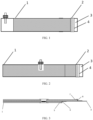
- FIG. 1 and FIG. 2 respectively show structural diagrams of positive electrode plates in two examples (positions of a tab are different), where 1 denotes a head of the positive electrode plate; 2 denotes a tail of the positive electrode plate; and 3 denotes a foil uncoating region.
- there are two termination tapes of a positive electrode plate that is, a plate termination tape of the positive electrode plate is provided on both side surfaces of a positive electrode current collector in the positive electrode plate.
- 5 denotes a paste coating tail on one side of a positive electrode plate
- 6 denotes a termination tape on one side of the positive electrode plate
- 7 denotes a paste coating tail on the other side of the positive electrode plate
- 8 denotes a termination tape on the other side of the positive electrode plate.
- the termination tape 4, 6, or 8 of the positive electrode plate covers both a part of a paste and a part of a foil uncoating region.
- FIG. 1 there is a vertical line in the middle of the termination tape 4 of the positive electrode plate (the vertical line is a crease, generated by an intersection of the paste and the foil uncoating region, of the termination tape of the positive electrode plate).
- a region on the left side of the vertical line is covered by the paste (a part of tail 2 of the positive electrode plate is covered), and a region on the right side of the vertical line is covered by the foil uncoating region.
- An area A of the termination tape of the positive electrode plate is an area of a termination tape of the positive electrode plate disposed on one side surface of a positive electrode current collector of the positive electrode plate.
- termination tapes of the positive electrode plate provided on two side surfaces of the positive electrode current collector in the positive electrode plate have a same area.
- a ratio of A to C is 1, 1.1, 1.2, 1.3, 1.4, 1.5, 1.6, 1.7, 1.8, 1.9, 2, 2.1, 2.2, 2.3, 2.4, 2.5, 2.6, 2.7, 2.8, 2.9, 3, or a point value in a range formed by any two of the foregoing values.
- the ratio of A to C is in a range of 1.6-2.2.
- the area A of the termination tape of the positive electrode plate may be adjusted depending on a size of the positive electrode plate, an actual requirement, and the ratio of A to C, for example, may be in a range of 3-120 cm 2 .
- the area A of the termination tape of the positive electrode plate is 3 cm 2 , 5 cm 2 , 10 cm 2 , 20 cm 2 , 30 cm 2 , 40 cm 2 , 50 cm 2 , 60 cm 2 , 70 cm 2 , 80 cm 2 , 90 cm 2 , 100 cm 2 , 120 cm 2 , or a point value in a range formed by any two of the foregoing values.
- the width C of the positive electrode plate may be adjusted depending on a battery size, an actual requirement, and the ratio of A to C, for example, be in a range of 1-120 cm.
- the width C of the positive electrode plate is 1 cm, 3 cm, 5 cm, 6 cm, 8 cm, 10 cm, 16 cm, 20 cm, 30 cm, 40 cm, 50 cm, 60 cm, 70 cm, 80 cm, 90 cm, 100 cm, 110 cm, 120 cm, or a point value in a range formed by any two of the foregoing values.
- the termination tape includes a substrate and a termination adhesive layer coated on a surface of the substrate.
- the substrate may be a conventional substrate used as a termination tape in the art, for example, PET (Polyethylene terephthalate).
- the termination adhesive layer uses a conventional material in the art.
- the termination adhesive layer is a rubber termination adhesive layer and/or a (meth)acrylic acid termination adhesive layer.
- the termination adhesive layer is a rubber termination adhesive layer.
- the rubber termination adhesive layer includes a cross-linked modified rubber.
- the cross-linked modified rubber is obtained by cross-linking modification of a first base under an action of a first cross-linking agent
- the first base is a rubber base, for example, is selected from at least one of a natural rubber, styrene-butadiene rubber, polyisobutylene rubber, butyl rubber, or nitrile rubber.
- the first cross-linking agent includes vinylene carbonate.
- Vinylene carbonate can participate in cross-linking polymerization of rubber, so as to prevent cracking, so that the rubber termination adhesive layer is more resistant to high temperature and high pressure, stabilizing an adhesive layer structure, and further improving high temperature performance of a battery cell.
- a content of vinylene carbonate ranges from 0.5 wt% to 5 wt%, for example, is 0.5 wt%, 0.6 wt%, 0.7 wt%, 0.8 wt%, 0.9 wt%, 1 wt%, 1.2 wt%, 1.5 wt%, 1.8 wt%, 2 wt%, 2.5 wt%, 3 wt%, 3.5 wt%, 3.8 wt%, 4 wt%, 4.5 wt%, or 5 wt%.
- the termination adhesive layer is a (meth)acrylic acid termination adhesive layer.
- the (meth)acrylic acid termination adhesive layer includes cross-linked modified (meth)acrylic acid and/or cross-linked modified (meth)acrylate.
- the (meth)acrylate is selected from C1-C10 alkyl (meth)acrylates, for example, is selected from at least one of isooctyl acrylate, n-butyl acrylate, methyl acrylate, ethyl acrylate, n-propyl acrylate, or the like.
- the (meth)acrylic acid termination adhesive layer includes at least one of cross-linked modified methacrylic acid, cross-linked modified acrylic acid, cross-linked modified methacrylate, or cross-linked modified acrylate.
- the (meth)acrylic acid termination adhesive layer is obtained by cross-linking modification of a second base under an action of a second cross-linking agent, and the second base is selected from at least one of methacrylic acid, acrylic acid, methacrylate, or acrylate.
- the second cross-linking agent includes vinylene carbonate.
- Vinylene carbonate can participate in cross-linking polymerization of acrylic acid, so that an acrylic acid termination adhesive layer includes an ethyl carbonate structure chain, making the acrylic acid termination adhesive layer more resistant to high temperature and high pressure, stabilizing an adhesive layer structure, and further improving high temperature performance of a battery cell.
- a content of vinylene carbonate ranges from 0.5 wt% to 5 wt%, for example, is 0.5 wt%, 0.6 wt%, 0.7 wt%, 0.8 wt%, 0.9 wt%, 1 wt%, 1.2 wt%, 1.5 wt%, 1.8 wt%, 2 wt%, 2.5 wt%, 3 wt%, 3.5 wt%, 3.8 wt%, 4 wt%, 4.5 wt%, or 5 wt%.
- the termination adhesive layer may further include another conventional component such as an auxiliary agent.
- the auxiliary agent is, for example, selected from at least one of an antioxidant, an inorganic filler, or the like.
- the antioxidant may be a conventional antioxidant suitable for a principal component (for example, a cross-linked modified rubber, or cross-linked modified (meth)acrylic acid and/or cross-linked modified (meth)acrylate).
- a principal component for example, a cross-linked modified rubber, or cross-linked modified (meth)acrylic acid and/or cross-linked modified (meth)acrylate.
- the inorganic filler may be a conventional inorganic filler suitable for a primary component.
- the termination adhesive layer includes neither a cross-linked modified rubber nor cross-linked modified (meth)acrylic acid and/or cross-linked modified (meth)acrylate, but is another conventional termination adhesive layer material in the art.
- a thickness of the positive electrode plate termination tape ranges from 8 ⁇ m to 20 ⁇ m, for example, is 8 ⁇ m, 9 ⁇ m, 10 ⁇ m, 11 ⁇ m, 12 ⁇ m, 13 ⁇ m, 14 ⁇ m, 15 ⁇ m, 16 ⁇ m, 17 ⁇ m, 18 ⁇ m, 19 ⁇ m, or 20 ⁇ m.
- an electrolyte solution is also an important factor that affects safety performance of a battery at high temperature and high pressure.
- a possible reason is that in a conventional technology, the electrolyte solution is easily decomposed at high temperature and high pressure, and redox decomposition occurs on surfaces of positive and negative electrodes to destroy an SEI film, causing impedance of a battery cell to continuously increase, and deteriorating cell performance. Therefore, the applicant makes an in-depth study on a composition of the electrolyte solution.
- the non-aqueous electrolyte solution includes a non-aqueous organic solvent, a lithium salt, and an optional electrolyte additive.
- performance of the non-aqueous electrolyte solution can be more stable at high temperature and high pressure by controlling a content of a lithium salt and/or by using an electrolyte additive with a specific content and composition.
- a concentration of the lithium salt is specially controlled. Using a total weight of the non-aqueous electrolyte solution as a reference, a content of the lithium salt is denoted as B1 mol/L.
- a ratio of A to B1 is in a range of 2-20.
- the ratio of A to B1 is 2, 3, 4, 5, 6, 7, 8, 9, 10, 11, 12, 13, 14, 15, 16, 17, 18, 19, 20, or a point value in a range formed by any two of the foregoing values.
- the content B1 of the lithium salt ranges from 1 mol/L to 6 mol/L, for example, is 1 mol/L, 1.5 mol/L, 2 mol/L, 2.5 mol/L, 3 mol/L, 3.5 mol/L, 4 mol/L, 5 mol/L, or 6 mol/L.
- the concentration B1 of the lithium salt ranges from 1.5 mol/L to 3 mol/L.
- the concentration of the lithium salt in the present disclosure is higher than a lithium salt concentration commonly used in a conventional technology (usually 1.2 mol/L or less).
- the lithium salt is selected from at least one of lithium bis(trifluoromethanesulfonyl)imide, lithium bis(fluorosulfonyl)imide, or lithium hexafluorophosphate.
- optional means that it may or may not exist.
- optional electrolyte additive means that the non-aqueous electrolyte solution may include an electrolyte additive or may not include an electrolyte additive.
- the non-aqueous electrolyte solution does not include the electrolyte additive.
- the non-aqueous electrolyte solution includes the electrolyte additive.
- the electrolyte additive includes fluoroethylene carbonate.
- a content of fluoroethylene carbonate is denoted as B2 wt%.
- a ratio of A to B2 is in a range of 0.5-5.
- the ratio of A to B2 is 0.5, 0.8, 1, 1.2, 1.4, 1.5, 1.8, 2, 2.2, 2.5, 2.8, 3, 3.2, 3.5, 3.8, 4, 4.5, 5, or a point value in a range formed by any two of the foregoing values.
- the content B2 of fluoroethylene carbonate ranges from 5 wt% to 30 wt%, and for example, is 5 wt%, 6 wt%, 7 wt%, 8 wt%, 9 wt%, 10 wt%, 12 wt%, 15 wt%, 18 wt%, 20 wt%, 22 wt%, 25 wt%, 28 wt%, or 30 wt%.
- the content of fluoroethylene carbonate ranges from 5 wt% to 10 wt%.
- the electrolyte additive includes lithium difluoro(oxalato)borate.
- the content of lithium difluoro(oxalato)borate is denoted as B3 wt%.
- a ratio of A to B3 is in a range of 5-200.
- the ratio of A to B3 is 5, 10, 15, 20, 25, 30, 40, 50, 60, 80, 100, 120, 150, 180, 200, or a point value in a range formed by any two of the foregoing values.
- the content B3 of lithium difluoro(oxalato)borate ranges from 0.1 wt% to 3 wt%, and for example, is 0.1 wt%, 0.2 wt%, 0.3 wt%, 0.4 wt%, 0.5 wt%, 0.6 wt%, 0.7 wt%, 0.8 wt%, 0.9 wt%, 1 wt%, 1.2 wt%, 1.5 wt%, 1.8 wt%, 2 wt%, 2.2 wt%, 2.5 wt%, 2.8 wt%, or 3 wt%.
- the content B3 of difluoro(oxalato)borate ranges from 0.2 wt% to 1 wt%.
- the electrolyte additive includes lithium difluorophosphate.
- a content of lithium difluorophosphate is denoted as B4 wt%.
- a ratio of A to B4 is in a range of 5-200.
- the ratio of A to B4 is 5, 10, 15, 20, 25, 30, 40, 50, 60, 80, 100, 120, 150, 180, 200, or a point value in a range formed by any two of the foregoing values.
- the content B4 of lithium difluorophosphate ranges from 0.1 wt% to 3 wt%, for example, is 0.1 wt%, 0.2 wt%, 0.3 wt%, 0.4 wt%, 0.5 wt%, 0.6 wt%, 0.7 wt%, 0.8 wt%, 0.9 wt%, 1 wt%, 1.2 wt%, 1.5 wt%, 1.8 wt%, 2 wt%, 2.2 wt%, 2.5 wt%, 2.8 wt%, or 3 wt%.
- the content B4 of lithium difluorophosphate ranges from 0.2 wt% to 1 wt%.
- the electrolyte additive includes 1,2-bis(cyanoethoxy)ethane.
- a content of 1,2-bis(cyanoethoxy)ethane is denoted as B5 wt%.
- a ratio of A to B5 is in a range of 2-40.
- the ratio of A to B5 is 2, 3, 4, 5, 6, 7, 8, 9, 10, 15, 20, 25, 30, 35, 40, or a point value in a range formed by any two of the foregoing values.
- the content B5 of 1,2-bis(cyanoethoxy)ethane ranges from 0.5 wt% to 3 wt%, for example, is 0.5 wt%, 0.6 wt%, 0.7 wt%, 0.8 wt%, 0.9 wt%, 1 wt%, 1.2 wt%, 1.5 wt%, 1.8 wt%, 2 wt%, 2.2 wt%, 2.5 wt%, 2.8 wt%, or 3 wt%.
- the content B5 of 1,2-bis(cyanoethoxy)ethane ranges from 1 wt% to 2 wt%.
- the electrolyte additive includes 1,2,3-tris(2-cyanoethoxy) propane.
- B6 wt% a content of 1,2,3-tris(2-cyanoethoxy)propane is denoted as B6 wt%.
- a ratio of A to B6 is in a range of 2-40.
- the ratio of A to B6 is 2, 3, 4, 5, 6, 7, 8, 9, 10, 15, 20, 25, 30, 35, 40, or a point value in a range formed by any two of the foregoing values.
- the content B6 of 1,2,3-tris(2-cyanoethoxy)propane ranges from 0.5 wt% to 3 wt%, for example, is 0.5 wt%, 0.6 wt%, 0.7 wt%, 0.8 wt%, 0.9 wt%, 1 wt%, 1.2 wt%, 1.5 wt%, 1.8 wt%, 2 wt%, 2.2 wt%, 2.5 wt%, 2.8 wt%, or 3 wt%.
- the content B6 of 1,2,3-tris(2-cyanoethoxy)propane ranges from 1 wt% to 2 wt%.
- the electrolyte additive may further include another component, which is, for example, selected from at least one of 1,3-propanesulfonic acid lactone, 1-propene 1,3-sultone, ethylene sulphite, ethylene sulfate, lithium bis(oxalate)borate, lithium difluoro oxalate phosphate, or vinyl ethylene carbonate.
- another component which is, for example, selected from at least one of 1,3-propanesulfonic acid lactone, 1-propene 1,3-sultone, ethylene sulphite, ethylene sulfate, lithium bis(oxalate)borate, lithium difluoro oxalate phosphate, or vinyl ethylene carbonate.
- a total content of the electrolyte additive ranges from 0 wt% to 10 wt%, for example, is 1 wt%, 2 wt%, 3 wt%, 4 wt%, 5 wt%, 6 wt%, 7 wt%, 8 wt%, 9wt%, or 10 wt%.
- the content is 0 wt%, it indicates that the non-aqueous electrolyte solution does not include the electrolyte additive.
- various implementations of the lithium salt and the electrolyte additive in the non-aqueous electrolyte solution may be combined in any manner.
- the foregoing exemplified Y1 th implementation (defining a lithium salt) and Y2 th -Y6 th implementations (defining an electrolyte additive) may be combined in any manner, and optionally, another electrolyte additive is added or not added.
- the Y5 th and the Y6 th are used as a new combination, which is denoted as Y56.
- the electrolyte additive includes 1,2-bis(cyanoethoxy)ethane and/or 1,2,3-tris(2-cyanoethoxy)propane. That is, the Y56 th implementation includes the Y5 th implementation and the Y6 th implementation, and further includes an implementation in which the Y5 th and the Y6 th are combined.
- the implementation is the Y5 th implementation or the Y6 th implementation, and details are not described herein again.
- a content of 1,2-bis(cyanoethoxy)ethane and 1,2,3-tris(2-cyanoethoxy)propane is denoted as B56 wt% by using a total weight of the non-aqueous electrolyte solution as a reference.
- a ratio of A to B56 is in a range of 2-40.
- the ratio of A to B56 is 2, 3, 4, 5, 6, 7, 8, 9, 10, 15, 20, 25, 30, 35, 40, or a point value in a range formed by any two of the foregoing values.
- the total content B56 of 1,2-bis(cyanoethoxy)ethane and 1,2,3-tris(2-cyanoethoxy)propane ranges from 0.5 wt% to 3 wt%, for example, is 0.5 wt%, 0.6 wt%, 0.7 wt%, 0.8 wt%, 0.9 wt%, 1 wt%, 1.2 wt%, 1.5 wt%, 1.8 wt%, 2 wt%, 2.2 wt%, 2.5 wt%, 2.8 wt%, or 3 wt%.
- the total content B56 of 1,2-bis(cyanoethoxy)ethane and 1,2,3-tris(2-cyanoethoxy)propane ranges from 1 wt% to 2 wt%.
- ratio generally refers to a proportion calculated by using a numerical portion of two parameters.
- the electrolyte additive includes at least lithium difluoro(oxalato)borate.
- the electrolyte additive includes at least lithium difluorophosphate.
- the electrolyte additive includes at least lithium difluorophosphate.
- the electrolyte additive includes at least fluoroethylene carbonate.
- the electrolyte additive includes at least 1,2-bis(cyanoethoxy)ethane and/or 1,2,3-tris(2-cyanoethoxy)propane.
- the electrolyte additive includes a combination of Y2 and Y3.
- the electrolyte additive includes a combination of Y2 and Y4.
- the electrolyte additive includes a combination of Y2 and Y56.
- the electrolyte additive includes a combination of Y3 and Y4.
- the electrolyte additive includes a combination of Y3 and Y56.
- the electrolyte additive includes a combination of Y4 and Y56.
- the electrolyte additive includes a combination of Y2, Y3, and Y4.
- the electrolyte additive includes a combination of Y2, Y3, and Y56.
- the electrolyte additive includes a combination of Y2, Y4, and Y56.
- the electrolyte additive includes a combination of Y3, Y4, and Y56.
- the electrolyte additive includes a combination of Y2, Y3, Y4, and Y56.
- the non-aqueous electrolyte solution necessarily include the lithium salt, and optionally includes the electrolyte additive.
- the non-aqueous electrolyte solution may include only Y1.
- the non-aqueous electrolyte solution may include only the Y2-Y6 and a combination thereof (that is, a content of the lithium salt may not be in the range defined in Y1).
- the non-aqueous electrolyte solution may include Y1 and Y2-Y6 and an internal combination thereof.
- the non-aqueous electrolyte solution includes a combination of Y1 and Y2.
- the non-aqueous electrolyte solution includes a combination of Y1 and Y3.
- the non-aqueous electrolyte solution includes a combination of Y1 and Y4.
- the non-aqueous electrolyte solution includes a combination of Y1 and Y56.
- the non-aqueous electrolyte solution includes Y1 and a combination of Y2 and Y3.
- the non-aqueous electrolyte solution includes Y1 and a combination of Y2 and Y4.
- the non-aqueous electrolyte solution includes Y1 and a combination of Y2 and Y56.
- the non-aqueous electrolyte solution includes Y1 and a combination of Y3 and Y4.
- the non-aqueous electrolyte solution includes Y1 and a combination of Y3 and Y56.
- the non-aqueous electrolyte solution includes Y1 and a combination of Y4 and Y56.
- the non-aqueous electrolyte solution includes Y1 and a combination of Y2, Y3, and Y4.
- the non-aqueous electrolyte solution includes Y1 and a combination of Y2, Y3, and Y56.
- the non-aqueous electrolyte solution includes Y1 and a combination of Y2, Y4, and Y56.
- the non-aqueous electrolyte solution includes Y1 and a combination of Y3, Y4, and Y56.
- the non-aqueous electrolyte solution includes Y1 and a combination of Y2, Y3, Y4, and Y56.
- the non-aqueous electrolyte solution further includes a non-aqueous organic solvent
- the non-aqueous organic solvent may be a conventional organic solvent in the art, for example, may be at least one of a carbonate, a carboxylic acid ester, or a fluorinated ether.
- the carbonate is, for example, selected from one or more combinations of ethylene carbonate, propylene carbonate, dimethyl carbonate, ethyl methyl carbonate, diethyl carbonate, or methyl propyl carbonate.
- the carboxylic acid ester is, for example, selected from one or more combinations of ethyl propionate or propyl propionate.
- the fluorinated ether for example, is selected from 1,1,2,3-tetrafluoroethyl-2,2,3,3-tetrafluoropropyl ether.
- the non-aqueous organic solvent includes a combination of ethylene carbonate (EC), propylene carbonate (PC), propyl propionate (PP), 1,1,2,3-tetrafluoroethyl-2,2,3,3-tetrafluoropropyl ether in a weight ratio of (1-3):(0.5-2):(2-4):(1-3).
- EC ethylene carbonate
- PC propylene carbonate
- PP propyl propionate
- 1,1,2,3-tetrafluoroethyl-2,2,3,3-tetrafluoropropyl ether in a weight ratio of (1-3):(0.5-2):(2-4):(1-3).
- a short-circuit risk caused by deformation and warping of a termination tape can be reduced by specially limiting a size of the termination tape of a positive electrode plate.
- a material of a termination adhesive layer on the termination tape of the positive electrode plate is further limited, so that a phenomenon that the adhesive layer is easily dissolved in an electrolyte solution at high temperature and high pressure can be further reduced, thereby further reducing a short-circuit risk caused by deformation and warping of the termination tape.
- a limitation on the electrolyte solution in Y1-Y6 can have synergistic effect with a limitation on the termination tape of the positive electrode plate described above (in particular, a limitation on the material of the termination adhesive layer), so that high-temperature performance of a battery cell of the prepared battery can be effectively improved, and a problem of lithium deposition at an edge of an electrode plate occurred after cycling of the battery cell can also be solved.
- one or more combinations of Y1-Y6 are further combined with X1 and/or X2.
- the battery includes a combination of X1 and Y1.
- the battery includes a combination of X2 and Y1.
- the non-aqueous electrolyte solution includes a high concentration of solute lithium salt
- the high concentration of solute lithium salt is more conducive to enhancing an interaction between a solute and a solvent in the solution, and free solvent molecules disappear, forming a new non-aqueous electrolyte solution, that is, a high concentration of non-aqueous electrolyte solution, which is more conducive to forming a specific three-dimensional network structure of the non-aqueous electrolyte solution in a current proportion.
- Ions (such as lithium ions) coordinate with limited free solvent molecules and anions, which is significantly different from a conventional low-concentration electrolyte solution with free solvent molecules as a main body, and may better slow down aging of an adhesive layer in a termination tape of a positive electrode plate after the termination tape of the positive electrode plate is soaked in the non-aqueous electrolyte solution, so that the adhesive layer still maintains a good multi-flex resistance and binding force.
- a concentration of the lithium salt increases, a working voltage range of the non-aqueous electrolyte solution becomes wider, a high-voltage positive electrode material is matched to implement stable charging and discharging, and combustible solvent molecules are less, so that a reaction between the electrolyte solution and active oxygen generated from the positive electrode may be alleviated, and a service life and safety of the battery may be improved.
- the battery includes a combination of X1 and Y2.
- the battery includes a combination of X2 and Y2.
- fluoroethylene carbonate can have good synergistic effect with the termination tape of the positive electrode plate.
- fluoroethylene carbonate is a carbonate compound with high viscosity, large intermolecular dipole moment, and strong polarity, and has poor compatibility with the termination adhesive layer in the termination tape of the positive electrode plate.
- a ratio of A to B2 is in a range of 0.
- an intermolecular force of the termination adhesive layer may be strengthened after the termination tape of the positive electrode plate is soaked in the non-aqueous electrolyte solution, to suppress flow and dispersion of the termination adhesive layer when the termination adhesive layer is soaked in the non-aqueous electrolyte solution, so that the termination adhesive layer maintains good viscosity.
- fluoroethylene carbonate may form a relatively strong SEI film on surfaces of positive and negative electrodes, stabilizing positive and negative electrode interfaces at high temperature and high pressure, reducing side reactions and generation of hydrofluoric acid, and avoiding corrosion and damage of the hydrofluoric acid to the termination adhesive layer.
- the battery includes a combination of X1 and Y3.
- the battery includes a combination of X2 and Y3.
- lithium difluoro(oxalato)borate When the non-aqueous electrolyte solution includes lithium difluoro(oxalato)borate, lithium difluoro(oxalato)borate can adsorb and complex small molecule substances (such as Cl, SO 4 2- , HF, and H 2 O) in the non-aqueous electrolyte solution, so as to slow down aging of an adhesive layer in the termination tape of the positive electrode plate soaked in the non-aqueous electrolyte solution, so that the adhesive layer still maintains a good multi-flex resistance and binding force. This ensures that the adhesive layer still maintains tensile strength after being soaked in the non-aqueous electrolyte solution, and keeps the adhesive layer stable and reduces flow of the adhesive layer.
- complex small molecule substances such as Cl, SO 4 2- , HF, and H 2 O
- Lithium difluoro(oxalato)borate may also enhance protective effect on precipitation of a positive electrode active material (a metal such as cobalt) while adsorbing and complexing small molecules in the non-aqueous electrolyte solution.
- a positive electrode active material a metal such as cobalt
- lithium difluoro(oxalato)borate in the non-aqueous electrolyte solution may further form a solid electrode/electrolyte interface film on the positive and negative electrode surfaces, so as to optimize intercalation/deintercalation of ions on the positive and negative electrode surfaces, thereby improving cycling performance of the battery.
- the battery includes a combination of X1 and Y4.
- the battery includes a combination of X2 and Y4.
- lithium difluorophosphate can have better synergistic effect with the termination tape of the positive electrode plate.
- lithium difluorophosphate can adsorb and complex more small molecule substances (such as Cl, SO 4 2- , HF, and H 2 O) in the non-aqueous electrolyte solution, to inhibit hydrolysis of an acrylic acid termination adhesive layer in the termination tape of the positive electrode plate after the termination tape of the positive electrode plate is soaked in the non-aqueous electrolyte solution, thereby effectively increasing stability of a macromolecular cross-linked structure in the acrylic acid termination adhesive layer, strengthening a molecular structure of the acrylic acid termination adhesive layer, and making the acrylic acid termination adhesive layer maintain good viscosity and reducing liquefaction and flow.
- small molecule substances such as Cl, SO 4 2- , HF, and H 2 O
- the lithium difluorophosphate in the non-aqueous electrolyte solution is combined with proton acid in the non-aqueous electrolyte solution, so that not only corrosion and damage of the proton acid to the acrylic acid termination adhesive layer are avoided, but also impact of the proton acid on an electrode material may be avoided, and an excellent electrode/electrolyte interface film is formed on the positive and negative electrodes, optimizing intercalation/deintercalation of ions (such as lithium ions) on the electrode surfaces, and improving cycling performance of a secondary lithium-ion battery.
- ions such as lithium ions
- the battery includes a combination of X1 and Y56.
- the battery includes a combination of X2 and Y56.
- 1,2-bis(cyanoethoxy)ethane and/or 1,2,3-tris(2-cyanoethoxy)propane 1,2-bis(cyanoethoxy)ethane and/or 1,2,3-tris(2-cyanoethoxy)propane can react at a high temperature, and an ether bond is broken to generate (CH 2 ) 2 CN free radical, which is relatively stable under impact of a cyano group and a chain reaction of free radical may be more fully triggered.
- some macromonomers in the adhesive layer may be further cross-linked and polymerized, so that a molecular chain breakage of a cross-linking body in the termination adhesive layer at a high temperature can be inhibited, stability of a macro cross-linked structure of the adhesive layer can be effectively enhanced, and a molecular structure of the adhesive layer may be strengthened.
- a group including N in 1,2-bis(cyanoethoxy)ethane and/or 1,2,3-tris(2-cyanoethoxy)propane in the non-aqueous electrolyte solution may be combined with a proton acid in the electrolyte, so that not only corrosion and damage of the proton acid to the termination adhesive layer are avoided, but also impact of the proton acid on an electrode material may be avoided, and an excellent electrode/electrolyte interface film is formed on a positive electrode, optimizing intercalation/deintercalation of ions (such as lithium ions) on the electrode surface, and improving cycling performance of a battery.
- the battery includes a combination of two or more of X1 and/or X2 and Y1-Y6 (see combination examples listed above).
- the positive electrode plate includes a positive electrode current collector and a positive electrode active material layer coated on a surface of either or both sides of the positive electrode current collector.
- the positive electrode active material layer includes a positive electrode active material, a conductive agent, and a binder.
- the positive electrode active material is selected from lithium cobalt oxide or lithium cobalt oxide doped and coated with two or more elements in Al, Mg, Mn, Cr, Ti, and Zr.
- a chemical formula of the lithium cobalt oxide doped and coated with the two or more elements in Mg, Mn, Cr, Ti, and Zr is Li x Co 1-y1-y2-y3-y4 A y1 B y2 C y3 D y4 O 2 , where 0.95 ⁇ x ⁇ 1.05, 0.01 ⁇ y1 ⁇ 0.1, 0.01 ⁇ y2 ⁇ 0.1, 0 ⁇ y3 ⁇ 0.1, 0 ⁇ y4 ⁇ 0.1, and A, B, C, and D are selected from the two or more elements in Al, Mg, Mn, Cr, Ti, and Zr.
- a negative electrode plate includes a negative electrode current collector and a negative electrode active material layer coated on a surface of either or both sides of the negative electrode current collector, and the negative electrode active material layer includes a negative electrode active material, a conductive agent, and a binder.
- the negative electrode active material is selected from graphite or a graphite composite material including 1-12 wt% SiO x /C or Si/C.
- a charge cut-off voltage of the battery is 4.45V or above.
- the battery is a lithium-ion battery.
- components of a lithium-ion battery are prepared and assembled in a manner in the following preparation example, unless otherwise specified.
- a positive electrode active material LiCoO 2 , a binder polyvinylidene fluoride (PVDF), and a conductive agent acetylene black were mixed at a weight ratio of 97.2: 1.3: 1.5, added with N-methylpyrrolidone (NMP).
- NMP N-methylpyrrolidone
- the mixture was stirred under action of a vacuum blender until a mixed system became a positive electrode slurry with uniform fluidity.
- the positive electrode slurry was evenly applied on aluminum foil having a thickness ranging from 9 ⁇ m to 12 ⁇ m.
- the coated aluminum foil was baked in a five-stage oven with different temperatures and then dried in an oven at 120°C for 8 hours, followed by rolling and cutting, to obtain required positive electrode plates with different sizes. For specific widths of electrode plates, see each group of examples.
- SWCNT conductive agent single-walled carbon nanotube
- SP conductive agent conductive carbon black
- CMC binder sodium carboxymethyl cellulose
- SBR binder styrene-butadiene rubber
- a polyethylene separator with a thickness ranging from 7 ⁇ m to 9 ⁇ m is selected.
- the positive electrode plate, the separator, and the negative electrode plate that are prepared above were wound, and a termination tape of the positive electrode plate is attached at an end of the positive electrode plate (termination tapes of the positive electrode plate on both sides of the positive electrode current collector have a same area), to obtain an unfilled bare battery cell.
- the bare cell was placed in outer packaging foil, the prepared electrolyte solution was injected into the dried bare cell, and after processes such as vacuum packaging, standing, forming, shaping, and sorting, the lithium-ion battery required was obtained.
- the batteries obtained in examples and comparative examples were placed in an environment of (45 ⁇ 2)°C to stand for 2 to 3 hours.
- the batteries were charged at a constant current of 1C, with a cut-off current of 0.05C.
- the batteries were left aside for 5 minutes, and then discharged at a constant current of 0.7C to a cut-off voltage of 3.0 V.
- the highest discharge capacity for the first three cycles was recorded as an initial capacity Q.
- the number of cycles reaches 400
- the last discharge capacity of each battery was recorded as Qi, and batteries obtained after 400 cycles are disassembled to record whether lithium deposition occurred on an edge of each battery. Results were recorded in a table of each group.
- Capacity retention rate (%) Q 1 /Q ⁇ 100%.
- the batteries obtained in examples and comparative examples were charged and discharged three times at a charge and discharge C-rate of 0.5C at room temperature, and then charged to a fully charged state at a C-rate of 0.5C, and the highest discharge capacity Q 2 and a battery thickness T 1 of the first three cycles at 0.5C for each battery were recorded.
- the batteries in a fully charged state were stored at a specified temperature (70°C or 85°C, for details, refer to each group of examples) for a specific time (for details, refer to each group of examples).
- the batteries obtained in examples and comparative examples were heated in a convection mode or by using a circulating hot air box at a start temperature of (25 ⁇ 3)°C, with a temperature change rate of (5 ⁇ 2)°C/min. The temperature was raised to (130 ⁇ 2)°C, the batteries were kept at the temperature for 60 minutes, and then the test ended.
- the recorded status results of the batteries were recorded in a table of each group.
- the termination tape of the positive electrode plate and/or the non-aqueous electrolyte solution are separately adjusted. These examples are merely used to illustrate exemplary combination manners of the present disclosure, and are not intended to limit a preferred combination manner. A person skilled in the art can infer good effect of other combination manners based on these combination manners.
- This example group is used for an example of a combination of [X1+Y1].
- 82 parts by weight of a natural rubber, 24 parts by weight of styrene-butadiene rubber, 20 parts by weight of butyl rubber, 10 parts by weight of nitrile rubber, 28 parts by weight of terpene resin, and 16 parts by weight of antioxidant were sequentially added into 1,500 parts by weight of a mixed solvent (ethyl ester, toluene, and xylene at a mass ratio of 1:1:1), and the resulting mixture was stirred evenly at a temperature of 85°C to obtain a mixed solution.
- 105 parts by weight of polyisobutylene rubber and 38 parts by weight of inorganic pigment were sequentially added into the mixed solution, and the resulting mixture was stirred evenly at a temperature of 80°C to obtain a mixed solution.
- a specific part by weight of cross-linking agent vinylene carbonate was added into the mixed solution, and the resulting mixture was stirred evenly at room temperature and applied on a surface of a PET substrate, to obtain the termination tape of the positive electrode plate
- This example group is used for an example of a combination of [X2+Y1].
- 40 parts by weight of isooctyl acrylate, 3 parts by weight of butyl acrylate, 3 parts by weight of vinyl acetate, 3 parts by weight of acrylic acid, 5 parts by weight of polyisoprene rubber, 1 part by weight of pentaerythritol trimethacrylate, 1 part by weight of azobiisobutyronitrile, and 40 parts by weight of ethyl ester were mixed and stirred evenly at a temperature of 80°C to obtain a mixed solution. Then a specific part by weight of cross-linking agent vinylene carbonate was added into the mixed solution, and the resulting mixture was stirred evenly at room temperature and applied on a surface of a PET substrate, to obtain the termination tape of the positive electrode plate.
- the set of examples is used for a combination of examples [X1+Y1+Y2].
- 82 parts by weight of a natural rubber, 24 parts by weight of styrene-butadiene rubber, 20 parts by weight of butyl rubber, 10 parts by weight of nitrile rubber, 28 parts by weight of terpene resin, and 16 parts by weight of antioxidant were sequentially added into 1,500 parts by weight of a mixed solvent (ethyl ester, toluene, and xylene at a mass ratio of 1:1:1), and the resulting mixture was stirred evenly at a temperature of 85°C to obtain a mixed solution.
- 105 parts by weight of polyisobutylene rubber and 38 parts by weight of inorganic pigment were sequentially added into the mixed solution, and the resulting mixture was stirred evenly at a temperature of 80°C to obtain a mixed solution.
- a specific part by weight of cross-linking agent vinylene carbonate was added into the mixed solution, and the resulting mixture was stirred evenly at room temperature and applied on a surface of a PET substrate, to obtain the termination tape of the positive electrode plate
- Example III1 A (cm 2 ) B2 (wt%) C (cm) A/B2 A/C D (wt%) Comparative Example III1 12 30 8 0.4 1.5 / Comparative Example III2 12 8 16 1.5 0.75 / Comparative Example III3 12 30 8 0.4 1.5 0.6 Comparative Example III4 12 8 16 1.5 0.75 0.6 Comparative Example III5 12 / 8 / 1.5 0.6
- Example III7 19.5 30 12 0.65 1.63 3.0 A is an area of a termination tape of a positive electrode plate, in a unit of cm 2 ;
- B2 is a content of fluoroethylene carbonate in a non-aqueous electrolyte solution, in a
- the set of examples is used for a combination of examples [X2+Y1+Y2].
- Example IV1 A (cm 2 ) B2 (wt%) C (cm) A/B2 A/C D (wt%) Comparative Example IV1 14.25 30 9 0.475 1.58 / Comparative Example IV2 14.25 10 15 1.425 0.95 / Comparative Example IV3 14.25 30 9 0.475 1.58 1.0 Comparative Example IV4 14.25 10 15 1.425 0.95 1.0 Comparative Example IV5 14.25 / 9 / 1.58 1.0 Comparative Example IV6 14.25 10 9 1.425 1.58 / Example IV1 14.25 10 9 1.425 1.58 1.0 Example IV2 12 5 7 2.4 1.71 1.5 Example IV3 16 7 10 2.29 1.60 2.0 Example IV4 13.5 15 8 0.9 1.69 3.0 Example IV5 35 30 16 1.167 2.19 4.0 Example IV6 24 12 12 2 2.00 5.0 A is an area of a termination tape of a positive electrode plate, in a unit of cm 2 ; B2 is a content of fluoro
- the set of examples is used for a combination of examples [X1+Y1+Y3].
- 82 parts by weight of a natural rubber, 24 parts by weight of styrene-butadiene rubber, 20 parts by weight of butyl rubber, 10 parts by weight of nitrile rubber, 28 parts by weight of terpene resin, and 16 parts by weight of antioxidant were sequentially added into 1,500 parts by weight of a mixed solvent (ethyl ester, toluene, and xylene at a mass ratio of 1:1:1), and the resulting mixture was stirred evenly at a temperature of 85°C to obtain a mixed solution.
- 105 parts by weight of polyisobutylene rubber and 38 parts by weight of inorganic pigment were sequentially added into the mixed solution, and the resulting mixture was stirred evenly at a temperature of 80°C to obtain a mixed solution.
- a specific part by weight of cross-linking agent vinylene carbonate was added into the mixed solution, and the resulting mixture was stirred evenly at room temperature and applied on a surface of a PET substrate, to obtain the termination tape of the positive electrode plate
- Example V1 A (cm 2 ) B3 (wt%) C (cm) A/B3 A/C D (wt%) Comparative Example V1 13.5 3 8 4.5 1.69 / Comparative Example V2 13.5 0.8 16 16.88 0.84 / Comparative Example V3 13.5 3 8 4.5 1.69 0.8 Comparative Example V4 13.5 0.8 16 16.88 0.84 0.8 Comparative Example V5 13.5 / 8 / 1.69 0.8 Example V1 13.5 0.8 8 16.88 1.69 / Example V2 13.5 0.8 8 16.88 1.69 0.8 Example V3 18 1 11 18 1.64 1.5 Example V4 16.5 0.1 10 165 1.65 2.0 Example V5 21 0.7 13 30 1.62 1.0 Example V6 15 3 9 5 1.67 3.0 Example V7 19.5 0.2 12 97.5 1.63 5.0 A is an area of a termination tape of a positive electrode plate, in a unit of cm 2 ; B3 is a content of lithium difluoro
- the set of examples is used for a combination of examples [X2+Y1+Y4].
- Example VI1 A (cm 2 ) B4 (wt%) C (cm) A/B4 A/C D (wt%) Comparative Example VI1 13.5 3 8 4.5 1.69 / Comparative Example VI2 13.5 0.5 18 27 0.75 / Comparative Example VI3 13.5 3 8 4.5 1.69 0.5 Comparative Example VI4 13.5 0.5 18 27 0.75 0.5 Comparative Example VI5 13.5 / 8 / 1.69 0.5 Example VI1 13.5 0.5 8 27 1.69 / Example VI2 13.5 0.5 8 27 1.69 0.5 Example VI3 16.5 1 10 16.5 1.65 1.5 Example VI4 15 0.1 9 150 1.67 2.0 Example VI5 10.5 0.7 6 15 1.75 1.0 Example VI6 19.5 3 12 6.5 1.63 3.0 Example VI7 22.5 0.2 14 112.5 1.61 5.0 A is an area of a termination tape of a positive electrode plate, in a unit of cm 2 ; B4 is a content of lithium difluorophosphat
- the set of examples is used for a combination of examples [X1+Y1+Y56].
- 82 parts by weight of a natural rubber, 24 parts by weight of styrene-butadiene rubber, 20 parts by weight of butyl rubber, 10 parts by weight of nitrile rubber, 28 parts by weight of terpene resin, and 16 parts by weight of antioxidant were sequentially added into 1,500 parts by weight of a mixed solvent (ethyl ester, toluene, and xylene at a mass ratio of 1:1:1), and the resulting mixture was stirred evenly at a temperature of 85°C to obtain a mixed solution.
- 105 parts by weight of polyisobutylene rubber and 38 parts by weight of inorganic pigment were sequentially added into the mixed solution, and the resulting mixture was stirred evenly at a temperature of 80°C to obtain a mixed solution.
- a specific part by weight of cross-linking agent vinylene carbonate was added into the mixed solution, and the resulting mixture was stirred evenly at room temperature and applied on a surface of a PET substrate, to obtain the termination tape of the positive electrode plate
- the set of examples is used for a combination of examples [X1+Y1+Y56].
- 40 parts by weight of isooctyl acrylate, 3 parts by weight of butyl acrylate, 3 parts by weight of vinyl acetate, 3 parts by weight of acrylic acid, 5 parts by weight of polyisoprene rubber, 1 part by weight of pentaerythritol trimethacrylate, 1 part by weight of azobiisobutyronitrile, and 40 parts by weight of ethyl ester were mixed and stirred evenly at a temperature of 80°C to obtain a mixed solution. Then a specific part by weight of cross-linking agent vinylene carbonate was added into the mixed solution, and the resulting mixture was stirred evenly at room temperature and applied on a surface of a PET substrate, to obtain the termination tape of the positive electrode plate.
- Example VIII1 A (cm 2 ) B56 (wt%) C (cm) A/B56 A/C D (wt%) Comparative Example VIII1 9.5 3% DENE+3% glycerol trinitrile 6 1.58 1.58 / Comparative Example VIII2 9.5 3% DENE 12 3.17 0.79 / Comparative Example VIII3 9.5 3% DENE+3% glycerol trinitrile 6 1.58 1.58 1.5 Comparative Example VIII4 9.5 3% DENE 12 3.17 0.79 1.5 Comparative Example VIII5 9.5 / 6 / 1.58 1.5 Comparative Example VIII6 9.5 3% DENE 6 3.17 1.58 / Example VIII1 9.5 3% DENE 6 3.17 1.58 1.5 Example VIII2 13.5 0.5% glycerol trinitrile 8 27 1.69 0.5 Example VIII3 16.5 1.5% DENE 10 11 1.65 1.0 Example VIII4 15 2% glycerol trinitrile 9 7.5 1.67 5.0 Example VIII5 2
- a battery in the present disclosure is a high-voltage battery and has excellent high-temperature performance.
- a size of a termination tape of a positive electrode plate is controlled, and a material of an adhesive layer is further controlled in a preferred solution, so that based on synergistic effect between the termination tape of the positive electrode plate and a non-aqueous electrolyte solution, high-temperature performance of a battery cell of a prepared battery can be effectively improved, and a problem of lithium deposition at an edge of an electrode plate occurred after cycling of the battery cell can also be solved.
Landscapes
- Chemical & Material Sciences (AREA)
- Chemical Kinetics & Catalysis (AREA)
- Electrochemistry (AREA)
- General Chemical & Material Sciences (AREA)
- Engineering & Computer Science (AREA)
- Manufacturing & Machinery (AREA)
- Inorganic Chemistry (AREA)
- Physics & Mathematics (AREA)
- Condensed Matter Physics & Semiconductors (AREA)
- General Physics & Mathematics (AREA)
- Materials Engineering (AREA)
- Organic Chemistry (AREA)
- Composite Materials (AREA)
- Secondary Cells (AREA)
Abstract
Description
- The present disclosure belongs to the field of battery technologies, and specifically relates to a battery.
- In recent years, batteries have been widely used in a smartphone, a tablet computer, intelligent wearing, an electric tool, an electric vehicle, and other fields. With wide application of batteries, consumers' requirements on energy density and use environment of the batteries are constantly increasing, which requires that the batteries have good high-temperature safety performance at high voltage.
- Currently, there is a potential safety hazard during use of lithium-ion batteries. For example, when a battery is in some extreme use cases such as a continuous high temperature, a serious safety accident easily occurs, and a serious safety accident such as a fire or even an explosion caused by deformation of a battery cell may occur. Therefore, it is very important to improve high-temperature safety performance of a battery.
- An objective of the present disclosure is to provide a new battery for improving high-temperature safety performance of a battery. The battery has excellent high-temperature safety performance, and can also display good high-temperature safety performance at high voltage.
- To achieve the foregoing objective, the present disclosure provides a battery. The battery includes a positive electrode plate, a negative electrode plate, a non-aqueous electrolyte solution, and a separator. The non-aqueous electrolyte solution includes a non-aqueous organic solvent, a lithium salt, and an optional electrolyte additive. A termination tape of the positive electrode plate is disposed at a paste coating tail of the positive electrode plate. An area of a termination tape of the positive electrode plate is A cm2, a width of the positive electrode plate is C cm, and a ratio of A to C is in a range of 1 to 3.
- In an example, the termination tape includes a substrate and a termination adhesive layer coated on a surface of the substrate, and the termination adhesive layer is a rubber termination adhesive layer or a (meth)acrylic acid termination adhesive layer.
- In an example, the termination adhesive layer includes vinylene carbonate.
- In an example, using a total weight of the non-aqueous electrolyte solution as a reference, a content of the lithium salt is B1 mol/L, and a ratio of A to B1 is in a range of 2-20.
- In an example, the electrolyte additive includes fluoroethylene carbonate, using a total weight of the non-aqueous electrolyte solution as a reference, a content of fluoroethylene carbonate is B2 wt%, and a ratio of A to B2 is in a range of 0.5-5.
- In an example, the electrolyte additive includes lithium difluoro(oxalato)borate, using a total weight of the non-aqueous electrolyte solution as a reference, a content of lithium difluoro(oxalato)borate is B3 wt%, and a ratio of A to B3 is in a range of 5-200.
- In an example, the electrolyte additive includes lithium difluorophosphate, using a total weight of the non-aqueous electrolyte solution as a reference, a content of lithium difluorophosphate is B4 wt%, and a ratio of A to B4 is in a range of 5-200.
- In an example, the electrolyte additive includes 1,2-bis(cyanoethoxy)ethane and/or 1,2,3-tris(2-cyanoethoxy)propane, using a total weight of the non-aqueous electrolyte solution as a reference, a content of 1,2-bis(cyanoethoxy)ethane and/or 1,2,3-tris(2-cyanoethoxy)propane is B56 wt%, and a ratio of A to B56 is in a range of 2-40.
- In an example, the electrolyte additive includes one or a combination of two or more of lithium difluoro(oxalato)borate, fluoroethylene carbonate, lithium difluorophosphate, 1,2-bis(cyanoethoxy)ethane, or 1,2,3-tris(2-cyanoethoxy)propane.
- In an example, the electrolyte additive includes at least lithium difluoro(oxalato)borate.
- In an example, the electrolyte additive includes at least lithium difluorophosphate.
- In an example, the electrolyte additive includes at least lithium difluorophosphate.
- In an example, the electrolyte additive includes at least fluoroethylene carbonate.
- In an example, the electrolyte additive includes at least 1,2-bis(cyanoethoxy)ethane and/or 1,2,3-tris(2-cyanoethoxy)propane.
- In an example, the battery includes at least one of the following combinations (1) to (8):
- (1) using a total weight of the non-aqueous electrolyte solution as a reference, a content of the lithium salt is B1 mol/L, a ratio of A to B1 is in a range of 2-20, and a termination adhesive layer of the termination tape of the positive electrode plate is a rubber termination adhesive layer;
- (2) using a total weight of the non-aqueous electrolyte solution as a reference, a content of the lithium salt is B1 mol/L, a ratio of A to B1 is in a range of 2-20, and a termination adhesive layer of the termination tape of the positive electrode plate is a (meth)acrylic acid termination adhesive layer;
- (3) the electrolyte additive includes fluoroethylene carbonate, using a total weight of the non-aqueous electrolyte solution as a reference, a content of fluoroethylene carbonate is B2 wt%, a ratio of A to B2 is in a range of 0.5-5, and a termination adhesive layer of the termination tape of the positive electrode plate is a (meth)acrylic acid termination adhesive layer;
- (4) the electrolyte additive includes fluoroethylene carbonate, using a total weight of the non-aqueous electrolyte solution as a reference, a content of fluoroethylene carbonate is B2 wt%, a ratio of A to B2 is in a range of 0.5-5, and a termination adhesive layer of the termination tape of the positive electrode plate is a rubber termination adhesive layer;
- (5) the electrolyte additive includes lithium difluoro(oxalato)borate, using a total weight of the non-aqueous electrolyte solution as a reference, a content of lithium difluoro(oxalato)borate is B3 wt%, a ratio of A to B3 is in a range of 5-200, and a termination adhesive layer of the termination tape of the positive electrode plate is a rubber termination adhesive layer;
- (6) the electrolyte additive includes lithium difluorophosphate, using a total weight of the non-aqueous electrolyte solution as a reference, a content of lithium difluorophosphate is B4 wt%, a ratio of A to B4 is in a range of 5-200, and a termination adhesive layer of the termination tape of the positive electrode plate is a (meth)acrylic acid termination adhesive layer;
- (7) the electrolyte additive includes 1,2-bis(cyanoethoxy)ethane and/or 1,2,3-tris(2-cyanoethoxy)propane, using a total weight of the non-aqueous electrolyte solution as a reference, a content of 1,2-bis(cyanoethoxy)ethane and/or 1,2,3-tris(2-cyanoethoxy)propane is B56 wt%, a ratio of A to B56 is in a range of 2-40, and a termination adhesive layer of the termination tape of the positive electrode plate is a (meth)acrylic acid termination adhesive layer; or
- (8) the electrolyte additive includes 1,2-bis(cyanoethoxy)ethane and/or 1,2,3-tris(2-cyanoethoxy)propane, using a total weight of the non-aqueous electrolyte solution as a reference, a content of 1,2-bis(cyanoethoxy)ethane and/or 1,2,3-tris(2-cyanoethoxy)propane is B56 wt%, a ratio of A to B56 is in a range of 2-40, and a termination adhesive layer of the termination tape of the positive electrode plate is a rubber termination adhesive layer.
- A battery in the present disclosure is a high-voltage battery and has excellent high-temperature performance. A size of a termination tape of a positive electrode plate is controlled, a material of an adhesive layer is further controlled in a preferred solution, a relationship between the termination tape of the positive electrode plate and the non-aqueous electrolyte solution is optimized, and selection and a content of a specific component in the non-aqueous electrolyte solution are controlled, so that problems such as an adhesive layer in the termination tape of the positive electrode plate being easily soluble in a non-aqueous electrolyte solution, and the non-aqueous electrolyte solution being easily oxidized, reduced and decomposed at positive and negative interfaces can be effectively solved. This avoids thickness failure in high-temperature storage and lithium deposition in high-temperature cycling of the battery cell caused by warping and deformation of the termination tape of the positive electrode plate occurred when the battery is used in a high-temperature environment. Thus, high-temperature performance of a battery cell of the prepared battery can be effectively improved, and a problem of lithium deposition at an edge of an electrode plate occurred after cycling of the battery cell can also be solved.
- An endpoint and any value of the ranges disclosed herein are not limited to the exact ranges or values, and these ranges or values shall be understood to include values close to these ranges or values. For a numerical range, one or more new numerical ranges may be obtained in combination with each other between endpoint values of respective ranges, between endpoint values of respective ranges and individual point values, and between individual point values, and these numerical range should be considered as specifically disclosed herein.
-
-
FIG. 1 is a schematic structural diagram of a positive electrode plate according to an example of the present disclosure. -
FIG. 2 is a schematic structural diagram of a positive electrode plate in another example of the present disclosure. -
FIG. 3 is a side view of the positive electrode plate inFIG. 2 . -
- 1-head of a positive electrode plate; 2-tail of a positive electrode plate; 3-foil uncoating region; 4-termination tape of a positive electrode plate;
- 5-paste coating tail on one side of a positive electrode plate; 6-termination tape on one side of the positive electrode plate;
- 7-paste coating tail on the other side of the positive electrode plate; and 8-termination tape on the other side of the positive electrode plate.
- The present disclosure is further described in detail below with reference to specific embodiments. It should be understood that the following embodiments are merely for the purposes of illustrating and explaining the present disclosure, and should not be construed as limiting the scope of protection of the present disclosure. Any technology implemented based on the foregoing contents of the present disclosure falls within the intended scope of protection of the present disclosure.
- A first aspect of the present disclosure provides a battery, where the battery includes a positive electrode plate, a negative electrode plate, a non-aqueous electrolyte solution, and a separator. The non-aqueous electrolyte solution includes a non-aqueous organic solvent, a lithium salt, and an optional electrolyte additive. A termination tape of the positive electrode plate is disposed at a paste coating tail of the positive electrode plate. An area of a termination tape of the positive electrode plate is A cm2, a width of the positive electrode plate is C cm, and a ratio of A to C is in a range of 1 to 3.
- A termination tape of a positive electrode plate is disposed at a paste coating tail of the positive electrode plate, so that a tail of a battery cell can be fixed, and burrs on a cut edge of the positive electrode plate can be covered, so as to prevent a battery from being short-circuited, thereby providing insulation protection. However, the applicant found that local deformation and warping easily occur on the termination tape at high temperature and high pressure. When the deformation and warping uplift to a specific extent, a short-circuit risk may occur. In this way, the applicant makes an in-depth study on a size of the termination tape, and finds that when a ratio of an area of the termination tape to a width of the positive electrode plate is in a range of 1 to 3, the termination tape can cover surfaces of paste and foil uncoating surfaces more properly, and control the short-circuit risk caused by deformation and warping to a low degree.
- In the present disclosure, the term "termination tape of a positive electrode plate" refers to an adhesive tape on the tail of a paste (such as a positive electrode active material layer) provided on a surface of a positive electrode current collector in a positive electrode plate. As shown in the accompanying drawings,
FIG. 1 and FIG. 2 respectively show structural diagrams of positive electrode plates in two examples (positions of a tab are different), where 1 denotes a head of the positive electrode plate; 2 denotes a tail of the positive electrode plate; and 3 denotes a foil uncoating region. In a battery, there are two termination tapes of a positive electrode plate, that is, a plate termination tape of the positive electrode plate is provided on both side surfaces of a positive electrode current collector in the positive electrode plate. As shown inFIG. 3 , 5 denotes a paste coating tail on one side of a positive electrode plate; 6 denotes a termination tape on one side of the positive electrode plate; 7 denotes a paste coating tail on the other side of the positive electrode plate; and 8 denotes a termination tape on the other side of the positive electrode plate. It may be learned fromFIG. 3 , a part of each of the plate termination tapes 6 and 8 of the positive electrode plate covers pastes 5 and 7 on surfaces of the positive electrode current collector, respectively, and the other part covers surfaces of the positive electrode current collector (namely, afoil uncoating region 3 on the surfaces of the positive electrode current collector). Thetermination tape 4, 6, or 8 of the positive electrode plate covers both a part of a paste and a part of a foil uncoating region. As shown inFIG. 1 , there is a vertical line in the middle of thetermination tape 4 of the positive electrode plate (the vertical line is a crease, generated by an intersection of the paste and the foil uncoating region, of the termination tape of the positive electrode plate). A region on the left side of the vertical line is covered by the paste (a part oftail 2 of the positive electrode plate is covered), and a region on the right side of the vertical line is covered by the foil uncoating region. - An area A of the termination tape of the positive electrode plate is an area of a termination tape of the positive electrode plate disposed on one side surface of a positive electrode current collector of the positive electrode plate. In an example, termination tapes of the positive electrode plate provided on two side surfaces of the positive electrode current collector in the positive electrode plate have a same area.
- For example, a ratio of A to C is 1, 1.1, 1.2, 1.3, 1.4, 1.5, 1.6, 1.7, 1.8, 1.9, 2, 2.1, 2.2, 2.3, 2.4, 2.5, 2.6, 2.7, 2.8, 2.9, 3, or a point value in a range formed by any two of the foregoing values.
- In an example, the ratio of A to C is in a range of 1.6-2.2.
- The area A of the termination tape of the positive electrode plate may be adjusted depending on a size of the positive electrode plate, an actual requirement, and the ratio of A to C, for example, may be in a range of 3-120 cm2. For example, the area A of the termination tape of the positive electrode plate is 3 cm2, 5 cm2, 10 cm2, 20 cm2, 30 cm2, 40 cm2, 50 cm2, 60 cm2, 70 cm2, 80 cm2, 90 cm2, 100 cm2, 120 cm2, or a point value in a range formed by any two of the foregoing values.
- The width C of the positive electrode plate may be adjusted depending on a battery size, an actual requirement, and the ratio of A to C, for example, be in a range of 1-120 cm. For example, the width C of the positive electrode plate is 1 cm, 3 cm, 5 cm, 6 cm, 8 cm, 10 cm, 16 cm, 20 cm, 30 cm, 40 cm, 50 cm, 60 cm, 70 cm, 80 cm, 90 cm, 100 cm, 110 cm, 120 cm, or a point value in a range formed by any two of the foregoing values.
- The applicant found that an important reason for occurrence of local deformation and warping of a termination tape is that an adhesive layer is easily dissolved in an electrolyte solution at high temperature and high pressure. Therefore, to reduce impact of the electrolyte solution on the termination tape, and to further reduce a risk of short-circuit caused by deformation and warping of the termination tape, the applicant makes an in-depth study on a material of the adhesive layer of the termination tape.
- In an example, the termination tape includes a substrate and a termination adhesive layer coated on a surface of the substrate.
- The substrate may be a conventional substrate used as a termination tape in the art, for example, PET (Polyethylene terephthalate).
- In an example, the termination adhesive layer uses a conventional material in the art.
- In a preferred example, the termination adhesive layer is a rubber termination adhesive layer and/or a (meth)acrylic acid termination adhesive layer.
- In an X1th implementation, the termination adhesive layer is a rubber termination adhesive layer.
- In the X1th implementation, the rubber termination adhesive layer includes a cross-linked modified rubber.
- The cross-linked modified rubber is obtained by cross-linking modification of a first base under an action of a first cross-linking agent, and the first base is a rubber base, for example, is selected from at least one of a natural rubber, styrene-butadiene rubber, polyisobutylene rubber, butyl rubber, or nitrile rubber.
- In an example, the first cross-linking agent includes vinylene carbonate. Vinylene carbonate can participate in cross-linking polymerization of rubber, so as to prevent cracking, so that the rubber termination adhesive layer is more resistant to high temperature and high pressure, stabilizing an adhesive layer structure, and further improving high temperature performance of a battery cell.
- In an example, using a total weight of the cross-linked modified rubber as a reference, a content of vinylene carbonate ranges from 0.5 wt% to 5 wt%, for example, is 0.5 wt%, 0.6 wt%, 0.7 wt%, 0.8 wt%, 0.9 wt%, 1 wt%, 1.2 wt%, 1.5 wt%, 1.8 wt%, 2 wt%, 2.5 wt%, 3 wt%, 3.5 wt%, 3.8 wt%, 4 wt%, 4.5 wt%, or 5 wt%.
- In an X2th implementation, the termination adhesive layer is a (meth)acrylic acid termination adhesive layer.
- In the X2th implementation, the (meth)acrylic acid termination adhesive layer includes cross-linked modified (meth)acrylic acid and/or cross-linked modified (meth)acrylate.
- In an example, the (meth)acrylate is selected from C1-C10 alkyl (meth)acrylates, for example, is selected from at least one of isooctyl acrylate, n-butyl acrylate, methyl acrylate, ethyl acrylate, n-propyl acrylate, or the like.
- In the present disclosure, "(meth)" in "(meth)acrylic acid" and "(meth)acrylate" means that it may or may not be present, that is, the (meth)acrylic acid termination adhesive layer includes at least one of cross-linked modified methacrylic acid, cross-linked modified acrylic acid, cross-linked modified methacrylate, or cross-linked modified acrylate.
- The (meth)acrylic acid termination adhesive layer is obtained by cross-linking modification of a second base under an action of a second cross-linking agent, and the second base is selected from at least one of methacrylic acid, acrylic acid, methacrylate, or acrylate.
- In an example, the second cross-linking agent includes vinylene carbonate. Vinylene carbonate can participate in cross-linking polymerization of acrylic acid, so that an acrylic acid termination adhesive layer includes an ethyl carbonate structure chain, making the acrylic acid termination adhesive layer more resistant to high temperature and high pressure, stabilizing an adhesive layer structure, and further improving high temperature performance of a battery cell.
- In an example, using a total weight of the cross-linked modified (meth)acrylic acid and/or cross-linked modified (meth)acrylate as a reference, a content of vinylene carbonate ranges from 0.5 wt% to 5 wt%, for example, is 0.5 wt%, 0.6 wt%, 0.7 wt%, 0.8 wt%, 0.9 wt%, 1 wt%, 1.2 wt%, 1.5 wt%, 1.8 wt%, 2 wt%, 2.5 wt%, 3 wt%, 3.5 wt%, 3.8 wt%, 4 wt%, 4.5 wt%, or 5 wt%.
- In the X1th and X2th implementations, the termination adhesive layer may further include another conventional component such as an auxiliary agent. The auxiliary agent is, for example, selected from at least one of an antioxidant, an inorganic filler, or the like.
- The antioxidant may be a conventional antioxidant suitable for a principal component (for example, a cross-linked modified rubber, or cross-linked modified (meth)acrylic acid and/or cross-linked modified (meth)acrylate).
- The inorganic filler may be a conventional inorganic filler suitable for a primary component.
- In an X0th implementation, the termination adhesive layer includes neither a cross-linked modified rubber nor cross-linked modified (meth)acrylic acid and/or cross-linked modified (meth)acrylate, but is another conventional termination adhesive layer material in the art.
- In an example, a thickness of the positive electrode plate termination tape ranges from 8 µm to 20 µm, for example, is 8 µm, 9 µm, 10 µm, 11 µm, 12 µm, 13 µm, 14 µm, 15 µm, 16 µm, 17 µm, 18 µm, 19 µm, or 20 µm.
- The applicant also found that an electrolyte solution is also an important factor that affects safety performance of a battery at high temperature and high pressure. A possible reason is that in a conventional technology, the electrolyte solution is easily decomposed at high temperature and high pressure, and redox decomposition occurs on surfaces of positive and negative electrodes to destroy an SEI film, causing impedance of a battery cell to continuously increase, and deteriorating cell performance. Therefore, the applicant makes an in-depth study on a composition of the electrolyte solution.
- The non-aqueous electrolyte solution includes a non-aqueous organic solvent, a lithium salt, and an optional electrolyte additive. The applicant found that performance of the non-aqueous electrolyte solution can be more stable at high temperature and high pressure by controlling a content of a lithium salt and/or by using an electrolyte additive with a specific content and composition.
- In a Y1th implementation, a concentration of the lithium salt is specially controlled. Using a total weight of the non-aqueous electrolyte solution as a reference, a content of the lithium salt is denoted as B1 mol/L.
- In an example, a ratio of A to B1 is in a range of 2-20. For example, the ratio of A to B1 is 2, 3, 4, 5, 6, 7, 8, 9, 10, 11, 12, 13, 14, 15, 16, 17, 18, 19, 20, or a point value in a range formed by any two of the foregoing values.
- In the present disclosure, "in a range of a-b" represents that two endpoint values and any value between a and b are included.
- In an example, the content B1 of the lithium salt ranges from 1 mol/L to 6 mol/L, for example, is 1 mol/L, 1.5 mol/L, 2 mol/L, 2.5 mol/L, 3 mol/L, 3.5 mol/L, 4 mol/L, 5 mol/L, or 6 mol/L.
- In an example, the concentration B1 of the lithium salt ranges from 1.5 mol/L to 3 mol/L. The concentration of the lithium salt in the present disclosure is higher than a lithium salt concentration commonly used in a conventional technology (usually 1.2 mol/L or less).
- Preferably, the lithium salt is selected from at least one of lithium bis(trifluoromethanesulfonyl)imide, lithium bis(fluorosulfonyl)imide, or lithium hexafluorophosphate.
- In the present disclosure, "optional" means that it may or may not exist. For example, "optional electrolyte additive" means that the non-aqueous electrolyte solution may include an electrolyte additive or may not include an electrolyte additive.
- In an example, the non-aqueous electrolyte solution does not include the electrolyte additive.
- In an example, the non-aqueous electrolyte solution includes the electrolyte additive.
- In a Y2th implementation, the electrolyte additive includes fluoroethylene carbonate. Using a total weight of the non-aqueous electrolyte solution as a reference, a content of fluoroethylene carbonate is denoted as B2 wt%.
- In an example, a ratio of A to B2 is in a range of 0.5-5. For example, the ratio of A to B2 is 0.5, 0.8, 1, 1.2, 1.4, 1.5, 1.8, 2, 2.2, 2.5, 2.8, 3, 3.2, 3.5, 3.8, 4, 4.5, 5, or a point value in a range formed by any two of the foregoing values.
- In an example, the content B2 of fluoroethylene carbonate ranges from 5 wt% to 30 wt%, and for example, is 5 wt%, 6 wt%, 7 wt%, 8 wt%, 9 wt%, 10 wt%, 12 wt%, 15 wt%, 18 wt%, 20 wt%, 22 wt%, 25 wt%, 28 wt%, or 30 wt%.
- In an example, the content of fluoroethylene carbonate ranges from 5 wt% to 10 wt%.
- In a Y3th implementation, the electrolyte additive includes lithium difluoro(oxalato)borate. Using a total weight of the non-aqueous electrolyte solution as a reference, the content of lithium difluoro(oxalato)borate is denoted as B3 wt%.
- In an example, a ratio of A to B3 is in a range of 5-200. For example, the ratio of A to B3 is 5, 10, 15, 20, 25, 30, 40, 50, 60, 80, 100, 120, 150, 180, 200, or a point value in a range formed by any two of the foregoing values.
- In an example, the content B3 of lithium difluoro(oxalato)borate ranges from 0.1 wt% to 3 wt%, and for example, is 0.1 wt%, 0.2 wt%, 0.3 wt%, 0.4 wt%, 0.5 wt%, 0.6 wt%, 0.7 wt%, 0.8 wt%, 0.9 wt%, 1 wt%, 1.2 wt%, 1.5 wt%, 1.8 wt%, 2 wt%, 2.2 wt%, 2.5 wt%, 2.8 wt%, or 3 wt%.
- In an example, the content B3 of difluoro(oxalato)borate ranges from 0.2 wt% to 1 wt%.
- In a Y4th implementation, the electrolyte additive includes lithium difluorophosphate. Using a total weight of the non-aqueous electrolyte solution as a reference, a content of lithium difluorophosphate is denoted as B4 wt%.
- In an example, a ratio of A to B4 is in a range of 5-200. For example, the ratio of A to B4 is 5, 10, 15, 20, 25, 30, 40, 50, 60, 80, 100, 120, 150, 180, 200, or a point value in a range formed by any two of the foregoing values.
- In an example, the content B4 of lithium difluorophosphate ranges from 0.1 wt% to 3 wt%, for example, is 0.1 wt%, 0.2 wt%, 0.3 wt%, 0.4 wt%, 0.5 wt%, 0.6 wt%, 0.7 wt%, 0.8 wt%, 0.9 wt%, 1 wt%, 1.2 wt%, 1.5 wt%, 1.8 wt%, 2 wt%, 2.2 wt%, 2.5 wt%, 2.8 wt%, or 3 wt%.
- In an example, the content B4 of lithium difluorophosphate ranges from 0.2 wt% to 1 wt%.
- In a Y5th implementation, the electrolyte additive includes 1,2-bis(cyanoethoxy)ethane. Using a total weight of the non-aqueous electrolyte solution as a reference, a content of 1,2-bis(cyanoethoxy)ethane is denoted as B5 wt%.
- In an example, a ratio of A to B5 is in a range of 2-40. For example, the ratio of A to B5 is 2, 3, 4, 5, 6, 7, 8, 9, 10, 15, 20, 25, 30, 35, 40, or a point value in a range formed by any two of the foregoing values.
- In an example, the content B5 of 1,2-bis(cyanoethoxy)ethane ranges from 0.5 wt% to 3 wt%, for example, is 0.5 wt%, 0.6 wt%, 0.7 wt%, 0.8 wt%, 0.9 wt%, 1 wt%, 1.2 wt%, 1.5 wt%, 1.8 wt%, 2 wt%, 2.2 wt%, 2.5 wt%, 2.8 wt%, or 3 wt%.
- In an example, the content B5 of 1,2-bis(cyanoethoxy)ethane ranges from 1 wt% to 2 wt%.
- In a Y6th implementation, the electrolyte additive includes 1,2,3-tris(2-cyanoethoxy) propane. Using a total weight of the non-aqueous electrolyte solution as a reference, a content of 1,2,3-tris(2-cyanoethoxy)propane is denoted as B6 wt%.
- In an example, a ratio of A to B6 is in a range of 2-40. For example, the ratio of A to B6 is 2, 3, 4, 5, 6, 7, 8, 9, 10, 15, 20, 25, 30, 35, 40, or a point value in a range formed by any two of the foregoing values.
- In an example, the content B6 of 1,2,3-tris(2-cyanoethoxy)propane ranges from 0.5 wt% to 3 wt%, for example, is 0.5 wt%, 0.6 wt%, 0.7 wt%, 0.8 wt%, 0.9 wt%, 1 wt%, 1.2 wt%, 1.5 wt%, 1.8 wt%, 2 wt%, 2.2 wt%, 2.5 wt%, 2.8 wt%, or 3 wt%.
- In an example, the content B6 of 1,2,3-tris(2-cyanoethoxy)propane ranges from 1 wt% to 2 wt%.
- In addition to main components defined in foregoing Y2th-Y6th specific implementations, the electrolyte additive may further include another component, which is, for example, selected from at least one of 1,3-propanesulfonic acid lactone, 1-
propene 1,3-sultone, ethylene sulphite, ethylene sulfate, lithium bis(oxalate)borate, lithium difluoro oxalate phosphate, or vinyl ethylene carbonate. - In an example, using a total weight of the non-aqueous electrolyte solution as a reference, a total content of the electrolyte additive ranges from 0 wt% to 10 wt%, for example, is 1 wt%, 2 wt%, 3 wt%, 4 wt%, 5 wt%, 6 wt%, 7 wt%, 8 wt%, 9wt%, or 10 wt%. When the content is 0 wt%, it indicates that the non-aqueous electrolyte solution does not include the electrolyte additive.
- According to the present disclosure, various implementations of the lithium salt and the electrolyte additive in the non-aqueous electrolyte solution may be combined in any manner. In the present disclosure, the foregoing exemplified Y1th implementation (defining a lithium salt) and Y2th-Y6th implementations (defining an electrolyte additive) may be combined in any manner, and optionally, another electrolyte additive is added or not added.
- Various combinations may be performed between components of the electrolyte additive. When a condition that a total weight of the electrolyte additive accounting for a content of the non-aqueous electrolyte solution is in a range is met, all combination manners can achieve better effect.
- According to a specific implementation, the Y5th and the Y6th are used as a new combination, which is denoted as Y56.
- In a Y56th implementation, the electrolyte additive includes 1,2-bis(cyanoethoxy)ethane and/or 1,2,3-tris(2-cyanoethoxy)propane. That is, the Y56th implementation includes the Y5th implementation and the Y6th implementation, and further includes an implementation in which the Y5th and the Y6th are combined.
- In the Y56th implementation, when only 1,2-bis(cyanoethoxy)ethane or 1,2,3-tris(2-cyanoethoxy)propane exist, the implementation is the Y5th implementation or the Y6th implementation, and details are not described herein again.
- In the Y56th implementation, when both 1,2-bis(cyanoethoxy)ethane and 1,2,3-tris(2-cyanoethoxy)propane exist, a content of 1,2-bis(cyanoethoxy)ethane and 1,2,3-tris(2-cyanoethoxy)propane is denoted as B56 wt% by using a total weight of the non-aqueous electrolyte solution as a reference.
- In an example, a ratio of A to B56 is in a range of 2-40. For example, the ratio of A to B56 is 2, 3, 4, 5, 6, 7, 8, 9, 10, 15, 20, 25, 30, 35, 40, or a point value in a range formed by any two of the foregoing values.
- In an example, the total content B56 of 1,2-bis(cyanoethoxy)ethane and 1,2,3-tris(2-cyanoethoxy)propane ranges from 0.5 wt% to 3 wt%, for example, is 0.5 wt%, 0.6 wt%, 0.7 wt%, 0.8 wt%, 0.9 wt%, 1 wt%, 1.2 wt%, 1.5 wt%, 1.8 wt%, 2 wt%, 2.2 wt%, 2.5 wt%, 2.8 wt%, or 3 wt%.
- In an example, the total content B56 of 1,2-bis(cyanoethoxy)ethane and 1,2,3-tris(2-cyanoethoxy)propane ranges from 1 wt% to 2 wt%.
- In the present disclosure, "ratio" generally refers to a proportion calculated by using a numerical portion of two parameters.
- In an example, the electrolyte additive includes at least lithium difluoro(oxalato)borate.
- In an example, the electrolyte additive includes at least lithium difluorophosphate.
- In an example, the electrolyte additive includes at least lithium difluorophosphate.
- In an example, the electrolyte additive includes at least fluoroethylene carbonate.
- In an example, the electrolyte additive includes at least 1,2-bis(cyanoethoxy)ethane and/or 1,2,3-tris(2-cyanoethoxy)propane.
- In an example, the electrolyte additive includes a combination of Y2 and Y3.
- In an example, the electrolyte additive includes a combination of Y2 and Y4.
- In an example, the electrolyte additive includes a combination of Y2 and Y56.
- In an example, the electrolyte additive includes a combination of Y3 and Y4.
- In an example, the electrolyte additive includes a combination of Y3 and Y56.
- In an example, the electrolyte additive includes a combination of Y4 and Y56.
- In an example, the electrolyte additive includes a combination of Y2, Y3, and Y4.
- In an example, the electrolyte additive includes a combination of Y2, Y3, and Y56.
- In an example, the electrolyte additive includes a combination of Y2, Y4, and Y56.
- In an example, the electrolyte additive includes a combination of Y3, Y4, and Y56.
- In an example, the electrolyte additive includes a combination of Y2, Y3, Y4, and Y56.
- The non-aqueous electrolyte solution necessarily include the lithium salt, and optionally includes the electrolyte additive.
- According to an implementation, the non-aqueous electrolyte solution may include only Y1.
- According to another implementation, the non-aqueous electrolyte solution may include only the Y2-Y6 and a combination thereof (that is, a content of the lithium salt may not be in the range defined in Y1).
- According to yet another implementation, the non-aqueous electrolyte solution may include Y1 and Y2-Y6 and an internal combination thereof.
- In an example, the non-aqueous electrolyte solution includes a combination of Y1 and Y2.
- In an example, the non-aqueous electrolyte solution includes a combination of Y1 and Y3.
- In an example, the non-aqueous electrolyte solution includes a combination of Y1 and Y4.
- In an example, the non-aqueous electrolyte solution includes a combination of Y1 and Y56.
- In an example, the non-aqueous electrolyte solution includes Y1 and a combination of Y2 and Y3.
- In an example, the non-aqueous electrolyte solution includes Y1 and a combination of Y2 and Y4.
- In an example, the non-aqueous electrolyte solution includes Y1 and a combination of Y2 and Y56.
- In an example, the non-aqueous electrolyte solution includes Y1 and a combination of Y3 and Y4.
- In an example, the non-aqueous electrolyte solution includes Y1 and a combination of Y3 and Y56.
- In an example, the non-aqueous electrolyte solution includes Y1 and a combination of Y4 and Y56.
- In an example, the non-aqueous electrolyte solution includes Y1 and a combination of Y2, Y3, and Y4.
- In an example, the non-aqueous electrolyte solution includes Y1 and a combination of Y2, Y3, and Y56.
- In an example, the non-aqueous electrolyte solution includes Y1 and a combination of Y2, Y4, and Y56.
- In an example, the non-aqueous electrolyte solution includes Y1 and a combination of Y3, Y4, and Y56.
- In an example, the non-aqueous electrolyte solution includes Y1 and a combination of Y2, Y3, Y4, and Y56.
- Existence of another electrolyte additive is not limited in the foregoing combination manners.
- The non-aqueous electrolyte solution further includes a non-aqueous organic solvent, and the non-aqueous organic solvent may be a conventional organic solvent in the art, for example, may be at least one of a carbonate, a carboxylic acid ester, or a fluorinated ether. The carbonate is, for example, selected from one or more combinations of ethylene carbonate, propylene carbonate, dimethyl carbonate, ethyl methyl carbonate, diethyl carbonate, or methyl propyl carbonate. The carboxylic acid ester is, for example, selected from one or more combinations of ethyl propionate or propyl propionate. The fluorinated ether, for example, is selected from 1,1,2,3-tetrafluoroethyl-2,2,3,3-tetrafluoropropyl ether.
- In an example, the non-aqueous organic solvent includes a combination of ethylene carbonate (EC), propylene carbonate (PC), propyl propionate (PP), 1,1,2,3-tetrafluoroethyl-2,2,3,3-tetrafluoropropyl ether in a weight ratio of (1-3):(0.5-2):(2-4):(1-3).
- According to the present disclosure, a short-circuit risk caused by deformation and warping of a termination tape can be reduced by specially limiting a size of the termination tape of a positive electrode plate. In a preferred solution, a material of a termination adhesive layer on the termination tape of the positive electrode plate is further limited, so that a phenomenon that the adhesive layer is easily dissolved in an electrolyte solution at high temperature and high pressure can be further reduced, thereby further reducing a short-circuit risk caused by deformation and warping of the termination tape.
- In a case in which the limitation on the termination tape of the positive electrode is met, even if the foregoing Y1-Y6 may not be further met, better effect can be achieved.
- In a preferred solution, a limitation on the electrolyte solution in Y1-Y6 can have synergistic effect with a limitation on the termination tape of the positive electrode plate described above (in particular, a limitation on the material of the termination adhesive layer), so that high-temperature performance of a battery cell of the prepared battery can be effectively improved, and a problem of lithium deposition at an edge of an electrode plate occurred after cycling of the battery cell can also be solved. This avoids problems, such as thickness failure in high-temperature storage and lithium deposition in high-temperature cycling of the battery cell caused by warping and deformation of the termination tape of the positive electrode plate, the adhesive layer in the termination tape of the positive electrode plate being easily soluble in a non-aqueous electrolyte solution, and the non-aqueous electrolyte solution being easily oxidized, reduced and decomposed at positive and negative interfaces, occurred when the battery is used in a high-temperature environment.
- Therefore, in a preferred solution, one or more combinations of Y1-Y6 are further combined with X1 and/or X2.
- In an example, the battery includes a combination of X1 and Y1.
- In an example, the battery includes a combination of X2 and Y1.
- When the non-aqueous electrolyte solution includes a high concentration of solute lithium salt, the high concentration of solute lithium salt is more conducive to enhancing an interaction between a solute and a solvent in the solution, and free solvent molecules disappear, forming a new non-aqueous electrolyte solution, that is, a high concentration of non-aqueous electrolyte solution, which is more conducive to forming a specific three-dimensional network structure of the non-aqueous electrolyte solution in a current proportion. Ions (such as lithium ions) coordinate with limited free solvent molecules and anions, which is significantly different from a conventional low-concentration electrolyte solution with free solvent molecules as a main body, and may better slow down aging of an adhesive layer in a termination tape of a positive electrode plate after the termination tape of the positive electrode plate is soaked in the non-aqueous electrolyte solution, so that the adhesive layer still maintains a good multi-flex resistance and binding force. This ensures that the adhesive layer still maintains tensile strength after being soaked in the non-aqueous electrolyte solution, delays aging and failure of the termination tape of the positive electrode plate, prevents the adhesive layer from overflowing the termination tape of the positive electrode plate and covering a surface of a positive electrode active material to cause hole plugging, improves deformation of a battery cell due to warping of the termination tape of the positive electrode plate, and also solves problems such as lithium deposition at an edge caused by the hole plugging during cycling of the battery cell. Further, as a concentration of the lithium salt increases, a working voltage range of the non-aqueous electrolyte solution becomes wider, a high-voltage positive electrode material is matched to implement stable charging and discharging, and combustible solvent molecules are less, so that a reaction between the electrolyte solution and active oxygen generated from the positive electrode may be alleviated, and a service life and safety of the battery may be improved.
- In an example, the battery includes a combination of X1 and Y2.
- In an example, the battery includes a combination of X2 and Y2.
- When the non-aqueous electrolyte solution includes fluoroethylene carbonate, fluoroethylene carbonate can have good synergistic effect with the termination tape of the positive electrode plate. Specifically, fluoroethylene carbonate is a carbonate compound with high viscosity, large intermolecular dipole moment, and strong polarity, and has poor compatibility with the termination adhesive layer in the termination tape of the positive electrode plate. When a ratio of A to B2 is in a range of 0. 5-5, an intermolecular force of the termination adhesive layer may be strengthened after the termination tape of the positive electrode plate is soaked in the non-aqueous electrolyte solution, to suppress flow and dispersion of the termination adhesive layer when the termination adhesive layer is soaked in the non-aqueous electrolyte solution, so that the termination adhesive layer maintains good viscosity. This delays aging and failure of the termination tape of the positive electrode plate, prevents the termination adhesive layer from overflowing the termination tape of the positive electrode plate and covering a surface of a positive electrode active material to cause hole plugging, improves deformation of a battery cell due to warping of the termination tape of the positive electrode plate occurred after high-temperature storage of the battery cell, and also solves problems such as lithium deposition at an edge caused by the hole plugging during cycling of the battery cell. In addition, fluoroethylene carbonate may form a relatively strong SEI film on surfaces of positive and negative electrodes, stabilizing positive and negative electrode interfaces at high temperature and high pressure, reducing side reactions and generation of hydrofluoric acid, and avoiding corrosion and damage of the hydrofluoric acid to the termination adhesive layer. This further slows down aging and failure of the termination adhesive layer after the termination tape of the positive electrode plate is soaked in the non-aqueous electrolyte solution, prevents the termination adhesive layer from overflowing the termination tape of the positive electrode plate and covering a surface of a positive electrode active material to cause hole plugging, improves deformation of a battery cell due to warping of the termination tape of the positive electrode plate occurred after high-temperature storage of the battery cell, and also solves problems such as lithium deposition at an edge caused by the hole plugging during cycling of the battery cell.
- In an example, the battery includes a combination of X1 and Y3.
- In an example, the battery includes a combination of X2 and Y3.
- When the non-aqueous electrolyte solution includes lithium difluoro(oxalato)borate, lithium difluoro(oxalato)borate can adsorb and complex small molecule substances (such as Cl, SO4 2-, HF, and H2O) in the non-aqueous electrolyte solution, so as to slow down aging of an adhesive layer in the termination tape of the positive electrode plate soaked in the non-aqueous electrolyte solution, so that the adhesive layer still maintains a good multi-flex resistance and binding force. This ensures that the adhesive layer still maintains tensile strength after being soaked in the non-aqueous electrolyte solution, and keeps the adhesive layer stable and reduces flow of the adhesive layer. Lithium difluoro(oxalato)borate may also enhance protective effect on precipitation of a positive electrode active material (a metal such as cobalt) while adsorbing and complexing small molecules in the non-aqueous electrolyte solution. This delays aging and failure of the termination tape of the positive electrode plate in high temperature, prevents the termination adhesive layer from overflowing the termination tape of the positive electrode plate and covering a surface of a positive electrode active material to cause hole plugging, improves deformation of a battery cell due to warping of the termination tape of the positive electrode plate occurred after high-temperature storage of the battery cell, and also solves problems such as lithium deposition at an edge caused by the hole plugging during cycling of the battery cell. Further, lithium difluoro(oxalato)borate in the non-aqueous electrolyte solution may further form a solid electrode/electrolyte interface film on the positive and negative electrode surfaces, so as to optimize intercalation/deintercalation of ions on the positive and negative electrode surfaces, thereby improving cycling performance of the battery.
- In an example, the battery includes a combination of X1 and Y4.
- In an example, the battery includes a combination of X2 and Y4.
- When the non-aqueous electrolyte solution includes lithium difluorophosphate, lithium difluorophosphate can have better synergistic effect with the termination tape of the positive electrode plate. Specifically, lithium difluorophosphate can adsorb and complex more small molecule substances (such as Cl, SO4 2-, HF, and H2O) in the non-aqueous electrolyte solution, to inhibit hydrolysis of an acrylic acid termination adhesive layer in the termination tape of the positive electrode plate after the termination tape of the positive electrode plate is soaked in the non-aqueous electrolyte solution, thereby effectively increasing stability of a macromolecular cross-linked structure in the acrylic acid termination adhesive layer, strengthening a molecular structure of the acrylic acid termination adhesive layer, and making the acrylic acid termination adhesive layer maintain good viscosity and reducing liquefaction and flow. This delays aging and failure of the termination tape of the positive electrode plate in high temperature, prevents the acrylic acid termination adhesive layer from overflowing the termination tape of the positive electrode plate and covering a surface of a positive electrode active material to cause hole plugging, improves deformation of a battery cell due to warping of the termination tape of the positive electrode plate occurred after high-temperature storage of the battery cell, and also solves problems such as lithium deposition at an edge caused by the hole plugging during cycling of the battery cell. Further, the lithium difluorophosphate in the non-aqueous electrolyte solution is combined with proton acid in the non-aqueous electrolyte solution, so that not only corrosion and damage of the proton acid to the acrylic acid termination adhesive layer are avoided, but also impact of the proton acid on an electrode material may be avoided, and an excellent electrode/electrolyte interface film is formed on the positive and negative electrodes, optimizing intercalation/deintercalation of ions (such as lithium ions) on the electrode surfaces, and improving cycling performance of a secondary lithium-ion battery.
- In an example, the battery includes a combination of X1 and Y56.
- In an example, the battery includes a combination of X2 and Y56.
- When the non-aqueous electrolyte solution includes 1,2-bis(cyanoethoxy)ethane and/or 1,2,3-tris(2-cyanoethoxy)propane, 1,2-bis(cyanoethoxy)ethane and/or 1,2,3-tris(2-cyanoethoxy)propane can react at a high temperature, and an ether bond is broken to generate (CH2)2CN free radical, which is relatively stable under impact of a cyano group and a chain reaction of free radical may be more fully triggered. After the termination tape of the positive electrode plate is soaked in the electrolyte solution, some macromonomers in the adhesive layer may be further cross-linked and polymerized, so that a molecular chain breakage of a cross-linking body in the termination adhesive layer at a high temperature can be inhibited, stability of a macro cross-linked structure of the adhesive layer can be effectively enhanced, and a molecular structure of the adhesive layer may be strengthened. This delays aging and failure of the termination tape of the positive electrode plate, prevents the termination adhesive layer from overflowing the termination tape of the positive electrode plate and covering a surface of a positive electrode active material to cause hole plugging, improves deformation of a battery cell due to warping of the termination tape of the positive electrode plate, and also solves problems such as lithium deposition at an edge caused by the hole plugging during cycling of the battery cell. Further, a group including N in 1,2-bis(cyanoethoxy)ethane and/or 1,2,3-tris(2-cyanoethoxy)propane in the non-aqueous electrolyte solution may be combined with a proton acid in the electrolyte, so that not only corrosion and damage of the proton acid to the termination adhesive layer are avoided, but also impact of the proton acid on an electrode material may be avoided, and an excellent electrode/electrolyte interface film is formed on a positive electrode, optimizing intercalation/deintercalation of ions (such as lithium ions) on the electrode surface, and improving cycling performance of a battery.
- According to an implementation, the battery includes a combination of two or more of X1 and/or X2 and Y1-Y6 (see combination examples listed above).
- Other components and elements of the battery may be disposed in a conventional manner in the art.
- In an example, the positive electrode plate includes a positive electrode current collector and a positive electrode active material layer coated on a surface of either or both sides of the positive electrode current collector. The positive electrode active material layer includes a positive electrode active material, a conductive agent, and a binder.
- The positive electrode active material is selected from lithium cobalt oxide or lithium cobalt oxide doped and coated with two or more elements in Al, Mg, Mn, Cr, Ti, and Zr. A chemical formula of the lithium cobalt oxide doped and coated with the two or more elements in Mg, Mn, Cr, Ti, and Zr is LixCo1-y1-y2-y3-y4Ay1By2Cy3Dy4O2, where 0.95 ≤ x ≤ 1.05, 0.01 ≤ y1 ≤ 0.1, 0.01 ≤ y2 ≤ 0.1, 0 ≤ y3 ≤ 0.1, 0 ≤ y4 ≤ 0.1, and A, B, C, and D are selected from the two or more elements in Al, Mg, Mn, Cr, Ti, and Zr.
- In an example, a negative electrode plate includes a negative electrode current collector and a negative electrode active material layer coated on a surface of either or both sides of the negative electrode current collector, and the negative electrode active material layer includes a negative electrode active material, a conductive agent, and a binder.
- In an example, the negative electrode active material is selected from graphite or a graphite composite material including 1-12 wt% SiOx/C or Si/C.
- In an example, a charge cut-off voltage of the battery is 4.45V or above.
- In an example, the battery is a lithium-ion battery.
- Experimental methods used in the following examples are conventional methods, unless otherwise specified. Reagents, materials, and the like used in the following examples are all commercially available, unless otherwise specified.
- In the following examples and comparative examples, components of a lithium-ion battery are prepared and assembled in a manner in the following preparation example, unless otherwise specified.
- A positive electrode active material LiCoO2, a binder polyvinylidene fluoride (PVDF), and a conductive agent acetylene black were mixed at a weight ratio of 97.2: 1.3: 1.5, added with N-methylpyrrolidone (NMP). The mixture was stirred under action of a vacuum blender until a mixed system became a positive electrode slurry with uniform fluidity. The positive electrode slurry was evenly applied on aluminum foil having a thickness ranging from 9 µm to 12 µm. The coated aluminum foil was baked in a five-stage oven with different temperatures and then dried in an oven at 120°C for 8 hours, followed by rolling and cutting, to obtain required positive electrode plates with different sizes. For specific widths of electrode plates, see each group of examples.
- See each group of examples.
- A negative electrode material artificial graphite with a mass percentage of 96.5%, a conductive agent single-walled carbon nanotube (SWCNT) with a mass percentage of 0.1%, a conductive agent conductive carbon black (SP) with a mass percentage of 1%, a binder sodium carboxymethyl cellulose (CMC) with a mass percentage of 1%, and a binder styrene-butadiene rubber (SBR) with a mass percentage of 1.4% were made into a slurry by using a wet process. The slurry was applied on a surface of a negative electrode current collector with copper foil, and then drying (temperature: 85°C, time: 5 hours), rolling, and die cutting were carried out to obtain negative electrode plates with different sizes.
- See each group of examples.
- A polyethylene separator with a thickness ranging from 7 µm to 9 µm is selected.
- The positive electrode plate, the separator, and the negative electrode plate that are prepared above were wound, and a termination tape of the positive electrode plate is attached at an end of the positive electrode plate (termination tapes of the positive electrode plate on both sides of the positive electrode current collector have a same area), to obtain an unfilled bare battery cell. The bare cell was placed in outer packaging foil, the prepared electrolyte solution was injected into the dried bare cell, and after processes such as vacuum packaging, standing, forming, shaping, and sorting, the lithium-ion battery required was obtained.
- The batteries obtained in each group of examples and comparative examples were separately tested according to the method shown in the following test example.
- The batteries obtained in examples and comparative examples were placed in an environment of (45±2)°C to stand for 2 to 3 hours. When the battery bodies reached (45±2)°C, the batteries were charged at a constant current of 1C, with a cut-off current of 0.05C. After being fully charged, the batteries were left aside for 5 minutes, and then discharged at a constant current of 0.7C to a cut-off voltage of 3.0 V. The highest discharge capacity for the first three cycles was recorded as an initial capacity Q. When the number of cycles reaches 400, the last discharge capacity of each battery was recorded as Qi, and batteries obtained after 400 cycles are disassembled to record whether lithium deposition occurred on an edge of each battery. Results were recorded in a table of each group.
- The calculation formula used is as follows: Capacity retention rate (%) = Q1/Q × 100%.
- The batteries obtained in examples and comparative examples were charged and discharged three times at a charge and discharge C-rate of 0.5C at room temperature, and then charged to a fully charged state at a C-rate of 0.5C, and the highest discharge capacity Q2 and a battery thickness T1 of the first three cycles at 0.5C for each battery were recorded. The batteries in a fully charged state were stored at a specified temperature (70°C or 85°C, for details, refer to each group of examples) for a specific time (for details, refer to each group of examples). Upon completion of storage, a battery thickness T2 and a 0.5C discharge capacity Q3 for each battery were recorded, then experimental data such as a thickness change rate and a capacity retention rate that are stored at a high temperature of each battery were obtained by means of calculation, and results were recorded in a table of each group.
- The calculation formulas used are as follows: Capacity retention rate (%) = Q3/Q2 × 100%; and Thickness change rate (%) = (T2 - T1)/T1 × 100%.
- The batteries obtained in examples and comparative examples were heated in a convection mode or by using a circulating hot air box at a start temperature of (25±3)°C, with a temperature change rate of (5±2)°C/min. The temperature was raised to (130±2)°C, the batteries were kept at the temperature for 60 minutes, and then the test ended. The recorded status results of the batteries were recorded in a table of each group.
- In the following groups of examples, the termination tape of the positive electrode plate and/or the non-aqueous electrolyte solution are separately adjusted. These examples are merely used to illustrate exemplary combination manners of the present disclosure, and are not intended to limit a preferred combination manner. A person skilled in the art can infer good effect of other combination manners based on these combination manners.
- This example group is used for an example of a combination of [X1+Y1].
- 82 parts by weight of a natural rubber, 24 parts by weight of styrene-butadiene rubber, 20 parts by weight of butyl rubber, 10 parts by weight of nitrile rubber, 28 parts by weight of terpene resin, and 16 parts by weight of antioxidant were sequentially added into 1,500 parts by weight of a mixed solvent (ethyl ester, toluene, and xylene at a mass ratio of 1:1:1), and the resulting mixture was stirred evenly at a temperature of 85°C to obtain a mixed solution. 105 parts by weight of polyisobutylene rubber and 38 parts by weight of inorganic pigment were sequentially added into the mixed solution, and the resulting mixture was stirred evenly at a temperature of 80°C to obtain a mixed solution. Then a specific part by weight of cross-linking agent vinylene carbonate was added into the mixed solution, and the resulting mixture was stirred evenly at room temperature and applied on a surface of a PET substrate, to obtain the termination tape of the positive electrode plate.
- In a glove box filled with argon (moisture < 10 ppm, oxygen < 1 ppm), solvents (ethylene carbonate (EC), propylene carbonate (PC), propyl propionate (PP), and 1,1,2,3-tetrafluoroethyl-2,2,3,3-tetrafluoropropyl ether at a mass ratio of 2:1:3:2) were evenly mixed, and a lithium salt (for specific amounts and selection of the lithium salt, refer to Table 11) was slowly added into the mixed solution. The mixture was stirred evenly to obtain the non-aqueous electrolyte solution.
- (3) Composition and preparation of a positive electrode plate, a negative electrode plate, and a separator, and assembly of a lithium-ion battery were performed according to the preparation example.
- Numbers and technical features of each group of examples and comparative examples are shown in Table 11.
Table I1 A (cm2) B1 (mol/L) C (cm) A/B1 A/C D (wt%) Comparative Example I1 11 6 mol/L LiFSI 8 1.83 1.38 / Comparative Example I2 11 1.7 mol/L LiFSI 16 6.47 0.69 / Comparative Example I3 11 6 mol/L LiFSI 8 1.83 1.38 0.5 Comparative Example I4 11 1.7 mol/L LiFSI 16 6.47 0.69 0.5 Comparative Example I5 11 0.8 mol/L LiFSI 8 / 1.38 0.5 Example I1 11 1.7 mol/L LiFSI 8 6.47 1.38 / Example I2 11 1.7 mol/L LiFSI 8 6.47 1.38 0.5 Example I3 18 2 mol/L LiTFSI 11 9.00 1.64 1.0 Example I4 12 6 mol/L LiFSI 7 2.00 1.71 1.5 Example I5 16.5 1 mol/L LiPF6 10 16.50 1.65 5.0 Example I6 19.5 1.5 mol/L LiFSI 12 13.00 1.63 2.0 Example I7 15 2.3 mol/L LiTFSI 9 6.52 1.67 2.5 A is an area of a termination tape of a positive electrode plate, in a unit of cm2; B1 is a content of a lithium salt in a non-aqueous electrolyte solution, in a unit of mol/L; C is a width of a positive electrode plate, in a unit of cm; and D is a content of vinylene carbonate in a non-aqueous electrolyte solution, in a unit of wt%. - The batteries obtained in examples and comparative examples were separately tested according to the method in the test example, and obtained results were recorded in Table 12.
Table 12 400 cycles in 45°C and 1C cycling 70°C high temperature storage for 60 hours Thermal shock for 60 minutes at 130°C Capacity retention rate Disassembly status after 400 cycles Capacity retention rate Thickness change rate Ignition (number of passed) Explosion (number of passed) Comparative Example I1 30.1% Lithium deposition at an edge 28.1% 37.1% 0/5 0/5 Comparative Example I2 31.2% Lithium deposition at an edge 30.6% 33.1% 0/5 115 Comparative Example I3 32.8% Lithium deposition at an edge 30.8% 34.2% 0/5 0/5 Comparative Example I4 37.1% Lithium deposition at an edge 33.4% 26.5% 2/5 2/5 Comparative Example I5 28.8% Lithium deposition at an edge 27.5% 35.7% 0/5 0/5 Example I1 60.0% No lithium deposition 48.7% 18.2% 4/5 3/5 Example I2 70.9% No lithium deposition 56.7% 10.9% 5/5 5/5 Example I3 75.8% No lithium deposition 52.4% 12.4% 5/5 5/5 Example I4 68.3% No lithium deposition 57.2% 13.3% 5/5 5/5 Example I5 65.4% No lithium deposition 61.6% 8.6% 5/5 5/5 Example I6 70.1% No lithium deposition 64.2% 9.7% 5/5 5/5 Example I7 73.3% No lithium deposition 61.3% 10.2% 5/5 5/5 - It may be learned from the results in Table 12 that, it may be learned from the examples and comparative examples that when a battery is obtained by improving a lithium salt concentration in an electrolyte solution and using a termination tape of a positive electrode plate, high-temperature performance of the battery can be effectively improved, and a problem of lithium deposition at an edge of an electrode plate occurred after cycling of the battery can also be solved.
- This example group is used for an example of a combination of [X2+Y1].
- 40 parts by weight of isooctyl acrylate, 3 parts by weight of butyl acrylate, 3 parts by weight of vinyl acetate, 3 parts by weight of acrylic acid, 5 parts by weight of polyisoprene rubber, 1 part by weight of pentaerythritol trimethacrylate, 1 part by weight of azobiisobutyronitrile, and 40 parts by weight of ethyl ester were mixed and stirred evenly at a temperature of 80°C to obtain a mixed solution. Then a specific part by weight of cross-linking agent vinylene carbonate was added into the mixed solution, and the resulting mixture was stirred evenly at room temperature and applied on a surface of a PET substrate, to obtain the termination tape of the positive electrode plate.
- In a glove box filled with argon (moisture < 10 ppm, oxygen < 1 ppm), ethylene carbonate (EC), propylene carbonate (PC), propyl propionate (PP), and 1,1,2,3-tetrafluoroethyl-2,2,3,3-tetrafluoropropyl ether were evenly mixed at a mass ratio of 1:1:3:2, and a lithium salt was slowly added into the mixed solution. The mixture was stirred evenly to obtain the non-aqueous electrolyte solution.
- (3) Composition and preparation of a positive electrode plate, a negative electrode plate, and a separator, and assembly of a lithium-ion battery were performed according to the preparation example.
- Numbers and technical features of each group of examples and comparative examples are shown in Table II1.
Table II1 A (cm2) B1 (mol/L) C (cm) A/B1 A/C D (wt%) Comparative Example II1 10 6 mol/L LiFSI 8 1.67 1.25 / Comparative Example II2 10 2 mol/L LiFSI 13 5 0.77 / Comparative Example II3 10 6 mol/L LiFSI 8 1.67 1.25 0.8 Comparative Example II4 10 2 mol/L LiFSI 13 5 0.77 0.8 Comparative Example II5 10 0.8 mol/L LiFSI 8 / 1.25 0.8 Comparative Example II6 10 2 mol/L LiFSI 8 5 1.25 / Example II1 10 2 mol/L LiFSI 8 5 1.25 0.8 Example II2 16.5 1.8 mol/L LiTFSI 10 9.17 1.65 0.5 Example II3 15 1.5 mol/L LiFSI 9 10.00 1.67 1.0 Example II4 12 1 mol/L LiPF6 7 10.91 1.71 2.0 Example II5 18 6 mol/L LiFSI 11 3.00 1.64 5.0 Example II6 19.5 2.3 mol/L LiTFSI 12 8.48 1.63 2.5 A is an area of a termination tape of a positive electrode plate, in a unit of cm2; B 1 is a content of a lithium salt in a non-aqueous electrolyte solution, in a unit of mol/L; C is a width of a positive electrode plate, in a unit of cm; and D is a content of vinylene carbonate in a non-aqueous electrolyte solution, in a unit of wt%. - The batteries obtained in examples and comparative examples were separately tested according to the method in the test example. The obtained results are recorded in Table 112.
Table 112 400 cycles in 45°C and 1C cycling 85°C high temperature storage for 8 hours Thermal shock for 60 minutes at 130°C Capacity retention rate Disassembly status after 400 cycles Capacity retention rate Thickness change rate Ignition (number of passed) Explosion (number of passed) Comparative Example II1 25.1% Lithium deposition at an edge 44.1% 33.1% 0/5 0/5 Comparative Example II2 32.5% Lithium deposition at an edge 50.1% 28.3% 0/5 115 Comparative Example II3 28.2% Lithium deposition at an edge 40.3% 29.4% 115 115 Comparative Example II4 37.4% Lithium deposition at an edge 53.2% 22.5% 2/5 2/5 Comparative Example II5 26.8% Lithium deposition at an edge 47.9% 30.1% 0/5 0/5 Comparative Example II6 55.6% No lithium deposition 58.5% 19.4% 3/5 4/5 Example II1 68.1% No lithium deposition 64.4% 10.4% 5/5 5/5 Example II2 62.8% No lithium deposition 62.4% 13.1% 5/5 5/5 Example II3 64.3% No lithium deposition 67.7% 11.8% 5/5 5/5 Example II4 70.1% No lithium deposition 61.8% 8.6% 5/5 5/5 Example II5 66.1% No lithium deposition 66.2% 9.7% 5/5 5/5 Example II6 73.3% No lithium deposition 72.3% 8.3% 5/5 5/5 - It may be learned from the results in Table 112 that, it may be learned from the examples and comparative examples that when a battery is obtained by using a lithium salt in an electrolyte solution in combination with a termination tape of a positive electrode plate, high-temperature performance of the battery can be effectively improved, and a problem of lithium deposition at an edge of an electrode plate occurred after cycling of the battery can also be solved.
- The set of examples is used for a combination of examples [X1+Y1+Y2].
- 82 parts by weight of a natural rubber, 24 parts by weight of styrene-butadiene rubber, 20 parts by weight of butyl rubber, 10 parts by weight of nitrile rubber, 28 parts by weight of terpene resin, and 16 parts by weight of antioxidant were sequentially added into 1,500 parts by weight of a mixed solvent (ethyl ester, toluene, and xylene at a mass ratio of 1:1:1), and the resulting mixture was stirred evenly at a temperature of 85°C to obtain a mixed solution. 105 parts by weight of polyisobutylene rubber and 38 parts by weight of inorganic pigment were sequentially added into the mixed solution, and the resulting mixture was stirred evenly at a temperature of 80°C to obtain a mixed solution. Then a specific part by weight of cross-linking agent vinylene carbonate was added into the mixed solution, and the resulting mixture was stirred evenly at room temperature and applied on a surface of a PET substrate, to obtain the termination tape of the positive electrode plate.
- In an argon-filled glove box (moisture <10 ppm, oxygen <1 ppm), ethylene carbonate (EC), propylene carbonate (PC), propyl propionate (PP), and ethyl propionate (EP) were evenly mixed at a mass ratio of 2:1:3:1, and LiPF6 accounting for 13 wt% of a total mass of the non-aqueous electrolyte solution and an additive were slowly added into the mixed solution. The mixture was stirred evenly to obtain the non-aqueous electrolyte solution.
- (3) Composition and preparation of a positive electrode plate, a negative electrode plate, and a separator, and assembly of a lithium-ion battery were performed according to the preparation example.
- Numbers and features of each group of examples and comparative examples are shown in Table 1111.
Table III1 A (cm2) B2 (wt%) C (cm) A/B2 A/C D (wt%) Comparative Example III1 12 30 8 0.4 1.5 / Comparative Example III2 12 8 16 1.5 0.75 / Comparative Example III3 12 30 8 0.4 1.5 0.6 Comparative Example III4 12 8 16 1.5 0.75 0.6 Comparative Example III5 12 / 8 / 1.5 0.6 Example III1 12 8 8 1.5 1.5 / Example III2 12 8 8 1.5 1.5 0.6 Example III3 16.5 10 10 1.65 1.65 0.5 Example III4 12 7 7 1.71 1.71 1.5 Example III5 13.5 5 8 2.7 1.69 5.0 Example III6 22.5 16 14 1.41 1.61 2.0 Example III7 19.5 30 12 0.65 1.63 3.0 A is an area of a termination tape of a positive electrode plate, in a unit of cm2; B2 is a content of fluoroethylene carbonate in a non-aqueous electrolyte solution, in a unit of wt%; C is a width of a positive electrode plate, in a unit of cm; and D is a content of vinylene carbonate in a non-aqueous electrolyte solution, in a unit of wt%. - The batteries obtained in examples and comparative examples were separately tested according to the method in the test example, and obtained results were recorded in Table III2.
Table 1112 400 cycles in 45°C and 1C cycling 70°C high temperature storage for 24 hours Thermal shock for 60 minutes at 130°C Capacity retention rate Disassembly status after 400 cycles Capacity retention rate Thickness change rate Ignition (number of passed) Explosion (number of passed) Comparative Example III1 28.0% Lithium deposition at an edge 50.1% 20.4% 0/5 0/5 Comparative Example III2 32.3% Lithium deposition at an edge 54.6% 19.3% 115 0/5 Comparative Example III3 35.8% Lithium deposition at an edge 55.3% 18.1% 115 0/5 Comparative Example III4 42.6% Lithium deposition at an edge 64.2% 14.6% 2/5 2/5 Comparative Example III5 31.7% Lithium deposition at an edge 52.9% 20.6% 0/5 0/5 Example III1 60.1% No lithium deposition 69.5% 13.0% 4/5 3/5 Example III2 73.5% No lithium deposition 76.4% 8.8% 5/5 5/5 Example III3 71.5% No lithium deposition 74.2% 5.2% 5/5 5/5 Example III4 75.4% No lithium deposition 71.8% 6.4% 5/5 5/5 Example III5 72.1% No lithium deposition 76.2% 4.7% 5/5 5/5 Example III6 69.1% No lithium deposition 70.3% 8.0% 5/5 5/5 Example III7 74.2% No lithium deposition 72.1% 7.3% 5/5 5/5 - It may be learned from the results in Table III2 that, it may be learned from the examples and comparative examples that when a battery is obtained by adding fluoroethylene carbonate into an electrolyte solution and meeting a synergistic relationship with a termination tape of a positive electrode plate, high-temperature performance of a battery cell can be effectively improved, and a problem of lithium deposition at an edge of an electrode plate occurred after cycling of the battery cell can also be solved.
- The set of examples is used for a combination of examples [X2+Y1+Y2].
- 38 parts by weight of isooctyl acrylate, 3 parts by weight of butyl acrylate, 3 parts by weight of vinyl acetate, 3 parts by weight of acrylic acid, 5 parts by weight of polyisoprene rubber, 1 part by weight of pentaerythritol trimethacrylate, 1 part by weight of azobiisobutyronitrile, and 36 parts by weight of ethyl ester were mixed and stirred evenly at a temperature of 80°C to obtain a mixed solution. Then a specific part by weight of cross-linking agent vinylene carbonate was added into the mixed solution, and the resulting mixture was stirred evenly at room temperature and applied on a surface of a PET substrate, to obtain the termination tape of the positive electrode plate.
- In an argon-filled glove box (moisture <10 ppm, oxygen <1 ppm), ethylene carbonate (EC), propylene carbonate (PC), propyl propionate (PP), and ethyl propionate (EP) were evenly mixed at a mass ratio of 1: 1:3:2, and LiPF6 accounting for 13 wt% of a total mass of the non-aqueous electrolyte solution and an additive (specific amounts and selection of the additive are shown in Table 1) were slowly added into the mixed solution. The mixture was stirred evenly to obtain the non-aqueous electrolyte solution.
- (3) Composition and preparation of a positive electrode plate, a negative electrode plate, and a separator, and assembly of a lithium-ion battery were performed according to the preparation example.
- Numbers and features of each group of examples and comparative examples are shown in Table IV1.
Table IV1 A (cm2) B2 (wt%) C (cm) A/B2 A/C D (wt%) Comparative Example IV1 14.25 30 9 0.475 1.58 / Comparative Example IV2 14.25 10 15 1.425 0.95 / Comparative Example IV3 14.25 30 9 0.475 1.58 1.0 Comparative Example IV4 14.25 10 15 1.425 0.95 1.0 Comparative Example IV5 14.25 / 9 / 1.58 1.0 Comparative Example IV6 14.25 10 9 1.425 1.58 / Example IV1 14.25 10 9 1.425 1.58 1.0 Example IV2 12 5 7 2.4 1.71 1.5 Example IV3 16 7 10 2.29 1.60 2.0 Example IV4 13.5 15 8 0.9 1.69 3.0 Example IV5 35 30 16 1.167 2.19 4.0 Example IV6 24 12 12 2 2.00 5.0 A is an area of a termination tape of a positive electrode plate, in a unit of cm2; B2 is a content of fluoroethylene carbonate in a non-aqueous electrolyte solution, in a unit of wt%; C is a width of a positive electrode plate, in a unit of cm; and D is a content of vinylene carbonate in a non-aqueous electrolyte solution, in a unit of wt%. - The batteries obtained in examples and comparative examples were separately tested according to the method in the test example, and obtained results were recorded in Table IV2.
Table IV2 400 cycles in 45°C and 1C cycling 85°C high temperature storage for 6 hours Thermal shock for 60 minutes at 130°C Capacity retention rate Disassembly status after 400 cycles Capacity retention rate Thickness change rate Ignition (number of passed) Explosion (number of passed) Comparative Example IV1 25.2% Lithium deposition at an edge 45.9% 41.2% 0/5 0/5 Comparative Example IV2 30.1% Lithium deposition at an edge 55.2% 35.5% 115 0/5 Comparative Example IV3 35.8% Lithium deposition at an edge 50.3% 34.3% 2/5 2/5 Comparative Example IV4 47.6% Lithium precipitation at edge 60.2% 28.1% 2/5 2/5 Comparative Example IV5 26.4% Lithium deposition at an edge 47.9% 40.9% 0/5 0/5 Comparative Example IV6 59.1% No lithium deposition 67.5% 18.0% 4/5 4/5 Example IV1 76.1% No lithium deposition 75.2% 13.8% 5/5 5/5 Example IV2 72.9% No lithium deposition 73.4% 11.9% 5/5 5/5 Example IV3 74.4% No lithium deposition 77.3% 10.4% 5/5 5/5 Example IV4 71.1% No lithium deposition 70.8% 10.6% 5/5 5/5 Example IV5 68.1% No lithium deposition 69.9% 9.0% 5/5 5/5 Example IV6 70.9% No lithium deposition 72.8% 10.3% 5/5 5/5 - It may be learned from the results in Table IV2 that, it may be learned from the examples and comparative examples that when a battery is obtained by adding fluoroethylene carbonate into an electrolyte solution and meeting a synergistic relationship with a termination tape of a positive electrode plate, high-temperature performance of a battery cell can be effectively improved, and a problem of lithium deposition at an edge of an electrode plate occurred after cycling of the battery cell can also be solved.
- The set of examples is used for a combination of examples [X1+Y1+Y3].
- 82 parts by weight of a natural rubber, 24 parts by weight of styrene-butadiene rubber, 20 parts by weight of butyl rubber, 10 parts by weight of nitrile rubber, 28 parts by weight of terpene resin, and 16 parts by weight of antioxidant were sequentially added into 1,500 parts by weight of a mixed solvent (ethyl ester, toluene, and xylene at a mass ratio of 1:1:1), and the resulting mixture was stirred evenly at a temperature of 85°C to obtain a mixed solution. 105 parts by weight of polyisobutylene rubber and 38 parts by weight of inorganic pigment were sequentially added into the mixed solution, and the resulting mixture was stirred evenly at a temperature of 80°C to obtain a mixed solution. Then a specific part by weight of cross-linking agent vinylene carbonate was added into the mixed solution, and the resulting mixture was stirred evenly at room temperature and applied on a surface of a PET substrate, to obtain the termination tape of the positive electrode plate.
- In an argon-filled glove box (moisture <10 ppm, oxygen <1 ppm), ethylene carbonate (EC), propylene carbonate (PC), propyl propionate (PP), and ethyl propionate (EP) were evenly mixed at a mass ratio of 1:1:3:2, and LiPF6 accounting for 13 wt% of a total mass of the non-aqueous electrolyte solution and lithium difluoro(oxalato)borate were slowly added into the mixed solution. The mixture was stirred evenly to obtain the non-aqueous electrolyte solution.
- (3) Composition and preparation of a positive electrode plate, a negative electrode plate, and a separator, and assembly of a lithium-ion battery were performed according to the preparation example.
- Numbers and features of each group of examples and comparative examples are shown in Table V1.
Table V1 A (cm2) B3 (wt%) C (cm) A/B3 A/C D (wt%) Comparative Example V1 13.5 3 8 4.5 1.69 / Comparative Example V2 13.5 0.8 16 16.88 0.84 / Comparative Example V3 13.5 3 8 4.5 1.69 0.8 Comparative Example V4 13.5 0.8 16 16.88 0.84 0.8 Comparative Example V5 13.5 / 8 / 1.69 0.8 Example V1 13.5 0.8 8 16.88 1.69 / Example V2 13.5 0.8 8 16.88 1.69 0.8 Example V3 18 1 11 18 1.64 1.5 Example V4 16.5 0.1 10 165 1.65 2.0 Example V5 21 0.7 13 30 1.62 1.0 Example V6 15 3 9 5 1.67 3.0 Example V7 19.5 0.2 12 97.5 1.63 5.0 A is an area of a termination tape of a positive electrode plate, in a unit of cm2; B3 is a content of lithium difluoro(oxalato)borate in a non-aqueous electrolyte solution, in a unit of wt%; C is a width of a positive electrode plate, in a unit of cm; and D is a content of vinylene carbonate in a non-aqueous electrolyte solution, in a unit of wt%. - The batteries obtained in examples and comparative examples were separately tested according to the method in the test example, and obtained results were recorded in Table V2.
Table V2 400 cycles in 45°C and 1C cycling 70°C high temperature storage for 48 hours Thermal shock for 60 minutes at 130°C Capacity retention rate Disassembly status after 400 cycles Capacity retention rate Thickness change rate Ignition (number of passed) Explosion (number of passed) Comparative Example V1 25.4% Lithium deposition at an edge 49.2% 22.4% 1/5 1/5 Comparative Example V2 40.3% Lithium deposition at an edge 52.1% 19.1% 0/5 0/5 Comparative Example V3 30.1% Lithium deposition at an edge 52.3% 20.9% 2/5 1/5 Comparative Example V4 45.0% Lithium precipitation at edge 57.1% 16.5% 1/5 0/5 Comparative Example V5 28.9% Lithium deposition at an edge 49.5% 23.1% 0/5 0/5 Example V1 55.2% No lithium deposition 65.9% 15.3% 4/5 4/5 Example V2 62.1% No lithium deposition 72.2% 8.3% 5/5 5/5 Example V3 67.3% No lithium deposition 74.4% 10.2% 5/5 5/5 Example V4 58.4% No lithium deposition 71.9% 8.8% 5/5 5/5 Example V5 69.1% No lithium deposition 75.3% 7.6% 5/5 5/5 Example V6 73.3% No lithium deposition 78.1% 12.3% 5/5 5/5 Example V7 64.6% No lithium deposition 73.1% 6.1% 5/5 5/5 - It may be learned from the results in Table V2 that, it may be learned from the examples and comparative examples that when a battery is obtained by adding lithium difluoro(oxalato)borate into an electrolyte solution and having a synergistic relationship with a termination tape of a positive electrode plate, high-temperature performance of a battery cell can be effectively improved, and a problem of lithium deposition at an edge of an electrode plate occurred after cycling of the battery cell can also be solved.
- The set of examples is used for a combination of examples [X2+Y1+Y4].
- 38 parts by weight of isooctyl acrylate, 3 parts by weight of butyl acrylate, 3 parts by weight of vinyl acetate, 3 parts by weight of acrylic acid, 5 parts by weight of polyisoprene rubber, 1 part by weight of pentaerythritol trimethacrylate, 1 part by weight of azobiisobutyronitrile, and 36 parts by weight of ethyl ester were mixed and stirred evenly at a temperature of 80°C to obtain a mixed solution. Then a specific part by weight of cross-linking agent vinylene carbonate was added into the mixed solution, and the resulting mixture was stirred evenly at room temperature and applied on a surface of a PET substrate, to obtain the termination tape of the positive electrode plate.
- In an argon-filled glove box (moisture <10 ppm, oxygen <1 ppm), ethylene carbonate (EC), propylene carbonate (PC), propyl propionate (PP), and ethyl propionate (EP) were evenly mixed at a mass ratio of 1:1:3:2, and LiPF6 accounting for 13 wt% of a total mass of the non-aqueous electrolyte solution and lithium difluorophosphate were slowly added into the mixed solution. The mixture was stirred evenly to obtain the non-aqueous electrolyte solution.
- (3) Composition and preparation of a positive electrode plate, a negative electrode plate, and a separator, and assembly of a lithium-ion battery were performed according to the preparation example.
- Numbers and features of each group of examples and comparative examples are shown in Table VI1.
Table VI1 A (cm2) B4 (wt%) C (cm) A/B4 A/C D (wt%) Comparative Example VI1 13.5 3 8 4.5 1.69 / Comparative Example VI2 13.5 0.5 18 27 0.75 / Comparative Example VI3 13.5 3 8 4.5 1.69 0.5 Comparative Example VI4 13.5 0.5 18 27 0.75 0.5 Comparative Example VI5 13.5 / 8 / 1.69 0.5 Example VI1 13.5 0.5 8 27 1.69 / Example VI2 13.5 0.5 8 27 1.69 0.5 Example VI3 16.5 1 10 16.5 1.65 1.5 Example VI4 15 0.1 9 150 1.67 2.0 Example VI5 10.5 0.7 6 15 1.75 1.0 Example VI6 19.5 3 12 6.5 1.63 3.0 Example VI7 22.5 0.2 14 112.5 1.61 5.0 A is an area of a termination tape of a positive electrode plate, in a unit of cm2; B4 is a content of lithium difluorophosphate in a non-aqueous electrolyte solution, in a unit of wt%; C is a width of a positive electrode plate, in a unit of cm; and D is a content of vinylene carbonate in a non-aqueous electrolyte solution, in a unit of wt%. - The batteries obtained in examples and comparative examples were separately tested according to the method in the test example, and obtained results were recorded in Table VI2.
Table VI2 400 cycles in 45°C and 1C cycling 85 °C high temperature storage for 4 hours Thermal shock for 60 minutes at 130°C Capacity retention rate Disassembly status after 400 cycles Capacity retention rate Thickness change rate Ignition (number of passed) Explosion (number of passed) Comparative Example VI1 22.6% Lithium deposition at an edge 38.1% 38.1% 0/5 0/5 Comparative Example VI2 33.3% Lithium deposition at an edge 50.4% 30.4% 115 0/5 Comparative Example VI3 28.1% Lithium deposition at an edge 42.7% 30.3% 115 0/5 Comparative Example VI4 43.0% Lithium deposition at an edge 57.9% 26.1% 2/5 3/5 Comparative Example VI5 24.8% Lithium deposition at an edge 48.4% 35.9% 0/5 0/5 Example VI1 55.4% No lithium deposition 59.5% 18.0% 4/5 4/5 Example VI2 65.1% No lithium deposition 62.2% 10.2% 5/5 5/5 Example VI3 61.3% No lithium deposition 64.4% 12.9% 5/5 5/5 Example VI4 67.4% No lithium deposition 66.9% 9.8% 5/5 5/5 Example VI5 71.1% No lithium deposition 70.3% 11.6% 5/5 5/5 Example VI6 65.0% No lithium deposition 69.4% 8.3% 5/5 5/5 Example VI7 70.3% No lithium deposition 72.1% 9.1% 5/5 5/5 - It may be learned from the results in Table VI2 that, it may be learned from the examples and comparative examples that when a battery is obtained by adding lithium difluorophosphate into an electrolyte solution and having a synergistic relationship with a termination tape of a positive electrode plate, high-temperature performance of a battery cell can be effectively improved, and a problem of lithium deposition at an edge of an electrode plate occurred after cycling of the battery cell can also be solved.
- The set of examples is used for a combination of examples [X1+Y1+Y56].
- 82 parts by weight of a natural rubber, 24 parts by weight of styrene-butadiene rubber, 20 parts by weight of butyl rubber, 10 parts by weight of nitrile rubber, 28 parts by weight of terpene resin, and 16 parts by weight of antioxidant were sequentially added into 1,500 parts by weight of a mixed solvent (ethyl ester, toluene, and xylene at a mass ratio of 1:1:1), and the resulting mixture was stirred evenly at a temperature of 85°C to obtain a mixed solution. 105 parts by weight of polyisobutylene rubber and 38 parts by weight of inorganic pigment were sequentially added into the mixed solution, and the resulting mixture was stirred evenly at a temperature of 80°C to obtain a mixed solution. Then a specific part by weight of cross-linking agent vinylene carbonate was added into the mixed solution, and the resulting mixture was stirred evenly at room temperature and applied on a surface of a PET substrate, to obtain the termination tape of the positive electrode plate.
- In an argon-filled glove box (moisture <10 ppm, oxygen <1 ppm), ethylene carbonate (EC), propylene carbonate (PC), propyl propionate (PP), and ethyl propionate (EP) were evenly mixed at a mass ratio of 2:1:2:1, and LiPF6 accounting for 13 wt% of a total mass of the non-aqueous electrolyte solution and an additive were slowly added into the mixed solution. The mixture was stirred evenly to obtain the non-aqueous electrolyte solution.
- Numbers and features of each group of examples and comparative examples are shown in Table VII1.
Table VII1 A (cm2) B56 (wt%) C (cm) A/B56 A/C D (wt%) Comparative Example VII1 10 3% DENE+3% glycerol trinitrile 6 1.67 1.67 / Comparative Example VII2 10 2% DENE 14 5 0.71 / Comparative Example VII3 10 3% DENE+3% glycerol trinitrile 6 1.67 1.67 1.0 Comparative Example VII4 10 2% DENE 14 5 0.71 1.0 Comparative Example VII5 10 / 6 / 1.67 1.0 Example VII1 10 2% DENE 6 5 1.67 / Example VII2 10 2% DENE 6 5 1.67 1.0 Example VII3 16.5 0.5% glycerol trinitrile 10 33 1.65 0.5 Example VII4 15 3% DENE 9 5 1.67 2.0 Example VII5 13.5 2% glycerol trinitrile 8 6.75 1.69 5.0 Example VII6 19.5 3% glycerol trinitrile 12 6.5 1.63 1.5 Example VII7 22.5 2.5% DENE 14 9 1.61 2.5 A is an area of a termination tape of a positive electrode plate, in a unit of cm2; B56 is a content of 1,2-bis(cyanoethoxy)ethane (DENE) and/or 1,2,3-tris(2-cyanoethoxy)propane (glycerol trinitrile) in a non-aqueous electrolyte solution, in a unit of wt%; C is a width of a positive electrode plate, in a unit of cm; and D is a content of vinylene carbonate in a non-aqueous electrolyte solution, in a unit of wt%. - The batteries obtained in examples and comparative examples were separately tested according to the method in the test example, and obtained results were recorded in Table VII2.
Table VII2 400 cycles in 45°C and 1C cycling 70°C high temperature storage for 72 hours Thermal shock for 60 minutes at 130°C Capacity retention rate Disassembly status after 400 cycles Capacity retention rate Thickness change rate Ignition (number of passed) Explosion (number of passed) Comparative Example VII1 29.1% Lithium deposition at an edge 29.1% 55.0% 0/5 0/5 Comparative Example VII2 32.4% Lithium precipitation at edge 31.5% 47.2% 115 115 Comparative Example VII3 35.2% Lithium precipitation at edge 35.7% 45.1% 115 2/5 Comparative Example VII4 42.8% Lithium deposition at an edge 38.3% 37.5% 2/5 2/5 Comparative Example VII5 31.3% Lithium deposition at an edge 30.5% 50.7% 0/5 115 Example VII1 60.5% No lithium deposition 58.1% 18.2% 3/5 4/5 Example VII2 74.5% No lithium deposition 67.3% 12.6% 5/5 5/5 Example VII3 68.3% No lithium deposition 62.5% 15.2% 5/5 5/5 Example VII4 76.6% No lithium deposition 71.3% 10.4% 5/5 5/5 Example VII5 73.2% No lithium deposition 72.7% 10.2% 5/5 5/5 Example VII6 79.1% No lithium deposition 76.9% 8.5% 5/5 5/5 Example VII7 75.3% No lithium deposition 70.2% 9.0% 5/5 5/5 - It may be learned from the results in Table 2 that, it may be learned from the examples and comparative examples that when a battery is prepared by adding 1,2-bis(cyanoethoxy)ethane and/or 1,2,3-tris(2-cyanoethoxy)propane into an electrolyte solution and meeting a synergistic relationship with a termination tape of a positive electrode plate, high-temperature performance of the battery can be effectively improved, and a problem of lithium deposition at an edge of an electrode plate occurred after cycling of the battery can also be solved.
- The set of examples is used for a combination of examples [X1+Y1+Y56].
- 40 parts by weight of isooctyl acrylate, 3 parts by weight of butyl acrylate, 3 parts by weight of vinyl acetate, 3 parts by weight of acrylic acid, 5 parts by weight of polyisoprene rubber, 1 part by weight of pentaerythritol trimethacrylate, 1 part by weight of azobiisobutyronitrile, and 40 parts by weight of ethyl ester were mixed and stirred evenly at a temperature of 80°C to obtain a mixed solution. Then a specific part by weight of cross-linking agent vinylene carbonate was added into the mixed solution, and the resulting mixture was stirred evenly at room temperature and applied on a surface of a PET substrate, to obtain the termination tape of the positive electrode plate.
- In an argon-filled glove box (moisture <10 ppm, oxygen <1 ppm), ethylene carbonate (EC), propylene carbonate (PC), propyl propionate (PP), and ethyl propionate (EP) were evenly mixed at a mass ratio of 2:1:3:2, and LiPF6 accounting for 13 wt% of a total mass of the non-aqueous electrolyte solution and an additive were slowly added into the mixed solution. The mixture was stirred evenly to obtain the non-aqueous electrolyte solution.
- (3) Composition and preparation of a positive electrode plate, a negative electrode plate, and a separator, and assembly of a lithium-ion battery were performed according to the preparation example.
- Numbers and features of each group of examples and comparative examples are shown in Table VIII1.
Table VIII1 A (cm2) B56 (wt%) C (cm) A/B56 A/C D (wt%) Comparative Example VIII1 9.5 3% DENE+3% glycerol trinitrile 6 1.58 1.58 / Comparative Example VIII2 9.5 3% DENE 12 3.17 0.79 / Comparative Example VIII3 9.5 3% DENE+3% glycerol trinitrile 6 1.58 1.58 1.5 Comparative Example VIII4 9.5 3% DENE 12 3.17 0.79 1.5 Comparative Example VIII5 9.5 / 6 / 1.58 1.5 Comparative Example VIII6 9.5 3% DENE 6 3.17 1.58 / Example VIII1 9.5 3% DENE 6 3.17 1.58 1.5 Example VIII2 13.5 0.5% glycerol trinitrile 8 27 1.69 0.5 Example VIII3 16.5 1.5% DENE 10 11 1.65 1.0 Example VIII4 15 2% glycerol trinitrile 9 7.5 1.67 5.0 Example VIII5 22.5 3% glycerol trinitrile 14 7.5 1.61 2.0 Example VIII6 19.5 2.5% DENE 12 7.8 1.63 3.0 A is an area of a termination tape of a positive electrode plate, in a unit of cm2; B56 is a content of 1,2-bis(cyanoethoxy)ethane (DENE) and/or 1,2,3-tris(2-cyanoethoxy)propane (glycerol trinitrile) in a non-aqueous electrolyte solution, in a unit of wt%; C is a width of a positive electrode plate, in a unit of cm; and D is a content of vinylene carbonate in a non-aqueous electrolyte solution, in a unit of wt%. - The batteries obtained in examples and comparative examples were separately tested according to the method in the test example, and obtained results were recorded in Table VIII2.
Table VIII2 400 cycles in 45°C and 1C cycling 85°C high temperature storage for 10 hours Thermal shock for 60 minutes at 130°C Capacity retention rate Disassembly status after 400 cycles Capacity retention rate Thickness change rate Ignition (number of passed) Explosion (number of passed) Comparative Example VIII1 28.2% Lithium deposition at an edge 26.1% 53.1% 0/5 0/5 Comparative Example VIII2 35.1% Lithium deposition at an edge 30.2% 45.8% 0/5 0/5 Comparative Example VIII3 33.7% Lithium deposition at an edge 30.3% 43.2% 2/5 2/5 Comparative Example VIII4 45.3% Lithium deposition at an edge 33.7% 35.2% 115 115 Comparative Example VIII5 32.1% Lithium deposition at an edge 27.5% 50.3% 0/5 0/5 Comparative Example VIII6 60.4% No lithium deposition 47.1% 19.2% 4/5 4/5 Example VIII1 72.7% No lithium deposition 57.3% 15.1% 5/5 5/5 Example VIII2 75.2% No lithium deposition 54.5% 13.5% 5/5 5/5 Example VIII3 77.1% No lithium deposition 59.1% 12.1% 5/5 5/5 Example VIII4 70.3% No lithium deposition 61.5% 10.2% 5/5 5/5 Example VIII5 71.7% No lithium deposition 56.9% 14.5% 5/5 5/5 Example VIII6 69.5% No lithium deposition 63.9% 9.3% 5/5 5/5 - It may be learned from the results in Table 2 that, it may be learned from the examples and comparative examples that when a battery is prepared by adding 1,2-bis(cyanoethoxy)ethane and/or 1,2,3-tris(2-cyanoethoxy)propane into an electrolyte solution and having a synergistic relationship with a termination tape of a positive electrode plate, high-temperature performance of the battery can be effectively improved, and a problem of lithium deposition at an edge of an electrode plate occurred after cycling of the battery can also be solved.
- A battery in the present disclosure is a high-voltage battery and has excellent high-temperature performance. A size of a termination tape of a positive electrode plate is controlled, and a material of an adhesive layer is further controlled in a preferred solution, so that based on synergistic effect between the termination tape of the positive electrode plate and a non-aqueous electrolyte solution, high-temperature performance of a battery cell of a prepared battery can be effectively improved, and a problem of lithium deposition at an edge of an electrode plate occurred after cycling of the battery cell can also be solved. This avoids problems, such as thickness failure in high-temperature storage and lithium deposition in high-temperature cycling of the battery cell caused by warping and deformation of the termination tape of the positive electrode plate, the adhesive layer in the termination tape of the positive electrode plate being easily soluble in a non-aqueous electrolyte solution, and the non-aqueous electrolyte solution being easily oxidized, reduced and decomposed at positive and negative interfaces, occurred when the battery is used in a high-temperature environment.
- The foregoing illustrates implementations of the present application. However, the present application is not limited to the foregoing implementations. Any modifications, equivalent replacements, and improvements made without departing from the principle of the present application shall fall within the protection scope of the present application.
Claims (15)
- A battery, wherein the battery comprises a positive electrode plate, a negative electrode plate, a non-aqueous electrolyte solution, and a separator; the non-aqueous electrolyte solution comprises a non-aqueous organic solvent, a lithium salt, and an optional electrolyte additive; and a termination tape of the positive electrode plate is disposed at a paste coating tail of the positive electrode plate; and
an area of a termination tape of the positive electrode plate is A cm2, and a width of the positive electrode plate is C cm, wherein a ratio of A to C is in a range of 1 to 3. - The battery according to claim 1, wherein the area A of the termination tape of the positive electrode plate ranges from 3 cm2 and 120 cm2; and
preferably, the width C of the positive electrode plate ranges from 1 cm to 120 cm. - The battery according to claim 1 or 2, wherein the termination tape comprises a substrate and a termination adhesive layer coated on a surface of the substrate, and the termination adhesive layer is a rubber termination adhesive layer or a (meth)acrylic acid termination adhesive layer.
- The battery according to claim 3, wherein the rubber termination adhesive layer comprises a cross-linked modified rubber;preferably, the cross-linked modified rubber is obtained by cross-linking modification of a first base under an action of a first cross-linking agent, and the first base is selected from at least one of a natural rubber, styrene-butadiene rubber, polyisobutylene rubber, butyl rubber, or nitrile rubber; andpreferably, the first cross-linking agent comprises vinylene carbonate; and using a total weight of the cross-linked modified rubber as a reference, a content of vinylene carbonate ranges from 0.5 wt% to 5 wt%.
- The battery according to claim 3, wherein the (meth)acrylic acid termination adhesive layer comprises cross-linked modified (meth)acrylic acid and/or cross-linked modified (meth)acrylate;preferably, the (meth)acrylic acid termination adhesive layer is obtained by cross-linking modification of a second base under an action of a second cross-linking agent, and the second base is selected from at least one of methacrylic acid, acrylic acid, methacrylate, or acrylate; andpreferably, the second cross-linking agent comprises vinylene carbonate; and using a total weight of the cross-linked modified (meth)acrylic acid and/or cross-linked modified (meth)acrylate as a reference, a content of vinylene carbonate ranges from 0.5 wt% to 5 wt%.
- The battery according to any one of claims 1 to 5, wherein using a total weight of the non-aqueous electrolyte solution as a reference, a content of the lithium salt is B1 mol/L, and a ratio of A to B1 is in a range of 2-20; and
preferably, the content B1 of the lithium salt ranges from 1 mol/L to 6 mol/L, and more preferably, ranges from 1.5 mol/L to 3 mol/L. - The battery according to any one of claims 1 to 6, wherein the electrolyte additive comprises lithium difluoro(oxalato)borate;preferably, using a total weight of the non-aqueous electrolyte solution as a reference, a content of lithium difluoro(oxalato)borate is B3 wt%, and a ratio of A to B3 is in a range of 5-200; andpreferably, the content B3 of lithium difluoro(oxalato)borate ranges from 0.1 wt% to 3 wt%, and more preferably, ranges from 0.2 wt% to 1 wt%.
- The battery according to any one of claims 1 to 7, wherein the electrolyte additive comprises fluoroethylene carbonate;preferably, using a total weight of the non-aqueous electrolyte solution as a reference, a content of fluoroethylene carbonate is B2 wt%, and a ratio of A to B2 is in a range of 0.5-5; andpreferably, the content B2 of fluoroethylene carbonate ranges from 5 wt% to 30 wt%, and more preferably, ranges from 5 wt% to 10wt%.
- The battery according to any one of claims 1 to 8, wherein the electrolyte additive comprises lithium difluorophosphate;preferably, using a total weight of the non-aqueous electrolyte solution as a reference, a content of lithium difluorophosphate is B4 wt%, and a ratio of A to B4 is in a range of 5-200; andpreferably, the content B4 of lithium difluorophosphate ranges from 0.1 wt% to 3 wt%, and more preferably, ranges from 0.2 wt% to 1 wt%.
- The battery according to any one of claims 1 to 9, wherein the electrolyte additive comprises 1,2-bis(cyanoethoxy)ethane and/or 1,2,3-tris(2-cyanoethoxy)propane;preferably, using a total weight of the non-aqueous electrolyte solution as a reference, a content of 1,2-bis(cyanoethoxy)ethane and/or 1,2,3-tris(2-cyanoethoxy)propane is B56 wt%, and a ratio of A to B56 is in a range of 2-40; andpreferably, the content B56 of 1,2-bis(cyanoethoxy)ethane and/or 1,2,3-tris(2-cyanoethoxy)propane ranges from 0.5 wt% to 3 wt%, and more preferably, ranges from 1 wt% to 2 wt%.
- The battery according to any one of claims 1 to 10, wherein the electrolyte additive comprises one or a combination of two or more of lithium difluoro(oxalato)borate, fluoroethylene carbonate, lithium difluorophosphate, 1,2-bis(cyanoethoxy)ethane, or 1,2,3-tris(2-cyanoethoxy)propane;preferably, the electrolyte additive at least comprises lithium difluoro(oxalato)borate;preferably, the electrolyte additive at least comprises lithium difluorophosphate;preferably, the electrolyte additive at least comprises fluoroethylene carbonate; andpreferably, the electrolyte additive at least comprises 1,2-bis(cyanoethoxy)ethane and/or 1,2,3-tris(2-cyanoethoxy)propane.
- The battery according to any one of claims 1 to 11, wherein the electrolyte additive further comprises at least one of 1,3-propanesulfonic acid lactone, 1-propene 1,3-sultone, ethylene sulphite, ethylene sulfate, lithium bis(oxalate)borate, lithium difluoro oxalate phosphate, and vinyl ethylene carbonate; and
preferably, using a total weight of the non-aqueous electrolyte solution as a reference, a total content of the electrolyte additive ranges from 0 wt% to 10 wt%. - The battery according to any one of claims 1 to 12, wherein the non-aqueous organic solvent is selected from at least one of carbonate, carboxylic acid ester, or fluorinated ether, wherein the carbonate is selected from one or more combinations of ethylene carbonate, propylene carbonate, dimethyl carbonate, ethyl methyl carbonate, diethyl carbonate, or methyl propyl carbonate; the carboxylic acid ester is selected from one or more combinations of ethyl propionate or propyl propionate; and the fluorinated ether is selected from 1,1,2,3-tetrafluoroethyl-2,2,3,3-tetrafluoropropyl ether.
- The battery according to any one of claims 1 to 13, wherein the battery comprises at least one of the following combinations (1) to (8):(1) using a total weight of the non-aqueous electrolyte solution as a reference, a content of the lithium salt is B 1 mol/L, a ratio of A to B 1 is in a range of 2-20, and a termination adhesive layer of the termination tape of the positive electrode plate is a rubber termination adhesive layer;(2) using a total weight of the non-aqueous electrolyte solution as a reference, a content of the lithium salt is B 1 mol/L, a ratio of A to B 1 is in a range of 2-20, and a termination adhesive layer of the termination tape of the positive electrode plate is a (meth)acrylic acid termination adhesive layer;(3) the electrolyte additive comprises fluoroethylene carbonate, using a total weight of the non-aqueous electrolyte solution as a reference, a content of fluoroethylene carbonate is B2 wt%, a ratio of A to B2 is in a range of 0.5-5, and a termination adhesive layer of the termination tape of the positive electrode plate is a (meth)acrylic acid termination adhesive layer;(4) the electrolyte additive comprises fluoroethylene carbonate, using a total weight of the non-aqueous electrolyte solution as a reference, a content of fluoroethylene carbonate is B2 wt%, a ratio of A to B2 is in a range of 0.5-5, and a termination adhesive layer of the termination tape of the positive electrode plate is a rubber termination adhesive layer;(5) the electrolyte additive comprises lithium difluoro(oxalato)borate, using a total weight of the non-aqueous electrolyte solution as a reference, a content of lithium difluoro(oxalato)borate is B3 wt%, a ratio of A to B3 is in a range of 5-200, and a termination adhesive layer of the termination tape of the positive electrode plate is a rubber termination adhesive layer;(6) the electrolyte additive comprises lithium difluorophosphate, using a total weight of the non-aqueous electrolyte solution as a reference, a content of lithium difluorophosphate is B4 wt%, a ratio of A to B4 is in a range of 5-200, and a termination adhesive layer of the termination tape of the positive electrode plate is a (meth)acrylic acid termination adhesive layer;(7) the electrolyte additive comprises 1,2-bis(cyanoethoxy)ethane and/or 1,2,3-tris(2-cyanoethoxy)propane, using a total weight of the non-aqueous electrolyte solution as a reference, a content of 1,2-bis(cyanoethoxy)ethane and/or 1,2,3-tris(2-cyanoethoxy)propane is B56 wt%, a ratio of A to B56 is in a range of 2-40, and a termination adhesive layer of the termination tape of the positive electrode plate is a (meth)acrylic acid termination adhesive layer; or(8) the electrolyte additive comprises 1,2-bis(cyanoethoxy)ethane and/or 1,2,3-tris(2-cyanoethoxy)propane, using a total weight of the non-aqueous electrolyte solution as a reference, a content of 1,2-bis(cyanoethoxy)ethane and/or 1,2,3-tris(2-cyanoethoxy)propane is B56 wt%, a ratio of A to B56 is in a range of 2-40, and a termination adhesive layer of the termination tape of the positive electrode plate is a rubber termination adhesive layer.
- The battery according to any one of claims 1 to 14, wherein a charge cut-off voltage of the battery is 4.45 V or above.
Applications Claiming Priority (9)
| Application Number | Priority Date | Filing Date | Title |
|---|---|---|---|
| CN202111396653.2A CN114094049B (en) | 2021-11-23 | 2021-11-23 | a battery |
| CN202111394925.5A CN114122637B (en) | 2021-11-23 | 2021-11-23 | A battery |
| CN202111396654.7A CN114122638B (en) | 2021-11-23 | 2021-11-23 | A battery |
| CN202111396648.1A CN114094167B (en) | 2021-11-23 | 2021-11-23 | a battery |
| CN202111394938.2A CN114094048B (en) | 2021-11-23 | 2021-11-23 | A battery |
| CN202111396652.8A CN114050232B (en) | 2021-11-23 | 2021-11-23 | Battery with a battery cell |
| CN202111394913.2A CN114094105B (en) | 2021-11-23 | 2021-11-23 | A battery |
| CN202111396647.7A CN114122518B (en) | 2021-11-23 | 2021-11-23 | a battery |
| PCT/CN2022/133613 WO2023093743A1 (en) | 2021-11-23 | 2022-11-23 | Battery |
Publications (2)
| Publication Number | Publication Date |
|---|---|
| EP4345934A1 true EP4345934A1 (en) | 2024-04-03 |
| EP4345934A4 EP4345934A4 (en) | 2025-08-06 |
Family
ID=86538845
Family Applications (1)
| Application Number | Title | Priority Date | Filing Date |
|---|---|---|---|
| EP22897826.8A Pending EP4345934A4 (en) | 2021-11-23 | 2022-11-23 | BATTERY |
Country Status (5)
| Country | Link |
|---|---|
| US (8) | US20240136581A1 (en) |
| EP (1) | EP4345934A4 (en) |
| JP (1) | JP2024526225A (en) |
| KR (1) | KR20240019174A (en) |
| WO (1) | WO2023093743A1 (en) |
Families Citing this family (1)
| Publication number | Priority date | Publication date | Assignee | Title |
|---|---|---|---|---|
| CN118099527A (en) * | 2024-04-22 | 2024-05-28 | 宁德新能源科技有限公司 | Non-aqueous electrolyte, lithium-ion battery and electronic device |
Family Cites Families (86)
| Publication number | Priority date | Publication date | Assignee | Title |
|---|---|---|---|---|
| JP2000243444A (en) * | 1999-02-19 | 2000-09-08 | Mitsui Chemicals Inc | Nonaqueous electrolytic solution and secondary battery using same |
| JP3721044B2 (en) | 1999-03-30 | 2005-11-30 | 株式会社東芝 | Secondary battery |
| JP4951168B2 (en) | 2000-12-25 | 2012-06-13 | トータル ワイヤレス ソリューショオンズ リミテッド | Sheet-like lithium secondary battery |
| JP4014816B2 (en) * | 2001-04-13 | 2007-11-28 | シャープ株式会社 | Lithium polymer secondary battery |
| JP2005011699A (en) | 2003-06-19 | 2005-01-13 | Canon Inc | Lithium secondary battery |
| JP4412966B2 (en) | 2003-10-21 | 2010-02-10 | 日東電工株式会社 | Lithium-ion battery element winding adhesive tape or sheet |
| JP2005243486A (en) | 2004-02-27 | 2005-09-08 | Toshiba Corp | Nonaqueous electrolyte secondary battery |
| JP4711653B2 (en) | 2004-08-31 | 2011-06-29 | 三洋電機株式会社 | battery |
| JP4836479B2 (en) | 2005-03-31 | 2011-12-14 | 三洋電機株式会社 | Nonaqueous electrolyte secondary battery and charging method thereof |
| JP4839746B2 (en) * | 2005-09-16 | 2011-12-21 | ソニー株式会社 | Cylindrical non-aqueous electrolyte secondary battery |
| JP4931492B2 (en) | 2006-06-28 | 2012-05-16 | 三洋電機株式会社 | Cylindrical storage battery |
| US20090297949A1 (en) | 2008-05-29 | 2009-12-03 | Berkowitz Fred J | Lithium Primary Cells |
| JP2010073367A (en) * | 2008-09-16 | 2010-04-02 | Sony Corp | Nonaqueous electrolyte, and nonaqueous electrolyte battery |
| JP2010198770A (en) | 2009-02-23 | 2010-09-09 | Sanyo Electric Co Ltd | Method and apparatus for manufacturing wound electrode assembly |
| JP2011204660A (en) | 2010-03-04 | 2011-10-13 | Sanyo Electric Co Ltd | Lithium secondary battery |
| JP2012226991A (en) | 2011-04-20 | 2012-11-15 | Nitto Denko Corp | Adhesive tape for electrochemical device |
| JP6044083B2 (en) * | 2011-06-21 | 2016-12-14 | 日産自動車株式会社 | Multilayer battery and manufacturing method thereof |
| JP2013110045A (en) | 2011-11-24 | 2013-06-06 | Hitachi Ltd | Nonaqueous electrolyte wound type secondary battery |
| KR20130081055A (en) * | 2012-01-06 | 2013-07-16 | 삼성에스디아이 주식회사 | Positive electrode material for lithium battery, positive material prepared from the material, and lithium battery including the positive electrode |
| JP2013225388A (en) | 2012-04-20 | 2013-10-31 | Sony Corp | Battery and electrolyte, and battery pack, electronic apparatus, electric vehicle, power storage device and electric power system |
| JP2014127242A (en) | 2012-12-25 | 2014-07-07 | Hitachi Maxell Ltd | Lithium secondary battery |
| CN203434247U (en) | 2013-07-30 | 2014-02-12 | 河南比得力高新能源科技有限公司 | Nickel cobalt lithium manganate cylindrical high-magnification battery |
| CN103413975B (en) | 2013-07-30 | 2015-06-10 | 河南比得力高新能源科技有限公司 | Lithium nickel cobalt manganate cylindrical high-rate battery and preparation method thereof |
| JP6409782B2 (en) * | 2013-10-31 | 2018-10-24 | 日本ゼオン株式会社 | Particulate polymer, binder layer and porous film composition for binder of lithium ion secondary battery |
| CN103746151A (en) | 2013-12-07 | 2014-04-23 | 新余英泰能科技有限公司 | Method capable of enabling electronic cigarette battery to pass needling detection |
| CN103762387B (en) | 2014-01-24 | 2017-02-15 | 东莞锂威能源科技有限公司 | Preparation method of coiled polymer lithium battery and coiled polymer lithium battery |
| US10249909B2 (en) | 2014-03-27 | 2019-04-02 | Sanyo Electric Co., Ltd. | Nonaqueous electrolyte secondary battery and method for manufacturing the same |
| JP2015213016A (en) | 2014-05-02 | 2015-11-26 | ソニー株式会社 | Battery, battery pack, battery module, electronic device, electric motor vehicle, power storage device and electric power system |
| JP2015213014A (en) | 2014-05-02 | 2015-11-26 | ソニー株式会社 | Batteries, battery packs, battery modules, electronic devices, electric vehicles, power storage devices, and power systems |
| EP3157089A4 (en) | 2014-06-10 | 2017-10-25 | Hitachi Chemical Co., Ltd. | Lithium ion secondary cell |
| JP6735445B2 (en) * | 2014-06-26 | 2020-08-05 | パナソニックIpマネジメント株式会社 | Wound battery |
| KR101638001B1 (en) | 2014-11-17 | 2016-07-08 | 파낙스 이텍(주) | electrolyte for lithium secondary battery and lithium secondary battery containing the same |
| KR102330760B1 (en) | 2014-11-18 | 2021-11-23 | 니폰 제온 가부시키가이샤 | Double-sided tape for electrode constituent body immobilization, and secondary battery |
| CN107615549B (en) | 2015-07-15 | 2020-09-11 | 宁德时代新能源科技股份有限公司 | Electrochemical energy storage device and method for preparing electrochemical energy storage device |
| WO2017037981A1 (en) * | 2015-08-31 | 2017-03-09 | パナソニックIpマネジメント株式会社 | Nonaqueous electrolyte secondary battery |
| CN105355921B (en) | 2015-10-16 | 2018-04-03 | 广东烛光新能源科技有限公司 | Electrochemical cell and preparation method thereof |
| CN105368336B (en) | 2015-10-16 | 2018-05-25 | 广东烛光新能源科技有限公司 | Electrochemical cell and preparation method thereof |
| CN105977507B (en) | 2016-05-23 | 2018-11-13 | 天津力神电池股份有限公司 | A kind of cylindrical lithium one-shot battery and preparation method thereof |
| CN108242568A (en) | 2016-12-26 | 2018-07-03 | 宁德时代新能源科技股份有限公司 | Electrolyte solution and secondary battery |
| JPWO2018123088A1 (en) | 2016-12-28 | 2019-10-31 | マクセルホールディングス株式会社 | Winding battery |
| CN106905884B (en) | 2017-03-09 | 2020-08-14 | 广东永邦新能源股份有限公司 | A bonding process of lithium battery termination tape |
| JP6917586B2 (en) * | 2017-03-28 | 2021-08-11 | パナソニックIpマネジメント株式会社 | Non-aqueous electrolyte secondary battery |
| KR102488677B1 (en) * | 2017-05-12 | 2023-01-16 | 주식회사 엘지에너지솔루션 | Method for preparing lithium secondary battery |
| CN108219694A (en) | 2017-12-21 | 2018-06-29 | 四川东材科技集团股份有限公司 | A kind of lithium battery environment friendly heat resistant terminal adhesive tape and preparation method thereof |
| CN207705300U (en) | 2018-01-23 | 2018-08-07 | 力神电池(苏州)有限公司 | A kind of negative plate of column lithium ion battery and its battery pole group of preparation |
| CN110224169B (en) | 2018-03-01 | 2021-09-14 | 安普瑞斯(南京)有限公司 | High-energy-density lithium ion battery |
| US11710834B2 (en) | 2018-03-23 | 2023-07-25 | Panasonic Intellectual Property Management Co., Ltd. | Lithium primary battery |
| JP7046682B2 (en) * | 2018-03-30 | 2022-04-04 | 三洋電機株式会社 | Manufacturing method of non-aqueous electrolyte secondary battery and non-aqueous electrolyte secondary battery |
| JP2019192339A (en) | 2018-04-18 | 2019-10-31 | 三井化学株式会社 | Secondary battery separator, secondary battery laminate and wound body including the same, and non-aqueous secondary battery |
| JP7062210B2 (en) * | 2018-05-29 | 2022-05-06 | エルジー エナジー ソリューション リミテッド | Secondary battery |
| CN108598488B (en) * | 2018-06-08 | 2020-12-01 | 东莞市杉杉电池材料有限公司 | High-energy-density lithium ion battery and electrolyte thereof |
| CN109301318B (en) | 2018-09-07 | 2020-06-26 | 成都晨光博达橡塑有限公司 | Polymer electrolyte, preparation method thereof and all-solid-state lithium ion battery prepared from polymer electrolyte |
| CN111326792B (en) | 2018-12-14 | 2021-02-23 | 宁德时代新能源科技股份有限公司 | Electrolyte and battery |
| CN109546219A (en) | 2018-12-19 | 2019-03-29 | 珠海光宇电池有限公司 | A kind of lithium-ion battery electrolytes and the lithium ion battery using the electrolyte |
| CN209434285U (en) | 2019-03-21 | 2019-09-24 | 珠海冠宇电池有限公司 | A kind of lithium ion battery |
| CN110797575A (en) | 2019-10-29 | 2020-02-14 | 珠海冠宇电池有限公司 | Non-aqueous electrolyte of lithium ion battery and lithium ion battery using same |
| CN110676458A (en) * | 2019-11-04 | 2020-01-10 | 惠州市惠德瑞锂电科技股份有限公司 | Lithium primary battery with high discharge efficiency |
| CN110911752A (en) | 2019-12-06 | 2020-03-24 | 广州天赐高新材料股份有限公司 | Low-internal-resistance lithium secondary battery electrolyte and lithium secondary battery |
| CN114902455B (en) | 2020-01-20 | 2025-03-28 | 松下知识产权经营株式会社 | Lithium primary battery and non-aqueous electrolyte for lithium primary battery |
| CN111342129B (en) | 2020-03-03 | 2021-07-20 | 宁德新能源科技有限公司 | An electrolyte and electrochemical device |
| CN115066762A (en) | 2020-03-27 | 2022-09-16 | 宁德新能源科技有限公司 | Electrode assembly, electrochemical device comprising same and electronic device |
| JP2021166244A (en) * | 2020-04-07 | 2021-10-14 | 太陽誘電株式会社 | Electrolyte for electrochemical device and electrochemical device |
| CN111463497B (en) | 2020-04-17 | 2021-05-11 | 山东聚信新能源科技有限公司 | Local deformation improvement method of high-energy-density flexible package ion battery and battery |
| CN111628218B (en) | 2020-05-18 | 2021-08-31 | 珠海冠宇电池股份有限公司 | Lithium ion battery and preparation method thereof |
| CN111900316B (en) | 2020-08-11 | 2023-05-09 | 珠海冠宇电池股份有限公司 | A kind of diaphragm and lithium ion battery |
| CN112018376A (en) | 2020-09-05 | 2020-12-01 | 珠海新视扬能源科技有限公司 | Positive electrode material and preparation method thereof |
| CN112072180A (en) | 2020-09-27 | 2020-12-11 | 珠海冠宇电池股份有限公司 | Electrolyte and lithium ion battery comprising same |
| CN112117491A (en) | 2020-10-14 | 2020-12-22 | 珠海冠宇电池股份有限公司 | A kind of electrolyte for lithium ion battery and lithium ion battery comprising the electrolyte |
| CN112397685B (en) | 2020-11-16 | 2022-02-15 | 珠海冠宇电池股份有限公司 | A negative electrode sheet and its application |
| CN112582580A (en) | 2020-12-14 | 2021-03-30 | 珠海冠宇电池股份有限公司 | Positive plate and lithium ion battery comprising same |
| CN112670558B (en) | 2020-12-25 | 2022-11-04 | 中山市众旺德新能源科技有限公司 | Miniature lithium ion battery and preparation method thereof |
| CN113078364A (en) | 2021-03-29 | 2021-07-06 | 中南大学 | Manufacturing method of high-energy-density aluminum-shell lithium ion battery |
| JP2021101432A (en) | 2021-03-30 | 2021-07-08 | 三井化学株式会社 | Nonaqueous electrolyte for battery, lithium secondary battery precursor, lithium secondary battery, and manufacturing method of lithium secondary battery |
| CN113410581A (en) | 2021-06-07 | 2021-09-17 | 珠海冠宇电池股份有限公司 | Diaphragm and lithium ion battery comprising same |
| CN113193233A (en) | 2021-06-07 | 2021-07-30 | 珠海冠宇电池股份有限公司 | Lithium ion battery |
| CN113381058B (en) | 2021-06-09 | 2023-10-31 | 珠海冠宇电池股份有限公司 | A lithium-ion battery |
| CN113422105B (en) | 2021-06-29 | 2022-10-04 | 珠海冠宇电池股份有限公司 | Lithium ion battery and electronic device |
| CN113471569B (en) | 2021-07-08 | 2022-11-08 | 宁德新能源科技有限公司 | Pole piece, electrochemical device and electronic device |
| CN114094167B (en) * | 2021-11-23 | 2023-12-19 | 珠海冠宇电池股份有限公司 | a battery |
| CN114094048B (en) * | 2021-11-23 | 2024-09-06 | 珠海冠宇电池股份有限公司 | A battery |
| CN119153755A (en) * | 2021-11-23 | 2024-12-17 | 珠海冠宇电池股份有限公司 | Battery cell |
| CN119153756A (en) * | 2021-11-23 | 2024-12-17 | 珠海冠宇电池股份有限公司 | Battery cell |
| CN114122518B (en) * | 2021-11-23 | 2023-06-09 | 珠海冠宇电池股份有限公司 | a battery |
| CN114122638B (en) * | 2021-11-23 | 2024-09-06 | 珠海冠宇电池股份有限公司 | A battery |
| CN114094049B (en) * | 2021-11-23 | 2023-12-19 | 珠海冠宇电池股份有限公司 | a battery |
| CN114050232B (en) * | 2021-11-23 | 2022-08-16 | 珠海冠宇电池股份有限公司 | Battery with a battery cell |
-
2022
- 2022-11-23 EP EP22897826.8A patent/EP4345934A4/en active Pending
- 2022-11-23 KR KR1020237045396A patent/KR20240019174A/en active Pending
- 2022-11-23 JP JP2023579755A patent/JP2024526225A/en active Pending
- 2022-11-23 WO PCT/CN2022/133613 patent/WO2023093743A1/en not_active Ceased
-
2023
- 2023-12-29 US US18/400,361 patent/US20240136581A1/en active Pending
- 2023-12-29 US US18/400,316 patent/US20240136685A1/en active Pending
- 2023-12-29 US US18/400,260 patent/US20240136580A1/en active Pending
- 2023-12-29 US US18/400,449 patent/US20240136688A1/en active Pending
- 2023-12-29 US US18/400,428 patent/US20240136687A1/en active Pending
- 2023-12-29 US US18/400,403 patent/US12347829B2/en active Active
- 2023-12-29 US US18/400,216 patent/US20240136684A1/en active Pending
- 2023-12-29 US US18/400,360 patent/US20240136686A1/en active Pending
Also Published As
| Publication number | Publication date |
|---|---|
| US20240136687A1 (en) | 2024-04-25 |
| WO2023093743A1 (en) | 2023-06-01 |
| US20240136685A1 (en) | 2024-04-25 |
| KR20240019174A (en) | 2024-02-14 |
| EP4345934A4 (en) | 2025-08-06 |
| US20240136580A1 (en) | 2024-04-25 |
| US20240136686A1 (en) | 2024-04-25 |
| US20240136581A1 (en) | 2024-04-25 |
| JP2024526225A (en) | 2024-07-17 |
| US20240136684A1 (en) | 2024-04-25 |
| US12347829B2 (en) | 2025-07-01 |
| US20240136582A1 (en) | 2024-04-25 |
| US20240136688A1 (en) | 2024-04-25 |
Similar Documents
| Publication | Publication Date | Title |
|---|---|---|
| EP3905396B1 (en) | Electrode assembly and lithium ion battery | |
| KR20260013995A (en) | Electrolyte additives, electrolytes and batteries | |
| CN105514489A (en) | Electrolyte and lithium ion battery containing electrolyte | |
| CN113241477B (en) | Electrochemical devices and electronic devices | |
| EP4503167A1 (en) | Positive electrode plate, secondary battery, and electric device | |
| CN105070940A (en) | Electrolyte containing lithium imide and battery using electrolyte | |
| CN117996192B (en) | A phosphorus-pyrocyclopentane-based electrolyte additive, electrolyte, and lithium-ion battery | |
| CN114122518B (en) | a battery | |
| CN118676373A (en) | Lithium ion battery | |
| CN109004275A (en) | Electrolyte solution and secondary battery | |
| CN114142039A (en) | Binder and lithium ion battery comprising same | |
| EP4345934A1 (en) | Battery | |
| CN112838269A (en) | Electrolyte and electrochemical devices and electronic equipment containing the same | |
| WO2024082979A1 (en) | Electrolyte and battery comprising electrolyte | |
| CN114094049B (en) | a battery | |
| EP4625574A1 (en) | Battery | |
| CN106340671A (en) | Lithium ion battery and electrolyte thereof | |
| CN113892207B (en) | Electrolyte, electrochemical device and electronic device | |
| EP4435903A1 (en) | Battery | |
| CN119297398B (en) | Lithium ion battery and application thereof | |
| CN119944038B (en) | Lithium ion battery | |
| CN117747953A (en) | Electrolyte and electrochemical device and vehicle including the same | |
| CN117673467A (en) | An electrolyte and a battery including the electrolyte | |
| EP4672356A1 (en) | BATTERY | |
| CN120376747A (en) | Electrolyte additive, electrolyte and lithium ion battery |
Legal Events
| Date | Code | Title | Description |
|---|---|---|---|
| STAA | Information on the status of an ep patent application or granted ep patent |
Free format text: STATUS: THE INTERNATIONAL PUBLICATION HAS BEEN MADE |
|
| PUAI | Public reference made under article 153(3) epc to a published international application that has entered the european phase |
Free format text: ORIGINAL CODE: 0009012 |
|
| STAA | Information on the status of an ep patent application or granted ep patent |
Free format text: STATUS: REQUEST FOR EXAMINATION WAS MADE |
|
| 17P | Request for examination filed |
Effective date: 20231227 |
|
| AK | Designated contracting states |
Kind code of ref document: A1 Designated state(s): AL AT BE BG CH CY CZ DE DK EE ES FI FR GB GR HR HU IE IS IT LI LT LU LV MC ME MK MT NL NO PL PT RO RS SE SI SK SM TR |
|
| DAV | Request for validation of the european patent (deleted) | ||
| DAX | Request for extension of the european patent (deleted) | ||
| A4 | Supplementary search report drawn up and despatched |
Effective date: 20250704 |
|
| RIC1 | Information provided on ipc code assigned before grant |
Ipc: H01M 4/13 20100101AFI20250630BHEP Ipc: H01M 4/62 20060101ALI20250630BHEP Ipc: H01M 10/0567 20100101ALI20250630BHEP Ipc: H01M 10/42 20060101ALI20250630BHEP Ipc: H01M 50/586 20210101ALI20250630BHEP Ipc: H01M 50/595 20210101ALI20250630BHEP Ipc: H01M 10/052 20100101ALI20250630BHEP Ipc: H01M 10/0569 20100101ALI20250630BHEP Ipc: H01M 10/0525 20100101ALI20250630BHEP |