EP4345261A1 - Extraktion von wasserdampf aus einem kraftwerksabgas - Google Patents
Extraktion von wasserdampf aus einem kraftwerksabgas Download PDFInfo
- Publication number
- EP4345261A1 EP4345261A1 EP23197158.1A EP23197158A EP4345261A1 EP 4345261 A1 EP4345261 A1 EP 4345261A1 EP 23197158 A EP23197158 A EP 23197158A EP 4345261 A1 EP4345261 A1 EP 4345261A1
- Authority
- EP
- European Patent Office
- Prior art keywords
- flowpath
- water
- powerplant
- water droplets
- condensation
- Prior art date
- Legal status (The legal status is an assumption and is not a legal conclusion. Google has not performed a legal analysis and makes no representation as to the accuracy of the status listed.)
- Granted
Links
Images



Classifications
-
- B—PERFORMING OPERATIONS; TRANSPORTING
- B01—PHYSICAL OR CHEMICAL PROCESSES OR APPARATUS IN GENERAL
- B01D—SEPARATION
- B01D5/00—Condensation of vapours; Recovering volatile solvents by condensation
- B01D5/0003—Condensation of vapours; Recovering volatile solvents by condensation by using heat-exchange surfaces for indirect contact between gases or vapours and the cooling medium
- B01D5/0006—Coils or serpentines
-
- F—MECHANICAL ENGINEERING; LIGHTING; HEATING; WEAPONS; BLASTING
- F01—MACHINES OR ENGINES IN GENERAL; ENGINE PLANTS IN GENERAL; STEAM ENGINES
- F01D—NON-POSITIVE DISPLACEMENT MACHINES OR ENGINES, e.g. STEAM TURBINES
- F01D25/00—Component parts, details, or accessories, not provided for in, or of interest apart from, other groups
- F01D25/32—Collecting of condensation water; Drainage ; Removing solid particles
-
- B—PERFORMING OPERATIONS; TRANSPORTING
- B01—PHYSICAL OR CHEMICAL PROCESSES OR APPARATUS IN GENERAL
- B01D—SEPARATION
- B01D5/00—Condensation of vapours; Recovering volatile solvents by condensation
- B01D5/0078—Condensation of vapours; Recovering volatile solvents by condensation characterised by auxiliary systems or arrangements
- B01D5/0081—Feeding the steam or the vapours
-
- B—PERFORMING OPERATIONS; TRANSPORTING
- B01—PHYSICAL OR CHEMICAL PROCESSES OR APPARATUS IN GENERAL
- B01D—SEPARATION
- B01D5/00—Condensation of vapours; Recovering volatile solvents by condensation
- B01D5/0078—Condensation of vapours; Recovering volatile solvents by condensation characterised by auxiliary systems or arrangements
- B01D5/009—Collecting, removing and/or treatment of the condensate
-
- B—PERFORMING OPERATIONS; TRANSPORTING
- B64—AIRCRAFT; AVIATION; COSMONAUTICS
- B64D—EQUIPMENT FOR FITTING IN OR TO AIRCRAFT; FLIGHT SUITS; PARACHUTES; ARRANGEMENT OR MOUNTING OF POWER PLANTS OR PROPULSION TRANSMISSIONS IN AIRCRAFT
- B64D33/00—Arrangement in aircraft of power plant parts or auxiliaries not otherwise provided for
- B64D33/04—Arrangement in aircraft of power plant parts or auxiliaries not otherwise provided for of exhaust outlets or jet pipes
-
- F—MECHANICAL ENGINEERING; LIGHTING; HEATING; WEAPONS; BLASTING
- F01—MACHINES OR ENGINES IN GENERAL; ENGINE PLANTS IN GENERAL; STEAM ENGINES
- F01K—STEAM ENGINE PLANTS; STEAM ACCUMULATORS; ENGINE PLANTS NOT OTHERWISE PROVIDED FOR; ENGINES USING SPECIAL WORKING FLUIDS OR CYCLES
- F01K21/00—Steam engine plants not otherwise provided for
- F01K21/04—Steam engine plants not otherwise provided for using mixtures of steam and gas; Plants generating or heating steam by bringing water or steam into direct contact with hot gas
- F01K21/047—Steam engine plants not otherwise provided for using mixtures of steam and gas; Plants generating or heating steam by bringing water or steam into direct contact with hot gas having at least one combustion gas turbine
-
- F—MECHANICAL ENGINEERING; LIGHTING; HEATING; WEAPONS; BLASTING
- F02—COMBUSTION ENGINES; HOT-GAS OR COMBUSTION-PRODUCT ENGINE PLANTS
- F02C—GAS-TURBINE PLANTS; AIR INTAKES FOR JET-PROPULSION PLANTS; CONTROLLING FUEL SUPPLY IN AIR-BREATHING JET-PROPULSION PLANTS
- F02C3/00—Gas-turbine plants characterised by the use of combustion products as the working fluid
- F02C3/20—Gas-turbine plants characterised by the use of combustion products as the working fluid using a special fuel, oxidant, or dilution fluid to generate the combustion products
- F02C3/22—Gas-turbine plants characterised by the use of combustion products as the working fluid using a special fuel, oxidant, or dilution fluid to generate the combustion products the fuel or oxidant being gaseous at standard temperature and pressure
-
- F—MECHANICAL ENGINEERING; LIGHTING; HEATING; WEAPONS; BLASTING
- F02—COMBUSTION ENGINES; HOT-GAS OR COMBUSTION-PRODUCT ENGINE PLANTS
- F02C—GAS-TURBINE PLANTS; AIR INTAKES FOR JET-PROPULSION PLANTS; CONTROLLING FUEL SUPPLY IN AIR-BREATHING JET-PROPULSION PLANTS
- F02C6/00—Plural gas-turbine plants; Combinations of gas-turbine plants with other apparatus; Adaptations of gas-turbine plants for special use
- F02C6/18—Plural gas-turbine plants; Combinations of gas-turbine plants with other apparatus; Adaptations of gas-turbine plants for special use using the waste heat of gas-turbine plants outside the plants themselves, e.g. gas-turbine power heat plants
-
- B—PERFORMING OPERATIONS; TRANSPORTING
- B01—PHYSICAL OR CHEMICAL PROCESSES OR APPARATUS IN GENERAL
- B01D—SEPARATION
- B01D2259/00—Type of treatment
- B01D2259/45—Gas separation or purification devices adapted for specific applications
- B01D2259/4566—Gas separation or purification devices adapted for specific applications for use in transportation means
- B01D2259/4575—Gas separation or purification devices adapted for specific applications for use in transportation means in aeroplanes or space ships
-
- F—MECHANICAL ENGINEERING; LIGHTING; HEATING; WEAPONS; BLASTING
- F05—INDEXING SCHEMES RELATING TO ENGINES OR PUMPS IN VARIOUS SUBCLASSES OF CLASSES F01-F04
- F05D—INDEXING SCHEME FOR ASPECTS RELATING TO NON-POSITIVE-DISPLACEMENT MACHINES OR ENGINES, GAS-TURBINES OR JET-PROPULSION PLANTS
- F05D2260/00—Function
- F05D2260/60—Fluid transfer
- F05D2260/602—Drainage
Definitions
- the powerplant may include an aircraft powerplant, an industrial powerplant, or any other type of power generation system.
- a powerplant includes a flowpath, a combustor and a water extraction system.
- the combustor is configured to generate combustion products and direct the combustion products through the flowpath.
- the combustion products are configured from or otherwise include water vapor.
- the water extraction system is arranged with the flowpath downstream of the combustor.
- the water extraction system includes a condensation seeder and a collector.
- the condensation seeder is configured to direct a plurality of small water droplets into the flowpath to promote condensation of the water vapor to grow the small water droplets into a plurality of large water droplets.
- the collector is configured to collect the large water droplets.
- another powerplant includes a flowpath, a combustor and a water extraction system.
- the combustor is configured to generate combustion products using non-hydrocarbon fuel and to direct the combustion products through the flowpath.
- the water extraction system is configured to extract water vapor from the combustion products.
- the water extraction system includes a plurality of nozzles configured to direct water droplets into the flowpath.
- a method for operating a powerplant.
- fuel is combusted within a combustor to provide combustion products.
- Water vapor is extracted from the combustion products downstream of the combustor.
- the extracting of the water vapor includes: introducing a plurality of small water droplets into a flowpath to promote condensation of the water vapor within the flowpath and to grow the small water droplets with the condensing water vapor into a plurality of large water droplets; and collecting the large water droplets for removal from the flowpath.
- the fuel may be configured as or otherwise include non-hydrocarbon fuel.
- the water extraction system may be configured to direct the water droplets into the flowpath using the nozzles to promote condensation of the water vapor to grow the water droplets into a plurality of larger water droplets.
- the water extraction system may be configured collect the larger water droplets for removal from the flowpath.
- the flowpath may extend axially along an axial centerline.
- the condensation seeder may include a nozzle configured to direct at least some of the small water droplets into the flowpath along a trajectory tangent to a reference line extending circumferentially about the axial centerline.
- the flowpath may extend axially along an axial centerline.
- the condensation seeder may include a nozzle configured to direct at least some of the small water droplets into the flowpath along a trajectory angularly offset from the axial centerline.
- the trajectory may be perpendicular to the axial centerline.
- the trajectory may be angularly offset from the axial centerline by an acute angle.
- the flowpath may extend axially along an axial centerline.
- the condensation seeder may include a plurality of nozzles configured to direct the small water droplets into the flowpath.
- the nozzles may include a first nozzle and a second nozzle axially spaced from the first nozzle along the axial centerline.
- the collector may include one or more fins and/or one or more coils.
- the collector may be configured as or otherwise include a centrifugal water-gas separator.
- the powerplant may also include a reservoir configured to receive water from the collector.
- the water may include the large water droplets.
- the powerplant may also include a heater configured to heat water provided to the condensation seeder for forming the small water droplets.
- the powerplant may also include a cooler configured to cool water provided to the condensation seeder for forming the small water droplets.
- the powerplant may also include a turbine rotor arranged along the flowpath downstream of the combustor.
- the water extraction system may be arranged with the flowpath between the combustor and the turbine rotor.
- the powerplant may also include a turbine rotor arranged along the flowpath between the combustor and the water extraction system.
- the powerplant may also include a first turbine rotor and a second turbine rotor.
- the first turbine rotor may be arranged along the flowpath downstream of the combustor.
- the second turbine rotor may be arranged along the flowpath downstream of the first turbine rotor.
- the water extraction system may be arranged with the flowpath between the first turbine rotor and the second turbine rotor.
- the powerplant may also include a fuel system configured to direct hydrogen fuel into the combustor for combustion to generate the combustion products.
- the powerplant may also include a control system configured to: monitor conditions entering the water extraction system; monitor a quantity of water extracted from the combustion products by the water extraction system; and adjust water pressure and/or flow rate to the condensation seeder to control a condensation rate of the water vapor.
- a control system configured to: monitor conditions entering the water extraction system; monitor a quantity of water extracted from the combustion products by the water extraction system; and adjust water pressure and/or flow rate to the condensation seeder to control a condensation rate of the water vapor.
- the powerplant may also include a heat exchanger arranged with the flowpath upstream of the condensation seeder.
- the heat exchanger may be configured to cool or otherwise condition the combustion products directed through the flowpath.
- the present disclosure may include any one or more of the individual features disclosed above and/or below alone or in any combination thereof.
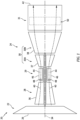
- FIG. 1 is a schematic illustration of a powerplant 20 such as, but not limited to, an aircraft powerplant.
- this powerplant 20 may be configured as, or otherwise included as part of, a propulsion system for an aircraft.
- the powerplant 20 may additionally or alternatively be configured as, or otherwise included as part of, an electrical power system for the aircraft.
- the powerplant 20 may be configured as a non-hydrocarbon powerplant / a hydrocarbon free powerplant; e.g., a powerplant that does not use (or require) hydrocarbon fuel for powerplant operation such as, but not limited to, kerosine, jet fuel, etc.
- the powerplant 20 of FIG. 1 is configured as a hydrogen fueled powerplant.
- the present disclosure is not limited to hydrogen fueled powerplants nor to non-hydrocarbon powerplants.
- the powerplant 20, for example may also or alternatively be fueled one or more other non-hydrocarbon fuels such as ammonia (NH 3 ).
- the powerplant 20 may still also or alternatively be fueled using any other fuel, including hydrocarbon fuels, which produces combustion products that include water (H 2 O) vapor.
- the powerplant 20 includes a mechanical load 22 and a powerplant engine 24.
- the mechanical load 22 may be configured as or otherwise include at least one driven rotor 26.
- the mechanical load 22, for example, may be configured as a bladed propulsor rotor for an aircraft propulsion system.
- the propulsor rotor include, but are not limited to, a propeller for a propeller engine (e.g., a turboprop engine), a fan for a ducted fan engine (e.g., a turbofan engine), and an open rotor for an open rotor engine (e.g., a pusher fan engine, an open tractor rotor engine, etc.).
- the mechanical load 22 may alternatively be configured as a generator rotor in an electrical power generator for the power system.
- the present disclosure is not limited to the foregoing exemplary mechanical loads nor the foregoing exemplary powerplant configurations.
- the engine 24 may be configured as a gas turbine engine.
- the engine 24 of FIG. 1 for example, includes a compressor section 28, a combustor section 29, a turbine section 30 and an exhaust section 31.
- the turbine section 30 of FIG. 1 includes a high pressure turbine (HPT) section 30A and a low pressure turbine (LPT) section 30B; e.g., a power turbine section, a free turbine section, etc.
- the mechanical load 22, the compressor section 28, the combustor section 29, the HPT section 30A, the LPT section 30B and the exhaust section 31 of FIG. 1 are arranged sequentially along an axial centerline 34 of the powerplant 20 and its engine 24, which axial centerline 34 may also be a rotational axis for rotors within the powerplant sections 22, 28, 30A and 30B.
- Each of the powerplant sections 28, 30A and 30B includes a respective bladed rotor 36-38.
- the driven rotor 26 is connected to and rotatably driven by the LPT rotor 38 through a low speed drivetrain; e.g., a shaft.
- the compressor rotor 36 is connected to and rotatably driven by the HPT rotor 37 through a high speed drivetrain; e.g., a shaft.
- air is directed (e.g., through the driven rotor 26 such as a propulsor rotor) into a core flowpath 40.
- the core flowpath 40 extends sequentially through the compressor section 28, the combustor section 29, the HPT section 30A, the LPT section 30B and the exhaust section 31 to an exhaust nozzle 42.
- the air entering the core flowpath 40 may be referred to as core air.
- the core air is compressed by the compressor rotor 36 and directed into a (e.g., annular) combustion chamber 44 of a (e.g., annular) combustor 46 in the combustor section 29.
- Fuel e.g., non-hydrocarbon fuel such as hydrogen
- This fuel-air mixture is ignited and combustion products thereof flow through and sequentially cause the HPT rotor 37 and the LPT rotor 38 to rotate.
- the combustion products are subsequently exhausted from the powerplant 20 and its engine 24 through the exhaust nozzle 42, which may provide powerplant thrust.
- the rotation of the HPT rotor 37 drives rotation of the compressor rotor 36 and, thus, compression of the air entering the core flowpath 40.
- the rotation of the LPT rotor 38 drives rotation of the driven rotor 26.
- the driven rotor 26 is configured as the propulsor rotor
- the rotation of the driven rotor 26 may propel another airflow (e.g., a bypass airflow) through (e.g., internal to) and/or along (e.g., external to) the powerplant 20 and its engine 24 to provide additional powerplant thrust.
- the driven rotor 26 is configured as the generator rotor
- the rotation of the driven rotor 26 may facilitate generation of electricity by the electrical power generator.
- the combustion products exhausted by the powerplant 20 and its engine 24 may include relatively warm water (H 2 O) vapor. Under certain environmental conditions (e.g., pressure, temperature, humidity, etc.), this warm water vapor may contribute to formation of a contrail in the ambient environment outside of / downstream of the powerplant 20 and, more generally, the aircraft. It has been theorized that contrails may contribute to global climate change.
- the powerplant 20 of FIG. 1 includes a water extraction system 50. This water extraction system 50 is configured to extract (e.g., recover) water from the combustion products to be exhausted from the powerplant 20 and its engine 24 upstream of the exhaust nozzle 42.
- the water extraction system 50 may reduce or eliminate matter which contributes to / produces contrails.
- the water extraction system 50 may facilitate water conservation.
- the extracted water for example, may be recycled (e.g., reused) for continued engine operation. This may also reduce water storage capacity requirements for the powerplant 20 where water, for example, is used for engine cooling.
- the water extraction system 50 may be configured as a condensation seeding system.
- the water extraction system 50 of FIG. 2 for example, includes a condensation seeder with one or more nozzles 52.
- This water extraction system 50 also includes a collector 54 and a water reservoir 56; e.g., a tank, a bladder, a cylinder, etc.
- the condensation seeder and its nozzles 52 are configured to direct (e.g., inject, spray, etc.) relatively small water droplets 58 into a (e.g., supersaturated) environment within the core flowpath 40.
- These small water droplets 58 may have a size (e.g., a radius) between, for example, 0.05 microns and 10 microns (e.g., 0.2 microns, 0.5 microns, etc.), although smaller and/or larger sizes are possible depending upon the environmental conditions within the core flowpath 40.
- the small water droplets 58 interact with (e.g., collide against, contact, etc.) the water vapor flowing with the combustion products through the core flowpath 40 to provide seed droplets for forming larger water droplets 60.
- the water vapor within the core flowpath 40 may condense against the small water droplets 58 (e.g., seed droplets) and accumulate to grow the small water droplets 58 into relatively large water droplets 60.
- These large water droplets 60 may have a size (e.g., a radius) between, for example, 0.05 microns and 20 microns (e.g., 1 micron, 1.5 microns, etc.), although smaller and/or larger sizes are possible depending upon the environmental conditions within the core flowpath 40.
- the large water droplets 60 may then be collected by the collector 54 and directed out of the core flowpath 40 to the water reservoir 56.
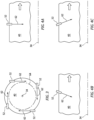
- each of the nozzles 52 is configured to direct a flow of the small water droplets 58 (see FIG. 2 ) into the core flowpath 40 along a respective trajectory 62.
- the trajectory 62 for one, some or all of the nozzles 52 may be tangent to a (e.g., circular or arcuate) reference line 64 extending circumferentially about the axial centerline 34 when viewed, for example, in a reference plane perpendicular to the axial centerline 34.
- a reference line 64 extending circumferentially about the axial centerline 34 when viewed, for example, in a reference plane perpendicular to the axial centerline 34.
- the small water droplets 58 may be swirled into the core flowpath 40.
- the trajectory 62 for one, some or all of the nozzles 52 may be angularly offset from the axial centerline 34 when viewed, for example, in a reference plane parallel with (e.g., including) the axial centerline 34.
- the trajectory 62 of FIG. 4A for example, is perpendicular to the axial centerline 34.
- the trajectory 62 of FIG. 4B, 4C is angularly offset from the axial centerline 34 by an acute angle.
- the trajectory 62 of FIG. 4B extends axially along the axial centerline 34 in an upstream direction.
- the trajectory 62 of FIG. 4C extends axially along the axial centerline 34 in a downstream direction.
- each of the nozzles 52 may have a similarly trajectory orientation.
- one or more of the nozzles 52 may have a different trajectory orientation than one or more of the other nozzles 52.
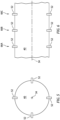
- the nozzles 52 may be axially aligned along the axial centerline 34.
- the nozzles 52 of FIG. 5 are arranged in a single annular (e.g., circular) array about the axial centerline 34.
- the nozzles 52 may be disposed along the axial centerline 34 in different stages 66A-C (generally referred to as "66").
- Each nozzle stage 66 may include a single one of the nozzles 52, or multiple of the nozzles 52 (e.g., in an array as shown in FIG. 5 ).
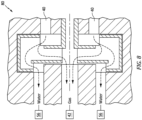
- the collector 54 may include one or more collection surfaces 68 and 70 and a gutter 72; e.g., a sump.
- the large water droplets 60 (see FIG. 2 ) grown within the core flowpath 40 may contact (e.g., impinge against) and accumulate on the collection surfaces 68 and 70.
- the collection surfaces 68 and 70 may then direct the accumulated water towards the water reservoir 56 by way of the gutter 72.
- the collector 54 may be configured as or otherwise include a heat exchanger 74.
- This heat exchanger 74 may include one or more fins 76 and/or one or more coils 78, which fins 76 and/or which coils 78 may respectively form the collection surfaces 68 and 70.
- This heat exchanger 74 may further promote condensation of the water vapor flowing within the core flowpath 40. Additional water vapor, for example, may condense against the fins 76 and/or the coils 78 of the heat exchanger 74, and this condensed water vapor (now liquid water) may be directed to the water reservoir 56 by way of the gutter 72.
- the heat exchanger 74 may thereby supplement the water extraction performed by the introduction of the small water droplets 58 (e.g., seed droplets; see FIG.
- the collector 54 may also or alternatively include centrifugal water-gas separator 80; e.g., a centrifugal liquid-gas separator.
- centrifugal water-gas separator 80 e.g., a centrifugal liquid-gas separator.
- centrifugal water-gas separators / centrifugal liquid-gas separators are known in the art, and the present disclosure is not limited to any particular ones thereof.
- some of the water received by the water reservoir 56 may be reused for injection into the core flowpath 40 by the nozzles 52 as the small water droplets 58.
- the water extraction system 50 may include a system heat exchanger 82 configured to condition the water provided to the nozzles 52.
- the system heat exchanger 82 may be configured as a cooler for cooling the water provided to the nozzles 52.
- the system heat exchanger 82 may be configured as a heater for heating the water provided to the nozzles 52.
- the water extraction system 50 may also include a flowpath heat exchanger 83.
- This flowpath heat exchanger 83 is arranged with (e.g., within) the core flowpath 40.
- the flowpath heat exchanger 83 is configured to cool the combustion products and its relatively warm water vapor prior to injection of the water droplets 58 by the condensation seeder and its nozzles 52.
- the water extraction system 50 may also include a control system 86.
- the control system 86 of FIG. 2 includes one or more sensors 88A and 88B (generally referred to as "88") and a controller 90.
- the sensor 88A is arranged with the core flowpath 40. This sensor 88A is configured to determined one or more environmental conditions within the core flowpath 40; e.g., relative humidity, temperature, pressure, etc.
- the sensor 88B is arranged with or downstream of the collector 54. This sensor 88B is configured to determine a parameter of the water being extracted; e.g., a quantity of the extracted water.
- the controller 90 is in signal communication (e.g., hardwired and/or wirelessly coupled) with the sensors 88 as well as any one or more of the components 52, 54, 82 and 83 (and/or device(s) which control operation of any one or more of the components 52, 54, 82 and 83).
- the controller 90 may be implemented with a combination of hardware and software.
- the hardware may include memory and at least one processing device, which processing device may include one or more single-core and/or multi-core processors.
- the hardware may also or alternatively include analog and/or digital circuitry other than that described above.
- the control system 86 is configured to monitor conditions entering the water extraction system 50 and/or a quantity of the water extracted from the combustion products.
- the control system 86 is further configured to adjust seed water pressure and/or flow rate to the condensation seeder and its nozzles 52 in order to control a condensation rate of the water vapor.
- the water extraction system 50 and its components 52 and 54 may be arranged with the core flowpath 40 within the exhaust section 31.
- the water extraction system 50 and its components 52 and 54 are thereby located downstream of the turbine section 30, but upstream of the exhaust nozzle 42.
- the water extraction system 50 and its components 52 and 54 may be arranged upstream of the exhaust section 31, but still downstream of the combustor section 29 and its combustor 46.
- the water extraction system 50 and its components 52 and 54 of FIG. 9 for example, are arranged with the core flowpath 40 between the HPT rotor 37 and the LPT rotor 38.
- the water extraction system 50 and its components 52 and 54 of FIG. 10 are arranged with the core flowpath 40 between the combustor 46 and the HPT rotor 37.
- the water extraction system 50 may be included in various powerplants other than the one described above.
- the water extraction system 50 may be included in a geared powerplant where a gear train connects one or more shafts to one or more rotors.
- the water extraction system 50 may be included in a powerplant configured without a gear train.
- the water extraction system 50 may be included in a gas turbine engine configured with a single spool, with two spools (e.g., see FIG. 1 ), or with more than two spools.
- the gas turbine engine may be configured as a turbofan engine, a turbojet engine, a turboprop engine, a turboshaft engine, a propfan engine, a pusher fan engine or any other type of turbine engine.
- the gas turbine engine may alternatively be configured as an auxiliary power unit (APU).
- APU auxiliary power unit
Landscapes
- Engineering & Computer Science (AREA)
- Chemical & Material Sciences (AREA)
- Combustion & Propulsion (AREA)
- Mechanical Engineering (AREA)
- Chemical Kinetics & Catalysis (AREA)
- General Engineering & Computer Science (AREA)
- Aviation & Aerospace Engineering (AREA)
- Engine Equipment That Uses Special Cycles (AREA)
Applications Claiming Priority (1)
| Application Number | Priority Date | Filing Date | Title |
|---|---|---|---|
| US17/943,817 US12161963B2 (en) | 2022-09-13 | 2022-09-13 | Extracting water vapor from a powerplant exhaust |
Publications (2)
| Publication Number | Publication Date |
|---|---|
| EP4345261A1 true EP4345261A1 (de) | 2024-04-03 |
| EP4345261B1 EP4345261B1 (de) | 2025-10-29 |
Family
ID=88020713
Family Applications (1)
| Application Number | Title | Priority Date | Filing Date |
|---|---|---|---|
| EP23197158.1A Active EP4345261B1 (de) | 2022-09-13 | 2023-09-13 | Extraktion von wasserdampf aus einem kraftwerksabgas |
Country Status (2)
| Country | Link |
|---|---|
| US (1) | US12161963B2 (de) |
| EP (1) | EP4345261B1 (de) |
Cited By (2)
| Publication number | Priority date | Publication date | Assignee | Title |
|---|---|---|---|---|
| EP4574678A1 (de) * | 2023-12-21 | 2025-06-25 | Airbus Operations GmbH | Energieumwandlungsanordnung und flugzeug damit |
| EP4574672A1 (de) * | 2023-12-21 | 2025-06-25 | Airbus Operations GmbH | Energieumwandlungsanordnung, energiesystem und flugzeug damit |
Citations (5)
| Publication number | Priority date | Publication date | Assignee | Title |
|---|---|---|---|---|
| EP0634563A1 (de) * | 1993-07-15 | 1995-01-18 | DaimlerChrysler Aerospace Airbus Gesellschaft mit beschränkter Haftung | Verfahren und Einrichtung zur Durchführung des Verfahrens zur Wasserversorgung an Bord eines Flugzeuges |
| US20020073712A1 (en) * | 2000-10-19 | 2002-06-20 | Kopko William L. | Subatmospheric gas-turbine engine |
| GB2531629A (en) * | 2015-08-04 | 2016-04-27 | Latif Qureshi Masood | A device to suppress contrail formation |
| US20210001269A1 (en) * | 2018-03-02 | 2021-01-07 | MTU Aero Engines AG | Reducing contrails during operation of aircraft |
| US20210207500A1 (en) * | 2018-05-22 | 2021-07-08 | MTU Aero Engines AG | Exhaust-gas treatment device, aircraft propulsion system, and method for treating an exhaust-gas stream |
Family Cites Families (12)
| Publication number | Priority date | Publication date | Assignee | Title |
|---|---|---|---|---|
| GB870268A (en) | 1957-08-14 | 1961-06-14 | Garrett Corp | Compound gas turbine engine |
| US3799249A (en) * | 1969-11-26 | 1974-03-26 | Air Reduction Inc | Hot gas heat exchanger |
| DE3617915C1 (de) | 1986-05-28 | 1987-09-17 | Messerschmitt Boelkow Blohm | Kombinationsantrieb |
| US5052176A (en) | 1988-09-28 | 1991-10-01 | Societe Nationale D'etude Et De Construction De Moteurs D'aviation | Combination turbojet-ramjet-rocket propulsion system |
| DE3909050C1 (de) | 1989-03-18 | 1990-08-16 | Messerschmitt-Boelkow-Blohm Gmbh, 8012 Ottobrunn, De | |
| GB0211350D0 (en) * | 2002-05-16 | 2002-06-26 | Rolls Royce Plc | A gas turbine engine |
| US7721524B2 (en) | 2006-02-15 | 2010-05-25 | United Technologies Corporation | Integrated airbreathing and non-airbreathing engine system |
| GB0608859D0 (en) * | 2006-05-05 | 2006-06-14 | Rolls Royce Plc | A gas turbine engine |
| US8833701B2 (en) | 2012-02-10 | 2014-09-16 | Rolls-Royce Plc | Moisture dispersion |
| RU2561757C1 (ru) | 2014-01-14 | 2015-09-10 | Николай Борисович Болотин | Трехкомпонентный воздушно-реактивный двигатель |
| GB201501045D0 (en) | 2015-01-22 | 2015-03-11 | Rolls Royce Plc | Aircraft propulsion system |
| FR3108174A1 (fr) | 2020-03-11 | 2021-09-17 | Airbus | Système d’échantillonnage et d’analyse de traînée de condensation générée par un aéronef. |
-
2022
- 2022-09-13 US US17/943,817 patent/US12161963B2/en active Active
-
2023
- 2023-09-13 EP EP23197158.1A patent/EP4345261B1/de active Active
Patent Citations (5)
| Publication number | Priority date | Publication date | Assignee | Title |
|---|---|---|---|---|
| EP0634563A1 (de) * | 1993-07-15 | 1995-01-18 | DaimlerChrysler Aerospace Airbus Gesellschaft mit beschränkter Haftung | Verfahren und Einrichtung zur Durchführung des Verfahrens zur Wasserversorgung an Bord eines Flugzeuges |
| US20020073712A1 (en) * | 2000-10-19 | 2002-06-20 | Kopko William L. | Subatmospheric gas-turbine engine |
| GB2531629A (en) * | 2015-08-04 | 2016-04-27 | Latif Qureshi Masood | A device to suppress contrail formation |
| US20210001269A1 (en) * | 2018-03-02 | 2021-01-07 | MTU Aero Engines AG | Reducing contrails during operation of aircraft |
| US20210207500A1 (en) * | 2018-05-22 | 2021-07-08 | MTU Aero Engines AG | Exhaust-gas treatment device, aircraft propulsion system, and method for treating an exhaust-gas stream |
Cited By (2)
| Publication number | Priority date | Publication date | Assignee | Title |
|---|---|---|---|---|
| EP4574678A1 (de) * | 2023-12-21 | 2025-06-25 | Airbus Operations GmbH | Energieumwandlungsanordnung und flugzeug damit |
| EP4574672A1 (de) * | 2023-12-21 | 2025-06-25 | Airbus Operations GmbH | Energieumwandlungsanordnung, energiesystem und flugzeug damit |
Also Published As
| Publication number | Publication date |
|---|---|
| EP4345261B1 (de) | 2025-10-29 |
| US20240082750A1 (en) | 2024-03-14 |
| US12161963B2 (en) | 2024-12-10 |
Similar Documents
| Publication | Publication Date | Title |
|---|---|---|
| US12065963B2 (en) | Reducing contrails from an aircraft powerplant | |
| US11828200B2 (en) | Hydrogen-oxygen fueled powerplant with water and heat recovery | |
| US20230258126A1 (en) | Hydrogen-oxygen fueled powerplant with water and heat recovery | |
| EP4345261A1 (de) | Extraktion von wasserdampf aus einem kraftwerksabgas | |
| US11815030B1 (en) | Contrail suppression system | |
| EP4477856A2 (de) | Gasturbinenmotor mit wasserrückgewinnungssystem | |
| US12421895B2 (en) | Turbine engine including a condenser system | |
| EP4438871A1 (de) | Einspritzung von brennstoff-dampf-gemisch in eine turbinenbrennkammer | |
| EP4438872A2 (de) | Wasser- und/oder wärmeenergierückgewinnung aus kraftwerksverbrennungsprodukten | |
| EP4520939A1 (de) | Wählbarer einlass für einen wärmetauscher eines flugzeugantriebssystems | |
| EP4481167A1 (de) | Wasser- und/oder wärmeenergierückgewinnungssystem für ein flugzeugkraftwerk mit wasserbehandlungsvorrichtung | |
| EP4459116A1 (de) | Flugzeugtriebwerk mit dampfsystem und bypass | |
| EP4477857A1 (de) | Gasturbinenmotor mit wasserstoffbrennstoffsystem | |
| EP4428350A1 (de) | Wärmetauscher zur wasser- und/oder wärmeenergierückgewinnung aus verbrennungsprodukten von turbinenmotoren | |
| US20260104009A1 (en) | Enhanced recuperation cycle for aircraft powerplant turbine engine | |
| EP4517066A1 (de) | Mehrkraftstoff-gasturbinenmotor mit wassereinspritzung | |
| US12397915B2 (en) | Ice protection systems for aircraft fueled by hydrogen |
Legal Events
| Date | Code | Title | Description |
|---|---|---|---|
| PUAI | Public reference made under article 153(3) epc to a published international application that has entered the european phase |
Free format text: ORIGINAL CODE: 0009012 |
|
| STAA | Information on the status of an ep patent application or granted ep patent |
Free format text: STATUS: THE APPLICATION HAS BEEN PUBLISHED |
|
| AK | Designated contracting states |
Kind code of ref document: A1 Designated state(s): AL AT BE BG CH CY CZ DE DK EE ES FI FR GB GR HR HU IE IS IT LI LT LU LV MC ME MK MT NL NO PL PT RO RS SE SI SK SM TR |
|
| STAA | Information on the status of an ep patent application or granted ep patent |
Free format text: STATUS: REQUEST FOR EXAMINATION WAS MADE |
|
| 17P | Request for examination filed |
Effective date: 20241003 |
|
| RBV | Designated contracting states (corrected) |
Designated state(s): AL AT BE BG CH CY CZ DE DK EE ES FI FR GB GR HR HU IE IS IT LI LT LU LV MC ME MK MT NL NO PL PT RO RS SE SI SK SM TR |
|
| GRAP | Despatch of communication of intention to grant a patent |
Free format text: ORIGINAL CODE: EPIDOSNIGR1 |
|
| STAA | Information on the status of an ep patent application or granted ep patent |
Free format text: STATUS: GRANT OF PATENT IS INTENDED |
|
| INTG | Intention to grant announced |
Effective date: 20250424 |
|
| GRAS | Grant fee paid |
Free format text: ORIGINAL CODE: EPIDOSNIGR3 |
|
| GRAA | (expected) grant |
Free format text: ORIGINAL CODE: 0009210 |
|
| STAA | Information on the status of an ep patent application or granted ep patent |
Free format text: STATUS: THE PATENT HAS BEEN GRANTED |
|
| AK | Designated contracting states |
Kind code of ref document: B1 Designated state(s): AL AT BE BG CH CY CZ DE DK EE ES FI FR GB GR HR HU IE IS IT LI LT LU LV MC ME MK MT NL NO PL PT RO RS SE SI SK SM TR |
|
| REG | Reference to a national code |
Ref country code: CH Ref legal event code: F10 Free format text: ST27 STATUS EVENT CODE: U-0-0-F10-F00 (AS PROVIDED BY THE NATIONAL OFFICE) Effective date: 20251029 Ref country code: GB Ref legal event code: FG4D |
|
| REG | Reference to a national code |
Ref country code: IE Ref legal event code: FG4D |
|
| REG | Reference to a national code |
Ref country code: DE Ref legal event code: R096 Ref document number: 602023007988 Country of ref document: DE |
|
| REG | Reference to a national code |
Ref country code: NL Ref legal event code: MP Effective date: 20251029 |
|
| PG25 | Lapsed in a contracting state [announced via postgrant information from national office to epo] |
Ref country code: ES Free format text: LAPSE BECAUSE OF FAILURE TO SUBMIT A TRANSLATION OF THE DESCRIPTION OR TO PAY THE FEE WITHIN THE PRESCRIBED TIME-LIMIT Effective date: 20251029 |
|
| REG | Reference to a national code |
Ref country code: LT Ref legal event code: MG9D |
|
| PG25 | Lapsed in a contracting state [announced via postgrant information from national office to epo] |
Ref country code: NO Free format text: LAPSE BECAUSE OF FAILURE TO SUBMIT A TRANSLATION OF THE DESCRIPTION OR TO PAY THE FEE WITHIN THE PRESCRIBED TIME-LIMIT Effective date: 20260129 |
|
| PG25 | Lapsed in a contracting state [announced via postgrant information from national office to epo] |
Ref country code: FI Free format text: LAPSE BECAUSE OF FAILURE TO SUBMIT A TRANSLATION OF THE DESCRIPTION OR TO PAY THE FEE WITHIN THE PRESCRIBED TIME-LIMIT Effective date: 20251029 Ref country code: HR Free format text: LAPSE BECAUSE OF FAILURE TO SUBMIT A TRANSLATION OF THE DESCRIPTION OR TO PAY THE FEE WITHIN THE PRESCRIBED TIME-LIMIT Effective date: 20251029 Ref country code: AT Free format text: LAPSE BECAUSE OF FAILURE TO SUBMIT A TRANSLATION OF THE DESCRIPTION OR TO PAY THE FEE WITHIN THE PRESCRIBED TIME-LIMIT Effective date: 20251029 |
|
| REG | Reference to a national code |
Ref country code: AT Ref legal event code: MK05 Ref document number: 1851775 Country of ref document: AT Kind code of ref document: T Effective date: 20251029 |
|
| PG25 | Lapsed in a contracting state [announced via postgrant information from national office to epo] |
Ref country code: NL Free format text: LAPSE BECAUSE OF FAILURE TO SUBMIT A TRANSLATION OF THE DESCRIPTION OR TO PAY THE FEE WITHIN THE PRESCRIBED TIME-LIMIT Effective date: 20251029 |
|
| PG25 | Lapsed in a contracting state [announced via postgrant information from national office to epo] |
Ref country code: RS Free format text: LAPSE BECAUSE OF FAILURE TO SUBMIT A TRANSLATION OF THE DESCRIPTION OR TO PAY THE FEE WITHIN THE PRESCRIBED TIME-LIMIT Effective date: 20260129 |
|
| PG25 | Lapsed in a contracting state [announced via postgrant information from national office to epo] |
Ref country code: IS Free format text: LAPSE BECAUSE OF FAILURE TO SUBMIT A TRANSLATION OF THE DESCRIPTION OR TO PAY THE FEE WITHIN THE PRESCRIBED TIME-LIMIT Effective date: 20260228 |