EP4344575A1 - Jewelery and its manufacturing process - Google Patents
Jewelery and its manufacturing process Download PDFInfo
- Publication number
- EP4344575A1 EP4344575A1 EP22198443.8A EP22198443A EP4344575A1 EP 4344575 A1 EP4344575 A1 EP 4344575A1 EP 22198443 A EP22198443 A EP 22198443A EP 4344575 A1 EP4344575 A1 EP 4344575A1
- Authority
- EP
- European Patent Office
- Prior art keywords
- jewellery
- piece
- core
- inclusive
- hardening
- Prior art date
- Legal status (The legal status is an assumption and is not a legal conclusion. Google has not performed a legal analysis and makes no representation as to the accuracy of the status listed.)
- Withdrawn
Links
- 238000004519 manufacturing process Methods 0.000 title description 6
- 229910001092 metal group alloy Inorganic materials 0.000 claims abstract description 11
- 239000010970 precious metal Substances 0.000 claims abstract description 6
- 229910052751 metal Inorganic materials 0.000 claims description 9
- 239000002184 metal Substances 0.000 claims description 9
- 238000004804 winding Methods 0.000 claims description 8
- 238000000034 method Methods 0.000 claims description 6
- 229910001069 Ti alloy Inorganic materials 0.000 claims description 4
- RTAQQCXQSZGOHL-UHFFFAOYSA-N Titanium Chemical group [Ti] RTAQQCXQSZGOHL-UHFFFAOYSA-N 0.000 claims description 2
- QMQXDJATSGGYDR-UHFFFAOYSA-N methylidyneiron Chemical compound [C].[Fe] QMQXDJATSGGYDR-UHFFFAOYSA-N 0.000 claims description 2
- 238000007493 shaping process Methods 0.000 claims description 2
- 239000010936 titanium Substances 0.000 claims description 2
- 229910052719 titanium Inorganic materials 0.000 claims description 2
- 239000011248 coating agent Substances 0.000 claims 1
- 238000000576 coating method Methods 0.000 claims 1
- BQCADISMDOOEFD-UHFFFAOYSA-N Silver Chemical compound [Ag] BQCADISMDOOEFD-UHFFFAOYSA-N 0.000 description 3
- 239000000463 material Substances 0.000 description 3
- 229910052709 silver Inorganic materials 0.000 description 3
- 239000004332 silver Substances 0.000 description 3
- 230000002860 competitive effect Effects 0.000 description 2
- PCHJSUWPFVWCPO-UHFFFAOYSA-N gold Chemical compound [Au] PCHJSUWPFVWCPO-UHFFFAOYSA-N 0.000 description 2
- 229910052737 gold Inorganic materials 0.000 description 2
- 239000010931 gold Substances 0.000 description 2
- 230000005923 long-lasting effect Effects 0.000 description 2
- 229910001285 shape-memory alloy Inorganic materials 0.000 description 2
- 229910001020 Au alloy Inorganic materials 0.000 description 1
- 229910001339 C alloy Inorganic materials 0.000 description 1
- 229910001200 Ferrotitanium Inorganic materials 0.000 description 1
- 229910000831 Steel Inorganic materials 0.000 description 1
- 229910045601 alloy Inorganic materials 0.000 description 1
- 239000000956 alloy Substances 0.000 description 1
- 238000005452 bending Methods 0.000 description 1
- 230000001419 dependent effect Effects 0.000 description 1
- 239000003353 gold alloy Substances 0.000 description 1
- 238000003780 insertion Methods 0.000 description 1
- 230000037431 insertion Effects 0.000 description 1
- 229910001000 nickel titanium Inorganic materials 0.000 description 1
- HLXZNVUGXRDIFK-UHFFFAOYSA-N nickel titanium Chemical compound [Ti].[Ti].[Ti].[Ti].[Ti].[Ti].[Ti].[Ti].[Ti].[Ti].[Ti].[Ni].[Ni].[Ni].[Ni].[Ni].[Ni].[Ni].[Ni].[Ni].[Ni].[Ni].[Ni].[Ni].[Ni] HLXZNVUGXRDIFK-UHFFFAOYSA-N 0.000 description 1
- 230000003252 repetitive effect Effects 0.000 description 1
- 238000005476 soldering Methods 0.000 description 1
- 239000010959 steel Substances 0.000 description 1
Images
Classifications
-
- A—HUMAN NECESSITIES
- A44—HABERDASHERY; JEWELLERY
- A44C—PERSONAL ADORNMENTS, e.g. JEWELLERY; COINS
- A44C5/00—Bracelets; Wrist-watch straps; Fastenings for bracelets or wrist-watch straps
- A44C5/12—C-spring-type bracelets or wrist-watch holders
-
- A—HUMAN NECESSITIES
- A44—HABERDASHERY; JEWELLERY
- A44C—PERSONAL ADORNMENTS, e.g. JEWELLERY; COINS
- A44C27/00—Making jewellery or other personal adornments
- A44C27/001—Materials for manufacturing jewellery
- A44C27/002—Metallic materials
- A44C27/003—Metallic alloys
-
- A—HUMAN NECESSITIES
- A44—HABERDASHERY; JEWELLERY
- A44C—PERSONAL ADORNMENTS, e.g. JEWELLERY; COINS
- A44C27/00—Making jewellery or other personal adornments
- A44C27/001—Materials for manufacturing jewellery
- A44C27/005—Coating layers for jewellery
-
- A—HUMAN NECESSITIES
- A44—HABERDASHERY; JEWELLERY
- A44C—PERSONAL ADORNMENTS, e.g. JEWELLERY; COINS
- A44C27/00—Making jewellery or other personal adornments
- A44C27/001—Materials for manufacturing jewellery
- A44C27/008—Materials for manufacturing jewellery having shape memory behavior
Definitions
- This invention relates to a piece of jewellery, particularly for the jewellery, goldsmith and silversmith sector and to its manufacturing process.
- omega or omega-shaped bracelets from the shape of the last letters of the Greek alphabet: that is to say, a circular curve with an open portion to allow the user to wear the piece of jewellery.
- This device does not, therefore, have an opening or closing mechanism but is worn simply by widening the omega which, elastically, returns to the initial position once the user stops forcing it.
- the purpose of the invention is to overcome the above-mentioned drawbacks of prior art types of jewellery, particularly for the jewellery, goldsmith and silversmith sector, which allows a piece of gold or silver jewellery to be manufactured in a substantially wire-like shape.
- an aim of the invention is to provide a wire-like piece of jewellery which can be used as an omega-shaped bracelet, without opening or closing means, but which is resistant and long-lasting.
- Another aim of the invention is to allow a piece of jewellery to be manufactured as an alternative to prior art pieces of jewellery.
- Yet another aim of the invention is to provide a piece of jewellery, particularly for the jewellery, goldsmith and silversmith sector, with means which are readily available on the market and using materials of common use, in such a way that the device is economically competitive.
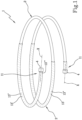
- FIG. 1 shows a preferred embodiment of a piece of jewellery, particularly for the jewellery, goldsmith and silversmith sector, according to the invention, which is identified in its entirety with the numeral 1 and which comprises a core 2 made of a metal alloy with a shape memory, for supporting a covering 3 made of precious metal.
- the core 2 extends along a direction of extension X in such a way as to substantially follow a portion of a spiral curve.
- the metal alloy is titanium-based.
- the metal alloy is made of steel, that is to say, made of an iron-carbon alloy.
- the metal alloy is of the biocompatible type.
- the metal alloy has a recovered deformation of between 5% and 10%, inclusive, preferably between 7% and 9.5%, inclusive, more preferably between 8% and 9%, inclusive, even more preferably substantially equal to 8.5%.
- the covering 3 comprises a metal sheet wound around said core 2.
- the metal sheet is wound around said core 2 in the form of turns 13', 13", 13" having a winding angle A of between 5° and 20°, inclusive, preferably between 7° and 18°, inclusive, more preferably between 10° and 17°, inclusive, even more preferably between 12° and 15°, inclusive.
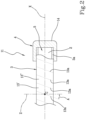
- the winding angle A is a portion of plane between the direction of winding of a turn 13', 13", 13′′′ and the normal Z relative to the direction of extension X passing through the centre C of the spiral curve ( Figure 2 ).
- the turns 13', 13", 13′′′ of the covering 3 are positioned on the core 2 in such a way that each of them has at least one perimeter edge 13a in contact with the next turn: obviously, the end turns 13′′′ will have a single edge 13a in contact with that of the turn next, the other turns 13" both the edges 13a.
- the locking means 4 comprise an abutment element 4 designed to be connected to each end 11 of the piece of jewellery 1 and which has a relative housing compartment 5 for the corresponding end portion 2a of the core 2 and for the relative end part 3a of the covering 3.
- the abutment element 4 comprises a cap 4, substantially tubular, closed in its outermost part, that is to say, on the opposite side relative to the compartment 5, by a thickness 14.
- the abutment element 4 is associated with the covering 3, for example by means of soldering.
- a second crucial aspect of the invention relates to the process for making the above-mentioned piece of jewellery.
- the process comprises the following steps:
- the temperatures and the hardening times are selected according to the masses and volumes of the objects to be hardened; these objects, once hardened, maintain over time the shape received during the hardening steps even if subjected to twisting of more than 360° are also more compact and the titanium alloy core is integral with the covering shell.
- the metal core is made of titanium alloy, preferably of nitinol, a metal alloy of per se known type which guarantees a shape memory of the object.
- the core is made of a shape memory alloy (SMA) of any known type.
- SMA shape memory alloy
- the insertion of the core inside the shell is very simple, since the whole occurs in a rectilinear manner, that is to say, the metal core is inserted in a substantially rectilinear direction.
- This production process allows a piece of jewellery to be obtained which, if subjected to twisting or bending, is able to fully recover (100%) the initial form (shape memory).
- the titanium steel core gives the piece of jewellery the shape memory which allows it to be used without the use of opening or closing means, that is to say, like an omega-shaped bracelet.
- Another advantage of the invention is due to the fact that the metal core is particularly resistant and long-lasting, guaranteeing a long life to the piece of jewellery and an excellent efficiency of use.
- Another advantage of such a piece of jewellery is that it represents a valid and welcome alternative in a sector which is very often repetitive, thus providing a good commercial boost.
- a further advantage of the invention is due to the fact that with the manufacturing process according to the invention, it is possible to use very thin thicknesses of the precious metal, even less than a tenth of a millimetre, thus allowing the low-cost production of a piece of jewellery made of gold alloy or silver.
- the materials used, as well as the dimensions may be of any type, depending on requirements, provided that they are consistent with their production purposes.
Landscapes
- Engineering & Computer Science (AREA)
- Manufacturing & Machinery (AREA)
- Chemical & Material Sciences (AREA)
- Materials Engineering (AREA)
- Adornments (AREA)
Abstract
Described is a piece of jewellery (1), for the jewellery, goldsmith and silversmith sector, comprising a core (2) made of a metal alloy with a shape memory, for supporting a covering (3) made of precious metal.The core (2) extends along a direction of extension (X) in such a way as to substantially follow a portion of a spiral curve.
Description
- This invention relates to a piece of jewellery, particularly for the jewellery, goldsmith and silversmith sector and to its manufacturing process.
- In the current state of the art, goldsmith's, silversmith's and costume jewellery products are available on the market, known as omega or omega-shaped bracelets, from the shape of the last letters of the Greek alphabet: that is to say, a circular curve with an open portion to allow the user to wear the piece of jewellery.
- This device does not, therefore, have an opening or closing mechanism but is worn simply by widening the omega which, elastically, returns to the initial position once the user stops forcing it.
- One problem with these bracelets is due to the fact that, in the goldsmith's or silversmith's sector, they cannot be manufactured with thin thicknesses, such as, for example, wires with a negligible cross-section relative to the length, due to the poor elastic memory of precious alloys.
- The purpose of the invention is to overcome the above-mentioned drawbacks of prior art types of jewellery, particularly for the jewellery, goldsmith and silversmith sector, which allows a piece of gold or silver jewellery to be manufactured in a substantially wire-like shape.
- In the context of the above-mentioned purpose, an aim of the invention is to provide a wire-like piece of jewellery which can be used as an omega-shaped bracelet, without opening or closing means, but which is resistant and long-lasting.
- Another aim of the invention is to allow a piece of jewellery to be manufactured as an alternative to prior art pieces of jewellery.
- Yet another aim of the invention is to provide a piece of jewellery, particularly for the jewellery, goldsmith and silversmith sector, with means which are readily available on the market and using materials of common use, in such a way that the device is economically competitive.
- This purpose, as well as these and other aims, which are described in more detail below, are achieved by the piece of jewellery, particularly for the jewellery, goldsmith and silversmith sector, according to the invention, comprising the technical features described in one or more of the appended claims. The dependent claims correspond to possible different embodiments of the invention.
- Further features and advantages of the invention are more apparent in the detailed description below, with reference to a preferred, non-limiting embodiment of the piece of jewellery, particularly for the jewellery, goldsmith and silversmith sector, illustrated by way of example and without limiting the scope of the invention, with the aid of the accompanying drawings, in which:
-
Figure 1 is a perspective view of a piece of jewellery 1 according to the invention, cut in half along an axis normal to the direction of extension X; -
Figure 2 illustrates a detail of the piece ofjewellery 11. - The above-mentioned drawings show a preferred embodiment of a piece of jewellery, particularly for the jewellery, goldsmith and silversmith sector, according to the invention, which is identified in its entirety with the numeral 1 and which comprises a
core 2 made of a metal alloy with a shape memory, for supporting a covering 3 made of precious metal. Thecore 2 extends along a direction of extension X in such a way as to substantially follow a portion of a spiral curve. - Preferably, the metal alloy is titanium-based.
- According to a variant, the metal alloy is made of steel, that is to say, made of an iron-carbon alloy.
- Preferably, the metal alloy is of the biocompatible type.
- Advantageously, the metal alloy has a recovered deformation of between 5% and 10%, inclusive, preferably between 7% and 9.5%, inclusive, more preferably between 8% and 9%, inclusive, even more preferably substantially equal to 8.5%.
- With reference to
Figure 1 , thecovering 3 comprises a metal sheet wound around saidcore 2. - The metal sheet is wound around said
core 2 in the form ofturns 13', 13", 13" having a winding angle A of between 5° and 20°, inclusive, preferably between 7° and 18°, inclusive, more preferably between 10° and 17°, inclusive, even more preferably between 12° and 15°, inclusive. Where the winding angle A is a portion of plane between the direction of winding of aturn 13', 13", 13‴ and the normal Z relative to the direction of extension X passing through the centre C of the spiral curve (Figure 2 ). Advantageously, the turns 13', 13", 13‴ of the covering 3 are positioned on thecore 2 in such a way that each of them has at least oneperimeter edge 13a in contact with the next turn: obviously, the end turns 13‴ will have asingle edge 13a in contact with that of the turn next, the other turns 13" both theedges 13a. - In other words, two adjacent turns are in contact only by means of the
respective perimeter edges 13a, without a sheet superposing the next one, not even partly. - Advantageously, there are abutting means for the covering 3 on the
core 2. - Preferably, the locking means 4 comprise an
abutment element 4 designed to be connected to eachend 11 of the piece of jewellery 1 and which has arelative housing compartment 5 for the corresponding end portion 2a of thecore 2 and for therelative end part 3a of thecovering 3. More specifically, theabutment element 4 comprises acap 4, substantially tubular, closed in its outermost part, that is to say, on the opposite side relative to thecompartment 5, by athickness 14. - According to the preferred embodiment, the
abutment element 4 is associated with the covering 3, for example by means of soldering. - A second crucial aspect of the invention relates to the process for making the above-mentioned piece of jewellery.
- The process comprises the following steps:
- winding the sheet of precious metal, for example, preferably with a thickness less than or equal to 0.2 mm, around the metal core, in such a way as to tighten the core inside the sheet, all in a rectilinear manner;
- shaping the sheet wound on the core, using suitable equipment and fixing the ends of the core;
- hardening everything in the predetermined form, using temperatures and hardening times in relation to the masses and volumes of the objects to be hardened, in such a way as to obtain products which maintain over time the shape received during the hardening steps, even if subjected to twisting of more than 360°.
- These products also have a greater compactness and have the core integral with the shell.
- A variant embodiment of this process consists in:
- constructing an outer covering shell having a passage for a core made of titanium alloy;
- inserting the core inside the above-mentioned shell;
- hardening everything in the predetermined form, using temperatures and hardening times in relation to the masses and volumes of the objects to be hardened, in such a way as to obtain products which maintain over time the shape received during the hardening steps, with greater compactness and which have the core integral with the shell.
- In practice, the temperatures and the hardening times are selected according to the masses and volumes of the objects to be hardened; these objects, once hardened, maintain over time the shape received during the hardening steps even if subjected to twisting of more than 360° are also more compact and the titanium alloy core is integral with the covering shell.
- Advantageously, the metal core is made of titanium alloy, preferably of nitinol, a metal alloy of per se known type which guarantees a shape memory of the object.
- Alternatively, the core is made of a shape memory alloy (SMA) of any known type.
- Advantageously, the insertion of the core inside the shell is very simple, since the whole occurs in a rectilinear manner, that is to say, the metal core is inserted in a substantially rectilinear direction.
- This production process allows a piece of jewellery to be obtained which, if subjected to twisting or bending, is able to fully recover (100%) the initial form (shape memory).
- From the above description it may be seen how the invention achieves the preset purpose and aims and in particular it should be noted that a piece of jewellery is manufactured, particularly for the jewellery, goldsmith and silversmith sector, which allows a piece of gold or silver jewellery to be manufactured in a substantially wire-like shape.
- More specifically, the titanium steel core gives the piece of jewellery the shape memory which allows it to be used without the use of opening or closing means, that is to say, like an omega-shaped bracelet.
- Another advantage of the invention is due to the fact that the metal core is particularly resistant and long-lasting, guaranteeing a long life to the piece of jewellery and an excellent efficiency of use.
- Another advantage of such a piece of jewellery is that it represents a valid and welcome alternative in a sector which is very often repetitive, thus providing a good commercial boost.
- A further advantage of the invention is due to the fact that with the manufacturing process according to the invention, it is possible to use very thin thicknesses of the precious metal, even less than a tenth of a millimetre, thus allowing the low-cost production of a piece of jewellery made of gold alloy or silver.
- Lastly, the use of means which are easily available on the market and the use of common materials makes the device economically competitive. The invention can be modified and adapted in several ways without thereby departing from the scope of the inventive concept.
- Moreover, all the details of the invention may be substituted by other technically equivalent elements.
- In practice, the materials used, as well as the dimensions, may be of any type, depending on requirements, provided that they are consistent with their production purposes.
Claims (15)
- A piece of jewellery (1) for the jewellery, goldsmith and silversmith sector comprising a core (2) made of a metal alloy with a shape memory, for supporting a covering (3) made of precious metal;
said core (2) extending along a direction of extension (X) in such a way as to substantially follow a portion of a spiral curve. - The piece of jewellery (1) according to the preceding claim, wherein said metal alloy is titanium-based or iron-carbon-based.
- The piece of jewellery (1) according to claim 1 or 2, wherein said metal alloy is of the biocompatible type.
- The piece of jewellery (1) according to any one of the preceding claims, wherein said metal alloy has a recovered deformation of between 5% and 10%, inclusive, preferably between 7% and 9.5%, inclusive, more preferably between 8% and 9%, inclusive, even more preferably substantially equal to 8.5%.
- The piece of jewellery (1) according to any one of the preceding claims, wherein said coating (3) comprises a metal sheet wound around said core (2).
- The piece of jewellery (1) according to the preceding claim, wherein said metal sheet is wound around said core (2) in the form of turns (13', 13", 13‴) having a winding angle (A) of between 5° and 20°, inclusive, preferably between 7° and 18°, inclusive, more preferably between 10° and 17°, inclusive, even more preferably between 12° and 15°, inclusive; said winding angle (A) being between the direction of winding of a turn (13', 13", 13"') and the normal (Z) relative to said direction of extension (X) passing through the centre (C) of said spiral curve.
- The piece of jewellery (1) according to the preceding claim, wherein each of said turns (13', 13", 13‴) has at least one perimeter edge (13a) in contact with the next turn.
- The piece of jewellery (1) according to the preceding claim, wherein two adjacent turns (13', 13") are in contact only by means of the respective perimeter edges (13a).
- The piece of jewellery (1) according to any one of the preceding claims, comprising locking means (4) for said covering (3) on said core (2).
- The piece of jewellery (1) according to the preceding claim, wherein said locking means (4) comprise an abutment element (4) designed to be connected to each end (11) of the piece of jewellery (1) and having a relative housing compartment (5) for the corresponding end portion (2a) of said core (2) and for the relative end part (3a) of said covering (3).
- The piece of jewellery (1) according to the preceding claim, wherein said abutment element (4) comprises a substantially tubular cap (4) closed in its outermost part by a thickness (14).
- The piece of jewellery (1) according to any one of claims 10 or 11, wherein said abutment element (4) is associated with said covering (3).
- A process for making a piece of jewellery for the jewellery, goldsmith and silversmith sector, characterised in that it comprises the steps consisting of:- winding a sheet of precious metal around a metal core, in such a way as to tighten said core inside the sheet;- shaping said sheet wound on said core;- hardening everything in the predetermined form, using temperatures and hardening times in relation to the masses and volumes of the objects to be hardened, in such a way as to obtain products which maintain over time the shape received during the hardening steps, even if subjected to twisting of more than 360°.
- A process for making a piece of jewellery for the jewellery, goldsmith and silversmith sector, characterised in that it comprises the steps consisting of:- constructing an outer covering shell having at least one passage for a core made of titanium alloy;- inserting said core inside said shell;- hardening everything in the predetermined form, with temperatures and hardening times in relation to the masses and volumes of the objects to be hardened, in such a way as to obtain products which maintain over time the shape received during the hardening steps, even if subjected to twisting of more than 360°.
- The process according to the preceding claim, wherein said core is inserted in said shell in a substantially rectilinear direction.
Priority Applications (1)
| Application Number | Priority Date | Filing Date | Title |
|---|---|---|---|
| EP22198443.8A EP4344575A1 (en) | 2022-09-28 | 2022-09-28 | Jewelery and its manufacturing process |
Applications Claiming Priority (1)
| Application Number | Priority Date | Filing Date | Title |
|---|---|---|---|
| EP22198443.8A EP4344575A1 (en) | 2022-09-28 | 2022-09-28 | Jewelery and its manufacturing process |
Publications (1)
| Publication Number | Publication Date |
|---|---|
| EP4344575A1 true EP4344575A1 (en) | 2024-04-03 |
Family
ID=84332343
Family Applications (1)
| Application Number | Title | Priority Date | Filing Date |
|---|---|---|---|
| EP22198443.8A Withdrawn EP4344575A1 (en) | 2022-09-28 | 2022-09-28 | Jewelery and its manufacturing process |
Country Status (1)
| Country | Link |
|---|---|
| EP (1) | EP4344575A1 (en) |
Citations (3)
| Publication number | Priority date | Publication date | Assignee | Title |
|---|---|---|---|---|
| JP2001286313A (en) * | 2000-04-05 | 2001-10-16 | Ando Seisakusho:Kk | Wire for ornament |
| JP2004337297A (en) * | 2003-05-14 | 2004-12-02 | Seberu Piko:Kk | Composite linear body accessory |
| KR200495112Y1 (en) * | 2020-04-04 | 2022-03-08 | 이봉승 | Manufacturing Method of Ornament Using Shape Memory Alloy |
-
2022
- 2022-09-28 EP EP22198443.8A patent/EP4344575A1/en not_active Withdrawn
Patent Citations (3)
| Publication number | Priority date | Publication date | Assignee | Title |
|---|---|---|---|---|
| JP2001286313A (en) * | 2000-04-05 | 2001-10-16 | Ando Seisakusho:Kk | Wire for ornament |
| JP2004337297A (en) * | 2003-05-14 | 2004-12-02 | Seberu Piko:Kk | Composite linear body accessory |
| KR200495112Y1 (en) * | 2020-04-04 | 2022-03-08 | 이봉승 | Manufacturing Method of Ornament Using Shape Memory Alloy |
Similar Documents
| Publication | Publication Date | Title |
|---|---|---|
| JP3577280B2 (en) | Adjustment pin for wristwatch band, method for manufacturing the same, and connection structure for wristwatch band | |
| US2451749A (en) | Bracelet or the like and method of making the same | |
| US6910273B2 (en) | Manufacturing method for jewelry including shape memory alloy elements | |
| US6116053A (en) | Seamless hollow wedding band with comfort fit | |
| WO2003059199A8 (en) | Stent and method for the production thereof (variants) | |
| EP0400932A2 (en) | Orthodontic coil spring | |
| EP4344575A1 (en) | Jewelery and its manufacturing process | |
| US6860097B2 (en) | Lightweight omega chain and improved method of manufacture | |
| US6895737B2 (en) | Lightweight omega chain and improved method of manufacture | |
| TW200938737A (en) | Lock ring | |
| JP4072567B2 (en) | Method for manufacturing wire for jewelry | |
| US11659902B2 (en) | Low profile expandable ring structure | |
| CN106174917B (en) | Decorative element and ornament | |
| US4417437A (en) | Watchband formed of tubular metal rods and method of manufacturing same | |
| EP1188388A1 (en) | Watch and bracelet connection structure and watch comprising said structure | |
| WO2003022091A1 (en) | Method for making elongated metal elements | |
| US3082595A (en) | Method of making lazy tongs linkage, each link being made from one piece of stock | |
| US6146772A (en) | Composite wire for the manufacture of jewelry articles | |
| EP3799761B1 (en) | Elastic bracelet for items such as wristwatches and/or jewellery items and/or costume jewellery items | |
| JP3072328U (en) | Ornament wire | |
| JP2000296007A (en) | Structure for connecting watch band | |
| WO2007148351A1 (en) | Jewel wearable according to two different stable configurations and manufacturing method thereof | |
| JP7011353B1 (en) | Core wire for jewelry | |
| HK40057937A (en) | Alloy, semi-finished product made from such an alloy, piece of jewelry having such semi-finished product, and method for producing such a semi-finished product | |
| CN113737048A (en) | Alloy, semi-finished product made of alloy, ornament with semi-finished product and method for manufacturing semi-finished product |
Legal Events
| Date | Code | Title | Description |
|---|---|---|---|
| PUAI | Public reference made under article 153(3) epc to a published international application that has entered the european phase |
Free format text: ORIGINAL CODE: 0009012 |
|
| STAA | Information on the status of an ep patent application or granted ep patent |
Free format text: STATUS: THE APPLICATION HAS BEEN PUBLISHED |
|
| AK | Designated contracting states |
Kind code of ref document: A1 Designated state(s): AL AT BE BG CH CY CZ DE DK EE ES FI FR GB GR HR HU IE IS IT LI LT LU LV MC MK MT NL NO PL PT RO RS SE SI SK SM TR |
|
| STAA | Information on the status of an ep patent application or granted ep patent |
Free format text: STATUS: THE APPLICATION IS DEEMED TO BE WITHDRAWN |
|
| 18D | Application deemed to be withdrawn |
Effective date: 20241005 |