EP4344162A1 - Informationsverarbeitungsverfahren, vorrichtung und speichermedium - Google Patents
Informationsverarbeitungsverfahren, vorrichtung und speichermedium Download PDFInfo
- Publication number
- EP4344162A1 EP4344162A1 EP22814982.9A EP22814982A EP4344162A1 EP 4344162 A1 EP4344162 A1 EP 4344162A1 EP 22814982 A EP22814982 A EP 22814982A EP 4344162 A1 EP4344162 A1 EP 4344162A1
- Authority
- EP
- European Patent Office
- Prior art keywords
- receiving terminal
- sharing information
- terminal
- sharing
- sending
- Prior art date
- Legal status (The legal status is an assumption and is not a legal conclusion. Google has not performed a legal analysis and makes no representation as to the accuracy of the status listed.)
- Pending
Links
Images


Classifications
-
- H—ELECTRICITY
- H04—ELECTRIC COMMUNICATION TECHNIQUE
- H04L—TRANSMISSION OF DIGITAL INFORMATION, e.g. TELEGRAPHIC COMMUNICATION
- H04L51/00—User-to-user messaging in packet-switching networks, transmitted according to store-and-forward or real-time protocols, e.g. e-mail
- H04L51/21—Monitoring or handling of messages
- H04L51/214—Monitoring or handling of messages using selective forwarding
-
- H—ELECTRICITY
- H04—ELECTRIC COMMUNICATION TECHNIQUE
- H04L—TRANSMISSION OF DIGITAL INFORMATION, e.g. TELEGRAPHIC COMMUNICATION
- H04L51/00—User-to-user messaging in packet-switching networks, transmitted according to store-and-forward or real-time protocols, e.g. e-mail
- H04L51/07—User-to-user messaging in packet-switching networks, transmitted according to store-and-forward or real-time protocols, e.g. e-mail characterised by the inclusion of specific contents
- H04L51/10—Multimedia information
-
- H—ELECTRICITY
- H04—ELECTRIC COMMUNICATION TECHNIQUE
- H04L—TRANSMISSION OF DIGITAL INFORMATION, e.g. TELEGRAPHIC COMMUNICATION
- H04L67/00—Network arrangements or protocols for supporting network services or applications
- H04L67/01—Protocols
- H04L67/06—Protocols specially adapted for file transfer, e.g. file transfer protocol [FTP]
-
- H—ELECTRICITY
- H04—ELECTRIC COMMUNICATION TECHNIQUE
- H04L—TRANSMISSION OF DIGITAL INFORMATION, e.g. TELEGRAPHIC COMMUNICATION
- H04L67/00—Network arrangements or protocols for supporting network services or applications
- H04L67/01—Protocols
- H04L67/10—Protocols in which an application is distributed across nodes in the network
-
- H—ELECTRICITY
- H04—ELECTRIC COMMUNICATION TECHNIQUE
- H04L—TRANSMISSION OF DIGITAL INFORMATION, e.g. TELEGRAPHIC COMMUNICATION
- H04L51/00—User-to-user messaging in packet-switching networks, transmitted according to store-and-forward or real-time protocols, e.g. e-mail
- H04L51/06—Message adaptation to terminal or network requirements
- H04L51/063—Content adaptation, e.g. replacement of unsuitable content
-
- H—ELECTRICITY
- H04—ELECTRIC COMMUNICATION TECHNIQUE
- H04L—TRANSMISSION OF DIGITAL INFORMATION, e.g. TELEGRAPHIC COMMUNICATION
- H04L51/00—User-to-user messaging in packet-switching networks, transmitted according to store-and-forward or real-time protocols, e.g. e-mail
- H04L51/06—Message adaptation to terminal or network requirements
- H04L51/066—Format adaptation, e.g. format conversion or compression
-
- H—ELECTRICITY
- H04—ELECTRIC COMMUNICATION TECHNIQUE
- H04L—TRANSMISSION OF DIGITAL INFORMATION, e.g. TELEGRAPHIC COMMUNICATION
- H04L51/00—User-to-user messaging in packet-switching networks, transmitted according to store-and-forward or real-time protocols, e.g. e-mail
- H04L51/07—User-to-user messaging in packet-switching networks, transmitted according to store-and-forward or real-time protocols, e.g. e-mail characterised by the inclusion of specific contents
- H04L51/18—Commands or executable codes
Definitions
- the present application relates to the technical field of communication, and in particular to an information processing method, a device and a storage medium.
- the sharing information can only be processed according to the operation of the receiving terminal, or the sharing information can only be processed before sharing, and so on.
- the present application provides an information processing method, a device and a storage medium, to enable users to share information conveniently and quickly.
- the present application provides an information processing method, applied to a sending terminal, including following steps:
- the step S1 includes at least one of the following:
- the preset operation includes at least one of the operations of selecting sharing information, determining or generating sharing information, selecting sharing objects, determining to start sharing, and the like.
- the first preset condition includes at least one of the following:
- the second preset condition includes at least one of the following:
- the first preset condition is the same as the second preset condition.
- the processing the sharing information according to at least one first preset strategy includes at least one of the following:
- the processing the sharing information according to at least one second preset strategy includes:
- processing the sharing information according to at least one first preset strategy, and/or processing the sharing information according to at least one second preset strategy includes at least one of the following:
- the processing the sharing information according to at least one second preset strategy includes: if the sharing information needs to be sent to the first receiving terminal, processing the sharing information through the second receiving terminal;
- the first preset condition includes that the first receiving terminal has preset authority and the second preset condition includes that the second receiving terminal does not have preset authority
- the processing the sharing information according to at least one first preset strategy and at least one second preset strategy includes:
- the method further includes:
- the method before the step S2, the method further includes: S02, dividing the sharing information into at least one first sharing information and/or at least one second sharing information.
- the S02 step includes:
- the first preset condition and/or the second preset condition include at least one of the following:
- the processing the sharing information according to at least one first preset strategy or at least one second preset strategy includes at least one of the following:
- the first conversion terminal is the sending terminal and/or the second receiving terminal and/or the server and/or at least one other device; and/or the second conversion terminal is the sending terminal and/or the first receiving terminal and/or the server and/or at least one other device.
- the method further includes at least one of the following:
- the method before the step S2, the method also include:
- the first preset condition and/or the second preset condition include at least one of the following:
- the sending the sharing information according to at least one first preset strategy or at least one second preset strategy includes at least one of the following:
- the first operation and/or the second operation include at least one of the following: touch operation, air separation operation, voice control, and key operation.
- the present application further provides a second information processing method, applied to a sending terminal, including following steps:
- the step S10 includes at least one of the following:
- the step S20 includes at least one of the following:
- the step S30 includes at least one of the following:
- the method further includes:
- the method before the step S20 or the step S30, the method also includes:
- the method further includes at least one of the following:
- the method further includes:
- the present application further provides a third information processing method, applied to a sending terminal, including following steps:
- the step S100 includes at least one of the following:
- the step S200 includes at least one of the following:
- the associated second receiving terminal may be any device connected and/or bound to the sending terminal and/or the first receiving terminal.
- the connection may be a direct connection or an indirect connection.
- binding may mean that the login account information is the same, or a matching connection, or through user-defined settings, and the like.
- the method before the step S300 or the step S400, the method also includes:
- the preset condition includes that the first receiving terminal does not meet the first preset condition and/or the second receiving terminal does not meet the second preset condition
- the step S400 includes: in response to that the first receiving terminal does not meet the first preset condition, processing the sharing information according to at least one first preset strategy; and/or in response to that the second receiving terminal does not meet the second preset condition, processing the sharing information according to at least one second preset strategy.
- processing the sharing information according to at least one first preset strategy, and/or processing the sharing information according to at least one second preset strategy includes at least one of the following:
- the processing the sharing information according to at least one second preset strategy further includes the following: if the sharing information needs to be sent to the first receiving terminal, processing the sharing information through the second receiving terminal.
- the performing at least one of the following processing on the processed sharing information :
- the first preset condition includes that the first receiving terminal has preset authority and the second preset condition includes that the second receiving terminal does not have preset authority
- the processing the sharing information according to at least one first preset strategy and at least one second preset strategy includes:
- the method before the step S300, further includes: dividing the sharing information into at least one first sharing information and at least one second sharing information.
- the first preset condition and/or the second preset condition include at least one of the following:
- the processing the sharing information according to at least one first preset strategy and/or at least one second preset strategy includes at least one of the following:
- the first preset condition and/or the second preset condition include at least one of the following:
- the sending the sharing information according to at least one first preset strategy or at least one second preset strategy includes at least one of the following:
- the method further includes:
- the third method further includes at least one of the following:
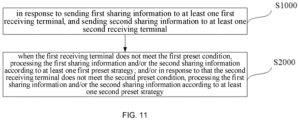
- the present application further provides a fourth information processing method, applied to a sending terminal, including the following steps:
- the step S1000 includes at least one of the following:
- the step S2000 includes at least one of the following:
- the dividing the sharing information includes at least one of the following:
- the method further includes:
- step S2000 further includes at least one of the following:
- the method further includes at least one of the following:
- the present application further provides an information processing method, applied to the first receiving terminal, including the following steps:
- the processing request includes that the sending terminal sends the sharing information to at least one first receiving terminal and at least one second receiving terminal.
- the sending terminal processing the sharing information according to at least one first preset strategy, and/or processing the sharing information according to at least one second preset strategy includes at least one of the following:
- the processing the sharing information according to at least one second preset strategy also includes: if the sharing information needs to be sent to the first receiving terminal, the sharing information is processed through the second receiving terminal.
- At least one of the following processing is performed on the processed sharing information:
- the first preset condition includes that the first receiving terminal has a preset authority
- the second preset condition includes that the second receiving terminal does not have a preset authority.
- the processing the sharing information according to at least one first preset strategy and at least one second preset strategy includes:
- the method before the step T2, the method further includes that the sharing information can be divided into at least one first sharing information and/or at least one second sharing information.
- the first preset condition and/or the second preset condition include at least one of the following:
- the processing the sharing information according to at least one first preset strategy or at least one second preset strategy includes at least one of the following:
- the method before the step T2, the method also include:
- the preset mode may be the mobile operator network mode, the wireless network mode, the power saving mode, the hands-free mode, the preset language mode, the smart mode, the sharing mode, the Internet of Things mode, and the like.
- the preset scenarios can be the work scenario, the conference scenario, the entertainment scenario, the game scenario, the driving scenario, the navigation scenario, the outdoor scenario, and the like.
- the first preset condition and/or the second preset condition include at least the following:
- the sending the sharing information according to at least one first preset strategy or at least one second preset strategy includes at least one of the following:
- the present application further provides an information processing method applied to the first receiving terminal, including the following steps:
- the determination method or the generation method for the first sharing information and/or the second sharing information may include that the sending terminal divides the at least one sharing information into at least one first sharing information and at least one second sharing information.
- the triggering method of the processing request may be the voice control, the gesture operation, the touch operation, the key operation or the air separation operation, and the like.
- the sending terminal dividing at least one sharing information into at least one first sharing information and at least one second sharing information includes at least one of the following:
- the step T30 includes at least one of the following:
- the method after the step T20, the method also includes:
- the method before the step T20 or the step T30, the method also includes:
- the preset mode may be the mobile operator network mode, the wireless network mode, the power saving mode, the hands-free mode, the preset language mode, the smart mode, the sharing mode, the Internet of Things mode, and the like.
- the preset scenarios can be the work scenario, the conference scenario, the entertainment scenario, the game scenario, the driving scenario, the navigation scenario, the outdoor scenario, and the like.
- the present application further provides an information processing method applied to the first receiving terminal, including the following steps:
- the step T200 includes at least one of the following:
- the associated second receiving terminal may be any device connected and/or bound to the sending terminal and/or the first receiving terminal.
- the connection may be a direct connection or an indirect connection.
- binding may mean that the login account information is the same, or a matching connection, or through user-defined settings, and the like.
- the method before the step T300 or the step T400, the method also includes:
- the preset condition includes that the first receiving terminal does not meet the first preset condition and/or the second receiving terminal does not meet the second preset condition.
- the step T400 includes: when the first receiving terminal does not meet the first preset condition, processing the sharing information according to at least one first preset strategy; and/or when the second receiving terminal does not meet the second preset condition, processing the sharing information according to at least one second preset strategy.
- the processing the sharing information according to at least one first preset strategy, and/or processing the sharing information according to at least one second preset strategy includes at least one of the following:
- the processing the sharing information according to at least one second preset strategy also includes: if the sharing information needs to be sent to the first receiving terminal, the sharing information is processed through the second receiving terminal.
- At least one of the following processing is performed on the processed sharing information:
- the first preset condition includes that the first receiving terminal has a preset authority
- the second preset condition includes that the second receiving terminal does not have a preset authority.
- the processing the sharing information according to at least one first preset strategy and at least one second preset strategy includes:
- the method further includes that the sharing information can be divided into at least one first sharing information and/or at least one second sharing information.
- the first preset condition and/or the second preset condition include at least one of the following:
- the processing the sharing information according to at least one first preset strategy or at least one second preset strategy includes at least one of the following:
- the first preset condition and/or the second preset condition include at least the following:
- the sending the sharing information according to at least one first preset strategy or at least one second preset strategy includes at least one of the following:
- the present application further provides a device including a memory and a processor.
- An information processing program is stored in the memory, and when the information processing program is executed by the processor, the information processing method according to any one of the above mentioned embodiments is implemented.
- the present application further provides a computer-readable storage medium.
- a computer program is stored in the computer-readable storage medium, and when the computer program is executed by a processor, the information processing method according to any one of the above mentioned embodiments is implemented.
- the present application relates to an information processing method, a device and a storage medium.
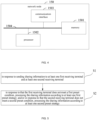
- the information processing method is applied to the sending terminal and includes the following steps: in response to sending sharing information to at least one first receiving terminal and at least one second receiving terminal; and in response to that the first receiving terminal does not meet a first preset condition, processing the sharing information according to at least one first preset strategy; and/or in response to that the second receiving terminal does not meet a second preset condition, processing the sharing information according to at least one second preset strategy.
- information can be shared easily and conveniently between different devices, thereby improving the user experience.
- first, second, third, and the like may be used herein to describe various information, the information should not be limited to these terms. These terms are only used to distinguish information of the same type from one another. For example, without departing from the scope of this document, first information may also be called second information, and similarly, second information may also be called first information.
- first information may also be called second information
- second information may also be called first information.
- word “if' as used herein may be interpreted as “at” or “when” or “in response to a determination”.
- the singular forms "a”, “an” and “the” are intended to include the plural forms as well, unless the context indicates otherwise.
- A, B, or C or "A, B, and/or C” means "any of the following: A; B; C; A and B; A and C; B and C; A and B and C". Exceptions to this definition will only arise when combinations of elements, functions, steps or operations are inherently mutually exclusive in some way.
- the words “if' as used herein may be interpreted as “at” or “when” or “in response to determining” or “in response to detecting”.
- the phrases “if determined” or “if detected (the stated condition or event)” could be interpreted as “when determined” or “in response to the determination” or “when detected (the stated condition or event)” or “in response to detection (the stated condition or event)”.
- step codes such as S1 and S2 are used for the purpose of expressing the corresponding content more clearly and concisely, and do not constitute a substantive limitation on the order. Those skilled in the art may perform S2 first and then S1 and the like during specific implementation, but these should all be within the protection scope of the present application.
- the intelligent the terminal can be implemented in various forms.
- the intelligent terminal described in the present application can include a mobile phone, a tablet computer, a notepad computer, a hand-held computer, a personal digital assistants (PDA), a portable media player (PMP), a navigation device, a wearable device, a smart bracelet, a pedometer and other intelligent terminals, as well as a fixed terminal such as a digital TV and a desktop computer.
- PDA personal digital assistants
- PMP portable media player
- navigation device a wearable device
- smart bracelet a smart bracelet
- a pedometer pedometer
- the present application takes a mobile the terminal as an example to illustrate. Those skilled in the art will understand that, in addition to elements specifically used for mobile purposes, the configuration according to the embodiments of the present application can also be applied to the fixed terminal.
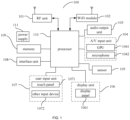
- FIG. 1 is a schematic structural diagram of a hardware of a mobile the terminal according to embodiments of the present application.
- the mobile terminal 100 can include a radio frequency (RF) unit 101, a WiFi module 102, an audio output unit 103, an audio/video (A/V) input unit 104, a sensor 105, a display unit 106, a user input unit 107, an interface unit 108, a memory 109, a processor 110, a power supply 111 and other components.
- RF radio frequency
- each component of the mobile terminal will be specifically introduced with reference to FIG. 1 .
- the radio frequency unit 101 can be used for transmitting and receiving signals during the process of transceiving information or talking. Specifically, after receiving the downlink information of the base station, the downlink information is processed by the processor 110; in addition, the uplink data is sent to the base station.
- the radio frequency unit 101 includes, but is not limited to, an antenna, at least one amplifier, a transceiver, a coupler, a low noise amplifier, a duplexer, and the like. In addition, the radio frequency unit 101 can also communicate with the network and other devices through wireless communication.
- the above-mentioned wireless communication can use any communication standard or protocol, including but not limited to Global System of Mobile communication (GSM), General Packet Radio Service (GPRS), Code Division Multiple Access 2000 (CDMA2000), Wideband Code Division Multiple Access (WCDMA), Time Division-Synchronous Code Division Multiple Access (TD-SCDMA), Frequency Division Duplexing-Long Term Evolution (FDD-LTE), Time Division Duplexing-Long Term Evolution (TDD-LTE), or the like.
- GSM Global System of Mobile communication
- GPRS General Packet Radio Service
- CDMA2000 Code Division Multiple Access 2000
- WCDMA Wideband Code Division Multiple Access
- TD-SCDMA Time Division-Synchronous Code Division Multiple Access
- FDD-LTE Frequency Division Duplexing-Long Term Evolution
- TDD-LTE Time Division Duplexing-Long Term Evolution
- TDD-LTE Time Division Duplexing-Long Term Evolution
- Wi-Fi is a short-range wireless transmission technology.
- the mobile terminal can help users transmit and receive email, browse webpage, and access streaming media through the Wi-Fi module 102, and Wi-Fi provides users with wireless broadband Internet access.
- FIG. 1 shows the Wi-Fi module 102, it is understandable that it is not a necessary component of the mobile the terminal and can be omitted as needed without changing the essence of the present application.
- the audio output unit 103 can convert the audio data received by the radio frequency unit 101 or the Wi-Fi module 102 or stored in the memory 109 into an audio signal and output the audio signal as sound. Moreover, the audio output unit 103 can also provide audio output related to a specific function performed by the mobile terminal 100 (for example, call signal reception sound, message reception sound, or the like).
- the audio output unit 103 can include a loudspeaker box, a buzzer, or the like.
- the A/V input unit 104 is configured to receive audio or video signals.
- the A/V input unit 104 can include a graphics processing unit (GPU) 1041 and a microphone 1042.
- the graphics processing unit 1041 processes image data of still pictures or videos obtained by an image capture device (such as a camera) in a video capture mode or an image capture mode.
- the processed image frame can be displayed on the display unit 106.
- the image frame processed by the graphics processing unit 1041 can be stored in the memory 109 (or other storage medium) or sent via the radio frequency unit 101 or the Wi-Fi module 102.
- the microphone 1042 can receive sound (audio data) in operation modes such as a call mode, a recording mode, a voice recognition mode, and the like, and can process such sound into audio data.
- the processed audio (voice) data can be converted into a format that can be sent to a mobile communication base station via the radio frequency unit 101 in the case of a call mode for output.
- the microphone 1042 can implement various types of noise cancellation (or suppression) algorithms to eliminate (or suppress) noise or interference generated during the process of transceiving audio signals.
- the mobile terminal 100 also includes at least one sensor 105, such as a light sensor, a motion sensor, and other sensors.
- the light sensor includes an ambient light sensor and a proximity sensor.
- the ambient light sensor can adjust the brightness of the display panel 1061 according to the brightness of the ambient light.
- the proximity sensor can turn off the display panel 1061 and/or the backlight when the mobile terminal 100 is moved to the ear.
- a gravity acceleration sensor as a kind of motion sensor, can detect the size of acceleration in various directions (usually three axes).
- the gravity acceleration sensor can detect the size and direction of gravity when it is stationary, and can identify the gesture of the mobile terminal (such as horizontal and vertical screen switching, related games, magnetometer attitude calibration), vibration recognition related functions (such as pedometer, tap), or the like.
- the mobile terminal can also be equipped with other sensors such as a fingerprint sensor, a pressure sensor, an iris sensor, a molecular sensor, a gyroscope, a barometer, a hygrometer, a thermometer, an infrared sensor and other sensors, which will not be repeated here.
- sensors such as a fingerprint sensor, a pressure sensor, an iris sensor, a molecular sensor, a gyroscope, a barometer, a hygrometer, a thermometer, an infrared sensor and other sensors, which will not be repeated here.
- the display unit 106 is configured to display information input by the user or information provided to the user.
- the display unit 106 can include a display panel 1061, and the display panel 1061 can be configured in the form of a liquid crystal display (LCD), an organic light emitting diode (OLED), or the like.
- LCD liquid crystal display
- OLED organic light emitting diode
- the user input unit 107 can be configured to receive inputted numeric or character information, and generate key signal input related to user settings and function control of the mobile terminal.
- the user input unit 107 can include a touch panel 1071 and other input devices 1072.
- the touch panel 1071 also called a touch screen, can collect user touch operations on or near it (for example, the user uses fingers, stylus and other suitable objects or accessories to operate on the touch panel 1071 or near the touch panel 1071), and drive the corresponding connection device according to a preset program.
- the touch panel 1071 can include two parts: a touch detection device and a touch controller.
- the touch detection device detects the user's touch position, detects the signal brought by the touch operation, and transmits the signal to the touch controller.
- the touch controller receives the touch information from the touch detection device, converts the touch information into contact coordinates, and sends it to the processor 110, and can receive and execute the instructions sent by the processor 110.
- the touch panel 1071 can be implemented in multiple types such as resistive, capacitive, infrared, and surface acoustic wave.
- the user input unit 107 can also include other input devices 1072.
- the other input devices 1072 can include, but are not limited to, one or more of physical keyboard, function keys (such as volume control buttons, switch buttons, and the like), trackball, mouse, joystick, and the like, which are not specifically limited here.
- the touch panel 1071 can cover the display panel 1061. After the touch panel 1071 detects a touch operation on or near it, the touch operation is transmitted to the processor 110 to determine the type of the touch event, and then the processor 110 provides a corresponding visual output on the display panel 1061 according to the type of the touch event.
- the touch panel 1071 and the display panel 1061 are used as two independent components to realize the input and output functions of the mobile terminal, in some embodiments, the touch panel 1071 and the display panel 1061 can be integrated to implement the input and output functions of the mobile terminal, which is not specifically limited here.
- the interface unit 108 serves as an interface through which at least one external device can be connected to the mobile terminal 100.
- the external device can include a wired or wireless earphone port, an external power source (or battery charger) port, a wired or wireless data port, a memory card port, a port for connecting devices with identification modules, an audio input/output (I/O) port, a video I/O port, an earphone port, or the like.
- the interface unit 108 can be configured to receive input (such as data information, electricity, or the like) from an external device and transmit the received input to one or more elements in the mobile terminal 100 or can be configured to transfer data between the mobile terminal 100 and the external device.
- the memory 109 can be configured to store software programs and various data.
- the memory 109 can mainly include a program storage area and a data storage area.
- the program storage area can store the operating system, at least one application required by the function (such as sound play function, image play function, and the like), or the like.
- the data storage area can store data (such as audio data, phone book, and the like) created based on the use of the mobile phone.
- the memory 109 can include a high-speed random access memory, and can also include a non-volatile memory, such as at least one magnetic disk storage device, a flash memory device, or other volatile solid-state storage devices.
- the processor 110 is a control center of the mobile terminal, and uses various interfaces and lines to connect the various parts of the entire mobile terminal. By running or performing the software programs and/or modules stored in the memory 109, and calling the data stored in the memory 109, various functions and processing data of the mobile the terminal are executed, thereby overall monitoring of the mobile terminal is performed.
- the processor 110 can include one or more processing units; and the processor 110 may integrate an application processor and a modem processor.
- the application processor mainly processes an operating system, a user interface, an application, or the like, and the modem processor mainly processes wireless communication. It can be understood that the foregoing modem processor may not be integrated into the processor 110.
- the mobile terminal 100 can also include a power source 111 (such as a battery) for supplying power to various components.
- the power supply 111 can be logically connected to the processor 110 through a power management system, so that functions such as charging, discharging, and power consumption management can be managed through the power management system.
- the mobile terminal 100 can also include a Bluetooth module, or the like, which will not be repeated herein.
- the following describes the communication network system on which the mobile terminal of the present application is based.
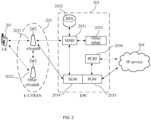
- FIG. 2 is an architecture diagram of a communication network system according to an embodiment of the present application.
- the communication network system is an LTE system of general mobile communication network technology.
- the LTE system includes a user equipment (UE) 201, an Evolved UMTS Terrestrial Radio Access Network (E-UTRAN) 202, an Evolved Packet Core (EPC) 203, and an operator's IP service 204 that are sequentially connected in communication.
- UE user equipment
- E-UTRAN Evolved UMTS Terrestrial Radio Access Network
- EPC Evolved Packet Core
- the UE 201 can be the aforementioned terminal 100, which will not be repeated here.
- E-UTRAN 202 includes eNodeB 2021 and other eNodeBs 2022.
- the eNodeB 2021 can be connected to other eNodeBs 2022 through a backhaul (for example, an X2 interface), the eNodeB 2021 is connected to the EPC 203, and the eNodeB 2021 can provide access from the UE 201 to the EPC 203.
- a backhaul for example, an X2 interface
- the EPC 203 can include Mobility Management Entity (MME) 2031, Home Subscriber Server (HSS) 2032, other MMEs 2033, Serving Gate Way (SGW) 2034, PDN Gate Way (PGW) 2035, Policy and Charging Rules Function (PCRF) 2036, and so on.
- MME 2031 is a control node that processes signaling between UE 201 and EPC 203, and provides bearer and connection management.
- HSS 2032 is configured to provide some registers to manage functions such as the home location register (not shown), and save some user-specific information about service feature, data rates, and so on. All user data can be sent through SGW 2034, PGW 2035 can provide UE 201 IP address allocation and other functions.
- PCRF 2036 is a policy and charging control policy decision point for service data flows and IP bearer resources, which selects and provides available policy and charging control decisions for policy and charging execution functional units (not shown).
- the IP service 204 can include Internet, intranet, IP Multimedia Subsystem (IMS), or other IP services.
- IMS IP Multimedia Subsystem
- LTE system is described above as an example, those skilled in the art should know that, the present application is not only applicable to the LTE system, but also applicable to other wireless communication systems, such as GSM, CDMA2000, WCDMA, TD-SCDMA, and new network systems in the future, or the like, which is not limited herein.
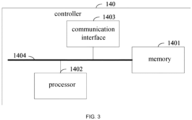
- FIG. 3 is a schematic structural diagram of a hardware of a controller according to embodiments of the present application.
- the controller 140 includes a memory 1401 and a processor 1402.
- the memory 1401 is used to store program instructions
- the processor 1402 is used to call the program instructions stored in the memory 1401 to execute the steps of the method of the present application.
- the above-mentioned controller 140 also includes a communication interface 1403, and the communication interface 1403 can be connected to the processor 1402 via a bus 1404.
- the processor 1402 can control the communication interface 1403 to implement the receiving and sending functions of the controller 140.
- FIG. 4 is a schematic structural diagram of a hardware of a network node according to embodiments of the present application.
- the network node 150 includes a memory 1501 and a processor 1502.
- the memory 1501 is used to store program instructions
- the processor 1502 is used to call the program instructions in the memory 1501 to execute the steps of the first node, intermediate node and/or tail node in the method of the present application.
- the above-mentioned network node 150 also includes a communication interface 1503, and the communication interface 1503 can be connected to the processor 1502 via a bus 1504.
- the processor 1502 can control the communication interface 1503 to implement the receiving and sending functions of the network node 150.
- the above-mentioned integrated modules implemented in the form of software function modules can be stored in a computer-readable storage medium.
- the above-mentioned software function modules are stored in a storage medium, and include several instructions to make a computer device (which may be a personal computer, server, or network device, and the like) or a processor execute some steps of the methods described in various embodiments of the present application.
- All or part of the above mentioned embodiments can be implemented by software, hardware, firmware, or any combination thereof.
- all or part of the above mentioned embodiments can be implemented in the form of a computer program product.
- the computer program product includes one or more computer instructions. When computer program instructions are loaded and executed on a computer, processes or functions according to embodiments of the present application are generated in whole or in part.
- the computer may be a general purpose computer, a special purpose computer, a computer network, or other programmable device. Computer instructions may be stored in the computer-readable storage medium, or may be transmitted from one computer-readable storage medium to another computer-readable storage medium.
- the computer instructions may be transmitted from a website, computer, server or data center to another website site, computer, server or data center via a wired manner (for example, a coaxial-cable, optical fiber, digital subscriber line) or a wireless manner (for example, infrared, wireless, microwave, and the like).
- the computer-readable storage medium can be any available medium that can be accessed by a computer, or can be the data storage device such as servers and data centers integrated with one or more available media.
- the available medium may be the magnetic medium (for example, floppy disk, hard disk, magnetic tape), optical medium (for example, DVD), or semiconductor medium (for example, solid state disk), and the like.
- FIG. 5 is a schematic flowchart of an information processing method according to a first embodiment. As shown in FIG. 5 , the information processing method of the present application is applied to the sending terminal and includes the following steps:
- the sending terminal, the first receiving terminal, and the second receiving terminal may include terminal devices (such as mobile phones, tablet computers, and the like), wearable smart devices (such as smart watches, smart bracelets, smart headphones, and the like), smart home devices (such as smart TV, smart loudspeaker box, and the like), Internet of Vehicles device (such as smart cars, vehicle-mounted terminals, and the like), through the above method, based on the conditional determination and processing strategy of the receiving terminal, information can be shared between different devices conveniently and quickly, thereby improving the user experience.
- terminal devices such as mobile phones, tablet computers, and the like
- wearable smart devices such as smart watches, smart bracelets, smart headphones, and the like
- smart home devices such as smart TV, smart loudspeaker box, and the like
- Internet of Vehicles device such as smart cars, vehicle-mounted terminals, and the like
- the step S1 includes at least one of the following:
- the preset operation is used to express sharing intention, including at least one of operations such as selecting sharing information, determining or generating sharing information, selecting the sharing object, determining to start sharing, and the like.
- the sharing information can be processed differently based on the conditional determination and processing strategy of the receiving terminal, to finish the information sharing.
- the processing strategy such as prohibiting sharing, sharing after the authority is determined, delaying sharing, and the like can be determined according to the analysis on the type and size of the sharing information, the storage space of the receiving terminal and the sending terminal, the electric quantity, the scenario, the mode and other information.
- the processing strategy such as canceling sharing, pausing sharing, and the like can be determined based on the scenario and mode changes of the receiving terminal and the sending terminal.
- the processing strategy such as withdrawing the sharing information, notifying the associated terminal, and the like can be determined. In this way, users can get a more flexible and convenient sharing experience at any stage of sharing information, and moreover, information security during the sharing process can be improved.
- the first preset condition includes at least one of the following:
- the second preset condition includes at least one of the following:
- the preset mode may be the mobile operator network mode, the wireless network mode, the power saving mode, the hands-free mode, the preset language mode, the smart mode, the sharing mode, the Internet of Things mode, and the like.
- the preset scenarios can be the work scenario, the conference scenario, the entertainment scenario, the game scenario, the driving scenario, the navigation scenario, the outdoor scenario, and the like.
- the preset authority can be the identity authority, the sharing authority, the receiving authority, and the like.
- the state can be the electric quantity states, the traffic state, the storage space size, and the like.
- the preset function can be the translation function, the presentation function, the compression or decompression function, the encryption or decryption function, the format conversion function, the image processing function, and the like.
- the first receiving terminal does not meet the first preset condition and the second receiving terminal does not meet the second preset condition, it means that the first receiving terminal cannot receive or process the sharing information and the second receiving terminal can receive or process the sharing information, or, at least one of the first receiving terminal and the second receiving terminal has the ability and/or authority to receive or process the sharing information.
- the sharing information can be processed by adopting corresponding strategies based on the abilities and/or authority of the first receiving terminal and the second receiving terminal, to obtain a better sharing experience.
- the processing the sharing information according to at least one first preset strategy includes at least one of the following:
- the processing the sharing information according to at least one second preset strategy includes:
- the first receiving terminal when the first receiving terminal does not meet the first preset condition, it means that the first receiving terminal is not in a preset mode or preset scenario, does not have the preset authority, is not in a preset state, or does not meet use conditions with the preset functions.
- the sharing with the first receiving terminal can be paused, delayed or canceled, or the sharing with the first receiving terminal can be started or resumed until the first receiving terminal meets the first preset condition, or the prompt information can be outputted to prompt potential problems in the current sharing, or the sharing with the first receiving terminal can be started or resumed based on the sharing operation.
- sharing when the network condition is poor, sharing is paused; or when the traffic of the receiving terminal receiving sharing information is insufficient, sharing is paused or canceled; or when the storage space of the receiving terminal receiving sharing information is insufficient, sharing can be canceled or delayed to avoid that the sharing information can only be partially received or fails to be received; or when some sharing information cannot be supported by the receiving terminal, sharing can be canceled or the sharing information can be sent to the terminal that can convert the information format and then the sharing information is reshared after the sharing information is processed by the terminal; or when some information cannot be shared (such as the WeChat voice cannot be shared), the information can be automatically filtered for canceling sharing the information, and a prompt can be outputted, to allow users to modify the sharing information timely and improve the sharing success rate.
- sharing the information can be delayed until the receiving terminal finishes the driving scenario, to avoid that the receiving terminal user checks the sharing information inconveniently or the driving safety is affected when the receiving terminal user checks the sharing information during driving; or when the language mode of the receiving terminal is Chinese and the language of the sharing information is French, the sharing information can be translated through the sending terminal or other terminals, and then be shared, to avoid that the receiving terminal user cannot obtain the content of the sharing information; or when the receiving terminal cannot decrypt files, the file can be decrypted by the sending terminal or other terminals and then sent to the receiving terminal, which is more convenient and can improve communication efficiency.
- At least one first preset strategy and/or at least one second preset strategy can be determined according to the first preset condition that is not met by the first receiving terminal and/or the second preset condition that is not met by the second receiving terminal and the content or type of the sharing information, then the sharing information is processed according to the determined at least one first preset strategy and/or at least one second preset strategy. For example, when the electric quantity of the first receiving terminal is lower than the threshold and the electric quantity of the second receiving terminal is higher than or equal to the threshold, the sharing information is a larger file, to avoid consuming more electric quantity in transmitting the file, the sharing with the first receiving terminal can be delayed.
- the second receiving terminal When the electric quantity of the first receiving terminal is higher than or equal to the threshold, starting sharing with the first receiving terminal. For the second receiving terminal, sending and sharing the sharing information can be performed directly. Or if the electric quantity of the first receiving terminal is lower than the threshold and the first receiving terminal cannot support files of the sharing information in the corresponding format, and the electric quantity of the second receiving terminal is higher than or equal to the threshold and the second receiving terminal can process files in the corresponding format, the sharing with the first receiving terminal can be canceled. After the file is sent to the second receiving terminal for processing and converted into a format that can be supported by the first receiving terminal, the second receiving terminal will share the processed file to the first receiving terminal when the electric quantity of the first receiving terminal is higher than or equal to the threshold. In this way, when sharing information, the abilities of the device participating in information sharing can be fully considered, which can achieve reasonable use of device abilities, effectively avoid or reduce the adverse effects caused in the information sharing process, and improve the experience of various users.
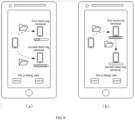
- the sending terminal when the sending terminal sends sharing information, the current sharing process will be prompted through the interface, including that the sharing objects are the first receiving terminal and the second receiving terminal, the sharing information is sent to the first receiving terminal and the second receiving terminal respectively, and the current corresponding sending progress of the first receiving terminal and the second receiving terminal, which can be displayed below the corresponding receiving terminal in the form of a progress bar.
- the interface provides pause options and cancel options, and users can pause or cancel the sharing process through operations.
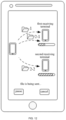
- the sending terminal sends files to the second receiving terminal through the first receiving terminal.
- the first receiving terminal has more remaining traffic or is in a wireless connection or can convert file formats, and the like.
- the current sharing process will be prompted through the interface, including that the sharing object is the first receiving terminal and the second receiving terminal, and the sharing information is sent to the second receiving terminal through the first receiving terminal, as well as the current corresponding sending progress of the first receiving terminal and the second receiving terminal, which can be displayed below the corresponding receiving terminal in the form of a progress bar, so that the user can know the progress, and then the sharing information can be processed according to the progress.
- the sending is paused or delayed according to the sending progress, and the like.
- the interface provides pause options and cancel options, and users can pause or cancel the sharing process through operations.
- FIG. 7 it is a schematic diagram of the interface of the receiving terminal.
- the receiving terminal's interface prompts the current sharing process and provides pause options and cancel options, and users can pause or cancel the sharing process through operations.
- FIG. 7 it is a schematic diagram of another interface of the receiving terminal.
- the interface of the second receiving terminal prompts the currently participating devices and the sharing process, and provides pause options and cancel options. Users can pause or cancel the sharing process through operations.
- processing the sharing information according to at least one first preset strategy, and/or processing the sharing information according to at least one second preset strategy includes at least one of the following:
- the first preset condition is the same as the second preset condition, which includes at least one of the following:
- sharing with the first receiving terminal and the second receiving terminal can be paused, or sharing with the first receiving terminal and the second receiving terminal can be canceled, or sharing with the first receiving terminal and the second receiving terminal can be delayed, or sharing with the first receiving terminal and the second receiving terminal can be started or resumed when the first receiving terminal meets the first preset condition and/or the second receiving terminal meets the second preset condition, or prompt information can be outputted, or sharing with the first receiving terminal and the second receiving terminal can be started or resumed in response to determining the first sharing operation, or information shared to the first receiving terminal and/or the second receiving terminal can be withdrawn.
- one of the receiving terminals can be selected for sending, thereby pausing the sharing with the first receiving terminal or the second receiving terminal, or canceling the sharing with the first receiving terminal or the second receiving terminal, or delaying the sharing with the first receiving terminal or the second receiving terminal, to meet the sending terminal's need to send sharing information.
- the electric quantity of the terminal A and the terminal B is both lower than the threshold, but the electric quantity of the terminal A is more than the terminal B, so that the file can be sent to the terminal A.
- This scenario can be applied to situations which have special requirements for the immediacy of information transmission, such as important files are transmitted, the electric quantity of the sending terminal is low, the sending terminal transfers authority, and the like. In this way, smooth information sharing can be ensured.
- the sharing information can be divided into at least one first sharing information and at least one second sharing information according to the remaining space of the first receiving terminal and the second receiving terminal, so that the sharing information can be actively divided to make the size of the sharing information match with the remaining capacity of the receiving terminal, or match the remaining space of one of the receiving terminals.
- the sharing information when the first receiving terminal does not meet the first preset condition and/or the second receiving terminal does not meet the second preset condition, the sharing information is divided into at least one first sharing information and at least one second sharing information according to the current state, and/or the mode, and/or the scenario of the first receiving terminal and the second receiving terminal.
- the sharing information can be divided into at least one first sharing information and at least one second sharing information.
- the first sharing information may be sent to the receiving terminal that meets the processing conditions, and the second sharing information may not be sent to the receiving terminal that does not meet the processing conditions temporarily, so that the receiving terminal that meets the processing conditions can process the sharing information first.
- the terminal C can send the video or image file in the sharing information to the terminal A for projection first, without sharing the audio file in the sharing information to the terminal B temporarily, to avoid affecting the current process of the terminal B.
- the processing the sharing information according to at least one second preset strategy also includes: if the sharing information needs to be sent to the first receiving terminal, the sharing information is processed through the second receiving terminal.
- At least one of the following processing is performed on the processed sharing information:
- the sharing information can be processed through the second receiving terminal and then be sent to the first receiving terminal. Therefore, when the sending terminal shares information with multiple receiving terminals, the sending terminal's workload of data sending and receiving can be reduced.
- the sharing information can be directly sent to the first receiving terminal, or can be processed according to the situation of the first receiving terminal.
- the processing includes at least one of delaying the sharing with the first receiving terminal, starting or resuming sharing with the first receiving terminal until the first receiving terminal meets the first preset condition, outputting prompt information, or starting or resuming sharing with the first receiving terminal in response to determining the second sharing operation. In this way, the transmit-receiving ability of the first receiving terminal and the second receiving terminal can be considered on the basis that the sharing requirements of the sending terminal are met.
- the processing the sharing information according to at least one first preset strategy and at least one second preset strategy includes:
- the sending terminal When the first receiving terminal does not have the preset authority and the second receiving terminal has the preset authority, the sending terminal first checks with the second receiving terminal whether the sharing information can be sent to the first receiving terminal, that is, the sending terminal sends a sharing request for sharing information. After the second receiving terminal determines that sharing is allowed, the sending terminal sends a sharing request to the first receiving terminal. For example, the sending terminal needs to send a file marked as a confidential file to the first receiving terminal, but the first receiving terminal does not have the authority to use the confidential file. In this case, the sending terminal needs to be authorized or confirmed by the second receiving terminal that has the authority to use the confidential file, then the confidential file is sent to the first receiving terminal.
- the same scenario also applies to sharing contact information, sharing chat records, and the like, thus improving data security and privacy during the information sharing process.
- the sending terminal may divide the sharing information into at least one first sharing information and/or at least one second sharing information.
- the dividing the sharing information into at least one first sharing information and at least one second sharing information includes at least one of the following:
- the sharing information By dividing the sharing information, the sharing information can be converted into unit parts that are more suitable for processing. For each unit part of the sharing information, the abilities of the devices participating in information sharing can be better allocated and used, and the efficiency of information sharing can be improved.
- the sharing information that can be divided can be at least one file in a folder, at least one file in a compressed file, at least one file sent continuously, and the like.
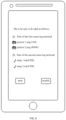
- the sending terminal when dividing the sharing information, can automatically divide the sharing information and output prompt information.
- the sharing information can be divided into picture parts and song parts according to the file format, and the file size can be indicated in the pictures and songs.
- the divided result shown in FIG. 8 can also be the result obtained by dividing the file into two parts with different file sizes.
- the receiving terminal that the sharing information can be sent to is determined according to the format and/or size of the file, and prompts are displayed on the sending terminal interface.
- the interface of the sending terminal provides sending options and modification options.
- the sending terminal can also update at least one first sharing information and at least one second sharing information according to the modifying operation for at least one first sharing information and at least one second sharing information, and then the updated sharing information is processed according to a preset strategy.
- the preset strategy may be the same as or different from the first preset strategy and the second preset strategy.
- the sharing information is divided into at least one first sharing information and/or at least one second sharing information after being compressed, or after the sharing information is divided into at least one first sharing information and/or at least one second sharing information, the first sharing information and/or the second sharing information are compressed. In this way, the size of the information can match with the first receiving terminal and the second receiving terminal, and the sharing speed can be increased.
- the sharing information is divided into at least one first sharing information and/or at least one second sharing information.
- the sharing information can be copied and divided into at least one first sharing information and at least one second sharing information, so that the sharing information can be processed quickly.
- the terminal C can copy the audio files in the sharing information, and send the copied audio files and the video or image files to the terminal A for displaying and playing.
- the terminal B has sufficient electric quantity, the audio files are sent to the terminal B for playing, and an instruction to stop playing is sent to the terminal A to realize quick sharing.
- the sharing information file when the sharing information file is large, the remaining space of the first receiving terminal is small and the remaining space of the second receiving terminal is large, the sharing information can be divided into at least one first sharing information and at least one second sharing information.
- the size of the space occupied by the first sharing information and the second sharing information is different, then the sharing information with the appropriate size is sent according to the remaining space of the first receiving terminal and the second receiving terminal.
- the terminal C when both the terminal A and the terminal B are connected to the conference projection, the terminal C can send the sharing files to the terminal A and the terminal B respectively according to the space size of the terminal A and the terminal B, so that the sharing can be quickly realized and displayed on the conference projection.
- the sharing information can be divided into at least one first sharing information and at least one second sharing information according to the type and/or format of the sharing information.
- This allows sharing information of the corresponding type and/or format to be sent to the adapted receiving terminal.
- the terminal C can send the sharing files to the terminal A and the terminal B respectively according to the file formats that are supported by the terminal A and the terminal B, to realize quick sharing and display the sharing information on the conference projection.
- the sharing information can be divided into at least one first sharing information and at least one second sharing information, so that the corresponding sharing information can be processed by the corresponding receiving terminal.
- the terminal C can send the video or image file in the sharing information to the terminal A and send the audio file in the sharing information to the terminal B, to realize quick sharing and display the sharing information on the conference projection.
- the sharing information may be divided after the sharing information starts to be shared or after the sharing information is sent.
- the speed of the terminal A receiving files is significantly slower than the speed of the terminal B receiving files, then the files sent to the terminal A can be divided, and partial files can be sent to the terminal B to improve sharing efficiency.
- the conference efficiency can be improved.
- the sharing information it is found that partial files sent to the terminal B are wrong, then the files sent to the terminal B can be divided and the wrong files are withdrawn.
- the first preset condition and/or the second preset condition include at least one of the following:
- the processing the sharing information according to at least one first preset strategy or at least one second preset strategy includes at least one of the following:
- the method further includes at least one of the following:
- the first conversion terminal is the sending terminal and/or the second receiving terminal and/or the server and/or at least one other device; and/or the second conversion terminal is the sending terminal and/or the first receiving terminal and/or the server and/or at least one other device.
- the first conversion terminal if the first receiving terminal cannot receive or process the first sharing information and the second receiving terminal can receive or process the first sharing information, the first conversion terminal is determined to be the second receiving terminal. In an embodiment, if the second receiving terminal cannot receive or process the second sharing information and the first receiving terminal can receive or process the second sharing information, the second conversion terminal is determined to be the first receiving terminal.
- the first preset condition and the second preset condition represent the ability of the first receiving terminal and the second receiving terminal to receive and process the sharing information.
- the receiving ability can be determined by network signal strength, storage space size, authority, scenarios, modes, and the like.
- the processing ability can be determined by the software configuration, hardware configuration, and the like of the receiving terminal.
- the terminal C can send the video or image files in the sharing information to the terminal A and send the audio files in the sharing information to the terminal B.
- the terminal C detects that the terminal B does not support the format of the audio file and the terminal A supports the format conversion of the audio file.
- the terminal C can send the audio file to the terminal A for format conversion, and then the terminal A sends the audio file to the terminal B, to achieve quick and accurate sharing.
- the terminal C can also convert the format of the audio file and then send the audio file to the terminal B.
- the audio file can also be sent to a server or other device for format conversion, and then the audio file is sent to the terminal B.
- multiple devices can convert the sharing information respectively and then the converted sharing information are sent.
- the sending terminal can allocate tasks to devices according to the ability of different devices, and at least one conversion terminal is used to convert the information to be shared, which not only improves efficiency, but also reduces the processing pressure of each device.
- the processing manner same as the first preset strategy or the second preset strategy described above can be adopted to send the information, which will not be repeated here.
- the first preset condition and/or the second preset condition include at least one of the following:
- the sending the sharing information according to at least one first preset strategy or at least one second preset strategy includes at least one of the following:
- the first operation and/or the second operation include at least one of the following: touch operation, air separation operation, voice control, and key operation.
- the connection between the sending terminal and the receiving terminal can be disconnected, or the sharing between the sending terminal and the receiving terminal can be paused or resumed or terminated or prohibited.
- each user participating in information sharing can independently control the sharing process when sharing information, which is more user-friendly and can collaboratively improve the sharing accuracy.
- the terminal A starts sending a larger file to the terminal B, although the terminal A determines that the size of the file matches the remaining space of the terminal B, the user of the terminal B thinks that the file is still too large or can be shared in a more appropriate way, then the terminal B can be operated to stop sharing.
- the terminal A starts sending a confidential file to the terminal B, but during the file sending process, it is found that the sent file is wrong, then the user of the terminal A can stop sharing or make the terminal A disconnected from the terminal B. Or, the terminal A starts sending contact information to the terminal B, but the user of the terminal C corresponding to the contact information is not allowed to share the contact information. Then the user of the terminal C can operate the terminal C to send a stop sharing instruction to the terminal A, to stop the sharing between the terminal A and the terminal B or disconnect the connection between the terminal A and the terminal B.
- the method before the step S2, the method also include:
- the preset mode or scenario in which the sending terminal is in may be modes or scenarios that allow information sharing between multiple devices, such as the sharing mode, a smart mode, the conference scenario, the multi-person conversation scenario, the multi-device connection scenario, and the like.
- the preset mode or scenario in which the sending terminal is in may be modes or scenarios that the authority needs to be authenticated, such as the children mode, the elderly mode, the monitoring scenario, the confidential scenario, and the like.
- the step S2 does not need to be executed and/or prompt information is outputted.
- the user can change the mode or scenario of the sending terminal to meet the processing requirements, or can input authorization information, such as the password, the verification code, the fingerprint, the face information, and the like for verifying. After the verification is passed, proceeding with the step S2.
- authorization information such as the password, the verification code, the fingerprint, the face information, and the like for verifying.
- the method after the step S2, the method also include:
- the first preset condition includes at least one of the following: being in the preset mode or preset scenario; having a preset authority; the state being in a preset state, in an embodiment, the preset state including that the traffic is greater than or equal to the preset traffic, the electric quantity is greater than or equal to the preset electric quantity, and the storage space is greater than or equal to the preset size; and meeting the use conditions with preset functions.
- the second preset condition includes at least one of the following: not being in the preset mode or preset scenario; not having a preset authority; the state not being in a preset state, in an embodiment, the preset state including that the traffic is greater than or equal to the preset traffic, the electric quantity is greater than or equal to the preset electric quantity, and the storage space is greater than or equal to the preset size; and not meeting the use conditions with preset functions.
- the processing strategy is adjusted to ensure that the sharing process is performed smoothly.
- the first receiving terminal has sufficient electric quantity when starting receiving files, but after receiving for a period of time, the electric quantity is insufficient.
- the remaining files can be sent to the second receiving terminal, and when the first receiving terminal has sufficient electric quantity, the second receiving terminal can send the remaining files to the first receiving terminal.
- the information processing method of the present application is applied to the sending terminal and includes the following steps: in response to sending sharing information to at least one first receiving terminal and at least one second receiving terminal; and in response to that the first receiving terminal does not meet a first preset condition, processing the sharing information according to at least one first preset strategy; and/or in response to that the second receiving terminal does not meet a second preset condition, processing the sharing information according to at least one second preset strategy.
- information can be shared easily and conveniently between different devices, thereby improving the user experience.
- FIG. 9 is a schematic flowchart of the information processing method according to a second embodiment. As shown in FIG. 9 , the information processing method of the present application is applied to the sending terminal and includes the following steps:
- the sending terminal, the first receiving terminal, and the second receiving terminal may include terminal devices (such as mobile phones, tablet computers, and the like), wearable smart devices (such as smart watches, smart bracelets, smart headphones, and the like), smart home devices (such as smart TV, smart loudspeaker box, and the like), Internet of Vehicles device (such as smart cars, vehicle-mounted terminals, and the like), through the above method, based on the conditional determination, the dividing for the sharing information, and processing strategy of the receiving terminal, information can be shared between different devices conveniently and quickly, thereby improving the user experience.
- terminal devices such as mobile phones, tablet computers, and the like
- wearable smart devices such as smart watches, smart bracelets, smart headphones, and the like
- smart home devices such as smart TV, smart loudspeaker box, and the like
- Internet of Vehicles device such as smart cars, vehicle-mounted terminals, and the like
- the step S10 includes at least one of the following:
- the preset operation is used to express sharing intention, including at least one of operations such as selecting sharing information, determining or generating sharing information, selecting the sharing object, determining to start sharing, and the like.
- the sharing information can be processed differently based on the conditional determination and processing strategy of the receiving terminal, to finish the information sharing.
- the processing strategy such as prohibiting sharing, sharing after the authority is determined, delaying sharing, and the like can be determined according to the analysis on the type and size of the sharing information, the storage space of the receiving terminal and the sending terminal, the electric quantity, the scenario, the mode and other information.
- the processing strategy such as canceling sharing, pausing sharing, and the like can be determined based on the scenario and mode changes of the receiving terminal and the sending terminal.
- the processing strategy such as withdrawing the sharing information, notifying the associated terminal, and the like can be determined. In this way, users can get a more flexible and convenient sharing experience at any stage of sharing information, and moreover, information security during the sharing process can be improved.
- the step S20 includes at least one of the following:
- the sharing information can be converted into unit parts that are more suitable for processing. For each unit part of the sharing information, the abilities of the devices participating in information sharing can be better allocated and used, and the efficiency of information sharing can be improved.
- the sharing information that can be divided can be at least one file in a folder, at least one file in a compressed file, at least one file sent continuously, and the like.
- the sending terminal can also obtain the updated at least one first sharing information and at least one second sharing information according to the modifying operation for at least one first sharing information and at least one second sharing information, and then the first sharing information is processed according to a third preset strategy, or the second sharing information is processed according to a fourth preset strategy.
- the fourth preset strategy may be the same as or different from the second preset strategy.
- the sharing information is divided into at least one first sharing information and/or at least one second sharing information after being compressed, or after the sharing information is divided into at least one first sharing information and/or at least one second sharing information, the first sharing information and/or the second sharing information are compressed. In this way, the size of the information can match with the first receiving terminal and the second receiving terminal, and the sharing speed can be increased.
- the sharing information is divided into at least one first sharing information and/or at least one second sharing information.
- the sharing information can be copied and divided into at least one first sharing information and at least one second sharing information, so that the sharing information can be processed quickly.
- the terminal C can copy the audio files in the sharing information, then sends the copied audio files and the video/image files to the terminal A for displaying and playing.
- the terminal B has sufficient electric quantity, the audio files are sent to the terminal B for playing, and an instruction to stop playing is sent to the terminal A to realize quick sharing.
- the sharing information file when the sharing information file is large, the remaining space of the first receiving terminal is small, and the remaining space of the second receiving terminal is large, the sharing information is divided into at least one first sharing information and at least one second sharing information.
- the size of the space occupied by the first sharing information and the second sharing information is different, then the sharing information with the appropriate size is sent according to the remaining space of the first receiving terminal and the second receiving terminal.
- the terminal C when the terminal A and the terminal B are connected to the conference projection, the terminal C can send the sharing files to the terminal A and the terminal B respectively according to the space size of the terminal A and the terminal B, so that the sharing can be quickly realized and displayed on the conference projection.
- the sharing information can be divided into at least one first sharing information and at least one second sharing information according to the type and/or format of the sharing information.
- This allows sharing information of the corresponding type and/or format to be sent to the adapted receiving terminal.
- the terminal C can send the songs to the terminal A and the terminal B respectively according to the song's formats supported by the terminal A and the terminal B, to realize quick sharing and display the sharing information on the conference projection.
- the sharing information can be divided into at least one first sharing information and at least one second sharing information, so that the corresponding sharing information can be processed by the corresponding receiving terminal.
- the terminal C can determine or generate sharing information after downloading children videos and drama videos, and send children videos to the terminal A and drama videos to the terminal B, so that users can receive the required information accurately.
- the sharing information may be divided before the sharing information starts to be sent, or after the sharing information starts to be shared, or after the sharing information is sent.
- the speed of power consumption of the terminal A receiving files is significantly slower than the speed of power consumption of the terminal B receiving files.
- the files sent to the terminal A can be divided, and partial files can be sent to the terminal B to reduce the power consumption of the terminal A and ensure the reasonable use of electric quantity of all terminals.
- the sharing information it is found that partial files sent to the terminal B are wrong, the files sent to the terminal B can be divided, then the wrong files can be withdrawn, and the correct files are retained.
- the step S30 includes at least one of the following:
- the method further includes at least one of the following:
- the first conversion terminal is the sending terminal and/or the second receiving terminal and/or the server and/or at least one other device; and/or the second conversion terminal is the sending terminal and/or the first receiving terminal and/or server and/or at least one other device.
- the first receiving terminal if the first receiving terminal cannot receive or process the first sharing information and the second receiving terminal can receive or process the first sharing information, the first conversion terminal is determined to be the second receiving terminal.
- the second receiving terminal cannot receive or process the second sharing information and the first receiving terminal can receive or process the second sharing information
- the second conversion terminal is determined to be the first receiving terminal.
- the receiving ability can be determined by network signal strength, storage space size, authority, scenarios, modes, and the like.
- the processing ability can be determined by the software configuration, hardware configuration, and the like of the receiving terminal.
- another receiving terminal and/or the sending terminal and/or the server and/or at least one other device can process the corresponding sharing information and then send the sharing information to the corresponding receiving terminal. For example, when the terminal user A needs to send an audio file to the terminal B user, but the terminal A detects that the terminal B does not support the format of the audio file and the terminal C supports the format conversion of audio files.
- the terminal A can send the audio file to the terminal C for format conversion, then the terminal C sends the audio file to the terminal B to achieve quick and accurate sharing.
- the terminal C can also convert the format of the audio file and then sends the audio file to the terminal B.
- the audio file can also be sent to a server or other device for format conversion, and then send the audio file to the terminal B.
- multiple sharing information needs to be converted, multiple devices can convert the sharing information respectively and then the converted sharing information are sent.
- the sending terminal can allocate tasks to devices according to the ability of different devices, and at least one conversion terminal is used to convert the information to be shared, which not only improves efficiency, but also reduces the processing pressure of each device.
- the processing manner same as the first preset strategy or the second preset strategy described above can be adopted to send the information, which will not be repeated here.
- the first receiving terminal and/or the second receiving terminal meet preset conditions, and based on the determination result, the first sharing information is processed according to at least one first preset strategy and/or the second preset strategy is processed according to at least one second preset strategy.
- the preset conditions include at least one of the following:
- the preset mode may be the mobile operator network mode, the wireless network mode, the power saving mode, the hands-free mode, the preset language mode, the smart mode, the sharing mode, the Internet of Things mode, and the like.
- the preset scenarios can be the work scenario, the conference scenario, the entertainment scenario, the game scenario, the driving scenario, the navigation scenario, the outdoor scenario, and the like.
- the preset authority can be the identity authority, the sharing authority, the receiving authority, and the like.
- the state can be the electric quantity states, the traffic state, the storage space size, and the like.
- the preset function can be the translation function, the presentation function, the compression or decompression function, the encryption or decryption function, the format conversion function, the image processing function, and the like.
- the receiving terminal can receive or process the sharing information.
- the sharing information can be processed by adopting corresponding strategies based on the abilities and/or authority of the first receiving terminal and the second receiving terminal, to obtain better sharing experience.
- the according to at least one first preset strategy and/or at least one second preset strategy includes at least one of the following:
- the receiving terminal when the receiving terminal does not meet the preset conditions, it means that the receiving terminal is not in the preset mode or preset scenario, does not have the preset authority, is not in the preset state, or does not meet the use conditions with preset functions.
- the sharing with the receiving terminal can be paused, delayed or canceled, or the sharing with the receiving terminal can be started or resumed until the receiving terminal meets the preset conditions, or the prompt information can be outputted to indicate possible problems in the current sharing, or the sharing with the receiving terminal can be started or resumed based on the sharing operation.
- sharing when network conditions are poor, sharing is paused; or when the traffic of the receiving terminal receiving sharing information is insufficient, the sharing will be paused or canceled; or when the storage space of the receiving terminal receiving sharing information is insufficient, the sharing can be canceled or delayed to avoid that the sharing information can only be partially received or fails to be received; or some sharing information cannot be supported by the receiving terminal, the sharing can be canceled or the sharing information can be sent to the terminal that can convert the information format for processing and then share the sharing information again.
- the method before the step S20 or the step S30, the method also includes:
- the preset mode or scenario in which the sending terminal is in may be modes or scenarios that allow information sharing between multiple devices, such as the sharing mode, a smart mode, the conference scenario, the multi-person conversation scenario, the multi-device connection scenario, and the like.
- the preset mode or scenario in which the sending terminal is in may be modes or scenarios that the authority needs to be authenticated, such as the children mode, the elderly mode, the monitoring scenario, the confidential scenario, and the like.
- the step S20 or the step S30 does not need to be executed and/or prompt information is outputted.
- the user can change the mode or scenario of the sending terminal to meet the processing requirements, or can input authorization information, such as the password, the verification code, the fingerprint, the face information, and the like for verifying, and the step S20 or the step S30 can be proceeded.
- authorization information such as the password, the verification code, the fingerprint, the face information, and the like for verifying
- the method after the step S2, the method also include:
- the first preset condition includes at least one of the following: being in the preset mode or preset scenario; having a preset authority; the state being in a preset state, in an embodiment, the preset state including that the traffic is greater than or equal to the preset traffic, the electric quantity is greater than or equal to the preset electric quantity, and the storage space is greater than or equal to the preset size; and meeting the use conditions with preset functions.
- the second preset condition includes at least one of the following: not being in the preset mode or preset scenario; not having a preset authority; the state not being in a preset state, in an embodiment, the preset state including that the traffic is greater than or equal to the preset traffic, the electric quantity is greater than or equal to the preset electric quantity, and the storage space is greater than or equal to the preset size; and not meeting the use conditions with preset functions.
- the processing strategy is adjusted to ensure that the sharing process is performed smoothly.
- the first receiving terminal has sufficient electric quantity when starting receiving files, but after receiving for a period of time, the electric quantity is insufficient.
- the remaining files can be sent to the second receiving terminal, and when the first receiving terminal has sufficient electric quantity, the second receiving terminal can send the remaining files to the first receiving terminal.
- the information processing method of the present application is applied to the sending terminal and includes the following steps: in response to sending sharing information to at least one first receiving terminal and at least one second receiving terminal; dividing the sharing information into at least one first sharing information and at least one second sharing information; and processing the first sharing information according to at least one first preset strategy, and/or processing the second sharing information according to at least one second preset strategy.
- the dividing for the sharing information, and processing strategy of the receiving terminal information can be shared between different devices conveniently and quickly, thereby improving the user experience.
- FIG. 10 is a schematic flowchart of the information processing method according to a third embodiment. As shown in FIG. 10 , the information processing method of the present application is applied to the sending terminal and includes the following steps:
- the sending terminal, the first receiving terminal, and the second receiving terminal may include terminal devices (such as mobile phones, tablet computers, and the like), wearable smart devices (such as smart watches, smart bracelets, smart headphones, and the like), smart home devices (such as smart TV, smart loudspeaker box, and the like), Internet of Vehicles device (such as smart cars, vehicle-mounted terminals, and the like), through the above method, based on the conditional determination, and collaboration and processing strategies among multi receiving terminals, information can be shared between different devices conveniently and quickly, thereby improving the user experience.
- terminal devices such as mobile phones, tablet computers, and the like
- wearable smart devices such as smart watches, smart bracelets, smart headphones, and the like
- smart home devices such as smart TV, smart loudspeaker box, and the like
- Internet of Vehicles device such as smart cars, vehicle-mounted terminals, and the like
- the step S100 includes at least one of the following:
- the preset operation is used to express sharing intention, including at least one of operations such as selecting sharing information, determining or generating sharing information, selecting the sharing object, determining to start sharing, and the like.
- the sharing information can be processed differently based on the conditional determination and processing strategy of the receiving terminal, to finish the information sharing.
- the processing strategy such as prohibiting sharing, sharing after the authority is determined, delaying sharing, and the like can be determined according to the analysis on the type and size of the sharing information, the storage space of the receiving terminal and the sending terminal, the electric quantity, the scenario, the mode and other information.
- the processing strategy such as canceling sharing, pausing sharing, and the like can be determined based on the scenario and mode changes of the receiving terminal and the sending terminal.
- the processing strategy such as withdrawing the sharing information, notifying the associated terminal, and the like can be determined. In this way, users can get a more flexible and convenient sharing experience at any stage of sharing information, and moreover, information security during the sharing process can be improved.
- the associated second receiving terminal may be any device connected and/or bound to the sending terminal and/or the first receiving terminal.
- the connection may be a direct connection or an indirect connection.
- binding may mean that the login account information is the same, or a matching connection, or through user-defined settings, and the like.
- the step S200 includes at least one of the following:
- the terminal association information may be a binding relationship between terminals, an authority affiliation relationship, and the like, indicating that terminal association information exists between the sending terminal and/or the first receiving terminal.
- there is an authority affiliation relationship between the terminal used by children and the terminal used by parents and there is a binding relationship between the lighting device in the living room and the user's mobile phone.
- the content and/or type of sharing information can be associated with the corresponding terminal device.
- the sharing information is the contact information
- the associated device can be the terminal used by the user corresponding to the contact information.
- the sharing information is important files
- the associated device can be the original issuing device of this important file.
- the sending terminal and/or the first receiving terminal can be associated with the corresponding terminal device according to the current mode and/or scenario. For example, if the terminal is currently in the children mode, the terminal can be associated with the parent's terminal, and if the terminal is currently in the driving mode, the terminal can be associated with a certain passenger's terminal.
- the associated second receiving terminal can be used to authenticate and share the authority and abilities of the sending terminal or receiving terminal.
- the terminal A can be assigned to share the storage space with the terminal B.
- the terminal B is the associated receiving terminal of the terminal A.
- the sending terminal can divide the file and send the divided file to the terminal A and the terminal B respectively, or only send the divided file to the terminal B to avoid insufficient storage space of the terminal A.
- children use their own mobile phones for projection screen on TV.
- the TV can send an authentication request to the parent's mobile phone bound to the children's mobile phone. After receiving determination information that allows projection screen, the TV can screen the contents of children's mobile phones.
- the preset condition includes that the first receiving terminal does not meet the first preset condition and/or the second receiving terminal does not meet the second preset condition.
- the step S400 includes: when the first receiving terminal does not meet the first preset condition, processing the sharing information according to at least one first preset strategy; and/or when the second receiving terminal does not meet the second preset condition, processing the sharing information according to at least one second preset strategy.
- the first preset condition includes at least one of the following:
- the second preset condition includes at least one of the following:
- the preset mode may be the mobile operator network mode, the wireless network mode, the power saving mode, the hands-free mode, the preset language mode, the smart mode, the sharing mode, the Internet of Things mode, and the like.
- the preset scenarios can be the work scenario, the conference scenario, the entertainment scenario, the game scenario, the driving scenario, the navigation scenario, the outdoor scenario, and the like.
- the preset authority can be the identity authority, the sharing authority, the receiving authority, and the like.
- the state can be the electric quantity states, the traffic state, the storage space size, and the like.
- the preset function can be the translation function, the presentation function, the compression or decompression function, the encryption or decryption function, the format conversion function, the image processing function, and the like.
- the first receiving terminal does not meet the first preset condition and the second receiving terminal does not meet the second preset condition, it means that the first receiving terminal cannot receive or process the sharing information and the second receiving terminal can receive or process the sharing information, or, at least one of the first receiving terminal and the second receiving terminal has the ability and/or authority to receive or process the sharing information.
- the sharing information can be processed by adopting corresponding strategies based on the abilities and/or authority of the first receiving terminal and the second receiving terminal, to obtain a better sharing experience.
- the processing the sharing information according to at least one first preset strategy includes at least one of the following:
- the processing the sharing information according to at least one second preset strategy includes:
- the first receiving terminal when the first receiving terminal does not meet the first preset condition, it means that the first receiving terminal is not in a preset mode or preset scenario, does not have the preset authority, is not in a preset state, or does not meet use conditions with the preset functions.
- the sharing with the first receiving terminal can be paused, delayed or canceled, or the sharing with the first receiving terminal can be started or resumed until the first receiving terminal meets the first preset condition, or the prompt information can be outputted to prompt potential problems in the current sharing, or the sharing with the first receiving terminal can be started or resumed based on the sharing operation.
- sharing when the network condition is poor, sharing is paused; or when the traffic of the receiving terminal receiving sharing information is insufficient, sharing is paused or canceled; or when the storage space of the receiving terminal receiving sharing information is insufficient, sharing can be canceled or delayed to avoid that the sharing information can only be partially received or fails to be received; or when some sharing information cannot be supported by the receiving terminal, sharing can be canceled or the sharing information can be sent to the terminal that can convert the information format and then the sharing information is reshared after the sharing information is processed by the terminal; or when some information cannot be shared (such as the WeChat voice cannot be shared), the information can be automatically filtered for canceling sharing the information, and a prompt can be outputted.
- sharing the information can be delayed or the sharing information can be sent to the associated second receiving terminal, and then the sharing is resumed until the receiving terminal finishes the driving scenario, to avoid that the receiving terminal user checks the sharing information inconveniently or the driving safety is affected when the receiving terminal user checks the sharing information during driving; or when the language mode of the receiving terminal is Chinese and the language of the sharing information is French, the sharing information can be translated through the second receiving terminal, and then be shared, to avoid that the user of the first receiving terminal cannot obtain the content of the sharing information; or when the first receiving terminal cannot decrypt files, the file can be decrypted through the second receiving terminal and then sent to the first receiving terminal, which is more convenient and can improve communication efficiency.
- At least one first preset strategy and/or at least one second preset strategy can be determined according to the first preset condition that is not met by the first receiving terminal and/or the second preset condition that is not met by the second receiving terminal and the content or type of the sharing information, then the sharing information is processed according to the determined at least one first preset strategy and/or at least one second preset strategy. For example, when the remaining traffic of the first receiving terminal is lower than the threshold and the first receiving terminal is not in the wireless connection mode, and the remaining traffic of the second receiving terminal is higher than or equal to the threshold, the shared information is a larger file.
- sharing with the first receiving terminal can be delayed to avoid consuming the traffic of the first receiving terminal when transmitting the file, and sharing with the first receiving terminal can be resumed when the first receiving terminal is in the wireless connection mode.
- the sharing information can be sent to the second receiving terminal first, and the sharing information will be sent to the first receiving terminal from the second receiving terminal until the first receiving terminal is in the wireless connection mode.
- the electric quantity of the first receiving terminal is lower than the threshold and the first receiving terminal cannot support the files of the sharing information in the corresponding format
- the electric quantity of the second receiving terminal is higher than or equal to the threshold and the second receiving terminal can support the files of the sharing information in the corresponding format
- sharing with the first receiving terminal can be canceled.
- the second receiving terminal After the file is sent to the second receiving terminal for processing and converted into a format that can be supported by the first receiving terminal, the second receiving terminal will share the processed file to the first receiving terminal when the electric quantity of the first receiving terminal is higher than or equal to the threshold.
- the abilities of the device participating in information sharing can be fully considered, which can achieve reasonable use of device abilities, effectively avoid or reduce the adverse effects caused in the information sharing process, and improve the experience of various users.
- processing the sharing information according to at least one first preset strategy, and/or processing the sharing information according to at least one second preset strategy includes at least one of the following:
- the first preset condition is the same as the second preset condition, which includes at least one of the following:
- sharing with the first receiving terminal and the second receiving terminal can be paused, or sharing with the first receiving terminal and the second receiving terminal can be canceled, or sharing with the first receiving terminal and the second receiving terminal can be delayed, or sharing with the first receiving terminal and the second receiving terminal can be started or resumed when the first receiving terminal meets the first preset condition and/or the second receiving terminal meets the second preset condition, or prompt information can be outputted, or sharing with the first receiving terminal and the second receiving terminal can be started or resumed in response to determining the first sharing operation, or information shared to the first receiving terminal and/or the second receiving terminal can be withdrawn.
- one of the receiving terminals can be selected for sending, thereby pausing the sharing with the first receiving terminal or the second receiving terminal, or canceling the sharing with the first receiving terminal or the second receiving terminal, or delaying the sharing with the first receiving terminal or the second receiving terminal, to meet the sending terminal's need to send sharing information.
- the electric quantity of the terminal A and the terminal B is both lower than the threshold, but the electric quantity of the terminal A is more than the terminal B, so that the file can be sent to the terminal A.
- This scenario can be applied to situations which have special requirements for the immediacy of information transmission, such as important files are transmitted, the electric quantity of the sending terminal is low, the sending terminal transfers authority, and the like. In this way, smooth information sharing can be ensured.
- the sharing information can be divided into at least one first sharing information and at least one second sharing information according to the remaining space of the first receiving terminal and the second receiving terminal, so that the sharing information can be actively divided to make the size of the sharing information match with the remaining capacity of the receiving terminal, or match the remaining space of one of the receiving terminals.
- the sharing information when the first receiving terminal does not meet the first preset condition and/or the second receiving terminal does not meet the second preset condition, the sharing information is divided into at least one first sharing information and at least one second sharing information according to the current state, and/or the mode, and/or the scenario of the first receiving terminal and the second receiving terminal.
- the sharing information can be divided into at least one first sharing information and at least one second sharing information.
- the first sharing information may be sent to the receiving terminal that meets the processing conditions, and the second sharing information may not be sent to the receiving terminal that does not meet the processing conditions temporarily, so that the receiving terminal that meets the processing conditions can process the sharing information first.
- the terminal C can send the video or image file in the sharing information to the terminal A for projection first, without sharing the audio file in the sharing information to the terminal B temporarily, to avoid affecting the current process of the terminal B.
- the processing the sharing information according to at least one second preset strategy also includes: if the sharing information needs to be sent to the first receiving terminal, the sharing information is processed through the second receiving terminal.
- At least one of the following processing is performed on the processed sharing information:
- the sharing information can be processed through the second receiving terminal and then sent to the first receiving terminal. Therefore, when the sending terminal shares information with multiple receiving terminals, the workload of data sending, receiving and processing in the sending terminal can be reduced.
- the sharing information can be directly sent to the first receiving terminal, or can be processed according to the situation of the first receiving terminal.
- the processing includes at least one of delaying the sharing with the first receiving terminal, starting or resuming sharing with the first receiving terminal until the first receiving terminal meets the first preset condition, outputting prompt information, or starting or resuming sharing with the first receiving terminal in response to determining the second sharing operation. In this way, the transmit-receiving ability of the first receiving terminal and the second receiving terminal can be considered on the basis that the sharing requirements of the sending terminal are met.
- the sending terminal may divide the sharing information into at least one first sharing information and/or at least one second sharing information.
- the processing sharing information into at least one first sharing information and at least one second sharing information includes at least one of the following:
- the sharing information By dividing the sharing information, the sharing information can be converted into unit parts that are more suitable for processing. For each unit part of the sharing information, the abilities of the devices participating in information sharing can be better allocated and used, and the efficiency of information sharing can be improved.
- the sharing information that can be divided can be at least one file in a folder, at least one file in a compressed file, at least one file sent continuously, and the like.
- the user when dividing the sharing information, the user can also modify at least one first sharing information and at least one second sharing information determined by the sending terminal, and obtain updated first sharing information and at least one second sharing information, and then process and share at least one first sharing information and at least one second sharing information.
- the sharing information file when the sharing information file is large, the remaining space of the first receiving terminal is small, and the remaining space of the second receiving terminal is large, the sharing information is divided into at least one first sharing information and at least one second sharing information.
- the size of the space occupied by the first sharing information and the second sharing information is different, then the sharing information with the appropriate size is sent according to the remaining space of the first receiving terminal and the second receiving terminal.
- the terminal C when the terminal A and the terminal B are connected to the conference projection, the terminal C can send the sharing files to the terminal A and the terminal B respectively according to the space size of the terminal A and the terminal B, so that the sharing can be quickly realized and displayed on the conference projection.
- the sharing information can be divided into at least one first sharing information and at least one second sharing information according to the type and/or format of the information that are supported by the terminals.
- This allows sharing information of the corresponding type and/or format to be sent to the adapted receiving terminal.
- the terminal C can send the sharing files in the file formats supported by the terminal A and the terminal B to the terminal A and the terminal B respectively, to realize quick sharing and display the sharing information on the conference projection.
- the sharing information can be divided into at least one first sharing information and at least one second sharing information, so that the corresponding sharing information can be processed by the corresponding receiving terminal.
- the terminal C can send the video or image files in the sharing information to the terminal A and send the audio files in the sharing information to the terminal B, so that the sharing can be quickly realized and displayed on the conference projection.
- the first preset condition and/or the second preset condition include at least one of the following:
- the processing the sharing information according to at least one first preset strategy or at least one second preset strategy includes at least one of the following:
- the method further includes at least one of the following:
- the first conversion terminal is the sending terminal and/or the second receiving terminal and/or the server and/or at least one other device; and/or the second conversion terminal is the sending terminal and/or the first receiving terminal and/or the server and/or at least one other device.
- the first conversion terminal if the first receiving terminal cannot receive or process the first sharing information and the second receiving terminal can receive or process the first sharing information, the first conversion terminal is determined to be the second receiving terminal. In an embodiment, if the second receiving terminal cannot receive or process the second sharing information and the first receiving terminal can receive or process the second sharing information, the second conversion terminal is determined to be the first receiving terminal.
- the processing manner same as the first preset strategy or the second preset strategy described above can be adopted to send the information, which will not be repeated here.
- the first preset condition and the second preset condition represent the ability of the first receiving terminal and the second receiving terminal to receive and process the sharing information.
- the receiving ability can be determined by network signal strength, storage space size, authority, and the like.
- the processing ability can be determined by the software configuration, hardware configuration, and the like of the receiving terminal.
- the terminal C can send the video or image files in the sharing information to the terminal A and send the audio files in the sharing information to the terminal B.
- the terminal C detects that the terminal B does not support the format of the audio file and the terminal A supports the format conversion of the audio file. In this case, the terminal C can send the audio file to the terminal A for format conversion, and then the terminal A sends the audio file to the terminal B, to achieve quick and accurate sharing.
- the first preset condition and/or the second preset condition include at least the following:
- the sending the sharing information according to at least one first preset strategy or at least one second preset strategy includes at least one of the following:
- the first operation and/or the second operation include at least one of the following: the touch operation, the air separation operation, the voice control, and the key operation.
- the connection between the sending terminal and the receiving terminal can be disconnected, or the sharing between the sending terminal and the receiving terminal can be paused or resumed or terminated or prohibited.
- each user participating in information sharing can independently control the sharing process when sharing information, which is more user-friendly and can collaboratively improve the sharing accuracy.
- the terminal A starts sending a larger file to the terminal B, although the terminal A determines that the size of the file matches the remaining space of the terminal B, the user of the terminal B thinks that the file is still too large or can be shared in a more appropriate way, then the terminal B can be operated to stop sharing.
- the terminal A starts sending a confidential file to the terminal B, but during the file sending process, it is found that the sent file is wrong, then the user of the terminal A can stop sharing or make the terminal A disconnected from the terminal B. Or, the terminal A starts sending contact information to the terminal B, but the user of the terminal C corresponding to the contact information is not allowed to share the contact information. Then the user of the terminal C can operate the terminal C to send a stop sharing instruction to the terminal A, to stop the sharing between the terminal A and the terminal B or disconnect the connection between the terminal A and the terminal B.
- the method before the step S300 or the step S400, the method also includes:
- the preset mode or scenario in which the sending terminal is in may be modes or scenarios that allow information sharing between multiple devices, such as the sharing mode, a smart mode, the conference scenario, the multi-person conversation scenario, the multi-device connection scenario, and the like.
- the preset mode or scenario in which the sending terminal is in may be modes or scenarios that the authority needs to be authenticated, such as the children mode, the elderly mode, the monitoring scenario, the confidential scenario, and the like.
- the step S300 or the step S400 does not need to be executed and/or prompt information is outputted.
- the user can change the mode or scenario of the sending terminal to meet the processing requirements, or can input authorization information, such as the password, the verification code, the fingerprint, the face information, and the like to proceed with the step S300 or the step S400.
- authorization information such as the password, the verification code, the fingerprint, the face information, and the like.
- processing the sharing information according to at least one first preset strategy, and/or processing the sharing information according to at least one second preset strategy includes at least one of the following:
- the first preset condition is the same as the second preset condition, which includes at least one of the following:
- sharing with the first receiving terminal and the second receiving terminal can be paused, or sharing with the first receiving terminal and the second receiving terminal can be canceled, or sharing with the first receiving terminal and the second receiving terminal can be delayed, or sharing with the first receiving terminal and the second receiving terminal can be started or resumed when the first receiving terminal meets the first preset condition and/or the second receiving terminal meets the second preset condition, or prompt information can be outputted, or sharing with the first receiving terminal and the second receiving terminal can be started or resumed in response to determining the first sharing operation, or information shared to the first receiving terminal and/or the second receiving terminal can be withdrawn.
- one of the receiving terminals can be selected for sending, thereby pausing the sharing with the first receiving terminal or the second receiving terminal, or canceling the sharing with the first receiving terminal or the second receiving terminal, or delaying the sharing with the first receiving terminal or the second receiving terminal, to meet the sending terminal need to send sharing information.
- the electric quantity of the terminal A and the terminal B is both lower than the threshold, but the electric quantity of the terminal A is more than the terminal B, so that the file can be sent to the terminal A.
- This scenario can be applied to situations which have special requirements for the information transmission, such as important files are transmitted, the electric quantity of the sending terminal is low, the sending terminal transfers authority, and the like. In this way, smooth information sharing can be ensured.
- the processing the sharing information according to at least one second preset strategy also includes: if the sharing information needs to be sent to the first receiving terminal, the sharing information is processed through the second receiving terminal.
- At least one of the following processing is performed on the processed sharing information:
- the sharing information can be processed through the second receiving terminal and then sent to the first receiving terminal. Therefore, when the sending terminal shares information with multiple receiving terminals, the workload of data sending, receiving and processing in the sending terminal can be reduced.
- the sharing information can be directly sent to the first receiving terminal, or can be processed according to the situation of the first receiving terminal.
- the processing includes at least one of delaying the sharing with the first receiving terminal, starting or resuming sharing with the first receiving terminal until the first receiving terminal meets the first preset condition, outputting prompt information, or starting or resuming sharing with the first receiving terminal in response to determining the second sharing operation. In this way, the transmit-receiving ability of the first receiving terminal and the second receiving terminal can be considered on the basis that the sharing requirements of the sending terminal are met.
- the first preset condition includes that the first receiving terminal has preset authority and the second preset condition includes that the second receiving terminal does not have preset authority
- the processing the sharing information according to at least one first preset strategy and at least one second preset strategy includes:
- the sharing information can be divided into at least one first sharing information and/or at least one second sharing information.
- the first preset condition and/or the second preset condition include at least one of the following:
- the processing the sharing information according to at least one first preset strategy or at least one second preset strategy includes at least one of the following:
- the first preset condition and/or the second preset condition include at least the following:
- the sending the sharing information according to at least one first preset strategy or at least one second preset strategy includes at least one of the following:
- the method also includes:
- the first preset condition includes at least one of the following: being in the preset mode or preset scenario; having a preset authority; the state being in a preset state, in an embodiment, the preset state including that the traffic is greater than or equal to the preset traffic, the electric quantity is greater than or equal to the preset electric quantity, and the storage space is greater than or equal to the preset size; and meeting the use conditions with preset functions.
- the second preset condition includes at least one of the following: not being in the preset mode or preset scenario; not having a preset authority; the state not being in a preset state, in an embodiment, the preset state including that the traffic is greater than or equal to the preset traffic, the electric quantity is greater than or equal to the preset electric quantity, and the storage space is greater than or equal to the preset size; and not meeting the use conditions with preset functions.
- the processing strategy is adjusted to ensure that the sharing process is performed smoothly.
- the first receiving terminal has sufficient electric quantity when starting receiving files, but after receiving for a period of time, the electric quantity is insufficient.
- the remaining files can be sent to the second receiving terminal, and when the first receiving terminal has sufficient electric quantity, the second receiving terminal can send the remaining files to the first receiving terminal.
- the information processing method of the present application is applied to the sending terminal and includes the following steps: in response to sending sharing information to at least one first receiving terminal; detecting whether an associated second receiving terminal exists; in response to that the associated second receiving terminal exists, detecting whether the first receiving terminal and/or the second receiving terminal meet the preset conditions; and in response to that the preset conditions are met, processing the sharing information according to the preset strategy.
- processing the sharing information according to the preset strategy.
- FIG. 11 is a schematic flowchart of the information processing method according to a fourth embodiment. As shown in FIG. 11 , the information processing method of the present application is applied to the sending terminal and includes the following steps:
- the sending terminal, the first receiving terminal, and the second receiving terminal may include terminal devices (such as mobile phones, tablet computers, and the like), wearable smart devices (such as smart watches, smart bracelets, smart headphones, and the like), smart home devices (such as smart TV, smart loudspeaker box, and the like), Internet of Vehicles device (such as smart cars, vehicle-mounted terminals, and the like), through the above method, based on the conditional determination and processing strategies of the receiving terminals, information can be shared between different devices conveniently and quickly, thereby improving the user experience.
- terminal devices such as mobile phones, tablet computers, and the like
- wearable smart devices such as smart watches, smart bracelets, smart headphones, and the like
- smart home devices such as smart TV, smart loudspeaker box, and the like
- Internet of Vehicles device such as smart cars, vehicle-mounted terminals, and the like
- the step S1000 includes at least one of the following:
- the preset operation is used to express sharing intention, including at least one of operations such as selecting sharing information, determining or generating sharing information, selecting the sharing object, determining to start sharing, and the like.
- the sharing information can be processed differently based on the conditional determination and processing strategy of the receiving terminal, to finish the information sharing.
- the processing strategy such as prohibiting sharing, sharing after the authority is determined, delaying sharing, and the like can be determined according to the analysis on the type and size of the sharing information, the storage space of the receiving terminal and the sending terminal, the electric quantity, the scenario, the mode and other information.
- the processing strategy such as canceling sharing, pausing sharing, and the like can be determined based on the scenario and mode changes of the receiving terminal and the sending terminal.
- the processing strategy such as withdrawing the sharing information, notifying the associated terminal, and the like can be determined. In this way, users can get a more flexible and convenient sharing experience at any stage of sharing information, and moreover, information security during the sharing process can be improved.
- the first preset condition includes at least one of the following: being in the preset mode or preset scenario; having a preset authority; the state being in a preset state, in an embodiment, the preset state including that the traffic is greater than or equal to the preset traffic, the electric quantity is greater than or equal to the preset electric quantity, and the storage space is greater than or equal to the preset size; and meeting the use conditions with preset functions.
- the second preset condition includes at least one of the following: not being in the preset mode or preset scenario; not having a preset authority; the state not being in a preset state, in an embodiment, the preset state including that the traffic is greater than or equal to the preset traffic, the electric quantity is greater than or equal to the preset electric quantity, and the storage space is greater than or equal to the preset size; and not meeting the use conditions with preset functions.
- the step S2000 includes at least one of the following:
- the sharing to be sent can be further divided according to the remaining space, current states, modes, and scenarios of the receiving terminal, to make the sharing process more stable, faster and smarter in different sharing stages. For example, the user chooses the file a, file b and file c to send to the first receiving terminal, and chooses the file d, file e and file f to send to the second receiving terminal.
- the current remaining space of the first receiving terminal is not enough to receive the files a, b and c, and the current remaining space of the second receiving terminal is greater than the total size of the files d, e and f.
- the files a, b and c are divided into two parts according to the remaining space of the first receiving terminal.
- the files a and b are sent to the first receiving terminal.
- the files c and d, and files e and f are sent to the second receiving terminal.
- the second receiving terminal will send the file c to the first receiving terminal after the first receiving terminal meets the conditions, for example, the remaining space of the first receiving terminal is enough to receive the file c.
- sending files can be finished.
- the user can first determine the information to be sent to the receiving terminal according to the actual needs, and then the device can intelligently adjust and send the sharing information according to the situation of the receiving terminal, making the operation simple and convenient.
- the sending terminal sends the file 1 to the first receiving terminal and sends the file 2 to the second receiving terminal, but the second receiving terminal cannot receive all the information of the file 2.
- the file 2 is divided into the file 2-1 and the file 2-2.
- the file 2-1 is sent to the first receiving terminal
- the file 2-2 is sent to the second receiving terminal.
- the sharing information is prompted through the interface, including that the sharing objects are the first receiving terminal and the second receiving terminal, the sharing information is sent to the first receiving terminal and the second receiving terminal respectively, and the current sending progress corresponding to the first receiving terminal and the second receiving terminal, which can be displayed below the corresponding receiving terminal in the form of a progress bar.
- the interface provides pause options and cancel options, and users can pause or cancel the sharing process through operations.
- the following process for dividing, converting, or receiving the first sharing information and the second sharing information is the same as the process for dividing, converting, or receiving the sharing information in the first embodiment, which will not be repeated here.
- dividing the sharing information includes at least one of the following:
- the method further includes:
- the step S2000 also includes at least one of the following:
- the method also includes at least one of the following:
- the information processing method of the present application is applied to the sending terminal and includes the following steps: in response to sending first sharing information to at least one first receiving terminal, and sending second sharing information to at least one second receiving terminal; and when the first receiving terminal does not meet the first preset condition, processing the first sharing information and/or the second sharing information according to at least one first preset strategy; and/or in response to that the second receiving terminal does not meet the second preset condition, processing the first sharing information and/or the second sharing information according to at least one second preset strategy.
- the embodiment of the present application also provides an information processing method, applied to the first receiving terminal, including the following steps:
- the processing request includes that the sending terminal sends the sharing information to at least one first receiving terminal and at least one second receiving terminal.
- the first preset condition includes at least one of the following:
- the first feedback information includes information that the first receiving terminal does not meet the first preset condition, for example, the current electric quantity of the first receiving terminal is lower than a threshold, the first receiving terminal does not have a preset authority currently, and the like. Based on this, the sending terminal can determine the sharing strategy.
- the second preset condition includes at least one of the following:
- the first receiving terminal may also determine whether the second receiving terminal meets the second preset condition, and then can output the second feedback information to the sending terminal.
- the first feedback information includes information that the first receiving terminal does not meet the second preset condition, for example, the current electric quantity of the first receiving terminal is not lower than a threshold, the first receiving terminal has a preset authority currently, and the like. Based on this, the sending terminal can determine the sharing strategy.
- processing the sharing information according to at least one first preset strategy, and/or processing the sharing information according to at least one second preset strategy includes at least one of the following:
- the processing the sharing information according to at least one second preset strategy also includes: if the sharing information needs to be sent to the first receiving terminal, the sharing information is processed through the second receiving terminal.
- At least one of the following processing is performed on the processed sharing information:
- the first preset condition includes that the first receiving terminal has a preset authority
- the second preset condition includes that the second receiving terminal does not have a preset authority.
- the processing the sharing information according to at least one first preset strategy and at least one second preset strategy includes:
- the sharing information can be divided into at least one first sharing information and/or at least one second sharing information.
- the first preset condition and/or the second preset condition include at least one of the following:
- the processing the sharing information according to at least one first preset strategy or at least one second preset strategy includes at least one of the following:
- the method before the step T2, the method also include:
- the preset mode may be the mobile operator network mode, the wireless network mode, the power saving mode, the hands-free mode, the preset language mode, the smart mode, the sharing mode, the Internet of Things mode, and the like.
- the preset scenarios can be the work scenario, the conference scenario, the entertainment scenario, the game scenario, the driving scenario, the navigation scenario, the outdoor scenario, and the like.
- the first preset condition and/or the second preset condition include at least the following:
- the sending the sharing information according to at least one first preset strategy or at least one second preset strategy includes at least one of the following:
- Embodiments of the present application further provide an information processing method applied to the first receiving terminal, including the following steps:
- the first receiving terminal can respond to the processing request of the sending terminal and/or the second receiving terminal, and then the processing strategy for the first sharing information can be determined, and/or, the processing strategy for the second sharing information associated with the first sharing information can be determined.
- the first receiving terminal can participate in decision-making during the information sharing process among the sending terminal, the first receiving terminal, and the second receiving terminal, such as whether to allow sharing and determining the sharing strategy. Therefore, it is conducive to improving the security and safety of information sharing, and the processing ability of the first receiving terminal can be used to reduce the processing workload of the sending terminal.
- the triggering method of the processing request may be the voice control, the gesture operation, the touch operation, the key operation or the air separation operation, and the like.
- the processing request includes a processing request for the first sharing information and/or a processing request for the sending terminal to send the second sharing information to the second receiving terminal.
- the first receiving terminal processes the first sharing information with at least one first preset strategy according to the processing request for the first sharing information, and/or the first receiving terminal processes the second sharing information with at least one second preset strategy according to the processing request for the sending terminal to send the second sharing information to the second receiving terminal.
- the determination method or the generation method for the first sharing information and/or the second sharing information may include that the sending terminal divides the at least one sharing information into at least one first sharing information and at least one second sharing information.
- the sending terminal dividing at least one sharing information into at least one first sharing information and at least one second sharing information includes at least one of the following:
- the step T30 is controlled and executed by the first receiving terminal, and includes at least one of the following:
- the method after the step T20, the method also includes:
- the modification operation on the first sharing information and/or the second sharing information can be performed on the first receiving terminal, or the sending terminal performs the modification according to the modification operation sent by the first receiving terminal, and then the first receiving terminal will process the sharing information according to the third preset strategy and/or he first receiving terminal will control the sending terminal to process the sharing information according to the fourth preset strategy.
- the method before the step T20 or the step T30, the method also includes:
- the preset mode may be the mobile operator network mode, the wireless network mode, the power saving mode, the hands-free mode, the preset language mode, the smart mode, the sharing mode, the Internet of Things mode, and the like.
- the preset scenarios can be the work scenario, the conference scenario, the entertainment scenario, the game scenario, the driving scenario, the navigation scenario, the outdoor scenario, and the like.
- Embodiments of the present application also provide an information processing method applied to the first receiving terminal, including the following steps:
- the processing request includes a request that the sending terminal sends the sharing information to at least one first receiving terminal.
- the sending terminal may output a processing request of sending sharing information to at least one first receiving terminal to the first receiving terminal, and then the first receiving terminal responds to the processing request and cooperates with the second receiving terminal to finish the information sharing.
- the first receiving terminal can participate in decision-making during the information sharing process of the sending terminal, such as whether to allow sharing and determining the sharing strategy. Therefore, it is conducive to improving the security and safety of information sharing, and the processing workload of the sending terminal can be reduced through collaboration among multi terminals.
- the step T200 includes at least one of the following:
- the associated second receiving terminal may be any device connected and/or bound to the sending terminal and/or the first receiving terminal.
- the connection may be a direct connection or an indirect connection.
- binding may mean that the login account information is the same, or a matching connection, or through user-defined settings, and the like.
- the method before the step T300 or the step T400, the method also includes:
- the preset mode may be the mobile operator network mode, the wireless network mode, the power saving mode, the hands-free mode, the preset language mode, the smart mode, the sharing mode, the Internet of Things mode, and the like.
- the preset scenarios can be the work scenario, the conference scenario, the entertainment scenario, the game scenario, the driving scenario, the navigation scenario, the outdoor scenario, and the like.
- the preset condition includes that the first receiving terminal does not meet the first preset condition and/or the second receiving terminal does not meet the second preset condition.
- the step T400 includes: when the first receiving terminal does not meet the first preset condition, processing the sharing information according to at least one first preset strategy; and/or when the second receiving terminal does not meet the second preset condition, processing the sharing information according to at least one second preset strategy.
- processing the sharing information according to at least one first preset strategy, and/or processing the sharing information according to at least one second preset strategy includes at least one of the following:
- the processing the sharing information according to at least one second preset strategy also includes: if the sharing information needs to be sent to the first receiving terminal, the sharing information is processed through the second receiving terminal.
- At least one of the following processing is performed on the processed sharing information:
- the first preset condition includes that the first receiving terminal has a preset authority
- the second preset condition includes that the second receiving terminal does not have a preset authority.
- the processing the sharing information according to at least one first preset strategy and at least one second preset strategy includes:
- the sharing information before the step T300, can be divided into at least one first sharing information and/or at least one second sharing information.
- the first preset condition and/or the second preset condition include at least one of the following:
- the processing the sharing information according to at least one first preset strategy or at least one second preset strategy includes at least one of the following:
- the first preset condition and/or the second preset condition include at least the following:
- the sending the sharing information according to at least one first preset strategy or at least one second preset strategy includes at least one of the following:
- the information processing method of the present application is applied to the sending terminal and includes the following steps: in response to sending sharing information to at least one first receiving terminal; detecting whether an associated second receiving terminal exists; in response to that the associated second receiving terminal exists, detecting whether the first receiving terminal and/or the second receiving terminal meet the preset conditions; and in response to that the preset conditions are met, processing the sharing information according to at least one preset strategy.
- Embodiments of the present application also provide an intelligent terminal.
- the intelligent terminal includes a memory and a processor.
- An information processing program is stored in the memory, and when the information processing program is executed by the processor, the information processing method in any of the foregoing embodiments is implemented.
- Embodiments of the present application also provide a computer-readable storage medium.
- the computer-readable storage medium stores an XX program.
- the information processing program is executed by the processor, the information processing method in any of the foregoing embodiments is implemented.
- the embodiments of the intelligent terminal and the computer-readable storage medium provided in the present application contain all the technical features of the above-mentioned embodiments of the information processing method.
- the expansion and explanation of the description are basically the same as the above embodiments of the information processing method, and will not be repeated here.
- the embodiments of the present application also provide a computer program product, and the computer program product includes computer program code.
- the computer program code runs on the computer, the computer executes the methods in the various possible implementation manners above.
- the embodiment of the present application also provides a chip, including a memory and a processor, the memory is configured to store a computer program.
- the processor is configured to call and run a computer program from the memory, so that the chip-mounted device executes the methods in the various possible implementation manners above.
- the technical solution of the present application can be embodied in the form of software product in essence or the part that contributes to the existing technology.
- the computer software product is stored on a storage medium (such as ROM/RAM, magnetic disk, optical disk) as described above, including several instructions to cause a terminal device (which can be a mobile phone, a computer, a server, a controlled terminal, or a network device, etc.) to execute the method described in each embodiment of the present application.
- All or part of the above embodiments may be implemented by software, hardware, firmware, or any combination thereof.
- software When implemented using software, it may be implemented in whole or in part in the form of a computer program product.
- a computer program product includes one or more computer instructions. When computer program instructions are loaded and executed on a computer, processes or functions according to embodiments of the present application are generated in whole or in part.
- the computer may be a general purpose computer, a special purpose computer, a computer network, or other programmable device.
- Computer instructions may be stored in a computer-readable storage medium or transmitted from one computer-readable storage medium to another computer-readable storage medium.
- the computer instructions may be transmitted from a website, a computer, a server or a data center by wired (for example, coaxial cable, optical fiber, digital subscriber line) or wireless (for example, infrared, wireless, microwave, and the like) means to transmit to another website, computer, server or data center.
- the computer-readable storage medium can be any available medium that can be accessed by a computer, or a data storage device such as a server, a data center, or other integrated medium that includes one or more available media. Available medium may be the magnetic medium (for example, a floppy disk, a storage disk, a tape), the optical medium (for example, DVD), or the semiconductor medium (for example, Solid State Disk), and the like.
Landscapes
- Engineering & Computer Science (AREA)
- Computer Networks & Wireless Communication (AREA)
- Signal Processing (AREA)
- Multimedia (AREA)
- Information Transfer Between Computers (AREA)
- Telephone Function (AREA)
- Two-Way Televisions, Distribution Of Moving Picture Or The Like (AREA)
Applications Claiming Priority (2)
| Application Number | Priority Date | Filing Date | Title |
|---|---|---|---|
| CN202110607400.9A CN113259227B (zh) | 2021-06-01 | 2021-06-01 | 信息处理方法、设备及存储介质 |
| PCT/CN2022/091992 WO2022252935A1 (zh) | 2021-06-01 | 2022-05-10 | 信息处理方法、设备及存储介质 |
Publications (2)
| Publication Number | Publication Date |
|---|---|
| EP4344162A1 true EP4344162A1 (de) | 2024-03-27 |
| EP4344162A4 EP4344162A4 (de) | 2024-08-21 |
Family
ID=77185801
Family Applications (1)
| Application Number | Title | Priority Date | Filing Date |
|---|---|---|---|
| EP22814982.9A Pending EP4344162A4 (de) | 2021-06-01 | 2022-05-10 | Informationsverarbeitungsverfahren, vorrichtung und speichermedium |
Country Status (4)
| Country | Link |
|---|---|
| US (1) | US20240098137A1 (de) |
| EP (1) | EP4344162A4 (de) |
| CN (1) | CN113259227B (de) |
| WO (1) | WO2022252935A1 (de) |
Families Citing this family (2)
| Publication number | Priority date | Publication date | Assignee | Title |
|---|---|---|---|---|
| CN113259227B (zh) * | 2021-06-01 | 2022-03-25 | 深圳传音控股股份有限公司 | 信息处理方法、设备及存储介质 |
| CN116193408A (zh) * | 2022-12-08 | 2023-05-30 | 深圳创维-Rgb电子有限公司 | 公用设备的控制方法、装置、电子设备及存储介质 |
Family Cites Families (19)
| Publication number | Priority date | Publication date | Assignee | Title |
|---|---|---|---|---|
| US20080181578A1 (en) * | 2007-01-31 | 2008-07-31 | Hanes David H | Transcoding of media content |
| KR101512322B1 (ko) * | 2008-06-04 | 2015-04-15 | 삼성전자주식회사 | 일상 공유를 위한 방법, 장치 및 그 시스템 |
| US8843165B2 (en) * | 2010-12-08 | 2014-09-23 | At&T Intellectual Property I, L.P. | Enhanced delivery of messaging data traffic |
| CN103379107A (zh) * | 2012-04-26 | 2013-10-30 | 中兴通讯股份有限公司 | 网络设备能力共享方法及装置、网络设备 |
| CN103516565A (zh) * | 2012-06-20 | 2014-01-15 | 中兴通讯股份有限公司 | 业务数据的处理方法及装置 |
| CN103327418B (zh) * | 2013-05-21 | 2018-04-27 | 深圳Tcl新技术有限公司 | 终端数据云分享的控制方法、服务器及终端 |
| CN104348875A (zh) * | 2013-08-06 | 2015-02-11 | 中国电信股份有限公司 | 用于群发数据的方法、云端服务器和系统 |
| CN104640060B (zh) * | 2015-01-28 | 2019-08-23 | 惠州Tcl移动通信有限公司 | 一种数据共享的方法及其系统 |
| CN106357521A (zh) * | 2016-10-25 | 2017-01-25 | 广东欧珀移动通信有限公司 | 数据分享方法及装置 |
| WO2018161353A1 (zh) * | 2017-03-10 | 2018-09-13 | 华为技术有限公司 | 一种分享照片的方法和装置 |
| CN108259320A (zh) * | 2018-01-11 | 2018-07-06 | 上海展扬通信技术有限公司 | 图片分享的方法、装置及可读存储介质 |
| CN108768838A (zh) * | 2018-06-04 | 2018-11-06 | 维沃移动通信(深圳)有限公司 | 一种熄屏信息分享方法、发送端及接收端 |
| CN111327517A (zh) * | 2020-01-20 | 2020-06-23 | 深圳传音控股股份有限公司 | 信息分享方法、终端及可读存储介质 |
| CN111327516B (zh) * | 2020-01-20 | 2021-09-24 | 深圳传音控股股份有限公司 | 信息处理方法、终端及可读存储介质 |
| CN111327764A (zh) * | 2020-01-20 | 2020-06-23 | 深圳传音控股股份有限公司 | 信息分享方法、终端及可读存储介质 |
| CN111858038A (zh) * | 2020-06-30 | 2020-10-30 | 浪潮电子信息产业股份有限公司 | Fpga板卡内存数据的读取方法、装置及介质 |
| CN111935849A (zh) * | 2020-09-30 | 2020-11-13 | 深圳传音控股股份有限公司 | 信息处理方法、设备及存储介质 |
| CN112994997B (zh) * | 2021-05-21 | 2022-07-29 | 深圳传音控股股份有限公司 | 处理方法、处理设备及存储介质 |
| CN113259227B (zh) * | 2021-06-01 | 2022-03-25 | 深圳传音控股股份有限公司 | 信息处理方法、设备及存储介质 |
-
2021
- 2021-06-01 CN CN202110607400.9A patent/CN113259227B/zh active Active
-
2022
- 2022-05-10 WO PCT/CN2022/091992 patent/WO2022252935A1/zh not_active Ceased
- 2022-05-10 EP EP22814982.9A patent/EP4344162A4/de active Pending
-
2023
- 2023-11-30 US US18/525,206 patent/US20240098137A1/en active Pending
Also Published As
| Publication number | Publication date |
|---|---|
| US20240098137A1 (en) | 2024-03-21 |
| CN113259227B (zh) | 2022-03-25 |
| CN113259227A (zh) | 2021-08-13 |
| WO2022252935A1 (zh) | 2022-12-08 |
| EP4344162A4 (de) | 2024-08-21 |
Similar Documents
| Publication | Publication Date | Title |
|---|---|---|
| WO2022242597A1 (zh) | 处理方法、处理设备及存储介质 | |
| US20240098137A1 (en) | Information processing method, device, and storage medium | |
| CN108197554B (zh) | 一种摄像头启动方法、移动终端和计算机可读存储介质 | |
| CN107147656B (zh) | 远程控制的建立方法、系统及可读存储介质 | |
| CN113114847B (zh) | 应用或服务的处理方法、设备及存储介质 | |
| CN107148055B (zh) | 一种流量管控方法、移动终端及计算机可读存储介质 | |
| CN109828711A (zh) | 一种移动终端的阅读管理方法、移动终端及存储介质 | |
| CN107563158B (zh) | 显示隐藏应用图标的方法、设备及计算机可读存储介质 | |
| CN112040065A (zh) | 一种握持状态提示方法、移动终端以及计算机存储介质 | |
| CN108601062B (zh) | WiFi连接共享方法、终端及计算机存储介质 | |
| CN107864086B (zh) | 信息快速分享方法、移动终端及计算机可读存储介质 | |
| CN107748680B (zh) | 一种内核配置方法、终端及计算机可读存储介质 | |
| CN112434283A (zh) | 移动终端的控制方法、移动终端及存储介质 | |
| CN111565388A (zh) | 一种网络注册方法及电子设备 | |
| US20240095335A1 (en) | Processing method, device, and storage medium | |
| CN115016723A (zh) | 控制方法、智能终端及存储介质 | |
| CN115278842A (zh) | 移动终端投屏方法、移动终端及存储介质 | |
| CN107168747B (zh) | 移动终端配置的区分方法、装置及计算机可读存储介质 | |
| CN113254109A (zh) | 应用或服务的处理方法、设备及可读存储介质 | |
| CN109889660B (zh) | 临时信息记录方法、存储介质和移动终端 | |
| CN112423211A (zh) | 一种多音频传输控制方法、设备及计算机可读存储介质 | |
| CN107728789B (zh) | 一种单手操作模式的开启方法、终端及存储介质 | |
| CN115617293A (zh) | 数据处理方法、源端投屏设备及存储介质 | |
| CN115277922A (zh) | 处理方法、智能终端及存储介质 | |
| CN109495948B (zh) | 一种通信连接方法、设备及计算机可读存储介质 |
Legal Events
| Date | Code | Title | Description |
|---|---|---|---|
| STAA | Information on the status of an ep patent application or granted ep patent |
Free format text: STATUS: THE INTERNATIONAL PUBLICATION HAS BEEN MADE |
|
| PUAI | Public reference made under article 153(3) epc to a published international application that has entered the european phase |
Free format text: ORIGINAL CODE: 0009012 |
|
| STAA | Information on the status of an ep patent application or granted ep patent |
Free format text: STATUS: REQUEST FOR EXAMINATION WAS MADE |
|
| 17P | Request for examination filed |
Effective date: 20231219 |
|
| AK | Designated contracting states |
Kind code of ref document: A1 Designated state(s): AL AT BE BG CH CY CZ DE DK EE ES FI FR GB GR HR HU IE IS IT LI LT LU LV MC MK MT NL NO PL PT RO RS SE SI SK SM TR |
|
| A4 | Supplementary search report drawn up and despatched |
Effective date: 20240724 |
|
| RIC1 | Information provided on ipc code assigned before grant |
Ipc: H04L 51/063 20220101ALI20240718BHEP Ipc: H04L 51/066 20220101ALI20240718BHEP Ipc: H04L 51/214 20220101ALI20240718BHEP Ipc: H04L 67/10 20220101ALI20240718BHEP Ipc: H04L 67/06 20220101ALI20240718BHEP Ipc: H04L 51/10 20220101AFI20240718BHEP |
|
| DAV | Request for validation of the european patent (deleted) | ||
| DAX | Request for extension of the european patent (deleted) | ||
| STAA | Information on the status of an ep patent application or granted ep patent |
Free format text: STATUS: EXAMINATION IS IN PROGRESS |
|
| 17Q | First examination report despatched |
Effective date: 20260109 |