EP4344121B1 - Verschlüsselte berechnung mit blindrotation - Google Patents
Verschlüsselte berechnung mit blindrotation Download PDFInfo
- Publication number
- EP4344121B1 EP4344121B1 EP22315217.4A EP22315217A EP4344121B1 EP 4344121 B1 EP4344121 B1 EP 4344121B1 EP 22315217 A EP22315217 A EP 22315217A EP 4344121 B1 EP4344121 B1 EP 4344121B1
- Authority
- EP
- European Patent Office
- Prior art keywords
- encrypted
- decryption
- ciphertexts
- key
- product
- Prior art date
- Legal status (The legal status is an assumption and is not a legal conclusion. Google has not performed a legal analysis and makes no representation as to the accuracy of the status listed.)
- Active
Links
Images



Classifications
-
- H—ELECTRICITY
- H04—ELECTRIC COMMUNICATION TECHNIQUE
- H04L—TRANSMISSION OF DIGITAL INFORMATION, e.g. TELEGRAPHIC COMMUNICATION
- H04L9/00—Cryptographic mechanisms or cryptographic arrangements for secret or secure communications; Network security protocols
- H04L9/008—Cryptographic mechanisms or cryptographic arrangements for secret or secure communications; Network security protocols involving homomorphic encryption
-
- H—ELECTRICITY
- H04—ELECTRIC COMMUNICATION TECHNIQUE
- H04L—TRANSMISSION OF DIGITAL INFORMATION, e.g. TELEGRAPHIC COMMUNICATION
- H04L9/00—Cryptographic mechanisms or cryptographic arrangements for secret or secure communications; Network security protocols
- H04L9/30—Public key, i.e. encryption algorithm being computationally infeasible to invert or user's encryption keys not requiring secrecy
- H04L9/3093—Public key, i.e. encryption algorithm being computationally infeasible to invert or user's encryption keys not requiring secrecy involving Lattices or polynomial equations, e.g. NTRU scheme
Definitions
- the presently disclosed subject matter relates to a cryptographic method of performing an encrypted computation, to a corresponding cryptographic device, and to a computer readable medium.
- Homomorphic cryptography allows one to perform encrypted computations: computations, e.g., circuit evaluations, that are performed over encrypted data by a party without that party being able to decrypt. For example, input data and computation results may be received and returned in encrypted form. Intermediate data, e.g., an internal state of the computation, may also be in encrypted form.
- Homomorphic encryption can be used for privacy-preserving outsourced storage and computation. This allows data to be encrypted and outsourced to a cloud environment for processing and/or storage, all while encrypted.
- homomorphic cryptography may be applied in fields such as health care in which privacy regulations may make it difficult to share plain data, but computations on encrypted medical data may be allowable.
- a medical model developed, say, to classify medical data may be configured to receive medical data from a third party, say a hospital, in encrypted form.
- the medical model might, e.g., classify medical data, e.g., as normal or abnormal, or as having some particular medical syndrome, disease, or other disorder.
- the medical model may be applied to medical data that is received in encrypted form. This means that the party that offers the medical model does not have access to the plain medical data that corresponds to the encrypted medical data.
- the user of the service can decrypt the result of the medical model application.
- homomorphic cryptography techniques exist that can be used, at least in principle, to compute any function on encrypted data. Such techniques are referred to as “fully homomorphic encryption” (FHE) techniques.
- FHE fully homomorphic encryption
- FHE uses noisy ciphertexts for security reasons.
- encryption of a data item may comprise mapping the data item to a point in a key-dependent lattice, to which noise is added.
- LWE-type ciphertexts whose security depends on the cryptographic hardness of the Learning With Errors problem or one of its variants, such as Ring Learning With Errors (RLWE) or Generalized Learning With Errors (GLWE).
- Such an LWE-type ciphertext may be a LWE ciphertext comprising one or more mask values (e.g., values modulo a certain modulus q , or torus elements), plus a body value which is derived from the mask values and from a plaintext using an encryption key, and which contains noise.
- a generalization of this is a GLWE ciphertext, that encrypts and uses polynomials instead of scalar values.
- a RLWE ciphertext is another type of GLWE ciphertext.
- Other known implementations of FHE use NTRU-type ciphertexts, for which the same considerations largely apply.
- the noise When a data item has just been encrypted the noise is low - the encryption is fresh. For example, the amount of noise is so low, that if a data item were to be decrypted, the noise can be removed at some point in the decryption process, e.g., by rounding. On the other hand, the noise should be high enough to make attacks on the system sufficiently hard. For example, in the hypothetical absence of noise, many homomorphic encryption schemes could be attacked with linear algebra, or other efficient algorithms, e.g., lattice reduction algorithms. When a data item is encrypted, noise is added that is chosen so that attacks are hard while homomorphic operations can still be performed and decryption is still possible.
- TFHE-like homomorphic encryption schemes A particular class of fully homomorphic encryption schemes are the TFHE-like homomorphic encryption schemes. Such a scheme is described in I. Chillotti et al., "TFHE: fast fully homomorphic encryption over the torus", J. Cryptol., 33(1):34-91, 2020 ; and I. Chillotti et al., "Programmable bootstrapping enables efficient homomorphic inference of deep neural networks", Cyber Security Cryptography and Machine Learning (CSCML 2021), vol. 12716 of Lecture Notes in Computer Science, pp. 1-19, Springer, 2021 .
- CSCML 2021 Cyber Security Cryptography and Machine Learning
- TFHE-like schemes differentiate themselves from other FHE schemes by supporting a comparatively very efficient technique for bootstrapping; in addition, they enable at the same time to evaluate a function during the bootstrap operation, referred to as programmable bootstrapping.
- the regular bootstrapping corresponds to a programmable bootstrapping with the identity function.
- the output of the programmable bootstrapping has an amount of noise that is independent of the noise in the input ciphertext.
- the noise in the input ciphertext can be reduced to a fixed amount, while possibly at the same time applying a function to the input ciphertext.
- the programmable bootstrapping of known TFHE-like encrypted computations typically uses a so-called blind rotation (also sometimes referred to as an accumulator update).
- the blind rotation evaluates a decryption of an encrypted input in an exponent of an encrypted monomial.
- the encrypted monomial may be a GLWE encryption or a NTRU encryption.
- the blind rotation in many cases uses an external product. This is a product of regular encryption (e.g., GLWE or NTRU) and a so-called gadget encryption (e.g., GGSW or gadget NTRU) that results in a regular encryption.
- the gadget encryptions encrypt values corresponding to the decryption key.
- an encrypted monomial corresponding to the plaintext can be obtained.
- Multiplying the encrypted monomial by a so-called test polynomial corresponds to performing a function on the corresponding plaintext.
- Algorithm 1 of "Programmable bootstrapping enables " uses a CMux operation, implemented by means of the external product, that conditionally keeps or updates the accumulator based on a gadget encryption of a bit of the decryption key.
- blind rotation is an important operation that is typically carried out many times during an encrypted computation. It would therefore be desirable to provide techniques that perform the blind rotation more efficiently.
- a cryptographic method of performing an encrypted computation is provided, as defined by the claims.
- a device corresponding to the computer-implemented method is provided, as defined by the claims.
- a computer-readable medium is provided as defined by the claims.
- the blind rotation may be configured to evaluate a decryption of an encrypted input in an exponent of an encrypted monomial, optionally in combination with the application of a test polynomial to the monomial.
- the blind rotation may use a bootstrapping key.
- the bootstrapping key may comprise key ciphertexts corresponding to a decryption key for the decryption of the encrypted input; for example, respective key ciphertexts may correspond to respective bits of the decryption key; multiple key ciphertexts may correspond to a bitwise representation of non-binary digits of the decryption key, etc.
- various known encrypted computation techniques use a blind rotation with such functionality.
- blind rotations for example blind rotations that use a CMux operator
- CMux operator CMux operator
- the inventors envisaged another way of performing a blind rotation, that is not based on sequentially updating an accumulator.
- the decryption ciphertexts may be determined based on the encrypted input and based on the key ciphertexts of the bootstrapping key. These decryption ciphertexts can in many cases even be determined independently from each other, in the sense that the computation of a decryption ciphertext does not use another computed decryption ciphertext.
- the exact shape of the decryption ciphertext depends on the encryption used (e.g., whether the decryption key as binary or ternary keys) and on the implementation.
- An internal product is an encrypted product where the inputs and output are the same type of encryption. In particular, they can all be gadget encryptions (e.g., GGSW + GGSW to GGSW).
- gadget encryptions e.g., GGSW + GGSW to GGSW.
- GLWE GLWE making up one of the two gadget encryptions.
- Such an internal product of gadget encryptions has a relatively limited noise growth (typically, the same as an external product with a gadget encryption) and does not require to use large ciphertext moduli.
- gadget encryption it is also possible to efficiently convert the encrypted polynomial product to a non-gadget encryption, e.g., GLWE or LWE, or to have the encrypted product itself be a non-gadget encryption, as illustrated by various examples given herein.
- Using internal products is advantageous, because these internal products can be computed at least in part in parallel, for example as a logarithmic-depth product tree. This is not possible when using accumulators, that are inherently sequential, and also not when using only external products, since it is not possible to apply a further external product directly to the results of two other external products.
- using an internal product in the blind rotation allows for composability between operations and so allows to break the sequentiality in the blind rotation. This means that the blind rotation can be sped up significantly by taking advantage of parallelization, e.g., using multiprocessing or multi-threading techniques.
- the depth of the computation of a blind rotation can be reduced from a factor n to a factor log 2 ( n ), This is particularly advantageous in a hyper-parallelizable scenario, e.g., when the internal products are computed on a GPU or FPGA or other processor system that allows e.g., at least 16, at least 32, or even at least 128 internal products computed at the same time.
- one or more of the internal products may themselves be implemented by performing multiple external products, where these multiple external products of the same internal product are also performed at least in parallel. Thereby, parallelizability of the blind rotation can be improved even further.
- a decryption ciphertext may be determined based on a linear combination of one or more key ciphertexts of the bootstrapping key.
- Such a linear combination may be expressed as a sum of products of the respective key ciphertexts by respective coefficient polynomials, to which a constant polynomial may or may not be added.
- the polynomials may be based on the encrypted input.
- the key ciphertexts of the bootstrapping key may encrypt bits. This type of bootstrapping key may be used to perform bootstrapping for a decryption key with binary or ternary digits, or other sets of digits with a limited number of possible values, say, at most 16.
- the decryption ciphertext may be determined in such a way that it represents the contribution to the decryption of the encrypted input that corresponds to a specific part of the decryption key, e.g., a particular digit.
- a decryption ciphertext can be based on one key ciphertext encrypting a binary digit of the decryption key; based on two key ciphertexts together representing a ternary digit of the decryption key; etcetera.
- a decryption ciphertext can be based on one key ciphertext encrypting a binary digit of the decryption key; based on two key ciphertexts together representing a ternary digit of the decryption key; etcetera.
- the decryption ciphertexts themselves may be computed wholly or partially in parallel.
- the polynomial product may be computed from the decryption ciphertext wholly or partially in parallel.
- a coefficient polynomial for a key ciphertext is based on a monomial having a mask value of the encrypted input as exponent.
- the coefficient polynomial p ( X ) may comprise a term X a i , where a i is a mask value of the encrypted input (possibly after scaling).
- a decryption ciphertext may be obtained comprising a term X a i s , where s is a digit of the decryption key.
- the decryption function in particular for LWE-type encryptions can be phrased based on such products of mask values and decryption key digits. Thus, a contribution to the decryption in the exponent of the encrypted input can be obtained.
- a decryption ciphertext that is determined as a linear combination, may encrypt a monomial X a i s i having as exponent a product of an element s i of the decryption key, and a mask value a i of the (possibly scaled) encrypted input.
- This is a useful contribution to the decryption in the exponent since a decryption function e.g., for LWE may be phrased based on such products of decryption key elements and mask values.
- a decryption ciphertext may be based on a key ciphertext encrypting a key digit itself; for non-binary key, a decryption ciphertext may be based on multiple key ciphertexts together representing the key digit.
- the decryption ciphertexts of which an encrypted polynomial product is computed may be obtained by selecting them as a subset of the key ciphertexts. The subset may be selected based on the encrypted input.
- This type of decryption ciphertext is for example useful with decryption keys that have digits with a large set of possible values, e.g., the whole field.
- a known accumulator-based blind rotation using external products can instead be implemented by internal products that are computed at least in part as parallel, also in this case leading to improved parallelizability and thereby improved performance.
- the encrypted output that is output by the blind rotation may encrypt a polynomial representing the application of a lookup table to the encrypted input. This is typically the case when using the blind rotation in a programmable bootstrapping, for example. On the other hand, when using the blind rotation as a monomial lift, such a lookup table may not be used.
- the encrypted output representing the lookup table application may be based on computing an encrypted polynomial product of the decryption ciphertexts and a test polynomial that encodes the lookup table.
- the test polynomial may be obtained as an encrypted or non-encrypted test polynomial, and applying the test polynomial may be performed in several ways, e.g., as a scalar multiplication by a non-encrypted test polynomial, as an internal product, or as an external product. This is also discussed in more detail elsewhere.
- an encryption of the output value of the lookup table may be extracted.
- the encrypted polynomial product of the decryption ciphertexts may be computed by a logarithmic-depth product tree.
- the encrypted polynomial product may be computed by computing internal (and optionally also external) products of decryption ciphertexts and/or internal product outputs, where the number of subsequent internal or external products applied to a ciphertext, scales logarithmically in the number of decryption ciphertexts.
- the number of subsequent products applied to a decryption ciphertext may be at most log 2 n or at most 2 ⁇ log 2 n , where n is the number of decryption ciphertexts.
- the products at a certain depth may be computed in parallel.
- a logarithmic-depth product tree a great degree of parallelism may be achieved, leading to a particularly efficient implementation.
- an internal product may be computed of first and second ciphertexts, e.g., first and second gadget ciphertexts, wherein the first and second ciphertexts are both based on multiple decryption ciphertexts.
- the first and second ciphertexts may both result from an internal product.
- Such a product of products is not possible when using only external product, because an external product cannot take as input the results of two other external products.
- an internal product as envisaged by the inventors, such products of products can be used, and in particular the first and second ciphertexts may be computed in parallel, improving efficiency.
- the encrypted polynomial product of the decryption ciphertexts is a gadget encryption, e.g., a GGSW encryption or a gadget NTRU encryption.
- a gadget encryption may result from using only internal products to determine the encrypted polynomial product.
- Obtaining a gadget encryption as result is advantageous because it allows e.g. a lookup table to be applied by performing an external product of the gadget encryption with a further encryption, providing a result with little noise while also allowing the application of encrypted lookup tables. It is also possible to extract the output of the blind rotation from the gadget encryption without performing an external product, however, as also discussed elsewhere.
- the encrypted polynomial product may be computed by further computing one or more external products.
- the final encrypted polynomial multiplication that results in the encrypted polynomial product may be an external product between a gadget and a non-gadget encryption.
- the non-gadget encryption may in turn be obtained as an external product, etc.
- one external product may be used.
- one of the decryption ciphertexts can be a non-gadget ciphertext, with the remainder of the decryption ciphertexts being gadget ciphertexts, for example.
- using external instead of internal products is more efficient, so using external products in this way gives a performance improvement; interestingly, without impacting parallelizability.
- the processor subsystem of that cryptographic device may comprise multiple cores.
- the computation of the encrypted polynomial product may be distributed over multiple cores.
- a first internal multiplication may be performed on a first core and a second internal multiplication may be simultaneously performed on a second core.
- the provided techniques allow the blind rotation to make better use of multi-core processors.
- Medical data may comprise a medical image.
- a medical image may comprise, e.g., multi-dimensional image data, e.g., to two-dimensional (2D), three-dimensional (3D) or four-dimensional (4D) images, acquired by various acquisition modalities such as, but not limited to, standard X-ray Imaging, Computed Tomography (CT), Magnetic Resonance Imaging (MRI), Ultrasound (US), Positron Emission Tomography (PET), Single Photon Emission Computed Tomography (SPECT), and Nuclear Medicine (NM).
- CT Computed Tomography
- MRI Magnetic Resonance Imaging
- US Ultrasound
- PET Positron Emission Tomography
- SPECT Single Photon Emission Computed Tomography
- NM Nuclear Medicine
- the provided techniques may be used to evaluate a neural network on encrypted inputs.
- the party evaluating the neural network may or may not have plaintext access to the trained parameters of the neural network, e.g., weights and biases.
- the techniques provided herein improve the efficiency of evaluating the neural network especially in multiprocessing environments.
- An embodiment of the method may be implemented on a computer as a computer implemented method, or in dedicated hardware, or in a combination of both.
- Executable code for an embodiment of the method may be stored on a computer program product.
- Examples of computer program products include memory devices, optical storage devices, integrated circuits, servers, online software, etc.
- the computer program product comprises non-transitory program code stored on a computer readable medium for performing an embodiment of the method when said program product is executed on a computer.
- the computer program comprises computer program code adapted to perform all or part of the steps of an embodiment of the method when the computer program is run on a computer.
- the computer program is embodied on a computer readable medium.
- the parameter q represents the modulus for encrypted values, e.g., a positive integer.
- Z q denotes the ring Z / qZ .
- ⁇ ⁇ denotes a Gaussian distribution with a mean set to zero and a standard deviation set to ⁇ .
- the symbol ⁇ denotes concatenation.
- the abbreviation MSB (resp. LSB) may be used to refer to the most (resp. least) significant bits of an integer.
- the abbreviation LUT is used to refer to a look-up table.
- the (computational) complexity of an algorithm Alg, potentially dependent on some parameters p 1 , ⁇ , p n , is denoted C Alg p 1 , ... , p n .
- LWE-type encryption Such encryption may be based on the cryptographic hardness of the LWE family of problems, such as Learning With Errors (LWE) or Ring Learning With Errors (RLWE), or the more general Generalized Learning With Errors (GLWE) that covers both LWE and RLWE.
- LWE Learning With Errors
- RLWE Ring Learning With Errors
- GLWE Generalized Learning With Errors
- an LWE ciphertext may comprise one or more mask values and a body value which is derived from at least the mask values and the plaintext value. The values are typically integers modulo a given modulus q .
- GLWE Generalized Learning With Error
- a GLWE ciphertext may comprise one or more mask polynomials, and a body polynomial which is derived from at least the mask polynomials and a plaintext polynomial.
- a GLWE ciphertext may be defined modulo a modulus q and a quotient polynomial p ( X ).
- a LWE ciphertext may be regarded as a particular kind of GLWE ciphertext where the quotient polynomial has degree one.
- a GLWE ciphertext that is not a LWE ciphertext, e.g., using polynomials that are not of degree zero, is also referred to as a polynomial ciphertext.
- Another particular kind of ciphertext is a RLWE (Ring Learning With Errors) ciphertext where the number of mask polynomials is one.
- S ( S 1 , ⁇ , S k ) ⁇ is a GLWE secret key with coefficients sampled e.g., from a uniform binary, uniform ternary or Gaussian distribution.
- the polynomial coefficients s i,j of the respective polynomials of a secret key are referred to as the digits of the secret key. It is understood that digits do not need to be nonnegative.
- the polynomials are degree-0 polynomials, e.g., the constant term, being the value itself, is the only digit.
- M ⁇ may be an appropriate scaling of the input message.
- E is a noise (error) polynomial in such that its coefficients are sampled e.g. from a Gaussian distribution ⁇ ⁇ .
- the parameter k is a positive integer and represents the number of polynomials in the GLWE secret key.
- the GLWE secret key may comprise only the respective secret elements S i corresponding to the respective mask elements A i , not the body element B.
- the digits of the GLWE secret key may comprise only the digits of these secret elements (values or polynomials) that correspond to mask elements (values or polynomials) of the ciphertext.
- integer q is used throughout this specification to denote a ciphertext modulus
- multiple ciphertext moduli may be used within an encrypted multiplication, e.g., with modulus switching being used to align ciphertexts under the same q when needed.
- NTRU ciphertexts may be used different lattice encryptions, in particular NTRU ciphertexts.
- Such encryption may be based on the cryptographic hardness of the NTRU family of problems.
- a NTRU encryption of a message ⁇ may be defined by adding a quotient of a noise polynomial g and a private key polynomial f to the message, e.g., f ⁇ Z N
- an NTRU ciphertext may comprise only a single polynomial. Security of such ciphertexts may be based on the NTRU assumption. Both NTRU encryptions of values and of polynomials are possible. Examples of suitable NTRU encryptions are described in C. Bonte et al., "FINAL: Faster FHE instantiated with NTRU and LWE", https://ia.cr/2022/074 ; and K. Kluczniak, "NTRU-v-um: Secure Fully Homomorphic Encryption from NTRU with Small Modulus", https://ia.cr/2022/089 .
- the above examples describe secret-key, symmetric encryption variants.
- the techniques provided herein apply equally to public-key variants as are known per se.
- the above secret key may be used as the private key, wherein the public key comprises one or more encryptions of zero, e.g., see R. Rothblum, "Homomorphic encryption: From private-key to public-key", Theory of Cryptography (TCC 2011), vol. 6597 of Lecture Notes in Computer Science, pp. 219-234, Springer, 2011 .
- Various embodiments operate in the TFHE setting, meaning that ciphertexts are used that support a programmable bootstrapping (PBS).
- the programmable bootstrapping may take as input a ciphertext, and output a ciphertext of the same message, or a function of that message (in other words, a lookup table applied to that message), with input-independent noise.
- the PBS may comprise a blind rotation that evaluates a homomorphic decryption of the input ciphertext in the exponent of a polynomial.
- the programmable bootstrapping may take as input a ciphertext encrypting a message m ; a bootstrapping key; and an encryption of a lookup table L.
- the encryption can be a trivial encryption, e.g., with fixed randomness.
- the programmable bootstrapping may output an encryption with a fixed level of noise encrypting the message L [ m ].
- the function to be evaluated may be represented as a look-up table, and the bootstrapping may rotate this table, represented as a polynomial P LUT , in order to output the correct element in the table. In case of a traditional bootstrapping, the function evaluated is the identity function.
- homomorphic decryption performed by a blind rotation may be correct up to scaling and rounding, and the LUT may perform rescaling and/or rounding to account for this.
- a gadget ciphertext may be defined as a ciphertext that comprises multiple constituent ciphertexts encrypting respective values based on a plaintext and defined based on a gadget matrix.
- the gadget ciphertext can be a GGSW ciphertext as known e.g. from "TFHE: fast fully homomorphic encryption over the torus" or "Programmable bootstrapping enables ".
- the gadget encryption can for example be the NGS encryption of C.
- Various programmable bootstrappings are known per se that use a blind rotation to evaluate a decryption of an encrypted input in an exponent of an encrypted monomial.
- a programmable bootstrapping may be implemented by performing a modulus switching; followed by a blind rotation; followed by a conversion of the blind rotation result to a value ciphertext, e.g., by means of a sample extraction followed by an optional key switching.
- known blind rotations are in many cases implemented in the art by sequentially applying external products to an accumulator based on gadget ciphertext. By instead using a blind rotation as provided herein, performance of various programmable bootstrappings can be improved.
- such a programmable bootstrapping is for example provided in Algorithm 2 of "FINAL: Faster FHE instantiated with NTRU and LWE", where an NTRU-encrypted accumulator is updated sequentially by external products with NGS ciphertexts, computed from a base scheme ciphertext (e.g. a LWE ciphertext).
- a base scheme ciphertext e.g. a LWE ciphertext
- NTRU- v -um Secure Fully Homomorphic Encryption from NTRU with Small Modulus
- a NTRU-encrypted ciphertext is sequentially updated based on an external product "GMul” involving a gadget NTRU-encrypted key ciphertext.
- the secret keys used in this specification may be sparse secret keys.
- a sparse binary (resp. ternary) secret key of hamming weight h ⁇ N may be defined as a secret key such that its polynomial coefficients are in ⁇ 0,1 ⁇ (resp. ⁇ -1, 0, 1 ⁇ ) and contain exactly h non-zero coefficients.
- the dimension k , the polynomial ring (including the polynomial degree N ), the distribution (binary or ternary), and the hamming weight h may be publicly known.
- Sparse secret keys can be beneficial for homomorphic computation, see, e.g., J. H. Cheon et al., "Homomorphic encryption for arithmetic of approximate numbers", proceedings ASIACRYPT 2017 .
- various types of secret key may be used, with respective parameters that are publicly known, e.g., to the party performing the encrypted computation. Such parameters typically include the size of the secret key (e.g., the dimension k and the polynomial ring for elements of the secret key), and the ring used for the encrypted computation.
- the following types of secret key may be used: Key Type Dimension Ring Distribution Hamming Weight Uniform Binary k U( ⁇ 0,1 ⁇ ) unknown Uniform Ternary k U( ⁇ -1,0,1 ⁇ ) unknown Gaussian k N ( ⁇ , ⁇ 2 ) unknown Uniform k U Z q unknown
- integers modulo a given modulus and discretized torus elements may be used interchangeably, in particular, there exists an isomorphism between Z q and 1 q Z / Z as also noted in the literature, e.g., see C. Boura et al., "CHIMERA: Combining Ring-LWE-based Fully Homomorphic Encryption Schemes", J. Math. Cryptol., 14(1):316-338, 2020 .
- TFHE-like schemes make them an appealing choice for a wide range of applications. Because bootstrapping is relatively efficient compared to many other FHE schemes, it is much more feasible to perform relatively complex computations, e.g., with a multiplicative depth of at least 10, at least 50, or at least 100.
- the cryptographic parameters of TFHE-like schemes can be selected based on the desired precision and resulting computational cost, independently from the quantity of homomorphic operations and their circuit depth.
- bootstrapping can be so inefficient that, in practice, these schemes are typically applied in a levelled way, meaning that their parameters are selected depending on a given computation such that it can be performed without the need for bootstrapping. Such a levelled approach is not feasible for more complex computations, however, so in such cases, TFHE-like schemes are particularly beneficial.
- the parameters of TFHE-like ciphertexts that are used may be selected based on a desired security level and based on a desired accuracy of operations such as linear combination of ciphertexts and/or applying a programmable bootstrapping, in other words, a noise level resulting from applying these operations.
- security parameters may be selected independently of the computational complexity, e.g. independently of the multiplicative depth of the computation. This is unlike for non-TFHE-like schemes, where the security parameters are typically chosen to limit or eliminate bootstrappings.
- LWE-based ciphertexts and/or GLWE-based ciphertexts used in the TFHE setting herein may use a relatively small modulus, e.g., of at most 32 bits, at most 64 bits, or at most 128 bits. This modulus is typically selected independent from the computation to be carried out, e.g., it is selected depending on a desired precision and/or efficiency.
- Parameters N , k , and/or ⁇ may be selected to achieve a desired security level, also typically independently from the computation to be carried out. For example, N may be set to at least 512 and/or at most 2048 or 4096, e.g., to 1024.
- N are not typically used in non-TFHE-like encryption schemes, where such values would severely restrict the computations that can be performed; instead, in non-TFHE-like schemes, q and N are typically both selected based on the desired security level, such that q may be much larger.
- a decomposition algorithm may decompose an integer or polynomial into a decomposition vector of elements with bounded values.
- This example decomposition starts from the MSB, but that is not needed.
- a decomposition may be defined for a vector of integers, resulting in a vector of decomposition vector of integers.
- GSW GSW, RGSW & GGSW Ciphertexts.
- S k +1 -1.
- a GGSW ciphertext is based on a gadget matrix, as follows.
- a GGSW ciphertext may be denoted as Z + M ⁇ , where Z ⁇ R q k + 1 l ⁇ k + 1 is a list of ( k + 1)l GLWE encryptions of zero and G is the so-called gadget matrix.
- Id k + 1 ⁇ g ⁇ ⁇ R q k + 1 l ⁇ k + 1 , where g ( q / , ..., q / ). It may be noted that can be used as a trivial encryption of the constant message 1.
- An external product may multiply a GGSW and a GLWE ciphertext, encrypted under the same secret key:
- CT ′ GLWE S q ⁇ ⁇ M 1 ⁇ M 2 encrypting the product between the two original messages under the same secret key.
- GGSW ciphertexts An internal product of GGSW ciphertexts may be defined as a multiplication between two GGSW ciphertexts, encrypted under the same secret key:
- the operation denoted herein as , may be implemented as respective independent external products between one of the two inputs seen as GGSW and the GLWE ciphertexts comprised in the other input:
- the product is commutative, so it can be done the other way around as well. It may moreover be noted that the respective external products that make up the internal product, can be performed in parallel to each other as well.
- the internal product can in this case be defined as: and can result in an NGS vector encryption encrypting the product m 1 ⁇ m 2 under the same secret.
- the product can alternatively be computed as g -1 ( c 2 ) ⁇ c 1 .
- g -1 ( c 1 ) refers to applying the g -1 ( ⁇ ) function to the respective l components of c 1 in R Q . To see that this is correct, it may be noted that:
- Fig. 1a schematically shows an example of a cryptographic computation device 110.
- Device 110 may be for performing an encrypted computation.
- the encrypted computation may comprise a blind rotation.
- the blind rotation may be configured to evaluate a decryption of an encrypted input in an exponent of an encrypted monomial.
- Device 110 may comprise a processor system 130, a storage 140, and a communication interface 150.
- Storage 140 may comprise local storage, e.g., a local hard drive or electronic memory.
- Storage 140 may comprise non-local storage, e.g., cloud storage. In the latter case, storage 140 may comprise a storage interface to the non-local storage,
- storage 140 may be for storing a bootstrapping key comprising key ciphertexts corresponding to a decryption key for the decryption of the encrypted input.
- Device 110 typically does not have access to the decryption key in plain form.
- Storage 140 may contain additional data, e.g., encrypted values on which the encrypted computation is performed.
- Device 110 may communicate internally, with other devices, external storage, input devices, output devices, and/or one or more sensors over a computer network.
- the computer network may be an internet, an intranet, a LAN, a WLAN, etc.
- the computer network may be the Internet.
- the device may optionally comprise connection interface 150 which is arranged to communicate with other devices as needed.
- the connection interface may comprise a connector, e.g., a wired connector, e.g., an Ethernet connector, an optical connector, etc., or a wireless connector, e.g., an antenna, e.g., a Wi-Fi, 4G or 5G antenna.
- Communication e.g., internal communication, may use other communication protocols or media, e.g., an internal data bus.
- the communication interface 150 may be used to send or receive digital data.
- device 110 may be configured to receive or send data representing one or more encrypted values and/or encrypted polynomials, e.g., representing inputs and/or outputs of the encrypted computation.
- the communication interface 150 may be used to receive data representing one or more bootstrapping keys and/or one or more key switching keys.
- the execution of device 110 may be implemented in a processor system 130, e.g., one or more processor circuits, e.g., microprocessors, examples of which are shown herein.
- Device 110 may comprise multiple processors, which may be distributed over different locations. For example, device 110 may use cloud computing.
- Processor subsystem 130 may be configured to perform the blind rotation.
- Processor subsystem 130 may perform the blind rotation by determining a set of decryption ciphertexts for evaluating the decryption.
- the decryption ciphertexts may be determined by processor subsystem 130 based on the encrypted input and based on the key ciphertexts.
- processor subsystem 130 may further determine an encrypted output by determining an encrypted polynomial product of the decryption ciphertexts.
- the encrypted polynomial product may be determined processor subsystem 130 by computing multiple internal products.
- the internal products may be computed by processor subsystem 130 at least in part in parallel, e.g., using multithreading and/or multiprocessing. Also external products that make up one internal product may be computed at least in part in parallel.
- the processor subsystem 130 may support at least 6, at least 8, at least 16, or at least 96 parallel computations.
- the processor subsystem 130 may comprise multiple cores, e.g., cores of a CPU or GPU, e.g., at least 8, at least 16, or at least 96 cores.
- a first internal multiplication may be performed on a first core of the processor subsystem 130
- a second internal multiplication may be performed simultaneously on a second core of the processor subsystem 130.
- Processor subsystem 130 may be configured to obtain one or more inputs to the encrypted computation, e.g., one or more encrypted input values and/or one or more encrypted input polynomials.
- Processor subsystem 130 may be configured to output one or more outputs of the encrypted computation, e.g., comprising one or more encrypted output values and/or one or more encrypted output polynomials.
- processor subsystem 130 may obtain the inputs and/or output the outputs from/to storage 140 and/or from/to another party via communication interface 150. Determining the outputs may comprise performing one or more blind rotations as described herein.
- FIG. 1 Some of the figures show functional units that may be functional units of the processor system. For example, a figure may be used as a blueprint of a possible functional organization of the processor system.
- the processor circuit(s) are not shown separate from the units in most figures.
- the functional units shown in figures 2-5 may be wholly or partially implemented in computer instructions that are stored at a device such as device 110, e.g., in an electronic memory of device 110, and are executable by a microprocessor of device 110.
- functional units are implemented partially in hardware, e.g., as coprocessors, e.g., arithmetic and/or cryptographic coprocessors, and partially in software stored and executed on device 110.
- device 110 may be a device for performing an encrypted computation.
- the encrypted computation may use homomorphic encryption cryptography.
- the device 110 may be used to perform an encrypted computation, e.g., the device may perform the computation even though said data is received in encrypted form, e.g., from a data provider, and even though the device 110 is not able to decrypt the data.
- the computation may involve blind rotations, key switchings, and/or sample extractions as described herein.
- the computation may comprise various other homomorphic encryption operations, e.g., linear operations, such as an addition, a subtraction, and/or a scalar multiplication; multiplications; univariate function evaluations; and the like.
- storage 140 may store encrypted data items, e.g., received from one or more data providers or generated as intermediate results or end results, e.g., outputs, of the computation.
- encrypted data items e.g., received from one or more data providers or generated as intermediate results or end results, e.g., outputs, of the computation.
- most or all data items on which the computation of device 110 is performed are encrypted with a key (or keys) that is not known to device 110-that is device 110 may not be configured to obtain the plain data items corresponding to the encrypted data items, e.g., such as stored in storage 140.
- the decryption key in plain form is secret for device 110, though the encryption/decryption key may be available in encrypted form.
- Fig. 1b schematically shows an example of an embodiment of an encrypted computation system 100.
- System 100 is configured for performing an encrypted computation using homomorphic encryption, e.g., fully homomorphic encryption.
- the system 100 in this example comprises a key generation device 111, a data provider device 113 and a cryptographic device 112.
- Key generation device 111 may be combined with data provider device 113 in a single device.
- Device 112 may be configured to receive encrypted data items from a data provider 113. At least one or more data items may be received in encrypted form. One or more further data items may be received in plain format.
- Device 112 may be configured to receive key material, e.g., bootstrapping and/or key switching keys, for performing the encrypted computation from the key generation device 111.
- Device 112 may perform the computation as described herein on the received data items and possibly also on stored data items. Moreover, the computation may be performed by the device on the encrypted data, without decrypting the data, e.g., without converting encrypted data items to data in a plain format.
- Device 112 in this example may be based on device 110 of Fig. 1a , e.g., may comprise processor system 130, storage 140, and/or communication interface 150 of Fig. 1a .
- Each of the devices 111, 112, 113 may be based on in general on the hardware configuration of device 110 of Fig. 1a , e.g., may each comprise a processor system, storage, and/or communication interface as in Fig. 1a .
- the figure shows the devices having respective processor subsystems 131, 132, 133 based on processor system 130 of Fig. 1a .
- the encrypted computation system 100 may comprise multiple cryptographic devices, e.g., two, three or more than three.
- the encrypted computation may be distributed among the multiple cryptographic devices.
- the cryptographic devices may exchange intermediate computation results, typically encrypted, among each other.
- Each cryptographic device may be implemented like cryptographic device 112, and may perform encrypted operations as described herein.
- Encryption and decryption keys may be the same-and in many cases are so.
- encrypted computation system 100 may be configured to train machine-learning models, e.g., image classifiers, e.g., medical models, without the encrypted computing devices having access to the plain data items. For example, linear regression may be performed on the input data, possibly, even without bootstrapping. For example, back-propagation may be performed on the input data, possibly, with bootstrapping.
- the resulting model parameters may be returned to an entity who is in possession of the decryption key. This enables multiple providers of medical data to pool their data, by sending the data to a cloud provider. The cloud provider then returns the model parameters, without ever having access to the plain data.
- Encryption keys may be equal to decryption keys.
- the encrypted computation system 100 may be used to offer the model, say, for use with medical data.
- This can be done with plain model parameters or encrypted model parameters-in both cases with encrypted data, e.g., encrypted input, intermediate and output data.
- plain model parameters is usually much more efficient: In both cases, an effect of the system is that a computation is performed, say an image classification, e.g., a medical image classification, without the computer knowing the plain data items.
- a mammogram may be evaluated for cancer, without the image ever being in the plain at a cryptographic device 112 and without any cryptographic device 112, or a coalition of such devices, knowing what the outcome of the cancer evaluation is. From a privacy point of view it may be acceptable to operate a plain model on encrypted privacy sensitive data, while it might not be acceptable to operate on plain privacy sensitive data.
- system 100 may be used for protected control of a device.
- a device even a large device such as a power plant, may send sensor values to a cryptographic device 112, and receive encrypted control signals in return. The control signals being computed from the sensor signals.
- An attacker of the system may be able to determine the contents of data going to and from one or more cryptographic devices 112, or even gain access to intermediate data of these devices, but he will not be helped by that as the data is encrypted. Even a full break of all cryptographic devices 112 of a system 100 will not reveal the data, as the decryption key is not known to these devices.
- Computing the control signal may involve such mathematical operations as linear algebra, averages, matrix multiplication, polynomial evaluations, and so on, all of which are possible to execute with homomorphic encryption operations.
- a pool of encrypted data items may be maintained in the encrypted computation system; a subset of these may be received and another subset may be the result of an encrypted computation, e.g., intermediate results.
- a cryptographic device 112 may be configured to apply a homomorphic encryption operation to one, two or more encrypted data items in a pool, e.g., a collection of input and/or intermediate and/or output values.
- the result may be a new encrypted data item that may be stored in the pool.
- the pool may be stored in a storage of the encrypted computation system. This may be local storage or a distributed storage. In the latter case, it may happen that one or more encrypted data items are represented multiple times in the pool. Encrypted data items may be sent from one computing device to another, e.g., if their values are needed elsewhere.
- the pool may be implemented in various ways, e.g., as a register file, an array, various data structure, and so on.
- the encrypted data items may represent all kinds of data.
- encrypted data items may represent numbers that need to be averaged, or which are used for linear regression, etc.
- the encrypted data items may represent an image.
- each pixel of the image may correspond to one or more encrypted data items.
- a grey-scale pixel may be represented by a grey level, which in turn may be represented by a single encrypted data item.
- 256 grey levels may be encoded in a single encrypted data item.
- a colour pixel may be represented as multiple colour levels, e.g., RGB levels, which in turn may be represented by a tuple of encrypted data items.
- three 256-level colours may be encoded as respective encrypted values.
- a set of homomorphic encryption operations may be defined for the computation.
- a network or circuit of operations may be built that together implement the computation, e.g., by a compiler device as described for Fig. 1b , or by the cryptographic device itself.
- the operations may include Boolean operations.
- the computation may be represented as a list of homomorphic encryption operations that are to be performed together with an indication on which encrypted data item they are to be performed.
- the network or circuit may indicate to the cryptographic device 112 when to carry out a programmable bootstrapping or a blind rotation.
- Fig. 2a shows a detailed, yet non-limiting, example of a controlled multiplexer operation , 204 that uses an external product.
- a controlled multiplexer is known e.g. from "TFHE: fast fully homomorphic encryption over the torus".
- the CMux operation may effectively implement a homomorphic if condition that performs a selection under encryption of a first ciphertext 201 or a second ciphertext 202 depending on the value of a third ciphertext 203.
- the first and second ciphertexts 201, 202 may be non-gadget encryptions, e.g., GLWE or NTRU.
- the third ciphertext 203 may be a corresponding gadget encryption. All three encryptions 201-203 may use the same secret key.
- the selected value may be output as a non-gadget encryption 205, again under the same key.
- operation 204 may take as input three ciphertexts encrypted under the same secret key as follows:
- Fig. 2b shows a detailed, yet non-limiting, example of a blind rotation operation using an external product.
- the blind rotation may evaluate a decryption of an encrypted input in an exponent of an encrypted monomial by using a controlled multiplexer using an external product, e.g., as discussed w.r.t. Fig. 2a .
- the figure shows an accumulator 211, in this case a GLWE-encrypted accumulator polynomial GLWE ( acc ).
- the accumulator may be initialized based on a polynomial lookup table v to be evaluated and/or based on the body value.
- the accumulator can be initialized to an encryption of the monomial X - b ⁇ v , e.g., a trivial encryption using fixed randomness.
- the blind rotation may be performed by sequentially updating the accumulator 211 to obtain an updated accumulator 215, using an external product-based CMux operation , 214 as discussed e.g. with respect to Fig. 2a .
- the accumulator 211 may be sequentially updated by using the CMux 214 to choose between a first ciphertext 211 and a second ciphertext 212 depending on a key ciphertext 213 of the bootstrapping key.
- the key ciphertext may encrypt a bit corresponding to a digit of the decryption key as a gadget ciphertext, e.g., GGSW ( s i ).
- the first ciphertext 211 can be the accumulator including a contribution to the decryption in case the key ciphertext 213 is zero, e.g., an encryption GLWE ( acc ) of the accumulator itself.
- the second ciphertext 212 can be computed from the first ciphertext 211 as the accumulator including a contribution to the decryption in case the key ciphertext 214 is one, e.g., an encryption GLWE ( acc * X a i ).
- the output of the CMux 214 may be a partial decryption, e.g., GLWE ( acc * X s i a i ) that incorporates the contribution to the decryption of the corresponding to the key ciphertext 213.
- a blind rotation such as the one illustrated in this figure may be used as part of a programmable bootstrapping.
- a bootstrapping can have at least two functions: it can reduce the noise in ciphertexts and at the same time evaluate a univariate function.
- the programmable bootstrapping may involve the following steps:
- the initialization of the accumulator of the blind rotation does not need to involve a lookup table polynomial. This way, an operation may be obtained that takes in input a ciphertext of a message m and returns in output another ciphertext encrypting the monomial corresponding to the plaintext, e.g., X ⁇ ( ⁇ m + e ). This operation is also referred to as a monomial lift.
- Fig. 2c shows a detailed, yet non-limiting, example of a controlled multiplexer operation.
- the controlled multiplexer is implemented using an internal product.
- such an internal product may multiply two gadget encryptions with the outcome being another gadget encryption.
- a controlled multiplexer , 224 based on an internal product may take as input three ciphertexts encrypted under the same secret key.
- the ciphertexts may be gadget ciphertexts, e.g., GGSW ciphertexts, e.g.;
- the operation may be performed as follows:
- CMux 224 of Fig. 2c Comparing the CMux 224 of Fig. 2c to the CMux 204 of Fig. 2a , it may be noted that the CMux 224 built with the internal product is typically more costly to execute than the CMux 204 built with the external product, since an internal product is more costly than an external product. Interestingly, however, it may be noted that using the internal product allows composability, because all the inputs and outputs are the same type of ciphertext. In particular, the outputs 225 of CMux 224 may be input into a further CMux, or multiplied using a further internal product, which is not possible with CMux 204. Various embodiments use this insight to provide an improved blind rotation.
- Fig. 3 shows a detailed, yet non-limiting, example of a blind rotation operation using an internal product.
- the blind rotation may be configured to evaluate a decryption of an encrypted input in an exponent of an encrypted monomial.
- this example illustrates a technique to instead use the internal product and to thereby break the sequentiality of CMuxes in TFHE-like bootstrappings.
- the blind rotation in this figure is based on computing an encrypted polynomial product of respective decryption ciphertexts that can be determined independently from each other.
- the encrypted polynomial product can then be evaluated using internal products that can be computed at least in part in parallel.
- the figure shows an encrypted input E ( M ), 310, to which the blind rotation is to be applied.
- the encrypted input 310 can be a scaled LWE ciphertext obtained by a modulus switching as known per se.
- the figure further shows a bootstrapping key.
- the bootstrapping key may comprise key ciphertexts corresponding to a decryption key for the decryption of the encrypted input 310.
- the figure shows key ciphertexts GE ( s 1 ), 301 up to GE ( s n ), 302.
- the key ciphertexts 301-302 are typically gadget ciphertexts, e.g., GGSW or gadget NTRU ciphertexts.
- the key ciphertexts 301-302 may be encrypted bits of the decryption key; respective groups of encrypted bits representing respective non-binary digits of the decryption; or respective scalar multiples of the secret key, for example.
- the blind rotation may be performed by determining an encrypted polynomial product of a set of decryption ciphertexts CE ( P 1 ), 321 up to GE ( P k ), 322; typically, gadget ciphertexts.
- decryption ciphertexts may be determined based on the encrypted input 310 and the key ciphertexts 301-302 in a determining operation Det, 320.
- the decryption ciphertexts may be determined fully or partially in parallel. There are multiple decryption ciphertexts.
- the number of determined decryption ciphertexts 321-322 can for example be at least equal to the number of bits, or other digits, of the decryption key; or at least half or at least a quarter of the number of digits.
- each decryption ciphertext is based on one or more key ciphertexts; in some cases, each key ciphertext is used in at least one decryption ciphertext, but in other cases, only a strict subset of key ciphertexts is used.
- a decryption ciphertext 321-322 may be determined based on a linear combination of one or more key ciphertexts 301-302, where the coefficient polynomials of this linear combination are determined based on the encrypted input. This implementation may be used in combination with key ciphertexts 310 that encrypt bits corresponding to the decryption key.
- a coefficient polynomial may be based on a monomial that has a mask value of the encrypted input 310 as exponent, e.g., a monomial X a i for an LWE-encrypted input ( a 1 , ... , a n , b ).
- a linear combination of key ciphertexts 301-302 according to such coefficients may include the monomial x a i if the corresponding key ciphertext encrypts one, while not including the monomial if the corresponding key ciphertext encrypts zero.
- the linear combination may include the term X a i s i . The combination of such terms may result in a LWE decryption of the input ciphertext.
- a decryption ciphertext 321-322 corresponding to a secret key bit s i may be determined as an encryption of the monomial X a i s i .
- the coefficient polynomial X a i -1 may be equal to the monomial minus one, and the decryption ciphertext may be determined by adding an encryption of one, e.g., to the encrypted scalar product of the coefficient polynomial X a i - 1 and the key ciphertext GGSW S ′ q , B , l s i .
- a single key ciphertext 301-302 and a single element of the encrypted input 310 may be used to obtain a decryption ciphertext 321-322 that encrypts a monomial X a i s i having as exponent the product of decryption key element s i and mask value a i .
- decryption ciphertext X a i s i based on multiple key ciphertexts. This can be used for example where the respective decryption key digits are non-binary but represented by respective sets of encrypted bits 301-302. This is also particularly useful in the NTRU setting, where ternary keys are often used. As also mentioned elsewhere, the techniques of this figure also apply in that setting, with NTRU and gadget NTRU encryption being used instead of (G)LWE and GGSW.
- the bootstrapping key may comprise respective pairs of GGSW encryptions for the respective key elements.
- a coefficient polynomial X a i -1 is used that is equal to a monomial minus one, and an encryption of one is added to the scalar product GGSW S ′ q , B , l s i , 0 . ( X a i - 1) of the coefficient polynomial and key ciphertext.
- this is in combination with the use of a further coefficient polynomial X - a i - 1 that is multiplied with a GGSW encryption of the value s i ,1 .
- Decryption ciphertexts 321-322 can be similarly determined for other non-binary LWE keys. Also in this case, it is possible to use an internal product to compute the linear combination C i of key ciphertexts.
- respective key ciphertexts encrypt indicator bits for combinations of possible values of the multiple digits.
- a key ciphertext may be 1 if the multiple digits are equal to a certain set of values, and 0 otherwise.
- the number of decryption ciphertexts 321-322 may be reduced by a factor k (up to n ) at the expense of increasing the number of key ciphertexts 301-302 of the bootstrapping key by a factor 2 k (up to 2 n ).
- groups of digits can be used to reduce the depth of the product tree, e.g., by doubling the number of key ciphertexts, the depth of the internal product tree can be reduced by one, e.g., to log 2 ( n ) - 1.
- the determining operation Det was based on computing a linear combination of key ciphertexts 301-302 that encrypt bits. Another possibility is for determining operation Det to determine the decryption ciphertexts 321-322 as a subset of the key ciphertexts 301-302, where this subset is selected based on the encrypted input 310.
- a blind rotation is discussed that is referred to as an "accumulator update”.
- the selected key ciphertexts are sequentially added to an accumulator ACC, denoted as Z j , c j .
- a decryption in an exponent of an encrypted monomial is achieved (referred to as a homomorphic accumulator scheme in that reference).
- determining operation Det may select the ciphertexts for which c j > 0 as in that reference, for example.
- the figure further shows a parallel internal product operation Par , 330.
- This operation may determine an encrypted polynomial product 331 of the decryption ciphertexts 321-322.
- the polynomial product may be computed by computing multiple internal products. These internal products may be computed at least in part in parallel, thereby increasing the parallelizability of the blind rotation and improving performance in particular in multiprocessing/multithreading environments. Also external products performed as part of performing an internal product, can be performed wholly or partially in parallel, thereby further increasing parallelizability.
- the product of the decryption ciphertexts may be computed by a logarithmic-depth product tree, as discussed in more detail with respect to Fig. 4a and Fig. 4b :
- the encrypted polynomial product 331 can be a gadget encryption such as GGSW (e.g., when using only internal products) or a non-gadget encryption such as GLWE (e.g., when using both internal and external products).
- the output of the blind rotation may be based on the product of the decryption ciphertext.
- the output may further comprise a contribution based on the body value b of the ciphertext, for example, a body value polynomial X - b .
- the blind rotation output may optionally comprise a contribution based on a lookup table represented by a so-called test polynomial v ( X ). Thereby, a lookup table can be applied to the encrypted input 310.
- the product of the decryption ciphertexts 321-322 may be multiplied by a polynomial, e.g., X - b ⁇ v ( X ), corresponding to one or both contributions, obtaining an encrypted output 351 of the blind rotation.
- a polynomial e.g., X - b ⁇ v ( X )
- the encrypted polynomial product 331 may thus incorporate the body value and/or test polynomial.
- the body value polynomial and/or the test polynomial may be gadget-encrypted or non-gadget encrypted.
- the encrypted polynomial product 331 is gadget-encrypted, and that an application Appl, 350 is applied by computing a product of the encrypted polynomial product 331 with the body value polynomial and/or the test polynomial 340.
- the body value polynomial and/or the test polynomial can be unencrypted, gadget encrypted, or non-gadget encrypted; separately or together.
- application operation Appl can be a scalar multiplication, an internal product, or an external product.
- the output 351 may be gadget encrypted and in the third case the output 351 can be non-gadget encrypted.
- the encrypted polynomial product 331 is non-gadget encrypted, or that a non-gadget-encrypted (e.g., GLWE) polynomial product is extracted from a gadget-encrypted (e.g., GGSW) polynomial product 331.
- the application operation Appl can be a scalar multiplication with an unencrypted body value polynomial and/or lookup table 340.
- the application Appl of the body value polynomial and the lookup table 340 as an external product to a gadget-encrypted polynomial product 331 may be preferred. This is because it is relatively efficient and results in comparatively little noise growth.
- an extraction operation Extr, 360 may be applied to extract from the encrypted output 351 an encryption 361 of an output value of applying the lookup table to the encrypted input.
- Such an extraction operation e.g., a sample extraction, is available for the various kinds of blind rotations described herein and may be implemented as is known per se. The sample extraction is typically not considered to be part of the blind rotation.
- the described blind rotation can be used in various encrypted computations.
- the blind rotation can be used in the so-called WoP-PBS from I. Chillotti et al., "Improved Programmable Bootstrapping with Larger Precision and Efficient Arithmetic Circuits for TFHE", proceedings ASIACRYPT 2021 .
- the blind rotation can be used as part of a circuit bootstrapping as known e.g. from I. Chillotti et al., "Faster packed homomorphic operations and efficient circuit bootstrapping for TFHE", proceedings ASIACRYPT 2017 ; and I. Chillotti et al., "TFHE: fast fully homomorphic encryption over the torus", J. Cryptol., 33(1):34-91, 2020 .
- the application to circuit bootstrapping is particularly advantageous since the circuit bootstrapping may comprise the evaluation of multiple bootstrappings on the same input. By implementing these multiple bootstrappings based on a single monomial lift performed as described herein, a particular efficiency improvement is obtained.
- the blind rotation can be performed as part of a lookup table evaluation that uses packing, e.g., vertical or mixed packing, e.g., as discussed in the references "Faster packed homomorphic operations and efficient circuit bootstrapping for TFHE", “TFHE: fast fully homomorphic encryption over the torus”, and L. Bergerat et al., “Parameter Optimization & Larger Precision for (T)FHE", Cryptology ePrint Archive 2022/704 (available at https://eprint.iacr.org/2022/704 ).
- packing e.g., vertical or mixed packing, e.g., as discussed in the references "Faster packed homomorphic operations and efficient circuit bootstrapping for TFHE", “TFHE: fast fully homomorphic encryption over the torus”, and L. Bergerat et al., “Parameter Optimization & Larger Precision for (T)FHE", Cryptology ePrint Archive 2022/704 (available at https://eprint.iacr.org/2022/704
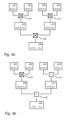
- Fig. 4a shows a detailed, yet non-limiting, example of an encrypted polynomial product operation.
- the figure shows the computation of an encrypted polynomial product 440 of a number of decryption ciphertexts 401-404, by using a logarithmic-depth product tree of internal products.
- the leaf nodes of the tree may correspond to the decryption ciphertexts.
- An internal node may be computed as an internal product of its two child nodes.
- node 420 may be computed by an internal product 410 of nodes 401 and 402
- node 421 may be computed by an internal product 411 of nodes 403 and 404, as follows:
- node 440 may be computed by an internal product 430 of nodes 420 and 421 that are themselves based on multiple decryption ciphertexts.
- the encrypted polynomial product is a gadget encryption.
- the encrypted computation product can be computed by a logarithmic number of sets of multiplications, e.g., log 2 n sets, where the multiplications in the set can be computed in parallel.
- all multiplications at a certain level of the tree e.g., multiplications 401-404 or multiplications 420-421, can be performed in parallel. (Although it is also possible e.g., to perform multiplications 401-402 and 421 in parallel, if desired.)
- Fig. 4b shows a detailed, yet non-limiting, example of an encrypted polynomial product operation.
- the encrypted polynomial product involves one or more external products.
- the final multiplication of the product tree can be implemented as an external product 430', leading to a non-gadget (e.g., GLWE) encrypted polynomial product 440'.
- a non-gadget e.g., GLWE
- one of the inputs of the external product 430' can be computed as an external product (or, it can be obtained as a gadget encryption from which a non-gadget encryption is obtained) 411'.
- one or more subsequent layers of the product tree may comprise a non-gadget encryption to which an external product is applied.
- one of the decryption ciphertexts 404' can be a non-gadget encryption, or can be extracted as a non-gadget encryption from a gadget encryption.
- Using external products is beneficial in terms of efficiency, and is particularly preferred when no subsequent multiplication with a lookup table polynomial is needed after computing the encrypted polynomial product 440', e.g., when the lookup table polynomial is one of the encryptions 401-404' to be multiplied, or when the blind rotation is used in a monomial lift.
- the encrypted polynomial product 440' is subsequently multiplied with a lookup table, it may be preferred to compute the encrypted polynomial product 440' only internal products, since this can give the encrypted polynomial product in gadget encrypted form, allowing a multiplication with the lookup table with little noise as also discussed with respect to Fig. 3 .
- an internal product may correspond to computing ( k + 1)l external products.
- an internal product may correspond in terms of cost to 6 external products.
- external products computed as part of performing an internal product can also be executed in parallel, making the depth of an internal product be the same as the external product. It may also be noted that, at least in this setting, an external product and an internal product with same parameters make the noise grow in the same way.
- the following comparison may be obtained in terms of complexity and depth in number of external products between a known accumulator-based sequential bootstrapping, and the proposed blind rotation that uses an internal product tree (including multiplication by the lookup table): Blind rotation construction Complexity Depth Accumulator-based Internal product tree
- the following table illustrates the effect of using multiple parallel units of computation for a blind rotation, e.g., multi-threading, by parallelizing internal and external products.
- the table shows the execution time for an accumulator-based blind rotation and for the proposed blind rotation, where in the latter the external products making up the different parallelizable internal products, are executed in parallel.
- T ExtProd the time for executing an external product.
- Fig. 5 schematically shows an example of an embodiment of a cryptographic method 500 of performing an encrypted computation.
- Method 500 may be computed-implemented.
- the encrypted computation may comprise a blind rotation.
- the blind rotation may be configured to evaluate a decryption of an encrypted input in an exponent of an encrypted monomial.
- the method 500 may comprise obtaining 510 a bootstrapping key comprising key ciphertexts corresponding to a decryption key for the decryption of the encrypted input.
- the method 500 may further comprise determining 520 a set of decryption ciphertexts for evaluating the decryption.
- the decryption ciphertexts may be determined based on the encrypted input and based on the key ciphertexts.
- the method 500 may further comprise determining 530 an encrypted output by determining an encrypted polynomial product of the decryption ciphertexts.
- the encrypted polynomial product may be determined by computing 531, 532 multiple internal products.
- the internal products may be computed at least in part in parallel.
- the order of the steps can be performed in the shown order, but the order of the steps can be varied or some steps may be executed in parallel.
- steps other method steps may be inserted.
- the inserted steps may represent refinements of the method such as described herein, or may be unrelated to the method.
- some steps may be executed, at least partially, in parallel.
- a given step may not have finished completely before a next step is started.
- Embodiments of the methods may be executed using software, which comprises instructions for causing a processor system to perform method 500.
- Software may only include those steps taken by a particular sub-entity of the system.
- the software may be stored in a suitable storage medium, such as a hard disk, a floppy, a memory, an optical disc, etc.
- the software may be sent as a signal along a wire, or wireless, or using a data network, e.g., the Internet.
- the software may be made available for download and/or for remote usage on a server.
- Embodiments of the method may be executed using a bitstream arranged to configure programmable logic, e.g., a field-programmable gate array (FPGA), to perform the method.
- FPGA field-programmable gate array
- the presently disclosed subject matter also extends to computer programs, particularly computer programs on or in a carrier, adapted for putting the presently disclosed subject matter into practice.
- the program may be in the form of source code, object code, a code intermediate source, and object code such as partially compiled form, or in any other form suitable for use in the implementation of an embodiment of the method.
- An embodiment relating to a computer program product comprises computer executable instructions corresponding to each of the processing steps of at least one of the methods set forth. These instructions may be subdivided into subroutines and/or be stored in one or more files that may be linked statically or dynamically.
- Another embodiment relating to a computer program product comprises computer executable instructions corresponding to each of the devices, units and/or parts of at least one of the systems and/or products set forth.
- the devices described herein comprise one or more microprocessors which executes appropriate software stored at the system; for example, that software may have been downloaded and/or stored in a corresponding memory, e.g., a volatile memory such as RAM or a non-volatile memory such as Flash.
- the systems may, in whole or in part, be implemented in programmable logic, e.g., as field-programmable gate array (FPGA).
- FPGA field-programmable gate array
- the systems may be implemented, in whole or in part, as a so-called application-specific integrated circuit (ASIC), e.g., an integrated circuit (IC) customized for their particular use.
- ASIC application-specific integrated circuit
- the circuits may be implemented in CMOS, e.g., using a hardware description language such as Verilog, VHDL, etc.
- the systems may comprise circuits for the evaluation of cryptographic primitives.
- a processor circuit may be implemented in a distributed fashion, e.g., as multiple sub-processor circuits.
- a storage may be distributed over multiple distributed sub-storages.
- Part or all of the memory may be an electronic memory, magnetic memory, etc.
- the storage may have volatile and a non-volatile part.
- Part of the storage may be read-only.
- Fig. 6 shows a computer readable medium 1000 having a writable part 1010.
- Computer readable medium 1000 is shown in the form of an optically readable medium.
- Computer readable medium 1000 may store data 1020 wherein the data may indicate instructions, which when executed by a processor system, cause a processor system to perform an embodiment of a method of performing an encrypted computation according to an embodiment.
- the data 1020 may be embodied on the computer readable medium 1000 as physical marks or by magnetization of the computer readable medium 1000.
- any other suitable embodiment is conceivable as well.
- the computer readable medium 1000 is shown here as an optical disc, the computer readable medium 1000 may be any suitable computer readable medium, such as a hard disk, solid state memory, flash memory, etc., and may be non-recordable or recordable.
- Fig. 7 shows in a schematic representation of a processor system 1140 according to an embodiment of a device for performing an encrypted computation.
- the processor system comprises one or more integrated circuits 1110.
- the architecture of the one or more integrated circuits 1110 is schematically shown in the figure.
- Circuit 1110 comprises a processing unit 1120, e.g., a CPU, for running computer program components to execute a method according to an embodiment and/or implement its modules or units.
- Circuit 1110 comprises a memory 1122 for storing programming code, data, etc. Part of memory 1122 may be read-only.
- Circuit 1110 may comprise a communication element 1126, e.g., an antenna, connectors or both, and the like.
- Circuit 1110 may comprise a dedicated integrated circuit 1124 for performing part or all of the processing defined in the method.
- Processor 1120, memory 1122, dedicated IC 1124 and communication element 1126 may be connected to each other via an interconnect 1130, say a bus.
- the processor system 1110 may be arranged for contact and/or contact-less communication, using an antenna and/or connectors, respectively.
- processor system 1140 e.g., the device for performing the encrypted computation, may comprise a processor circuit and a memory circuit, the processor being arranged to execute software stored in the memory circuit.
- the processor circuit may be an Intel Core i7 processor, ARM Cortex-R8, etc.
- the processor circuit may be ARM Cortex M0.
- the memory circuit may be an ROM circuit, or a non-volatile memory, e.g., a flash memory.
- the memory circuit may be a volatile memory, e.g., an SRAM memory.
- the device may comprise a non-volatile software interface, e.g., a hard drive, a network interface, etc., arranged for providing the software.
- the various components may be duplicated in various embodiments.
- the processor 1120 may include multiple microprocessors that are configured to independently execute the methods described herein or are configured to perform steps or subroutines of the methods described herein such that the multiple processors cooperate to achieve the functionality described herein.
- the various hardware components may belong to separate physical systems.
- the processor 1120 may include a first processor in a first server and a second processor in a second server.
- processor 1120 may have multiprocessing and/or multi-threading capabilities, e.g., the processor 1120 may have multiple cores, allowing multiple internal products to be computed in parallel.
- any reference signs placed between parentheses shall not be construed as limiting the claim.
- Use of the verb 'comprise' and its conjugations does not exclude the presence of elements or steps other than those stated in a claim.
- the article 'a' or 'an' preceding an element does not exclude the presence of a plurality of such elements.
- Expressions such as "at least one of” when preceding a list of elements represent a selection of all or of any subset of elements from the list. For example, the expression, "at least one of A, B, and C" should be understood as including only A, only B, only C, both A and B, both A and C, both B and C, or all of A, B, and C.
- the presently disclosed subject matter may be implemented by hardware comprising several distinct elements, and by a suitably programmed computer.
- the device claim enumerating several parts several of these parts may be embodied by one and the same item of hardware.
- the mere fact that certain measures are recited in mutually different dependent claims does not indicate that a combination of these measures cannot be used to advantage.
- references in parentheses refer to reference signs in drawings of exemplifying embodiments or to formulas of embodiments, thus increasing the intelligibility of the claim. These references shall not be construed as limiting the claim.
Landscapes
- Engineering & Computer Science (AREA)
- Computer Security & Cryptography (AREA)
- Computer Networks & Wireless Communication (AREA)
- Signal Processing (AREA)
- Physics & Mathematics (AREA)
- Algebra (AREA)
- General Physics & Mathematics (AREA)
- Mathematical Analysis (AREA)
- Mathematical Optimization (AREA)
- Mathematical Physics (AREA)
- Pure & Applied Mathematics (AREA)
- Computing Systems (AREA)
- Theoretical Computer Science (AREA)
- Storage Device Security (AREA)
Claims (15)
- Ein Kryptografieverfahren (500) zum Durchführen einer verschlüsselten Berechnung, wobei die verschlüsselte Berechnung eine Blindrotation umfasst, wobei die Blindrotation konfiguriert ist, um eine Entschlüsselung einer verschlüsselten Eingabe in einen Exponenten eines verschlüsselten Monoms zu bewerten, wobei Durchführen der Blindrotation umfasst:Erhalten (510) eines Bootstrapping-Schlüssels, der Schlüsselgeheimtexte umfasst, wobei die Schlüsselgeheimtexte einem Entschlüsselungsschlüssel zur Entschlüsselung der verschlüsselten Eingabe entsprechen;Bestimmen (520) eines Satzes von Entschlüsselungsgeheimtexten zum Bewerten der Entschlüsselung, wobei die Entschlüsselungsgeheimtexte auf der Grundlage der verschlüsselten Eingabe und auf der Grundlage der Schlüsselgeheimtexte bestimmt werden; gekennzeichnet durchBestimmen (530) einer verschlüsselten Ausgabe, die Bestimmen eines verschlüsselten Polynomprodukts der Entschlüsselungsgeheimtexte umfasst, wobei das Bestimmen des verschlüsselten Polynomprodukts das Berechnen (531, 532) mehrfacher innerer Produkte umfasst und wobei die inneren Produkte zumindest teilweise parallel berechnet werden.
- Das Verfahren (500) nach Anspruch 1, wobei ein Entschlüsselungsgeheimtext auf der Grundlage einer linearen Kombination von einem oder mehreren Schlüsselgeheimtexten bestimmt wird, wobei der eine oder die mehreren Schlüsselgeheimtexte Bits verschlüsseln und wobei Koeffizientenpolynome der linearen Kombination auf der Grundlage der verschlüsselten Eingabe bestimmt werden.
- Das Verfahren (500) nach Anspruch 2, wobei ein Koeffizientenpolynom für einen Schlüsselgeheimtext auf einem Monom basiert, das einen Maskenwert der verschlüsselten Eingabe als Exponenten aufweist.
- Das Verfahren (500) nach Anspruch 2 oder 3, wobei der Entschlüsselungsgeheimtext ein Monom verschlüsselt, das als Exponenten ein Produkt eines Elements des Entschlüsselungsschlüssels und einen Maskenwert der verschlüsselten Eingabe aufweist.
- Das Verfahren (500) nach Anspruch 1, wobei die Entschlüsselungsgeheimtexte eine Teilmenge der Schlüsselgeheimtexte sind, wobei die Teilmenge auf der Grundlage der verschlüsselten Eingabe ausgewählt wird.
- Das Verfahren (500) nach einem vorstehenden Anspruch, wobei die verschlüsselte Ausgabe ein Polynom verschlüsselt, das die Anwendung einer Nachschlagetabelle an der verschlüsselten Eingabe darstellt, und wobei die verschlüsselte Ausgabe auf dem Berechnen eines verschlüsselten Polynomprodukts der Entschlüsselungsgeheimtexte und eines Testpolynoms, das die Nachschlagetabelle codiert, basiert.
- Das Verfahren (500) nach Anspruch 6, das weiter das Extrahieren, aus dem verschlüsselten Polynomprodukt, einer Verschlüsselung eines Ausgabewerts des Anwendens der Nachschlagetabelle an der verschlüsselten Eingabe umfasst.
- Das Verfahren (500) nach einem vorstehenden Anspruch, wobei das verschlüsselte Polynomprodukt durch einen Produktbaum mit logarithmischer Tiefe berechnet wird.
- Das Verfahren (500) nach einem vorstehenden Anspruch, wobei das Bestimmen des verschlüsselten Polynomprodukt das Berechnen eines inneren Produkts aus ersten und zweiten Geheimtexten umfasst, wobei die ersten und zweiten Geheimtexte beide auf mehrfachen Entschlüsselungsgeheimtexten basieren.
- Das Verfahren (500) nach einem vorstehenden Anspruch, wobei das verschlüsselte Polynomprodukt eine Gadget-Verschlüsselung des Polynomprodukts ist.
- Das Verfahren (500) nach Anspruch 10, wobei die verschlüsselte Ausgabe durch Berechnen eines äußeren Produkts aus der Gadget-Verschlüsselung mit einer weiteren Verschlüsselung oder durch Extrahieren der Ausgabe aus der Gadget-Verschlüsselung bestimmt wird.
- Das Verfahren (500) nach einem der Ansprüche 1-9, wobei das verschlüsselte Polynomprodukt durch weiteres Berechnen eines oder mehrerer äußerer Produkte berechnet wird.
- Eine Kryptografievorrichtung (110) zum Durchführen einer verschlüsselten Berechnung, wobei die verschlüsselte Berechnung eine Blindrotation umfasst, wobei die Blindrotation konfiguriert ist, um eine Entschlüsselung einer verschlüsselten Eingabe in einen Exponenten eines verschlüsselten Monoms zu bewerten, wobei die Vorrichtung umfasst:einen Speicher (140) zum Speichern eines Bootstrapping-Schlüssels, der Schlüsselgeheimtexte umfasst, die einem Entschlüsselungsschlüssel zur Entschlüsselung der verschlüsselten Eingabe entsprechen;ein Prozessor-Teilsystem (130), das konfiguriert ist, um die Blindrotation durchzuführen durch:Bestimmen eines Satzes von Entschlüsselungsgeheimtexten zum Bewerten der Entschlüsselung, wobei die Entschlüsselungsgeheimtexte auf der Grundlage der verschlüsselten Eingabe und auf der Grundlage der Schlüsselgeheimtexte bestimmt werden; gekennzeichnet durchBestimmen einer verschlüsselten Ausgabe, umfassend Bestimmen eines verschlüsselten Polynomprodukts der Entschlüsselungsgeheimtexte, wobei das Bestimmen des verschlüsselten Polynomprodukts das Berechnen mehrfacher innerer Produkte umfasst und wobei die inneren Produkte zumindest teilweise parallel berechnet werden.
- Die Vorrichtung (110) nach Anspruch 13, wobei das Prozessor-Teilsystem (130) mehrfache Kerne umfasst, wobei eine erste innere Multiplikation an einem ersten Kern durchgeführt wird und eine zweite Multiplikation gleichzeitig an einem zweiten Kern durchgeführt wird.
- Ein flüchtiges oder nichtflüchtiges computerlesbares Speichermedium (1000), umfassend Daten (1020), die Anweisungen darstellen, die, wenn sie von einem Prozessorsystem ausgeführt werden, das Prozessorsystem veranlassen, das Verfahren nach einem der Ansprüche 1-12 durchzuführen.
Priority Applications (2)
| Application Number | Priority Date | Filing Date | Title |
|---|---|---|---|
| EP22315217.4A EP4344121B1 (de) | 2022-09-26 | 2022-09-26 | Verschlüsselte berechnung mit blindrotation |
| PCT/EP2023/075646 WO2024068333A1 (en) | 2022-09-26 | 2023-09-18 | Encrypted computation with a blind rotation |
Applications Claiming Priority (1)
| Application Number | Priority Date | Filing Date | Title |
|---|---|---|---|
| EP22315217.4A EP4344121B1 (de) | 2022-09-26 | 2022-09-26 | Verschlüsselte berechnung mit blindrotation |
Publications (2)
| Publication Number | Publication Date |
|---|---|
| EP4344121A1 EP4344121A1 (de) | 2024-03-27 |
| EP4344121B1 true EP4344121B1 (de) | 2024-08-28 |
Family
ID=84421076
Family Applications (1)
| Application Number | Title | Priority Date | Filing Date |
|---|---|---|---|
| EP22315217.4A Active EP4344121B1 (de) | 2022-09-26 | 2022-09-26 | Verschlüsselte berechnung mit blindrotation |
Country Status (2)
| Country | Link |
|---|---|
| EP (1) | EP4344121B1 (de) |
| WO (1) | WO2024068333A1 (de) |
-
2022
- 2022-09-26 EP EP22315217.4A patent/EP4344121B1/de active Active
-
2023
- 2023-09-18 WO PCT/EP2023/075646 patent/WO2024068333A1/en not_active Ceased
Also Published As
| Publication number | Publication date |
|---|---|
| WO2024068333A1 (en) | 2024-04-04 |
| EP4344121A1 (de) | 2024-03-27 |
Similar Documents
| Publication | Publication Date | Title |
|---|---|---|
| EP4535716A2 (de) | Berechnung auf lwe-verschlüsselten werten | |
| US12143467B2 (en) | Encrypted scalar multiplication | |
| EP4352913B1 (de) | Verschlüsselte berechnung mit einer blinden rotation | |
| US12574206B2 (en) | Blind rotation for use in fully homomorphic encryption | |
| US20250175322A1 (en) | Optimizing encrypted computation parameters | |
| EP4195578B1 (de) | Polynomiale multiplikation verschlüsselter werte | |
| EP4096148A1 (de) | Berechnung von lwe-verschlüsselten werten | |
| EP4087177A1 (de) | Blinddrehung zur verwendung in vollständig homomorpher verschlüsselung | |
| CN117643012A (zh) | Lwe加密值的计算 | |
| EP4195577A1 (de) | Verschlüsselte berechung mit einer blinden rotation | |
| EP4344121A1 (de) | Verschlüsselte berechnung mit blindrotation | |
| EP4573693B1 (de) | Schlüsselsätze mit gemeinsamen oder vordefinierten elementen | |
| EP4449666B1 (de) | Berechnung von codierten und verschlüsselten werten |
Legal Events
| Date | Code | Title | Description |
|---|---|---|---|
| PUAI | Public reference made under article 153(3) epc to a published international application that has entered the european phase |
Free format text: ORIGINAL CODE: 0009012 |
|
| STAA | Information on the status of an ep patent application or granted ep patent |
Free format text: STATUS: REQUEST FOR EXAMINATION WAS MADE |
|
| 17P | Request for examination filed |
Effective date: 20230406 |
|
| AK | Designated contracting states |
Kind code of ref document: A1 Designated state(s): AL AT BE BG CH CY CZ DE DK EE ES FI FR GB GR HR HU IE IS IT LI LT LU LV MC MK MT NL NO PL PT RO RS SE SI SK SM TR |
|
| P01 | Opt-out of the competence of the unified patent court (upc) registered |
Effective date: 20240404 |
|
| GRAP | Despatch of communication of intention to grant a patent |
Free format text: ORIGINAL CODE: EPIDOSNIGR1 |
|
| STAA | Information on the status of an ep patent application or granted ep patent |
Free format text: STATUS: GRANT OF PATENT IS INTENDED |
|
| INTG | Intention to grant announced |
Effective date: 20240612 |
|
| GRAS | Grant fee paid |
Free format text: ORIGINAL CODE: EPIDOSNIGR3 |
|
| GRAA | (expected) grant |
Free format text: ORIGINAL CODE: 0009210 |
|
| STAA | Information on the status of an ep patent application or granted ep patent |
Free format text: STATUS: THE PATENT HAS BEEN GRANTED |
|
| RAP3 | Party data changed (applicant data changed or rights of an application transferred) |
Owner name: ZAMA SAS |
|
| AK | Designated contracting states |
Kind code of ref document: B1 Designated state(s): AL AT BE BG CH CY CZ DE DK EE ES FI FR GB GR HR HU IE IS IT LI LT LU LV MC MK MT NL NO PL PT RO RS SE SI SK SM TR |
|
| REG | Reference to a national code |
Ref country code: CH Ref legal event code: EP |
|
| REG | Reference to a national code |
Ref country code: DE Ref legal event code: R096 Ref document number: 602022005712 Country of ref document: DE |
|
| REG | Reference to a national code |
Ref country code: IE Ref legal event code: FG4D |
|
| REG | Reference to a national code |
Ref country code: LT Ref legal event code: MG9D |
|
| PG25 | Lapsed in a contracting state [announced via postgrant information from national office to epo] |
Ref country code: NO Free format text: LAPSE BECAUSE OF FAILURE TO SUBMIT A TRANSLATION OF THE DESCRIPTION OR TO PAY THE FEE WITHIN THE PRESCRIBED TIME-LIMIT Effective date: 20241128 |
|
| REG | Reference to a national code |
Ref country code: AT Ref legal event code: MK05 Ref document number: 1719134 Country of ref document: AT Kind code of ref document: T Effective date: 20240828 |
|
| PG25 | Lapsed in a contracting state [announced via postgrant information from national office to epo] |
Ref country code: GR Free format text: LAPSE BECAUSE OF FAILURE TO SUBMIT A TRANSLATION OF THE DESCRIPTION OR TO PAY THE FEE WITHIN THE PRESCRIBED TIME-LIMIT Effective date: 20241129 Ref country code: FI Free format text: LAPSE BECAUSE OF FAILURE TO SUBMIT A TRANSLATION OF THE DESCRIPTION OR TO PAY THE FEE WITHIN THE PRESCRIBED TIME-LIMIT Effective date: 20240828 Ref country code: PL Free format text: LAPSE BECAUSE OF FAILURE TO SUBMIT A TRANSLATION OF THE DESCRIPTION OR TO PAY THE FEE WITHIN THE PRESCRIBED TIME-LIMIT Effective date: 20240828 Ref country code: NL Free format text: LAPSE BECAUSE OF FAILURE TO SUBMIT A TRANSLATION OF THE DESCRIPTION OR TO PAY THE FEE WITHIN THE PRESCRIBED TIME-LIMIT Effective date: 20240828 Ref country code: PT Free format text: LAPSE BECAUSE OF FAILURE TO SUBMIT A TRANSLATION OF THE DESCRIPTION OR TO PAY THE FEE WITHIN THE PRESCRIBED TIME-LIMIT Effective date: 20241230 |
|
| PG25 | Lapsed in a contracting state [announced via postgrant information from national office to epo] |
Ref country code: BG Free format text: LAPSE BECAUSE OF FAILURE TO SUBMIT A TRANSLATION OF THE DESCRIPTION OR TO PAY THE FEE WITHIN THE PRESCRIBED TIME-LIMIT Effective date: 20240828 |
|
| PG25 | Lapsed in a contracting state [announced via postgrant information from national office to epo] |
Ref country code: LV Free format text: LAPSE BECAUSE OF FAILURE TO SUBMIT A TRANSLATION OF THE DESCRIPTION OR TO PAY THE FEE WITHIN THE PRESCRIBED TIME-LIMIT Effective date: 20240828 |
|
| REG | Reference to a national code |
Ref country code: NL Ref legal event code: MP Effective date: 20240828 |
|
| PG25 | Lapsed in a contracting state [announced via postgrant information from national office to epo] |
Ref country code: AT Free format text: LAPSE BECAUSE OF FAILURE TO SUBMIT A TRANSLATION OF THE DESCRIPTION OR TO PAY THE FEE WITHIN THE PRESCRIBED TIME-LIMIT Effective date: 20240828 Ref country code: IS Free format text: LAPSE BECAUSE OF FAILURE TO SUBMIT A TRANSLATION OF THE DESCRIPTION OR TO PAY THE FEE WITHIN THE PRESCRIBED TIME-LIMIT Effective date: 20241228 |
|
| PG25 | Lapsed in a contracting state [announced via postgrant information from national office to epo] |
Ref country code: HR Free format text: LAPSE BECAUSE OF FAILURE TO SUBMIT A TRANSLATION OF THE DESCRIPTION OR TO PAY THE FEE WITHIN THE PRESCRIBED TIME-LIMIT Effective date: 20240828 |
|
| PG25 | Lapsed in a contracting state [announced via postgrant information from national office to epo] |
Ref country code: ES Free format text: LAPSE BECAUSE OF FAILURE TO SUBMIT A TRANSLATION OF THE DESCRIPTION OR TO PAY THE FEE WITHIN THE PRESCRIBED TIME-LIMIT Effective date: 20240828 Ref country code: RS Free format text: LAPSE BECAUSE OF FAILURE TO SUBMIT A TRANSLATION OF THE DESCRIPTION OR TO PAY THE FEE WITHIN THE PRESCRIBED TIME-LIMIT Effective date: 20241128 |
|
| PG25 | Lapsed in a contracting state [announced via postgrant information from national office to epo] |
Ref country code: RS Free format text: LAPSE BECAUSE OF FAILURE TO SUBMIT A TRANSLATION OF THE DESCRIPTION OR TO PAY THE FEE WITHIN THE PRESCRIBED TIME-LIMIT Effective date: 20241128 Ref country code: PT Free format text: LAPSE BECAUSE OF FAILURE TO SUBMIT A TRANSLATION OF THE DESCRIPTION OR TO PAY THE FEE WITHIN THE PRESCRIBED TIME-LIMIT Effective date: 20241230 Ref country code: PL Free format text: LAPSE BECAUSE OF FAILURE TO SUBMIT A TRANSLATION OF THE DESCRIPTION OR TO PAY THE FEE WITHIN THE PRESCRIBED TIME-LIMIT Effective date: 20240828 Ref country code: NO Free format text: LAPSE BECAUSE OF FAILURE TO SUBMIT A TRANSLATION OF THE DESCRIPTION OR TO PAY THE FEE WITHIN THE PRESCRIBED TIME-LIMIT Effective date: 20241128 Ref country code: NL Free format text: LAPSE BECAUSE OF FAILURE TO SUBMIT A TRANSLATION OF THE DESCRIPTION OR TO PAY THE FEE WITHIN THE PRESCRIBED TIME-LIMIT Effective date: 20240828 Ref country code: LV Free format text: LAPSE BECAUSE OF FAILURE TO SUBMIT A TRANSLATION OF THE DESCRIPTION OR TO PAY THE FEE WITHIN THE PRESCRIBED TIME-LIMIT Effective date: 20240828 Ref country code: IS Free format text: LAPSE BECAUSE OF FAILURE TO SUBMIT A TRANSLATION OF THE DESCRIPTION OR TO PAY THE FEE WITHIN THE PRESCRIBED TIME-LIMIT Effective date: 20241228 Ref country code: HR Free format text: LAPSE BECAUSE OF FAILURE TO SUBMIT A TRANSLATION OF THE DESCRIPTION OR TO PAY THE FEE WITHIN THE PRESCRIBED TIME-LIMIT Effective date: 20240828 Ref country code: GR Free format text: LAPSE BECAUSE OF FAILURE TO SUBMIT A TRANSLATION OF THE DESCRIPTION OR TO PAY THE FEE WITHIN THE PRESCRIBED TIME-LIMIT Effective date: 20241129 Ref country code: FI Free format text: LAPSE BECAUSE OF FAILURE TO SUBMIT A TRANSLATION OF THE DESCRIPTION OR TO PAY THE FEE WITHIN THE PRESCRIBED TIME-LIMIT Effective date: 20240828 Ref country code: ES Free format text: LAPSE BECAUSE OF FAILURE TO SUBMIT A TRANSLATION OF THE DESCRIPTION OR TO PAY THE FEE WITHIN THE PRESCRIBED TIME-LIMIT Effective date: 20240828 Ref country code: BG Free format text: LAPSE BECAUSE OF FAILURE TO SUBMIT A TRANSLATION OF THE DESCRIPTION OR TO PAY THE FEE WITHIN THE PRESCRIBED TIME-LIMIT Effective date: 20240828 Ref country code: AT Free format text: LAPSE BECAUSE OF FAILURE TO SUBMIT A TRANSLATION OF THE DESCRIPTION OR TO PAY THE FEE WITHIN THE PRESCRIBED TIME-LIMIT Effective date: 20240828 |
|
| PG25 | Lapsed in a contracting state [announced via postgrant information from national office to epo] |
Ref country code: RO Free format text: LAPSE BECAUSE OF FAILURE TO SUBMIT A TRANSLATION OF THE DESCRIPTION OR TO PAY THE FEE WITHIN THE PRESCRIBED TIME-LIMIT Effective date: 20240828 Ref country code: SM Free format text: LAPSE BECAUSE OF FAILURE TO SUBMIT A TRANSLATION OF THE DESCRIPTION OR TO PAY THE FEE WITHIN THE PRESCRIBED TIME-LIMIT Effective date: 20240828 Ref country code: DK Free format text: LAPSE BECAUSE OF FAILURE TO SUBMIT A TRANSLATION OF THE DESCRIPTION OR TO PAY THE FEE WITHIN THE PRESCRIBED TIME-LIMIT Effective date: 20240828 |
|
| PG25 | Lapsed in a contracting state [announced via postgrant information from national office to epo] |
Ref country code: EE Free format text: LAPSE BECAUSE OF FAILURE TO SUBMIT A TRANSLATION OF THE DESCRIPTION OR TO PAY THE FEE WITHIN THE PRESCRIBED TIME-LIMIT Effective date: 20240828 |
|
| PG25 | Lapsed in a contracting state [announced via postgrant information from national office to epo] |
Ref country code: CZ Free format text: LAPSE BECAUSE OF FAILURE TO SUBMIT A TRANSLATION OF THE DESCRIPTION OR TO PAY THE FEE WITHIN THE PRESCRIBED TIME-LIMIT Effective date: 20240828 |
|
| PG25 | Lapsed in a contracting state [announced via postgrant information from national office to epo] |
Ref country code: SK Free format text: LAPSE BECAUSE OF FAILURE TO SUBMIT A TRANSLATION OF THE DESCRIPTION OR TO PAY THE FEE WITHIN THE PRESCRIBED TIME-LIMIT Effective date: 20240828 Ref country code: IT Free format text: LAPSE BECAUSE OF FAILURE TO SUBMIT A TRANSLATION OF THE DESCRIPTION OR TO PAY THE FEE WITHIN THE PRESCRIBED TIME-LIMIT Effective date: 20240828 |
|
| PG25 | Lapsed in a contracting state [announced via postgrant information from national office to epo] |
Ref country code: LU Free format text: LAPSE BECAUSE OF NON-PAYMENT OF DUE FEES Effective date: 20240926 |
|
| REG | Reference to a national code |
Ref country code: DE Ref legal event code: R097 Ref document number: 602022005712 Country of ref document: DE |
|
| PLBE | No opposition filed within time limit |
Free format text: ORIGINAL CODE: 0009261 |
|
| STAA | Information on the status of an ep patent application or granted ep patent |
Free format text: STATUS: NO OPPOSITION FILED WITHIN TIME LIMIT |
|
| PG25 | Lapsed in a contracting state [announced via postgrant information from national office to epo] |
Ref country code: MC Free format text: LAPSE BECAUSE OF FAILURE TO SUBMIT A TRANSLATION OF THE DESCRIPTION OR TO PAY THE FEE WITHIN THE PRESCRIBED TIME-LIMIT Effective date: 20240828 |
|
| REG | Reference to a national code |
Ref country code: BE Ref legal event code: MM Effective date: 20240930 |
|
| PG25 | Lapsed in a contracting state [announced via postgrant information from national office to epo] |
Ref country code: BE Free format text: LAPSE BECAUSE OF NON-PAYMENT OF DUE FEES Effective date: 20240930 |
|
| PG25 | Lapsed in a contracting state [announced via postgrant information from national office to epo] |
Ref country code: IE Free format text: LAPSE BECAUSE OF NON-PAYMENT OF DUE FEES Effective date: 20240926 |
|
| 26N | No opposition filed |
Effective date: 20250530 |
|
| PG25 | Lapsed in a contracting state [announced via postgrant information from national office to epo] |
Ref country code: SE Free format text: LAPSE BECAUSE OF FAILURE TO SUBMIT A TRANSLATION OF THE DESCRIPTION OR TO PAY THE FEE WITHIN THE PRESCRIBED TIME-LIMIT Effective date: 20240828 |
|
| REG | Reference to a national code |
Ref country code: CH Ref legal event code: U11 Free format text: ST27 STATUS EVENT CODE: U-0-0-U10-U11 (AS PROVIDED BY THE NATIONAL OFFICE) Effective date: 20251001 |
|
| PGFP | Annual fee paid to national office [announced via postgrant information from national office to epo] |
Ref country code: DE Payment date: 20250929 Year of fee payment: 4 |
|
| PGFP | Annual fee paid to national office [announced via postgrant information from national office to epo] |
Ref country code: FR Payment date: 20250925 Year of fee payment: 4 |
|
| PGFP | Annual fee paid to national office [announced via postgrant information from national office to epo] |
Ref country code: CH Payment date: 20251001 Year of fee payment: 4 |
|
| PG25 | Lapsed in a contracting state [announced via postgrant information from national office to epo] |
Ref country code: CY Free format text: LAPSE BECAUSE OF FAILURE TO SUBMIT A TRANSLATION OF THE DESCRIPTION OR TO PAY THE FEE WITHIN THE PRESCRIBED TIME-LIMIT; INVALID AB INITIO Effective date: 20220926 |
|
| PG25 | Lapsed in a contracting state [announced via postgrant information from national office to epo] |
Ref country code: HU Free format text: LAPSE BECAUSE OF FAILURE TO SUBMIT A TRANSLATION OF THE DESCRIPTION OR TO PAY THE FEE WITHIN THE PRESCRIBED TIME-LIMIT; INVALID AB INITIO Effective date: 20220926 |