EP4342916A1 - Method for removing metal contaminants from fluorine resin and method for producing fluorine resin having reduced amount of metal contaminants - Google Patents
Method for removing metal contaminants from fluorine resin and method for producing fluorine resin having reduced amount of metal contaminants Download PDFInfo
- Publication number
- EP4342916A1 EP4342916A1 EP22804685.0A EP22804685A EP4342916A1 EP 4342916 A1 EP4342916 A1 EP 4342916A1 EP 22804685 A EP22804685 A EP 22804685A EP 4342916 A1 EP4342916 A1 EP 4342916A1
- Authority
- EP
- European Patent Office
- Prior art keywords
- fluororesin
- foreign matter
- metallic foreign
- magnet
- screen
- Prior art date
- Legal status (The legal status is an assumption and is not a legal conclusion. Google has not performed a legal analysis and makes no representation as to the accuracy of the status listed.)
- Pending
Links
Images
Classifications
-
- B—PERFORMING OPERATIONS; TRANSPORTING
- B03—SEPARATION OF SOLID MATERIALS USING LIQUIDS OR USING PNEUMATIC TABLES OR JIGS; MAGNETIC OR ELECTROSTATIC SEPARATION OF SOLID MATERIALS FROM SOLID MATERIALS OR FLUIDS; SEPARATION BY HIGH-VOLTAGE ELECTRIC FIELDS
- B03C—MAGNETIC OR ELECTROSTATIC SEPARATION OF SOLID MATERIALS FROM SOLID MATERIALS OR FLUIDS; SEPARATION BY HIGH-VOLTAGE ELECTRIC FIELDS
- B03C1/00—Magnetic separation
- B03C1/32—Magnetic separation acting on the medium containing the substance being separated, e.g. magneto-gravimetric-, magnetohydrostatic-, or magnetohydrodynamic separation
-
- B—PERFORMING OPERATIONS; TRANSPORTING
- B29—WORKING OF PLASTICS; WORKING OF SUBSTANCES IN A PLASTIC STATE IN GENERAL
- B29B—PREPARATION OR PRETREATMENT OF THE MATERIAL TO BE SHAPED; MAKING GRANULES OR PREFORMS; RECOVERY OF PLASTICS OR OTHER CONSTITUENTS OF WASTE MATERIAL CONTAINING PLASTICS
- B29B17/00—Recovery of plastics or other constituents of waste material containing plastics
- B29B17/02—Separating plastics from other materials
-
- B—PERFORMING OPERATIONS; TRANSPORTING
- B03—SEPARATION OF SOLID MATERIALS USING LIQUIDS OR USING PNEUMATIC TABLES OR JIGS; MAGNETIC OR ELECTROSTATIC SEPARATION OF SOLID MATERIALS FROM SOLID MATERIALS OR FLUIDS; SEPARATION BY HIGH-VOLTAGE ELECTRIC FIELDS
- B03C—MAGNETIC OR ELECTROSTATIC SEPARATION OF SOLID MATERIALS FROM SOLID MATERIALS OR FLUIDS; SEPARATION BY HIGH-VOLTAGE ELECTRIC FIELDS
- B03C1/00—Magnetic separation
- B03C1/02—Magnetic separation acting directly on the substance being separated
- B03C1/30—Combinations with other devices, not otherwise provided for
-
- B—PERFORMING OPERATIONS; TRANSPORTING
- B03—SEPARATION OF SOLID MATERIALS USING LIQUIDS OR USING PNEUMATIC TABLES OR JIGS; MAGNETIC OR ELECTROSTATIC SEPARATION OF SOLID MATERIALS FROM SOLID MATERIALS OR FLUIDS; SEPARATION BY HIGH-VOLTAGE ELECTRIC FIELDS
- B03C—MAGNETIC OR ELECTROSTATIC SEPARATION OF SOLID MATERIALS FROM SOLID MATERIALS OR FLUIDS; SEPARATION BY HIGH-VOLTAGE ELECTRIC FIELDS
- B03C1/00—Magnetic separation
- B03C1/02—Magnetic separation acting directly on the substance being separated
- B03C1/025—High gradient magnetic separators
- B03C1/031—Component parts; Auxiliary operations
- B03C1/033—Component parts; Auxiliary operations characterised by the magnetic circuit
- B03C1/0335—Component parts; Auxiliary operations characterised by the magnetic circuit using coils
-
- B—PERFORMING OPERATIONS; TRANSPORTING
- B03—SEPARATION OF SOLID MATERIALS USING LIQUIDS OR USING PNEUMATIC TABLES OR JIGS; MAGNETIC OR ELECTROSTATIC SEPARATION OF SOLID MATERIALS FROM SOLID MATERIALS OR FLUIDS; SEPARATION BY HIGH-VOLTAGE ELECTRIC FIELDS
- B03C—MAGNETIC OR ELECTROSTATIC SEPARATION OF SOLID MATERIALS FROM SOLID MATERIALS OR FLUIDS; SEPARATION BY HIGH-VOLTAGE ELECTRIC FIELDS
- B03C1/00—Magnetic separation
- B03C1/02—Magnetic separation acting directly on the substance being separated
- B03C1/26—Magnetic separation acting directly on the substance being separated with free falling material
-
- C—CHEMISTRY; METALLURGY
- C08—ORGANIC MACROMOLECULAR COMPOUNDS; THEIR PREPARATION OR CHEMICAL WORKING-UP; COMPOSITIONS BASED THEREON
- C08F—MACROMOLECULAR COMPOUNDS OBTAINED BY REACTIONS ONLY INVOLVING CARBON-TO-CARBON UNSATURATED BONDS
- C08F6/00—Post-polymerisation treatments
- C08F6/02—Neutralisation of the polymerisation mass, e.g. killing the catalyst also removal of catalyst residues
-
- C—CHEMISTRY; METALLURGY
- C08—ORGANIC MACROMOLECULAR COMPOUNDS; THEIR PREPARATION OR CHEMICAL WORKING-UP; COMPOSITIONS BASED THEREON
- C08F—MACROMOLECULAR COMPOUNDS OBTAINED BY REACTIONS ONLY INVOLVING CARBON-TO-CARBON UNSATURATED BONDS
- C08F6/00—Post-polymerisation treatments
- C08F6/26—Treatment of polymers prepared in bulk also solid polymers or polymer melts
- C08F6/28—Purification
-
- B—PERFORMING OPERATIONS; TRANSPORTING
- B03—SEPARATION OF SOLID MATERIALS USING LIQUIDS OR USING PNEUMATIC TABLES OR JIGS; MAGNETIC OR ELECTROSTATIC SEPARATION OF SOLID MATERIALS FROM SOLID MATERIALS OR FLUIDS; SEPARATION BY HIGH-VOLTAGE ELECTRIC FIELDS
- B03C—MAGNETIC OR ELECTROSTATIC SEPARATION OF SOLID MATERIALS FROM SOLID MATERIALS OR FLUIDS; SEPARATION BY HIGH-VOLTAGE ELECTRIC FIELDS
- B03C2201/00—Details of magnetic or electrostatic separation
- B03C2201/20—Magnetic separation of bulk or dry particles in mixtures
-
- B—PERFORMING OPERATIONS; TRANSPORTING
- B03—SEPARATION OF SOLID MATERIALS USING LIQUIDS OR USING PNEUMATIC TABLES OR JIGS; MAGNETIC OR ELECTROSTATIC SEPARATION OF SOLID MATERIALS FROM SOLID MATERIALS OR FLUIDS; SEPARATION BY HIGH-VOLTAGE ELECTRIC FIELDS
- B03C—MAGNETIC OR ELECTROSTATIC SEPARATION OF SOLID MATERIALS FROM SOLID MATERIALS OR FLUIDS; SEPARATION BY HIGH-VOLTAGE ELECTRIC FIELDS
- B03C2201/00—Details of magnetic or electrostatic separation
- B03C2201/22—Details of magnetic or electrostatic separation characterised by the magnetic field, e.g. its shape or generation
-
- B—PERFORMING OPERATIONS; TRANSPORTING
- B03—SEPARATION OF SOLID MATERIALS USING LIQUIDS OR USING PNEUMATIC TABLES OR JIGS; MAGNETIC OR ELECTROSTATIC SEPARATION OF SOLID MATERIALS FROM SOLID MATERIALS OR FLUIDS; SEPARATION BY HIGH-VOLTAGE ELECTRIC FIELDS
- B03C—MAGNETIC OR ELECTROSTATIC SEPARATION OF SOLID MATERIALS FROM SOLID MATERIALS OR FLUIDS; SEPARATION BY HIGH-VOLTAGE ELECTRIC FIELDS
- B03C2201/00—Details of magnetic or electrostatic separation
- B03C2201/28—Parts being designed to be removed for cleaning purposes
-
- B—PERFORMING OPERATIONS; TRANSPORTING
- B29—WORKING OF PLASTICS; WORKING OF SUBSTANCES IN A PLASTIC STATE IN GENERAL
- B29B—PREPARATION OR PRETREATMENT OF THE MATERIAL TO BE SHAPED; MAKING GRANULES OR PREFORMS; RECOVERY OF PLASTICS OR OTHER CONSTITUENTS OF WASTE MATERIAL CONTAINING PLASTICS
- B29B17/00—Recovery of plastics or other constituents of waste material containing plastics
- B29B17/02—Separating plastics from other materials
- B29B2017/0213—Specific separating techniques
- B29B2017/0217—Mechanical separating techniques; devices therefor
- B29B2017/0224—Screens, sieves
-
- B—PERFORMING OPERATIONS; TRANSPORTING
- B29—WORKING OF PLASTICS; WORKING OF SUBSTANCES IN A PLASTIC STATE IN GENERAL
- B29B—PREPARATION OR PRETREATMENT OF THE MATERIAL TO BE SHAPED; MAKING GRANULES OR PREFORMS; RECOVERY OF PLASTICS OR OTHER CONSTITUENTS OF WASTE MATERIAL CONTAINING PLASTICS
- B29B17/00—Recovery of plastics or other constituents of waste material containing plastics
- B29B17/02—Separating plastics from other materials
- B29B2017/0213—Specific separating techniques
- B29B2017/0268—Separation of metals
- B29B2017/0272—Magnetic separation
-
- B—PERFORMING OPERATIONS; TRANSPORTING
- B29—WORKING OF PLASTICS; WORKING OF SUBSTANCES IN A PLASTIC STATE IN GENERAL
- B29K—INDEXING SCHEME ASSOCIATED WITH SUBCLASSES B29B, B29C OR B29D, RELATING TO MOULDING MATERIALS OR TO MATERIALS FOR MOULDS, REINFORCEMENTS, FILLERS OR PREFORMED PARTS, e.g. INSERTS
- B29K2027/00—Use of polyvinylhalogenides or derivatives thereof as moulding material
- B29K2027/12—Use of polyvinylhalogenides or derivatives thereof as moulding material containing fluorine
-
- B—PERFORMING OPERATIONS; TRANSPORTING
- B29—WORKING OF PLASTICS; WORKING OF SUBSTANCES IN A PLASTIC STATE IN GENERAL
- B29K—INDEXING SCHEME ASSOCIATED WITH SUBCLASSES B29B, B29C OR B29D, RELATING TO MOULDING MATERIALS OR TO MATERIALS FOR MOULDS, REINFORCEMENTS, FILLERS OR PREFORMED PARTS, e.g. INSERTS
- B29K2027/00—Use of polyvinylhalogenides or derivatives thereof as moulding material
- B29K2027/12—Use of polyvinylhalogenides or derivatives thereof as moulding material containing fluorine
- B29K2027/16—PVDF, i.e. polyvinylidene fluoride
-
- B—PERFORMING OPERATIONS; TRANSPORTING
- B29—WORKING OF PLASTICS; WORKING OF SUBSTANCES IN A PLASTIC STATE IN GENERAL
- B29K—INDEXING SCHEME ASSOCIATED WITH SUBCLASSES B29B, B29C OR B29D, RELATING TO MOULDING MATERIALS OR TO MATERIALS FOR MOULDS, REINFORCEMENTS, FILLERS OR PREFORMED PARTS, e.g. INSERTS
- B29K2027/00—Use of polyvinylhalogenides or derivatives thereof as moulding material
- B29K2027/12—Use of polyvinylhalogenides or derivatives thereof as moulding material containing fluorine
- B29K2027/18—PTFE, i.e. polytetrafluoroethylene, e.g. ePTFE, i.e. expanded polytetrafluoroethylene
-
- Y—GENERAL TAGGING OF NEW TECHNOLOGICAL DEVELOPMENTS; GENERAL TAGGING OF CROSS-SECTIONAL TECHNOLOGIES SPANNING OVER SEVERAL SECTIONS OF THE IPC; TECHNICAL SUBJECTS COVERED BY FORMER USPC CROSS-REFERENCE ART COLLECTIONS [XRACs] AND DIGESTS
- Y02—TECHNOLOGIES OR APPLICATIONS FOR MITIGATION OR ADAPTATION AGAINST CLIMATE CHANGE
- Y02W—CLIMATE CHANGE MITIGATION TECHNOLOGIES RELATED TO WASTEWATER TREATMENT OR WASTE MANAGEMENT
- Y02W30/00—Technologies for solid waste management
- Y02W30/50—Reuse, recycling or recovery technologies
- Y02W30/62—Plastics recycling; Rubber recycling
Definitions
- the present disclosure relates to a method for removing metallic foreign matter from a fluororesin and a method for producing a fluororesin with reduced metallic foreign matter.
- Fluororesin is used in a wide variety of applications. Fluororesin, however, may be contaminated with metallic foreign matter resulting from rubbing or corrosion of manufacturing facilities. Removing metallic foreign matter from a fluororesin containing metallic foreign matter is an important issue.
- Patent Literatures 1 and 2 disclose removing a tiny amount of metallic foreign matter from a resin using a magnet.
- Patent Literature 3 discloses separating and collecting fluorine-containing resin powder using a liquid medium containing chlorofluoroalkane and an aqueous liquid medium.
- Patent Literature 4 discloses removing foreign matter from a fluororesin using a solvent.
- An object of the present disclosure is to provide a method for suitably removing metallic foreign matter from a fluororesin and a method for producing a fluororesin with reduced metallic foreign matter, including the method for removing metallic foreign matter from a fluororesin as one of the steps.
- the present disclosure is a method for removing metallic foreign matter from a fluororesin, comprising applying a magnetic field to a fluororesin with a magnet while dropping the fluororesin by gravity, to remove metal.
- the method for removing metallic foreign matter preferably provides a screen made of a magnetic material in a flow path of the fluororesin dropped by gravity.
- the magnet is an electromagnet.
- the fluororesin is a powder, a pellet, or a granulated product.
- the screen is, preferably, not vibrated.
- the present disclosure is also about a method for producing a fluororesin with reduced metallic foreign matter, comprising a step of applying a magnetic field to a fluororesin with an electromagnet while dropping the fluororesin by gravity, to remove metal.
- the method for producing a fluororesin preferably provides a screen made of a magnetic material in a flow path of a fluororesin.
- the magnet is an electromagnet.
- the fluororesin is a powder, a pellet, or a granulated product.
- the screen is, preferably, not vibrated.
- the method of the present disclosure for removing metallic foreign matter from a fluororesin can efficiently and precisely remove metallic foreign matter at low cost. Consequently, when the resulting resin is checked for metallic foreign matter, the amount of resin treated as rejected lot can be reduced, and a fluororesin with low metallic foreign matter content can be efficiently provided.
- the present disclosure is about a method for removing metal from a fluororesin.
- the fluororesin used herein is not limited. Specific examples of the fluororesin include PTFE resin, PFA resin, FEP resin, ETFE resin, PCTFE resin, and PVDF resin. Among these resins, PTFE resin is particularly preferable.
- the fluororesin is preferably solid and the disclosed method may be applied to any form, such as powder, granulated products, and pellets.
- the metal in such a fluororesin may be present in a metal powder or the like by itself or in an integrated form with the fluororesin.
- foreign matter is removed by magnetic force. Accordingly, the disclosure enables suitable removal even from an integrated material of metal and a fluororesin, which makes the removal more difficult.
- metals that can be mixed as foreign matter include stainless steel, iron, and these metals mixed with other elements.
- the metal in a fluororesin is mainly a contaminant that is foreign matter resulting from rubbing, corrosion, or the like of manufacturing facilities and does not occur at a high rate.
- foreign matter if once occurs, causes defective products in various applications.
- foreign matter can be removed with as high accuracy as possible.
- the present disclosure features applying a magnetic field to a fluororesin with a magnet while dropping the fluororesin by gravity, thereby removing metal.
- a magnetic field to a fluororesin with a magnet while dropping the fluororesin by gravity, thereby removing metal.
- the fluororesin in the form of a dispersion in the air is subjected to the magnetic field application.
- the magnetic field applied to the fluororesin being dropped by gravity sufficiently reaches the metal.
- This action of the magnetic field enables suitable removal.
- Such magnetic field application is also preferable from the viewpoint of continuous processing.
- it has the advantage that the loss of fluororesin is not as high as when a roller or a conveyor is used. More specifically, in the method of the present disclosure, the loss of fluororesin is a small amount of fluororesin removed due to attachment to a screen used as a filter when the screen is washed for inspection or the like.
- the magnet used in the present disclosure may be an electromagnet or a permanent magnet.
- Electromagnets are more preferable in that they can apply a stronger magnetic field. Also, electromagnets are preferable from the viewpoint of enabling foreign matter to be easily removed by disconnecting the power supply during washing. Although permanent magnets are used as well, using an electromagnet is more preferable in view of foreign matter removal efficiency because permanent magnets are low in magnetic force, require large intervals for placing the magnets, and have difficulty in removing attached foreign matter during cleaning.
- the magnetic force applied to a fluororesin is preferably 0.8 T or more and more preferably 1.2 T or more. Treatment in such a high range of magnetic force is particularly preferable in view of the ability to remove fine metal.
- a screen made of a magnetic material is set in the space through which the fluororesin falls.
- the screen thus provided is given magnetism by the electromagnet, thus serving to remove metallic foreign matter.
- metallic foreign matter attached to the screen can be easily removed by turning off the electromagnet for cleaning, and thus, using such a screen is preferable.
- the screen may be made of a permanent magnet. Such a screen, which has magnetism derived from the permanent magnet, can produce the same effect.
- the screen may have any shape without limitation and may be, for example, a screen with an opening size of 5 mm or a honeycomb or micro-pitch screen.
- the path through which the fluororesin falls by gravity is provided with some metal screens.
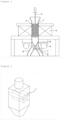
- Figure 1 illustrates an electromagnetic separator in which screens are set.
- One or more screens 1 made of a magnetic material are held by a holding rod 3 in the vertical direction in a multilayer manner in the hollow of a tube 2 open at the upper and lower ends.
- the tube 2 may be located in the center of an electromagnet 4 and provided with a vibrator 5 at a lower portion of the tube 2.
- the vibrator 5 is optional and may not necessarily be provided.
- the vibrator 5 is preferably not used for fluororesin in a powder form. If a vibrator is used, the fluororesin trapped in the gap may be broken into flakes or aggregated resin particles, or rubbing by vibration may cause new metal debris. Thus, it is preferable not to use a vibrator.
- the tube may be connected to a product outlet and a magnetic foreign matter outlet at a lower portion of the tube.
- the product outlet and the magnetic foreign matter outlet may be switched by turning a damper with a cylinder.
- a fluororesin containing magnetic foreign matter is fed into the interior of the tube 2 through the upper end and dropped in the direction indicated by the arrow in Figure 1 .
- the magnetic foreign matter is magnetically attached to the screens magnetized by the magnet 4.
- the product from which magnetic foreign matter is removed is discharged through the lower end of the tube 2.
- the electromagnet may be turned off to demagnetize the screens and remove magnetic foreign matter attached to the screens for cleaning.
- the screens 1 may be taken out using the holding rod and cleaned to remove the magnetic foreign matter. The cleaned screens can be loaded back into the tube.
- Figure 2 illustrates an apparatus for removing magnetic foreign matter by bringing at least one droplet-shaped magnet to contact with a fluororesin containing magnetic foreign matter.
- a droplet-shaped magnet 11 has a shape forming a semi-circular arc portion downward and a triangular portion upward, as depicted in Figure 2 . While the fluororesin is falling along the slopes of the triangular shape, the magnet removes the foreign matter.
- a plurality of droplet-shaped magnets is arranged with yokes therebetween.
- Such an apparatus depicted in Figure 2 , also can remove magnetic foreign matter.
- the present disclosure is about not only the above-described method for removing metallic foreign matter from a fluororesin but also a method for producing a fluororesin with reduced metallic foreign matter, including a similar step of removing metallic foreign matter.
- the present disclosure provides a novel method for obtaining a "fluororesin with reduced metallic foreign matter.”
- the method of the present disclosure for producing a fluororesin with reduced metallic foreign matter includes the step of removing metallic foreign matter from a fluororesin by the above-described method. "The step of removing metallic foreign matter" mentioned herein can be the same as the method described above.
- the method of the present disclosure for producing a fluororesin with reduced metallic foreign matter may further include another step of removing metallic foreign matter other than the above-described step.
- PTFE granulated powder POLYFLON PTFE M-392 produced by Daikin Industries, Ltd.
- 500 ppm of 316L stainless steel powder SUS 316L powder, 150 ⁇ m pass, produced by Kojundo Chemical Laboratory Co., Ltd.
- the apparatus used was an electromagnetic separator (model CG-180X-1) manufactured by Nippon Magnetics, Inc. An electromagnet was used as the magnet. Additionally, the screen in the apparatus was made of a magnetic material.
- Example was tested under varying conditions, such as the throughput rate and the presence or absence of a vibrator, as presented in Table 1 below.
- a weighing paper is wound around a 15,000 G bar magnet without gaps and fixed with tape.
- the resulting bar magnet is secured by a clamp.
- the powder subject to the measurement is poured over the bar magnet.
- the throughput rate as a guide is 4 kg/h.
- the collected powder is poured over the bar magnet again. Through such operation, the metal in the powder is attached to the magnet.
- This heat-resistant metal container is placed in an electric furnace at 600°C and removed in 2 hours. After air cooling, the container was weighed. The amount of the metal contained was determined by subtracting the weight of the empty container from the measured value.
- Example 1 Example 2
- Example 3 Screen Opening size: Opening size: Opening size: 5 mm 5 mm 5 mm Throughput rate (kg/h) 600 200 600 Magnetic flux density (T) 1.5 1.5 1.5 With/without vibrator With With Without Residual stainless steel percentage (%) 17.8 15.1 7.8
- TFE tetrafluoroethylene
- Polymerization was started by adding 0.028 kg of 50% solution of di-n-propyl peroxydicarbonate [NPP] in methanol as a polymerization initiator. Since the pressure decreases as the polymerization proceeds, TFE and PPVE were continuously added in a proportion that could result in the desired polymer composition.
- Example 4 Shape Droplet-shaped Droplet-shaped Throughput rate (kg/h) 300 200 Magnetic flux density (T) 1.4 1.4 With/without vibrator Without Without Residual stainless steel percentage (%) 27.9 23.0
- the removing method of the present disclosure can suitably remove metallic foreign matter from a fluororesin.
Landscapes
- Chemical & Material Sciences (AREA)
- Engineering & Computer Science (AREA)
- Health & Medical Sciences (AREA)
- Chemical Kinetics & Catalysis (AREA)
- Medicinal Chemistry (AREA)
- Polymers & Plastics (AREA)
- Organic Chemistry (AREA)
- Environmental & Geological Engineering (AREA)
- Mechanical Engineering (AREA)
- Physics & Mathematics (AREA)
- Fluid Mechanics (AREA)
- Processing And Handling Of Plastics And Other Materials For Molding In General (AREA)
Abstract
Description
- The present disclosure relates to a method for removing metallic foreign matter from a fluororesin and a method for producing a fluororesin with reduced metallic foreign matter.
- Fluororesin is used in a wide variety of applications. Fluororesin, however, may be contaminated with metallic foreign matter resulting from rubbing or corrosion of manufacturing facilities. Removing metallic foreign matter from a fluororesin containing metallic foreign matter is an important issue.
-
Patent Literatures 1 and 2 disclose removing a tiny amount of metallic foreign matter from a resin using a magnet. - Patent Literature 3 discloses separating and collecting fluorine-containing resin powder using a liquid medium containing chlorofluoroalkane and an aqueous liquid medium.
- Patent Literature 4 discloses removing foreign matter from a fluororesin using a solvent.
-
- Patent Literature 1:
Japanese Patent Laid-Open No. 2005-263985 - Patent Literature 2:
Japanese Patent Laid-Open No. 2005-21761 - Patent Literature 3:
Japanese Patent Laid-Open No. 54-071155 - Patent Literature 4: International Publication No.
WO 2004/009653 - An object of the present disclosure is to provide a method for suitably removing metallic foreign matter from a fluororesin and a method for producing a fluororesin with reduced metallic foreign matter, including the method for removing metallic foreign matter from a fluororesin as one of the steps.
- The present disclosure is
a method for removing metallic foreign matter from a fluororesin, comprising applying a magnetic field to a fluororesin with a magnet while dropping the fluororesin by gravity, to remove metal. - The method for removing metallic foreign matter preferably provides a screen made of a magnetic material in a flow path of the fluororesin dropped by gravity.
- Preferably, the magnet is an electromagnet.
- Preferably, the fluororesin is a powder, a pellet, or a granulated product.
- In the method for removing metallic foreign matter from a fluororesin, when the fluororesin passes through a screen, the screen is, preferably, not vibrated.
- The present disclosure is also about a method for producing a fluororesin with reduced metallic foreign matter, comprising a step of applying a magnetic field to a fluororesin with an electromagnet while dropping the fluororesin by gravity, to remove metal.
- The method for producing a fluororesin preferably provides a screen made of a magnetic material in a flow path of a fluororesin.
- Preferably, the magnet is an electromagnet.
- Preferably, the fluororesin is a powder, a pellet, or a granulated product.
- In the method for producing a fluororesin, when the fluororesin passes through a screen, the screen is, preferably, not vibrated.
- The method of the present disclosure for removing metallic foreign matter from a fluororesin can efficiently and precisely remove metallic foreign matter at low cost. Consequently, when the resulting resin is checked for metallic foreign matter, the amount of resin treated as rejected lot can be reduced, and a fluororesin with low metallic foreign matter content can be efficiently provided.
-
- [
Figure 1] Figure 1 is an exemplified view of an apparatus used in the present invention. - [
Figure 2] Figure 2 is an exemplified view of an apparatus used in the present invention. - The present disclosure will now be described in detail.
- The present disclosure is about a method for removing metal from a fluororesin. The fluororesin used herein is not limited. Specific examples of the fluororesin include PTFE resin, PFA resin, FEP resin, ETFE resin, PCTFE resin, and PVDF resin. Among these resins, PTFE resin is particularly preferable. The fluororesin is preferably solid and the disclosed method may be applied to any form, such as powder, granulated products, and pellets.
- The metal in such a fluororesin may be present in a metal powder or the like by itself or in an integrated form with the fluororesin. In the present disclosure, foreign matter is removed by magnetic force. Accordingly, the disclosure enables suitable removal even from an integrated material of metal and a fluororesin, which makes the removal more difficult. Examples of metals that can be mixed as foreign matter include stainless steel, iron, and these metals mixed with other elements.
- In the present disclosure, the metal in a fluororesin is mainly a contaminant that is foreign matter resulting from rubbing, corrosion, or the like of manufacturing facilities and does not occur at a high rate. However, such foreign matter, if once occurs, causes defective products in various applications. Desirably, foreign matter can be removed with as high accuracy as possible.
- The present disclosure features applying a magnetic field to a fluororesin with a magnet while dropping the fluororesin by gravity, thereby removing metal. When a large amount of fluororesin surrounds metallic foreign matter, the surrounding fluororesin may obstruct the magnetic force and thus interfere with sufficient removal of the foreign matter.
- For example, when a magnetic force is applied to a fluororesin being moved in a horizontal direction using a roller, a conveyor, or the like, the metallic foreign matter attached to the fluororesin may not be removed sufficiently by the magnetic force. Also, the fluororesin is removed to some extent together with the foreign matter. This is the problem that a certain percentage of fluororesin is always lost during operation.
- In contrast, when a magnetic field is applied to a fluororesin while the fluororesin is being dropped by gravity, the fluororesin in the form of a dispersion in the air is subjected to the magnetic field application. The magnetic field applied to the fluororesin being dropped by gravity sufficiently reaches the metal. This action of the magnetic field enables suitable removal. Such magnetic field application is also preferable from the viewpoint of continuous processing. Additionally, it has the advantage that the loss of fluororesin is not as high as when a roller or a conveyor is used. More specifically, in the method of the present disclosure, the loss of fluororesin is a small amount of fluororesin removed due to attachment to a screen used as a filter when the screen is washed for inspection or the like.
- The magnet used in the present disclosure may be an electromagnet or a permanent magnet.
- Electromagnets are more preferable in that they can apply a stronger magnetic field. Also, electromagnets are preferable from the viewpoint of enabling foreign matter to be easily removed by disconnecting the power supply during washing. Although permanent magnets are used as well, using an electromagnet is more preferable in view of foreign matter removal efficiency because permanent magnets are low in magnetic force, require large intervals for placing the magnets, and have difficulty in removing attached foreign matter during cleaning.
- The magnetic force applied to a fluororesin is preferably 0.8 T or more and more preferably 1.2 T or more. Treatment in such a high range of magnetic force is particularly preferable in view of the ability to remove fine metal.
- In some embodiments, a screen made of a magnetic material is set in the space through which the fluororesin falls. The screen thus provided is given magnetism by the electromagnet, thus serving to remove metallic foreign matter. Also, metallic foreign matter attached to the screen can be easily removed by turning off the electromagnet for cleaning, and thus, using such a screen is preferable.
- The screen may be made of a permanent magnet. Such a screen, which has magnetism derived from the permanent magnet, can produce the same effect.
- The screen may have any shape without limitation and may be, for example, a screen with an opening size of 5 mm or a honeycomb or micro-pitch screen.
- The method of the present disclosure for removing metallic foreign matter will be specifically further described in detail below with reference to
Figure 1 . - In some embodiments of the removing method of the present disclosure, the path through which the fluororesin falls by gravity is provided with some metal screens.
-
Figure 1 illustrates an electromagnetic separator in which screens are set. One or more screens 1 made of a magnetic material are held by a holding rod 3 in the vertical direction in a multilayer manner in the hollow of atube 2 open at the upper and lower ends. For example, thetube 2 may be located in the center of an electromagnet 4 and provided with avibrator 5 at a lower portion of thetube 2. Thevibrator 5 is optional and may not necessarily be provided. - In particular, the
vibrator 5 is preferably not used for fluororesin in a powder form. If a vibrator is used, the fluororesin trapped in the gap may be broken into flakes or aggregated resin particles, or rubbing by vibration may cause new metal debris. Thus, it is preferable not to use a vibrator. - The tube may be connected to a product outlet and a magnetic foreign matter outlet at a lower portion of the tube. In this instance, the product outlet and the magnetic foreign matter outlet may be switched by turning a damper with a cylinder.
- A fluororesin containing magnetic foreign matter is fed into the interior of the
tube 2 through the upper end and dropped in the direction indicated by the arrow inFigure 1 . The magnetic foreign matter is magnetically attached to the screens magnetized by the magnet 4. After passing through the screens, the product from which magnetic foreign matter is removed is discharged through the lower end of thetube 2. In some embodiments using an electromagnet as the magnet, the electromagnet may be turned off to demagnetize the screens and remove magnetic foreign matter attached to the screens for cleaning. Also, if necessary, the screens 1 may be taken out using the holding rod and cleaned to remove the magnetic foreign matter. The cleaned screens can be loaded back into the tube. - The embodiment depicted in
Figure 2 will also be described as another embodiment different from that inFigure 1 . -
Figure 2 illustrates an apparatus for removing magnetic foreign matter by bringing at least one droplet-shaped magnet to contact with a fluororesin containing magnetic foreign matter. - A droplet-shaped
magnet 11 has a shape forming a semi-circular arc portion downward and a triangular portion upward, as depicted inFigure 2 . While the fluororesin is falling along the slopes of the triangular shape, the magnet removes the foreign matter. - Preferably, a plurality of droplet-shaped magnets is arranged with yokes therebetween. Such an apparatus, depicted in
Figure 2 , also can remove magnetic foreign matter. - The present disclosure is about not only the above-described method for removing metallic foreign matter from a fluororesin but also a method for producing a fluororesin with reduced metallic foreign matter, including a similar step of removing metallic foreign matter.
- Hence, various methods can be applied to obtain a "fluororesin with reduced metallic foreign matter."
- The present disclosure provides a novel method for obtaining a "fluororesin with reduced metallic foreign matter."
- The method of the present disclosure for producing a fluororesin with reduced metallic foreign matter includes the step of removing metallic foreign matter from a fluororesin by the above-described method. "The step of removing metallic foreign matter" mentioned herein can be the same as the method described above.
- The method of the present disclosure for producing a fluororesin with reduced metallic foreign matter may further include another step of removing metallic foreign matter other than the above-described step.
- In the method of the present disclosure for removing metallic foreign matter, the lower the throughput rate, the better. More specifically, treating a large amount of fluororesin in a short time is undesirable in view of difficulty in sufficiently removing metallic foreign matter.
- The present disclosure will now be specifically described with reference to Examples. In the following Examples, "part(s)" and "%" are "part(s) by weight" and "% by weight," respectively, unless otherwise specified.
- PTFE granulated powder (POLYFLON PTFE M-392 produced by Daikin Industries, Ltd.) into which 500 ppm of 316L stainless steel powder (SUS 316L powder, 150 µm pass, produced by Kojundo Chemical Laboratory Co., Ltd.) was added was prepared as a sample.
- For each test, 5 kg of the PTFE granulated powder containing the stainless steel powder thus prepared was used.
- The apparatus used was an electromagnetic separator (model CG-180X-1) manufactured by Nippon Magnetics, Inc. An electromagnet was used as the magnet. Additionally, the screen in the apparatus was made of a magnetic material.
- Each Example was tested under varying conditions, such as the throughput rate and the presence or absence of a vibrator, as presented in Table 1 below.
- The results in Table 1 clearly show that better results were obtained without vibration.
- A weighing paper is wound around a 15,000 G bar magnet without gaps and fixed with tape. The resulting bar magnet is secured by a clamp. The powder subject to the measurement is poured over the bar magnet. The throughput rate as a guide is 4 kg/h. After the completion of pouring the powder, the collected powder is poured over the bar magnet again. Through such operation, the metal in the powder is attached to the magnet.
- Then, with the bar magnet placed on a heat-resistant metal container, the tape fixing the weighing paper is removed, and the weighing paper is removed from the bar magnet. Thus, the metal attached to a metal falls into the heat-resistant metal container.
- This heat-resistant metal container is placed in an electric furnace at 600°C and removed in 2 hours. After air cooling, the container was weighed. The amount of the metal contained was determined by subtracting the weight of the empty container from the measured value.
- The value calculated as the proportion of the amount of the metal measured as described above to the amount of the stainless steel powder added to the sample is presented in Table 1 as the residual stainless steel percentage.
[Table 1] Example 1 Example 2 Example 3 Screen Opening size: Opening size: Opening size: 5 mm 5 mm 5 mm Throughput rate (kg/h) 600 200 600 Magnetic flux density (T) 1.5 1.5 1.5 With/without vibrator With With Without Residual stainless steel percentage (%) 17.8 15.1 7.8 - The results of the above Examples clearly show that the method of the present disclosure for removing metallic foreign matter can suitably remove foreign matter from a fluororesin.
- An autoclave (capacity: 174 L) subjected to glass lining and equipped with a stirrer was charged with 26.6 kg of pure water. After the interior of the autoclave was sufficiently purged with N2 and evacuated to a vacuum, the autoclave was charged with 30.4 kg of perfluorocyclobutane [C-318], 0.8 kg of methanol, and 1.6 kg of perfluoro(propyl vinyl ether) [PPVE]. Then, the interior of the autoclave was kept at 35°C while being stirred, and tetrafluoroethylene [TFE] was injected into the autoclave to an inner pressure of 0.58 MPaG. Polymerization was started by adding 0.028 kg of 50% solution of di-n-propyl peroxydicarbonate [NPP] in methanol as a polymerization initiator. Since the pressure decreases as the polymerization proceeds, TFE and PPVE were continuously added in a proportion that could result in the desired polymer composition.
- 33 hours after starting the polymerization, the stirring was stopped, and simultaneously, unreacted monomers and C-318 were discharged to stop the polymerization. The white powder in the autoclave was washed with water and dried at 150°C for 12 hours to yield a polymer product.
- To the PFA powder obtained by the above-described process, 500 ppm of 316L stainless steel powder (SUS 316L powder, 150 µm pass, produced by Kojundo Chemical Laboratory Co., Ltd.) was added to prepare a sample.
- For each test, 1 kg of the PFA powder containing the stainless steel powder thus prepared was used.
- The apparatus used was a lattice magnet with a housing (neodymium-based rare earth magnet, whose magnet is a permanent magnet) manufactured by Magnetec Japan Ltd.
[Table 2] Example 4 Example 5 Shape Droplet-shaped Droplet-shaped Throughput rate (kg/h) 300 200 Magnetic flux density (T) 1.4 1.4 With/without vibrator Without Without Residual stainless steel percentage (%) 27.9 23.0 - The results of the above Examples clearly show that the method of the present disclosure for removing metallic foreign matter can suitably remove foreign matter from a fluororesin.
- The removing method of the present disclosure can suitably remove metallic foreign matter from a fluororesin.
-
- 1: screen
- 2 : tube
- 3: holding rod
- 4: electromagnet
- 5: vibrator
- 6: product outlet
- 7: iron powder outlet
- 8: cylinder
- 9: damper
- 11: droplet-shaped magnet
Claims (10)
- A method for removing metallic foreign matter from a fluororesin, comprising applying a magnetic field to a fluororesin with a magnet while dropping the fluororesin by gravity, to remove metal.
- The method for removing metallic foreign matter from a fluororesin according to claim 1, wherein the method provides a screen made of a magnetic material in a flow path of the fluororesin dropped by gravity.
- The method for removing metallic foreign matter from a fluororesin according to claim 1 or 2, wherein the magnet is an electromagnet.
- The method for removing metallic foreign matter from a fluororesin according to any one of claims 1, 2, and 3, wherein the fluororesin is a powder, a pellet, or a granulated product.
- The method for removing metallic foreign matter from a fluororesin according to any one of claims 1 to 4, wherein when the fluororesin passes through the screen, the screen is not vibrated.
- A method for producing a fluororesin with reduced metallic foreign matter, comprising a step of applying a magnetic field to a fluororesin with a magnet while dropping the fluororesin by gravity, to remove metal.
- The method for producing a fluororesin according to claim 6, wherein the method provides a screen made of a magnetic material in a flow path of the fluororesin dropped by gravity.
- The method for producing a fluororesin according to claim 6 or 7, wherein the magnet is an electromagnet.
- The method for producing a fluororesin according to any one of claims 6, 7, and 8, wherein the fluororesin is a powder, a pellet, or a granulated product.
- The method for removing metallic foreign matter from a fluororesin according to any one of claims 1 to 4, wherein when the fluororesin passes through a screen, the screen is not vibrated.
Applications Claiming Priority (2)
| Application Number | Priority Date | Filing Date | Title |
|---|---|---|---|
| CN202110549939.3A CN115366293A (en) | 2021-05-20 | 2021-05-20 | Method for removing metal foreign matter from fluororesin and method for producing fluororesin with reduced metal foreign matter |
| PCT/JP2022/020540 WO2022244774A1 (en) | 2021-05-20 | 2022-05-17 | Method for removing metal contaminants from fluorine resin and method for producing fluorine resin having reduced amount of metal contaminants |
Publications (2)
| Publication Number | Publication Date |
|---|---|
| EP4342916A1 true EP4342916A1 (en) | 2024-03-27 |
| EP4342916A4 EP4342916A4 (en) | 2024-11-20 |
Family
ID=84058672
Family Applications (1)
| Application Number | Title | Priority Date | Filing Date |
|---|---|---|---|
| EP22804685.0A Pending EP4342916A4 (en) | 2021-05-20 | 2022-05-17 | METHOD FOR REMOVING METAL IMPURITIES FROM FLUORINE RESIN AND METHOD FOR PRODUCING FLUORINE RESIN WITH A REDUCED CONTENT OF METAL IMPURITIES |
Country Status (6)
| Country | Link |
|---|---|
| US (1) | US12420290B2 (en) |
| EP (1) | EP4342916A4 (en) |
| JP (1) | JP7603157B2 (en) |
| CN (2) | CN115366293A (en) |
| TW (1) | TW202307103A (en) |
| WO (1) | WO2022244774A1 (en) |
Families Citing this family (1)
| Publication number | Priority date | Publication date | Assignee | Title |
|---|---|---|---|---|
| CN117358415A (en) * | 2023-11-03 | 2024-01-09 | 宜章弘源化工有限责任公司 | Magnetic separation device for iron ore screening |
Family Cites Families (18)
| Publication number | Priority date | Publication date | Assignee | Title |
|---|---|---|---|---|
| US2062545A (en) * | 1933-01-14 | 1936-12-01 | Feldspathic Res Corp | Apparatus for magnetic separation |
| JPS587659B2 (en) | 1977-11-18 | 1983-02-10 | 三井フロロケミカル株式会社 | Method for removing foreign substances from fluororesin powder |
| US4778594A (en) * | 1986-07-24 | 1988-10-18 | The University Of Chicago (Arch Development Corp.) | Apparatus for magnetic separation of paramagnetic and diamagnetic material |
| JP2926919B2 (en) * | 1990-07-17 | 1999-07-28 | 三菱瓦斯化学株式会社 | Permanent magnet type roll separator |
| US5333797A (en) * | 1992-04-03 | 1994-08-02 | Becker John C | Commingled recyclables recovery and recycling process and related apparatuses |
| JP3993797B2 (en) * | 2001-07-06 | 2007-10-17 | 株式会社日本触媒 | Water-absorbent resin powder, production method thereof and use thereof |
| US6716894B2 (en) | 2001-07-06 | 2004-04-06 | Nippon Shokubai Co., Ltd. | Water-absorbent resin powder and its production process and uses |
| KR20050030203A (en) | 2002-07-24 | 2005-03-29 | 아사히 가라스 가부시키가이샤 | Continuous resin recovery apparatus and method of recovery |
| JP2005021761A (en) | 2003-06-30 | 2005-01-27 | Sumitomo Bakelite Co Ltd | Removing device for impurity |
| JP4108021B2 (en) * | 2003-08-21 | 2008-06-25 | ダイセル化学工業株式会社 | Plastic mixture fractionation system |
| JP4293360B2 (en) | 2004-03-18 | 2009-07-08 | エア・ウォーター株式会社 | Method and apparatus for removing foreign matter from thermosetting resin |
| JP2012511602A (en) * | 2008-12-12 | 2012-05-24 | ビーエーエスエフ ソシエタス・ヨーロピア | Method for separating metal impurities |
| JP5218294B2 (en) * | 2009-06-24 | 2013-06-26 | 住友ベークライト株式会社 | Magnetic metal foreign object capturing device, capturing system, and capturing method |
| KR20120135211A (en) * | 2009-12-24 | 2012-12-12 | 파낙쿠 고교 가부시키가이샤 | Method for recovering polycarbonate resin from discarded optical disc and/or recovered optical disc, flame-retardant polycarbonate resin composition, injection molded body, and molded article for optical use |
| JP5551662B2 (en) * | 2011-08-23 | 2014-07-16 | 旭化成ケミカルズ株式会社 | Process for producing polyacetal |
| JP2016176802A (en) * | 2015-03-19 | 2016-10-06 | 株式会社クレハ | Methods for recovering metallic foreign matter and for inspecting metallic foreign matter of polymer |
| JP6574115B2 (en) * | 2015-08-12 | 2019-09-11 | 宇部興産株式会社 | Sorting device |
| JP2022059133A (en) | 2020-10-01 | 2022-04-13 | 株式会社三洋物産 | Game machine |
-
2021
- 2021-05-20 CN CN202110549939.3A patent/CN115366293A/en active Pending
-
2022
- 2022-05-17 CN CN202280033892.8A patent/CN117295773A/en active Pending
- 2022-05-17 JP JP2023522676A patent/JP7603157B2/en active Active
- 2022-05-17 WO PCT/JP2022/020540 patent/WO2022244774A1/en not_active Ceased
- 2022-05-17 EP EP22804685.0A patent/EP4342916A4/en active Pending
- 2022-05-19 TW TW111118708A patent/TW202307103A/en unknown
-
2023
- 2023-11-13 US US18/507,699 patent/US12420290B2/en active Active
Non-Patent Citations (5)
| Title |
|---|
| ANONYMOUS: "Electromagnetic Separator Model CG (for power process?", NIPPON MAGNETICS - PRODUCT BROCHURE, 1 January 2023 (2023-01-01), pages 1 - 8, XP093379503 |
| ANONYMOUS: "Electromagnetic Separator Model CG/AT-CG (Water cooled/Air cooled)", NIPPON MAGNETICS - INSTRUCTION MANUAL, 1 July 2020 (2020-07-01), pages 1 - 78, XP093379498 |
| ANONYMOUS: "Fluoropolymer POLYFLON PTFE M-392", DAIKIN - TECHNICAL DATASHEET, 1 March 2018 (2018-03-01), pages 1 - 1, XP093379500 |
| ANONYMOUS: "Magnet filter model CS - Electromagnetic Separator Model CG", NIPPON MAGNETICS - PRODUCT BROCHURE, 1 January 2007 (2007-01-01), pages 1 - 8, XP093379619 |
| See also references of WO2022244774A1 |
Also Published As
| Publication number | Publication date |
|---|---|
| TW202307103A (en) | 2023-02-16 |
| CN117295773A (en) | 2023-12-26 |
| JP7603157B2 (en) | 2024-12-19 |
| JPWO2022244774A1 (en) | 2022-11-24 |
| CN115366293A (en) | 2022-11-22 |
| WO2022244774A1 (en) | 2022-11-24 |
| US12420290B2 (en) | 2025-09-23 |
| EP4342916A4 (en) | 2024-11-20 |
| US20240075481A1 (en) | 2024-03-07 |
Similar Documents
| Publication | Publication Date | Title |
|---|---|---|
| US12420290B2 (en) | Method for removing metallic foreign matter from fluororesin and method for producing fluororesin with reduced metallic foreign matter | |
| WO2018233382A1 (en) | Dry separation and recovery process for recovering valuable constituent from waste circuit board | |
| EP2749357A1 (en) | Mixture separation method and separation device | |
| US7681737B2 (en) | Magnetic separator apparatus | |
| JP5787591B2 (en) | Foreign matter removing apparatus, foreign matter removing method, uranium oxide pellet and fuel assembly manufacturing method | |
| CN114887761B (en) | A steel scrap recycling system | |
| CN1097068C (en) | Polytetrafluoroethylene granular powder not containing filler and its production method | |
| JP5280626B2 (en) | Method for measuring the number of magnetized particles in non-magnetic metal oxide powder | |
| JP3210936B2 (en) | Filler-containing polytetrafluoroethylene granular powder and method for producing the same | |
| JP2010042347A (en) | Method and device of removing magnetic metal foreign substance | |
| EP1316348A1 (en) | Magnetic filter device | |
| JP2016176802A (en) | Methods for recovering metallic foreign matter and for inspecting metallic foreign matter of polymer | |
| Furuuchi et al. | Shape separation of particulates by a rotating horizontal sieve drum | |
| CN224077136U (en) | Multistage calcium impurity filtering device for industrial silicon smelting | |
| CN115184057B (en) | Experimental method for iron removal from powder | |
| JP4301369B2 (en) | Magnet body and box or magnetic separator using the magnet body | |
| JP4760781B2 (en) | Magnetic metal foreign matter trapping method, magnetic metal foreign matter trapping apparatus, and processing object inspection method | |
| CN224041235U (en) | Material deironing device | |
| JP7266457B2 (en) | Filter media cleaning method | |
| CN211439599U (en) | Air flow separator for pellet recovery | |
| JP4828556B2 (en) | Titanium sponge sorting method | |
| CN210994771U (en) | A solution filtration iron removal device | |
| CN207592056U (en) | Lime slaking conveys grid type deironing apparatus | |
| CN117165949A (en) | Method for treating metal surface after fire by using tetra sodium ethylenediamine tetraacetate | |
| JP2000271507A (en) | Method and apparatus for recovering useful metal from electronic part |
Legal Events
| Date | Code | Title | Description |
|---|---|---|---|
| STAA | Information on the status of an ep patent application or granted ep patent |
Free format text: STATUS: THE INTERNATIONAL PUBLICATION HAS BEEN MADE |
|
| PUAI | Public reference made under article 153(3) epc to a published international application that has entered the european phase |
Free format text: ORIGINAL CODE: 0009012 |
|
| STAA | Information on the status of an ep patent application or granted ep patent |
Free format text: STATUS: REQUEST FOR EXAMINATION WAS MADE |
|
| 17P | Request for examination filed |
Effective date: 20231120 |
|
| AK | Designated contracting states |
Kind code of ref document: A1 Designated state(s): AL AT BE BG CH CY CZ DE DK EE ES FI FR GB GR HR HU IE IS IT LI LT LU LV MC MK MT NL NO PL PT RO RS SE SI SK SM TR |
|
| DAV | Request for validation of the european patent (deleted) | ||
| DAX | Request for extension of the european patent (deleted) | ||
| A4 | Supplementary search report drawn up and despatched |
Effective date: 20241022 |
|
| RIC1 | Information provided on ipc code assigned before grant |
Ipc: C08F 6/02 20060101ALI20241016BHEP Ipc: B29K 27/18 20060101ALI20241016BHEP Ipc: B29K 27/00 20060101ALI20241016BHEP Ipc: B29K 27/12 20060101ALI20241016BHEP Ipc: B29B 17/02 20060101ALI20241016BHEP Ipc: B03C 1/30 20060101ALI20241016BHEP Ipc: B03C 1/26 20060101ALI20241016BHEP Ipc: B03C 1/033 20060101ALI20241016BHEP Ipc: C08F 6/28 20060101ALI20241016BHEP Ipc: C08F 14/18 20060101AFI20241016BHEP |
|
| STAA | Information on the status of an ep patent application or granted ep patent |
Free format text: STATUS: EXAMINATION IS IN PROGRESS |
|
| 17Q | First examination report despatched |
Effective date: 20250801 |
|
| TPAC | Observations filed by third parties |
Free format text: ORIGINAL CODE: EPIDOSNTIPA |