EP4342871A1 - Method for preparing olefin from methanol - Google Patents
Method for preparing olefin from methanol Download PDFInfo
- Publication number
- EP4342871A1 EP4342871A1 EP23818900.5A EP23818900A EP4342871A1 EP 4342871 A1 EP4342871 A1 EP 4342871A1 EP 23818900 A EP23818900 A EP 23818900A EP 4342871 A1 EP4342871 A1 EP 4342871A1
- Authority
- EP
- European Patent Office
- Prior art keywords
- catalyst
- phenol
- methanol
- constant
- ethylene
- Prior art date
- Legal status (The legal status is an assumption and is not a legal conclusion. Google has not performed a legal analysis and makes no representation as to the accuracy of the status listed.)
- Pending
Links
Images

Classifications
-
- C—CHEMISTRY; METALLURGY
- C07—ORGANIC CHEMISTRY
- C07C—ACYCLIC OR CARBOCYCLIC COMPOUNDS
- C07C1/00—Preparation of hydrocarbons from one or more compounds, none of them being a hydrocarbon
- C07C1/20—Preparation of hydrocarbons from one or more compounds, none of them being a hydrocarbon starting from organic compounds containing only oxygen atoms as heteroatoms
- C07C1/22—Preparation of hydrocarbons from one or more compounds, none of them being a hydrocarbon starting from organic compounds containing only oxygen atoms as heteroatoms by reduction
-
- C—CHEMISTRY; METALLURGY
- C07—ORGANIC CHEMISTRY
- C07C—ACYCLIC OR CARBOCYCLIC COMPOUNDS
- C07C1/00—Preparation of hydrocarbons from one or more compounds, none of them being a hydrocarbon
- C07C1/20—Preparation of hydrocarbons from one or more compounds, none of them being a hydrocarbon starting from organic compounds containing only oxygen atoms as heteroatoms
-
- C—CHEMISTRY; METALLURGY
- C07—ORGANIC CHEMISTRY
- C07C—ACYCLIC OR CARBOCYCLIC COMPOUNDS
- C07C41/00—Preparation of ethers; Preparation of compounds having groups, groups or groups
- C07C41/01—Preparation of ethers
- C07C41/09—Preparation of ethers by dehydration of compounds containing hydroxy groups
-
- B—PERFORMING OPERATIONS; TRANSPORTING
- B01—PHYSICAL OR CHEMICAL PROCESSES OR APPARATUS IN GENERAL
- B01J—CHEMICAL OR PHYSICAL PROCESSES, e.g. CATALYSIS OR COLLOID CHEMISTRY; THEIR RELEVANT APPARATUS
- B01J21/00—Catalysts comprising the elements, oxides, or hydroxides of magnesium, boron, aluminium, carbon, silicon, titanium, zirconium, or hafnium
- B01J21/02—Boron or aluminium; Oxides or hydroxides thereof
- B01J21/04—Alumina
-
- B—PERFORMING OPERATIONS; TRANSPORTING
- B01—PHYSICAL OR CHEMICAL PROCESSES OR APPARATUS IN GENERAL
- B01J—CHEMICAL OR PHYSICAL PROCESSES, e.g. CATALYSIS OR COLLOID CHEMISTRY; THEIR RELEVANT APPARATUS
- B01J21/00—Catalysts comprising the elements, oxides, or hydroxides of magnesium, boron, aluminium, carbon, silicon, titanium, zirconium, or hafnium
- B01J21/10—Magnesium; Oxides or hydroxides thereof
-
- B—PERFORMING OPERATIONS; TRANSPORTING
- B01—PHYSICAL OR CHEMICAL PROCESSES OR APPARATUS IN GENERAL
- B01J—CHEMICAL OR PHYSICAL PROCESSES, e.g. CATALYSIS OR COLLOID CHEMISTRY; THEIR RELEVANT APPARATUS
- B01J29/00—Catalysts comprising molecular sieves
- B01J29/04—Catalysts comprising molecular sieves having base-exchange properties, e.g. crystalline zeolites
- B01J29/06—Crystalline aluminosilicate zeolites; Isomorphous compounds thereof
- B01J29/08—Crystalline aluminosilicate zeolites; Isomorphous compounds thereof of the faujasite type, e.g. type X or Y
- B01J29/082—X-type faujasite
-
- B—PERFORMING OPERATIONS; TRANSPORTING
- B01—PHYSICAL OR CHEMICAL PROCESSES OR APPARATUS IN GENERAL
- B01J—CHEMICAL OR PHYSICAL PROCESSES, e.g. CATALYSIS OR COLLOID CHEMISTRY; THEIR RELEVANT APPARATUS
- B01J29/00—Catalysts comprising molecular sieves
- B01J29/04—Catalysts comprising molecular sieves having base-exchange properties, e.g. crystalline zeolites
- B01J29/06—Crystalline aluminosilicate zeolites; Isomorphous compounds thereof
- B01J29/08—Crystalline aluminosilicate zeolites; Isomorphous compounds thereof of the faujasite type, e.g. type X or Y
- B01J29/084—Y-type faujasite
-
- B—PERFORMING OPERATIONS; TRANSPORTING
- B01—PHYSICAL OR CHEMICAL PROCESSES OR APPARATUS IN GENERAL
- B01J—CHEMICAL OR PHYSICAL PROCESSES, e.g. CATALYSIS OR COLLOID CHEMISTRY; THEIR RELEVANT APPARATUS
- B01J29/00—Catalysts comprising molecular sieves
- B01J29/04—Catalysts comprising molecular sieves having base-exchange properties, e.g. crystalline zeolites
- B01J29/06—Crystalline aluminosilicate zeolites; Isomorphous compounds thereof
- B01J29/40—Crystalline aluminosilicate zeolites; Isomorphous compounds thereof of the pentasil type, e.g. types ZSM-5, ZSM-8 or ZSM-11, as exemplified by patent documents US3702886, GB1334243 and US3709979, respectively
-
- B—PERFORMING OPERATIONS; TRANSPORTING
- B01—PHYSICAL OR CHEMICAL PROCESSES OR APPARATUS IN GENERAL
- B01J—CHEMICAL OR PHYSICAL PROCESSES, e.g. CATALYSIS OR COLLOID CHEMISTRY; THEIR RELEVANT APPARATUS
- B01J29/00—Catalysts comprising molecular sieves
- B01J29/04—Catalysts comprising molecular sieves having base-exchange properties, e.g. crystalline zeolites
- B01J29/06—Crystalline aluminosilicate zeolites; Isomorphous compounds thereof
- B01J29/70—Crystalline aluminosilicate zeolites; Isomorphous compounds thereof of types characterised by their specific structure not provided for in groups B01J29/08 - B01J29/65
- B01J29/7007—Zeolite Beta
-
- B—PERFORMING OPERATIONS; TRANSPORTING
- B01—PHYSICAL OR CHEMICAL PROCESSES OR APPARATUS IN GENERAL
- B01J—CHEMICAL OR PHYSICAL PROCESSES, e.g. CATALYSIS OR COLLOID CHEMISTRY; THEIR RELEVANT APPARATUS
- B01J29/00—Catalysts comprising molecular sieves
- B01J29/82—Phosphates
- B01J29/84—Aluminophosphates containing other elements, e.g. metals, boron
- B01J29/85—Silicoaluminophosphates [SAPO compounds]
-
- B—PERFORMING OPERATIONS; TRANSPORTING
- B01—PHYSICAL OR CHEMICAL PROCESSES OR APPARATUS IN GENERAL
- B01J—CHEMICAL OR PHYSICAL PROCESSES, e.g. CATALYSIS OR COLLOID CHEMISTRY; THEIR RELEVANT APPARATUS
- B01J31/00—Catalysts comprising hydrides, coordination complexes or organic compounds
- B01J31/02—Catalysts comprising hydrides, coordination complexes or organic compounds containing organic compounds or metal hydrides
- B01J31/0201—Oxygen-containing compounds
- B01J31/0204—Ethers
-
- B—PERFORMING OPERATIONS; TRANSPORTING
- B01—PHYSICAL OR CHEMICAL PROCESSES OR APPARATUS IN GENERAL
- B01J—CHEMICAL OR PHYSICAL PROCESSES, e.g. CATALYSIS OR COLLOID CHEMISTRY; THEIR RELEVANT APPARATUS
- B01J31/00—Catalysts comprising hydrides, coordination complexes or organic compounds
- B01J31/02—Catalysts comprising hydrides, coordination complexes or organic compounds containing organic compounds or metal hydrides
- B01J31/0201—Oxygen-containing compounds
- B01J31/0205—Oxygen-containing compounds comprising carbonyl groups or oxygen-containing derivatives, e.g. acetals, ketals, cyclic peroxides
- B01J31/0208—Ketones or ketals
-
- B—PERFORMING OPERATIONS; TRANSPORTING
- B01—PHYSICAL OR CHEMICAL PROCESSES OR APPARATUS IN GENERAL
- B01J—CHEMICAL OR PHYSICAL PROCESSES, e.g. CATALYSIS OR COLLOID CHEMISTRY; THEIR RELEVANT APPARATUS
- B01J31/00—Catalysts comprising hydrides, coordination complexes or organic compounds
- B01J31/02—Catalysts comprising hydrides, coordination complexes or organic compounds containing organic compounds or metal hydrides
- B01J31/0231—Halogen-containing compounds
- B01J31/0232—Halogen-containing compounds also containing elements or functional groups covered by B01J31/0201 - B01J31/0228
-
- B—PERFORMING OPERATIONS; TRANSPORTING
- B01—PHYSICAL OR CHEMICAL PROCESSES OR APPARATUS IN GENERAL
- B01J—CHEMICAL OR PHYSICAL PROCESSES, e.g. CATALYSIS OR COLLOID CHEMISTRY; THEIR RELEVANT APPARATUS
- B01J31/00—Catalysts comprising hydrides, coordination complexes or organic compounds
- B01J31/02—Catalysts comprising hydrides, coordination complexes or organic compounds containing organic compounds or metal hydrides
- B01J31/04—Catalysts comprising hydrides, coordination complexes or organic compounds containing organic compounds or metal hydrides containing carboxylic acids or their salts
-
- B—PERFORMING OPERATIONS; TRANSPORTING
- B01—PHYSICAL OR CHEMICAL PROCESSES OR APPARATUS IN GENERAL
- B01J—CHEMICAL OR PHYSICAL PROCESSES, e.g. CATALYSIS OR COLLOID CHEMISTRY; THEIR RELEVANT APPARATUS
- B01J31/00—Catalysts comprising hydrides, coordination complexes or organic compounds
- B01J31/26—Catalysts comprising hydrides, coordination complexes or organic compounds containing in addition, inorganic metal compounds not provided for in groups B01J31/02 - B01J31/24
-
- C—CHEMISTRY; METALLURGY
- C07—ORGANIC CHEMISTRY
- C07C—ACYCLIC OR CARBOCYCLIC COMPOUNDS
- C07C2529/00—Catalysts comprising molecular sieves
- C07C2529/04—Catalysts comprising molecular sieves having base-exchange properties, e.g. crystalline zeolites, pillared clays
- C07C2529/06—Crystalline aluminosilicate zeolites; Isomorphous compounds thereof
- C07C2529/08—Crystalline aluminosilicate zeolites; Isomorphous compounds thereof of the faujasite type, e.g. type X or Y
-
- C—CHEMISTRY; METALLURGY
- C07—ORGANIC CHEMISTRY
- C07C—ACYCLIC OR CARBOCYCLIC COMPOUNDS
- C07C2529/00—Catalysts comprising molecular sieves
- C07C2529/04—Catalysts comprising molecular sieves having base-exchange properties, e.g. crystalline zeolites, pillared clays
- C07C2529/06—Crystalline aluminosilicate zeolites; Isomorphous compounds thereof
- C07C2529/40—Crystalline aluminosilicate zeolites; Isomorphous compounds thereof of the pentasil type, e.g. types ZSM-5, ZSM-8 or ZSM-11
-
- C—CHEMISTRY; METALLURGY
- C07—ORGANIC CHEMISTRY
- C07C—ACYCLIC OR CARBOCYCLIC COMPOUNDS
- C07C2529/00—Catalysts comprising molecular sieves
- C07C2529/04—Catalysts comprising molecular sieves having base-exchange properties, e.g. crystalline zeolites, pillared clays
- C07C2529/06—Crystalline aluminosilicate zeolites; Isomorphous compounds thereof
- C07C2529/70—Crystalline aluminosilicate zeolites; Isomorphous compounds thereof of types characterised by their specific structure not provided for in groups C07C2529/08 - C07C2529/65
-
- C—CHEMISTRY; METALLURGY
- C07—ORGANIC CHEMISTRY
- C07C—ACYCLIC OR CARBOCYCLIC COMPOUNDS
- C07C2529/00—Catalysts comprising molecular sieves
- C07C2529/82—Phosphates
- C07C2529/84—Aluminophosphates containing other elements, e.g. metals, boron
- C07C2529/85—Silicoaluminophosphates (SAPO compounds)
-
- C—CHEMISTRY; METALLURGY
- C07—ORGANIC CHEMISTRY
- C07C—ACYCLIC OR CARBOCYCLIC COMPOUNDS
- C07C2531/00—Catalysts comprising hydrides, coordination complexes or organic compounds
- C07C2531/02—Catalysts comprising hydrides, coordination complexes or organic compounds containing organic compounds or metal hydrides
-
- C—CHEMISTRY; METALLURGY
- C07—ORGANIC CHEMISTRY
- C07C—ACYCLIC OR CARBOCYCLIC COMPOUNDS
- C07C2531/00—Catalysts comprising hydrides, coordination complexes or organic compounds
- C07C2531/26—Catalysts comprising hydrides, coordination complexes or organic compounds containing in addition, inorganic metal compounds not provided for in groups C07C2531/02 - C07C2531/24
-
- Y—GENERAL TAGGING OF NEW TECHNOLOGICAL DEVELOPMENTS; GENERAL TAGGING OF CROSS-SECTIONAL TECHNOLOGIES SPANNING OVER SEVERAL SECTIONS OF THE IPC; TECHNICAL SUBJECTS COVERED BY FORMER USPC CROSS-REFERENCE ART COLLECTIONS [XRACs] AND DIGESTS
- Y02—TECHNOLOGIES OR APPLICATIONS FOR MITIGATION OR ADAPTATION AGAINST CLIMATE CHANGE
- Y02P—CLIMATE CHANGE MITIGATION TECHNOLOGIES IN THE PRODUCTION OR PROCESSING OF GOODS
- Y02P20/00—Technologies relating to chemical industry
- Y02P20/50—Improvements relating to the production of bulk chemicals
- Y02P20/52—Improvements relating to the production of bulk chemicals using catalysts, e.g. selective catalysts
-
- Y—GENERAL TAGGING OF NEW TECHNOLOGICAL DEVELOPMENTS; GENERAL TAGGING OF CROSS-SECTIONAL TECHNOLOGIES SPANNING OVER SEVERAL SECTIONS OF THE IPC; TECHNICAL SUBJECTS COVERED BY FORMER USPC CROSS-REFERENCE ART COLLECTIONS [XRACs] AND DIGESTS
- Y02—TECHNOLOGIES OR APPLICATIONS FOR MITIGATION OR ADAPTATION AGAINST CLIMATE CHANGE
- Y02P—CLIMATE CHANGE MITIGATION TECHNOLOGIES IN THE PRODUCTION OR PROCESSING OF GOODS
- Y02P30/00—Technologies relating to oil refining and petrochemical industry
- Y02P30/20—Technologies relating to oil refining and petrochemical industry using bio-feedstock
-
- Y—GENERAL TAGGING OF NEW TECHNOLOGICAL DEVELOPMENTS; GENERAL TAGGING OF CROSS-SECTIONAL TECHNOLOGIES SPANNING OVER SEVERAL SECTIONS OF THE IPC; TECHNICAL SUBJECTS COVERED BY FORMER USPC CROSS-REFERENCE ART COLLECTIONS [XRACs] AND DIGESTS
- Y02—TECHNOLOGIES OR APPLICATIONS FOR MITIGATION OR ADAPTATION AGAINST CLIMATE CHANGE
- Y02P—CLIMATE CHANGE MITIGATION TECHNOLOGIES IN THE PRODUCTION OR PROCESSING OF GOODS
- Y02P30/00—Technologies relating to oil refining and petrochemical industry
- Y02P30/40—Ethylene production
Definitions
- the present disclosure relates to technical field of olefin preparation, and in particular to a method of preparing olefins from methanol.
- Ethylene is one of the world's largest chemical products and is known as "mother of petrochemicals".
- the development of clean and efficient coal-to-ethene technology can help solve problems, of the existing industrial ethylene production process, such as strong oil dependence, low ethylene self-sufficiency, etc.
- Chinese patent CN1356299A discloses a preparation process of light olefin from methanol or dimethyl ether, where the catalyst is silica-aluminum phosphate type molecular sieve SAPO-34.
- a gas-solid parallel flow downstream fluidized bed ultra-short time contact reactor is adopted, in which the catalyst and raw materials are contacted and reacted, and then quickly separated in a gas-solid fast separator in a lower part of the reactor.
- the separated catalyst enters into a regenerator to remove the coke by air combustion and carry on another cycle reaction.
- the conversion of dimethyl ether or methanol by this reaction process is greater than 98%.
- the method has technical drawbacks such as low selectivity of ethylene and propylene, easy coke deposition of catalyst, and the need for repeated regeneration.
- Chinese patent CN101165026A discloses a method of preparing ethylene and propylene from methanol or dimethyl ether, using a two-stage reactor and adding a gas separation unit, with ethylene selectivity of 47.1% and propylene yield of 36.9%.
- ethylene selectivity 47.1%
- propylene yield 36.9%.
- the subsequent separation of ethylene/propylene is a difficult problem with high energy consumption and high separation cost.
- a first object of the present disclosure is to provide, in view of the deficiencies of the related technique, a method for the production of olefins from methanol, which realizes the highly selective production of olefins from methanol by introducing a phenol-like substance as a molecular catalyst.
- a method of preparing olefins from methanol comprising:
- a molar ratio of the methanol to phenol-like molecules is (1-8): 1, preferably (2-6):1, and most preferably 3:1.
- the first constant-temperature zone is at a temperature of 300-400°C, preferably 320-360°C.
- the second constant-temperature zone is at a temperature of 160-400°C, preferably 200-300°C.
- the catalyst A is one or more of X-type, Y-type, and ⁇ -type molecular sieves, preferably a NaX molecular sieve.
- the catalyst B is one or more of AlPO, SAPO, ZSM, Y-type molecular sieves, preferably a SAPO-type molecular sieve, most preferably a SAPO-34 or SAPO-18 molecular sieve.
- an inert gas can be used to assist the feed in the reaction process, specifically, the raw material is gasified and mixed with inert gas and passed into the two-stage fixed-bed catalytic reactor; the inert gas is selected from any one or more of N 2 , He or Ar; the flow rate of the inert gas is 0-100 mL/min, preferably 20-80 mL/min, and more preferably 30-40 mL/ min.
- a reaction pressure of the two-stage fixed-bed catalytic reactor is atmospheric pressure.
- a space velocity of the methanol is 3-200 kg CH 3 OH/(kg cat. A)/h, preferably 6-80 kg CH 3 OH/(kg cat. A)/h; the space velocity expresses a mass or volume of a reactant passing through the catalytic bed per unit of time, and is usually expressed as the mass or volume of reactants per unit of time divided by the mass or volume of the catalytic bed.
- the beneficial effect of the present disclosure compared to the related technique includes the following.
- the present disclosure provides a method of preparing olefins from methanol, using phenol-like molecules as a molecular catalyst, and a catalytic reaction by co-feeding methanol and the phenol-like molecules.
- the raw material can be brought into the reactor by an inert gas, and after a two-stage catalyst system, the selectivity of ethylene reaches more than 90%, which effectively solves the problem of the products separation in the current process.
- the economy of carbon atoms in the reaction process is up to 100%.
- the process described in the present disclosure has a good stability and can be operated continuously for more than 100 h. A little coke is formed in catalyst during the reaction, which solves the problem that the catalyst is required to be regenerated repeatedly.
- the traditional methanol-to-olefin process has a large investment and is suitable for large-scale production of olefins
- the process route of the present disclosure has the potential for miniaturized production and can be applied in the industrial production of ethylene with annual small-scale output.
- Ethylene selectivity and ethylene yield for 100 hours of continuous operation are calculated using the following equations, respectively.
- C 2 H 4 selectivity in gas phase product 2 ⁇ C 2 H 4 ⁇ x ⁇ products ⁇ 100 % 100 h
- C 2 H 4 yield 100 ⁇ C 2 H 4 m cat
- m cat represents the mass of the catalyst
- a catalyst evaluation device involved in the embodiments of the present disclosure includes a liquid chromatograph-mass spectrometer (LC-MS) and an online gas chromatography.
- LC-MS liquid chromatograph-mass spectrometer
- an online gas chromatography the composition of the gas-phase product in the reactor is monitored and analyzed in real time by the online gas chromatography, while a liquid phase product in the reactor is collected and analyzed by liquid chromatograph-mass spectrometer to obtain information on composition and characteristic parameters of the liquid phase product in the reaction.
- R 1 -R 5 are independently selected from one of H atom, alkyl, alkoxy, phenol hydroxyl, alcohol hydroxyl, carbonyl, halogen, respectively.
- Methanol and phenol are mixed according to a molar ratio of 8:1 at a feed rate of 1.0 mL/h.
- the raw material is gasified and passed into a reaction tube under nitrogen, with a flow rate of nitrogen is 30 mL/min.
- the catalyst A is NaX molecular sieve at an amount of 50 mg and a bed temperature of 320°C; the catalyst B is KY molecular sieve at an amount of 150 mg and a bed temperature of 250-290°C.
- each of the catalyst A and the catalyst B is mixed with 400 mg of quartz sand with a mesh size of 20-40 mesh when loading.
- the gas phase product is detected and analyzed by the online gas chromatography, and the liquid phase product is collected and analyzed by the liquid chromatograph-mass spectrometer. The results obtained are shown in Table 1.
- the process described in the present disclosure has a good stability and can be operated continuously for more than 100 h. A little coke is formed in catalyst during the reaction. In contrast, the conventional methanol-to-olefin (MTO) process is prone to coke deposition, the catalyst runs continuously for less than 10 h, and after a period of operation, the catalyst must be regenerated by air combustion to remove the coke before it can continue to be used.
- MTO methanol-to-olefin
- the catalytic performance is maintained, and the 100 h ethylene yield, which is the amount of ethylene produced per gram of catalyst over the 100 h stable life cycle of the catalyst, is up to 551.8 mmol C 2 H 4 g -1 cat, which is higher than the amount of ethylene produced on conventional MTO catalysts (150-250 mmol C 2 H 4 g -1 cat) per gram of catalyst produced over a stable life cycle (10 h)
- Embodiments 1-14 illustrate the effect of the type of the catalyst B on the reaction temperature, ethylene selectivity, and 100 h ethylene yield, when the catalyst A is fixed to NaX molecular sieve, the reaction temperature is fixed to 320°C, and the molecular catalyst is phenol.
- the catalyst B may be one or a mixture of Y-type, X-type, AlPO, SAPO, SSZ, ZSM, chabazite, and more preferably SAPO-type molecular sieves.
- SAPO-34 and SAPO-18 molecular sieves The best 100 h ethylene yield is achieved when the catalyst B is SAPO-34 and SAPO-18 molecular sieves.
- the ethylene selectivity can all be greater than 95%, while when the catalyst B is selected with the HY molecular sieve, the ethylene selectivity is only 60-70%.
- Embodiments 7,15-18 illustrate the effect of the type of the catalyst A on the reaction temperature, ethylene selectivity, and 100 h ethylene yield, when the catalyst B is fixed to SAPO-34 molecular sieve, the reaction temperature of the catalyst B is fixed to 230°C, and the molecular catalyst is fixed to phenol.
- the catalyst A may be one or a mixture of X-type, Y type, and ⁇ -type molecular sieves.
- the best 100 h ethylene yield is achieved when the catalyst A is NaX molecular sieve.
- the 100 h ethylene yield is only 9.21 mmol C 2 H 4 g -1 cat when the catalyst A is MgO.
- Embodiments 7,19-23 illustrate the effect of the molar ratio of methanol to phenol-like molecules on the reaction temperature, the 100 h ethylene yield, and the ethylene selectivity, preferably 8:1-1:1, more preferably 3: 1.
- optimization of the molar ratio of methanol to phenol-like molecules resulted in the modulation of the 100 h ethylene yields, with the highest 100 h ethylene yields up to 208.79 mmol C 2 H 4 g -1 cat.
- thermogravimetric curves of SAPO-34 before and after the reaction are shown in FIG. 2 , and there is a little coke formed on the surface of the catalyst B after 100 h of reaction of SAPO-34, which proves the good catalytic stability of the reaction in the present disclosure;
- the trend of the reaction as a function of temperature is shown in FIG. 3 , and the 100 h ethylene yield increases with the rise of the reaction temperature; when the reaction temperature is 230°C, the 100 h ethylene yield is achieved as 208.79 mmol C 2 H 4 g -1 cat and the ethylene selectivity is >99%;
- the catalytic stability performance is shown in FIG. 4 , there is no significant decrease in the reaction performance within 100 h, which further indicates that the reaction process of the present disclosure has good catalytic stability.
- Embodiments 21, 24-35 illustrate the effect of the type of phenol-like molecule on the ethylene selectivity and 100 h ethylene yield.
- the substituents may include one or more of H atoms, alkyl groups, alkoxy groups, phenol hydroxyl groups, alcohol hydroxyl groups, carbonyl groups, and halogens.
- the ethylene selectivity is each greater than 98%, and the 100 h ethylene yield is up to 551.79 mmol C 2 H 4 g -1 cat when the phenol-like molecule is a methoxy phenol.
- methanol is mixed with phenol at a molar ratio of 3:1 at a feed rate of 1.0 mL/h.
- the raw material is gasified and passed into the reaction tube under nitrogen, varying the flow rate of nitrogen to 100, 80, 60, 40, 30, 20, 0 mL/min.
- the catalyst A is NaX molecular sieve at an amount of 50 mg and a bed temperature of 360°C.
- the catalyst B is SAPO-34 molecular sieve at an amount of 150 mg and a bed temperature of 230°C.
- each of the catalyst A and the catalyst B is mixed with 400 mg of quartz sand with a mesh size of 20-40 mesh when loading.
- the gas phase product is detected and analyzed by the online gas chromatography, and the liquid phase product is collected and analyzed by the liquid chromatograph-mass spectrometer.
- the 100 h ethylene yield shows an increasing and then decreasing trend with the decrease of nitrogen flow rate.
- the nitrogen flow rate is 30 mL/min
- the 100 h ethylene yield reaches the highest value of 208.8 mmol C 2 H 4 g -1 cat.
- the nitrogen flow rate is 100 mL/min
- the 100 h ethylene yield is 83.31 mmol C 2 H 4 g -1 cat.
- the nitrogen flow rate is 0 mL/min
- the 100 h ethylene yield is 98.06 mmol C 2 H 4 g -1 cat.
- methanol is mixed with phenol at a molar ratio of 3:1, varying the feed rate with the methanol space velocity of 3, 6, 9, 40, 80, 120, 160, 200 kg CH 3 OH/(kg cat. A)/h, and the nitrogen flow rate is 30 mL/min.
- the raw material is gasified and passed into the reaction tube under nitrogen.
- the catalyst A is NaX molecular sieve at an amount of 50 mg at a bed temperature of 360°C
- the catalyst B is SAPO-34 molecular sieve at an amount of 150 mg at a bed temperature of 230°C.
- each of the catalyst A and the catalyst B is mixed with 400 mg of quartz sand with a mesh size of 20-40 mesh when loading.
- the gas phase product is detected and analyzed by the online gas chromatography, and the liquid phase product is collected and analyzed by the liquid chromatograph-mass spectrometer. It is found that the ethylene selectivity in the gas phase product is greater than 99% with the gradual increase of methanol space velocity from 3 to 200 kg CH 3 OH/(kg cat. A)/h.
- the 100 h ethylene yield shows an increasing and then decreasing trend with the increase of methanol space velocity. When the methanol space velocity is 24 kg CH 3 OH/(kg cat.
- the 100 h ethylene yield reaches the highest value of 201.2 mmol C 2 H 4 g -1 cat.
- the 100 h ethylene yield is 181.3 mmol C 2 H 4 g -1 cat.
- the 100 h ethylene yield is 109.8 mmol C 2 H 4 g -1 cat.
- methanol is mixed with phenol at a molar ratio of 3:1 at a feed rate of 1.0 mL/h and a nitrogen flow rate of 30 mL/min.
- the raw material is gasified and passed into the reaction tube under nitrogen.
- the catalyst A is NaX molecular sieve at a bed temperature of 360°C
- the catalyst B is SAPO-34 molecular sieve at a bed temperature of 230°C, varying the catalyst A/B mass ratio of 0.1, 0.33, 1, 3, 6, 9, 12.
- each of the catalyst A and the catalyst B is mixed with 400 mg of quartz sand with a mesh size of 20-40 mesh when loading.
- the gas phase product is detected and analyzed by the online gas chromatography, and the liquid phase product is collected and analyzed by the liquid chromatograph-mass spectrometer. It is found that the ethylene selectivity in the gas phase product is greater than 99% with the gradual increase of the catalyst A/B mass ratio from 0.1 to 12, and the 100 h ethylene yield shows an increasing and then decreasing trend with the increase of the catalyst A/B mass ratio.
- the catalyst A/B mass ratio is 0.1
- the 100 h ethylene yield reaches the highest value of 208.8 mmol C 2 H 4 g -1 cat.
- the catalyst A/B mass ratio is 0.33
- the 100 h ethylene yield is 133.1 mmol C 2 H 4 g -1 cat.
- the catalyst A/B mass ratio is 12
- the 100 h ethylene yield is 118.3 mmol C 2 H 4 g -1 cat.
- This comparative example is carried out with reference to the reaction parameters of Embodiment 21, and differs from Embodiment 21 in that no catalyst B is added.
- the gas and liquid phase products are detected by chromatography, showing that the main product is anisole and that ethylene is not present.
- This result indicates that the primary role of the catalyst A is to catalyze the reaction between methanol and phenol to produce anisole molecules.
- Highly selective ethylene-production from methanol cannot be achieved with only the catalyst A and the molecular catalyst, namely, the phenol-like molecules.
- Anisole is used as the raw material, the feed rate is 1 mL/h, and the raw material is gasified and passed into the reaction tube driven by nitrogen, with a nitrogen flow rate of 30 mL/min.
- the catalyst is SAPO-34 molecular sieve at an amount of 150 mg.
- the catalyst is loaded with 400 mg of quartz sand mixed with a mesh size of 20-40 mesh when loading.
- the bed temperature is in a range of 160-230°C.
- the gas phase product is detected and analyzed by the online gas chromatography, and the liquid phase product is collected and analyzed by the liquid chromatograph-mass spectrometer.
- the main product of anisole decomposition is ethylene and phenol
- the ethylene selectivity in the gas-phase product is >98%
- the phenol selectivity in the liquid phase product is >91%
- the 100 h ethylene yield increases with the increase of temperature.
- the 100 h ethylene yield is 62.7 mmol C 2 H 4 g -1 cat at 160°C, and 218.8 mmol C 2 H 4 g -1 cat at 230°C.
- This result suggests that the main role of the catalyst B is to catalyze the decomposition of anisole into phenol and ethylene.
- This comparative example is carried out according to the reaction parameters of Embodiment 21, and differs from Embodiment 21 in that no catalyst A is added.
- the gas and liquid phase products are detected by chromatography, showing that no ethylene is produced, even at a reaction temperature of 230°C.
- This comparative example is carried out according to the reaction parameters of Embodiment 21, and differs from Embodiment 21 in that no phenol is added n.
- the gas and liquid phase products are detected by chromatography, showing that even if the reaction temperature of the catalyst B is 230 °C, the methanol as raw material is hardly reacted, and no ethylene is produced in the gas phase.
- the molecular catalyst, the catalyst A, and the catalyst B are indispensable in the methanol-to-ethylene process proposed in the present disclosure.
- the synergistic effect between them is the key to ensure the high selective conversion of methanol to ethylene.
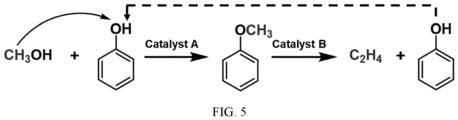
- the specific reaction process is shown in FIG. 5 , where methanol reacts with the phenol-like molecules to generate anisole-like molecules under the action of the catalyst A.
- the anisole-like molecules decompose to generate the phenol-like molecules and ethylene under the action of the catalyst B, where the phenol-like molecules participate in the reaction, but the quantity thereof before and after the reaction does not change significantly, and thus the phenol-like molecules act as the molecular catalyst.
- factors such as the types of catalysts A and B, the reaction temperature, and the ratio of phenol-like molecules to methanol affect the catalytic reaction performance.
Landscapes
- Chemical & Material Sciences (AREA)
- Organic Chemistry (AREA)
- Engineering & Computer Science (AREA)
- Materials Engineering (AREA)
- Chemical Kinetics & Catalysis (AREA)
- Crystallography & Structural Chemistry (AREA)
- Inorganic Chemistry (AREA)
- Organic Low-Molecular-Weight Compounds And Preparation Thereof (AREA)
Abstract
Description
- The present disclosure relates to technical field of olefin preparation, and in particular to a method of preparing olefins from methanol.
- Ethylene is one of the world's largest chemical products and is known as "mother of petrochemicals". The development of clean and efficient coal-to-ethene technology can help solve problems, of the existing industrial ethylene production process, such as strong oil dependence, low ethylene self-sufficiency, etc.
- The core of the coal-to-ethylene technology lies in the methanol-to-olefin reaction; however, the current methanol-to-olefin process is still characterized by technical bottlenecks such as difficult product separation and short catalyst life. For example, Chinese patent
CN1356299A discloses a preparation process of light olefin from methanol or dimethyl ether, where the catalyst is silica-aluminum phosphate type molecular sieve SAPO-34. In the process, a gas-solid parallel flow downstream fluidized bed ultra-short time contact reactor is adopted, in which the catalyst and raw materials are contacted and reacted, and then quickly separated in a gas-solid fast separator in a lower part of the reactor. The separated catalyst enters into a regenerator to remove the coke by air combustion and carry on another cycle reaction. The conversion of dimethyl ether or methanol by this reaction process is greater than 98%. However, the method has technical drawbacks such as low selectivity of ethylene and propylene, easy coke deposition of catalyst, and the need for repeated regeneration. - Another example is Chinese patent
CN101165026A , which discloses a method of preparing ethylene and propylene from methanol or dimethyl ether, using a two-stage reactor and adding a gas separation unit, with ethylene selectivity of 47.1% and propylene yield of 36.9%. However, the subsequent separation of ethylene/propylene is a difficult problem with high energy consumption and high separation cost. - Therefore, there is an urgent need for a new methanol-to-olefin process route to achieve a high selectivity of olefins in methanol conversion and to solve problems with the existing industrial methanol-to-olefin production process, such as difficult product separation, easy coke deposition, etc.
- A first object of the present disclosure is to provide, in view of the deficiencies of the related technique, a method for the production of olefins from methanol, which realizes the highly selective production of olefins from methanol by introducing a phenol-like substance as a molecular catalyst.
- A method of preparing olefins from methanol, comprising:
- taking methanol and phenol-like molecules as raw material; gasifying the raw material and passing it into a two-stage fixed-bed catalytic reactor under an anaerobic environment, such that the reaction material is contacted with a catalyst A and a catalyst B in turn, and ethylene is generated after a reaction for a certain period of time; wherein the two-stage fixed-bed catalytic reactor comprises a first constant-temperature zone and a second constant-temperature zone; the catalyst A is placed in the first constant-temperature zone, and the catalyst B is placed in the second constant-temperature zone;
- a structural formula of the phenol-like molecules is:

- wherein R1-R5 are independently selected from one of H atom, alkyl, alkoxy, phenol hydroxyl, alcohol hydroxyl,

- the catalyst A is a silica-aluminum molecular sieve; the catalyst B is a silica-aluminum molecular sieve or a phosphorus-aluminum molecular sieve.
- In some embodiments, a molar ratio of the methanol to phenol-like molecules is (1-8): 1, preferably (2-6):1, and most preferably 3:1.
- In some embodiments, the first constant-temperature zone is at a temperature of 300-400°C, preferably 320-360°C.
- In some embodiments, the second constant-temperature zone is at a temperature of 160-400°C, preferably 200-300°C.
- In some embodiments, the catalyst A is one or more of X-type, Y-type, and β-type molecular sieves, preferably a NaX molecular sieve.
- In some embodiments, the catalyst B is one or more of AlPO, SAPO, ZSM, Y-type molecular sieves, preferably a SAPO-type molecular sieve, most preferably a SAPO-34 or SAPO-18 molecular sieve.
- In some embodiments, an inert gas can be used to assist the feed in the reaction process, specifically, the raw material is gasified and mixed with inert gas and passed into the two-stage fixed-bed catalytic reactor; the inert gas is selected from any one or more of N2, He or Ar; the flow rate of the inert gas is 0-100 mL/min, preferably 20-80 mL/min, and more preferably 30-40 mL/ min.
- In some embodiments, a reaction pressure of the two-stage fixed-bed catalytic reactor is atmospheric pressure.
- In some embodiments, a space velocity of the methanol is 3-200 kg CH3OH/(kg cat. A)/h, preferably 6-80 kg CH3OH/(kg cat. A)/h; the space velocity expresses a mass or volume of a reactant passing through the catalytic bed per unit of time, and is usually expressed as the mass or volume of reactants per unit of time divided by the mass or volume of the catalytic bed.
- The beneficial effect of the present disclosure compared to the related technique includes the following.
- The present disclosure provides a method of preparing olefins from methanol, using phenol-like molecules as a molecular catalyst, and a catalytic reaction by co-feeding methanol and the phenol-like molecules. After gasification of the raw material, the raw material can be brought into the reactor by an inert gas, and after a two-stage catalyst system, the selectivity of ethylene reaches more than 90%, which effectively solves the problem of the products separation in the current process. The economy of carbon atoms in the reaction process is up to 100%. In addition, the process described in the present disclosure has a good stability and can be operated continuously for more than 100 h. A little coke is formed in catalyst during the reaction, which solves the problem that the catalyst is required to be regenerated repeatedly. In addition, the traditional methanol-to-olefin process has a large investment and is suitable for large-scale production of olefins, whereas the process route of the present disclosure has the potential for miniaturized production and can be applied in the industrial production of ethylene with annual small-scale output.
-
-
FIG. 1 is a schematic view of a two-stage fixed-bed catalytic reactor used in the present disclosure and a schematic diagram of a reaction process. -
FIG. 2 shows a thermogravimetric diagram of SAPO-34 before and after the reaction in Embodiment 21. -
FIG. 3 shows a trend diagram of the reaction in Embodiment 21 as a function of temperature. -
FIG. 4 shows a diagram of stability results of the catalytic reaction in Embodiment 21. -
FIG. 5 shows a reaction principle of a process for a highly selective preparation of ethylene from methanol according to the present disclosure. - The present disclosure is further illustrated below by means of embodiments, but the embodiments do not limit the present disclosure thereby.
- Thorough the embodiments, reagents used are analytically pure unless otherwise specified.
- Ethylene selectivity and ethylene yield for 100 hours of continuous operation (abbreviated as 100 h ethylene yield) are calculated using the following equations, respectively.


where |C 2 H 4| represents the number of moles of ethylene in the reaction products per hour; |products|represents the number of moles of each reaction product per hour, mcat represents the mass of the catalyst, and x is the number of carbon atoms in the gas phase product. For example, for CH4, x=1; for C2H4, x=2. - A catalyst evaluation device involved in the embodiments of the present disclosure includes a liquid chromatograph-mass spectrometer (LC-MS) and an online gas chromatography. During the reaction process, the composition of the gas-phase product in the reactor is monitored and analyzed in real time by the online gas chromatography, while a liquid phase product in the reactor is collected and analyzed by liquid chromatograph-mass spectrometer to obtain information on composition and characteristic parameters of the liquid phase product in the reaction.
- The preparation route of the present disclosure is shown below:

- Methanol and phenol are mixed according to a molar ratio of 8:1 at a feed rate of 1.0 mL/h. The raw material is gasified and passed into a reaction tube under nitrogen, with a flow rate of nitrogen is 30 mL/min. The catalyst A is NaX molecular sieve at an amount of 50 mg and a bed temperature of 320°C; the catalyst B is KY molecular sieve at an amount of 150 mg and a bed temperature of 250-290°C. In order to enhance the mass and heat transfer, each of the catalyst A and the catalyst B is mixed with 400 mg of quartz sand with a mesh size of 20-40 mesh when loading. The gas phase product is detected and analyzed by the online gas chromatography, and the liquid phase product is collected and analyzed by the liquid chromatograph-mass spectrometer. The results obtained are shown in Table 1.
- Referring to the method described in Embodiment 1, the experimental parameters adopted in Embodiments 2-35 are slightly different from Embodiment 1, and the specific experimental parameters and reaction properties are shown in Table 1.
Table 1 Summary of experimental parameters and reaction properties of the Embodiments Em b. No. Type of phenol -like molec ule Molar ratio of metha nol to phenol -like molec ule Catalyst A Catalyst B Ethyl ene Select ivity (%) 100 h ethyl ene yield (mm ol C2H4 g-1cat) Typ e Amo unt( mg) Temper ature (°C) Typ e Amo unt (mg) Temper ature (°C) 1 Phenol 8 Na X 50 320 KY 150 290 97.3 221. 1 2 Phenol 8 Na X 50 320 KX 150 360 96.3 113. 6 3 Phenol 8 Na X 50 320 K- beta 150 360 96.5 107. 5 4 Phenol 8 Na X 50 320 HY 150 360 59.6 141. 2 5 Phenol 8 Na X 50 320 SAP O-34 150 160 99.7 52.7 6 Phenol 8 Na X 50 320 SAP O-34 150 200 99.3 155. 8 7 Phenol 8 Na X 50 320 SAP O-34 150 230 99.4 196. 5 8 Phenol 8 Na X 50 320 AlP O-18 150 400 99.1 189. 7 9 Phenol 8 Na X 50 320 SAP O-18 150 230 99.6 294. 8 10 Phenol 8 Na X 50 320 SAP O-11 150 230 99.3 79.8 11 Phenol 8 Na X 50 320 SAP O-14 150 230 99.4 70.6 12 Phenol 8 Na X 50 320 SSZ -13 150 350 99.8 503. 6 13 Phenol 8 Na X 50 320 ZS M-5 150 230 99.2 273. 3 14 Phenol 8 Na X 50 320 cha bazi te 150 300 99.3 168. 9 15 Phenol 8 Na Y 50 360 SAP O-34 150 230 99.2 175. 0 16 Phenol 8 Na- beta 50 400 SAP O-34 150 230 98.7 61.4 17 Phenol 8 γ-Al2 O3 50 400 SAP O-34 150 230 98.7 138. 2 18 Phenol 8 Mg O 50 400 SAP O-34 150 230 98.7 9.2 19 Phenol 6 Na X 50 300 SAP O-34 150 230 99.3 162. 7 20 Phenol 4 Na X 50 340 SAP O-34 150 230 99.7 168. 9 21 Phenol 3 Na X 50 360 SAP O- 150 230 99.5 208. 8 34 22 Phenol 2 Na X 50 380 SAP O-34 150 230 98.9 129. 0 23 Phenol 1 Na X 50 400 SAP O-34 150 230 98.9 101. 3 24 Cresol 3 Na X 50 360 SAP O-34 150 230 99.6 531. 2 25 Ethylphenol 3 Na X 50 360 SAP O-34 150 230 99.9 525. 1 26 Propylphenol 3 Na X 50 360 SAP O-34 150 230 98.7 496. 4 27 4-Methox yphenol 3 Na X 50 360 SAP O-34 150 230 99.4 551. 8 28 4-Ethoxyp henol 3 Na X 50 360 SAP O-34 150 230 99.4 531. 3 29 Hydroq uinone 4- 3 Na X 50 360 SAP O-34 150 230 98.7 215. 8 30 (Hydrox ymethyl )phenol 3 Na X 50 360 SAP O-34 150 230 99.4 426. 8 31 4-Hydrox yacetop henone 3 Na X 50 360 SAP O-34 150 230 99.4 196. 8 32 4-Hydrox ybenzoi c acid Methyl 3 Na X 50 360 SAP O-34 150 230 99.4 451. 4 33 4-hydroxy benzoat e 3 Na X 50 360 SAP O-34 150 230 99.4 186. 2 34 4-Bromop henol 3 Na X 50 360 SAP O-34 150 230 99.4 104. 2 35 4-Chlorop henol 3 Na X 50 360 SAP O-34 150 230 99.4 96.8 - The process described in the present disclosure has a good stability and can be operated continuously for more than 100 h. A little coke is formed in catalyst during the reaction. In contrast, the conventional methanol-to-olefin (MTO) process is prone to coke deposition, the catalyst runs continuously for less than 10 h, and after a period of operation, the catalyst must be regenerated by air combustion to remove the coke before it can continue to be used. In the 100 h stability tests of Embodiments 1-38, the catalytic performance is maintained, and the 100 h ethylene yield, which is the amount of ethylene produced per gram of catalyst over the 100 h stable life cycle of the catalyst, is up to 551.8 mmol C2H4 g-1cat, which is higher than the amount of ethylene produced on conventional MTO catalysts (150-250 mmol C2H4 g-1cat) per gram of catalyst produced over a stable life cycle (10 h) (Ref: Álvaro-Muñoz, T., Márquez-Álvarez, C., Sastre, E. Applied Catalysis A: General. 472, 72-79 (2014). Tian, P., Wei, Y, Ye, M., Liu, Z. ACS Catalysis. 5(3), 1922-1938 (2015).).
- Embodiments 1-14 illustrate the effect of the type of the catalyst B on the reaction temperature, ethylene selectivity, and 100 h ethylene yield, when the catalyst A is fixed to NaX molecular sieve, the reaction temperature is fixed to 320°C, and the molecular catalyst is phenol. As can be seen from the table, the catalyst B may be one or a mixture of Y-type, X-type, AlPO, SAPO, SSZ, ZSM, chabazite, and more preferably SAPO-type molecular sieves. The best 100 h ethylene yield is achieved when the catalyst B is SAPO-34 and SAPO-18 molecular sieves. During the preparation process, when the catalyst B is selected from KY, KX, AlPO, SAPO, SSZ, ZSM, and chabazite molecular sieves, the ethylene selectivity can all be greater than 95%, while when the catalyst B is selected with the HY molecular sieve, the ethylene selectivity is only 60-70%.
- Embodiments 7,15-18 illustrate the effect of the type of the catalyst A on the reaction temperature, ethylene selectivity, and 100 h ethylene yield, when the catalyst B is fixed to SAPO-34 molecular sieve, the reaction temperature of the catalyst B is fixed to 230°C, and the molecular catalyst is fixed to phenol. As can be seen from the table, the catalyst A may be one or a mixture of X-type, Y type, and β-type molecular sieves. The best 100 h ethylene yield is achieved when the catalyst A is NaX molecular sieve. During the preparation process, the 100 h ethylene yield is only 9.21 mmol C2H4 g-1cat when the catalyst A is MgO.
- Embodiments 7,19-23 illustrate the effect of the molar ratio of methanol to phenol-like molecules on the reaction temperature, the 100 h ethylene yield, and the ethylene selectivity, preferably 8:1-1:1, more preferably 3: 1. During the testing process, optimization of the molar ratio of methanol to phenol-like molecules resulted in the modulation of the 100 h ethylene yields, with the highest 100 h ethylene yields up to 208.79 mmol C2H4 g-1cat.
- Taking Embodiment 21 as an example, the thermogravimetric curves of SAPO-34 before and after the reaction are shown in
FIG. 2 , and there is a little coke formed on the surface of the catalyst B after 100 h of reaction of SAPO-34, which proves the good catalytic stability of the reaction in the present disclosure; the trend of the reaction as a function of temperature is shown inFIG. 3 , and the 100 h ethylene yield increases with the rise of the reaction temperature; when the reaction temperature is 230°C, the 100 h ethylene yield is achieved as 208.79 mmol C2H4 g-1cat and the ethylene selectivity is >99%; the catalytic stability performance is shown inFIG. 4 , there is no significant decrease in the reaction performance within 100 h, which further indicates that the reaction process of the present disclosure has good catalytic stability. - Embodiments 21, 24-35 illustrate the effect of the type of phenol-like molecule on the ethylene selectivity and 100 h ethylene yield. The substituents may include one or more of H atoms, alkyl groups, alkoxy groups, phenol hydroxyl groups, alcohol hydroxyl groups, carbonyl groups, and halogens. The ethylene selectivity is each greater than 98%, and the 100 h ethylene yield is up to 551.79 mmol C2H4 g-1cat when the phenol-like molecule is a methoxy phenol.
- Referring to the method described in Embodiment 21, methanol is mixed with phenol at a molar ratio of 3:1 at a feed rate of 1.0 mL/h. The raw material is gasified and passed into the reaction tube under nitrogen, varying the flow rate of nitrogen to 100, 80, 60, 40, 30, 20, 0 mL/min. The catalyst A is NaX molecular sieve at an amount of 50 mg and a bed temperature of 360°C. The catalyst B is SAPO-34 molecular sieve at an amount of 150 mg and a bed temperature of 230°C. To enhance the mass and heat transfer, each of the catalyst A and the catalyst B is mixed with 400 mg of quartz sand with a mesh size of 20-40 mesh when loading. The gas phase product is detected and analyzed by the online gas chromatography, and the liquid phase product is collected and analyzed by the liquid chromatograph-mass spectrometer. With the gradual decrease of nitrogen flow rate from 100 to 0 mL/min, the ethylene selectivity in the gas phase product is greater than 99%. The 100 h ethylene yield shows an increasing and then decreasing trend with the decrease of nitrogen flow rate. When the nitrogen flow rate is 30 mL/min, the 100 h ethylene yield reaches the highest value of 208.8 mmol C2H4 g-1cat. When the nitrogen flow rate is 100 mL/min, the 100 h ethylene yield is 83.31 mmol C2H4 g-1cat. When the nitrogen flow rate is 0 mL/min, the 100 h ethylene yield is 98.06 mmol C2H4 g-1cat.
- Referring to the method described in Embodiment 21, methanol is mixed with phenol at a molar ratio of 3:1, varying the feed rate with the methanol space velocity of 3, 6, 9, 40, 80, 120, 160, 200 kg CH3OH/(kg cat. A)/h, and the nitrogen flow rate is 30 mL/min. The raw material is gasified and passed into the reaction tube under nitrogen. The catalyst A is NaX molecular sieve at an amount of 50 mg at a bed temperature of 360°C, and the catalyst B is SAPO-34 molecular sieve at an amount of 150 mg at a bed temperature of 230°C. To enhance the mass and heat transfer, each of the catalyst A and the catalyst B is mixed with 400 mg of quartz sand with a mesh size of 20-40 mesh when loading. The gas phase product is detected and analyzed by the online gas chromatography, and the liquid phase product is collected and analyzed by the liquid chromatograph-mass spectrometer. It is found that the ethylene selectivity in the gas phase product is greater than 99% with the gradual increase of methanol space velocity from 3 to 200 kg CH3OH/(kg cat. A)/h. The 100 h ethylene yield shows an increasing and then decreasing trend with the increase of methanol space velocity. When the methanol space velocity is 24 kg CH3OH/(kg cat. A)/h, the 100 h ethylene yield reaches the highest value of 201.2 mmol C2H4 g-1cat. When the methanol space velocity is 3 kg CH3OH/(kg cat. A)/h, the 100 h ethylene yield is 181.3 mmol C2H4 g-1cat. When the methanol space velocity is 200 kg CH3OH/(kg cat. A)/h, the 100 h ethylene yield is 109.8 mmol C2H4 g-1cat.
- Referring to the method described in Embodiment 21, methanol is mixed with phenol at a molar ratio of 3:1 at a feed rate of 1.0 mL/h and a nitrogen flow rate of 30 mL/min. The raw material is gasified and passed into the reaction tube under nitrogen. The catalyst A is NaX molecular sieve at a bed temperature of 360°C, and the catalyst B is SAPO-34 molecular sieve at a bed temperature of 230°C, varying the catalyst A/B mass ratio of 0.1, 0.33, 1, 3, 6, 9, 12. To enhance the mass and heat transfer, each of the catalyst A and the catalyst B is mixed with 400 mg of quartz sand with a mesh size of 20-40 mesh when loading. The gas phase product is detected and analyzed by the online gas chromatography, and the liquid phase product is collected and analyzed by the liquid chromatograph-mass spectrometer. It is found that the ethylene selectivity in the gas phase product is greater than 99% with the gradual increase of the catalyst A/B mass ratio from 0.1 to 12, and the 100 h ethylene yield shows an increasing and then decreasing trend with the increase of the catalyst A/B mass ratio. When the catalyst A/B mass ratio is 0.1, the 100 h ethylene yield reaches the highest value of 208.8 mmol C2H4 g-1cat. When the catalyst A/B mass ratio is 0.33, the 100 h ethylene yield is 133.1 mmol C2H4 g-1cat. When the catalyst A/B mass ratio is 12, the 100 h ethylene yield is 118.3 mmol C2H4 g-1cat.
- This comparative example is carried out with reference to the reaction parameters of Embodiment 21, and differs from Embodiment 21 in that no catalyst B is added. The gas and liquid phase products are detected by chromatography, showing that the main product is anisole and that ethylene is not present. This result indicates that the primary role of the catalyst A is to catalyze the reaction between methanol and phenol to produce anisole molecules. Highly selective ethylene-production from methanol cannot be achieved with only the catalyst A and the molecular catalyst, namely, the phenol-like molecules.
- Anisole is used as the raw material, the feed rate is 1 mL/h, and the raw material is gasified and passed into the reaction tube driven by nitrogen, with a nitrogen flow rate of 30 mL/min. The catalyst is SAPO-34 molecular sieve at an amount of 150 mg. To enhance the mass transfer and heat transfer, the catalyst is loaded with 400 mg of quartz sand mixed with a mesh size of 20-40 mesh when loading. During the test, the bed temperature is in a range of 160-230°C. The gas phase product is detected and analyzed by the online gas chromatography, and the liquid phase product is collected and analyzed by the liquid chromatograph-mass spectrometer. It is found that the main product of anisole decomposition is ethylene and phenol, the ethylene selectivity in the gas-phase product is >98%, and the phenol selectivity in the liquid phase product is >91%; the 100 h ethylene yield increases with the increase of temperature. The 100 h ethylene yield is 62.7 mmol C2H4 g-1cat at 160°C, and 218.8 mmol C2H4 g-1cat at 230°C. This result suggests that the main role of the catalyst B is to catalyze the decomposition of anisole into phenol and ethylene.
- This comparative example is carried out according to the reaction parameters of Embodiment 21, and differs from Embodiment 21 in that no catalyst A is added. The gas and liquid phase products are detected by chromatography, showing that no ethylene is produced, even at a reaction temperature of 230°C.
- This comparative example is carried out according to the reaction parameters of Embodiment 21, and differs from Embodiment 21 in that no phenol is added n. The gas and liquid phase products are detected by chromatography, showing that even if the reaction temperature of the catalyst B is 230 °C, the methanol as raw material is hardly reacted, and no ethylene is produced in the gas phase.
- As can be seen from the synthesis of Embodiment 21 and Comparative Examples 1-4, the molecular catalyst, the catalyst A, and the catalyst B are indispensable in the methanol-to-ethylene process proposed in the present disclosure. The synergistic effect between them is the key to ensure the high selective conversion of methanol to ethylene. The specific reaction process is shown in
FIG. 5 , where methanol reacts with the phenol-like molecules to generate anisole-like molecules under the action of the catalyst A. Subsequently, the anisole-like molecules decompose to generate the phenol-like molecules and ethylene under the action of the catalyst B, where the phenol-like molecules participate in the reaction, but the quantity thereof before and after the reaction does not change significantly, and thus the phenol-like molecules act as the molecular catalyst. And as can be seen from Embodiments 1-38, factors such as the types of catalysts A and B, the reaction temperature, and the ratio of phenol-like molecules to methanol affect the catalytic reaction performance.
Claims (13)
- A method of preparing olefins from methanol, characterized in that the method comprises:taking methanol and phenol-like molecules as raw material; gasifying the raw material and passing into a two-stage fixed-bed catalytic reactor under an anaerobic environment, such that ethylene is generated after a reaction for a certain period of time; wherein the two-stage fixed-bed catalytic reactor comprises a first constant-temperature zone and a second constant-temperature zone in order from an inlet to an outlet; a catalyst A is placed in the first constant-temperature zone, and a catalyst B is placed in the second constant-temperature zone; the first constant-temperature zone is at a temperature of 300-400°C, and the second constant-temperature zone is at a temperature of 160-400°C;a structural formula of the phenol-like molecules is:
 wherein R1-R5 are independently selected from one of H atom, alkyl, alkoxy, phenol hydroxyl, alcohol hydroxyl,
 the catalyst A is a silica-aluminum molecular sieve; the catalyst B is a silica-aluminum molecular sieve or a phosphorus-aluminum molecular sieve.
 - The method according to claim 1, characterized in that a molar ratio of the methanol to phenol-like molecules is (1-8): 1.
- The method according to claim 1, characterized in that the first constant-temperature zone is at the temperature of 320-360°C.
- The method according to claim 1, characterized in that the second constant-temperature zone is at the temperature of 200-300°C
- The method according to claim 1, characterized in that the method further comprises: introducing an inert gas during the reaction.
- The method according to claim 5, characterized in that the inert gas is one or more of N2, He, or Ar.
- The method according to claim 5 or 6, characterized in that a flow rate of the inert gas is 0-100 mL/min.
- The method according to claim 1, characterized in that quartz sand is added to the first constant-temperature zone of the two-stage fixed-bed catalytic reactor, the quartz sand being mixed with the catalyst A.
- The method according to claim 1 or 8, characterized in that quartz sand is added to the second constant-temperature zone of the two-stage fixed-bed catalytic reactor, the quartz sand being mixed with the catalyst B.
- The method according to claim 1, characterized in that a space velocity of the methanol is 3-200 kg CH3OH/(kg cat. A)/h.
- The method according to claim 1 or 9, characterized in that a mass ratio of the catalyst A to the catalyst B is (0.1-12): 1.
- The method according to claim 1, characterized in that the catalyst A is one or more of X-type, Y-type, and β-type molecular sieves.
- The method according to claim 1 or 12, characterized in that the catalyst B is one or more of AlPO, SAPO, ZSM, Y-type molecular sieves.
Applications Claiming Priority (2)
| Application Number | Priority Date | Filing Date | Title |
|---|---|---|---|
| CN202310399567.XA CN116606188B (en) | 2023-04-14 | 2023-04-14 | Method for preparing olefin from methanol |
| PCT/CN2023/094587 WO2023236735A1 (en) | 2023-04-14 | 2023-05-16 | Method for preparing olefin from methanol |
Publications (2)
| Publication Number | Publication Date |
|---|---|
| EP4342871A1 true EP4342871A1 (en) | 2024-03-27 |
| EP4342871A4 EP4342871A4 (en) | 2025-10-29 |
Family
ID=87673653
Family Applications (1)
| Application Number | Title | Priority Date | Filing Date |
|---|---|---|---|
| EP23818900.5A Pending EP4342871A4 (en) | 2023-04-14 | 2023-05-16 | METHOD FOR THE PRODUCTION OF OLEFIN FROM METHANOL |
Country Status (4)
| Country | Link |
|---|---|
| US (1) | US12030830B1 (en) |
| EP (1) | EP4342871A4 (en) |
| CN (1) | CN116606188B (en) |
| WO (1) | WO2023236735A1 (en) |
Family Cites Families (13)
| Publication number | Priority date | Publication date | Assignee | Title |
|---|---|---|---|---|
| US5817886A (en) * | 1995-12-28 | 1998-10-06 | Nippon Shokubai Co., Ltd. | Process for production of alkyl ether of phenol and catalyst used therein |
| CN1156416C (en) | 2001-12-14 | 2004-07-07 | 清华大学 | Process and system for preparing low-carbon olefin from methanol or dimethylether |
| CN100430349C (en) * | 2005-08-15 | 2008-11-05 | 中国石油化工股份有限公司 | Process for producing propylene from methanol or dimethyl ether |
| CN101165026B (en) | 2006-10-20 | 2011-01-19 | 中国石油化工股份有限公司上海石油化工研究院 | Method for producing ethylene and propylene from methanol and dimethyl ether |
| US20080167501A1 (en) * | 2007-01-08 | 2008-07-10 | Bayer Materialscience Llc. | High productivity alkoxylation processes |
| CN101362668B (en) * | 2007-11-15 | 2011-09-14 | 陕西煤化工技术工程中心有限公司 | Preparation of propane |
| CN101402539B (en) * | 2008-11-21 | 2013-04-10 | 中国石油化工股份有限公司 | Process for producing light olefins with methanol or dimethyl ether |
| CN101955406B (en) * | 2009-07-20 | 2013-01-23 | 中国科学院大连化学物理研究所 | Method for producing propylene and ethylene byproduct |
| ITMI20111143A1 (en) * | 2011-06-23 | 2012-12-24 | Polimeri Europa Spa | PROCEDURE FOR THE ALKYLATION OF AROMATIC HYDROCARBONS WITH C1-C8 ALCOHOLS |
| CN105439788B (en) * | 2015-12-10 | 2017-11-03 | 七台河宝泰隆煤化工股份有限公司 | A kind of method that olefine selective in product is improved in methanol-to-olefins reaction process |
| CN114804993A (en) * | 2021-01-27 | 2022-07-29 | 国家能源投资集团有限责任公司 | Method for preparing olefin from methanol and method for preparing olefin from dimethyl ether |
| CN113509957B (en) * | 2021-07-12 | 2023-02-17 | 南开大学 | Method for improving cycle stability and service life of catalyst for methanol-to-olefin reaction |
| CN115745751B (en) * | 2022-11-29 | 2023-12-29 | 大连理工大学 | Liquid-solid phase reaction method for continuously producing anisole by using phenol and methanol raw materials on fixed bed reactor |
-
2023
- 2023-04-14 CN CN202310399567.XA patent/CN116606188B/en active Active
- 2023-05-16 EP EP23818900.5A patent/EP4342871A4/en active Pending
- 2023-05-16 WO PCT/CN2023/094587 patent/WO2023236735A1/en not_active Ceased
- 2023-12-19 US US18/545,426 patent/US12030830B1/en active Active
Also Published As
| Publication number | Publication date |
|---|---|
| CN116606188B (en) | 2024-03-29 |
| US12030830B1 (en) | 2024-07-09 |
| CN116606188A (en) | 2023-08-18 |
| WO2023236735A1 (en) | 2023-12-14 |
| EP4342871A4 (en) | 2025-10-29 |
Similar Documents
| Publication | Publication Date | Title |
|---|---|---|
| EP0148626B1 (en) | A process for the preparation of catalysts for use in ether synthesis | |
| Li et al. | Synergy between Cu and Brønsted acid sites in carbonylation of dimethyl ether over Cu/H-MOR | |
| EP2133319B1 (en) | A process for producing lower carbon olefins from methanol or/and dimethyl ether | |
| KR100192527B1 (en) | Process for producing hydrogen rich gas | |
| US20230271172A1 (en) | Catalysts and process for liquid hydrocarbon fuel production | |
| JP2000501735A (en) | Use of transition metal containing small pore molecular sieve catalysts in the conversion of oxygen binding compounds. | |
| US20120271088A1 (en) | Process for producing lower alkenes with methanol or dimethyl ether | |
| RU2007115066A (en) | METHOD FOR TRANSFORMING OXYGEN-CONTAINING COMPOUNDS IN PROPYLENE WITH A SELECTIVE HYDRO-CLEANING RECYCLING HEAVY OLEFIN FLOW | |
| EP2184268A1 (en) | Process for producing of propylene | |
| US10927051B2 (en) | Method for preparing aromatic hydrocarbons | |
| EP3711854A1 (en) | Method for directly producing aromatic hydrocarbon from synthesis gas | |
| US20140179971A1 (en) | Catalyst for the conversion of oxygenates to olefins and a process for preparing said catalyst | |
| EA007767B1 (en) | Production of olefins | |
| Wild et al. | Experimental investigations and model-based optimization of CZZ/H-FER 20 bed compositions for the direct synthesis of DME from CO2-rich syngas | |
| CN112601733B (en) | Method and catalyst system for producing monoethanolamine from glycolaldehyde | |
| EP3326995B1 (en) | Method for preparing acetal carbonyl compound | |
| US8450551B2 (en) | Method for producing propylene | |
| Martin et al. | Coupled conversion of methanol and C4 hydrocarbons to lower olefins | |
| CN1683079A (en) | Catalyst for reaction to produce olefine with methanol | |
| CN101195093A (en) | Chromium modified silicon aluminum phosphoric acid molecular sieve, preparation method and application thereof | |
| US12030830B1 (en) | Method of preparing olefins from methanol | |
| EP1955989B1 (en) | Method for production of lower olefin | |
| KR101336115B1 (en) | Process for producing lower olefins from methanol or dimethyl ether | |
| CN1704390A (en) | Method for preparing olefin by conversion of methanol | |
| US9012694B2 (en) | Process for the production of alcohols |
Legal Events
| Date | Code | Title | Description |
|---|---|---|---|
| STAA | Information on the status of an ep patent application or granted ep patent |
Free format text: STATUS: THE INTERNATIONAL PUBLICATION HAS BEEN MADE |
|
| PUAI | Public reference made under article 153(3) epc to a published international application that has entered the european phase |
Free format text: ORIGINAL CODE: 0009012 |
|
| STAA | Information on the status of an ep patent application or granted ep patent |
Free format text: STATUS: REQUEST FOR EXAMINATION WAS MADE |
|
| 17P | Request for examination filed |
Effective date: 20231221 |
|
| AK | Designated contracting states |
Kind code of ref document: A1 Designated state(s): AL AT BE BG CH CY CZ DE DK EE ES FI FR GB GR HR HU IE IS IT LI LT LU LV MC ME MK MT NL NO PL PT RO RS SE SI SK SM TR |
|
| A4 | Supplementary search report drawn up and despatched |
Effective date: 20251001 |
|
| RIC1 | Information provided on ipc code assigned before grant |
Ipc: C07C 1/20 20060101AFI20250925BHEP Ipc: C07C 11/04 20060101ALI20250925BHEP Ipc: B01J 31/02 20060101ALI20250925BHEP Ipc: B01J 31/26 20060101ALI20250925BHEP Ipc: C07C 41/09 20060101ALI20250925BHEP Ipc: C07C 43/205 20060101ALI20250925BHEP |
|
| DAV | Request for validation of the european patent (deleted) | ||
| DAX | Request for extension of the european patent (deleted) |