EP4340373A1 - Video processing method and apparatus, and device and storage medium - Google Patents
Video processing method and apparatus, and device and storage medium Download PDFInfo
- Publication number
- EP4340373A1 EP4340373A1 EP22857644.3A EP22857644A EP4340373A1 EP 4340373 A1 EP4340373 A1 EP 4340373A1 EP 22857644 A EP22857644 A EP 22857644A EP 4340373 A1 EP4340373 A1 EP 4340373A1
- Authority
- EP
- European Patent Office
- Prior art keywords
- video
- target video
- timestamp
- preset
- play
- Prior art date
- Legal status (The legal status is an assumption and is not a legal conclusion. Google has not performed a legal analysis and makes no representation as to the accuracy of the status listed.)
- Pending
Links
Images
Classifications
-
- H—ELECTRICITY
- H04—ELECTRIC COMMUNICATION TECHNIQUE
- H04N—PICTORIAL COMMUNICATION, e.g. TELEVISION
- H04N21/00—Selective content distribution, e.g. interactive television or video on demand [VOD]
- H04N21/80—Generation or processing of content or additional data by content creator independently of the distribution process; Content per se
- H04N21/85—Assembly of content; Generation of multimedia applications
- H04N21/854—Content authoring
- H04N21/8547—Content authoring involving timestamps for synchronizing content
-
- H—ELECTRICITY
- H04—ELECTRIC COMMUNICATION TECHNIQUE
- H04N—PICTORIAL COMMUNICATION, e.g. TELEVISION
- H04N21/00—Selective content distribution, e.g. interactive television or video on demand [VOD]
- H04N21/40—Client devices specifically adapted for the reception of or interaction with content, e.g. set-top-box [STB]; Operations thereof
- H04N21/43—Processing of content or additional data, e.g. demultiplexing additional data from a digital video stream; Elementary client operations, e.g. monitoring of home network or synchronising decoder's clock; Client middleware
- H04N21/442—Monitoring of processes or resources, e.g. detecting the failure of a recording device, monitoring the downstream bandwidth, the number of times a movie has been viewed, the storage space available from the internal hard disk
- H04N21/44204—Monitoring of content usage, e.g. the number of times a movie has been viewed, copied or the amount which has been watched
-
- H—ELECTRICITY
- H04—ELECTRIC COMMUNICATION TECHNIQUE
- H04N—PICTORIAL COMMUNICATION, e.g. TELEVISION
- H04N21/00—Selective content distribution, e.g. interactive television or video on demand [VOD]
- H04N21/60—Network structure or processes for video distribution between server and client or between remote clients; Control signalling between clients, server and network components; Transmission of management data between server and client, e.g. sending from server to client commands for recording incoming content stream; Communication details between server and client
- H04N21/65—Transmission of management data between client and server
- H04N21/658—Transmission by the client directed to the server
- H04N21/6582—Data stored in the client, e.g. viewing habits, hardware capabilities, credit card number
-
- H—ELECTRICITY
- H04—ELECTRIC COMMUNICATION TECHNIQUE
- H04N—PICTORIAL COMMUNICATION, e.g. TELEVISION
- H04N21/00—Selective content distribution, e.g. interactive television or video on demand [VOD]
- H04N21/40—Client devices specifically adapted for the reception of or interaction with content, e.g. set-top-box [STB]; Operations thereof
- H04N21/43—Processing of content or additional data, e.g. demultiplexing additional data from a digital video stream; Elementary client operations, e.g. monitoring of home network or synchronising decoder's clock; Client middleware
- H04N21/433—Content storage operation, e.g. storage operation in response to a pause request, caching operations
- H04N21/4335—Housekeeping operations, e.g. prioritizing content for deletion because of storage space restrictions
Definitions
- the present disclosure relates to the field of data processing, and in particular, to a video processing method, apparatus, and device, and a storage medium.
- the flashing video type is a video type that indicates only supporting playing once for each user (except a video maker).
- the present disclosure provides a video processing method, which can solve the problem that the playing of the video of the flashing type ends immediately after starting caused by the above mentioned occasional problem at an underlying layer of a video player, thus improving the experience of the user when watching the video.
- the present disclosure provides a video processing method, and the method comprises:
- the method further comprises: displaying a preset destroyed state of the target video if the time difference is determined not to be smaller than the preset time threshold.
- the method further comprises: displaying a preset destroyed state of the target video when a replay event for the target video is monitored.
- the method further comprises: reporting a playing record of a current user for the target video to a server when the stop callback event corresponding to the play method call event is monitored, the playing record being used to update a played state of the target video for the current user at the server.
- the preset time threshold has a value in a range of 0.1 second to 0.2 second.
- the method before the if it is determined that a target video belongs to a preset video type, recording a first timestamp when a play method call event for the target video is monitored, the method further comprises: determining whether the target video belongs to the preset video type when a play trigger operation on the target video is detected.
- the present disclosure provides a video processing apparatus, and the apparatus comprises:
- the present disclosure provides a computer-readable storage medium, the computer-readable storage medium stores instructions, when the instructions are run on a terminal device, the terminal device is caused to implement the above-mentioned method.
- the present disclosure provides a device, comprising a memory, a processor, and a computer program stored on the memory and executable on the processor, the processor is configured to, when executing the computer program, implement the above-mentioned method.
- the present disclosure provides a computer program product, the computer program product comprises a computer program/instruction, and when the computer program/instruction is executed by a processor, the method is implemented.
- the present disclosure provides a video processing method, when it is determined that the target video belongs to a flashing type video, a play method call event for the target video is monitored, and when the play method call event for the target video has been monitored, the first timestamp is recorded. Then, when a stop callback event corresponding to the play method call event has been monitored, a second timestamp is recorded, the time difference between the second timestamp and the first timestamp is calculated, and it is determined whether the time difference is smaller than a preset time threshold. Furthermore, when it is determined that the time difference is smaller than the preset time threshold, the target video continues to be played without responding to the stop callback event.
- the embodiments of the present disclosure identify the occasional problem at the underlying layer of the video player by recording the time difference between the stop callback event and the play method call event for the target video, and avoids the phenomenon that the playing of the video of the flashing type ends as soon as it starts due to the occasional problem by a processing method of not responding to the stop callback event in the occasional problem and continuing to play the target video, thus improving the experience of the user when watching the video.
- An occasional problem at an underlying layer of a video player mentioned in the present disclosure refers to that the video player will return a stop callback event immediately after calling a play method.
- the occasional problem especially occurs in the IOS system.
- an embodiment of the present disclosure provides a video processing method. Specifically, when it is determined that the target video belongs to a flashing type video, a play method call event for the target video is monitored, and when the play method call event for the target video has been monitored, the first timestamp is recorded. Then, when a stop callback event corresponding to the play method call event has been monitored, a second timestamp is recorded, the time difference between the second timestamp and the first timestamp is calculated, and it is determined whether the time difference is smaller than a preset time threshold. Furthermore, when it is determined that the time difference is smaller than the preset time threshold, the target video continues to be played without responding to the stop callback event.
- the embodiments of the present disclosure identify the above-mentioned occasional problem at the underlying layer of the video player by recording the time difference between the stop callback event and the play method call event for the target video, and avoids the phenomenon that the playing of the video of the flashing type is stopped immediately after starting due to the occasional problem by a processing method of not responding to the stop callback event in the occasional problem and continuing to play the target video, thereby improving the experience of the user when watching the video.
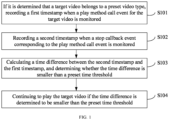
- FIG. 1 is a flowchart of a video processing method provided in an embodiment of the present disclosure
- the video processing method includes the following steps.
- S101 if it is determined that a target video belongs to a preset video type, recording a first timestamp when a play method call event for the target video is monitored.
- the preset video type is a video type that indicates only supporting playing once for each user.
- the play method call event refers to an event of triggering the target video to start being played by calling a play method.
- monitoring the play method call event for the target video may include monitoring a call event for the play method for the target video.
- the target video type when a play trigger operation on the target video is detected, firstly, whether the target video belongs to the preset video type is determined, where the preset video type may also be referred to as a flashing video type. Specifically, whether the target video belongs to the preset video type may be determined according to a video type identifier of the target video and the like.
- the embodiment of the present disclosure may allow for monitoring the play method call event for the target video in order to avoid the experience of the user when watching the video from being affected by the above-mentioned occasional event at the underlying layer of the video player.
- the first timestamp t1 is recorded and is used for subsequently identifying whether the above-mentioned occasional event at the underlying layer of the video player occurs.
- the above-mentioned occasional event at the underlying layer of the video player may not be processed specially. Specifically, if it is determined that the target video does not belong to the flashing video type, the first timestamp when the play method call event for the target video occurs may not need to be recorded.
- S102 recording a second timestamp when a stop callback event corresponding to the play method call event is monitored.
- the play method call event and the stop callback event appear in pair.
- the play method call event for the target video indicates that the target video starts being played, and at this time, monitoring the stop callback event for the target video may be started.
- monitoring the stop callback event for the target video may include monitoring a call event for a stop method for the target video.
- the second timestamp t2 is recorded and is used for subsequently identifying whether the above-mentioned occasional event at the underlying layer of the video player occurs.
- S103 calculating a time difference between the second timestamp and the first timestamp, and determining whether the time difference is smaller than a preset time threshold.
- the underlying occasional problem that the video player returns the stop callback event immediately after calling the play method is characterized by a short time difference (which is usually a time difference on the order of tens of milliseconds) between calling the play method and returning the stop callback event.
- the time difference between calling the play method and returning the stop callback event during the process of playing the normal video is far greater than the time difference of tens of milliseconds.
- the inventors have conceived of identifying the above-mentioned occasional problem at the underlying layer of the video player by using the time difference between calling the play method and returning the stop callback event.
- the embodiment of the present disclosure determines whether the time difference is smaller than the preset time threshold, so as to identify whether the above-mentioned occasional problem at the underlying layer of the video player occurs currently.
- the preset time threshold may be predetermined to be any numerical value in a range of 0.1 second to 0.2 second in the embodiment of the present disclosure, for example, the preset time threshold is 0.2 second so as to identify whether the above-mentioned occasional problem at the underlying layer of the video player occurs currently.
- the time difference between the first timestamp t1 corresponding to the play method call event for the target video and the second timestamp t2 corresponding to the stop callback event for the target video is calculated, it is determined whether the time difference is smaller than the preset time threshold to identify whether the above-mentioned occasional problem at the underlying layer of the video player occurs currently.
- the time difference is determined to be smaller than the preset time threshold, it indicates that the above-mentioned occasional problem at the underlying layer of the video player occurs currently, and in this case, the playing of the target video is continued without responding to the stop callback event monitored currently. Thus, the experience of the user when watching the video is avoided from being affected due to the above-mentioned occasional problem at the underlying layer of the video player.
- the embodiment of the present disclosure may allow for processing based on the processing logic of the video of the flashing type.
- the stop callback event for the target video may also be monitored when the playing of the target video is completed, at this time, if it is determined that the time difference between the first timestamp t1 corresponding to the play method call event for the target video and the second timestamp t2 corresponding to the stop callback event for the target video is not smaller than the preset time threshold, a preset destroyed state of the target video may be shown to prompt the user that the target video has finished playing and does not support playing again.
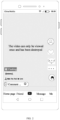
- FIG. 2 which is a schematic diagram of a preset destroyed state of a target video provided in an embodiment of the present disclosure
- a mask layer is shown on a play page for the target video, and prompt information "the video can only be viewed once and has been destroyed" is displayed over the mask layer, which can prompt the user that the target video has finished playing and does not support playing again.
- a play method call event for the target video is monitored, and when the play method call event for the target video has been monitored, the first timestamp is recorded. Then, when a stop callback event corresponding to the play method call event has been monitored, a second timestamp is recorded, the time difference between the second timestamp and the first timestamp is calculated, and it is determined whether the time difference is smaller than a preset time threshold. Furthermore, when it is determined that the time difference is smaller than the preset time threshold, the target video continues to be played without responding to the stop callback event.
- the embodiments of the present disclosure identify the above-mentioned occasional problem at the underlying layer of the video player by recording the time difference between the stop callback event and the play method call event for the target video, and avoids the phenomenon that the playing of the video of the flashing type is stopped immediately after starting due to the occasional problem by a processing method of not responding to the stop callback event in the occasional problem and continuing to play the target video, thereby improving the experience of the user when watching the video.
- a video may be automatically played again after its playing is terminated.
- the embodiment of the present disclosure may allow for directly showing the preset destroyed state of the video, thereby avoiding replaying the video.
- the embodiment of the present disclosure allows for monitoring the replay event for the target video after determining that the time difference between the first timestamp t1 corresponding to the play method call event for the target video and the second timestamp t2 corresponding to the stop callback event for the target video is smaller than the preset time threshold and continuing to play the target video.
- the preset destroyed state of the target video is shown, so as to guarantee the user's experience of viewing the video of the flashing type.
- the stop callback event for the target video is monitored, it indicates that the target video is in a played state for the current user.
- a client may report a playing record of a current user for the target video to a server, so that the server can update the played state of the target video for the current user based on the playing record, thereby guaranteeing that the destroyed state can be directly shown for the user when the current user triggers the playing of the target video next time.
- the playing effect of the video of the flashing type is guaranteed.
- the client reports the playing record of the current user for the target video to the server upon monitoring the stop callback event corresponding to the play method call event for the target video, and the playing record is used for updating the played state of the target video for the current user on the server side.
- the present disclosure further provides a video processing apparatus.
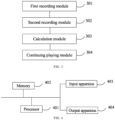
- FIG. 3 is a structural schematic diagram of a video processing apparatus provided in an embodiment of the present disclosure, the video processing apparatus includes:
- the apparatus further comprises: a first display module, configured to display a preset destroyed state of the target video when the time difference is determined not to be smaller than the preset time threshold.
- the apparatus further comprises: a second display module, configured to display a preset destroyed state of the target video when a replay event for the target video is monitored.
- the apparatus further comprises: a reporting module, configured to report a playing record of a current user for the target video to a server when the stop callback event corresponding to the play method call event is monitored, the playing record being used to update a played state of the target video for the current user at the server.
- a reporting module configured to report a playing record of a current user for the target video to a server when the stop callback event corresponding to the play method call event is monitored, the playing record being used to update a played state of the target video for the current user at the server.
- the preset time threshold has a value in a range of 0.1 second to 0.2 second.
- the apparatus further comprises: a determination module, configured to determine whether the target video belongs to the preset video type when a play trigger operation on the target video is detected.
- a play method call event for the target video is monitored, and when the play method call event for the target video has been monitored, the first timestamp is recorded. Then, when a stop callback event corresponding to the play method call event has been monitored, a second timestamp is recorded, the time difference between the second timestamp and the first timestamp is calculated, and it is determined whether the time difference is smaller than a preset time threshold. Furthermore, when it is determined that the time difference is smaller than the preset time threshold, the target video continues to be played without responding to the stop callback event.
- the embodiments of the present disclosure identify the above-mentioned occasional problem at the underlying layer of the video player by recording the time difference between the stop callback event and the play method call event for the target video, and avoids the phenomenon that the playing of the video of the flashing type is stopped immediately after starting due to the occasional problem by a processing method of not responding to the stop callback event in the occasional problem and continuing to play the target video, thereby improving the experience of the user when watching the video.
- the embodiments of the present disclosure further provide a computer-readable storage medium, the computer-readable storage medium stores instructions, when the instructions are run on a terminal device, the terminal device is caused to implement the video processing method described in the embodiment of the present disclosure.
- the embodiments of the present disclosure further provide a computer program product, the computer program product comprises a computer program/instruction, and when the computer program/instruction is executed by a processor, the video processing method described in the embodiment of the present disclosure is implemented.
- the embodiments of the present disclosure further provide a video processing device, referring to FIG. 4 , the video processing device may comprise: a processor 401, a memory 402, an input apparatus 403, and an output apparatus 404.
- the number of processors 401 in the video processing device can be one or more, and one processor is taken as an example in FIG. 4 .
- the processor 401, the memory 402, the input apparatus 403, and the output apparatus 404 may be connected through a bus or other means, and the connection through a bus is taken as an example in FIG. 4 .
- the memory 402 may be used to store software programs and modules, and the processor 401 executes various functional applications and data processing of the video processing device by running the software programs and modules stored in the memory 402.
- the memory 402 may mainly include a storage program area and a storage data area, the storage program area may store an operating system, an application program required by at least one function, and the like.
- the memory 402 may include a high-speed random access memory, and may also include a non-volatile memory, such as at least one magnetic disk memory device, a flash memory device, or other volatile solid-state memory devices.
- the input apparatus 403 can be used to receive input numeric or character information and to generate signal input related to user settings and function control of the video processing device.
- the processor 401 can load the executable files corresponding to the processes of one or more application programs into the memory 402 according to the following instructions, and the processor 401 can run the application programs stored in the memory 402, thus implementing various functions of the above video processing device.
Landscapes
- Engineering & Computer Science (AREA)
- Databases & Information Systems (AREA)
- Multimedia (AREA)
- Signal Processing (AREA)
- Computer Networks & Wireless Communication (AREA)
- Computer Security & Cryptography (AREA)
- Two-Way Televisions, Distribution Of Moving Picture Or The Like (AREA)
Abstract
Description
- The present application claims priority of the
Chinese Patent Application No. 202110948040.9, filed on August 18, 2021 - The present disclosure relates to the field of data processing, and in particular, to a video processing method, apparatus, and device, and a storage medium.
- With the continuous development of the Internet short video technology, people have increasingly diversified requirements on video types, and a flashing video type has been emerged. As the name suggests, the flashing video type is a video type that indicates only supporting playing once for each user (except a video maker).
- At present, due to an occasional problem at an underlying layer of a video player, it causes that when a user watches a video with the flashing type for the first time, the playing of the video ends immediately after starting, and a destroyed state of the flashing video is directly shown for the user, thereby seriously affecting the video viewing experience of the user.
- In order to solve or at least partially solve the above technical problems, the present disclosure provides a video processing method, which can solve the problem that the playing of the video of the flashing type ends immediately after starting caused by the above mentioned occasional problem at an underlying layer of a video player, thus improving the experience of the user when watching the video.
- In a first aspect, the present disclosure provides a video processing method, and the method comprises:
- if it is determined that a target video belongs to a preset video type, recording a first timestamp when a play method call event for the target video is monitored, the preset video type being a video type that indicates only supporting playing once for each user;
- recording a second timestamp when a stop callback event corresponding to the play method call event is monitored;
- calculating a time difference between the second timestamp and the first timestamp, and determining whether the time difference is smaller than a preset time threshold; and
- continuing to play the target video if the time difference is determined to be smaller than the preset time threshold.
- In an alternative implementation, the method further comprises:
displaying a preset destroyed state of the target video if the time difference is determined not to be smaller than the preset time threshold. - In an alternative implementation, after the continuing to play the target video, the method further comprises:
displaying a preset destroyed state of the target video when a replay event for the target video is monitored. - In an alternative implementation, the method further comprises:
reporting a playing record of a current user for the target video to a server when the stop callback event corresponding to the play method call event is monitored, the playing record being used to update a played state of the target video for the current user at the server. - In an alternative implementation, the preset time threshold has a value in a range of 0.1 second to 0.2 second.
- In an alternative implementation, before the if it is determined that a target video belongs to a preset video type, recording a first timestamp when a play method call event for the target video is monitored, the method further comprises:
determining whether the target video belongs to the preset video type when a play trigger operation on the target video is detected. - In a second aspect, the present disclosure provides a video processing apparatus, and the apparatus comprises:
- a first recording module, configured to record a first timestamp when it is determined that a target video belongs to a preset video type and a play method call event for the target video is monitored, the preset video type being a video type that indicates only supporting playing once for each user;
- a second recording module, configured to record a second timestamp when a stop callback event corresponding to the play method call event is monitored;
- a calculation module, configured to calculate a time difference between the second timestamp and the first timestamp and determine whether the time difference is smaller than a preset time threshold; and
- a continuing playing module, configured to continue to play the target video when the time difference is determined to be smaller than the preset time threshold.
- In a third aspect, the present disclosure provides a computer-readable storage medium, the computer-readable storage medium stores instructions, when the instructions are run on a terminal device, the terminal device is caused to implement the above-mentioned method.
- In a fourth aspect, the present disclosure provides a device, comprising a memory, a processor, and a computer program stored on the memory and executable on the processor, the processor is configured to, when executing the computer program, implement the above-mentioned method.
- In a fifth aspect, the present disclosure provides a computer program product, the computer program product comprises a computer program/instruction, and when the computer program/instruction is executed by a processor, the method is implemented.
- Compared with the prior art, the technical solution provided by the embodiments of the present disclosure has the following advantages:
the present disclosure provides a video processing method, when it is determined that the target video belongs to a flashing type video, a play method call event for the target video is monitored, and when the play method call event for the target video has been monitored, the first timestamp is recorded. Then, when a stop callback event corresponding to the play method call event has been monitored, a second timestamp is recorded, the time difference between the second timestamp and the first timestamp is calculated, and it is determined whether the time difference is smaller than a preset time threshold. Furthermore, when it is determined that the time difference is smaller than the preset time threshold, the target video continues to be played without responding to the stop callback event. The embodiments of the present disclosure identify the occasional problem at the underlying layer of the video player by recording the time difference between the stop callback event and the play method call event for the target video, and avoids the phenomenon that the playing of the video of the flashing type ends as soon as it starts due to the occasional problem by a processing method of not responding to the stop callback event in the occasional problem and continuing to play the target video, thus improving the experience of the user when watching the video. - The accompanying drawings herein are incorporated into and constitute a part of the specification, show the embodiments consistent with the present disclosure, and together with the description, serve to explain the principles of the present disclosure.
- In order to more clearly illustrate the technical solutions of the embodiments of the present disclosure or the prior art, the drawings required for describing the embodiments or the prior art will be briefly described in the following; it is obvious that those skilled in the art can obtain other drawing(s) according to these drawings, without any inventive work.
-
FIG. 1 is a flowchart of a video processing method provided in an embodiment of the present disclosure; -
FIG. 2 is a schematic diagram of a preset destroyed state of a target video provided in an embodiment of the present disclosure; -
FIG. 3 is a structural schematic diagram of a video processing apparatus provided in an embodiment of the present disclosure; and -
FIG. 4 is a structural schematic diagram of a video processing device provided in an embodiment of the present disclosure. - In order to understand the above objects, features, and advantages of the present disclosure more clearly, the technical solutions of the present disclosure will be further described below. It should be noted that, in case of no conflict, the embodiments of the present disclosure and the features in the embodiments can be combined with each other.
- In the following description, many specific details are set forth in order to fully understand the present disclosure, but the present disclosure may be implemented in other ways than those described herein; apparently, the embodiments in the specification are just a part but not all of the embodiments of the present disclosure.
- An occasional problem at an underlying layer of a video player mentioned in the present disclosure refers to that the video player will return a stop callback event immediately after calling a play method. The occasional problem especially occurs in the IOS system.
- Because some processing logics in a video of a flashing type are implemented based on the stop callback event, for example, during the process of playing of the video of the flashing type, once the stop callback event has been monitored, the playing of the video is ended, and a destroyed state of the video is directly displayed. Therefore, the above-described occasional problem at the underlying layer of the video player will cause that when a user watches the video of the flashing type for the first time, the playing of the video may be stopped immediately after starting, and the destroyed state is directly shown for the user, thus seriously affecting the viewing experience of the user.
- For this purpose, an embodiment of the present disclosure provides a video processing method. Specifically, when it is determined that the target video belongs to a flashing type video, a play method call event for the target video is monitored, and when the play method call event for the target video has been monitored, the first timestamp is recorded. Then, when a stop callback event corresponding to the play method call event has been monitored, a second timestamp is recorded, the time difference between the second timestamp and the first timestamp is calculated, and it is determined whether the time difference is smaller than a preset time threshold. Furthermore, when it is determined that the time difference is smaller than the preset time threshold, the target video continues to be played without responding to the stop callback event.
- Thus it can be seen that the embodiments of the present disclosure identify the above-mentioned occasional problem at the underlying layer of the video player by recording the time difference between the stop callback event and the play method call event for the target video, and avoids the phenomenon that the playing of the video of the flashing type is stopped immediately after starting due to the occasional problem by a processing method of not responding to the stop callback event in the occasional problem and continuing to play the target video, thereby improving the experience of the user when watching the video.
- On this basis, an embodiment of the present disclosure provides a video processing method. With reference to
FIG. 1 , which is a flowchart of a video processing method provided in an embodiment of the present disclosure, the video processing method includes the following steps. - S101: if it is determined that a target video belongs to a preset video type, recording a first timestamp when a play method call event for the target video is monitored.
- The preset video type is a video type that indicates only supporting playing once for each user.
- In an embodiment of the present disclosure, the play method call event refers to an event of triggering the target video to start being played by calling a play method. Specifically, monitoring the play method call event for the target video may include monitoring a call event for the play method for the target video.
- In practical application, when a play trigger operation on the target video is detected, firstly, whether the target video belongs to the preset video type is determined, where the preset video type may also be referred to as a flashing video type. Specifically, whether the target video belongs to the preset video type may be determined according to a video type identifier of the target video and the like.
- If it is determined that the target video belongs to the flashing video type, the embodiment of the present disclosure may allow for monitoring the play method call event for the target video in order to avoid the experience of the user when watching the video from being affected by the above-mentioned occasional event at the underlying layer of the video player. Once the play method call event for the target video has been monitored, the first timestamp t1 is recorded and is used for subsequently identifying whether the above-mentioned occasional event at the underlying layer of the video player occurs.
- For a video type with a processing logic independent of a stop callback event, the above-mentioned occasional event at the underlying layer of the video player may not be processed specially. Specifically, if it is determined that the target video does not belong to the flashing video type, the first timestamp when the play method call event for the target video occurs may not need to be recorded.
- S102: recording a second timestamp when a stop callback event corresponding to the play method call event is monitored.
- For a video playing logic, usually, the play method call event and the stop callback event appear in pair. When the play method call event for the target video has been monitored, it indicates that the target video starts being played, and at this time, monitoring the stop callback event for the target video may be started. Specifically, monitoring the stop callback event for the target video may include monitoring a call event for a stop method for the target video.
- In an embodiment of the present disclosure, when the stop callback event corresponding to the play method call event for the target video has been monitored, the second timestamp t2 is recorded and is used for subsequently identifying whether the above-mentioned occasional event at the underlying layer of the video player occurs.
- S103: calculating a time difference between the second timestamp and the first timestamp, and determining whether the time difference is smaller than a preset time threshold.
- Because the underlying occasional problem that the video player returns the stop callback event immediately after calling the play method is characterized by a short time difference (which is usually a time difference on the order of tens of milliseconds) between calling the play method and returning the stop callback event. However, the time difference between calling the play method and returning the stop callback event during the process of playing the normal video is far greater than the time difference of tens of milliseconds. Based on the point of distinction, the inventors have conceived of identifying the above-mentioned occasional problem at the underlying layer of the video player by using the time difference between calling the play method and returning the stop callback event.
- In an embodiment of the present disclosure, after the first timestamp t1 corresponding to the play method call event and the second timestamp t2 corresponding to the stop callback event are recorded, the time difference between the second timestamp t2 and the first timestamp t1 is calculated. Because the magnitude of the time difference can be used for identifying the above-mentioned occasional problem at the underlying layer of the video player, the embodiment of the present disclosure determines whether the time difference is smaller than the preset time threshold, so as to identify whether the above-mentioned occasional problem at the underlying layer of the video player occurs currently.
- It needs to be noted that because the time difference between calling the play method and returning the stop callback event in the occasional problem at the underlying layer of the video player is usually on the order of tens of milliseconds, and the time difference between calling the play method and returning the stop callback event during the process of playing the normal video is far greater than the time difference of tens of milliseconds. For this purpose, the preset time threshold may be predetermined to be any numerical value in a range of 0.1 second to 0.2 second in the embodiment of the present disclosure, for example, the preset time threshold is 0.2 second so as to identify whether the above-mentioned occasional problem at the underlying layer of the video player occurs currently.
- S104: continuing to play the target video if the time difference is determined to be smaller than the preset time threshold.
- In an embodiment of the present disclosure, after the time difference between the first timestamp t1 corresponding to the play method call event for the target video and the second timestamp t2 corresponding to the stop callback event for the target video is calculated, it is determined whether the time difference is smaller than the preset time threshold to identify whether the above-mentioned occasional problem at the underlying layer of the video player occurs currently.
- If the time difference is determined to be smaller than the preset time threshold, it indicates that the above-mentioned occasional problem at the underlying layer of the video player occurs currently, and in this case, the playing of the target video is continued without responding to the stop callback event monitored currently. Thus, the experience of the user when watching the video is avoided from being affected due to the above-mentioned occasional problem at the underlying layer of the video player.
- In an alternative implementation, if it is determined that the time difference is not smaller than the preset time difference, it can be considered that the stop callback event monitored currently does not belong to the above-mentioned occasional problem at the underlying layer of the video player. For this purpose, the embodiment of the present disclosure may allow for processing based on the processing logic of the video of the flashing type.
- In an alternative implementation, the stop callback event for the target video may also be monitored when the playing of the target video is completed, at this time, if it is determined that the time difference between the first timestamp t1 corresponding to the play method call event for the target video and the second timestamp t2 corresponding to the stop callback event for the target video is not smaller than the preset time threshold, a preset destroyed state of the target video may be shown to prompt the user that the target video has finished playing and does not support playing again.
- As shown in
FIG. 2 , which is a schematic diagram of a preset destroyed state of a target video provided in an embodiment of the present disclosure, a mask layer is shown on a play page for the target video, and prompt information "the video can only be viewed once and has been destroyed" is displayed over the mask layer, which can prompt the user that the target video has finished playing and does not support playing again. - In the video processing method provided in the embodiment of the present disclosure, when it is determined that the target video belongs to a flashing type video, a play method call event for the target video is monitored, and when the play method call event for the target video has been monitored, the first timestamp is recorded. Then, when a stop callback event corresponding to the play method call event has been monitored, a second timestamp is recorded, the time difference between the second timestamp and the first timestamp is calculated, and it is determined whether the time difference is smaller than a preset time threshold. Furthermore, when it is determined that the time difference is smaller than the preset time threshold, the target video continues to be played without responding to the stop callback event. The embodiments of the present disclosure identify the above-mentioned occasional problem at the underlying layer of the video player by recording the time difference between the stop callback event and the play method call event for the target video, and avoids the phenomenon that the playing of the video of the flashing type is stopped immediately after starting due to the occasional problem by a processing method of not responding to the stop callback event in the occasional problem and continuing to play the target video, thereby improving the experience of the user when watching the video.
- In practical application, in some video playing scenarios, a video may be automatically played again after its playing is terminated. Based on the characteristic that the flashing video type indicates only supporting playing once for each user in the embodiment of the present disclosure, when a replay event for a video of the flashing type has been monitored, the embodiment of the present disclosure may allow for directly showing the preset destroyed state of the video, thereby avoiding replaying the video.
- Specifically, on the basis of the above embodiments, the embodiment of the present disclosure allows for monitoring the replay event for the target video after determining that the time difference between the first timestamp t1 corresponding to the play method call event for the target video and the second timestamp t2 corresponding to the stop callback event for the target video is smaller than the preset time threshold and continuing to play the target video.
- If the replay event for the target video has been monitored, instead of responding to the replay event, the preset destroyed state of the target video is shown, so as to guarantee the user's experience of viewing the video of the flashing type.
- In addition, in the embodiment of the present disclosure, if the stop callback event for the target video is monitored, it indicates that the target video is in a played state for the current user. To guarantee the user's experience of viewing the video of the flashing type, a client may report a playing record of a current user for the target video to a server, so that the server can update the played state of the target video for the current user based on the playing record, thereby guaranteeing that the destroyed state can be directly shown for the user when the current user triggers the playing of the target video next time. Thus, the playing effect of the video of the flashing type is guaranteed. Specifically, based on the content in the above embodiments, the client reports the playing record of the current user for the target video to the server upon monitoring the stop callback event corresponding to the play method call event for the target video, and the playing record is used for updating the played state of the target video for the current user on the server side.
- Based on the same inventive concept as the above method embodiments, the present disclosure further provides a video processing apparatus. With reference to
FIG. 3 , which is a structural schematic diagram of a video processing apparatus provided in an embodiment of the present disclosure, the video processing apparatus includes: - a
first recording module 301 configured to record a first timestamp when it is determined that a target video belongs to a preset video type and a play method call event for the target video is monitored, where the preset video type is a video type that indicates only supporting playing once for each user; - a
second recording module 302 configured to record a second timestamp when a stop callback event corresponding to the play method call event is monitored ; - a
calculation module 303 configured to calculate a time difference between the second timestamp and the first timestamp and determine whether the time difference is smaller than a preset time threshold ; and - a continuing
playing module 304 configured to continue to play the target video when the time difference is determined to be smaller than the preset time threshold. - In an alternative implementation, the apparatus further comprises:
a first display module, configured to display a preset destroyed state of the target video when the time difference is determined not to be smaller than the preset time threshold. - In an alternative implementation, the apparatus further comprises:
a second display module, configured to display a preset destroyed state of the target video when a replay event for the target video is monitored. - In an alternative implementation, the apparatus further comprises:
a reporting module, configured to report a playing record of a current user for the target video to a server when the stop callback event corresponding to the play method call event is monitored, the playing record being used to update a played state of the target video for the current user at the server. - In an alternative implementation, the preset time threshold has a value in a range of 0.1 second to 0.2 second.
- In an alternative implementation, the apparatus further comprises:
a determination module, configured to determine whether the target video belongs to the preset video type when a play trigger operation on the target video is detected. - In the video processing apparatus provided in the embodiment of the present disclosure, when it is determined that the target video belongs to a flashing type video, a play method call event for the target video is monitored, and when the play method call event for the target video has been monitored, the first timestamp is recorded. Then, when a stop callback event corresponding to the play method call event has been monitored, a second timestamp is recorded, the time difference between the second timestamp and the first timestamp is calculated, and it is determined whether the time difference is smaller than a preset time threshold. Furthermore, when it is determined that the time difference is smaller than the preset time threshold, the target video continues to be played without responding to the stop callback event. The embodiments of the present disclosure identify the above-mentioned occasional problem at the underlying layer of the video player by recording the time difference between the stop callback event and the play method call event for the target video, and avoids the phenomenon that the playing of the video of the flashing type is stopped immediately after starting due to the occasional problem by a processing method of not responding to the stop callback event in the occasional problem and continuing to play the target video, thereby improving the experience of the user when watching the video.
- In addition to the above method and apparatus, the embodiments of the present disclosure further provide a computer-readable storage medium, the computer-readable storage medium stores instructions, when the instructions are run on a terminal device, the terminal device is caused to implement the video processing method described in the embodiment of the present disclosure.
- The embodiments of the present disclosure further provide a computer program product, the computer program product comprises a computer program/instruction, and when the computer program/instruction is executed by a processor, the video processing method described in the embodiment of the present disclosure is implemented.
- In addition, the embodiments of the present disclosure further provide a video processing device, referring to
FIG. 4 , the video processing device may comprise:
aprocessor 401, amemory 402, aninput apparatus 403, and anoutput apparatus 404. The number ofprocessors 401 in the video processing device can be one or more, and one processor is taken as an example inFIG. 4 . In some embodiments of the present disclosure, theprocessor 401, thememory 402, theinput apparatus 403, and theoutput apparatus 404 may be connected through a bus or other means, and the connection through a bus is taken as an example inFIG. 4 . - The
memory 402 may be used to store software programs and modules, and theprocessor 401 executes various functional applications and data processing of the video processing device by running the software programs and modules stored in thememory 402. Thememory 402 may mainly include a storage program area and a storage data area, the storage program area may store an operating system, an application program required by at least one function, and the like. In addition, thememory 402 may include a high-speed random access memory, and may also include a non-volatile memory, such as at least one magnetic disk memory device, a flash memory device, or other volatile solid-state memory devices. Theinput apparatus 403 can be used to receive input numeric or character information and to generate signal input related to user settings and function control of the video processing device. - Specifically, in the embodiment, the
processor 401 can load the executable files corresponding to the processes of one or more application programs into thememory 402 according to the following instructions, and theprocessor 401 can run the application programs stored in thememory 402, thus implementing various functions of the above video processing device. - It should be understood that in the specification, the relational terms such as "first", "second", etc. are only used for distinguishing one entity or operation from another entity or operation, and do not necessarily require or imply any such actual relationship or order between these entities or operations. Moreover, the term "comprise/include", "contain", and any variations thereof are intended to cover non-exclusive inclusion, such that a process, method, article, or device including a series of elements includes not only those elements, but also other elements not explicitly listed or elements inherent to such process, method, article, or device. Without further restrictions, an element defined by the phrase "comprising/including one" does not exclude the existence of other identical elements in the process, method, article, or device including the element.
- What has been described above is only the specific implementation of the present disclosure, so that those skilled in the art can understand or implement the present disclosure. Various modifications to these embodiments will be apparent to those skilled in the art, and the general principles defined herein can be implemented in other embodiments without departing from the spirit or scope of the present disclosure. Therefore, the present disclosure will not be limited to the embodiments described herein, but is to be accorded the widest scope consistent with the principles and novel features disclosed herein.
Claims (10)
- A video processing method, characterized in that, the method comprises:if it is determined that a target video belongs to a preset video type, recording a first timestamp when a play method call event for the target video is monitored, wherein the preset video type is a video type that indicates only supporting playing once for each user;recording a second timestamp when a stop callback event corresponding to the play method call event is monitored;calculating a time difference between the second timestamp and the first timestamp, and determining whether the time difference is smaller than a preset time threshold; andcontinuing to play the target video if the time difference is determined to be smaller than the preset time threshold.
- The method according to claim 1, characterized in that, the method further comprises:
displaying a preset destroyed state of the target video if the time difference is determined not to be smaller than the preset time threshold. - The method according to claim 1, characterized in that, after the continuing to play the target video, the method further comprises:
displaying a preset destroyed state of the target video when a replay event for the target video is monitored. - The method according to claim 1, characterized in that, the method further comprises:
reporting a playing record of a current user for the target video to a server when the stop callback event corresponding to the play method call event is monitored, wherein the playing record is used to update a played state of the target video for the current user at the server. - The method according to claim 1, characterized in that, the preset time threshold has a value in a range of 0.1 second to 0.2 second.
- The method according to claim 1, characterized in that, before the if it is determined that a target video belongs to a preset video type, recording a first timestamp when a play method call event for the target video is monitored, the method further comprises:
determining whether the target video belongs to the preset video type when a play trigger operation on the target video is detected. - A video processing apparatus, characterized in that, the apparatus comprises:a first recording module, configured to record a first timestamp when it is determined that a target video belongs to a preset video type and a play method call event for the target video is monitored, wherein the preset video type is a video type that indicates only supporting playing once for each user;a second recording module, configured to record a second timestamp when a stop callback event corresponding to the play method call event is monitored;a calculation module, configured to calculate a time difference between the second timestamp and the first timestamp and determine whether the time difference is smaller than a preset time threshold; anda continuing playing module, configured to continue to play the target video when the time difference is determined to be smaller than the preset time threshold.
- A computer-readable storage medium, characterized in that, the computer-readable storage medium stores instructions, when the instructions are run on a terminal device, the terminal device is caused to implement the method according to any one of claims 1 to 6.
- A device, characterized by comprising a memory, a processor, and a computer program stored on the memory and executable on the processor, wherein the processor is configured to, when executing the computer program, implement the method according to any one of claims 1 to 6.
- A computer program product, characterized in that, the computer program product comprises a computer program/instruction, and when the computer program/instruction is executed by a processor, the method according to any one of claims 1 to 6 is implemented.
Applications Claiming Priority (2)
| Application Number | Priority Date | Filing Date | Title |
|---|---|---|---|
| CN202110948040.9A CN115708358B (en) | 2021-08-18 | 2021-08-18 | Video processing method, device, equipment and storage medium |
| PCT/CN2022/111116 WO2023020332A1 (en) | 2021-08-18 | 2022-08-09 | Video processing method and apparatus, and device and storage medium |
Publications (2)
| Publication Number | Publication Date |
|---|---|
| EP4340373A1 true EP4340373A1 (en) | 2024-03-20 |
| EP4340373A4 EP4340373A4 (en) | 2024-12-25 |
Family
ID=85212443
Family Applications (1)
| Application Number | Title | Priority Date | Filing Date |
|---|---|---|---|
| EP22857644.3A Pending EP4340373A4 (en) | 2021-08-18 | 2022-08-09 | Video processing method and apparatus, and device and storage medium |
Country Status (5)
| Country | Link |
|---|---|
| US (1) | US12477177B2 (en) |
| EP (1) | EP4340373A4 (en) |
| JP (1) | JP7711227B2 (en) |
| CN (1) | CN115708358B (en) |
| WO (1) | WO2023020332A1 (en) |
Families Citing this family (1)
| Publication number | Priority date | Publication date | Assignee | Title |
|---|---|---|---|---|
| CN115708358B (en) | 2021-08-18 | 2025-05-16 | 北京字跳网络技术有限公司 | Video processing method, device, equipment and storage medium |
Family Cites Families (31)
| Publication number | Priority date | Publication date | Assignee | Title |
|---|---|---|---|---|
| CA1257377A (en) * | 1984-11-29 | 1989-07-11 | Toshihide Hayashi | Receiver for pay television |
| GB2376128B (en) * | 2000-03-08 | 2004-08-11 | Gen Instrument Corp | Personal versatile recorder and method of implementing and using same |
| US7464392B2 (en) * | 2001-11-20 | 2008-12-09 | Starz Encore Group Llc | Viewing limit controls |
| KR100474350B1 (en) * | 2004-12-16 | 2005-03-14 | 박수민 | System and method for charging the postpayment of multimedia file |
| FI3346698T3 (en) | 2005-12-29 | 2023-10-11 | Rovi Guides Inc | SYSTEMS AND METHODS FOR MONITORING EPISODES IN AN INTERACTIVE MEDIA ENVIRONMENT |
| US20100086277A1 (en) * | 2008-10-03 | 2010-04-08 | Guideworks, Llc | Systems and methods for deleting viewed portions of recorded programs |
| JP5180262B2 (en) * | 2010-06-25 | 2013-04-10 | 株式会社エヌ・ティ・ティ・ドコモ | System, server, terminal device and method |
| US9077462B2 (en) * | 2010-12-21 | 2015-07-07 | Cox Communications, Inc. | Systems and methods for measuring audience participation over a distribution network |
| US20130004142A1 (en) | 2011-06-29 | 2013-01-03 | Rovi Corp. | Systems and methods for device authentication including timestamp validation |
| CN102595196A (en) * | 2012-01-12 | 2012-07-18 | 华为技术有限公司 | Method and device for receiving application data |
| US8887188B2 (en) * | 2012-05-09 | 2014-11-11 | Rentrak Corporation | System and method for television advertisement audience measurement |
| CN105208532B (en) * | 2014-05-29 | 2018-11-16 | 展讯通信(上海)有限公司 | An information interaction system and method, and a mobile terminal |
| US9301013B2 (en) * | 2014-05-30 | 2016-03-29 | Rovi Guides, Inc. | Methods and systems for alerting users regarding media availability |
| ES2698512T3 (en) * | 2014-05-30 | 2019-02-05 | Rovi Guides Inc | Procedures and systems to alert users to the availability of multimedia support |
| US9749668B2 (en) * | 2014-08-29 | 2017-08-29 | Verizon Patent And Licensing Inc. | Automated account crediting after interruption or failure of paid content delivery |
| CN104239053B (en) | 2014-09-12 | 2018-03-23 | 广州华多网络科技有限公司 | Progress bar display methods and system |
| US20160149956A1 (en) * | 2014-11-21 | 2016-05-26 | Whip Networks, Inc. | Media management and sharing system |
| US10616162B1 (en) * | 2015-08-24 | 2020-04-07 | Snap Inc. | Systems devices and methods for automatically selecting an ephemeral message availability |
| US10674214B2 (en) * | 2015-08-28 | 2020-06-02 | DISH Technologies L.L.C. | Systems, methods and apparatus for presenting relevant programming information |
| US10474321B2 (en) * | 2015-11-30 | 2019-11-12 | Snap Inc. | Network resource location linking and visual content sharing |
| CN105979276A (en) * | 2015-12-03 | 2016-09-28 | 乐视致新电子科技(天津)有限公司 | Play method based on player and player device |
| US10484494B2 (en) * | 2016-06-29 | 2019-11-19 | Rovi Guides, Inc. | Methods and systems for alerting users regarding availability of unconsumed content |
| CN106210079A (en) * | 2016-07-15 | 2016-12-07 | 徐文波 | The method and apparatus that multimedia messages is shared |
| KR102327511B1 (en) * | 2016-11-01 | 2021-11-17 | 스냅 인코포레이티드 | Fast video capture and sensor adjustment |
| CN106791934A (en) * | 2016-12-14 | 2017-05-31 | 暴风集团股份有限公司 | For the encryption player method and encryption system of VIP videos |
| CN107071522A (en) | 2017-05-17 | 2017-08-18 | 聚好看科技股份有限公司 | Multimedia program request amount recording method and device, server |
| CN107801055A (en) * | 2017-11-01 | 2018-03-13 | 北京邦邦共赢网络科技有限公司 | A kind of method and apparatus that image is presented |
| US20190141398A1 (en) * | 2017-11-06 | 2019-05-09 | Rovi Guides, Inc. | Systems and methods for sharing content service provider subscriptions for media asset recommendations |
| US12063321B2 (en) * | 2019-06-28 | 2024-08-13 | Snap Inc. | Modular camera interface with context-based display elements utilizing first and second lens |
| CN111526385B (en) * | 2020-04-29 | 2022-07-22 | 北京奇艺世纪科技有限公司 | Video processing method and device, electronic equipment and storage medium |
| CN115708358B (en) | 2021-08-18 | 2025-05-16 | 北京字跳网络技术有限公司 | Video processing method, device, equipment and storage medium |
-
2021
- 2021-08-18 CN CN202110948040.9A patent/CN115708358B/en active Active
-
2022
- 2022-08-09 US US18/569,973 patent/US12477177B2/en active Active
- 2022-08-09 WO PCT/CN2022/111116 patent/WO2023020332A1/en not_active Ceased
- 2022-08-09 EP EP22857644.3A patent/EP4340373A4/en active Pending
- 2022-08-09 JP JP2023577419A patent/JP7711227B2/en active Active
Also Published As
| Publication number | Publication date |
|---|---|
| US12477177B2 (en) | 2025-11-18 |
| EP4340373A4 (en) | 2024-12-25 |
| JP7711227B2 (en) | 2025-07-22 |
| US20240292056A1 (en) | 2024-08-29 |
| CN115708358B (en) | 2025-05-16 |
| WO2023020332A1 (en) | 2023-02-23 |
| CN115708358A (en) | 2023-02-21 |
| JP2024521487A (en) | 2024-05-31 |
Similar Documents
| Publication | Publication Date | Title |
|---|---|---|
| US12483757B2 (en) | Method, apparatus, and device for video-based interaction, and storage medium | |
| US9817484B2 (en) | Method for capturing screen content of mobile terminal and device thereof | |
| CN108966016B (en) | Video clip rebroadcasting method and device and terminal equipment | |
| WO2019140739A1 (en) | Method for determining return visits to client, and electronic apparatus and computer-readable storage medium | |
| CN105204969A (en) | Abnormal log processing method and abnormal log processing device | |
| CN110795311B (en) | Event playback method and device | |
| CN113672458B (en) | Application program monitoring method, electronic equipment and storage medium | |
| US11941728B2 (en) | Previewing method and apparatus for effect application, and device, and storage medium | |
| US20240394174A1 (en) | Application software testing method, electronic device and computer-readable storage medium | |
| CN112579938B (en) | Page loading method, device, storage medium and electronic device | |
| US12477177B2 (en) | Video processing method and apparatus, and device and storage medium | |
| CN110502324B (en) | Processing method, system and storage medium for restart data of cloud mobile phone game | |
| CN111970572B (en) | Method for controlling video occlusion map on smart television | |
| WO2020199469A1 (en) | Interface call recording method, apparatus, device, and storage medium based on django framework | |
| CN110245046B (en) | Data statistics method and device for Android App without buried points | |
| CN115495185A (en) | Method and device for displaying page elements | |
| CN114722776B (en) | A white screen detection method, device, computer equipment and storage medium | |
| EP4344231A1 (en) | Video processing method and apparatus, and device and storage medium | |
| CN109986552B (en) | Robot action control method, intelligent terminal and device with storage function | |
| CN112073579B (en) | Terminal operation playback processing method and device, terminal equipment and storage medium | |
| CN112925588A (en) | Interface jump method, device, equipment and readable storage medium | |
| CN116431233B (en) | Resource loading method, device, equipment and storage medium | |
| CN110597566A (en) | Application processing method and device, storage medium and electronic equipment | |
| JP7823971B2 (en) | Regeneration control system and regeneration control program | |
| CN108733435B (en) | Method and device for preventing application from triggering ANR (automatic neighbor discovery) |
Legal Events
| Date | Code | Title | Description |
|---|---|---|---|
| STAA | Information on the status of an ep patent application or granted ep patent |
Free format text: STATUS: THE INTERNATIONAL PUBLICATION HAS BEEN MADE |
|
| PUAI | Public reference made under article 153(3) epc to a published international application that has entered the european phase |
Free format text: ORIGINAL CODE: 0009012 |
|
| STAA | Information on the status of an ep patent application or granted ep patent |
Free format text: STATUS: REQUEST FOR EXAMINATION WAS MADE |
|
| 17P | Request for examination filed |
Effective date: 20231213 |
|
| AK | Designated contracting states |
Kind code of ref document: A1 Designated state(s): AL AT BE BG CH CY CZ DE DK EE ES FI FR GB GR HR HU IE IS IT LI LT LU LV MC MK MT NL NO PL PT RO RS SE SI SK SM TR |
|
| REG | Reference to a national code |
Ref country code: DE Ref legal event code: R079 Free format text: PREVIOUS MAIN CLASS: H04N0021472000 Ipc: H04N0021442000 |
|
| DAV | Request for validation of the european patent (deleted) | ||
| DAX | Request for extension of the european patent (deleted) | ||
| A4 | Supplementary search report drawn up and despatched |
Effective date: 20241127 |
|
| RIC1 | Information provided on ipc code assigned before grant |
Ipc: H04N 21/4335 20110101ALN20241121BHEP Ipc: H04N 21/8547 20110101ALI20241121BHEP Ipc: H04N 21/658 20110101ALI20241121BHEP Ipc: H04N 21/442 20110101AFI20241121BHEP |
|
| STAA | Information on the status of an ep patent application or granted ep patent |
Free format text: STATUS: EXAMINATION IS IN PROGRESS |
|
| 17Q | First examination report despatched |
Effective date: 20250716 |
|
| GRAP | Despatch of communication of intention to grant a patent |
Free format text: ORIGINAL CODE: EPIDOSNIGR1 |
|
| STAA | Information on the status of an ep patent application or granted ep patent |
Free format text: STATUS: GRANT OF PATENT IS INTENDED |
|
| INTG | Intention to grant announced |
Effective date: 20260330 |
|
| RIC1 | Information provided on ipc code assigned before grant |
Ipc: H04N 21/442 20110101AFI20260323BHEP Ipc: H04N 21/658 20110101ALI20260323BHEP Ipc: H04N 21/8547 20110101ALI20260323BHEP Ipc: H04N 21/4335 20110101ALN20260323BHEP |