EP4340364A1 - Video decoding apparatus and video coding apparatus with oob - out-of-boundary checks - Google Patents
Video decoding apparatus and video coding apparatus with oob - out-of-boundary checks Download PDFInfo
- Publication number
- EP4340364A1 EP4340364A1 EP23154690.4A EP23154690A EP4340364A1 EP 4340364 A1 EP4340364 A1 EP 4340364A1 EP 23154690 A EP23154690 A EP 23154690A EP 4340364 A1 EP4340364 A1 EP 4340364A1
- Authority
- EP
- European Patent Office
- Prior art keywords
- oob
- prediction
- picture
- mvprec
- unit
- Prior art date
- Legal status (The legal status is an assumption and is not a legal conclusion. Google has not performed a legal analysis and makes no representation as to the accuracy of the status listed.)
- Pending
Links
- 238000012545 processing Methods 0.000 claims abstract description 90
- 238000009795 derivation Methods 0.000 claims abstract description 69
- 230000014509 gene expression Effects 0.000 description 57
- 238000013139 quantization Methods 0.000 description 38
- 239000013598 vector Substances 0.000 description 28
- 238000010586 diagram Methods 0.000 description 14
- 238000004364 calculation method Methods 0.000 description 13
- 230000006870 function Effects 0.000 description 12
- 238000000034 method Methods 0.000 description 8
- 230000005540 biological transmission Effects 0.000 description 6
- 208000034188 Stiff person spectrum disease Diseases 0.000 description 5
- 229920010524 Syndiotactic polystyrene Polymers 0.000 description 5
- 208000012112 ischiocoxopodopatellar syndrome Diseases 0.000 description 5
- 238000002490 spark plasma sintering Methods 0.000 description 5
- 230000000694 effects Effects 0.000 description 4
- 230000003044 adaptive effect Effects 0.000 description 3
- 230000006854 communication Effects 0.000 description 3
- 238000004891 communication Methods 0.000 description 3
- 238000005516 engineering process Methods 0.000 description 3
- 230000010354 integration Effects 0.000 description 3
- NRNCYVBFPDDJNE-UHFFFAOYSA-N pemoline Chemical compound O1C(N)=NC(=O)C1C1=CC=CC=C1 NRNCYVBFPDDJNE-UHFFFAOYSA-N 0.000 description 3
- 238000012952 Resampling Methods 0.000 description 2
- 238000005401 electroluminescence Methods 0.000 description 2
- 238000010606 normalization Methods 0.000 description 2
- 229920000069 polyphenylene sulfide Polymers 0.000 description 2
- VBRBNWWNRIMAII-WYMLVPIESA-N 3-[(e)-5-(4-ethylphenoxy)-3-methylpent-3-enyl]-2,2-dimethyloxirane Chemical compound C1=CC(CC)=CC=C1OC\C=C(/C)CCC1C(C)(C)O1 VBRBNWWNRIMAII-WYMLVPIESA-N 0.000 description 1
- 241001025261 Neoraja caerulea Species 0.000 description 1
- 230000006978 adaptation Effects 0.000 description 1
- 230000007175 bidirectional communication Effects 0.000 description 1
- 230000002457 bidirectional effect Effects 0.000 description 1
- 238000013461 design Methods 0.000 description 1
- 239000004973 liquid crystal related substance Substances 0.000 description 1
- 239000011159 matrix material Substances 0.000 description 1
- 238000012986 modification Methods 0.000 description 1
- 230000004048 modification Effects 0.000 description 1
- 230000002093 peripheral effect Effects 0.000 description 1
- 230000002265 prevention Effects 0.000 description 1
- 239000000047 product Substances 0.000 description 1
- 239000004065 semiconductor Substances 0.000 description 1
- 239000013589 supplement Substances 0.000 description 1
- 230000000153 supplemental effect Effects 0.000 description 1
- 230000001131 transforming effect Effects 0.000 description 1
Images




Classifications
-
- H—ELECTRICITY
- H04—ELECTRIC COMMUNICATION TECHNIQUE
- H04N—PICTORIAL COMMUNICATION, e.g. TELEVISION
- H04N19/00—Methods or arrangements for coding, decoding, compressing or decompressing digital video signals
- H04N19/10—Methods or arrangements for coding, decoding, compressing or decompressing digital video signals using adaptive coding
- H04N19/102—Methods or arrangements for coding, decoding, compressing or decompressing digital video signals using adaptive coding characterised by the element, parameter or selection affected or controlled by the adaptive coding
- H04N19/103—Selection of coding mode or of prediction mode
- H04N19/105—Selection of the reference unit for prediction within a chosen coding or prediction mode, e.g. adaptive choice of position and number of pixels used for prediction
-
- H—ELECTRICITY
- H04—ELECTRIC COMMUNICATION TECHNIQUE
- H04N—PICTORIAL COMMUNICATION, e.g. TELEVISION
- H04N19/00—Methods or arrangements for coding, decoding, compressing or decompressing digital video signals
- H04N19/50—Methods or arrangements for coding, decoding, compressing or decompressing digital video signals using predictive coding
- H04N19/503—Methods or arrangements for coding, decoding, compressing or decompressing digital video signals using predictive coding involving temporal prediction
- H04N19/51—Motion estimation or motion compensation
- H04N19/513—Processing of motion vectors
- H04N19/517—Processing of motion vectors by encoding
- H04N19/52—Processing of motion vectors by encoding by predictive encoding
-
- H—ELECTRICITY
- H04—ELECTRIC COMMUNICATION TECHNIQUE
- H04N—PICTORIAL COMMUNICATION, e.g. TELEVISION
- H04N19/00—Methods or arrangements for coding, decoding, compressing or decompressing digital video signals
- H04N19/10—Methods or arrangements for coding, decoding, compressing or decompressing digital video signals using adaptive coding
- H04N19/134—Methods or arrangements for coding, decoding, compressing or decompressing digital video signals using adaptive coding characterised by the element, parameter or criterion affecting or controlling the adaptive coding
- H04N19/136—Incoming video signal characteristics or properties
- H04N19/14—Coding unit complexity, e.g. amount of activity or edge presence estimation
-
- H—ELECTRICITY
- H04—ELECTRIC COMMUNICATION TECHNIQUE
- H04N—PICTORIAL COMMUNICATION, e.g. TELEVISION
- H04N19/00—Methods or arrangements for coding, decoding, compressing or decompressing digital video signals
- H04N19/10—Methods or arrangements for coding, decoding, compressing or decompressing digital video signals using adaptive coding
- H04N19/134—Methods or arrangements for coding, decoding, compressing or decompressing digital video signals using adaptive coding characterised by the element, parameter or criterion affecting or controlling the adaptive coding
- H04N19/157—Assigned coding mode, i.e. the coding mode being predefined or preselected to be further used for selection of another element or parameter
- H04N19/159—Prediction type, e.g. intra-frame, inter-frame or bidirectional frame prediction
-
- H—ELECTRICITY
- H04—ELECTRIC COMMUNICATION TECHNIQUE
- H04N—PICTORIAL COMMUNICATION, e.g. TELEVISION
- H04N19/00—Methods or arrangements for coding, decoding, compressing or decompressing digital video signals
- H04N19/10—Methods or arrangements for coding, decoding, compressing or decompressing digital video signals using adaptive coding
- H04N19/169—Methods or arrangements for coding, decoding, compressing or decompressing digital video signals using adaptive coding characterised by the coding unit, i.e. the structural portion or semantic portion of the video signal being the object or the subject of the adaptive coding
- H04N19/17—Methods or arrangements for coding, decoding, compressing or decompressing digital video signals using adaptive coding characterised by the coding unit, i.e. the structural portion or semantic portion of the video signal being the object or the subject of the adaptive coding the unit being an image region, e.g. an object
- H04N19/172—Methods or arrangements for coding, decoding, compressing or decompressing digital video signals using adaptive coding characterised by the coding unit, i.e. the structural portion or semantic portion of the video signal being the object or the subject of the adaptive coding the unit being an image region, e.g. an object the region being a picture, frame or field
-
- H—ELECTRICITY
- H04—ELECTRIC COMMUNICATION TECHNIQUE
- H04N—PICTORIAL COMMUNICATION, e.g. TELEVISION
- H04N19/00—Methods or arrangements for coding, decoding, compressing or decompressing digital video signals
- H04N19/10—Methods or arrangements for coding, decoding, compressing or decompressing digital video signals using adaptive coding
- H04N19/169—Methods or arrangements for coding, decoding, compressing or decompressing digital video signals using adaptive coding characterised by the coding unit, i.e. the structural portion or semantic portion of the video signal being the object or the subject of the adaptive coding
- H04N19/17—Methods or arrangements for coding, decoding, compressing or decompressing digital video signals using adaptive coding characterised by the coding unit, i.e. the structural portion or semantic portion of the video signal being the object or the subject of the adaptive coding the unit being an image region, e.g. an object
- H04N19/174—Methods or arrangements for coding, decoding, compressing or decompressing digital video signals using adaptive coding characterised by the coding unit, i.e. the structural portion or semantic portion of the video signal being the object or the subject of the adaptive coding the unit being an image region, e.g. an object the region being a slice, e.g. a line of blocks or a group of blocks
-
- H—ELECTRICITY
- H04—ELECTRIC COMMUNICATION TECHNIQUE
- H04N—PICTORIAL COMMUNICATION, e.g. TELEVISION
- H04N19/00—Methods or arrangements for coding, decoding, compressing or decompressing digital video signals
- H04N19/10—Methods or arrangements for coding, decoding, compressing or decompressing digital video signals using adaptive coding
- H04N19/169—Methods or arrangements for coding, decoding, compressing or decompressing digital video signals using adaptive coding characterised by the coding unit, i.e. the structural portion or semantic portion of the video signal being the object or the subject of the adaptive coding
- H04N19/17—Methods or arrangements for coding, decoding, compressing or decompressing digital video signals using adaptive coding characterised by the coding unit, i.e. the structural portion or semantic portion of the video signal being the object or the subject of the adaptive coding the unit being an image region, e.g. an object
- H04N19/176—Methods or arrangements for coding, decoding, compressing or decompressing digital video signals using adaptive coding characterised by the coding unit, i.e. the structural portion or semantic portion of the video signal being the object or the subject of the adaptive coding the unit being an image region, e.g. an object the region being a block, e.g. a macroblock
-
- H—ELECTRICITY
- H04—ELECTRIC COMMUNICATION TECHNIQUE
- H04N—PICTORIAL COMMUNICATION, e.g. TELEVISION
- H04N19/00—Methods or arrangements for coding, decoding, compressing or decompressing digital video signals
- H04N19/10—Methods or arrangements for coding, decoding, compressing or decompressing digital video signals using adaptive coding
- H04N19/169—Methods or arrangements for coding, decoding, compressing or decompressing digital video signals using adaptive coding characterised by the coding unit, i.e. the structural portion or semantic portion of the video signal being the object or the subject of the adaptive coding
- H04N19/182—Methods or arrangements for coding, decoding, compressing or decompressing digital video signals using adaptive coding characterised by the coding unit, i.e. the structural portion or semantic portion of the video signal being the object or the subject of the adaptive coding the unit being a pixel
-
- H—ELECTRICITY
- H04—ELECTRIC COMMUNICATION TECHNIQUE
- H04N—PICTORIAL COMMUNICATION, e.g. TELEVISION
- H04N19/00—Methods or arrangements for coding, decoding, compressing or decompressing digital video signals
- H04N19/50—Methods or arrangements for coding, decoding, compressing or decompressing digital video signals using predictive coding
- H04N19/503—Methods or arrangements for coding, decoding, compressing or decompressing digital video signals using predictive coding involving temporal prediction
- H04N19/51—Motion estimation or motion compensation
- H04N19/55—Motion estimation with spatial constraints, e.g. at image or region borders
-
- H—ELECTRICITY
- H04—ELECTRIC COMMUNICATION TECHNIQUE
- H04N—PICTORIAL COMMUNICATION, e.g. TELEVISION
- H04N19/00—Methods or arrangements for coding, decoding, compressing or decompressing digital video signals
- H04N19/50—Methods or arrangements for coding, decoding, compressing or decompressing digital video signals using predictive coding
- H04N19/503—Methods or arrangements for coding, decoding, compressing or decompressing digital video signals using predictive coding involving temporal prediction
- H04N19/51—Motion estimation or motion compensation
- H04N19/573—Motion compensation with multiple frame prediction using two or more reference frames in a given prediction direction
-
- H—ELECTRICITY
- H04—ELECTRIC COMMUNICATION TECHNIQUE
- H04N—PICTORIAL COMMUNICATION, e.g. TELEVISION
- H04N19/00—Methods or arrangements for coding, decoding, compressing or decompressing digital video signals
- H04N19/50—Methods or arrangements for coding, decoding, compressing or decompressing digital video signals using predictive coding
- H04N19/503—Methods or arrangements for coding, decoding, compressing or decompressing digital video signals using predictive coding involving temporal prediction
- H04N19/51—Motion estimation or motion compensation
- H04N19/577—Motion compensation with bidirectional frame interpolation, i.e. using B-pictures
-
- H—ELECTRICITY
- H04—ELECTRIC COMMUNICATION TECHNIQUE
- H04N—PICTORIAL COMMUNICATION, e.g. TELEVISION
- H04N19/00—Methods or arrangements for coding, decoding, compressing or decompressing digital video signals
- H04N19/50—Methods or arrangements for coding, decoding, compressing or decompressing digital video signals using predictive coding
- H04N19/593—Methods or arrangements for coding, decoding, compressing or decompressing digital video signals using predictive coding involving spatial prediction techniques
-
- H—ELECTRICITY
- H04—ELECTRIC COMMUNICATION TECHNIQUE
- H04N—PICTORIAL COMMUNICATION, e.g. TELEVISION
- H04N19/00—Methods or arrangements for coding, decoding, compressing or decompressing digital video signals
- H04N19/70—Methods or arrangements for coding, decoding, compressing or decompressing digital video signals characterised by syntax aspects related to video coding, e.g. related to compression standards
-
- H—ELECTRICITY
- H04—ELECTRIC COMMUNICATION TECHNIQUE
- H04N—PICTORIAL COMMUNICATION, e.g. TELEVISION
- H04N19/00—Methods or arrangements for coding, decoding, compressing or decompressing digital video signals
- H04N19/90—Methods or arrangements for coding, decoding, compressing or decompressing digital video signals using coding techniques not provided for in groups H04N19/10-H04N19/85, e.g. fractals
- H04N19/91—Entropy coding, e.g. variable length coding [VLC] or arithmetic coding
-
- H—ELECTRICITY
- H04—ELECTRIC COMMUNICATION TECHNIQUE
- H04N—PICTORIAL COMMUNICATION, e.g. TELEVISION
- H04N19/00—Methods or arrangements for coding, decoding, compressing or decompressing digital video signals
- H04N19/90—Methods or arrangements for coding, decoding, compressing or decompressing digital video signals using coding techniques not provided for in groups H04N19/10-H04N19/85, e.g. fractals
- H04N19/96—Tree coding, e.g. quad-tree coding
Definitions
- the embodiment of the present invention relates to a video decoding apparatus and a video coding apparatus.
- a video coding apparatus which generates coded data by coding a video
- a video decoding apparatus which generates decoded images by decoding the coded data are used for efficient transmission or recording of videos.
- Specific video coding schemes include, for example, H.264/AVC, High-Efficiency Video Coding (HEVC), and Versatile Video Coding (VVC) schemes, and the like.
- images (pictures) constituting a video are managed in a hierarchical structure including slices obtained by splitting an image, coding tree units (CTUs) obtained by splitting a slice, units of coding (which may also be referred to as coding units (CUs)) obtained by splitting a coding tree unit, and transform units (TUs) obtained by splitting a coding unit, and are coded/decoded for each CU.
- CTUs coding tree units
- CUs coding units
- transform units TUs
- a prediction image is generated based on a local decoded image that is obtained by coding/decoding an input image (a source image), and prediction errors (which may be referred to also as “difference images” or “residual images") obtained by subtracting the prediction image from the input image are coded.
- Generation methods of prediction images include an inter-picture prediction (inter prediction) and an intra-picture prediction (intra prediction).
- inter prediction inter prediction
- intra prediction intra-picture prediction
- VVC as in FIG. 8(a) , coordinates of motion vectors are subjected to wrap-around processing, and thus motion compensation can be continuously performed between a left edge and a right edge of a picture in a horizontal coordinate system.
- RPR Reference Picture Resampling
- NPL 1 discloses an Out-Of-Boundary (OOB) processing technique, in which a part or all of regions of one reference block of bi-prediction including a region out of a picture of a reference image are substituted with a part or all of regions of the other reference block.
- OOB Out-Of-Boundary
- a video decoding apparatus includes an OOB determination unit configured to determine whether a reference block is a target of OOB processing by comparing coordinates of the reference block with coordinates of a picture, and an OOB mask derivation unit configured to derive mask data indicating whether a pixel is available by comparing coordinates of the pixel included in the reference block with coordinates of a picture boundary or a region boundary.
- the OOB determination unit determines whether the reference block is the target of the OOB processing based on presence or absence of processing to be applied to a reference picture including the reference block.
- the OOB determination unit compares a valid region of an L0 reference region and a valid region of an L1 reference region, and invalidates OOB determination for the reference picture whose valid region of the reference region is larger.
- the amount of calculation required in OOB processing in video coding and decoding processing can be reduced.
- FIG. 1 is a schematic diagram illustrating a configuration of an image transmission system 1 according to the present embodiment.
- the image transmission system 1 is a system in which a coding stream obtained by coding a coding target image is transmitted, the transmitted coding stream is decoded, and thus an image is displayed.
- the image transmission system 1 includes a video coding apparatus (image coding apparatus) 11, a network 21, a video decoding apparatus (image decoding apparatus) 31, and a video display apparatus (image display apparatus) 41.
- An image T is input to the video coding apparatus 11.
- the network 21 transmits a coding stream Te generated by the video coding apparatus 11 to the video decoding apparatus 31.
- the network 21 is the Internet, a Wide Area Network (WAN), a Local Area Network (LAN), or a combination thereof.
- the network 21 is not necessarily limited to a bidirectional communication network, and may be a unidirectional communication network configured to transmit broadcast waves of digital terrestrial television broadcasting, satellite broadcasting of the like.
- the network 21 may be substituted by a storage medium in which the coding stream Te is recorded, such as a Digital Versatile Disc (DVD: trade name) or a Blue-ray Disc (BD: trade name).
- DVD Digital Versatile Disc
- BD Blue-ray Disc
- the video decoding apparatus 31 decodes each of the coding streams Te transmitted from the network 21 and generates one or multiple decoded images Td.
- the video display apparatus 41 displays all or part of one or multiple decoded images Td generated by the video decoding apparatus 31.
- the video display apparatus 41 includes a display device such as a liquid crystal display and an organic Electro-Luminescence (EL) display.
- EL Electro-Luminescence
- Forms of the display include a stationary type, a mobile type, an HMD type, and the like.
- the video decoding apparatus 31 has a high processing capability
- an image having high image quality is displayed
- an image which does not require high processing capability and display capability is displayed.
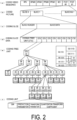
- FIG. 2 is a diagram illustrating the hierarchy structure of data in the coding stream Te.
- the coding stream Te includes a sequence and multiple pictures constituting the sequence illustratively.
- (a) to (f) of FIG. 2 are diagrams illustrating a coded video sequence defining a sequence SEQ, a coded picture prescribing a picture PICT, a coding slice prescribing a slice S, a coding slice data prescribing slice data, a coding tree unit included in the coding slice data, and a coding unit included in the coding tree unit, respectively.
- the sequence SEQ includes a Video Parameter Set, a Sequence Parameter Set SPS, a Picture Parameter Set PPS, an Adaptation Parameter Set (APS), a picture PICT, and Supplemental Enhancement Information SEI.
- a set of coding parameters common to multiple videos and a set of coding parameters associated with the multiple layers and an individual layer included in the video are defined.
- sequence parameter set SPS a set of coding parameters referenced by the video decoding apparatus 31 to decode a target sequence is defined. For example, a width and a height of a picture are defined. Note that multiple SPSs may exist. In that case, any of the multiple SPSs is selected from the PPS.
- a set of coding parameters referenced by the video decoding apparatus 31 to decode each picture in a target sequence is defined. For example, a reference value (pic_init_qp_minus26) of a quantization step size used for decoding of a picture and a flag (weighted_pred_flag) indicating an application of a weighted prediction are included. Note that multiple PPSs may exist. In that case, any of the multiple PPSs is selected from each picture in a target sequence.
- the picture PICT includes a slice 0 to a slice NS-1 (NS is the total number of slices included in the picture PICT).
- the coding slice a set of data referenced by the video decoding apparatus 31 to decode the slice S to be processed is defined. As illustrated in FIG. 2 , the slice includes a slice header and slice data.
- the slice header includes a coding parameter group referenced by the video decoding apparatus 31 to determine a decoding method for a target slice.
- Slice type specification information (slice_type) specifying a slice type is one example of a coding parameter included in the slice header.
- Examples of slice types that can be specified by the slice type specification information include (1) I slice using only an intra prediction in coding, (2) P slice using a unidirectional prediction or an intra prediction in coding, and (3) B slice using a unidirectional prediction, a bidirectional prediction, or an intra prediction in coding, and the like.
- the inter prediction is not limited to a uni-prediction and a bi-prediction, and the prediction image may be generated by using a larger number of reference pictures.
- the P or B slice a slice that includes a block in which the inter prediction can be used is indicated.
- the slice header may include a reference to the picture parameter set PPS (pic_parameter_set_id).
- the slice data includes a CTU as illustrated in FIG. 2(d) .
- the CTU is a block of a fixed size (for example, 64 x 64) constituting a slice, and may also be called a Largest Coding Unit (LCU).
- LCU Largest Coding Unit
- a set of data is defined that is referenced by the video decoding apparatus 31 to decode the CTU to be processed.
- the CTU is split into coding units CUs, each of which is a basic unit of coding processing, by a recursive Quad Tree split (QT split), Binary Tree split (BT split), or Ternary Tree split (TT split).
- QT split recursive Quad Tree split
- BT split Binary Tree split
- TT split Ternary Tree split
- the BT split and the TT split are collectively referred to as a Multi Tree split (MT split).
- Nodes of a tree structure obtained by recursive quad tree splits are referred to as Coding Nodes.
- Intermediate nodes of a quad tree, a binary tree, and a ternary tree are coding nodes, and the CTU itself is also defined as the highest coding node.
- the lowest coding node is defined as the coding unit.
- the CU includes a CU header CUH, a prediction parameter, a transform parameter, a quantization transform coefficient, and the like.
- a prediction mode and the like are defined in the CU header.
- the prediction processing is performed in units of CU or performed in units of sub-CU in which the CU is further split.
- the sizes of the CU and the sub-CU are equal to each other, the number of sub-CUs in the CU is one.
- the CU is split into sub-CUs. For example, in a case that the CU has a size of 8 x 8, and the sub-CU has a size of 4 x 4, the CU is split into four sub-CUs which include two horizontal splits and two vertical splits.
- Prediction types include intra prediction (MODE_INTRA), inter prediction (MODE_INTER), and intra block copy (MODE_IBC).
- the intra prediction refers to a prediction in an identical picture
- the inter prediction refers to prediction processing performed between different pictures (for example, between pictures of different display times, and between pictures of different layer images).
- Transform and quantization processing is performed in units of CU, but the quantization transform coefficient may be subjected to entropy coding in units of subblock such as 4 x 4.
- a prediction image is derived by prediction parameters accompanying a block.
- the prediction parameters include prediction parameters for intra prediction and inter prediction.
- the inter prediction parameters include prediction list utilization flags predFlagLO and predFlagL1, reference picture indexes refIdxL0 and refIdxL1, and motion vectors mvL0 and mvL1.
- predFlagLO and predFlagL1 are flags indicating whether reference picture lists (L0 list and L1 list) are used, and in a case that the value of each of the flags is 1, a corresponding reference picture list is used.
- a flag indicating whether or not XX a flag being other than 0 (for example, 1) assumes a case of XX, and a flag being 0 assumes a case of not XX, and 1 is treated as true and 0 is treated as false in a logical negation, a logical product, and the like (hereinafter, the same is applied).
- a flag indicating whether or not XX a flag being other than 0 (for example, 1) assumes a case of XX, and a flag being 0 assumes a case of not XX, and 1 is treated as true and 0 is treated as false in a logical negation, a logical product, and the like.
- other values can be used for true values and false values in real apparatuses and methods.
- syntax elements to derive inter prediction parameters include a merge flag merge_flag (general_merge_flag), a merge index merge_idx, merge_subblock_flag, regulare_merge_flag, ciip_flag, merge_gpm_partition_idx, merge_gpm_idx0, merge_gpm_idx1, inter_pred_idc, a reference picture index refIdxLX, mvp_LX_idx, a difference vector mvdLX, and a motion vector accuracy mode amvr_mode.
- merge_subblock_flag is a flag indicating whether inter prediction in units of subblocks is used.
- regulare_merge_flag is a flag indicating whether regular merge mode or MMVD is used.
- ciip_flag is a flag indicating whether a combined inter-picture merge and intra-picture prediction (CIIP) mode is used.
- merge_gpm_partition_idx is an index indicating a split shape of a GPM mode.
- merge_gpm_idx0 and merge_gpm_idx1 are each an index indicating a merge index of the GPM mode.
- inter_pred_idc is an inter prediction indicator for selecting a reference picture to be used in an AMVP mode.
- mvp_LX_idx is a prediction vector index for deriving a motion vector.
- a reference picture list is a list including reference pictures stored in a reference picture memory 306.
- LX is a description method used in a case of not distinguishing an L0 prediction and an L1 prediction, and in the following description, distinguishes parameters for the L0 list and parameters for the L1 list by replacing LX with L0 and L1.
- a decoding (coding) method for prediction parameters includes a merge prediction (merge) mode (merge mode) and an Advanced Motion Vector Prediction or an adaptive motion vector prediction (AMVP) mode, and general_merge_flag is a flag to identify these modes.
- the merge mode is a prediction mode to omit a part or all of motion vector differences, and is a mode in which a prediction list utilization flag predFlagLX, the reference picture index refIdxLX, and a motion vector mvLX are derived from prediction parameters for neighboring blocks already processed, or the like, without being included in the coded data.
- the AMVP mode is a mode in which inter_pred_idc, refldxLX, and mvLX are included in the coded data.
- mvLX is coded as mvp_LX_idx identifying a prediction vector mvpLX and a difference vector mvdLX.
- a prediction mode for omitting and simplifying the motion vector differences may be collectively referred to as a general merge mode, and general_merge_flag may be used for selecting the general merge mode and the AMVP prediction.
- regular_merge_flag may be transmitted separately.
- regular_merge_flag is 1
- the regular merge mode or MMVD may be selected, and in other cases, the CIIP mode or the GPM mode may be selected.
- the CIIP mode a prediction image is generated using a weighted sum of an inter prediction image and an intra prediction image.
- the GPM mode a prediction image is generated as two non-rectangular prediction units obtained by splitting a target CU along a line segment.
- mvLX indicates a shift amount between blocks in two different pictures.
- a prediction vector and a difference vector related to mvLX are respectively referred to as mvpLX and mvdLX.
- the inter prediction parameters may use a prediction list utilization flag or may use an inter prediction indicator.
- a determination using a prediction list utilization flag may be replaced with a determination using an inter prediction indicator.
- a determination using an inter prediction indicator may be replaced with a determination using a prediction list utilization flag.
- a flag biPred for identifying a bi-prediction can be derived from whether two prediction list utilization flags are both 1. For example, the derivation can be performed by the following expression.
- biPred can be also derived from whether the inter prediction indicator is a value indicating the use of two prediction lists (reference pictures). For example, the derivation can be performed by the following expression.
- the video decoding apparatus 31 includes an entropy decoder 301, a parameter decoder (a prediction image decoding apparatus) 302, a loop filter 305, a reference picture memory 306, a prediction parameter memory 307, a prediction image generation unit (prediction image generation apparatus) 308, an inverse quantization and inverse transform processing unit 311, an addition unit 312, and a prediction parameter derivation unit 320.
- a configuration in which the loop filter 305 is not included in the video decoding apparatus 31 may be used in accordance with the video coding apparatus 11 described later.
- the parameter decoder 302 further includes a header decoder 3020, a CT information decoder 3021, and a CU decoder 3022 (prediction mode decoder), and the CU decoder 3022 further includes a TU decoder 3024. These may be collectively referred to as a decoding module.
- the header decoder 3020 decodes, from coded data, parameter set information such as the VPS, the SPS, the PPS, and an APS, and a slice header (slice information).
- the CT information decoder 3021 decodes a CT from coded data.
- the CU decoder 3022 decodes a CU from coded data.
- the TU decoder 3024 decodes a CU from coded data.
- the TU decoder 3024 decodes, from the coded data, QP update information and a quantization transform coefficient.
- the QP update information is a difference value from a quantization parameter prediction value qPpred, which is a prediction value of a quantization parameter QP.
- the prediction image generation unit 308 includes an inter prediction image generation unit 309 ( FIG. 4 ) and an intra prediction image generation unit 310.
- the prediction parameter derivation unit 320 includes an inter prediction parameter derivation unit 303 ( FIG. 5 ) and an intra prediction parameter derivation unit.
- a CTU and a CU are used as units of processing
- the processing is not limited to this example, and processing in units of sub-CU may be performed.
- the CTU and the CU may be replaced with a block
- the sub-CU may be replaced with by a subblock
- processing may be performed in units of blocks or subblocks.
- the entropy decoder 301 performs entropy decoding on the coding stream Te input from the outside and separates and decodes individual codes (syntax elements).
- the entropy coding includes a scheme in which syntax elements are subjected to variable-length coding by using a context (probability model) that is adaptively selected according to a type of the syntax elements and a surrounding condition, and a scheme in which syntax elements are subjected to variable-length coding by using a table or a calculation expression that is determined in advance.
- the entropy decoder 301 outputs the decoded codes to the parameter decoder 302.
- the decoded code is, for example, a prediction mode predMode, general_merge_flag, merge_idx, inter_pred_idc, refIdxLX, mvp_LX_idx, mvdLX, amvr_mode, and the like. Which code is to be decoded is controlled based on an indication of the parameter decoder 302.
- FIG. 6 is a flowchart illustrating general operation of the video decoding apparatus 31.
- the video decoding apparatus 31 repeats the processing from S1300 to S5000 for each CTU included in the target picture, and thereby derives a decoded image of each CTU.
- the loop filter 305 is a filter provided in the coding loop, and is a filter that removes block distortion and ringing distortion and improves image quality.
- the loop filter 305 applies a filter such as a deblocking filter, a Sample Adaptive Offset (SAO), and an Adaptive Loop Filter (ALF) on a decoded image of a CU generated by the addition unit 312.
- a filter such as a deblocking filter, a Sample Adaptive Offset (SAO), and an Adaptive Loop Filter (ALF) on a decoded image of a CU generated by the addition unit 312.
- the reference picture memory 306 stores a decoded image of the CU generated by the addition unit 312 in a predetermined position for each target picture and target CU.
- the prediction parameter memory 307 stores a prediction parameter in a position predetermined for each CTU or CU to be decoded. Specifically, the prediction parameter memory 307 stores a parameter decoded by the parameter decoder 302, the prediction mode predMode separated by the entropy decoder 301, and the like.
- the prediction image generation unit 308 reads a reference picture from the reference picture memory 306.
- the prediction image generation unit 308 generates a prediction image of a block or a subblock by using the prediction parameter and the read reference picture (reference block) in the prediction mode indicated by predMode.
- the reference block refers to a set of pixels (referred to as a block because they are normally rectangular) on a reference picture and is a region that is referenced for generating a prediction image.
- the inter prediction parameter derivation unit 303 derives an inter prediction parameter with reference to the prediction parameters stored in the prediction parameter memory 307, based on the syntax element input from the parameter decoder 302.
- the inter prediction parameter derivation unit 303 outputs the inter prediction parameter to the inter prediction image generation unit 309 and the prediction parameter memory 307.
- the following are components common to the video coding apparatus and the video decoding apparatus, and may thus be collectively referred to as a motion vector derivation unit (motion vector derivation apparatus): the inter prediction parameter derivation unit 303 and the internal elements of the inter prediction parameter derivation unit 303 including an AMVP prediction parameter derivation unit 3032, a merge prediction parameter derivation unit 3036, an MMVD prediction unit 30376, and an MV addition unit 3038.
- a motion vector derivation unit motion vector derivation apparatus
- merge_idx is derived and output to the merge prediction parameter derivation unit 3036.
- the AMVP prediction parameter derivation unit 3032 derives mvpLX from inter_pred_idc, refIdxLX, or mvp_LX_idx.
- MV addition unit 3038 In the MV addition unit 3038, mvpLX and mvdLX derived are added together to derive mvLX.
- the merge prediction parameter derivation unit 3036 derives merge candidates including the prediction parameters (predFlagLX, mvLX, refIdxLX), and configures a merge candidate list. Moreover, among the merge candidates included in the merge candidate list, the merge prediction parameter derivation unit 3036 selects motion information (mvLXN[0], mvLXN[1]), predFlagLXN, and refIdxLXN of a merge candidate N indicated by merge_idx as the inter prediction parameters of the target block. The merge prediction parameter derivation unit 3036 stores the selected inter prediction parameters of the merge candidate in the prediction parameter memory 307 and outputs the selected inter prediction parameters to the inter prediction image generation unit 309.
- the prediction parameters predFlagLX, mvLX, refIdxLX
- the inter prediction image generation unit 309 In a case that predMode indicates the inter prediction, the inter prediction image generation unit 309 generates a prediction image of a block or a subblock by the inter prediction by using the inter prediction parameters input from the inter prediction parameter derivation unit 303 and the reference picture.
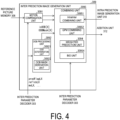
- FIG. 4 is a schematic diagram illustrating a configuration of the inter prediction image generation unit 309 included in the prediction image generation unit 308 according to the present embodiment.
- the inter prediction image generation unit 309 includes a motion compensation unit (prediction image generation apparatus) 3091, an OOB processing unit 3092, and a combining unit 3095.
- the combining unit 3095 includes a weighted prediction unit 3094.
- the motion compensation unit 3091 (interpolation image generation unit 3091) generates an interpolation image (motion compensation image) by reading a reference block from the reference picture memory 306 based on the inter prediction parameters (predFlagLX, refIdxLX, mvLX) input from the inter prediction parameter derivation unit 303.
- the reference block is a block located on the reference picture RefPicLX specified by refIdxLX, at a position shifted by mvLX from the position of the target block.
- an interpolation image is generated by using a filter referred to as a motion compensation filter and configured to generate pixels at fractional positions.
- the motion compensation unit 3091 derives an integer position (xInt, yInt) and a phase (xFrac, yFrac) corresponding to top left coordinates (xPb, yPb) of a block having a size of bW ⁇ bH, coordinates (xL, yL) in a prediction block, and motion vectors (mvLX[0], mvLX[1]) by the following expression (MC-P1).
- MVPREC represents accuracy of mvLX (1/MVPREC pixel accuracy)
- log2MVPREC log2(MVPREC)
- x 0, ..., bW - 1
- y 0, ..., bH - 1.
- MVPREC may be 16.
- the derivation may be performed as in (MC-P2) to be described later.
- the motion compensation unit 3091 may correct the position for wrap around.
- each parameter is set as follows.
- the motion compensation unit 3091 derives a temporary image temp[][] by performing horizontal interpolation processing on a reference picture refImg using an interpolation filter.
- mcFilter[Frac][k] is a k-th interpolation filter coefficient in the phase Frac
- shift1 is a normalization parameter for adjusting a value range
- offset! 1 ⁇ (shift1 - 1).
- temp x y ⁇ mcFilter xFrac k * refImg xInt + k ⁇ NTAP / 2 + 1 yInt + offset 1 ⁇ shift 1
- the motion compensation unit 3091 derives an interpolation image Pred[][] by performing vertical interpolation processing on the temporary image temp[][].
- shift2 is a normalization parameter for adjusting a value range
- offset2 1 ⁇ (shift2 - 1).
- Pred x y ⁇ mcFilter yFrac k * temp x y + k ⁇ NTAP / 2 + 1 + offset 2 ⁇ shift 2
- the weighted prediction unit 3094 generates a prediction image of a block by multiplying an interpolation image PredLX by a weight coefficient.
- the OOB processing unit 3092 includes an OOB determination unit 30921 and an OOB mask derivation unit 30922.
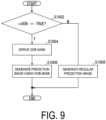
- the OOB determination unit 30921 determines whether each reference block of the bi-prediction mode includes a region out of a valid range (an Out-Of-Boundary (OOB) region) of a reference picture, based on the inter prediction parameters (predFlagLX, refIdxLX, mvLX, and the like) input from the inter prediction parameter derivation unit 303.
- OOB Out-Of-Boundary
- the determination whether a region out of a valid range of a picture or a subpicture is included may be determined. The determination may be performed using whether a region out of a slice is included.
- the OOB mask derivation unit 30922 derives mask data (mask value, OOB mask) indicating which region in the reference block is out of the valid range (S1004).
- the inter prediction image generation unit 309 applies the OOB mask to the OOB reference block, and generates a prediction image (S1006).
- the inter prediction image generation unit 309 generates a regular prediction image for the non-OOB reference block (S1008). Details will be described below.
- the OOB determination unit 30921 determines whether a part of each reference block is out of the picture (OOB).
- the width and the height of the picture are represented by picW and picH, respectively. Note that, in the following, values obtained by converting mvLX into integers according to accuracy MVPREC of mvLX are used in the coordinate system.
- the OOB determination unit 30921 derives a truth value isOOB[X] for representing whether the LX reference block includes a region out of the picture (out of the valid range), according to the following expression.
- a region inside the valid range is referred to as a valid region.
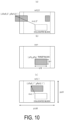
- FIG. 10 is a diagram in integer units, and a motion vector mvLX' and a reference pixel position (xRefLX', yRefLX') are parameters being integer expressions of the motion vector mvLX and the reference pixel position (xRefLX, yRefLX).
- xRefLX 0
- yRefLX 1
- xRefLX xPb ⁇ log 2 MVPREC + mvLX 0
- the derivation expression of isOOB[X] in (DecideOOB1) may be the following expression.
- the OOB determination unit 30921 may perform determination in a simplified manner as follows, with omission of terms for rounding.
- picMaxX picW ⁇ 1 ⁇ log 2 MVPREC
- the OOB determination unit 30921 may perform determination with coordinates in integer units, instead of boundary coordinates in fractional sample units.
- xRefLX xPb + mvLX 0 ⁇ log 2 MVPREC Decide OOB 3
- the derivation expression of isOOB[X] in (DecideOOB3) may be the following expression.
- isOOB[X] may be derived according to the following expression.
- isOOB[X] may be derived according to the following expression.
- picMaxX picW ⁇ 1 ⁇ log 2 MVPREC
- isOOB[X] may be derived according to the following expression.
- xRefLX xPb + mvLX 0 ⁇ log 2 MVPREC
- isOOB[X] may be derived according to the following expression.
- BLKTHW1 may be 4, 8, 16, or 32
- BLKTHH1 may be 4, 8, 16, or 32, or the like.
- a threshold of the block size to which OOB is applied may be 8 x 8, 4 x 4, 4 x 8, 8 x 4, 16 x 16, or the like.
- isOOB[X] may be derived according to the following expression.
- isOOB[X] may be derived according to the following expression.
- picMaxX picW ⁇ 1 ⁇ log 2 MVPREC
- isOOB[X] may be derived according to the following expression.
- xRefLX xPb + mvLX 0 ⁇ log 2 MVPREC
- isOOB[X] may be derived according to the following expression.
- xRefLX xPb + mvLX 0 ⁇ log 2 MVPREC
- BLKTHW2 may be 16, 32, or 64
- BLKTHH2 may be 16, 32, or 64, or the like.
- the OOB processing may be applied only to blocks having a specific range of size.
- isOOB[X] may be derived according to the following expression.
- isOOB[X] may be derived according to the following expression.
- picMaxX picW ⁇ 1 ⁇ log 2 MVPREC
- isOOB[X] may be derived according to the following expression.
- xRefLX xPb + mvLX 0 ⁇ log 2 MVPREC
- isOOB[X] may be derived according to the following expression.
- (BLKTHW3, BLKTHW4) may be ⁇ (4, 16), (8, 32), (16, 32), (32, 64) ⁇
- (BLKTHH3, BLKHH4) may be ⁇ (4, 16), (8, 32), (16, 32), (32, 64) ⁇ , or the like.
- OOB processing may be applied, with determination being made depending on the size of areas.
- isOOB[X] may be derived according to the following expression.
- isOOB[X] may be derived according to the following expression.
- picMaxX picW ⁇ 1 ⁇ log 2 MVPREC
- isOOB[X] may be derived according to the following expression.
- xRefLX xPb + mvLX 0 ⁇ log 2 MVPREC
- isOOB[X] may be derived according to the following expression.
- BLKTHW5 may be 4, 8, 16, or 32
- BLKTHH5 may be 4, 8, 16, or 32, or the like.
- BLKTHS5 may be used instead of BLKTHWS ⁇ BLKTHH5.
- BLKTHS5 may be 32, 64, 128, or the like.
- a condition of restricting the block size based on the OOB determination expression of (DecideOOB1) is added.
- a condition of restricting the block size based on the OOB determination expression of (DecideOOB2) or (DecideOOB3) may be added.
- the block size to which the OOB processing is applied can be restricted, and the amount of calculation can be reduced.
- the OOB determination unit 30921 derives InsideAreaX according to the following expression, for example. Note that, as a value of (false, true), (0, 1) may be used, or another value (1, 0) may be used.
- the valid range of the LX reference region may be derived in a common part of the LX reference block and the picture.
- xRefLX xPb * MVPREC + mvLX 0
- the reference block does not have a part in common with the picture (the reference block is not included in the picture), and thus InsideAreaX may be 0.
- the size may be processed with left bit shift " ⁇ " with a logarithm of MVPREC as follows.
- xRefLX xPb ⁇ log 2 MVPREC + mvLX 0
- yRefLX yPb ⁇ log 2 MVPREC + mvLX 1
- picMaxX and picMaxY may be derived as follows.
- picMaxX picW ⁇ 1 * MVPREC
- picMaxY picH ⁇ 1 * MVPREC
- xRefLX and yRefLX may be derived in coordinates in integer units, instead of boundary coordinates in fractional sample units.
- xRefLX xPb + mvLX 0 * MVPREC
- yRefLX yPb + mvLX 1 * MVPREC
- the OOB determination unit 30921 derives InsideArea0 and InsideArea1 for the L0 reference block and the L1 reference block, respectively, and derives isOOB[X] as follows.
- “InsideArea0 > InsideArea1” may be used.
- the valid region is large, there is substantially no reduction in image quality even in a case that the OOB determination is invalidated.
- the OOB determination unit 30921 may invalidate the OOB determination for both of the reference images.
- isOOB[X] may be derived such that a value (false) indicating omission of the OOB determination is obtained.
- the amount of calculation in generation of the prediction image can be reduced.
- the OOB determination may be performed by using only the widths or only the heights in the above determination.
- the OOB determination for a reference block having a large valid region can be omitted, and therefore the amount of calculation in generation of the prediction image can be reduced.
- this eliminates the need of deriving areas, and therefore the amount of calculation of multiplication can be reduced.
- the valid region of the L0 reference region and the valid region of the L1 reference region are compared with each other, and the OOB determination for the reference picture having a larger reference region may be invalidated. Determination as to whether the reference region is large may be performed by comparing the areas of the valid regions of L0 and L1. Determination as to whether the reference region is large may be performed by comparing the widths or the heights of the valid regions of L0 and L 1.
- the OOB mask derivation unit 30922 derives the OOB mask (OOBMask[X]) for the reference block.
- OOBMask[X] is a binary image (mask) having bW x bH pixels.
- false and true are not limited to 0 and 1, and other values may be used, such as binary bit mask values "0000000000b” and "1111111111b” constituted of a string of 0 or 1 and having a length of BitDepth or longer, for example. Hexadecimal numbers of "000” and “3FF”, “000” and “FFF”, and "0000” and "FFFF” may be used.
- xRefLX xPb ⁇ log2MVPREC + mvLX 0
- yRefLX yPb ⁇ log2MVPREC + mvLX 1
- OOBMask is derived based on the determination expression of isOOB[X] in (DecideOOB1).
- OOBMask may be derived based on the determination expression of isOOB[X] in (DecideOOB2) and (DecideOOB3).
- OOBMask may be derived based on the determination expression of isOOB[X] provided with a restriction of the valid range in (DecideOOB1), (DecideOOB2), and (DecideOOB3).
- the derivation expression of OOBMask may be the following expression.
- OOBMask X px py xRefLX + px ⁇ picMinX ⁇ xRefLX + py ⁇ picMinY ⁇ xRefLX + px + bW ⁇ log 2
- the derivation expression of OOBMask may be the following expression.
- OOBMask may be derived as follows with omission of terms for rounding.
- picMaxX picW ⁇ 1 ⁇ log 2
- MVPREC picMaxY picH ⁇ 1 ⁇ log 2 MVPREC OOBMask
- X px py ( xRefLX + px ⁇ 0 ⁇ yRefLX + py ⁇ 0 ⁇ xRefLX + bW ⁇ log 2 MVPREC ⁇ 1 > picMaxX ) ⁇ yRefLX + bH ⁇ log 2 MVPREC ⁇ 1 > pixMaxY ) ) ? 1 : 0
- OOBMask may be derived by using the motion vectors in integer units.
- xRefLX xPb + mvLX 0 ⁇ log 2 MVPREC
- yRefLX yPb + mvLX 1 ⁇ log 2 MVPREC OOBMask
- the derivation expression of OOBMask may be the following expression.
- the OOB mask derivation unit 30922 may derive OOBMask[X] as a mask in a unit of N x M pixels.
- one mask value is associated with OOB determination of N x M pixels.
- the size of OOBMask[X] is (bW/N) * (bH/M).
- xRefLX xPb ⁇ log 2 MVPREC + mvLX 0
- yRefLX yPb ⁇ log 2 MVPREC + mvLX 1
- px 0, ..., bW/N - 1
- py 0, ..., bH/M - 1.
- OOBMask is derived based on the determination expression of isOOB[X] in (DecideOOB1).
- OOBMask may be derived based on the determination expression of isOOB[X] in (DecideOOB2) and (DecideOOB3).
- OOBMask may be derived based on the determination expression of isOOB[X] provided with a restriction of the valid range in (DecideOOB1), (DecideOOB2), and (DecideOOB3).
- the derivation expression of OOBMask may be the following expression.
- OOBMask may be derived as follows with omission of terms for rounding.
- picMaxX picW ⁇ 1 ⁇ log 2
- MVPREC picMaxY picH ⁇ 1 ⁇ log 2
- MVPREC OOBMask X px py ( xRefLX + px * N ⁇ 0 ⁇ yRefLX + py * N ⁇ 0 ⁇ xRefLX + px * N + N + bW * MVPREC ⁇ 1 > picMaxX ⁇ yRefLX + py * N + M + bH * MVPREC ⁇ 1 > pixMaxY ) ? 1 : 0
- OOBMask may be derived by using the motion vectors in integer units.
- xRefLX xPb + mvLX 0 ⁇ log 2 MVPREC
- yRefLX yPb + mvLX 1 ⁇ log 2 MVPREC OOBMask
- the masks have equal values in units of N x M pixels, and therefore memory necessary for the masks can be reduced and also the amount of calculation can be reduced.
- the motion compensation unit 3091 (interpolation image generation unit 3091) sets Pred[][] derived in the above (Expression MC-1) equal to interpolation images PredL0[][] and PredL1[][] for each L0 list and L1 list. Then, the weighted prediction unit 3094 generates an interpolation image Pred[][] from PredL0[][] and PredL1[][].
- the reference block of the bi-prediction is a target of the OOB processing
- OOBMask[X] corresponding to the reference block is used in generation of the prediction image.
- Pred[][] is derived as follows.
- shift1 Max(2, 14 - bitDepth)
- shift2 Max(3, 15 - bitDepth)
- offset! 1 ⁇ (shift1 - 1)
- offset2 1 ⁇ (shift2 - 1).
- shift1 is shift (for example, 14 - bitDepth) for restoring interpolation image bit depth (for example, 14 bits) back to the original bit depth
- shift2 is a right shift amount serving as an average simultaneously with restoring back to the original bits
- offset1 offset2 are rounding values in a case that right shift is performed by shift1 and shift2, respectively.
- bcwIdx is an index indicating the weight of BCW.
- processing is performed as follows by collectively performing processing using the flag predFlagLX indicating whether the LX reference picture is used and OOBMask in units of blocks in one branch, there is an effect that the amount of processing can be reduced.
- the OOB determination unit 30921 may not apply the OOB processing to blocks.
- the OOB determination presence/absence flag isOOB[X] is set equal to false. This allows for prevention of occurrence of distortion or reduction of coding efficiency, which is caused by no use of one of the reference blocks to which the bi-directional weighted prediction is applied.
- Such weighted prediction includes Bi-prediction with CU-level Weight (BCW) prediction and Weighted prediction (WP) prediction.
- weight coefficients (w0, w1) are selected in units of blocks, and an L0 interpolation image and an L1 interpolation image in the bi-prediction are multiplied by the weights, and thereby a prediction image is generated.
- the parameter decoder 302 decodes, from the coded data, a parameter bcw_idx indicating the weight coefficients in the coding unit CU.
- the parameter coder 111 codes bcw_idx. In a case of the merge prediction, bcwIdx of a reference block (neighboring block) is set equal to bcwIdx of the target block.
- bcw_idx is set equal to bcwIdx of the target block.
- the BCW prediction is applied to the CU.
- the OOB determination unit 30921 sets isOOB[X] equal to false.
- weight coefficients (we0, we1) and offsets (offset0, offset1) for each reference picture are switched in units of slices, the weight coefficients and the offsets are selected based on the reference picture index in units of CUs, the L0 interpolation image and the L1 interpolation image are multiplied by the weights, and thereby a prediction image is generated.
- (we0, we1) and (offset0, offset1) are weight coefficients and offsets decoded from the coded data in units of slices, respectively, and are derived in accordance with the reference picture index.
- OOBMask[0] and OOBMask[1] are not set equal to 1 together, and thus the weighted prediction unit 3094 can derive the interpolation image according to the following branch processing.
- PredLO, PredL1, and PredBI be calculated in advance, and final Pred be derived in the following mask processing.
- PredL0, PredL1, and PredBI are calculated.
- PredL 0 px py we 0 * PredL 0 px py + offset 0 ⁇ shift 1
- PredL 1 px py we 1 * PredL 1 px py + offset 1 ⁇ shift 1
- PredBI px py we 0 * PredL 0 px py + we 1 * PredL 1 px py + offset 2 ⁇ shift 2 in a case of WP prediction
- PredBI px py w 0 * PredL 0 px py + w 1 * PredL 1 px py + offset 3 ⁇ shift 1 + 3 ) in a case of BCW prediction
- Pred px py PredBI px py & ! OOBMask 0 px py & !
- bit mask values "0000000000b” and "1111111111b" may be generated from 0 and 1, and the following processing may be performed.
- " + " may be "
- Pred px py Expression excl ⁇ 1 PredBI px py & 0 ⁇ ! OOBMask 0 px py & ! OOBMask 1 px py ?
- the above expression includes calculation of transforming the binary (0 or 1) mask into 0 (all of the bits are 0, the pixel value is invalidated) or into -1 (all of the bits are 1, the pixel value is validated).
- Derivation of the prediction image is not limited thereto, and such calculation may be used that a term invalidated due to the OOB mask among three terms corresponding to PredBI, PredLO, and PredL1 is set equal to 0.
- Pred px py PredBI px py & !
- bit OR may be used as follows.
- Pred px py PredBI px py & ! OOBMask 0 px py & ! OOBMask 1 px py ?
- Pred px py PredBI px py * ! OOBMask 0 px py & ! OOBMask 1 px py ? 1 : 0 + PredL0 px py * OOBMask 0 px py ? 1 : 0 + PredL 1 px py * OOBMask 1 px py ? 1 : 0 + PredL 1 px py * OOBMask 1 px py ? 1 : 0 + PredL 1 px py * OOBMask 1 px py ? 1 : 0
- exclusive processing can be simplified. Owing to the exclusive processing, processing can be further simplified than operation of (Expression excl-1).
- the weighted prediction unit 3094 may refer to the value of isOOB and separate processing in advance. For example, the following may be performed. In this manner, in a case that isOOB [X] is false, there is no need to refer to OOBMask[X] [px] [py] for each pixel, and thus there is an effect that the amount of calculation can be reduced. For example, in a case that weights are not used, the prediction image may be generated as follows.
- the prediction image may be generated as follows.
- the prediction image may be generated as follows.
- the inter prediction image generation unit 309 outputs the generated prediction image of the block to the addition unit 312.
- FIG. 7 is a block diagram illustrating a configuration of the video coding apparatus 11 according to the present embodiment.
- the video coding apparatus 11 includes a prediction image generation unit 101, a subtraction unit 102, a transform and quantization unit 103, an inverse quantization and inverse transform processing unit 105, an addition unit 106, a loop filter 107, a prediction parameter memory (a prediction parameter storage unit, a frame memory) 108, a reference picture memory (a reference image storage unit, a frame memory) 109, a coding parameter determination unit 110, a parameter coder 111, a prediction parameter derivation unit 120, and an entropy coder 104.
- the prediction image generation unit 101 generates a prediction image for each CU.
- the prediction image generation unit 101 includes the inter prediction image generation unit 309 and the intra prediction image generation unit already described, and description of these units is omitted.
- the subtraction unit 102 subtracts a pixel value of the prediction image of a block input from the prediction image generation unit 101 from a pixel value of the image T to generate a prediction error.
- the subtraction unit 102 outputs the prediction error to the transform and quantization unit 103.
- the transform and quantization unit 103 performs a frequency transform on the prediction error input from the subtraction unit 102 to calculate a transform coefficient, and derives a quantization transform coefficient by quantization.
- the transform and quantization unit 103 outputs the quantization transform coefficient to the parameter coder 111 and the inverse quantization and inverse transform processing unit 105.
- the transform and quantization unit 103 includes a separable transform processing unit (first transform processing unit), a non-separable transform processing unit (second transform processing unit), and a scaling unit.
- the separable transform processing unit applies separable transform to the prediction error.
- the scaling unit performs scaling on the transform coefficient using a quantization matrix.
- the inverse quantization and inverse transform processing unit 105 is the same as the inverse quantization and inverse transform processing unit 311 in the video decoding apparatus 31, and descriptions thereof are omitted.
- the calculated prediction error is output to the addition unit 106.
- the parameter coder 111 includes a header coder 1110, a CT information coder 1111, and a CU coder 1112 (prediction mode coder).
- the CU coder 1112 further includes a TU coder 1114. General operation of each module will be described below.
- the header coder 1110 performs coding processing of parameters such as header information, split information, prediction information, and quantization transform coefficients.
- the CT information coder 1111 codes the QT and MT (BT, TT) split information and the like.
- the CU coder 1112 codes the CU information, the prediction information, the split information, and the like.
- the TU coder 1114 codes the QP update information and the quantization prediction error.
- the CT information coder 1111 and the CU coder 1112 supply, to the parameter coder 111, syntax elements such as the inter prediction parameters (predMode, general_merge_flag, merge_idx, inter_pred_idc, refIdxLX, mvp_LX_idx, and mvdLX), the intra prediction parameters, and the quantization transform coefficients.
- inter prediction parameters predMode, general_merge_flag, merge_idx, inter_pred_idc, refIdxLX, mvp_LX_idx, and mvdLX
- the parameter coder 111 inputs the quantization transform coefficient and the coding parameters (split information and prediction parameters) to the entropy coder 104.
- the entropy coder 104 entropy-codes the quantization transform coefficient and the coding parameters to generate a coding stream Te and outputs the coding stream Te.
- the prediction parameter derivation unit 120 is a component including the inter prediction parameter coder 112 and the intra prediction parameter coder, and derives an intra prediction parameter and an inter prediction parameter from the parameters input from the coding parameter determination unit 110.
- the intra prediction parameter and inter prediction parameter derived are output to the parameter coder 111.
- the inter prediction parameter coder 112 includes a parameter coding controller 1121 and an inter prediction parameter derivation unit 303.
- the inter prediction parameter derivation unit 303 has a configuration common to the video decoding apparatus.
- the parameter coding controller 1121 includes a merge index derivation unit 11211 and a vector candidate index derivation unit 11212.
- the merge index derivation unit 11211 derives merge candidates and the like, and outputs the merge candidates and the like to the inter prediction parameter derivation unit 303.
- the vector candidate index derivation unit 11212 derives prediction vector candidates and the like, and outputs the prediction vector candidates and the like to the inter prediction parameter derivation unit 303 and the parameter coder 111.
- the intra prediction parameter coder includes a parameter coding controller and an intra prediction parameter derivation unit.
- the intra prediction parameter derivation unit has a configuration common to the video decoding apparatus.
- the coding parameter determination unit 110 and the prediction parameter memory 108 provide input to the inter prediction parameter derivation unit 303 and the intra prediction parameter derivation unit, and output from the inter prediction parameter derivation unit 303 and the intra prediction parameter derivation unit is provided to the parameter coder 111.
- the addition unit 106 adds together, for each pixel, a pixel value for the prediction block input from the prediction image generation unit 101 and a prediction error input from the inverse quantization and inverse transform processing unit 105, generating a decoded image.
- the addition unit 106 stores the generated decoded image in the reference picture memory 109.
- the loop filter 107 applies a deblocking filter, an SAO, and an ALF to the decoded image generated by the addition unit 106.
- the loop filter 107 need not necessarily include the above-described three types of filters, and may have a configuration of only the deblocking filter, for example.
- the prediction parameter memory 108 stores the prediction parameters generated by the coding parameter determination unit 110 for each target picture and CU at a predetermined position.
- the reference picture memory 109 stores the decoded image generated by the loop filter 107 for each target picture and CU at a predetermined position.
- the coding parameter determination unit 110 selects one set among multiple sets of coding parameters.
- the coding parameters include QT, BT, or TT split information described above, a prediction parameter, or a parameter to be coded which is generated related thereto.
- the prediction image generation unit 101 generates the prediction image by using these coding parameters.
- the coding parameter determination unit 110 calculates, for each of the multiple sets, an RD cost value indicating the magnitude of an amount of information and a coding error.
- the RD cost value is, for example, the sum of a code amount and the value obtained by multiplying a coefficient ⁇ by a square error.
- the code amount is an amount of information of the coding stream Te obtained by performing entropy coding on a quantization error and a coding parameter.
- the square error is the square sum of the prediction errors calculated in the subtraction unit 102.
- the coefficient ⁇ is a real number greater than a preset zero.
- the coding parameter determination unit 110 selects a set of coding parameters of which cost value calculated is a minimum value.
- the coding parameter determination unit 110 outputs the determined coding parameters to the prediction parameter derivation unit 120.
- a computer may be used to implement some of the video coding apparatus 11 and the video decoding apparatus 31 in the above-described embodiments, for example, the entropy decoder 301, the parameter decoder 302, the loop filter 305, the prediction image generation unit 308, the inverse quantization and inverse transform processing unit 311, the addition unit 312, the prediction parameter derivation unit 320, the prediction image generation unit 101, the subtraction unit 102, the transform and quantization unit 103, the entropy coder 104, the inverse quantization and inverse transform processing unit 105, the loop filter 107, the coding parameter determination unit 110, a parameter coder 111, and the prediction parameter derivation unit 120.
- the entropy decoder 301 the parameter decoder 302, the loop filter 305, the prediction image generation unit 308, the inverse quantization and inverse transform processing unit 311, the addition unit 312, the prediction parameter derivation unit 320, the prediction image generation unit 101, the subtraction unit 102, the transform and quantization unit
- this configuration may be realized by recording a program for realizing such control functions on a computer-readable recording medium and causing a computer system to read and perform the program recorded on the recording medium.
- the "computer system” mentioned here refers to a computer system built into either the video coding apparatus 11 or the video decoding apparatus 31 and is assumed to include an OS and hardware components such as a peripheral apparatus.
- a "computer-readable recording medium” refers to a portable medium such as a flexible disk, a magneto-optical disk, a ROM, and a CD-ROM, and a storage device such as a hard disk built into the computer system.
- the "computer-readable recording medium” may include a medium that dynamically stores a program for a short period of time, such as a communication line in a case that the program is transmitted over a network such as the Internet or over a communication line such as a telephone line, and may also include a medium that stores the program for a fixed period of time, such as a volatile memory included in the computer system functioning as a server or a client in such a case.
- the above-described program may be one for realizing some of the above-described functions, and also may be one capable of realizing the above-described functions in combination with a program already recorded in a computer system.
- a part or all of the video coding apparatus 11 and the video decoding apparatus 31 in the embodiment described above may be realized as an integrated circuit such as a Large Scale Integration (LSI).
- LSI Large Scale Integration
- Each function block of the video coding apparatus 11 and the video decoding apparatus 31 may be individually realized as processors, or part or all may be integrated into processors.
- the circuit integration technique is not limited to LSI, and the integrated circuits for the functional blocks may be realized as dedicated circuits or a multipurpose processor. In a case that, with advances in semiconductor technology, a circuit integration technology with which an LSI is replaced appears, an integrated circuit based on the technology may be used.
- the embodiment of the present invention can be preferably applied to a video decoding apparatus that decodes coded data in which image data is coded, and a video coding apparatus that generates coded data in which image data is coded.
- the embodiment of the present invention can be preferably applied to a data structure of coded data generated by the video coding apparatus and referred to by the video decoding apparatus.
Landscapes
- Engineering & Computer Science (AREA)
- Multimedia (AREA)
- Signal Processing (AREA)
- Compression Or Coding Systems Of Tv Signals (AREA)
Applications Claiming Priority (1)
| Application Number | Priority Date | Filing Date | Title |
|---|---|---|---|
| JP2022146436A JP2024041558A (ja) | 2022-09-14 | 2022-09-14 | 動画像復号装置および動画像符号化装置 |
Publications (1)
| Publication Number | Publication Date |
|---|---|
| EP4340364A1 true EP4340364A1 (en) | 2024-03-20 |
Family
ID=85172791
Family Applications (1)
| Application Number | Title | Priority Date | Filing Date |
|---|---|---|---|
| EP23154690.4A Pending EP4340364A1 (en) | 2022-09-14 | 2023-02-02 | Video decoding apparatus and video coding apparatus with oob - out-of-boundary checks |
Country Status (6)
| Country | Link |
|---|---|
| US (1) | US12219150B2 (https=) |
| EP (1) | EP4340364A1 (https=) |
| JP (1) | JP2024041558A (https=) |
| KR (1) | KR20240037137A (https=) |
| CN (1) | CN117714713A (https=) |
| AU (1) | AU2023200531A1 (https=) |
Families Citing this family (3)
| Publication number | Priority date | Publication date | Assignee | Title |
|---|---|---|---|---|
| KR20240137038A (ko) * | 2022-01-18 | 2024-09-19 | 베이징 다지아 인터넷 인포메이션 테크놀로지 컴퍼니 리미티드 | 비디오 코딩에서 경계외 조건을 고려한 모션 보정 |
| JP2024006995A (ja) * | 2022-07-05 | 2024-01-18 | シャープ株式会社 | 動画像復号装置および動画像符号化装置 |
| US12549759B2 (en) * | 2023-03-16 | 2026-02-10 | Tencent America LLC | Motion compensated picture boundary padding |
Family Cites Families (6)
| Publication number | Priority date | Publication date | Assignee | Title |
|---|---|---|---|---|
| US20110122950A1 (en) * | 2009-11-26 | 2011-05-26 | Ji Tianying | Video decoder and method for motion compensation for out-of-boundary pixels |
| CN113994671B (zh) * | 2019-06-14 | 2024-05-10 | 北京字节跳动网络技术有限公司 | 基于颜色格式处理视频单元边界和虚拟边界 |
| US11539939B2 (en) * | 2019-11-27 | 2022-12-27 | Hfi Innovation Inc. | Video processing methods and apparatuses for horizontal wraparound motion compensation in video coding systems |
| EP4173290A4 (en) * | 2020-06-30 | 2024-01-10 | Beijing Bytedance Network Technology Co., Ltd. | BOUNDARY LOCATION FOR ADAPTIVE LOOP FILTERING |
| US12526443B2 (en) * | 2022-01-13 | 2026-01-13 | Qualcomm Incorporated | Coding video data using out-of-boundary motion vectors |
| US12413745B2 (en) * | 2022-04-12 | 2025-09-09 | Qualcomm Incorporated | Bi-directional prediction boundary pixel padding with out-of-picture-boundary motion vectors |
-
2022
- 2022-09-14 JP JP2022146436A patent/JP2024041558A/ja active Pending
-
2023
- 2023-02-02 AU AU2023200531A patent/AU2023200531A1/en active Pending
- 2023-02-02 US US18/104,793 patent/US12219150B2/en active Active
- 2023-02-02 EP EP23154690.4A patent/EP4340364A1/en active Pending
- 2023-02-03 CN CN202310128572.7A patent/CN117714713A/zh active Pending
- 2023-02-14 KR KR1020230019325A patent/KR20240037137A/ko active Pending
Non-Patent Citations (4)
| Title |
|---|
| BROSS BENJAMIN ET AL: "Developments in International Video Coding Standardization After AVC, With an Overview of Versatile Video Coding (VVC)", PROCEEDINGS OF THE IEEE, IEEE. NEW YORK, US, vol. 109, no. 9, 19 January 2021 (2021-01-19), pages 1463 - 1493, XP011873463, ISSN: 0018-9219, [retrieved on 20210818], DOI: 10.1109/JPROC.2020.3043399 * |
| LE LÉANNEC (XIAOMI) F ET AL: "ECM fix for block-level out-of-bound checking", no. JVET-AA0097 ; m60067, 14 July 2022 (2022-07-14), XP030302880, Retrieved from the Internet <URL:https://jvet-experts.org/doc_end_user/documents/27_Teleconference/wg11/JVET-AA0097-v2.zip JVET-AA0097-fix-oob-0.2.docx> [retrieved on 20220714] * |
| LE LÉANNEC (XIAOMI) F ET AL: "EE2-2.2: Motion compensated picture boundary padding", no. JVET-AA0096 ; m60066, 6 July 2022 (2022-07-06), XP030302878, Retrieved from the Internet <URL:https://jvet-experts.org/doc_end_user/documents/27_Teleconference/wg11/JVET-AA0096-v1.zip JVET-AA0096-mc-padding-0.1.docx> [retrieved on 20220706] * |
| Y-W CHEN (KWAI) ET AL: "AHG12: Enhanced bi-directional motion compensation", no. JVET-Y0125, 6 January 2022 (2022-01-06), XP030300450, Retrieved from the Internet <URL:https://jvet-experts.org/doc_end_user/documents/25_Teleconference/wg11/JVET-Y0125-v1.zip JVET-Y0125.docx> [retrieved on 20220106] * |
Also Published As
| Publication number | Publication date |
|---|---|
| US20240098272A1 (en) | 2024-03-21 |
| AU2023200531A1 (en) | 2024-03-28 |
| CN117714713A (zh) | 2024-03-15 |
| JP2024041558A (ja) | 2024-03-27 |
| US12219150B2 (en) | 2025-02-04 |
| KR20240037137A (ko) | 2024-03-21 |
Similar Documents
| Publication | Publication Date | Title |
|---|---|---|
| EP4340364A1 (en) | Video decoding apparatus and video coding apparatus with oob - out-of-boundary checks | |
| US12418674B2 (en) | Video coding apparatus and video decoding apparatus | |
| EP3937498B1 (en) | Dynamic image decoding | |
| JP7448349B2 (ja) | 動画像復号装置 | |
| EP3905694A1 (en) | Prediction image generating device, moving image decoding device, moving image encoding device, and prediction image generating method | |
| US11716486B2 (en) | Video decoding apparatus using parameter decoding circuit to derive weight coefficients | |
| EP4418657A2 (en) | Video decoding apparatus and video coding apparatus | |
| EP4346204A1 (en) | Image decoding apparatus and image coding apparatus | |
| EP3836541A1 (en) | Moving image decoding apparatus and moving image encoding apparatus | |
| EP4436179A1 (en) | Video encoding device and video decoding device | |
| US12132887B2 (en) | Video decoding apparatus, video coding apparatus, video decoding method, and video coding method | |
| EP4451680A1 (en) | Video decoding device and video coding device | |
| US20250267251A1 (en) | Image decoding apparatus and image coding apparatus | |
| US12563182B2 (en) | Video coding apparatus and video decoding apparatus | |
| EP4443884A1 (en) | Video decoding apparatus and video coding apparatus | |
| EP4554208A1 (en) | Video decoding device and video coding device | |
| EP4485926A1 (en) | Video decoding device and video coding device | |
| EP4546779A1 (en) | Video decoding device | |
| EP4407994A1 (en) | Moving-image encoding device and moving-image decoding device | |
| US12563180B2 (en) | Video coding apparatus and decoding apparatus | |
| EP4694114A1 (en) | Video decoding device and video coding device | |
| EP3896973A1 (en) | Predicted image generation device, moving image decoding device, moving image encoding device, and predicted image generation method |
Legal Events
| Date | Code | Title | Description |
|---|---|---|---|
| PUAI | Public reference made under article 153(3) epc to a published international application that has entered the european phase |
Free format text: ORIGINAL CODE: 0009012 |
|
| STAA | Information on the status of an ep patent application or granted ep patent |
Free format text: STATUS: THE APPLICATION HAS BEEN PUBLISHED |
|
| AK | Designated contracting states |
Kind code of ref document: A1 Designated state(s): AL AT BE BG CH CY CZ DE DK EE ES FI FR GB GR HR HU IE IS IT LI LT LU LV MC ME MK MT NL NO PL PT RO RS SE SI SK SM TR |
|
| STAA | Information on the status of an ep patent application or granted ep patent |
Free format text: STATUS: REQUEST FOR EXAMINATION WAS MADE |
|
| 17P | Request for examination filed |
Effective date: 20240920 |
|
| RBV | Designated contracting states (corrected) |
Designated state(s): AL AT BE BG CH CY CZ DE DK EE ES FI FR GB GR HR HU IE IS IT LI LT LU LV MC ME MK MT NL NO PL PT RO RS SE SI SK SM TR |