EP4340335B1 - Redundanz in einem automatisierungssystem, das mehr als einen systembereich abdeckt - Google Patents
Redundanz in einem automatisierungssystem, das mehr als einen systembereich abdeckt Download PDFInfo
- Publication number
- EP4340335B1 EP4340335B1 EP22196108.9A EP22196108A EP4340335B1 EP 4340335 B1 EP4340335 B1 EP 4340335B1 EP 22196108 A EP22196108 A EP 22196108A EP 4340335 B1 EP4340335 B1 EP 4340335B1
- Authority
- EP
- European Patent Office
- Prior art keywords
- packet
- ipv6
- ipv6 packet
- sequence number
- redundancy
- Prior art date
- Legal status (The legal status is an assumption and is not a legal conclusion. Google has not performed a legal analysis and makes no representation as to the accuracy of the status listed.)
- Active
Links
Images

Classifications
-
- H—ELECTRICITY
- H04—ELECTRIC COMMUNICATION TECHNIQUE
- H04L—TRANSMISSION OF DIGITAL INFORMATION, e.g. TELEGRAPHIC COMMUNICATION
- H04L69/00—Network arrangements, protocols or services independent of the application payload and not provided for in the other groups of this subclass
- H04L69/40—Network arrangements, protocols or services independent of the application payload and not provided for in the other groups of this subclass for recovering from a failure of a protocol instance or entity, e.g. service redundancy protocols, protocol state redundancy or protocol service redirection
-
- H—ELECTRICITY
- H04—ELECTRIC COMMUNICATION TECHNIQUE
- H04L—TRANSMISSION OF DIGITAL INFORMATION, e.g. TELEGRAPHIC COMMUNICATION
- H04L45/00—Routing or path finding of packets in data switching networks
- H04L45/24—Multipath
-
- H—ELECTRICITY
- H04—ELECTRIC COMMUNICATION TECHNIQUE
- H04L—TRANSMISSION OF DIGITAL INFORMATION, e.g. TELEGRAPHIC COMMUNICATION
- H04L61/00—Network arrangements, protocols or services for addressing or naming
- H04L61/09—Mapping addresses
- H04L61/10—Mapping addresses of different types
- H04L61/103—Mapping addresses of different types across network layers, e.g. resolution of network layer into physical layer addresses or address resolution protocol [ARP]
-
- H—ELECTRICITY
- H04—ELECTRIC COMMUNICATION TECHNIQUE
- H04L—TRANSMISSION OF DIGITAL INFORMATION, e.g. TELEGRAPHIC COMMUNICATION
- H04L69/00—Network arrangements, protocols or services independent of the application payload and not provided for in the other groups of this subclass
- H04L69/22—Parsing or analysis of headers
-
- H—ELECTRICITY
- H04—ELECTRIC COMMUNICATION TECHNIQUE
- H04L—TRANSMISSION OF DIGITAL INFORMATION, e.g. TELEGRAPHIC COMMUNICATION
- H04L2101/00—Indexing scheme associated with group H04L61/00
- H04L2101/60—Types of network addresses
- H04L2101/618—Details of network addresses
- H04L2101/622—Layer-2 addresses, e.g. medium access control [MAC] addresses
-
- H—ELECTRICITY
- H04—ELECTRIC COMMUNICATION TECHNIQUE
- H04L—TRANSMISSION OF DIGITAL INFORMATION, e.g. TELEGRAPHIC COMMUNICATION
- H04L2101/00—Indexing scheme associated with group H04L61/00
- H04L2101/60—Types of network addresses
- H04L2101/618—Details of network addresses
- H04L2101/659—Internet protocol version 6 [IPv6] addresses
Definitions
- the present disclosure relates to a transmitting redundancy handling device for a first system area of an automation system, a method, computer program and computer program product for handling redundancy for packets transmitted from a first system area of an automation system to a second system area of the automation system, a receiving redundancy handling device for a second system area of an automation system, a method, computer program and computer program product for handling redundancy for packets received in a second system area of an automation system from a first system area of the automation system as well as to an automation system.
- Redundancy is important in many automation systems, such as in process control systems, where an automation system may comprise many controllers and many field devices communicating with the controllers. Some critical automation applications might require deterministic and reliable data exchange between controllers, i.e. interlocking between controllers. There may also be a requirement of End to End (E2E) redundancy. E2E redundancy is typically carried out using Parallel Redundancy Protocol (PRP) and High Availability Redundancy (HSR), which are both linked to Layer 2 of the Open Systems Interconnection (OSI) model, i.e. to the data link layer of the OSI model. It is more particularly linked to the Medium Access Control (MAC) sublayer.
- PRP Parallel Redundancy Protocol
- HSR High Availability Redundancy
- OSI Open Systems Interconnection
- MAC Medium Access Control
- Some automation systems cover more than one area, which system areas may be interconnected by one or more routers or gateways.
- the division into system areas may for instance be needed due to system capacity considerations.
- layer 2 redundancy can only be used inside such a system area.
- E2E redundancy can only be used inside such a system area.
- One objective of the invention is therefore to provide end-to-end redundancy in an automation system that covers more than one system area.
- a transmitting redundancy handling device for a first system area of an automation system and for communicating with a receiving redundancy handling device in a second system area of the automation system, the transmitting redundancy handling device implementing a transmission redundancy handling function configured to:
- a transmitting redundancy handling function of a transmitting redundancy handling device in the first system area comprising:
- a computer program for handling redundancy for packets transmitted from a first system area of an automation system to a second system area of the automation system comprising computer program code which when run by a processor implements a transmitting redundancy handling function of a transmitting redundancy handling device in the first system area configured to:
- a computer program product for handling redundancy for packets transmitted from a first system area of an automation system to a second system area of the automation system, the computer program product comprising a data carrier with the computer program code according to the third aspect.
- a receiving redundancy handling device for a second system area of an automation system and for communicating with a transmitting redundancy handling device of a first system area of the automation system, the receiving redundancy handling device implementing a receiving redundancy handling function configured to:
- a receiving redundancy handling function of a receiving redundancy handling device comprising:
- a computer program for handling redundancy in packets received in a second system area of an automation system from a first system area of the automation system comprising computer program code which when run by a processor implements a receiving redundancy handling function of a receiving redundancy handling device in the second system area and configured to:
- An eighth aspect is concerned with a computer program product for handling redundancy in packets received in a second system area of an automation system from a first system area of the automation system, the computer program product comprising a data carrier with the computer program code according to the seventh aspect.
- a ninth aspect is concerned with an automation system comprising:
- IPv6 is an abbreviation for Internet Protocol version 6.
- the first and second IPv6 packets are thereby Internet Protocol packets in the Internet Layer of the Transmission Control Protocol/Internet Protocol (TCP/IP) model or network protocol packets in the Network Layer of the Open Systems Interconnection (OSI) model.
- the communication protocol packets may on the other hand be transport protocol packets in the transport layer of the TCP/IP or OSI models.
- the transmitting redundancy handling device may comprise a processor acting on computer instructions causing the transmitting redundancy handling device to perform the activities of the transmitting redundancy handling function.
- the combination of processor and computer instructions may together implement the transmitting redundancy handling function.
- the receiving redundancy handling device may comprise a processor acting on computer instructions causing the receiving redundancy handling device to perform the activities of the receiving redundancy handling function.
- the combination of processor and computer instructions may together implement the receiving redundancy handling function.
- the discarding of the first IPv6 packet or the second IPv6 packet may be the discarding of the first or the second IPv6 packet, whichever is received later than the other.
- the one of the first and the second IPv6 packet that is discarded may thus be the packet that is received after the other.
- the first and the second IPv6 packets each comprise an IPv6 routing header indicating intermediate nodes of the automation system that the IPv6 packets are to pass when travelling from the transmitting to the receiving redundancy handling device and the transmitting redundancy handling function is further configured to ensure that all intermediate nodes specified in the first and the second IPv6 packet differ from each other.
- the first and the second IPv6 messages each comprise an IPv6 routing header indicating intermediate nodes of the automation system that the IPv6 packets are to pass when travelling from the transmitting to the receiving redundancy handling device and further comprising ensuring that all intermediate nodes specified in the first and the second IPv6 packet differ from each other.
- the transmitting redundancy handling function is configured to generate the first and the second IPv6 packets.
- the transmitting redundancy handling function may generate the packets with an IPv6 destination option header and optionally also with an IPv6 routing header. If there is an IPv6 routing header, the ensuring may comprise the transmitting redundancy handling function setting different nodes in the IPv6 routing header of the first and second IPv6 packets.
- the method may further comprise generating the first and the second IPv6 packets.
- the generating of the IPv6 packets may be the generating of the packets with an IPv6 destination option header and optionally also with an IPv6 routing header. If there is an IPv6 routing header, the ensuring may additionally comprise setting different nodes in the IPv6 routing header of the first and second IPv6 packets.
- the first communication protocol packet is obtained through being generated by the transmitting redundancy handling function and the second communication protocol packet is obtained based on copying at least the automation application data of the first communication protocol packet.
- the obtaining of the first communication protocol packet comprises generating the first communication protocol packet and the obtaining of the second communication protocol packet comprises copying at least the automation application data of the first communication protocol packet.
- the first communication protocol packet may comprise a payload that comprises the automation application data and the sequence number.
- the copying may involve copying this payload or alternatively the whole first communication protocol packet.
- the first IPv6 packet is generated with the first communication protocol packet and that the generation of the second IPv6 packet comprises generating the second communication protocol packet through copying at least the automation application data of the first communication protocol packet into the second communication protocol packet.
- first and second IPv6 packets are addressed to the receiving redundancy handling device using different IPv6 destination addresses and take different communication paths to the receiving redundancy handling device.
- the transmitting redundancy handling device and the receiving redundancy handling device may be endpoint devices, i.e. devices that are end points of the automation application data and in which applications are running that use the automation application data.
- the endpoint devices may thus be automation devices that need to exchange automation application data with each other, such as controllers, for instance controlling one or more field devices.
- the transmitting redundancy handling device and the receiving redundancy handling device may be devices handing redundancy for the endpoint devices. They may for instance be interface devices, i.e .devices that are interfaces to the first and second system areas.
- the first and the second communication protocol packets are received from a first endpoint device, are intended for a second endpoint device connected to the receiving redundancy handling device and placed in the payloads of the first and the second IPv6 packet.
- the first and the second communication protocol packets are received from a first endpoint device and are intended for a second endpoint device connected to the receiving redundancy handling device, and further comprising placing the first communication protocol packet in a payload of the first IPv6 packet, extracting the sequence number from the second communication protocol packet and placing the second communication protocol packet in a payload of the second IPv6 packet.
- the first and the second communication protocol packets may be received in a first and a second original IP packet and the first and the second communication protocol packets or even the whole original IP packets may be tunnelled in the payloads of the first and the second IPv6 packets.
- the first and second original IP packets are Internet Protocol packets in the Internet Layer of the TCP/IP model or network protocol packets in the Network Layer of the OSI model.
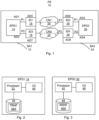
- Fig. 1 is a diagram schematically illustrating a first embodiment of an automation system AS 10 comprising a first system area SA1 12 and a second system area SA2 24.
- first system area 12 there is a first endpoint device EPD1 14 and in the second system area 24 there is a second endpoint device EPD2 30.
- first interface device ID1 16 In the first system area 12 there is also a first interface device ID1 16 and a third interface device ID3 18, while in the second system area 24 there is a second interface device ID2 26 and a fourth interface device ID4 28.
- the interface devices 16, 18, 26, 28 are interfaces of the system areas 12, 24 to communication networks used for communication between automation devices and may as an example be realized as routers. However, they may also be gateways.
- a system area has a logically flat system structure without internal routers, but with interface devices, such as routers or gateways, for external communication out of the system area.
- the first endpoint device 14 has a first IP address AD1 as well as a second IP address AD2, which are both IPv6 addresses, where IP is an acronym for Internet Protocol and IPv6 is an abbreviation for Internet Protocol version 6.
- the second endpoint device 30 has a third IP address AD3 as well as a fourth IP address AD4, which are likewise both IPv6 addresses.
- the first interface device 16 in turn has a fifth IP address AD5, the second interface device 26 has a sixth IP address, AD6, the third interface device 18 has a seventh IP address AD7 and the fourth interface device 28 has an eighth IP address AD8. These addresses are likewise all IPv6 addresses.
- the first interface device 16 communicates with the second interface device 26 via a first communication network CN1 20 and the third interface device 18 communicates with the fourth interface device 28 via a second communication network CN2 22.
- the first endpoint device 14 sends a first IPv6 packet P1 to the second endpoint device 30 in a first communication path that goes from the first endpoint device 14 to the second endpoint device 30 via the first and the second interface devices 16, 26 and the first communication network 20.
- the first endpoint device 14 also sends a second IPv6 packet P2 to the second endpoint device 30 in a second communication path that goes from the first endpoint device 14 to the second endpoint device 30 via the third and the fourth interface devices 18, 28 and the second communication network 22.
- the first and second IPv6 packets are thereby Internet Protocol packets in the Internet Layer of the Transmission Control Protocol/Internet Protocol (TCP/IP) model or network protocol packets in the Network Layer of the Open Systems Interconnection (OSI) model. It should here be realized that as an alternative there may be no second communication network but only the first communication network, to which the interface devices are all connected and through which both paths pass.
- TCP/IP Transmission Control Protocol/Internet Protocol
- OSI Open Systems Interconnection
- first automation application running in the first endpoint device 14, which first automation application may need to send data to a corresponding second automation application running in the second endpoint device 30.
- This data will in the following be referred to as automation application data AAD.
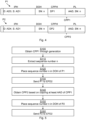
- the transmitting redundancy handling function 36A obtains a first communication protocol packet CPP1, S100, which obtaining is done through generating the first communication protocol packet CPP1.
- the communication protocol is typically User Datagram Protocol (UDP) and therefore the communication protocol packet may be a UDP packet having a UDP header with a first destination port number DP1 and a payload PL comprising the automation application data AAD that needs to be sent to the second endpoint device.
- the first communication protocol packet CPP1 typically also has a sequence number n, which sequence number is associated with the automation application data AAD and is typically also placed in the payload PL.
- the first communication protocol packet CPP1 thus has automation application data AAD for which redundancy is to be provided and a sequence number n linked to the automation application data.
- the transmitting redundancy handling function also generates a second IPv6 packet P2 with an IPv6 destination option header DOH. In order to do this it obtains a second communication protocol packet CPP2 having the same automation application data AAD and the same sequence number n, S140, which second communication protocol packet P2 is to be a part of the second IPv6 packet P2 intended for the receiving redundancy handling device.
- the second IPv6 packet is thus also to comprise the second communication protocol packet.
- the obtaining is in this case done based on copying at least the automation application data AAD of the first communication protocol packet CPP1.
- the presence of the destination option header is again indicated through the field immediately preceding the destination option header DOH comprising a predefined character combination, which again is the character combination of 60. Therefore, the transmitting redundancy handling function 36A also inserts the character combination at the end of the field that precedes the destination option header.
- the second communication protocol packet CPP2 is then placed as a payload of the second IPv6 packet.
- the second IPv6 packet P2 After the second IPv6 packet P2 has been generated in this way, it is then sent to the receiving redundancy handling device, S160, which in this embodiment is the second end point device 30.
- the sending is made in the second communication path that goes to the second endpoint device 30 via the third and the fourth interface devices 18, 28 and the second communication network 22.
- the first endpoint device When the first endpoint device sends data packets to the corresponding second endpoint device, it thus duplicates the automation application data and inserts the sequence number in the IPv6 destination option header, which s used to carry information that only needs to be examined by the destination node of the IPv6 packet. It can also be seen that the first endpoint device 14 then sends the two IPv6 packets in two different OSI layer 3 paths.
- the first and second communication protocol packets are also transport protocol packets in the transport layer of the TCP/IP or OSI models. Furthermore, it is possible that another protocol than UDP is used, such as Stream Control Transmission Protocol (SCTP).
- SCTP Stream Control Transmission Protocol
- IPv6 addresses are pre-configured by a network management protocol or using protocols such as Domain Name Server (DNS). In either case the corresponding devices can get each other interface indentities from the IPv6 addresses themselves.
- DNS Domain Name Server
- the first and second IPv6 packets P1, P2 are addressed to the receiving redundancy handling device using different IPv6 destination addresses and take different communication paths to the receiving redundancy handling device.
- the receiving redundancy handling function 46A receives the first IPv6 packet P1 that comprises the automation application data AAD and the destination option header DOH with the sequence number n associated with the automation application data AAD from the first endpoint device 14 acting as a transmitting redundancy handling device, S200.
- the receiving redundancy handling function 46A locates the destination option header DOH through detecting the preceding pre-defined character combination and then analyses this destination option header DOH of the first IPv6 packet P1 with regard to sequence number, S210. It thus detects the sequence number n that has been inserted in the destination option header DOH of the first IPv6 packet P1.
- the receiving redundancy handling function 46A also receives the second IPv6 packet P2 from the first endpoint device 14 acting as a transmitting redundancy handling device, which packet P2 comprises the same automation application data AAD and a destination option header with the same sequence number n, S220. It also locates the destination option header DOH, which is done in the same way as with the first IPv6 packet P1, and then analyses this destination option header DOH of the second IPv6 packet P2 with regard to sequence number, S230. It thus detects the sequence number that has been inserted in the destination option header DOH of the second IPv6 packet P2.
- the receiving redundancy handling function 46A thereafter determines that the sequence number n is the same in the first and the second IPv6 packet P1 and P2, S240, and then discards the first IPv6 packet or the second IPv6 packet based on the determination, S250.
- the discarding of the first IPv6 packet P1 or the second IPv6 packet P2 may be the discarding of the first or the second IPv6 packet, whichever is received later than the other.
- the one of the first and the second IPv6 packet that is discarded may thus be the packet that is received after the other.
- the receiving redundancy handling function 46A thus discards one of the two packets, which may be the one that is received after the other.
- the automation application data AAD of the other retained IPv6 packet is in turn provided to the second automation application in the second endpoint device 30.
- the second endpoint device 30 determines if it has already received an IPv6 packet with the same source address and sequence number. If it has, then it discards the packet otherwise it processes the automation application data.
- the endpoint devices perform duplication and elimination of IPv6 packet (which contain the automation application data) and achieve end to end seamless network redundancy by utilizing IPv6 destination option extension header.
- the second endpoint device 30 receives redundant packets with the automation application data AAD from the first endpoint device, which thus increases the reliability of the data transfer.
- This reliability is increased by the use of completely separated paths between the endpoint devices.
- IPv6 IPv6
- these packets can be sent without address translations.
- the redundant or superfluous packet can be quickly discarded merely through investigating this destination option header. Time is thereby saved in the further processing of the packet, if it is a duplicate. There is thus no need for analysing the communication protocol packet or its payload, which may involve more and slower processing.
- Fig. 7 schematically illustrates a second embodiment of the automation system 10, which comprises the first system area SA1 12 and the second system area SA2 24 with the first endpoint device EDP1 14 and the second endpoint device EPD2 30.
- the first system area 12 also comprises the first interface device ID1 16 and the second system area 24 comprises the second interface device ID2 26.
- the third and the fourth interface devices are omitted.
- the first endpoint device 14 has the first IP address AD1 and the second IP address AD2, which may again both be IPv6 addresses. However, they may also be IPv4 addresses.
- the second IP address AD2 may also be omitted.
- the second endpoint device 30 has the third IP address AD3 as well as the fourth IP address AD4, which may likewise both be, but are not limited to IPv6 addresses. Also the fourth IP address may be omitted.
- the first interface device 16 again has the fifth IP address AD5 and the second interface device 26 has the sixth IP address AD6, which are IPv6 addresses. It is here possible that the second interface device 26 has a further IP address.
- the first interface device 16 communicates with the second interface device 26 via a first communication path through the first communication network CN1 20 as well as via a second communication path through the first communication network CN1 20.
- the first endpoint device 14 sends a first original IP packet OP1 and a second original IP packet OP2 to the first interface device 16, which in turn sends the first IPv6 packet P1 to the second interface device 26 via the first communication path and the second IPv6 packet P2 to the second interface device 26 via the second communication path.
- the second interface device 26 also sends an IP packet, for instance a third IPv6 packet P3, to the second endpoint device 30.
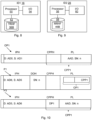
- Fig. 8 schematically shows a variation of the first interface device ID1 16. It comprises a third processor 50 connected to a third memory 52 with computer instructions implementing a second version of the transmitting redundancy handling function TRHF 36B.
- the computer instructions may be computer program code of a computer program, where the computer program code implements the second version of the transmitting redundancy handling function 36B when being run by the third processor 50.
- the third memory 52 may also be considered to be a data carrier with the computer program code used to implement the second version of the transmitting redundancy handling function 36B. In this case the data carrier with computer program code implementing the second version of the transmitting redundancy handling function 36B may also be considered to form a computer program product.
- the first interface device 16 also comprises a third Input/Output interface I/O 54 for communicating with other devices such as the first endpoint device 14.
- Fig. 9 schematically shows a variation of the second interface device ID2 26. It comprises a fourth processor 56 connected to a fourth memory 58 with computer instructions implementing a second version of the receiving redundancy handling function RRHF 46B.
- the combination of fourth processor 56 and fourth memory 58 is one realization of hardware used to implement the second version of the receiving redundancy handling function 46B.
- the fourth memory 58 may also be considered to be a data carrier with the computer program code used to implement the second version of the receiving redundancy handling function 46B. In this case the data carrier with computer program code implementing the second version of the receiving redundancy handling function 46B may also be considered to form a computer program product.
- the second interface device 26 also comprises a second Input/Output interface I/O 60 for communicating with other devices such as the second endpoint device 30.
- the first and second endpoint devices 14, 30 may in this case also be controllers needing to communicate with each other. They may also able to generate duplicate data packets, for instance according to the PRP protocol. However, they may not be able to handle duplicate packets in a simple and efficient fashion.
- the first endpoint device 14 is an automation application data generation device
- the second endpoint device 30 is an automation application data reception device
- the first interface device 16 is a transmitting redundancy handling device in the first system area 12
- the second interface device 26 is a receiving redundancy handling device in the second system area 24, where the first interface device 16 comprises the second version of the transmitting redundancy handling function 36B and the second interface device 26 comprises the second version of the receiving redundancy handling function 46B, which functions together allow such redundancy to be implemented.
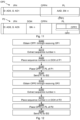
- fig. 10 schematically shows the first original IP packet OP1 sent from the first endpoint device 14 to the first interface device 16, the first IPv6 packet P1 sent from the first interface device 16 to the second interface device 26 and the third packet P3 sent from the second interface device 26 to the second endpoint device 30, fig. 11 schematically shows the second original IP packet OP2 sent from the first endpoint device 14 to the first interface device 16 and the second IPv6 packet P2 sent from the first interface device 16 to the second interface device 26, fig.
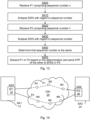
- FIG. 12 schematically shows a flow chart of a number of method steps in a second embodiment of the method of handling redundancy for packets transmitted from the first system area 12 to the second system area 24 and fig. 13 schematically shows a flow chart of a number of method steps in a second embodiment of the method of handling redundancy for packets received in the second system area 24 from the first system area 12.
- the first endpoint device 14 sends redundant data to the second endpoint device 30, for instance in PRP frames. For this it only needs to use the first IP address AD1 and not the second IP address AD2. It is additionally possible that the second endpoint device 30 only uses the third IP address AD3.
- the first endpoint device 14 is here a first endpoint and the second endpoint device 30 is a second endpoint of automation application data communicated between the first and second system areas 12, 24.
- the first interface device 16 is a transmitting redundancy handling device
- the second interface device 26 is a receiving redundancy handling device.
- the first and second interface devices 16 and 26 may be routers, like in the first embodiment. However, it is also or instead possible that they are gateways or connection servers. It is also possible that a transmitting redundancy handling device and a receiving redundancy handling device are separate devices that are connected between an endpoint device and a corresponding interface device, such as a router or a gateway.
- the first endpoint device 14 When the first endpoint device 14 has data that it needs to provide redundantly to the second endpoint device 30, it sends the first and the second original IP packets OP1, OP2 to the first interface device 16 that acts as a transmitting redundancy handling device.
- the first and second original IP packets OP1, OP2, which are also Internet Protocol packets in the Internet Layer of the TCP/IP model or network protocol packets in the Network Layer of the OSI model, are thus addressed to the transmitting redundancy handling device, where the first original packet IP OP1 comprises an IP header IPH with the first address AD1 of the first endpoint device 14 as the source address and the fifth address AD5 of the first interface device 16 acting as a transmitting redundancy handling device as destination address.
- the second original IP packet OP2 with redundant automation application data in a similar manner comprises an IP header IPH with the first address AD1 of the first endpoint device 14 as the source address and the fifth address AD5 of the first interface device 16 acting as a transmitting redundancy handling device as destination address .
- the second original IP packet OP2 also comprises a second communication protocol packet CPP2 with a payload PL comprising the automation application data AAD together with a PRP trailer.
- sequence number n that is associated with the automation application data AAD, which sequence number n is placed in the PRP trailer of the second communication protocol packet CCP2.
- the packets will be received by the first interface device 16 and more particularly by the transmitting redundancy handling function 36B of the first interface device 16, which thereby obtains the first communication protocol packet CCP1 through receiving the first original IP packet OP1, S300, which first communication protocol packet CPP1 comprises automation application data AAD for which redundancy is to be provided and a sequence number n linked to the automation application data.
- the transmitting redundancy handling function 36B After having received the first communication protocol packet CPP1, the transmitting redundancy handling function 36B starts operation in a first processing path in which it first extracts the sequence number n from the first communication protocol packet, S310, and more particularly from the PRP trailer of the first communication protocol packet CPP1. Also in this second embodiment the transmitting redundancy handling function 36B generates the first IPv6 packet P1 with an IPv6 destination option header.
- the packet P1 is intended for or to be sent to the receiving redundancy handling function 46B of the second interface device 26 acting as receiving redundancy handling device.
- the first IPv6 packet P1 has an IPv6 header comprising a destination address and a source address.
- the destination address is in this case the sixth IP address AD6 of the second interface device 26, while the source address is the fifth IP address AD5 of the first interface device 16.
- the first IPv6 packet P1 also comprises the destination option header DOH, which is also here indicated through the field immediately preceding the destination option header DOH comprising a predefined character combination, here 60. Thereafter the transmitting redundancy handling function 36B inserts or places the sequence number n in the destination option header DOH of the first IPv6 packet P1 intended for the receiving redundancy handling device, S320.
- the first IPv6 packet is also to comprise the first communication protocol packet CPP1. Therefore, the first communication protocol packet CPP1 is placed in the payload PL of the first IPv6 packet P1, S330. Thereby the PRP packet is tunnelled in the first IPv6 packet P1. It is here possible that the complete first original IP packet OP1 is tunnelled in the payload.
- the first processing path is finished by the transmitting redundancy handling function 36B sending it to the second interface device 26 acting as a receiving redundancy handling device, S340.
- the sending is made to the second interface device 26 in the first communication path through the first communication network 20.
- the transmitting redundancy handling function 36B also obtains the second communication protocol packet CPP2 having the same automation application data AAD and the same sequence number n, S350, which in a similar manner is done through receiving the second original IP packet OP2 that comprises the second communication protocol packet CPP2.
- the transmitting redundancy handling function 36B then processes the second communication protocol packet CPP2 in a second processing path, which processing involves the generating of the second IPv6 packet P2 intended for second interface device 26 acting as receiving redundancy handling device with an IPv6 destination option header.
- the second IPv6 packet P2 is also provided with the second communication protocol packet CPP2 as well as with an IPv6 header with a destination address that is the sixth address AD6 of the second interface device 26 and a source address that is the fifth address AD5 of the first interface device 16.
- the generated second IPv6 packet P2 also comprises the destination option header DOH.
- the transmitting redundancy handling function 36B extracts the sequence number n from the second communication protocol packet CPP2, S360, and inserts or places it in the destination option header DOH of the second IPv6 packet P2, S370.
- the destination option header DOH of the second IPv6 packet P2 includes the sequence number n that is the same as the sequence number in the destination option header DOH of the first IPv6 packet P1.
- the presence of the destination option header is indicated in the same way as in the first IPv6 packet P1.
- the second communication protocol packet CPP2 is also here placed as a payload of the second IPv6 packet, S380.
- the processing in the second processing path is ended through sending the second IPv6 packet P2 to the second interface device 26 acting as receiving redundancy handling device, S390, which sending is made in the second communication path through the first communication network 20.
- the first endpoint device may send duplicated PRP frames to the transmitting redundancy handling device, which may be a gateway such as a connectivity server.
- the transmitting redundancy handling device can then tunnel the PRP frames in the IPv6 packets and insert the sequence number in the destination option header and send them via two different layer 3 paths to the receiving redundancy handling device.
- the second original packet OP2 may be received before the first original packet OP1 and that the transmitting redundancy handling function 36B may start to process a received packet as soon as it is being received. Therefore, the two processing paths are in fact performed independently of each other even though the method is shown as a sequence of consecutive steps.
- the receiving redundancy handling function 46B receives the first IPv6 packet P1 that comprises the automation application data AAD and destination option header DOH with the associated sequence number n from the first interface device 16 acting as a transmitting redundancy handling device, S400. It then locates the destination option header DOH through detecting the preceding pre-defined character combination and then analyses this destination option header DOH of the first IPv6 packet P1 with regard to sequence number, S410. Thereby it detects the sequence number n that has been inserted in the destination option header DOH of the first IPv6 packet P1.
- the receiving redundancy handling function 46B also receives the second IPv6 packet P2 that comprises the same automation application data AAD and a destination option header with the same sequence number n from the first interface device 16 acting as a transmitting redundancy handling device, S420. It also locates the destination option header DOH of this packet P2, which is done in the same way as with the first IPv6 packet P1, and then analyses this destination option header DOH of the second IPv6 packet P2 with regard to sequence number, S430. It thus also detects the sequence number that has been inserted in the destination option header DOH of the second IPv6 packet P2. It then determines that the sequence number is the same in the two IPv6 packets P1 P2 through comparing the two extracted sequence numbers, S440. Based on the determination, the receiving redundancy handling function 46A then discards the first IPv6 packet or the second IPv6 packet and sends the communication protocol packet of the other to the second endpoint device 30, S450.
- the discarding of the first IPv6 packet or the second IPv6 packet may be the discarding of the first or the second IPv6 packet, whichever is received later than the other.
- the one of the first and the second IPv6 packet that is discarded may thus be the packet that is received after the other.
- the receiving redundancy handling function 46B may do this through storing the sequence number of the first received of the two IPv6 packets and discarding the other packet after identifying that it has the same sequence number.
- the communication protocol packet of the other non-discarded IPv6 packet is sent to the second endpoint device 30.
- the communication protocol packet being sent to the second endpoint device 30 is thus the communication protocol packet in the first or second IPv6 packet P1, P2 that is received first.
- the first communication protocol packet CPP1 in the first IPv6 packet P1 may be sent to the second endpoint device 30 in a third packet P3, which may be the first original IP packet OP1 or a new packet comprising the first communication protocol packet CPP1, where in case the third packet P3 being a new packet it may have the third address AD3 of the second endpoint device 30 as destination address and the sixth address AD6 of the second interface device 26 acting as receiving redundancy handling device as a source address.
- the third packet P3 is an Internet Protocol packet in the Internet Layer of the TCP/IP model or a network protocol packet in the Network Layer of the OSI model.
- the second interface device may also have two different IPv6 addresses and the first interface device may send the first IPv6 packet to the second interface device via one of the communication networks using one of these IPv6 addresses and the second IPv6 packet to the second interface device via the other communication network using the other IPv6 address.
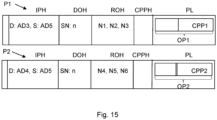
- fig. 14 shows a variation of the automation system 10 in which the two communication paths pass through different nodes of the first communication network 20 and fig. 15 shows the first and the second IPv6 packets P1, P2 that are sent along the different paths in fig. 14 .
- the first and second IPv6 packet P1, P2 comprise a further extension header in the form of an IPv6 routing header ROH.
- a header is included in a packet when the immediately preceding field comprises a predefined character combination, which as an example is the character combination of 43.
- the transmission redundancy handling function generates the packets P1, P2 with an IPv6 routing header ROH and inserts, in the IPv6 routing header ROH, identifiers of nodes that that the packet is to pass when travelling from the transmission redundancy handling device that implements the transmission redundancy handling function to the receiving redundancy handling device that implements the receiving redundancy handing function, which devices are the first and the second endpoint devices in the first embodiment and the first and the second interface devices in the second embodiment.
- the transmission redundancy handling function thus indicates intermediate nodes of the automation system that the IPv6 packets are to pass when traveling along the corresponding communication path.
- the transmission redundancy handling function more particularly ensures that all intermediate nodes of the first and the second paths specified in the first and the second IPv6 packet P1, P2 differ from each other.
- the ensuring thus comprises setting different nodes in the IPv6 routing header ROH of the first and second IPv6 packets P1, P2. None of the specified nodes is thereby present in both of the paths.
- the first IPv6 packet P1 is to pass a first, second and third node N1, N2 and N3 between its source and destination, while the second IPv6 packet P2 is to pass a fourth, fifth and sixth node N4, N5 and N6 between the source and destination.
- the routing header of the duplicate packets contains different intermediate router addresses so that the packets traverse two different paths without any joint intermediate nodes.
- the end devices are configured with the intermediate addresses.
Landscapes
- Engineering & Computer Science (AREA)
- Computer Networks & Wireless Communication (AREA)
- Signal Processing (AREA)
- Computer Security & Cryptography (AREA)
- Data Exchanges In Wide-Area Networks (AREA)
Claims (15)
- Übertragungsredundanzhandhabungsvorrichtung (14; 16) für einen ersten Systembereich (12) eines Automatisierungssystems (10) und zum Kommunizieren mit einer Empfangsredundanzhandhabungsvorrichtung (30; 26) in einem zweiten Systembereich (24) des Automatisierungssystems (10), wobei die Übertragungsredundanzhandhabungsvorrichtung (14; 16) eine Übertragungsredundanzhandhabungsfunktion (36A; 36B) implementiert, die für Folgendes konfiguriert ist:Erhalten eines ersten Kommunikationsprotokollpakets (CPP1) mit Automatisierungsanwendungsdaten (AAD), für die eine Redundanz bereitzustellen ist, und einer mit den Automatisierungsanwendungsdaten (AAD) verknüpften Folgenummer (n);Extrahieren der Folgenummer (n) aus dem ersten Kommunikationsprotokollpaket (CPP1);Einfügen der Folgenummer (n) in einem Zieloptionsheader (DOH) eines ersten IPv6-Pakets (P1), das für die Empfangsredundanzhandhabungsvorrichtung (30; 26) vorgesehen ist, wobei das erste IPv6-Paket (P1) auch das erste Kommunikationsprotokollpaket (CPP1) umfasst;Senden des ersten IPv6-Pakets (P1) an die Empfangsredundanzhandhabungsvorrichtung (30; 26);Erhalten eines zweiten Kommunikationsprotokollpakets (CPP2) mit den gleichen Automatisierungsanwendungsdaten (AAD) und der gleichen Folgenummer (n);Einfügen der Folgenummer (n) in einem Zieloptionsheader (DOH) eines zweiten IPv6-Pakets (P2), das für die Empfangsredundanzhandhabungsvorrichtung (30; 26) vorgesehen ist, wobei das zweite IPv6-Paket (P2) auch das zweite Kommunikationsprotokollpaket (CPP2) umfasst; undSenden des zweiten IPv6-Pakets (P2) an die Empfangsredundanzhandhabungsvorrichtung (30; 26).
- Übertragungsredundanzhandhabungsvorrichtung (14; 16) nach Anspruch 1, wobei das erste und das zweite IPv6-Paket (P1, P2) je einen IPv6-Routingheader (ROH) umfassen, der Zwischenknoten des Automatisierungssystems (10), die die IPv6-Pakete (P1, P2) auf ihrem Weg von der Übertragungs- zu der Empfangsredundanzhandhabungsvorrichtung (14, 30; 16, 26) zu passieren haben, anzeigt, und die Übertragungsredundanzhandhabungsfunktion (36A; 36B) ferner konfiguriert ist, um sicherzustellen, dass sich alle in dem ersten und dem zweiten IPv6-Paket (P1, P2) angegebenen Zwischenknoten voneinander unterscheiden.
- Übertragungsredundanzhandhabungsvorrichtung (14) nach Anspruch 1 oder 2, wobei das erste Kommunikationsprotokollpaket (CCP1) dadurch erhalten wird, dass es durch die Übertragungsredundanzhandhabungsfunktion (36A) generiert wird, und das zweite Kommunikationsprotokollpaket (CCP2) basierend auf dem Kopieren mindestens der Automatisierungsanwendungsdaten (AAD) des ersten Kommunikationsprotokollpakets (CCP1) erhalten wird.
- Übertragungsredundanzhandhabungsvorrichtung (16) nach Anspruch 1 oder 2, wobei das erste und das zweite Kommunikationsprotokollpaket (CPP1, CPP2) von einer ersten Endpunktvorrichtung (14) empfangen werden, für eine mit der Empfangsredundanzhandhabungsvorrichtung (26) verbundene zweite Endpunktvorrichtung (30) vorgesehen sind und in den Nutzdaten (PL) des ersten und des zweiten IPv6-Pakets (P1, P2) eingefügt werden.
- Verfahren zum Handhaben einer Redundanz für von einem ersten Systembereich (12) eines Automatisierungssystems (10) an einen zweiten Systembereich (24) des Automatisierungssystems (10) übertragene Pakete, wobei das Verfahren durch eine Übertragungsredundanzhandhabungsfunktion (36A; 36B) einer Übertragungsredundanzhandhabungsvorrichtung (14; 16) in dem ersten Systembereich (12) durchgeführt wird und Folgendes umfasst:Erhalten (S100; S300) eines ersten Kommunikationsprotokollpakets (CPP1) mit Automatisierungsanwendungsdaten (AAD), für die eine Redundanz bereitzustellen ist, und einer mit den Automatisierungsanwendungsdaten (AAD) verknüpften Folgenummer (n);Extrahieren (S110; S310) der Folgenummer (n) aus dem ersten Kommunikationsprotokollpaket (CPP1);Einfügen (120; 320) der Folgenummer (n) in einem Zieloptionsheader (DOH) eines ersten IPv6-Pakets (P1), das für eine Empfangsredundanzhandhabungsvorrichtung (30; 26) in dem zweiten Systembereich (24) vorgesehen ist, wobei das erste IPv6-Paket (P1) auch das erste Kommunikationsprotokollpaket (CPP1) umfasst;Senden (S130; S340) des ersten IPv6-Pakets an die Empfangsredundanzhandhabungsvorrichtung (30; 26);Erhalten (S140; S350) eines zweiten Kommunikationsprotokollpakets (CPP2) mit den gleichen Automatisierungsanwendungsdaten (AAD) und der gleichen Folgenummer (n);Einfügen (S150; S370) der Folgenummer (n) in einem Zieloptionsheader (DOH) eines zweiten IPv6-Pakets (P2), das für die Empfangsredundanzhandhabungsvorrichtung (30; 26) vorgesehen ist, wobei das zweite IPv6-Paket (P2) auch das zweite Kommunikationsprotokollpaket (CPP2) umfasst; undSenden (S160; S390) des zweiten IPv6-Pakets an die Empfangsredundanzhandhabungsvorrichtung (30; 26).
- Verfahren nach Anspruch 5, wobei die erste und die zweite IPv6-Nachricht (P1, P2) je einen IPv6-Routingheader (ROH) umfassen, der Zwischenknoten des Automatisierungssystems (10), die die IPv6-Pakete auf ihrem Weg von der Übertragungs- zu der Empfangsredundanzhandhabungsvorrichtung (14, 30; 16, 26) zu passieren haben, anzeigt, und ferner umfassend Sicherstellen, dass sich alle in dem ersten und dem zweiten IPv6-Paket angegebenen Zwischenknoten voneinander unterscheiden.
- Verfahren nach Anspruch 5 oder 6, wobei das Erhalten des ersten Kommunikationsprotokollpakets das Generieren (S100) des ersten Kommunikationsprotokollpakets (CPP1) umfasst und das Erhalten des zweiten Kommunikationsprotokollpakets (CPP2) das Kopieren (S140) mindestens der Automatisierungsanwendungsdaten (AAD) des ersten Kommunikationsprotokollpakets (CPP1) umfasst.
- Verfahren nach Anspruch 5 oder 6, wobei das erste und das zweite Kommunikationsprotokollpaket (CPP1, CPP2) von einer ersten Endpunktvorrichtung (14) empfangen werden (S300; S350) und für eine mit der Empfangsredundanzhandhabungsvorrichtung (26) verbundene zweite Endpunktvorrichtung (30) vorgesehen sind, und ferner umfassend Einfügen (S330) des ersten Kommunikationsprotokollpakets (CPP1) in Nutzdaten (PL) des ersten IPv6-Pakets (P1), Extrahieren (S360) der Folgenummer (n) aus dem zweiten Kommunikationsprotokollpaket (CPPL) und Einfügen (S380) des zweiten Kommunikationsprotokollpakets (CPP2) in Nutzdaten (PL) des zweiten IPv6-Pakets (P2).
- Computerprogramm zum Handhaben einer Redundanz für von einem ersten Systembereich (12) eines Automatisierungssystems (10) an einen zweiten Systembereich (24) des Automatisierungssystems (10) übertragene Pakete, wobei das Computerprogramm Computerprogrammcode umfasst, der, wenn er von einem Prozessor (32; 50) ausgeführt wird, eine Übertragungsredundanzhandhabungsfunktion (36A; 36B) einer Übertragungsredundanzhandhabungsvorrichtung (14; 16) in dem ersten Systembereich (12) implementiert, die für Folgendes konfiguriert ist:Erhalten eines ersten Kommunikationsprotokollpakets (CPP1) mit Automatisierungsanwendungsdaten (AAD), für die eine Redundanz bereitzustellen ist, und einer mit den Automatisierungsanwendungsdaten (AAD) verknüpften Folgenummer (n);Extrahieren der Folgenummer (n) aus dem ersten Kommunikationsprotokollpaket (CPP1);Einfügen der Folgenummer (n) in einem Zieloptionsheader (DOH) eines ersten IPv6-Pakets (P1), das für eine Empfangsredundanzhandhabungsvorrichtung (30; 26) in dem zweiten Systembereich (24) vorgesehen ist, wobei das erste IPv6-Paket (P1) auch das erste Kommunikationsprotokollpaket (CPP1) umfasst;Senden des ersten IPv6-Pakets an eine Empfangsredundanzhandhabungsvorrichtung (30; 26);Erhalten eines zweiten Kommunikationsprotokollpakets (CPP2) mit den gleichen Automatisierungsanwendungsdaten (AAD) ;Einfügen der Folgenummer (n) in einem Zieloptionsheader (DOH) eines zweiten IPv6-Pakets (P2), das für die Empfangsredundanzhandhabungsvorrichtung (30; 26) vorgesehen ist, wobei das zweite IPv6-Paket (P2) auch das zweite Kommunikationsprotokollpaket (CPP2) umfasst; undSenden des zweiten IPv6-Pakets (P2) an die Empfangsredundanzhandhabungsvorrichtung (30; 26).
- Computerprogrammprodukt zum Handhaben einer Redundanz für von einem ersten Systembereich (12) eines Automatisierungssystems (10) an einen zweiten Systembereich (24) des Automatisierungssystems (10) übertragene Pakete, wobei das Computerprogrammprodukt einen Datenträger (34; 52) mit dem Computerprogrammcode nach Anspruch 9 umfasst.
- Empfangsredundanzhandhabungsvorrichtung (30; 26) für einen zweiten Systembereich (24) eines Automatisierungssystems (10) und zum Kommunizieren mit einer Übertragungsredundanzhandhabungsvorrichtung (14; 16) eines ersten Systembereichs (12) des Automatisierungssystems (10), wobei die Empfangsredundanzhandhabungsvorrichtung (30; 26) eine Empfangsredundanzhandhabungsfunktion (46A; 46B) implementiert, die für Folgendes konfiguriert ist:Empfangen eines ersten IPv6-Pakets (P1) von der Übertragungsredundanzhandhabungsvorrichtung (14; 16), wobei das erste IPv6-Paket (P1) Automatisierungsanwendungsdaten (AAD) und einen Zieloptionsheader (DOH) umfasst, der eine mit den Automatisierungsanwendungsdaten (AAD) verknüpfte Folgenummer (n) enthält;Analysieren des Zieloptionsheaders (DOH) des ersten IPv6-Pakets (P1) mit Bezug auf eine Folgenummer;Empfangen eines zweiten IPv6-Pakets (P2) von der Übertragungsredundanzhandhabungsvorrichtung (14; 16), das die gleichen Automatisierungsanwendungsdaten (AAD) und einen Zieloptionsheader (DOH) mit der gleichen Folgenummer (n) umfasst;Analysieren des Zieloptionsheaders (DOH) des zweiten IPv6-Pakets (P2) mit Bezug auf eine Folgenummer;Bestimmen, dass die Folgenummer in dem ersten und dem zweiten IPv6-Paket (P1, P2) die gleiche ist; undVerwerfen des ersten IPv6-Pakets (P1) oder des zweiten IPv6-Pakets (P2) basierend auf der Bestimmung.
- Verfahren zum Handhaben einer Redundanz für in einem zweiten Systembereich (24) eines Automatisierungssystems (10) von einem ersten Systembereich (12) des Automatisierungssystems (10) empfangene Pakete, wobei das Verfahren durch eine Empfangsredundanzhandhabungsfunktion (46A; 46B) einer Empfangsredundanzhandhabungsvorrichtung (30; 26) durchgeführt wird und Folgendes umfasst:Empfangen (S200; S400) eines ersten IPv6-Pakets (P1) von einer Übertragungsredundanzhandhabungsvorrichtung (14; 16) des ersten Systembereichs (12), wobei das erste IPv6-Paket (P1) Automatisierungsanwendungsdaten (AAD) und einen Zieloptionsheader (DOH) umfasst, der eine mit den Automatisierungsanwendungsdaten (AAD) verknüpfte Folgenummer (n) enthält;Analysieren (S210; S410) des Zieloptionsheaders (n) des ersten IPv6-Pakets (P1) mit Bezug auf eine Folgenummer (n);Empfangen (S220; S420) eines zweiten IPv6-Pakets (P2) von der Übertragungsredundanzhandhabungsvorrichtung (14; 16), das die gleichen Automatisierungsanwendungsdaten (AAD) und einen Zieloptionsheader (DOH) mit der gleichen Folgenummer (n) umfasst;Analysieren (S230; S430) des Zieloptionsheaders (DOH) des zweiten IPv6-Pakets (P2) mit Bezug auf eine Folgenummer; Bestimmen (S240; S440), dass die Folgenummer in dem ersten und dem zweiten IPv6-Paket (P1, P2) die gleiche ist; undVerwerfen (S250; S450) des ersten IPv6-Pakets (P1) oder des zweiten IPv6-Pakets (P2) basierend auf der Bestimmung.
- Computerprogramm zum Handhaben einer Redundanz in in einem zweiten Systembereich (24) eines Automatisierungssystems (10) von einem ersten Systembereich (12) des Automatisierungssystems (10) empfangenen Paketen;
wobei das Computerprogramm Computerprogrammcode umfasst, der, wenn er von einem Prozessor (42; 56) ausgeführt wird, eine Empfangsredundanzhandhabungsfunktion (46A; 46B) einer Empfangsredundanzhandhabungsvorrichtung (30; 26) in dem zweiten Systembereich (24) implementiert und für Folgendes konfiguriert ist:Empfangen eines ersten IPv6-Pakets (P1) von einer Übertragungsredundanzhandhabungsvorrichtung (14; 16) des ersten Systembereichs (12), wobei das erste IPv6-Paket (P1) Automatisierungsanwendungsdaten (AAD) und einen Zieloptionsheader (DOH) umfasst, der eine mit den Automatisierungsanwendungsdaten (AAD) verknüpfte Folgenummer (n) umfasst;Analysieren des Zieloptionsheaders (n) des ersten IPv6-Pakets (P1) mit Bezug auf eine Folgenummer (n);Empfangen eines zweiten IPv6-Pakets (P2) von der Übertragungsredundanzhandhabungsvorrichtung (14; 16), das die gleichen Automatisierungsanwendungsdaten (AAD) und einen Zieloptionsheader (DOH) mit der gleichen Folgenummer (n) umfasst;Analysieren des Zieloptionsheaders (DOH) des zweiten IPv6-Pakets (P2) mit Bezug auf eine Folgenummer;Bestimmen, dass die Folgenummer in dem ersten und dem zweiten IPv6-Paket (P1, P2) die gleiche ist; undVerwerfen des ersten IPv6-Pakets (P1) oder des zweiten IPv6-Pakets (P2) basierend auf der Bestimmung. - Computerprogrammprodukt zum Handhaben einer Redundanz in in einem zweiten Systembereich (24) eines Automatisierungssystems (10) von einem ersten Systembereich (12) des Automatisierungssystems (10) empfangenen Paketen, wobei das Computerprogrammprodukt einen Datenträger (44; 58) mit dem Computerprogrammcode nach Anspruch 13 umfasst.
- Automatisierungssystem (10), das Folgendes umfasst:einen ersten Systembereich (12), der eine Übertragungsredundanzhandhabungsvorrichtung (14; 16) umfasst, und einen zweiten Systembereich (24), der eine Empfangsredundanzhandhabungsvorrichtung (30; 26) umfasst,wobei die Übertragungsredundanzhandhabungsvorrichtung (14; 16) eine Übertragungsredundanzhandhabungsfunktion (36A; 36B) implementiert, die für Folgendes konfiguriert ist:Erhalten eines ersten Kommunikationsprotokollpakets (CPP1) mit Automatisierungsanwendungsdaten (AAD), für die eine Redundanz bereitzustellen ist, und einer mit den Automatisierungsanwendungsdaten (AAD) verknüpften Folgenummer (n);Extrahieren der Folgenummer (n) aus dem ersten Kommunikationsprotokollpaket (CPP1);Einfügen der Folgenummer (n) in einem Zieloptionsheader (DOH) eines ersten IPv6-Pakets (P1), das für die Empfangsredundanzhandhabungsvorrichtung (30; 26) vorgesehen ist, wobei das erste IPv6-Paket (P1) auch das erste Kommunikationsprotokollpaket (CPP1) umfasst;Senden des ersten IPv6-Pakets (P1) an die Empfangsredundanzhandhabungsvorrichtung (30; 26);Erhalten eines zweiten Kommunikationsprotokollpakets (CPP2) mit den gleichen Automatisierungsanwendungsdaten (AAD) und der gleichen Folgenummer (n);Einfügen der Folgenummer (n) in einem Zieloptionsheader (DOH) eines zweiten IPv6-Pakets (P2), das für die Empfangsredundanzhandhabungsvorrichtung (30; 26) vorgesehen ist, wobei das zweite IPv6-Paket (P2) auch das zweite Kommunikationsprotokollpaket (CPP2) umfasst; undSenden des zweiten IPv6-Pakets (P2) an die Empfangsredundanzhandhabungsvorrichtung (30; 26);wobei die Empfangsredundanzhandhabungsvorrichtung (30; 25) eine Empfangsredundanzhandhabungsfunktion (46A; 46B) implementiert, die für Folgendes konfiguriert ist:Empfangen des ersten IPv6-Pakets (P1) von der Übertragungsredundanzhandhabungsvorrichtung (14; 16);Analysieren des Zieloptionsheaders (DOH) des ersten IPv6-Pakets (P1) mit Bezug auf eine Folgenummer;Empfangen des zweiten IPv6-Pakets (P2) von der Übertragungsredundanzhandhabungsvorrichtung (14; 16);Analysieren des Zieloptionsheaders (DOH) des zweiten IPv6-Pakets (P2) mit Bezug auf eine Folgenummer;Bestimmen, dass die Folgenummer in dem ersten und dem zweiten IPv6-Paket (P1, P2) die gleiche ist; undVerwerfen des ersten IPv6-Pakets (P1) oder des zweiten IPv6-Pakets (P2) basierend auf der Bestimmung.
Priority Applications (3)
| Application Number | Priority Date | Filing Date | Title |
|---|---|---|---|
| EP22196108.9A EP4340335B1 (de) | 2022-09-16 | 2022-09-16 | Redundanz in einem automatisierungssystem, das mehr als einen systembereich abdeckt |
| US18/465,460 US12267406B2 (en) | 2022-09-16 | 2023-09-12 | Redundancy in an automation system covering more than one system area |
| CN202311192231.2A CN117724324A (zh) | 2022-09-16 | 2023-09-15 | 覆盖多于一个系统区域的自动化系统中的冗余 |
Applications Claiming Priority (1)
| Application Number | Priority Date | Filing Date | Title |
|---|---|---|---|
| EP22196108.9A EP4340335B1 (de) | 2022-09-16 | 2022-09-16 | Redundanz in einem automatisierungssystem, das mehr als einen systembereich abdeckt |
Publications (2)
| Publication Number | Publication Date |
|---|---|
| EP4340335A1 EP4340335A1 (de) | 2024-03-20 |
| EP4340335B1 true EP4340335B1 (de) | 2025-03-26 |
Family
ID=83594376
Family Applications (1)
| Application Number | Title | Priority Date | Filing Date |
|---|---|---|---|
| EP22196108.9A Active EP4340335B1 (de) | 2022-09-16 | 2022-09-16 | Redundanz in einem automatisierungssystem, das mehr als einen systembereich abdeckt |
Country Status (3)
| Country | Link |
|---|---|
| US (1) | US12267406B2 (de) |
| EP (1) | EP4340335B1 (de) |
| CN (1) | CN117724324A (de) |
Family Cites Families (4)
| Publication number | Priority date | Publication date | Assignee | Title |
|---|---|---|---|---|
| US116146A (en) | 1871-06-20 | Improvement in fire-places | ||
| US10778779B2 (en) * | 2016-06-17 | 2020-09-15 | Huawei Technologies Co., Ltd. | Method and system for session management for ultra reliable and low latency communications in high mobility scenarios |
| US11336564B1 (en) * | 2021-09-01 | 2022-05-17 | Schweitzer Engineering Laboratories, Inc. | Detection of active hosts using parallel redundancy protocol in software defined networks |
| US12323244B2 (en) * | 2021-12-23 | 2025-06-03 | Intel Corporation | Enhanced redundancy over Wi-Fi for ultra-reliable wireless time-sensitive networking |
-
2022
- 2022-09-16 EP EP22196108.9A patent/EP4340335B1/de active Active
-
2023
- 2023-09-12 US US18/465,460 patent/US12267406B2/en active Active
- 2023-09-15 CN CN202311192231.2A patent/CN117724324A/zh active Pending
Also Published As
| Publication number | Publication date |
|---|---|
| US20240098162A1 (en) | 2024-03-21 |
| EP4340335A1 (de) | 2024-03-20 |
| CN117724324A (zh) | 2024-03-19 |
| US12267406B2 (en) | 2025-04-01 |
Similar Documents
| Publication | Publication Date | Title |
|---|---|---|
| US10200264B2 (en) | Link status monitoring based on packet loss detection | |
| EP3342127B1 (de) | Netzpaketflussregler mit erweiterter sitzungsverwaltung | |
| US20240333632A1 (en) | Flow modification including shared context | |
| EP3231160B1 (de) | Zustandsorientierter lastausgleich in einem zustandslosen netzwerk | |
| US5740375A (en) | Forwarding internetwork packets by replacing the destination address | |
| US10257061B2 (en) | Detecting source network address translation in a communication system | |
| CN112154627B (zh) | 服务相关的路由方法和装置 | |
| WO2006101823A2 (en) | System and method for routing isis traffic through unidirectional links of a computer network | |
| WO2017209944A1 (en) | Session continuity in the presence of network address translation | |
| US20030112753A1 (en) | Router, terminal apparatus, communication system and routing method | |
| US8526435B2 (en) | Packet node for applying service path routing at the MAC layer | |
| JP2004312683A (ja) | IPv6においてインターフェースIDを利用したルーティングテーブル管理方法及びシステム | |
| KR20000076845A (ko) | Ip 데이터 전송 시스템의 다중 arp 기능 | |
| JPH09331348A (ja) | ネットワーク間接続装置 | |
| EP4340335B1 (de) | Redundanz in einem automatisierungssystem, das mehr als einen systembereich abdeckt | |
| JP2022074129A (ja) | BIERv6パケットを送信するための方法および第1のネットワークデバイス | |
| Cowley | Network Protocols | |
| JP4472651B2 (ja) | ネットワークアクセスシステムおよびネットワークアクセス方法 | |
| Saide | Exploring the TCP/IP Protocol Suite: Architecture, Dominance, and Future Challenges in Data Communication | |
| KR20020025427A (ko) | 아이피 패킷 포워딩 장치 및 그 방법 | |
| KR100772182B1 (ko) | 라우터 및 그의 외부 트래픽과 내부 트래픽을 구분한IPv4 패킷 처리 방법 | |
| KR20080050041A (ko) | IPv4/IPv6 변환을 이용한 라우터 시스템에서의 패킷전달 방법 | |
| JP2007068220A (ja) | 仮想ルータ |
Legal Events
| Date | Code | Title | Description |
|---|---|---|---|
| PUAI | Public reference made under article 153(3) epc to a published international application that has entered the european phase |
Free format text: ORIGINAL CODE: 0009012 |
|
| STAA | Information on the status of an ep patent application or granted ep patent |
Free format text: STATUS: THE APPLICATION HAS BEEN PUBLISHED |
|
| AK | Designated contracting states |
Kind code of ref document: A1 Designated state(s): AL AT BE BG CH CY CZ DE DK EE ES FI FR GB GR HR HU IE IS IT LI LT LU LV MC MK MT NL NO PL PT RO RS SE SI SK SM TR |
|
| STAA | Information on the status of an ep patent application or granted ep patent |
Free format text: STATUS: REQUEST FOR EXAMINATION WAS MADE |
|
| 17P | Request for examination filed |
Effective date: 20240828 |
|
| RBV | Designated contracting states (corrected) |
Designated state(s): AL AT BE BG CH CY CZ DE DK EE ES FI FR GB GR HR HU IE IS IT LI LT LU LV MC MK MT NL NO PL PT RO RS SE SI SK SM TR |
|
| GRAP | Despatch of communication of intention to grant a patent |
Free format text: ORIGINAL CODE: EPIDOSNIGR1 |
|
| STAA | Information on the status of an ep patent application or granted ep patent |
Free format text: STATUS: GRANT OF PATENT IS INTENDED |
|
| RIC1 | Information provided on ipc code assigned before grant |
Ipc: H04L 69/40 20220101AFI20241023BHEP |
|
| INTG | Intention to grant announced |
Effective date: 20241105 |
|
| GRAS | Grant fee paid |
Free format text: ORIGINAL CODE: EPIDOSNIGR3 |
|
| GRAA | (expected) grant |
Free format text: ORIGINAL CODE: 0009210 |
|
| STAA | Information on the status of an ep patent application or granted ep patent |
Free format text: STATUS: THE PATENT HAS BEEN GRANTED |
|
| AK | Designated contracting states |
Kind code of ref document: B1 Designated state(s): AL AT BE BG CH CY CZ DE DK EE ES FI FR GB GR HR HU IE IS IT LI LT LU LV MC MK MT NL NO PL PT RO RS SE SI SK SM TR |
|
| REG | Reference to a national code |
Ref country code: GB Ref legal event code: FG4D |
|
| REG | Reference to a national code |
Ref country code: CH Ref legal event code: EP |
|
| REG | Reference to a national code |
Ref country code: DE Ref legal event code: R096 Ref document number: 602022012197 Country of ref document: DE |
|
| REG | Reference to a national code |
Ref country code: IE Ref legal event code: FG4D |
|
| PG25 | Lapsed in a contracting state [announced via postgrant information from national office to epo] |
Ref country code: RS Free format text: LAPSE BECAUSE OF FAILURE TO SUBMIT A TRANSLATION OF THE DESCRIPTION OR TO PAY THE FEE WITHIN THE PRESCRIBED TIME-LIMIT Effective date: 20250626 |
|
| PG25 | Lapsed in a contracting state [announced via postgrant information from national office to epo] |
Ref country code: FI Free format text: LAPSE BECAUSE OF FAILURE TO SUBMIT A TRANSLATION OF THE DESCRIPTION OR TO PAY THE FEE WITHIN THE PRESCRIBED TIME-LIMIT Effective date: 20250326 |
|
| REG | Reference to a national code |
Ref country code: LT Ref legal event code: MG9D |
|
| PG25 | Lapsed in a contracting state [announced via postgrant information from national office to epo] |
Ref country code: NO Free format text: LAPSE BECAUSE OF FAILURE TO SUBMIT A TRANSLATION OF THE DESCRIPTION OR TO PAY THE FEE WITHIN THE PRESCRIBED TIME-LIMIT Effective date: 20250626 |
|
| PG25 | Lapsed in a contracting state [announced via postgrant information from national office to epo] |
Ref country code: HR Free format text: LAPSE BECAUSE OF FAILURE TO SUBMIT A TRANSLATION OF THE DESCRIPTION OR TO PAY THE FEE WITHIN THE PRESCRIBED TIME-LIMIT Effective date: 20250326 |
|
| PG25 | Lapsed in a contracting state [announced via postgrant information from national office to epo] |
Ref country code: LV Free format text: LAPSE BECAUSE OF FAILURE TO SUBMIT A TRANSLATION OF THE DESCRIPTION OR TO PAY THE FEE WITHIN THE PRESCRIBED TIME-LIMIT Effective date: 20250326 |
|
| PG25 | Lapsed in a contracting state [announced via postgrant information from national office to epo] |
Ref country code: GR Free format text: LAPSE BECAUSE OF FAILURE TO SUBMIT A TRANSLATION OF THE DESCRIPTION OR TO PAY THE FEE WITHIN THE PRESCRIBED TIME-LIMIT Effective date: 20250627 Ref country code: BG Free format text: LAPSE BECAUSE OF FAILURE TO SUBMIT A TRANSLATION OF THE DESCRIPTION OR TO PAY THE FEE WITHIN THE PRESCRIBED TIME-LIMIT Effective date: 20250326 |
|
| REG | Reference to a national code |
Ref country code: NL Ref legal event code: MP Effective date: 20250326 |
|
| PG25 | Lapsed in a contracting state [announced via postgrant information from national office to epo] |
Ref country code: NL Free format text: LAPSE BECAUSE OF FAILURE TO SUBMIT A TRANSLATION OF THE DESCRIPTION OR TO PAY THE FEE WITHIN THE PRESCRIBED TIME-LIMIT Effective date: 20250326 |
|
| PG25 | Lapsed in a contracting state [announced via postgrant information from national office to epo] |
Ref country code: SE Free format text: LAPSE BECAUSE OF FAILURE TO SUBMIT A TRANSLATION OF THE DESCRIPTION OR TO PAY THE FEE WITHIN THE PRESCRIBED TIME-LIMIT Effective date: 20250326 |
|
| REG | Reference to a national code |
Ref country code: AT Ref legal event code: MK05 Ref document number: 1780115 Country of ref document: AT Kind code of ref document: T Effective date: 20250326 |
|
| PG25 | Lapsed in a contracting state [announced via postgrant information from national office to epo] |
Ref country code: SM Free format text: LAPSE BECAUSE OF FAILURE TO SUBMIT A TRANSLATION OF THE DESCRIPTION OR TO PAY THE FEE WITHIN THE PRESCRIBED TIME-LIMIT Effective date: 20250326 |
|
| PG25 | Lapsed in a contracting state [announced via postgrant information from national office to epo] |
Ref country code: ES Free format text: LAPSE BECAUSE OF FAILURE TO SUBMIT A TRANSLATION OF THE DESCRIPTION OR TO PAY THE FEE WITHIN THE PRESCRIBED TIME-LIMIT Effective date: 20250326 Ref country code: PT Free format text: LAPSE BECAUSE OF FAILURE TO SUBMIT A TRANSLATION OF THE DESCRIPTION OR TO PAY THE FEE WITHIN THE PRESCRIBED TIME-LIMIT Effective date: 20250728 |
|
| PGFP | Annual fee paid to national office [announced via postgrant information from national office to epo] |
Ref country code: DE Payment date: 20250919 Year of fee payment: 4 |
|
| PG25 | Lapsed in a contracting state [announced via postgrant information from national office to epo] |
Ref country code: PL Free format text: LAPSE BECAUSE OF FAILURE TO SUBMIT A TRANSLATION OF THE DESCRIPTION OR TO PAY THE FEE WITHIN THE PRESCRIBED TIME-LIMIT Effective date: 20250326 Ref country code: IT Free format text: LAPSE BECAUSE OF FAILURE TO SUBMIT A TRANSLATION OF THE DESCRIPTION OR TO PAY THE FEE WITHIN THE PRESCRIBED TIME-LIMIT Effective date: 20250326 |
|
| PG25 | Lapsed in a contracting state [announced via postgrant information from national office to epo] |
Ref country code: AT Free format text: LAPSE BECAUSE OF FAILURE TO SUBMIT A TRANSLATION OF THE DESCRIPTION OR TO PAY THE FEE WITHIN THE PRESCRIBED TIME-LIMIT Effective date: 20250326 |
|
| PG25 | Lapsed in a contracting state [announced via postgrant information from national office to epo] |
Ref country code: EE Free format text: LAPSE BECAUSE OF FAILURE TO SUBMIT A TRANSLATION OF THE DESCRIPTION OR TO PAY THE FEE WITHIN THE PRESCRIBED TIME-LIMIT Effective date: 20250326 |
|
| PG25 | Lapsed in a contracting state [announced via postgrant information from national office to epo] |
Ref country code: RO Free format text: LAPSE BECAUSE OF FAILURE TO SUBMIT A TRANSLATION OF THE DESCRIPTION OR TO PAY THE FEE WITHIN THE PRESCRIBED TIME-LIMIT Effective date: 20250326 |
|
| PG25 | Lapsed in a contracting state [announced via postgrant information from national office to epo] |
Ref country code: SK Free format text: LAPSE BECAUSE OF FAILURE TO SUBMIT A TRANSLATION OF THE DESCRIPTION OR TO PAY THE FEE WITHIN THE PRESCRIBED TIME-LIMIT Effective date: 20250326 |
|
| PG25 | Lapsed in a contracting state [announced via postgrant information from national office to epo] |
Ref country code: IS Free format text: LAPSE BECAUSE OF FAILURE TO SUBMIT A TRANSLATION OF THE DESCRIPTION OR TO PAY THE FEE WITHIN THE PRESCRIBED TIME-LIMIT Effective date: 20250726 |
|
| REG | Reference to a national code |
Ref country code: DE Ref legal event code: R097 Ref document number: 602022012197 Country of ref document: DE |
|
| PG25 | Lapsed in a contracting state [announced via postgrant information from national office to epo] |
Ref country code: DK Free format text: LAPSE BECAUSE OF FAILURE TO SUBMIT A TRANSLATION OF THE DESCRIPTION OR TO PAY THE FEE WITHIN THE PRESCRIBED TIME-LIMIT Effective date: 20250326 |
|
| PG25 | Lapsed in a contracting state [announced via postgrant information from national office to epo] |
Ref country code: CZ Free format text: LAPSE BECAUSE OF FAILURE TO SUBMIT A TRANSLATION OF THE DESCRIPTION OR TO PAY THE FEE WITHIN THE PRESCRIBED TIME-LIMIT Effective date: 20250326 |
|
| PLBE | No opposition filed within time limit |
Free format text: ORIGINAL CODE: 0009261 |
|
| STAA | Information on the status of an ep patent application or granted ep patent |
Free format text: STATUS: NO OPPOSITION FILED WITHIN TIME LIMIT |
|
| REG | Reference to a national code |
Ref country code: CH Ref legal event code: L10 Free format text: ST27 STATUS EVENT CODE: U-0-0-L10-L00 (AS PROVIDED BY THE NATIONAL OFFICE) Effective date: 20260211 |
|
| 26N | No opposition filed |
Effective date: 20260105 |