EP4340334A2 - Verfahren und entität zum überprüfen der port-konsistenz einer nidd-nachricht - Google Patents
Verfahren und entität zum überprüfen der port-konsistenz einer nidd-nachricht Download PDFInfo
- Publication number
- EP4340334A2 EP4340334A2 EP24154854.4A EP24154854A EP4340334A2 EP 4340334 A2 EP4340334 A2 EP 4340334A2 EP 24154854 A EP24154854 A EP 24154854A EP 4340334 A2 EP4340334 A2 EP 4340334A2
- Authority
- EP
- European Patent Office
- Prior art keywords
- rds
- entity
- port
- nidd
- response message
- Prior art date
- Legal status (The legal status is an assumption and is not a legal conclusion. Google has not performed a legal analysis and makes no representation as to the accuracy of the status listed.)
- Granted
Links
Images



Classifications
-
- H—ELECTRICITY
- H04—ELECTRIC COMMUNICATION TECHNIQUE
- H04W—WIRELESS COMMUNICATION NETWORKS
- H04W8/00—Network data management
- H04W8/26—Network addressing or numbering for mobility support
-
- H—ELECTRICITY
- H04—ELECTRIC COMMUNICATION TECHNIQUE
- H04L—TRANSMISSION OF DIGITAL INFORMATION, e.g. TELEGRAPHIC COMMUNICATION
- H04L45/00—Routing or path finding of packets in data switching networks
- H04L45/302—Route determination based on requested QoS
- H04L45/306—Route determination based on the nature of the carried application
-
- H—ELECTRICITY
- H04—ELECTRIC COMMUNICATION TECHNIQUE
- H04L—TRANSMISSION OF DIGITAL INFORMATION, e.g. TELEGRAPHIC COMMUNICATION
- H04L47/00—Traffic control in data switching networks
- H04L47/70—Admission control; Resource allocation
- H04L47/80—Actions related to the user profile or the type of traffic
- H04L47/803—Application aware
-
- H—ELECTRICITY
- H04—ELECTRIC COMMUNICATION TECHNIQUE
- H04L—TRANSMISSION OF DIGITAL INFORMATION, e.g. TELEGRAPHIC COMMUNICATION
- H04L47/00—Traffic control in data switching networks
- H04L47/70—Admission control; Resource allocation
- H04L47/80—Actions related to the user profile or the type of traffic
- H04L47/808—User-type aware
-
- H—ELECTRICITY
- H04—ELECTRIC COMMUNICATION TECHNIQUE
- H04L—TRANSMISSION OF DIGITAL INFORMATION, e.g. TELEGRAPHIC COMMUNICATION
- H04L69/00—Network arrangements, protocols or services independent of the application payload and not provided for in the other groups of this subclass
- H04L69/22—Parsing or analysis of headers
-
- H—ELECTRICITY
- H04—ELECTRIC COMMUNICATION TECHNIQUE
- H04L—TRANSMISSION OF DIGITAL INFORMATION, e.g. TELEGRAPHIC COMMUNICATION
- H04L45/00—Routing or path finding of packets in data switching networks
- H04L45/302—Route determination based on requested QoS
- H04L45/304—Route determination for signalling traffic
Definitions
- the present disclosure relates generally to the technology of communication system, and in particular, to a method and an entity for checking a port consistency of a non-internet protocol data delivery, NIDD, message.
- NIDD non-internet protocol data delivery
- NIDD non-internet protocol data delivery
- UE mobile originated (MO) and mobile terminated (MT) communication with user equipment, UE, where the data used for the communication is considered unstructured (also referred as Non-IP) from the Evolved Packet System, EPS, standpoint.
- NIDD non-internet protocol data delivery
- an association between a Service Capability Server / Application Server, SCS/AS, and a Public Data Network, PDN, Connection to a Service Capability Exposure Function, SCEF needs to be established to enable transfer of non-IP data between the user equipment, UE, and the SCS/AS.
- PDN Public Data Network
- SCEF determines the association based on provisioned policies that may be used to map an SCS/AS identity and User identity to an access point name, APN.
- the SCEF determines the association based on port numbers and provisioned policies that may be used to map SCS/AS identities and User identity to an APN (see 3rd generation partnership project technical specification, 3GPP TS 23.682, V16.4.0, clause 4.5.14.3).
- any polices that are applied to the PDN Connection may be applied to traffic from all of the SCS/ASes that are associated with the PDN Connection.
- the reliable data service may be used to allow data transfer of multiple SCS/ASes (i.e. multiple applications) using the same non-IP PDN connection.
- the Reliable Data Service may be used by the user equipment, UE, and SCEF or packet data network gateway, P-GW, when using PDN Connection of PDN Type 'Non-IP'.
- the service provides a mechanism for the SCEF or P-GW to determine if the data was successfully delivered to the UE and for UE to determine if the data was successfully delivered to the SCEF.
- the Reliable Data Service retransmits the packet.
- the service is enabled or disabled based on APN Configuration per Service-Level Agreement, SLA.
- a protocol is used between the end-points of the Non-IP PDN Connection.
- the protocol uses a packet header to identify if the packet requires no acknowledgement, requires an acknowledgement, or is an acknowledgment and to allow detection and elimination of duplicate PDUs at the receiving endpoint.
- Reliable Data Service supports both single and multiple applications within the UE. Port Numbers in the header are used to identify the application on the originator and to identify the application on the receiver.
- the UE, the SCEF and the P-GW may support reservation of the source and the destination port numbers for their use and subsequent release of the reserved port numbers.
- Reliable Data Service protocol (as defined in 3GPP TS 24.250, V16.1.0) also enables applications to query their peer entities to determine which port numbers are reserved and which are available for use at any given time.
- the static RDS port information is currently sent via NIDD configuration to SCEF, or etc. Then, MO /MT non-IP data including any of this RDS port information are transferred by the SCEF. However, the SCEF will directly transfer any MO /MT non-IP data, including these NIDD messages with mismatched port number. Namely, a waste of communication resources as well as undesired actions in the communication network will occur due to meaningless message including mismatched port number.
- Certain aspects of the present disclosure and their embodiments may provide solutions to these or other challenges. There are, proposed herein, various embodiments which address one or more of the issues disclosed herein. Namely, according to embodiments of the present disclosure, network resources for transmitting the invalid NIDD data may be saved, and undesired actions in the communication system may be avoided.
- a first aspect of the present disclosure provides a method performed at a first entity, comprising: receiving, from a second entity, a non-internet protocol data delivery, NIDD, message including one or more RDS port numbers; and determining whether the one or more RDS port numbers are within a configured RDS port list.
- NIDD non-internet protocol data delivery
- the method further comprises: discarding the NIDD message, if it is determined that the one or more RDS port numbers are not within the Configured RDS port list.
- the method further comprises: transmitting a response message including an indication of that a port number is not consistent, if it is determined that the one or more RDS port numbers are not within the configured RDS port list.
- the indication of that the port number is not consistent may comprise an error code, and a value of the port number in the NIDD message.
- the response message is transmitted to a Service Capability Server / Application Server, SCS/AS, or an Application Function, AF; and the response message comprises at least one of: a Mobile Terminated, MT, NIDD submit Response message; a Group MT NIDD submit Response message; a NIDD Authorization Notification Request message; or a Mobile Originated, MO, NIDD Indication message.
- the method further comprises: receiving an updated configured RDS port list from the SCS/AS or the AF, after transmitting the response message including the indication of that the port number is not consistent; or receiving an updated NIDD message from the SCS/AS or the AF, after transmitting the response message including the indication of that the port number is not consistent.
- the first entity determines whether the one or more RDS port numbers are within a configured RDS port list, if an RDS port verification feature is supported.
- the first entity comprises a Service Capability Exposure Function, SCEF, or a Network Exposure Function, NEF; and the second entity comprises a SCS/AS or an AF, or a terminal device.
- SCEF Service Capability Exposure Function
- NEF Network Exposure Function
- a second aspect of the present disclosure provides a method performed at a second entity, comprising: transmitting, to a first entity, a NIDD message including one or more RDS port numbers.
- the first entity determines whether the one or more RDS port numbers are within a configured RDS port list.
- the one or more RDS port numbers comprise a source port number and a destination port number.
- the first entity determines whether the one or more RDS port numbers are within a configured RDS port list, the first entity determines: whether the source port number in the NIDD message equals to a configured source port number in the configured RDS port list; and/or whether the destination port number in the NIDD message equals to a configured destination port number in the configured RDS port list.
- the NIDD message is discarded by the first entity, if it is determined that the one or more RDS port numbers are not within the configured RDS port list.
- the method further comprises: receiving, from the first entity, a response message including an indication of that a port number is not consistent, if it is determined that the one or more RDS port numbers are not within the Configured RDS port list.
- the indication of that the port number is not consistent may comprise an error code, and a value of the port number in the NIDD message.
- the second entity comprises a SCS/AS, or an AF
- the response message comprises at least one of: a MT NIDD submit Response message; a Group MT NIDD submit Response message; a NIDD Authorisation Notification Request message; or a MO NIDD Indication message.
- the method further comprises: transmitting, to the first entity, an updated configured RDS port list, after receiving the response message including the indication of that the port number is not consistent; or transmitting, to the first entity, an updated NIDD message, after receiving the response message including the indication of that the port number is not consistent.
- the second entity comprises a terminal device.
- the first entity determines whether the one or more RDS port numbers are within a configured RDS port list, if an RDS port verification feature is supported.
- the first entity comprises a SCEF, or a NEF.
- a third aspect of the present disclosure provides an apparatus for a first entity, comprising: a processor; and a memory, containing instructions executable by the processor.
- the first entity is operative to: receive, from a second entity, a NIDD message including one or more RDS port numbers; and determine whether the one or more RDS port numbers are within a configured RDS port list.
- the first entity is further operative to implement any of the methods above mentioned.
- a fourth aspect of the present disclosure provides an apparatus for a second entity, comprising: a processor; and a memory, containing instructions executable by the processor.
- the second entity is operative to: transmit, to a first entity, a NIDD message including one or more RDS port numbers.
- the first entity determines whether the one or more RDS port numbers are within a configured RDS port list.
- the second entity is further operative to implement any of the methods above mentioned.
- a fifth aspect of the present disclosure provides an apparatus for a first entity, comprising: a reception unit, configured to receive, from a second entity, a NIDD message including one or more RDS port numbers; and a determination unit, configured to determine whether the one or more RDS port numbers are within a configured RDS port list.
- the first entity is further operative to implement any of the methods above mentioned.
- a sixth aspect of the present disclosure provides an apparatus for a second entity, comprising: a transmission unit, configured to transmit, to a first entity, a NIDD message including one or more RDS port numbers.
- the first entity determines whether the one or more RDS port numbers are within a configured RDS port list.
- the second entity is further operative to implement any of the methods above mentioned.
- a seventh aspect of the present disclosure provides a computer readable storage medium having a computer program stored thereon, wherein the computer program is executable by an apparatus to cause the apparatus to carry out any of the methods.
- the port consistency of NIDD message may be checked.
- network resources for transmitting the invalid NIDD data may be saved, and undesired actions in the communication system may be avoided.
- NIDD service for the SCS/AS or AF may be improved (i.e. the 3GPP network is able to notify abnormal situation to SCS/AS, or AF).
- the term “network”, or “communication network/system” refers to a network/ system following any suitable communication standards, such as new radio (NR), long term evolution (LTE), LTE-Advanced, wideband code division multiple access (WCDMA), high-speed packet access (HSPA), and so on.
- NR new radio
- LTE long term evolution
- WCDMA wideband code division multiple access
- HSPA high-speed packet access
- the communications between a terminal device and a network node in the communication network may be performed according to any suitable generation communication protocols, including, but not limited to, the first generation (1G), the second generation (2G), 2.5G, 2.75G, the third generation (3G), 4G, 4.5G, 5G communication protocols, and/or any other protocols either currently known or to be developed in the future.
- entity may refer to a network device/apparatus/node with accessing capability in a communication network via which a terminal device accesses to the network and receives services therefrom.
- entity/function may include a base station (BS), an access point (AP), a multi-cell/multicast coordination entity (MCE), a server node/function (such as a service capability server/application server, SCS/AS, group communication service application server, GCS AS, application function, AF), an exposure node (such as a service capability exposure function, SCEF, network exposure function, NEF), a controller or any other suitable device in a wireless communication network.
- BS base station
- AP access point
- MCE multi-cell/multicast coordination entity
- server node/function such as a service capability server/application server, SCS/AS, group communication service application server, GCS AS, application function, AF
- an exposure node such as a service capability exposure function, SCEF, network exposure function, NEF
- controller any other suitable device in a wireless
- the BS may be, for example, a node B (NodeB or NB), an evolved NodeB (eNodeB or eNB), a next generation NodeB (gNodeB or gNB), a remote radio unit (RRU), a radio header (RH), a remote radio head (RRH), a relay, a low power node such as a femto node, a pico node, and so forth.
- NodeB or NB node B
- eNodeB or eNB evolved NodeB
- gNodeB or gNB next generation NodeB
- RRU remote radio unit
- RH radio header
- RRH remote radio head
- relay a low power node such as a femto node, a pico node, and so forth.
- the network function/entity comprise multi-standard radio (MSR) radio equipment such as MSR BSs, network controllers such as radio network controllers (RNCs) or base station controllers (BSCs), base transceiver stations (BTSs), transmission points, transmission nodes, positioning nodes and/or the like.
- MSR multi-standard radio
- RNCs radio network controllers
- BSCs base station controllers
- BTSs base transceiver stations
- transmission points transmission nodes
- positioning nodes positioning nodes and/or the like.
- the network node may represent any suitable device (or group of devices) capable, configured, arranged, and/or operable to enable and/or provide a terminal device access to a wireless communication network or to provide some service to a terminal device that has accessed to the wireless communication network.
- terminal device encompasses a device which is able to communicate with a network function/node such as a base station, or with another wireless device by transmitting and/or receiving wireless signals.
- a network function/node such as a base station
- terminal device encompasses, but is not limited to: a mobile phone, a stationary or mobile wireless device for machine-to-machine communication, an integrated or embedded wireless card, an externally plugged in wireless card, a vehicle, etc.
- a terminal device may also be called an IoT device and represent a machine or other device that performs monitoring, sensing and/or measurements etc., and transmits the results of such monitoring, sensing and/or measurements etc. to another terminal device and/or a network equipment.
- the terminal device may in this case be a machine-to-machine (M2M) device, which may in a 3rd generation partnership project (3GPP) context be referred to as a machine-type communication (MTC) device.
- M2M machine-to-machine
- 3GPP 3rd generation partnership project
- the terminal device may be a user equipment, UE, implementing the 3GPP narrow band Internet of things (NB-IoT) standard.
- NB-IoT 3GPP narrow band Internet of things
- machines or devices are sensors, metering devices such as power meters, industrial machinery, or home or personal appliances, e.g. refrigerators, televisions, personal wearables such as watches etc.
- a terminal device may represent a vehicle or other equipment, for example, a medical instrument that is capable of monitoring, sensing and/or reporting etc. on its operational status or other functions associated with its operation.
- the terms “first”, “second” and so forth refer to different elements.
- the singular forms “a” and “an” are intended to include the plural forms as well, unless the context clearly indicates otherwise.
- the terms “comprises”, “comprising”, “has”, “having”, “includes” and/or “including” as used herein, specify the presence of stated features, elements, and/or components and the like, but do not preclude the presence or addition of one or more other features, elements, components and/or combinations thereof.
- the term “based on” is to be read as “based at least in part on”.
- the term “one embodiment” and “an embodiment” are to be read as “at least one embodiment”.
- the term “another embodiment” is to be read as “at least one other embodiment”.
- Other definitions, explicit and implicit, may be included below.
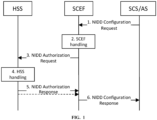
- FIG. 1 is an exemplary procedure diagram for NIDD Configuration.
- FIG. 1 is the same as the " Figure 5.13.2-1: Configuration for NIDD procedure in 3GPP TS 23.682 V16.4.0" (see clause 5.13.2 of 3GPP TS 23.682 V16.4.0, which is incorporated herein by reference in its entirety, for more details).
- This configuration procedure shown in FIG. 1 is applicable for both of a single LTE and a group of LTEs. See clause 5.13.2 of 3GPP TS 23.682 V16.4.0, in step 1, the SCS/AS sends an NIDD Configuration Request message to the SCEF.
- step 2 if the Requested Action is set to "Cancel” it indicates the purpose of the request is to cancel the transaction identified by TLTRI (T8 Long Term Transaction Reference ID) and the flow proceeds to step 6. If the Requested Action is set to "Update”, the purpose of the transaction is to update the parameters associated with the configuration.
- the SCEF sends an NIDD Authorization Request (External Group Identifier, External Identifier or MSISDN, APN, MTC Provider Information) message to the HSS (Home Subscriber Server) to authorize the NIDD configuration request for the UEs that belongs to the External Group Identifier, received External Identifier or MSISDN, and to receive necessary information for NIDD, if required.
- NIDD Authorization Request External Group Identifier, External Identifier or MSISDN, APN, MTC Provider Information
- step 4 the HSS examines the NIDD Authorization Request message, e.g. with regards to the existence of External Group Identifier, External Identifier or MSISDN.
- step 5 the HSS sends an NIDD Authorization Response (with single value or list of (IMSI and MSISDN or External Identifier), Result) message to the SCEF to acknowledge acceptance of the NIDD Authorization Request.
- step 6 the SCEF sends an NIDD Configuration Response (TLTRI, Maximum Packet Size, Reliable Data Service Indication, and Cause) message to the SCS/AS to acknowledge acceptance of the NIDD Configuration Request and the deletion of the identified NIDD configuration, if it was requested.
- TTRI Maximum Packet Size, Reliable Data Service Indication, and Cause
- the SCS/AS may send a list of RDS ports in the RDS configuration. These ports will be used in later non-IP data transmission.
- the static RDS port information may be sent via NIDD configuration as shown in FIG. 1 .
- a dynamic RDS port management procedure is introduced between the UE and the SCEF (see 3GPP TS 24.250 V16.1.0, which is incorporated herein by reference in its entirety), the SCS/AS can dynamically negotiate with the UE (via SCEF) regarding the RDS port reservation/release.
- the SCEF does not verify the RDS port received, i.e. whether it is aligned with subsequently received MO /MT non-IP data.
- the RDS port included in the MO / MT NIDD was not set/configured via the previous NIDD configuration. If there is a mismatch, for MO NIDD, the MO data may be silently discarded by the SCEF if received from the UE; for MT NIDD, the MT data may be transferred to UE but is silently discarded by the LTE due to unknown RDS port (i.e. unknown application).
- the undesired data such as the MT NIDD with mismatched port information, are still transferred, thereby wasting communication resource and causing undesired, unpredictable actions in the communication network.
- FIG. 2 is an exemplary flow chart showing methods according to embodiments of the present disclosure.
- a method performed at a first entity 100 may comprise: step S101, receiving, from a second entity, a non-internet protocol data delivery, NIDD, message including a port number, particularly one or more RDS port numbers; and step S102, determining whether the one or more RDS port numbers are consistent with a NIDD configuration.
- the NIDD configuration may comprise a configured RDS port list. It may be determined that whether the one or more RDS port numbers are within the configured RDS port list.
- the first entity 100 may comprise any entity capable of receiving NIDD data during NIDD procedures in the communication system.
- the first entity 100 may comprise a SCEF as shown in FIG. 1 , or network exposure function, NEF, in a fifth generation (5G) communication system.
- 5G fifth generation
- a method performed at a second entity 200 may comprise: step S201, transmitting, to a first entity, a NIDD message including a port number (e.g. one or more RDS port numbers).
- the first entity determines whether the port number is consistent with a NIDD configuration (e.g., whether the one or more RDS port numbers are within a configured RDS port list).
- the second entity 200 may comprise any entity capable of transmitting NIDD data during NIDD procedures in the communication system.
- the second entity 100 may comprise a SCS/AS shown in FIG. 1 , an application function, AF, in a 5G system, or a terminal device, such as any UE.
- the first entity 100 may check the port consistency between any received NIDD message and NIDD configuration.
- network resources for transmitting the invalid NIDD data may be saved, and undesired actions in the communication system may be avoided.
- FIG. 3 is an exemplary diagram showing address and control field format for a NIDD message.
- FIG. 3 is the same as the " Figure 5.2.1-1: Address and Control field format" from 3GPP TS 24.250, V16.1.0.
- I frame may be for confirmed information transfer; S frame may be for supervisory functions; UI frame may be for unconfirmed information transfer; and U frame may be for control functions.
- the port number comprises a source port number and/or a destination port number.
- the port number may comprise: an RDS source port number and/or an RDS destination port number.
- a strict policy may be applied for checking the port consistency. Namely, it will be determined that the port number is not consistent with the NIDD configuration, if any one of the source port or the destination port in the NIDD message does not equal to a configured one in the NIDD configuration.
- the first entity 100 may obtain the port number from the NIDD configuration and NIDD messages, based on applied standard or technical specification.
- an exemplary table 1 shows a definition of the RdsPort, for the port configuration for Reliable Data Transfer.
- Table 1 Definition of RdsPort data Type Attribute name Data type Cardi nality Description
- portUE Port 1 Indicates the port number on UE that is used for reliable data transfer with a specific application on UE using RDS (as defined in clause 5.2.4 and 5.2.5 of 3GPP TS 24.250 [31]).
- portSCEF Port 1 Indicates the port number on SCEF that is used for reliable data transfer with a specific application on SCEF using RDS (as defined in clause 5.2.4 and 5.2.5 of 3GPP TS 24.250 [31]).
- FIG. 4 is an exemplary flow chart showing sub-steps of methods shown in FIG. 2 .
- the step S102, determining whether the port number is consistent with a NIDD configuration may comprise: step S1021, determining whether the source port number in the NIDD message equals to a configured source port number in the NIDD configuration (particularly in the configured RDS port list); and/or step S1022, determining whether the destination port number in the NIDD message equals to a configured destination port number in the NIDD configuration.
- the SCEF upon receiving the MT NIDD message, shall check whether the received RDS destination port equals with the configured RDS port on UE and whether the received RDS source port equals with the configured RDS port on SCEF. If there is any mismatch, SCEF shall report the error.
- the SCEF shall check whether the decoded RDS destination port equals with the configured RDS port on SCEF and whether the decoded RDS source port equals with the configured RDS port on LTE. If there is any mismatch, SCEF shall report the error.
- FIG. 5 is an exemplary flow chart showing additional steps of methods shown in FIG. 2 .
- the method performed at the first entity 100 further comprises: step S103, discarding the NIDD message, if it is determined that the port number is not consistent with the NIDD configuration.
- the method performed at the first entity 100 further comprises: step S104, transmitting a response message including an indication of that the port number is not consistent (e.g., indicating that the port number is unknown), if it is determined that the port number is not consistent with the NIDD configuration.
- the method performed at the second entity 200 further comprises: step S204, receiving, from the first entity, a response message including an indication of that the port number is not consistent, if it is determined that the port number is not consistent with the NIDD configuration.
- the indication of that the port number is not consistent may comprise an error code, and a value of the port number in the NIDD message.
- network resource for transmitting the invalid MT NIDD is saved.
- improved NIDD service may be provided (i.e. the 3GPP network is able to notify abnormal situation to the second entity, such as a SCS/AS, or an AF).
- the response message for abnormal situation may be any kind of message/signalling, and the indication for the abnormal situation may be any kind of indicator/flag/information element.
- the response message when the response message is transmitted to a Service Capability Server / Application Server, SCS/AS, or an Application Function, AF, the response message may comprise at least one of: a Mobile Terminated, MT, NIDD submit Response message; a Group MT NIDD submit Response message; a NIDD Authorisation Notification Request message; or a Mobile Originated, MO, NIDD Indication message.
- FIG. 6 is another exemplary flow chart showing additional steps of methods shown in FIG. 2 .
- the method performed at the first entity 100 further comprises: S105, receiving an updated NIDD configuration from the SCS/AS or the AF, after transmitting the response message including the indication of that the port number is not consistent; or S106, receiving an updated NIDD message from the SCS/AS or the AF, after transmitting the response message including the indication of that the port number is not consistent.
- the method performed at the second entity 200 further comprises: S205, transmitting, to the first entity, an updated NIDD configuration, after receiving the response message including the indication of that the port number is not consistent; or S206, transmitting, to the first entity, an updated NIDD message, after receiving the response message including the indication of that the port number is not consistent.
- the first entity 100 such as a SCEF
- the second entity 200 will make as at least one of following corrective actions, after receiving the ⁇ RDS port unknown' error message:
- FIG. 7 is an exemplary procedure for MT NIDD for a single UE.
- FIG. 7 is the same as the " Figure 5.13.3-1: Mobile Terminated NIDD procedure" in clause 5.13.3 of 3GPP TS 23.682 V16.4.0. See clause 5.13.3 of 3GPP TS 23.682 V16.4.0, in step 1, if SCS/AS has already activated the NIDD service for a given UE, and has downlink non-IP data to send to the UE, the SCS/AS sends a MT NIDD Submit Request (External Identifier or MSISDN, TLTRI, non-IP data, non-IP data sequence number, Reliable Data Service Configuration, Maximum Latency, Priority, PDN Connection Establishment Option) message to the SCEF.
- MSISDN Serial Identifier
- TLTRI non-IP data
- TLTRI non-IP data
- Reliable Data Service Configuration Maximum Latency, Priority, PDN Connection Establishment Option
- step 2 the SCEF determines the EPS Bearer Context based on the APN associated with the NIDD configuration and the User Identity.
- step 3 if an SCEF EPS bearer context corresponding to the External Identifier or MSISDN included in step 1 is found, then the SCEF sends a NIDD Submit Request (User Identity, EPS Bearer ID, SCEF ID, non-IP data, SCEF Wait Time, Maximum Re-transmission time) message toward the MME/SGSN.
- step 4 if the MME/SGSN can immediately deliver the non-IP data to the UE e.g.
- the procedure proceeds at step 8. If the MME/SGSN is aware of the UE being temporarily unreachable, or if the MME/SGSN knows that the LTE is not scheduled to be reachable within the SCEF Wait Time, while using power saving functions e.g. UE Power Saving Mode (see clause 4.5.4) or extended idle mode DRX (see clause 4.5.13), then the MME/SGSN may send a NIDD Submit Response (Cause, Requested Re-Transmission Time) message towards the SCEF.
- UE Power Saving Mode see clause 4.5.4
- extended idle mode DRX see clause 4.5.13
- the SCEF may send a MT NIDD Submit Response (Requested Re-Transmission time, non-IP data sequence number, Buffered Indication, Cause) to the SCS/AS informing of the received results from the MME/SGSN.
- MT NIDD Submit Response Requested Re-Transmission time, non-IP data sequence number, Buffered Indication, Cause
- the MME/SGSN detects that the LTE is reachable (e.g. when coming out of PSM mode by performing TAU/RAU, when initiating MO communication etc.), or when the UE is about to become reachable (e.g.
- NIDD Submit Indication User Identity
- SCEF sends a NIDD Submit Request (User Identity, EPS Bearer ID, SCEF ID, non-IP data, SCEF Wait Time, Maximum Re-transmission time) message toward the MME/SGSN.
- the MME/SGSN pages the UE and delivers the non-IP data to the UE using data transfer via the MME procedure as described in clause 5.3.4B.3 of TS 23.401 [7] or the SGSN procedure as described in clauses 9.3 and 9.6 of TS 23.060 [6].
- the MME/SGSN may generate the necessary accounting information required for charging.
- step 9 if the MME/SGSN was able to initiate step 8, then the MME/SGSN sends a NIDD Submit Response (cause) message towards the SCEF acknowledging the NIDD Submit Request from SCEF received in step 3 or step 7.
- the SCEF sends an MT NIDD Submit Response (Reliable Data Service Acknowledgement Indication, Hop-by-Hop Acknowledgment Indication, non-IP data sequence number, Cause).
- the steps 2a and 2b in FIG. 7 may be improved.
- the SCEF may check/verify whether the received RDS ports in the MT NIDD is recognized based on the NIDD configuration or not. If the above check fails, the SCEF shall reject the request in 2b (MT NIDD Submit Response message) with new error code, such as 'RDS PORT UNKNOWN'.
- the SCEF upon receipt of a HTTP POST request from the SCS/AS for a downlink data delivery for a single UE, the SCEF shall: ... if the Rds port check/verification feature is supported, check whether the RDS port numbers are configured (e.g. whether the RDS port numbers are within the configured RDS list). If the RDS port numbers are unknown in the SCEF, the SCEF shall respond a 403 Forbidden response with a cause value "RDS PORT UNKNOWN" in the "cause” attribute of the "ProblemDetails" structure (e.g. for indicating the RDS port is not properly configured).
- FIG. 8 is an exemplary procedure for MT NIDD for a group of LTEs.
- FIG. 8 is the same as the "Figure 5.5.3-1: Group Message Delivery via unicast MT NIDD" in clause 5.5.3 of 3GPP TS 23.682 V16.4.0. See clause 5.5.3 of 3GPP TS 23.682 V16.4.0, in step 1, if SCS/AS has downlink non-IP data to send to a group of UEs, the SCS/AS sends a Group MT NIDD Submit Request (SCS/AS Identifier, External Group Identifier, TLTRI, non-IP data, Reliable Data Service Configuration, Maximum Latency, PDN Connection Establishment Option) message to the SCEF.
- SCS/AS Identifier External Group Identifier
- TLTRI non-IP data
- Reliable Data Service Configuration Maximum Latency, PDN Connection Establishment Option
- step 2 based on the preceding NIDD Configuration of the UE Group (see clause 5.13.2) and the SCEF stored list of authorized External Identifiers associated to the External Group Identifier, the SCEF sends a single Group MT NIDD Submit Response (Cause) message to the SCS/AS to acknowledge acceptance of the Group MT NIDD Submit Request.
- step 3 the SCEF performs this step for each External Identifier that belongs to the External Group Identifier.
- the SCEF stored the list of authorized External Identifiers associated to the External Group Identifier during the preceding NIDD Configuration of the UE Group (see clause 5.13.2).
- step 4 after executing step 3 for all LTEs, the SCEF sends an aggregated response message Group MT NIDD Submit Indication (TLTRI associated with the Request of step 1, Hop-by-Hop Acknowledgment Indication(s), Re-Transmission time(s), Trigger Indication(s), Cause(s)).
- TTRI aggregated response message Group MT NIDD Submit Indication
- the step 2 in FIG. 8 may be improved.
- the SCEF needs to reject the request with new error code ⁇ RDS PORT UNKNOWN' in step 2 (Group MT NIDD Submit Response message).
- the SCEF upon receipt of such an HTTP POST request from the SCS/AS requesting the group message delivery, the SCEF checks whether the SCS/AS is authorised to send NIDD requests, whether the non-IP packet size is larger than the Maximum Packet Size that was provided to the SCS/AS during NIDD Configuration and if the Rds port check feature is supported whether the RDS port numbers are recognized.
- FIG. 9 is an exemplary procedure for Mobile Originated NIDD procedure.
- FIG. 9 is the same as the " Figure 5.13.4-1: Mobile Originated NIDD procedure" in clause 5.13.4 of 3GPP TS 23.682 V16.4.0. See clause 5.13.4 of 3GPP TS 23.682 V16.4.0, in step 1, the LTE sends a NAS message with EPS bearer ID and non-IP data, the Reliable Data Service header is included if the Reliable data service is enabled, to the MME as per the procedure described in clause 5.3.4B.2 of TS 23.401 [7] (steps 0 - 2) or the UE sends data to the SGSN (see clause 9.3 and 9.6 of TS 23.060 [6]) on a PDP Context of PDN type Non-IP associated with a T6b interface.
- step 2 the MME/SGSN sends NIDD Submit Request (User Identity, EBI, SCEF ID, non-IP data, MO Exception data counter) message to the SCEF.
- NIDD Submit Request User Identity, EBI, SCEF ID, non-IP data, MO Exception data counter
- the MME/SGSN sends the message to the IWK-SCEF which forwards the message to the SCEF over T7.
- step 3 when the SCEF receives the non-IP data on the T6a/T6b (or T7) interface, and finds an SCEF EPS bearer context and the related T8 Destination Address, then it sends the non-IP data to the SCS/AS that is identified by the T8 Destination address in a MO NIDD Indication (External Identifier or MSISDN, non-IP data, TLTRI, Reliable Data Service Configuration).
- MO NIDD Indication Extra Identifier or MSISDN, non-IP data, TLTRI, Reliable Data Service Configuration.
- the SCS/AS responds to the SCEF with a MO NIDD Acknowledgement (Cause).
- step 5 the SCEF sends NIDD Submit Response to MME/SGSN.
- the procedure between step 2 and step 3 in MO NIDD in FIG. 9 may be improved.
- the SCEF shall check whether the RDS ports in the MO non-IP data is recognized or not.
- the SCEF shall notify all SCS/AS in step 3 (MO NIDD message).
- the SCEF may trigger the NIDD authorization notification procedure described below to notify all SCS/AS.
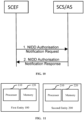
- FIG. 10 is an exemplary procedure for NIDD Authorisation Update procedure.
- the SCEF may initially transmit a NIDD Authorisation Notification Request with new NIDD status ⁇ RDS PORT UNKNOWN' and the unrecognized RDS ports.
- the SCEF may receive a NIDD Authorisation Notification Response from SCS/AS.
- the SCEF shall check RDS port numbers contained in (decoded from) the uplink non-IP data. If it is not within the configured RDS port list, the SCEF shall notify all SCS/AS with NIDD status set to "RDS PORT UNKNOWN" and the unknown (i.e. unrecognized) RDS port numbers. The SCS/AS shall acknowledge the request with an HTTP 200 OK or 204 No Content response.
- Table 2 shows an exemplary improvement (underlined part) for "Table 5.6.2.1.6-1: Definition of type NiddConfigurationStatusNotification, in clause 5.6.2.1.6 in 3GPP TS 29.122 V16.3.0", according to embodiments of the present disclosure.
- Table 2 Definition of type NiddConfigurationStatusNotification Attribute name Data type Cardi nality Description Applicability (NOTE 1) niddConfig uration Link 1 Link to the NIDD configuration resource to which this notification is related.
- ExternalId Extern alId 0..1 Each element uniquely identifies a user as defined in Clause 4.6.2 of 3GPP TS 23.682 [2].
- NOTE 2 msisdn Msisdn 0..1
- Each element identifies the MS internal PSTN/ISDN number allocated for a UE.
- NOTE 2 status NiddSt atus 1 Indicates the NIDD configuration status.
- rdsCapIndi cation boolea n 0..1 It indicates whether the network capability for the reliable data service is enabled or not.
- rdsPort RdsPor t 0..1 Indicates the port configuration that is used for reliable data transfer between specific applications using RDS (as defined in clause 5.2.4 and 5.2.5 of 3GPP TS 24.250 [31]).
- Table 3 shows an exemplary improvement (underlined part) for "Table 5.6.2.3.5-1: Enumeration NiddStatus, in clause 5.6.2.3.5 in 3GPP TS 29.122 V16.3.0", according to embodiments of the present disclosure.
- Table 3 Enumeration NiddStatus Enumeration value Description Applicability (NOTE) ACTIVE
- the NIDD configuration is active. TERMINATED U E_NOT_AUTHO RIZED The NIDD configuration was terminated because the UE's authorisation was revoked. TERMINATED The NIDD configuration was terminated.
- RDS_PORT_UNK NOWN The SCEF does not know the RDS port numbers in the NIDD, such port numbers does not match with the configured port numbers. (or, the RDS port is unknown)
- Rds_port_che ck NOTE: Properties marked with a feature as defined in subclause 5.6.4 are applicable as described in subclause 5.2.7. If no feature are indicated, the related property applies for all the features.
- Table 4 shows an exemplary improvement (underlined part) for "Table 5.6.5.3-1: Application errors, in clause 5.6.5.3 in 3GPP TS 29.122 V16.3.0", according to embodiments of the present disclosure.
- Table 4 Application errors
- Application Error HTTP status code Description Applic ability QUOTA_EXC EEDED 403 Forbidden Not enough quota for the MT NIDD DATA_TOO_ LARGE 403 Forbidden
- the non-IP data size is larger than "maximumPacketSize" of the NIDD configuration.
- RDS_PORT UNKNOWN 403 Forbidden
- the SCEF does not know the RDS port numbers in the MT NIDD, such port numbers does not match with the configured port numbers.
- ALREADY_D ELIVERED 404 Not Found The SCEF has already delivered the buffered data.
- SENDING 409 Conflict The SCEF is ready in sending the buffered non-IP data.
- TRIGGERED 500 Internal Server Error
- the SCEF triggered the device but did not buffer the data.
- the SCS AS may resubmit the data TEMPORARI LY NOT RE ACHABLE 500 Internal Server Error
- the SCEF has aborted the delivery because the UE is temporarily not reachable.
- the SCEF may in addition indicate a requested re-submission time for the data.
- NEXT_HOP 500 Internal Server Error Unsuccessful delivery to the next hop.
- TIMEOUT 500 Internal Server Error Unsuccessful delivery due to timeout.
- FIG. 11 is a block diagram showing apparatuses for the first and second entities, according to embodiments of the present disclosure.
- the apparatus for first entity 100 may comprise: a processor 110; and a memory 120, containing instructions executable by the processor 110.
- the first entity 100 is operative to: receive, from a second entity, a NIDD message including a port number; and determine whether the port number is consistent with a NIDD configuration.
- the first entity is further operative to implement any of the methods above described, such as methods shown in FIG. 1-10 .
- the apparatus for second entity 200 may comprise: a processor 210; and a memory 220, containing instructions executable by the processor 210.
- the second entity 200 is operative to: transmit, to a first entity, a NIDD message including a port number.
- the first entity determines whether the port number is consistent with a NIDD configuration.
- the second entity is further operative to implement any of the methods above described, such as methods shown in FIG. 1-10 .
- the processor 110 and processor 210 may be any kind of processing component, such as one or more microprocessor or microcontrollers, as well as other digital hardware, which may include digital signal processors (DSPs), special-purpose digital logic, and the like.
- the memory 120 and memory 220 may be any kind of storage component, such as read-only memory (ROM), random-access memory, cache memory, flash memory devices, optical storage devices, etc.
- FIG. 12 is a block diagram showing a computer readable storage medium, according to embodiments of the present disclosure.
- a computer readable storage medium 1000 having a computer program 1001 stored thereon.
- the computer program 1001 is executable by an entity to cause the entity to carry out any of the methods above described, such as methods shown in FIG. 1-10 .
- the computer readable storage medium 1000 may be configured to include memory such as RAM, ROM, programmable read-only memory (PROM), erasable programmable read-only memory (EPROM), electrically erasable programmable read-only memory (EEPROM), magnetic disks, optical disks, floppy disks, hard disks, removable cartridges, or flash drives.
- memory such as RAM, ROM, programmable read-only memory (PROM), erasable programmable read-only memory (EPROM), electrically erasable programmable read-only memory (EEPROM), magnetic disks, optical disks, floppy disks, hard disks, removable cartridges, or flash drives.
- FIG. 13 is a block diagram showing function units of the apparatuses, according to embodiments of the present disclosure.
- the apparatus for first network entity 100 may comprise: a reception unit 101, configured to receive, from a second entity, a NIDD message including a port number; and a determination unit 102, configured to determine whether the port number is consistent with a NIDD configuration.
- the first entity 100 is further operative to implement any of the methods above described, such as methods shown in FIG. 1-10 .
- the apparatus for second entity 200 may comprise: a transmission unit 201, configured to transmit, to a first entity, a NIDD message including a port number.
- the first entity determines whether the port number is consistent with a NIDD configuration.
- the second entity 200 is further operative to implement any of the methods above described, such as methods shown in FIG. 1-10 .
- unit/function unit may have conventional meaning in the field of electronics, electrical devices and/or electronic devices and may include, for example, electrical and/or electronic circuitry, devices, modules, processors, memories, logic solid state and/or discrete devices, computer programs or instructions for carrying out respective tasks, procedures, computations, outputs, and/or displaying functions, and so on, as such as those that are described herein.
- the apparatus for the first entity 100 or second entity 200 may not need a fixed processor or memory, any computing resource and storage resource may be arranged from at least one network node/device/entity/apparatus in the communication system.
- the virtualization technology and network computing technology may be further introduced, so as to improve the usage efficiency of the network resources and the flexibility of the network.
- these network entities e.g. the first entity 100 or the second entity 200, may be implemented either as a network element on a dedicated hardware, as a software instance running on a dedicated hardware, or as a virtualized function instantiated on an appropriate platform, e.g. on a cloud infrastructure.
- a new error code in the MT NIDD response indicating ⁇ RDS port unknown' may be supported.
- a NIDD configuration notification to the SCS/AS notifying the ⁇ RDS port unknown' may be supported.
- NIDD service for the SCS/AS is improved (i.e. the 3GPP network is able to notify abnormal situation).
- the various exemplary embodiments of the present disclosure may be implemented in hardware or special purpose circuits, software, logic or any combination thereof.
- some aspects may be implemented in hardware, while other aspects may be implemented in firmware or software that may be executed by a controller, microprocessor or other computing device, although the disclosure is not limited thereto.
- firmware or software may be executed by a controller, microprocessor or other computing device, although the disclosure is not limited thereto.
- While various aspects of the exemplary embodiments of this disclosure may be illustrated and described as block diagrams, flow charts, or using some other pictorial representation, it is well understood that these blocks, apparatus, systems, techniques or methods described herein may be implemented in, as non-limiting examples, hardware, software, firmware, special purpose circuits or logic, general purpose hardware or controller or other computing devices, or some combination thereof.
- the exemplary embodiments of the disclosure may be practiced in various components such as integrated circuit chips and modules. It should thus be appreciated that the exemplary embodiments of this disclosure may be realized in an apparatus that is embodied as an integrated circuit, where the integrated circuit may include circuitry (as well as possibly firmware) for embodying at least one or more of a data processor, a digital signal processor, baseband circuitry and radio frequency circuitry that are configurable so as to operate in accordance with the exemplary embodiments of this disclosure.
- program modules include routines, programs, objects, components, data structures, etc. that perform particular tasks or implement particular abstract data types when executed by a processor in a computer or other device.
- the computer executable instructions may be stored on a computer readable medium such as a hard disk, optical disk, removable storage media, solid state memory, RAM, etc.
- a computer readable medium such as a hard disk, optical disk, removable storage media, solid state memory, RAM, etc.
Landscapes
- Engineering & Computer Science (AREA)
- Computer Networks & Wireless Communication (AREA)
- Signal Processing (AREA)
- Computer Security & Cryptography (AREA)
- Databases & Information Systems (AREA)
- Mobile Radio Communication Systems (AREA)
- Computer And Data Communications (AREA)
Applications Claiming Priority (3)
| Application Number | Priority Date | Filing Date | Title |
|---|---|---|---|
| CN2019108567 | 2019-09-27 | ||
| PCT/CN2020/117492 WO2021057856A1 (en) | 2019-09-27 | 2020-09-24 | Method and entity for checking port consistency of nidd message |
| EP20867371.5A EP4035455B1 (de) | 2019-09-27 | 2020-09-24 | Verfahren und entität zum überprüfen der port-konsistenz einer nidd-nachricht |
Related Parent Applications (1)
| Application Number | Title | Priority Date | Filing Date |
|---|---|---|---|
| EP20867371.5A Division EP4035455B1 (de) | 2019-09-27 | 2020-09-24 | Verfahren und entität zum überprüfen der port-konsistenz einer nidd-nachricht |
Publications (4)
| Publication Number | Publication Date |
|---|---|
| EP4340334A2 true EP4340334A2 (de) | 2024-03-20 |
| EP4340334A3 EP4340334A3 (de) | 2024-07-03 |
| EP4340334B1 EP4340334B1 (de) | 2025-11-12 |
| EP4340334C0 EP4340334C0 (de) | 2025-11-12 |
Family
ID=75166748
Family Applications (2)
| Application Number | Title | Priority Date | Filing Date |
|---|---|---|---|
| EP20867371.5A Active EP4035455B1 (de) | 2019-09-27 | 2020-09-24 | Verfahren und entität zum überprüfen der port-konsistenz einer nidd-nachricht |
| EP24154854.4A Active EP4340334B1 (de) | 2019-09-27 | 2020-09-24 | Verfahren und entität zum überprüfen der port-konsistenz einer nidd-nachricht |
Family Applications Before (1)
| Application Number | Title | Priority Date | Filing Date |
|---|---|---|---|
| EP20867371.5A Active EP4035455B1 (de) | 2019-09-27 | 2020-09-24 | Verfahren und entität zum überprüfen der port-konsistenz einer nidd-nachricht |
Country Status (6)
| Country | Link |
|---|---|
| US (1) | US12004261B2 (de) |
| EP (2) | EP4035455B1 (de) |
| CN (1) | CN114467334B (de) |
| AU (1) | AU2020354228B2 (de) |
| ES (1) | ES2975510T3 (de) |
| WO (1) | WO2021057856A1 (de) |
Family Cites Families (8)
| Publication number | Priority date | Publication date | Assignee | Title |
|---|---|---|---|---|
| US9639553B2 (en) * | 2000-11-02 | 2017-05-02 | Oracle International Corporation | TCP/UDP acceleration |
| EP3182741B1 (de) * | 2015-12-15 | 2020-02-26 | Alcatel Lucent | Verfahren und vorrichtungen zur unterstützung eines non-ip data delivery (nidd) dienstes zu einem endgerät im extended idle mode drx (edrx) |
| US10652085B2 (en) * | 2016-01-07 | 2020-05-12 | Lg Electronics Inc. | Method for setting configuration of non-IP data delivery (NDID) in wireless communication system and device for same |
| ES2745424T3 (es) * | 2016-03-31 | 2020-03-02 | Ericsson Telefon Ab L M | Comunicación de alta latencia mediante la SCEF |
| EP3577941B1 (de) * | 2017-02-06 | 2022-05-18 | Apple Inc. | Zuverlässiges datendienstprotokoll für ciot-vorrichtungen |
| CN110574448B (zh) * | 2017-04-24 | 2022-08-19 | 苹果公司 | 用于蜂窝物联网(CIoT)的MulteFire体系结构 |
| US11076447B2 (en) * | 2018-02-20 | 2021-07-27 | Intel Corporation | Efficient and reliable data transfer in 5G systems |
| US20210037584A1 (en) * | 2019-07-30 | 2021-02-04 | Qualcomm Incorporated | Rds support for lwm2m and non-lwm2m iot applications |
-
2020
- 2020-09-24 CN CN202080067755.7A patent/CN114467334B/zh active Active
- 2020-09-24 EP EP20867371.5A patent/EP4035455B1/de active Active
- 2020-09-24 US US17/763,581 patent/US12004261B2/en active Active
- 2020-09-24 AU AU2020354228A patent/AU2020354228B2/en active Active
- 2020-09-24 ES ES20867371T patent/ES2975510T3/es active Active
- 2020-09-24 WO PCT/CN2020/117492 patent/WO2021057856A1/en not_active Ceased
- 2020-09-24 EP EP24154854.4A patent/EP4340334B1/de active Active
Also Published As
| Publication number | Publication date |
|---|---|
| EP4340334B1 (de) | 2025-11-12 |
| US12004261B2 (en) | 2024-06-04 |
| EP4035455A4 (de) | 2022-11-09 |
| CN114467334B (zh) | 2025-08-01 |
| AU2020354228B2 (en) | 2023-10-19 |
| ES2975510T3 (es) | 2024-07-08 |
| US20220295268A1 (en) | 2022-09-15 |
| AU2020354228A1 (en) | 2022-03-24 |
| CN114467334A (zh) | 2022-05-10 |
| EP4035455B1 (de) | 2024-01-31 |
| WO2021057856A1 (en) | 2021-04-01 |
| EP4340334C0 (de) | 2025-11-12 |
| EP4340334A3 (de) | 2024-07-03 |
| EP4035455A1 (de) | 2022-08-03 |
Similar Documents
| Publication | Publication Date | Title |
|---|---|---|
| US10624004B2 (en) | Serving node relocating method in wireless communication system and device for same | |
| US11997640B2 (en) | Paging for delay tolerant mobile terminals and applications | |
| EP3400726B1 (de) | Übermittlung der verwendung von ausnahmemeldung an kernnetzwerkknoten | |
| US9473877B2 (en) | Uplink/downlink transmission method for small amount of data, and corresponding terminal and mobility management unit | |
| WO2015171242A1 (en) | Mobility management entity, user equipment and methods for machine type communication | |
| JP6097757B2 (ja) | 無線通信システムにおいてマルチキャストデータを伝送及び受信する方法とそのための装置 | |
| KR20160060091A (ko) | 페이징 방법, 네트워크 디바이스 및 통신 시스템 | |
| Kunz et al. | Enhanced 3GPP system for machine type communications and Internet of Things | |
| EP4035455B1 (de) | Verfahren und entität zum überprüfen der port-konsistenz einer nidd-nachricht | |
| WO2019047139A1 (en) | CONFIGURATION OF COMMUNICATION DEVICE REVIEW | |
| US12213062B2 (en) | Method and apparatus for notifying application function node about RDS configuration of network | |
| WO2019109298A1 (en) | Network capability configuration for rate control | |
| US20250374188A1 (en) | Message delivery to wireless user devices using learned retransmission time in wireless communication networks | |
| EP2827661A1 (de) | System, vorrichtung und verfahren zum auslösen einer roaming-mtc-vorrichtung |
Legal Events
| Date | Code | Title | Description |
|---|---|---|---|
| PUAI | Public reference made under article 153(3) epc to a published international application that has entered the european phase |
Free format text: ORIGINAL CODE: 0009012 |
|
| STAA | Information on the status of an ep patent application or granted ep patent |
Free format text: STATUS: THE APPLICATION HAS BEEN PUBLISHED |
|
| AC | Divisional application: reference to earlier application |
Ref document number: 4035455 Country of ref document: EP Kind code of ref document: P |
|
| AK | Designated contracting states |
Kind code of ref document: A2 Designated state(s): AL AT BE BG CH CY CZ DE DK EE ES FI FR GB GR HR HU IE IS IT LI LT LU LV MC MK MT NL NO PL PT RO RS SE SI SK SM TR |
|
| REG | Reference to a national code |
Ref country code: DE Ref legal event code: R079 Ipc: H04W0040000000 Ref country code: DE Ref legal event code: R079 Ref document number: 602020062307 Country of ref document: DE Free format text: PREVIOUS MAIN CLASS: H04L0069220000 Ipc: H04W0040000000 |
|
| PUAL | Search report despatched |
Free format text: ORIGINAL CODE: 0009013 |
|
| AK | Designated contracting states |
Kind code of ref document: A3 Designated state(s): AL AT BE BG CH CY CZ DE DK EE ES FI FR GB GR HR HU IE IS IT LI LT LU LV MC MK MT NL NO PL PT RO RS SE SI SK SM TR |
|
| RIC1 | Information provided on ipc code assigned before grant |
Ipc: H04L 69/22 20220101ALI20240528BHEP Ipc: H04L 45/302 20220101ALI20240528BHEP Ipc: H04W 40/00 20090101AFI20240528BHEP |
|
| STAA | Information on the status of an ep patent application or granted ep patent |
Free format text: STATUS: REQUEST FOR EXAMINATION WAS MADE |
|
| 17P | Request for examination filed |
Effective date: 20241216 |
|
| GRAP | Despatch of communication of intention to grant a patent |
Free format text: ORIGINAL CODE: EPIDOSNIGR1 |
|
| STAA | Information on the status of an ep patent application or granted ep patent |
Free format text: STATUS: GRANT OF PATENT IS INTENDED |
|
| INTG | Intention to grant announced |
Effective date: 20250718 |
|
| GRAS | Grant fee paid |
Free format text: ORIGINAL CODE: EPIDOSNIGR3 |
|
| GRAA | (expected) grant |
Free format text: ORIGINAL CODE: 0009210 |
|
| STAA | Information on the status of an ep patent application or granted ep patent |
Free format text: STATUS: THE PATENT HAS BEEN GRANTED |
|
| AC | Divisional application: reference to earlier application |
Ref document number: 4035455 Country of ref document: EP Kind code of ref document: P |
|
| AK | Designated contracting states |
Kind code of ref document: B1 Designated state(s): AL AT BE BG CH CY CZ DE DK EE ES FI FR GB GR HR HU IE IS IT LI LT LU LV MC MK MT NL NO PL PT RO RS SE SI SK SM TR |
|
| REG | Reference to a national code |
Ref country code: CH Ref legal event code: F10 Free format text: ST27 STATUS EVENT CODE: U-0-0-F10-F00 (AS PROVIDED BY THE NATIONAL OFFICE) Effective date: 20251112 Ref country code: GB Ref legal event code: FG4D |
|
| REG | Reference to a national code |
Ref country code: IE Ref legal event code: FG4D |
|
| REG | Reference to a national code |
Ref country code: DE Ref legal event code: R096 Ref document number: 602020062307 Country of ref document: DE |
|
| U01 | Request for unitary effect filed |
Effective date: 20251208 |
|
| U07 | Unitary effect registered |
Designated state(s): AT BE BG DE DK EE FI FR IT LT LU LV MT NL PT RO SE SI Effective date: 20251212 |
|
| PG25 | Lapsed in a contracting state [announced via postgrant information from national office to epo] |
Ref country code: ES Free format text: LAPSE BECAUSE OF FAILURE TO SUBMIT A TRANSLATION OF THE DESCRIPTION OR TO PAY THE FEE WITHIN THE PRESCRIBED TIME-LIMIT Effective date: 20251112 |
|
| PG25 | Lapsed in a contracting state [announced via postgrant information from national office to epo] |
Ref country code: NO Free format text: LAPSE BECAUSE OF FAILURE TO SUBMIT A TRANSLATION OF THE DESCRIPTION OR TO PAY THE FEE WITHIN THE PRESCRIBED TIME-LIMIT Effective date: 20260212 |
|
| PG25 | Lapsed in a contracting state [announced via postgrant information from national office to epo] |
Ref country code: HR Free format text: LAPSE BECAUSE OF FAILURE TO SUBMIT A TRANSLATION OF THE DESCRIPTION OR TO PAY THE FEE WITHIN THE PRESCRIBED TIME-LIMIT Effective date: 20251112 |
|
| PG25 | Lapsed in a contracting state [announced via postgrant information from national office to epo] |
Ref country code: RS Free format text: LAPSE BECAUSE OF FAILURE TO SUBMIT A TRANSLATION OF THE DESCRIPTION OR TO PAY THE FEE WITHIN THE PRESCRIBED TIME-LIMIT Effective date: 20260212 |
|
| PG25 | Lapsed in a contracting state [announced via postgrant information from national office to epo] |
Ref country code: IS Free format text: LAPSE BECAUSE OF FAILURE TO SUBMIT A TRANSLATION OF THE DESCRIPTION OR TO PAY THE FEE WITHIN THE PRESCRIBED TIME-LIMIT Effective date: 20260312 |
|
| PG25 | Lapsed in a contracting state [announced via postgrant information from national office to epo] |
Ref country code: PL Free format text: LAPSE BECAUSE OF FAILURE TO SUBMIT A TRANSLATION OF THE DESCRIPTION OR TO PAY THE FEE WITHIN THE PRESCRIBED TIME-LIMIT Effective date: 20251112 |