EP4340293A1 - Verfahren zur durchführung von polynommultiplikationsoperationen - Google Patents
Verfahren zur durchführung von polynommultiplikationsoperationen Download PDFInfo
- Publication number
- EP4340293A1 EP4340293A1 EP22306367.8A EP22306367A EP4340293A1 EP 4340293 A1 EP4340293 A1 EP 4340293A1 EP 22306367 A EP22306367 A EP 22306367A EP 4340293 A1 EP4340293 A1 EP 4340293A1
- Authority
- EP
- European Patent Office
- Prior art keywords
- polynomial
- sub
- integer
- coefficients
- input
- Prior art date
- Legal status (The legal status is an assumption and is not a legal conclusion. Google has not performed a legal analysis and makes no representation as to the accuracy of the status listed.)
- Withdrawn
Links
- 238000000034 method Methods 0.000 title claims abstract description 37
- 238000004422 calculation algorithm Methods 0.000 claims abstract description 30
- 238000012545 processing Methods 0.000 claims description 11
- 230000000873 masking effect Effects 0.000 claims description 6
- 238000004364 calculation method Methods 0.000 claims description 5
- 239000000654 additive Substances 0.000 claims description 4
- 230000000996 additive effect Effects 0.000 claims description 4
- 238000004590 computer program Methods 0.000 claims description 3
- 238000005538 encapsulation Methods 0.000 claims description 3
- 238000012795 verification Methods 0.000 claims description 2
- 238000004891 communication Methods 0.000 description 3
- SMBQBQBNOXIFSF-UHFFFAOYSA-N dilithium Chemical compound [Li][Li] SMBQBQBNOXIFSF-UHFFFAOYSA-N 0.000 description 3
- 238000013459 approach Methods 0.000 description 1
- 230000000135 prohibitive effect Effects 0.000 description 1
- APTZNLHMIGJTEW-UHFFFAOYSA-N pyraflufen-ethyl Chemical compound C1=C(Cl)C(OCC(=O)OCC)=CC(C=2C(=C(OC(F)F)N(C)N=2)Cl)=C1F APTZNLHMIGJTEW-UHFFFAOYSA-N 0.000 description 1
Images


Classifications
-
- H—ELECTRICITY
- H04—ELECTRIC COMMUNICATION TECHNIQUE
- H04L—TRANSMISSION OF DIGITAL INFORMATION, e.g. TELEGRAPHIC COMMUNICATION
- H04L9/00—Cryptographic mechanisms or cryptographic arrangements for secret or secure communications; Network security protocols
- H04L9/30—Public key, i.e. encryption algorithm being computationally infeasible to invert or user's encryption keys not requiring secrecy
- H04L9/3093—Public key, i.e. encryption algorithm being computationally infeasible to invert or user's encryption keys not requiring secrecy involving Lattices or polynomial equations, e.g. NTRU scheme
Definitions
- the present invention relates to the field of cryptographic methods and devices, and more particularly to an efficient method for performing polynomial multiplication operations.
- Cryptographic algorithms are commonly used for ensuring the privacy of communications by encryption, for authentication or for generating a verifiable signature.
- the increasing computational power of quantum computers is a growing threat to the security of classical schemes such as RSA or ECDSA, which will eventually be completely defenseless against attacks performed using quantum computers. Therefore, work is being done to develop new efficient cryptographic algorithms that would be resistant against such attacks.
- a class of cryptographic algorithms able to resist quantum computers is lattice-based cryptographic algorithms. Such cryptographic algorithms are well positioned to be the next standard for post quantum cryptography. A drawback of such algorithms is that they make an extensive use of polynomial multiplications. Since existing devices don't come with any coprocessor dedicated to such multiplications, such operation have to be computed using the CPU and their cost strongly grows as the number and size of polynomials coefficients increases.
- this invention therefore relates to a method for performing a cryptographic algorithm, performed by a cryptographic device comprising a cryptographic co-processor comprising an integer multiplier, said cryptographic algorithm comprising a polynomial multiplication between a first input polynomial A[X] and a second input polynomial B[X], wherein the first input polynomial A[X] comprises N cm coefficients and the second input polynomial B[X] comprises N cn coefficients and said coefficients of the first and second input polynomials are of size N b bits, with N cm , N cn and N b non-zero integers, said method comprising :
- Such a method enables to compute polynomial multiplications between large polynomials at a low cost by narrowing it to one or more integer multiplications without additional complexity due to the carry of the integer multiplications.
- coefficients of said input polynomials may be masked using additive or multiplicative masking, and said masked coefficients may be used for generating said concatenated integer.
- said concatenated integer and said coefficients of the second input polynomial may be masked using multiplicative blinding, and said masked concatenated integers and coefficients may be used for computing said intermediate values.
- Such masking techniques enable to protect the polynomial multiplication according to the invention against side-channel attacks.
- the cryptographic algorithm may be among: a signature generation, a signature verification, encapsulation, decapsulation, public key encryption or decryption, password-based key exchange algorithm.
- this invention therefore relates also to a computer program product directly loadable into the memory of at least one computer, comprising software code instructions for performing the steps of the method according to the first aspect when said product is run on the computer.
- this invention therefore relates also to a non-transitory computer readable medium storing executable computer code that when executed by a cryptographic device comprising a processing system having at least one hardware processor performs the method according to the first aspect.
- this invention therefore relates also to a cryptographic device comprising:
- the invention aims at providing a method performing efficiently a polynomial multiplication operation of a cryptographic algorithm.
- a cryptographic algorithm may for example be used for signature generation, encapsulation, decapsulation, public key encryption or decryption, optionally homomorphic, password-based key exchange algorithm.
- This cryptographic algorithm may be a lattice-based cryptographic scheme such as Saber, Kyber or Dilithium.
- this method is performed by a cryptographic device 101.
- a cryptographic device 101 may be connected to a personal computer or server 102 operated by a user and sending commands to the cryptographic device for cryptographic operations such as data encryption or decryption.
- the cryptographic device 101 may be embedded in the computer 102.
- the cryptographic device 101 includes a processing system having at least one hardware processor and a cryptographic co-processor for performing cryptographic operations, and at least one memory configured for storing the data needed for such operations, such as the coefficients of the polynomials used as input to the polynomial operations, intermediate results, mask values...
- a processing system may be comprised in a tamper resistant device 103 secured against any unauthorized access, integrated in the cryptographic device.
- the cryptographic device may be a smartcard reader housing a smartcard device, or an electronic device, such as a smartphone or an loT device, possibly including an integrated or embedded secure element or secured microcontroller.
- the cryptographic device may also be a dedicated hardware security module.
- the cryptographic device 101 may include a processing system 201 having at least one hardware processor 201a and a cryptographic co-processor 201b comprising an integer multiplier, such as a RSA or ECC coprocessor, connected via a bus 202 to a computer readable memory circuit including a random access memory (RAM) 203, a read-only memory (ROM) 204, and/or a non-volatile memory (NVM) 205.
- the cryptographic device 101 may also include a random number generator (RNG) 206, included in the hardware processor or connected to it via the bus.
- the cryptographic device 101 may further include an interface 207 used to connect the cryptographic device 101 to the computer 102.
- Such an interface may be either a wired interface such as a USB or Thunderbolt interface, or a wireless interface, such as a Bluetooth interface.
- the interface 207 may also be a communication interface used to connect the cryptographic device 101 to a wireless network, e.g., wide-area networks, WiFi networks, or mobile telephony networks, or to a wired interface such as an Ethernet one, through which communication may be performed with the computer 102.
- a first main idea of the invention in order to make polynomial multiplication much faster is to transform it into a multiplication between two integers by concatenating all the coefficients of each polynomial into a long integer; and to use the co-processor of the processing means to perform this operation at low cost.
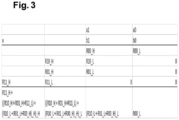
- a second main idea of the invention is to insert enough zeroes between the coefficients of the polynomials when concatenating them into long integers to avoid such a superimposition of terms when computing the multiplication between the two integers.
- An example is given on Figure 4 .
- a drawback of such an approach is that in order to be able to compute the multiplication between the two integers each obtained by extending the coefficients of a polynomial using zeroes and concatenating them, the size of each integer, zeroes included, must be lower than half the maximal length supported by the coprocessor performing the calculation. This greatly restricts the applicability of such a method for computing a polynomial multiplication between polynomials of high order and/or with large coefficients, such as polynomial used in SABER, Dilithium or Kyber which have typically up to 256 23-bit coefficients (before zero-extension).
- a third idea of the invention is to apply such a zero-extension and concatenation to one of the two polynomials to be multiplied only; and to multiply it one-by-one with the coefficients of the second polynomial.
- the number and size of the coefficients of the second polynomial is not limited, and the integer obtained by extension and concatenation of the first polynomial can be nearly the size of the maximal length supported by the coprocessor.
- the first input polynomial A[X] and the second input polynomial B[X] comprise respectively Ncm and Ncn coefficients of size N b bits, with Ncm, Ncn and N b non-zero integers.
- the numbers of coefficients N cm and N cn may be equal to a power of two such as 32, 64, 128 or 256, and the size of the coefficients N b may be equal to 10 or 13.
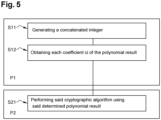
- the method according to the invention may comprise two phases : a multiplication phase P1 during which the cryptographic device computes a polynomial result C[X] of the polynomial multiplication between said first input polynomial A[X] and said second input polynomial B[X]; and a cryptographic computation phase P2 during which the cryptographic device performs steps of the cryptographic algorithm using the polynomial result determined at the end of the multiplication phase.
- some steps of the cryptographic algorithm, which are independent of the polynomial result may be performed before the multiplication phase P1 or during the execution of the multiplication phase in parallel to it.
- the multiplication phase P1 comprises an integer generation step S11 during which the cryptographic device generates, for the first input polynomial A[X], a concatenated integer A x as a concatenation of the coefficients of the first input polynomial, each coefficient being extended to an extension size N e with N e ⁇ ⁇ log 2 Ncm ⁇ + 2 ⁇ N b by inserting zeros as Most Significant Bits MSB of said concatenated coefficients.
- the cryptographic device may either first extend the size of each coefficient to the extension size N e by inserting zeros and then concatenate the extended coefficients into the concatenated integer, or first concatenate the original coefficients of the first input polynomial into an intermediary integer and then generate the concatenated integer by inserting zeros between each group of bits of the intermediary integer corresponding to an original coefficient.
- the coefficients of the first input polynomial shall be concatenated from the highest order coefficient to the lowest order coefficient, such that the most significant bits of the concatenated integer A x correspond to the highest order coefficient of the first input polynomial.
- the multiplication phase P1 then comprises a coefficient determination step S12 during which the cryptographic device computes one by one, using said integer multiplier of the co-processor, each coefficient of the polynomial result C[X] from the concatenated integer A x generated at the integer generation step S11 and the second input polynomial B[X].
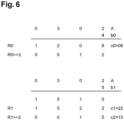
- the cryptographic device multiplies the concatenated integer A x by one coefficient of the second input polynomial B[X] and adds the carry from the multiplication of the concatenated integer A x with the previous coefficient of the second input polynomial B[X].
- Each such multiplication of the concatenated integer A x by one coefficient of the second input polynomial B[X] and addition of a carry gives one coefficient of the polynomial result C[X].
- the cryptographic device performs the following steps, the execution of which, for one value of i, is called hereafter a "round":
- the cryptographic device performs steps of the cryptographic algorithm using the polynomial result C[X] determined at the end of the multiplication phase in a computation step S21 of the cryptographic computation phase P2.
- the length of the values generated by the operations is limited to 4 digits, while the direct multiplication of the concatenated integer A x with a corresponding concatenated integer generated from the second input polynomial would have generated a 6 digits long result equal to 152208, and would have required the cryptographic device to handle such a bigger length.
- the first input polynomial may be split into several smaller polynomials; and the method described above may be used to compute the products of each of said smaller polynomials with the second input polynomial B[X].
- the cryptographic device may:
- A A 0 + A 1 ⁇ x 64 + A 2 ⁇ x 128 + A 3 ⁇ x 192
- a i has 64 coefficients
- a ⁇ B A 0 ⁇ B + A 1 ⁇ B ⁇ x 64 + A 2 ⁇ B ⁇ x 128 + A 3 ⁇ B ⁇ x 192
- the cryptographic device may generate small integers each corresponding to the concatenation and extension of several coefficients of the second input polynomial, and the concatenated integer A x may be multiplied one by one by each of these small integers, one at each round of the coefficient determination step S12.
- a ⁇ B A 0 ⁇ B + A 1 ⁇ B ⁇ x 64 + A 2 ⁇ B ⁇ x 128 + A 3 ⁇ B ⁇ x 192
- B B 0 + B 1 ⁇ x 64 + B 2 ⁇ x 128 + B 3 ⁇ x 192
- a ⁇ B A 0 ⁇ B 0 + B 1 ⁇ x 64 + B 2 ⁇ x 128 + B 3 ⁇ x 192 + A 1 ⁇ B 0 + B 1 ⁇ x 64 + B 2 ⁇ x 128 + B 3 ⁇ x 192 ⁇ x 64 + A 2 ⁇ B 0 + B 1 ⁇ x 64 + B 2 ⁇ x 128 + B 3 ⁇ x 192 ⁇ x 64 + A 2 ⁇ B 0 + B 1 ⁇ x 64 + B 2 ⁇ x 128 + B 3 ⁇ x 192 ⁇ x 128 + A 3 ⁇ B 0 + B 1 ⁇ x 64 + B 2
- the coefficients of the input polynomials A[X] and B[X] may be blinded.
- a i ′ a i ⁇ rnd % q
- b i ′ bi ⁇ rnd ⁇ 1 % q
- a i ′ ⁇ b i ′ a i ⁇ b i % q
- a unique random mask may be used for all the coefficients of A[X] or a different coefficient may be used for each coefficient.
- the masked coefficients are then used by the cryptographic device for generating the concatenated integer.
- the coefficients of at least one input polynomial are masked using an additive masking.
- a i ′ a i + rnd 1 ⁇ q
- the masked coefficients are then used by the cryptographic device for generating the concatenated integer.
- the masked concatenated integer and the masked coefficients of the second input polynomial are then used for computing the multiplication of concatenated integer and the coefficient and the result of the product a*b may be retrieved by multiplying the masked multiplication result by the inverse of the random masks r 1 and r 2 .
- c a ⁇ r 1 ⁇ b ⁇ r 2 % q ⁇ r 1 ⁇ r 2 ⁇ 1 % q
- the method according to the invention enables to compute polynomial multiplications between large polynomials at a low cost by narrowing it to one or more series of integer multiplications. It can even be easily protected against side channel analysis by applying additive or multiplicative blinding to the inputs of the integer multiplications.
- this invention therefore relates also to a computer program product directly loadable into the memory of at least one computer, comprising software code instructions for performing the steps of the method described here above when said product is run on the computer.
- this invention therefore relates also to a non-transitory computer readable medium storing executable computer code that when executed by a cryptographic device comprising a processing system having at least one hardware processor performs the method described here above.
- this invention therefore relates also to a cryptographic device 101 illustrated in figure 2 and comprising :
Landscapes
- Engineering & Computer Science (AREA)
- Pure & Applied Mathematics (AREA)
- General Physics & Mathematics (AREA)
- Mathematical Analysis (AREA)
- Mathematical Optimization (AREA)
- Mathematical Physics (AREA)
- Physics & Mathematics (AREA)
- Algebra (AREA)
- Computing Systems (AREA)
- Theoretical Computer Science (AREA)
- Computer Security & Cryptography (AREA)
- Computer Networks & Wireless Communication (AREA)
- Signal Processing (AREA)
- Complex Calculations (AREA)
Priority Applications (3)
| Application Number | Priority Date | Filing Date | Title |
|---|---|---|---|
| EP22306367.8A EP4340293A1 (de) | 2022-09-16 | 2022-09-16 | Verfahren zur durchführung von polynommultiplikationsoperationen |
| EP23768310.7A EP4588208A1 (de) | 2022-09-16 | 2023-09-14 | Verfahren zur durchführung von polynommultiplikationsoperationen |
| PCT/EP2023/075233 WO2024056778A1 (en) | 2022-09-16 | 2023-09-14 | Method for performing polynomial multiplication operations |
Applications Claiming Priority (1)
| Application Number | Priority Date | Filing Date | Title |
|---|---|---|---|
| EP22306367.8A EP4340293A1 (de) | 2022-09-16 | 2022-09-16 | Verfahren zur durchführung von polynommultiplikationsoperationen |
Publications (1)
| Publication Number | Publication Date |
|---|---|
| EP4340293A1 true EP4340293A1 (de) | 2024-03-20 |
Family
ID=84358719
Family Applications (2)
| Application Number | Title | Priority Date | Filing Date |
|---|---|---|---|
| EP22306367.8A Withdrawn EP4340293A1 (de) | 2022-09-16 | 2022-09-16 | Verfahren zur durchführung von polynommultiplikationsoperationen |
| EP23768310.7A Pending EP4588208A1 (de) | 2022-09-16 | 2023-09-14 | Verfahren zur durchführung von polynommultiplikationsoperationen |
Family Applications After (1)
| Application Number | Title | Priority Date | Filing Date |
|---|---|---|---|
| EP23768310.7A Pending EP4588208A1 (de) | 2022-09-16 | 2023-09-14 | Verfahren zur durchführung von polynommultiplikationsoperationen |
Country Status (2)
| Country | Link |
|---|---|
| EP (2) | EP4340293A1 (de) |
| WO (1) | WO2024056778A1 (de) |
Families Citing this family (2)
| Publication number | Priority date | Publication date | Assignee | Title |
|---|---|---|---|---|
| CN118963700B (zh) * | 2024-07-18 | 2025-07-22 | 华中科技大学 | 一种兼容Kyber、Dilithium算法的格密码协处理器电路 |
| CN121485938A (zh) * | 2026-01-08 | 2026-02-06 | 北京信安世纪科技股份有限公司 | 多项式信息获取方法、装置、电子设备及存储介质 |
-
2022
- 2022-09-16 EP EP22306367.8A patent/EP4340293A1/de not_active Withdrawn
-
2023
- 2023-09-14 EP EP23768310.7A patent/EP4588208A1/de active Pending
- 2023-09-14 WO PCT/EP2023/075233 patent/WO2024056778A1/en not_active Ceased
Non-Patent Citations (3)
| Title |
|---|
| AYGUN SERCAN ET AL: "Karatsuba Ofman Multiplication implementation on SystemC for Diffie-Hellman Key Exchange algorithm", 2017 IEEE 4TH INTERNATIONAL CONFERENCE ON KNOWLEDGE-BASED ENGINEERING AND INNOVATION (KBEI), 22 December 2017 (2017-12-22), pages 0641 - 0645, XP055959004, ISBN: 978-1-5386-2640-5, Retrieved from the Internet <URL:https://ieeexplore.ieee.org/stampPDF/getPDF.jsp?tp=&arnumber=8324878&ref=aHR0cHM6Ly9pZWVleHBsb3JlLmllZWUub3JnL2Fic3RyYWN0L2RvY3VtZW50LzgzMjQ4Nzg=> DOI: 10.1109/KBEI.2017.8324878 * |
| LI AOBO ET AL: "A Flexible and High-Performance Lattice-Based Post-Quantum Crypto Secure Coprocessor", IEEE TRANSACTIONS ON INDUSTRIAL INFORMATICS, IEEE SERVICE CENTER, NEW YORK, NY, US, vol. 19, no. 2, 24 August 2022 (2022-08-24), pages 1874 - 1883, XP011930465, ISSN: 1551-3203, [retrieved on 20220825], DOI: 10.1109/TII.2022.3195743 * |
| PRASANNA RAVI ET AL: "Lattice-based Key Sharing Schemes - A Survey", vol. 20201014:182155, 13 October 2020 (2020-10-13), pages 1 - 39, XP061041537, Retrieved from the Internet <URL:http://eprint.iacr.org/2020/1276.pdf> [retrieved on 20201013] * |
Also Published As
| Publication number | Publication date |
|---|---|
| WO2024056778A1 (en) | 2024-03-21 |
| EP4588208A1 (de) | 2025-07-23 |
Similar Documents
| Publication | Publication Date | Title |
|---|---|---|
| EP3559811B1 (de) | Schutz paralleler multiplikationsoperationen vor externen überwachungsangriffen | |
| EP1889391B1 (de) | Skalarumkodierung für die punktmultiplikation auf elliptischen kurve | |
| US7218735B2 (en) | Cryptography method on elliptic curves | |
| EP3115887B1 (de) | Verfahren, vorrichtung und nichttransitorisches computerlesbares medium zur kryptografischen berechnung | |
| US20030133567A1 (en) | Encryption operating apparatus and method having side-channel attack resistance | |
| US12494910B2 (en) | Method secured against side-channel attacks performing a cryptographic algorithm comprising a polynomial operation | |
| EP3732822B1 (de) | Weissboxberechnung von schlüsselnachrichten-authentifizierungscodes | |
| EP4340293A1 (de) | Verfahren zur durchführung von polynommultiplikationsoperationen | |
| JP4977300B2 (ja) | 暗号法及び装置 | |
| CN113498591A (zh) | 一种密码系统和方法 | |
| EP3707593B1 (de) | Rechenvorrichtung und -verfahren | |
| CN100403674C (zh) | 使用rsa类型公开密钥加密算法的电子部件中的对策方法 | |
| US12388615B2 (en) | Method for securing a multiple point multiplication operation against side-channel attacks | |
| Kotukh et al. | Method of security improvement for MST3 cryptosystem based on automorphism group of Ree function field | |
| EP0971331B1 (de) | Verfahren zur ausführung einer arithmetischen operation und aufzeichnungsmedium für das verfahren | |
| EP4258594A1 (de) | Verfahren zur durchführung von polynommultiplikationsoperationen | |
| KR101805840B1 (ko) | 암호 계산을 위한 방법, 장치 및 비일시적이고 컴퓨터로 독출가능한 매체 | |
| EP4723538A1 (de) | Verfahren zur sicherung von modularen potenzierungs- oder punktmultiplikationsoperationen gegen seitenkanalangriffe | |
| EP4343537A1 (de) | Verfahren zur sicherung einer operation unter verwendung eines privaten schlüssels gegen seitenkanalangriffe | |
| EP0356127A2 (de) | RSA-Berechnungsverfahren zur wirkungsvollen Stapelverarbeitung | |
| EP0854603B1 (de) | Erzeugung von Sitzungsparametern für El-Gamal-ähnliche Protokolle | |
| Faugere | CryptoChallenge 11 |
Legal Events
| Date | Code | Title | Description |
|---|---|---|---|
| PUAI | Public reference made under article 153(3) epc to a published international application that has entered the european phase |
Free format text: ORIGINAL CODE: 0009012 |
|
| STAA | Information on the status of an ep patent application or granted ep patent |
Free format text: STATUS: THE APPLICATION HAS BEEN PUBLISHED |
|
| AK | Designated contracting states |
Kind code of ref document: A1 Designated state(s): AL AT BE BG CH CY CZ DE DK EE ES FI FR GB GR HR HU IE IS IT LI LT LU LV MC MK MT NL NO PL PT RO RS SE SI SK SM TR |
|
| STAA | Information on the status of an ep patent application or granted ep patent |
Free format text: STATUS: THE APPLICATION IS DEEMED TO BE WITHDRAWN |
|
| 18D | Application deemed to be withdrawn |
Effective date: 20240921 |