EP4338731A1 - Composition for increasing muscle mass - Google Patents
Composition for increasing muscle mass Download PDFInfo
- Publication number
- EP4338731A1 EP4338731A1 EP22807456.3A EP22807456A EP4338731A1 EP 4338731 A1 EP4338731 A1 EP 4338731A1 EP 22807456 A EP22807456 A EP 22807456A EP 4338731 A1 EP4338731 A1 EP 4338731A1
- Authority
- EP
- European Patent Office
- Prior art keywords
- composition
- citric acid
- hydrate
- mixture
- muscle mass
- Prior art date
- Legal status (The legal status is an assumption and is not a legal conclusion. Google has not performed a legal analysis and makes no representation as to the accuracy of the status listed.)
- Withdrawn
Links
Images


Classifications
-
- A—HUMAN NECESSITIES
- A61—MEDICAL OR VETERINARY SCIENCE; HYGIENE
- A61P—SPECIFIC THERAPEUTIC ACTIVITY OF CHEMICAL COMPOUNDS OR MEDICINAL PREPARATIONS
- A61P13/00—Drugs for disorders of the urinary system
- A61P13/12—Drugs for disorders of the urinary system of the kidneys
-
- A—HUMAN NECESSITIES
- A61—MEDICAL OR VETERINARY SCIENCE; HYGIENE
- A61K—PREPARATIONS FOR MEDICAL, DENTAL OR TOILETRY PURPOSES
- A61K31/00—Medicinal preparations containing organic active ingredients
- A61K31/185—Acids; Anhydrides, halides or salts thereof, e.g. sulfur acids, imidic, hydrazonic or hydroximic acids
- A61K31/19—Carboxylic acids, e.g. valproic acid
- A61K31/194—Carboxylic acids, e.g. valproic acid having two or more carboxyl groups, e.g. succinic, maleic or phthalic acid
-
- A—HUMAN NECESSITIES
- A23—FOODS OR FOODSTUFFS; TREATMENT THEREOF, NOT COVERED BY OTHER CLASSES
- A23L—FOODS, FOODSTUFFS OR NON-ALCOHOLIC BEVERAGES, NOT OTHERWISE PROVIDED FOR; PREPARATION OR TREATMENT THEREOF
- A23L33/00—Modifying nutritive qualities of foods; Dietetic products; Preparation or treatment thereof
- A23L33/10—Modifying nutritive qualities of foods; Dietetic products; Preparation or treatment thereof using additives
-
- A—HUMAN NECESSITIES
- A61—MEDICAL OR VETERINARY SCIENCE; HYGIENE
- A61K—PREPARATIONS FOR MEDICAL, DENTAL OR TOILETRY PURPOSES
- A61K9/00—Medicinal preparations characterised by special physical form
- A61K9/20—Pills, tablets, discs, rods
-
- A—HUMAN NECESSITIES
- A61—MEDICAL OR VETERINARY SCIENCE; HYGIENE
- A61P—SPECIFIC THERAPEUTIC ACTIVITY OF CHEMICAL COMPOUNDS OR MEDICINAL PREPARATIONS
- A61P17/00—Drugs for dermatological disorders
-
- A—HUMAN NECESSITIES
- A61—MEDICAL OR VETERINARY SCIENCE; HYGIENE
- A61P—SPECIFIC THERAPEUTIC ACTIVITY OF CHEMICAL COMPOUNDS OR MEDICINAL PREPARATIONS
- A61P19/00—Drugs for skeletal disorders
- A61P19/02—Drugs for skeletal disorders for joint disorders, e.g. arthritis, arthrosis
-
- A—HUMAN NECESSITIES
- A61—MEDICAL OR VETERINARY SCIENCE; HYGIENE
- A61P—SPECIFIC THERAPEUTIC ACTIVITY OF CHEMICAL COMPOUNDS OR MEDICINAL PREPARATIONS
- A61P21/00—Drugs for disorders of the muscular or neuromuscular system
-
- A—HUMAN NECESSITIES
- A23—FOODS OR FOODSTUFFS; TREATMENT THEREOF, NOT COVERED BY OTHER CLASSES
- A23V—INDEXING SCHEME RELATING TO FOODS, FOODSTUFFS OR NON-ALCOHOLIC BEVERAGES AND LACTIC OR PROPIONIC ACID BACTERIA USED IN FOODSTUFFS OR FOOD PREPARATION
- A23V2002/00—Food compositions, function of food ingredients or processes for food or foodstuffs
-
- A—HUMAN NECESSITIES
- A23—FOODS OR FOODSTUFFS; TREATMENT THEREOF, NOT COVERED BY OTHER CLASSES
- A23V—INDEXING SCHEME RELATING TO FOODS, FOODSTUFFS OR NON-ALCOHOLIC BEVERAGES AND LACTIC OR PROPIONIC ACID BACTERIA USED IN FOODSTUFFS OR FOOD PREPARATION
- A23V2200/00—Function of food ingredients
- A23V2200/30—Foods, ingredients or supplements having a functional effect on health
- A23V2200/316—Foods, ingredients or supplements having a functional effect on health having an effect on regeneration or building of ligaments or muscles
-
- A—HUMAN NECESSITIES
- A23—FOODS OR FOODSTUFFS; TREATMENT THEREOF, NOT COVERED BY OTHER CLASSES
- A23V—INDEXING SCHEME RELATING TO FOODS, FOODSTUFFS OR NON-ALCOHOLIC BEVERAGES AND LACTIC OR PROPIONIC ACID BACTERIA USED IN FOODSTUFFS OR FOOD PREPARATION
- A23V2250/00—Food ingredients
- A23V2250/02—Acid
- A23V2250/032—Citric acid
Definitions
- the present invention relates to the use of citric acid, a salt thereof, a hydrate thereof, or a mixture thereof, for increasing muscle mass, and the like.
- Disuse syndrome is known as a disorder caused by such an inactive state of the body.
- it is difficult for patients to recover the original state, and there is a high possibility of being in a so-called bedridden state.
- the disuse syndrome progresses rapidly, and 20% of the muscles of the lower limbs atrophy in two weeks of bed rest.
- prevention of disuse syndrome has become more important. Under such circumstances, there is a demand for a safe food composition capable of suppressing muscle atrophy and increasing the muscle mass.
- Patent Document 1 discloses a food composition for suppressing disuse muscle atrophy, the food composition containing naringenin as an active ingredient.
- Patent Document 2 discloses a food composition for increasing muscle mass, the food composition containing lemon juice, oligosaccharide acid, and calcium as active ingredients.
- An object of the present invention is to provide a composition useful for increasing muscle mass. Another object of the present invention is to provide a composition useful for preventing disuse syndrome. Another object of the present invention is to provide a composition useful for the rehabilitation of a long-term bedridden person.
- the inventors of the present invention conducted a thorough investigation to achieve the above-described objects, and they found that citric acid, a salt of citric acid, a hydrate thereof, or a mixture thereof increases the muscle mass, thus completing the invention.
- the present invention provides a composition for increasing muscle mass, the composition including citric acid, a salt of citric acid, a hydrate thereof, or a mixture thereof.
- the present invention provides a composition for preventing disuse syndrome, the composition including citric acid, a salt of citric acid, a hydrate thereof, or a mixture thereof.
- the present invention provides a composition for enhancing the effect of rehabilitation of a long-term bedridden person, the composition including citric acid, a salt of citric acid, a hydrate thereof, or a mixture thereof.
- the present invention provides a composition for suppressing a decrease in the muscle mass of an aged person, the composition including citric acid, a salt of citric acid, a hydrate thereof, or a mixture thereof.
- the present invention has the following aspects.
- the muscle mass is increased by taking in or ingesting a pharmaceutical composition or a food composition provided by the present invention.
- a composition provided by the present invention can include citric acid, a salt of citric acid, a hydrate thereof, or a mixture thereof, as an active ingredient.
- the salt of citric acid may be a salt acceptable as a medicine or a food.
- Examples of the salt of citric acid include an alkali metal salt of citric acid.
- Examples of the alkali metal salt of citric acid include potassium citrate and sodium citrate, and a mixture thereof may also be used.
- potassium citrate and sodium citrate may include hydrates such as tripotassium citrate monohydrate (C 6 H 5 K 3 O 7 ⁇ H 2 O) and trisodium citrate dihydrate (C 6 H 5 Na 3 O 7 ⁇ 2H 2 O), each of which is stable.
- the active ingredient include anhydrous citric acid, sodium citrate, potassium citrate, a hydrate thereof, and a mixture thereof, and the active ingredient may be, for example, a mixture of tripotassium citrate monohydrate (C 6 H 5 K 3 O 7 ⁇ H 2 O) and trisodium citrate dihydrate (C 6 H 5 Na 3 O 7 ⁇ 2H 2 O); or a mixture of tripotassium citrate monohydrate (C 6 H 5 K 3 O 7 ⁇ H 2 O), trisodium citrate dihydrate (C 6 H 5 Na 3 O 7 ⁇ 2H 2 O), and anhydrous citric acid.
- the active ingredient may be, for example, a mixture of tripotassium citrate monohydrate (C 6 H 5 K 3 O 7 ⁇ H 2 O) and trisodium citrate dihydrate (C 6 H 5 Na 3 O 7 ⁇ 2H 2 O); or a mixture of tripotassium citrate monohydrate (C 6 H 5 K 3 O 7 ⁇ H 2 O), trisodium citrate
- a mixing ratio of tripotassium citrate monohydrate (C 6 H 5 K 3 O 7 ⁇ H 2 O) and trisodium citrate dihydrate (C 6 H 5 Na 3 O 7 ⁇ 2H 2 O) can be appropriately set by a person skilled in the art, and for example, a molar ratio of tripotassium citrate monohydrate and trisodium citrate dihydrate can be set to 0.01 to 100 of trisodium citrate dihydrate with respect to 1 of tripotassium citrate monohydrate.
- the mixing ratio may be set to about 1:1 as a molar ratio.
- a mixing ratio of tripotassium citrate monohydrate (C 6 H 5 K 3 O 7 ⁇ H 2 O), trisodium citrate dihydrate (C 6 H 5 Na 3 O 7 ⁇ 2H 2 O), and anhydrous citric acid in the mixture of tripotassium citrate monohydrate (C 6 H 5 K 3 O 7 ⁇ H 2 O), trisodium citrate dihydrate (C 6 H 5 Na 3 O 7 ⁇ 2H 2 O), and anhydrous citric acid can be appropriately set by a person skilled in the art, and for example, the molar ratio of tripotassium citrate monohydrate, trisodium citrate dihydrate, and anhydrous citric acid can be set to 0.01 to 100 of trisodium citrate monohydrate and 0.01 to 100 of anhydrous citric acid with respect to 1 of tripotassium citrate monohydrate.
- the mixing ratio may be set to about 2:2:1 in a molar ratio.
- the active ingredient include sodium citrate or a hydrate thereof, and for example, the active ingredient may be trisodium citrate dihydrate (C 6 H 5 Na 3 O 7 ⁇ 2H 2 O).
- the active ingredient include potassium citrate or a hydrate thereof, and for example, the active ingredient may be tripotassium citrate monohydrate (C 6 H 5 K 3 O 7 ⁇ H 2 O).
- the active ingredient of the composition provided by the present invention may include a mixture of citric acid or a hydrate thereof, sodium citrate or a hydrate thereof and potassium citrate or a hydrate thereof, or may be composed only of a mixture of citric acid or a hydrate thereof, sodium citrate or a hydrate thereof and potassium citrate or a hydrate thereof.
- the active ingredient of the composition provided by the present invention may include a mixture of sodium citrate or a hydrate thereof and potassium citrate or a hydrate thereof, or may be composed only of a mixture of sodium citrate or a hydrate thereof and potassium citrate or a hydrate thereof.
- the active ingredient of the composition provided by the present invention is citric acid, a salt of citric acid, a hydrate thereof, or a mixture thereof, excluding ferrous citrate, ferric citrate, and hydrates thereof (for example, ferric citrate hydrate).
- the weight of citric acid or a hydrate thereof, a pharmaceutically acceptable salt of citric acid, or a hydrate thereof, or a mixture thereof for example, tripotassium citrate monohydrate (C 6 H 5 K 3 O 7 ⁇ H 2 O) and trisodium citrate dihydrate (C 6 H 5 Na 3 O 7 ⁇ 2H 2 O)
- the weight may be a dry weight.
- the muscle mass of the subject which has been administered with the composition or has ingested the composition increases.
- the muscle that increases include skeletal muscles.
- the muscle mass may be, for example, the weight of muscles per body weight.
- the renal function of the subject which has been administered with the composition or which has ingested the composition is ameliorated (for example, the creatinine clearance is ameliorated).
- the increase in muscle mass, amelioration of renal function, suppression of a decrease in the muscle mass, and suppression of the deterioration of renal function can be checked by, for example, a comparison between the administration of the composition provided by the present invention and the administration of a placebo, and/or a comparison between before and after the administration of the composition provided by the present invention.
- composition provided by the present invention may be a mammal (for example, a human) and is not particularly limited, and can be appropriately selected by a person skilled in the art.
- composition provided by the present invention may be administered to or taken in by a long-term bedridden person (for example, a long-term bedridden patient).
- the disuse syndrome may be developed due to continuing a resting state for a long period of time for the treatment of a disease, an injury, or the like.
- the composition provided by the present invention can be used for the prevention or amelioration of disuse syndrome, particularly the prevention of deterioration of the physical ability seen in the disuse syndrome (for example, prevention of muscle weakness, prevention of muscle mass reduction, and prevention of the deterioration of renal function) or the amelioration of the physical ability of a human who has developed disuse syndrome (for example, amelioration of muscle strength, increase in muscle mass, and amelioration of renal function) or treatment.
- the composition provided by the present invention may be used in order to enhance the effect of rehabilitation for the purpose of ameliorating the physical ability.
- composition provided by the present invention may be administered to or taken in by an aged person (for example, 60 years or more of age, 65 years or more of age, 70 years or more of age, 75 years or more of age, 80 years or more of age, 90 years or more of age, 60 years or more and less than 75 years of age, 60 years or more and less than 90 years of age).
- the composition provided by the present invention can be used for the suppression of deterioration of the physical ability due to aging (for example, suppression of muscle weakness, suppression of muscle mass reduction, and prevention of the deterioration of renal function), and the amelioration of the physical ability that has deteriorated due to aging (for example, amelioration of muscle strength, increase in muscle mass, and amelioration of renal function).
- the composition provided by the present invention suppresses muscle weakness, suppresses muscle mass reduction, ameliorates muscle strength, or increases muscle mass, without requiring high-intensity exercise.
- composition provided by the present invention suppresses the deterioration of renal function or ameliorates the renal function.
- the composition provided by the present invention suppresses muscle mass reduction and suppresses the deterioration of renal function or increases muscle mass, while ameliorating the renal function.
- Citric acid a salt thereof, a hydrate thereof, or a mixture thereof (for example, citric acid, sodium citrate dihydrate, and tripotassium citrate monohydrate), all of which are the active ingredients of the composition provided by the present invention, is a substance whose safety has been proven, and which may be administered or ingested without inducing harmful side effects on humans.
- the "muscle mass” can be measured by, for example, a bioelectrical impedance analysis (BIA) method using a body composition analyzer (for example, InBody 770; manufactured by InBody Co., Ltd.).
- a bioelectrical impedance analysis (BIA) method using a body composition analyzer (for example, InBody 770; manufactured by InBody Co., Ltd.).
- the increase in muscle mass can be represented by a comparison of administration of the composition provided by the present invention with respect to administration of a placebo or a control, and the following Calculation Formula (1) may be applied.
- Amount of increase in muscle mass % Muscle mass g after administration of composition provided by present invention ⁇ muscle mass after administration of placebo or control g / muscle mass after administration of placebo or control g ⁇ 100
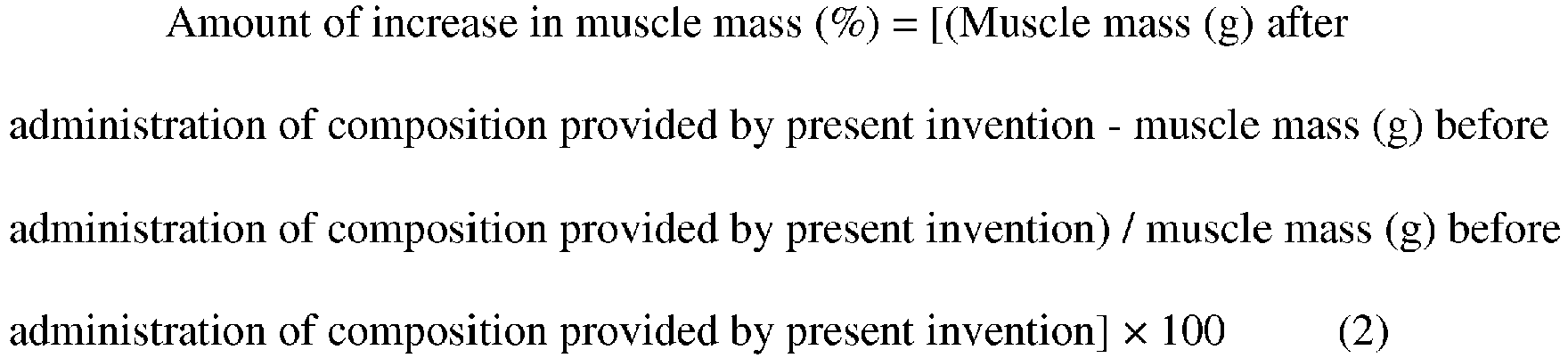
- the increase in muscle mass can be represented by a comparison of after the administration of the composition provided by the present invention with respect to before the administration of the composition provided by the present invention, and the following Calculation Formula (2) may be applied.
- Amount of increase in muscle mass % Muscle mass g after administration of composition provided by present invention ⁇ muscle mass g before administration of composition provided by present invention / muscle mass g before administration of composition provided by present invention ⁇ 100
- the composition provided by the present invention can be continuously administered for 6, 12, 24 weeks, or longer.
- the amount of increase (%) in muscle mass after administration for 6 weeks of the composition provided by the present invention based on a comparison with the administration of a placebo or a control may be 1% to 20%, 2% to 10%, 3% to 15%, 5% to 13%, 6% to 12%, 8% to 11%, or 9% to 10%
- the amount of increase (%) in muscle mass after administration for 6 weeks of the composition provided by the present invention based on a comparison between before and after the administration of the composition provided by the present invention may be 1% to 20%, 2% to 10%, 3% to 15%, 5% to 13%, 6% to 12%, 8% to 11%, or 9% to 10%.
- the amount of increase (%) in muscle mass after administration for 12 weeks of the composition provided by the present invention based on a comparison with the administration of a placebo or a control may be 1% to 20%, 2% to 10%, 3% to 15%, 5% to 13%, 6% to 12%, 8% to 11%, or 9% to 10%
- the amount of increase (%) in muscle mass after administration for 12 weeks of the composition provided by the present invention based on a comparison between before and after the administration of the composition provided by the present invention may be 1% to 20%, 2% to 10%, 3% to 15%, 5% to 13%, 6% to 12%, 8% to 11%, or 9% to 10%.
- the amount of increase (%) in muscle mass after administration for 24 weeks of the composition provided by the present invention based on a comparison with the administration of a placebo or a control may be 1 % to 20%, 2% to 10%, 3% to 15%, 5% to 13%, 6% to 12%, 8% to 11%, or 9% to 10%
- the amount of increase (%) in muscle mass after administration for 24 weeks of the composition provided by the present invention based on a comparison between before and after the administration of the composition provided by the present invention may be 1% to 20%, 2% to 10%, 3% to 15%, 5% to 13%, 6% to 12%, 8% to 11%, or 9% to 10%.
- the Calculation Formulas (1) and (2) for the amount of increase (%) in muscle mass may also be applied to the amount of decrease (%) in muscle mass.
- the amount of increase (%) in muscle mass is replaced with the amount of decrease (%) in muscle mass, and the amount of decrease (%) in muscle mass is expressed as a negative value by substituting each of the "muscle mass (g) after administration of composition provided by present invention", the "muscle mass (g) after administration of placebo or control", and the "muscle mass (g) before administration of composition provided by present invention”.
- the term “amelioration” is a concept encompassing bringing "pathological", “abnormal”, or “uncomfortable” symptoms, conditions, or diseases closer to “healthy”, “normal”, or “comfortable” conditions, or action or means for that purpose; and converting them to "healthy”, “normal”, or “comfortable” conditions, or action or means for that purpose.
- the term “amelioration” encompasses a concept in which a numerical value indicative of "pathological", “abnormal”, or “uncomfortable” symptoms or conditions decreases or increases in accordance with the "amelioration" to become closer to a normal value or become a normal value.
- amelioration of the renal function encompasses a concept in which the creatinine clearance decreases or increases to become closer to a normal value or become a normal value.
- treatment is a concept encompassing eliminating, completely curing, healing, or palliating "pathological", “abnormal”, or “uncomfortable” symptoms, conditions, or diseases, and action or means for that purpose; encompassing “suppressing” deterioration in the "pathological", “abnormal”, or “uncomfortable” symptoms, conditions, or diseases, and action or means for that purpose; and encompassing “amelioration”.
- the term “treatment” encompasses eliminating, completely curing, healing, or palliating “pathological”, “abnormal”, or “uncomfortable” symptoms, conditions, or diseases, and action or means for that purpose.
- treatment encompasses eliminating, completely curing, healing, or palliating "pathological", “abnormal”, or “uncomfortable” symptoms, conditions, or diseases.
- the term “suppression” is a concept encompassing stopping or slowing down of deterioration or progression of symptoms, conditions, or diseases, and action or means for that purpose; and encompassing ameliorating the symptoms, conditions, or diseases, or action or means for that purpose.
- the above-mentioned “deterioration or progression of symptoms, conditions, or diseases” includes deterioration or progression of "pathological”, “abnormal”, or “uncomfortable” symptoms, conditions, or diseases; and deterioration or progression from "healthy” or "normal” conditions to "pathological", “abnormal”, or “uncomfortable” symptoms, conditions, or diseases.
- the term “suppression” encompasses stopping or slowing down of deterioration or progression of symptoms, conditions, or diseases, or action or means for that purpose. In another embodiment, the term “suppression” encompasses stopping or slowing down of deterioration or progression of symptoms, conditions, or diseases.
- the term “healthy” represents a state in which there is no acute or chronic disease or disorder
- the term “normal” represents a state which a healthy subject usually expresses.
- prevention is a concept encompassing preventing onset of "pathological”, “abnormal”, or “uncomfortable” symptoms, conditions, or diseases before they occur, and action or means for that purpose.
- the composition provided by the present invention can be applied to the prevention of disuse syndrome; however, the composition may be ingested by or administered to a mammal (for example, a human) having a risk of continuing a resting state for a long period of time for treatment of a disease, an injury, or the like, in other words, a risk of long-term bedridden, from the initiation of the above-described resting state.
- a mammal for example, a human
- long-term bedridden means that "bed rest” lasts for a long period of time continuously or intermittently.
- the day is regarded as “bed rest”.
- “long-term bedridden” means that "bed rest” lasts for one week or longer continuously or intermittently; as another embodiment, “bed rest” lasts for 6 weeks or longer continuously or intermittently; as still another embodiment, “bed rest” lasts for 12 weeks or longer continuously or intermittently; and as still another embodiment, “bed rest” lasts for 24 weeks or longer continuously or intermittently.
- the "long-term bedridden” means that "bed rest” lasts continuously for one week or longer; as another embodiment, “bed rest” lasts continuously for 6 weeks or longer; as still another embodiment, “bed rest” lasts continuously for 12 weeks or longer; and as still another embodiment, “bed rest” lasts continuously for 24 weeks or longer.
- “enhancement of the effect of rehabilitation can be represented by a comparison of administration of the composition provided by the present invention with respect to administration of a placebo or a control, and for example, as described above, the amount of increase (%) in muscle mass can be used as an index.
- composition provided by the present invention may be a pharmaceutical composition or a food composition.
- a pharmaceutical composition provided by the present invention is orally or parenterally administered to a human or other mammals, and examples of parenteral administration include intravenous administration, subcutaneous administration, intramuscular administration, intra-articular administration, transmucosal administration, transdermal administration, transnasal administration, rectal administration, intrathecal administration, intraperitoneal administration, and topical administration.
- the pharmaceutical composition provided by the present invention may be prepared by using citric acid, a salt of citric acid, a hydrate thereof, or a mixture thereof, as it is or by mixing with a pharmaceutically acceptable carrier, for example, an excipient (for example, lactose, D-mannitol, crystalline cellulose, or glucose), a binder (for example, hydroxypropyl cellulose (HPC), gelatin, or polyvinylpyrrolidone (PVP)), a lubricating agent (for example, magnesium stearate or talc), a disintegrant (for example, starch or carboxymethyl cellulose calcium (CMC-Ca)), a diluent (for example, water for injection or physiological saline), and other additives as necessary (for example, a pH adjuster, a surfactant, a dissolution aid, a preservative, an emulsifier, an isotonic agent, and a stabilizer), and the pharmaceutical composition may be a preparation such as a
- citric acid, a pharmaceutically acceptable salt thereof, a hydrate thereof, or a mixture thereof may be formulated by mixing with an excipient (for example, lactose, D-mannitol, crystalline cellulose, or glucose), a disintegrant (for example, starch or carboxymethyl cellulose calcium (CMC-Ca)), a binder (for example, hydroxypropyl cellulose (HPC), gelatin, or polyvinylpyrrolidone (PVP)), a lubricating agent (for example, magnesium stearate or talc), and the like.
- an excipient for example, lactose, D-mannitol, crystalline cellulose, or glucose
- a disintegrant for example, starch or carboxymethyl cellulose calcium (CMC-Ca)
- a binder for example, hydroxypropyl cellulose (HPC), gelatin, or polyvinylpyrrolidone (PVP)
- a lubricating agent for example, magnesium stearate
- the dosage of the active ingredient which is citric acid, a salt of citric acid, a hydrate thereof, or a mixture thereof, is appropriately determined according to the type of the active ingredient, the administration method, the age, body weight, gender, symptoms, sensitivity to drugs, and the like of the subject of administration; however, the dosage may be adjusted according to the circumstances of the amelioration of symptoms.
- the present invention also provides a food composition including citric acid, a salt of citric acid, a hydrate thereof, or a mixture thereof.
- the food composition provided by the present invention can exhibit an effect of enhancing the mass of muscles (for example, skeletal muscle) when ingested by a healthy person.
- the food composition provided by the present invention may be ingested by an aged person (for example, 60 years or more of age, 65 years or more of age, 70 years or more of age, 75 years or more of age, 80 years or more of age, 90 years or more of age, 60 years or more and less than 75 years of age, or 60 years or more and less than 90 years of age).
- the food composition provided by the present invention may be ingested by a long-term bedridden person (for example, a long-term bedridden patient) or may be ingested to enhance the effect of rehabilitation intended for ameliorating the physical ability.
- the content of citric acid, a salt of citric acid, a hydrate thereof, or a mixture thereof in the food composition provided by the present invention may be appropriately determined according to the type of the food.
- Examples of the food composition include foods for specified health use, dietary supplements, foods with function claims, foods for hospital patients, and supplements.
- the form of these food compositions is not particularly limited as long as it is a form that includes citric acid, a salt of citric acid, a hydrate thereof, or a mixture thereof in an effective amount for providing the above-mentioned effects and can be ingested orally, the form may be a form of an ordinary food or drink, or the food composition may be provided as a preparation suitable for oral administration, for example, a preparation such as a tablet, a capsule, or a suspension, among preparations that can be applied to the composition.
- Known formulation technologies can be applied to the configurations and production methods of these preparations.
- the food may include a 1/3 amount of 0.03 to 0.3 g of anhydrous citric acid and a 1/3 amount of a total of 1 to 3 g of tripotassium citrate monohydrate and trisodium citrate dihydrate per meal of the food.
- a food for specified health use, dietary supplements, a food with function claims, a food for hospital patients, or a supplement is provided as a tablet, for example, tablets of 300 mg to 600 mg per tablet may include 70% to 90% by weight of citric acid, a salt of citric acid, a hydrate thereof, or a mixture thereof.
- the food composition provided by the present invention is not formulated and is provided in the form of an ordinary food or drink
- the food composition can be appropriately produced by a person skilled in the art according to the type of the food, and for example, the food composition may be produced by blending citric acid, a salt of citric acid, a hydrate thereof, or a mixture thereof into a food material.
- Examples of the form of the food and drink include liquid, milky, or pasty foods such as beverages, soy sauce, milk, yogurt, and miso; semi-solid foods such as jellies and gummies; solid foods such as candy, gums, tofu, and supplements; and powdered foods; and the like.
- beverages examples include fruit juice, fruit drinks, coffee drinks, oolong tea drinks, green tea drinks, black tea drinks, barley tea drinks, vegetable drinks, carbonated soft drinks, fruit extract drinks, vegetable extract juices, near water, sports drinks, diet drinks, and the like.
- additives such as antioxidants, fragrances, various esters, organic acids, organic acid salts, inorganic acids, inorganic acid salts, inorganic salts, color materials, emulsifiers, preservatives, seasonings, sweeteners, acidulants, fruit juice extracts, vegetable extracts, nectar extracts, pH adjusters, and quality stabilizers can be blended in singly or in combination.
- the composition provided by the present invention is a tablet, and one tablet may include 10 mg to 1 g, preferably 100 mg to 500 mg, and more preferably 400 mg to 500 mg, of tripotassium citrate monohydrate or trisodium citrate dihydrate as an alkalinizing agent.
- the composition provided by the present invention is a tablet, and one tablet may include tripotassium citrate monohydrate and trisodium citrate dihydrate in an amount of 10 mg to 300 mg for each and 20 mg to 600 mg in total, preferably 150 to 250 mg for each and 400 to 500 mg in total, and more preferably 190 to 240 mg for each and 400 to 450 mg in total.
- the composition provided by the present invention is a tablet, and one tablet includes 10 mg to 1 g, preferably 100 mg to 500 mg, and more preferably 400 mg to 500 mg, of tripotassium citrate monohydrate or trisodium citrate dihydrate as an alkalinizing agent and may include 10 mg to 500 mg, preferably 10 mg to 100 mg, and more preferably 50 mg to 100 mg, of anhydrous citric acid.
- the composition provided by the present invention is a tablet
- one tablet may include tripotassium citrate monohydrate and trisodium citrate dihydrate in an amount of 10 mg to 300 mg for each and 20 mg to 600 mg in total, preferably 150 to 250 mg for each and 400 to 500 mg in total, and more preferably 190 to 240 mg for each and 400 to 450 mg in total, and may include anhydrous citric acid in an amount of 10 mg to 500 mg, preferably 10 mg to 100 mg, and more preferably 50 mg to 100 mg.
- the composition provided by the present invention is a tablet, and the tablet includes, as active ingredients, 231.5 mg of tripotassium citrate monohydrate (C 6 H 5 K 3 O 7 ⁇ H 2 O) and 195.0 mg of trisodium citrate dihydrate (C 6 H 5 Na 3 O 7 ⁇ 2H 2 O) and may include anhydrous citric acid, crystalline cellulose, partially pregelatinized starch, hydroxypropyl cellulose, magnesium stearate, Hypromellose, Macrogol 6000, titanium oxide, and carnauba wax as additives.
- the tablet provided by the present invention may include 72.5 mg of anhydrous citric acid as an additive.
- the dosage or intake amount of the active ingredient included in the composition provided by the present invention can be appropriately set by a person skilled in the art.
- tripotassium citrate monohydrate and trisodium citrate dihydrate may be administered or ingested at a dosage or intake amount of 0.1 to 5 g/day for each and 0.2 to 10 g/day in total, 0.1 to 3 g/day for each and 0.2 to 6 g/day in total, 0.5 to 3 g/day for each and 1 to 6 g/day in total, preferably 0.5 to 1.5 g/day for each and 1 to 3 g/day in total, 1 to 1.5 g/day for each 2 to 3 g/day in total, or 0.5 to 1 g/day for each and 1 to 2 g/day in total, and may be administered or ingested in one to five separate parts a day, and preferably three separate parts a day.
- the active ingredient in a case where the active ingredient is tripotassium citrate monohydrate or trisodium citrate dihydrate, the active ingredient may be administered or ingested at a dosage or intake amount of 1 to 10 g/day, 1 to 6 g/day, 2 to 5.5 g/day, 1 to 3 g/day, 2 to 3 g/day, or 1 to 1.5 g/day, and may be administered or ingested in one to five separate parts a day, and preferably three separate parts a day.
- anhydrous citric acid may be administered or ingested at a dosage or intake amount of 0.1 to 2 g/day, preferably 0.1 to 1 g/day, and more preferably 0.3 to 0.6 g/day; and tripotassium citrate monohydrate and trisodium citrate dihydrate may be administered or ingested at a dosage or intake amount of 0.1 to 5 g/day for each and 0.2 to 10 g/day in total, 0.1 to 3 g/day for each and 0.2 to 6 g/day in total, 0.5 to 3 g/day for each and 1 to 6 g/day in total, preferably 0.5 to 1.5 g/day for each and 1 to 3 g/day in total, 1 to 1.5 g/day for each and 2 to 3 g/day in total, or 0.5 to 1 g/day for each and
- the active ingredient in a case where the active ingredient is anhydrous citric acid, the active ingredient may be administered or ingested at a dose or intake amount of 0.1 to 2 g/day, preferably 0.1 to 1 g/day, and more preferably 0.3 to 0.6 g/day, and may be administered or ingested one to five separate parts a day, and preferably three separate parts a day.
- the duration for administration or ingestion of the composition provided by the present invention may be appropriately set, and for example, the duration may be 5 days, 1 week, 2 weeks, 1 month, 5 days or more and 10 days or less, 1 week or more and 2 weeks or less, 1 week or more and 1 month or less, 5 days or more, 1 week or more, 2 weeks or more, or 1 month or more.
- the following experiment was performed for the purpose of checking a muscle mass increasing effect of a mixture of sodium citrate, potassium citrate, and citric acid.
- mice Male Crl:CD(SD) rats (8 weeks of age at the time of initiation of administration) were divided into two groups, and an aqueous solution of a test drug (group D) or purified water (group C) was orally administered forcibly and repeatedly twice a day for 7 days.
- the dosage volume of the control group (group C) was set to 10.0 mL/kg, and for the test drug administration group (group D), the dosage was set to 2000 mg/kg, the concentration was set to 100 mg/mL, and the dosage volume was set to 10.0 mL/kg.
- An autopsy was performed on the day after the 7th day of administration.
- a 50% aqueous solution of acetonitrile (v/v) (internal standard substance concentration: 20 ⁇ M) was added to the sample, the resulting mixture was crushed under cooling using a crusher (3,500 rpm, 60 seconds ⁇ 5 times), and the same amount of a 50% aqueous solution of acetonitrile (v/v) was further added to the sample.
- tissue disruption centrifugal separation (2,300 ⁇ g, 4°C, for 5 minutes) was performed. After the centrifugal separation, 400 ⁇ L of an upper layer was transferred into an ultrafiltration tube (ULTRAFREE MC PLHCC, HMT, centrifugal filter unit 5 kDa).
- 116 (cation 52, anion 64) kinds of metabolites occupying important roles in the glycolysis system, the pentose phosphate pathway, the citric acid cycle, the urea cycle, the polyamine creatine metabolic pathway, the purine metabolic pathway, the glutathione metabolic pathway, the nicotinamide metabolic pathway, the choline metabolic pathway, and various amino acid metabolic pathways, were selected and analyzed. Absolute quantitative values of these metabolites were calculated, and each substance was drawn on the metabolic pathway of the substance.
- items (NADPH/NADP + , Fischer's Ratio) for which p ⁇ 0.05 in the unpaired t test are shown in Table 1. All of these are items related to energy production or protein synthesis/degradation. Therefore, it is conceivable that due to the energy production increased and the promotion of protein synthesis or/and suppression of protein degradation occurred as a result of ingestion of citrate, the relative muscle mass was higher in the group D as compared with the group C.
- the muscle mass per body weight was significantly increased in the group D as compared with the group C ( FIG. 1 ). Since no significant difference in body weight was recognized between the group C and the group D, these results rule out that the muscle mass increased due to the increase in the body weight. Furthermore, the creatinine clearance (Ccr) per rat body weight was measured, and in the group D, the Ccr increased after administration of the aqueous solution of the test drug as compared with the group C ( FIG. 2 ). The Ccr was calculated from the serum creatinine values before administration and on the day of autopsy, the 21-hour urinary creatinine, and the body weight.
- the Ccr was calculated by dividing the amount of urinary creatinine per minute by the serum creatinine and the body weight.
- a paired t test was used for changes between before administration and on the autopsy day, and an unpaired t test was used for tests between groups.
- composition and the like provided by the present invention may increase muscle mass in a mammal, ameliorate renal function, and reduce the burden on the nursing care field for aged people and long-term bedridden people.
Landscapes
- Health & Medical Sciences (AREA)
- Life Sciences & Earth Sciences (AREA)
- Chemical & Material Sciences (AREA)
- Pharmacology & Pharmacy (AREA)
- Veterinary Medicine (AREA)
- Public Health (AREA)
- General Health & Medical Sciences (AREA)
- Animal Behavior & Ethology (AREA)
- Medicinal Chemistry (AREA)
- Engineering & Computer Science (AREA)
- Chemical Kinetics & Catalysis (AREA)
- Organic Chemistry (AREA)
- Nuclear Medicine, Radiotherapy & Molecular Imaging (AREA)
- General Chemical & Material Sciences (AREA)
- Bioinformatics & Cheminformatics (AREA)
- Physical Education & Sports Medicine (AREA)
- Orthopedic Medicine & Surgery (AREA)
- Epidemiology (AREA)
- Neurology (AREA)
- Mycology (AREA)
- Nutrition Science (AREA)
- Food Science & Technology (AREA)
- Polymers & Plastics (AREA)
- Dermatology (AREA)
- Immunology (AREA)
- Rheumatology (AREA)
- Urology & Nephrology (AREA)
- Pharmaceuticals Containing Other Organic And Inorganic Compounds (AREA)
- Acyclic And Carbocyclic Compounds In Medicinal Compositions (AREA)
Abstract
Description
- The present invention relates to the use of citric acid, a salt thereof, a hydrate thereof, or a mixture thereof, for increasing muscle mass, and the like.
- Priority is claimed on
Japanese Patent Application No. 2021-80076, filed May 10, 2021 - When bed rest is continued for a certain period of time due to disease or injury, muscle strength decreases, and muscles atrophy. Disuse syndrome is known as a disorder caused by such an inactive state of the body. When affected by disuse syndrome, it is difficult for patients to recover the original state, and there is a high possibility of being in a so-called bedridden state. Particularly in aged people, it is said that the disuse syndrome progresses rapidly, and 20% of the muscles of the lower limbs atrophy in two weeks of bed rest. In recent years, along with the rapid progress of an aging society, prevention of disuse syndrome has become more important. Under such circumstances, there is a demand for a safe food composition capable of suppressing muscle atrophy and increasing the muscle mass.
- Patent Document 1 discloses a food composition for suppressing disuse muscle atrophy, the food composition containing naringenin as an active ingredient.
- Patent Document 2 discloses a food composition for increasing muscle mass, the food composition containing lemon juice, oligosaccharide acid, and calcium as active ingredients.
-
- [Patent Document 1]
JP 2016-136952 A - [Patent Document 2]
JP 2018-153166 A - An object of the present invention is to provide a composition useful for increasing muscle mass. Another object of the present invention is to provide a composition useful for preventing disuse syndrome. Another object of the present invention is to provide a composition useful for the rehabilitation of a long-term bedridden person.
- The inventors of the present invention conducted a thorough investigation to achieve the above-described objects, and they found that citric acid, a salt of citric acid, a hydrate thereof, or a mixture thereof increases the muscle mass, thus completing the invention.
- In one aspect, the present invention provides a composition for increasing muscle mass, the composition including citric acid, a salt of citric acid, a hydrate thereof, or a mixture thereof.
- In one aspect, the present invention provides a composition for preventing disuse syndrome, the composition including citric acid, a salt of citric acid, a hydrate thereof, or a mixture thereof.
- In one aspect, the present invention provides a composition for enhancing the effect of rehabilitation of a long-term bedridden person, the composition including citric acid, a salt of citric acid, a hydrate thereof, or a mixture thereof.
- In one aspect, the present invention provides a composition for suppressing a decrease in the muscle mass of an aged person, the composition including citric acid, a salt of citric acid, a hydrate thereof, or a mixture thereof.
- That is, the present invention has the following aspects.
- (1) A composition for increasing muscle mass in a mammal, the composition including citric acid, a salt of citric acid, a hydrate thereof, or a mixture thereof.
- (2) The composition according to (1), in which the composition is a food composition.
- (3) The composition according to (1) or (2), in which the citric acid, the salt of citric acid, the hydrate thereof, or the mixture thereof is an alkali metal salt of citric acid.
- (4) The composition according to any one of (1) to (3), in which the citric acid, the salt of citric acid, the hydrate thereof, or the mixture thereof is a mixture of sodium citrate or a hydrate thereof and potassium citrate or a hydrate thereof.
- (5) The composition according to (3) or (4), further including anhydrous citric acid.
- (6) The composition according to any one of (1) to (5), in which the composition is a food composition in which an effect of increasing muscle mass is indicated on packaging, a container, or an instruction leaflet.
- (7) The composition according to any one of (1) to (6), in which the composition is used for preventing disuse syndrome.
- (8) The composition according to any one of (1) to (7), in which the composition is used for enhancing an effect of rehabilitation of a long-term bedridden person.
- (9) The composition according to any one of (1) to (8), in which the composition is used for suppressing a decrease in muscle mass of an aged person.
- (10) The composition according to any one of (1) to (9), in which the composition is a tablet.
- (11) The composition according to any one of (1) to (10), in which the composition ameliorates a renal function of a mammal.
- (12) The composition according to any one of (1), (3) to (5), and (7) to (11), in which the composition is a pharmaceutical composition.
- The muscle mass is increased by taking in or ingesting a pharmaceutical composition or a food composition provided by the present invention.
-
-
FIG. 1 is a graph showing the relative muscle masses of vastus lateralis muscle (weight of vastus lateralis muscle per 100 g of body weight) of rats to which a mixture of sodium citrate, potassium citrate, and citric acid was administered, and rats to which purified water was administered. Each bar indicates the average value and the standard deviation. -
FIG. 2 is a graph showing creatinine clearances before administration and after administration in rats to which a mixture of sodium citrate, potassium citrate, and citric acid was administered, and rats to which purified water was administered. Each bar indicates the average value and the standard deviation. - A composition provided by the present invention can include citric acid, a salt of citric acid, a hydrate thereof, or a mixture thereof, as an active ingredient. The salt of citric acid may be a salt acceptable as a medicine or a food. Examples of the salt of citric acid include an alkali metal salt of citric acid. Examples of the alkali metal salt of citric acid include potassium citrate and sodium citrate, and a mixture thereof may also be used. Examples of potassium citrate and sodium citrate may include hydrates such as tripotassium citrate monohydrate (C6H5K3O7·H2O) and trisodium citrate dihydrate (C6H5Na3O7·2H2O), each of which is stable.
- Preferred examples of the active ingredient include anhydrous citric acid, sodium citrate, potassium citrate, a hydrate thereof, and a mixture thereof, and the active ingredient may be, for example, a mixture of tripotassium citrate monohydrate (C6H5K3O7·H2O) and trisodium citrate dihydrate (C6H5Na3O7·2H2O); or a mixture of tripotassium citrate monohydrate (C6H5K3O7·H2O), trisodium citrate dihydrate (C6H5Na3O7·2H2O), and anhydrous citric acid.
- A mixing ratio of tripotassium citrate monohydrate (C6H5K3O7·H2O) and trisodium citrate dihydrate (C6H5Na3O7·2H2O) can be appropriately set by a person skilled in the art, and for example, a molar ratio of tripotassium citrate monohydrate and trisodium citrate dihydrate can be set to 0.01 to 100 of trisodium citrate dihydrate with respect to 1 of tripotassium citrate monohydrate. The mixing ratio may be set to about 1:1 as a molar ratio.
- A mixing ratio of tripotassium citrate monohydrate (C6H5K3O7·H2O), trisodium citrate dihydrate (C6H5Na3O7·2H2O), and anhydrous citric acid in the mixture of tripotassium citrate monohydrate (C6H5K3O7·H2O), trisodium citrate dihydrate (C6H5Na3O7·2H2O), and anhydrous citric acid can be appropriately set by a person skilled in the art, and for example, the molar ratio of tripotassium citrate monohydrate, trisodium citrate dihydrate, and anhydrous citric acid can be set to 0.01 to 100 of trisodium citrate monohydrate and 0.01 to 100 of anhydrous citric acid with respect to 1 of tripotassium citrate monohydrate. The mixing ratio may be set to about 2:2:1 in a molar ratio.
- In addition, other preferred examples of the active ingredient include sodium citrate or a hydrate thereof, and for example, the active ingredient may be trisodium citrate dihydrate (C6H5Na3O7·2H2O).
- Furthermore, other preferred examples of the active ingredient include potassium citrate or a hydrate thereof, and for example, the active ingredient may be tripotassium citrate monohydrate (C6H5K3O7·H2O).
- In one embodiment, the active ingredient of the composition provided by the present invention may include a mixture of citric acid or a hydrate thereof, sodium citrate or a hydrate thereof and potassium citrate or a hydrate thereof, or may be composed only of a mixture of citric acid or a hydrate thereof, sodium citrate or a hydrate thereof and potassium citrate or a hydrate thereof.
- In one embodiment, the active ingredient of the composition provided by the present invention may include a mixture of sodium citrate or a hydrate thereof and potassium citrate or a hydrate thereof, or may be composed only of a mixture of sodium citrate or a hydrate thereof and potassium citrate or a hydrate thereof.
- In one embodiment, the active ingredient of the composition provided by the present invention is citric acid, a salt of citric acid, a hydrate thereof, or a mixture thereof, excluding ferrous citrate, ferric citrate, and hydrates thereof (for example, ferric citrate hydrate).
- In the present specification, when the weight of citric acid or a hydrate thereof, a pharmaceutically acceptable salt of citric acid, or a hydrate thereof, or a mixture thereof (for example, tripotassium citrate monohydrate (C6H5K3O7·H2O) and trisodium citrate dihydrate (C6H5Na3O7·2H2O)) is to be mentioned, the weight may be a dry weight.
- As the composition provided by the present invention is administered or ingested, the muscle mass of the subject which has been administered with the composition or has ingested the composition increases. Examples of the muscle that increases include skeletal muscles. The muscle mass may be, for example, the weight of muscles per body weight.
- In addition, as the composition provided by the present invention is administered or ingested, the renal function of the subject which has been administered with the composition or which has ingested the composition is ameliorated (for example, the creatinine clearance is ameliorated).
- In the present specification, the increase in muscle mass, amelioration of renal function, suppression of a decrease in the muscle mass, and suppression of the deterioration of renal function can be checked by, for example, a comparison between the administration of the composition provided by the present invention and the administration of a placebo, and/or a comparison between before and after the administration of the composition provided by the present invention.
- The subject of administration of the composition provided by the present invention may be a mammal (for example, a human) and is not particularly limited, and can be appropriately selected by a person skilled in the art.
- The composition provided by the present invention may be administered to or taken in by a long-term bedridden person (for example, a long-term bedridden patient).
- The disuse syndrome may be developed due to continuing a resting state for a long period of time for the treatment of a disease, an injury, or the like. The composition provided by the present invention can be used for the prevention or amelioration of disuse syndrome, particularly the prevention of deterioration of the physical ability seen in the disuse syndrome (for example, prevention of muscle weakness, prevention of muscle mass reduction, and prevention of the deterioration of renal function) or the amelioration of the physical ability of a human who has developed disuse syndrome (for example, amelioration of muscle strength, increase in muscle mass, and amelioration of renal function) or treatment. The composition provided by the present invention may be used in order to enhance the effect of rehabilitation for the purpose of ameliorating the physical ability.
- In addition, the composition provided by the present invention may be administered to or taken in by an aged person (for example, 60 years or more of age, 65 years or more of age, 70 years or more of age, 75 years or more of age, 80 years or more of age, 90 years or more of age, 60 years or more and less than 75 years of age, 60 years or more and less than 90 years of age). The composition provided by the present invention can be used for the suppression of deterioration of the physical ability due to aging (for example, suppression of muscle weakness, suppression of muscle mass reduction, and prevention of the deterioration of renal function), and the amelioration of the physical ability that has deteriorated due to aging (for example, amelioration of muscle strength, increase in muscle mass, and amelioration of renal function).
- In one embodiment, the composition provided by the present invention suppresses muscle weakness, suppresses muscle mass reduction, ameliorates muscle strength, or increases muscle mass, without requiring high-intensity exercise.
- In one embodiment, the composition provided by the present invention suppresses the deterioration of renal function or ameliorates the renal function.
- In one embodiment, the composition provided by the present invention suppresses muscle mass reduction and suppresses the deterioration of renal function or increases muscle mass, while ameliorating the renal function.
- Citric acid, a salt thereof, a hydrate thereof, or a mixture thereof (for example, citric acid, sodium citrate dihydrate, and tripotassium citrate monohydrate), all of which are the active ingredients of the composition provided by the present invention, is a substance whose safety has been proven, and which may be administered or ingested without inducing harmful side effects on humans.
- In the present specification, the "muscle mass" can be measured by, for example, a bioelectrical impedance analysis (BIA) method using a body composition analyzer (for example, InBody 770; manufactured by InBody Co., Ltd.).
- In one embodiment, the increase in muscle mass can be represented by a comparison of administration of the composition provided by the present invention with respect to administration of a placebo or a control, and the following Calculation Formula (1) may be applied.

- In one embodiment, the increase in muscle mass can be represented by a comparison of after the administration of the composition provided by the present invention with respect to before the administration of the composition provided by the present invention, and the following Calculation Formula (2) may be applied.
- In one embodiment, the composition provided by the present invention can be continuously administered for 6, 12, 24 weeks, or longer. For example, the amount of increase (%) in muscle mass after administration for 6 weeks of the composition provided by the present invention based on a comparison with the administration of a placebo or a control, may be 1% to 20%, 2% to 10%, 3% to 15%, 5% to 13%, 6% to 12%, 8% to 11%, or 9% to 10%, and the amount of increase (%) in muscle mass after administration for 6 weeks of the composition provided by the present invention based on a comparison between before and after the administration of the composition provided by the present invention, may be 1% to 20%, 2% to 10%, 3% to 15%, 5% to 13%, 6% to 12%, 8% to 11%, or 9% to 10%. For example, the amount of increase (%) in muscle mass after administration for 12 weeks of the composition provided by the present invention based on a comparison with the administration of a placebo or a control, may be 1% to 20%, 2% to 10%, 3% to 15%, 5% to 13%, 6% to 12%, 8% to 11%, or 9% to 10%, and the amount of increase (%) in muscle mass after administration for 12 weeks of the composition provided by the present invention based on a comparison between before and after the administration of the composition provided by the present invention, may be 1% to 20%, 2% to 10%, 3% to 15%, 5% to 13%, 6% to 12%, 8% to 11%, or 9% to 10%. For example, the amount of increase (%) in muscle mass after administration for 24 weeks of the composition provided by the present invention based on a comparison with the administration of a placebo or a control, may be 1 % to 20%, 2% to 10%, 3% to 15%, 5% to 13%, 6% to 12%, 8% to 11%, or 9% to 10%, and the amount of increase (%) in muscle mass after administration for 24 weeks of the composition provided by the present invention based on a comparison between before and after the administration of the composition provided by the present invention, may be 1% to 20%, 2% to 10%, 3% to 15%, 5% to 13%, 6% to 12%, 8% to 11%, or 9% to 10%.
- The Calculation Formulas (1) and (2) for the amount of increase (%) in muscle mass may also be applied to the amount of decrease (%) in muscle mass. In this case, the amount of increase (%) in muscle mass is replaced with the amount of decrease (%) in muscle mass, and the amount of decrease (%) in muscle mass is expressed as a negative value by substituting each of the "muscle mass (g) after administration of composition provided by present invention", the "muscle mass (g) after administration of placebo or control", and the "muscle mass (g) before administration of composition provided by present invention".
- In the present specification, the term "amelioration" is a concept encompassing bringing "pathological", "abnormal", or "uncomfortable" symptoms, conditions, or diseases closer to "healthy", "normal", or "comfortable" conditions, or action or means for that purpose; and converting them to "healthy", "normal", or "comfortable" conditions, or action or means for that purpose. Accordingly, in one embodiment, the term "amelioration" encompasses a concept in which a numerical value indicative of "pathological", "abnormal", or "uncomfortable" symptoms or conditions decreases or increases in accordance with the "amelioration" to become closer to a normal value or become a normal value. For example, amelioration of the renal function encompasses a concept in which the creatinine clearance decreases or increases to become closer to a normal value or become a normal value.
- In the present specification, the term "treatment" is a concept encompassing eliminating, completely curing, healing, or palliating "pathological", "abnormal", or "uncomfortable" symptoms, conditions, or diseases, and action or means for that purpose; encompassing "suppressing" deterioration in the "pathological", "abnormal", or "uncomfortable" symptoms, conditions, or diseases, and action or means for that purpose; and encompassing "amelioration". In one embodiment, the term "treatment" encompasses eliminating, completely curing, healing, or palliating "pathological", "abnormal", or "uncomfortable" symptoms, conditions, or diseases, and action or means for that purpose. In another embodiment, the term "treatment" encompasses eliminating, completely curing, healing, or palliating "pathological", "abnormal", or "uncomfortable" symptoms, conditions, or diseases.
- In the present specification, the term "suppression" is a concept encompassing stopping or slowing down of deterioration or progression of symptoms, conditions, or diseases, and action or means for that purpose; and encompassing ameliorating the symptoms, conditions, or diseases, or action or means for that purpose. The above-mentioned "deterioration or progression of symptoms, conditions, or diseases" includes deterioration or progression of "pathological", "abnormal", or "uncomfortable" symptoms, conditions, or diseases; and deterioration or progression from "healthy" or "normal" conditions to "pathological", "abnormal", or "uncomfortable" symptoms, conditions, or diseases. In one embodiment, the term "suppression" encompasses stopping or slowing down of deterioration or progression of symptoms, conditions, or diseases, or action or means for that purpose. In another embodiment, the term "suppression" encompasses stopping or slowing down of deterioration or progression of symptoms, conditions, or diseases.
- In the present specification, the term "healthy" represents a state in which there is no acute or chronic disease or disorder, and the term "normal" represents a state which a healthy subject usually expresses.
- In the present specification, the term "prevention" is a concept encompassing preventing onset of "pathological", "abnormal", or "uncomfortable" symptoms, conditions, or diseases before they occur, and action or means for that purpose.
- In one embodiment, the composition provided by the present invention can be applied to the prevention of disuse syndrome; however, the composition may be ingested by or administered to a mammal (for example, a human) having a risk of continuing a resting state for a long period of time for treatment of a disease, an injury, or the like, in other words, a risk of long-term bedridden, from the initiation of the above-described resting state.
- In the present specification, the term "long-term bedridden" means that "bed rest" lasts for a long period of time continuously or intermittently. In the present specification, in a case where the period of time for "bed rest" is longer than the period of time for "getting out of bed" in one day, the day is regarded as "bed rest". As one embodiment, "long-term bedridden" means that "bed rest" lasts for one week or longer continuously or intermittently; as another embodiment, "bed rest" lasts for 6 weeks or longer continuously or intermittently; as still another embodiment, "bed rest" lasts for 12 weeks or longer continuously or intermittently; and as still another embodiment, "bed rest" lasts for 24 weeks or longer continuously or intermittently. As one embodiment, the "long-term bedridden" means that "bed rest" lasts continuously for one week or longer; as another embodiment, "bed rest" lasts continuously for 6 weeks or longer; as still another embodiment, "bed rest" lasts continuously for 12 weeks or longer; and as still another embodiment, "bed rest" lasts continuously for 24 weeks or longer.
- In the present specification, "enhancement of the effect of rehabilitation (also referred to as rehabilitation)" can be represented by a comparison of administration of the composition provided by the present invention with respect to administration of a placebo or a control, and for example, as described above, the amount of increase (%) in muscle mass can be used as an index.
- In the present specification, the expression [A, B, and/or C] means that "at least one is selected from the group consisting of A, B, and C".
- The composition provided by the present invention may be a pharmaceutical composition or a food composition.
- A pharmaceutical composition provided by the present invention is orally or parenterally administered to a human or other mammals, and examples of parenteral administration include intravenous administration, subcutaneous administration, intramuscular administration, intra-articular administration, transmucosal administration, transdermal administration, transnasal administration, rectal administration, intrathecal administration, intraperitoneal administration, and topical administration.
- The pharmaceutical composition provided by the present invention may be prepared by using citric acid, a salt of citric acid, a hydrate thereof, or a mixture thereof, as it is or by mixing with a pharmaceutically acceptable carrier, for example, an excipient (for example, lactose, D-mannitol, crystalline cellulose, or glucose), a binder (for example, hydroxypropyl cellulose (HPC), gelatin, or polyvinylpyrrolidone (PVP)), a lubricating agent (for example, magnesium stearate or talc), a disintegrant (for example, starch or carboxymethyl cellulose calcium (CMC-Ca)), a diluent (for example, water for injection or physiological saline), and other additives as necessary (for example, a pH adjuster, a surfactant, a dissolution aid, a preservative, an emulsifier, an isotonic agent, and a stabilizer), and the pharmaceutical composition may be a preparation such as a tablet, a capsule, a suspension, an injectable preparation, or a suppository. For example, in order to prepare as a tablet, citric acid, a pharmaceutically acceptable salt thereof, a hydrate thereof, or a mixture thereof may be formulated by mixing with an excipient (for example, lactose, D-mannitol, crystalline cellulose, or glucose), a disintegrant (for example, starch or carboxymethyl cellulose calcium (CMC-Ca)), a binder (for example, hydroxypropyl cellulose (HPC), gelatin, or polyvinylpyrrolidone (PVP)), a lubricating agent (for example, magnesium stearate or talc), and the like.
- The dosage of the active ingredient, which is citric acid, a salt of citric acid, a hydrate thereof, or a mixture thereof, is appropriately determined according to the type of the active ingredient, the administration method, the age, body weight, gender, symptoms, sensitivity to drugs, and the like of the subject of administration; however, the dosage may be adjusted according to the circumstances of the amelioration of symptoms.
- The present invention also provides a food composition including citric acid, a salt of citric acid, a hydrate thereof, or a mixture thereof.
- The food composition provided by the present invention can exhibit an effect of enhancing the mass of muscles (for example, skeletal muscle) when ingested by a healthy person.
- The food composition provided by the present invention may be ingested by an aged person (for example, 60 years or more of age, 65 years or more of age, 70 years or more of age, 75 years or more of age, 80 years or more of age, 90 years or more of age, 60 years or more and less than 75 years of age, or 60 years or more and less than 90 years of age). In addition, the food composition provided by the present invention may be ingested by a long-term bedridden person (for example, a long-term bedridden patient) or may be ingested to enhance the effect of rehabilitation intended for ameliorating the physical ability.
- The content of citric acid, a salt of citric acid, a hydrate thereof, or a mixture thereof in the food composition provided by the present invention may be appropriately determined according to the type of the food. Examples of the food composition include foods for specified health use, dietary supplements, foods with function claims, foods for hospital patients, and supplements. The form of these food compositions is not particularly limited as long as it is a form that includes citric acid, a salt of citric acid, a hydrate thereof, or a mixture thereof in an effective amount for providing the above-mentioned effects and can be ingested orally, the form may be a form of an ordinary food or drink, or the food composition may be provided as a preparation suitable for oral administration, for example, a preparation such as a tablet, a capsule, or a suspension, among preparations that can be applied to the composition. Known formulation technologies can be applied to the configurations and production methods of these preparations.
- For example, in the case of a food for specified health use, dietary supplements, a food with function claims, or a food for hospital patients, the food may include a 1/3 amount of 0.03 to 0.3 g of anhydrous citric acid and a 1/3 amount of a total of 1 to 3 g of tripotassium citrate monohydrate and trisodium citrate dihydrate per meal of the food. In a case where a food for specified health use, dietary supplements, a food with function claims, a food for hospital patients, or a supplement is provided as a tablet, for example, tablets of 300 mg to 600 mg per tablet may include 70% to 90% by weight of citric acid, a salt of citric acid, a hydrate thereof, or a mixture thereof.
- In a case where the food composition provided by the present invention is not formulated and is provided in the form of an ordinary food or drink, the food composition can be appropriately produced by a person skilled in the art according to the type of the food, and for example, the food composition may be produced by blending citric acid, a salt of citric acid, a hydrate thereof, or a mixture thereof into a food material.
- Examples of the form of the food and drink include liquid, milky, or pasty foods such as beverages, soy sauce, milk, yogurt, and miso; semi-solid foods such as jellies and gummies; solid foods such as candy, gums, tofu, and supplements; and powdered foods; and the like.
- Examples of the beverages include fruit juice, fruit drinks, coffee drinks, oolong tea drinks, green tea drinks, black tea drinks, barley tea drinks, vegetable drinks, carbonated soft drinks, fruit extract drinks, vegetable extract juices, near water, sports drinks, diet drinks, and the like.
- In beverages, additives such as antioxidants, fragrances, various esters, organic acids, organic acid salts, inorganic acids, inorganic acid salts, inorganic salts, color materials, emulsifiers, preservatives, seasonings, sweeteners, acidulants, fruit juice extracts, vegetable extracts, nectar extracts, pH adjusters, and quality stabilizers can be blended in singly or in combination.
- In one embodiment, the composition provided by the present invention is a tablet, and one tablet may include 10 mg to 1 g, preferably 100 mg to 500 mg, and more preferably 400 mg to 500 mg, of tripotassium citrate monohydrate or trisodium citrate dihydrate as an alkalinizing agent.
- In one embodiment, the composition provided by the present invention is a tablet, and one tablet may include tripotassium citrate monohydrate and trisodium citrate dihydrate in an amount of 10 mg to 300 mg for each and 20 mg to 600 mg in total, preferably 150 to 250 mg for each and 400 to 500 mg in total, and more preferably 190 to 240 mg for each and 400 to 450 mg in total.
- In one embodiment, the composition provided by the present invention is a tablet, and one tablet includes 10 mg to 1 g, preferably 100 mg to 500 mg, and more preferably 400 mg to 500 mg, of tripotassium citrate monohydrate or trisodium citrate dihydrate as an alkalinizing agent and may include 10 mg to 500 mg, preferably 10 mg to 100 mg, and more preferably 50 mg to 100 mg, of anhydrous citric acid.
- In one embodiment, the composition provided by the present invention is a tablet, and one tablet may include tripotassium citrate monohydrate and trisodium citrate dihydrate in an amount of 10 mg to 300 mg for each and 20 mg to 600 mg in total, preferably 150 to 250 mg for each and 400 to 500 mg in total, and more preferably 190 to 240 mg for each and 400 to 450 mg in total, and may include anhydrous citric acid in an amount of 10 mg to 500 mg, preferably 10 mg to 100 mg, and more preferably 50 mg to 100 mg.
- In one embodiment, the composition provided by the present invention is a tablet, and the tablet includes, as active ingredients, 231.5 mg of tripotassium citrate monohydrate (C6H5K3O7·H2O) and 195.0 mg of trisodium citrate dihydrate (C6H5Na3O7·2H2O) and may include anhydrous citric acid, crystalline cellulose, partially pregelatinized starch, hydroxypropyl cellulose, magnesium stearate, Hypromellose, Macrogol 6000, titanium oxide, and carnauba wax as additives. In this embodiment, the tablet provided by the present invention may include 72.5 mg of anhydrous citric acid as an additive.
- The dosage or intake amount of the active ingredient included in the composition provided by the present invention can be appropriately set by a person skilled in the art.
- In one embodiment, in a case where the active ingredient is a mixture of tripotassium citrate monohydrate and trisodium citrate dihydrate, tripotassium citrate monohydrate and trisodium citrate dihydrate may be administered or ingested at a dosage or intake amount of 0.1 to 5 g/day for each and 0.2 to 10 g/day in total, 0.1 to 3 g/day for each and 0.2 to 6 g/day in total, 0.5 to 3 g/day for each and 1 to 6 g/day in total, preferably 0.5 to 1.5 g/day for each and 1 to 3 g/day in total, 1 to 1.5 g/day for each 2 to 3 g/day in total, or 0.5 to 1 g/day for each and 1 to 2 g/day in total, and may be administered or ingested in one to five separate parts a day, and preferably three separate parts a day.
- In one embodiment, in a case where the active ingredient is tripotassium citrate monohydrate or trisodium citrate dihydrate, the active ingredient may be administered or ingested at a dosage or intake amount of 1 to 10 g/day, 1 to 6 g/day, 2 to 5.5 g/day, 1 to 3 g/day, 2 to 3 g/day, or 1 to 1.5 g/day, and may be administered or ingested in one to five separate parts a day, and preferably three separate parts a day.
- In one embodiment, in a case where the active ingredient is a mixture of anhydrous citric acid, tripotassium citrate monohydrate, and trisodium citrate dihydrate, anhydrous citric acid may be administered or ingested at a dosage or intake amount of 0.1 to 2 g/day, preferably 0.1 to 1 g/day, and more preferably 0.3 to 0.6 g/day; and tripotassium citrate monohydrate and trisodium citrate dihydrate may be administered or ingested at a dosage or intake amount of 0.1 to 5 g/day for each and 0.2 to 10 g/day in total, 0.1 to 3 g/day for each and 0.2 to 6 g/day in total, 0.5 to 3 g/day for each and 1 to 6 g/day in total, preferably 0.5 to 1.5 g/day for each and 1 to 3 g/day in total, 1 to 1.5 g/day for each and 2 to 3 g/day in total, or 0.5 to 1 g/day for each and 1 to 2 g/day in total, and may be administered or ingested in one to five separate parts a day, and preferably three separate parts a day.
- In one embodiment, in a case where the active ingredient is anhydrous citric acid, the active ingredient may be administered or ingested at a dose or intake amount of 0.1 to 2 g/day, preferably 0.1 to 1 g/day, and more preferably 0.3 to 0.6 g/day, and may be administered or ingested one to five separate parts a day, and preferably three separate parts a day.
- The duration for administration or ingestion of the composition provided by the present invention may be appropriately set, and for example, the duration may be 5 days, 1 week, 2 weeks, 1 month, 5 days or more and 10 days or less, 1 week or more and 2 weeks or less, 1 week or more and 1 month or less, 5 days or more, 1 week or more, 2 weeks or more, or 1 month or more.
- Examples of embodiments provided by the present invention include the following.
- (1-1)
Use of citric acid, a salt of citric acid, a hydrate thereof, or a mixture thereof, for producing a composition for increasing muscle mass; - (1-2)
Use of citric acid, a salt of citric acid, a hydrate thereof, or a mixture thereof, for producing a composition for preventing disuse syndrome; - (1-3)
Use of citric acid, a salt of citric acid, a hydrate thereof, or a mixture thereof, for producing a composition for enhancing an effect of rehabilitation of a long-term bedridden person; - (1-4)
Use of citric acid, a salt of citric acid, a hydrate thereof, or a mixture thereof, for producing a composition for suppressing a decrease in muscle mass of an aged person; - (1-5)
Use of citric acid, a salt of citric acid, a hydrate thereof, or a mixture thereof, for producing a composition for ameliorating renal function of a long-term bedridden person or an aged person; - (2-1)
A composition including citric acid, a salt of citric acid, a hydrate thereof, or a mixture thereof, for use in increasing muscle mass; - (2-2)
A composition including citric acid, a salt of citric acid, a hydrate thereof, or a mixture thereof, for use in preventing disuse syndrome; - (2-3)
A composition including citric acid, a salt of citric acid, a hydrate thereof, or a mixture thereof, for use in enhancing an effect of rehabilitation of a long-term bedridden person; - (2-4)
A composition including citric acid, a salt of citric acid, a hydrate thereof, or a mixture thereof, for use in suppressing a decrease in muscle mass in an aged person; - (2-5)
A composition including citric acid, a salt of citric acid, a hydrate thereof, or a mixture thereof, for use in ameliorating renal function of a long-term bedridden person or an aged person; - (3-1)
A method for increasing muscle mass, the method including administering a composition including an effective amount of citric acid, a salt of citric acid, a hydrate thereof, or a mixture thereof, to a subject in need of an increase in muscle mass; - (3-2)
A method for preventing disuse syndrome, the method including administering a composition including an effective amount of citric acid, a salt of citric acid, a hydrate thereof, or a mixture thereof, to a subject in need of prevention of disuse syndrome; - (3-3)
A method for enhancing an effect of rehabilitation of a long-term bedridden person, the method including administering a composition including an effective amount of citric acid, a salt of citric acid, a hydrate thereof, or a mixture thereof, to a subject in need of enhancement of an effect of rehabilitation; - (3-4)
A method for suppressing a decrease in muscle mass in an aged person, the method including administering a composition including an effective amount of citric acid, a salt of citric acid, a hydrate thereof, or a mixture thereof, to a subject in need of suppression of a decrease in muscle mass; - (3-5)
A method for ameliorating renal function of a long-term bedridden person or an aged person, the method including administering a composition including an effective amount of citric acid, a salt of citric acid, a hydrate thereof, or a mixture thereof, to a subject in need of amelioration of renal function; - (4-1)
The use, composition, or method according to any one of (1-1) to (1-5), (2-1) to (2-5), and (3-1) to (3-5), in which the citric acid, the salt of citric acid, the hydrate thereof, or the mixture thereof, is an alkali metal salt of citric acid; - (4-2)
The use, composition, or method according to any one of (1-1) to (1-5), (2-1) to (2-5), and (3-1) to (3-5), in which the citric acid, the salt of citric acid, the hydrate thereof, or the mixture thereof, is sodium citrate or a hydrate thereof, potassium citrate or a hydrate thereof, or a mixture thereof; - (4-3)
The use, composition, or method according to any one of (1-1) to (1-5), (2-1) to (2-5), and (3-1) to (3-5), in which the citric acid, the salt of citric acid, the hydrate thereof, or the mixture thereof, is sodium citrate or a hydrate thereof; - (4-4)
The use, composition, or method according to any one of (1-1) to (1-5), (2-1) to (2-5), (3-1) to (3-5), and (4-1) to (4-5), in which the citric acid, the salt of citric acid, the hydrate thereof, or the mixture thereof, is a mixture of trisodium citrate dihydrate and tripotassium citrate monohydrate; - (4-5)
The use, composition, or method according to any one of (1-1) to (1-5), (2-1) to (2-5), (3-1) to (3-5), and (4-1) to (4-5), in which the citric acid, the salt of citric acid, the hydrate thereof, or the mixture thereof, is a mixture of trisodium citrate dihydrate and tripotassium citrate monohydrate, and an oral dosage or intake amount is 0.5 g to 1.5 g/day for each and 1 to 3 g/day in total; - (4-6)
The use, composition, or method according to any one of (4-1) to (4-5), further including citric acid; - (4-7)
The use, composition, or method according to any one of (1-1) to (1-5), (2-1) to (2-5), (3-1) to (3-5), and (4-1) to (4-6), in which the citric acid, the salt of citric acid, the hydrate thereof, or the mixture thereof, is a mixture of citric acid, trisodium citrate dihydrate, and tripotassium citrate monohydrate, and a weight ratio of the mixture is 2:2:1; - (4-8)
The use, composition, or method according to any one of (1-1) to (1-5), (2-1) to (2-5), (3-1) to (3-5), and (4-1) to (4-7), in which the composition is a food; - (4-9)
The use, composition, or method according to any one of (1-1) to (1-5), (2-1) to (2-5), (3-1) to (3-5), and (4-1) to (4-8), in which the composition is a food composition whose effect of increasing muscle mass is indicated on packaging, a container, or an instruction leaflet; and - (4-10)
The use, composition, or method according to any one of (1-1) to (1-5), (2-1) to (2-5), (3-1) to (3-5), and (4-1) to (4-9), in which the citric acid, the salt of citric acid, the hydrate thereof, or the mixture thereof, is a mixture of trisodium citrate dihydrate and tripotassium citrate monohydrate, an oral dosage or intake amount is 0.5 g to 1.5 g/day for each and 1 to 3 g/day in total, and an increase in muscle mass and/or amelioration of renal function is recognized as a result of administration or ingestion. - Hereinafter, the present invention will be further described by way of Examples; however, the present invention is not intended to be limited to these.
- The following experiment was performed for the purpose of checking a muscle mass increasing effect of a mixture of sodium citrate, potassium citrate, and citric acid.
- Male Crl:CD(SD) rats (8 weeks of age at the time of initiation of administration) were divided into two groups, and an aqueous solution of a test drug (group D) or purified water (group C) was orally administered forcibly and repeatedly twice a day for 7 days.
- The dosage volume of the control group (group C) was set to 10.0 mL/kg, and for the test drug administration group (group D), the dosage was set to 2000 mg/kg, the concentration was set to 100 mg/mL, and the dosage volume was set to 10.0 mL/kg. An autopsy was performed on the day after the 7th day of administration.
- The above-described aqueous solution of the test drug was produced as follows.
- 463 mg of tripotassium citrate monohydrate (C6H5K3O7·H2O), 390 mg of trisodium citrate dihydrate (C6H5Na3O7·2H2O), and 145 mg of anhydrous citric acid were dissolved in purified water, and adjusted to 100 mg/mL.
- As a result, in group D, the weight of the vastus lateralis muscle per 100 g of the body weight was significantly higher as compared with group C (
FIG. 1 ). For statistical analysis, an unpaired t test was used. - In addition, a metabolome analysis was performed on the muscles collected at the time of autopsy on the day after the 7th day of administration.
- After receiving a rat muscle tissue sample, 750 µL of a 50% aqueous solution of acetonitrile (v/v) (internal standard substance concentration: 20 µM) was added to the sample, the resulting mixture was crushed under cooling using a crusher (3,500 rpm, 60 seconds × 5 times), and the same amount of a 50% aqueous solution of acetonitrile (v/v) was further added to the sample. After the tissue disruption, centrifugal separation (2,300×g, 4°C, for 5 minutes) was performed. After the centrifugal separation, 400 µL of an upper layer was transferred into an ultrafiltration tube (ULTRAFREE MC PLHCC, HMT, centrifugal filter unit 5 kDa). This was centrifuged (9,100×g, 4°C, for 120 minutes), and an ultrafiltration treatment was performed. The filtrate was dried and solidified, dissolved again in 50 µL of Milli-Q water, and submitted to measurement. Measurement was carried out in a cation mode and an anion mode of CE-TOFMS and CE-QqQMS. As measurement targets, 116 (cation 52, anion 64) kinds of metabolites occupying important roles in the glycolysis system, the pentose phosphate pathway, the citric acid cycle, the urea cycle, the polyamine creatine metabolic pathway, the purine metabolic pathway, the glutathione metabolic pathway, the nicotinamide metabolic pathway, the choline metabolic pathway, and various amino acid metabolic pathways, were selected and analyzed. Absolute quantitative values of these metabolites were calculated, and each substance was drawn on the metabolic pathway of the substance. Among the results, items (NADPH/NADP+, Fischer's Ratio) for which p < 0.05 in the unpaired t test are shown in Table 1. All of these are items related to energy production or protein synthesis/degradation. Therefore, it is conceivable that due to the energy production increased and the promotion of protein synthesis or/and suppression of protein degradation occurred as a result of ingestion of citrate, the relative muscle mass was higher in the group D as compared with the group C.
- When the weight of the rat vastus lateralis muscle was measured, the muscle mass per body weight was significantly increased in the group D as compared with the group C (
FIG. 1 ). Since no significant difference in body weight was recognized between the group C and the group D, these results rule out that the muscle mass increased due to the increase in the body weight. Furthermore, the creatinine clearance (Ccr) per rat body weight was measured, and in the group D, the Ccr increased after administration of the aqueous solution of the test drug as compared with the group C (FIG. 2 ). The Ccr was calculated from the serum creatinine values before administration and on the day of autopsy, the 21-hour urinary creatinine, and the body weight. Specifically, after unit conversion, the Ccr was calculated by dividing the amount of urinary creatinine per minute by the serum creatinine and the body weight. A paired t test was used for changes between before administration and on the autopsy day, and an unpaired t test was used for tests between groups. These results support the results of the increase in muscle mass brought by administration of the aqueous solution of the test drug (FIG. 1 ). The Ccr itself is an index of renal function. However, it is known that deterioration of renal function leads to a decrease in muscle mass, and an increase in muscle mass leads to a kidney protection effect. It is conceivable that there is a possibility that the renal function was also improved through this relationship between muscles and the kidney. In addition, since the serum creatinine is considered to be affected by muscle mass, it is predicted that the serum creatinine in the group C will be higher than that in the group D. However, in the present test, although the relative muscle mass in the group C was significantly higher than that in the group D, no significant difference was observed in the serum creatinine. From this as well, it is considered that the renal function in the group C was improved as compared with that in the group D. As described above, it is understood that the ingestion of citric acid salts in the present test ameliorated the functions of muscles and kidneys through the muscle-kidney linkage.[Table 1] Table 1. Results of metabolome analysis in muscle tissue (p < 0.05) Control Citrate Metabolite mean ± SD n mean ± SD n p-value NADPH/NADP+ 1.599 ± 0.431 6 1.089 ± 0.194 7 0.0163* Fischer's Ratio 2.045 ± 0.192 6 1.768 ± 0.193 7 0.0253* unit: nmol/g of wet tissue, *p < 0.05 (unpaired t test),
Fischer's ratio: Ratio of branched amino acids / aromatic amino acids - The composition and the like provided by the present invention may increase muscle mass in a mammal, ameliorate renal function, and reduce the burden on the nursing care field for aged people and long-term bedridden people.
Claims (11)
- A composition for increasing muscle mass in a mammal, the composition comprising citric acid, a salt of citric acid, a hydrate thereof, or a mixture thereof.
- The composition according to Claim 1, wherein the composition is a food composition.
- The composition according to Claim 1 or 2, wherein the citric acid, the salt of citric acid, the hydrate thereof, or the mixture thereof is an alkali metal salt of citric acid.
- The composition according to Claim 1 or 2, wherein the citric acid, the salt of citric acid, the hydrate thereof, or the mixture thereof is a mixture of sodium citrate or a hydrate thereof and potassium citrate or a hydrate thereof.
- The composition according to Claim 3, further comprising anhydrous citric acid.
- The composition according to Claim 2, wherein the composition is a food composition in which an effect of increasing muscle mass is indicated on packaging, a container, or an instruction leaflet.
- The composition according to Claim 1 or 2, wherein the composition is used for preventing disuse syndrome.
- The composition according to Claim 1 or 2, wherein the composition is used for enhancing an effect of rehabilitation of a long-term bedridden person.
- The composition according to Claim 1 or 2, wherein the composition is used for suppressing a decrease in muscle mass of an aged person.
- The composition according to Claim 1 or 2, wherein the composition is a tablet.
- The composition according to Claim 1 or 2, wherein the composition ameliorates renal function of a mammal.
Applications Claiming Priority (2)
| Application Number | Priority Date | Filing Date | Title |
|---|---|---|---|
| JP2021080076 | 2021-05-10 | ||
| PCT/JP2022/019747 WO2022239755A1 (en) | 2021-05-10 | 2022-05-10 | Composition for increasing muscle mass |
Publications (1)
| Publication Number | Publication Date |
|---|---|
| EP4338731A1 true EP4338731A1 (en) | 2024-03-20 |
Family
ID=84029632
Family Applications (1)
| Application Number | Title | Priority Date | Filing Date |
|---|---|---|---|
| EP22807456.3A Withdrawn EP4338731A1 (en) | 2021-05-10 | 2022-05-10 | Composition for increasing muscle mass |
Country Status (9)
| Country | Link |
|---|---|
| US (1) | US20240245636A1 (en) |
| EP (1) | EP4338731A1 (en) |
| JP (1) | JPWO2022239755A1 (en) |
| KR (1) | KR20240005744A (en) |
| CN (1) | CN117279631A (en) |
| AU (1) | AU2022271744A1 (en) |
| CA (1) | CA3218375A1 (en) |
| TW (1) | TW202308604A (en) |
| WO (1) | WO2022239755A1 (en) |
Families Citing this family (1)
| Publication number | Priority date | Publication date | Assignee | Title |
|---|---|---|---|---|
| IT202300013257A1 (en) * | 2023-06-27 | 2024-12-27 | Namedsport S R L | EFFECTIVE COMPOSITION FOR IMPROVING SPORTS PERFORMANCE AND PREVENTING RELEVANT MUSCLE-SKELETAL DAMAGE.” |
Family Cites Families (11)
| Publication number | Priority date | Publication date | Assignee | Title |
|---|---|---|---|---|
| US20040120983A1 (en) * | 2002-12-23 | 2004-06-24 | Philip Connolly | Nutritional supplement |
| US20050043287A1 (en) * | 2003-08-18 | 2005-02-24 | Allen Ann De Wees | Composition comprising L-arginine as a muscle growth stimulant and use thereof |
| JP6071092B2 (en) | 2016-02-05 | 2017-02-01 | ポッカサッポロフード&ビバレッジ株式会社 | Disuse muscular atrophy inhibitor, food / beverage composition for disuse muscular atrophy control, and method for producing food / beverage composition for disuse muscular atrophy control |
| JP6845430B2 (en) * | 2017-03-21 | 2021-03-17 | ポッカサッポロフード&ビバレッジ株式会社 | A composition for increasing muscle mass, a composition for reducing body fat, and a composition for increasing muscle mass and reducing body fat. |
| WO2018193648A1 (en) * | 2017-04-18 | 2018-10-25 | 国立大学法人東北大学 | Blood purification through alkalifying agent |
| JP6966066B2 (en) * | 2017-07-20 | 2021-11-10 | 株式会社大塚製薬工場 | Muscle spasm threshold enhancer |
| IT201700087359A1 (en) * | 2017-07-28 | 2019-01-28 | Professional Dietetics Spa | COMPOSITIONS INCLUDING AMINO ACIDS FOR USE IN THE TREATMENT OF DISEASES ASSOCIATED WITH MITOCHONDRIAL DYSFUNCTION |
| JP7464951B2 (en) * | 2018-04-26 | 2024-04-10 | 国立大学法人徳島大学 | Disuse muscle atrophy inhibitor and food composition for inhibiting disuse muscle atrophy |
| US12324793B2 (en) * | 2018-10-17 | 2025-06-10 | Tohoku University | Method for renal protection |
| JP2021063059A (en) * | 2019-10-16 | 2021-04-22 | ユーハ味覚糖株式会社 | Myalgia inhibitory composition and food and drink containing the same |
| JP7157727B2 (en) | 2019-11-20 | 2022-10-20 | 株式会社日立ビルシステム | Elevator safety work management system and elevator safety work management device |
-
2022
- 2022-05-09 TW TW111117337A patent/TW202308604A/en unknown
- 2022-05-10 CN CN202280033855.7A patent/CN117279631A/en active Pending
- 2022-05-10 AU AU2022271744A patent/AU2022271744A1/en not_active Abandoned
- 2022-05-10 US US18/289,935 patent/US20240245636A1/en not_active Abandoned
- 2022-05-10 WO PCT/JP2022/019747 patent/WO2022239755A1/en not_active Ceased
- 2022-05-10 CA CA3218375A patent/CA3218375A1/en active Pending
- 2022-05-10 KR KR1020237038455A patent/KR20240005744A/en active Pending
- 2022-05-10 JP JP2023521198A patent/JPWO2022239755A1/ja active Pending
- 2022-05-10 EP EP22807456.3A patent/EP4338731A1/en not_active Withdrawn
Also Published As
| Publication number | Publication date |
|---|---|
| JPWO2022239755A1 (en) | 2022-11-17 |
| AU2022271744A1 (en) | 2023-12-14 |
| TW202308604A (en) | 2023-03-01 |
| US20240245636A1 (en) | 2024-07-25 |
| CN117279631A (en) | 2023-12-22 |
| WO2022239755A1 (en) | 2022-11-17 |
| KR20240005744A (en) | 2024-01-12 |
| CA3218375A1 (en) | 2022-11-17 |
Similar Documents
| Publication | Publication Date | Title |
|---|---|---|
| EP1089726B1 (en) | Composition comprising ss-hydroxy-ss-methylbutyric acid and at least one amino acid | |
| US10022358B2 (en) | Methods for improving muscle and heart function | |
| KR100629670B1 (en) | Oxidative Stress Reducing Composition | |
| JP5214628B2 (en) | Pharmaceutical composition for prevention and treatment of alcoholic fatty liver and steatohepatitis containing metadoxine and garlic oil | |
| KR100591045B1 (en) | Diabetic Composition | |
| Yonei et al. | Effects on the human body of a dietary supplement containing L-carnitine and Garcinia cambogia extract: a study using double-blind tests | |
| US20090017167A1 (en) | Mixture and beverage made therefrom for protecting cellular hydration | |
| US20210220301A1 (en) | Pharmaceutical or Nutritional Combination Comprising Beta-Hydroxy-Betamethylbutyrate | |
| JPWO2020080499A1 (en) | New pharmaceutical composition | |
| JP2003171271A (en) | Medicine for glucose tolerance disorder | |
| CN118178404A (en) | Use of amino acid supplements to increase muscle protein synthesis | |
| US6017946A (en) | Serotonin containing formulation for oral administration and method of use | |
| US20240245636A1 (en) | Composition for increasing muscle mass | |
| KR20060066732A (en) | Multivitamin Syrup for Kids or Youth | |
| KR20250151401A (en) | Medicines for the treatment or prevention of peripheral neuropathy | |
| JP5584411B2 (en) | Homocysteine lowering composition | |
| US20210169906A1 (en) | Composition and method for treating, relieving or preventing muscle cramps, containing choline alfoscerate as active ingredient | |
| JPWO2008136173A1 (en) | Adipocyte differentiation inhibitor comprising a stilbene derivative as an active ingredient | |
| WO2020222302A1 (en) | Novel pharmaceutical composition | |
| KR20220164517A (en) | renal function protectant | |
| JP2009155278A (en) | Hyperhomocysteinemia improving agent | |
| JP7550054B2 (en) | Agent for suppressing intoxication or hangover caused by alcoholic beverage intake | |
| JP4896531B2 (en) | Pharmaceutical composition for increasing blood CoQ10 level | |
| KR20240116182A (en) | Composition for preventing alcoholic liver disorders comprising Paeoniae Radix Alba complex as an effective ingredient and beverage for relieving hangover using the same | |
| JPH04112823A (en) | Remedy for dementia |
Legal Events
| Date | Code | Title | Description |
|---|---|---|---|
| STAA | Information on the status of an ep patent application or granted ep patent |
Free format text: STATUS: THE INTERNATIONAL PUBLICATION HAS BEEN MADE |
|
| PUAI | Public reference made under article 153(3) epc to a published international application that has entered the european phase |
Free format text: ORIGINAL CODE: 0009012 |
|
| STAA | Information on the status of an ep patent application or granted ep patent |
Free format text: STATUS: REQUEST FOR EXAMINATION WAS MADE |
|
| 17P | Request for examination filed |
Effective date: 20231129 |
|
| AK | Designated contracting states |
Kind code of ref document: A1 Designated state(s): AL AT BE BG CH CY CZ DE DK EE ES FI FR GB GR HR HU IE IS IT LI LT LU LV MC MK MT NL NO PL PT RO RS SE SI SK SM TR |
|
| DAV | Request for validation of the european patent (deleted) | ||
| DAX | Request for extension of the european patent (deleted) | ||
| RIC1 | Information provided on ipc code assigned before grant |
Ipc: A61K 31/194 20060101AFI20250618BHEP Ipc: A23L 33/10 20160101ALI20250618BHEP Ipc: A61K 9/20 20060101ALI20250618BHEP Ipc: A61P 13/12 20060101ALI20250618BHEP Ipc: A61P 17/00 20060101ALI20250618BHEP Ipc: A61P 19/02 20060101ALI20250618BHEP Ipc: A61P 21/00 20060101ALI20250618BHEP |
|
| STAA | Information on the status of an ep patent application or granted ep patent |
Free format text: STATUS: THE APPLICATION IS DEEMED TO BE WITHDRAWN |
|
| 18D | Application deemed to be withdrawn |
Effective date: 20251202 |