EP4338664A1 - Tragbare vorrichtung und verfahren zur messung physiologischer parameter - Google Patents
Tragbare vorrichtung und verfahren zur messung physiologischer parameter Download PDFInfo
- Publication number
- EP4338664A1 EP4338664A1 EP22836772.8A EP22836772A EP4338664A1 EP 4338664 A1 EP4338664 A1 EP 4338664A1 EP 22836772 A EP22836772 A EP 22836772A EP 4338664 A1 EP4338664 A1 EP 4338664A1
- Authority
- EP
- European Patent Office
- Prior art keywords
- electrodes
- group
- wearable device
- user
- fixing strip
- Prior art date
- Legal status (The legal status is an assumption and is not a legal conclusion. Google has not performed a legal analysis and makes no representation as to the accuracy of the status listed.)
- Pending
Links
Images



Classifications
-
- A—HUMAN NECESSITIES
- A61—MEDICAL OR VETERINARY SCIENCE; HYGIENE
- A61B—DIAGNOSIS; SURGERY; IDENTIFICATION
- A61B5/00—Measuring for diagnostic purposes; Identification of persons
- A61B5/05—Detecting, measuring or recording for diagnosis by means of electric currents or magnetic fields; Measuring using microwaves or radio waves
- A61B5/053—Measuring electrical impedance or conductance of a portion of the body
- A61B5/0537—Measuring body composition by impedance, e.g. tissue hydration or fat content
-
- A—HUMAN NECESSITIES
- A44—HABERDASHERY; JEWELLERY
- A44C—PERSONAL ADORNMENTS, e.g. JEWELLERY; COINS
- A44C5/00—Bracelets; Wrist-watch straps; Fastenings for bracelets or wrist-watch straps
- A44C5/14—Bracelets; Wrist-watch straps; Fastenings for bracelets or wrist-watch straps characterised by the way of fastening to a wrist-watch or the like
-
- A—HUMAN NECESSITIES
- A61—MEDICAL OR VETERINARY SCIENCE; HYGIENE
- A61B—DIAGNOSIS; SURGERY; IDENTIFICATION
- A61B5/00—Measuring for diagnostic purposes; Identification of persons
- A61B5/42—Detecting, measuring or recording for evaluating the gastrointestinal, the endocrine or the exocrine systems
- A61B5/4222—Evaluating particular parts, e.g. particular organs
- A61B5/4244—Evaluating particular parts, e.g. particular organs liver
-
- A—HUMAN NECESSITIES
- A61—MEDICAL OR VETERINARY SCIENCE; HYGIENE
- A61B—DIAGNOSIS; SURGERY; IDENTIFICATION
- A61B5/00—Measuring for diagnostic purposes; Identification of persons
- A61B5/48—Other medical applications
- A61B5/4869—Determining body composition
- A61B5/4872—Body fat
-
- A—HUMAN NECESSITIES
- A61—MEDICAL OR VETERINARY SCIENCE; HYGIENE
- A61B—DIAGNOSIS; SURGERY; IDENTIFICATION
- A61B5/00—Measuring for diagnostic purposes; Identification of persons
- A61B5/68—Arrangements of detecting, measuring or recording means, e.g. sensors, in relation to patient
- A61B5/6801—Arrangements of detecting, measuring or recording means, e.g. sensors, in relation to patient specially adapted to be attached to or worn on the body surface
- A61B5/6802—Sensor mounted on worn items
-
- A—HUMAN NECESSITIES
- A61—MEDICAL OR VETERINARY SCIENCE; HYGIENE
- A61B—DIAGNOSIS; SURGERY; IDENTIFICATION
- A61B5/00—Measuring for diagnostic purposes; Identification of persons
- A61B5/68—Arrangements of detecting, measuring or recording means, e.g. sensors, in relation to patient
- A61B5/6801—Arrangements of detecting, measuring or recording means, e.g. sensors, in relation to patient specially adapted to be attached to or worn on the body surface
- A61B5/6802—Sensor mounted on worn items
- A61B5/681—Wristwatch-type devices
-
- A—HUMAN NECESSITIES
- A61—MEDICAL OR VETERINARY SCIENCE; HYGIENE
- A61B—DIAGNOSIS; SURGERY; IDENTIFICATION
- A61B5/00—Measuring for diagnostic purposes; Identification of persons
- A61B5/68—Arrangements of detecting, measuring or recording means, e.g. sensors, in relation to patient
- A61B5/6801—Arrangements of detecting, measuring or recording means, e.g. sensors, in relation to patient specially adapted to be attached to or worn on the body surface
- A61B5/683—Means for maintaining contact with the body
- A61B5/6831—Straps, bands or harnesses
Definitions
- This application relates to the field of terminal technologies, and in particular, to a wearable device and a physiological parameter measurement method.
- fatty liver fatty liver
- a prevalence rate is gradually increasing.
- Formation of the fatty liver is mainly caused by pathological changes in the liver due to excessive fat accumulation in hepatocytes.
- the fatty liver can be diagnosed. Therefore, liver fat is an important characteristic of fatty liver detection.
- a process of liver testing is too complex, and it is inconvenient to carry a test device. This is very unfriendly to a user. Therefore, at present, how to provide a device that can accurately and conveniently test a risk level of a user's liver is a technical problem that needs to be resolved urgently.
- This application provides a wearable device and a physiological parameter measurement method, to accurately and conveniently test a risk level of a user's liver.
- this application provides a wearable device, including a device body, a flexible fixing strip connected to two ends of the device body, and at least two groups of electrodes, where each group of electrodes includes at least one electrode, at least one group of the at least two groups of electrodes is disposed on the flexible fixing strip, and the at least two groups of electrodes are configured to measure a physiological parameter of a user based on an electrical signal generated by the wearable device.
- the physiological parameter such as a liver impedance of the user can be accurately and conveniently measured by using the wearable device, to determine a risk level of a user's liver based on the measured liver impedance.
- the at least two groups of electrodes include a first group of electrodes and a second group of electrodes.
- the flexible fixing strip includes a first flexible strip and a second flexible strip.
- the first flexible strip is connected to one end of the device body and the second flexible strip is connected to the other end of the device body.
- the first group of electrodes is disposed on the first flexible strip and the second group of electrodes is disposed on the second flexible strip.
- the two groups of electrodes are both disposed on the flexible fixing strip, so that the physiological parameter such as the liver impedance can be easily measured.
- the first flexible strip may be a flexible strip 121 shown in FIG. 7
- the second flexible strip may be a flexible strip 122 shown in FIG. 7 .
- a distance between the first group of electrodes and the second group of electrodes is greater than a preset distance.
- one group of electrodes may be placed in an upper area of the liver, and the other group of electrodes may be placed in a lower area of the liver, so that the physiological parameter such as the liver impedance can be easily measured.
- the device body includes a display screen.
- the first group of electrodes is located on a same side of the first flexible strip as the display screen, and the second group of electrodes is located on a side that is of the second flexible strip and that faces away from the display screen; or the first group of electrodes is located on a same side of the first flexible strip as the display screen, and the second group of electrodes is located on a same side of the second flexible strip as the display screen; or the first group of electrodes is located on a side that is of the first flexible strip and that faces away from the display screen, and the second group of electrodes is located on a side that is of the second flexible strip and that faces away from the display screen.
- a side that faces away from the display screen may be understood as a rear side of the wearable device.
- “facing away” may also be understood as “facing away”, “facing away”, or the like.
- the at least two groups of electrodes include a first group of electrodes and a second group of electrodes, the first group of electrodes is disposed on the device body, and the second group of electrodes is disposed on flexible fixing strip.
- one group of electrodes is disposed on the device body, and the other group of electrodes is disposed on the flexible fixing strip, so that the physiological parameter such as the liver impedance can be easily measured.
- a distance between the first group of electrodes and the second group of electrodes is greater than a preset distance.
- one group of electrodes may be placed in an upper area of the liver, and the other group of electrodes may be placed in a lower area of the liver, so that the physiological parameter such as the liver impedance can be easily measured.
- the device body includes a display screen.
- the first group of electrodes is located on a side that is of the device body and that faces away from the display screen, and the second group of electrodes is located on a same side of the flexible fixing strip as the display screen; or the first group of electrodes is located on a same side of the device body as the display screen, and the second group of electrodes is located on a same side of the flexible fixing strip as the display screen; or the first group of electrodes is located on a side that is of the device body and that faces away from the display screen, and the second group of electrodes is located on a side that is of the flexible fixing strip and that faces away from the display screen; or the first group of electrodes is located on a same side of the device body as the display screen, and the second group of electrodes is located on a side that is of the flexible fixing strip and that faces away from the display screen.
- the flexible fixing strip is connected to the device body in an undetachable manner.
- the flexible fixing strip is provided with a first cable channel
- the device body is provided with a second cable channel
- the first cable channel and the second cable channel are communicated with each other and are both configured to accommodate a first cable
- the first cable is configured to connect a processor of the wearable device to the electrode on the flexible fixing strip.
- the flexible fixing strip is detachably connected to the device body.
- the flexible fixing strip includes a first locking piece, an elastic component, a pushing member, and a second locking piece, where the first locking piece, the elastic component, the pushing member, and the second locking piece are sequentially arranged in a width direction of the flexible fixing strip.
- the device body is provided with a first slot to which the first locking piece is fitted and a second slot to which the second locking piece is fitted.
- the first locking piece is electrically connected to the at least one electrode on the flexible fixing strip
- the first slot is electrically connected to a processor in the wearable device
- the first locking piece is electrically connected to the first slot
- the second locking piece is electrically connected to the at least one electrode on the flexible fixing strip
- the second slot is electrically connected to a processor in the wearable device
- the second locking piece is electrically connected to the second slot.
- the at least two groups of electrodes are two groups, and each group of electrodes includes one electrode, or each group of electrodes includes two electrodes.
- the physiological parameter includes the liver impedance.
- this application provides a physiological parameter measurement method, applied to a wearable device.
- the wearable device includes a device body, a flexible fixing strip, and at least two groups of electrodes, the flexible fixing strip is connected to two ends of the device body, the at least two groups of electrodes include a first group of electrodes and a second group of electrodes, the first group of electrodes is disposed on the flexible fixing strip, and the second group of electrodes is disposed on the flexible fixing strip or the device body.
- the method includes: detecting a first operation; in response to the first operation, generating a first current when the first group of electrodes is electrically connected to the second group of electrodes, where the first current has a first current value, and the first current flows through the first group of electrodes and the second group of electrodes; determining a first voltage value between the first group of electrodes and the second group of electrodes; and determining a first physiological parameter based on the first current value and the first voltage value.
- the physiological parameter such as a liver impedance of the user can be accurately and conveniently measured by using the wearable device, to determine a risk level of a user's liver based on the measured liver impedance.
- the first physiological parameter may be the liver impedance.
- the first operation may be an operation of testing the risk level of a liver.
- the first operation may be an operation that the user may tap an "OK" button in an area a1 in (A) of FIG. 19 , or an operation that the user may tap an "OK” button in an area a1 in (A) of FIG. 21 .
- the generating a first current; determining a first voltage value between the first group of electrodes and the second group of electrodes; and determining a first physiological parameter based on the first current value and the first voltage value further includes: generating a second current of a first frequency, where the second current has a second current value; determining a second voltage value between the first group of electrodes and the second group of electrodes; generating a third current of a second frequency, where the third current has a third current value; determining a third voltage value between the first group of electrodes and the second group of electrodes; and determining the first physiological parameter based on the second current value, the second voltage value, the third current value, and the third voltage value.
- the first physiological parameter can be measured from a plurality of dimensions by using a plurality of currents with different frequencies, thereby improving accuracy of measuring the first physiological parameter.
- the device body includes a display screen, and the first group of electrodes and the second group of electrodes are located on a same side of the flexible fixing strip and/or the device body as the display screen.
- the method further includes: in response to the first operation, displaying a first interface, where the first interface indicates a user to enable the first group of electrodes and the second group of electrodes to get in contact with a first position and a second position of a user body.
- the first operation may be an operation that the user may tap an "OK" button in an area a1 in (A) of FIG. 19 .
- the first position may be a xiphoid process position on the user body (for example, an area A in FIG.
- the second position may be a position below a rib on a right side of the user body (for example, an area B in FIG. 13 ).
- the first physiological parameter may be the liver impedance.
- the first interface may be an interface shown in (B) of FIG. 19 .
- the method further includes: determining whether the first physiological parameter falls within a preset range; and if the first physiological parameter is not within the preset range, prompting to perform re-measurement. In this way, it can be determined whether the measured first physiological parameter is consistent with the preset range, to avoid a measurement error, and prompt the user to perform re-measurement when the measurement error occurs.
- the method further includes: in response to the first operation, displaying a second interface, where the second interface indicates a user to enable the first group of electrodes to get in contact with a first position of a user body; and after the determining a first physiological parameter, the method further includes: displaying a third interface, where the third interface indicates the user to contact the first group of electrodes with a second position of the user body; generating a fourth current when the first group of electrodes is electrically connected to the second group of electrodes, where the fourth current has a fourth current value, and the fourth current flows through the first group of electrodes and the second group of electrodes; determining a fourth voltage value between the first group of electrodes and the second group of electrodes; determining a second physiological parameter based on the fourth current value and the fourth voltage value; and determining a third physiological parameter based on the first physiological parameter and the second physiological parameter, where the device body includes the display screen, the second group of electrodes is located on a side that is of the device body and that faces away from
- the user can measure the physiological parameter of the user when wearing the wearable device.
- the first operation may be an operation that the user may tap an "OK" button in an area a1 in (A) of FIG. 21 .
- the second interface may be an interface shown in (B) of FIG. 21 .
- the third interface may be an interface shown in (D) of FIG. 21 .
- the first position may be a xiphoid process position on the user body (for example, an area D in FIG. 16 ), and the second position may be a position below a rib on a right side of the user body (for example, an area E in FIG. 16 ).
- the first physiological parameter may be R1+R2 shown in FIG. 16 .
- the second physiological parameter may be R1+R2+R3 shown in FIG. 16
- the third physiological parameter may be R3 shown in FIG. 6 .
- the method further includes: determining whether the third physiological parameter falls within a preset range; and if the third physiological parameter is not within the preset range, prompting to perform re-measurement.
- the third physiological parameter may be the liver impedance.
- this application provides a physiological parameter measurement method, applied to an electronic device.
- the electronic device has a first group of electrodes and a second group of electrodes.
- the first group of electrodes is located on a first surface of the electronic device
- the second group of electrodes is located on a second surface of the electronic device.
- the first surface and the second surface are different sides of the electronic device.
- the method includes: detecting a first operation; in response to the first operation, displaying a first user interface, where the first user interface indicates a user to enable a first part and a second part to get in contact with the first group of electrodes and the second group of electrodes respectively, so that the first group of electrodes is electrically connected to the second group of electrodes; when the first group of electrodes is electrically connected to the second group of electrodes, generating a first current, where the first current has a first current value; determining a first voltage value between the first group of electrodes and the second group of electrodes; determining a first physiological parameter based on the first current value and the first voltage value; determining n second physiological parameters based on the first physiological parameter, where n is a positive integer greater than or equal to 1; and obtaining a third physiological parameter based on the n second physiological parameters.
- the physiological parameter such as a liver impedance of the user can be accurately and conveniently measured by using the wearable device, to determine a risk level of a user'
- the first part may be a left finger of the user described in FIG. 6
- the second part may be a right finger of the user described in FIG. 6
- the first physiological parameter may be an upper limb impedance
- the n second physiological parameters may include one or more of a body fat rate, visceral fat content in a torso, or torso fat content
- the third physiological parameter may be liver fat content or a liver risk level.
- the obtaining a third physiological parameter based on the n second physiological parameters specifically includes: obtaining a fourth physiological parameter; and obtaining the third physiological parameter based on the n second physiological parameters and the fourth physiological parameter.
- the fourth physiological parameter includes a waist circumference and/or a height. In this way, the third physiological parameter is obtained with reference to the fourth physiological parameter, thereby improving accuracy of measuring the third physiological parameter.
- the obtaining the third physiological parameter based on the n second physiological parameters and the fourth physiological parameter specifically includes: determining a timing variance between a currently obtained fourth physiological parameter and a previously obtained fourth physiological parameter; and obtaining the third physiological parameter based on the timing variance, the n second physiological parameters, and the currently obtained fourth physiological parameter.
- the fourth physiological parameter is the waist circumference. In this way, the third physiological parameter is corrected based on the input timing variance of the fourth physiological parameter, thereby improving accuracy of measuring the third physiological parameter.
- this application provides a wearable device, including at least one memory, configured to store a program; and at least one processor, configured to execute the program stored in the memory, where when the program stored in the memory is executed, the processor is configured to perform the method provided in the second aspect or the third aspect.
- this application provides a computer storage medium, where the computer storage medium stores instructions, and when the instructions are run on a computer, the computer is enabled to perform the method provided in the second aspect or the third aspect.
- this application provides a computer program product including instructions, where when the instructions are run on a computer, the computer is enabled to perform the method provided in the second aspect or the third aspect.
- connection includes a direct connection and an indirect connection, unless otherwise indicated.
- first and second mentioned below are merely intended for a purpose of description, and shall not be understood as an indication or implication of relative importance or implicit indication of a quantity of indicated technical features. Therefore, a feature limited by “first” or “second” may explicitly or implicitly include one or more of the features.
- example for example, or the like is used for representing giving an example, an illustration, or a description. Any embodiment or design scheme described as “example” or “for example” in embodiments of this application should not be explained as being more preferred or having more advantages than another embodiment or design scheme. Exactly, use of the term “example”, “for example”, or the like is intended to present a relative concept in a specific manner.
- Embodiments of this application provide a wearable device.
- the wearable device may measure liver fat of a user.
- the wearable device includes but is not limited to a watch, a band, or the like.
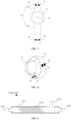
- FIG. 1 is a schematic diagram of a structure of a wearable device according to an embodiment of this application.
- a wearable device 100 includes a device body 11, a flexible fixing strip 12 connected to two ends of the device body 11, a processor 13, and at least two groups of electrodes, where each group of electrodes may include at least one electrode 14.
- the processor 13 is disposed in the device body 11, and each electrode 14 is electrically connected to the processor 13.
- a group of electrodes may be disposed on the device body 11, and a group of electrodes may be disposed on the flexible fixing strip 12.
- two groups of electrodes may be disposed on the flexible fixing strip 12, and the two groups of electrodes are arranged in spacing on the flexible fixing strip 12.
- a plurality of groups of electrodes on the wearable device 100 may be located on a same side of the wearable device 100, for example, all on a side on which the wearable device 100 is in contact with a user body (that is, a rear side of the wearable device 100).
- the plurality of groups of electrodes on the wearable device 100 may be located on different sides of the wearable device 100. For example, one group of electrodes may be located on the side on which the wearable device 100 is in contact with the user body (that is, the rear side of the wearable device 100), and another group of electrodes may be located on a side on which the wearable device 100 faces away from the user body (that is, a front side of the wearable device 100).
- the plurality of electrodes may be arranged in spacing in a preset distance, for example, 1 millimeter.
- a display screen (not shown in the figure) may be disposed on the device body 11.
- a side that is of the device body 11 and on which the display screen is located on is referred to as a front side
- a side that is of the device body 11 and on which the display screen faces away from the device body 11 is referred to as a rear side of the device body 11.
- a part that is of the flexible fixing strip 12 and that is on a same side as the display screen on the device body 11 is referred to as a front side of the flexible fixing strip 12, and a side that faces away from the front side of the flexible fixing strip 12 is referred to as a rear side of the flexible fixing strip 12.
- An electrode disposed on the device body 11 may be located on the rear side of the device body 11, or may be located on the front side of the device body 11.
- An electrode disposed on the flexible fixing strip 12 may be located on the front side of the flexible fixing strip 12, or may be located on the rear side of the flexible fixing strip.
- the flexible fixing strip 12 may be implemented by using a flexible strip, and two ends of the flexible strip are respectively connected to two ends of the device body 11.
- the flexible fixing strip 12 may alternatively be implemented by using two flexible strips. One end of each of the two flexible strips is separately connected to one end of two ends of the device body 11, and the other end of each of the two flexible strips implements detachable connection by using a connection structure, for example, locking or a threaded connection.
- the flexible fixing strip 12 may be understood as a strip that binds the device body 11 of the wearable device 100 to the user body, so that the user carries the wearable device 100.
- the flexible fixing strip 12 may be referred to as a watch band.
- each group of electrodes When two groups of electrodes are disposed on the wearable device 100, and each group of electrodes includes one electrode 14, one group of electrodes may be disposed on the device body 11, and the other group of electrodes may be disposed on the flexible fixing strip 12.
- An electrode on the device body 11 is located on the rear side of the device body 11, and an electrode on the flexible fixing strip 12 is located on the rear side of the flexible fixing strip 12.
- FIG. 2 when two groups of electrodes are disposed on the wearable device 100, and each group of electrodes includes one electrode 14, one group of electrodes may be disposed on the device body 11, and the other group of electrodes may be disposed on the flexible fixing strip 12.
- An electrode on the device body 11 is located on the rear side of the device body 11, and an electrode on the flexible fixing strip 12 is located on the front side of the flexible fixing strip 12.
- a distance (the distance is a distance when the flexible fixing strip 12 is in an unfolded state) between a group of electrodes located on the device body 11 and a group of electrodes located on the flexible fixing strip 12 may be greater than a preset distance, for example, greater than 15 centimeters.
- both the two groups of electrodes may be disposed on the flexible fixing strip 12, and a distance (the distance is a distance when the flexible fixing strip 12 is in an unfolded state) between the two groups of electrodes is greater than a preset distance, for example, greater than 15 centimeters. Both the two groups of electrodes may be located on the rear side of the flexible fixing strip 12. As shown in FIG. 3 , when two groups of electrodes are disposed on the wearable device 100, and each group of electrodes includes one electrode 14, both the two groups of electrodes may be disposed on the flexible fixing strip 12, and a distance (the distance is a distance when the flexible fixing strip 12 is in an unfolded state) between the two groups of electrodes is greater than a preset distance, for example, greater than 15 centimeters. Both the two groups of electrodes may be located on the rear side of the flexible fixing strip 12. As shown in FIG.
- both the two groups of electrodes may be disposed on the flexible fixing strip 12, and a distance (the distance is a distance when the flexible fixing strip 12 is in an unfolded state) between the two groups of electrodes is greater than a preset distance, for example, greater than 15 centimeters.
- One group of electrodes may be located on the rear side of the flexible fixing strip 12, and the other group of electrodes may be located on the front side of the flexible fixing strip 12.
- the flexible fixing strip 12 is formed by a flexible strip 121 and a flexible strip 122
- one group of electrodes may be disposed at an end that is of the flexible strip 121 and that is away from the device body 11
- the other group of electrodes 14 may be disposed at an end that is of the flexible strip 122 and that is away from the device body 11.
- the flexible strip 121 may be referred to as a first flexible strip
- the flexible strip 122 may be referred to as a second flexible strip.
- each group of electrodes when two groups of electrodes are disposed on the wearable device 100, and each group of electrodes includes two electrodes 14, one group of electrodes may be disposed on the device body 11, and the other group of electrodes may be disposed on the flexible fixing strip 12. Electrodes on the device body 11 are located on the rear side of the device body 11, and electrodes on the flexible fixing strip 12 are located on the rear side of the flexible fixing strip 12. As shown in FIG. 6 , when two groups of electrodes are disposed on the wearable device 100, and each group of electrodes includes two electrodes 14, one group of electrodes may be disposed on the device body 11, and the other group of electrodes may be disposed on the flexible fixing strip 12.
- Electrodes on the device body 11 are located on the rear side of the device body 11, and electrodes on the flexible fixing strip 12 are located on the front side of the flexible fixing strip 12.
- a shape of an electrode located on the device body 11 and/or the flexible fixing strip 12 may be one or more of a circle, an ellipse, a semicircle, an arc, or a rectangle.
- the electrodes located on the device body 11 may be symmetrically arranged along a center line of the device body 11 in a direction (for example, in an extension direction from one end of the flexible fixing strip 12 to the other end of the flexible fixing strip 12), and there is a preset distance between different electrodes. It may be understood that the electrodes located on the device body 11 may be arranged in another manner.
- the electrodes located on the flexible fixing strip 12 may be spaced apart on the flexible fixing strip 12, and each electrode on the flexible fixing strip 12 is at a specific distance from the device body 11. Still refer to FIG. 5 .
- the electrodes on the flexible fixing strip 12 may be sequentially arranged in an x direction, or may be sequentially arranged in a direction perpendicular to the x direction, or may be sequentially arranged in another direction. This is not limited herein. For example, in FIG. 5 and FIG.
- a distance (the distance is a distance when the flexible fixing strip 12 is in an unfolded state) between a group of electrodes located on the device body 11 and a group of electrodes located on the flexible fixing strip 12 may be greater than a preset distance, for example, greater than 15 centimeters.
- both the two groups of electrodes may be disposed on the flexible fixing strip 12, and a distance (the distance is a distance when the flexible fixing strip 12 is in an unfolded state) between the two groups of electrodes is greater than a preset distance, for example, greater than 15 centimeters.
- Both the two groups of electrodes are located on the rear side of the flexible fixing strip 12, one group of electrodes may be located at one end of the flexible fixing strip 12, and the other group of electrodes may be located at the other end of the flexible fixing strip 12. As shown in FIG.
- both the two groups of electrodes may be disposed on the flexible fixing strip 12, and a distance (the distance is a distance when the flexible fixing strip 12 is in an unfolded state) between the two groups of electrodes is greater than a preset distance, for example, greater than 15 centimeters.
- One group of electrodes may be located at one end of the rear side of the flexible fixing strip 12, and the other group of electrodes may be located at one end of the front side of the flexible fixing strip 12.
- one group of electrodes may be disposed at an end that is of the flexible strip 121 and that is away from the device body 11, and the other group of electrodes may be disposed at an end that is of the flexible strip 122 and that is away from the device body 11.
- arrangement manners of the electrodes on the flexible strip 121 and the flexible strip 122 refer to the foregoing descriptions about the arrangement manners of the electrodes in FIG. 5 . Details are not described herein again.
- an electrode 14 in the at least one group of electrodes may be pasted on an outer side of the flexible fixing strip 12.
- an electrode 14 in the at least one group of electrodes may be coated on the device body 11.
- the electrode 14 may be fixed to a surface of the device body 11 by coating the device body 11.
- the flexible fixing strip 12 and the device body 11 may be designed in an integrated manner.
- the electrode on the flexible fixing strip 12 may be directly connected to the processor 13.
- the device body 11 may be provided with a cable channel a (not shown in the figure)
- the flexible fixing strip 12 may be provided with a cable channel b (not shown in the figure).
- the cable channel a and the cable channel b are communicated with each other, and the cable channels a and b are both configured to accommodate a cable configured to connect the processor 13 to the electrode on the flexible fixing strip 12, to implement an electrical connection between the processor 13 and the electrode on the flexible fixing strip 12.
- the cable channel a may be referred to as a second cable channel
- the cable channel b may be referred to as a first cable channel
- the cable configured to connect the processor 13 to the electrode on the flexible fixing strip 12 may be referred to as a first cable.
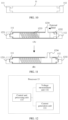
- a locking piece 1231, a locking piece 1232, an elastic component 1233, and a pushing member 1234 may be disposed in a fixing strip body 123 at an end that is of the flexible fixing strip 12 and that is connected to the device body 11.
- the locking piece 1231, the elastic component 1233, the pushing member 1234, and the locking piece 1232 are arranged sequentially.
- both the locking piece 1231 and the locking piece 1232 are partially located in the fixing strip body 123, and partially located outside the fixing strip body 123.
- the pushing member 1234 may drive the locking piece 1232 to move towards the locking piece 1231, so that a part of the locking piece 1232 located outside the fixing strip body 123 may move toward an interior of the fixing strip body 123.
- the electrode 14 When the electrode 14 is disposed on the flexible fixing strip 12, the electrode 14 may be connected to the locking piece 1231 and/or the locking piece 1232 by using a cable.
- the locking piece 1231 and/or the locking piece 1232 may be a conductor.
- the elastic component 1233 may be a spring.
- the flexible fixing strip 12 when the electrode is disposed on the flexible fixing strip 12, the flexible fixing strip 12 may be provided with a cable channel c (not shown in the figure), and the cable channel c may accommodate the cable configured to connect the electrode to the locking piece.
- the locking piece 1231 may be referred to as a first locking piece
- the locking piece 1232 may be referred to as a second locking piece.
- the device body 11 may be provided with a slot 111 to which the locking piece 1231 is fitted and a slot 112 to which the locking piece 1232 is fitted.
- the slot 111 may be connected to the processor 13 by using a cable, and the slot 112 may also be connected to the processor 13 by using a cable.
- a conductor may be disposed in both the slot 111 and the slot 112, so that the processor 13 is electrically connected to the electrode 14.
- the device body 11 may be provided with a cable channel d (not shown in the figure), and the cable channel d may accommodate a cable configured to connect the processor 13 to the slot.
- the slot 111 may be referred to as a first slot
- the slot 112 may be referred to as a second slot.
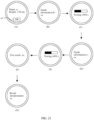
- the locking piece 1231 may be first placed in the slot 111, and the pushing member 1234 is controlled to move towards the locking piece 1231, so that the locking piece 1232 moves towards the locking piece 1231, so that the fixing strip body 123 may be located between the slot 111 and the slot 112. Then, as shown in (B) of FIG. 11 , external force may be stopped being applied to the pushing member 1234. By using the elastic component 1233, the pushing member 1234 pushes the locking piece 1232 into the slot 112. In this way, the flexible fixing strip 12 is mounted on the device body 11.
- the locking piece 1231 may be electrically connected to the slot 111 by using a pogo pin (pogo pin), an elastic piece, or the like
- the locking piece 1232 may also be electrically connected to the slot 112 by using a pogo pin (pogo pin), an elastic piece, or the like.
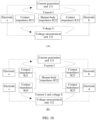
- a current generation unit 131 may be disposed in the processor 13 in the wearable device 100.
- the current generation unit 131 may generate a current under control of the control and processing unit 133, for example, generate a current of 50 micro-amps ( ⁇ A) or 100 micro-amps ( ⁇ A).
- the current generation unit 131 may be connected to an electrode in the wearable device 100.
- the current generation unit 131 may also generate currents of different frequencies under control of the control and processing unit 133, for example, generate a current of 50 kilohertz (kHz) or 250 kilohertz (kHz).
- the voltage measurement unit 132 may measure a voltage.
- the voltage measurement unit 132 may be connected to the electrode in the wearable device 100.
- the control and processing unit 133 may control the current generation unit 131 to generate a current.
- an impedance of a human body may also be determined.
- the impedance of a human body may be a ratio of the voltage value measured by the voltage measurement unit 132 to the current value generated by the current generation unit 131.
- current values of currents at different frequencies may be the same, voltage values corresponding to currents at different frequencies may be the same, or may be different, and currents at different frequencies are generated at different moments.
- the current generation unit 131 may apply a voltage between one electrode in a group of electrodes and one electrode in another group of electrodes. After the user enables both the electrodes on the wearable device 100 to get in contact with the body, the two electrodes are electrically connected to each other, and a current is generated. In this case, the current generation unit 131 may adjust a value of the voltage, so that the current reaches a preset current value (for example, 50 micro-amps), and the current value is controlled to maintain continuously in a process of the measurement. For example, when the current value reaches the preset current value, the voltage may be kept unchanged, to keep the current value unchanged.
- a preset current value for example, 50 micro-amps
- the current generation unit 131 may apply a preset voltage between one electrode in a group of electrodes and one electrode in another group of electrodes. After the user enables both the electrodes on the wearable device 100 to get in contact with the body, the two electrodes are electrically connected to each other, and a current is generated. In this case, the current generation unit 131 may measure the current value. Then, an impedance value may be obtained based on the current value and the preset voltage value. In addition, to improve measurement accuracy, the voltage measurement unit 132 may also measure the voltage, and an impedance value is determined by using the measured voltage value and the measured current value.
- any one or two of the current generation unit 131, the voltage measurement unit 132, and the control and processing unit 133 may alternatively be integrated into the processor 13, and the rest may be disposed independently.
- the current generation unit 131, the voltage measurement unit 132, and the control and processing unit 133 may alternatively be separately disposed. This is not limited herein.
- the wearable device 100 when a plurality of groups of electrodes on the wearable device 100 are all disposed on a same side of the wearable device 100 (as shown in cases in FIG. 1, FIG. 3 , FIG. 5 , and FIG. 7 ), when the user uses the wearable device 100 to measure liver fat, the user may place the wearable device 100 on skin corresponding to an area in which the user's liver body is located. During measurement, the user may place some electrodes of the wearable device 100 in an area in which one end of the body liver is located, and place some electrodes in an area in which the other end of the body liver is located.
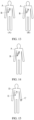
- the electrode on the device body 11 may be attached to a xiphoid process position (for example, an area A in the figure) on the user body, and the electrode on the flexible fixing strip 12 may be attached to a position (for example, an area B in the figure) below a rib on a right side of the user body.
- a xiphoid process position for example, an area A in the figure
- the electrode on the flexible fixing strip 12 may be attached to a position (for example, an area B in the figure) below a rib on a right side of the user body.
- the electrode on the flexible fixing strip 12 may be attached to a xiphoid process position (for example, an area A in the figure) on the user body, and the electrode on the device body 11 may be attached to a position (for example, an area B in the figure) below a rib on a right side of the user body.
- a xiphoid process position for example, an area A in the figure
- the electrode on the device body 11 may be attached to a position (for example, an area B in the figure) below a rib on a right side of the user body.
- an electrode on a side of the flexible fixing strip 12 is attached to a xiphoid process position (for example, an area A in the figure) on the user body, and an electrode on the other side of the flexible fixing strip 12 is attached to a position below a rib on a right side of the user body (for example, an area B in the figure).
- a xiphoid process position on the user body for example, the area A in FIG. 13
- the position below a rib on a right side of the user body for example, the area B in FIG. 13
- the electrode in contact with the area A of the user body is electrically connected to the electrode in contact with the area B of the user body.
- the current generated by the current generation unit 131 in the wearable device 100 first flows through a loop with a small impedance. In other words, the current flows through the liver instead of a skin surface layer.
- the voltage measurement unit 132 in the wearable device 100 may measure a voltage value between the electrode located in the area A and the electrode located in the area B. Then, the liver impedance may be obtained based on the voltage value measured by the voltage measurement unit 132 and the current value generated by the current generation unit 131.
- the wearable device 100 when electrodes on the wearable device 100 are disposed on different sides of the wearable device 100 (as shown in FIG. 2 , FIG. 4 , FIG. 6 , and FIG. 8 ), when the user uses the wearable device 100 to measure liver fat, the user may not need to remove the wearable device 100 from the user body (for example, a wrist). For details, refer to the following descriptions.
- a part of electrode on the wearable device 100 may be located on the device body 11, the part of electrode is in contact with the wrist of the user, and the other part of electrode is located on the flexible fixing strip 12 on the wearable device 100 and is located on a side away from the wrist of the user, that is, a case shown in FIG. 6 .
- an electrode on the device body 11 is in contact with a wrist (that is, an area C in the figure) of the user.
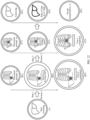
- the user may first attach an electrode on the flexible fixing strip 12 to a xiphoid process position (for example, an area D in the figure) on the user body, and then attach the electrode on the flexible fixing strip 12 to a position below a rib on a right side of the user body (for example, an area E in the figure). Finally, a liver impedance is obtained based on data from two measurements. Still refer to FIG. 15 .
- the area D When the user attaches the electrode on the flexible fixing strip 12 to the xiphoid process position (for example, the area D in the figure) on the user body, the area D may be electrically connected to the area C, a current generated by the current generation unit 131 in the wearable device 100 may flow through the area D and the area C and an area (for example, an arm, a chest, and the like) between the area C and the area D, and the voltage measurement unit 132 in the wearable device 100 may measure a voltage value between the area D and the area C, to obtain an impedance between the area D and the area C.
- the voltage measurement unit 132 in the wearable device 100 may measure a voltage value between the area D and the area C, to obtain an impedance between the area D and the area C.
- the area E When the user attaches the electrode on the flexible fixing strip 12 to the position below a rib on a right side of the user body (for example, the area E in the figure), the area E may be electrically connected to the area C, a current generated by the current generation unit 131 in the wearable device 100 may flow through the area E and the area C and an area (for example, an arm, a chest, a liver, and the like) between the area C and the area E, and the voltage measurement unit 132 in the wearable device 100 may measure a voltage value between the area E and the area C, to obtain an impedance between the area E and the area C. Further, the impedance of the liver may be obtained based on the impedance between the area D and the area C and the impedance between the area E and the area C.
- an arm of the user may be equivalent to a resistor
- an upper left chest or an upper right chest of the user may be equivalent to a resistor
- the user's liver may be equivalent to a resistor.
- the left arm of the user may be equivalent to a resistor R1
- the upper left chest of the user may be equivalent to a resistor R2
- the user's liver may be equivalent to a resistor R3. Still refer to FIG. 15 , with reference to FIG. 16 .
- the xiphoid process position on the user body for example, the area D in FIG.
- R01 may be referred to as a first physiological parameter
- R02 may be referred to as a second physiological parameter
- R03 may be referred to as a third physiological parameter.
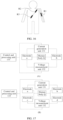
- a current loop may be formed between an electrode a, the current generation unit 131, and an electrode b on the wearable device 100 and a human body Q.
- a voltage measurement loop may be formed between the electrode a, the voltage measurement unit 132, and the electrode b on the wearable device 100 and the human body Q.
- control and processing unit 133 in the processor 13 of the wearable device 100 may control the current generation unit 131 to generate a current I, and the current I flows through the formed current loop.
- the voltage measurement unit 132 may measure a voltage U (that is, a voltage of the human body) between the electrodes a and b. Finally, an impedance of the human body Q is obtained based on the voltage U and the current I.
- the impedance of the liver is measured by using four electrodes (that is, measured by using two groups of electrodes, and each group of electrodes includes two electrodes), for example, the four electrodes are electrodes a, b, c, and d
- the electrodes a and c may be located in a same area on the wearable device 100
- the electrodes b and d may be located in a same area on the wearable device 100.
- the electrodes a and c may be electrodes located on the device body 11 of the wearable device 100
- the electrodes b and d may be electrodes located on the flexible fixing strip 12 of the wearable device 100.
- a current loop may be formed between the electrode a, the current generation unit 131, and the electrode b on the wearable device 100 and a human body Q.
- a voltage measurement loop may be formed between the electrode c, the voltage measurement unit 132, and the electrode d on the wearable device 100 and the human body Q.
- the control and processing unit 133 in the processor 13 of the wearable device 100 may control the current generation unit 131 to generate a current I, and the current I flows through the formed current loop.
- the voltage measurement unit 132 may measure a voltage U (that is, a voltage of the human body) between the electrodes c and d.
- an impedance of the human body Q is obtained based on the voltage U and the current I. It may be understood that, for a measurement method in which more electrodes are used for measuring the impedance of the liver, refer to the measurement method using two or four electrodes, and details are not described herein again.
- the obtained impedance is two more contact impedance values than the real impedance of the human body.
- the impedance of the human body is about 300 S2 to 1000 ⁇ , and the contact impedance may be generally greater than 30 Q. Therefore, the contact impedance has a great impact on a measurement result. In other words, precision of the measured impedance of the liver obtained by using the two electrodes is relatively low.
- the impedance of the liver is measured by using four electrodes (that is, measured by using two groups of electrodes, and each group of electrodes includes two electrodes), as shown in (B) of FIG. 18 , if a current generated by the current generation unit 131 is I, contact impedances are R21, R23, R24, and R25, and an impedance of the human body is R22. In a voltage measurement loop, the impedance R22 of the human body and the two contact resistances R24 and R25 are connected in series. When measuring the voltage, the voltage measurement unit 132 may generate a current I' that is approximately 0.
- a current flowing through the human body is I+I'
- fat content of the liver may be obtained based on the impedance of the liver, to evaluate a liver risk level.
- the fat content of the liver may be calculated by using the following formula.
- M is the fat content of the liver
- R is the impedance of the liver
- ⁇ 1 , ⁇ 2 , and ⁇ 3 are preset coefficients, and may be obtained through experiment.
- a body parameter such as a height of the user may also be combined in calculation on the fat content of the liver.
- the fat content of the liver may also be calculated by using the following formula.
- M is the fat content of the liver
- R is the impedance of the liver
- H is the height
- ⁇ 1 , ⁇ 2 , ⁇ 3 and ⁇ 4 are preset coefficients, and may be obtained through experiment.
- the fat content of the liver may be calculated by using the following formula.
- M is the fat content of the liver; R 1 and R 2 are impedances of the liver measured under currents of different frequencies; and ⁇ 1 , ⁇ 2 , ⁇ 3 , ⁇ 4 , and ⁇ 5 are preset coefficients, and may be obtained through experiment. It can be understood that, when a quantity of impedances of a liver measured under currents of different frequencies is greater than or equal to three, " ⁇ n R n + ⁇ n + 1 R n " may be added to Formula 3.
- R n is an n th impedance of the liver, and ⁇ n and ⁇ n +1 are preset coefficients corresponding to R n , and may be obtained through experiment.
- the fat content of the liver may also be calculated by using the following formula.
- M is the fat content of the liver; R 1 and R 2 are impedances of the liver measured under currents of different frequencies; H is the height; and ⁇ 1 , ⁇ 2 , ⁇ 3 , ⁇ 4 , ⁇ 5 , and ⁇ 6 are preset coefficients, and may be obtained through experiment. It can be understood that, when a quantity of impedances of a liver measured under currents of different frequencies is greater than or equal to three, " ⁇ n R n + ⁇ n + 1 R n " may be added to Formula 4.
- R n is an n th impedance of the liver, and ⁇ n and ⁇ n +1 are preset coefficients corresponding to R n , and may be obtained through experiment.
- the risk level of the user's liver may be determined based on a correspondence between the fat content of the liver and the risk level of the liver. For example, a preset correspondence between the fat content of the liver and the risk level of the liver may be shown in Table 1. When it is determined that fat content of the liver is "5", it can be learned from Table 1 that a risk level of the liver in this case is "suspicious risk”. Table 1 Liver fat content Liver risk level 0 to 4 Normal 4 to 7 Suspected risk 7 to 10 Medium to high risk
- the foregoing describes the wearable device 100 and a related measurement principle in the technical solutions of this application.
- the following separately describes a process of testing a risk level of a liver by using examples in which electrodes of the wearable device 100 are disposed on a same side and different sides of the wearable device 100.
- the measurement manners described in FIG. 13 or FIG. 14 may be used. In this case, after the user attaches all the electrodes on the wearable device 100 to a specific position on the user body, the testing may be performed.
- an application for example, Huawei Health
- the wearable device 100 may display personal information of the user, such as a name and a height. The user may modify the personal information of the user on the display interface.
- the user may tape an "OK" button in an area a1 to go to a next step.
- the wearable device 100 may display guide information.
- the guide information is mainly used for guiding the user to attach an electrode on the wearable device 100 to a specific position on the user body, for example, attach the electrode to a xiphoid process position on the user body or a position below a right rib of the user body.
- the guide information may be text information, or may be voice information, or may be graphic information, or may be any combination of two or three of the text information, the voice information, and the graphic information. It may be understood that, when selecting a button on the wearable device 100, the user may select the button by tapping, by a voice, or by using a gesture. This may be specifically determined according to an actual situation, and is not limited herein.
- the wearable device 100 may apply a current required for the measurement.
- the wearable device 100 may also generate a current required for the measurement. This is not limited herein.
- the operation in which the user may tap the "OK" button in the area a1 may be referred to as a first operation.
- the interface shown in (B) of FIG. 19 may be referred to as a first interface.
- the wearable device 100 may display an interface shown in (C) of FIG. 19 . Then, after measuring the liver fat content of the user, the wearable device 100 may prompt, by using a voice, the user that the measurement is completed, or prompt, by using a combination of a voice and a text, the user that the measurement is completed, and display a test result, that is, display an interface shown in (D) of FIG. 19 . In addition, after displaying the interface shown in (D) of FIG. 19 , the wearable device 100 may also display a related result interpretation, that is, display an interface shown in (E) of FIG. 19 .
- a result interpretation can be as follows: You have a high risk of fatty liver. To ensure your health, please strictly control your diet, especially oil and alcohol intake, and it is recommended that you perform aerobic exercise for at least one hour every day. If a risk of fatty liver is moderate, a result interpretation can be as follows: You have a moderate risk of fatty liver. To ensure your health, please control your diet, especially oil and alcohol intake, and it is recommended that you perform aerobic exercise every day. When a risk of fatty liver is low, a result interpretation can be as follows: You have a low risk of fatty liver. To ensure your health, please eat properly, exercise properly, and control alcohol intake. In addition, in addition to displaying the test result, the wearable device 100 may also broadcast the test result or the like by using a voice.
- the wearable device 100 needs to measure an impedance of the liver, and obtain the fat content of the liver based on the impedance of the liver, to obtain a risk level of the liver.
- the impedance of the liver may be compared with a preset impedance range, to determine whether the measured impedance of the liver is reasonable.
- the impedance of the liver falls within the preset impedance range, the measured impedance of the liver is reasonable; otherwise, the measured impedance of the liver is unreasonable.
- the user may be prompted to perform measurement again. For example, the user may be prompted to perform the measurement again by using a voice. After prompting the user, the wearable device 100 may return to display the interface shown in (B) of FIG. 19 .
- the wearable device 100 may display different interfaces at different measurement stages, to prompt the user. For example, after the user starts testing the risk level of the liver, the wearable device 100 may display an interface shown in (A) of FIG. 20 , to prompt the user to start fatty liver screening. Then, the wearable device 100 may display an interface shown in (B) of FIG. 20 , to visually prompt the user to place the wearable device 100 at a preset position or area on the user body. A placement prompt may be the same as the guide information in (B) of FIG. 19 . Then, after the user places the wearable device 100 at the preset position or area, the wearable device 100 may display an interface shown in (C) of FIG.
- the wearable device 100 may display an interface shown in (D) of FIG. 20 , to prompt the user that the risk level testing of the liver is being performed.
- the wearable device 100 may display an interface shown in (E) of FIG. 20 , to display the risk level of the liver to the user.
- the wearable device 100 may display, after a preset time (for example, 3s), an interface shown in (F) of FIG. 20 , to present a testing result interpretation to the user.
- the result interpretation may be the same as the result interpretation in (E) of FIG. 19 .
- the user may also perform a manual operation for switching.
- a sliding operation for example, slide up, slide down, slide left, or slide right
- the wearable device 100 switches to (F) of FIG. 20 .
- the display interfaces shown in FIG. 20 are merely examples for description, and do not constitute a limitation on this solution.
- the display interfaces may be selected according to a requirement, or may be redrawn according to a requirement. This is not limited herein.
- Electrodes of the wearable device 100 are disposed on different sides of the wearable device 100 (a case shown in FIG. 2 , FIG. 4 , FIG. 6 , or FIG. 8 ).
- the measurement manner described in FIG. 15 may be used.
- a wearing position for example, a wrist
- measurement may be performed after the user enables a part of the electrodes on the wearable device 100 to get in contact with a wearing position (for example, a wrist) of the user, and places the other part of the electrodes to a specific position on the user body.
- an application for example, Huawei Health
- the wearable device 100 may display personal information of the user, such as a name and a height. The user may modify the personal information of the user on the display interface.
- the user may tape an "OK" button in an area a1 to go to a next step.
- the wearable device 100 may display guide information b.
- the guide information b is mainly used for guiding the user to attach an electrode on the wearable device 100 to a specific position on the user body, for example, attach the electrode to a xiphoid process position on the user body or a position below a right rib of the user body.
- the guide information b may be text information, or may be voice information, or may be graphic information, or may be any combination of two or three of the text information, the voice information, and the graphic information. It may be understood that, when selecting a button on the wearable device 100, the user may select the button by tapping, by a voice, or by using a gesture. This may be specifically determined according to an actual situation, and is not limited herein.
- the wearable device 100 may generate a current required for the measurement.
- the wearable device 100 may also generate a current required for the measurement. This is not limited herein.
- the operation in which the user may tap the "OK" button in the area a1 may be referred to as a first operation.
- the interface shown in (B) of FIG. 21 may be referred to as a second interface.
- the wearable device 100 may display an interface shown in (C) of FIG. 21 . Then, after measuring a human body impedance R of the user, the wearable device 100 may prompt the user that the measurement is completed, for example, by using a voice prompt and/or a vibration prompt, and display an interface shown in (D) of FIG. 21 , that is, display guide information c.
- the guide information c is mainly used for guiding the user to attach an electrode of the wearable device 100 to a specific position on the user body, for example, attach the electrode to a xiphoid process position on the user body or a position below a right rib of the user body.
- the placement position of the electrode guided by the guide information c is different from the placement position of the electrode guided by the guide information b.
- the placement position of the electrode guided by the guide information c is the position below a right rib of the user body.
- the interface shown in (D) of FIG. 21 may be referred to as a third interface.
- the wearable device 100 may display an interface shown in (E) of FIG. 21 .
- the wearable device 100 may determine liver fat content based on impedance values from two measurements.
- the wearable device 100 may prompt, by using a voice, the user that the measurement is completed, or prompt, by using a combination of a voice and a text, the user that the measurement is completed, and display a test result, that is, display an interface shown in (F) of FIG. 21 .
- the wearable device 100 may also display a related result interpretation, that is, display an interface shown in (G) of FIG.
- a result interpretation can be as follows: You have a high risk of fatty liver. To ensure your health, please strictly control your diet, especially oil and alcohol intake, and it is recommended that you perform aerobic exercise for at least one hour every day. If a risk of fatty liver is moderate, a result interpretation can be as follows: You have a moderate risk of fatty liver. To ensure your health, please control your diet, especially oil and alcohol intake, and it is recommended that you perform aerobic exercise every day. When a risk of fatty liver is low, a result interpretation can be as follows: You have a low risk of fatty liver. To ensure your health, please eat properly, exercise properly, and control alcohol intake. In addition, in addition to displaying the test result, the wearable device 100 may also broadcast the test result or the like by using a voice.
- the impedance of the liver may be compared with a preset impedance range, to determine whether the measured impedance of the liver is reasonable.
- the impedance of the liver falls within the preset impedance range, the measured impedance of the liver is reasonable; otherwise, the measured impedance of the liver is unreasonable.
- the user may be prompted to perform measurement again. For example, the user may be prompted to perform the measurement again by using a voice. After prompting the user, the wearable device 100 may return to display the interface shown in (B) of FIG. 21 .
- the wearable device 100 may both check the measured body impedances of the user, to determine whether the measured body impedances are reasonable.
- the impedance of the body may be compared with a preset impedance range, to determine whether the measured impedance of the body is reasonable.
- the body impedance falls within the preset impedance range, the measured body impedance is reasonable; otherwise, the measured body impedance is unreasonable.
- the user may be prompted to perform measurement again. For example, the user may be prompted to perform the measurement again by using a voice.
- the wearable device 100 may redisplay a previous interface of a current display interface. For example, if the current display interface is (C) of FIG. 21 , the interface shown in (B) of FIG. 21 is redisplayed; or if the current display interface is (E) of FIG. 21 , the interface shown in (D) of FIG. 21 is redisplayed. In addition, on the interface shown in (E) of FIG. 21 , the wearable device 100 may further determine fat content of the liver based on body impedances from two measurements, to obtain a risk level of the liver.
- the wearable device 100 may display different interfaces at different measurement stages, to prompt the user.
- the wearable device 100 may display an interface shown in (A) of FIG. 22 , to prompt the user to start fatty liver screening.
- the wearable device 100 may guide the user to perform testing by using a posture 1.
- the wearable device 100 may first display an interface shown in (B1) of FIG. 22 , to visually prompt the user to place the wearable device 100 at a preset position or area on the user body.
- a placement prompt may be the same as the guide information b in (B) of FIG. 21 .
- the wearable device 100 may display an interface shown in (B2) of FIG. 22 , to prompt the user that body impedance measurement is being performed in the posture 1.
- the wearable device 100 may display an interface shown in (B3) of FIG. 22 , to prompt the user that measurement of the body impedance in the posture 1 has been completed.
- the wearable device 100 may guide the user to perform testing by using a posture 2.
- the wearable device 100 may first display an interface shown in (C1) of FIG. 22 , to visually prompt the user to place the wearable device 100 at a preset position or area on the user body.
- a placement prompt may be the same as the guide information c in (D) of FIG. 21 .
- the wearable device 100 may display an interface shown in (C2) of FIG. 22 , to prompt the user that body impedance measurement is being performed in the posture 2.
- the wearable device 100 may display an interface shown in (C3) of FIG. 22 , to prompt the user that measurement of the body impedance in the posture 2 has been completed.
- the wearable device 100 may display an interface shown in (D1) of FIG. 22 , to prompt the user that a liver risk level is being tested. After the risk level of the liver is tested, the wearable device 100 may display an interface shown in (D2) of FIG. 22 , to display the risk level of the liver to the user. Then, the wearable device 100 may display an interface shown in (D3) of FIG. 22 , to present a testing result interpretation to the user. The result interpretation may be the same as the result interpretation in (G) of FIG. 21 . It should be noted that the display interfaces shown in FIG. 22 are merely examples for description, and do not constitute a limitation on this solution. The display interfaces may be selected according to a requirement, or may be redrawn according to a requirement. This is not limited herein.
- the wearable device 100 may alternatively send data measured by the wearable device 100 to another electronic device, so that the another electronic device obtains the risk level of the user's liver based on the data measured by the wearable device 100.
- the wearable device 100 is a smartwatch
- the smartwatch may send impedance data of the liver measured by the smartwatch to a mobile phone.
- the mobile phone may obtain a risk level of the liver based on the impedance data of the liver.
- the wearable device 100 may perform short-distance communication or long-distance communication with another electronic device, to implement information exchange between the wearable device 100 and the another electronic device.
- a communication module may be disposed in the wearable device 100.
- the communication module may include at least one filter, a switch, a power amplifier, a low noise amplifier (low noise amplifier, LNA), and the like.
- the communication module may receive an electromagnetic wave through at least one antenna, perform processing such as filtering and amplification on the received electromagnetic wave, and transmit the electromagnetic wave to a modem for demodulation.
- the communication module may further amplify a signal modulated by the modem.
- the amplified signal is converted into an electromagnetic wave and radiated out via the antenna.
- at least some function modules of the communication module may be disposed in the processor 13 of the wearable device 100.
- at least some function modules of the communication module and at least some modules of the processor 13 of the wearable device 100 may be disposed in a same component.
- the communication module may provide a wireless communication solution that is applied to the wearable device 100 and that includes a wireless local area network (wireless local area network, WLAN) (such as a wireless fidelity (wireless fidelity, Wi-Fi) network), Bluetooth (Bluetooth, BT), a global navigation satellite system (global navigation satellite system, GNSS), frequency modulation (frequency modulation, FM), a near field communication (near field communication, NFC) technology, an infrared (infrared, IR) technology, and the like.
- the communication module may be one or more devices integrating at least one communication processing module.
- the communication module receives an electromagnetic wave via an antenna, performs frequency modulation and filtering processing on an electromagnetic wave signal, and sends the processed signal to the processor 13 of the wearable device 100.
- the communication module may further receive a to-be-sent signal from the processor 13 of the wearable device 100, and perform frequency modulation and amplification on the signal.
- the amplified signal is converted into an electromagnetic wave and radiated out via the antenna.
- an upper limb impedance of the user may be first measured, and then the risk level of the liver is determined based on the determined upper limb impedance.
- the user may touch one group of electrodes of the wearable device 100 with a finger of the left hand, and touch another group of electrodes of the wearable device 100 with a finger of the right hand. Further, the two groups of electrodes on the wearable device 100 are electrically connected to each other. In this case, a current generated by the current generation unit 132 in the processor 13 of the wearable device 100 flows in a loop formed between the left hand and the right hand of the user.
- the voltage measurement unit 132 in the processor 13 of the wearable device 100 may measure a voltage value between an electrode in contact with the left hand of the user and an electrode in contact with the right hand of the user.
- the control and processing unit 133 in the processor 13 of the wearable device 100 may obtain the upper limb impedance of the user based on the voltage value measured by the voltage measurement unit 132 and the current value generated by the current generation unit 131.
- the upper limb impedance may also be referred to as a first physiological parameter
- the finger of the left hand of the user may also be referred to as a first part
- the finger of the right hand of the user may also be referred to as a second part.
- physiological parameters of the user for example, a body fat rate, a visceral fat amount in a torso, and a fat amount of a torso, may be obtained based on the upper limb impedance.
- physiological parameters such as a body fat rate, a visceral fat amount in a torso, and a fat amount of a torso may also be referred to as second physiological parameters.
- the body fat rate may be calculated by using the following formula.
- BFR is the body fat rate
- R is the upper limb impedance
- ⁇ 1 and ⁇ 2 are preset coefficients, and may be obtained through experiment.
- the body fat rate may be calculated by using the following formula.
- BFR is the body fat rate
- R 1 and R 2 are upper limb impedances measured under currents of different frequencies
- ⁇ 1 , ⁇ 2 and ⁇ 3 are preset coefficients, and may be obtained through experiment. It can be understood that, when a quantity of upper limb impedances measured under currents of different frequencies is greater than or equal to three, " ⁇ n R n " may be added to Formula 2.
- R n is an upper limb impedance measured under a current of the n th frequency
- ⁇ n is a preset coefficient corresponding to R n , and may be obtained through experiment.
- the visceral fat amount in a torso may be calculated by using the following formula.
- X is the visceral fat amount in a torso
- R is the upper limb impedance
- ⁇ 1 and ⁇ 2 are preset coefficients, and may be obtained through experiment.
- the visceral fat amount in a torso may be calculated by using the following formula.
- X is the visceral fat amount in a torso; R 1 and R 2 are upper limb impedances measured under currents of different frequencies; and ⁇ 1 , ⁇ 2 , and ⁇ 3 are preset coefficients, and may be obtained through experiment. It can be understood that, when a quantity of upper limb impedances measured under currents of different frequencies is greater than or equal to three, " ⁇ n R n " may be added to Formula 4.
- R n is an upper limb impedance measured under a current of the n th frequency
- ⁇ n is a preset coefficient corresponding to R n , and may be obtained through experiment.
- the fat amount of a torso may be calculated by using the following formula.
- P is the fat amount of a torso
- R is the upper limb impedance
- ⁇ 1 and ⁇ 2 are preset coefficients, and may be obtained through experiment.
- the fat amount of a torso may be calculated by using the following formula.
- P is the fat amount of a torso; R 1 and R 2 are upper limb impedances measured under currents of different frequencies; and ⁇ 1 , ⁇ 2 and ⁇ 3 are preset coefficients, and may be obtained through experiment. It can be understood that, when a quantity of upper limb impedances measured under currents of different frequencies is greater than or equal to three, " ⁇ n R n " may be added to Formula 6. R n is an upper limb impedance measured under the n th frequency, and ⁇ n is a preset coefficient corresponding to R n , and may be obtained through experiment.
- the physiological parameters such as the body fat rate, the visceral fat amount in a torso, and the fat amount of a torso are obtained based on the upper limb impedance
- the physiological parameters may also be determined in combination with a body parameter such as a height of the user.
- the body fat rate may be calculated by using the following formula.
- BFR is the body fat rate
- R is the upper limb impedance
- H is the height
- ⁇ 1 , ⁇ 2 and ⁇ 3 are preset coefficients, and may be obtained through experiment.
- the body fat rate may be calculated by using the following formula, in combination with a height of the user.
- BFR is the body fat rate
- R 1 and R 2 are upper limb impedances measured under currents of different frequencies
- ⁇ 1 , ⁇ 2 , ⁇ 3 and ⁇ 4 are preset coefficients, and may be obtained through experiment. It can be understood that, when a quantity of upper limb impedances measured under currents of different frequencies is greater than or equal to three, " ⁇ n R n " may be added to Formula 2.
- R n is an upper limb impedance measured under a current of the n th frequency
- ⁇ n is a preset coefficient corresponding to R n , and may be obtained through experiment.
- the visceral fat amount in a torso may be calculated by using the following formula.
- X is the visceral fat amount in a torso
- R is the upper limb impedance
- ⁇ 1 , ⁇ 2 , and ⁇ 3 are preset coefficients, and may be obtained through experiment.
- the visceral fat amount in a torso may be calculated by using the following formula in combination with a height of the user.
- X is the visceral fat amount in a torso; R 1 and R 2 are upper limb impedances measured under currents of different frequencies; and ⁇ 1 , ⁇ 2 , ⁇ 3 and ⁇ 4 are preset coefficients, and may be obtained through experiment. It can be understood that, when a quantity of upper limb impedances measured under currents of different frequencies is greater than or equal to three, " ⁇ n R n " may be added to Formula 4.
- R n is an upper limb impedance measured under a current of the n th frequency
- ⁇ n is a preset coefficient corresponding to R n , and may be obtained through experiment.
- the fat amount of a torso may be calculated by using the following formula.
- P is the fat amount of a torso
- R is the upper limb impedance
- ⁇ 1 , ⁇ 2 and ⁇ 3 are preset coefficients, and may be obtained through experiment.
- the fat amount of a torso may be calculated by using the following formula in combination with a height of the user.
- P is the fat amount of a torso
- R 1 and R 2 are upper limb impedances measured under currents of different frequencies
- ⁇ 1 , ⁇ 2 , ⁇ 3 and ⁇ 4 are preset coefficients, and may be obtained through experiment.
- ⁇ n R n may be added to Formula 6.
- R n is an upper limb impedance measured under a current of the n th frequency
- ⁇ n is a preset coefficient corresponding to R n , and may be obtained through experiment.
- fat content of the user's liver may be determined in combination with a body mass index (body mass index, BMI) of the user.
- BMI body mass index
- the fat content of the user's liver may be calculated by using the following formula.
- M is the fat content of the liver; BMI is the body mass index; BFR is the body fat rate; X is the visceral fat amount in a torso; P is the fat amount of a torso; ⁇ 1 , ⁇ 2 , ⁇ 3 , ⁇ 4 and ⁇ 5 are preset coefficients, and may be obtained through experiment. It may be understood that the parameters (for example, BMI, BFR, X, and P ) in Formula 13 may be selected according to a requirement, and this is not limited herein.
- a waist circumference of the user may also be combined in calculation on the fat content of the user's liver.
- the fat content of the user's liver may be calculated by using the following formula.
- ⁇ 1 , ⁇ 2 , ⁇ 3 , ⁇ 4 , Ys , ⁇ 6 , ⁇ 7 , and ⁇ 8 are preset coefficients, and may be obtained through experiment. It may be understood that the parameters (for example, BMI, BFR, X, P, L, H and ⁇ T ) in Formula 14 may be selected according to a requirement, and this is not limited herein. In an example, the waist circumference and/or the height may also be referred to as a fourth physiological parameter.
- the risk level of the user's liver may be determined based on a correspondence between the fat content of the liver and the risk level of the liver. For example, a preset correspondence between the fat content of the liver and the risk level of the liver may be shown in Table 1. When it is determined that fat content of the liver is "5", it can be learned from Table 1 that a risk level of the liver in this case is "suspicious risk". In an example, the fat content of the liver or the risk level of the liver may also be referred to as a third physiological parameter. Table 1 Liver fat content Liver risk level 0 to 4 Normal 4 to 7 Suspected risk 7 to 10 Medium to high risk
- the wearable device 100 may further display a physiological parameter such as a body fat rate of the user, so that the user learns of the physiological parameter such as the body fat rate of the user.
- the processor in embodiments of this application may be a central processing unit (central processing unit, CPU), the processor may further be another general-purpose processor, a digital signal processor (digital signal processor, DSP), an application-specific integrated circuit (application-specific integrated circuit, ASIC), a field programmable gate array (field programmable gate array, FPGA) or another programmable logic device, a transistor logic device, a hardware component, or any combination thereof.
- the general-purpose processor may be a microprocessor or any regular processor or the like.
- the method steps in embodiments of this application may be implemented in a hardware manner, or may be implemented in a manner of executing software instructions by the processor.
- the software instructions may include corresponding software modules.
- the software modules may be stored in a random access memory (random access memory, RAM), a flash memory, a read-only memory (read-only memory, ROM), a programmable read-only memory (programmable ROM, PROM), an erasable programmable read-only memory (erasable PROM, EPROM), an electrically erasable programmable read-only memory (electrically EPROM, EEPROM), a register, a hard disk drive, a removable hard disk drive, a CD-ROM, or any other form of storage medium well-known in the art.
- a storage medium is coupled to the processor, so that the processor can read information from the storage medium and write information into the storage medium.
- the storage medium may be a component of the processor.
- the processor and the storage medium may be disposed in an ASIC.
- All or some of the foregoing embodiments may be implemented by using software, hardware, firmware, or any combination thereof.
- the software is used for implementing the embodiments, all or a part of the embodiments may be implemented in a form of a computer program product.
- the computer program product includes one or more computer instructions.
- the computer program instructions When the computer program instructions are loaded and executed on a computer, the procedure or functions according to embodiments of this application are all or partially generated.
- the computer may be a general-purpose computer, a special-purpose computer, a computer network, or another programmable apparatus.
- the computer instructions may be stored in a computer-readable storage medium, or may be transmitted by using the computer-readable storage medium.
- the computer instructions may be transmitted from a website, a computer, a server, or a data center to another website, computer, server, or data center in a wired (for example, a coaxial cable, an optical fiber, or a digital subscriber line (DSL)) or wireless (for example, infrared, radio, or microwave) manner.
- the computer-readable storage medium may be any usable medium accessible by the computer, or a data storage device, for example, a server or a data center, integrating one or more usable media.
- the usable medium may be a magnetic medium (for example, a floppy disk, a hard disk drive, or a magnetic tape), an optical medium (for example, a DVD), a semiconductor medium (for example, a solid-state drive (solid-state disk, SSD)), or the like.
- a magnetic medium for example, a floppy disk, a hard disk drive, or a magnetic tape
- an optical medium for example, a DVD
- a semiconductor medium for example, a solid-state drive (solid-state disk, SSD)
Landscapes
- Health & Medical Sciences (AREA)
- Life Sciences & Earth Sciences (AREA)
- Medical Informatics (AREA)
- Molecular Biology (AREA)
- Veterinary Medicine (AREA)
- Biophysics (AREA)
- Pathology (AREA)
- Engineering & Computer Science (AREA)
- Biomedical Technology (AREA)
- Heart & Thoracic Surgery (AREA)
- Public Health (AREA)
- Physics & Mathematics (AREA)
- Surgery (AREA)
- Animal Behavior & Ethology (AREA)
- General Health & Medical Sciences (AREA)
- Gastroenterology & Hepatology (AREA)
- Nuclear Medicine, Radiotherapy & Molecular Imaging (AREA)
- Radiology & Medical Imaging (AREA)
- Endocrinology (AREA)
- Physiology (AREA)
- Measurement And Recording Of Electrical Phenomena And Electrical Characteristics Of The Living Body (AREA)
Applications Claiming Priority (2)
| Application Number | Priority Date | Filing Date | Title |
|---|---|---|---|
| CN202110769492.0A CN115590493A (zh) | 2021-07-07 | 2021-07-07 | 一种可穿戴设备及生理参数测量方法 |
| PCT/CN2022/101925 WO2023280018A1 (zh) | 2021-07-07 | 2022-06-28 | 一种可穿戴设备及生理参数测量方法 |
Publications (2)
| Publication Number | Publication Date |
|---|---|
| EP4338664A1 true EP4338664A1 (de) | 2024-03-20 |
| EP4338664A4 EP4338664A4 (de) | 2024-11-06 |
Family
ID=84800360
Family Applications (1)
| Application Number | Title | Priority Date | Filing Date |
|---|---|---|---|
| EP22836772.8A Pending EP4338664A4 (de) | 2021-07-07 | 2022-06-28 | Tragbare vorrichtung und verfahren zur messung physiologischer parameter |
Country Status (3)
| Country | Link |
|---|---|
| EP (1) | EP4338664A4 (de) |
| CN (1) | CN115590493A (de) |
| WO (1) | WO2023280018A1 (de) |
Families Citing this family (2)
| Publication number | Priority date | Publication date | Assignee | Title |
|---|---|---|---|---|
| CN116138763A (zh) * | 2023-03-31 | 2023-05-23 | 芯海科技(深圳)股份有限公司 | 一种人体阻抗测量方法及可穿戴设备 |
| CN120167927A (zh) * | 2023-12-19 | 2025-06-20 | 华为技术有限公司 | 一种监测方法、系统及相关装置 |
Family Cites Families (32)
| Publication number | Priority date | Publication date | Assignee | Title |
|---|---|---|---|---|
| JP2000051173A (ja) * | 1998-08-12 | 2000-02-22 | Ya Man Ltd | 腕時計型体脂肪測定器 |
| CN100387187C (zh) * | 1999-10-15 | 2008-05-14 | 花王株式会社 | 人体脂肪测量方法与相应装置 |
| CN1316840C (zh) * | 2003-07-28 | 2007-05-16 | 明基电通股份有限公司 | 具有测脂功能的移动电话及其测脂方法 |
| FR2880113B1 (fr) * | 2004-12-23 | 2007-02-09 | Seb Sa | Appareil de mesure de la composition corporelle |
| CN1957843A (zh) * | 2005-11-02 | 2007-05-09 | 明基电通股份有限公司 | 具有测脂功能的手持式电子装置及其测脂方法 |
| CN200966617Y (zh) * | 2006-03-27 | 2007-10-31 | 何志坚 | 袖珍脂肪测量器 |
| ES2324189B1 (es) * | 2006-10-03 | 2010-05-13 | Consejo Superior Investig. Cientificas | Aparato para el diagnostico y monitorizacion de la esteatosis hepatica basado en la medicion de la impedancia electrica. |
| CN103209639B (zh) * | 2010-10-15 | 2016-05-04 | 费森尤斯医疗保健控股有限公司 | 干燥重量预测器 |
| EP2670301A4 (de) * | 2011-02-03 | 2014-07-02 | Impedimed Ltd | Gewebemasseindikatorbestimmung |
| KR20140099539A (ko) * | 2011-12-07 | 2014-08-12 | 액세스 비지니스 그룹 인터내셔날 엘엘씨 | 행동 추적 및 수정 시스템 |
| CN102920454B (zh) * | 2012-06-26 | 2014-09-17 | 北京四海华辰科技有限公司 | 一种人体阻抗测量方法、装置及设备 |
| CN103815905B (zh) * | 2014-03-17 | 2016-06-08 | 四川宇峰科技发展有限公司 | 一种实现人体任意分段测量的人体成分分析仪 |
| KR102329820B1 (ko) * | 2015-01-29 | 2021-11-23 | 삼성전자주식회사 | 신체 장착형 장치 |
| KR20170010703A (ko) * | 2015-07-20 | 2017-02-01 | 엘지전자 주식회사 | 이동 단말기 및 이의 제어방법 |
| CN105455810A (zh) * | 2015-12-31 | 2016-04-06 | 华南理工大学 | 一种基于生物电阻抗可测量人体成分的可穿戴脚环 |
| CN106255456A (zh) * | 2016-04-18 | 2016-12-21 | 深圳市汇顶科技股份有限公司 | 移动终端及脂肪数据测量方法 |
| KR101870612B1 (ko) * | 2016-07-22 | 2018-06-25 | 주식회사 인바디 | 생체 임피던스 측정 장치 및 그 전극 측 보드 |
| CN106249302A (zh) * | 2016-08-12 | 2016-12-21 | 华为技术有限公司 | 可穿戴设备以及可穿戴设备的佩戴检测装置 |
| CN107811616B (zh) * | 2016-09-14 | 2021-01-15 | 中国科学院宁波材料技术与工程研究所 | 一种柔性多参量人体体征探测器及其使用方法 |
| WO2018124809A1 (ko) * | 2016-12-29 | 2018-07-05 | 주식회사 인바디 | 착용형 단말기 및 그 동작 방법 |
| US11395628B2 (en) * | 2017-02-16 | 2022-07-26 | Samsung Electronics Co., Ltd. | Method of providing service based on biometric information and wearable electronic device |
| CN106896713A (zh) * | 2017-05-03 | 2017-06-27 | 广州便航迅信息科技有限公司 | 可拆卸式手表 |
| WO2018201629A1 (zh) * | 2017-05-03 | 2018-11-08 | 华为技术有限公司 | 一种体脂测量方法和体脂测量设备 |
| CN107411730A (zh) * | 2017-08-31 | 2017-12-01 | 邹海清 | 穿戴式运动训练监测装备 |
| CN107714040A (zh) * | 2017-10-31 | 2018-02-23 | 浙江再生方医药科技有限公司 | 一种通过固定频率电流标记人体器官阻抗值的方法和装置 |
| CN109875511B (zh) * | 2019-03-16 | 2022-04-01 | 徐弘哲 | 基于生物电阻抗可测量人体成分的健康监测系统 |
| CN111973174B (zh) * | 2019-05-23 | 2023-03-28 | 华为技术有限公司 | 一种心电图检测装置 |
| US10998101B1 (en) * | 2019-12-15 | 2021-05-04 | Bao Tran | Health management |
| EP3858230A1 (de) * | 2020-02-03 | 2021-08-04 | Cardioscan GmbH | Vorrichtung zur bestimmung wenigstens eines gesundheitsparameters einer person |
| CN212368966U (zh) * | 2020-02-28 | 2021-01-19 | 芯海科技(深圳)股份有限公司 | 可穿戴设备 |
| CN111887550B (zh) * | 2020-07-30 | 2024-05-07 | 维沃移动通信有限公司 | 穿戴设备 |
| CN114041775A (zh) * | 2021-12-10 | 2022-02-15 | 苏州长脉科技有限责任公司 | 一种基于生物阻抗的人体腹部脂肪含量评估装置及方法 |
-
2021
- 2021-07-07 CN CN202110769492.0A patent/CN115590493A/zh active Pending
-
2022
- 2022-06-28 EP EP22836772.8A patent/EP4338664A4/de active Pending
- 2022-06-28 WO PCT/CN2022/101925 patent/WO2023280018A1/zh not_active Ceased
Also Published As
| Publication number | Publication date |
|---|---|
| CN115590493A (zh) | 2023-01-13 |
| EP4338664A4 (de) | 2024-11-06 |
| WO2023280018A1 (zh) | 2023-01-12 |
Similar Documents
| Publication | Publication Date | Title |
|---|---|---|
| EP4338664A1 (de) | Tragbare vorrichtung und verfahren zur messung physiologischer parameter | |
| CN103800003B (zh) | 一种心电检测方法及检测仪 | |
| US11579106B2 (en) | High accuracy impedance measurement | |
| KR20190065102A (ko) | 심전도 측정 장치 | |
| US20120316457A1 (en) | Acupuncture Meridian Measurement System | |
| AU2017200785A1 (en) | Fluids Testing Apparatus and Methods of Use | |
| US10786176B2 (en) | Fat thickness estimating device, fat thickness estimating system, fat thickness measuring method, and program | |
| US20160299097A1 (en) | Analyte meter and method of operation | |
| EP4129164A1 (de) | Blutdruckdetektionsverfahren und -vorrichtung | |
| CN105455810A (zh) | 一种基于生物电阻抗可测量人体成分的可穿戴脚环 | |
| US10383537B2 (en) | Physiological signal measuring method and physiological signal measuring device | |
| EP4344623A1 (de) | Verfahren zur messung physiologischer parameter und wearable-vorrichtung | |
| US20230218209A1 (en) | Apparatus and method for analyzing in vivo component and impedance measuring apparatus | |
| EP4111956B1 (de) | Gerät und verfahren zur schätzung von bioinformationen basierend auf bioimpedanz | |
| KR20200000406A (ko) | 심전도 측정 장치 | |
| CN111012346A (zh) | 体质指标测量方法、装置及智能体脂秤 | |
| KR102269411B1 (ko) | 심전도 측정 장치 | |
| US20230148913A1 (en) | Apparatus for measuring biometric information | |
| CN209252850U (zh) | 一种多功能血压测量仪 | |
| CN214128567U (zh) | 一种带有皮电波形检测的心理测试设备 | |
| CN205994492U (zh) | 指夹式检测仪 | |
| US20240389908A1 (en) | Analyte monitoring device calibration | |
| CN204882443U (zh) | 血液检测仪 | |
| US9211079B2 (en) | Bioelectrical impedance measurement apparatus | |
| CN209107313U (zh) | 一种基于iBeacon数据共享的多功能家庭体检装置 |
Legal Events
| Date | Code | Title | Description |
|---|---|---|---|
| STAA | Information on the status of an ep patent application or granted ep patent |
Free format text: STATUS: THE INTERNATIONAL PUBLICATION HAS BEEN MADE |
|
| PUAI | Public reference made under article 153(3) epc to a published international application that has entered the european phase |
Free format text: ORIGINAL CODE: 0009012 |
|
| STAA | Information on the status of an ep patent application or granted ep patent |
Free format text: STATUS: REQUEST FOR EXAMINATION WAS MADE |
|
| 17P | Request for examination filed |
Effective date: 20231211 |
|
| AK | Designated contracting states |
Kind code of ref document: A1 Designated state(s): AL AT BE BG CH CY CZ DE DK EE ES FI FR GB GR HR HU IE IS IT LI LT LU LV MC MK MT NL NO PL PT RO RS SE SI SK SM TR |
|
| DAV | Request for validation of the european patent (deleted) | ||
| DAX | Request for extension of the european patent (deleted) | ||
| A4 | Supplementary search report drawn up and despatched |
Effective date: 20241007 |
|
| RIC1 | Information provided on ipc code assigned before grant |
Ipc: A44C 5/14 20060101ALI20240930BHEP Ipc: A61B 5/0537 20210101AFI20240930BHEP |
|
| STAA | Information on the status of an ep patent application or granted ep patent |
Free format text: STATUS: EXAMINATION IS IN PROGRESS |
|
| 17Q | First examination report despatched |
Effective date: 20251029 |