EP4338633B1 - Auxetische textilstrukturen - Google Patents
Auxetische textilstrukturen Download PDFInfo
- Publication number
- EP4338633B1 EP4338633B1 EP23190648.8A EP23190648A EP4338633B1 EP 4338633 B1 EP4338633 B1 EP 4338633B1 EP 23190648 A EP23190648 A EP 23190648A EP 4338633 B1 EP4338633 B1 EP 4338633B1
- Authority
- EP
- European Patent Office
- Prior art keywords
- auxetic
- layer
- textile structure
- elastic portions
- cut
- Prior art date
- Legal status (The legal status is an assumption and is not a legal conclusion. Google has not performed a legal analysis and makes no representation as to the accuracy of the status listed.)
- Active
Links
Images




Classifications
-
- D—TEXTILES; PAPER
- D03—WEAVING
- D03D—WOVEN FABRICS; METHODS OF WEAVING; LOOMS
- D03D1/00—Woven fabrics designed to make specified articles
- D03D1/0035—Protective fabrics
- D03D1/0041—Cut or abrasion resistant
-
- A—HUMAN NECESSITIES
- A41—WEARING APPAREL
- A41D—OUTERWEAR; PROTECTIVE GARMENTS; ACCESSORIES
- A41D19/00—Gloves
- A41D19/0024—Gloves with accessories
-
- A—HUMAN NECESSITIES
- A41—WEARING APPAREL
- A41D—OUTERWEAR; PROTECTIVE GARMENTS; ACCESSORIES
- A41D19/00—Gloves
- A41D19/015—Protective gloves
- A41D19/01505—Protective gloves resistant to mechanical aggressions, e.g. cutting. piercing
-
- A—HUMAN NECESSITIES
- A41—WEARING APPAREL
- A41D—OUTERWEAR; PROTECTIVE GARMENTS; ACCESSORIES
- A41D31/00—Materials specially adapted for outerwear
- A41D31/04—Materials specially adapted for outerwear characterised by special function or use
- A41D31/18—Elastic
- A41D31/185—Elastic using layered materials
-
- A—HUMAN NECESSITIES
- A41—WEARING APPAREL
- A41D—OUTERWEAR; PROTECTIVE GARMENTS; ACCESSORIES
- A41D31/00—Materials specially adapted for outerwear
- A41D31/04—Materials specially adapted for outerwear characterised by special function or use
- A41D31/24—Resistant to mechanical stress, e.g. pierce-proof
-
- D—TEXTILES; PAPER
- D03—WEAVING
- D03D—WOVEN FABRICS; METHODS OF WEAVING; LOOMS
- D03D17/00—Woven fabrics having elastic or stretch properties due to manner of weaving
-
- D—TEXTILES; PAPER
- D04—BRAIDING; LACE-MAKING; KNITTING; TRIMMINGS; NON-WOVEN FABRICS
- D04B—KNITTING
- D04B1/00—Weft knitting processes for the production of fabrics or articles not dependent on the use of particular machines; Fabrics or articles defined by such processes
- D04B1/14—Other fabrics or articles characterised primarily by the use of particular thread materials
- D04B1/18—Other fabrics or articles characterised primarily by the use of particular thread materials elastic threads
-
- D—TEXTILES; PAPER
- D10—INDEXING SCHEME ASSOCIATED WITH SUBLASSES OF SECTION D, RELATING TO TEXTILES
- D10B—INDEXING SCHEME ASSOCIATED WITH SUBLASSES OF SECTION D, RELATING TO TEXTILES
- D10B2401/00—Physical properties
- D10B2401/06—Load-responsive characteristics
- D10B2401/061—Load-responsive characteristics elastic
-
- D—TEXTILES; PAPER
- D10—INDEXING SCHEME ASSOCIATED WITH SUBLASSES OF SECTION D, RELATING TO TEXTILES
- D10B—INDEXING SCHEME ASSOCIATED WITH SUBLASSES OF SECTION D, RELATING TO TEXTILES
- D10B2403/00—Details of fabric structure established in the fabric forming process
- D10B2403/01—Surface features
- D10B2403/011—Dissimilar front and back faces
- D10B2403/0113—One surface including hollow piping or integrated straps, e.g. for inserts or mountings
-
- D—TEXTILES; PAPER
- D10—INDEXING SCHEME ASSOCIATED WITH SUBLASSES OF SECTION D, RELATING TO TEXTILES
- D10B—INDEXING SCHEME ASSOCIATED WITH SUBLASSES OF SECTION D, RELATING TO TEXTILES
- D10B2501/00—Wearing apparel
- D10B2501/04—Outerwear; Protective garments
-
- D—TEXTILES; PAPER
- D10—INDEXING SCHEME ASSOCIATED WITH SUBLASSES OF SECTION D, RELATING TO TEXTILES
- D10B—INDEXING SCHEME ASSOCIATED WITH SUBLASSES OF SECTION D, RELATING TO TEXTILES
- D10B2501/00—Wearing apparel
- D10B2501/04—Outerwear; Protective garments
- D10B2501/041—Gloves
Definitions
- Example embodiments of the present application relate generally to textile materials, and, more particularly, to auxetic textile structures having double layer portions (e.g., having two layers in select portions of the auxetic textile structure) and protective garments incorporating such auxetic textile structures.
- Textile materials may be manufactured to provide cut-resistance or other high performance properties.
- high performance yarns are used to impart such cut-resistant properties to a textile to create personal protection equipment and protective garments such as gloves, sleeves, shirts, pants, socks, coverings, and the like.
- An example auxetic textile structure may include an auxetic layer having an inner surface and an outer surface and a plurality of dispersed elastic portions.
- the auxetic layer may include a plurality of high performance yarns and each of the dispersed elastic portions may include a plurality of elastic yarns.
- the plurality of dispersed elastic portions may be at least partially coupled to the inner surface of the auxetic layer and the plurality of dispersed elastic portions in combination with the auxetic layer may form a plurality of double layer structures distributed amongst a single layer of the auxetic layer.
- a cut-resistant sleeve comprises a plurality of the auxetic textile structures.
- the plurality of high performance yarns may include one or more of ultra-high molecular weight polyethylene (UHMWPE), aramid, metal, glass, basalt, carbon, polybenzoxazole (PBO), polybenzimidazole (PBI), polyether ether ketone (PEEK), polyimide (PI), liquid crystalline polymer (LCP), polyphenylene sulfide (PPS).
- UHMWPE ultra-high molecular weight polyethylene
- PBO polybenzoxazole
- PBI polybenzimidazole
- PEEK polyether ether ketone
- PI polyimide
- LCP liquid crystalline polymer
- PPS polyphenylene sulfide
- the auxetic layer may further include one or more of a synthetic yarn or a natural yarn, such as polyamide, polyester, cotton, silk, polypropylene, polyethylene, ramie.
- the elastic yarns of the dispersed elastic portions may have a lower modulus of elasticity than the high performance yarns of the auxetic layer.
- the elastic yarns may include one or more of spandex, rubber, thermoplastic elastomer (TPE), thermoplastic vulcanizate (TPV).
- the inner surface of the auxetic layer may be visible between the plurality of dispersed elastic portions.
- a void space may be defined between each of the dispersed elastic portions and the auxetic layer in a first state of the auxetic textile structure.
- the first state may be an unstressed state devoid of external application of stress.
- the void space may be reduced in a second state of the auxetic textile structure.
- the second state may be a stressed state wherein an external stress is applied to the auxetic textile structure.
- the plurality of dispersed elastic portions may be configured to return the auxetic textile structure to the first state after the external stress is removed.
- the auxetic layer may include a plurality of auxetic segments, the auxetic segments oriented to impart auxetic properties to the auxetic layer.
- the plurality of auxetic segments may be disposed in a repeating pattern.
- the pattern may be an organized array of repeating bow-tie shaped segments.
- the pattern may be an organized array of repeating chevron-shaped segments.
- the plurality of auxetic segments may be inconsistently disposed throughout the auxetic layer.
- An example cut-resistant glove may include one or more auxetic textile structures, wherein each of the auxetic textile structures may include an auxetic layer having an inner surface and an outer surface, wherein the auxetic layer comprises a plurality of cut-resistant yarns; and a plurality of dispersed elastic portions at least partially coupled to the inner surface of the auxetic layer, wherein the plurality of dispersed elastic portions in combination with the auxetic layer form a plurality of double layer structures distributed amongst a single layer of the auxetic layer, and wherein each of the dispersed elastic portions comprises a plurality of elastic yarns.
- the auxetic textile structures may be disposed in a finger portion of the cut-resistant glove.
- the cut-resistant glove may further include a coating layer, the coating layer comprising one or more of nitrile rubber, natural rubber, polyurethane (PU) rubber, neoprene rubber, polyvinyl chloride (PVC) rubber, wax, latex.
- PU polyurethane
- PVC polyvinyl chloride
- auxetic as used herein generally refers to a material or structure possessing a negative Poisson's ratio.
- the Poisson's ratio of a material is a measure of its expansion or contraction in a direction perpendicular to an applied force. Most materials, when stretched, contract or become thinner in a direction perpendicular to the applied force. These materials possess a positive Poisson's ratio.
- auxetic materials or structures expand or become thicker (as opposed to thinner) in a direction perpendicular to the applied force when stretched. This thickening phenomenon is due to the way the auxetic structure deforms in response to lateral stretching.
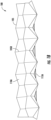
- the auxetic textile structure 100 includes an auxetic layer 105.
- the auxetic layer 105 comprises a plurality of auxetic segments 110A-110N, the auxetic segments 110A-110N oriented to impart auxetic properties to the auxetic layer 105.
- the depictions in FIG. 1A of "N" auxetic segments are merely for illustration purposes.
- the auxetic layer 105 may comprise any number of auxetic segments 110A-110N.
- the auxetic segments 110A-110N may be shaped, disposed, or arranged in any suitable pattern, arrangement, or orientation known in the art as will impart auxetic behavior such that the auxetic layer 105 expands or becomes thicker perpendicular to an applied force when stretched.
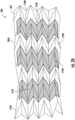
- the auxetic segments 110A-110N may be disposed in a pattern or organized array of repeating bow-tie shaped auxetic segments 110A-110N as depicted in FIGS. 1A-1C or a pattern or organized array of repeating chevron-shaped auxetic segments 210A-210N as depicted in FIG. 2A-2C .
- auxetic segments 110A-110N may be used based upon the intended use for the auxetic textile structure 100.
- the auxetic segments 110A-110N may be disposed in an inconsistent arrangement, irregular pattern, or disarray as depicted by the exemplary wrinkled auxetic segments 310A-310N in FIGS. 3A-3B .
- the auxetic layer 105, 205, 305 may comprise a plurality of high performance yarns.
- Such high performance yarns may be selected to impart one or more of cut-resistance, thermal resistance, flame retardant, or the like.
- typical cut-resistant materials possessing a positive Poisson's ratio contract or become thinner in a direction perpendicular to an applied force.
- a cut-resistant material possessing a positive Poisson's ratio i.e., a non-auxetic becomes tighter at and around the elbow portion of the garment.
- the garment wearer is provided with improved fit, comfort, flexibility, and dexterity while maintaining cut-resistant properties.
- the high performance (e.g., cut-resistant, thermal resistant, flame retardant, etc.) yarns may be formed of filaments (e.g., continuous fibers), staple yarn (e.g., fibers cut to a shorter length), or a combination thereof.
- the auxetic layer 105, 205, 305 may be manufactured by any suitable operation or method known in the art.
- the auxetic layer 105, 205, 305 may be formed as a knitted cloth such that the high performance yarns are knitted to obtain the auxetic layer 105, 205, 305 but the auxetic layer 105, 205, 305 may also be formed via non-knitting techniques, such as using weaving or felting techniques. That is, the auxetic layer 105, 205, 305 may be woven, knitted, felted or the like without limitation. In some instances, the auxetic layer 105, 205, 305 may be referred to as an auxetic fabric, an auxetic cloth, or as an auxetic textile. In still further instances when the high performance yarns include cut-resistant yarns, the auxetic layer 105, 205, 305 may be referred to as a cut-resistant fabric, a cut-resistant cloth, or as a cut-resistant textile.
- the plurality of high performance yarns may include one or more of ultra-high molecular weight polyethylene (UHMWPE), aramid, metal, glass, basalt, carbon, polybenzoxazole (PBO), polybenzimidazole (PBI), polyether ether ketone (PEEK), polyimide (PI), liquid crystalline polymer (LCP), polyphenylene sulfide (PPS).
- UHMWPE ultra-high molecular weight polyethylene
- PBO polybenzoxazole
- PBI polybenzimidazole
- PEEK polyether ether ketone
- PI polyimide
- LCP liquid crystalline polymer
- PPS polyphenylene sulfide
- the plurality of high performance yarns may include a ultra-high molecular weight polyethylene material to impart cut-resistance.
- the cut-resistance of the auxetic layer 105, 205, 305 may be improved as compared to an auxetic layer formed without the use of cut-resistant yarns. That is, an auxetic layer 105, 205, 305 comprising cut-resistant yarns, such as UHMWPE yarns, may provide cut protection or tear and abrasion resistance against sharp or jagged objects. While described with reference to a particular implementation including UHMWPE material, the present disclosure contemplates that any combination of the above materials for the plurality of high performance yarns may be used based upon the intended use for the auxetic textile structure 100, 200, 300.
- the auxetic layer 105, 205, 305 is formed, at least in part, by a plurality of high performance yarns.
- the present disclosure contemplates that the auxetic layer 105, 205, 305 may be a hybrid construction and include yarns, adhesives, and/or materials other than the plurality of high performance yarns.
- the auxetic layer 105, 205, 305 may further comprise one or more of polyamide, polyester, cotton, silk, polyester, polypropylene, polyethylene, ramie.
- the auxetic layer 105, 205, 305 may further comprise a flame or fire retardant material such as aramid, polyimide (PI), polytetrafluoroethylene (PTFE), and/or polyether ether ketone (PEEK) to impart fire retardant properties.
- a flame or fire retardant material such as aramid, polyimide (PI), polytetrafluoroethylene (PTFE), and/or polyether ether ketone (PEEK) to impart fire retardant properties.
- the auxetic textile structure 100, 200, 300 further includes a plurality of dispersed elastic portions 115A-115N, 215A-215N, 315A-315N.
- the depictions in FIGS. 1-3 of "N" elastic portions are merely for illustration purposes.
- the auxetic textile structure 100, 200, 300 may comprise any number of dispersed elastic portions 115A-115N, 215A-215N, 315A-315N.
- the elastic portions 115A-115N, 215A-215N, 315A-315N may function to draw or pull the auxetic layer 105 back into its unstressed state (i.e., rest state).
- the plurality of dispersed elastic portions 115A-115N, 215A-215N, 315A-315N function to draw or pull the auxetic layer 105, 205, 305 back into its unstressed state (i.e., rest state), thereby providing improved fit, comfort, flexibility, and dexterity while maintaining cut-resistant properties.
- the auxetic layer 105, 205, 305 comprises an inner surface 105A, 205A, 305A and an outer surface 105B, 205B, 305B and the plurality of dispersed elastic portions 115A-115N, 215A-215N, 315A-315N are at least partially coupled to the inner surface 105A, 205A, 305A of the auxetic layer 105, 205, 305.
- plurality of dispersed elastic portions 115A-115N, 215A-215N, 315A-315N may be at least partially coupled to the inner surface 105A of the auxetic layer 105, 205, 305 by any suitable operation or method known in the art.
- a yarn may extend through the auxetic layer 105, 205, 305, knitting both portions together.
- the dispersed elastic portions 115A-115N, 215A-215N, 315A-315N may comprise a plurality of elastic yarns.
- an elastic yarn is a yarn imparting sufficient elasticity to draw or pull the auxetic layer 105, 205, 305 back into its unstressed state (i.e., rest state) after removal of a stress/force.
- the elastic yarns of the dispersed elastic portions 115A-115N, 215A-215N, 315A-315N may have a lower modulus of elasticity than the high performance yarns of the auxetic layer 105, 205, 305.
- the elastic yarns may be formed of filaments (e.g., continuous fibers), staple yarn (e.g., fibers cut to a shorter length), or a combination thereof.
- the dispersed elastic portions 115A-115N, 215A-215N, 315A-315N may be manufactured by any suitable operation or method known in the art.
- the dispersed elastic portions 115A-115N, 215A-215N, 315A-315N may be formed as a knitted cloth such that the elastic yarns are knitted to obtain the dispersed elastic portions 115A-115N, 215A-215N, 315A-315N, but the dispersed elastic portions 115A-115N, 215A-215N, 315A-315N may also be formed via non-knitting techniques, such as using weaving or felting techniques. That is, the dispersed elastic portions 115A-115N, 215A-215N, 315A-315N may be woven, knitted, felted or the like without limitation.
- the plurality of elastic yarns may include one or more of spandex, rubber, thermoplastic elastomer (TPE), thermoplastic vulcanizate (TPV).
- the plurality of elastic yarns may include a spandex material. Due to the elastic performance of these materials, the fit and comfort of a protective garment or other article may be improved as compared to a protective garment formed without the use of a cut-resistant auxetic layer 105, 205, 305 in conjunction with dispersed elastic portions 115A-115N, 215A-215N, 315A-315N. While described with reference to a particular implementation including spandex material, the present disclosure contemplates that any combination of the above materials for the plurality of elastic yarns may be used based upon the intended use for the auxetic textile structure 100, 200, 300.
- the plurality of dispersed elastic portions 115A-115N in combination with the auxetic layer 105, form a plurality of double layer structures 120A-120N distributed amongst a single layer 125 of the auxetic layer 105.
- regions of the auxetic textile structure 100, 200, 300 may be single-layered (i.e., including only the auxetic layer 105, 205, 305) and other regions of the auxetic textile structure 100, 200, 300 may be double-layered (i.e., including the auxetic layer 105, 205, 305 and a dispersed elastic portion 115A, 215A, 315A).
- a plurality of distinct (e.g., spaced apart) regions of the auxetic textile structure 100, 200, 300 may be double-layered, while the remaining regions of the auxetic textile structure 100, 200, 300 may be single-layered (i.e., the plurality of dispersed elastic portions 115A-115N in combination with the auxetic layer 105 form a plurality of double layer structures 120A-120N distributed amongst a single layer 125 of the auxetic layer 105 as depicted in FIG. 1C ).
- the auxetic layer 105, 205, 305 forms a first layer and the plurality of dispersed elastic portions 115A-115N, 215A-215N, 315A-315N form a distributed second layer of an auxetic textile structure 100, 200, 300 of the present disclosure. Additionally or alternatively, in some embodiments, the inner surface 105A, 205A, 305A of the auxetic layer 105, 205, 305 is visible between the plurality of dispersed elastic portions 115A-115N, 215A-215N, 315A-315N.
- a void space 150 is defined between each of the dispersed elastic portions 115A-115N and the auxetic layer 105 in a first state of the auxetic textile structure 100.
- the first state of the auxetic textile structure 100 is an unstressed state, devoid of external application of stress.
- the first state corresponds to an unstressed state such as the elbow of the wearer being in a straight configuration.
- the void space 150 is reduced in a second state of the auxetic textile structure 100, wherein the second state comprises a stressed state wherein an external stress is applied to the auxetic textile structure 100.
- the second state corresponds to a stressed state such as the elbow of the wearer being in a bent configuration.
- the plurality of dispersed elastic portions 115A-115N may be configured to return the auxetic textile structure 100 to the first state after the external stress is removed (i.e., the wearer returns her elbow to a straight configuration).
- the auxetic textile structure 100, 200, 300 may be formed into any suitable shape or size based upon the intended use for the auxetic textile structure 100, 200, 300.
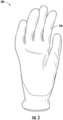
- the auxetic textile structure 100, 200, 300 may be configured to have a tubular shape (e.g., tubular portion 430) such that it may form a cut-resistant sleeve 400 as depicted in FIG. 4 or as one or more tubular or finger portion(s) 530 of a cut-resistant glove 500 as depicted in FIG. 5 .
- an exemplary cut-resistant sleeve 400 for implementing example auxetic textile structures (e.g., auxetic textile structures 100, 200, 300 in FIGS. 1-3 ) of the present disclosure is illustrated.
- the cut-resistant sleeve 400 may be manufactured or otherwise formed (e.g., woven, knitted, or the like) of an auxetic layer comprising a plurality of cut-resistant yarns and a plurality of dispersed elastic portions at least partially coupled to the inner surface (e.g., the surface facing an elbow of a user wearing the cut-resistant sleeve) of the auxetic layer, each of the dispersed elastic portions comprising a plurality of elastic yarns.
- an exemplary cut-resistant glove 500 for implementing example auxetic textile structures for implementing example auxetic textile structures (e.g., auxetic textile structures 100, 200, 300 in FIGS. 1-3 ) of the present disclosure is illustrated.
- the cut-resistant glove 500 including one or more tubular or finger portion(s) 530 may be manufactured or otherwise formed (e.g., woven, knitted, or the like) of an auxetic layer comprising a plurality of cut-resistant yarns and a plurality of dispersed elastic portions at least partially coupled to the inner surface (e.g., the surface facing a hand of a user wearing the cut-resistant glove) of the auxetic layer, each of the dispersed elastic portions comprising a plurality of elastic yarns.
- auxetic textile structures 100, 200, 300 used in forming a cut-resistant sleeve or a cut-resistant glove 500 may equally be used to form any personal protection equipment or other protective garment (e.g., gloves, sleeves, shirts, jackets, pants, socks, aprons, overalls, coverings, or the like) without limitation.
- the entirety of the protective garment is formed using auxetic textile structures of the present disclosure.
- one or more auxetic textile structures 100, 200, 300 of the present disclosure are placed, formed, or incorporated into strategic places in a protective garment, such as in the finger portion(s), elbow portion(s), knee portion(s), etc.
- the auxetic layer of the auxetic textile structure 100, 200, 300 may serve as the exterior layer of the cut-resistant glove 500 (i.e., a garment) such that the auxetic layer comprising cut resistant yarns will be contacted by the sharp or jagged object first in order to provide cut protection or tear and abrasion resistance.
- the cut-resistant glove 500 may further include a coated material (e.g., nitrile rubber, natural rubber, polyurethane (PU), rubber, neoprene rubber, polyvinyl chloride (PVC) rubber, wax, latex, or the like) applied to the auxetic textile structure (e.g., the outer surface of the auxetic layer or the exterior of the cut-resistant glove) based upon the intended use of the cut-resistant glove 500.
- a coated material e.g., nitrile rubber, natural rubber, polyurethane (PU), rubber, neoprene rubber, polyvinyl chloride (PVC) rubber, wax, latex, or the like
- the auxetic textile structure e.g., the outer surface of the auxetic layer or the exterior of the cut-resistant glove
- coated materials may be applied via dip coating, micro foaming, sandy finish, smooth finish, and/or any other application process known in the art.
- the present disclosure contemplates that any number of coating layers or coated materials may be applied
Landscapes
- Engineering & Computer Science (AREA)
- Textile Engineering (AREA)
- Gloves (AREA)
- Professional, Industrial, Or Sporting Protective Garments (AREA)
Claims (15)
- Auxetische Textilstruktur (100, 200, 300), umfassend:eine auxetische Schicht (105, 205, 305), die eine Innenfläche und eine Außenfläche aufweist, wobei die auxetische Schicht (105, 205, 305) eine Vielzahl von Hochleistungsgarnen umfasst; undeine Vielzahl von dispergierten elastischen Abschnitten (115A-115N, 215A-215N, 315A-315N), die mindestens teilweise mit der Innenfläche der auxetischen Schicht (105, 205, 305) gekoppelt sind, wobei jeder der dispergierten elastischen Abschnitte (115A-115N, 215A-215N, 315A-315N) eine Vielzahl von elastischen Garnen umfasst, gekennzeichnet durchwobei die Vielzahl von dispergierten elastischen Abschnitten (115A-115N, 215A-215N, 315A-315N) in Kombination mit der auxetischen Schicht (105, 205, 305) eine Vielzahl von Doppelschichtstrukturen ausbilden, die inmitten einer Einzelschicht der auxetischen Schicht (105, 205, 305) verteilt sind.
- Auxetische Textilstruktur (100, 200, 300) nach Anspruch 1, wobei die Vielzahl von Hochleistungsgarnen eines oder mehrere aus Polyethylen mit ultrahohem Molekulargewicht (UHMWPE), Aramid, Metall, Glas, Basalt, Carbon, Polybenzoxazol (PBO), Polybenzimidazol (PBI), Polyetheretherketon (PEEK), Polyimid (PI), Flüssigkristallpolymer (LCP), Polyphenylensulfid (PPS) umfassen.
- Auxetische Textilstruktur (100, 200, 300) nach Anspruch 1 oder 2, wobei die auxetische Schicht (105, 205, 305) ferner eines oder mehrere aus einem synthetischen Garn oder einem natürlichen Garn umfasst.
- Auxetische Textilstruktur (100, 200, 300) nach einem der vorhergehenden Ansprüche, wobei die elastischen Garne der dispergierten elastischen Abschnitte (115A-115N, 215A-215N, 315A-315N) einen niedrigeren Elastizitätsmodul aufweisen als die Hochleistungsgarne der auxetischen Schicht (105, 205, 305).
- Auxetische Textilstruktur (100, 200, 300) nach einem der vorhergehenden Ansprüche, wobei die elastischen Garne eines oder mehrere aus Elastan, Gummi, thermoplastischem Elastomer (TPE), thermoplastischem Vulkanisat (TPV) umfassen.
- Auxetische Textilstruktur (100, 200, 300) nach einem der vorhergehenden Ansprüche, wobei die Innenfläche der auxetischen Schicht (105, 205, 305) zwischen der Vielzahl der dispergierten elastischen Abschnitte sichtbar ist.
- Auxetische Textilstruktur (100, 200, 300) nach einem der vorhergehenden Ansprüche, wobei zwischen jedem der dispergierten elastischen Abschnitte (115A-115N, 215A-215N, 315A-315N) und der auxetischen Schicht (105, 205, 305) in einem ersten Zustand der auxetischen Textilstruktur ein Hohlraum definiert ist.
- Auxetische Textilstruktur (100, 200, 300) nach Anspruch 7, wobei der erste Zustand einen unbeanspruchten Zustand ohne äußere Anwendung einer Beanspruchung umfasst, wobei der Hohlraum in einem zweiten Zustand der auxetischen Textilstruktur reduziert ist, und wobei der zweite Zustand einen beanspruchten Zustand umfasst, wobei eine äußere Beanspruchung auf die auxetische Textilstruktur angewendet wird.
- Auxetische Textilstruktur (100, 200, 300) nach Anspruch 8, wobei die Vielzahl von dispergierten elastischen Abschnitten (115A-115N, 215A-215N, 315A-315N) dazu konfiguriert sind, die auxetische Textilstruktur in den ersten Zustand zurückzubringen, nachdem die äußere Beanspruchung beseitigt wurde.
- Auxetische Textilstruktur (100, 200, 300) nach einem der vorhergehenden Ansprüche, wobei die auxetische Schicht (105, 205, 305) eine Vielzahl von auxetischen Segmenten umfasst, wobei die auxetischen Segmente dazu ausgerichtet sind, der auxetischen Schicht (105, 205, 305) auxetische Eigenschaften zu verleihen.
- Auxetische Textilstruktur (100, 200, 300) nach Anspruch 10, wobei die Vielzahl von auxetischen Segmenten in einem sich wiederholenden Muster angeordnet sind.
- Auxetische Textilstruktur (100, 200, 300) nach Anspruch 11, wobei das Muster eine organisierte Anordnung von sich wiederholenden Segmenten in Form einer gebundenen Fliege oder eine organisierte Anordnung von sich wiederholenden Chevronförmigen Segmenten ist.
- Auxetische Textilstruktur (100, 200, 300) nach Anspruch 10, wobei die Vielzahl von auxetischen Segmenten uneinheitlich über die auxetische Schicht (105, 205, 305) angeordnet sind.
- Schnittfester Ärmel oder Handschuh, umfassend eine Vielzahl von auxetischen Textilstrukturen (100, 200, 300) gemäß einem der vorhergehenden Ansprüche.
- Schnittfester Ärmel oder Handschuh nach Anspruch 14, ferner umfassend eine Deckschicht, wobei die Deckschicht eines oder mehrere aus Nitrilgummi, Naturgummi, Polyurethan (PU) -Gummi, Neoprengummi, Polyvinylchlorid (PVC) -Gummi, Wachs, Latex umfasst.
Applications Claiming Priority (1)
| Application Number | Priority Date | Filing Date | Title |
|---|---|---|---|
| CN202211109310.8A CN117731083A (zh) | 2022-09-13 | 2022-09-13 | 拉胀织物结构 |
Publications (2)
| Publication Number | Publication Date |
|---|---|
| EP4338633A1 EP4338633A1 (de) | 2024-03-20 |
| EP4338633B1 true EP4338633B1 (de) | 2025-04-30 |
Family
ID=87567582
Family Applications (1)
| Application Number | Title | Priority Date | Filing Date |
|---|---|---|---|
| EP23190648.8A Active EP4338633B1 (de) | 2022-09-13 | 2023-08-09 | Auxetische textilstrukturen |
Country Status (3)
| Country | Link |
|---|---|
| US (1) | US20240084486A1 (de) |
| EP (1) | EP4338633B1 (de) |
| CN (1) | CN117731083A (de) |
Families Citing this family (1)
| Publication number | Priority date | Publication date | Assignee | Title |
|---|---|---|---|---|
| US9901138B2 (en) * | 2014-11-13 | 2018-02-27 | Adidas Ag | Multilayered materials with color changing properties |
Family Cites Families (3)
| Publication number | Priority date | Publication date | Assignee | Title |
|---|---|---|---|---|
| US9629397B2 (en) * | 2012-08-31 | 2017-04-25 | Under Armour, Inc. | Articles of apparel including auxetic materials |
| US9903054B2 (en) * | 2014-08-27 | 2018-02-27 | Nike, Inc. | Knitted component having tensile strand for adjusting auxetic portion |
| CN108000758B (zh) * | 2017-12-01 | 2019-11-08 | 东华大学 | 一种负泊松比纺织复合材料成型模具和方法 |
-
2022
- 2022-09-13 CN CN202211109310.8A patent/CN117731083A/zh active Pending
-
2023
- 2023-08-09 EP EP23190648.8A patent/EP4338633B1/de active Active
- 2023-08-24 US US18/455,251 patent/US20240084486A1/en active Pending
Also Published As
| Publication number | Publication date |
|---|---|
| EP4338633A1 (de) | 2024-03-20 |
| CN117731083A (zh) | 2024-03-22 |
| US20240084486A1 (en) | 2024-03-14 |
Similar Documents
| Publication | Publication Date | Title |
|---|---|---|
| CN109996912B (zh) | 三维3d针织织物及其制造方法 | |
| Wang et al. | 3 D auxetic warp‐knitted spacer fabrics | |
| US9878185B2 (en) | Flame resistant fabric and garments made therefrom | |
| US5323815A (en) | Textile material for inner lining of firefighter protective garment | |
| US10520280B2 (en) | Cut, slash and/or abrasion resistant protective fabric and lightweight shaped knit garment made therefrom | |
| EP2285247B1 (de) | Schutzkleidung mit geringen reibungsmerkmalen | |
| JP2021143453A (ja) | 耐切断性、耐切裂き性および/または耐摩耗性の布帛、およびそれから作られる軽量保護衣類 | |
| US20120204604A1 (en) | Knitted glove | |
| CN100577046C (zh) | 结合植绒材料的服饰 | |
| CN104837378A (zh) | 编织的多功能手套 | |
| US12558579B2 (en) | Woven fabric with intricate design | |
| EP4338633B1 (de) | Auxetische textilstrukturen | |
| JP2008517177A (ja) | エンボス加工された素材を組み込んだ衣料品 | |
| WO2017205602A1 (en) | Cut, slash and/or abrasion resistant protective fabric, and lightweight shaped knit garment made therefrom, having improved color consistency and cut resistance | |
| WO2013156790A1 (en) | Knitted glove | |
| JP2019194379A (ja) | 強靱糸及び耐切創性を備えた編織物 | |
| EP3278681A1 (de) | Bekleidungsartikel | |
| HK1154465B (en) | Protective garment with low friction characteristics |
Legal Events
| Date | Code | Title | Description |
|---|---|---|---|
| PUAI | Public reference made under article 153(3) epc to a published international application that has entered the european phase |
Free format text: ORIGINAL CODE: 0009012 |
|
| STAA | Information on the status of an ep patent application or granted ep patent |
Free format text: STATUS: REQUEST FOR EXAMINATION WAS MADE |
|
| 17P | Request for examination filed |
Effective date: 20230809 |
|
| AK | Designated contracting states |
Kind code of ref document: A1 Designated state(s): AL AT BE BG CH CY CZ DE DK EE ES FI FR GB GR HR HU IE IS IT LI LT LU LV MC ME MK MT NL NO PL PT RO RS SE SI SK SM TR |
|
| REG | Reference to a national code |
Ref country code: DE Free format text: PREVIOUS MAIN CLASS: A41D0019000000 Ref country code: DE Ref legal event code: R079 Ref document number: 602023003170 Country of ref document: DE Free format text: PREVIOUS MAIN CLASS: A41D0019000000 Ipc: D04B0001180000 |
|
| GRAP | Despatch of communication of intention to grant a patent |
Free format text: ORIGINAL CODE: EPIDOSNIGR1 |
|
| STAA | Information on the status of an ep patent application or granted ep patent |
Free format text: STATUS: GRANT OF PATENT IS INTENDED |
|
| RIC1 | Information provided on ipc code assigned before grant |
Ipc: A41D 31/24 20190101ALI20241029BHEP Ipc: A41D 19/015 20060101ALI20241029BHEP Ipc: A41D 31/18 20190101ALI20241029BHEP Ipc: A41D 19/00 20060101ALI20241029BHEP Ipc: D04B 1/18 20060101AFI20241029BHEP |
|
| INTG | Intention to grant announced |
Effective date: 20241204 |
|
| GRAS | Grant fee paid |
Free format text: ORIGINAL CODE: EPIDOSNIGR3 |
|
| GRAA | (expected) grant |
Free format text: ORIGINAL CODE: 0009210 |
|
| STAA | Information on the status of an ep patent application or granted ep patent |
Free format text: STATUS: THE PATENT HAS BEEN GRANTED |
|
| AK | Designated contracting states |
Kind code of ref document: B1 Designated state(s): AL AT BE BG CH CY CZ DE DK EE ES FI FR GB GR HR HU IE IS IT LI LT LU LV MC ME MK MT NL NO PL PT RO RS SE SI SK SM TR |
|
| REG | Reference to a national code |
Ref country code: CH Ref legal event code: EP Ref country code: GB Ref legal event code: FG4D |
|
| REG | Reference to a national code |
Ref country code: IE Ref legal event code: FG4D |
|
| REG | Reference to a national code |
Ref country code: DE Ref legal event code: R096 Ref document number: 602023003170 Country of ref document: DE |
|
| RAP2 | Party data changed (patent owner data changed or rights of a patent transferred) |
Owner name: HONEYWELL SAFETY PRODUCTS USA, INC. |
|
| REG | Reference to a national code |
Ref country code: DE Ref legal event code: R081 Ref document number: 602023003170 Country of ref document: DE Owner name: HONEYWELL SAFETY PRODUCTS USA, INC., WILMINGTO, US Free format text: FORMER OWNER: HONEYWELL INTERNATIONAL INC., CHARLOTTE, NC, US |
|
| REG | Reference to a national code |
Ref country code: NL Ref legal event code: MP Effective date: 20250430 |
|
| REG | Reference to a national code |
Ref country code: AT Ref legal event code: MK05 Ref document number: 1790098 Country of ref document: AT Kind code of ref document: T Effective date: 20250430 |
|
| PG25 | Lapsed in a contracting state [announced via postgrant information from national office to epo] |
Ref country code: FI Free format text: LAPSE BECAUSE OF FAILURE TO SUBMIT A TRANSLATION OF THE DESCRIPTION OR TO PAY THE FEE WITHIN THE PRESCRIBED TIME-LIMIT Effective date: 20250430 Ref country code: PT Free format text: LAPSE BECAUSE OF FAILURE TO SUBMIT A TRANSLATION OF THE DESCRIPTION OR TO PAY THE FEE WITHIN THE PRESCRIBED TIME-LIMIT Effective date: 20250901 Ref country code: ES Free format text: LAPSE BECAUSE OF FAILURE TO SUBMIT A TRANSLATION OF THE DESCRIPTION OR TO PAY THE FEE WITHIN THE PRESCRIBED TIME-LIMIT Effective date: 20250430 |
|
| PGFP | Annual fee paid to national office [announced via postgrant information from national office to epo] |
Ref country code: DE Payment date: 20250926 Year of fee payment: 3 |
|
| REG | Reference to a national code |
Ref country code: LT Ref legal event code: MG9D |
|
| PG25 | Lapsed in a contracting state [announced via postgrant information from national office to epo] |
Ref country code: NO Free format text: LAPSE BECAUSE OF FAILURE TO SUBMIT A TRANSLATION OF THE DESCRIPTION OR TO PAY THE FEE WITHIN THE PRESCRIBED TIME-LIMIT Effective date: 20250730 Ref country code: GR Free format text: LAPSE BECAUSE OF FAILURE TO SUBMIT A TRANSLATION OF THE DESCRIPTION OR TO PAY THE FEE WITHIN THE PRESCRIBED TIME-LIMIT Effective date: 20250731 |
|
| PG25 | Lapsed in a contracting state [announced via postgrant information from national office to epo] |
Ref country code: NL Free format text: LAPSE BECAUSE OF FAILURE TO SUBMIT A TRANSLATION OF THE DESCRIPTION OR TO PAY THE FEE WITHIN THE PRESCRIBED TIME-LIMIT Effective date: 20250430 Ref country code: PL Free format text: LAPSE BECAUSE OF FAILURE TO SUBMIT A TRANSLATION OF THE DESCRIPTION OR TO PAY THE FEE WITHIN THE PRESCRIBED TIME-LIMIT Effective date: 20250430 |
|
| PG25 | Lapsed in a contracting state [announced via postgrant information from national office to epo] |
Ref country code: BG Free format text: LAPSE BECAUSE OF FAILURE TO SUBMIT A TRANSLATION OF THE DESCRIPTION OR TO PAY THE FEE WITHIN THE PRESCRIBED TIME-LIMIT Effective date: 20250430 |
|
| PG25 | Lapsed in a contracting state [announced via postgrant information from national office to epo] |
Ref country code: HR Free format text: LAPSE BECAUSE OF FAILURE TO SUBMIT A TRANSLATION OF THE DESCRIPTION OR TO PAY THE FEE WITHIN THE PRESCRIBED TIME-LIMIT Effective date: 20250430 |
|
| PG25 | Lapsed in a contracting state [announced via postgrant information from national office to epo] |
Ref country code: AT Free format text: LAPSE BECAUSE OF FAILURE TO SUBMIT A TRANSLATION OF THE DESCRIPTION OR TO PAY THE FEE WITHIN THE PRESCRIBED TIME-LIMIT Effective date: 20250430 |
|
| PGFP | Annual fee paid to national office [announced via postgrant information from national office to epo] |
Ref country code: FR Payment date: 20250926 Year of fee payment: 3 |
|
| PG25 | Lapsed in a contracting state [announced via postgrant information from national office to epo] |
Ref country code: RS Free format text: LAPSE BECAUSE OF FAILURE TO SUBMIT A TRANSLATION OF THE DESCRIPTION OR TO PAY THE FEE WITHIN THE PRESCRIBED TIME-LIMIT Effective date: 20250731 |
|
| PG25 | Lapsed in a contracting state [announced via postgrant information from national office to epo] |
Ref country code: IS Free format text: LAPSE BECAUSE OF FAILURE TO SUBMIT A TRANSLATION OF THE DESCRIPTION OR TO PAY THE FEE WITHIN THE PRESCRIBED TIME-LIMIT Effective date: 20250830 |
|
| PG25 | Lapsed in a contracting state [announced via postgrant information from national office to epo] |
Ref country code: LV Free format text: LAPSE BECAUSE OF FAILURE TO SUBMIT A TRANSLATION OF THE DESCRIPTION OR TO PAY THE FEE WITHIN THE PRESCRIBED TIME-LIMIT Effective date: 20250430 |
|
| PG25 | Lapsed in a contracting state [announced via postgrant information from national office to epo] |
Ref country code: DK Free format text: LAPSE BECAUSE OF FAILURE TO SUBMIT A TRANSLATION OF THE DESCRIPTION OR TO PAY THE FEE WITHIN THE PRESCRIBED TIME-LIMIT Effective date: 20250430 Ref country code: SM Free format text: LAPSE BECAUSE OF FAILURE TO SUBMIT A TRANSLATION OF THE DESCRIPTION OR TO PAY THE FEE WITHIN THE PRESCRIBED TIME-LIMIT Effective date: 20250430 |
|
| PG25 | Lapsed in a contracting state [announced via postgrant information from national office to epo] |
Ref country code: CZ Free format text: LAPSE BECAUSE OF FAILURE TO SUBMIT A TRANSLATION OF THE DESCRIPTION OR TO PAY THE FEE WITHIN THE PRESCRIBED TIME-LIMIT Effective date: 20250430 |
|
| PG25 | Lapsed in a contracting state [announced via postgrant information from national office to epo] |
Ref country code: EE Free format text: LAPSE BECAUSE OF FAILURE TO SUBMIT A TRANSLATION OF THE DESCRIPTION OR TO PAY THE FEE WITHIN THE PRESCRIBED TIME-LIMIT Effective date: 20250430 |
|
| PG25 | Lapsed in a contracting state [announced via postgrant information from national office to epo] |
Ref country code: SK Free format text: LAPSE BECAUSE OF FAILURE TO SUBMIT A TRANSLATION OF THE DESCRIPTION OR TO PAY THE FEE WITHIN THE PRESCRIBED TIME-LIMIT Effective date: 20250430 |
|
| PG25 | Lapsed in a contracting state [announced via postgrant information from national office to epo] |
Ref country code: IT Free format text: LAPSE BECAUSE OF FAILURE TO SUBMIT A TRANSLATION OF THE DESCRIPTION OR TO PAY THE FEE WITHIN THE PRESCRIBED TIME-LIMIT Effective date: 20250430 |
|
| REG | Reference to a national code |
Ref country code: DE Ref legal event code: R097 Ref document number: 602023003170 Country of ref document: DE |
|
| PG25 | Lapsed in a contracting state [announced via postgrant information from national office to epo] |
Ref country code: RO Free format text: LAPSE BECAUSE OF FAILURE TO SUBMIT A TRANSLATION OF THE DESCRIPTION OR TO PAY THE FEE WITHIN THE PRESCRIBED TIME-LIMIT Effective date: 20250430 |
|
| PLBE | No opposition filed within time limit |
Free format text: ORIGINAL CODE: 0009261 |
|
| STAA | Information on the status of an ep patent application or granted ep patent |
Free format text: STATUS: NO OPPOSITION FILED WITHIN TIME LIMIT |
|
| REG | Reference to a national code |
Ref country code: CH Ref legal event code: L10 Free format text: ST27 STATUS EVENT CODE: U-0-0-L10-L00 (AS PROVIDED BY THE NATIONAL OFFICE) Effective date: 20260311 |
|
| PG25 | Lapsed in a contracting state [announced via postgrant information from national office to epo] |
Ref country code: MC Free format text: LAPSE BECAUSE OF FAILURE TO SUBMIT A TRANSLATION OF THE DESCRIPTION OR TO PAY THE FEE WITHIN THE PRESCRIBED TIME-LIMIT Effective date: 20250430 |
|
| 26N | No opposition filed |
Effective date: 20260202 |
|
| PG25 | Lapsed in a contracting state [announced via postgrant information from national office to epo] |
Ref country code: LU Free format text: LAPSE BECAUSE OF NON-PAYMENT OF DUE FEES Effective date: 20250809 |