EP4337511B1 - Procédé de détermination d'au moins un paramètre de la géométrie d'une voie ferrée, et système pour la mise en oeuvre du procédé - Google Patents
Procédé de détermination d'au moins un paramètre de la géométrie d'une voie ferrée, et système pour la mise en oeuvre du procédé Download PDFInfo
- Publication number
- EP4337511B1 EP4337511B1 EP23730005.8A EP23730005A EP4337511B1 EP 4337511 B1 EP4337511 B1 EP 4337511B1 EP 23730005 A EP23730005 A EP 23730005A EP 4337511 B1 EP4337511 B1 EP 4337511B1
- Authority
- EP
- European Patent Office
- Prior art keywords
- rails
- observed
- inertial unit
- row
- values
- Prior art date
- Legal status (The legal status is an assumption and is not a legal conclusion. Google has not performed a legal analysis and makes no representation as to the accuracy of the status listed.)
- Active
Links
Images
Classifications
-
- B—PERFORMING OPERATIONS; TRANSPORTING
- B61—RAILWAYS
- B61D—BODY DETAILS OR KINDS OF RAILWAY VEHICLES
- B61D15/00—Other railway vehicles, e.g. scaffold cars; Adaptations of vehicles for use on railways
- B61D15/08—Railway inspection trolleys
- B61D15/12—Railway inspection trolleys power propelled
-
- B—PERFORMING OPERATIONS; TRANSPORTING
- B61—RAILWAYS
- B61K—AUXILIARY EQUIPMENT SPECIALLY ADAPTED FOR RAILWAYS, NOT OTHERWISE PROVIDED FOR
- B61K9/00—Railway vehicle profile gauges; Detecting or indicating overheating of components; Apparatus on locomotives or cars to indicate bad track sections; General design of track recording vehicles
- B61K9/08—Measuring installations for surveying permanent way
-
- E—FIXED CONSTRUCTIONS
- E01—CONSTRUCTION OF ROADS, RAILWAYS, OR BRIDGES
- E01B—PERMANENT WAY; PERMANENT-WAY TOOLS; MACHINES FOR MAKING RAILWAYS OF ALL KINDS
- E01B35/00—Applications of measuring apparatus or devices for track-building purposes
-
- G—PHYSICS
- G01—MEASURING; TESTING
- G01C—MEASURING DISTANCES, LEVELS OR BEARINGS; SURVEYING; NAVIGATION; GYROSCOPIC INSTRUMENTS; PHOTOGRAMMETRY OR VIDEOGRAMMETRY
- G01C21/00—Navigation; Navigational instruments not provided for in groups G01C1/00 - G01C19/00
- G01C21/10—Navigation; Navigational instruments not provided for in groups G01C1/00 - G01C19/00 by using measurements of speed or acceleration
- G01C21/12—Navigation; Navigational instruments not provided for in groups G01C1/00 - G01C19/00 by using measurements of speed or acceleration executed aboard the object being navigated; Dead reckoning
- G01C21/16—Navigation; Navigational instruments not provided for in groups G01C1/00 - G01C19/00 by using measurements of speed or acceleration executed aboard the object being navigated; Dead reckoning by integrating acceleration or speed, i.e. inertial navigation
- G01C21/165—Navigation; Navigational instruments not provided for in groups G01C1/00 - G01C19/00 by using measurements of speed or acceleration executed aboard the object being navigated; Dead reckoning by integrating acceleration or speed, i.e. inertial navigation combined with non-inertial navigation instruments
- G01C21/1656—Navigation; Navigational instruments not provided for in groups G01C1/00 - G01C19/00 by using measurements of speed or acceleration executed aboard the object being navigated; Dead reckoning by integrating acceleration or speed, i.e. inertial navigation combined with non-inertial navigation instruments with passive imaging devices, e.g. cameras
-
- B—PERFORMING OPERATIONS; TRANSPORTING
- B61—RAILWAYS
- B61L—GUIDING RAILWAY TRAFFIC; ENSURING THE SAFETY OF RAILWAY TRAFFIC
- B61L23/00—Control, warning or like safety means along the route or between vehicles or trains
- B61L23/04—Control, warning or like safety means along the route or between vehicles or trains for monitoring the mechanical state of the route
- B61L23/042—Track changes detection
- B61L23/047—Track or rail movements
-
- G—PHYSICS
- G01—MEASURING; TESTING
- G01C—MEASURING DISTANCES, LEVELS OR BEARINGS; SURVEYING; NAVIGATION; GYROSCOPIC INSTRUMENTS; PHOTOGRAMMETRY OR VIDEOGRAMMETRY
- G01C15/00—Surveying instruments or accessories not provided for in groups G01C1/00 - G01C13/00
-
- G—PHYSICS
- G01—MEASURING; TESTING
- G01C—MEASURING DISTANCES, LEVELS OR BEARINGS; SURVEYING; NAVIGATION; GYROSCOPIC INSTRUMENTS; PHOTOGRAMMETRY OR VIDEOGRAMMETRY
- G01C21/00—Navigation; Navigational instruments not provided for in groups G01C1/00 - G01C19/00
- G01C21/10—Navigation; Navigational instruments not provided for in groups G01C1/00 - G01C19/00 by using measurements of speed or acceleration
- G01C21/12—Navigation; Navigational instruments not provided for in groups G01C1/00 - G01C19/00 by using measurements of speed or acceleration executed aboard the object being navigated; Dead reckoning
- G01C21/16—Navigation; Navigational instruments not provided for in groups G01C1/00 - G01C19/00 by using measurements of speed or acceleration executed aboard the object being navigated; Dead reckoning by integrating acceleration or speed, i.e. inertial navigation
- G01C21/165—Navigation; Navigational instruments not provided for in groups G01C1/00 - G01C19/00 by using measurements of speed or acceleration executed aboard the object being navigated; Dead reckoning by integrating acceleration or speed, i.e. inertial navigation combined with non-inertial navigation instruments
Definitions
- the invention relates to the determination of certain parameters of the geometry of a railway track, in particular with a view to its inspection or control, for example during its installation, monitoring, maintenance or repair.
- an instrumented vehicle on the track, the body or bogie chassis of which is equipped with an inertial unit providing gyroscopic measurements of yaw, pitch and roll angles and accelerometric measurements along three axes.
- the vehicle is also equipped with detection lasers to determine the relative position of the chassis, and therefore of the inertial unit, in relation to the lines of rails of the railway.
- Such a non-contact inertial measurement device is notably implemented in the IRIS 320 high-speed measuring train (TGV d'Inspection Rapide des Installations de Sécurotti at 320 km/h), which allows measurement of all track geometry parameters up to a running speed on the train track of 360 km/h.
- a disadvantage of this device is that it imposes a minimum speed for the measuring vehicle to travel on the track.
- the accelerometric signals which, by double time integration, allow access to displacements in the three dimensions of space, are weak and do not exploit the full dynamic range of the sensors. It follows that the accelerometric measurements are potentially affected by inaccuracies or systematic biases, which are amplified by the double integration operations, to the point of generating a constant time drift in the estimation of displacements in the three dimensions. In practice, we find that these drifts are no longer negligible below a certain speed of circulation, which in practice can be 60 km/h, so that it is not possible to obtain measurements for slow movements or with stops.
- measuring vehicles equipped with such a conventional inertial measurement system are therefore limited. In particular, they cannot be used on a railway repair site, which progresses at a working speed well below the minimum operating speed of the measuring device and which may have zero speed during stops of arbitrarily long duration.
- the invention aims to remedy the drawbacks of the state of the art and to propose means for determining, with the precision desired in practice, the geometry of a railway track, which can be implemented at low running speed on the track including arbitrarily long stops.
- the successive values of the curvilinear abscissa are not necessarily determined at a constant distance interval.
- the different signals can in particular be sampled at a constant time interval, preferably in a synchronized manner so as to obtain good concomitance between the values. determined from the signals from the inertial unit, the odometer(s) and the measuring equipment.
- the inertial unit implemented must be of a level of precision that effectively allows access to absolute orientation components in a geostationary frame of reference, i.e. without drift. It is therefore a type of unit whose gyroscopes are able to detect the projection of the rotation of the Earth and whose accelerometers are able to detect the projection of gravity.
- the linear filter implemented is preferably a finite impulse response filter of any order N, preferably greater than or equal to 2.
- the linear filter is a bandpass filter, preferably in one of the following three bands: 3m to 25m, 25m to 70m, 70m to 150m, or a sag calculation function.
- a bandpass filter preferably in one of the following three bands: 3m to 25m, 25m to 70m, 70m to 150m, or a sag calculation function.
- s ⁇ G (s) several filtered functions in parallel, each for a wavelength band or a filter type.
- the estimation of the integral is obtained by a discrete sum, preferably, the integral I(l) is estimated by a Riemann sum or by the trapezoid method on the given interval, with a step less than 25cm, and preferably less than 1cm.
- the operation of calculating the successive values of at least one absolute orientation or positioning component of the observed line of rails consists, at successive times, of an algebraic sum of an instantaneous value of the absolute orientation component of the inertial unit and of a simultaneous instantaneous value of the relative orientation component of each of the observed line of rails with respect to the inertial unit.
- the relative orientation component of the line of rails observed with respect to the inertial unit is an orientation angle in a horizontal plane
- the absolute orientation component of the inertial unit is a yaw angle
- the integral I(l) being a dressing parameter.
- the relative orientation component of the line of rails observed with respect to the inertial unit is an orientation angle with respect to a longitudinal vertical plane (V) of the vehicle
- the absolute orientation component of the inertial unit is a pitch angle
- the integral I(l) being a longitudinal leveling parameter
- the operations of calculating the successive values of at least one absolute orientation component of a row of rails observed among the two rows of rails, of constructing the function s ⁇ G ( s ), of applying a linear filter, of constructing the filtered function s ⁇ F ( s ) and of estimating the integral I(l) are carried out in parallel to obtain the intrinsic dressing coordinate and the intrinsic longitudinal leveling coordinate.
- the measuring equipment delivers at least two simultaneous signals for measuring the lateral distance between two reference points of the vehicle and the row of rails observed, the two reference points being at a distance (A) from each other greater than 250 mm, and preferably greater than 500 mm.
- the measuring equipment delivers at least two simultaneous signals for measuring the vertical distance between two reference points of the vehicle and the row of rails observed, the two reference points being at a distance (B) from each other greater than 250 mm, and preferably greater than 500 mm.
- the sensors of the measuring equipment can operate according to different principles (optical, magnetic, capacitive, etc.), which work in a linear and optimal in a relatively narrow operating range. It is therefore of interest that the positioning of the vehicle on the railway, both vertical and lateral, is close to an "ideal" alignment position at all times.
- At least one actuator for correcting the registration of the vehicle on the railway is controlled as a function of the signals delivered by the measuring equipment or of the successive values of the relative orientation component of the row of rails observed with respect to the inertial unit to reduce a difference between the signals delivered by the measuring equipment and predetermined values, or to reduce a difference between the successive values of the relative orientation component of the row of rails observed and a predetermined value of the relative orientation component of the row of rails observed.
- the correction operation will be particularly useful for a vehicle running on a single pair of wheels.
- the operation of determining the successive values of the curvilinear abscissa of the vehicle on the observed line of rails is carried out as a function of at least signals delivered by an odometer associated with the observed line of rail among the odometer(s). In the case where each of the lines of rails is associated with at least one odometer, this operation may be carried out for each of the lines of rails.
- the operation of determining the successive values of the curvilinear abscissa of the vehicle on the observed line of rails is carried out as a function of at least signals delivered by an odometer which is not associated with the observed line of rail among the odometer(s) and signals delivered by the measuring equipment. In the case where only one of the lines of rails is associated with an odometer, this operation may be carried out for the other line of track.
- the wheels to which the odometer(s) are linked may temporarily lose contact with the observed line of rails, in which case the signals delivered no longer reliably provide information on the positioning of the vehicle relative to the observed line of rails.
- failures of the odometer(s) are detected by comparing longitudinal acceleration values delivered by the inertial unit with average acceleration values determined as a function of the signals delivered by the odometer(s) and/or by comparing angular velocity values around a vertical axis delivered by the inertial unit with angular velocity values deduced from the signals delivered by the odometer(s).
- a system for implementing the method according to the first aspect of the invention, or one of its embodiments comprising a vehicle capable of running on a railway track with two parallel lines of rails, the vehicle carrying an inertial unit with at least three gyrometers and three accelerometers, equipment for measuring a relative orientation of each of the two lines of rails with respect to the inertial unit, and one or more odometers, characterized in that the system further comprises calculation means programmed to execute the operations of calculating the successive values of at least one absolute orientation or positioning component of a line of rails observed among the two lines of rails, of constructing the function s ⁇ G ( s ), of applying a linear filter, of constructing the filtered function s ⁇ F ( s ) and of estimating the integral I(l).
- the measuring equipment comprises, associated with each of the two rows of rails, at least two sensors for measuring the lateral distance between two reference points of the vehicle and the associated row of rails, the two reference points being at a distance (A) from each other greater than 250 mm, and preferably greater than 500 mm.
- Each of the sensors is here dedicated to measuring a lateral distance at one of the reference points.
- the measuring equipment comprises at least one and preferably at least two cameras for detecting one or more linear laser beams projected onto each of the rows of rails.
- each camera can capture the position of a laser line projected onto the row of rails observed, the measuring equipment determining by triangulation the relative vertical and lateral position between the row of rails observed and the camera, placed in the reference frame of the inertial unit.
- the measuring equipment comprises at least one and preferably at least two laser rangefinders scanning the lines of rails of the railway.
- the distance is given by measuring the delay between the emission of a pulse and the detection of a reflected pulse.
- the projected laser beam is oriented by a rotating mirror, which makes it possible to scan a plane of space which can cover the two lines of rails and to deduce therefrom by triangulation for each line of rails a lateral distance measurement and a vertical distance measurement.
- two laser rangefinders placed at a distance from each other in the longitudinal direction of the vehicle, it is thus possible to obtain the eight desired dimensions, namely four lateral distances and four vertical distances.
- the measuring equipment may also include a track gauge sensor, although this dimension may be derived from the lateral distance measurements between the various reference points and the two lines of rail. Where appropriate, the measuring equipment may also include a track cant sensor.
- the vehicle is a two-wheeled cart, driven by a machine and connected to the machine via at least three links making it possible to control the attitude and the registration of the cart according to the relative orientation components.
- the vehicle is a cart with at least four wheels.
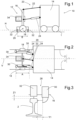
- a system 10 for determining at least one geometric parameter of a railway track 1 with two lines of rails 2, comprising a vehicle 12 capable of running on the railway track, coupled to a railway machine 14, which may in particular be a machine for laying, repairing or renewing the railway track.
- the vehicle 12 is here a trolley comprising a non-deformable chassis 16 resting on a single pair of wheels 18, if necessary with the interposition of a primary suspension.
- the trolley 12 is preferably without means of propulsion, and simply pulled or pushed by the railway machine 14 as the latter advances on the track.
- the coupling 20 connecting the trolley 12 to the railway machine 14 is here constituted by a connection with two ball joints 22 and two jacks 24 to allow the angular orientation of the chassis 16 to be adjusted relative to the machine railway 14 and to the railway track 1, in particular in a vertical plane and in a transverse plane. It will be noted, however, that the adjustment of the orientation of the chassis 16 relative to the railway track 1 can, if necessary, be obtained by other adjustment means, in particular by controlling actuators arranged at the level of a primary suspension between the chassis 16 and the wheels 18. It will also be noted that the wheels 18 are preferably independent, in the sense that they rotate independently of one another.
- the carriage 12 is instrumented with various measuring devices, and in particular at least one odometer 26 equipping for example one of the wheels 18 of the carriage 12 to determine the distance traveled on the line of rails 2 on which the wheel 18 rolls, or the curvilinear abscissa of the carriage 12 relative to this line of rails 2.
- each of the two wheels 18 is equipped with an odometer 26, so as to be able to directly determine the curvilinear abscissa of the carriage 12 relative to each of the two lines of rails 2 of the railway track 1.
- the carriage 12 further comprises measuring equipment 28 intended to determine the orientation of the chassis 16 relative to each rail line 2, at least in a reference plane of the chassis 16, and preferably in at least two orthogonal planes, namely a horizontal plane H and a longitudinal vertical plane V.
- the measuring equipment comprises, associated with at least one of the two rows of rails 2, and preferably with each of the two rows of rails 2, at least two lateral distance measuring sensors 30 between two reference points of the vehicle and the associated row of rails, the two reference points being at a distance A from each other, as illustrated in the Figure 2 .
- the accuracy of the result naturally increases with the distance A, which should preferably be greater than 250mm, and preferably greater than 500.
- the measuring equipment comprises, associated with at least one of the two rows of rails 2, and preferably with each of the two rows of rails 2, at least two vertical distance measuring sensors 32 between two reference points of the vehicle and the associated row of rails, as illustrated in the Figure 1 .
- an inertial unit 34 with at least three gyrometers and three accelerometers, this inertial unit 34 being said to be precision, in the sense that it is capable of delivering absolute orientation signals, that is to say without drift, in a geostationary reference frame. It is therefore a type of power plant whose gyroscopes are able to detect the projection of the Earth's rotation and whose accelerometers are able to detect the projection of gravity.
- the carriage 12 makes it possible to determine on the one hand the absolute orientation of the inertial unit 34 in a geostationary reference frame, and on the other hand the relative orientation of each of the rail lines 2 with respect to the chassis 16, therefore to the inertial unit 34 secured to the chassis 16.
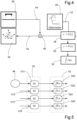
- a specific method is proposed, illustrated in the Figures 4 and 5 .
- the trolley 12 While the trolley 12 is traveling at low speed, in particular at a speed of less than 10 km/h, a speed which may not be constant and the machine 14 being likely to slow down, or even stop for a prolonged period at the rate of the work undertaken on the railway line 1, the signals from the odometers 26, the measuring equipment 28 and the inertial unit 34 are simultaneously sampled at constant time intervals.
- successive values of at least one absolute orientation component of the inertial unit 34 in a geostationary reference frame are determined, for example successive values of the roll angle and/or successive values of the pitch angle (operation 40).
- the function s ⁇ G L ( s ) will be constructed by connecting for all measurement times t or for at least some of them, the value s(t) measured by the odometer associated with the observed rail line to the value ⁇ A (t).
- the function s ⁇ G T ( s ) will be constructed by connecting for all measurement times t or for at least some of them, the value s(t) measured by the odometer associated with the observed rail line to the value ⁇ A (t).
- s ⁇ G ( s ) have been constructed where time no longer appears as a variable.
- a linear band-pass or high-pass filter which is not a time filter, but a spatial filter, so as to construct a filtered function s ⁇ F ( s ) (operation 50).
- At least one bandpass filter will be implemented in one of the following three bands: 3m to 25m (D1), 25m to 70m (D2), 70m to 150m (D3), or a bandpass filter carried out by a deflection calculation function (CF), and in practice, operation 50 will be carried out in parallel for each of the desired wavelength domains among those available, which we have schematized in Figure 5 by parallel sub-operations 510, 512, 514, 516.
- D1 3m to 25m
- D2 25m to 70m
- D3 70m to 150m
- CF deflection calculation function
- the integral I(l) is estimated by a Riemann sum or by the trapezoid method over the given interval, with a step less than 25cm, and preferably less than 1cm.
- this operation 52 is carried out in parallel for each of the observed wavelength domains, hence the parallel sub-operations 520, 522, 524, 526.
- the integral I(l) will be a dressing parameter.
- the integral I(l) will be a longitudinal leveling parameter.
- the calculations can be carried out in real time by a computer on board the vehicle 12, on the machine 14 or located remotely.
- failures of the odometer(s) 26 can be detected by comparing longitudinal acceleration values delivered by the inertial unit 34 with average acceleration values determined as a function of the signals delivered by the odometer(s) 26 and/or by comparing angular velocity values around a vertical axis delivered by the inertial unit 34 with angular velocity values deduced from the signals delivered by the odometer(s) 26.
- a degraded mode operating procedure is executed, in which the successive values of the curvilinear abscissa of the vehicle 12 are determined on each of the two lines of rails 2 as a function of at least accelerometric signals or angular velocity delivered by the inertial unit 34.
- the method for determining the geometry parameters of the railway track described above can also be carried out using a four-wheeled trolley, or more generally a railway vehicle which can rest on several wheel sets or on several bogies.
- the chassis to which the inertial unit is secured can be linked to the wheels by one or more suspension stages, for example a primary suspension and/or a secondary suspension.
- the equipment for measuring the relative orientation of each of the rows of rails with respect to the inertial unit will preferably use measurement principles other than those described so far.
- the measuring equipment comprises at least one and preferably at least two cameras for detecting one or more linear laser beams projected onto each of the rail lines.
- each camera is fixed to the chassis carrying the inertial unit in a fixed manner in the reference frame of the inertial unit, and oriented so as to aim and capture the position of a laser line projected onto the observed line of rails, the measuring equipment determining by triangulation the relative vertical and lateral position between the observed line of rails and the camera.
- the measuring equipment comprises at least one and preferably at least two laser rangefinders also placed in the reference frame of the inertial unit so as to scan the lines of rails of the railway.
- the distance is given by measuring the delay between the emission of a pulse and the detection of a reflected pulse.
- the projected laser beam is oriented by a rotating mirror, which makes it possible to scan a plane of space which can cover the two lines of rails and to deduce therefrom by triangulation for each line of rails a lateral distance measurement and a vertical distance measurement.
- two laser rangefinders placed at a distance from each other in the longitudinal direction of the vehicle, it is thus possible to obtain the eight desired dimensions, namely four lateral distances and four vertical distances.
- the measuring equipment includes at least one time-of-flight camera (ToF camera, "time of flight”) placed in the frame of the inertial unit, making it possible to visualize a scene in three dimensions in its field of vision. Since the field of vision of this type of camera is relatively narrow, it will be advantageous to use one camera of this type per line of rails.
- ToF camera time of flight
Landscapes
- Engineering & Computer Science (AREA)
- Radar, Positioning & Navigation (AREA)
- Remote Sensing (AREA)
- Mechanical Engineering (AREA)
- Transportation (AREA)
- General Physics & Mathematics (AREA)
- Physics & Mathematics (AREA)
- Automation & Control Theory (AREA)
- Architecture (AREA)
- Civil Engineering (AREA)
- Structural Engineering (AREA)
- Machines For Laying And Maintaining Railways (AREA)
- Length Measuring Devices With Unspecified Measuring Means (AREA)
- Navigation (AREA)
Applications Claiming Priority (2)
| Application Number | Priority Date | Filing Date | Title |
|---|---|---|---|
| FR2205102A FR3135947A1 (fr) | 2022-05-28 | 2022-05-28 | PROCÉDÉ DE DÉTERMINATION D’AU MOINS un paramètre de la géométrie D’UNE VOIE FERRÉE, ET SYSTÈME POUR LA MISE EN œuvre DU PROCÉDÉ |
| PCT/EP2023/064105 WO2023232645A1 (fr) | 2022-05-28 | 2023-05-25 | Procédé de détermination d'au moins un parametre de la geometrie d'une voie ferrée, et système pour la mise en oeuvre du procédé |
Publications (3)
| Publication Number | Publication Date |
|---|---|
| EP4337511A1 EP4337511A1 (fr) | 2024-03-20 |
| EP4337511C0 EP4337511C0 (fr) | 2025-03-26 |
| EP4337511B1 true EP4337511B1 (fr) | 2025-03-26 |
Family
ID=83280562
Family Applications (1)
| Application Number | Title | Priority Date | Filing Date |
|---|---|---|---|
| EP23730005.8A Active EP4337511B1 (fr) | 2022-05-28 | 2023-05-25 | Procédé de détermination d'au moins un paramètre de la géométrie d'une voie ferrée, et système pour la mise en oeuvre du procédé |
Country Status (9)
| Country | Link |
|---|---|
| US (1) | US20250319910A1 (pl) |
| EP (1) | EP4337511B1 (pl) |
| JP (1) | JP2025517873A (pl) |
| CN (1) | CN119343286A (pl) |
| AU (1) | AU2023279122A1 (pl) |
| ES (1) | ES3030326T3 (pl) |
| FR (1) | FR3135947A1 (pl) |
| PL (1) | PL4337511T3 (pl) |
| WO (1) | WO2023232645A1 (pl) |
Family Cites Families (1)
| Publication number | Priority date | Publication date | Assignee | Title |
|---|---|---|---|---|
| FR3005321B1 (fr) * | 2013-05-05 | 2015-10-02 | Leyfa Measurement | Dispositif de mesure de la geometrie d'une voie ferree et procede d'estimation des profils de nivellement et de dressage de ladite voie ferree |
-
2022
- 2022-05-28 FR FR2205102A patent/FR3135947A1/fr active Pending
-
2023
- 2023-05-25 CN CN202380043603.7A patent/CN119343286A/zh active Pending
- 2023-05-25 ES ES23730005T patent/ES3030326T3/es active Active
- 2023-05-25 EP EP23730005.8A patent/EP4337511B1/fr active Active
- 2023-05-25 US US18/868,025 patent/US20250319910A1/en active Pending
- 2023-05-25 JP JP2024560599A patent/JP2025517873A/ja active Pending
- 2023-05-25 WO PCT/EP2023/064105 patent/WO2023232645A1/fr not_active Ceased
- 2023-05-25 PL PL23730005.8T patent/PL4337511T3/pl unknown
- 2023-05-25 AU AU2023279122A patent/AU2023279122A1/en active Pending
Also Published As
| Publication number | Publication date |
|---|---|
| PL4337511T3 (pl) | 2025-06-02 |
| FR3135947A1 (fr) | 2023-12-01 |
| CN119343286A (zh) | 2025-01-21 |
| EP4337511C0 (fr) | 2025-03-26 |
| EP4337511A1 (fr) | 2024-03-20 |
| JP2025517873A (ja) | 2025-06-12 |
| AU2023279122A1 (en) | 2024-10-24 |
| US20250319910A1 (en) | 2025-10-16 |
| ES3030326T3 (en) | 2025-06-27 |
| WO2023232645A1 (fr) | 2023-12-07 |
Similar Documents
| Publication | Publication Date | Title |
|---|---|---|
| EP3740410B1 (fr) | Procédés de repérage de points ou lignes d'intérêt sur une voie ferrée, de positionnement et de conduite d'une machine d'intervention sur une voie ferrée | |
| EP1083106B1 (fr) | Véhicule de mesure de l'état géometrique d'une voie ferrée. | |
| JP7037948B2 (ja) | 最適な軌道を算出するための方法 | |
| EP2806065B1 (fr) | Procédé de mesure et d'estimation de géométrie d'une voie ferrée | |
| FR2678962A1 (fr) | Procede pour determiner les ecarts de la position reelle d'un troncon de voie ferree. | |
| JP2022535384A (ja) | 軌道監視システム | |
| FR3077553A1 (fr) | Procede de reperage de points ou lignes d’interet sur une voie ferree | |
| WO2021233912A1 (fr) | Procédé de calcul d'un vecteur de vitesse instantanée d'un véhicule ferroviaire, système correspondant→ | |
| WO2020021191A1 (fr) | Engin volant motorisé de mesure du relief de surfaces d'un objet prédéterminé et procédé de commande d'un tel engin | |
| FR3042875A1 (fr) | Procede de calcul de l'acceleration propre d'un vehicule ferroviaire, produit programme d'ordinateur et systeme associes | |
| EP4337511B1 (fr) | Procédé de détermination d'au moins un paramètre de la géométrie d'une voie ferrée, et système pour la mise en oeuvre du procédé | |
| CN113442957A (zh) | 轨道巡检车 | |
| Escalona | Vertical track geometry monitoring using inertial sensors and complementary filters | |
| FR3066770B1 (fr) | Procedure de reglage d’un systeme de guidage d’une machine de travaux ferroviaires, procede et systeme de guidage associes | |
| WO2018065692A1 (fr) | Procédé et dispositif autonomes de détermination d'une assiette d'un véhicule automobile | |
| WO1989012234A1 (fr) | Procede et dispositif de tachymetrie et localisation des materiels roulants de chemin de fer | |
| FR3077552A1 (fr) | Procedes de reperage de points ou lignes d’interet sur une voie ferree, de positionnement et de conduite d’une machine d’intervention sur une voie ferree | |
| EP3493153A1 (fr) | Procédé et système de détection des défauts de géométrie d'une voie ferrée | |
| FR3135946A1 (fr) | Chariot ferroviaire à deux roues | |
| FR3037085B1 (fr) | Dispositif de mesure du nivellement ou du dressage d'une voie ferree | |
| WO2021191351A1 (fr) | Procede de calcul d'un ripage et/ou relevage de voie de chemin de fer, bourreuse adaptee | |
| EP1826319A1 (fr) | Procédé et système d'insertion d'éléments dans le sol, support d'enregistrement d'informations pour ce procédé | |
| RU2489291C1 (ru) | Способ оптического определения неровностей и дефектов рельсового пути | |
| FR3077582A1 (fr) | Procede de commande d’un ensemble d’un ou plusieurs outils d’intervention montes sur un vehicule ferroviaire d’intervention | |
| FR2966847A1 (fr) | Procede et dispositif de mesure continue en charge d'un parametre geometrique d'une voie ferree |
Legal Events
| Date | Code | Title | Description |
|---|---|---|---|
| STAA | Information on the status of an ep patent application or granted ep patent |
Free format text: STATUS: UNKNOWN |
|
| STAA | Information on the status of an ep patent application or granted ep patent |
Free format text: STATUS: THE INTERNATIONAL PUBLICATION HAS BEEN MADE |
|
| PUAI | Public reference made under article 153(3) epc to a published international application that has entered the european phase |
Free format text: ORIGINAL CODE: 0009012 |
|
| STAA | Information on the status of an ep patent application or granted ep patent |
Free format text: STATUS: REQUEST FOR EXAMINATION WAS MADE |
|
| 17P | Request for examination filed |
Effective date: 20231211 |
|
| AK | Designated contracting states |
Kind code of ref document: A1 Designated state(s): AL AT BE BG CH CY CZ DE DK EE ES FI FR GB GR HR HU IE IS IT LI LT LU LV MC ME MK MT NL NO PL PT RO RS SE SI SK SM TR |
|
| GRAP | Despatch of communication of intention to grant a patent |
Free format text: ORIGINAL CODE: EPIDOSNIGR1 |
|
| STAA | Information on the status of an ep patent application or granted ep patent |
Free format text: STATUS: GRANT OF PATENT IS INTENDED |
|
| DAV | Request for validation of the european patent (deleted) | ||
| DAX | Request for extension of the european patent (deleted) | ||
| INTG | Intention to grant announced |
Effective date: 20241126 |
|
| GRAS | Grant fee paid |
Free format text: ORIGINAL CODE: EPIDOSNIGR3 |
|
| GRAA | (expected) grant |
Free format text: ORIGINAL CODE: 0009210 |
|
| STAA | Information on the status of an ep patent application or granted ep patent |
Free format text: STATUS: THE PATENT HAS BEEN GRANTED |
|
| AK | Designated contracting states |
Kind code of ref document: B1 Designated state(s): AL AT BE BG CH CY CZ DE DK EE ES FI FR GB GR HR HU IE IS IT LI LT LU LV MC ME MK MT NL NO PL PT RO RS SE SI SK SM TR |
|
| REG | Reference to a national code |
Ref country code: GB Ref legal event code: FG4D Free format text: NOT ENGLISH |
|
| REG | Reference to a national code |
Ref country code: CH Ref legal event code: EP |
|
| REG | Reference to a national code |
Ref country code: DE Ref legal event code: R096 Ref document number: 602023002624 Country of ref document: DE |
|
| REG | Reference to a national code |
Ref country code: IE Ref legal event code: FG4D Free format text: LANGUAGE OF EP DOCUMENT: FRENCH |
|
| U01 | Request for unitary effect filed |
Effective date: 20250421 |
|
| U07 | Unitary effect registered |
Designated state(s): AT BE BG DE DK EE FI FR IT LT LU LV MT NL PT RO SE SI Effective date: 20250425 |
|
| U20 | Renewal fee for the european patent with unitary effect paid |
Year of fee payment: 3 Effective date: 20250331 |
|
| REG | Reference to a national code |
Ref country code: ES Ref legal event code: FG2A Ref document number: 3030326 Country of ref document: ES Kind code of ref document: T3 Effective date: 20250627 |
|
| PG25 | Lapsed in a contracting state [announced via postgrant information from national office to epo] |
Ref country code: RS Free format text: LAPSE BECAUSE OF FAILURE TO SUBMIT A TRANSLATION OF THE DESCRIPTION OR TO PAY THE FEE WITHIN THE PRESCRIBED TIME-LIMIT Effective date: 20250626 |
|
| PGFP | Annual fee paid to national office [announced via postgrant information from national office to epo] |
Ref country code: PL Payment date: 20250415 Year of fee payment: 3 |
|
| PGFP | Annual fee paid to national office [announced via postgrant information from national office to epo] |
Ref country code: ES Payment date: 20250604 Year of fee payment: 3 |
|
| PG25 | Lapsed in a contracting state [announced via postgrant information from national office to epo] |
Ref country code: NO Free format text: LAPSE BECAUSE OF FAILURE TO SUBMIT A TRANSLATION OF THE DESCRIPTION OR TO PAY THE FEE WITHIN THE PRESCRIBED TIME-LIMIT Effective date: 20250626 |
|
| PG25 | Lapsed in a contracting state [announced via postgrant information from national office to epo] |
Ref country code: HR Free format text: LAPSE BECAUSE OF FAILURE TO SUBMIT A TRANSLATION OF THE DESCRIPTION OR TO PAY THE FEE WITHIN THE PRESCRIBED TIME-LIMIT Effective date: 20250326 |
|
| PG25 | Lapsed in a contracting state [announced via postgrant information from national office to epo] |
Ref country code: GR Free format text: LAPSE BECAUSE OF FAILURE TO SUBMIT A TRANSLATION OF THE DESCRIPTION OR TO PAY THE FEE WITHIN THE PRESCRIBED TIME-LIMIT Effective date: 20250627 |
|
| PG25 | Lapsed in a contracting state [announced via postgrant information from national office to epo] |
Ref country code: SM Free format text: LAPSE BECAUSE OF FAILURE TO SUBMIT A TRANSLATION OF THE DESCRIPTION OR TO PAY THE FEE WITHIN THE PRESCRIBED TIME-LIMIT Effective date: 20250326 |
|
| PG25 | Lapsed in a contracting state [announced via postgrant information from national office to epo] |
Ref country code: SK Free format text: LAPSE BECAUSE OF FAILURE TO SUBMIT A TRANSLATION OF THE DESCRIPTION OR TO PAY THE FEE WITHIN THE PRESCRIBED TIME-LIMIT Effective date: 20250326 |
|
| PG25 | Lapsed in a contracting state [announced via postgrant information from national office to epo] |
Ref country code: IS Free format text: LAPSE BECAUSE OF FAILURE TO SUBMIT A TRANSLATION OF THE DESCRIPTION OR TO PAY THE FEE WITHIN THE PRESCRIBED TIME-LIMIT Effective date: 20250726 |
|
| PG25 | Lapsed in a contracting state [announced via postgrant information from national office to epo] |
Ref country code: CZ Free format text: LAPSE BECAUSE OF FAILURE TO SUBMIT A TRANSLATION OF THE DESCRIPTION OR TO PAY THE FEE WITHIN THE PRESCRIBED TIME-LIMIT Effective date: 20250326 |
|
| PG25 | Lapsed in a contracting state [announced via postgrant information from national office to epo] |
Ref country code: MC Free format text: LAPSE BECAUSE OF FAILURE TO SUBMIT A TRANSLATION OF THE DESCRIPTION OR TO PAY THE FEE WITHIN THE PRESCRIBED TIME-LIMIT Effective date: 20250326 |
|
| PLBE | No opposition filed within time limit |
Free format text: ORIGINAL CODE: 0009261 |
|
| STAA | Information on the status of an ep patent application or granted ep patent |
Free format text: STATUS: NO OPPOSITION FILED WITHIN TIME LIMIT |
|
| REG | Reference to a national code |
Ref country code: CH Ref legal event code: L10 Free format text: ST27 STATUS EVENT CODE: U-0-0-L10-L00 (AS PROVIDED BY THE NATIONAL OFFICE) Effective date: 20260211 |
|
| 26N | No opposition filed |
Effective date: 20260105 |
|
| PG25 | Lapsed in a contracting state [announced via postgrant information from national office to epo] |
Ref country code: IE Free format text: LAPSE BECAUSE OF NON-PAYMENT OF DUE FEES Effective date: 20250525 |