EP4337490B1 - Manipulator zum positionieren einer energieübertragungseinheit zum laden eines fahrzeugs und ladestation dafür - Google Patents
Manipulator zum positionieren einer energieübertragungseinheit zum laden eines fahrzeugs und ladestation dafür Download PDFInfo
- Publication number
- EP4337490B1 EP4337490B1 EP22728844.6A EP22728844A EP4337490B1 EP 4337490 B1 EP4337490 B1 EP 4337490B1 EP 22728844 A EP22728844 A EP 22728844A EP 4337490 B1 EP4337490 B1 EP 4337490B1
- Authority
- EP
- European Patent Office
- Prior art keywords
- link
- trajectory
- manipulator
- pivoting connection
- support
- Prior art date
- Legal status (The legal status is an assumption and is not a legal conclusion. Google has not performed a legal analysis and makes no representation as to the accuracy of the status listed.)
- Active
Links
Images




Classifications
-
- B—PERFORMING OPERATIONS; TRANSPORTING
- B60—VEHICLES IN GENERAL
- B60L—PROPULSION OF ELECTRICALLY-PROPELLED VEHICLES; SUPPLYING ELECTRIC POWER FOR AUXILIARY EQUIPMENT OF ELECTRICALLY-PROPELLED VEHICLES; ELECTRODYNAMIC BRAKE SYSTEMS FOR VEHICLES IN GENERAL; MAGNETIC SUSPENSION OR LEVITATION FOR VEHICLES; MONITORING OPERATING VARIABLES OF ELECTRICALLY-PROPELLED VEHICLES; ELECTRIC SAFETY DEVICES FOR ELECTRICALLY-PROPELLED VEHICLES
- B60L53/00—Methods of charging batteries, specially adapted for electric vehicles; Charging stations or on-board charging equipment therefor; Exchange of energy storage elements in electric vehicles
- B60L53/30—Constructional details of charging stations
- B60L53/35—Means for automatic or assisted adjustment of the relative position of charging devices and vehicles
-
- Y—GENERAL TAGGING OF NEW TECHNOLOGICAL DEVELOPMENTS; GENERAL TAGGING OF CROSS-SECTIONAL TECHNOLOGIES SPANNING OVER SEVERAL SECTIONS OF THE IPC; TECHNICAL SUBJECTS COVERED BY FORMER USPC CROSS-REFERENCE ART COLLECTIONS [XRACs] AND DIGESTS
- Y02—TECHNOLOGIES OR APPLICATIONS FOR MITIGATION OR ADAPTATION AGAINST CLIMATE CHANGE
- Y02T—CLIMATE CHANGE MITIGATION TECHNOLOGIES RELATED TO TRANSPORTATION
- Y02T10/00—Road transport of goods or passengers
- Y02T10/60—Other road transportation technologies with climate change mitigation effect
- Y02T10/70—Energy storage systems for electromobility, e.g. batteries
-
- Y—GENERAL TAGGING OF NEW TECHNOLOGICAL DEVELOPMENTS; GENERAL TAGGING OF CROSS-SECTIONAL TECHNOLOGIES SPANNING OVER SEVERAL SECTIONS OF THE IPC; TECHNICAL SUBJECTS COVERED BY FORMER USPC CROSS-REFERENCE ART COLLECTIONS [XRACs] AND DIGESTS
- Y02—TECHNOLOGIES OR APPLICATIONS FOR MITIGATION OR ADAPTATION AGAINST CLIMATE CHANGE
- Y02T—CLIMATE CHANGE MITIGATION TECHNOLOGIES RELATED TO TRANSPORTATION
- Y02T10/00—Road transport of goods or passengers
- Y02T10/60—Other road transportation technologies with climate change mitigation effect
- Y02T10/7072—Electromobility specific charging systems or methods for batteries, ultracapacitors, supercapacitors or double-layer capacitors
-
- Y—GENERAL TAGGING OF NEW TECHNOLOGICAL DEVELOPMENTS; GENERAL TAGGING OF CROSS-SECTIONAL TECHNOLOGIES SPANNING OVER SEVERAL SECTIONS OF THE IPC; TECHNICAL SUBJECTS COVERED BY FORMER USPC CROSS-REFERENCE ART COLLECTIONS [XRACs] AND DIGESTS
- Y02—TECHNOLOGIES OR APPLICATIONS FOR MITIGATION OR ADAPTATION AGAINST CLIMATE CHANGE
- Y02T—CLIMATE CHANGE MITIGATION TECHNOLOGIES RELATED TO TRANSPORTATION
- Y02T90/00—Enabling technologies or technologies with a potential or indirect contribution to GHG emissions mitigation
- Y02T90/10—Technologies relating to charging of electric vehicles
- Y02T90/12—Electric charging stations
-
- Y—GENERAL TAGGING OF NEW TECHNOLOGICAL DEVELOPMENTS; GENERAL TAGGING OF CROSS-SECTIONAL TECHNOLOGIES SPANNING OVER SEVERAL SECTIONS OF THE IPC; TECHNICAL SUBJECTS COVERED BY FORMER USPC CROSS-REFERENCE ART COLLECTIONS [XRACs] AND DIGESTS
- Y02—TECHNOLOGIES OR APPLICATIONS FOR MITIGATION OR ADAPTATION AGAINST CLIMATE CHANGE
- Y02T—CLIMATE CHANGE MITIGATION TECHNOLOGIES RELATED TO TRANSPORTATION
- Y02T90/00—Enabling technologies or technologies with a potential or indirect contribution to GHG emissions mitigation
- Y02T90/10—Technologies relating to charging of electric vehicles
- Y02T90/14—Plug-in electric vehicles
Definitions
- the present invention generally relates to a manipulator for charging vehicles and specifically to a manipulator for positioning an energy transfer unit for charging vehicles.
- the invention further relates to a charging station comprising such a device.
- connection devices for charging electric vehicles automatically are known in the art.
- US20160332525 A1 discloses a connection device for conductive charging providing lifting means to move a charging head towards a stop surface provided on an underbody of a vehicle. Upon striking the stop surface, continued actuation of the lifting means provides alignment along the stop surface.
- the disadvantage of such a connection device is that it allows a limited lateral offset and therefore requires very accurate positioning of the vehicle. Furthermore, considerable lifting force will be required for moving the charging head along the stop surface orthogonal to the direction of the lifting force.
- EP0788212A2 discloses a more complex connection system for inductive charging allowing more positioning freedom for the vehicle through the use of stacked linear actuators.
- the system comprises orthogonally placed linear actuators for moving a body comprising a charging coil in the horizontal plane, wherein the body further comprises a pantograph mechanism for moving the charging coil in the vertical direction.
- the disadvantage of such a connection system is that it requires a large number of moving elements, which are sensitive to fouling and it are difficult to shield.
- WO2019060939 discloses an alternative solution for actively moving a plug in a volume through the use of a number of stacked rotary and linear actuators.
- the system comprises a rotatable platform provided with a set of stacked linear actuators.
- the disadvantage of such a manipulator is of such a connection system is that it requires a large number of moving elements, which are sensitive to fouling and it are difficult to shield. Furthermore, it requires the use of an axisymmetric charging head, because the charging head rotates when the rotatable platform is rotated.
- a manipulator for positioning an end effector such as an energy transfer unit for charging vehicles.
- the manipulator comprises a support and a stage comprising the end effector.
- the manipulator further comprises a first link connecting the stage and the support.
- the first link may comprise a first end providing a first pivoting connection connected to the support and a second end providing a second pivoting connection connected to the stage.
- the first link may define a first longitudinal axis between the first end and the second end.
- such first link comprises an elongate member extending between the first end and the second end.
- the manipulator further comprises a first and a second actuating mechanism providing an actuatable connection between the stage and the support through the first link.
- Each of the first and the second actuating mechanisms may be configured to exert a first (linear) actuating force on the first link for moving the second end of the first link (relative to the support or the first end of the first link) through a volume.
- the manipulator may further comprise a second link (e.g. an elongate member, such as a cable or a rod) comprising a first end providing a first pivoting connection connected to the support and a second end providing a second pivoting connection connected to the stage at a first position offset from the second pivoting connection of the first link.
- the first link and the first and second actuating mechanism provide a means for positioning the end effector (e.g. an energy transfer device) using a limited number of moving parts, thereby improving the robustness and limiting the sensitivity with respect to fouling. Furthermore, by connecting the first and second actuating mechanism to the stage through the first link enables manipulator configurations wherein the first link is the single main body that moves through the environment while positioning the end effector.
- the second link provides a means for substantially maintaining an orientation of the end effector along a direction, thereby enabling the use of a non-axisymmetric (conductive or inductive) energy transfer unit and/or reducing the alignment requirements for the vehicle.
- the first actuating mechanism and the second actuating mechanism jointly define a parallel actuating mechanism configured to exert a first actuating force on the first link for moving the second end of the first link (relative to the support or the first end of the first link) through a volume.
- a parallel actuating mechanism in this disclosure should be interpreted as a mechanism functionally arranged in parallel as opposed to functionally arranged in series, or in other words stacked, and thus should not be interpreted restrictively as meaning geometrically arranged in parallel.
- first actuating and the second actuating mechanism each comprise a first end (directly) connected to the support, for instance the first and second actuating mechanism are arranged (directly) on the support, and a second end (directly) connected to the first link.
- the second end of the first actuating mechanism and the second end of the second actuating mechanism may be connected to the first link at a first and second location of the first link, respectively, wherein the first and second location are arranged offset from the first end of the first link.
- the first and second actuating mechanism are configured to adapt a distance between the corresponding first and second end, such that an actuating force is exerted on the first link for moving the second end of the first link (relative to the support or the first end of the first link) through a volume is generated between the first and the second end.
- the first and second actuating mechanism are structurally similar.
- a first tension exerted by the first link at the second end of the first actuating mechanism and a second tension exerted by the first link at the second end of the second actuating mechanism each comprise a first directional component, wherein the first directional component of the first and second tension are arranged in a same sense of direction.
- the first and second tension each comprise a second directional component orthogonal to the first directional component, wherein the second directional component of the first and second tension are arranged in an opposite sense of direction.
- the first actuating force of the first and second actuating mechanism each provide a torque about the first pivoting connection of the first link.
- the torques provided by the first and the second actuating mechanism are configured to move the second end of the first link through a volume.
- a direction of the torque provided by the first actuating mechanism is not parallel to a direction of the torque provided by the second actuating mechanism.
- the manipulator may be configured such that a direction of the torque provided by the first actuating mechanism is orthogonal to a directional component of a direction of the torque provided by the second actuating mechanism.
- the manipulator is configured such that each of the first actuating forces of the first and second actuation mechanism are oblique to the first longitudinal axis.
- Such first actuation forces may each have a first directional component parallel to the first longitudinal axis.
- Such first actuation forces may each have a second directional component perpendicular to the first longitudinal axis.
- such first actuation forces may each have a third directional component perpendicular to the corresponding first and second directional component.
- the actuating forces of the first and the second actuating mechanisms may be exerted on the first link at a first and second location of the first link, respectively. Both the first and second location may be provided offset from a longitudinal axis defined by the first link, preferably at opposing sides of the longitudinal axis.
- the actuation force of the first and second actuating mechanism in such embodiments may be configured to be parallel, but preferably a direction of the actuation force of the first actuation mechanism is configured orthogonal to a directional component of the actuation force of the second actuation mechanism.
- the first and second location may however also coincide in the event that the actuation force of the first actuation mechanism is configured to be orthogonal to a directional component of the actuation force of the second actuation mechanism.
- the end effector may be connected to the stage at a second position offset from the second pivoting connection of the first link (e.g. an axis of rotation of the stage).
- the end effector comprises an energy transfer unit, wherein the energy transfer unit advantageously is pivotally connected to the stage.
- the first and second actuating mechanism may comprise any suitable means for providing the corresponding actuating force exerted on the first link.
- Actuating mechanisms in the present disclosure therefore comprise an active component such as an actuator (e.g. motor).
- suitable actuating mechanisms comprise actuating mechanisms comprising a rotary motor and a cable connection, actuating mechanism comprising comprise linear magnetic motors or actuating mechanisms comprising a rotary motor and gears (e.g. rack and pinion, belt drive) configured for providing a linear motion.
- the first and second actuating mechanisms comprise a third and a fourth link, respectively.
- the third and fourth link may comprise a first end providing a first pivoting connection connected to the support and/or a second end providing a second pivoting connection connected to the first link.
- the first actuating mechanism may comprise a first actuator configured for moving the first end of the third link relative to the support along a first trajectory (e.g. linear) and the second actuating mechanism may comprise a second actuator configured for moving the first end of the fourth link relative to the support along a second trajectory (e.g. linear).
- one of the first and the second pivoting connection of both the third and fourth link are configured for limiting (a range of) a single rotational degree of freedom of the corresponding respective link.
- the respective pivoting connection is configured to prevent a single rotational degree of freedom of the corresponding respective link
- such pivoting connection may comprise a single joint providing two degrees of freedom or a plurality of stacked joints providing just two degrees of freedom. The benefit of providing pivoting connections having limited rotational degrees of freedom is that it may improve robustness of the manipulator.
- the first and second actuator mechanism may comprise a first and second prismatic joint, respectively, connected to the corresponding first end.
- the first and the second prismatic joint may be configured to provide linear first and second trajectories, respectively.
- the first and the second actuator each provide a second actuating force configured to be co-linear with the corresponding trajectory.
- the prismatic joint and the corresponding trajectory may be configured co-linear.
- the first and the second prismatic joint may extend (co-linearly) from a linearly actuated part of the corresponding (linear) actuator, such that the linear actuating force generated by the actuator is provided co-linearly to a central longitudinal axis of a moving part of the corresponding prismatic joint.
- the actuator may comprise a rack and a pinion, wherein a first part of the prismatic joint, such as a rod, extends from the rack and is configured for being guided along a second part of the prismatic joint, such as a linear bearing (e.g. a bushing) that may be (fixedly) connected to the support.
- a linear bearing e.g. a bushing
- a rod-shaped first part of the prismatic joint provides a simple means that may for instance extend through a seal provided in a cover shielding sensitive components of the manipulator, such as motors and gears.
- the support may comprise such a cover.
- both the first and the second trajectory are substantially horizontal.
- the manipulator is configured for charging a vehicle from an underside or a topside of the vehicle.
- the manipulator further comprises a base and a third actuator, such as a linear actuator (e.g. a rotary motor comprising means such as a rack and pinion arrangement or belt drive to provide a linear motion).
- the third actuator may be configured for moving the support along a (linear) third trajectory (e.g. substantially horizontal) relative to the base. This allows a larger initial misalignment between the vehicle and the manipulator. Furthermore, it enables moving the support along the third trajectory between a first (shielded) state, for instance wherein the support or the energy transfer unit is shielded from the environment for example by a housing, and a second (operating) state, for instance wherein the energy transfer unit can be positioned for charging a vehicle.
- a first (shielded) state for instance wherein the support or the energy transfer unit is shielded from the environment for example by a housing
- a second (operating) state for instance wherein the energy transfer unit can be positioned for charging a vehicle.
- Another benefit of such an embodiment is its so-called back-drivability, wherein a movement of the stage is induced by an external force applied (e.g. by the socket for instance provided on a vehicle) to the manipulator stage.
- an external force applied e.g. by the socket for instance provided on a vehicle
- the support has to be moved, which is only countered by the third actuator.
- the first and second actuating mechanisms have to be moved, which may only be countered by the first and second actuator.
- the support may be configured to comprise the aforementioned cover for shielding.
- the motors of each of the actuators are configured to be shielded by the cover.
- the gears of the first and the second actuator e.g. rack and pinion
- the pinion or gear of the third actuator may be provided on the support and the rack or belt of the third actuator may be provided on the base.
- the manipulator may comprise a housing, which may be fixedly connected to the base.
- the third actuator may be configured for moving the support between a first state, wherein the support and preferably the first link or the energy transfer unit is completely received within the housing, and a second state, wherein the first link at least in part extends from a side of the housing.
- the third trajectory may have a directional component parallel to the first and second trajectory.
- the manipulator may further comprise a third prismatic joint configured for guiding the movement of the support with respect to the base.
- the third prismatic joint may comprise a first part fixedly connected to the base and a second part fixedly connected to the support.
- the third prismatic joint comprises at least one, preferably two (parallel) telescopic guides for guiding the movement of the support with respect to the base.
- each of the at least one telescopic guide has a stroke substantially parallel to the third trajectory.
- a telescopic guide may comprise any suitable type of extendable guide. It may for instance comprise longitudinal elements configured for sliding into one another, but preferably comprises longitudinal elements configured for sliding alongside one another.
- the first and second trajectory may define a first plane.
- the first trajectory, the second trajectory and a projection of the third trajectory on the first plane each have with respect to each other one, one of a list of: an acute angle ( ⁇ , ⁇ , ⁇ ) of less than 60 degrees, preferably less than 30 degrees, more preferably less than 10 degrees and even more preferably less than 5 degrees and no angle. This facilitates shielding of actuators and other moving parts of the manipulator, since all trajectories comprise at least one common directional component.
- the first end of the first link is provided in a second plane parallel to the first plane, wherein the second plane is other than the first plane.
- the first link comprises a protrusion protruding away from the first longitudinal axis (e.g. the first link comprises a shoulder), wherein the protrusion is configured for pivotally connecting the second end of the third link, and the second end of the fourth link.
- the first end of the second link may be configured outside the second plane.
- the first link comprises a protrusion protruding away from the first longitudinal axis, are also suitable for actuating mechanisms alternative to actuating mechanisms comprising a third and a fourth link.
- the first end of the first link may be configured equidistant from the first trajectory and the second trajectory.
- the first end of the second link is configured in closer proximity to the first trajectory than the second trajectory.
- the second link can function as a push or pull rod for substantially maintaining an orientation of the stage.
- the first link and the second link each comprises a longitudinal axis and wherein the longitudinal axis of the first link is substantially parallel to the longitudinal axis of the second link.
- the first end of the first link may provide a first pivoting connection to the support, wherein the pivoting connection is configured for limiting (a range of) a single rotational degree of freedom of the first link.
- the pivoting connection may be configured to prevent a single rotational degree of freedom.
- the single rotational degree of freedom may be configured to provide a reaction-torque in response to the first actuating force of each of the first and second actuating mechanism.
- the reaction-torque provided by the pivoting connection preferably comprises a direction having a directional component orthogonal to the direction of the torque provided by the first actuating mechanism and the second actuating mechanism. This may prevent tilting of the stage about the longitudinal axis of the first link and thereby simplifies alignment of the energy transfer unit.
- the second end of the first link may provide a second pivoting connection to the stage.
- the second pivoting connection of the first link may define an axis of rotation of the stage, wherein the second pivoting connection may be configured for providing a single rotational degree of freedom about the axis of rotation.
- the stage comprises a sidewall being at least in part circular about the axis of rotation. This may shield the second end of the first link in any orientation of the first link.
- the energy transfer unit may be connected to the stage at any location, for instance at a first position radially extending from the axis of rotation.
- the energy transfer unit is pivotally connected to the stage such that it can be aligned, for instance by contacting a surface of the vehicle, along to multiple axes of rotation.
- the energy transfer unit may further comprise communicating means for providing communication, for instance regarding charge levels, between the vehicle and the manipulator. Additionally or alternatively, the energy transfer unit may comprise sensors or beacons for guiding the energy transfer unit of the manipulator towards the vehicle.
- the first link may provide a conduit parallel to the first longitudinal axis (i.e. an axis between the first end and the second end of the first link).
- the conduit may be configured for providing passage to the second link.
- Embodiments of a manipulator according to the present invention may comprise an energy cable configured to transfer energy along the first link to the end effector.
- the conduit of the first link may additionally or alternatively provide passage for the energy cable.
- a stage configured to shield the second end of the first link, for instance as described before, may also be configured to shield the conduit and thereby for instance the second link or the energy cable.
- a charging station according to the present invention achieves the object of the invention in a similar way as a manipulator according to the present invention.
- a relative movement of one end of a link with respect to another end of such link is defined by a change in orientation of the one end with respect to the other end according to a stationary (e.g. with respect to the support) cartesian coordinate system, or in other words any movement changing a direction of a longitudinal axis defined by the one end and the other end.
- Such relative movement may comprise a rotation of such link or an unequal translational movements of the one end with respect to the other end, but does not comprise movements consisting of equal translational movements in terms of distance and direction of the one end and the other end. For instance, pivoting the first link about the first pivoting connection moves the second end of the first link relative to the first end of the first link.
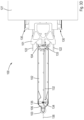
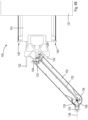
- a manipulator 100 comprises a support 101 and a first link 102 configured to pivot with respect to the support 101 to position an end effector 103 (e.g. an energy transfer unit) in an operating volume when the manipulator 100 is in an operating or second state (also see Figs. 3 and 4 ). Therefore, the first link 102 is pivotally connected to the support 101 by a pivoting connection 104 provided at a first end 105 of the first link 102 and pivotally connected to a stage 106 comprising the end effector 103 at a second end 107 of the first link 102.
- an end effector 103 e.g. an energy transfer unit
- a first and a second actuating mechanism 108, 109 provide an actuatable connection configured to move the stage 106 relative to the support 101 via respective forces acting on the first link 102, preferably near the first end 105 of the first link 102.
- the support 101 may extend from a side of a housing 110.
- a hatch 111 may be provided configured to open the side of the housing 110 and allow the support 101 to extend from the housing 110.
- the first and second actuating mechanism 108, 109 may comprise a third and a fourth link 112, 113, respectively.
- the third and fourth link 112, 113 each comprise a first end 114, 115 and a second end 116, 117.
- the second ends 116, 117 are pivotally connected to the first link 102, possibly at offset positions, even though this is not a requirement.
- the first ends 114, 115 are configured to move (e.g. translate) with respect to the support 101 along a first and a second preferably linear trajectory 118, 119, respectively.
- This movement along the first and second trajectory 118, 119 results in a pivoting movement of the first link 102 about pivoting connection 104, with respect to the support 101.
- the second ends 116, 117 the third and fourth link 112, 113 are each pivotally connected to the first link 102 near the first end 105 of the first link for limiting the extent to which the third and fourth link 112, 113 extend into the environment.
- the first and second actuating mechanisms 108, 109 are each configured to exert a force on the first link 102, in the pivotal connections at the second ends 116, 117 of the third and fourth links, respectively. These forces have opposite directional components, particularly in projection on a horizontal plane, allowing the first link to be moved about a vertical axis A defined by pivotal connection 104 along a direction A'.
- the pivotal connection 104 of the first link 102 to the support 101 and the pivotal connections of the second ends 116 and 117 of the third and fourth links on the first link 102 are preferably arranged in offset horizontal planes. This allows the first and second actuating mechanisms to move the first link 102 about a horizontal axis B defined by pivotal connection 104 along another direction B'.
- Actuating the first and second actuating mechanisms 108, 109 simultaneously may result in a pulling or a pushing force exerted on the first link 102.
- the second end 107 of the first link 102, the stage 106 and end effector 103 will be moved relative to the support 101 in a direction orthogonal to a plane defined by the first and second trajectory 118, 119, for instance away or towards a mounting surface (e.g. horizontal ground surface).
- Differentially actuating the first and second actuating mechanisms may, optionally in addition result in a movement of the second end 107 of the first link 102 in a direction having a directional component parallel to the plane defined by the first and second trajectory 118, 119, for instance sideways relative to the mounting surface (not shown).
- Each of the first and second actuating mechanism 108, 109 may further comprise a prismatic joint 120, 121 arranged in parallel to the first and second trajectory 118, 119, respectively.
- the prismatic joints can be pivotally connected to the first end 114, 115 of the corresponding link 112, 113.
- Such prismatic joints 120, 121 may each comprise a rod 122 and two bushings 123, 124, wherein the rod 122 is configured for sliding along the bushings 123, 124.
- the rod 122 extending between two bushings 123, 124 may be directly pivotally connected to the first end 114, 115 of the corresponding link 112, 113.
- Each of the first and second actuating mechanism 108, 109 may each further comprise an actuator 125, such as a linear motor or a rotary motor comprising a means 126 for converting a rotary motion to a linear motion, for instance using a rack and pinion or a belt drive.
- the linearly actuated part of the actuating means 126 may be connected co-linearly to the rod 122 to actuate the linear movement of the rod 122.
- the manipulator 100 may comprise a base 127 and a third actuator 128.
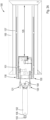
- the third actuator 128 is configured to move the support along a third trajectory 129 with respect to the base 127 between a first state (see Fig. 2A and Fig. 2B ) and a second state (see Figs. 1 , 3 and 4 ).
- the third trajectory 129 is linear and substantially parallel to a longitudinal axis of the first link 102 in the first state.
- the manipulator 100 may further comprise one, preferably two prismatic joints 130 (e.g. telescopic guides) for guiding the movement of the support 101 along the third trajectory 129.
- the third trajectory 129 is a linear trajectory parallel to the first and second linear trajectories 118, 119.
- the first, second and third actuators 125, 128 may comprise motors, such as rotary motors, fixedly connected to the support 101.
- the actuators may further comprise a means 126, 131 for converting a rotary motion to a linear motion, for instance using a rack and pinion or a belt drive.
- the first and second actuators 125 preferably comprise a rack and pinion.
- the third actuator 131 preferably also comprises a rack and pinion.
- the support 101 may comprise a cover for shielding sensitive parts of the manipulator 100, such as parts of the first actuating mechanisms 108, parts of the second actuating mechanisms 109, parts of the third actuator 128, for example motors and means 126, 131 for converting a rotary motion to a linear motion (e.g. gears), which may for instance otherwise be exposed to the external environment in the second state.
- sensitive parts of the manipulator 100 such as parts of the first actuating mechanisms 108, parts of the second actuating mechanisms 109, parts of the third actuator 128, for example motors and means 126, 131 for converting a rotary motion to a linear motion (e.g. gears), which may for instance otherwise be exposed to the external environment in the second state.
- the manipulator may comprise a housing 110 connected to the base 127 configured for shielding the first link 102, the stage 106 and the end effector 103 of the manipulator 100 in the first state.
- the cover 110 may further comprise a hatch 111 configured at a side of the cover 110 wherefrom the first link 102 may protrude in the second state.
- the hatch 111 being configured to move between a closed state in the first state, wherein the hatch 111 shields the first link 102, and an opened state in the second state, wherein the first link 102 may extend from the cover 110.
- the manipulator 100 may further comprise a second link 132 having a first end 133 pivotally connected to the support 101 and a second end 134 pivotally connected to the stage 106 at a location offset from a pivotal connection 135 of the second end 107 of the first link 102 to the stage.
- the pivotal connection 135 of the second end 107 of the first link 102 to the stage may provide an axis of rotation C of the stage for rotating the stage along a direction C'.
- the first end 133 of the second link 132 is connected to the support 101 at a location offset from the pivotal connection 104 connecting the first end 105 of the first link 102 to the support 101.
- first link and the second link 102, 132 each define a longitudinal axis between the corresponding first and second ends, which longitudinal axes are substantially parallel.
- the first and second link 102, 132 may be configured to define a parallelogram or a trapezoid, wherein it is not required that all edges necessarily lie within a same plane.
- Such second link 132 substantially maintains an orientation 136 of the stage 106 with respect to the environment, when the first link 102 is moved sideways by the first and second actuating mechanisms 108, 109 (see Fig. 3 and Fig. 4 ).
- the second link 132 is arranged in a conduit defined within the first link 102.
- the first link 102 can be hollow or tubular and the second link is arranged inside the tubular first link 102.
Landscapes
- Engineering & Computer Science (AREA)
- Power Engineering (AREA)
- Transportation (AREA)
- Mechanical Engineering (AREA)
- Manipulator (AREA)
Claims (15)
- Manipulator (100) zum Positionieren eines Endeffektors (103) zum Laden von Fahrzeugen, umfassend:einen Träger (101),eine Plattform (106), die den Endeffektor umfasst,ein erstes Bindeglied (102), umfassend ein erstes Ende (105), das eine mit dem Träger verbundene erste Schwenkverbindung (104) bereitstellt, und ein zweites Ende (107), das eine mit der Plattform verbundene zweite Schwenkverbindung (135) bereitstellt, wobei das erste Bindeglied eine erste Längsachse zwischen dem ersten Ende und dem zweiten Ende definiert, undein zweites Bindeglied (132), umfassend ein erstes Ende (133), das eine mit dem Träger verbundene erste Schwenkverbindung bereitstellt, und ein zweites Ende (134), das eine zweite Schwenkverbindung bereitstellt, die an einer ersten Position, die von der zweiten Schwenkverbindung des ersten Bindeglieds versetzt ist, mit der Plattform verbunden ist,gekennzeichnet dadurch, dass der Manipulator ferner Folgendes umfasst:
einen ersten (108) und einen zweiten (109) Betätigungsmechanismus, der über das erste Bindeglied eine betätigbare Verbindung zwischen der Plattform und dem Träger bereitstellt, wobei jeder von dem ersten und dem zweiten Betätigungsmechanismus dazu konfiguriert ist, eine erste Betätigungskraft auf das erste Bindeglied auszuüben, um das zweite Ende des ersten Bindeglieds durch ein Volumen zu bewegen. - Manipulator nach Anspruch 1, wobei jeder von dem ersten und dem zweiten Betätigungsmechanismus dazu konfiguriert ist, eine erste lineare Betätigungskraft auf das erste Bindeglied auszuüben, um das zweite Ende des ersten Bindeglieds relativ zu dem ersten Ende des ersten Bindeglieds durch ein Volumen zu bewegen.
- Manipulator nach Anspruch 1 oder 2, wobei die erste Betätigungskraft des ersten und des zweiten Betätigungsmechanismus jeweils ein Drehmoment um die erste Schwenkverbindung des ersten Bindeglieds herum bereitstellt, wobei bevorzugt eine Richtung des von dem ersten Betätigungsmechanismus bereitgestellten Drehmoments nicht parallel zu einer Richtung des von dem zweiten Betätigungsmechanismus bereitgestellten Drehmoments ist.
- Manipulator nach einem der vorhergehenden Ansprüche, wobei der erste und der zweite Betätigungsmechanismus jeweils ein drittes und ein viertes Bindeglied umfassen, wobei jedes von dem dritten (112) und dem vierten (113) Bindeglied ein erstes Ende (114, 115), das eine mit dem Träger verbundene erste Schwenkverbindung bereitstellt, und ein zweites Ende (116, 117), das eine mit dem ersten Bindeglied verbundene zweite Schwenkverbindung bereitstellt, umfasst, und wobei der erste Betätigungsmechanismus einen ersten Aktuator (125, 126) umfasst, der zum Bewegen des ersten Endes des dritten Bindeglieds relativ zu dem Träger entlang einer ersten Bewegungsbahn (118) konfiguriert ist ,und wobei der zweite Betätigungsmechanismus einen zweiten Aktuator (125, 126) umfasst ,der zum Bewegen des ersten Endes des vierten Bindeglieds relativ zu dem Träger entlang einer zweiten Bewegungsbahn (119) konfiguriert ist, wobei bevorzugt eine von der ersten und der zweiten Schwenkverbindung sowohl des dritten als auch des vierten Bindeglieds zum Begrenzen eines einzelnen Drehfreiheitsgrades des entsprechenden jeweiligen Bindeglieds konfiguriert ist, wobei bevorzugt die jeweilige Schwenkverbindung dazu konfiguriert ist, einen einzelnen Drehfreiheitsgrad des entsprechenden jeweiligen Bindeglieds zu verhindern, wobei bevorzugt der erste und der zweite Aktuatormechanismus jeweils ein erstes (120) und ein zweites (121) prismatisches Gelenk umfassen, das mit dem entsprechenden ersten Ende verbunden ist, und wobei der erste und der zweite Aktuator jeweils eine zweite Betätigungskraft bereitstellen ,die dazu konfiguriert ist, mit der entsprechenden Bewegungsbahn kollinear zu sein, wobei bevorzugt das prismatische Gelenk und die entsprechende Bewegungsbahn kollinear sind.
- Manipulator nach einem der vorhergehenden Ansprüche, ferner umfassend eine Basis (127) und einen dritten Aktuator (128, 131), wobei der dritte Aktuator zum Bewegen des Trägers entlang einer dritten Bewegungsbahn (129) relativ zu der Basis konfiguriert ist, bevorzugt ferner umfassend ein drittes prismatisches Gelenk (130), das zum Führen einer Bewegung des Trägers in Bezug auf die Basis konfiguriert ist, wobei bevorzugt das dritte prismatische Gelenk mindestens eine Teleskopführung zum Führen der Bewegung umfasst, wobei jede der mindestens einen Teleskopführung einen Hub aufweist, der im Wesentlichen parallel zu der dritten Bewegungsbahn ist, bevorzugt ferner umfassend ein Gehäuse (110), wobei der dritte Aktuator zum Bewegen des Trägers zwischen einem ersten Zustand, wobei das erste Bindeglied vollständig im Inneren des Gehäuses aufgenommen ist, und einem zweiten Zustand, wobei das erste Bindeglied sich mindestens teilweise von einer Seite des Gehäuses aus erstreckt, konfiguriert ist, wobei bevorzugt, in Zusammenwirken mit Anspruch 4, die erste und die zweite Bewegungsbahn eine erste Ebene definieren und wobei die erste Bewegungsbahn, die zweite Bewegungsbahn und eine Projektion der dritten Bewegungsbahn auf die erste Ebene in Bezug zueinander eines aus einer Liste aus Folgendem aufweisen: einen spitzen Winkel (α, β, γ) von weniger als 60 Grad, bevorzugt weniger als 30 Grad, mehr bevorzugt weniger als 10 Grad und noch mehr bevorzugt weniger als 5 Grad und keinen Winkel.
- Manipulator nach Anspruch 4 oder 5, wobei die erste und die zweite Bewegungsbahn eine erste Ebene definieren, wobei das erste Ende des ersten Bindeglieds in einer zweiten Ebene bereitgestellt ist, die sich von der ersten Ebene unterscheidet und parallel zu der ersten Ebene ist, und wobei mindestens eines aus dem ersten Ende des dritten Bindeglieds, dem zweiten Ende des dritten Bindeglieds, dem ersten Ende des vierten Bindeglieds und dem zweiten Ende des vierten Bindeglieds außerhalb der zweiten Ebene konfiguriert ist.
- Manipulator nach einem der Ansprüche 4 bis 6, wobei das erste Ende des ersten Bindeglieds abstandsgleich von der ersten Bewegungsbahn und der zweiten Bewegungsbahn konfiguriert ist, wobei bevorzugt das erste Ende des zweiten Bindeglieds in näherer Lage zu der ersten Bewegungsbahn als zu der zweiten Bewegungsbahn konfiguriert ist.
- Manipulator nach einem der vorhergehenden Ansprüche, wobei das erste Ende und das zweite Ende des zweiten Bindeglieds eine zweite Längsachse definieren und wobei die erste Längsachse im Wesentlichen parallel zu der zweiten Längsachse ist.
- Manipulator nach einem der vorhergehenden Ansprüche, wobei die erste Schwenkverbindung des ersten Bindeglieds zum Begrenzen eines einzelnen Drehfreiheitswinkels des ersten Bindeglieds konfiguriert ist, bevorzugt dazu konfiguriert ist, einen einzelnen Drehfreiheitswinkel des ersten Bindeglieds zu verhindern.
- Manipulator nach einem der vorhergehenden Ansprüche, wobei die zweite Schwenkverbindung des ersten Bindeglieds eine Drehachse der Plattform definiert, wobei bevorzugt die zweite Schwenkverbindung zum Bereitstellen eines einzelnen Drehfreiheitswinkels um die Drehachse herum konfiguriert ist, wobei bevorzugt die Plattform eine Seitenwand umfasst, die mindestens teilweise kreisförmig um die Drehachse herum ist.
- Manipulator nach einem der vorhergehenden Ansprüche, wobei der Endeffektor mit der Plattform an einer zweiten Position verbunden ist, die zu der zweiten Schwenkverbindung des ersten Bindeglieds versetzt ist.
- Manipulator nach einem der vorhergehenden Ansprüche, wobei der Endeffektor eine Energieübertragungseinheit umfasst, wobei bevorzugt die Energieübertragungseinheit schwenkbar mit der Plattform verbunden ist.
- Manipulator nach einem der vorhergehenden Ansprüche, wobei das erste Bindeglied einen Kanal parallel zu der ersten Längsachse umfasst, der zum Bereitstellen eines Durchgangs für das zweite Bindeglied konfiguriert ist.
- Manipulator nach einem der vorhergehenden Ansprüche, ferner umfassend ein Energiekabel, das dazu konfiguriert ist, Energie entlang dem ersten Bindeglied zu dem Endeffektor zu übertragen, wobei das erste Bindeglied einen Kanal parallel zu der ersten Längsachse bereitstellt, der zum Bereitstellen eines Durchgangs für das Energiekabel konfiguriert ist.
- Ladestation, umfassend einen Wandler und ein Manipulator nach einem der vorhergehenden Ansprüche, wobei der Wandler zum Bereitstellen elektrischer Energie an die Energieübertragungseinheit des Manipulators konfiguriert ist.
Applications Claiming Priority (2)
| Application Number | Priority Date | Filing Date | Title |
|---|---|---|---|
| NL2028211A NL2028211B1 (en) | 2021-05-12 | 2021-05-12 | Manipulator for positioning an energy transfer unit for charging a vehicle and charging station for the same |
| PCT/EP2022/062866 WO2022238521A1 (en) | 2021-05-12 | 2022-05-12 | Manipulator for positioning an energy transfer unit for charging a vehicle and charging station for the same |
Publications (2)
| Publication Number | Publication Date |
|---|---|
| EP4337490A1 EP4337490A1 (de) | 2024-03-20 |
| EP4337490B1 true EP4337490B1 (de) | 2025-04-23 |
Family
ID=76601660
Family Applications (1)
| Application Number | Title | Priority Date | Filing Date |
|---|---|---|---|
| EP22728844.6A Active EP4337490B1 (de) | 2021-05-12 | 2022-05-12 | Manipulator zum positionieren einer energieübertragungseinheit zum laden eines fahrzeugs und ladestation dafür |
Country Status (3)
| Country | Link |
|---|---|
| EP (1) | EP4337490B1 (de) |
| NL (1) | NL2028211B1 (de) |
| WO (1) | WO2022238521A1 (de) |
Citations (1)
| Publication number | Priority date | Publication date | Assignee | Title |
|---|---|---|---|---|
| WO2019060939A1 (de) * | 2017-09-27 | 2019-04-04 | Nrg-X Charging Systems Gmbh | Komponente für eine ladeeinrichtung und ladeeinrichtung hiermit |
Family Cites Families (6)
| Publication number | Priority date | Publication date | Assignee | Title |
|---|---|---|---|---|
| EP0788212B1 (de) | 1996-01-30 | 2002-04-17 | Sumitomo Wiring Systems, Ltd. | Verbindungssystem und -verfahren für ein elektrisch betriebenes Fahrzeug |
| KR101034038B1 (ko) * | 2009-12-23 | 2011-05-11 | 한국과학기술원 | 비접촉 자기 유도 충전 방식의 전기자동차 집전모듈 |
| DE102014200290A1 (de) | 2014-01-10 | 2015-07-16 | Robert Bosch Gmbh | Elektrische Ladevorrichtung, elektrische Anschlussvorrichtung, System und Verfahren zum Laden einer Batterie eines Fahrzeugs |
| DE102018106046B3 (de) * | 2018-03-15 | 2019-03-14 | Schunk Bahn- Und Industrietechnik Gmbh | Schnellladesystem und Verfahren zur elektrischen Verbindung eines Fahrzeugs mit einer Ladestation |
| JP2019209729A (ja) * | 2018-05-31 | 2019-12-12 | 川崎重工業株式会社 | 車両給電装置 |
| DE102019115601A1 (de) * | 2019-06-07 | 2020-12-10 | Webasto SE | Ladevorrichtung zum Laden einer Batterie eines Kraftfahrzeugs |
-
2021
- 2021-05-12 NL NL2028211A patent/NL2028211B1/en active
-
2022
- 2022-05-12 WO PCT/EP2022/062866 patent/WO2022238521A1/en not_active Ceased
- 2022-05-12 EP EP22728844.6A patent/EP4337490B1/de active Active
Patent Citations (1)
| Publication number | Priority date | Publication date | Assignee | Title |
|---|---|---|---|---|
| WO2019060939A1 (de) * | 2017-09-27 | 2019-04-04 | Nrg-X Charging Systems Gmbh | Komponente für eine ladeeinrichtung und ladeeinrichtung hiermit |
Also Published As
| Publication number | Publication date |
|---|---|
| EP4337490A1 (de) | 2024-03-20 |
| NL2028211B1 (en) | 2022-11-30 |
| WO2022238521A1 (en) | 2022-11-17 |
Similar Documents
| Publication | Publication Date | Title |
|---|---|---|
| US11996316B2 (en) | Robot having arm with parallel paths | |
| US11484979B2 (en) | Precision tripod motion system with six degrees of freedom | |
| US8585111B2 (en) | Robot hand and robot apparatus | |
| KR20140052987A (ko) | 스콧 러셀 기구식 장치 | |
| EP2578367B1 (de) | Dispositivo de posicionamiento controlado por cables | |
| KR101437767B1 (ko) | 기어 타입 중력 보상 유니트 | |
| KR101606075B1 (ko) | 병렬형 마이크로 로봇 및 이를 갖는 수술 로봇 시스템 | |
| JPS6243837B2 (de) | ||
| EP2529882A1 (de) | Planare bühne mit 3 freiheitsgraden | |
| US20200298427A1 (en) | Wire-body processing structure for robot | |
| EP4337490B1 (de) | Manipulator zum positionieren einer energieübertragungseinheit zum laden eines fahrzeugs und ladestation dafür | |
| JP7490440B2 (ja) | 処理装置、開閉機構およびリンク機構 | |
| CN112549007A (zh) | 机器人 | |
| JP2025103039A (ja) | コンパクトなトラバースロボット | |
| US3610438A (en) | Manipulator arm | |
| CN101977736B (zh) | 夹持装置以及搬运机扑 | |
| WO2022077203A1 (en) | Gripper and robotic arm | |
| US20250144819A1 (en) | A robotic gripper, a robot arm and a robot comprising the same | |
| CN115122388A (zh) | 机械调节悬臂 | |
| US20210379769A1 (en) | Robot hand and robot having the same | |
| EP3822043B1 (de) | Manipulator zum freihändigen laden von elektrofahrzeugen | |
| CN218967036U (zh) | 一种盖板结构及车辆 | |
| CN112614728B (zh) | 用于断路器的三相机械联动装置及断路器 | |
| JPWO2019244262A1 (ja) | ロボット及びロボットハンド | |
| JP3579451B2 (ja) | 産業車両のための操作装置 |
Legal Events
| Date | Code | Title | Description |
|---|---|---|---|
| STAA | Information on the status of an ep patent application or granted ep patent |
Free format text: STATUS: UNKNOWN |
|
| STAA | Information on the status of an ep patent application or granted ep patent |
Free format text: STATUS: THE INTERNATIONAL PUBLICATION HAS BEEN MADE |
|
| PUAI | Public reference made under article 153(3) epc to a published international application that has entered the european phase |
Free format text: ORIGINAL CODE: 0009012 |
|
| STAA | Information on the status of an ep patent application or granted ep patent |
Free format text: STATUS: REQUEST FOR EXAMINATION WAS MADE |
|
| 17P | Request for examination filed |
Effective date: 20231107 |
|
| AK | Designated contracting states |
Kind code of ref document: A1 Designated state(s): AL AT BE BG CH CY CZ DE DK EE ES FI FR GB GR HR HU IE IS IT LI LT LU LV MC MK MT NL NO PL PT RO RS SE SI SK SM TR |
|
| DAV | Request for validation of the european patent (deleted) | ||
| DAX | Request for extension of the european patent (deleted) | ||
| GRAP | Despatch of communication of intention to grant a patent |
Free format text: ORIGINAL CODE: EPIDOSNIGR1 |
|
| STAA | Information on the status of an ep patent application or granted ep patent |
Free format text: STATUS: GRANT OF PATENT IS INTENDED |
|
| INTG | Intention to grant announced |
Effective date: 20241216 |
|
| GRAS | Grant fee paid |
Free format text: ORIGINAL CODE: EPIDOSNIGR3 |
|
| GRAA | (expected) grant |
Free format text: ORIGINAL CODE: 0009210 |
|
| STAA | Information on the status of an ep patent application or granted ep patent |
Free format text: STATUS: THE PATENT HAS BEEN GRANTED |
|
| AK | Designated contracting states |
Kind code of ref document: B1 Designated state(s): AL AT BE BG CH CY CZ DE DK EE ES FI FR GB GR HR HU IE IS IT LI LT LU LV MC MK MT NL NO PL PT RO RS SE SI SK SM TR |
|
| REG | Reference to a national code |
Ref country code: GB Ref legal event code: FG4D |
|
| REG | Reference to a national code |
Ref country code: CH Ref legal event code: EP |
|
| REG | Reference to a national code |
Ref country code: DE Ref legal event code: R096 Ref document number: 602022013599 Country of ref document: DE |
|
| REG | Reference to a national code |
Ref country code: IE Ref legal event code: FG4D |
|
| PGFP | Annual fee paid to national office [announced via postgrant information from national office to epo] |
Ref country code: DE Payment date: 20250521 Year of fee payment: 4 |
|
| PGFP | Annual fee paid to national office [announced via postgrant information from national office to epo] |
Ref country code: AT Payment date: 20250721 Year of fee payment: 4 |
|
| REG | Reference to a national code |
Ref country code: NL Ref legal event code: MP Effective date: 20250423 |
|
| PG25 | Lapsed in a contracting state [announced via postgrant information from national office to epo] |
Ref country code: NL Free format text: LAPSE BECAUSE OF FAILURE TO SUBMIT A TRANSLATION OF THE DESCRIPTION OR TO PAY THE FEE WITHIN THE PRESCRIBED TIME-LIMIT Effective date: 20250423 |
|
| REG | Reference to a national code |
Ref country code: AT Ref legal event code: MK05 Ref document number: 1787476 Country of ref document: AT Kind code of ref document: T Effective date: 20250423 |
|
| PG25 | Lapsed in a contracting state [announced via postgrant information from national office to epo] |
Ref country code: FI Free format text: LAPSE BECAUSE OF FAILURE TO SUBMIT A TRANSLATION OF THE DESCRIPTION OR TO PAY THE FEE WITHIN THE PRESCRIBED TIME-LIMIT Effective date: 20250423 Ref country code: PT Free format text: LAPSE BECAUSE OF FAILURE TO SUBMIT A TRANSLATION OF THE DESCRIPTION OR TO PAY THE FEE WITHIN THE PRESCRIBED TIME-LIMIT Effective date: 20250825 Ref country code: ES Free format text: LAPSE BECAUSE OF FAILURE TO SUBMIT A TRANSLATION OF THE DESCRIPTION OR TO PAY THE FEE WITHIN THE PRESCRIBED TIME-LIMIT Effective date: 20250423 |
|
| REG | Reference to a national code |
Ref country code: LT Ref legal event code: MG9D |
|
| PG25 | Lapsed in a contracting state [announced via postgrant information from national office to epo] |
Ref country code: NO Free format text: LAPSE BECAUSE OF FAILURE TO SUBMIT A TRANSLATION OF THE DESCRIPTION OR TO PAY THE FEE WITHIN THE PRESCRIBED TIME-LIMIT Effective date: 20250723 Ref country code: GR Free format text: LAPSE BECAUSE OF FAILURE TO SUBMIT A TRANSLATION OF THE DESCRIPTION OR TO PAY THE FEE WITHIN THE PRESCRIBED TIME-LIMIT Effective date: 20250724 |
|
| PG25 | Lapsed in a contracting state [announced via postgrant information from national office to epo] |
Ref country code: PL Free format text: LAPSE BECAUSE OF FAILURE TO SUBMIT A TRANSLATION OF THE DESCRIPTION OR TO PAY THE FEE WITHIN THE PRESCRIBED TIME-LIMIT Effective date: 20250423 |
|
| PG25 | Lapsed in a contracting state [announced via postgrant information from national office to epo] |
Ref country code: BG Free format text: LAPSE BECAUSE OF FAILURE TO SUBMIT A TRANSLATION OF THE DESCRIPTION OR TO PAY THE FEE WITHIN THE PRESCRIBED TIME-LIMIT Effective date: 20250423 |
|
| PG25 | Lapsed in a contracting state [announced via postgrant information from national office to epo] |
Ref country code: HR Free format text: LAPSE BECAUSE OF FAILURE TO SUBMIT A TRANSLATION OF THE DESCRIPTION OR TO PAY THE FEE WITHIN THE PRESCRIBED TIME-LIMIT Effective date: 20250423 Ref country code: AT Free format text: LAPSE BECAUSE OF FAILURE TO SUBMIT A TRANSLATION OF THE DESCRIPTION OR TO PAY THE FEE WITHIN THE PRESCRIBED TIME-LIMIT Effective date: 20250423 |
|
| PG25 | Lapsed in a contracting state [announced via postgrant information from national office to epo] |
Ref country code: RS Free format text: LAPSE BECAUSE OF FAILURE TO SUBMIT A TRANSLATION OF THE DESCRIPTION OR TO PAY THE FEE WITHIN THE PRESCRIBED TIME-LIMIT Effective date: 20250723 |
|
| PG25 | Lapsed in a contracting state [announced via postgrant information from national office to epo] |
Ref country code: IS Free format text: LAPSE BECAUSE OF FAILURE TO SUBMIT A TRANSLATION OF THE DESCRIPTION OR TO PAY THE FEE WITHIN THE PRESCRIBED TIME-LIMIT Effective date: 20250823 |
|
| PG25 | Lapsed in a contracting state [announced via postgrant information from national office to epo] |
Ref country code: LV Free format text: LAPSE BECAUSE OF FAILURE TO SUBMIT A TRANSLATION OF THE DESCRIPTION OR TO PAY THE FEE WITHIN THE PRESCRIBED TIME-LIMIT Effective date: 20250423 |
|
| REG | Reference to a national code |
Ref country code: CH Ref legal event code: H13 Free format text: ST27 STATUS EVENT CODE: U-0-0-H10-H13 (AS PROVIDED BY THE NATIONAL OFFICE) Effective date: 20251223 |
|
| PG25 | Lapsed in a contracting state [announced via postgrant information from national office to epo] |
Ref country code: SM Free format text: LAPSE BECAUSE OF FAILURE TO SUBMIT A TRANSLATION OF THE DESCRIPTION OR TO PAY THE FEE WITHIN THE PRESCRIBED TIME-LIMIT Effective date: 20250423 Ref country code: DK Free format text: LAPSE BECAUSE OF FAILURE TO SUBMIT A TRANSLATION OF THE DESCRIPTION OR TO PAY THE FEE WITHIN THE PRESCRIBED TIME-LIMIT Effective date: 20250423 |
|
| PG25 | Lapsed in a contracting state [announced via postgrant information from national office to epo] |
Ref country code: LU Free format text: LAPSE BECAUSE OF NON-PAYMENT OF DUE FEES Effective date: 20250512 |
|
| PG25 | Lapsed in a contracting state [announced via postgrant information from national office to epo] |
Ref country code: CH Free format text: LAPSE BECAUSE OF NON-PAYMENT OF DUE FEES Effective date: 20250531 |
|
| PG25 | Lapsed in a contracting state [announced via postgrant information from national office to epo] |
Ref country code: CZ Free format text: LAPSE BECAUSE OF FAILURE TO SUBMIT A TRANSLATION OF THE DESCRIPTION OR TO PAY THE FEE WITHIN THE PRESCRIBED TIME-LIMIT Effective date: 20250423 |
|
| PG25 | Lapsed in a contracting state [announced via postgrant information from national office to epo] |
Ref country code: EE Free format text: LAPSE BECAUSE OF FAILURE TO SUBMIT A TRANSLATION OF THE DESCRIPTION OR TO PAY THE FEE WITHIN THE PRESCRIBED TIME-LIMIT Effective date: 20250423 |
|
| REG | Reference to a national code |
Ref country code: DE Ref legal event code: R097 Ref document number: 602022013599 Country of ref document: DE |
|
| PG25 | Lapsed in a contracting state [announced via postgrant information from national office to epo] |
Ref country code: SK Free format text: LAPSE BECAUSE OF FAILURE TO SUBMIT A TRANSLATION OF THE DESCRIPTION OR TO PAY THE FEE WITHIN THE PRESCRIBED TIME-LIMIT Effective date: 20250423 |
|
| PG25 | Lapsed in a contracting state [announced via postgrant information from national office to epo] |
Ref country code: IT Free format text: LAPSE BECAUSE OF FAILURE TO SUBMIT A TRANSLATION OF THE DESCRIPTION OR TO PAY THE FEE WITHIN THE PRESCRIBED TIME-LIMIT Effective date: 20250423 |
|
| REG | Reference to a national code |
Ref country code: BE Ref legal event code: MM Effective date: 20250531 |
|
| PG25 | Lapsed in a contracting state [announced via postgrant information from national office to epo] |
Ref country code: MC Free format text: LAPSE BECAUSE OF FAILURE TO SUBMIT A TRANSLATION OF THE DESCRIPTION OR TO PAY THE FEE WITHIN THE PRESCRIBED TIME-LIMIT Effective date: 20250423 |
|
| PLBE | No opposition filed within time limit |
Free format text: ORIGINAL CODE: 0009261 |
|
| STAA | Information on the status of an ep patent application or granted ep patent |
Free format text: STATUS: NO OPPOSITION FILED WITHIN TIME LIMIT |
|
| REG | Reference to a national code |
Ref country code: CH Ref legal event code: L10 Free format text: ST27 STATUS EVENT CODE: U-0-0-L10-L00 (AS PROVIDED BY THE NATIONAL OFFICE) Effective date: 20260304 |
|
| PG25 | Lapsed in a contracting state [announced via postgrant information from national office to epo] |
Ref country code: RO Free format text: LAPSE BECAUSE OF FAILURE TO SUBMIT A TRANSLATION OF THE DESCRIPTION OR TO PAY THE FEE WITHIN THE PRESCRIBED TIME-LIMIT Effective date: 20250423 |
|
| 26N | No opposition filed |
Effective date: 20260126 |
|
| PG25 | Lapsed in a contracting state [announced via postgrant information from national office to epo] |
Ref country code: IE Free format text: LAPSE BECAUSE OF NON-PAYMENT OF DUE FEES Effective date: 20250512 |
|
| PG25 | Lapsed in a contracting state [announced via postgrant information from national office to epo] |
Ref country code: BE Free format text: LAPSE BECAUSE OF NON-PAYMENT OF DUE FEES Effective date: 20250531 |
|
| PG25 | Lapsed in a contracting state [announced via postgrant information from national office to epo] |
Ref country code: FR Free format text: LAPSE BECAUSE OF NON-PAYMENT OF DUE FEES Effective date: 20250623 |