EP4336446A1 - Method and device for target tracking and storage medium - Google Patents
Method and device for target tracking and storage medium Download PDFInfo
- Publication number
- EP4336446A1 EP4336446A1 EP23192372.3A EP23192372A EP4336446A1 EP 4336446 A1 EP4336446 A1 EP 4336446A1 EP 23192372 A EP23192372 A EP 23192372A EP 4336446 A1 EP4336446 A1 EP 4336446A1
- Authority
- EP
- European Patent Office
- Prior art keywords
- target
- orientation
- tracklets
- tracklet
- group
- Prior art date
- Legal status (The legal status is an assumption and is not a legal conclusion. Google has not performed a legal analysis and makes no representation as to the accuracy of the status listed.)
- Pending
Links
Images




Classifications
-
- G—PHYSICS
- G06—COMPUTING OR CALCULATING; COUNTING
- G06T—IMAGE DATA PROCESSING OR GENERATION, IN GENERAL
- G06T7/00—Image analysis
- G06T7/20—Analysis of motion
- G06T7/292—Multi-camera tracking
-
- G—PHYSICS
- G06—COMPUTING OR CALCULATING; COUNTING
- G06T—IMAGE DATA PROCESSING OR GENERATION, IN GENERAL
- G06T7/00—Image analysis
- G06T7/20—Analysis of motion
- G06T7/246—Analysis of motion using feature-based methods, e.g. the tracking of corners or segments
-
- G—PHYSICS
- G06—COMPUTING OR CALCULATING; COUNTING
- G06T—IMAGE DATA PROCESSING OR GENERATION, IN GENERAL
- G06T7/00—Image analysis
- G06T7/20—Analysis of motion
- G06T7/246—Analysis of motion using feature-based methods, e.g. the tracking of corners or segments
- G06T7/248—Analysis of motion using feature-based methods, e.g. the tracking of corners or segments involving reference images or patches
-
- G—PHYSICS
- G06—COMPUTING OR CALCULATING; COUNTING
- G06T—IMAGE DATA PROCESSING OR GENERATION, IN GENERAL
- G06T7/00—Image analysis
- G06T7/70—Determining position or orientation of objects or cameras
- G06T7/73—Determining position or orientation of objects or cameras using feature-based methods
-
- G—PHYSICS
- G06—COMPUTING OR CALCULATING; COUNTING
- G06T—IMAGE DATA PROCESSING OR GENERATION, IN GENERAL
- G06T7/00—Image analysis
- G06T7/70—Determining position or orientation of objects or cameras
- G06T7/73—Determining position or orientation of objects or cameras using feature-based methods
- G06T7/74—Determining position or orientation of objects or cameras using feature-based methods involving reference images or patches
-
- G—PHYSICS
- G06—COMPUTING OR CALCULATING; COUNTING
- G06V—IMAGE OR VIDEO RECOGNITION OR UNDERSTANDING
- G06V10/00—Arrangements for image or video recognition or understanding
- G06V10/40—Extraction of image or video features
- G06V10/44—Local feature extraction by analysis of parts of the pattern, e.g. by detecting edges, contours, loops, corners, strokes or intersections; Connectivity analysis, e.g. of connected components
-
- G—PHYSICS
- G06—COMPUTING OR CALCULATING; COUNTING
- G06V—IMAGE OR VIDEO RECOGNITION OR UNDERSTANDING
- G06V10/00—Arrangements for image or video recognition or understanding
- G06V10/70—Arrangements for image or video recognition or understanding using pattern recognition or machine learning
- G06V10/762—Arrangements for image or video recognition or understanding using pattern recognition or machine learning using clustering, e.g. of similar faces in social networks
-
- G—PHYSICS
- G06—COMPUTING OR CALCULATING; COUNTING
- G06V—IMAGE OR VIDEO RECOGNITION OR UNDERSTANDING
- G06V10/00—Arrangements for image or video recognition or understanding
- G06V10/70—Arrangements for image or video recognition or understanding using pattern recognition or machine learning
- G06V10/764—Arrangements for image or video recognition or understanding using pattern recognition or machine learning using classification, e.g. of video objects
-
- G—PHYSICS
- G06—COMPUTING OR CALCULATING; COUNTING
- G06T—IMAGE DATA PROCESSING OR GENERATION, IN GENERAL
- G06T2207/00—Indexing scheme for image analysis or image enhancement
- G06T2207/10—Image acquisition modality
- G06T2207/10016—Video; Image sequence
-
- G—PHYSICS
- G06—COMPUTING OR CALCULATING; COUNTING
- G06T—IMAGE DATA PROCESSING OR GENERATION, IN GENERAL
- G06T2207/00—Indexing scheme for image analysis or image enhancement
- G06T2207/30—Subject of image; Context of image processing
- G06T2207/30196—Human being; Person
-
- G—PHYSICS
- G06—COMPUTING OR CALCULATING; COUNTING
- G06T—IMAGE DATA PROCESSING OR GENERATION, IN GENERAL
- G06T2207/00—Indexing scheme for image analysis or image enhancement
- G06T2207/30—Subject of image; Context of image processing
- G06T2207/30232—Surveillance
-
- G—PHYSICS
- G06—COMPUTING OR CALCULATING; COUNTING
- G06T—IMAGE DATA PROCESSING OR GENERATION, IN GENERAL
- G06T2207/00—Indexing scheme for image analysis or image enhancement
- G06T2207/30—Subject of image; Context of image processing
- G06T2207/30241—Trajectory
Definitions
- the present disclosure generally relates to target tracking technology, and specifically to Multi-Target Multi-Camera Tracking technology.
- MTMCT Multi-Target Multi-Camera Tracking
- MTMCT still faces many problems and challenges.
- the orientation of the target relative to the camera in the video may affect the association of tracklets of a single target.
- a target may have different orientations (such as front, sideways or back) relative to the camera, and different orientations will lead to different appearance features of the target.
- This is disadvantageous to the existing method of associating tracklets based on features, because different appearance features will make it difficult to associate all tracklets that actually correspond to a single target with each other.
- the present disclosure provides a cross-camera target association technology based on orientation estimation, which eliminates or mitigates the adverse impact on target association cause by appearance differences resulted from different orientations of a target, and significantly improves the performance of MTMCT.
- a method for multi-target multi-camera tracking includes: performing multi-target tracking on an image sequence captured by each of a plurality of cameras that capture different scenes respectively, to extract a tracklet for each target appearing in the image sequence, wherein a plurality of tracklets for a plurality of targets are extracted on the basis of a plurality of image sequences captured by the plurality of cameras; extracting a feature for each tracklet; determining an orientation of each tracklet based on an orientation of the target relative to the camera in the tracklet; dividing the plurality of tracklets into a plurality of groups based on the determined orientations, wherein tracklets in the same group have the same orientation, and tracklets in different groups have different orientations; performing clustering on tracklets in each group based on the extracted features, such that tracklets corresponding to the same target are aggregated into an initial set; performing merging among a plurality of initial sets obtained by performing clustering on the plurality of groups respectively, such that tracklets corresponding to the same
- a device for multi-target multi-camera tracking includes a memory storing a computer program and a processor.
- the processor is configured to execute the computer program to perform operations of: performing multi-target tracking on an image sequence captured by each of a plurality of cameras that capture different scenes respectively, to extract a tracklet for each target appearing in the image sequence, wherein a plurality of tracklets for a plurality of targets are extracted on the basis of a plurality of image sequences captured by the plurality of cameras; extracting a feature for each tracklet; determining an orientation of each tracklet based on an orientation of the target relative to the camera in the tracklet; dividing the plurality of tracklets into a plurality of groups based on the determined orientations, wherein tracklets in the same group have the same orientation, and tracklets in different groups have different orientations; performing clustering on tracklets in each group based on the extracted features, such that tracklets corresponding to the same target are aggregated into an initial set; performing merging among a
- a non-transitory computer-readable storage medium storing a program.
- the program when executed by a computer, causes the computer to perform the method for multi-target multi-camera tracking described above.
- FIG. 1 schematically shows a conceptual diagram of MTMCT according to the present disclosure.
- videos captured by a plurality of cameras CAM 1 - CAM n are received.
- the cameras CAM 1 - CAM n capture different scenes respectively.
- a tracklet may be extracted for each target appearing in the video using multi-target tracking (MOT).
- MOT multi-target tracking
- a single target may appear in different scenes and therefore be captured by different cameras.
- the tracklets extracted from the videos of different cameras may correspond to the same target.
- a trajectory of a target during a certain time period may be formed based on multiple tracklets of the target, so as to obtain tracking information of the target. Since the trajectory of the target is usually distributed across multiple video frames, the tracklet may be a set of target boxes obtained by identifying the target in the multiple frames. As an example, one tracklet including multiple target boxes may be saved in an image folder according to the present disclosure.
- a feature may be extracted for each of the obtained multiple tracklets (not shown in Figure 1 ).
- a visual feature may be extracted for each tracklet by applying pedestrian re-identification (Re-ID) technology. Since one tracklet may be a set of target boxes, visual features of respective target boxes may be extracted using Re-ID technology. Therefore, the feature of the tracklet may be a set of features of the respective target boxes.
- Re-ID pedestrian re-identification
- OSNet model is employed in the present disclosure.
- the OSNet model is described in detail in " Omni-Scale Feature Learning for Person Re-Identification", K Zhou, Y. Yang, et al, ICCV, 2019, pages 3702 - 3712 , which is incorporated herein by reference.
- the obtained multiple tracklets may be divided into several groups, such as a front orientation group, a back orientation group and a sideways orientation group. Tracklets in the same group have the same orientation, and tracklets in different groups have different orientations.
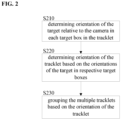
- FIG. 2 is a flowchart showing a process of grouping the tracklets.
- step S210 the orientation of the target relative to the camera in each tracklet is determined. More specifically, the orientation of the target relative to the camera in each of the target boxes in the tracklet is determined.
- various methods may be used to estimate the orientation of the target in the target box. For example, a supervised training method or a method of fine-tuning on the basis of a pre-trained model may be used. It is necessary to label data in advance in order to train the model in these two methods. In addition, a zero-sample method may be used, that is, a trained large model is used for orientation estimation.
- attribute recognition technology may be used to estimate the orientation of the target in the target box.
- the present disclosure employs the attribute recognition technology described in "Improving pediatric attribute recognition with weakly-supervised multi-scale attribute-specific localization", Tang C, Sheng L, et al., Proceedings of IEEE/CVF International Conference on Computer Vision, 2019: (4997-5006 ).
- the orientation of the tracklet is determined based on the orientations of the target in respective target boxes. Specifically, when the number of target boxes in which the orientation of the target is a specific orientation is larger than a predetermined threshold, the orientation of the tracklet may be determined to be the specific orientation. If the orientation of the tracklet cannot be determined based on this rule, for example when the number of target boxes corresponding to any orientation does not exceed the predetermined threshold, the orientation of the tracklet may be determined to be the orientation to which the largest number of target boxes correspond.
- the orientation determined for each tracklet in this way may be one or more orientations.
- the orientation of the tracklet may be determined to be both the front orientation and the sideways orientation.
- step S230 tracklets are grouped based on the orientation of the tracklet.
- a front orientation group, a back orientation group and a sideways orientation group are schematically shown in Figure 1 .
- a tracklet may be determined to have multiple orientations as described above, so the tracklet may be assigned to multiple groups at the same time.
- the tracklets in the initial set may be a tracklet of a single target captured by a single camera, or tracklets of a single target captured by different cameras.
- the initial set includes cross-camera tracklets corresponding to the same target, and these tracklets have the same orientation.
- an agglomerative clustering method is used in the present disclosure, and other known methods may also be used by the skilled person to perform clustering.
- Figure 1 schematically shows a clustering result for each group. It can be seen that three initial sets (represented by circles) are obtained based on the tracklets in the front orientation group, two initial sets (represented by squares) are obtained based on the tracklets in the back orientation group, and two initial sets (represented by triangles) are obtained based on the tracklets in the sideways orientation group.
- the three initial sets represented by black shapes actually correspond to the same target, and the initial sets represented by other shapes (filled with different patterns) correspond to different targets.
- Merging is then performed among the obtained initial sets such that the tracklets corresponding to the same target and having different orientations are merged into one set.
- merging is first performed on the initial sets of the front orientation group and the back orientation group, and then the merged set is merged with the initial sets of the sideways orientation group.
- Figure 1 shows that the tracklets in the three initial sets represented by black shapes are merged into a final set, while the other initial sets are not merged because they correspond to different targets.
- the present disclosure can overcome this shortcoming by associating the tracklets with different orientations belonging to a target with the target, so as to obtain more accurate and complete tracking information.
- FIG. 3 is a flowchart showing a process of merging the initial sets derived from two groups.
- step S310 a M ⁇ N matrix is built.
- step S320 a maximum value among the element values of the matrix is determined.
- step S330 it is determined whether the maximum value is zero.
- the maximum value is determined to be zero, it means that M initial sets (corresponding to M targets) derived from the first group and N initial sets (corresponding to N targets) derived from the second group are independent of each other, that is, they do not correspond to the same target. Therefore, the merging process ends.
- step S330 When it is determined that the maximum value is not zero in step S330, assuming that the position of the maximum value in the matrix is expressed as (a, b), the a-th initial set derived from the first group and the b-th initial set derived from the second group that correspond to the maximum value may be merged into one set in step S340, and then the element values on the a-th row and the b-th column where the maximum value is located in the matrix are set to zero in step S350. Then, in step S360, a maximum value is determined again for the matrix after the element values have been modified.
- steps S340 to S360 may be repeated.
- the merge process may end when the maximum value in the current matrix is determined to be zero.
- step S410 the captured videos are received from multiple cameras capturing different scenes respectively.
- step S420 multi-target tracking is performed on the video captured by each camera by a multi-target tracking (MOT) module 510 to extract a tracklet for each target appearing in the video.
- MOT multi-target tracking
- the MOT module 510 may extract multiple tracklets of multiple targets from multiple videos captured by multiple cameras.
- step S430 a feature is extracted by a feature extraction module 520 for each of the multiple tracklets extracted by the MOT module 510.
- step S440 for each tracklet, orientations of the target relative to the camera in respective target boxes in the tracklet are determined, and the orientation of the tracklet is determined based on the orientations of the target in the respective target boxes, by an orientation determination module 530.
- step S450 the extracted tracklets are divided into multiple groups by a grouping module 540 based on the orientation of the tracklet. Tracklets in the same group have the same orientation, and tracklets in different groups have different orientations.
- step S460 clustering is performed on the tracklets in each group by a clustering module 550 based on the feature of the tracklet, such that the tracklets corresponding to the same target are aggregated into an initial set.
- step S470 merging is performed by a merging module 560 among multiple initial sets obtained by performing clustering on the respective groups, such that the tracklets corresponding to the same target and having different orientations are merged into a final set.
- the tracklets in the final set may be used as tracking information of the corresponding target.
- step S430 may be executed after step S450 or in parallel with steps S440 and S450.
- the technology according to the present disclosure has been described above in combination with specific embodiments.
- the MTMCT according to the present disclosure can overcome the shortcomings of the conventional methods and identify the tracklets with multiple orientations belonging to a single target, and thereby obtain more accurate and complete tracking information.
- the method described in the embodiments may be implemented by software, hardware, or a combination of software and hardware.
- Programs included in the software may be pre-stored in a storage medium arranged inside or outside a device.
- these programs are written into a random access memory (RAM) and executed by a processor (such as CPU), to implement the methods and processes described herein.
- RAM random access memory
- processor such as CPU
- Figure 6 is a block diagram showing an exemplary configuration of computer hardware for implementing the method of the present disclosure according to programs.
- the device for MTMCT according to the present disclosure can be implemented based on the computer hardware.
- a central processing unit (CPU) 601, a read only memory (ROM) 602, and a random-access memory (RAM) 603 are connected to each other via a bus 604.
- An input/output interface 605 is further connected to the bus 604.
- the input/output interface 605 is connected to the following components: an input device 606 formed with keyboard, mouse, microphone and the like; an output device 607 formed with display, speaker and the like; a storage device 608 formed with hard disk, non-volatile memory and the like; a communication device 609 formed by a network interface card (such as local area network (LAN) card, and modem); and a driver 610 for driving a removable medium 611.
- the removable medium 611 is for example a magnetic disk, an optical disk, a magneto-optical disk, or a semiconductor memory.
- the CPU 601 loads the program stored in the storage device 608 into the RAM 603 via the input/output interface 605 and the bus 604, and executes the program to perform the method described above.
- a program to be executed by the computer (CPU 601) may be recorded on a removable medium 611 which may be a package medium.
- the package medium is formed with for example a magnetic disk (including floppy disk), an optical disk (including compact disk-read only memory (CD-ROM)), digital versatile disk (DVD), or the like), a magneto-optical disk, or a semiconductor memory.
- the program to be executed by the computer (CPU 601) may also be provided via a wired or wireless transmission medium such as local area network, Internet, or digital satellite broadcasting.
- the program may be installed in the storage device 608 through the input/output interface 605.
- the program may be received by the communication unit 609 via a wired or wireless transmission medium, and installed in the storage unit 608.
- the program may be installed in the ROM 602 or the storage unit 608 in advance.
- the program to be executed by the computer may be a program that performs processes in the order described in the present disclosure, or may be a program that performs processes in parallel or when necessary (e.g., when invoked).
- modules or devices described herein are only in logical sense, and do not strictly correspond to physical apparatuses or entities.
- a function of each of the modules described herein can be implemented by multiple physical entities, or, functions of multiple modules described herein may be implemented by a single physical entity.
- features, components, elements, steps or the like described in one embodiment are not limited to the embodiment, but may also be applied in other embodiments to for example replace or combine with specific features, components, elements, steps or the like in other embodiments.
Landscapes
- Engineering & Computer Science (AREA)
- Theoretical Computer Science (AREA)
- Computer Vision & Pattern Recognition (AREA)
- General Physics & Mathematics (AREA)
- Physics & Mathematics (AREA)
- Multimedia (AREA)
- Computing Systems (AREA)
- General Health & Medical Sciences (AREA)
- Medical Informatics (AREA)
- Software Systems (AREA)
- Evolutionary Computation (AREA)
- Databases & Information Systems (AREA)
- Health & Medical Sciences (AREA)
- Artificial Intelligence (AREA)
- Image Analysis (AREA)
- Closed-Circuit Television Systems (AREA)
Abstract
Description
- The present disclosure generally relates to target tracking technology, and specifically to Multi-Target Multi-Camera Tracking technology.
- Multi-Target Multi-Camera Tracking (MTMCT) is currently a very important research topic in the field of video surveillance. It refers to finding the time and space locations of multiple targets in the videos captured by multiple cameras capturing different scenes respectively, and associating the time and space information of a target with the target. MTMCT integrates various computer vision technologies such as pedestrian detection, object detection, pedestrian re-recognition, object tracking, etc.
- In practical applications, MTMCT still faces many problems and challenges. For example, the orientation of the target relative to the camera in the video may affect the association of tracklets of a single target. Specifically, in the videos captured by different cameras, a target may have different orientations (such as front, sideways or back) relative to the camera, and different orientations will lead to different appearance features of the target. This is disadvantageous to the existing method of associating tracklets based on features, because different appearance features will make it difficult to associate all tracklets that actually correspond to a single target with each other.
- For example, there may be a situation where a tracklet in which a target has front orientation is associated with the target, but it is difficult to associate a tracklet in which the target has sideways orientation with the tracklet in which the target has front orientation because there is a great difference between the appearance when the target has sideways orientation and the appearance when the target has front orientation. As such, only the tracklet in which the target has front orientation can be obtained as tracking information, and therefore the accuracy and integrity of tracking information is decreased.
- To address the above technical problems, the present disclosure provides a cross-camera target association technology based on orientation estimation, which eliminates or mitigates the adverse impact on target association cause by appearance differences resulted from different orientations of a target, and significantly improves the performance of MTMCT.
- According to one aspect of the present invention, a method for multi-target multi-camera tracking is provided. The method includes: performing multi-target tracking on an image sequence captured by each of a plurality of cameras that capture different scenes respectively, to extract a tracklet for each target appearing in the image sequence, wherein a plurality of tracklets for a plurality of targets are extracted on the basis of a plurality of image sequences captured by the plurality of cameras; extracting a feature for each tracklet; determining an orientation of each tracklet based on an orientation of the target relative to the camera in the tracklet; dividing the plurality of tracklets into a plurality of groups based on the determined orientations, wherein tracklets in the same group have the same orientation, and tracklets in different groups have different orientations; performing clustering on tracklets in each group based on the extracted features, such that tracklets corresponding to the same target are aggregated into an initial set; performing merging among a plurality of initial sets obtained by performing clustering on the plurality of groups respectively, such that tracklets corresponding to the same target and having different orientations are merged into a final set; and using the tracklets in the final set as tracking information for the corresponding target.
- According to another aspect of the present invention, a device for multi-target multi-camera tracking is provided. The device includes a memory storing a computer program and a processor. The processor is configured to execute the computer program to perform operations of: performing multi-target tracking on an image sequence captured by each of a plurality of cameras that capture different scenes respectively, to extract a tracklet for each target appearing in the image sequence, wherein a plurality of tracklets for a plurality of targets are extracted on the basis of a plurality of image sequences captured by the plurality of cameras; extracting a feature for each tracklet; determining an orientation of each tracklet based on an orientation of the target relative to the camera in the tracklet; dividing the plurality of tracklets into a plurality of groups based on the determined orientations, wherein tracklets in the same group have the same orientation, and tracklets in different groups have different orientations; performing clustering on tracklets in each group based on the extracted features, such that tracklets corresponding to the same target are aggregated into an initial set; performing merging among a plurality of initial sets obtained by performing clustering on the plurality of groups respectively, such that tracklets corresponding to the same target and having different orientations are merged into a final set; and using the tracklets in the final set as tracking information for the corresponding target.
- According to another aspect of the present invention, a non-transitory computer-readable storage medium storing a program is provided. The program, when executed by a computer, causes the computer to perform the method for multi-target multi-camera tracking described above.
-
-
Figure 1 schematically shows a conceptual diagram of MTMCT according to the present disclosure. -
Figure 2 is a flowchart showing a process of grouping tracklets. -
Figure 3 is a flowchart showing a process of performing merge on initial sets. -
Figure 4 is a flowchart showing a MTMCT method according to the present disclosure. -
Figure 5 shows functional modules for implementing the MTMCT method. -
Figure 6 is a block diagram showing an exemplary configuration of computer hardware for implementing the present disclosure. -
Figure 1 schematically shows a conceptual diagram of MTMCT according to the present disclosure. First, videos captured by a plurality of cameras CAM 1 - CAM n are received. The cameras CAM 1 - CAM n capture different scenes respectively. For a video from a single camera, a tracklet may be extracted for each target appearing in the video using multi-target tracking (MOT). In this way, a number of tracklets of multiple targets maybe extracted from the videos captured by cameras CAM 1 - CAM n. - In particular, a single target may appear in different scenes and therefore be captured by different cameras. As such, the tracklets extracted from the videos of different cameras may correspond to the same target.
- A trajectory of a target during a certain time period may be formed based on multiple tracklets of the target, so as to obtain tracking information of the target. Since the trajectory of the target is usually distributed across multiple video frames, the tracklet may be a set of target boxes obtained by identifying the target in the multiple frames. As an example, one tracklet including multiple target boxes may be saved in an image folder according to the present disclosure.
- Since the multi-target tracking (MOT) for a video captured by a single camera is a known to the skilled person in the art, the detailed description thereof is omitted in the present disclosure. Those skilled in the art can apply appropriate MOT technology to extract tracklets. As an example, Byte Track model is employed in the present disclosure. The Bytetrack model is described in detail in "Bytetrack: Multi-Object Tracking by Associating Every Detection Box", Zhang, Y., Sun, P. et al, arXiv pre-print arXiv: 2110.06864 (2021), which is incorporated herein by reference.
- A feature may be extracted for each of the obtained multiple tracklets (not shown in
Figure 1 ). For example, a visual feature may be extracted for each tracklet by applying pedestrian re-identification (Re-ID) technology. Since one tracklet may be a set of target boxes, visual features of respective target boxes may be extracted using Re-ID technology. Therefore, the feature of the tracklet may be a set of features of the respective target boxes. - Since the Re-ID technology is known to the skilled person, the detailed description thereof is omitted in the present disclosure. Those skilled in the art can apply appropriate Re-ID technology to extract features. As an example, OSNet model is employed in the present disclosure. The OSNet model is described in detail in "Omni-Scale Feature Learning for Person Re-Identification", K Zhou, Y. Yang, et al, ICCV, 2019, pages 3702 - 3712, which is incorporated herein by reference.
- Then, as shown in
Figure 1 , the obtained multiple tracklets may be divided into several groups, such as a front orientation group, a back orientation group and a sideways orientation group. Tracklets in the same group have the same orientation, and tracklets in different groups have different orientations. - The grouping process will be described in detail below in combination with
Figure 2. Figure 2 is a flowchart showing a process of grouping the tracklets. In step S210, the orientation of the target relative to the camera in each tracklet is determined. More specifically, the orientation of the target relative to the camera in each of the target boxes in the tracklet is determined. In this step, various methods may be used to estimate the orientation of the target in the target box. For example, a supervised training method or a method of fine-tuning on the basis of a pre-trained model may be used. It is necessary to label data in advance in order to train the model in these two methods. In addition, a zero-sample method may be used, that is, a trained large model is used for orientation estimation. Data labeling and training is not required in this method. In addition, attribute recognition technology may be used to estimate the orientation of the target in the target box. As an example, the present disclosure employs the attribute recognition technology described in "Improving pediatric attribute recognition with weakly-supervised multi-scale attribute-specific localization", Tang C, Sheng L, et al., Proceedings of IEEE/CVF International Conference on Computer Vision, 2019: (4997-5006). - Then, in step S220, the orientation of the tracklet is determined based on the orientations of the target in respective target boxes. Specifically, when the number of target boxes in which the orientation of the target is a specific orientation is larger than a predetermined threshold, the orientation of the tracklet may be determined to be the specific orientation. If the orientation of the tracklet cannot be determined based on this rule, for example when the number of target boxes corresponding to any orientation does not exceed the predetermined threshold, the orientation of the tracklet may be determined to be the orientation to which the largest number of target boxes correspond.
- In particular, the orientation determined for each tracklet in this way may be one or more orientations. For example, when the number of target boxes corresponding to the front orientation and the number of target boxes corresponding to the sideways orientation are each larger than the threshold value, the orientation of the tracklet may be determined to be both the front orientation and the sideways orientation.
- Then, in step S230, tracklets are grouped based on the orientation of the tracklet. A front orientation group, a back orientation group and a sideways orientation group are schematically shown in
Figure 1 . In particular, a tracklet may be determined to have multiple orientations as described above, so the tracklet may be assigned to multiple groups at the same time. - In addition, it should be noted that the present disclosure is not limited to the three groups shown in
Figure 1 . Those skilled in the art can set more or fewer groups and use other orientations than the front orientation, back orientation and sideways orientation. - Referring back to
Figure 1 , after grouping, clustering is performed on the tracklets in each group based on the feature of the tracklet, such that the tracklets corresponding to the same target are aggregated into an initial set. Depending on the result of clustering, the tracklets in the initial set may be a tracklet of a single target captured by a single camera, or tracklets of a single target captured by different cameras. In other words, the initial set includes cross-camera tracklets corresponding to the same target, and these tracklets have the same orientation. As an example, an agglomerative clustering method is used in the present disclosure, and other known methods may also be used by the skilled person to perform clustering. -
Figure 1 schematically shows a clustering result for each group. It can be seen that three initial sets (represented by circles) are obtained based on the tracklets in the front orientation group, two initial sets (represented by squares) are obtained based on the tracklets in the back orientation group, and two initial sets (represented by triangles) are obtained based on the tracklets in the sideways orientation group. In addition, the three initial sets represented by black shapes actually correspond to the same target, and the initial sets represented by other shapes (filled with different patterns) correspond to different targets. - Merging is then performed among the obtained initial sets such that the tracklets corresponding to the same target and having different orientations are merged into one set. In the process of merging, it is possible to first perform merging on the initial sets of two groups, and then merge the merged set with the initial sets of the remaining group. As schematically shown in
Figure 1 , merging is first performed on the initial sets of the front orientation group and the back orientation group, and then the merged set is merged with the initial sets of the sideways orientation group. In addition,Figure 1 shows that the tracklets in the three initial sets represented by black shapes are merged into a final set, while the other initial sets are not merged because they correspond to different targets. - Therefore, when different cameras capture tracklets having different orientations for the same target, these tracklets cannot be associated with each other using the conventional methods due to appearance differences caused by orientation differences of the target. The present disclosure can overcome this shortcoming by associating the tracklets with different orientations belonging to a target with the target, so as to obtain more accurate and complete tracking information.
- The merging process will be described in detail below in connection with
Figure 3. Figure 3 is a flowchart showing a process of merging the initial sets derived from two groups. In step S310, a M × N matrix is built. An element value of the matrix is the number of identical tracklets included in both of the following two initial sets: the i-th initial set obtained by performing clustering on a first group (such as the front orientation group), and the j-th initial set obtained by performing clustering on a second group (such as the back orientation group), wherein i = 1, 2, ..., M, j = 1, 2, ..., N, and M and N are natural numbers. - Then, in step S320, a maximum value among the element values of the matrix is determined, In step S330, it is determined whether the maximum value is zero. When the maximum value is determined to be zero, it means that M initial sets (corresponding to M targets) derived from the first group and N initial sets (corresponding to N targets) derived from the second group are independent of each other, that is, they do not correspond to the same target. Therefore, the merging process ends.
- When it is determined that the maximum value is not zero in step S330, assuming that the position of the maximum value in the matrix is expressed as (a, b), the a-th initial set derived from the first group and the b-th initial set derived from the second group that correspond to the maximum value may be merged into one set in step S340, and then the element values on the a-th row and the b-th column where the maximum value is located in the matrix are set to zero in step S350. Then, in step S360, a maximum value is determined again for the matrix after the element values have been modified.
- If the maximum value is not zero, steps S340 to S360 may be repeated. The merge process may end when the maximum value in the current matrix is determined to be zero.
- The method of MTMCT according to the present disclosure and the functional modules for implementing the method will be described below in combination with
Figures 4 and5 . - Referring to
Figures 4 and5 , in step S410, the captured videos are received from multiple cameras capturing different scenes respectively. In step S420, multi-target tracking is performed on the video captured by each camera by a multi-target tracking (MOT)module 510 to extract a tracklet for each target appearing in the video. In this way, theMOT module 510 may extract multiple tracklets of multiple targets from multiple videos captured by multiple cameras. - Then, in step S430, a feature is extracted by a feature extraction module 520 for each of the multiple tracklets extracted by the
MOT module 510. - Then, in step S440, for each tracklet, orientations of the target relative to the camera in respective target boxes in the tracklet are determined, and the orientation of the tracklet is determined based on the orientations of the target in the respective target boxes, by an orientation determination module 530.
- Then, in step S450, the extracted tracklets are divided into multiple groups by a
grouping module 540 based on the orientation of the tracklet. Tracklets in the same group have the same orientation, and tracklets in different groups have different orientations. - Then, in step S460, clustering is performed on the tracklets in each group by a clustering module 550 based on the feature of the tracklet, such that the tracklets corresponding to the same target are aggregated into an initial set.
- Then, in step S470, merging is performed by a merging
module 560 among multiple initial sets obtained by performing clustering on the respective groups, such that the tracklets corresponding to the same target and having different orientations are merged into a final set. The tracklets in the final set may be used as tracking information of the corresponding target. - It should be noted that the method according to the present disclosure is not limited to the sequence shown in
Figure 4 . The method can be executed in a different order as long as it is technically feasible. For example, step S430 may be executed after step S450 or in parallel with steps S440 and S450. - The technology according to the present disclosure has been described above in combination with specific embodiments. The MTMCT according to the present disclosure can overcome the shortcomings of the conventional methods and identify the tracklets with multiple orientations belonging to a single target, and thereby obtain more accurate and complete tracking information.
- The method described in the embodiments may be implemented by software, hardware, or a combination of software and hardware. Programs included in the software may be pre-stored in a storage medium arranged inside or outside a device. As an example, during execution, these programs are written into a random access memory (RAM) and executed by a processor (such as CPU), to implement the methods and processes described herein.
-
Figure 6 is a block diagram showing an exemplary configuration of computer hardware for implementing the method of the present disclosure according to programs. The device for MTMCT according to the present disclosure can be implemented based on the computer hardware. - As shown in
Figure 6 , in acomputer 600, a central processing unit (CPU) 601, a read only memory (ROM) 602, and a random-access memory (RAM) 603 are connected to each other via abus 604. - An input/
output interface 605 is further connected to thebus 604. The input/output interface 605 is connected to the following components: aninput device 606 formed with keyboard, mouse, microphone and the like; anoutput device 607 formed with display, speaker and the like; astorage device 608 formed with hard disk, non-volatile memory and the like; acommunication device 609 formed by a network interface card (such as local area network (LAN) card, and modem); and adriver 610 for driving aremovable medium 611. Theremovable medium 611 is for example a magnetic disk, an optical disk, a magneto-optical disk, or a semiconductor memory. - In the computer with the above structure, the
CPU 601 loads the program stored in thestorage device 608 into theRAM 603 via the input/output interface 605 and thebus 604, and executes the program to perform the method described above. - A program to be executed by the computer (CPU 601) may be recorded on a
removable medium 611 which may be a package medium. The package medium is formed with for example a magnetic disk (including floppy disk), an optical disk (including compact disk-read only memory (CD-ROM)), digital versatile disk (DVD), or the like), a magneto-optical disk, or a semiconductor memory. In addition, the program to be executed by the computer (CPU 601) may also be provided via a wired or wireless transmission medium such as local area network, Internet, or digital satellite broadcasting. - In a case that the
removable medium 611 is installed in thedrive 610, the program may be installed in thestorage device 608 through the input/output interface 605. In addition, the program may be received by thecommunication unit 609 via a wired or wireless transmission medium, and installed in thestorage unit 608. Alternatively, the program may be installed in theROM 602 or thestorage unit 608 in advance. - The program to be executed by the computer may be a program that performs processes in the order described in the present disclosure, or may be a program that performs processes in parallel or when necessary (e.g., when invoked).
- The modules or devices described herein are only in logical sense, and do not strictly correspond to physical apparatuses or entities. For example, a function of each of the modules described herein can be implemented by multiple physical entities, or, functions of multiple modules described herein may be implemented by a single physical entity. In addition, features, components, elements, steps or the like described in one embodiment are not limited to the embodiment, but may also be applied in other embodiments to for example replace or combine with specific features, components, elements, steps or the like in other embodiments.
- The scope of the present invention is not limited to the embodiments described herein. Those skilled in the art should understand that, depending on design requirements and other factors, various modifications or changes may be made to the embodiments herein without departing from principle of the present invention. The scope of the present invention is defined by the appended claims and their equivalents.
- In addition, the following embodiments are also included in the present invention.
- (1). A method for multi-target multi-camera tracking, comprising:
- performing multi-target tracking on an image sequence captured by each of a plurality of cameras that capture different scenes respectively, to extract a tracklet for each target appearing in the image sequence, wherein a plurality of tracklets for a plurality of targets are extracted on the basis of a plurality of image sequences captured by the plurality of cameras;
- extracting a feature for each tracklet;
- determining an orientation of each tracklet based on an orientation of the target relative to the camera in the tracklet;
- dividing the plurality of tracklets into a plurality of groups based on the determined orientations, wherein tracklets in a same group have a same orientation, and tracklets in different groups have different orientations;
- performing clustering on tracklets in each group based on the extracted features, such that tracklets corresponding to a same target are aggregated into an initial set;
- performing merging among a plurality of initial sets obtained by performing clustering on the plurality of groups respectively, such that tracklets corresponding to the same target and having different orientations are merged into a final set; and
- using the tracklets in the final set as tracking information for the corresponding target.
- (2). The method according to (1), wherein the orientation of the target relative to the camera is one of front, back, and sideways.
- (3). The method according to (1), wherein each tracklet is a set of target boxes that identify the target in a plurality of frames of the image sequence respectively,
the method further comprising:- determining the orientation of the target in each of the target boxes relative to the camera;
- when the number of target boxes in which the orientation of the target is a specific orientation is larger than a first threshold, determining that the orientation of the tracklet is the specific orientation; or
- when the number of target boxes in which the orientation of the target is a specific orientation is larger than the number of target boxes in which the orientation of the target is any other orientation, determining that the orientation of the tracklet is the specific orientation.
- (4). The method according to (3), wherein each tracklet can be determined to have one or more orientations, and the tracklet can be included in one or more of the plurality of groups.
- (5). The method according to (4), further comprising:
establishing a matrix, wherein an element value of the matrix is the number of identical tracklets included in both of the following two initial sets: an i-th initial set obtained by performing clustering on a first group corresponding to a first orientation, and an j-th initial set obtained by performing clustering on a second group corresponding to a second orientation, wherein i = 1, 2, ..., M, j = 1, 2, ..., N, and M and N are natural numbers. - (6). The method according to (5), further comprising:
- determining a maximum value among the element values of the matrix; and
- not performing merging among the initial sets when the maximum value is zero.
- (7). The method according to (5), further comprising:
- determining a maximum value among the element values of the matrix; and
- when the maximum value is not zero,
- a) merging an initial set derived from the first group and an initial set derived from the second group that correspond to the maximum value into one set;
- b) setting element values on a row and a column where the maximum value is located in the matrix to zero;
- c) determining a maximum value among element values of the modified matrix; and
- d) iteratively performing the steps a) to c), until the maximum value among the element values of the matrix is zero
- (8). The method according to (7), wherein K initial sets are obtained by performing clustering on a third group corresponding to a third orientation,
the method further comprising: after performing merging between the M initial sets derived from the first group and the N initial sets derived from the second group, performing merging between the resulted sets and the K initial sets derived from the third group. - (9). A device for multi-target multi-camera tracking, comprising:
- a memory storing a computer program; and
- a processor configured to execute the computer program to perform operations of:
- performing multi-target tracking on an image sequence captured by each of a plurality of cameras that capture different scenes respectively, to extract a tracklet for each target appearing in the image sequence, wherein a plurality of tracklets for a plurality of targets are extracted on the basis of a plurality of image sequences captured by the plurality of cameras;
- extracting a feature for each tracklet;
- determining an orientation of each tracklet based on an orientation of the target relative to the camera in the tracklet;
- dividing the plurality of tracklets into a plurality of groups based on the determined orientations, wherein tracklets in a same group have a same orientation, and tracklets in different groups have different orientations;
- performing clustering on tracklets in each group based on the extracted features, such that tracklets corresponding to a same target are aggregated into an initial set;
- performing merging among a plurality of initial sets obtained by performing clustering on the plurality of groups respectively, such that tracklets corresponding to the same target and having different orientations are merged into a final set; and
- using the tracklets in the final set as tracking information for the corresponding target.
- (10). The device according to (9), wherein the orientation of the target relative to the camera is one of front, back, and sideways.
- (11). The device according to (9), wherein each tracklet is a set of target boxes that identify the target in a plurality of frames of the image sequence respectively,
the processor is further configured to:- determining the orientation of the target in each of the target boxes relative to the camera;
- when the number of target boxes in which the orientation of the target is a specific orientation is larger than a first threshold, determining that the orientation of the tracklet is the specific orientation; or
- when the number of target boxes in which the orientation of the target is a specific orientation is larger than the number of target boxes in which the orientation of the target is any other orientation, determining that the orientation of the tracklet is the specific orientation
- (12). The device according to (11), wherein each tracklet can be determined to have one or more orientations, and the tracklet can be included in one or more of the plurality of groups.
- (13). The device according to (12), the processor is further configured to establish a matrix, wherein an element value of the matrix is the number of identical tracklets included in both of the following two initial sets: an i-th initial set obtained by performing clustering on a first group corresponding to a first orientation, and an j-th initial set obtained by performing clustering on a second group corresponding to a second orientation, wherein i = 1, 2, ..., M, j = 1, 2, ..., N, and M and N are natural numbers.
- (14). The device according to (13), the processor is further configured to:
- determining a maximum value among the element values of the matrix; and
- not performing merging among the initial sets when the maximum value is zero.
- (15). The device according to (13), the processor is further configured to:
- determining a maximum value among the element values of the matrix; and
- when the maximum value is not zero,
- a) merging an initial set derived from the first group and an initial set derived from the second group that correspond to the maximum value into one set;
- b) setting element values on a row and a column where the maximum value is located in the matrix to zero;
- c) determining a maximum value among element values of the modified matrix; and
- d) iteratively performing the steps a) to c), until the maximum value among the element values of the matrix is zero.
- (16). The device according to (15), wherein K initial sets are obtained by performing clustering on a third group corresponding to a third orientation,
the processor is further configured to: after performing merging between the M initial sets derived from the first group and the N initial sets derived from the second group, performing merging between the resulted sets and the K initial sets derived from the third group. - (17). A non-transitory computer-readable storage medium storing a program that, when executed by a computer, causes the computer to perform the method for multi-target multi-camera tracking according to any one of (1) to (8).
Claims (10)
- A method for multi-target multi-camera tracking, comprising:performing multi-target tracking on an image sequence captured by each of a plurality of cameras that capture different scenes respectively, to extract a tracklet for each target appearing in the image sequence, wherein a plurality of tracklets for a plurality of targets are extracted on the basis of a plurality of image sequences captured by the plurality of cameras;extracting a feature for each tracklet;determining an orientation of each tracklet based on an orientation of the target relative to the camera in the tracklet;dividing the plurality of tracklets into a plurality of groups based on the determined orientations, wherein tracklets in a same group have a same orientation, and tracklets in different groups have different orientations;performing clustering on tracklets in each group based on the extracted features, such that tracklets corresponding to a same target are aggregated into an initial set;performing merging among a plurality of initial sets obtained by performing clustering on the plurality of groups respectively, such that tracklets corresponding to the same target and having different orientations are merged into a final set; andusing the tracklets in the final set as tracking information for the corresponding target.
- The method according to claim 1, wherein the orientation of the target relative to the camera is one of front, back, and sideways.
- The method according to claim 1, wherein each tracklet is a set of target boxes that identify the target in a plurality of frames of the image sequence respectively,
the method further comprising:determining the orientation of the target in each of the target boxes relative to the camera;when the number of target boxes in which the orientation of the target is a specific orientation is larger than a first threshold, determining that the orientation of the tracklet is the specific orientation; orwhen the number of target boxes in which the orientation of the target is a specific orientation is larger than the number of target boxes in which the orientation of the target is any other orientation, determining that the orientation of the tracklet is the specific orientation. - The method according to claim 3, wherein each tracklet can be determined to have one or more orientations, and the tracklet can be included in one or more of the plurality of groups.
- The method according to claim 4, further comprising:
establishing a matrix, wherein an element value of the matrix is the number of identical tracklets included in both of the following two initial sets: an i-th initial set obtained by performing clustering on a first group corresponding to a first orientation, and an j-th initial set obtained by performing clustering on a second group corresponding to a second orientation, wherein i = 1, 2, ..., M, j = 1, 2, ..., N, and M and N are natural numbers. - The method according to claim 5, further comprising:determining a maximum value among the element values of the matrix; andnot performing merging among the initial sets when the maximum value is zero.
- The method according to claim 5, further comprising:determining a maximum value among the element values of the matrix; andwhen the maximum value is not zero,a) merging an initial set derived from the first group and an initial set derived from the second group that correspond to the maximum value into one set;b) setting element values on a row and a column where the maximum value is located in the matrix to zero;c) determining a maximum value among element values of the modified matrix; andd) iteratively performing the steps a) to c), until the maximum value among the element values of the matrix is zero.
- The method according to claim 7, wherein K initial sets are obtained by performing clustering on a third group corresponding to a third orientation,
the method further comprising: after performing merging between the M initial sets derived from the first group and the N initial sets derived from the second group, performing merging between the resulted sets and the K initial sets derived from the third group. - A device for multi-target multi-camera tracking, comprising:a memory storing a computer program; anda processor configured to execute the computer program to perform operations of:performing multi-target tracking on an image sequence captured by each of a plurality of cameras that capture different scenes respectively, to extract a tracklet for each target appearing in the image sequence, wherein a plurality of tracklets for a plurality of targets are extracted on the basis of a plurality of image sequences captured by the plurality of cameras;extracting a feature for each tracklet;determining an orientation of each tracklet based on an orientation of the target relative to the camera in the tracklet;dividing the plurality of tracklets into a plurality of groups based on the determined orientations, wherein tracklets in a same group have a same orientation, and tracklets in different groups have different orientations;performing clustering on tracklets in each group based on the extracted features, such that tracklets corresponding to a same target are aggregated into an initial set;performing merging among a plurality of initial sets obtained by performing clustering on the plurality of groups respectively, such that tracklets corresponding to the same target and having different orientations are merged into a final set; andusing the tracklets in the final set as tracking information for the corresponding target.
- A non-transitory computer-readable storage medium storing a program that, when executed by a computer, causes the computer to perform the method for multi-target multi-camera tracking according to any one of claims 1 to 8.
Applications Claiming Priority (1)
| Application Number | Priority Date | Filing Date | Title |
|---|---|---|---|
| CN202211046789.5A CN117670923A (en) | 2022-08-30 | 2022-08-30 | Method, device and storage medium for target tracking |
Publications (1)
| Publication Number | Publication Date |
|---|---|
| EP4336446A1 true EP4336446A1 (en) | 2024-03-13 |
Family
ID=87760294
Family Applications (1)
| Application Number | Title | Priority Date | Filing Date |
|---|---|---|---|
| EP23192372.3A Pending EP4336446A1 (en) | 2022-08-30 | 2023-08-21 | Method and device for target tracking and storage medium |
Country Status (4)
| Country | Link |
|---|---|
| US (1) | US20240070881A1 (en) |
| EP (1) | EP4336446A1 (en) |
| JP (1) | JP2024035128A (en) |
| CN (1) | CN117670923A (en) |
Families Citing this family (1)
| Publication number | Priority date | Publication date | Assignee | Title |
|---|---|---|---|---|
| CN119131082B (en) * | 2024-09-02 | 2026-03-17 | 中国人民解放军国防科技大学 | Multi-target tracking method, apparatus, and device based on multi-view representation for event cameras |
Family Cites Families (25)
| Publication number | Priority date | Publication date | Assignee | Title |
|---|---|---|---|---|
| JPH10235580A (en) * | 1997-02-26 | 1998-09-08 | Seiko Seiki Co Ltd | Position and force target trajectory generator |
| US8933986B2 (en) * | 2010-05-28 | 2015-01-13 | Qualcomm Incorporated | North centered orientation tracking in uninformed environments |
| JP2014186547A (en) * | 2013-03-22 | 2014-10-02 | Toshiba Corp | Moving object tracking system, method and program |
| US9975550B2 (en) * | 2013-05-31 | 2018-05-22 | Toyota Jidosha Kabushiki Kaisha | Movement trajectory predicting device and movement trajectory predicting method |
| CN104270620A (en) * | 2014-10-27 | 2015-01-07 | 成都新舟锐视科技有限公司 | Real-time linkage intelligent tracking and early-warning system integrated with multiple cameras |
| US9911198B2 (en) * | 2015-12-17 | 2018-03-06 | Canon Kabushiki Kaisha | Method, system and apparatus for matching moving targets between camera views |
| US10163015B2 (en) * | 2016-11-16 | 2018-12-25 | Ford Global Technologies, Llc | Detecting foliage using range data |
| US10121103B2 (en) * | 2016-12-09 | 2018-11-06 | Cisco Technologies, Inc. | Scalable deep learning video analytics |
| US10699421B1 (en) * | 2017-03-29 | 2020-06-30 | Amazon Technologies, Inc. | Tracking objects in three-dimensional space using calibrated visual cameras and depth cameras |
| CN110232701A (en) * | 2018-03-05 | 2019-09-13 | 奥的斯电梯公司 | Use the pedestrian tracking of depth transducer network |
| CN110619658B (en) * | 2019-09-16 | 2022-04-19 | 北京地平线机器人技术研发有限公司 | Object tracking method, object tracking device and electronic equipment |
| CN112262411B (en) * | 2019-12-23 | 2024-04-05 | 商汤国际私人有限公司 | Image association method, system and device |
| WO2022021217A1 (en) * | 2020-07-30 | 2022-02-03 | Intel Corporation | Multi-camera person association via pair-wise matching in continuous frames for immersive video |
| KR102625119B1 (en) * | 2020-08-14 | 2024-01-12 | 탑골프 스웨덴 에이비 | Motion-based preprocessing of 2D image data before 3D object tracking using virtual time synchronization |
| CN114913386B (en) * | 2021-01-29 | 2025-08-19 | 北京原创世代科技有限公司 | Training method of multi-target tracking model and multi-target tracking method |
| US11966452B2 (en) * | 2021-08-05 | 2024-04-23 | Ford Global Technologies, Llc | Systems and methods for image based perception |
| US12406502B2 (en) * | 2021-09-28 | 2025-09-02 | The Hong Kong University Of Science And Technology | Enriched and discriminative convolutional neural network features for pedestrian re-identification and trajectory modeling |
| US11774599B2 (en) * | 2021-10-29 | 2023-10-03 | Aptiv Technologies Limited | Joint cost estimation for associating a detection-tracklet pair to an object |
| US12456207B2 (en) * | 2022-04-04 | 2025-10-28 | Palexy Pte. Ltd. | System and method of processing images associated with objects in a camera view |
| US12412367B2 (en) * | 2022-05-11 | 2025-09-09 | Verb Surgical Inc. | Operating room objects and workflow tracking using depth cameras |
| EP4300434A1 (en) * | 2022-06-28 | 2024-01-03 | Axis AB | Image processing device and method of detecting objects crossing a crossline and a direction the objects crosses the crossline |
| CN117495901A (en) * | 2022-07-26 | 2024-02-02 | 富士通株式会社 | Method, device and storage medium for post-processing of multi-target tracking |
| US12007469B1 (en) * | 2023-08-04 | 2024-06-11 | Block, Inc. | Trajectory determination system using positional sensing to determine the movement of people or objects |
| US11914025B1 (en) * | 2023-08-04 | 2024-02-27 | Density, Inc. | Trajectory determination system using positional sensing to determine the movement of people or objects |
| US20250285295A1 (en) * | 2024-03-06 | 2025-09-11 | Nvidia Corporation | Bidirectional object tracking in computer vision applications |
-
2022
- 2022-08-30 CN CN202211046789.5A patent/CN117670923A/en active Pending
-
2023
- 2023-08-21 EP EP23192372.3A patent/EP4336446A1/en active Pending
- 2023-08-22 JP JP2023134967A patent/JP2024035128A/en active Pending
- 2023-08-25 US US18/455,688 patent/US20240070881A1/en active Pending
Non-Patent Citations (5)
| Title |
|---|
| HSU HUNG-MIN ET AL: "Multi-Target Multi-Camera Tracking of Vehicles Using Metadata-Aided Re-ID and Trajectory-Based Camera Link Model", IEEE TRANSACTIONS ON IMAGE PROCESSING, IEEE, USA, vol. 30, 17 May 2021 (2021-05-17), pages 5198 - 5210, XP011856433, ISSN: 1057-7149, [retrieved on 20210524], DOI: 10.1109/TIP.2021.3078124 * |
| K ZHOUY. YANG ET AL.: "Omni-Scale Feature Learning for Person Re-Identification", ICCV, 2019, pages 3702 - 3712 |
| TANG CSHENG L ET AL.: "Improving pediatric attribute recognition with weakly-supervised multi-scale attribute-specific localization", PROCEEDINGS OF IEEE/CVF INTERNATIONAL CONFERENCE ON COMPUTER VISION, 2019, pages 4997 - 5006 |
| YOU SISI ET AL: "Multi-Target Multi-Camera Tracking With Optical-Based Pose Association", IEEE TRANSACTIONS ON CIRCUITS AND SYSTEMS FOR VIDEO TECHNOLOGY, IEEE, USA, vol. 31, no. 8, 6 November 2020 (2020-11-06), pages 3105 - 3117, XP011870058, ISSN: 1051-8215, [retrieved on 20210802], DOI: 10.1109/TCSVT.2020.3036467 * |
| ZHANG, Y.SUN, P. ET AL.: "Bytetrack: Multi-Object Tracking by Associating Every Detection Box", ARXIV: 2110.06864, 2021 |
Also Published As
| Publication number | Publication date |
|---|---|
| JP2024035128A (en) | 2024-03-13 |
| US20240070881A1 (en) | 2024-02-29 |
| CN117670923A (en) | 2024-03-08 |
Similar Documents
| Publication | Publication Date | Title |
|---|---|---|
| Vedhaviyassh et al. | Comparative analysis of easyocr and tesseractocr for automatic license plate recognition using deep learning algorithm | |
| US10192105B1 (en) | Support vector machine adapted sign language classification method | |
| Xu et al. | An enhanced Viola-Jones vehicle detection method from unmanned aerial vehicles imagery | |
| CN110070085B (en) | License plate recognition method and device | |
| US20240221426A1 (en) | Behavior detection method, electronic device, and computer readable storage medium | |
| Bashir et al. | Vr-proud: Vehicle re-identification using progressive unsupervised deep architecture | |
| CN108388879B (en) | Target detection method, device and storage medium | |
| CN102609720B (en) | Pedestrian detection method based on position correction model | |
| US20190325205A1 (en) | Method and apparatus for human behavior recognition, and storage medium | |
| Gonçalves et al. | License plate recognition based on temporal redundancy | |
| CN111814690B (en) | Target re-identification method, device and computer readable storage medium | |
| CN106529477A (en) | Video human behavior recognition method based on significant trajectory and time-space evolution information | |
| CN115424090A (en) | Target re-identification method and model acquisition method and device thereof, and terminal equipment | |
| CN111291887A (en) | Neural network training method, image recognition method, device and electronic equipment | |
| CN110826415A (en) | Method and device for re-identifying vehicles in scene image | |
| Amrouche et al. | Vehicle Detection and Tracking in Real-time using YOLOv4-tiny | |
| CN115953744A (en) | A vehicle recognition and tracking method based on deep learning | |
| Schulter et al. | Unsupervised Object Discovery and Segmentation in Videos. | |
| Deng et al. | Yoloscm: An improved yolo algorithm for cars detection | |
| US20240070881A1 (en) | Method and device for target tracking and storage medium | |
| CN111611846A (en) | Pedestrian re-identification method, device, electronic device and storage medium | |
| CN114399724A (en) | Pedestrian re-identification method and device, electronic equipment and storage medium | |
| CN109389048B (en) | A Pedestrian Detection and Tracking Method in Surveillance Video | |
| Gawande et al. | Scale invariant mask r-cnn for pedestrian detection | |
| CN116189044A (en) | Method, device, equipment and storage medium for counting people flow |
Legal Events
| Date | Code | Title | Description |
|---|---|---|---|
| PUAI | Public reference made under article 153(3) epc to a published international application that has entered the european phase |
Free format text: ORIGINAL CODE: 0009012 |
|
| STAA | Information on the status of an ep patent application or granted ep patent |
Free format text: STATUS: THE APPLICATION HAS BEEN PUBLISHED |
|
| AK | Designated contracting states |
Kind code of ref document: A1 Designated state(s): AL AT BE BG CH CY CZ DE DK EE ES FI FR GB GR HR HU IE IS IT LI LT LU LV MC ME MK MT NL NO PL PT RO RS SE SI SK SM TR |
|
| STAA | Information on the status of an ep patent application or granted ep patent |
Free format text: STATUS: REQUEST FOR EXAMINATION WAS MADE |
|
| 17P | Request for examination filed |
Effective date: 20240912 |
|
| RBV | Designated contracting states (corrected) |
Designated state(s): AL AT BE BG CH CY CZ DE DK EE ES FI FR GB GR HR HU IE IS IT LI LT LU LV MC ME MK MT NL NO PL PT RO RS SE SI SK SM TR |
|
| GRAP | Despatch of communication of intention to grant a patent |
Free format text: ORIGINAL CODE: EPIDOSNIGR1 |
|
| STAA | Information on the status of an ep patent application or granted ep patent |
Free format text: STATUS: GRANT OF PATENT IS INTENDED |
|
| RIC1 | Information provided on ipc code assigned before grant |
Ipc: G06T 7/292 20170101AFI20260408BHEP |