EP4336410A1 - Verfahren und system zur merkmalsextraktion unter verwendung einer rekonfigurierbaren faltungscluster-engine in einer bildsensorpipeline - Google Patents
Verfahren und system zur merkmalsextraktion unter verwendung einer rekonfigurierbaren faltungscluster-engine in einer bildsensorpipeline Download PDFInfo
- Publication number
- EP4336410A1 EP4336410A1 EP23154883.5A EP23154883A EP4336410A1 EP 4336410 A1 EP4336410 A1 EP 4336410A1 EP 23154883 A EP23154883 A EP 23154883A EP 4336410 A1 EP4336410 A1 EP 4336410A1
- Authority
- EP
- European Patent Office
- Prior art keywords
- convolution
- feature map
- output
- cmac
- reconfigurable
- Prior art date
- Legal status (The legal status is an assumption and is not a legal conclusion. Google has not performed a legal analysis and makes no representation as to the accuracy of the status listed.)
- Pending
Links
Images




Classifications
-
- G—PHYSICS
- G06—COMPUTING OR CALCULATING; COUNTING
- G06V—IMAGE OR VIDEO RECOGNITION OR UNDERSTANDING
- G06V10/00—Arrangements for image or video recognition or understanding
- G06V10/70—Arrangements for image or video recognition or understanding using pattern recognition or machine learning
- G06V10/77—Processing image or video features in feature spaces; using data integration or data reduction, e.g. principal component analysis [PCA] or independent component analysis [ICA] or self-organising maps [SOM]; Blind source separation
- G06V10/7715—Feature extraction, e.g. by transforming the feature space, e.g. multi-dimensional scaling [MDS]; Mappings, e.g. subspace methods
-
- G—PHYSICS
- G06—COMPUTING OR CALCULATING; COUNTING
- G06N—COMPUTING ARRANGEMENTS BASED ON SPECIFIC COMPUTATIONAL MODELS
- G06N3/00—Computing arrangements based on biological models
- G06N3/02—Neural networks
- G06N3/04—Architecture, e.g. interconnection topology
- G06N3/0464—Convolutional networks [CNN, ConvNet]
-
- G—PHYSICS
- G06—COMPUTING OR CALCULATING; COUNTING
- G06N—COMPUTING ARRANGEMENTS BASED ON SPECIFIC COMPUTATIONAL MODELS
- G06N3/00—Computing arrangements based on biological models
- G06N3/02—Neural networks
- G06N3/06—Physical realisation, i.e. hardware implementation of neural networks, neurons or parts of neurons
- G06N3/063—Physical realisation, i.e. hardware implementation of neural networks, neurons or parts of neurons using electronic means
-
- G—PHYSICS
- G06—COMPUTING OR CALCULATING; COUNTING
- G06T—IMAGE DATA PROCESSING OR GENERATION, IN GENERAL
- G06T5/00—Image enhancement or restoration
- G06T5/20—Image enhancement or restoration using local operators
- G06T5/30—Erosion or dilatation, e.g. thinning
-
- G—PHYSICS
- G06—COMPUTING OR CALCULATING; COUNTING
- G06V—IMAGE OR VIDEO RECOGNITION OR UNDERSTANDING
- G06V10/00—Arrangements for image or video recognition or understanding
- G06V10/70—Arrangements for image or video recognition or understanding using pattern recognition or machine learning
- G06V10/82—Arrangements for image or video recognition or understanding using pattern recognition or machine learning using neural networks
-
- G—PHYSICS
- G06—COMPUTING OR CALCULATING; COUNTING
- G06F—ELECTRIC DIGITAL DATA PROCESSING
- G06F11/00—Error detection; Error correction; Monitoring
- G06F11/07—Responding to the occurrence of a fault, e.g. fault tolerance
- G06F11/14—Error detection or correction of the data by redundancy in operations
- G06F11/1476—Error detection or correction of the data by redundancy in operations in neural networks
-
- G—PHYSICS
- G06—COMPUTING OR CALCULATING; COUNTING
- G06F—ELECTRIC DIGITAL DATA PROCESSING
- G06F11/00—Error detection; Error correction; Monitoring
- G06F11/07—Responding to the occurrence of a fault, e.g. fault tolerance
- G06F11/16—Error detection or correction of the data by redundancy in hardware
- G06F11/18—Error detection or correction of the data by redundancy in hardware using passive fault-masking of the redundant circuits
-
- G—PHYSICS
- G06—COMPUTING OR CALCULATING; COUNTING
- G06N—COMPUTING ARRANGEMENTS BASED ON SPECIFIC COMPUTATIONAL MODELS
- G06N3/00—Computing arrangements based on biological models
- G06N3/02—Neural networks
- G06N3/08—Learning methods
- G06N3/098—Distributed learning, e.g. federated learning
Definitions
- the invention relates to Convolutional Neural Networks (CNNs). More specifically, the invention relates to a method and system for feature extraction from an input image from a plurality of images in an image sensor pipeline.
- CNNs Convolutional Neural Networks
- An Image Signal Processing (ISP) chipset is a type of media processor used for image processing, in digital cameras, smartphones, or other devices.
- ISP chipsets have been noticed to a greater extent by incorporating different image qualities and stabilization algorithms with the ISP pipeline blocks.
- the ISP chipsets play a vital role in building various computer vision solutions.
- Recent trends in Edge Computing Application have enabled edge devices to perform real-time tasks at silicon level. Artificial Intelligence (Al) at an edge device-level is more promising when real-time on-the-fly data analytics is required.
- Al-enabled edge devices in many real-world applications such as in automotive (for example, driver/passenger monitoring and fleet management), portable medical devices (for example, diagnostic kits), video surveillance (for example, retail segments and warehouse management), and aerospace (for example, in-cabin monitoring) domains.
- automotive for example, driver/passenger monitoring and fleet management
- portable medical devices for example, diagnostic kits
- video surveillance for example, retail segments and warehouse management
- aerospace for example, in-cabin monitoring
- CNN Convolution Neural Network
- Hardware-accelerated CNN engines are gaining momentum in image sensor pipeline.
- the hardware-accelerated CNN engines help in feature extraction and handle massive computation-intensive operations (for example, mathematical operations) along with performance v/s power trade-off scenarios.
- incorporating the functional safety mechanisms with diagnostics features at the silicon level becomes essential.
- the functional safety mechanisms support in handling the real-time faults such as Single Event Upset (SEU), and Single Event Transition (SET) faults due to EMI, or other radiation effects (according to the device FIT and Grade).
- SEU Single Event Upset
- SET Single Event Transition
- the functional safety mechanisms help in diagnosing the failure and achieving the safety compliance.
- CNN accelerators are available for feature extraction.
- conventional CNN accelerators lack in providing full parallel and reconfigurable 2D/3D convolution, concurrent feature map processing with layer combine option, convolution compute element with integrated safety mechanism and BIST, support for dilation convolution, configurable pooling logic which may be hooked closely to leaf level compute element, on demand fast convolution when number of filters are large or when solution need more performance, near memory compute for convolution accelerator and localized kernel memory, reuse of the level convolution element for various kernel size, integrated 1D multiplication by reusing the leaf level convolution element, grouping of convolution accelerator to handle multiple input feature maps for increased performance, and scalable and flexible hardware accelerator to support for performance v/s power trade-off based on host configuration.
- a method for feature extraction from an input image from a plurality of images in an image sensor pipeline may include determining a number of logical convolutional operations to be performed, within a reconfigurable convolutional cluster engine, based on a size of an input feature map corresponding to the input image.
- the method may further include performing a set of concurrent row wise convolutions on the input feature map, based on the number of logical convolutional operations. It should be noted that each of the set of concurrent row wise convolutions may include a set of convolution operations corresponding to a pre-determined kernel size so as to generate a set of corresponding convolution output.
- each of the set of convolution operations may be one of a one-dimensional (1D) convolution, a two-dimensional (2D) convolution, or a three-dimensional (3D) convolution.
- each of the set of convolution operations may be at least one of a dilation convolution, a fast convolution, or a functional safety convolution based on a user-defined configuration of the reconfigurable convolutional cluster engine.
- the method may further include performing at least one of a maximum pooling or an average pooling operation on the set of corresponding convolution output through one or more pooling elements to generate a set of pooling output.
- the method may further include generating an output feature map based on the set of pooling output. At least one of the output feature map or the input image is transmitted, based on a user-defined mode, for subsequent storage or processing prior to performing feature extraction from a next input image from the plurality of images in the image sensor pipeline.
- a system for feature extraction from an input image from a plurality of images in an image sensor pipeline may include a processor and a memory communicatively coupled to the processor, which, on execution, may cause the processor to determine a number of logical convolutional operations to be performed, within a reconfigurable convolutional cluster engine, based on a size of an input feature map corresponding to the input image.
- the processor-executable instructions, on execution, may further cause the processor to perform a set of concurrent row wise convolutions on the input feature map, based on the number of logical convolutional operations.
- each of the set of concurrent row wise convolutions may include a set of convolution operations corresponding to a pre-determined kernel size so as to generate a set of corresponding convolution output.
- each of the set of convolution operations may be one of a 1D convolution, a 2D convolution, or a 3D convolution.
- each of the set of convolution operations may be at least one of a dilation convolution, a fast convolution, or a functional safety convolution based on a user-defined configuration of the reconfigurable convolutional cluster engine.
- the processor-executable instructions, on execution, may further cause the processor to perform at least one of a maximum pooling or an average pooling operation on the set of corresponding convolution output through one or more pooling elements to generate a set of pooling output.
- the processor-executable instructions, on execution, may further cause the processor to generate an output feature map based on the set of pooling output. At least one of the output feature map or the input image is transmitted, based on a user-defined mode, for subsequent storage or processing prior to performing feature extraction from a next input image from the plurality of images in the image sensor pipeline.
- a non-transitory computer-readable medium storing computer-executable instruction for feature extraction from an input image from a plurality of images in an image sensor pipeline.
- the stored instructions when executed by a processor, may cause the processor to perform operations including determining a number of logical convolutional operations to be performed, within a reconfigurable convolutional cluster engine, based on a size of an input feature map corresponding to the input image.
- the operations may further include performing a set of concurrent row wise convolutions on the input feature map, based on the number of logical convolutional operations.
- each of the set of concurrent row wise convolutions may include a set of convolution operations corresponding to a pre-determined kernel size so as to generate a set of corresponding convolution output.
- each of the set of convolution operations may be one of a 1D convolution, a 2D convolution, or a 3D convolution.
- each of the set of convolution operations may be at least one of a dilation convolution, a fast convolution, or a functional safety convolution based on a user-defined configuration of the reconfigurable convolutional cluster engine.
- the operations may further include performing at least one of a maximum pooling or an average pooling operation on the set of corresponding convolution output through one or more pooling elements to generate a set of pooling output.
- the operations may further include generating an output feature map based on the set of pooling output. At least one of the output feature map or the input image is transmitted, based on a user-defined mode, for subsequent storage or processing prior to performing feature extraction from a next input image from the plurality of images in the image sensor pipeline.
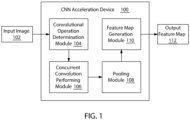
- CNN acceleration device 100 configured for feature extraction in an image sensor pipeline is illustrated, in accordance with some embodiments of the present disclosure.
- the CNN acceleration device 100 may perform a concurrent row wise convolution on an input image 102 received from a camera sensor pipeline with functional safety mechanisms to support functional safety faults such as Single Event Upset (SEU) or Single Event Transition (SET) faults.
- SEU Single Event Upset
- SET Single Event Transition
- the CNN acceleration device 100 allows feature extraction, using Mini Parallel Rolling Engines (MPREs) built with multiple instances of Convolution Multiply and Accumulate-XtendedGen2 (CMAC-XG2) engine with localized kernel memory space. This may be explained further in conjunction with FIGS. 2-7 . As illustrated in FIG.
- the CNN acceleration device 100 may include a convolutional operation determination module 104, a concurrent convolution performing module 106, a pooling module 108, a feature map generation module 110. Further, the CNN acceleration device 100 may also include a data store (not shown in FIG. 1 ) in order to store intermediate results generated by the modules 104-110.
- the convolutional operation determination module 104 may be configured to determine a number of logical convolutional operations to be performed, within a reconfigurable convolutional cluster engine.
- the CNN acceleration device 100 may be associated with the reconfigurable convolutional cluster engine.
- the CNN acceleration device 100 may include the reconfigurable convolutional cluster engine. It should be noted that the convolutional operation determination module 104 may determine the number of logical convolutional operations based on a size of an input feature map corresponding to the input image 102.
- the convolutional operation determination module 104 may be communicatively coupled to the concurrent convolution performing module 106.
- the concurrent convolution performing module 106 may be configured to perform a set of concurrent row wise convolutions on the input feature map.
- the concurrent convolution performing module 106 may include a set of MPREs to perform the set of concurrent row wise convolutions.
- the set of concurrent row wise convolutions may be performed based on the number of logical convolutional operations.
- each of the set of concurrent row wise convolutions may include a set of convolution operations corresponding to a pre-determined kernel size so as to generate a set of corresponding convolution output.
- each of the set of convolution operations may be one of a one-dimensional (1D) convolution, a two-dimensional (2D) convolution, or a three-dimensional (3D) convolution.
- Each of the set of convolution operations may be at least one of a dilation convolution, a fast convolution, or a functional safety convolution based on a user-defined configuration of the reconfigurable convolutional cluster engine.
- the user-defined configuration, for the dilation convolution may include a dilation rate of the input feature map.
- the fast convolution may include employing a convolution grid engine (CGRID), and the functional safety convolution may include enabling at least one of a double-module redundancy (DMR), a triple-module redundancy (TMR), and one or more diagnostic features.
- CGRID convolution grid engine
- TMR triple-module redundancy
- the reconfigurable convolution cluster engine may include a set of MPREs.
- Each MPRE may be configured to perform the concurrent row wise convolution operation on the input feature map.
- the number of MPRE may be based on a number of lines in the input feature map.
- Each of the set of MPREs may include a set of Convolution Multiply and Accumulate-XtendedGen2 (CMAC-XG2) elements.
- each CMAC-XG2 may be configured to perform a convolution operation corresponding to the pre-determined kernel size.
- the number of CMAC-XG2 may be based on a number of pixels in each of the line in the input feature map.
- each of the set of CMAC-XG2 may include at least one of a Double Module Redundancy (DMR) or a Triple-Module Redundancy (TMR).
- DMR Double Module Redundancy
- TMR Triple-Module Redundancy
- the each of the set of CMAC-XG2 may be validated through safety diagnostics registers and Built-In Self-Test (BIST).
- the reconfigurable convolution cluster engine may include an input feature map memory to store the input image 102 and an output feature map memory to store the output feature map. Further, the reconfigurable convolution cluster engine may also include a kernel memory space capable for holding a set of network parameters associated to a network layer. Additionally, the reconfigurable convolution cluster engine may include a kernel controller to enable the parallel convolution operation by loading the network parameters into the one or more CMAC-XG2 elements simultaneously. Further, as illustrated in FIG. 1 , the concurrent convolution performing module 106 may be communicatively coupled to the pooling module 108.
- the pooling module 108 may be configured for performing at least one of a maximum pooling or an average pooling operation on the set of corresponding convolution output.
- the pooling module 108 may include one or more pooling (CPOOL) elements to generate a set of pooling output.
- the pooling module 108 may be operatively coupled to the feature map generation module 110.
- the feature map generation module 110 may be configured to generate an output feature map 112 based on the set of pooling output. At least one of the output feature map or the input image is transmitted, based on a user-defined mode, for subsequent storage or processing prior to performing feature extraction from a next input image from the plurality of images in the image sensor pipeline.
- the system 200 may include the CNN acceleration device 100, an exemplary legacy image sensor pipeline 202, a memory sub-system 204, a processor core 206, and a compression engine 208.
- the legacy image sensor pipeline 202 may include optics, image filtering and Bayer processing, and post filtering. Further, output of the legacy image sensor pipeline 202 may be transmitted to the memory sub-system 204.
- the memory sub system 204 may include a write memory controller, a frame memory, a read memory controller, a feature map memory, and a read-write controller.
- the memory sub-system 204 may be operatively connected to the CNN acceleration device 100, the processor core 206, and the compression engine 208.
- the CNN acceleration device 100 may include an input feature map memory 210a, an output feature map memory 210b, a memory read controller 212a, a memory write controller 212b, a main controller 216, a kernel memory space 218, a kernel controller 220, an input data router 222, an output data router, a reconfigurable convolution cluster engine 214, and a host interface.
- the CNN acceleration device 100 may include the reconfigurable convolution cluster engine 214 for performing two dimensional (2D) and/or three-dimensional 3D convolutions in parallel on an entire input image/input feature map and may fit into to the image sensor pipeline for feature extraction.
- the CNN acceleration device 100 may also be referred to as ICoS_NOVA.
- the reconfigurable convolution cluster engine 214 may include a plurality of MPREs which further includes a set of Convolution Multiply and Accumulate-XtendedGen2 (CMAC-XG2) elements to handle multiple feature maps and perform convolutions for various kernel sizes and depths.
- the kernel sizes may be, but are not limited to, '3x3', '5x5', '7x7' and '9x9'.
- Configurable pooling block for various size may also be supported in the system 200.
- Various modules of the CNN acceleration device 100 may help in performing the parallel 3D convolution or dilated convolution, and feature map extraction on the image sensor pipeline.
- CMAC-XG2 there may be multiple instances of CMAC-XG2 to perform concurrent convolution on the entire input feature map, based on image size, performance, and power requirements.
- the CMAC-XG2 engine performs convolution and multiple CMAC-XG2 elements form an MPRE perform parallel row wise convolution operation on the feature map.
- multiple reconfigurable convolution cluster engines may be instantiated to compute the convolution operations faster on the input image/the feature map plane.
- the system 200 enables to reuse the compute resources efficiently (i.e., DSP, registers, and memory block).
- the host processor (processor core) 206 may be an on-chip processor (for example, an Advanced RISC Machine (ARM) or Reduced Instruction Set Computer Five (RISC-V) processor Core).
- the host processor (processor core) 206 performs primary scheduling task and parameter loading for the reconfigurable convolution cluster engine.
- the host processor (processor core) 206 may shut-off one or multiple selected CMAC-XG2 elements and activate parallel dense Matrix computation (1D processing).
- the input image (for example, may be of RGB or Y component) may be stored in the on-chip memory subsystem and this data get stored in the input feature map memory 21 0a.
- the output feature extracted image data get stored in the output feature map memory 210b.
- the input feature map memory (input line buffer) 210a and output feature map memory (output line buffer) 210b may hold single or multiple image/feature map data.
- the host processor (processor core) 206 may schedule the data to the input line buffer based on current layer processing.
- the kernel memory space 218 may act as a local cache memory and hold the entire network parameters such as kernel values, BIAS, and the like.
- the main controller 216 interfaced with the processor core 206 via the host interface, stores the necessary network layer information, and further acts as local control unit for the CMAC-XG2, memory controller, kernel memory space 218, pooling, input/output routers 222, 224, and read/write controllers 212a, 212b.
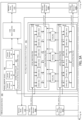
- FIGS. 3A-3C various MPREs 316 within a reconfigurable convolutional cluster engine 302 of an exemplary CNN acceleration device 300 are illustrated, in accordance with some embodiments of the present disclosure.
- FIGS. 3A-3C are explained in accordance with FIG. 1-2 .
- the CNN acceleration device 300 is analogous to the CNN acceleration device 100.
- the CNN acceleration device 300 may include the reconfigurable convolutional cluster engine 302, an input feature map memory 304a, an output feature map memory 304b, a kernel memory space 306, a kernel controller 308, a CNN main controller 310, a memory read controller 312, and a memory write controller 314.
- the reconfigurable convolutional cluster engine 302 may include the MPREs 316 (for example, MPRE 316a to MPRE 316n).
- Each of the MPREs 316 may include a plurality of CMAC-XG2 instances, configurable pooling (CPOOL) elements, a local input router and a local output router.
- CPOOL configurable pooling
- a number of CMAC-XG2 elements in the MPREs may be decided based on maximum image size.
- an image size of 800 X 480 (W X H) from the sensor pipeline may be used for feature extraction.
- each MPRE may have 800 CMAC-XG2 elements and for the parallel row processing there may be maximum 480 MPRE instances.
- the kernel memory space 306 may be same as the kernel memory space 218 of FIG. 2 which may act as a local memory and may hold the network parameters (such as, kernel value, BIAS, etc.) for the CNN network of the CNN acceleration device 300.
- the kernel controller 308 loads the network parameters into all CMAC-XG2 elements simultaneously to enable the parallel convolution operation.
- Each CMAC-XG2 element internally includes local pixel memory and kernel memory. Therefore, the convolution with multiply and accumulation (MAC) may be done seamlessly.
- the convolution operation may be a dilation convolution.
- the CMAC_XG2 local controller may schedule the data to the MAC from the local pixel memory.
- the convolution operation may be a fast convolution.
- a convolution grid engine may be activated and full parallel convolution may be done in each of the CMAC-XG2 elements.
- the convolution operation may be a functional safety convolution.
- the CNN main controller enables a functional safety mode based on user settings, the CMAC-XG2 get configured to support functional safety mechanism like Double Module Redundancy (DMR) or Triple-Module Redundancy (TMR), and safety diagnostics registers.
- DMR Double Module Redundancy
- TMR Triple-Module Redundancy
- the reconfigurable convolution cluster engine 302 shown in FIG. 3 performs various functions including loading Input feature map pixel data (from input line buffer) into the local input router, loading the local input router with input feature map data in parallel to CMAC-XG2 element, loading kernel value to all the CMAC-XG2 elements in each of the MPREs 316, controlling the configurable pooling elements when pooling layer is enabled from the CNN main controller, controlling the CMAC-XG2 instances for parallel convolution for one full feature map, moving the convoluted data to the output line buffer via the local output router, interfacing with CNN main controller 310 for centralized control to all MPRE 316 and monitoring the convolution processing status from all MPRE 316.
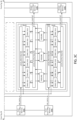
- the reconfigurable convolutional cluster engine 400 may include MPRE 402, MPRE 404, MPRE 406, MPRE 408, MPRE n.
- Each of the MPREs may include multiple CMAC-XG2 elements.
- the MPRE 402 may include CMAC-XG2 elements 402a to 402m
- MPRE 404 may include CMAC-XG2 elements 404a to 404m.
- the CMAC-XG2 elements may perform convolution for different kernel size (i.e., 3 X 3, 5 X 5, 7 X 7, and 9 X 9). Further, the concurrent convolution may be achieved by allocating CMAC-XG2 element which is equal to the maximum size of a feature map.
- Each of the CMAC-XG2 elements in each MPRE may run in parallel. It should be noted that the MPREs run in parallel and each MPRE may access dedicated line buffers.
- the CMAC-XG2 elements may operate with same kernel value. In some other embodiments, the CMAC-XG2 elements may operate with different kernel value.
- the image size i.e., input feature map size
- the number of CMAC-XG2 may be 320,000 and there may be 480 MPRE instances.
- the kernel size is 3 X 3
- each CMAC-XG2 may operate on 3 X 3 image size on the input feature map. Since the same kernel values are loaded into all the CMAC-XG2, one feature map processing may be done in parallel.
- the host processor may load all the kernels values from the related current convolution layer to the kernel memory space 406.
- CMAC-XG2 Convolution Multiply and Accumulate-XtendedGen2
- CPOOL pooling
- FIG. 5 is explained in conjunction with FIGS. 1-4 .
- the CPOOL elements 504 may perform maximum pooling function of '2 X 2' or '3 X 3', based on the user configuration settings from the host processor.
- the CPOOL elements 504 may run in the pipeline by using convoluted output generated from the CMAC-XG2 elements.
- maximum pooling function 2 X 2 is configured the CMAC-XG2 element (#1), CMAC-XG2 element (#2), CMAC-XG2 element (#11) and CMAC-XG2 element (#12) may be connected to the CPOOL (#1) as shown in the FIG. 5 .
- the CPOOL elements are enabled by the CNN main controller for the respective convolution layers, the CPOOL elements take the convoluted output from 4 respective CMAC-XG2 elements, compute the maximum value, and send the output to the local output router.
- FIG. 6 an exemplary table 600 for determining approximate processing time for a six layered CNN network while using the CNN acceleration device 100 is illustrated, in accordance with some embodiments of the present disclosure.
- FIG. 6 is explained in conjunction with FIGS. 1-5 .
- the table 600 includes layers 602 (for example, conv1 to conv6).
- the table 600 further includes input feature map size 604, number of input feature map 606, number of kernels 608, kernel size 610, number of output feature map 612, presence of pooling layer 614, output feature map size 616, processing time for convolution 618, corresponding to each of the layer 602.
- the table 600 may be generated based on some assumptions. For example, consider that clock frequency for a reconfigurable convolution cluster engine may be 200 MHz which is equivalent to 5 ns, maximum pooling function used and size may be 2 X 2, stride used for convolution may be '1', one row and column may be trimmed-off when pooled output size is odd, input feature map memory read and output feature map memory write latency may not be considered, and host processor data scheduling, the data read and write to external DRAM may not be considered.
- the input feature map size 604 corresponding to the layers 602 are '800 X 480', '792 X 472', ⁇ 394 X 234', ⁇ 392 X 232', '1951 X 115', '193 X 113', respectively.
- respective number of input feature map 606 corresponding to the layers 602 are '1', '16', '16', '32', '128', '64'
- respective number of kernels 606 corresponding to each of the layers 602 are '16', '256', '512', '4096', '8192', '2048'.
- kernel size 608 corresponding to each of the layers 602 are ⁇ 9 X 9', ⁇ 5 X 5', '3 X 3', '3 X 3', '3 X 3', '3 X 3', '3 X 3', and output feature map 610 corresponding to each of the layers 602 are '16', ⁇ 16', '32', '128', '64', '32', respectively.
- presence of pooling layer 612 corresponding to each of the layers 602 is also shown in the table 600.
- pooling layer may be absent in layers conv1, conv3, and conv5, and present in conv2, conv4, and conv6 with maximum pooling function 2X2.
- output feature map size corresponding to conv1 is 792 X 472.
- output feature map size corresponding to other layers is also shown in table 600.
- processing time for convolution Kernel size + Stride used for convolution 1 / Clock frequency ⁇ Number of kernels
- processing time for conv1 may be calculated as follows:
- processing time may be calculated for other convolutional layers based on the equation (1).
- total processing time taken for the six convolutional layers (i.e., summation of the processing time taken by the six convolutional layers) may be ⁇ 782 us' approximately.
- the CNN acceleration device 100 may be implemented in programmable hardware devices such as programmable gate arrays, programmable array logic, programmable logic devices, or the like. Alternatively, the CNN acceleration device 100 may be implemented in software for execution by various types of processors.
- An identified engine/module of executable code may, for instance, include one or more physical or logical blocks of computer instructions which may, for instance, be organized as a component, module, procedure, function, or other construct. Nevertheless, the executables of an identified engine/module need not be physically located together but may include disparate instructions stored in different locations which, when joined logically together, comprise the identified engine/module and achieve the stated purpose of the identified engine/module. Indeed, an engine or a module of executable code may be a single instruction, or many instructions, and may even be distributed over several different code segments, among different applications, and across several memory devices.
- the exemplary CNN acceleration device 100 may extract features from the input image, by the process discussed herein.
- control logic and/or automated routines for performing the techniques and steps described herein may be implemented by the CNN acceleration device 100 either by hardware, software, or combinations of hardware and software.
- suitable code may be accessed and executed by the one or more processors on the system and associated CNN acceleration device 100 to perform some or all of the techniques described herein.
- application specific integrated circuits ASICs configured to perform some or all the processes described herein may be included in the one or more processors on the system 200 and the associated CNN acceleration device 100.
- FIG.7 a flowchart 700 of an exemplary process of feature extraction from an input image from a plurality of images in an image sensor pipeline is depicted, in accordance with some embodiments of the present disclosure.
- Each step of the process may be executed by a CNN acceleration device (same as the CNN acceleration device 100.
- FIG. 7 is explained in conjunction with FIGS. 1-6 .
- a number of logical convolutional operations to be performed within a reconfigurable convolutional cluster engine may be determined using a convolutional operation determination module (similar to the convolutional operation determination module 104).
- the reconfigurable convolutional cluster engine may include an input feature map memory and the output feature map memory.
- the input feature map memory may be used to store the input image.
- the output feature map memory may store output feature map.
- the reconfigurable convolution cluster engine may also include a kernel memory space capable for holding a set of network parameters associated to a network layer.
- the reconfigurable convolution cluster engine may include a kernel controller to enable the parallel convolution operation. In order to enable the parallel convolution operation, the kernel controller may load the network parameters into the one or more CMAC-XG2 elements simultaneously.
- the reconfigurable convolution cluster engine may further include a set of MPREs.
- Each MPRE may be configured to perform the concurrent row wise convolution operation on the input feature map.
- the number of MPRE may be based on a number of lines in the input feature map.
- each of the set of MPREs may further include a set of Convolution Multiply and Accumulate-XtendedGen2 (CMAC-XG2) elements.
- Each CMAC-XG2 may be configured to perform a convolution operation corresponding to the pre-determined kernel size.
- the number of CMAC-XG2 may be based on a number of pixels in each of the line in the input feature map.
- each of the set of CMAC-XG2 may include at least one of a Double Module Redundancy (DMR) or a Triple-Module Redundancy (TMR).
- DMR Double Module Redundancy
- TMR Triple-Module Redundancy
- the each of the set of CMAC-XG2 may be validated through safety diagnostics registers and Built-In Self-Test (BIST). Further, the number of logical convolutional operation may be determined based on a size of an input feature map corresponding to the input image.
- a set of concurrent row wise convolutions on the input feature map may be performed using a concurrent convolution performing module (same as the concurrent convolution performing module 106).
- the number of logical convolutional operations may be considered.
- each of the set of concurrent row wise convolutions may include a set of convolution operations corresponding to a pre-determined kernel size. Thus, a set of corresponding convolution output may be generated.
- each of the set of convolution operations may be one of a 1D convolution, a 2D convolution, or a 3D convolution.
- each of the set of convolution operations may be at least one of a dilation convolution, a fast convolution, or a functional safety convolution. This may be based on a user-defined configuration of the reconfigurable convolutional cluster engine.
- the user-defined configuration, for the dilation convolution may include a dilation rate of the input feature map.
- the fast convolution may include employing a convolution grid engine (CGRID).
- the functional safety convolution may include enabling at least one of a double-module redundancy (DMR), a triple-module redundancy (TMR), and one or more diagnostic features.
- At step 706, at least one of a maximum pooling or an average pooling operation may be performed on the set of corresponding convolution output using a pooling module (same as the pooling module 108).
- the pooling module may include one or more pooling (CPOOL) elements.
- the pooling operation may be performed through the one or more pooling (CPOOL) elements to generate a set of pooling output.
- an output feature map based on the set of pooling output may be generated using feature map generation module (such as the feature map generation module 110). At least one of the output feature map or the input image may be transmitted, based on a user-defined mode. The output feature map may be transmitted for subsequent storage or processing prior to performing feature extraction from a next input image from the plurality of images in the image sensor pipeline.
- feature map generation module such as the feature map generation module 110
- the disclosed methods and systems may be implemented on a conventional or a general-purpose computer system, such as a personal computer (PC) or server computer.
- a general-purpose computer system such as a personal computer (PC) or server computer.
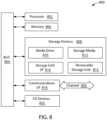
- FIG. 8 an exemplary computing system 800 that may be employed to implement processing functionality for various embodiments (e.g., as a SIMD device, client device, server device, one or more processors, or the like) is illustrated.
- the computing system 800 may represent, for example, a user device such as a desktop, a laptop, a mobile phone, personal entertainment device, DVR, and so on, or any other type of special or general-purpose computing device as may be desirable or appropriate for a given application or environment.
- the computing system 800 may include one or more processors, such as a processor 802 that may be implemented using a general or special purpose processing engine such as, for example, a microprocessor, microcontroller or other control logic.
- the processor 802 is connected to a bus 802 or other communication medium.
- the processor 802 may be an AI processor, which may be implemented as a Tensor Processing Unit (TPU), or a graphical processor unit, or a custom programmable solution Field-Programmable Gate Array (FPGA).
- TPU Tensor Processing Unit
- FPGA Field-Programmable Gate Array
- the computing system 800 may also include a memory 806 (main memory), for example, Random Access Memory (RAM) or other dynamic memory, for storing information and instructions to be executed by the processor 802.
- the memory 806 also may be used for storing temporary variables or other intermediate information during execution of instructions to be executed by the processor 802.
- the computing system 800 may likewise include a read only memory (“ROM”) or other static storage device coupled to bus 804 for storing static information and instructions for the processor 802.
- ROM read only memory
- the computing system 800 may also include a storage device 808, which may include, for example, a media drives 810 and a removable storage interface.
- the media drive 810 may include a drive or other mechanism to support fixed or removable storage media, such as a hard disk drive, a floppy disk drive, a magnetic tape drive, an SD card port, a USB port, a micro USB, an optical disk drive, a CD or DVD drive (R or RW), or other removable or fixed media drive.
- a storage media 812 may include, for example, a hard disk, magnetic tape, flash drive, or other fixed or removable medium that is read by and written to by the media drive 810. As these examples illustrate, the storage media 812 may include a computer-readable storage medium having stored there in particular computer software or data.
- the storage devices 808 may include other similar instrumentalities for allowing computer programs or other instructions or data to be loaded into the computing system 800.
- Such instrumentalities may include, for example, a removable storage unit 814 and a storage unit interface 816, such as a program cartridge and cartridge interface, a removable memory (for example, a flash memory or other removable memory module) and memory slot, and other removable storage units and interfaces that allow software and data to be transferred from the removable storage unit 814 to the computing system 800.
- the computing system 800 may also include a communications interface 818.
- the communications interface 818 may be used to allow software and data to be transferred between the computing system 800 and external devices.
- Examples of the communications interface 818 may include a network interface (such as an Ethernet or other NIC card), a communications port (such as for example, a USB port, a micro USB port), Near Field Communication (NFC), etc.
- Software and data transferred via the communications interface 818 are in the form of signals which may be electronic, electromagnetic, optical, or other signals capable of being received by the communications interface 818. These signals are provided to the communications interface 818 via a channel 820.
- the channel 820 may carry signals and may be implemented using a wireless medium, wire or cable, fiber optics, or other communications medium.
- Some examples of the channel 820 may include a phone line, a cellular phone link, an RF link, a Bluetooth link, a network interface, a local or wide area network, and other communications channels.
- the computing system 800 may further include Input/Output (I/O) devices 822. Examples may include, but are not limited to a display, keypad, microphone, audio speakers, vibrating motor, LED lights, etc.
- the I/O devices 822 may receive input from a user and also display an output of the computation performed by the processor 802.
- the terms "computer program product” and "computer-readable medium” may be used generally to refer to media such as, for example, the memory 812, the storage devices 808, the removable storage unit 814, or signal(s) on the channel 820. These and other forms of computer-readable media may be involved in providing one or more sequences of one or more instructions to the processor 802 for execution.
- Such instructions generally referred to as "computer program code” (which may be grouped in the form of computer programs or other groupings), when executed, enable the computing system 800 to perform features or functions of embodiments of the present invention.
- the software may be stored in a computer-readable medium and loaded into the computing system 800 using, for example, the removable storage unit 814, the media drive 810 or the communications interface 818.
- the control logic in this example, software instructions or computer program code
- the processor 802 when executed by the processor 802, causes the processor 802 to perform the functions of the invention as described herein.
- the disclosed method and system in the present disclosure may enable feature extraction in the image sensor pipeline based on the user configuration (i.e., convolution mode setting). Only extracted features, video data and extracted features, and/or the video data with resized resolution may be transmitted from the imager. Further, for deeper networks, the computation element may be reused with better utilization of on-chip hardware resources. For the deeper layers, when the feature map size shrinks, leaf accelerator elements may be grouped to increase the throughput. Further, the present disclosure allows to process the pixel data in the image sensor pipeline. And, for the performance demanding application on-demand fast convolution mode may be enabled. Additionally, extracted feature or the classified output alone may be sent from the image sensor chipset.
- the reconfigurable convolution cluster engine allows to instantiate multiple CMAC-XG2 element instances using MPRE example in a grid topology which help in multiple input feature maps processing with different filter kernel and the solution may be extended to any image sensing device (such as medical, automotive, satellite, and the like). Also, it may be integrated with an audio sensor.
- the reconfigurable convolution cluster engine helps in full parallel feature maps processing with different filter kernels.
- configurable pooling option supports pooling functions 2 X 2 or 3 X 3 in an integrated convolution pipeline.
- the disclosure provides user configurable option to enable or disable built-in functional safety mechanisms which is more suitable for safety critical application.
- the functional safety mechanism enables to address the functional safety failures like SEU/SET fault.
- the disclosure further includes fully reconfigurable CMAC-XG2 elements that may support dilation convolution and handle both 2D and 3D convolutions for various kernel sizes of 3 X 3, 5 X 5, 7 X 7 and 9X9 (common in large networks).
- the localized kernel memory space enables near memory computation for reconfigurable convolution cluster engine, and helps in reducing the external memory bandwidth and host overhead.
- the disclosure provides user configurable fully connected layer processing (1D multiplication and accumulation using the flattened data).
Landscapes
- Engineering & Computer Science (AREA)
- Theoretical Computer Science (AREA)
- Physics & Mathematics (AREA)
- General Physics & Mathematics (AREA)
- Evolutionary Computation (AREA)
- Health & Medical Sciences (AREA)
- Computing Systems (AREA)
- Artificial Intelligence (AREA)
- Software Systems (AREA)
- General Health & Medical Sciences (AREA)
- Computer Vision & Pattern Recognition (AREA)
- Biophysics (AREA)
- Biomedical Technology (AREA)
- Life Sciences & Earth Sciences (AREA)
- Databases & Information Systems (AREA)
- Medical Informatics (AREA)
- Multimedia (AREA)
- Molecular Biology (AREA)
- General Engineering & Computer Science (AREA)
- Data Mining & Analysis (AREA)
- Mathematical Physics (AREA)
- Computational Linguistics (AREA)
- Neurology (AREA)
- Image Analysis (AREA)
Applications Claiming Priority (1)
| Application Number | Priority Date | Filing Date | Title |
|---|---|---|---|
| IN202211051646 | 2022-09-09 |
Publications (1)
| Publication Number | Publication Date |
|---|---|
| EP4336410A1 true EP4336410A1 (de) | 2024-03-13 |
Family
ID=85174122
Family Applications (1)
| Application Number | Title | Priority Date | Filing Date |
|---|---|---|---|
| EP23154883.5A Pending EP4336410A1 (de) | 2022-09-09 | 2023-02-03 | Verfahren und system zur merkmalsextraktion unter verwendung einer rekonfigurierbaren faltungscluster-engine in einer bildsensorpipeline |
Country Status (2)
| Country | Link |
|---|---|
| US (1) | US20240087291A1 (de) |
| EP (1) | EP4336410A1 (de) |
Families Citing this family (1)
| Publication number | Priority date | Publication date | Assignee | Title |
|---|---|---|---|---|
| CN120570602B (zh) * | 2025-08-04 | 2025-10-03 | 中国计量大学 | 结合多阈值判别和改进型卷积网络的可穿戴跌倒预测方法、装置及其可读存储介质 |
Citations (4)
| Publication number | Priority date | Publication date | Assignee | Title |
|---|---|---|---|---|
| US20210365703A1 (en) * | 2020-05-20 | 2021-11-25 | Hcl Technologies Limited | Convolution operator system to perform concurrent convolution operations |
| EP3920099A1 (de) * | 2020-06-01 | 2021-12-08 | HCL Technologies Limited | System und verfahren zur durchführung einer faltungsoperation mit einem funktionalen sicherheitsmechanismus |
| EP3961509A1 (de) * | 2020-07-09 | 2022-03-02 | HCL Technologies Limited | Rekonfigurierbarer paralleler 3-dimensionaler faltungs-cluster-motor |
| US11315344B2 (en) * | 2019-01-07 | 2022-04-26 | Hcl Technologies Limited | Reconfigurable 3D convolution engine |
Family Cites Families (5)
| Publication number | Priority date | Publication date | Assignee | Title |
|---|---|---|---|---|
| US10607715B2 (en) * | 2017-06-13 | 2020-03-31 | International Business Machines Corporation | Self-evaluating array of memory |
| IN201811023855A (de) * | 2018-06-26 | 2018-07-13 | Hcl Technologies Ltd | |
| US11568229B2 (en) * | 2018-07-11 | 2023-01-31 | Silicon Storage Technology, Inc. | Redundant memory access for rows or columns containing faulty memory cells in analog neural memory in deep learning artificial neural network |
| IN201911000739A (de) * | 2019-01-07 | 2019-02-22 | ||
| CN113989169B (zh) * | 2020-07-08 | 2024-12-10 | 北京硅升科技有限公司 | 一种膨胀卷积加速计算方法及装置 |
-
2023
- 2023-02-03 EP EP23154883.5A patent/EP4336410A1/de active Pending
- 2023-02-07 US US18/106,585 patent/US20240087291A1/en active Pending
Patent Citations (5)
| Publication number | Priority date | Publication date | Assignee | Title |
|---|---|---|---|---|
| US11315344B2 (en) * | 2019-01-07 | 2022-04-26 | Hcl Technologies Limited | Reconfigurable 3D convolution engine |
| US20210365703A1 (en) * | 2020-05-20 | 2021-11-25 | Hcl Technologies Limited | Convolution operator system to perform concurrent convolution operations |
| US11868873B2 (en) * | 2020-05-20 | 2024-01-09 | Hcl Technologies Limited | Convolution operator system to perform concurrent convolution operations |
| EP3920099A1 (de) * | 2020-06-01 | 2021-12-08 | HCL Technologies Limited | System und verfahren zur durchführung einer faltungsoperation mit einem funktionalen sicherheitsmechanismus |
| EP3961509A1 (de) * | 2020-07-09 | 2022-03-02 | HCL Technologies Limited | Rekonfigurierbarer paralleler 3-dimensionaler faltungs-cluster-motor |
Non-Patent Citations (3)
| Title |
|---|
| LI DU ET AL: "A Reconfigurable Streaming Deep Convolutional Neural Network Accelerator for Internet of Things", 8 July 2018 (2018-07-08), XP055569293, Retrieved from the Internet <URL:https://arxiv.org/ftp/arxiv/papers/1707/1707.02973.pdf> [retrieved on 20190314], DOI: 10.1109/TCSI.2017.2735490 * |
| ROSHANSHAH MOHAMMAD RASOUL ET AL: "Online Testing of a Row-Stationary Convolution Accelerator", 2021 IEEE EUROPEAN TEST SYMPOSIUM (ETS), IEEE, 24 May 2021 (2021-05-24), pages 1 - 2, XP033935757, DOI: 10.1109/ETS50041.2021.9465392 * |
| XU ZHENG ET AL: "Design of a Safe Convolutional Neural Network Accelerator", 2019 IEEE COMPUTER SOCIETY ANNUAL SYMPOSIUM ON VLSI (ISVLSI) IEEE, 15 July 2019 (2019-07-15), pages 247 - 252, XP033617536, [retrieved on 20190913], DOI: 10.1109/ISVLSI.2019.00053 * |
Also Published As
| Publication number | Publication date |
|---|---|
| US20240087291A1 (en) | 2024-03-14 |
Similar Documents
| Publication | Publication Date | Title |
|---|---|---|
| US10394929B2 (en) | Adaptive execution engine for convolution computing systems | |
| CN109102065B (zh) | 一种基于PSoC的卷积神经网络加速器 | |
| KR102499396B1 (ko) | 뉴럴 네트워크 장치 및 뉴럴 네트워크 장치의 동작 방법 | |
| CN111465943B (zh) | 一种集成电路和用于神经网络处理的方法 | |
| EP3346425B1 (de) | Hardware-beschleunigermaschine und verfahren | |
| JP2019036298A (ja) | 知能型高帯域幅メモリシステム及びそのための論理ダイ | |
| US20190026626A1 (en) | Neural network accelerator and operation method thereof | |
| US11315344B2 (en) | Reconfigurable 3D convolution engine | |
| US10997115B2 (en) | Systems and methods for implementing a machine perception and dense algorithm integrated circuit and enabling a flowing propagation of data within the integrated circuit | |
| EP4384899B1 (de) | Teilsummenmanagement und rekonfigurierbare systolische flussarchitekturen zur speicherinternen berechnung | |
| US12456039B2 (en) | Artificial neural network computation acceleration apparatus for distributed processing, artificial neural network acceleration system using same, and artificial neural network acceleration method therefor | |
| CN107301456A (zh) | 基于向量处理器的深度神经网络多核加速实现方法 | |
| KR20220020816A (ko) | 심층 신경망들에서의 깊이-우선 컨볼루션 | |
| US20220138563A1 (en) | Method and device with deep learning operations | |
| CN112799599A (zh) | 一种数据存储方法、计算核、芯片和电子设备 | |
| KR102756359B1 (ko) | 영상 데이터 처리 방법 및 영상 데이터 처리 방법을 수행하는 센서 장치 | |
| EP4336410A1 (de) | Verfahren und system zur merkmalsextraktion unter verwendung einer rekonfigurierbaren faltungscluster-engine in einer bildsensorpipeline | |
| US11868873B2 (en) | Convolution operator system to perform concurrent convolution operations | |
| US11741349B2 (en) | Performing matrix-vector multiply operations for neural networks on electronic devices | |
| US20230222621A1 (en) | Information processing apparatus, image processing method and computer readable medium | |
| CN111178495A (zh) | 用于检测图像中极小物体的轻量卷积神经网络 | |
| CN117581245A (zh) | 用于机器学习的共享数据的加速处理设备和方法 | |
| US12400137B1 (en) | Bidirectional network on a data-flow centric processor | |
| US11899743B2 (en) | Reconfigurable parallel 3-dimensional convolution cluster engine | |
| CN115511079B (zh) | 离线模型推理的方法、装置、计算机设备和存储介质 |
Legal Events
| Date | Code | Title | Description |
|---|---|---|---|
| PUAI | Public reference made under article 153(3) epc to a published international application that has entered the european phase |
Free format text: ORIGINAL CODE: 0009012 |
|
| STAA | Information on the status of an ep patent application or granted ep patent |
Free format text: STATUS: REQUEST FOR EXAMINATION WAS MADE |
|
| 17P | Request for examination filed |
Effective date: 20230203 |
|
| AK | Designated contracting states |
Kind code of ref document: A1 Designated state(s): AL AT BE BG CH CY CZ DE DK EE ES FI FR GB GR HR HU IE IS IT LI LT LU LV MC ME MK MT NL NO PL PT RO RS SE SI SK SM TR |
|
| STAA | Information on the status of an ep patent application or granted ep patent |
Free format text: STATUS: EXAMINATION IS IN PROGRESS |
|
| 17Q | First examination report despatched |
Effective date: 20251210 |