EP4336408A1 - Signalverarbeitungsverfahren, kommunikationsvorrichtung und kommunikationssystem - Google Patents
Signalverarbeitungsverfahren, kommunikationsvorrichtung und kommunikationssystem Download PDFInfo
- Publication number
- EP4336408A1 EP4336408A1 EP21939707.2A EP21939707A EP4336408A1 EP 4336408 A1 EP4336408 A1 EP 4336408A1 EP 21939707 A EP21939707 A EP 21939707A EP 4336408 A1 EP4336408 A1 EP 4336408A1
- Authority
- EP
- European Patent Office
- Prior art keywords
- model
- channel
- optimized
- signal
- signal processing
- Prior art date
- Legal status (The legal status is an assumption and is not a legal conclusion. Google has not performed a legal analysis and makes no representation as to the accuracy of the status listed.)
- Pending
Links
Images





Classifications
-
- H—ELECTRICITY
- H04—ELECTRIC COMMUNICATION TECHNIQUE
- H04L—TRANSMISSION OF DIGITAL INFORMATION, e.g. TELEGRAPHIC COMMUNICATION
- H04L1/00—Arrangements for detecting or preventing errors in the information received
- H04L1/0001—Systems modifying transmission characteristics according to link quality, e.g. power backoff
- H04L1/0009—Systems modifying transmission characteristics according to link quality, e.g. power backoff by adapting the channel coding
-
- G—PHYSICS
- G06—COMPUTING OR CALCULATING; COUNTING
- G06N—COMPUTING ARRANGEMENTS BASED ON SPECIFIC COMPUTATIONAL MODELS
- G06N20/00—Machine learning
-
- G—PHYSICS
- G06—COMPUTING OR CALCULATING; COUNTING
- G06N—COMPUTING ARRANGEMENTS BASED ON SPECIFIC COMPUTATIONAL MODELS
- G06N3/00—Computing arrangements based on biological models
- G06N3/02—Neural networks
- G06N3/04—Architecture, e.g. interconnection topology
- G06N3/045—Combinations of networks
- G06N3/0455—Auto-encoder networks; Encoder-decoder networks
-
- G—PHYSICS
- G06—COMPUTING OR CALCULATING; COUNTING
- G06N—COMPUTING ARRANGEMENTS BASED ON SPECIFIC COMPUTATIONAL MODELS
- G06N3/00—Computing arrangements based on biological models
- G06N3/02—Neural networks
- G06N3/04—Architecture, e.g. interconnection topology
- G06N3/0464—Convolutional networks [CNN, ConvNet]
-
- G—PHYSICS
- G06—COMPUTING OR CALCULATING; COUNTING
- G06N—COMPUTING ARRANGEMENTS BASED ON SPECIFIC COMPUTATIONAL MODELS
- G06N3/00—Computing arrangements based on biological models
- G06N3/02—Neural networks
- G06N3/08—Learning methods
- G06N3/09—Supervised learning
-
- H—ELECTRICITY
- H04—ELECTRIC COMMUNICATION TECHNIQUE
- H04L—TRANSMISSION OF DIGITAL INFORMATION, e.g. TELEGRAPHIC COMMUNICATION
- H04L25/00—Baseband systems
- H04L25/02—Details ; arrangements for supplying electrical power along data transmission lines
- H04L25/0202—Channel estimation
- H04L25/0224—Channel estimation using sounding signals
-
- H—ELECTRICITY
- H04—ELECTRIC COMMUNICATION TECHNIQUE
- H04L—TRANSMISSION OF DIGITAL INFORMATION, e.g. TELEGRAPHIC COMMUNICATION
- H04L25/00—Baseband systems
- H04L25/02—Details ; arrangements for supplying electrical power along data transmission lines
- H04L25/0202—Channel estimation
- H04L25/0224—Channel estimation using sounding signals
- H04L25/0226—Channel estimation using sounding signals sounding signals per se
-
- H—ELECTRICITY
- H04—ELECTRIC COMMUNICATION TECHNIQUE
- H04L—TRANSMISSION OF DIGITAL INFORMATION, e.g. TELEGRAPHIC COMMUNICATION
- H04L25/00—Baseband systems
- H04L25/02—Details ; arrangements for supplying electrical power along data transmission lines
- H04L25/0202—Channel estimation
- H04L25/024—Channel estimation channel estimation algorithms
- H04L25/0254—Channel estimation channel estimation algorithms using neural network algorithms
-
- H—ELECTRICITY
- H04—ELECTRIC COMMUNICATION TECHNIQUE
- H04L—TRANSMISSION OF DIGITAL INFORMATION, e.g. TELEGRAPHIC COMMUNICATION
- H04L1/00—Arrangements for detecting or preventing errors in the information received
- H04L1/0001—Systems modifying transmission characteristics according to link quality, e.g. power backoff
- H04L1/0002—Systems modifying transmission characteristics according to link quality, e.g. power backoff by adapting the transmission rate
- H04L1/0003—Systems modifying transmission characteristics according to link quality, e.g. power backoff by adapting the transmission rate by switching between different modulation schemes
-
- H—ELECTRICITY
- H04—ELECTRIC COMMUNICATION TECHNIQUE
- H04L—TRANSMISSION OF DIGITAL INFORMATION, e.g. TELEGRAPHIC COMMUNICATION
- H04L1/00—Arrangements for detecting or preventing errors in the information received
- H04L1/0001—Systems modifying transmission characteristics according to link quality, e.g. power backoff
- H04L1/0023—Systems modifying transmission characteristics according to link quality, e.g. power backoff characterised by the signalling
- H04L1/0026—Transmission of channel quality indication
Definitions
- the present disclosure relates to a technical field of communications, and in particular to a signal processing method, a communication device, and a communication system.
- neural network models based on AI are employed to process signals to simplify signal processing processes in the communication systems.
- the neural network models themselves have inherent disadvantage of generalization problems in practical applications, which leads to trained neural network models being only applicable to application scenarios having the same characteristics as training sets, i.e., unitary applicable scenarios.
- Embodiments of the present disclosure provide a signal processing method, a communication device, and a communication system, such that a problem of neural network model being only applicable to application scenarios having the same characteristics as training sets, i.e., unitary applicable scenarios, may be resolved.
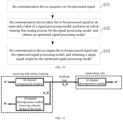
- a signal processing method comprises acquiring a to-be-processed signal; taking the to-be-processed signal as an input and a label of a signal processing model, performing an online training fine-tuning process for the signal processing model, and obtaining an optimized signal processing model; and inputting the to-be-processed signal into the optimized signal processing model, and obtaining a target signal output by the optimized signal processing model.
- a communication device comprises a memory, storing executable program codes; and a processor, coupled to the memory; wherein the processor is configured to: acquire a to-be-processed signal; take the to-be-processed signal as an input and a label of a signal processing model, perform an online training fine-tuning process for the signal processing model, and obtain an optimized signal processing model; and input the to-be-processed signal into the optimized signal processing model, and obtain a target signal output by the optimized signal processing model.
- a communication device configured to comprises an acquisition module, configured to acquire a to-be-processed signal; a training module, configured to take the to-be-processed signal as an input and a label of a signal processing model, perform an online training fine-tuning process for the signal processing model, and obtain an optimized signal processing model; and a processing module, configured to input the to-be-processed signal into the optimized signal processing model, and obtaining a target signal output by the optimized signal processing model.
- a communication system comprises a receiver; and a transmitter; wherein the receiver is configured to implement the method according to the first aspect and/or the transmitter is configured to implement the method according to the first aspect.
- a computer-readable storage medium comprises computer instructions, wherein when the computer instructions are run on a computer, the computer is caused to perform the method as the implementation manner of the first aspect.
- a computer program product in a sixth aspect, includes computer instructions, wherein when the computer program product is run on a computer, the computer is caused to perform the method as the implementation manner of the first aspect.
- a chip is provided and coupled to a memory in a terminal device to cause the chip to call program instructions stored in the memory during running, enabling the terminal device to perform the method as the implementation manner of the first aspect.
- Embodiments of the present disclosure provide a signal processing method.
- the communication device may acquire a to-be-processed signal; the to-be-processed signal is taken as an input and a label of a signal processing model, an online training fine-tuning process is performed for the signal processing model to acquire an optimized signal processing model; and the to-be-processed signal is input into the optimized signal processing model to obtain a target signal output by the optimized signal processing model.
- the communication device may firstly perform the online training fine-tuning process for the signal processing model through the to-be-processed signal, and inputs the to-be-processed signal into the optimized signal processing model to be processed after obtaining the optimized signal processing model through the fine-tuning to obtain more accurate target signal.
- the signal processing model since the signal processing model may be fine tuned in real time, a fine-tuned signal processing model is appliable to any communication scenario.
- this signal processing method may be performed in any communication scenario.
- exemplary or “for example” or the like, are used to indicate an example, instance or illustration. Any embodiment or design solution described with “exemplary” or “for example” in the embodiments of the present disclosure should not be construed to be more preferrable or have more advantage than other embodiments or design solutions. Rather, the terms “exemplary” or “for example” are intended to present relevant concepts in a specific manner.
- a and/or B may indicate: A exists alone, both A and B exist, and B exists alone.
- the symbol "/” indicates that the associated objects have an "or” relationship, e.g., A/B indicates A or B.
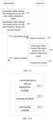
- FIG. 1 shows a basic operating flow of the wireless communication system.
- a primary flow includes the following.
- a transmitter i.e., a transmitting side device performs a channel coding process and a modulation process for a source bitstream to obtain a modulation symbol. Then, a pilot frequency symbol may be inserted into an obtained modulation symbol for a channel estimation and a symbol detection at a receiving side. Finally, a transmitting signal is formed and reaches the receiving side through a channel.
- the receiver i.e., a receiving side device receives the signal and performs the channel estimation through the pilot frequency, and then feeds channel information back to the transmitter through a feedback link for the transmitter to adjust a channel coding manner, a modulation manner, and a precoding manner, etc. Finally, the receiver obtains a final recovery bitstream through a process such as the symbol detection, a demodulation process, and a channel decoding process, etc.
- the channel information involved in the embodiments of the present disclosure may be Channel-State Information (CSI).
- FIG. 1 is a simple schematic view of the basic operating flow of the wireless communication system.
- a traditional communication system may include other unlisted modules and operating flows.
- the traditional communication system may include function modules such as resource mapping, precoding, interference cancellation, CSI measurement, etc. These modules may be separately designed and implemented, and these independent modules may form a complete wireless communication system after being integrated.
- an estimation and a recovery of the receiver for a wireless channel directly affects a data recovery performance of the final recovery bitstream.
- a current channel estimation and recovery process in the communication system are as shown in FIG. 2 .
- the transmitter in addition to information data symbols (i.e., data symbols as shown in FIG. 2 ), the transmitter also transmits a series of particular pilot frequency symbols known to the receiver (i.e., reference signal symbols shown in FIG. 2 ) on a time-frequency resource, such as a Channel-State Information Reference Signal (CSI-RS), a Demodulation Reference Signal (DMRS), etc.
- CSI-RS Channel-State Information Reference Signal
- DMRS Demodulation Reference Signal
- the receiver may estimate the channel information on a position of a reference signal based on a true pilot frequency and a received pilot frequency through a least square method (also referred to be a LS method).
- a least square method also referred to be a LS method
- the receiver recovers the channel information on a full time-frequency resource based on the channel information estimated at a pilot frequency position through an interpolation algorithm, for a subsequent channel information feedback or data recovery, etc.
- a codebook-based scheme is primarily employed to achieve an extraction and feedback of a channel feature. That is, after the transmitting side performs the channel estimation, a precoding matrix matching a current channel is selected from a preconfigured precoding codebook based on a result of the channel estimation in accordance with an optimized criterion, an index information Precoding Matrix Indicator (PMI) is fed back to a receiving side through the feedback link of a radio for the receiving side to achieve precoding, and a Channel Quality Indication (CQI) obtained through measurement back to the receiving side for the receiving side to achieve adaptive modulation coding, or the like.
- PMI Precoding Matrix Indicator
- CQI Channel Quality Indication
- NN neural networks
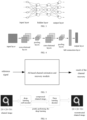
- a basic structure of a neural network includes an input layer, a hidden layer, and an output layer.
- the input layer is configured to receive data
- the hidden layer is configured to process the data
- a final result is generated in the output layer.
- Each node herein represents a processing unit, which may be considered as a simulation of a neuron. Multiple neurons form a layer of neural networks, and multiple layers of information transferring and processing construct a whole neural network.
- a neural-network deep learning algorithm has been proposed in the recent years. More hidden layers are introduced, a neural network having multiple hidden layers is trained layer by layer to perform a feature learning process, which significantly improves a learning and processing capabilities of the neural network and is widely applied in an aspect such as mode distinguishing, signal processing, optimizing combinations, anomaly detection, or the like.
- FIG. 4 is a schematic view of a convolutional neural network.
- a basic structure of the convolutional neural network includes an input layer, multiple convolutional layers, multiple pooling layers, a full connection layer, and an output layer.
- the introduction of the convolutional layers and the pooling layers effectively controls a drastic increase of network parameters, restricts the number of parameters and taps into characteristics of local structures, and improves robustness of the algorithm.
- FIG. 5 is a schematic view of the channel estimation process of the neural network.
- the reference signal is input into an AI-based channel estimation and recovery module and information is output.
- Output information is a result of the channel estimation and recovery (i.e., a channel recovery result in FIG. 5 ).
- input information of the AI-based channel estimation and recovery module may be other assistance information in addition to the reference signal, so as to improve a performance of the AI-based channel estimation and recovery module.
- these other assistance information may be feature extraction information, energy level information, delay feature information, noise feature information, etc., for the reference signal.
- a neural network architecture commonly used in the deep learning is nonlinear and data-driven, which may perform a feature extraction process for actual channel matrix data and restore channel matrix information compressed fed back by a User Equipment (UE) side as much as possible at a base station side. In this way, the channel information is ensured to be restored, while a possibility is provided to reduce a CSI feedback overhead at the UE side.
- UE User Equipment
- FIG. 6 is a schematic view of a channel feedback process of the neural network.
- the channel information is compressed by means of a deep-learning self-encoder and then a compressed channel image is fed back to an opposite side device of a current device, and the compressed channel image is reconstructed in the opposite side device, such that the channel information may be preserved to a larger extent. A reconstructed channel image is obtained.
- FIG. 7 is a schematic view of a channel information feedback system.
- the channel information feedback system is divided into an encoder part and a decoder part.
- the encoder is deployed at the transmitting side (e.g., the receiver shown in FIG. 1 ) and the decoder is deployed at the receiving side (e.g., the transmitter shown in FIG. 1 ).
- the transmitting side obtains the channel information through the channel estimation
- the convolutional layers in the neural network of the encoder are configured to convolve the channel information matrix to obtain a 32 ⁇ 32 coding matrix.
- a N ⁇ 1 coding matrix is obtained through a dimensionality conversion process.
- the N ⁇ 1 coding matrix is then converted into an M ⁇ 1 coding matrix after being further compressed through the full connection layer, M is less than N, and a compression coding process is completed.
- a bitstream after the compression coding process is fed back to the receiving side through the feedback link of the radio.
- the receiving side recovers the channel information through the decoder based on a fed bitstream to obtain complete feedback channel information.
- the received M ⁇ 1 coding matrix may be recovered into a N ⁇ 1 feature map, and the N ⁇ 1 feature map is then converted into a 32 ⁇ 32 feature map coding matrix.
- a convolution process and a summation process are performed for the 32 ⁇ 32 feature map coding matrix, and the convolution process and the summation process are repeated to obtain recovered channel information and output the recovered channel information.
- a number of full connection layers in the encoder may be configured to code, while the decoder employs a residual network structure to decode.
- internal network model structures of the encoder and the decoder may be flexibly designed.
- an AI-based side-to-side transmitter and receiver may solve the above problems of the traditional communication systems to a certain extent.
- side-to-side designs are often purely data-driven. That is, the transmitter and receiver are respectively integrated and black-boxed, which requires a large amount of data and a longer period of time for training and construction. The acquisition of massive datasets and long time for training are more difficult in current wireless communication systems.
- an AI-based modular communication system design considers a data and model dual drive, which may make good use of a priori structure of an original communication system model and flexibly adjust and train for each module.
- independent neural network models are separately designed for the channel estimation, the modulation coding, etc., such that requirements of large data set and long training time are reduced.
- the neural network models themselves have inherent disadvantage of generalization problems in practical applications, which leads to trained neural network models being only applicable to application scenarios having the same characteristics as training sets. Whereas the training sets usually fail to contain all cases, when the scenario characteristics are changed, the trained neural network models are difficult to continue to maintain a good generalization performance.
- the above problem may be solved through an online learning method, which may include the following phases.
- a to-be-processed signal is taken as an input and a label of a signal processing model, and an online training fine-tuning process is performed for the signal processing model and an optimized signal processing model is obtained.
- the signal processing model is a pretrained model.
- the to-be-processed signal is input into the optimized signal processing model and a target signal output by the optimized signal processing model is obtained.
- the target signal obtained in this way may be a more accurate output signal.
- a communication device may acquire the to-be-processed signal, take the to-be-processed signal as the input and the label of the signal processing model, perform the online training fine-tuning process for the signal processing model, and obtain the optimized signal processing model, and input the to-be-processed signal into the optimized signal processing model, and obtain the target signal output by the optimized signal processing model.
- the communication device may firstly perform the online training fine-tuning process for the signal processing model through the to-be-processed signal, and inputs the to-be-processed signal into the optimized signal processing model to be processed after obtaining the optimized signal processing model through the fine-tuning to obtain more accurate target signal.
- the signal processing model since the signal processing model may be fine tuned in real time, a fine-tuned signal processing model is appliable to any communication scenario.
- this signal processing method may be performed in any communication scenario.
- the communication device may be the receiver or the transmitter.
- the receiver may be a terminal device or a network device.
- the transmitter may also be the terminal device or the network device.
- the terminal device may be a STATION (ST) in WLAN, or may be a cellular phone, a cordless phone, a session initiation protocol (SIP) phone, a wireless local loop (WLL) station, a personal digital assistant (PDA), a handheld device with a wireless communication capability, a computing device, or other processing devices connected to a wireless modem, an in-vehicle device, a wearable device, a terminal device in a next generation communication system such a NR network, or a terminal device in a future evolved public land mobile network (PLMN), or the like.
- ST STATION
- WLAN Wireless Local Area Network
- PDA personal digital assistant
- the terminal device may be deployed on land which includes indoor or outdoor, handheld, wearable, or vehicle-mounted cases.
- the terminal device may also be deployed on water (e.g., a ship, etc.), and may also be deployed in the air (e.g., on an aircraft, a balloon, or a satellite, etc.).
- the terminal device may be a Mobile Phone, a Pad, a computer with a wireless transceiving function, a virtual reality (VR) terminal device, an augmented reality (AR) terminal device, a wireless terminal device under an industrial control, a wireless terminal device in self driving, a wireless terminal devices in a remote medical, a wireless terminal device in a smart grid, a wireless terminal devices in transportation safety, and a wireless terminal device in a smart city or a wireless terminal device in a smart home, etc.
- VR virtual reality
- AR augmented reality
- the terminal device may also be the wearable device.
- the wearable device may also be referred to as a wearable smart device, which is a general term of wearable devices obtained by intelligently designing and developing daily wears, such as glasses, gloves, watches, clothing, and shoes, by means of wearable techniques.
- the wearable devices are directly worn on a body or integrated into the clothing or an accessory of the user as a portable device.
- the wearable devices are more than hardware devices, may also achieve powerful functions thereof through software supports, data interactions, and cloud interactions.
- the wearable smart device in a broad sense includes a device having full features, a large size, and capable of achieving entire or partial functions independent of a smartphone, e.g., a smart watch, or smart glasses, etc., and a device only concentrating on a particular category of application function and required to cooperate with other devices such as the smartphone, e.g., various smart bracelets configured to monitor signs, a smart jewelry, or the like.
- the network device may be a device configured to communicate with the terminal device.
- the network device may be an Access Point (AP) in the WLAN, a base transceiver station (BTS) in a GSM or CDMA system, or a NodeB (NB) in a WCDMA system, or an evolutional NodeB (eNB or eNodeB) in the LTE system, or may be a relay station, the access point, the in-vehicle device, the wearable device. and a network device (gNB) in the NR network, or a network device in the future evolved PLMN network, or a network device in a NTN network.
- AP Access Point
- BTS base transceiver station
- NB NodeB
- eNB evolutional NodeB
- the network device may have a mobile characteristic.
- the network device may be a mobile device.
- the network device may be a satellite, a balloon station.
- the satellite may be a Low Earth Orbit (LEO) satellite, a medium earth orbit (MEO) satellite, a geostationary earth orbit (GEO) satellite, a High Elliptical Orbit (HEO) satellite, etc.
- the network device may also be a base station installed on a location such as the land, the water, etc.
- the network device may provide service for a cell.
- the terminal device communicates with the network device through a transmission resource (e.g., a frequency domain resource, or in other words, a spectrum resource) employed by the cell.
- the cell may be a cell corresponding to the network device (such as, the base station).
- the cell may belong to a macro base station or a base station corresponding to a small cell.
- the small cell herein may include a Metro cell, a Micro cell, a Pico cell, a Femto cell, etc. These small cells have characteristics of a small coverage area and a low transmission power, and are suitable to provide a high-speed data transmission service.
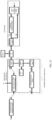
- FIG. 8 is a schematic view of the communication system according to some embodiments of the present disclosure.
- the communication system is an AI-based model and data dual-drive communication system.
- the pilot frequency insertion module may select a traditional pilot frequency insertion scheme or an AI pilot frequency design and insertion module.
- the pilot frequency in a case of selecting the traditional pilot frequency insertion scheme, may be placed on an allocated time-frequency resource based on a pilot frequency sequence and an insertion pattern which are preconfigured by a system, and the data symbols are placed on the rest.
- an input of a neural network model in the AI-based pilot frequency design and insertion module is the channel matrix H" fed back by the feedback link, an output thereof is the pilot frequency sequence and a position code corresponding to each symbol in the sequence.
- the AI-based pilot frequency design and insertion module further inserts the pilot frequency symbols into the allocated time-frequency resource according to the code, and the data symbols are placed on the rest.
- X is all symbols transmitted by the transmitter
- p is a pilot frequency symbol vector
- d is a data symbol vector
- H_p and H_d are channel information corresponding to a position of the pilot frequency and a position of the data symbol, respectively
- W is an additive noise.
- the receiver after receiving the above signal Y, the receiver inputs the pilot frequency signal Y_p into the channel estimation module and outputs estimated channel information H' on a full time-frequency resource. Finally, the receiver inputs the estimated full channel information H' and the received data signal Y_d into an AI-based joint demodulation decoding module. An output of the AI-based joint demodulation decoding module is a final receiving bitstream b'.
- the channel information H' may be encoded and compressed through an AI channel compression module to obtain a bitstream vector b_H.
- the bitstream vector b_H is fed back to the transmitter through the feedback link.
- the transmitter decodes and recovers the channel information through an AI channel decompression module to obtain a recovered channel information H".
- the channel information H" may be configured as the input of the AI pilot frequency design and insertion module.
- the channel information H" may also be configured for online training of an AI-based joint coding modulation module.
- the transmitter transmits a signal to the receiver once in each transmission period, and the receiver may feed the channel information to the transmitter once in each transmission period.
- the transmitter transmits the signal to the receiver once in each transmission period, and the receiver may feed the channel information to the transmitter once in a plurality of transmission periods.
- FIG. 9 is a schematic view of the transmission period and a feedback period in the communication system.
- FIG. 9 is illustrated with an example in which the transmitter feeds back the channel information to the receiver once in every four transmission periods. That is, the feedback period is four times the transmission period.
- a transmission manner of the transmitter transmitting the signal to the receiver may be categorized into an online-learning type transmission and a traditional transmission.
- the one or more signal processing models described above may be any one of: the AI-based joint coding modulation module, the AI pilot frequency design and insertion module, the AI channel decompression module, the AI channel compression module, the AI-based joint demodulation decoding module, and an AI channel estimation module in FIG. 8 .
- whether the transmission and feedback select a learning type or a traditional type may be flexibly configured according to an actual transmission environment, delay requirements, and complexity requirements.
- This scheme may improve overall adaptability of an AI-based communication system to the environment. That is, the higher the configuration proportion of the learning-type transmission or feedback is, the stronger the adaptability of the system is.
- the channel information in the embodiments of the present disclosure includes the channel information.
- the transmitting side in the embodiments of the present disclosure may refer to the transmitter or the receiver, and the receiving side may also refer to the transmitter or the receive.
- an actively transmitting side may be determined as the transmitting side
- a passively receiving side may be determined as the receiving side.
- the transmitter transmits the signal after the pilot frequency insertion to the receiver
- the transmitter is the transmitting side
- the receiver is the receiving side.
- the receiver feeds the channel information back to the transmitter
- the receiver is the transmitting side
- the transmitter is the transmitting side.
- a signal processing method is provided in the embodiments of the present disclosure.
- the method includes operations 101-103.
- the communication device acquires a to-be-processed signal.
- the communication device takes the to-be-processed signal as an input and a label of a signal processing model, performs an online training fine-tuning process for the signal processing model, and obtains an optimized signal processing model.
- the communication device is preconfigured with a channel simulation module and a target processing module.
- the target processing module is configured to simulate an opposite side device of the communication device to restore the to-be-processed signal
- the channel simulation module is configured to simulate a channel environment
- a signal output by the communication device is transmitted to the target processing module through the channel simulation module.
- the channel simulation module may be configured to simulate the channel environment through which the signal transmission between the transmitter and the receiver passes. Normally, a signal attenuation may be generated when the signal transmission passes through the channel environment.
- the channel simulation module in order to restore the signal in the local of the communication device, the channel simulation module is required to simulate the channel environment, such that the signal attenuation generated during the signal output by the communication device being transmitted to the target processing module through the channel simulation module is in accordance with an actual situation. In this way, a restored to-be-processed signal may be closer to an actual transmission situation between the transmitter and the receiver, a restoring level of the to-be-processed signal may be improved, and a more accurate signal may be obtained.
- the channel simulation module may be configured based on historical channel information.
- the historical channel information is the channel information fed back by the feedback link in the n th transmission period prior to a current transmission period, and n is greater than or equal to 1.
- the transmitting side when the transmitting side transmits the signal to the receiving side once in each transmission period, and the receiving side may feed the channel information back to the transmitting side once in each transmission period.
- the channel simulation module may be determined based on the channel information fed back in a previous transmission period.
- the transmitting side when the transmitting side transmits the signal to the receiving side once in each transmission period, and the receiving side may feed the channel information back to the transmitting side once in the plurality of transmission periods.
- the channel simulation module may be channel information fed back by the feedback link in the n th transmission period prior to the current transmission period, and n is greater than or equal to 1.
- the above signal processing model includes at least one of the following:
- the receiver model indicates an AI neural network model which may achieve all functions of the receiver.
- the receiver model may achieve a function of the receiver, such as the signal demodulation, the signal decoding, the channel estimation, the channel compression, etc.
- involved models may refer to neural network models implemented based on the AI.
- to-be-processed signals may also be different.
- signal processing models and the to-be-processed signals may include the following cases.
- the signal processing model is the channel compression model
- the to-be-processed signal is the channel information obtained by the channel estimation, i.e., first channel information in the embodiments of the present disclosure.
- the signal processing model is the joint coding modulation model, and the to-be-processed signal is the source bitstream.
- Case 3 The signal processing model is a pilot frequency design and insertion model, and the to-be-processed signal is the historical channel information fed back by the feedback link.
- the communication device inputs the to-be-processed signal into the optimized signal processing model, and obtaining a target signal output by the optimized signal processing model.
- the communication device may acquire the to-be-processed signal, take the to-be-processed signal as the input and the label of the signal processing model, perform the online training fine-tuning process for the signal processing model, and obtain the optimized signal processing model, and input the to-be-processed signal into the optimized signal processing model, and obtain the target signal output by the optimized signal processing model.
- the communication device may firstly perform the online training fine-tuning process for the signal processing model through the to-be-processed signal, and inputs the to-be-processed signal into the optimized signal processing model to be processed after obtaining the optimized signal processing model through the fine-tuning to obtain more accurate target signal.
- the signal processing model since the signal processing model may be fine tuned in real time, a fine-tuned signal processing model is appliable to any communication scenario.
- this signal processing method may be performed in any communication scenario.
- the operation 102 in which the to-be-processed signal is taken as the input and the label of the signal processing model, and the online training fine-tuning process is performed for the signal processing model and the optimized signal processing model is obtained may include in response to a first parameter satisfying a preset condition, taking the to-be-processed signal as the input and the label of the signal processing model, performing the online training fine-tuning process for the signal processing model, and obtaining the optimized signal processing model.
- the first parameter includes at least one of a channel parameter variation value, a delay requirement of the communication device, and a computational complexity requirement of the communication device.
- the first parameter satisfying the preset condition may include the first parameter satisfying at least one condition of: the channel parameter variation value detected by the communication device being greater than a preset variation value, a required delay of the communication device being greater than a preset delay and the computational complexity requirement of the communication device
- the channel parameter variation value described above may include at least one of: an average path loss, a large-scale fading value, a small-scale fading value, and a signal-to-noise ratio variation value.
- the communication device may detect the channel parameter variation value.
- the communication device in response to the channel parameter variation value being greater than the preset variation value, may take the to-be-processed signal as the input and the label of the signal processing model, and perform the online training fine-tuning process for the signal processing model and obtain the optimized signal processing model.
- the higher the delay requirement of the communication device i.e., the shorter the required delay
- the to-be-processed signal when the required delay of the communication device is greater than the preset delay, the to-be-processed signal may be taken as the input and the label of the signal processing model, the online training fine-tuning process is performed for the signal processing model to obtain the optimized signal processing model.
- the to-be-processed signal may be taken as the input and the label of the signal processing model, the online training fine-tuning process is performed for the signal processing model to obtain the optimized signal processing model.
- whether the transmission and feedback select the learning type or the traditional type may be flexibly configured according to the actual transmission environment, the delay requirements, and the complexity requirements, etc.
- This scheme may improve overall adaptability of the AI-based communication system to the environment. That is, the higher the configuration proportion of the learning-type transmission or feedback is, the stronger the adaptability of the system is.
- the specific number of operations of online learning in an online learning process may also be flexibly configured according to the actual transmission environment, the delay requirements, and the complexity requirements, etc., which are not limited herein.
- the signal processing model is the channel compression model
- the to-be-processed signal is the channel information obtained by the channel estimation, i.e., the first channel information in the embodiments of the present disclosure
- the communication device may be the receiver.
- the first channel information is taken as the input and the label of the channel compression model, the online training fine-tuning process is performed for the channel compression model and an optimized channel compression model is obtained.
- the first channel information is input into the optimized channel compression model, and a channel compression coding process is performed through the optimized channel compression model, and second channel information output by the optimized signal processing model is acquired.
- the channel information described above may be also referred to as the channel information, or, the channel information.
- the channel information described above may be the CSI.
- the method further includes transmitting the second channel information to the transmitter.
- the target processing module configured to simulate the channel decompression model in the transmitter is preconfigured in the communication device. In some embodiments, the target processing module has the same structure and parameter with the channel decompression model in the transmitter.
- FIG. 11 is an implementation schematic view of performing the online training fine-tuning process for a channel feedback model.
- the local of the receiving side may pre-store the AI channel decompression module having the same structure and parameter with the transmitting side for the online learning at the receiving side before the channel feedback.
- the channel H' is taken as online training data to perform the online training fine-tuning process for the AI channel compression module (i.e., the channel compression model in the case 1 of the present disclosure).
- the input of the AI channel compression module of the receiving side is the channel H', and the output bitstream b_H is fed to the AI channel decompression module pre-stored in the local.
- the channel H' is taken as an output label, and a side-to-side model is constructed.
- a side-to-side online optimizing training having few training steps may be performed for the above model.
- a channel compression process may be performed through the updated optimized model.
- the result is fed back to the transmitting side through a real feedback link for the transmitting side to perform a channel decompression process and obtain the decompressed feedback channel H".
- weight parameters of the AI channel decompression module pre-stored in the local are required to be frozen during the side-to-side model training. That is, only weight parameters of the AI channel compression module are updated in the process of training.
- this signal processing method may be performed in any communication scenario.
- the signal processing model is the joint coding modulation model
- the to-be-processed signal is the source bitstream.
- the communication device may be the transmitter.
- the source bitstream is taken as the input and the label of the joint coding modulation model, and the online training fine-tuning process is performed for the joint coding modulation model, and the optimized joint coding modulation model is obtained.
- the source bitstream is input into the optimized joint coding modulation model.
- the channel coding process and a signal modulation process are performed for the source bitstream through the optimized joint coding modulation model, and a modulation signal output by the optimized joint coding modulation model is acquired.
- the source bitstream is taken as the input and the label of the joint coding modulation model, and the online training fine-tuning process is performed for the joint coding modulation model, and the optimized joint coding modulation model is obtained.
- the source bitstream is then input into the optimized joint coding modulation model.
- the channel coding process and a signal modulation process are performed for the source bitstream through the optimized joint coding modulation model, and the modulation signal output by the optimized joint coding modulation model is acquired.
- both the modulation signal and the historical channel information are input into the pilot frequency design and insertion model, the historical channel information is taken as a label of the pilot frequency design and insertion model, and the online training fine-tuning process is performed for the signal processing model and an optimized pilot frequency design and insertion model is obtained. Further, both the modulation signal and the historical channel information are input into the optimized pilot frequency design and insertion model. A pilot frequency design and insertion process are performed for a coding modulated bitstream through the optimized pilot frequency design and insertion model, and pilot frequency information output by the optimized pilot frequency design and insertion model is acquired.
- the pilot frequency information includes a pilot frequency sequence and a position code corresponding to each symbol of the pilot frequency sequence.
- the target processing module is preconfigured in the communication device, and the target processing module is configured to simulate the receiver corresponding to the transmitter.
- the target processing module has the same structure and parameter as the receiver. That is, each model and parameter of a target processing link are the same with those of an entire transmission link.
- a transmitting signal may be obtained after the pilot frequency design and insertion process is performed for the modulation signal. The transmitting signal is transmitted to the receiver.
- FIG. 12 is an implementation schematic view of performing the online training fine-tuning process for an AI-based joint coding modulation module (i.e., the joint coding modulation model in the Case 2 of this embodiment).
- the local of the transmitting side may pre-store the receiver having the same structure and parameter as the receiving side for the transmitting side online learning before transmitting the signal. Equivalently, an entire transmission link is constructed at the local of the transmitting side, which may be considered as a side-to-side network model.
- An estimated radio channel is the channel information H" obtained in a previous channel feedback.
- a to-be-transmitted bitstream b is taken as an input and a label of the entire side-to-side model, and the side-to-side online optimizing training having few training steps may be performed for the above model.
- the to-be-transmitted bitstream may be modulated through an updated AI-based joint coding modulation module, and the signal is processed and transmitted through a subsequent corresponding transmitter module.
- a subsequent corresponding processing flow for a receiving signal is performed at the receiving side, and finally a receiving bitstream b' is obtained. Since an adaptive online training process is performed at the transmitting side, an accuracy of the receiving side recovering the receiving bitstream b' may be improved.
- weight parameters of other neural network models other than the AI-based coding modulation model are required to be frozen during the side-to-side model training. That is, only weight parameters of an AI-based coding modulation neural network model are updated in the process of training.
- this signal processing method may be performed in any communication scenario.
- the signal processing model is the pilot frequency design and insertion model
- the to-be-processed signal is the historical channel information fed back by the feedback link.
- the communication device in this case 3 may be the transmitter.
- the modulation symbol and the historical channel information are input into the pilot frequency design and insertion model, and the historical channel information is taken as the label of the pilot frequency design and insertion model.
- the online training fine-tuning process is performed for the pilot frequency design and insertion model to obtain the optimized pilot frequency design and insertion model.
- the modulation signal and the historical channel information are input into the optimized pilot frequency design and insertion model.
- the pilot frequency design and insertion process is performed for the coding modulated bitstream through the optimized pilot frequency design and insertion model, and the pilot frequency information output by the optimized pilot frequency design and insertion model is acquired.
- the pilot frequency information includes the pilot frequency sequence and the position code corresponding to each symbol of the pilot frequency sequence.
- the historical channel information is the channel information fed back by the feedback link in the n th transmission period prior to the current transmission period, and n is greater than or equal to 1.
- the communication device is preconfigured with the target processing module.
- the target processing module is configured to simulate a transmission module of the receiver from pilot frequency insertion to the channel estimation.
- the target processing module has the same structure and parameter with the transmission module of the receiver from the pilot frequency insertion to the channel estimation. That is, each model of the target processing module and the transmission module of the receiver from the pilot frequency insertion to the channel estimation has the same structure and parameter.
- FIG. 13 is an implementation schematic view of performing the online training fine-tuning process for the AI pilot frequency design and insertion model (i.e., the pilot frequency design and insertion model in the case 3 of the present disclosure).
- the local of the transmitting side may pre-store the receiver having the same structure and parameter with the receiving side for the transmitting side to perform the online learning before transmitting the signal. It is equivalent that a transmission link from the pilot insertion to the channel estimation is constructed at the local of the transmitting side, which may be considered as the side-to-side network model.
- the estimated radio channel is the channel information H" obtained in the previous channel feedback.
- the channel information H" is taken as the input of the entire side-to-side model, i.e., as the input of the AI pilot frequency design and insertion module.
- the channel information H" is also taken as an output label of the channel estimation in a local simulated link, and the side-to-side online optimizing training having few training steps may be performed for the above model.
- the to-be-transmitted bitstream may be modulated through an updated pilot frequency design and insertion model, and the signal is processed and transmitted through the subsequent corresponding transmitter module.
- the subsequent corresponding processing flow for the receiving signal is performed at the receiving side. Since the adaptive online training process is performed at the transmitting side performs, an accuracy of the channel estimation of the receiving side may be improved, and an accuracy of a receiving bitstream b' ultimately obtained may be further improved.
- the weight parameters of other neural network models other than the AI pilot frequency design and insertion model are required to be frozen during the side-to-side model training. That is, only weight parameters of the AI pilot frequency design and insertion model are updated in the process of training.
- this signal processing method may be performed in any communication scenario.
- At least one of the channel compression model, a joint coding modulation model, and a pilot frequency design and insertion model may be fine tuned in a manner of online learning, which may include the following embodiments.
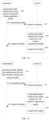
- FIG. 14 is a schematic view of the mode with the traditional transmission + the online-learning type channel feedback.
- An implementation flow under this mode includes steps 141-145.
- the transmitter first transmits signals to the receiving side, and the signals is the pilot frequency signal and the data signal.
- the receiver receives the signals for the channel estimation and obtains estimated channel information.
- a step 143 the receiver performs the online training fine-tuning process with a smaller training step for the channel compression model through the estimated channel information and completes the online learning process.
- the receiver performs the channel compression coding process through an online learning fine-tuned channel compression model.
- the receiver transmits the compression coded channel information to the transmitter through the feedback link (i.e., the channel feedback).
- the online-learning type channel feedback may refer to online-learning fine tuning of the channel compression model.
- an online-learning type transmission may include online-learning fine tuning of the joint coding modulation model, online-learning fine tuning of the pilot frequency design and insertion module, and online-learning fine tuning of the joint coding modulation model and the pilot frequency design and insertion module jointly, which will be elaborated in the following description.
- an online learning fine-tuning process is performed for the channel compression model, while both the joint coding modulation module and the pilot frequency design and insertion model still adopt an existing signal transmission manner rather than are performed the online learning fine-tuning process.
- a mode with a joint coding modulation model online-learning type transmission + a traditional channel feedback in another embodiment, a mode with a joint coding modulation model online-learning type transmission + a traditional channel feedback.
- FIG. 15 is a schematic view of a mode with a joint coding modulation model online-learning type transmission + a traditional type channel feedback.
- An implementation flow under this mode includes steps 151-155.
- the transmitter firstly performs a targeted online training fine-tuning process for the joint coding modulation model through the to-be-transmitted source bitstream.
- a step 152 after the joint coding modulation model is fine tuned, the transmitter processes the signal and transmits the signal.
- the receiver performs the channel estimation through the channel estimation model.
- the receiver performs the compression coding process for the estimated channel information through a compression coding model.
- the receiver feeds the compression coded channel information back to the transmitter.
- the online learning fine-tuning process is performed for the joint coding modulation model, while the channel compression model adopts an existing feedback manner, the pilot frequency design and insertion model adopts the existing signal transmission manner, instead of being performed the online learning fine-tuning processes.
- FIG. 16 is a schematic view of the mode with the pilot frequency design and insertion model online-learning type transmission + the traditional type channel feedback.
- An implementation flow under this mode includes steps 161-165.
- the transmitter performs the targeted online training fine-tuning process for the pilot frequency design and insertion model through the channel information obtained in the previous channel feedback.
- a step 162 after the transmitter performs the targeted online training fine-tuning process for the pilot frequency design and insertion model, the transmitter processes the signal and transmits the signal.
- the receiver performs the channel estimation through the channel estimation model.
- the receiver performs the compression coding process for the estimated channel information through the compression coding model.
- a step 165 the receiver feeds the compression coded channel information back to the transmitter.
- the online learning fine-tuning process is performed for the pilot frequency design and insertion model, while the channel compression model adopts the existing feedback manner and the joint coding modulation model adopts the existing signal transmission manner rather than is performed the online learning fine-tuning process.
- FIG. 17 is a schematic view of the mode with the joint coding modulation model and the pilot frequency design and insertion model joint online learning + the traditional type channel feedback.
- An implementation flow of this mode includes steps 171-176.
- the transmitter first performs the targeted online training fine-tuning process for the joint coding modulation model with the to-be-transmitted source bitstream.
- the transmitter performs the targeted online training fine-tuning process for the pilot frequency design and insertion model with the channel information obtained from previous feedback.
- a step 173 after the transmitter fine tunes a coding modulation model and the pilot frequency design and insertion model, the transmitter processes the signal and transmits the signal.
- the receiver performs the channel estimation through the channel estimation model.
- the receiver performs the compression coding process for the estimated channel information through the compression coding model.
- the receiver feeds the compression coded channel information back to the transmitter.
- the online learning fine-tuning processes are performed for the joint coding modulation model and the pilot frequency design and insertion model, respectively, while the channel compression model adopts the existing feedback manner rather than is performed the online learning fine-tuning process.
- FIG. 18 is a schematic view of the mode with the joint coding modulation model online learning + the learning type channel feedback. An implementation flow under this mode includes steps 181-186.
- the transmitter first performs the targeted online training fine-tuning process for the joint coding modulation model with the to-be-transmitted bitstream.
- a step 182 after the transmitter fine tunes the joint coding modulation model, the transmitter processes the signal and transmits the signal.
- the receiver performs the channel estimation through the channel estimation model.
- a step 184 the receiver performs online training fine-tuning process with the smaller training step for the channel compression model with the estimated channel information.
- the receiver performs the channel compression coding process with a fine-tuned channel compression coding model.
- a step 186 the receiver feeds the compression coded channel information back to the transmitter through the feedback link.
- the online learning fine-tuning process is performed for the joint coding modulation model and the online learning fine-tuning process is also performed for the channel compression model, and the learning type channel feedback is employed.
- the online learning fine-tuning process is not performed for the pilot frequency design and insertion model.
- FIG. 19 is a schematic view of a mode with the pilot frequency design and insertion model online learning + the learning type channel feedback. An implementation flow under this mode includes steps 191-196.
- the transmitter performs the online training fine-tuning process for the pilot frequency design and insertion model with the channel information obtained from the previous channel feedback.
- a step 192 after the transmitter fine tunes the pilot frequency design and insertion model, the transmitter processes the signal and transmits the signal.
- the receiver performs the channel estimation through the channel estimation model and obtains the estimated channel information.
- the receiver performs the online training fine-tuning process with the smaller training step for the channel compression model with the estimated channel information this time and completes the online learning process.
- the receiver performs the compression coding process for the estimated channel information through the fine-tuned channel compression coding model.
- a step 196 The receiver feeds the compression coded channel information back to the transmitter through the feedback link.
- the online learning fine-tuning process is performed for the pilot frequency design and insertion model and the online learning fine-tuning process is also performed for the channel compression model, respectively, and the learning type channel feedback is employed.
- the online learning fine-tuning process is not performed for the joint coding modulation model.
- FIG. 20 is a schematic view of the mode with the joint coding modulation model and the pilot frequency design and insertion model joint online learning type + the learning type channel feedback.
- An implementation flow under this mode includes steps 201-207.
- the transmitter performs the online training fine-tuning process for the joint coding modulation model with the to-be-transmitted source bitstream.
- the transmitter performs the online training fine-tuning process for the pilot frequency design and insertion model with the channel information obtained from the previous feedback.
- the transmitter processes the signal and transmits the signal through a fine-tuned pilot frequency design and insertion model.
- the receiver performs the channel estimation through the channel estimation model and obtains the estimated channel information.
- a step 205 the receiver performs the online training fine-tuning process with the smaller training step for the channel compression model with the estimated channel information and completes the online learning process.
- the receiver performs the channel compression coding process for the estimated channel information through the fine-tuned channel compression coding model.
- a step 207 the receiver feeds the compression coded channel information back to the transmitter through the feedback link.
- the online learning fine-tuning processes are performed for both the joint coding modulation model and the pilot frequency design and insertion model, respectively, and an online-learning type signal processing manner is employed.
- the online learning fine-tuning process is performed for the channel compression model, and the learning type channel feedback manner is employed.
- the joint coding modulation model, the pilot frequency design and insertion model, the channel estimation model, and the channel compression model may all employ the online learning manner.
- a specific flow may include that the transmitter performs the online training fine-tuning process for the joint coding modulation model with the to-be-transmitted source bitstream, and performs the online training fine-tuning process for the pilot frequency design and insertion model with the channel information obtained from the previous feedback; the transmitter processes the signal and transmits the signal through the fine-tuned joint coding modulation model and the fine-tuned pilot frequency design and insertion model; the receiver performs the online training fine-tuning process for the channel estimation model, and performs the channel estimation through the fine-tuned channel estimation model and obtains the estimated channel information; the receiver performs the online training fine-tuning process with the smaller training step for the channel compression model with the estimated channel information and completes the online learning process; the receiver performs the channel compression coding process for the estimated channel information through the fine-tuned channel compression
- the joint coding modulation model may be divided into a coding model and a modulation model to be performed the online training fine-tuning processes, respectively.
- Both the pilot frequency design and insertion model and the channel compression model employ the online learning manner.
- a specific flow may include that the transmitter performs the online training fine-tuning process for a coding module with the to-be-transmitted source bitstream, and inputs the source bitstream into a fine-tuned coding module and obtains a coded signal; the transmitter performs the online training fine-tuning process for the modulation model with the coded signal and obtains a fine-tuned modulation model, and performs the online training fine-tuning process for the pilot frequency design and insertion model with the channel information obtained from the previous feedback; the transmitter processes the signal and transmits the signal through the fine-tuned coding model, the fine-tuned modulation model, and the fine-tuned pilot frequency design and insertion model; the receiver performs the channel estimation through the channel estimation model and obtains the estimated channel information; the receiver performs the online training fine-tuning process with the smaller training step for the channel compression model with the estimated channel information and completes the online training process; the receiver performs the channel compression coding process for the estimated channel information through the fine-t
- a part of or all neural network models of various models i.e., the joint coding modulation model, the coding model, the modulation model, the pilot frequency design and insertion model, the pilot frequency design model, the pilot frequency insertion model, the channel decompression model, the channel compression model, the channel estimation model, the demodulation decoding model, the demodulation model, the decoding model, the transmitter model, and the receiver model
- the joint coding modulation model, the coding model, the modulation model, the pilot frequency design and insertion model, the pilot frequency design model, the pilot frequency insertion model, the channel decompression model, the channel compression model, the channel estimation model, the demodulation decoding model, the demodulation model, the decoding model, the transmitter model, and the receiver model may be selected according to actual delay requirements, computational complexity requirements, and communication scenarios to perform the online learning process, such that a signal transmission manner may be more flexible, and a more flexible and adjustable communication system may be provided.
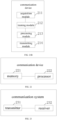
- the communication device includes an acquisition module 211, a training module 212, and a processing module 213.
- the acquisition module 211 is configured to acquire a to-be-processed signal.
- the training module 212 is configured to take the to-be-processed signal as an input and a label of a signal processing model, perform an online training fine-tuning process for the signal processing model, and obtain an optimized signal processing model.
- the processing module 213 is configured to input the to-be-processed signal into the optimized signal processing model, and obtaining a target signal output by the optimized signal processing model.
- the communication device is preconfigured with a channel simulation module and a target processing module, the target processing module is configured to simulate an opposite side device of the communication device to restore the to-be-processed signal, the channel simulation module is configured to simulate a channel environment, and a signal output by the communication device being transmitted to the target processing module through the channel simulation module.
- the signal processing model includes at least one of a joint coding modulation model; a coding model; a modulation model; a pilot frequency design and insertion model; a pilot frequency design model; a pilot frequency insertion model; a channel decompression model; a channel compression model; a channel estimation model; a demodulation decoding model; a demodulation model; a decoding model; a transmitter model; and a receiver model.
- the training module 212 is configured to, in response to a first parameter satisfying a preset condition, take the to-be-processed signal as the input and the label of the signal processing model, perform the online training fine-tuning process for the signal processing model, and obtain the optimized signal processing model.
- the first parameter includes at least one of a channel parameter variation value, a delay requirement of the communication device, and a computational complexity requirement of the communication device.
- the communication device is a receiver
- the signal processing model is a channel compression model
- the to-be-processed signal is first channel information obtained through channel estimation.
- the training module 212 is configured to take the first channel information as the input and the label of the channel compression model, perform the online training fine-tuning process for the channel compression model, and obtain an optimized channel compression model.
- the processing module 213 is configured to input the first channel information into the optimized channel compression model, and perform a channel compression coding process through the optimized channel compression model, and acquire second channel information output by the optimized signal processing model.
- the communication device may further include a transmitting module 214.
- the transmitting module is configured to transmit the second channel information to a transmitter after the processing module 213 acquires compression coded channel information output by the optimized signal processing model.
- the target processing module is configured to simulate a channel decompression model in the transmitter.
- the target processing module has the same structure and parameter with the channel decompression model in the transmitter.
- the communication device is the transmitter, the signal processing model is a joint coding modulation model, and the to-be-processed signal is a source bitstream.
- the processing module 213 is configured to take the source bitstream as the input and the label of the joint coding modulation model, perform the online training fine-tuning process for the j oint coding modulation model, and obtain an optimized j oint coding modulation model
- the target processing module is configured to simulate the receiver corresponding to the transmitter.
- the target processing module has the same structure and parameter as the receiver.
- the processing module 213 is configured to input the source bitstream into the optimized joint coding modulation model; perform a channel coding process and a signal modulation process for the source bitstream through the optimized joint coding modulation model; and acquire a modulation signal output by the optimized joint coding modulation model.
- the training model 212 is further configured to, after the source bitstream is taken as the input and the label of the joint coding modulation model, and the online training fine-tuning process is performed for the joint coding modulation model and the optimized joint coding modulation model is obtained, input a modulation signal and historical channel information into a pilot frequency design and insertion model, take the historical channel information as a label of the pilot frequency design and insertion model, and perform the online training fine-tuning process for the signal processing model and obtain an optimized pilot frequency design and insertion model.
- the communication device may further include the transmitting module 214.
- the processing module 213 is further configured to obtain a transmitting signal after a pilot frequency design and insertion process is performed for the modulation signal.
- the transmitting module 214 is configured to transmit the transmitting signal to the receiver.
- the communication device is the transmitter
- the signal processing model is the pilot frequency design and insertion model
- the to-be-processed signal is historical channel information fed back by a feedback link.
- the training module 212 is configured to input the modulation signal and the historical channel information into the pilot frequency design and insertion model, take the historical channel information as the label of the pilot frequency design and insertion model, perform the online training fine-tuning process for the pilot frequency design and insertion model and obtain the optimized pilot frequency design and insertion model.
- the historical channel information is the channel information fed back by the feedback link in the n th transmission period prior to a current transmission period, and n is greater than or equal to 1.
- the target processing module is configured to simulate a transmission module of a receiver from pilot frequency insertion to channel estimation.
- the target processing module has the same structure and parameter with the transmission module of the receiver from the pilot frequency insertion to the channel estimation.
- the processing module 213 is configured to input the modulation signal and the historical channel information into the optimized pilot frequency design and insertion model; perform a pilot frequency design and insertion process for a coding modulated bitstream through the optimized pilot frequency design and insertion model; and acquire pilot frequency information output by the optimized pilot frequency design and insertion model.
- the pilot frequency information includes a pilot frequency sequence and a position code corresponding to each symbol of the pilot frequency sequence.
- a communication device is provided.
- the communication device includes a memory 221 and a processor 222 coupled to the memory.
- the memory 221 stores executable program codes 221.
- the processor 222 is configured to acquire a to-be-processed signal; take the to-be-processed signal as an input and a label of a signal processing model, perform an online training fine-tuning process for the signal processing model, and obtain an optimized signal processing model; and input the to-be-processed signal into the optimized signal processing model, and obtain a target signal output by the optimized signal processing model.
- the communication device is preconfigured with a channel simulation module and a target processing module, the target processing module is configured to simulate an opposite side device of the communication device to restore the to-be-processed signal, the channel simulation module is configured to simulate a channel environment, and a signal output by the communication device is transmitted to the target processing module through the channel simulation module.
- the signal processing model includes at least one of a joint coding modulation model; a coding model; a modulation model; a pilot frequency design and insertion model; a pilot frequency design model; a pilot frequency insertion model; a channel decompression model; a channel compression model; a channel estimation model; a demodulation decoding model; a demodulation model; a decoding model; a transmitter model; and a receiver model.
- the processor 222 is configured to, in response to a first parameter satisfying a preset condition, take the to-be-processed signal as the input and the label of the signal processing model, perform the online training fine-tuning process for the signal processing model, and obtain the optimized signal processing model.
- the first parameter includes at least one of a channel parameter variation value, a delay requirement of the communication device, and a computational complexity requirement of the communication device.
- the communication device is a receiver
- the signal processing model is a channel compression model
- the to-be-processed signal is first channel information obtained through channel estimation.
- the processor 222 is configured to take the first channel information as the input and the label of the channel compression model, perform the online training fine-tuning process for the channel compression model, and obtain an optimized channel compression model.
- the processor 222 is configured to input the first channel information into the optimized channel compression model, and perform a channel compression coding process through the optimized channel compression model, and acquire second channel information output by the optimized signal processing model.
- the processor 222 is configured to transmit the second channel information to a transmitter after acquiring compression coded channel information output by the optimized signal processing model.
- the target processing module is configured to simulate a channel decompression model in a transmitter.
- the target processing module has the same structure and parameter with the channel decompression model in the transmitter.
- the communication device is a transmitter
- the signal processing model is a joint coding modulation model
- the to-be-processed signal is a source bitstream.
- the processor 222 is configured to take the source bitstream as the input and the label of the joint coding modulation model, perform the online training fine-tuning process for the joint coding modulation model, and obtain an optimized joint coding modulation model.
- the target processing module is configured to simulate a receiver corresponding to the transmitter.
- the target processing module has the same structure and parameter as the receiver.
- the processor 222 is configured to input the source bitstream into the optimized joint coding modulation model; perform a channel coding process and a signal modulation process for the source bitstream through the optimized joint coding modulation model; and acquire a modulation signal output by the optimized joint coding modulation model.
- the processor 222 is further configured to input a modulation signal and historical channel information into a pilot frequency design and insertion model, take the historical channel information as a label of the pilot frequency design and insertion model, and perform the online training fine-tuning process for the signal processing model and obtain an optimized pilot frequency design and insertion model.
- the processor 222 is configured to obtain a transmitting signal after a pilot frequency design and insertion process is performed for the modulation signal, and transmit the transmitting signal to a receiver.
- the communication device is a transmitter
- the signal processing model is a pilot frequency design and insertion model
- the to-be-processed signal is historical channel information fed back by a feedback link.
- the processor 222 is configured to input a modulation signal and the historical channel information into the pilot frequency design and insertion model, take the historical channel information as the label of the pilot frequency design and insertion model, perform the online training fine-tuning process for the pilot frequency design and insertion model and obtain an optimized pilot frequency design and insertion model.
- the historical channel information is the channel information fed back by the feedback link in the n th transmission period prior to a current transmission period, and n is greater than or equal to 1.
- the target processing module is configured to simulate a transmission moduleof a receiver from pilot frequency insertion to channel estimation.
- the target processing module has the same structure and parameter with the transmission module of the receiver from the pilot frequency insertion to the channel estimation.
- the processor 222 is configured to input the modulation signal and the historical channel information into the optimized pilot frequency design and insertion model; perform a pilot frequency design and insertion process for a coding modulated bitstream through the optimized pilot frequency design and insertion model; and acquire pilot frequency information output by the optimized pilot frequency design and insertion model, and the pilot frequency information comprising a pilot frequency sequence and a position code corresponding to each symbol of the pilot frequency sequence.
- a communication system is provided in the embodiments of the present disclosure and includes a transmitter 231 and a receiver 232.
- the transmitter 231 is configured to implement processes involved by the communication device or the transmitter in the method embodiments described above.
- the receiver 232 is configured to implement processes involved by the communication device or the receiver in the method embodiments described above.
- a computer-readable storage medium is further provided in some embodiments of the present disclosure and includes computer instructions.
- the processor is caused to perform the processes of the communication device in the method embodiments described above.
- a computer program product is further provided in some embodiments of the present disclosure and includes computer instructions.
- the computer program product is un on a processor, the computer instructions are run to implement the processes of the communication device in the method embodiments described above.
- a chip is further provided in some embodiments of the present disclosure.
- the chip is coupled to a memory in the communication device to enable the chip to call program instructions stored in the memory during running, and the communication device is caused to implement t the processes of the communication device in the method embodiments described above.
- the above embodiments may be achieved in whole or in part through a software, a hardware, a firmware, or any combination thereof.
- the software When implemented by the software, it may be implemented in whole or in part in a form of a computer program product.
- the computer program product includes one or more computer instructions. When the computer instructions are loaded and executed in a computer, a flow or function described in accordance with the embodiments of the present disclosure is generated in whole or in part.
- the computer may be a general-purpose computer, a specialized computer, a computer network, or other programmable devices.
- the computer instructions may be stored in a computer-readable storage medium or transmitted from one computer-readable storage medium to another computer-readable storage medium.
- the computer instructions may be transmitted from a website site, a computer, a server, or a data center to another website site, another computer, another server, or another data center in a wired manner (e.g., a coaxial cable, a fiber optic, and a digital subscriber line (DSL)) or a wireless manner (e.g., infrared, wireless, microwave, etc.).
- the computer-readable storage medium may be any available medium storable in the computer or a data storage device such as the server, the data center, etc., integrated by one or more available media.
- the available medium may be a magnetic medium (e.g., a floppy disk, a hard disk, a magnetic tape), an optical medium (e.g., DVD), or a semiconductor medium (e.g., a Solid State Disk (SSD)), etc.
- a magnetic medium e.g., a floppy disk, a hard disk, a magnetic tape
- an optical medium e.g., DVD
- a semiconductor medium e.g., a Solid State Disk (SSD)
- a process, method, system, product, or apparatus including a series of steps or units are not necessary to be limited to those steps or units which are clearly listed, but may include those steps or units which are not clearly listed, or other steps or units inherent to the above process, method, product, or device.
Landscapes
- Engineering & Computer Science (AREA)
- Theoretical Computer Science (AREA)
- Physics & Mathematics (AREA)
- Software Systems (AREA)
- Artificial Intelligence (AREA)
- Evolutionary Computation (AREA)
- Signal Processing (AREA)
- Computer Networks & Wireless Communication (AREA)
- General Physics & Mathematics (AREA)
- Data Mining & Analysis (AREA)
- Mathematical Physics (AREA)
- Computing Systems (AREA)
- General Engineering & Computer Science (AREA)
- Power Engineering (AREA)
- Biophysics (AREA)
- Molecular Biology (AREA)
- General Health & Medical Sciences (AREA)
- Computational Linguistics (AREA)
- Biomedical Technology (AREA)
- Life Sciences & Earth Sciences (AREA)
- Health & Medical Sciences (AREA)
- Quality & Reliability (AREA)
- Computer Vision & Pattern Recognition (AREA)
- Medical Informatics (AREA)
- Mobile Radio Communication Systems (AREA)
Applications Claiming Priority (1)
| Application Number | Priority Date | Filing Date | Title |
|---|---|---|---|
| PCT/CN2021/092232 WO2022233061A1 (zh) | 2021-05-07 | 2021-05-07 | 信号处理方法、通信设备及通信系统 |
Publications (2)
| Publication Number | Publication Date |
|---|---|
| EP4336408A1 true EP4336408A1 (de) | 2024-03-13 |
| EP4336408A4 EP4336408A4 (de) | 2024-07-10 |
Family
ID=83931965
Family Applications (1)
| Application Number | Title | Priority Date | Filing Date |
|---|---|---|---|
| EP21939707.2A Pending EP4336408A4 (de) | 2021-05-07 | 2021-05-07 | Signalverarbeitungsverfahren, kommunikationsvorrichtung und kommunikationssystem |
Country Status (4)
| Country | Link |
|---|---|
| US (1) | US20240072927A1 (de) |
| EP (1) | EP4336408A4 (de) |
| CN (1) | CN117255996A (de) |
| WO (1) | WO2022233061A1 (de) |
Families Citing this family (2)
| Publication number | Priority date | Publication date | Assignee | Title |
|---|---|---|---|---|
| CN120359526A (zh) * | 2022-12-20 | 2025-07-22 | Oppo广东移动通信有限公司 | 无线通信的方法、终端设备和网络设备 |
| WO2026016131A1 (zh) * | 2024-07-18 | 2026-01-22 | 北京小米移动软件有限公司 | 数据接收方法、通信设备和存储介质 |
Family Cites Families (5)
| Publication number | Priority date | Publication date | Assignee | Title |
|---|---|---|---|---|
| CN108932950B (zh) * | 2018-05-18 | 2021-07-09 | 华南师范大学 | 一种基于标签扩增与多频谱图融合的声音场景识别方法 |
| CN111091175A (zh) * | 2018-10-23 | 2020-05-01 | 北京嘀嘀无限科技发展有限公司 | 神经网络模型训练方法、分类方法、装置和电子设备 |
| CN111385462A (zh) * | 2018-12-28 | 2020-07-07 | 上海寒武纪信息科技有限公司 | 信号处理装置、信号处理方法及相关产品 |
| CN113906719B (zh) * | 2019-04-23 | 2023-08-29 | 迪普西格有限公司 | 使用机器学习网络处理通信信号 |
| CN110473568B (zh) * | 2019-08-08 | 2022-01-07 | Oppo广东移动通信有限公司 | 场景识别方法、装置、存储介质及电子设备 |
-
2021
- 2021-05-07 CN CN202180097668.0A patent/CN117255996A/zh active Pending
- 2021-05-07 EP EP21939707.2A patent/EP4336408A4/de active Pending
- 2021-05-07 WO PCT/CN2021/092232 patent/WO2022233061A1/zh not_active Ceased
-
2023
- 2023-11-07 US US18/503,836 patent/US20240072927A1/en active Pending
Also Published As
| Publication number | Publication date |
|---|---|
| CN117255996A (zh) | 2023-12-19 |
| EP4336408A4 (de) | 2024-07-10 |
| US20240072927A1 (en) | 2024-02-29 |
| WO2022233061A1 (zh) | 2022-11-10 |
Similar Documents
| Publication | Publication Date | Title |
|---|---|---|
| US20240072927A1 (en) | Signal processing method, communication device, and communication system | |
| US20240259072A1 (en) | Model processing method, electronic device, network device, and terminal device | |
| US11956031B2 (en) | Communication of measurement results in coordinated multipoint | |
| CN117322044A (zh) | 无线通信的方法和设备 | |
| Safari et al. | Deep UL2DL: Channel knowledge transfer from uplink to downlink | |
| WO2023060503A1 (zh) | 信息处理方法、装置、设备、介质、芯片、产品及程序 | |
| US20240061905A1 (en) | Data augmentation method and receiver | |
| US20250125854A1 (en) | Channel state information (csi) feedback method, terminal device and network device | |
| WO2023283785A1 (zh) | 信号处理的方法及接收机 | |
| US20240275643A1 (en) | Data processing method, data processing device, and computer-readable storage medium | |
| WO2022236785A1 (zh) | 信道信息的反馈方法、收端设备和发端设备 | |
| US20250045587A1 (en) | Neural network operation method and apparatus, and storage medium | |
| US12255667B2 (en) | Method and apparatus for performing channel coding of UE and base station in wireless communication system | |
| KR20230097696A (ko) | 에너지 공급이 제한된 기지국이 심층강화학습을 기반으로 합 전송률 최대화를 수행하기 위한 전송률 분할 다중접속 방법 | |
| CN120419114A (zh) | 无线通信的方法及通信设备 | |
| CN117648966A (zh) | Ai模型训练方法、装置、设备及可读存储介质 | |
| US20250047524A1 (en) | Csi compression and decompression | |
| WO2025000243A9 (en) | Signal detection for mimo | |
| EP4604466A1 (de) | Kanalinformationsrückkopplungsverfahren, sendeseitige vorrichtung und empfangsseitige vorrichtung | |
| CN117044145A (zh) | 获取参考信号的方法及通信设备 | |
| US20260031867A1 (en) | Information processing method, information processing apparatus, terminal and network side device | |
| EP4597935A2 (de) | Kommunikationssysteme | |
| WO2024207329A1 (en) | Separate training approach for channel state information feedback | |
| WO2024125770A1 (en) | Transmission channel representation | |
| WO2025025002A1 (zh) | 无线通信的方法及通信设备 |
Legal Events
| Date | Code | Title | Description |
|---|---|---|---|
| STAA | Information on the status of an ep patent application or granted ep patent |
Free format text: STATUS: THE INTERNATIONAL PUBLICATION HAS BEEN MADE |
|
| PUAI | Public reference made under article 153(3) epc to a published international application that has entered the european phase |
Free format text: ORIGINAL CODE: 0009012 |
|
| STAA | Information on the status of an ep patent application or granted ep patent |
Free format text: STATUS: REQUEST FOR EXAMINATION WAS MADE |
|
| 17P | Request for examination filed |
Effective date: 20231207 |
|
| AK | Designated contracting states |
Kind code of ref document: A1 Designated state(s): AL AT BE BG CH CY CZ DE DK EE ES FI FR GB GR HR HU IE IS IT LI LT LU LV MC MK MT NL NO PL PT RO RS SE SI SK SM TR |
|
| REG | Reference to a national code |
Ref country code: DE Ref legal event code: R079 Free format text: PREVIOUS MAIN CLASS: G06N0003040000 Ipc: G06N0020000000 |
|
| A4 | Supplementary search report drawn up and despatched |
Effective date: 20240607 |
|
| RIC1 | Information provided on ipc code assigned before grant |
Ipc: G06N 3/0464 20230101ALN20240603BHEP Ipc: H04L 1/00 20060101ALI20240603BHEP Ipc: G06N 20/00 20190101AFI20240603BHEP |
|
| DAV | Request for validation of the european patent (deleted) | ||
| DAX | Request for extension of the european patent (deleted) |