EP4335885A1 - Urethane resin-forming composition, adhesive agent, cured product, and production method for cured product - Google Patents
Urethane resin-forming composition, adhesive agent, cured product, and production method for cured product Download PDFInfo
- Publication number
- EP4335885A1 EP4335885A1 EP22820286.7A EP22820286A EP4335885A1 EP 4335885 A1 EP4335885 A1 EP 4335885A1 EP 22820286 A EP22820286 A EP 22820286A EP 4335885 A1 EP4335885 A1 EP 4335885A1
- Authority
- EP
- European Patent Office
- Prior art keywords
- urethane resin
- group
- forming composition
- mmol
- diol
- Prior art date
- Legal status (The legal status is an assumption and is not a legal conclusion. Google has not performed a legal analysis and makes no representation as to the accuracy of the status listed.)
- Pending
Links
Classifications
-
- C—CHEMISTRY; METALLURGY
- C09—DYES; PAINTS; POLISHES; NATURAL RESINS; ADHESIVES; COMPOSITIONS NOT OTHERWISE PROVIDED FOR; APPLICATIONS OF MATERIALS NOT OTHERWISE PROVIDED FOR
- C09J—ADHESIVES; NON-MECHANICAL ASPECTS OF ADHESIVE PROCESSES IN GENERAL; ADHESIVE PROCESSES NOT PROVIDED FOR ELSEWHERE; USE OF MATERIALS AS ADHESIVES
- C09J175/00—Adhesives based on polyureas or polyurethanes; Adhesives based on derivatives of such polymers
- C09J175/04—Polyurethanes
-
- C—CHEMISTRY; METALLURGY
- C09—DYES; PAINTS; POLISHES; NATURAL RESINS; ADHESIVES; COMPOSITIONS NOT OTHERWISE PROVIDED FOR; APPLICATIONS OF MATERIALS NOT OTHERWISE PROVIDED FOR
- C09J—ADHESIVES; NON-MECHANICAL ASPECTS OF ADHESIVE PROCESSES IN GENERAL; ADHESIVE PROCESSES NOT PROVIDED FOR ELSEWHERE; USE OF MATERIALS AS ADHESIVES
- C09J175/00—Adhesives based on polyureas or polyurethanes; Adhesives based on derivatives of such polymers
- C09J175/04—Polyurethanes
- C09J175/08—Polyurethanes from polyethers
-
- C—CHEMISTRY; METALLURGY
- C08—ORGANIC MACROMOLECULAR COMPOUNDS; THEIR PREPARATION OR CHEMICAL WORKING-UP; COMPOSITIONS BASED THEREON
- C08G—MACROMOLECULAR COMPOUNDS OBTAINED OTHERWISE THAN BY REACTIONS ONLY INVOLVING UNSATURATED CARBON-TO-CARBON BONDS
- C08G18/00—Polymeric products of isocyanates or isothiocyanates
- C08G18/06—Polymeric products of isocyanates or isothiocyanates with compounds having active hydrogen
- C08G18/08—Processes
- C08G18/088—Removal of water or carbon dioxide from the reaction mixture or reaction components
- C08G18/0885—Removal of water or carbon dioxide from the reaction mixture or reaction components using additives, e.g. absorbing agents
-
- C—CHEMISTRY; METALLURGY
- C08—ORGANIC MACROMOLECULAR COMPOUNDS; THEIR PREPARATION OR CHEMICAL WORKING-UP; COMPOSITIONS BASED THEREON
- C08G—MACROMOLECULAR COMPOUNDS OBTAINED OTHERWISE THAN BY REACTIONS ONLY INVOLVING UNSATURATED CARBON-TO-CARBON BONDS
- C08G18/00—Polymeric products of isocyanates or isothiocyanates
- C08G18/06—Polymeric products of isocyanates or isothiocyanates with compounds having active hydrogen
- C08G18/08—Processes
- C08G18/10—Prepolymer processes involving reaction of isocyanates or isothiocyanates with compounds having active hydrogen in a first reaction step
-
- C—CHEMISTRY; METALLURGY
- C08—ORGANIC MACROMOLECULAR COMPOUNDS; THEIR PREPARATION OR CHEMICAL WORKING-UP; COMPOSITIONS BASED THEREON
- C08G—MACROMOLECULAR COMPOUNDS OBTAINED OTHERWISE THAN BY REACTIONS ONLY INVOLVING UNSATURATED CARBON-TO-CARBON BONDS
- C08G18/00—Polymeric products of isocyanates or isothiocyanates
- C08G18/06—Polymeric products of isocyanates or isothiocyanates with compounds having active hydrogen
- C08G18/08—Processes
- C08G18/10—Prepolymer processes involving reaction of isocyanates or isothiocyanates with compounds having active hydrogen in a first reaction step
- C08G18/12—Prepolymer processes involving reaction of isocyanates or isothiocyanates with compounds having active hydrogen in a first reaction step using two or more compounds having active hydrogen in the first polymerisation step
-
- C—CHEMISTRY; METALLURGY
- C08—ORGANIC MACROMOLECULAR COMPOUNDS; THEIR PREPARATION OR CHEMICAL WORKING-UP; COMPOSITIONS BASED THEREON
- C08G—MACROMOLECULAR COMPOUNDS OBTAINED OTHERWISE THAN BY REACTIONS ONLY INVOLVING UNSATURATED CARBON-TO-CARBON BONDS
- C08G18/00—Polymeric products of isocyanates or isothiocyanates
- C08G18/06—Polymeric products of isocyanates or isothiocyanates with compounds having active hydrogen
- C08G18/28—Polymeric products of isocyanates or isothiocyanates with compounds having active hydrogen characterised by the compounds used containing active hydrogen
- C08G18/30—Low-molecular-weight compounds
- C08G18/32—Polyhydroxy compounds; Polyamines; Hydroxyamines
- C08G18/3203—Polyhydroxy compounds
- C08G18/3212—Polyhydroxy compounds containing cycloaliphatic groups
-
- C—CHEMISTRY; METALLURGY
- C08—ORGANIC MACROMOLECULAR COMPOUNDS; THEIR PREPARATION OR CHEMICAL WORKING-UP; COMPOSITIONS BASED THEREON
- C08G—MACROMOLECULAR COMPOUNDS OBTAINED OTHERWISE THAN BY REACTIONS ONLY INVOLVING UNSATURATED CARBON-TO-CARBON BONDS
- C08G18/00—Polymeric products of isocyanates or isothiocyanates
- C08G18/06—Polymeric products of isocyanates or isothiocyanates with compounds having active hydrogen
- C08G18/28—Polymeric products of isocyanates or isothiocyanates with compounds having active hydrogen characterised by the compounds used containing active hydrogen
- C08G18/30—Low-molecular-weight compounds
- C08G18/32—Polyhydroxy compounds; Polyamines; Hydroxyamines
- C08G18/3271—Hydroxyamines
- C08G18/329—Hydroxyamines containing aromatic groups
-
- C—CHEMISTRY; METALLURGY
- C08—ORGANIC MACROMOLECULAR COMPOUNDS; THEIR PREPARATION OR CHEMICAL WORKING-UP; COMPOSITIONS BASED THEREON
- C08G—MACROMOLECULAR COMPOUNDS OBTAINED OTHERWISE THAN BY REACTIONS ONLY INVOLVING UNSATURATED CARBON-TO-CARBON BONDS
- C08G18/00—Polymeric products of isocyanates or isothiocyanates
- C08G18/06—Polymeric products of isocyanates or isothiocyanates with compounds having active hydrogen
- C08G18/28—Polymeric products of isocyanates or isothiocyanates with compounds having active hydrogen characterised by the compounds used containing active hydrogen
- C08G18/40—High-molecular-weight compounds
- C08G18/42—Polycondensates having carboxylic or carbonic ester groups in the main chain
-
- C—CHEMISTRY; METALLURGY
- C08—ORGANIC MACROMOLECULAR COMPOUNDS; THEIR PREPARATION OR CHEMICAL WORKING-UP; COMPOSITIONS BASED THEREON
- C08G—MACROMOLECULAR COMPOUNDS OBTAINED OTHERWISE THAN BY REACTIONS ONLY INVOLVING UNSATURATED CARBON-TO-CARBON BONDS
- C08G18/00—Polymeric products of isocyanates or isothiocyanates
- C08G18/06—Polymeric products of isocyanates or isothiocyanates with compounds having active hydrogen
- C08G18/28—Polymeric products of isocyanates or isothiocyanates with compounds having active hydrogen characterised by the compounds used containing active hydrogen
- C08G18/40—High-molecular-weight compounds
- C08G18/42—Polycondensates having carboxylic or carbonic ester groups in the main chain
- C08G18/44—Polycarbonates
-
- C—CHEMISTRY; METALLURGY
- C08—ORGANIC MACROMOLECULAR COMPOUNDS; THEIR PREPARATION OR CHEMICAL WORKING-UP; COMPOSITIONS BASED THEREON
- C08G—MACROMOLECULAR COMPOUNDS OBTAINED OTHERWISE THAN BY REACTIONS ONLY INVOLVING UNSATURATED CARBON-TO-CARBON BONDS
- C08G18/00—Polymeric products of isocyanates or isothiocyanates
- C08G18/06—Polymeric products of isocyanates or isothiocyanates with compounds having active hydrogen
- C08G18/28—Polymeric products of isocyanates or isothiocyanates with compounds having active hydrogen characterised by the compounds used containing active hydrogen
- C08G18/40—High-molecular-weight compounds
- C08G18/48—Polyethers
- C08G18/4854—Polyethers containing oxyalkylene groups having four carbon atoms in the alkylene group
-
- C—CHEMISTRY; METALLURGY
- C08—ORGANIC MACROMOLECULAR COMPOUNDS; THEIR PREPARATION OR CHEMICAL WORKING-UP; COMPOSITIONS BASED THEREON
- C08G—MACROMOLECULAR COMPOUNDS OBTAINED OTHERWISE THAN BY REACTIONS ONLY INVOLVING UNSATURATED CARBON-TO-CARBON BONDS
- C08G18/00—Polymeric products of isocyanates or isothiocyanates
- C08G18/06—Polymeric products of isocyanates or isothiocyanates with compounds having active hydrogen
- C08G18/70—Polymeric products of isocyanates or isothiocyanates with compounds having active hydrogen characterised by the isocyanates or isothiocyanates used
- C08G18/72—Polyisocyanates or polyisothiocyanates
- C08G18/74—Polyisocyanates or polyisothiocyanates cyclic
- C08G18/76—Polyisocyanates or polyisothiocyanates cyclic aromatic
- C08G18/7657—Polyisocyanates or polyisothiocyanates cyclic aromatic containing two or more aromatic rings
- C08G18/7664—Polyisocyanates or polyisothiocyanates cyclic aromatic containing two or more aromatic rings containing alkylene polyphenyl groups
- C08G18/7671—Polyisocyanates or polyisothiocyanates cyclic aromatic containing two or more aromatic rings containing alkylene polyphenyl groups containing only one alkylene bisphenyl group
-
- C—CHEMISTRY; METALLURGY
- C09—DYES; PAINTS; POLISHES; NATURAL RESINS; ADHESIVES; COMPOSITIONS NOT OTHERWISE PROVIDED FOR; APPLICATIONS OF MATERIALS NOT OTHERWISE PROVIDED FOR
- C09J—ADHESIVES; NON-MECHANICAL ASPECTS OF ADHESIVE PROCESSES IN GENERAL; ADHESIVE PROCESSES NOT PROVIDED FOR ELSEWHERE; USE OF MATERIALS AS ADHESIVES
- C09J175/00—Adhesives based on polyureas or polyurethanes; Adhesives based on derivatives of such polymers
- C09J175/04—Polyurethanes
- C09J175/06—Polyurethanes from polyesters
-
- C—CHEMISTRY; METALLURGY
- C08—ORGANIC MACROMOLECULAR COMPOUNDS; THEIR PREPARATION OR CHEMICAL WORKING-UP; COMPOSITIONS BASED THEREON
- C08G—MACROMOLECULAR COMPOUNDS OBTAINED OTHERWISE THAN BY REACTIONS ONLY INVOLVING UNSATURATED CARBON-TO-CARBON BONDS
- C08G2170/00—Compositions for adhesives
Definitions
- the present disclosure relates to a urethane resin-forming composition, an adhesive agent, a cured product, and a production method for a cured product.
- Adhesive agents for automotive structures have various required properties. Among these, a fracture toughness value can be exemplified as a physical property that has received particular attention.
- the fracture toughness value can be thought of as a composite index of flexibility and stiffness and expressed as a unit of energy. The higher the fracture toughness value, the better the resistance when energy (such as an impact) is applied to an adhesive agent, which is preferable.
- Patent Literature 1 discloses a urethane adhesive composition including: a first liquid containing a specific formulation amount of filler and a prepolymer obtained by reacting a polyisocyanate with a polyol having a specific molecular weight; and a second liquid containing a catalyst and a polyol having a specific molecular weight, in which the number of moles of hydroxyl groups derived from the polyol in the first liquid and the number of moles of hydroxyl groups derived from the polyol in the second liquid have a specific relationship. According to Patent Literature 1, such a urethane adhesive composition can obtain favorable adhesive performance and also has excellent storage stability.
- Patent Literature 1 PCT International Publication No. WO2009/047962
- Patent Literature 1 tensile shear strength is measured as adhesive performance, but a fracture toughness value is not sufficient. For this reason, an adhesive agent that has a high fracture toughness value and high degrees of both flexibility and rigidity is required.
- one aspect of the present disclosure is to provide a urethane resin-forming composition and an adhesive agent capable of forming a cured product having a high fracture toughness value.
- one aspect of the present disclosure is directed to providing a cured product having a high fracture toughness value, and a production method for the same.
- a urethane resin-forming composition and an adhesive agent capable of forming a cured product having a high fracture toughness value.
- an adhesive agent capable of forming a cured product having a high fracture toughness value.
- a cured product having a high fracture toughness value and a production method for the same.
- a urethane resin-forming composition includes a main agent (A) and a curing agent (B).
- the urethane resin-forming composition may be a two-component type in which the main agent (A) and the curing agent (B) are present separately, a one-component type in which the main agent (A) and the curing agent (B) are combined, or a multi-component type of three or more components.
- the one-component type requires long-term storage, it is preferable to take well-known measures such as blocking an isocyanate group-terminated prepolymer (A-1) so that functional groups do not react in the one-liquid state.
- the urethane resin-forming composition may contain, for example, a first agent containing the main agent (A) and a second agent containing the curing agent (B).
- each agent may be in a liquid form when in use, and may be, for example, a solid at normal temperature.
- the main agent (A) contains an isocyanate group-terminated prepolymer (A-1) which is a reaction product of a component (a) containing a polyol (a-1) having a number average molecular weight of 2,500 or more and a polyisocyanate (a-2).
- the curing agent (B) contains at least one diol (B-1) selected from the group consisting of an aliphatic diol and an alicyclic diol, and a diol (B-2) represented by Formula (1) below.
- L is a trivalent group consisting of one or more atoms selected from the group consisting of a carbon atom, a hydrogen atom, a nitrogen atom, and an oxygen atom
- R is a group having at least one ring structure selected from the group consisting of an alicyclic structure, an aromatic ring, and a heterocyclic ring.
- At least one of the component (a) and the curing agent (B) contains a polyfunctional component.
- the urethane resin-forming composition may be, for example, a composition that forms a urethane resin having a urethane group concentration of 2,000 mmol/kg to 4,500 mmol/kg (more preferably 2,500 mmol/kg to 4,000 mmol/kg).
- the urethane resin-forming composition may be a composition for which the main agent (A) and the curing agent (B) are selected so that a urethane resin having a urethane group concentration of 2,000 mmol/kg to 4,500 mmol/kg (more preferably 2,500 mmol/kg to 4,000 mmol/kg) is formed.
- the main agent (A) contains an isocyanate group-terminated prepolymer (A-1).
- the isocyanate group-terminated prepolymer (A-1) is a reaction product of a component (a) containing a polyol (a-1) having a number average molecular weight of 2,500 or more and a polyisocyanate (a-2).
- polyols (a-1) examples include a polyol having at least one bond selected from the group consisting of an ester bond, an ether bond, and a carbonate bond.
- polyols (a-1) examples include a polyester polyol, a polyether polyol, and a polycarbonate polyol.
- the polyols (a-1) can be used alone or in a combination of two or more thereof.
- polyester polyols include condensation polymers of polyols with dicarboxylic acids or their anhydrides.
- Polyols may be used alone or in a combination of two or more thereof, and may be, for example, ethylene glycol, 1,2-propanediol, 1,3-propanediol, 1,2-butanediol, 1,3-butanediol, 1,4-butanediol, 1,5-pentanediol, 1,6-hexanediol, 1,8-octanediol, 1,9-nonanediol, 3-methyl-1,5-pentanediol, 3,3-dimethylol heptane, diethylene glycol, dipropylene glycol, neopentyl glycol, cyclohexane-1,4-diol, cyclohexane-1,4-dimethanol, glycerol, trimethylolprop
- Dicarboxylic acids may be, for example, phthalic acid, isophthalic acid, terephthalic acid, naphthalenedicarboxylic acid, succinic acid, tartaric acid, oxalic acid, malonic acid, glutaric acid, adipic acid, pimelic acid, suberic acid, glutaconic acid, azelaic acid, sebacic acid, 1,4-cyclohexyldicarboxylic acid, ⁇ -hydromuconic acid, ⁇ -hydromuconic acid, ⁇ -butyl- ⁇ -ethylglutaric acid, ⁇ , ⁇ -diethylsuccinic acid, maleic acid, and fumaric acid.
- polyether polyols examples include, for example, a polyether polyol which is an addition polymer of alkylene oxides using a compound having two active hydrogen groups as an initiator, and a polyether polyol which is a ring-opening polymer of cyclic ethers.
- the compound having two active hydrogen groups may be one or two or more, and examples thereof may include polyols (for example, ethylene glycol, 1,2-propanediol, 1,3-propanediol, 1,2-butanediol, 1,3-butanediol, 1,4-butanediol, 1,5-pentanediol, 1,6-hexanediol, 1,8-octanediol, 1,9-nonanediol, 3-methyl-1,5-pentanediol, 3,3-dimethylol heptane, diethylene glycol, dipropylene glycol, neopentyl glycol, cyclohexane-1,4-diol, cyclohexane-1,4-dimethanol, diol dimerate, bisphenol A, bis( ⁇ -hydroxyethyl) benzene, and xylylene glycol) and polyamine
- Alkylene oxides may be used alone or in a combination of two or more thereof, and may be, for example, ethylene oxide, propylene oxide, and butylene oxide.
- Cyclic ethers may be used alone or in a combination of two or more thereof, and may be, for example, alkyl glycidyl ethers (for example, methyl glycidyl ether), aryl glycidyl ethers (for example, phenyl glycidyl ether), and tetrahydrofuran.
- polycarbonate polyols examples include condensation polymers of polyols with carbonates.
- Polyols may be used alone or in a combination of two or more thereof, and may be, for example, ethylene glycol, 1,2-propanediol, 1,3-propanediol, 1,2-butanediol, 1,3-butanediol, 1,4-butanediol, 1,5-pentanediol, 1,6-hexanediol, 1,8-octanediol, 1,9-nonanediol, 3-methyl-1,5-pentanediol, 3,3-dimethylol heptane, diethylene glycol, dipropylene glycol, neopentyl glycol, cyclohexane-1,4-diol, cyclohexane-1,4-dimethanol, glycerol, trimethylolpropane,
- Carbonates may be used alone or in a combination of two or more thereof, and may be, for example, dialkyl carbonates (for example, dimethyl carbonate and diethyl carbonate), alkylene carbonates (for example, ethylene carbonate and propylene carbonate), diphenyl carbonate, dinaphthyl carbonate, dianthryl carbonate, diphenanthryl carbonate, and diindanyl carbonate.
- dialkyl carbonates for example, dimethyl carbonate and diethyl carbonate
- alkylene carbonates for example, ethylene carbonate and propylene carbonate
- diphenyl carbonate diphenyl carbonate
- dinaphthyl carbonate dianthryl carbonate
- diphenanthryl carbonate diphenanthryl carbonate
- diindanyl carbonate diindanyl carbonate
- the number average molecular weight of the polyol (a-1) is 2,500 or more, preferably 2,500 to 10,000, and more preferably 2,500 to 7,000.
- the number average molecular weight of the polyol (a-1) indicates a value measured through a method (titration method) according to JIS K 0070-1992.
- the content of the polyol (a-1) based on the total amount of the component (a) may be, for example, 5 mass% or more, 10 mass% or more, 12 mass% or more, or 15 mass% or more. If the content of the polyol (a-1) is large, the fracture toughness value tends to be further improved. In addition, the content of the polyol (a-1) based on the total amount of the component (a) may be, for example, 61 mass% or less, 59 mass% or less, 57 mass% or less, or 55 mass% or less. If the content of the polyol (a-1) is small, the change in elastic modulus of a cured product tends to be further suppressed.
- the content of a structural unit derived from the polyol (a-1) may be, for example, 10 mmol/kg or more, 20 mmol/kg or more, 30 mmol/kg or more, 40 mmol/kg or more, 50 mmol/kg or more, and may be 200 mmol/kg or less, 180 mmol/kg or less, 160 mmol/kg or less, 140 mmol/kg or less, 130 mmol/kg or less, 120 mmol/kg or less, 110 mmol/kg or less, or 100 mmol/kg or less.
- the content of the structural unit derived from the polyol (a-1) is preferably 10 mmol/kg to 300 mmol/kg and more preferably 50 mmol/kg to 250 mmol/kg.
- the urethane resin-forming composition may be a composition for which a main agent (A) and a curing agent (B) are selected so that a urethane resin having a content of the structural unit derived from the polyol (a-1) within the above-described ranges is formed.
- the polyol (a-1) can also be formulated with the curing agent (B).
- the "content of the structural unit derived from the polyol (a-1)" described above may be a total amount of a structural unit derived from a polyol (a-1) in the component (a) and a structural unit derived from a polyol (a-1) in the curing agent (B).
- polyisocyanates (a-2) examples include a polyisocyanate having two or more isocyanate groups in the molecule.
- a polyisocyanate (a-2) a polyisocyanate (diisocyanate) having two or more isocyanate groups in the molecule is preferable.
- polyisocyanates examples include an aromatic polyisocyanate, an araliphatic polyisocyanate, an aliphatic polyisocyanate, and an alicyclic polyisocyanate. These can be used alone or in a combination of two or more thereof. Among these, an aromatic polyisocyanate is preferably used from the viewpoints of reactivity, viscosity, and the like.
- aromatic polyisocyanates examples include 2,4-tolylene diisocyanate, 2,6-tolylene diisocyanate, a 2,4-tolylene diisocyanate/2,6-tolylene diisocyanate mixture, 2,2'-diphenylmethane diisocyanate, 4,4'-diphenylmethane diisocyanate, a 2,2'-diphenylmethane diisocyanate/4,4'-diphenylmethane diisocyanate mixture, 2,4'-diphenylmethane diisocyanate, a 2,4'-diphenylmethane diisocyanate/4,4'-diphenylmethane diisocyanate mixture, a 2,2' -diphenylmethane diisocyanate/2,4' -diphenylmethane diisocyanate/4,4'-diphenylmethane diisocyanate mixture, m-xylylene diisocyanate,
- araliphatic polyisocyanates include 1,3-xylylene diisocyanate, 1,4-xylylene diisocyanate, a 1,3-xylylene diisocyanate/1,4-xylylene diisocyanate mixture, 1,3-bis(1-isocyanato-1-methylethyl) benzene, 1,4-bis(1-isocyanato-1-methylethyl) benzene, a 1,3-bis(1-isocyanato-1-methylethyl) benzene/1,4-bis(1-isocyanato-1-methylethyl) benzene mixture, and ⁇ , ⁇ '-diisocyanato-1,4-diethylbenzene.
- aliphatic polyisocyanates examples include tetramethylene diisocyanate, hexamethylene diisocyanate, 2-methylpentane-1,5-diisocyanate, 3-methylpentane-1,5-diisocyanate, lysine diisocyanate, trioxyethylene diisocyanate, ethylene diisocyanate, trimethylene diisocyanate, octamethylene diisocyanate, nonamethylene diisocyanate, 2,2'-dimethylpentane diisocyanate, 2,2,4-trimethylhexane diisocyanate, decamethylene diisocyanate, butene diisocyanate, 1,3-butadiene-1,4-diisocyanate, 2,4,4-trimethylhexamethylene diisocyanate, 1,6,11-undecane triisocyanate, 1,3,6-hexamethylene triisocyanate, 1,8-diisocyanate-4-isocyanate methyl
- polyisocyanates examples include isophorone diisocyanate, cyclohexane diisocyanate, bis(isocyanatomethyl) cyclohexane, dicyclohexylmethane diisocyanate, methylcyclohexane diisocyanate, dicyclohexyldimethylmethane diisocyanate, 2,2'-dimethyldicyclohexylmethane diisocyanate, bis(4-isocyanate-n-butylidene) pentaerythritol, hydrogenated hydrogenated dimer acid diisocyanate, 2-isocyanatomethyl-3-(3-isocyanatopropyl)-5-isocyanatomethyl-bicyclo [2.2.1]-heptane,
- the content of the polyisocyanate (a-2) based on the total amount of the component (a) may be, for example, 40 mass% or more, 42 mass% or more, 44 mass% or more, or 46 mass% or more. If the content of the polyisocyanate (a-2) is large, the change in elastic modulus of a cured product tends to be further suppressed. In addition, the content of the polyisocyanate (a-2) based on the total amount of the component (a) may be, for example, 95 mass% or less, 90 mass% or less, 88 mass% or less, or 85 mass% or less. If the content of the polyisocyanate (a-2) is small, the fracture toughness value tends to be further improved.
- the content of the structural unit derived from the polyisocyanate (a-2) is preferably 500 mmol/kg to 3,000 mmol/kg and more preferably 750 mmol/kg to 2,500 mmol/kg.
- the urethane resin-forming composition may be a composition for which a main agent (A) and a curing agent (B) are selected so that a urethane resin having a content of the structural unit derived from the polyisocyanate (a-2) within the above-described ranges is formed.
- the content of the structural unit derived from the polyisocyanate (a-2) in the isocyanate group-terminated prepolymer (A-1) in the urethane resin-forming composition may be within the above-described ranges.
- the component (a) may contain a polyfunctional component.
- the polyfunctional component is a compound having three or more reactive groups.
- the reactive groups may be any group that can react with an isocyanate group or a hydroxy group to form a bond.
- the reactive groups may be, for example, an isocyanate group or active hydrogen groups (for example, a hydroxy group and an amino group).
- the polyfunctional component can be used alone or in a combination of two or more thereof.
- the polyfunctional component may be a polyol (a-1), a polyisocyanate (a-2), or a compound (a-3) other than the polyol (a-1) and the polyisocyanate (a-2).
- the compound (a-3) may be a compound having three or more active hydrogen groups, a compound having three or more hydroxy groups, or a compound having three hydroxy groups.
- Examples of compounds (a-3) include glycerol, trimethylolpropane, pentaerythritol, N,N-bishydroxypropyl-N-hydroxyethylamine, triethanolamine, triisopropanolamine, a monomer polyol of modified ethylenediamine propylene oxide, a monomer polyol of modified trimethylolpropane propylene oxide, and modified pentaerythritol propylene oxide.
- examples of compounds (a-3) include polycaprolactone polyol which is a ring-opening addition polymer of cyclic esters (for example, ⁇ -caprolactone, ⁇ -butyrolactone, ⁇ -butyrolactone, ⁇ -valerolactone, and ⁇ -valerolactone) and polyols (for example, glycerol, trimethylolpropane, and pentaerythritol) having three or more hydroxy groups.
- polycaprolactone polyol which is a ring-opening addition polymer of cyclic esters (for example, ⁇ -caprolactone, ⁇ -butyrolactone, ⁇ -butyrolactone, ⁇ -valerolactone, and ⁇ -valerolactone) and polyols (for example, glycerol, trimethylolpropane, and pentaerythritol) having three or more hydroxy groups.
- the content of the polyfunctional component based on the total amount of the component (a) may be, for example, 10 mass% or less, 7 mass% or less, 5 mass% or less, or 3 mass% or less.
- the component (a) may not contain a polyfunctional component, and the content of the polyfunctional component may be 0 mass% or more based on the total amount of the component (a).
- the content of the structural unit derived from the polyfunctional component is preferably 25 mmol/kg to 1,000 mmol/kg and more preferably 40 mmol/kg to 600 mmol/kg. If the content of the structural unit derived from the polyfunctional component is within the above-described ranges, there is a tendency to obtain a cured product having a higher fracture toughness value (G 1c ) and superior toughness.
- the urethane resin-forming composition may be a composition for which a main agent (A) and a curing agent (B) are selected so that a urethane resin having a content of the structural unit derived from the polyfunctional component within the above-described ranges is formed.
- the polyfunctional component can also be formulated with the curing agent (B). That is, the "content of the structural unit derived from the polyfunctional component" described above may be a total amount of a structural unit derived from a polyfunctional component in the component (a) and a structural unit derived from a polyfunctional component in the curing agent (B).
- the content of the structural unit derived from a crosslinkable group of the polyfunctional component is preferably 25 mmol/kg to 1,000 mmol/kg and more preferably 40 mmol/kg to 600 mmol/kg. If the content of the structural unit derived from the crosslinkable group is within the above-described ranges, there is a tendency to obtain a cured product having a high fracture toughness value (G 1c ) and excellent toughness.
- the urethane resin-forming composition may be a composition for which a main agent (A) and a curing agent (B) are selected so that a urethane resin having a content of the structural unit derived from the crosslinkable group within the above-described ranges is formed.
- the polyfunctional component can also be formulated with the curing agent (B). That is, the "content of the structural unit derived from the crosslinkable group" described above may be a total amount of a structural unit derived from a crosslinkable group in a polyfunctional component in the component (a) and a structural unit derived from a crosslinkable group in a polyfunctional component in the curing agent (B).
- the crosslinkable group is a functional group that forms a crosslink.
- a trifunctional polyol for example, glycerol
- one hydroxy group in one molecule forms a crosslink and the remaining two hydroxy groups do not contribute to cross-linking, and therefore, in this case, there is one crosslinkable group.
- the content of the crosslinkable group is synonymous with the content of the trifunctional polyol because the trifunctional polyol has one crosslinkable group.
- the component (a) may further contain, as components other than the polyol (a-1) and the polyisocyanate (a-2), one or more diols (a-4), as described below, selected from the group consisting of a diol (B-1), a diol (B-2), and a diol (B-4) described below.
- the content of the diols (a-4) based on the total amount of the component (a) may be, for example, 5 mass% or less, 4 mass% or less, 3 mass% or less, or 2 mass% or less.
- the component (a) may not contain the diols (a-4), and the content of the diols (a-4) may be 0 mass% or more based on the total amount of the component (a).
- At least one of the polyol (a-1) and the polyisocyanate (a-2) is preferably a liquid at 25°C and 1 atm.
- the (OH/NCO) ratio of the total number of hydroxy groups to the total number of isocyanate groups may be, for example, 0.02 or more, 0.03 or more, 0.04 or more, or 0.05 or more.
- the (OH/NCO) ratio in the component (a) may be, for example, 0.5 or less, 0.4 or less, 0.3 or less, or 0.2 or less.
- the isocyanate group-terminated prepolymer (A-1) is a reaction product of the component (a).
- the isocyanate group-terminated prepolymer (A-1) may be a reaction product obtained by reacting all of the component (a) or may be a reaction product obtained by reacting a part of the component (a).
- the reaction conditions of the component (a) are not particularly limited as long as the hydroxy groups and the isocyanate groups in the component (a) are reacted with each other to form a urethane bond.
- the reaction temperature of the component (a) may be, for example, 70°C to 80°C.
- the reaction time of the component (a) may be, for example, 2 to 6 hours.
- the isocyanate group-terminated prepolymer (A-1) is preferably a liquid at 25°C and 1 atm.
- the main agent (A) may contain components other than the isocyanate group-terminated prepolymer (A-1). As other components, those (for example, a colorant, an antistatic agent, and a preservative) that do not react with functional groups in a curing agent (B) to be described below and the isocyanate group-terminated prepolymer (A-1) are preferable.
- the main agent (A) is preferably a liquid at 25°C and 1 atm.
- the curing agent (B) contains at least one diol (B-1) selected from the group consisting of an aliphatic diol and an alicyclic diol, and a diol (B-2) represented by Formula (1).
- the diol (B-1) can be used alone or in a combination of two or more thereof.
- the diol (B-2) can be used alone or in a combination of two or more thereof.
- aliphatic diols examples include ethylene glycol, 1,2-propanediol, 1,3-propanediol, 1,2-butanediol, 1,3-butanediol, 1,4-butanediol, 1,5-pentanediol, 1,6-hexanediol, 1,8-octanediol, 1,9-nonanediol, 3-methyl-1,5-pentanediol, 3,3-dimethylol heptane, neopentyl glycol, diethylene glycol, and dipropylene glycol.
- alicyclic diols examples include 1,4-cyclohexanediol, cycloheptanediol, cyclooctanediol, 1,4-cyclohexane dimethanol, hydroxypropyl cyclohexanol, isohexide, tricyclo[5.2.1.0 2,6 ]decane-4,8-dimethanol, and alkylene oxide adducts thereof.
- the number average molecular weight of the diol (B-1) is preferably 500 g/mol or less and more preferably 250 g/mol or less.
- the number average molecular weight indicates a value measured through a method (titration method) according to JIS K 0070-1992.
- the content of the structural unit derived from the diol (B-1) is preferably 150 mmol/kg to 2,000 mmol/kg and more preferably 200 mmol/kg to 1,500 mmol/kg.
- the urethane resin-forming composition may be a composition for which a main agent (A) and a curing agent (B) are selected so that a urethane resin having a content of the structural unit derived from the diol (B-1) within the above-described ranges is formed.
- the diol (B-1) can also be formulated with the above-described component (a).
- the "content of the structural unit derived from the diol (B-1)" described above may be a total amount of a structural unit derived from a diol (B-1) in the component (a) and a structural unit derived from a diol (B-1) in the curing agent (B).
- the diol (B-2) is a compound represented by Formula (1).
- the diol (B-2) may have a linear portion and a side chain portion having a ring structure.
- L is a trivalent group consisting of one or more atoms selected from the group consisting of a carbon atom, a hydrogen atom, a nitrogen atom, and an oxygen atom.
- R is a group having at least one ring structure selected from the group consisting of an alicyclic structure, an aromatic ring, and a heterocyclic ring.
- L may be, for example, a group having a linear portion of 10 or less carbon atoms connecting two hydroxy groups.
- the diol (B-2) may be, for example, a compound represented by Formula (1-1).
- R is synonymous with the above.
- L 1 and L 2 each independently represent a hydrocarbon group which may have a substituent.
- a 1 represents C-R 1 (R 1 represents a hydrogen atom or a hydrocarbon group which may have a substituent) or N.
- the hydrocarbon group in L 1 and L 2 may be, for example, an alkanediyl group.
- the number of carbon atoms in the hydrocarbon group in L 1 and L 2 may be, for example, 1 to 10 or 1 to 5 excluding the number of carbon atoms in the substituent.
- substituents which may be contained in the hydrocarbon group in L 1 and L 2 include an alkyl group (for example, a C1-10 alkyl group), a cycloalkyl group, an alkoxy group (for example, a C1-10 alkoxy group), an aryl group (for example, a phenyl group), and these groups may further have a substituent (for example, the above-described substituent).
- the hydrocarbon group in R 1 may be, for example, an alkyl group, a cycloalkyl group, or an aryl group.
- the number of carbon atoms in the hydrocarbon group in R 1 may be, for example, 1 to 8 or 1 to 5 excluding the number of carbon atoms in the substituent.
- substituents which may be contained in the hydrocarbon group in R 1 include an alkyl group (for example, a C1-8 alkyl group), a cycloalkyl group, an alkoxy group (for example, a C1-8 alkoxy group), an aryl group (for example, a phenyl group), and these groups may further have a substituent (for example, the above-described substituent) .
- R 1 is preferably a hydrogen atom.
- R is a group having at least one ring structure selected from the group consisting of an alicyclic structure, an aromatic ring, and a heterocyclic ring, preferably a group having at least one ring structure selected from the group consisting of an alicyclic structure and an aromatic ring, and more preferably a group having an aromatic ring.
- the number of carbon atoms constituting a ring structure in R is preferably 10 or less.
- R may be, for example, a phenyl group which may have a substituent or a cyclohexyl group which may have a substituent.
- substituents which may be contained in the phenyl group or the cyclohexyl group in R include an alkyl group (for example, a C1-5 alkyl group), a cycloalkyl group, an alkoxy group (for example, a C1-5 alkoxy group), an aryl group (for example, a phenyl group), and these groups may further have a substituent (for example, the above-described substituent).
- diols (B-2) examples include 3-phenyl-1,5-pentanediol, 2-(phenylmethyl)-1,4-butanediol, 2,4-dimethyl-3-phenyl-1,5-pentanediol, 3-phenyl-1,4-pentanediol, 2-(2-phenylethyl)-1,3-propanediol, 3-methyl-3-phenyl-1,5-pentanediol, 3-(4-methylphenyl)-1,5-pentanediol, 3-methyl-3-(4-methylphenyl)-1,5-pentanediol, 2-[2-(4-ethylphenyl)ethyl]-1,3-propanediol, 2-[4-(1-methylethyl)phenyl]-1,4-butanediol, 2,2'-(p-tolylimino)diethanol, (2
- the content of the structural unit derived from the diol (B-2) is preferably 40 mmol/kg to 600 mmol/kg and more preferably 60 mmol/kg to 500 mmol/kg.
- the urethane resin-forming composition may be a composition for which a main agent (A) and a curing agent (B) are selected so that a urethane resin having a content of the structural unit derived from the diol (B-2) within the above-described ranges is formed.
- the diol (B-2) can also be formulated with the above-described component (a).
- the "content of the structural unit derived from the diol (B-2)" described above may be a total amount of a structural unit derived from a diol (B-2) in the component (a) and a structural unit derived from a diol (B-2) in the curing agent (B).
- the curing agent (B) may further contain a polyfunctional component.
- the polyfunctional component is a compound having three or more reactive groups.
- the polyfunctional component can be used alone or in a combination of two or more thereof.
- As the polyfunctional component the same one as the polyfunctional component in the component (a) can be exemplified.
- the polyfunctional component contained in the curing agent (B) is preferably a compound (B-3) having three or more hydroxy groups.
- Examples of compounds (B-3) include glycerol, trimethylolpropane, pentaerythritol, N,N-bishydroxypropyl-N-hydroxyethylamine, triethanolamine, triisopropanolamine, a monomer polyol of modified ethylenediamine propylene oxide, a monomer polyol of modified trimethylolpropane propylene oxide, and modified pentaerythritol propylene oxide.
- examples of compounds (B-2) include polycaprolactone polyol which is a ring-opening addition polymer of cyclic esters (for example, ⁇ -caprolactone, ⁇ -butyrolactone, ⁇ -butyrolactone, ⁇ -valerolactone, and ⁇ -valerolactone) and polyols (for example, glycerol, trimethylolpropane, and pentaerythritol) having three or more hydroxy groups.
- polycaprolactone polyol which is a ring-opening addition polymer of cyclic esters (for example, ⁇ -caprolactone, ⁇ -butyrolactone, ⁇ -butyrolactone, ⁇ -valerolactone, and ⁇ -valerolactone) and polyols (for example, glycerol, trimethylolpropane, and pentaerythritol) having three or more hydroxy groups.
- the content of the polyfunctional component based on the total amount of the curing agent (B) may be, for example, 80 mass% or less, 70 mass% or less, 60 mass% or less, 50 mass% or less, 40 mass% or less, 30 mass% or less, or 20 mass% or less.
- the curing agent (B) may not contain a polyfunctional component, and the content of the polyfunctional component may be 0 mass% or more based on the total amount of the curing agent (B).
- the content of a structural unit derived from the polyfunctional component in the urethane resin formed from the urethane resin-forming composition is as described above.
- the curing agent (B) may further contain the compounds exemplified as the polyols (a-1) described above.
- the curing agent (B) may further contain a diol (B-4) having a number average molecular weight of less than 1,000 as a component other than the diol (B-1) and the diol (B-2) described above.
- the diol (B-4) more preferably has a number average molecular weight of less than 500.
- diols (B-4) include a diol having at least one bond selected from the group consisting of an ether bond, an ester bond, and a carbonate bond.
- diols include a polyether polyol, a polycarbonate polyol, and a polyester polyol.
- polyether polyols, polycarbonate polyols and polyester polyols are the same as the above-described polyol (a-1) (provided that the number average molecular weight is different).
- the content of the structural unit derived from a diol (B-4) may be, for example, 100 mmol/kg or less, 80 mmol/kg or less, or 60 mmol/kg or less.
- the content of the structural unit derived from the diol (B-4) may be, for example, 0 mmol/kg or more, or may be 5 mmol/kg or more or 10 mmol/kg or more.
- the urethane resin-forming composition may be a composition for which a main agent (A) and a curing agent (B) are selected so that a urethane resin having a content of the structural unit derived from the diol (B-4) within the above-described ranges is formed.
- the diol (B-4) can also be formulated with the above-described component (a). That is, the "content of the structural unit derived from the diol (B-4)" described above may be a total amount of a structural unit derived from a diol (B-4) in the component (a) and a structural unit derived from a diol (B-4) in the curing agent (B).
- the curing agent (B) may further contain an active hydrogen-containing compound as a component other than the above.
- active hydrogen-containing compounds include a compound having functional groups such as an amino group, a thiol group, and a carboxyl group. These active hydrogen-containing compounds can be used alone or in a combination of two or more thereof.
- the curing agent (B) may contain components other than the above. As other components, those (for example, a colorant, an antistatic agent, and a preservative) that do not react with functional groups in a curing agent (B) and the isocyanate group-terminated prepolymer (A-1) are preferable.
- At least one of the diol (B-1) and the diol (B-2) in the curing agent (B) is preferably a liquid at 25°C and 1 atm, and both of them are more preferably liquids at 25°C and 1 atm.
- the (B/A) ratio of the total number of hydroxy groups in the curing agent (B) to the total number of isocyanate groups in the main agent (A) may be, for example, 0.6 or more, 0.7 or more, 0.8 or more, or 0.9 or more.
- the above-described (B/A) ratio may be, for example, 1.2 or less, 1.15 or less, 1.10 or less, or 1.05 or less. If the (B/A) ratio is within the above-described ranges, the resin strength tends to be further improved.
- urethane resin-forming composition is a two-component type
- two liquids in the urethane resin-forming composition may be mixed with each other so that the main agent (A) and the curing agent (B) satisfy the above-described (B/A) ratio.
- the curing agent (B) is preferably a liquid at 25°C and 1 atm.
- At least one of the main agent (A) and the curing agent (B) is preferably a liquid at 25°C and 1 atm and both of them are more preferably liquids at 25°C and 1 atm.
- the urethane resin-forming composition may further contain a filler (C).
- the filler (C) may be contained in a first agent together with the main agent (A), may be contained in a second agent together with the curing agent (B), or may be contained in both of the first agent and the second agent.
- the urethane resin-forming composition may contain, for example: a first agent containing the main agent (A) and the filler (C) and a second agent containing the curing agent (B); a first agent containing the main agent (A) and a second agent containing the curing agent (B) and the filler (C); or a first agent containing the main agent (A) and the filler (C) and a second agent containing the curing agent (B) and the filler (C).
- fillers (C) include a well-known filler.
- the filler (C) may be, for example, an inorganic filler or an organic filler, and is preferably an inorganic filler.
- the filler (C) can be used alone or in a combination of two or more thereof.
- inorganic fillers examples include talc, a zeolite, silica, microballoons, clay, glass balloons, carbon black, and calcium carbonate.
- the inorganic fillers are not limited thereto. These can be used alone or in a combination of two or more thereof.
- organic fillers examples include polyamide particles, acrylic particles, carbon nanotubes, starch, natural organic fibers, and synthetic fibers.
- the content of the filler (C) based on the total mass of the urethane resin-forming composition is, for example, preferably 10 mass% to 70 mass% and more preferably 10 mass% to 50 mass%.
- the content of the filler (C) is 10 mass% or more, dripping can be more favorably suppressed.
- the filler (C) is 70 mass% or less, the filler (C) is likely to be more uniformly mixed with other components, and more favorable adhesive strength and coatability can be obtained.
- the total mass of the urethane resin-forming composition may be a total amount of a first agent and a second agent mixed with each other to form a cured product.
- the urethane resin-forming composition may be a two-component type in which a first agent containing the main agent (A) and a second agent containing the curing agent (B) are present separately, or a one-component type in which the main agent (A) is mixed with the curing agent (B).
- the temperature and time for mixing the first agent with the second agent may be, for example, 10°C to 35°C and 1 to 60 minutes.
- the mixing method when mixing the first agent with the second agent is not particularly limited.
- the mixing may be performed manually with a spatula or may be performed using a mechanical rotary mixer, a static mixer, and the like.
- the urethane resin-forming composition preferably contains 1.0 mass% or less of a solvent.
- the urethane resin-forming composition may not contain substantially a solvent, that is, solvent-free. However, in a case where a solvent is contained as an impurity, this case belongs to a substantial solvent-free category.
- the content of a solvent in the first agent is preferably 1.0 mass% or less, and the content of a solvent in the second agent is preferably 1.0 mass% or less.
- the content of the solvents in the first agent and the second agent mixed is preferably 1.0 mass% or less based on the total amount of the first agent and the second agent mixed to form a cured product.
- the urethane resin-forming composition can be suitably used as an adhesive agent (particularly, a two-component adhesive agent) for various applications.
- application fields include the automotive field, the display field, the recording medium field, the electronic material field, the battery field, the optical component field, the construction field, the electronic device field, and the aviation field.
- the composition can be used in the automotive field, for example, automotive structural parts, switch parts, headlamps, internal engine parts, electrical parts, drive engines, and brake oil tanks.
- the composition can be used in the display field, for example, liquid crystal displays, organic electroluminescence, and light emitting diode display devices.
- the composition can be used in the recording medium field, for example, video discs, CDs, DVDs, MDs, pickup lenses, VCM magnets, spindle motors, hard disk peripheral members, and Blu-ray Disc.
- the composition can be used in the electronic material field, for example, electronic components, electrical circuits, electrical contacts, and semiconductor elements, and detailed examples of such applications include sealing materials, die-bonding agents, conductive adhesive agents, anisotropic conductive adhesive agents, and interlayer adhesive agents for multilayer substrates including build-up substrates.
- the composition can be used in the battery field, for example, lithium ion batteries, manganese batteries, alkali batteries, nickel batteries, fuel cells, silicon solar cells, dye-sensitized solar cells, and organic solar cells.
- the composition can be used in the optical component field, for example: optical fiber materials around optical switches and optical connectors in optical communication systems; optical passive components; optical circuit components; and the periphery of optoelectronic integrated circuits.
- the composition can be used in the electronic device field, for example, camera modules.
- the urethane resin-forming composition has a high fracture toughness value, it can be particularly suitably used as an adhesive agent for an automotive structure.
- a cured product according to one aspect of the present disclosure is a cured product of the above-described urethane resin-forming composition.
- the cured product contains a urethane resin which is a reaction product of the main agent (A) and the curing agent (B).
- the urethane resin in the cured product may have a urethane group concentration of, for example, 2,000 mmol/kg to 4,500 mmol/kg and preferably 2,500 mmol/kg to 4,000 mmol/kg. With such a urethane group concentration, there is a tendency to obtain a cured product having a higher fracture toughness value (G 1c ) and superior toughness.
- the urethane resin-forming composition is cured by reacting the main agent (A) with the curing agent (B).
- the urethane resin-forming composition may be cured by, for example, mixing a first agent with a second agent to cause a reaction between the main agent (A) and the curing agent (B).
- the reaction conditions when reacting the main agent (A) with the curing agent (B) are not particularly limited.
- the heating temperature may be 100°C to 200°C, and the heating time may be 20 minutes to 10 hours.
- the reaction between the main agent (A) and the curing agent (B) may be carried out in one stage of heating, or may be carried out through multi-stage heating in two or more stages.
- the fracture toughness value of the cured product may be, for example, 0.3 or more, 0.5 or more, 0.7 or more, or 0.8 or more.
- the upper limit of the fracture toughness value of the cured product is not particularly limited.
- the fracture toughness value of the cured product may be, for example, 6.0 or less, 4.0 or less, or 3.0 or less.
- the fracture toughness value of a cured product is measured through the following method by a DCP test.
- the DCP test is performed according to ASTM D3433-99.
- Resin thickness Adjusted with a spacer to 0.35 mm.
- Teflon (registered trademark) tape is used as a spacer.
- Test piece shape A contoured type is used.
- Test base material A S50C steel material (electroless nickel-plating treatment) is used.
- a filler (C) 50 mass% of talc 150 mass% of zeolite was added to the main agent (A) so that the amount of filler in the system became 1/3 (mass ratio), and the mixture was mixed and defoamed to obtain a first agent.
- raw materials of a curing agent each were placed in a 2 L stirring vessel filled with nitrogen according to prescription shown in Tables 1 to 5 and stirred. Thereafter, the mixture was mixed and stirred for about 1 to 3 hours while maintaining the temperature in the stirring vessel at 70°C to 80°C to obtain a curing agent (B).
- This curing agent (B) was used as a second agent.
- Resin thickness Adjusted with a spacer to 0.35 mm (Teflon (registered trademark) tape was used as the spacer).
- Test piece shape A contoured type was used.
- Test base material A S50C steel material (electroless nickel-plating treatment) was used.
- the first agent and the second agent were mixed with each other according to the compositions of Tables 1 to 5, stirred for 30 seconds, and then applied onto a first base material.
- a 0.35 mm thick Teflon (registered trademark) seal was attached to the first substrate in a range of 4.9 cm from one end of the first substrate to form a preliminary crack in the test piece.
- a 0.35 mm thick Teflon (registered trademark) seal was attached to the first substrate in a range of 2 cm from the other end of the first substrate to make the coating thickness of an adhesive agent uniform.
- a second base material was piled on the coated surface and fixed with a clamp.
- Cohesive failure A state in which the cured product layer is broken.
- Interfacial failure A state in which the cured product is peeled off at a base material interface.
- Example 1 Example 2
- Example 3 Example 4
- Example 5 Main agent MT 460 (1838) 460 (1838) 460(1838) 460 (1838) 460 (1838) PTG-L3500 336(93) - - 304 (85) 367 (102) PCD3000 - 338 (114) - - - PES3000 - - 338 (114) - - Curing agent BG 50 (508) 49 (548) 49 (548) - 100(1108) CHDM 81 (558) 79 (548) 79 (548) 162 (1125) - TMP 27 (200) 27 (200) 27 (200) 27 (200) 27 (200) 27 (200) p-TolylDEA 47 (240) 47 (240) 47 (240) 47 (240) 47 (240) Urethane group concentration (mmol/g) 3.5 3.5 3.5 3.5 3.5 3.5 3.5 Cross
Landscapes
- Chemical & Material Sciences (AREA)
- Organic Chemistry (AREA)
- Health & Medical Sciences (AREA)
- Chemical Kinetics & Catalysis (AREA)
- Medicinal Chemistry (AREA)
- Polymers & Plastics (AREA)
- Polyurethanes Or Polyureas (AREA)
Abstract
Description
- The present disclosure relates to a urethane resin-forming composition, an adhesive agent, a cured product, and a production method for a cured product.
- Adhesive agents for automotive structures have various required properties. Among these, a fracture toughness value can be exemplified as a physical property that has received particular attention.
- The fracture toughness value can be thought of as a composite index of flexibility and stiffness and expressed as a unit of energy. The higher the fracture toughness value, the better the resistance when energy (such as an impact) is applied to an adhesive agent, which is preferable.
- Patent Literature 1 discloses a urethane adhesive composition including: a first liquid containing a specific formulation amount of filler and a prepolymer obtained by reacting a polyisocyanate with a polyol having a specific molecular weight; and a second liquid containing a catalyst and a polyol having a specific molecular weight, in which the number of moles of hydroxyl groups derived from the polyol in the first liquid and the number of moles of hydroxyl groups derived from the polyol in the second liquid have a specific relationship. According to Patent Literature 1, such a urethane adhesive composition can obtain favorable adhesive performance and also has excellent storage stability.
- [Patent Literature 1]
PCT International Publication No. WO2009/047962 - In Patent Literature 1, tensile shear strength is measured as adhesive performance, but a fracture toughness value is not sufficient. For this reason, an adhesive agent that has a high fracture toughness value and high degrees of both flexibility and rigidity is required.
- Therefore, one aspect of the present disclosure is to provide a urethane resin-forming composition and an adhesive agent capable of forming a cured product having a high fracture toughness value. In addition, one aspect of the present disclosure is directed to providing a cured product having a high fracture toughness value, and a production method for the same.
- Each aspect of the present disclosure includes an embodiment shown below.
- (1) A urethane resin-forming composition including: a main agent (A); and a curing agent (B), in which the main agent (A) contains an isocyanate group-terminated prepolymer (A-1) which is a reaction product of a component (a) containing a polyol (a-1) having a number average molecular weight of 2,500 or more and a polyisocyanate (a-2), the curing agent (B) contains at least one diol (B-1) selected from the group consisting of an aliphatic diol and an alicyclic diol, and a diol (B-2) represented by Formula (1) below, and at least one of the component (a) and the curing agent (B) contains a polyfunctional component.

- (2) The urethane resin-forming composition according to (1), which forms a urethane resin having a urethane group concentration of 2,000 mmol/kg to 4,500 mmol/kg.
- (3) The urethane resin-forming composition according to (1) or (2), which forms a urethane resin having a urethane group concentration of 2,500 mmol/kg to 4,000 mmol/kg.
- (4) The urethane resin-forming composition according to any one of (1) to (3), which forms a urethane resin having a content of a constitutional unit derived from the polyfunctional component of 25 mmol/kg to 1,000 mmol/kg.
- (5) The urethane resin-forming composition according to any one of (1) to (4), which forms a urethane resin having a content of a constitutional unit derived from the polyfunctional component of 40 mmol/kg to 600 mmol/kg.
- (6) The urethane resin-forming composition according to any one of (1) to (5), in which the R is a hydrocarbon group having at least one ring structure selected from the group consisting of an alicyclic structure and an aromatic ring.
- (7) The urethane resin-forming composition according to any one of (1) to (6), which forms a urethane resin having a content of a constitutional unit derived from the diol (B-2) of 40 mmol/kg to 600 mmol/kg.
- (8) The urethane resin-forming composition according to any one of (1) to (7), in which a solvent content is 1.0 mass% or less.
- (9) The urethane resin-forming composition according to any one of (1) to (8), further including: a filler (C).
- (10) The urethane resin-forming composition according to any one of (1) to (9), in which at least one of the main agent (A) and the curing agent (B) is a liquid at a temperature of 25°C and at 1 atm.
- (11) A two-component adhesive agent including: the urethane resin-forming composition according to any one of (1) to (10).
- (12) An adhesive agent for an automotive structure including: the urethane resin-forming composition according to any one of (1) to (10).
- (13) A cured product of the urethane resin-forming composition according to any one of (1) to (10).
- (14) A production method for a cured product, including: a step of mixing a first agent containing a main agent (A) with a second agent containing a curing agent (B) to obtain a cured product containing a urethane resin, in which the main agent (A) contains an isocyanate group-terminated prepolymer (A-1) which is a reaction product of a component (a) containing a polyol (a-1) having a number average molecular weight of 2,500 or more and a polyisocyanate (a-2), the curing agent (B) contains at least one diol (B-1) selected from the group consisting of an aliphatic diol and an alicyclic diol, and a diol (B-2) represented by Formula (1) below, and at least one of the component (a) and the curing agent (B) contains a polyfunctional component.

- According to one aspect of the present disclosure, it is possible to provide a urethane resin-forming composition and an adhesive agent capable of forming a cured product having a high fracture toughness value. In addition, according to one aspect of the present disclosure, it is possible to provide a cured product having a high fracture toughness value, and a production method for the same.
- Hereinafter, an exemplary embodiment for implementing each aspect of the present disclosure will be described in detail.
- A urethane resin-forming composition according to one aspect of the present disclosure includes a main agent (A) and a curing agent (B). The urethane resin-forming composition may be a two-component type in which the main agent (A) and the curing agent (B) are present separately, a one-component type in which the main agent (A) and the curing agent (B) are combined, or a multi-component type of three or more components. In a case where the one-component type requires long-term storage, it is preferable to take well-known measures such as blocking an isocyanate group-terminated prepolymer (A-1) so that functional groups do not react in the one-liquid state. In a case where the urethane resin-forming composition is a two-component type or a multi-component type, the urethane resin-forming composition may contain, for example, a first agent containing the main agent (A) and a second agent containing the curing agent (B). In any of the one-component type, two-component type, and multi-component type, each agent may be in a liquid form when in use, and may be, for example, a solid at normal temperature.
- The main agent (A) contains an isocyanate group-terminated prepolymer (A-1) which is a reaction product of a component (a) containing a polyol (a-1) having a number average molecular weight of 2,500 or more and a polyisocyanate (a-2).
- The curing agent (B) contains at least one diol (B-1) selected from the group consisting of an aliphatic diol and an alicyclic diol, and a diol (B-2) represented by Formula (1) below.

- In the urethane resin-forming composition, at least one of the component (a) and the curing agent (B) contains a polyfunctional component.
- By curing the urethane resin-forming composition, it is possible to obtain a cured product having a high fracture toughness value.
- The urethane resin-forming composition may be, for example, a composition that forms a urethane resin having a urethane group concentration of 2,000 mmol/kg to 4,500 mmol/kg (more preferably 2,500 mmol/kg to 4,000 mmol/kg). In other words, the urethane resin-forming composition may be a composition for which the main agent (A) and the curing agent (B) are selected so that a urethane resin having a urethane group concentration of 2,000 mmol/kg to 4,500 mmol/kg (more preferably 2,500 mmol/kg to 4,000 mmol/kg) is formed.
- The main agent (A) contains an isocyanate group-terminated prepolymer (A-1). The isocyanate group-terminated prepolymer (A-1) is a reaction product of a component (a) containing a polyol (a-1) having a number average molecular weight of 2,500 or more and a polyisocyanate (a-2).
- Examples of polyols (a-1) include a polyol having at least one bond selected from the group consisting of an ester bond, an ether bond, and a carbonate bond. Examples of such polyols (a-1) include a polyester polyol, a polyether polyol, and a polycarbonate polyol. The polyols (a-1) can be used alone or in a combination of two or more thereof.
- Examples of polyester polyols include condensation polymers of polyols with dicarboxylic acids or their anhydrides. Polyols may be used alone or in a combination of two or more thereof, and may be, for example, ethylene glycol, 1,2-propanediol, 1,3-propanediol, 1,2-butanediol, 1,3-butanediol, 1,4-butanediol, 1,5-pentanediol, 1,6-hexanediol, 1,8-octanediol, 1,9-nonanediol, 3-methyl-1,5-pentanediol, 3,3-dimethylol heptane, diethylene glycol, dipropylene glycol, neopentyl glycol, cyclohexane-1,4-diol, cyclohexane-1,4-dimethanol, glycerol, trimethylolpropane, diol dimerate, an ethylene oxide adduct of bisphenol A, a propylene oxide adduct of bisphenol A, bis(β-hydroxyethyl) benzene, and xylylene glycol. Dicarboxylic acids may be, for example, phthalic acid, isophthalic acid, terephthalic acid, naphthalenedicarboxylic acid, succinic acid, tartaric acid, oxalic acid, malonic acid, glutaric acid, adipic acid, pimelic acid, suberic acid, glutaconic acid, azelaic acid, sebacic acid, 1,4-cyclohexyldicarboxylic acid, α-hydromuconic acid, β-hydromuconic acid, α-butyl-α-ethylglutaric acid, α,β-diethylsuccinic acid, maleic acid, and fumaric acid.
- Examples of polyether polyols include, for example, a polyether polyol which is an addition polymer of alkylene oxides using a compound having two active hydrogen groups as an initiator, and a polyether polyol which is a ring-opening polymer of cyclic ethers. The compound having two active hydrogen groups may be one or two or more, and examples thereof may include polyols (for example, ethylene glycol, 1,2-propanediol, 1,3-propanediol, 1,2-butanediol, 1,3-butanediol, 1,4-butanediol, 1,5-pentanediol, 1,6-hexanediol, 1,8-octanediol, 1,9-nonanediol, 3-methyl-1,5-pentanediol, 3,3-dimethylol heptane, diethylene glycol, dipropylene glycol, neopentyl glycol, cyclohexane-1,4-diol, cyclohexane-1,4-dimethanol, diol dimerate, bisphenol A, bis(β-hydroxyethyl) benzene, and xylylene glycol) and polyamines (for example, ethylenediamine, propylenediamine, toluenediamine, meta-phenylenediamine, diphenylmethanediamine, and xylylenediamine). Alkylene oxides may be used alone or in a combination of two or more thereof, and may be, for example, ethylene oxide, propylene oxide, and butylene oxide. Cyclic ethers may be used alone or in a combination of two or more thereof, and may be, for example, alkyl glycidyl ethers (for example, methyl glycidyl ether), aryl glycidyl ethers (for example, phenyl glycidyl ether), and tetrahydrofuran.
- Examples of polycarbonate polyols (a-1-2) include condensation polymers of polyols with carbonates. Polyols may be used alone or in a combination of two or more thereof, and may be, for example, ethylene glycol, 1,2-propanediol, 1,3-propanediol, 1,2-butanediol, 1,3-butanediol, 1,4-butanediol, 1,5-pentanediol, 1,6-hexanediol, 1,8-octanediol, 1,9-nonanediol, 3-methyl-1,5-pentanediol, 3,3-dimethylol heptane, diethylene glycol, dipropylene glycol, neopentyl glycol, cyclohexane-1,4-diol, cyclohexane-1,4-dimethanol, glycerol, trimethylolpropane, diol dimerate, an ethylene oxide adduct of bisphenol A, a propylene oxide adduct of bisphenol A, bis(β-hydroxyethyl) benzene, and xylylene glycol. Carbonates may be used alone or in a combination of two or more thereof, and may be, for example, dialkyl carbonates (for example, dimethyl carbonate and diethyl carbonate), alkylene carbonates (for example, ethylene carbonate and propylene carbonate), diphenyl carbonate, dinaphthyl carbonate, dianthryl carbonate, diphenanthryl carbonate, and diindanyl carbonate.
- The number average molecular weight of the polyol (a-1) is 2,500 or more, preferably 2,500 to 10,000, and more preferably 2,500 to 7,000. In the present disclosure, the number average molecular weight of the polyol (a-1) indicates a value measured through a method (titration method) according to JIS K 0070-1992.
- The content of the polyol (a-1) based on the total amount of the component (a) may be, for example, 5 mass% or more, 10 mass% or more, 12 mass% or more, or 15 mass% or more. If the content of the polyol (a-1) is large, the fracture toughness value tends to be further improved. In addition, the content of the polyol (a-1) based on the total amount of the component (a) may be, for example, 61 mass% or less, 59 mass% or less, 57 mass% or less, or 55 mass% or less. If the content of the polyol (a-1) is small, the change in elastic modulus of a cured product tends to be further suppressed.
- In a urethane resin formed from the urethane resin-forming composition, the content of a structural unit derived from the polyol (a-1) may be, for example, 10 mmol/kg or more, 20 mmol/kg or more, 30 mmol/kg or more, 40 mmol/kg or more, 50 mmol/kg or more, and may be 200 mmol/kg or less, 180 mmol/kg or less, 160 mmol/kg or less, 140 mmol/kg or less, 130 mmol/kg or less, 120 mmol/kg or less, 110 mmol/kg or less, or 100 mmol/kg or less. In addition, in the urethane resin formed from the urethane resin-forming composition, the content of the structural unit derived from the polyol (a-1) is preferably 10 mmol/kg to 300 mmol/kg and more preferably 50 mmol/kg to 250 mmol/kg. In other words, the urethane resin-forming composition may be a composition for which a main agent (A) and a curing agent (B) are selected so that a urethane resin having a content of the structural unit derived from the polyol (a-1) within the above-described ranges is formed. In the urethane resin-forming composition, the polyol (a-1) can also be formulated with the curing agent (B). That is, the "content of the structural unit derived from the polyol (a-1)" described above may be a total amount of a structural unit derived from a polyol (a-1) in the component (a) and a structural unit derived from a polyol (a-1) in the curing agent (B).
- Examples of polyisocyanates (a-2) include a polyisocyanate having two or more isocyanate groups in the molecule. As a polyisocyanate (a-2), a polyisocyanate (diisocyanate) having two or more isocyanate groups in the molecule is preferable.
- Examples of polyisocyanates include an aromatic polyisocyanate, an araliphatic polyisocyanate, an aliphatic polyisocyanate, and an alicyclic polyisocyanate. These can be used alone or in a combination of two or more thereof. Among these, an aromatic polyisocyanate is preferably used from the viewpoints of reactivity, viscosity, and the like.
- Examples of aromatic polyisocyanates include 2,4-tolylene diisocyanate, 2,6-tolylene diisocyanate, a 2,4-tolylene diisocyanate/2,6-tolylene diisocyanate mixture, 2,2'-diphenylmethane diisocyanate, 4,4'-diphenylmethane diisocyanate, a 2,2'-diphenylmethane diisocyanate/4,4'-diphenylmethane diisocyanate mixture, 2,4'-diphenylmethane diisocyanate, a 2,4'-diphenylmethane diisocyanate/4,4'-diphenylmethane diisocyanate mixture, a 2,2' -diphenylmethane diisocyanate/2,4' -diphenylmethane diisocyanate/4,4'-diphenylmethane diisocyanate mixture, m-xylylene diisocyanate, p-xylylene diisocyanate, 4,4'-diphenyl ether diisocyanate, 2-nitrodiphenyl-4,4'-diisocyanate, 2,2'-diphenylpropane-4,4'-diisocyanate, 3,3'-dimethyldiphenylmethane-4,4'-diisocyanate, 4,4'-diphenylpropane diisocyanate, m-phenylene diisocyanate, p-phenylene diisocyanate, naphthylene-1,4-diisocyanate, naphthylene-1,5-diisocyanate, and 3,3'-dimethoxydiphenyl-4,4'-diisocyanate.
- Examples of araliphatic polyisocyanates include 1,3-xylylene diisocyanate, 1,4-xylylene diisocyanate, a 1,3-xylylene diisocyanate/1,4-xylylene diisocyanate mixture, 1,3-bis(1-isocyanato-1-methylethyl) benzene, 1,4-bis(1-isocyanato-1-methylethyl) benzene, a 1,3-bis(1-isocyanato-1-methylethyl) benzene/1,4-bis(1-isocyanato-1-methylethyl) benzene mixture, and ω,ω'-diisocyanato-1,4-diethylbenzene.
- Examples of aliphatic polyisocyanates include tetramethylene diisocyanate, hexamethylene diisocyanate, 2-methylpentane-1,5-diisocyanate, 3-methylpentane-1,5-diisocyanate, lysine diisocyanate, trioxyethylene diisocyanate, ethylene diisocyanate, trimethylene diisocyanate, octamethylene diisocyanate, nonamethylene diisocyanate, 2,2'-dimethylpentane diisocyanate, 2,2,4-trimethylhexane diisocyanate, decamethylene diisocyanate, butene diisocyanate, 1,3-butadiene-1,4-diisocyanate, 2,4,4-trimethylhexamethylene diisocyanate, 1,6,11-undecane triisocyanate, 1,3,6-hexamethylene triisocyanate, 1,8-diisocyanate-4-isocyanate methyloctane, 2,5,7-trimethyl-1,8-diisocyanate-5-isocyanate methyloctane, bis(isocyanatoethyl) carbonate, bis(isocyanatoethyl) ether, 1,4-butylene glycol dipropyl ether-α,α'-diisocyanate, lysine diisocyanate methyl ester, 2-isocyanatoethyl-2,6-diisocyanatohexeanoate, and 2-isocyanate propyl-2,6-diisocyanatohexanoate.
- Examples of polyisocyanates include isophorone diisocyanate, cyclohexane diisocyanate, bis(isocyanatomethyl) cyclohexane, dicyclohexylmethane diisocyanate, methylcyclohexane diisocyanate, dicyclohexyldimethylmethane diisocyanate, 2,2'-dimethyldicyclohexylmethane diisocyanate, bis(4-isocyanate-n-butylidene) pentaerythritol, hydrogenated hydrogenated dimer acid diisocyanate, 2-isocyanatomethyl-3-(3-isocyanatopropyl)-5-isocyanatomethyl-bicyclo [2.2.1]-heptane,
- 2-isocyanatomethyl-3-(3-isocyanatopropyl)-6-isocyanatomethyl-bicyclo [2.2.1]-heptane,
- 2-isocyanatomethyl-2-(3-isocyanatopropyl)-5-isocyanatomethyl-bicyclo [2.2.1]-heptane,
- 2-isocyanatomethyl-2-(3-isocyanatopropyl)-6-isocyanatomethyl-bicyclo [2.2.1]-heptane,
- 2-isocyanatomethyl-3-(3-isocyanatopropyl)-5-(2-isocyanatoethyl)-bicyc lo-[2.2.1]-heptane,
- 2-isocyanatomethyl-3-(3-isocyanatopropyl)-6-(2-isocyanatoethyl)-bicyc lo-[2.2.1]-heptane,
- 2-isocyanatomethyl-2-(3-isocyanatopropyl)-5-(2-isocyanatoethyl)-bicyc lo-[2.2.1]-heptane,
- 2-isocyanatomethyl-2-(3-isocyanatopropyl)-6-(2-isocyanatoethyl)-bicyc lo-[2.2.1]-heptane, 2,5-bis(isocyanatomethyl)-bicyclo[2.2.1]-heptane, hydrogenated hydrogenated diphenylmethane diisocyanate, norbornane diisocyanate, hydrogenated hydrogenated tolylene diisocyanate, hydrogenated hydrogenated xylene diisocyanate, and hydrogenated hydrogenated tetramethylxylene diisocyanate.
- The content of the polyisocyanate (a-2) based on the total amount of the component (a) may be, for example, 40 mass% or more, 42 mass% or more, 44 mass% or more, or 46 mass% or more. If the content of the polyisocyanate (a-2) is large, the change in elastic modulus of a cured product tends to be further suppressed. In addition, the content of the polyisocyanate (a-2) based on the total amount of the component (a) may be, for example, 95 mass% or less, 90 mass% or less, 88 mass% or less, or 85 mass% or less. If the content of the polyisocyanate (a-2) is small, the fracture toughness value tends to be further improved.
- In the urethane resin formed from the urethane resin-forming composition, the content of the structural unit derived from the polyisocyanate (a-2) is preferably 500 mmol/kg to 3,000 mmol/kg and more preferably 750 mmol/kg to 2,500 mmol/kg. In other words, the urethane resin-forming composition may be a composition for which a main agent (A) and a curing agent (B) are selected so that a urethane resin having a content of the structural unit derived from the polyisocyanate (a-2) within the above-described ranges is formed. In addition, it can also be said that the content of the structural unit derived from the polyisocyanate (a-2) in the isocyanate group-terminated prepolymer (A-1) in the urethane resin-forming composition may be within the above-described ranges.
- The component (a) may contain a polyfunctional component. The polyfunctional component is a compound having three or more reactive groups. The reactive groups may be any group that can react with an isocyanate group or a hydroxy group to form a bond. The reactive groups may be, for example, an isocyanate group or active hydrogen groups (for example, a hydroxy group and an amino group). The polyfunctional component can be used alone or in a combination of two or more thereof.
- The polyfunctional component may be a polyol (a-1), a polyisocyanate (a-2), or a compound (a-3) other than the polyol (a-1) and the polyisocyanate (a-2).
- The compound (a-3) may be a compound having three or more active hydrogen groups, a compound having three or more hydroxy groups, or a compound having three hydroxy groups. Examples of compounds (a-3) include glycerol, trimethylolpropane, pentaerythritol, N,N-bishydroxypropyl-N-hydroxyethylamine, triethanolamine, triisopropanolamine, a monomer polyol of modified ethylenediamine propylene oxide, a monomer polyol of modified trimethylolpropane propylene oxide, and modified pentaerythritol propylene oxide. In addition, examples of compounds (a-3) include polycaprolactone polyol which is a ring-opening addition polymer of cyclic esters (for example, ε-caprolactone, β-butyrolactone, γ-butyrolactone, γ-valerolactone, and δ-valerolactone) and polyols (for example, glycerol, trimethylolpropane, and pentaerythritol) having three or more hydroxy groups.
- The content of the polyfunctional component based on the total amount of the component (a) may be, for example, 10 mass% or less, 7 mass% or less, 5 mass% or less, or 3 mass% or less. The component (a) may not contain a polyfunctional component, and the content of the polyfunctional component may be 0 mass% or more based on the total amount of the component (a).
- In the urethane resin formed from the urethane resin-forming composition, the content of the structural unit derived from the polyfunctional component is preferably 25 mmol/kg to 1,000 mmol/kg and more preferably 40 mmol/kg to 600 mmol/kg. If the content of the structural unit derived from the polyfunctional component is within the above-described ranges, there is a tendency to obtain a cured product having a higher fracture toughness value (G1c) and superior toughness. In other words, the urethane resin-forming composition may be a composition for which a main agent (A) and a curing agent (B) are selected so that a urethane resin having a content of the structural unit derived from the polyfunctional component within the above-described ranges is formed. In the urethane resin-forming composition, the polyfunctional component can also be formulated with the curing agent (B). That is, the "content of the structural unit derived from the polyfunctional component" described above may be a total amount of a structural unit derived from a polyfunctional component in the component (a) and a structural unit derived from a polyfunctional component in the curing agent (B).
- In the urethane resin formed from the urethane resin-forming composition, the content of the structural unit derived from a crosslinkable group of the polyfunctional component is preferably 25 mmol/kg to 1,000 mmol/kg and more preferably 40 mmol/kg to 600 mmol/kg. If the content of the structural unit derived from the crosslinkable group is within the above-described ranges, there is a tendency to obtain a cured product having a high fracture toughness value (G1c) and excellent toughness. In other words, the urethane resin-forming composition may be a composition for which a main agent (A) and a curing agent (B) are selected so that a urethane resin having a content of the structural unit derived from the crosslinkable group within the above-described ranges is formed. In the urethane resin-forming composition, the polyfunctional component can also be formulated with the curing agent (B). That is, the "content of the structural unit derived from the crosslinkable group" described above may be a total amount of a structural unit derived from a crosslinkable group in a polyfunctional component in the component (a) and a structural unit derived from a crosslinkable group in a polyfunctional component in the curing agent (B).
- Here, the crosslinkable group is a functional group that forms a crosslink. Taking a trifunctional polyol (for example, glycerol) as an example, one hydroxy group in one molecule forms a crosslink and the remaining two hydroxy groups do not contribute to cross-linking, and therefore, in this case, there is one crosslinkable group. That is, in the case of the trifunctional polyol, the content of the crosslinkable group is synonymous with the content of the trifunctional polyol because the trifunctional polyol has one crosslinkable group.
- The component (a) may further contain, as components other than the polyol (a-1) and the polyisocyanate (a-2), one or more diols (a-4), as described below, selected from the group consisting of a diol (B-1), a diol (B-2), and a diol (B-4) described below.
- The content of the diols (a-4) based on the total amount of the component (a) may be, for example, 5 mass% or less, 4 mass% or less, 3 mass% or less, or 2 mass% or less. The component (a) may not contain the diols (a-4), and the content of the diols (a-4) may be 0 mass% or more based on the total amount of the component (a).
- In the component (a), at least one of the polyol (a-1) and the polyisocyanate (a-2) is preferably a liquid at 25°C and 1 atm.
- In the component (a), the (OH/NCO) ratio of the total number of hydroxy groups to the total number of isocyanate groups may be, for example, 0.02 or more, 0.03 or more, 0.04 or more, or 0.05 or more. In addition, the (OH/NCO) ratio in the component (a) may be, for example, 0.5 or less, 0.4 or less, 0.3 or less, or 0.2 or less.
- The isocyanate group-terminated prepolymer (A-1) is a reaction product of the component (a). The isocyanate group-terminated prepolymer (A-1) may be a reaction product obtained by reacting all of the component (a) or may be a reaction product obtained by reacting a part of the component (a).
- The reaction conditions of the component (a) are not particularly limited as long as the hydroxy groups and the isocyanate groups in the component (a) are reacted with each other to form a urethane bond. The reaction temperature of the component (a) may be, for example, 70°C to 80°C. The reaction time of the component (a) may be, for example, 2 to 6 hours.
- The isocyanate group-terminated prepolymer (A-1) is preferably a liquid at 25°C and 1 atm.
- The main agent (A) may contain components other than the isocyanate group-terminated prepolymer (A-1). As other components, those (for example, a colorant, an antistatic agent, and a preservative) that do not react with functional groups in a curing agent (B) to be described below and the isocyanate group-terminated prepolymer (A-1) are preferable.
- The main agent (A) is preferably a liquid at 25°C and 1 atm.
- The curing agent (B) contains at least one diol (B-1) selected from the group consisting of an aliphatic diol and an alicyclic diol, and a diol (B-2) represented by Formula (1). The diol (B-1) can be used alone or in a combination of two or more thereof. The diol (B-2) can be used alone or in a combination of two or more thereof.
- Examples of aliphatic diols include ethylene glycol, 1,2-propanediol, 1,3-propanediol, 1,2-butanediol, 1,3-butanediol, 1,4-butanediol, 1,5-pentanediol, 1,6-hexanediol, 1,8-octanediol, 1,9-nonanediol, 3-methyl-1,5-pentanediol, 3,3-dimethylol heptane, neopentyl glycol, diethylene glycol, and dipropylene glycol.
- Examples of alicyclic diols include 1,4-cyclohexanediol, cycloheptanediol, cyclooctanediol, 1,4-cyclohexane dimethanol, hydroxypropyl cyclohexanol, isohexide, tricyclo[5.2.1.02,6]decane-4,8-dimethanol, and alkylene oxide adducts thereof.
- The number average molecular weight of the diol (B-1) is preferably 500 g/mol or less and more preferably 250 g/mol or less. In the present disclosure, the number average molecular weight indicates a value measured through a method (titration method) according to JIS K 0070-1992.
- In the urethane resin formed from the urethane resin-forming composition, the content of the structural unit derived from the diol (B-1) is preferably 150 mmol/kg to 2,000 mmol/kg and more preferably 200 mmol/kg to 1,500 mmol/kg. In other words, the urethane resin-forming composition may be a composition for which a main agent (A) and a curing agent (B) are selected so that a urethane resin having a content of the structural unit derived from the diol (B-1) within the above-described ranges is formed. In the urethane resin-forming composition, the diol (B-1) can also be formulated with the above-described component (a). That is, the "content of the structural unit derived from the diol (B-1)" described above may be a total amount of a structural unit derived from a diol (B-1) in the component (a) and a structural unit derived from a diol (B-1) in the curing agent (B).
- The diol (B-2) is a compound represented by Formula (1). The diol (B-2) may have a linear portion and a side chain portion having a ring structure.
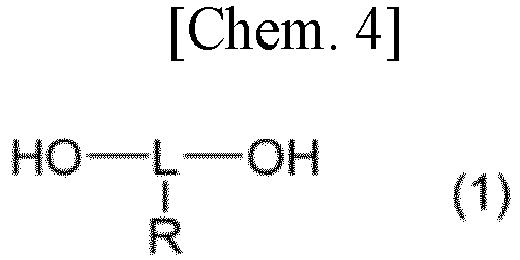
- In Formula (1), L is a trivalent group consisting of one or more atoms selected from the group consisting of a carbon atom, a hydrogen atom, a nitrogen atom, and an oxygen atom.
- In Formula (1), R is a group having at least one ring structure selected from the group consisting of an alicyclic structure, an aromatic ring, and a heterocyclic ring.
- When the curing agent (A) contains the diol (B-2), a cured product having a high fracture toughness value (G1c) and excellent toughness is obtained.
- L may be, for example, a group having a linear portion of 10 or less carbon atoms connecting two hydroxy groups.
- The diol (B-2) may be, for example, a compound represented by Formula (1-1).

- In Formula (1-1), R is synonymous with the above.
- In Formula (1-1), L1 and L2 each independently represent a hydrocarbon group which may have a substituent.
- In Formula (1-1), A1 represents C-R1 (R1 represents a hydrogen atom or a hydrocarbon group which may have a substituent) or N.
- The hydrocarbon group in L1 and L2 may be, for example, an alkanediyl group. The number of carbon atoms in the hydrocarbon group in L1 and L2 may be, for example, 1 to 10 or 1 to 5 excluding the number of carbon atoms in the substituent.
- Examples of substituents which may be contained in the hydrocarbon group in L1 and L2 include an alkyl group (for example, a C1-10 alkyl group), a cycloalkyl group, an alkoxy group (for example, a C1-10 alkoxy group), an aryl group (for example, a phenyl group), and these groups may further have a substituent (for example, the above-described substituent).
- The hydrocarbon group in R1 may be, for example, an alkyl group, a cycloalkyl group, or an aryl group. The number of carbon atoms in the hydrocarbon group in R1 may be, for example, 1 to 8 or 1 to 5 excluding the number of carbon atoms in the substituent.
- Examples of substituents which may be contained in the hydrocarbon group in R1 include an alkyl group (for example, a C1-8 alkyl group), a cycloalkyl group, an alkoxy group (for example, a C1-8 alkoxy group), an aryl group (for example, a phenyl group), and these groups may further have a substituent (for example, the above-described substituent) .
- R1 is preferably a hydrogen atom.
- R is a group having at least one ring structure selected from the group consisting of an alicyclic structure, an aromatic ring, and a heterocyclic ring, preferably a group having at least one ring structure selected from the group consisting of an alicyclic structure and an aromatic ring, and more preferably a group having an aromatic ring. The number of carbon atoms constituting a ring structure in R is preferably 10 or less.
- R may be, for example, a phenyl group which may have a substituent or a cyclohexyl group which may have a substituent. Examples of substituents which may be contained in the phenyl group or the cyclohexyl group in R include an alkyl group (for example, a C1-5 alkyl group), a cycloalkyl group, an alkoxy group (for example, a C1-5 alkoxy group), an aryl group (for example, a phenyl group), and these groups may further have a substituent (for example, the above-described substituent).
- Examples of diols (B-2) include 3-phenyl-1,5-pentanediol, 2-(phenylmethyl)-1,4-butanediol, 2,4-dimethyl-3-phenyl-1,5-pentanediol, 3-phenyl-1,4-pentanediol, 2-(2-phenylethyl)-1,3-propanediol, 3-methyl-3-phenyl-1,5-pentanediol, 3-(4-methylphenyl)-1,5-pentanediol, 3-methyl-3-(4-methylphenyl)-1,5-pentanediol, 2-[2-(4-ethylphenyl)ethyl]-1,3-propanediol, 2-[4-(1-methylethyl)phenyl]-1,4-butanediol, 2,2'-(p-tolylimino)diethanol, (2,2'-[(4-methylcyclohexyl)imino]bis[ethanol]), (2,2'-[(4-ethylcyclohexyl)azanediyl]diethanol), and (3-[(2-hydroxyethyl)(4-methylcyclohexyl)amino]-1-propanol).
- In the urethane resin formed from the urethane resin-forming composition, the content of the structural unit derived from the diol (B-2) is preferably 40 mmol/kg to 600 mmol/kg and more preferably 60 mmol/kg to 500 mmol/kg. In other words, the urethane resin-forming composition may be a composition for which a main agent (A) and a curing agent (B) are selected so that a urethane resin having a content of the structural unit derived from the diol (B-2) within the above-described ranges is formed. In the urethane resin-forming composition, the diol (B-2) can also be formulated with the above-described component (a). That is, the "content of the structural unit derived from the diol (B-2)" described above may be a total amount of a structural unit derived from a diol (B-2) in the component (a) and a structural unit derived from a diol (B-2) in the curing agent (B).
- The curing agent (B) may further contain a polyfunctional component. The polyfunctional component is a compound having three or more reactive groups. The polyfunctional component can be used alone or in a combination of two or more thereof. As the polyfunctional component, the same one as the polyfunctional component in the component (a) can be exemplified.
- The polyfunctional component contained in the curing agent (B) is preferably a compound (B-3) having three or more hydroxy groups.
- Examples of compounds (B-3) include glycerol, trimethylolpropane, pentaerythritol, N,N-bishydroxypropyl-N-hydroxyethylamine, triethanolamine, triisopropanolamine, a monomer polyol of modified ethylenediamine propylene oxide, a monomer polyol of modified trimethylolpropane propylene oxide, and modified pentaerythritol propylene oxide. In addition, examples of compounds (B-2) include polycaprolactone polyol which is a ring-opening addition polymer of cyclic esters (for example, ε-caprolactone, β-butyrolactone, γ-butyrolactone, γ-valerolactone, and δ-valerolactone) and polyols (for example, glycerol, trimethylolpropane, and pentaerythritol) having three or more hydroxy groups.
- The content of the polyfunctional component based on the total amount of the curing agent (B) may be, for example, 80 mass% or less, 70 mass% or less, 60 mass% or less, 50 mass% or less, 40 mass% or less, 30 mass% or less, or 20 mass% or less. The curing agent (B) may not contain a polyfunctional component, and the content of the polyfunctional component may be 0 mass% or more based on the total amount of the curing agent (B).
- The content of a structural unit derived from the polyfunctional component in the urethane resin formed from the urethane resin-forming composition is as described above.
- The curing agent (B) may further contain the compounds exemplified as the polyols (a-1) described above.
- The curing agent (B) may further contain a diol (B-4) having a number average molecular weight of less than 1,000 as a component other than the diol (B-1) and the diol (B-2) described above. The diol (B-4) more preferably has a number average molecular weight of less than 500.
- Examples of diols (B-4) include a diol having at least one bond selected from the group consisting of an ether bond, an ester bond, and a carbonate bond. Examples of such diols include a polyether polyol, a polycarbonate polyol, and a polyester polyol. Examples of polyether polyols, polycarbonate polyols and polyester polyols are the same as the above-described polyol (a-1) (provided that the number average molecular weight is different).
- In the urethane resin formed from the urethane resin-forming composition, the content of the structural unit derived from a diol (B-4) may be, for example, 100 mmol/kg or less, 80 mmol/kg or less, or 60 mmol/kg or less. In addition, in the urethane resin formed from the urethane resin-forming composition, the content of the structural unit derived from the diol (B-4) may be, for example, 0 mmol/kg or more, or may be 5 mmol/kg or more or 10 mmol/kg or more. In other words, the urethane resin-forming composition may be a composition for which a main agent (A) and a curing agent (B) are selected so that a urethane resin having a content of the structural unit derived from the diol (B-4) within the above-described ranges is formed. In the urethane resin-forming composition, the diol (B-4) can also be formulated with the above-described component (a). That is, the "content of the structural unit derived from the diol (B-4)" described above may be a total amount of a structural unit derived from a diol (B-4) in the component (a) and a structural unit derived from a diol (B-4) in the curing agent (B).
- The curing agent (B) may further contain an active hydrogen-containing compound as a component other than the above. Examples of such active hydrogen-containing compounds include a compound having functional groups such as an amino group, a thiol group, and a carboxyl group. These active hydrogen-containing compounds can be used alone or in a combination of two or more thereof.
- The curing agent (B) may contain components other than the above. As other components, those (for example, a colorant, an antistatic agent, and a preservative) that do not react with functional groups in a curing agent (B) and the isocyanate group-terminated prepolymer (A-1) are preferable.
- At least one of the diol (B-1) and the diol (B-2) in the curing agent (B) is preferably a liquid at 25°C and 1 atm, and both of them are more preferably liquids at 25°C and 1 atm.
- The (B/A) ratio of the total number of hydroxy groups in the curing agent (B) to the total number of isocyanate groups in the main agent (A) may be, for example, 0.6 or more, 0.7 or more, 0.8 or more, or 0.9 or more. In addition, the above-described (B/A) ratio may be, for example, 1.2 or less, 1.15 or less, 1.10 or less, or 1.05 or less. If the (B/A) ratio is within the above-described ranges, the resin strength tends to be further improved. In a case where the urethane resin-forming composition is a two-component type, two liquids in the urethane resin-forming composition may be mixed with each other so that the main agent (A) and the curing agent (B) satisfy the above-described (B/A) ratio.
- The curing agent (B) is preferably a liquid at 25°C and 1 atm.
- In the urethane resin-forming composition, from the viewpoint of handling properties, at least one of the main agent (A) and the curing agent (B) is preferably a liquid at 25°C and 1 atm and both of them are more preferably liquids at 25°C and 1 atm.
- The urethane resin-forming composition may further contain a filler (C). In a case where the urethane resin-forming composition is a two-component type, the filler (C) may be contained in a first agent together with the main agent (A), may be contained in a second agent together with the curing agent (B), or may be contained in both of the first agent and the second agent. That is, the urethane resin-forming composition may contain, for example: a first agent containing the main agent (A) and the filler (C) and a second agent containing the curing agent (B); a first agent containing the main agent (A) and a second agent containing the curing agent (B) and the filler (C); or a first agent containing the main agent (A) and the filler (C) and a second agent containing the curing agent (B) and the filler (C).
- Examples of fillers (C) include a well-known filler. The filler (C) may be, for example, an inorganic filler or an organic filler, and is preferably an inorganic filler. The filler (C) can be used alone or in a combination of two or more thereof.
- Examples of inorganic fillers include talc, a zeolite, silica, microballoons, clay, glass balloons, carbon black, and calcium carbonate. The inorganic fillers are not limited thereto. These can be used alone or in a combination of two or more thereof.
- Examples of organic fillers include polyamide particles, acrylic particles, carbon nanotubes, starch, natural organic fibers, and synthetic fibers.
- The content of the filler (C) based on the total mass of the urethane resin-forming composition is, for example, preferably 10 mass% to 70 mass% and more preferably 10 mass% to 50 mass%. When the content of the filler (C) is 10 mass% or more, dripping can be more favorably suppressed. When the content of the filler (C) is 70 mass% or less, the filler (C) is likely to be more uniformly mixed with other components, and more favorable adhesive strength and coatability can be obtained. In a case where the urethane resin-forming composition is a two-component type, the total mass of the urethane resin-forming composition may be a total amount of a first agent and a second agent mixed with each other to form a cured product.
- The urethane resin-forming composition may be a two-component type in which a first agent containing the main agent (A) and a second agent containing the curing agent (B) are present separately, or a one-component type in which the main agent (A) is mixed with the curing agent (B).
- The temperature and time for mixing the first agent with the second agent may be, for example, 10°C to 35°C and 1 to 60 minutes.
- The mixing method when mixing the first agent with the second agent is not particularly limited. For example, the mixing may be performed manually with a spatula or may be performed using a mechanical rotary mixer, a static mixer, and the like.
- The urethane resin-forming composition preferably contains 1.0 mass% or less of a solvent. In addition, the urethane resin-forming composition may not contain substantially a solvent, that is, solvent-free. However, in a case where a solvent is contained as an impurity, this case belongs to a substantial solvent-free category.
- In a case where the urethane resin-forming composition is a two-component type, the content of a solvent in the first agent is preferably 1.0 mass% or less, and the content of a solvent in the second agent is preferably 1.0 mass% or less. In addition, the content of the solvents in the first agent and the second agent mixed is preferably 1.0 mass% or less based on the total amount of the first agent and the second agent mixed to form a cured product.
- The urethane resin-forming composition can be suitably used as an adhesive agent (particularly, a two-component adhesive agent) for various applications. Examples of application fields include the automotive field, the display field, the recording medium field, the electronic material field, the battery field, the optical component field, the construction field, the electronic device field, and the aviation field.
- The composition can be used in the automotive field, for example, automotive structural parts, switch parts, headlamps, internal engine parts, electrical parts, drive engines, and brake oil tanks. The composition can be used in the display field, for example, liquid crystal displays, organic electroluminescence, and light emitting diode display devices. The composition can be used in the recording medium field, for example, video discs, CDs, DVDs, MDs, pickup lenses, VCM magnets, spindle motors, hard disk peripheral members, and Blu-ray Disc.
- The composition can be used in the electronic material field, for example, electronic components, electrical circuits, electrical contacts, and semiconductor elements, and detailed examples of such applications include sealing materials, die-bonding agents, conductive adhesive agents, anisotropic conductive adhesive agents, and interlayer adhesive agents for multilayer substrates including build-up substrates. The composition can be used in the battery field, for example, lithium ion batteries, manganese batteries, alkali batteries, nickel batteries, fuel cells, silicon solar cells, dye-sensitized solar cells, and organic solar cells. The composition can be used in the optical component field, for example: optical fiber materials around optical switches and optical connectors in optical communication systems; optical passive components; optical circuit components; and the periphery of optoelectronic integrated circuits. The composition can be used in the electronic device field, for example, camera modules.
- Since the urethane resin-forming composition has a high fracture toughness value, it can be particularly suitably used as an adhesive agent for an automotive structure.
- A cured product according to one aspect of the present disclosure is a cured product of the above-described urethane resin-forming composition.
- The cured product contains a urethane resin which is a reaction product of the main agent (A) and the curing agent (B).
- The urethane resin in the cured product may have a urethane group concentration of, for example, 2,000 mmol/kg to 4,500 mmol/kg and preferably 2,500 mmol/kg to 4,000 mmol/kg. With such a urethane group concentration, there is a tendency to obtain a cured product having a higher fracture toughness value (G1c) and superior toughness.
- The urethane resin-forming composition is cured by reacting the main agent (A) with the curing agent (B). The urethane resin-forming composition may be cured by, for example, mixing a first agent with a second agent to cause a reaction between the main agent (A) and the curing agent (B).
- The reaction conditions when reacting the main agent (A) with the curing agent (B) are not particularly limited. For example, the heating temperature may be 100°C to 200°C, and the heating time may be 20 minutes to 10 hours. In addition, the reaction between the main agent (A) and the curing agent (B) may be carried out in one stage of heating, or may be carried out through multi-stage heating in two or more stages.
- In addition, the fracture toughness value of the cured product may be, for example, 0.3 or more, 0.5 or more, 0.7 or more, or 0.8 or more. The upper limit of the fracture toughness value of the cured product is not particularly limited. The fracture toughness value of the cured product may be, for example, 6.0 or less, 4.0 or less, or 3.0 or less.
- In the present disclosure, the fracture toughness value of a cured product is measured through the following method by a DCP test.
- The DCP test is performed according to ASTM D3433-99.
- Resin thickness: Adjusted with a spacer to 0.35 mm.
- Teflon (registered trademark) tape is used as a spacer.
- Test piece shape: A contoured type is used.
- Test base material: A S50C steel material (electroless nickel-plating treatment) is used.
- Test conditions: Stretching is performed at 2 mm/min, and the fracture toughness value G1c is calculated based on the maximum load.

- L(max) as load: (N)
- E as Young's modulus (MPa) of base material: 208,000
- B as width (mm) of base material: 25.49
- m as constant (from contoured type): 3.54
- Hereinafter, the present invention will be described more specifically based on the following examples. However, the present invention is not limited to the examples.
- The following raw materials were used to perform examples and comparative examples.
- · "MT": Millionate MT (monomeric MDI manufactured by Tosoh Corporation), molecular weight of 250, f=2
- · "TMP": Trimethylolpropane (manufactured by Mitsubishi Gas Chemical Company, Inc.), molecular weight of 134, f=3
- · "PTG-L3500": Amorphous polytetramethylene ether glycol (manufactured by Hodogaya Chemical Co., Ltd.), number average molecular weight of 3,500, f=2
- · "PCD3000": Polycarbonate polyol N-969 (manufactured by Tosoh Corporation), number average molecular weight of 3,000, f=2
- · "PES3000": Polyester polyol, Kuraray Polyol P-3010 (manufactured by Kuraray Co., Ltd.), molecular weight of 3,000, f=2
- · "BG": Butylene glycol (manufactured by Mitsubishi Chemical Corporation), 1,4-butanediol, number average molecular weight of 90, f=2
- · "CHDM": 1,4-cyclohexane dimethanol (manufactured by FUJIFILM Wako Pure Chemical Corporation)
- · "p-TolylDEA"; 2,2'-(p-tolylimino)diethanol
- · "Zeolite": Zeolum A-3 (manufactured by Tosoh Corporation)
- · "Talc": Crown Talc R (manufactured by Matsumura Sangyo Co., Ltd.)
- Raw materials of a main agent each were placed in a 2 L stirring vessel filled with nitrogen according to prescription shown in Tables 1 to 5 and stirred. Thereafter, a urethanization reaction was allowed to proceed for about 2 to 5 hours while maintaining the temperature in the stirring vessel at 70°C to 80°C to obtain a main agent (A).
- Next, a filler (C) (50 mass% of talc 150 mass% of zeolite) was added to the main agent (A) so that the amount of filler in the system became 1/3 (mass ratio), and the mixture was mixed and defoamed to obtain a first agent.
- In addition, raw materials of a curing agent each were placed in a 2 L stirring vessel filled with nitrogen according to prescription shown in Tables 1 to 5 and stirred. Thereafter, the mixture was mixed and stirred for about 1 to 3 hours while maintaining the temperature in the stirring vessel at 70°C to 80°C to obtain a curing agent (B). This curing agent (B) was used as a second agent.
- A DCB test was performed under the following conditions according to ASTM D3433-99.
- Resin thickness: Adjusted with a spacer to 0.35 mm (Teflon (registered trademark) tape was used as the spacer).
- Test piece shape: A contoured type was used.
- Test base material: A S50C steel material (electroless nickel-plating treatment) was used.
- Test conditions: Stretching was performed at 2 mm/min, and the fracture toughness value G1c was calculated based on the maximum load.

- L(max) as load: (N)
- E as Young's modulus (MPa) of base material: 208,000
- B as width (mm) of base material: 25.49
- m as constant (from contoured type): 3.54
- Specifically, the first agent and the second agent were mixed with each other according to the compositions of Tables 1 to 5, stirred for 30 seconds, and then applied onto a first base material. A 0.35 mm thick Teflon (registered trademark) seal was attached to the first substrate in a range of 4.9 cm from one end of the first substrate to form a preliminary crack in the test piece. In addition, a 0.35 mm thick Teflon (registered trademark) seal was attached to the first substrate in a range of 2 cm from the other end of the first substrate to make the coating thickness of an adhesive agent uniform. A second base material was piled on the coated surface and fixed with a clamp. Next, two-step heat treatment was performed at 130°C for 1.5 hours and 110°C for 20 hours and cured to obtain a test piece. The obtained test piece was subjected to a DCB test under the above-described conditions, and the fracture toughness value G1c was calculated from the results. The results are shown in Tables 1 to 5.
- After the DCB test, the broken surface of the sample was visually observed, and the proportion of the broken area in the cured product layer part was measured. The measurement results are shown in Tables 1 to 5.
- Cohesive failure: A state in which the cured product layer is broken.
- Interfacial failure: A state in which the cured product is peeled off at a base material interface.
[Table 1] Charged amount g(mmol) Example 1 Example 2 Example 3 Example 4 Example 5 Main agent MT 460 (1838) 460 (1838) 460(1838) 460 (1838) 460 (1838) PTG-L3500 336(93) - - 304 (85) 367 (102) PCD3000 - 338 (114) - - - PES3000 - - 338 (114) - - Curing agent BG 50 (508) 49 (548) 49 (548) - 100(1108) CHDM 81 (558) 79 (548) 79 (548) 162 (1125) - TMP 27 (200) 27 (200) 27 (200) 27 (200) 27 (200) p-TolylDEA 47 (240) 47 (240) 47 (240) 47 (240) 47 (240) Urethane group concentration (mmol/g) 3.5 3.5 3.5 3.5 3.5 Cross-linking density (mmol/g) 0.2 0.2 0.2 0.2 0.2 R (Resin) 1.05 1.05 1.05 1.05 1.05 GIc (kJ/m2) 1.30 1.00 1.35 1.30 2.05 Cohesive failure rate (%) 100 100 100 100 100 [Table 2] Charged amount g(mmol) Example 6 Example 7 Example 8 Example 9 Example 10 Main agent MT 460 (1838) 460 (1838) 460 (1838) 460 (1838) 460 (1838) PTG-L3500 349(97) 342(95) 336(93) 329 (92) 323(90) PCD3000 - - - - - PES3000 - - - - - Curing agent BG 57 (637) 54 (597) 50 (558) 47 (519) 43 (480) CHDM 92 (637) 86 (597) 81 (558) 75 (519) 69 (480) TMP 27 (200) 27 (200) 27 (200) 27 (200) 27 (200) p-TolylDEA 16 (80) 31 (160) 47 (240) 63 (320) 78 (400) Urethane group concentration (mmol/g) 3.5 3.5 3.0 3.5 3.5 Cross-linking density (mmol/g) 0.2 0.2 0.2 0.2 0.2 R (Resin) 1.05 1.05 1.05 1.05 1.05 GIc (kJ/m2) 1.00 1.14 1.30 1.31 1.12 Cohesive failure rate (%) 100 100 100 100 100 [Table 3] Charged amount g(mmol) Example 11 Example 12 Example 13 Example 14 Example 15 Main agent MT 263 (1050) 394 (1575) 460(1838) 526 (2100) 460 (1838) PTG-L3500 630 (175) 423 (118) 317 (88) 238 (66) 329(92) Curing agent BG 13 (142) 38 (420) 50 (558) 63 (697) 61 (679) CHDM 21 (142) 61 (420) 81 (558) 101 (679) 98 (679) TMP 27 (200) 27 (200) 27 (200) 27 (200) 5 (40) p-TolylDEA 47 (240) 47 (240) 47 (240) 47 (240) 47 (240) Urethane group concentration (mmol/g) 2.0 3.0 3.5 4.0 3.5 Cross-linking density (mmol/g) 0.2 0.2 0.2 0.2 0.04 R (Resin) 1.05 1.05 1.05 1.05 1.05 GIc (kJ/m2) 1.62 1.67 1.30 0.91 1.66 Cohesive failure rate (%) 0 100 100 100 100 [Table 4] Charged amount g(mmol) Example 16 Example 17 Example 18 Example 19 Example 20 Main agent MT 460 (1838) 460 (1838) 460(1838) 460 (1838) 460 (1838) PTG-L3500 331 (92) 317 (88) 344 (96) 353 (98) 361 (101) Curing agent BG 57 (634) 50 (558) 37 (407) 23 (256) 9 (105) CHDM 91 (634) 81 (558) 59 (407) 37 (256) 15 (105) TMP 13 (100) 27 (200) 54 (400) 81 (600) 107(800) p-TolylDEA 47 (240) 47 (240) 47 (240) 47 (240) 47 (240) Urethane group concentration (mmol/g) 3.5 3.5 3.5 3.5 3.5 Cross-linking density (mmol/g) 0.1 0.2 0.4 0.6 0.8 R (Resin) 1.05 1.05 1.05 1.05 1.05 GIc (kJ/m2) 1.55 1.30 1.28 0.88 0.82 Cohesive failure rate (%) 10 100 100 100 100 [Table 5] Charged amount g(mmol) Comparative Example 1 Comparative Example 2 Comparative Example 3 Comparative Example 4 Main agent MT 526 (2100) 591 (2363) 460 (1838) 460 (1838) PTG-L3500 211 (59) 105 (29) 300 (83) 303 (84) Curing agent BG - - - - CHDM 237 (1641) 277 (1921) 240 (1667) 232 (1606) TMP 27 (200) 27 (200) - 5 (40) Urethane group concentration (mmol/g) 4.0 4.5 3.5 3.5 Cross-linking density (mmol/g) 0.2 0.2 0 0.04 R (Resin) 1.05 1.05 1.05 1.05 GIc (kJ/m2) 0.17 0.15 0.25 0.25 Cohesive failure rate (%) 100 100 100 100
Claims (14)
- A urethane resin-forming composition comprising:a main agent (A); anda curing agent (B),wherein the main agent (A) contains an isocyanate group-terminated prepolymer (A-1) which is a reaction product of a component (a) containing a polyol (a-1) having a number average molecular weight of 2,500 or more and a polyisocyanate (a-2),wherein the curing agent (B) contains at least one diol (B-1) selected from the group consisting of an aliphatic diol and an alicyclic diol, and a diol (B-2) represented by Formula (1) below, andwherein at least one of the component (a) and the curing agent (B) contains a polyfunctional component

- The urethane resin-forming composition according to claim 1, which forms a urethane resin having a urethane group concentration of 2,000 mmol/kg to 4,500 mmol/kg.
- The urethane resin-forming composition according to claim 1, which forms a urethane resin having a urethane group concentration of 2,500 mmol/kg to 4,000 mmol/kg.
- The urethane resin-forming composition according to claim 1, which forms a urethane resin having a content of a constitutional unit derived from the polyfunctional component of 25 mmol/kg to 1,000 mmol/kg.
- The urethane resin-forming composition according to claim 1, which forms a urethane resin having a content of a constitutional unit derived from the polyfunctional component of 40 mmol/kg to 600 mmol/kg.
- The urethane resin-forming composition according to claim 1,
wherein the R is a hydrocarbon group having at least one ring structure selected from the group consisting of an alicyclic structure and an aromatic ring. - The urethane resin-forming composition according to claim 1, which forms a urethane resin having a content of a constitutional unit derived from the diol (B-2) of 40 mmol/kg to 600 mmol/kg.
- The urethane resin-forming composition according to claim 1,
wherein a solvent content is 1.0 mass% or less. - The urethane resin-forming composition according to claim 1, further comprising:
a filler (C). - The urethane resin-forming composition according to claim 1,
wherein at least one of the main agent (A) and the curing agent (B) is a liquid at a temperature of 25°C and at 1 atm. - A two-component adhesive agent comprising:
the urethane resin-forming composition according to any one of claims 1 to 10. - An adhesive agent for an automotive structure comprising:
the urethane resin-forming composition according to any one of claims 1 to 10. - A cured product of the urethane resin-forming composition according to any one of claims 1 to 10.
- A production method for a cured product, comprising:a step of mixing a first agent containing a main agent (A) with a second agent containing a curing agent (B) to obtain a cured product containing a urethane resin,wherein the main agent (A) contains an isocyanate group-terminated prepolymer (A-1) which is a reaction product of a component (a) containing a polyol (a-1) having a number average molecular weight of 2,500 or more and a polyisocyanate (a-2),wherein the curing agent (B) contains at least one diol (B-1) selected from the group consisting of an aliphatic diol and an alicyclic diol, and a diol (B-2) represented by Formula (1) below, andwherein at least one of the component (a) and the curing agent (B) contains a polyfunctional component

Applications Claiming Priority (3)
| Application Number | Priority Date | Filing Date | Title |
|---|---|---|---|
| JP2021096974 | 2021-06-09 | ||
| JP2021136856 | 2021-08-25 | ||
| PCT/JP2022/023194 WO2022260107A1 (en) | 2021-06-09 | 2022-06-08 | Urethane resin-forming composition, adhesive agent, cured product, and production method for cured product |
Publications (2)
| Publication Number | Publication Date |
|---|---|
| EP4335885A1 true EP4335885A1 (en) | 2024-03-13 |
| EP4335885A4 EP4335885A4 (en) | 2025-06-04 |
Family
ID=84426141
Family Applications (1)
| Application Number | Title | Priority Date | Filing Date |
|---|---|---|---|
| EP22820286.7A Pending EP4335885A4 (en) | 2021-06-09 | 2022-06-08 | Urethane resin-forming composition, adhesive agent, cured product, and production method for cured product |
Country Status (4)
| Country | Link |
|---|---|
| US (1) | US20240279518A1 (en) |
| EP (1) | EP4335885A4 (en) |
| JP (1) | JPWO2022260107A1 (en) |
| WO (1) | WO2022260107A1 (en) |
Family Cites Families (14)
| Publication number | Priority date | Publication date | Assignee | Title |
|---|---|---|---|---|
| JPS5017520B2 (en) * | 1972-03-10 | 1975-06-21 | ||
| US5136010A (en) * | 1990-09-28 | 1992-08-04 | Olin Corporation | Polyurethane elastomers and polyurea elastomers made using high functionality, low unsaturation level polyols prepared with double metal cyanide catalysts |
| JP2694055B2 (en) * | 1990-12-27 | 1997-12-24 | 東洋インキ製造株式会社 | ink |
| WO1994013723A1 (en) * | 1992-12-08 | 1994-06-23 | Minnesota Mining And Manufacturing Company | Room temperature curable silane-terminated polyurethane dispersions |
| JP4026306B2 (en) * | 2000-08-11 | 2007-12-26 | 東洋インキ製造株式会社 | Water-based urethane resin and water-based printing ink composition, and packaging material using the composition |
| EP2199358B1 (en) | 2007-10-12 | 2013-06-12 | Emulsion Technology Co. Ltd. | Urethane adhesive composition |
| EP2709842B1 (en) * | 2011-05-16 | 2019-03-06 | Ashland Licensing And Intellectual Property, LLC | Two part polyurea-urethane adhesive with elevated high temperature storage modulus |
| JP6380775B1 (en) * | 2017-04-25 | 2018-08-29 | 東洋インキScホールディングス株式会社 | Rotary printing ink and its use |
| JP7228417B2 (en) * | 2019-03-12 | 2023-02-24 | 三井化学株式会社 | Two-liquid curing polyurethane resin composition |
| JP7310223B2 (en) * | 2019-03-29 | 2023-07-19 | 東ソー株式会社 | Polyurethane-based adhesive-forming composition and adhesive |
| JP7732175B2 (en) * | 2020-09-07 | 2025-09-02 | 東ソー株式会社 | Polyurethane adhesive composition, cured product and adhesive |
| JP2024076870A (en) * | 2022-11-25 | 2024-06-06 | 東ソー株式会社 | Polyurethane adhesive composition, adhesive for automobile structure, and cured product |
| CN120659820A (en) * | 2023-02-09 | 2025-09-16 | 东曹株式会社 | Urethane resin-forming composition, urethane adhesive composition, adhesive for automobile structure, and cured product |
| CN119978313A (en) * | 2025-04-16 | 2025-05-13 | 合肥安利聚氨酯新材料有限公司 | A kind of weather-resistant wet-process polyurethane resin and its preparation method and application |
-
2022
- 2022-06-08 WO PCT/JP2022/023194 patent/WO2022260107A1/en not_active Ceased
- 2022-06-08 EP EP22820286.7A patent/EP4335885A4/en active Pending
- 2022-06-08 US US18/567,211 patent/US20240279518A1/en active Pending
- 2022-06-08 JP JP2023527913A patent/JPWO2022260107A1/ja active Pending
Also Published As
| Publication number | Publication date |
|---|---|
| WO2022260107A1 (en) | 2022-12-15 |
| EP4335885A4 (en) | 2025-06-04 |
| JPWO2022260107A1 (en) | 2022-12-15 |
| US20240279518A1 (en) | 2024-08-22 |
Similar Documents
| Publication | Publication Date | Title |
|---|---|---|
| US11643581B2 (en) | Two-component polyurethane adhesive composition and bonding method thereof | |
| CN104245769B (en) | Moisture-curable polyurethane hot-melt resin combination, bonding agent and article | |
| JP2021091863A (en) | Polyurethane resin formative composition, composition for adhesive, cured product and adhesive article | |
| CN111349417B (en) | Polyurethane adhesive composition and polyurethane adhesive | |
| EP4335884A1 (en) | Urethane resin-forming composition, adhesive agent, cured product, and production method for cured product | |
| JP2018135491A (en) | Polyurethane resin formative composition | |
| JP7310223B2 (en) | Polyurethane-based adhesive-forming composition and adhesive | |
| US20250197702A1 (en) | Two-component polyurethane adhesive composition | |
| JP7732175B2 (en) | Polyurethane adhesive composition, cured product and adhesive | |
| CN105473680A (en) | Hydrophobic polyurethane adhesive | |
| JP2024076870A (en) | Polyurethane adhesive composition, adhesive for automobile structure, and cured product | |
| JP5561657B2 (en) | Solvent-free polyurethane resin-forming adhesive composition for fibrous base material, laminate using the adhesive composition, and method for producing laminate | |
| JP2012251053A (en) | Urethane resin adhesive composition | |
| CN117500856A (en) | Urethane resin-forming composition, adhesive, cured product, and method for producing cured product | |
| JP7767714B2 (en) | Polyurethane adhesive composition, cured product and adhesive | |
| JP7608739B2 (en) | Composition, adhesive composition and adhesive | |
| US20240279518A1 (en) | Urethane resin-forming composition, adhesive agent, cured product, and production method for cured product | |
| WO2023085387A1 (en) | Urethane resin-forming composition and two-part type adhesive agent | |
| CN117500857A (en) | Urethane resin-forming composition, adhesive, cured product, and method for producing cured product | |
| WO2024166987A1 (en) | Urethane resin–forming composition, composition for urethane adhesive, adhesive for automobile structure, and cured product | |
| JP7735701B2 (en) | Composition and two-component adhesive using same | |
| JP2023006643A (en) | Polyurethane adhesive for packaging material for power storage device, packaging material for power storage device, container for power storage device and power storage device | |
| JP7697203B2 (en) | Isocyanate composition, two-liquid urethane resin-forming composition, adhesive composition, and adhesive | |
| JP2022158814A (en) | Composition for polyurethane adhesive | |
| JP2021195373A (en) | Composition, composition for adhesive and adhesive |
Legal Events
| Date | Code | Title | Description |
|---|---|---|---|
| STAA | Information on the status of an ep patent application or granted ep patent |
Free format text: STATUS: THE INTERNATIONAL PUBLICATION HAS BEEN MADE |
|
| PUAI | Public reference made under article 153(3) epc to a published international application that has entered the european phase |
Free format text: ORIGINAL CODE: 0009012 |
|
| STAA | Information on the status of an ep patent application or granted ep patent |
Free format text: STATUS: REQUEST FOR EXAMINATION WAS MADE |
|
| 17P | Request for examination filed |
Effective date: 20231208 |
|
| AK | Designated contracting states |
Kind code of ref document: A1 Designated state(s): AL AT BE BG CH CY CZ DE DK EE ES FI FR GB GR HR HU IE IS IT LI LT LU LV MC MK MT NL NO PL PT RO RS SE SI SK SM TR |
|
| DAV | Request for validation of the european patent (deleted) | ||
| DAX | Request for extension of the european patent (deleted) | ||
| A4 | Supplementary search report drawn up and despatched |
Effective date: 20250508 |
|
| RIC1 | Information provided on ipc code assigned before grant |
Ipc: C09J 175/04 20060101ALI20250430BHEP Ipc: C09J 175/06 20060101ALI20250430BHEP Ipc: C09J 11/08 20060101ALI20250430BHEP Ipc: C09J 11/06 20060101ALI20250430BHEP Ipc: C09J 11/04 20060101ALI20250430BHEP Ipc: C08G 18/32 20060101ALI20250430BHEP Ipc: C09J 175/08 20060101ALI20250430BHEP Ipc: C08G 18/76 20060101ALI20250430BHEP Ipc: C08G 18/48 20060101ALI20250430BHEP Ipc: C08G 18/42 20060101ALI20250430BHEP Ipc: C08G 18/08 20060101ALI20250430BHEP Ipc: C08G 18/44 20060101ALI20250430BHEP Ipc: C08G 18/10 20060101AFI20250430BHEP |