EP4335747B1 - Aircraft bulkhead-mounted pilot seat with horizontal and vertical adjustment - Google Patents
Aircraft bulkhead-mounted pilot seat with horizontal and vertical adjustment Download PDFInfo
- Publication number
- EP4335747B1 EP4335747B1 EP23195098.1A EP23195098A EP4335747B1 EP 4335747 B1 EP4335747 B1 EP 4335747B1 EP 23195098 A EP23195098 A EP 23195098A EP 4335747 B1 EP4335747 B1 EP 4335747B1
- Authority
- EP
- European Patent Office
- Prior art keywords
- aircraft seat
- hole
- sled
- aircraft
- bulkhead
- Prior art date
- Legal status (The legal status is an assumption and is not a legal conclusion. Google has not performed a legal analysis and makes no representation as to the accuracy of the status listed.)
- Active
Links
Images


Classifications
-
- B—PERFORMING OPERATIONS; TRANSPORTING
- B64—AIRCRAFT; AVIATION; COSMONAUTICS
- B64D—EQUIPMENT FOR FITTING IN OR TO AIRCRAFT; FLIGHT SUITS; PARACHUTES; ARRANGEMENT OR MOUNTING OF POWER PLANTS OR PROPULSION TRANSMISSIONS IN AIRCRAFT
- B64D11/00—Passenger or crew accommodation; Flight-deck installations not otherwise provided for
- B64D11/06—Arrangements of seats, or adaptations or details specially adapted for aircraft seats
- B64D11/0619—Arrangements of seats, or adaptations or details specially adapted for aircraft seats with energy absorbing means specially adapted for mitigating impact loads for passenger seats, e.g. at a crash
-
- B—PERFORMING OPERATIONS; TRANSPORTING
- B64—AIRCRAFT; AVIATION; COSMONAUTICS
- B64D—EQUIPMENT FOR FITTING IN OR TO AIRCRAFT; FLIGHT SUITS; PARACHUTES; ARRANGEMENT OR MOUNTING OF POWER PLANTS OR PROPULSION TRANSMISSIONS IN AIRCRAFT
- B64D11/00—Passenger or crew accommodation; Flight-deck installations not otherwise provided for
- B64D11/06—Arrangements of seats, or adaptations or details specially adapted for aircraft seats
- B64D11/0639—Arrangements of seats, or adaptations or details specially adapted for aircraft seats with features for adjustment or converting of seats
- B64D11/064—Adjustable inclination or position of seats
-
- B—PERFORMING OPERATIONS; TRANSPORTING
- B60—VEHICLES IN GENERAL
- B60N—SEATS SPECIALLY ADAPTED FOR VEHICLES; VEHICLE PASSENGER ACCOMMODATION NOT OTHERWISE PROVIDED FOR
- B60N2/00—Seats specially adapted for vehicles; Arrangement or mounting of seats in vehicles
- B60N2/02—Seats specially adapted for vehicles; Arrangement or mounting of seats in vehicles the seat or part thereof being movable, e.g. adjustable
- B60N2/0284—Adjustable seat-cushion length
-
- B—PERFORMING OPERATIONS; TRANSPORTING
- B60—VEHICLES IN GENERAL
- B60N—SEATS SPECIALLY ADAPTED FOR VEHICLES; VEHICLE PASSENGER ACCOMMODATION NOT OTHERWISE PROVIDED FOR
- B60N2/00—Seats specially adapted for vehicles; Arrangement or mounting of seats in vehicles
- B60N2/02—Seats specially adapted for vehicles; Arrangement or mounting of seats in vehicles the seat or part thereof being movable, e.g. adjustable
- B60N2/04—Seats specially adapted for vehicles; Arrangement or mounting of seats in vehicles the seat or part thereof being movable, e.g. adjustable the whole seat being movable
- B60N2/045—Longitudinal adjustment by means of articulated rods supporting the seat, e.g. parallelogram mechanisms
-
- B—PERFORMING OPERATIONS; TRANSPORTING
- B60—VEHICLES IN GENERAL
- B60N—SEATS SPECIALLY ADAPTED FOR VEHICLES; VEHICLE PASSENGER ACCOMMODATION NOT OTHERWISE PROVIDED FOR
- B60N2/00—Seats specially adapted for vehicles; Arrangement or mounting of seats in vehicles
- B60N2/02—Seats specially adapted for vehicles; Arrangement or mounting of seats in vehicles the seat or part thereof being movable, e.g. adjustable
- B60N2/04—Seats specially adapted for vehicles; Arrangement or mounting of seats in vehicles the seat or part thereof being movable, e.g. adjustable the whole seat being movable
- B60N2/16—Seats specially adapted for vehicles; Arrangement or mounting of seats in vehicles the seat or part thereof being movable, e.g. adjustable the whole seat being movable height-adjustable
- B60N2/1605—Seats specially adapted for vehicles; Arrangement or mounting of seats in vehicles the seat or part thereof being movable, e.g. adjustable the whole seat being movable height-adjustable characterised by the cinematic
- B60N2/163—Slides only
-
- B—PERFORMING OPERATIONS; TRANSPORTING
- B60—VEHICLES IN GENERAL
- B60N—SEATS SPECIALLY ADAPTED FOR VEHICLES; VEHICLE PASSENGER ACCOMMODATION NOT OTHERWISE PROVIDED FOR
- B60N2/00—Seats specially adapted for vehicles; Arrangement or mounting of seats in vehicles
- B60N2/24—Seats specially adapted for vehicles; Arrangement or mounting of seats in vehicles for particular purposes or particular vehicles
- B60N2/42—Seats specially adapted for vehicles; Arrangement or mounting of seats in vehicles for particular purposes or particular vehicles the seat constructed to protect the occupant from the effect of abnormal g-forces, e.g. crash or safety seats
- B60N2/4207—Seats specially adapted for vehicles; Arrangement or mounting of seats in vehicles for particular purposes or particular vehicles the seat constructed to protect the occupant from the effect of abnormal g-forces, e.g. crash or safety seats characterised by the direction of the g-forces
- B60N2/4242—Seats specially adapted for vehicles; Arrangement or mounting of seats in vehicles for particular purposes or particular vehicles the seat constructed to protect the occupant from the effect of abnormal g-forces, e.g. crash or safety seats characterised by the direction of the g-forces vertical
-
- B—PERFORMING OPERATIONS; TRANSPORTING
- B60—VEHICLES IN GENERAL
- B60N—SEATS SPECIALLY ADAPTED FOR VEHICLES; VEHICLE PASSENGER ACCOMMODATION NOT OTHERWISE PROVIDED FOR
- B60N2/00—Seats specially adapted for vehicles; Arrangement or mounting of seats in vehicles
- B60N2/24—Seats specially adapted for vehicles; Arrangement or mounting of seats in vehicles for particular purposes or particular vehicles
- B60N2/42—Seats specially adapted for vehicles; Arrangement or mounting of seats in vehicles for particular purposes or particular vehicles the seat constructed to protect the occupant from the effect of abnormal g-forces, e.g. crash or safety seats
- B60N2/427—Seats or parts thereof displaced during a crash
- B60N2/42709—Seats or parts thereof displaced during a crash involving residual deformation or fracture of the structure
-
- B—PERFORMING OPERATIONS; TRANSPORTING
- B60—VEHICLES IN GENERAL
- B60N—SEATS SPECIALLY ADAPTED FOR VEHICLES; VEHICLE PASSENGER ACCOMMODATION NOT OTHERWISE PROVIDED FOR
- B60N2/00—Seats specially adapted for vehicles; Arrangement or mounting of seats in vehicles
- B60N2/24—Seats specially adapted for vehicles; Arrangement or mounting of seats in vehicles for particular purposes or particular vehicles
- B60N2/42—Seats specially adapted for vehicles; Arrangement or mounting of seats in vehicles for particular purposes or particular vehicles the seat constructed to protect the occupant from the effect of abnormal g-forces, e.g. crash or safety seats
- B60N2/427—Seats or parts thereof displaced during a crash
- B60N2/42727—Seats or parts thereof displaced during a crash involving substantially rigid displacement
- B60N2/42736—Seats or parts thereof displaced during a crash involving substantially rigid displacement of the whole seat
-
- B—PERFORMING OPERATIONS; TRANSPORTING
- B64—AIRCRAFT; AVIATION; COSMONAUTICS
- B64D—EQUIPMENT FOR FITTING IN OR TO AIRCRAFT; FLIGHT SUITS; PARACHUTES; ARRANGEMENT OR MOUNTING OF POWER PLANTS OR PROPULSION TRANSMISSIONS IN AIRCRAFT
- B64D11/00—Passenger or crew accommodation; Flight-deck installations not otherwise provided for
- B64D11/06—Arrangements of seats, or adaptations or details specially adapted for aircraft seats
- B64D11/0698—Seats suspended from aircraft walls
-
- B—PERFORMING OPERATIONS; TRANSPORTING
- B64—AIRCRAFT; AVIATION; COSMONAUTICS
- B64D—EQUIPMENT FOR FITTING IN OR TO AIRCRAFT; FLIGHT SUITS; PARACHUTES; ARRANGEMENT OR MOUNTING OF POWER PLANTS OR PROPULSION TRANSMISSIONS IN AIRCRAFT
- B64D25/00—Emergency apparatus or devices, not otherwise provided for
- B64D25/02—Supports or holding means for living bodies
- B64D25/04—Seat modifications
Definitions
- Aircraft seats for example pilot or crew seats in a rotorcraft cockpit, may attach directly to a rear wall of bulkhead rather than to the cabin floor. Such seats may be capable of at least a limited amount of vertical adjustment, or adjustment of the seat height relative to the cabin floor. While vertical adjustment may help the aircraft seat accommodate a broader range of taller or shorter pilots, for example, there is as yet no corresponding capacity for horizontal adjustment of the seat.
- US2945654A discloses a combination of a seat, a support, a track and a slide movable in the track.
- a bulkhead-mounted aircraft seat configured for independent horizontal and vertical adjustment.
- the aircraft seat includes a seatback and seat frame/cushion for supporting an occupant.
- Parallel rails attach to the bulkhead and extend along the bulkhead (vertically or near vertically) with opposing slots set into each rail.
- a sled translates along the rails via paired sliding members set into the slots, each pair of sliding members connected to an axle extending through the sled.
- the seat is independently configured for substantially vertical adjustment via a metering plate attached to the bulkhead.
- the sled includes an upper pair and a lower pair of sliding members, each pair of sliding members (e.g., left-side and right-side) connected to an upper or lower axle extending through the sled and translating through left-side and right-side slots respectively.
- each pair of sliding members e.g., left-side and right-side
- the aircraft seat assembly includes a linear lock for securing the aircraft seat in the desired horizontal position along the linear rail (e.g., relative to the bulkhead).
- the metering plate is configured for energy attenuation via controlled deformation to control downward deceleration of the aircraft seat in response to an impact event.
- the aircraft seat is held at a desired height by a spring-loaded locking pin which extends through a hole in the sled and a second hole in the metering plate, the metering plate including a substantially vertical sequence of holes where each hole corresponds to a desired height of the seat.
- a spring-loaded locking pin which extends through a hole in the sled and a second hole in the metering plate, the metering plate including a substantially vertical sequence of holes where each hole corresponds to a desired height of the seat.
- an occupant of the seat may release the locking pin via a handle to articulate the aircraft seat to a higher or lower desired height, releasing the handle to restore the locking pin through the sled hole and higher or lower metering hole and securing the aircraft seat to the new desired height.
- a letter following a reference numeral is intended to reference an embodiment of the feature or element that may be similar, but not necessarily identical, to a previously described element or feature bearing the same reference numeral (e.g., 1, 1a, 1b).
- reference numeral e.g. 1, 1a, 1b
- Such shorthand notations are used for purposes of convenience only and should not be construed to limit the disclosure in any way unless expressly stated to the contrary.
- any reference to “one embodiment” or “some embodiments” means that a particular element, feature, structure, or characteristic described in connection with the embodiment is included in at least one embodiment disclosed herein.
- embodiments of the inventive concepts disclosed herein are directed to a seat assembly for a rotorcraft or other aircraft that attaches directly to a rear bulkhead, e.g., of a rotorcraft cockpit.
- the aircraft seat is capable of vertical adjustment, e.g., height adjustment of the aircraft seat relative to the cabin floor
- the aircraft seat is also capable of horizontal adjustment.
- the aircraft seat may be adjusted forward or backward relative to the bulkhead, e.g., along an x-axis.
- the horizontal adjustment mechanism maintains the vertical seat position (e.g., the height of the seat relative to the floor) within a narrow tolerance during horizontal adjustment.
- the aircraft seat assembly may include an aircraft seat 102, seat base rails 104, metering plate 106, and linkage 108.
- the aircraft seat assembly 100 may attach directly to a rear bulkhead 110, e.g., within a rotorcraft cockpit or like aircraft interior space, rather than to a cabin floor.
- two parallel seat base rails 104 may be rigidly attached to the bulkhead 110, e.g., a left-side rail and a right-side rail in a spaced apart relationship.
- the aircraft seat 102 may include a seatback 102a and a seat frame/seat cushion 102b collectively capable of supporting an occupant of the seat; for example, the seatback and seat frame/seat cushion may be two separate components or may be combined into a single component.
- the aircraft seat 102 may attach to the bulkhead 110 via a sled (not shown), the sled capable of translation along the left-side and right-side seat base rails 104 via sliding members 112 (e.g., rolling members).
- each seat base rail 104 may include a slot 104a extending substantially the length of the base rail, the sliding member 112 capable of translating through the slot.
- the aircraft seat 102 may be spring-loaded to a default height above the cabin floor and secured to the default height via a locking pin (306, FIG. 3 ; e.g., "pop pin") inserted through a hole 114 in the metering plate 106.
- the metering plate 106 may include a substantially vertical array of holes 114, each hole corresponding to a height to which the aircraft seat 102 may be secured.
- Vertical adjustment (116; e.g., height adjustment) of the aircraft seat 102 by the occupant of the aircraft seat 102 may be achieved by releasing the locking pin from the metering plate 106, allowing the aircraft seat to translate freely along the seat base rails 104.
- the occupant may raise or lower the aircraft seat 102 to a new desired height by shifting their weight in the aircraft seat, e.g., pushing the seat downward or allowing the seat to rise toward the default height, and secure the aircraft seat to the new desired height by reinserting the locking pin in the appropriate hole 114 in the metering plate.
- the aircraft seat 102 may be capable of horizontal adjustment (118), as well as vertical adjustment (116), relative to the bulkhead 110.
- the linkage 108 may operate as a four-bar linkage, including an upper portion 108a and a lower portion 108b attached to the aircraft seat 102 and to the sled 202, the linkage pivotable at both ends.
- the sled 202 may translate relative to the seat base rails 104 via pairs of sliding members 112, each pair of sliding members including a left-side sliding member capable of translation along the slot of the left-side seat base rail and a right-side sliding member capable of translation along the slot of the right-side seat base rail.
- each opposing pair of sliding members e.g., left and right
- the upper portion 108a of the linkage 108 may be connected to an upper axle 204 and may pivot relative to the upper axle; similarly, the lower portion 108b of the linkage may be connected, and may pivot relative to, a lower axle.
- the linkage 108 may pivot to allow the occupant to articulate the aircraft seat 102 along the horizontal axis 118, e.g., forward or backward relative to the bulkhead 110 (and allowing the aircraft seat 102 to accommodate a broader range of pilot sizes).
- the metering plate 106 may be configured for energy attenuation (EA). For example, in response to a crash event associated with a downward load (e.g., a rapid downward deceleration) on the aircraft seat 102 and its occupant, the aircraft seat may stroke downward (206) along the seat base rails 104, the metering plate 106 deforming to absorb at least a portion of the load as it deforms, slowing the deceleration of the aircraft seat (as disclosed by US Patent application 17/940,873 ).
- EA energy attenuation
- FIG. 3 the aircraft seat assembly 100 is shown.
- the aircraft seat assembly 100 may include a linear lock assembly 300 comprising a linear track 302 and a sliding carriage 304 capable of horizontal translation along the linear track.
- the linear track 302 may attach to the sled 202 and project forward therefrom, defining a substantially horizontal axis (118).
- the sliding carriage 304 may secure to the linear track 302 to lock the aircraft seat 102 in a desired horizontal position relative to the bulkhead (110, FIG. 1 ).
- the occupant of the aircraft seat 102 may vertically adjust (116) the aircraft seat by releasing the locking pin 306 and actuating the aircraft seat to a new desired height as described above.
- the locking pin 306 may be spring-loaded to a default configuration wherein the locking pin is inserted through a hole 308 extending through the sled 202 and through a hole 114 in the metering plate 106.
- the occupant may re-insert the locking pin 306 into the hole 308 and into the hole 114 in the metering plate 106 corresponding to the new desired height.
- the occupant may horizontally articulate the aircraft seat 102 by releasing the sliding carriage 304 from the linear track 302 and actuating the aircraft seat along the horizontal axis 118 to the new desired position.
- the linkage 108 may pivot between the aircraft seat 102 and the sled 202, allowing the aircraft seat to translate forward or backward along the linear track.
- the occupant may lock the aircraft seat 102 to the new desired position via the sliding carriage.
- FIGS. 4A and 4B the aircraft seat assembly 100 is shown.
- horizontal adjustment 118 of the aircraft seat 102 relative to the bulkhead 110 may be achieved independently of vertical adjustment 116 of the aircraft seat, and vice versa.
- the aircraft seat 102 is shown by FIG. 4A at a default horizontal position, e.g., wherein the aircraft seat 102 is closest to the bulkhead 110, and by FIG. 4B at a maximum horizontal distance from the bulkhead (e.g., as allowed by the placement of other fixtures or objects within a cockpit 400 or control area wherein the aircraft seat assembly 100 is situated, where continued horizontal adjustment of the aircraft seat may collide or interfere with said other fixtures or objects).
- full horizontal adjustment of the aircraft seat 102 may be possible at any selected height of the aircraft seat, and full vertical adjustment of the aircraft seat may be possible at any position of the aircraft seat along the linear track (302, FIG. 3 ).
- the upper and lower linkages 108a, 108b may be sized to provide adjustment 118 of the aircraft seat 102 along the linear track while maintaining the vertical seat reference point 402 (VSRP) within a minimal tolerance.
- VSRP vertical seat reference point 402
- the upper and lower linkages 108a, 108b may be sized (e.g., bar length) so as to provide sufficient rotational radius 404 that the aircraft seat 102 may be horizontally adjusted with minimal variation in VSRP 402.
- the achievable VSRP tolerance may vary according to the length of the upper and lower linkages 108a, 108b and the desired range of horizontal adjustment. For example, shorter upper and lower linkages 108a, 108b and/or greater desired ranges of horizontal adjustment may both increase the achievable VSRP tolerance.
- embodiments of the methods disclosed herein may include one or more of the steps described herein. Further, such steps may be carried out in any desired order and two or more of the steps may be carried out simultaneously with one another. Two or more of the steps disclosed herein may be combined in a single step, and in some embodiments, one or more of the steps may be carried out as two or more sub-steps. Further, other steps or sub-steps may be carried in addition to, or as substitutes to one or more of the steps disclosed herein.
Landscapes
- Engineering & Computer Science (AREA)
- Aviation & Aerospace Engineering (AREA)
- Transportation (AREA)
- Mechanical Engineering (AREA)
- Business, Economics & Management (AREA)
- Emergency Management (AREA)
- Seats For Vehicles (AREA)
Description
- The instant application is related to commonly owned
U.S. Patent Application Serial No. 17/940,873 having attorney docket number 172204US01, filed September 8, 2022 - Aircraft seats, for example pilot or crew seats in a rotorcraft cockpit, may attach directly to a rear wall of bulkhead rather than to the cabin floor. Such seats may be capable of at least a limited amount of vertical adjustment, or adjustment of the seat height relative to the cabin floor. While vertical adjustment may help the aircraft seat accommodate a broader range of taller or shorter pilots, for example, there is as yet no corresponding capacity for horizontal adjustment of the seat.
-
US2945654A discloses a combination of a seat, a support, a track and a slide movable in the track. - The detailed description is described with reference to the accompanying figures. The use of the same reference numbers in different instances in the description and the figures may indicate similar or identical items. Various embodiments or examples ("examples") of the present disclosure are disclosed in the following detailed description and the accompanying drawings. The drawings are not necessarily to scale. In general, operations of disclosed processes may be performed in an arbitrary order, unless otherwise provided in the claims. In the drawings:
-
FIG. 1 is a forward left-side isometric view of an aircraft seat assembly incorporating vertical and horizontal adjustment according to example embodiments of the inventive concepts disclosed herein; -
FIG. 2 is a rear left-side isometric view of the aircraft seat assembly ofFIG. 1 ; -
FIG. 3 is an underside view of the aircraft seat assembly ofFIG. 1 ; -
FIG. 4A is a left-side profile view of the aircraft seat assembly ofFIG. 1 in a default horizontal position; - and
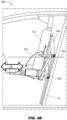
FIG. 4B is a left-side profile view of the aircraft seat assembly ofFIG. 4A in an extended horizontal position. - A bulkhead-mounted aircraft seat configured for independent horizontal and vertical adjustment is disclosed. In embodiments, the aircraft seat includes a seatback and seat frame/cushion for supporting an occupant. Parallel rails attach to the bulkhead and extend along the bulkhead (vertically or near vertically) with opposing slots set into each rail. A sled translates along the rails via paired sliding members set into the slots, each pair of sliding members connected to an axle extending through the sled. A four-bar linkage attached to the sled and to the aircraft seat; the four-bar linkage extends from a default position to allow the aircraft seat to translate along a horizontal linear rail under the seat while maintaining a stable vertical reference point above the cabin floor. The seat is independently configured for substantially vertical adjustment via a metering plate attached to the bulkhead.
- In some embodiments, the sled includes an upper pair and a lower pair of sliding members, each pair of sliding members (e.g., left-side and right-side) connected to an upper or lower axle extending through the sled and translating through left-side and right-side slots respectively.
- In some embodiments, the aircraft seat assembly includes a linear lock for securing the aircraft seat in the desired horizontal position along the linear rail (e.g., relative to the bulkhead).
- In some embodiments, the metering plate is configured for energy attenuation via controlled deformation to control downward deceleration of the aircraft seat in response to an impact event.
- In some embodiments, the aircraft seat is held at a desired height by a spring-loaded locking pin which extends through a hole in the sled and a second hole in the metering plate, the metering plate including a substantially vertical sequence of holes where each hole corresponds to a desired height of the seat. For example, an occupant of the seat may release the locking pin via a handle to articulate the aircraft seat to a higher or lower desired height, releasing the handle to restore the locking pin through the sled hole and higher or lower metering hole and securing the aircraft seat to the new desired height.
- This Summary is provided solely as an introduction to subject matter that is fully described in the Detailed Description and Drawings. The Summary should not be considered to describe essential features nor be used to determine the scope of the Claims. Moreover, it is to be understood that both the foregoing Summary and the following Detailed Description are example and explanatory only and are not necessarily restrictive of the subject matter claimed.
- Before explaining one or more embodiments of the disclosure in detail, it is to be understood that the embodiments are not limited in their application to the details of construction and the arrangement of the components or steps or methodologies set forth in the following description or illustrated in the drawings. In the following detailed description of embodiments, numerous specific details may be set forth in order to provide a more thorough understanding of the disclosure. However, it will be apparent to one of ordinary skill in the art having the benefit of the instant disclosure that the embodiments disclosed herein may be practiced without some of these specific details. In other instances, well-known features may not be described in detail to avoid unnecessarily complicating the instant disclosure.
- As used herein a letter following a reference numeral is intended to reference an embodiment of the feature or element that may be similar, but not necessarily identical, to a previously described element or feature bearing the same reference numeral (e.g., 1, 1a, 1b). Such shorthand notations are used for purposes of convenience only and should not be construed to limit the disclosure in any way unless expressly stated to the contrary.
- Further, unless expressly stated to the contrary, "or" refers to an inclusive or and not to an exclusive or. For example, a condition A or B is satisfied by any one of the following: A is true (or present) and B is false (or not present), A is false (or not present) and B is true (or present), and both A and B are true (or present).
- In addition, use of "a" or "an" may be employed to describe elements and components of embodiments disclosed herein. This is done merely for convenience and "a" and "an" are intended to include "one" or "at least one," and the singular also includes the plural unless it is obvious that it is meant otherwise.
- Finally, as used herein any reference to "one embodiment" or "some embodiments" means that a particular element, feature, structure, or characteristic described in connection with the embodiment is included in at least one embodiment disclosed herein.
- Broadly speaking, embodiments of the inventive concepts disclosed herein are directed to a seat assembly for a rotorcraft or other aircraft that attaches directly to a rear bulkhead, e.g., of a rotorcraft cockpit. While the aircraft seat is capable of vertical adjustment, e.g., height adjustment of the aircraft seat relative to the cabin floor, the aircraft seat is also capable of horizontal adjustment. For example, the aircraft seat may be adjusted forward or backward relative to the bulkhead, e.g., along an x-axis. Further, the horizontal adjustment mechanism maintains the vertical seat position (e.g., the height of the seat relative to the floor) within a narrow tolerance during horizontal adjustment.
- Referring now to
FIG. 1 , anaircraft seat assembly 100 is shown. The aircraft seat assembly may include anaircraft seat 102,seat base rails 104,metering plate 106, andlinkage 108. - In embodiments, the
aircraft seat assembly 100 may attach directly to arear bulkhead 110, e.g., within a rotorcraft cockpit or like aircraft interior space, rather than to a cabin floor. For example, two parallelseat base rails 104 may be rigidly attached to thebulkhead 110, e.g., a left-side rail and a right-side rail in a spaced apart relationship. Theaircraft seat 102 may include aseatback 102a and a seat frame/seat cushion 102b collectively capable of supporting an occupant of the seat; for example, the seatback and seat frame/seat cushion may be two separate components or may be combined into a single component. - In embodiments, the
aircraft seat 102 may attach to thebulkhead 110 via a sled (not shown), the sled capable of translation along the left-side and right-sideseat base rails 104 via sliding members 112 (e.g., rolling members). For example, eachseat base rail 104 may include aslot 104a extending substantially the length of the base rail, thesliding member 112 capable of translating through the slot. - In embodiments, the
aircraft seat 102 may be spring-loaded to a default height above the cabin floor and secured to the default height via a locking pin (306,FIG. 3 ; e.g., "pop pin") inserted through ahole 114 in themetering plate 106. For example, themetering plate 106 may include a substantially vertical array ofholes 114, each hole corresponding to a height to which theaircraft seat 102 may be secured. Vertical adjustment (116; e.g., height adjustment) of theaircraft seat 102 by the occupant of theaircraft seat 102 may be achieved by releasing the locking pin from themetering plate 106, allowing the aircraft seat to translate freely along theseat base rails 104. In some embodiments, the occupant may raise or lower theaircraft seat 102 to a new desired height by shifting their weight in the aircraft seat, e.g., pushing the seat downward or allowing the seat to rise toward the default height, and secure the aircraft seat to the new desired height by reinserting the locking pin in theappropriate hole 114 in the metering plate. - Referring also to
FIG. 2 , in embodiments, theaircraft seat 102 may be capable of horizontal adjustment (118), as well as vertical adjustment (116), relative to thebulkhead 110. For example, thelinkage 108 may operate as a four-bar linkage, including anupper portion 108a and alower portion 108b attached to theaircraft seat 102 and to thesled 202, the linkage pivotable at both ends. For example, the sled 202 (e.g., to which theaircraft seat 102 may be fixed) may translate relative to the seat base rails 104 via pairs of slidingmembers 112, each pair of sliding members including a left-side sliding member capable of translation along the slot of the left-side seat base rail and a right-side sliding member capable of translation along the slot of the right-side seat base rail. In embodiments, each opposing pair of sliding members (e.g., left and right) may be joined to anaxle 204 extending through thesled 202. For example, theupper portion 108a of thelinkage 108 may be connected to anupper axle 204 and may pivot relative to the upper axle; similarly, thelower portion 108b of the linkage may be connected, and may pivot relative to, a lower axle. In embodiments, thelinkage 108 may pivot to allow the occupant to articulate theaircraft seat 102 along thehorizontal axis 118, e.g., forward or backward relative to the bulkhead 110 (and allowing theaircraft seat 102 to accommodate a broader range of pilot sizes). - In some embodiments, the
metering plate 106 may be configured for energy attenuation (EA). For example, in response to a crash event associated with a downward load (e.g., a rapid downward deceleration) on theaircraft seat 102 and its occupant, the aircraft seat may stroke downward (206) along the seat base rails 104, themetering plate 106 deforming to absorb at least a portion of the load as it deforms, slowing the deceleration of the aircraft seat (as disclosed byUS Patent application 17/940,873 ). - Referring now to
FIG. 3 , theaircraft seat assembly 100 is shown. - In embodiments, the
aircraft seat assembly 100 may include alinear lock assembly 300 comprising alinear track 302 and a slidingcarriage 304 capable of horizontal translation along the linear track. For example, thelinear track 302 may attach to thesled 202 and project forward therefrom, defining a substantially horizontal axis (118). In embodiments, the slidingcarriage 304 may secure to thelinear track 302 to lock theaircraft seat 102 in a desired horizontal position relative to the bulkhead (110,FIG. 1 ). - In embodiments, the occupant of the
aircraft seat 102 may vertically adjust (116) the aircraft seat by releasing thelocking pin 306 and actuating the aircraft seat to a new desired height as described above. For example, the lockingpin 306 may be spring-loaded to a default configuration wherein the locking pin is inserted through ahole 308 extending through thesled 202 and through ahole 114 in themetering plate 106. In embodiments, when theaircraft seat 102 has reached the new desired height, the occupant may re-insert thelocking pin 306 into thehole 308 and into thehole 114 in themetering plate 106 corresponding to the new desired height. - In embodiments, the occupant may horizontally articulate the
aircraft seat 102 by releasing the slidingcarriage 304 from thelinear track 302 and actuating the aircraft seat along thehorizontal axis 118 to the new desired position. For example, thelinkage 108 may pivot between theaircraft seat 102 and thesled 202, allowing the aircraft seat to translate forward or backward along the linear track. When the new desired position on thelinear track 302 is reached, the occupant may lock theaircraft seat 102 to the new desired position via the sliding carriage. - Referring now to
FIGS. 4A and4B , theaircraft seat assembly 100 is shown. - In embodiments,
horizontal adjustment 118 of theaircraft seat 102 relative to thebulkhead 110 may be achieved independently ofvertical adjustment 116 of the aircraft seat, and vice versa. For example, theaircraft seat 102 is shown byFIG. 4A at a default horizontal position, e.g., wherein theaircraft seat 102 is closest to thebulkhead 110, and byFIG. 4B at a maximum horizontal distance from the bulkhead (e.g., as allowed by the placement of other fixtures or objects within a cockpit 400 or control area wherein theaircraft seat assembly 100 is situated, where continued horizontal adjustment of the aircraft seat may collide or interfere with said other fixtures or objects). In embodiments, full horizontal adjustment of theaircraft seat 102 may be possible at any selected height of the aircraft seat, and full vertical adjustment of the aircraft seat may be possible at any position of the aircraft seat along the linear track (302,FIG. 3 ). - In embodiments, the upper and
lower linkages adjustment 118 of theaircraft seat 102 along the linear track while maintaining the vertical seat reference point 402 (VSRP) within a minimal tolerance. For example, given abulkhead 110 at an angle of 15 degrees from vertical and a desired range of horizontal adjustment (e.g., 4 inches), the upper andlower linkages rotational radius 404 that theaircraft seat 102 may be horizontally adjusted with minimal variation inVSRP 402. In embodiments, the achievable VSRP tolerance may vary according to the length of the upper andlower linkages lower linkages - It is to be understood that embodiments of the methods disclosed herein may include one or more of the steps described herein. Further, such steps may be carried out in any desired order and two or more of the steps may be carried out simultaneously with one another. Two or more of the steps disclosed herein may be combined in a single step, and in some embodiments, one or more of the steps may be carried out as two or more sub-steps. Further, other steps or sub-steps may be carried in addition to, or as substitutes to one or more of the steps disclosed herein.
- Although inventive concepts have been described with reference to the embodiments illustrated in the attached drawing figures, substitutions may be made herein without departing from the scope of the claims. Components illustrated and described herein are merely examples of a system/device and components that may be used to implement embodiments of the inventive concepts and may be replaced with other devices and components without departing from the scope of the claims. Furthermore, any dimensions, degrees, and/or numerical ranges provided herein are to be understood as non-limiting examples unless otherwise specified in the claims.
Claims (6)
- An aircraft seat assembly (100), comprising:an aircraft seat (102) capable of supporting an occupant;two parallel rails (104) attachable to a bulkhead (110) of an aircraft, each rail including a slot (104a) set thereinto and extending along the rail (104);a sled (202) disposed between the two rails (104) and slidably attached to each rail via at least two pairs of sliding members (112), each pair including a left-side sliding member configured for translation along a left-side slot and a right-side sliding member configured to translation along a right-side slot, the sled including at least one first hole set thereinto;a four-bar linkage pivotably attached to the sled (202) and to the aircraft seat (102), the linkage including at least an upper portion (108a) and a lower portion (108b);a metering plate (106) disposed between the two parallel rails (104) behind the sled (202), the metering plate (106) including a substantially vertical array of second holes set thereinto, each second hole associated with a height of the aircraft seat;
anda locking pin controllable by the occupant;wherein the locking pin (306) is configured for insertion through the first hole and a second hole of the array to secure the aircraft seat (102) at a height associated with the second hole;
andwherein the four-bar linkage is configured for horizontal articulation of the aircraft seat (102) relative to the bulkhead (110). - The aircraft seat assembly of Claim 1, wherein the at least two pairs of sliding members (112) include:an upper pair connected by an upper axle (204) extending through the sled (202) and a lower pair connected by a lower axle extending through the sled,the upper portion (108a) of the linkage pivotably attached to the upper axle (204) and the lower portion (108b) of the linkage pivotably attached to the lower axle.
- The aircraft seat assembly of Claim 1 or 2, further comprising:
a linear locking mechanism configured to secure the aircraft seat (102) in at least one horizontal position relative to the bulkhead. - The aircraft seat assembly of any preceding Claim, wherein the metering plate (106) is configured for energy attenuation in response to an impact event via controlled deformation in a downward direction.
- The aircraft seat assembly of any preceding Claim, wherein:the locking pin is held in a default configuration by at least one spring, the default configuration associated with insertion through the first hole and the second hole;
andwherein the locking pin is operatively coupled to a handle controllable by the occupant, the handle articulable to release the locking pin from the first hole and the second hole for adjustment of the aircraft seat (102) to a new desired height. - The aircraft seat assembly of Claim 3, wherein the linear locking mechanism comprises:a linear track (302) attached to the sled and projecting forward therefrom; anda sliding carriage (304) attached to the aircraft seat and configured for translating along the linear track and for securing to the linear track to lock the aircraft seat in the at least one horizontal position relative to the bulkhead.
Applications Claiming Priority (2)
| Application Number | Priority Date | Filing Date | Title |
|---|---|---|---|
| US17/940,873 US11945590B1 (en) | 2022-09-08 | 2022-09-08 | Aircraft seat with energy attenuating metering plate |
| US17/941,674 US12049321B2 (en) | 2022-09-08 | 2022-09-09 | Aircraft bulkhead-mounted pilot seat with horizontal and vertical adjustment |
Publications (2)
| Publication Number | Publication Date |
|---|---|
| EP4335747A1 EP4335747A1 (en) | 2024-03-13 |
| EP4335747B1 true EP4335747B1 (en) | 2025-06-18 |
Family
ID=87845945
Family Applications (1)
| Application Number | Title | Priority Date | Filing Date |
|---|---|---|---|
| EP23195098.1A Active EP4335747B1 (en) | 2022-09-08 | 2023-09-04 | Aircraft bulkhead-mounted pilot seat with horizontal and vertical adjustment |
Country Status (2)
| Country | Link |
|---|---|
| US (1) | US12049321B2 (en) |
| EP (1) | EP4335747B1 (en) |
Families Citing this family (3)
| Publication number | Priority date | Publication date | Assignee | Title |
|---|---|---|---|---|
| USD1108169S1 (en) * | 2022-05-12 | 2026-01-06 | Ami Industries, Inc. | Compact rotorcraft seating assembly |
| USD1105776S1 (en) * | 2022-09-22 | 2025-12-16 | Ami Industries, Inc. | Pilot seat |
| US12252253B2 (en) * | 2022-10-14 | 2025-03-18 | Ami Industries, Inc. | Aircraft seat with nested energy attenuation guide system |
Family Cites Families (19)
| Publication number | Priority date | Publication date | Assignee | Title |
|---|---|---|---|---|
| GB774129A (en) | 1954-06-25 | 1957-05-08 | Woodhead Monroe Ltd | Improvements in or relating to seat suspensions |
| US2945654A (en) | 1957-05-14 | 1960-07-19 | Clifford C Woodward | Pilot and ejection seat energy absorption system |
| US3572828A (en) | 1967-10-23 | 1971-03-30 | Wilhelm Lehner | Seat for vehicle preferably agricultural vehicle |
| US3630478A (en) | 1970-05-15 | 1971-12-28 | Otto Klepp | Seat structure for agricultural tractor |
| US4004763A (en) | 1974-07-15 | 1977-01-25 | Lockheed Aircraft Corporation | Articulated high "G" pilot S seat |
| EP0099677B1 (en) | 1982-07-19 | 1988-03-23 | Westland Group plc | Aircraft seat |
| US5791597A (en) | 1995-06-22 | 1998-08-11 | East/West Industries, Inc. | Energy attenuation system |
| US6394393B1 (en) | 2000-08-25 | 2002-05-28 | Skyline Industries, Inc. | Crashworthy aircraft seat |
| US6378939B1 (en) | 2000-09-25 | 2002-04-30 | East/West Industries, Inc. | Variable energy attenuating apparatus |
| US7293830B2 (en) | 2005-06-29 | 2007-11-13 | Stidd Systems, Inc. | Shock-mitigating bolster |
| FR2950607B1 (en) * | 2009-09-30 | 2011-08-26 | Eurocopter France | SEAT FOR MOTORIZED FLYWHEELS, INCORPORATING MEANS FOR PROTECTING THE PASSENGER IN CASE OF CRASH |
| US8636154B2 (en) * | 2010-07-12 | 2014-01-28 | Ferno-Washington, Inc. | Litter support systems for medical care units and methods of their use |
| GB201019468D0 (en) | 2010-11-17 | 2010-12-29 | Vital Seating & Systems Ltd | A seat for absorbing a force |
| FR2991667B1 (en) | 2012-06-06 | 2015-05-29 | Eads Sogerma | AIRCRAFT SEAT WITH A MONOPOUTRE AND AIRCRAFT STRUCTURE COMPRISING SUCH A SEAT |
| FR3013644B1 (en) | 2013-11-27 | 2016-01-22 | Eads Sogerma | EVOLUTIVE CINEMATIC BAQUET SEAT |
| CN105416325A (en) | 2015-11-28 | 2016-03-23 | 中国北车集团大连机车车辆有限公司 | Driver seat for locomotive |
| US10052984B1 (en) | 2017-03-28 | 2018-08-21 | Armorworks Holdings, Inc. | Extended stroke energy attenuator |
| US20190118680A1 (en) | 2017-10-25 | 2019-04-25 | Tencate Advanced Armor Usa, Inc. | Advanced active crash seat systems and methods |
| US11447252B2 (en) * | 2019-10-01 | 2022-09-20 | B/E Aerospace, Inc. | Aircraft seat with separated seat back and seat pan |
-
2022
- 2022-09-09 US US17/941,674 patent/US12049321B2/en active Active
-
2023
- 2023-09-04 EP EP23195098.1A patent/EP4335747B1/en active Active
Also Published As
| Publication number | Publication date |
|---|---|
| US20240083583A1 (en) | 2024-03-14 |
| US12049321B2 (en) | 2024-07-30 |
| EP4335747A1 (en) | 2024-03-13 |
Similar Documents
| Publication | Publication Date | Title |
|---|---|---|
| EP4335747B1 (en) | Aircraft bulkhead-mounted pilot seat with horizontal and vertical adjustment | |
| EP4177163B1 (en) | Compact rotorcraft seating assembly with non-linear bucket guide channels | |
| US9421886B2 (en) | Bucket seat with changing kinematics | |
| EP2981469B1 (en) | Vertically stowed tray table assembly with translational movement | |
| EP3060473B1 (en) | Independently articulating seat pan for aircraft seat | |
| EP4335745B1 (en) | Aircraft seat with energy attenuating metering plate | |
| EP3453620B1 (en) | Tracking base assembly for aircraft seat | |
| US7726607B2 (en) | Flight passenger seat with an integrated spring element | |
| EP3060472B1 (en) | Linearly deployable aircraft seat legrest | |
| EP0065982B1 (en) | Vehicle crashworthy seat | |
| US11850974B2 (en) | Vehicle seat with inclinable seat bottom and seatbacks to improve access to the rear places | |
| EP2632763B1 (en) | Vehicle occupant support | |
| EP3626619B1 (en) | Multi-stage seatback extension system | |
| EP3680173B1 (en) | Passenger seat reconfigurable for seating or storage | |
| EP3393906B1 (en) | Passenger seat having a displaceable seat element | |
| EP0049167A1 (en) | Fore and aft adjustment and isolation assembly for a vehicle seat | |
| EP3702282A1 (en) | Multi-position adjustable headrest assembly | |
| EP3715255B1 (en) | Seat, in particular an aircraft seat | |
| CN110979117A (en) | Set of seats and motor vehicle comprising same | |
| WO2015164690A1 (en) | Aircraft seat with occupant weight sensing mechanism to adjust tiltrecline force | |
| US20070052263A1 (en) | Seating system for passenger service vehicles, for aircraft in particular | |
| WO2014125507A2 (en) | An internal bottom locking type sliding system | |
| EP3757008B1 (en) | Braking table system for an aircraft | |
| CN113525691B (en) | Aircraft seat with spring assisted actuation | |
| EP3774540B1 (en) | Movable ottoman for an aircraft seat |
Legal Events
| Date | Code | Title | Description |
|---|---|---|---|
| PUAI | Public reference made under article 153(3) epc to a published international application that has entered the european phase |
Free format text: ORIGINAL CODE: 0009012 |
|
| STAA | Information on the status of an ep patent application or granted ep patent |
Free format text: STATUS: THE APPLICATION HAS BEEN PUBLISHED |
|
| AK | Designated contracting states |
Kind code of ref document: A1 Designated state(s): AL AT BE BG CH CY CZ DE DK EE ES FI FR GB GR HR HU IE IS IT LI LT LU LV MC ME MK MT NL NO PL PT RO RS SE SI SK SM TR |
|
| STAA | Information on the status of an ep patent application or granted ep patent |
Free format text: STATUS: REQUEST FOR EXAMINATION WAS MADE |
|
| 17P | Request for examination filed |
Effective date: 20240822 |
|
| RBV | Designated contracting states (corrected) |
Designated state(s): AL AT BE BG CH CY CZ DE DK EE ES FI FR GB GR HR HU IE IS IT LI LT LU LV MC ME MK MT NL NO PL PT RO RS SE SI SK SM TR |
|
| GRAP | Despatch of communication of intention to grant a patent |
Free format text: ORIGINAL CODE: EPIDOSNIGR1 |
|
| STAA | Information on the status of an ep patent application or granted ep patent |
Free format text: STATUS: GRANT OF PATENT IS INTENDED |
|
| RIC1 | Information provided on ipc code assigned before grant |
Ipc: B60N 2/16 20060101ALN20241219BHEP Ipc: B60N 2/015 20060101ALN20241219BHEP Ipc: B60N 2/427 20060101ALN20241219BHEP Ipc: B60N 2/42 20060101ALN20241219BHEP Ipc: B64D 11/06 20060101AFI20241219BHEP |
|
| RIC1 | Information provided on ipc code assigned before grant |
Ipc: B60N 2/16 20060101ALN20241223BHEP Ipc: B60N 2/015 20060101ALN20241223BHEP Ipc: B60N 2/427 20060101ALN20241223BHEP Ipc: B60N 2/42 20060101ALN20241223BHEP Ipc: B64D 11/06 20060101AFI20241223BHEP |
|
| INTG | Intention to grant announced |
Effective date: 20250122 |
|
| GRAS | Grant fee paid |
Free format text: ORIGINAL CODE: EPIDOSNIGR3 |
|
| GRAA | (expected) grant |
Free format text: ORIGINAL CODE: 0009210 |
|
| STAA | Information on the status of an ep patent application or granted ep patent |
Free format text: STATUS: THE PATENT HAS BEEN GRANTED |
|
| AK | Designated contracting states |
Kind code of ref document: B1 Designated state(s): AL AT BE BG CH CY CZ DE DK EE ES FI FR GB GR HR HU IE IS IT LI LT LU LV MC ME MK MT NL NO PL PT RO RS SE SI SK SM TR |
|
| REG | Reference to a national code |
Ref country code: GB Ref legal event code: FG4D |
|
| REG | Reference to a national code |
Ref country code: CH Ref legal event code: EP |
|
| REG | Reference to a national code |
Ref country code: DE Ref legal event code: R096 Ref document number: 602023004056 Country of ref document: DE |
|
| REG | Reference to a national code |
Ref country code: CH Ref legal event code: EP |
|
| REG | Reference to a national code |
Ref country code: IE Ref legal event code: FG4D |
|
| PG25 | Lapsed in a contracting state [announced via postgrant information from national office to epo] |
Ref country code: FI Free format text: LAPSE BECAUSE OF FAILURE TO SUBMIT A TRANSLATION OF THE DESCRIPTION OR TO PAY THE FEE WITHIN THE PRESCRIBED TIME-LIMIT Effective date: 20250618 |
|
| PGFP | Annual fee paid to national office [announced via postgrant information from national office to epo] |
Ref country code: DE Payment date: 20250820 Year of fee payment: 3 |
|
| REG | Reference to a national code |
Ref country code: LT Ref legal event code: MG9D |
|
| PG25 | Lapsed in a contracting state [announced via postgrant information from national office to epo] |
Ref country code: NO Free format text: LAPSE BECAUSE OF FAILURE TO SUBMIT A TRANSLATION OF THE DESCRIPTION OR TO PAY THE FEE WITHIN THE PRESCRIBED TIME-LIMIT Effective date: 20250918 Ref country code: GR Free format text: LAPSE BECAUSE OF FAILURE TO SUBMIT A TRANSLATION OF THE DESCRIPTION OR TO PAY THE FEE WITHIN THE PRESCRIBED TIME-LIMIT Effective date: 20250919 |
|
| PG25 | Lapsed in a contracting state [announced via postgrant information from national office to epo] |
Ref country code: BG Free format text: LAPSE BECAUSE OF FAILURE TO SUBMIT A TRANSLATION OF THE DESCRIPTION OR TO PAY THE FEE WITHIN THE PRESCRIBED TIME-LIMIT Effective date: 20250618 |
|
| PG25 | Lapsed in a contracting state [announced via postgrant information from national office to epo] |
Ref country code: HR Free format text: LAPSE BECAUSE OF FAILURE TO SUBMIT A TRANSLATION OF THE DESCRIPTION OR TO PAY THE FEE WITHIN THE PRESCRIBED TIME-LIMIT Effective date: 20250618 |
|
| PGFP | Annual fee paid to national office [announced via postgrant information from national office to epo] |
Ref country code: FR Payment date: 20250820 Year of fee payment: 3 Ref country code: AT Payment date: 20251020 Year of fee payment: 3 |
|
| PG25 | Lapsed in a contracting state [announced via postgrant information from national office to epo] |
Ref country code: RS Free format text: LAPSE BECAUSE OF FAILURE TO SUBMIT A TRANSLATION OF THE DESCRIPTION OR TO PAY THE FEE WITHIN THE PRESCRIBED TIME-LIMIT Effective date: 20250918 |
|
| REG | Reference to a national code |
Ref country code: NL Ref legal event code: MP Effective date: 20250618 |
|
| PG25 | Lapsed in a contracting state [announced via postgrant information from national office to epo] |
Ref country code: LV Free format text: LAPSE BECAUSE OF FAILURE TO SUBMIT A TRANSLATION OF THE DESCRIPTION OR TO PAY THE FEE WITHIN THE PRESCRIBED TIME-LIMIT Effective date: 20250618 |
|
| PG25 | Lapsed in a contracting state [announced via postgrant information from national office to epo] |
Ref country code: NL Free format text: LAPSE BECAUSE OF FAILURE TO SUBMIT A TRANSLATION OF THE DESCRIPTION OR TO PAY THE FEE WITHIN THE PRESCRIBED TIME-LIMIT Effective date: 20250618 |
|
| PG25 | Lapsed in a contracting state [announced via postgrant information from national office to epo] |
Ref country code: PT Free format text: LAPSE BECAUSE OF FAILURE TO SUBMIT A TRANSLATION OF THE DESCRIPTION OR TO PAY THE FEE WITHIN THE PRESCRIBED TIME-LIMIT Effective date: 20251020 |
|
| REG | Reference to a national code |
Ref country code: AT Ref legal event code: MK05 Ref document number: 1803992 Country of ref document: AT Kind code of ref document: T Effective date: 20250618 |
|
| PG25 | Lapsed in a contracting state [announced via postgrant information from national office to epo] |
Ref country code: IS Free format text: LAPSE BECAUSE OF FAILURE TO SUBMIT A TRANSLATION OF THE DESCRIPTION OR TO PAY THE FEE WITHIN THE PRESCRIBED TIME-LIMIT Effective date: 20251018 |
|
| PG25 | Lapsed in a contracting state [announced via postgrant information from national office to epo] |
Ref country code: AT Free format text: LAPSE BECAUSE OF FAILURE TO SUBMIT A TRANSLATION OF THE DESCRIPTION OR TO PAY THE FEE WITHIN THE PRESCRIBED TIME-LIMIT Effective date: 20250618 Ref country code: SM Free format text: LAPSE BECAUSE OF FAILURE TO SUBMIT A TRANSLATION OF THE DESCRIPTION OR TO PAY THE FEE WITHIN THE PRESCRIBED TIME-LIMIT Effective date: 20250618 |
|
| PG25 | Lapsed in a contracting state [announced via postgrant information from national office to epo] |
Ref country code: CZ Free format text: LAPSE BECAUSE OF FAILURE TO SUBMIT A TRANSLATION OF THE DESCRIPTION OR TO PAY THE FEE WITHIN THE PRESCRIBED TIME-LIMIT Effective date: 20250618 |
|
| PG25 | Lapsed in a contracting state [announced via postgrant information from national office to epo] |
Ref country code: PL Free format text: LAPSE BECAUSE OF FAILURE TO SUBMIT A TRANSLATION OF THE DESCRIPTION OR TO PAY THE FEE WITHIN THE PRESCRIBED TIME-LIMIT Effective date: 20250618 |
|
| PG25 | Lapsed in a contracting state [announced via postgrant information from national office to epo] |
Ref country code: EE Free format text: LAPSE BECAUSE OF FAILURE TO SUBMIT A TRANSLATION OF THE DESCRIPTION OR TO PAY THE FEE WITHIN THE PRESCRIBED TIME-LIMIT Effective date: 20250618 |
|
| PG25 | Lapsed in a contracting state [announced via postgrant information from national office to epo] |
Ref country code: SK Free format text: LAPSE BECAUSE OF FAILURE TO SUBMIT A TRANSLATION OF THE DESCRIPTION OR TO PAY THE FEE WITHIN THE PRESCRIBED TIME-LIMIT Effective date: 20250618 |
|
| PG25 | Lapsed in a contracting state [announced via postgrant information from national office to epo] |
Ref country code: ES Free format text: LAPSE BECAUSE OF FAILURE TO SUBMIT A TRANSLATION OF THE DESCRIPTION OR TO PAY THE FEE WITHIN THE PRESCRIBED TIME-LIMIT Effective date: 20250618 |
|
| PG25 | Lapsed in a contracting state [announced via postgrant information from national office to epo] |
Ref country code: RO Free format text: LAPSE BECAUSE OF FAILURE TO SUBMIT A TRANSLATION OF THE DESCRIPTION OR TO PAY THE FEE WITHIN THE PRESCRIBED TIME-LIMIT Effective date: 20250618 |
|
| PG25 | Lapsed in a contracting state [announced via postgrant information from national office to epo] |
Ref country code: DK Free format text: LAPSE BECAUSE OF FAILURE TO SUBMIT A TRANSLATION OF THE DESCRIPTION OR TO PAY THE FEE WITHIN THE PRESCRIBED TIME-LIMIT Effective date: 20250618 |
|
| PG25 | Lapsed in a contracting state [announced via postgrant information from national office to epo] |
Ref country code: IT Free format text: LAPSE BECAUSE OF FAILURE TO SUBMIT A TRANSLATION OF THE DESCRIPTION OR TO PAY THE FEE WITHIN THE PRESCRIBED TIME-LIMIT Effective date: 20250618 |
|
| PLBE | No opposition filed within time limit |
Free format text: ORIGINAL CODE: 0009261 |
|
| STAA | Information on the status of an ep patent application or granted ep patent |
Free format text: STATUS: NO OPPOSITION FILED WITHIN TIME LIMIT |
|
| REG | Reference to a national code |
Ref country code: CH Ref legal event code: L10 Free format text: ST27 STATUS EVENT CODE: U-0-0-L10-L00 (AS PROVIDED BY THE NATIONAL OFFICE) Effective date: 20260430 |