EP4334530B1 - Particule de remplissage pour gazon artificiel, procédé de production d'une telle particule de remplissage et utilisation de ladite particule de remplissage - Google Patents
Particule de remplissage pour gazon artificiel, procédé de production d'une telle particule de remplissage et utilisation de ladite particule de remplissage Download PDFInfo
- Publication number
- EP4334530B1 EP4334530B1 EP22728454.4A EP22728454A EP4334530B1 EP 4334530 B1 EP4334530 B1 EP 4334530B1 EP 22728454 A EP22728454 A EP 22728454A EP 4334530 B1 EP4334530 B1 EP 4334530B1
- Authority
- EP
- European Patent Office
- Prior art keywords
- particle
- infill
- particles
- artificial turf
- salt
- Prior art date
- Legal status (The legal status is an assumption and is not a legal conclusion. Google has not performed a legal analysis and makes no representation as to the accuracy of the status listed.)
- Active
Links
Images

Classifications
-
- B—PERFORMING OPERATIONS; TRANSPORTING
- B27—WORKING OR PRESERVING WOOD OR SIMILAR MATERIAL; NAILING OR STAPLING MACHINES IN GENERAL
- B27K—PROCESSES, APPARATUS OR SELECTION OF SUBSTANCES FOR IMPREGNATING, STAINING, DYEING, BLEACHING OF WOOD OR SIMILAR MATERIALS, OR TREATING OF WOOD OR SIMILAR MATERIALS WITH PERMEANT LIQUIDS, NOT OTHERWISE PROVIDED FOR; CHEMICAL OR PHYSICAL TREATMENT OF CORK, CANE, REED, STRAW OR SIMILAR MATERIALS
- B27K3/00—Impregnating wood, e.g. impregnation pretreatment, for example puncturing; Wood impregnation aids not directly involved in the impregnation process
- B27K3/34—Organic impregnating agents
- B27K3/36—Aliphatic compounds
-
- B—PERFORMING OPERATIONS; TRANSPORTING
- B01—PHYSICAL OR CHEMICAL PROCESSES OR APPARATUS IN GENERAL
- B01J—CHEMICAL OR PHYSICAL PROCESSES, e.g. CATALYSIS OR COLLOID CHEMISTRY; THEIR RELEVANT APPARATUS
- B01J2/00—Processes or devices for granulating materials, e.g. fertilisers in general; Rendering particulate materials free flowing in general, e.g. making them hydrophobic
-
- B—PERFORMING OPERATIONS; TRANSPORTING
- B27—WORKING OR PRESERVING WOOD OR SIMILAR MATERIAL; NAILING OR STAPLING MACHINES IN GENERAL
- B27K—PROCESSES, APPARATUS OR SELECTION OF SUBSTANCES FOR IMPREGNATING, STAINING, DYEING, BLEACHING OF WOOD OR SIMILAR MATERIALS, OR TREATING OF WOOD OR SIMILAR MATERIALS WITH PERMEANT LIQUIDS, NOT OTHERWISE PROVIDED FOR; CHEMICAL OR PHYSICAL TREATMENT OF CORK, CANE, REED, STRAW OR SIMILAR MATERIALS
- B27K3/00—Impregnating wood, e.g. impregnation pretreatment, for example puncturing; Wood impregnation aids not directly involved in the impregnation process
- B27K3/02—Processes; Apparatus
-
- E—FIXED CONSTRUCTIONS
- E01—CONSTRUCTION OF ROADS, RAILWAYS, OR BRIDGES
- E01C—CONSTRUCTION OF, OR SURFACES FOR, ROADS, SPORTS GROUNDS, OR THE LIKE; MACHINES OR AUXILIARY TOOLS FOR CONSTRUCTION OR REPAIR
- E01C13/00—Pavings or foundations specially adapted for playgrounds or sports grounds; Drainage, irrigation or heating of sports grounds
- E01C13/08—Surfaces simulating grass ; Grass-grown sports grounds
Definitions
- the invention relates generally to an infill particle for artificial turf. More particularly, the invention relates to an infill particle for artificial turf wherein said particle is made from organic material. The invention also relates to a method of producing the infill particle of the invention and artificial turf systems comprising these particles.
- IT MI20131235 A1 relates to an artificial turf structure and a method of making artificial turf.
- KR 20170105233 A1 relates to an artificial turf filler having antibacterial function.
- WO 2018/039554 A1 relates to a treated walnut shell infill for artificial turf.
- WO 2020/120799 A1 relates to a turf infill comprising a mixture of cork particles and rubber particles.
- Artificial turf has become a significant alternative to natural grass in several types of environments.
- Football uses artificial turf to a large extent both indoors and outdoors. While artificial turf systems can vary in terms of their design and manufacture, they generally all share common components.
- the artificial turf fibre (or turf pile or artificial grass) itself is usually made from polyethylene (PE) with a primary backing material of polypropylene (PP) that provides the structure and spacing that the artificial turf fibre is woven into.
- a secondary backing of polyurethane (PU) may be applied and allowed to set in order to bind the pile to the backing.
- the backing or backings form the "turf carpet".
- Hybrid turf or reinforced natural grass, is a turf created by combining natural grass with synthetic reinforcing fibers.
- First generation artificial turf systems comprise short artificial turf fibres.
- First generation artificial turf systems have largely been superseded by second generation and third generation artificial turf systems.
- Second generation artificial turf systems have longer fibres (e.g. 13-24 mm in height) and a sand infill.
- Third generation systems typically include even longer fibres (e.g. 30-60 mm in height), and include two types of infill, namely a “stabilising infill” (which is typically sand) and a “performance infill”.
- a stabilising infill which is typically sand
- a performance infill typically a "performance infill”
- the stabilising infill is placed as a lower layer between the artificial turf fibres
- the performance infill is placed on top of the stabilising infill as an upper layer between the artificial turf fibres.
- the stabilising infill functions to keep the artificial turf fibres vertical during use, while the performance infill functions to mimic the feel of a natural grass bed, for example by providing the correct level of impact resistance, rotational resistance and bounce.
- SBR styrene-butadiene rubber
- crumb rubber a shock pad
- Cork granules are one of the few known natural infill alternatives. However, cork granules are not ideal for all applications, since they are expensive and will tend to deteriorate on artificial turf over time at a faster rate than rubber, so the infill will need topping up more regularly over the lifetime of the artificial turf.
- the present invention provides an infill for artificial turf that meets the aforementioned needs.
- This infill of the invention is demonstrated to have achieved FIFA Quality PRO and FIFA Quality certification (by satisfying the performance requirements outlined in EN 15330-1: 2013), based on tests performed at an accredited FIFA laboratory - Sports Labs Ltd (see Example 3).
- the invention provides an infill particle for artificial turf, wherein said particle has a salt content of at least 5 %, preferably at least 10%, by weight, has a volume of up to about 512 mm 3 and is made of wood.
- the inventors have found surprisingly that wood has technical properties comparable to those of SBR granules.
- the infill particles of the invention constitute a product that can perform the function of SBR without the associated environmental harm resulting from infill escape.
- the particles are impregnated with a high content of salt.
- the level of salt in the infill particles of the invention contributes to the particle behaving stably and not breaking down too soon (being resistant to decomposition and decay). Without wishing to be bound by theory, this effect appears to be caused by the ability of the salt to repel microorganisms and fungi, thus causing the infill particles to be resistant to biodegradation, and the contribution of the salt to resistance of the particle to UV radiation.
- the salt also makes the particles more dense and this gives better properties as infill (e.g. for sports pitches) than wood that is not impregnated with a high concentration of salt. Even at the high concentrations used, the salt is not environmentally harmful, neither toxic to humans or other animals which may come into contact with the infill nor harmful to the wider environment.
- the infill is demonstrated to be stable on artificial turf for at least 5 years and is predicted to be stable for 10 years.
- the lifetime of an artificial turf i.e. the turf carpet comprising artificial turf fibres
- the lifetime of an artificial turf is approximately 10 years and so, unlike cork and other known organic infills, there is a reduced need to replace or top up the infill of the invention over the lifetime of the artificial turf.
- fill it is meant any solid particle that is suitable for use on an artificial turf.
- Particles which are suitable for use on an artificial turf may be particles which, as part of the turf system, mimic the properties of natural grass or a natural grass bed. The properties mimicked may be ball rebound, ball roll, shock absorption, vertical deformation, rotational resistance of the foot, and/or water permeability.
- the infill of the invention is an infill for artificial turf (e.g. an artificial football turf).
- the infill of the invention is for (or suitable for, or suitable for use on) artificial turf (e.g. artificial football turf) having artificial turf fibres (preferably monofilament fibres, fibrillated fibres, monofilament fibres with a stem, or a combination thereof, more preferably monofilament fibres) of about 25-70 mm in height (preferably about 30-50 mm in height, more preferably about 40 mm in height).
- the infill of the invention is for (or suitable for, or suitable for use on) artificial turf (or artificial football turf) having artificial turf fibres which are monofilament turf fibres and are about 40 mm in height.
- the infill of the invention is for (or suitable for, or suitable for use on) a third generation (3G) artificial turf.
- the infill of the invention is a third generation (3G) artificial turf infill.
- the infill of the invention is a performance infill, preferably a performance infill for (or suitable for, or suitable for use on) an artificial turf, more preferably a performance infill for (or suitable for, or suitable for use on) a third generation artificial turf.
- Infill particles (or infill) of the invention can be referred to simply as “particles”.
- the infill particle of the invention comprises a substrate (also referred to as a base material), which is impregnated with salt.
- the substrate is preferably wood.
- the substrate comprises (or is formed form or consists of or consists essentially of) other cellulosic and/or hemicellulosic material.
- other cellulosic and/or hemicellulosic material is contemplated (including lignocellulosic material).
- non-wood substrates include nut shells, olive stones, cork, coconut, walnut shell, and/or corn cob.
- the invention also provides an infill particle for artificial turf, wherein said particle has a salt content of at least 5 %, preferably at least 10%, by weight, has a volume of up to about 512 mm 3 and is made of cellulosic and/or hemicellulosic material.
- the wood of the infill particle may be whole wood or raw wood.
- the wood is not reconstituted or engineered wood.
- the wood is not formed from compressed or blended sawdust.
- the infill particle does not contain non-biodegradable material.
- the infill particle does not contain thermoplastic material.
- Composite infill particles in the art may comprise a thermoplastic material, the purpose of which is to bind the substituents of the particle together.
- thermoplastic material is disadvantageous to use in infill particles since it is potentially damaging to the environment (thermoplastic material used in infill particles may be synthetic and non-biodegradable).
- the method of production of the infill particles of the invention enables salting without the need to break apart the natural structure of cellulosic or hemicellulosic material and then recombine the fibres. This means that there is no need for the use of a thermoplastic material in the particles of the invention, which is advantageous.
- the substrate of the infill particle consists (or consists essentially) of wood (or cellulosic and/or hemicellulosic) material.
- the infill particles of the invention are engineered, manufactured or man-made, preferably manufactured.
- the salt is an inorganic salt, typically comprising, consisting or consisting essentially of a chloride salt.
- the salt is sodium chloride, magnesium chloride, calcium chloride, potassium chloride, sodium sulfate, magnesium sulfate, calcium sulfate, potassium sulfate or a mixture thereof.
- the salt is sodium chloride, magnesium chloride, calcium chloride, potassium chloride or a mixture thereof.
- the salt consists or consists essentially of sodium chloride, i.e. the inorganic salt component is at least 95% NaCl, preferably at least 98% NaCl.
- the salt content (or salt concentration) of the infill particle is at least (or up to) about 5, 6, 7, 8, 9, 10, 11, 12, 13, 14, 15, 16, 17, 18, 19, 20, 21, 22, 23, 24, 25, 26, 27, 28, 29, 30, 31, 32, 33, 34, 35, 36, 37, 38, 39, 40, 41, 42, 43, 44, 45, 46, 47, 48, 49 or 50% by weight.
- the salt content (or salt concentration) of the infill particle is at least about 7%, or at least about 10%, or at least about 15%, or at least about 20% by weight, or at least about 30%, or at least about 40% by weight.
- the salt content of the infill particle is between about 10-55%, e.g.
- % by weight means the % (percentage) of the total weight of the infill particle which is made up of salt.
- % weight means the % (percentage) of the total weight of the infill particle which is made up of salt.
- % weight means the % (percentage) of the total weight of the infill particle which is made up of salt.
- the salt % by weight is calculated based on a dry particle, e.g. a particle that has been in dry ambient conditions for at least 1 week.
- Dry ambient conditions may be those found inside a building at normal room temperature (e.g. 20 degrees Celsius) and under normal conditions of humidity, e.g. between 30 and 50% humidity, such as 40% humidity.
- the salt content (or salt concentration) of the infill particle is at least (or up to) about 5, 6, 7, 8, 9, 10, 11, 12, 13, 14, 15, 16, 17, 18, 19, 20, 21, 22, 23, 24, 25, 26, 27, 28, 29, 30, 31, 32, 33, 34, 35, 36, 37, 38, 39, 40, 41, 42, 43, 44, 45, 46, 47, 48, 49 or 50% by volume.
- the salt content (or salt concentration) of the infill particle is at least about 5%, or at least about 10% by volume.
- the salt content is between about 5-15% by volume.
- the salt % by volume is calculated based on a dry particle, e.g. a particle that has been in dry ambient conditions for at least 1 week.
- the size of the infill particle can be conveniently defined by the volume of said particle.
- the volume of the particle may be up to about 512, 500, 400, 343, 300, 216, 200, 175, 125, 120, 115, 110, 105, 100, 95, 90, 85, 80, 75, 70, 65, 60, 55, 50, 45, 40, 35, 30, 25, 20, 15, or 10 mm 3 .
- the volume of the infill particle may be at least about 0.001, 0.008, 0.01, 0.1, 1, 2, 3, 4 or 5 mm 3 .
- the volume of the infill particle is between about 0.008 mm 3 and about 64, or between about 0.008 mm 3 and about 125 mm 3 .
- the volume of the infill particle is between about 0.1 mm 3 and about 125 mm 3 .
- the volume of the infill particle is between about 0.5 mm 3 and about 64 mm 3 , e.g. between about 1mm 3 and about 10 or 20 mm 3 , particularly around 8 mm 3 .
- the volume should be understood as the size of the particle measured or calculated from its dimensions, the volume of a particle is not reduced just because it may contain pores (i.e. voids).
- a preferred particle which is a cube of 2mm in each dimension has a volume of 8mm 3 .
- the infill particle has a volume of between about 0.001 mm 3 and about 512 mm 3 , more preferably between about 0.008 mm 3 and about 125 mm 3 , more preferably between about 1 mm 3 and about 64 mm 3 , more preferably between about 1 mm 3 and about 27 mm 3 .
- the infill particle is a cube having dimensions of 2x 2x 2 mm and a volume of about 8 mm 3 .
- particles having dimensions of 2x 2x 2 mm are particularly suitable for use as an infill for artificial turf. It is demonstrated herein that such particles exhibit long-term (at least 5 years, possibly 10 or more years) resistance to degradation while on artificial turf, yet advantageously they degrade quickly when in soil. Such particles are also demonstrated herein to be resistant to freezing down to -18°C.
- the 2x 2x 2mm size itself is also particularly appropriate for artificial turf, being particularly complementary to the size and spacing of the turf fibres usually seen on artificial turf carpets.
- the 2x 2x 2mm size of particle can also be efficiently manufactured.
- Particles which are cubes of 1x1x1 mm are also highly preferred and exhibit excellent performance as infill. Cubes with dimensions of 0.5-4x 0.5-4 x 0.5-4 mm are generally preferred as are cuboids of the same dimensions.
- the infill particle can be any shape, preferably any shape that is suitable for use on an artificial turf, more preferably any shape that is suitable for use on a third generation artificial turf.
- the infill particle may take the shape of any polyhedron.
- the infill particle has the shape (or approximate shape) of a cube, cuboid, sphere, ellipsoid, spheroid, ovoid, or pyramid, e.g. a tetrahedron or a square pyramid.
- the infill particle has the shape (or approximate shape) of a cuboid or cube, more preferably a cube.
- the particles are preferably (approximately) equal in their three dimensions. Preferably, no single dimension is more than 1.5 times the length of any other dimension.
- cuboid particles may be preferred, such as elongate or flattened cuboids, for example particles having dimensions of 1x 2x 2mm, may be preferred.
- Other preferred shapes include 1x1x4mm, 1x1x2mm, 2x4x4mm and 2x2x4mm.
- Such particles may make the artificial turf less slippery (for example by providing more rotational resistance) as compared with cubic infill particles.
- the cuboid particles may be flattened rather than elongate in form, in other words, one dimension is smaller than the other two dimensions, which are the same or approximately the same (rather than one dimension being larger than the other two dimensions, as is the case with an elongate cuboid/particle).
- the particles are spheres or spheroid.
- Preferred diameters are 0.5-4mm, preferably 1-2mm.
- the particles are three dimensional and it is understood that for a three dimensional object, the aspect ratio is the ratio of the longest dimension to the shortest dimension. Cuboids are contemplated where two dimensions are the same and one is longer or shorter than the other two, or all three dimensions may be different.
- the cuboid particles may define an aspect ratio of at least (or up to) 1:1, 2:1, 3:1, 4:1, 5:1, 6:1, 7:1, 8:1, 9:1, or 10:1.
- the aspect ratio is between 1:1 and 10:1, more preferably between 2:1 and 10:1, more preferably between 2:1 and 5:1.
- the infill particle has a width to thickness dimension in a range of about (0.5mm to 5mm)x(0.5mm to 5mm). In some embodiments, the infill particle has a cross section and/or length dimension of about 1mm to about 5mm.
- the infill particle length is between 1mm and 5mm, and/or the aspect ratio is between 3:1 and 7:1.
- the infill particle of the invention has a smooth or polished surface.
- a “smooth or polished” surface in accordance with the invention is one that has been treated to reduce roughness and/or to soften the sharpness or angularity of edges and/or corners.
- the vertices (or corners) of the processed infill particle shape are rounded.
- Infill particles of the invention with rounded vertices (or corners) may be advantageous since the rounding improves the rotational resistance of the turf over which the infill is distributed.
- rotational resistance it is meant the ability of the turf to resist the rotational movement of a sole (or foot or boot) when pressed down on the turf.
- the infill particle has the shape of a cube or cuboid with rounded corners.
- some of the outer pores of the infill particle of the invention are sealed, as in they do not provide open channels from the exterior of the particle into the particle. At least 10%, 20%, 30%, 50% or 70% of the pores which open on to the surface of the particle may preferably be sealed.
- the pores of the infill particle of the invention may be sealed by polishing the particles.
- the water absorbency of the infill particle of the invention may be reduced compared to raw wood particles of the same dimensions.
- the water absorbency of the infill particle of the invention may be reduced by virtue of having a smooth or polished surface.
- the water absorbency of the infill particle of the invention may be reduced by virtue of having been impregnated with an oil or a preservative.
- the particles can absorb some water so they can behave in a spongey way and mimic the conditions of a traditional turf pitch in different weather, i.e. harder in dry weather and softer with rain.
- the infill particles of the invention may (or may not) be impregnated with an oil or a preservative.
- the oil or preservative serves as a protective coating (e.g. a waterproof coating) of the infill particles, and functions to improve the retention of the salt inside the particle.
- the oil is a natural oil (i.e. plant derived) and the preservative is a natural preservative.
- the oil is linseed oil (e.g. cold pressed linseed oil).
- Alternative oils include Tung oil, olive oil, rapeseed oil or sunflower oil.
- the infill particle does not comprise a coating.
- the infill particle does not contain (or is not coated with) glycerol, xylitol or sorbitol, more preferably it does not contain any polyols.
- the infill particle does not contain potassium acetate, sodium formate, sodium acetate, urea, sodium chloride, and/or calcium chloride.
- a glycerol (glycerine) coating may have been applied in addition to the salt, usually in a separate application step.
- the salting process significantly increases the density/weight of the wood and this provides superior properties as compared to unsalted wood, in particular it enables the particles to meet the density requirements set by FIFA for infill.
- the density of the dry particle is increased by 20-60%, preferably at least 30% through the addition of salt.
- dry particles have a density of 0.3 - 0.7g/ml, more preferably 0.4-0.7g/ml, in some embodiments 0.65-0.70g/ml.
- the particles when the particles are packaged for sale or applied to the turf system or laid on a pitch, they have a moisture content of around 16-20% (this can still be considered a dry particle).
- the infill particle of the invention typically has a density higher than (or about the same as) pure water such that the infill particle tends to sink when in pure water; it is to be understood that the (dry) particles may float initially, due to the buoyancy of wood, but when placed in water (e.g. after 30 minutes), water is taken up and then the particles become more dense than water and sink.
- the salt content causes the wet particles to be denser than water, despite the fact that wood would naturally be buoyant in water.
- the density of the particle is dependent on saturation and salinity, so it depends not only on the amount of salt added to the substrate particle but also on the ambient or environmental conditions, which will impact on how much moisture is present in (taken up by) the particle. In general the density will vary from 0.5g/ml to over 1.0g/ml (e.g. up to 1.1, 1.2 or 1.4 g/ml).
- the wood of the particles may be natural or raw wood, e.g. as opposed to engineered wood products which may be formed from reconstituted chip or plies which may have a non-wood binder, such as a resin or glue.
- the wood of the particles may be softwood or hardwood, hardwood being preferred.
- Suitable softwood includes Araucaria, Cedar (Cedrus), Celery-top pine (Phyllocladus aspleniifolius), Cypress (e.g. Chamaecyparis, Cupressus, or Taxodium), Douglas-fir (Pseudotsuga menziesii), European yew (Taxus baccata), Fir (Abies), Hemlock (Tsuga), Huon pine, Macquarie pine (Lagarostrobos franklinii), Kauri (Agathis australis), Queensland kauri (Agathis robusta), Japanese nutmeg-yew (Torreya nucifera), Larch (Larix), Pine (Pinus), Red cedar (e.g.
- Juniperus virginiana or Thuja plicata Coast redwood (Sequoia sempervirens), Rimu (Dacrydium cupressinum), Spruce (Picea), Sugi (Cryptomeria japonica), White cedar (e.g. Thuja occidentalis or Chamaecyparis thyoides), or Nootka cypress (Cupressus nootkatensis).
- Suitable hardwood includes birch (Betula), Alder (Alnus), Ash (Fraxinus), Aspen (Populus), Australian red cedar (Toona ciliata), Boxelder (Acer negundo), Boxwood (Buxus sempervirens), Brazilian walnut (Ocotea porosa), Brazilwood (Caesalpinia echinata), Aesculus, Catalpa, Ceylon satinwood (Chloroxylon swietenia), Cherry (Prunus), Chestnut (Castanea), Coachwood (Ceratopetalum apetalum), Corkwood (Leitneria floridana), Populus, Dogwood (Cornus), Ebony (Diospyros), Elm (Ulmus), Eucalyptus, European crabapple (Malus sylvestris), European pear (Pyrus communis), Ironwood, Kingwood (Dalbergia cearensis), Lacewood, Mahogany (e.
- the softwood is Spruce (Picea), more preferably Sitka spruce (Picea sitchensis).
- the hardwood is birch (Betula) e.g. an American birch, preferably gray birch (Betula populifolia), black birch (Betula nigra), paper birch (Betula papyrifera), sweet birch (Betula lenta), Virginia round-leaf birch (Betula uber) or yellow birch (Betula alleghaniensis).
- the birch is a European birch, preferably silver birch (Betula pendula) or most preferably downy birch (Betula pubescens).
- Birch is preferred as the substrate of the infill particle of the invention due to its particularly advantageous properties, as demonstrated in the Examples. Birch is also particularly advantageous due to its homogeneous structure throughout the trunk, which allows the production of homogeneous particles. This is important since it provides consistency of physical properties between batches of infill particles. This homogeneity is in contrast to more heterogeneous wood such as southern yellow pine, which is harder and more compact towards the core of the tree but softer and less compact in the outer layers. Wood such as southern yellow pine is therefore not as ideal for making infill particles as other woods, especially birch, preferably European birch.
- the birch wood used as the preferred substrate of the infill particles of the present invention also has enhanced properties, for example in terms of energy restitution (it provides greater "bounce back") than other woods, such as southern yellow pine.
- the plurality of infill particles of the present invention are homogeneous in size.
- at least 70, 80 or 90% of the particles have a volume which is within 20%, preferably within 10%, e.g. 5% (plus or minus), of the mean volume.
- the infill particle of the invention is resistant to biodegradation while on artificial turf.
- Biodegradation is the breakdown of organic matter by microorganisms, such as bacteria and fungi. In practice, almost all biological compounds and materials are subject to biodegradation processes. The significance, however, is in the rates of such processes, such as days, weeks, years or centuries. Since organic matter is particularly prone to biodegradation, the level of resistance of the organic infill to biodegradation while on artificial turf is important in determining the lifetime of the organic infill.
- the infill particle of the invention is demonstrated herein to be stable on artificial turf for at least 5 years, and is expected to last for at least 10 years (in contrast, when the infill particle is placed in soil, it is fully biodegraded within 3 months). This is particularly advantageous, since it means that the infill particle of the invention is commercially useful as an infill for artificial turf.
- the particles are preferably stable, e.g. able to retain their functional properties and structure, for at least 5 years when placed on artificial turf.
- the infill (including the performance infill) does not freeze, otherwise the surface will not mimic the conditions of a normal grass bed.
- a frozen infill will not have the same advantageous properties as a non-frozen infill.
- the infill particle of the invention is freeze resistant. Without wishing to be bound by theory, this may be due to the high salt content (or salt concentration) of the infill particle, and may additionally be due to the wood of the infill particle.
- the infill particle of the invention is preferably freeze resistant at, i.e. it is not frozen, down to -10, -15 or even -18 °C.
- pyrotechnics and/or fireworks may be used (for example during breaks in play at sporting events).
- the infill particle of the invention is fire resistant or non-flammable. In embodiments, the infill particle of the invention is substantially fire resistant or completely fire resistant. In embodiments, the infill particle of the invention is more fire resistant than a corresponding unsalted or unmodified version of said particle.
- the infill particle of the invention is preferably less susceptible to degradation by UV radiation than untreated wood of the same dimensions.
- the infill particles employed according to the present invention may comprise two or more shapes of infill particle.
- the two or more shapes are selected from the group consisting of a cube, cuboid, sphere, ellipsoid, spheroid, ovoid, or pyramid.
- the infill particles employed according to the present invention may comprise two or more sizes of infill particle.
- a plurality of infill particles of the invention may comprise a first type of infill particle and a second type of infill particle, wherein said first type of infill particle has a volume at least 2 or 3 times the size of the second type of infill particle.
- two different sizes of cube may be employed, such as cubes which are 1mm x 1mm x 1mm, together with cubes which are 2mm x 2mm x 2mm.
- the particles of the invention may be employed with a second particle made of a different substrate.
- the second particle is sand, e.g. silica sand.
- Artificial turf systems of the invention may comprise a lower layer of particles and an upper layer of particles, wherein the upper layer comprises particles of the invention and the lower layer comprises a second particle type suitable for use as an artificial turf infill.
- the second particle type is sand.
- the sand is silica sand.
- the infill particles of the invention may be termed performance infill and the second particle type (e.g. sand) is a stabilising infill.
- the infill particles have a packing factor of about 1.5, 2, 2.5, or 3, preferably about 2.
- Packing factor is a measure of the overall volume of a packed group of particles, divided by the sum total volume of all the particles individually. Hence, the added volume in the collection of particles (as compared to the sum total volume of all the particles individually) is the empty space between the packed particles.
- the packing factor thus reflects the volume of air that exists between the particles. Air between the particles contributes to the softness and technical properties of the infill (and the turf surface when the infill is applied thereto). Therefore, having a packing factor above 1 can be advantageous.
- infill particles of the invention may have a packing factor of 1 to 3, 1.5 to 2.5 or about 2.
- the present invention also provides a method of producing the infill particle(s) of the invention, the method comprising: soaking in a salt solution a particle made of wood and having a volume of up to about 512 mm 3 ; and optionally drying the soaked particle.
- the invention also provides a method of producing the infill particle(s) of the invention, the method comprising: soaking in a salt solution a particle made of cellulosic and/or hemicellulosic material and having a volume of up to about 512 mm 3 ; and optionally drying the soaked particle.
- the particle made of wood has a volume of up to about 512, 500, 400, 343, 300, 216, 200, 175, 125, 120, 115, 110, 105, 100, 95, 90, 85, 80, 75, 70, 65, 60, 55, 50, 45, 40, 35, 30, 25, 20, 15, or 10 mm 3 .
- the volume of the particle made of wood may be at least about 0.001, 0.008, 0.01, 0.1, 1, 2, 3, 4 or 5 mm 3 .
- the volume of the particle made of wood is between about 0.008 mm 3 and about 64, or between about 0.008 mm 3 and about 125 mm 3 .
- the volume of the particle made of wood is between about 0.1 mm 3 and about 125 mm 3 .
- the volume of the particle made of wood is between about 0.5 mm 3 and about 64 mm 3 , e.g. between about 1mm 3 and about 10 or 20 mm 3 , particularly around 8 mm 3 .
- the volume should be understood as the size of the particle measured or calculated from its dimensions, the volume of a particle is not reduced just because it may contain pores (i.e. voids).
- a preferred particle which is a cube of 2mm in each dimension has a volume of 8mm 3 .
- the particle made of wood has a volume of between about 0.001 mm 3 and about 512 mm 3 , more preferably between about 0.008 mm 3 and about 125 mm 3 , more preferably between about 1 mm 3 and about 64 mm 3 , more preferably between about 1 mm 3 and about 27 mm 3 .
- the particle made of wood has corners and edges, wherein said corners and edges are rounded.
- the soaking step is sufficient to give the particles a salt content as described herein, i.e. at least 5%, preferably at least 10%, by weight of salt.
- the soaking step may be sufficient for the salt to penetrate throughout the particle.
- the particles are soaked in salt water, wherein the water preferably has a salt concentration of at least about 200, 210, 220, 230, 240, 250, 260, 270, 280, 290, 300, 310, 320, 330, 340, 350 or 360 g/L (i.e. grams per litre).
- the salt solution is a saturated salt solution, the exact concentration at which saturation is reached will depend on the temperature of the water.
- the salt concentration is 300-400g/L, more preferably 320-380g/L, e.g. around 360g/L.
- the salt solution (salted water) is preferably heated, for example to at least 50 °C, at least 70 or 75 °C or to around boiling point. Preferred temperatures are 70-80 °C, e.g. around 75 °C. Conveniently, the water may be heated prior to the addition of salt and the particles may then be added to the salted water/salt solution.
- the rate of uptake of a liquid (e.g. water or salt water) by a sample of wood can be increased with decreasing liquid viscosity and with increasing surface area and permeability of the wood.
- the viscosity of the liquid (e.g. salt water) can be decreased, and the surface area (e.g. through cellulose and hemicellulose expansion) and permeability (e.g. through pore expansion) of the wood increased, by raising the temperature of the liquid and the wood respectively.
- the rate of salt uptake by the particles is increased significantly as compared to the same protocol at ambient temperature (i.e. the salt uptake stage can take as little as e.g. 15 minutes when conducted at high temperature, as opposed to days or weeks when conducted at ambient temperature). Soaking in a heated salt solution will usually, but not always, be preferred.
- the liquid not only travels through the wood fibres/pores but also percolates through the cellulose and hemicellulose parts between the fibres/pores. This is facilitated by use of a high temperature liquid since this enables expansion of the cellulose and hemicellulose parts of the wood as explained above.
- the soaking of the wood substrate in high temperature salt water results in the formation of a wood particle in which salt is dispersed throughout the particle.
- the dispersion of salt throughout the particle of the invention is advantageous, for example compared to simply coating of the surface of the particle with salt. For example, dispersing the salt throughout the particle allows the particles of the invention to hold a higher quantity of salt as compared to a particle which is merely coated with salt.
- dispersion of salt throughout the particle means that the advantageous properties of salt as described herein may be exhibited throughout the particle, for example in terms of resistance to degradation and resistance to freezing.
- the advantageous properties associated with salt impregnation are enhanced.
- the soaking method of the present invention is distinct from coating where only the surface of the particle will become coated and there is little penetration into the inner parts of the particles.
- the salt is dispersed (substantially or fully) throughout the particle.
- the entirety (or the whole, or all) of the particle is impregnated with the salt.
- the soaking step is for about 5-60 minutes, preferably for about 5-10, 10-15, 15-20, 20-25, 25-30, 30-35, 35-40, 40-45, 45-50, 50-55, or 55-60 minutes. In some embodiments, the soaking step is for at least 10 minutes, at least 15 minutes or at least 20 minutes, more preferably at least 10 minutes. In some embodiments, the soaking step is for about 10-40 minutes, preferably for about 15-35 or 20-35 minutes, more preferably for about 30 minutes.
- the method of producing the infill particle of the invention may further comprise, e.g. after the drying step, polishing the surface of the infill particle.
- polishing refers to a process of creating a smooth surface on the infill particle of the invention through abrasion and/or mechanical stress/pressure. As well as a smooth surface, the polishing results in rounding off of any edges/vertices and corners present on the particle. As discussed elsewhere herein, this may have beneficial properties in terms of performance and in sealing pores to prevent ingress of water in use.
- polishing for example polishing wood
- sandpaper a belt machine employing sandpaper of grade 200 may conveniently be used.
- a suitable machine is known as a wild-belt sanding machine, e.g. SANDTEQ-W-200 from the HOMAG group. "Polishing" and "sanding" are used synonymously herein.
- Another method of polishing the infill particles of the invention is by running said particles through multiple cycles (e.g. 20,200 cycles or 40,200 cycles) of wearing using a wear simulation machine, for example the Lisport (i.e. Lisport classic) wear simulation machine.
- a wear simulation machine for example the Lisport (i.e. Lisport classic) wear simulation machine.
- the polishing step results in the production of an infill particle of the invention having a smooth or polished surface. This decreases the water absorbency of the infill particles. This is advantageous since water absorption is associated with degradation of infill particles composed of organic material.
- reduced water absorption may be achieved through the polishing process by blocking the pores of the particle (or, more specifically, the pores of the wood of which the particle is composed).
- the polishing step may cause some of the outer pores of the infill particle of the invention to become sealed.
- particles made of wood can be obtained by wood milling.
- particles made of wood can be obtained by cutting wood particles from wooden planks or veneers.
- Wooden planks and veneers can be cut using one or more well-known bladed tools, for example a saw, e.g. scroll saw, hack saw, jig saw, circular saw, mitre saw, reciprocating saw, or trimming saw.
- a band saw for example the Scheppach B ⁇ ndsag HBS 261
- a guillotine cutter can be used (e.g.
- a heavy-duty instrument such as a band saw
- the spacing of the blades of the guillotine cutter can be adjusted in order to achieve the desired dimensions of the wood particles cut from the plank.
- a band saw may be used to produce wood which is of the desired particle size in two dimensions and a guillotine may then be used to produce the particles themselves by cutting to the desired size also in the third dimension.
- wood is a preferred example of cellulosic and/or hemicellulosic particles in general.
- the above method also applies to obtaining particles made of other cellulosic and/or hemicellulosic material.
- the present invention provides a method of producing wooden infill particles for artificial turf, the method comprising cutting wood to form particles having a volume per particle of up to about 512 mm 3 (preferably 1-8 mm 3 ) which are cuboid in shape, preferably cubes, and then sanding (polishing) the cut particles in order to round the corners thereof.
- Preferred features of the particles and the cutting and sanding methods described elsewhere herein apply, mutatis mutandis, to this aspect of the invention.
- wood is a preferred example of cellulosic and/or hemicellulosic particles in general.
- the above method also applies to producing particles made of other cellulosic and/or hemicellulosic material for artificial turf.
- the rounded particle has a volume of up to about 512, 500, 400, 343, 300, 216, 200, 175, 125, 120, 115, 110, 105, 100, 95, 90, 85, 80, 75, 70, 65, 60, 55, 50, 45, 40, 35, 30, 25, 20, 15, or 10 mm 3 .
- the volume of the rounded particle may be at least about 0.001, 0.008, 0.01, 0.1, 1, 2, 3, 4 or 5 mm 3 .
- the volume of the rounded particle is between about 0.008 mm 3 and about 64, or between about 0.008 mm 3 and about 125 mm 3 . More preferably, the volume of the rounded particle is between about 0.1 mm 3 and about 125 mm 3 .
- the volume of the rounded particle is between about 0.5 mm 3 and about 64 mm 3 , e.g. between about 1mm 3 and about 10 or 20 mm 3 , particularly around 8 mm 3 .
- the volume should be understood as the size of the particle measured or calculated from its dimensions, the volume of a particle is not reduced just because it may contain pores (i.e. voids).
- a preferred particle which is a cube of 2mm in each dimension has a volume of 8mm 3 .
- the rounded particle has a volume of between about 0.001 mm 3 and about 512 mm 3 , more preferably between about 0.008 mm 3 and about 125 mm 3 , more preferably between about 1 mm 3 and about 64 mm 3 , more preferably between about 1 mm 3 and about 27 mm 3 .
- the rounded particle described above may be impregnated with salt (e.g. by the soaking method described elsewhere herein) thus producing an infill particle of the invention.
- artificial turf infill or “infill for artificial turf” it is meant an infill suitable for (or suitable for use on) artificial turf, i.e. as part of an artificial turf system.
- artificial turf it is meant a turf which is man-made, manufactured or artificial which is suitable for sporting activity. Examples of artificial turf include hybrid, first generation (1G), second generation (2G) and third generation (3G) turf. These terms are well known in the art and are described above.
- the infill of the invention is suitable for all artificial or synthetic surfaces.
- the infill of the invention is suitable for use on first, second or third generation artificial turf, preferably third generation artificial turf.
- an artificial turf system comprising:
- the plurality of infill particles is distributed evenly across the artificial turf.
- the artificial turf system further comprises sand.
- the artificial turf system can be any artificial turf system suitable for sport.
- the artificial turf system is an artificial turf system for (or suitable for) ball games, preferably association football or soccer.
- the turf carpet comprises a backing.
- the turf carpet may comprise a primary backing and a secondary backing (in addition to the artificial turf fibres).
- the primary backing is polypropylene (PP) and the secondary backing is polyurethane (PU) or latex.
- the artificial turf carpet comprises artificial turf fibres.
- the terms "fibres” and “pile” are used interchangeably herein.
- the artificial turf fibres can be any fibres suitable for use as part of said artificial turf system.
- the artificial turf fibres may be monofilament fibres, fibrillated fibres, monofilament fibres with a stem, or a combination thereof, preferably monofilament fibres.
- the artificial turf fibres comprise or consist of polypropylene, polyethylene, nylon (polyamide) or a combination thereof.
- the artificial turf fibres have a height of about 25-70 mm.
- the artificial turf fibres have a height of about 25-30, 30-35, 35-40, 40-45, 45-50, 55-60, 60-65, or 65-70 mm. In preferred embodiments, the artificial turf fibres have a height of about 30-50mm, preferably about 40 mm.
- the plurality of infill particles is distributed between a plurality of the artificial turf fibres.
- the (plurality of) infill particles are arranged between a plurality of said artificial turf fibres.
- the plurality of infill particles is distributed or arranged between the grains of said artificial turf fibres, i.e. a grain being the point where a fibre protrudes from, or emanates from, or is attached to, the (underlying) artificial turf carpet.
- the plurality of infill particles may be located at any point between the fibres, e.g. any point horizontally or vertically among the fibres.
- the invention provides a grass turf or grass bed or football pitch comprising the infill particle or plurality of infill particles of the invention.
- the grass turf or grass bed or football pitch (further) comprises sand.
- the invention provides an infill particle produced by any method of the invention disclosed herein, wherein said infill particle has the features of an infill particle of the invention as defined herein.
- the invention provides use of the infill particle of the invention, or the plurality of infill particles of the invention, as an infill for artificial turf.
- the artificial turf is a third generation (3G) artificial turf.
- 100*x is the % by volume of salt in the dry salted granule (i.e. the % of the total volume of the granule which is made up of salt).
- % by mass of salt in the dry salted 2mm granule i.e. the % of the total mass of the granule which is made up of salt
- 100*x is the % volume of salt in the dry salted granule (i.e. the % volume of the granule which is made up of salt).
- This example provides data from testing conducted by Sports Labs Ltd to confirm the suitability of the infill particles of the invention for use on artificial turf.
- the tests provided below were carried out in accordance with BS EN 15530-1: 2013 (Surfaces for Sports Areas - Synthetic Turf and Needle-punched Surfaces Primarily Designed for Outdoor Use).
- BS EN 15530-1 2013 is a document, published in 2013 by the British Standards Institution (BSI), which provides a selection of tests to be carried out to meet the requirements of an infill for artificial turf. Each test is itself described in detail in a separate published document, and each of these documents is also designated with a particular "EN number" for clear and unambiguous identification. The EN number of each test done on the infill particles is provided in Table 18.
- BSI British Standards Institution
- the properties of the infill particles were also tested after being put through wear simulation on a Lisport (i.e. Lisport classic) wear simulation machine.
- the Lisport wear simulation machine comprises two heavy rollers having rounded 13mm nylon studs.
- the apparatus traverses the sample (i.e. the artificial turf comprising infill) for a prescribed number of cycles.
- the studs bear down on the sample and simulate wear caused by years of sporting use.
- the particles tested were each made of birch wood, 2x 2x 2 mm size, with salt content of 30.5% by weight, as calculated in Example 2.
- Table 4 Product Description Project Name: GOE-IP 2mm Infill Trial Artificial turf Name: Standard 40mm monofilament artificial turf Performance Infill: GOE-IP 2mm Infill 5 kg/m2 (approx. 15mm) Stabilising Infill: Silica Sand 18 kg/m2 (approx.
- Ball Rebound - Requirements Test Method EN12235: 2013 Requirement 45 - 75 % Ball Rebound - Test Equipment SL Equipment Number SL113, SL198, SL282, SL481 Uncertainty Value (k 2.52) ⁇ 2.21 % Table 7 Ball Rebound - Results Test Date: 20/08/2020 10/152020 22/152020 Air Temperature: 23.3 23.4 23.4 Surface Temperature: 22.0 21.1 22.0 Humidity: 45 43 45 Test Condition DRY WET 20,200 Lisport Cycles Concrete Value 1.35 m 1.35 m 1.35 m m RESULTS Result (m) Percentage Result (m) Percentage Result (m) Percentage Drop 1 0.80 59 0.72 53 0.73 54 Drop 2 0.76 56 0.73 54 0.73 54 Drop 3 0.78 58 0.71 53 0.70 52 Drop 4 0.76 56 0.74 55 - - Drop 5 0.78 58 0.73 54 - - Mean Result 58 % 54 %
- Ball Roll - Requirements Test Method EN12234: 2013 Requirement 4 - 10.0 m Ball Roll - Test Equipment SL Equipment Number SL277, SL061, SL198 Uncertainty Value (k 2.83) ⁇ 0.05 m Table 9 Ball Roll - Results Test Date: 21/03/2020 21/152020 Air Temperature: 23.2 23.2 Surface Temperature: 22.9 21.7 Humidity: 45 45 Test Condition DRY WET Test Direction With Pile against Pile With Pile against Pile RESULTS Result (m) Result (m) Result (m) Result (m) Result (m) Roll 1 5.01 5.11 5.34 5.27 Roll 2 5.23 5.27 5.35 5.38 Roll 3 4.98 5.19 5.41 5.29 Roll 4 4.89 5.11 5.52 5.33 Roll 5 5.03 5.12 5.21 5.31 Mean Result 5.03 5.16 5.37 5.32 Overall Mean Result 5.09 m 5.34 m Re
- the difference between this value and the maximum force measured on a concrete substrate is reported as the force reduction value.
- the test is conducted 3 times on the same location, and the mean values of the second and third drops is determined as the force reduction value.
- the test is conducted on a total of 3 locations across the sample.
- the test is conducted 3 times on the same location, and the mean values of the second and third drops is determined as the vertical deformation value.
- Rotational Resistance - Requirements Test Method EN15301-1: 2007 Requirement 25 - 50 Nm Rotational Resistance - Test Equipment SL Equipment Number SL098, SL194, SL224 Uncertainty Value (k 2.11) ⁇ 2.89 Nm Table 15 Rotational Resistance - Results Test Date: 20/08/2020 20/08/2020 22/152020 Air Temperature: 23.3 23.4 23.4 Surface Temperature: 22.0 22.0 22.0 Humidity: 45 45 45 45 45 45 45 45 Test Condition DRY WET 20,200 Lisport Cycles RESULTS STUDDED DIMPLED STUDDED DIMPLED STUDDED Location 1 43 31 42 27 44 Location 2 45 27 42 27 39 Location 3 43 29 42 26 42 Location 4 42 30 41 28 - Location 5 43 30 39 30 - Mean Result 43 Nm 29 Nm 41 Nm 28 Nm 42 Nm Requirement 25 - 50 Nm 25 - 50 Nm 25 - 50 Nm Pass/Fail PASS PASS Table 16 Water
- Table 20 shows technical results of infill particles of the invention - each made of birch wood, 2x 2x 2 mm size - which have been put through 40,200 cycles on a Lisport (i.e. Lisport classic) wear simulation machine.
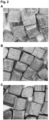
- An image of the particles after the 40,200 cycles is shown is Figure 2C ; it can be noted that the particles are visibly smooth, polished and shiny.
- Performance Results - Additional 20,000 Lisport Classic Cycles Property Test Method Test Condition Mean Result Requireme nt Pass/ Fail Ball Rebound EN 12235: 2013 40,200 Lisport Cycles 57 % 45 - 75 % PASS Shock Absorption EN 14808: 2005 40,200 Lisport Cycles 60 % 55 - 70 % PASS Vertical Deformation EN 14809: 2005 40,200 Lisport Cycles 6.2 mm 4 - 9 mm PASS Rotational Resistance - Studded EN 15301-1: 2007 40,200 Lisport Cycles 43 Nm 25 - 50 Nm PASS Table 21 Test Method, Equipment and Uncertainty Value Summary Test Method SL Equipment Number Uncertainty Value Ball Rebound EN 12235: 2013 SL113, SL198, SL282, SL481 (k 2.52) ⁇ 2.21 % Ball Roll EN 12234: 2013 SL277, SL06
- a group of infill particles of the invention each made of birch wood, with dimensions 2 x 2 x 2 mm and salt content of 30.5% by weight, was placed on a patch of artificial turf outdoors in Stavanger, Norway and left for 5 years. After those 5 years, the group of infill particles was analysed; it was found that the infill particles were still stable ( Figure 3 ). This is particularly impressive given the harsh weather conditions in Stavanger.
- a group of infill particles of the invention each made of birch wood, with dimensions 2 x 2 x 2 mm and salt content of 30.5% by weight, was placed in soil outdoors in Stavanger, Norway. After 3 months the soil was analysed; it was found that the infill particles had fully degraded in the soil.
Landscapes
- Engineering & Computer Science (AREA)
- Life Sciences & Earth Sciences (AREA)
- Architecture (AREA)
- Civil Engineering (AREA)
- Structural Engineering (AREA)
- Chemical & Material Sciences (AREA)
- Wood Science & Technology (AREA)
- Forests & Forestry (AREA)
- Organic Chemistry (AREA)
- Chemical Kinetics & Catalysis (AREA)
- Road Paving Structures (AREA)
- Cultivation Of Plants (AREA)
- Paper (AREA)
- Reinforced Plastic Materials (AREA)
- Carpets (AREA)
- Compositions Of Macromolecular Compounds (AREA)
- Polysaccharides And Polysaccharide Derivatives (AREA)
- Processes Of Treating Macromolecular Substances (AREA)
- Treatments Of Macromolecular Shaped Articles (AREA)
Claims (15)
- Particule de remplissage pour gazon artificiel, dans laquelle :ladite particule comprend un substrat qui est imprégné de sel et ladite particule ne contient pas de matériau thermoplastique ;ledit substrat comprend un matériau cellulosique et/ou un hémicellulosique ; etladite particule présente un volume allant jusqu'à environ 512 mm3 ;caractérisée en ce queladite particule présente une teneur en sel d'au moins 5 % en poids, etledit sel est dispersé dans toute la particule.
- Particule de remplissage selon la revendication 1, dans laquelle ledit substrat consiste sensiblement en un matériau cellulosique et/ou hémicellulosique ; ou dans laquelle ledit substrat consiste en un matériau cellulosique et/ou hémicellulosique.
- Particule de remplissage selon la revendication 1 ou la revendication 2, dans laquelle ledit substrat a été obtenu par fraisage ou découpe.
- Particule de remplissage selon l'une quelconque des revendications 1 à 3, dans laquelle ladite particule présente une teneur en sel d'au moins 20 % en poids.
- Particule de remplissage selon l'une quelconque des revendications 1 à 4, dans laquelle ladite particule présente un volume compris entre 0,001 mm3 et 512 mm3; de préférence entre 0,008 mm3 et 125 mm3; de préférence entre 1 mm3 et 27 mm3.
- Particule de remplissage selon l'une quelconque des revendications 1 à 5 :dans laquelle la particule présente la forme d'un cube, d'un cuboïde, d'une sphère, d'un ellipsoïde, d'un sphéroïde, d'un ovoïde ou d'une pyramide, de préférence un cube, plus préférentiellement un cube de dimensions 2 mm x 2 mm x 2 mm ;dans laquelle la particule présente des coins, et dans laquelle lesdits coins sont arrondis ; et/oudans laquelle la particule présente une surface lisse ou polie.
- Particule de remplissage selon l'une quelconque des revendications 1 à 6, dans laquelle ledit substrat est du bois, de préférence du bois naturel ou brut ; plus préférentiellement dans laquelle le bois est du bois tendre ou du bois dur ; plus préférentiellement dans laquelle le bois dur est du bois de bouleau.
- Particule de remplissage selon l'une quelconque des revendications 1 à 7, dans laquelle la particule est imprégnée d'une huile ou d'un conservateur ; plus préférentiellement dans laquelle l'huile est une huile naturelle, et le conservateur est un conservateur naturel ; plus préférentiellement dans laquelle l'huile est de l'huile de lin.
- Pluralité de particules de remplissage, dans laquelle chaque particule de remplissage est une particule de remplissage telle que définie dans l'une quelconque des revendications précédentes, et dans laquelle la pluralité de particules comprennent deux formes de particules de remplissage, ou plus, et/ou comprennent deux tailles de particules de remplissage, ou plus.
- Pluralité de particules de remplissage selon la revendication 9,dans lesquelles les deux formes, ou plus, sont choisies dans le groupe consistant en un cube, un cuboïde, une sphère, un ellipsoïde, un sphéroïde, un ovoïde ou une pyramide ; et/oudans lesquelles la pluralité de particules de remplissage comprennent un premier type de particule de remplissage et un second type de particule de remplissage, dans lesquelles ledit premier type de particule de remplissage présente un volume au moins 2 ou 3 fois supérieur à celui du second type de particule de remplissage.
- Procédé de production de la particule de remplissage selon l'une quelconque des revendications 1 à 8, le procédé comprenant :le trempage dans une solution saline d'une particule comprenant un substrat qui comprend un matériau cellulosique et/ou hémicellulosique, dans lequel la particule ne contient pas de matériau thermoplastique et présente un volume allant jusqu'à environ 512 mm3; éventuellementle séchage de la particule trempée ; et éventuellementle polissage de la particule.
- Procédé selon la revendication 11, dans lequel la solution saline a été chauffée à au moins 50 °C, de préférence à environ 75 °C ; et/ou
dans lequel la particule reste dans la solution saline pendant au moins 10 minutes. - Système de gazon artificiel, comprenant :un tapis de gazon artificiel, le tapis de gazon artificiel comprenant des fibres de gazon artificiel ;une pluralité de particules de remplissage selon l'une quelconque des revendications 1 à 10 ; et éventuellement du sable.
- Procédé selon la revendication 11 ou la revendication 12 comprenant une étape d'obtention de la particule avant l'étape de trempage, l'étape comprenant la découpe du matériau cellulosique et/ou hémicellulosique pour former des particules présentant un volume par particule allant jusqu'à environ 512 mm3 qui sont de forme cuboïde, de préférence des cubes, puis le ponçage des particules coupées afin d'arrondir les coins de celles-ci.
- Utilisation de la particule de remplissage selon l'une quelconque des revendications 1 à 8 ou de la pluralité de particules de remplissage selon la revendication 9 ou la revendication 10 comme remplissage pour gazon artificiel.
Priority Applications (2)
| Application Number | Priority Date | Filing Date | Title |
|---|---|---|---|
| HRP20250985TT HRP20250985T1 (hr) | 2021-05-07 | 2022-05-09 | Čestice za ispunu umjetne trave, postupak proizvodnje takvih čestica za ispunu i uporaba takvih čestica za ispunu |
| MA64488A MA64488B1 (fr) | 2021-05-07 | 2022-05-09 | Particule de remplissage pour gazon artificiel, procédé de production d'une telle particule de remplissage et utilisation de ladite particule de remplissage |
Applications Claiming Priority (3)
| Application Number | Priority Date | Filing Date | Title |
|---|---|---|---|
| GB202106534 | 2021-05-07 | ||
| GBGB2111672.8A GB202111672D0 (en) | 2021-08-13 | 2021-08-13 | Infill for artificial turf |
| PCT/EP2022/062502 WO2022234142A1 (fr) | 2021-05-07 | 2022-05-09 | Particule de remplissage pour gazon artificiel, procédé de production d'une telle particule de remplissage et utilisation de ladite particule de remplissage |
Publications (3)
| Publication Number | Publication Date |
|---|---|
| EP4334530A1 EP4334530A1 (fr) | 2024-03-13 |
| EP4334530C0 EP4334530C0 (fr) | 2025-04-23 |
| EP4334530B1 true EP4334530B1 (fr) | 2025-04-23 |
Family
ID=81975363
Family Applications (1)
| Application Number | Title | Priority Date | Filing Date |
|---|---|---|---|
| EP22728454.4A Active EP4334530B1 (fr) | 2021-05-07 | 2022-05-09 | Particule de remplissage pour gazon artificiel, procédé de production d'une telle particule de remplissage et utilisation de ladite particule de remplissage |
Country Status (16)
| Country | Link |
|---|---|
| US (1) | US20250050531A1 (fr) |
| EP (1) | EP4334530B1 (fr) |
| JP (1) | JP2024521038A (fr) |
| KR (1) | KR20240046111A (fr) |
| AU (1) | AU2022268650A1 (fr) |
| BR (1) | BR112023023134A2 (fr) |
| CA (1) | CA3217781A1 (fr) |
| CL (1) | CL2023003280A1 (fr) |
| ES (1) | ES3039829T3 (fr) |
| GB (1) | GB2608497B (fr) |
| HR (1) | HRP20250985T1 (fr) |
| HU (1) | HUE072838T2 (fr) |
| MA (1) | MA64488B1 (fr) |
| MX (1) | MX2023013109A (fr) |
| PL (1) | PL4334530T3 (fr) |
| WO (1) | WO2022234142A1 (fr) |
Families Citing this family (1)
| Publication number | Priority date | Publication date | Assignee | Title |
|---|---|---|---|---|
| FI20235407A1 (en) * | 2023-04-11 | 2024-10-12 | Upm Kymmene Corp | Filling material for artificial grass |
Family Cites Families (5)
| Publication number | Priority date | Publication date | Assignee | Title |
|---|---|---|---|---|
| ITMI20131235A1 (it) * | 2013-07-23 | 2015-01-24 | Italgreen S P A | Struttura di manto erboso artificiale e metodo di realizzazione di manti erbosi artificiali |
| KR20170105233A (ko) * | 2016-03-09 | 2017-09-19 | 최은희 | 항균기능을 갖는 인조 잔디 충진재와 그 제조방법 |
| AU2017315456B2 (en) * | 2016-08-25 | 2023-02-02 | Usgreentech, L.L.C. | Treated walnut shell infill for artificial turf |
| EP3604677A1 (fr) * | 2018-07-30 | 2020-02-05 | Polytex Sportbeläge Produktions-GmbH | Matériau de remplissage de gazon artificiel avec des granulés d'épi de maïs revêtus de polyuréthane |
| CA3118800A1 (fr) * | 2018-12-14 | 2020-06-18 | Pintat, Benoit | Remplissage de gazon artificiel et gazon artificiel |
-
2022
- 2022-05-09 EP EP22728454.4A patent/EP4334530B1/fr active Active
- 2022-05-09 GB GB2206758.1A patent/GB2608497B/en not_active Ceased
- 2022-05-09 ES ES22728454T patent/ES3039829T3/es active Active
- 2022-05-09 WO PCT/EP2022/062502 patent/WO2022234142A1/fr not_active Ceased
- 2022-05-09 CA CA3217781A patent/CA3217781A1/fr active Pending
- 2022-05-09 JP JP2023568523A patent/JP2024521038A/ja active Pending
- 2022-05-09 MA MA64488A patent/MA64488B1/fr unknown
- 2022-05-09 BR BR112023023134A patent/BR112023023134A2/pt unknown
- 2022-05-09 KR KR1020237042070A patent/KR20240046111A/ko active Pending
- 2022-05-09 HU HUE22728454A patent/HUE072838T2/hu unknown
- 2022-05-09 AU AU2022268650A patent/AU2022268650A1/en active Pending
- 2022-05-09 MX MX2023013109A patent/MX2023013109A/es unknown
- 2022-05-09 PL PL22728454.4T patent/PL4334530T3/pl unknown
- 2022-05-09 US US18/558,675 patent/US20250050531A1/en active Pending
- 2022-05-09 HR HRP20250985TT patent/HRP20250985T1/hr unknown
-
2023
- 2023-11-03 CL CL2023003280A patent/CL2023003280A1/es unknown
Also Published As
| Publication number | Publication date |
|---|---|
| EP4334530A1 (fr) | 2024-03-13 |
| GB2608497B (en) | 2024-02-07 |
| ES3039829T3 (en) | 2025-10-24 |
| GB2608497A (en) | 2023-01-04 |
| AU2022268650A1 (en) | 2023-12-21 |
| PL4334530T3 (pl) | 2025-10-20 |
| US20250050531A1 (en) | 2025-02-13 |
| MX2023013109A (es) | 2024-03-27 |
| MA64488B1 (fr) | 2025-09-30 |
| EP4334530C0 (fr) | 2025-04-23 |
| KR20240046111A (ko) | 2024-04-08 |
| BR112023023134A2 (pt) | 2024-02-06 |
| WO2022234142A1 (fr) | 2022-11-10 |
| HUE072838T2 (hu) | 2025-12-28 |
| JP2024521038A (ja) | 2024-05-28 |
| HRP20250985T1 (hr) | 2025-10-24 |
| CA3217781A1 (fr) | 2022-11-10 |
| CL2023003280A1 (es) | 2024-10-11 |
Similar Documents
| Publication | Publication Date | Title |
|---|---|---|
| US12247360B2 (en) | Infill for artificial turf system | |
| AU2024200909B2 (en) | Infill for artificial turf system | |
| US20230243110A1 (en) | Compostable artificial turf infill | |
| ES2354720T3 (es) | Estructura de césped artificial y procedimiento de fabricación de la misma | |
| EP4334530B1 (fr) | Particule de remplissage pour gazon artificiel, procédé de production d'une telle particule de remplissage et utilisation de ladite particule de remplissage | |
| EP3503746B1 (fr) | Remplissage à base de coquilles de noix traitées pour gazon artificiel et procédé de fabrication | |
| KR20170136460A (ko) | 천연 충진재 및 이의 제조방법 | |
| EP4001506A1 (fr) | Système de gazon artificiel comprenant du sable hydrophobique | |
| CN117916424A (zh) | 人造草坪填充物颗粒、制造该填充物颗粒的方法以及该填充物颗粒的应用 | |
| US20200354901A1 (en) | Artificial turf infill material for disinfecting artificial turfs | |
| NO346685B1 (en) | Modification of wood residue from processes to make a substitute for rubber granular infill | |
| WO2026008490A1 (fr) | Remplissage pour gazon artificiel | |
| JP7443863B2 (ja) | 人工芝 | |
| 青木豊明 et al. | Current state and perspective for artificial turf as sport environment: Focusing on third-generation artificial turf as football playing surface | |
| NZ757782B2 (en) | Infill for artificial turf system | |
| JPH10252007A (ja) | 木質舗装 | |
| JP2025109222A (ja) | 人工芝構造体とその敷設方法、これを使用したグラウンド | |
| BR112019020332B1 (pt) | Material de enchimento para um sistema de relva artificial e método para fazê-lo, conjunto e sistema de relva artificial |
Legal Events
| Date | Code | Title | Description |
|---|---|---|---|
| REG | Reference to a national code |
Ref country code: HR Ref legal event code: TUEP Ref document number: P20250985T Country of ref document: HR |
|
| STAA | Information on the status of an ep patent application or granted ep patent |
Free format text: STATUS: UNKNOWN |
|
| STAA | Information on the status of an ep patent application or granted ep patent |
Free format text: STATUS: THE INTERNATIONAL PUBLICATION HAS BEEN MADE |
|
| PUAI | Public reference made under article 153(3) epc to a published international application that has entered the european phase |
Free format text: ORIGINAL CODE: 0009012 |
|
| STAA | Information on the status of an ep patent application or granted ep patent |
Free format text: STATUS: REQUEST FOR EXAMINATION WAS MADE |
|
| 17P | Request for examination filed |
Effective date: 20231206 |
|
| AK | Designated contracting states |
Kind code of ref document: A1 Designated state(s): AL AT BE BG CH CY CZ DE DK EE ES FI FR GB GR HR HU IE IS IT LI LT LU LV MC MK MT NL NO PL PT RO RS SE SI SK SM TR |
|
| RAV | Requested validation state of the european patent: fee paid |
Extension state: TN Effective date: 20231206 Extension state: MD Effective date: 20231206 Extension state: MA Effective date: 20231206 |
|
| GRAP | Despatch of communication of intention to grant a patent |
Free format text: ORIGINAL CODE: EPIDOSNIGR1 |
|
| STAA | Information on the status of an ep patent application or granted ep patent |
Free format text: STATUS: GRANT OF PATENT IS INTENDED |
|
| INTG | Intention to grant announced |
Effective date: 20241114 |
|
| GRAS | Grant fee paid |
Free format text: ORIGINAL CODE: EPIDOSNIGR3 |
|
| GRAA | (expected) grant |
Free format text: ORIGINAL CODE: 0009210 |
|
| STAA | Information on the status of an ep patent application or granted ep patent |
Free format text: STATUS: THE PATENT HAS BEEN GRANTED |
|
| RBV | Designated contracting states (corrected) |
Designated state(s): AL AT BE BG CH CY CZ DE DK EE ES FI FR GR HR HU IE IS IT LI LT LU LV MC MK MT NL NO PL PT RO RS SE SI SK SM TR |
|
| AK | Designated contracting states |
Kind code of ref document: B1 Designated state(s): AL AT BE BG CH CY CZ DE DK EE ES FI FR GR HR HU IE IS IT LI LT LU LV MC MK MT NL NO PL PT RO RS SE SI SK SM TR |
|
| RAP3 | Party data changed (applicant data changed or rights of an application transferred) |
Owner name: GOE-IP AS |
|
| REG | Reference to a national code |
Ref country code: CH Ref legal event code: EP |
|
| REG | Reference to a national code |
Ref country code: DE Ref legal event code: R096 Ref document number: 602022013597 Country of ref document: DE |
|
| REG | Reference to a national code |
Ref country code: IE Ref legal event code: FG4D |
|
| U01 | Request for unitary effect filed |
Effective date: 20250519 |
|
| PGFP | Annual fee paid to national office [announced via postgrant information from national office to epo] |
Ref country code: AT Payment date: 20250721 Year of fee payment: 4 |
|
| U07 | Unitary effect registered |
Designated state(s): AT BE BG DE DK EE FI FR IT LT LU LV MT NL PT RO SE SI Effective date: 20250625 |
|
| REG | Reference to a national code |
Ref country code: HR Ref legal event code: NPPZ Ref document number: P20250985T Country of ref document: HR |
|
| REG | Reference to a national code |
Ref country code: MA Ref legal event code: VAGR Ref document number: 64488 Country of ref document: MA Kind code of ref document: B1 |
|
| REG | Reference to a national code |
Ref country code: HR Ref legal event code: NPPU Ref document number: P20250985T Country of ref document: HR |
|
| PG25 | Lapsed in a contracting state [announced via postgrant information from national office to epo] |
Ref country code: GR Free format text: LAPSE BECAUSE OF FAILURE TO SUBMIT A TRANSLATION OF THE DESCRIPTION OR TO PAY THE FEE WITHIN THE PRESCRIBED TIME-LIMIT Effective date: 20250724 |
|
| PG25 | Lapsed in a contracting state [announced via postgrant information from national office to epo] |
Ref country code: RS Free format text: LAPSE BECAUSE OF FAILURE TO SUBMIT A TRANSLATION OF THE DESCRIPTION OR TO PAY THE FEE WITHIN THE PRESCRIBED TIME-LIMIT Effective date: 20250723 |
|
| REG | Reference to a national code |
Ref country code: ES Ref legal event code: FG2A Ref document number: 3039829 Country of ref document: ES Kind code of ref document: T3 Effective date: 20251024 Ref country code: HR Ref legal event code: T1PR Ref document number: P20250985 Country of ref document: HR |
|
| PG25 | Lapsed in a contracting state [announced via postgrant information from national office to epo] |
Ref country code: IS Free format text: LAPSE BECAUSE OF FAILURE TO SUBMIT A TRANSLATION OF THE DESCRIPTION OR TO PAY THE FEE WITHIN THE PRESCRIBED TIME-LIMIT Effective date: 20250823 |
|
| REG | Reference to a national code |
Ref country code: CH Ref legal event code: U11 Free format text: ST27 STATUS EVENT CODE: U-0-0-U10-U11 (AS PROVIDED BY THE NATIONAL OFFICE) Effective date: 20251128 |
|
| U21 | Renewal fee for the european patent with unitary effect paid with additional fee |
Year of fee payment: 4 Effective date: 20251030 |
|
| REG | Reference to a national code |
Ref country code: HR Ref legal event code: ODRP Ref document number: P20250985 Country of ref document: HR Payment date: 20251106 Year of fee payment: 4 |
|
| PGFP | Annual fee paid to national office [announced via postgrant information from national office to epo] |
Ref country code: HU Payment date: 20251107 Year of fee payment: 4 |
|
| REG | Reference to a national code |
Ref country code: HU Ref legal event code: AG4A Ref document number: E072838 Country of ref document: HU |
|
| PGFP | Annual fee paid to national office [announced via postgrant information from national office to epo] |
Ref country code: NO Payment date: 20251113 Year of fee payment: 4 |
|
| PG25 | Lapsed in a contracting state [announced via postgrant information from national office to epo] |
Ref country code: SM Free format text: LAPSE BECAUSE OF FAILURE TO SUBMIT A TRANSLATION OF THE DESCRIPTION OR TO PAY THE FEE WITHIN THE PRESCRIBED TIME-LIMIT Effective date: 20250423 |
|
| PGFP | Annual fee paid to national office [announced via postgrant information from national office to epo] |
Ref country code: HR Payment date: 20251106 Year of fee payment: 4 |
|
| VS25 | Lapsed in a validation state [announced via postgrant information from nat. office to epo] |
Ref country code: MD Free format text: LAPSE BECAUSE OF FAILURE TO SUBMIT A TRANSLATION OF THE DESCRIPTION OR TO PAY THE FEE WITHIN THE PRESCRIBED TIME-LIMIT Effective date: 20250423 |
|
| PGFP | Annual fee paid to national office [announced via postgrant information from national office to epo] |
Ref country code: TR Payment date: 20251106 Year of fee payment: 4 |
|
| PGFP | Annual fee paid to national office [announced via postgrant information from national office to epo] |
Ref country code: CH Payment date: 20251128 Year of fee payment: 4 |
|
| PGFP | Annual fee paid to national office [announced via postgrant information from national office to epo] |
Ref country code: IE Payment date: 20251127 Year of fee payment: 4 Ref country code: CZ Payment date: 20251106 Year of fee payment: 4 |
|
| PGFP | Annual fee paid to national office [announced via postgrant information from national office to epo] |
Ref country code: PL Payment date: 20251106 Year of fee payment: 4 |
|
| PG25 | Lapsed in a contracting state [announced via postgrant information from national office to epo] |
Ref country code: SK Free format text: LAPSE BECAUSE OF FAILURE TO SUBMIT A TRANSLATION OF THE DESCRIPTION OR TO PAY THE FEE WITHIN THE PRESCRIBED TIME-LIMIT Effective date: 20250423 |
|
| PG25 | Lapsed in a contracting state [announced via postgrant information from national office to epo] |
Ref country code: MC Free format text: LAPSE BECAUSE OF FAILURE TO SUBMIT A TRANSLATION OF THE DESCRIPTION OR TO PAY THE FEE WITHIN THE PRESCRIBED TIME-LIMIT Effective date: 20250423 |