EP4334165B1 - Electric or hybrid rideable saddle vehicle comprising an extractable rechargeable battery and a battery locking device - Google Patents
Electric or hybrid rideable saddle vehicle comprising an extractable rechargeable battery and a battery locking device Download PDFInfo
- Publication number
- EP4334165B1 EP4334165B1 EP22718810.9A EP22718810A EP4334165B1 EP 4334165 B1 EP4334165 B1 EP 4334165B1 EP 22718810 A EP22718810 A EP 22718810A EP 4334165 B1 EP4334165 B1 EP 4334165B1
- Authority
- EP
- European Patent Office
- Prior art keywords
- rideable
- saddle
- rechargeable battery
- locking device
- hybrid
- Prior art date
- Legal status (The legal status is an assumption and is not a legal conclusion. Google has not performed a legal analysis and makes no representation as to the accuracy of the status listed.)
- Active
Links
Images


Classifications
-
- B—PERFORMING OPERATIONS; TRANSPORTING
- B62—LAND VEHICLES FOR TRAVELLING OTHERWISE THAN ON RAILS
- B62M—RIDER PROPULSION OF WHEELED VEHICLES OR SLEDGES; POWERED PROPULSION OF SLEDGES OR SINGLE-TRACK CYCLES; TRANSMISSIONS SPECIALLY ADAPTED FOR SUCH VEHICLES
- B62M6/00—Rider propulsion of wheeled vehicles with additional source of power, e.g. combustion engine or electric motor
- B62M6/80—Accessories, e.g. power sources; Arrangements thereof
- B62M6/90—Batteries
-
- B—PERFORMING OPERATIONS; TRANSPORTING
- B62—LAND VEHICLES FOR TRAVELLING OTHERWISE THAN ON RAILS
- B62M—RIDER PROPULSION OF WHEELED VEHICLES OR SLEDGES; POWERED PROPULSION OF SLEDGES OR SINGLE-TRACK CYCLES; TRANSMISSIONS SPECIALLY ADAPTED FOR SUCH VEHICLES
- B62M7/00—Motorcycles characterised by position of motor or engine
- B62M7/12—Motorcycles characterised by position of motor or engine with the engine beside or within the driven wheel
-
- B—PERFORMING OPERATIONS; TRANSPORTING
- B60—VEHICLES IN GENERAL
- B60L—PROPULSION OF ELECTRICALLY-PROPELLED VEHICLES; SUPPLYING ELECTRIC POWER FOR AUXILIARY EQUIPMENT OF ELECTRICALLY-PROPELLED VEHICLES; ELECTRODYNAMIC BRAKE SYSTEMS FOR VEHICLES IN GENERAL; MAGNETIC SUSPENSION OR LEVITATION FOR VEHICLES; MONITORING OPERATING VARIABLES OF ELECTRICALLY-PROPELLED VEHICLES; ELECTRIC SAFETY DEVICES FOR ELECTRICALLY-PROPELLED VEHICLES
- B60L53/00—Methods of charging batteries, specially adapted for electric vehicles; Charging stations or on-board charging equipment therefor; Exchange of energy storage elements in electric vehicles
- B60L53/80—Exchanging energy storage elements, e.g. removable batteries
-
- B—PERFORMING OPERATIONS; TRANSPORTING
- B62—LAND VEHICLES FOR TRAVELLING OTHERWISE THAN ON RAILS
- B62J—CYCLE SADDLES OR SEATS; AUXILIARY DEVICES OR ACCESSORIES SPECIALLY ADAPTED TO CYCLES AND NOT OTHERWISE PROVIDED FOR, e.g. ARTICLE CARRIERS OR CYCLE PROTECTORS
- B62J1/00—Saddles or other seats for cycles; Arrangement thereof; Component parts
- B62J1/08—Frames for saddles; Connections between saddle frames and seat pillars; Seat pillars
-
- B—PERFORMING OPERATIONS; TRANSPORTING
- B62—LAND VEHICLES FOR TRAVELLING OTHERWISE THAN ON RAILS
- B62J—CYCLE SADDLES OR SEATS; AUXILIARY DEVICES OR ACCESSORIES SPECIALLY ADAPTED TO CYCLES AND NOT OTHERWISE PROVIDED FOR, e.g. ARTICLE CARRIERS OR CYCLE PROTECTORS
- B62J43/00—Arrangements of batteries
- B62J43/10—Arrangements of batteries for propulsion
-
- B—PERFORMING OPERATIONS; TRANSPORTING
- B62—LAND VEHICLES FOR TRAVELLING OTHERWISE THAN ON RAILS
- B62J—CYCLE SADDLES OR SEATS; AUXILIARY DEVICES OR ACCESSORIES SPECIALLY ADAPTED TO CYCLES AND NOT OTHERWISE PROVIDED FOR, e.g. ARTICLE CARRIERS OR CYCLE PROTECTORS
- B62J43/00—Arrangements of batteries
- B62J43/10—Arrangements of batteries for propulsion
- B62J43/16—Arrangements of batteries for propulsion on motorcycles or the like
-
- B—PERFORMING OPERATIONS; TRANSPORTING
- B62—LAND VEHICLES FOR TRAVELLING OTHERWISE THAN ON RAILS
- B62J—CYCLE SADDLES OR SEATS; AUXILIARY DEVICES OR ACCESSORIES SPECIALLY ADAPTED TO CYCLES AND NOT OTHERWISE PROVIDED FOR, e.g. ARTICLE CARRIERS OR CYCLE PROTECTORS
- B62J43/00—Arrangements of batteries
- B62J43/20—Arrangements of batteries characterised by the mounting
- B62J43/28—Arrangements of batteries characterised by the mounting hidden within the cycle frame
-
- B—PERFORMING OPERATIONS; TRANSPORTING
- B62—LAND VEHICLES FOR TRAVELLING OTHERWISE THAN ON RAILS
- B62J—CYCLE SADDLES OR SEATS; AUXILIARY DEVICES OR ACCESSORIES SPECIALLY ADAPTED TO CYCLES AND NOT OTHERWISE PROVIDED FOR, e.g. ARTICLE CARRIERS OR CYCLE PROTECTORS
- B62J9/00—Containers specially adapted for cycles, e.g. panniers or saddle bags
- B62J9/10—Containers specially adapted for cycles, e.g. panniers or saddle bags integrated with the cycle
- B62J9/14—Containers specially adapted for cycles, e.g. panniers or saddle bags integrated with the cycle under the saddle
-
- B—PERFORMING OPERATIONS; TRANSPORTING
- B62—LAND VEHICLES FOR TRAVELLING OTHERWISE THAN ON RAILS
- B62J—CYCLE SADDLES OR SEATS; AUXILIARY DEVICES OR ACCESSORIES SPECIALLY ADAPTED TO CYCLES AND NOT OTHERWISE PROVIDED FOR, e.g. ARTICLE CARRIERS OR CYCLE PROTECTORS
- B62J9/00—Containers specially adapted for cycles, e.g. panniers or saddle bags
- B62J9/30—Containers specially adapted for cycles, e.g. panniers or saddle bags characterised by locking arrangements, e.g. top case locks integrated in a vehicle central locking system
-
- B—PERFORMING OPERATIONS; TRANSPORTING
- B62—LAND VEHICLES FOR TRAVELLING OTHERWISE THAN ON RAILS
- B62K—CYCLES; CYCLE FRAMES; CYCLE STEERING DEVICES; RIDER-OPERATED TERMINAL CONTROLS SPECIALLY ADAPTED FOR CYCLES; CYCLE AXLE SUSPENSIONS; CYCLE SIDECARS, FORECARS, OR THE LIKE
- B62K2204/00—Adaptations for driving cycles by electric motor
Definitions
- the present invention relates to the technical field of rideable saddle vehicles, and particularly relates to an electric or hybrid rideable saddle vehicle comprising a removable rechargeable battery and a battery locking device.
- the present Patent Application claims the priority of Italian Patent Application No. 102021000011432 dated 05/20172021 .
- JP 2011 136626 discloses the preamble of claim 1.
- Such a rechargeable battery provides the electrical power required to supply the traction motor so that it delivers a drive torque.
- the rechargeable battery is required to be easily removable from a respective housing seat so that a user may easily remove the rechargeable battery from the vehicle to replace it and/or recharge it.
- rideable saddle vehicles such as motorcycles, for example, in particular but not only motor scooters with two or more wheels, comprise a storage container integrated in the body of the vehicle and arranged below the rideable saddle thereof.
- the rideable saddle is a closing element of the storage container and may selectively take an opening configuration for allowing access to the housing seat and a closing configuration for preventing access to the housing seat.
- the rechargeable battery is extractable and accommodated in a housing seat defined inside the storage container.
- the rechargeable battery of an electric or hybrid rideable saddle vehicle usually is cumbersome and has a large mass. Therefore, there is a need for the rechargeable battery to be kept in a stable position inside the housing seat thereof in order to prevent possible vibrations, noise, and jolts of the rechargeable battery when using, for example when driving, the vehicle. For this reason, locking systems of the rechargeable battery comprising, for example, one or more locking belts or locking hooks or brackets are provided onboard the aforesaid vehicles.
- the locking systems of the known art have several drawbacks. In some cases, indeed, they are complex and costly, in other cases they do not allow an easy and quick removal of the rechargeable battery, or in other cases again, they do not ensure keeping the rechargeable battery in a stable position when using the vehicle.
- Figure 1 shows an embodiment of an electric or hybrid rideable saddle vehicle 1 which is embodied, in the particular example shown and without however introducing any limitation, by a two-wheeled motorcycle, and in particular by a two-wheeled scooter, having a front wheel 6 and a rear wheel 7.
- the rideable saddle vehicle 1 is an electric vehicle and comprises, without however introducing any limitation, an electric motor 8 integrated in at least one of the two wheels 6, 7, in the example integrated in the rear wheel 7.
- the electric motor 8 is a hub motor.
- the assembly consisting of the rear wheel 7, and in particular of the wheel hub and the electric motor 8, is a drive wheel 7, 8.
- the main body 2, 3, 4 of motorcycle 1 has a front part 2, a tail part 4, and a middle part 3 interposed between the front part 2 and the tail part 4.
- the middle part 3 comprises a footboard 5, for example, on which a rider can place his/her feet.
- the front part 2 comprises a front shield 12, a steering handlebar 9, the front wheel 6, a front suspension 11.
- the tail part 4 comprises a rideable saddle 40, the drive wheel 7, 8, a support arm or fork 16 of the drive wheel 7, 8, a rear suspension 18.
- the motorcycle 1 further comprises a storage container 20 integrated in the main body 2, 3, 4, preferably in the tail part 4 of motorcycle 1.
- the storage container 20 is arranged below the rideable saddle 40.
- the rideable saddle 40 can be moved between a closing configuration, in which the rideable saddle 40 prevents access to the storage container 20, and an opening configuration, in which the rideable saddle 40 allows access to the storage container 20. Therefore, in such an embodiment, the rideable saddle 40 is a closing element of the storage container 20.
- the rideable saddle 40 in particular in the closing configuration, reversibly obstructs an upper access opening 24 of the storage container 20.
- the rideable saddle 40 in Figures 1, 2 and 8 is shown in the closing configuration, while it is shown in the opening configuration in Figures 4 and 9 .
- the rideable saddle 40 was instead omitted in Figure 5 .
- the rideable saddle 40 is hinged to the main body 2, 3, 4 of motorcycle 1 to be rotated about a first rotation axis Y1 ( Figure 2 and Figure 4 ), between two positions angularly spaced apart from each other, corresponding to the closing configuration and to the opening configuration, respectively.
- motorcycle 1 comprises a first cylindrical hinge 48 ( Figure 2 ) adapted and configured to rotatably hinge an end portion of the rideable saddle 40 to the tail portion 4 of motorcycle 1 so that the rideable saddle 40 is rotatable about the first rotation axis Y1, which thus represents the hinge axis.
- Said end portion preferably is a front end portion of the rideable saddle 40, i.e., an end portion facing the front part 2 of the main body 2, 3, 4 of motorcycle 1.
- Motorcycle 1 preferably comprises a locking system 26, 46 of the rideable saddle 40 ( Figure 4 ) which can be operated to take a locking configuration for locking the rideable saddle 40 in the closing configuration, and a releasing configuration to allow the rideable saddle 40 to be brought from the closing configuration to the opening configuration.
- the locking system 26, 46 of the rideable saddle 40 comprises, for example, a lock 26 having a movable catch 27 and an engagement element 46 with which the movable catch 27 is engaged when the locking system 26, 46 is in the locking configuration.
- lock 26 can be operated by means of a key and/or by means of a mechanical or electromechanical button and/or by means of an electrical control signal.
- the engagement element 46 is provided on the rideable saddle 40 and lock 26 is provided on the main body 2, 3, 4 of motorcycle 1, in particular on the tail part 4.
- the positions of the aforesaid elements of the locking system 26, 46 could be inverted with one another.
- the motorcycle 1 further comprises at least one extractable rechargeable battery 30, as better shown in Figures 2 , 3 and 4 .
- a user may thus remove the rechargeable battery 30 to be recharged and replace it with a charged rechargeable battery 30, for example.
- the rechargeable battery 30 is operatively connected, for example by means of an electric wire 13 ( Figure 5 ), to motor 8 to supply it so that it can deliver a drive torque.
- the rechargeable battery 30 preferably comprises an electrical connector 34 adapted to be engaged, for example by coupling, with a complementary electrical connector 14 provided at a free end of the electric wire 13.
- the rechargeable battery 30 extends between a bottom portion 31 and a head portion 32.
- the rechargeable battery 30 comprises a containment body made of an electrically insulating material which accommodates a plurality of rechargeable cells therein.
- the bottom portion 31 is a first end portion of the containment body and the head portion 32 is a second end portion of the containment body, opposite to the first end portion.
- the containment body of the rechargeable battery 30 is prism-shaped, e.g., it has a general polygonal shape, in particular is parallelepiped-shaped, for example a straight parallelepiped.
- Rubber tips or feet 35 for damping any impacts to battery 30 can be arranged below the bottom portion 31. These rubber tips or feet 35 can alternatively be arranged on motorcycle 1.
- the rechargeable battery 30 preferably comprises a gripping handle 33, preferably included in, or fixed to, the head portion 32.
- the gripping handle 33 preferably protrudes from the head portion 32, and more preferably is C-shaped, with two side support arms and a middle gripping part, for example for ergonomic gripping, interposed between the two side arms.
- the two side arms are mutually inclined and the middle part is cylindrical in shape, for example.
- the storage container 20 comprises a first housing seat S1 which at least partially houses the rechargeable battery 30 so that the rechargeable battery 30 can be inserted into, and extracted from, the first housing seat S1.
- the rechargeable battery 30 is slidably insertable into, and slidably extractable from, the first housing seat S1 by translation along a sliding axis Z.
- the housing seat S1, with the rechargeable battery 30, substantially defines a shape coupling.
- the first housing seat S1 is preferably delimited by a tubular side wall 300 and a bottom wall 301 joined to the tubular side wall 300.
- the first housing seat S1 preferably comprises guiding means, e.g., guides which allow directing the insertion/removal of the rechargeable battery 30 into/from the first housing seat S1. The user is thus facilitated in placing the battery 30 in a correct position in the first housing seat S1.
- the first housing seat S1 and/or the rechargeable battery 30 are shaped so as to avoid the rechargeable battery 30 from being mounted in a wrong position or with a wrong orientation.
- the first housing seat S1 and the rechargeable battery 30 mutually form a shape coupling which defines a unique position between the first housing seat S1 and the rechargeable battery 30.
- the storage container 20 further comprises a second housing seat S2A, S2B, adapted and configured to house at least one helmet 50, preferably a jet-type helmet, i.e., a helmet without a fixed chin guard.
- a helmet 50 preferably a jet-type helmet, i.e., a helmet without a fixed chin guard.
- the storage container 20 can comprise a shell 21 shaped to delimit and define the lower portion of the compartment in which the first housing seat S1 and the second housing seat S2A, S2B are obtained. The compartment is then closed at the top by a support base 41 of saddle 40.
- the second housing seat S2A, S2B has a first housing portion S2A and a second housing portion S2B, which are adjacent to each other.
- the first housing portion S2A at least partially extends over the head portion 32 of the rechargeable battery 30
- the second housing portion S2B at least partially extends laterally with respect to the head portion 32 of the rechargeable battery 30.
- the volume in the storage container 20 reserved for housing the rechargeable battery 30 thus forms a step close to which a front portion of helmet 50 can rest, e.g., an open front portion 51 of a jet helmet 50.
- both a rechargeable battery 30 and a helmet 50 can be simultaneously housed in the storage container 20 even when the space onboard the motorcycle 1 reserved for the storage container 20 is relatively small.
- the head portion 32 of the rechargeable battery 30 at least partially protrudes into the second housing seat S2A, S2B, in particular into the first housing portion S2A.
- the head portion 32 of the rechargeable battery 30 comprises the gripping handle 33
- the gripping handle 33 at least partially protrudes into the second housing seat S2A, S2B, in particular into the first housing portion S2A.
- the depth of the first housing seat S1, i.e., of the housing seat reserved for the rechargeable battery 30, can thus be reduced because, for housing the head portion 32 and/or the gripping handle 33 of the rechargeable battery 30, a relatively limited part of the housing volume of the second housing seat S2A, S2B can be utilized by utilizing the remaining part of the latter to house helmet 50.
- the first housing seat S1 and the second housing seat S2A, S2B communicate with each other.
- the first housing seat S1 comprises an access opening 38 which is crossable by the bottom portion 31 of the rechargeable battery 30 to insert the latter into the first housing seat S1.
- the first housing seat S1 and the second housing seat S2A, S2B communicate with each other through the access opening 38.
- the access opening 38 is an opening arranged on the opposite side with respect to the bottom wall 301.
- the storage container 20 is adapted and configured to house a jet helmet 50.
- the jet helmet 50 comprises a shell having a front open portion 51, two opposite side portions 52, a rear portion 53, and an upper portion 54.
- the front open portion 51 of the shell is joined to the rear portion 53 of the shell by means of the side portions 52, while the upper portion 54 of the shell is above the front open portion 51, the side portions 52, and the rear portion 53.
- the first portion S2A of the second housing seat S2A, S2B is adapted and configured to house the front open portion 51 of the shell.
- the jet helmet 50 comprises at least one visor 55 (shown only in Figure 2 ), and the first portion S2A of the second housing seat S2A, S2B is also adapted and configured to house the visor 55.
- visor 55 is a transparent or semitransparent shield rotatably constrained to the shell and can be rotated from the outside of the shell to obstruct at least partially the front open portion 51 of the shell in a removable manner.
- the second portion S2B of the second housing seat S2A, S2B is adapted and configured to house at least partially the side portions 52 of the shell of the jet helmet 50.
- the rideable saddle 40 comprises ( Figure 2 ) a support base 41 and a padding 42, and the support base 41 comprises a recess 43 adapted and configured to receive part of the upper portion 54 of the shell of helmet 50 when the storage container 20 accommodates a helmet 50 therein.
- the first portion S2A of the second housing seat S2A, S2B advantageously partially extends into saddle 40.
- the aforesaid recess 43 preferably extends into the thickness of padding 42.
- the support base 41 is a frame made of hard plastics and/or metal, and the padding is made of a yielding material, such as a spongy synthetic material.
- padding 42 is covered with a waterproof coating, e.g., made of natural or synthetic leather.
- the aforesaid recess 43 is a rounded and/or curved recess.
- the motorcycle 1 further comprises a locking device 60 (shown in greater detail in Figures 5, 6 , 7, 8 and 9 ) adapted to lock the rechargeable battery 30 in the first housing seat S1.
- the locking device 60 is adapted and configured to be moved in order to take an operating locking position and an operating releasing position.
- the locking device 60 is retained in the operating locking position by means of a thrust force applied by the rideable saddle 40 to the locking device 60 when the rideable saddle 40 takes the closing configuration.
- the locking device 60 prevents the rechargeable battery 30 from being removed from the first housing seat S1.
- the locking device 60 allows the removal, in particular the extraction, of the rechargeable battery 30 from the first housing seat S1, and thus from the storage container 20.
- the locking device 60 is accommodated in the storage container 20 and has a first end portion 61 rotatably hinged, by means of a hinge, to a wall of the storage container 20, and a second end portion 62, opposite to the first end portion 61, which is a free end portion when in the operating releasing position.
- the first end portion 61 is rotatable about a second rotation axis Y2 ( Figure 6 ), which is preferably parallel to the first rotation axis Y1, i.e., to the rotation axis of the rideable saddle 40.
- the first end portion 61 is the furthest from the first rotation axis Y1 when the locking device 60 is in the operating locking position.
- the vehicle 1 may comprise, at the hinge of the first end portion 61, an elastic return means (not shown in the drawings) adapted to push the locking device 60 towards the operating locking position.
- the elastic return means can be a torsional spring connected to the locking device 60 and to the shell 21 of the storage container 20.
- the rideable saddle 40 abuts against the second end portion 62 and applies a pressure force to the latter, for example by means of at least one thrust element 45.
- the thrust element 45 is integrated in, or fastened to, the support base 41 of the rideable saddle 40.
- the thrust element 45 protrudes from the rideable saddle 40, in particular from the support base 41, towards the storage container 20, preferably so as to cross the upper access opening 24.
- the locking device 60 is kept in the operating locking position thereof, which prevents the removal of battery 30, only by means of the thrust applied by the rideable saddle 40 when the rideable saddle abuts with the locking device 60.
- This allows making vehicle 1 more affordable because battery 30 remains firmly connected to vehicle 1 by means of the locking device 60 alone, without needing further locking systems of the locking device 60.
- this solution allows locking battery 30 without any effort by the user of vehicle 1 because the locking device 60 is autonomously and automatically released by simply bringing saddle 40 to the closing position.
- the locking device 60 is shaped so as to remain pinched between the bottom of the rideable saddle 40, in particular the support base 41 thereof, and the storage container 20, in particular the shell 21 thereof.
- the support base 41 of the rideable saddle 40 thus rests on the shell 21 of the storage container 20 by means of the locking device 60, thus improving the discharge of the rider's and passenger's weight onto the remainder of the motorcycle and ensuring a firm anchoring of the locking device 60, and therefore of battery 30.
- the rideable saddle 40 comprises two thrust elements 45 spaced apart from each other.
- the two thrust elements 45 In the closing configuration of the rideable saddle 40, the two thrust elements 45 abut against the second end portion 62 of the locking device 60, applying a pressure force to the latter in two contact points p1, p2 spaced apart from each other.
- the locking device 60 preferably comprises at least one locking arm 63 which extends between the first end portion 61 and the second end portion 62. In the operating locking position, the at least one locking arm 63 applies a thrust force to the rechargeable battery 30, in particular to the head portion 32.
- the rechargeable battery 30 is thus kept in a stable position inside the first housing seat S1 and possible vibrations, noise, and jolts of the rechargeable battery 30 when using, for example when driving, the motorcycle 1 are eliminated.
- the first end portion 61 and the second end portion 62 of the locking device 60 projects towards sides which are arranged to be mutually opposite with respect to the locking arm 63, so that the locking device 60 has an overall S- or step-shaped lateral profile.
- the locking device 60 comprises two locking arms 63 which are joined to each other on one side by the first end portion 61 and on another side by the second end portion 62.
- the locking device 60 comprises at least one recess or a through opening 65 ( Figure 6 ) which accommodates, or is crossed by, a protruding part of the rechargeable battery 30 in the operating locking position of the locking device 60.
- a protruding part preferably is the gripping handle 33.
- the aforesaid recess or through opening 65 extends into the locking arm 63 or between the locking arms 63.
- At least one elastically yielding element 66 ( Figure 5 ), for example a yielding block 66, is interposed and sandwiched between the locking device 60 and the rechargeable battery 30.
- the yielding block 66 is made of an elastically deformable material, such as rubber, latex, or silicone, for example.
- the at least one elastically yielding element 66 is fastened to the locking device 60.
- the elastically yielding element 66 is fastened to the rechargeable battery 30, for example in the head portion 32 thereof.
- such an elastically yielding element 66 is a free element, for example a yielding pad, which can be interposed between the rechargeable battery 30 and the locking device 60.
- the feature of the elastic yielding nature associated with element 66 implies that such an element has a greater elasticity and yielding nature than that of a remaining part of the locking device 60.
- the locking device 60 is made of a metal material or hard plastics (e.g., ABS), while the elastically yielding element 66 is made of rubber or silicone.
- Providing at least one elastically yielding element 66 allows an elastic recovery of any clearance and/or damping of vibrations.
- two elastically yielding elements 66 are provided, each fastened or coupled to a respective arm 63 of the locking device 60.
- At least one elastically yielding element can also be provided, which is interposed between the rideable saddle 40 and the locking device 60, for example between the rideable saddle 40 and the second end portion 62 of the locking device 60, when the locking device 60 is in the operating locking position.
- elastically yielding elements can be arranged at the contact point or points p1, p2, or on the locking device 60 or the thrust element 45 (or on the thrust elements 45).
- a through hole 68 such as a slot-shaped hole, is defined in the second end portion 62 of the locking device 60.
- the storage container 20 preferably comprises a protruding arm 69 fastened inside the container 20, for example fastened to an inner wall of container 20, which crosses the through hole 68 when in the locking position.
- a security lock (not shown in the drawings), for example, it is optionally possible for a user to prevent the locking device 60 from being brought to the releasing position.
- the security is thus increased, making the unauthorized removal of the rechargeable battery 30 more complex, for example by third parties intending to unlawfully remove it when the rideable saddle vehicle 1 is in a parking state, for example.
Landscapes
- Engineering & Computer Science (AREA)
- Mechanical Engineering (AREA)
- Chemical & Material Sciences (AREA)
- Combustion & Propulsion (AREA)
- Transportation (AREA)
- Power Engineering (AREA)
- Battery Mounting, Suspending (AREA)
- Electric Propulsion And Braking For Vehicles (AREA)
- Arrangement Or Mounting Of Propulsion Units For Vehicles (AREA)
- Lock And Its Accessories (AREA)
Description
- The present invention relates to the technical field of rideable saddle vehicles, and particularly relates to an electric or hybrid rideable saddle vehicle comprising a removable rechargeable battery and a battery locking device. The present Patent Application claims the priority of
Italian Patent Application No. 102021000011432 dated 05/05/2021 -
JP 2011 136626 claim 1. - With the introduction of electric or hybrid rideable saddle vehicles, the need has arisen to accommodate at least one rechargeable battery onboard such vehicles. Such a rechargeable battery provides the electrical power required to supply the traction motor so that it delivers a drive torque. Generally, the rechargeable battery is required to be easily removable from a respective housing seat so that a user may easily remove the rechargeable battery from the vehicle to replace it and/or recharge it.
- As is known, some types of rideable saddle vehicles, such as motorcycles, for example, in particular but not only motor scooters with two or more wheels, comprise a storage container integrated in the body of the vehicle and arranged below the rideable saddle thereof. Here, the rideable saddle is a closing element of the storage container and may selectively take an opening configuration for allowing access to the housing seat and a closing configuration for preventing access to the housing seat. In some types of rideable saddle vehicles of the above-described type, the rechargeable battery is extractable and accommodated in a housing seat defined inside the storage container.
- As is known, in order to ensure satisfactory autonomy or power, the rechargeable battery of an electric or hybrid rideable saddle vehicle usually is cumbersome and has a large mass. Therefore, there is a need for the rechargeable battery to be kept in a stable position inside the housing seat thereof in order to prevent possible vibrations, noise, and jolts of the rechargeable battery when using, for example when driving, the vehicle. For this reason, locking systems of the rechargeable battery comprising, for example, one or more locking belts or locking hooks or brackets are provided onboard the aforesaid vehicles.
- The locking systems of the known art have several drawbacks. In some cases, indeed, they are complex and costly, in other cases they do not allow an easy and quick removal of the rechargeable battery, or in other cases again, they do not ensure keeping the rechargeable battery in a stable position when using the vehicle.
- An example of battery locking system of the prior art is provided by document
WO2020194985A1 , which describes a locking device of the battery, in particular of the handle thereof. This locking system does not allow closing the saddle if the locking device is not in the locking position of the battery, rather forces the vehicle user to apply force for positioning the locking device in the locking position of the battery. - A further known solution example is provided by document
EP2873599B1 , which describes a motorcycle provided with a door for closing the battery compartment provided with a closing system. The motorcycle saddle then independently rests on this door provided with a locking system. - It is a general object of the present description to provide an electric or hybrid rideable saddle vehicle with removable rechargeable battery which is capable of completely or at least partially overcoming the drawbacks of the above-described vehicles of the known art.
- Such an object is achieved by a rideable saddle vehicle, as generally defined in
claim 1. Preferred and advantageous embodiments of the aforesaid vehicle are defined in the appended dependent claims. - The invention will be better understood from the following detailed description of particular embodiments thereof, given by way of non-limiting example, with reference to the accompanying drawings briefly described in the following paragraph.
- In the accompanying drawings:
-
Figure 1 shows a side plan view of a non-limiting embodiment of a rideable saddle vehicle comprising a storage container integrated in the body of the rideable saddle vehicle; -
Figure 2 shows a diagrammatic sectional view of a part of the vehicle inFigure 1 , in which a non-limiting embodiment of the storage container is shown; -
Figure 3 shows a diagrammatic view of a possible internal subdivision of the storage container in a plurality of housing seats; -
Figure 4 shows an axonometric view of a part of the vehicle inFigure 1 in which the storage container is shown in an opening configuration which shows the inside of the container and a locking device arranged inside the container, in which the locking device is shown in a locking position; -
Figure 5 shows an axonometric view similar to that shown inFigure 4 , in which the locking device is shown in a releasing position; -
Figure 6 is an axonometric view of the locking device inFigure 4 ; -
Figure 7 is a side plan view of the locking device inFigure 4 ; -
Figure 8 is a partial perspective view of the vehicle inFigure 1 , with parts sectioned so as to show the inside of the storage container when the container is in the closing configuration; -
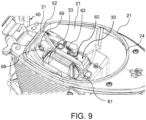
Figure 9 is an axonometric view similar to that shown inFigure 4 , in which an enlarged part ofFigure 4 is shown. - The same or similar elements are indicated by the same reference signs in the accompanying drawings.
-
Figure 1 shows an embodiment of an electric or hybridrideable saddle vehicle 1 which is embodied, in the particular example shown and without however introducing any limitation, by a two-wheeled motorcycle, and in particular by a two-wheeled scooter, having afront wheel 6 and arear wheel 7. - Hereinafter, in the present description, without however introducing any limitation, reference will be made to a
general motorcycle 1, meaning that the following description can be generally applied to any type of electric or hybrid rideable saddle vehicle comprising: - a
main body - at least two
wheels main body - a
motor 8, in particular, an electric or hybrid traction motor operatively connected to, or integrated in, at least one of the twowheels - In the particular example shown in
Figure 1 , therideable saddle vehicle 1 is an electric vehicle and comprises, without however introducing any limitation, anelectric motor 8 integrated in at least one of the twowheels rear wheel 7. In other words, in this example, theelectric motor 8 is a hub motor. The assembly consisting of therear wheel 7, and in particular of the wheel hub and theelectric motor 8, is adrive wheel - The
main body motorcycle 1 has afront part 2, atail part 4, and amiddle part 3 interposed between thefront part 2 and thetail part 4. - The
middle part 3 comprises afootboard 5, for example, on which a rider can place his/her feet. - In the example, the
front part 2 comprises afront shield 12, asteering handlebar 9, thefront wheel 6, afront suspension 11. - In the example, the
tail part 4 comprises arideable saddle 40, thedrive wheel fork 16 of thedrive wheel rear suspension 18. - The
motorcycle 1 further comprises astorage container 20 integrated in themain body tail part 4 ofmotorcycle 1. - The
storage container 20 is arranged below therideable saddle 40. Therideable saddle 40 can be moved between a closing configuration, in which therideable saddle 40 prevents access to thestorage container 20, and an opening configuration, in which therideable saddle 40 allows access to thestorage container 20. Therefore, in such an embodiment, therideable saddle 40 is a closing element of thestorage container 20. Therideable saddle 40, in particular in the closing configuration, reversibly obstructs an upper access opening 24 of thestorage container 20. Therideable saddle 40 inFigures 1, 2 and8 is shown in the closing configuration, while it is shown in the opening configuration inFigures 4 and9 . Therideable saddle 40 was instead omitted inFigure 5 . - According to an advantageous embodiment, the
rideable saddle 40 is hinged to themain body motorcycle 1 to be rotated about a first rotation axis Y1 (Figure 2 andFigure 4 ), between two positions angularly spaced apart from each other, corresponding to the closing configuration and to the opening configuration, respectively. In the example depicted in the drawings,motorcycle 1 comprises a first cylindrical hinge 48 (Figure 2 ) adapted and configured to rotatably hinge an end portion of therideable saddle 40 to thetail portion 4 ofmotorcycle 1 so that therideable saddle 40 is rotatable about the first rotation axis Y1, which thus represents the hinge axis. Said end portion preferably is a front end portion of therideable saddle 40, i.e., an end portion facing thefront part 2 of themain body motorcycle 1. -
Motorcycle 1 preferably comprises alocking system Figure 4 ) which can be operated to take a locking configuration for locking therideable saddle 40 in the closing configuration, and a releasing configuration to allow therideable saddle 40 to be brought from the closing configuration to the opening configuration. Thelocking system rideable saddle 40 comprises, for example, alock 26 having amovable catch 27 and anengagement element 46 with which themovable catch 27 is engaged when thelocking system lock 26 can be operated by means of a key and/or by means of a mechanical or electromechanical button and/or by means of an electrical control signal. In the particular embodiment shown for example inFigure 4 , theengagement element 46 is provided on therideable saddle 40 andlock 26 is provided on themain body motorcycle 1, in particular on thetail part 4. In a constructional variant, the positions of the aforesaid elements of thelocking system - The
motorcycle 1 further comprises at least one extractablerechargeable battery 30, as better shown inFigures 2 ,3 and 4 . A user may thus remove therechargeable battery 30 to be recharged and replace it with a chargedrechargeable battery 30, for example. - The
rechargeable battery 30 is operatively connected, for example by means of an electric wire 13 (Figure 5 ), tomotor 8 to supply it so that it can deliver a drive torque. Therechargeable battery 30 preferably comprises anelectrical connector 34 adapted to be engaged, for example by coupling, with a complementaryelectrical connector 14 provided at a free end of theelectric wire 13. - As shown in
Figure 3 , therechargeable battery 30 extends between abottom portion 31 and ahead portion 32. For example, therechargeable battery 30 comprises a containment body made of an electrically insulating material which accommodates a plurality of rechargeable cells therein. Thebottom portion 31 is a first end portion of the containment body and thehead portion 32 is a second end portion of the containment body, opposite to the first end portion. For example, the containment body of therechargeable battery 30 is prism-shaped, e.g., it has a general polygonal shape, in particular is parallelepiped-shaped, for example a straight parallelepiped. Rubber tips orfeet 35 for damping any impacts tobattery 30 can be arranged below thebottom portion 31. These rubber tips orfeet 35 can alternatively be arranged onmotorcycle 1. - The
rechargeable battery 30 preferably comprises agripping handle 33, preferably included in, or fixed to, thehead portion 32. Thegripping handle 33 preferably protrudes from thehead portion 32, and more preferably is C-shaped, with two side support arms and a middle gripping part, for example for ergonomic gripping, interposed between the two side arms. For example, the two side arms are mutually inclined and the middle part is cylindrical in shape, for example. - The
storage container 20 comprises a first housing seat S1 which at least partially houses therechargeable battery 30 so that therechargeable battery 30 can be inserted into, and extracted from, the first housing seat S1. Preferably, therechargeable battery 30 is slidably insertable into, and slidably extractable from, the first housing seat S1 by translation along a sliding axis Z. In particular, the housing seat S1, with therechargeable battery 30, substantially defines a shape coupling. - The first housing seat S1 is preferably delimited by a
tubular side wall 300 and abottom wall 301 joined to thetubular side wall 300. The first housing seat S1 preferably comprises guiding means, e.g., guides which allow directing the insertion/removal of therechargeable battery 30 into/from the first housing seat S1. The user is thus facilitated in placing thebattery 30 in a correct position in the first housing seat S1. In detail, the first housing seat S1 and/or therechargeable battery 30 are shaped so as to avoid therechargeable battery 30 from being mounted in a wrong position or with a wrong orientation. In particular, the first housing seat S1 and therechargeable battery 30 mutually form a shape coupling which defines a unique position between the first housing seat S1 and therechargeable battery 30. - Preferably, the
storage container 20 further comprises a second housing seat S2A, S2B, adapted and configured to house at least onehelmet 50, preferably a jet-type helmet, i.e., a helmet without a fixed chin guard. - The
storage container 20 can comprise ashell 21 shaped to delimit and define the lower portion of the compartment in which the first housing seat S1 and the second housing seat S2A, S2B are obtained. The compartment is then closed at the top by asupport base 41 ofsaddle 40. - According to an advantageous embodiment, the second housing seat S2A, S2B has a first housing portion S2A and a second housing portion S2B, which are adjacent to each other. When the
rechargeable battery 30 is inserted into the first housing seat S1, the first housing portion S2A at least partially extends over thehead portion 32 of therechargeable battery 30 and the second housing portion S2B at least partially extends laterally with respect to thehead portion 32 of therechargeable battery 30. The volume in thestorage container 20 reserved for housing therechargeable battery 30 thus forms a step close to which a front portion ofhelmet 50 can rest, e.g., anopen front portion 51 of ajet helmet 50. Thereby, both arechargeable battery 30 and ahelmet 50 can be simultaneously housed in thestorage container 20 even when the space onboard themotorcycle 1 reserved for thestorage container 20 is relatively small. - According to a particularly advantageous embodiment, the
head portion 32 of therechargeable battery 30 at least partially protrudes into the second housing seat S2A, S2B, in particular into the first housing portion S2A. For example, if thehead portion 32 of therechargeable battery 30 comprises thegripping handle 33, when therechargeable battery 30 is inserted into the first housing seat S1, the grippinghandle 33 at least partially protrudes into the second housing seat S2A, S2B, in particular into the first housing portion S2A. The depth of the first housing seat S1, i.e., of the housing seat reserved for therechargeable battery 30, can thus be reduced because, for housing thehead portion 32 and/or thegripping handle 33 of therechargeable battery 30, a relatively limited part of the housing volume of the second housing seat S2A, S2B can be utilized by utilizing the remaining part of the latter to househelmet 50. - According to an advantageous embodiment, the first housing seat S1 and the second housing seat S2A, S2B communicate with each other. For example, the first housing seat S1 comprises an access opening 38 which is crossable by the
bottom portion 31 of therechargeable battery 30 to insert the latter into the first housing seat S1. The first housing seat S1 and the second housing seat S2A, S2B communicate with each other through theaccess opening 38. For example, the access opening 38 is an opening arranged on the opposite side with respect to thebottom wall 301. - According to an embodiment, the
storage container 20 is adapted and configured to house ajet helmet 50. As shown inFigure 3 , thejet helmet 50 comprises a shell having a frontopen portion 51, twoopposite side portions 52, arear portion 53, and anupper portion 54. The frontopen portion 51 of the shell is joined to therear portion 53 of the shell by means of theside portions 52, while theupper portion 54 of the shell is above the frontopen portion 51, theside portions 52, and therear portion 53. - Advantageously, the first portion S2A of the second housing seat S2A, S2B is adapted and configured to house the front
open portion 51 of the shell. According to a particularly advantageous embodiment, thejet helmet 50 comprises at least one visor 55 (shown only inFigure 2 ), and the first portion S2A of the second housing seat S2A, S2B is also adapted and configured to house thevisor 55. As known per se,visor 55 is a transparent or semitransparent shield rotatably constrained to the shell and can be rotated from the outside of the shell to obstruct at least partially the frontopen portion 51 of the shell in a removable manner. - According to a particularly advantageous embodiment, the second portion S2B of the second housing seat S2A, S2B is adapted and configured to house at least partially the
side portions 52 of the shell of thejet helmet 50. - According to an advantageous embodiment which allows increasing the useful space inside the
storage container 20, therideable saddle 40 comprises (Figure 2 ) asupport base 41 and apadding 42, and thesupport base 41 comprises arecess 43 adapted and configured to receive part of theupper portion 54 of the shell ofhelmet 50 when thestorage container 20 accommodates ahelmet 50 therein. Thereby, the first portion S2A of the second housing seat S2A, S2B advantageously partially extends intosaddle 40. Theaforesaid recess 43 preferably extends into the thickness ofpadding 42. For example, thesupport base 41 is a frame made of hard plastics and/or metal, and the padding is made of a yielding material, such as a spongy synthetic material. As known per se, padding 42 is covered with a waterproof coating, e.g., made of natural or synthetic leather. According to a particularly advantageous embodiment, theaforesaid recess 43 is a rounded and/or curved recess. - The
motorcycle 1 further comprises a locking device 60 (shown in greater detail inFigures 5, 6 ,7, 8 and9 ) adapted to lock therechargeable battery 30 in the first housing seat S1. The lockingdevice 60 is adapted and configured to be moved in order to take an operating locking position and an operating releasing position. The lockingdevice 60 is retained in the operating locking position by means of a thrust force applied by therideable saddle 40 to thelocking device 60 when therideable saddle 40 takes the closing configuration. In the operating locking position shown for example inFigures 4 and8 , the lockingdevice 60 prevents therechargeable battery 30 from being removed from the first housing seat S1. Instead, in the operating releasing position shown inFigure 5 , the lockingdevice 60 allows the removal, in particular the extraction, of therechargeable battery 30 from the first housing seat S1, and thus from thestorage container 20. - According to a particularly advantageous embodiment, the locking
device 60 is accommodated in thestorage container 20 and has afirst end portion 61 rotatably hinged, by means of a hinge, to a wall of thestorage container 20, and asecond end portion 62, opposite to thefirst end portion 61, which is a free end portion when in the operating releasing position. Thefirst end portion 61 is rotatable about a second rotation axis Y2 (Figure 6 ), which is preferably parallel to the first rotation axis Y1, i.e., to the rotation axis of therideable saddle 40. According to a particularly advantageous embodiment, of thefirst end portion 61 and thesecond end portion 62 of thelocking device 60, thefirst end portion 61 is the furthest from the first rotation axis Y1 when thelocking device 60 is in the operating locking position. - The
vehicle 1 may comprise, at the hinge of thefirst end portion 61, an elastic return means (not shown in the drawings) adapted to push thelocking device 60 towards the operating locking position. Preferably, the elastic return means can be a torsional spring connected to thelocking device 60 and to theshell 21 of thestorage container 20. - As shown in
Figures 2 and8 , in the operating locking position of thelocking device 60, therideable saddle 40 abuts against thesecond end portion 62 and applies a pressure force to the latter, for example by means of at least onethrust element 45. For example, thethrust element 45 is integrated in, or fastened to, thesupport base 41 of therideable saddle 40. Conveniently, thethrust element 45 protrudes from therideable saddle 40, in particular from thesupport base 41, towards thestorage container 20, preferably so as to cross the upper access opening 24. - The locking
device 60 is kept in the operating locking position thereof, which prevents the removal ofbattery 30, only by means of the thrust applied by therideable saddle 40 when the rideable saddle abuts with the lockingdevice 60. This allows makingvehicle 1 more affordable becausebattery 30 remains firmly connected tovehicle 1 by means of thelocking device 60 alone, without needing further locking systems of thelocking device 60. Moreover, this solution allows lockingbattery 30 without any effort by the user ofvehicle 1 because thelocking device 60 is autonomously and automatically released by simply bringingsaddle 40 to the closing position. - The locking
device 60 is shaped so as to remain pinched between the bottom of therideable saddle 40, in particular thesupport base 41 thereof, and thestorage container 20, in particular theshell 21 thereof. Thesupport base 41 of therideable saddle 40 thus rests on theshell 21 of thestorage container 20 by means of thelocking device 60, thus improving the discharge of the rider's and passenger's weight onto the remainder of the motorcycle and ensuring a firm anchoring of thelocking device 60, and therefore ofbattery 30. - In the particular non-limiting embodiment shown in the drawings, the
rideable saddle 40 comprises two thrustelements 45 spaced apart from each other. In the closing configuration of therideable saddle 40, the two thrustelements 45 abut against thesecond end portion 62 of thelocking device 60, applying a pressure force to the latter in two contact points p1, p2 spaced apart from each other. - The locking
device 60 preferably comprises at least one lockingarm 63 which extends between thefirst end portion 61 and thesecond end portion 62. In the operating locking position, the at least one lockingarm 63 applies a thrust force to therechargeable battery 30, in particular to thehead portion 32. Therechargeable battery 30 is thus kept in a stable position inside the first housing seat S1 and possible vibrations, noise, and jolts of therechargeable battery 30 when using, for example when driving, themotorcycle 1 are eliminated. - Referring now to
Figure 7 , according to a particularly advantageous embodiment, thefirst end portion 61 and thesecond end portion 62 of thelocking device 60 projects towards sides which are arranged to be mutually opposite with respect to the lockingarm 63, so that the lockingdevice 60 has an overall S- or step-shaped lateral profile. - According to an advantageous and non-limiting embodiment, the locking
device 60 comprises two lockingarms 63 which are joined to each other on one side by thefirst end portion 61 and on another side by thesecond end portion 62. - According to a particularly advantageous embodiment, the locking
device 60 comprises at least one recess or a through opening 65 (Figure 6 ) which accommodates, or is crossed by, a protruding part of therechargeable battery 30 in the operating locking position of thelocking device 60. Such a protruding part preferably is thegripping handle 33. For example, the aforesaid recess or throughopening 65 extends into the lockingarm 63 or between the lockingarms 63. - According to a particularly advantageous embodiment, when the
locking device 60 takes the operating locking position, at least one elastically yielding element 66 (Figure 5 ), for example a yieldingblock 66, is interposed and sandwiched between the lockingdevice 60 and therechargeable battery 30. For example, the yieldingblock 66 is made of an elastically deformable material, such as rubber, latex, or silicone, for example. - In the embodiment shown in
Figure 5 , the at least one elastically yieldingelement 66 is fastened to thelocking device 60. In a constructional variant, the elastically yieldingelement 66 is fastened to therechargeable battery 30, for example in thehead portion 32 thereof. In a further variant, such an elastically yieldingelement 66 is a free element, for example a yielding pad, which can be interposed between therechargeable battery 30 and thelocking device 60. For the purposes of the present description, the feature of the elastic yielding nature associated withelement 66 implies that such an element has a greater elasticity and yielding nature than that of a remaining part of thelocking device 60. For example, the lockingdevice 60 is made of a metal material or hard plastics (e.g., ABS), while the elastically yieldingelement 66 is made of rubber or silicone. - Providing at least one elastically yielding
element 66 allows an elastic recovery of any clearance and/or damping of vibrations. In the particular example shown inFigure 5 , two elastically yieldingelements 66 are provided, each fastened or coupled to arespective arm 63 of thelocking device 60. - Similarly to the above description, at least one elastically yielding element (not shown in the drawings) can also be provided, which is interposed between the
rideable saddle 40 and thelocking device 60, for example between therideable saddle 40 and thesecond end portion 62 of thelocking device 60, when thelocking device 60 is in the operating locking position. For example, elastically yielding elements can be arranged at the contact point or points p1, p2, or on thelocking device 60 or the thrust element 45 (or on the thrust elements 45). - With reference to
Figure 9 , according to an advantageous embodiment, a throughhole 68, such as a slot-shaped hole, is defined in thesecond end portion 62 of thelocking device 60. Thestorage container 20 preferably comprises a protrudingarm 69 fastened inside thecontainer 20, for example fastened to an inner wall ofcontainer 20, which crosses the throughhole 68 when in the locking position. Thereby, by providing a hole in the protrudingarm 69 and using a security lock (not shown in the drawings), for example, it is optionally possible for a user to prevent thelocking device 60 from being brought to the releasing position. The security is thus increased, making the unauthorized removal of therechargeable battery 30 more complex, for example by third parties intending to unlawfully remove it when therideable saddle vehicle 1 is in a parking state, for example. - Based on the explanation above, it is thus possible to understand how an electric or hybrid
rideable saddle vehicle 1 of the type described above allows achieving the purposes indicated above with reference to the prior art.
Claims (15)
- An electric or hybrid rideable saddle vehicle (1), comprising:- a rechargeable battery (30);- an electric or hybrid traction motor (8) which can be supplied by the rechargeable battery (30) to deliver a drive torque;- a storage container (20) comprising a first housing seat (S1) which at least partially houses the rechargeable battery (30), wherein the rechargeable battery (30) is removably housed in the first housing seat (S1) so that the rechargeable battery (30) can be inserted into, and extracted from, the first housing seat (S1), the storage container (20) further comprising a locking device (60) adapted to lock the rechargeable battery (30) in the first housing seat (S1);- a rideable saddle (40) which can be moved between a closing configuration, in which the rideable saddle (40) prevents access to the storage container (20), and an opening configuration, in which the rideable saddle (40) allows access to the storage container (20), the storage container (20) being arranged below the rideable saddle (40);- the locking device (60) is adapted and configured to be moved to take an operating locking position and an operating releasing position; characterized in that :- the locking device (60) is retained in the operating locking position only by means of a thrust force applied by the rideable saddle (15) when the rideable saddle (40) takes the closing configuration.
- An electric or hybrid rideable saddle vehicle (1) according to claim 1, wherein when the rideable saddle (40) takes the closing configuration, the locking device (60) is pinched between a support base (41) of the rideable saddle (40) and a shell (21) of the storage container (20).
- An electric or hybrid rideable saddle vehicle (1) according to claim 1 or 2, comprising a main body (2, 3, 4), and wherein the rideable saddle (40) is hinged to the main body (2, 3, 4) to be rotated about a first rotation axis (Y1), between two positions angularly spaced apart from each other, corresponding to the closing configuration and the opening configuration, respectively.
- An electric or hybrid rideable saddle vehicle (1) according to claim 1, 2 or 3, wherein the locking device (60) is accommodated in the storage container (20) and has a first end portion (61) rotatably hinged to a wall of the storage container (20) and a second end portion (62) which, in the operating releasing position, is a free end portion.
- An electric or hybrid rideable saddle vehicle (1) according to claim 4, wherein of the first end portion (61) and second end portion (62) of the locking device (60), the first end portion (61) is the furthest from the first rotation axis (Y1) when the locking device (60) is in the operating locking position.
- An electric or hybrid rideable saddle vehicle (1) according to claim 4 or 5, wherein the first end portion (61) is rotatable about a second rotation axis (Y2) which is parallel to the first rotation axis (Y1).
- An electric or hybrid rideable saddle vehicle (1) according to any one of claims 4 to 6, wherein the locking device (60) comprises at least one locking arm (63) which extends between the first end portion (61) and the second end portion (62) and which, in said operating locking position, applies a thrust force to the rechargeable battery (30).
- An electric or hybrid rideable saddle vehicle (1) according to claim 7, wherein the first end portion (61) and the second end portion (62) of the locking device (60) project towards sides which are arranged to be mutually opposite with respect to the locking arm (63), so that the locking device (60) has an overall S- or step-shaped lateral profile.
- An electric or hybrid rideable saddle vehicle (1) according to any one of the preceding claims, wherein the locking device (60) comprises at least one recess or through opening (65) which, in said operating locking position, accommodates, or is crossed by, a protruding part of the rechargeable battery (30), said protruding part being preferably a gripping handle (33).
- An electric or hybrid rideable saddle vehicle (1) according to claims 7 and 9, wherein the locking device (60) comprises two locking arms (63) which are joined to each other on one side by the first end portion (61) and on another side by the second end portion (62).
- An electric or hybrid rideable saddle vehicle (1) according to claims 9 and 10, wherein said recess or through opening (65) extends between the locking arms (63).
- An electric or hybrid rideable saddle vehicle (1) according to any one of the preceding claims, wherein when the locking device (60) is in the operating locking position, at least one elastically yielding element (66) is interposed and sandwiched between the locking device (60) and the rechargeable battery (30).
- An electric or hybrid rideable saddle vehicle (1) according to any one of the preceding claims, wherein the rechargeable battery (30) extends between a bottom portion (31) and a head portion (32) and wherein the storage container (20) comprises a second housing seat (S2A, S2B), adapted and configured to house at least one helmet (50), having a first housing portion (S2A) and a second housing portion (S2B) wherein when the rechargeable battery (30) is inserted into the first housing seat (S1), the first housing portion (S2A) at least partially extends over the head portion (32) of the rechargeable battery (30) and the second housing portion (S2B) at least partially extends laterally with respect to the head portion (32) of the rechargeable battery (30).
- An electric or hybrid rideable saddle vehicle (1) according to claim 13, wherein the head portion (32) of the rechargeable battery (30) at least partially protrudes into the second housing seat (S2A, S2B), in particular into the first portion (S2A).
- An electric or hybrid rideable saddle vehicle (1) according to any one of the preceding claims, comprising an elastic return means configured to push the locking device (60) towards the operating locking position.
Applications Claiming Priority (2)
| Application Number | Priority Date | Filing Date | Title |
|---|---|---|---|
| IT102021000011432A IT202100011432A1 (en) | 2021-05-05 | 2021-05-05 | Electric or hybrid ride-on vehicle including a removable rechargeable battery and a battery locking device |
| PCT/IB2022/053683 WO2022234375A1 (en) | 2021-05-05 | 2022-04-20 | Electric or hybrid rideable saddle vehicle comprising an extractable rechargeable battery and a battery locking device |
Publications (3)
| Publication Number | Publication Date |
|---|---|
| EP4334165A1 EP4334165A1 (en) | 2024-03-13 |
| EP4334165B1 true EP4334165B1 (en) | 2025-01-29 |
| EP4334165C0 EP4334165C0 (en) | 2025-01-29 |
Family
ID=77022014
Family Applications (1)
| Application Number | Title | Priority Date | Filing Date |
|---|---|---|---|
| EP22718810.9A Active EP4334165B1 (en) | 2021-05-05 | 2022-04-20 | Electric or hybrid rideable saddle vehicle comprising an extractable rechargeable battery and a battery locking device |
Country Status (6)
| Country | Link |
|---|---|
| US (1) | US20240217619A1 (en) |
| EP (1) | EP4334165B1 (en) |
| CN (1) | CN117396357A (en) |
| IT (1) | IT202100011432A1 (en) |
| TW (1) | TWI894463B (en) |
| WO (1) | WO2022234375A1 (en) |
Families Citing this family (4)
| Publication number | Priority date | Publication date | Assignee | Title |
|---|---|---|---|---|
| IT202100011438A1 (en) * | 2021-05-05 | 2022-11-05 | Piaggio & C Spa | Electric or hybrid ride-on vehicle including a rechargeable battery and a storage container |
| IT202200026004A1 (en) * | 2022-12-20 | 2024-06-20 | Piaggio & C Spa | Ride-on electric or hybrid vehicle comprising a removable rechargeable battery and an improved rechargeable battery locking device |
| JP2024118004A (en) * | 2023-02-20 | 2024-08-30 | ヤマハ発動機株式会社 | Electric straddle type vehicle |
| JP2025059437A (en) * | 2023-09-29 | 2025-04-10 | スズキ株式会社 | Saddle-type vehicle |
Citations (13)
| Publication number | Priority date | Publication date | Assignee | Title |
|---|---|---|---|---|
| JPH05105145A (en) * | 1991-10-18 | 1993-04-27 | Yamaha Motor Co Ltd | Electric motorcycle |
| EP1389552A1 (en) * | 2002-08-16 | 2004-02-18 | Yamaha Hatsudoki Kabushiki Kaisha | Electrically-Driven Vehicle |
| EP2168862A1 (en) * | 2008-09-30 | 2010-03-31 | Honda Motor Co., Ltd | Saddle-ride type electric vehicle |
| EP2623404A1 (en) * | 2010-09-30 | 2013-08-07 | Suzuki Motor Corporation | Electric two-wheeled vehicle |
| US20150127206A1 (en) * | 2013-11-06 | 2015-05-07 | Yamaha Hatsudoki Kabushiki Kaisha | Vehicle and battery pack |
| EP2871125A1 (en) * | 2013-11-06 | 2015-05-13 | Yamaha Hatsudoki Kabushiki Kaisha | Battery and saddle-type electric vehicle equipped therewith |
| EP3088286A2 (en) * | 2015-04-30 | 2016-11-02 | Yamaha Hatsudoki Kabushiki Kaisha | Straddled electric vehicle, and charging system for straddled electric vehicle |
| WO2019064605A1 (en) * | 2017-09-29 | 2019-04-04 | 本田技研工業株式会社 | Battery storage device for vehicle |
| WO2019064556A1 (en) * | 2017-09-29 | 2019-04-04 | 本田技研工業株式会社 | Battery storage device for vehicle |
| WO2020065865A1 (en) * | 2018-09-27 | 2020-04-02 | 本田技研工業株式会社 | Battery attaching/detaching structure for saddle-type vehicle |
| EP3670311A1 (en) * | 2017-09-29 | 2020-06-24 | Honda Motor Co., Ltd. | Battery storage device for vehicle |
| WO2021005767A1 (en) * | 2019-07-10 | 2021-01-14 | 本田技研工業株式会社 | Saddled electric-powered vehicle |
| EP3838725A1 (en) * | 2019-12-20 | 2021-06-23 | PIAGGIO & C. S.p.A. | Removable storage container for saddle riding-type vehicle |
Family Cites Families (9)
| Publication number | Priority date | Publication date | Assignee | Title |
|---|---|---|---|---|
| JP5197563B2 (en) * | 2009-12-28 | 2013-05-15 | 本田技研工業株式会社 | Straddle-type electric vehicle |
| JP5999953B2 (en) * | 2012-03-29 | 2016-09-28 | 本田技研工業株式会社 | Electric vehicle |
| JP6284746B2 (en) * | 2013-11-06 | 2018-02-28 | ヤマハ発動機株式会社 | Straddle-type electric vehicle |
| US11355812B2 (en) * | 2017-09-29 | 2022-06-07 | Honda Motor Co., Ltd. | Battery storage device of vehicle |
| JP6874144B2 (en) * | 2017-09-29 | 2021-05-19 | 本田技研工業株式会社 | Battery storage device for electric vehicles |
| WO2020065868A1 (en) * | 2018-09-27 | 2020-04-02 | 本田技研工業株式会社 | Battery attaching/detaching structure for saddle-type vehicle |
| JP6830567B1 (en) * | 2019-03-25 | 2021-02-17 | 本田技研工業株式会社 | Battery attachment / detachment structure for saddle-mounted electric vehicle |
| JP6864162B1 (en) * | 2019-07-10 | 2021-04-28 | 本田技研工業株式会社 | Saddle-type electric vehicle |
| FR3109472B1 (en) * | 2020-04-21 | 2022-08-26 | Ze Way | Device for receiving a battery for an electric vehicle and vehicle comprising such a device |
-
2021
- 2021-05-05 IT IT102021000011432A patent/IT202100011432A1/en unknown
-
2022
- 2022-04-20 CN CN202280033346.4A patent/CN117396357A/en active Pending
- 2022-04-20 WO PCT/IB2022/053683 patent/WO2022234375A1/en not_active Ceased
- 2022-04-20 US US18/289,013 patent/US20240217619A1/en active Pending
- 2022-04-20 EP EP22718810.9A patent/EP4334165B1/en active Active
- 2022-04-28 TW TW111116158A patent/TWI894463B/en active
Patent Citations (13)
| Publication number | Priority date | Publication date | Assignee | Title |
|---|---|---|---|---|
| JPH05105145A (en) * | 1991-10-18 | 1993-04-27 | Yamaha Motor Co Ltd | Electric motorcycle |
| EP1389552A1 (en) * | 2002-08-16 | 2004-02-18 | Yamaha Hatsudoki Kabushiki Kaisha | Electrically-Driven Vehicle |
| EP2168862A1 (en) * | 2008-09-30 | 2010-03-31 | Honda Motor Co., Ltd | Saddle-ride type electric vehicle |
| EP2623404A1 (en) * | 2010-09-30 | 2013-08-07 | Suzuki Motor Corporation | Electric two-wheeled vehicle |
| US20150127206A1 (en) * | 2013-11-06 | 2015-05-07 | Yamaha Hatsudoki Kabushiki Kaisha | Vehicle and battery pack |
| EP2871125A1 (en) * | 2013-11-06 | 2015-05-13 | Yamaha Hatsudoki Kabushiki Kaisha | Battery and saddle-type electric vehicle equipped therewith |
| EP3088286A2 (en) * | 2015-04-30 | 2016-11-02 | Yamaha Hatsudoki Kabushiki Kaisha | Straddled electric vehicle, and charging system for straddled electric vehicle |
| WO2019064605A1 (en) * | 2017-09-29 | 2019-04-04 | 本田技研工業株式会社 | Battery storage device for vehicle |
| WO2019064556A1 (en) * | 2017-09-29 | 2019-04-04 | 本田技研工業株式会社 | Battery storage device for vehicle |
| EP3670311A1 (en) * | 2017-09-29 | 2020-06-24 | Honda Motor Co., Ltd. | Battery storage device for vehicle |
| WO2020065865A1 (en) * | 2018-09-27 | 2020-04-02 | 本田技研工業株式会社 | Battery attaching/detaching structure for saddle-type vehicle |
| WO2021005767A1 (en) * | 2019-07-10 | 2021-01-14 | 本田技研工業株式会社 | Saddled electric-powered vehicle |
| EP3838725A1 (en) * | 2019-12-20 | 2021-06-23 | PIAGGIO & C. S.p.A. | Removable storage container for saddle riding-type vehicle |
Also Published As
| Publication number | Publication date |
|---|---|
| EP4334165A1 (en) | 2024-03-13 |
| IT202100011432A1 (en) | 2022-11-05 |
| US20240217619A1 (en) | 2024-07-04 |
| CN117396357A (en) | 2024-01-12 |
| TW202300395A (en) | 2023-01-01 |
| TWI894463B (en) | 2025-08-21 |
| WO2022234375A1 (en) | 2022-11-10 |
| EP4334165C0 (en) | 2025-01-29 |
Similar Documents
| Publication | Publication Date | Title |
|---|---|---|
| EP4334165B1 (en) | Electric or hybrid rideable saddle vehicle comprising an extractable rechargeable battery and a battery locking device | |
| EP3566940B1 (en) | Bicycle battery assembly | |
| ES2906233T3 (en) | Battery lock for an electric bike | |
| JP5750544B2 (en) | Mounting structure of portable information terminal in saddle-ride type vehicle | |
| JP2012006549A (en) | Charging port structure and saddle-riding type vehicle | |
| US20240217611A1 (en) | An electric or hybrid rideable saddle vehicle comprising a rechargeable battery and a storage container | |
| JP4989263B2 (en) | Electric vehicle | |
| JPH1053178A (en) | Motorcycle | |
| EP1759968B1 (en) | Saddle for a scooter-type motorcycle | |
| EP4094973B1 (en) | Battery storage device and electric vehicle | |
| JP3490900B2 (en) | Electric bicycle | |
| JP2013129342A (en) | Saddle riding type electric vehicle | |
| JP7064622B2 (en) | Saddle-type vehicle | |
| CN111422292B (en) | Saddle-ride type vehicle | |
| JP2001225774A (en) | Power-assisted bicycle | |
| JPH11321753A (en) | Arrangement structure of charger in electric vehicle | |
| EP4638251A1 (en) | Electric or hybrid rideable-saddle vehicle comprising a removable rechargeable battery and an improved rechargeable battery locking device | |
| JP2024052490A (en) | Electric two-wheeler | |
| JP7733635B2 (en) | Storage box for saddle-type vehicles | |
| CN221272809U (en) | Storage box mounted on back door of automobile | |
| EP4585498A1 (en) | Vehicle | |
| JP2011152897A (en) | Battery attaching-detaching structure of electric motorcycle | |
| JP2002127967A (en) | Motor-assisted bicycle | |
| JP2002145166A (en) | Electric motor bicycle | |
| CN113195347A (en) | Saddle-ride type vehicle |
Legal Events
| Date | Code | Title | Description |
|---|---|---|---|
| STAA | Information on the status of an ep patent application or granted ep patent |
Free format text: STATUS: UNKNOWN |
|
| STAA | Information on the status of an ep patent application or granted ep patent |
Free format text: STATUS: THE INTERNATIONAL PUBLICATION HAS BEEN MADE |
|
| PUAI | Public reference made under article 153(3) epc to a published international application that has entered the european phase |
Free format text: ORIGINAL CODE: 0009012 |
|
| STAA | Information on the status of an ep patent application or granted ep patent |
Free format text: STATUS: REQUEST FOR EXAMINATION WAS MADE |
|
| 17P | Request for examination filed |
Effective date: 20231006 |
|
| AK | Designated contracting states |
Kind code of ref document: A1 Designated state(s): AL AT BE BG CH CY CZ DE DK EE ES FI FR GB GR HR HU IE IS IT LI LT LU LV MC MK MT NL NO PL PT RO RS SE SI SK SM TR |
|
| DAV | Request for validation of the european patent (deleted) | ||
| DAX | Request for extension of the european patent (deleted) | ||
| GRAP | Despatch of communication of intention to grant a patent |
Free format text: ORIGINAL CODE: EPIDOSNIGR1 |
|
| STAA | Information on the status of an ep patent application or granted ep patent |
Free format text: STATUS: GRANT OF PATENT IS INTENDED |
|
| RIC1 | Information provided on ipc code assigned before grant |
Ipc: B62J 9/14 20200101ALI20240930BHEP Ipc: B62J 43/28 20200101ALI20240930BHEP Ipc: B62J 43/16 20200101ALI20240930BHEP Ipc: B62M 6/90 20100101ALI20240930BHEP Ipc: B60L 53/80 20190101AFI20240930BHEP |
|
| INTG | Intention to grant announced |
Effective date: 20241029 |
|
| GRAS | Grant fee paid |
Free format text: ORIGINAL CODE: EPIDOSNIGR3 |
|
| GRAA | (expected) grant |
Free format text: ORIGINAL CODE: 0009210 |
|
| STAA | Information on the status of an ep patent application or granted ep patent |
Free format text: STATUS: THE PATENT HAS BEEN GRANTED |
|
| AK | Designated contracting states |
Kind code of ref document: B1 Designated state(s): AL AT BE BG CH CY CZ DE DK EE ES FI FR GB GR HR HU IE IS IT LI LT LU LV MC MK MT NL NO PL PT RO RS SE SI SK SM TR |
|
| REG | Reference to a national code |
Ref country code: GB Ref legal event code: FG4D |
|
| REG | Reference to a national code |
Ref country code: CH Ref legal event code: EP |
|
| REG | Reference to a national code |
Ref country code: DE Ref legal event code: R096 Ref document number: 602022010191 Country of ref document: DE |
|
| REG | Reference to a national code |
Ref country code: IE Ref legal event code: FG4D |
|
| U01 | Request for unitary effect filed |
Effective date: 20250129 |
|
| U07 | Unitary effect registered |
Designated state(s): AT BE BG DE DK EE FI FR IT LT LU LV MT NL PT RO SE SI Effective date: 20250205 |
|
| U20 | Renewal fee for the european patent with unitary effect paid |
Year of fee payment: 4 Effective date: 20250324 |
|
| PG25 | Lapsed in a contracting state [announced via postgrant information from national office to epo] |
Ref country code: RS Free format text: LAPSE BECAUSE OF FAILURE TO SUBMIT A TRANSLATION OF THE DESCRIPTION OR TO PAY THE FEE WITHIN THE PRESCRIBED TIME-LIMIT Effective date: 20250429 |
|
| PG25 | Lapsed in a contracting state [announced via postgrant information from national office to epo] |
Ref country code: PL Free format text: LAPSE BECAUSE OF FAILURE TO SUBMIT A TRANSLATION OF THE DESCRIPTION OR TO PAY THE FEE WITHIN THE PRESCRIBED TIME-LIMIT Effective date: 20250129 |
|
| PG25 | Lapsed in a contracting state [announced via postgrant information from national office to epo] |
Ref country code: ES Free format text: LAPSE BECAUSE OF FAILURE TO SUBMIT A TRANSLATION OF THE DESCRIPTION OR TO PAY THE FEE WITHIN THE PRESCRIBED TIME-LIMIT Effective date: 20250129 |
|
| PG25 | Lapsed in a contracting state [announced via postgrant information from national office to epo] |
Ref country code: IS Free format text: LAPSE BECAUSE OF FAILURE TO SUBMIT A TRANSLATION OF THE DESCRIPTION OR TO PAY THE FEE WITHIN THE PRESCRIBED TIME-LIMIT Effective date: 20250529 Ref country code: NO Free format text: LAPSE BECAUSE OF FAILURE TO SUBMIT A TRANSLATION OF THE DESCRIPTION OR TO PAY THE FEE WITHIN THE PRESCRIBED TIME-LIMIT Effective date: 20250429 |
|
| PG25 | Lapsed in a contracting state [announced via postgrant information from national office to epo] |
Ref country code: HR Free format text: LAPSE BECAUSE OF FAILURE TO SUBMIT A TRANSLATION OF THE DESCRIPTION OR TO PAY THE FEE WITHIN THE PRESCRIBED TIME-LIMIT Effective date: 20250129 |
|
| PG25 | Lapsed in a contracting state [announced via postgrant information from national office to epo] |
Ref country code: GR Free format text: LAPSE BECAUSE OF FAILURE TO SUBMIT A TRANSLATION OF THE DESCRIPTION OR TO PAY THE FEE WITHIN THE PRESCRIBED TIME-LIMIT Effective date: 20250430 |
|
| PG25 | Lapsed in a contracting state [announced via postgrant information from national office to epo] |
Ref country code: SM Free format text: LAPSE BECAUSE OF FAILURE TO SUBMIT A TRANSLATION OF THE DESCRIPTION OR TO PAY THE FEE WITHIN THE PRESCRIBED TIME-LIMIT Effective date: 20250129 |
|
| PG25 | Lapsed in a contracting state [announced via postgrant information from national office to epo] |
Ref country code: CZ Free format text: LAPSE BECAUSE OF FAILURE TO SUBMIT A TRANSLATION OF THE DESCRIPTION OR TO PAY THE FEE WITHIN THE PRESCRIBED TIME-LIMIT Effective date: 20250129 |
|
| PG25 | Lapsed in a contracting state [announced via postgrant information from national office to epo] |
Ref country code: SK Free format text: LAPSE BECAUSE OF FAILURE TO SUBMIT A TRANSLATION OF THE DESCRIPTION OR TO PAY THE FEE WITHIN THE PRESCRIBED TIME-LIMIT Effective date: 20250129 |
|
| REG | Reference to a national code |
Ref country code: CH Ref legal event code: H13 Free format text: ST27 STATUS EVENT CODE: U-0-0-H10-H13 (AS PROVIDED BY THE NATIONAL OFFICE) Effective date: 20251125 |
|
| PLBE | No opposition filed within time limit |
Free format text: ORIGINAL CODE: 0009261 |
|
| STAA | Information on the status of an ep patent application or granted ep patent |
Free format text: STATUS: NO OPPOSITION FILED WITHIN TIME LIMIT |
|
| PG25 | Lapsed in a contracting state [announced via postgrant information from national office to epo] |
Ref country code: MC Free format text: LAPSE BECAUSE OF FAILURE TO SUBMIT A TRANSLATION OF THE DESCRIPTION OR TO PAY THE FEE WITHIN THE PRESCRIBED TIME-LIMIT Effective date: 20250129 |
|
| 26N | No opposition filed |
Effective date: 20251030 |
|
| PG25 | Lapsed in a contracting state [announced via postgrant information from national office to epo] |
Ref country code: CH Free format text: LAPSE BECAUSE OF NON-PAYMENT OF DUE FEES Effective date: 20250430 |
|
| U20 | Renewal fee for the european patent with unitary effect paid |
Year of fee payment: 5 Effective date: 20260225 |
|
| PG25 | Lapsed in a contracting state [announced via postgrant information from national office to epo] |
Ref country code: IE Free format text: LAPSE BECAUSE OF NON-PAYMENT OF DUE FEES Effective date: 20250420 |