EP4334087B1 - Skalierbare und antriebslose stützvorrichtung mit kraftreglern - Google Patents
Skalierbare und antriebslose stützvorrichtung mit kraftreglern Download PDFInfo
- Publication number
- EP4334087B1 EP4334087B1 EP22728199.5A EP22728199A EP4334087B1 EP 4334087 B1 EP4334087 B1 EP 4334087B1 EP 22728199 A EP22728199 A EP 22728199A EP 4334087 B1 EP4334087 B1 EP 4334087B1
- Authority
- EP
- European Patent Office
- Prior art keywords
- assistive
- assembly
- force regulator
- force
- freedom
- Prior art date
- Legal status (The legal status is an assumption and is not a legal conclusion. Google has not performed a legal analysis and makes no representation as to the accuracy of the status listed.)
- Active
Links
Images






Classifications
-
- B—PERFORMING OPERATIONS; TRANSPORTING
- B25—HAND TOOLS; PORTABLE POWER-DRIVEN TOOLS; MANIPULATORS
- B25J—MANIPULATORS; CHAMBERS PROVIDED WITH MANIPULATION DEVICES
- B25J9/00—Program-controlled manipulators
- B25J9/0006—Exoskeletons, i.e. resembling a human figure
-
- B—PERFORMING OPERATIONS; TRANSPORTING
- B25—HAND TOOLS; PORTABLE POWER-DRIVEN TOOLS; MANIPULATORS
- B25J—MANIPULATORS; CHAMBERS PROVIDED WITH MANIPULATION DEVICES
- B25J3/00—Manipulators of leader-follower type, i.e. both controlling unit and controlled unit perform corresponding spatial movements
- B25J3/02—Manipulators of leader-follower type, i.e. both controlling unit and controlled unit perform corresponding spatial movements involving a parallelogram coupling of the leader and follower units
-
- B—PERFORMING OPERATIONS; TRANSPORTING
- B25—HAND TOOLS; PORTABLE POWER-DRIVEN TOOLS; MANIPULATORS
- B25J—MANIPULATORS; CHAMBERS PROVIDED WITH MANIPULATION DEVICES
- B25J9/00—Program-controlled manipulators
- B25J9/003—Program-controlled manipulators having parallel kinematics
- B25J9/0045—Program-controlled manipulators having parallel kinematics with kinematics chains having a rotary joint at the base
- B25J9/0048—Program-controlled manipulators having parallel kinematics with kinematics chains having a rotary joint at the base with kinematics chains of the type rotary-rotary-rotary
Definitions
- the present invention concerns the field of support devices for humans and industrial manipulators.
- the field of wearable exoskeletons that support human wearers by compensating the weight of their limbs, torso or a carried payload, or the field of industrial manipulators that support a payload or allow an operator to move the manipulator, again possibly while carrying a payload.
- industrial manipulators apply forces directly between the links of the robotic manipulator and eventually to the robotic base, making the robot support itself as if it was weightless, yet without applying external forces from a hoist, and enabling additionally to apply extra forces between the links to support a payload.
- the unpowered devices have the advantage of substantially lower manufacturing costs and improved user experience through lower heat emissions, lower maintenance efforts, and a higher level of autonomy.
- the powered devices have the advantage of higher flexibility, often being digitally controllable, allowing to define various types of compensation forces and adjusting to various configurations.
- the hybrid devices utilize many unpowered parts similar to the unpowered devices, but additionally include powered components like an electronic controller, one or more sensors and one or more shifting actuators to regulate and adapt compensation force in correlation with the desired force. If these devices still strongly rely on the unpowered components, many of the benefits of the unpowered devices are maintained, while the additional electronic components add flexibility and the possibility to program complex desired behaviors. Both powered and hybrid devices do still rely on external power sources. To make already existing or new manipulators more compact, more energy efficient and more cost efficient the present invention focuses on the unpowered and hybrid solutions.
- the present invention proposes unpowered and hybrid devices that are, compared to existing solutions, more compact, more flexible, more easy to scale to more degrees of freedom, and better able to apply compensation forces that take into account the specific positions of the entire support device, such as taking into account the position of the lower arm when applying force to support the upper arm in a wearable exoskeleton to render the wearer's arm weightless, and without having the wearer feel the weight of the components supplying the compensation forces.
- the present invention proposes such devices for usage in wearable exoskeletons, and for usage as industrial manipulators.
- US2018361565A1 to Ekso Bionics describes an unpowered arm support assembly that provides assistive torque to the arm of a human wearer through a gas spring and cam follower assembly.
- the arm support assembly is configured to pivot about the horizontal axis, the sagittal axis and the coronal axis.
- this device does not provide any support for the forearm and is not able to adapt compensation forces in correlation to the individual position of upper, fore-arm and base to the ground plane.
- the compensation force on the upper arm is chosen to compensate for the position of the lower arm in a single position, but since the lower arm can move freely it does not in all possible positions fully compensate for its impact. Therefore, there is a general need to provide support devices that allow motion but maintain weight compensation of the whole arm depending on the specific orientation of this upper, forearm and base
- EP3216417A1 to Hanyang University Industry-University Cooperation Foundation (IUCF) ,Koh Young Technology Inc.
- Both patents describe an unpowered Multi Degrees of freedom counterbalance and spring balanced mechanism. These mechanisms have two active degrees of freedom connected in a serial way, to which an end effector can be installed that can be moved to a desired position. The mechanisms are compensated through dedicated springs or counterweight, with a minimum of one for each active degree of freedom, and allow motion in the horizontal plane.
- these devices do not provide a solution for more degrees of freedom, specifically more than three compensated parallel inter dependent or serial compensated degrees of freedom working in two different planes other than a plane which is parallel to the horizontal plane.
- These devices have the need for dedicated spring or counterbalance parts in combination with dedicated cam and bar linkages for each compensated degree of freedom in correlation with on dedicated end effector or payload.
- US 2021/060762 A1 discloses a force regulator assembly according to the preamble of the appended independent claim 1.
- a force regulator assembly as defined by the appended claims, comprising a main assembly, which forms the part of the exoskeleton that directly supports the human or the main part of the robotic manipulator that moves its end-effector between different positions, which is connected to an assistive assembly that is a representation of the main assembly, located outside of the main assembly and possible in a scaled format.
- the invention discusses a connection between the main and assistive assemblies in at least two actuated degrees of freedom to achieve this representation, so that displacements and forces in the main assembly result in displacements and forces in the assistive assembly.
- the invention relies upon this so that force regulator units can be used to apply compensation forces in the assistive assembly yet perform useful supportive actions in the main assembly, while the weight of these force regulator assemblies is not felt by the main assemblies, and at the same time to ensure that the positions of the actuated degrees of freedom in the main assembly have an impact on the forces experienced by the other actuated degrees of freedom, so that when for example the lower arm moves of a person wearing an exoskeleton, a part of the main assembly moves along with it and so does a link in the assistive assembly, ensuring that the compensation forces felt on the main assembly for the upper arm will be applied taking into account the lower arm displacement.
- a switch to alter the force applied by the force regulator units and/or the force transmission unit or its interface point to the assistive assembly.
- This can be a toggle to enable load or no load mode, allowing an operator or person wearing the device to easily move the device without experiencing assistive forces when the no load position is selected, while being able to activate the assistive forces when needed.
- the invention provides an efficient, user-friendly and convenient way to apply desired forces on a target object, such as a part of the human body like a limb, or a robotic manipulator.
- a target object such as a part of the human body like a limb, or a robotic manipulator.
- the same support device and underlying methods can also be used for other applications where applying assistive forces is useful.
- a first aspect of the invention is a support device, comprising
- the assistive assembly is a scaled representation of the main assembly, optionally folded in such a way as to provide easy access for force regulator assemblies.
- the assistive assembly includes a smaller scale representation of the main assembly.
- the assistive assembly is arranged such that the bidirectional movements of the main assembly and of the assistive assembly are essentially synchronized. Bidirectional movements include position, force and motion.
- the assistive links and the intermediate distance between al degrees of freedom of assistive assembly are between half the size and a tenth of the size of the links and the intermediate distance between al degrees of freedom of main assembly.
- multi motion configuration, Figure 14 there is a single link in the main assembly rotatably connected to the base support and arranged to support the movements of the first mass of a target, and/or transfer forces coming from one or multiple masses of a target(s) to a first actuator and the base support.
- this single link there is a second rotatable connection between the first link and the base support to support the movements of one or multiple masses of a target in a motion path different from the achieved motion freedom coming from the first rotatable connection between the base support and a first link.
- the assistive assembly similarly has a first assistive link rotatably connected to the assistive base support and arranged to represent the movements of the corresponding first link in the main assembly, and or transfer forces coming from one or multiple force regulator units to a first assistive actuator and the assistive base support.
- This assistive link has a second rotatable connection between the first assistive link and the assistive base support arranged to represent the movements in a second degree of freedom of the corresponding first link in the main assembly, and or transfer forces coming from one or multiple force regulator units to a first assistive actuator and the assistive base support.
- a first link is rotatably connected to the base support and arranged to support the movements of the first mass of a target, and or transfer forces coming from one or multiple masses of a target(s) to a first actuator and the base support.
- a second link is rotatably connected to the first link and arranged to support the movements of the first mass of a target, and or transfer forces coming from one or multiple masses of a target(s) to a second actuator and the first link.
- the assistive assembly similarly has a first assistive link rotatably connected to the assistive base support and arranged to represent the movements of the corresponding first link in the main assembly, and or transfer forces coming from one or multiple force regulator units to a first assistive actuator and the assistive base support.
- a second assistive link is rotatably connected to the first assistive link and arranged to represent the movements of the corresponding second link in the main assembly, and or transfer forces coming from one or multiple force regulator units to a second assistive actuator and the first assistive link.
- a first link rotatably connected in the main assembly to the base support and arranged to support the movements of the first mass of a target, and or transfer forces coming from one or multiple masses of a target(s) to a first actuator and the base support.
- a second link having a first and second end, the first end being rotatably connected to the base support end and the second end being indirect connected to the second end of the first link, through a third and fourth interdependent link and arranged to support the movements of the first mass of a target, and or transfer forces coming from one or multiple masses of a target(s) to a first and second actuator and the base support.
- the assistive assembly similarly has a first assistive link rotatably connected to the assistive base support and arranged to represent the movements of the corresponding first link in the main assembly, and or transfer forces coming from one or multiple force regulator units to a first assistive actuator and the assistive base support.
- a second assistive link has a first and second end, the first end being rotatably connected to the assistive base support end and the second end being indirect connected to the second end of the first assistive link, through a third and fourth interdependent assistive link and arranged represent the movements of the corresponding second, third and fourth link in the main assembly, and or transfer forces coming from one or multiple force regulator units to a second assistive actuator and the assistive base support.
- the main and assistive assemblies can have one or more links in two or more actuated degrees of freedom, connected through unpowered mechanical connections optionally relying on unpowered actuators, so that the assistive assembly forms a representation of the main assembly, and wherein the assistive assembly can have one or force regulator units that apply forces on the assistive links through interface points.
- the main assembly can have additional passive, non-actuated degrees of freedom, such as a rotation of the base support in the horizontal plane, which are not included in the assistive assembly, so these degrees of freedom are not connected to the links in the assistive assembly.
- the assistive assembly is located outside of the main assembly in the form of a separatable assembly, such that no connection from the assistive assembly to main assembly is in place other than the connection established to transfer force and position between assistive and main assemblies.
- the force resulting from the weight of this assistive device and specifically the force regulator units used to apply compensation forces is not transferred the main assembly.
- the position of one actuated degree of freedom has influence on delivered output force of the other actuated degrees of freedom as well as the delivered output force felt in the degree of freedom itself.
- the device provides an efficient, user-friendly and convenient way to regulate the desired force acting on the targeted mass(es)/payload or limb. This can for example be used to apply a force on the upper arm of a wearable exoskeleton to compensate the weight of the arm of the wearer, and to ensure the compensation force while doing so takes into account the specific position of the forearm.
- the forces applied by the force regulator units are a function of the positions of the links in the assistive assembly and through the connection thus also of the positions of the main assembly. This allows to flexibly define the desired compensation forces depending on the positions, for various applications.
- the force regulator unit is connected to the assistive base support through a planar degree of freedom such that the first regulator unit can follow the motion of the interface point with the assistive link.
- this connection between the force regulator assembly end the assistive base support can be limited to one degree of freedom.
- the force and position communication between main and assistive assembly is done through a flexible connection, such that the location and orientation of assistive and main assembly in correlation to each other can vary in a flexible way.
- the means to connect the main and assistive assemblies can any force transmission systems.
- hydraulic cylinders for example, hydraulic cylinders, torsion cables, pulley systems, gears, shafts, friction or elastic couplings or bar linkages.
- a hydraulic cylinder is a mechanical actuator that is used to give a bidirectional force through a bidirectional stroke.
- the hydraulic cylinders are connected back to back connected through flexible tubes in a closed circuit such no external energy is required except the mechanical energy through the assistive force provided by the force regulator assembly.
- the unpowered actuators are selected from the group consisting of hydraulic cylinders, torsion cables or pulley systems or combinations thereof.
- the flexible connection can be achieved using a closed circuit of hydraulic actuators serving as main and assistive actuators, and the connection between the main and assistive assemblies is achieved by connecting the hydraulic actuators using flexible hydraulic lines.
- the main actuators can be connected using a closed system of hydraulic lines to the assistive actuators, each time connecting one main actuator to one assistive actuator, so that a displacement in the main actuator leads to a proportional displacement in the assistive actuator, and the other way around, and similarly a force in the main actuator leads to a proportional force in the assistive actuator.
- the force and position communication between assistive and main assemblies is done through a stiff connection.
- the means to stiffly connect main and assistive assemblies is selected from the group consisting of rotation shafts, linkages, gears, pulleys and belt or combinations thereof.
- the energy storage units contained within the force regulator units may be any suitably sized units to releasably store energy.
- the energy storage unit is an elastic energy storage unit.
- Examples of elastic compensation actuator include springs, such as clock springs and blade springs. Such springs are commonly referred to as mechanical batteries for their ability to releasably store energy.
- other elastic elements are suitable, for example elastic foams and air springs.
- the energy storage unit is selected from the group consisting of metal springs, counterweights, clock spring, a blade spring, a gas spring, an elastically deformable foam or a combination thereof.
- the energy storage unit is a combination of clock springs, servo shift and a gearbox.
- the force transmission unit is a toothed cam chain assembly, cam linkage assembly, ball joint and any other mechanical assembly or part that transfers and directs force coming from the force regulator assembly to the foreseen interface point on the assistive links.
- the device is free of powered electric, hydraulic, or pneumatic actuators configured to generate the assistive force.
- the support device is unpowered in the sense that no external energy is necessary to provide the assistive force, in particular no electric energy is required. Though additional powering is possible, the support device preferably is unpowered.
- the device does not comprise a sensor configured to sense a motion and or position of the links in the assistive assembly relative to the assistive base support plane, nor an electronic controller to process this sensor.
- the device does comprise a sensor configured to sense a motion and or position of the links in the assistive assembly relative to the assistive base support plane, such the controller detects a balance between applied load and assistive force.
- the device is powered in a hybrid way by a combination of electric, hydraulic, or pneumatic actuators in combination with the group consisting of metal springs, clock spring, a blade spring, a gas spring, an elastically deformable foam or a combination thereof.
- both location of the interface point and the applied assistive force can be adjusted such that the compensation force perceived by the main assembly can be placed in the theoretical center of gravity of a payload with the desired amplitude.
- the tunable embodiment of this force regulator assembly can be replaced by a dedicated non tunable version, such that there is a cost and weight optimization.
- both location of the interface point and applied assistive force are tunable through a powered actuator.
- the device has an auto load detect function.
- This function relies on a support device equipped with electronics and sensors and it executes a force ramp up till a force balance is found between assistive force and force coming from the load connected to links of the main structure.
- the ramp up is controlled by the embedded algorithm in the controller, and once the balance is found the payload and the force needed to compensate for it are known for future reuse.
- the support device of the present invention may be applied wherever gravity exists.
- the applied assistive force is constant, such that it is independent of the traveled stroke, position in the direction of the axis perpendicular to the planer degree of freedom between assistive base and this force regulator. This way compensation of gravity forces can be realized.
- the device is a wearable exoskeleton.
- the torso support is a wearable harness.
- the device is a wearable exoskeleton that' assists the wearer to compensate for the gravity experienced due to his or her body parts.
- the device is a wearable exoskeleton that' assists the wearer to compensate for the gravity experienced due to his or her body parts as well as a carried payload.
- Another object of the invention is the use of the support device as a wearable gravity compensation device for medical assistive systems, muscular damage control, vibration control, rehabilitation, muscle training in order to support the whole human arm, leg or any other moving member of the human.
- the wearable support device will act in the center of gravity resulting in a multiplication of the gravitational force. This effect may also be helpful in muscle training or rehabilitation after injury
- the wearable support device provides assistive force to the whole arm of the user by counteracting gravity.
- the present device may also be configured to provide assistive force to any linkage that movably connects two parts, for example mechanical joints or human joints. Examples of further human joints are the leg, knee or the hip.
- the support device is used for protective purposes.
- the support device may reduce the risk of muscular injuries during the lifting of heavy objects.
- the support device may also be configured to reinforce the weight of such a part for example for training purposes.
- the device is an exoskeleton to assist the motions of the human arm configured to assist the human arm to pivot in both a sagittal, coronal or transverse plane.
- the device comprises a torso support and a first support device configured to support the right arm and a second support device configured to support the left arm.
- the wearable support device may be used to simulate the gravitational force on earth. This is useful in space applications to avoid degradations of muscles and bones due to the absence of gravity.
- the wearable support device may be used to eliminate high and low frequency vibrations in movements.
- the support device may be used to reduce or control muscles vibrations, for example in patients suffering from Parkinson disease. For example by lowering the required force in correlation to motion and or position of the arm in combination with friction dampening behavior of the device, the oscillation amplitude will be lowered.
- the device is device is a prothesis replacing a part or a complete limb of the wearer.
- the device is a stand-alone manipulator.
- the device is an manipulator that compensates its own weight at any orientation and location, as well as that of a connected mass/payload.
- the device is a robotic manipulator compensating for its own weight, allowing a human operator to flexibly move the robotic manipulator with little effort.
- the reduction of the weight can be the goal, it is also possible to apply additional forces to for example increase stiffness in one direction to achieve compliance control and to limit motions in dangerous or unwanted directions.
- the manipulator support device will act in the center of gravity resulting in a multiplication of gravitational force acting on a payload. This effect may also be helpful for energy efficient and fully or partly submerging floating body's in a liquid.
- the device is a parallel weight compensator with three or more actuated degrees of freedom and additional passive, non-actuated degrees of freedom.
- the device is a serial weight compensator with three or more actuated degrees of freedom and additional passive, non-actuated degrees of freedom.
- the device further comprises a carrier support configured to be coupled to a movable carrier/ platform.
- Another object of the invention is the use of the support device to support the movement of the arm of a robot or a crane in industrial applications.
- the present invention is also useful in reversing the force direction.
- the smaller scale duplicate assistive assembly regulates the force in a way that the force acting on a body or payload mimics the gravitational force acting on the same body or payload in relation to its orientation.
- Another object of the invention is a method of providing assistive forces to a target or a main assembly using the support device of the invention, wherein
- Another aspect of method is that it is possible to apply compensation forces using only a single force regulator unit per object in the main assembly or object held by the main assembly, independent of the number of degrees of freedom, and number of links.
- the support devices can be adjusted for various purposes, with variable configurations, numbers of links, actuated degrees of freedom and force regulator units, and that it can remain purely unpowered or become a hybrid.
- the force regulator assembly has an assistive assembly comprising an assistive base support and one or more assistive links wherein at least one is connected to the base assistive support, arranged to move in at least two degrees of freedom, and arranged so the assistive assembly moves in a manner that is a representation of the main assembly.
- the force regulator assembly has a mechanical, unpowered connection between the main and assistive assemblies, the assistive assembly being arranged so that this connection results in the assistive assembly being a representation of the main assembly, in that when the link in the main assembly moves the link in the assistive assembly moves as well, and the position of the main assembly directly follows from that of the assistive assembly and the other way around.
- the support device (100) takes the form of an exoskeleton to assist the whole right arm of a human being thereby enabling the user to perform work and motion whilst fully supported by the support device (100) during the motion and at any static position or orientation.
- the support device (100) includes a main assembly (1) and an assistive assembly (3).
- the assistive assembly (3) of Figure 1 is in fluid connection with the main assembly (1).
- the hydraulic connections between the hydraulic cylinders are not shown in Figure 1 nor any of the Figures but are immediately clear for the skilled person.
- the hydraulic cylinders are arranged such that if the hydraulic cylinders of the assistive system (3) are actuated, this actuation in the form of position and force is transferred through the fluid connection to the corresponding hydraulic cylinders in the main assembly (1) and the other way around, such if the hydraulic cylinders of the main assembly (1) are actuated, this actuation is transferred to the corresponding cylinders in the assistive assembly (3).
- the assistive assembly (3) is a smaller scale representation of the of the main assembly (1) configured to represent the bidirectional movements of the main assembly (1) such that the main assembly (1) and the assistive assembly (3) move in an essentially synchronized way.
- the assistive assembly (3) can be one half of the size of the main assembly, preferably even smaller, for example one third, one fourth, one fifth or even one tenth of the size of the main assembly (1) as shown in Figure 1 .
- the support device (100) shown in Figure 1 allows for supporting lateral, forward and backward motions of the arm and of the forearm.
- a first interface ensures the connection with the arm.
- a second interface ensures the connection with a harness which is not shown.
- a harness is typically reversibly mounted on the torso of the human or a robot or any other target in need of assistive force.
- the main assembly (1) of Figure 1 is further exemplified in Figure 2 .
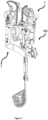
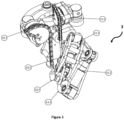
- the assistive assembly (3) of Figure 1 is further detailed in Figures 3 and 4 .
- FIG 2 is a perspective view of the main assembly (1) of the embodiment shown in Figure 1 .
- the main assembly (1) comprises three hydraulic actuators (1.C.1, 1.C.2, 1.C.3) and four links (1.A.1, 1.A.2, 1.A.3, 1.A.4) that represent the first and the second links of the main assembly.
- the main assembly (1) further comprises four independent degrees of freedom (1.B.1, 1.B.2, 1.B.3, 1.B.4) ensuring the rotatable connection of the first and the second member resulting in a maximum of freedom of movement for the wearer. Motion about the rotation means are generally free.
- the lengths of the links (1.A.1, 1.A.2, 1.A.3, 1.A.4) shown in Figure 1 may vary. In general, the length of the links may vary widely and may reflect the needs of the specific application.
- the dimensions of the links shown in Figure 1 and 2 may be chosen to optimally support the ergonomics of the whole right human arm, in particular its shoulder, fore and back arm portions.
- the first end of the force regulator units are the energy storage units which are movably connected to the horizontal frame of the support assembly (3.F.1) which is movably connected to the assistive base support (3.G.1).
- the force regulator units take the form of toothed cams with chains as force transmission units and with clock springs as energy storage units to provide the assistive force.
- the toothed cams are configured to engage with the chain and to redirect the assistive force in an axis parallel to the coronal plane to the corresponding interface point on the assistive links, resulting in a redirected force acting on the assistive actuator (3.C.1, 3.C.2, 3.C.3).
- the clock springs act as energy storage units or release units in support of the assistive assembly (3).
- a second end of the chain is connected to the bar linkages of the assistive assembly through a wire or other flexible connecting elements such as a rope, a cable, a snare, a string, a belt, a chain, but also through any inflexible connecting element.
- a wire or other flexible connecting elements such as a rope, a cable, a snare, a string, a belt, a chain, but also through any inflexible connecting element.
- Figures 1 , 3 and 4 show a clock spring, any other mechanical deformation springs, preferably metal springs, may also be used.
- the support device (200) takes the form of an industrial parallel manipulator to assist the whole payload (5) in its center of gravity thereby enabling the user to manipulate and position the payload (5) in five degrees of freedom without perceiving the static load enabling the option to perform work on the payload (5) while it is fully supported by the support device (200).
- the support device (200) includes a main assembly (4) and an assistive assembly (6).
- the assistive assembly (6) of Figure 5 is in shaft connection with the main assembly (4).
- the shaft connections between the links are not clearly shown in Figure 5 nor any of the Figures but are immediately clear for the skilled person.
- the assistive assembly (6) is a smaller scale representation of the of the main assembly (4) configured to represent the directional movements of the main assembly (4) such that the main assembly (4) and the assistive assembly (6) move in an essentially synchronized way.
- the assistive assembly (6) may be equal in size or even bigger. Preferably one half of the size of the main assembly or smaller, for example one third, one fourth, one fifth or even one tenth of the size of the main assembly (4) as shown in Figure 5 . The smaller the size of the assistive assembly (6) is, the better the compacter the enclosure is.
- the support device (200) shown in Figure 5 allows for supporting five degree of freedom of the payload (5).
- a first interface ensures the connection with the payload (5).
- a second interface ensures the connection with a base which is not shown.
- the second interface to the base typically reversibly mounted on a frame, carrier, linear guide or directly on the infrastructure.
- the main assembly (4) of Figure 5 is further exemplified in Figure 6 .
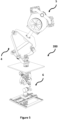
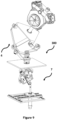
- the assistive assembly (6) of Figure 5 is further detailed in Figures 7 and 8 .
- FIG. 6 is a perspective view of the main assembly (4) of the embodiment shown in Figure 5 .
- the main assembly (4) comprises three actuator shafts (4.C.1, 4.C.2, 4.C.3), which are connected to the top of baseplate (4.E) through multiple bearing houses, such the main actuator shafts (4.C.1, 4.C.2, 4.C.3) can rotate around on common rotation point.
- Transfer Link (4.A.8) is connected to the payload (5) through a quick release plate (4.D) shown in Figure 6 .
- the main assembly (4) further comprises six dependent rotation means (4.B.1, 4.B.2, 4.B.3, 4.B.4, 4.B.5, 4.B.6), one independent rotation (4.B.7) ensuring a combined motion freedom of the first interface resulting in a maximum of five degree of freedom movement for the operator.
- the lengths of the transfer links (4.A.1, 4.A.2, 4.A.3, 4.A.4, 4.A.5, 4.A.6, 4.A.7, 4.A.8) shown in Figure 5 may vary.
- the length of the bar linkages may vary widely and may reflect the needs of the specific application.
- the dimensions of the links shown in Figure 5 and 6 may be chosen to optimally support the ergonomics of the operator in the preformed handling.
- FIGs 7 and 8 are perspective views of the assistive assembly (6) of the embodiment shown in Figure 5 .
- the assistive assembly (6) comprises three assistive actuator shafts (6.C.1, 6.C.2, 6.C.3) which take the form of a shaft and are connected through a shaft coupling with the actuator shaft of the main assembly, such the main actuator shafts and corresponding assistive actuator shafts form an stiff torsion connection allowing position and force transfer.
- the assistive assembly (6) further comprises seven assistive transfer links (6.A.1, 6.A.2, 6.A.3, 6.A.4, 6.A.5, 6.A.6, 6.A.7).
- the assistive transfer links and the actuator shafts are arranged in a way as to represent the links and the actuator shafts of the main assembly (4) in a way that the main assembly (4) and the assistive assembly (6) move essential synchronically.
- the assistive assembly (6) shown in Figure 7 further comprises a force regulator assembly (6.D).
- the force regulator assemblies which is movable connected to a parallel plate (6.G) through an planar guide assembly (6.H) comprising linear guiding rails arranged in a way these enable motion in 2 degrees of freedom, such the force regulator assembly is free movable in a planar motion parallel to the baseplate (4.E).
- the parallel plate (6.G) is fixed connected to bottom side of the baseplate (4.E) through the housing (6.H) shown in Figure 12 .
- the force regulator assembly has a first and second end.
- the first end takes the form of a gearbox, crankshaft combination as force transmission units (6.1).
- a second end takes the form of a clock spring, servo load shift as energy storage units (6.J) which provide tunable assistive force.
- the energy storage unit (6.J) can be tunned trough shifting the servo load shift unit.
- This servo load shift unit is not disclosed in this patent as it will be protected in an additional patent. This unit has the capability to shift output torque will under load and at a standstill, without changing shifting resistance friction in correlation to applied output torque. In this embodiment the shifting is done by a sensor, switch or any other electric trigger, in combination with a controller and servo shift motor.
- the actuation of this shifting motion is not limited to electrical power components as mechanical applied shift force of any form will be sufficient to perform this shifting motion.
- the sensor, switch or trigger and controller are not clearly shown in Figure 5 nor any of the Figures but are immediately clear for the skilled person.
- the sensor, controller and servo motor are arranged such that if the on/off sensor is triggered the controller positions servomotor and thereby also the shifts the servo load shift unit, in such a way the output torque is essential equal to the reaction force induced by the connected payload (5).
- the second end being the force transfer unit (6.1) is connected to the interface point (6.K) through a ball joint such the effect of this assistive force is perpendicular to the planar motion of the planar guide assembly (6.H).
- the resulting force perpendicular to the baseplate (4.E) acting on the interface point (6.K) is independent of this interface point (6.K) position.
- the assistive transfer links (6.A.1, 6.A.2, 6.A.3, 6.A.4, 6.A.5, 6.A.6, 6.A.7) and linear stage (6.L) redirect this force to the corresponding actuator shaft (6.C.1, 6.C.2, 6.C.3).
- the interface point (6.K) is connected to top assistive transfer link (6.A.4) through a linear stage (6.L) .
- the linear stage has a first and a second end.
- the first end being the base part with adjustment screw which is fixed connected to the top side of the transfer link (6.A.4).
- the second end being the adjustable slider which is fixed connected to the interface point (6.K) and connected to the first end trough a Bal screw and linear guides, such this second end can move in a linear direction.
- the actuation and repositioning of the linear stage (6.L) is not limited to electrical power components as mechanical applied torque of any form will be sufficient to perform this repositioning.
- the sensor, switch or trigger and controller are not clearly shown in Figure 5 nor any of the Figures but are immediately clear for the skilled person.
- the sensor , controller and servo motor are arranged such that if the in/out sensor is triggered the controller positions servomotor and thereby also repositions the second end of the linear stage (6.L), such the distance between the interface point (6.K) and Transfer link (6.A.4) is essentially equal in correlation with the distance between the center of gravity of the payload (5) and the transfer link (4.A.4) Taking the universal scaling factor between main (4) and assistive (6) assembly into account.
- the clock springs act as energy storage or release unit in support of the assistive assembly (6).
- Figures 5 , 7 and 8 show a clock spring, any other springs, preferably metal springs, air spring, magnetic spring may also be used.
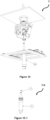
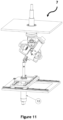
- Figures 10 and 11 are perspective views of the assistive assembly (7) of the alternative embodiment for the force regulator assembly shown in Figure 9 .
- the force regulator assembly which is movable connected to a parallel plate (6.G) through an planar guide assembly (6.H) comprising linear guiding rails arranged in a way these enable motion in 2 degrees of freedom, such the force regulator assembly is free movable in a planar motion parallel to the baseplate (4.E).
- the parallel plate (6.G) is fixed connected to bottom side of the baseplate (4.E) through the housing (6.H) shown in Figure 13 .
- the force regulator assembly has a first and a second end.
- the first end being the energy storage unit (7.J) takes the form of a pneumatic cylinder, pressure regulator, high and low pressure tank, resulting in a adaptable constant force spring which provide the assistive force.
- the regulator and tanks are not clearly shown in Figure 10 and 11 nor any of the Figures but are immediately clear for the skilled person.
- the regulator and tanks are arranged such that the output force resulting from the cylinder is constant and essential equal to the reaction force induced by the connected payload (5).
- the second end being the force transfer unit (7.1) in this embodiment the tread end of the cylinder shaft.
- the cylinder shaft is connected to the interface point (6.K) through a ball joint such the effect of this assistive force is perpendicular to the planar motion of the planar guide assembly (6.H).
- the resulting force perpendicular to the baseplate (4.E) acting on the interface point (6.K) is independent of this interface point (6.K) position.
- the assistive transfer links (6.A.1, 6.A.2, 6.A.3, 6.A.4, 6.A.5, 6.A.6, 6.A.7) and linear stage (6.L) redirect this force to the corresponding actuator shaft (6.C.1, 6.C.2, 6.C.3).
- the cylinder act as energy storage units or release units in support of the assistive assembly (7).
- a second end of the pneumatic cylinder is connected to the interface point (6.K) of the assistive assembly through a ball joint or other flexible connecting elements such as a rubber, multi joint, flexing, ....
- Figure 9 show an air spring in the form of a cylinder filed with pressurized Air, any other mechanical deformation springs, preferably metal springs, may also be used.
- Figure 14 is a perspective view of an embodiment of the support device including the main and assistive device in the form of an multi degree of freedom in combination with one link.
- Figure 15 is a perspective view of an embodiment of the support device including the main and assistive device in the form of a serial manipulator with two actuated degrees of freedom and two links.
- Figure 16 is a perspective view of an embodiment of the support device including the main and assistive device in the form of a parallel manipulator with two actuated degrees of freedom and 4 position interdepending links.
- Figure 17 is a perspective view of an embodiment of the support device in the form of an exoskeleton for both whole arms worn by a human with virtual rotation points and additional tilt compensation.
- Figure 18 is a left side overview of three possible tilting positions of the human's upper body while carrying an exoskeleton for both arms including the tilt compensation. This view shows the change in reference plane in relation to the gravitational field.
- Figure 19 is a perspective view of an embodiment of the supporting device in the form of an exoskeleton for both arms using virtual rotation points and waist belt interface to enhance the users comfort.
- Figure 20 is a partial back view of an embodiment of the support device in the form of an exoskeleton for the whole left arm worn by a human, showing the virtual rotation point of the exoskeleton in correlation to the human's shoulder ball joint.
- Figure 21 is a top view of an embodiment of the support device in the form of an exoskeleton for both whole arms worn by a human, showing the virtual rotation point of the exoskeleton in correlation to the human's elbow and shoulder joint.
- the support device (500) takes the form of an multi motion manipulator to assist a payload (11.D), more specific one link what can move in 2 different actuated rotational degrees of freedom while compensating for this payload (11.D) independent of the spatial position and orientation of this load, such the compensation force acting in any of the actuated degree of freedom is depending on the position of all actuated degrees of freedom.
- the support device (100) includes a main assembly (11) and an assistive assembly (12).
- the assistive assembly (12) of Figure 14 is in fluid connection with the main assembly (11).
- the hydraulic connections between the hydraulic cylinders are not shown in Figure 14 nor any of the Figures but are immediately clear for the skilled person.
- the hydraulic cylinders are arranged such that if the hydraulic cylinders of the assistive assembly (12) are actuated, this actuation in the form of position and force is transferred through the fluid connection to the corresponding hydraulic cylinders in the main assembly (11) and the other way around, such if the hydraulic cylinders of the main assembly (11) are actuated, this actuation is transferred to the corresponding cylinders in the assistive assembly (12), more specific hydraulic cylinder (11.C.1) of the main assembly (11) is back to back coupled trough a flexible hydraulic tube to cylinder (12.C.1) of the assistive assembly (12), all additional cylinders are coupled in a similar back to back principal way.
- the assistive assembly (12) is a smaller scale representation of the main assembly (11) configured to represent the bidirectional movements of the main assembly (11) such that the main assembly (11) and the assistive assembly (12) move in an essentially synchronized way.
- the assistive assembly (12) can be one half of the size of the main assembly, preferably even smaller, for example one third the size of the main assembly (11) as shown in Figure 14 .
- the support device (500) shown in Figure 14 allows for supporting in 2 degrees of freedom.
- a first interface ensures the connection the payload which is not shown.
- a quick release plate is typically reversibly mounted on the top of the link.
- a second interface ensures the connection with a base plate (11.E)
- the main assembly (11) and assistive assembly (12) of Figure 14 is further exemplified in detailed bellow.
- the main assembly (11) of the embodiment shown in Figure 14 comprises one link (11.A.1) and one baseplate (11.E) what represent the main structure parts of the main assembly.
- the main assembly (11) further comprises two independent degrees of freedom (11.B.1, 11.B.2) and two hydraulic actuators (11.C.1, 11.C.2,), ensuring the actuated rotatable connections of the main link to the baseplate resulting in a spherical motion freedom of the payload.
- the assistive assembly (12) of the embodiment shown in Figure 14 comprises two assistive actuators (12.C.1, 12.C.2) that take the form of hydraulic cylinders in fluid connection with the actuators of the main assembly.
- the assistive assembly (12) further comprises one assistive link (12.A.1), one assistive baseplate (12.E) two independent degrees of freedom (12.B.1, 12.B.2) ensuring the rotatable connections of the assistive link to the assistive baseplate.
- the assistive link, assistive degrees of freedom and the assistive actuators are arranged in a way as to represent the links and the actuators of the main assembly (11) in a way that the main assembly (11) and the assistive assembly (12) move in an essential synchronic way.
- the assistive assembly (12) shown in Figure 14 further comprises a force regulator assembly (12.D).
- the force regulator assembly has a first and a second end.
- the first end of the force regulator assembly is the energy storage unit which is movably connected to the base beam (12.F) through a plainer degree of freedom parallel to the assistive baseplate (12.E) in the form of a bearing, linkage assembly (12.G).
- the base beam is fixed connected to the assistive baseplate (12.E).
- the force regulator assembly takes the form of a toothed cam and chain as force transmission units and a clock spring as energy storage units which provide the assistive force.
- the toothed cam is configured to engage with a chain and to redirect the assistive force in an axis perpendicular to the assistive baseplate (12.E) corresponding interface point (12.K) on the assistive link (12.A.1), resulting in a redirected force acting on the assistive actuator (12.C.1,12.C.2).
- the clock springs act as energy storage units or release units in support of the assistive assembly (12).
- a second end of the chain is connected to the bar linkages of the assistive assembly through a wire or other flexible connecting elements such as a rope, a cable, a snare, a string, a belt, a chain, but also through any inflexible connecting element.
- the support device (600) takes the form of an serial manipulator to assist a payload (13.D), more specific two links what can move in 2 different actuated rotational degrees of freedom while compensating for this payload (13.D) independent of the spatial position and orientation of this load, such the compensation force acting in any of the actuated degree of freedom is depending on the position of all actuated degrees of freedom.
- the support device (600) includes a main assembly (13) and an assistive assembly (14).
- the assistive assembly (14) of Figure 15 is in fluid connection with the main assembly (13).
- the hydraulic connections between the hydraulic cylinders are not shown in Figure 15 nor any of the Figures but are immediately clear for the skilled person.
- the hydraulic cylinders are arranged such that if the hydraulic cylinders of the assistive assembly (14) are actuated, this actuation in the form of position and force is transferred through the fluid connection to the corresponding hydraulic cylinders in the main assembly (13) and the other way around, such if the hydraulic cylinders of the main assembly (13) are actuated, this actuation is transferred to the corresponding cylinders in the assistive assembly (14), more specific hydraulic cylinder (13.C.1) of the main assembly (13) is back to back coupled trough a flexible hydraulic tube to cylinder (14.C.1) of the assistive assembly (14), all additional cylinders are coupled in a similar back to back principal way.
- the assistive assembly (14) is a smaller scale representation of the main assembly (13) configured to represent the bidirectional movements of the main assembly (13) such that the main assembly (13) and the assistive assembly (14) move in an essentially synchronized way.
- the assistive assembly (14) can be one half of the size of the main assembly, preferably even smaller, for example one third the size of the main assembly (13) as shown in Figure 15 .
- the support device (600) shown in Figure 15 allows for supporting in 2 degrees of freedom.
- a first interface ensures the connection the payload which is not shown.
- a quick release plate is typically reversibly mounted on the top of the link.
- a second interface ensures the connection with a base plate (13.E)
- the main assembly (13) and assistive assembly (14) of Figure 15 is further exemplified in detailed bellow.
- the main assembly (13) of the embodiment shown in Figure 15 comprises two links (13.A.1, 13.A.2) and one baseplate (13.E) what represent the main structure parts of the main assembly.
- the main assembly (13) further comprises two independent degrees of freedom (13.B.1, 13.B.2) and two hydraulic actuators (13.C.1, 13.C.2), ensuring the actuated rotatable connections of the main links in correlation to each other and to the baseplate (13.E) resulting in a planar motion freedom of the payload perpendicular to the baseplate (13.E).
- the assistive assembly (14) of the embodiment shown in Figure 15 comprises two assistive actuators (14.C.1, 14.C.2) that take the form of hydraulic cylinders in fluid connection with the actuators of the main assembly.
- the assistive assembly (14) further comprises two assistive link (14.A.1, 14.A.2), one assistive baseplate (14.E) two independent degrees of freedom (14.B.1, 14.B.2) ensuring the rotatable connections of the assistive links to each other and the assistive baseplate (14.E).
- the assistive links, assistive degrees of freedom and the assistive actuators are arranged in a way as to represent the links and the actuators of the main assembly (13) in a way that the main assembly (13) and the assistive assembly (14) move in an essential synchronic way.
- the assistive assembly (14) shown in Figure 15 further comprises a force regulator assembly (14.D).
- the force regulator assembly has a first and a second end.
- the first end of the force regulator assembly is the energy storage unit which is movably connected to the base beam (14.F) through a plainer degree of freedom parallel to the assistive baseplate (14.E) in the form of a bearing, linkage assembly (14.G).
- the base beam (14.F) is fixed connected to the assistive baseplate (14.E).
- the force regulator assembly takes the form of a toothed cam and chain as force transmission units and a clock spring as energy storage units which provide the assistive force.
- the toothed cam is configured to engage with a chain and to redirect the assistive force in an axis perpendicular to the assistive baseplate (14.E) corresponding interface point (14.K) on the assistive link (14.A.2), resulting in a redirected force acting on the assistive actuator (14.C.1,14.C.2).
- the clock springs act as energy storage units or release units in support of the assistive assembly (14).
- a second end of the chain is connected to the link of the assistive assembly through a wire or other flexible connecting elements such as a rope, a cable, a snare, a string, a belt, a chain, but also through any inflexible connecting element.
- the support device (700) takes the form of an parallel manipulator to assist a payload (15.D), more specific fore interdependent links end to end connected to each other by 5 rotational degrees of freedom (15.B.1, 15.B.2, 15.B.3, 15.B.4, 15.B.5) where rotation point (15.B.1) and (15.B.2) are actuated and rotate around a mutual rotation axis.
- This interdependent movement of al the links leads to motion in 2 different degrees of freedom
- payload (15.D) is compensated in a planar motion freedom parallel to the main baseplate independent of the spatial position and orientation of this load, such the compensation force acting in any of the actuated degree of freedom is depending on the position of all actuated degrees of freedom.
- the support device (700) includes a main assembly (15) and an assistive assembly (16).
- the assistive assembly (16) of Figure 16 is in fluid connection with the main assembly (15).
- the hydraulic connections between the hydraulic cylinders are not shown in Figure 15 nor any of the Figures but are immediately clear for the skilled person.
- the hydraulic cylinders are arranged such that if the hydraulic cylinders of the assistive assembly (16) are actuated, this actuation in the form of position and force is transferred through the fluid connection to the corresponding hydraulic cylinders in the main assembly (15) and the other way around, such if the hydraulic cylinders of the main assembly (15) are actuated, this actuation is transferred to the corresponding cylinders in the assistive assembly (16), more specific hydraulic cylinder (15.C.1) of the main assembly (15) is back to back coupled trough a flexible hydraulic tube to cylinder (16.C.1) of the assistive assembly (16), all additional cylinders are coupled in a similar back to back principal way.
- the assistive assembly (16) is a smaller scale representation of the main assembly (15) configured to represent the bidirectional movements of the main assembly (15) such that the main assembly (15) and the assistive assembly (16) move in an essentially synchronized way.
- the assistive assembly (16) can be one half of the size of the main assembly, preferably even smaller, for example one third the size of the main assembly (15) as shown in Figure 16 .
- the support device (700) shown in Figure 16 allows for supporting in 2 degrees of freedom.
- a first interface ensures the connection the payload which is not shown.
- a quick release plate is typically reversibly mounted on the top of the link.
- a second interface ensures the connection with a base plate (15.E)
- the main assembly (15) and assistive assembly (16) of Figure 16 is further exemplified in detailed bellow.
- the main assembly (15) of the embodiment shown in Figure 16 comprises two links (15.A.1, 15.A.2) and one baseplate (15.E) what represent the main structure parts of the main assembly.
- the main assembly (15) further comprises five independent degrees of freedom (15.B.1, 15.B.2, 15.B.3, 15.B.4, 15.B.5) and two hydraulic actuators (15.C.1, 15.C.2), ensuring the actuated rotatable connections of the main links in correlation to each other and to the baseplate (15.E) resulting in a planar motion freedom of the payload perpendicular to the baseplate (15.E).
- the assistive assembly (16) of the embodiment shown in Figure 16 comprises two assistive actuators (16.C.1, 16.C.2) that take the form of hydraulic cylinders in fluid connection with the actuators of the main assembly.
- the assistive assembly (16) further comprises fore assistive link (16.A.1, 16.A.2, 16.A.3, 16.A.4), one assistive baseplate (14.E) and five independent degrees of freedom (16.B.1, 16.B.2, 16.B.3, 16.B.4, 16.B.5) ensuring the rotatable connections of the assistive links to each other and the assistive baseplate (16.E).
- the assistive links, assistive degrees of freedom and the assistive actuators are arranged in a way as to represent the links and the actuators of the main assembly (15) in a way that the main assembly (15) and the assistive assembly (16) move in an essential synchronic way.
- the assistive assembly (16) shown in Figure 16 further comprises a force regulator assembly (16.D).
- the force regulator assembly has a first and a second end.
- the first end of the force regulator assembly is the energy storage unit which is movably connected to the base beam (16.F) through a plainer degree of freedom parallel to the assistive baseplate (16.E) in the form of a bearing, linkage assembly (16.G).
- the base beam (16.F) is fixed connected to the assistive baseplate (16.E).
- the force regulator assembly takes the form of a toothed cam and chain as force transmission units and a clock spring as energy storage units which provide the assistive force.
- the toothed cam is configured to engage with a chain and to redirect the assistive force in an axis perpendicular to the assistive baseplate (16.E) corresponding interface point (16.K) which is located on the axis of the mutual rotation degree of freedom (16.B.5) between link (16.A.4) and link (16.A.3), resulting in a redirected force acting on the assistive actuator (16.C.1,16.C.2).
- the clock springs act as energy storage units or release units in support of the assistive assembly (16).
- a second end of the chain is connected to the link of the assistive assembly through a wire or other flexible connecting elements such as a rope, a cable, a snare, a string, a belt, a chain, but also through any inflexible connecting element.
- a wire or other flexible connecting elements such as a rope, a cable, a snare, a string, a belt, a chain, but also through any inflexible connecting element.
- Figures 14 show a clock spring and hydraulic actuators, any other mechanical deformation springs and other type of actuating means may also be used, for example the once mentioned in this patent text.
- the lengths of the all links shown in Figure 14 , 15 and 16 may vary. In general, the length of the links may vary widely and may reflect the needs of the specific application. The dimensions of the links shown in Figure 14 , 15 and 16 may be chosen to optimally support the payload of a target for a certain motion or position.
- the support device (800) takes the form of an exoskeleton to assist the whole left and right arm of a human being thereby enabling the user to perform work and motion whilst fully supported by the support device (800) during the motion and at any static position or orientation.
- the support device (800) includes a main assembly (17) and an assistive assembly (18).
- the assistive assembly (18) of Figure 17 is in mechanical and fluid connection with the main assembly (17).
- the hydraulic connections between the hydraulic cylinders and torsion cable actuation rotation point (17.B.3) are not shown in Figure 17 nor any of the Figures but are immediately clear for the skilled person.
- the hydraulic cylinders and torsion cable connection are arranged such that if the hydraulic cylinders and or torsion cable end of the assistive system (18) are actuated, this actuation in the form of position and force is transferred through the fluid and or flexible shaft connection to the corresponding hydraulic cylinders and rotation point in the main assembly (17) and the other way around, such if the hydraulic cylinders and flexible shaft of the main assembly (17) are actuated, this actuation is transferred to the corresponding cylinders and rotation point in the assistive assembly (18).
- the assistive assembly (18) is a smaller scale representation of the of the main assembly (17) configured to represent the bidirectional movements of the main assembly (17) such that the main assembly (17) and the assistive assembly (18) move in an essentially synchronized way.
- the support device (800) shown in Figure 17 allows for supporting lateral, forward and backward motions of both arms and of the forearms.
- a first interface (17.D.1) ensures the connection with the arm.
- a second interface (17.E) in the form of a waist which is typically reversibly mounted on the hips.
- the Tilt compensation of Figure 17 is further exemplified in Figure 18 . Every orientation deviation of the torso in correlation to the gravitational field will result in a mismatch between the applied and desired assistive force.
- FIG. 18 shows the mismatch between Exoskeleton reference and the gravitational field reference due to upper body motion.
- One additional actuator is focused on detecting and transferring these reference angles shown in figure 18 to the assistive device, such the force regulators inside the assistive device (18) change their interaction angle with the assistive links in an essentially synchronized way with the position of the upper body. Thereby resulting in proper weight compensation of the upper and lower arm in correlation to the gravitational field.
- figure 17 does not show a detailed version of the assistive device (18), but rather an enclosure in which the assistive device is contained. The enclosure is reversibly mounted on the waist belt.
- Figure 17 therefore does not show a detailed view of the assistive device (18).
- the assistive device (18) enclosed shown in Figure 17 is based on the same principles describes above.
- the main assembly (17) comprises four hydraulic actuators (17.C.1, 17.C.2, 17.C.3, 17.C.4), one interface for a torsion cable and four links (17.A.1, 17.A.2, 17.A.3, 17.A.4).
- the main assembly (17) further comprises four independent degrees of freedom (17.B.1, 17.B.2, 17.B.3, 17.B.4) ensuring the rotatable connection (17.B.4) of the second (17.A.2) and the third link (17.A.3) where the rest resulting in a maximum of freedom of movement for the wearer.
- the lengths of the links (17.A.1, 17.A.2, 17.A.3, 17.A.4) shown in Figure 17 may vary. In general, the length of the links may vary widely and may reflect the needs of the specific application.
- the dimensions and orientation of the links and rotation points shown in Figure 17 are chosen to create a virtual rotation point shown in figures 20 and 21 to optimally support the ergonomics of the whole right and left human arm, in particular its shoulders, fore and back arms. Due to the use of these virtual rotation point the composition and range of motion are impacted in a positive way.
- Virtual rotation points enable parallel motion between the human's body and the exoskeleton while being located outside of the human and locally allow rotation around a different reference axis. The intersection points between the motion axis coming from the kinematic structure of the exoskeleton and the motion axis following from the humans kinematic structure, determines the location of this virtual rotation point.
- the support device (900) takes the form of an exoskeleton to assist the whole left and right arm of a human being thereby enabling the user to perform work and motion whilst fully supported by the support device (900) during the motion and at any static position or orientation.
- the support device (900) includes a main assembly (19) and an assistive assembly (20).
- the assistive assembly (20) of Figure 19 is in mechanical and fluid connection with the main assembly (19).
- the hydraulic connections between the hydraulic cylinders and torsion cable actuation rotation point (17.B.3) are not shown in Figure 19 nor any of the Figures but are immediately clear for the skilled person.
- the hydraulic cylinders and torsion cable connection are arranged such that if the hydraulic cylinders and or torsion cable end of the assistive system (20) are actuated, this actuation in the form of position and force is transferred through the fluid and flexible shaft connection to the corresponding hydraulic cylinders and rotation point in the main assembly (19) and the other way around, such if the hydraulic cylinders and flexible shaft of the main assembly (20) are actuated, this actuation is transferred to the corresponding cylinders and rotation point in the assistive assembly (20).
- the assistive assembly (20) is a smaller scale representation of the of the main assembly (19) configured to represent the bidirectional movements of the main assembly (19) such that the main assembly (19) and the assistive assembly (20) move in an essentially synchronized way.
- the support device (900) shown in Figure 19 allows for supporting lateral, forward and backward motions of both arms and of the forearms.
- the assistive assembly (20) of Figure 19 is shown in an enclosure that is reversible mounted on the waist belt. Figure 19 therefore does not show a detailed view of the assistive device (20).
- the assistive device (20) enclosed shown in Figure 19 is based on the same principles describes above, meaning, it is a scaled representation of the main assembly including force regulator assemblies witch counteract gravitational forces acting on the human arms. These forces are transferred trough interfacing point (19.D), main linkages, main rotation points (19.B.1, 19.B.2, 19.B.3, 19.B.4), main actuators(19.C.1, 19.C.2), flexible shaft connected to and transferring from rotation point (19.B.3) and hydraulic couplings to the assistive assembly. This assembly transfers these gravitational forces trough the assistive links, Assistive degrees of freedom and a coupling to the force regulator and the other way around.
- the main assembly (19) comprises two hydraulic actuators (19.C.1, 19.C.2), One interface for a torsion cable and tree links (19.A.1, 19.A.2, 19.A.3).
- the main assembly (19) further comprises four independent degrees of freedom (19.B.1, 19.B.2, 19.B.3, 19.B.4) ensuring a similar motion possibility in terms of degrees, such the wearable exoskeleton is not limiting any desired day tot day motion of the whole left and right arm.
Landscapes
- Engineering & Computer Science (AREA)
- Robotics (AREA)
- Mechanical Engineering (AREA)
- Manipulator (AREA)
Claims (15)
- Kraftregleranordnung, umfassenda. eine Hauptanordnung (1), umfassendi. einen Basisträger,ii. eine oder mehrere Verknüpfungen (1.A.1, 1.A.2, 1.A.3, 1.A.4), wobei mindestens eine mit dem Basisträger verbunden ist, wobei die eine oder die mehreren Verknüpfungen (1.A.1, 1.A.2, 1.A.3, 1.A.4) eingerichtet sind, um sich in mindestens zwei Freiheitsgraden zu bewegen,b. eine unterstützende Anordnung (3), umfassendi. einen unterstützenden Basisträger (3.G.1),ii. eine oder mehrere unterstützende Verknüpfungen (3.A.1, 3.A.2, 3.A.3, 3.A.4), wobei mindestens eine mit dem unterstützenden Basisträger verbunden ist, wobei eine oder mehrere unterstützende Verknüpfungen (3.A.1, 3.A.2, 3.A.3, 3.A.4) eingerichtet sind, um sich in mindestens zwei Freiheitsgraden zu bewegen,iii. eine oder mehrere Kraftreglereinheiten (3.E.1, 3.E.2), umfassend eine Energiespeichereinheit, die über eine Kraftübertragungseinheit mit einer unterstützenden Verknüpfung (3.A.1, 3.A.2, 3.A.3, 3.A.4) verbunden ist,c. eine mechanische, stromlose Verbindung zwischen der Haupt- und der unterstützenden Anordnung (1, 3),dadurch gekennzeichnet, dass mechanische Schalter vorhanden sind, die konfiguriert sind, um die Kraft, die durch die Kraftreglereinheiten ausgeübt wird, und/oder den Verbindungspunkt der Kraftregler zu der unterstützenden Anordnung (3) zu verändern.i. wobei die unterstützende (3) eingerichtet ist, sodass diese Verbindung dazu führt, dass die unterstützende Anordnung (3) eine Darstellung der Hauptanordnung (1) ist, in der Kräfte in der Hauptanordnung (1) zu Kräften in der unterstützenden Anordnung (3) führen und umgekehrt, sodass in einer Konsequenz die mögliche Verschiebung der Hauptanordnung (1) infolge dieser Kräfte ebenso zu einer Verschiebung der unterstützenden Anordnung (3) führt und umgekehrt;ii. wobei die unterstützende Anordnung (3) eingerichtet ist, sodass diese Verbindung dazu führt, dass die Kräfte, die durch die Verknüpfung (1.A.1, 1.A.2, 1.A.3, 1.A.4) in der Hauptanordnung (1) in einem Freiheitsgrad erfahren werden, eine Funktion der Position der Verknüpfungen (1.A.1, 1.A.2, 1.A.3, 1.A.4) in dem einen oder den mehreren der anderen Freiheitsgrade sind, was es ermöglicht, basierend auf diesen Funktionen, gewünschte Kompensationskräfte anzuwenden, die durch die Kraftreglereinheiten bereitgestellt werden; und
- Kraftregleranordnung nach Anspruch 1, wobei die unterstützende Anordnung getrennt von der Hauptanordnung und außerhalb davon platziert ist.
- Kraftregleranordnung nach Anspruch 1 oder 2, wobei die Kräfte, die durch die Verknüpfung in der Hauptanordnung in einem Freiheitsgrad erfahren werden, eine Funktion der Position der Verknüpfungen in dem einen oder den mehreren der anderen Freiheitsgrade sind und umgekehrt, in einer zuvor bestimmten Weise, die es ermöglicht, für jede Position der Anordnung gewünschte Kompensationskräfte anzuwenden, die durch die Kraftreglereinheiten bereitgestellt werden.
- Kraftregleranordnung nach Anspruch 1, 2 oder 3, wobei die eine oder die mehreren Kraftreglereinheiten Kräfte auf die unterstützenden Verknüpfungen ausüben, was möglicherweise zu Verschiebungen der unterstützenden Anordnung führt, wobei das Gewicht der Kraftreglereinheit aufgrund ihrer Platzierung in der unterstützenden Anordnung durch die Hauptanordnung nicht wahrgenommen wird.
- Kraftregleranordnung nach Anspruch 1, 2, 3 oder 4, wobei eine Vielzahl von Verknüpfungen und/oder eine Vielzahl von Kraftreglereinheiten vorhanden sind, und wobei betätigte Freiheitsgrade in der Hauptanordnung, die mit repräsentativen Freiheitsgraden in der unterstützenden Anordnung verbunden sind, und optional ebenso nicht betätigte Freiheitsgrade vorhanden sind, in denen sich die Hauptanordnung bewegen kann, die nicht mit Freiheitsgraden in der unterstützenden Anordnung verbunden sind.
- Kraftregleranordnung nach einem der vorstehenden Ansprüche, wobei mindestens eine der Kraftreglereinheiten mit dem unterstützenden Basisträger mit einer Einrichtung verbunden ist, die in der Lage ist, einen ebenen, vorzugsweise linearen Freiheitsgrad derart bereitzustellen (und in der Lage ist, mit der darauf wirkenden resultierenden Kraft zurechtzukommen), dass die Kraftreglereinheit der Bewegung des Schnittstellenpunkts folgen kann, wo die Kraftreglereinheit mit der unterstützenden Verknüpfung interagiert.
- Kraftregleranordnung nach einem der vorstehenden Ansprüche, die mechanisch einstellbar ist (ohne Werkzeug oder ohne Austausch von Teilen), durch ein Anpassen der Verknüpfungslängen und/oder der Steifheit der Verknüpfungen und/oder durch das Anpassen der Platzierung der Verbindungspunkte für Kraftreglereinheiten, sodass die Ausgangskräfte der Kraftreglereinheiten angepasst werden können.
- Kraftregleranordnung nach einem der vorstehenden Ansprüche, die keine Elektronik enthält und nicht extern mit Strom versorgt wird.
- Kraftregleranordnung nach einem der vorstehenden Ansprüche 1 bis 8, in der neben stromlosen mechanischen Komponenten ebenso Sensoren, eine Steuereinheit und eine oder mehrere elektronisch gesteuerte Betätigungsglieder eingeschlossen sind, um Kräfte auf die unterstützende Anordnung auszuüben, um entweder als eine oder mehrere mit Strom versorgte Kraftreglereinheiten zu dienen und/oder den Verbindungspunkt einer oder mehrerer stromloser Kraftreglereinheiten an die unterstützende Anordnung anzupassen.
- Kraftregleranordnung nach einem der vorstehenden Ansprüche, wobei die unterstützende Anordnung eine maßstabsgetreue Darstellung der Hauptanordnung ist.
- Kraftregleranordnung nach einem der vorstehenden Ansprüche, die als tragbares Exoskelett dient, wobeia. der Basisträger (durch einen bereitgestellten Gurt) für die Verbindung an einer Person (Träger) angepasst ist; undb. die Kraftreglereinheiten angepasst sind, um Kompensationskräfte auf die unterstützende Anordnung auszuüben, um die Person (Träger) in mindestens zwei Freiheitsgraden zu tragen.
- Kraftregleranordnung nach einem der Ansprüche 1 bis 11, die als Teil eines Robotermanipulators dient, wobeia. der Basisträger der Hauptanordnung auf einer Basis montiert ist; undb. die Kraftreglereinheiten angepasst sind, um Kräfte auf die unterstützenden Verknüpfungen derart auszuüben, dass die resultierenden Kräfte auf die Hauptverknüpfungen bewirken, dass die Hauptanordnung ihr Eigengewicht trägt und sie zu einer selbsttragenden mechanischen Struktur macht; und/oderc. die Kraftreglereinheiten angepasst sind, um zusätzliche Kräfte anzuwenden, sodass die resultierenden Kräfte auf die Hauptbetätigungsglieder eine Nutzlast tragen oder externe Kräfte kompensieren können.
- Kraftregleranordnung nach einem der vorstehenden Ansprüche, wobei die Verbindung zwischen der Haupt- und der unterstützenden Anordnung durch steife mechanische Verbindungen über eine Bewegung um einen einzigen Rotationspunkt erreicht wird, wobei eine flexible Platzierung der unterstützenden Anordnung ermöglicht wird.
- Kraftregleranordnung nach einem der vorstehenden Ansprüche, wobei die Freiheitsgrade in der Haupt- und der unterstützenden Anordnung unter Verwendung von hydraulischen Betätigungsgliedern betätigt werden und die Verbindung zwischen der Haupt- und der unterstützenden Anordnung durch Verbinden der hydraulischen Betätigungsglieder unter Verwendung flexibler Hydraulikleitungen erreicht wird.
- Kraftregleranordnung nach einem der vorstehenden Ansprüche, wobei die Freiheitsgrade in der Haupt- und der unterstützenden Anordnung unter Verwendung eines geschlossenen Hydrauliksystems aus Hydraulikzylindern verbunden sind, die unter Verwendung flexibler Hydraulikleitungen verbunden sind.
Applications Claiming Priority (2)
| Application Number | Priority Date | Filing Date | Title |
|---|---|---|---|
| BE20215376A BE1029388B1 (nl) | 2021-05-07 | 2021-05-07 | Schaalbaar en onbekrachtigd ondersteuningsmiddel wat krachtregelunits gebruikt |
| PCT/EP2022/062434 WO2022234141A1 (en) | 2021-05-07 | 2022-05-09 | Scalable and unpowered support device using force regulators |
Publications (3)
| Publication Number | Publication Date |
|---|---|
| EP4334087A1 EP4334087A1 (de) | 2024-03-13 |
| EP4334087B1 true EP4334087B1 (de) | 2024-11-20 |
| EP4334087C0 EP4334087C0 (de) | 2024-11-20 |
Family
ID=76305679
Family Applications (1)
| Application Number | Title | Priority Date | Filing Date |
|---|---|---|---|
| EP22728199.5A Active EP4334087B1 (de) | 2021-05-07 | 2022-05-09 | Skalierbare und antriebslose stützvorrichtung mit kraftreglern |
Country Status (4)
| Country | Link |
|---|---|
| US (1) | US20240227163A1 (de) |
| EP (1) | EP4334087B1 (de) |
| BE (1) | BE1029388B1 (de) |
| WO (1) | WO2022234141A1 (de) |
Families Citing this family (1)
| Publication number | Priority date | Publication date | Assignee | Title |
|---|---|---|---|---|
| CN116276899B (zh) * | 2023-01-31 | 2023-08-29 | 哈尔滨商业大学 | 一种机器人关节装置 |
Family Cites Families (5)
| Publication number | Priority date | Publication date | Assignee | Title |
|---|---|---|---|---|
| US6899308B2 (en) | 2003-07-31 | 2005-05-31 | Agency For Science, Technology And Research | Passive gravity-compensating mechanisms |
| US20140257091A1 (en) * | 2013-03-11 | 2014-09-11 | The Board Of Trustees Of The Leland Stanford Junior University | Master-slave apparatus and approach |
| KR101740699B1 (ko) | 2013-05-24 | 2017-05-26 | 주식회사 고영테크놀러지 | 카운터 밸런스부를 구비한 스탠드 |
| US10569413B2 (en) | 2015-12-22 | 2020-02-25 | Ekso Bionics, Inc. | Exoskeleton and method of providing an assistive torque to an arm of a wearer |
| JP2019130600A (ja) * | 2018-01-30 | 2019-08-08 | ソニー株式会社 | マスタ−スレーブシステム、操作装置、並びにロボット装置 |
-
2021
- 2021-05-07 BE BE20215376A patent/BE1029388B1/nl active IP Right Grant
-
2022
- 2022-05-09 EP EP22728199.5A patent/EP4334087B1/de active Active
- 2022-05-09 WO PCT/EP2022/062434 patent/WO2022234141A1/en not_active Ceased
- 2022-05-09 US US18/559,442 patent/US20240227163A1/en active Pending
Also Published As
| Publication number | Publication date |
|---|---|
| EP4334087A1 (de) | 2024-03-13 |
| BE1029388A1 (nl) | 2022-12-02 |
| BE1029388B1 (nl) | 2022-12-07 |
| EP4334087C0 (de) | 2024-11-20 |
| US20240227163A1 (en) | 2024-07-11 |
| WO2022234141A1 (en) | 2022-11-10 |
Similar Documents
| Publication | Publication Date | Title |
|---|---|---|
| EP2150175B1 (de) | Robotisches exoskelett für gliedmassenbewegung | |
| US7410338B2 (en) | Exoskeleton for the human arm, in particular for space applications | |
| US10857664B2 (en) | Exoskeleton | |
| EP2178680B1 (de) | Tragbares mechatronisches gerät | |
| EP2209595B1 (de) | Vorrichtung zur bewegung zwischen einem eingangsglied und einem ausgangsglied | |
| US8857874B2 (en) | Robotic finger assembly | |
| JP4144021B2 (ja) | 機械的自重補償装置 | |
| EP4069156B1 (de) | System zum führen von bewegungen einer zielverbindung | |
| CN112025681B (zh) | 电动腰部辅助外骨骼 | |
| US11246787B2 (en) | Bi-directional underactuated exoskeleton | |
| EP2861387B1 (de) | Verfahren zum betreiben und gerät zur mensch-mehrfach gelenkeinrichtung interaktion | |
| EP4334087B1 (de) | Skalierbare und antriebslose stützvorrichtung mit kraftreglern | |
| US20230101090A1 (en) | System and Method for Restoring Robotic Assemblies to One Or More Self-Supporting Stable Support Positions | |
| Jarrassé et al. | Design and acceptability assessment of a new reversible orthosis | |
| US20230098713A1 (en) | System and Method for Restoring Upper Robotic Assemblies Supported About a Base Platform to One Or More Self-Supporting Stable Support Positions | |
| WO2010022982A1 (en) | Method for remote mechanism actuation and exoskeleton aptic interface based thereon | |
| Yellewa et al. | Design and hybrid impedance control of a compliant and balanced wrist rehabilitation device | |
| RU2813174C2 (ru) | Устройство для компенсации прикладываемой к экзоскелетам нагрузки | |
| Garrec et al. | A reversible arm orthosis: design and acceptability assessment |
Legal Events
| Date | Code | Title | Description |
|---|---|---|---|
| STAA | Information on the status of an ep patent application or granted ep patent |
Free format text: STATUS: UNKNOWN |
|
| STAA | Information on the status of an ep patent application or granted ep patent |
Free format text: STATUS: THE INTERNATIONAL PUBLICATION HAS BEEN MADE |
|
| PUAI | Public reference made under article 153(3) epc to a published international application that has entered the european phase |
Free format text: ORIGINAL CODE: 0009012 |
|
| STAA | Information on the status of an ep patent application or granted ep patent |
Free format text: STATUS: REQUEST FOR EXAMINATION WAS MADE |
|
| 17P | Request for examination filed |
Effective date: 20231129 |
|
| AK | Designated contracting states |
Kind code of ref document: A1 Designated state(s): AL AT BE BG CH CY CZ DE DK EE ES FI FR GB GR HR HU IE IS IT LI LT LU LV MC MK MT NL NO PL PT RO RS SE SI SK SM TR |
|
| DAV | Request for validation of the european patent (deleted) | ||
| DAX | Request for extension of the european patent (deleted) | ||
| GRAP | Despatch of communication of intention to grant a patent |
Free format text: ORIGINAL CODE: EPIDOSNIGR1 |
|
| STAA | Information on the status of an ep patent application or granted ep patent |
Free format text: STATUS: GRANT OF PATENT IS INTENDED |
|
| INTG | Intention to grant announced |
Effective date: 20240826 |
|
| GRAS | Grant fee paid |
Free format text: ORIGINAL CODE: EPIDOSNIGR3 |
|
| GRAA | (expected) grant |
Free format text: ORIGINAL CODE: 0009210 |
|
| STAA | Information on the status of an ep patent application or granted ep patent |
Free format text: STATUS: THE PATENT HAS BEEN GRANTED |
|
| AK | Designated contracting states |
Kind code of ref document: B1 Designated state(s): AL AT BE BG CH CY CZ DE DK EE ES FI FR GB GR HR HU IE IS IT LI LT LU LV MC MK MT NL NO PL PT RO RS SE SI SK SM TR |
|
| REG | Reference to a national code |
Ref country code: GB Ref legal event code: FG4D |
|
| REG | Reference to a national code |
Ref country code: CH Ref legal event code: EP |
|
| REG | Reference to a national code |
Ref country code: DE Ref legal event code: R096 Ref document number: 602022007984 Country of ref document: DE |
|
| REG | Reference to a national code |
Ref country code: IE Ref legal event code: FG4D |
|
| U01 | Request for unitary effect filed |
Effective date: 20241206 |
|
| U07 | Unitary effect registered |
Designated state(s): AT BE BG DE DK EE FI FR IT LT LU LV MT NL PT RO SE SI Effective date: 20241217 |
|
| PG25 | Lapsed in a contracting state [announced via postgrant information from national office to epo] |
Ref country code: HR Free format text: LAPSE BECAUSE OF FAILURE TO SUBMIT A TRANSLATION OF THE DESCRIPTION OR TO PAY THE FEE WITHIN THE PRESCRIBED TIME-LIMIT Effective date: 20241120 Ref country code: IS Free format text: LAPSE BECAUSE OF FAILURE TO SUBMIT A TRANSLATION OF THE DESCRIPTION OR TO PAY THE FEE WITHIN THE PRESCRIBED TIME-LIMIT Effective date: 20250320 |
|
| PG25 | Lapsed in a contracting state [announced via postgrant information from national office to epo] |
Ref country code: ES Free format text: LAPSE BECAUSE OF FAILURE TO SUBMIT A TRANSLATION OF THE DESCRIPTION OR TO PAY THE FEE WITHIN THE PRESCRIBED TIME-LIMIT Effective date: 20241120 |
|
| PG25 | Lapsed in a contracting state [announced via postgrant information from national office to epo] |
Ref country code: NO Free format text: LAPSE BECAUSE OF FAILURE TO SUBMIT A TRANSLATION OF THE DESCRIPTION OR TO PAY THE FEE WITHIN THE PRESCRIBED TIME-LIMIT Effective date: 20250220 |
|
| PG25 | Lapsed in a contracting state [announced via postgrant information from national office to epo] |
Ref country code: GR Free format text: LAPSE BECAUSE OF FAILURE TO SUBMIT A TRANSLATION OF THE DESCRIPTION OR TO PAY THE FEE WITHIN THE PRESCRIBED TIME-LIMIT Effective date: 20250221 |
|
| PG25 | Lapsed in a contracting state [announced via postgrant information from national office to epo] |
Ref country code: PL Free format text: LAPSE BECAUSE OF FAILURE TO SUBMIT A TRANSLATION OF THE DESCRIPTION OR TO PAY THE FEE WITHIN THE PRESCRIBED TIME-LIMIT Effective date: 20241120 |
|
| PG25 | Lapsed in a contracting state [announced via postgrant information from national office to epo] |
Ref country code: RS Free format text: LAPSE BECAUSE OF FAILURE TO SUBMIT A TRANSLATION OF THE DESCRIPTION OR TO PAY THE FEE WITHIN THE PRESCRIBED TIME-LIMIT Effective date: 20250220 |
|
| U20 | Renewal fee for the european patent with unitary effect paid |
Year of fee payment: 4 Effective date: 20250527 |
|
| PG25 | Lapsed in a contracting state [announced via postgrant information from national office to epo] |
Ref country code: SM Free format text: LAPSE BECAUSE OF FAILURE TO SUBMIT A TRANSLATION OF THE DESCRIPTION OR TO PAY THE FEE WITHIN THE PRESCRIBED TIME-LIMIT Effective date: 20241120 |
|
| PG25 | Lapsed in a contracting state [announced via postgrant information from national office to epo] |
Ref country code: SK Free format text: LAPSE BECAUSE OF FAILURE TO SUBMIT A TRANSLATION OF THE DESCRIPTION OR TO PAY THE FEE WITHIN THE PRESCRIBED TIME-LIMIT Effective date: 20241120 |
|
| PG25 | Lapsed in a contracting state [announced via postgrant information from national office to epo] |
Ref country code: CZ Free format text: LAPSE BECAUSE OF FAILURE TO SUBMIT A TRANSLATION OF THE DESCRIPTION OR TO PAY THE FEE WITHIN THE PRESCRIBED TIME-LIMIT Effective date: 20241120 |
|
| PLBE | No opposition filed within time limit |
Free format text: ORIGINAL CODE: 0009261 |
|
| STAA | Information on the status of an ep patent application or granted ep patent |
Free format text: STATUS: NO OPPOSITION FILED WITHIN TIME LIMIT |
|
| 26N | No opposition filed |
Effective date: 20250821 |
|
| REG | Reference to a national code |
Ref country code: CH Ref legal event code: H13 Free format text: ST27 STATUS EVENT CODE: U-0-0-H10-H13 (AS PROVIDED BY THE NATIONAL OFFICE) Effective date: 20251223 |
|
| PG25 | Lapsed in a contracting state [announced via postgrant information from national office to epo] |
Ref country code: CH Free format text: LAPSE BECAUSE OF NON-PAYMENT OF DUE FEES Effective date: 20250531 |
|
| PG25 | Lapsed in a contracting state [announced via postgrant information from national office to epo] |
Ref country code: MC Free format text: LAPSE BECAUSE OF FAILURE TO SUBMIT A TRANSLATION OF THE DESCRIPTION OR TO PAY THE FEE WITHIN THE PRESCRIBED TIME-LIMIT Effective date: 20241120 |