EP4333394A1 - Verfahren und vorrichtung zur pfadbestimmung - Google Patents
Verfahren und vorrichtung zur pfadbestimmung Download PDFInfo
- Publication number
- EP4333394A1 EP4333394A1 EP22894777.6A EP22894777A EP4333394A1 EP 4333394 A1 EP4333394 A1 EP 4333394A1 EP 22894777 A EP22894777 A EP 22894777A EP 4333394 A1 EP4333394 A1 EP 4333394A1
- Authority
- EP
- European Patent Office
- Prior art keywords
- ecmp
- group
- entries
- level
- entry
- Prior art date
- Legal status (The legal status is an assumption and is not a legal conclusion. Google has not performed a legal analysis and makes no representation as to the accuracy of the status listed.)
- Pending
Links
- 238000000034 method Methods 0.000 title claims abstract description 66
- 230000015654 memory Effects 0.000 claims description 23
- 238000004590 computer program Methods 0.000 claims description 11
- 238000012545 processing Methods 0.000 claims description 11
- 238000009826 distribution Methods 0.000 claims description 8
- 102100034411 H/ACA ribonucleoprotein complex subunit 2 Human genes 0.000 description 26
- 101000994912 Homo sapiens H/ACA ribonucleoprotein complex subunit 2 Proteins 0.000 description 26
- 101100133350 Neurospora crassa (strain ATCC 24698 / 74-OR23-1A / CBS 708.71 / DSM 1257 / FGSC 987) nhp-1 gene Proteins 0.000 description 25
- 239000010410 layer Substances 0.000 description 22
- 238000010586 diagram Methods 0.000 description 19
- 230000006854 communication Effects 0.000 description 16
- 238000004891 communication Methods 0.000 description 15
- 239000012792 core layer Substances 0.000 description 11
- 238000003860 storage Methods 0.000 description 10
- 238000004220 aggregation Methods 0.000 description 5
- 230000002776 aggregation Effects 0.000 description 5
- 238000013461 design Methods 0.000 description 4
- 238000005516 engineering process Methods 0.000 description 4
- 230000003287 optical effect Effects 0.000 description 4
- 230000005540 biological transmission Effects 0.000 description 3
- 238000005538 encapsulation Methods 0.000 description 3
- 238000010187 selection method Methods 0.000 description 3
- 230000006870 function Effects 0.000 description 2
- 238000013507 mapping Methods 0.000 description 2
- 230000002093 peripheral effect Effects 0.000 description 2
- 230000003068 static effect Effects 0.000 description 2
- 230000001413 cellular effect Effects 0.000 description 1
- 238000000802 evaporation-induced self-assembly Methods 0.000 description 1
- 238000012423 maintenance Methods 0.000 description 1
- 238000005457 optimization Methods 0.000 description 1
- 230000001681 protective effect Effects 0.000 description 1
Images




Classifications
-
- H—ELECTRICITY
- H04—ELECTRIC COMMUNICATION TECHNIQUE
- H04L—TRANSMISSION OF DIGITAL INFORMATION, e.g. TELEGRAPHIC COMMUNICATION
- H04L45/00—Routing or path finding of packets in data switching networks
- H04L45/24—Multipath
-
- H—ELECTRICITY
- H04—ELECTRIC COMMUNICATION TECHNIQUE
- H04L—TRANSMISSION OF DIGITAL INFORMATION, e.g. TELEGRAPHIC COMMUNICATION
- H04L45/00—Routing or path finding of packets in data switching networks
- H04L45/24—Multipath
- H04L45/247—Multipath using M:N active or standby paths
-
- H—ELECTRICITY
- H04—ELECTRIC COMMUNICATION TECHNIQUE
- H04L—TRANSMISSION OF DIGITAL INFORMATION, e.g. TELEGRAPHIC COMMUNICATION
- H04L45/00—Routing or path finding of packets in data switching networks
- H04L45/28—Routing or path finding of packets in data switching networks using route fault recovery
-
- H—ELECTRICITY
- H04—ELECTRIC COMMUNICATION TECHNIQUE
- H04L—TRANSMISSION OF DIGITAL INFORMATION, e.g. TELEGRAPHIC COMMUNICATION
- H04L45/00—Routing or path finding of packets in data switching networks
- H04L45/34—Source routing
-
- H—ELECTRICITY
- H04—ELECTRIC COMMUNICATION TECHNIQUE
- H04L—TRANSMISSION OF DIGITAL INFORMATION, e.g. TELEGRAPHIC COMMUNICATION
- H04L45/00—Routing or path finding of packets in data switching networks
- H04L45/50—Routing or path finding of packets in data switching networks using label swapping, e.g. multi-protocol label switch [MPLS]
-
- H—ELECTRICITY
- H04—ELECTRIC COMMUNICATION TECHNIQUE
- H04L—TRANSMISSION OF DIGITAL INFORMATION, e.g. TELEGRAPHIC COMMUNICATION
- H04L45/00—Routing or path finding of packets in data switching networks
- H04L45/74—Address processing for routing
Definitions
- This application relates to the field of network communication technologies, and in particular, to a path determining method and apparatus.
- equal-cost multi-path In a network communication process, equal-cost multi-path (equal-cost multi-path, ECMP) is configured between nodes.
- the ECMP not only increases network bandwidth, but also provides a route redundancy backup capability for a network when some paths are faulty.
- ECMP cascading occurs when different network models are stacked.
- Different levels of the ECMP can store different types of labels. For example, in a VPN over LDP over SR-TE scenario, a forwarding entry of a node may include three levels of ECMP, where one level of the ECMP corresponds to a private network label, one level of the ECMP corresponds to an LDP label, and another level of the ECMP corresponds to a tunnel label.
- Each level of the ECMP includes one or more members (indicating a path that forms the ECMP, which may also be referred to as an equal-cost path).
- a control plane needs to delete a faulty member from the level of the ECMP, reorder other members, and re-deliver an updated ECMP entry to a data plane, so that the data plane can correctly select a path.
- the foregoing fault convergence process is complex, time-consuming, and inefficient.
- This application discloses a path determining method and apparatus, to implement fast path selection in an ECMP cascading scenario, reduce consumption of path switching time, and improve efficiency and accuracy of path selection.
- this application provides a path determining method.
- a network device receives a packet.
- the network device selects a target path from a plurality of equal-cost paths in a first group of ECMP entries in a forwarding table based on a first equal-cost multi-path ECMP identifier, and forwards the packet based on the target path.
- the first ECMP identifier indicates that at least one valid equal-cost path exists in the plurality of equal-cost paths in the first group of ECMP entries.
- the first group of ECMP entries is a last-level ECMP entry in a plurality of levels of ECMP entries in the forwarding table.
- the network device may be a head node or a transit node in a packet forwarding path.
- the head node may be a label edge router (label edge router, LER) in a multiprotocol label switching (Multiprotocol Label Switching, MPLS) network
- the transit node may be a label switching router (label switching router, LSR) in the MPLS network.
- the forwarding table may also be referred to as a forwarding information base (Forwarding Information Base, FIB).
- the last-level ECMP entry in the forwarding table is an ECMP entry of one level finally found by the network device in the forwarding table based on a destination address (for example, a destination IP address) of the packet.
- a label corresponding to an equal-cost path in the last-level ECMP entry is a label closest to a layer 2 header (L2 header) during packet encapsulation.
- an ECMP identifier of each group of ECMP entries in each level of ECMP entries in the forwarding table may be used to determine whether the valid equal-cost path exists in the group of ECMP entries. In this way, whether an equal-cost path in the group of ECMP entries is available for selection is known. This can implement fast path selection in an ECMP cascading scenario, and improve path selection efficiency.
- an operation of switching entry content and removing a faulty path does not need to be performed. In this way, time that is consumed for entry switching is saved, and a normal path can be quickly switched to based on an ECMP identifier of an ECMP entry, to improve the path selection efficiency.
- the target path is any valid equal-cost path in the plurality of equal-cost paths in the first group of ECMP entries.
- Validity of each equal-cost path in the first group of ECMP entries may be indicated by an identifier of the equal-cost path.
- an equal-cost path i is used as an example.
- an identifier of the equal-cost path i is a first value (for example, " 1")
- the identifier indicates that the equal-cost path i is valid, in other words, the equal-cost path i is a non-faulty path and the equal-cost path i is available.
- the identifier of the equal-cost path i is a second value (for example, "0")
- the identifier indicates that the equal-cost path i is invalid, in other words, the equal-cost path i is faulty and the equal-cost path i is unavailable.
- a bit mapping manner may alternatively be used for the identifier of the equal-cost path i, to indicate whether the equal-cost path i is valid.
- each equal-cost path in the first group of ECMP entries may be directly indicated via an identifier.
- an identifier of the equal-cost path is marked as invalid, and there is no need to perform switching between an entry of the faulty path and an entry of another valid equal-cost path in the first group of ECMP entries to remove the faulty path. This saves time that is consumed in entry switching, and helps improve selection efficiency of the target path.
- the forwarding table further includes a second group of ECMP entries, and the second group of ECMP entries is an upper-level ECMP entry of the first group of ECMP entries.
- a second ECMP identifier of the second group of ECMP entries indicates that at least one group of valid lower-level ECMP entries exists in a plurality of groups of lower-level ECMP entries cascaded with the second group of ECMP entries.
- the method further includes: determining whether the first ECMP identifier of the first group of ECMP entries is valid.
- the target path may be further selected from the first group of ECMP entries, so that fast and direct path selection is implemented. This helps improve efficiency and accuracy of path selection in an ECMP cascading scenario.
- the plurality of groups of lower-level ECMP entries cascaded with the second group of ECMP entries further include a third group of ECMP entries, and a third ECMP identifier of the third group of ECMP entries indicates that a plurality of equal-cost paths that are included in the third group of ECMP entries are all invalid.
- the network device when a previous-level ECMP entry of the first group of ECMP entries exists in the forwarding table, it is learned, from the forwarding table, that the plurality of groups of lower-level ECMP entries cascaded with the second group of ECMP entries include the first group of ECMP entries and a third group of ECMP entries, and the third ECMP identifier of the third group of ECMP entries indicates that the third group of ECMP entries is invalid. In this way, the network device does not select a path from the third group of ECMP entries, but selects a path from other valid lower-level ECMP entries cascaded with the second group of ECMP entries. This helps improve efficiency and accuracy of path selection in an ECMP cascading scenario.
- each equal-cost path in the last-level ECMP entry corresponds to one segment routing traffic engineering tunnel SR_TE tunnel label
- each group of lower-level ECMP entries cascaded with the second group of ECMP entries corresponds to one private network label.
- SR_TE tunnel labels corresponding to different equal-cost paths may be the same or may be different, which is not specifically limited herein. It should be noted that the SR TE tunnel label and the private network label are generated by the network device in a route advertisement process. The network device may find, based on a destination address of the received packet, an ECMP entry corresponding to the destination address in the forwarding table, to obtain a label corresponding to the corresponding ECMP entry.
- the private network label may be a label of a virtual private network (virtual private network, VPN) instance.
- VPN virtual private network
- each equal-cost path in the last-level ECMP entry corresponds to one label distribution protocol LDP label
- each group of lower-level ECMP entries cascaded with the second group of ECMP entries corresponds to one private network label.
- the network device may be a head node in an MPLS VPN scenario.
- each equal-cost path in the last-level ECMP entry corresponds to one SR_TE tunnel label
- each group of lower-level ECMP entries cascaded with the second group of ECMP entries may not correspond to a label.
- the network device may be a transit node on which a plurality of tunnels are deployed in a VPN over LDP over SR-TE scenario.
- ECMP entries of different levels may correspond to different types of labels, and the label types include but are not limited to an SR TE tunnel label, a private network label, and the like. Therefore, this method may be applied to different ECMP cascading scenarios, which helps improve applicability of the method.
- the network device may find a corresponding label in the forwarding table based on the destination address of the packet, to encapsulate the packet. For example, the network device finds a first-level ECMP in the forwarding table based on a destination IP address of the packet, for example, the second group of ECMP entries. A private network label 1 is first obtained from the second group of ECMP entries. The private network label 1 corresponds to the destination address of the packet. Further, the first group of ECMP entries cascaded under the second group of ECMP entries is determined based on the forwarding table, and an SR TE tunnel label 2 corresponding to an equal-cost path is obtained from the first group of ECMP entries.
- a label for encapsulating the packet includes the SR_TE tunnel label 2 and the private network label 1.
- the SR_TE tunnel label 2 is an outer label of the packet
- the private network label 1 is an inner label of the packet.
- the forwarding table further includes a fourth group of ECMP entries, and the fourth group of ECMP entries is an upper-level ECMP entry of the second group of ECMP entries.
- a fourth ECMP identifier of the fourth group of ECMP entries indicates that at least one group of valid lower-level ECMP entries exists in a plurality of groups of lower-level ECMP entries cascaded with the fourth group of ECMP entries.
- the method further includes: determining whether the second ECMP identifier of the second group of ECMP entries is valid.
- a previous-level ECMP entry for example, the fourth group of ECMP entries
- the second ECMP identifier of the second group of ECMP entries cascaded under the fourth group of ECMP entries is valid
- whether the first ECMP identifier of the first group of ECMP entries cascaded under the second group of ECMP entries is valid is further checked.
- the target path is selected from the first group of ECMP entries only when the first ECMP identifier is valid, so that fast and direct path selection is implemented, and efficiency and accuracy of path selection in an ECMP cascading scenario are improved.
- the plurality of groups of lower-level ECMP entries cascaded with the fourth group of ECMP entries further include a fifth group of ECMP entries, and a fifth ECMP identifier of the fifth group of ECMP entries indicates that a plurality of groups of lower-level ECMP entries cascaded with the fifth group of ECMP entries are all invalid.
- a previous-level ECMP entry for example, the fourth group of ECMP entries
- the plurality of groups of lower-level ECMP entries cascaded with the fourth group of ECMP entries include the second group of ECMP entries and the fifth group of ECMP entries
- the fifth ECMP identifier of the fifth group of ECMP entries indicates that the fifth group of ECMP entries is invalid.
- the network device does not select a path from the fifth group of ECMP entries, but further searches for another valid lower-level ECMP entry cascaded with the fourth group of ECMP entries, for example, the second group of ECMP entries, and further searches the second group of ECMP entries until the last-level ECMP entry (for example, the first group of ECMP entries) in the forwarding table is found to determine the target path.
- This helps improve efficiency and accuracy of path selection in an ECMP cascading scenario.
- each equal-cost path in the last-level ECMP entry corresponds to one segment routing traffic engineering tunnel SR_TE tunnel label
- each group of lower-level ECMP entries cascaded with the second group of ECMP entries corresponds to one label distribution protocol LDP label
- each group of lower-level ECMP entries cascaded with the fourth group of ECMP entries corresponds to one private network label.
- SR TE tunnel labels corresponding to different equal-cost paths may be the same or may be different. This is not specifically limited herein.
- LDP labels corresponding to different lower-level ECMP entries may be the same or may be different. This is not specifically limited herein.
- the SR_TE tunnel label, the LDP label and the private network label are generated by the network device in a route advertisement process.
- the network device may find, based on a destination address of the received packet, an ECMP entry corresponding to the destination address in the forwarding table, to obtain a label corresponding to the corresponding ECMP entry.
- ECMP entries of different levels may correspond to different types of labels, and the label types include but are not limited to an SR_TE tunnel label, an LDP label, a private network label, and the like. Therefore, this method may be applied to different ECMP cascading scenarios, which helps improve applicability of the method.
- this application provides a path determining apparatus.
- the apparatus may be a network device or a part of the network device.
- the apparatus is configured to perform the method in any one of the first aspect or the possible designs of the first aspect.
- the apparatus includes a unit configured to perform the method in any one of the first aspect or the possible designs of the first aspect.
- the unit may be a hardware unit, a software unit, or a combination of a hardware unit and a software unit.
- the unit may be one unit or a plurality of units obtained through division based on functions.
- this application provides a network device.
- the network device includes a memory and a processor.
- the memory is configured to store a forwarding table.
- the forwarding table includes a plurality of levels of ECMP entries.
- Each level of ECMP entries in the plurality of levels of ECMP entries includes at least one group of ECMP entries.
- Each group of ECMP entries corresponds to one ECMP identifier.
- the ECMP identifier indicates whether a valid equal-cost path exists in a corresponding group of ECMP entries.
- the memory is further configured to store instructions.
- the processor is configured to invoke the instructions, so that an apparatus performs the method in any one of the first aspect or the possible implementations of the first aspect.
- the network device may be a router, a switch, or the like, or may be a component that can implement the method in any one of the first aspect or the possible implementations of the first aspect and that is used in the network device, for example, a board, a chip, or a line card.
- this application provides a computer-readable storage medium, including computer instructions.
- the computer instructions When the computer instructions are run by a processor, the method in any one of the first aspect or the possible implementations of the first aspect is implemented.
- this application provides a computer program product.
- the computer program product When the computer program product is executed by a processor, the method in any one of the first aspect or the possible embodiments of the first aspect is implemented.
- the computer program product may be, for example, a software installation package.
- the computer program product may be downloaded and executed on the processor, to implement the method in any one of the first aspect or the possible embodiments of the first aspect.
- Equal-cost multi-path may also be referred to as equal-cost route or equal-cost route.
- ECMP is that there are a plurality of paths with a same cost and to a same destination address.
- Layer 3 forwarding traffic sent to a destination IP address or a destination network segment can be shared by different paths to implement network load balancing.
- another path is used to perform forwarding processing, and route redundancy backup function is implemented.
- ECMP can effectively increase a transmission bandwidth and back up data transmission on a failed link without delay or packet loss.
- Multiprotocol label switching uses a label distribution protocol (Label Distribution Protocol, LDP) to allocate a label (label) to a network segment, establish a label forwarding table, replace Layer 3 routing forwarding with label forwarding, and improve forwarding efficiency.
- LDP Label Distribution Protocol
- a node at a network edge is referred to as a label edge router (label edge router, LER), and a core node of the network is referred to as a label switching router (label switching router, LSR).
- the LER is used to forward a data packet into an MPLS domain or to guide an IP packet to leave the MPLS domain.
- the LSR is used to forward a labeled data packet.
- a path between MPLS nodes is referred to as a label switched path (label switched path, LSP).
- LSP label switched path
- One LSP can be considered as a unidirectional tunnel that traverses a network.
- An LSP is a unidirectional path, and is in a same direction as a data stream.
- An ingress LER of the LSP is referred to as an ingress (ingress) node
- an LSR in the middle of the LSP is referred to as a transit (transit) node
- an egress LER of the LSP is referred to as an egress (egress).
- the MPLS uses a forwarding equivalence class (forwarding equivalence class, FEC) to map an input data stream to one LSP.
- FEC forwarding equivalence class
- the FEC defines a group of data streams that are along a same path and have a same processing process.
- the LER may allocate a unique label to the FEC based on a label information base (Label Information Base, LIB) and map each FEC to a label of a next hop of the LSP.
- LIB Label Information Base
- Segment routing-traffic engineering (Segment Routing-Traffic Engineering, SR-TE) is a new TE tunnel technology that uses segment routing or SR-MPLS as a control protocol, and greatly simplifies a traffic configuration process.
- An SR-TE tunnel (Tunnel) can be used for traffic optimization.
- FIG. 1 is a hardware architecture diagram according to an embodiment of this application. As shown in FIG. 1 , the hardware architecture diagram may include an access layer, an aggregation layer, and a core layer.
- the core layer is a high-speed switching backbone of the network and plays a critical role in connectivity of the entire network.
- a main purpose of the core layer is to provide an optimized and reliable backbone transmission structure through high-speed forwarding communication. Therefore, a network device at the core layer has comparatively high reliability and a comparatively large throughput.
- the core layer uses a network device with comparatively high bandwidth.
- the aggregation layer located between the access layer and the core layer, is responsible for processing all traffic from the access layer and providing a link between the access layer and the core layer.
- the access layer is a part for a user to directly connect to or access the network, and a purpose of the access layer is to allow a user terminal to connect to the network.
- a transport network shown in FIG. 1 includes a plurality of network devices. Data exchange between a user terminal and a backbone network or data exchange between user terminals may be implemented through forwarding operations between the plurality of network devices.
- a network device located at the core layer may be a provider (provider) device (P device for short).
- the P device has a powerful switching capability and may be used for high-speed switching of a data stream.
- a network device located at the aggregation layer may be a provider edge (provider edge, PE) device, and the PE device may be configured to implement a connection between the access layer and the core layer, and is a most important network device.
- a data stream flows to the access layer by using the PE device, or flows to the core layer by using the PE device.
- a network device located at the access layer may be a customer edge (customer edge, CE) device.
- the CE device is configured to provide an access service for a user terminal.
- each network device is for packet forwarding
- a data stream of a user terminal may be forwarded to a backbone network through a CE device to a PE device to a P device
- a data stream of a backbone network may also be forwarded to the user terminal through the P device to the PE device to the CE device.
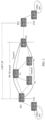
- FIG. 2 An embodiment of this application provides a schematic diagram of an application scenario.
- a device CE1 and a device CE2 may be user-side devices.
- a device PE1 and a device PE2 may be located at an access layer.
- a device P1, a device P2, and a device P3 may be located at an aggregation layer.
- a device P4 may be located at a core layer.
- the application scenario may be VPN over LDP over SR-TE.
- VPNs virtual private networks
- a VPN is a private network constructed by using a public network.
- FIG. 2 different VPN instances are deployed on the device CE1 and the device CE2.
- a VPN1 is deployed on the device CE2, and a VPN2 is deployed on the device CE1.
- an LDP is deployed in an area between the device PE1 and the device PE2, so that VPN services on both ends can combine different branches of the private network through the LSP, to form a unified network.
- an SR-TE tunnel is deployed in a core area between the device PE1 and the device P4. As shown in FIG.
- tunnel1 and Tunnel2 are deployed between the device PE1 and the device P4.
- advantages of the SR-TE tunnel in protective switchover and path planning can be fully utilized in a core area of the network.
- the device PE1 is used as an example. After the device PE1 receives a packet from the device CE1, the device PE1 searches a forwarding table of the device PE1, and adds three layers of labels to the packet based on a destination address of the packet.
- An outermost label is an SR TE tunnel label, and indicates one tunnel from the device PE1 to the device P4.
- a middle label is an LDP label, and indicates transmitting the packet from the device P4 to the device PE2.
- An inner label is a private network label corresponding to a VPN instance, and indicates that the packet should reach the VPN1 of the CE2.
- the packet is forwarded from the device PE1 to the device P4 based on a tunnel label
- the packet is forwarded from the device P4 to the device PE2 based on an LDP label
- the packet is forwarded from the device PE2 to the device CE2 based on a private network label.
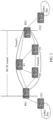
- FIG. 3 An embodiment of this application further provides a schematic diagram of an application scenario.
- a device CE1 and a device CE2 may be user-side devices.
- a device PE1 and a device PE2 may be located at the foregoing access layer.
- a device P1, a device P2, and a device P3 may be located at the foregoing aggregation layer.
- VPNs are first respectively deployed on the device CE1 and the device CE2, and a VPN is a private network constructed by using a public network.
- FIG. 3 different VPN instances are deployed on the device CE1 and the device CE2.
- a VPN1 is deployed on the device CE2, and a VPN2 is deployed on the device CE1.
- a fully connected SR-TE tunnel is deployed between the device PE1 and the device PE2.
- two tunnels namely, Tunnel1 and Tunnel2, are deployed between the device PE1 and the device PE2.
- the device PE1 is used as an example. After the device PE1 receives a packet from the device CE1, the device PE1 searches a forwarding table of the device PE1, and adds two layers of labels to the packet based on a destination address of the packet.
- An outer label is an SR TE tunnel label, and indicates one tunnel from the device PE1 to the device PE2.
- An inner label is a private network label corresponding to a VPN instance, and indicates that the packet should reach the VPN1 of the CE2. In other words, the packet is forwarded from the device PE1 to the device PE2 based on a tunnel label, and the packet is forwarded from the device PE2 to the device CE2 based on a private network label.
- ECMP may be set on a node.
- the ECMP may not only implement load sharing, but also provide a redundancy backup capability for the network.
- the VPN over LDP over SR-TE scenario shown in FIG. 2 is used as an example, It is assumed that a PE1 node generates a forwarding table (Forwarding Info Base, FIB) in a route advertisement process of each node in FIG. 2 , and the forwarding table includes three-level ECMP cascading information, where ECMP entries of different levels may correspond to different types of labels, and label types include a tunnel label, an LDP label, and a private network label.
- FIB Forwarding Info Base
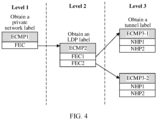
- the three-level ECMP cascading information found by the PE1 node based on the forwarding table may be represented in a form shown in FIG. 4 .
- the forwarding table is searched based on a destination address of a packet received by the PE1 node, and a private network label is obtained from ECMP1 in level-1 type ECMP in the forwarding table, where the private network label corresponds to the destination address of the received packet.
- the ECMP1 includes one member FEC, and the FEC points to ECMP2, where the ECMP2 is level-2 type ECMP. That is, the ECMP1 is cascaded with the ECMP2 through the FEC.
- the level-2 type ECMP includes the ECMP2, and the ECMP2 includes two members, namely, an FEC1 and an FEC2.
- the FEC1 points to ECMP3-1 in a level-3 type
- the FEC2 points to ECMP3-2 in the level-3 type.
- the ECMP2 is cascaded with the ECMP3-1 through the FEC1
- the ECMP2 is cascaded with the ECMP3-2 through the FEC2
- an LDP label corresponding to the ECMP3-1 and an LDP label corresponding to the ECMP3-2 may be obtained based on the ECMP2.
- the level-3 type ECMP includes the ECMP3-1 and the ECMP3-2, where the ECMP3-1 represents Tunnel1 in FIG. 2 , and the ECMP3-2 represents Tunnel2 in FIG. 2 .
- the ECMP3-1 includes two members, namely, NHP1 and NHP2. This means that Tunnel1 has two equal-cost paths.
- the ECMP3-2 also includes two members, namely, NHP1 and NHP2. This means that Tunnel2 has two equal-cost paths.
- a tunnel label corresponding to Tunnel1 may be obtained based on the ECMP3-1
- a tunnel label corresponding to Tunnel2 may be obtained based on the ECMP3-2.
- the control plane needs to exchange content of the ECMP3-1 and content of the ECMP3-2, delete the ECMP3-2, and then redeliver a related entry to the forwarding plane again, to enable the PE1 to reselect a route.
- an embodiment of this application provides a path determining method, so that in an ECMP cascading scenario, when a member at a level of the ECMP is faulty or a level of the ECMP is faulty, correct path selection can be quickly implemented based on a set ECMP identifier, to save entry switching time, and improve path selection efficiency.
- FIG. 5A is a schematic diagram of a structure of three-level ECMP cascading according to an embodiment of this application. It should be noted that FIG. 5A shows a forwarding table (Forwarding Info Base, FIB) of a PE1 in a VPN over LDP over SR-TE scenario.
- FIB Forwarding Info Base
- identifiers are respectively set for each group of ECMP and each member in each group of ECMP.
- the identifier corresponding to each group of ECMP indicates whether the group of ECMP is valid
- the identifier corresponding to the member in each group of ECMP indicates whether the member in the group of ECMP is valid.
- For a relationship between validity of each group of ECMP and validity of each member in the group of ECMP refer to related descriptions below.
- the forwarding table further includes the following information: a route (route), a virtual routing forwarding (virtual routing forwarding, VRF) instance, an IP address, a mask (mask), and the like.
- the forwarding table shown in FIG. 5A includes a plurality of levels of ECMP. The plurality of levels of ECMP are classified into level-1 type ECMP, level-2 type ECMP, and level-3 type ECMP.
- the level-3 type ECMP is a last-level ECMP entry in the plurality of levels of ECMP
- the level-2 type ECMP is a previous-level ECMP entry of the level-3 type ECMP
- the level-1 type ECMP is a previous-level ECMP entry of the level-2 type ECMP. The following specifically describes an ECMP entry of each level.
- the level-1 type ECMP includes an ECMP1 entry, and an identifier 1 is set for indicating validity of the ECMP1 entry.
- the ECMP1 entry includes one FEC member, and the FEC member points to an ECMP2 entry of a next level, in other words, the ECMP1 entry is cascaded with the lower-level ECMP2 entry.
- the forwarding table further includes a private network label corresponding to the ECMP2 entry.
- the level-2 type ECMP includes the ECMP2 entry, and an identifier 2 is set for indicating validity of the ECMP2 entry.
- the ECMP2 entry includes two FEC members, namely, an FEC1 and an FEC2.
- the FEC1 points to ECMP3-1 of a next level
- the FEC2 points to ECMP3-2 of the next level.
- the ECMP2 entry is separately cascaded with an ECMP3-1 entry and an ECMP3-2 entry that are at a lower level.
- the forwarding table further includes an LDP label corresponding to the ECMP3-1 entry and an LDP label corresponding to the ECMP3-2 entry.
- the level-3 type ECMP includes the ECMP3-1 entry and the ECMP3-2 entry, where an identifier 3 is set for indicating validity of the ECMP3-1 entry and an identifier 4 is set for indicating validity of the ECMP3-2 entry.
- an identifier 3 is set for indicating validity of the ECMP3-1 entry
- an identifier 4 is set for indicating validity of the ECMP3-2 entry.
- the ECMP3-1 entry includes two NHP members (namely, NHP1 and NHP2), in other words, two equal-cost paths.
- An identifier 5 is set for indicating validity of the member NHP1 in the ECMP3 -1
- an identifier 6 is set for indicating validity of the member NHP2 in the ECMP3 -1.
- the forwarding table further includes an SR_TE tunnel label corresponding to each equal-cost path in the ECMP3-1 entry.
- the ECMP3-2 entry includes two NHP members (namely, NHP1 and NHP2), in other words, two equal-cost paths.
- An identifier 7 is set for indicating validity of the member NHP1 in the ECMP3-2
- an identifier 8 is set for indicating validity of the member NHP2 in the ECMP3 -2.
- the forwarding table further includes an SR_TE tunnel label corresponding to each equal-cost path in the ECMP3-2 entry.
- validity of each group of ECMP entries in the forwarding table relates to validity of each member in the group of ECMP entries.
- the ECMP3-1 entry in the last-level ECMP entry is used as an example.
- the identifier 3 indicates that the ECMP3-1 entry is valid, it indicates that at least one valid equal-cost path exists in a plurality of equal-cost paths in the ECMP3-1 entry.
- the following three cases are specifically included: (1) Both the NHP1 and the NHP2 in the ECMP3-1 entry are valid, to be specific, the identifier 5 indicates that the NHP1 in the ECMP3-1 entry is valid and the identifier 6 indicates that the NHP2 in the ECMP3-1 entry is valid.
- the identifier 5 indicates that the NHP1 in the ECMP3-1 entry is valid but the identifier 6 indicates that the NHP2 in the ECMP3-1 entry is invalid.
- the identifier 6 indicates that the NHP2 in the ECMP3-1 entry is valid but the identifier 5 indicates that the NHP1 in the ECMP3-1 entry is invalid.
- the identifier 3 indicates that the ECMP3 -1 entry is invalid, it indicates that the plurality of equal-cost paths included in the ECMP3-1 entry are all invalid. Therefore, the identifier 5 indicates that the NHP1 in the ECMP3-1 entry is invalid, and the identifier 6 indicates that the NHP2 in the ECMP3 -1 entry is invalid.
- a level-2 type ECMP2 entry is used as an example.
- the identifier 2 indicates that the ECMP2 entry is valid, it indicates that at least one group of valid lower-level ECMP entries exists in a plurality of groups of lower-level ECMP entries cascaded with the ECMP2 entry.
- the following three cases are specifically included: (1) Both the ECMP3-1 and the ECMP3-2 are valid, to be specific, the identifier 3 indicates that the ECMP3-1 entry is valid and the identifier 4 indicates that the ECMP3-2 entry is valid. (2) Only the ECMP3-1 is valid, to be specific, the identifier 3 indicates that the ECMP3-1 entry is valid but the identifier 4 indicates that the ECMP3-2 entry is invalid.
- the identifier 4 indicates that the ECMP3 -2 is valid but the identifier 3 indicates that the ECMP3-1 is invalid.
- the identifier 2 indicates that the ECMP2 entry is invalid, it indicates that the plurality of groups of lower-level ECMP entries cascaded with the ECMP2 entry are all invalid, to be specific, the identifier 3 indicates that the ECMP3-1 entry is invalid and the identifier 4 indicates that the ECMP3-2 entry is invalid.
- a quantity of ECMP cascading levels in the forwarding table of the network device is not limited to 3. Another quantity of ECMP cascading levels may be used.
- ECMP cascading shown in the forwarding table of the network device may be two-level ECMP cascading.
- ECMP cascading shown in the forwarding table of the network device may be two-level ECMP cascading.
- a quantity of members in each group of ECMP is not limited in this embodiment of this application.
- a quantity of members in a group of ECMP may alternatively be 3, 4, or another value.
- FIG. 5B is a schematic diagram of a structure of another three-level ECMP cascading according to an embodiment of this application.
- level-1 type ECMP includes an ECMP1 entry.
- Level-2 type ECMP includes two groups of ECMP entries, namely, an ECMP2-1 entry and an ECMP2-2 entry.
- Level-3 type ECMP includes four groups of ECMP entries, namely, an ECMP3-1 entry, an ECMP3-2 entry, an ECMP3-3 entry, and an ECMP3-4 entry.
- the ECMP1 entry is separately cascaded with the ECMP2-1 entry and the ECMP2-2 entry that are at a lower level
- the ECMP2-1 entry is cascaded with the lower-level ECMP3-1 entry and the lower-level ECMP3-2 entry separately
- the ECMP2-2 entry is cascaded with the lower-level ECMP3-3 entry and the lower-level ECMP3 - 4 entry separately.
- the ECMP1 entry in FIG. 5A is cascaded only with the ECMP2 entry, in other words, a quantity of lower-level ECMP entries cascaded with the ECMP1 in FIG. 5A is 1.
- the quantity of lower-level ECMP entries cascaded with the ECMP1 entry is 2.
- the ECMP2-1 entry in FIG. 5B is the ECMP2 entry in FIG. 5A .
- the ECMP2-1 entry and a lower-level entry cascaded with the ECMP2-1 entry refer to related descriptions of the ECMP2 entry in FIG. 5A . Details are not described herein again.
- An identifier 9 is set for indicating validity of the ECMP2-2 entry.
- the ECMP2-2 entry includes two FEC members, namely, an FEC1 and an FEC2.
- the FEC1 points to the ECMP3-3 entry of a lower level
- the FEC2 points to the ECMP3-4 entry of a lower level.
- the ECMP2-2 entry is separately cascaded with the ECMP3-3 entry and the ECMP3-4 entry that are at a lower level.
- the forwarding table further includes an LDP label corresponding to the ECMP3-3 entry and an LDP label corresponding to the ECMP3-4 entry.
- An identifier 10 is set for indicating validity of the ECMP3-3 entry.
- the ECMP3-3 entry includes two NHP members (namely, NHP1 and NHP2), in other words, two equal-cost paths.
- An identifier 12 is set for indicating validity of the member NHP1 in the ECMP3-3
- an identifier 13 is set for indicating validity of the member NHP2 in the ECMP3-3.
- the forwarding table further includes an SR_TE tunnel label corresponding to each equal-cost path in the ECMP3-3 entry.
- An identifier 11 is set for indicating validity of the ECMP3-4 entry.
- the ECMP3-4 entry includes two NHP members (namely, NHP1 and NHP2), in other words, two equal-cost paths.
- An identifier 14 is set for indicating validity of the member NHP1 in the ECMP3-4
- an identifier 15 is set for indicating validity of the member NHP2 in the ECMP3-4.
- the forwarding table further includes an SR_TE tunnel label corresponding to each equal-cost path in the ECMP3-4 entry.
- FIG. 5A and FIG. 5B are merely an example.
- another table, dendrogram, or the like that describes a relationship between ECMP levels and content of entries of the ECMP levels may be used. This is not specifically limited in this embodiment of this application.
- FIG. 6 is a flowchart of a path determining method according to an embodiment of this application. The method is applied to a network device in an ECMP cascading scenario. The method includes but is not limited to the following steps.
- a network device receives a packet sent by a previous node.
- the network device may be a head node or a transit node in a packet forwarding path.
- the head node may be a label edge router LER in an MPLS network
- the transit node may be a label switching router LSR in the MPLS network.
- the previous node when the network device is a device PE1, the previous node may be a device CE1, in other words, the device PE1 receives a packet sent by the device CE1, and the packet is forwarded by the device PE1 to a device CE2.
- the previous node may be a device CE2, in other words, the device PE2 receives a packet sent by the device CE2, and the packet is forwarded by the device PE2 to a device CE1.
- the previous node may be the device PE2, in other words, the device P4 receives a packet sent by the device PE2, and the packet is forwarded by the device P4 to the device CE1.
- S102 Obtain an ECMP entry group 1 from a forwarding table, where the ECMP entry group 1 includes a plurality of first equal-cost paths.
- the ECMP entry group 1 is a last-level ECMP entry in a plurality of levels of ECMP entries in the forwarding table. Each first equal-cost path in the ECMP entry group 1 has a same cost.
- the forwarding table includes an identifier of the ECMP entry group 1, and the identifier of the ECMP entry group 1 indicates validity of the ECMP entry group 1.
- the identifier of the ECMP entry group 1 when the identifier of the ECMP entry group 1 is valid, in other words, the identifier of the ECMP entry group 1 indicates that the ECMP entry group 1 is valid, it indicates that at least one valid first equal-cost path exists in the plurality of first equal-cost paths in the ECMP entry group 1.
- the identifier of the ECMP entry group 1 is invalid, in other words, the identifier of the ECMP entry group 1 indicates that the ECMP entry group 1 is invalid, it indicates that the plurality of first equal-cost paths included in the ECMP entry group 1 are all invalid.
- a bit mapping manner may alternatively be used for the identifier of the ECMP entry group 1, to indicate whether the ECMP entry group 1 is valid.
- the forwarding table further includes an identifier of each first equal-cost path in the ECMP entry group 1, and the identifier of each equal-cost path is used for validity of the first equal-cost path.
- a first equal-cost path i is used as an example, and the first equal-cost path i is any one of the plurality of first equal-cost paths.
- the identifier of the first equal-cost path i indicates that the first equal-cost path i is valid, it indicates that the first equal-cost path i is a non-faulty path and the first equal-cost path i is available.
- the identifier of the first equal-cost path i is invalid, in other words, the identifier of the first equal-cost path i indicates that the first equal-cost path i is invalid, it indicates that the first equal-cost path i is faulty and the first equal-cost path i is unavailable.
- the identifier of the first equal-cost path i is a first value (for example, "1"), it indicates that the first equal-cost path i is valid.
- the identifier of the first equal-cost path i is a second value (for example, "0"), it indicates that the first equal-cost path i is invalid.
- the ECMP entry group 1 may be the ECMP3-1
- the first equal-cost path i may be a path corresponding to the NPH1 in the ECMP3-1.
- the identifier of the first equal-cost path i is the identifier 5
- the identifier of the ECMP entry group 1 is the identifier 3 in FIG. 5A .
- the identifier of the ECMP entry group 1 in the forwarding table and the identifier of the first equal-cost path in the ECMP entry group 1 may be updated through a forwarding plane of the network device.
- an identifier of the first equal-cost path is marked as invalid in the forwarding table, for example, the identifier is set to "0", to indicate that the first equal-cost path is invalid.
- the forwarding plane of the network device perceives that identifiers of all first equal-cost paths in the ECMP entry group 1 are marked as invalid
- the identifier of the ECMP entry group 1 is marked as invalid in the forwarding table, for example, the identifier is set to "0", to indicate that the ECMP entry group 1 is invalid.
- S103 When the identifier of the ECMP entry group 1 is valid, determine a first path from the plurality of first equal-cost paths based on identifiers of the plurality of first equal-cost paths, and forward the packet based on the first path.
- the first path is any first equal-cost path whose identifier is valid in the plurality of first equal-cost paths in the ECMP entry group 1.
- a hash algorithm may be used to determine the first path from each first equal-cost path whose identifier is valid in the ECMP entry group 1.
- the network device may alternatively determine, by using a polling policy or based on a path weight, the first path from each first equal-cost path whose identifier is valid in the ECMP entry group 1. This is not specifically limited in this embodiment of this application.
- the ECMP entry group 1 is the ECMP3-1.
- the identifier 3 is valid, if both the identifier 5 corresponding to the NHP1 in the ECMP3 -1 and the identifier 6 corresponding to the NHP2 in the ECMP3-1 are valid, a path corresponding to the NHP1 or a path corresponding to the NHP2 in the ECMP3-1 may be selected as the first path.
- the identifier 3 if the identifier 3 is valid, the identifier 5 is invalid, and the identifier 6 is valid, a path corresponding to the NHP2 is selected as the first path.
- the forwarding table further includes an ECMP entry group 2.
- the ECMP entry group 2 is an upper-level ECMP entry of the ECMP entry group 1, the forwarding table further includes an identifier of the ECMP entry group 2, and the identifier of the ECMP entry group 2 indicates validity of the ECMP entry group 2. Specifically, when the identifier of the ECMP entry group 2 is valid, it indicates that the ECMP entry group 2 is valid; or when the identifier of the ECMP entry group 2 is invalid, it indicates that the ECMP entry group 2 is invalid.
- the validity of the ECMP entry group 2 relates to validity of each group of ECMP entries in a plurality of groups of lower-level ECMP entries cascaded with the ECMP entry group 2. Specifically, that the ECMP entry group 2 is valid means that at least one group of ECMP entries whose identifier is valid exists in the plurality of groups of lower-level ECMP entries cascaded with the ECMP entry group 2; and that the ECMP entry group 2 is invalid means that the plurality of groups of lower-level ECMP entries cascaded with the ECMP entry group 2 are all invalid.
- the method when an upper-level ECMP entry of the ECMP entry group 1 exists in the forwarding table, the method further includes: when the identifier of the ECMP entry group 1 is invalid, determining a second path based on the ECMP entry group 2, and forwarding the packet based on the second path.
- the determining a second path based on the ECMP entry group 2 includes: when the identifier of the ECMP entry group 2 is valid, selecting, based on identifiers of the plurality of groups of lower-level ECMP entries cascaded with the ECMP entry group 2, an ECMP entry group 3 from the plurality of groups of lower-level ECMP entries cascaded with the ECMP entry group 2, where the ECMP entry group 3 is any group of ECMP entries whose identifier is valid in the plurality of groups of lower-level ECMP entries cascaded with the ECMP entry group 2; and determining the second path from a plurality of second equal-cost paths based on identifiers of the plurality of second equal-cost paths in the ECMP entry group 3.
- An identifier of each group of lower-level ECMP entries cascaded with the ECMP entry group 2 indicates validity of the group of lower-level ECMP entries.
- An identifier of each second equal-cost path indicates validity of the second equal-cost path.
- the second path is any second equal-cost path whose identifier is valid in the plurality of second equal-cost paths in the ECMP entry group 3.
- the forwarding table of the network device includes the ECMP entry group 2, two-level ECMP cascading exists in the forwarding table.
- FIG. 5A a path selection method used when last-level ECMP is invalid in an ECMP cascading scenario is specifically described.
- the ECMP entry group 1 is the ECMP3-1.
- the identifier of the ECMP entry group 1 is the identifier 3.
- the network device finds, based on the forwarding table, upper-level ECMP cascaded with the ECMP3-1, that is, the ECMP2 (where the ECMP2 is the ECMP entry group 2).
- the ECMP3 -2 (where the ECMP3-2 is the ECMP entry group 3) whose identifier 4 is valid is selected from the lower-level ECMP cascaded with the ECMP2. Then any equal-cost path whose identifier is valid is selected from the NHP1 and the NHP2 in the ECMP3-2 as the second path based on an identifier of each equal-cost path in the ECMP3-2, and the packet is forwarded based on the second path.
- the forwarding table further includes an ECMP entry group 4.
- the ECMP entry group 4 is upper-level ECMP of the ECMP entry group 2, the forwarding table further includes an identifier of the ECMP entry group 4, and the identifier of the ECMP entry group 4 indicates validity of the ECMP entry group 4. Specifically, when the identifier of the ECMP entry group 4 is valid, it indicates that the ECMP entry group 4 is valid; or when the identifier of the ECMP entry group 4 is invalid, it indicates that the ECMP entry group 4 is invalid.
- the validity of the ECMP entry group 4 relates to validity of each group of ECMP entries in a plurality of groups of lower-level ECMP entries cascaded with the ECMP entry group 4. Specifically, that the ECMP entry group 4 is valid means that at least one group of ECMP entries whose identifier is valid exists in the plurality of groups of lower-level ECMP entries cascaded with the ECMP entry group 4; and that the ECMP entry group 4 is invalid means that the plurality of groups of lower-level ECMP entries cascaded with the ECMP entry group 4 are all invalid.
- the method when an upper-level ECMP entry of the ECMP entry group 2 exists in the forwarding table, the method further includes: when the identifier of the ECMP entry group 2 is invalid, determining a third path based on the ECMP entry group 4, and forwarding the packet based on the third path.
- the determining a third path based on the ECMP entry group 4 includes: when the identifier of the ECMP entry group 4 is valid, selecting, based on identifiers of the plurality of groups of lower-level ECMP entries cascaded with the ECMP entry group 4, an ECMP entry group 5 from the plurality of groups of lower-level ECMP entries cascaded with the ECMP entry group 4, where the ECMP entry group 5 is any group of ECMP entries whose identifier is valid in the plurality of groups of lower-level ECMP entries cascaded with the ECMP entry group 4; selecting, based on identifiers of a plurality of groups of lower-level ECMP entries cascaded with the ECMP entry group 5, an ECMP entry group 6 from the plurality of groups of lower-level ECMP entries cascaded with the ECMP entry group 5, where the ECMP entry group 6 is any group of ECMP entries whose identifier is valid in the plurality of groups of lower-level ECMP entry
- An identifier of each group of lower-level ECMP entries cascaded with the ECMP entry group 4 indicates validity of the group of lower-level ECMP entries.
- An identifier of each group of lower-level ECMP entries cascaded with the ECMP entry group 5 indicates validity of the group of lower-level ECMP entries.
- An identifier of each third equal-cost path indicates validity of the third equal-cost path.
- the third path is any third equal-cost path whose identifier is valid in the plurality of third equal-cost paths in the ECMP entry group 6.
- the forwarding table of the network device includes the ECMP entry group 4, three-level ECMP cascading exists in the forwarding table.
- FIG. 5B a path selection method used when a group of ECMP entries of a previous level of a last level in a forwarding table is invalid in an ECMP cascading scenario is specifically described.
- the ECMP entry group 2 is the ECMP2-1
- the identifier 2 of the ECMP2-1 obtained from the forwarding table is invalid.
- the network device finds, based on the forwarding table, upper-level ECMP cascaded with the ECMP2-1, that is, the ECMP1 (where the ECMP1 is the ECMP entry group 4).
- the identifier 1 of the ECMP1 is determined as valid.
- the ECMP2-2 (where the ECMP2-2 is the ECMP entry group 5) whose identifier 9 is valid is selected from the lower-level ECMP cascaded with the ECMP1. Then, based on an identifier of each lower-level ECMP cascaded with the ECMP2-2, one ECMP whose identifier is valid is selected from the lower-level ECMP cascaded with the ECMP2-2, for example, the ECMP3-3 (where the ECMP3-3 is the ECMP entry group 6) whose identifier 10 is valid is selected.
- any equal-cost path whose identifier is valid is selected from the NHP1 and the NHP2 in the ECMP3-3 as the third path based on an identifier of each equal-cost path in the ECMP3-3, and the packet is forwarded based on the third path.
- each group of ECMP entries in the forwarding table corresponds to a label, for packet encapsulation.
- each equal-cost path in the last-level ECMP entry (for example, the ECMP entry group 1) in the forwarding table corresponds to one segment routing traffic engineering tunnel SR_TE tunnel label
- each group of lower-level ECMP entries cascaded with the ECMP entry group 2 corresponds to one label distribution protocol LDP label
- each group of lower-level ECMP entries cascaded with the ECMP entry group 4 corresponds to one private network label.
- the SR_TE tunnel label, the LDP label and the private network label are generated by the network device in a route advertisement process. The network device may find, based on a destination address of the received packet, an ECMP entry corresponding to the destination address in the forwarding table, to obtain a label corresponding to the corresponding ECMP entry.
- SR TE tunnel labels corresponding to different equal-cost paths may be the same or may be different. This is not specifically limited herein.
- LDP labels corresponding to different lower-level ECMP entries may be the same or may be different. This is not specifically limited herein.
- the network device may be the device PE1 in the VPN over LDP over SR-TE shown in FIG. 2 .
- a label corresponding to each group of ECMP entries may be any one of the following cases.
- Each equal-cost path in the last-level ECMP entry (for example, the ECMP entry group 1) in the forwarding table corresponds to one SR_TE tunnel label
- each group of lower-level ECMP entries cascaded with the ECMP entry group 2 corresponds to one private network label.
- the SR TE tunnel label and the private network label are generated by the network device in a route advertisement process. The network device may find, based on a destination address of the received packet, an ECMP entry corresponding to the destination address in the forwarding table, to obtain a label corresponding to the corresponding ECMP entry.
- the network device may be the device PE2 or the device PE1 in the MPLS VPN shown in FIG. 3 .
- Each equal-cost path in the last-level ECMP entry (for example, the ECMP entry group 1) in the forwarding table corresponds to one LDP tunnel label, and each group of lower-level ECMP entries cascaded with the ECMP entry group 2 corresponds to one private network label.
- the network device may be the device PE2 in FIG. 2 .
- a destination address of a packet received by the network device corresponds to a private network label on the device CE1.
- Case 3 When each ECMP entry group included in the forwarding table is in two-level ECMP cascading, only each equal-cost path in the last-level ECMP entry (for example, the ECMP entry group 1) in the forwarding table corresponds to one SR_TE tunnel label, and each group of lower-level ECMP entries cascaded with the ECMP entry group 2 does not correspond to a label.
- the network device may be the device P4 shown in FIG. 2 . It can be learned from FIG. 2 that two tunnels are deployed on the device PE2, and in this case, a destination address of a packet received by the network device corresponds to a private network label on the device CE1.
- the forwarding table includes a plurality of levels of ECMP entries, and each level of ECMP entries includes at least one group of ECMP entries.
- One corresponding ECMP identifier is set for each group of ECMP entries to indicate whether a valid equal-cost path exists in the group of ECMP entries.
- a valid equal-cost path may be reselected based on an ECMP identifier of the group of ECMP entries, or when a plurality of equal-cost paths in a group of ECMP entries are all faulty, route reselecting is performed based on an ECMP identifier of a previous-level ECMP entry of the group of ECMP entries, to save time for exchanging entry content when a path in an ECMP entry is faulty, implement fast path switching in an ECMP cascading scenario, reduce path fault convergence time, and improve path selection efficiency.
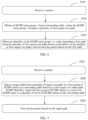
- FIG. 7 is a flowchart of another path determining method according to an embodiment of this application. The method is applied to a network device. The method includes but is not limited to the following steps.
- S201 Receive a packet.
- S101 in the embodiment in FIG. 6 .
- S201 Receive a packet.
- S202 Select a target path from a plurality of equal-cost paths in a first group of ECMP entries in a forwarding table based on a first equal-cost multi-path ECMP identifier, where the first group of ECMP entries is a last-level ECMP entry in a plurality of levels of ECMP entries in the forwarding table.
- the first ECMP identifier indicates that at least one valid equal-cost path exists in the plurality of equal-cost paths in the first group of ECMP entries.
- the last-level ECMP entry in the forwarding table is a last-level ECMP entry found by the network device in the forwarding table based on a destination address of the packet, and a label corresponding to an equal-cost path in the last-level ECMP entry is a label closest to a layer 2 header (L2 header) during packet encapsulation.
- L2 header layer 2 header
- the target path is any valid equal-cost path in the plurality of equal-cost paths in the first group of ECMP entries.
- validity of each equal-cost path in the first group of ECMP entries may be indicated by an identifier of the equal-cost path.
- the first group of ECMP entries may be the ECMP entry group 1 in the embodiment in FIG. 6
- the first ECMP identifier is equivalent to the identifier of the ECMP entry group 1 in FIG. 6 .
- the target path is the first path in FIG. 6 .
- the forwarding table further includes a second group of ECMP entries, and the second group of ECMP entries is an upper-level ECMP entry of the first group of ECMP entries.
- a second ECMP identifier of the second group of ECMP entries indicates that at least one group of valid lower-level ECMP entries exists in a plurality of groups of lower-level ECMP entries cascaded with the second group of ECMP entries.
- the method further includes: determining whether the first ECMP identifier of the first group of ECMP entries is valid.
- the first group of ECMP entries may be the ECMP entry group 1 in the embodiment in FIG. 6 .
- the first ECMP identifier is equivalent to the identifier of the ECMP entry group 1 in FIG. 6 .
- the second group of ECMP entries is equivalent to the ECMP entry group 2 in FIG. 6 .
- the target path is the first path in FIG. 6 . Before the first path is selected from the ECMP entry group 1, whether the identifier of the ECMP entry group 1 is valid needs to be first determined.
- the plurality of groups of lower-level ECMP entries cascaded with the second group of ECMP entries further include a third group of ECMP entries, and a third ECMP identifier of the third group of ECMP entries indicates that a plurality of equal-cost paths that are included in the third group of ECMP entries are all invalid.
- the second group of ECMP entries may be the ECMP entry group 2 in the embodiment in FIG. 6
- the third group of ECMP entries is equivalent to the ECMP entry group 1 in FIG. 6
- the first group of ECMP entries is equivalent to the ECMP entry group 3 in FIG. 6 .
- the target path is the second path in FIG. 6 .
- each equal-cost path in the last-level ECMP entry corresponds to one segment routing traffic engineering tunnel SR_TE tunnel label
- each group of lower-level ECMP entries cascaded with the second group of ECMP entries corresponds to one private network label.
- SR_TE tunnel labels corresponding to different equal-cost paths may be the same or may be different, which is not specifically limited herein. It should be noted that the SR TE tunnel label and the private network label are generated by the network device in a route advertisement process. The network device may find, based on a destination address of the received packet, an ECMP entry corresponding to the destination address in the forwarding table, to obtain a label corresponding to the corresponding ECMP entry.
- each group of ECMP entries included in the forwarding table of the network device is in two-level ECMP cascading, for a label corresponding to each group of ECMP entries, further refer to related descriptions of the case 1 to the case 3 in S103 in FIG. 6 . Details are not described herein again.
- the forwarding table further includes a fourth group of ECMP entries, and the fourth group of ECMP entries is an upper-level ECMP entry of the second group of ECMP entries.
- a fourth ECMP identifier of the fourth group of ECMP entries indicates that at least one group of valid lower-level ECMP entries exists in a plurality of groups of lower-level ECMP entries cascaded with the fourth group of ECMP entries.
- the method further includes: determining whether the second ECMP identifier of the second group of ECMP entries is valid. That is, when it is determined that the second ECMP identifier of the second group of ECMP entries is valid, it is further determined whether the first ECMP identifier of the first group of ECMP entries is valid.
- the plurality of groups of lower-level ECMP entries cascaded with the fourth group of ECMP entries further include a fifth group of ECMP entries.
- a fifth ECMP identifier of the fifth group of ECMP entries indicates that a plurality of groups of lower-level ECMP entries cascaded with the fifth group of ECMP entries are all invalid.
- the fourth group of ECMP entries may be the ECMP entry group 4 in the embodiment in FIG. 6
- the fifth group of ECMP entries may be the ECMP entry group 2 in FIG. 6
- the second group of ECMP entries is equivalent to the ECMP entry group 5 in FIG. 6
- the first group of ECMP entries is equivalent to the ECMP entry group 6 in FIG. 6 . Therefore, when the identifier of the ECMP entry group 2 indicates that the ECMP entry group 2 is invalid, the ECMP entry group 5 whose identifier is valid is selected from each group of lower-level ECMP entries cascaded with the ECMP entry group 4.
- the ECMP entry group 6 whose identifier is valid is selected from each group of lower-level ECMP entries cascaded with the ECMP entry group 5.
- the target path is the third path in FIG. 6 .
- each equal-cost path in the last-level ECMP entry corresponds to one segment routing traffic engineering tunnel SR_TE tunnel label
- each group of lower-level ECMP entries cascaded with the second group of ECMP entries corresponds to one label distribution protocol LDP label
- each group of lower-level ECMP entries cascaded with the fourth group of ECMP entries corresponds to one private network label.
- the SR_TE tunnel label, the LDP label and the private network label are generated by the network device in a route advertisement process. The network device may find, based on a destination address of the received packet, an ECMP entry corresponding to the destination address in the forwarding table, to obtain a label corresponding to the corresponding ECMP entry.
- SR TE tunnel labels corresponding to different equal-cost paths may be the same or may be different. This is not specifically limited herein.
- LDP labels corresponding to different lower-level ECMP entries may be the same or may be different. This is not specifically limited herein.
- the forwarding table includes a plurality of levels of ECMP entries, and each level of ECMP entries includes at least one group of ECMP entries.
- One corresponding ECMP identifier is set for each group of ECMP entries to indicate whether a valid equal-cost path exists in the group of ECMP entries.
- a valid equal-cost path may be reselected based on an ECMP identifier of the group of ECMP entries, or when a plurality of equal-cost paths in a group of ECMP entries are all faulty, route reselecting is performed based on an ECMP identifier of a previous-level ECMP entry of the group of ECMP entries, to save time for exchanging entry content when a path in an ECMP entry is faulty, implement fast path switching in an ECMP cascading scenario, reduce path fault convergence time, and improve path selection efficiency.
- FIG. 8 is a schematic diagram of a functional structure of a network device according to an embodiment of this application.
- the network device 30 includes a receiving unit 310, a processing unit 312, and a sending unit 314.
- the network device 30 may be implemented by using hardware, software, or a combination of software and hardware.
- the receiving unit 310 is configured to receive a packet.
- the processing unit 312 is configured to select, based on a first equal-cost multi-path ECMP identifier, a target path from a plurality of equal-cost paths in a first group of ECMP entries in a forwarding table.
- the sending unit 314 is configured to forward the packet based on the target path.
- the first ECMP identifier indicates that at least one valid equal-cost path exists in the plurality of equal-cost paths in the first group of ECMP entries.
- the first group of ECMP entries is a last-level ECMP entry in a plurality of levels of ECMP entries in the forwarding table.
- Each functional module of the network device 30 may be configured to implement the method described in the embodiment in FIG. 7 .
- the receiving unit 310 may be configured to perform S201
- the processing unit 312 may be configured to perform S202
- the sending unit 314 may be configured to perform S203.
- Each functional module of the network device 30 may be further configured to implement the method described in the embodiment in FIG. 6 .
- FIG. 6 For brevity of the specification, details are not described herein again.
- One or more of the units in the embodiment shown in FIG. 8 may be implemented by software, hardware, firmware, or a combination thereof.
- the software or firmware includes but is not limited to computer program instructions or code, and may be executed by a hardware processor.
- the hardware includes but is not limited to various integrated circuits, such as a central processing unit (central processing unit, CPU), a digital signal processor (digital signal processor, DSP), a field programmable gate array (field-programmable gate array, FPGA), or an application-specific integrated circuit (application-specific integrated circuit, ASIC).
- the network device 40 includes a processor 401, a communication interface 402, a memory 403, and a bus 404.
- the processor 401, the memory 403, and the communication interface 402 communicate with each other via the bus 404.
- the network device 40 may be a router, a switch, or the like, or may be a component that is used in the foregoing network device and that can implement the foregoing method, for example, a board, a chip, or a line card. It should be understood that a quantity of processors and a quantity of memories in the network device 40 are not limited in this application.
- the bus 404 may be a peripheral component interconnect (peripheral component interconnect, PCI) bus or an extended industry standard architecture (extended industry standard architecture, EISA) bus, or the like.
- the bus may be categorized as an address bus, a data bus, a control bus, or the like. For ease of representation, only one line is used to represent the bus in FIG. 9 , but this does not mean that there is only one bus or only one type of bus.
- the bus 404 may include a path for transmitting information between components (for example, the memory 403, the processor 401, and the communication interface 402) of the network device 40.
- the processor 401 may be a general-purpose CPU, an NP, a microprocessor, or may be one or more integrated circuits configured to implement the solutions of this application, for example, an application-specific integrated circuit (application-specific integrated circuit, ASIC), a programmable logic device (programmable logic device, PLD), or a combination thereof.
- the PLD may be a complex programmable logic device (complex programmable logic device, CPLD), a field programmable logic gate array (field-programmable gate array, FPGA), generic array logic (generic array logic, GAL), or any combination thereof.
- the memory 403 is configured to provide storage space.
- the storage space may store computer program instructions and data.
- the memory 403 stores a forwarding table, the forwarding table includes a plurality of levels of ECMP entries, each level of ECMP entries in the plurality of levels of ECMP entries includes at least one group of ECMP entries, each group of ECMP entries corresponds to one ECMP identifier, and the ECMP identifier indicates whether a valid equal-cost path exists in a corresponding group of ECMP entries.
- the memory 403 may be a read-only memory (read-only memory, ROM) or another type of static storage device capable of storing static information and instructions, or may be a random access memory (random access memory, RAM) or another type of dynamic storage device capable of storing information and instructions, or may be an electrically erasable programmable read-only memory (electrically erasable programmable read-only Memory, EEPROM), a compact disc read-only memory (compact disc read-only memory, CD-ROM) or other compact disc storage, optical disc storage (including a compressed optical disc, a laser disc, an optical disc, a digital versatile disc, a Blu-ray disc, or the like), a magnetic disk storage medium or another magnetic storage device, or any other medium capable of carrying or storing expected program code in a form of an instruction or a data structure and capable of being accessed by a computer. This is not limited thereto.
- the memory 403 may exist independently, and is connected to the processor 401 via the bus 404. Alternatively, the memory 403
- the communication interface 402 may be configured to provide information input or output for the processor 401. Alternatively, the communication interface 402 may be configured to receive data sent from outside and/or send data to the outside. The communication interface 402 is configured to communicate with another device or a communication network by using any transceiver-type apparatus.
- the communication interface 402 includes a wired communication interface, and may include a wireless communication interface.
- the wired communication interface may be, for example, an Ethernet interface.
- the Ethernet interface may be an optical interface, an electrical interface, or a combination thereof.
- the wireless communication interface may be a wireless local area network (wireless local area network, WLAN) interface, a cellular network communication interface, or a combination thereof.
- the processor 401 in the network device 40 is configured to read a computer program stored in the memory 403, to perform the foregoing method, for example, the path determining method described in FIG. 6 or FIG. 7 .
- the network device 40 may be one or more modules in an execution body (for example, the network device) that performs the method shown in FIG. 7
- the processor 401 may be configured to read one or more computer programs stored in a memory, to perform the following operations.
- the first ECMP identifier indicates that at least one valid equal-cost path exists in the plurality of equal-cost paths in the first group of ECMP entries
- the first group of ECMP entries is a last-level ECMP entry in a plurality of levels of ECMP entries in the forwarding table.
- a computer program product is stored in a storage medium and includes several instructions for instructing a device (which may be a personal computer, a server, or a network device, a robot, a single-chip microcomputer, a chip, a robot, or the like) to perform all or some of the steps of the methods described in embodiments of this application.
- a device which may be a personal computer, a server, or a network device, a robot, a single-chip microcomputer, a chip, a robot, or the like
Landscapes
- Engineering & Computer Science (AREA)
- Computer Networks & Wireless Communication (AREA)
- Signal Processing (AREA)
- Data Exchanges In Wide-Area Networks (AREA)
Applications Claiming Priority (2)
| Application Number | Priority Date | Filing Date | Title |
|---|---|---|---|
| CN202111361408.8A CN116137607A (zh) | 2021-11-17 | 2021-11-17 | 一种路径确定方法及装置 |
| PCT/CN2022/131967 WO2023088244A1 (zh) | 2021-11-17 | 2022-11-15 | 一种路径确定方法及装置 |
Publications (2)
| Publication Number | Publication Date |
|---|---|
| EP4333394A1 true EP4333394A1 (de) | 2024-03-06 |
| EP4333394A4 EP4333394A4 (de) | 2024-08-28 |
Family
ID=86332649
Family Applications (1)
| Application Number | Title | Priority Date | Filing Date |
|---|---|---|---|
| EP22894777.6A Pending EP4333394A4 (de) | 2021-11-17 | 2022-11-15 | Verfahren und vorrichtung zur pfadbestimmung |
Country Status (4)
| Country | Link |
|---|---|
| US (1) | US20240121177A1 (de) |
| EP (1) | EP4333394A4 (de) |
| CN (1) | CN116137607A (de) |
| WO (1) | WO2023088244A1 (de) |
Families Citing this family (2)
| Publication number | Priority date | Publication date | Assignee | Title |
|---|---|---|---|---|
| CN116545921A (zh) * | 2023-05-31 | 2023-08-04 | 珠海星云智联科技有限公司 | 基于ecmp的报文转发方法、装置、设备及存储介质 |
| CN119835217A (zh) * | 2024-12-31 | 2025-04-15 | 联想(北京)有限公司 | 报文传输方法和装置 |
Family Cites Families (8)
| Publication number | Priority date | Publication date | Assignee | Title |
|---|---|---|---|---|
| CN101820395B (zh) * | 2010-05-19 | 2012-11-28 | 杭州华三通信技术有限公司 | 基于mpls的路由信息配置和私网标签添加方法及装置 |
| US10469372B2 (en) * | 2018-01-09 | 2019-11-05 | Cisco Technology, Inc. | Segment-routing multiprotocol label switching end-to-end dataplane continuity |
| CN110650094B (zh) * | 2018-06-27 | 2021-07-16 | 华为技术有限公司 | 一种发送报文的方法、设备和系统 |
| CN110430131B (zh) * | 2019-07-25 | 2021-12-24 | 新华三技术有限公司合肥分公司 | 一种报文转发方法及装置 |
| WO2021052681A1 (en) * | 2019-09-20 | 2021-03-25 | Telefonaktiebolaget Lm Ericsson (Publ) | Method and system for cache management in a network device |
| CN110661713B (zh) * | 2019-10-22 | 2021-09-21 | 新华三信息安全技术有限公司 | 一种报文转发方法及装置 |
| CN112825509B (zh) * | 2019-11-21 | 2024-04-16 | 华为技术有限公司 | 一种路径切换方法及相关装置 |
| US11582140B2 (en) * | 2020-12-16 | 2023-02-14 | Cisco Technology, Inc. | OAM-based suboptimal ECMP path detection in software-defined fabric |
-
2021
- 2021-11-17 CN CN202111361408.8A patent/CN116137607A/zh active Pending
-
2022
- 2022-11-15 WO PCT/CN2022/131967 patent/WO2023088244A1/zh not_active Ceased
- 2022-11-15 EP EP22894777.6A patent/EP4333394A4/de active Pending
-
2023
- 2023-12-19 US US18/545,382 patent/US20240121177A1/en active Pending
Also Published As
| Publication number | Publication date |
|---|---|
| WO2023088244A1 (zh) | 2023-05-25 |
| EP4333394A4 (de) | 2024-08-28 |
| US20240121177A1 (en) | 2024-04-11 |
| CN116137607A (zh) | 2023-05-19 |
Similar Documents
| Publication | Publication Date | Title |
|---|---|---|
| US12368669B2 (en) | Packet sending method, device, and system | |
| US12034632B2 (en) | Fault protection method, node, and storage medium | |
| EP4102785A1 (de) | Nachrichtenverarbeitungsverfahren und -vorrichtung sowie netzwerkvorrichtung und speichermedium | |
| US8576721B1 (en) | Local forwarding bias in a multi-chassis router | |
| US20230095244A1 (en) | Packet sending method, device, and system | |
| US9036637B2 (en) | Message transmission in virtual private networks | |
| US20220345404A1 (en) | Packet sending method, routing entry generation method, apparatus, and storage medium | |
| CN113489641A (zh) | 一种网络中传输报文的方法和节点 | |
| US20240121177A1 (en) | Path determining method and apparatus | |
| US20230216786A1 (en) | Method for forwarding service packet, method for sending sr policy, device, and system | |
| US12063155B2 (en) | Packet sending method and apparatus, and storage medium | |
| CN114760165B (zh) | 报文传输方法、设备及系统 | |
| EP4002776B1 (de) | Ende-zu-ende-flussüberwachung in einem computernetzwerk | |
| KR20150013536A (ko) | 분할 동점 처리기를 사용한 802.1aq 네트워크에서의 동일 비용 최단 경로들 중의 선택 | |
| CN114615179A (zh) | 报文传输方法、设备及系统 | |
| CN115865769A (zh) | 报文处理方法、网络设备及系统 | |
| US11546252B2 (en) | Fast flooding topology protection | |
| US11824779B2 (en) | Traffic forwarding processing method and device | |
| CN111740907A (zh) | 一种报文传输方法、装置、设备及机器可读存储介质 | |
| WO2018058639A1 (zh) | 伪线负载分担的方法和设备 | |
| US11991068B2 (en) | Multichassis link aggregation method and device | |
| WO2022222884A1 (zh) | 转发路径的故障感知方法、装置及系统 | |
| KR20230093015A (ko) | 정보 처리 방법, 노드 및 컴퓨터 판독 가능한 저장 매체 | |
| CN116506379A (zh) | 一种流量转发方法、报文发送方法、消息发送方法及装置 | |
| US20230336458A1 (en) | Route Transmission Method and Apparatus |
Legal Events
| Date | Code | Title | Description |
|---|---|---|---|
| STAA | Information on the status of an ep patent application or granted ep patent |
Free format text: STATUS: THE INTERNATIONAL PUBLICATION HAS BEEN MADE |
|
| PUAI | Public reference made under article 153(3) epc to a published international application that has entered the european phase |
Free format text: ORIGINAL CODE: 0009012 |
|
| STAA | Information on the status of an ep patent application or granted ep patent |
Free format text: STATUS: REQUEST FOR EXAMINATION WAS MADE |
|
| 17P | Request for examination filed |
Effective date: 20231130 |
|
| AK | Designated contracting states |
Kind code of ref document: A1 Designated state(s): AL AT BE BG CH CY CZ DE DK EE ES FI FR GB GR HR HU IE IS IT LI LT LU LV MC ME MK MT NL NO PL PT RO RS SE SI SK SM TR |
|
| A4 | Supplementary search report drawn up and despatched |
Effective date: 20240731 |
|
| RIC1 | Information provided on ipc code assigned before grant |
Ipc: H04L 45/74 20220101ALI20240725BHEP Ipc: H04L 45/50 20220101ALI20240725BHEP Ipc: H04L 45/28 20220101ALI20240725BHEP Ipc: H04L 45/12 20220101ALI20240725BHEP Ipc: H04L 45/247 20220101ALI20240725BHEP Ipc: H04L 45/24 20220101AFI20240725BHEP |
|
| DAV | Request for validation of the european patent (deleted) | ||
| DAX | Request for extension of the european patent (deleted) |