EP4333390A1 - Paketverarbeitungsverfahren, -vorrichtung und -system - Google Patents
Paketverarbeitungsverfahren, -vorrichtung und -system Download PDFInfo
- Publication number
- EP4333390A1 EP4333390A1 EP21943921.3A EP21943921A EP4333390A1 EP 4333390 A1 EP4333390 A1 EP 4333390A1 EP 21943921 A EP21943921 A EP 21943921A EP 4333390 A1 EP4333390 A1 EP 4333390A1
- Authority
- EP
- European Patent Office
- Prior art keywords
- header
- packet
- payload
- sff
- segment routing
- Prior art date
- Legal status (The legal status is an assumption and is not a legal conclusion. Google has not performed a legal analysis and makes no representation as to the accuracy of the status listed.)
- Granted
Links
Images



Classifications
-
- H—ELECTRICITY
- H04—ELECTRIC COMMUNICATION TECHNIQUE
- H04L—TRANSMISSION OF DIGITAL INFORMATION, e.g. TELEGRAPHIC COMMUNICATION
- H04L45/00—Routing or path finding of packets in data switching networks
- H04L45/56—Routing software
- H04L45/566—Routing instructions carried by the data packet, e.g. active networks
-
- H—ELECTRICITY
- H04—ELECTRIC COMMUNICATION TECHNIQUE
- H04L—TRANSMISSION OF DIGITAL INFORMATION, e.g. TELEGRAPHIC COMMUNICATION
- H04L45/00—Routing or path finding of packets in data switching networks
- H04L45/34—Source routing
-
- H—ELECTRICITY
- H04—ELECTRIC COMMUNICATION TECHNIQUE
- H04L—TRANSMISSION OF DIGITAL INFORMATION, e.g. TELEGRAPHIC COMMUNICATION
- H04L12/00—Data switching networks
- H04L12/28—Data switching networks characterised by path configuration, e.g. LAN [Local Area Networks] or WAN [Wide Area Networks]
- H04L12/46—Interconnection of networks
- H04L12/4633—Interconnection of networks using encapsulation techniques, e.g. tunneling
-
- H—ELECTRICITY
- H04—ELECTRIC COMMUNICATION TECHNIQUE
- H04L—TRANSMISSION OF DIGITAL INFORMATION, e.g. TELEGRAPHIC COMMUNICATION
- H04L12/00—Data switching networks
- H04L12/28—Data switching networks characterised by path configuration, e.g. LAN [Local Area Networks] or WAN [Wide Area Networks]
- H04L12/46—Interconnection of networks
- H04L12/4641—Virtual LANs, VLANs, e.g. virtual private networks [VPN]
-
- H—ELECTRICITY
- H04—ELECTRIC COMMUNICATION TECHNIQUE
- H04L—TRANSMISSION OF DIGITAL INFORMATION, e.g. TELEGRAPHIC COMMUNICATION
- H04L45/00—Routing or path finding of packets in data switching networks
- H04L45/42—Centralised routing
-
- H—ELECTRICITY
- H04—ELECTRIC COMMUNICATION TECHNIQUE
- H04L—TRANSMISSION OF DIGITAL INFORMATION, e.g. TELEGRAPHIC COMMUNICATION
- H04L45/00—Routing or path finding of packets in data switching networks
- H04L45/50—Routing or path finding of packets in data switching networks using label swapping, e.g. multi-protocol label switch [MPLS]
-
- H—ELECTRICITY
- H04—ELECTRIC COMMUNICATION TECHNIQUE
- H04L—TRANSMISSION OF DIGITAL INFORMATION, e.g. TELEGRAPHIC COMMUNICATION
- H04L45/00—Routing or path finding of packets in data switching networks
- H04L45/74—Address processing for routing
-
- H—ELECTRICITY
- H04—ELECTRIC COMMUNICATION TECHNIQUE
- H04L—TRANSMISSION OF DIGITAL INFORMATION, e.g. TELEGRAPHIC COMMUNICATION
- H04L45/00—Routing or path finding of packets in data switching networks
- H04L45/74—Address processing for routing
- H04L45/741—Routing in networks with a plurality of addressing schemes, e.g. with both IPv4 and IPv6
Definitions
- This application relates to the field of communication technologies, and in particular, to a packet processing method and apparatus, and a system.
- a service function chain (service function chain, SFC) is an ordered service function set.
- a basic principle of the SFC is as follows: Traffic passes through a plurality of service function (service function, SF) devices in a specified sequence, and the plurality of SF devices process a packet in sequence, to complete a service processing procedure.
- Segment routing (segment routing, SR) is a technology that is based on source routing and that is used for packet forwarding.
- a packet of an SR-based forwarded packet includes a segment routing header, and a segment identifier (segment ID, SID) list in the segment routing header indicates a forwarding path of the packet.
- a dynamic proxy manner is used to support an SR-based SFC.
- the dynamic proxy manner mainly includes stripping a segment routing header, buffering the segment routing header, re-encapsulating the segment routing header, and the like. Specifically, after a service function forwarder (service function forwarder, SFF) receives a packet including a segment routing header, the SFF strips the segment routing header from the packet, and generates a buffer space to store the stripped segment routing header. Then, the SFF sends the packet whose segment routing header is stripped to an SF. After receiving a packet returned by the SF, the SFF obtains the previously stripped segment routing header from the buffer space. The SFF re-encapsulates the segment routing header in the packet returned by the SF, and continues to forward a re-encapsulated packet.
- SFF service function forwarder
- Embodiments of this application provide a packet processing method and apparatus, and a system, to reduce resource overheads.
- a packet processing method receives a first packet, obtains a second packet based on the first packet, and sends the second packet to an SF.
- the first packet includes a first segment routing (segment routing, SR) header, a first internet protocol (internet protocol, IP) header, and a first IP payload (IP payload), and the first segment routing header is encapsulated in an outer layer of the first IP header and the first IP payload.
- the second packet includes a second IP header, the first IP payload, and the first segment routing header, and the second IP header is encapsulated in an outer layer of the first IP payload and the first segment routing header.
- an SFF when receiving a packet in an SR encapsulation format, modifies the encapsulation format of the packet, encapsulates an IP header in the packet in an outer layer of an SR header, and sends a modified packet to an SF device.
- the packet In a process in which the packet is forwarded from the SFF to the SF device, the packet still carries the SR header. Therefore, when the packet is subsequently returned from the SF device to the SFF, the SFF can restore the original SR encapsulation format by using the SR header carried in the packet.
- the first segment routing header includes a first segment identifier (segment ID, SID).
- the SFF stores a first correspondence, the first correspondence includes the first SID and a SID type, and the SID type indicates that the segment routing header is not supported. That the SFF obtains a second packet based on the first packet includes: The SFF obtains the SID type based on the first SID and the first correspondence, and performs first processing on the first packet based on the SID type to obtain the second packet.
- the first processing includes: setting the first segment routing header behind the first IP payload, and replacing the first IP header with the second IP header.
- the foregoing implementation matches and is compatible with processing logic of querying a local SID table based on an active SID in an SR protocol. Therefore, the processing logic of the SR protocol can be reused, a requirement on an SFF is reduced, and implementation complexity is low.
- the first SID is a segment routing over internet protocol version 6 (internet protocol version 6 for segment routing, SRv6) SID.
- that the SFF obtains the SID type based on the first SID and the first correspondence includes: When determining that a destination address in an IPv6 basic header in the first segment routing header includes the first SID, the SFF obtains the SID type based on the first SID and the first correspondence.
- the first SID is a multi-protocol label switching (multi-protocol label switching, MPLS) label.
- MPLS multi-protocol label switching
- that the SFF obtains the SID type based on the first SID and the first correspondence includes:
- the SFF When determining that a topmost label of a label stack in the first segment routing header is the first SID, the SFF obtains the SID type based on the first SID and the first correspondence.
- This embodiment supports implementation of a service function chain in a plurality of cases.
- the following provides descriptions by using an example with reference to case 1 to case 4.
- the first segment routing header is an SRv6 header
- the first IP header and the second IP header both are internet protocol version 4 (internet protocol version 4, IPv6) IPv4 headers
- the first IP payload is an IPv4 payload.
- the implementation of the service function chain in a case of accessing an IPv4 SF device by an SFF in an SRv6 scenario is supported.
- the first segment routing header is an SRv6 header
- the first IP header and the second IP header both are internet protocol version 6 (internet protocol version 6, IPv6) IPv6 headers
- the first IP payload is an IPv6 payload.
- the implementation of the service function chain in a case of accessing an IPv6 SF device by an SFF in an SRv6 scenario is supported.
- the first segment routing header is an SR-MPLS header
- the first IP header and the second IP header both are IPv4 headers
- the first IP payload is an IPv4 payload.
- the implementation of the service function chain in a case of accessing an IPv6 SF device by an SFF in an SR-MPLS scenario is supported.
- the first segment routing header is an SR-MPLS header
- the first IP header and the second IP header both are IPv6 headers
- the first IP payload is an IPv6 payload.
- the implementation of the service function chain in a case of accessing an IPv6 SF device by an SFF in an SR-MPLS scenario is supported.
- the second packet has a plurality of possible formats.
- the following provides descriptions by using an example with reference to three formats.
- Ethernet header (Ethernet header) is further encapsulated in an outer layer of an IP header in the second packet.
- the second packet further includes a first Ethernet header
- the first Ethernet header is encapsulated in an outer layer of the second IP header.
- the first Ethernet header includes one or two virtual local area network (virtual local area network, VLAN) tags (VLAN tags), for example, dot1q (namely, 802.1q) or QinQ (namely, 802.1Q-in-802.1Q, characterized by including two 802.1Q tags: one public network tag and one private network tag).
- VLAN virtual local area network
- the format 1 is used to support a network deployment scenario in which an SFF and an SF are connected through a layer 2 network.
- the second IP header in the second packet is a packet header encapsulated in an outermost layer.
- the format 1 is used to support a network deployment scenario in which an SFF and an SF are connected through an IP network.
- a tunnel header (tunnel header) is further encapsulated in an outer layer of an IP header in the second packet.
- the second packet further includes a first tunnel header
- the first tunnel header is encapsulated in an outer layer of the second IP header.
- Encapsulation types of the first tunnel header include but are not limited to a virtual extensible local area network (virtual extensible local area network, VXLAN) encapsulation, a generic routing encapsulation (generic routing encapsulation, GRE), a VXLAN generic protocol encapsulation (VXLAN generic protocol encapsulation, VXLAN-GPE), a generic network virtualization encapsulation (generic network virtualization encapsulation, GENEVE), and the like.
- VXLAN virtual extensible local area network
- GRE generic routing encapsulation
- VXLAN generic protocol encapsulation VXLAN generic protocol encapsulation
- VENEVE generic network virtualization encapsulation
- the format 3 is used to support a network deployment scenario in which an SFF and an SF device are connected through an explicit tunnel.
- the SFF after sending the second packet to the SF device, receives a third packet from the SF device.
- the third packet includes a third IP header, a second IP payload, and the first segment routing header, and the third IP header is encapsulated in an outer layer of the second IP payload and the first segment routing header.
- the SFF obtains a fourth packet based on the third packet.
- the fourth packet includes the first segment routing header, a fourth IP header, and a third IP payload, and the first segment routing header is encapsulated in an outer layer of the fourth IP header and the third IP payload.
- the SFF sends the fourth packet based on the first segment routing header.
- an SFF is supported in restoring an encapsulation format of a packet returned by an SF device to the encapsulation format of the SR packet, so that data obtained through service processing by the SF device is transmitted to a next node in a service function chain based on a specified path by using SR.
- the third packet has a plurality of possible formats.
- the following provides descriptions by using an example with reference to three formats.
- An Ethernet header is further encapsulated in an outer layer of an IP header in the third packet.
- the third packet further includes a second Ethernet header, and the second Ethernet header is encapsulated in an outer layer of the third IP header.
- IP header in the third packet is a packet header encapsulated in an outermost layer.
- a tunnel header (tunnel header) is further encapsulated in an outer layer of an IP header in the second packet.
- the third packet further includes a second tunnel header, and the second tunnel header is encapsulated in an outer layer of the third IP header.
- that the SFF obtains a fourth packet based on the third packet includes:
- the SFF performs second processing on the third packet based on the third IP header, to obtain the fourth packet.
- the second processing includes: replacing the third IP header with the fourth IP header, and encapsulating the first segment routing header in the outer layer of the fourth IP header and the third IP payload.
- the SFF performs second processing on the third packet based on an interface for receiving the third packet, to obtain the fourth packet.
- the interface for receiving the third packet is an inbound interface bound to the first SID, and the second processing includes: replacing the third IP header with the fourth IP header, and encapsulating the first segment routing header in the outer layer of the fourth IP header and the third IP payload.
- the SFF performs second processing on the third packet based on the third IP header and an interface for receiving the third packet, to obtain the fourth packet.
- the interface for receiving the third packet is an inbound interface bound to the first SID, and the second processing includes: replacing the third IP header with the fourth IP header, and encapsulating the first segment routing header in the outer layer of the fourth IP header and the third IP payload.
- the SFF is supported in identifying a packet in a specific format in a manner such as using an inbound interface, adding new information to an IP header, or the like, to improve flexibility.
- the third IP header further includes first length information, and the first length information is used to determine a location of the first segment routing header in the third packet.
- the first length information indicates a length of the first IP payload, or indicates a sum of lengths of the first IP payload and the second IP header.
- an SFF can accurately locate a location of a segment routing header by using the length information, to restore an SR encapsulation format, and reduce implementation complexity of restoring the SR encapsulation format.
- the third IP header includes identification information, and the identification information identifies that the third IP header is encapsulated in the outer layer of the second IP payload and the first segment routing header.
- Identification information is introduced to identify a packet encapsulation format provided in this embodiment, so that an SFF determines, based on whether an IP header carries the identification information, whether to restore an SR encapsulation format, to improve flexibility.
- the third IP header includes a second option, a type field of the second option carries the identification information, and a value field of the second option carries the first length information.
- the third IP header is an IPv4 header
- a third option is an option in the IPv4 header
- the third IP header is an IPv6 header including a hop-by-hop options header, and a third option is an option in the hop-by-hop options header.
- the third IP header is an IPv6 header including a destination options header, and a third option is an option in the destination options header.
- the second IP header includes identification information, and the identification information identifies that the first segment routing header is set behind the first IP payload.
- the second IP header further includes second length information, and the second length information indicates the length of the first IP payload, or indicates the sum of the lengths of the first IP payload and the second IP header.
- an SFF includes length information in an IP header to record a length of an IP payload. Therefore, it is not only convenient for an SF device to locate a location of the IP payload during service processing, but also convenient for the SFF to restore an SR encapsulation format. This reduces overall implementation complexity of the solution.
- the second IP header includes a first option, and a type field of the first option carries the identification information.
- a value field of the first option carries the second length information.
- the second IP header is an IPv6 header including a hop-by-hop options header
- the first option is an option in the hop-by-hop options header.
- the second IP header is an IPv6 header including a destination options header
- the first option is an option in the destination options header.
- the second IP header is an IPv4 header
- the first option is an option in the IPv4 header
- a packet processing method receives a first packet from an SFF.
- the first packet includes a first IP header, a first IP payload, and a first segment routing header, and the first IP header is encapsulated in an outer layer of the first IP payload and the first segment routing header.
- the SF device performs service processing based on the first packet.
- an IP header in a packet is encapsulated in an outer layer of an SR header, so that when receiving the packet, an SF device can ignore the SR header and perform service processing.
- This helps an SF device that does not support SR provide a service processing service, to implement a service function chain.
- the packet still carries the SR header. Therefore, when the packet is subsequently returned from the SF device to the SFF, the SFF can restore an original SR encapsulation format by using the SR header carried in the packet.
- the first IP header includes identification information, and the identification information identifies that the first segment routing header is set behind the first IP payload.
- the first IP header further includes second length information, and the second length information indicates a length of the first IP payload, or indicates a sum of lengths of the first IP payload and the first IP header.
- the first IP header includes a first option, and a type field of the first option carries the identification information.
- the first IP header is an IPv4 header
- the first option is an option in the IPv4 header
- the first IP header is an IPv6 header including a hop-by-hop options header
- the first option is an option in the hop-by-hop options header.
- the first IP header is an IPv6 header including a destination options header
- the first option is an option in the destination options header.
- the method further includes:
- the SF device sends, to the SFF, a second packet obtained through the service processing.
- the second packet includes a second IP header, a second IP payload, and the first segment routing header, and the second IP header is encapsulated in an outer layer of the second IP payload and the first segment routing header.
- the second IP header further includes first length information, and the first length information is used to determine a location of the first segment routing header in the second packet.
- the second IP header includes the first option.
- the second IP header includes the identification information.
- a packet processing apparatus is provided.
- the packet processing apparatus is disposed in an SFF (SR proxy), and has a function of implementing the first aspect or any optional manner of the first aspect.
- the packet processing apparatus includes at least one unit, and the at least one unit is configured to implement the method provided in the first aspect or any optional manner of the first aspect.
- a unit in the packet processing apparatus is implemented by using software, and is a program module.
- a unit in the packet processing apparatus is implemented by using hardware or firmware.
- a packet processing apparatus is provided.
- the packet processing apparatus is disposed in an SF device, and has a function of implementing the second aspect or any optional manner of the second aspect.
- the packet processing apparatus includes at least one unit, and the at least one unit is configured to implement the method provided in the second aspect or any optional manner of the second aspect.
- a unit in the packet processing apparatus is implemented by using software, and is a program module.
- a unit in the packet processing apparatus is implemented by using hardware or firmware.
- a computer device is provided.
- the computer device is disposed in an SFF (SR proxy), and includes a processor and a network interface.
- the processor is configured to execute instructions, to enable the computer device to perform the method provided in the first aspect or any optional manner of the first aspect, and the network interface is configured to receive or send a packet.
- SFF SR proxy
- the processor is configured to execute instructions, to enable the computer device to perform the method provided in the first aspect or any optional manner of the first aspect
- the network interface is configured to receive or send a packet.
- a computer device is provided.
- the computer device is disposed in an SF device, and includes a processor and a network interface.
- the processor is configured to execute instructions, to enable the computer device to perform the method provided in the second aspect or any optional manner of the second aspect, and the network interface is configured to receive or send a packet.
- the network interface is configured to receive or send a packet.
- a computer-readable storage medium stores at least one instruction, and when the instruction is run on a computer, the computer is enabled to perform the method provided in the first aspect or any optional manner of the first aspect.
- a computer-readable storage medium stores at least one instruction, and when the instruction is run on a computer, the computer is enabled to perform the method provided in the second aspect or any optional manner of the second aspect.
- a computer program product includes one or more computer program instructions, and when the computer program instructions are loaded and run by a computer, the computer is enabled to perform the method provided in the first aspect or any optional manner of the first aspect.
- a computer program product includes one or more computer program instructions, and when the computer program instructions are loaded and run by a computer, the computer is enabled to perform the method provided in the second aspect or any optional manner of the second aspect.
- a chip including a memory and a processor.
- the memory is configured to store computer instructions
- the processor is configured to invoke the computer instructions from the memory and run the computer instructions, to perform the method in the first aspect and any possible implementation of the first aspect.
- a chip including a memory and a processor.
- the memory is configured to store computer instructions
- the processor is configured to invoke the computer instructions from the memory and run the computer instructions, to perform the method provided in the second aspect or any optional manner of the second aspect.
- a network device is provided.
- the network device is disposed in an SFF (SR proxy), and includes a main control board and an interface board.
- the main control board includes a first processor and a first memory.
- the interface board includes a second processor, a second memory, and an interface card.
- the main control board is coupled to the interface board.
- the second memory may be configured to store program code.
- the second processor is configured to invoke the program code in the second memory, to trigger the interface card to perform the following operation: receiving a first packet.
- the first packet includes a first segment routing header, a first IP header, and a first IP payload, and the first segment routing header is encapsulated in an outer layer of the first IP header and the first IP payload.
- the first memory may be configured to store program code.
- the first processor is configured to invoke the program code in the first memory to perform the following operation: obtaining a second packet based on the first packet.
- the second packet includes a second IP header, the first IP payload, and the first segment routing header, and the second IP header is encapsulated in an outer layer of the first IP payload and the first segment routing header.
- the second processor is further configured to invoke the program code in the second memory, to trigger the interface card to perform the following operation: sending the second packet to an SF device.
- an inter-process communication (inter-process communication, IPC) channel is established between the main control board and the interface board, and the main control board communicates with the interface board through the IPC channel.
- IPC inter-process communication
- a network device is provided.
- the network device is disposed in an SF device, and includes a main control board and an interface board.
- the main control board includes a first processor and a first memory.
- the interface board includes a second processor, a second memory, and an interface card.
- the main control board is coupled to the interface board.
- the second memory may be configured to store program code.
- the second processor is configured to invoke the program code in the second memory, to trigger the interface card to perform the following operation: receiving a first packet from an SFF.
- the first packet includes a first IP header, a first IP payload, and a first segment routing header, and the first IP header is encapsulated in an outer layer of the first IP payload and the first segment routing header.
- the first memory may be configured to store program code
- the first processor is configured to invoke the program code in the first memory to perform the following operation: performing service processing based on the first packet.
- an IPC channel is established between the main control board and the interface board, and the main control board communicates with the interface board through the IPC channel.
- a system includes the apparatus disposed in an SFF provided in the third aspect and the apparatus disposed in an SF device provided in the fourth aspect.
- the network system includes the computer device disposed in an SFF provided in the fifth aspect and the computer device disposed in an SF device provided in the sixth aspect.
- the network system includes the network device disposed in an SFF provided in the thirteenth aspect and the network device disposed in an SF provided in the fourteenth aspect.
- Segment routing segment routing, SR
- the SR is a tunneling technology based on a source routing forwarding mode.
- a basic design idea of the SR is that a per-flow status (namely, an SR policy) needs to be maintained on a head node (of an SR tunnel) of a service flow, and does not need to be maintained on a transit node and a tail node.
- the SR tunnel can be established in a distributed or centralized manner.
- the distributed manner refers to a manner in which an intermediate system to intermediate system (Intermediate system to intermediate system, IS-IS), the open shortest path first (open shortest path first, OSPF) protocol, or the border gateway protocol (Border Gateway Protocol, BGP) is used to advertise a segment identifier (segment ID, SID).
- IS-IS Intermediate system to intermediate system
- OSPF open shortest path first
- BGP Border Gateway Protocol
- the centralized manner refers to a manner in which an SDN controller (English: SDN controller) collects and computes a path by using a border gateway protocol-link state (border gateway protocol-link state, BGP-LS) or the path computation element communication protocol (path computation element communication protocol, PCEP).
- the head node can specify a SID list (SID list) of the SR tunnel in two manners: an explicit candidate path (explicit candidate path) and a dynamic candidate path (dynamic candidate path). For details, see draft-ietf-spring-segment-routing-policy-13.
- a binding SID binding SID, BSID
- the SR includes two data planes: multi-protocol label switching (multi-protocol label switching, MPLS) and internet protocol version 6 (internet protocol version 6, IPv6), which are respectively referred to as SR-MPLS and SRv6.
- MPLS multi-protocol label switching
- IPv6 internet protocol version 6
- the SRv6 has universal characteristics of the SR.
- the SRv6 is most outstanding in supporting network programming (RFC8986), which makes the SRv6 highly extendable.
- RRC8986 network programming
- the SRv6 may implement the border gateway protocol (border gateway protocol, BGP), an SR layer 3 virtual private network (SR layer 3 virtual private network, SR L3 VPN), an Ethernet virtual private network layer 2 virtual private network (Ethernet virtual private network layer 2 VPN, EVPN L2 VPN), an Ethernet virtual private network layer 3 virtual private network (Ethernet virtual private network layer 3 VPN, EVPN L3 VPN), an SFC, or the like.
- Border gateway protocol border gateway protocol
- BGP border gateway protocol
- SR layer 3 virtual private network SR layer 3 virtual private network
- SR L3 VPN an Ethernet virtual private network layer 2 virtual private network
- Ethernet virtual private network layer 2 VPN Ethernet virtual private network layer 2 VPN, EVPN L2 VPN
- Ethernet virtual private network layer 3 virtual private network Ethernet virtual private network layer 3 VPN, EVPN L3 VPN
- SFC or the like.
- the SR packet includes an SR header and an internet protocol (internet protocol, IP) packet.
- IP internet protocol
- the SR header is encapsulated in an outer layer of an IP header and an IP payload. In other words, in a sequence from the packet header to the packet tail, in the SR packet, the SR header is first, then the IP header, and then the IP payload.
- the SR packet includes but is not limited to an SRv6 packet and an SR-MPLS packet.
- the SR header is usually added to a packet by the head node of the SR tunnel.
- the SR header includes path information of the SR tunnel.
- the SR header includes information (for example, a SID or a label) about at least one node or at least one link in the SR tunnel.
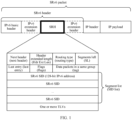
- FIG. 1 is a schematic diagram of a format of an SRv6 packet.
- the SR header in the SR packet is an SR-MPLS header.
- FIG. 2 is a schematic diagram of a format of an SR-MPLS packet. For a specific format of the SR-MPLS header, refer to FIG. 2 .
- the IP packet is sometimes referred to as a data packet, a service packet, or an original packet.
- the IP payload includes service data.
- the IP packet includes but is not limited to an IPv4 packet or an IPv6 packet.
- the IP header is specifically an IPv4 header.
- FIG. 3 is a schematic diagram of a format of an IPv4 header. For a specific format of the IPv4 header, refer to FIG. 3 .
- the IP header is specifically an IPv6 header.
- the IPv6 header includes at least an IPv6 basic header, and optionally, further includes an IPv6 extension header.
- FIG. 4 is a schematic diagram of a format of an IPv6 header. For a specific format of the IPv6 header, refer to FIG. 4 .
- Segment routing header (segment routing header, SRH)
- the SRH is an IPv6 extension header, specifically, an IPv6 routing header (IPv6 routing header) whose routing type (routing type) is 4.
- the SRH is defined by IETF 6man WG.
- the SRH includes a SID list (SID list), which is used to specify a forwarding path of an IPv6 packet.
- SID list SID list
- the SRH RRC8754
- an SRv6 tunnel packet may not include the SRH.
- the SRH includes a next header (next header) field, a header extended length (header extended length, Hdr Ext Len) field, a routing type (routing type) field, a segments left (segments left, SL) field, a last entry (last entry) field, a flags (flags) field, a tag field, a segment list (SID list), and the like.
- a next header a header extended length
- Hdr Ext Len header extended length
- routing type routing type
- segments left segment left
- SL last entry
- last entry last entry
- flags flags
- tag field a tag field
- SID list segment list
- the next header field identifies a type of a next packet header of the SRH.
- the Hdr Ext Len field indicates a length of the SRH.
- the routing type field indicates a type of a routing header. For the SRH, a value of the routing type field is 4.
- the SL indicates a quantity of transit nodes that still need to be accessed before a destination node is reached.
- the SL field functions as a pointer that points to an active SID in the segment list. For example, if the segment list of the SRH includes five SIDs: a SID 0, a SID 1, a SID 2, a SID 3, and a SID 4, and a value of the SL is 2, it indicates that the active SID in the segment list is the SID 2.
- the last entry indicates an index of the last element in the SID list.
- the tag field identifies data packets in a same group.
- the segment list includes one or more SRv6 SIDs. Each SRv6 SID is in a form of an IPv6 address. Therefore, the segment list is equivalent to an explicit IPv6 address stack.
- the segment list in the SRv6 is similar to an MPLS label stack in the SR-MPLS.
- the IHL is a field in the IPv4 header.
- a length of the IHL field is 4 bits.
- the IHL field is used to describe a length of the IP header.
- the total length field is a field in the IPv4 header.
- a length of the total length field is 16 bits.
- the total length field is used to describe a total length of the IP packet (including the IP header length and an IP payload length).
- the IPv4 option is a part of the IPv4 header. According to RFC791, a total length of the IPv4 option is 40 bytes (byte, B) (limited by the length of the IHL).
- the IPv4 option includes two forms: a single-byte option and an option in a form of a type length value (a type length value, TLV).
- the option in the form of the TLV includes a 1-byte option type field, a 1-byte option length field, and an option data field (also referred to as a value field) whose length is changeable.
- the option type field includes a 1-bit copy flag (copy flag), a 2-bit option class (class), and a 5-bit option number (number).
- the option class is used to describe a function of an option. If a value of the option class is 0, the option is used for control (control). If a value of the option class is 2, the option is used for debugging and measurement (debugging and measurement). Other values of the option class are reserved.
- a method of using the IP protocol for experimental purposes is defined in RFC3692.
- an experimental parameter value is allocated to a related field of the internet protocol version 4 (internet protocol version 4, IPv4), the internet control message protocol for the IPv4 (internet control message protocol for the IPv4, ICMPv4), the IPv6, the internet control message protocol for the IPv6 (internet control message protocol for the IPv6, ICMPv6), the transmission control protocol (transmission control protocol, TCP), or the user datagram protocol (user datagram protocol, UDP).
- IPv4 internet protocol version 4, IPv4
- IPv6 internet control message protocol for the IPv4
- IPv6 internet control message protocol for the IPv6
- TCP transmission control protocol
- UDP user datagram protocol
- option types 30/94/158/222 are reserved as experimental values.
- the standard allows flexible extension to be performed based on these option types.
- Segment ID Segment ID, SID
- the SID is a core element of the SR.
- a segment is defined as the following semantics:
- a segment can represent any instruction, topological or service based.
- a SID can indicate any topology, instruction, or service.
- the SID uniquely identifies a segment.
- a SID in the SR-MPLS has a form of an MPLS label, and is usually also referred to as an SR-MPLS SID.
- a SID in the SRv6 is in a form of an IPv6 address and is usually also referred to as an SRv6 SID (segment identifier).
- the SRv6 SID has a form of an IPv6 address.
- a length of the SRv6 SID is 128 bits.
- the SRv6 SID mainly includes two parts: locator (locator) and function (function).
- locator occupies a high bit of the SRv6 SID, and the function occupies a remaining part of the SRv6 SID.
- the SRv6 SID further includes a parameter (arguments).
- the locator is used to locate a node that advertises the SRv6 SID.
- One locator represents one IPv6 network segment, and an IPv6 address on the segment can be allocated as an SRv6 SID.
- the function represents instructions of a device, and the instructions are preset on the device.
- the function part indicates the node that advertises the SRv6 SID to perform a corresponding function operation.
- Types of the SRv6 SID include an End SID (Endpoint SID, endpoint SID) that identifies a node, an End.X SID (layer 3 cross-connect Endpoint SID) that identifies a layer 3 link, and the like.
- the types of the SRv6 SID include a SID type that identifies a proxy (proxy) behavior of editing an SR packet into a packet in a specific format.
- an SRv6 SID of this type is referred to as End.P4 (P indicates proxy, and 4 indicates IPv4 VAS).
- the SR-MPLS SID has a form of an MPLS label.
- a length of the SR-MPLS SID is 20 bits.
- Types of the SR-MPLS SID include a prefix segment (prefix segment) that identifies a prefix of a destination address, an adjacency segment (adjacency segment) that identifies an adjacency, a node segment (node segment) that identifies a node, and the like.
- the types of the SR-MPLS SID include a SID type that identifies that an SR packet is edited into a packet in a specific format.
- the SF that does not support the SR is an SF that cannot identify an SR encapsulation format.
- the SF that does not support the SR includes an SF that does not support the SR-MPLS and an SF that does not support the SRv6.
- the SF that does not support the SR usually discards the SR packet because the SF cannot identify the SR encapsulation format. This leads to a failure in service processing. Therefore, an SF proxy needs to be configured for the SF that does not support the SR to implement a service function chain.
- the local SID table is a table maintained by an SRv6-enabled node.
- the local SID table is used to store an SRv6 SID generated by a local node and information associated with the SRv6 SID.
- the local SID table includes an SRv6 SID, a SID type, and an outbound interface bound to a SID.
- Service function chain service function chain, SFC
- the SFC is a technology that provides an ordered service for an application layer.
- the SFC is configured to logically connect services on a network device to form an ordered service set.
- the SFC adds service function chain path information to an original packet to enable a packet to pass through service functions (service functions, SFs) in sequence along a specified path.
- service functions service functions, SFs
- Service function forwarder service function forwarder
- the SFF is configured to forward, based on information encapsulated in the SR header, a packet received from a network to several SFs associated with the SFF.
- the SF processes the packet and returns the packet to the SFF.
- the SFF finally determines whether to send the packet back to the network.
- the SF is configured to provide a service processing service.
- the SF includes but is not limited to a firewall (firewall, FW), a load balancer (load balancer, LB), an intrusion prevention system (intrusion prevention system, IPS), an application accelerator, network address translation (network address translation, NAT), a web application firewall (Web application firewall, WAF, also referred to as a website application-level intrusion prevention system), bandwidth control, virus detection, cloud storage, deep packet inspection (deep packet inspection, DPI), intrusion detection, hyper text transfer protocol (hyper text transfer protocol, HTTP) header enrichment (HTTP header enrichment), and the like.
- a firewall firewall
- FW load balancer
- intrusion prevention system intrusion prevention system
- IPS intrusion prevention system
- IPS intrusion prevention system
- IPS application accelerator
- network address translation network address translation
- NAT web application firewall
- WAF web application firewall
- bandwidth control virus detection
- cloud storage deep packet inspection
- DPI deep packet inspection
- intrusion detection hyper text transfer protocol (
- the SFs are classified into an SR-aware SF (SR-aware SF) and an SR-unaware SF (SR-unaware SF).
- SR-aware SF SR-aware SF
- SR-unaware SF SR-unaware SF
- the SR-aware SF can identify and process a received SR packet.
- a SID of the SF is orchestrated into a service function chain path to implement the service function chain.
- the SR-unaware SF does not identify the SR packet and discards a received SR packet.
- an SF proxy needs to be configured, to implement the service function chain.
- the SF proxy is configured to process an SR encapsulation in place of the SF.
- the SFF acts as the SF proxy.
- FIG. 5 shows a general architecture of an SR proxy. As shown in FIG. 5 , when receiving an SR packet from an upstream node, if the SR proxy finds that an SF does not support SR, the SR proxy converts the SR packet into a non-SR packet. Then, the SR proxy sends the non-SR packet to the SF through an outbound interface connected to the SF.
- the SF After performing service processing on the received non-SR packet, the SF returns a non-SR packet obtained through the service processing to the SR proxy.
- the SR proxy converts the non-SR packet into an SR packet and forwards the SR packet to a downstream node.
- An SRv6 SFC proxy includes four proxy modes, among which a static proxy (static proxy) and a dynamic proxy (dynamic proxy) are most commonly used.
- a static proxy solution is characterized by stripping and discarding an SRv6 header. Specifically, when receiving an SRv6 packet, if an SFF uses a static proxy mode, the SFF strips an SRH from the SRv6 packet, discards the stripped SRH, and forwards a packet that does not include the SRH to the SF. After receiving the packet returned by the SF, the SFF generates an SRv6 header based on a statically configured parameter and encapsulates the generated SRv6 header in the packet returned by the SF to restore an encapsulation format of the SRv6 packet. Then, the SFF continues to forward an encapsulated SRv6 packet.
- a dynamic proxy solution is characterized by stripping and caching an SRv6 header. Specifically, when receiving an SRv6 packet, if an SFF uses a dynamic proxy mode, the SFF strips an SRH from the SRv6 packet, generates a dynamic entry for storing the SRH, and caches the generated dynamic entry. The SFF forwards a packet that does not include the SRH to the SF. After receiving the packet returned by the SF, the SFF accesses a cache, queries the dynamic entry in the cache, obtains the stripped SRH from the dynamic entry, encapsulates the SRv6 header in the packet returned by the SF, and forwards an encapsulated SRv6 packet.
- the static proxy solution cannot be used as a universal solution.
- the static proxy mode the following items are not supported: a dynamically allocated SRv6 virtual private network (virtual private network, VPN) SID, internet protocol data flow-based channel associated OAM performance measurement (in-situ Flow information Telemetry, iFit), application-aware networking for IPv6 (application-aware networking for IPv6, APN6), and network slicing (network slicing). Therefore, the static proxy mode applies only to a simple and statically configured SRv6 network. In addition, the static proxy solution causes complex configuration.
- an IPv6 basic header and the SRH both need to be generated by the SFF based on configured parameters.
- many parameters such as a hop limit, a source address, and a destination address
- many parameters such as a SID list
- the dynamic proxy solution can support an SRv6 dynamic service
- a forwarding plane has a status.
- a large quantity of caches need to be occupied to store the SRH. This leads to high implementation complexity and huge resource overheads.
- Performance (a capacity, a rate, convergence, and the like) is under great pressure. As a result, forwarding performance deteriorates and large-scale deployment is not supported.
- an expected SRv6 SFC proxy behavior should meet the following requirements of two aspects.
- the SRv6 SFC proxy behavior needs to support the SRv6 dynamic service.
- the dynamic information (non-SRv6 SFC-related information) carried in the SRv6 header should not be lost in an SFF (proxy) -->SF-->SFF (proxy) forwarding procedure of an SRv6 packet.
- a data plane of the SFF should be stateless (stateless).
- generation and maintenance performed by the data plane on the dynamic entry for caching the SRv6 header needs to be avoided as much as possible.
- IPv4 SF namely, an SF that does not support IPv6, which is usually an inventory device on a live network
- the SFF that acts as the SF proxy after receiving an SR packet, the SFF that acts as the SF proxy re-encapsulates the SR packet into a packet in a specified format, and then forwards the packet to the SF.
- a main characteristic of the packet encapsulation format provided in this embodiment is that a packet carries an SR header, an IP header is encapsulated in an outer layer, and the SR header is encapsulated in an inner layer.
- a packet of this type further carries an option inserted by the SFF.
- components in a packet of this type are sequentially: an optional tunnel header, an IPv4 header, an optional IPv4 option (which is a part of the IPv4 header), an IPv4 payload, and an SR header.
- the SF can ignore the SR header during service processing, so that the SR header is transparent to the SF, and a basic requirement of a proxy function is met.
- the SFF does not discard an SR header in a packet when forwarding the packet to the SF, and when the SFF and the SF exchange the packet, the packet exchanged between the SFF and the SF always carries the SR header, the dynamic information included in the SR header is not lost. Therefore, dynamic services of SR-MPLS and SRv6 can be supported, which meets the requirement of the first aspect.
- a head node when a packet enters the service function chain, a head node encapsulates an SR header including a slice identifier (slice ID) of a network slice in the packet, so that each SFF in the service function chain forwards the packet by using a resource corresponding to the network slice. If the SFF discards the SR header when forwarding the packet to the SF, the slice identifier carried in the SR header is lost. As a result, a network slicing service is not supported. However, according to the method provided in this embodiment, because the packet forwarded by the SFF to the SF still includes the SR header, the slice identifier carried in the SR header is not lost. Therefore, the network slicing service can be better supported.
- slice ID slice identifier
- the SF can restore an SR encapsulation by using the SR header in the packet without depending on the dynamic entry for storing the SRH, and a limitation that the dynamic entry for caching the SRH needs to be generated and maintained is eliminated. Therefore, a series of technical problems such as huge resource overheads, performance deterioration, and a limited service scale caused by generation and maintenance of the dynamic entry are resolved, which helps implement a stateless service function chain. For example, a management plane, a control plane, and a data plane are all stateless.
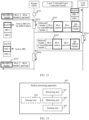
- FIG. 6 is a schematic diagram of a typical scenario of an SFC according to an embodiment of this application.
- FIG. 6 includes a service classifier (service classifier, SC) 101, an SFF 111, an SF 112, an SFF 121, an SF 122, and an egress node 131.
- Devices included in FIG. 6 can form an SFC domain.
- the following describes network deployment locations, typical product forms, locations, functions, connection relationships, and the like of devices in FIG. 6 by using an example with reference to (1) to (5).
- the SC 101 is deployed at a boundary entry of the SFC domain.
- the SC 101 is configured to receive a service packet from user equipment, classify the service packet by matching a quintuple or in another manner, and redirect a classified service packet to the SFC domain.
- a typical product form of the SC 101 is a network device, such as a router or a switch.
- the SC 101 optionally serves as a head node of an SR tunnel.
- the SC 101 is configured to encapsulate the service packet into an SR packet, to direct the service packet to the devices in the service function chain by using a segment routing header in the SR packet.
- the SFF 111 is configured to forward a received packet to the SF 112, receive a processed packet returned by the SF 112, and forward the packet processed by the SF 112.
- a typical product form of the SFF 111 is a network device, such as a router or a switch.
- the SFF 111 is further configured to serve as a proxy of the SF 112. Specifically, the SFF 111 is configured to encapsulate a received SR packet into a packet in a format supported by the SF 112, and forward the encapsulated packet to the SF 112. When receiving the packet returned by the SF 112, the SFF 111 is further configured to re-encapsulate a packet returned by the SF 112 into an SR packet, to restore an encapsulation format of the SR packet.
- the SF 112 has accessed the SFF 111.
- the SF 112 is configured to perform service processing on the packet sent by the SFF 111, and send a processed packet to the SF 112.
- a typical product form of the SF 112 includes but is not limited to a server, a host, a personal computer, a firewall, an intrusion detection system, an intrusion prevention system, or the like.
- the SFF 111 and the SF 112 are connected to each other through a wired network or a wireless network.
- the SFF 111 and the SF 112 transmit packets to each other through a network.
- a specific network connection mode between the SFF 111 and the SF 112 includes a plurality of cases. The following provides descriptions by using an example with reference to three network connection modes.
- Connection mode 1 The SFF 111 and the SF 112 are connected to each other through a layer 2 network.
- an L2 interface on the SFF 111 is connected to an L2 interface on the SF 112.
- one or more L2 devices exist between the SFF and the SF.
- a packet exchanged between the SFF 111 and the SF 112 is carried in an Ethernet frame.
- the SFF 111 sends a packet to the SF 112
- the SFF 111 generates an Ethernet header, and encapsulates the Ethernet header in the packet to obtain the Ethernet frame.
- the SFF 111 sends the Ethernet frame through a layer 2 interface.
- the Ethernet frame is forwarded to the layer 2 interface of the SF 112 through the layer 2 network by using layer 2 information such as a media access control (media access control, MAC) address carried in the Ethernet header.
- the SF 112 obtains the packet from the Ethernet frame.
- a procedure of sending the processed packet to the SFF 111 by the SF 112 is similar.
- Connection mode 2 The SFF 111 and the SF 112 are connected to each other through an IP network.
- a packet exchanged between the SFF 111 and the SF 112 is an IP packet.
- the SFF 111 After encapsulating an SRv6 packet into an IPv4 packet, the SFF 111 forwards the IPv4 packet to the SF 112 through an IPv4 network.
- Connection mode 3 The SFF 111 and the SF 112 are connected to each other through a tunnel (tunnel).
- Types of the tunnel between the SFF 111 and the SF 112 include but are not limited to a virtual extensible local area network (virtual extensible local area network, VXLAN) tunnel, a generic routing encapsulation (generic routing encapsulation, GRE) tunnel, a VXLAN generic protocol encapsulation (VXLAN generic protocol encapsulation, VXLAN-GPE) tunnel, a generic network virtualization encapsulation (generic network virtualization encapsulation, GENEVE) tunnel, a mobile IP data encapsulation tunnel (IP-in-IP), and the like.
- VXLAN virtual extensible local area network
- GRE virtual routing encapsulation
- VXLAN generic protocol encapsulation VXLAN generic protocol encapsulation
- GENEVE generic network virtualization encapsulation
- IP-in-IP mobile IP data encapsulation tunnel
- a packet exchanged between the SFF 111 and the SF 112 includes an IP packet and a tunnel header.
- the tunnel header is first, and then the IP packet.
- the packet exchanged between the SFF 111 and the SF 112 further includes an optional tunnel header.
- the tunnel header indicates a tunnel between the SFF 111 and the SF 112.
- the tunnel header is configured to transmit the IPv4 packet between the SFF 111 and the SF 112.
- the tunnel header includes but is not limited to a VXLAN tunnel header, a GRE tunnel header, an IP-in-IP tunnel header, or the like.
- a source address in the tunnel header includes an IP address of the SFF 111
- a destination address in the tunnel header includes an IP address of the SF 112.
- a source address in the tunnel header includes the IP address of the SF 112
- a destination address in the tunnel header includes the IP address of the SFF 111.
- the SFF 121 is similar to the SFF 111, and the SF 122 is similar to the SF 112. For details, refer to descriptions of the SFF 111 and the SF 112.
- the egress node 131 is deployed at a boundary exit of the SFC domain.
- the egress node 131 is configured to forward, from the SFC domain, the service packets processed by the SF 112 and the SF 122.
- a typical product form of the egress node 131 is a network device, such as a router or a switch.
- the egress node 131 optionally serves as a tail node of the SR tunnel.
- the SC 101 is configured to decapsulate the SR packet to obtain the service packet.
- FIG. 6 an example in which two SFFs and two SFs are deployed is used for description. More or fewer SFFs or SFs are optionally deployed in one SFC domain. For example, only one SFF or SF is deployed in one SFC domain. For another example, dozens of, hundreds of, or more SFFs or SFs are deployed in one SFC domain. The quantity of SFFs or SFs is not limited in this embodiment.
- FIG. 6 an example in which one SF accesses one SFF (namely, single-homing access) is used for description.
- one SF accesses two or more SFFs (namely, multi-homing access).
- a quantity of SFFs accessed by the SF is not limited in this embodiment.
- the foregoing describes an overall architecture of the SFC with reference to FIG. 6 .
- the following describes a basic procedure in which the architecture shown in FIG. 6 is used in a case in which an SFF accesses an IPv4 SF in an SRv6 scenario.
- the SC 101 After receiving the IPv4 packet sent by user equipment 1, the SC 101 generates an SRv6 header including an IPv6 basic header and an SRH, and encapsulates the SRv6 header in an outer layer of the received IPv4 packet, to obtain an SRv6 packet.
- the SC 101 forwards the obtained SRv6 packet to the SFF 111.
- An outer layer of the SRv6 packet is the SRv6 header and an inner layer is the IPv4 packet.
- a segment list of the SRH in the SRv6 header includes an SRv6 SID of the SFF 111, an SRv6 SID of the SFF 121, and a SID of the egress node 131.
- the SFF 111 After receiving the SRv6 packet sent by the SC 101, the SFF 111 encapsulates a format of the SRv6 packet into a format of an IPv4 packet (in other words, an IPv4 header is encapsulated in the outer layer of the SRv6 header), and forwards an encapsulated IPv4 packet to the SF 112.
- the SF 112 After receiving the IPv4 packet sent by the SFF 111, the SF 112 performs service processing based on an IPv4 payload in the IPv4 packet, and returns an IPv4 packet obtained through service processing to the SFF 111.
- the SFF 111 After receiving the processed IPv4 packet returned by the SF 112, the SFF 111 re-encapsulates the IPv4 packet into an SRv6 packet (in other words, the SRv6 header is encapsulated in an outer layer of the IPv4 header), and forwards the SRv6 packet to the SFF 121 based on the SRv6 header.
- the SFF 121 and the SF 122 perform steps similar to the steps performed by the SFF 111 and the SF 112.
- the egress node 131 After receiving the SRv6 packet sent by the SFF 121, the egress node 131 strips the SRv6 header from the SRv6 packet to obtain the IPv4 packet. The egress node 131 forwards the IPv4 packet from the SFC domain, and finally the packet arrives at user equipment 2.
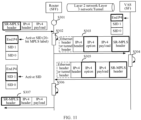
- FIG. 7 is a flowchart of a packet processing method according to an embodiment of this application.
- the method shown in FIG. 7 includes the following step S201 to step S209.
- the method shown in FIG. 7 relates to a procedure in which a packet is forwarded from an SFF to an SF and a procedure in which a packet is returned from the SF to the SFF. After a packet passes through the SFF or the SF, content of the packet may change or remain unchanged.
- first packet “second packet”, “third packet”, and “fourth packet” are used to describe packets at different stages in a forwarding procedure.
- the SFF in the method shown in FIG. 7 is the SFF 111 in FIG. 6
- the SF in the method shown in FIG. 7 is the SF 112 in FIG. 6
- the first packet is the packet sent by the SC 101 to the SFF 111 in FIG. 6
- the second packet is the packet sent by the SFF 111 to the SF 112 in FIG. 6
- the third packet is the packet sent by the SF 112 to the SFF 111 in FIG. 6
- the fourth packet is the packet sent by the SFF 111 to the SFF 121 in FIG. 6 .
- the method shown in FIG. 7 has four typical application scenarios: accessing an IPv4 SF by an SFF in an SRv6 SFC proxy scenario, accessing an IPv6 SF by an SFF in the SRv6 SFC proxy scenario, accessing an IPv4 SF by an SFF in an SR-MPLS SFC proxy scenario, and accessing an IPv6 SF by an SFF in the SR-MPLS SFC proxy scenario.
- an outer SR header in a packet is an SRv6 header and an inner IP packet in the packet is an IPv4 packet.
- an outer SR header in a packet is an SRv6 header and an inner IP packet in the packet is an IPv6 packet.
- an outer SR header in a packet is an SR-MPLS header and an inner IP packet in the packet is an IPv4 packet.
- an outer SR header in a packet is an SR-MPLS header and an inner IP packet in the packet is an IPv6 packet.
- Step S201 An SFF receives a first packet.
- the first packet is an SR packet.
- the first packet has a format in which an SR header is encapsulated in an outer layer of an IP header and an IP payload.
- the first packet includes a first segment routing header, a first IP header, and a first IP payload, and the first segment routing header is encapsulated in an outer layer of the first IP header and the first IP payload.
- the first IP header and the first IP payload in the first packet are generated by the user equipment 1 in FIG. 6
- the first SR header is generated and encapsulated in the outer layer of the first IP header and the first IP payload by the SC 101.
- a source address in the first IP header includes the address of the user equipment 1 in FIG. 6
- a destination address in the first IP header includes the address of the user equipment 2 in FIG. 6
- the first IP payload includes the service data to be transmitted by the user equipment 1 to the user equipment 2 in FIG. 6
- the first SR header includes path information.
- the path information indicates a forwarding path of the service data in the IP payload in the service function chain domain in FIG. 6 .
- the path information is indicated by a SID on the SFF 111 or a SID on the SFF 121.
- an upper-layer service requires that the service data should be first processed by an SF 112 and then processed by an SF 122.
- a first SR header encapsulated by an SC 101 includes a SID allocated by an SFF 111 to a proxy function of the SF 112, a SID allocated by an SFF 121 to a proxy function of the SF 122, and a SID of an egress node 131, to indicate the SFF 111 and the SFF 121 to sequentially forward a packet to the SF 112 and the SF 122.
- the SR header is an SRv6 header
- an inner packet is an IPv4 packet.
- the first segment routing header is the SRv6 header
- the first IP header is an IPv4 header
- the first IP payload is an IPv4 payload.
- the SR header is an SRv6 header
- an inner packet is an IPv6 packet.
- the first segment routing header is the SRv6 header
- the first IP header is an IPv6 header
- the first IP payload is an IPv6 payload
- the first packet for example, has the encapsulation format shown in FIG. 1 .
- the SR header is an SR-MPLS header
- an inner packet is an IPv4 packet.
- the first segment routing header is the SR-MPLS header
- the first IP header is an IPv4 header
- the first IP payload is an IPv4 payload.
- the SR header is an SR-MPLS header
- an inner packet is an IPv6 packet.
- the first segment routing header is the SR-MPLS header
- the first IP header is an IPv6 header
- the first IP payload is an IPv6 payload.
- the first packet for example, has the encapsulation format shown in FIG. 2 .
- Step S202 The SFF obtains a second packet based on the first packet.
- Step S203 The SFF sends the second packet to an SF.
- the SFF When forwarding a packet to the SF, the SFF modifies an encapsulation format of the packet. For example, an SR header in the second packet and the SR header in the first packet are carried in different locations. The SR header in the first packet is encapsulated in the outer layer of the IP header, and the SR header in the second packet is encapsulated in an inner layer of the IP header.
- the second packet includes a second IP header, a first IP payload, and the first segment routing header, and the second IP header is encapsulated in an outer layer of the first IP payload and the first segment routing header.
- the second packet belongs to a case 1 in step S203.
- the second packet belongs to a case 2 in step S203.
- the first packet belongs to the case 3 in step S201
- the second packet belongs to a case 3 in step S203.
- the first packet belongs to the case 4 in step S201, the second packet belongs to a case 4 in step S203.
- the SR header is an SRv6 header
- an inner packet is an IPv4 packet.
- the first segment routing header is the SRv6 header
- the second IP header is an IPv4 header
- the first IP payload is an IPv4 payload.
- the SR header is an SRv6 header
- an inner packet is an IPv6 packet.
- the first segment routing header is the SRv6 header
- the second IP header is an IPv6 header
- the first IP payload is an IPv6 payload
- the SR header is an SR-MPLS header
- an inner packet is an IPv4 packet.
- the first segment routing header is the SR-MPLS header
- the second IP header is an IPv4 header
- the first IP payload is an IPv4 payload.
- the SR header is an SR-MPLS header
- an inner packet is an IPv6 packet.
- the first segment routing header is the SR-MPLS header
- the second IP header is an IPv6 header
- the first IP payload is an IPv6 payload.
- the SFF modifies content of one or more fields in the IP header.
- content of one or more fields in the second IP header is different from that in the first IP header.
- the following describes the fields that may have different content in the second IP header and the first IP header by using an example with reference to the following (a) to (d).
- content of the field indicating the IP payload length in the second IP header is different from that in the first IP header.
- the SFF modifies a field indicating an IP payload length in a received packet.
- a length carried in the field indicating the IP payload length in the second IP header includes a length of the SR header, and a length carried in the field indicating the IP payload length in the first IP header does not include the length of the SR header.
- a difference between the length carried in the field indicating the IP payload length in the second IP header and the length carried in the field indicating the IP payload length in the first IP header is a length of the first SR header.
- a field indicating an IP payload length in the IP header is a total length (total length) field.
- the field indicating the IP payload length in the IP header is a payload length (payload length) field.
- the SFF when the SFF adds a field (for example, a newly added option) to the first IP header in the first packet, content of the field indicating the IP header length in the second IP header is different from that in the first IP header.
- the SFF modifies a field indicating an IP header length in a received packet.
- a length carried in the field indicating the IP header length in the second IP header includes a length of the field added by the SFF.
- a difference between the length carried in the field indicating the IP header length in the second IP header and the length carried in the field indicating the IP header length in the first IP header is the length of the field added by the SFF.
- the field indicating the IP header length in the IP header is an IP header length (IHL).
- content of the field indicating the IP header length in the second IP header is the same as that in the first IP header.
- the SFF when the SFF adds a field (for example, a newly added option) to the first IP header in the first packet, content of the field used to check the IP header in the second IP header is different from that in the first IP header.
- the SFF modifies a field used to check an IP header in a received packet.
- content of the field used to check the IP header in the second IP header is calculated based on the second IP header.
- Content of the field used to check the IP header in the first IP header is calculated based on the first IP header.
- the field used to check the IP header in the IP header is a header checksum (header checksum) field.
- content of the field used to check the IP header in the second IP header is the same as that in the first IP header.
- content of the field indicating the packet lifetime in the second IP header is different from that in the first IP header.
- the SFF modifies a field indicating a packet lifetime in a received packet.
- content of the field indicating the packet lifetime in the second IP header is the same as that in the first IP header. Whether the SFF modifies the field indicating the packet lifetime in the received packet is optionally determined based on a forwarding policy of the SFF.
- the field indicating the packet lifetime in the IP header is a time to live (time to live, TTL) field.
- the field indicating the packet lifetime in the IP header is a hop limit (hop limit) field.
- the SFF modifies at least one of (a) to (d) in the IP header, and keeps content of each field in the IP header except (a) to (d) unchanged.
- the SFF keeps content of each field in the IP header unchanged.
- Step S204 The SF receives the second packet from the SFF.
- Step S205 The SF performs service processing based on the second packet.
- the SF performs service processing based on the second IP header and the first IP payload in the second packet, and ignores the first SR header in the second packet.
- the SF further returns a packet obtained through service processing to the SFF, and the SFF further restores an encapsulation format of the packet returned by the SF to a format of an SR packet, and then continues to forward the packet.
- the method shown in FIG. 7 optionally further includes the following step S206 to step S209.
- Step S206 The SF sends a third packet obtained through the service processing to the SFF.
- the SFF when returning a packet, keeps an encapsulation format of the packet unchanged.
- the SR header in the third packet and the SR header in the second packet are carried in a same location.
- the SR header in the third packet is encapsulated in the inner layer of the IP header.
- the third packet includes a third IP header, a second IP payload, and the first segment routing header, and the third IP header is encapsulated in an outer layer of the second IP payload and the first segment routing header.
- the SR header is an SRv6 header
- an inner packet is an IPv4 packet.
- the first segment routing header is the SRv6 header
- the third IP header is an IPv4 header
- the second IP payload is an IPv4 payload.
- the SR header is an SRv6 header
- an inner packet is an IPv6 packet.
- the first segment routing header is the SRv6 header
- the third IP header is an IPv6 header
- the second IP payload is an IPv6 payload
- the SR header is an SR-MPLS header
- an inner packet is an IPv4 packet.
- the first segment routing header is the SR-MPLS header
- the third IP header is an IPv4 header
- the second IP payload is an IPv4 payload.
- the SR header is an SR-MPLS header
- an inner packet is an IPv6 packet.
- the first segment routing header is the SR-MPLS header
- the third IP header is an IPv6 header
- the second IP payload is an IPv6 payload.
- the SF modifies content of the IP header.
- content of one or more fields in the third IP header is different from that in the second IP header.
- the SF does not modify content of the IP header.
- content of each field in the third IP header is the same as that in the second IP header.
- the SF modifies content of the IP payload.
- content of one or more fields in the second IP payload is different from that in the first IP payload.
- the SF does not modify content of the IP payload.
- content of each field in the second IP header is the same as that in the first IP header.
- the SF modifies the content of the IP payload or the IP header, and content of which fields in the IP payload or the IP header are specifically modified by the SF are determined, for example, based on a service that the SF is responsible for.
- the service that the SF is responsible for is specifically destination address translation (destination network address translation, DNAT).
- the SF After the SF receives the packet sent by the SFF, the SF replaces a destination address in the IP header, and replaces a destination port number in a TCP header or a UDP header in the IP payload. In this way, content of a destination address field in the IP header and content of a destination port number field in the IP payload are changed.
- Content of a destination address field in the third IP header is an address obtained through replacement by the SF
- content of the destination port number field in the second IP payload is a port number obtained through replacement by the SF.
- the service that the SF is responsible for is traffic filtering. After receiving the packet sent by the SFF, the SF matches a quintuple in the packet with a preset filter criteria. If the quintuple matches the filter criteria, the SF allows the packet to pass through and returns a packet to the SFF without modifying content of the IP payload and content the IP header.
- Step S207 The SFF receives the third packet from the SF.
- Step S208 The SFF obtains a fourth packet based on the third packet.
- Step S209 The SFF sends the fourth packet based on the first segment routing header.
- a location at which an SR header is carried in the fourth packet is different from a location at which an SR header is carried in the third packet, and is the same as a location at which an SR header is carried in the first packet.
- the SR header in the fourth packet is encapsulated in the outer layer of the IP header. It can be learned that, the SFF restores an encapsulation format of the packet (the third packet) returned by the SFF to an encapsulation format of the originally received SR packet (the first packet).
- the fourth packet includes the first segment routing header, a fourth IP header, and a third IP payload. The first segment routing header is encapsulated in an outer layer of the fourth IP header and the third IP payload.
- a receiving end of the fourth packet includes a plurality of cases.
- the SFF sends the fourth packet to a next SFF in the service function chain.
- the SFF is the SFF 111 in FIG. 6
- the SFF 111 sends the fourth packet to the SF 112.
- the SFF sends the fourth packet to an egress node in the service function chain.
- the SFF is the SF 112 in FIG. 6
- the SF 112 sends the fourth packet to the egress node 131.
- the fourth packet There are a plurality of possible cases for a specific format of the fourth packet.
- the following describes the fourth packet by using an example with reference to four cases of case 1 to case 4.
- the second packet belongs to a case 1 in step S209.
- the second packet belongs to a case 2 in step S209.
- the first packet belongs to the case 3 in step S201
- the second packet belongs to a case 3 in step S209.
- the first packet belongs to the case 4 in step S201
- the second packet belongs to a case 4 in step S209.
- the SR header is an SRv6 header
- an inner packet is an IPv4 packet.
- the first segment routing header is the SRv6 header
- the fourth IP header is an IPv4 header
- the third IP payload is an IPv4 payload.
- the SR header is an SRv6 header
- an inner packet is an IPv6 packet.
- the first segment routing header is the SRv6 header
- the fourth IP header is an IPv6 header
- the third IP payload is an IPv6 payload
- the SR header is an SR-MPLS header
- an inner packet is an IPv4 packet.
- the first segment routing header is the SR-MPLS header
- the fourth IP header is an IPv4 header
- the third IP payload is an IPv4 payload.
- the SR header is an SR-MPLS header
- an inner packet is an IPv6 packet.
- the first segment routing header is the SR-MPLS header
- the fourth IP header is an IPv6 header
- the third IP payload is an IPv6 payload.
- step S206 describes, by using step S206 to step S209, how to restore the SR encapsulation format of the packet returned by the SF when the SF returns the packet.
- the SF does not perform the step of returning the packet.
- the SF is a firewall. If the SF detects that the packet sent by the SFF has a security threat, the SF intercepts the packet and does not return a packet to the SFF, to block transmission of attack traffic.
- the SFF when receiving a packet in an SR encapsulation format, modifies the encapsulation format of the packet, encapsulates an IP header in the packet in an outer layer of an SR header, and sends a modified packet to the SF.
- the packet In a process in which the packet is forwarded from the SFF to the SF, the packet still carries the SR header. Therefore, when the packet is subsequently returned from the SF to the SFF, the SFF can restore an original SR encapsulation format by using the SR header carried in the packet.
- the method shown in FIG. 7 is specifically implemented by using a newly defined SID type.
- this embodiment provides a new SID type and associates the SID type with a behavior of moving the SR header behind the payload.
- the SFF detects that a SID in an SR header of the SR packet matches the SID type, the SFF moves the SR header behind the payload to change the encapsulation format of the SR packet.
- the first segment routing header includes a first SID
- the SFF stores a first correspondence
- that the SFF obtains a second packet based on the first packet includes:
- the SFF obtains a SID type based on the first SID and the first correspondence, and performs first processing on the first packet based on the SID type to obtain the second packet.
- the first SID is an SR SID.
- the first SID is, for example, an SRv6 SID or an MPLS label.
- a process in which the SFF obtains the first SID from the first packet includes: The SFF determines an active SID from the first segment routing header to obtain the first SID.
- the active SID refers to a SID that needs to be processed currently in a SID list in a segment routing header.
- the active SID is a SID in a destination address field in an IPv6 basic header.
- the active SID is a topmost label of a label stack in an SR-MPLS header.
- a process of obtaining the first SID from the first segment routing header includes: When the first segment routing header is an SRv6 header, the SFF obtains the first SID from the destination address field in the IPv6 basic header in the first segment routing header. When the first segment routing header is an SR-MPLS header, the SFF obtains the first SID from the topmost label field of the label stack in the first segment routing header.
- the first correspondence includes the first SID and the SID type.
- the first correspondence is an entry in a local SID table of the SFF.
- Table 1 is an example of a SID table.
- the first correspondence is, for example, an entry in which 10:1:: 1:0 is located in the SID table.
- the first SID is, for example, 10:1::1:0
- the SID type corresponding to the first SID is, for example, End.P4.
- the SFF specifically obtains the SID type in a table lookup manner. For example, the SFF queries the SID table based on the first SID; and in response to that the first SID matches the SID type corresponding to the first SID in the SID table, the SFF performs first processing on the first packet based on the SID type corresponding to the first SID, to obtain the second packet.
- the SID type corresponding to the first SID indicates that the segment routing header is not supported.
- the type corresponding to the first SID is, for example, an SR proxy SID.
- the first processing refers to processing performed by the SFF on a packet when the packet is forwarded from the SFF to the SF.
- the first processing includes: setting the first segment routing header behind the first IP payload, and replacing the first IP header with the second IP header.
- the first correspondence further includes at least one of an outbound interface bound to the first SID or an inbound interface bound to the first SID.
- the first SID is, for example, 10: 1:: 1:0
- the inbound interface bound to the first SID is the interface Ethernet 1/0/0.2
- the outbound interface bound to the first SID is the interface Ethernet 1/0/0.1.
- the outbound interface bound to the first SID is configured to send a packet obtained through the first processing to the SF.
- the SFF sends the second packet to the SF through the outbound interface bound to the first SID.
- the inbound interface bound to the first SID is configured to receive the packet that is returned by the SF and that is obtained through the service processing. For example, when performing step S207, the SFF receives the third packet from the SF through the inbound interface bound to the first SID.
- a packet processing behavior of the SFF is compatible with an SR protocol, implementation complexity is low, and configuration is simple.
- the SFF when receiving the packet returned by the SF, the SFF restores the SR packet encapsulation format based on an indication of some information related to the packet.
- the SFF restores the SR packet encapsulation format based on an indication of some information related to the packet.
- the IP header in the packet returned by the SF is the third IP header.
- the SFF performs second processing on the third packet based on the third IP header, to obtain the fourth packet.
- the SFF determines whether the third IP header includes identification information, and if the third IP header includes the identification information, the SFF performs the second processing on the third packet to obtain the fourth packet.
- the second processing refers to a manner in which the SFF processes the packet returned by the SF.
- the second processing is used to restore the SR packet encapsulation format.
- the second processing includes: replacing the third IP header with the fourth IP header, and encapsulating the first segment routing header in the outer layer of the fourth IP header and the third IP payload.
- the identification information identifies a packet encapsulation format provided in this embodiment.
- the identification information identifies that the segment routing header is set behind the IP payload.
- the identification information included in the third IP header identifies that the first segment routing header is set behind the second IP payload.
- identification information in the IP header of the packet returned by the SF is previously added by the SFF to the packet.
- the SFF adds identification information to the packet, to identify that the packet has an encapsulation format in which the segment routing header is set behind the IP payload.
- the SFF sends the packet including the identification information to the SF, and the SF receives the packet including the identification information.
- the SF keeps the identification information in the packet unchanged.
- the SF returns, to the SFF, a packet including the identification information, so that the packet received by the SFF includes the identification information.
- an IP header in the packet sent by the SFF is the second IP header.
- the second IP header also includes identification information, and the identification information in the second IP header identifies that the first segment routing header is set behind the first IP payload.
- the SFF determines, based on whether a returned packet carries the identification information, whether to perform processing of encapsulating an SR packet format.
- a location at which the identification information is carried in a packet includes a plurality of implementations.
- the identification information is carried in an option in the IP header.
- the third IP header and the second IP header both include a first option, and the first option carries the identification information.
- the option that carries the identification information includes but is not limited to an option in an IPv4 header and an option in an IPv6 extension header.
- both the third IP header and the second IP header are IPv4 headers
- both a first option in the third IP header and a first option in the second IP header are IPv4 options in the IPv4 header.
- both the third IP header and the second IP header are IPv6 headers including a hop-by-hop options header, and both a first option in the third IP header and a first option in the second IP header are options in the hop-by-hop options header.
- both the third IP header and the second IP header are IPv6 headers including a destination options header
- both a first option in the third IP header and a first option in the second IP header are options in the destination options header.
- a specific location at which the identification information is carried in an option includes a plurality of cases.
- a new type of option is added, and the identification information is carried in a type field of the option.
- an option type is used as information that identifies the packet encapsulation format in which the segment routing header is set behind the IP payload.
- a type field of the first option carries the identification information.
- the identification information is carried in a value field (also referred to as an option data field) of an existing option.
- a value field of the first option carries the identification information.
- the SFF performs second processing on the third packet based on an interface for receiving the third packet, to obtain the fourth packet.
- the SFF determines whether the interface for receiving the third packet is the inbound interface bound to the first SID, and if the interface for receiving the third packet by the SFF is the inbound interface bound to the first SID, the SFF performs the second processing on the third packet.
- Implementation (3) is equivalent to a combination of Implementation (1) and Implementation (2) in an "and" relationship.
- the SFF performs second processing on the third packet based on an interface for receiving the third packet and the third IP header, to obtain the fourth packet.
- the SFF determines whether the third IP header includes identification information and whether the interface for receiving the third packet is the inbound interface bound to the first SID, and if the third IP header includes the identification information and the interface for receiving the third packet by the SFF is the inbound interface bound to the first SID, the SFF performs the second processing on the third packet.
- the SFF further adds length information to the IP header, so that the SF determines a boundary of the IP payload based on the length information in the IP header.
- the packet sent by the SFF to the SF includes the second IP header, the first IP payload, and the first segment routing header.
- the second IP header further includes second length information, and the second length information indicates a length of the first IP payload, or indicates a sum of lengths of the first IP payload and the second IP header.
- the SFF determines an end location of the first IP payload based on the second length information, to ignore the first SR header behind the first IP payload.
- the IP header in a packet returned by the SF to the SFF includes length information, so that the SFF determines a location of the SR header based on the IP header.
- the packet returned by the SF includes the third IP header, the second IP payload, and the first segment routing header.
- the third IP header further includes first length information, and the first length information is used to determine a location of the first segment routing header in the third packet.
- the first length information indicates a length of the second IP payload, or indicates a sum of lengths of the third IP header and the second IP payload.
- the SFF does not modify the length information in the packet.
- the second length information is the same as the first length information.
- the SFF modifies the length information in the packet.
- the second length information is different from the first length information.
- Whether the SF modifies the length information in the packet is determined, for example, based on a service that the SF is responsible for. For example, when the service of the SF relates to adding some content to or deleting some content from the IP payload of a packet, a length of the IP payload in the packet returned by the SF changes compared with the packet sent by the SFF to the SF. In this way, the SF may indicate the length of the changed IP payload by modifying the length information in the packet sent by the SFF.
- the SF modifies, based on a length of the added content, the length information in the packet sent by the SFF.
- the length information modified by the SF includes the length of the content added by the SF.
- a length indicated by the second length information not only includes a length indicated by the first length information (for example, an original length of the IP payload), but also includes the length of the content added by the SF.
- the length indicated by the second length information is equivalent to a sum of the length indicated by the first length information and the length of the content added by the SF.
- the IP payload becomes shorter.
- the SF modifies, based on a length of the deleted content, the length information in the packet sent by the SFF.
- the length information modified by the SF no longer includes the length of the content deleted by the SF.
- a length indicated by the second length information does not include the length of the content deleted by the SF.
- the length indicated by the second length information is equivalent to a difference between the length indicated by the first length information and the length of the content deleted by the SF.
- the service of the SF is HTTP header enrichment.
- the SF adds user information and device identification information to an HTTP header of the packet sent by the SFF, so that an IP payload part in the packet becomes longer.
- the SF modifies the length information in the packet, so that the modified length information includes the added user information and device identification information.
- a location at which the length information is carried in a packet includes a plurality of implementations.
- the length information is carried in an option in the IP header.
- the third IP header and the second IP header both include a first option, and the first option carries the length information.
- the option that carries the length information includes but is not limited to an option in an IPv4 header and an option in an IPv6 extension header. For details, refer to the descriptions of manner (1-1) to manner (1-3).
- the length information and the identification information are carried in a same option in the IP header.
- the third IP header and the second IP header both include a first option, and the first option carries the identification information and the length information.
- the first option carries the identification information
- the length information For example, a type field of the first option carries the identification information, and a value field following the type field carries the length information.
- the SFF further encapsulates a packet header in the outer layer of the IP header in the packet, so that the packet is forwarded from the SFF to the SF by using an outer packet header of the IP header.
- the SFF encapsulates a packet header in the outer layer of the IP header and which type of packet header specifically is encapsulated depend on a network connection mode between the SFF and the SF.
- the following provides descriptions by using an example with reference to three network connection modes between the SFF and the SF.
- Connection mode 1 The SFF and the SF are connected through a layer 2 network.
- the SFF when sending a packet to the SF, the SFF further encapsulates an Ethernet header in the outer layer of the IP header in the packet.
- the packet sent by the SFF is equivalent to an Ethernet frame.
- An encapsulation format of the packet sent by the SFF is: Ethernet header + IP header + IP payload + SR header.
- the encapsulation format of the packet sent by the SFF is: Ethernet header + IPv4 header (optionally including an IPv4 option) + IP payload + SR header.
- the encapsulation format of the packet sent by the SFF is: Ethernet header + IPv6 basic header + optional IPv6 extension header (optionally including an IPv6 option) + IP payload + SR header.
- the Ethernet header includes one or two VLAN tags (VLAN tags), such as dot1q (802.1q) or QinQ (namely, 802.1Q-in-802.1Q, also referred to as Stacked VLAN or Double VLAN, characterized by including two 802.1Q tags: one public network tag and one private network tag).
- VLAN tags such as dot1q (802.1q) or QinQ (namely, 802.1Q-in-802.1Q, also referred to as Stacked VLAN or Double VLAN, characterized by including two 802.1Q tags: one public network tag and one private network tag).
- the second packet is used as an example.
- the second packet further includes a first Ethernet header, and the first Ethernet header is encapsulated in an outer layer of the second IP header.
- an Ethernet header namely, the first Ethernet header
- the outer layer of the IP header namely, the second IP header
- Connection mode 2 The SFF and the SF are connected through a layer 3 network.
- an IP interface on the SFF is connected to an IP interface on the SF.
- one or more L3 devices exist between the SFF and the SF.
- an outermost packet header in a packet sent by the SFF to the SF may be optionally an IP header.
- Connection mode 3 The SFF and the SF are connected through an explicit tunnel (tunnel).
- the SFF when sending a packet to the SF, the SFF further encapsulates a tunnel header in the outer layer of the IP header in the packet.
- An encapsulation format of the packet sent by the SFF is: tunnel header + IP header + IP payload + SR header.
- the encapsulation format of the packet sent by the SFF is: tunnel header + IPv4 header (optionally including an IPv4 option) + IP payload + SR header.
- the encapsulation format of the packet sent by the SFF is: tunnel header + IPv6 basic header + optional IPv6 extension header (optionally including an IPv6 option) + IP payload + SR header.
- a specific type of the tunnel header is determined, for example, based on a type of a tunnel between the SFF and the SF.
- the tunnel header includes but is not limited to a VXLAN header, a GRE header, a VXLAN-GPE header, a GENEVE header, and the like.
- the second packet is used as an example.
- the second packet further includes a first tunnel header, and the first tunnel header is encapsulated in the outer layer of a second IP header.
- a tunnel header namely, the first tunnel header
- the outer layer of the IP header namely, the second IP header
- the foregoing describes a packet header that may exist in the outer layer of the IP header in the packet from the SFF to the SF.
- the SF optionally first terminates the packet header (for example, an Ethernet header or a tunnel header) in the outer layer of the IP header in the second packet, and then performs service processing.
- the packet header for example, an Ethernet header or a tunnel header
- the SF further encapsulates a packet header in the outer layer of the IP header in the packet, so that the packet is returned from the SF to the SFF by using an outer packet header of the IP header.
- an action that the SF encapsulates the packet header in the outer layer of the IP header in the procedure of returning the packet from the SF to the SFF is symmetric to an action that the SFF encapsulates the packet header in the outer layer of the IP header in the procedure of forwarding the packet from the SFF to the SF.
- the SFF when forwarding a packet, the SFF first encapsulates a tunnel header and then forwards a packet that includes the tunnel header to the SF.
- the SF first encapsulates a tunnel header and then forwards a packet that includes the tunnel header to the SF.
- the following still describes the packet header encapsulated in the outer layer of the IP header by the SF by using an example with reference to the three network connection modes between the SF and the SFF.
- Connection mode 1 The SF and the SFF are connected through a layer 2 network.
- the SF when sending a packet to the SFF, the SF further encapsulates an Ethernet header in the outer layer of the IP header in the packet.
- the packet sent by the SF is equivalent to an Ethernet frame.
- An encapsulation format of the packet sent by the SF is: Ethernet header + IP header + IP payload + SR header.
- the encapsulation format of the packet sent by the SF is: Ethernet header + IPv4 header (optionally including an IPv4 option) + IP payload + SR header.
- the encapsulation format of the packet sent by the SF is: Ethernet header + IPv6 basic header + optional IPv6 extension header (optionally including an IPv6 option) + IP payload + SR header.
- the Ethernet header includes one or two VLAN tags (for example, dot1q or QinQ).
- the third packet is used as an example.
- the third packet further includes a second Ethernet header, and the second Ethernet header is encapsulated in the outer layer of the third IP header.
- Connection mode 2 The SF and the SFF are connected through a layer 3 network.
- an IP interface on the SF is connected to an IP interface on the SFF.
- one or more L3 devices exist between the SF and the SFF.
- an outermost packet header in a packet sent by the SF to the SFF may be optionally an IP header.
- Connection mode 3 The SF and the SFF are connected through an explicit tunnel (tunnel).
- the SF when sending a packet to the SFF, the SF further encapsulates a tunnel header in the outer layer of the IP header in the packet.
- An encapsulation format of the packet sent by the SF is: tunnel header + IP header + IP payload + SR header.
- the encapsulation format of the packet sent by the SF is: tunnel header + IPv4 header (optionally including an IPv4 option) + IP payload + SR header.
- the encapsulation format of the packet sent by the SF is: tunnel header + IPv6 basic header + optional IPv6 extension header (optionally including an IPv6 option) + IP payload + SR header.
- a specific type of the tunnel header is determined, for example, based on a type of a tunnel between the SF and the SFF.
- the tunnel header includes but is not limited to a VXLAN header, a GRE header, a VXLAN-GPE header, a GENEVE header, and the like.
- the third packet is used as an example.
- the third packet further includes a second tunnel header, and the second tunnel header is encapsulated in the outer layer of the third IP header.
- the packet header encapsulated by the SFF in the IP header and the packet header encapsulated by the SF in the IP header content of some fields is the same but content of some fields is different.
- the connection mode 3 is used as an example.
- source address fields and destination address fields have different content, but common fields of a tunnel header such as a protocol type and a protocol version number have same content.
- the source address is the IP address of the SFF
- the destination address is the IP address of the SF.
- the source address is the IP address of the SF and the destination address is the IP address of the SFF.
- the foregoing describes a packet header that may exist in the outer layer of the IP header in the packet from the SF to the SFF.
- the SFF optionally first terminates a packet header (for example, an Ethernet header or a tunnel header) encapsulated in the outer layer of the IP header in the third packet, and then obtains the fourth packet based on a remaining part of the third packet.
- the fourth packet sent by the SFF usually does not include the packet header (for example, an Ethernet header or a tunnel header) encapsulated by the SF in the outer layer of the IP header.
- a value-added service (value-added service, VAS) device in the following four instances is the SF in the method shown in FIG. 7 .
- a router in the following four instances is the SFF in the method shown in FIG. 7 .
- the VAS is a more common term for the SF.
- the VAS is a device such as FW, DPI, and NAT.
- the NAT includes source network address translation (source network address translation, SNAT) and DNAT.
- An instance 1 describes a processing procedure in which an SFF accesses an IPv4 VAS in an SRv6 SFC proxy scenario
- an instance 2 describes a processing procedure in which an SFF accesses an IPv6 VAS in an SRv6 SFC proxy scenario
- an instance 3 describes a processing procedure in which an SFF accesses an IPv4 VAS in an SR-MPLS SFC proxy scenario
- an instance 4 describes a processing procedure in which an SFF accesses an IPv6 VAS in an SR-MPLS SFC proxy scenario.
- the instance 2, the instance 3, and the instance 4 focus on a difference from the instance 1.
- the instance 3, and the instance 4 as the instance 1 refer to the instance 1.
- the instance 1 provides a method for implementing an SRv6 IPv4 service function chain.
- a VAS namely, SF
- an outer layer includes an SRv6 header and an inner layer includes an IPv4 packet.
- End.P4 in the instance 1 is the type corresponding to the first SID in the method shown in FIG. 7 .
- the SRv6 header in the instance 1 is the SR header in the method shown in FIG. 7 .
- the IPv4 header in the instance 1 is the IP header in the method shown in FIG. 7 .
- the IPv4 payload in the instance 1 is the IP payload in the method shown in FIG. 7 .
- the IPv4 option in the instance 1 is the first option in the method shown in FIG. 7 .
- FIG. 9 shows a flowchart of the instance 1.
- the instance 1 includes step S301 to step S307.
- Step S301 Statically configure an End.P4 SID on a router (namely, an SFF having a proxy function).
- End.P4 is a new SRv6 SFC SID type defined in this instance.
- the End.P4 is used to support editing to an IPv4 encapsulation and restoring to an SRv6 encapsulation.
- P4 indicates a proxy for an IPv4 VAS (proxy for IPv4 VAS).
- the following is an example of configuring the End.P4 SID.
- the following configuration example includes three command lines, which can be used to configure one End.P4 SID.
- a length of the End.P4 SID is 128 bits.
- the End.P4 SID includes a 64-bit locator and a 64-bit operation code (operation code, opcode) (namely, a function).
- the locator is A:: 1.
- the opcode is :: 1.
- the first command line also referred to as a segment-routing ipv6 command, indicates to enable SRv6 and enter a segment-routing ipv6 view.
- the second command line is also referred to as a locator command, indicating that a name of the locator is test, a prefix of an IPv6 address is A::1, a length of the prefix of the IPv6 address is 64 bits, and a length of a statically configured SID in the locator is 32 bits.
- the router Indicated by the second command line, the router generates a 64-bit network segment route based on A::1 (where a destination prefix in the route is A::/64) and advertises the network segment route by using a routing protocol. After learning the network segment route, and when receiving a packet whose destination address belongs to a network segment A::/64, another device matches, based on the destination address, a route advertised by the router, and then forwards the packet to the router.
- the third command line is also referred to as an opcode command, which is used to configure an opcode for a static SID.
- the opcode and an ipv6-prefix configured by the locator command constitute the static SID.
- a value range of the opcode configured by the opcode command is determined by a static parameter in the locator command. To be specific, a maximum value of the opcode is determined by a bit length specified by the static parameter.
- the SID type is end.p4, an outbound interface (out-interface) bound to the end.p4 SID type is Ethernet 1/0/0.1, and an inbound interface (in-interface) bound to the end.p4 SID type is Ethernet 1/0/0.2.
- the End.P4 SID is configured and orchestrated based on per-VRF per-SF (per-VRF per-SF) to support virtual routing and forwarding (virtual routing and forwarding, VRF).
- per-VRF per-SF per-VRF per-SF
- VRF virtual routing and forwarding
- Step S302 When receiving an SRv6 packet whose active SID is End.P4, the router performs processing processes provided in the following step S302-1 to step S302-5.
- Step S302 is an upstream processing procedure of End.P4.
- a process in which the router detects that the active SID is End.P4 is as follows: The router matches a destination address in an outer IPv6 basic header of the SRv6 packet with a local SID table (local SID table), and determines that the destination address matches an entry in the local SID table. A SID type in the entry is End.P4.
- Step S302-1 The router checks whether an inner packet in the SRv6 packet is an IPv4 packet. If the inner packet is not the IPv4 packet, the router discards the SRv6 packet.
- Step S302-2 The router checks whether option space of the IPv4 header has at least 4-byte remaining space. If the option space has remaining space less than 4 bytes, the router discards the SRv6 packet.
- Step S302-3 The router checks whether End.P4 is the last SID (where the last SID refers to a SID list [0]). If End.P4 is the last SID, the router discards the SRv6 packet.
- SRH.SL-- refers to decreasing a value of an SL field in the SRH by one.
- SID list [SRH.SL] refers to a SID to which the SL field in the SRH points in the SID list (SID list).
- the SL field in the SRv6 header in the packet received by the router points to End.P4 SID in the SID list.
- the SL field in the SRv6 header of a packet sent out by the router points to a next SID (namely, a SID 1) of the End.P4 SID in the SID list.
- Step S302-5 The router edits the SRv6 packet: SRv6 header + IPv4 header + IPv4 payload IPv4 header ⁇ IPv4 header + IPv4 option + IPv4 payload + SRv6 header.
- the SRv6 header is moved behind the IPv4 payload, and then the IPv4 option is inserted between the IPv4 header and the IPv4 payload.
- IPv4 option For a specific format of the IPv4 option, see the following section.
- the router changes the encapsulation format of the packet, and converts the encapsulation format of the packet from the SRv6 encapsulation format to the IPv4 encapsulation format.
- Step S303 The router sends, based on a configuration parameter of End.P4, an edited IPv4 packet to the VAS through the outbound interface bound to End.P4.
- Step S304 When the VAS receives the IPv4 packet sent by the router, the router identifies, based on the IPv4 option, a specific packet format provided in this embodiment (where the SRv6 header is behind the IPv4 payload). Then, the VAS determines the boundary of the IPv4 payload based on the payload length field in the IPv4 option. Therefore, the VAS can ignore an SRv6 header part and process a remaining part.
- Step S305 After completing service processing, the VAS maintains a format of the processed packet as a format of an IPv4 packet, and returns the processed packet to the router.
- Step S306 When receiving the IPv4 packet returned by the VAS from a specified inbound interface, if it is detected that the IPv4 packet has an IPv4 option and the IPv4 option is an option defined in this embodiment, the router performs a processing procedure provided in the following step S306-1 to step S306-3. Step S306 is a downstream processing procedure of End.P4.
- Step S306-1 The router parses the IPv4 option, determines a location of an SRv6 header based on the payload length in the IPv4 option, and performs SRv6 header validity check. If the SRv6 header is invalid, the router discards the packet; or if the SRv6 header is valid, the router performs the following step S306-2.
- a destination address in the IPv6 basic header is the SID to which the SL field in the SRH points in the SID table.
- Step S306-2 The router strips the IPv4 option from an input IPv4 packet, and restores the encapsulation format in the input IPv4 packet to the format of an SRv6 packet: IPv4 header + IPv4 option + IPv4 payload + SRv6 header4 SRv6 header + IPv4 header + IPv4 payload.
- the SRv6 header includes two types of packet headers: an IPv6 header and an SRH header.
- the IPv6 header includes at least one 40-byte IPv6 basic header, and optionally further includes one or more IPv6 extension headers (where the IPv6 extension header in this sentence does not include an IPv6 routing extension header such as an SRH).
- Step S307 The router continues to forward based on an active SID in an SRH in a restored SRv6 packet.
- the active SID in the SRH in the recovered SRv6 packet is a next SID (namely, a SID 1) of the End.P4 SID.
- the router continues to forward the restored SRv6 packet based on the SID 1.
- the packet exchanged between the router and the VAS further includes a tunnel header encapsulated in an outer layer of the IPv4 header.
- the router further generates the tunnel header, and adds the tunnel header to the outer layer of the IPv4 header, to obtain an IPv4 packet including the tunnel header.
- the IPv4 packet sent by the router to the VAS further includes a tunnel header in front of the IPv4 header.
- the VAS In a process in which the VAS performs step S304, the VAS first strips a tunnel header (namely, terminating the tunnel header) from the received IPv4 packet, and then performs service processing based on an IPv4 packet from which the tunnel header is stripped. After receiving the IPv4 packet obtained through the service processing, the VAS re-encapsulates a tunnel header in the IPv4 packet. Refer to FIG. 9 .
- the IPv4 packet sent by the VAS to the router further includes a tunnel header encapsulated in an outer layer of the IPv4 header.
- the router In a process in which the router performs step S306, the router first strips the tunnel header from the IPv4 packet returned by the VAS, and then performs the steps of restoring the SRv6 encapsulation and forwarding a packet.
- a main function of the tunnel header is to transmit a packet between the router and the VAS.
- the tunnel header includes but is not limited to a VXLAN header, a GRE header, a VXLAN-GPE header, a GENEVE header, and the like.
- a source IP address of the tunnel header is an IP address of the router
- a destination IP address is an IP address of the VAS.
- a source IP address of the tunnel header is the IP address of the VAS
- a destination IP address is the IP address of the router.
- a packet exchanged between the router and the VAS further includes an Ethernet header encapsulated in an outer layer of the IPv4 header.
- An encapsulation procedure and a termination procedure of the Ethernet header are similar to the encapsulation procedure and the termination procedure of the tunnel header. This is not described herein again.
- FIG. 8 is a schematic diagram of a format of an IPv4 option according to this embodiment.
- An IPv4 option shown in FIG. 8 is an example for describing the first option in the method shown in FIG. 7 .
- the IP header of the second packet sent by the SFF optionally includes the IPv4 option shown in FIG. 8 .
- the IP header of the third packet sent by the SF optionally includes the IPv4 option shown in FIG. 8 .
- the IPv4 option shown in FIG. 8 includes an option type (type) field, an option length (length) field, and a payload length (payload length) field.
- the option type field is an example for describing the field in which the identification information is located in the method shown in FIG. 7 .
- a length of the option type field is 1 byte.
- a value of the option type field is standard or privately defined. Before standardization, the value of the option type field is optionally one of experimental values of an IPv4 option type to avoid a conflict.
- the experimental values of the IPv4 option type include 30, 94, 158, and 222.
- a length of the option length field is 1 byte.
- a value of the option length field is 4.
- the payload length field is an example for describing the field in which the length information is located in the method shown in FIG. 7 .
- the IP header of the second packet sent by the SFF optionally includes the payload length field shown in FIG. 8
- a value of the payload length field indicates a length of the first IP payload in the second packet.
- the IP header of the third packet sent by the SF optionally includes the payload length field shown in FIG. 8
- the value of the payload length field indicates a length of the second IP payload in the third packet.
- a length of the payload length field is 2 bytes.
- the value of the payload length field is a byte length of an IPv4 payload in the SRv6 packet input by the router.
- the newly added IPv4 option exists between the router and the VAS, and is not transmitted to a downstream node of the router.
- the VAS does not need to parse the option. Therefore, during deployment, the option type may use the experimental value of the IPv4 option type, instead of being standardized.
- the following analyzes a requirement of the IPv4 VAS in this embodiment.
- the IPv4 VAS needs to be capable of supporting receiving the IPv4 packet defined in this embodiment, keeping content of the newly added IPv4 option and the SRv6 header unchanged, and optionally modifying content of the IPv4 payload.
- the IPv4 packet further includes an IPv4 option other than the IPv4 option defined in this embodiment.
- Table 2 below describes support statuses of various VASs.
- Table 2 VAS Operation Operation description
- VAS requirement example Traffic statistics Only the IPv4 header and an upper-layer header in the IPv4 payload, namely, the quintuple, are parsed, and a boundary of the IPv4 payload is not exceeded.
- No new requirement / Traffic filtering Traffic is filtered based on the quintuple, only the upper-layer header is parsed, and the boundary of the IPv4 payload is not exceeded.
- No new requirement FW Address translation A source/destination address and/or TCP/UDP source/destination port number in the IPv4 header are/is replaced, only the upper-layer header (more specifically, a TCP/UDP header) is parsed and operated, and the boundary of the IPv4 payload is not exceeded.
- No new requirement SNAT/DNAT Load balancing Load balancing of the traffic is performed based on the quintuple. Only the upper layer header is parsed, and the boundary of the IPv4 payload is not exceeded.
- the upper-layer header limits an operation scope within the boundary of the IPv4 payload. Therefore, the new IPv4 option does not need to be aware of. Therefore, most IPv4 VASs can support this embodiment without any modification.
- step S302 When editing and generating the IPv4 packet (step S302), the router updates the content of the IPv4 header.
- Step S302-a to step S302-c Step S302-a to step S302-c are optionally performed sequentially or simultaneously.
- a time sequence of step S302-a to step S302-c is not limited in this embodiment.
- Step S302-a The router updates an IP header length (IHL) in the IPv4 header.
- An updated IHL includes a length of the newly added IPv4 option.
- the updated IHL is optionally a sum of lengths of the received IPv4 header and the newly added IPv4 option. For example, if a length of an IPv4 header in an SRv6 packet received by the router is N and the router adds an IPv4 option with a length of M, the router updates content of an IHL field from N to (N+M).
- Step S302-b The router updates a total length (total length) in the IPv4 header.
- An updated total length of the IPv4 header includes the length of the SRv6 header and the length of the newly added IPv4 option.
- the updated IHL is optionally a sum of lengths of the received IPv4 header, the newly added IPv4 option, the IPv4 payload, and the SRv6 header.
- a length of the IPv4 header is N
- a length of the IPv4 payload is P
- a length of the SRv6 header is Q
- the router adds an IPv4 option with a length of M.
- the router updates the content of the IHL field from (N+P) to (N+P+M+Q).
- Step S302-c The router updates header checksum (header checksum) of the IPv4 header. Specifically, when completing editing the IPv4 packet, the router recalculates the header checksum based on an edited IPv4 packet, and updates the header checksum in the IPv4 header to recalculated header checksum.
- header checksum header checksum
- the router further reduces time to live (TTL) in the IPv4 header by one, or keeps the TTL in the IPv4 header unchanged. Whether the router updates the TTL is optionally determined based on a forwarding policy.
- TTL time to live
- the IPv4 header received by the router may include the IPv4 option. If the received IPv4 header already includes the IPv4 option, the IPv4 option in the received IPv4 header needs to have an available space of at least 4 bytes, to ensure that a total length of the IPv4 option does not exceed 40 bytes specified in the standard after the newly added IPv4 option in this embodiment is added.
- the VAS executes a normal IPv4 forwarding process, and reduces the TTL in the IPv4 header by one.
- the VAS modifies the content of the IPv4 payload, or keeps the content of the IPv4 payload unchanged. Whether the VAS modifies the content of the IPv4 payload is optionally determined based on a service function of the VAS. In some embodiments, the VAS is prohibited from parsing or modifying content of the SRv6 header part.
- step S306-a to step S306-d the router updates the content of the IPv4 header.
- Step S306-a to step S306-d are optionally performed sequentially or simultaneously.
- a time sequence of step S306-a to step S306-d is not limited in this embodiment.
- Step S306-a The router removes, from the IPv4 packet returned by the VAS, the IPv4 option inserted by the router when step S302 is performed.
- Step S306-b The router updates the IHL in the IPv4 header.
- An updated IHL does not include a length of the previously inserted IPv4 option.
- a length indicated by an IHL field in the IPv4 header received by the router from the VAS is (N+M)
- the IPv4 header includes the IPv4 option whose length is M and that is previously added by the router.
- the router removes the IPv4 option whose length is M
- the router updates a length indicated by the IHL field from (N+M) to N.
- Step S306-c The router updates the total length (total length) in the IPv4 header.
- An updated total length of the IPv4 header does not include the length of the SRv6 header or the length of the previously inserted IPv4 option.
- a length indicated by a total length field in the IPv4 header received by the router from the VAS is (N+P+M+Q).
- the router removes the IPv4 option whose length is M, moves the SRv6 header whose length is Q to the front of the IPv4 header, and then updates the length indicated by the total length field from (N+P+M+Q) to (N+P).
- Step S306-d The router updates the header check (header checksum) of the IPv4 header.
- the instance 2 provides a method for implementing an SRv6 IPv6 service function chain.
- the VAS supports an IPv6 instead of an SRv6.
- an outer layer includes an SRv6 header and an inner layer includes an IPv6 packet.
- FIG. 10 shows a flowchart of the instance 2.
- a specific procedure of the instance 2 is equivalent to replacing the IPv4 header in the instance 1 with an IPv6 header, replacing the IPv4 payload with an IPv6 payload, and replacing the IPv4 option with an IPv6 option.
- the instance 3 provides a method for implementing an SR-MPLS IPv4 service function chain.
- the VAS supports an IPv4 instead of SR-MPLS.
- an outer layer includes an SR-MPLS header and an inner layer includes an IPv4 packet.
- FIG. 11 shows a flowchart of the instance 3.
- a specific procedure of the instance 3 is equivalent to replacing the SRv6 header in the instance 1 with an SR-MPLS header, replacing the SID list in the SRH in the instance 1 with a label stack, and replacing the destination address in the IPv6 basic header, namely, the information that serves as the active SID, with a topmost label of the label stack.
- the SFF in the instance 1 uses the SID in the segment list in the SRH to update the destination address in the IPv6 basic header in step S302, and the SFF in the instance 3 pops up the topmost label of the label stack in step S302.
- operations on the SRv6 SRH are performed by the router from the bottom up, but in the instance 3, operations on an MPLS label stack are performed from top to bottom.
- a SID type defined in the instance 3 may be renamed, for example, Node.P4 instead of End.P4.
- the instance 4 provides a method for implementing an SR-MPLS IPv6 service function chain.
- the VAS supports an IPv6 instead of SR-MPLS.
- an outer layer includes an SR-MPLS header and an inner layer includes an IPv6 packet.
- FIG. 12 shows a flowchart of the instance 4.
- a specific procedure of the instance 4 is equivalent to replacing the SRv6 header in the instance 1 with an SR-MPLS header, replacing the SRH in the instance 1 with a label stack, replacing the destination address in the IPv6 basic header, namely, the information that serves as the active SID, with a topmost label of the label stack, replacing the IPv4 header in the instance 1 with an IPv6 header, replacing the IPv4 payload in the instance 1 with an IPv6 payload, and replacing the IPv4 option in the instance 1 with an IPv6 option.
- the configuration is simpler and a dynamic SR service is supported.
- an SFF does not need to generate or maintain a cache when supporting the SR dynamic service. This greatly reduces implementation complexity, reduces resource overheads of a device, provides higher forwarding performance, and can support a larger service specification.
- a VAS does not need to be aware of a boundary of an IPv4 payload. Therefore, the VAS device does not need to be aware of a specified IPv4 packet format defined in the present invention, and only needs to modify a router (proxy) device. Therefore, a third-party IPv4 VAS on a live network can be seamlessly accessed.
- the embodiments are applicable to both an SR-MPLS SFC and an SRv6 SFC.
- the embodiments support both a case in which the SFF accesses an IPv4 VAS and a case in which the SFF accesses an IPv6 VAS.
- FIG. 13 is a schematic diagram of a structure of a packet processing apparatus according to an embodiment of this application.
- the packet processing apparatus shown in FIG. 13 is disposed in an SFF (SR proxy), and a packet processing apparatus 400 includes a receiving unit 401, an obtaining unit 402, and a sending unit 403.
- the packet processing apparatus 400 further includes a storage unit 404.
- the packet processing apparatus 400 shown in FIG. 13 is disposed in the SFF 111 or the SFF 121 in FIG. 6 .
- the packet processing apparatus 400 shown in FIG. 13 is disposed in the SFF in FIG. 7 .
- the receiving unit 401 is configured to support the packet processing apparatus 400 in performing step S201.
- the obtaining unit 402 is configured to support the packet processing apparatus 400 in performing step S202.
- the sending unit 403 is configured to support the packet processing apparatus 400 in performing step S203.
- the receiving unit 401 is further configured to support the packet processing apparatus 400 in performing step S207.
- the obtaining unit 402 is configured to support the packet processing apparatus 400 in performing step S208.
- the sending unit 403 is configured to support the packet processing apparatus 400 in performing step S209.
- the storage unit 404 is configured to support the packet processing apparatus 400 in storing a correspondence between a first SID and a SID type.
- the packet processing apparatus 400 shown in FIG. 13 is disposed in the router in the method procedure shown in FIG. 9 , FIG. 10 , FIG. 11 , or FIG. 12 .
- the obtaining unit 402 is configured to support the packet processing apparatus 400 in performing step S302.
- the sending unit 403 is configured to support the packet processing apparatus 400 in performing step S303.
- the obtaining unit 402 is configured to support the packet processing apparatus 400 in performing step S306.
- the sending unit 403 is configured to support the packet processing apparatus 400 in performing step S307.
- the storage unit 404 is configured to support the packet processing apparatus 400 in storing the configuration generated in step S301.
- division into the units is merely logical function division and may be other division during actual implementation.
- a plurality of units or components may be combined or integrated into another system, or some features may be ignored or not performed.
- Function units in embodiments of this application may be integrated into one processing unit, or each of the units may exist alone physically, or two or more units are integrated into one unit.
- All or some of the units in the packet processing apparatus 400 are implemented by using software, hardware, firmware, or any combination thereof.
- the obtaining unit 402 is implemented by a software functional unit generated after at least one processor 601 in FIG. 15 reads program code stored in a memory 602.
- FIG. 13 When hardware is used for implementation, the units in FIG. 13 are optionally separately implemented by different hardware in a device of a computer type. The following separately uses examples for description with reference to hardware structures shown in FIG. 15 and FIG. 16 .
- the receiving unit 401 and the sending unit 403 are implemented by a network interface 603 in FIG. 15 .
- the obtaining unit 402 is implemented by some of processing resources in the at least one processor 601 (for example, one or two cores in a multi-core processor) in FIG. 15 , or is implemented by using a programmable device such as a field-programmable gate array (field-programmable gate array, FPGA) or a coprocessor.
- the storage unit 404 is implemented by the memory 602 in FIG. 15 .
- the receiving unit 401 and the sending unit 403 are implemented by a physical interface card 733 on an interface board 730 in FIG. 16 .
- the obtaining unit 402 is implemented by a network processor 732 on the interface board 730 in FIG. 16 .
- the storage unit 404 is implemented by a forwarding entry memory 734 on the interface board 730 in FIG. 16 .
- FIG. 14 is a schematic diagram of a structure of a packet processing apparatus according to an embodiment of this application.
- a packet processing apparatus 500 shown in FIG. 14 is disposed in an SF.
- the packet processing apparatus 500 includes a receiving unit 501 and a processing unit 502.
- the packet processing apparatus 500 further includes a sending unit 503.
- the packet processing apparatus 500 shown in FIG. 14 is disposed in the SF 112 or the SF 122 in FIG. 6 .
- the packet processing apparatus 500 shown in FIG. 14 is disposed in the SF in the method procedure shown in FIG. 7 .
- the receiving unit 501 is configured to support the packet processing apparatus 500 in performing step S204.
- the processing unit 502 is configured to support the packet processing apparatus 500 in performing step S205.
- the sending unit 503 is configured to support the packet processing apparatus 500 in performing step S206.
- the packet processing apparatus 500 shown in FIG. 14 is disposed in the VAS in the method procedure shown in FIG. 9 , FIG. 10 , FIG. 11 , or FIG. 12 .
- the processing unit 502 is configured to support the packet processing apparatus 500 in performing step S304.
- the sending unit 503 is configured to support the packet processing apparatus 500 in performing step S305.
- division into the units is merely logical function division and may be other division during actual implementation.
- a plurality of units or components may be combined or integrated into another system, or some features may be ignored or not performed.
- Function units in embodiments of this application may be integrated into one processing unit, or each of the units may exist alone physically, or two or more units are integrated into one unit.
- All or some of the units in the packet processing apparatus 500 are implemented by using software, hardware, firmware, or any combination thereof.
- the processing unit 502 is implemented by the software functional unit generated after the at least one processor 601 in FIG. 15 reads the program code stored in the memory 602.
- the units in FIG. 14 are optionally separately implemented by different hardware in a device.
- the receiving unit 501 and the sending unit 503 are implemented by the network interface 603 in FIG. 15 .
- the processing unit 502 is implemented by some of processing resources in the at least one processor 601 (for example, one or two cores in a multi-core processor) in FIG. 15 , or is implemented by using a programmable device such as a field-programmable gate array (field-programmable gate array, FPGA) or a coprocessor.
- the receiving unit 501 and the sending unit 503 are implemented by a physical interface card 733 on an interface board 730 in FIG. 16 .
- the processing unit 502 is implemented by the network processor 732 on the interface board 730 in FIG. 16 .
- FIG. 15 is a schematic diagram of a structure of a device 600 according to an embodiment of this application.
- the device 600 is, for example, a network device (such as a router, a switch, or a firewall), a computer device (such as a server, a host, a personal computer, a notebook computer, or another terminal device).
- a network device such as a router, a switch, or a firewall
- a computer device such as a server, a host, a personal computer, a notebook computer, or another terminal device.
- an SFF (SR proxy) is disposed on the device 600 shown in FIG. 15 .
- the SFF 111 or the SFF 121 in FIG. 6 is optionally disposed in the device 600 shown in FIG. 15 .
- the SFF in FIG. 7 is disposed in the device 600 shown in FIG. 15
- the device 600 shown in FIG. 15 is configured to perform the steps performed by the SFF in FIG. 7 .
- the device 600 shown in FIG. 15 is the router in FIG. 9 , FIG. 10 , FIG. 11 , or FIG. 12 .
- the device 600 shown in FIG. 15 is the packet processing apparatus 400 shown in FIG. 13 .
- an SF is disposed on the device 600 shown in FIG. 15 .
- the SF 112 or the SF 122 in FIG. 6 is optionally disposed on the device 600 shown in FIG. 15 .
- the SF in FIG. 7 is disposed in the device 600 shown in FIG. 15
- the device 600 shown in FIG. 15 is configured to perform the steps performed by the SF in FIG. 7 .
- the VAS in FIG. 9 , FIG. 10 , FIG. 11 , or FIG. 12 is disposed in the device 600 shown in FIG. 15 .
- the packet processing apparatus 500 shown in FIG. 14 is disposed in the device 600 shown in FIG. 15 .
- the device 600 includes at least one processor 601, a memory 602, and at least one network interface 603.
- the processor 601 is, for example, a general-purpose central processing unit (central processing unit, CPU), a network processor (network processor, NP), a graphics processing unit (graphics processing unit, GPU), a neural-network processing unit (neural-network processing unit, NPU), a data processing unit (data processing unit, DPU), a microprocessor, or one or more integrated circuits configured to implement the solutions of this application.
- the processor 601 includes an application-specific integrated circuit (application-specific integrated circuit, ASIC), a programmable logic device (programmable logic device, PLD), or a combination thereof.
- the PLD is, for example, a complex programmable logic device (complex programmable logic device, CPLD), a field-programmable gate array (field-programmable gate array, FPGA), generic array logic (generic array logic, GAL), or any combination thereof.
- complex programmable logic device complex programmable logic device, CPLD
- field-programmable gate array field-programmable gate array
- GAL generic array logic
- the memory 602 is a read-only memory (read-only memory, ROM) or another type of static storage device capable of storing static information and instructions, or a random access memory (random access memory, RAM) or another type of dynamic storage device capable of storing information and instructions, or is an electrically erasable programmable read-only memory (electrically erasable programmable read-only Memory, EEPROM), a compact disc read-only memory (compact disc read-only memory, CD-ROM) or other compact disc storage, optical disc storage (including a compact disc, a laser disc, an optical disc, a digital versatile disc, a Blu-ray disc, and the like), a magnetic disk storage medium or another magnetic storage device, or any other medium capable of carrying or storing expected program code in an instruction form or a data structure form and capable of being accessed by a computer.
- the memory is not limited thereto.
- the memory 602 exists independently, and is connected to the processor 601 through an internal connection 604.
- the memory 602 exists independently, and is connected
- the network interface 603 is configured to communicate with another device or a communication network by using any transceiver-type apparatus.
- the network interface 603 includes, for example, at least one of a wired network interface and a wireless network interface.
- the wired network interface is, for example, an Ethernet interface.
- the Ethernet interface is, for example, an optical interface, an electrical interface, or a combination thereof.
- the wireless network interface is, for example, a wireless local area network (wireless local area network, WLAN) interface, a cellular network interface, or a combination thereof.
- the processor 601 includes one or more CPUs, for example, a CPU 0 and a CPU 1 shown in FIG. 15 .
- the device 600 optionally includes a plurality of processors, for example, a processor 601 and a processor 605 shown in FIG. 15 .
- processors are, for example, a single-core processor (single-CPU), or a multi-core processor (multi-CPU).
- the processor herein optionally refers to one or more devices, circuits, and/or processing cores configured to process data (for example, computer program instructions).
- the device 600 further includes an internal connection 604.
- the processor 601, the memory 602, and at least one network interface 603 are connected through the internal connection 604.
- the internal connection 604 includes a path for transmitting information between the foregoing components.
- the internal connection 604 is a board or a bus.
- the internal connection 604 is classified into an address bus, a data bus, a control bus, and the like.
- the device 600 further includes an input/output interface 606.
- the input/output interface 606 is connected to the internal connection 604.
- the processor 601 implements the method in the foregoing embodiments by reading the program code 610 stored in the memory 602.
- the processor 601 implements the method in the foregoing embodiments by using program code in an internal storage.
- the memory 602 stores the program code for implementing the method provided in embodiments of this application.
- FIG. 16 is a schematic diagram of a structure of a device 700 according to an embodiment of this application.
- the device 700 is, for example, a network device (for example, a router, a switch, or a firewall).
- a network device for example, a router, a switch, or a firewall.
- an SFF (SR proxy) is disposed on the device 700 shown in FIG. 16 .
- the SFF 111 or the SFF 121 in FIG. 6 is optionally disposed in the device 700 shown in FIG. 16 .
- the SFF in FIG. 7 is disposed in the device 700 shown in FIG. 16
- the device 700 shown in FIG. 16 is configured to perform the steps performed by the SFF in FIG. 7 .
- the device 700 shown in FIG. 16 is the router in FIG. 9 , FIG. 10 , FIG. 11 , or FIG. 12 .
- the packet processing apparatus 400 shown in FIG. 13 is disposed on the device 700 shown in FIG. 16 .
- an SF is disposed on the device 700 shown in FIG. 16 .
- the SF 112 or the SF 122 in FIG. 6 is optionally disposed on the device 700 shown in FIG. 16 .
- the SF in FIG. 7 is disposed in the device 700 shown in FIG. 16
- the device 700 shown in FIG. 16 is configured to perform the steps performed by the SF in FIG. 7 .
- the VAS in FIG. 9 , FIG. 10 , FIG. 11 , or FIG. 12 is disposed in the device 700 shown in FIG. 16 .
- the packet processing apparatus 500 shown in FIG. 14 is disposed on the device 700 shown in FIG. 16 .
- the device 700 includes a main control board 710 and an interface board 730.
- the main control board is also referred to as a main processing unit (main processing unit, MPU) or a route processor card (route processor card).
- the main control board 710 is configured to control and manage components in the device 700, including route computation, device management, device maintenance, and protocol processing functions.
- the main control board 710 includes a central processing unit 711 and a memory 712.
- the interface board 730 is also referred to as a line processing unit (line processing unit, LPU) card, a line card (line card), or a service board.
- the interface board 730 is configured to provide various service interfaces and implement data packet forwarding.
- the service interface includes but is not limited to an Ethernet interface, a POS (packet over SONET/SDH) interface, and the like.
- the Ethernet interface is, for example, a flexible Ethernet service interface (flexible Ethernet clients, FlexE clients).
- the interface board 730 includes a central processing unit 731, a network processor 732, a forwarding entry memory 734, and a physical interface card (physical interface card, PIC) 733.
- the central processing unit 731 on the interface board 730 is configured to control and manage the interface board 730 and communicate with the central processing unit 711 on the main control board 710.
- the network processor 732 is configured to implement packet forwarding processing.
- a form of the network processor 732 is, for example, a forwarding chip.
- the network processor 732 is configured to forward a received packet based on a forwarding table stored in the forwarding entry memory 734. If a destination address of the packet is an address of the device 700, the network processor 732 sends the packet to a CPU (for example, the central processing unit 711) for processing. If the destination address of the packet is not the address of the device 700, the network processor 732 searches, based on the destination address, the forwarding table for a next hop and an outbound interface corresponding to the destination address, and forwards the packet to the outbound interface corresponding to the destination address. Processing of an uplink packet includes processing of a packet inbound interface and forwarding table lookup, and processing of a downlink packet includes forwarding table lookup and the like.
- the physical interface card 733 is configured to implement a physical layer interconnection function.
- Original traffic enters the interface board 730 from the physical interface card 733, and a processed packet is sent out from the physical interface card 733.
- the physical interface card 733 also referred to as a subcard, may be mounted on the interface board 730, and is responsible for converting an optical/electrical signal into a packet, performing validity check on the packet, and forwarding the packet to the network processor 732 for processing.
- the central processing unit may alternatively perform a function of the network processor 732, for example, implement software forwarding based on a general CPU. Therefore, the network processor 732 is not necessary in the physical interface card 733.
- the device 700 includes a plurality of interface boards.
- the device 700 further includes an interface board 740, and the interface board 740 includes a central processing unit 741, a network processor 742, a forwarding entry memory 744, and a physical interface card 743.
- the device 700 further includes a switching board 720.
- the switching board 720 may also be referred to as, for example, a switch fabric unit (switch fabric unit, SFU).
- switch fabric unit switch fabric unit
- the switching board 720 is configured to complete data exchange between the interface boards.
- the interface board 730 and the interface board 740 communicate with each other by using the switching board 720.
- the main control board 710 is coupled to the interface board 730.
- the main control board 710, the interface boards 730 and 740, and the switching board 720 are connected to a system backplane through a system bus to communicate with each other.
- an inter-process communication (inter-process communication, IPC) channel is established between the main control board 710 and the interface board 730, and the main control board 710 communicates with the interface board 730 through the IPC channel.
- IPC inter-process communication
- the device 700 includes a control plane and a forwarding plane.
- the control plane includes the main control board 710 and the central processing unit 731.
- the forwarding plane includes components that perform forwarding, such as the forwarding entry memory 734, the physical interface card 733, and the network processor 732.
- the control plane performs functions such as routing, generating a forwarding table, processing signaling and a protocol packet, and configuring and maintaining a device status.
- the control plane delivers the generated forwarding table to the forwarding plane.
- the network processor 732 looks up the table, and forwards a packet received by the physical interface card 733.
- the forwarding table delivered by the control plane is stored in the forwarding entry memory 734.
- the control plane and the forwarding plane are completely separated, and are not on a same device.
- the device 700 in this embodiment may correspond to the SFF or the SF in the foregoing method embodiments.
- the main control board 710, the interface board 730, and/or the interface board 740 in the device 700 implement, for example, functions of the edge device or the forwarding device in the foregoing method embodiments and/or various steps implemented by the SFF or the SF.
- details are not described herein again.
- main control boards there may be one or more main control boards.
- the main control boards may include, for example, an active main control board and a standby main control board.
- a network device having a stronger data processing capability provides more interface boards.
- load balancing and redundancy backup may be implemented together.
- the network device may not need the switching board, and the interface board provides a function of processing service data of an entire system.
- the network device may have at least one switching board, and data exchange between a plurality of interface boards is implemented by using the switching board, to provide a large-capacity data exchange and processing capability. Therefore, a data access and processing capability of a network device in the distributed architecture is better than that of a device in the centralized architecture.
- the network device may alternatively be in a form in which there is only one card. To be specific, there is no switching board, and functions of the interface board and the main control board are integrated on the card. In this case, the central processing unit on the interface board and the central processing unit on the main control board may be combined into one central processing unit on the card, to perform functions obtained by combining the two central processing units.
- the device in this form (for example, a network device such as a low-end switch or router) has a weak data exchange and processing capability.
- a specific architecture that is to be used depends on a specific networking deployment scenario. This is not limited herein.
- the one or more SFs mentioned in embodiments of this application may be disposed on one or more devices, for example, a network device or a computer device.
- a device on which an SF is disposed may be referred to as an SF device for short.
- the SF in embodiments of this application may be short for a device on which an SF is disposed or an SF device. This is not limited in embodiments of this application.
- Embodiments in this specification are all described in a progressive manner. For same or similar parts in the embodiments, refer to each other. Each embodiment focuses on a difference from other embodiments.
- "For A, refer to B" means that A is the same as B or A is a simple variant of B.
- the terms "first”, “second”, and the like are intended to distinguish between different objects, do not describe a particular order of the objects, and cannot be understood as an indication or implication of relative importance.
- the first packet and the second packet are used to distinguish between different packets, but are not used to describe a particular sequence of the packets, and it cannot be understood that the first packet is more important than the second packet.
- "at least one" refers to one or more
- "a plurality of” refers to two or more.
- All or some of the foregoing embodiments may be implemented by using software, hardware, firmware, or any combination thereof.
- the software is used to implement the embodiments, all or some of the embodiments may be implemented in a form of a computer program product.
- the computer program product includes one or more computer instructions.
- the computer may be a general-purpose computer, a dedicated computer, a computer network, or another programmable apparatus.
- the computer instructions may be stored in a computer-readable storage medium or may be transmitted from a computer-readable storage medium to another computer-readable storage medium.
- the computer instructions may be transmitted from a website, computer, server, or data center to another website, computer, server, or data center in a wired (for example, a coaxial cable, an optical fiber, or a digital subscriber line (DSL)) or wireless (for example, infrared, radio, or microwave) manner.
- the computer-readable storage medium may be any usable medium accessible by the computer, or a data storage device such as a server or a data center that integrates one or more usable media.
- the usable medium may be a magnetic medium (for example, a floppy disk, a hard disk, or a magnetic tape), an optical medium (for example, a DVD), a semiconductor medium (for example, a solid-state drive (Solid-State Drive, SSD)), or the like.
- a magnetic medium for example, a floppy disk, a hard disk, or a magnetic tape
- an optical medium for example, a DVD
- a semiconductor medium for example, a solid-state drive (Solid-State Drive, SSD)
Landscapes
- Engineering & Computer Science (AREA)
- Computer Networks & Wireless Communication (AREA)
- Signal Processing (AREA)
- Computer Security & Cryptography (AREA)
- Data Exchanges In Wide-Area Networks (AREA)
Applications Claiming Priority (3)
| Application Number | Priority Date | Filing Date | Title |
|---|---|---|---|
| CN202110604888 | 2021-05-31 | ||
| CN202110655978.1A CN115426305B (zh) | 2021-05-31 | 2021-06-11 | 报文处理方法、装置、系统及存储介质 |
| PCT/CN2021/139368 WO2022252569A1 (zh) | 2021-05-31 | 2021-12-17 | 报文处理方法、装置及系统 |
Publications (3)
| Publication Number | Publication Date |
|---|---|
| EP4333390A1 true EP4333390A1 (de) | 2024-03-06 |
| EP4333390A4 EP4333390A4 (de) | 2024-10-02 |
| EP4333390B1 EP4333390B1 (de) | 2025-11-26 |
Family
ID=84195466
Family Applications (1)
| Application Number | Title | Priority Date | Filing Date |
|---|---|---|---|
| EP21943921.3A Active EP4333390B1 (de) | 2021-05-31 | 2021-12-17 | Paketverarbeitungsverfahren, -vorrichtung und -system |
Country Status (5)
| Country | Link |
|---|---|
| US (1) | US20240106748A1 (de) |
| EP (1) | EP4333390B1 (de) |
| JP (1) | JP2024520119A (de) |
| CN (1) | CN115426305B (de) |
| WO (1) | WO2022252569A1 (de) |
Families Citing this family (5)
| Publication number | Priority date | Publication date | Assignee | Title |
|---|---|---|---|---|
| US20230198946A1 (en) * | 2021-12-21 | 2023-06-22 | Cisco Technology, Inc. | Predictive policy enforcement using encapsulated metadata |
| CN116366592B (zh) * | 2023-03-07 | 2025-10-31 | 烽火通信科技股份有限公司 | 一种srv6 sfc双栈的实现方法及装置 |
| CN118677878A (zh) * | 2023-03-16 | 2024-09-20 | 中国移动通信有限公司研究院 | 一种通信方法、装置、通信设备和计算机存储介质 |
| CN118101555B (zh) * | 2024-04-22 | 2024-07-23 | 新华三技术有限公司 | 报文转发方法、装置、电子设备及计算机可读存储介质 |
| CN119094494B (zh) * | 2024-09-26 | 2025-11-18 | 烽火通信科技股份有限公司 | SRv6报文转发方法、装置及计算机可读存储介质 |
Family Cites Families (9)
| Publication number | Priority date | Publication date | Assignee | Title |
|---|---|---|---|---|
| US10164875B2 (en) * | 2016-02-22 | 2018-12-25 | Cisco Technology, Inc. | SR app-segment integration with service function chaining (SFC) header metadata |
| US10270691B2 (en) * | 2016-02-29 | 2019-04-23 | Cisco Technology, Inc. | System and method for dataplane-signaled packet capture in a segment routing environment |
| US10506083B2 (en) * | 2017-06-27 | 2019-12-10 | Cisco Technology, Inc. | Segment routing gateway storing segment routing encapsulating header used in encapsulating and forwarding of returned native packet |
| CN109962847B (zh) * | 2017-12-14 | 2021-07-30 | 中国电信股份有限公司 | 业务功能链报文的封装方法和装置及计算机可读存储介质 |
| WO2020225092A1 (en) * | 2019-05-03 | 2020-11-12 | Nokia Technologies Oy | Mapping gtp-u extension headers |
| CN111988266B (zh) * | 2019-05-24 | 2022-05-17 | 华为技术有限公司 | 一种处理报文的方法 |
| CN112104552B (zh) * | 2019-06-17 | 2021-12-28 | 华为技术有限公司 | 处理报文的方法、装置及计算机存储介质 |
| CN112787931B (zh) * | 2019-11-06 | 2022-09-23 | 华为技术有限公司 | 报文传输方法、代理节点及存储介质 |
| CN112787927B (zh) * | 2021-03-26 | 2022-03-22 | 新华三信息安全技术有限公司 | 一种分段路由报文转发方法、装置及预设逻辑电路单元 |
-
2021
- 2021-06-11 CN CN202110655978.1A patent/CN115426305B/zh active Active
- 2021-12-17 WO PCT/CN2021/139368 patent/WO2022252569A1/zh not_active Ceased
- 2021-12-17 EP EP21943921.3A patent/EP4333390B1/de active Active
- 2021-12-17 JP JP2023573675A patent/JP2024520119A/ja not_active Withdrawn
-
2023
- 2023-11-29 US US18/523,432 patent/US20240106748A1/en active Pending
Also Published As
| Publication number | Publication date |
|---|---|
| US20240106748A1 (en) | 2024-03-28 |
| JP2024520119A (ja) | 2024-05-21 |
| EP4333390A4 (de) | 2024-10-02 |
| WO2022252569A1 (zh) | 2022-12-08 |
| EP4333390B1 (de) | 2025-11-26 |
| CN115426305A (zh) | 2022-12-02 |
| CN115426305B (zh) | 2024-06-11 |
Similar Documents
| Publication | Publication Date | Title |
|---|---|---|
| US12309064B2 (en) | Method for forwarding packet in SRv6 service function chain, SFF, and SF device | |
| EP4333390B1 (de) | Paketverarbeitungsverfahren, -vorrichtung und -system | |
| EP4044528B1 (de) | Paketübertragungsverfahren, proxyknoten und speichermedium | |
| US12513022B2 (en) | Packet processing method, device, system, and storage medium | |
| CN113079089B (zh) | 业务链的故障保护方法、装置、设备、系统及存储介质 | |
| US12199794B2 (en) | Packet sending method, apparatus, and system | |
| US20220255857A1 (en) | Packet Processing Method, Network Node, and System | |
| EP3920512A1 (de) | Übertragungsverfahren und -vorrichtung für nachricht | |
| US20240275722A1 (en) | Packet forwarding method and apparatus, device, and storage medium | |
| CN114513457B (zh) | Bgp流规则路由的发布方法、网络设备及存储介质 | |
| CN112787922A (zh) | 一种报文处理的方法、网络节点和系统 | |
| US10749710B2 (en) | Service offload or bypass initiated by a service function forwarder in a service function chaining network | |
| CN117376233A (zh) | 数据处理方法、装置及系统 | |
| US20240364631A1 (en) | VXLAN Traffic Handling for EVPN E-Tree | |
| CN117097656A (zh) | 一种报文处理的方法及相关设备 | |
| CN116781618A (zh) | 路由生成方法、数据报文的转发方法及装置 | |
| CN116866243A (zh) | 流量回注方法及防护系统 | |
| US20250274368A1 (en) | Metadata Preservation for Network Traffic | |
| EP4525400A1 (de) | Nachrichtensendeverfahren, netzwerkvorrichtung und system | |
| WO2023125774A1 (zh) | 一种vxlan报文传输方法、网络设备及系统 | |
| CN119276697A (zh) | 网络配置方法、装置及系统 | |
| KR20230035673A (ko) | 경로 광고 방법 및 관련 디바이스 |
Legal Events
| Date | Code | Title | Description |
|---|---|---|---|
| STAA | Information on the status of an ep patent application or granted ep patent |
Free format text: STATUS: THE INTERNATIONAL PUBLICATION HAS BEEN MADE |
|
| PUAI | Public reference made under article 153(3) epc to a published international application that has entered the european phase |
Free format text: ORIGINAL CODE: 0009012 |
|
| STAA | Information on the status of an ep patent application or granted ep patent |
Free format text: STATUS: REQUEST FOR EXAMINATION WAS MADE |
|
| 17P | Request for examination filed |
Effective date: 20231201 |
|
| AK | Designated contracting states |
Kind code of ref document: A1 Designated state(s): AL AT BE BG CH CY CZ DE DK EE ES FI FR GB GR HR HU IE IS IT LI LT LU LV MC MK MT NL NO PL PT RO RS SE SI SK SM TR |
|
| DAV | Request for validation of the european patent (deleted) | ||
| DAX | Request for extension of the european patent (deleted) | ||
| A4 | Supplementary search report drawn up and despatched |
Effective date: 20240902 |
|
| RIC1 | Information provided on ipc code assigned before grant |
Ipc: H04L 45/74 20220101ALI20240827BHEP Ipc: H04L 12/46 20060101ALI20240827BHEP Ipc: H04L 45/741 20220101ALI20240827BHEP Ipc: H04L 45/50 20220101ALI20240827BHEP Ipc: H04L 45/00 20220101AFI20240827BHEP |
|
| GRAP | Despatch of communication of intention to grant a patent |
Free format text: ORIGINAL CODE: EPIDOSNIGR1 |
|
| STAA | Information on the status of an ep patent application or granted ep patent |
Free format text: STATUS: GRANT OF PATENT IS INTENDED |
|
| INTG | Intention to grant announced |
Effective date: 20250721 |
|
| RIC1 | Information provided on ipc code assigned before grant |
Ipc: H04L 45/00 20220101AFI20250711BHEP Ipc: H04L 45/50 20220101ALI20250711BHEP Ipc: H04L 45/741 20220101ALI20250711BHEP Ipc: H04L 12/46 20060101ALI20250711BHEP Ipc: H04L 45/74 20220101ALI20250711BHEP |
|
| GRAS | Grant fee paid |
Free format text: ORIGINAL CODE: EPIDOSNIGR3 |
|
| GRAA | (expected) grant |
Free format text: ORIGINAL CODE: 0009210 |
|
| STAA | Information on the status of an ep patent application or granted ep patent |
Free format text: STATUS: THE PATENT HAS BEEN GRANTED |
|
| AK | Designated contracting states |
Kind code of ref document: B1 Designated state(s): AL AT BE BG CH CY CZ DE DK EE ES FI FR GB GR HR HU IE IS IT LI LT LU LV MC MK MT NL NO PL PT RO RS SE SI SK SM TR |
|
| REG | Reference to a national code |
Ref country code: CH Ref legal event code: F10 Free format text: ST27 STATUS EVENT CODE: U-0-0-F10-F00 (AS PROVIDED BY THE NATIONAL OFFICE) Effective date: 20251126 Ref country code: GB Ref legal event code: FG4D |
|
| REG | Reference to a national code |
Ref country code: DE Ref legal event code: R096 Ref document number: 602021043399 Country of ref document: DE |
|
| REG | Reference to a national code |
Ref country code: IE Ref legal event code: FG4D |
|
| PGFP | Annual fee paid to national office [announced via postgrant information from national office to epo] |
Ref country code: DE Payment date: 20251216 Year of fee payment: 5 |
|
| PGFP | Annual fee paid to national office [announced via postgrant information from national office to epo] |
Ref country code: AT Payment date: 20260113 Year of fee payment: 5 |