EP4332984A1 - Systeme und verfahren zur verbesserung der kommunikation zwischen lokalen technologieologen in einem rahmen einer radiologiebetriebsbefehlszentrale (rocc) - Google Patents
Systeme und verfahren zur verbesserung der kommunikation zwischen lokalen technologieologen in einem rahmen einer radiologiebetriebsbefehlszentrale (rocc) Download PDFInfo
- Publication number
- EP4332984A1 EP4332984A1 EP22196074.3A EP22196074A EP4332984A1 EP 4332984 A1 EP4332984 A1 EP 4332984A1 EP 22196074 A EP22196074 A EP 22196074A EP 4332984 A1 EP4332984 A1 EP 4332984A1
- Authority
- EP
- European Patent Office
- Prior art keywords
- imaging
- technician
- message
- computer readable
- readable medium
- Prior art date
- Legal status (The legal status is an assumption and is not a legal conclusion. Google has not performed a legal analysis and makes no representation as to the accuracy of the status listed.)
- Withdrawn
Links
- 238000000034 method Methods 0.000 title claims abstract description 33
- 238000004891 communication Methods 0.000 title description 27
- 238000003384 imaging method Methods 0.000 claims abstract description 163
- 238000002059 diagnostic imaging Methods 0.000 claims abstract description 54
- 230000008867 communication pathway Effects 0.000 claims abstract description 18
- 238000012545 processing Methods 0.000 claims description 29
- 238000012544 monitoring process Methods 0.000 description 11
- 230000008901 benefit Effects 0.000 description 9
- 238000002591 computed tomography Methods 0.000 description 7
- 238000002595 magnetic resonance imaging Methods 0.000 description 7
- 238000002600 positron emission tomography Methods 0.000 description 5
- 238000004458 analytical method Methods 0.000 description 4
- 238000013459 approach Methods 0.000 description 4
- 230000003287 optical effect Effects 0.000 description 4
- 238000013473 artificial intelligence Methods 0.000 description 3
- 239000002872 contrast media Substances 0.000 description 3
- 208000010125 myocardial infarction Diseases 0.000 description 3
- 230000008569 process Effects 0.000 description 3
- 230000004044 response Effects 0.000 description 3
- 206010010904 Convulsion Diseases 0.000 description 2
- 230000004075 alteration Effects 0.000 description 2
- 210000003484 anatomy Anatomy 0.000 description 2
- 238000013170 computed tomography imaging Methods 0.000 description 2
- 230000036541 health Effects 0.000 description 2
- 238000012986 modification Methods 0.000 description 2
- 230000004048 modification Effects 0.000 description 2
- 238000002603 single-photon emission computed tomography Methods 0.000 description 2
- 239000007787 solid Substances 0.000 description 2
- 238000002604 ultrasonography Methods 0.000 description 2
- 230000001755 vocal effect Effects 0.000 description 2
- 230000036642 wellbeing Effects 0.000 description 2
- 229910052688 Gadolinium Inorganic materials 0.000 description 1
- 108091081062 Repeated sequence (DNA) Proteins 0.000 description 1
- 208000006011 Stroke Diseases 0.000 description 1
- 230000001154 acute effect Effects 0.000 description 1
- 238000002583 angiography Methods 0.000 description 1
- 230000003190 augmentative effect Effects 0.000 description 1
- 230000017531 blood circulation Effects 0.000 description 1
- 238000013480 data collection Methods 0.000 description 1
- 238000001514 detection method Methods 0.000 description 1
- 229940079593 drug Drugs 0.000 description 1
- 239000003814 drug Substances 0.000 description 1
- 238000002594 fluoroscopy Methods 0.000 description 1
- UIWYJDYFSGRHKR-UHFFFAOYSA-N gadolinium atom Chemical compound [Gd] UIWYJDYFSGRHKR-UHFFFAOYSA-N 0.000 description 1
- 208000018910 keratinopathic ichthyosis Diseases 0.000 description 1
- 210000000056 organ Anatomy 0.000 description 1
- 230000000399 orthopedic effect Effects 0.000 description 1
- 238000012552 review Methods 0.000 description 1
- 230000003319 supportive effect Effects 0.000 description 1
- 230000008685 targeting Effects 0.000 description 1
- 238000012549 training Methods 0.000 description 1
Images

Classifications
-
- G—PHYSICS
- G16—INFORMATION AND COMMUNICATION TECHNOLOGY [ICT] SPECIALLY ADAPTED FOR SPECIFIC APPLICATION FIELDS
- G16H—HEALTHCARE INFORMATICS, i.e. INFORMATION AND COMMUNICATION TECHNOLOGY [ICT] SPECIALLY ADAPTED FOR THE HANDLING OR PROCESSING OF MEDICAL OR HEALTHCARE DATA
- G16H40/00—ICT specially adapted for the management or administration of healthcare resources or facilities; ICT specially adapted for the management or operation of medical equipment or devices
- G16H40/20—ICT specially adapted for the management or administration of healthcare resources or facilities; ICT specially adapted for the management or operation of medical equipment or devices for the management or administration of healthcare resources or facilities, e.g. managing hospital staff or surgery rooms
-
- G—PHYSICS
- G16—INFORMATION AND COMMUNICATION TECHNOLOGY [ICT] SPECIALLY ADAPTED FOR SPECIFIC APPLICATION FIELDS
- G16H—HEALTHCARE INFORMATICS, i.e. INFORMATION AND COMMUNICATION TECHNOLOGY [ICT] SPECIALLY ADAPTED FOR THE HANDLING OR PROCESSING OF MEDICAL OR HEALTHCARE DATA
- G16H30/00—ICT specially adapted for the handling or processing of medical images
- G16H30/40—ICT specially adapted for the handling or processing of medical images for processing medical images, e.g. editing
Definitions
- the following relates generally to the imaging arts, remote imaging assistance arts, remote imaging examination monitoring arts, and related arts.
- Medical imaging such as computed tomography (CT) imaging, magnetic resonance imaging (MRI), positron emission tomography (PET) imaging, fluoroscopy imaging, and so forth, is a critical component of providing medical care, and is used in a wide range of medical fields, such as cardiology, oncology, neurology, orthopedics, to name a few.
- CT computed tomography
- MRI magnetic resonance imaging
- PET positron emission tomography
- fluoroscopy imaging fluoroscopy imaging
- CT computed tomography
- MRI magnetic resonance imaging
- PET positron emission tomography
- fluoroscopy imaging fluoroscopy imaging
- Radiology operations command centers enable remote experts to remotely provide assistance to imaging technicians at numerous imaging sites, providing their expertise as needed and remotely assisting less experienced technologists in carrying out high quality scans.
- Remote technologists or experts can monitor the local operators of scanning procedures through cameras installed in the scanning areas (or from other sources, such as sensors (including radar sensors), console video feeds, microphones connected to Internet of Things (IoT) devices, and so forth.
- these sources can be supplemented by other data sources like Health-Level 7 (HL7), Digital Imaging and Communications in Medicine (DICOM), Electronic Health Record (EHR) databases, and so forth.
- the remote expert is often a senior imaging technologist (i.e. "super-tech”) who, within the ROCC setup, is often concurrently assigned to assist a number of different imaging bays at different sites that may be spread out across different cities or different states.
- the super-tech can only be paying attention to a single imaging bay at any given time.
- the super-tech will typically be assisting local technologists who actively call for super-tech support.
- ROCC systems are a promising way for large imaging centers or IDNs (integrated delivery networks) with diverse pools of senior technologist talent to remotely share their advice and expertise across the entire imaging network to imaging technicians who are actually performing imaging examinations.
- IDNs integrated delivery networks
- ROCC aims to empower the most experienced technologists to provide guidance and oversight for junior techs when performing difficult scans or facing challenges during exam acquisition.
- ROCC Reliable and unreliable services.
- One of the main goals of ROCC is to empower the most experienced technologists within a large IDN to provide guidance and oversight for local junior technologists.
- remotely located expert users may virtually guide their less experienced colleagues through challenging acquisitions.
- exam acquisitions and exam problems happen in real time and may be difficult to predict, suggesting that availability of expert users may present a significant bottleneck.
- a non-transitory computer readable medium stores instructions executable by at least one electronic processor to perform a method of providing assistance during a medical imaging examination performed using a medical imaging device.
- the method includes acquiring video and/or audio feeds of two or more imaging examinations; identifying a feature of the two or more imaging examinations in one or more of the video and/or audio feeds; and establishing a natural communication pathway between technicians performing the two or more imaging examinations based on the identified feature.
- a non-transitory computer readable medium stores instructions executable by at least one electronic processor to perform a method of providing assistance during a medical imaging examination performed using a medical imaging device.
- the method includes acquiring video and/or audio feeds of two or more imaging examinations; identifying a location of each technician performing a corresponding imaging examination in one or more of the video and/or audio feeds; and establishing a natural communication pathway between technicians having a matching location.
- a method of providing assistance during a medical imaging examination performed using a medical imaging device includes acquiring video and/or audio feeds of two or more imaging examinations; identifying a type of imaging examination for each imaging examination in one or more of the video and/or audio feeds; and establishing a natural communication pathway between technicians performing the two or more imaging examinations having a common identified type of imaging examination.
- One advantage resides in providing tools for local imaging technicians to efficiently assist each other in various ways.
- Another advantage resides in identifying imaging technicians performing examinations of the same type to establish communication pathways between such technicians, and providing tools for the identified imaging technicians to assist each other.
- Another advantage resides in identifying imaging technicians performing examinations in a same location, to assist during such examinations.
- Another advantage resides in identifying imaging technicians performing examinations in a same location to assist in emergency situations during such examinations.
- a given embodiment may provide none, one, two, more, or all of the foregoing advantages, and/or may provide other advantages as will become apparent to one of ordinary skill in the art upon reading and understanding the present disclosure.
- ROCC While establishing open channels of communication between remotely located expert users and local technologists is important, it is recognized herein that the ROCC also provides an opportunity to streamline and strengthen communication and support among the local technologists. Sharing of knowledge through built-in ROCC features will create a more supportive environment for technologists, build expertise, and facilitate communication, ultimately resulting in better patient safety and improved exam quality.
- the following is related to expanding the ROCC framework, developed to enable communication between a local imaging technologist performing an imaging examination and a remote expert, to also provide communication between local imaging technologists.
- these tools can be modified to also facilitate targeted natural language communication between local imaging technologists.
- the ROCC analyzes upcoming imaging examinations to identify pairs (or trios, or larger groups) of concurrent imaging examinations of the same type.
- pairs or trios, or larger groups
- the imaging technicians performing these concurrent imaging examinations of the same type may be readily able to assist one another.
- every imaging technician of the group has prepared to perform his or her assigned examination of that type, and so is inherently prepared to assist the others in the same type of imaging examination.
- each imaging technician of the pair or other group is notified of the other concurrent imaging examination(s) and provided videoconference links or the like to the other technicians.
- the imaging technician can contact one of the other imaging technicians identified by the ROCC as currently performing the same type of imaging examination, thus facilitating cooperative assistance between local imaging technicians.
- the first use case can be applied across the entire ROCC, i.e. the paired imaging technicians could be located at different hospitals, or even in different states or countries.
- the next two use cases support cooperation between imaging technicians at the same location, where the proximity of the imaging technicians is leveraged to provide assistance in other ways.
- the second use case recognizes that the imaging technician often has substantial periods of passive monitoring time. For example, while the imaging technician may be very busy during setup of imaging scans, the actual execution of the imaging scans is often fully automated, and at that stage of the examination the imaging technician is merely monitoring to ensure the scans are running properly and monitoring patient well-being. If the imaging technician wants to take a bathroom or rest break during such a passive monitoring period, he or she can contact an imaging technician in a neighboring imaging bay and ask whether that other imaging technician can briefly handle the passive monitoring during such a break. If accepted, the ROCC feeds from the imaging bay, such as the scraped screen and video camera feed, are transferred to the accepting imaging technician who can then briefly monitor the examination progress and patient well-being while the first imaging technician is on the break. To enable the second imaging technician to continue his or her primary examination, the transferred ROCC feeds can be shown in pop-up or picture-in-picture or split-screen windows on the tablet computer.
- the third use case relates to an emergency situation.
- an emergency situation such as a sudden collapse of the imaging technician or patient, an argument indicated by shouting, or so forth
- an alert is sent to the tablet computers of other local imaging technicians in neighboring imaging bays, possibly along with a pop-up window showing the video feed of the imaging bay experiencing the emergency, and/or a summary of the problem determined by artificial intelligence (AI) analysis of the sensor data.
- AI artificial intelligence
- Yet another use case may involve a remotely located expert user on a call with the local technologist, observing a health episode involving the local technologist (seizure, stroke, heart attack, etc.). While the expert user may call emergency services, it would be prudent to also alert a healthcare professional in the vicinity, ensuring medical assistance may begin without delay. Ability to quickly identify and contact a technologist or technologist aid or a nurse within physical vicinity of a local technologist could be of benefit especially in emergency situations.
- an apparatus 1 for providing assistance from a remote medical imaging expert RE (or supertech) to a local technologist operator LO is shown.
- the local operator LO who operates a medical imaging device (also referred to as an image acquisition device, imaging device, and so forth) 2
- the remote expert RE is disposed in a remote service location or center 4.
- the "remote expert" RE may not necessarily directly operate the medical imaging device 2, but rather provides assistance to the local operator LO in the form of advice, guidance, instructions, or the like.
- the remote location 4 can be a remote service center, a radiologist's office, a radiology department, and so forth.
- the remote location 4 may be in the same building as the medical imaging device bay 3 (this may , for example, in the case of a "remote operator or expert" RE who is a radiologist tasked with peri-examination image review), but more typically the remote service center 4 and the medical imaging device bay 3 are in different buildings, and indeed may be located in different cities, different countries, and/or different continents.
- the remote location 4 is remote from the imaging device bay 3 in the sense that the remote expert RE cannot directly visually observe the imaging device 2 in the imaging device bay 3 (hence optionally providing a video feed as described further herein).
- the image acquisition device 2 can be a Magnetic Resonance (MR) image acquisition device, a Computed Tomography (CT) image acquisition device; a positron emission tomography (PET) image acquisition device; a single photon emission computed tomography (SPECT) image acquisition device; an X-ray image acquisition device; an ultrasound (US) image acquisition device; or a medical imaging device of another modality.
- the imaging device 2 may also be a hybrid imaging device such as a PET/CT or SPECT/CT imaging system. While a single image acquisition device 2 is shown by way of illustration in Fig. 1 , more typically a medical imaging laboratory will have multiple image acquisition devices, which may be of the same and/or different imaging modalities.
- the hospital's imaging laboratory (sometimes called the "radiology lab" or some other similar nomenclature) may have three CT scanners, two MRI scanners, and only a single PET scanner. This is merely an example.
- the remote service center 4 may provide service to multiple hospitals.
- the local operator controls the medical imaging device 2 via an imaging device controller 10.
- the remote operator is stationed at a remote electronic processing device 12 (or, more generally, an electronic controller 12).
- Some types of imaging modalities and some types of imaging examinations may employ a contrast agent.
- some types of MRI angiography imaging examinations employ a gadolinium-based magnetic contrast agent to observe blood flow into and out of an anatomical organ or region.
- a programmable contrast injector 11 with a display 13 is configured to inject the patient with a contrast agent.
- the injector display 13 may be monitored by a further ROCC sensor such as a camera viewing the injector display 13.
- the term "medical imaging device bay” refers to a room containing the medical imaging device 2 and also any adjacent control room containing the medical imaging device controller 10 for controlling the medical imaging device.
- the medical imaging device bay 3 can include the radiofrequency (RF) shielded room containing the MRI device 2, as well as an adjacent control room housing the medical imaging device controller 10, as understood in the art of MRI devices and procedures.
- the imaging device controller 10 may be located in the same room as the imaging device 2, so that there is no adjacent control room and the medical bay 3 is only the room containing the medical imaging device 2.
- FIG. 1 shows a single medical imaging device bay 3, it will be appreciated that the remote service center 4 (and more particularly the remote electronic processing device 12) is in communication with multiple medical bays via a communication link 14, which typically comprises the Internet augmented by local area networks at the remote expert RE and local operator LO ends for electronic data communications.
- a communication link 14 typically comprises the Internet augmented by local area networks at the remote expert RE and local operator LO ends for electronic data communications.
- Fig. 1 shows a single remote service center 4, it will be appreciated that the medical imaging device bays 3 is in communication with multiple medical bays via the communication link 14.
- a camera 16 (e.g., a video camera) is arranged to acquire a video stream or feed 17 of a portion of a workspace of the medical imaging device bay 3 that includes at least the area of the imaging device 2 where the local operator LO interacts with the patient, and optionally may further include the imaging device controller 10.
- a microphone 15 is arranged to acquire an audio stream or feed 18 of the workspace that includes audio noises occurring within the medical imaging device bay 3 (e.g., verbal instructions by the local operator LO, questions from the patient, and so forth).
- the video stream 17 and/or the audio stream 18 is sent to the remote electronic processing device 12 via the communication link 14, e.g. as a streaming video feed received via a secure Internet link.
- the communication link 14 also provides a natural language communication pathway 19 for verbal and/or textual communication between the local operator and the remote operator.
- the natural language communication link 19 may be a Voice-Over-Internet-Protocol (VOIP) telephonic connection, an online video chat link, a computerized instant messaging service, or so forth.
- the natural language communication pathway 19 may be provided by a dedicated communication link that is separate from the communication link 14 providing the data communications 17, 18, e.g. the natural language communication pathway 19 may be provided via a landline telephone.
- the natural language communication link 19 allows a local operator LO to call a selected remote expert RE.
- the call can refer to an audio call (e.g., a telephone call), a video call (e.g., a Skype or Facetime or other screen-sharing program), or an audio-video call.
- the natural language communication pathway 19 may be provided via an ROCC device 8 with a display device 36.
- an "app" can run on the ROCC device 8 (operable by the local operator LO) and the remote electronic processing device 12 (operable by the remote expert RE) to allow communication (e.g., audio chats, video chats, and so forth) between the local operator and the remote expert.
- Fig. 1 also shows, in the remote service center 4 including the remote electronic processing device 12, such as a workstation, a workstation computer, or more generally a computer, which is operatively connected to receive and present the video feed 17 of the medical imaging device bay 3 from the camera 16 and/or to the audio feed 18.
- the remote workstation 12 can be embodied as a server computer or a plurality of server computers, e.g. interconnected to form a server cluster, cloud computing resource, or so forth.
- the workstation 12 includes typical components, such as an electronic processor 20 (e.g., a microprocessor), at least one user input device (e.g., a mouse, a keyboard, a trackball, and/or the like) 22, and at least one display device 24 (e.g. an LCD display, plasma display, cathode ray tube display, and/or so forth).
- the display device 24 can be a separate component from the remote electronic processing device 12.
- the display device 24 may also comprise two or more display devices.
- the electronic processor 20 is operatively connected with a one or more non-transitory storage media 26.
- the non-transitory storage media 26 may, by way of non-limiting illustrative example, include one or more of a magnetic disk, RAID, or other magnetic storage medium; a solid state drive, flash drive, electronically erasable read-only memory (EEROM) or other electronic memory; an optical disk or other optical storage; various combinations thereof; or so forth; and may be for example a network storage, an internal hard drive of the workstation 12, various combinations thereof, or so forth. It is to be understood that any reference to a non-transitory medium or media 26 herein is to be broadly construed as encompassing a single medium or multiple media of the same or different types.
- the electronic processor 20 may be embodied as a single electronic processor or as two or more electronic processors.
- the non-transitory storage media 26 stores instructions executable by the at least one electronic processor 20.
- the instructions include instructions to generate a graphical user interface (GUI) 28 for display on the remote operator display device 24.
- GUI graphical user interface
- the video feed 17 from the camera 16 can also be displayed on the display device 24, and the audio feed 18 can be output on the remote electronic processing device 12 via a loudspeaker 29.
- the audio feed 18 can be an audio component of an audio/video feed (such as, for example, recording as a video cassette recorder (VCR) device would operate).
- VCR video cassette recorder
- Fig. 1 shows an illustrative local operator LO, and an illustrative remote expert RE (e.g., supertech).
- RE e.g., supertech
- the ROCC provides a staff of supertechs who are available to assist local operators LO at different hospitals, radiology labs, or the like.
- Each remote expert RE can operate a corresponding remote electronic processing device 12.
- the ROCC may be housed in a single physical location, or may be geographically distributed.
- the remote expert RE are recruited from across the United States and/or internationally in order to provide a staff of supertechs with a wide range of expertise in various imaging modalities and in various imaging procedures targeting various imaged anatomies.
- a server computer 14s can be in communication with the medical imaging bay 3 and the remote service center 4 with one or more non-transitory storage media 26s.
- the non-transitory storage media 26s may, by way of non-limiting illustrative example, include one or more of a magnetic disk, RAID, or other magnetic storage medium; a solid state drive, flash drive, electronically erasable read-only memory (EEROM) or other electronic memory; an optical disk or other optical storage; various combinations thereof; or so forth; and may be for example a network storage, an internal hard drive of the server computer 14s, various combinations thereof, or so forth.
- any reference to a non-transitory medium or media 26s herein is to be broadly construed as encompassing a single medium or multiple media of the same or different types.
- the server computer 14s may be embodied as a single electronic processor or as two or more electronic processors.
- the non-transitory storage media 26s stores instructions executable by the server computer 14s.
- the medical imaging device controller 10 in the medical imaging device bay 3 also includes similar components as the remote electronic processing device 12 disposed in the remote service center 4. Except as otherwise indicated herein, features of the medical imaging device controller 10, which includes a local workstation 12', disposed in the medical imaging device bay 3 similar to those of the remote workstation 12 disposed in the remote service center 4 have a common reference number followed by a "prime" symbol, and the description of the components of the medical imaging device controller 10 will not be repeated.
- the medical imaging device controller 10 is configured to display a GUI 28' on a display device or controller display 24' that presents information pertaining to the control of the medical imaging device 2, such as configuration displays for adjusting configuration settings an alert 30 perceptible at the remote location when the status information on the medical imaging examination satisfies an alert criterion of the imaging device 2, imaging acquisition monitoring information, presentation of acquired medical images, and so forth.
- the screen mirroring data stream 18 carries the content presented on the display device 24' of the medical imaging device controller 10.
- the communication link 14 allows for screen sharing between the display device 24 in the remote service center 4 and the display device 24' in the medical imaging device bay 3.
- the GUI 28' includes one or more dialog screens, including, for example, an examination/scan selection dialog screen, a scan settings dialog screen, an acquisition monitoring dialog screen, among others.
- the GUI 28' can be included in the video feed 17 and displayed on the remote workstation display 24 at the remote location 4.
- the server 14s performs a method or process 100 for providing assistance during a medical imaging examination performed using a medical imaging device 2 (i.e., by assisting local operators LO of respective medical imaging devices 2 during medical imaging examinations by a remote expert RE).
- the method or process 100 is further operative to provide assistance between local operators LO, as disclosed herein.
- the instructions to perform the method 100 are stored in the non-transitory computer readable medium 26 of the remote workstation 12.
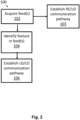
- an illustrative embodiment of the method 100 is diagrammatically shown as a flowchart.
- multiple (i.e., two or more imaging examinations are commenced by corresponding local operators LO using corresponding medical imaging devices 2 disposed in corresponding imaging bays 3.
- the two or more imaging examinations can occur in a common medical facility, or in different medical facilities.
- the video feed 17 (acquired by the one or more cameras 16 and/or the audio feed 18 (acquired by the one or more microphones 15) of each imaging examination are acquired and routed to the server computer 14s for analysis.
- a communication pathway between a local operator LO and the remote expert RE is established to enable the latter to assist the former.
- the operation 103 may occur in response to the local operator LO making a request for remote expert assistance via the ROCC device 8, and the communication pathway may, by way of nonlimiting illustrative example, comprise a telephonic or videoconference link established between the local operator LO and the assisting remote expert RE, along with sharing of the controller display and imaging bay sensor data with the remote expert RE.
- the ROCC framework is also used in the method 100 to provide assistive communication between two (or more) local operators. Since there may be dozens, hundreds, or more local operators performing imaging examinations under ROCC monitoring at any given time, the method 100 promotes targeted local operator-local operator assistance by identifying local operators that are likely to be in a position to assist one another. To this end, at an operation 104, a common feature of the two or more imaging examinations are identified in the video feed 17 and/or the audio feed 18. At an operation 106, the natural communication pathway 19 is established between local technicians (LO) performing the two or more imaging examinations based on the identified feature.
- LO local technicians
- the feature identification operation 104 can be performed in a variety of manners.
- the identified feature is a type of imaging examination of each imaging examination.
- the type of imaging examination can be a modality of the imaging device 2, an anatomy of the patient being imaged, or both.
- the natural communication pathway 19 can then be established between the local technicians LO performing the two or more imaging examinations having a common identified type of imaging examination.
- an indication 46 of an identification of each local technician LO performing the common type of imaging examination can be displayed on the display device 36 on corresponding electronic processing devices 8 operable by each corresponding local technician LO. This approach for targeted assistance between local operators leverages the expectation that each of the local operators performing these concurrent imaging examinations have the training, and have prepared, to perform the imaging examination.
- each of these identified local operators is notified of the other concurrent imaging examination(s) and provided videoconference links or the like to the other technicians.
- one local operator encounters a problem, he or she can contact one of the other imaging technicians identified by the ROCC as currently performing the same type of imaging examination, thus facilitating cooperative assistance between local imaging technicians.
- This has the substantial benefit that the valuable time of the remote expert RE is not occupied in resolving the problem. (Howbeit, if the cooperative efforts of the local operators is insufficient to resolve the problem, the local operator LO experiencing the problem can escalate by contacting the remote expert RE for assistance in accordance with the operation 103).
- the feature that is identified in the operation 104 is a location of each imaging examination (i.e., at the same medical facility, or different medical facilities).
- the natural communication pathway 19 can then be established between the local technicians LO performing the two or more imaging examinations identified as being at matching locations.
- matching it is meant that the locations are in the same radiology facility (e.g., in a single building, or in a single radiology suite within a single building), and/or a distance between the imaging examinations is at or below a threshold distance as measured by a suitable distance metric. Determining that two (or more) locations match can be done in various ways.
- the matching locations can be recognized as having the same radiology facility tags.
- the electronic processing devices 8 used in the examinations have GPS and/or other geographical location services then this can be used to determine the distance.
- a time period during which each local technician LO in the matching location is passive i.e., when the local technician LO is not actively performing a step or process in their respective imaging examination.
- a displayed indication 46 can be displayed on the display device 36 on corresponding electronic processing devices 8 operable by each corresponding local technician LO of each passive time period for each corresponding local technician LO in the matching location.
- One of the local technicians LO in the matching location can send messages to the other local technicians LO in the identified matching location, which can be displayed on the display device 36 on corresponding electronic processing devices 8 operable by each corresponding local technician LO.
- the messages can be, for example, a request for assistance, a request to monitor the sender's imaging examination while that local technician LO takes a break (i.e., restroom, phone call, lunch, and so forth).
- the "other" local technicians LO can provide user inputs to the corresponding electronic processing device 8 indicative of an acceptance or rejection of the message (i.e., "yes, I can assist with your imaging examination while you take a break", "no, I cannot assist you” and obvious variants thereof).
- the video and/or audio feeds 17, 18 of the imaging examination performed by the technician who generated the message can be transferred to the corresponding electronic processing device 8 of the local technician LO who accepted the message.
- the display device 36 of the electronic processing device 8 of the local technician LO who accepted the message can display a first window the video and/or audio feeds 17, 18 of the imaging examination performed by the local technician LO who provided the user input (i.e., accepted the message), and a second window showing the video and/or audio feeds 17, 18 of the imaging examination performed by the local technician LO who generated the message (i.e., requested assistance).
- the feature identified in the operation 104 can comprise an emergency condition occurring during one of the imaging examinations.
- imaging bay video feed(s) and/or data from other sensors monitoring the imaging bay are analyzed by artificial intelligence (AI) and/or other analysis to detect a possible emergency situation in the imaging bay.
- AI artificial intelligence
- successive frames or frames spaced apart in time by a chosen time interval
- audio feed from an imaging bay microphone can be monitored to detect elevated volume potentially indicative of an argument, or more specific analysis can be done by AI to detect, specifically a raised voice.
- the audio feed can be monitored to detect usage of inappropriate language suggesting that intervention may be called for.
- an alert indicative of the emergency condition is sent to the corresponding electronic processing devices 8 operable by each corresponding technician LO at the matching location.
- the video feed 17 of the imaging examination in which the emergency condition is occurring can be displayed in each corresponding ROCC device 8.
- Another opportunity for local technologists to work in tandem is to keep an eye on their neighbor's scan while he or she steps away from the imaging bay 3 - either for lunch or to prep the following patient. In reality, most scans are rather straight forward. Once initial images are acquired, the rest of the exam sequences can be prescribed, and an auto-scan option can be activated.
- the role of the local technician LO switches from active (patient positioning and coaching, initial acquisitions and exam set-up) to passive (watching for motion artifact in acquired images and ensuring the patient remains comfortable). A neighboring local technician LO could perform this passive watch especially when provided with appropriate tools.
- Image quality during acquisition could be assessed 1) automatically by an image quality tracking algorithm that kicks in when a technologist leaves his station or 2) manually by a neighboring technologist who through ROCC receives images as they are being acquired at the neighboring scanner. If the image quality is poor, the responsible local technologist LO might be summoned back to his station, or an expert user may be asked to intervene. These summons and interventions by the remote expert RE will be tracked and are used to train models to identify exams that should not be left unattended, as well as exams that are not likely to require intervention. Such models will allow local technologists to better plan and balance current and upcoming exams. To ensure patient is comfortable, patient alarm button is going to be monitored (via camera) and status continuously displayed on the ROCC device 8. If the patient squeezes the alarm ball, the message is displayed in the ROCC device 8, neighbor tech, as well as the responsible tech are both alerted.
Landscapes
- Health & Medical Sciences (AREA)
- Engineering & Computer Science (AREA)
- General Health & Medical Sciences (AREA)
- General Business, Economics & Management (AREA)
- Epidemiology (AREA)
- Business, Economics & Management (AREA)
- Medical Informatics (AREA)
- Primary Health Care (AREA)
- Public Health (AREA)
- Biomedical Technology (AREA)
- Nuclear Medicine, Radiotherapy & Molecular Imaging (AREA)
- Radiology & Medical Imaging (AREA)
- Measuring And Recording Apparatus For Diagnosis (AREA)
Priority Applications (1)
| Application Number | Priority Date | Filing Date | Title |
|---|---|---|---|
| PCT/EP2023/073470 WO2024046938A1 (en) | 2022-08-31 | 2023-08-28 | Improving communication between local technologists |
Applications Claiming Priority (1)
| Application Number | Priority Date | Filing Date | Title |
|---|---|---|---|
| US202263402489P | 2022-08-31 | 2022-08-31 |
Publications (1)
| Publication Number | Publication Date |
|---|---|
| EP4332984A1 true EP4332984A1 (de) | 2024-03-06 |
Family
ID=83360903
Family Applications (1)
| Application Number | Title | Priority Date | Filing Date |
|---|---|---|---|
| EP22196074.3A Withdrawn EP4332984A1 (de) | 2022-08-31 | 2022-09-16 | Systeme und verfahren zur verbesserung der kommunikation zwischen lokalen technologieologen in einem rahmen einer radiologiebetriebsbefehlszentrale (rocc) |
Country Status (1)
| Country | Link |
|---|---|
| EP (1) | EP4332984A1 (de) |
Citations (5)
| Publication number | Priority date | Publication date | Assignee | Title |
|---|---|---|---|---|
| WO2019111077A1 (en) * | 2017-11-12 | 2019-06-13 | Aleph Bot Ltd. | Systems, methods, devices, circuits and computer executable code for tracking evaluating and facilitating a medical procedure |
| KR20210132130A (ko) * | 2019-02-21 | 2021-11-03 | 시어터 인코포레이티드 | 수술 비디오의 분석을 위한 시스템 및 방법 |
| WO2021228541A1 (en) * | 2020-05-12 | 2021-11-18 | Koninklijke Philips N.V. | Systems and methods for extraction and processing of information from imaging systems in a multi-vendor setting |
| CN113765218A (zh) * | 2021-08-04 | 2021-12-07 | 杭州丁卯智能科技有限公司 | 基于gis+bim的配电架空线路及电力设施巡检系统 |
| WO2022120203A1 (en) * | 2020-12-04 | 2022-06-09 | Avail Medsystems, Inc. | Systems and methods for enhancing audio communications |
-
2022
- 2022-09-16 EP EP22196074.3A patent/EP4332984A1/de not_active Withdrawn
Patent Citations (5)
| Publication number | Priority date | Publication date | Assignee | Title |
|---|---|---|---|---|
| WO2019111077A1 (en) * | 2017-11-12 | 2019-06-13 | Aleph Bot Ltd. | Systems, methods, devices, circuits and computer executable code for tracking evaluating and facilitating a medical procedure |
| KR20210132130A (ko) * | 2019-02-21 | 2021-11-03 | 시어터 인코포레이티드 | 수술 비디오의 분석을 위한 시스템 및 방법 |
| WO2021228541A1 (en) * | 2020-05-12 | 2021-11-18 | Koninklijke Philips N.V. | Systems and methods for extraction and processing of information from imaging systems in a multi-vendor setting |
| WO2022120203A1 (en) * | 2020-12-04 | 2022-06-09 | Avail Medsystems, Inc. | Systems and methods for enhancing audio communications |
| CN113765218A (zh) * | 2021-08-04 | 2021-12-07 | 杭州丁卯智能科技有限公司 | 基于gis+bim的配电架空线路及电力设施巡检系统 |
Similar Documents
| Publication | Publication Date | Title |
|---|---|---|
| US12440105B2 (en) | Camera view and screen scraping for information extraction from imaging scanner consoles | |
| EP4162503B1 (de) | System und verfahren zur datengesteuerten auswahl eines entfernten experten für eine medizinische bildgebungsuntersuchung | |
| US12451234B2 (en) | Actionable visualization by overlaying historical data on a real-time image acquisition workflow overview | |
| CN115552544A (zh) | 用于在多供应商设置中提取和处理来自成像系统的信息的系统和方法 | |
| US12512226B2 (en) | Effective imaging examination handoffs between users within a radiology operations command center (ROCC) structure | |
| US12374111B2 (en) | Event-controlled view selection | |
| US20220044798A1 (en) | Audio and video processing for safety alerts during an imaging examination | |
| US20240170135A1 (en) | Load balancing in exam assignments for expert users within a radiology operations command center (rocc) structure | |
| US20230420118A1 (en) | Technologist assessments for professional growth and operational improvement | |
| EP4332984A1 (de) | Systeme und verfahren zur verbesserung der kommunikation zwischen lokalen technologieologen in einem rahmen einer radiologiebetriebsbefehlszentrale (rocc) | |
| WO2024046938A1 (en) | Improving communication between local technologists | |
| US20260096786A1 (en) | Systems and methods for automatic state estimation of a current imaging exam using user actions on a console screen | |
| WO2024200059A1 (en) | Automated remote support requests based on console extraction of system warnings in the context of a running imaging examination | |
| CN119585812A (zh) | 用于预测成像检查的图像采集复杂度的系统和方法 | |
| US20250069515A1 (en) | Method and system for data acquisition parameter recommendation and technologist training | |
| WO2024115156A1 (en) | Systems and methods for adaptive image acquisition | |
| EP4312225A1 (de) | Rechnergestützte architektur für die fernüberwachung von bildgebenden untersuchungen zur bereitstellung von genauen, robusten und echtzeitereignissen |
Legal Events
| Date | Code | Title | Description |
|---|---|---|---|
| PUAI | Public reference made under article 153(3) epc to a published international application that has entered the european phase |
Free format text: ORIGINAL CODE: 0009012 |
|
| STAA | Information on the status of an ep patent application or granted ep patent |
Free format text: STATUS: THE APPLICATION HAS BEEN PUBLISHED |
|
| AK | Designated contracting states |
Kind code of ref document: A1 Designated state(s): AL AT BE BG CH CY CZ DE DK EE ES FI FR GB GR HR HU IE IS IT LI LT LU LV MC MK MT NL NO PL PT RO RS SE SI SK SM TR |
|
| STAA | Information on the status of an ep patent application or granted ep patent |
Free format text: STATUS: THE APPLICATION IS DEEMED TO BE WITHDRAWN |
|
| 18D | Application deemed to be withdrawn |
Effective date: 20240907 |