EP4332983B1 - Generation of synthetic radiological recordings - Google Patents
Generation of synthetic radiological recordings Download PDFInfo
- Publication number
- EP4332983B1 EP4332983B1 EP22192907.8A EP22192907A EP4332983B1 EP 4332983 B1 EP4332983 B1 EP 4332983B1 EP 22192907 A EP22192907 A EP 22192907A EP 4332983 B1 EP4332983 B1 EP 4332983B1
- Authority
- EP
- European Patent Office
- Prior art keywords
- representation
- examination
- synthetic
- transformed
- input
- Prior art date
- Legal status (The legal status is an assumption and is not a legal conclusion. Google has not performed a legal analysis and makes no representation as to the accuracy of the status listed.)
- Active
Links
Images





Classifications
-
- G—PHYSICS
- G16—INFORMATION AND COMMUNICATION TECHNOLOGY [ICT] SPECIALLY ADAPTED FOR SPECIFIC APPLICATION FIELDS
- G16H—HEALTHCARE INFORMATICS, i.e. INFORMATION AND COMMUNICATION TECHNOLOGY [ICT] SPECIALLY ADAPTED FOR THE HANDLING OR PROCESSING OF MEDICAL OR HEALTHCARE DATA
- G16H50/00—ICT specially adapted for medical diagnosis, medical simulation or medical data mining; ICT specially adapted for detecting, monitoring or modelling epidemics or pandemics
- G16H50/70—ICT specially adapted for medical diagnosis, medical simulation or medical data mining; ICT specially adapted for detecting, monitoring or modelling epidemics or pandemics for mining of medical data, e.g. analysing previous cases of other patients
-
- G—PHYSICS
- G16—INFORMATION AND COMMUNICATION TECHNOLOGY [ICT] SPECIALLY ADAPTED FOR SPECIFIC APPLICATION FIELDS
- G16H—HEALTHCARE INFORMATICS, i.e. INFORMATION AND COMMUNICATION TECHNOLOGY [ICT] SPECIALLY ADAPTED FOR THE HANDLING OR PROCESSING OF MEDICAL OR HEALTHCARE DATA
- G16H30/00—ICT specially adapted for the handling or processing of medical images
- G16H30/40—ICT specially adapted for the handling or processing of medical images for processing medical images, e.g. editing
-
- G—PHYSICS
- G16—INFORMATION AND COMMUNICATION TECHNOLOGY [ICT] SPECIALLY ADAPTED FOR SPECIFIC APPLICATION FIELDS
- G16H—HEALTHCARE INFORMATICS, i.e. INFORMATION AND COMMUNICATION TECHNOLOGY [ICT] SPECIALLY ADAPTED FOR THE HANDLING OR PROCESSING OF MEDICAL OR HEALTHCARE DATA
- G16H50/00—ICT specially adapted for medical diagnosis, medical simulation or medical data mining; ICT specially adapted for detecting, monitoring or modelling epidemics or pandemics
- G16H50/20—ICT specially adapted for medical diagnosis, medical simulation or medical data mining; ICT specially adapted for detecting, monitoring or modelling epidemics or pandemics for computer-aided diagnosis, e.g. based on medical expert systems
Definitions
- the present disclosure relates to the technical field of radiology.
- Subject matters of the present disclosure are a novel approach for training a machine learning model to generate synthetic radiological images based on measured radiological images and the use of the trained machine learning model to generate synthetic radiological images.
- Medical imaging is the technique and process of imaging the inside of the body for clinical analysis and medical intervention, as well as to visually depict the function of specific organs or tissues.
- the purpose of medical imaging is to reveal internal structures hidden beneath the skin and bones and to diagnose and/or treat diseases.
- Machine learning models are used, among other things, to segment radiological images, to induce contrast enhancements in radiological images and/or to predict a radiological image in a temporal sequence of radiological images.
- WO2019/074938A1 discloses a method for reducing the amount of contrast agent when generating radiological images using an artificial neural network.
- US 10,997,716 B2 also discloses a method for reducing the amount of contrast agent when generating radiological images using an artificial neural network.
- WO2021/052896A1 discloses a method in which an MRI image of a patient's liver during the hepatobiliary phase is not generated by measurement, but is calculated (predicted) on the basis of MRI images from one or more previous phases in order to shorten the patient's stay in the MRI scanner.
- WO2021/197996A1 discloses a method in which MRI images after the application of a so-called blood pool contrast agent are simulated using a machine learning model.
- At least one measured radiological image of an examination area of an object under examination is fed to a trained machine learning model and the model generates a synthetic radiological image.
- Both the fed radiological image and the synthetic radiological image are representations of the examination area in a spatial representation.
- representations of an examination region of an examination object can be predicted.
- a predicted representation is also referred to as a synthetic representation in this disclosure.
- the "object under investigation” is usually a living being, preferably a mammal, most preferably a human.
- the "area of investigation” is a part of the object of investigation, for example an organ or part of an organ such as the liver, brain, heart, kidney, lung, stomach, intestine, pancreas or part of the organs mentioned or several organs or another part of the body.
- the examination area is the liver or part of the liver of a human.
- the area under investigation is represented by a superposition of fundamental oscillations.
- the area under investigation can be represented by a sum of sine and cosine functions with different amplitudes, frequencies and phases.
- the amplitudes and phases can be plotted as a function of the frequencies, for example in a two- or three-dimensional representation.
- the lowest frequency (origin) is placed in the center. The further away you are from this center, the higher the frequencies.
- Each frequency can be assigned an amplitude with which the frequency is represented in the frequency space representation and a phase that indicates the extent to which the respective oscillation is shifted compared to a sine or cosine oscillation.
- the machine learning model is configured and trained to generate a synthetic representation based on at least one input representation of an examination area of an examination object, which represents the examination area before and/or after the application of a first amount of contrast agent, which synthetic representation represents the examination area after the application of a second amount of contrast agent, wherein the first amount is less than the second amount.
- a trained machine learning model can, for example, be as in WO2019/074938A1 described to reduce the amount of contrast agent in radiological examinations.
- a “machine learning model” can be understood as a computer-implemented data processing architecture.
- the model can receive input data and provide output data based on that input data and model parameters.
- the model can learn a relationship between the input data and the output data through training.
- model parameters can be adjusted to provide a desired output for a given input.
- the deviations can be quantified using a loss function.
- a loss function can be used to calculate an error ( loss ) for a given pair of output data and target data.
- the goal of the training process can be to change (adjust) the parameters of the machine learning model so that the error is reduced to a (defined) minimum for all pairs of the training data set.
- the error function can be the absolute difference between those numbers.
- a high absolute error may mean that one or more model parameters need to be changed significantly.
- an element-wise difference metric can be used.
- the output data can be transformed, e.g. into a one-dimensional vector, before calculating an error value.
- the machine learning model is trained using training data to generate a synthetic representation of an examination area of an examination object in a second state based on at least one representation of the examination area of the examination object in a first state.
- the training data includes a set of input data and target data for each of a plurality of test objects.
- the term multitude means at least ten, preferably more than one hundred.
- Each set of input data and target data comprises at least one input representation of an examination area of the examination object in a first state as input data.
- Each set of input data and target data further comprises a target representation of the examination area of the object of investigation in a second state and a transformed target representation as target data.
- the area of investigation is usually the same for all objects under investigation.
- the transformed target representation represents at least part of the examination area of the examination object in the second state.
- the transformed target representation represents at least part of the investigation area of the investigation object in the spatial space.
- the transformed target representation in frequency space can be generated from a target representation in spatial space, for example by Fourier transformation.
- the transformed target representation in the spatial domain can be generated from a target representation in the frequency domain, for example by inverse Fourier transformation.
- At least one input representation of the area of investigation is fed to the machine learning model for each object of investigation of the plurality of objects of investigation.
- the model generates a synthetic representation based on the at least one input representation of the area of investigation and on the basis of model parameters.
- the synthetic input representation preferably (but not necessarily) also represents the investigation area in the spatial space.
- the synthetic representation preferably (but not necessarily) also represents the investigation area in frequency space.
- the machine learning model can also be configured and trained to generate a synthetic representation of the investigation area based on the at least one input representation of the investigation area, which i) represents the investigation area in frequency space if the at least one representation represents the investigation area in spatial space, or ii) represents the investigation area in spatial space if the at least one representation represents the investigation area in frequency space.
- the machine learning model can be configured and trained to carry out (among other things) a transformation from spatial to frequency space or vice versa.
- a transformed synthetic representation is generated from or to the synthetic representation.
- the transformed synthetic representation represents at least a part of the examination area in the second state in the frequency space.
- the synthetic representation represents the examination area in the second state in the frequency space
- the transformed synthetic representation represents at least a part of the examination area in the second state in the spatial space.
- the generation of the transformed synthetic representation can take place by transforming the synthetic representation and/or the machine learning model can be configured and trained to generate a transformed synthetic representation based on the at least one input representation.
- An error function is used to calculate the deviations i) between at least a part of the synthetic representation and at least a part of the line representation and ii) between at least a part of the transformed synthetic representation and at least a part of the transformed target representation.
- the error function can have two terms, a first term for quantifying the deviations between at least part of the synthetic representation and at least part of the target representation and a second term for quantifying the deviations between at least part of the transformed synthetic representation and at least part of the transformed target representation.
- the terms can be added together in the error function, for example.
- the terms can be weighted differently in the error function.
- L is the (total) error function
- L 1 is a term that represents the deviations between the synthetic representation and the target representation
- L 2 is a term that quantifies the deviations between the transformed synthetic representation and the transformed target representation
- ⁇ 1 and ⁇ 2 are weight factors that can, for example, take values between 0 and 1 and give the two terms a different weight in the error function. It is possible that the weight factors are kept constant or varied during the training of the machine learning model.
- error functions examples include L1 error function ( L1 loss ), L2 error function ( L2 loss ), Lp error function (Lp loss), structural similarity index measure (SSIM)), VGG error function (VGG loss), perceptual error function ( perceptual loss ) or a combination of the above functions or other error functions. Further details on error functions can be found in the scientific literature (see e.g.: R. Mechrez et al.: The Contextual Loss for Image Transformation with Non-Aligned Data, 2018, arXiv:1803.02077v4 ; H. Zhao et al.: Loss Functions for Image Restoration with Neural Networks, 2018, arxiv:1511.08861v3 ).
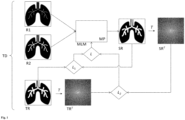
- Fig. 1 shows an example and schematically the process of training the machine learning model. Training is done using training data.
- training data TD for an examination object are shown.
- the training data TD comprise as input data a first input representation R1 of an examination area of the examination object and a second input representation R2 of the examination area of the examination object.
- the first input representation R1 and the second input representation R2 represent the examination area in spatial space.
- the first input representation R1 represents the examination area in a first state, for example before or after the application of a first amount of a contrast agent.
- the second input representation R2 represents the examination area in a second state, for example after the application of a second amount of the contrast agent.
- the training data TD also include a target representation TR as target data.
- the target representation TR also represents the examination area in spatial space.
- the target representation TR represents the examination area in a third state, for example after the application of a third amount of contrast agent.
- the machine learning model MLM is trained to predict the target representation TR based on the first input representation R1 and the second input representation R2 as well as on the basis of model parameters MP.
- the first input representation R1 and the second input representation R2 are fed to the machine learning model as input data.
- the machine learning model is configured to generate a synthetic representation SR.
- the synthetic representation SR is discussed in Fig. 1 shown example by means of a transformation T (e.g. a Fourier transformation) a transformed synthetic representation SR T is generated.
- a transformed target representation TR T is generated from the target representation TR using the transformation T.
- the transformed synthetic representation SR T and the transformed target representation TR T are frequency space representations of the investigation area in the third state.
- a first error function L 1 is used to quantify the deviations between the synthetic representation SR and the target representation TR.
- a second error function L 2 is used to quantify the deviations between the transformed synthetic representation SR T and the transformed target representation TR T.
- the errors calculated using the error functions L 1 and L 2 are combined in a total error function L to form a total error (e.g. by addition).
- Model parameters MP are modified with a view to reducing the total error.
- the reduction of the total error can be achieved using an optimization method, for example using a gradient method.
- the process is repeated for a large number of objects under investigation until the total error reaches a predefined (desired) minimum.
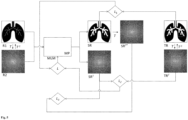
- the transformed synthetic representation and the transformed target representation are each reduced to one or more predefined parts. This is shown by way of example and schematically in Fig. 2 shown.
- the entire frequency space is not considered in the calculation using the error function L 2.
- the representations in the frequency space are reduced to a range with low frequencies; the higher frequencies are discarded.
- contrast information is predominantly encoded, while in the range of higher frequencies, information on fine structures is predominantly encoded.
- the machine learning model in the Fig. 2 in addition to generating the synthetic representation SR, it is trained to correctly reproduce the low frequencies in particular and thus a special focus is placed on contrast information.
- Fig. 3 shows another example in which the entire frequency range is not considered, but a focus is placed on a defined frequency range.
- the Fig. 3 The process shown corresponds to the process described in Fig. 2 , with the difference that the function P ensures that the transformed target representation TR T and the transformed synthetic representation SR T are each are reduced to a higher frequency component, while low frequencies are discarded (the low frequency values in this example are set to zero, which is represented by the color black).
- the machine learning model in the Fig. 3 in addition to generating the synthetic representation SR, the auditory system is trained to correctly reproduce the higher frequencies in particular, thus placing particular emphasis on the correct reproduction of fine structures.
- the part to which the frequency space is reduced may also include other than those in Fig. 2 and Fig. 3 can take on the shapes and sizes shown. Furthermore, several parts can be selected and the frequency space representations restricted to several parts (areas). For example, it is possible to divide the frequency space into different areas and to generate frequency space representations of the examination area for several or all areas, in which only the frequencies of the respective area occur. In this way, different frequency ranges can be weighted/taken into account to different degrees during training.
- the representations R1, R2, TR and SR are representations in the spatial space. It is also possible that one or more of these representations are frequency space representations.
- the transformed synthetic representation SR T and the transformed target representation TR T are representations in the spatial space
- a part (or several parts) in the representations can also be selected and the representations can be reduced to this part (these parts).
- the error calculation focuses on features in the spatial space that can be found in the selected part (the selected parts).
- Fig. 4 , Fig. 5 , Fig. 6 , Fig. 7 and Fig. 8 show further embodiments of the training procedure.
- the training data for each examination object comprise at least one input representation R1 of an examination area in a first state and a target representation TR of the examination area in a second state.
- the at least one input representation R1 and the target representation TR can each be a representation in the spatial space or a representation in the frequency space.
- the input representation R1 and the target representation TR are representations in the spatial space.
- the machine learning model MLM is trained to predict the target representation TR on the basis of at least one input representation R1.
- a transformed input representation R2 is generated on the basis of the input representation R1 using a transformation T.
- a transformed target representation TR T is generated on the basis of the target representation TR using the transformation T.
- the transformed input representation R2 and the transformed target representation TR T are representations of the examination region in the frequency domain.
- the transformed input representation R2 represents the examination region (like the input representation R1) in the first state;
- the transformed target representation TR T represents the examination region (like the target representation TR) in the second state.
- the input representation R1 can be obtained by an inverse transformation T -1 based on the transformed input representation R2.
- a target representation TR can be obtained by the inverse transformation T -1 based on the transformed target representation TR T.
- the inverse transformation T -1 is the inverse transformation of the transformation T , which is indicated by the index -1.
- the reference to the inverse transformation is intended to clarify that the training data must contain at least one input representation (R1 or R2) and one target representation (TR or TR T ); the other (R2 or R1, or TR T or TR) can be obtained by transformation or inverse transformation from the existing representation. This applies generally and not only to the Fig. 4 illustrated embodiment.
- both the input representation R1 and the transformed input representation R2 are fed to the machine learning model MLM.
- the machine learning model MLM is configured to generate both a synthetic representation SR and a transformed synthetic representation SR T.
- the deviations between at least part of the synthetic representation SR and at least part of the target representation TR are quantified using a first error function L 1 .
- the deviations between at least part of the transformed synthetic representation SR T and at least part of the transformed target representation TR T are quantified using a second error function L 2 .
- the Fig. 4 The dashed white frames drawn in the transformed representations are intended to express that the calculation of the error with the error function as in relation to Fig. 3 described does not have to be based on the entire frequency space representation, but that the transformed representations can be reduced to a frequency range (or several frequency ranges). Analogously, the position space representations SR and TR can be reduced to a part (or several parts) in the error calculation (also shown by the dashed white frames). This also applies analogously to the other embodiments and not only to those in Fig. 4 illustrated embodiment.
- the errors calculated using the error functions L 1 and L 2 are combined to form a total error function L (e.g. by addition).
- Model parameters MP are modified with a view to reducing the total error. This can be done using an optimization method, for example a gradient method.
- the process is repeated for a large number of objects under investigation until the total error reaches a predefined (desired) minimum.
- the synthetic representation SR and the transformed synthetic representation SR T must be able to be converted into one another in the same way as the target representation TR and the transformed target representation TR T . It is possible to introduce a further error function that evaluates the quality of such a conversion. It is therefore possible to generate a transformed synthetic representation from the synthetic representation SR by means of the transformation T and to quantify the deviations between this synthetic representation generated by transformation and the transformed synthetic representation generated by the machine learning model using a third error function L 3 . Alternatively or additionally, it is possible to generate a synthetic representation from the transformed synthetic representation SR T by means of the inverse transformation T -1 and to quantify the deviations between this synthetic representation generated by inverse transformation and the synthetic representation generated by the machine learning model using a third error function L 3 .
- the error function L 3 quantifies the deviations between the transformed synthetic representation SR T * generated by transformation and the transformed synthetic representation SR T generated by the machine learning model MLM.
- the error functions L 1 , L 2 and L 3 are combined in an overall error function L (e.g. by addition).
- the individual terms can carry different weights, whereby the weights can be kept constant or varied over the course of training.
- a variation of the Fig. 4 and Fig. 5 shown embodiments is that the machine learning model MLM is not fed with both input representations R1 and R2, but only one of the two.
- the machine learning model can be configured and trained to generate the other.
- Fig. 6 shows schematically another embodiment of the training method.
- two machine learning models are used, a first model MLM1 and a second model MLM2.
- the first machine learning model MLM1 is trained to predict a target representation TR and/or a transformed target representation TR T from an input representation R1 and/or R2.
- the second machine learning model MLM2 is trained to predict (reconstruct) the original input representation R1 and/or R2 from a predicted target representation SR and/or a predicted transformed target representation SR T.
- the machine learning models thus carry out a cycle that can be used to improve the prediction quality of the first model MLM1 (which is used in the subsequent prediction).
- At least one input representation R1 and/or at least one transformed input representation R2 is fed to the first machine learning model MLM1 as input data.
- the first model MLM1 is configured to generate a synthetic representation SR and/or a transformed synthetic representation SR T based on the input data and model parameters MP1.
- a transformed synthetic representation SR T can also be generated by transformation T of the synthetic representation SR.
- a synthetic representation SR can also be generated by inverse transformation T -1 of the transformed synthetic representation SR T.
- Deviations between the synthetic representation SR and the target representation TR can be quantified using an error function L 1 1. Deviations between the transformed synthetic representation SR T and the transformed target representation TR T can be quantified using an error function L 2 1 .
- Deviations between a synthetic representation obtained by transformation T and the synthetic representation SR generated by the model MLM1 can be quantified using an error function L 3 1 (in Fig. 6 not shown).
- deviations between a transformed synthetic representation obtained by transformation T and the transformed synthetic representation SR T generated by the model MLM1 can be quantified using an error function L 4 1 (in Fig. 6 not shown).
- the error functions L 1 1 , L 2 1 and, if present, L 3 1 and/or L 4 1 can be combined to form a total error function (in Fig. 6 not shown).
- Model parameters MP1 can be modified to reduce the total error.
- the synthetic representation SR and/or the transformed synthetic representation SR T is/are fed to the second machine learning model MLM2.
- the second model MLM2 is configured to reconstruct (predict) the first input representation R1 and/or the second input representation R2.
- the second model MLM2 is configured to generate a predicted first input representation R1* and/or a predicted second input representation R2* based on the synthetic representation SR, the transformed synthetic representation SR T and based on model parameters MP2.
- a second input representation R2* can also be generated by transformation T of the first input representation R1* and/or a first input representation R1* can also be generated by inverse transformation T -1 of the second input representation R2*.
- Deviations between the predicted first input representation R1* and the first input representation R1 can be quantified using an error function L 1 2 .
- Deviations between the predicted second input representation R2* and the second input representation R2 can be quantified using an error function L 2 2 .
- Deviations between an input representation R1* obtained by inverse transformation T -1 and the input representation R1* generated by the model MLM2 can be quantified using an error function L 3 2 (in Fig. 6 not shown).
- deviations between an input representation R2* obtained by transformation and the by the model MLM2 generated input representation R2* can be quantified by means of an error function L 4 2 (in Fig. 6 not shown).
- the error functions L 1 2 , L 2 2 and, if present, L 3 2 and/or L 4 2 can be combined to form a total error function (in Fig. 6 not shown).
- Model parameters MP2 can be modified to reduce the overall error.
- Fig. 7 , Fig. 8 and Fig. 9 show schematically further examples of the procedure for training the machine learning model and using the trained machine learning model for prediction.
- Fig. 7 and Fig. 8 show the training procedure;
- Fig. 9 shows the prediction procedure.
- the machine learning model MLM is trained to generate a synthetic representation SR of the examination area of the examination object based on one or more input representations R1,2, which represent an examination area of an examination object before and/or after the application of a first amount of contrast agent, and based on model parameters MP, wherein the synthetic representation SR represents the examination area after the application of a second amount of contrast agent, wherein the second amount is larger than the first amount.
- the machine learning model is trained to predict a representation of the examination area after the application of a larger amount of contrast agent than was actually applied.
- a target representation TR represents the examination area of the examination object after the application of the second (larger) amount of contrast agent.
- the area of investigation is a human brain.
- the at least one input representation R1,2, the target representation TR and the synthetic representation SR represent the brain in spatial space.
- the at least one input representation R1,2 is fed into the machine learning model MLM.
- the machine learning model generates the synthetic representation SR.
- the synthetic representation SR is transformed into a transformed synthetic transformation SR T .
- the transformed synthetic transformation SR T is reduced to a part using a function P ; a proportional transformed synthetic transformation SR T , P is created.
- a transformed target representation TR T is generated from the target representation SR using the transformation T
- a proportional transformed target representation TR T , P is generated from the transformed target representation TR T using the function P.
- the transformed synthetic representation SR T and the transformed target representation TR T represent the investigation area in the frequency space.
- the partial transformed synthetic representation SR T , P is a transformed synthetic representation SR T reduced to a frequency range with higher frequencies.
- the partial transformed target representation TR T , P is a transformed target representation TR T reduced to the frequency range with higher frequencies.
- the machine learning model MLM is thus trained to focus on fine structure information that is encoded in the higher frequencies.
- the machine learning model is trained using an error function L.
- the error function L quantifies the deviations i) between the synthetic representation SR and the target representation TR using a first term L 1 and ii) between the proportionally transformed synthetic representation SR T , P and the proportionally transformed target representation TR T , P using a second term L 2 .
- the first term L 1 and the second term L 2 in the error function can, for example, each be multiplied by a weight factor and the resulting products added (as described in equation 1).
- the model parameters MP can be modified with a view to reducing the error calculated by the function L.
- Training can be terminated when the errors calculated using the error function L reach a defined minimum, ie the prediction quality reaches a desired level.
- Fig. 9 shows the use of the Fig. 7 or Fig. 8 trained machine learning model MLM or MLM1, in Fig. 11 marked with MLM t .
- the trained machine learning model MLM t is fed at least one input representation R1,2 that represents the brain of a new examination object.
- the term "new" means that the at least one input representation R1,2 has not already been used in training.
- the input representation R1,2 represents the brain of the new examination object before and/or after the application of a first amount of contrast agent.
- the trained machine learning model generates a synthetic representation SR based on the at least one input representation R1,2, which represents the brain after the application of a second amount of the contrast agent.
- Fig. 10 shows the result of a validation (a) of the Fig. 7 trained machine learning model and (b) the Fig. 8 trained machine learning model.
- Each of the models was given the same Fig. 9 described at least one input representation of a new object of investigation is fed.
- Each of the models generates a synthetic representation SR.
- a target representation TR is available for the object of investigation.
- Fig. 10 The generation of a difference representation is shown, where for each model a difference representation ⁇ R is generated by subtracting the respective synthetic representation SR from the target representation TR.
- each of the synthetic representations SR corresponds to the target representation TR and the difference representation ⁇ R is completely black (all values are zero).
- Fig. 10 It can be seen that in the case of the Fig.
- FIG. 10 (a) more pixels are different from zero than in the case of the Fig. 8 trained machine learning model ( Fig. 10 (b) ).
- the prediction quality of the Fig. 8 In this example, the performance of the machine learning model trained according to Fig. 7 trained machine learning model.
- the machine learning models according to the present disclosure may be an artificial neural network or may include one or more such artificial neural networks.
- An artificial neural network comprises at least three layers of processing elements: a first layer with input neurons (nodes), an Nth layer with at least one output neuron (node), and N-2 inner layers, where N is a natural number and greater than 2.
- the input neurons are used to receive the input representations.
- there is one input neuron for each pixel or voxel of an input representation if the representation is a spatial representation in the form of a raster graphic, or one input neuron for each frequency present in the input representation if the representation is a frequency-space representation.
- There may be additional input neurons for additional input values e.g. information about the area under investigation, the object under investigation, conditions that prevailed when the input representation was generated, information about the state that the input representation represents, and/or information about the time or period at which the input representation was generated).
- the output neurons can be used to output a synthetic representation that represents the region of interest in a different state.
- the processing elements of the layers between the input neurons and the output neurons are connected in a predetermined pattern with predetermined connection weights.
- the artificial neural network is a so-called convolutional neural network (CNN for short) or it includes one.
- CNN convolutional neural network
- a CNN usually consists essentially of filters (convolutional layer) and aggregation layers (pooling layer), which repeat alternately, and at the end of one or more layers of "normal" fully connected neurons (dense / fully connected layer).
- the neural network can be trained using a backpropagation method, for example.
- the aim is to map the input representation(s) to the synthetic representation as reliably as possible.
- the quality of the prediction is described by an error function.
- the goal is to minimize the error function.
- the backpropagation method teaches an artificial neural network by changing the connection weights.
- connection weights between the processing elements contain information regarding the dynamics of the relationship between the input representation(s) and the synthetic representation, which can be used to predict a synthetic representation of the new study object's study area based on one or more representations of the study area of a new study object.
- new means that representations of the study area of the new study object were not already used in training the machine learning model.
- the artificial neural network may have an autoencoder architecture; e.g., the artificial neural network may have an architecture such as the U-Net (see e.g. O. Ronneberger et al.: U-net: Convolutional networks for biomedical image segmentation, International Conference on Medical image computing and computer-assisted intervention, pages 234-241, Springer, 2015, https://doi.org/10.1007/978-3-319-24574-4_28 ).
- U-Net see e.g. O. Ronneberger et al.: U-net: Convolutional networks for biomedical image segmentation, International Conference on Medical image computing and computer-assisted intervention, pages 234-241, Springer, 2015, https://doi.org/10.1007/978-3-319-24574-4_28 ).
- the artificial neural network can be a Generative Adversarial Network (GAN) (see e.g. M.-Y. Liu et al.: Generative Adversarial Networks for Image and Video Synthesis: Algorithms and Applications, arXiv:2008.02793 ; J. Henry et al.: Pix2Pix GAN for Image-to-Image Translation, DOI: 10.13140/RG.2.2.32286.66887 ).
- GAN Generative Adversarial Network
- the artificial neural network can be a Regularized Generative Adversarial Network (see e.g. Q. Li et al.: RegGAN: An End-to-End Network for Building Footprint Generation with Boundary Regularization, Remote Sens. 2022, 14, 1835 ).
- the artificial neural network can be a Conditional Adversarial Network (see e.g. P. Isola et al.: Image-to-Image Translation with Conditional Adversarial Networks, arXiv:1611.07004 [cs.CV] ).
- the artificial neural network can be a transformer network (see e.g. D. Karimi et al.: Convolution-Free Medical Image Segmentation using Transformers, arXiv:2102.13645 [eess.IV] ).
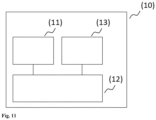
- Fig. 11 shows, by way of example and schematically, a computer system according to the present disclosure and that can be used for training the machine learning model and/or for using the trained machine learning model for prediction.
- a “computer system” is a system for electronic data processing that processes data using programmable calculation rules. Such a system usually includes a “computer”, the unit that includes a processor for carrying out logical operations, and peripherals.
- peripherals refers to all devices that are connected to the computer and are used to control the computer and/or as input and output devices. Examples of these are monitors (screens), printers, scanners, mice, keyboards, drives, cameras, microphones, speakers, etc. Internal connections and expansion cards are also considered peripherals in computer technology.
- the Fig. 11 The computer system (1) shown comprises an input unit (10), a control and computing unit (20) and an output unit (30).
- the control and computing unit (20) serves to control the computer system (1), to coordinate the data flows between the units of the computer system (1) and to carry out calculations.
- Fig. 12 shows an exemplary and schematic illustration of another embodiment of the computer system according to the invention.
- the computer system (1) comprises a processing unit (21) which is connected to a memory (22).
- the processing unit (21) and the memory (22) form a control and calculation unit as described in Fig. 11 shown.
- the processing unit (21) may comprise one or more processors alone or in combination with one or more memories.
- the processing unit (21) may be ordinary computer hardware capable of processing information such as digital images, computer programs and/or other digital information.
- the processing unit (21) typically consists of an arrangement of electronic circuits, some of which may be implemented as an integrated circuit or as multiple interconnected integrated circuits (an integrated circuit is sometimes referred to as a "chip").
- the processing unit (21) may be configured to execute computer programs that may be stored in a main memory of the processing unit (21) or in the memory (22) of the same or another computer system.
- the memory (22) may be ordinary computer hardware capable of storing information such as digital images (e.g. representations of the examination area), data, computer programs and/or other digital information either temporarily and/or permanently.
- the memory (22) may comprise volatile and/or non-volatile memory and may be permanently installed or removable. Examples of suitable memories are RAM (Random Access Memory), ROM (Read-Only Memory), a hard disk, flash memory, a removable computer diskette, an optical disc, a magnetic tape, or a combination of the above.
- Optical discs may include read-only compact discs (CD-ROM), read/write compact discs (CD-R/W), DVDs, Blu-ray discs, and the like.
- the processing unit (21) may also be connected to one or more interfaces (11, 12, 31, 32, 33) to display, transmit and/or receive information.
- the interfaces may comprise one or more communication interfaces (32, 33) and/or one or more user interfaces (11, 12, 31).
- the one or more communication interfaces may be configured to send and/or receive information, e.g. to and/or from an MRI scanner, a CT scanner, an ultrasound camera, other computer systems, networks, data storage or the like.
- the one or more communication interfaces may be configured to transmit and/or receive information via physical (wired) and/or wireless communication connections.
- the one or more communication interfaces may include one or more interfaces for connecting to a network, e.g., using technologies such as cellular, Wi-Fi, satellite, cable, DSL, fiber optic, and/or the like.
- the one or more communication interfaces may include one or more short-range communication interfaces configured to connect devices using short-range communication technologies such as NFC, RFID, Bluetooth, Bluetooth LE, ZigBee, infrared (e.g., IrDA), or the like.
- the user interfaces may include a display (31).
- a display (31) may be configured to display information to a user. Suitable examples include a liquid crystal display (LCD), a light emitting diode display (LED), a plasma display panel (PDP), or the like.
- the user input interface(s) (11, 12) may be wired or wireless and may be configured to receive information from a user into the computer system (1), e.g. for processing, storage, and/or display. Suitable examples of user input interfaces include a microphone, an image or video capture device (e.g. a camera), a keyboard or keypad, a joystick, a touch-sensitive surface (separate from or integrated into a touchscreen), or the like.
- the user interfaces may include automatic identification and data capture (AIDC) technology for machine-readable information. This can include barcodes, radio frequency identification (RFID), magnetic stripes, optical character recognition (OCR), cards with integrated circuits (ICC) and the like.
- the user interfaces may further include one or more interfaces for communication with peripheral devices such as printers and the like.
- One or more computer programs (40) may be stored in the memory (22) and executed by the processing unit (21), which is thereby programmed to perform the functions described in this description.
- the retrieval, loading and execution of instructions of the computer program (40) may be carried out sequentially, so that one instruction is retrieved, loaded and executed at a time. However, the retrieval, loading and/or execution may also be carried out in parallel.
- the machine learning model according to the invention can also be stored in the memory (22).
- the system according to the invention can be designed as a laptop, notebook, netbook and/or tablet PC; it can also be a component of an MRI scanner, a CT scanner or an ultrasound diagnostic device.
Landscapes
- Engineering & Computer Science (AREA)
- Health & Medical Sciences (AREA)
- Medical Informatics (AREA)
- Public Health (AREA)
- General Health & Medical Sciences (AREA)
- Biomedical Technology (AREA)
- Epidemiology (AREA)
- Data Mining & Analysis (AREA)
- Primary Health Care (AREA)
- Databases & Information Systems (AREA)
- Pathology (AREA)
- Nuclear Medicine, Radiotherapy & Molecular Imaging (AREA)
- Radiology & Medical Imaging (AREA)
- Image Analysis (AREA)
- Magnetic Resonance Imaging Apparatus (AREA)
Description
Die vorliegende Offenbarung bezieht sich auf das technische Gebiet der Radiologie. Gegenstände der vorliegenden Offenbarung sind ein neuartiger Ansatz zum Trainieren eines Modells des maschinellen Lernens zur Erzeugung synthetischer radiologischer Aufnahmen auf Basis von gemessenen radiologischen Aufnahmen und die Verwendung des trainierten Modells des maschinellen Lernens zur Erzeugung von synthetischen radiologischen Aufnahmen.The present disclosure relates to the technical field of radiology. Subject matters of the present disclosure are a novel approach for training a machine learning model to generate synthetic radiological images based on measured radiological images and the use of the trained machine learning model to generate synthetic radiological images.
Medizinische Bildgebung ist die Technik und der Prozess der Abbildung des Körperinneren für klinische Analysen und medizinische Eingriffe sowie die visuelle Darstellung der Funktion bestimmter Organe oder Gewebe. Mit Hilfe der medizinischen Bildgebung sollen innere Strukturen sichtbar gemacht werden, die unter der Haut und den Knochen verborgen sind, und Krankheiten diagnostiziert und/oder behandelt werden.Medical imaging is the technique and process of imaging the inside of the body for clinical analysis and medical intervention, as well as to visually depict the function of specific organs or tissues. The purpose of medical imaging is to reveal internal structures hidden beneath the skin and bones and to diagnose and/or treat diseases.
Fortschritte im Bereich der Bildgebung und des maschinellen Lernens haben zu einem raschen Anstieg des potenziellen Einsatzes von künstlicher Intelligenz bei verschiedenen Aufgaben der medizinischen Bildgebung geführt, z. B. bei der Risikobewertung, Erkennung, Diagnose, Prognose und Therapie.Advances in imaging and machine learning have led to a rapid increase in the potential use of artificial intelligence in various medical imaging tasks, such as risk assessment, detection, diagnosis, prognosis and therapy.
Dabei werden Modelle des maschinellen Lernens u.a. eingesetzt, um radiologische Aufnahmen zu segmentieren, Kontrastverstärkungen in radiologischen Aufnahmen hervorzurufen und/oder um eine radiologische Aufnahme in einer zeitlichen Sequenz von radiologischen Aufnahmen vorherzusagen.Machine learning models are used, among other things, to segment radiological images, to induce contrast enhancements in radiological images and/or to predict a radiological image in a temporal sequence of radiological images.
Bei allen genannten Verfahren wird mindestens eine gemessene radiologische Aufnahme eines Untersuchungsbereichs eines Untersuchungsobjekts einem trainierten Modell des maschinellen Lernens zugeführt und das Modell erzeugt eine synthetische radiologische Aufnahme. Sowohl bei der zugeführten radiologischen Aufnahme als auch bei der synthetischen radiologischen Aufnahme handelt es sich um Repräsentationen des Untersuchungsbereichs in einer Ortsraumdarstellung.In all of the above-mentioned methods, at least one measured radiological image of an examination area of an object under examination is fed to a trained machine learning model and the model generates a synthetic radiological image. Both the fed radiological image and the synthetic radiological image are representations of the examination area in a spatial representation.
Es hat sich gezeigt, dass die synthetischen radiologischen Aufnahmen oftmals Artefakte aufweisen. Oftmals werden insbesondere feine Strukturen nicht richtig wiedergegeben oder es treten Strukturen in Bereichen der synthetischen radiologischen Aufnahme auf, die das repräsentierte Gewebe nicht aufweist.It has been shown that synthetic radiological images often contain artifacts. Fine structures in particular are often not reproduced correctly or structures appear in areas of the synthetic radiological image that are not present in the tissue represented.
Diesem und weiteren Problemen widmet sich die vorliegende Offenbarung.This revelation addresses this and other problems.
Ein erster Gegenstand der vorliegenden Offenbarung ist ein Verfahren zum Trainieren eines Modells des maschinellen Lernens zur Erzeugung synthetischer radiologischer Aufnahmen auf Basis von gemessenen radiologischen Aufnahmen. Das Trainingsverfahren umfasst die Schritte:
- Empfangen und/oder Bereitstellen von Trainingsdaten, wobei die Trainingsdaten für jedes Untersuchungsobjekt einer Vielzahl von Untersuchungsobjekten einen Satz an Eingabedaten und Zieldaten umfasst,
- wobei jeder Satz
- ∘ mindestens eine Eingabe-Repräsentation eines Untersuchungsbereichs des Untersuchungsobjekts in einem ersten Zustand als Eingabedaten und
- ∘ eine Ziel-Repräsentation des Untersuchungsbereichs des Untersuchungsobjekts in einem zweiten Zustand sowie eine transformierte Ziel-Repräsentation als Zieldaten umfasst,
- wobei die transformierte Ziel-Repräsentation zumindest einen Teil des Untersuchungsbereichs des Untersuchungsobjekts
- ∘ im Frequenzraum repräsentiert, falls die Ziel-Repräsentation den Untersuchungsbereichs des Untersuchungsobjekts im Ortsraum repräsentiert, oder
- ∘ im Ortsraum repräsentiert, falls die Ziel-Repräsentation den Untersuchungsbereich des Untersuchungsobjekts im Frequenzraum repräsentiert,
- wobei jeder Satz
- Trainieren eines Modells des maschinellen Lernens, wobei das Modell des maschinellen Lernens konfiguriert ist, auf Basis mindestens einer Eingabe-Repräsentation und Modellparametern eine synthetische Repräsentation des Untersuchungsbereichs des Untersuchungsobjekts zu erzeugen, wobei die mindestens eine Eingabe-Repräsentation den Untersuchungsbereich vor und/oder nach der Applikation einer ersten Menge eines Kontrastmittels repräsentiert, und die synthetische Repräsentation den Untersuchungsbereich nach der Applikation einer zweiten Menge des Kontrastmittels repräsentiert, wobei die erste Menge verschieden von der zweiten Menge ist,
wobei das Trainieren für jedes Untersuchungsobjekt der Vielzahl an Untersuchungsobjekten umfasst:- ∘ Zuführen der mindestens einen Eingabe-Repräsentation dem Modell des maschinellen Lernens,
- o Empfangen einer synthetischen Repräsentation des Untersuchungsbereichs des Untersuchungsobjekts von dem Modell des maschinellen Lernens,
- o Erzeugen und/oder Empfangen einer transformierten synthetischen Repräsentation auf Basis und/oder zu der synthetischen Repräsentation, wobei die transformierte synthetische Repräsentation zumindest einen Teil des Untersuchungsbereichs des Untersuchungsobjekts
- ▪ im Frequenzraum repräsentiert, falls die synthetische Repräsentation den Untersuchungsbereichs des Untersuchungsobjekts im Ortsraum repräsentiert, oder
- ▪ im Ortsraum repräsentiert, falls die synthetische Repräsentation den Untersuchungsbereich des Untersuchungsobjekts im Frequenzraum repräsentiert,
- o Quantifizieren der Abweichungen i) zwischen zumindest einem Teil der synthetischen Repräsentation und zumindest einem Teil der Ziel-Repräsentation und ii) zwischen zumindest einem Teil der transformierten synthetischen Repräsentation und zumindest einem Teil der transformierten Ziel-Repräsentation mittels einer Fehlerfunktion,
- o Modifizieren von Modellparametern im Hinblick auf reduzierte Abweichungen,
- Ausgeben und/oder Speichern des trainierten Modells des maschinellen Lernens und/oder der Modellparameter und/oder Übermitteln des trainierten Modells des maschinellen Lernens und/oder der Modellparameter an ein separates Computersystem.
- Receiving and/or providing training data, wherein the training data comprises a set of input data and target data for each object of investigation of a plurality of objects of investigation,
- where each sentence
- ∘ at least one input representation of an examination area of the examination object in a first state as input data and
- ∘ a target representation of the examination area of the object under investigation in a second state and a transformed target representation as target data,
- wherein the transformed target representation comprises at least a part of the examination area of the examination object
- ∘ in frequency space if the target representation represents the investigation area of the object under investigation in spatial space, or
- ∘ represented in the spatial space if the target representation represents the investigation area of the object under investigation in the frequency space,
- where each sentence
- Training a machine learning model, wherein the machine learning model is configured to generate a synthetic representation of the examination area of the examination object based on at least one input representation and model parameters, wherein the at least one input representation represents the examination area before and/or after the application of a first amount of a contrast agent, and the synthetic representation represents the examination area after the application of a second amount of the contrast agent, wherein the first amount is different from the second amount,
wherein the training for each of the plurality of objects comprises:- ∘ Feeding the at least one input representation to the machine learning model,
- o Receiving a synthetic representation of the study area of the study object from the machine learning model,
- o Generating and/or receiving a transformed synthetic representation based on and/or related to the synthetic representation, wherein the transformed synthetic representation comprises at least a portion of the examination area of the examination object
- ▪ represented in frequency space, if the synthetic representation represents the area of investigation of the object under investigation in spatial space, or
- ▪ represented in spatial space, if the synthetic representation represents the investigation area of the object under investigation in frequency space,
- o Quantifying the deviations i) between at least part of the synthetic representation and at least part of the target representation and ii) between at least part of the transformed synthetic representation and at least part of the transformed target representation by means of an error function,
- o Modifying model parameters to reduce deviations,
- Outputting and/or storing the trained machine learning model and/or model parameters and/or transmitting the trained machine learning model and/or model parameters to a separate computer system.
Ein weiterer Gegenstand der vorliegenden Offenbarung ist ein computer-implementiertes Verfahren (Vorhersageverfahren) zum Erzeugen einer synthetischen radiologischen Aufnahme mit Hilfe des trainierten Modells des maschinellen Lernens. Das Vorhersageverfahren umfasst die Schritte:
- Bereitstellen eines trainieren Modells des maschinellen Lernens,
- wobei das trainierte Modell des maschinellen Lernens anhand von Trainingsdaten trainiert worden ist, auf Basis mindestens einer Eingabe-Repräsentation eines Untersuchungsbereichs eines Untersuchungsobjekts in einem ersten Zustand eine synthetische Repräsentation des Untersuchungsbereichs in einem zweiten Zustand zu erzeugen,
- wobei die Trainingsdaten für jedes Untersuchungsobjekt einer Vielzahl von Untersuchungsobjekten i) eine Eingabe-Repräsentation des Untersuchungsbereichs, ii) eine Ziel-Repräsentation und iii) eine transformierte Ziel-Repräsentation umfassen,
- wobei die transformierte Ziel-Repräsentation zumindest einen Teil des Untersuchungsbereichs des Untersuchungsobjekts im Frequenzraum repräsentiert, falls die Ziel-Repräsentation den Untersuchungsbereichs des Untersuchungsobjekts im Ortsraum repräsentiert, oder im Ortsraum repräsentiert, falls die Ziel-Repräsentation den Untersuchungsbereich des Untersuchungsobjekts im Frequenzraum repräsentiert,
- wobei das Modell des maschinellen Lernens trainiert worden ist, für jedes Untersuchungsobjekt, Abweichungen zwischen i) zumindest einem Teil der synthetischen Repräsentation und zumindest einem Teil der Ziel-Repräsentation und ii) zwischen zumindest einem Teil einer transformierten synthetischen Repräsentation und zumindest einem Teil der transformierten Ziel-Repräsentation zu minimieren,
- Empfangen mindestens einer Eingabe-Repräsentation eines Untersuchungsbereichs eines neuen Untersuchungsobjekts in dem ersten Zustand, wobei die mindestens eine Eingabe-Repräsentation den Untersuchungsbereich vor und/oder nach der Applikation einer ersten Menge eines Kontrastmittels repräsentiert,
- Eingeben der mindestens einen Eingabe-Repräsentation des Untersuchungsbereichs des neuen Untersuchungsobjekts in das trainierte Modell des maschinellen Lernens,
- Empfangen einer synthetischen Repräsentation des Untersuchungsbereichs des neuen Untersuchungsobjekts in dem zweiten Zustand von dem Modell des maschinellen Lernens, wobei die synthetische Repräsentation den Untersuchungsbereich nach der Applikation einer zweiten Menge des Kontrastmittels repräsentiert, wobei die zweite Menge verschieden von der ersten Menge ist,
- Ausgeben und/oder Speichern der synthetischen Repräsentation und/oder Übermitteln der synthetischen Repräsentation an ein separates Computersystem.
- Providing a trained machine learning model,
- wherein the trained machine learning model has been trained using training data to generate a synthetic representation of the examination region in a second state based on at least one input representation of an examination region of an examination object in a first state,
- wherein the training data for each object of a plurality of objects of investigation comprises i) an input representation of the area of investigation, ii) a target representation and iii) a transformed target representation,
- wherein the transformed target representation represents at least a part of the examination area of the examination object in the frequency space if the target representation represents the examination area of the examination object in the spatial space, or in the spatial space if the target representation represents the examination area of the examination object in the frequency space,
- wherein the machine learning model has been trained to minimize, for each object of investigation, deviations between i) at least a part of the synthetic representation and at least a part of the target representation and ii) between at least a part of a transformed synthetic representation and at least a part of the transformed target representation,
- Receiving at least one input representation of an examination region of a new examination object in the first state, wherein the at least one input representation represents the examination region before and/or after the application of a first amount of a contrast agent,
- Entering at least one input representation of the investigation area of the new investigation object into the trained machine learning model,
- Receiving a synthetic representation of the examination area of the new examination object in the second state from the machine learning model, wherein the synthetic representation represents the examination area after the application of a second amount of the contrast agent, wherein the second amount is different from the first amount,
- Outputting and/or storing the synthetic representation and/or transmitting the synthetic representation to a separate computer system.
Ein weiterer Gegenstand der vorliegenden Offenbarung ist ein Computersystem umfassend
- eine Empfangseinheit,
- eine Steuer- und Recheneinheit und
- eine Ausgabeeinheit,
- wobei die Steuer- und Recheneinheit konfiguriert ist, die Empfangseinheit zu veranlassen, mindestens eine Eingabe-Repräsentation eines Untersuchungsbereichs eines neuen Untersuchungsobjekts in einem ersten Zustand zu empfangen, wobei die mindestens eine Eingabe-Repräsentation den Untersuchungsbereich vor und/oder nach der Applikation einer ersten Menge eines Kontrastmittels repräsentiert,
- wobei die Steuer- und Recheneinheit konfiguriert ist, die empfangene mindestens eine Eingabe-Repräsentation in ein trainiertes Modell des maschinellen Lernens einzugeben,
- o wobei das trainierte Modell des maschinellen Lernens anhand von Trainingsdaten trainiert worden ist, auf Basis mindestens einer Eingabe-Repräsentation eines Untersuchungsbereichs eines Untersuchungsobjekts in einem ersten Zustand eine synthetische Repräsentation des Untersuchungsbereichs in einem zweiten Zustand zu erzeugen,
- o wobei die Trainingsdaten für jedes Untersuchungsobjekt einer Vielzahl von Untersuchungsobjekten i) eine Eingabe-Repräsentation des Untersuchungsbereichs, ii) eine Ziel-Repräsentation und iii) eine transformierte Ziel-Repräsentation umfassen,
- o wobei die transformierte Ziel-Repräsentation zumindest einen Teil des Untersuchungsbereichs des Untersuchungsobjekts im Frequenzraum repräsentiert, falls die Ziel-Repräsentation den Untersuchungsbereichs des Untersuchungsobjekts im Ortsraum repräsentiert, oder im Ortsraum repräsentiert, falls die Ziel-Repräsentation den Untersuchungsbereich des Untersuchungsobjekts im Frequenzraum repräsentiert,
- o wobei das Modell des maschinellen Lernens trainiert worden ist, für jedes Untersuchungsobjekt, Abweichungen zwischen i) zumindest einem Teil der synthetischen Repräsentation und zumindest einem Teil der Ziel-Repräsentation und ii) zwischen zumindest einem Teil einer transformierten synthetischen Repräsentation und zumindest einem Teil der transformierten Ziel-Repräsentation zu minimieren,
- wobei die Steuer- und Recheneinheit konfiguriert ist, von dem Modell des maschinellen Lernens eine synthetische Repräsentation des Untersuchungsbereichs des neuen Untersuchungsobjekts in dem zweiten Zustand zu empfangen, wobei die synthetische Repräsentation den Untersuchungsbereich nach der Applikation einer zweiten Menge des Kontrastmittels repräsentiert, wobei die zweite Menge verschieden von der ersten Menge ist,
- wobei die Steuer- und Recheneinheit konfiguriert ist, die Ausgabeeinheit zu veranlassen, die synthetische Repräsentation auszugeben und/oder zu speichern und/oder an ein separates Computersystem zu übermitteln.
- a receiving unit,
- a control and computing unit and
- an output unit,
- wherein the control and computing unit is configured to cause the receiving unit to receive at least one input representation of an examination region of a new examination object in a first state, wherein the at least one input representation represents the examination region before and/or after the application of a first amount of a contrast agent,
- wherein the control and computing unit is configured to input the received at least one input representation into a trained machine learning model,
- o wherein the trained machine learning model has been trained using training data to generate a synthetic representation of the examination area in a second state based on at least one input representation of an examination area of an examination object in a first state,
- o wherein the training data for each object of a plurality of objects of investigation comprises i) an input representation of the investigation area, ii) a target representation and iii) a transformed target representation,
- o wherein the transformed target representation represents at least a part of the examination area of the examination object in the frequency space if the target representation represents the examination area of the examination object in the spatial space, or in the spatial space if the target representation represents the examination area of the examination object in the frequency space,
- o wherein the machine learning model has been trained to minimize, for each object under investigation, deviations between i) at least a part of the synthetic representation and at least a part of the target representation and ii) between at least a part of a transformed synthetic representation and at least a part of the transformed target representation,
- wherein the control and computing unit is configured to receive from the machine learning model a synthetic representation of the examination area of the new examination object in the second state, wherein the synthetic representation represents the examination area after the application of a second amount of the contrast agent, wherein the second amount is different from the first amount,
- wherein the control and computing unit is configured to cause the output unit to output and/or store and/or transmit the synthetic representation to a separate computer system.
Ein weiterer Gegenstand der vorliegenden Offenbarung ist ein Computerprogrammprodukt umfassend ein Computerprogramm, das in einen Arbeitsspeicher eines Computersystems geladen werden kann und dort das Computersystem dazu veranlasst, folgende Schritte ausführen:
- Empfangen mindestens einer Eingabe-Repräsentation eines Untersuchungsbereichs eines neuen Untersuchungsobjekts in einem ersten Zustand, wobei die mindestens eine Eingabe-Repräsentation den Untersuchungsbereich vor und/oder nach der Applikation einer ersten Menge eines Kontrastmittels repräsentiert,
- Eingeben der mindestens einen Eingabe-Repräsentation des Untersuchungsbereichs des neuen Untersuchungsobjekts in ein trainiertes Modell des maschinellen Lernens,
- o wobei das trainierte Modell des maschinellen Lernens anhand von Trainingsdaten trainiert worden ist, auf Basis mindestens einer Eingabe-Repräsentation eines Untersuchungsbereichs eines Untersuchungsobjekts in einem ersten Zustand eine synthetische Repräsentation des Untersuchungsbereichs in einem zweiten Zustand zu erzeugen,
- o wobei die Trainingsdaten für jedes Untersuchungsobjekt einer Vielzahl von Untersuchungsobjekten i) eine Eingabe-Repräsentation des Untersuchungsbereichs, ii) eine Ziel-Repräsentation und iii) eine transformierte Ziel-Repräsentation umfassen,
- o wobei die transformierte Ziel-Repräsentation zumindest einen Teil des Untersuchungsbereichs des Untersuchungsobjekts im Frequenzraum repräsentiert, falls die Ziel-Repräsentation den Untersuchungsbereichs des Untersuchungsobjekts im Ortsraum repräsentiert, oder im Ortsraum repräsentiert, falls die Ziel-Repräsentation den Untersuchungsbereich des Untersuchungsobjekts im Frequenzraum repräsentiert,
- o wobei das Modell des maschinellen Lernens trainiert worden ist, für jedes Untersuchungsobjekt, Abweichungen zwischen i) zumindest einem Teil der synthetischen Repräsentation und zumindest einem Teil der Ziel-Repräsentation und ii) zwischen zumindest einem Teil einer transformierten synthetischen Repräsentation und zumindest einem Teil der transformierten Ziel-Repräsentation zu minimieren,
- Empfangen einer synthetischen Repräsentation des Untersuchungsbereichs des neuen Untersuchungsobjekts in dem zweiten Zustand von dem Modell des maschinellen Lernens, wobei die synthetische Repräsentation den Untersuchungsbereich nach der Applikation einer zweiten Menge des Kontrastmittels repräsentiert, wobei die zweite Menge verschieden von der ersten Menge ist,
- Ausgeben und/oder Speicher der synthetischen Repräsentation und/oder Übermitteln der synthetischen Repräsentation an ein separates Computersystem.
- Receiving at least one input representation of an examination region of a new examination object in a first state, wherein the at least one input representation represents the examination region before and/or after the application of a first amount of a contrast agent,
- Entering at least one input representation of the investigation area of the new investigation object into a trained machine learning model,
- o wherein the trained machine learning model has been trained on the basis of training data, based on at least one input representation of an examination area of an examination object in a first state, a to generate a synthetic representation of the area of investigation in a second state,
- o wherein the training data for each object of a plurality of objects of investigation comprises i) an input representation of the investigation area, ii) a target representation and iii) a transformed target representation,
- o wherein the transformed target representation represents at least a part of the examination area of the examination object in the frequency space if the target representation represents the examination area of the examination object in the spatial space, or in the spatial space if the target representation represents the examination area of the examination object in the frequency space,
- o wherein the machine learning model has been trained to minimize, for each object under investigation, deviations between i) at least a part of the synthetic representation and at least a part of the target representation and ii) between at least a part of a transformed synthetic representation and at least a part of the transformed target representation,
- Receiving a synthetic representation of the examination area of the new examination object in the second state from the machine learning model, wherein the synthetic representation represents the examination area after the application of a second amount of the contrast agent, wherein the second amount is different from the first amount,
- Outputting and/or storing the synthetic representation and/or transmitting the synthetic representation to a separate computer system.
Die Erfindung wird nachstehend näher erläutert, ohne zwischen den Erfindungsgegenständen (Trainingsverfahren, Vorhersageverfahren, Computersystem, Computerprogrammprodukt) zu unterscheiden. Die nachfolgenden Erläuterungen sollen vielmehr für alle Erfindungsgegenstände in analoger Weise gelten, unabhängig davon, in welchem Kontext (Verfahren, Computersystem, Computerprogrammprodukt) sie erfolgen.The invention is explained in more detail below, without distinguishing between the subject matters of the invention (training method, prediction method, computer system, computer program product). Rather, the following explanations are intended to apply analogously to all subject matters of the invention, regardless of the context in which they occur (method, computer system, computer program product).
Wenn in der vorliegenden Beschreibung oder in den Patentansprüchen Schritte in einer Reihenfolge genannt sind, bedeutet dies nicht zwingend, dass die Erfindung auf die genannte Reihenfolge beschränkt ist. Vielmehr ist denkbar, dass die Schritte auch in einer anderen Reihenfolge oder auch parallel zueinander ausgeführt werden; es sei denn, ein Schritt baut auf einem anderen Schritt auf, was zwingend erforderlich macht, dass der aufbauende Schritt nachfolgend ausgeführt wird (was im Einzelfall aber deutlich wird). Die genannten Reihenfolgen stellen damit bevorzugte Ausführungsformen der Erfindung dar.If steps are mentioned in a sequence in the present description or in the patent claims, this does not necessarily mean that the invention is limited to the sequence mentioned. Rather, it is conceivable that the steps are also carried out in a different sequence or in parallel to one another; unless a step builds on another step, which makes it absolutely necessary that the step that builds on it is carried out subsequently (which will become clear in individual cases). The sequences mentioned therefore represent preferred embodiments of the invention.
Mit Hilfe der vorliegenden Erfindung können Repräsentationen eines Untersuchungsbereichs eines Untersuchungsobjekts vorhergesagt werden. Eine solche vorhergesagte Repräsentation wird in dieser Offenbarung auch als synthetische Repräsentation bezeichnet.With the aid of the present invention, representations of an examination region of an examination object can be predicted. Such a predicted representation is also referred to as a synthetic representation in this disclosure.
Das "Untersuchungsobjekt" ist üblicherweise ein Lebewesen, vorzugsweise ein Säugetier, ganz besonders bevorzugt ein Mensch.The "object under investigation" is usually a living being, preferably a mammal, most preferably a human.
Der "Untersuchungsbereich" ist ein Teil des Untersuchungsobjekts, zum Beispiel ein Organ oder ein Teil eines Organs wie beispielsweise die Leber, das Gehirn, das Herz, die Niere, die Lunge, der Magen, der Darm, die Bauchspeicheldrüse oder ein Teil der genannten Organe oder mehrere Organe oder ein anderer Teil des Körpers.The "area of investigation" is a part of the object of investigation, for example an organ or part of an organ such as the liver, brain, heart, kidney, lung, stomach, intestine, pancreas or part of the organs mentioned or several organs or another part of the body.
In einer bevorzugten Ausführungsform der vorliegenden Erfindung ist der Untersuchungsbereich die Leber oder ein Teil der Leber eines Menschen.In a preferred embodiment of the present invention, the examination area is the liver or part of the liver of a human.
Der Untersuchungsbereich, auch Aufnahmevolumen (engl.: field of view, FOV) genannt, stellt insbesondere ein Volumen dar, welches in radiologischen Aufnahmen abgebildet wird. Der Untersuchungsbereich wird typischerweise durch einen Radiologen, beispielsweise auf einer Übersichtsaufnahme (engl.: localizer) festgelegt. Selbstverständlich kann der Untersuchungsbereich alternativ oder zusätzlich auch automatisch, beispielsweise auf Grundlage eines ausgewählten Protokolls, festgelegt werden.The examination area, also called field of view ( FOV), represents a volume that is depicted in radiological images. The examination area is typically determined by a radiologist, for example on an overview image ( localizer ). Of course, the examination area can alternatively or additionally be determined automatically, for example on the basis of a selected protocol.
Eine "Repräsentation des Untersuchungsbereichs" ist üblicherweise das Ergebnis einer radiologischen Untersuchung.A "representation of the field of study" is usually the result of a radiological examination.
Die "Radiologie" ist das Teilgebiet der Medizin, das sich mit der Anwendung vorwiegend elektromagnetischer Strahlen und (unter Einbezug etwa der Ultraschalldiagnostik) mechanischer Wellen zu diagnostischen, therapeutischen und/oder wissenschaftlichen Zwecken befasst. Neben Röntgenstrahlen kommen auch andere ionisierende Strahlungen wie Gammastrahlung oder Elektronen zum Einsatz. Da ein wesentlicher Einsatzzweck die Bildgebung ist, werden auch andere bildgebende Verfahren wie die Sonografie und die Magnetresonanztomographie (Kernspintomographie) zur Radiologie gerechnet, obwohl bei diesen Verfahren keine ionisierende Strahlung zum Einsatz kommt. Der Begriff "Radiologie" im Sinne der vorliegenden Erfindung umfasst damit insbesondere die folgenden Untersuchungsmethoden: Computertomografie, Magnetresonanztomografie, Sonografie."Radiology" is the branch of medicine that deals with the use of predominantly electromagnetic radiation and (including ultrasound diagnostics, for example) mechanical waves for diagnostic, therapeutic and/or scientific purposes. In addition to X-rays, other ionizing radiation such as gamma radiation or electrons is also used. Since a major purpose is imaging, other imaging methods such as sonography and magnetic resonance imaging (MRI) are also considered radiology, although these methods do not use ionizing radiation. The term "radiology" in the sense of the present invention therefore includes in particular the following examination methods: computer tomography, magnetic resonance imaging, sonography.
In einer bevorzugten Ausführungsform der vorliegenden Erfindung handelt es sich bei der radiologischen Untersuchung um eine magnetresonanztomographische oder computertomografische Untersuchung. Ganz besonders bevorzugt handelt es sich bei der radiologischen Untersuchung um eine magnetresonanztomographische Untersuchung.In a preferred embodiment of the present invention, the radiological examination is a magnetic resonance imaging or computed tomography examination. Most preferably, the radiological examination is a magnetic resonance imaging examination.
Die Magnetresonanztomographie, abgekürzt MRT oder MRI (engl. MRI: Magnetic Resonance Imaging), ist ein bildgebendes Verfahren, das vor allem in der medizinischen Diagnostik zur Darstellung von Struktur und Funktion der Gewebe und Organe im menschlichen oder tierischen Körper eingesetzt wird.Magnetic resonance imaging, abbreviated MRI or MRI ( Magnetic Resonance Imaging ), is an imaging technique that is used primarily in medical diagnostics to depict the structure and function of tissues and organs in the human or animal body.
Bei der MR-Bildgebung werden die magnetischen Momente von Protonen in einem Untersuchungsobjekt in einem Grundmagnetfeld ausgerichtet, so dass sich eine makroskopische Magnetisierung entlang einer Längsrichtung einstellt. Diese wird anschließend durch das Einstrahlen von Hochfrequenz(HF)-Pulsen aus der Ruhelage ausgelenkt (Anregung). Die Rückkehr der angeregten Zustände in die Ruhelage (Relaxation) bzw. die Magnetisierungsdynamik wird anschließend mittels einer oder mehrerer HF-Empfangsspulen als Relaxationssignale detektiert.In MR imaging, the magnetic moments of protons in an object under investigation are aligned in a basic magnetic field so that a macroscopic magnetization is established along a longitudinal direction. This is then deflected from the rest position by irradiating high frequency (HF) pulses (excitation). The return of the excited states to the rest position (relaxation) or the magnetization dynamics is then detected as relaxation signals using one or more HF receiving coils.
Zur Ortskodierung werden dem Grundmagnetfeld schnell geschaltete magnetische Gradientenfelder überlagert. Die erfassten Relaxationssignale bzw. die detektierten MR-Daten liegen zunächst als Rohdaten im Frequenzraum vor (so genannte k-Raum-Daten), und können durch anschließende inverse Fourier-Transformation in den Ortsraum (Bildraum) transformiert werden.For spatial coding, rapidly switched magnetic gradient fields are superimposed on the basic magnetic field. The recorded relaxation signals or the detected MR data are initially available as raw data in the frequency space (so-called k-space data) and can be transformed into the spatial space (image space) by subsequent inverse Fourier transformation.
Eine Repräsentation des Untersuchungsbereichs im Sinne der vorliegenden Offenbarung kann eine MRT-Aufnahme, ein Computertomogramm, ein Ultraschallbild oder dergleichen sein oder die Repräsentation des Untersuchungsbereichs kann aus einer oder mehreren MRT-Aufnahmen, Computertomogrammen, Ultraschallbildern oder dergleichen erzeugt werden.A representation of the examination region within the meaning of the present disclosure can be an MRI image, a computer tomogram, an ultrasound image or the like, or the representation of the examination region can be generated from one or more MRI images, computer tomograms, ultrasound images or the like.
Eine Repräsentation des Untersuchungsbereichs im Sinne der vorliegenden Offenbarung kann eine Repräsentation im Ortsraum (Bildraum) oder eine Repräsentation im Frequenzraum sein.A representation of the examination area within the meaning of the present disclosure can be a representation in the spatial space (image space) or a representation in the frequency space.
In einer Repräsentation im Ortsraum, in dieser Beschreibung auch als Ortsraumdarstellung oder Ortsraum-Repräsentation bezeichnet, wird der Untersuchungsbereich üblicherweise durch eine Vielzahl an Bildelementen (Pixeln oder Voxel) repräsentiert, die beispielsweise rasterförmig angeordnet sein können, und wobei jedes Bildelement einen Teil des Untersuchungsbereichs repräsentiert. Ein in der Radiologie weit verbreitetes Format zur Speicherung und Verarbeitung von Repräsentationen im Ortsraum ist das DICOM-Format. DICOM (Digital Imaging and Communications in Medicine) ist ein offener Standard zur Speicherung und zum Austausch von Informationen im medizinischen Bilddatenmanagement.In a representation in the spatial space, also referred to in this description as spatial representation or spatial representation, the examination area is usually represented by a large number of image elements (pixels or voxels), which can be arranged in a grid, for example, and where each image element represents a part of the examination area. A The DICOM format is widely used in radiology for storing and processing representations in spatial space. DICOM (Digital Imaging and Communications in Medicine) is an open standard for storing and exchanging information in medical image data management.
In einer Repräsentation im Frequenzraum, in dieser Beschreibung auch als Frequenzraumdarstellung oder Frequenzraum-Repräsentation bezeichnet, wird der Untersuchungsbereich durch eine Überlagerung von Grundschwingungen repräsentiert. Beispielsweise kann der Untersuchungsbereich durch eine Summe von Sinus- und Kosinus-Funktionen mit verschiedenen Amplituden, Frequenzen und Phasen repräsentiert werden. Die Amplituden und Phasen können als Funktion der Frequenzen beispielsweise in einer zwei- oder dreidimensionalen Darstellung aufgetragen werden. Üblicherweise wird die niedrigste Frequenz (Ursprung) in das Zentrum gelegt. Je weiter man sich von diesem Zentrum entfernt, desto höher sind die Frequenzen. Jeder Frequenz kann eine Amplitude, mit der die Frequenz in der Frequenzraumdarstellung vertreten ist, und eine Phase, die angibt, inwieweit die jeweilige Schwingung gegenüber einer Sinus- oder Kosinus-Schwingung verschoben ist, zugeordnet werden.In a representation in frequency space, also referred to in this description as frequency space representation or frequency space representation, the area under investigation is represented by a superposition of fundamental oscillations. For example, the area under investigation can be represented by a sum of sine and cosine functions with different amplitudes, frequencies and phases. The amplitudes and phases can be plotted as a function of the frequencies, for example in a two- or three-dimensional representation. Usually, the lowest frequency (origin) is placed in the center. The further away you are from this center, the higher the frequencies. Each frequency can be assigned an amplitude with which the frequency is represented in the frequency space representation and a phase that indicates the extent to which the respective oscillation is shifted compared to a sine or cosine oscillation.
Eine Repräsentation im Ortsraum lässt sich beispielsweise durch eine Fourier-Transformation in eine Repräsentation im Frequenzraum überführen (transformieren). Umgekehrt lässt sich eine Repräsentation im Frequenzraum beispielsweise durch eine inverse Fourier-Transformation in eine Repräsentation im Ortsraum überführen (transformieren).A representation in the spatial domain can be converted (transformed) into a representation in the frequency domain, for example, using a Fourier transformation. Conversely, a representation in the frequency domain can be converted (transformed) into a representation in the spatial domain, for example, using an inverse Fourier transformation.
Details über Ortsraumdarstellungen und Frequenzraumdarstellungen und ihre jeweilige Umwandlung ineinander sind in zahlreichen Publikationen beschrieben, siehe z.B.: https://see.stanford.edu/materials/1softaee261/book-fall-07.pdf.Details about position space representations and frequency space representations and their respective conversion into each other are described in numerous publications, see e.g.: https://see.stanford.edu/materials/1softaee261/book-fall-07.pdf.
Mit Hilfe eines trainierten Modells des maschinellen Lernens kann auf Basis mindestens einer Repräsentation eines Untersuchungsbereichs eines Untersuchungsobjekts in einem ersten Zustand eine synthetische Repräsentation des Untersuchungsbereichs des Untersuchungsobjekts in einem zweiten Zustand erzeugt werden. Die mindestens eine Repräsentation, auf deren Basis das (trainierte) Modell des maschinellen Lernens die synthetische Repräsentation erzeugt, wird in dieser Beschreibung auch als Eingabe-Repräsentation bezeichnet.With the help of a trained machine learning model, a synthetic representation of the examination area of the examination object in a second state can be generated on the basis of at least one representation of an examination area of an examination object in a first state. The at least one representation on the basis of which the (trained) machine learning model generates the synthetic representation is also referred to as the input representation in this description.
Die synthetische Repräsentation repräsentiert üblicherweise denselben Untersuchungsbereich desselben Untersuchungsobjekts wie die mindestens eine Eingabe-Repräsentation, auf deren Erzeugung die synthetische Repräsentation basiert. Die Eingabe-Repräsentation repräsentiert den Untersuchungsbereich in einem ersten Zustand; die synthetische Repräsentation repräsentiert den Untersuchungsbereich in einem zweiten Zustand. Der erste Zustand und der zweite Zustand sind unterschiedliche Zustände.The synthetic representation typically represents the same area of investigation of the same object of investigation as the at least one input representation on whose generation the synthetic representation is based. The input representation represents the area of investigation in a first state; the synthetic representation represents the area of investigation in a second state. The first state and the second state are different states.
Die synthetische Repräsentation repräsentiert den Untersuchungsbereich mit einer anderen Menge an Kontrastmittel als die Eingabe-Repräsentation.The synthetic representation represents the examination area with a different amount of contrast agent than the input representation.
In einer bevorzugten Ausführungsform ist das Modell des maschinellen Lernens konfiguriert und trainiert, auf Basis mindestens einer Eingabe-Repräsentation eines Untersuchungsbereichs eines Untersuchungsobjekts, die den Untersuchungsbereich vor und/oder nach der Applikation einer ersten Menge an Kontrastmittel repräsentiert, eine synthetische Repräsentation zu erzeugen, die den Untersuchungsbereich nach der Applikation einer zweiten Menge an Kontrastmittel repräsentiert, wobei die erste Menge geringer als die zweite Menge ist. Ein solches trainiertes Modell des maschinellen Lernens kann beispielsweise wie in
Ein "Modell des maschinellen Lernens" kann als eine computerimplementierte Datenverarbeitungsarchitektur verstanden werden. Das Modell kann Eingabedaten empfangen und Ausgabedaten auf der Grundlage dieser Eingabedaten und Modellparametern liefern. Das Modell kann durch Training eine Beziehung zwischen den Eingabedaten und den Ausgabedaten erlernen. Beim Training können Modellparameter angepasst werden, um eine gewünschte Ausgabe für eine bestimmte Eingabe zu liefern.A "machine learning model" can be understood as a computer-implemented data processing architecture. The model can receive input data and provide output data based on that input data and model parameters. The model can learn a relationship between the input data and the output data through training. During training, model parameters can be adjusted to provide a desired output for a given input.
Beim Trainieren eines solchen Modells werden dem Modell Trainingsdaten präsentiert, aus denen es lernen kann. Das trainierte Modell des maschinellen Lernens ist das Ergebnis des Trainingsprozesses. Die Trainingsdaten umfassen neben Eingabedaten die korrekten Ausgabedaten (Zieldaten), die das Modell auf Basis der Eingabedaten erzeugen soll. Beim Trainieren werden Muster erkannt, die die Eingabedaten auf die Zieldaten abbilden.When training such a model, the model is presented with training data from which it can learn. The trained machine learning model is the result of the training process. In addition to input data, the training data includes the correct output data (target data) that the model should generate based on the input data. During training, patterns are recognized that map the input data to the target data.
Im Trainingsprozess werden die Eingabedaten der Trainingsdaten in das Modell eingegeben, und das Modell erzeugt Ausgabedaten. Die Ausgabedaten werden mit den Zieldaten verglichen. Modellparameter werden so verändert, dass die Abweichungen zwischen den Ausgabedaten und den Zieldaten auf ein (definiertes) Minimum reduziert werden. Zur Modifizierung der Modellparameter im Hinblick auf eine Reduzierung der Abweichungen kann ein Optimierungsverfahren wie beispielsweise ein Gradientenverfahren verwendet werden.In the training process, the input data of the training data is fed into the model and the model generates output data. The output data is compared with the target data. Model parameters are changed so that the deviations between the output data and the target data are reduced to a (defined) minimum. An optimization method such as a gradient method can be used to modify the model parameters with a view to reducing the deviations.
Die Abweichungen können mit Hilfe einer Fehlerfunktion (engl.: loss function) quantifiziert werden. Eine solche Fehlerfunktion kann verwendet werden, um einen Fehler (engl.: loss) für ein gegebenes Paar von Ausgabedaten und Zieldaten zu berechnen. Das Ziel des Trainingsprozesses kann darin bestehen, die Parameter des Modells des maschinellen Lernens so zu verändern (anzupassen), dass der Fehler für alle Paare des Trainingsdatensatzes auf ein (definiertes) Minimum reduziert wird.The deviations can be quantified using a loss function. Such an error function can be used to calculate an error ( loss ) for a given pair of output data and target data. The goal of the training process can be to change (adjust) the parameters of the machine learning model so that the error is reduced to a (defined) minimum for all pairs of the training data set.
Handelt es sich bei den Ausgabedaten und den Zieldaten beispielsweise um Zahlen, kann die Fehlerfunktion die absolute Differenz zwischen diesen Zahlen sein. In diesem Fall kann ein hoher absoluter Fehler bedeuten, dass ein oder mehrere Modellparameter in hohem Maße geändert werden müssen.For example, if the output data and the target data are numbers, the error function can be the absolute difference between those numbers. In this case, a high absolute error may mean that one or more model parameters need to be changed significantly.
Bei Ausgabedaten in Form von Vektoren können beispielsweise Differenzmetriken zwischen Vektoren wie der mittlere quadratische Fehler, ein Kosinusabstand, eine Norm des Differenzvektors wie ein euklidischer Abstand, ein Tschebyscheff-Abstand, eine Lp-Norm eines Differenzvektors, eine gewichtete Norm oder eine andere Art von Differenzmetrik zweier Vektoren als Fehlerfunktion gewählt werden.For example, for output data in the form of vectors, difference metrics between vectors such as the mean square error, a cosine distance, a norm of the difference vector such as a Euclidean distance, a Chebyshev distance, an Lp norm of a difference vector, a weighted norm, or another type of difference metric of two vectors can be chosen as the error function.
Bei höherdimensionalen Ausgaben, wie z.B. zweidimensionalen, dreidimensionalen oder höherdimensionalen Ausgaben, kann z.B. eine elementweise Differenzmetrik verwendet werden. Alternativ oder zusätzlich können die Ausgabedaten vor der Berechnung eines Fehlerwertes transformiert werden, z.B. in einen eindimensionalen Vektor.For higher dimensional outputs, such as two-dimensional, three-dimensional or higher dimensional outputs, an element-wise difference metric can be used. Alternatively or additionally, the output data can be transformed, e.g. into a one-dimensional vector, before calculating an error value.
Im vorliegenden Fall wird das Modell des maschinellen Lernens anhand von Trainingsdaten trainiert, eine synthetische Repräsentation eines Untersuchungsbereichs eines Untersuchungsobjekts in einem zweiten Zustand auf Basis von mindestens einer Repräsentation des Untersuchungsbereichs des Untersuchungsobjekts in einem ersten Zustand zu erzeugen.In the present case, the machine learning model is trained using training data to generate a synthetic representation of an examination area of an examination object in a second state based on at least one representation of the examination area of the examination object in a first state.
Die Trainingsdaten umfassen für jedes Untersuchungsobjekt einer Vielzahl von Untersuchungsobjekten einen Satz an Eingabedaten und Zieldaten.The training data includes a set of input data and target data for each of a plurality of test objects.
Der Begriff Vielzahl bedeutet mindestens zehn, vorzugsweise mehr als einhundert.The term multitude means at least ten, preferably more than one hundred.
Jeder Satz an Eingabedaten und Zieldaten umfasst mindestens eine Eingabe-Repräsentation eines Untersuchungsbereich des Untersuchungsobjekts in einem ersten Zustand als Eingabedaten. Jeder Satz an Eingabedaten und Zieldaten umfasst ferner eine Ziel-Repräsentation des Untersuchungsbereichs des Untersuchungsobjekts in einem zweiten Zustand und eine transformierte Ziel-Repräsentation als Zieldaten.Each set of input data and target data comprises at least one input representation of an examination area of the examination object in a first state as input data. Each set of input data and target data further comprises a target representation of the examination area of the object of investigation in a second state and a transformed target representation as target data.
Der Untersuchungsbereich ist üblicherweise für alle Untersuchungsobjekte der gleiche.The area of investigation is usually the same for all objects under investigation.
Die transformierte Ziel-Repräsentation repräsentiert zumindest einen Teil des Untersuchungsbereichs des Untersuchungsobjekts in dem zweiten Zustand.The transformed target representation represents at least part of the examination area of the examination object in the second state.
Für den Fall, dass die Ziel-Repräsentation den Untersuchungsbereich des Untersuchungsobjekts im Ortsraum repräsentiert, repräsentiert die transformierte Ziel-Repräsentation zumindest einen Teil des Untersuchungsbereichs des Untersuchungsobjekts im Frequenzraum.In the event that the target representation represents the investigation area of the investigation object in spatial space, the transformed target representation represents at least part of the investigation area of the investigation object in frequency space.
Für den Fall, dass die Ziel-Repräsentation den Untersuchungsbereich des Untersuchungsobjekts im Frequenzraum repräsentiert, repräsentiert die transformierte Ziel-Repräsentation zumindest einen Teil des Untersuchungsbereichs des Untersuchungsobjekts im Ortsraum.In the event that the target representation represents the investigation area of the investigation object in the frequency space, the transformed target representation represents at least part of the investigation area of the investigation object in the spatial space.
Die transformierte Ziel-Repräsentation im Frequenzraum kann aus einer Ziel-Repräsentation im Ortsraum beispielsweise durch Fourier-Transformation erzeugt werden.The transformed target representation in frequency space can be generated from a target representation in spatial space, for example by Fourier transformation.
Die transformierte Ziel-Repräsentation im Ortsraum kann aus einer Ziel-Repräsentation im Frequenzraum beispielsweise durch inverse Fourier-Transformation erzeugt werden.The transformed target representation in the spatial domain can be generated from a target representation in the frequency domain, for example by inverse Fourier transformation.
Beim Trainieren des Modells des maschinellen Lernens wird für jedes Untersuchungsobjekt der Vielzahl an Untersuchungsobjekten die mindestens eine Eingabe-Repräsentation des Untersuchungsbereichs dem Modell des maschinellen Lernens zugeführt. Das Modell erzeugt auf Basis der mindestens einen Eingabe-Repräsentation des Untersuchungsbereichs und auf Basis von Modellparametern eine synthetische Repräsentation.When training the machine learning model, at least one input representation of the area of investigation is fed to the machine learning model for each object of investigation of the plurality of objects of investigation. The model generates a synthetic representation based on the at least one input representation of the area of investigation and on the basis of model parameters.
Für den Fall, dass die dem Modell zugeführte mindestens eine Eingabe-Repräsentation den Untersuchungsbereich im Ortsraum repräsentiert, repräsentiert die synthetische Eingabe-Repräsentation den Untersuchungsbereich vorzugsweise (aber nicht notwendigerweise) ebenfalls im Ortsraum.In case the at least one input representation supplied to the model represents the investigation area in the spatial space, the synthetic input representation preferably (but not necessarily) also represents the investigation area in the spatial space.
Für den Fall, dass die dem Modell zugeführte mindestens eine Eingabe-Repräsentation den Untersuchungsbereich im Frequenzraum repräsentiert, repräsentiert die synthetische Repräsentation den Untersuchungsbereich vorzugsweise (aber nicht notwendigerweise) ebenfalls im Frequenzraum.In case the at least one input representation supplied to the model represents the investigation area in frequency space, the synthetic representation preferably (but not necessarily) also represents the investigation area in frequency space.
Das Modell des maschinellen Lernens kann jedoch auch konfiguriert sein und trainiert werden, auf Basis der mindestens einen Eingabe-Repräsentation des Untersuchungsbereichs eine synthetische Repräsentation des Untersuchungsbereichs zu erzeugen, die i) den Untersuchungsbereich im Frequenzraum repräsentiert falls die mindestens eine Repräsentation den Untersuchungsbereich im Ortsraum repräsentiert, oder ii) den Untersuchungsbereich im Ortsraum repräsentiert falls die mindestens eine Repräsentation den Untersuchungsbereich im Frequenzraum repräsentiert. Mit anderen Worten: das Modell des maschinellen Lernens kann konfiguriert sein und trainiert werden, (unter anderem) eine Transformation vom Orts- in den Frequenztraum oder umgekehrt auszuführen.However, the machine learning model can also be configured and trained to generate a synthetic representation of the investigation area based on the at least one input representation of the investigation area, which i) represents the investigation area in frequency space if the at least one representation represents the investigation area in spatial space, or ii) represents the investigation area in spatial space if the at least one representation represents the investigation area in frequency space. In other words: the machine learning model can be configured and trained to carry out (among other things) a transformation from spatial to frequency space or vice versa.
Von oder zu der synthetischen Repräsentation wird eine transformierte synthetische Repräsentation erzeugt. Für den Fall, dass die synthetische Repräsentation den Untersuchungsbereich im Ortsraum in einem zweite Zustand repräsentiert, repräsentiert die transformierte synthetische Repräsentation zumindest einen Teil des Untersuchungsbereichs in dem zweiten Zustand im Frequenzraum. Für den Fall, dass die synthetische Repräsentation den Untersuchungsbereich in dem zweiten Zustand im Frequenzraum repräsentiert, repräsentiert die transformierte synthetische Repräsentation zumindest einen Teil des Untersuchungsbereichs in dem zweiten Zustand im Ortsraum. Die Erzeugung der transformierten synthetischen Repräsentation kann durch Transformation der synthetischen Repräsentation erfolgen und/oder das Modell des maschinellen Lernens kann konfiguriert sein und trainiert werden, eine transformierte synthetische Repräsentation auf Basis der mindestens einen Eingabe-Repräsentation zu erzeugen.A transformed synthetic representation is generated from or to the synthetic representation. In the event that the synthetic representation represents the examination area in the spatial space in a second state, the transformed synthetic representation represents at least a part of the examination area in the second state in the frequency space. In the event that the synthetic representation represents the examination area in the second state in the frequency space, the transformed synthetic representation represents at least a part of the examination area in the second state in the spatial space. The generation of the transformed synthetic representation can take place by transforming the synthetic representation and/or the machine learning model can be configured and trained to generate a transformed synthetic representation based on the at least one input representation.
Mittels einer Fehlerfunktion werden die Abweichungen i) zwischen zumindest einem Teil der synthetischen Repräsentation und zumindest einem Teil der Zeil-Repräsentation und ii) zwischen zumindest einem Teil der transformierten synthetischen Repräsentation und zumindest einem Teil der transformierten Ziel-Repräsentation quantifiziert.An error function is used to calculate the deviations i) between at least a part of the synthetic representation and at least a part of the line representation and ii) between at least a part of the transformed synthetic representation and at least a part of the transformed target representation.
Die Fehlerfunktion kann zwei Terme aufweisen, einen ersten Term zur Quantifizierung der Abweichungen zwischen zumindest einem Teil der synthetischen Repräsentation und zumindest einem Teil der Ziel-Repräsentation und einen zweiten Term zur Quantifizierung der Abweichungen zwischen zumindest einem Teil der transformierten synthetischen Repräsentation und zumindest einem Teil der transformierten Ziel-Repräsentation. Die Terme können in der Fehlerfunktion beispielsweise addiert werden. Die Terme können in der Fehlerfunktion unterschiedlich gewichtet werden. Die nachfolgende Gleichung gibt ein Beispiel für eine (Gesamt-)Fehlerfunktion L zur Quantifizierung der Abweichungen an:
Dabei ist L die (Gesamt-)Fehlerfunktion, L 1 ein Term, der die Abweichungen zwischen der synthetischen Repräsentation und der Ziel-Repräsentation repräsentiert, L 2 ein Term, der die Abweichungen zwischen der transformierten synthetischen Repräsentation und der transformierten Ziel-Repräsentation quantifiziert, und λ1 und λ2 Gewichtsfaktoren, die beispielsweise Werte zwischen 0 und 1 annehmen können und den beiden Termen ein unterschiedliches Gewicht in der Fehlerfunktion geben. Es ist möglich, dass die Gewichtsfaktoren während des Trainierens des Modells des maschinellen Lernens konstant gehalten werden oder variiert werden.Here, L is the (total) error function, L 1 is a term that represents the deviations between the synthetic representation and the target representation, L 2 is a term that quantifies the deviations between the transformed synthetic representation and the transformed target representation, and λ 1 and λ 2 are weight factors that can, for example, take values between 0 and 1 and give the two terms a different weight in the error function. It is possible that the weight factors are kept constant or varied during the training of the machine learning model.
Beispiele für Fehlerfunktionen, die allgemein zur Ausführung der vorliegenden Erfindung verwendet werden können, sind L1-Fehlerfunktion (L1 loss), L2-Fehlerfunktion (L2 loss), Lp-Fehlerfunktion (Lp loss), Strukturähnlichkeitsindexmaß (structural similarity index measure (SSIM)), VGG-Fehlerfunktion (VGG loss), Wahrnehmungs-Fehlerfunktion (perceptual loss) oder eine Kombination der oben genannten Funktionen oder andere Fehlerfunktionen. Weitere Einzelheiten zu Fehlerfunktionen sind z.B. in der wissenschaftlichen Literatur zu finden (siehe z. B.:
Die Trainingsdaten TD umfassen ferner eine Ziel-Repräsentation TR als Zieldaten. Die ZielRepräsentation TR repräsentiert den Untersuchungsbereich ebenfalls im Ortsraum. Die ZielRepräsentation TR repräsentiert den Untersuchungsbereich in einem dritten Zustand, beispielsweise nach der Applikation einer dritten Menge des Kontrastmittels.The training data TD also include a target representation TR as target data. The target representation TR also represents the examination area in spatial space. The target representation TR represents the examination area in a third state, for example after the application of a third amount of contrast agent.
Das Modell des maschinellen Lernens MLM wird trainiert, auf Basis der ersten Eingabe-Repräsentation R1 und der zweiten Eingabe-Repräsentation R2 sowie auf Basis von Modellparametern MP die ZielRepräsentation TR vorherzusagen. Die erste Eingabe-Repräsentation R1 und die zweite Eingabe-Repräsentation R2 werden dem Modell des maschinellen Lernens als Eingabedaten zugeführt. Das Modell des maschinellen Lernens ist konfiguriert, eine synthetische Repräsentation SR zu erzeugen.The machine learning model MLM is trained to predict the target representation TR based on the first input representation R1 and the second input representation R2 as well as on the basis of model parameters MP. The first input representation R1 and the second input representation R2 are fed to the machine learning model as input data. The machine learning model is configured to generate a synthetic representation SR.
Von der synthetischen Repräsentation SR wird in dem in
Eine erste Fehlerfunktion L 1 wird verwendet, um die Abweichungen zwischen der synthetischen Repräsentation SR und der Ziel-Repräsentation TR zu quantifizieren. Eine zweite Fehlerfunktion L 2 wird verwendet, um die Abweichungen zwischen der transformierten synthetischen Repräsentation SR T und der transformierten Ziel-Repräsentation TR T zu quantifizieren. Die mittels der Fehlerfunktionen L 1 und L 2 berechneten Fehler werden in einer Gesamtfehlerfunktion L zu einem Gesamtfehler zusammengefasst (z.B. durch Addition).A first error function L 1 is used to quantify the deviations between the synthetic representation SR and the target representation TR. A second error function L 2 is used to quantify the deviations between the transformed synthetic representation SR T and the transformed target representation TR T. The errors calculated using the error functions L 1 and L 2 are combined in a total error function L to form a total error (e.g. by addition).
Modellparameter MP werden im Hinblick auf eine Reduzierung des Gesamtfehlers modifiziert. Die Reduzierung des Gesamtfehlers kann mit Hilfe eines Optimierungsverfahrens erfolgen, beispielsweise mit Hilfe eines Gradientenverfahrens.Model parameters MP are modified with a view to reducing the total error. The reduction of the total error can be achieved using an optimization method, for example using a gradient method.
Der Prozess wird für eine Vielzahl an Untersuchungsobjekten wiederholt, bis der Gesamtfehler ein vordefiniertes (gewünschtes) Minimum erreicht hat.The process is repeated for a large number of objects under investigation until the total error reaches a predefined (desired) minimum.
In einer bevorzugten Ausführungsform werden die transformierte synthetische Repräsentation und die transformierte Ziel-Repräsentation jeweils auf einen oder mehrere vordefinierte Anteile reduziert. Dies ist beispielhaft und schematisch in
Der in
- Die transformierte Ziel-Repräsentation TR T wird auf einen definierten Anteil TR T,P reduziert. Die Repräsentation TR T,P ist ein Teil der transformierten Ziel-Repräsentation TR. Die Repräsentation TR T,P kann durch eine Funktion P aus der transformierten Ziel-Repräsentation TR T erzeugt werden, indem beispielsweise alle Werte von Frequenzen außerhalb des vordefinierten Teils auf Null gesetzt werden.
- Analog wird die transformierte synthetische Repräsentation SR T wird auf einen definierten Anteil SR T,P reduziert.
- Die Anteile, auf die die transformierte Ziel-Repräsentation TR T und die transformierte synthetische Repräsentation SR T reduziert werden, korrespondieren üblicherweise miteinander, d.h. sie betreffen üblicherweise dieselben Frequenzen. In dem in
Fig. 2 dargestellten Prozess ist sowohl die die transformierte Ziel-Repräsentation TR T als auch die transformierte synthetische Repräsentation SR T auf jeweils einen Anteil reduziert worden, der die niedrigen Frequenzen in einem Bereich (z.B. Rechteck oder Quadrat) um das Zentrum herum beinhaltet (siehe die gestrichelten weißen Rahmen). In diesem Bereich sind überwiegend Kontrastinformationen kodiert).
- The transformed target representation TR T is reduced to a defined portion TR T , P. The representation TR T , P is a part of the transformed target representation TR. The representation TR T , P can be generated from the transformed target representation TR T by a function P, for example by setting all values of frequencies outside the predefined part to zero.
- Analogously, the transformed synthetic representation SR T is reduced to a defined proportion SR T , P .
- The parts to which the transformed target representation TR T and the transformed synthetic representation SR T are reduced usually correspond to each other, ie they usually concern the same frequencies. In the
Fig. 2 In the process shown, both the transformed target representation TR T and the transformed synthetic representation SR T have been reduced to a portion that contains the low frequencies in an area (e.g. rectangle or square) around the center (see the dashed white frames). In this area, predominantly contrast information is encoded).
In dem in
Es sei angemerkt, dass der Teil, auf den der Frequenzraum reduziert wird, auch andere als die in
In den in
Sind die transformierte synthetische Repräsentation SR T und die transformierte Ziel-Repräsentation TR T Repräsentationen im Ortsraum, kann ebenfalls ein Teil (oder mehrere Teile) in den Repräsentationen ausgewählt und die Repräsentationen können auf diesen Teil (diese Teile) reduziert werden. In einem solchen Fall wird also bei der Fehlerberechnung Fokus auf Merkmale im Ortsraum gelegt, die sich in dem ausgewählten Teil (den ausgewählten Teilen) wiederfinden.If the transformed synthetic representation SR T and the transformed target representation TR T are representations in the spatial space, a part (or several parts) in the representations can also be selected and the representations can be reduced to this part (these parts). In such a case, the error calculation focuses on features in the spatial space that can be found in the selected part (the selected parts).
In der in
In
In der in
Mittels eine ersten Fehlerfunktion L 1 werden die Abweichungen zwischen zumindest einem Teil der synthetischen Repräsentation SR und zumindest einem Teil der Ziel-Repräsentation TR quantifiziert. Mittels einer zweiten Fehlerfunktion L 2 werden die Abweichungen zwischen zumindest einem Teil der transformierten synthetischen Repräsentation SR T und zumindest einem Teil der transformierten ZielRepräsentation TR T quantifiziert. Die in
Die mittels der Fehlerfunktionen L 1 und L 2 berechneten Fehler werden in einer Gesamtfehlerfunktion L zu einem Gesamtfehler zusammengefasst (z.B. durch Addition).The errors calculated using the error functions L 1 and L 2 are combined to form a total error function L (e.g. by addition).
Modellparameter MP werden im Hinblick auf eine Reduzierung des Gesamtfehlers modifiziert. Dies kann mittels eines Optimierungsverfahrens, beispielsweise eines Gradientenverfahrens erfolgen.Model parameters MP are modified with a view to reducing the total error. This can be done using an optimization method, for example a gradient method.
Der Prozess wird für eine Vielzahl an Untersuchungsobjekten wiederholt, bis der Gesamtfehler ein vordefiniertes (gewünschtes) Minimum erreicht hat.The process is repeated for a large number of objects under investigation until the total error reaches a predefined (desired) minimum.
Die synthetische Repräsentation SR und die transformierte synthetische Repräsentation SR T müssen sich genauso ineinander umwandeln lassen wie die Ziel-Repräsentation TR und die transformierte Zielrepräsentation TR T . Es ist möglich, eine weitere Fehlerfunktion einzuführen, die die Qualität einer solchen Umwandlung bewertet. Es ist also möglich, durch die Transformation T aus der synthetischen Repräsentation SR eine transformierte synthetische Repräsentation zu erzeugen und die Abweichungen zwischen dieser durch Transformation erzeugten und der von dem Modell des maschinellen Lernens erzeugten transformierten synthetischen Repräsentation mittels einer dritten Fehlerfunktion L 3 zu quantifizieren. Alternativ oder zusätzlich ist es möglich, durch die inverse Transformation T -1 aus der transformierten synthetischen Repräsentation SR T eine synthetische Repräsentation zu erzeugen und die Abweichungen zwischen dieser durch inverse Transformation erzeugten und der von dem Modell des maschinellen Lernens erzeugten synthetischen Repräsentation mittels einer dritten Fehlerfunktion L 3 zu quantifizieren. Dies ist schematisch in
Eine Abwandlung von den in
Dem ersten Modell des maschinellen Lernens MLM1 wird mindestens eine Eingabe-Repräsentation R1 und/oder mindestens eine transformierte Eingabe-Repräsentation R2 als Eingabedaten zugeführt. Das erste Modell MLM1 ist konfiguriert, eine synthetische Repräsentation SR und/oder eine transformierte synthetische Repräsentation SR T auf Basis der Eingabedaten und Modellparametern MP1 zu erzeugen. Eine transformierte synthetische Repräsentation SR T kann auch durch Transformation T der synthetischen Repräsentation SR erzeugt werden. Eine synthetische Repräsentation SR kann auch durch inverse Transformation T -1 der transformierten synthetischen Repräsentation SR T erzeugt werden.At least one input representation R1 and/or at least one transformed input representation R2 is fed to the first machine learning model MLM1 as input data. The first model MLM1 is configured to generate a synthetic representation SR and/or a transformed synthetic representation SR T based on the input data and model parameters MP1. A transformed synthetic representation SR T can also be generated by transformation T of the synthetic representation SR. A synthetic representation SR can also be generated by inverse transformation T -1 of the transformed synthetic representation SR T.
Abweichungen zwischen der synthetischen Repräsentation SR und der Ziel-Repräsentation TR können mittels einer Fehlerfunktion L 1 1 quantifiziert werden. Abweichungen zwischen der transformierten synthetischen Repräsentation SR T und der transformierten Ziel-Repräsentation TR T können mittels einer Fehlerfunktion L 2 1 quantifiziert werden.Deviations between the synthetic representation SR and the target representation TR can be quantified using an error function L 1 1. Deviations between the transformed synthetic representation SR T and the transformed target representation TR T can be quantified using an error function L 2 1 .
Abweichungen zwischen einer durch Transformation T gewonnenen synthetischen Repräsentation und der durch das Modell MLM1 erzeugten synthetischen Repräsentation SR können mittels einer Fehlerfunktion L 3 1 quantifiziert werden (in
Die Fehlerfunktionen L 1 1, L 2 1 und, falls vorhanden, L 3 1 und/oder L 4 1 können zu einer Gesamtfehlerfunktion kombiniert werden (in
Modellparameter MP1 können im Hinblick auf eine Reduzierung des Gesamtfehlers modifiziert werden.Model parameters MP1 can be modified to reduce the total error.
Die synthetische Repräsentation SR und/oder die transformierte synthetische Repräsentation SR T wird/werden dem zweiten Modell des maschinellen Lernens MLM2 zugeführt. Das zweite Modell MLM2 ist konfiguriert, die erste Eingabe-Repräsentation R1 und/der die zweite Eingabe-Repräsentation R2 zu rekonstruieren (vorherzusagen). Das zweite Modell MLM2 ist konfiguriert, eine vorhergesagte erste Eingabe-Repräsentation R1* und/oder eine vorhergesagte zweite Eingabe-Repräsentation R2* auf Basis der synthetischen Repräsentation SR, der transformierten synthetischen Repräsentation SR T und auf Basis von Modellparametern MP2 zu erzeugen. Eine zweite Eingabe-Repräsentation R2* kann auch durch Transformation T der ersten Eingabe-Repräsentation R1* erzeugt werden und/oder eine erste Eingabe-Repräsentation R1* kann auch durch inverse Transformation T -1 der zweiten Eingabe-Repräsentation R2* erzeugt werden.The synthetic representation SR and/or the transformed synthetic representation SR T is/are fed to the second machine learning model MLM2. The second model MLM2 is configured to reconstruct (predict) the first input representation R1 and/or the second input representation R2. The second model MLM2 is configured to generate a predicted first input representation R1* and/or a predicted second input representation R2* based on the synthetic representation SR, the transformed synthetic representation SR T and based on model parameters MP2. A second input representation R2* can also be generated by transformation T of the first input representation R1* and/or a first input representation R1* can also be generated by inverse transformation T -1 of the second input representation R2*.
Abweichungen zwischen der vorhergesagten ersten Eingabe-Repräsentation R1* und der ersten Eingabe-Repräsentation R1 können mittels einer Fehlerfunktion L 1 2 quantifiziert werden. Abweichungen zwischen der vorhergesagten zweiten Eingabe-Repräsentation R2* und der zweiten Eingabe-Repräsentation R2 können mittels einer Fehlerfunktion L 2 2 quantifiziert werden.Deviations between the predicted first input representation R1* and the first input representation R1 can be quantified using an error function L 1 2 . Deviations between the predicted second input representation R2* and the second input representation R2 can be quantified using an error function L 2 2 .
Abweichungen zwischen einer durch inverse Transformation T -1 gewonnenen Eingabe-Repräsentation R1* und der durch das Modell MLM2 erzeugten Eingabe-Repräsentation R1* können mittels einer Fehlerfunktion L 3 2 quantifiziert werden (in
Die Fehlerfunktionen L 1 2, L 2 2 und, falls vorhanden, L 3 2 und/oder L 4 2 können zu einer Gesamtfehlerfunktion kombiniert werden (in
Modellparameter MP2 können im Hinblick auf eine Reduzierung des Gesamtfehlers modifiziert werden.Model parameters MP2 can be modified to reduce the overall error.
In dem in
Im vorliegenden Beispiel ist der Untersuchungsbereich ein Gehirn eines Menschen. Die mindestens eine Eingabe-Repräsentation R1,2, die Ziel-Repräsentation TR und die synthetische Repräsentation SR repräsentieren das Gehirn im Ortsraum.In the present example, the area of investigation is a human brain. The at least one input representation R1,2, the target representation TR and the synthetic representation SR represent the brain in spatial space.
Die mindestens eine Eingabe-Repräsentation R1,2 wird in das Modell des maschinellen Lernens MLM eingegeben. Das Modell des maschinellen Lernens erzeugt die synthetische Repräsentation SR.The at least one input representation R1,2 is fed into the machine learning model MLM. The machine learning model generates the synthetic representation SR.
Mittels einer Transformation T wird die synthetische Repräsentation SR in eine transformierte synthetische Transformation SR T transformiert. Die transformierte synthetische Transformation SR T wird mit Hilfe einer Funktion P auf einen Teil reduziert; es entsteht eine anteilige transformierte synthetische Transformation SR T,P .By means of a transformation T , the synthetic representation SR is transformed into a transformed synthetic transformation SR T . The transformed synthetic transformation SR T is reduced to a part using a function P ; a proportional transformed synthetic transformation SR T , P is created.
Analog werden aus der Ziel-Repräsentation SR mittels der Transformation T eine transformierte ZielRepräsentation TR T und mittels der Funktion P aus der transformierten Ziel-Repräsentation TR T eine anteilige transformierte Ziel-Repräsentation TR T,P erzeugt.Analogously, a transformed target representation TR T is generated from the target representation SR using the transformation T , and a proportional transformed target representation TR T , P is generated from the transformed target representation TR T using the function P.
Die transformierte synthetische Repräsentation SR T und die transformierte Ziel-Repräsentation TR T repräsentieren den Untersuchungsbereich im Frequenzraum. Die anteilige transformierte synthetische Repräsentation SR T,P ist eine auf einen Frequenzbereich mit höheren Frequenzen reduzierte transformierte synthetische Repräsentation SR T . Die anteilige transformierte Ziel-Repräsentation TR T,P ist eine auf den Frequenzbereich mit höheren Frequenzen reduzierte transformierte Ziel-Repräsentation TR T . Das Modell des maschinellen Lernens MLM wird also trainiert, einen Fokus auf Feinstrukturinformationen zu legen, die in den höheren Frequenzen kodiert sind.The transformed synthetic representation SR T and the transformed target representation TR T represent the investigation area in the frequency space. The partial transformed synthetic representation SR T , P is a transformed synthetic representation SR T reduced to a frequency range with higher frequencies. The partial transformed target representation TR T , P is a transformed target representation TR T reduced to the frequency range with higher frequencies. The machine learning model MLM is thus trained to focus on fine structure information that is encoded in the higher frequencies.
Das Modell des maschinellen Lernens wird mit Hilfe einer Fehlerfunktion L trainiert. Die Fehlerfunktion L quantifiziert die Abweichungen i) zwischen der synthetischen Repräsentation SR und der Ziel-Repräsentation TR mittels eines ersten Terms L 1 und ii) zwischen der anteiligen transformierten synthetischen Repräsentation SR T,P und der anteiligen transformierten Ziel-Repräsentation TR T,P mittels eines zweiten Terms L 2. Der erste Term L 1 und der zweite Term L 2 können in der Fehlerfunktion beispielsweise jeweils mit einem Gewichtsfaktor multipliziert und die resultierenden Produkte addiert werden (wie mit der Gleichung Gl. 1 beschrieben).The machine learning model is trained using an error function L. The error function L quantifies the deviations i) between the synthetic representation SR and the target representation TR using a first term L 1 and ii) between the proportionally transformed synthetic representation SR T , P and the proportionally transformed target representation TR T , P using a second term L 2 . The first term L 1 and the second term L 2 in the error function can, for example, each be multiplied by a weight factor and the resulting products added (as described in equation 1).
In einem Optimierungsverfahren, z.B. einem Gradientenverfahren, können die Modellparameter MP im Hinblick auf eine Reduzierung des mittels der Funktion L berechneten Fehlers modifiziert werden.In an optimization procedure, e.g. a gradient method, the model parameters MP can be modified with a view to reducing the error calculated by the function L.
Der beschriebene Prozess wird für weitere Untersuchungsobjekte wiederholt. Das Training kann beendet werden, wenn die mittels der Fehlerfunktion L errechneten Fehler ein definiertes Minimum erreichen, d.h. die Vorhersagequalität ein gewünschtes Niveau erreicht.The described process is repeated for other objects under investigation. Training can be terminated when the errors calculated using the error function L reach a defined minimum, ie the prediction quality reaches a desired level.
- In dem Trainingsverfahren werden zwei Modelle des maschinellen Lernens eingesetzt, ein erstes Modell MLM1 und ein zweites Modell MLM2.
- Das erste Modell des maschinellen Lernens MLM1 führt die Funktionen aus, die für das Modell des maschinellen Lernens MLM in Bezug zu
Fig. 7 beschrieben wurden. - Das zweite Modell des maschinellen Lernens ist konfiguriert und wird trainiert, die mindestens eine Eingabe-Repräsentation R1,2 zu reproduzieren. Mit anderen Worten, das zweite Modell des maschinellen Lernens ist konfiguriert und wird trainiert, auf Basis der synthetischen Repräsentation SR und auf Basis von Modellparametern MP2 eine vorhergesagte Eingabe-Repräsentation R1,2 zu erzeugen.
- Die Fehlerfunktion L verfügt über einen dritten Term L 3, der die Abweichungen zwischen der Eingabe-Repräsentation R1,2 und der vorhergesagten Eingabe-Repräsentation R1,2* quantifiziert.
- In einem Optimierungsverfahren, z.B. einem Gradientenverfahren, können die Modellparameter MP1 und MP2 im Hinblick auf eine Reduzierung des mittels der Funktion L berechneten Fehlers modifiziert werden.
- The training process uses two machine learning models, a first model MLM1 and a second model MLM2.
- The first machine learning model MLM1 performs the functions required for the machine learning model MLM with respect to
Fig. 7 described. - The second machine learning model is configured and trained to reproduce the at least one input representation R1,2. In other words, the second machine learning model is configured and trained to generate a predicted input representation R1,2 based on the synthetic representation SR and on model parameters MP2.
- The error function L has a third term L 3 that quantifies the deviations between the input representation R1,2 and the predicted input representation R1,2*.
- In an optimization procedure, e.g. a gradient method, the model parameters MP1 and MP2 can be modified with a view to reducing the error calculated by the function L.
Dem trainierten Modell des maschinellen Lernens MLMt wird mindestens eine Eingabe-Repräsentation R1,2, die das Gehirn eines neuen Untersuchungsobjekts repräsentiert, zugeführt. Der Begriff "neu" bedeutet, dass die mindestens eine Eingabe-Repräsentation R1,2 nicht bereits im Training verwendet wurde. Die Eingabe-Repräsentation R1,2 repräsentiert das Gehirn des neuen Untersuchungsobjekts vor und/oder nach der Applikation einer ersten Menge eines Kontrastmittels.The trained machine learning model MLM t is fed at least one input representation R1,2 that represents the brain of a new examination object. The term "new" means that the at least one input representation R1,2 has not already been used in training. The input representation R1,2 represents the brain of the new examination object before and/or after the application of a first amount of contrast agent.
Das trainierte Modell des maschinellen Lernens erzeugt auf Basis der mindestens einen Eingabe-Repräsentation R1,2 eine synthetische Repräsentation SR, die das Gehirn nach der Applikation einer zweiten Menge des Kontrastmittels repräsentiert.The trained machine learning model generates a synthetic representation SR based on the at least one input representation R1,2, which represents the brain after the application of a second amount of the contrast agent.
Bei den Modellen des maschinellen Lernens gemäß der vorliegenden Offenbarung kann es sich beispielsweise um ein künstliches neuronales Netzwerk handeln, oder es kann ein oder mehrere solcher künstlichen neuronalen Netze umfassen.For example, the machine learning models according to the present disclosure may be an artificial neural network or may include one or more such artificial neural networks.
Ein künstliches neuronales Netzwerk umfasst mindestens drei Schichten von Verarbeitungselementen: eine erste Schicht mit Eingangsneuronen (Knoten), eine N-te Schicht mit mindestens einem Ausgangsneuron (Knoten) und N-2 innere Schichten, wobei N eine natürliche Zahl und größer als 2 ist.An artificial neural network comprises at least three layers of processing elements: a first layer with input neurons (nodes), an Nth layer with at least one output neuron (node), and N-2 inner layers, where N is a natural number and greater than 2.
Die Eingangsneuronen dienen zum Empfangen der Eingabe-Repräsentationen. Üblicherweise gibt es ein Eingangsneuron für jedes Pixel oder Voxel einer Eingabe-Repräsentation, falls es sich bei der Repräsentation um eine Ortsraumdarstellung in Form einer Rastergrafik handelt, oder ein Eingangsneuron für jede Frequenz, die in der Eingabe-Repräsentation vorhanden ist, falls es sich bei der Repräsentation um eine Frequenzraumdarstellung handelt. Es können zusätzliche Eingangsneuronen für zusätzliche Eingangswerte (z.B. Informationen zum Untersuchungsbereich, zum Untersuchungsobjekt, zu Bedingungen, die bei der Erzeugung der Eingabe-Repräsentation herrschten, Informationen zu dem Zustand, den die Eingabe-Repräsentation repräsentiert, und/oder Informationen zu dem Zeitpunkt oder der Zeitspanne zu/in der die Eingabe-Repräsentation erzeugt worden ist) vorhanden sein.The input neurons are used to receive the input representations. Typically, there is one input neuron for each pixel or voxel of an input representation if the representation is a spatial representation in the form of a raster graphic, or one input neuron for each frequency present in the input representation if the representation is a frequency-space representation. There may be additional input neurons for additional input values (e.g. information about the area under investigation, the object under investigation, conditions that prevailed when the input representation was generated, information about the state that the input representation represents, and/or information about the time or period at which the input representation was generated).
Die Ausgangsneuronen können dazu dienen, eine synthetische Repräsentation, die den Untersuchungsbereich in einem anderen Zustand repräsentiert, auszugeben.The output neurons can be used to output a synthetic representation that represents the region of interest in a different state.
Die Verarbeitungselemente der Schichten zwischen den Eingangsneuronen und den Ausgangsneuronen sind in einem vorbestimmten Muster mit vorbestimmten Verbindungsgewichten miteinander verbunden.The processing elements of the layers between the input neurons and the output neurons are connected in a predetermined pattern with predetermined connection weights.
Vorzugsweise handelt es sich bei dem künstlichen neuronalen Netz um ein so genanntes Convolutional Neural Network (kurz: CNN) oder es umfasst ein solches.Preferably, the artificial neural network is a so-called convolutional neural network (CNN for short) or it includes one.
Ein CNN besteht üblicherweise im Wesentlichen aus Filtern (Convolutional Layer) und Aggregations-Schichten (Pooling Layer), die sich abwechselnd wiederholen, und am Ende aus einer Schicht oder mehreren Schichten von "normalen" vollständig verbundenen Neuronen (Dense / Fully Connected Layer).A CNN usually consists essentially of filters (convolutional layer) and aggregation layers (pooling layer), which repeat alternately, and at the end of one or more layers of "normal" fully connected neurons (dense / fully connected layer).
Das Trainieren des neuronalen Netzes kann beispielsweise mittels eines Backpropagation-Verfahrens durchgeführt werden. Dabei wird für das Netz eine möglichst zuverlässige Abbildung der Eingabe-Repräsentation(en) auf die synthetische Repräsentation angestrebt. Die Qualität der Vorhersage wird durch eine Fehlerfunktion beschrieben. Das Ziel ist die Minimierung der Fehlerfunktion. Das Einlernen eines künstlichen neuronalen Netzes erfolgt bei dem Backpropagation-Verfahren durch die Änderung der Verbindungsgewichte.The neural network can be trained using a backpropagation method, for example. The aim is to map the input representation(s) to the synthetic representation as reliably as possible. The quality of the prediction is described by an error function. The goal is to minimize the error function. The backpropagation method teaches an artificial neural network by changing the connection weights.
Im trainierten Zustand enthalten die Verbindungsgewichte zwischen den Verarbeitungselementen Informationen bezüglich der Dynamik der Beziehung zwischen der/den Eingabe-Repräsentation(en) und der synthetischen Repräsentation, die verwendet werden können, um, auf Basis einer oder mehrerer Repräsentationen des Untersuchungsbereichs eines neuen Untersuchungsobjekts eine synthetische Repräsentation des Untersuchungsbereichs des neuen Untersuchungsobjekts vorherzusagen. Dabei bedeutet der Begriff "neu", dass Repräsentationen des Untersuchungsbereichs des neuen Untersuchungsobjekt nicht bereits beim Trainieren des Modells des maschinellen Lernens verwendet wurden.In the trained state, the connection weights between the processing elements contain information regarding the dynamics of the relationship between the input representation(s) and the synthetic representation, which can be used to predict a synthetic representation of the new study object's study area based on one or more representations of the study area of a new study object. The term "new" means that representations of the study area of the new study object were not already used in training the machine learning model.
Eine Kreuzvalidierungsmethode kann verwendet werden, um die Daten in Trainings- und Validierungsdatensätze aufzuteilen. Der Trainingsdatensatz wird beim Backpropagation-Training der Netzwerkgewichte verwendet. Der Validierungsdatensatz wird verwendet, um zu überprüfen, mit welcher Vorhersagegenauigkeit sich das trainierte Netzwerk auf unbekannte (neue) Daten anwenden lässt.A cross-validation method can be used to split the data into training and validation sets. The training set is used in backpropagation training of the network weights. The validation set is used to check the prediction accuracy of the trained network when applied to unknown (new) data.
Das künstliche neuronale Netzwerk kann eine Autoencoder-Architektur aufweisen; z.B. kann das künstliche neuronale Netzwerk eine Architektur wie das U-Net aufweisen (siehe z.B.
Das künstliche neuronale Netzwerk kann ein Generative Adversarial Network (GAN) sein (siehe z.B.
Das künstliche neuronale Netz kann ein Regularized Generative Adversarial Network sein (siehe z.B.
Das künstliche neuronale Netzwerk kann ein Conditional Adversarial Network sein (siehe z.B.
Das künstliche neuronale Netz kann ein Transformer-Netzwerk sein (siehe z.B.
Ein "Computersystem" ist ein System zur elektronischen Datenverarbeitung, das mittels programmierbarer Rechenvorschriften Daten verarbeitet. Ein solches System umfasst üblicherweise einen "Computer", diejenige Einheit, die einen Prozessor zur Durchführung logischer Operationen umfasst, sowie eine Peripherie.A "computer system" is a system for electronic data processing that processes data using programmable calculation rules. Such a system usually includes a "computer", the unit that includes a processor for carrying out logical operations, and peripherals.
Als "Peripherie" bezeichnet man in der Computertechnik alle Geräte, die an den Computer angeschlossen sind, und zur Steuerung des Computers und/oder als Ein- und Ausgabegeräte dienen. Beispiele hierfür sind Monitor (Bildschirm), Drucker, Scanner, Maus, Tastatur, Laufwerke, Kamera, Mikrofon, Lautsprecher etc. Auch interne Anschlüsse und Erweiterungskarten gelten in der Computertechnik als Peripherie.In computer technology, "peripherals" refers to all devices that are connected to the computer and are used to control the computer and/or as input and output devices. Examples of these are monitors (screens), printers, scanners, mice, keyboards, drives, cameras, microphones, speakers, etc. Internal connections and expansion cards are also considered peripherals in computer technology.
Das in
Die Steuer- und Recheneinheit (20) dient der Steuerung des Computersystems (1), der Koordinierung der Datenflüsse zwischen den Einheiten des Computersystems (1) und der Durchführung von Berechnungen.The control and computing unit (20) serves to control the computer system (1), to coordinate the data flows between the units of the computer system (1) and to carry out calculations.
Die Steuer- und Recheneinheit (20) ist konfiguriert:
- die Empfangseinheit (10) zu veranlassen, mindestens eine Eingabe-Repräsentation eines Untersuchungsbereichs eines neuen Untersuchungsobjekts zu empfangen, wobei die mindestens eine Eingabe-Repräsentation den Untersuchungsbereich vor und/oder nach der Applikation einer ersten Menge eines Kontrastmittels repräsentiert,
- die empfangene mindestens eine Eingabe-Repräsentation in ein trainiertes Modell des maschinellen Lernens einzugeben, wobei das trainierte Modell des maschinellen Lernens wie in dieser Beschreibung beschrieben trainiert worden ist,
- von dem Modell des maschinellen Lernens eine synthetische Repräsentation des Untersuchungsbereichs des neuen Untersuchungsobjekts zu empfangen, wobei die synthetische Repräsentation den Untersuchungsbereich nach der Applikation einer zweiten Menge des Kontrastmittels repräsentiert, wobei die zweite Menge verschieden von der ersten Menge ist,
- die Ausgabeeinheit (30) zu veranlassen, die synthetische Repräsentation auszugeben und/oder zu speichern und/oder an ein separates Computersystem zu übermitteln.
- to cause the receiving unit (10) to receive at least one input representation of an examination region of a new examination object, wherein the at least one input representation represents the examination region before and/or after the application of a first amount of a contrast agent,
- input the received at least one input representation into a trained machine learning model, wherein the trained machine learning model has been trained as described in this description,
- to receive a synthetic representation of the examination area of the new examination object from the machine learning model, wherein the synthetic representation represents the examination area after the application of a second amount of the contrast agent, wherein the second amount is different from the first amount,
- to cause the output unit (30) to output and/or store the synthetic representation and/or transmit it to a separate computer system.
Das Computersystem (1) umfasst eine Verarbeitungseinheit (21), die mit einem Speicher (22) verbunden ist. Die Verarbeitungseinheit (21) und der Speicher (22) bilden eine Steuer- und Berechnungseinheit, wie sie in
Die Verarbeitungseinheit (21) (engl.: processing unit) kann einen oder mehrere Prozessoren allein oder in Kombination mit einem oder mehreren Speichern umfassen. Bei der Verarbeitungseinheit (21) kann es sich um gewöhnliche Computerhardware handeln, die in der Lage ist, Informationen wie z.B. digitale Bildaufnahmen, Computerprogramme und/oder andere digitale Informationen zu verarbeiten. Die Verarbeitungseinheit (21) besteht üblicherweise aus einer Anordnung elektronischer Schaltungen, von denen einige als integrierter Schaltkreis oder als mehrere miteinander verbundene integrierte Schaltkreise (ein integrierter Schaltkreis wird manchmal auch als "Chip" bezeichnet) ausgeführt sein können. Die Verarbeitungseinheit (21) kann konfiguriert sein, Computerprogramme auszuführen, die in einem Arbeitsspeicher der Verarbeitungseinheit (21) oder im Speicher (22) desselben oder eines anderen Computersystems gespeichert sein können.The processing unit (21) may comprise one or more processors alone or in combination with one or more memories. The processing unit (21) may be ordinary computer hardware capable of processing information such as digital images, computer programs and/or other digital information. The processing unit (21) typically consists of an arrangement of electronic circuits, some of which may be implemented as an integrated circuit or as multiple interconnected integrated circuits (an integrated circuit is sometimes referred to as a "chip"). The processing unit (21) may be configured to execute computer programs that may be stored in a main memory of the processing unit (21) or in the memory (22) of the same or another computer system.
Der Speicher (22) kann eine gewöhnliche Computerhardware sein, die in der Lage ist, Informationen wie z.B. digitale Bildaufnahmen (z.B. Repräsentationen des Untersuchungsbereichs), Daten, Computerprogramme und/oder andere digitale Informationen entweder vorübergehend und/oder dauerhaft zu speichern. Der Speicher (22) kann einen flüchtigen und/oder nichtflüchtigen Speicher umfassen und kann fest eingebaut oder entfernbar sein. Beispiele für geeignete Speicher sind RAM (Random Access Memory), ROM (Read-Only Memory), eine Festplatte, ein Flash-Speicher, eine austauschbare Computerdiskette, eine optische Disc, ein Magnetband oder eine Kombination der oben genannten. Zu den optischen Discs können Compact Discs mit Nur-Lese-Speicher (CD-ROM), Compact Discs mit Lese-/Schreibfunktion (CD-R/W), DVDs, Blu-ray-Discs und ähnliche gehören.The memory (22) may be ordinary computer hardware capable of storing information such as digital images (e.g. representations of the examination area), data, computer programs and/or other digital information either temporarily and/or permanently. The memory (22) may comprise volatile and/or non-volatile memory and may be permanently installed or removable. Examples of suitable memories are RAM (Random Access Memory), ROM (Read-Only Memory), a hard disk, flash memory, a removable computer diskette, an optical disc, a magnetic tape, or a combination of the above. Optical discs may include read-only compact discs (CD-ROM), read/write compact discs (CD-R/W), DVDs, Blu-ray discs, and the like.
Zusätzlich zum Speicher (22) kann die Verarbeitungseinheit (21) auch mit einer oder mehreren Schnittstellen (11, 12, 31, 32, 33) verbunden sein, um Informationen anzuzeigen, zu übertragen und/oder zu empfangen. Die Schnittstellen können eine oder mehrere Kommunikationsschnittstellen (32, 33) und/oder eine oder mehrere Benutzerschnittstellen (11, 12, 31) umfassen. Die eine oder mehrere Kommunikationsschnittstellen können so konfiguriert sein, dass sie Informationen senden und/oder empfangen, z.B. zu und/oder von einer MRT-Scanner, einem CT-Scanner, einer Ultraschallkamera, anderen Computersystemen, Netzwerken, Datenspeichern oder dergleichen. Die eine oder mehrere Kommunikationsschnittstellen können so konfiguriert sein, dass sie Informationen über physische (verdrahtete) und/oder drahtlose Kommunikationsverbindungen übertragen und/oder empfangen. Die eine oder die mehreren Kommunikationsschnittstellen können eine oder mehrere Schnittstellen für die Verbindung mit einem Netzwerk enthalten, z.B. unter Verwendung von Technologien wie Mobiltelefon, Wi-Fi, Satellit, Kabel, DSL, Glasfaser und/oder dergleichen. In einigen Beispielen können die eine oder die mehreren Kommunikationsschnittstellen eine oder mehrere Nahbereichskommunikationsschnittstellen umfassen, die so konfiguriert sind, dass sie Geräte mit Nahbereichskommunikationstechnologien wie NFC, RFID, Bluetooth, Bluetooth LE, ZigBee, Infrarot (z. B. IrDA) oder Ähnlichem verbinden.In addition to the memory (22), the processing unit (21) may also be connected to one or more interfaces (11, 12, 31, 32, 33) to display, transmit and/or receive information. The interfaces may comprise one or more communication interfaces (32, 33) and/or one or more user interfaces (11, 12, 31). The one or more communication interfaces may be configured to send and/or receive information, e.g. to and/or from an MRI scanner, a CT scanner, an ultrasound camera, other computer systems, networks, data storage or the like. The one or more communication interfaces may be configured to transmit and/or receive information via physical (wired) and/or wireless communication connections. The one or more communication interfaces may include one or more interfaces for connecting to a network, e.g., using technologies such as cellular, Wi-Fi, satellite, cable, DSL, fiber optic, and/or the like. In some examples, the one or more communication interfaces may include one or more short-range communication interfaces configured to connect devices using short-range communication technologies such as NFC, RFID, Bluetooth, Bluetooth LE, ZigBee, infrared (e.g., IrDA), or the like.
Die Benutzerschnittstellen können eine Anzeige (31) umfassen. Eine Anzeige (31) kann so konfiguriert sein, dass sie einem Benutzer Informationen anzeigt. Geeignete Beispiele hierfür sind eine Flüssigkristallanzeige (LCD), eine Leuchtdiodenanzeige (LED), ein Plasmabildschirm (PDP) oder Ähnliches. Die Benutzereingabeschnittstelle(n) (11, 12) kann/können verdrahtet oder drahtlos sein und kann/können so konfiguriert sein, dass sie Informationen von einem Benutzer in das Computersystem (1) empfängt/empfangen, z.B. zur Verarbeitung, Speicherung und/oder Anzeige. Geeignete Beispiele für Benutzereingabeschnittstellen sind ein Mikrofon, ein Bild- oder Videoaufnahmegerät (z.B. eine Kamera), eine Tastatur oder ein Tastenfeld, ein Joystick, eine berührungsempfindliche Oberfläche (getrennt von einem Touchscreen oder darin integriert) oder ähnliches. In einigen Beispielen können die Benutzerschnittstellen eine automatische Identifikations- und Datenerfassungstechnologie (AIDC) für maschinenlesbare Informationen enthalten. Dazu können Barcodes, Radiofrequenz-Identifikation (RFID), Magnetstreifen, optische Zeichenerkennung (OCR), Karten mit integrierten Schaltkreisen (ICC) und ähnliches gehören. Die Benutzerschnittstellen können ferner eine oder mehrere Schnittstellen für die Kommunikation mit Peripheriegeräten wie Druckern und dergleichen umfassen.The user interfaces may include a display (31). A display (31) may be configured to display information to a user. Suitable examples include a liquid crystal display (LCD), a light emitting diode display (LED), a plasma display panel (PDP), or the like. The user input interface(s) (11, 12) may be wired or wireless and may be configured to receive information from a user into the computer system (1), e.g. for processing, storage, and/or display. Suitable examples of user input interfaces include a microphone, an image or video capture device (e.g. a camera), a keyboard or keypad, a joystick, a touch-sensitive surface (separate from or integrated into a touchscreen), or the like. In some examples, the user interfaces may include automatic identification and data capture (AIDC) technology for machine-readable information. This can include barcodes, radio frequency identification (RFID), magnetic stripes, optical character recognition (OCR), cards with integrated circuits (ICC) and the like. The user interfaces may further include one or more interfaces for communication with peripheral devices such as printers and the like.
Ein oder mehrere Computerprogramme (40) können im Speicher (22) gespeichert sein und von der Verarbeitungseinheit (21) ausgeführt werden, die dadurch programmiert wird, die in dieser Beschreibung beschriebenen Funktionen zu erfüllen. Das Abrufen, Laden und Ausführen von Anweisungen des Computerprogramms (40) kann sequenziell erfolgen, so dass jeweils ein Befehl abgerufen, geladen und ausgeführt wird. Das Abrufen, Laden und/oder Ausführen kann aber auch parallel erfolgen.One or more computer programs (40) may be stored in the memory (22) and executed by the processing unit (21), which is thereby programmed to perform the functions described in this description. The retrieval, loading and execution of instructions of the computer program (40) may be carried out sequentially, so that one instruction is retrieved, loaded and executed at a time. However, the retrieval, loading and/or execution may also be carried out in parallel.
In dem Speicher (22) kann auch das erfindungsgemäße Modell des maschinellen Lernens gespeichert sein.The machine learning model according to the invention can also be stored in the memory (22).
Das erfindungsgemäße System kann als Laptop, Notebook, Netbook und/der Tablet-PC ausgeführt sein, es kann auch ein Bestandteil eines MRT-Scanners, eines CT-Scanners oder eines Ultraschalldiagnosegeräts sein.The system according to the invention can be designed as a laptop, notebook, netbook and/or tablet PC; it can also be a component of an MRI scanner, a CT scanner or an ultrasound diagnostic device.
Claims (13)
- Method for training a machine-learning model (MLM) for producing synthetic radiological images based on measured radiological images, wherein the method comprises:- receiving and/or providing training data (TD), the training data for each examination object of a multiplicity of examination objects comprising a set of input data and target data,
wherein each set compriseso at least one input representation (R1, R2) of an examination region of the examination object in a first state as input data and∘ a target representation (TR) of the examination region of the examination object in a second state and also a transformed target representation (TR T ) as target data,wherein the transformed target representation (TR T ) represents at least one part of the examination region of the examination objecto in frequency space, if the target representation (TR) represents the examination region of the examination object in real space, oro in real space, if the target representation (TR) represents the examination region of the examination object in frequency space,- training a machine-learning model (MLM), the machine-learning model (MLM) being configured to produce a synthetic representation (SR) of the examination region of the examination object on the basis of at least one input representation (R1, R2) and model parameters (MP), with the at least one input representation (R1, R2) representing the examination region before and/or after the application of a first amount of a contrast agent, the synthetic representation (SR) representing the examination region after the application of a second amount of contrast agent, and the first amount differing from the second amount,
wherein training for each examination object of the multiplicity of examination objects comprises:o supplying the at least one input representation (R1, R2) to the machine-learning model (MLM),o receiving a synthetic representation (SR) of the examination region of the examination object from the machine-learning model (MLM),o producing and/or receiving a transformed synthetic representation (SR T ) on the basis of and/or relating to the synthetic representation (SR), the transformed synthetic representation (SR T ) representing at least one part of the examination region of the examination object▪ in frequency space, if the synthetic representation (SR) represents the examination region of the examination object in real space, or▪ in real space, if the synthetic representation (SR) represents the examination region of the examination object in frequency space,o quantifying the deviations i) between at least one part of the synthetic representation (SR) and at least one part of the target representation (TR) and ii) between at least one part (SR T,P ) of the transformed synthetic representation (SR T ) and at least one part (TR T,P ) of the transformed target representation (TR T ) by means of an error function (L),o modifying model parameters (MP) with regards to reduced deviations,- outputting and/or storing the trained machine-learning model (MLMt) and/or model parameters (MP) and/or transmitting the trained machine-learning model (MLMt) and/or model parameters (MP) to a separate computer system. - Method according to Claim 1,wherein receiving and/or providing training data (TD) comprises:- producing a partial transformed target representation (TR T,P ), the partial transformed target representation (TR T,P ) being reduced to one or more parts of the transformed target representation (TR T ),wherein the production and/or reception of a transformed synthetic representation (SR T ) on the basis of and/or relating to the synthetic representation (SR) comprises:- producing a partial transformed synthetic representation (SR T,P ), the partial transformed synthetic representation (SR T,P ) being reduced to one or more parts of the transformed synthetic representation (SR T ),wherein the quantification of the deviations between the transformed synthetic representation (SR T ) and the transformed target representation (TR T ) comprises:- quantifying the deviations between the partial transformed synthetic representation (SR T,P ) and the partial transformed target representation (TR T,P ).
- Method according to Claim 1 or 2,
wherein training for each examination object of the multiplicity of examination objects comprises:o supplying the at least one input representation (R1, R2) to the machine-learning model (MLM),o receiving the synthetic representation (SR) and a first transformed synthetic representation (SR T ) of the examination region of the examination object from the machine-learning model (MLM), the first transformed synthetic representation (SR T ) representing at least one part of the examination region of the examination object▪ in frequency space, if the synthetic representation (SR) represents the examination region of the examination object in real space, or▪ in real space, if the synthetic representation (SR) represents the examination region of the examination object in frequency space,o producing a second transformed synthetic representation (SR T *) on the basis of the synthetic representation (SR) by means of a transformation (T), the second transformed synthetic representation (SR T *) representing at least one part of the examination region of the examination object▪ in frequency space, if the synthetic representation (SR) represents the examination region of the examination object in real space, or▪ in real space, if the synthetic representation (SR) represents the examination region of the examination object in frequency space,- quantifying the deviations i) between at least one part of the synthetic representation (SR) and at least one part of the target representation (TR), ii) between at least one part of the first transformed synthetic representation (SR T ) and at least one part of the transformed target representation (TR*), and iii) between at least one part of the first transformed synthetic representation (SR T ) and at least one part of the second transformed synthetic representation (SR T *) by means of an error function (L),- modifying model parameters (MP) with regards to reduced deviations. - Method according to any of Claims 1 to 3,wherein the machine-learning model (MLM) comprises a first machine-learning model (MLM1) and a second machine-learning model (MLM2),wherein the first machine-learning model (MLM1) is configured to produce a synthetic representation (SR) of the examination region of the examination object on the basis of at least one input representation (R1) and model parameters (MP1),wherein the second machine-learning model (MLM2) is configured to reconstruct the input representation (R1) on the basis of the synthetic representation (SR) of the examination region of the examination object,wherein training for each examination object of the multiplicity of examination objects comprises:o producing a transformed input representation (R2) on the basis of the input representation (R1) by means of a transformation (T), the transformed input representation (R2) representing at least one part of the examination region of the examination object▪ in frequency space, if the input representation (R1) represents the examination region of the examination object in real space, or▪ in real space, if the input representation (R1) represents the examination region of the examination object in frequency space,o supplying the at least one input representation (R1) to the first machine-learning model (MLM1),o receiving a synthetic representation (SR) of the examination region of the examination object from the first machine-learning model (MLM1),o producing and/or receiving a transformed synthetic representation (SR T ) on the basis of and/or relating to the synthetic representation (SR), the transformed synthetic representation (SR T ) representing at least one part of the examination region of the examination object▪ in frequency space, if the synthetic representation (SR) represents the examination region of the examination object in real space, or▪ in real space, if the synthetic representation (SR) represents the examination region of the examination object in frequency space,o supplying the synthetic representation (SR) and/or the transformed synthetic representation (SR T ) to the second machine-learning model (MLM2),o receiving a predicted input representation (R1*) from the second machine-learning model (MLM2),o producing and/or receiving a transformed predicted input representation (R2*) on the basis of and/or relating to the predicted input representation (R1*), the transformed predicted input representation (R2*) representing at least one part of the examination region of the examination object▪ in frequency space, if the predicted input representation (R1*) represents the examination region of the examination object in real space, or▪ in real space, if the predicted input representation (R1*) represents the examination region of the examination object in frequency space,o quantifying the deviations i) between at least one part of the synthetic representation (SR) and at least one part of the target representation (TR), ii) between at least one part of the transformed synthetic representation (SR T ) and at least one part of the transformed target representation (TR T ), iii) between at least one part of the input representation (R1) and at least one part of the predicted input representation (R1*) and iv) between at least one part of the transformed input representation (R2) and at least one part of the transformed predicted input representation (R2*) by means of an error function,o modifying model parameters (MP1, MP2) with regards to reduced deviations.
- Method according to any of Claims 1 to 4, wherein the first amount is less than the second amount.
- Method according to any of Claims 1 to 5, wherein the examination region is a liver or a part of a liver of a human being.
- Method according to any of Claims 1 to 6, wherein each of the at least one input representation (R1, R2) is a representation of the examination region in real space, the target representation (TR) is a representation of the examination region in real space and the synthetic representation (SR) is a representation of the examination region in real space.
- Method according to any of Claims 2 to 6, wherein the partial transformed synthetic representation (SR T,P ) represents the examination region in frequency space, the partial transformed synthetic representation (SR T,P ) being reduced to a frequency range of the transformed synthetic representation (SR T ), with contrast information being encoded in the frequency range.
- Method according to any of Claims 2 to 6, wherein the partial transformed synthetic representation (SR T,P ) represents the examination region in frequency space, the partial transformed synthetic representation (SR T,P ) being reduced to a frequency range of the transformed synthetic representation (SR T ), with information relating to fine structures being encoded in the frequency range.
- Computer-implemented method for producing a synthetic representation of an examination region of an examination object, wherein the method comprises:- receiving at least one input representation (R1,2) of the examination region of the examination object in a first state, the at least one input representation (R1,2) representing the examination region before and/or after the application of a first amount of a contrast agent,- providing a trained machine-learning model (MLMt),• wherein the trained machine-learning model (MLMt) has been trained on the basis of training data (TD) to produce a synthetic representation (SR) of the examination region in a second state on the basis of at least one input representation (R1, R2) of an examination region of an examination object in a first state,• wherein the training data (TD) for each examination object of a multiplicity of examination objects comprise i) an input representation (R1) of the examination region, ii) a target representation (TR) and iii) a transformed target representation (TR T ),• wherein the transformed target representation (TR T ) represents at least one part of the examination region of the examination object in frequency space, if the target representation (TR) represents the examination region of the examination object in real space, or in real space, if the target representation (TR) represents the examination region of the examination object in frequency space,• wherein the machine-learning model (MLMt) has been trained for each examination object to minimize deviations between i) at least one part of the synthetic representation (SR) and at least one part of the target representation (TR) and ii) between at least one part of a transformed synthetic representation (SR T ) and at least one part of the transformed target representation (TR T ),- inputting the at least one received input representation (R1,2) of the examination region of the examination object into the trained machine-learning model (MLMt),- receiving a synthetic representation (SR) of the examination region of the examination object in the second state from the machine-learning model (MLMt), the synthetic representation (SR*) representing the examination region after the application of a second amount of contrast agent, with the second amount differing from the first amount,- outputting and/or storing the synthetic representation (SR) and/or transmitting the synthetic representation (SR) to a separate computer system.
- Method according to Claim 10, wherein the trained machine-learning model (MLMt) has been trained in a method according to any of Claims 1 to 9.
- Computer system (10) comprising• a receiving unit (11),• a control and calculation unit (12) and• an output unit (13),- wherein the control and calculation unit (12) is configured to cause the receiving unit (11) to receive at least one input representation (R1,2) of an examination region of a new examination object in a first state, the at least one input representation (R1,2) representing the examination region before and/or after the application of a first amount of a contrast agent,- wherein the control and calculation unit (12) is configured to input the received at least one input representation (R1,2) into a trained machine-learning model (MLMt),o wherein the trained machine-learning model (MLMt) has been trained on the basis of training data (TD) to produce a synthetic representation (SR) of the examination region in a second state on the basis of at least one input representation (R1, R2) of an examination region of an examination object in a first state,o wherein the training data (TD) for each examination object of a multiplicity of examination objects comprise i) an input representation (R1) of the examination region, ii) a target representation (TR) and iii) a transformed target representation (TR T ),o wherein the transformed target representation (TR T ) represents at least one part of the examination region of the examination object in frequency space, if the target representation (TR) represents the examination region of the examination object in real space, or in real space, if the target representation (TR) represents the examination region of the examination object in frequency space,o wherein the machine-learning model (MLMt) has been trained for each examination object to minimize deviations between i) at least one part of the synthetic representation (SR) and at least one part of the target representation (TR) and ii) between at least one part of a transformed synthetic representation (SR T ) and at least one part of the transformed target representation (TR T ),- wherein the control and calculation unit (12) is configured to receive from the machine-learning model (MLMt) a synthetic representation (SR) of the examination region of the new examination object in the second state, the synthetic representation (SR) representing the examination region after the application of a second amount of contrast agent, the second amount differing from the first amount,- wherein the control and calculation unit (12) is configured to cause the output unit (13) to output and/or store the synthetic representation (SR) and/or transmit the latter to a separate computer system.
- Computer program product comprising a computer program (40) that can be loaded into a working memory (22) of a computer system (1), where it causes the computer system (1) to execute the following steps:- receiving at least one input representation (R1,2) of the examination region of the examination object in a first state, the at least one input representation (R1,2) representing the examination region before and/or after the application of a first amount of a contrast agent,- providing a trained machine-learning model (MLMt),• wherein the trained machine-learning model (MLMt) has been trained on the basis of training data (TD) to produce a synthetic representation (SR) of the examination region in a second state on the basis of at least one input representation (R1, R2) of an examination region of an examination object in a first state,• wherein the training data (TD) for each examination object of a multiplicity of examination objects comprise i) an input representation (R1) of the examination region, ii) a target representation (TR) and iii) a transformed target representation (TR T ),• wherein the transformed target representation (TR T ) represents at least one part of the examination region of the examination object in frequency space, if the target representation (TR) represents the examination region of the examination object in real space, or in real space, if the target representation (TR) represents the examination region of the examination object in frequency space,• wherein the machine-learning model (MLMt) has been trained for each examination object to minimize deviations between i) at least one part of the synthetic representation (SR) and at least one part of the target representation (TR) and ii) between at least one part of a transformed synthetic representation (SR T ) and at least one part of the transformed target representation (TR T ),- inputting the at least one received input representation (R1,2) of the examination region of the examination object into the trained machine-learning model (MLMt),- receiving a synthetic representation (SR) of the examination region of the examination object in the second state from the machine-learning model (MLMt), the synthetic representation (SR) representing the examination region after the application of a second amount of contrast agent, with the second amount differing from the first amount,- outputting and/or storing the synthetic representation (SR) and/or transmitting the synthetic representation (SR) to a separate computer system.
Priority Applications (7)
| Application Number | Priority Date | Filing Date | Title |
|---|---|---|---|
| EP22192907.8A EP4332983B1 (en) | 2022-08-30 | 2022-08-30 | Generation of synthetic radiological recordings |
| EP23163650.7A EP4336513B1 (en) | 2022-08-30 | 2022-08-30 | Generation of synthetic radiological recordings |
| PCT/EP2023/073102 WO2024046831A1 (en) | 2022-08-30 | 2023-08-23 | Generation of synthetic radiological images |
| PCT/EP2023/073104 WO2024046833A1 (en) | 2022-08-30 | 2023-08-23 | Generation of synthetic radiological images |
| EP23757958.6A EP4581640A1 (en) | 2022-08-30 | 2023-08-23 | Generation of synthetic radiological images |
| EP23758344.8A EP4581641A1 (en) | 2022-08-30 | 2023-08-23 | Generation of synthetic radiological images |
| PCT/EP2023/073103 WO2024046832A1 (en) | 2022-08-30 | 2023-08-23 | Generation of synthetic radiological images |
Applications Claiming Priority (1)
| Application Number | Priority Date | Filing Date | Title |
|---|---|---|---|
| EP22192907.8A EP4332983B1 (en) | 2022-08-30 | 2022-08-30 | Generation of synthetic radiological recordings |
Related Child Applications (2)
| Application Number | Title | Priority Date | Filing Date |
|---|---|---|---|
| EP23163650.7A Division EP4336513B1 (en) | 2022-08-30 | 2022-08-30 | Generation of synthetic radiological recordings |
| EP23163650.7A Division-Into EP4336513B1 (en) | 2022-08-30 | 2022-08-30 | Generation of synthetic radiological recordings |
Publications (2)
| Publication Number | Publication Date |
|---|---|
| EP4332983A1 EP4332983A1 (en) | 2024-03-06 |
| EP4332983B1 true EP4332983B1 (en) | 2025-03-05 |
Family
ID=83444873
Family Applications (2)
| Application Number | Title | Priority Date | Filing Date |
|---|---|---|---|
| EP23163650.7A Active EP4336513B1 (en) | 2022-08-30 | 2022-08-30 | Generation of synthetic radiological recordings |
| EP22192907.8A Active EP4332983B1 (en) | 2022-08-30 | 2022-08-30 | Generation of synthetic radiological recordings |
Family Applications Before (1)
| Application Number | Title | Priority Date | Filing Date |
|---|---|---|---|
| EP23163650.7A Active EP4336513B1 (en) | 2022-08-30 | 2022-08-30 | Generation of synthetic radiological recordings |
Country Status (1)
| Country | Link |
|---|---|
| EP (2) | EP4336513B1 (en) |
Family Cites Families (4)
| Publication number | Priority date | Publication date | Assignee | Title |
|---|---|---|---|---|
| US6039931A (en) | 1989-06-30 | 2000-03-21 | Schering Aktiengesellschaft | Derivatized DTPA complexes, pharmaceutical agents containing these compounds, their use, and processes for their production |
| EP3694413B1 (en) * | 2017-10-09 | 2025-06-11 | The Board of Trustees of the Leland Stanford Junior University | Contrast dose reduction for medical imaging using deep learning |
| EP4231037A1 (en) | 2019-09-18 | 2023-08-23 | Bayer Aktiengesellschaft | Acceleration of mri examinations |
| EP4128261A1 (en) * | 2020-04-03 | 2023-02-08 | Bayer Aktiengesellschaft | Generation of radiological images |
-
2022
- 2022-08-30 EP EP23163650.7A patent/EP4336513B1/en active Active
- 2022-08-30 EP EP22192907.8A patent/EP4332983B1/en active Active
Also Published As
| Publication number | Publication date |
|---|---|
| EP4336513A1 (en) | 2024-03-13 |
| EP4332983A1 (en) | 2024-03-06 |
| EP4336513B1 (en) | 2024-12-18 |
Similar Documents
| Publication | Publication Date | Title |
|---|---|---|
| EP4143779B1 (en) | Machine learning in the field of radiology with contrast agent | |
| EP4348573B1 (en) | Machine learning in the field of radiology with contrast agent | |
| EP3485457B1 (en) | System, in particular magnetic resonance system, for gernerating images | |
| EP4482393B1 (en) | Prediction of a representation of an area of an object to be examined after the application of different amounts of a contrast agent | |
| EP4483197B1 (en) | Prediction of a representation of an object to be examined in a state of a sequence of states | |
| DE102008007827A1 (en) | Method for controlling the recording and / or evaluation operation of image data in medical examinations | |
| EP4332983B1 (en) | Generation of synthetic radiological recordings | |
| EP4332601B1 (en) | Generation of artificial contrast agent-enhanced radiological recordings | |
| WO2024046831A1 (en) | Generation of synthetic radiological images | |
| EP4475070A1 (en) | Detection of artifacts in synthetic medical records | |
| EP4540783A1 (en) | Identification and characterization of pancreatic cystic lesions | |
| EP3783570B1 (en) | Computer-implemented method for reconstructing medical image data | |
| EP4475137B1 (en) | Generation of artificial contrast enhanced radiological recordings | |
| EP4471710B1 (en) | Detection of artifacts in synthetic medical records | |
| EP4485474A2 (en) | Generation of artificial contrast enhanced radiological recordings | |
| DE102009015116B4 (en) | Method and device for registering image data sets and for reducing position-dependent gray scale fluctuations, together with associated objects | |
| EP4154797A1 (en) | Method for determining a diagnostically relevant sectional plane | |
| EP4369285A1 (en) | Generation of artificial contrast agent-enhanced radiological recordings | |
| WO2024046833A1 (en) | Generation of synthetic radiological images | |
| DE202024107339U1 (en) | Color assignment when merging image data sets | |
| EP4336204A1 (en) | Acceleration of liver mri examinations | |
| DE102023125066A1 (en) | Method for creating an image annotation tool | |
| WO2024046832A1 (en) | Generation of synthetic radiological images |
Legal Events
| Date | Code | Title | Description |
|---|---|---|---|
| PUAI | Public reference made under article 153(3) epc to a published international application that has entered the european phase |
Free format text: ORIGINAL CODE: 0009012 |
|
| STAA | Information on the status of an ep patent application or granted ep patent |
Free format text: STATUS: THE APPLICATION HAS BEEN PUBLISHED |
|
| AK | Designated contracting states |
Kind code of ref document: A1 Designated state(s): AL AT BE BG CH CY CZ DE DK EE ES FI FR GB GR HR HU IE IS IT LI LT LU LV MC MK MT NL NO PL PT RO RS SE SI SK SM TR |
|
| STAA | Information on the status of an ep patent application or granted ep patent |
Free format text: STATUS: REQUEST FOR EXAMINATION WAS MADE |
|
| 17P | Request for examination filed |
Effective date: 20240906 |
|
| RBV | Designated contracting states (corrected) |
Designated state(s): AL AT BE BG CH CY CZ DE DK EE ES FI FR GB GR HR HU IE IS IT LI LT LU LV MC MK MT NL NO PL PT RO RS SE SI SK SM TR |
|
| GRAP | Despatch of communication of intention to grant a patent |
Free format text: ORIGINAL CODE: EPIDOSNIGR1 |
|
| STAA | Information on the status of an ep patent application or granted ep patent |
Free format text: STATUS: GRANT OF PATENT IS INTENDED |
|
| INTG | Intention to grant announced |
Effective date: 20241024 |
|
| P01 | Opt-out of the competence of the unified patent court (upc) registered |
Free format text: CASE NUMBER: APP_61537/2024 Effective date: 20241118 |
|
| GRAS | Grant fee paid |
Free format text: ORIGINAL CODE: EPIDOSNIGR3 |
|
| GRAA | (expected) grant |
Free format text: ORIGINAL CODE: 0009210 |
|
| STAA | Information on the status of an ep patent application or granted ep patent |
Free format text: STATUS: THE PATENT HAS BEEN GRANTED |
|
| AK | Designated contracting states |
Kind code of ref document: B1 Designated state(s): AL AT BE BG CH CY CZ DE DK EE ES FI FR GB GR HR HU IE IS IT LI LT LU LV MC MK MT NL NO PL PT RO RS SE SI SK SM TR |
|
| REG | Reference to a national code |
Ref country code: GB Ref legal event code: FG4D Free format text: NOT ENGLISH |
|
| REG | Reference to a national code |
Ref country code: CH Ref legal event code: EP |
|
| REG | Reference to a national code |
Ref country code: IE Ref legal event code: FG4D Free format text: LANGUAGE OF EP DOCUMENT: GERMAN |
|
| REG | Reference to a national code |
Ref country code: DE Ref legal event code: R096 Ref document number: 502022003082 Country of ref document: DE |
|
| PG25 | Lapsed in a contracting state [announced via postgrant information from national office to epo] |
Ref country code: RS Free format text: LAPSE BECAUSE OF FAILURE TO SUBMIT A TRANSLATION OF THE DESCRIPTION OR TO PAY THE FEE WITHIN THE PRESCRIBED TIME-LIMIT Effective date: 20250605 |
|
| PG25 | Lapsed in a contracting state [announced via postgrant information from national office to epo] |
Ref country code: FI Free format text: LAPSE BECAUSE OF FAILURE TO SUBMIT A TRANSLATION OF THE DESCRIPTION OR TO PAY THE FEE WITHIN THE PRESCRIBED TIME-LIMIT Effective date: 20250305 |
|
| REG | Reference to a national code |
Ref country code: NL Ref legal event code: MP Effective date: 20250305 |
|
| PG25 | Lapsed in a contracting state [announced via postgrant information from national office to epo] |
Ref country code: ES Free format text: LAPSE BECAUSE OF FAILURE TO SUBMIT A TRANSLATION OF THE DESCRIPTION OR TO PAY THE FEE WITHIN THE PRESCRIBED TIME-LIMIT Effective date: 20250305 |
|
| REG | Reference to a national code |
Ref country code: LT Ref legal event code: MG9D |
|
| PG25 | Lapsed in a contracting state [announced via postgrant information from national office to epo] |
Ref country code: NO Free format text: LAPSE BECAUSE OF FAILURE TO SUBMIT A TRANSLATION OF THE DESCRIPTION OR TO PAY THE FEE WITHIN THE PRESCRIBED TIME-LIMIT Effective date: 20250605 |
|
| PG25 | Lapsed in a contracting state [announced via postgrant information from national office to epo] |
Ref country code: HR Free format text: LAPSE BECAUSE OF FAILURE TO SUBMIT A TRANSLATION OF THE DESCRIPTION OR TO PAY THE FEE WITHIN THE PRESCRIBED TIME-LIMIT Effective date: 20250305 |
|
| PG25 | Lapsed in a contracting state [announced via postgrant information from national office to epo] |
Ref country code: LV Free format text: LAPSE BECAUSE OF FAILURE TO SUBMIT A TRANSLATION OF THE DESCRIPTION OR TO PAY THE FEE WITHIN THE PRESCRIBED TIME-LIMIT Effective date: 20250305 |
|
| PG25 | Lapsed in a contracting state [announced via postgrant information from national office to epo] |
Ref country code: BG Free format text: LAPSE BECAUSE OF FAILURE TO SUBMIT A TRANSLATION OF THE DESCRIPTION OR TO PAY THE FEE WITHIN THE PRESCRIBED TIME-LIMIT Effective date: 20250305 Ref country code: GR Free format text: LAPSE BECAUSE OF FAILURE TO SUBMIT A TRANSLATION OF THE DESCRIPTION OR TO PAY THE FEE WITHIN THE PRESCRIBED TIME-LIMIT Effective date: 20250606 |
|
| PG25 | Lapsed in a contracting state [announced via postgrant information from national office to epo] |
Ref country code: NL Free format text: LAPSE BECAUSE OF FAILURE TO SUBMIT A TRANSLATION OF THE DESCRIPTION OR TO PAY THE FEE WITHIN THE PRESCRIBED TIME-LIMIT Effective date: 20250305 |
|
| PG25 | Lapsed in a contracting state [announced via postgrant information from national office to epo] |
Ref country code: SE Free format text: LAPSE BECAUSE OF FAILURE TO SUBMIT A TRANSLATION OF THE DESCRIPTION OR TO PAY THE FEE WITHIN THE PRESCRIBED TIME-LIMIT Effective date: 20250305 |
|
| PG25 | Lapsed in a contracting state [announced via postgrant information from national office to epo] |
Ref country code: SM Free format text: LAPSE BECAUSE OF FAILURE TO SUBMIT A TRANSLATION OF THE DESCRIPTION OR TO PAY THE FEE WITHIN THE PRESCRIBED TIME-LIMIT Effective date: 20250305 |
|
| PG25 | Lapsed in a contracting state [announced via postgrant information from national office to epo] |
Ref country code: PT Free format text: LAPSE BECAUSE OF FAILURE TO SUBMIT A TRANSLATION OF THE DESCRIPTION OR TO PAY THE FEE WITHIN THE PRESCRIBED TIME-LIMIT Effective date: 20250707 |
|
| PGFP | Annual fee paid to national office [announced via postgrant information from national office to epo] |
Ref country code: DE Payment date: 20250722 Year of fee payment: 4 |
|
| PG25 | Lapsed in a contracting state [announced via postgrant information from national office to epo] |
Ref country code: IT Free format text: LAPSE BECAUSE OF FAILURE TO SUBMIT A TRANSLATION OF THE DESCRIPTION OR TO PAY THE FEE WITHIN THE PRESCRIBED TIME-LIMIT Effective date: 20250305 Ref country code: PL Free format text: LAPSE BECAUSE OF FAILURE TO SUBMIT A TRANSLATION OF THE DESCRIPTION OR TO PAY THE FEE WITHIN THE PRESCRIBED TIME-LIMIT Effective date: 20250305 |
|
| PGFP | Annual fee paid to national office [announced via postgrant information from national office to epo] |
Ref country code: FR Payment date: 20250721 Year of fee payment: 4 Ref country code: AT Payment date: 20251020 Year of fee payment: 4 |
|
| PG25 | Lapsed in a contracting state [announced via postgrant information from national office to epo] |
Ref country code: EE Free format text: LAPSE BECAUSE OF FAILURE TO SUBMIT A TRANSLATION OF THE DESCRIPTION OR TO PAY THE FEE WITHIN THE PRESCRIBED TIME-LIMIT Effective date: 20250305 Ref country code: CZ Free format text: LAPSE BECAUSE OF FAILURE TO SUBMIT A TRANSLATION OF THE DESCRIPTION OR TO PAY THE FEE WITHIN THE PRESCRIBED TIME-LIMIT Effective date: 20250305 |
|
| PG25 | Lapsed in a contracting state [announced via postgrant information from national office to epo] |
Ref country code: RO Free format text: LAPSE BECAUSE OF FAILURE TO SUBMIT A TRANSLATION OF THE DESCRIPTION OR TO PAY THE FEE WITHIN THE PRESCRIBED TIME-LIMIT Effective date: 20250305 |
|
| PG25 | Lapsed in a contracting state [announced via postgrant information from national office to epo] |
Ref country code: SK Free format text: LAPSE BECAUSE OF FAILURE TO SUBMIT A TRANSLATION OF THE DESCRIPTION OR TO PAY THE FEE WITHIN THE PRESCRIBED TIME-LIMIT Effective date: 20250305 |
|
| PG25 | Lapsed in a contracting state [announced via postgrant information from national office to epo] |
Ref country code: IS Free format text: LAPSE BECAUSE OF FAILURE TO SUBMIT A TRANSLATION OF THE DESCRIPTION OR TO PAY THE FEE WITHIN THE PRESCRIBED TIME-LIMIT Effective date: 20250705 |
|
| REG | Reference to a national code |
Ref country code: DE Ref legal event code: R097 Ref document number: 502022003082 Country of ref document: DE |
|
| PLBE | No opposition filed within time limit |
Free format text: ORIGINAL CODE: 0009261 |
|
| STAA | Information on the status of an ep patent application or granted ep patent |
Free format text: STATUS: NO OPPOSITION FILED WITHIN TIME LIMIT |
|
| PG25 | Lapsed in a contracting state [announced via postgrant information from national office to epo] |
Ref country code: DK Free format text: LAPSE BECAUSE OF FAILURE TO SUBMIT A TRANSLATION OF THE DESCRIPTION OR TO PAY THE FEE WITHIN THE PRESCRIBED TIME-LIMIT Effective date: 20250305 |
|
| REG | Reference to a national code |
Ref country code: CH Ref legal event code: L10 Free format text: ST27 STATUS EVENT CODE: U-0-0-L10-L00 (AS PROVIDED BY THE NATIONAL OFFICE) Effective date: 20260114 |
|
| 26N | No opposition filed |
Effective date: 20251208 |