EP4332835A1 - Image processing device, image processing method, and storage medium using an attention map for partial images - Google Patents
Image processing device, image processing method, and storage medium using an attention map for partial images Download PDFInfo
- Publication number
- EP4332835A1 EP4332835A1 EP23189403.1A EP23189403A EP4332835A1 EP 4332835 A1 EP4332835 A1 EP 4332835A1 EP 23189403 A EP23189403 A EP 23189403A EP 4332835 A1 EP4332835 A1 EP 4332835A1
- Authority
- EP
- European Patent Office
- Prior art keywords
- image
- token
- sequence
- attention
- feature vector
- Prior art date
- Legal status (The legal status is an assumption and is not a legal conclusion. Google has not performed a legal analysis and makes no representation as to the accuracy of the status listed.)
- Pending
Links
Images








Classifications
-
- G—PHYSICS
- G06—COMPUTING OR CALCULATING; COUNTING
- G06V—IMAGE OR VIDEO RECOGNITION OR UNDERSTANDING
- G06V40/00—Recognition of biometric, human-related or animal-related patterns in image or video data
- G06V40/10—Human or animal bodies, e.g. vehicle occupants or pedestrians; Body parts, e.g. hands
- G06V40/16—Human faces, e.g. facial parts, sketches or expressions
- G06V40/168—Feature extraction; Face representation
-
- G—PHYSICS
- G06—COMPUTING OR CALCULATING; COUNTING
- G06N—COMPUTING ARRANGEMENTS BASED ON SPECIFIC COMPUTATIONAL MODELS
- G06N3/00—Computing arrangements based on biological models
- G06N3/02—Neural networks
- G06N3/04—Architecture, e.g. interconnection topology
- G06N3/045—Combinations of networks
- G06N3/0455—Auto-encoder networks; Encoder-decoder networks
-
- G—PHYSICS
- G06—COMPUTING OR CALCULATING; COUNTING
- G06V—IMAGE OR VIDEO RECOGNITION OR UNDERSTANDING
- G06V40/00—Recognition of biometric, human-related or animal-related patterns in image or video data
- G06V40/10—Human or animal bodies, e.g. vehicle occupants or pedestrians; Body parts, e.g. hands
- G06V40/16—Human faces, e.g. facial parts, sketches or expressions
- G06V40/172—Classification, e.g. identification
-
- G—PHYSICS
- G06—COMPUTING OR CALCULATING; COUNTING
- G06N—COMPUTING ARRANGEMENTS BASED ON SPECIFIC COMPUTATIONAL MODELS
- G06N3/00—Computing arrangements based on biological models
- G06N3/02—Neural networks
- G06N3/04—Architecture, e.g. interconnection topology
- G06N3/0464—Convolutional networks [CNN, ConvNet]
-
- G—PHYSICS
- G06—COMPUTING OR CALCULATING; COUNTING
- G06N—COMPUTING ARRANGEMENTS BASED ON SPECIFIC COMPUTATIONAL MODELS
- G06N3/00—Computing arrangements based on biological models
- G06N3/02—Neural networks
- G06N3/08—Learning methods
- G06N3/084—Backpropagation, e.g. using gradient descent
-
- G—PHYSICS
- G06—COMPUTING OR CALCULATING; COUNTING
- G06T—IMAGE DATA PROCESSING OR GENERATION, IN GENERAL
- G06T7/00—Image analysis
- G06T7/70—Determining position or orientation of objects or cameras
- G06T7/73—Determining position or orientation of objects or cameras using feature-based methods
-
- G—PHYSICS
- G06—COMPUTING OR CALCULATING; COUNTING
- G06V—IMAGE OR VIDEO RECOGNITION OR UNDERSTANDING
- G06V10/00—Arrangements for image or video recognition or understanding
- G06V10/20—Image preprocessing
- G06V10/26—Segmentation of patterns in the image field; Cutting or merging of image elements to establish the pattern region, e.g. clustering-based techniques; Detection of occlusion
-
- G—PHYSICS
- G06—COMPUTING OR CALCULATING; COUNTING
- G06V—IMAGE OR VIDEO RECOGNITION OR UNDERSTANDING
- G06V10/00—Arrangements for image or video recognition or understanding
- G06V10/70—Arrangements for image or video recognition or understanding using pattern recognition or machine learning
- G06V10/74—Image or video pattern matching; Proximity measures in feature spaces
- G06V10/761—Proximity, similarity or dissimilarity measures
-
- G—PHYSICS
- G06—COMPUTING OR CALCULATING; COUNTING
- G06V—IMAGE OR VIDEO RECOGNITION OR UNDERSTANDING
- G06V10/00—Arrangements for image or video recognition or understanding
- G06V10/70—Arrangements for image or video recognition or understanding using pattern recognition or machine learning
- G06V10/764—Arrangements for image or video recognition or understanding using pattern recognition or machine learning using classification, e.g. of video objects
-
- G—PHYSICS
- G06—COMPUTING OR CALCULATING; COUNTING
- G06V—IMAGE OR VIDEO RECOGNITION OR UNDERSTANDING
- G06V10/00—Arrangements for image or video recognition or understanding
- G06V10/70—Arrangements for image or video recognition or understanding using pattern recognition or machine learning
- G06V10/77—Processing image or video features in feature spaces; using data integration or data reduction, e.g. principal component analysis [PCA] or independent component analysis [ICA] or self-organising maps [SOM]; Blind source separation
- G06V10/7715—Feature extraction, e.g. by transforming the feature space, e.g. multi-dimensional scaling [MDS]; Mappings, e.g. subspace methods
-
- G—PHYSICS
- G06—COMPUTING OR CALCULATING; COUNTING
- G06V—IMAGE OR VIDEO RECOGNITION OR UNDERSTANDING
- G06V10/00—Arrangements for image or video recognition or understanding
- G06V10/70—Arrangements for image or video recognition or understanding using pattern recognition or machine learning
- G06V10/77—Processing image or video features in feature spaces; using data integration or data reduction, e.g. principal component analysis [PCA] or independent component analysis [ICA] or self-organising maps [SOM]; Blind source separation
- G06V10/774—Generating sets of training patterns; Bootstrap methods, e.g. bagging or boosting
-
- G—PHYSICS
- G06—COMPUTING OR CALCULATING; COUNTING
- G06V—IMAGE OR VIDEO RECOGNITION OR UNDERSTANDING
- G06V10/00—Arrangements for image or video recognition or understanding
- G06V10/70—Arrangements for image or video recognition or understanding using pattern recognition or machine learning
- G06V10/77—Processing image or video features in feature spaces; using data integration or data reduction, e.g. principal component analysis [PCA] or independent component analysis [ICA] or self-organising maps [SOM]; Blind source separation
- G06V10/776—Validation; Performance evaluation
-
- G—PHYSICS
- G06—COMPUTING OR CALCULATING; COUNTING
- G06V—IMAGE OR VIDEO RECOGNITION OR UNDERSTANDING
- G06V10/00—Arrangements for image or video recognition or understanding
- G06V10/70—Arrangements for image or video recognition or understanding using pattern recognition or machine learning
- G06V10/82—Arrangements for image or video recognition or understanding using pattern recognition or machine learning using neural networks
-
- G—PHYSICS
- G06—COMPUTING OR CALCULATING; COUNTING
- G06V—IMAGE OR VIDEO RECOGNITION OR UNDERSTANDING
- G06V40/00—Recognition of biometric, human-related or animal-related patterns in image or video data
- G06V40/10—Human or animal bodies, e.g. vehicle occupants or pedestrians; Body parts, e.g. hands
- G06V40/16—Human faces, e.g. facial parts, sketches or expressions
- G06V40/161—Detection; Localisation; Normalisation
-
- G—PHYSICS
- G06—COMPUTING OR CALCULATING; COUNTING
- G06T—IMAGE DATA PROCESSING OR GENERATION, IN GENERAL
- G06T2207/00—Indexing scheme for image analysis or image enhancement
- G06T2207/20—Special algorithmic details
- G06T2207/20021—Dividing image into blocks, subimages or windows
-
- G—PHYSICS
- G06—COMPUTING OR CALCULATING; COUNTING
- G06T—IMAGE DATA PROCESSING OR GENERATION, IN GENERAL
- G06T2207/00—Indexing scheme for image analysis or image enhancement
- G06T2207/20—Special algorithmic details
- G06T2207/20081—Training; Learning
-
- G—PHYSICS
- G06—COMPUTING OR CALCULATING; COUNTING
- G06T—IMAGE DATA PROCESSING OR GENERATION, IN GENERAL
- G06T2207/00—Indexing scheme for image analysis or image enhancement
- G06T2207/30—Subject of image; Context of image processing
- G06T2207/30196—Human being; Person
- G06T2207/30201—Face
Definitions
- the present invention relates to an image processing device, an image processing method, and a storage medium.
- Literature 1 Dosovitskiy, Alexey, et al. An Image Is Worth 16x16 Words: Transformers for Image Recognition at Scale.
- ViT vision transformer
- a ViT-based feature extractor has been shown to outperform a CNN-based feature extractor in an image classification task.
- a ViT-based feature extractor is applied to an object detection task and thus shows performance equivalent to that of a CNN-based feature extractor.
- Literature 4 Deng, et. Al. ArcFace: Additive Angular Margin Loss for Deep Face Recognition. In CVPR, 2019 ) shows a general learning method using a representative vector method.
- a ViT extracts features from each partial image in an image by means of a plurality of self-attention mechanisms. Further, when the feature of a certain partial image is extracted, it generates a map called an attention map having information on how much attention should be paid to other partial images. A feature vector is then calculated by repeating a process of concentrating the features of each partial image on the basis of the attention map.
- an input image of a ViT contains regions having information unnecessary for recognition (such as, for example, concealment by an object in the case of face authentication)
- each self-attention of the ViT focuses on partial images containing those regions and collects information unnecessary for recognition.
- regions having relatively important information for recognition such as, for example, regions including facial organs in the case of face authentication
- sufficient information important for recognition cannot be collected, which leads to a decrease in the performance of recognition.
- an image processing device includes an image acquisition unit configured to acquire an input image; a division unit configured to divide the input image into a plurality of partial images to obtain a partial image sequence; a token conversion unit configured to convert the partial image sequence into a token sequence by respectively converting each of the partial images includes in the partial image sequence into a token having a fixed-dimensional vector; an encoding unit configured to obtain an encoded representation sequence based on an attention map indicating a degree of association between tokens and the token sequence; a feature vector acquisition unit configured to obtain a feature vector from the encoded representation sequence obtained by the encoding unit; and a learning unit configured to adjust at least parameters of the feature vector to reduce an attention loss value, wherein the attention loss value corresponds to an error between a target value of the degree of association between the partial images and a value indicated by the attention map calculated by the encoding unit.
- a task of calculating a feature vector for specifying the identity of one person's face from an image of the face (hereinafter referred to as a face image) (hereinafter referred to as face authentication) will be described as an example.
- FIG. 1 is a functional block diagram illustrating a configuration example of a feature vector calculation unit included in a learning unit serving as an image processing device in the first embodiment.
- FIG. 1 some of the functional blocks shown in FIG. 1 are realized by causing a computer (not shown) included in an image processing device to execute a computer program stored in a memory serving as a storage medium (not shown).
- ASIC dedicated circuit
- DSP reconfigurable processor
- FIG. 1 may not be built into the same housing, and may be constituted by separate devices connected to each other through signal paths. Meanwhile, the above description of FIG. 1 applies equally to FIGS. 6 , 11 , 16 , and 19 .
- a feature vector calculation unit 100 includes an image acquisition unit 101, an image division unit 102, an image token conversion unit 103, an encoding unit 104, a feature vector acquisition unit 105, an attention map acquisition unit 106, and a parameter storage unit 107. Meanwhile, the image division unit 102 divides an input image into a plurality of partial images to obtain a partial image sequence.
- the image token conversion unit 103 converts the partial image sequence into a token sequence by respectively converting each of the partial images included in the partial image sequence into a token having a fixed-dimensional vector.
- the encoding unit 104 obtains an encoded representation sequence by updating the token sequence on the basis of an attention map indicating the degree of association between tokens.
- the feature vector acquisition unit 105 obtains a feature vector from the encoded representation sequence.
- the attention map acquisition unit 106 acquires an attention map generated by the encoding unit 104 and indicating the degree of association which is the degree of relevance between tokens.
- a learning unit serving as an image processing device to be described later in FIG. 6 has a built-in CPU serving as a computer, which functions as a control unit that controls the operation of each unit of the entire image processing device on the basis of a computer program stored in a memory serving as a storage medium.
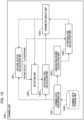
- FIG. 2 is a flowchart illustrating a flow of a feature vector calculation process of calculating a feature vector from a face image in the first embodiment.
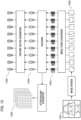
- FIG. 3 is a schematic diagram illustrating a flow of processing of calculating a feature vector from the face image in the first embodiment.
- FIG. 4 is a flowchart illustrating a processing flow of a transformer encoder block of the first embodiment. Meanwhile, the operation of each step of the flowcharts of FIGS. 2 and 4 is performed by a CPU serving as a computer in an image processing device executing a computer program stored in a memory.
- step S101 the image acquisition unit 101 acquires a face image 301 as shown in FIG. 3 from an input image from a camera or an image storage unit.
- the width and height of the face image are set to W and H, respectively.
- step S101 functions as an image acquisition step of acquiring an input image.
- step S102 the image division unit 102 divides the face image into partial images to obtain a partial image sequence 302 (see FIG. 3 ) which is a set of partial images of a predetermined size.
- step S102 functions as a division step of dividing the input image into a plurality of partial images to obtain a partial image sequence.
- the process of obtaining a partial image sequence by dividing a face image may be performed after a convolutional neural network (CNN) is applied as disclosed in Literature 1.
- CNN convolutional neural network
- the present embodiment is not limited to this.
- step S103 the image token conversion unit 103 converts the partial image sequence into a token sequence 303 (see FIG. 3 ) by converting the partial image into an image token which is a fixed D-dimensional vector. Further, for example, class tokens which are D-dimensional vectors of the same dimension initialized with random numbers are added to the token sequence.
- step S103 functions as a token conversion step of converting a partial image sequence into a token sequence by converting the partial images into tokens having a fixed-dimensional vector.
- the DNN is constituted by, for example, fully connected layers.
- the DNN need only be configured to convert PW- and PH-dimensional vectors into D-dimensional vectors, and is not limited to the present embodiment.
- a position embedding vector which is a D-dimensional vector may be further added to each token included in the token sequence. By adding the position embedding vector, it is possible to hold position information on the face image of the partial image corresponding to each token.
- the DNN and the class token are learnable parameters and are trained through a learning process to be described later in FIG. 6 .
- the class token may not be added.
- the feature vector acquisition unit 105 may calculate a feature vector from an encoded representation sequence corresponding to the token sequence converted from the partial image sequence.
- step S104 the encoding unit 104 obtains an encoded representation sequence 304 (see FIG. 3 ) by performing a process of updating each token once or more on the basis of the relationship between the tokens included in the token sequence through the DNN.
- the DNN has a configuration in which transformer encoder blocks known from Literature 1 are multi-staged.
- step S104 functions as an encoding step of obtaining the encoded representation sequence 304 by calculating an attention map indicating the degree of association between tokens to update the token sequence.
- Step S400 is a process based on layer normalization of a normalization layer
- step S401 is a process based on, for example, multi-head self-attention (hereinafter referred to as MHSA) disclosed in Japanese Patent No. 6884871 .
- MHSA multi-head self-attention
- Step S402 is a process of a fully connected layer
- step S403 is a process based on Gaussian error linear units (hereinafter referred to as GeLU) which is a non-linear activation function.
- GeLU Gaussian error linear units
- Step S401 which is a process based on MHSAin FIG. 4 , is repeated twice.
- the configuration shown here is an example, and a process may be performed using batch normalization (hereinafter referred to as BN) as a normalization layer instead of step S400 based on layer normalization (hereinafter referred to as LN).
- BN batch normalization
- LN layer normalization
- a process may be performed using a rectified linear unit (hereinafter referred to as ReLU) as a non-linear activation function instead of step S403 based on GeLU.
- ReLU rectified linear unit
- step S401 based on MHSA is arbitrary.
- a convolutional layer may be added.
- a vector of the same dimension as a token such as a position embedding vector may be added to the input of any layer.
- each transformer encoder block in the multi-stage DNN may be processed using configurations different from each other. Meanwhile, the DNN is trained through a learning process to be described later.
- Step S401 based on MHSA is a type of process called self-attention, and self-attention will be first described with reference to FIG. 5 as a schematic diagram.
- FIG. 5 is a schematic diagram illustrating a flow of self-attention in the first embodiment. For simplicity, it is assumed that the number of image tokens is five and the number of class tokens added to the image token is one.
- An input token matrix 501 is a matrix representation of a token sequence where row vectors are tokens.
- an attention map 505 is calculated by calculating the matrix product of the query matrix 502 and a matrix obtained by transposing the key matrix 503, dividing each element of the obtained matrix by D, and multiplying a Softmax function in a column direction.
- the attention map 505 is a matrix of the number of tokens ⁇ the number of tokens (here, 6 ⁇ 6), and is normalized so that the element sum of each row vector is one. Each row vector of the attention map 505 represents how much attention should be paid to each token in order to acquire an encoded representation for a certain token.
- tokens having a lot of information necessary to characterize the partial image corresponding to the token draw great attention
- tokens having information necessary to identify a person in the face image draw great attention
- the matrix product of the value matrix 504 and the attention map 505 is output as an output token matrix 506.
- the configuration shown here is an example, and, for example, a fully connected layer may be further applied to the attention map 505.
- step S401 based on MHSA the input token matrix 501 is divided into H pieces in the column direction (the dimension of the token is D/H), and after self-attention is applied to each of the divided input token matrices, they are connected to each other and integrated in the column direction.
- step S401 based on MHSA H attention maps 306 are calculated (see FIG. 3 ).
- step S105 the feature vector acquisition unit 105 acquires the encoded representation corresponding to the class token from the encoded representation sequence 304 obtained by the encoding unit, and outputs it as a feature vector 305.
- step S105 functions as a feature vector acquisition step of obtaining a feature vector from the encoded representation sequence.
- a method of calculating a feature vector may be, for example, weighted addition of a token sequence, or calculation of basic statistics such as the average or sum of each encoded representation.
- the encoded representation sequence may be converted into a vector of a predetermined number of dimensions through the DNN.
- the encoded representation sequence may be output as it is as a feature vector, or the application of the DNN to each encoded representation sequence may be output as a feature vector.
- step S106 the attention map acquisition unit 106 acquires and outputs the attention map 306 generated in step S401 based on each MHSA of the encoding unit.
- steps S101 to S105 are performed for each of the two images. Thereby, feature vectors of the first image and the second image are calculated.
- the feature vectors are set to f1 and f2, respectively.
- the similarity score between the two feature vectors is calculated.
- a plurality of degrees of similarity may be used for the similarity score between feature vectors, and the angle between feature amount vectors is used, for example, as in the method in Literature 3. That is, the similarity score S is calculated as in the following Formula 1.
- ⁇ 12 is the angle between the feature amount vectors f1 and f2
- ⁇ f1, f2> is the inner product of the feature amount vectors f1 and f2.
- Formula 2 is the Euclidean norm of the feature amount vectors f1 and f2. ⁇ f 1 ⁇ , ⁇ f 2 ⁇
- the similarity score S is equal to or less than a predetermined threshold, the same person is determined, and if not, a different person is determined.
- FIG. 6 is a functional block diagram illustrating a configuration example of a learning unit serving as an image processing device of the first embodiment.
- a learning unit 600 includes a learning data acquisition unit 601, the feature vector calculation unit 100 of FIG. 1 , a classification loss calculation unit 602, an association degree calculation unit 603, an attention loss calculation unit 604, a parameter update unit 605, a learning data storage unit 606, a representative vector storage unit 607, and the like.
- the learning data acquisition unit 601 acquires region information, an inter-region association degree map, and a face image set which are held by the learning data storage unit 606.
- the feature vector calculation unit 100 calculates feature vectors and attention maps from the face image set obtained by the learning data acquisition unit 601 as described above.
- the classification loss calculation unit 602 calculates a classification loss value from the face image set obtained by the learning data acquisition unit 601, the feature vector obtained by the feature vector calculation unit 100, and the representative vector held by the representative vector storage unit.
- the association degree calculation unit 603 calculates an inter-token association degree map which is a correct value for calculating an attention loss from the region information, the degree of association between regions, and the face image set which are obtained by the learning data acquisition unit.
- the attention loss calculation unit 604 calculates an attention loss value from the attention map obtained by the feature vector calculation unit 100 and the inter-token association degree map obtained by the association degree calculation unit 603.
- the parameter update unit 605 updates at least parameters held by the parameter storage unit 107 on the basis of the classification loss value obtained by the classification loss calculation unit 602 and the attention loss value obtained by the attention loss calculation unit 604. In addition, the parameter update unit 605 updates the representative vector held by the representative vector storage unit 607 on the basis of the classification loss value and the attention loss value.
- FIG. 7 is a flowchart illustrating a procedure of a learning process of the first embodiment. Meanwhile, the operation of each step of the flowchart of FIG. 7 is performed by the CPU serving as a computer in an image processing device executing a computer program stored in a memory.
- FIG. 8 is a schematic diagram of region information and an inter-region association degree map in the first embodiment
- FIG. 9 is a schematic diagram of a face image set of the first embodiment
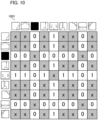
- FIG. 10 is a schematic diagram of an inter-token association degree map of the first embodiment.
- the procedure of the learning process will be described with reference to FIGS. 1 and 6 to 10 .
- learning is performed using a known ⁇ representative vector method> as disclosed in Literature 4.
- the representative vector method is a method of learning face authentication in which a feature amount vector representing each person is set and used together to improve learning efficiency.
- step S201 the parameters of the image token conversion unit 103 and the encoding unit 104 held in the parameter storage unit 107 of the feature vector calculation unit 100 are initialized. Further, representative vectors v1 to vn held in the representative vector storage unit 607 of the learning unit 600 are initialized with random numbers.
- 1 to n are IDs of all persons included in the learning image.
- Each representative vector v is a d-dimensional vector (d is a predetermined value).
- step S202 the learning data acquisition unit 601 acquires region information 801 and an inter-region association degree map 802 as shown in FIG. 8 from the learning data storage unit 606.
- the region information 801 is constituted by a region (left column) that needs to be controlled and its label ID (right column), and indicates the degree of association which is the degree of relevance to other regions.
- the inter-region association degree map 802 is a matrix whose elements are the target values of the degree of association between regions defined by the region information 801.
- the size of the matrix is the number of types of regions ⁇ the number of types of regions, which is 4 ⁇ 4 in the example of FIG. 8 .
- the element in the r-th row and s-th column of the inter-region association degree map indicates the correct value of the element in which the label ID of a partial image corresponding to a row in the attention map is r and the label ID of a partial image corresponding to a column is s, and is a real number that takes a value ranging from 0 to 1.
- the region unnecessary for face authentication may be a sunglass region or a region of a wearable object that hides a portion of the face, and need only be a region of low contribution to the performance of face authentication.
- the important region for face authentication may be the region of facial organs such as the eyes and mouth, and need only be a region of high contribution to the performance of face authentication.
- the value of the degree of association may be other values such as 0.9 or 0.1.
- a value 803 indicating NaN (Not a Number) is used for elements for which target values are not set.
- FIG. 8 although a set of region information and inter-region association degree map are acquired, different region information and inter-region association degree maps may be acquired for each head in step S401 based on each MHSA included in the encoding unit 104 of the feature vector calculation unit 100.
- step S203 the learning data acquisition unit 601 randomly acquires face image sets I1 to Im from the learning data storage unit 606.
- each face image 901 is provided with person ID information 902 and a region label image 903.
- the region label image 903 is constituted by a predetermined image according to the label ID for each region to which each pixel of the face image belongs, and has the same size as the face image.
- the feature vector calculation unit 100 calculates a feature vector fi and an attention map Ailh from each face image Ii of the above face image set.
- the feature vector fi is a d-dimensional vector.
- the attention map Ailh is an attention map of an h-th head in step S401 based on the first MHSA included in the encoding unit 104 of the feature vector calculation unit 100.
- the classification loss calculation unit 602 calculates a classification loss value from the feature vector and the representative vector.
- the similarity (intra-class similarity) Sintra of the feature amount between each person and the representative vector and the similarity (inter-class similarity) Sinter between feature amounts of each person and the representative vector of another person are calculated on the basis of the following Formula 3.
- S Intra f i S f i v a i
- S Inter f i ⁇ j ⁇ a i S f i v j
- a(i) is the ID number of a person in the face image Ii.
- the classification loss value LCLS used for learning is obtained by summing this value for each face image as shown in the following Formula 4.
- L CLS ⁇ i S Inter f i ⁇ ⁇ S Intra f i
- ⁇ is a weight parameter for the balance of learning.
- Formula 4 is an example of a formula for calculating a loss value, and various known methods such as using a similarity score with a margin or cross entropy may be used.
- the association degree calculation unit 603 calculates the inter-token association degree map from the inter-region association degree map and the region label image. Specifically, for example, an association degree map Ri is calculated from the region information 801, the inter-region association degree map 802, and the region label image corresponding to each face image. First, the label IDs within a range on the input image of the partial image and a corresponding range on the region label image are counted, and the label ID having the largest number of pixels among the label IDs is associated with the partial image.
- a single label ID need only be able to be associated with each partial image, or each label ID may be prioritized and the one having the highest priority among the label IDs included in the range may be associated.
- the inter-token association degree map is a matrix having a size of the number of tokens ⁇ the number of tokens, where the row and column correspond to the index of each token in the token sequence and the index of each partial image in the partial image sequence, respectively,
- the association degree map Ri(t, u) which is an element of the t-th row and u-th column of the inter-token association degree map is calculated by the following Formula 5.
- one inter-token association degree map is calculated for all the attention maps corresponding to one face image Ii from a set of region information and inter-region association degree map.
- a different inter-token association degree map may be calculated for each head in step S401 based on each MHSA included the encoding unit 104 of the feature vector calculation unit 100 from one or a plurality of sets of region information and inter-region association degree maps.
- R i t u R Region ( g t , g u
- g(t) is a label ID to which the t-th partial image in the partial image sequence corresponds
- RRegion is an inter-region association degree map.
- the attention loss calculation unit 604 calculates an attention loss value LAttn from the attention map Ai and the association degree map Ri of each face image, for example, using the following Formula 6.
- L Attn ⁇ i ⁇ l ⁇ h ⁇ t ⁇ u A ilh t u ⁇ R i t u , if R i t u ⁇ NaN
- T1 and T2 are thresholds for elements of the attention map, where T1 ⁇ T2.
- L Attn ⁇ i ⁇ l ⁇ h ⁇ t ⁇ u A ilh t u ⁇ R i t u , if R i t u ⁇ Nan and A ilh t u ⁇ T 1 and A ilh , t u ⁇ T 2
- self-attention forcibly weakens the attention between tokens to which strong attention is given, or forcibly strengthens the attention between tokens for which there is no attention at all. This can prevent adverse effects on learning.
- Rilh is an inter-token association degree map corresponding to the attention map Ailh.
- the sum of errors for the elements of all the attention maps is used as the attention loss value in Formulas 6 to 8, it may be a sum of errors for some attention maps, or a weighted sum of errors for the element of each attention map as in the following Formula 9.
- L Attn ⁇ i ⁇ l ⁇ h ⁇ t ⁇ u W ilh t u A ilh t u ⁇ R i t u if R i t u ⁇ NaN
- Wilh(t, u) is a weight corresponding to Ailh(t, u).
- the weight may be the area ratio of the label ID corresponding to each partial image in the partial image, and the loss value may be calculated so that the error for the partial image with a large area ratio gives more importance.
- step S208 the parameter update unit 605 adjusts the parameters of the feature vector calculation unit 100 and the representative vector of each person so as to reduce loss. That is, the parameters of the image token conversion unit 103 and the encoding unit 104 held by the parameter storage unit 107 and the value of the representative vector held by the representative vector storage unit 607 are updated.
- the weighted sum of the classification loss value obtained by the classification loss calculation unit 602 and the attention loss value obtained by the attention loss calculation unit 604 is updated slightly in the direction of decrease.
- the representative vector is improved to function more effectively as a value representing the feature of each person, and the feature vectors output by the feature vector calculation unit 100 are improved to resemble each other if they are the feature vectors of the same person. Therefore, each element of the attention map output by each self-attention of the feature vector calculation unit 100 is improved so as to approach the target value set in the inter-region association degree map 802.
- step S209 it is determined whether the above learning has converged. If No, the process returns to step S203, and repeats a predetermined number of times until the learning process converges. If Yes in step S209, the process proceeds to step S210. In step S210, the parameters held by the parameter storage unit 107 of the feature vector calculation unit 100 are stored and saved, and the flow of FIG. 7 ends.
- steps S203 to S209 function as learning steps.
- the error between the target value of the degree of association between partial images and the attention map calculated from the input image in the encoding step is set as the attention loss value, and at least the parameter of the feature vector is adjusted so as to reduce the attention loss value.
- a second embodiment has an image synthesis unit 1102 that synthesizes a region unnecessary for face authentication with a face image, and calculates an attention loss value for the face image that has undergone image synthesis.
- image synthesis unit 1102 that synthesizes a region unnecessary for face authentication with a face image, and calculates an attention loss value for the face image that has undergone image synthesis.
- learning is performed so as to reduce the attention of self-attention only for a region unnecessary for face authentication included in learning data.
- a region unnecessary for face authentication is generated on the face image through image synthesis, and learning is performed so as to reduce the attention of self-attention for the region.
- FIG. 11 is a functional block diagram illustrating a configuration example of a learning unit serving as an image processing device of the second embodiment.
- a learning unit 1100 includes a learning data acquisition unit 1101, the image synthesis unit 1102, the feature vector calculation unit 100, a classification loss calculation unit 1103, an association degree calculation unit 1104, an attention loss calculation unit 1105, and a parameter update unit 1106.
- the learning unit 1100 further includes a learning data storage unit 1107 and a representative vector storage unit 1108.
- the learning data acquisition unit 1101 acquires region information, an inter-region association degree map, and a face image set which are held by the learning data storage unit 1107.
- the image synthesis unit 1102 synthesizes a region unnecessary for face authentication with the face image included in the face image set obtained by the learning data acquisition unit 1101, and updates the corresponding region label image.
- the feature vector calculation unit 100 calculates a feature vector and an attention map from the face image set obtained by the image synthesis unit 1102.
- the classification loss calculation unit 1103 calculates a classification loss value from the face image set obtained by the image synthesis unit 1102, the feature vector obtained by the feature vector calculation unit 100, and the representative vector held by the representative vector storage unit.
- the association degree calculation unit 1104 calculates an inter-token association degree map which is a correct value for calculating an attention loss value from the region information, the inter-region association degree map, and the face image set which are obtained by the learning data acquisition unit.
- the attention loss calculation unit 1105 calculates an attention loss value from the attention map obtained by the feature vector calculation unit and the inter-token association degree map obtained by the association degree calculation unit 1104.
- the parameter update unit 1106 updates the parameters held by the parameter storage unit 107 on the basis of the classification loss value obtained by the classification loss calculation unit 1103 and the attention loss value obtained by the attention loss calculation unit. In addition, the parameter update unit 1106 updates the representative vector held by the representative vector storage unit 1108 on the basis of the classification loss value and the attention loss value.
- FIG. 12 is a flowchart illustrating a procedure of a learning process of the second embodiment
- FIG. 13 is a schematic diagram of a face image set of the second embodiment. Meanwhile, the operation of each step of the flowchart of FIG. 12 is performed by the CPU serving as a computer in an image processing device executing a computer program stored in a memory.
- FIG. 14 is a schematic diagram illustrating a procedure of an image synthesis process of the second embodiment.
- the procedure of the learning process of the second embodiment will be described with reference to FIGS. 1 , 8 , 10 , and 12 to 14 .
- learning is performed using a ⁇ representative vector method> disclosed in Literature 4 similarly to the first embodiment.
- the same portions as those in the first embodiment will not be described, and only different points will be described.
- step S301 the feature vector calculation unit 100 initializes the parameters of the image token conversion unit 103 and the encoding unit 104 held by the parameter storage unit 107. Further, the learning unit 1100 initializes the representative vector of each person held by the representative vector storage unit 1108.
- step S302 the learning data acquisition unit 1101 acquires the region information 801 and the inter-region association degree map 802 from the learning data storage unit 1107.
- the details of the region information and the inter-region association degree map and the acquisition method thereof are the same as in the first embodiment. Meanwhile, as will be described later, the region information and the inter-region association degree map define the information on a region to be synthesized in step S304 and the degree of association for the region.
- step S303 the learning data acquisition unit 1101 randomly acquires a face image set from the learning data storage unit 1107.
- each face image 1301 is provided with person ID information 1302 and a region label image 1303.
- the region label image is constituted by a predetermined image corresponding to the label ID of a region to which each pixel of the face image belongs, and has the same size as the face image.
- step S304 as shown in FIG. 14 , the image synthesis unit 1102 creates a synthesized face image 1401 by synthesizing a region unnecessary for face authentication with the face image 1301.
- a synthesized region label image 1404 is created by updating the value of the region of the region label image 1303 corresponding to a synthesis location.
- a masked image 1402 and a blackened image 1403 are synthesized with the face image, and corresponding regions on the region label image are updated as a masked region 1405 and a blackened region 1406.
- the synthesis position of the regions may be randomly determined for each face image, or may be a fixed position.
- the synthesis position may be determined by randomly selecting it from candidates for positions that do not overlap an important region for recognition. It may be determined whether each region is probabilistically synthesized for each face image. In the example of FIG. 14 , the entire image of the region unnecessary for face authentication is synthesized, but a portion of the image may be synthesized.
- step S305 the feature vector calculation unit 100 calculates a feature vector and an attention map from the above synthesized face image.
- the details of the feature vector and the attention map are the same as in the first embodiment.
- the classification loss calculation unit 1103 calculates a classification loss value from the feature vector and the representative vector. Specifically, for example, similarly to the first embodiment, intra-class similarity and inter-class similarity are calculated, and the classification loss value is calculated on the basis of these similarities. A method of calculating intra-class similarity and inter-class similarity may be the same as in the first embodiment.
- step S307 the association degree calculation unit 1104 calculates the inter-token association degree map 1001 from the region information, the inter-region association degree map, and the synthesized region label image.
- the details of the inter-token association degree map and the calculation method thereof are the same as in the first embodiment.
- step S308 the attention loss calculation unit 1105 calculates an attention loss value from the attention map and the association degree map of each face image.
- a method of calculating an attention loss value is the same as in the first embodiment.
- step S309 the parameter update unit 1106 adjusts the parameters of the feature vector calculation unit 100 and the representative vector of each person so as to reduce loss. That is, the parameters of the image token conversion unit 103 and the encoding unit 104 held by the parameter storage unit 107 and the value of the representative vector held by the representative vector storage unit 1108 are updated.
- step S310 it is determined whether the above learning has converged. If No, the process returns to step S303, and repeats a predetermined number of times until the learning process converges.
- step S310 the process proceeds to step S311.
- step S311 the parameters held by the parameter storage unit 107 of the feature vector calculation unit 100 are stored and saved, and the flow of FIG. 12 ends.
- rectangle information and detection likelihood of a face in an image are estimated on the basis of a feature vector, a detection loss value is calculated on the basis of the rectangle information and the detection likelihood, and parameters are adjusted so that the detection loss value and the attention loss value are reduced.
- a process of calculating a feature vector from an image, a process of estimating the position of a face on the image on the basis of the feature vector, and a learning process in the third embodiment will be described below.
- the same portions as those in the first embodiment will not be described, and only different points will be described.
- FIG. 15 is a schematic diagram illustrating a procedure of a feature vector calculation process of the third embodiment. A procedure of calculating a feature vector from an image in the third embodiment will be described with reference to FIGS. 1 , 2 , and 15 .
- step S101 the image acquisition unit 101 acquires an image 1501 in FIG. 15 .
- step S102 the image division unit 102 divides the face image into a partial image sequence 1502 (see FIG. 15 ) which is a set of partial images of a predetermined size.
- the division process is the same as in the first embodiment.
- step S103 the image token conversion unit 103 converts the partial image sequence into a token sequence 1503 (see FIG. 15 ) by converting the partial image into an image token which is a D-dimensional vector.
- a feature vector corresponding to each partial image is required to be acquired in order to estimate whether a face is in a local region on the image, a class token is not added.
- the process of conversion into an image token is the same as in the first embodiment.
- step S104 the encoding unit 104 obtains an encoded representation sequence 1504 as shown in FIG. 15 by performing a process of updating each token once or more on the basis of the relationship between tokens included in the token sequence through the DNN.
- step S105 the feature vector acquisition unit 105 acquires the encoded representation sequence obtained by the encoding unit, as it is, as a feature vector sequence 1505.
- a configuration in which encoded representation corresponding to a class token is acquired is adopted in order to obtain one feature vector from the entire image, whereas, in the third embodiment, it is inferred (estimated) whether there is a face with respect to the feature vector corresponding to each partial region.
- the encoded representation sequence 1504 corresponding to each partial image is acquired as the feature vector sequence 1505 as it is.
- the attention map acquisition unit 106 acquires and outputs an attention map 1506 (see FIG. 15 ) generated in step S401 for each MHSA of the encoding unit 104.
- FIG. 16 is a functional block diagram illustrating a configuration example of a detection unit included in a learning unit serving as an image processing device of the third embodiment.
- a detection unit 1600 includes a feature vector acquisition unit 1601, an estimation unit 1602, and a parameter storage unit 1603.
- the feature vector acquisition unit 1601 includes 100 of which the configuration is shown in FIG. 1 .
- FIG. 17 is a flowchart illustrating a procedure of a detection process of the third embodiment, and shows a flow of processing of estimating a circumscribed rectangle and detection likelihood of a face on an image from a feature vector. Meanwhile, the operation of each step of the flowchart of FIG. 17 is performed by the CPU serving as a computer in an image processing device executing a computer program stored in a memory.
- FIG. 18 is a schematic diagram of rectangle information of the third embodiment. A procedure of estimating a circumscribed rectangle and detection likelihood of a face on an input image from a feature vector will be described with reference to FIGS. 16 to 18 .
- step S1701 of FIG. 17 the feature vector acquisition unit 1601 acquires a feature vector sequence.
- the estimation unit 1602 applies a DNN to each feature vector in the feature vector sequence to estimate (infer) rectangle information (position information on circumscribed rectangular region) and detection likelihood from each feature vector.
- rectangle information 1800 consists of an x coordinate 1801 and a y coordinate 1802 at the upper left, a width 1803, and a height 1804 of the circumscribed rectangle of the face in the input image, and the detection likelihood is a real number that takes a value ranging from 0 to 1.
- the x coordinate and width are normalized to values obtained by dividing them by the width of the input image
- the y coordinate and height are normalized to values obtained by dividing them by the height of the input image.
- a threshold is set for the detection likelihood, and the rectangle information equal to or greater than the threshold is output as the circumscribed rectangle of the face.
- the DNN is constituted by one fully connected layer and a Sigmoid function, where the fully connected layer is linearly converts a D-dimensional feature vector into a 5-dimensional vector and the Sigmoid function is applied to output values ranging from 0 to 1.
- Each dimension of the output vector corresponds to the rectangle information and detection likelihood. Meanwhile, the configuration shown here is an example, and if the rectangle information is output without being normalized, an activation function may be output without being applied.
- the Softmax function may be applied as the activation function by increasing the number of dimensions corresponding to the detection likelihood in the output vector.
- the number of layers of the DNN is arbitrary, and another fully connected layer and a normalization layer such as the activation function, BN, or LN may be added.
- the DNN is trained through a learning process to be described later.
- FIG. 19 is a functional block diagram illustrating a configuration example of a learning unit serving as an image processing device of the third embodiment.
- a learning unit 1900 includes a learning data acquisition unit 1901, the feature vector calculation unit 100, the detection unit 1600 in FIG. 16 , a detection loss calculation unit 1902, an association degree calculation unit 1903, an attention loss calculation unit 1904, a parameter update unit 1905, and a learning data storage unit 1906.
- the learning data acquisition unit 1901 acquires region information, an inter-region association degree map, and an image set which are held by the learning data storage unit 1906.
- the feature vector calculation unit 100 calculates a feature vector and an attention map from the image set obtained by the learning data acquisition unit.
- the detection unit 1600 estimates the rectangle information and detection likelihood from the feature vector obtained by the feature vector calculation unit 100.
- the detection loss calculation unit 1902 calculates a detection loss value from the face image set obtained by the learning data acquisition unit 1901 and the rectangle information and detection likelihood obtained by the detection unit 1600.
- the association degree calculation unit 1903 calculates an inter-token association degree map which is a correct value for calculating an attention loss value from the region information, the inter-region association degree map, and the face image set obtained by the learning data acquisition unit 1901.
- the attention loss calculation unit 1904 calculates an attention loss value from the attention map obtained by the feature vector calculation unit and the inter-token association degree map obtained by the association degree calculation unit 1903.
- the parameter update unit 1905 updates at least the parameters held by the parameter storage unit 109 on the basis of the detection loss value obtained by the detection loss calculation unit 1902 and the attention loss value obtained by the attention loss calculation unit 1904. In addition, the parameter update unit 1905 further updates the parameters held by the parameter storage unit 1603 on the basis of the detection loss value and the attention loss value.
- FIG. 20 is a flowchart illustrating a procedure of a learning process of the third embodiment. Meanwhile, the operation of each step of the flowchart of FIG. 20 is performed by the CPU serving as a computer in an image processing device executing a computer program stored in a memory.
- FIG. 21 is a schematic diagram of a face image set of the third embodiment.
- the procedure of the learning process of the third embodiment will be described with reference to FIGS. 1 , 10 , 16 , and 19 to 21 .
- the same portions as those in the first embodiment will not be described, and only different points will be described.
- step S501 the parameters of the image token conversion unit 103 and the encoding unit 104 held by the parameter storage unit 107 are initialized. Further, the parameters of the estimation unit 1602 held by the parameter storage unit 1603 are initialized.
- step S502 the learning data acquisition unit 1901 acquires the region information 801 and the inter-region association degree map 802 from the learning data storage unit 1906.
- the details of the region information and the inter-region association degree map and the acquisition method thereof are the same as in the first embodiment.
- step S503 the learning data acquisition unit 1901 randomly acquires face image sets I1 to Im from the learning data storage unit 1906.
- each face image 2101 is provided with correct rectangle information 2102 and a region label image 2107.
- the correct rectangle information consists of an x coordinate 2103 and a y coordinate 2104 at the upper left, a width 2105, and a height 2106 of the circumscribed rectangle of the face in the input image.
- the region label image 2107 is constituted by a predetermined image corresponding to the label ID of a region to which each pixel of the face image belongs, and has the same size as the face image.
- step S504 the feature vector calculation unit 100 calculates a feature vector and an attention map from the face image.
- the details of the feature vector and the attention map are the same as in the first embodiment.
- step S505 the detection unit 1600 estimates rectangle information and detection likelihood from the feature vector.
- step S506 the detection loss calculation unit 1902 calculates a detection loss value from correct rectangle information, rectangle information, and detection likelihood.
- a detection likelihood loss value LDET1 and a rectangle information loss value LDET2 are calculated.
- the detection likelihood loss value LDET1 is calculated using the following Formula 10.
- L DET 1 ⁇ ⁇ i ⁇ n p in ′ log p in
- pin is the detection likelihood for the n-th partial image of the face image Ii
- p'in is a value of 1 if the central coordinates of the rectangle in the correct rectangle information of the face image Ii are included in the n-th partial image of the face image Ii, and is a value of 0 if not.
- the rectangle information loss value LDET2 is calculated using the following Formula 11.
- L DET 2 ⁇ i ⁇ n x i ⁇ x i ′ + y i ⁇ y i ′ + w i ⁇ w i ′ + h i ⁇ h i ′
- x'i, y'i, w'i, and h'i are the x coordinate, y coordinate, width, and height of the correct rectangle information of the face image Ii, respectively.
- xi, yi, wi, and hi are the x coordinate, y coordinate, width, and height of the rectangle information, respectively, corresponding to the partial image of the face image Ii which includes the central coordinates of the rectangle in the correct rectangle information of the face image Ii.
- a weighted addition of this as in the following Formula 12 is a detection loss value LDET.
- L DET ⁇ 1 L DET 1 + ⁇ 2 L DET 2
- ⁇ 1 and ⁇ 2 are weight parameters for the balance of learning.
- Formula 12 is an example of a formula for calculating a detection loss value, and various known methods such as using generalized intersection over union (GIoU) indicating the degree of overlap between rectangular regions may be used.
- GOU generalized intersection over union
- step S507 the association degree calculation unit 1903 calculates the inter-token association degree map 1001 from the region information, the inter-region association degree map, and the region label image.
- the details of the inter-token association degree map and the calculation method thereof are the same as in step S206 of the first embodiment.
- step S508 the attention loss calculation unit 1904 calculates an attention loss value from the attention map and the association degree map of each face image.
- a method of calculating an attention loss value is the same as in step S207 of the first embodiment.
- step S509 the parameter update unit 1905 adjusts the parameters of the feature vector calculation unit 100 and the representative vector of each person so as to reduce loss. That is, the parameters of the image token conversion unit 103 and the encoding unit 104 held by the parameter storage unit 107 and the parameters of the estimation unit 1602 held by the parameter storage unit 1603 are updated.
- the weighted sum of the detection loss value obtained by the detection loss calculation unit 1902 and the attention loss value obtained by the attention loss calculation unit 1904 is updated slightly in the direction of decrease. That is, the learning unit adjusts at least the parameters of the feature vector so that the detection loss value and the attention loss value are reduced.
- each element of the attention map output by each self-attention of the feature vector calculation unit 100 is improved to approach the target value set in the inter-region association degree map 802.
- step S510 it is determined whether the above learning has converged. If No, the process returns to step S503, and repeats a predetermined number of times until the learning process converges. If Yes in step S510, the process proceeds to step S511.
- step S511 the parameters held by the parameter storage unit 107 of the feature vector calculation unit 100 and the parameters held by the parameter storage unit 1603 of the detection unit 1600 are stored and saved, and the flow of FIG. 20 ends.
- a computer program realizing the function of the embodiments described above may be supplied to the image processing device through a network or various storage media. Then, a computer (or a CPU, an MPU, or the like) of the image processing device may be configured to read and execute the program. In such a case, the program and the storage medium storing the program configure the present invention.
- An image processing device comprising at least one processor or circuit configured to function as: an image acquisition unit configured to acquire an input image; a division unit configured to divide the input image into a plurality of partial images to obtain a partial image sequence; a token conversion unit configured to convert the partial image sequence into a token sequence by respectively converting each of the partial images includes in the partial image sequence into a token having a fixed-dimensional vector; an encoding unit configured to obtain an encoded representation sequence based on an attention map indicating a degree of association between tokens and the token sequence; a feature vector acquisition unit configured to obtain a feature vector from the encoded representation sequence obtained by the encoding unit; and a learning unit configured to adjust at least parameters of the feature vector to reduce an attention loss value, wherein the attention loss value corresponds to an error between a target value of the degree of association between the partial images and a value indicated by the attention map calculated
Landscapes
- Engineering & Computer Science (AREA)
- Theoretical Computer Science (AREA)
- Physics & Mathematics (AREA)
- General Physics & Mathematics (AREA)
- Health & Medical Sciences (AREA)
- General Health & Medical Sciences (AREA)
- Multimedia (AREA)
- Evolutionary Computation (AREA)
- Computer Vision & Pattern Recognition (AREA)
- Software Systems (AREA)
- Computing Systems (AREA)
- Artificial Intelligence (AREA)
- Medical Informatics (AREA)
- Databases & Information Systems (AREA)
- Oral & Maxillofacial Surgery (AREA)
- Human Computer Interaction (AREA)
- Life Sciences & Earth Sciences (AREA)
- Biomedical Technology (AREA)
- Biophysics (AREA)
- Computational Linguistics (AREA)
- Data Mining & Analysis (AREA)
- Molecular Biology (AREA)
- General Engineering & Computer Science (AREA)
- Mathematical Physics (AREA)
- Image Analysis (AREA)
- Image Processing (AREA)
- Collating Specific Patterns (AREA)
Abstract
Description
- The present invention relates to an image processing device, an image processing method, and a storage medium.
- Many feature extractors that extract information useful for solving a target task from an image as feature vectors have been proposed. Among them, feature extractors using a convolutional neural network (hereinafter referred to as a CNN) which is a method of a deep neural network (hereinafter referred to as a DNN) have conventionally shown high performance.
- Literature 1 (Dosovitskiy, Alexey, et al. An Image Is Worth 16x16 Words: Transformers for Image Recognition at Scale. ICLR 2021: The Ninth International Conference on Learning Representations, 2021.) proposes a vision transformer (hereinafter referred to as ViT) in which a DNN called a transformer as disclosed in
Japanese Patent No. 6884871 - In Literature 2 (Zhong, Y, & Deng, W. (2021). Face Transformer for Recognition. arXiv preprint arXiv: 2103.14803.), a ViT-based feature extractor is applied to a face authentication task and thus shows performance equivalent to that of a CNN-based feature extractor. In addition, in Literature 3 (Carion, N., Massa, F., Synnaeve, G., Usunier, N., Kirillov, A., & Zagoruyko, S. (2020). End-to-End OBJECT Detection with Transformers. In European Conference on Computer Vision (pp. 213-229).), a ViT-based feature extractor is applied to an object detection task and thus shows performance equivalent to that of a CNN-based feature extractor. In addition, Literature 4 (Deng, et. Al. ArcFace: Additive Angular Margin Loss for Deep Face Recognition. In CVPR, 2019) shows a general learning method using a representative vector method.
- A ViT extracts features from each partial image in an image by means of a plurality of self-attention mechanisms. Further, when the feature of a certain partial image is extracted, it generates a map called an attention map having information on how much attention should be paid to other partial images. A feature vector is then calculated by repeating a process of concentrating the features of each partial image on the basis of the attention map.
- If an input image of a ViT contains regions having information unnecessary for recognition (such as, for example, concealment by an object in the case of face authentication), each self-attention of the ViT focuses on partial images containing those regions and collects information unnecessary for recognition. Thereby, there is a problem in that less attention is paid to partial images containing regions having relatively important information for recognition (such as, for example, regions including facial organs in the case of face authentication), and sufficient information important for recognition cannot be collected, which leads to a decrease in the performance of recognition.
- In Literature 5 (Mao, X., Qi, G., Chen, Y, Li, X., Duan, R., Ye, S., ··· Xue, H. (2021). Towards Robust Vision Transformer. ArXiv Preprint ArXiv: 2105.07926.), a weighted map of the same size as an attention map is acquired through learning, and the attention map generated by self-attention is multiplied by the weighted map. Thereby, the relevance between partial images with low positional relevance (for example, image center and image edge) is lowered to enhance robustness against position-dependent noise. However, it is difficult to improve robustness against noise with low position dependence (such as, for example, concealment by an object in the case of face authentication).
- According to an aspect of the present invention, there is provided an image processing device includes an image acquisition unit configured to acquire an input image; a division unit configured to divide the input image into a plurality of partial images to obtain a partial image sequence; a token conversion unit configured to convert the partial image sequence into a token sequence by respectively converting each of the partial images includes in the partial image sequence into a token having a fixed-dimensional vector; an encoding unit configured to obtain an encoded representation sequence based on an attention map indicating a degree of association between tokens and the token sequence; a feature vector acquisition unit configured to obtain a feature vector from the encoded representation sequence obtained by the encoding unit; and a learning unit configured to adjust at least parameters of the feature vector to reduce an attention loss value, wherein the attention loss value corresponds to an error between a target value of the degree of association between the partial images and a value indicated by the attention map calculated by the encoding unit.
- Further features of the present invention will become apparent from the following description of embodiments with reference to the attached drawings.
-
-
FIG. 1 is a functional block diagram illustrating a configuration example of a feature vector calculation unit included in a learning unit serving as an image processing device of a first embodiment. -
FIG. 2 is a flowchart illustrating a flow of a feature vector calculation process of calculating a feature vector from a face image in the first embodiment. -
FIG. 3 is a schematic diagram illustrating a flow of processing of calculating a feature vector from the face image in the first embodiment. -
FIG. 4 is a flowchart illustrating a processing flow of a transformer encoder block of the first embodiment. -
FIG. 5 is a schematic diagram illustrating a flow of self-attention in the first embodiment. -
FIG. 6 is a functional block diagram illustrating a configuration example of the learning unit serving as an image processing device of the first embodiment. -
FIG. 7 is a flowchart illustrating a procedure of a learning process of the first embodiment. -
FIG. 8 is a schematic diagram of region information and an inter-region association degree map in the first embodiment. -
FIG. 9 is a schematic diagram of a face image set of the first embodiment. -
FIG. 10 is a schematic diagram of an inter-token association degree map of the first embodiment. -
FIG. 11 is a functional block diagram illustrating a configuration example of a learning unit serving as an image processing device of a second embodiment. -
FIG. 12 is a flowchart illustrating a procedure of a learning process of the second embodiment. -
FIG. 13 is a schematic diagram of a face image set of the second embodiment. -
FIG. 14 is a schematic diagram illustrating a procedure of an image synthesis process of the second embodiment. -
FIG. 15 is a schematic diagram illustrating a procedure of a feature vector calculation process of a third embodiment. -
FIG. 16 is a functional block diagram illustrating a configuration example of a detection unit included in a learning unit serving as an image processing device of the third embodiment. -
FIG. 17 is a flowchart illustrating a procedure of a detection process of the third embodiment. -
FIG. 18 is a schematic diagram of rectangle information of the third embodiment. -
FIG. 19 is a functional block diagram illustrating a configuration example of the learning unit serving as an image processing device of the third embodiment. -
FIG. 20 is a flowchart illustrating a procedure of a learning process of the third embodiment. -
FIG. 21 is a schematic diagram of a face image set of the third embodiment. - Hereinafter, with reference to the accompanying drawings, favorable modes of the present invention will be described using Embodiments. In each diagram, the same reference signs are applied to the same members or elements, and duplicate description will be omitted or simplified.
- In the following first embodiment and second embodiment, a task of calculating a feature vector for specifying the identity of one person's face from an image of the face (hereinafter referred to as a face image) (hereinafter referred to as face authentication) will be described as an example.
- A feature vector calculation process of calculating a feature vector from a face image and a learning process in a first embodiment will be described below.
FIG. 1 is a functional block diagram illustrating a configuration example of a feature vector calculation unit included in a learning unit serving as an image processing device in the first embodiment. - Meanwhile, some of the functional blocks shown in
FIG. 1 are realized by causing a computer (not shown) included in an image processing device to execute a computer program stored in a memory serving as a storage medium (not shown). - However, some or all of them may be realized by hardware. Examples of the hardware capable of being used include a dedicated circuit (ASIC), a processor (reconfigurable processor, DSP), and the like.
- In addition, the functional blocks shown in
FIG. 1 may not be built into the same housing, and may be constituted by separate devices connected to each other through signal paths. Meanwhile, the above description ofFIG. 1 applies equally toFIGS. 6 ,11 ,16 , and19 . - A feature
vector calculation unit 100 includes animage acquisition unit 101, animage division unit 102, an imagetoken conversion unit 103, anencoding unit 104, a featurevector acquisition unit 105, an attentionmap acquisition unit 106, and aparameter storage unit 107. Meanwhile, theimage division unit 102 divides an input image into a plurality of partial images to obtain a partial image sequence. - In addition, the image
token conversion unit 103 converts the partial image sequence into a token sequence by respectively converting each of the partial images included in the partial image sequence into a token having a fixed-dimensional vector. In addition, theencoding unit 104 obtains an encoded representation sequence by updating the token sequence on the basis of an attention map indicating the degree of association between tokens. - In addition, the feature
vector acquisition unit 105 obtains a feature vector from the encoded representation sequence. The attentionmap acquisition unit 106 acquires an attention map generated by theencoding unit 104 and indicating the degree of association which is the degree of relevance between tokens. - Meanwhile, a learning unit serving as an image processing device to be described later in
FIG. 6 has a built-in CPU serving as a computer, which functions as a control unit that controls the operation of each unit of the entire image processing device on the basis of a computer program stored in a memory serving as a storage medium. -
FIG. 2 is a flowchart illustrating a flow of a feature vector calculation process of calculating a feature vector from a face image in the first embodiment.FIG. 3 is a schematic diagram illustrating a flow of processing of calculating a feature vector from the face image in the first embodiment. -
FIG. 4 is a flowchart illustrating a processing flow of a transformer encoder block of the first embodiment. Meanwhile, the operation of each step of the flowcharts ofFIGS. 2 and4 is performed by a CPU serving as a computer in an image processing device executing a computer program stored in a memory. - A procedure of calculating a feature vector from a face image will be described with reference to
FIGS. 1 to 4 . First, in step S101, theimage acquisition unit 101 acquires aface image 301 as shown inFIG. 3 from an input image from a camera or an image storage unit. The width and height of the face image are set to W and H, respectively. Here, step S101 functions as an image acquisition step of acquiring an input image. - In step S102, the
image division unit 102 divides the face image into partial images to obtain a partial image sequence 302 (seeFIG. 3 ) which is a set of partial images of a predetermined size. The width and height of the partial image are set to PW and PH, respectively. If the number of partial images is set to N, the relation of N = W·H/PW·PH is established. - Meanwhile, as disclosed in
Literature 2, the partial images may be cut out from regions that partially overlap each other on a face image. Here, step S102 functions as a division step of dividing the input image into a plurality of partial images to obtain a partial image sequence. - Meanwhile, the process of obtaining a partial image sequence by dividing a face image may be performed after a convolutional neural network (CNN) is applied as disclosed in
Literature 1. In that case, if the width and height of a feature map output by the CNN are set to FW and FH, respectively, the number of partial images is N = FW·FH/PW·PH. Meanwhile, the present embodiment is not limited to this. - In step S103, the image
token conversion unit 103 converts the partial image sequence into a token sequence 303 (seeFIG. 3 ) by converting the partial image into an image token which is a fixed D-dimensional vector. Further, for example, class tokens which are D-dimensional vectors of the same dimension initialized with random numbers are added to the token sequence. - The conversion from the partial image into image tokens is performed by first converting the partial images into PW- and PH-dimensional vectors through planarization thereof and then converting these images into D-dimensional vectors through the DNN. Here, step S103 functions as a token conversion step of converting a partial image sequence into a token sequence by converting the partial images into tokens having a fixed-dimensional vector.
- The DNN is constituted by, for example, fully connected layers. The DNN need only be configured to convert PW- and PH-dimensional vectors into D-dimensional vectors, and is not limited to the present embodiment. Here, as in
Literature 1, a position embedding vector which is a D-dimensional vector may be further added to each token included in the token sequence. By adding the position embedding vector, it is possible to hold position information on the face image of the partial image corresponding to each token. - The DNN and the class token are learnable parameters and are trained through a learning process to be described later in
FIG. 6 . Meanwhile, the class token may not be added. In that case, instep S 105 to be described later, the featurevector acquisition unit 105 may calculate a feature vector from an encoded representation sequence corresponding to the token sequence converted from the partial image sequence. - In step S104, the
encoding unit 104 obtains an encoded representation sequence 304 (seeFIG. 3 ) by performing a process of updating each token once or more on the basis of the relationship between the tokens included in the token sequence through the DNN. - The DNN has a configuration in which transformer encoder blocks known from
Literature 1 are multi-staged. Here, step S104 functions as an encoding step of obtaining the encodedrepresentation sequence 304 by calculating an attention map indicating the degree of association between tokens to update the token sequence. - The processing flow of the transformer encoder block is shown in
FIG. 4 . Step S400 is a process based on layer normalization of a normalization layer, and step S401 is a process based on, for example, multi-head self-attention (hereinafter referred to as MHSA) disclosed inJapanese Patent No. 6884871 - Step S402 is a process of a fully connected layer, and step S403 is a process based on Gaussian error linear units (hereinafter referred to as GeLU) which is a non-linear activation function. In the flow of
FIG. 4 , an input token is processed to output an output token. - Step S401, which is a process based on MHSAin
FIG. 4 , is repeated twice. The configuration shown here is an example, and a process may be performed using batch normalization (hereinafter referred to as BN) as a normalization layer instead of step S400 based on layer normalization (hereinafter referred to as LN). - In addition, a process may be performed using a rectified linear unit (hereinafter referred to as ReLU) as a non-linear activation function instead of step S403 based on GeLU.
- The number of repetitions of step S401 based on MHSA is arbitrary. A convolutional layer may be added. A vector of the same dimension as a token such as a position embedding vector may be added to the input of any layer. In addition, each transformer encoder block in the multi-stage DNN may be processed using configurations different from each other. Meanwhile, the DNN is trained through a learning process to be described later.
- Here, step S401 based on MHSAwill be described. Step S401 based on MHSA is a type of process called self-attention, and self-attention will be first described with reference to
FIG. 5 as a schematic diagram. -
FIG. 5 is a schematic diagram illustrating a flow of self-attention in the first embodiment. For simplicity, it is assumed that the number of image tokens is five and the number of class tokens added to the image token is one. An inputtoken matrix 501 is a matrix representation of a token sequence where row vectors are tokens. - First, three fully connected layers are applied to the input
token matrix 501 to convert them into aquery matrix 502, akey matrix 503, and avalue matrix 504. Meanwhile, although there is one input token matrix in the example ofFIG. 6 , there may be separate input token matrices for the query matrix, the key matrix, and the value matrix. - Next, an
attention map 505 is calculated by calculating the matrix product of thequery matrix 502 and a matrix obtained by transposing thekey matrix 503, dividing each element of the obtained matrix by D, and multiplying a Softmax function in a column direction. - The
attention map 505 is a matrix of the number of tokens × the number of tokens (here, 6 × 6), and is normalized so that the element sum of each row vector is one. Each row vector of theattention map 505 represents how much attention should be paid to each token in order to acquire an encoded representation for a certain token. - For image tokens, tokens having a lot of information necessary to characterize the partial image corresponding to the token draw great attention, and for class tokens, tokens having information necessary to identify a person in the face image draw great attention.
- Finally, the matrix product of the
value matrix 504 and theattention map 505 is output as an outputtoken matrix 506. Meanwhile, the configuration shown here is an example, and, for example, a fully connected layer may be further applied to theattention map 505. - In step S401 based on MHSA, the input
token matrix 501 is divided into H pieces in the column direction (the dimension of the token is D/H), and after self-attention is applied to each of the divided input token matrices, they are connected to each other and integrated in the column direction. - This has the effect of preventing small features for each dimension from being easily ignored in high-dimensional vectors by dividing them into low-dimensional vectors. In step S401 based on MHSA, H attention maps 306 are calculated (see
FIG. 3 ). - In step S105, the feature
vector acquisition unit 105 acquires the encoded representation corresponding to the class token from the encodedrepresentation sequence 304 obtained by the encoding unit, and outputs it as afeature vector 305. - Meanwhile, the acquisition of the encoded representation sequence corresponding to the class token is merely an example. If the image
token conversion unit 103 does not add a class token in step S103, thefeature vector 305 is calculated from the encodedrepresentation sequence 304 corresponding to the token sequence converted from the partial image sequence. Here, step S105 functions as a feature vector acquisition step of obtaining a feature vector from the encoded representation sequence. - A method of calculating a feature vector may be, for example, weighted addition of a token sequence, or calculation of basic statistics such as the average or sum of each encoded representation. In addition, after the above-described process is performed or the encoded representation sequence is connected in the dimension direction, it may be converted into a vector of a predetermined number of dimensions through the DNN.
- In addition, if the feature of the partial image corresponding to each encoded representation is extracted, the encoded representation sequence may be output as it is as a feature vector, or the application of the DNN to each encoded representation sequence may be output as a feature vector.
- In step S106, the attention
map acquisition unit 106 acquires and outputs theattention map 306 generated in step S401 based on each MHSA of the encoding unit. Next, a method of determining, when two input images (face images) are given, whether the two persons are the same person or different persons on the basis of the feature vector calculated by the featurevector calculation unit 100 will be described. - First, the above-described processes of steps S101 to S105 are performed for each of the two images. Thereby, feature vectors of the first image and the second image are calculated. The feature vectors are set to f1 and f2, respectively.
- Next, the similarity score between the two feature vectors is calculated. A plurality of degrees of similarity may be used for the similarity score between feature vectors, and the angle between feature amount vectors is used, for example, as in the method in
Literature 3. That is, the similarity score S is calculated as in the followingFormula 1.
- Where, θ12 is the angle between the feature amount vectors f1 and f2, and <f1, f2> is the inner product of the feature amount vectors f1 and f2.
Formula 2 is the Euclidean norm of the feature amount vectors f1 and f2.
- If the similarity score S is equal to or less than a predetermined threshold, the same person is determined, and if not, a different person is determined.
-
FIG. 6 is a functional block diagram illustrating a configuration example of a learning unit serving as an image processing device of the first embodiment. Alearning unit 600 includes a learningdata acquisition unit 601, the featurevector calculation unit 100 ofFIG. 1 , a classificationloss calculation unit 602, an associationdegree calculation unit 603, an attentionloss calculation unit 604, aparameter update unit 605, a learningdata storage unit 606, a representativevector storage unit 607, and the like. - Each functional configuration unit of the
learning unit 600 will be described in detail. The learningdata acquisition unit 601 acquires region information, an inter-region association degree map, and a face image set which are held by the learningdata storage unit 606. The featurevector calculation unit 100 calculates feature vectors and attention maps from the face image set obtained by the learningdata acquisition unit 601 as described above. - The classification
loss calculation unit 602 calculates a classification loss value from the face image set obtained by the learningdata acquisition unit 601, the feature vector obtained by the featurevector calculation unit 100, and the representative vector held by the representative vector storage unit. The associationdegree calculation unit 603 calculates an inter-token association degree map which is a correct value for calculating an attention loss from the region information, the degree of association between regions, and the face image set which are obtained by the learning data acquisition unit. - The attention
loss calculation unit 604 calculates an attention loss value from the attention map obtained by the featurevector calculation unit 100 and the inter-token association degree map obtained by the associationdegree calculation unit 603. - The
parameter update unit 605 updates at least parameters held by theparameter storage unit 107 on the basis of the classification loss value obtained by the classificationloss calculation unit 602 and the attention loss value obtained by the attentionloss calculation unit 604. In addition, theparameter update unit 605 updates the representative vector held by the representativevector storage unit 607 on the basis of the classification loss value and the attention loss value. -
FIG. 7 is a flowchart illustrating a procedure of a learning process of the first embodiment. Meanwhile, the operation of each step of the flowchart ofFIG. 7 is performed by the CPU serving as a computer in an image processing device executing a computer program stored in a memory. -
FIG. 8 is a schematic diagram of region information and an inter-region association degree map in the first embodiment,FIG. 9 is a schematic diagram of a face image set of the first embodiment, andFIG. 10 is a schematic diagram of an inter-token association degree map of the first embodiment. - The procedure of the learning process will be described with reference to
FIGS. 1 and6 to 10 . Here, learning is performed using a known <representative vector method> as disclosed inLiterature 4. The representative vector method is a method of learning face authentication in which a feature amount vector representing each person is set and used together to improve learning efficiency. - First, in step S201, the parameters of the image
token conversion unit 103 and theencoding unit 104 held in theparameter storage unit 107 of the featurevector calculation unit 100 are initialized. Further, representative vectors v1 to vn held in the representativevector storage unit 607 of thelearning unit 600 are initialized with random numbers. Here, 1 to n are IDs of all persons included in the learning image. Each representative vector v is a d-dimensional vector (d is a predetermined value). - In step S202, the learning
data acquisition unit 601 acquiresregion information 801 and an inter-regionassociation degree map 802 as shown inFIG. 8 from the learningdata storage unit 606. Theregion information 801 is constituted by a region (left column) that needs to be controlled and its label ID (right column), and indicates the degree of association which is the degree of relevance to other regions. - In the example of
FIG. 8 , four regions are defined: a blackened region (label ID: 2) and a masked region (label ID: 3) as regions unnecessary for face authentication, a central region of the face (label ID: 4) as an important region for face authentication, and a normal region (label ID: 1). The inter-regionassociation degree map 802 is a matrix whose elements are the target values of the degree of association between regions defined by theregion information 801. - The size of the matrix is the number of types of regions × the number of types of regions, which is 4 × 4 in the example of
FIG. 8 . The element in the r-th row and s-th column of the inter-region association degree map indicates the correct value of the element in which the label ID of a partial image corresponding to a row in the attention map is r and the label ID of a partial image corresponding to a column is s, and is a real number that takes a value ranging from 0 to 1. - In the example of
FIG. 8 , by setting the degree of association of the central region of the face and the normal region with respect to the blackened region and the masked region as regions unnecessary for face authentication to 0, self-attention is trained so as not to collect (to ignore) information on a region unnecessary for face authentication. The region unnecessary for face authentication may be a sunglass region or a region of a wearable object that hides a portion of the face, and need only be a region of low contribution to the performance of face authentication. - By setting the degree of association of the normal region with respect to the central region of the face as an important region for face authentication to 1, self-attention is trained so as to collect information on an important region for face authentication. The important region for face authentication may be the region of facial organs such as the eyes and mouth, and need only be a region of high contribution to the performance of face authentication.
- The value of the degree of association may be other values such as 0.9 or 0.1. A
value 803 indicating NaN (Not a Number) is used for elements for which target values are not set. In the example ofFIG. 8 , although a set of region information and inter-region association degree map are acquired, different region information and inter-region association degree maps may be acquired for each head in step S401 based on each MHSA included in theencoding unit 104 of the featurevector calculation unit 100. - In step S203, the learning
data acquisition unit 601 randomly acquires face image sets I1 to Im from the learningdata storage unit 606. As shown inFIG. 9 , eachface image 901 is provided withperson ID information 902 and a region label image 903. As shown inFIG. 9 , the region label image 903 is constituted by a predetermined image according to the label ID for each region to which each pixel of the face image belongs, and has the same size as the face image. - In step S204, the feature
vector calculation unit 100 calculates a feature vector fi and an attention map Ailh from each face image Ii of the above face image set. Here, the feature vector fi is a d-dimensional vector. The attention map Ailh is an attention map of an h-th head in step S401 based on the first MHSA included in theencoding unit 104 of the featurevector calculation unit 100. - In step S205, the classification
loss calculation unit 602 calculates a classification loss value from the feature vector and the representative vector. Specifically, for example, the similarity (intra-class similarity) Sintra of the feature amount between each person and the representative vector and the similarity (inter-class similarity) Sinter between feature amounts of each person and the representative vector of another person are calculated on the basis of the followingFormula 3.
- Here, a(i) is the ID number of a person in the face image Ii. The classification loss value LCLS used for learning is obtained by summing this value for each face image as shown in the following
Formula 4.
- Here, λ is a weight parameter for the balance of learning. Meanwhile,
Formula 4 is an example of a formula for calculating a loss value, and various known methods such as using a similarity score with a margin or cross entropy may be used. - In step S206, the association
degree calculation unit 603 calculates the inter-token association degree map from the inter-region association degree map and the region label image. Specifically, for example, an association degree map Ri is calculated from theregion information 801, the inter-regionassociation degree map 802, and the region label image corresponding to each face image. First, the label IDs within a range on the input image of the partial image and a corresponding range on the region label image are counted, and the label ID having the largest number of pixels among the label IDs is associated with the partial image. - In that case, a single label ID need only be able to be associated with each partial image, or each label ID may be prioritized and the one having the highest priority among the label IDs included in the range may be associated.
- Next, an inter-token association degree map 1001 (see
FIG. 10 ) is calculated. The inter-token association degree map is a matrix having a size of the number of tokens × the number of tokens, where the row and column correspond to the index of each token in the token sequence and the index of each partial image in the partial image sequence, respectively, - The association degree map Ri(t, u) which is an element of the t-th row and u-th column of the inter-token association degree map is calculated by the following
Formula 5. Here, one inter-token association degree map is calculated for all the attention maps corresponding to one face image Ii from a set of region information and inter-region association degree map. - However, a different inter-token association degree map may be calculated for each head in step S401 based on each MHSA included the
encoding unit 104 of the featurevector calculation unit 100 from one or a plurality of sets of region information and inter-region association degree maps.
- Meanwhile, here, g(t) is a label ID to which the t-th partial image in the partial image sequence corresponds, and RRegion is an inter-region association degree map.
- In step S207, the attention
loss calculation unit 604 calculates an attention loss value LAttn from the attention map Ai and the association degree map Ri of each face image, for example, using the followingFormula 6.
- Meanwhile, although the absolute error is used as the loss value in
Formula 6, the squared error may be used. In addition, a loss value that brings a variable closer to the target value need only be used. For example, as in the followingFormula 7, the error may be calculated only for elements of the attention map having values within a certain range. Meanwhile, T1 and T2 are thresholds for elements of the attention map, where T1 < T2.
- By calculating the error only for elements within a certain range, self-attention forcibly weakens the attention between tokens to which strong attention is given, or forcibly strengthens the attention between tokens for which there is no attention at all. This can prevent adverse effects on learning.
- Meanwhile, although the error with the same inter-token association degree map is calculated for all the attention maps in
Formulas Formula 8.
- Here, Rilh is an inter-token association degree map corresponding to the attention map Ailh. Meanwhile, although the sum of errors for the elements of all the attention maps is used as the attention loss value in
Formulas 6 to 8, it may be a sum of errors for some attention maps, or a weighted sum of errors for the element of each attention map as in the followingFormula 9.
- Here, Wilh(t, u) is a weight corresponding to Ailh(t, u). The weight may be the area ratio of the label ID corresponding to each partial image in the partial image, and the loss value may be calculated so that the error for the partial image with a large area ratio gives more importance.
- In step S208, the
parameter update unit 605 adjusts the parameters of the featurevector calculation unit 100 and the representative vector of each person so as to reduce loss. That is, the parameters of the imagetoken conversion unit 103 and theencoding unit 104 held by theparameter storage unit 107 and the value of the representative vector held by the representativevector storage unit 607 are updated. - Specifically, by using a general error backpropagation method in the DNN, the weighted sum of the classification loss value obtained by the classification
loss calculation unit 602 and the attention loss value obtained by the attentionloss calculation unit 604 is updated slightly in the direction of decrease. - Thereby, the representative vector is improved to function more effectively as a value representing the feature of each person, and the feature vectors output by the feature
vector calculation unit 100 are improved to resemble each other if they are the feature vectors of the same person. Therefore, each element of the attention map output by each self-attention of the featurevector calculation unit 100 is improved so as to approach the target value set in the inter-regionassociation degree map 802. - Further, in step S209, it is determined whether the above learning has converged. If No, the process returns to step S203, and repeats a predetermined number of times until the learning process converges. If Yes in step S209, the process proceeds to step S210. In step S210, the parameters held by the
parameter storage unit 107 of the featurevector calculation unit 100 are stored and saved, and the flow ofFIG. 7 ends. - Here, steps S203 to S209 function as learning steps. In addition, in the learning step, the error between the target value of the degree of association between partial images and the attention map calculated from the input image in the encoding step is set as the attention loss value, and at least the parameter of the feature vector is adjusted so as to reduce the attention loss value.
- In this way, according to the first embodiment, in self-attention, it is difficult to pay attention to a region unnecessary for face authentication, and more attention is paid to an important region for face authentication. Therefore, the performance of face authentication is improved by important information for face authentication being concentrated in each token.
- A second embodiment has an
image synthesis unit 1102 that synthesizes a region unnecessary for face authentication with a face image, and calculates an attention loss value for the face image that has undergone image synthesis. The same portions as those in the first embodiment will not be described, and only different points will be described. - In the first embodiment, learning is performed so as to reduce the attention of self-attention only for a region unnecessary for face authentication included in learning data. However, in the second embodiment, a region unnecessary for face authentication is generated on the face image through image synthesis, and learning is performed so as to reduce the attention of self-attention for the region.
- This makes it difficult for self-attention to pay attention to a region having noise information which is not included in the learning data, and also makes it possible to increase the variation of noise information used for learning. Therefore, the effect of improving the performance of face authentication can be further enhanced.
- Meanwhile, a process of calculating a feature vector from a face image in the second embodiment is the same as in the first embodiment, and thus description thereof will be omitted.
FIG. 11 is a functional block diagram illustrating a configuration example of a learning unit serving as an image processing device of the second embodiment. - A
learning unit 1100 includes a learningdata acquisition unit 1101, theimage synthesis unit 1102, the featurevector calculation unit 100, a classificationloss calculation unit 1103, an associationdegree calculation unit 1104, an attentionloss calculation unit 1105, and aparameter update unit 1106. In addition, thelearning unit 1100 further includes a learningdata storage unit 1107 and a representativevector storage unit 1108. - Each functional configuration unit of the
learning unit 1100 will be described in detail. The learningdata acquisition unit 1101 acquires region information, an inter-region association degree map, and a face image set which are held by the learningdata storage unit 1107. Theimage synthesis unit 1102 synthesizes a region unnecessary for face authentication with the face image included in the face image set obtained by the learningdata acquisition unit 1101, and updates the corresponding region label image. - The feature
vector calculation unit 100 calculates a feature vector and an attention map from the face image set obtained by theimage synthesis unit 1102. The classificationloss calculation unit 1103 calculates a classification loss value from the face image set obtained by theimage synthesis unit 1102, the feature vector obtained by the featurevector calculation unit 100, and the representative vector held by the representative vector storage unit. - The association
degree calculation unit 1104 calculates an inter-token association degree map which is a correct value for calculating an attention loss value from the region information, the inter-region association degree map, and the face image set which are obtained by the learning data acquisition unit. The attentionloss calculation unit 1105 calculates an attention loss value from the attention map obtained by the feature vector calculation unit and the inter-token association degree map obtained by the associationdegree calculation unit 1104. - The
parameter update unit 1106 updates the parameters held by theparameter storage unit 107 on the basis of the classification loss value obtained by the classificationloss calculation unit 1103 and the attention loss value obtained by the attention loss calculation unit. In addition, theparameter update unit 1106 updates the representative vector held by the representativevector storage unit 1108 on the basis of the classification loss value and the attention loss value. -
FIG. 12 is a flowchart illustrating a procedure of a learning process of the second embodiment, andFIG. 13 is a schematic diagram of a face image set of the second embodiment. Meanwhile, the operation of each step of the flowchart ofFIG. 12 is performed by the CPU serving as a computer in an image processing device executing a computer program stored in a memory. -
FIG. 14 is a schematic diagram illustrating a procedure of an image synthesis process of the second embodiment. The procedure of the learning process of the second embodiment will be described with reference toFIGS. 1 ,8 ,10 , and12 to 14 . Here, it is assumed that learning is performed using a <representative vector method> disclosed inLiterature 4 similarly to the first embodiment. Meanwhile, the same portions as those in the first embodiment will not be described, and only different points will be described. - First, in step S301, the feature
vector calculation unit 100 initializes the parameters of the imagetoken conversion unit 103 and theencoding unit 104 held by theparameter storage unit 107. Further, thelearning unit 1100 initializes the representative vector of each person held by the representativevector storage unit 1108. - In step S302, the learning
data acquisition unit 1101 acquires theregion information 801 and the inter-regionassociation degree map 802 from the learningdata storage unit 1107. The details of the region information and the inter-region association degree map and the acquisition method thereof are the same as in the first embodiment. Meanwhile, as will be described later, the region information and the inter-region association degree map define the information on a region to be synthesized in step S304 and the degree of association for the region. - In step S303, the learning
data acquisition unit 1101 randomly acquires a face image set from the learningdata storage unit 1107. As shown inFIG. 13 , eachface image 1301 is provided withperson ID information 1302 and aregion label image 1303. The region label image is constituted by a predetermined image corresponding to the label ID of a region to which each pixel of the face image belongs, and has the same size as the face image. - In step S304, as shown in
FIG. 14 , theimage synthesis unit 1102 creates a synthesizedface image 1401 by synthesizing a region unnecessary for face authentication with theface image 1301. In addition, as shown inFIG. 14 , a synthesized region label image 1404 is created by updating the value of the region of theregion label image 1303 corresponding to a synthesis location. - That is, in the example shown in
FIG. 14 , amasked image 1402 and a blackenedimage 1403 are synthesized with the face image, and corresponding regions on the region label image are updated as amasked region 1405 and a blackenedregion 1406. - The synthesis position of the regions may be randomly determined for each face image, or may be a fixed position. In addition, the synthesis position may be determined by randomly selecting it from candidates for positions that do not overlap an important region for recognition. It may be determined whether each region is probabilistically synthesized for each face image. In the example of
FIG. 14 , the entire image of the region unnecessary for face authentication is synthesized, but a portion of the image may be synthesized. - In step S305, the feature
vector calculation unit 100 calculates a feature vector and an attention map from the above synthesized face image. The details of the feature vector and the attention map are the same as in the first embodiment. - In step S306, the classification
loss calculation unit 1103 calculates a classification loss value from the feature vector and the representative vector. Specifically, for example, similarly to the first embodiment, intra-class similarity and inter-class similarity are calculated, and the classification loss value is calculated on the basis of these similarities. A method of calculating intra-class similarity and inter-class similarity may be the same as in the first embodiment. - In step S307, the association
degree calculation unit 1104 calculates the inter-tokenassociation degree map 1001 from the region information, the inter-region association degree map, and the synthesized region label image. The details of the inter-token association degree map and the calculation method thereof are the same as in the first embodiment. - In step S308, the attention
loss calculation unit 1105 calculates an attention loss value from the attention map and the association degree map of each face image. A method of calculating an attention loss value is the same as in the first embodiment. - In step S309, the
parameter update unit 1106 adjusts the parameters of the featurevector calculation unit 100 and the representative vector of each person so as to reduce loss. That is, the parameters of the imagetoken conversion unit 103 and theencoding unit 104 held by theparameter storage unit 107 and the value of the representative vector held by the representativevector storage unit 1108 are updated. - A method of updating parameters and a representative vector is the same as in the first embodiment. Further, in step S310, it is determined whether the above learning has converged. If No, the process returns to step S303, and repeats a predetermined number of times until the learning process converges.
- If Yes in step S310, the process proceeds to step S311. In step S311, the parameters held by the
parameter storage unit 107 of the featurevector calculation unit 100 are stored and saved, and the flow ofFIG. 12 ends. - By adopting a configuration as in the second embodiment, in self-attention, it becomes difficult to pay attention to a region having noise information which is not included in learning data. In addition, since it is possible to easily increase the variation of noise information used for learning rather than collecting learning data having new noise information, the effect of improving the performance of face authentication can be further enhanced.
- In a third embodiment, rectangle information and detection likelihood of a face in an image are estimated on the basis of a feature vector, a detection loss value is calculated on the basis of the rectangle information and the detection likelihood, and parameters are adjusted so that the detection loss value and the attention loss value are reduced.
- A process of calculating a feature vector from an image, a process of estimating the position of a face on the image on the basis of the feature vector, and a learning process in the third embodiment will be described below. The same portions as those in the first embodiment will not be described, and only different points will be described.
- Meanwhile, the configuration example of a feature vector calculation unit of the third embodiment is the same as in
FIG. 1 , and a flow of processing of calculating a feature vector from the face image in the third embodiment is the same as inFIG. 2 .FIG. 15 is a schematic diagram illustrating a procedure of a feature vector calculation process of the third embodiment. A procedure of calculating a feature vector from an image in the third embodiment will be described with reference toFIGS. 1 ,2 , and15 . - First, in step S101, the
image acquisition unit 101 acquires animage 1501 inFIG. 15 . In step S102, theimage division unit 102 divides the face image into a partial image sequence 1502 (seeFIG. 15 ) which is a set of partial images of a predetermined size. The division process is the same as in the first embodiment. - In step S103, the image
token conversion unit 103 converts the partial image sequence into a token sequence 1503 (seeFIG. 15 ) by converting the partial image into an image token which is a D-dimensional vector. In the third embodiment, since a feature vector corresponding to each partial image is required to be acquired in order to estimate whether a face is in a local region on the image, a class token is not added. The process of conversion into an image token is the same as in the first embodiment. - In step S104, the
encoding unit 104 obtains an encodedrepresentation sequence 1504 as shown inFIG. 15 by performing a process of updating each token once or more on the basis of the relationship between tokens included in the token sequence through the DNN. - The details of the token update process and the DNN are the same as in the first embodiment. In step S105, the feature
vector acquisition unit 105 acquires the encoded representation sequence obtained by the encoding unit, as it is, as afeature vector sequence 1505. - In the first embodiment, a configuration in which encoded representation corresponding to a class token is acquired is adopted in order to obtain one feature vector from the entire image, whereas, in the third embodiment, it is inferred (estimated) whether there is a face with respect to the feature vector corresponding to each partial region.
- Therefore, the encoded
representation sequence 1504 corresponding to each partial image is acquired as thefeature vector sequence 1505 as it is. In step S106, the attentionmap acquisition unit 106 acquires and outputs an attention map 1506 (seeFIG. 15 ) generated in step S401 for each MHSA of theencoding unit 104. -
FIG. 16 is a functional block diagram illustrating a configuration example of a detection unit included in a learning unit serving as an image processing device of the third embodiment. Adetection unit 1600 includes a featurevector acquisition unit 1601, anestimation unit 1602, and aparameter storage unit 1603. The featurevector acquisition unit 1601 includes 100 of which the configuration is shown inFIG. 1 . -
FIG. 17 is a flowchart illustrating a procedure of a detection process of the third embodiment, and shows a flow of processing of estimating a circumscribed rectangle and detection likelihood of a face on an image from a feature vector. Meanwhile, the operation of each step of the flowchart ofFIG. 17 is performed by the CPU serving as a computer in an image processing device executing a computer program stored in a memory. -
FIG. 18 is a schematic diagram of rectangle information of the third embodiment. A procedure of estimating a circumscribed rectangle and detection likelihood of a face on an input image from a feature vector will be described with reference toFIGS. 16 to 18 . - In step S1701 of
FIG. 17 , the featurevector acquisition unit 1601 acquires a feature vector sequence. In step S1702, theestimation unit 1602 applies a DNN to each feature vector in the feature vector sequence to estimate (infer) rectangle information (position information on circumscribed rectangular region) and detection likelihood from each feature vector. - As shown in
FIG. 18 ,rectangle information 1800 consists of an x coordinate 1801 and a y coordinate 1802 at the upper left, awidth 1803, and aheight 1804 of the circumscribed rectangle of the face in the input image, and the detection likelihood is a real number that takes a value ranging from 0 to 1. - Here, the x coordinate and width are normalized to values obtained by dividing them by the width of the input image, and the y coordinate and height are normalized to values obtained by dividing them by the height of the input image. During inference in the
estimation unit 1602, a threshold is set for the detection likelihood, and the rectangle information equal to or greater than the threshold is output as the circumscribed rectangle of the face. The DNN is constituted by one fully connected layer and a Sigmoid function, where the fully connected layer is linearly converts a D-dimensional feature vector into a 5-dimensional vector and the Sigmoid function is applied to output values ranging from 0 to 1. - Each dimension of the output vector corresponds to the rectangle information and detection likelihood. Meanwhile, the configuration shown here is an example, and if the rectangle information is output without being normalized, an activation function may be output without being applied.
- In addition, if a plurality of face classes (for example, faces by attributes such as age and gender) are estimated, the Softmax function may be applied as the activation function by increasing the number of dimensions corresponding to the detection likelihood in the output vector. In addition, the number of layers of the DNN is arbitrary, and another fully connected layer and a normalization layer such as the activation function, BN, or LN may be added. The DNN is trained through a learning process to be described later.
-
FIG. 19 is a functional block diagram illustrating a configuration example of a learning unit serving as an image processing device of the third embodiment. Alearning unit 1900 includes a learningdata acquisition unit 1901, the featurevector calculation unit 100, thedetection unit 1600 inFIG. 16 , a detectionloss calculation unit 1902, an associationdegree calculation unit 1903, an attentionloss calculation unit 1904, aparameter update unit 1905, and a learningdata storage unit 1906. - Each functional configuration unit of the
learning unit 1900 will be described in detail. The learningdata acquisition unit 1901 acquires region information, an inter-region association degree map, and an image set which are held by the learningdata storage unit 1906. The featurevector calculation unit 100 calculates a feature vector and an attention map from the image set obtained by the learning data acquisition unit. - The
detection unit 1600 estimates the rectangle information and detection likelihood from the feature vector obtained by the featurevector calculation unit 100. The detectionloss calculation unit 1902 calculates a detection loss value from the face image set obtained by the learningdata acquisition unit 1901 and the rectangle information and detection likelihood obtained by thedetection unit 1600. - The association
degree calculation unit 1903 calculates an inter-token association degree map which is a correct value for calculating an attention loss value from the region information, the inter-region association degree map, and the face image set obtained by the learningdata acquisition unit 1901. - The attention
loss calculation unit 1904 calculates an attention loss value from the attention map obtained by the feature vector calculation unit and the inter-token association degree map obtained by the associationdegree calculation unit 1903. - The
parameter update unit 1905 updates at least the parameters held by the parameter storage unit 109 on the basis of the detection loss value obtained by the detectionloss calculation unit 1902 and the attention loss value obtained by the attentionloss calculation unit 1904. In addition, theparameter update unit 1905 further updates the parameters held by theparameter storage unit 1603 on the basis of the detection loss value and the attention loss value. -
FIG. 20 is a flowchart illustrating a procedure of a learning process of the third embodiment. Meanwhile, the operation of each step of the flowchart ofFIG. 20 is performed by the CPU serving as a computer in an image processing device executing a computer program stored in a memory. -
FIG. 21 is a schematic diagram of a face image set of the third embodiment. The procedure of the learning process of the third embodiment will be described with reference toFIGS. 1 ,10 ,16 , and19 to 21 . The same portions as those in the first embodiment will not be described, and only different points will be described. - First, in step S501, the parameters of the image
token conversion unit 103 and theencoding unit 104 held by theparameter storage unit 107 are initialized. Further, the parameters of theestimation unit 1602 held by theparameter storage unit 1603 are initialized. - In step S502, the learning
data acquisition unit 1901 acquires theregion information 801 and the inter-regionassociation degree map 802 from the learningdata storage unit 1906. The details of the region information and the inter-region association degree map and the acquisition method thereof are the same as in the first embodiment. - In step S503, the learning
data acquisition unit 1901 randomly acquires face image sets I1 to Im from the learningdata storage unit 1906. As shown inFIG. 21 , eachface image 2101 is provided withcorrect rectangle information 2102 and a region label image 2107. The correct rectangle information consists of an x coordinate 2103 and a y coordinate 2104 at the upper left, awidth 2105, and aheight 2106 of the circumscribed rectangle of the face in the input image. - Here, the x coordinate and width are normalized to values obtained by dividing them by the width of the input image, and the y coordinate and height are normalized to values obtained by dividing them by the height of the input image. The region label image 2107 is constituted by a predetermined image corresponding to the label ID of a region to which each pixel of the face image belongs, and has the same size as the face image.
- In step S504, the feature
vector calculation unit 100 calculates a feature vector and an attention map from the face image. The details of the feature vector and the attention map are the same as in the first embodiment. - In step S505, the
detection unit 1600 estimates rectangle information and detection likelihood from the feature vector. In step S506, the detectionloss calculation unit 1902 calculates a detection loss value from correct rectangle information, rectangle information, and detection likelihood. In order to calculate the detection loss value, a detection likelihood loss value LDET1 and a rectangle information loss value LDET2 are calculated. The detection likelihood loss value LDET1 is calculated using the followingFormula 10.
- Here, pin is the detection likelihood for the n-th partial image of the face image Ii, and p'in is a value of 1 if the central coordinates of the rectangle in the correct rectangle information of the face image Ii are included in the n-th partial image of the face image Ii, and is a value of 0 if not. The rectangle information loss value LDET2 is calculated using the following Formula 11.
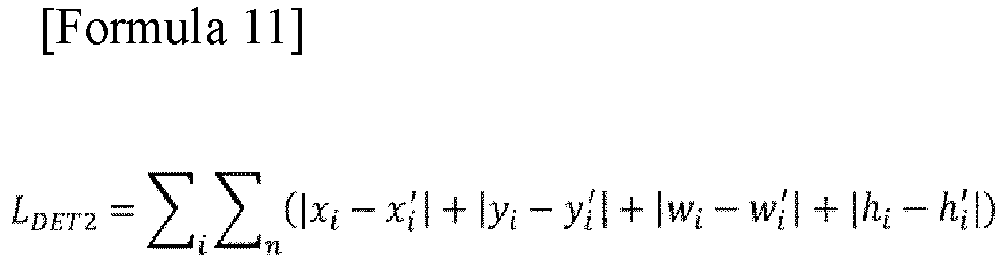
- Here, x'i, y'i, w'i, and h'i are the x coordinate, y coordinate, width, and height of the correct rectangle information of the face image Ii, respectively. In addition, xi, yi, wi, and hi are the x coordinate, y coordinate, width, and height of the rectangle information, respectively, corresponding to the partial image of the face image Ii which includes the central coordinates of the rectangle in the correct rectangle information of the face image Ii. A weighted addition of this as in the following Formula 12 is a detection loss value LDET.

- Here, λ1 and λ2 are weight parameters for the balance of learning. Meanwhile, Formula 12 is an example of a formula for calculating a detection loss value, and various known methods such as using generalized intersection over union (GIoU) indicating the degree of overlap between rectangular regions may be used.
- In step S507, the association
degree calculation unit 1903 calculates the inter-tokenassociation degree map 1001 from the region information, the inter-region association degree map, and the region label image. The details of the inter-token association degree map and the calculation method thereof are the same as in step S206 of the first embodiment. - In step S508, the attention
loss calculation unit 1904 calculates an attention loss value from the attention map and the association degree map of each face image. A method of calculating an attention loss value is the same as in step S207 of the first embodiment. - In step S509, the
parameter update unit 1905 adjusts the parameters of the featurevector calculation unit 100 and the representative vector of each person so as to reduce loss. That is, the parameters of the imagetoken conversion unit 103 and theencoding unit 104 held by theparameter storage unit 107 and the parameters of theestimation unit 1602 held by theparameter storage unit 1603 are updated. - Specifically, by using a general error backpropagation method in the DNN, the weighted sum of the detection loss value obtained by the detection
loss calculation unit 1902 and the attention loss value obtained by the attentionloss calculation unit 1904 is updated slightly in the direction of decrease. That is, the learning unit adjusts at least the parameters of the feature vector so that the detection loss value and the attention loss value are reduced. - Thereby, the detection unit is improved to output a high detection likelihood and accurate rectangle information for faces. In addition, each element of the attention map output by each self-attention of the feature
vector calculation unit 100 is improved to approach the target value set in the inter-regionassociation degree map 802. - Further, in step S510, it is determined whether the above learning has converged. If No, the process returns to step S503, and repeats a predetermined number of times until the learning process converges. If Yes in step S510, the process proceeds to step S511.
- In step S511, the parameters held by the
parameter storage unit 107 of the featurevector calculation unit 100 and the parameters held by theparameter storage unit 1603 of thedetection unit 1600 are stored and saved, and the flow ofFIG. 20 ends. - With such a configuration as in the third embodiment, it becomes difficult to pay attention to a region unnecessary for face detection in self-attention, and it becomes possible to pay more attention to an important region for face detection. Thereby, the performance of face detection is improved by important information for face detection being concentrated in each token.
- While the present invention has been described with reference to exemplary embodiments, it is to be understood that the invention is not limited to the disclosed exemplary embodiments. The scope of the following claims is to be accorded the broadest interpretation to encompass all such modifications and equivalent structures and functions.
- In addition, as a part or the whole of the control according to the embodiments, a computer program realizing the function of the embodiments described above may be supplied to the image processing device through a network or various storage media. Then, a computer (or a CPU, an MPU, or the like) of the image processing device may be configured to read and execute the program. In such a case, the program and the storage medium storing the program configure the present invention.
- This application claims the benefit of
Japanese Patent Application No. 2022-135676, filed on August 29, 2022
An image processing device comprising at least one processor or circuit configured to function as: an image acquisition unit configured to acquire an input image; a division unit configured to divide the input image into a plurality of partial images to obtain a partial image sequence; a token conversion unit configured to convert the partial image sequence into a token sequence by respectively converting each of the partial images includes in the partial image sequence into a token having a fixed-dimensional vector; an encoding unit configured to obtain an encoded representation sequence based on an attention map indicating a degree of association between tokens and the token sequence; a feature vector acquisition unit configured to obtain a feature vector from the encoded representation sequence obtained by the encoding unit; and a learning unit configured to adjust at least parameters of the feature vector to reduce an attention loss value, wherein the attention loss value corresponds to an error between a target value of the degree of association between the partial images and a value indicated by the attention map calculated by the encoding unit.
Claims (11)
- An image processing device comprising
at least one processor or circuit configured to function as:an image acquisition unit configured to acquire an input image;a division unit configured to divide the input image into a plurality of partial images to obtain a partial image sequence;a token conversion unit configured to convert the partial image sequence into a token sequence by respectively converting each of the partial images includes in the partial image sequence into a token having a fixed-dimensional vector;an encoding unit configured to obtain an encoded representation sequence based on an attention map indicating a degree of association between tokens and the token sequence;a feature vector acquisition unit configured to obtain a feature vector from the encoded representation sequence obtained by the encoding unit; anda learning unit configured to adjust at least parameters of the feature vector to reduce an attention loss value, wherein the attention loss value corresponds to an error between a target value of the degree of association between the partial images and a value indicated by the attention map calculated by the encoding unit. - The image processing device according to claim 1, wherein the token conversion unit converts the partial image sequence obtained by the division unit into the token sequence, and adds a class token having a vector of the same dimension as the token to the token sequence, wherein the encoding unit acquires the encoded representation sequence by updating the token sequence to which the class token is added based on the attention map.
- The image processing device according to claim 2, wherein the feature vector acquisition unit obtains, as the feature vector, the encoded representation corresponding to the class token from the encoded representation sequence obtained by the encoding unit.
- The image processing device according to claim 1, wherein the input image is an image including a face of person, and it is determined whether persons included in two input images are the same on the basis of the feature vectors corresponding to the two input images.
- The image processing device according to claim 1, wherein the input image is an image including a face of person, and the feature vector is used to estimate a position on the input image of the face of the person included in the input image.
- The image processing device according to claim 1, wherein the learning unit adjusts at least parameters of the token conversion unit and the encoding unit to reduce the attention loss value.
- The image processing device according to claim 4, wherein the learning unit adjusts a representative vector of each person to reduce the attention loss value.
- The image processing device according to claim 1, wherein the at least one processor or circuit is further configured to function as:
an image synthesis unit configured to synthesize a region unnecessary for face authentication with a face image and calculate the attention loss value for the face image that has undergone image synthesis. - The image processing device according to claim 1, wherein the at least one processor or circuit is further configured to function as:an estimation unit configured to estimate rectangle information and detection likelihood of a face in an image on the basis of the feature vector; anda detection loss calculation unit configured to calculate a detection loss value on the basis of the rectangle information and the detection likelihood, andthe learning unit adjusts at least the parameters of the feature vector so that the detection loss value and the attention loss value are reduced.
- An image processing method comprising:acquiring an input image;dividing the input image into a plurality of partial images to obtain a partial image sequence;converting the partial image sequence into a token sequence by respectively converting each of the partial images includes in the partial image sequence into a token having a fixed-dimensional vector;obtaining an encoded representation sequence based on an attention map indicating a degree of association between tokens and the token sequence;obtaining a feature vector from the encoded representation sequence obtained by the encoding; andlearning to adjust at least parameters of the feature vector to reduce an attention loss value, wherein the attention loss value corresponds to an error between a target value of the degree of association between the partial images and a value indicated by the attention map calculated by the encoding.
- A non-transitory computer-readable storage medium storing a computer program including instructions for executing following processes:acquiring an input image;dividing the input image into a plurality of partial images to obtain a partial image sequence;converting the partial image sequence into a token sequence by respectively converting each of the partial images includes in the partial image sequence into a token having a fixed-dimensional vector;obtaining an encoded representation sequence based on an attention map indicating a degree of association between tokens and the token sequence;obtaining a feature vector from the encoded representation sequence obtained by the encoding; andlearning to adjust at least parameters of the feature vector to reduce an attention loss value, wherein the attention loss value corresponds to an error between a target value of the degree of association between the partial images and a value indicated by the attention map calculated by the encoding.
Applications Claiming Priority (1)
| Application Number | Priority Date | Filing Date | Title |
|---|---|---|---|
| JP2022135676A JP2024032167A (en) | 2022-08-29 | 2022-08-29 | Image processing device, image processing method and computer program |
Publications (1)
| Publication Number | Publication Date |
|---|---|
| EP4332835A1 true EP4332835A1 (en) | 2024-03-06 |
Family
ID=87556059
Family Applications (1)
| Application Number | Title | Priority Date | Filing Date |
|---|---|---|---|
| EP23189403.1A Pending EP4332835A1 (en) | 2022-08-29 | 2023-08-03 | Image processing device, image processing method, and storage medium using an attention map for partial images |
Country Status (4)
| Country | Link |
|---|---|
| US (1) | US12586407B2 (en) |
| EP (1) | EP4332835A1 (en) |
| JP (1) | JP2024032167A (en) |
| CN (1) | CN117636414A (en) |
Families Citing this family (1)
| Publication number | Priority date | Publication date | Assignee | Title |
|---|---|---|---|---|
| JP7834471B2 (en) * | 2021-12-21 | 2026-03-24 | キヤノン株式会社 | Image processing device, learning method, and program |
Citations (2)
| Publication number | Priority date | Publication date | Assignee | Title |
|---|---|---|---|---|
| JPH0584871B2 (en) | 1987-09-28 | 1993-12-03 | Sekisui Plastics | |
| JP2022135676A (en) | 2021-03-05 | 2022-09-15 | キヤノン株式会社 | Moving body control system and moving body control method |
Family Cites Families (5)
| Publication number | Priority date | Publication date | Assignee | Title |
|---|---|---|---|---|
| EP4156034A1 (en) | 2017-05-23 | 2023-03-29 | Google LLC | Attention-based sequence transduction neural networks |
| US12056880B2 (en) * | 2020-08-03 | 2024-08-06 | Korea Advanced Institute Of Science And Technology | Method of classifying lesion of chest x-ray radiograph based on data normalization and local patch and apparatus thereof |
| US11574500B2 (en) * | 2020-09-08 | 2023-02-07 | Samsung Electronics Co., Ltd. | Real-time facial landmark detection |
| JP7741670B2 (en) | 2021-09-15 | 2025-09-18 | キヤノン株式会社 | Image processing device, its control method, and program |
| JP7757176B2 (en) * | 2021-12-21 | 2025-10-21 | キヤノン株式会社 | Image processing device, control method and program for image processing device |
-
2022
- 2022-08-29 JP JP2022135676A patent/JP2024032167A/en active Pending
-
2023
- 2023-08-03 EP EP23189403.1A patent/EP4332835A1/en active Pending
- 2023-08-15 US US18/449,732 patent/US12586407B2/en active Active
- 2023-08-28 CN CN202311089226.9A patent/CN117636414A/en active Pending
Patent Citations (2)
| Publication number | Priority date | Publication date | Assignee | Title |
|---|---|---|---|---|
| JPH0584871B2 (en) | 1987-09-28 | 1993-12-03 | Sekisui Plastics | |
| JP2022135676A (en) | 2021-03-05 | 2022-09-15 | キヤノン株式会社 | Moving body control system and moving body control method |
Non-Patent Citations (5)
| Title |
|---|
| CARION, N.MASSA, F.SYNNAEVE, G.USUNIER, N.KIRILLOV, A.ZAGORUYKO, S.: "End-to-End OBJECT Detection with Transformers", EUROPEAN CONFERENCE ON COMPUTER VISION, 2020, pages 213 - 229 |
| DOSOVITSKIY, ALEXEY ET AL.: "An Image Is Worth 16x16 Words: Transformers for Image Recognition at Scale", ICLR 2021: THE NINTH INTERNATIONAL CONFERENCE ON LEARNING REPRESENTATIONS, 2021 |
| MAO XIAOFENG ET AL: "Towards Robust Vision Transformer", 2022 IEEE/CVF CONFERENCE ON COMPUTER VISION AND PATTERN RECOGNITION (CVPR), IEEE, 18 June 2022 (2022-06-18), pages 12032 - 12041, XP034193426, DOI: 10.1109/CVPR52688.2022.01173 * |
| PATRO BADRI N ET AL: "Self Supervision for Attention Networks", 2021 IEEE WINTER CONFERENCE ON APPLICATIONS OF COMPUTER VISION (WACV), IEEE, 3 January 2021 (2021-01-03), pages 726 - 735, XP033926268, DOI: 10.1109/WACV48630.2021.00077 * |
| ZHONG YAOYAO ET AL: "Face Transformer for Recognition", ARXIV.ORG, 26 March 2021 (2021-03-26), Ithaca, XP093113503, Retrieved from the Internet <URL:https://arxiv.org/pdf/2103.14803.pdf> [retrieved on 20231219], DOI: 10.48550/arxiv.2103.14803 * |
Also Published As
| Publication number | Publication date |
|---|---|
| US12586407B2 (en) | 2026-03-24 |
| US20240071130A1 (en) | 2024-02-29 |
| CN117636414A (en) | 2024-03-01 |
| JP2024032167A (en) | 2024-03-12 |
Similar Documents
| Publication | Publication Date | Title |
|---|---|---|
| Hosseini et al. | Age and gender classification using wide convolutional neural network and Gabor filter | |
| US9053388B2 (en) | Image processing apparatus and method, and computer-readable storage medium | |
| EP2590111B1 (en) | Face recognition apparatus and method for controlling the same | |
| CN110069985B (en) | Image-based target point position detection method and device and electronic equipment | |
| CN110826534B (en) | Face key point detection method and system based on local principal component analysis | |
| JP2004192603A (en) | Method of extracting pattern feature, and device therefor | |
| CN107408211A (en) | Method for distinguishing is known again for object | |
| Vinyals et al. | Learning with recursive perceptual representations | |
| Kishore et al. | Selfie sign language recognition with convolutional neural networks | |
| US20230077498A1 (en) | Information processing apparatus, method for controlling the same, and non-transitory computer-readable storage medium | |
| Elmadany et al. | Multiview emotion recognition via multi-set locality preserving canonical correlation analysis | |
| CN115035916A (en) | Noise-containing speech emotion recognition method based on deep learning | |
| CN116403015A (en) | Unsupervised target re-identification method and system based on perception-assisted learning Transformer model | |
| EP4332835A1 (en) | Image processing device, image processing method, and storage medium using an attention map for partial images | |
| Ramireddy et al. | Facial expression classification using Kernel based PCA with fused DCT and GWT features | |
| CN108229432A (en) | Face calibration method and device | |
| CN119169666A (en) | Person Re-ID Method Based on Occlusion Enhancement and Mask Learning | |
| Grijalva et al. | Smartphone recognition of the US banknotes' denomination, for visually impaired people | |
| CN116030522A (en) | Mask face recognition model training method, device and electronic equipment | |
| KR100888476B1 (en) | A method and apparatus for extracting facial features from an image including a face. | |
| US11003954B2 (en) | Information processing device, information processing method, and recording medium | |
| KR20230011819A (en) | Apparatus and Method for Keypoint Detection based on Deep-Learning By Exploiting Information Change Across Receptive Field | |
| Moeini et al. | Multimodal facial expression recognition based on 3D face reconstruction from 2D images | |
| CN112800924A (en) | Face feature extraction method, device, equipment and storage medium | |
| Duan et al. | Local feature learning for face recognition under varying poses |
Legal Events
| Date | Code | Title | Description |
|---|---|---|---|
| PUAI | Public reference made under article 153(3) epc to a published international application that has entered the european phase |
Free format text: ORIGINAL CODE: 0009012 |
|
| STAA | Information on the status of an ep patent application or granted ep patent |
Free format text: STATUS: THE APPLICATION HAS BEEN PUBLISHED |
|
| AK | Designated contracting states |
Kind code of ref document: A1 Designated state(s): AL AT BE BG CH CY CZ DE DK EE ES FI FR GB GR HR HU IE IS IT LI LT LU LV MC ME MK MT NL NO PL PT RO RS SE SI SK SM TR |
|
| STAA | Information on the status of an ep patent application or granted ep patent |
Free format text: STATUS: REQUEST FOR EXAMINATION WAS MADE |
|
| 17P | Request for examination filed |
Effective date: 20240906 |
|
| RBV | Designated contracting states (corrected) |
Designated state(s): AL AT BE BG CH CY CZ DE DK EE ES FI FR GB GR HR HU IE IS IT LI LT LU LV MC ME MK MT NL NO PL PT RO RS SE SI SK SM TR |
|
| STAA | Information on the status of an ep patent application or granted ep patent |
Free format text: STATUS: EXAMINATION IS IN PROGRESS |
|
| 17Q | First examination report despatched |
Effective date: 20251008 |