EP4332413A1 - Additively manufactured bellows - Google Patents
Additively manufactured bellows Download PDFInfo
- Publication number
- EP4332413A1 EP4332413A1 EP23194393.7A EP23194393A EP4332413A1 EP 4332413 A1 EP4332413 A1 EP 4332413A1 EP 23194393 A EP23194393 A EP 23194393A EP 4332413 A1 EP4332413 A1 EP 4332413A1
- Authority
- EP
- European Patent Office
- Prior art keywords
- connecting portion
- compliant
- convolution
- longitudinal axis
- bellows assembly
- Prior art date
- Legal status (The legal status is an assumption and is not a legal conclusion. Google has not performed a legal analysis and makes no representation as to the accuracy of the status listed.)
- Pending
Links
Images






Classifications
-
- F—MECHANICAL ENGINEERING; LIGHTING; HEATING; WEAPONS; BLASTING
- F16—ENGINEERING ELEMENTS AND UNITS; GENERAL MEASURES FOR PRODUCING AND MAINTAINING EFFECTIVE FUNCTIONING OF MACHINES OR INSTALLATIONS; THERMAL INSULATION IN GENERAL
- F16L—PIPES; JOINTS OR FITTINGS FOR PIPES; SUPPORTS FOR PIPES, CABLES OR PROTECTIVE TUBING; MEANS FOR THERMAL INSULATION IN GENERAL
- F16L11/00—Hoses, i.e. flexible pipes
- F16L11/14—Hoses, i.e. flexible pipes made of rigid material, e.g. metal or hard plastics
- F16L11/15—Hoses, i.e. flexible pipes made of rigid material, e.g. metal or hard plastics corrugated
-
- F—MECHANICAL ENGINEERING; LIGHTING; HEATING; WEAPONS; BLASTING
- F16—ENGINEERING ELEMENTS AND UNITS; GENERAL MEASURES FOR PRODUCING AND MAINTAINING EFFECTIVE FUNCTIONING OF MACHINES OR INSTALLATIONS; THERMAL INSULATION IN GENERAL
- F16J—PISTONS; CYLINDERS; SEALINGS
- F16J3/00—Diaphragms; Bellows; Bellows pistons
- F16J3/04—Bellows
- F16J3/041—Non-metallic bellows
-
- B—PERFORMING OPERATIONS; TRANSPORTING
- B22—CASTING; POWDER METALLURGY
- B22F—WORKING METALLIC POWDER; MANUFACTURE OF ARTICLES FROM METALLIC POWDER; MAKING METALLIC POWDER; APPARATUS OR DEVICES SPECIALLY ADAPTED FOR METALLIC POWDER
- B22F10/00—Additive manufacturing of workpieces or articles from metallic powder
- B22F10/20—Direct sintering or melting
- B22F10/28—Powder bed fusion, e.g. selective laser melting [SLM] or electron beam melting [EBM]
-
- B—PERFORMING OPERATIONS; TRANSPORTING
- B22—CASTING; POWDER METALLURGY
- B22F—WORKING METALLIC POWDER; MANUFACTURE OF ARTICLES FROM METALLIC POWDER; MAKING METALLIC POWDER; APPARATUS OR DEVICES SPECIALLY ADAPTED FOR METALLIC POWDER
- B22F10/00—Additive manufacturing of workpieces or articles from metallic powder
- B22F10/40—Structures for supporting workpieces or articles during manufacture and removed afterwards
-
- B—PERFORMING OPERATIONS; TRANSPORTING
- B33—ADDITIVE MANUFACTURING TECHNOLOGY
- B33Y—ADDITIVE MANUFACTURING, i.e. MANUFACTURING OF THREE-DIMENSIONAL [3D] OBJECTS BY ADDITIVE DEPOSITION, ADDITIVE AGGLOMERATION OR ADDITIVE LAYERING, e.g. BY 3D PRINTING, STEREOLITHOGRAPHY OR SELECTIVE LASER SINTERING
- B33Y80/00—Products made by additive manufacturing
-
- F—MECHANICAL ENGINEERING; LIGHTING; HEATING; WEAPONS; BLASTING
- F16—ENGINEERING ELEMENTS AND UNITS; GENERAL MEASURES FOR PRODUCING AND MAINTAINING EFFECTIVE FUNCTIONING OF MACHINES OR INSTALLATIONS; THERMAL INSULATION IN GENERAL
- F16J—PISTONS; CYLINDERS; SEALINGS
- F16J15/00—Sealings
- F16J15/50—Sealings between relatively-movable members, by means of a sealing without relatively-moving surfaces, e.g. fluid-tight sealings for transmitting motion through a wall
- F16J15/52—Sealings between relatively-movable members, by means of a sealing without relatively-moving surfaces, e.g. fluid-tight sealings for transmitting motion through a wall by means of sealing bellows or diaphragms
-
- F—MECHANICAL ENGINEERING; LIGHTING; HEATING; WEAPONS; BLASTING
- F16—ENGINEERING ELEMENTS AND UNITS; GENERAL MEASURES FOR PRODUCING AND MAINTAINING EFFECTIVE FUNCTIONING OF MACHINES OR INSTALLATIONS; THERMAL INSULATION IN GENERAL
- F16J—PISTONS; CYLINDERS; SEALINGS
- F16J3/00—Diaphragms; Bellows; Bellows pistons
- F16J3/04—Bellows
- F16J3/047—Metallic bellows
-
- B—PERFORMING OPERATIONS; TRANSPORTING
- B22—CASTING; POWDER METALLURGY
- B22F—WORKING METALLIC POWDER; MANUFACTURE OF ARTICLES FROM METALLIC POWDER; MAKING METALLIC POWDER; APPARATUS OR DEVICES SPECIALLY ADAPTED FOR METALLIC POWDER
- B22F5/00—Manufacture of workpieces or articles from metallic powder characterised by the special shape of the product
- B22F2005/004—Article comprising helical form elements
-
- B—PERFORMING OPERATIONS; TRANSPORTING
- B22—CASTING; POWDER METALLURGY
- B22F—WORKING METALLIC POWDER; MANUFACTURE OF ARTICLES FROM METALLIC POWDER; MAKING METALLIC POWDER; APPARATUS OR DEVICES SPECIALLY ADAPTED FOR METALLIC POWDER
- B22F5/00—Manufacture of workpieces or articles from metallic powder characterised by the special shape of the product
- B22F5/008—Manufacture of workpieces or articles from metallic powder characterised by the special shape of the product of engine cylinder parts or of piston parts other than piston rings
-
- F—MECHANICAL ENGINEERING; LIGHTING; HEATING; WEAPONS; BLASTING
- F02—COMBUSTION ENGINES; HOT-GAS OR COMBUSTION-PRODUCT ENGINE PLANTS
- F02K—JET-PROPULSION PLANTS
- F02K9/00—Rocket-engine plants, i.e. plants carrying both fuel and oxidant therefor; Control thereof
- F02K9/97—Rocket nozzles
Definitions
- the present disclosure relates to bellows. More specifically, embodiments of the present disclosure relate to bellows geometry and methods of manufacturing bellows geometry.
- Expansion joints and bellows are used to create structural compliance and potential energy storage in fluid and mechanical systems.
- An expansion joint is any device containing one or more bellows used to absorb dimensional changes.
- a bellows is a flexible element of an expansion joint with one or more convolutions. Bellows compliance can reduce stress in mechanical systems or store energy in piston driven systems such as hydraulic actuators or similar moving mechanical assemblies.
- bellows are used in various applications to provide compliance and movement between rigid leak-tight ducts or lines that are used to transfer gases or liquids.
- a bellows assembly can include a first connecting portion, a second connecting portion, and at least one convolution portion.
- the first connecting portion is configured to connect to a first component.
- the second connecting portion configured to connect to a second component.
- the at least one convolution portion extends between the first connecting portion and the second connecting portion and is configured to provide compliance such that the first connecting portion moves relative to the second connecting portion.
- the at least one convolution portion includes a first end, a second end, a longitudinal axis, a first compliant portion, a second compliant portion, and a third compliant portion.
- the first end is disposed toward the first connecting portion.
- the second end is spaced apart from the first end, toward the second connecting portion.
- the longitudinal axis extends from the first end to the second end and a lateral axis is perpendicular to the longitudinal axis.
- the first compliant portion extends outwardly away from the first end at a first angle relative to the lateral axis.
- the third compliant portion extends outwardly away from the second end at a second angle relative to the lateral axis, and the second compliant portion is formed between and coupling to distal ends of the first and third compliant portions.
- the first angle and the second angle are between about 30 degrees to 80 degrees such that the first compliant portion and the second compliant portion form inward extending cone shapes.
- the first angle and the second angle are equal such that the first compliant portion is parallel to the second compliant portion. In some embodiments, the first angle is different from the second angle such that the first compliant portion and the second compliant portion converge toward the first end and the second end.
- a starter portion extends away from the second compliant portion along the longitudinal axis and is configured to provide a starting point for additively manufacturing the at least one convolution portion.
- the first connecting portion is integrally formed with the first component and the second connecting portion is integrally formed with the second component, such that the first component, the first connecting portion, the second connecting portion, and the second component are a single piece structure.
- a single piece structure means that the structure is a single piece of material and is not multiple pieces of material joined by one or more weld joints, solder joints, or the like.
- a conventionally manufactured bellows is a multi-piece structure and is not a single piece structure under this definition.
- an additively manufactured structure formed from deposition of layers of a material, is a single piece structure under this definition.
- first connecting portion and the second connecting portion move relative to one another in at least one of an axial movement perpendicular to the longitudinal axis, compression or extension along the longitudinal axis, and a gimballing tilting angle relative to the longitudinal axis.
- the at least one convolution portion comprises at least four convolution portions.
- the second compliant portion is located below the first end and the second end.
- the at least one convolution portion has a wall thickness of about 0.5 millimeters.
- a bellows assembly includes a first connecting portion, a second connecting portion, and at least one convolution portion formed between the first connecting portion and the second connecting portion and configured to provide compliance such that the first connecting portion moves relative to the second connecting portion.
- the at least one convolution includes a first end, a second end, a longitudinal axis extending from the first end to the second end, a lateral axis perpendicular to the longitudinal axis, a first compliant portion, a first tube portion, a second tube portion, a second compliant portion, a third tube portion, and a third compliant portion.
- the first compliant portion extends outwardly away from the first end at a first angle relative to the lateral axis. In some embodiments, the first tube portion extends away from the first compliant portion end. In some embodiments, the second tube portion is radially spaced apart from the first tube portion. In some embodiments, the second compliant portion is formed between and couples the first and second tube portions. In some embodiments, the third tube portion is radially spaced apart from the second tube portion and extends away from the second end approximately parallel to the longitudinal axis. In some embodiments, the third compliant portion is formed between and couples the second and third tube portions.
- the first angle is between about 30 degrees to 80 degrees such that the first compliant portion forms inward extending cone.
- at least two of the first, second, and third tube portions are axially aligned along the longitudinal axis.
- the first tube portion and the second tube portion are radially spaced apart by a first distance
- the second tube portion and the third tube portion are radially spaced apart by a second distance
- the first distance is equal to the second distance.
- the at least one convolution portion is at least four convolution portions. In some embodiments, the at least one convolution portion has a wall thickness of about 0.5 millimeters. In some embodiments, the at least one convolution further includes a fourth tube portion, a fourth compliant portion, a fifth tube portion, and a fifth compliant portion. In some embodiments, the fourth tube portion is radially spaced apart from the third tube portion. In some embodiments, the fourth compliant portion is formed between and couples the fourth tube portion to the second end and third tube portion. In some embodiments, the fifth tube portion is radially spaced apart from the fourth tube portion and extends away from a third end. In some embodiments, the fifth compliant portion is formed between and couples the fourth and fifth tube portions.
- a bellows assembly includes a first connecting portion, a second connecting portion, and a helix convolution portion formed between the first connecting portion and the second connecting portion and configured to provide compliance such that the first connecting portion moves relative to the second connecting portion.
- the second connecting portion is spaced apart from the first connecting portion along a longitudinal axis.
- the helix convolution portion extends circumferentially around and along the longitudinal axis and has a first section with a first angle relative to a lateral axis that is perpendicular to the longitudinal axis.
- the helix convolution comprises a second section extending from the first section.
- the second section has a second angle relative to the lateral axis, wherein the second angle is greater than the first angle.
- the first section has a first height along the longitudinal axis
- the second section has a second height along the longitudinal axis
- the first height is greater than the second height.
- the first angle is between about 10 degrees and about 30 degrees
- the second angle is between about 30 degrees and about 60 degrees.
- the terms “about” and “substantially” can indicate a value of a given quantity that varies within 20% of the value (e.g., ⁇ 1%, ⁇ 2%, ⁇ 3%, ⁇ 4%, ⁇ 5%, ⁇ 10%, ⁇ 20% of the value). These values are merely examples and are not intended to be limiting. The terms “about” and “substantially” can refer to a percentage of the values as interpreted by those skilled in relevant art in light of the teachings herein.
- spatially relative terms such as “beneath,” “below,” “lower,” “above,” “upper,” and the like, may be used herein for ease of description to describe one element or feature's relationship to another element or feature as illustrated in the figures.
- the spatially relative terms are intended to encompass different orientations of the device in use or operation in addition to the orientation depicted in the figures.
- the apparatus can be otherwise oriented (rotated 90 degrees or at other orientations) and the spatially relative descriptors used herein can likewise be interpreted accordingly.
- Additive manufacturing such as Laser Powder Bed Fusion (LPBF) allows a user to create a complex additively manufactured object from a CAD model.
- the CAD model can be input into a 3-D printer, and the printer can form parts with the user's desired shapes.
- the additive manufactured parts are formed by building up structural layers and fusing them together.
- the print chamber is filled with inert gas and heated to an optimal printing temperature.
- a thin layer of a powdered material is applied to the build platform and a focused energy source (e.g., a fiber optic laser) scans the cross-section of the part and melts the metal particles together.
- a focused energy source e.g., a fiber optic laser
- the platform can move downward, allowing the next layer of powder to be added, melted, and fused to the first layer.
- the process is repeated until the final part is obtained.
- the powdered raw material can be polymers or metals such as stainless steel, cobalt-chromium, aluminum, titanium, Inconel, or other suitable metals.
- LPBF additive manufacturing allows 3-D printed components to be made with tight tolerance and thin walls.
- geometries of the present disclosure can have wall thicknesses between about 0.3 mm to about 2 mm.
- Propulsion devices use bellows to transfer liquids and gases between adjacent ducts and lines especially in arrangements that can translate or rotate relative to one another.
- Propulsion devices include, for example, gas turbine engines, rocket engines, and other similar applications.
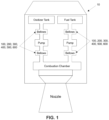
- multiple bellows can be used on a propulsion device with different requirements, as shown, for example, in FIG. 1 .
- the bellows can allow for axial or translational movement, expansion, gimballing to allow tilt movement in any direction, and/or thrust vector control.
- the bellows can transfer liquid or gases at high or low pressures or act as a spring to store potential energy.
- embodiments of the present disclosure provide optimized bellows geometries for propulsion devices.
- the inventors realized and discovered that additive manufactured parts according to embodiments of the present invention have greater design freedom than formed or welded parts and therefore allow greater design iteration, short lead times, and fewer parts for a particular application. They further realized and discovered that, when manufacturing embodiments of the present invention, ingredients in the raw material, e.g., a metallic powder, can be modified in a controlled fashion to alter properties of the coupling as desired, while still using the same 3-D printer.
- FIGS. 3-5 illustrate a cross-sectional side view of bellows assembly 100, according to at least one embodiment.
- Bellows assembly 100 can be coupled to adjacent components in propulsion device 10.
- Bellows assembly 100 includes first connecting portion 110, second connecting portion 112, and at least one convolution 114a.
- bellows assembly 100 includes four convolutions 114a,b,c,d with identical geometries stacked on top of each other along a longitudinal axis 124.
- bellows assembly 100 can include two, three, or more than four convolutions depending on the flexibility requirements and space constraints of the application the bellows is assembled into.
- First connecting portion 110 extends around the longitudinal axis 124 to form a tube as shown, for example in FIG. 3 .
- first connecting portion 110 can be additively manufactured to have a different cross-sectional shape such as a square, oval, or other polygonal shape.
- First connecting portion 110 can be coupled to an adjacent component, such as an exhaust duct, or fuel line, in propulsion device 10 (not shown in FIG. 3 ).
- first connecting portion 110 can be coupled to the adjacent component with a flange, or by welding, fusing, or other suitable coupling method.
- first connecting portion 110 can be integral with the adjacent component to reduce overall part count in the propulsion device 10 (not shown).
- Second connecting portion 112 extends around the longitudinal axis 124 to form a tube as shown, for example, in FIG. 3 .
- second connecting portion 112 can be additively manufactured to have a different cross-sectional shape such as a square, oval, or other polygonal shape.
- Second connecting portion 112 can be coupled to an adjacent component, such as an exhaust duct, or fuel line, in propulsion device 10 (not shown in FIG. 3 ).
- second connecting portion 112 can be coupled to the adjacent component with a flange, or by welding, fusing, or other suitable coupling method.
- second connecting portion 112 can be integral with the adjacent component to reduce overall part count in the propulsion device 10 (not shown).
- Convolution 114a extends between first connecting portion 110 and second connecting portion 112 along longitudinal axis 124.
- Convolution 114a can have a wall thickness between about 0.3 mm and 5 mm. In some embodiments, convolution 114a can have a wall thickness of about 0.5 mm.
- Convolution 114a is configured to be flexible such that first connecting portion 110 and second connecting portion 112 can move relative to one another. In some embodiments, convolution 114a expands and contracts along the longitudinal axis 124 so that first connecting member 110 and second connecting portion 112 move toward and away from each other. In some embodiments, convolution 114a and others like it, viz.
- first connecting portion 110 and second connecting portion 112 allow first connecting portion 110 and second connecting portion 112 to translate radially relative to each other, perpendicular to the longitudinal axis 124.
- convolution 114a allows for angular rotation of first connecting portion 110 relative to second connecting portion 112 such that bellows assembly 100 can gimbal and move or tilt freely in any direction.
- Convolution 114a can include first end 120, second end 122, first compliant portion 126, second compliant portion 128, third compliant portion 130, and fourth compliant portion 132, as shown, for example, in FIG. 3 .
- First end 120 connects to first connecting portion 110.
- Second end 122 connects to second connecting portion 112, or to a first end of an adjacent convolution 114b where bellows assembly 100 includes more than one convolution 114a.
- First compliant portion 126 extends outwardly away from first end 120 to form an inward cone shape.
- First compliant portion 126 extends at first angle 140 relative to a lateral axis 125, where the lateral axis 125 is perpendicular to the longitudinal axis 124.
- First angle 140 can be between about 30 degrees to about 80 degrees.
- Second compliant portion 128 extends from a distal end 142 of first compliant portion 126 and couples to a distal end 152 of third compliant portion 130.
- Third compliant portion 130 extends away from second compliant portion 128 toward second end 122 and forms an inward cone shape. The inventors realized and discovered that the inward cone shape of third compliant portion 130 and associated hoop stresses allow for a stable additive manufacturing of bellows assembly 100.
- Third compliant portion 130 extends at second angle 150 relative to the lateral axis 125. Second angle 150 can be between about 30 degrees to about 80 degrees. In the illustrative embodiment shown in FIG. 3 , first angle 140 and second angle 150 are equal such that first compliant portion 126 and third compliant portion 130 are spaced apart and parallel to one another.
- Fourth compliant portion 132 extends between and couples second end 122 and proximal end 154 of third compliant portion 130 together.
- second end 122 is axially located between second compliant portion 128 and first end 120 such that second compliant portion 128 overlaps an adjacent convolution 114 in bellows assembly 100.
- Such overlapping of convolutions 114 allows for improved packaging of bellows assembly 100 relative to conventional bellows; for example, more convolutions 114 can be included in bellows assembly 100 per unit length along the longitudinal axis 124 than can be included in conventional bellows.
- bellows assembly 100 can have a reduced radial envelope area relative to a conventional bellows while still providing similar flexibility in axial and radial directions, and providing similar flexibility in tilting gimbal angles relative to the longitudinal axis.
- second compliant portion 128 can extend between first and third compliant portions 126, 130 with a single smooth radius, as shown, for example, in FIG. 3 .
- Second compliant portion 128' can include starting portion 160 that extends away from second compliant portion 128' approximately parallel with longitudinal axis 124. The inventors discovered that starting portion 160 improves printing yield by providing a feature to start printing convolution 114. Starting portion 160 can allow convolution 114 to be printed without support members 180. Starting portion 160 can have a sharp angle, approximately about 90 degrees.
- fourth compliant portion 132 can extend between second compliant portion 128 and second end 122 with a single smooth radius, as shown, for example, in FIG. 3 .
- fourth compliant portion 132' can extend at approximately 90 degrees from third compliant portion 130 and couple with second end 122 with a smooth radius.
- the inventors discovered that the foregoing configuration of fourth compliant portion 132' provides high printing stability of third compliant portion 130 in an additive manufacturing process.
- Fourth compliant portion 132' can include stiffening portion 170 that extends away from fourth compliant portion 132' approximately parallel with longitudinal axis 124.
- Stiffening portion 170 can locally stiffen convolution 114a such that compliance of convolution 114a comes from first and third compliant portions 126, 130. Stiffening portion 170 can provide additional material in fourth compliant portion 132' to accommodate stresses in convolution 114a due to bending and movement of first connecting portion 110 relative to second connecting portion 112.
- FIGS. 6-8 provide another embodiment of a bellows assembly 200 in accordance with the present disclosure and show a different convolution 214 configuration.
- Bellows assembly 200 is substantially similar to bellows assembly 100 shown in FIGS. 3-5 and described herein. Accordingly, similar reference numbers in the 200 series indicate commonalities between bellows assembly 200 and bellows assembly 100.
- the description of bellows assembly 100 above is incorporated by reference to apply to bellows assembly 200, except in instances when it conflicts with the specific description and the drawings of bellows assembly 200.
- Bellows assembly 200 includes first connecting portion 210, second connecting portion 212, and at least one convolution 214. As shown in FIGS. 6 and 7 , for example, bellows assembly 200 can include four convolutions 214 with identical geometries stacked on top of each other along a longitudinal axis 224, but more or fewer convolutions 214 can also be possible.
- First connecting portion 210 extends around the longitudinal axis 124 to form a tube.
- Second connecting portion 212 extends around the longitudinal axis 224 to form a tube.
- Convolution 214 extends between first connecting portion 210 and second connecting portion 212 along longitudinal axis 224 as shown, for example in FIGS. 6 and 7 .
- Convolution 214 is configured to be flexible such that first connecting portion 210 and second connecting portion 212 can move relative to one another.
- Convolution 214 can include first end 220, second end 222, first compliant portion 226, second compliant portion 228, third compliant portion 230, and fourth compliant portion 232.
- First end 220 connects to first connecting portion 210.
- Second end 222 connects to second connecting portion 212, or to a first end of an adjacent convolution where bellows assembly 200 includes more than one convolution 214.
- First compliant portion 226 extends outwardly away from first end 220 to form an inward cone shape.
- First compliant portion 226 extends at first angle 240 relative to a lateral axis 225, where the lateral axis 225 is perpendicular to longitudinal axis 224.
- First angle 240 can be between about 30 degrees to about 80 degrees relative to the lateral axis 225.
- Second compliant portion 228 extends from a distal end 242 of first compliant portion 226 and couples to a distal end 252 of third compliant portion 230.
- Third compliant portion 230 extends away from second compliant portion 228 toward second end 222 and forms an inward cone shape.
- Third compliant portion 230 extends at second angle 250 relative to the lateral axis 225.
- Second angle 250 can be between about 30 degrees to about 80 degrees relative to the lateral axis 225.
- first angle 240 is different from second angle 250.
- first angle 240 is greater than second angle 250 such that distal ends 242, 252 are spaced further apart than proximal end 254 of third compliant portion 230 and first compliant portion 126.
- first angle 240 can be less than second angle 250.
- Fourth compliant portion 232 extends between and couples second end 222 and proximal end 254 of second compliant portion 228 together.
- second end 222 is axially located between second compliant portion 228 and first end 220 such that second compliant portion 228 overlaps an adjacent convolution 214 in bellows assembly 200.
- the inventors realized and discovered that such overlapping of convolutions 214 allows for improved packaging of bellows assembly 200 relative to conventional bellows.
- first angle 240 and second angle 250 of convolutions 214 allows for increased flexibility of bellows assembly 200 compared to bellows assembly 100.
- bellows assembly 200 can have increased convolutions 214 per unit length compared to bellows assembly 100, thereby providing improved packaging of the bellows assembly 200 compared to bellows 100.
- second compliant portion 228 can extend between first and third compliant portions 226, 230 with a single smooth radius, as shown, for example, in FIG. 6 .
- second compliant portion 228' can extend between first and third compliant portions 226, 230 with a compound radii curve to improve printing stability convolution 214.
- Second compliant portion 228' can include starting portion 260 that extends away from second compliant portion 228' approximately parallel with longitudinal axis 224. Starting portion 260 can have a sharp angle, approximately about 90 degrees.
- fourth compliant portion 232 can extend between third compliant portion 230 and second end 222 with a single smooth radius, as shown, for example, in FIG. 6 .
- fourth compliant portion 232' can extend at approximately 90 degrees from third compliant portion 230 and couple with second end 222 with a smooth radius to provide high printing stability of convolution 214.
- Fourth compliant portion 232' can include stiffening portion 270 that extends away from fourth compliant portion 232' approximately parallel with longitudinal axis 224. Stiffening portion 270 can locally stiffen convolution 214 such that compliance of convolution 214 comes from first and third compliant portions 226, 230.
- structural members 180 can be used to improve printing yields.
- Structural members 180 provide support to convolution 114 during printing and can be snapped off or cut from convolution 114 after printing.
- FIG. 10 Another embodiment of a bellows assembly 300 in accordance with the present disclosure is shown in FIG. 10 showing a different convolution 314 configuration.
- Bellows assembly 300 is substantially similar to bellows assembly 100 shown in FIGS. 3-5 and described herein. Accordingly, similar reference numbers in the 300 series indicate commonalities between bellows assembly 300 and bellows assembly 100. The description of bellows assembly 100 is incorporated by reference to apply to bellows assembly 300, except in instances when it conflicts with the specific description and the drawings of bellows assembly 300.
- FIG. 10 illustrates a cross-sectional side view of bellows assembly 300, according to embodiments.
- Bellows assembly 300 can be coupled to adjacent components in propulsion device 10.
- Bellows assembly 300 includes first connecting portion 310, second connecting portion 312, and at least one convolution 314.
- bellows assembly 300 includes four convolutions 314 with identical geometries stacked on top of each other along a longitudinal axis 324, but more or fewer convolutions 314 can also be possible.
- First connecting portion 310 extends around the longitudinal axis 324 to form a tube.
- Second connecting portion 312 extends around the longitudinal axis 324 to form a tube.
- Convolution 314 extends between first connecting portion 310 and second connecting portion 312 along longitudinal axis 324 as shown, for example in FIG. 10 .
- Convolution 314 is configured to be flexible such that first connecting portion 310 and second connecting portion 312 can move relative to one another.
- Convolution 314 can include first end 320, second end 322, first compliant portion 326, first tube portion 327, second tube portion 328, second compliant portion 330, third tube portion 332, and third compliant portion 334.
- First end 320 connects to first connecting portion 310.
- Second end 322 connects to second connecting portion 312, or to a first end of an adjacent convolution where bellows assembly 300 includes more than one convolution 314.
- First compliant portion 326 extends outwardly away from first end 320 to form an inward cone shape.
- First compliant portion 326 extends at first angle 340 relative to a lateral axis 325, where the lateral axis 325 is perpendicular to the longitudinal axis 324.
- First angle 340 can be between about 30 degrees to about 80 degrees relative to the lateral axis 325.
- First tube portion 327 extends away from a distal end 342 of first compliant portion 326 approximately parallel to the longitudinal axis 324, such that first tube portion 327 forms a tube.
- Second compliant portion 330 extends from a distal end 344 of first tube portion 327 and couples to a distal end 352 of second tube portion 328.
- Second tube portion 328 extends away from second compliant portion 330 approximately parallel to longitudinal axis 324, such that second tube portion 328 forms a tube.
- Third compliant portion 334 extends from a proximal end 354 of second tube portion 328 and couples to a proximal end 356 of third tube portion 332.
- Third tube portion 332 extends away from third compliant portion 334 approximately parallel to longitudinal axis 324, such that third tube portion 332 forms a tube.
- Third tube portion 332 extends to and couples with second end 322.
- first tube portion 327, second tube portion 328, and third tube portion 332 are equally spaced apart in the radial direction.
- first tube portion 327 can be spaced apart from second tube portion 328 by a first distance
- second tube portion 328 can be spaced apart from third tube portion 332 by a second distance different from the first distance.
- first tube portion 327, second tube portion 328, and third tube portion 330 can be approximately aligned along the longitudinal axis 324.
- first tube portion 327, second tube portion 328, and third tube portion 332 can extend at an angle relative to the lateral axis 325 such that each of first, second, and third tube portions 327, 328, 332 form inward extending cones similar to bellows assembly 100 described above.
- first, second, and third tube portions 327, 328, 332 can extend at different angles relative to the lateral axis 325 similar to bellows assembly 200 described above. The inventors realized and discovered that such radially overlapping of convolutions 314 can allow for improved packaging of bellows assembly 300 relative to conventional bellows.
- bellows assembly 300 can have more radial compliance for a unit length than a conventional bellows or bellows assemblies 100, 200.
- second compliant portion 330 can include starting portion 360 that extends away from second compliant portion 330 approximately parallel with longitudinal axis 324.
- Starting portion 360 can have a sharp angle, approximately about 90 degrees, to improve the initial additive manufacturing of convolution 314.
- FIG. 11 Another embodiment of a bellows assembly 400 in accordance with the present disclosure is shown in FIG. 11 showing a different convolution 414 configuration.
- Bellows assembly 400 is substantially similar to bellows assembly 100 shown in FIGS. 3-5 and described herein. Accordingly, similar reference numbers in the 400 series indicate commonalities between bellows assembly 400 and bellows assembly 100. The description of bellows assembly 100 is incorporated by reference to apply to bellows assembly 400, except in instances when it conflicts with the specific description and the drawings of bellows assembly 400.
- FIG. 11 illustrates a cross-sectional side view of bellows assembly 400, according to embodiments.
- Bellows assembly 400 can be coupled to adjacent components in propulsion device 10.
- Bellows assembly 400 includes first connecting portion 410, second connecting portion 412, and at least one convolution 414.
- bellows assembly 400 includes two convolutions 414 with identical geometries stacked on top of each other along a longitudinal axis 424, but more convolutions 414 can also be possible.
- First connecting portion 410 extends around the longitudinal axis 424 to form a tube.
- Second connecting portion 412 extends around the longitudinal axis 424 to form a tube.
- Convolution 414 extends between first connecting portion 410 and second connecting portion 412 along longitudinal axis 424 as shown, for example in FIG. 11 .
- Convolution 414 is configured to be flexible such that first connecting portion 410 and second connecting portion 412 can move relative to one another.
- Convolution 414 can include first end 420, second end 422, first compliant portion 426, first tube portion 427, second tube portion 428, second compliant portion 430, third tube portion 432, third compliant portion 434, fourth tube portion 436, fourth compliant portion 437, fifth tube portion 438, and fifth compliant portion 439.
- First end 420 connects to first connecting portion 410.
- Second end 422 connects to second connecting portion 412, or to a first end of an adjacent convolution where bellows assembly 400 includes more than one convolution 414.
- First compliant portion 426 extends outwardly away from first end 420 to form an inward cone.
- First compliant portion 426 extends at first angle 440 relative to a lateral axis 425, where the lateral axis 425 is perpendicular to the longitudinal axis 424.
- First angle 440 can be between about 30 degrees to about 80 degrees relative to the lateral axis 425.
- First tube portion 427 extends away from a distal end 442 of first compliant portion 426 approximately parallel to the longitudinal axis 424, such that first tube portion 427 forms a tube.
- Second compliant portion 430 extends from a distal end 444 of first tube portion 427 and couples to a distal end 452 of second tube portion 428.
- Second tube portion 428 extends away from second compliant portion 430 approximately parallel to longitudinal axis 424, such that second tube portion 428 forms a tube.
- Third compliant portion 434 extends from a proximal end 454 of second tube portion 428 and couples to a proximal end 456 of third tube portion 432.
- Third tube portion 432 extends away from third compliant portion 434 approximately parallel to longitudinal axis 424, such that third tube portion 432 forms a tube.
- Fourth compliant portion 437 extends from a distal end 458 of third tube portion 432 and couples to a distal end 451 of fourth tube portion 436.
- Fourth tube portion 436 extends away from fourth compliant portion 437 approximately parallel to longitudinal axis 424, such that fourth tube portion 436 forms a tube.
- Fifth compliant portion 439 extends from a proximal end 453 of fourth tube portion 436 and couples to a proximal end 455 of fifth tube portion 438.
- Fifth tube portion 438 extends away from fifth compliant portion 439 approximately parallel to longitudinal axis 424, such that fifth tube portion 438 forms a tube.
- Fifth tube portion 438 extends to and couples with second end 422.
- first, second, third, fourth, and fifth tube portions 427, 428, 432, 436, 438 are equally spaced apart in the radial direction and parallel to one another. In some embodiments, first, second, third, fourth, and fifth tube portions 427, 428, 432, 436, 438 are parallel to one another and spaced apart by differing distances. In some embodiments, first, second, third, fourth, and fifth tube portions 427, 428, 432, 436, 438 can be approximately aligned along the longitudinal axis 324.
- first, second, third, fourth, and fifth tube portions 427, 428, 432, 436, 438 can extend at an angle relative to the lateral axis 425 such that each of first, second, third, fourth, and fifth tube portions 427, 428, 432, 436, 438 form inward extending cones similar to bellows assembly 100 described above.
- first, second, third, fourth, and fifth tube portions 427, 428, 432, 436, 438 can extend at different angles relative to the lateral axis 425 similar to bellows assembly 200 described above.
- the inventors realized and discovered that such radially overlapping of convolutions 414 can allow for improved packaging of bellows assembly 400 relative to conventional bellows.
- bellows assembly 400 can have more radial compliance for a unit length than a conventional bellows, or bellows assemblies 100, 200, 300.
- second compliant portion 430 can include starting portion 460 that extends away from second compliant portion 430 approximately parallel with longitudinal axis 424.
- fourth compliant portion 436 can include starting portion 462 that extends away from fourth compliant portion 436 approximately parallel with longitudinal axis 424. Starting portions 460, 462 can have sharp angles, approximately about 90 degrees, to improve the initial printing process of convolution 414.
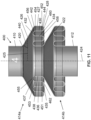
- FIGS. 12-14 illustrate bellows assembly 500, according to embodiments.
- Bellows assembly 500 can be coupled to adjacent components in propulsion device 10.
- Bellows assembly 500 includes first connecting portion 510, second connecting portion 512, and helix convolution 514.
- Helix convolution 514 can include between about four and twelve individual adjoining convolutions, circumferentially spaced apart and parallel to one another, and extending between the first and second connecting portions 510, 512 to form the helix shape.
- bellows assembly 500 is additively manufactured.
- First connecting portion 510 (not shown) can extend around the longitudinal axis 524 to form a tube.
- First connecting portion 510 can be coupled to an adjacent component, such as an exhaust duct, or fuel line, in propulsion device 10.
- first connecting portion 510 can be coupled to the adjacent component with a flange, or by welding, fusing, or other suitable coupling method.
- first connecting portion 510 can be integral with the adjacent component to reduce overall part count in the propulsion device 10.
- Second connecting portion 512 (not shown) can extend around the longitudinal axis 524 to form a tube. Second connecting portion 512 can be coupled to an adjacent component, such as an exhaust duct, or fuel line, in propulsion device 10. In some embodiments, second connecting portion 512 can be coupled to the adjacent component with a flange, or by welding, fusing, or other suitable coupling method. In some embodiments, second connecting portion 512 can be integral with the adjacent component to reduce overall part count in the propulsion device 10.
- Helix convolution 514 extends between first connecting portion 510 and second connecting portion 512 along longitudinal axis 524.
- Helix convolution 514 can have a wall thickness between about 0.3 mm and 5 mm. In some embodiments, helix convolution 514 can have a wall thickness of about 0.5 mm.
- Helix convolution 514 can be configured to be flexible such that first connecting portion 510 and second connecting portion 512 can move relative to one another. In some embodiments, helix convolution 514 expands and contracts along the longitudinal axis 524 so that first connecting member 510 and second connecting portion 512 move toward and away from each other.
- helix convolution 514 allows first connecting portion 510 and second connecting portion 512 to translate radially relative to each other, perpendicular to the longitudinal axis 524. In some embodiments, convolution 514 allows for angular rotation of first connecting portion 510 relative to second connecting portion 512 such that bellows assembly 500 can gimbal or tilt by an angle relative to longitudinal axis 524. In some embodiments, convolution 514 allows for torsional angular rotation of first connecting portion 510 relative to second connecting portion 512 such that bellows assembly 500 provides a torsion compliance between adjacent component of the propulsion device 10.
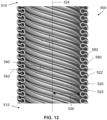
- Helix convolution 514 can include a plurality of individual helixes circumferentially spaced apart and extending around longitudinal axis 524 parallel to one another as shown for example in FIGS. 12 and 13 .
- a first helix 520 of the plurality of helixes can have identical geometry to adjacent helixes 522, 523 of the plurality of individual helixes.
- first helix can have different geometry to adjacent helixes 522, 523 of the plurality of helixes.
- the number of helixes in helix convolution 514 can be constrained by a radius 530 of the bellows assembly 500.
- the number of helixes arranged around the circumference of helix convolution 514 can also increase.
- the number of helixes that can be arranged around the circumference of helix convolution 514 can also decrease.
- the number of helixes in helix convolution 514 can be a function of the desired flexibility of bellows assembly 500. More helixes can provide a stiffer bellows assembly, fewer helixes can provide a more flexible bellows assembly.
- the number of helixes in helix convolution 514 can be a function of a desired weight and/or cost of bellows assembly 500.
- First helix 520 is spaced apart from the longitudinal axis 524 by radius 530 and extends circumferentially around longitudinal axis 524 as shown, for example, in FIGS. 12 and 13 . As first helix 520 extends circumferentially around longitudinal axis 524, first helix 520 increases in height along longitudinal axis 524 such that first helix 520 extends at a first angle 540 relative to plane 542.
- Plane 542 is perpendicular to longitudinal axis 524. In some embodiments, plane 542 can be horizontal and longitudinal axis 524 can be vertical during additive manufacturing of bellows assembly 500. In some embodiments, first angle 540 can be between about 10 degrees and about 30 degrees. In the embodiment shown in FIG.
- helix convolution 514 can have steeper convolutions to provide increased torsional flexibility and/or more stable printing of bellows assembly 500, with first angle between about 30 degrees and about 60 degrees.
- first angle 540 is consistent along the length of helix convolution 514.
- a lower first angle 540 provides more longitudinal and lateral flexibility of bellows assembly 500.
- first helix 520 has a cross-section parallel to plane 542 that includes a concave portion 560 and a convex portion 570.
- Each of adjacent helixes 522, 523, of helix convolution 514 have similar cross-sectional shape to first helix 520.
- Convex portion 570 extends from an outer radius portion 580 of helix convolution 514 inward toward concave portion 560. Convex portion 570 is at an overhang portion 584 of first helix 520.
- Concave portion 560 extends inwardly away from convex portion 570 with opposite curvature to convex portion 570 and toward inner radius portion 582. Concave portion 560 can have larger radius than convex portion while maintaining high printing stability during additive manufacturing. Concave portion 560 is supported by inner radius portion 582 and convex portion 570 and can have more stable printing properties than convex portion 570.
- FIGS. 14 and 15 Another embodiment of a bellows assembly 600 in accordance with the present disclosure is shown in FIGS. 14 and 15 showing a different helix convolution 614 configuration.
- Bellows assembly 600 is substantially similar to bellows assembly 500 shown in FIGS. 12 and 13 and described herein. Accordingly, similar reference numbers in the 600 series indicate commonalities between bellows assembly 600 and bellows assembly 500. The description of bellows assembly 500 is incorporated by reference to apply to bellows assembly 600, except in instances when it conflicts with the specific description and the drawings of bellows assembly 600.
- FIGS. 14 and 15 illustrate bellows assembly 600, according to embodiments.
- Bellows assembly 600 can be coupled to adjacent components in propulsion device 10.
- Bellows assembly 600 includes first connecting portion 610, second connecting portion 612, and helix convolution 614.
- Helix convolution 614 can include between about four and twelve individual convolutions, circumferentially spaced apart and parallel to one another, and extending between the first and second connecting portions 610, 612 to form the helix shape.
- bellows assembly 600 is additively manufactured.
- First connecting portion 610 (not shown) can extend around the longitudinal axis 624 to form a tube.
- First connecting portion 610 can be coupled to an adjacent component, such as an exhaust duct, or fuel line, in propulsion device 10.
- first connecting portion 610 can be coupled to the adjacent component with a flange, or by welding, fusing, or other suitable coupling method.
- first connecting portion 610 can be integral with the adjacent component to reduce overall part count in the propulsion device 10.
- Second connecting portion 612 (not shown) can extend around the longitudinal axis 624 to form a tube. Second connecting portion 612 can be coupled to an adjacent component, such as an exhaust duct, or fuel line, in propulsion device 10. In some embodiments, second connecting portion 612 can be coupled to the adjacent component with a flange, or by welding, fusing, or other suitable coupling method. In some embodiments, second connecting portion 612 can be integral with the adjacent component to reduce overall part count in the propulsion device 10.
- Helix convolution 614 extends between first connecting portion 610 and second connecting portion 612 along longitudinal axis 624.
- Helix convolution 614 can have a wall thickness between about 0.3 mm and 5 mm. In some embodiments, helix convolution 614 can have a wall thickness of about 0.5 mm.
- Helix convolution 614 can be configured to be flexible such that first connecting portion 610 and second connecting portion 612 can move and translate relative to one another similar to bellows assembly 500 described above.
- Helix convolution 614 can include a plurality of individual helixes 620, 622, 623 circumferentially spaced apart and extending around longitudinal axis 624 parallel to one another as shown for example in FIGS. 14 and 15 .
- a first helix 620 of the plurality of helixes can have identical geometry to adjacent helixes 622, 623 of the plurality of individual helixes.
- first helix can have different geometry to adjacent helixes 622, 623 of the plurality of helixes.
- the number of helixes in helix convolution 614 can be constrained by a radius 630 of the bellows assembly 600.
- the number of helixes in helix convolution 614 can be a function of the desired flexibility of bellows assembly 600.
- First helix 620 is spaced apart from the longitudinal axis 624 by radius 630 and extends circumferentially around longitudinal axis 624 as shown, for example, in FIGS. 14 and 15 . As first helix 620 extends circumferentially around longitudinal axis 624, first helix 620 increases in height along longitudinal axis 624. First helix 620 includes first section 632 and second section 634. First section 632 extends at a first angle 640 relative to plane 642 and extends around longitudinal axis 624 for a first circumferential length 644. The first angle 640 and first circumferential length 642 result in first section 632 having a first height 646 along longitudinal axis 624.
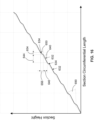
- first angle 640 can be between about 10 degrees and about 30 degrees. In the illustrative embodiment shown in FIG. 14 , first angle 640 is about 20 degrees relative to plane 642. In some embodiments, first height 646 of first section 632 is between about 2 mm and about 12 mm. In the illustrative embodiment shown in FIG. 14 , first height 646 is about 5 mm. First angle 640, first circumferential length 644, and first height 646 are illustratively shown in a graphical view in FIG. 16 .
- Second section 634 extends at a second angle 650 relative to plane 642 and extends around longitudinal axis 624 for a second circumferential length 654.
- the second angle 650 and second circumferential length 654 result in second section 634 having a second height 656 along longitudinal axis 624.
- second angle 650 is greater than first angle 640.
- second angle 650 can be between about 30 degrees and about 60 degrees.
- second angle 650 is about 45 degrees relative to plane 642.
- second height 656 of second section 634 is between about 2 mm and about 7 mm. In the illustrative embodiment shown in FIG. 14 , second height 656 is about 2 mm.
- First helix 620 extends between first connecting portion 610 and second connecting portion 612 with alternating first and second sections 632, 634 as shown, for example, in FIG. 14 .
- first section 632 can extend from second connecting portion 612
- second section 634 can extend from first section 632, then a first section 632 and second section 634 extend therefrom.
- First and section sections 632, 634 of first helix 620 can alternate and extend from one another along longitudinal axis 624 until first helix 620 couples to first connecting portion 610.
- first helix 620 has a stepped shape as it extends between first and second connecting portions 610, 612. As illustratively shown in FIG.
- first helix 620 has an average angle 690 relative to plane 642 based on the combinations of the first and second sections 632, 634 and the relative geometries of each of first and second sections 632, 634.
- helix convolution 614 has an average angle 690 of about 24 degrees, where first angle is about 20 degrees, first height is about 5 mm, second angle is about 45 degree, and second height is about 2 mm.
- helix convolution can have an average angle 690 between about 15 degrees and about 30 degrees. The inventors realized and discovered that a lower average angle 690 increases the flexibility of bellows assembly 600. Geometries of first and second sections 632, 634 can be optimized for printability, manufacturing yield, and flexibility of bellows assembly 600.
- first helix 620 has a cross-section parallel to plane 642 that includes a concave portion 660 and a convex portion 670.
- Each of adjacent helixes 622, 623, of helix convolution 614 have similar cross-sectional shape to first helix 620, but at a given cross-section along longitudinal axis 624, each helix 620, 622, 623 can appear different.
- the difference in appearance is based on the compound first and second section 632, 634 geometries along longitudinal axis 624 and relative locations of first section 632 and/or second section 634 for the location where the cross-section is taken.
- Convex portion 670 extends from an outer radius portion 680 of helix convolution 614 inward toward concave portion 660.
- the inventors realized and discovered that using smaller local radii of convex portion 670 or increased first and second angles 640, 650 of first helix 620 would increase printing stability and manufacturing yield of bellows assembly 600, and to avoid melt-pool instability in overhang portion 684.
- Concave portion 660 extends inwardly away from convex portion 670 with opposite curvature to convex portion 670 and toward inner radius portion 682.
- Concave portion 660 can have larger radius than convex portion 670 while maintaining high printing stability during additive manufacturing.
- Concave portion 660 is supported by inner radius portion 682 and convex portion 670 and has more stable printing properties than convex portion 670.
- Bellows assembly 500 and bellows assembly 600 can provide a flexible bellow design with geometry to increase printing stability and additive manufacturing yields of the design.
- Bellows assembly 500 and bellows assembly 600 can provide geometry that do not need additional supports during manufacture.
- Helix convolutions 514, 614 can allow the walls of the print to overlap without creating sharp overhangs, which can allow the bellows assemblies 500, 600 to be printed without supports.
- the cross section of helix convolutions 514, 614 can minimize the curvature or radius of the convex portions 570, 670 of outcropping sections 584, 684 of the bellows assembly 500, 600.
- the reduced curvature can decrease warp up, material shape changes caused by heat, or decrease printing instability of convex portions 570, 670.
- low first angles 540, 640 approximately 20 degrees, can be used for convex portions 570, 670 to print smooth overhangs 584, 684 without the need for supports.
- Bellows assembly 600 can have varied overhang angle 640, 650 throughout the print. By alternating between, for example, about a 5 mm first height 646 with about a 20 degree first angle 640 overhang and about a 2 mm second height 656 and about a 45 degree second angle 650 overhang, the bellows assembly 600 can be printed with fewer undesirable overhang errors.
- This alternating overhang angle 640, 650 can allow for a continuous unsupported overhang angle 690 of about 24 degrees as shown, for example, in FIG. 16 .
- the ability to print sharper overhangs 684 can allow for more wall overlap in the bellows assembly 600, which can result in less stiffness for the same part volume.
- Bellows have applications anywhere fluid systems exist, such as mining, fracking, oil and gas recovery, and so forth. Bellows also have application outside of fluid systems, for example, as highly customized springs in a purely structural/mechanical use. Examples of such purely structure/mechanical uses include vehicle suspensions, hydraulic and pneumatic spring return mechanisms, or basically anywhere a spring would also fit the application. Accordingly, it should be understood that while some embodiments include propulsion devices and connections to and within propulsion devices, the invention itself is not so limited. The embodiments described above are contemplated for use with such fluid systems and structural/mechanical systems.
- references herein to "an embodiment,” “some embodiments,” “an example,” or similar phrases, indicate that the embodiment described can include a particular feature, structure, or characteristic, but every embodiment can not necessarily include the particular feature, structure, or characteristic. Moreover, such phrases are not necessarily referring to the same embodiment. Further, when a particular feature, structure, or characteristic is described in connection with an embodiment, it would be within the knowledge of persons skilled in the relevant art to incorporate such feature, structure, or characteristic into other embodiment whether or not explicitly mentioned or described herein. Additionally, some embodiments can be described using the expression “coupled” and “connected” along with their derivatives. These terms are not necessarily intended as synonyms for each other.
- Coupled can also mean that two or more elements are not in direct contact with each other, but yet still co-operate or interact with each other.
Landscapes
- Engineering & Computer Science (AREA)
- General Engineering & Computer Science (AREA)
- Mechanical Engineering (AREA)
- Chemical & Material Sciences (AREA)
- Manufacturing & Machinery (AREA)
- Materials Engineering (AREA)
- Physics & Mathematics (AREA)
- Plasma & Fusion (AREA)
- Diaphragms And Bellows (AREA)
Abstract
Description
- The present disclosure relates to bellows. More specifically, embodiments of the present disclosure relate to bellows geometry and methods of manufacturing bellows geometry.
- Expansion joints and bellows are used to create structural compliance and potential energy storage in fluid and mechanical systems. An expansion joint is any device containing one or more bellows used to absorb dimensional changes. A bellows is a flexible element of an expansion joint with one or more convolutions. Bellows compliance can reduce stress in mechanical systems or store energy in piston driven systems such as hydraulic actuators or similar moving mechanical assemblies. In addition, bellows are used in various applications to provide compliance and movement between rigid leak-tight ducts or lines that are used to transfer gases or liquids.
- The present disclosure can comprise one or more of the following features and combinations thereof. The descriptions herein represent non-limiting invention embodiments.
- According to an embodiment of the present disclosure, a bellows assembly can include a first connecting portion, a second connecting portion, and at least one convolution portion. In some embodiments, the first connecting portion is configured to connect to a first component. In some embodiments, the second connecting portion configured to connect to a second component. In some embodiments, the at least one convolution portion extends between the first connecting portion and the second connecting portion and is configured to provide compliance such that the first connecting portion moves relative to the second connecting portion.
- In some embodiments, the at least one convolution portion includes a first end, a second end, a longitudinal axis, a first compliant portion, a second compliant portion, and a third compliant portion. In some embodiments, the first end is disposed toward the first connecting portion. In some embodiments, the second end is spaced apart from the first end, toward the second connecting portion. In some embodiments, the longitudinal axis extends from the first end to the second end and a lateral axis is perpendicular to the longitudinal axis. In some embodiments, the first compliant portion extends outwardly away from the first end at a first angle relative to the lateral axis. In some embodiments, the third compliant portion extends outwardly away from the second end at a second angle relative to the lateral axis, and the second compliant portion is formed between and coupling to distal ends of the first and third compliant portions. In some embodiments, the first angle and the second angle are between about 30 degrees to 80 degrees such that the first compliant portion and the second compliant portion form inward extending cone shapes.
- In some embodiments, the first angle and the second angle are equal such that the first compliant portion is parallel to the second compliant portion. In some embodiments, the first angle is different from the second angle such that the first compliant portion and the second compliant portion converge toward the first end and the second end.
- In some embodiments, a starter portion extends away from the second compliant portion along the longitudinal axis and is configured to provide a starting point for additively manufacturing the at least one convolution portion. In some embodiments, the first connecting portion is integrally formed with the first component and the second connecting portion is integrally formed with the second component, such that the first component, the first connecting portion, the second connecting portion, and the second component are a single piece structure. A single piece structure means that the structure is a single piece of material and is not multiple pieces of material joined by one or more weld joints, solder joints, or the like. A conventionally manufactured bellows is a multi-piece structure and is not a single piece structure under this definition. By contrast, an additively manufactured structure, formed from deposition of layers of a material, is a single piece structure under this definition.
- In some embodiments, the first connecting portion and the second connecting portion move relative to one another in at least one of an axial movement perpendicular to the longitudinal axis, compression or extension along the longitudinal axis, and a gimballing tilting angle relative to the longitudinal axis.
- In some embodiments, the at least one convolution portion comprises at least four convolution portions. In some embodiments, the second compliant portion is located below the first end and the second end. In some embodiments, the at least one convolution portion has a wall thickness of about 0.5 millimeters.
- According to another embodiment of the present disclosure, a bellows assembly includes a first connecting portion, a second connecting portion, and at least one convolution portion formed between the first connecting portion and the second connecting portion and configured to provide compliance such that the first connecting portion moves relative to the second connecting portion. In some embodiments the at least one convolution includes a first end, a second end, a longitudinal axis extending from the first end to the second end, a lateral axis perpendicular to the longitudinal axis, a first compliant portion, a first tube portion, a second tube portion, a second compliant portion, a third tube portion, and a third compliant portion. In some embodiments, the first compliant portion extends outwardly away from the first end at a first angle relative to the lateral axis. In some embodiments, the first tube portion extends away from the first compliant portion end. In some embodiments, the second tube portion is radially spaced apart from the first tube portion. In some embodiments, the second compliant portion is formed between and couples the first and second tube portions. In some embodiments, the third tube portion is radially spaced apart from the second tube portion and extends away from the second end approximately parallel to the longitudinal axis. In some embodiments, the third compliant portion is formed between and couples the second and third tube portions.
- In some embodiments, the first angle is between about 30 degrees to 80 degrees such that the first compliant portion forms inward extending cone. In some embodiments, at least two of the first, second, and third tube portions are axially aligned along the longitudinal axis. In some embodiments, the first tube portion and the second tube portion are radially spaced apart by a first distance, and the second tube portion and the third tube portion are radially spaced apart by a second distance, and the first distance is equal to the second distance.
- In some embodiments, the at least one convolution portion is at least four convolution portions. In some embodiments, the at least one convolution portion has a wall thickness of about 0.5 millimeters. In some embodiments, the at least one convolution further includes a fourth tube portion, a fourth compliant portion, a fifth tube portion, and a fifth compliant portion. In some embodiments, the fourth tube portion is radially spaced apart from the third tube portion. In some embodiments, the fourth compliant portion is formed between and couples the fourth tube portion to the second end and third tube portion. In some embodiments, the fifth tube portion is radially spaced apart from the fourth tube portion and extends away from a third end. In some embodiments, the fifth compliant portion is formed between and couples the fourth and fifth tube portions.
- According to another embodiment of the present disclosure, a bellows assembly includes a first connecting portion, a second connecting portion, and a helix convolution portion formed between the first connecting portion and the second connecting portion and configured to provide compliance such that the first connecting portion moves relative to the second connecting portion. In some embodiments, the second connecting portion is spaced apart from the first connecting portion along a longitudinal axis. In some embodiments, the helix convolution portion extends circumferentially around and along the longitudinal axis and has a first section with a first angle relative to a lateral axis that is perpendicular to the longitudinal axis.
- In some embodiments, the helix convolution comprises a second section extending from the first section. In some embodiments, the second section has a second angle relative to the lateral axis, wherein the second angle is greater than the first angle. In some embodiments, the first section has a first height along the longitudinal axis, the second section has a second height along the longitudinal axis, and the first height is greater than the second height. In some embodiments, the first angle is between about 10 degrees and about 30 degrees, and the second angle is between about 30 degrees and about 60 degrees.
- Further features and advantages, as well as the structure and operation of various embodiments, are described in detail below with reference to the accompanying drawings. It is noted that the specific embodiments described herein are not intended to be limiting. Such embodiments are presented herein for illustrative purposes only. Additional embodiments will be apparent to persons skilled in the relevant art based on the teachings contained herein.
- The accompanying drawings, which are incorporated herein and form a part of the specification, illustrate embodiments of the present disclosure and, together with the description, further explain the principles of the disclosure and to enable a person skilled in the pertinent art to make and use the disclosure.
-
FIG. 1 illustrates a block diagram of an example rocket engine showing various locations where bellows can be located. -
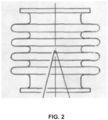
FIG. 2 illustrates a side view of a conventional known bellows design made by conventional methods. -
FIG. 3 illustrates a cross-sectional side view of a first bellows configuration, according to an embodiment of the present disclosure. -
FIG. 4 illustrates a cross-sectional side view of the first bellows configuration with alternate geometry features for printability and stiffness, according to an embodiment of the present disclosure. -
FIG. 5 illustrate a detailed view of the convolution shown inFIG. 4 , according to an embodiment of the present disclosure. -
FIG. 6 illustrates a cross-sectional side view of a second bellows configuration, according to an embodiment of the present disclosure. -
FIG. 7 illustrates a cross-sectional side view of the second bellows configuration with alternate geometry features for printability and stiffness, according to an embodiment of the present disclosure. -
FIG. 8 illustrate a detailed view of the convolution shown inFIG. 7 , according to an embodiment of the present disclosure. -
FIG. 9 illustrates a cross-sectional side view of the first bellows configuration showing manufacturing features to support the bellows, according to an embodiment of the present disclosure. -
FIG. 10 illustrates a cross-sectional side view of a third bellows configuration, according to an embodiment of the present disclosure. -
FIG. 11 illustrates a cross-sectional side view of a fourth bellows configuration, according to an embodiment of the present disclosure. -
FIG. 12 illustrates a cross-sectional side view of a fifth bellows configuration, according to an embodiment of the present disclosure. -
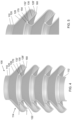
FIG. 13 illustrates a perspective view of the fifth bellows configuration with a steeper helix angle of the plurality of helixes, according to an embodiment of the present disclosure. -
FIG. 14 illustrates a perspective view of a sixth bellows configuration showing a helix convolution, according to an embodiment of the present disclosure. -
FIG. 15 illustrates a top perspective view of the sixth bellows configuration ofFIG. 14 , according to an embodiment of the present disclosure. -
FIG. 16 illustrates a graphical view of an example geometry of the sixth bellows configuration ofFIG. 14 , according to an embodiment of the present disclosure. -
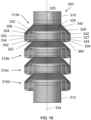
FIG. 17 illustrates a perspective view of a seventh bellows configuration, according to an embodiment of the present disclosure. - Standards for expansion joint design, testing, and production make traditional methods for manufacturing bellows low risk and the logical choice of aerospace companies and similarly risk adverse industries. The inventors realized and discovered that traditional manufacturing methods cause long lead times for delivering bellows components due to expensive and complicated tooling. They further realized and discovered that traditional tooling cannot be easily changed or adapted to modify bellows geometry, making quick design modifications of the bellows for particular applications difficult. The present disclosure describes inventive bellows geometries and methods of manufacturing bellows geometries that can leverage additive manufacturing to solve these and other problems that the inventors discovered and overcame. Embodiments of the present disclosure will be described with reference to the accompanying drawings.
- In some embodiments of the present disclosure, the terms "about" and "substantially" can indicate a value of a given quantity that varies within 20% of the value (e.g., ±1%, ±2%, ±3%, ±4%, ±5%, ±10%, ±20% of the value). These values are merely examples and are not intended to be limiting. The terms "about" and "substantially" can refer to a percentage of the values as interpreted by those skilled in relevant art in light of the teachings herein.
- Further, spatially relative terms, such as "beneath," "below," "lower," "above," "upper," and the like, may be used herein for ease of description to describe one element or feature's relationship to another element or feature as illustrated in the figures. The spatially relative terms are intended to encompass different orientations of the device in use or operation in addition to the orientation depicted in the figures. The apparatus can be otherwise oriented (rotated 90 degrees or at other orientations) and the spatially relative descriptors used herein can likewise be interpreted accordingly.
- Additive manufacturing, such as Laser Powder Bed Fusion (LPBF) allows a user to create a complex additively manufactured object from a CAD model. The CAD model can be input into a 3-D printer, and the printer can form parts with the user's desired shapes. The additive manufactured parts are formed by building up structural layers and fusing them together. To start the process, the print chamber is filled with inert gas and heated to an optimal printing temperature. A thin layer of a powdered material is applied to the build platform and a focused energy source (e.g., a fiber optic laser) scans the cross-section of the part and melts the metal particles together. When the first layer is finished, the platform can move downward, allowing the next layer of powder to be added, melted, and fused to the first layer. The process is repeated until the final part is obtained. The powdered raw material can be polymers or metals such as stainless steel, cobalt-chromium, aluminum, titanium, Inconel, or other suitable metals. LPBF additive manufacturing allows 3-D printed components to be made with tight tolerance and thin walls. For example, geometries of the present disclosure can have wall thicknesses between about 0.3 mm to about 2 mm.
- The inventors realized that additive manufacturing can be advantageous because it allows for production of a wide array of 3-D shapes that would be impossible to replicate using conventional methods. Conventional forming of bellows assemblies requires that all features of the bellows have line-of-sight with the forming tool. Generally, this limits bellows assemblies to perpendicular convolutions relative to a longitudinal axis of the bellows, and other simple shapes, as shown, for example, in
FIG. 2 . In addition, because additive manufacturing does not require fixed forming tools, iterations of bellows designs can be quickly produced for either testing or customization for different applications. A new CAD model can be input to the 3-D printer to produce a new bellows assembly with varying shapes, wall thicknesses, or other features to optimize the bellows for its application. - Propulsion devices use bellows to transfer liquids and gases between adjacent ducts and lines especially in arrangements that can translate or rotate relative to one another. Propulsion devices include, for example, gas turbine engines, rocket engines, and other similar applications. In some embodiments, multiple bellows can be used on a propulsion device with different requirements, as shown, for example, in
FIG. 1 . For example, between adjacent joining components, the bellows can allow for axial or translational movement, expansion, gimballing to allow tilt movement in any direction, and/or thrust vector control. In addition, the bellows can transfer liquid or gases at high or low pressures or act as a spring to store potential energy. - Compared with conventional bellows assemblies, embodiments of the present disclosure provide optimized bellows geometries for propulsion devices. The inventors realized and discovered that additive manufactured parts according to embodiments of the present invention have greater design freedom than formed or welded parts and therefore allow greater design iteration, short lead times, and fewer parts for a particular application. They further realized and discovered that, when manufacturing embodiments of the present invention, ingredients in the raw material, e.g., a metallic powder, can be modified in a controlled fashion to alter properties of the coupling as desired, while still using the same 3-D printer.
-
FIGS. 3-5 illustrate a cross-sectional side view ofbellows assembly 100, according to at least one embodiment.Bellows assembly 100 can be coupled to adjacent components inpropulsion device 10.Bellows assembly 100 includes first connectingportion 110, second connectingportion 112, and at least oneconvolution 114a. As shown inFIG. 3 , for example, bellowsassembly 100 includes fourconvolutions 114a,b,c,d with identical geometries stacked on top of each other along alongitudinal axis 124. In some embodiments, bellows assembly 100 can include two, three, or more than four convolutions depending on the flexibility requirements and space constraints of the application the bellows is assembled into. - First connecting
portion 110 extends around thelongitudinal axis 124 to form a tube as shown, for example inFIG. 3 . In some embodiments, first connectingportion 110 can be additively manufactured to have a different cross-sectional shape such as a square, oval, or other polygonal shape. First connectingportion 110 can be coupled to an adjacent component, such as an exhaust duct, or fuel line, in propulsion device 10 (not shown inFIG. 3 ). In some embodiments, first connectingportion 110 can be coupled to the adjacent component with a flange, or by welding, fusing, or other suitable coupling method. In some embodiments, first connectingportion 110 can be integral with the adjacent component to reduce overall part count in the propulsion device 10 (not shown). - Second connecting
portion 112 extends around thelongitudinal axis 124 to form a tube as shown, for example, inFIG. 3 . In some embodiment, second connectingportion 112 can be additively manufactured to have a different cross-sectional shape such as a square, oval, or other polygonal shape. Second connectingportion 112 can be coupled to an adjacent component, such as an exhaust duct, or fuel line, in propulsion device 10 (not shown inFIG. 3 ). In some embodiments, second connectingportion 112 can be coupled to the adjacent component with a flange, or by welding, fusing, or other suitable coupling method. In some embodiments, second connectingportion 112 can be integral with the adjacent component to reduce overall part count in the propulsion device 10 (not shown). -
Convolution 114a extends between first connectingportion 110 and second connectingportion 112 alonglongitudinal axis 124.Convolution 114a can have a wall thickness between about 0.3 mm and 5 mm. In some embodiments,convolution 114a can have a wall thickness of about 0.5 mm.Convolution 114a is configured to be flexible such that first connectingportion 110 and second connectingportion 112 can move relative to one another. In some embodiments,convolution 114a expands and contracts along thelongitudinal axis 124 so that first connectingmember 110 and second connectingportion 112 move toward and away from each other. In some embodiments,convolution 114a and others like it, viz. 114b, 114c, 144d, allow first connectingportion 110 and second connectingportion 112 to translate radially relative to each other, perpendicular to thelongitudinal axis 124. In some embodiments,convolution 114a allows for angular rotation of first connectingportion 110 relative to second connectingportion 112 such that bellows assembly 100 can gimbal and move or tilt freely in any direction. -
Convolution 114a can includefirst end 120,second end 122, firstcompliant portion 126, secondcompliant portion 128, thirdcompliant portion 130, and fourthcompliant portion 132, as shown, for example, inFIG. 3 .First end 120 connects to first connectingportion 110.Second end 122 connects to second connectingportion 112, or to a first end of anadjacent convolution 114b wherebellows assembly 100 includes more than oneconvolution 114a. - First
compliant portion 126 extends outwardly away fromfirst end 120 to form an inward cone shape. The inventors realized and discovered that the inward cone shape of firstcompliant portion 126 and associated hoop stresses allow for a stable additive manufacturing process ofbellows assembly 100. Firstcompliant portion 126 extends atfirst angle 140 relative to alateral axis 125, where thelateral axis 125 is perpendicular to thelongitudinal axis 124.First angle 140 can be between about 30 degrees to about 80 degrees. Secondcompliant portion 128 extends from adistal end 142 of firstcompliant portion 126 and couples to adistal end 152 of thirdcompliant portion 130. Thirdcompliant portion 130 extends away from secondcompliant portion 128 towardsecond end 122 and forms an inward cone shape. The inventors realized and discovered that the inward cone shape of thirdcompliant portion 130 and associated hoop stresses allow for a stable additive manufacturing ofbellows assembly 100. Thirdcompliant portion 130 extends atsecond angle 150 relative to thelateral axis 125.Second angle 150 can be between about 30 degrees to about 80 degrees. In the illustrative embodiment shown inFIG. 3 ,first angle 140 andsecond angle 150 are equal such that firstcompliant portion 126 and thirdcompliant portion 130 are spaced apart and parallel to one another. Fourthcompliant portion 132 extends between and couplessecond end 122 andproximal end 154 of thirdcompliant portion 130 together. - In the embodiment in
FIG. 3 ,second end 122 is axially located between secondcompliant portion 128 andfirst end 120 such that secondcompliant portion 128 overlaps anadjacent convolution 114 inbellows assembly 100. Such overlapping ofconvolutions 114 allows for improved packaging ofbellows assembly 100 relative to conventional bellows; for example,more convolutions 114 can be included in bellows assembly 100 per unit length along thelongitudinal axis 124 than can be included in conventional bellows. The inventors discovered that bellows assembly 100 can have a reduced radial envelope area relative to a conventional bellows while still providing similar flexibility in axial and radial directions, and providing similar flexibility in tilting gimbal angles relative to the longitudinal axis. - In some embodiments, second
compliant portion 128 can extend between first and thirdcompliant portions FIG. 3 . As illustratively shown inFIGS. 4 and 5 , the inventors discovered that extending second compliant portion 128' between first and thirdcompliant portions compliant portions portion 160 that extends away from second compliant portion 128' approximately parallel withlongitudinal axis 124. The inventors discovered that startingportion 160 improves printing yield by providing a feature to start printingconvolution 114. Startingportion 160 can allowconvolution 114 to be printed withoutsupport members 180. Startingportion 160 can have a sharp angle, approximately about 90 degrees. - In some embodiments, fourth
compliant portion 132 can extend between secondcompliant portion 128 andsecond end 122 with a single smooth radius, as shown, for example, inFIG. 3 . As illustratively shown inFIGS. 4 and 5 , fourth compliant portion 132' can extend at approximately 90 degrees from thirdcompliant portion 130 and couple withsecond end 122 with a smooth radius. The inventors discovered that the foregoing configuration of fourth compliant portion 132' provides high printing stability of thirdcompliant portion 130 in an additive manufacturing process. Fourth compliant portion 132' can include stiffeningportion 170 that extends away from fourth compliant portion 132' approximately parallel withlongitudinal axis 124. Stiffeningportion 170 can locally stiffenconvolution 114a such that compliance ofconvolution 114a comes from first and thirdcompliant portions portion 170 can provide additional material in fourth compliant portion 132' to accommodate stresses inconvolution 114a due to bending and movement of first connectingportion 110 relative to second connectingportion 112. -
FIGS. 6-8 provide another embodiment of abellows assembly 200 in accordance with the present disclosure and show adifferent convolution 214 configuration.Bellows assembly 200 is substantially similar tobellows assembly 100 shown inFIGS. 3-5 and described herein. Accordingly, similar reference numbers in the 200 series indicate commonalities betweenbellows assembly 200 and bellowsassembly 100. The description ofbellows assembly 100 above is incorporated by reference to apply tobellows assembly 200, except in instances when it conflicts with the specific description and the drawings ofbellows assembly 200. -
Bellows assembly 200 includes first connectingportion 210, second connectingportion 212, and at least oneconvolution 214. As shown inFIGS. 6 and7 , for example, bellows assembly 200 can include fourconvolutions 214 with identical geometries stacked on top of each other along alongitudinal axis 224, but more orfewer convolutions 214 can also be possible. First connectingportion 210 extends around thelongitudinal axis 124 to form a tube. Second connectingportion 212 extends around thelongitudinal axis 224 to form a tube. -
Convolution 214 extends between first connectingportion 210 and second connectingportion 212 alonglongitudinal axis 224 as shown, for example inFIGS. 6 and7 .Convolution 214 is configured to be flexible such that first connectingportion 210 and second connectingportion 212 can move relative to one another.Convolution 214 can includefirst end 220,second end 222, firstcompliant portion 226, secondcompliant portion 228, thirdcompliant portion 230, and fourthcompliant portion 232.First end 220 connects to first connectingportion 210.Second end 222 connects to second connectingportion 212, or to a first end of an adjacent convolution where bellowsassembly 200 includes more than oneconvolution 214. - First
compliant portion 226 extends outwardly away fromfirst end 220 to form an inward cone shape. Firstcompliant portion 226 extends atfirst angle 240 relative to alateral axis 225, where thelateral axis 225 is perpendicular tolongitudinal axis 224.First angle 240 can be between about 30 degrees to about 80 degrees relative to thelateral axis 225. Secondcompliant portion 228 extends from adistal end 242 of firstcompliant portion 226 and couples to a distal end 252 of thirdcompliant portion 230. Thirdcompliant portion 230 extends away from secondcompliant portion 228 towardsecond end 222 and forms an inward cone shape. Thirdcompliant portion 230 extends atsecond angle 250 relative to thelateral axis 225.Second angle 250 can be between about 30 degrees to about 80 degrees relative to thelateral axis 225. In the illustrative embodiment shown inFIG. 6 ,first angle 240 is different fromsecond angle 250. In some embodiments,first angle 240 is greater thansecond angle 250 such that distal ends 242, 252 are spaced further apart than proximal end 254 of thirdcompliant portion 230 and firstcompliant portion 126. In some embodiments,first angle 240 can be less thansecond angle 250. Fourthcompliant portion 232 extends between and couplessecond end 222 and proximal end 254 of secondcompliant portion 228 together. - In the illustrative embodiment in
FIG. 6 ,second end 222 is axially located between secondcompliant portion 228 andfirst end 220 such that secondcompliant portion 228 overlaps anadjacent convolution 214 inbellows assembly 200. The inventors realized and discovered that such overlapping ofconvolutions 214 allows for improved packaging ofbellows assembly 200 relative to conventional bellows. In addition, the inventors realized and discovered thatfirst angle 240 andsecond angle 250 ofconvolutions 214 allows for increased flexibility ofbellows assembly 200 compared tobellows assembly 100. They also realized and discovered that bellows assembly 200 can have increasedconvolutions 214 per unit length compared tobellows assembly 100, thereby providing improved packaging of thebellows assembly 200 compared to bellows 100. - In some embodiments, second
compliant portion 228 can extend between first and thirdcompliant portions FIG. 6 . As illustratively shown inFIGS. 7 and 8 , second compliant portion 228' can extend between first and thirdcompliant portions printing stability convolution 214. Second compliant portion 228' can include startingportion 260 that extends away from second compliant portion 228' approximately parallel withlongitudinal axis 224. Startingportion 260 can have a sharp angle, approximately about 90 degrees. - In some embodiments, fourth
compliant portion 232 can extend between thirdcompliant portion 230 andsecond end 222 with a single smooth radius, as shown, for example, inFIG. 6 . As illustratively shown inFIGS. 7 and 8 , fourth compliant portion 232' can extend at approximately 90 degrees from thirdcompliant portion 230 and couple withsecond end 222 with a smooth radius to provide high printing stability ofconvolution 214. Fourth compliant portion 232' can include stiffeningportion 270 that extends away from fourth compliant portion 232' approximately parallel withlongitudinal axis 224. Stiffeningportion 270 can locally stiffenconvolution 214 such that compliance ofconvolution 214 comes from first and thirdcompliant portions - During manufacture of
bellows assembly 100 or bellowsassembly 200,structural members 180, as shown, for example, inFIG. 9 , can be used to improve printing yields.Structural members 180 provide support toconvolution 114 during printing and can be snapped off or cut fromconvolution 114 after printing. - Another embodiment of a
bellows assembly 300 in accordance with the present disclosure is shown inFIG. 10 showing a different convolution 314 configuration.Bellows assembly 300 is substantially similar tobellows assembly 100 shown inFIGS. 3-5 and described herein. Accordingly, similar reference numbers in the 300 series indicate commonalities betweenbellows assembly 300 and bellowsassembly 100. The description ofbellows assembly 100 is incorporated by reference to apply tobellows assembly 300, except in instances when it conflicts with the specific description and the drawings ofbellows assembly 300. -
FIG. 10 illustrates a cross-sectional side view ofbellows assembly 300, according to embodiments.Bellows assembly 300 can be coupled to adjacent components inpropulsion device 10.Bellows assembly 300 includes first connectingportion 310, second connectingportion 312, and at least one convolution 314. As shown inFIG. 10 , for example, bellowsassembly 300 includes four convolutions 314 with identical geometries stacked on top of each other along alongitudinal axis 324, but more or fewer convolutions 314 can also be possible. First connectingportion 310 extends around thelongitudinal axis 324 to form a tube. Second connectingportion 312 extends around thelongitudinal axis 324 to form a tube. - Convolution 314 extends between first connecting
portion 310 and second connectingportion 312 alonglongitudinal axis 324 as shown, for example inFIG. 10 . Convolution 314 is configured to be flexible such that first connectingportion 310 and second connectingportion 312 can move relative to one another. Convolution 314 can includefirst end 320,second end 322, firstcompliant portion 326,first tube portion 327,second tube portion 328, secondcompliant portion 330,third tube portion 332, and thirdcompliant portion 334.First end 320 connects to first connectingportion 310.Second end 322 connects to second connectingportion 312, or to a first end of an adjacent convolution where bellowsassembly 300 includes more than one convolution 314. - First
compliant portion 326 extends outwardly away fromfirst end 320 to form an inward cone shape. Firstcompliant portion 326 extends atfirst angle 340 relative to alateral axis 325, where thelateral axis 325 is perpendicular to thelongitudinal axis 324.First angle 340 can be between about 30 degrees to about 80 degrees relative to thelateral axis 325.First tube portion 327 extends away from adistal end 342 of firstcompliant portion 326 approximately parallel to thelongitudinal axis 324, such thatfirst tube portion 327 forms a tube. Secondcompliant portion 330 extends from adistal end 344 offirst tube portion 327 and couples to adistal end 352 ofsecond tube portion 328.Second tube portion 328 extends away from secondcompliant portion 330 approximately parallel tolongitudinal axis 324, such thatsecond tube portion 328 forms a tube. Thirdcompliant portion 334 extends from aproximal end 354 ofsecond tube portion 328 and couples to aproximal end 356 ofthird tube portion 332.Third tube portion 332 extends away from thirdcompliant portion 334 approximately parallel tolongitudinal axis 324, such thatthird tube portion 332 forms a tube.Third tube portion 332 extends to and couples withsecond end 322. - In the illustrative embodiment in
FIG. 10 ,first tube portion 327,second tube portion 328, andthird tube portion 332 are equally spaced apart in the radial direction. In some embodiments,first tube portion 327 can be spaced apart fromsecond tube portion 328 by a first distance, andsecond tube portion 328 can be spaced apart fromthird tube portion 332 by a second distance different from the first distance. In some embodiments,first tube portion 327,second tube portion 328, andthird tube portion 330 can be approximately aligned along thelongitudinal axis 324. In some embodiments,first tube portion 327,second tube portion 328, andthird tube portion 332 can extend at an angle relative to thelateral axis 325 such that each of first, second, andthird tube portions bellows assembly 100 described above. In some embodiments, first, second, andthird tube portions lateral axis 325 similar tobellows assembly 200 described above. The inventors realized and discovered that such radially overlapping of convolutions 314 can allow for improved packaging ofbellows assembly 300 relative to conventional bellows. For example, bellows assembly 300 can have more radial compliance for a unit length than a conventional bellows or bellowsassemblies - In some embodiments, second
compliant portion 330 can include startingportion 360 that extends away from secondcompliant portion 330 approximately parallel withlongitudinal axis 324. Startingportion 360 can have a sharp angle, approximately about 90 degrees, to improve the initial additive manufacturing of convolution 314. - Another embodiment of a
bellows assembly 400 in accordance with the present disclosure is shown inFIG. 11 showing a different convolution 414 configuration.Bellows assembly 400 is substantially similar tobellows assembly 100 shown inFIGS. 3-5 and described herein. Accordingly, similar reference numbers in the 400 series indicate commonalities betweenbellows assembly 400 and bellowsassembly 100. The description ofbellows assembly 100 is incorporated by reference to apply tobellows assembly 400, except in instances when it conflicts with the specific description and the drawings ofbellows assembly 400. -
FIG. 11 illustrates a cross-sectional side view ofbellows assembly 400, according to embodiments.Bellows assembly 400 can be coupled to adjacent components inpropulsion device 10.Bellows assembly 400 includes first connectingportion 410, second connectingportion 412, and at least one convolution 414. As shown inFIG. 11 , for example, bellowsassembly 400 includes two convolutions 414 with identical geometries stacked on top of each other along alongitudinal axis 424, but more convolutions 414 can also be possible. First connectingportion 410 extends around thelongitudinal axis 424 to form a tube. Second connectingportion 412 extends around thelongitudinal axis 424 to form a tube. - Convolution 414 extends between first connecting
portion 410 and second connectingportion 412 alonglongitudinal axis 424 as shown, for example inFIG. 11 . Convolution 414 is configured to be flexible such that first connectingportion 410 and second connectingportion 412 can move relative to one another. Convolution 414 can includefirst end 420,second end 422, firstcompliant portion 426,first tube portion 427,second tube portion 428, secondcompliant portion 430,third tube portion 432, thirdcompliant portion 434,fourth tube portion 436, fourthcompliant portion 437,fifth tube portion 438, and fifth compliant portion 439.First end 420 connects to first connectingportion 410.Second end 422 connects to second connectingportion 412, or to a first end of an adjacent convolution where bellowsassembly 400 includes more than one convolution 414. - First
compliant portion 426 extends outwardly away fromfirst end 420 to form an inward cone. Firstcompliant portion 426 extends atfirst angle 440 relative to alateral axis 425, where thelateral axis 425 is perpendicular to thelongitudinal axis 424.First angle 440 can be between about 30 degrees to about 80 degrees relative to thelateral axis 425.First tube portion 427 extends away from adistal end 442 of firstcompliant portion 426 approximately parallel to thelongitudinal axis 424, such thatfirst tube portion 427 forms a tube. Secondcompliant portion 430 extends from adistal end 444 offirst tube portion 427 and couples to adistal end 452 ofsecond tube portion 428.Second tube portion 428 extends away from secondcompliant portion 430 approximately parallel tolongitudinal axis 424, such thatsecond tube portion 428 forms a tube. Thirdcompliant portion 434 extends from aproximal end 454 ofsecond tube portion 428 and couples to aproximal end 456 ofthird tube portion 432.Third tube portion 432 extends away from thirdcompliant portion 434 approximately parallel tolongitudinal axis 424, such thatthird tube portion 432 forms a tube. Fourthcompliant portion 437 extends from adistal end 458 ofthird tube portion 432 and couples to adistal end 451 offourth tube portion 436.Fourth tube portion 436 extends away from fourthcompliant portion 437 approximately parallel tolongitudinal axis 424, such thatfourth tube portion 436 forms a tube. Fifth compliant portion 439 extends from aproximal end 453 offourth tube portion 436 and couples to aproximal end 455 offifth tube portion 438.Fifth tube portion 438 extends away from fifth compliant portion 439 approximately parallel tolongitudinal axis 424, such thatfifth tube portion 438 forms a tube.Fifth tube portion 438 extends to and couples withsecond end 422. - In the illustrative embodiment in
FIG. 11 , first, second, third, fourth, andfifth tube portions fifth tube portions fifth tube portions longitudinal axis 324. In some embodiments, first, second, third, fourth, andfifth tube portions lateral axis 425 such that each of first, second, third, fourth, andfifth tube portions bellows assembly 100 described above. In some embodiments, first, second, third, fourth, andfifth tube portions lateral axis 425 similar tobellows assembly 200 described above. The inventors realized and discovered that such radially overlapping of convolutions 414 can allow for improved packaging ofbellows assembly 400 relative to conventional bellows. For example, bellows assembly 400 can have more radial compliance for a unit length than a conventional bellows, or bellowsassemblies - In some embodiments, second
compliant portion 430 can include startingportion 460 that extends away from secondcompliant portion 430 approximately parallel withlongitudinal axis 424. In some embodiments, fourthcompliant portion 436 can include startingportion 462 that extends away from fourthcompliant portion 436 approximately parallel withlongitudinal axis 424. Startingportions -
FIGS. 12-14 illustratebellows assembly 500, according to embodiments.Bellows assembly 500 can be coupled to adjacent components inpropulsion device 10.Bellows assembly 500 includes first connectingportion 510, second connectingportion 512, and helix convolution 514. Helix convolution 514 can include between about four and twelve individual adjoining convolutions, circumferentially spaced apart and parallel to one another, and extending between the first and second connectingportions assembly 500 is additively manufactured. - First connecting portion 510 (not shown) can extend around the
longitudinal axis 524 to form a tube. First connectingportion 510 can be coupled to an adjacent component, such as an exhaust duct, or fuel line, inpropulsion device 10. In some embodiments, first connectingportion 510 can be coupled to the adjacent component with a flange, or by welding, fusing, or other suitable coupling method. In some embodiments, first connectingportion 510 can be integral with the adjacent component to reduce overall part count in thepropulsion device 10. - Second connecting portion 512 (not shown) can extend around the
longitudinal axis 524 to form a tube. Second connectingportion 512 can be coupled to an adjacent component, such as an exhaust duct, or fuel line, inpropulsion device 10. In some embodiments, second connectingportion 512 can be coupled to the adjacent component with a flange, or by welding, fusing, or other suitable coupling method. In some embodiments, second connectingportion 512 can be integral with the adjacent component to reduce overall part count in thepropulsion device 10. - Helix convolution 514 extends between first connecting
portion 510 and second connectingportion 512 alonglongitudinal axis 524. Helix convolution 514 can have a wall thickness between about 0.3 mm and 5 mm. In some embodiments, helix convolution 514 can have a wall thickness of about 0.5 mm. Helix convolution 514 can be configured to be flexible such that first connectingportion 510 and second connectingportion 512 can move relative to one another. In some embodiments, helix convolution 514 expands and contracts along thelongitudinal axis 524 so that first connectingmember 510 and second connectingportion 512 move toward and away from each other. In some embodiments, helix convolution 514 allows first connectingportion 510 and second connectingportion 512 to translate radially relative to each other, perpendicular to thelongitudinal axis 524. In some embodiments, convolution 514 allows for angular rotation of first connectingportion 510 relative to second connectingportion 512 such that bellows assembly 500 can gimbal or tilt by an angle relative tolongitudinal axis 524. In some embodiments, convolution 514 allows for torsional angular rotation of first connectingportion 510 relative to second connectingportion 512 such that bellowsassembly 500 provides a torsion compliance between adjacent component of thepropulsion device 10. - Helix convolution 514 can include a plurality of individual helixes circumferentially spaced apart and extending around
longitudinal axis 524 parallel to one another as shown for example inFIGS. 12 and13 . Afirst helix 520 of the plurality of helixes can have identical geometry toadjacent helixes adjacent helixes radius 530 of thebellows assembly 500. For example, asradius 530 of helix convolution 514 increases, the number of helixes arranged around the circumference of helix convolution 514 can also increase. Alternatively, asradius 530 of helix convolution 514 decreases, the number of helixes that can be arranged around the circumference of helix convolution 514 can also decrease. In some embodiments, the number of helixes in helix convolution 514 can be a function of the desired flexibility ofbellows assembly 500. More helixes can provide a stiffer bellows assembly, fewer helixes can provide a more flexible bellows assembly. In some embodiments, the number of helixes in helix convolution 514 can be a function of a desired weight and/or cost ofbellows assembly 500. -
First helix 520 is spaced apart from thelongitudinal axis 524 byradius 530 and extends circumferentially aroundlongitudinal axis 524 as shown, for example, inFIGS. 12 and13 . Asfirst helix 520 extends circumferentially aroundlongitudinal axis 524,first helix 520 increases in height alonglongitudinal axis 524 such thatfirst helix 520 extends at afirst angle 540 relative to plane 542.Plane 542 is perpendicular tolongitudinal axis 524. In some embodiments,plane 542 can be horizontal andlongitudinal axis 524 can be vertical during additive manufacturing ofbellows assembly 500. In some embodiments,first angle 540 can be between about 10 degrees and about 30 degrees. In the embodiment shown inFIG. 13 , helix convolution 514 can have steeper convolutions to provide increased torsional flexibility and/or more stable printing ofbellows assembly 500, with first angle between about 30 degrees and about 60 degrees. In the illustrative embodiment inFIG. 12 ,first angle 540 is consistent along the length of helix convolution 514. In some embodiments, a lowerfirst angle 540 provides more longitudinal and lateral flexibility ofbellows assembly 500. - As shown, for example, in
FIG. 13 ,first helix 520 has a cross-section parallel to plane 542 that includes aconcave portion 560 and aconvex portion 570. Each ofadjacent helixes first helix 520.Convex portion 570 extends from anouter radius portion 580 of helix convolution 514 inward towardconcave portion 560.Convex portion 570 is at anoverhang portion 584 offirst helix 520. The inventors realized and discovered that using smaller local radii ofconvex portion 570 or increasedfirst angle 540 offirst helix 520 would increase printing stability and manufacturing yield ofbellows assembly 500, and to avoid melt-pool instability inoverhang portion 584.Concave portion 560 extends inwardly away fromconvex portion 570 with opposite curvature toconvex portion 570 and towardinner radius portion 582.Concave portion 560 can have larger radius than convex portion while maintaining high printing stability during additive manufacturing.Concave portion 560 is supported byinner radius portion 582 andconvex portion 570 and can have more stable printing properties thanconvex portion 570. - Another embodiment of a
bellows assembly 600 in accordance with the present disclosure is shown inFIGS. 14 and 15 showing a different helix convolution 614 configuration.Bellows assembly 600 is substantially similar tobellows assembly 500 shown inFIGS. 12 and13 and described herein. Accordingly, similar reference numbers in the 600 series indicate commonalities betweenbellows assembly 600 and bellowsassembly 500. The description ofbellows assembly 500 is incorporated by reference to apply tobellows assembly 600, except in instances when it conflicts with the specific description and the drawings ofbellows assembly 600. -
FIGS. 14 and 15 illustratebellows assembly 600, according to embodiments.Bellows assembly 600 can be coupled to adjacent components inpropulsion device 10.Bellows assembly 600 includes first connecting portion 610, second connecting portion 612, and helix convolution 614. Helix convolution 614 can include between about four and twelve individual convolutions, circumferentially spaced apart and parallel to one another, and extending between the first and second connecting portions 610, 612 to form the helix shape. In some embodiments, bellowsassembly 600 is additively manufactured. - First connecting portion 610 (not shown) can extend around the
longitudinal axis 624 to form a tube. First connecting portion 610 can be coupled to an adjacent component, such as an exhaust duct, or fuel line, inpropulsion device 10. In some embodiments, first connecting portion 610 can be coupled to the adjacent component with a flange, or by welding, fusing, or other suitable coupling method. In some embodiments, first connecting portion 610 can be integral with the adjacent component to reduce overall part count in thepropulsion device 10. - Second connecting portion 612 (not shown) can extend around the
longitudinal axis 624 to form a tube. Second connecting portion 612 can be coupled to an adjacent component, such as an exhaust duct, or fuel line, inpropulsion device 10. In some embodiments, second connecting portion 612 can be coupled to the adjacent component with a flange, or by welding, fusing, or other suitable coupling method. In some embodiments, second connecting portion 612 can be integral with the adjacent component to reduce overall part count in thepropulsion device 10. - Helix convolution 614 extends between first connecting portion 610 and second connecting portion 612 along
longitudinal axis 624. Helix convolution 614 can have a wall thickness between about 0.3 mm and 5 mm. In some embodiments, helix convolution 614 can have a wall thickness of about 0.5 mm. Helix convolution 614 can be configured to be flexible such that first connecting portion 610 and second connecting portion 612 can move and translate relative to one another similar tobellows assembly 500 described above. - Helix convolution 614 can include a plurality of
individual helixes longitudinal axis 624 parallel to one another as shown for example inFIGS. 14 and 15 . Afirst helix 620 of the plurality of helixes can have identical geometry toadjacent helixes adjacent helixes radius 630 of thebellows assembly 600. In some embodiments, the number of helixes in helix convolution 614 can be a function of the desired flexibility ofbellows assembly 600. -
First helix 620 is spaced apart from thelongitudinal axis 624 byradius 630 and extends circumferentially aroundlongitudinal axis 624 as shown, for example, inFIGS. 14 and 15 . Asfirst helix 620 extends circumferentially aroundlongitudinal axis 624,first helix 620 increases in height alonglongitudinal axis 624.First helix 620 includesfirst section 632 andsecond section 634.First section 632 extends at afirst angle 640 relative to plane 642 and extends aroundlongitudinal axis 624 for a firstcircumferential length 644. Thefirst angle 640 and first circumferential length 642 result infirst section 632 having afirst height 646 alonglongitudinal axis 624. In some embodiments,first angle 640 can be between about 10 degrees and about 30 degrees. In the illustrative embodiment shown inFIG. 14 ,first angle 640 is about 20 degrees relative to plane 642. In some embodiments,first height 646 offirst section 632 is between about 2 mm and about 12 mm. In the illustrative embodiment shown inFIG. 14 ,first height 646 is about 5 mm.First angle 640, firstcircumferential length 644, andfirst height 646 are illustratively shown in a graphical view inFIG. 16 . -
Second section 634 extends at asecond angle 650 relative to plane 642 and extends aroundlongitudinal axis 624 for a secondcircumferential length 654. Thesecond angle 650 and secondcircumferential length 654 result insecond section 634 having asecond height 656 alonglongitudinal axis 624. In some embodiments,second angle 650 is greater thanfirst angle 640. The inventor realized and discovered that a configuration in whichsecond angle 650 is greater than that offirst angle 640 can allowsecond section 634 to have more stable printing properties to providebellows assembly 600 with a robustness during manufacture. In some embodiments,second angle 650 can be between about 30 degrees and about 60 degrees. In the illustrative embodiment shown inFIGS. 14 and16 ,second angle 650 is about 45 degrees relative to plane 642. In some embodiments,second height 656 ofsecond section 634 is between about 2 mm and about 7 mm. In the illustrative embodiment shown inFIG. 14 ,second height 656 is about 2 mm. -
First helix 620 extends between first connecting portion 610 and second connecting portion 612 with alternating first andsecond sections FIG. 14 . For example,first section 632 can extend from second connecting portion 612, and thensecond section 634 can extend fromfirst section 632, then afirst section 632 andsecond section 634 extend therefrom. First andsection sections first helix 620 can alternate and extend from one another alonglongitudinal axis 624 untilfirst helix 620 couples to first connecting portion 610. As a result,first helix 620 has a stepped shape as it extends between first and second connecting portions 610, 612. As illustratively shown inFIG. 16 ,first helix 620 has anaverage angle 690 relative to plane 642 based on the combinations of the first andsecond sections second sections FIG. 14 , helix convolution 614 has anaverage angle 690 of about 24 degrees, where first angle is about 20 degrees, first height is about 5 mm, second angle is about 45 degree, and second height is about 2 mm. In some embodiments, helix convolution can have anaverage angle 690 between about 15 degrees and about 30 degrees. The inventors realized and discovered that a loweraverage angle 690 increases the flexibility ofbellows assembly 600. Geometries of first andsecond sections bellows assembly 600. - As shown, for example, in
FIG. 15 ,first helix 620 has a cross-section parallel to plane 642 that includes aconcave portion 660 and aconvex portion 670. Each ofadjacent helixes first helix 620, but at a given cross-section alonglongitudinal axis 624, eachhelix second section longitudinal axis 624 and relative locations offirst section 632 and/orsecond section 634 for the location where the cross-section is taken. -
Convex portion 670 extends from anouter radius portion 680 of helix convolution 614 inward towardconcave portion 660. The inventors realized and discovered that using smaller local radii ofconvex portion 670 or increased first andsecond angles first helix 620 would increase printing stability and manufacturing yield ofbellows assembly 600, and to avoid melt-pool instability inoverhang portion 684.Concave portion 660 extends inwardly away fromconvex portion 670 with opposite curvature toconvex portion 670 and towardinner radius portion 682.Concave portion 660 can have larger radius thanconvex portion 670 while maintaining high printing stability during additive manufacturing.Concave portion 660 is supported byinner radius portion 682 andconvex portion 670 and has more stable printing properties thanconvex portion 670. -
Bellows assembly 500 and bellows assembly 600 can provide a flexible bellow design with geometry to increase printing stability and additive manufacturing yields of the design.Bellows assembly 500 and bellows assembly 600 can provide geometry that do not need additional supports during manufacture. Helix convolutions 514, 614 can allow the walls of the print to overlap without creating sharp overhangs, which can allow thebellows assemblies - The cross section of helix convolutions 514, 614 can minimize the curvature or radius of the
convex portions sections bellows assembly convex portions first angles convex portions smooth overhangs -
Bellows assembly 600 can have variedoverhang angle first height 646 with about a 20 degreefirst angle 640 overhang and about a 2 mmsecond height 656 and about a 45 degreesecond angle 650 overhang, thebellows assembly 600 can be printed with fewer undesirable overhang errors. This alternatingoverhang angle unsupported overhang angle 690 of about 24 degrees as shown, for example, inFIG. 16 . The ability to printsharper overhangs 684 can allow for more wall overlap in thebellows assembly 600, which can result in less stiffness for the same part volume. - Bellows have applications anywhere fluid systems exist, such as mining, fracking, oil and gas recovery, and so forth. Bellows also have application outside of fluid systems, for example, as highly customized springs in a purely structural/mechanical use. Examples of such purely structure/mechanical uses include vehicle suspensions, hydraulic and pneumatic spring return mechanisms, or basically anywhere a spring would also fit the application. Accordingly, it should be understood that while some embodiments include propulsion devices and connections to and within propulsion devices, the invention itself is not so limited. The embodiments described above are contemplated for use with such fluid systems and structural/mechanical systems.
- It is to be appreciated that the Detailed Description section, and not any other section, is intended to be used to interpret the claims. Other sections can set forth one or more but not all embodiments as contemplated by the inventors, and thus, are not intended to limit this disclosure or the appended claims in any way.
- While this disclosure describes example embodiments for example fields and applications, it should be understood that the disclosure is not limited thereto. Other embodiments and modifications thereto are possible, and are within the scope and spirit of this disclosure. For example, and without limiting the generality of this paragraph, embodiments are not limited to the hardware and/or entities illustrated in the figures and/or described herein. Further, embodiments (whether or not explicitly described herein) have significant utility to fields and applications beyond the examples described herein.
- Embodiments have been described herein with the aid of functional building blocks illustrating the implementation of specified functions and relationships thereof. The boundaries of these functional building blocks have been arbitrarily defined herein for the convenience of the description. Alternate boundaries can be defined as long as the specified functions and relationships (or equivalents thereof) are appropriately performed. Also, alternative embodiments can perform functional blocks, steps, operations, methods, etc. using orderings different from those described herein.
- References herein to "an embodiment," "some embodiments," "an example," or similar phrases, indicate that the embodiment described can include a particular feature, structure, or characteristic, but every embodiment can not necessarily include the particular feature, structure, or characteristic. Moreover, such phrases are not necessarily referring to the same embodiment. Further, when a particular feature, structure, or characteristic is described in connection with an embodiment, it would be within the knowledge of persons skilled in the relevant art to incorporate such feature, structure, or characteristic into other embodiment whether or not explicitly mentioned or described herein. Additionally, some embodiments can be described using the expression "coupled" and "connected" along with their derivatives. These terms are not necessarily intended as synonyms for each other. For example, some embodiments can be described using the terms "connected" and/or "coupled" to indicate that two or more elements are in direct physical or electrical contact with each other. The term "coupled," however, can also mean that two or more elements are not in direct contact with each other, but yet still co-operate or interact with each other.
- The breadth and scope of this disclosure should not be limited by any of the above-described embodiments, which are merely examples, but should be defined only in accordance with the following claims and their equivalents.
Claims (15)
- A bellows assembly comprising:a first connecting portion configured to connect to a first component;a second connecting portion configured to connect to a second component; andat least one convolution portion between the first connecting portion and the second connecting portion and configured to provide compliance such that the first connecting portion moves relative to the second connecting portion, the at least one convolution portion comprising:a first end disposed toward the first connecting portion,a second end spaced away from the first end, toward the second connecting portion,a longitudinal axis extending from the first end to the second end and a lateral axis perpendicular to the longitudinal axis,a first compliant portion extending outwardly away from the first end at a first angle relative to the lateral axis,a second compliant portion,a third compliant portion extending outwardly away from the second end at a second angle relative to the lateral axis,the second compliant portion formed between and coupling to distal ends of the first and third compliant portions,wherein the first angle and the second angle are between about 30 degrees to 80 degrees such that the first compliant portion and the second compliant portion form inward extending cone shapes.
- The bellows assembly of claim 1, wherein the first angle and the second angle are equal such that the first compliant portion is parallel to the second compliant portion.
- The bellows assembly of claim 1, wherein the first angle is different from the second angle such that the first compliant portion and the second compliant portion converge toward the first end and the second end.
- The bellows assembly of claim 1, 2 or 3, further comprising a starter portion that extends away from the second compliant portion along the longitudinal axis and is configured to provide a starting point for additively manufacturing the at least one convolution portion.
- The bellows assembly of any of claims 1-4, wherein the first connecting portion is integral with the first component and the second connecting portion is integral with the second component, such that the first component, the first connecting portion, the second connecting portion, and the second component are a single piece structure, optionally wherein the single piece structure is metal.
- The bellows assembly of any preceding claim, wherein the first connecting portion and the second connecting portion move relative to one another in at least one of an axial movement perpendicular to the longitudinal axis, compression or extension along the longitudinal axis, and a gimballing tilting angle relative to the longitudinal axis.
- The bellows assembly of any preceding claim, wherein the at least one convolution portion comprises at least four convolution portions, and/orwherein the second compliant portion is located below the first end and the second end, and/orwherein the at least one convolution portion has a wall thickness of about 0.5 millimeters.
- A bellows assembly comprising:a first connecting portion;a second connecting portion; andat least one convolution portion formed between the first connecting portion and the second connecting portion and configured to provide compliance such that the first connecting portion moves relative to the second connecting portion, the at least one convolution comprising:a first end,a second end,a longitudinal axis extending from the first end to the second end and a laterial axis perpendicular to the longitudinal axis,a first compliant portion extending outwardly away from the first end at a first angle relative to the lateral axis,a first tube portion extending away from the first compliant portion end,a second tube portion radially spaced apart from the first tube portion,a second compliant portion formed between and coupling the first and second tube portions,a third tube portion radially spaced apart from the second tube portion and extending away from the second end approximately parallel to the longitudinal axis, anda third compliant portion formed between and coupling the second and third tube portions.
- The bellows assembly of claim 8, wherein the first angle is between about 30 degrees to 80 degrees such that the first compliant portion forms inward extending cone, and/or
wherein at least two of the first, second, and third tube portions are axially aligned along the longitudinal axis. - The bellows assembly of claim 8 or 9, wherein the first tube portion and the second tube portion are radially spaced apart by a first distance, and the second tube portion and the third tube portion are radially spaced apart by a second distance,
wherein the first distance is equal to the second distance. - The bellows assembly of any of claims 8-10, wherein the at least one convolution portion is at least four convolution portions, and/or
wherein the at least one convolution portion has a wall thickness of about 0.5 millimeters. - The bellows assembly of any of claims 8-11, wherein the at least one convolution further comprises:a fourth tube portion radially spaced apart from the third tube portion,a fourth compliant portion formed between and coupling the fourth tube portion to the second end and third tube portion,a fifth tube portion radially spaced apart from the fourth tube portion and extending away from a third end,a fifth compliant portion formed between and coupling the fourth and fifth tube portions.
- A bellows assembly comprising:a first connecting portion;a second connecting portion spaced apart from the first connecting portion along a longitudinal axis; anda helix convolution portion formed between the first connecting portion and the second connecting portion and configured to provide compliance such that the first connecting portion moves relative to the second connecting portion,wherein the helix convolution portion extends circumferentially around and along the longitudinal axis and has a first section with a first angle relative to a lateral axis that is perpendicular to the longitudinal axis.
- The bellows assembly of claim 13, wherein the helix convolution comprises a second section extending from the first section, wherein the second section has a second angle relative to the lateral axis, wherein the second angle is greater than the first angle.
- The bellows assembly of claim 13 or 14, wherein the first section has a first height along the longitudinal axis, the second section has a second height along the longitudinal axis, and the first height is greater than the second height, and/or
wherein the first angle is between about 10 degrees and about 30 degrees, and the second angle is between about 30 degrees and about 60 degrees.
Applications Claiming Priority (1)
| Application Number | Priority Date | Filing Date | Title |
|---|---|---|---|
| US202263373961P | 2022-08-30 | 2022-08-30 |
Publications (1)
| Publication Number | Publication Date |
|---|---|
| EP4332413A1 true EP4332413A1 (en) | 2024-03-06 |
Family
ID=87863369
Family Applications (1)
| Application Number | Title | Priority Date | Filing Date |
|---|---|---|---|
| EP23194393.7A Pending EP4332413A1 (en) | 2022-08-30 | 2023-08-30 | Additively manufactured bellows |
Country Status (2)
| Country | Link |
|---|---|
| US (1) | US20240068604A1 (en) |
| EP (1) | EP4332413A1 (en) |
Families Citing this family (1)
| Publication number | Priority date | Publication date | Assignee | Title |
|---|---|---|---|---|
| DE102023103259A1 (en) * | 2023-02-10 | 2024-08-14 | Gkn Driveline International Gmbh | Bellows, joint assembly and motor vehicle |
Citations (5)
| Publication number | Priority date | Publication date | Assignee | Title |
|---|---|---|---|---|
| US4235427A (en) * | 1979-05-07 | 1980-11-25 | Walter Bialobrzeski | Spring |
| EP0198734A1 (en) * | 1985-03-15 | 1986-10-22 | Compagnie Des Produits Industriels De L'ouest (C.P.I.O.) | Protection bellow for a piston rod, particularly for a motor vehicle |
| US6042092A (en) * | 1996-12-06 | 2000-03-28 | Inoac Corporation | Bellows cylinder |
| DE102008061947A1 (en) * | 2008-12-12 | 2010-06-17 | Schaeffler Kg | Bellows for protecting component i.e. piston rod, of helical spring leg of motor vehicle, has folding side pieces whose ends are arranged at inner and outer vertex paths, which are arranged along screw path that is wound around axis |
| FR3046447A1 (en) * | 2016-01-05 | 2017-07-07 | Airbus Operations Sas | BELLOW PRODUCED IN PARTICULAR BY A METHOD OF MANUFACTURING BY 3D PRINTING |
Family Cites Families (42)
| Publication number | Priority date | Publication date | Assignee | Title |
|---|---|---|---|---|
| US1094323A (en) * | 1913-04-30 | 1914-04-21 | Fulton Co | Flexible corrugated tubular metal wall. |
| GB862795A (en) * | 1958-06-12 | 1961-03-15 | Bodin Girin & Cie Tissus Ind | Tubular members provided with corrugated walls and method for producing same |
| US3140584A (en) * | 1959-05-07 | 1964-07-14 | Thiokol Chemical Corp | Steering device for rocket-powered vehicles |
| US3392918A (en) * | 1962-07-09 | 1968-07-16 | Thiokol Chemical Corp | Rocket motor thrust control system |
| US3266244A (en) * | 1963-01-28 | 1966-08-16 | William A Schulze | Liquid-fueled rocket roll control device |
| US3929165A (en) * | 1971-12-13 | 1975-12-30 | Ball Corp | Tubular hinge assembly |
| DE2948065C2 (en) * | 1979-11-29 | 1983-11-17 | IWK Regler und Kompensatoren GmbH, 7513 Stutensee | Bellows |
| US4875692A (en) * | 1987-10-20 | 1989-10-24 | The Boeing Company | Conically-shaped corrugated seal |
| FR2671844B1 (en) * | 1991-01-17 | 1994-12-30 | Eg G | CURVED WAVE BELLOWS. |
| JP3122744B2 (en) * | 1993-12-28 | 2001-01-09 | 金尾 茂樹 | Synthetic resin bellows tube |
| US5745834A (en) * | 1995-09-19 | 1998-04-28 | Rockwell International Corporation | Free form fabrication of metallic components |
| JP2001153053A (en) * | 1999-11-29 | 2001-06-05 | Nippon Pillar Packing Co Ltd | Fluid equipment having bellows |
| AU2003261920A1 (en) * | 2002-09-06 | 2004-03-29 | Ork Corporation | Metal bellows tube, method of producing the same, and flexible tube for high-pressure fluid |
| US7216476B2 (en) * | 2003-12-09 | 2007-05-15 | The Boeing Company | Two-axis thrust vectoring nozzle |
| US8046097B2 (en) * | 2007-09-17 | 2011-10-25 | 3D Systems, Inc. | Region-based supports for parts produced by solid freeform fabrication |
| US8429894B2 (en) * | 2008-09-22 | 2013-04-30 | Pratt & Whitney Rocketdyne, Inc. | Nano-grained aluminum alloy bellows |
| US9109979B2 (en) * | 2009-12-03 | 2015-08-18 | The Boeing Company | Z-axis test coupon structure and method for additive manufacturing process |
| WO2012131481A1 (en) * | 2011-03-29 | 2012-10-04 | Inspire Ag, Irpd | Part structure built by metal powder based added manufacturing |
| JP5932517B2 (en) * | 2012-06-26 | 2016-06-08 | イーグル工業株式会社 | accumulator |
| US10900537B2 (en) * | 2012-07-02 | 2021-01-26 | Honeywell International Inc. | Vibration isolator assemblies and methods for the manufacture thereof |
| US9486963B2 (en) * | 2012-12-28 | 2016-11-08 | United Technologies Corporation | Work piece having self-supporting gusset and method related thereto |
| FR3002168B1 (en) * | 2013-02-15 | 2016-12-23 | Michelin & Cie | PIECE OBTAINED BY SELECTIVE FUSION OF A POWDER COMPRISING A MAIN ELEMENT AND RIGID SECONDARY ELEMENTS |
| DE102013203938A1 (en) * | 2013-03-07 | 2014-09-25 | Airbus Operations Gmbh | Generative layer building method for producing a three-dimensional object and three-dimensional object |
| GB201310762D0 (en) * | 2013-06-17 | 2013-07-31 | Rolls Royce Plc | An additive layer manufacturing method |
| GB201313926D0 (en) * | 2013-08-05 | 2013-09-18 | Renishaw Plc | Additive manufacturing method and apparatus |
| EP3026638B1 (en) * | 2014-11-25 | 2020-04-01 | Airbus Operations GmbH | Method and system for adapting a 3D printing model |
| EP3053674B1 (en) * | 2015-02-03 | 2020-04-01 | Ansaldo Energia IP UK Limited | Method for manufacturing a combustor front panel and a combustor front panel |
| US9879566B2 (en) * | 2015-07-07 | 2018-01-30 | Honeywell International Inc. | Turbine engine couplings and methods for manufacturing turbine engine couplings |
| FR3043577B1 (en) * | 2015-11-17 | 2022-06-17 | Snecma | METHOD FOR MANUFACTURING A BLADE PREFORM, A BLADE AND A DISTRIBUTOR SECTOR BY SELECTIVE POWDER BED FUSION |
| US20170239726A1 (en) * | 2015-12-30 | 2017-08-24 | Mott Corporation | Porous devices made by laser additive manufacturing |
| US10799951B2 (en) * | 2016-02-11 | 2020-10-13 | General Electric Company | Method and conformal supports for additive manufacturing |
| US20190039137A1 (en) * | 2016-02-16 | 2019-02-07 | Arizona Board Of Regent On Behalf Of Arizona State University | Process controlled dissolvable supports in 3d printing of metal or ceramic components |
| US20170232514A1 (en) * | 2016-02-17 | 2017-08-17 | Siemens Energy, Inc. | Superplastic fabrication of superalloy components for turbine engines |
| US20180169756A1 (en) * | 2016-12-20 | 2018-06-21 | General Electric Company | Self-breaking support for additive manufacturing |
| DE102017200152A1 (en) * | 2017-01-09 | 2018-07-12 | Ford Global Technologies, Llc | Additive manufacturing process |
| US10801653B2 (en) * | 2017-10-13 | 2020-10-13 | Honeywell International Inc. | Flexible, thermal-isolating, dual-walled tube with bellows and method for manufacture thereof |
| EP3511164A1 (en) * | 2018-01-16 | 2019-07-17 | Siemens Aktiengesellschaft | Support structure for three-dimensional printing |
| FR3082449B1 (en) * | 2018-06-15 | 2020-09-04 | Safran Landing Systems | PROCESS FOR MAKING A PART WITH CAVITY BY ADDITIVE MANUFACTURING |
| US11192207B2 (en) * | 2018-10-26 | 2021-12-07 | General Electric Company | Additive manufactured object with passage having varying cross-sectional shape |
| US11913301B2 (en) * | 2021-04-09 | 2024-02-27 | Schlumberger Technology Corporation | Integral bellows for oilfield equipment |
| US12162072B2 (en) * | 2021-06-29 | 2024-12-10 | Howmedica Osteonics Corp. | Supports for cantilevered elements during additive manufacturing and methods of forming such supports |
| CN116213760B (en) * | 2022-12-30 | 2025-05-30 | 鑫精合激光科技发展(北京)有限公司 | Part forming method, terminal equipment and laser selective melting forming system |
-
2023
- 2023-01-27 US US18/160,786 patent/US20240068604A1/en active Pending
- 2023-08-30 EP EP23194393.7A patent/EP4332413A1/en active Pending
Patent Citations (5)
| Publication number | Priority date | Publication date | Assignee | Title |
|---|---|---|---|---|
| US4235427A (en) * | 1979-05-07 | 1980-11-25 | Walter Bialobrzeski | Spring |
| EP0198734A1 (en) * | 1985-03-15 | 1986-10-22 | Compagnie Des Produits Industriels De L'ouest (C.P.I.O.) | Protection bellow for a piston rod, particularly for a motor vehicle |
| US6042092A (en) * | 1996-12-06 | 2000-03-28 | Inoac Corporation | Bellows cylinder |
| DE102008061947A1 (en) * | 2008-12-12 | 2010-06-17 | Schaeffler Kg | Bellows for protecting component i.e. piston rod, of helical spring leg of motor vehicle, has folding side pieces whose ends are arranged at inner and outer vertex paths, which are arranged along screw path that is wound around axis |
| FR3046447A1 (en) * | 2016-01-05 | 2017-07-07 | Airbus Operations Sas | BELLOW PRODUCED IN PARTICULAR BY A METHOD OF MANUFACTURING BY 3D PRINTING |
Also Published As
| Publication number | Publication date |
|---|---|
| US20240068604A1 (en) | 2024-02-29 |
Similar Documents
| Publication | Publication Date | Title |
|---|---|---|
| US5611577A (en) | Bellows sealed ball joint and method of forming | |
| EP4332413A1 (en) | Additively manufactured bellows | |
| US6945032B2 (en) | Method for manufacturing outlet nozzles for rocket engines | |
| US10948108B2 (en) | Turbine engine duct | |
| EP2682207B1 (en) | Vibration isolator assembly | |
| US6062266A (en) | Multibellows element | |
| JP2005127388A (en) | High-pressure vessel and method for manufacturing the same | |
| JPH0715276B2 (en) | Bearing seals for universal ball joints | |
| US6789316B2 (en) | Method for manufacturing outlet nozzles for rocket engines | |
| JP6046044B2 (en) | Tool set and method for manufacturing a metal liner | |
| US20060236544A1 (en) | Design methodology to maximize the application of direct manufactured aerospace parts | |
| JPH07174233A (en) | Bellows | |
| EP3665413B1 (en) | A method of cladding the interior of a component part of a pressure vessel and device for fusing a lining to it. | |
| US12281733B2 (en) | Gimbal joints for bleed air systems | |
| EP3983712B1 (en) | Gimbal joints assembly for bleed air systems | |
| Lossie et al. | Extending filament winding capabilities towards obstacle integration | |
| JP2019063853A (en) | Pressure proof device and fluid pressure cylinder | |
| JP2004293785A (en) | Pressure vessel, fuel tank and vehicle, method of manufacturing pressure vessel, and method of manufacturing fuel tank | |
| CA3138787C (en) | Gimbal joints for bleed air systems | |
| US12571431B2 (en) | Flexible metallic couplings for drive shafts | |
| US5507339A (en) | Reinforced hydraulically expanded coil | |
| US12607232B2 (en) | Flexible metallic coupling for drive shafts made by additive manufacturing | |
| CN117759794B (en) | Seamless S-shaped swing hose and rocket engine | |
| US20250375945A1 (en) | Method of manufacturing a workpiece made from a thermoplastic material reinforced with fibers | |
| CN120327822A (en) | Swinging gas transmission mechanism based on metal tube spring |
Legal Events
| Date | Code | Title | Description |
|---|---|---|---|
| PUAI | Public reference made under article 153(3) epc to a published international application that has entered the european phase |
Free format text: ORIGINAL CODE: 0009012 |
|
| STAA | Information on the status of an ep patent application or granted ep patent |
Free format text: STATUS: REQUEST FOR EXAMINATION WAS MADE |
|
| 17P | Request for examination filed |
Effective date: 20230830 |
|
| AK | Designated contracting states |
Kind code of ref document: A1 Designated state(s): AL AT BE BG CH CY CZ DE DK EE ES FI FR GB GR HR HU IE IS IT LI LT LU LV MC ME MK MT NL NO PL PT RO RS SE SI SK SM TR |
|
| P01 | Opt-out of the competence of the unified patent court (upc) registered |
Effective date: 20240404 |
|
| RBV | Designated contracting states (corrected) |
Designated state(s): AL AT BE BG CH CY CZ DE DK EE ES FI FR GB GR HR HU IE IS IT LI LT LU LV MC ME MK MT NL NO PL PT RO RS SE SI SK SM TR |
|
| STAA | Information on the status of an ep patent application or granted ep patent |
Free format text: STATUS: EXAMINATION IS IN PROGRESS |
|
| 17Q | First examination report despatched |
Effective date: 20250306 |
|
| REG | Reference to a national code |
Ref country code: DE Ref legal event code: R079 Free format text: PREVIOUS MAIN CLASS: F16J0003040000 Ipc: B22F0005000000 |
|
| GRAP | Despatch of communication of intention to grant a patent |
Free format text: ORIGINAL CODE: EPIDOSNIGR1 |
|
| STAA | Information on the status of an ep patent application or granted ep patent |
Free format text: STATUS: GRANT OF PATENT IS INTENDED |
|
| RIC1 | Information provided on ipc code assigned before grant |
Ipc: B22F 5/00 20060101AFI20251211BHEP Ipc: B22F 10/28 20210101ALI20251211BHEP Ipc: B22F 10/40 20210101ALI20251211BHEP Ipc: F16J 3/04 20060101ALI20251211BHEP Ipc: B33Y 80/00 20150101ALI20251211BHEP Ipc: F16J 15/52 20060101ALI20251211BHEP |
|
| INTG | Intention to grant announced |
Effective date: 20260105 |