EP4332373A2 - Steuerungssystem für eine windturbinenerzeugungsvorrichtung und schaufelwinderkennungsvorrichtung - Google Patents
Steuerungssystem für eine windturbinenerzeugungsvorrichtung und schaufelwinderkennungsvorrichtung Download PDFInfo
- Publication number
- EP4332373A2 EP4332373A2 EP23193176.7A EP23193176A EP4332373A2 EP 4332373 A2 EP4332373 A2 EP 4332373A2 EP 23193176 A EP23193176 A EP 23193176A EP 4332373 A2 EP4332373 A2 EP 4332373A2
- Authority
- EP
- European Patent Office
- Prior art keywords
- blade
- wind
- power generation
- detecting
- generation device
- Prior art date
- Legal status (The legal status is an assumption and is not a legal conclusion. Google has not performed a legal analysis and makes no representation as to the accuracy of the status listed.)
- Pending
Links
Images



Classifications
-
- F—MECHANICAL ENGINEERING; LIGHTING; HEATING; WEAPONS; BLASTING
- F03—MACHINES OR ENGINES FOR LIQUIDS; WIND, SPRING, OR WEIGHT MOTORS; PRODUCING MECHANICAL POWER OR A REACTIVE PROPULSIVE THRUST, NOT OTHERWISE PROVIDED FOR
- F03D—WIND MOTORS
- F03D7/00—Controlling wind motors
- F03D7/02—Controlling wind motors the wind motors having rotation axis substantially parallel to the air flow entering the rotor
- F03D7/022—Adjusting aerodynamic properties of the blades
- F03D7/0224—Adjusting blade pitch
-
- F—MECHANICAL ENGINEERING; LIGHTING; HEATING; WEAPONS; BLASTING
- F03—MACHINES OR ENGINES FOR LIQUIDS; WIND, SPRING, OR WEIGHT MOTORS; PRODUCING MECHANICAL POWER OR A REACTIVE PROPULSIVE THRUST, NOT OTHERWISE PROVIDED FOR
- F03D—WIND MOTORS
- F03D7/00—Controlling wind motors
- F03D7/02—Controlling wind motors the wind motors having rotation axis substantially parallel to the air flow entering the rotor
- F03D7/0204—Controlling wind motors the wind motors having rotation axis substantially parallel to the air flow entering the rotor for orientation in relation to wind direction
-
- F—MECHANICAL ENGINEERING; LIGHTING; HEATING; WEAPONS; BLASTING
- F03—MACHINES OR ENGINES FOR LIQUIDS; WIND, SPRING, OR WEIGHT MOTORS; PRODUCING MECHANICAL POWER OR A REACTIVE PROPULSIVE THRUST, NOT OTHERWISE PROVIDED FOR
- F03D—WIND MOTORS
- F03D17/00—Monitoring or testing of wind motors, e.g. diagnostics
-
- F—MECHANICAL ENGINEERING; LIGHTING; HEATING; WEAPONS; BLASTING
- F03—MACHINES OR ENGINES FOR LIQUIDS; WIND, SPRING, OR WEIGHT MOTORS; PRODUCING MECHANICAL POWER OR A REACTIVE PROPULSIVE THRUST, NOT OTHERWISE PROVIDED FOR
- F03D—WIND MOTORS
- F03D17/00—Monitoring or testing of wind motors, e.g. diagnostics
- F03D17/005—Monitoring or testing of wind motors, e.g. diagnostics using computation methods, e.g. neural networks
- F03D17/006—Estimation methods
-
- F—MECHANICAL ENGINEERING; LIGHTING; HEATING; WEAPONS; BLASTING
- F03—MACHINES OR ENGINES FOR LIQUIDS; WIND, SPRING, OR WEIGHT MOTORS; PRODUCING MECHANICAL POWER OR A REACTIVE PROPULSIVE THRUST, NOT OTHERWISE PROVIDED FOR
- F03D—WIND MOTORS
- F03D17/00—Monitoring or testing of wind motors, e.g. diagnostics
- F03D17/027—Monitoring or testing of wind motors, e.g. diagnostics characterised by the component being monitored or tested
- F03D17/028—Blades
-
- F—MECHANICAL ENGINEERING; LIGHTING; HEATING; WEAPONS; BLASTING
- F03—MACHINES OR ENGINES FOR LIQUIDS; WIND, SPRING, OR WEIGHT MOTORS; PRODUCING MECHANICAL POWER OR A REACTIVE PROPULSIVE THRUST, NOT OTHERWISE PROVIDED FOR
- F03D—WIND MOTORS
- F03D7/00—Controlling wind motors
- F03D7/02—Controlling wind motors the wind motors having rotation axis substantially parallel to the air flow entering the rotor
- F03D7/04—Automatic control; Regulation
- F03D7/042—Automatic control; Regulation by means of an electrical or electronic controller
-
- F—MECHANICAL ENGINEERING; LIGHTING; HEATING; WEAPONS; BLASTING
- F03—MACHINES OR ENGINES FOR LIQUIDS; WIND, SPRING, OR WEIGHT MOTORS; PRODUCING MECHANICAL POWER OR A REACTIVE PROPULSIVE THRUST, NOT OTHERWISE PROVIDED FOR
- F03D—WIND MOTORS
- F03D17/00—Monitoring or testing of wind motors, e.g. diagnostics
- F03D17/009—Monitoring or testing of wind motors, e.g. diagnostics characterised by the purpose
- F03D17/011—Monitoring or testing of wind motors, e.g. diagnostics characterised by the purpose for monitoring mechanical loads or assessing fatigue; for monitoring structural integrity
-
- F—MECHANICAL ENGINEERING; LIGHTING; HEATING; WEAPONS; BLASTING
- F05—INDEXING SCHEMES RELATING TO ENGINES OR PUMPS IN VARIOUS SUBCLASSES OF CLASSES F01-F04
- F05B—INDEXING SCHEME RELATING TO WIND, SPRING, WEIGHT, INERTIA OR LIKE MOTORS, TO MACHINES OR ENGINES FOR LIQUIDS COVERED BY SUBCLASSES F03B, F03D AND F03G
- F05B2260/00—Function
- F05B2260/82—Forecasts
- F05B2260/821—Parameter estimation or prediction
-
- F—MECHANICAL ENGINEERING; LIGHTING; HEATING; WEAPONS; BLASTING
- F05—INDEXING SCHEMES RELATING TO ENGINES OR PUMPS IN VARIOUS SUBCLASSES OF CLASSES F01-F04
- F05B—INDEXING SCHEME RELATING TO WIND, SPRING, WEIGHT, INERTIA OR LIKE MOTORS, TO MACHINES OR ENGINES FOR LIQUIDS COVERED BY SUBCLASSES F03B, F03D AND F03G
- F05B2270/00—Control
- F05B2270/30—Control parameters, e.g. input parameters
- F05B2270/32—Wind speeds
-
- F—MECHANICAL ENGINEERING; LIGHTING; HEATING; WEAPONS; BLASTING
- F05—INDEXING SCHEMES RELATING TO ENGINES OR PUMPS IN VARIOUS SUBCLASSES OF CLASSES F01-F04
- F05B—INDEXING SCHEME RELATING TO WIND, SPRING, WEIGHT, INERTIA OR LIKE MOTORS, TO MACHINES OR ENGINES FOR LIQUIDS COVERED BY SUBCLASSES F03B, F03D AND F03G
- F05B2270/00—Control
- F05B2270/30—Control parameters, e.g. input parameters
- F05B2270/321—Wind directions
-
- F—MECHANICAL ENGINEERING; LIGHTING; HEATING; WEAPONS; BLASTING
- F05—INDEXING SCHEMES RELATING TO ENGINES OR PUMPS IN VARIOUS SUBCLASSES OF CLASSES F01-F04
- F05B—INDEXING SCHEME RELATING TO WIND, SPRING, WEIGHT, INERTIA OR LIKE MOTORS, TO MACHINES OR ENGINES FOR LIQUIDS COVERED BY SUBCLASSES F03B, F03D AND F03G
- F05B2270/00—Control
- F05B2270/30—Control parameters, e.g. input parameters
- F05B2270/328—Blade pitch angle
-
- F—MECHANICAL ENGINEERING; LIGHTING; HEATING; WEAPONS; BLASTING
- F05—INDEXING SCHEMES RELATING TO ENGINES OR PUMPS IN VARIOUS SUBCLASSES OF CLASSES F01-F04
- F05B—INDEXING SCHEME RELATING TO WIND, SPRING, WEIGHT, INERTIA OR LIKE MOTORS, TO MACHINES OR ENGINES FOR LIQUIDS COVERED BY SUBCLASSES F03B, F03D AND F03G
- F05B2270/00—Control
- F05B2270/30—Control parameters, e.g. input parameters
- F05B2270/329—Azimuth or yaw angle
-
- F—MECHANICAL ENGINEERING; LIGHTING; HEATING; WEAPONS; BLASTING
- F05—INDEXING SCHEMES RELATING TO ENGINES OR PUMPS IN VARIOUS SUBCLASSES OF CLASSES F01-F04
- F05B—INDEXING SCHEME RELATING TO WIND, SPRING, WEIGHT, INERTIA OR LIKE MOTORS, TO MACHINES OR ENGINES FOR LIQUIDS COVERED BY SUBCLASSES F03B, F03D AND F03G
- F05B2270/00—Control
- F05B2270/80—Devices generating input signals, e.g. transducers, sensors, cameras or strain gauges
-
- F—MECHANICAL ENGINEERING; LIGHTING; HEATING; WEAPONS; BLASTING
- F05—INDEXING SCHEMES RELATING TO ENGINES OR PUMPS IN VARIOUS SUBCLASSES OF CLASSES F01-F04
- F05B—INDEXING SCHEME RELATING TO WIND, SPRING, WEIGHT, INERTIA OR LIKE MOTORS, TO MACHINES OR ENGINES FOR LIQUIDS COVERED BY SUBCLASSES F03B, F03D AND F03G
- F05B2270/00—Control
- F05B2270/80—Devices generating input signals, e.g. transducers, sensors, cameras or strain gauges
- F05B2270/808—Strain gauges; Load cells
-
- Y—GENERAL TAGGING OF NEW TECHNOLOGICAL DEVELOPMENTS; GENERAL TAGGING OF CROSS-SECTIONAL TECHNOLOGIES SPANNING OVER SEVERAL SECTIONS OF THE IPC; TECHNICAL SUBJECTS COVERED BY FORMER USPC CROSS-REFERENCE ART COLLECTIONS [XRACs] AND DIGESTS
- Y02—TECHNOLOGIES OR APPLICATIONS FOR MITIGATION OR ADAPTATION AGAINST CLIMATE CHANGE
- Y02E—REDUCTION OF GREENHOUSE GAS [GHG] EMISSIONS, RELATED TO ENERGY GENERATION, TRANSMISSION OR DISTRIBUTION
- Y02E10/00—Energy generation through renewable energy sources
- Y02E10/70—Wind energy
- Y02E10/72—Wind turbines with rotation axis in wind direction
Definitions
- Some aspects of the present invention relate to a wind power generation device control system and a blade wind detecting device.
- Patent Literature 1 discloses a wind power generation device including a plurality of blades, a nacelle, and a tower.
- a nacelle wind direction detecting device is provided on the nacelle to detect the wind direction.
- the wind power generation device controls the rotational angle (i.e., yaw angle) of the nacelle, which is mounted on the tower. This control is designed to enhance the power generated by the wind power generation device and to save the driving unit for driving the blades from being blown by a gust of wind.
- Patent Literature 1 Japanese Patent Application Publication No. 2020-118076
- the blades can rotate in response to wind blowing toward the wind power generation device.
- the nacelle wind direction detecting device on the nacelle detects the wind passing between the blades.
- the nacelle wind direction detecting device is positioned behind the blades. This means that the blades are distanced from the nacelle wind direction detecting device.
- the wind direction to be detected by the nacelle wind direction detecting device on the nacelle may be different from the wind direction on the blades.
- the wind power generation device disclosed in Patent Literature 1 may not be capable of accurately determining the wind direction on the blades for controlling the rotational angle (yaw angle) of the nacelle mounted on the tower.
- Some aspects of the present invention are intended to overcome the above problem, and one object thereof is to provide a wind power generation device control system and a blade wind detecting device that are capable of accurately determining the state of the wind acting upon the wind power generation device for driving the wind power generation device.
- Some aspects of the present invention can accurately determine the state of the wind acting upon the wind power generation device for driving the wind power generation device.
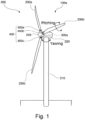
- Fig. 1 is a perspective view showing an example of a wind power generation device control system 100a according to a first embodiment of the present invention.
- the wind power generation device control system 100a includes a wind power generation device 200, a blade control device 300a, and blade wind detecting devices 400 (blade wind detecting devices 400a, 400b, 400c).
- the wind power generation device 200 includes a tower 210, a nacelle 220, blades 230a, 230b and 230c, and a hub 240.
- Fig. 1 shows the case where the wind power generation device 200 includes the blades 230a, 230b, and 230c, the present embodiment is not limited to such.
- the wind power generation device 200 may include two or fewer blades, or four or more blades.
- the tower 210 is a columnar structure.
- the tower 210 is installed such that its central axis is perpendicular to the ground.
- the nacelle 220 is mounted on the top end of the tower 210.
- the nacelle 220 is configured to rotate (yaw) around the central axis of the tower 210.
- the nacelle 220 has the blade control device 300a provided therein.
- the blades 230a, 230b, and 230c are each shaped like an elongated flat plate.
- the blades 230a, 230b and 230c are mounted on the hub 240 such that they fixedly radiate from the hub 240.
- the longitudinal directions of two of the blades intersect at 120 degrees.
- the blades 230a, 230b, and 230c respectively have the blade wind detecting devices 400a, 400b, and 400c at their root for detecting the wind speed.
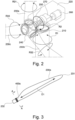
- Fig. 2 is a schematic view showing the configuration of the nacelle 220 and blades 230a, 230b and 230c of the wind power generation device 200 (see Fig. 1 ).
- the nacelle 220 has a power generator 260 disposed therein.
- An axle 250 which is connected to the hub 240, is rotated, and the rotation is increased by a speed increaser 270 and transmitted to the power generator 260. This results in power generation.
- the nacelle 220 has the blade control device 300a provided therein, Fig. 2 does not show the blade control device 300a.
- the wind power generation device 200 creates three types of rotations. The first one of them is yawing R1, where the nacelle 220 rotates about the central axis of the columnar tower 210.
- the second is axle rotation R2, where the hub 240 having the blades 230a, 230b and 230c attached thereto rotates about the axle 250, which is parallel to the ground.
- the third is pitching R31, R32, and R33, where the blades 230a 230b and 230c shaped like an elongated flat plate rotate about their longitudinal direction.
- Fig. 3 is a schematic view showing the configuration of the blade 230a of the wind power generation device 200 (see Fig. 1 ).
- the blades 230b and 230c have the same configuration as the blade 230a shown in Fig. 3 .
- the blade 230a which has a root 232 and a tip 231, has an elongated flat plate shape extending in the longitudinal direction D1.
- the root 232 of the blade 230a is fixedly attached to the hub 240 such that the blade 230a can rotate about the longitudinal direction D1.
- the blade wind detecting device 400a In the vicinity of the root 232 of the blade 230a, the blade wind detecting device 400a is provided and surrounds the blade 230a along its circumferential direction.
- the vicinity of the root 232 of the blade 230a may be defined, for example, as the area originating from the root 232 and spanning the distance of "0 to Z/8" toward the tip 231. Since the blade wind detecting device 400a is provided in the vicinity of the root 232 of the blade 230a, the blade wind detecting device 400a is configured to travel less upon rotation of the blade 230a following the axle rotation R2 (see Fig.
- Fig. 3 shows the case in which the blade wind detecting device 400a is installed near the root 232 of the blade 230a, the present embodiment is not limited to such.
- the blade wind detecting device 400a may be installed in any other area than the vicinity of the root 232 of the blade 230a.
- the blade wind detecting device 400a is significantly affected by the wind caused by the rotation of the blade 230a itself if it is installed at the tip 231 of the blade 230a.
- the wind result in noise, which may be disadvantageously included in the measurements of the stress sensors 410A to 410L shown in Fig. 4 or cause malfunction of the stress sensors 410A to 410L.
- Fig. 4 is a sectional view along the line A-A in Fig. 3 .
- the area in the vicinity of the root 232 of the blade 230a is circular in cross-section.
- the blade wind detecting device 400 is provided on the circumference of the circular area in the vicinity of the root 232.
- the blade wind detecting device 400 includes 12 stress sensors 410A, 410B, 410C, 410D, 410E, 410F, 410G, 410H, 410I, 410J, 410K and 410L for detecting an externally applied force.
- the stress sensors 410A to 410L are all constituted by the same sensor, for example.
- the stress sensors 410A to 410L each can detect stress received from the outside.
- Fig. 4 shows the case where the twelve stress sensors 410A to 410L are provided on the blade 230a
- the present embodiment is not limited to such.
- the blade 230a may be provided with 1 to 11 stress sensors, or 13 or more stress sensors.
- the blade wind detecting device 400 can be manufactured with a reduced cost by reducing the number of stress sensors provided on the blade 230a.
- the speed and direction of the wind acting upon the blade 230a can be more closely monitored by increasing the number of stress sensors provided on the blade 230a.
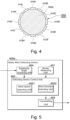
- Fig. 5 is a schematic block diagram showing the configuration of the blade wind detecting device 400a included in the wind power generation device control system 100a (see Fig. 1 ).
- the blade wind detecting devices 400b and 400c are not described since they have the same configuration as the blade wind detecting device 400a.
- the blade wind detecting device 400a has a stress measuring unit 401, a detecting device control unit 402, a transmitting unit 403, and a rotational angle acquiring unit 404.
- the stress measuring unit 401 includes the twelve stress sensors 410A to 410L (see Fig. 4 ).
- the stress sensors 410A to 410L are configured to measure, at the same time, the stress received from outside, and the stress measuring unit 401 outputs the measurements to the detecting device control unit 402.
- the detecting device control unit 402 controls the units of the blade wind detecting device 400a.
- the detecting device control unit 402 is, for example, a Central Processing Unit (CPU).
- the detecting device control unit 402 includes a wind speed detecting unit 4021 and a wind direction detecting unit 4022.
- the transmitting unit 403 is constituted by a wireless transmitting device. The transmitting unit 403 performs wireless transmission with the blade control device 300a installed within the nacelle 220 to transmit the data of the wind speed output from the wind speed detecting unit 4021 and the data of the wind direction detected by the wind direction detecting unit 4022.
- the rotational angle acquiring unit 404 acquires the rotational angle of the rotation of the blades 230a, 230b, and 230c about the axle 250, which is caused by the wind acting upon the blades 230a, 230b and 230c. For example, when the blade 230a points to the above, right, below, and left, the rotational angle acquiring unit 404 acquires, as the rotational angle, the values 0, 90, 180, and 270 degrees, respectively.
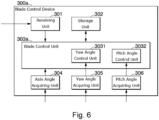
- Fig. 6 is a schematic block diagram showing the configuration of the blade control device 300a included in the wind power generation device control system 100a (see Fig. 1 ).
- the blade control device 300a includes a receiving unit 301, a storage unit 302, a blade control unit 303a, an axle angle acquiring unit 304, a yaw angle acquiring unit 305, and a pitch angle acquiring unit 306.
- the receiving unit 301 is constituted by a wireless communication device.
- the receiving unit 301 receives the data regarding the wind speed and direction, which is transmitted from the transmitting unit 403 of the blade wind detecting device 400, and outputs the received data to the blade control unit 303a.
- the storage unit 302 is constituted by a memory.
- the storage unit 302 stores the data acquired by the blade control unit 303a, including the data output to the blade control unit 303a from the receiving unit 301, the data output to the blade control unit 303a from the axle angle acquiring unit 304, the data output to the blade control unit 303a from the yaw angle acquiring unit 305, and the data output to the blade control unit 303a from the pitch angle acquiring unit 306.
- the blade control unit 303a controls the units of the blade control device 300a.
- the blade control unit 303a is constituted by a CPU.
- the blade control unit 303a has a yaw angle control unit 3031 and a pitch angle control unit 3032.
- the yaw angle control unit 3031 outputs instructions to a yaw drive device, which is provided between the tower 210 and the nacelle 220. In this way, the yaw angle control unit 3031 can control the angle of the yawing R1 (see Fig. 2 ) of the nacelle 220.
- the pitch angle control unit 3032 outputs instructions to the blades 230a, 230b, and 230c attached to the hub 240. In this manner, the pitch angle control unit 3032 controls the angle of the pitching R31, R32 and R33 (see Fig. 2 ) of the blades 230a, 230b, and 230c.
- the axle angle acquiring unit 304 acquires data of the current rotational angle of the rotation about the axle 250 (see Fig. 2 ) and outputs the acquired data to the blade control unit 303a. For example, when the blade 230a shown in Fig. 1 points to the immediately above, the axle angle acquiring unit 304 outputs to the blade control unit 303a data indicating that the blade 230a is at a rotational angle of 0 degrees, the blade 230b is at a rotational angle of 120 degrees, and the blade 230c is at a rotational angle of 240 degrees.
- the yaw angle acquiring unit 305 acquires data indicating which direction the nacelle 220 faces on the tower 210 and outputs the acquired data to the yaw angle control unit 3031. For example, when the power generation is taking place with the blades 230a, 230b and 230c shown in Fig. 1 facing the south, the yaw angle acquiring unit 305 outputs to the yaw angle control unit 3031 data indicating that the yaw angle indicates the south (180 degrees).
- the yaw angle is defined as 0 degrees when the blades 230a, 230b, and 230c face the north.
- the pitch angle acquiring unit 306 acquires data indicating which direction the blades 230a, 230b and 230c, which are rotatably attached to the hub 240, face relative to the hub 240 and outputs the acquired data to the pitch angle control unit 3032. For example, when the wind receiving surfaces of the blades 230a, 230b and 230c shown in Fig. 1 all face forward, the pitch angle acquiring unit 306 outputs to the pitch angle control unit 3032 data indicating that the blades 230a, 230b and 230c all have a pitch angle of 0 degrees.
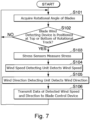
- Fig. 7 is a flow chart illustrating how the blade wind detecting device 400 of the wind power generation device control system 100a (see Fig. 1 ) works.
- Fig. 7 illustrates the operations performed by the blade wind detecting device 400a attached to the blade 230a of the wind power generation device control system 100a (see Fig. 1 ).
- the blade wind detecting devices 400b and 400c attached to the other blades 230b and 230c perform the same series of operations as shown in the flow chart of Fig. 7 .
- the rotational angle acquiring unit 404 acquires the rotational angle of the blade 230a having the blade wind detecting device 400a installed thereon (step S101).
- the acquired rotational angle is 0 degrees.
- the acquired rotational angle is 90 degrees.
- the acquired rotational angle is 180 degrees.
- the detecting device control unit 402 of the blade wind detecting device 400a determines whether the blade wind detection device 400a is positioned at the top or bottom of the rotational track (step S102).
- the position of the blade wind detecting device 400a transitions in the order of the rotational angle of 0 degrees (the blade 230a pointing to the immediately above), the rotational angle of 90 degrees (the blade 230a pointing to the right), the rotational angle of 180 degrees (the blade 230a pointing to the immediately below), the rotational angle of 270 degrees (the blade 230a pointing to the left) and the rotational angle of 0 degrees (the blade 230a pointing to the immediately above).
- the detecting device control unit 402 repeatedly performs the step until the blade 230a points to the immediately above (the rotational angle of 0 degrees) or the blade 230a points to the immediately below (the rotational angle of 180 degrees).
- the blade wind detecting device 400a may be provided with a Global Positioning System (GPS), which can be used to determine whether the blade 230a points to the immediately above (the rotational angle of 0 degrees) or the immediately below (the rotational angle of 180 degrees).
- GPS Global Positioning System
- the direction the blade 230a points to can be determined by referring to the GPS information to judge whether the altitude of the blade wind detecting device 400a coincides with the top or bottom point of the rotational track of the blade wind detecting device 400a.
- the altitude of the blade wind detecting device 400a coincides with the top or bottom point of the rotational track of the blade wind detecting device 400a based on the instruction issued by the blade control unit 303a (the instruction issued based on the data of the rotational angle of the axle 250), which can be acquired from the axle angle acquiring unit 304 (see Fig. 6 ).
- the detecting device control unit 402 determines affirmatively (YES) in the step S102 (i.e., if the blade 230a points to the immediately above or below), the detecting device control unit 402 proceeds to the step S103.
- the detecting device control unit 402 controls the stress sensors 410A to 410L to measure the stress (step S103). Specifically, at the point of time when the blade 230a points to the immediately above and at the point of time when the blade 230a points to the immediately below, the detecting device control unit 402 simultaneously causes the stress sensors 410A to 410L to measure the stress.
- the wind speed detecting unit 4021 detects the wind speed on the stress sensors 410A to 410L based on the stress measured by the stress sensors 410A to 410L (step S104). Specifically, the wind speed detecting unit 4021 stores in advance data associating the values of the stress detected by the stress sensors with the wind speed values. Based on the stored data, the wind speed detecting unit 4021 retrieves the wind speed associated with the detected stress.
- the detecting device control unit 402 may statistically process the stress values detected by the respective stress sensors 410A to 410L into index values (for example, the total, average, median, or difference between the maximum and minimum values)) and compare the index values against the data stored in advance therein.
- the wind speed detecting unit 4021 may calculate the sum of the stress values measured by the stress sensors 410A to 410L in the stress measuring unit 401.
- the wind speed detecting unit 4021 may store in advance the total stress values and the wind speed values in association with each other.
- the wind speed detecting unit 4021 may thus consult the stored data to retrieve the wind speed value associated with the total of the stress values measured by the stress sensors 410A to 410L. In this way, it is no longer necessary to convert each of the measurements of the stress sensors 410A to 410L into wind speed in order to detect the wind speed. This leads to a reduced amount of operations to be performed by the blade wind detecting device 400a.
- the wind direction detecting unit 4022 detects the wind direction at the point of time when the stress sensors 410A to 410L measure the stress (step S105). Specifically, the highest wind speed is determined from among the wind speed values detected by the wind speed detecting unit 4021 for the respective stress sensors 410A to 410L constituting the stress measuring unit 401, and the direction faced by the stress sensor corresponding to the determined highest wind speed is identified as the wind direction. As the axle 250 rotates, the directions faced by the stress sensors 410A to 410L change. Therefore, the wind direction detecting unit 4022 refers to the rotational angle obtained by the rotational angle acquiring unit 404 to detect the wind direction, which is the direction faced by the stress sensor that has measured the highest stress value.
- the wind direction detecting unit 4022 may obtain data indicating the stress values measured by the stress sensors 410A to 410L constituting the stress measuring unit 401 and may detect as the wind direction the direction faced by the stress sensor that has measured the largest stress value from among the obtained stress values. In this way, the wind direction can be detected without the need of detecting the wind speed. This leads to a reduced amount of operations to be performed by the blade wind detecting device 400a.
- the transmitting unit 403 transmits the data regarding the wind speed and direction detected in the step S102 to the receiving unit 301 of the blade control device 300a (see Fig. 6 ) (step S106).
- the blade control device 300a relates to each other the stress values detected by the wind speed detecting unit 4021 in the step S104, blade identification information identifying the blade (in this case, the blade 230a) for which the stress values are detected, the rotational angle of the blade 230a at the point of time when the wind speed is measured (in this case, 0 or 180 degrees) and the point of time when the wind speed is measured.
- Fig. 7 may be performed not only by the blade wind detecting device 400a attached to the blade 230a but also by the blade wind detecting devices 400b and 400c respectively attached to the blades 230b and 230c.
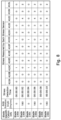
- the data shown in Fig. 8 is stored.
- the stress sensors 410A to 410L are attached to the blade 230a in the manner shown in Fig. 4 .
- a case is examined where the blades 230a, 230b, and 230c of the wind power generation device 200 may face the south, and the blade 230a may point to the immediately above.
- the stress sensor 410A shown in Fig. 4 faces the north
- the wind speed detected based on the stress measured by the stress sensor 410E is related to the wind blowing from the east.
- the wind speed detected based on the stress measured by the stress sensor 410J is related to the wind blowing from the west.
- the blades 230a, 230b, and 230c of the wind power generation device 200 may face the south and the blade 230a may alternatively point to the immediately below.
- the wind speed detected based on the stress measured by the stress sensor 410E is related to the wind blowing from the west.
- the wind speed detected based on the stress measured by the stress sensor 410J is related to the wind blowing from the east.
- the blade control unit 303a identifies the respective positions of the stress sensors 410A to 410L based on the rotational angle of the blades 230a, 230b 230c formed by the rotation of the axle 250.
- the blade control unit 303a determines at least one of the wind direction or wind speed on the blades 230a, 230b, and 230c based on the identified positions of the stress sensors 410A to 410L.
- the data shown in Fig. 9 is obtained.
- the maximum wind speed e.g., 10 (m/sec)
- the wind speed detection time when the corresponding wind speed is detected (e.g., 0:0:0)
- the wind direction e.g., east-southeast (120 degrees)
- the wind direction is expressed numerically here with the north, east, south and west being respectively represented by 0 degrees, 90 degrees, 180 degrees, and 270 degrees.
- the data shown in Fig. 9 can tell the maximum wind speed (m/sec) and the wind direction at a particular time (hours, minutes, seconds or 0:0:0).
- the stress values measured by the stress sensors 410A to 410L and the directions faced by the stress sensors 410A to 410L may be transformed into vectors, from which a resultant force vector may be calculated.
- the direction of the resultant force vector may be determined as the wind direction.
- the pitch angles of the blades 230a, 230b and 230c and the rotational angle of the blades 230a, 230b and 230c may be taken into consideration.
- Fig. 8 shows an example of the data obtained from the measurements of the stress sensors 410A to 410L according to the first embodiment of the present invention.
- the data shown in Fig. 8 relates to each other the blade identification information (for example, the blade 230a), the axle rotational angle (for example, 0 degrees), the stress detection time (for example, 0:0:0), and the stress values measured by the stress sensors 410A to 410L included in each of the blades 230a, 230b, and 230c (for example, 0, 0, 1, 2, 3, 2, 1, 0, 0, 0 ,0, 0 (m/sec)).
- the flowchart in Fig. 7 describes the case where the blade wind detecting device 400 detects the wind speed and direction when the blade wind detecting device 400 is positioned at the top or bottom of the rotational track.
- the wind speed and direction may be detected on any other occasions than when the blade wind detecting device 400 is positioned at the top or bottom of the rotational track. It is, however, difficult to detect the wind from the east and west when the wind power generation device 200 faces the south and the blade 230a points to the east (i.e., the rotational angle of the blade 230a is 90 degrees). This is because the axis passing through the center of the annulus formed by the stress sensors 410A to 410L provided on the blade 230a extends in the east-west direction.
- the blade wind detecting device 400a is preferably configured to measure the wind speed when the blade wind detecting device 400a is positioned at the top or bottom of the rotational track. This is because the axis passing through the center of the annulus formed by the stress sensors 410A to 410L extends perpendicularly to the ground, so that the blade wind detecting device 400a can successfully detect the wind from any of the north, south, east and west.
- the flowchart in Fig. 7 describes the case where the blade wind detecting device 400 detects the wind speed and direction when the blade wind detecting device 400 is positioned at the top or bottom of the rotational track, but the present embodiment is not limited to such.
- the blade wind detecting device 400 may be configured to detect the wind speed and direction only when the blade wind detecting device 400 is positioned at the top of the rotational track, or the blade wind detecting device 400 may be configured to detect the wind speed only when the blade wind detecting device 400 is positioned at the bottom of the rotational track. In this way, the number of operations required to calculate the wind speed and direction can be halved, which can reduce the load on the blade control device 300a.
- Fig. 10 is a flow chart showing operations performed by the blade control device 300a included in the wind power generation device control system 100a (see Fig. 1 ) according to the first embodiment.
- the blade control unit 303a of the blade control device 300a receives the data of the wind speed and direction from the blade wind detecting device 400 via the receiving unit 301 (step S201).
- the blade control unit 303a stores the data of the wind speed and direction received in the step S201 in the storage unit 302 (step S202).
- the blade control unit 303a determines whether the current time is the time to control the yawing R1 (see Fig.
- step S203 determines whether ten minutes have elapsed after the point of time when the most recent yawing control is performed in the step S203.
- the blade control unit 303a determines negatively (NO) in the step S203 and proceeds to the step S201. On the other hand, if it is determined that the current time is the time to control the yawing R1 (see Fig. 2 ), the blade control unit 303a determines affirmatively (YES) in the step S203 and determines the yawing angle based on the data of the wind direction from among the data stored in the storage unit 302 (see Fig. 8 ) (step S204).
- the yaw angle control unit 3031 determines the yawing angle such that the wind power generation device 200 can directly face the wind direction received in the step S201. Following this, the yaw angle control unit 3031 causes the nacelle 220 to yaw such that the current yaw angle, which is obtained from the yaw angle acquiring unit 305, becomes equal to the yawing angle determined in the step S204 (step S205).
- the pitch angle control unit 3032 determines the pitching angle based on the data of the wind speed and the like from among the data stored in the storage unit 302 (see Fig. 8 ) (step S206). Specifically, the pitch angle control unit 3032 determines the pitching angle based on the wind speed received in the step S201 and the rotational angle of the axle 250. More specifically, the pitch angle control unit 3032 determines and controls the pitch angle based on the wind speed and determines the pitching angle such that the rated rotational speed is maintained by feeding back the rotational speed calculated based on the axle rotational angle.
- the pitch angle control unit 3032 causes the blades 230a, 230b, and 230c to pitch such that the current pitch angle obtained from the pitch angle acquiring unit 306 becomes equal to the pitching angle determined in the step S206 (step S207).
- the yawing R1 (see Fig. 2 ) is based on the wind direction on the blades 230a, 230b, and 230c, which are directly exposed to the wind, so that the blades 230a, 230b, and 230c can be controlled to directly face the wind direction to the maximum extent.
- the first embodiment of the present invention can determine more accurately the direction of the wind acting upon the wind power generation device 200 than in the conventional art, where the blades 230a, 230b and 230c rotate near the axle 250 (see Fig. 2 ) to disturb the wind.
- the nacelle wind direction detecting device provided on the nacelle 220 of the wind power generation device 200 is configured to detect the disturbed wind. As a result, the wind power generation device 200 can be controlled to face the direction where the wind speed is high. This allows the wind power generation device 200 to achieve improved power generation efficiency.
- the pitching R31, R32, R33 (see Fig. 2 ) is based on the wind speed on the blades 230a, 230b and 230c, which are exposed to the wind.
- the pitch angle is controlled based on the detected wind speed such that the blades 230a, 230b and 230c can reach the rated operation as quickly as possible.
- the wind power generation device 200 can reach the rated operation more quickly than in the conventional art. This allows the wind power generation device 200 to achieve improved power generation efficiency.
- the blade wind detecting devices 400a, 400b and 400c are respectively provided on the blades 230a, 230b and 230c, and the data of the wind direction detected by the blade wind detecting devices 400a, 400b and 400c is transmitted to the blade control device 300a via wireless communication.
- the present embodiment is not limited to such.
- one of the blades 230a, 230b and 230c may be provided with a weathervane, and a camera or other imaging device may be provided on the nacelle 220.
- the imaging device may be used to capture images of the weathervane on one of the blades 230a, 230b and 230c, and the images are used to detect the wind direction on the blades.
- This implementation eliminates the need of providing the receiving unit 301 of the blade control device 300a in the first embodiment. As a result, the blade control device 300a can have more simplified configuration.
- the pitching is performed in the step S207 of the flowchart shown in Fig. 10 .
- the steps S206 and S207 of the flow chart of Fig. 10 are no longer necessary.
- the operation relating to the yawing (steps S204 and S205) is followed by the operation relating to the pitching (steps S206 and S207), but the present embodiment is not limited to such.
- the operation relating to the pitching may be followed by the operation relating to the yawing.
- the operation relating to the yawing and the operation relating to the pitching may be performed simultaneously.
- the operation relating to the yawing and the operation relating to the pitching may be performed independently.
- the blade wind detecting devices 400a, 400b and 400c each have the stress measuring unit 401, detecting device control unit 402, transmitting unit 403, and rotational angle acquiring unit 404.
- the present embodiment is not limited to such.
- the blade wind detecting devices 400a, 400b and 400c may need only the stress measuring unit 401 and transmitting unit 403, and the other units may be included in the blade control device 300a or an external device.
- the wind speed on the blades 230a, 230b and 230c may be detected by a device other than the blade wind detecting devices 400a, 400b and 400c. This also applies to the subsequent embodiments.
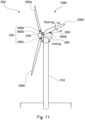
- Fig. 11 is a perspective view showing an example of a wind power generation device control system 100b according to a second embodiment of the present invention.
- the wind power generation device control system 100b relating to the second embodiment differs from the wind power generation device control system 100a relating to the first embodiment (see Fig. 1 ) in that a nacelle wind direction detecting device 500 is provided and a blade control device 300b is provided in place of the blade control device 300a.
- the other units of the wind power generation device control system 100b (see Fig. 11 ) relating to the second embodiment are the same as the corresponding units of the wind power generation device control system 100a (see Fig. 1 ) relating to the first embodiment. These units are assigned with the same reference numerals as in the first embodiment and thus not described here.
- the nacelle wind direction detecting device 500 is, for example, a cup-shaped wind direction detecting device.
- the nacelle wind direction detecting device 500 is located within the area above the nacelle 220 and away from the blades 230a, 230b and 230c.
- the wind direction detected by the nacelle wind direction detecting device 500 is transmitted to the blade control device 300b in the nacelle 220 via wired or wireless communication.
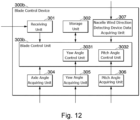
- Fig. 12 is a schematic block diagram showing the configuration of the blade control device 300b included in the wind power generation device control system 100b (see Fig. 11 ).
- the blade control device 300b relating to the second embodiment differs from the blade control device 300a relating to the first embodiment (see Fig. 6 ) in that a nacelle wind direction detecting device data acquiring unit 307 is provided and a blade control unit 303b is provided in place of the blade control unit 303a.
- the other units of the blade control device 300b relating to the second embodiment are the same as the corresponding units of the blade control device 300a relating to the first embodiment (see Fig. 6 ). These units are assigned with the same reference numerals as in the first embodiment and thus not described here.
- the nacelle wind direction detecting device data acquiring unit 307 shown in Fig. 12 receives data of the wind direction detected by the nacelle wind direction detecting device 500 from the nacelle wind direction detecting device 500, which is provided on the nacelle 220.
- the blade control unit 303b is constituted by a CPU and the like. The blade control unit 303b uses the data of the wind direction output from the nacelle wind direction detecting device data acquiring unit 307 to perform operations shown in Fig. 13 .
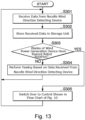
- Fig. 13 is a flow chart illustrating the operations performed by the blade control device 300b of the wind power generation device control system 100b (see Fig. 11 ).
- the blade control unit 303b receives the data of the wind direction detected by the nacelle wind direction detecting device 500 from the nacelle wind direction detecting device 500, which is provided on the nacelle 220 (step S301). Subsequently, the blade control unit 303b stores in the storage unit 302 the data of the wind direction received in the step S301 from the nacelle wind direction detecting device 500 via the nacelle wind direction detecting device data acquiring unit 307 (step S302).
- the blade control unit 303b determines whether the rotation speed of the blades 230a, 230b and 230c of the wind power generation device 200 has reached the rated rotation speed (step S303). For example, the blade control unit 303b determines whether the rotation speed of the axle rotation R2 (see Fig. 2 ) of the blades 230a, 230b and 230c has reached the rated rotation speed N (e.g., 6 (rev/min)).
- the blade control unit 303b judges negatively (NO) in the step S303 and performs the yawing R1 (see Fig. 2 ) based on the data of the wind direction received from the nacelle wind direction detecting device 500 in the step S301 (step S304).
- the yaw angle control unit 3031 of the blade control unit 303b performs the yawing R1 (see Fig. 2 ) such that the direction currently faced by the blades 230a, 230b and 230c coincides with the wind direction received from the nacelle wind direction detecting device 500 in the step S301.
- the blade control unit 303b judges affirmatively (YES) in the step S303, and the blade control unit 303b starts the series of steps described in the flow chart shown in Fig. 10 , instead of the series of steps described in the flow chart shown in Fig. 13 (step S305).
- Fig. 14 is a graph showing how the wind power generation device control system 100b works.
- the horizontal axis represents the time
- the vertical axis represents the rotation speed of the blades 230a, 230b and 230c achieved by the axle rotation R2 (see Fig. 2 ).
- Fig. 14 indicates that the blades 230a, 230b and 230c of the wind power generation device 200 of the wind power generation device control system 100b (see Fig. 11 ) start the axle rotation R2 (see Fig. 2 ) at a point of time t A .
- the rotation speed of the axle rotation R2 (see Fig.
- the wind power generation device 200 of the wind power generation device control system 100b does not generate a sufficient amount of power.
- the wind direction is detected based on the single nacelle wind direction detecting device 500 (see Fig. 11 ), which is located behind the blades 230a, 230b and 230c.
- the wind power generation device 200 of the wind power generation device control system 100b After the point of time t B , the wind power generation device 200 of the wind power generation device control system 100b generates a sufficient amount of power.
- the wind direction is detected based on the data acquired by the blade wind detecting devices 400 installed on the blades 230a, 230b and 230c.
- the blade control device 300b relating to the second embodiment can detect the wind direction more accurately after the amount of power generated by the wind power generation device 200 reaches a sufficient level than before the amount of power generated by the wind power generation device 200 reaches the sufficient level. Since the blade control device 300b is used to control the yaw angle and other factors, the second embodiment can reduce the processing load for the wind direction detection before the amount of power generated by the wind power generation device 200 reaches a sufficient level.
- the series of operations shown in the flow chart of Fig. 10 is started.
- the present embodiment is not limited to such.
- the series of operations shown in the flow chart of Fig. 10 may be performed while the blades 230a, 230b and 230c of the wind power generation device 200 keeps their rated rotation.
- the wind power generation device 200 may reach the rated rotation but later leave the rated rotation.
- the series of steps shown in the flow chart of Fig. 13 may be performed instead of the series of steps shown in the flow chart of Fig.
- the yaw angle is controlled.
- the second embodiment is not limited to such.
- the pitch angle may be controlled, and the yaw and pitch angles. may be both controlled.
- the wind power generation device control system relating to the third embodiment has the same configuration as the wind power generation device control system 100a (see Fig. 1 ) relating to the first embodiment.
- the wind power generation device control system relating to the third embodiment is thus not described in detail, and only the differences are described.
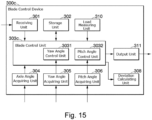
- Fig. 15 is a schematic block diagram showing the configuration of a blade control device 300c included in a wind power generation device control system relating to a third embodiment.
- the blade control device 300c relating to the third embodiment differs from the blade control device 300a relating to the first embodiment (see Fig. 6 ) in that a deviation calculating unit 308, a load measuring unit 310 (referred to as the load detecting device), and an output unit 311 (referred to as the output device) are provided and the blade control unit 303c is provided in place of the blade control unit 303a.
- the other units of the blade control device 300c (see Fig. 15 ) relating to the third embodiment are the same as the corresponding units of the blade control device 300a (see Fig. 6 ) relating to the first embodiment. These units are assigned with the same reference numerals as in the first embodiment and thus not described here.
- a yaw drive device which is not shown, rotates the nacelle 220 with respect to the tower 102, so that the blades 230a, 230b, and 230c may yaw.
- the deviation calculating unit 308 calculates a wind direction deviation indicating a change in the wind direction observed over a predetermined period of time (for example, three seconds).
- the wind direction deviation is large if the wind direction significantly changes over the predetermined period of time (for example, the wind direction changes by 90 degrees or more). On the other hand, if the wind direction does not change significantly over the predetermined period of time, the wind direction deviation is small.
- the load measuring unit 310 is, for example, a bolt strain sensor or a torque sensor.
- the bolt strain sensor is a sensor shaped like a bolt and configured to determine how much load is applied.
- the bolt strain sensor has a sensor included in the bolt for detecting strain.
- the bolt strain sensor is used to secure the yaw drive device to the wind power generation device 200. In this way, the bolt strain sensor can determine how much load is applied to the yaw drive device during yawing.
- the torque sensor is configured to measure the force (torque) applied to the axis of rotation in the direction of rotation.
- the torque sensor is installed in, for example, a shaft provided for the yawing.
- the load measuring unit 310 detects yaw load applied to the yaw drive device for yawing (R1, see Fig. 2 ) the nacelle 220 on the tower 210.
- the output unit 311 transmits predetermined data from among the data stored in the storage unit 302 to an external device.
- the external device is a storage device, which is not shown, in the blade control device 300c or a cloud server outside the wind power generation device control system.
- the blade control unit 303c is constituted by a CPU and the like.
- the blade control unit 303c uses the data of the load, which is output from the load measuring unit 310, to perform operations shown in Fig. 16 .
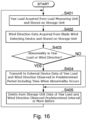
- Fig. 16 is a flow chart showing how the blade control device 300c (see Fig. 15 ) operates.
- the blade control unit 303c acquires from the load measuring unit 310 the yaw load applied to the yaw drive device, which is configured to yaw (R1, see Fig. 2 ) the nacelle 220 on the tower 210, and stores the acquired data in the storage unit 302 (step S401).
- the deviation calculating unit 308 acquires from the blade wind detecting device 400 (see Fig. 1 ) the data of the wind direction, generates data of wind direction deviation from the acquired wind direction data, and stores the generated data in the storage unit 302 (step S402).
- the blade control unit 303c determines whether or not an abnormality occurs in at least one of (i) the yaw load acquired from the load measuring unit 310 in the step S401 or (ii) the wind direction deviation generated in the step S402 (step S403). If an abnormality occurs in at least one of the yaw load acquired in the step S401 or the wind direction deviation generated in the step S402, the blade control unit 303c judges affirmatively (YES) in the step S403.
- the blade control unit 303c generates data indicating the yaw load, wind direction, and wind direction deviation observed over a predetermined period of time preceding and following the point of time when the abnormality occurs in association with the times when the respective data values are detected, and transmits the data to an external device via the output unit 311 (step S404). Following this, the blade control unit 303c performs the step S405. In the step S404, the blade control unit 303c may not transmit all of the data values indicating the yaw load, wind direction, and wind direction deviation, but at least some of them to the external device.
- the blade control unit 303c For example, if the yaw load acquired in the step S401 exceeds a predetermined yaw load threshold, the blade control unit 303c generates data indicating the yaw load, wind direction, and wind direction deviation observed over a period from a point of time a predetermined interval (for example, 20 seconds) prior to the point of time when the predetermined yaw load threshold is exceeded to a point of time a predetermined interval (for example, 20 seconds) subsequent to the point of time when the predetermined yaw load threshold is exceeded, and transmits the data to the external device.
- a predetermined interval for example, 20 seconds
- the blade control unit 303c if the wind direction deviation generated in the step S402 exceeds a predetermined wind direction deviation threshold, the blade control unit 303c generates data indicating the yaw load, wind direction, and wind direction deviation observed over a period from a point of time a predetermined interval (for example, 20 seconds) prior to the point of time when the predetermined wind direction deviation threshold is exceeded to a point of time a predetermined interval (for example, 20 seconds) subsequent to the point of time when the predetermined wind direction deviation threshold is exceeded, and transmits the data to the external device.
- a predetermined interval for example, 20 seconds
- the blade control unit 303c deletes from the storage unit 302 the data detected at the points of time a predetermined interval (for example, 20 seconds) or more prior to the point of time when the yaw load or wind direction deviation experiences the abnormality (step S405). In this way, the data detected at the points of time around the period in which the abnormality occurs can be transmitted to the external device and kept. On the other hand, the data that has nothing to do with the abnormality and does not need to be examined is deleted. This results in reducing the amount of data stored in the storage unit 302 of the blade control unit 303c. Following this, the blade control unit 303c performs the step S401.
- a predetermined interval for example, 20 seconds
- the blade control unit 303c performs the step S401.
- the blade control unit 303c may not entirely delete the data related to the yaw load, wind direction and wind direction deviation stored in the storage unit 302 but delete at least some of the data, specifically, the data detected at the points of time a predetermined interval (for example, 20 seconds) or more prior to the point of time when the abnormality occurs.
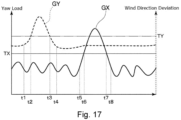
- Fig. 17 is a graph illustrating the operations performed by the wind power generation device control system according to the third embodiment of the present invention.
- the horizontal axis represents the time
- the left vertical axis represents the yaw load
- the right vertical axis represents the wind direction deviation.
- TX denotes the yaw load threshold
- TY represents the wind deviation threshold.
- the graph GX shows how the yaw load changes over time.
- the graph GY shows how the wind direction deviation changes over time.
- the wind direction deviation is above the wind direction deviation threshold TY in the period from the point of time t2 to the point of time t3. Therefore, the data of the yaw load and the data of wind direction deviation detected at the points of time in the period from the point of time t1, which is the predetermined interval (for example, 20 seconds) prior to the point of time t2, to the point of time t4, which is the predetermined interval (for example, 20 seconds) subsequent to the point of time t3, are transmitted to the external device such as a cloud server.
- the predetermined interval for example, 20 seconds
- the yaw load is above the yaw load threshold TX in the period from the point of time t6 to the point of time t7. Therefore, the data of the yaw load and the data of the wind direction deviation detected at the points of time in the period from the point of time t5, which is the predetermined interval (for example, 20 seconds) prior to the point of time t6, to the point of time t8, which is the predetermined interval (for example, 20 seconds) subsequent to the point of time t7, are transmitted to the external device such as a cloud server.
- the predetermined interval for example, 20 seconds
- the data of the yaw load and wind direction deviation detected in the time ranges t1 to t4 and t5 to t8 respectively including the time ranges t2 to t3 and t6 to t7 in which the abnormality occurs is transmitted to the external device.
- the user can analyze the situation by comparing and studying the data of the yaw load and the data of the wind direction deviation that are received by the external device, where one of the yaw load and the wind direction deviation experiences abnormalities and the other does not.
- the relationship between the yaw load and the wind direction deviation can be examined.
- the results of the examination can be referred to in order to determine whether a new wind power generation device 200 can be installed near the current wind power generation device 200 or at a different site.
- the blade control unit 303c transmits to the external device the data of the yaw load and the data of the wind direction deviation detected at the points of time around the time range in which the abnormality occurs.
- the present embodiment is not limited to this.
- the data of the wind direction deviation which experiences no abnormality
- the data of the yaw load which experiences no abnormality
- the user of the external device can acquire and analyze the data of the other of the yaw load and the wind direction deviation that experiences no abnormality.
- the yaw drive device includes a motor for feeding a driving force to adjust the yaw angle of the blades 230a, 230b and 230c and a braking mechanism for performing braking by stopping the driving force fed from the motor.
- the blades 230a, 230b and 230c each have one stress sensor.
- the fourth embodiment further provides a release unit for stopping the driving force output from the motor, which is configured to adjust the yaw angle of the blades 230a, 230b and 230c through rotation and releasing the braking applied by the braking mechanism based on the measurements provided by the stress sensors.
- the release unit prevents the motor from outputting the driving force and releases the braking of the rotation applied by the braking mechanism.
- free yaw control is in place.
- the free yaw control permits free relative rotation between the nacelle 220 and the tower 210, and reduces or eliminates the braking force and drive force that may intervene the free relative rotation between the nacelle 220 and the tower 210.
- the braking of the rotation may be released by controlling the power fed to the motor such that no braking force is applied from the motor brake unit to the motor drive unit. For example, an external force such as a wind gust may be applied.
- the release unit may release the braking of the rotation by the braking mechanism of the drive device. This can not only prevent an increase in load on the meshing but also release the load at the meshing.
- a computer readable storage medium may store thereon programs for realizing the functions of the units of the blade wind detecting device 400 (see Fig. 5 ), blade control device 300a (see Fig. 6 ), blade control device 300b (see Fig. 12 ), and blade control device 300c (see Fig. 15 ).
- the programs stored on the storage medium may be loaded onto a computer system and then executed, so that the respective units shown in Figs. 5 , 6 , 12 and 15 may operate.
- the term "computer system” as used herein encompasses hardware such as OS and peripheral devices.
- the term “computer system” may also encompass WWW systems with homepage provision environment (or display environment).
- computer-readable storage medium refers to a storage device such as portable medium including a flexible disc, a magneto-optical disc, a ROM, and a CD-ROM, and a hard disk built-in to the computer system. Further, the term “computer-readable storage medium” includes storage that retain the program for some period of time, like a volatile memory (for example, RAM) in a computer system that operates as a server or a client receiving the program through a network such as the Internet or a communication line such as a telephone line.
- RAM volatile memory
- 100a, 100b -- wind power generation device control system 200 -- wind power generation device, 210 -- tower, 220 -- nacelle, 230a, 230b, 230c -- blade, 240 -- hub, 250 -- axle, 260 -- power generator, 270 -- speed increaser, 300a, 300b, 300c -- blade control device, 301 --receiving unit, 302 -- storage unit, 303a, 303b, 303c -- blade control unit, 3031 -- yaw angle control unit, 3032 -- pitch angle control unit, 304 -- axle angle acquiring unit, 305 -- yaw angle acquiring unit, 306 - - pitch angle acquiring unit, 307 -- nacelle wind direction detecting device data acquiring unit, 308 -- deviation calculating unit, 310 -- load measuring unit, 311output unit, 400, 400a, 400b, 400c -- blade wind detecting device, 401 -- stress measuring unit, 402 -- detecting device control unit, 403 -- transmitting unit, 404 - - rotational angle acquiring unit,
Landscapes
- Engineering & Computer Science (AREA)
- Mechanical Engineering (AREA)
- Sustainable Development (AREA)
- Sustainable Energy (AREA)
- Chemical & Material Sciences (AREA)
- Combustion & Propulsion (AREA)
- Life Sciences & Earth Sciences (AREA)
- General Engineering & Computer Science (AREA)
- Physics & Mathematics (AREA)
- Fluid Mechanics (AREA)
- Evolutionary Computation (AREA)
- Theoretical Computer Science (AREA)
- Artificial Intelligence (AREA)
- Wind Motors (AREA)
- Indicating Or Recording The Presence, Absence, Or Direction Of Movement (AREA)
Applications Claiming Priority (1)
| Application Number | Priority Date | Filing Date | Title |
|---|---|---|---|
| JP2022140400A JP2024035741A (ja) | 2022-09-02 | 2022-09-02 | 風力発電装置制御システム及びブレード風検出装置 |
Publications (2)
| Publication Number | Publication Date |
|---|---|
| EP4332373A2 true EP4332373A2 (de) | 2024-03-06 |
| EP4332373A3 EP4332373A3 (de) | 2024-05-15 |
Family
ID=87801016
Family Applications (1)
| Application Number | Title | Priority Date | Filing Date |
|---|---|---|---|
| EP23193176.7A Pending EP4332373A3 (de) | 2022-09-02 | 2023-08-24 | Steuerungssystem für eine windturbinenerzeugungsvorrichtung und schaufelwinderkennungsvorrichtung |
Country Status (4)
| Country | Link |
|---|---|
| US (1) | US12473887B2 (de) |
| EP (1) | EP4332373A3 (de) |
| JP (1) | JP2024035741A (de) |
| CN (1) | CN117646702A (de) |
Citations (1)
| Publication number | Priority date | Publication date | Assignee | Title |
|---|---|---|---|---|
| JP2020118076A (ja) | 2019-01-23 | 2020-08-06 | 株式会社Ihi建材工業 | 風力発電装置及びその施工方法 |
Family Cites Families (11)
| Publication number | Priority date | Publication date | Assignee | Title |
|---|---|---|---|---|
| DE10011393A1 (de) * | 2000-03-09 | 2001-09-13 | Tacke Windenergie Gmbh | Regelungssystem für eine Windkraftanlage |
| DE10113039B4 (de) * | 2001-03-17 | 2017-12-07 | Aloys Wobben | Windenergieanlage |
| US20070124025A1 (en) * | 2005-11-29 | 2007-05-31 | General Electric Company | Windpark turbine control system and method for wind condition estimation and performance optimization |
| US8203229B2 (en) * | 2009-06-15 | 2012-06-19 | Challenger Design, LLC | Auxiliary drive/brake system for a wind turbine |
| EP2317327A1 (de) | 2009-10-28 | 2011-05-04 | SSB Wind Systems GmbH & Co. KG | Windsensorsystem mit Hilfe von Rotorblattsignalen |
| US9140239B2 (en) * | 2009-12-15 | 2015-09-22 | Vestas Wind Sytems A/S | Wind power plant controller for avoiding common cause shutdown |
| GB2481461A (en) * | 2010-06-21 | 2011-12-28 | Vestas Wind Sys As | Control of a downstream wind turbine in a wind park by sensing the wake turbulence of an upstream turbine |
| EP2557311A1 (de) * | 2011-08-12 | 2013-02-13 | kk-electronic a/s | Verfahren zur Steuerung eines Windkraftparks und durch solch ein Verfahren gesteuerter Windkraftpark |
| DK2940295T3 (en) * | 2014-04-29 | 2018-05-22 | Gen Electric | SYSTEM AND PROCEDURE FOR MANAGING A WINDOW PARK |
| EP3163274A4 (de) | 2014-06-30 | 2018-03-21 | Hitachi, Ltd. | Windgetriebene elektrizitätserzeugungsvorrichtung, system zur überwachung der windgetriebenen elektrizitätserzeugungsvorrichtung und verfahren zur überwachung der windgetriebenen elektrizitätserzeugungsvorrichtung |
| EP4001638A1 (de) | 2020-11-17 | 2022-05-25 | Vestas Wind Systems A/S | Schätzung der auf eine windkraftanlage einfallenden windrichtung |
-
2022
- 2022-09-02 JP JP2022140400A patent/JP2024035741A/ja active Pending
-
2023
- 2023-08-24 EP EP23193176.7A patent/EP4332373A3/de active Pending
- 2023-08-24 US US18/455,150 patent/US12473887B2/en active Active
- 2023-08-31 CN CN202311108927.2A patent/CN117646702A/zh active Pending
Patent Citations (1)
| Publication number | Priority date | Publication date | Assignee | Title |
|---|---|---|---|---|
| JP2020118076A (ja) | 2019-01-23 | 2020-08-06 | 株式会社Ihi建材工業 | 風力発電装置及びその施工方法 |
Also Published As
| Publication number | Publication date |
|---|---|
| US20240077056A1 (en) | 2024-03-07 |
| US12473887B2 (en) | 2025-11-18 |
| JP2024035741A (ja) | 2024-03-14 |
| CN117646702A (zh) | 2024-03-05 |
| EP4332373A3 (de) | 2024-05-15 |
Similar Documents
| Publication | Publication Date | Title |
|---|---|---|
| EP2531722B1 (de) | Verfahren zur Kalibrierung von Lastsensoren einer Windturbinenschaufel und Windenergieanlage | |
| US10519935B2 (en) | Condition monitoring system and wind power generation system using the same | |
| US9841004B2 (en) | Yaw control system and yaw control method for wind turbine generator | |
| US10047726B2 (en) | Condition monitoring system and wind power generation system comprising the same | |
| ES2924494T3 (es) | Sistema de diagnóstico, sistema de aerogenerador, método para uso en un aerogenerador y producto de programa informático | |
| US8702388B2 (en) | Calibration of blade load sensors | |
| US10775267B2 (en) | Condition monitoring system | |
| CN101495747A (zh) | 校准方法 | |
| US20170356425A1 (en) | Method and system for determining the dynamic twist of a wind turbine blade | |
| US20100143128A1 (en) | Wind turbine yaw bearing determination | |
| EP4077919B1 (de) | Verfahren zur bestimmung der orientierung einer gondel | |
| CN107559144B (zh) | 用于风力涡轮机的前馈控制的方法及系统 | |
| EP4330692B1 (de) | Bestimmung der rotorgeschwindigkeit einer windturbine | |
| US10752341B2 (en) | Tip clearance harmonic estimation | |
| US20170292501A1 (en) | System and Method for Auto-Calibrating a Load Sensor System of a Wind Turbine | |
| US20140020465A1 (en) | Monitoring arrangement | |
| US20180283981A1 (en) | Method for determining the remaining service life of a wind turbine | |
| US20170284376A1 (en) | Method and Control Device for Measuring a Load on a Rotor Blade of a Wind Power Plant | |
| US11118566B2 (en) | Method of diagnosing a wind turbine power generation facility and automatic diagnosis device for wind turbine power generation facility | |
| EP4332373A2 (de) | Steuerungssystem für eine windturbinenerzeugungsvorrichtung und schaufelwinderkennungsvorrichtung | |
| US20200182225A1 (en) | Determining a wind speed value | |
| US20230091324A1 (en) | Method for self-testing an angle-of-attack probe and method for checking the velocity of an airflow provided by a series of associated pitot probes and angle-of-attack probe | |
| US12000379B2 (en) | Wind turbine system | |
| US11959459B2 (en) | Information generating device, information generating method and non-transitory computer-readable storage medium storing information generating program | |
| CN114930143A (zh) | 状态监测装置以及包括状态监测装置的风力发电装置 |
Legal Events
| Date | Code | Title | Description |
|---|---|---|---|
| PUAI | Public reference made under article 153(3) epc to a published international application that has entered the european phase |
Free format text: ORIGINAL CODE: 0009012 |
|
| STAA | Information on the status of an ep patent application or granted ep patent |
Free format text: STATUS: REQUEST FOR EXAMINATION WAS MADE |
|
| 17P | Request for examination filed |
Effective date: 20230824 |
|
| AK | Designated contracting states |
Kind code of ref document: A2 Designated state(s): AL AT BE BG CH CY CZ DE DK EE ES FI FR GB GR HR HU IE IS IT LI LT LU LV MC ME MK MT NL NO PL PT RO RS SE SI SK SM TR |
|
| PUAL | Search report despatched |
Free format text: ORIGINAL CODE: 0009013 |
|
| AK | Designated contracting states |
Kind code of ref document: A3 Designated state(s): AL AT BE BG CH CY CZ DE DK EE ES FI FR GB GR HR HU IE IS IT LI LT LU LV MC ME MK MT NL NO PL PT RO RS SE SI SK SM TR |
|
| RIC1 | Information provided on ipc code assigned before grant |
Ipc: F03D 17/00 20160101ALI20240409BHEP Ipc: F03D 7/02 20060101AFI20240409BHEP |