EP4332034B1 - Yarn processing apparatus and yarn processing system - Google Patents
Yarn processing apparatus and yarn processing system Download PDFInfo
- Publication number
- EP4332034B1 EP4332034B1 EP23188016.2A EP23188016A EP4332034B1 EP 4332034 B1 EP4332034 B1 EP 4332034B1 EP 23188016 A EP23188016 A EP 23188016A EP 4332034 B1 EP4332034 B1 EP 4332034B1
- Authority
- EP
- European Patent Office
- Prior art keywords
- yarn
- contact portion
- terminal
- power storage
- storage device
- Prior art date
- Legal status (The legal status is an assumption and is not a legal conclusion. Google has not performed a legal analysis and makes no representation as to the accuracy of the status listed.)
- Active
Links
Images





Classifications
-
- D—TEXTILES; PAPER
- D02—YARNS; MECHANICAL FINISHING OF YARNS OR ROPES; WARPING OR BEAMING
- D02G—CRIMPING OR CURLING FIBRES, FILAMENTS, THREADS, OR YARNS; YARNS OR THREADS
- D02G1/00—Producing crimped or curled fibres, filaments, yarns, or threads, giving them latent characteristics
- D02G1/02—Producing crimped or curled fibres, filaments, yarns, or threads, giving them latent characteristics by twisting, fixing the twist and backtwisting, i.e. by imparting false twist
- D02G1/0206—Producing crimped or curled fibres, filaments, yarns, or threads, giving them latent characteristics by twisting, fixing the twist and backtwisting, i.e. by imparting false twist by false-twisting
-
- D—TEXTILES; PAPER
- D01—NATURAL OR MAN-MADE THREADS OR FIBRES; SPINNING
- D01D—MECHANICAL METHODS OR APPARATUS IN THE MANUFACTURE OF ARTIFICIAL FILAMENTS, THREADS, FIBRES, BRISTLES OR RIBBONS
- D01D13/00—Complete machines for producing artificial threads
- D01D13/02—Elements of machines in combination
-
- B—PERFORMING OPERATIONS; TRANSPORTING
- B65—CONVEYING; PACKING; STORING; HANDLING THIN OR FILAMENTARY MATERIAL
- B65H—HANDLING THIN OR FILAMENTARY MATERIAL, e.g. SHEETS, WEBS, CABLES
- B65H51/00—Forwarding filamentary material
- B65H51/02—Rotary devices, e.g. with helical forwarding surfaces
- B65H51/04—Rollers, pulleys, capstans, or intermeshing rotary elements
- B65H51/06—Rollers, pulleys, capstans, or intermeshing rotary elements arranged to operate singly
-
- B—PERFORMING OPERATIONS; TRANSPORTING
- B65—CONVEYING; PACKING; STORING; HANDLING THIN OR FILAMENTARY MATERIAL
- B65H—HANDLING THIN OR FILAMENTARY MATERIAL, e.g. SHEETS, WEBS, CABLES
- B65H57/00—Guides for filamentary materials; Supports therefor
- B65H57/16—Guides for filamentary materials; Supports therefor formed to maintain a plurality of filaments in spaced relation
-
- B—PERFORMING OPERATIONS; TRANSPORTING
- B65—CONVEYING; PACKING; STORING; HANDLING THIN OR FILAMENTARY MATERIAL
- B65H—HANDLING THIN OR FILAMENTARY MATERIAL, e.g. SHEETS, WEBS, CABLES
- B65H63/00—Warning or safety devices, e.g. automatic fault detectors, stop-motions ; Quality control of the package
- B65H63/02—Warning or safety devices, e.g. automatic fault detectors, stop-motions ; Quality control of the package responsive to reduction in material tension, failure of supply, or breakage, of material
- B65H63/024—Warning or safety devices, e.g. automatic fault detectors, stop-motions ; Quality control of the package responsive to reduction in material tension, failure of supply, or breakage, of material responsive to breakage of materials
- B65H63/028—Warning or safety devices, e.g. automatic fault detectors, stop-motions ; Quality control of the package responsive to reduction in material tension, failure of supply, or breakage, of material responsive to breakage of materials characterised by the detecting or sensing element
- B65H63/032—Warning or safety devices, e.g. automatic fault detectors, stop-motions ; Quality control of the package responsive to reduction in material tension, failure of supply, or breakage, of material responsive to breakage of materials characterised by the detecting or sensing element electrical or pneumatic
- B65H63/0321—Warning or safety devices, e.g. automatic fault detectors, stop-motions ; Quality control of the package responsive to reduction in material tension, failure of supply, or breakage, of material responsive to breakage of materials characterised by the detecting or sensing element electrical or pneumatic using electronic actuators
-
- B—PERFORMING OPERATIONS; TRANSPORTING
- B65—CONVEYING; PACKING; STORING; HANDLING THIN OR FILAMENTARY MATERIAL
- B65H—HANDLING THIN OR FILAMENTARY MATERIAL, e.g. SHEETS, WEBS, CABLES
- B65H67/00—Replacing or removing cores, receptacles, or completed packages at paying-out, winding, or depositing stations
- B65H67/04—Arrangements for removing completed take-up packages and or replacing by cores, formers, or empty receptacles at winding or depositing stations; Transferring material between adjacent full and empty take-up elements
- B65H67/044—Continuous winding apparatus for winding on two or more winding heads in succession
- B65H67/048—Continuous winding apparatus for winding on two or more winding heads in succession having winding heads arranged on rotary capstan head
-
- H—ELECTRICITY
- H02—GENERATION; CONVERSION OR DISTRIBUTION OF ELECTRIC POWER
- H02J—ELECTRIC POWER NETWORKS; CIRCUIT ARRANGEMENTS OR SYSTEMS FOR SUPPLYING OR DISTRIBUTING ELECTRIC POWER; SYSTEMS FOR STORING ELECTRIC ENERGY
- H02J7/00—Circuit arrangements for charging or discharging batteries or for supplying loads from batteries
- H02J7/32—Circuit arrangements for charging or discharging batteries or for supplying loads from batteries for charging batteries from a charging set comprising a non-electric prime mover rotating at constant speed
-
- H—ELECTRICITY
- H02—GENERATION; CONVERSION OR DISTRIBUTION OF ELECTRIC POWER
- H02J—ELECTRIC POWER NETWORKS; CIRCUIT ARRANGEMENTS OR SYSTEMS FOR SUPPLYING OR DISTRIBUTING ELECTRIC POWER; SYSTEMS FOR STORING ELECTRIC ENERGY
- H02J7/00—Circuit arrangements for charging or discharging batteries or for supplying loads from batteries
- H02J7/70—Circuit arrangements for charging or discharging batteries or for supplying loads from batteries characterised by the mechanical construction
-
- H—ELECTRICITY
- H02—GENERATION; CONVERSION OR DISTRIBUTION OF ELECTRIC POWER
- H02M—APPARATUS FOR CONVERSION BETWEEN AC AND AC, BETWEEN AC AND DC, OR BETWEEN DC AND DC, AND FOR USE WITH MAINS OR SIMILAR POWER SUPPLY SYSTEMS; CONVERSION OF DC OR AC INPUT POWER INTO SURGE OUTPUT POWER; CONTROL OR REGULATION THEREOF
- H02M7/00—Conversion of AC power input into DC power output; Conversion of DC power input into AC power output
- H02M7/02—Conversion of AC power input into DC power output without possibility of reversal
- H02M7/04—Conversion of AC power input into DC power output without possibility of reversal by static converters
- H02M7/06—Conversion of AC power input into DC power output without possibility of reversal by static converters using discharge tubes without control electrode or semiconductor devices without control electrode
-
- B—PERFORMING OPERATIONS; TRANSPORTING
- B65—CONVEYING; PACKING; STORING; HANDLING THIN OR FILAMENTARY MATERIAL
- B65H—HANDLING THIN OR FILAMENTARY MATERIAL, e.g. SHEETS, WEBS, CABLES
- B65H2701/00—Handled material; Storage means
- B65H2701/30—Handled filamentary material
- B65H2701/31—Textiles threads or artificial strands of filaments
- B65H2701/313—Synthetic polymer threads
- B65H2701/3132—Synthetic polymer threads extruded from spinnerets
-
- H—ELECTRICITY
- H05—ELECTRIC TECHNIQUES NOT OTHERWISE PROVIDED FOR
- H05F—STATIC ELECTRICITY; NATURALLY-OCCURRING ELECTRICITY
- H05F3/00—Carrying-off electrostatic charges
Definitions
- the present invention relates to a yarn processing apparatus configured to process a yarn while conveying the yarn, and a yarn processing system including the yarn processing apparatus.
- an antistatic unit for removing static electricity is provided for a rotational shaft supporting a drive roller forming a third feed roller.
- the antistatic unit includes a supporter and a static electricity removing member.
- the supporter is grounded directly or via a metal frame.
- the static electricity removing member is attached to the supporter, and provided along the rotational shaft.
- An object of the present invention is to provide a yarn processing apparatus and a yarn processing system which make it possible to effectively use static electricity generated by conveying a yarn.
- a yarn processing apparatus includes: at least one contact portion which is conductive and which is configured to make contact with at least one running yarn; at least one power storage device which includes a first terminal and a second terminal and which is able to be charged by a voltage applied between the first terminal and the second terminal; a voltage application circuit which is connected between the at least one contact portion and the at least one power storage device and which is configured to apply, by using a charge of static electricity generated because of friction between the at least one running yarn and the at least one contact portion, the voltage between the first terminal and the second terminal so that the first terminal is higher in electric potential than the second terminal, irrespective of the polarity of the static electricity; an electric device connected to the at least one power storage device; and a first switching unit which is connected between (i) any one of the first terminal and second terminal of the at least one power storage device and (ii) the electric device, and which is configured to switch connection of the at least one power storage device with the electric device and disconnection of the at least one power storage device
- the at least one power storage device when the connection between the at least one power storage device and the electric device is blocked by the first switching unit, the at least one power storage device is charged by using the charge of the static electricity generated at the at least one contact portion because of the friction between the at least one running yarn and the at least one contact portion.
- the polarity of the static electricity generated at the at least one contact portion changes depending on, e.g., the type of the at least one yarn, the type of oil applied to the at least one yarn, and the degree to which the oil is applied to the at least one yarn.
- the voltage application circuit is connected between the at least one contact portion and the at least one power storage device.
- the voltage is applied between the first terminal and the second terminal so that the first terminal is higher in electric potential than the second terminal at the at least one power storage device irrespective of the polarity of the static electricity generated at the at least one contact portion. Because of this, the at least one power storage device is charged irrespective of the polarity of the static electricity generated at the at least one contact portion. It is therefore possible to efficiently charge the at least one power storage device.
- the charge of the static electricity generated at the at least one contact portion is used to charge the at least one power storage device. It is therefore possible to remove the static electricity generated at the at least one contact portion.
- the first switching unit connects the at least one power storage device to the electric device while the at least one power storage device is charged. Because of this, the electric device is driven by electric charges stored in the at least one power storage device.
- the yarn processing apparatus of the first aspect is arranged such that the voltage application circuit is a full-wave rectifier circuit.
- the full-wave rectifier circuit is able to apply the voltage between the first terminal and the second terminal, so that the first terminal is higher in electric potential than the second terminal irrespective of the polarity of the static electricity generated at the at least one contact portion. Because of this, the at least one power storage device is charged irrespective of the polarity of the static electricity generated at the at least one contact portion. It is therefore possible to efficiently charge the at least one power storage device.
- the yarn processing apparatus of the first or second aspect further includes, as the at least one contact portion, a stationary guide to which the at least one yarn is threaded and which is configured not to move in accordance with running of the at least one yarn.
- the stationary guide is configured not to move in accordance with the running of the at least one yarn.
- the stationary guide has high friction with the at least one running yarn so as to generate a large amount of the static electricity as compared to, e.g., a roller configured to move in accordance with the running of the at least one yarn.
- the at least one power storage device is charged by using the charge of the static electricity generated at the stationary guide functioning as the at least one contact portion. It is therefore possible to efficiently charge the at least one power storage device. In this regard, because the at least one power storage device is charged, a large amount of the static electricity generated at the stationary guide is removed.
- a surface of the stationary guide is gradually worn because of the friction with the at least one yarn, and thus an amount of electric charges of the static electricity generated at the stationary guide varies depending on the degree to which the surface of the stationary guide is worn.
- the present invention makes it possible to detect the degree to which the stationary guide is worn, in accordance the variation of how much the at least one power storage device is charged.
- the variation of how much the at least one power storage device is charged is caused by the variation of an amount of charges of the static electricity generated at the stationary guide.
- the yarn processing apparatus of any one of the first to third aspects further includes a supplying roller configured to convey yarns as the at least one contact portion.
- the supplying roller is configured to convey the yarns, and the static electricity is generated because of the friction between the supplying roller and each of the yarns. With this arrangement, a total amount of the static electricity generated at the supplying roller is large.
- the at least one power storage device is charged by using the charge of the static electricity generated at the supplying roller functioning as the at least one contact portion. It is therefore possible to efficiently charge the at least one power storage device. In this regard, because the at least one power storage device is charged, a large amount of the static electricity generated at the supplying roller is removed.
- the supplying roller is configured to convey the yarns while gripping the yarns.
- the tension of the running yarns may be adjusted by changing the rotation speed of the supplying roller.
- the degree to which the yarns are gripped by the supplying roller i.e., the degree to which the yarns slip on the supplying roller is detected based on how much the at least one power storage device is charged by the charge of the static electricity generated at the supplying roller.
- the yarn processing apparatus of any one of the first to fourth aspects further includes a winding unit configured to form a package by winding the at least one running yarn onto a bobbin.
- the winding unit includes: a contact roller configured to make contact with the at least one yarn on a surface of the unfinished package, as the at least one contact portion; and a winding detection unit configured to detect the at least one yarn being wound onto the contact roller.
- the running speed of the at least one yarn is high in the yarn processing apparatus (i.e., yarn winding system) configured to form the package by winding the at least one running yarn onto the bobbin.
- the friction between the at least one running yarn and the at least one contact portion is therefore high, and thus a large amount of the static electricity is generated at the at least one contact portion.
- the at least one power storage device is charged by using the charge of the static electricity generated at the at least one contact portion of the yarn winding system in which the running speed of the at least one yarn is high. It is therefore possible to efficiently charge the at least one power storage device. In this regard, because the at least one power storage device is charged, a large amount of the static electricity generated at the at least one contact portion of the yarn winding system is removed.
- the contact roller is configured to rotate while being in contact with the at least one yarn on a surface of the unfinished package. With this arrangement, a large amount of the static electricity is generated at the contact roller.
- the at least one power storage device is charged by using the charge of the static electricity generated at the contact roller functioning as the at least one contact portion. This removes the static electricity generated at the contact roller.
- the winding detection unit configured to detect the at least one yarn being wound onto the contact roller is provided in the vicinity of the contact roller.
- the at least one power storage device is charged by using the charge of the static electricity generated at the contact roller functioning as the at least one contact portion. This removes the static electricity generated at the contact roller, and thus the electric discharge between the contact roller and the winding detection unit is suppressed.
- the yarn processing apparatus of any one of the first to fifth aspects includes a winding unit configured to form a package by winding the at least one running yarn onto a bobbin.
- the winding unit includes a traverse device configured to traverse the at least one yarn in an axial direction of the bobbin at the time of winding the at least one yarn onto the bobbin.
- the traverse device includes: a moving guide configured to reciprocate in the axial direction of the bobbin while holding the at least one yarn; and a fulcrum guide configured to support the at least one yarn on the upstream side of the moving guide in a running direction of the at least one yarn.
- the moving guide is the at least one contact portion.
- the at least one power storage device is charged by using the charge of the static electricity generated at the moving guide functioning as the at least one contact portion. It is therefore possible to efficiently charge the at least one power storage device.
- the yarn processing apparatus of any one of the first to sixth aspects includes a winding unit configured to form a package by winding the at least one running yarn onto a bobbin.
- the winding unit includes a traverse device configured to traverse the at least one yarn in an axial direction of the bobbin at the time of winding the at least one yarn onto the bobbin, the traverse device includes: a moving guide configured to reciprocate in the axial direction of the bobbin while holding the at least one yarn; and a fulcrum guide configured to support the at least one yarn on the upstream side of the moving guide in a running direction of the at least one yarn, and the fulcrum guide is the at least one contact portion.
- the fulcrum guide of the traverse device functions as a fulcrum at the time of the traverse of the at least one yarn
- a bending angle of the at least one yarn at the fulcrum guide is larger than that at each of other fixed guides.
- the at least one power storage device is charged by using the charge of the static electricity generated at the fulcrum guide functioning as the at least one contact portion. It is therefore possible to efficiently charge the at least one power storage device.
- the traverse device is provided for each of the yarns. It is therefore possible to detect yarn breakage based on whether the at least one power storage device is charged by using the static electricity generated at the fulcrum guide (i.e., whether the static electricity is generated at the fulcrum guide).
- the yarn processing apparatus of any one of the first to seventh aspects further includes an oil apply unit which is provided upstream of the at least one contact portion in the running direction of the at least one yarn and which is configured to apply oil to the at least one yarn.
- the polarity of the static electricity generated at the at least one contact portion because of the friction between the at least one oiled yarn and the at least one contact portion may change depending on the type and brand of the oil, which is applied to the at least one yarn, and the changes in the surroundings such as humidity.
- the voltage application circuit is connected between the at least one contact portion and the at least one power storage device.
- the yarn processing apparatus of any one of the first to eighth aspects further includes: a second switching unit configured to switch connection of the at least one contact portion with the voltage application circuit and grounding of the at least one contact portion; and a full charge detection unit configured to detect whether the at least one power storage device is fully charged.
- the second switching unit connects the at least one contact portion to the voltage application circuit.
- the second switching unit grounds the at least one contact portion.
- the at least one contact portion When the at least one power storage device is not fully charged, the at least one contact portion is connected to the voltage application circuit so that the at least one power storage device is charged by using the static electricity generated at the at least one contact portion. When the at least one power storage device is fully charged, the at least one contact portion is grounded so as to dissipate the static electricity generated at the at least one contact portion to the outside.
- a yarn processing system includes at least one yarn processing apparatus and an electric device provided outside the at least one yarn processing apparatus, the at least one yarn processing apparatus including: at least one contact portion which is conductive and which is configured to make contact with a running yarn; at least one power storage device which includes a first terminal and a second terminal and which is able to be charged by the voltage applied between the first terminal and the second terminal; a voltage application circuit which is connected between the at least one contact portion and the at least one power storage device and which is configured to apply, by using a charge of static electricity generated because of friction between the running yarn and the at least one contact portion, the voltage between the first terminal and the second terminal so that the first terminal is higher in electric potential than the second terminal, irrespective of the polarity of the static electricity; and a switching unit which is connected between (i) any one of the first terminal and second terminal of the at least one power storage device and (ii) the electric device, and which is configured to switch connection of the at least one power storage device with the electric device
- the at least one power storage device when the connection between the at least one power storage device and the electric device is blocked by the switching unit, the at least one power storage device is charged by using the charge of the static electricity generated at the at least one contact portion because of the friction between the running yarn and the at least one contact portion.
- the polarity of the static electricity generated at the at least one contact portion changes depending on, e.g., the type of the yarn, the type of the oil applied to the yarn, and the degree to which the oil is applied to the yarn.
- the voltage application circuit is connected between the at least one contact portion and the at least one power storage device.
- the voltage is applied between the first terminal and the second terminal so that the first terminal is higher in electric potential than the second terminal at the at least one power storage device irrespective of the polarity of the static electricity generated at the at least one contact portion. Because of this, the at least one power storage device is charged irrespective of the polarity of the static electricity generated at the at least one contact portion. It is therefore possible to efficiently charge the at least one power storage device.
- the charge of the static electricity generated at the at least one contact portion is used to charge the at least one power storage device. It is therefore possible to remove the static electricity generated at the at least one contact portion.
- the switching unit connects the at least one power storage device to the electric device provided outside the at least one yarn processing apparatus while the at least one power storage device is charged. Because of this, the electric device is driven by electric charges stored in the at least one power storage device.
- the yarn processing system of the tenth aspect includes yarn processing apparatuses; and the single electric device connected to the yarn processing apparatuses.
- the single electric device is driven by using electric charges stored in power storage devices of the yarn processing apparatuses. Therefore, even when an amount of electric charges stored in a power storage device of each of the yarn processing apparatuses is not large, the electric device is driven as long as a total amount of electric charges stored in the power storage devices of the yarn processing apparatuses is relatively large.
- a power storage device is charged by using a charge of static electricity generated at a contact portion, irrespective of the polarity of the static electricity generated at the contact portion. It is therefore possible to remove the static electricity generated at the contact portion.
- the electric device is driven by electric charges stored in the power storage device.
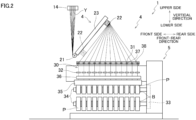
- a spun yarn take-up winder 1 of the present embodiment (i.e., a yarn processing apparatus of the present invention) includes a drawing unit 3, a take-up unit 4, and a winding unit 5.
- the take-up unit 4 and the winding unit 5 are provided below the drawing unit 3.
- the following description uses a vertical direction, a front-rear direction, and a left-right direction which are defined as shown in FIG. 1 and FIG. 2 .
- the vertical direction is a direction in which the gravity acts.
- the front-rear direction, the left-right direction, and the vertical direction are orthogonal to one another.
- the following description also uses (i) the upper side and the lower side in the vertical direction, (ii) the right side and the left side in the left-right direction, and (iii) the front side and the rear side in the front-rear direction which are defined as shown in FIG. 1 and FIG. 2 .
- the drawing unit 3 is configured to draw yarns Y that are produced by continuously spinning a molten fibrous material such as polyester out from a spinning apparatus 2 provided above the drawing unit 3.
- the drawing unit 3 includes an oil supply guide 10 (i.e., an oil apply unit of the present invention) and five godet rollers 11a to 11e.
- the oil supply guide 10 is configured to apply oil to each of the yarns Y spun out from the spinning apparatus 2.
- Each of the five godet rollers 11a to 11e has an axis parallel to the front-rear direction, and is rotationally driven by an unillustrated motor.
- Each of the five godet rollers 11a to 11e is made of a conductive material such as metal, and includes a heater therein.
- the five godet rollers 11a to 11e are housed in a thermal insulation box 12 which is rectangular parallelepiped in shape.
- a yarn inlet 12a through which the yarns Y are introduced into the thermal insulation box 12 and a yarn outlet 12b through which the yarns Y go outside from the thermal insulation box 12 are formed.
- the yarns Y to which oil is applied by the oil supply guide 10 are guided by a guide roller 13 and introduced into the thermal insulation box 12 through the yarn inlet 12a.
- the guide roller 13 has an axis parallel to the front-rear direction, and is made of a conductive material such as metal.
- the yarns Y introduced into the thermal insulation box 12 are wound onto the five godet rollers 11a to 11e in order.
- the upstream three godet rollers 11a to 11c are heating rollers for preheating the yarns Y before drawing the yarns Y.
- the surface temperatures of the godet rollers 11a to 11c are arranged to be equal to or higher than a glass transition temperature of the yarns Y.
- the downstream two godet rollers 11d and 11e are heating rollers for thermally setting the drawn yarns Y.
- the surface temperatures of the godet rollers 11d and 11e are arranged to be higher than those of the upstream three godet rollers 11a to 11c.
- the surface speeds of the downstream two godet rollers 11d and 11e are higher than those of the upstream three godet rollers 11a to 11c.
- the yarns Y introduced into the thermal insulation box 12 through the yarn inlet 12a are preheated to a drawable temperature, i.e., the glass transition temperature or more while being conveyed by the upstream three godet rollers 11a to 11c. Subsequently, the preheated yarns Y are drawn on account of the difference in surface speed between the godet rollers 11c and 11d. After that, the yarns Y are further heated while being conveyed by the downstream two godet rollers 11d and 11e. As a result, the drawn state is thermally set.
- the yarns Y which have been drawn in this way go outside from the thermal insulation box 12 through the yarn outlet 12b, and are then sent to the take-up unit 4 by a guide roller 14.
- the guide roller 14 has an axis parallel to the front-rear direction, and is made of a conductive material such as metal.
- the take-up unit 4 includes godet rollers 21 and 22.
- the godet roller 21 has an axis parallel to the left-right direction, and is provided below the guide roller 14.
- the yarns Y sent to the take-up unit 4 by the guide roller 14 are taken up by the godet roller 21.
- the godet roller 21 is driven by an unillustrated motor.
- the godet roller 22 has an axis parallel to the left-right direction, and is provided on the rear side of the godet roller 21 in the front-rear direction.
- the godet roller 22 is driven by an unillustrated motor.
- the take-up unit 4 further includes a guide rail 23 extending upward in the vertical direction toward the rear side in the front-rear direction.
- the godet roller 22 is connected to an unillustrated motor by an unillustrated pulley, belt, etc. As this motor is driven, the godet roller 22 moves along the guide rail 23.
- the godet roller 22 is movable between (i) a rear position which is indicated by full lines in FIG. 2 and where winding of the yarns Y is performed and (ii) a front position which is indicated by one-dot chain lines in FIG. 2 , which is closer to the godet roller 21 than the rear position, and where yarn threading is performed.
- the winding unit 5 includes traverse devices 30, a turret 33, two bobbin holders 34, a contact roller 35, and a winding detection unit 36.
- the traverse devices 30 are provided for the respective yarns Y, and aligned in the front-rear direction.
- Each traverse device 30 includes a fulcrum guide 31 (i.e., a stationary guide of the present invention) and a traverse guide 32 (i.e., a moving guide of the present invention).
- Each fulcrum guide 31 is made of a conductive material such as metal.
- the fulcrum guides 31 of the traverse devices 30 are attached to sliders 37.
- the sliders 37 are supported to be movable in the front-rear direction along a guide rail 38 extending in the front-rear direction.
- the sliders 37 are connected to an unillustrated cylinder. As this cylinder is driven, the sliders 37 move in the front-rear direction along the guide rail 38.
- the fulcrum guides 31 are movable between (i) positions where the fulcrum guides 31 are separated from one another in the front-rear direction and where the winding of the yarns Y is performed and (ii) positions where the fulcrum guides 31 are gathered to the front side in the front-rear direction and where the yarn threading is performed.
- Each traverse guide 32 is made of a conductive material such as metal, and provided downstream of a fulcrum guide 31 in a running direction of the yarns Y.
- the traverse guide 32 is driven by an unillustrated motor, and configured to reciprocate in the front-rear direction. With this arrangement, a yarn Y threaded to the traverse guide 32 is traversed about the fulcrum guide 31 provided upstream of the traverse guide 32 in the running direction of the yarns Y.
- the turret 33 is a disc-shaped member having an axis parallel to the front-rear direction.
- the turret 33 is rotationally driven by an unillustrated motor.
- the two bobbin holders 34 have axes parallel to the front-rear direction and are rotatably supported at an upper end portion and a lower end portion of the turret 33, respectively.
- bobbins B provided for the respective yarns Y are attached to be aligned in the front-rear direction.
- the two bobbin holders 34 are respectively driven by unillustrated motors.
- the yarns Y traversed by the traverse guides 32 are wound onto the bobbins B so as to form packages P.
- the turret 33 is rotated so that the positions of the two bobbin holders 34 are changed upside down.
- the bobbin holder 34 having been at the lower position is moved to the upper position. This allows the yarns Y to be wound onto bobbins B attached to this bobbin holder 34, so as to form packages P. Meanwhile, the bobbin holder 34 having been at the upper position is accordingly moved to the lower position so that collection of packages P becomes possible.
- the contact roller 35 has an axis parallel to the front-rear direction, and is made of a conductive material such as metal.
- the contact roller 35 is provided immediately above upper one of the bobbin holders 34.
- the contact roller 35 is configured to make contact with the yarns Y on surfaces of packages P formed by winding the yarns Y onto bobbins B attached to upper one of the bobbin holders 34, so as to apply a contact pressure to the surfaces of the unfinished packages P.
- the winding detection unit 36 is provided immediately above the contact roller 35.
- the winding detection unit 36 is configured to detect the yarns Y being wound onto the contact roller 35.
- the spun yarn take-up winder 1 of the present embodiment further includes a charging unit 6 shown in FIG. 3 .
- the charging unit 6 includes a full-wave rectifier circuit 41 (i.e., a voltage application circuit of the present invention), a capacitor 42 (a power storage device of the present invention), a voltage detection circuit 43 (a full charge detection unit of the present invention), switches 44a to 44d, and a controller 45.
- the switch 44d is equivalent to a first switching unit of the present invention
- a combination of the switches 44a to 44c and the controller 45 is equivalent to a second switching unit of the present invention.
- the contact portion 61 is conductive and configured to make contact with the running yarns Y.
- the contact portion 61 is formed of one of the godet rollers 11a to 11e, one of the guide rollers 13 and 14, one of the godet rollers 21 and 22, the contact roller 35, one of the fulcrum guides 31, or one of the traverse guides 32.
- the friction between the running yarns Y and the contact portion 61 generates static electricity at the contact portion 61.
- the full-wave rectifier circuit 41 includes four diodes 51a to 51d.
- a cathode of the diode 51a is connected to a cathode of the diode 51b.
- An anode of the diode 51b is connected to a cathode of the diode 51c.
- An anode of the diode 51c is connected to an anode of the diode 51d.
- a cathode of the diode 51d is connected to an anode of the diode 51a.
- a connecting portion 52a between the cathode of the diode 51d and the anode of the diode 51a is connected to the contact portion 61.
- the switch 44a is connected between the connecting portion 52a and the contact portion 61.
- the switch 44a is configured to be switched between the ON state and the OFF state under the control of the controller 45.
- the switch 44a is turned on, the connecting portion 52a is connected to the contact portion 61.
- the switch 44a is turned off, the connection between the connecting portion 52a and the contact portion 61 is blocked.
- a connecting portion 52b between the anode of the diode 51b and the cathode of the diode 51c is connected to a grounded portion G so as to be grounded.
- the contact portion 61 is connected to the grounded portion G via the switch 44b.
- the switch 44b is configured to be switched between the ON state and the OFF state under the control of the controller 45. When the switch 44b is turned on, the contact portion 61 is connected to the grounded portion G so as to be grounded. When the switch 44b is turned off, the connection between the contact portion 61 and the grounded portion G is blocked.
- the capacitor 42 is connected between (i) a connecting portion 52c between the cathode of the diode 51a and the cathode of the diode 51b and (ii) a connecting portion 52d between the anode of the diode 51c and the anode of the diode 51d.
- the capacitor 42 includes a first terminal 42a connected to the connecting portion 52c and a second terminal 42b connected to the connecting portion 52d.
- the switch 44c is connected between the connecting portion 52c and the first terminal 42a of the capacitor 42.
- the switch 44c is configured to be switched between the ON state and the OFF state under the control of the controller 45. When the switch 44c is turned on, the connecting portion 52c is connected to the first terminal 42a of the capacitor 42. When the switch 44c is turned off, the connection between the connecting portion 52c and the first terminal 42a of the capacitor 42 is blocked.
- the first terminal 42a and second terminal 42b of the capacitor 42 are connected to an electric device 62.
- the electric device 62 is a tension sensor of yarns, a sensor configured to detect an amount of static electricity generated at the contact portion 61, a temperature sensor of a bearing, or the like.
- the switch 44d is connected between the first terminal 42a and the electric device 62.
- the switch 44d is configured to be switched between the ON state and the OFF state under the control of the controller 45. When the switch 44d is turned on, the first terminal 42a of the capacitor 42 is connected to the electric device 62. When the switch 44d is turned off, the connection between the first terminal 42a of the capacitor 42 and the electric device 62 is blocked.
- the voltage detection circuit 43 is connected between the first terminal 42a and second terminal 42b of the capacitor 42.
- the voltage detection circuit 43 is configured to output, to the controller 45, a signal indicating the voltage between the first terminal 42a and the second terminal 42b.
- the controller 45 receives this signal as a signal indicating the full charge of the capacitor 42.
- the controller 45 receives this signal as a signal indicating that the capacitor 42 is not fully charged.
- this fulcrum guide 31 is connected to the charging unit 6 through, e.g., a wire.
- this traverse guide 32 is connected to the charging unit 6 by, e.g., a connecting member supporting this traverse guide 32 to the charging unit 6 through a wire.
- this roller is connected to the charging unit 6 by, e.g., being made contact with an anti-static brush connected to the charging unit 6.
- this roller may be arranged to be separated from and to oppose an electrode connected to the charging unit 6 so that electric discharge from the roller to the electrode can occur.
- the roller is electrically connected to the charging unit 6 also in this case.
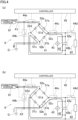
- the controller 45 turns on the switches 44a and 44c and turns off the switches 44b and 44d as shown in FIGs. 4(a) and 4(b) . Because of this, a charge of static electricity generated at the contact portion 61 is used to charge the capacitor 42, and thus the static electricity generated at the contact portion 61 is removed.
- the first terminal 42a is higher in electric potential than the second terminal 42b in the capacitor 42. As a result that, the capacitor 42 is charged.
- the controller 45 turns on the switch 44b and turns off the switches 44a, 44c, and 44d as shown in FIG. 5(a) . Because of this, the contact portion 61 is connected to the grounded portion G so as to be grounded, and thus static electricity generated at the contact portion 61 is removed.
- the controller 45 turns on the switches 44b and 44d and turns off the switches 44a and 44c as shown in FIG. 5(b) . Because of this, the capacitor 42 is connected to the electric device 62, and the electric device 62 is driven by electric charges stored in the capacitor 42. As such, the present embodiment makes it possible to drive the electric device 62 by using electric charges stored in the capacitor 42. It is therefore unnecessary to connect the electric device 62 to a power source of the spun yarn take-up winder 1, and thus the electric device 62 is easily attached and driven according to need. Because the switch 44b is turned on when the electric device 62 is driven by using electric charges stored in the capacitor 42, the contact portion 61 is connected to the grounded portion G so as to be grounded.
- the switch 44b may be turned off.
- the capacitor 42 when the switch 44d is turned off, the capacitor 42 is charged by using a charge of static electricity generated at the contact portion 61 because of the friction between the running yarns Y and the contact portion 61.
- the polarity of static electricity generated at the contact portion 61 because of the friction between the oiled yarns Y and the contact portion 61 changes depending on, e.g., the type of the yarns Y, the type and brand of oil applied to the yarns Y, and changes in the surroundings such as humidity.
- the full-wave rectifier circuit 41 is connected between the contact portion 61 and the capacitor 42.
- the first terminal 42a is higher in electric potential than the second terminal 42b at the capacitor 42 irrespective of the polarity of the static electricity generated at the contact portion 61. Because of this, the capacitor 42 is charged irrespective of the polarity of static electricity generated at the contact portion 61. It is therefore possible to efficiently charge the capacitor 42. Furthermore, a charge of static electricity generated at the contact portion 61 is used to charge the capacitor 42. It is therefore possible to remove the static electricity generated at the contact portion 61.
- the switch 44d is turned on so as to connect the first terminal 42a of the capacitor 42 to the electric device 62, with the capacitor 42 charged. As a result, the electric device 62 is driven by electric charges stored in the capacitor 42.
- the running speed of the yarns Y is high in the spun yarn take-up winder 1 configured to form the packages P by winding the running yarns Y onto the bobbins B.
- the friction between the running yarns Y and the contact portion 61 is therefore high, and thus a large amount of static electricity is generated at the contact portion 61.
- the capacitor 42 is charged by using a charge of static electricity generated at the contact portion 61 of the spun yarn take-up winder 1 in which the running speed of the yarns Y is high. It is therefore possible to efficiently charge the capacitor 42. In this regard, because the capacitor 42 is charged, a large amount of static electricity generated at the contact portion 61 is removed.
- the godet rollers 11a to 11e, the guide rollers 13 and 14, and the godet rollers 21 and 22 are configured to convey the yarns Y, and each of the yarns Y causes friction with each of these rollers so as to generate static electricity.
- a total amount of the generated static electricity is large. Therefore, when (i) the contact portion 61 is formed of one of these rollers and (ii) the capacitor 42 is charged by using a charge of static electricity generated at this roller (the contact portion 61), the capacitor 42 is efficiently charged. In this regard, because the capacitor 42 is charged, a large amount of static electricity generated at the roller is removed.
- the godet rollers 11a to 11e, the guide rollers 13 and 14, and the godet rollers 21 and 22 are configured to convey the yarns Y while gripping the yarns Y.
- the tension of the running yarns Y may be adjusted by adjusting the rotation speed of one of these rollers.
- the present embodiment makes it possible to detect the degree to which the yarns Y are gripped by this roller, i.e., the degree to which the yarns Y slip on this roller based on how much the capacitor 42 is charged by a charge of static electricity generated at this roller.
- the contact roller 35 is configured to rotate while being in contact with each yarn Y on the surface of an unfinished package P. With this arrangement, static electricity is generated at the contact roller 35.
- the contact roller 35 is configured to rotate while being in contact with the yarns Y on the surfaces of the packages P, and thus a total amount of generated static electricity is large. Therefore, when (i) the contact portion 61 is formed of the contact roller 35 and (ii) the capacitor 42 is charged by using a charge of static electricity generated at the contact roller 35, the capacitor 42 is efficiently charged. In this regard, because the capacitor 42 is charged, static electricity generated at the contact roller 35 is removed.
- the winding detection unit 36 configured to detect the yarns Y being wound onto the contact roller 35 is provided in the vicinity of the contact roller 35.
- the friction occurring between the fulcrum guides 31 of the traverse devices 30 and the running yarns Y generates static electricity.
- the fulcrum guides 31 function as fulcrums at the time of the traverse of yarns Y, a bending angle of a yarn Y at each fulcrum guide 31 is larger than that at each of other fixed guides. With this arrangement, a large amount of static electricity is generated. Therefore, when (i) the contact portion 61 is formed of one fulcrum guide 31 and (ii) the capacitor 42 is charged by using a charge of static electricity generated at this fulcrum guide 31, a large amount of static electricity generated at this fulcrum guide 31 is removed and the capacitor 42 is efficiently charged.
- the fulcrum guides 31 are provided for the respective yarns Y. It is therefore possible to detect yarn breakage based on whether the capacitor 42 is charged by using static electricity generated at the fulcrum guides 31 (i.e., whether static electricity is generated at the fulcrum guides 31).
- the fulcrum guides 31 are configured not to move in accordance with running of the yarns Y. With this arrangement, the fulcrum guides 31 have high friction with the running yarns Y so as to generate a large amount of static electricity as compared to the godet rollers 11a to 11e, the guide rollers 13 and 14, the godet rollers 21 and 22, and the contact roller 35 all of which are configured to rotate in accordance with the running of the yarns Y. With this arrangement, when (i) the contact portion 61 is formed of one fulcrum guide 31 and (ii) the capacitor 42 is charged by using a charge of static electricity generated at this fulcrum guide 31, the capacitor 42 is efficiently charged. In this regard, because the capacitor 42 is charged, a large amount of static electricity generated at the fulcrum guides 31 is removed.
- the oil supply guide 10 is provided upstream of the contact portion 61 in the running direction of the yarns Y.
- the polarity of static electricity generated at the contact portion 61 because of the friction between the oiled yarns Y and the contact portion 61 may change depending on the type and brand of oil, which is applied to the yarns Y in the oil supply guide 10, and the changes in the surroundings such as humidity.
- the full-wave rectifier circuit 41 is connected between the contact portion 61 and the capacitor 42.
- the first terminal 42a is higher in electric potential than the second terminal 42b irrespective of the polarity of the static electricity generated at the contact portion 61. Therefore, even when the polarity of static electricity generated at the contact portion 61 changes because of uneven application of oil to the yarns Y, the capacitor 42 continues to be charged.
- the contact portion 61 when the capacitor 42 is not fully charged, the contact portion 61 is connected to the full-wave rectifier circuit 41 so that the capacitor 42 is charged by using a charge of static electricity generated at the contact portion 61. Meanwhile, when the capacitor 42 is fully charged, the contact portion 61 is grounded so as to dissipate static electricity generated at the contact portion 61 to the outside.
- the single capacitor 42 is charged by using a charge of static electricity generated at the single contact portion 61 in the embodiment above.
- the disclosure is not limited to this.
- two or more contact portions 61 each of which is formed of one of the godet rollers 11a to 11e, one of the guide rollers 13 and 14, one of the godet rollers 21 and 22, the contact roller 35, one of the fulcrum guides 31, and one of the traverse guides 32 may be provided and (ii) the charging unit 6 of the embodiment above may be provided for each contact portion 61.
- each contact portion 61 When plural contact portions 61 are provided, the charging unit 6 may not be provided for each contact portion 61.
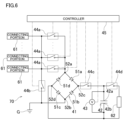
- a charging unit 70 of a modification 1 plural contact portions 61 are connected to the connecting portion 52a in a parallel manner as shown in FIG. 6 .
- Each contact portion 61 is formed of one of the godet rollers 11a to 11e, one of the guide rollers 13 and 14, one of the godet rollers 21 and 22, the contact roller 35, one of the fulcrum guides 31, or one of the traverse guides 32.
- a switch 44a is connected between the connecting portion 52a and each contact portion 61.
- the controller 45 when the voltage indicated by a signal output from the voltage detection circuit 43 is less than a predetermined voltage, the controller 45 turns on one of the switches 44a and the switch 44c and turns off the remaining switches 44a, the switch 44b, and the switch 44d.
- the controller 45 is programmed to select one of the switches 44a to be turned on at predetermined intervals.
- the capacitor 42 is charged by using a charge of static electricity generated at the contact portions 61. This removes the static electricity generated at the contact portions 61.
- a charging unit 80 of a modification 2 plural capacitors 42 are connected between the connecting portion 52c and the connecting portion 52d in a parallel manner as shown in FIG. 7 .
- a switch 44c is connected between the connecting portion 52c and a first terminal 42a of each capacitor 42.
- a voltage detection circuit 43 is connected between the first terminal 42a and second terminal 42b of each capacitor 42.
- the controller 45 turns on the switch 44a and one of one or more switches 44c corresponding to the one or more voltage detection circuits 43 and turns off the switch 44b, the switch 44d, and the remaining switches 44c.
- the switch 44c is turned off.
- the voltage indicated by a signal output from another voltage detection circuit 43 is less than a predetermined voltage (i.e., when another capacitor 42 is not fully charged)
- a switch 44c corresponding to the another voltage detection circuit 43 is turned on.
- the switch 44a, the switch 44d, and all switches 44c are turned off and the switch 44b is turned on.
- the electric device 62 is driven with use of electric charges stored in a capacitor 42 corresponding to one of the switches 44c by turning on the one of the switches 44c, the switch 44b, and the switch 44d and turning off the switch 44a and the remaining switches 44c.
- the capacitors 42 are charged by using a charge of static electricity generated at the contact portion 61.
- the electric device 62 is driven by electric charges stored in the capacitors 42.
- plural contact portions 61 and plural switches 44a may be provided in the same manner as in the modification 1 and (ii) plural capacitors 42, plural switches 44c, and plural voltage detection circuits 43 may be provided in the same manner as in the modification 2.
- the capacitors 42 are charged by using electric charges generated at the contact portions 61, and the electric device 62 is driven by the electric charges stored in the capacitors 42.
- the full-wave rectifier circuit 41 is connected between the contact portion 61 and the capacitor 42.
- the voltage is applied between the first terminal 42a and the second terminal 42b by a charge of static electricity generated at the contact portion 61, so that the first terminal 42a is higher in electric potential than the second terminal 42b irrespective of the polarity of the static electricity.
- the disclosure is not limited to this.
- a voltage application circuit different from the full-wave rectifier circuit 41 may be connected between the contact portion 61 and the capacitor 42 and, with this arrangement, the voltage may be applied between the first terminal 42a and the second terminal 42b by a charge of static electricity generated at the contact portion 61 so that the first terminal 42 is higher in electric potential than the second terminal 42b irrespective of the polarity of static electricity.
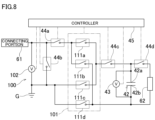
- a charging unit 100 of a modification 3 includes a voltage application circuit 101 instead of the full-wave rectifier circuit 41 used in the charging unit 6 of the embodiment above.
- the charging unit 100 further includes a voltage detection circuit 102.
- the voltage application circuit 101 includes four switches 111a to 111d.
- the switch 111a is connected between a terminal of the switch 44a and a terminal of the switch 44c.
- the terminal of the switch 44a is opposite to the contact portion 61, and the terminal of the switch 44c is opposite to the capacitor 42.
- the switch 111b is connected between the terminal of the switch 44a and the second terminal 42b of the capacitor 42. In this regard, the terminal of the switch 44a is opposite to the contact portion 61.
- the switch 111c is connected between a terminal of the switch 44c and the grounded portion G.
- the terminal of the switch 44c is opposite to the capacitor 42.
- the switch 111d is connected between the second terminal 42b of the capacitor 42 and the grounded portion G.
- the switches 111a to 111d are configured to be switched between the ON state and the OFF state by the controller 45.
- the switch 44d is equivalent to the first switching unit of the present invention
- a combination of the switches 44a to 44c, the switches 111a to 111d, and the controller 45 is equivalent to the second switching unit of the present invention.
- the voltage detection circuit 102 is connected between the contact portion 61 and the grounded portion G and configured to output, to the controller 45, a signal indicating the electric potential of the contact portion 61 with reference to the electric potential of the grounded portion G (i.e., ground potential).
- a signal output from the voltage detection circuit 102 indicates a positive electric potential that is higher than the ground potential.
- a signal output from the voltage detection circuit 102 indicates a negative electric potential that is lower than the ground potential.
- the controller 45 when the voltage indicated by a signal output from the voltage detection circuit 43 is less than a predetermined voltage (i.e., when the capacitor 42 is not fully charged), the controller 45 turns on the switches 44a and 44c and turns off the switches 44b and 44d as shown in FIGs. 9(a) and 9(b) .
- the controller 45 When a signal output from the voltage detection circuit 102 indicates a positive electric potential, i.e., when a positive charge of static electricity is generated at the contact portion 61, the controller 45 turns on the switches 111a and 111d and turns off the switches 111b and 111c as shown in FIG. 9(a) . By doing this, a current flows along a path (i.e., path indicated by an arrow A3 in FIG. 9(a) ) passing through the contact portion 61, the switch 44a, the switch 111a, the switch 44c, the capacitor 42, the switch 111d, and the grounded portion G in this order. Because of this, static electricity generated at the contact portion 61 is removed, and the capacitor 42 is charged by using a charge of the static electricity generated at the contact portion 61.
- a path i.e., path indicated by an arrow A3 in FIG. 9(a)
- the controller 45 turns on the switches 111b and 111c and turns off the switches 111a and 111d as shown in FIG. 9(b) .
- a current flows along a path (i.e., path indicated by an arrow A4 in FIG. 9(b) ) passing through the grounded portion G, the switch 111c, the switch 44c, the capacitor 42, the switch 111b, the switch 44a, the contact portion 61 in this order. Because of this, static electricity generated at the contact portion 61 is removed, and the capacitor 42 is charged by using a charge of the static electricity generated at the contact portion 61.
- the first terminal 42a is higher in electric potential than the second terminal 42b irrespective of the polarity of static electricity generated at the contact portion 61.
- the switches 44a to 44d are configured to be switched between the ON state and the OFF state under the control of the controller 45.
- the disclosure is not limited to this.
- the charging unit 6 may include a circuit configured to switch at least one of the switches 44a to 44d between the ON state and the OFF state.
- the charging unit 6 may include an IC for charge control so that the charging unit 6 can switch the state of each of the switches 44a to 44d between the state shown in FIG. 4(a) , the state shown in FIG. 4(b) , and the state shown in FIG. 5(a) by using this IC, depending on whether the capacitor 42 is fully charged.
- the contact portion 61 when the voltage indicated by a signal output from the voltage detection circuit 43 is not less than a predetermined voltage (i.e., when the capacitor 42 is fully charged), the contact portion 61 is connected to the grounded portion G so as to be grounded.
- a predetermined voltage i.e., when the capacitor 42 is fully charged
- the disclosure is not limited to this.
- the switches 44a and 44c may not be turned off and (ii) the contact portion 61 may not be grounded.
- the spun yarn take-up winder 1 includes the winding detection unit 36 configured to detect the yarns Y being wound onto the contact roller 35.
- the spun yarn take-up winder 1 may not include the winding detection unit 36.
- the contact portion 61 is formed of one of the godet rollers 11a to 11e, one of the guide rollers 13 and 14, one of the godet rollers 21 and 22, the contact roller 35, one of the fulcrum guides 31, or one of the traverse guides 32.
- the spun yarn take-up winder 1 may include, as the contact portion 61, another member which is conductive and which is configured to make contact with the running yarns Y.
- the contact portion 61 may be formed of one of stationary guides different from the fulcrum guides 31.
- the spun yarn take-up winder 1 includes the oil supply guide 10, and the contact portion 61 is a member provided downstream of the oil supply guide 10 in the running direction of the yarns Y.
- the disclosure is not limited to this.
- the spun yarn take-up winder 1 may include another member which is conductive, which is configured to make contact with the running yarns Y, and which is provided upstream of the oil supply guide 10 in the running direction of the yarns Y.
- the spun yarn take-up winder 1 may not include the oil supply guide 10.
- the capacitor 42 is charged by using a charge of static electricity generated at the contact portion 61.
- the disclosure is not limited to this.
- a battery may be provided instead of the capacitor 42 and the battery may be charged by using a charge of static electricity generated at the contact portion 61.
- the battery is equivalent to the power storage device of the present invention.
- the present invention is used in the spun yarn take-up winder configured to form the packages by winding the running yarns Y.
- the disclosure is not limited to this.
- the present invention can be used in a yarn processing apparatus different from the spun yarn take-up winder.
- the electric device forming the yarn processing apparatus is driven by electric charges stored in the capacitor, etc. included in the yarn processing apparatus.
- the disclosure is not limited to this.
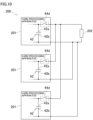
- a yarn processing system 200 of a modification 4 includes yarn processing apparatuses 201 and a single electric device 202.
- Each yarn processing apparatus 201 is equivalent to, e.g., the spun yarn take-up winder 1 of the embodiment above from which the electric device 62 is removed.
- the yarn processing apparatuses 201 are provided in the same building.
- the yarn processing apparatuses 201 may be the same type or different types of apparatuses.
- FIG. 10 shows the yarn processing system 200 including three yarn processing apparatuses 201. However, the number of the yarn processing apparatuses 201 forming the yarn processing system 200 may be two or may be four or more.
- FIG. 10 does not illustrate the structure of each yarn processing apparatus 201, except the capacitor 42 and the switch 44d.
- the electric device 202 is provided in a building different from a building where each yarn processing apparatus 201 is provided. That is, the electric device 202 is different from a device forming each yarn processing apparatus 201.
- a first terminal 42a of a capacitor 42 of each yarn processing apparatus 201 is connected to one terminal of the electric device 202 through a switch 44d, and a second terminal 42b of the capacitor 42 of each yarn processing apparatus 201 is connected to the other terminal of the electric device 202.
- the capacitor 42 of each yarn processing apparatus 201 is charged.
- the electric device 202 is driven by electric charges stored in a capacitor 42 of the one yarn processing apparatus 201. That is, in the modification 4, the electric device 202 is driven by electric charges stored in capacitors 42 of the yarn processing apparatuses 201.
- the switches 44d are equivalent to a switching unit of the present invention.
- each yarn processing apparatus 201 while the switch 44d of each yarn processing apparatus 201 is turned off, the capacitor 42 of each yarn processing apparatus 201 is charged irrespective of the polarity of static electricity by using a charge of the static electricity in the same manner as described above.
- the static electricity is generated at the contact portion because of the friction between the running yarns Y and the contact portion.
- a charge of static electricity generated at the contact portion is used to charge each capacitor 42. It is therefore possible to remove the static electricity generated at the contact portion.
- the single electric device 202 is driven by using electric charges stored in the capacitors 42 of the yarn processing apparatuses 201. Therefore, even when an amount of electric charges stored in a capacitor 42 of each yarn processing apparatus 201 is not large, the electric device 202 is driven as long as a total amount of electric charges stored in the capacitors 42 of the yarn processing apparatuses 201 is relatively large.
- the yarn processing system 200 includes the yarn processing apparatuses 201 and the single electric device 202, and the single electric device 202 is driven by electric charges stored in the capacitors 42 of the yarn processing apparatuses 201.
- the disclosure is not limited to this.
- the yarn processing system may be formed of a single yarn processing apparatus and a single electric device provided outside the yarn processing apparatus and (ii) the single electric device may be driven by electric charges stored in the capacitor 42 of the single yarn processing apparatus.
- the switch 44d is connected between the first terminal 42a of the capacitor 42 and the electric device 62, 202.
- the switch 44d may be connected between the second terminal 42d of the capacitor 42 and the electric device 62, 202.
- the electric device may be connected not only to the power storage device of the yarn processing apparatus but also to another power source such as a commercial power source.
- the electric device may be driven not only by electric charges stored in the power storage device of the yarn processing apparatus but also by electric charges supplied from the another power source.
- the electric device may be driven only by the electric charges stored in the power storage device.
- the electric device is driven by electric charges stored in the power storage device of the yarn processing apparatus and by electric charges supplied from the another power source described above, power consumption of the another power source described above is suppressed.
- the electric device is driven even in a case where electric charges are not sufficiently supplied to the electric device from the power storage device of the yarn processing apparatus.
Landscapes
- Engineering & Computer Science (AREA)
- Power Engineering (AREA)
- Mechanical Engineering (AREA)
- Textile Engineering (AREA)
- Quality & Reliability (AREA)
- Spinning Methods And Devices For Manufacturing Artificial Fibers (AREA)
- Filamentary Materials, Packages, And Safety Devices Therefor (AREA)
- Guides For Winding Or Rewinding, Or Guides For Filamentary Materials (AREA)
Description
- The present invention relates to a yarn processing apparatus configured to process a yarn while conveying the yarn, and a yarn processing system including the yarn processing apparatus.
- In a false-twist texturing machine of Patent Literature 1 (
Japanese Unexamined Patent Publication No. 2018-3167 Patent Literature 1, when static electricity is generated at the third feed roller as a yarn is conveyed, the static electricity is dissipated to the outside via the static electricity removing member and the grounded supporter. - Further relevant information can be found in documents
CN 111 498 569 A ,CN 209 982 800 U ,CN 204 168 573 U andEP 3 263 500 A . - In the above-described false-twist texturing machine of
Patent Literature 1, the static electricity generated as the yarn is conveyed is just dissipated to the outside. That is, the static electricity is not effectively used. - An object of the present invention is to provide a yarn processing apparatus and a yarn processing system which make it possible to effectively use static electricity generated by conveying a yarn.
- According to a first aspect of the invention, a yarn processing apparatus includes: at least one contact portion which is conductive and which is configured to make contact with at least one running yarn; at least one power storage device which includes a first terminal and a second terminal and which is able to be charged by a voltage applied between the first terminal and the second terminal; a voltage application circuit which is connected between the at least one contact portion and the at least one power storage device and which is configured to apply, by using a charge of static electricity generated because of friction between the at least one running yarn and the at least one contact portion, the voltage between the first terminal and the second terminal so that the first terminal is higher in electric potential than the second terminal, irrespective of the polarity of the static electricity; an electric device connected to the at least one power storage device; and a first switching unit which is connected between (i) any one of the first terminal and second terminal of the at least one power storage device and (ii) the electric device, and which is configured to switch connection of the at least one power storage device with the electric device and disconnection of the at least one power storage device from the electric device.
- According to this aspect, when the connection between the at least one power storage device and the electric device is blocked by the first switching unit, the at least one power storage device is charged by using the charge of the static electricity generated at the at least one contact portion because of the friction between the at least one running yarn and the at least one contact portion. In this regard, the polarity of the static electricity generated at the at least one contact portion changes depending on, e.g., the type of the at least one yarn, the type of oil applied to the at least one yarn, and the degree to which the oil is applied to the at least one yarn. According to this aspect, the voltage application circuit is connected between the at least one contact portion and the at least one power storage device. With this arrangement, the voltage is applied between the first terminal and the second terminal so that the first terminal is higher in electric potential than the second terminal at the at least one power storage device irrespective of the polarity of the static electricity generated at the at least one contact portion. Because of this, the at least one power storage device is charged irrespective of the polarity of the static electricity generated at the at least one contact portion. It is therefore possible to efficiently charge the at least one power storage device. The charge of the static electricity generated at the at least one contact portion is used to charge the at least one power storage device. It is therefore possible to remove the static electricity generated at the at least one contact portion.
- When the electric device needs to be driven, the first switching unit connects the at least one power storage device to the electric device while the at least one power storage device is charged. Because of this, the electric device is driven by electric charges stored in the at least one power storage device.
- According to a second aspect of the invention, the yarn processing apparatus of the first aspect is arranged such that the voltage application circuit is a full-wave rectifier circuit.
- The full-wave rectifier circuit is able to apply the voltage between the first terminal and the second terminal, so that the first terminal is higher in electric potential than the second terminal irrespective of the polarity of the static electricity generated at the at least one contact portion. Because of this, the at least one power storage device is charged irrespective of the polarity of the static electricity generated at the at least one contact portion. It is therefore possible to efficiently charge the at least one power storage device.
- According to a third aspect of the invention, the yarn processing apparatus of the first or second aspect further includes, as the at least one contact portion, a stationary guide to which the at least one yarn is threaded and which is configured not to move in accordance with running of the at least one yarn.
- The stationary guide is configured not to move in accordance with the running of the at least one yarn. With this arrangement, the stationary guide has high friction with the at least one running yarn so as to generate a large amount of the static electricity as compared to, e.g., a roller configured to move in accordance with the running of the at least one yarn. According to this aspect, the at least one power storage device is charged by using the charge of the static electricity generated at the stationary guide functioning as the at least one contact portion. It is therefore possible to efficiently charge the at least one power storage device. In this regard, because the at least one power storage device is charged, a large amount of the static electricity generated at the stationary guide is removed.
- A surface of the stationary guide is gradually worn because of the friction with the at least one yarn, and thus an amount of electric charges of the static electricity generated at the stationary guide varies depending on the degree to which the surface of the stationary guide is worn. According to this aspect, the present invention makes it possible to detect the degree to which the stationary guide is worn, in accordance the variation of how much the at least one power storage device is charged. In this regard, the variation of how much the at least one power storage device is charged is caused by the variation of an amount of charges of the static electricity generated at the stationary guide.
- According to a fourth aspect of the invention, the yarn processing apparatus of any one of the first to third aspects further includes a supplying roller configured to convey yarns as the at least one contact portion.
- The supplying roller is configured to convey the yarns, and the static electricity is generated because of the friction between the supplying roller and each of the yarns. With this arrangement, a total amount of the static electricity generated at the supplying roller is large. According to this aspect, the at least one power storage device is charged by using the charge of the static electricity generated at the supplying roller functioning as the at least one contact portion. It is therefore possible to efficiently charge the at least one power storage device. In this regard, because the at least one power storage device is charged, a large amount of the static electricity generated at the supplying roller is removed.
- The supplying roller is configured to convey the yarns while gripping the yarns. In the yarn processing apparatus, the tension of the running yarns may be adjusted by changing the rotation speed of the supplying roller. According to this aspect, the degree to which the yarns are gripped by the supplying roller, i.e., the degree to which the yarns slip on the supplying roller is detected based on how much the at least one power storage device is charged by the charge of the static electricity generated at the supplying roller.
- According to a fifth aspect of the invention, the yarn processing apparatus of any one of the first to fourth aspects further includes a winding unit configured to form a package by winding the at least one running yarn onto a bobbin. Furthermore, the winding unit includes: a contact roller configured to make contact with the at least one yarn on a surface of the unfinished package, as the at least one contact portion; and a winding detection unit configured to detect the at least one yarn being wound onto the contact roller.
- Typically, the running speed of the at least one yarn is high in the yarn processing apparatus (i.e., yarn winding system) configured to form the package by winding the at least one running yarn onto the bobbin. The friction between the at least one running yarn and the at least one contact portion is therefore high, and thus a large amount of the static electricity is generated at the at least one contact portion. According to this aspect, the at least one power storage device is charged by using the charge of the static electricity generated at the at least one contact portion of the yarn winding system in which the running speed of the at least one yarn is high. It is therefore possible to efficiently charge the at least one power storage device. In this regard, because the at least one power storage device is charged, a large amount of the static electricity generated at the at least one contact portion of the yarn winding system is removed.
- The contact roller is configured to rotate while being in contact with the at least one yarn on a surface of the unfinished package. With this arrangement, a large amount of the static electricity is generated at the contact roller. According to this aspect, the at least one power storage device is charged by using the charge of the static electricity generated at the contact roller functioning as the at least one contact portion. This removes the static electricity generated at the contact roller.
- The winding detection unit configured to detect the at least one yarn being wound onto the contact roller is provided in the vicinity of the contact roller. With this arrangement, when the static electricity is generated at the contact roller, electric discharge tends to occur between the contact roller and the winding detection unit. According to this aspect, the at least one power storage device is charged by using the charge of the static electricity generated at the contact roller functioning as the at least one contact portion. This removes the static electricity generated at the contact roller, and thus the electric discharge between the contact roller and the winding detection unit is suppressed.
- According to a sixth aspect of the invention, the yarn processing apparatus of any one of the first to fifth aspects includes a winding unit configured to form a package by winding the at least one running yarn onto a bobbin. In this regard, the winding unit includes a traverse device configured to traverse the at least one yarn in an axial direction of the bobbin at the time of winding the at least one yarn onto the bobbin. Furthermore, the traverse device includes: a moving guide configured to reciprocate in the axial direction of the bobbin while holding the at least one yarn; and a fulcrum guide configured to support the at least one yarn on the upstream side of the moving guide in a running direction of the at least one yarn. In addition to that, the moving guide is the at least one contact portion.
- The friction occurring between the moving guide of the traverse device and the at least one running yarn generates the static electricity. According to this aspect, the at least one power storage device is charged by using the charge of the static electricity generated at the moving guide functioning as the at least one contact portion. It is therefore possible to efficiently charge the at least one power storage device.
- According to a seventh aspect of the invention, the yarn processing apparatus of any one of the first to sixth aspects includes a winding unit configured to form a package by winding the at least one running yarn onto a bobbin. In this regard, the winding unit includes a traverse device configured to traverse the at least one yarn in an axial direction of the bobbin at the time of winding the at least one yarn onto the bobbin, the traverse device includes: a moving guide configured to reciprocate in the axial direction of the bobbin while holding the at least one yarn; and a fulcrum guide configured to support the at least one yarn on the upstream side of the moving guide in a running direction of the at least one yarn, and the fulcrum guide is the at least one contact portion.
- Because the fulcrum guide of the traverse device functions as a fulcrum at the time of the traverse of the at least one yarn, a bending angle of the at least one yarn at the fulcrum guide is larger than that at each of other fixed guides. With this arrangement, a large amount of the static electricity is generated. According to this aspect, the at least one power storage device is charged by using the charge of the static electricity generated at the fulcrum guide functioning as the at least one contact portion. It is therefore possible to efficiently charge the at least one power storage device.
- Assume that plural yarns are wound by plural winding units. In this case, the traverse device is provided for each of the yarns. It is therefore possible to detect yarn breakage based on whether the at least one power storage device is charged by using the static electricity generated at the fulcrum guide (i.e., whether the static electricity is generated at the fulcrum guide).
- According to an eighth aspect of the invention, the yarn processing apparatus of any one of the first to seventh aspects further includes an oil apply unit which is provided upstream of the at least one contact portion in the running direction of the at least one yarn and which is configured to apply oil to the at least one yarn.
- The polarity of the static electricity generated at the at least one contact portion because of the friction between the at least one oiled yarn and the at least one contact portion may change depending on the type and brand of the oil, which is applied to the at least one yarn, and the changes in the surroundings such as humidity. According to this aspect, the voltage application circuit is connected between the at least one contact portion and the at least one power storage device. With this arrangement, the voltage is applied between the first terminal and the second terminal so that the first terminal is higher in electric potential than the second terminal at the at least one power storage device irrespective of the polarity of the static electricity generated at the at least one contact portion. Therefore, even when the polarity of the static electricity generated at the at least one contact portion changes because of uneven application of the oil to the at least one yarn, the at least one power storage device continues to be charged.
- According to a ninth aspect of the invention, the yarn processing apparatus of any one of the first to eighth aspects further includes: a second switching unit configured to switch connection of the at least one contact portion with the voltage application circuit and grounding of the at least one contact portion; and a full charge detection unit configured to detect whether the at least one power storage device is fully charged. In this regard, when the full charge detection unit detects that the at least one power storage device is not fully charged, the second switching unit connects the at least one contact portion to the voltage application circuit. Meanwhile, when the full charge detection unit detects that the at least one power storage device is fully charged, the second switching unit grounds the at least one contact portion.
- When the at least one power storage device is not fully charged, the at least one contact portion is connected to the voltage application circuit so that the at least one power storage device is charged by using the static electricity generated at the at least one contact portion. When the at least one power storage device is fully charged, the at least one contact portion is grounded so as to dissipate the static electricity generated at the at least one contact portion to the outside.
- According to a tenth aspect of the invention, a yarn processing system includes at least one yarn processing apparatus and an electric device provided outside the at least one yarn processing apparatus, the at least one yarn processing apparatus including: at least one contact portion which is conductive and which is configured to make contact with a running yarn; at least one power storage device which includes a first terminal and a second terminal and which is able to be charged by the voltage applied between the first terminal and the second terminal; a voltage application circuit which is connected between the at least one contact portion and the at least one power storage device and which is configured to apply, by using a charge of static electricity generated because of friction between the running yarn and the at least one contact portion, the voltage between the first terminal and the second terminal so that the first terminal is higher in electric potential than the second terminal, irrespective of the polarity of the static electricity; and a switching unit which is connected between (i) any one of the first terminal and second terminal of the at least one power storage device and (ii) the electric device, and which is configured to switch connection of the at least one power storage device with the electric device and disconnection of the at least one power storage device from the electric device.
- According to this aspect, when the connection between the at least one power storage device and the electric device is blocked by the switching unit, the at least one power storage device is charged by using the charge of the static electricity generated at the at least one contact portion because of the friction between the running yarn and the at least one contact portion. In this regard, the polarity of the static electricity generated at the at least one contact portion changes depending on, e.g., the type of the yarn, the type of the oil applied to the yarn, and the degree to which the oil is applied to the yarn. According to this aspect, the voltage application circuit is connected between the at least one contact portion and the at least one power storage device. With this arrangement, the voltage is applied between the first terminal and the second terminal so that the first terminal is higher in electric potential than the second terminal at the at least one power storage device irrespective of the polarity of the static electricity generated at the at least one contact portion. Because of this, the at least one power storage device is charged irrespective of the polarity of the static electricity generated at the at least one contact portion. It is therefore possible to efficiently charge the at least one power storage device. The charge of the static electricity generated at the at least one contact portion is used to charge the at least one power storage device. It is therefore possible to remove the static electricity generated at the at least one contact portion.
- According to this aspect, when the electric device needs to be driven, the switching unit connects the at least one power storage device to the electric device provided outside the at least one yarn processing apparatus while the at least one power storage device is charged. Because of this, the electric device is driven by electric charges stored in the at least one power storage device.
- According to an eleventh aspect of the invention, the yarn processing system of the tenth aspect includes yarn processing apparatuses; and the single electric device connected to the yarn processing apparatuses.
- According to this aspect, the single electric device is driven by using electric charges stored in power storage devices of the yarn processing apparatuses. Therefore, even when an amount of electric charges stored in a power storage device of each of the yarn processing apparatuses is not large, the electric device is driven as long as a total amount of electric charges stored in the power storage devices of the yarn processing apparatuses is relatively large.
- In the present invention, a power storage device is charged by using a charge of static electricity generated at a contact portion, irrespective of the polarity of the static electricity generated at the contact portion. It is therefore possible to remove the static electricity generated at the contact portion. When an electric device needs to be driven, the electric device is driven by electric charges stored in the power storage device.
-
-
FIG. 1 is a schematic diagram of a drawing unit of a spun yarn take-up winder of an embodiment of the present invention. -
FIG. 2 is a schematic diagram of a take-up unit and winding unit of the spun yarn take-up winder of the embodiment of the present invention. -
FIG. 3 shows a charging unit of the spun yarn take-up winder of the embodiment of the present invention. -
FIG. 4(a) shows how a capacitor of the charging unit is charged when a positive charge of static electricity is generated at a contact portion, andFIG. 4(b) shows how the capacitor of the charging unit is charged when a negative charge of static electricity is generated at the contact portion. -
FIG. 5(a) shows how static electricity generated at the contact portion is discharged to a grounded portion, andFIG. 5(b) shows how a device is driven by electric charges stored in the capacitor. -
FIG. 6 shows a charging unit of amodification 1. -
FIG. 7 shows a charging unit of amodification 2. -
FIG. 8 shows a charging unit of amodification 3. -
FIG. 9(a) shows how a capacitor of the charging unit is charged when a positive charge of static electricity is generated at a contact portion of themodification 3, andFIG. 9(b) shows how the capacitor of the charging unit is charged when a negative charge of static electricity is generated at the contact portion of themodification 3. -
FIG. 10 shows a yarn processing system of amodification 4. - The following will describe a preferred embodiment of the present invention.
- As shown in
FIG. 1 andFIG. 2 , a spun yarn take-upwinder 1 of the present embodiment (i.e., a yarn processing apparatus of the present invention) includes adrawing unit 3, a take-upunit 4, and a windingunit 5. The take-upunit 4 and the windingunit 5 are provided below thedrawing unit 3. The following description uses a vertical direction, a front-rear direction, and a left-right direction which are defined as shown inFIG. 1 andFIG. 2 . The vertical direction is a direction in which the gravity acts. The front-rear direction, the left-right direction, and the vertical direction are orthogonal to one another. The following description also uses (i) the upper side and the lower side in the vertical direction, (ii) the right side and the left side in the left-right direction, and (iii) the front side and the rear side in the front-rear direction which are defined as shown inFIG. 1 andFIG. 2 . - As shown in
FIG. 1 , thedrawing unit 3 is configured to draw yarns Y that are produced by continuously spinning a molten fibrous material such as polyester out from aspinning apparatus 2 provided above thedrawing unit 3. Thedrawing unit 3 includes an oil supply guide 10 (i.e., an oil apply unit of the present invention) and fivegodet rollers 11a to 11e. Theoil supply guide 10 is configured to apply oil to each of the yarns Y spun out from thespinning apparatus 2. - Each of the five
godet rollers 11a to 11e has an axis parallel to the front-rear direction, and is rotationally driven by an unillustrated motor. Each of the fivegodet rollers 11a to 11e is made of a conductive material such as metal, and includes a heater therein. The fivegodet rollers 11a to 11e are housed in athermal insulation box 12 which is rectangular parallelepiped in shape. In a right side wall member of thethermal insulation box 12, ayarn inlet 12a through which the yarns Y are introduced into thethermal insulation box 12 and ayarn outlet 12b through which the yarns Y go outside from thethermal insulation box 12 are formed. - The yarns Y to which oil is applied by the
oil supply guide 10 are guided by aguide roller 13 and introduced into thethermal insulation box 12 through theyarn inlet 12a. Theguide roller 13 has an axis parallel to the front-rear direction, and is made of a conductive material such as metal. The yarns Y introduced into thethermal insulation box 12 are wound onto the fivegodet rollers 11a to 11e in order. - The upstream three
godet rollers 11a to 11c are heating rollers for preheating the yarns Y before drawing the yarns Y. The surface temperatures of thegodet rollers 11a to 11c are arranged to be equal to or higher than a glass transition temperature of the yarns Y. - The downstream two
godet rollers godet rollers godet rollers 11a to 11c. The surface speeds of the downstream twogodet rollers godet rollers 11a to 11c. - To begin with, the yarns Y introduced into the
thermal insulation box 12 through theyarn inlet 12a are preheated to a drawable temperature, i.e., the glass transition temperature or more while being conveyed by the upstream threegodet rollers 11a to 11c. Subsequently, the preheated yarns Y are drawn on account of the difference in surface speed between thegodet rollers godet rollers thermal insulation box 12 through theyarn outlet 12b, and are then sent to the take-upunit 4 by aguide roller 14. Theguide roller 14 has an axis parallel to the front-rear direction, and is made of a conductive material such as metal. - As shown in
FIG. 2 , the take-upunit 4 includesgodet rollers - The
godet roller 21 has an axis parallel to the left-right direction, and is provided below theguide roller 14. The yarns Y sent to the take-upunit 4 by theguide roller 14 are taken up by thegodet roller 21. Thegodet roller 21 is driven by an unillustrated motor. - The
godet roller 22 has an axis parallel to the left-right direction, and is provided on the rear side of thegodet roller 21 in the front-rear direction. Thegodet roller 22 is driven by an unillustrated motor. The take-upunit 4 further includes aguide rail 23 extending upward in the vertical direction toward the rear side in the front-rear direction. Thegodet roller 22 is connected to an unillustrated motor by an unillustrated pulley, belt, etc. As this motor is driven, thegodet roller 22 moves along theguide rail 23. With this arrangement, thegodet roller 22 is movable between (i) a rear position which is indicated by full lines inFIG. 2 and where winding of the yarns Y is performed and (ii) a front position which is indicated by one-dot chain lines inFIG. 2 , which is closer to thegodet roller 21 than the rear position, and where yarn threading is performed. - The winding
unit 5 includes traversedevices 30, aturret 33, twobobbin holders 34, acontact roller 35, and a windingdetection unit 36. Thetraverse devices 30 are provided for the respective yarns Y, and aligned in the front-rear direction. Eachtraverse device 30 includes a fulcrum guide 31 (i.e., a stationary guide of the present invention) and a traverse guide 32 (i.e., a moving guide of the present invention). - Each fulcrum guide 31 is made of a conductive material such as metal. The fulcrum guides 31 of the
traverse devices 30 are attached tosliders 37. Thesliders 37 are supported to be movable in the front-rear direction along aguide rail 38 extending in the front-rear direction. Thesliders 37 are connected to an unillustrated cylinder. As this cylinder is driven, thesliders 37 move in the front-rear direction along theguide rail 38. With this arrangement, the fulcrum guides 31 are movable between (i) positions where the fulcrum guides 31 are separated from one another in the front-rear direction and where the winding of the yarns Y is performed and (ii) positions where the fulcrum guides 31 are gathered to the front side in the front-rear direction and where the yarn threading is performed. - Each
traverse guide 32 is made of a conductive material such as metal, and provided downstream of afulcrum guide 31 in a running direction of the yarns Y. Thetraverse guide 32 is driven by an unillustrated motor, and configured to reciprocate in the front-rear direction. With this arrangement, a yarn Y threaded to thetraverse guide 32 is traversed about thefulcrum guide 31 provided upstream of thetraverse guide 32 in the running direction of the yarns Y. - The
turret 33 is a disc-shaped member having an axis parallel to the front-rear direction. Theturret 33 is rotationally driven by an unillustrated motor. The twobobbin holders 34 have axes parallel to the front-rear direction and are rotatably supported at an upper end portion and a lower end portion of theturret 33, respectively. To eachbobbin holder 34, bobbins B provided for the respective yarns Y are attached to be aligned in the front-rear direction. The twobobbin holders 34 are respectively driven by unillustrated motors. - As the
upper bobbin holder 34 is rotationally driven, the yarns Y traversed by the traverse guides 32 are wound onto the bobbins B so as to form packages P. After the formation of the packages P is completed, theturret 33 is rotated so that the positions of the twobobbin holders 34 are changed upside down. As a result, thebobbin holder 34 having been at the lower position is moved to the upper position. This allows the yarns Y to be wound onto bobbins B attached to thisbobbin holder 34, so as to form packages P. Meanwhile, thebobbin holder 34 having been at the upper position is accordingly moved to the lower position so that collection of packages P becomes possible. - The
contact roller 35 has an axis parallel to the front-rear direction, and is made of a conductive material such as metal. Thecontact roller 35 is provided immediately above upper one of thebobbin holders 34. Thecontact roller 35 is configured to make contact with the yarns Y on surfaces of packages P formed by winding the yarns Y onto bobbins B attached to upper one of thebobbin holders 34, so as to apply a contact pressure to the surfaces of the unfinished packages P. - The winding
detection unit 36 is provided immediately above thecontact roller 35. The windingdetection unit 36 is configured to detect the yarns Y being wound onto thecontact roller 35. - The spun yarn take-up
winder 1 of the present embodiment further includes acharging unit 6 shown inFIG. 3 . The chargingunit 6 includes a full-wave rectifier circuit 41 (i.e., a voltage application circuit of the present invention), a capacitor 42 (a power storage device of the present invention), a voltage detection circuit 43 (a full charge detection unit of the present invention), switches 44a to 44d, and acontroller 45. In the present embodiment, theswitch 44d is equivalent to a first switching unit of the present invention, and a combination of theswitches 44a to 44c and thecontroller 45 is equivalent to a second switching unit of the present invention. - In advance of the description of details of the charging
unit 6, the following describes acontact portion 61 shown inFIG. 3 . In the spun yarn take-upwinder 1, thecontact portion 61 is conductive and configured to make contact with the running yarns Y. To be more specific, for example, thecontact portion 61 is formed of one of thegodet rollers 11a to 11e, one of theguide rollers godet rollers contact roller 35, one of the fulcrum guides 31, or one of the traverse guides 32. The friction between the running yarns Y and thecontact portion 61 generates static electricity at thecontact portion 61. - The full-
wave rectifier circuit 41 includes fourdiodes 51a to 51d. A cathode of thediode 51a is connected to a cathode of thediode 51b. An anode of thediode 51b is connected to a cathode of thediode 51c. An anode of thediode 51c is connected to an anode of thediode 51d. A cathode of thediode 51d is connected to an anode of thediode 51a. - A connecting
portion 52a between the cathode of thediode 51d and the anode of thediode 51a is connected to thecontact portion 61. Theswitch 44a is connected between the connectingportion 52a and thecontact portion 61. Theswitch 44a is configured to be switched between the ON state and the OFF state under the control of thecontroller 45. When theswitch 44a is turned on, the connectingportion 52a is connected to thecontact portion 61. When theswitch 44a is turned off, the connection between the connectingportion 52a and thecontact portion 61 is blocked. - A connecting
portion 52b between the anode of thediode 51b and the cathode of thediode 51c is connected to a grounded portion G so as to be grounded. Thecontact portion 61 is connected to the grounded portion G via theswitch 44b. Theswitch 44b is configured to be switched between the ON state and the OFF state under the control of thecontroller 45. When theswitch 44b is turned on, thecontact portion 61 is connected to the grounded portion G so as to be grounded. When theswitch 44b is turned off, the connection between thecontact portion 61 and the grounded portion G is blocked. - The
capacitor 42 is connected between (i) a connectingportion 52c between the cathode of thediode 51a and the cathode of thediode 51b and (ii) a connectingportion 52d between the anode of thediode 51c and the anode of thediode 51d. Thecapacitor 42 includes afirst terminal 42a connected to the connectingportion 52c and asecond terminal 42b connected to the connectingportion 52d. Theswitch 44c is connected between the connectingportion 52c and thefirst terminal 42a of thecapacitor 42. Theswitch 44c is configured to be switched between the ON state and the OFF state under the control of thecontroller 45. When theswitch 44c is turned on, the connectingportion 52c is connected to thefirst terminal 42a of thecapacitor 42. When theswitch 44c is turned off, the connection between the connectingportion 52c and thefirst terminal 42a of thecapacitor 42 is blocked. - The
first terminal 42a and second terminal 42b of thecapacitor 42 are connected to anelectric device 62. For example, theelectric device 62 is a tension sensor of yarns, a sensor configured to detect an amount of static electricity generated at thecontact portion 61, a temperature sensor of a bearing, or the like. Theswitch 44d is connected between thefirst terminal 42a and theelectric device 62. Theswitch 44d is configured to be switched between the ON state and the OFF state under the control of thecontroller 45. When theswitch 44d is turned on, thefirst terminal 42a of thecapacitor 42 is connected to theelectric device 62. When theswitch 44d is turned off, the connection between thefirst terminal 42a of thecapacitor 42 and theelectric device 62 is blocked. - The
voltage detection circuit 43 is connected between thefirst terminal 42a and second terminal 42b of thecapacitor 42. Thevoltage detection circuit 43 is configured to output, to thecontroller 45, a signal indicating the voltage between thefirst terminal 42a and thesecond terminal 42b. When the voltage indicated by a signal output from thevoltage detection circuit 43 is not less than a predetermined voltage, thecontroller 45 receives this signal as a signal indicating the full charge of thecapacitor 42. When the voltage indicated by a signal output from thevoltage detection circuit 43 is less than a predetermined voltage, thecontroller 45 receives this signal as a signal indicating that thecapacitor 42 is not fully charged. - The following describes the connection between the
contact portion 61 and each part of the chargingunit 6. When thecontact portion 61 is formed of onefulcrum guide 31, thisfulcrum guide 31 is connected to thecharging unit 6 through, e.g., a wire. When thecontact portion 61 is formed of onetraverse guide 32, thistraverse guide 32 is connected to thecharging unit 6 by, e.g., a connecting member supporting thistraverse guide 32 to thecharging unit 6 through a wire. When thecontact portion 61 is formed of one of thegodet rollers 11a to 11e, one of theguide rollers godet rollers contact roller 35, this roller (the contact portion 61) is connected to thecharging unit 6 by, e.g., being made contact with an anti-static brush connected to thecharging unit 6. Alternatively, when thecontact portion 61 is formed of one of the above-described rollers, this roller (the contact portion 61) may be arranged to be separated from and to oppose an electrode connected to thecharging unit 6 so that electric discharge from the roller to the electrode can occur. The roller is electrically connected to thecharging unit 6 also in this case. - The following will describe an operation of the charging
unit 6. When the voltage indicated by a signal output from thevoltage detection circuit 43 is less than a predetermined voltage (i.e., when thecapacitor 42 is not fully charged) in thecharging unit 6, thecontroller 45 turns on theswitches switches FIGs. 4(a) and 4(b) . Because of this, a charge of static electricity generated at thecontact portion 61 is used to charge thecapacitor 42, and thus the static electricity generated at thecontact portion 61 is removed. - To be more specific, when a positive charge of static electricity is generated at the
contact portion 61, a current flows along a path (i.e., path indicated by an arrow A1 inFIG. 4(a) ) passing trough thecontact portion 61, theswitch 44a, the connectingportion 52a, thediode 51a, the connectingportion 52c, theswitch 44c, thecapacitor 42, the connectingportion 52d, thediode 51c, the connectingportion 52b, and the grounded portion G in this order as shown inFIG. 4(a) . Because of this, electric charges generated at thecontact portion 61 are used to charge thecapacitor 42, and thus the static electricity generated at thecontact portion 61 is removed. - When a negative charge of static electricity is generated at the
contact portion 61, a current flows along a path (i.e., path indicated by an arrow A2 inFIG. 4(b) ) passing trough the grounded portion G, the connectingportion 52b, thediode 51b, the connectingportion 52c, theswitch 44c, thecapacitor 42, the connectingportion 52d, thediode 51d, the connectingportion 52a, theswitch 44a, and thecontact portion 61 in this order as shown inFIG. 4 (b) . Because of this, electric charges generated at thecontact portion 61 are used to charge thecapacitor 42, and thus the static electricity generated at thecontact portion 61 is removed. - When either a positive charge or a negative charge of static electricity is generated at the
contact portion 61 as described above, thefirst terminal 42a is higher in electric potential than thesecond terminal 42b in thecapacitor 42. As a result that, thecapacitor 42 is charged. - When the voltage indicated by a signal output from the
voltage detection circuit 43 is not less than a predetermined voltage (i.e., when thecapacitor 42 is fully charged) in thecharging unit 6, thecontroller 45 turns on theswitch 44b and turns off theswitches FIG. 5(a) . Because of this, thecontact portion 61 is connected to the grounded portion G so as to be grounded, and thus static electricity generated at thecontact portion 61 is removed. - When the
electric device 62 is driven in thecharging unit 6, thecontroller 45 turns on theswitches switches FIG. 5(b) . Because of this, thecapacitor 42 is connected to theelectric device 62, and theelectric device 62 is driven by electric charges stored in thecapacitor 42. As such, the present embodiment makes it possible to drive theelectric device 62 by using electric charges stored in thecapacitor 42. It is therefore unnecessary to connect theelectric device 62 to a power source of the spun yarn take-upwinder 1, and thus theelectric device 62 is easily attached and driven according to need. Because theswitch 44b is turned on when theelectric device 62 is driven by using electric charges stored in thecapacitor 42, thecontact portion 61 is connected to the grounded portion G so as to be grounded. With this arrangement, while theelectric device 62 is driven, a charge of static electricity is avoided from continuing to be stored in thecontact portion 61. In this regard, when (i) theelectric device 62 is driven in a short time and (ii) a charge of static electricity stored in thecontact portion 61 while theelectric device 62 is driven is not so large, theswitch 44b may be turned off. - In the present embodiment, when the
switch 44d is turned off, thecapacitor 42 is charged by using a charge of static electricity generated at thecontact portion 61 because of the friction between the running yarns Y and thecontact portion 61. In this regard, the polarity of static electricity generated at thecontact portion 61 because of the friction between the oiled yarns Y and thecontact portion 61 changes depending on, e.g., the type of the yarns Y, the type and brand of oil applied to the yarns Y, and changes in the surroundings such as humidity. In the present embodiment, the full-wave rectifier circuit 41 is connected between thecontact portion 61 and thecapacitor 42. With this arrangement, when the voltage is applied between thefirst terminal 42a and thesecond terminal 42b by using a charge of static electricity generated at thecontact portion 61, thefirst terminal 42a is higher in electric potential than thesecond terminal 42b at thecapacitor 42 irrespective of the polarity of the static electricity generated at thecontact portion 61. Because of this, thecapacitor 42 is charged irrespective of the polarity of static electricity generated at thecontact portion 61. It is therefore possible to efficiently charge thecapacitor 42. Furthermore, a charge of static electricity generated at thecontact portion 61 is used to charge thecapacitor 42. It is therefore possible to remove the static electricity generated at thecontact portion 61. - When the
electric device 62 needs to be driven, theswitch 44d is turned on so as to connect thefirst terminal 42a of thecapacitor 42 to theelectric device 62, with thecapacitor 42 charged. As a result, theelectric device 62 is driven by electric charges stored in thecapacitor 42. - Typically, the running speed of the yarns Y is high in the spun yarn take-up
winder 1 configured to form the packages P by winding the running yarns Y onto the bobbins B. The friction between the running yarns Y and thecontact portion 61 is therefore high, and thus a large amount of static electricity is generated at thecontact portion 61. In the present embodiment, thecapacitor 42 is charged by using a charge of static electricity generated at thecontact portion 61 of the spun yarn take-upwinder 1 in which the running speed of the yarns Y is high. It is therefore possible to efficiently charge thecapacitor 42. In this regard, because thecapacitor 42 is charged, a large amount of static electricity generated at thecontact portion 61 is removed. - The
godet rollers 11a to 11e, theguide rollers godet rollers contact portion 61 is formed of one of these rollers and (ii) thecapacitor 42 is charged by using a charge of static electricity generated at this roller (the contact portion 61), thecapacitor 42 is efficiently charged. In this regard, because thecapacitor 42 is charged, a large amount of static electricity generated at the roller is removed. - The
godet rollers 11a to 11e, theguide rollers godet rollers capacitor 42 is charged by a charge of static electricity generated at this roller. - The
contact roller 35 is configured to rotate while being in contact with each yarn Y on the surface of an unfinished package P. With this arrangement, static electricity is generated at thecontact roller 35. In the present embodiment, thecontact roller 35 is configured to rotate while being in contact with the yarns Y on the surfaces of the packages P, and thus a total amount of generated static electricity is large. Therefore, when (i) thecontact portion 61 is formed of thecontact roller 35 and (ii) thecapacitor 42 is charged by using a charge of static electricity generated at thecontact roller 35, thecapacitor 42 is efficiently charged. In this regard, because thecapacitor 42 is charged, static electricity generated at thecontact roller 35 is removed. - The winding
detection unit 36 configured to detect the yarns Y being wound onto thecontact roller 35 is provided in the vicinity of thecontact roller 35. With this arrangement, when static electricity is generated at thecontact roller 35, electric discharge tends to occur between thecontact roller 35 and the windingdetection unit 36. Therefore, when (i) thecontact portion 61 is formed of thecontact roller 35 and (ii) thecapacitor 42 is charged by using a charge of static electricity generated at thecontact roller 35, the electric discharge between thecontact roller 35 and the windingdetection unit 36 is suppressed by removing the static electricity generated at thecontact roller 35. - The friction occurring between the traverse guides 32 of the
traverse devices 30 and the running yarns Y generates static electricity. Therefore, when (i) thecontact portion 61 is formed of onetraverse guide 32 and (ii) thecapacitor 42 is charged by using a charge of static electricity generated at thistraverse guide 32, the static electricity generated at thistraverse guide 32 is removed. - The friction occurring between the fulcrum guides 31 of the
traverse devices 30 and the running yarns Y generates static electricity. In this regard, because the fulcrum guides 31 function as fulcrums at the time of the traverse of yarns Y, a bending angle of a yarn Y at eachfulcrum guide 31 is larger than that at each of other fixed guides. With this arrangement, a large amount of static electricity is generated. Therefore, when (i) thecontact portion 61 is formed of onefulcrum guide 31 and (ii) thecapacitor 42 is charged by using a charge of static electricity generated at thisfulcrum guide 31, a large amount of static electricity generated at thisfulcrum guide 31 is removed and thecapacitor 42 is efficiently charged. In the present embodiment, the fulcrum guides 31 are provided for the respective yarns Y. It is therefore possible to detect yarn breakage based on whether thecapacitor 42 is charged by using static electricity generated at the fulcrum guides 31 (i.e., whether static electricity is generated at the fulcrum guides 31). - The fulcrum guides 31 are configured not to move in accordance with running of the yarns Y. With this arrangement, the fulcrum guides 31 have high friction with the running yarns Y so as to generate a large amount of static electricity as compared to the
godet rollers 11a to 11e, theguide rollers godet rollers contact roller 35 all of which are configured to rotate in accordance with the running of the yarns Y. With this arrangement, when (i) thecontact portion 61 is formed of onefulcrum guide 31 and (ii) thecapacitor 42 is charged by using a charge of static electricity generated at thisfulcrum guide 31, thecapacitor 42 is efficiently charged. In this regard, because thecapacitor 42 is charged, a large amount of static electricity generated at the fulcrum guides 31 is removed. - In the present embodiment, also when the
contact portion 61 is formed of one of thegodet rollers 11a to 11e, one of theguide rollers godet rollers contact roller 35, one of the fulcrum guides 31, or one of the traverse guides 32, theoil supply guide 10 is provided upstream of thecontact portion 61 in the running direction of the yarns Y. The polarity of static electricity generated at thecontact portion 61 because of the friction between the oiled yarns Y and thecontact portion 61 may change depending on the type and brand of oil, which is applied to the yarns Y in theoil supply guide 10, and the changes in the surroundings such as humidity. In the present embodiment, the full-wave rectifier circuit 41 is connected between thecontact portion 61 and thecapacitor 42. With this arrangement, when the voltage is applied between thefirst terminal 42a and second terminal 42b of thecapacitor 42 by a charge of static electricity generated at thecontact portion 61, thefirst terminal 42a is higher in electric potential than thesecond terminal 42b irrespective of the polarity of the static electricity generated at thecontact portion 61. Therefore, even when the polarity of static electricity generated at thecontact portion 61 changes because of uneven application of oil to the yarns Y, thecapacitor 42 continues to be charged. - In the present embodiment, when the
capacitor 42 is not fully charged, thecontact portion 61 is connected to the full-wave rectifier circuit 41 so that thecapacitor 42 is charged by using a charge of static electricity generated at thecontact portion 61. Meanwhile, when thecapacitor 42 is fully charged, thecontact portion 61 is grounded so as to dissipate static electricity generated at thecontact portion 61 to the outside. - A preferred embodiment of the present invention has been described. It should be noted that the present invention is not limited to the above-described embodiment, and various changes, substitutions, and alterations can be made herein without departing from the spirit and scope of the invention as defined by the appended claims.
- For example, the
single capacitor 42 is charged by using a charge of static electricity generated at thesingle contact portion 61 in the embodiment above. However, the disclosure is not limited to this. - For example, (i) two or
more contact portions 61 each of which is formed of one of thegodet rollers 11a to 11e, one of theguide rollers godet rollers contact roller 35, one of the fulcrum guides 31, and one of the traverse guides 32 may be provided and (ii) thecharging unit 6 of the embodiment above may be provided for eachcontact portion 61. - When
plural contact portions 61 are provided, the chargingunit 6 may not be provided for eachcontact portion 61. In a chargingunit 70 of amodification 1,plural contact portions 61 are connected to the connectingportion 52a in a parallel manner as shown inFIG. 6 . Eachcontact portion 61 is formed of one of thegodet rollers 11a to 11e, one of theguide rollers godet rollers contact roller 35, one of the fulcrum guides 31, or one of the traverse guides 32. Aswitch 44a is connected between the connectingportion 52a and eachcontact portion 61. - In the
modification 1, when the voltage indicated by a signal output from thevoltage detection circuit 43 is less than a predetermined voltage, thecontroller 45 turns on one of theswitches 44a and theswitch 44c and turns off the remainingswitches 44a, theswitch 44b, and theswitch 44d. In this regard, for example, thecontroller 45 is programmed to select one of theswitches 44a to be turned on at predetermined intervals. - In the
modification 1, thecapacitor 42 is charged by using a charge of static electricity generated at thecontact portions 61. This removes the static electricity generated at thecontact portions 61. - In a charging
unit 80 of amodification 2,plural capacitors 42 are connected between the connectingportion 52c and the connectingportion 52d in a parallel manner as shown inFIG. 7 . Aswitch 44c is connected between the connectingportion 52c and afirst terminal 42a of eachcapacitor 42. Avoltage detection circuit 43 is connected between thefirst terminal 42a and second terminal 42b of eachcapacitor 42. - In the
modification 2, when each of one or morevoltage detection circuits 43 outputs a signal indicating the voltage that is less than a predetermined voltage (i.e., when one ormore capacitors 42 are not fully charged), thecontroller 45 turns on theswitch 44a and one of one ormore switches 44c corresponding to the one or morevoltage detection circuits 43 and turns off theswitch 44b, theswitch 44d, and the remainingswitches 44c. In this regard, when (i) one of the one ormore switches 44c is turned on and then (ii) the voltage indicated by a signal output from avoltage detection circuit 43 corresponding to thisswitch 44c becomes equal to or higher than a predetermined voltage (i.e., acapacitor 42 corresponding to thisswitch 44c is fully charged), thisswitch 44c is turned off. Subsequently, when the voltage indicated by a signal output from anothervoltage detection circuit 43 is less than a predetermined voltage (i.e., when anothercapacitor 42 is not fully charged), aswitch 44c corresponding to the anothervoltage detection circuit 43 is turned on. - Meanwhile, when all
voltage detection circuits 43 output signals each of which indicates the voltage that is not less than a predetermined voltage (i.e., when allcapacitors 42 are fully charged), theswitch 44a, theswitch 44d, and allswitches 44c are turned off and theswitch 44b is turned on. In themodification 2, theelectric device 62 is driven with use of electric charges stored in acapacitor 42 corresponding to one of theswitches 44c by turning on the one of theswitches 44c, theswitch 44b, and theswitch 44d and turning off theswitch 44a and the remainingswitches 44c. - In the
modification 2, thecapacitors 42 are charged by using a charge of static electricity generated at thecontact portion 61. Theelectric device 62 is driven by electric charges stored in thecapacitors 42. - In regard to the charging unit of the present invention, (i)
plural contact portions 61 andplural switches 44a may be provided in the same manner as in themodification 1 and (ii)plural capacitors 42,plural switches 44c, and pluralvoltage detection circuits 43 may be provided in the same manner as in themodification 2. In this case, thecapacitors 42 are charged by using electric charges generated at thecontact portions 61, and theelectric device 62 is driven by the electric charges stored in thecapacitors 42. - In the embodiment above, the full-
wave rectifier circuit 41 is connected between thecontact portion 61 and thecapacitor 42. With this arrangement, the voltage is applied between thefirst terminal 42a and thesecond terminal 42b by a charge of static electricity generated at thecontact portion 61, so that thefirst terminal 42a is higher in electric potential than thesecond terminal 42b irrespective of the polarity of the static electricity. However, the disclosure is not limited to this. A voltage application circuit different from the full-wave rectifier circuit 41 may be connected between thecontact portion 61 and thecapacitor 42 and, with this arrangement, the voltage may be applied between thefirst terminal 42a and thesecond terminal 42b by a charge of static electricity generated at thecontact portion 61 so that thefirst terminal 42 is higher in electric potential than thesecond terminal 42b irrespective of the polarity of static electricity. - For example, as shown in
FIG. 8 , a chargingunit 100 of amodification 3 includes avoltage application circuit 101 instead of the full-wave rectifier circuit 41 used in thecharging unit 6 of the embodiment above. The chargingunit 100 further includes avoltage detection circuit 102. - The
voltage application circuit 101 includes fourswitches 111a to 111d. Theswitch 111a is connected between a terminal of theswitch 44a and a terminal of theswitch 44c. The terminal of theswitch 44a is opposite to thecontact portion 61, and the terminal of theswitch 44c is opposite to thecapacitor 42. Theswitch 111b is connected between the terminal of theswitch 44a and the second terminal 42b of thecapacitor 42. In this regard, the terminal of theswitch 44a is opposite to thecontact portion 61. Theswitch 111c is connected between a terminal of theswitch 44c and the grounded portion G. The terminal of theswitch 44c is opposite to thecapacitor 42. Theswitch 111d is connected between the second terminal 42b of thecapacitor 42 and the grounded portion G. Theswitches 111a to 111d are configured to be switched between the ON state and the OFF state by thecontroller 45. In themodification 3, theswitch 44d is equivalent to the first switching unit of the present invention, and a combination of theswitches 44a to 44c, theswitches 111a to 111d, and thecontroller 45 is equivalent to the second switching unit of the present invention. - The
voltage detection circuit 102 is connected between thecontact portion 61 and the grounded portion G and configured to output, to thecontroller 45, a signal indicating the electric potential of thecontact portion 61 with reference to the electric potential of the grounded portion G (i.e., ground potential). When a positive charge of static electricity is generated at thecontact portion 61, a signal output from thevoltage detection circuit 102 indicates a positive electric potential that is higher than the ground potential. When a negative charge of static electricity is generated at thecontact portion 61, a signal output from thevoltage detection circuit 102 indicates a negative electric potential that is lower than the ground potential. - In the
modification 3, when the voltage indicated by a signal output from thevoltage detection circuit 43 is less than a predetermined voltage (i.e., when thecapacitor 42 is not fully charged), thecontroller 45 turns on theswitches switches FIGs. 9(a) and 9(b) . - When a signal output from the
voltage detection circuit 102 indicates a positive electric potential, i.e., when a positive charge of static electricity is generated at thecontact portion 61, thecontroller 45 turns on theswitches switches FIG. 9(a) . By doing this, a current flows along a path (i.e., path indicated by an arrow A3 inFIG. 9(a) ) passing through thecontact portion 61, theswitch 44a, theswitch 111a, theswitch 44c, thecapacitor 42, theswitch 111d, and the grounded portion G in this order. Because of this, static electricity generated at thecontact portion 61 is removed, and thecapacitor 42 is charged by using a charge of the static electricity generated at thecontact portion 61. - Meanwhile, when a signal output from the
voltage detection circuit 102 indicates a negative electric potential, i.e., when a negative charge of static electricity is generated at thecontact portion 61, thecontroller 45 turns on theswitches switches FIG. 9(b) . By doing this, a current flows along a path (i.e., path indicated by an arrow A4 inFIG. 9(b) ) passing through the grounded portion G, theswitch 111c, theswitch 44c, thecapacitor 42, theswitch 111b, theswitch 44a, thecontact portion 61 in this order. Because of this, static electricity generated at thecontact portion 61 is removed, and thecapacitor 42 is charged by using a charge of the static electricity generated at thecontact portion 61. - Also in the
capacitor 42 of themodification 3, thefirst terminal 42a is higher in electric potential than thesecond terminal 42b irrespective of the polarity of static electricity generated at thecontact portion 61. - In the embodiment above, the
switches 44a to 44d are configured to be switched between the ON state and the OFF state under the control of thecontroller 45. However, the disclosure is not limited to this. For example, the chargingunit 6 may include a circuit configured to switch at least one of theswitches 44a to 44d between the ON state and the OFF state. - For example, the charging
unit 6 may include an IC for charge control so that the chargingunit 6 can switch the state of each of theswitches 44a to 44d between the state shown inFIG. 4(a) , the state shown inFIG. 4(b) , and the state shown inFIG. 5(a) by using this IC, depending on whether thecapacitor 42 is fully charged. - In the embodiment above, when the voltage indicated by a signal output from the
voltage detection circuit 43 is not less than a predetermined voltage (i.e., when thecapacitor 42 is fully charged), thecontact portion 61 is connected to the grounded portion G so as to be grounded. However, the disclosure is not limited to this. When the voltage indicated by a signal output from thevoltage detection circuit 43 is not less than a predetermined voltage, (i) theswitches contact portion 61 may not be grounded. - In the embodiment above, the spun yarn take-up
winder 1 includes the windingdetection unit 36 configured to detect the yarns Y being wound onto thecontact roller 35. However, the spun yarn take-upwinder 1 may not include the windingdetection unit 36. - In the embodiment above, the
contact portion 61 is formed of one of thegodet rollers 11a to 11e, one of theguide rollers godet rollers contact roller 35, one of the fulcrum guides 31, or one of the traverse guides 32. However, the disclosure is not limited to this. For example, the spun yarn take-upwinder 1 may include, as thecontact portion 61, another member which is conductive and which is configured to make contact with the running yarns Y. In this case, thecontact portion 61 may be formed of one of stationary guides different from the fulcrum guides 31. - In the embodiment above, the spun yarn take-up
winder 1 includes theoil supply guide 10, and thecontact portion 61 is a member provided downstream of theoil supply guide 10 in the running direction of the yarns Y. However, the disclosure is not limited to this. For example, as thecontact portion 61, the spun yarn take-upwinder 1 may include another member which is conductive, which is configured to make contact with the running yarns Y, and which is provided upstream of theoil supply guide 10 in the running direction of the yarns Y. Alternatively, the spun yarn take-upwinder 1 may not include theoil supply guide 10. - In the embodiment above, the
capacitor 42 is charged by using a charge of static electricity generated at thecontact portion 61. However, the disclosure is not limited to this. For example, a battery may be provided instead of thecapacitor 42 and the battery may be charged by using a charge of static electricity generated at thecontact portion 61. In this case, the battery is equivalent to the power storage device of the present invention. - As described above, the present invention is used in the spun yarn take-up winder configured to form the packages by winding the running yarns Y. However, the disclosure is not limited to this. The present invention can be used in a yarn processing apparatus different from the spun yarn take-up winder.
- As described above, the electric device forming the yarn processing apparatus is driven by electric charges stored in the capacitor, etc. included in the yarn processing apparatus. However, the disclosure is not limited to this.
- As shown in
FIG. 10 , ayarn processing system 200 of amodification 4 includesyarn processing apparatuses 201 and a singleelectric device 202. Eachyarn processing apparatus 201 is equivalent to, e.g., the spun yarn take-upwinder 1 of the embodiment above from which theelectric device 62 is removed. For example, theyarn processing apparatuses 201 are provided in the same building. Theyarn processing apparatuses 201 may be the same type or different types of apparatuses.FIG. 10 shows theyarn processing system 200 including threeyarn processing apparatuses 201. However, the number of theyarn processing apparatuses 201 forming theyarn processing system 200 may be two or may be four or more.FIG. 10 does not illustrate the structure of eachyarn processing apparatus 201, except thecapacitor 42 and theswitch 44d. - For example, the
electric device 202 is provided in a building different from a building where eachyarn processing apparatus 201 is provided. That is, theelectric device 202 is different from a device forming eachyarn processing apparatus 201. - In the
yarn processing system 200, afirst terminal 42a of acapacitor 42 of eachyarn processing apparatus 201 is connected to one terminal of theelectric device 202 through aswitch 44d, and a second terminal 42b of thecapacitor 42 of eachyarn processing apparatus 201 is connected to the other terminal of theelectric device 202. Assume that thecapacitor 42 of eachyarn processing apparatus 201 is charged. In this case, when aswitch 44d of oneyarn processing apparatus 201 is turned on, theelectric device 202 is driven by electric charges stored in acapacitor 42 of the oneyarn processing apparatus 201. That is, in themodification 4, theelectric device 202 is driven by electric charges stored incapacitors 42 of theyarn processing apparatuses 201. In themodification 4, theswitches 44d are equivalent to a switching unit of the present invention. - In the
modification 4, while theswitch 44d of eachyarn processing apparatus 201 is turned off, thecapacitor 42 of eachyarn processing apparatus 201 is charged irrespective of the polarity of static electricity by using a charge of the static electricity in the same manner as described above. In this regard, the static electricity is generated at the contact portion because of the friction between the running yarns Y and the contact portion. A charge of static electricity generated at the contact portion is used to charge eachcapacitor 42. It is therefore possible to remove the static electricity generated at the contact portion. - In the
modification 4, when theelectric device 202 needs to be driven, theswitch 44d is turned on while thecapacitor 42 is charged. As a result, theelectric device 202 is driven by electric charges stored in eachcapacitor 42. - In the
modification 4, the singleelectric device 202 is driven by using electric charges stored in thecapacitors 42 of theyarn processing apparatuses 201. Therefore, even when an amount of electric charges stored in acapacitor 42 of eachyarn processing apparatus 201 is not large, theelectric device 202 is driven as long as a total amount of electric charges stored in thecapacitors 42 of theyarn processing apparatuses 201 is relatively large. - In the
modification 4, theyarn processing system 200 includes theyarn processing apparatuses 201 and the singleelectric device 202, and the singleelectric device 202 is driven by electric charges stored in thecapacitors 42 of theyarn processing apparatuses 201. However, the disclosure is not limited to this. In this regard, (i) the yarn processing system may be formed of a single yarn processing apparatus and a single electric device provided outside the yarn processing apparatus and (ii) the single electric device may be driven by electric charges stored in thecapacitor 42 of the single yarn processing apparatus. - As described above, the
switch 44d is connected between thefirst terminal 42a of thecapacitor 42 and theelectric device switch 44d may be connected between the second terminal 42d of thecapacitor 42 and theelectric device - As described above, the electric device may be connected not only to the power storage device of the yarn processing apparatus but also to another power source such as a commercial power source. In this case, the electric device may be driven not only by electric charges stored in the power storage device of the yarn processing apparatus but also by electric charges supplied from the another power source. Furthermore, when enough electric charges are stored in the power storage device of the yarn processing apparatus, the electric device may be driven only by the electric charges stored in the power storage device. As such, when the electric device is driven by electric charges stored in the power storage device of the yarn processing apparatus and by electric charges supplied from the another power source described above, power consumption of the another power source described above is suppressed. Furthermore, the electric device is driven even in a case where electric charges are not sufficiently supplied to the electric device from the power storage device of the yarn processing apparatus.
Claims (11)
- A yarn processing apparatus (1) comprising: at least one contact portion (61) which is conductive and which is configured to make contact with at least one running yarn (Y) ;at least one power storage device (42) which includes a first terminal (42a) and a second terminal (42b) and which is able to be charged by a voltage applied between the first terminal (42a) and the second terminal (42b);a voltage application circuit (41, 101) which is connected between the at least one contact portion (61) and the at least one power storage device (42) and which is configured to apply, by using a charge of static electricity generated because of friction between the at least one running yarn (Y) and the at least one contact portion (61), the voltage between the first terminal (42a) and the second terminal (42b) so that the first terminal (42a) is higher in electric potential than the second terminal (42b), irrespective of the polarity of the static electricity;an electric device (62) connected to the at least one power storage device (42); anda first switching unit (44d) which is connected between (i) any one of the first terminal (42a) and second terminal (42b) of the at least one power storage device (42)and (ii) the electric device (62), and which is configured to switch between connection of the at least one power storage device (41, 101) with the electric device (62) and disconnection of the at least one power storage device (41, 101) from the electric device (62).
- The yarn processing apparatus (1) according to claim 1, wherein, the voltage application circuit is a fullwave rectifier circuit(41).
- The yarn processing apparatus (1) according to claim 1 or 2, further comprising, as the at least one contact portion (61), a stationary guide (31) to which the at least one yarn (Y) is threaded and which is configured not to move in accordance with running of the at least one yarn (Y).
- The yarn processing apparatus (1) according to any one of claims 1 to 3, further comprising a supplying roller (11a-11e, 13, 14, 21, 22) configured to convey yarns (Y) as the at least one contact portion (61).
- The yarn processing apparatus (1) according to any one of claims 1 to 4, further comprising a winding unit (5) configured to form a package (P) by winding the at least one running yarn (Y) onto a bobbin (B), wherein,
the winding unit (5) includes:a contact roller (35) configured to make contact with the at least one yarn (Y) on a surface of the unfinished package (P), as the at least one contact portion (61); anda winding detection unit (36) configured to detect the at least one yarn (Y) being wound onto the contact roller (35). - The yarn processing apparatus (1) according to any one of claims 1 to 5, comprising a winding unit (5) configured to form a package (P) by winding the at least one running yarn (Y) onto a bobbin (B), wherein,the winding unit (5) includes a traverse device (30) configured to traverse the at least one yarn (Y) in an axial direction of the bobbin (B) at the time of winding the at least one yarn (Y) onto the bobbin (B),the traverse device (30) includes:a moving guide (32) configured to reciprocate in the axial direction of the bobbin (B) while holding the at least one yarn (Y); anda fulcrum guide (31) configured to support the at least one yarn (Y) on the upstream side of the moving guide (32) in a running direction of the at least one yarn (Y), andthe moving guide (32) is the at least one contact portion (61).
- The yarn processing apparatus (1) according to any one of claims 1 to 6, comprising a winding unit (5) configured to form a package (P) by winding the at least one running yarn (Y) onto a bobbin (B), wherein,the winding unit (5) includes a traverse device (30) configured to traverse the at least one yarn (Y) in an axial direction of the bobbin (B) at the time of winding the at least one yarn (Y) onto the bobbin (B),the traverse device (30) includes:a moving guide (32) configured to reciprocate in the axial direction of the bobbin (B) while holding the at least one yarn (Y); anda fulcrum guide (31) configured to support the at least one yarn (Y) on the upstream side of the moving guide (32) in a running direction of the at least one yarn (Y), andthe fulcrum guide (31) is the at least one contact portion (61).
- The yarn processing apparatus (1) according to any one of claims 1 to 7, further comprising an oil apply unit (10) which is provided upstream of the at least one contact portion (61) in the running direction of the at least one yarn (Y) and which is configured to apply oil to the at least one yarn (Y).
- The yarn processing apparatus (1) according to any one of claims 1 to 8, further comprising: a second switching unit (44a-44c) configured to switch connection of the at least one contact portion (61) with the voltage application circuit (41, 101) and grounding of the at least one contact portion (61); anda full charge detection unit (43) configured to detect whether the at least one power storage device (42) is fully charged, andwhen the full charge detection unit (43) detects that the at least one power storage device (42) is not fully charged, the second switching unit (44a-44c) connects the at least one contact portion (61) to the voltage application circuit (41, 101), andwhen the full charge detection unit (43) detects that the at least one power storage device (42) is fully charged, the second switching unit (44a-44c) grounds the at least one contact portion (61).
- A yarn processing system (200) comprising at least one yarn processing apparatus (201) and an electric device (202) provided outside the at least one yarn processing apparatus (201),
the at least one yarn processing apparatus (201) including:at least one contact portion (61) which is conductive and which is configured to make contact with a running yarn (Y);at least one power storage device (42) which includes a first terminal (42a) and a second terminal (42b) and which is able to be charged by the voltage applied between the first terminal (42a) and the second terminal (42b);a voltage application circuit (41, 101) which is connected between the at least one contact portion (61) and the at least one power storage device (42) and which is configured to apply, by using a charge of static electricity generated because of friction between the running yarn (Y) and the at least one contact portion (61), the voltage between the first terminal (42a) and the second terminal (42b) so that the first terminal (42a) is higher in electric potential than the second terminal (42b), irrespective of the polarity of the static electricity; anda switching unit (44d) which is connected between (i) any one of the first terminal (42a) and second terminal (42b) of the at least one power storage device (42) and (ii) the electric device (202), and which is configured to switch connection of the at least one power storage device (42) with the electric device (202) and disconnection of the at least one power storage device (42) from the electric device (202). - The yarn processing system (200) according to claim 10, comprising: yarn processing apparatuses (201); and
the single electric device (202) connected to the yarn processing apparatuses (201).
Applications Claiming Priority (1)
| Application Number | Priority Date | Filing Date | Title |
|---|---|---|---|
| JP2022131973 | 2022-08-22 |
Publications (2)
| Publication Number | Publication Date |
|---|---|
| EP4332034A1 EP4332034A1 (en) | 2024-03-06 |
| EP4332034B1 true EP4332034B1 (en) | 2025-02-12 |
Family
ID=87517463
Family Applications (1)
| Application Number | Title | Priority Date | Filing Date |
|---|---|---|---|
| EP23188016.2A Active EP4332034B1 (en) | 2022-08-22 | 2023-07-27 | Yarn processing apparatus and yarn processing system |
Country Status (3)
| Country | Link |
|---|---|
| EP (1) | EP4332034B1 (en) |
| JP (1) | JP2024029748A (en) |
| CN (1) | CN117614092A (en) |
Families Citing this family (6)
| Publication number | Priority date | Publication date | Assignee | Title |
|---|---|---|---|---|
| JP2025132302A (en) | 2024-02-29 | 2025-09-10 | 京セラドキュメントソリューションズ株式会社 | Sheet conveying device and image forming apparatus |
| JP2026047139A (en) * | 2024-09-02 | 2026-03-13 | Tmtマシナリー株式会社 | Textile machinery |
| JP2026061410A (en) * | 2024-09-30 | 2026-04-09 | Tmtマシナリー株式会社 | Thread processing device |
| JP2026061406A (en) * | 2024-09-30 | 2026-04-09 | Tmtマシナリー株式会社 | Thread processing device |
| JP2026061400A (en) * | 2024-09-30 | 2026-04-09 | Tmtマシナリー株式会社 | Thread winding device |
| JP2026061403A (en) * | 2024-09-30 | 2026-04-09 | Tmtマシナリー株式会社 | Thread winding device |
Family Cites Families (5)
| Publication number | Priority date | Publication date | Assignee | Title |
|---|---|---|---|---|
| CN204168573U (en) * | 2014-09-10 | 2015-02-18 | 新昌县远德纺织机械有限公司 | The adjustable Destaticizing device of a kind of weaving loom |
| JP6770836B2 (en) * | 2016-06-27 | 2020-10-21 | Tmtマシナリー株式会社 | Thread take-up device |
| JP6697963B2 (en) | 2016-06-27 | 2020-05-27 | Tmtマシナリー株式会社 | Textile machinery |
| CN209982800U (en) * | 2019-05-05 | 2020-01-21 | 浙江新益印染有限公司 | Spinning static removing device |
| CN111498569A (en) * | 2020-04-27 | 2020-08-07 | 万海龙 | Novel weaving winding up roller for weaving machine |
-
2023
- 2023-07-05 JP JP2023111022A patent/JP2024029748A/en active Pending
- 2023-07-14 CN CN202310869254.6A patent/CN117614092A/en active Pending
- 2023-07-27 EP EP23188016.2A patent/EP4332034B1/en active Active
Also Published As
| Publication number | Publication date |
|---|---|
| CN117614092A (en) | 2024-02-27 |
| JP2024029748A (en) | 2024-03-06 |
| EP4332034A1 (en) | 2024-03-06 |
Similar Documents
| Publication | Publication Date | Title |
|---|---|---|
| EP4332034B1 (en) | Yarn processing apparatus and yarn processing system | |
| TW201400656A (en) | Spun yarn drawing apparatus | |
| CN101849049A (en) | Method for operating a workstation of a textile machine producing cross-wound bobbins | |
| EP3974568B1 (en) | Textile machine | |
| CN111433397A (en) | Method for operating a winding machine for rewinding a cop of a previous ring spinning machine | |
| CN111406032B (en) | Method and winding device for monitoring a winding device | |
| CN1108403C (en) | Texturing machine | |
| CN104746154A (en) | Spin drawing apparatus | |
| JP6027344B2 (en) | Textile machinery | |
| EP4144678A1 (en) | Spun yarn take-up machine | |
| CN102753739B (en) | Device for drawing and winding multiple synthetic filaments | |
| JP2009155066A (en) | Revolving type yarn winding method and apparatus | |
| CN105683074A (en) | Godet and method for controlling a godet | |
| JP7130365B2 (en) | Yarn guide pulley for a mechanical yarn accumulator located in the traverse triangle area in a textile machine work station producing cross-wound packages | |
| EP4717648A1 (en) | Yarn processing apparatus | |
| EP4717645A1 (en) | Yarn winding apparatus | |
| EP4717644A1 (en) | Yarn winding apparatus | |
| EP4717643A1 (en) | Yarn processing apparatus | |
| KR100737866B1 (en) | Control device of motor in textile machinery | |
| JP2022188381A (en) | Job cart and yarn wind-up machine | |
| CN221836481U (en) | Cartridge dropping system of elasticizer | |
| EP4556420A1 (en) | Winding system | |
| EP4098596A1 (en) | False-twist texturing machine including empty take-up tube supplier | |
| JP2025149112A (en) | Thread winding device | |
| JP3839294B2 (en) | Yarn winding device |
Legal Events
| Date | Code | Title | Description |
|---|---|---|---|
| PUAI | Public reference made under article 153(3) epc to a published international application that has entered the european phase |
Free format text: ORIGINAL CODE: 0009012 |
|
| STAA | Information on the status of an ep patent application or granted ep patent |
Free format text: STATUS: THE APPLICATION HAS BEEN PUBLISHED |
|
| AK | Designated contracting states |
Kind code of ref document: A1 Designated state(s): AL AT BE BG CH CY CZ DE DK EE ES FI FR GB GR HR HU IE IS IT LI LT LU LV MC ME MK MT NL NO PL PT RO RS SE SI SK SM TR |
|
| STAA | Information on the status of an ep patent application or granted ep patent |
Free format text: STATUS: REQUEST FOR EXAMINATION WAS MADE |
|
| 17P | Request for examination filed |
Effective date: 20240314 |
|
| RBV | Designated contracting states (corrected) |
Designated state(s): AL AT BE BG CH CY CZ DE DK EE ES FI FR GB GR HR HU IE IS IT LI LT LU LV MC ME MK MT NL NO PL PT RO RS SE SI SK SM TR |
|
| GRAP | Despatch of communication of intention to grant a patent |
Free format text: ORIGINAL CODE: EPIDOSNIGR1 |
|
| STAA | Information on the status of an ep patent application or granted ep patent |
Free format text: STATUS: GRANT OF PATENT IS INTENDED |
|
| RIC1 | Information provided on ipc code assigned before grant |
Ipc: H05F 3/00 20060101ALI20241007BHEP Ipc: B65H 75/02 20060101ALI20241007BHEP Ipc: H05F 3/04 20060101ALI20241007BHEP Ipc: B65H 23/00 20060101ALI20241007BHEP Ipc: D01D 13/02 20060101ALI20241007BHEP Ipc: B65H 27/00 20060101AFI20241007BHEP |
|
| INTG | Intention to grant announced |
Effective date: 20241030 |
|
| GRAS | Grant fee paid |
Free format text: ORIGINAL CODE: EPIDOSNIGR3 |
|
| P01 | Opt-out of the competence of the unified patent court (upc) registered |
Free format text: CASE NUMBER: APP_63256/2024 Effective date: 20241128 |
|
| GRAA | (expected) grant |
Free format text: ORIGINAL CODE: 0009210 |
|
| STAA | Information on the status of an ep patent application or granted ep patent |
Free format text: STATUS: THE PATENT HAS BEEN GRANTED |
|
| AK | Designated contracting states |
Kind code of ref document: B1 Designated state(s): AL AT BE BG CH CY CZ DE DK EE ES FI FR GB GR HR HU IE IS IT LI LT LU LV MC ME MK MT NL NO PL PT RO RS SE SI SK SM TR |
|
| REG | Reference to a national code |
Ref country code: GB Ref legal event code: FG4D |
|
| REG | Reference to a national code |
Ref country code: CH Ref legal event code: EP |
|
| REG | Reference to a national code |
Ref country code: DE Ref legal event code: R096 Ref document number: 602023001996 Country of ref document: DE |
|
| REG | Reference to a national code |
Ref country code: IE Ref legal event code: FG4D |
|
| REG | Reference to a national code |
Ref country code: NL Ref legal event code: MP Effective date: 20250212 |
|
| PG25 | Lapsed in a contracting state [announced via postgrant information from national office to epo] |
Ref country code: RS Free format text: LAPSE BECAUSE OF FAILURE TO SUBMIT A TRANSLATION OF THE DESCRIPTION OR TO PAY THE FEE WITHIN THE PRESCRIBED TIME-LIMIT Effective date: 20250512 |
|
| PG25 | Lapsed in a contracting state [announced via postgrant information from national office to epo] |
Ref country code: FI Free format text: LAPSE BECAUSE OF FAILURE TO SUBMIT A TRANSLATION OF THE DESCRIPTION OR TO PAY THE FEE WITHIN THE PRESCRIBED TIME-LIMIT Effective date: 20250212 |
|
| PG25 | Lapsed in a contracting state [announced via postgrant information from national office to epo] |
Ref country code: PL Free format text: LAPSE BECAUSE OF FAILURE TO SUBMIT A TRANSLATION OF THE DESCRIPTION OR TO PAY THE FEE WITHIN THE PRESCRIBED TIME-LIMIT Effective date: 20250212 |
|
| PG25 | Lapsed in a contracting state [announced via postgrant information from national office to epo] |
Ref country code: ES Free format text: LAPSE BECAUSE OF FAILURE TO SUBMIT A TRANSLATION OF THE DESCRIPTION OR TO PAY THE FEE WITHIN THE PRESCRIBED TIME-LIMIT Effective date: 20250212 |
|
| REG | Reference to a national code |
Ref country code: LT Ref legal event code: MG9D |
|
| PG25 | Lapsed in a contracting state [announced via postgrant information from national office to epo] |
Ref country code: IS Free format text: LAPSE BECAUSE OF FAILURE TO SUBMIT A TRANSLATION OF THE DESCRIPTION OR TO PAY THE FEE WITHIN THE PRESCRIBED TIME-LIMIT Effective date: 20250612 Ref country code: NO Free format text: LAPSE BECAUSE OF FAILURE TO SUBMIT A TRANSLATION OF THE DESCRIPTION OR TO PAY THE FEE WITHIN THE PRESCRIBED TIME-LIMIT Effective date: 20250512 |
|
| PG25 | Lapsed in a contracting state [announced via postgrant information from national office to epo] |
Ref country code: NL Free format text: LAPSE BECAUSE OF FAILURE TO SUBMIT A TRANSLATION OF THE DESCRIPTION OR TO PAY THE FEE WITHIN THE PRESCRIBED TIME-LIMIT Effective date: 20250212 |
|
| PG25 | Lapsed in a contracting state [announced via postgrant information from national office to epo] |
Ref country code: HR Free format text: LAPSE BECAUSE OF FAILURE TO SUBMIT A TRANSLATION OF THE DESCRIPTION OR TO PAY THE FEE WITHIN THE PRESCRIBED TIME-LIMIT Effective date: 20250212 |
|
| PG25 | Lapsed in a contracting state [announced via postgrant information from national office to epo] |
Ref country code: LV Free format text: LAPSE BECAUSE OF FAILURE TO SUBMIT A TRANSLATION OF THE DESCRIPTION OR TO PAY THE FEE WITHIN THE PRESCRIBED TIME-LIMIT Effective date: 20250212 Ref country code: PT Free format text: LAPSE BECAUSE OF FAILURE TO SUBMIT A TRANSLATION OF THE DESCRIPTION OR TO PAY THE FEE WITHIN THE PRESCRIBED TIME-LIMIT Effective date: 20250612 |
|
| PG25 | Lapsed in a contracting state [announced via postgrant information from national office to epo] |
Ref country code: BG Free format text: LAPSE BECAUSE OF FAILURE TO SUBMIT A TRANSLATION OF THE DESCRIPTION OR TO PAY THE FEE WITHIN THE PRESCRIBED TIME-LIMIT Effective date: 20250212 Ref country code: GR Free format text: LAPSE BECAUSE OF FAILURE TO SUBMIT A TRANSLATION OF THE DESCRIPTION OR TO PAY THE FEE WITHIN THE PRESCRIBED TIME-LIMIT Effective date: 20250513 |
|
| REG | Reference to a national code |
Ref country code: AT Ref legal event code: MK05 Ref document number: 1765906 Country of ref document: AT Kind code of ref document: T Effective date: 20250212 |
|
| PG25 | Lapsed in a contracting state [announced via postgrant information from national office to epo] |
Ref country code: SE Free format text: LAPSE BECAUSE OF FAILURE TO SUBMIT A TRANSLATION OF THE DESCRIPTION OR TO PAY THE FEE WITHIN THE PRESCRIBED TIME-LIMIT Effective date: 20250212 |
|
| PG25 | Lapsed in a contracting state [announced via postgrant information from national office to epo] |
Ref country code: SM Free format text: LAPSE BECAUSE OF FAILURE TO SUBMIT A TRANSLATION OF THE DESCRIPTION OR TO PAY THE FEE WITHIN THE PRESCRIBED TIME-LIMIT Effective date: 20250212 |
|
| PG25 | Lapsed in a contracting state [announced via postgrant information from national office to epo] |
Ref country code: DK Free format text: LAPSE BECAUSE OF FAILURE TO SUBMIT A TRANSLATION OF THE DESCRIPTION OR TO PAY THE FEE WITHIN THE PRESCRIBED TIME-LIMIT Effective date: 20250212 |
|
| PGFP | Annual fee paid to national office [announced via postgrant information from national office to epo] |
Ref country code: DE Payment date: 20250728 Year of fee payment: 3 |
|
| PG25 | Lapsed in a contracting state [announced via postgrant information from national office to epo] |
Ref country code: IT Free format text: LAPSE BECAUSE OF FAILURE TO SUBMIT A TRANSLATION OF THE DESCRIPTION OR TO PAY THE FEE WITHIN THE PRESCRIBED TIME-LIMIT Effective date: 20250212 |
|
| PG25 | Lapsed in a contracting state [announced via postgrant information from national office to epo] |
Ref country code: AT Free format text: LAPSE BECAUSE OF FAILURE TO SUBMIT A TRANSLATION OF THE DESCRIPTION OR TO PAY THE FEE WITHIN THE PRESCRIBED TIME-LIMIT Effective date: 20250212 |
|
| PG25 | Lapsed in a contracting state [announced via postgrant information from national office to epo] |
Ref country code: EE Free format text: LAPSE BECAUSE OF FAILURE TO SUBMIT A TRANSLATION OF THE DESCRIPTION OR TO PAY THE FEE WITHIN THE PRESCRIBED TIME-LIMIT Effective date: 20250212 Ref country code: CZ Free format text: LAPSE BECAUSE OF FAILURE TO SUBMIT A TRANSLATION OF THE DESCRIPTION OR TO PAY THE FEE WITHIN THE PRESCRIBED TIME-LIMIT Effective date: 20250212 |
|
| PG25 | Lapsed in a contracting state [announced via postgrant information from national office to epo] |
Ref country code: RO Free format text: LAPSE BECAUSE OF FAILURE TO SUBMIT A TRANSLATION OF THE DESCRIPTION OR TO PAY THE FEE WITHIN THE PRESCRIBED TIME-LIMIT Effective date: 20250212 |
|
| PG25 | Lapsed in a contracting state [announced via postgrant information from national office to epo] |
Ref country code: SK Free format text: LAPSE BECAUSE OF FAILURE TO SUBMIT A TRANSLATION OF THE DESCRIPTION OR TO PAY THE FEE WITHIN THE PRESCRIBED TIME-LIMIT Effective date: 20250212 |
|
| REG | Reference to a national code |
Ref country code: DE Ref legal event code: R097 Ref document number: 602023001996 Country of ref document: DE |
|
| PLBE | No opposition filed within time limit |
Free format text: ORIGINAL CODE: 0009261 |
|
| STAA | Information on the status of an ep patent application or granted ep patent |
Free format text: STATUS: NO OPPOSITION FILED WITHIN TIME LIMIT |
|
| 26N | No opposition filed |
Effective date: 20251113 |
|
| PG25 | Lapsed in a contracting state [announced via postgrant information from national office to epo] |
Ref country code: LU Free format text: LAPSE BECAUSE OF NON-PAYMENT OF DUE FEES Effective date: 20250727 |
|
| REG | Reference to a national code |
Ref country code: BE Ref legal event code: MM Effective date: 20250731 |
|
| PG25 | Lapsed in a contracting state [announced via postgrant information from national office to epo] |
Ref country code: BE Free format text: LAPSE BECAUSE OF NON-PAYMENT OF DUE FEES Effective date: 20250731 |
|
| PG25 | Lapsed in a contracting state [announced via postgrant information from national office to epo] |
Ref country code: FR Free format text: LAPSE BECAUSE OF NON-PAYMENT OF DUE FEES Effective date: 20250731 |