EP4329027A1 - Electrode assembly, secondary battery comprising same, secondary battery manufacturing method for manufacturing same, and secondary battery manufacturing device used therein - Google Patents
Electrode assembly, secondary battery comprising same, secondary battery manufacturing method for manufacturing same, and secondary battery manufacturing device used therein Download PDFInfo
- Publication number
- EP4329027A1 EP4329027A1 EP22870280.9A EP22870280A EP4329027A1 EP 4329027 A1 EP4329027 A1 EP 4329027A1 EP 22870280 A EP22870280 A EP 22870280A EP 4329027 A1 EP4329027 A1 EP 4329027A1
- Authority
- EP
- European Patent Office
- Prior art keywords
- electrode assembly
- area
- electrode
- pressing
- height
- Prior art date
- Legal status (The legal status is an assumption and is not a legal conclusion. Google has not performed a legal analysis and makes no representation as to the accuracy of the status listed.)
- Pending
Links
Images




Classifications
-
- H—ELECTRICITY
- H01—ELECTRIC ELEMENTS
- H01M—PROCESSES OR MEANS, e.g. BATTERIES, FOR THE DIRECT CONVERSION OF CHEMICAL ENERGY INTO ELECTRICAL ENERGY
- H01M10/00—Secondary cells; Manufacture thereof
- H01M10/04—Construction or manufacture in general
- H01M10/0431—Cells with wound or folded electrodes
-
- H—ELECTRICITY
- H01—ELECTRIC ELEMENTS
- H01M—PROCESSES OR MEANS, e.g. BATTERIES, FOR THE DIRECT CONVERSION OF CHEMICAL ENERGY INTO ELECTRICAL ENERGY
- H01M10/00—Secondary cells; Manufacture thereof
- H01M10/04—Construction or manufacture in general
- H01M10/0404—Machines for assembling batteries
-
- B—PERFORMING OPERATIONS; TRANSPORTING
- B30—PRESSES
- B30B—PRESSES IN GENERAL
- B30B9/00—Presses specially adapted for particular purposes
- B30B9/28—Presses specially adapted for particular purposes for forming shaped articles
-
- H—ELECTRICITY
- H01—ELECTRIC ELEMENTS
- H01M—PROCESSES OR MEANS, e.g. BATTERIES, FOR THE DIRECT CONVERSION OF CHEMICAL ENERGY INTO ELECTRICAL ENERGY
- H01M10/00—Secondary cells; Manufacture thereof
- H01M10/04—Construction or manufacture in general
- H01M10/0404—Machines for assembling batteries
- H01M10/0409—Machines for assembling batteries for cells with wound electrodes
-
- H—ELECTRICITY
- H01—ELECTRIC ELEMENTS
- H01M—PROCESSES OR MEANS, e.g. BATTERIES, FOR THE DIRECT CONVERSION OF CHEMICAL ENERGY INTO ELECTRICAL ENERGY
- H01M10/00—Secondary cells; Manufacture thereof
- H01M10/04—Construction or manufacture in general
- H01M10/0413—Large-sized flat cells or batteries for motive or stationary systems with plate-like electrodes
-
- H—ELECTRICITY
- H01—ELECTRIC ELEMENTS
- H01M—PROCESSES OR MEANS, e.g. BATTERIES, FOR THE DIRECT CONVERSION OF CHEMICAL ENERGY INTO ELECTRICAL ENERGY
- H01M10/00—Secondary cells; Manufacture thereof
- H01M10/04—Construction or manufacture in general
- H01M10/0459—Cells or batteries with folded separator between plate-like electrodes
-
- H—ELECTRICITY
- H01—ELECTRIC ELEMENTS
- H01M—PROCESSES OR MEANS, e.g. BATTERIES, FOR THE DIRECT CONVERSION OF CHEMICAL ENERGY INTO ELECTRICAL ENERGY
- H01M10/00—Secondary cells; Manufacture thereof
- H01M10/05—Accumulators with non-aqueous electrolyte
- H01M10/058—Construction or manufacture
- H01M10/0583—Construction or manufacture of accumulators with folded construction elements except wound ones, i.e. folded positive or negative electrodes or separators, e.g. with "Z"-shaped electrodes or separators
-
- H—ELECTRICITY
- H01—ELECTRIC ELEMENTS
- H01M—PROCESSES OR MEANS, e.g. BATTERIES, FOR THE DIRECT CONVERSION OF CHEMICAL ENERGY INTO ELECTRICAL ENERGY
- H01M10/00—Secondary cells; Manufacture thereof
- H01M10/05—Accumulators with non-aqueous electrolyte
- H01M10/058—Construction or manufacture
- H01M10/0585—Construction or manufacture of accumulators having only flat construction elements, i.e. flat positive electrodes, flat negative electrodes and flat separators
-
- H—ELECTRICITY
- H01—ELECTRIC ELEMENTS
- H01M—PROCESSES OR MEANS, e.g. BATTERIES, FOR THE DIRECT CONVERSION OF CHEMICAL ENERGY INTO ELECTRICAL ENERGY
- H01M10/00—Secondary cells; Manufacture thereof
- H01M10/04—Construction or manufacture in general
- H01M10/0468—Compression means for stacks of electrodes and separators
-
- H—ELECTRICITY
- H01—ELECTRIC ELEMENTS
- H01M—PROCESSES OR MEANS, e.g. BATTERIES, FOR THE DIRECT CONVERSION OF CHEMICAL ENERGY INTO ELECTRICAL ENERGY
- H01M4/00—Electrodes
- H01M4/02—Electrodes composed of, or comprising, active material
- H01M4/04—Processes of manufacture in general
- H01M4/0402—Methods of deposition of the material
- H01M4/0404—Methods of deposition of the material by coating on electrode collectors
-
- H—ELECTRICITY
- H01—ELECTRIC ELEMENTS
- H01M—PROCESSES OR MEANS, e.g. BATTERIES, FOR THE DIRECT CONVERSION OF CHEMICAL ENERGY INTO ELECTRICAL ENERGY
- H01M50/00—Constructional details or processes of manufacture of the non-active parts of electrochemical cells other than fuel cells, e.g. hybrid cells
- H01M50/10—Primary casings; Jackets or wrappings
- H01M50/172—Arrangements of electric connectors penetrating the casing
- H01M50/174—Arrangements of electric connectors penetrating the casing adapted for the shape of the cells
- H01M50/178—Arrangements of electric connectors penetrating the casing adapted for the shape of the cells for pouch or flexible bag cells
-
- Y—GENERAL TAGGING OF NEW TECHNOLOGICAL DEVELOPMENTS; GENERAL TAGGING OF CROSS-SECTIONAL TECHNOLOGIES SPANNING OVER SEVERAL SECTIONS OF THE IPC; TECHNICAL SUBJECTS COVERED BY FORMER USPC CROSS-REFERENCE ART COLLECTIONS [XRACs] AND DIGESTS
- Y02—TECHNOLOGIES OR APPLICATIONS FOR MITIGATION OR ADAPTATION AGAINST CLIMATE CHANGE
- Y02E—REDUCTION OF GREENHOUSE GAS [GHG] EMISSIONS, RELATED TO ENERGY GENERATION, TRANSMISSION OR DISTRIBUTION
- Y02E60/00—Enabling technologies; Technologies with a potential or indirect contribution to GHG emissions mitigation
- Y02E60/10—Energy storage using batteries
-
- Y—GENERAL TAGGING OF NEW TECHNOLOGICAL DEVELOPMENTS; GENERAL TAGGING OF CROSS-SECTIONAL TECHNOLOGIES SPANNING OVER SEVERAL SECTIONS OF THE IPC; TECHNICAL SUBJECTS COVERED BY FORMER USPC CROSS-REFERENCE ART COLLECTIONS [XRACs] AND DIGESTS
- Y02—TECHNOLOGIES OR APPLICATIONS FOR MITIGATION OR ADAPTATION AGAINST CLIMATE CHANGE
- Y02P—CLIMATE CHANGE MITIGATION TECHNOLOGIES IN THE PRODUCTION OR PROCESSING OF GOODS
- Y02P70/00—Climate change mitigation technologies in the production process for final industrial or consumer products
- Y02P70/50—Manufacturing or production processes characterised by the final manufactured product
Definitions
- the present invention relates to an electrode assembly, a secondary battery including the same, a method for manufacturing a secondary battery, which manufactures the same, and an apparatus for manufacturing a secondary battery, which is used therefor, and more particularly, to an electrode assembly, which is capable of improving a non-bonded area of an electrode and a separator inside an electrode unit and a non-bonded area of an electrode unit and a separator sheet inside the electrode assembly, a secondary battery including the same, a method for manufacturing a secondary battery, which manufactures the same, and an apparatus for manufacturing a secondary battery, which is used therefor.
- Batteries (cells) that generate electric energy through physical or chemical reaction to supply the generated electric energy to the outside are used when AC power to be supplied to the building is not obtained, or DC power is required according to the living environments surrounded by various electric and electronic devices.
- primary batteries and secondary batteries which are chemical batteries using chemical reaction
- the primary batteries are consumable batteries which are collectively referred to as dry batteries.
- secondary batteries are rechargeable batteries that are manufactured by using a material in a redox process between current and a substance is repeatable several times. When the reduction reaction is performed on the material by the current, power is charged, and when the oxidation reaction is performed on the material, power is discharged. Such the charging-discharging is repeatedly performed to generate electricity.
- an electrode slurry in which an active material, a conductive material, and a binder are mixed, may be applied at a predetermined thickness to a positive electrode conductive foil and a negative electrode conductive foil to manufacture an electrode, and a separator may be interposed between both the conductive foils to manufacture an electrode assembly.
- the secondary battery may be classified according to a structure of the electrode assembly having a structure of a positive electrode/separator/negative electrode.
- the secondary batteries may be classified into a cylindrical secondary battery, in which long sheet-type positive and negative electrodes are wound several times in the form of a bulk jelly roll with a separator therebetween to manufacture an electrode assembly, and then, the manufactured electrode assembly is accommodated in a cylindrical can so that the can is sealed, and a pouch-type secondary battery, in which a bi-cell, in which positive and negative electrodes, each of which has a predetermined size, are stacked with a separator therebetween, is folded to manufacture an electrode assembly, and then, the manufactured electrode assembly is accommodated in a pouch so that the pouch is sealed.
- the electrode slurry When manufacturing the electrode, the electrode slurry is non-uniformly applied to the conductive foils due to viscosity of the electrode slurry, resulting in a difference in coating thickness of the electrode slurry.
- the difference in coating thickness of the electrode slurry forms a non-bonded area of the electrodes and separator inside a unit cell manufactured by including the electrodes after the electrodes are manufactured and a non-bonded area of a unit cell and a separator sheet of the electrode assembly including the unit cell, resulting in lithium precipitation due to interfacial resistance on the negative electrode to increase in resistance of the electrodes.
- the present invention has been made to solve the above problems, and an object of the present invention is to provide an electrode assembly, which is capable of improving a non-bonded area of an electrode and a separator inside an electrode unit and a non-bonded area of an electrode unit and a separator sheet inside the electrode assembly, a secondary battery including the same, a method for manufacturing a secondary battery, which manufactures the same, and an apparatus for manufacturing a secondary battery, which is used therefor.
- the present invention provides a method for manufacturing a secondary battery, the method including: a unit cell manufacturing process of manufacturing a unit cell including an electrode and a separator; an electrode assembly manufacturing process of folding a plurality of unit cells and a separator sheet to be alternately stacked so as to manufacture an electrode assembly; a correction process of correcting a height difference formed on an outer surface of the electrode assembly; and a pressing process of pressing the electrode assembly, wherein, in the correction process, a correction sheet is disposed on an area formed with a relatively low height with respect to the inside of the electrode assembly to correct the height difference formed on the outer surface of the electrode assembly.
- the height difference may be corrected so that the outer surface of the electrode assembly has a uniform height.
- the electrode assembly may include: a first area having a first height; and a second area having a second height less than the first height, wherein, in the correction process, the correction sheet may be disposed on the second area to correct a height difference between the first area and the second area.
- the correction sheet may be disposed on the second area by a difference between the first height and the second height.
- the second area may be disposed to correspond to an edge of the electrode assembly.
- the electrode assembly may include an electrode tab connected to the electrode, and the second area may be disposed to correspond to an area on which the electrode tab of the electrode assembly is disposed.
- the correction sheet may be made of an insulating material.
- the correction sheet may include a synthetic resin or an adhesive material.
- the correction sheet may include a cast polypropylene tape (CPP).
- CPP cast polypropylene tape
- the present invention may provide an electrode assembly in which a plurality of unit cells, each of which includes an electrode and a separator, and separator sheets are alternately stacked, the electrode assembly including: a first area having a first height; a second area having a second height less than the first height; and a correction sheet disposed on the second area to correct a height difference between the first area and the second area.
- the correction sheet may be disposed by the height difference between the first area and the second area.
- the second area may be disposed to correspond to an edge of the electrode assembly.
- the electrode assembly may include an electrode tab connected to the electrode, and the second area may be disposed to correspond to an area on which the electrode tab of the electrode assembly is disposed.
- the present invention may provide a secondary battery including an electrode assembly in which a plurality of unit cells, each of which includes an electrode and a separator, and separator sheets are alternately stacked, wherein the electrode assembly includes: a first area having a first height; a second area having a second height less than the first height; and a correction sheet disposed on the second area to correct a height difference between the first area and the second area.
- the present invention may provide an apparatus for manufacturing a secondary battery, which manufactures a secondary battery including an electrode assembly in which a plurality of unit cells, each of which includes an electrode and a separator, and separator sheets are alternately stacked, wherein the electrode assembly includes: a first area having a first height; a second area having a second height less than the first height; and a correction sheet disposed on the second area to correct a height difference between the first area and the second area, and the apparatus for manufacturing the secondary battery includes a pressing press configured to press the electrode assembly, wherein the pressing press is provided so that a pressing surface configured to press the electrode assembly is stepped.
- the pressing surface may include: a first pressing surface configured to press the first area; a second pressing surface configured to press the second area; and a connection surface configured to connect the first pressing surface to the second pressing surface, wherein the second pressing surface may protrude further than the first pressing surface toward the electrode assembly.
- connection surface may be disposed to be inclined with respect to the first pressing surface and the second pressing surface.
- the present invention may provide a method for manufacturing a secondary battery, the method including: a unit cell manufacturing process of manufacturing a unit cell including an electrode and a separator; an electrode assembly manufacturing process of folding a plurality of unit cells and a separator sheet to be alternately stacked so as to manufacture an electrode assembly; a correction process of correcting a height difference formed on an outer surface of the electrode assembly; and a pressing process of pressing the electrode assembly, wherein the pressing process includes: a first pressing process of pressing the electrode assembly using a first pressing press; and a second pressing process of pressing the electrode assembly using a second pressing press, wherein at least one of the first pressing press and the second pressing press is formed so that a pressing surface for pressing the electrode assembly is stepped.
- the first pressing press may be formed so that the pressing surface for pressing the electrode assembly is stepped, and the second pressing press may be formed so that the pressing surface for pressing the electrode assembly is flat at a predetermined height.
- the present invention may have the advantage of including the correction process of correcting the height difference occurring on the outer surface of the electrode assembly so that the non-bonded area of the electrode and the separator inside the unit cell and the non-bonded area of the unit cell and the separator sheet inside the electrode assembly are pressed in the pressing process to bond the non-boned areas to each other, thereby improving the performance of the secondary battery.
- the present invention may have the advantage in that the at least one pressing surface of the pressing press, which presses the electrode assembly, is formed to be stepped so that the non-bonded area of the electrode and the separator inside the unit cell and the non-bonded area of the unit cell and the separator sheet inside the electrode assembly are pressed to bond the non-boned areas to each other, thereby improving the performance of the secondary battery.
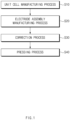
- the present invention provides a method for manufacturing a secondary battery, which includes: a unit cell manufacturing process (S10) of manufacturing a unit cell including an electrode and a separator; an electrode assembly manufacturing process (S20) of folding a plurality of unit cells and separator sheets to be alternately stacked so as to manufacture an electrode assembly; a correction process (S30) of correcting a height difference occurring on an outer surface of the electrode assembly; and a pressing process (S40) of pressing the electrode assembly.
- S10 unit cell manufacturing process
- S20 electrode assembly manufacturing process
- S30 correction process
- S40 pressing the electrode assembly.
- the unit cell manufacturing process (S10) may be a process of manufacturing the unit cell including the electrode and the separator and be performed in various manners.
- electrode slurry may be applied on an electrode collector (e.g., conductive foil) to be applied on the electrode collector, thereby manufacturing a positive electrode or a negative electrode.
- the separator may be interposed between the positive electrode and the negative electrode, and the positive electrode and the negative electrode and the separator may be pressed to manufacture the unit cell.
- the electrode slurry may be applied on only a partial area on the electrode collector, and thus, a difference in thickness between an area, on which the electrode slurry is uniformly applied, and the applied electrode slurry may occur on the partial area on which the electrode slurry is non-uniformly applied.
- a smaller amount of electrode slurry is applied to the area, on which the electrode slurry is non-uniformly applied, rather than the surrounding uniformly applied area, an empty space may be formed between the electrode and the separator, resulting in the non-bonded area.
- the electrode assembly manufacturing process (S20) of manufacturing the electrode assembly 10 including the unit cell may be performed.
- the electrode assembly manufacturing process (S20) may be a process of manufacturing the electrode assembly by folding the plurality of unit cells and separator sheets so as to be alternately stacked and may be performed in various manners.
- the unit cells manufactured in the above-described unit cell manufacturing process (S10) may be disposed side by side on the separator sheet, the unit cells and the separator sheets, which are formed with one surfaces having surface areas and shapes corresponding to each other, may be disposed to be alternately stacked, and the separator sheets may be folded several times in a direction in which the separator sheets surround the unit cell disposed on the separator sheets to manufacture the electrode assembly 10.
- An outer surface of the electrode assembly 10 manufactured as described above may be formed in a shape in which the separator sheet surrounds the electrode assembly 10.
- the outer surface of the manufactured electrode assembly 10 may not expose the electrode portion of the unit cell and may be completely wrapped with the separator sheet to protect the unit cell disposed inside the separator sheet.
- the electrode slurry may be non-uniformly applied on the partial area between the electrode and the separator.
- the difference in coating thickness of the electrode slurry may occur between the uniformly applied surrounding area and the non-uniformly applied area, resulting in the non-bonded area between the electrode and the separator.
- a specific area of the unit cell may have a relatively low height compared to each of other areas by the difference in coating thickness of the electrode slurry.
- the electrode assembly 10 may have a height difference formed on the outer surface so that the outer surface is formed to be stepped in a stair shape, or the outer surface is formed to be inclined with a predetermined inclination.
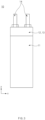
- the electrode assembly 10 may include a first area 11 having a first height H1; and a second area 12 having a second height H2 lower than the first height H1.
- dotted lines disposed between the first area 11 and the second area 12 in FIG. 2 are shown to understand positions of the first area 11 and the second area 12, and thus, it does not mean that an internal area of the electrode assembly 10 is divided.
- the first area 11 means an area having the first height H1 in the electrode assembly 10.
- the first height H1 may be defined as a height formed with the highest height from one surface of the electrode assembly 10 disposed in the stacking direction of the unit cells to the other surface facing the one surface.
- the first area 11 may be understood as an area having the thickest thickness in the electrode assembly 10.
- the second area 12 means an area having the second height H2 lower than the first height H1 in the electrode assembly 10.
- a height difference between the second height H2 and the first height H1 may be formed to be accumulated while the non-bonded area between the electrode and the separator, which occurs by the difference in coating thickness of the electrode slurry applied to the electrode in the unit cell, and the non-bonded area formed by alternately stacking the unit cell and the separator sheet are folded several times.
- the second height H2 may be defined as a height formed so that a height from one surface of the electrode assembly 10 disposed in the stacking direction of the unit cells to the other surface facing the one surface is lower than the first height H1.
- the second area 12 may be understood as all areas having a thickness less than that of the first area 11 in the electrode assembly 10.
- the second area 12 may be disposed at any portion on the electrode assembly 10.
- the electrode slurry may be less likely to reach an edge of the electrode collector when the electrode slurry is applied, and thus, the second area 12 may be disposed to correspond to an edge of the electrode assembly 10.
- the second area 12 may be disposed to correspond to the edge area of the electrode assembly 10 on which the electrode tab 14 is disposed on the edge area of the electrode assembly 10.
- the electrode slurry is sufficiently applied to an edge area of the electrode assembly 10, which originally corresponds to the central portion of the electrode current collector, but it may be understood that the edge area of the electrode assembly 10, on which the electrode tab 14 is disposed, is easy to allow the electrode slurry to be relatively less reached. That is, while the electrode slurry less reaches the edge area, the coating thickness of the electrode slurry may become thinner, and the second area 12 may be formed.
- the electrode tab 14 may be formed on the electrode collector through a notching process before the electrode slurry is applied or may be attached to any portion of the electrode collector after the electrode slurry is applied so as to be connected to the electrode.
- the correction process (S30) of correcting the height difference formed on the outer surface of the electrode assembly 10 so that the outer surface of the electrode assembly 10 is uniformly pressed in the pressing process (S40) to be described later after the electrode assembly manufacturing process (S20) may be additionally performed.
- the height difference of the outer surface of the electrode assembly 10 is corrected through the correction process (S30)
- the first area 11 having a relatively high height but also the second area 12 having a relatively low height in the electrode assembly 10 may be pressed in the pressing process (S40) described below, and thus, the non-bonded area of the electrode and the separator, which is disposed on the second area 12, and the non-bonded area of the unit cell and the separator sheet may be improved.
- the correcting process (S30) may be a process of correcting the height difference formed on the outer surface of the electrode assembly 10 by disposing a correction sheet 13 on an area of the electrode assembly 10, which is formed with a relatively low height and may be performed in various manners.
- the correction sheet 13 may be disposed at an upper side of the separator sheet on the second area 12 having the relatively low height in the electrode assembly 10 to correct the height difference H1-H2 between the first area 11 and the second area 12.
- the electrode assembly 10 may be provided to have areas and shapes corresponding to each other to manufacture the electrode assembly 10, and since the outer surface of the manufactured electrode assembly 10 is wrapped by the separator sheet, the correction sheet 13 may be provided and attached at the upper side of the separator sheet on the second area 12.
- reference numerals 12 and 13 are shown to indicate the same position, but since the correction sheet 13 is additionally disposed on the second area 12, it is noted that, in the present invention, the second area 12 and the correction sheet 13 are distinct concepts.
- a solid line disposed between the first area 11 and the second area 12 in FIG. 3 is shown to distinguish the correction sheet 13 additionally disposed on the first area 11 and the second area 12 and does not mean that the internal area of the electrode assembly 10 is divided.
- the correction sheet 13 may be stacked in various numbers so as to reduce the height difference H1-H2 between the first area 11 and the second area 12.
- At least one correction sheet 13 may be stacked and disposed according to the thickness of the correction sheet 13 and the height difference H1-H2 between the first area 11 and the second area 12.
- the correction sheet 13 may be disposed at the upper side of the separator sheet on the second area 12 by as much as the height difference H1-H2 between the first height H1 and the second height H2 so that the height of the outer surface of the electrode assembly 10 is uniform.
- the correction sheet 13 may be made of various materials.
- the correction sheet 13 may be made of any material as long as it does not affect the performance of the electrode assembly and may include, for example, a synthetic resin or an adhesive material.
- a tape made of an insulating material may be used for the correction sheet 13, and for example, a CPP tape (cast polypropylene tape) used for insulating an electrode tab in the related art may be used.
- CPP tape cast polypropylene tape
- correction sheet 13 may have various widths and thicknesses, and for example, the correction sheet 13 may have a width of 12 mm and a thickness of 0.03 t.
- the pressing process (S40) of pressing the electrode assembly 10 to bond the unit cell and the separator sheet of the electrode assembly 10 to each other is performed.
- the pressing process (S40) may be a process of pressing the electrode assembly 10 and may be performed in various manners.
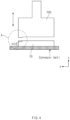
- the pressing process (S40) may be performed using an apparatus for manufacturing the secondary battery, which includes a pressing press 100 for pressing the electrode assembly 10 moving on a conveyor belt.
- the electrode assembly 10 may move on the conveyor belt in an x direction (a direction penetrating the drawing) perpendicular to a y-z plane of the drawing.
- the pressing press 100 may be a configuration that presses the electrode assembly 10 and may have various configurations.
- the pressing press 100 may have a pressing surface 110 formed to be stepped so as to correspond to the height difference formed on the outer surface of the electrode assembly 10 so that the pressing press 100 press the outer surface of the electrode assembly 10 as uniformly as possible even when the height difference is formed on the outer surface of the electrode assembly 10.
- the pressing surface 110 includes: a first pressing surface 111 formed on a lower portion of the pressing press 100 to press the first area 11; a second pressing surface 112 pressing the second area 12; and a connection surface 113 connecting the first pressing surface 111 to the second pressing surface 112.
- the first pressing surface 111 may be a pressing surface that presses the first area 11 and may have various configurations.
- the first pressing surface 111 may have any shape as long as the first pressing surface 111 is capable of pressing the first area 11.
- the second pressing surface 112 may be a pressing surface that presses the second area 12 and may have various configurations.
- the second pressing surface 112 may have any shape as long as it can press the second area 12.
- the second pressing surface 112 may be formed to protrude more than the first pressing surface 111 toward the electrode assembly 10.
- first pressing surface 111 and the second pressing surface 112 may be formed to be stepped with respect to each other.
- the second pressing surface 112 may protrude from the first pressing surface 111 by the height difference H1-H2 between the first area11 and the second area 12 of the electrode assembly 10.
- the electrode assembly 10 may uniformly press one surface on which the first area 11 and the second area 12 are formed in spite of the height difference between the first area 11 and the second area 12 of the outer surface of the electrode assembly 10.
- connection surface 113 may be a configuration connecting the first pressing surface 111 to the second pressing surface 112 and may have various configurations.
- connection surface 113 may be disposed between the first pressing surface 111 and the second pressing surface 112 to connect the first pressing surface 111 and the second pressing surface 112, which have heights different from each other, to each other.
- connection surface 113 may be connected to the first pressing surface 111 and the second pressing surface 112 in various manners.
- connection surface 113 may be connected to be inclined with respect to the first pressing surface 111 and the second pressing surface 112 so as to minimize damage caused by linear scratches and damage on the electrode surface.
- the pressing press 100 may include a heating member (not shown) heated to a temperature higher than room temperature so as to thermally press the electrode assembly 10.
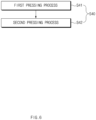
- the pressing process (S40) may include a first pressing process (S41) of pressing the electrode assembly using a first pressing press; and a second pressing process (S42) of pressing the electrode assembly by using a second pressing press.
- the first pressing press and the second pressing press may be sequentially disposed along the moving direction of the electrode assembly 10 on the conveyor belt to press the above-described electrode assembly at least twice.
- the first pressing press and the second pressing press may press the electrode assembly 10 by moving in a z direction (direction penetrating the drawing) perpendicular to the x-y plane on the drawing.
- At least one of the first pressing press and the second pressing press may include the pressing press 100 having the stepped pressing surface 110 for pressing the electrode assembly 10.
- contents of the pressing press 100 may be cited from the above contents.
- the pressing surfaces 110 for pressing the electrode assembly 10 may be formed to be stepped so as to have different heights; and the pressing surface of the second pressing press may be formed to be flat at a predetermined height.
- FIG. 8 (a) illustrates a front image (hereinafter, reference to as ⁇ Comparative Example') of a unit cell (bi-cell) manufactured according to the related art
- FIG. 8 (b) illustrates a front image (hereinafter, referred to as an ⁇ embodiment of the present invention') of a unit cell (bi-cell) manufactured according to the present invention.
Landscapes
- Engineering & Computer Science (AREA)
- Manufacturing & Machinery (AREA)
- Chemical & Material Sciences (AREA)
- Chemical Kinetics & Catalysis (AREA)
- Electrochemistry (AREA)
- General Chemical & Material Sciences (AREA)
- Mechanical Engineering (AREA)
- Secondary Cells (AREA)
- Cell Separators (AREA)
- Connection Of Batteries Or Terminals (AREA)
- Battery Electrode And Active Subsutance (AREA)
Abstract
Description
- The present application claims the benefit of the priority of
Korean Patent Application Nos. 10-2021-0122787, filed on September 14, 2021 10-2022-0115146, filed on September 13, 2022 - The present invention relates to an electrode assembly, a secondary battery including the same, a method for manufacturing a secondary battery, which manufactures the same, and an apparatus for manufacturing a secondary battery, which is used therefor, and more particularly, to an electrode assembly, which is capable of improving a non-bonded area of an electrode and a separator inside an electrode unit and a non-bonded area of an electrode unit and a separator sheet inside the electrode assembly, a secondary battery including the same, a method for manufacturing a secondary battery, which manufactures the same, and an apparatus for manufacturing a secondary battery, which is used therefor.
- Batteries (cells) that generate electric energy through physical or chemical reaction to supply the generated electric energy to the outside are used when AC power to be supplied to the building is not obtained, or DC power is required according to the living environments surrounded by various electric and electronic devices.
- Among such batteries, primary batteries and secondary batteries, which are chemical batteries using chemical reaction, are being generally used. The primary batteries are consumable batteries which are collectively referred to as dry batteries. In addition, secondary batteries are rechargeable batteries that are manufactured by using a material in a redox process between current and a substance is repeatable several times. When the reduction reaction is performed on the material by the current, power is charged, and when the oxidation reaction is performed on the material, power is discharged. Such the charging-discharging is repeatedly performed to generate electricity.
- Here, in a lithium ion battery among secondary batteries, an electrode slurry, in which an active material, a conductive material, and a binder are mixed, may be applied at a predetermined thickness to a positive electrode conductive foil and a negative electrode conductive foil to manufacture an electrode, and a separator may be interposed between both the conductive foils to manufacture an electrode assembly.
- In addition, the secondary battery may be classified according to a structure of the electrode assembly having a structure of a positive electrode/separator/negative electrode. For example, the secondary batteries may be classified into a cylindrical secondary battery, in which long sheet-type positive and negative electrodes are wound several times in the form of a bulk jelly roll with a separator therebetween to manufacture an electrode assembly, and then, the manufactured electrode assembly is accommodated in a cylindrical can so that the can is sealed, and a pouch-type secondary battery, in which a bi-cell, in which positive and negative electrodes, each of which has a predetermined size, are stacked with a separator therebetween, is folded to manufacture an electrode assembly, and then, the manufactured electrode assembly is accommodated in a pouch so that the pouch is sealed.
- When manufacturing the electrode, the electrode slurry is non-uniformly applied to the conductive foils due to viscosity of the electrode slurry, resulting in a difference in coating thickness of the electrode slurry. Particularly, in the pouch-type secondary battery, the difference in coating thickness of the electrode slurry forms a non-bonded area of the electrodes and separator inside a unit cell manufactured by including the electrodes after the electrodes are manufactured and a non-bonded area of a unit cell and a separator sheet of the electrode assembly including the unit cell, resulting in lithium precipitation due to interfacial resistance on the negative electrode to increase in resistance of the electrodes.
- The present invention has been made to solve the above problems, and an object of the present invention is to provide an electrode assembly, which is capable of improving a non-bonded area of an electrode and a separator inside an electrode unit and a non-bonded area of an electrode unit and a separator sheet inside the electrode assembly, a secondary battery including the same, a method for manufacturing a secondary battery, which manufactures the same, and an apparatus for manufacturing a secondary battery, which is used therefor.
- The present invention provides a method for manufacturing a secondary battery, the method including: a unit cell manufacturing process of manufacturing a unit cell including an electrode and a separator; an electrode assembly manufacturing process of folding a plurality of unit cells and a separator sheet to be alternately stacked so as to manufacture an electrode assembly; a correction process of correcting a height difference formed on an outer surface of the electrode assembly; and a pressing process of pressing the electrode assembly, wherein, in the correction process, a correction sheet is disposed on an area formed with a relatively low height with respect to the inside of the electrode assembly to correct the height difference formed on the outer surface of the electrode assembly.
- In the correction process, the height difference may be corrected so that the outer surface of the electrode assembly has a uniform height.
- The electrode assembly may include: a first area having a first height; and a second area having a second height less than the first height, wherein, in the correction process, the correction sheet may be disposed on the second area to correct a height difference between the first area and the second area.
- In the correction process, the correction sheet may be disposed on the second area by a difference between the first height and the second height.
- The second area may be disposed to correspond to an edge of the electrode assembly.
- The electrode assembly may include an electrode tab connected to the electrode, and the second area may be disposed to correspond to an area on which the electrode tab of the electrode assembly is disposed.
- The correction sheet may be made of an insulating material.
- The correction sheet may include a synthetic resin or an adhesive material.
- The correction sheet may include a cast polypropylene tape (CPP).
- In addition, the present invention may provide an electrode assembly in which a plurality of unit cells, each of which includes an electrode and a separator, and separator sheets are alternately stacked, the electrode assembly including: a first area having a first height; a second area having a second height less than the first height; and a correction sheet disposed on the second area to correct a height difference between the first area and the second area.
- The correction sheet may be disposed by the height difference between the first area and the second area.
- The second area may be disposed to correspond to an edge of the electrode assembly.
- The electrode assembly may include an electrode tab connected to the electrode, and the second area may be disposed to correspond to an area on which the electrode tab of the electrode assembly is disposed.
- In addition, the present invention may provide a secondary battery including an electrode assembly in which a plurality of unit cells, each of which includes an electrode and a separator, and separator sheets are alternately stacked, wherein the electrode assembly includes: a first area having a first height; a second area having a second height less than the first height; and a correction sheet disposed on the second area to correct a height difference between the first area and the second area.
- In addition, the present invention may provide an apparatus for manufacturing a secondary battery, which manufactures a secondary battery including an electrode assembly in which a plurality of unit cells, each of which includes an electrode and a separator, and separator sheets are alternately stacked, wherein the electrode assembly includes: a first area having a first height; a second area having a second height less than the first height; and a correction sheet disposed on the second area to correct a height difference between the first area and the second area, and the apparatus for manufacturing the secondary battery includes a pressing press configured to press the electrode assembly, wherein the pressing press is provided so that a pressing surface configured to press the electrode assembly is stepped.
- The pressing surface may include: a first pressing surface configured to press the first area; a second pressing surface configured to press the second area; and a connection surface configured to connect the first pressing surface to the second pressing surface, wherein the second pressing surface may protrude further than the first pressing surface toward the electrode assembly.
- The connection surface may be disposed to be inclined with respect to the first pressing surface and the second pressing surface.
- In addition, the present invention may provide a method for manufacturing a secondary battery, the method including: a unit cell manufacturing process of manufacturing a unit cell including an electrode and a separator; an electrode assembly manufacturing process of folding a plurality of unit cells and a separator sheet to be alternately stacked so as to manufacture an electrode assembly; a correction process of correcting a height difference formed on an outer surface of the electrode assembly; and a pressing process of pressing the electrode assembly, wherein the pressing process includes: a first pressing process of pressing the electrode assembly using a first pressing press; and a second pressing process of pressing the electrode assembly using a second pressing press, wherein at least one of the first pressing press and the second pressing press is formed so that a pressing surface for pressing the electrode assembly is stepped.
- The first pressing press may be formed so that the pressing surface for pressing the electrode assembly is stepped, and the second pressing press may be formed so that the pressing surface for pressing the electrode assembly is flat at a predetermined height.
- The present invention may have the advantage of including the correction process of correcting the height difference occurring on the outer surface of the electrode assembly so that the non-bonded area of the electrode and the separator inside the unit cell and the non-bonded area of the unit cell and the separator sheet inside the electrode assembly are pressed in the pressing process to bond the non-boned areas to each other, thereby improving the performance of the secondary battery.
- In addition, the present invention may have the advantage in that the at least one pressing surface of the pressing press, which presses the electrode assembly, is formed to be stepped so that the non-bonded area of the electrode and the separator inside the unit cell and the non-bonded area of the unit cell and the separator sheet inside the electrode assembly are pressed to bond the non-boned areas to each other, thereby improving the performance of the secondary battery.
-
-
FIG. 1 is a flowchart illustrating a method for manufacturing a secondary battery according to the present invention. -
FIG. 2 is a side view illustrating a side surface of an electrode assembly in which a height difference is corrected according to the present invention. -
FIG. 3 is a front view illustrating a front surface of the electrode assembly in which the height difference is corrected according to the present invention. -
FIG. 4 is a conceptual view illustrating a process of pressing the electrode assembly using a pressing press of an apparatus for manufacturing the secondary battery according to the present invention. -
FIG. 5 is an enlarged view illustrating a portion A of a pressing surface of the pressing press. -
FIG. 6 is a flowchart illustrating a pressing process in the method for manufacturing the secondary battery according to the present invention. -
FIG. 7 is a conceptual view illustrating a process of pressing the electrode assembly using a first pressing press and a second pressing press in the method for manufacturing the secondary battery according to the present invention. - (a) and (b) of
FIG. 8 are images illustrating whether a non-bonded area of an electrode and a separator is formed on a unit cell (bi-cell) manufactured according to the related art and the present invention, respectively. - Hereinafter, preferred embodiments of the present invention will be described in detail with reference to the accompanying drawings so that those of ordinary skill in the art can easily carry out the present invention. However, the present invention may be implemented in several different forms and is not limited or restricted by the following examples.
- In order to clearly explain the present invention, detailed descriptions of portions that are irrelevant to the description or related known technologies that may unnecessarily obscure the gist of the present invention have been omitted, and in the present specification, reference symbols are added to components in each drawing. In this case, the same or similar reference numerals are assigned to the same or similar elements throughout the specification.
- Also, terms or words used in this specification and claims should not be restrictively interpreted as ordinary meanings or dictionary-based meanings, but should be interpreted as meanings and concepts conforming to the scope of the present invention on the basis of the principle that an inventor can properly define the concept of a term to describe and explain his or her invention in the best ways.
- As illustrated in
FIG. 1 , the present invention provides a method for manufacturing a secondary battery, which includes: a unit cell manufacturing process (S10) of manufacturing a unit cell including an electrode and a separator; an electrode assembly manufacturing process (S20) of folding a plurality of unit cells and separator sheets to be alternately stacked so as to manufacture an electrode assembly; a correction process (S30) of correcting a height difference occurring on an outer surface of the electrode assembly; and a pressing process (S40) of pressing the electrode assembly. - First, the unit cell manufacturing process (S10) may be a process of manufacturing the unit cell including the electrode and the separator and be performed in various manners.
- For example, in the unit cell manufacturing process (S10), electrode slurry may be applied on an electrode collector (e.g., conductive foil) to be applied on the electrode collector, thereby manufacturing a positive electrode or a negative electrode. Then, the separator may be interposed between the positive electrode and the negative electrode, and the positive electrode and the negative electrode and the separator may be pressed to manufacture the unit cell.
- However, in the process of manufacturing the electrodes, the electrode slurry may be applied on only a partial area on the electrode collector, and thus, a difference in thickness between an area, on which the electrode slurry is uniformly applied, and the applied electrode slurry may occur on the partial area on which the electrode slurry is non-uniformly applied. Particularly, when a smaller amount of electrode slurry is applied to the area, on which the electrode slurry is non-uniformly applied, rather than the surrounding uniformly applied area, an empty space may be formed between the electrode and the separator, resulting in the non-bonded area.
- After the unit cell manufacturing process (S10), as illustrated in
FIG. 1 , the electrode assembly manufacturing process (S20) of manufacturing theelectrode assembly 10 including the unit cell may be performed. - Here, the electrode assembly manufacturing process (S20) may be a process of manufacturing the electrode assembly by folding the plurality of unit cells and separator sheets so as to be alternately stacked and may be performed in various manners.
- Specifically, in the electrode assembly manufacturing process (S20), the unit cells manufactured in the above-described unit cell manufacturing process (S10) may be disposed side by side on the separator sheet, the unit cells and the separator sheets, which are formed with one surfaces having surface areas and shapes corresponding to each other, may be disposed to be alternately stacked, and the separator sheets may be folded several times in a direction in which the separator sheets surround the unit cell disposed on the separator sheets to manufacture the
electrode assembly 10. An outer surface of theelectrode assembly 10 manufactured as described above may be formed in a shape in which the separator sheet surrounds theelectrode assembly 10. That is, since the unit cell and the separator sheet are formed to have the surface areas and shape corresponding to each other, the outer surface of the manufacturedelectrode assembly 10 may not expose the electrode portion of the unit cell and may be completely wrapped with the separator sheet to protect the unit cell disposed inside the separator sheet. - However, the electrode slurry may be non-uniformly applied on the partial area between the electrode and the separator. In this case, the difference in coating thickness of the electrode slurry may occur between the uniformly applied surrounding area and the non-uniformly applied area, resulting in the non-bonded area between the electrode and the separator. In the case of the unit cell having the non-bonded area, a specific area of the unit cell may have a relatively low height compared to each of other areas by the difference in coating thickness of the electrode slurry. Thus, when the
electrode assembly 10 is manufactured, if the unit cells are disposed to be stacked in parallel in one direction, a non-bonded area may be formed again between the unit cell and the separator sheet by the non-bonded area formed in the unit cell. Then, when the separator sheet is folded several times, the non-bonded areas may be accumulated, and thus, a specific area of theelectrode assembly 10 may have a relatively low height compared to each of other areas. - Specifically, the
electrode assembly 10 may have a height difference formed on the outer surface so that the outer surface is formed to be stepped in a stair shape, or the outer surface is formed to be inclined with a predetermined inclination. - In this case, as illustrated in
FIG. 2 , theelectrode assembly 10 may include afirst area 11 having a first height H1; and asecond area 12 having a second height H2 lower than the first height H1. However, dotted lines disposed between thefirst area 11 and thesecond area 12 inFIG. 2 are shown to understand positions of thefirst area 11 and thesecond area 12, and thus, it does not mean that an internal area of theelectrode assembly 10 is divided. - Specifically, the
first area 11 means an area having the first height H1 in theelectrode assembly 10. - Here, the first height H1 may be defined as a height formed with the highest height from one surface of the
electrode assembly 10 disposed in the stacking direction of the unit cells to the other surface facing the one surface. Thus, thefirst area 11 may be understood as an area having the thickest thickness in theelectrode assembly 10. - The
second area 12 means an area having the second height H2 lower than the first height H1 in theelectrode assembly 10. A height difference between the second height H2 and the first height H1 may be formed to be accumulated while the non-bonded area between the electrode and the separator, which occurs by the difference in coating thickness of the electrode slurry applied to the electrode in the unit cell, and the non-bonded area formed by alternately stacking the unit cell and the separator sheet are folded several times. - Here, the second height H2 may be defined as a height formed so that a height from one surface of the
electrode assembly 10 disposed in the stacking direction of the unit cells to the other surface facing the one surface is lower than the first height H1. Thus, thesecond area 12 may be understood as all areas having a thickness less than that of thefirst area 11 in theelectrode assembly 10. - Also, the
second area 12 may be disposed at any portion on theelectrode assembly 10. - For example, as a length of the electrode collector increases, the electrode slurry may be less likely to reach an edge of the electrode collector when the electrode slurry is applied, and thus, the
second area 12 may be disposed to correspond to an edge of theelectrode assembly 10. - Particularly, the
second area 12 may be disposed to correspond to the edge area of theelectrode assembly 10 on which theelectrode tab 14 is disposed on the edge area of theelectrode assembly 10. - In the case of manufacturing two electrodes by applying and drying the electrode slurry to a central portion of one electrode collector to cut the electrode collector during the electrode manufacturing, it may be expected that the electrode slurry is sufficiently applied to an edge area of the
electrode assembly 10, which originally corresponds to the central portion of the electrode current collector, but it may be understood that the edge area of theelectrode assembly 10, on which theelectrode tab 14 is disposed, is easy to allow the electrode slurry to be relatively less reached. That is, while the electrode slurry less reaches the edge area, the coating thickness of the electrode slurry may become thinner, and thesecond area 12 may be formed. - Here, the
electrode tab 14 may be formed on the electrode collector through a notching process before the electrode slurry is applied or may be attached to any portion of the electrode collector after the electrode slurry is applied so as to be connected to the electrode. - The correction process (S30) of correcting the height difference formed on the outer surface of the
electrode assembly 10 so that the outer surface of theelectrode assembly 10 is uniformly pressed in the pressing process (S40) to be described later after the electrode assembly manufacturing process (S20) may be additionally performed. - That is, as the height difference of the outer surface of the
electrode assembly 10 is corrected through the correction process (S30), not only thefirst area 11 having a relatively high height, but also thesecond area 12 having a relatively low height in theelectrode assembly 10 may be pressed in the pressing process (S40) described below, and thus, the non-bonded area of the electrode and the separator, which is disposed on thesecond area 12, and the non-bonded area of the unit cell and the separator sheet may be improved. - Specifically, the correcting process (S30) may be a process of correcting the height difference formed on the outer surface of the
electrode assembly 10 by disposing acorrection sheet 13 on an area of theelectrode assembly 10, which is formed with a relatively low height and may be performed in various manners. - For example, in the correction process (S30), as illustrated in
FIGS. 2 and3 , thecorrection sheet 13 may be disposed at an upper side of the separator sheet on thesecond area 12 having the relatively low height in theelectrode assembly 10 to correct the height difference H1-H2 between thefirst area 11 and thesecond area 12. Theelectrode assembly 10 may be provided to have areas and shapes corresponding to each other to manufacture theelectrode assembly 10, and since the outer surface of the manufacturedelectrode assembly 10 is wrapped by the separator sheet, thecorrection sheet 13 may be provided and attached at the upper side of the separator sheet on thesecond area 12. InFIG. 3 ,reference numerals correction sheet 13 is additionally disposed on thesecond area 12, it is noted that, in the present invention, thesecond area 12 and thecorrection sheet 13 are distinct concepts. In addition, a solid line disposed between thefirst area 11 and thesecond area 12 inFIG. 3 is shown to distinguish thecorrection sheet 13 additionally disposed on thefirst area 11 and thesecond area 12 and does not mean that the internal area of theelectrode assembly 10 is divided. - Here, the
correction sheet 13 may be stacked in various numbers so as to reduce the height difference H1-H2 between thefirst area 11 and thesecond area 12. - For example, at least one
correction sheet 13 may be stacked and disposed according to the thickness of thecorrection sheet 13 and the height difference H1-H2 between thefirst area 11 and thesecond area 12. - Here, the
correction sheet 13 may be disposed at the upper side of the separator sheet on thesecond area 12 by as much as the height difference H1-H2 between the first height H1 and the second height H2 so that the height of the outer surface of theelectrode assembly 10 is uniform. - The
correction sheet 13 may be made of various materials. For example, thecorrection sheet 13 may be made of any material as long as it does not affect the performance of the electrode assembly and may include, for example, a synthetic resin or an adhesive material. - In addition, a tape made of an insulating material may be used for the
correction sheet 13, and for example, a CPP tape (cast polypropylene tape) used for insulating an electrode tab in the related art may be used. - In addition, the
correction sheet 13 may have various widths and thicknesses, and for example, thecorrection sheet 13 may have a width of 12 mm and a thickness of 0.03 t. - After the correction process (S30) is performed, the pressing process (S40) of pressing the
electrode assembly 10 to bond the unit cell and the separator sheet of theelectrode assembly 10 to each other is performed. - Here, the pressing process (S40) may be a process of pressing the
electrode assembly 10 and may be performed in various manners. - For example, as illustrated in
FIG. 4 , the pressing process (S40) may be performed using an apparatus for manufacturing the secondary battery, which includes apressing press 100 for pressing theelectrode assembly 10 moving on a conveyor belt. Here, theelectrode assembly 10 may move on the conveyor belt in an x direction (a direction penetrating the drawing) perpendicular to a y-z plane of the drawing. - Here, the
pressing press 100 may be a configuration that presses theelectrode assembly 10 and may have various configurations. - For example, as described above, the
pressing press 100 may have apressing surface 110 formed to be stepped so as to correspond to the height difference formed on the outer surface of theelectrode assembly 10 so that thepressing press 100 press the outer surface of theelectrode assembly 10 as uniformly as possible even when the height difference is formed on the outer surface of theelectrode assembly 10. - Particularly, as illustrated in
FIG. 5 , thepressing surface 110 includes: a firstpressing surface 111 formed on a lower portion of thepressing press 100 to press thefirst area 11; a secondpressing surface 112 pressing thesecond area 12; and aconnection surface 113 connecting the firstpressing surface 111 to the secondpressing surface 112. - The first
pressing surface 111 may be a pressing surface that presses thefirst area 11 and may have various configurations. For example, the firstpressing surface 111 may have any shape as long as the firstpressing surface 111 is capable of pressing thefirst area 11. - The second
pressing surface 112 may be a pressing surface that presses thesecond area 12 and may have various configurations. For example, the secondpressing surface 112 may have any shape as long as it can press thesecond area 12. - Here, the second
pressing surface 112 may be formed to protrude more than the firstpressing surface 111 toward theelectrode assembly 10. - That is, the first
pressing surface 111 and the secondpressing surface 112 may be formed to be stepped with respect to each other. Here, the secondpressing surface 112 may protrude from the firstpressing surface 111 by the height difference H1-H2 between the first area11 and thesecond area 12 of theelectrode assembly 10. - Thus, when the
pressing press 100 presses theelectrode assembly 10, theelectrode assembly 10 may uniformly press one surface on which thefirst area 11 and thesecond area 12 are formed in spite of the height difference between thefirst area 11 and thesecond area 12 of the outer surface of theelectrode assembly 10. - The
connection surface 113 may be a configuration connecting the firstpressing surface 111 to the secondpressing surface 112 and may have various configurations. - Specifically, the
connection surface 113 may be disposed between the firstpressing surface 111 and the secondpressing surface 112 to connect the firstpressing surface 111 and the secondpressing surface 112, which have heights different from each other, to each other. - Here, the
connection surface 113 may be connected to the firstpressing surface 111 and the secondpressing surface 112 in various manners. - For example, as illustrated in
FIG. 5 , theconnection surface 113 may be connected to be inclined with respect to the firstpressing surface 111 and the secondpressing surface 112 so as to minimize damage caused by linear scratches and damage on the electrode surface. - In addition, the
pressing press 100 may include a heating member (not shown) heated to a temperature higher than room temperature so as to thermally press theelectrode assembly 10. - As illustrated in
FIG. 6 , the pressing process (S40) may include a first pressing process (S41) of pressing the electrode assembly using a first pressing press; and a second pressing process (S42) of pressing the electrode assembly by using a second pressing press. - That is, in the pressing process (S40), as illustrated in
FIG. 7 , the first pressing press and the second pressing press may be sequentially disposed along the moving direction of theelectrode assembly 10 on the conveyor belt to press the above-described electrode assembly at least twice. Here, the first pressing press and the second pressing press may press theelectrode assembly 10 by moving in a z direction (direction penetrating the drawing) perpendicular to the x-y plane on the drawing. - Here, as described above, at least one of the first pressing press and the second pressing press may include the
pressing press 100 having the steppedpressing surface 110 for pressing theelectrode assembly 10. Here, contents of thepressing press 100 may be cited from the above contents. - For example, in the first pressing press, the
pressing surfaces 110 for pressing theelectrode assembly 10 may be formed to be stepped so as to have different heights; and the pressing surface of the second pressing press may be formed to be flat at a predetermined height. - Hereinafter, a size of the non-bonded area of the electrode and the separator of the unit cell according to whether the present invention is applied will be described with reference to
FIG. 8 (a) and (b). FIG. 8 (a) illustrates a front image (hereinafter, reference to as `Comparative Example') of a unit cell (bi-cell) manufactured according to the related art, andFIG. 8 (b) illustrates a front image (hereinafter, referred to as an `embodiment of the present invention') of a unit cell (bi-cell) manufactured according to the present invention. - First, referring to the front image of the unit cell, which is formed by Comparative Example in
FIG. 8 (a) , it is seen that an non-bonded area of an electrode and a separator, which has a black color, is formed on an edge portion B corresponding to an upper portion of a unit cell, i.e., an electrode tab. In addition, in the case of an electrode assembly including the unit cell as described above, it is expected that a non-bonded area between the unit cell and a separator sheet occurs, and thus, lithium is precipitated on a negative electrode to increase in resistance of the electrode. Thus, a problem in which performance of the secondary battery is deteriorated may occur. - On the other hand, referring to the front image of the unit cell formed according to the embodiment of the present invention in (b) of
FIG. 8 , it is seen that almost no non-bonded area is formed on an upper portion of the unit cell, i.e., an edge portion B corresponding to an electrode tab. Therefore, it is expected that the unit cell formed according to an embodiment of the present invention will hardly form not only the non-bonded area of the electrode and the separator inside the unit cell, but also the non-bonded area between the unit cell and the separator sheet on the electrode assembly, and thus, there may be an advantage in that the performance of the secondary battery is improved by minimizing the lithium precipitation on the negative electrode due to interfacial resistance. - While the embodiments of the present invention have been described with reference to the specific embodiments, it will be apparent to those skilled in the art that various changes and modifications may be made without departing from the spirit and scope of the invention as defined in the following claims.
-
- 10: Electrode assembly
- 11: First area
- 12: Second area
- 13: Correction sheet
- 14: Electrode tab
- 100: Pressing press
- 110: Pressing surface
- 111: First pressing surface
- 112: Second pressing surface
- 113: Connection surface
- S10: Unit cell manufacturing process
- S20: Electrode assembly manufacturing process
- S30: Correction process
- S40: Pressing process
- S41: First pressing process
- S42: Second pressing process
Claims (28)
- A method for manufacturing a secondary battery, the method comprising:a unit cell manufacturing process of manufacturing a unit cell comprising an electrode and a separator;an electrode assembly manufacturing process of folding a plurality of unit cells and a separator sheet to be alternately stacked so as to manufacture an electrode assembly;a correction process of correcting a height difference formed on an outer surface of the electrode assembly; anda pressing process of pressing the electrode assembly,wherein, in the correction process, a correction sheet is disposed on an area formed with a relatively low height with respect to the inside of the electrode assembly to correct the height difference formed on the outer surface of the electrode assembly.
- The method of claim 1, wherein, in the correction process, the height difference is corrected so that the outer surface of the electrode assembly has a uniform height.
- The method of claim 1, wherein the electrode assembly comprises:a first area having a first height; anda second area having a second height less than the first height,wherein, in the correction process, the correction sheet is disposed on the second area to correct a height difference between the first area and the second area.
- The method of claim 3, wherein, in the correction process, the correction sheet is disposed on the second area by a difference between the first height and the second height.
- The method of claim 3, wherein the second area is disposed to correspond to an edge of the electrode assembly.
- The method of claim 3, wherein the electrode assembly comprises an electrode tab connected to the electrode, and
the second area is disposed to correspond to an area on which the electrode tab of the electrode assembly is disposed. - The method of claim 1, wherein the correction sheet is made of an insulating material.
- The method of claim 1, wherein the correction sheet comprises a synthetic resin or an adhesive material.
- The method of claim 8, wherein the correction sheet comprises a cast polypropylene tape (CPP).
- The method of claim 1, wherein electrode slurry is applied on the electrode, and
the height difference is formed by a thickness difference of the applied electrode slurry. - The method of claim 1, wherein the unit cell and the separator sheet are formed to have one surfaces with surface areas corresponding to each other.
- The method of claim 1, wherein the correction sheet is disposed above the separator sheet.
- An electrode assembly in which a plurality of unit cells, each of which comprises an electrode and a separator, and separator sheets are alternately stacked, the electrode assembly comprising:a first area having a first height;a second area having a second height less than the first height; anda correction sheet disposed on the second area to correct a height difference between the first area and the second area.
- The electrode assembly of claim 13, wherein the correction sheet is disposed by the height difference between the first area and the second area.
- The electrode assembly of claim 13, wherein the second area is disposed to correspond to an edge of the electrode assembly.
- The electrode assembly of claim 13, wherein the electrode assembly comprises an electrode tab connected to the electrode, and
the second area is disposed to correspond to an area on which the electrode tab of the electrode assembly is disposed. - The electrode assembly of claim 13, wherein electrode slurry is applied to the electrode, and
the second height is less than the first height by a thickness difference of the applied electrode slurry. - The electrode assembly of claim 13, wherein the unit cell and the separator sheet are formed to have one surfaces with surface areas corresponding to each other.
- The electrode assembly of claim 13, wherein the correction sheet is provided above the separator sheet.
- A secondary battery comprising an electrode assembly in which a plurality of unit cells, each of which comprises an electrode and a separator, and separator sheets are alternately stacked,
wherein the electrode assembly comprises:a first area having a first height;a second area having a second height less than the first height; anda correction sheet disposed on the second area to correct a height difference between the first area and the second area. - An apparatus for manufacturing a secondary battery, which manufactures a secondary battery comprising an electrode assembly in which a plurality of unit cells, each of which comprises an electrode and a separator, and separator sheets are alternately stacked,
wherein the electrode assembly comprises:a first area having a first height;a second area having a second height less than the first height; anda correction sheet disposed on the second area to correct a height difference between the first area and the second area, andthe apparatus for manufacturing the secondary battery comprises a pressing press configured to press the electrode assembly,wherein the pressing press is provided so that a pressing surface configured to press the electrode assembly is stepped. - The apparatus of claim 21, wherein the pressing surface comprises:a first pressing surface configured to press the first area;a second pressing surface configured to press the second area; anda connection surface configured to connect the first pressing surface to the second pressing surface,wherein the second pressing surface protrudes further than the first pressing surface toward the electrode assembly.
- The apparatus of claim 22, wherein the connection surface is disposed to be inclined with respect to the first pressing surface and the second pressing surface.
- The apparatus of claim 21, wherein electrode slurry is applied on the electrode, and
the second height is less than the first height by a thickness difference of the applied electrode slurry. - The apparatus of claim 21, wherein the unit cell and the separator sheet are formed to have one surfaces with surface areas corresponding to each other.
- The apparatus of claim 21, wherein the correction sheet is provided above the separator sheet.
- A method for manufacturing a secondary battery, the method comprising:a unit cell manufacturing process of manufacturing a unit cell comprising an electrode and a separator;an electrode assembly manufacturing process of folding a plurality of unit cells and a separator sheet to be alternately stacked so as to manufacture an electrode assembly;a correction process of correcting a height difference formed on an outer surface of the electrode assembly; anda pressing process of pressing the electrode assembly,wherein the pressing process comprises:a first pressing process of pressing the electrode assembly using a first pressing press; anda second pressing process of pressing the electrode assembly using a second pressing press,wherein at least one of the first pressing press and the second pressing press is formed so that a pressing surface for pressing the electrode assembly is stepped.
- The method of claim 27, wherein the first pressing press is formed so that the pressing surface for pressing the electrode assembly is stepped, and
the second pressing press is formed so that the pressing surface for pressing the electrode assembly is flat at a predetermined height.
electrode assembly, wherein, in the correction process, a correction sheet is disposed on an area formed with a relatively low height with respect to the inside of the electrode assembly to correct the height difference formed on the outer surface of the electrode assembly.
Applications Claiming Priority (3)
| Application Number | Priority Date | Filing Date | Title |
|---|---|---|---|
| KR20210122787 | 2021-09-14 | ||
| KR1020220115146A KR102844349B1 (en) | 2021-09-14 | 2022-09-13 | Electrode assembly, secondary battery including same, secondary battery manufacturing method for manufacturing same, and secondary battery manufacturing apparatus used therefor |
| PCT/KR2022/013735 WO2023043196A1 (en) | 2021-09-14 | 2022-09-14 | Electrode assembly, secondary battery comprising same, secondary battery manufacturing method for manufacturing same, and secondary battery manufacturing device used therein |
Publications (2)
| Publication Number | Publication Date |
|---|---|
| EP4329027A1 true EP4329027A1 (en) | 2024-02-28 |
| EP4329027A4 EP4329027A4 (en) | 2025-05-14 |
Family
ID=85603231
Family Applications (1)
| Application Number | Title | Priority Date | Filing Date |
|---|---|---|---|
| EP22870280.9A Pending EP4329027A4 (en) | 2021-09-14 | 2022-09-14 | ELECTRODE ASSEMBLY, SECONDARY BATTERY COMPRISING SAME, SECONDARY BATTERY MANUFACTURING METHOD FOR MANUFACTURING SAME, AND SECONDARY BATTERY MANUFACTURING DEVICE USED THEREIN |
Country Status (4)
| Country | Link |
|---|---|
| US (1) | US20240258554A1 (en) |
| EP (1) | EP4329027A4 (en) |
| JP (1) | JP7687732B2 (en) |
| WO (1) | WO2023043196A1 (en) |
Cited By (1)
| Publication number | Priority date | Publication date | Assignee | Title |
|---|---|---|---|---|
| EP4685897A3 (en) * | 2024-07-22 | 2026-04-08 | SK On Co., Ltd. | Battery cell, manufacturing method of battery cell, and battery module |
Families Citing this family (1)
| Publication number | Priority date | Publication date | Assignee | Title |
|---|---|---|---|---|
| KR20250046919A (en) * | 2023-09-27 | 2025-04-03 | 삼성에스디아이 주식회사 | Secondary battery |
Family Cites Families (11)
| Publication number | Priority date | Publication date | Assignee | Title |
|---|---|---|---|---|
| US9806370B2 (en) * | 2011-08-18 | 2017-10-31 | Samsung Sdi Co., Ltd. | Secondary battery having a planarizing member |
| DE102014207531A1 (en) * | 2014-04-22 | 2015-10-22 | Bayerische Motoren Werke Aktiengesellschaft | Galvanic element with solid-state cell stack |
| KR102016645B1 (en) * | 2016-07-08 | 2019-08-30 | 주식회사 엘지화학 | Electrode assembly and manufacturing method of the same |
| WO2019044526A1 (en) * | 2017-08-29 | 2019-03-07 | 株式会社村田製作所 | Battery, battery pack, electronic equipment, electric-powered vehicle, electric storage device and electric power system |
| KR102473094B1 (en) * | 2018-01-26 | 2022-12-01 | 삼성에스디아이 주식회사 | Battery pack and method for attaching label thereof |
| KR102314631B1 (en) * | 2018-09-19 | 2021-10-20 | 주식회사 엘지에너지솔루션 | Electrode-assembly |
| US11039540B2 (en) | 2019-01-01 | 2021-06-15 | Catlam, Llc | Multi-layer circuit board with traces thicker than a circuit board layer |
| KR20200095896A (en) * | 2019-02-01 | 2020-08-11 | 주식회사 엘지화학 | Electrode assembly manufacturing method, and electrode assembly and rechargeable battery manufactured from thereof |
| KR102509516B1 (en) * | 2019-05-03 | 2023-03-13 | 주식회사 엘지에너지솔루션 | Electrode assembly and manufacturing method thereof |
| KR102930411B1 (en) * | 2020-02-20 | 2026-02-25 | 주식회사 엘지에너지솔루션 | Rolling apparatus for secondary battery |
| KR102547391B1 (en) | 2021-02-10 | 2023-06-23 | 대동모벨시스템 주식회사 | Seat sliding apparatus for vehicle |
-
2022
- 2022-09-14 WO PCT/KR2022/013735 patent/WO2023043196A1/en not_active Ceased
- 2022-09-14 EP EP22870280.9A patent/EP4329027A4/en active Pending
- 2022-09-14 US US18/561,012 patent/US20240258554A1/en active Pending
- 2022-09-14 JP JP2023568403A patent/JP7687732B2/en active Active
Cited By (1)
| Publication number | Priority date | Publication date | Assignee | Title |
|---|---|---|---|---|
| EP4685897A3 (en) * | 2024-07-22 | 2026-04-08 | SK On Co., Ltd. | Battery cell, manufacturing method of battery cell, and battery module |
Also Published As
| Publication number | Publication date |
|---|---|
| US20240258554A1 (en) | 2024-08-01 |
| EP4329027A4 (en) | 2025-05-14 |
| WO2023043196A1 (en) | 2023-03-23 |
| JP2024517283A (en) | 2024-04-19 |
| JP7687732B2 (en) | 2025-06-03 |
Similar Documents
| Publication | Publication Date | Title |
|---|---|---|
| EP2325929B1 (en) | Secondary battery and method of manufacture | |
| KR101755873B1 (en) | Method of manufacturing secondary battery, and secondary battery | |
| CN105374978B (en) | Bent secondary battery and method of manufacturing the same | |
| EP2325927B1 (en) | Secondary battery | |
| EP2328211A1 (en) | Secondary battery | |
| EP2341567A1 (en) | Secondary battery | |
| EP3460892A1 (en) | Electricity storage device | |
| CN1713418A (en) | Electrode assembly and lithium ion secondary battery using the same | |
| CN1574422A (en) | Jelly-roll type electrode assembly and secondary battery employing the same | |
| US10522871B2 (en) | Secondary battery and current collector terminal | |
| US20200251783A1 (en) | Secondary battery | |
| US20240258554A1 (en) | Electrode Assembly, Secondary Battery Including The Same, Method For Manufacturing The Secondary Battery, and Apparatus For Manufacturing The Secondary Battery | |
| CN106328843B (en) | Secondary battery | |
| CN114467191B (en) | Electrode assembly and method of manufacturing the same | |
| KR20190055994A (en) | Secondary battery | |
| KR102844349B1 (en) | Electrode assembly, secondary battery including same, secondary battery manufacturing method for manufacturing same, and secondary battery manufacturing apparatus used therefor | |
| JP2003297427A (en) | Lithium ion polymer secondary battery and method of manufacturing the same | |
| CN119725663A (en) | Rechargeable battery | |
| KR100580767B1 (en) | Pouch Type Lithium-ion Polymer Battery | |
| CN117594853A (en) | Electrode assembly for secondary battery, method of manufacturing the same, and lithium secondary battery including the same | |
| CN117203806A (en) | Electrode assembly, secondary battery including the electrode assembly, secondary battery manufacturing method for manufacturing the secondary battery, and equipment for manufacturing the secondary battery | |
| EP4726833A1 (en) | Secondary battery pressing device and secondary battery pressing method using same | |
| EP4131589B1 (en) | Secondary battery manufacturing method | |
| EP4484132A1 (en) | Device for folding pouch for secondary battery and secondary battery | |
| KR102489324B1 (en) | Battery cell and manufacturing method thereof |
Legal Events
| Date | Code | Title | Description |
|---|---|---|---|
| STAA | Information on the status of an ep patent application or granted ep patent |
Free format text: STATUS: THE INTERNATIONAL PUBLICATION HAS BEEN MADE |
|
| PUAI | Public reference made under article 153(3) epc to a published international application that has entered the european phase |
Free format text: ORIGINAL CODE: 0009012 |
|
| STAA | Information on the status of an ep patent application or granted ep patent |
Free format text: STATUS: REQUEST FOR EXAMINATION WAS MADE |
|
| 17P | Request for examination filed |
Effective date: 20231122 |
|
| AK | Designated contracting states |
Kind code of ref document: A1 Designated state(s): AL AT BE BG CH CY CZ DE DK EE ES FI FR GB GR HR HU IE IS IT LI LT LU LV MC MK MT NL NO PL PT RO RS SE SI SK SM TR |
|
| DAV | Request for validation of the european patent (deleted) | ||
| DAX | Request for extension of the european patent (deleted) | ||
| A4 | Supplementary search report drawn up and despatched |
Effective date: 20250414 |
|
| RIC1 | Information provided on ipc code assigned before grant |
Ipc: H01M 4/04 20060101ALN20250408BHEP Ipc: H01M 10/0585 20100101ALI20250408BHEP Ipc: H01M 10/0583 20100101ALI20250408BHEP Ipc: H01M 10/04 20060101AFI20250408BHEP |
|
| STAA | Information on the status of an ep patent application or granted ep patent |
Free format text: STATUS: EXAMINATION IS IN PROGRESS |
|
| 17Q | First examination report despatched |
Effective date: 20251201 |