EP4328779B1 - Strukturierung von daten zur beurteilung von datenschutzrisiken - Google Patents
Strukturierung von daten zur beurteilung von datenschutzrisiken Download PDFInfo
- Publication number
- EP4328779B1 EP4328779B1 EP22192421.0A EP22192421A EP4328779B1 EP 4328779 B1 EP4328779 B1 EP 4328779B1 EP 22192421 A EP22192421 A EP 22192421A EP 4328779 B1 EP4328779 B1 EP 4328779B1
- Authority
- EP
- European Patent Office
- Prior art keywords
- sub
- cluster
- text
- attribute
- clusters
- Prior art date
- Legal status (The legal status is an assumption and is not a legal conclusion. Google has not performed a legal analysis and makes no representation as to the accuracy of the status listed.)
- Active
Links
Images
Classifications
-
- G—PHYSICS
- G06—COMPUTING OR CALCULATING; COUNTING
- G06F—ELECTRIC DIGITAL DATA PROCESSING
- G06F21/00—Security arrangements for protecting computers, components thereof, programs or data against unauthorised activity
- G06F21/60—Protecting data
- G06F21/62—Protecting access to data via a platform, e.g. using keys or access control rules
- G06F21/6218—Protecting access to data via a platform, e.g. using keys or access control rules to a system of files or objects, e.g. local or distributed file system or database
- G06F21/6245—Protecting personal data, e.g. for financial or medical purposes
- G06F21/6254—Protecting personal data, e.g. for financial or medical purposes by anonymising data, e.g. decorrelating personal data from the owner's identification
-
- G—PHYSICS
- G06—COMPUTING OR CALCULATING; COUNTING
- G06F—ELECTRIC DIGITAL DATA PROCESSING
- G06F21/00—Security arrangements for protecting computers, components thereof, programs or data against unauthorised activity
- G06F21/60—Protecting data
- G06F21/62—Protecting access to data via a platform, e.g. using keys or access control rules
- G06F21/6218—Protecting access to data via a platform, e.g. using keys or access control rules to a system of files or objects, e.g. local or distributed file system or database
- G06F21/6245—Protecting personal data, e.g. for financial or medical purposes
-
- G—PHYSICS
- G06—COMPUTING OR CALCULATING; COUNTING
- G06F—ELECTRIC DIGITAL DATA PROCESSING
- G06F40/00—Handling natural language data
- G06F40/30—Semantic analysis
-
- G—PHYSICS
- G06—COMPUTING OR CALCULATING; COUNTING
- G06N—COMPUTING ARRANGEMENTS BASED ON SPECIFIC COMPUTATIONAL MODELS
- G06N20/00—Machine learning
-
- G—PHYSICS
- G16—INFORMATION AND COMMUNICATION TECHNOLOGY [ICT] SPECIALLY ADAPTED FOR SPECIFIC APPLICATION FIELDS
- G16H—HEALTHCARE INFORMATICS, i.e. INFORMATION AND COMMUNICATION TECHNOLOGY [ICT] SPECIALLY ADAPTED FOR THE HANDLING OR PROCESSING OF MEDICAL OR HEALTHCARE DATA
- G16H10/00—ICT specially adapted for the handling or processing of patient-related medical or healthcare data
- G16H10/60—ICT specially adapted for the handling or processing of patient-related medical or healthcare data for patient-specific data, e.g. for electronic patient records
Definitions
- Various examples generally relate to assessing privacy risks.
- Various examples specifically relate to computer-implemented methods for assessing a person re-identification risk.
- Information privacy is the relationship between the collection, processing and dissemination of data, technology, the public expectation of privacy, as well as the legal and political issues surrounding them. It is also known as data privacy or personal data protection. Personal data protection is challenging since it attempts to use data while protecting an individual's privacy preferences and personally identifiable information.
- Data minimization and purpose limitation are the two the main principles of personal data protection. Any time that personal data is required for a particular explicit purpose, the amount of data collected or processed may be limited to what is necessary in relation to the purposes for which they are processed. This is particularly true for personal health information, which is subject to very strict privacy and data protection regulation, including the General Data Protection Regulation (GDPR) in the European Union (EU) or the Health Insurance Portability and Accountability Act (HIPAA) in the United States (US) of America.
- GDPR General Data Protection Regulation
- EU European Union
- HIPAA Health Insurance Portability and Accountability Act
- personal data relating to a person may be considered as consisting of a record.
- Each record comprises a set of fields or attributes.
- Each of the fields or attributes is a pair of attribute name or tag (for example: the age of the person or his name) and attribute value (for example 33 years old or Peter Smith).
- Pseudonymization is a data management and de-identification procedure by which personally identifiable information fields within a data record are replaced by one or more artificial identifiers, or pseudonyms.
- a single pseudonym for each replaced field or collection of replaced fields makes the data record less identifiable while remaining suitable for data analysis and data processing.
- Data anonymization is a process of removing personally identifiable information from data sets, so that the people whom the data describe remain anonymous.
- the fields or attributes have different significance for the identification of an individual person.
- the name of the person identifies the individual not perfectly, but to a great degree, while the age does not.
- the combination of attributes may raise a problem: given the age, zip address and weight of a person, the probability of identifying the person can be very high.
- the principles of data protection should apply to any information concerning an identified or identifiable natural person.
- the principles of data protection should therefore not apply to anonymous information, namely information which does not relate to an identified or identifiable natural person or to personal data rendered anonymous in such a manner that the data subject is not or no longer identifiable.
- the minimized data should not relate to an identified or identifiable natural person nor to any other personal data rendered anonymous even if that data subject is not or no longer identifiable.
- anonymous data should not be linkable, directly or indirectly, to the subjects from where they come from.
- the idea is that the resulting "anonymized data" requires no further privacy protection and, in particular, does not require (after release) any particular mechanism involving the management of information and context. It should be impossible to infer information, i.e., to deduce with significant probability the value of an attribute from the values of a set of other attributes.
- structured formats like DICOM (Digital Imaging and Communications in Medicine), the HL7 (Health Level 7), and the FHIR (Fast Healthcare Interoperability Resources) standards. They are used to store readings of vital signs, results of medical examinations, and in particular information obtained from imaging devices, such as CT (Computed Tomography), MRI (Magnetic Resonance Imaging), and ultrasound imaging.
- CT Computer Planar Tomography
- MRI Magnetic Resonance Imaging
- an attribute may be called critical if the attribute value can contain too much information, valuable for identifying the data subject.
- a deny list also called "Blacklist”
- This approach may be very risky, as in the remaining attributes still much information can be present which has not been identified as being critical, alone or in combination with other attributes.
- US 2013/198194 discloses using clustering and metrics such as k-anonymity and l-diversity to assess the re-identification risk associated with a given dataset.
- US 2017/177907 teaches methods for determining whether the risk of re-identification in a set of (medical) records is below a given threshold by identifying direct identifiers and/or quasi-identifiers and applying techniques such as k-anonymity and KERMIT.
- a computer-implemented method for assessing a person re-identification risk in an application domain is provided.
- the application domain for each of a plurality of persons a corresponding personal record is stored in a database.
- Each record comprises a set of attributes.
- Each attribute comprises a corresponding attribute name and a corresponding attribute value.
- a plurality of text documents relating to the application domain is provided.
- the application domain may be any domain in which personal data is gathered, for example consumer behavior, travel and driving habits, employment, and especially medical and health care.
- descriptions of corresponding standards for example the DICOM standard in the medical and health domain, or specialist literature, for example corresponding entries in an encyclopedia like Wikipedia, may be compiled by a specialist and provided in electronic form as an input in a computer-based system.
- a plurality of text snippets are determined.
- a text snippet of the one or more text snippets is a text phrase or word contained in the plurality of text documents which is presumably relevant in the application domain.
- a text snippet may comprise for example a whole sentence, a part of a sentence or a single word.
- word and phrase embedding techniques may be used to determine the text snippets, or text marks emphasizing particular words or phrases, for example hyperlinks, italics or bold letters, may be utilized to determine the text snippets.
- a label of a plurality of labels is assigned to each of the plurality of text snippets.
- the label is a word representing the text snippet.
- the plurality of labels may be determined based on cluster labeling techniques applied on the plurality of text snippets or based on emphasized words in the plurality of text documents.
- a plurality of main objects in the application domain is provided.
- the main objects may be provided by a specialist as a list in electronic form for input in the computer-based system.
- the main objects may include patient information, visit and examination information, institution information, device information, and/or analysis and result information.
- the plurality of text snippets and the plurality of labels are clustered based on the plurality of main objects.
- the clustering may be performed by using cluster labeling techniques.
- the clustering is performed such that a plurality of clusters is obtained.
- Each cluster relates to one of the plurality of main objects, i.e. the text snippets of a specific cluster relate to one of the plurality of main objects.
- the plurality of text snippets with related information are clustered in sub-clusters, and the labels of the clustered text snippets are assigned to the corresponding sub-cluster.
- the text snippets of a specific sub-cluster may have a spatial or contextual relationship, or may have similar kind of information.
- Two text snippets may have a spatial relationship when they occur in a common sentence or are arranged close together, for example separated from each other by not more than a few words, for example not more than ten or fifteen words.
- the number of words separating the related text snippets can be an adjustable parameter of the method.
- a sub-cluster may comprise a plurality of labels. Each attribute is assigned to one of the sub-clusters based on a similarity between
- a corresponding re-identification risk is assessed based on value types assigned to the attributes and the attribute descriptions of the attributes assigned to the sub-cluster.
- the attributes of the sub-cluster may be treated in the same way, for example a pseudonymization may be applied.
- attributes which individually viewed may appear to be not critical in view of a re-identification risk, but may be critical in combination with other attributes, may be grouped in one sub-cluster and treated accordingly to avoid re-identification.
- new attributes can be easily and automatically included in the method such that assessment of the re-identification risk can be performed at low effort and at least partially automated.
- the method further comprises adapting the value types assigned to the attributes and re-assessing for each sub-cluster a corresponding re-identification risk based on the adapted value types and the attribute descriptions of the attributes assigned to the sub-cluster.
- a value type of an attribute may be defined in different ways.
- the value type of the attribute "age of a person" may be defined as the age in years, i.e. as an integer value, or as an age group, i.e. as an enumerated value defining for example a plurality of age groups like 0-4 years, 5-10 years, 11-15 years, 16-20 years, 21-25 years, and so on.
- Another value type may define a plurality of age groups with another granularity or age groups which cover ranges of different sizes, for example 0 to 20 years, 21 to 30 years, 31 to 40 years, 41 to 50 years, 51 to 60 years and above 60 years.
- the value type of the attribute "address of a person” may be defined as the exact address including country, city (for example via ZIP Code), street and house number. Another value type of the attribute "address of a person” may include merely the country and the city. Yet another value type of the attribute "address of a person” may include ranges in latitude and/or longitude.
- the re-identification risk may vary. For example, by changing the granularity of the age grouping, the number of persons assigned to an age group and thus the number of persons assigned to a sub-cluster comprising the "age" attribute may vary such that the re-identification risk may also vary.
- Adapting the value type of an attribute may have the goal of ensuring that the number of people per cluster is within a reasonable range, i.e., a cluster contains enough persons to have low re-identification risk, yet has a granularity that allows for meaningful data correlation.
- the step of assigning the attribute to a sub-clusters comprises determining, for each sub-cluster, a semantic similarity measure between
- Semantic similarity is a metric defined over a set of documents or terms, where the idea of distance between items is based on the likeness of their meaning or semantic content as opposed to lexicographical similarity.
- Mathematical tools may be used to estimate the strength of the semantic relationship between units of language, concepts or instances, through a numerical description obtained according to the comparison of information supporting their meaning or describing their nature.
- determining the text snippets may comprise determining text snippets relating to at least one of:
- a clinical domain may mean the categories of the various types of health care services provided to patients.
- a clinical domain may relate to a particular topic, as: musculoskeletal disorders, trauma, cancer, stroke, mental health, diabetes, etc.
- the text snippets may be determined such that they relate to a specific clinical domain, for example a magnetic resonance (MR) examination of specific areas like knee, pancreas, breast, or brain.
- Objects of a clinical domain may relate to specific organs or bones in the clinical domain. Activities of a clinical domain may define actions performed in connection with the clinical domain, for example consultation of a doctor, hospital stay, and examinations performed.
- Types of information to be collected in a clinical domain may comprise for example examination results, data from a laboratory, images of an ultrasound, X-ray or MR examination.
- the text snippets may be determined such that they comprise text snippets of the provided text documents relating to each of the above described aspect.
- determining the text snippets and assigning the labels may be performed by machine learning techniques with the plurality of text documents as an input, thus obtaining a cluster for each main object.
- the method may comprise a step of removing a particular sub-cluster when no attributes are assigned to that particular sub-cluster.
- a particular sub-cluster may be removed when the number of attributes assigned to the sub-cluster is below a target, i.e. the sub-cluster is too small.
- the predefined target number of sub-clusters may be in the range of 1 to a maximum number in the order of 20 - 100. However, if a sub-cluster is smaller than the target and is clearly separated (has a large distance) from all other ones, it may still be kept. It is clear that the attributes assigned to a sub-cluster which is to be removed may be assigned to another sub-cluster.
- the target may be sub-cluster specific, i.e. some sub-clusters may not be allowed to be removed even if they contain very few attributes.
- two sub-clusters may comprise attributes with high semantic similarity. Therefore, the method may comprise a step of merging a first sub-cluster of the sub-clusters and a second sub-cluster of the sub-clusters when a semantic similarity measure between the attributes assigned to the first sub-cluster and the attributes assigned to the second sub-cluster is greater than a predefined threshold.
- a semantic similarity measure may be defined in a range from 0 to 1, where 0 signifies very low similarity and 1 signifies very high similarity.
- the predefined threshold may be in the range of 0.9 to 1, for example the predefined threshold may have a value of 0.98.
- the plurality of text snippets and the plurality of labels are clustered, within each cluster, such that each sub-cluster comprises text snippets and labels having a semantic similarity measure above a threshold.
- the threshold is selected such that the number of sub-clusters is in a predefined range.
- the predefined maximum number of sub-clusters is 20 to 100.
- the desired number of sub-clusters can be a target value for the used clustering algorithm.
- clustering the plurality of text snippets with related information in sub-clusters may consider a predefined target number of sub-clusters.
- a cost function may indicate a higher cost for a clustering resulting in a number of sub-clusters deviating from the target number of sub-clusters.
- a desired number of sub-cluster may be achieved, at least approximately.
- the method comprises a step of assessing the assignment of the attributes to the sub-clusters by verifying whether a same data minimization algorithm is applicable to the attributes assigned to one sub-cluster.
- the goal of this assessment is to address the re-identification risk.
- a same or similar data minimization algorithm should be available. Similar data minimization algorithms may differ only in different parameters for different value types. If this cannot be achieved with the determined sub-clustering, this is a clear sign that the attributes should be in different sub-clusters, and the step of assigning the attributes to the sub-clusters may be repeated with a different metric or parametrization for the semantic similarity thus obtaining a different sub-clustering.
- assigning the attributes to the sub-clusters is performed by machine learning techniques with (i) at least one of the attribute name and the attribute description of the attributes, and (ii) the plurality of text snippets and the plurality of labels of the sub-clusters as an input.
- the machine learning techniques may comprise a supervised machine learning methods including a manual check to check the actual content of at least some of the sub-clusters.
- Various examples of the present application relates to an apparatus for assessing a person re-identification risk for a "project" in an application domain in which for each of a plurality of persons a corresponding personal record is stored in a database.
- Each record comprises a set of attributes.
- Each attribute comprises a corresponding attribute name and a corresponding attribute value.
- the apparatus may be a computer, workstation or server and comprises at least one interface and a computing device.
- the computing device is configured to receive via the at least one interface a plurality of text documents relating to the application domain, and to determine, based on the plurality of text documents, a plurality of text snippets.
- a text snippet of the one or more text snippets is a text phrase or word contained in the plurality of text documents which is presumably relevant in the application domain.
- the computing device is further configured to assign to each of the plurality of text snippets a label of a plurality of labels.
- the label is a word representing the related text snippet.
- the computing device receives via the at least one input unit a plurality of main objects in the application domain.
- the plurality of main objects may be provided by an input file.
- the computing device is further configured to cluster the plurality of text snippets and the plurality of labels based on the plurality of main objects for obtaining a plurality of clusters.
- Each cluster may be assigned to one of the plurality of main objects.
- the computing device may cluster the plurality of text snippets in sub-clusters and assign the labels of the clustered text snippets to the corresponding sub-cluster.
- the text snippets may be clustered based on their contained information, i.e. text snippets with related information are within one sub-cluster.
- the computing device assigns the attribute to one of the plurality of sub-clusters based on a similarity between
- the computing device is also configured to assess, for each sub-cluster, a corresponding re-identification risk based on value types assigned to the attributes and the attribute descriptions of the attributes assigned to the sub-cluster.
- a computer-readable recording medium is configured to store therein a computer program product, which comprises a computer readable program code that is configured to cause a computing device to execute steps of the method described above.
- Machine learning techniques may comprise supervised learning and/or unsupervised learning.
- Unsupervised learning may include data mining and clustering techniques.
- machine learning techniques may be optimized by repeating some steps, for example the clustering and the assignment of the attributes to the sub-clusters with modified parameters, for example parameters relating to the semantic similarity.
- a manually provided quality parameter concerning for example the result of the clustering, attribute assignment or re-identification risk assessment may also be feedback in a supervised machine learning technique.
- circuits and other electrical devices generally provide for a plurality of circuits or other electrical devices. All references to the circuits and other electrical devices and the functionality provided by each are not intended to be limited to encompassing only what is illustrated and described herein. While particular labels may be assigned to the various circuits or other electrical devices disclosed, such labels are not intended to limit the scope of operation for the circuits and the other electrical devices. Such circuits and other electrical devices may be combined with each other and/or separated in any manner based on the particular type of electrical implementation that is desired.
- any circuit or other electrical device disclosed herein may include any number of microcontrollers, a graphics processor unit (GPU), integrated circuits, memory devices (e.g., FLASH, random access memory (RAM), read only memory (ROM), electrically programmable read only memory (EPROM), electrically erasable programmable read only memory (EEPROM), or other suitable variants thereof), and software which co-act with one another to perform operation(s) disclosed herein.
- any one or more of the electrical devices may be configured to execute a program code that is embodied in a non-transitory computer readable medium programmed to perform any number of the functions as disclosed.
- data can be distinguished as direct identifiers, quasi-identifiers, and other information.
- Direct identifiers often uniquely identify the patient without further information.
- Quasi-identifiers alone do not identify a patient, but in combination with other information contribute to singling out a patient. Therefore, it is important to recognize which fields or information represent quasi-identifiers, and their re-identification risk carefully estimated.
- the information necessary for evaluating the data should be kept to the minimum possible.
- personal data relating to a person or patient may be considered as consisting of a record.
- Each record comprises a set of fields or attributes.
- Each of the fields or attributes is a pair of attribute name or tag and attribute value.
- the re-identification risk may be measured by k-anonymity.
- k-anonymity is a property possessed by certain anonymized data. For example, a release of data is said to have the k-anonymity property if the information for each person contained in the release cannot be distinguished from at least k-1 individuals whose information also appear in the release.
- the quasi-identifiers are generalized or obfuscated to obtain sub-clusters of a chosen size, but also the possibility of using the sensitive information (like the pixel data) is considered.
- Other factors that are analysed and affect the re-identification risk are: the coverage of the hospital (what is the size of the population of possible patients), the amount of studies performed in this hospital (the lower this number, the easier is to re-identify a patient) and the completeness of the number of studies in the collaboration (the proportion of studies that are used for the collaboration over the total of available studies; the lower the completeness, the more difficult to re-identify a patient).
- Data is the basis of all digitization activities and the basis for the development of new and improved products.
- digitalization is creating enormous opportunities, for example through developments of artificial intelligence (AI), which helps doctors with decision-making processes or automates the safe operation of medical devices. Therefore, many projects in this area obtain such data and process this data, e.g. store, analyze, evaluate or correlate this data.
- AI artificial intelligence
- data may include personal health information which is subject to very strict privacy and data protection regulation. There is a need to avoid re-identification of a person/patient based on the data.
- the techniques described herein organize the information of an examination in different re-identification risk "main objects" and provides guidance for data minimization operations.
- the evaluation whether data can be considered anonymous or not, may be based on the criteria of singling out, linkability, and inference, defined by Article 29 Data Protection Working Party "Opinion 05/2014 on Anonymisation Techniques ". It may also consider the elements set out in Recital 26 of the GDPR such as costs, amount of time and the reasonable likelihood of a re-identification attempt.
- the data minimization concept may be based on an allow list.
- the allow list may specify which tags of the DICOM study are kept and which minimization operations are performed on them.
- the operation describes whether a tag is kept unmodified or, if some modification is done, e.g., the preciseness of the value is reduced, or the value is replaced by a random value. All tags not contained in the allow list may not be kept during data minimization.
- the DICOM standard itself defines currently about 5000 different tags. New versions of the standard including new tags to support new modalities and use cases are published multiple times each year. Furthermore, vendors can define their own private tags.
- deny list approaches are used to remove tags that contain identifiable information. Any tag that is not listed in a deny list is not modified.
- the DICOM standard itself contains a list (“Confidentiality Profile”) which currently defines about 450 tags considered to contain identifiable information.
- the techniques described herein propose a more secure approach using an allow list with defined operations on the content of each DICOM tag. That means, that only the tags contained in the allow list are kept using the defined data reduction operation during data minimization. All tags not listed in the allow list are not kept. This is similar to the security approach for declarative access control: only those actions are allowed that are explicitly specified.
- DICOM tags may comprise thousands of commonly used DICOM tags defined by the DICOM standard plus private DICOM tags in the same order of magnitude.
- the DICOM tags may be grouped according to main objects in clusters and each cluster in sub-clusters.
- the main objects group the different kinds of information within a DICOM study, e.g., information about the institution, the device used, the patient itself, and the parameters and measurements within the examination.
- sub-clusters are defined that group tags with similar re-identification risk.
- DICOM tags with VR text whose content can be defined by the operator of the device may be considered with special care. Usually, these tags do not contain patient related information but there is a residual risk that these tags hold quasi-identifiers. Therefore, only the free text elements should be kept that are known to be used for a certain purpose and needed because they are commonly used for this purpose.
- the recommendations of the DICOM standard in the Confidentiality Profile may be considered as well.
- Private tags are defined by a vendor (i.e., manufacturer) of a modality. Each vendor publishes DICOM Conformance Statements (DCS) containing a list with some of his private tags, including the tag name and the value representation. Not all the private tags are published by the vendor.
- DCS DICOM Conformance Statements
- the DICOM standard has listed several private tags as "safe" attributes in the Confidentiality Profile. That means, these private tags are considered to be only technical information.
- DICOM conformance statements may be used as base for information. Recommendations from the DICOM standard may be considered but not as only source of information. The evaluation may consider especially the VR which gives a hint on the values of a tag and the potential for contributing to the re-identification risk. For tags containing strings and tags containing Binary Objects further information may be required.
- the tags within a DICOM study may be clustered according to the main object they belong to.
- Cluster Description Re-identification aspects Patient All information directly related to the patient. This information relates to direct identifiers or quasi-identifiers which can be used to single out a patient. Institution Information about the institution (hospital) that performed an examination, e.g. imaging procedure Knowing the institution helps narrowing down the set of possible patients. Device Information about the device used. Knowing the device might allow identifying the institution and thus might help narrowing down the set of potential patients. Examination All information about the imaging acquisition itself, the pixel data, and results of post-processing steps as annotations. Pixel data is a major aspect for re-identification, but also free-text fields or the date of the examination. Others All other data that have been analyzed and do not fall in any of the main objects above The data is either not kept or generated by the minimization tooling. Thus, they do not contribute to re-identification.
- sub-clusters For each cluster, sub-clusters may be identified that group DICOM tags with similar information related to re-identification. For all tags in a sub-cluster the same kind of data minimization operation may be applied. The applied data minimization may always remove direct patient identifiers. Nevertheless, the resulting information may still be a quasi-identifier. In this case, the re-identification risk based on this sub-cluster is estimated and a rationale may be given.
- the identified sub-clusters are discussed regarding their content, the data minimization applied, and the resulting risk of re-identification.
- the following information may be considered for each sub-cluster:
- the cluster "patient” contains all information directly related to the patient. This cluster is divided into sub-clusters that differentiate different types of fields (tags).
- the criteria for constructing those sub-clusters may appear somewhat arbitrary, but criteria may be the following: two different types of data (tags/fields) are placed into different sub-clusters if they pose different re-identification risks (given the rest of data that should be collected). More precisely, two tags may be kept together in the same sub-cluster only if:
- the following sub-clusters may be identified concerning the cluster "patient”: identifiers, information, and characteristics.
- Patient identifiers such as patientID (identifier of the patient used by the hospital) or patients' name could be replaced with empty values, the same constant value, or random values. Not keeping the tags may not be possible, e.g. as these tags are required to be compliant with the DICOM standard.
- Some projects may require distinguishing different patients. Examples are projects that develop AI algorithms. Other examples are projects in which the progress of a health condition is analyzed over time.
- DICOM studies might contain much more information about the patient such as address, phone number, date of birth, names of relatives.
- DICOM tags containing this type of information have been assigned in this sub-cluster.
- DICOM studies may contain many different characteristics of the patient as gender, age, weight, size. All these characteristics are quasi-identifiers of the patient.
- Another aspect to be considered is the set of data. If a project has several or all DICOM studies of a hospital for a specific disease, singling out and inference might become a threat for re-identification. If someone knows that his neighbor has a bone fracture, was in a particular hospital (institution), is 86 years old and in the data set patients with bone fractures of the last 3 years there is only one 86-year-old patient, then singling out with a high probability is possible.
- the main object "institution" contains all information about the institution (hospital) that performed examinations, e.g. the imaging procedure of the DICOM study.
- sub-clusters may be identified concerning the main object "institution”: identifiers, region, information, and personnel.
- Information about the institution is an important quasi-identifier as it helps narrowing down the set of potential persons who have been the subject of the imaging procedure by means of their location.
- DICOM tags may be carefully analyzed to avoid any hints to the institution.
- Concerning institution identifiers e.g. the name of the institution, such information may generally not be required in clear text.
- a random value may be used to represent a particular institution in all studies. For different projects new random values may be generated (which, being random and not too short, can be safely assumed to be different for all institutions and all projects).
- the random value for the institution alone does not provide useful information to singling out a patient. But, within a project, the information about the institution may be available even if no information is contained in the DICOM file itself.
- the catchment area gives hints about the set of potential patients. The size of this set depends on the institution. A small hospital in rural areas may only provide service to 100.000 people. A small hospital in a rural area, specialized on certain diseases, will process a much larger number of patients. These patients might also come from other areas (e.g., in case of specialist services). If the institution is a hospital chain or a group of clinics, the catchment area will be much larger and encompass millions of persons.
- the number of possible patients derived from the catchment area of the institution may be estimated for each project as this number is an important factor in estimation of singling out risk.
- DICOM studies contain other institution information that helps identifying the institution. Examples are address of the institution, the names of the departments, names of stations. This information is not necessarily needed within the research projects. As it increases the risk that the institution can be identified, this data may not be kept.
- the region of the institution may be supported.
- the calculated regions may be large enough (e.g., EU, Asia, ...) so that there is no increased re-identification risk. Thus, the value is not considered a quasi-identifier.
- DICOM studies may contain names or identifiers of institution personnel or other persons involved in the imaging acquisition or treatment of the patient. This is personal data is usually not needed. It also increases the risk of figuring out the institution. Therefore, this data may not be kept.
- DICOM studies may contain other further tags that might contain information about the institution. Examples are tags, whose content are text fields that can be specified by the institution. In case of doubt, these tags are assigned to this cluster and not kept making sure that no unintended content is contained in the minimized DICOM studies.
- the cluster "device” contains all information about the device(s) that generated the DICOM study.
- sub-clusters may be identified concerning the cluster "device”: identifiers, general information, specific information, and free text.
- DICOM studies contain unique identifiers of the device, e.g. a device used for imaging acquisition. Examples are the serial number or identifiers of the components of the device. This information may allow attributing the device to an institution and thus is not kept.
- tags containing device identifiers are so-called "Type 1" tags, i.e., they should be present in a DICOM study for DICOM conformance. Therefore, these values may be replaced with a random number.
- assigning a consistent value to the device identifiers may be supported (either by a mapping table or using a keyed hash where the key is generated for this research project in the sphere of the customer).
- serial number itself is considered a quasi-identifier as a manufacturer knows which device is installed at which location. Knowing the location, the possible catchment area is reduced and thus the number of potential patients will be much smaller. Therefore, device identifiers are not kept.
- General information about the device and its subcomponents e.g. detector, coils
- manufacturer information and model name may be needed for all kinds of analysis.
- test data is based on devices from different vendors.
- An example is the development of AI based analysis of pixel data for automatic annotations. Regulatory authorities require tests among many different devices for approval of the medical product.
- This sub-cluster is so general, that in general many devices of each model are in use. There are two exceptions. For new device models when introduced into a market there will be only few customers. Also, some high-end devices are not widely in use.
- the general device information is considered a quasi-identifier because under certain circumstances it can be used to restrict the set of hospitals operating the device model.
- the device model information does not directly contribute to singling out a patient, but it may facilitate narrowing down the hospitals using the device.
- This sub-cluster "Device - Specific Information" encompasses more detailed information about the device, e.g., software version or application version. There might be many different versions in use. The current versions may be available within a manufacturer's installed-base database and accessible by many different employees. Therefore, knowing this information would allow narrowing down the institutions considerably. In contrast to the general device information, this more specific information is considered a quasi-identifier.
- DICOM studies contain date stamps that are related to the device itself and are independent of the imaging acquisition date. These are dates of the device maintenance especially device configuration and calibration dates.
- the maintenance dates and calibration dates may be available in databases monitoring the devices.
- the date stamps alone are only technical information. Therefore, these date stamps are not kept or replaced by a fixed or random value.
- DICOM studies may contain various information about the device that can be defined by the operator of the device. Examples are institution specific names for the device. These free text DICOM fields might contain information about the institution. To avoid this risk, free text values or comments are not kept.
- the cluster "Examination” contains information about examinations itself, e.g. imaging acquisitions, and post-processing steps as annotations.
- sub-clusters may be identified concerning the cluster "examination”: identifiers, dates, procedure, text, pixel data, technical data, free text, and others.
- DICOM UIDs (unique identifiers for examinations) describe the relationship of different parts of the imaging procedure.
- the ⁇ org root> portion of the UID uniquely identifies an organization, e.g., the manufacturer of the device.
- the ⁇ suffix> portion of the UID is also composed of several numeric components and shall be unique within the scope of the ⁇ org root>.
- the "Study Instance UID” is a worldwide unique identifier of the DICOM study itself.
- the "Series Instance UID” identifies the series (usually one scan), and the "SOP Instance UID” is unique for a single file (e.g., one slice).
- DICOM UIDs are quasi-identifiers as they allow identification of the DICOM study, not directly of the patient. To provide uniqueness, the suffix part often contains detailed device information and date or time stamps.
- DICOM UIDs may be modified to reduce the re-identification risk. This modification should be consistent such that the relations within a DICOM study is retained and that the result is compliant with the DICOM standard.
- UIDs may be modified as followed:
- the root is replaced with a vendor specific root for the data minimization use case, and the suffix is generated using a keyed hash of the original UID.
- the key is generated for the research project within the institution. This approach retains the required uniqueness of the UIDs within a DICOM study.
- DICOM study contains many different date/time stamps.
- the tags contained depend on different factors, e.g., the imaging device being used, but also the configuration of the whole imaging procedure within an institution, e.g. date/time stamps related to an imaging acquisition.
- date stamps within a DICOM study are related to the hospital stay or to the device itself. These date stamps are assigned to different sub-clusters and handled differently.
- the date of the examination is a quasi-identifier as the actual date of an examination might be known.
- the timeframes between the different steps are important for all analysis of the DICOM studies. Therefore, the date stamps may be modified in such a manner that the time distances within a study are kept.
- Modifying (shifting) the timestamps does not contribute to lowering the re-identification risk considerably.
- the exact time stamp within an examination is usually unknown.
- One approach may be to shift the date of all studies by the same random value or let the user choose a timeframe for shifting. This approach is risky for different reasons:
- a more appropriate approach for data minimization of the date may be to discard the date distribution pattern completely. This can be done by setting all dates to one fixed value (e.g., the first day of the year) or shifting each single study randomly with a random value large enough. The drawback is, that longitudinal information will be lost.
- Some research projects analyze the different examinations of the same patient, e.g., to analyze the progress of a disease as cancer.
- longitudinal information i.e., the distances between different examinations may be needed.
- Longitudinal information can only be kept if the patientID is modified consistently, i.e., different patients can be distinguished. In this case, all studies belonging to the same patient are shifted the same number of days.
- the risk related to retaining longitudinal information depends on the type of project. If all patients are examined at the same date distances, the examination pattern is not unique for a single patient. Effects of retaining longitudinal information may be evaluated per project.
- R&D projects use similar longitudinal information for each patient, e.g., several examinations within short distances (hours or some days) to analyze effects of contrast medium applied, or examinations with roughly fixed distances (e.g., all 6 month) to monitor the progress of a disease.
- all the patients have the same pattern of examinations. Therefore, this pattern helps narrowing down the patients as it reveals that several examinations are done, but this pattern is the same. Thus, in these cases, the risk that singling out is possible, is considered negligible.
- the sub-cluster "Examination - Procedure” may contain procedural information of the examination conducted as applied pharmaceuticals (contrast/bolus), the used protocols, and annotations.
- information about the health status of the patient may be derived from the procedure information because some procedures are specific for the kind of (suspected) disease.
- the information is considered a quasi-identifier as it may give some information about the health status of the patient and thus may indirectly contribute to narrowing down the set of patients.
- the sub-cluster "Examination - Text” contains standardized text elements that contain information about the applied procedure (e.g., study or series description, labels) or post-processing objects as segmentations of Radiotherapy (RT) structures). This may be needed for many analyses.
- This information contained is similar to the sub-cluster "procedure". It does not contain information about a patient.
- the information in this sub-cluster contains standardized values. As examinations are also done to exclude some medical conditions, the information is not considered a quasi-identifier.
- the sub-cluster "Pixel data” relates to the "image” data itself. In modalities, pixel data is calculated by the device itself based on the physical measurements.
- DICOM studies may contain different "slices" of the image.
- the different slices can be rendered and displayed as 3D images.
- Retaining the pixel data is the core requirement for all these research projects.
- the research projects mostly are focused on improvement of image quality or image analysis and thus blurring the content to reduce the re-identification risk is contradicting the goal of the research project.
- Pixel data may contain burned-in textual information about the patient. This is done for instance to improve human readability by post-processing systems. Collection of this types of pixel data may be excluded, for instance the information may be blurred or masked before it is being minimized; this may be enforced by manual checks or semi-automated tests.
- the pixel data provide information about the patient that, depending on the body area and disease shown, supports singling out a patient or link the data to other data of the same patient.
- DICOM studies include pixel data containing direct patient identifiers as burned-in text or very specific clinical conditions that would allow identifying a patient with high probability.
- DICOM tags as sequences (SQ), i.e. DICOM tags of VR SQ, used to structure the information in the DICOM studies are contained in this sub-cluster.
- the technical data have no relation to the patient and are therefore not considered quasi-identifiers.
- DICOM studies may contain comments or other free text information related to the DICOM study or post-processing on the study or accompanying objects of the study specified by the operator.
- the sub-cluster "Examination - Others" contains all data not relevant or not required for the use cases, e.g., data for display systems or storage devices, data with content not being clear and not required. This data may not be kept.
- the cluster "Others” may contain all other information, i.e., DICOM tags that have been analyzed and do not fall in any of the above clusters and sub-clusters.
- (research) projects may also need additional clinical data about the patient, e.g., biopsy results in cancer related projects or lab information as the PCR value in case of prostate examinations.
- This information may not be stored within the DICOM files. It may need to be linked by the institution to the modified patientID. For these projects, storing a mapping table between the original patientID and the minimized patientID within the sphere of the institution may therefore be required.
- Each project may need to check if this additional information is a quasi-identifier and thus needs to be evaluated per project.
- projects related to prostate examinations need the PCR value.
- This PCR value is a lab result at the time of the examination which will vary over time. Thus, it does not help singling out patients and is not considered a quasi-identifier.
- Article 29 Data Protection Working Party "Opinion 05/2014 on Anonymisation Techniques" describes criteria for the evaluation of anonymization techniques. These criteria may be used to derive the concrete threats for the analysis regarding the risk of re-identifying a patient.
- a re-identification risk analysis framework which evaluates the quasi-identifiers of a project, which have been identified by grouping them to the DICOM-Tag clusters as described above. It examines combinations of quasi-identifiers, connects this information with additional knowledge a threat source may have, and analyses the re-identification risk considering which means and external information a threat source is likely to use and considering the objective factors that determine this risk value, such as costs, amount of time and the reasonable likelihood of a re-identification attempt.
- pixel data could be used to identify the patient. It might contain patient identifying structures as text or identifying structures (outliers). Some devices generate text information within the pixel data. In this case, the patientID or even the patients' name might be contained. In this case, the patient can be directly identified. Also, pixel data might contain identifying structures (outliers) like unusual implants. This information would allow singling out a patient.
- pixel data may contain no patient identifying structures.
- the only information about the hospital that might be available is the geographical region of the hospital.
- the regions may be pre-defined values covering several countries.
- the set of potential patients is very large, it may encompass many millions of persons.
- the DICOM study may contain generic information about the used device. Employees of the manufacturer can use this information to restrict the set of potential hospitals. Even if there are only a few hospitals using a specific type of device, the set of potential patients will remain large.
- the patient related quasi-identifiers can be used to restrict the set of potential patients.
- the parameters of the examination, the clinical conditions, and the pixel data itself indicating the disease are further quasi-identifiers.
- the information gained is the disease or suspected disease.
- the frequency of the disease may be derived from available statistics or estimated.
- k-anonymity may be done.
- the following example shows this for the patients' quasi-identifiers as used in the patient's basic characteristics sub-cluster. In case more or fewer patient characteristics are configured, the estimation may be adapted.
- Age groups 21 - 23 24 - 26 27 - 29 30 - 32 33 - 35 36 - 38 Number of persons (here: numbers for Germany) 2.700.000 2.800.000 3.100.000 3.300.000 3.100.000 2.800.000 Number of female or male 1.350.000 1.400.000 1.550.000 1.650.000 1.550.000 1.400.000 Incidence in this age group (just a fictional number for illustration) 5 5 5 10 10 10 Resulting number of patients 68 70 78 165 155 140
- the threat source does know the hospital in which the DICOM study was generated. Even if there is no information about the hospital in the DICOM studies itself, persons involved in the project may know the hospital. In this case, the catchment area of the hospital may be evaluated as base of further evaluations.
- an employee having access to the installed base lists may identify the device of this device model.
- the employee could even further narrow down the regions from which the patient probably origins.
- the catchment area to be considered is even smaller. Due to the much smaller number of persons, k-anonymity may be hard to achieve.
- the probability may be estimated that a potential threat agent
- the resulting probability shall be low and the gain of information by a successful linking shall be low or negligible.
- Inference is the possibility of deducing properties of a person with significant probability from the information about the quasi-identifiers and the distribution of their values.
- the deviation from the a-priori probabilities is systematic, because there is a relationship between the main object and the values of the sensitive data in the population, then this knowledge increase is not “inference”. For instance, if a certain complication is typical for a certain main object, the implication that the patient may have this complication is not a privacy threat.
- a plurality of DICOM studies may be selected by a hospital.
- DICOM studies with similar clinical conditions may be analyzed, e.g., COVID-19 lung conditions or lung lesions for AI algorithm development. By this pre-selection the clinical conditions of the DICOM studies may be the same.
- Linkability relates to the probability that the minimized DICOM studies within different scenarios can be linked to other information allowing the identification of a patient.
- the data minimization tooling removes all direct patient identifiers and ensures that for a new project new random values for the patientID and the hospital are generated. Therefore, if a DICOM study of a specific patient is collected for different projects, the generated random identifiers for the patient and the hospital are different. Thus, using these identifiers to link different DICOM studies is not possible.
- this information can be used to match the minimized DICOM study to the original DICOM study.
- Using the technical data or the pixel data to search in a large data base of DICOM studies is possible in principle but not easy and such a heavy processing of the DICOM Database will be conspicuous and will most surely not go unnoticed.
- Files will need to be parsed for value combinations of technical data or pixel data will be needed to be compared.
- Comparison of pixel data can be sped up by first calculating the hash values and the comparing these hash values. But this may succeed only if the two images are identical. Moreover, the effort in these types of attacks is disproportionate to the expected gain in information (as the DICOM original studies already contain all information).
- a corresponding method may be performed at least partially or to a large amount automatically, for example by a device like a computer system.
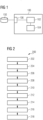
- FIG. 1 illustrates aspects with respect to a device 100.
- the device 100 includes a computing device, e.g. a processor 102, and a memory 104.
- the device 100 also includes an interface 106.
- the processor 102 can load program code from the memory 104 and execute the program code.
- the processor 102 can perform one or more of the following: receive via the at least one interface a plurality of text documents relating to the application domain; determine, based on the plurality of text documents, a plurality of text snippets, wherein a text snippet of the one or more text snippets is a text phrase or word contained in the plurality of text documents which is presumably relevant in the application domain; assign to each of the plurality of text snippets a label of a plurality of labels, the label being a word representing the text snippet; receive via the at least one input unit a plurality of main objects in the application domain; cluster the plurality of text snippets and the plurality of labels based on the plurality of main objects for obtaining a plurality of clusters; cluster, within each cluster, the plurality of text snippets with related information in sub-clusters and assigning the labels of the clustered text snippets to the corresponding sub-cluster; for each attribute,
- FIG. 2 is a flowchart of a method 200 according to various examples.
- the method 200 of FIG. 2 could be executed by the processor 102 upon loading program code from the memory 104.
- the method to 200 comprises method steps 202 to 218.
- the method steps 202 to 218 may be carried out serially or in parallel.
- the (preliminary) results of each step may lead to a revision of previous (or posterior) steps.
- An application domain for example the domain of medical and health care, may be described using a set of labels and text snippets.
- a plurality of text documents relating to the application domain may be provided in step 202.
- Text snippets can be small documents, text sentences or text phrases or even words. More precisely, it may be necessary to find (mostly short) text snippets and labels that describe the different aspects of:
- each label is a word representing the assigned text snippets.
- Each label is a word representing the assigned text snippets.
- unlabeled text like Wikipedia uses text marks to emphasize particular words, e.g. with hyperlinks, italics or bold, which have a good chance of providing good labels for the texts.
- Even without labels there are well-known algorithms for separating the text snippets and labelling, e.g. cluster labeling techniques.
- Main objects available in the application domain are identified in step 208, e.g. based on expert knowledge.
- Main objects may be physical objects (for instance, technical objects, buildings or parts of building), institutions (hospital, museum, etc.), persons (identifiable or not, groups or roles of persons, like doctor, patient, etc.) events (like examination).
- This step can be fully manual, fully automated or machine-assisted.
- main objects may comprise as discussed above (without being restricted to these examples):
- step 210 the texts and labels are organized in clusters, that is, in groups that relate directly to the same main object.
- a plurality of clusters is obtained, wherein each cluster may comprise spatially and/or context related text snippets in one document of the plurality of text documents.
- Clusters may be characterized by sets of representative labels.
- the task of assigning a set of labels to each individual cluster in a document organization is known as cluster labeling. See for instance “ Hanieh Poostchi and Massimo Piccardi. 2018. Cluster Labeling by Word Embeddings and Word-Net's Hypernymy. In Proceedings of Australasian Language Technology Association Workshop, pages 66-70 ".
- a related set of algorithms that can be sued is word embeddings, see for instance " Wang, Yanshan, et al. "A comparison of word embeddings for the biomedical natural language processing.” Journal of biomedical informatics 87 (2016): 12-20 ".
- text snippets and labels are grouped in clusters and each cluster is described by several labels and several text snippets.
- the labels and text snippets may be condensed and aggregated to identify the main objects available in the application domain.
- a hierarchical approach is applied on the set of labels to partition them into a hierarchy of clusters (according to the main objects) and sub-clusters. This can be done using standard clustering algorithms as discussed in “ Hanieh Poostchi and Massimo Piccardi. 2018. Cluster Labeling by Word Embeddings and WordNet's Hypernymy. In Proceedings of Australasian Language Technology Association Workshop, pages 66-70 ".
- a main criterion may be to end up with about 5-12 main objects and correspondingly with 5-12 clusters with main labels that represent the objects, that means one main label for each object, but there may be more labels.
- a manual revision of this step or the manual inclusion of objects could be helpful but is not necessary.
- each attribute is assigned to a sub-clusters based on a similarity between (i) at least one of the attribute name and an attribute description of the attribute, and (ii) the plurality of text snippets and the plurality of labels of the cluster.
- Steps 212 to 214 may comprise two inter-related tasks:
- the steps 202 to 208 may be repeated again within each of the main objects: the text snippets with similar kind of information are grouped in sub-clusters and those sub-clusters are labelled.
- the different attributes of the standard may be assigned according to the labels of the clusters and sub-clusters.
- Supervised machine learning methods can be used to find the best label for a given input sequence, a problem known as sequence labeling problem.
- Well know procedures for this step are Conditional Random Fields (CRFs), Maximum Entropy (ME), and Structural Support Vector Machines (SSVMs).
- CRFs Conditional Random Fields
- ME Maximum Entropy
- SSVMs Structural Support Vector Machines
- a guiding principle may be that attributes of the same type (identifiers, dates, free text) should be as far as possible, be classified inside the same sub-cluster.
- the information about the value type and a short description of the contents of the attributes in the DICOM standard is found in the Registry of DICOM Data Elements (see e.g.
- step 216 for each sub-cluster, a corresponding re-identification risk is assessed based on value types assigned to the attributes and the attribute descriptions of the attributes assigned to the sub-cluster.
- the value types assigned to the attributes may be adapted and for each sub-cluster a corresponding re-identification risk may be re-assessed based on the adapted value types and the attribute descriptions of the attributes assigned to the sub-cluster.
- the goal of this adaption of the value types may be to achieve a suitable number of patients per sub-cluster.
- the above described method enables a grouping of the attributes of all objects in the application domain, so that they can be treated together in a data minimization step, in a way that the re-identification risk can be easily evaluated.
- the method can be performed fully automatically or can be done fully manually, but it is very convenient to have an automatic method that is later evaluated by an expert.
- the procedure comprises several interrelated steps:
- the analysis of the re-identification risk is based on the sub-clusters.
- the risk evaluation is manageable, as the number of sub-clusters is much smaller than the number of attributes, thus eliminating the need to evaluate thousands of single attributes.
- the structured approach helps to make the risk evaluation more transparent.
- the reasoning in the evaluation can be easily comprehended and thus weaknesses will be detected early and avoid data breaches.
- the clusters and sub-clusters can be described such that new attributes can be easily assigned to a sub-cluster; an automated first assignment is possible. Further, assignment can be done by persons not experts in the field of anonymization. If an existing sub-cluster can be used, there is no need to adapt the re-identification risk evaluation. This provides an efficient and robust mechanism for adaption of new attributes for the purpose of data minimization and assessment of appropriate re-identification risk.
Landscapes
- Engineering & Computer Science (AREA)
- Theoretical Computer Science (AREA)
- General Health & Medical Sciences (AREA)
- Health & Medical Sciences (AREA)
- Bioethics (AREA)
- General Engineering & Computer Science (AREA)
- Medical Informatics (AREA)
- General Physics & Mathematics (AREA)
- Software Systems (AREA)
- Physics & Mathematics (AREA)
- Computer Hardware Design (AREA)
- Databases & Information Systems (AREA)
- Computer Security & Cryptography (AREA)
- Artificial Intelligence (AREA)
- Computer Vision & Pattern Recognition (AREA)
- Public Health (AREA)
- Primary Health Care (AREA)
- Epidemiology (AREA)
- Data Mining & Analysis (AREA)
- Evolutionary Computation (AREA)
- Computing Systems (AREA)
- Mathematical Physics (AREA)
- Audiology, Speech & Language Pathology (AREA)
- Computational Linguistics (AREA)
- Information Retrieval, Db Structures And Fs Structures Therefor (AREA)
Claims (15)
- Computerimplementiertes Verfahren zum Beurteilen eines Re-Identifizierungsrisikos von Personen in einer Anwendungsdomäne, in der für jede von einer Vielzahl von Personen ein entsprechender persönlicher Datensatz in einer Datenbank gespeichert ist, wobei jeder persönliche Datensatz einen Satz von Attributen umfasst, wobei jedes Attribut einen entsprechenden Attributnamen und einen entsprechenden Attributwert umfasst, wobei das Verfahren umfasst:- Bereitstellen (202) einer Vielzahl von Textdokumenten, die in Beziehung zu der Anwendungsdomäne stehen;- automatisches Bestimmen (204) einer Vielzahl von Textausschnitten basierend auf der Vielzahl von Textdokumenten, wobei ein Textausschnitt des einen oder der Vielzahl von Textausschnitten eine Textphrase oder ein Wort ist, die bzw. das in der Vielzahl von Textdokumenten enthalten ist und vermutlich in der Anwendungsdomäne relevant ist;- automatisches Zuweisen (206) eines Labels von einer Vielzahl von Labeln zu jedem von der Vielzahl von Textausschnitten, wobei das Label ein Wort ist, das den Textausschnitt repräsentiert;- Bereitstellen (208) einer Vielzahl von Hauptobjekten in der Anwendungsdomäne;- automatisches Clustern (210) der Vielzahl von Textausschnitten und der Vielzahl von Labeln basierend auf der Vielzahl von Hauptobjekten, um eine Vielzahl von Clustern zu erhalten;- innerhalb jedes Clusters automatisches Clustern (212) der Vielzahl von Textausschnitten mit in Beziehung stehenden Informationen zu Unterclustern und Zuweisen der Label der geclusterten Textausschnitte zu dem entsprechenden Untercluster;- für jedes Attribut automatisches Zuweisen (214) des Attributs zu einem der Untercluster basierend auf einer Ähnlichkeit zwischen (i) mindestens einem von dem Attributnamen und einer Attributbeschreibung des Attributs und (ii) der Vielzahl von Textausschnitten und der Vielzahl von Labeln der Untercluster; und- für jeden Untercluster Beurteilen (216) eines entsprechenden Re-Identifizierungsrisikos basierend auf Werttypen, die den Attributen zugewiesen sind, und den Attributbeschreibungen der dem Untercluster zugewiesenen Attribute.
- Verfahren nach Anspruch 1, wobei das Verfahren ferner umfasst:- Anpassen (218) der den Attributen zugewiesenen Werttypen, und für jeden Untercluster erneutes Beurteilen des entsprechenden Re-Identifizierungsrisikos basierend auf den angepassten Werttypen und den Attributbeschreibungen der dem Untercluster zugewiesenen Attribute.
- Verfahren nach Anspruch 1 oder Anspruch 2, wobei der Schritt des Zuweisens (206) des Attributs zu einem der Untercluster umfasst:für jeden Untercluster Bestimmen eines semantischen Ähnlichkeitsmaßes zwischen (i) mindestens einem von dem Attributnamen und der Attributbeschreibung des Attributs und (ii) der Vielzahl von Textausschnitten und der Vielzahl von Labeln des Unterclusters, undZuweisen des Attributs zu dem Untercluster, für den das größte semantische Ähnlichkeitsmaß bestimmt wurde.
- Verfahren nach einem der vorhergehenden Ansprüche, wobei Bestimmen (204) der Textausschnitte Bestimmen von Textausschnitten umfasst, die mit einem der Folgenden in Beziehung stehen:- einer klinischen Domäne, die in der Vielzahl von Textdokumenten abgedeckt wird,- einem Objekt einer klinischen Domäne, die in der Vielzahl von Textdokumenten abgedeckt wird,- einer Aktivität einer klinischen Domäne, die in der Vielzahl von Textdokumenten abgedeckt wird, und- einem Typ von Informationen, der in einer klinischen Domäne zu sammeln ist, die in der Vielzahl von Textdokumenten abgedeckt wird.
- Verfahren nach einem der vorhergehenden Ansprüche, wobei Bestimmen (204) der Textausschnitte und Zuweisen (206) der Label durch Maschinenlerntechniken mit der Vielzahl von Textdokumenten als Eingabe durchgeführt wird.
- Verfahren nach einem der vorhergehenden Ansprüche, wobei die Vielzahl der Hauptobjekte mindestens eines der Folgenden einschließt:Patienteninformationen,Visiten- und Untersuchungsinformationen,Institutsinformationen,Geräteinformationen undAnalyse- und Ergebnisinformationen.
- Verfahren nach einem der vorhergehenden Ansprüche, wobei das Verfahren ferner umfasst:- Entfernen eines bestimmten Unterclusters, wenn diesem bestimmten Untercluster weniger als eine vordefinierte Anzahl von Attributen zugewiesen ist.
- Verfahren nach einem der vorhergehenden Ansprüche, wobei das Verfahren ferner umfasst:- Zusammenführen eines ersten Unterclusters der Untercluster und eines zweiten Unterclusters der Untercluster, wenn ein semantisches Ähnlichkeitsmaß zwischen den Attributen, die dem ersten Untercluster zugewiesen sind, und den Attributen, die dem zweiten Untercluster zugewiesen sind, größer als ein vordefinierter Schwellenwert ist.
- Verfahren nach einem der vorhergehenden Ansprüche, wobei in dem Schritt des Clusterns (212) der Vielzahl von Textausschnitten mit in Beziehung stehenden Informationen zu Unterclustern innerhalb jedes Clusters jeder Untercluster Textausschnitte und Label mit einem semantischen Ähnlichkeitsmaß über einem Schwellenwert umfasst, wobei der Schwellenwert so ausgewählt ist, dass die Anzahl von Unterclustern in einem vordefinierten Zielbereich liegt.
- Verfahren nach Anspruch 9, wobei der vordefinierte Zielbereich 20 bis 100 Untercluster beträgt.
- Verfahren nach einem der vorhergehenden Ansprüche, ferner umfassend:- Beurteilen der Zuweisung der Attribute zu den Unterclustern durch Verifizieren, ob ähnliche Datenminimierungsalgorithmen auf die Attribute anwendbar sind, die einem Untercluster zugewiesen sind.
- Verfahren nach einem der vorhergehenden Ansprüche, wobei Zuweisen (214) der Attribute zu den Unterclustern durch Maschinenlerntechniken mit (i) mindestens einem von dem Attributnamen und der Attributbeschreibung der Attribute und (ii) der Vielzahl von Textausschnitten und der Vielzahl von Labeln der Untercluster als Eingabe durchgeführt wird.
- Einrichtung zum Beurteilen eines Re-Identifikationsrisikos von Personen in einer Anwendungsdomäne, in der für jede von einer Vielzahl von Personen ein entsprechender persönlicher Datensatz in einer Datenbank gespeichert ist, wobei jeder persönliche Datensatz einen Satz von Attributen umfasst, wobei jedes Attribut einen entsprechenden Attributnamen und einen entsprechenden Attributwert umfasst, wobei die Einrichtung umfasst:- mindestens eine Schnittstelle (106) und- eine Rechenvorrichtung (102), wobei die Rechenvorrichtung (102) ausgelegt ist zumEmpfangen einer Vielzahl von Textdokumenten, die mit der Anwendungsdomäne in Beziehung stehen, über die mindestens eine Schnittstelle (106);basierend auf der Vielzahl von Textdokumenten Bestimmen einer Vielzahl von Textausschnitten, wobei ein Textausschnitt des einen oder der mehreren Textausschnitte eine Textphrase oder ein Wort ist, die bzw. das in der Vielzahl von Textdokumenten enthalten ist und vermutlich in der Anwendungsdomäne relevant ist;Zuweisen eines Labels von einer Vielzahl von Labeln, wobei das Label ein Wort ist, das den Textausschnitt repräsentiert, zu jedem von der Vielzahl von Textausschnitten;Empfangen einer Vielzahl von Hauptobjekten in der Anwendungsdomäne über die mindestens eine Eingabeeinheit;Clustern der Vielzahl von Textausschnitten und der Vielzahl von Labeln basierend auf der Vielzahl von Hauptobjekten, um eine Vielzahl von Clustern zu erhalten;Clustern der Vielzahl von Textausschnitten mit in Beziehung stehenden Informationen zu Unterclustern innerhalb jedes Clusters und Zuweisen der Label der geclusterten Textausschnitte zu dem entsprechenden Untercluster;für jedes Attribut Zuweisen des Attributs zu einem von der Vielzahl von Unterclustern basierend auf einer Ähnlichkeit zwischen (i) mindestens einem von dem Attributnamen und einer Attributbeschreibung des Attributs und (ii) der Vielzahl von Textausschnitten und der Vielzahl von Labels der Untercluster undfür jeden Untercluster von der Vielzahl von Unterclustern Beurteilen eines entsprechenden Re-Identifizierungsrisikos basierend auf Werttypen, die den Attributen zugewiesen sind, und den Attributbeschreibungen der dem Untercluster zugewiesenen Attribute.
- Computerprogrammprodukt, umfassend computerlesbaren Programmcode, der ausgelegt ist, um zu bewirken, dass eine Rechenvorrichtung (102) Schritte des Verfahrens nach einem der Ansprüche 1 bis 12 ausführt.
- Computerlesbares Aufzeichnungsmedium, das ausgelegt ist, um ein Computerprogrammprodukt darin zu speichern, das einen computerlesbaren Programmcode umfasst, der ausgelegt ist, um zu bewirken, dass eine Rechenvorrichtung (102) Schritte des Verfahrens nach einem der Ansprüche 1 bis 12 ausführt.
Priority Applications (3)
| Application Number | Priority Date | Filing Date | Title |
|---|---|---|---|
| EP22192421.0A EP4328779B1 (de) | 2022-08-26 | 2022-08-26 | Strukturierung von daten zur beurteilung von datenschutzrisiken |
| CN202311076502.8A CN117633858B (zh) | 2022-08-26 | 2023-08-24 | 为隐私风险评估结构化数据 |
| US18/456,082 US12050718B2 (en) | 2022-08-26 | 2023-08-25 | Structuring data for privacy risks assessments |
Applications Claiming Priority (1)
| Application Number | Priority Date | Filing Date | Title |
|---|---|---|---|
| EP22192421.0A EP4328779B1 (de) | 2022-08-26 | 2022-08-26 | Strukturierung von daten zur beurteilung von datenschutzrisiken |
Publications (3)
| Publication Number | Publication Date |
|---|---|
| EP4328779A1 EP4328779A1 (de) | 2024-02-28 |
| EP4328779C0 EP4328779C0 (de) | 2025-02-26 |
| EP4328779B1 true EP4328779B1 (de) | 2025-02-26 |
Family
ID=83081983
Family Applications (1)
| Application Number | Title | Priority Date | Filing Date |
|---|---|---|---|
| EP22192421.0A Active EP4328779B1 (de) | 2022-08-26 | 2022-08-26 | Strukturierung von daten zur beurteilung von datenschutzrisiken |
Country Status (3)
| Country | Link |
|---|---|
| US (1) | US12050718B2 (de) |
| EP (1) | EP4328779B1 (de) |
| CN (1) | CN117633858B (de) |
Families Citing this family (3)
| Publication number | Priority date | Publication date | Assignee | Title |
|---|---|---|---|---|
| EP4404095B1 (de) * | 2023-01-17 | 2025-11-19 | Siemens Healthineers AG | Anonymisieren von daten |
| US20250231859A1 (en) * | 2024-01-12 | 2025-07-17 | Capital One Services, Llc | Assessing computer code using machine learning |
| US12462059B2 (en) * | 2024-01-16 | 2025-11-04 | Cindy L. Warner | Method for managing data according to one or more privacy protection rules |
Family Cites Families (28)
| Publication number | Priority date | Publication date | Assignee | Title |
|---|---|---|---|---|
| JP4125951B2 (ja) * | 2002-12-25 | 2008-07-30 | 日本電信電話株式会社 | テキスト自動分類方法及び装置並びにプログラム及び記録媒体 |
| US11222052B2 (en) * | 2011-02-22 | 2022-01-11 | Refinitiv Us Organization Llc | Machine learning-based relationship association and related discovery and |
| US9619811B2 (en) * | 2011-12-20 | 2017-04-11 | Bitly, Inc. | Systems and methods for influence of a user on content shared via 7 encoded uniform resource locator (URL) link |
| TW201331770A (zh) * | 2012-01-31 | 2013-08-01 | Ibm | 在資料組中保存隱私的方法與系統 |
| US10176253B2 (en) * | 2015-01-28 | 2019-01-08 | International Business Machines Corporation | Fusion of cluster labeling algorithms by analyzing sub-clusters |
| US10395059B2 (en) * | 2015-07-15 | 2019-08-27 | Privacy Analytics Inc. | System and method to reduce a risk of re-identification of text de-identification tools |
| US9760556B1 (en) * | 2015-12-11 | 2017-09-12 | Palantir Technologies Inc. | Systems and methods for annotating and linking electronic documents |
| US11727195B2 (en) * | 2016-03-18 | 2023-08-15 | Audioeye, Inc. | Modular systems and methods for selectively enabling cloud-based assistive technologies |
| US10572221B2 (en) * | 2016-10-20 | 2020-02-25 | Cortical.Io Ag | Methods and systems for identifying a level of similarity between a plurality of data representations |
| US10817670B2 (en) * | 2017-05-10 | 2020-10-27 | Oracle International Corporation | Enabling chatbots by validating argumentation |
| US12493747B2 (en) * | 2019-02-21 | 2025-12-09 | Charlee.Ai, Inc. | Computerized natural language processing with workflow recommendations using semantic analysis |
| EP3868077A1 (de) * | 2019-08-08 | 2021-08-25 | Google LLC | Niedrigentropie-durchsuchhistorie für quasi-personalisierung von inhalt |
| US11580869B2 (en) * | 2019-09-23 | 2023-02-14 | Revealit Corporation | Computer-implemented interfaces for identifying and revealing selected objects from video |
| US11657307B1 (en) * | 2019-11-27 | 2023-05-23 | Amazon Technologies, Inc. | Data lake-based text generation and data augmentation for machine learning training |
| CN111180024B (zh) * | 2019-12-13 | 2023-03-21 | 深圳平安医疗健康科技服务有限公司 | 基于词频逆文档频率的数据处理方法、装置和计算机设备 |
| US11734937B1 (en) * | 2020-01-02 | 2023-08-22 | Amazon Technologies, Inc. | Creating text classification machine learning models |
| CN111325030A (zh) * | 2020-03-31 | 2020-06-23 | 卓尔智联(武汉)研究院有限公司 | 文本标签构建方法、装置、计算机设备和存储介质 |
| CA3239449A1 (en) * | 2020-07-13 | 2022-01-20 | Ai21 Labs | Controllable reading guides and natural language generation |
| US11734332B2 (en) * | 2020-11-19 | 2023-08-22 | Cortical.Io Ag | Methods and systems for reuse of data item fingerprints in generation of semantic maps |
| IL280057A (en) * | 2021-01-10 | 2022-08-01 | Google Llc | Maintaining privacy in machine learning classification |
| US20230252224A1 (en) * | 2021-01-22 | 2023-08-10 | Bao Tran | Systems and methods for machine content generation |
| US12141185B2 (en) * | 2021-08-26 | 2024-11-12 | Tata Consultancy Services Limited | Systems and methods for generating causal insight summary |
| US20230075884A1 (en) * | 2021-09-06 | 2023-03-09 | Artema Labs, Inc | Systems and Methods for Token Management in Social Media Environments |
| US12361363B2 (en) * | 2021-09-29 | 2025-07-15 | Jpmorgan Chase Bank, N.A. | Method and system for proficiency identification |
| US12430508B2 (en) * | 2021-10-29 | 2025-09-30 | Manyworlds, Inc. | Semantic-based navigation of temporally sequenced content |
| US12386189B2 (en) * | 2021-11-15 | 2025-08-12 | Umajin Inc. | Systems and methods for photometrically extracting 3-dimensional depth |
| US20230186023A1 (en) * | 2021-12-13 | 2023-06-15 | International Business Machines Corporation | Automatically assign term to text documents |
| US20230205824A1 (en) * | 2021-12-23 | 2023-06-29 | Pryon Incorporated | Contextual Clarification and Disambiguation for Question Answering Processes |
-
2022
- 2022-08-26 EP EP22192421.0A patent/EP4328779B1/de active Active
-
2023
- 2023-08-24 CN CN202311076502.8A patent/CN117633858B/zh active Active
- 2023-08-25 US US18/456,082 patent/US12050718B2/en active Active
Also Published As
| Publication number | Publication date |
|---|---|
| US12050718B2 (en) | 2024-07-30 |
| CN117633858B (zh) | 2025-10-28 |
| EP4328779C0 (de) | 2025-02-26 |
| EP4328779A1 (de) | 2024-02-28 |
| US20240070324A1 (en) | 2024-02-29 |
| CN117633858A (zh) | 2024-03-01 |
Similar Documents
| Publication | Publication Date | Title |
|---|---|---|
| US12198085B2 (en) | Artifact detection via a medical scan quality assurance system | |
| EP4328779B1 (de) | Strukturierung von daten zur beurteilung von datenschutzrisiken | |
| Stanfill et al. | Health information management: implications of artificial intelligence on healthcare data and information management | |
| KR101873926B1 (ko) | 빅데이터 기반 의료자문 서비스 제공 방법 | |
| US20220172809A9 (en) | Report generating system and methods for use therewith | |
| US20220037019A1 (en) | Medical scan artifact detection system and methods for use therewith | |
| Feng et al. | Curation of the candid-ptx dataset with free-text reports | |
| US7505867B2 (en) | System and method for predicting medical condition | |
| WO2022036351A1 (en) | Automatic medical scan triaging system and methods for use therewith | |
| Baughan et al. | Sequestration of imaging studies in MIDRC: stratified sampling to balance demographic characteristics of patients in a multi-institutional data commons | |
| Kundu et al. | De-identification of Radiomics data retaining longitudinal temporal information | |
| Graham et al. | Use of natural language processing method to identify regional anesthesia from clinical notes | |
| US20200381108A1 (en) | System and Method for Managing Diagnostic Imaging Costs | |
| US20160162650A1 (en) | Method for automating medical billing | |
| Alamudun et al. | Modeling sequential context effects in diagnostic interpretation of screening mammograms | |
| van Ooijen et al. | Pseudonymization and Anonymization of Radiology Data | |
| EP4379732A1 (de) | System und verfahren zur bereitstellung medizinischer informationen | |
| Gaindric et al. | On some aspects of medical data quality | |
| US20230096820A1 (en) | Methods, systems, and computer program products for automatically processing a clinical record for a patient to detect protected health information (phi) violations | |
| Herman | The Transformational Impact of Artificial Intelligence in Healthcare | |
| Dey et al. | Exploring Patient Decision-Making In Hospital Choice: A Statistical Evaluation Using Exploratory Factor Analysis And Logistic Regression | |
| EP2685407A1 (de) | Computersystem, Verfahren und Programm zur Quantifizierung der Dienstleistungsbereitstellungsqualität | |
| Pinto | Analysis of usage patterns of medical image exams in medical environments | |
| Stanfill et al. | United Audit Systems, Inc., Cincinnati, OH, USA 2 The College of St. Scholastica, Department of Health Informatics and Information Management, Duluth, MN, USA | |
| van Ooijen et al. | and Anonymization of Radiology Data |
Legal Events
| Date | Code | Title | Description |
|---|---|---|---|
| PUAI | Public reference made under article 153(3) epc to a published international application that has entered the european phase |
Free format text: ORIGINAL CODE: 0009012 |
|
| STAA | Information on the status of an ep patent application or granted ep patent |
Free format text: STATUS: THE APPLICATION HAS BEEN PUBLISHED |
|
| AK | Designated contracting states |
Kind code of ref document: A1 Designated state(s): AL AT BE BG CH CY CZ DE DK EE ES FI FR GB GR HR HU IE IS IT LI LT LU LV MC MK MT NL NO PL PT RO RS SE SI SK SM TR |
|
| STAA | Information on the status of an ep patent application or granted ep patent |
Free format text: STATUS: REQUEST FOR EXAMINATION WAS MADE |
|
| 17P | Request for examination filed |
Effective date: 20240805 |
|
| RBV | Designated contracting states (corrected) |
Designated state(s): AL AT BE BG CH CY CZ DE DK EE ES FI FR GB GR HR HU IE IS IT LI LT LU LV MC MK MT NL NO PL PT RO RS SE SI SK SM TR |
|
| GRAP | Despatch of communication of intention to grant a patent |
Free format text: ORIGINAL CODE: EPIDOSNIGR1 |
|
| STAA | Information on the status of an ep patent application or granted ep patent |
Free format text: STATUS: GRANT OF PATENT IS INTENDED |
|
| RIC1 | Information provided on ipc code assigned before grant |
Ipc: G06F 21/62 20130101AFI20240824BHEP |
|
| INTG | Intention to grant announced |
Effective date: 20241002 |
|
| GRAS | Grant fee paid |
Free format text: ORIGINAL CODE: EPIDOSNIGR3 |
|
| GRAA | (expected) grant |
Free format text: ORIGINAL CODE: 0009210 |
|
| STAA | Information on the status of an ep patent application or granted ep patent |
Free format text: STATUS: THE PATENT HAS BEEN GRANTED |
|
| AK | Designated contracting states |
Kind code of ref document: B1 Designated state(s): AL AT BE BG CH CY CZ DE DK EE ES FI FR GB GR HR HU IE IS IT LI LT LU LV MC MK MT NL NO PL PT RO RS SE SI SK SM TR |
|
| REG | Reference to a national code |
Ref country code: GB Ref legal event code: FG4D |
|
| REG | Reference to a national code |
Ref country code: CH Ref legal event code: EP |
|
| REG | Reference to a national code |
Ref country code: DE Ref legal event code: R096 Ref document number: 602022011042 Country of ref document: DE |
|
| REG | Reference to a national code |
Ref country code: IE Ref legal event code: FG4D |
|
| U01 | Request for unitary effect filed |
Effective date: 20250312 |
|
| U07 | Unitary effect registered |
Designated state(s): AT BE BG DE DK EE FI FR IT LT LU LV MT NL PT RO SE SI Effective date: 20250318 |
|
| PG25 | Lapsed in a contracting state [announced via postgrant information from national office to epo] |
Ref country code: RS Free format text: LAPSE BECAUSE OF FAILURE TO SUBMIT A TRANSLATION OF THE DESCRIPTION OR TO PAY THE FEE WITHIN THE PRESCRIBED TIME-LIMIT Effective date: 20250526 |
|
| PG25 | Lapsed in a contracting state [announced via postgrant information from national office to epo] |
Ref country code: PL Free format text: LAPSE BECAUSE OF FAILURE TO SUBMIT A TRANSLATION OF THE DESCRIPTION OR TO PAY THE FEE WITHIN THE PRESCRIBED TIME-LIMIT Effective date: 20250226 |
|
| PG25 | Lapsed in a contracting state [announced via postgrant information from national office to epo] |
Ref country code: ES Free format text: LAPSE BECAUSE OF FAILURE TO SUBMIT A TRANSLATION OF THE DESCRIPTION OR TO PAY THE FEE WITHIN THE PRESCRIBED TIME-LIMIT Effective date: 20250226 |
|
| PG25 | Lapsed in a contracting state [announced via postgrant information from national office to epo] |
Ref country code: NO Free format text: LAPSE BECAUSE OF FAILURE TO SUBMIT A TRANSLATION OF THE DESCRIPTION OR TO PAY THE FEE WITHIN THE PRESCRIBED TIME-LIMIT Effective date: 20250526 Ref country code: IS Free format text: LAPSE BECAUSE OF FAILURE TO SUBMIT A TRANSLATION OF THE DESCRIPTION OR TO PAY THE FEE WITHIN THE PRESCRIBED TIME-LIMIT Effective date: 20250626 |
|
| PG25 | Lapsed in a contracting state [announced via postgrant information from national office to epo] |
Ref country code: HR Free format text: LAPSE BECAUSE OF FAILURE TO SUBMIT A TRANSLATION OF THE DESCRIPTION OR TO PAY THE FEE WITHIN THE PRESCRIBED TIME-LIMIT Effective date: 20250226 |
|
| PG25 | Lapsed in a contracting state [announced via postgrant information from national office to epo] |
Ref country code: GR Free format text: LAPSE BECAUSE OF FAILURE TO SUBMIT A TRANSLATION OF THE DESCRIPTION OR TO PAY THE FEE WITHIN THE PRESCRIBED TIME-LIMIT Effective date: 20250527 |
|
| U20 | Renewal fee for the european patent with unitary effect paid |
Year of fee payment: 4 Effective date: 20250820 |
|
| PG25 | Lapsed in a contracting state [announced via postgrant information from national office to epo] |
Ref country code: SM Free format text: LAPSE BECAUSE OF FAILURE TO SUBMIT A TRANSLATION OF THE DESCRIPTION OR TO PAY THE FEE WITHIN THE PRESCRIBED TIME-LIMIT Effective date: 20250226 |
|
| PG25 | Lapsed in a contracting state [announced via postgrant information from national office to epo] |
Ref country code: CZ Free format text: LAPSE BECAUSE OF FAILURE TO SUBMIT A TRANSLATION OF THE DESCRIPTION OR TO PAY THE FEE WITHIN THE PRESCRIBED TIME-LIMIT Effective date: 20250226 |
|
| PG25 | Lapsed in a contracting state [announced via postgrant information from national office to epo] |
Ref country code: SK Free format text: LAPSE BECAUSE OF FAILURE TO SUBMIT A TRANSLATION OF THE DESCRIPTION OR TO PAY THE FEE WITHIN THE PRESCRIBED TIME-LIMIT Effective date: 20250226 |
|
| PLBE | No opposition filed within time limit |
Free format text: ORIGINAL CODE: 0009261 |
|
| STAA | Information on the status of an ep patent application or granted ep patent |
Free format text: STATUS: NO OPPOSITION FILED WITHIN TIME LIMIT |
|
| 26N | No opposition filed |
Effective date: 20251127 |