EP4323243B1 - Brake cylinder comprising two integrated chambers - Google Patents
Brake cylinder comprising two integrated chambers Download PDFInfo
- Publication number
- EP4323243B1 EP4323243B1 EP22720411.2A EP22720411A EP4323243B1 EP 4323243 B1 EP4323243 B1 EP 4323243B1 EP 22720411 A EP22720411 A EP 22720411A EP 4323243 B1 EP4323243 B1 EP 4323243B1
- Authority
- EP
- European Patent Office
- Prior art keywords
- slave
- master
- cylinder
- piston
- brake
- Prior art date
- Legal status (The legal status is an assumption and is not a legal conclusion. Google has not performed a legal analysis and makes no representation as to the accuracy of the status listed.)
- Active
Links
Images




Classifications
-
- A—HUMAN NECESSITIES
- A63—SPORTS; GAMES; AMUSEMENTS
- A63F—CARD, BOARD, OR ROULETTE GAMES; INDOOR GAMES USING SMALL MOVING PLAYING BODIES; VIDEO GAMES; GAMES NOT OTHERWISE PROVIDED FOR
- A63F13/00—Video games, i.e. games using an electronically generated display having two or more dimensions
- A63F13/20—Input arrangements for video game devices
- A63F13/24—Constructional details thereof, e.g. game controllers with detachable joystick handles
- A63F13/245—Constructional details thereof, e.g. game controllers with detachable joystick handles specially adapted to a particular type of game, e.g. steering wheels
-
- A—HUMAN NECESSITIES
- A63—SPORTS; GAMES; AMUSEMENTS
- A63F—CARD, BOARD, OR ROULETTE GAMES; INDOOR GAMES USING SMALL MOVING PLAYING BODIES; VIDEO GAMES; GAMES NOT OTHERWISE PROVIDED FOR
- A63F13/00—Video games, i.e. games using an electronically generated display having two or more dimensions
- A63F13/20—Input arrangements for video game devices
- A63F13/21—Input arrangements for video game devices characterised by their sensors, purposes or types
- A63F13/218—Input arrangements for video game devices characterised by their sensors, purposes or types using pressure sensors, e.g. generating a signal proportional to the pressure applied by the player
-
- A—HUMAN NECESSITIES
- A63—SPORTS; GAMES; AMUSEMENTS
- A63F—CARD, BOARD, OR ROULETTE GAMES; INDOOR GAMES USING SMALL MOVING PLAYING BODIES; VIDEO GAMES; GAMES NOT OTHERWISE PROVIDED FOR
- A63F13/00—Video games, i.e. games using an electronically generated display having two or more dimensions
- A63F13/25—Output arrangements for video game devices
- A63F13/28—Output arrangements for video game devices responding to control signals received from the game device for affecting ambient conditions, e.g. for vibrating players' seats, activating scent dispensers or affecting temperature or light
- A63F13/285—Generating tactile feedback signals via the game input device, e.g. force feedback
-
- B—PERFORMING OPERATIONS; TRANSPORTING
- B60—VEHICLES IN GENERAL
- B60T—VEHICLE BRAKE CONTROL SYSTEMS OR PARTS THEREOF; BRAKE CONTROL SYSTEMS OR PARTS THEREOF, IN GENERAL; ARRANGEMENT OF BRAKING ELEMENTS ON VEHICLES IN GENERAL; PORTABLE DEVICES FOR PREVENTING UNWANTED MOVEMENT OF VEHICLES; VEHICLE MODIFICATIONS TO FACILITATE COOLING OF BRAKES
- B60T11/00—Transmitting braking action from initiating means to ultimate brake actuator without power assistance or drive or where such assistance or drive is irrelevant
- B60T11/10—Transmitting braking action from initiating means to ultimate brake actuator without power assistance or drive or where such assistance or drive is irrelevant transmitting by fluid means, e.g. hydraulic
- B60T11/16—Master control, e.g. master cylinders
- B60T11/165—Single master cylinders for pressurised systems
-
- B—PERFORMING OPERATIONS; TRANSPORTING
- B60—VEHICLES IN GENERAL
- B60T—VEHICLE BRAKE CONTROL SYSTEMS OR PARTS THEREOF; BRAKE CONTROL SYSTEMS OR PARTS THEREOF, IN GENERAL; ARRANGEMENT OF BRAKING ELEMENTS ON VEHICLES IN GENERAL; PORTABLE DEVICES FOR PREVENTING UNWANTED MOVEMENT OF VEHICLES; VEHICLE MODIFICATIONS TO FACILITATE COOLING OF BRAKES
- B60T7/00—Brake-action initiating means
- B60T7/02—Brake-action initiating means for personal initiation
- B60T7/04—Brake-action initiating means for personal initiation foot actuated
- B60T7/06—Disposition of pedal
-
- F—MECHANICAL ENGINEERING; LIGHTING; HEATING; WEAPONS; BLASTING
- F15—FLUID-PRESSURE ACTUATORS; HYDRAULICS OR PNEUMATICS IN GENERAL
- F15B—SYSTEMS ACTING BY MEANS OF FLUIDS IN GENERAL; FLUID-PRESSURE ACTUATORS, e.g. SERVOMOTORS; DETAILS OF FLUID-PRESSURE SYSTEMS, NOT OTHERWISE PROVIDED FOR
- F15B13/00—Details of servomotor systems ; Valves for servomotor systems
- F15B13/14—Special measures for giving the operating person a "feeling" of the response of the actuated device
-
- F—MECHANICAL ENGINEERING; LIGHTING; HEATING; WEAPONS; BLASTING
- F15—FLUID-PRESSURE ACTUATORS; HYDRAULICS OR PNEUMATICS IN GENERAL
- F15B—SYSTEMS ACTING BY MEANS OF FLUIDS IN GENERAL; FLUID-PRESSURE ACTUATORS, e.g. SERVOMOTORS; DETAILS OF FLUID-PRESSURE SYSTEMS, NOT OTHERWISE PROVIDED FOR
- F15B15/00—Fluid-actuated devices for displacing a member from one position to another; Gearing associated therewith
- F15B15/02—Mechanical layout characterised by the means for converting the movement of the fluid-actuated element into movement of the finally-operated member
-
- F—MECHANICAL ENGINEERING; LIGHTING; HEATING; WEAPONS; BLASTING
- F15—FLUID-PRESSURE ACTUATORS; HYDRAULICS OR PNEUMATICS IN GENERAL
- F15B—SYSTEMS ACTING BY MEANS OF FLUIDS IN GENERAL; FLUID-PRESSURE ACTUATORS, e.g. SERVOMOTORS; DETAILS OF FLUID-PRESSURE SYSTEMS, NOT OTHERWISE PROVIDED FOR
- F15B15/00—Fluid-actuated devices for displacing a member from one position to another; Gearing associated therewith
- F15B15/20—Other details, e.g. assembly with regulating devices
-
- F—MECHANICAL ENGINEERING; LIGHTING; HEATING; WEAPONS; BLASTING
- F15—FLUID-PRESSURE ACTUATORS; HYDRAULICS OR PNEUMATICS IN GENERAL
- F15B—SYSTEMS ACTING BY MEANS OF FLUIDS IN GENERAL; FLUID-PRESSURE ACTUATORS, e.g. SERVOMOTORS; DETAILS OF FLUID-PRESSURE SYSTEMS, NOT OTHERWISE PROVIDED FOR
- F15B19/00—Testing; Calibrating; Fault detection or monitoring; Simulation or modelling of fluid-pressure systems or apparatus not otherwise provided for
- F15B19/007—Simulation or modelling
-
- A—HUMAN NECESSITIES
- A63—SPORTS; GAMES; AMUSEMENTS
- A63F—CARD, BOARD, OR ROULETTE GAMES; INDOOR GAMES USING SMALL MOVING PLAYING BODIES; VIDEO GAMES; GAMES NOT OTHERWISE PROVIDED FOR
- A63F13/00—Video games, i.e. games using an electronically generated display having two or more dimensions
- A63F13/80—Special adaptations for executing a specific game genre or game mode
- A63F13/803—Driving vehicles or craft, e.g. cars, airplanes, ships, robots or tanks
-
- A—HUMAN NECESSITIES
- A63—SPORTS; GAMES; AMUSEMENTS
- A63F—CARD, BOARD, OR ROULETTE GAMES; INDOOR GAMES USING SMALL MOVING PLAYING BODIES; VIDEO GAMES; GAMES NOT OTHERWISE PROVIDED FOR
- A63F2300/00—Features of games using an electronically generated display having two or more dimensions, e.g. on a television screen, showing representations related to the game
- A63F2300/80—Features of games using an electronically generated display having two or more dimensions, e.g. on a television screen, showing representations related to the game specially adapted for executing a specific type of game
- A63F2300/8017—Driving on land or water; Flying
-
- A—HUMAN NECESSITIES
- A63—SPORTS; GAMES; AMUSEMENTS
- A63G—MERRY-GO-ROUNDS; SWINGS; ROCKING-HORSES; CHUTES; SWITCHBACKS; SIMILAR DEVICES FOR PUBLIC AMUSEMENT
- A63G31/00—Amusement arrangements
- A63G31/16—Amusement arrangements creating illusions of travel
-
- F—MECHANICAL ENGINEERING; LIGHTING; HEATING; WEAPONS; BLASTING
- F15—FLUID-PRESSURE ACTUATORS; HYDRAULICS OR PNEUMATICS IN GENERAL
- F15B—SYSTEMS ACTING BY MEANS OF FLUIDS IN GENERAL; FLUID-PRESSURE ACTUATORS, e.g. SERVOMOTORS; DETAILS OF FLUID-PRESSURE SYSTEMS, NOT OTHERWISE PROVIDED FOR
- F15B7/00—Systems in which the movement produced is definitely related to the output of a volumetric pump; Telemotors
- F15B7/06—Details
- F15B7/08—Input units; Master units
-
- G—PHYSICS
- G09—EDUCATION; CRYPTOGRAPHY; DISPLAY; ADVERTISING; SEALS
- G09B—EDUCATIONAL OR DEMONSTRATION APPLIANCES; APPLIANCES FOR TEACHING, OR COMMUNICATING WITH, THE BLIND, DEAF OR MUTE; MODELS; PLANETARIA; GLOBES; MAPS; DIAGRAMS
- G09B9/00—Simulators for teaching or training purposes
- G09B9/02—Simulators for teaching or training purposes for teaching control of vehicles or other craft
- G09B9/04—Simulators for teaching or training purposes for teaching control of vehicles or other craft for teaching control of land vehicles
Definitions
- the present invention relates to a brake cylinder for use in automotive simulators that is both cost effective to produce and provides authentic feedback when in use.
- Automotive simulation systems that simulate the experience of driving a car are used for both video gaming purposes as well as for training purposes for persons involved in driving, such as racing car drivers. To effectively achieve these video gaming and training purposes, the simulation provided by these automotive simulation systems must be able to replicate the experience of a real car with a high degree of accuracy and authenticity. However, designing an automotive simulation system that achieves a high degree of accuracy and authenticity is difficult and expensive to produce.
- the brake cylinder comprising two integrated chambers for an automotive simulation system is directed to overcoming one or more of the problems set forth above and/or other problems of the prior art.
- a brake cylinder according to the invention is defined in claim 1.
- the pressure is the same inside the enclosure.
- the pressure sensor may be located anywhere in connection with the hydraulic system.
- the pressure is the same within the slave cylinder chamber and the master cylinder chamber the pressure sensor physically arranged to be in communication with either of the chambers as it will be in pressure communication with both chambers, and the rest of the brake cylinder, regardless.
- a brake system according to the invention is defined in claim 11.
- the brake cylinder includes a brake cylinder housing with a master cylinder chamber and a slave cylinder chamber.
- the cylinder chambers are separated by the wall defining openings allowing liquid to pass from the master cylinder chamber to the slave cylinder chamber.
- the master cylinder chamber includes the master piston for connecting to a brake pedal (or similar interface), and the master piston when pushed is adapted to force liquid from the master cylinder chamber to the slave cylinder chamber via the openings.
- the slave cylinder chamber comprises a slave piston which is adapted to be pushed when liquid enters from the master cylinder chamber into the slave cylinder chamber.
- the fluid communication between the master cylinder chamber and the slave cylinder chamber may be provided by another channel than the one or more openings in the wall between the chambers.
- a channel may be provided in some other part of the brake cylinder, such as the outer wall, rather than the separating wall.
- Another example is by the presence of an external channel such as a tube extending externally from the brake cylinder, for example running along the outer surface of the brake system or connecting the master cylinder chamber and the slave cylinder chamber via another piece of equipment arranged in the fluid path of the channel.
- External channels thus have the benefit that it may be possible to connect the master cylinder chamber and the slave cylinder chamber via another piece of equipment which may provide additional functionality to the brake system.
- a channel is understood any means of providing fluid communication between the master cylinder and the slave cylinder.
- the channel may be integrated preferably in the form of an opening in the wall between the master cylinder chamber and the slave cylinder chamber.
- the channel may be an external channel, such as a tube.
- the master cylinder chamber and the slave cylinder chamber are housed in a common brake cylinder housing.
- the master cylinder chamber includes the master piston which can affect a fluid which again can affect the slave piston in the slave cylinder chamber.
- the fluid is preferably an oil or another low-compressible liquid used in braking systems.
- the master cylinder chamber and the slave cylinder chamber are mutual connected via at least one opening and preferably the master cylinder chamber and the slave cylinder chamber are substantially parallel.
- the two chambers are only separated by a wall constituting a part of the cylinder chamber wall in both cylinder chambers.
- the master piston is connected with the brake pedal via a master cylinder rod, which can affect movement of the master piston.
- the master piston and the slave piston are arranged such that in their respective cylinder chambers, the slave piston is pushed in an opposite direction of the master piston when the master piston is pushed. In this manner a very compact design of the brake cylinder housing is achieved.
- the master cylinder is arranged with an internal master cylinder rod engaging with a cavity in the master piston and with a master cylinder spring surrounding the internal master cylinder rod at least along the length of the rod.
- the internal master cylinder rod is preferably attached to the master cylinder at the opposite end of the entrance of the master cylinder rod connected with the brake pedal.
- the master cylinder rod extends along the length of the master cylinder chamber into a cavity of the master piston that extends into the master cylinder rod.
- the internal master cylinder rod is surrounded by a master cylinder spring along its entire length and the master cylinder spring continues into the cavity of the master cylinder rod connected with the brake pedal.
- the master cylinder spring may serve to bring the brake pedal back to its initial position after it has been pushed.
- the internal master cylinder rod and the master cylinder spring serve to control the movement of master piston in the master cylinder chamber.
- the slave cylinder is arranged with an internal slave cylinder rod engaging with a cavity in the slave piston and with a slave cylinder spring surrounding the internal slave cylinder rod at least along the length of the rod.
- the internal slave cylinder rod is preferably attached to the slave cylinder at the end toward which the slave piston is moved when the brake is depressed.
- the slave piston element is connected with a damping system via a slave cylinder rod.
- the internal slave cylinder rod is surrounded by a slave cylinder spring which serves to bring the slave piston back to an unloaded position after the brake has been released.
- the internal slave cylinder rod and the slave cylinder spring serve to control the movement of slave piston in the slave cylinder chamber.
- the slave cylinder spring and the internal slave cylinder rod continue into at least a part of the cavity in the slave piston.
- the slave cylinder spring also continues into a cavity in the slave cylinder rod.
- the slave cylinder spring may serve to control the movement of the slave cylinder rod.
- the unloaded position is considered the default position of the brake cylinder system as well as for the brake pedal; this can also be considered the released orientation of the system.
- the terms default position, unloaded position and released orientation will be used interchangeably throughout the application.
- This unloaded default position is also considered the first position of the system, hence when the system is in the unloaded position or default position of the system, the master piston is in the first master position and the slave cylinder is in the first slave position.
- the master cylinder chamber preferably includes a stop for stopping the master piston.
- the stop is preferably mounted at the opposite end of the entrance of the master cylinder rod.
- the stop is mounted at the same end in the master cylinder chamber as the internal master rod.
- the stop surrounds the spring and the internal rod along its length.
- the end wall of the master cylinder chamber may function as a stop for the master cylinder piston element and no additional master cylinder stop member is necessary in the master cylinder chamber.
- the master piston is in contact the stop or the end wall, i.e. via contact between the piston element and the stop or end wall, the master piston is in the second master position.
- the slave cylinder chamber preferably includes a stop for stopping the slave piston.
- this stop is mounted in the opposite end of where the internal slave rod is mounted. The stop serves to stop the movement of the slave piston in the direction of the dampening device.
- the end wall of the slave cylinder chamber may function as a stop for the slave cylinder piston element and no additional slave cylinder stop member is necessary in the slave cylinder chamber.
- the position where the slave piston is in contact with the stop, i.e. the slave cylinder stop member, or the end wall or the movement of the slave cylinder is stopped by the mechanical contact between a mechanical stop of a block or damper piston connected to the slave cylinder rod, the slave piston is in the second slave position.
- in front of may be used, e.g. that fluid is in front of the master cylinder piston element.
- in front of/the front is understood the end towards which the master cylinder piston element moves when the pedal is being depressed. This front end is considered the first end of the master cylinder chamber.
- the cylinder chambers are separated by a wall with openings that allow fluid to pass from the master cylinder chamber to the slave cylinder chamber (the fluid can also pass through these openings from the slave cylinder chamber back into the master cylinder chamber).
- the wall includes only one opening which may be located both (i) next to the stop for stopping the master piston in the master cylinder chamber and (ii) next to the stop for stopping the slave piston the slave cylinder chamber. In this configuration, the opening is not blocked by the pistons, and the fluid may flow freely between the master cylinder chamber and the slave cylinder chamber (thereby, improving the operation of the brake cylinder).
- Both the master piston and the slave piston may be configured with recesses or rims having reduced cross section to allow flow of fluid to and from the opening.
- the one or more openings will similarly be located both (i) next to the end wall at the first end of the master cylinder chamber and (ii) next to the end wall of the first end of the slave cylinder chamber.
- the opening is not blocked by the pistons, and the fluid may flow freely between the master cylinder chamber and the slave cylinder chamber (thereby, improving the operation of the brake cylinder).
- Both the master piston and the slave piston may be configured with recesses or rims having reduced cross section to allow flow of fluid to and from the opening.
- the inlet and outlet of this channel in the master cylinder chamber and slave cylinder chamber respectively is located in the same manner as described for the location of one or more openings. That is to say that the channel inlet will be next to the master cylinder stop member or end wall at the first end of the master cylinder chamber, while the outlet will be next to the slave cylinder stop member or end wall at the first end of the slave cylinder chamber.
- the dampening device preferably includes a damper in a damper housing which cooperates with a damper piston physically connected with the slave cylinder rod.
- the damper piston is pushed towards the damper by the slave cylinder rod and applies pressure on the damper.
- the damper piston is a specific variant of a block element in contact with the slave cylinder piston, which is arranged to push against the damper rather than drawing on the damper, but both components have the same effect in that they are means for transferring force from the slave cylinder to the damper.
- the damper is capable of deforming when pressure is applied, thereby providing a dampening effect.
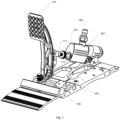
- Fig. 1 illustrates an embodiment of brake system for use in an automotive simulation system such as a racing video game simulator or a professional racecar driver training simulator.
- the brake system includes a brake pedal 101 connected to a brake cylinder 201.
- the brake pedal 101 and brake cylinder 201 are mounted to a base or support surface 103.
- the brake pedal 101 is mounted via a pivot axis 105 on the base 103 having a large surface area and weight to ensure that the brake system is supported in a stable manner.
- the brake system is configured to communicate with a computer system running car simulation software. Communication between the brake system and the computer system could be via wires such as USB or via wireless communication such as Bluetooth. The communication between the brake system and the computer system is preferably in real-time to ensure that any actions on the brake pedal are immediately communicated to the car simulation software to minimize lag time and provide a realistic feel for the user using the simulation software.
- a master cylinder piston 107 is pushed into the brake cylinder 201 and the brake pressure is then measured and communicated back to the computer system via the sensor 109.
- the sensor 109 is able to detect when, how much, and how fast pressure on the brake pedal is changed.
- the brake cylinder 201 is connected to the brake pedal 101 by a rod clevis 207 at the end of the piston rod 205 of the master cylinder piston 107 which grips around a mount plate 113 on the arm of the brake pedal 101.
- a rod clevis 207 is a specific example embodiment of a brake cylinder connector, and the two terms will be used interchangeably and uses the same reference number 207.
- Figure 2A and 2B illustrate external and internal components of the brake cylinder 201.
- the brake cylinder 201 includes a brake cylinder housing 203 and an attachment opening 202 which can be used for mounting the brake cylinder 201 to a support system of the brake system such as the base 103.
- a pressure sensor 204 is mounted at the top of the brake cylinder 201 for measuring pressure within the brake cylinder 201 and converting a pressure measurement into an electronic signal that can be sent to a processor of the automotive simulation system and be interpreted using the simulator software run on the processor to indicate the amount braking that should be applied to a vehicle simulated by the automotive simulation system (the electronic signal could be communicated either wireless or via wires).
- a master cylinder piston 107 includes a master cylinder rod 205, a brake pedal connector 207, and a brake arm adjuster 209.
- the brake cylinder 201 is connected to the brake pedal 101 via the brake pedal connector 207 which may be in the form of, for example, a rod clevis.
- the brake arm adjuster 209 may be used for adjusting the slack in the pedal by increasing or decreasing the distance between the rod 205 and the connector 207 and for adjusting the position of the pedal 101 when not being pressed.
- a master cylinder rod guide 211 is mounted inside the housing 203 for guiding the master cylinder rod 205 of the master cylinder piston 107 and allowing movement of the rod 205 only in an axial direction.
- the end of the master cylinder rod 205 disposed within the housing 203 includes a piston element 213 with a seal 242.
- the piston element 213 can move back and forth inside a master cylinder chamber 215 where a fluid (e.g., oil or other liquid) is present.
- the movement of the master cylinder piston element 213 is limited by the rod guide 211 and the stop member 240 at the opposite end of the master cylinder housing 203.
- the stop member 240 is to ensure that fluid cannot enter from the slave cylinder chamber 221 and behind the piston element 213.
- the stop member 240 should therefore have a length ensuring that the master piston 107 cannot be pressed to pass the openings 219 between master and slave chambers 215, 211.
- a master cylinder spring 217 is also present (where one end is inserted into a hollow end of the master cylinder rod 205 and the opposite end is inserted into the hollow stop member 240) that, when compressed, applies pressure between the stop member 240 and the rod 205 ensuring that the master cylinder piston element 213 moves back to a position associated with a released orientation when pressure on the pedal 101 has been released.
- the master cylinder spring 217 is mounted on an internal master cylinder rod guide 218 to keep the master cylinder spring 217 in place.
- the cylinder 201 additionally includes a slave chamber 221.
- the slave chamber 221 and the master cylinder chamber 215 are elongated cavities that are disposed substantially parallel to each other and are separated from each other by a chamber dividing wall 220.
- One or more openings 219 are disposed within the wall 220 to allow for fluid communication between the master cylinder chamber 215 and the slave chamber 221.
- the fluid in the chamber 215 is forced through the one or more openings 219 in the wall 220 between the two chambers 215, 221 and into the slave cylinder chamber 221.
- Fluid entering the chamber 221 via the one or more openings 219 increases the pressure within the chamber 221 and pushes a slave cylinder piston element 223 connected to a slave piston rod 230 in a direction opposite that of the master cylinder piston element 213.
- the dimensioning and number of openings 219 should be considered to ensure a sufficient flow between the two chambers 215, 221 when fluid is pressed from the master chamber 215 to the slave chamber 221.
- two openings 219 each having a diameter of around 1.5 mm may be used, but these openings 219 may be larger or smaller depending on the viscosity of the fluid.
- the piston seal 242, 244 for each of the master cylinder piston element 213 and the slave cylinder piston element 223 may be a u gasket.
- the lips of the u gaskets 242, 244 are pressed towards the inner walls of the cylinder chambers 215, 221.
- the u gasket 244 of the slave piston element 223 is mounted opposite the u gasket 242 of the master piston element 213, since in the master cylinder chamber 215 the fluid is in front of the piston element 213, whereas in the slave cylinder chamber 221 fluid is between the slave piston element 223 and the slave rod guide 231.
- the end of the slave piston rod 230 distal to the master cylinder piston 107 is connected to an end bolt 226 and a block element 225 via windings at the end of the slave cylinder rod 230.
- the block element 225 is dragged towards and into a brake cylinder damper housing 227 and moves with the piston 223 back and forth based on pressure provided by the fluid entering the slave cylinder chamber 221.
- a dampener 229 is positioned between the block element 225 and an inner wall of the housing 227.
- the dampener 229 is made from flexible, elastic material (e.g., rubber, silicone, etc.), where the flexibility of the elastic material influences the perceived softness of the pedal 101 in use. For example, a dampener 229 with greater flexibility will result in the pedal 101 being perceived as softer than when a stiffer dampener 229 with less flexibility is used.
- a threaded nut may be included on the slave piston 223 next to the block element 225 on the opposite side of the dampener 229. Manipulation of the threaded nut may be used to adjust the stiffness of the brake pedal 101.
- the block element 225 has an edge limiting how far the block element can move into the damper house and thereby how far the brake pedal can be pressed.
- the block element 225 is arranged between the threaded nut 226 and the dampener 229.
- This threaded nut 226 is also called the end bolt 226.
- the arrangement of the end bolt 226 affects the default position of the block element 225 as screwing the bolt further onto the windings of the slave cylinder rod 230 such that the end bolt 226 is closer to the dampener 229 forces the end block 225 placed between the end bolt 226 and the dampener 229 towards the dampener 229.
- the travel range is how far the pedal can be pressed before the mechanical stop 260 between the extending edge of the block element 225 and the damper housing 227 is engaged such that the further movement of the block element 225 is hindered whereafter the second phase of the braking process begins.
- the dampener 229 is being deformed and the user needs to apply force to the brake pedal 101 to cause this deformation, this will give the user a feeling of resistance in the pedal.
- the edge of the block element is in contact with the damper housing 227 the resistance is no longer caused by the deformation of the dampener 229, but will be the hydraulic pressure related to compression of the fluid in the brake cylinder 201.
- the arrangement which allows the block element 225 to travel a distance before contacting the damper housing 227 gives the user a more realistic brake feel with two stages having significantly different resistance, i.e. requiring significantly different force to be applied by the user to the pedal. In the second phase the user will not feel the pedal move even as the pressure rises and detects increased braking force.
- a slave rod guide 231 is mounted inside the housing 203 for guiding the rod of the slave piston 223 and allowing movement of the piston 223 in only the axial direction.
- the slave cylinder piston 223 can move back and forth inside the slave cylinder chamber 221 where the fluid (e.g., oil or other liquid) is present.
- a slave cylinder spring 233 is also present that, when compressed, applies pressure between an inner wall of the chamber 221 and the piston 223 ensuring that the slave cylinder piston 223 moves back to a position associated with the released orientation when pressure on the pedal 101 has been released.
- the slave cylinder spring 233 is mounted on the internal slave cylinder rod guide 234 to keep the slave cylinder spring 233 in place.
- the pressure sensor 204 is connected to and is in fluid connection with the chamber 221 and is configured to measure the pressure in the chamber 221 between the slave cylinder piston 223 and the slave rod guide 231.
- the pressure sensor 204 may be arranged to be in fluid connection with either the slave cylinder chamber 221 or the master cylinder chamber 215 at any position along the cylinder housing 203. In yet other embodiments the pressure sensor 204 mare be arranged spaced away from the cylinder housing 203 while still being in fluid connection with either the master cylinder chamber 215 or the slave cylinder chamber 221, e.g. by connection with a tube.
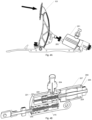
- Figs. 3A and 3B illustrates the brake system in the released orientation, where the pedal 101 is not pressed.
- the pedal 101 is connected to the master piston rod 205 but there is no pressure on the pedal 101. Consequently, since no pressure is applied to the master piston rod 205 from the pedal 101, the fluid remains in the master cylinder chamber 215 and does not pass through the holes 219 and into the slave cylinder chamber 221. Accordingly, since no fluid is added to the chamber 221 from the chamber 215, the pressure sensor 204 measures no increased level of pressure. Because the pressure sensor 204 does not measure an increased level of pressure in the chamber 221, the processor of the automotive simulation system does not receive any signal indicative of braking.
- Figs. 4A and 4B illustrates the brake system in a depressed orientation, where the pedal 101 is pressed.
- the pedal 101 is connected to the master cylinder piston rod 205 and there is pressure on the pedal 101 (illustrated by black arrow). Consequently, since pressure is applied to the master piston rod 205 from the pedal 101, the fluid is pushed from the master cylinder chamber 215, through the holes 219, and into the slave cylinder chamber 221. Accordingly, since fluid has been added to the chamber 221 from the chamber 215, the slave cylinder piston 223 is pushed and an increased pressure of fluid in the area 221 in front of the slave cylinder piston 223 is measured by the pressure sensor 204.
- the slave piston 223 By means of the slave cylinder rod 230, when the slave piston 223 is pushed, it drags the block element 225 into the damper housing 227 and applies compressive pressure onto the dampener 229.
- the increased pressure causes the dampener 229 to deform which affects the movement of the slave cylinder piston 223 which again affects the entire brake system providing a feeling corresponding the feeling of a brake system in a vehicle.
- the deformation of the dampener 229 is an elastic deformation, and when the pressure is released, the dampener will regain its initial shape (i.e., the shape of the dampener 229 in an unloaded condition). Further the pedal 101 can be pushed no further due to the edge of the block element 225 being blocked by the edge of the damper housing 227.
- Fig. 5A illustrates a brake cylinder 201 for use with a pedal 101 of a brake system for driving simulation according to the invention.
- the brake cylinder 201 comprises a cylinder housing 203, an attachment opening 202 for connecting the brake cylinder 201 to a support surface 103, and a master cylinder rod 205 for connecting the brake cylinder 201 to a brake pedal 101 via a brake pedal connector 207.
- the master cylinder rod 205 is connected to the brake pedal connector 207 via a brake arm adjuster 209 which has a winding allowing for the adjustment of the distance 206 between the brake cylinder rod 205 and the brake pedal connector 207.
- the brake cylinder rod 205 and brake pedal connector 207 may be connected by other means such as but not limited to the master cylinder rod 205 and the brake pedal connector 207 being integrated, being welded together or releasably connected through winding or being screwed together by a transverse screw and bolt.
- Fig. 5B illustrates a preferred embodiment having a solid separating wall 220, separating the master cylinder chamber 15 and the slave cylinder chamber 221, by solid is understood that the wall does not have one or more holes or other breaches allowing fluid communication between the chambers 115,221 through the separating wall 220.
- the master cylinder chamber 215 and the slave cylinder chamber 221 are in stead in fluid communication through an external channel connected to the chambers via external chamber connectors (not visible in the cross-sectional view).
- the first external channel connector connects the external channel to the master cylinder chamber 215, near the first end of the master cylinder chamber 215', that is between the master cylinder piston element 213 and the end wall at the first end of the master cylinder chamber 215'.
- the second external channel connector connects the external channel to the slave cylinder chamber 221 near the first end of the slave cylinder chamber 221, i.e. between the slave piston element 223 and the damper housing 227.
- the embodiment illustrated in Fig. 5B further differ from the previously illustrated embodiments in that the master cylinder rod 205 is solid and that the piston element 213 is releasably connected to the master cylinder rod 205 by means of an external winding on the first end of the master cylinder rod 205' and an internal winding in a recess of the master cylinder piston element 213.
- the master cylinder rod 205 may comprise a recess with internal winding which may connect to an external winding on a protrusion on the the master cylinder piston element 213.
- the master cylinder rod 205 may be connected to the master cylinder piston element 213 by other known means such as a press fit or gluing.
- the slave cylinder piston element 223 is similarly connected to the slave cylinder rod 230 by the second end of the slave cylinder rod 230" extending into a hollow of the slave cylinder piston element 223.
- the slave cylinder rod 230 will further be connected to the slave cylinder piston by a winding or by other known means of connection.
- a master cylinder spring 217 is arranged between the first end of the master cylinder chamber 115' and the master cylinder piston element 213.
- the first end of the master cylinder spring 217' is arranged to contact and be guided by a master cylinder stop member 240 arranged at the first end of the master cylinder chamber 215'.
- the master cylinder spring 217 may be guided by the master cylinder stop member 240 by being arranged such that at least part of the first end of the master cylinder spring 217' encircles the master cylinder stop member 240, in such an embodiment the master cylinder stop member 240 may be solid.
- the master cylinder spring 217 may be guided by the master cylinder stop member 240 by having at least part of the first end of the master cylinder spring 217' arranged inside a hollow of the master cylinder stop member 204.
- the second end of the master cylinder spring 217" is arrange to contact the master cylinder piston element 213.
- at least part of the second end of the master cylinder spring 217" is arranged to encircle at least part of the master cylinder piston element 213 such that the master cylinder piston element 213 may act as a guide for the master cylinder spring 217.
- something acting as a guide for a spring is understood that it limits the movement of the spring, such that the end of the spring does not significantly change position in the direction perpendicular to the axis of the chamber in which the spring is arranged.
- the first end of the master cylinder spring 217 is arranged to contact the end wall at the first end of the master cylinder chamber 217'.
- the first end of the master cylinder spring 217' may be mounted in or otherwise connected to the end wall at the first end of the master cylinder chamber 217'.
- the slave cylinder spring 233 may similarly be mounted between the slave cylinder piston element 223 and the end wall at the second end of the slave cylinder chamber 221" or a slave cylinder stop element 245 mounted at said end wall.
- the slave cylinder spring 233 is mounted such that the first end of the slave cylinder spring 233' is guided by the slave cylinder piston element 223, e.g. by at least part of the first end of the slave cylinder spring 233' encircling at least part of the slave cylinder piston element 223.
- the second end of the slave cylinder spring element 221" is guided by a slave cylinder stop element 245, e.g.
- the second end of the slave cylinder spring element 221" being arranged to encircle at least a part of the slave cylinder stop element 245.
- the second end of the slave cylinder chamber spring 233" is mounted in or otherwise connected to the end wall at the second end of the slave cylinder chamber 221".
- the brake cylinder 201 of Figs. 5A-5B function by the exchange of fluid between the master cylinder chamber 215 and the slave cylinder chamber 221 and the increased pressure within the brake cylinder 201.
- the springs 217, 233 maintain the same functionality as does the differently mounted piston elements 213,223. Namely, when a user applies pressure to the pedal, pressure is transferred via the master cylinder rod 205 to the master cylinder piston element 213.
- the master cylinder piston element 213 compresses the master cylinder spring 217 and displaces fluid from the master cylinder chamber 215 through an external channel and into the slave cylinder chamber 221.
- the addition of the displaced fluid in turn moves the slave cylinder piston element 223 in direction of the second end of the slave cylinder chamber 221" compressing the slave cylinder spring 233.
- the slave cylinder piston element 223 being connected to the slave cylinder rod 230 causes movement of the slave cylinder rod 230 which in turn moves the block element 225 towards the dampener 229 causing elastic deformation of the damper 229.
- the action of the users applying pressure to the pedal causes an increase of pressure within the brake cylinder 201, which can be detected by a pressure sensor, which in turn can send a signal to the processing unit of a driving simulator.
- a pressure sensor which in turn can send a signal to the processing unit of a driving simulator.
- the spring arrangement illustrated in the embodiment of Fig. 5B may be used in a an embodiment having one or more holes in the separating wall 220, or either or both piston elements may be mounted to the master cylinder rod and/or the slave cylinder rod respectively in an embodiment having the spring mounted inside the hollow of the rod.
- the arrangement of rods, piston elements and springs are the same in both the master cylinder chamber 215 and the slave cylinder chamber 221, but in alternative variants the arrangement may differ in the two chambers.
- the master cylinder rod 205 and the slave cylinder rod 230 are arranged substantially parallel and at the same time staggered such that the slave cylinder rod 230 extends further towards the front than the master cylinder rod 205 does.
- the damper housing is arranged at the front end of the brake cylinder 201, i.e. connected to and extending from the first end of the slave cylinder chamber 221'.
- Such an embodiment may be considered a pull configuration as the depression of the pedal leads to the block element attached to the slave cylinder rod 230 being pulled towards the dampener 229.
- Figs. 6 and 7 illustrate alternative embodiments of the brake system which is based on the same working principle but arranged in a push configuration, wherein depression of the brake pedal 101 and the displacement of fluid from the master cylinder chamber 215 to the slave cylinder chamber 221 leads to the slave cylinder rod 203 pushing the block element towards the dampener 229.
- the damper piston which may be seen as equivalent to the block element is positioned on the side of the dampener 229 facing the slave cylinder piston element 223.
- damper housing may be arranged at the second end of the slave cylinder chamber 221", i.e. adjacent to the entry of the master cylinder rod 205 into the second end of the master cylinder chamber 215".
- a brake cylinder 201 may be used with a pedal 101 in the same manner as disclosed for the previous embodiments by replacing the brake cylinder 201 of the previous embodiment.
- the push configuration brake cylinder 201 it comprises an attachment opening 202 for releasably connecting the brake cylinder 201 to a support surface 103 such as a mount plate 113 and a brake pedal connector 207, such as a rod clevis, for connecting the brake cylinder 201 to a mount plate 113 of the brake pedal 101.
- Fig. 6 is an external view of a brake cylinder housing 203 having damper housing 227 arranged at the opposite end of the attachment opening 202.
- the illustrated embodiment comprises a first external channel connector and a second external channel connector for connecting an external channel for bringing a master cylinder chamber and a slave cylinder chamber in fluid communication.
- a pressure sensor may be connected in the external channel rather than directly to the cylinder housing 203.
- the pressure sensor may be connected directly to a chamber through the cylinder housing 203. It could for example be through an external connector 243 made in the housing for that purpose.
- the external connector 243 is in Fig. 6 shown as being connected to the slave cylinder chamber, the pressure sensor is not restricted to be connected to any particular chamber or in any particular position as the pressure in the closed hydraulic system remains the same through the system and may be measured at any point.
- Fig. 7 is a schematic illustration of the internal component of an alternative embodiment of the brake cylinder 201.
- the master cylinder rod 205 may be connected to the piston element 213, for example by means of threading allowing the piston element 213 to be releasably connected with the master cylinder rod 205 by screwing the piston element 213 onto the master cylinder rod 205.
- the master cylinder rod 205 may be abutting the piston element 213 and being arranged such that they may be in contact.
- the piston element 213 is adapted to move back and forth inside the master cylinder chamber 215 along the direction of the longitudinal axis of the master cylinder chamber 215.
- the master cylinder rod 205 is arranged such that the movement of the master cylinder rod affects the movement of the piston element 213.
- a stop member 240 may be located at the first end of the master cylinder chamber 215', i.e. the end of the master cylinder chamber 215 opposite the end at which the master cylinder rod 205 enters the master cylinder chamber 215 which in turn is the second end of the master cylinder chamber 215".
- the movement of the master cylinder piston element 213 is limited by the rod guide 211 and either the stop member 240 or the first end of the master cylinder chamber 215'.
- the rod guide 211 limits the movement of the master cylinder rod 205 to be along the axis of the master cylinder chamber 215. In embodiments having the stop member 240, it limits how far the master cylinder piston element 213 can travel inside the master cylinder chamber 215.
- the stop element 240 is adapted to ensure that the master cylinder piston element cannot move past the one or more openings 219 such that fluid from the slave cylinder chamber 221 cannot enter the master cylinder chamber 215 behind the master cylinder piston element 213. This is achieved by the length of the stop member 240 being such that it ensures that the master cylinder piston element 213 cannot be extended past the opening 219 between the master and the slave chambers 215, 211. In embodiments having no stop member 240, the distance which the master cylinder piston element 213 can travel is limited by the first end of the master cylinder chamber 215' and the dimensions of the piston element 213 itself, in particular the length of the piston element 213.
- the placement of the one or more openings 219 and the length of the piston element 213 are such that the entirety of the master cylinder piston element 213 cannot be extended past the opening 219 between the master and the slave chambers 215, 211 such that fluid cannot enter the space between the second end of the master cylinder chamber 215" and the master cylinder piston element 213.
- a master cylinder spring 217 is arranged within the master cylinder chamber 215.
- a first end of the master cylinder spring 217' is disposed at the first end of the master cylinder chamber 215'.
- the first end of the master cylinder spring 217' may be arranged within a hollow opening of the stop member 240.
- the embodiment having a stopper member 240 arranged at the first end of the master cylinder chamber 215' the first end of the master cylinder spring 217' may be arranged such that the first end of the master cylinder spring 217' encircles the master cylinder stopper member 240.
- the first end of the master cylinder spring 217' is preferably at least partially arranged within a cavity in the end wall of the first end of the master cylinder chamber 215'.
- the first end of the master cylinder spring 217' is arranged to abut the end wall at the first end of the master cylinder chamber 215'.
- the second end of the master cylinder spring 217" opposite of the first end of the master cylinder spring 217' is disposed within a hollow opening of the master cylinder rod 205 such that at least part of the master cylinder spring 217 extends through the body of the master cylinder piston element 213.
- the master cylinder rod 205 is solid and the second end of the master cylinder spring 217" is guided by the piston element 213.
- the second end of the master cylinder spring 217" may be arranged within a hollow section of the master cylinder piston element 213 such that at least part of the master cylinder spring 217 is encircled by part of the master cylinder piston element 213.
- the second end of the master cylinder spring 217" may abut the first end of the master cylinder rod 205' if a central channel extends throughout the body of the piston element 213, such a channel may for example be equipped with internal threading for connecting the piston element 213 to the master cylinder rod 205.
- the second end of the master cylinder spring 217" may be disposed to surround part of the master cylinder piston element 213.
- the master cylinder piston element 213 guides the second end of the master cylinder spring 217" by restricting its movement in the radial direction within the master cylinder chamber 215, that is in any other direction than the axial direction of the master cylinder chamber 215.
- the master cylinder spring 217 When force is applied to the master cylinder rod 205, i.e. when a user applies pressure to the pedal, such that the master cylinder rod 205 moves further into the master cylinder chamber 215, i.e. in the direction from the second end of the master cylinder chamber 215" towards the first end of the master cylinder chamber 215', the master cylinder spring 217 is compressed. The forces of the compressed master cylinder spring 217 applies force to the points of contact at the first 217' and second end of the master cylinder spring 217". At the first end of the master cylinder spring 217' pressure is applied to the contact point at the end of the master cylinder chamber 215', i.e. the stop member 240 or the end wall at the first end of the master cylinder chamber 215'.
- the force from the master cylinder spring 217 acts upon the master cylinder rod 205 to move it back to a position associated with a default position of the master cylinder rod 205 associated with no pressure being applied by a user to the pedal 101.
- the default position is understood the unloaded position of the brake and brake cylinder.
- the master cylinder spring 217 may be mounted around an internal master cylinder rod guide 218 to keep the master cylinder spring 217 arranged as intended. In other embodiments the master cylinder spring 217 will be guided to stay in the intended position by the master cylinder piston element 213 and/or the master cylinder stop member 240 and/or a cavity in the end wall of the first end of the master cylinder chamber 217'.
- the slave cylinder chamber 221 comprises a slave cylinder rod guide 231 mounted inside the slave cylinder chamber 221 for guiding a slave cylinder rod 230 and allowing movement of the slave cylinder rod 230 only in an axial direction substantially parallel to the axis of movement of the master cylinder rod 205. At least part of the slave cylinder rod 230 is disposed within the slave cylinder chamber 221.
- the slave cylinder rod 230 is arranged such that the first end of the slave cylinder rod 230' contacts a slave cylinder piston element 223.
- the slave cylinder rod 230 may comprise an integrated slave cylinder piston element 223 at the first end of the slave cylinder rod 230'.
- the first end of the slave cylinder rod 230' may be releasably connected to the slave cylinder piston element 223 for example by both components comprising threading such that they may be releasably connected by screwing the slave cylinder piston element 223 onto the first end of the slave cylinder rod 230'.
- the slave cylinder rod 230 is arranged such that the first end of the slave cylinder rod 230' abuts and is in contact with the slave cylinder piston element 223.
- the slave cylinder piston element 223 has a slave cylinder seal 244 arranged around the body of the slave cylinder piston element 223 to create a fluid tight seal between the volumes of the slave cylinder chamber separated by the cylinder piston element 223.
- the slave cylinder piston element 223 is adapted to move back and forth inside the slave cylinder chamber 221 along the direction of the longitudinal axis of the slave cylinder chamber 221.
- a slave cylinder stop member 245 may be located at the closed first end of the slave cylinder chamber 221'. Alternatively the slave cylinder piston may stop against the end wall of the first end of the slave cylinder chamber 221'.
- the movement of the slave cylinder piston element 223 within the slave cylinder chamber 221 along the axis of the slave cylinder chamber 221 is at the second end of the slave cylinder chamber 221" limited by the rod guide 231 and at the first end of the slave cylinder chamber 221' it is limited either by the slave cylinder stop member 245 or alternatively by the end of the slave cylinder chamber.
- the slave cylinder rod guide 231 optionally in combination with slave cylinder spring 233 limits the movement of the slave cylinder rod 230 to be along the axis of the slave cylinder chamber 221.
- the slave cylinder piston element 223 is arranged such that it cannot translate past the one or more openings 219 such that fluid from the master cylinder chamber 215 cannot enter the slave cylinder chamber 221 behind the slave cylinder piston element 223, i.e. on the side of the slave cylinder piston element 223 closest to the second end of the slave cylinder chamber 221".
- this is achieved by the length of the slave cylinder stop member 245 and the dimensions of the slave cylinder piston element 223 being such that it ensures that the slave cylinder piston element 223 cannot be extended past the opening 219 between the master and the slave chambers 215, 211.
- the travel range of the slave cylinder piston element 223 is limited by the end wall at the first end of the slave cylinder chamber 221', it is achieved by the dimensions, in particular the length of the slave cylinder piston element 223 along the axis of the slave cylinder chamber, being adapted to cover all one or more holes 219 when the slave cylinder piston element 223 contacts the end wall at the first end of the slave cylinder chamber 221'.
- the dimensions of the master and the slave stop members 240,245 as well as the dimensions of the master and the slave piston element 213, 223 are the same.
- the dimensions of the components of the master cylinder chamber 215 and the slave cylinder chamber 221 may however vary.
- the a stop member 240,245 may be present in either the master cylinder chamber 215 or the slave cylinder chamber 221 while there is no stop member 240,245 in the other chamber 215,221.
- a slave cylinder spring 233 is arranged within the slave cylinder chamber 221 such that the spring forces of the slave cylinder spring 233 acts upon the slave cylinder piston element 223 to bring it back to a default position corresponding to no pressure being applied by the user.
- the first end of the slave cylinder spring 233' is arranged to contact the end of the slave cylinder piston element 223 facing the second end of the slave cylinder chamber 221' and the second end of the slave cylinder spring 233 opposite of the first end is disposed at the slave cylinder rod guide 231.
- the slave cylinder spring 230 When force is applied to the slave cylinder rod 230 such that the slave cylinder rod 230 translates in the direction from the first end of the slave cylinder chamber 221' towards the second end of the slave cylinder chamber 221, i.e. by a user applying pressure to the pedal, the slave cylinder spring 230 is compressed.
- the forces of the compressed slave cylinder spring 233 applies force to the slave cylinder piston element 223 and the slave cylinder rod guide 231 such that the slave cylinder rod 230 moves back to a default position of the slave cylinder rod 230 associated with no pressure being applied by a user to the pedal 101.
- the slave cylinder spring 230 is mounted around an internal slave cylinder rod to keep the slave cylinder spring 233 in place.
- the second end of the slave cylinder rod 230 i.e. the end opposite the end arranged to contact the slave cylinder piston element 223, is arranged in contact with a damper piston 250.
- the damper piston 250 may be connected to the slave cylinder rod 230, e.g. they may be comprised of a single piece of material or they may be assembled from two component that are fixed together or releasably connected.
- the slave cylinder rod 230 may simply be arranged to be capable of physically contacting the damper piston 250 without the two components being connected such that force may be transferred from the slave cylinder rod to the damper piston 250.
- a slave cylinder cap 224 is mounted at the second end of the slave cylinder 221".
- the slave cylinder cap 224 has an internal thread such the that the cap can apply a an adjustable and variably mechanical pressure on the damper 229.
- the adjustable position of the cap may further contribute to adjusting the travel range of the pedal in the first phase of the braking process before the mechanical stop 260 is engaged.
- the end bold 226 locks the cylinder cap 224 in place once it is in the desired position.
- the region of the slave cylinder from the slave cylinder cap 224 to the damper piston 250 may be considered the damper housing.
- the chamber within the damper housing wherein the damper piston 250 is located may in some variants be wider than the slave cylinder chamber 221.
- a damper 229 is located between the damper piston 250 and a damper bracket 251224.
- the one or more dampeners 229 are hollow cylinder-shaped elongated pieces of resilient material that are dimensioned such that when the system is in the relaxed default position the uncompressed dampener 229 extend from the damper piston 250 to the slave cylinder bracket 251.
- the one or more dampeners 229 may be a solid elongated piece of resilient material.
- each solid damper 229 preferably has a depression in either or both ends for engaging part of the damper piston 250 and/or damper bracket 251.
- the dampener is preferably mounted such that a flange of the damper piston 250 extends around a first end of the dampener 229 and a flange of the damper bracket extends around the second end of the dampener 229, such that when the dampener 229 is sufficiently compressed the flanges will come in mechanical contact and form a mechanical stop enabling the two-phase braking process.
- the resilient material of the dampener 229 may for example be rubber, silicone or similar known materials that are flexible and elastic. The resilient properties of the material, i.e. the force required to deform a dampener 229, influences the perceived softness of the pedal 101 in use.
- dampener 229 being elongated is to be understood that in such preferred variants they are longer in the axial direction of the slave cylinder chamber 221 than they are wide in the transverse direction.
- such an elongated dampener 229 is cylinder-shaped.
- such an elongated dampener 220 is hollow which is a cylinder shaped hollow opening in a cylinder shaped resilient material, i.e. it is a resilient sidewall of a cylinder shape.
- the shape of the damper piston 250 is such that a protrusion extends at least partially into the hollow opening of the cylinder-shaped dampener, thereby fixating and guiding the direction in which the damper 229 is bend it is deformed under pressure from the damper piston 250.
- the damper piston 250 may further comprise outer edges extending partially along the length of the of the dampener 229 for further fixating and controlling the dampener position.
- damper bracket 251 may further comprise outer edges extending partially along the length of the of the dampener 229 for further fixating and controlling the dampener position. Furthermore the protrusion of the damper bracket 251 may in some embodiments serve as a mechanical stop 260, limiting the travel of the pedal 101 as well as limiting the compression of the damper 229. In a preferred embodiment damper piston 250 and damper bracket 251 are identical parts arranged with mirrored orientation.
- the protrusion of the damper piston 250 optionally in combination with a protrusion of the damper bracket 251 or of the slave cylinder cap 224 provides a mechanical stop 260 which limits the travel range of the damper piston 250. Due to this limitation of the travel range of the damper piston 250 the user may experience two phases with different resistance when pressing the brake pedal. The first braking phase is experienced when the damper piston 250 is translating under the force of the pedal depression and the resistance is due to the deformation of the dampener 229.
- the second braking phase is experienced if the user continues to apply pressure after the protrusion of the damper piston 250 is in mechanical contact with the damper bracket 251, in this case the resistance the user will feel is due to the hydraulic pressure within the brake cylinder, that is from compressing the fluid within the brake cylinder system.
- damper bracket 251 and the slave cylinder cap 224 is an integral part as shown in Fig. 7 .
- the damper piston 250 may have multiple protrusions for engaging the hollows of each damper 229.
- the damper piston 250 may further comprise protrusions extending between neighbouring dampers to further guide their bending during compression.
- Protrusions extending between neighbouring dampers 229 may also be present in embodiments where one or more dampers are made from a solid piece of resilient material, i.e. without a hollow extending through the damper.
- Fluid entering the slave cylinder chamber 221 via the one or more openings 219 increases the pressure within the slave cylinder chamber 221 and exerts a force on the slave cylinder piston element 223 forcing it in a direction opposite that of the master cylinder piston element 213.
- the slave cylinder piston element 223 moving in a direction opposite that of the master cylinder piston element 213 is understood that it moves along an axis parallel to the axis of movement substantially parallel to the axis of movement of the master cylinder piston element 213 but towards the opposite end of said axis than the end which the master cylinder piston element 213 moves towards, i.e. in the direction from the first end of the slave cylinder chamber 221' towards the second end of the slave cylinder chamber 221".
- the dimensions of the one or more openings 219 as well as the number of openings present 219 is adapted to control the flow of fluid exchange between the master cylinder chamber 215 and the slave fluid chamber 221 and thereby affect the force which must be applied to the master cylinder rod 205 to cause the slave cylinder piston element 223 to move, hence the dimensioning and number of openings 219 may vary between different embodiments of the invention. In particular it may be necessary to adapt the dimensioning and number of openings 219 depending on the fluid used, e.g. depending on the viscosity of that fluid.
- the fluidic exchange between the master cylinder chamber 215 and the slave cylinder chamber 221 may be through a differently arranged channel.
- the fluidic connection may be through a tube connecting the master cylinder chamber 215 and the slave cylinder chamber 221 externally of the brake cylinder 201.
- Such a configuration may be beneficial as it allows inspection of the fluid, e.g. through a transparent tube.
- the tube may also be connected through another device allowing treatment or affecting of the fluid.
- exchanging of the tube e.g. to change its length or in case the tube is damaged or clogged.
- the master cylinder chamber 215 and the slave cylinder chamber 221 may be fluidically connected though a channel arranged in the outer wall of the brake cylinder rather than in the wall 220 separating the chambers 215,221.
- the holes 219 should be interpreted as a specific embodiment of any type of channel arranged to fluidically connect the master cylinder chamber 215 and the slave cylinder chamber 221.
- the slave chamber piston element 223 When the slave chamber piston element 223 is forced to move, it transfers force to the damper piston 250 which in turn is pressed in the same direction as the slave chamber piston element 223 moves, i.e. towards the dampener 229, the damper bracket 251 and the slave cylinder cap 224. This movement will lead to the compression and/or deformation of the dampener 229.
- the amount of force needed to elastically deform the dampener 229 depends on the material of choice of the dampener and may vary between embodiments to allow for different load of different brake cylinders to match user preference.
- a pressure sensor 204 may be connected to and in fluid communication with the slave cylinder chamber 221 or the master cylinder chamber 215. There may be further openings in the cylinder chambers for fluid communication of other devices.
- the pressure sensor 204 is configured to measure the pressure in the brake cylinder 201. The pressure reading from the pressure sensor 204 may then be transmitted to the simulator and correlated to a braking force within the simulation. In the default position corresponding to no pressure being applied to the pedal (such as in the configuration shown on Fig. 3A ) there is no elevation of the pressure detected by the pressure sensor 204 and thus the processor of the automotive simulation system does not receive signal indicative of braking activity.
- the automotive simulation the braking effect achieved for a given detection of the sensor may be adjusted based on user preference and/or other factors of the simulation such as grip on a simulated surface and/or the type of vehicle simulated, i.e. the correlation between the detected pressure and the simulated braking effect may be adjustable.
- the brake cylinder system Upon release of the pedal, i.e. when the user no longer applies pressure to the pedal, the brake cylinder system will return to its default position under the spring forces of the master cylinder spring 217, the slave cylinder spring 233, and the dampener 229 as the dampener 229 is decompressed, these forces move the slave chamber piston element 223 and the master cylinder piston element 213 back to their default position thereby also moving fluid which had been forced into the slave cylinder chamber 221 back into the master cylinder chamber 215.
- Fig. 8 illustrates a cross sectional view of an embodiment of a brake cylinder in the push configuration.
- the working principle and components of the brake cylinder 201 of Fig. 8 is the same as previously described.
- the embodiment shows how various features previously described may be combined.
- the shown embodiment of the push configuration comprises a master cylinder spring 217 arranged between the master piston element 213 and a master cylinder stop element 240 arranged at the first end of the master cylinder chamber 215'.
- a slave cylinder spring 233 is arranged between the slave cylinder piston element 233 and a slave cylinder rod guide 231. Both springs 217,233 are arranged to bias the system towards its default position.
- the brake cylinder 201 further comprises a damper housing 227 integrated in the brake cylinder housing 203 with a dampener 229 arranged within.
- a block in the form of a damper piston 250 is arranged in contact with the slave cylinder rod on one side and the damper 229 on the other.
- a damper housing cap 225 is arranged at the end of the damper housing not facing the slave cylinder chamber 221.
- a damper bracket 251 is arranged between the damper housing cap 225 and the damper 229. In the preferred embodiment shown in Fig. 8 both the damper piston 250 and the damper bracket 250 comprise protrusions forming mechanical stop 260.
- the braking process and the feel of the pedal may be by exchanging the damper 229 using different resilient materials or springs to adjust how much force is required to compress the dampener 229.
- Different embodiments may further be adjusted by the length of the mechanical stop 260 of the block, damper piston and/or damper bracket, which adjusts how far the pedal can be depressed before the mechanical stop is reached.
- Some preferred embodiments of the hydraulic brake cylinder may be made without a master cylinder spring 217 and/or without a slave cylinder spring 233.
- the decompression of the dampener 229 causes the pistons and pedal to return to the default position.
- the working principle of the brake cylinder remains the same.
- the force required to depress the pedal also includes the force required to compress such springs 217,233 in addition to the force required to compress the dampener 229.
Landscapes
- Engineering & Computer Science (AREA)
- Multimedia (AREA)
- Mechanical Engineering (AREA)
- Physics & Mathematics (AREA)
- Fluid Mechanics (AREA)
- General Engineering & Computer Science (AREA)
- Human Computer Interaction (AREA)
- Transportation (AREA)
- Transmission Of Braking Force In Braking Systems (AREA)
- Regulating Braking Force (AREA)
Description
- This application claims priority to
European Patent Application No. 21168955.9 filed on April 16, 2021 US Application No. 17/445,638 filed on August 23, 2021 - The present invention relates to a brake cylinder for use in automotive simulators that is both cost effective to produce and provides authentic feedback when in use.
- Automotive simulation systems that simulate the experience of driving a car are used for both video gaming purposes as well as for training purposes for persons involved in driving, such as racing car drivers. To effectively achieve these video gaming and training purposes, the simulation provided by these automotive simulation systems must be able to replicate the experience of a real car with a high degree of accuracy and authenticity. However, designing an automotive simulation system that achieves a high degree of accuracy and authenticity is difficult and expensive to produce.
- In order to make the simulation as close to reality as possible (i.e., with a high degree of accuracy and authenticity), it is important that in addition to the visual experience, user interface equipment such as steering wheels and brake systems have to be equal to that which is experienced in a real car. This allows for maximum learning potential in automotive simulation systems used for training and maximum entertainment emersion potential in automotive simulation systems used for video gaming purposes. Regarding brake systems in automotive simulation systems, it is not just important that the mechanical elements, such as the brake pedals, look like those and feel like those of a real car, it is also important to have the tactile response (e.g., the feedback and feel of pressing the brake pedal) in an automotive simulation system be the same as that which is experienced in a real car.
- In conventional brake systems that are used in automotive simulation systems, depressing a brake pedal compresses a liquid (such as oil) in a chamber of a main brake cylinder. The elevated pressure in this chamber is then transferred to a slave cylinder where the pressure is measured. By converting the measured pressure in this slave cylinder, an electrical signal is generated which can be used as input to a simulation program of the automotive simulation system. These components of conventional brake systems take up a lot of space within the brake systems, and the incorporation of multiple interconnected chambers connected via tubes make manufacturing such conventional brake systems expensive to produce.
- One example of a conventional brake system is described in
US2017/0190328A1 , where a brake system with multiple pistons, chambers, and a stroke sensor for controlling four wheels of a vehicle is disclosed. - Conventional brake systems that are used in automotive simulation systems and which are based on hydraulics are also prone to leak due to many fitting and connections that each are regions where fluid may leak out of the system. Fluid leakage causes the performance of the braking system to deteriorate over time and is a hazardous risk near electronics that may short-circuit due to leaking fluids.
- One solution to this issue known in the art is to make braking system which are purely mechanical having no hydraulics and thus no fluid which can leak from the system. Such system relies on resistance solely from the compression and elastic deformation of a resilient piece of material. While such a solution solves the risk of leakage, the tactile and physical feedback is significantly different from that of a real car.
- In view of the foregoing, it is desirable to create a brake system that is simple and inexpensive to produce while maintaining the look and feel of a brake system in a real car. The brake cylinder comprising two integrated chambers for an automotive simulation system is directed to overcoming one or more of the problems set forth above and/or other problems of the prior art.
- The invention is set out in the appended set of claims and to further explain the features defined in these claims they are further described in the following:
- A brake cylinder according to the invention is defined in claim 1.
- It is to be understood that as the brake cylinder is a hydraulic closed system the pressure is the same inside the enclosure. Thus the pressure sensor may be located anywhere in connection with the hydraulic system. For example the pressure is the same within the slave cylinder chamber and the master cylinder chamber the pressure sensor physically arranged to be in communication with either of the chambers as it will be in pressure communication with both chambers, and the rest of the brake cylinder, regardless. In all discussed embodiments of the invention it is possible to use one or more sensors, hence it is possible to have multiple pressure sensors in fluid communication with the chambers of the brake cylinder or to have a one or more pressure sensors in combination with other types of sensors such as a load cell using a strain gauge, a rotary potentiometer, a Hall effect sensor in combination with a magnet, or temperature sensors or other types of sensors which may provide auxiliary information about the brake cylinder.
- A brake system according to the invention is defined in claim 11.
- As described above, the brake cylinder includes a brake cylinder housing with a master cylinder chamber and a slave cylinder chamber. The cylinder chambers are separated by the wall defining openings allowing liquid to pass from the master cylinder chamber to the slave cylinder chamber. The master cylinder chamber includes the master piston for connecting to a brake pedal (or similar interface), and the master piston when pushed is adapted to force liquid from the master cylinder chamber to the slave cylinder chamber via the openings. The slave cylinder chamber comprises a slave piston which is adapted to be pushed when liquid enters from the master cylinder chamber into the slave cylinder chamber.
- In some variants the fluid communication between the master cylinder chamber and the slave cylinder chamber may be provided by another channel than the one or more openings in the wall between the chambers. For example a channel may be provided in some other part of the brake cylinder, such as the outer wall, rather than the separating wall. Another example is by the presence of an external channel such as a tube extending externally from the brake cylinder, for example running along the outer surface of the brake system or connecting the master cylinder chamber and the slave cylinder chamber via another piece of equipment arranged in the fluid path of the channel. External channels thus have the benefit that it may be possible to connect the master cylinder chamber and the slave cylinder chamber via another piece of equipment which may provide additional functionality to the brake system. In contrast an integrated channel has the benefit of fewer connections and thus fewer points risking leakage. Thus by a channel is understood any means of providing fluid communication between the master cylinder and the slave cylinder. The channel may be integrated preferably in the form of an opening in the wall between the master cylinder chamber and the slave cylinder chamber. Alternatively the channel may be an external channel, such as a tube.
- The master cylinder chamber and the slave cylinder chamber are housed in a common brake cylinder housing. The master cylinder chamber includes the master piston which can affect a fluid which again can affect the slave piston in the slave cylinder chamber. The fluid is preferably an oil or another low-compressible liquid used in braking systems. The master cylinder chamber and the slave cylinder chamber are mutual connected via at least one opening and preferably the master cylinder chamber and the slave cylinder chamber are substantially parallel. The two chambers are only separated by a wall constituting a part of the cylinder chamber wall in both cylinder chambers. The master piston is connected with the brake pedal via a master cylinder rod, which can affect movement of the master piston. Preferably the master piston and the slave piston are arranged such that in their respective cylinder chambers, the slave piston is pushed in an opposite direction of the master piston when the master piston is pushed. In this manner a very compact design of the brake cylinder housing is achieved.
- In one embodiment of the brake cylinder, the master cylinder is arranged with an internal master cylinder rod engaging with a cavity in the master piston and with a master cylinder spring surrounding the internal master cylinder rod at least along the length of the rod. The internal master cylinder rod is preferably attached to the master cylinder at the opposite end of the entrance of the master cylinder rod connected with the brake pedal. The master cylinder rod extends along the length of the master cylinder chamber into a cavity of the master piston that extends into the master cylinder rod. The internal master cylinder rod is surrounded by a master cylinder spring along its entire length and the master cylinder spring continues into the cavity of the master cylinder rod connected with the brake pedal. Thus, the master cylinder spring may serve to bring the brake pedal back to its initial position after it has been pushed. Together the internal master cylinder rod and the master cylinder spring serve to control the movement of master piston in the master cylinder chamber.
- In one embodiment the slave cylinder is arranged with an internal slave cylinder rod engaging with a cavity in the slave piston and with a slave cylinder spring surrounding the internal slave cylinder rod at least along the length of the rod. The internal slave cylinder rod is preferably attached to the slave cylinder at the end toward which the slave piston is moved when the brake is depressed. The slave piston element is connected with a damping system via a slave cylinder rod. The internal slave cylinder rod is surrounded by a slave cylinder spring which serves to bring the slave piston back to an unloaded position after the brake has been released. In combination, the internal slave cylinder rod and the slave cylinder spring serve to control the movement of slave piston in the slave cylinder chamber. Preferably the slave cylinder spring and the internal slave cylinder rod continue into at least a part of the cavity in the slave piston. Preferably the slave cylinder spring also continues into a cavity in the slave cylinder rod. Thus, the slave cylinder spring may serve to control the movement of the slave cylinder rod.
- The unloaded position is considered the default position of the brake cylinder system as well as for the brake pedal; this can also be considered the released orientation of the system. The terms default position, unloaded position and released orientation will be used interchangeably throughout the application. This unloaded default position is also considered the first position of the system, hence when the system is in the unloaded position or default position of the system, the master piston is in the first master position and the slave cylinder is in the first slave position.
- The master cylinder chamber preferably includes a stop for stopping the master piston. The stop is preferably mounted at the opposite end of the entrance of the master cylinder rod. Thus, the stop is mounted at the same end in the master cylinder chamber as the internal master rod. Preferably the stop surrounds the spring and the internal rod along its length.
- In other preferred variants the end wall of the master cylinder chamber may function as a stop for the master cylinder piston element and no additional master cylinder stop member is necessary in the master cylinder chamber.
- The position where the master piston is in contact the stop or the end wall, i.e. via contact between the piston element and the stop or end wall, the master piston is in the second master position.
- Also, the slave cylinder chamber preferably includes a stop for stopping the slave piston. However, this stop is mounted in the opposite end of where the internal slave rod is mounted. The stop serves to stop the movement of the slave piston in the direction of the dampening device.
- In other preferred variants the end wall of the slave cylinder chamber may function as a stop for the slave cylinder piston element and no additional slave cylinder stop member is necessary in the slave cylinder chamber.
- The position where the slave piston is in contact with the stop, i.e. the slave cylinder stop member, or the end wall or the movement of the slave cylinder is stopped by the mechanical contact between a mechanical stop of a block or damper piston connected to the slave cylinder rod, the slave piston is in the second slave position.
- Throughout the application the term "in front of" may be used, e.g. that fluid is in front of the master cylinder piston element. By in front of/the front is understood the end towards which the master cylinder piston element moves when the pedal is being depressed. This front end is considered the first end of the master cylinder chamber.
- As mentioned above, the cylinder chambers are separated by a wall with openings that allow fluid to pass from the master cylinder chamber to the slave cylinder chamber (the fluid can also pass through these openings from the slave cylinder chamber back into the master cylinder chamber). In one embodiment of the brake cylinder, the wall includes only one opening which may be located both (i) next to the stop for stopping the master piston in the master cylinder chamber and (ii) next to the stop for stopping the slave piston the slave cylinder chamber. In this configuration, the opening is not blocked by the pistons, and the fluid may flow freely between the master cylinder chamber and the slave cylinder chamber (thereby, improving the operation of the brake cylinder). Both the master piston and the slave piston may be configured with recesses or rims having reduced cross section to allow flow of fluid to and from the opening.
- In configurations where there is no separate stop element in the master cylinder chamber and/or the slave cylinder chamber the one or more openings will similarly be located both (i) next to the end wall at the first end of the master cylinder chamber and (ii) next to the end wall of the first end of the slave cylinder chamber. In this configuration, the opening is not blocked by the pistons, and the fluid may flow freely between the master cylinder chamber and the slave cylinder chamber (thereby, improving the operation of the brake cylinder). Both the master piston and the slave piston may be configured with recesses or rims having reduced cross section to allow flow of fluid to and from the opening.
- In variants where the fluidic communication between the master cylinder chamber and the slave cylinder chamber is affected by another channel than the one or more openings in the wall dividing the chambers, the inlet and outlet of this channel in the master cylinder chamber and slave cylinder chamber respectively is located in the same manner as described for the location of one or more openings. That is to say that the channel inlet will be next to the master cylinder stop member or end wall at the first end of the master cylinder chamber, while the outlet will be next to the slave cylinder stop member or end wall at the first end of the slave cylinder chamber.
- In one embodiment of the brake cylinder, the slave cylinder chamber communicates with a pressure sensor. The pressure sensor measures the pressure of the fluid in the slave cylinder chamber and converts this measurement into an electronic signal to be used for signaling the braking to the simulator software.
- To obtain a more realistic or natural feeling of the brake, the brake cylinder may include a dampening device, and in one embodiment, the slave piston communicates with the dampening device. Preferably the dampening device is located outside the slave cylinder chamber and communicates with the slave piston via a slave cylinder rod. Preferably the dampening device includes a damper in a damper housing which cooperates with a block element connected with the slave cylinder rod. When the slave piston is activated, the block element is drawn towards the damper by the slave cylinder rod and applies pressure on the damper. The damper is capable of deforming when pressure is applied, thereby providing a dampening effect.
- Preferably the damper housing is located outside the slave cylinder chamber in a manner where it is coaxially adjacent to the slave cylinder chamber.
- Preferably the block element has an edge or a protrusion limiting how far the block element can move into the damper house and thereby how far the brake pedal can be pressed. The edge or protrusion forms a mechanical stop between two solid components of the brake cylinder causing a hard limit to the movement of the block element. The edge or protrusion is also found in alternative versions of the block elements such as the equivalent damper piston and the effect of creating a mechanical stop against another surface of the brake cylinder is the same.
- Having a mechanical stop blocking the piston, movement of the block element, or damper piston enables the braking process to be divided into two phases. During the first phase of the braking process, i.e. before the mechanical stop is contacted, the pedal can be moved and both the master and the slave piston can move accordingly. During the second phase of the braking process, i.e. once the stop is contacted, the mechanical limits the further movement of the pedal, e.g. as the further movement of the slave cylinder piston element is prevented. By the mechanical stop limiting the further movement of the piston is understood an abrupt increase in the force required to move the pedal a predetermined distance compared to force required to move the pedal the same predetermined distance before the engagement of the mechanical stop. In some preferred embodiments the mechanical stop will completely prevent the further movement of the pedal, i.e. movement of the pedal would require permanent deformation of the mechanical stop or compression of an incompressible hydraulic fluid. In other preferred embodiments it will be possible to move the pedal in the second phase as well although engagement the mechanical stop will cause the abrupt transition to an increased resistance felt by the user as force is applied to the pedal, thereby requiring an increased force to depress the pedal further. This is equivalent to the feeling of a real pedal in a car where the resistance will change during the braking process. In preferred embodiments the brake cylinder is configured such that the length of the first phase can be adjusted, by adjusting the distance the pedal has to travel before the mechanical stop is engaged.
- The mechanical stop and the two-phase braking process is beneficial in a hydraulic brake cylinder as it provides the user with feedback akin to that in a real car using a hydraulic brake system and having a two-phase braking process. In addition to the realistic tactile feedback the system has high precision as the increase in pressure within the brake cylinder chambers in the second phase of the braking process can be measured and provide the simulation system with feedback on the braking force throughout the braking process.
- In alternative preferred embodiments based on the same underlying principle, the dampening device preferably includes a damper in a damper housing which cooperates with a damper piston physically connected with the slave cylinder rod. When the slave piston is activated, the damper piston is pushed towards the damper by the slave cylinder rod and applies pressure on the damper. Hence, the damper piston is a specific variant of a block element in contact with the slave cylinder piston, which is arranged to push against the damper rather than drawing on the damper, but both components have the same effect in that they are means for transferring force from the slave cylinder to the damper. The damper is capable of deforming when pressure is applied, thereby providing a dampening effect.
- For the two-phase braking system with a damper and a mechanical stop, the damper will provide resistance in the first phase as the pedal moves and the resilient material of the damper is compressed. In the second phase the damper remains compressed and the movement of the pedal is stopped by the mechanical stop.
- Throughout the application the terms damper and dampener will be used interchangeably to describe the damper element of the dampening device.
- Preferably the damper is made from an elastomer material, such as nitril, silicone, fluorosilicone, neoprene, polyacrylate, polyurethane, polyisoprene and similar material. Preferably the dampener has a Shore A hardness in the range 30 to 90, such as in the range 40 to 80 when measured according to ASTM D2240. A hardness within such ranges provides a feeling in the brake pedal similar to the feeling of a brake pedal in a vehicle.
- In another preferred variant the damper is made from a spring such as a compression spring or a disc spring.
- The accompanying drawings, illustrate various embodiments and aspects of the present invention. In the drawings:
-
Fig. 1 illustrates a perspective view of a brake system with a brake cylinder according to an embodiment consistent with the present invention; -
Figs. 2A and 2B illustrate respectively a side view of the brake cylinder ofFig. 1 and a cross section of the brake cylinder ofFig. 1 ; -
Figs. 3A and 3B illustrate respectively a side view of the brake system ofFig. 1 in a released orientation and a cross section of the brake cylinder ofFig. 1 in the released orientation; and -
Figs. 4A and 4B illustrate respectively a side view of the brake system ofFig. 1 in a depressed orientation and a cross section of the brake cylinder ofFig. 1 in the depressed orientation; and -
Figs. 5A and 5B illustrate respectively a side view of a brake cylinder according to an alternative embodiment of the brake cylinder ofFig.1 in the released, default orientation and a perspective cross section of that embodiment of the brake cylinder; and -
Fig. 6 illustrates an external view of an alternative embodiment of a brake cylinder having its damper housing on the opposite side of the attachment opening, which may replace the brake cylinder ofFig.1 to be used with the same type of pedal; and -
Fig. 7 illustrates a perspective cross section of an alternative embodiment of a brake cylinder which may replace the brake cylinder ofFig.1 to be used with the same type of pedal, the cylinder is shown in the released orientation; and -
Fig. 8 illustrates a cross sectional view of an embodiment of a brake cylinder based on the same working principle as the one illustrated inFig.7 . - The following detailed description refers to the accompanying drawings. Wherever possible, the same reference numbers are used in the drawings and in the following description to refer to the same or similar parts.
-
Fig. 1 illustrates an embodiment of brake system for use in an automotive simulation system such as a racing video game simulator or a professional racecar driver training simulator. The brake system includes abrake pedal 101 connected to abrake cylinder 201. Thebrake pedal 101 andbrake cylinder 201 are mounted to a base orsupport surface 103. Thebrake pedal 101 is mounted via apivot axis 105 on the base 103 having a large surface area and weight to ensure that the brake system is supported in a stable manner. - The brake system is configured to communicate with a computer system running car simulation software. Communication between the brake system and the computer system could be via wires such as USB or via wireless communication such as Bluetooth. The communication between the brake system and the computer system is preferably in real-time to ensure that any actions on the brake pedal are immediately communicated to the car simulation software to minimize lag time and provide a realistic feel for the user using the simulation software. When pressing the
brake pedal 101, amaster cylinder piston 107 is pushed into thebrake cylinder 201 and the brake pressure is then measured and communicated back to the computer system via thesensor 109. Thesensor 109 is able to detect when, how much, and how fast pressure on the brake pedal is changed. Thebrake cylinder 201 is connected to thebrake pedal 101 by arod clevis 207 at the end of thepiston rod 205 of themaster cylinder piston 107 which grips around amount plate 113 on the arm of thebrake pedal 101. - A
rod clevis 207 is a specific example embodiment of a brake cylinder connector, and the two terms will be used interchangeably and uses thesame reference number 207. -
Figure 2A and 2B illustrate external and internal components of thebrake cylinder 201. As seen inFig. 2A , thebrake cylinder 201 includes abrake cylinder housing 203 and anattachment opening 202 which can be used for mounting thebrake cylinder 201 to a support system of the brake system such as thebase 103. Further, at the top of thebrake cylinder 201, apressure sensor 204 is mounted for measuring pressure within thebrake cylinder 201 and converting a pressure measurement into an electronic signal that can be sent to a processor of the automotive simulation system and be interpreted using the simulator software run on the processor to indicate the amount braking that should be applied to a vehicle simulated by the automotive simulation system (the electronic signal could be communicated either wireless or via wires). - As seen in
Fig. 2A , attached through a lower part of thebrake cylinder housing 203, amaster cylinder piston 107 includes amaster cylinder rod 205, abrake pedal connector 207, and abrake arm adjuster 209. Thebrake cylinder 201 is connected to thebrake pedal 101 via thebrake pedal connector 207 which may be in the form of, for example, a rod clevis. Thebrake arm adjuster 209 may be used for adjusting the slack in the pedal by increasing or decreasing the distance between therod 205 and theconnector 207 and for adjusting the position of the pedal 101 when not being pressed. Thebrake arm adjuster 209 can be used for adjusting the length of themaster cylinder rod 205 by screwing the winding 210 at the end of therod 205 either into or out of the winding 210 at the inner part of therod clevis 207. When depressing the pedal 101 (as seen inFig. 1 ) connected to themaster cylinder rod 205 via theadjuster 209 and theconnector 207, themaster cylinder piston 107 is pushed into thebrake cylinder housing 203 increasing the internal pressure of thebrake cylinder 201. - It is the pressure increase in internal pressure caused by the depression of the pedal 101 which may be detected by a
pressure sensor 204. - As seen in
Fig. 2B , a mastercylinder rod guide 211 is mounted inside thehousing 203 for guiding themaster cylinder rod 205 of themaster cylinder piston 107 and allowing movement of therod 205 only in an axial direction. The end of themaster cylinder rod 205 disposed within thehousing 203 includes apiston element 213 with aseal 242. Thepiston element 213 can move back and forth inside amaster cylinder chamber 215 where a fluid (e.g., oil or other liquid) is present. The movement of the mastercylinder piston element 213 is limited by therod guide 211 and thestop member 240 at the opposite end of themaster cylinder housing 203. Thestop member 240 is to ensure that fluid cannot enter from theslave cylinder chamber 221 and behind thepiston element 213. Thestop member 240 should therefore have a length ensuring that themaster piston 107 cannot be pressed to pass theopenings 219 between master andslave chambers master cylinder spring 217 is also present (where one end is inserted into a hollow end of themaster cylinder rod 205 and the opposite end is inserted into the hollow stop member 240) that, when compressed, applies pressure between thestop member 240 and therod 205 ensuring that the mastercylinder piston element 213 moves back to a position associated with a released orientation when pressure on thepedal 101 has been released. Themaster cylinder spring 217 is mounted on an internal mastercylinder rod guide 218 to keep themaster cylinder spring 217 in place. - As seen in
Fig. 2B , thecylinder 201 additionally includes aslave chamber 221. Theslave chamber 221 and themaster cylinder chamber 215 are elongated cavities that are disposed substantially parallel to each other and are separated from each other by achamber dividing wall 220. One ormore openings 219 are disposed within thewall 220 to allow for fluid communication between themaster cylinder chamber 215 and theslave chamber 221. - When the master
cylinder piston element 213 is pressed towards the fluid inside the master cylinder chamber 215 (such as in the situation depicted inFigs. 4A and 4B ), then the fluid in thechamber 215 is forced through the one ormore openings 219 in thewall 220 between the twochambers slave cylinder chamber 221. Fluid entering thechamber 221 via the one ormore openings 219 increases the pressure within thechamber 221 and pushes a slavecylinder piston element 223 connected to aslave piston rod 230 in a direction opposite that of the mastercylinder piston element 213. The dimensioning and number ofopenings 219 should be considered to ensure a sufficient flow between the twochambers master chamber 215 to theslave chamber 221. If the passage between the twochambers master chamber 215 toslave chamber 221. In one embodiment twoopenings 219 each having a diameter of around 1.5 mm may be used, but theseopenings 219 may be larger or smaller depending on the viscosity of the fluid. - The
piston seal cylinder piston element 213 and the slavecylinder piston element 223 may be a u gasket. When fluid is being pressed, the lips of theu gaskets cylinder chambers u gasket 244 of theslave piston element 223 is mounted opposite theu gasket 242 of themaster piston element 213, since in themaster cylinder chamber 215 the fluid is in front of thepiston element 213, whereas in theslave cylinder chamber 221 fluid is between theslave piston element 223 and theslave rod guide 231. Due to the u gaskets' 242, 244 seal, air is present in themaster chamber 215 behind themaster cylinder piston 107 and in front of theslave cylinder piston 223. In theslave chamber 221, a hole should be present at the end to ensure air is allowed to leave and enter thechamber 221 as theslave piston 223 moves back and forth. - The end of the
slave piston rod 230 distal to themaster cylinder piston 107 is connected to anend bolt 226 and ablock element 225 via windings at the end of theslave cylinder rod 230. When theslave cylinder piston 223 is pushed by the fluid entering theslave cylinder chamber 221, theblock element 225 is dragged towards and into a brakecylinder damper housing 227 and moves with thepiston 223 back and forth based on pressure provided by the fluid entering theslave cylinder chamber 221. Inside thedamper housing 227, adampener 229 is positioned between theblock element 225 and an inner wall of thehousing 227. Thedampener 229 is made from flexible, elastic material (e.g., rubber, silicone, etc.), where the flexibility of the elastic material influences the perceived softness of the pedal 101 in use. For example, adampener 229 with greater flexibility will result in thepedal 101 being perceived as softer than when astiffer dampener 229 with less flexibility is used. Additionally, a threaded nut may be included on theslave piston 223 next to theblock element 225 on the opposite side of thedampener 229. Manipulation of the threaded nut may be used to adjust the stiffness of thebrake pedal 101. Theblock element 225 has an edge limiting how far the block element can move into the damper house and thereby how far the brake pedal can be pressed. - By the optional threaded nut being placed next to the
block element 225 on the opposite side of thedampener 229 is understood that theblock element 225 is arranged between the threadednut 226 and thedampener 229. This threadednut 226 is also called theend bolt 226. The arrangement of theend bolt 226 affects the default position of theblock element 225 as screwing the bolt further onto the windings of theslave cylinder rod 230 such that theend bolt 226 is closer to thedampener 229 forces theend block 225 placed between theend bolt 226 and thedampener 229 towards thedampener 229. By changing the distance between theblock element 225 and the damper housing, the travel range of the pedal in the first phase of the braking process is adjusted. The travel range is how far the pedal can be pressed before themechanical stop 260 between the extending edge of theblock element 225 and thedamper housing 227 is engaged such that the further movement of theblock element 225 is hindered whereafter the second phase of the braking process begins. During the movement of theblock element 225 thedampener 229 is being deformed and the user needs to apply force to thebrake pedal 101 to cause this deformation, this will give the user a feeling of resistance in the pedal. Once the edge of the block element is in contact with thedamper housing 227 the resistance is no longer caused by the deformation of thedampener 229, but will be the hydraulic pressure related to compression of the fluid in thebrake cylinder 201. Hence, the arrangement which allows theblock element 225 to travel a distance before contacting thedamper housing 227 gives the user a more realistic brake feel with two stages having significantly different resistance, i.e. requiring significantly different force to be applied by the user to the pedal. In the second phase the user will not feel the pedal move even as the pressure rises and detects increased braking force. - In the
slave cylinder chamber 221, aslave rod guide 231 is mounted inside thehousing 203 for guiding the rod of theslave piston 223 and allowing movement of thepiston 223 in only the axial direction. Theslave cylinder piston 223 can move back and forth inside theslave cylinder chamber 221 where the fluid (e.g., oil or other liquid) is present. - A
slave cylinder spring 233 is also present that, when compressed, applies pressure between an inner wall of thechamber 221 and thepiston 223 ensuring that theslave cylinder piston 223 moves back to a position associated with the released orientation when pressure on thepedal 101 has been released. Theslave cylinder spring 233 is mounted on the internal slavecylinder rod guide 234 to keep theslave cylinder spring 233 in place. - As seen in
Figs. 2A and 2B , thepressure sensor 204 is connected to and is in fluid connection with thechamber 221 and is configured to measure the pressure in thechamber 221 between theslave cylinder piston 223 and theslave rod guide 231. - In other equally preferred embodiments the
pressure sensor 204 may be arranged to be in fluid connection with either theslave cylinder chamber 221 or themaster cylinder chamber 215 at any position along thecylinder housing 203. In yet other embodiments thepressure sensor 204 mare be arranged spaced away from thecylinder housing 203 while still being in fluid connection with either themaster cylinder chamber 215 or theslave cylinder chamber 221, e.g. by connection with a tube. -
Figs. 3A and 3B illustrates the brake system in the released orientation, where thepedal 101 is not pressed. As seen inFig. 3A , thepedal 101 is connected to themaster piston rod 205 but there is no pressure on thepedal 101. Consequently, since no pressure is applied to themaster piston rod 205 from thepedal 101, the fluid remains in themaster cylinder chamber 215 and does not pass through theholes 219 and into theslave cylinder chamber 221. Accordingly, since no fluid is added to thechamber 221 from thechamber 215, thepressure sensor 204 measures no increased level of pressure. Because thepressure sensor 204 does not measure an increased level of pressure in thechamber 221, the processor of the automotive simulation system does not receive any signal indicative of braking. -
Figs. 4A and 4B illustrates the brake system in a depressed orientation, where thepedal 101 is pressed. - As seen in
Fig. 3A , thepedal 101 is connected to the mastercylinder piston rod 205 and there is pressure on the pedal 101 (illustrated by black arrow). Consequently, since pressure is applied to themaster piston rod 205 from thepedal 101, the fluid is pushed from themaster cylinder chamber 215, through theholes 219, and into theslave cylinder chamber 221. Accordingly, since fluid has been added to thechamber 221 from thechamber 215, theslave cylinder piston 223 is pushed and an increased pressure of fluid in thearea 221 in front of theslave cylinder piston 223 is measured by thepressure sensor 204. By means of theslave cylinder rod 230, when theslave piston 223 is pushed, it drags theblock element 225 into thedamper housing 227 and applies compressive pressure onto thedampener 229. The increased pressure causes thedampener 229 to deform which affects the movement of theslave cylinder piston 223 which again affects the entire brake system providing a feeling corresponding the feeling of a brake system in a vehicle. The deformation of thedampener 229 is an elastic deformation, and when the pressure is released, the dampener will regain its initial shape (i.e., the shape of thedampener 229 in an unloaded condition). Further the pedal 101 can be pushed no further due to the edge of theblock element 225 being blocked by the edge of thedamper housing 227. The resistance of thedampener 229 is felt by a user's foot on thepedal 101 and provides a tactile feedback similar to a brake of a real car. Because thepressure sensor 204 does measure an increased level of pressure in thechamber 221, the processor of the automotive simulation system receives a signal from thesensor 204 indicative of braking. Because the amount of increased pressure measured by thesensor 204 can vary with the amount of pressure applied by a user's foot on thepedal 101, the signal from the sensor will be indicative of the amount of braking that a user is applying to thepedal 101. -
Figs. 5A and 5B illustrates an alternative preferred embodiment of thebrake cylinder 201. InFig. 5A shown from the outside and inFig. 5B shown in schematic cross-sectional view. The working principle is the same as in the previously described embodiments, theFigs. 5A and 5B simply illustrate alternative arrangements of some of the features of thebrake cylinder 201 and they may be used either in combination as in the illustration or having either separately incorporated in the previously described embodiments. -
Fig. 5A illustrates abrake cylinder 201 for use with apedal 101 of a brake system for driving simulation according to the invention. Same as for the other example embodiments thebrake cylinder 201 comprises acylinder housing 203, anattachment opening 202 for connecting thebrake cylinder 201 to asupport surface 103, and amaster cylinder rod 205 for connecting thebrake cylinder 201 to abrake pedal 101 via abrake pedal connector 207. In a preferred embodiment themaster cylinder rod 205 is connected to thebrake pedal connector 207 via abrake arm adjuster 209 which has a winding allowing for the adjustment of thedistance 206 between thebrake cylinder rod 205 and thebrake pedal connector 207. In other embodiments thebrake cylinder rod 205 andbrake pedal connector 207 may be connected by other means such as but not limited to themaster cylinder rod 205 and thebrake pedal connector 207 being integrated, being welded together or releasably connected through winding or being screwed together by a transverse screw and bolt. - In some preferred embodiments as illustrated in
Fig. 5A thebrake cylinder 201 is equipped with a firstexternal channel connecter 241 for fluidically connecting a first end of an external channel (not shown) to the master cylinder chamber 115 and a secondexternal channel connector 242 for fluidically connecting a second end of an external channel (not shown) to theslave cylinder chamber 221. In some embodiments the external channel is a tube directly connecting the first 241 and secondexternal channel connector 242 and enabling the exchange of fluid between themaster cylinder chamber 215 and theslave cylinder chamber 221. In some embodiments an external channel connected to the firstexternal channel connector 241 and the secondexternal channel connector 242 replaces the one ormore holes 219 while serving the same purpose of enabling fluid exchange between the chambers 215,221 when pressure is applied and the master cylinder piston element moves. In other embodiments thebrake cylinder 201 may comprise a firstexternal channel connector 241, a secondexternal channel connector 242 and an external channel in addition to one or more holes 119 in the separatingwall 220 between the master cylinder chamber 115 and theslave cylinder chamber 221. The number and dimensioning of the external channel and/or the one or more holes 119 may be adapted between different embodiments of thebrake cylinder 201 to control the flowrate and resistance of the system. In some embodiments the external channel may connect themaster cylinder chamber 215 and theslave cylinder chamber 215 via one or more other pieces of equipment such as but not limited to diagnostics tools, pressure sensors and/or filters. -
Fig. 5B illustrates a preferred embodiment having asolid separating wall 220, separating the master cylinder chamber 15 and theslave cylinder chamber 221, by solid is understood that the wall does not have one or more holes or other breaches allowing fluid communication between the chambers 115,221 through the separatingwall 220. In such an embodiment themaster cylinder chamber 215 and theslave cylinder chamber 221 are in stead in fluid communication through an external channel connected to the chambers via external chamber connectors (not visible in the cross-sectional view). In a preferred embodiment the first external channel connector connects the external channel to themaster cylinder chamber 215, near the first end of the master cylinder chamber 215', that is between the mastercylinder piston element 213 and the end wall at the first end of the master cylinder chamber 215'. In a preferred embodiment the second external channel connector connects the external channel to theslave cylinder chamber 221 near the first end of theslave cylinder chamber 221, i.e. between theslave piston element 223 and thedamper housing 227. - The embodiment illustrated in
Fig. 5B further differ from the previously illustrated embodiments in that themaster cylinder rod 205 is solid and that thepiston element 213 is releasably connected to themaster cylinder rod 205 by means of an external winding on the first end of the master cylinder rod 205' and an internal winding in a recess of the mastercylinder piston element 213. In an alternative embodiment themaster cylinder rod 205 may comprise a recess with internal winding which may connect to an external winding on a protrusion on the the mastercylinder piston element 213. In yet other embodiments themaster cylinder rod 205 may be connected to the mastercylinder piston element 213 by other known means such as a press fit or gluing. - In some preferred embodiments the slave
cylinder piston element 223 is similarly connected to theslave cylinder rod 230 by the second end of theslave cylinder rod 230" extending into a hollow of the slavecylinder piston element 223. In some preferred variants theslave cylinder rod 230 will further be connected to the slave cylinder piston by a winding or by other known means of connection. - In some preferred embodiment as illustrated in
Fig. 5B amaster cylinder spring 217 is arranged between the first end of the master cylinder chamber 115' and the mastercylinder piston element 213. In a preferred embodiment the first end of the master cylinder spring 217' is arranged to contact and be guided by a mastercylinder stop member 240 arranged at the first end of the master cylinder chamber 215'. Themaster cylinder spring 217 may be guided by the mastercylinder stop member 240 by being arranged such that at least part of the first end of the master cylinder spring 217' encircles the mastercylinder stop member 240, in such an embodiment the mastercylinder stop member 240 may be solid. Alternatively themaster cylinder spring 217 may be guided by the mastercylinder stop member 240 by having at least part of the first end of the master cylinder spring 217' arranged inside a hollow of the mastercylinder stop member 204. The second end of themaster cylinder spring 217" is arrange to contact the mastercylinder piston element 213. In a preferred variant at least part of the second end of themaster cylinder spring 217" is arranged to encircle at least part of the mastercylinder piston element 213 such that the mastercylinder piston element 213 may act as a guide for themaster cylinder spring 217. By something acting as a guide for a spring is understood that it limits the movement of the spring, such that the end of the spring does not significantly change position in the direction perpendicular to the axis of the chamber in which the spring is arranged. - In alternative equally preferred embodiments wherein there is no master cylinder stop member, the first end of the
master cylinder spring 217 is arranged to contact the end wall at the first end of the master cylinder chamber 217'. In such cases the first end of the master cylinder spring 217' may be mounted in or otherwise connected to the end wall at the first end of the master cylinder chamber 217'. - In some preferred embodiments the
slave cylinder spring 233 may similarly be mounted between the slavecylinder piston element 223 and the end wall at the second end of theslave cylinder chamber 221" or a slavecylinder stop element 245 mounted at said end wall. In a preferred embodiment theslave cylinder spring 233 is mounted such that the first end of the slave cylinder spring 233' is guided by the slavecylinder piston element 223, e.g. by at least part of the first end of the slave cylinder spring 233' encircling at least part of the slavecylinder piston element 223. In a preferred embodiment the second end of the slavecylinder spring element 221" is guided by a slavecylinder stop element 245, e.g. by at least a part of the second end of the slavecylinder spring element 221" being arranged to encircle at least a part of the slavecylinder stop element 245. In an alternative equally preferred embodiment where there is no slavecylinder stop element 245 comprised in theslave cylinder chamber 221 the second end of the slavecylinder chamber spring 233" is mounted in or otherwise connected to the end wall at the second end of theslave cylinder chamber 221". - Same as for the previously described embodiments the
brake cylinder 201 ofFigs. 5A-5B function by the exchange of fluid between themaster cylinder chamber 215 and theslave cylinder chamber 221 and the increased pressure within thebrake cylinder 201. Hence, it is understood that all the elements have the same functionality, i.e. the external channel has the same functionality as the one or more holes in the separating wall, thesprings master cylinder rod 205 to the mastercylinder piston element 213. The mastercylinder piston element 213 compresses themaster cylinder spring 217 and displaces fluid from themaster cylinder chamber 215 through an external channel and into theslave cylinder chamber 221. In theslave cylinder chamber 221 the addition of the displaced fluid in turn moves the slavecylinder piston element 223 in direction of the second end of theslave cylinder chamber 221" compressing theslave cylinder spring 233. The slavecylinder piston element 223 being connected to theslave cylinder rod 230 causes movement of theslave cylinder rod 230 which in turn moves theblock element 225 towards thedampener 229 causing elastic deformation of thedamper 229. The action of the users applying pressure to the pedal causes an increase of pressure within thebrake cylinder 201, which can be detected by a pressure sensor, which in turn can send a signal to the processing unit of a driving simulator. When the user releases the pressure on the pedal the forces of the compressed springs 215,233 will act upon the piston elements 213,223 moving them back to a default position associated with released orientation of the system. - As the effects of the components remain the same and interact in the same manner, in the various embodiment the skilled person would understand that it is possible to use these elements in combination without changing the essence of the invention and should not be construed as limited to the particular combinations shown in the illustrations. For example the spring arrangement illustrated in the embodiment of
Fig. 5B may be used in a an embodiment having one or more holes in the separatingwall 220, or either or both piston elements may be mounted to the master cylinder rod and/or the slave cylinder rod respectively in an embodiment having the spring mounted inside the hollow of the rod. In preferred embodiments the arrangement of rods, piston elements and springs are the same in both themaster cylinder chamber 215 and theslave cylinder chamber 221, but in alternative variants the arrangement may differ in the two chambers. - In the embodiments illustrated in
Figs. 1-5 themaster cylinder rod 205 and theslave cylinder rod 230 are arranged substantially parallel and at the same time staggered such that theslave cylinder rod 230 extends further towards the front than themaster cylinder rod 205 does. In such a configuration the damper housing is arranged at the front end of thebrake cylinder 201, i.e. connected to and extending from the first end of the slave cylinder chamber 221'. Such an embodiment may be considered a pull configuration as the depression of the pedal leads to the block element attached to theslave cylinder rod 230 being pulled towards thedampener 229. -
Figs. 6 and 7 illustrate alternative embodiments of the brake system which is based on the same working principle but arranged in a push configuration, wherein depression of thebrake pedal 101 and the displacement of fluid from themaster cylinder chamber 215 to theslave cylinder chamber 221 leads to theslave cylinder rod 203 pushing the block element towards thedampener 229. In other words in such a configuration the damper piston which may be seen as equivalent to the block element is positioned on the side of thedampener 229 facing the slavecylinder piston element 223. In such a push configuration damper housing may be arranged at the second end of theslave cylinder chamber 221", i.e. adjacent to the entry of themaster cylinder rod 205 into the second end of themaster cylinder chamber 215". Abrake cylinder 201 according to the variant illustrated in Figs. 6A and 6B may be used with a pedal 101 in the same manner as disclosed for the previous embodiments by replacing thebrake cylinder 201 of the previous embodiment. In a preferred embodiment of the pushconfiguration brake cylinder 201 it comprises anattachment opening 202 for releasably connecting thebrake cylinder 201 to asupport surface 103 such as amount plate 113 and abrake pedal connector 207, such as a rod clevis, for connecting thebrake cylinder 201 to amount plate 113 of thebrake pedal 101. -
Fig. 6 is an external view of abrake cylinder housing 203 havingdamper housing 227 arranged at the opposite end of theattachment opening 202. The illustrated embodiment comprises a first external channel connector and a second external channel connector for connecting an external channel for bringing a master cylinder chamber and a slave cylinder chamber in fluid communication. In the embodiment illustrated inFig. 6 a pressure sensor may be connected in the external channel rather than directly to thecylinder housing 203. Alternatively the pressure sensor may be connected directly to a chamber through thecylinder housing 203. It could for example be through anexternal connector 243 made in the housing for that purpose. It is to be understood that while theexternal connector 243 is inFig. 6 shown as being connected to the slave cylinder chamber, the pressure sensor is not restricted to be connected to any particular chamber or in any particular position as the pressure in the closed hydraulic system remains the same through the system and may be measured at any point. -
Fig. 7 is a schematic illustration of the internal component of an alternative embodiment of thebrake cylinder 201. - As seen in
Fig. 7 thebrake cylinder 201 includes a brake cylinder housing. Similar to the other embodiments the brake cylinder housing comprises amaster cylinder chamber 215 and aslave cylinder chamber 221, the two chambers 215,221 each being an elongated cavity which are disposed substantially parallel to each other. Themaster cylinder chamber 215 and theslave cylinder chamber 221 are separated by achamber dividing wall 220. One ormore openings 219 are disposed within thewall 220 to allow for fluid communication between themaster cylinder chamber 215 and theslave chamber 221. - A master
cylinder rod guide 211 is arranged for guiding amaster cylinder rod 205 of the master cylinder piston and allowing movement of therod 205 only in an axial direction. In some variants the mastercylinder rod guide 211 may be mounted inside themaster cylinder chamber 215 in some other variants the mastercylinder rod guide 211 may be mounted adjacent to and/or abutting the master cylinder chamber. The first end of the master cylinder rod 205' is disposed within themaster cylinder chamber 215 and contacts apiston element 213, thepiston element 213 being equipped with aseal 242. In some variants themaster cylinder rod 205 may be connected to thepiston element 213, for example by means of threading allowing thepiston element 213 to be releasably connected with themaster cylinder rod 205 by screwing thepiston element 213 onto themaster cylinder rod 205. In other variants themaster cylinder rod 205 may be abutting thepiston element 213 and being arranged such that they may be in contact. Thepiston element 213 is adapted to move back and forth inside themaster cylinder chamber 215 along the direction of the longitudinal axis of themaster cylinder chamber 215. Themaster cylinder rod 205 is arranged such that the movement of the master cylinder rod affects the movement of thepiston element 213. Astop member 240 may be located at the first end of the master cylinder chamber 215', i.e. the end of themaster cylinder chamber 215 opposite the end at which themaster cylinder rod 205 enters themaster cylinder chamber 215 which in turn is the second end of themaster cylinder chamber 215". The movement of the mastercylinder piston element 213 is limited by therod guide 211 and either thestop member 240 or the first end of the master cylinder chamber 215'. Therod guide 211 limits the movement of themaster cylinder rod 205 to be along the axis of themaster cylinder chamber 215. In embodiments having thestop member 240, it limits how far the mastercylinder piston element 213 can travel inside themaster cylinder chamber 215. In a preferred variant thestop element 240 is adapted to ensure that the master cylinder piston element cannot move past the one ormore openings 219 such that fluid from theslave cylinder chamber 221 cannot enter themaster cylinder chamber 215 behind the mastercylinder piston element 213. This is achieved by the length of thestop member 240 being such that it ensures that the mastercylinder piston element 213 cannot be extended past theopening 219 between the master and theslave chambers stop member 240, the distance which the mastercylinder piston element 213 can travel is limited by the first end of the master cylinder chamber 215' and the dimensions of thepiston element 213 itself, in particular the length of thepiston element 213. In preferred variants of such embodiments with nostop member 240, the placement of the one ormore openings 219 and the length of thepiston element 213 are such that the entirety of the mastercylinder piston element 213 cannot be extended past theopening 219 between the master and theslave chambers master cylinder chamber 215" and the mastercylinder piston element 213. - A
master cylinder spring 217 is arranged within themaster cylinder chamber 215. A first end of the master cylinder spring 217' is disposed at the first end of the master cylinder chamber 215'. In some embodiments having astopper member 240 arranged at the first end of the master cylinder chamber 215' the first end of the master cylinder spring 217' may be arranged within a hollow opening of thestop member 240. In other variants the embodiment having astopper member 240 arranged at the first end of the master cylinder chamber 215' the first end of the master cylinder spring 217' may be arranged such that the first end of the master cylinder spring 217' encircles the mastercylinder stopper member 240. In other embodiments wherein themaster cylinder chamber 215 comprises no stopper member the first end of the master cylinder spring 217' is preferably at least partially arranged within a cavity in the end wall of the first end of the master cylinder chamber 215'. In another variant the first end of the master cylinder spring 217' is arranged to abut the end wall at the first end of the master cylinder chamber 215'. - In some preferred embodiments the second end of the
master cylinder spring 217" opposite of the first end of the master cylinder spring 217' is disposed within a hollow opening of themaster cylinder rod 205 such that at least part of themaster cylinder spring 217 extends through the body of the mastercylinder piston element 213. - In alternative preferred embodiments the
master cylinder rod 205 is solid and the second end of themaster cylinder spring 217" is guided by thepiston element 213. In such embodiments the second end of themaster cylinder spring 217" may be arranged within a hollow section of the mastercylinder piston element 213 such that at least part of themaster cylinder spring 217 is encircled by part of the mastercylinder piston element 213. In such a configuration the second end of themaster cylinder spring 217" may abut the first end of the master cylinder rod 205' if a central channel extends throughout the body of thepiston element 213, such a channel may for example be equipped with internal threading for connecting thepiston element 213 to themaster cylinder rod 205. In alternative variants of such embodiments the second end of themaster cylinder spring 217" may be disposed to surround part of the mastercylinder piston element 213. In these configuration the mastercylinder piston element 213 guides the second end of themaster cylinder spring 217" by restricting its movement in the radial direction within themaster cylinder chamber 215, that is in any other direction than the axial direction of themaster cylinder chamber 215. - When force is applied to the
master cylinder rod 205, i.e. when a user applies pressure to the pedal, such that themaster cylinder rod 205 moves further into themaster cylinder chamber 215, i.e. in the direction from the second end of themaster cylinder chamber 215" towards the first end of the master cylinder chamber 215', , themaster cylinder spring 217 is compressed. The forces of the compressedmaster cylinder spring 217 applies force to the points of contact at the first 217' and second end of themaster cylinder spring 217". At the first end of the master cylinder spring 217' pressure is applied to the contact point at the end of the master cylinder chamber 215', i.e. thestop member 240 or the end wall at the first end of the master cylinder chamber 215'. At the second end of themaster cylinder spring 217" pressure is applied to the contact point at themaster cylinder rod 205 and/or the mastercylinder piston element 213 such that the spring force is applied to themaster cylinder rod 205 either directly or transmitted to themaster cylinder rod 205 via the mastercylinder piston element 213. - The force from the
master cylinder spring 217 acts upon themaster cylinder rod 205 to move it back to a position associated with a default position of themaster cylinder rod 205 associated with no pressure being applied by a user to thepedal 101. In other words by the default position is understood the unloaded position of the brake and brake cylinder. - In some embodiment the
master cylinder spring 217 may be mounted around an internal mastercylinder rod guide 218 to keep themaster cylinder spring 217 arranged as intended. In other embodiments themaster cylinder spring 217 will be guided to stay in the intended position by the mastercylinder piston element 213 and/or the mastercylinder stop member 240 and/or a cavity in the end wall of the first end of the master cylinder chamber 217'. - Similar to the configuration in the
master cylinder chamber 215, theslave cylinder chamber 221 comprises a slavecylinder rod guide 231 mounted inside theslave cylinder chamber 221 for guiding aslave cylinder rod 230 and allowing movement of theslave cylinder rod 230 only in an axial direction substantially parallel to the axis of movement of themaster cylinder rod 205. At least part of theslave cylinder rod 230 is disposed within theslave cylinder chamber 221. Theslave cylinder rod 230 is arranged such that the first end of the slave cylinder rod 230' contacts a slavecylinder piston element 223. In some embodiments theslave cylinder rod 230 may comprise an integrated slavecylinder piston element 223 at the first end of the slave cylinder rod 230'. In other embodiments the first end of the slave cylinder rod 230' may be releasably connected to the slavecylinder piston element 223 for example by both components comprising threading such that they may be releasably connected by screwing the slavecylinder piston element 223 onto the first end of the slave cylinder rod 230'. In yet other alternative embodiments theslave cylinder rod 230 is arranged such that the first end of the slave cylinder rod 230' abuts and is in contact with the slavecylinder piston element 223. The slavecylinder piston element 223 has aslave cylinder seal 244 arranged around the body of the slavecylinder piston element 223 to create a fluid tight seal between the volumes of the slave cylinder chamber separated by thecylinder piston element 223. The slavecylinder piston element 223 is adapted to move back and forth inside theslave cylinder chamber 221 along the direction of the longitudinal axis of theslave cylinder chamber 221. A slavecylinder stop member 245 may be located at the closed first end of the slave cylinder chamber 221'. Alternatively the slave cylinder piston may stop against the end wall of the first end of the slave cylinder chamber 221'. The movement of the slavecylinder piston element 223 within theslave cylinder chamber 221 along the axis of theslave cylinder chamber 221 is at the second end of theslave cylinder chamber 221" limited by therod guide 231 and at the first end of the slave cylinder chamber 221' it is limited either by the slavecylinder stop member 245 or alternatively by the end of the slave cylinder chamber. The slavecylinder rod guide 231 optionally in combination withslave cylinder spring 233 limits the movement of theslave cylinder rod 230 to be along the axis of theslave cylinder chamber 221. - In a preferred embodiments the slave
cylinder piston element 223 is arranged such that it cannot translate past the one ormore openings 219 such that fluid from themaster cylinder chamber 215 cannot enter theslave cylinder chamber 221 behind the slavecylinder piston element 223, i.e. on the side of the slavecylinder piston element 223 closest to the second end of theslave cylinder chamber 221". In embodiment comprising a slavecylinder stop element 245, this is achieved by the length of the slavecylinder stop member 245 and the dimensions of the slavecylinder piston element 223 being such that it ensures that the slavecylinder piston element 223 cannot be extended past theopening 219 between the master and theslave chambers cylinder piston element 223 is limited by the end wall at the first end of the slave cylinder chamber 221', it is achieved by the dimensions, in particular the length of the slavecylinder piston element 223 along the axis of the slave cylinder chamber, being adapted to cover all one ormore holes 219 when the slavecylinder piston element 223 contacts the end wall at the first end of the slave cylinder chamber 221'. - In some preferred variants of embodiments having both a master and a slave stop members 240,245, the dimensions of the master and the slave stop members 240,245 as well as the dimensions of the master and the
slave piston element master cylinder chamber 215 and theslave cylinder chamber 221 may however vary. In yet other variants the a stop member 240,245 may be present in either themaster cylinder chamber 215 or theslave cylinder chamber 221 while there is no stop member 240,245 in the other chamber 215,221. - A
slave cylinder spring 233 is arranged within theslave cylinder chamber 221 such that the spring forces of theslave cylinder spring 233 acts upon the slavecylinder piston element 223 to bring it back to a default position corresponding to no pressure being applied by the user. In a preferred embodiment the first end of the slave cylinder spring 233' is arranged to contact the end of the slavecylinder piston element 223 facing the second end of the slave cylinder chamber 221' and the second end of theslave cylinder spring 233 opposite of the first end is disposed at the slavecylinder rod guide 231. - When force is applied to the
slave cylinder rod 230 such that theslave cylinder rod 230 translates in the direction from the first end of the slave cylinder chamber 221' towards the second end of theslave cylinder chamber 221, i.e. by a user applying pressure to the pedal, theslave cylinder spring 230 is compressed. The forces of the compressedslave cylinder spring 233 applies force to the slavecylinder piston element 223 and the slavecylinder rod guide 231 such that theslave cylinder rod 230 moves back to a default position of theslave cylinder rod 230 associated with no pressure being applied by a user to thepedal 101. In a preferred embodiment theslave cylinder spring 230 is mounted around an internal slave cylinder rod to keep theslave cylinder spring 233 in place. - The second end of the
slave cylinder rod 230", i.e. the end opposite the end arranged to contact the slavecylinder piston element 223, is arranged in contact with adamper piston 250. In some variants thedamper piston 250 may be connected to theslave cylinder rod 230, e.g. they may be comprised of a single piece of material or they may be assembled from two component that are fixed together or releasably connected. In other variants theslave cylinder rod 230 may simply be arranged to be capable of physically contacting thedamper piston 250 without the two components being connected such that force may be transferred from the slave cylinder rod to thedamper piston 250. - A
slave cylinder cap 224 is mounted at the second end of theslave cylinder 221". In a preferred embodiment theslave cylinder cap 224 has an internal thread such the that the cap can apply a an adjustable and variably mechanical pressure on thedamper 229. The adjustable position of the cap may further contribute to adjusting the travel range of the pedal in the first phase of the braking process before themechanical stop 260 is engaged. The end bold 226 locks thecylinder cap 224 in place once it is in the desired position. - Equivalent to the previously described embodiments the region of the slave cylinder from the
slave cylinder cap 224 to thedamper piston 250 may be considered the damper housing. The chamber within the damper housing wherein thedamper piston 250 is located may in some variants be wider than theslave cylinder chamber 221. - In a preferred variant a
damper 229 is located between thedamper piston 250 and a damper bracket 251224. In preferred variants the one ormore dampeners 229 are hollow cylinder-shaped elongated pieces of resilient material that are dimensioned such that when the system is in the relaxed default position theuncompressed dampener 229 extend from thedamper piston 250 to theslave cylinder bracket 251. In other variants the one ormore dampeners 229 may be a solid elongated piece of resilient material. In such variants having one or moresolid dampers 229, eachsolid damper 229 preferably has a depression in either or both ends for engaging part of thedamper piston 250 and/ordamper bracket 251. In embodiments with a singlesolid dampener 229, the dampener is preferably mounted such that a flange of thedamper piston 250 extends around a first end of thedampener 229 and a flange of the damper bracket extends around the second end of thedampener 229, such that when thedampener 229 is sufficiently compressed the flanges will come in mechanical contact and form a mechanical stop enabling the two-phase braking process. The resilient material of thedampener 229 may for example be rubber, silicone or similar known materials that are flexible and elastic. The resilient properties of the material, i.e. the force required to deform adampener 229, influences the perceived softness of the pedal 101 in use. The less force is required to deform and/or compress thedampener 229 the softer thepedal 101 will be perceived by the user as less force will be required for a response. By the one ormore dampeners 229 being elongated is to be understood that in such preferred variants they are longer in the axial direction of theslave cylinder chamber 221 than they are wide in the transverse direction. In a preferred embodiment such anelongated dampener 229 is cylinder-shaped. In a more preferred embodiment such anelongated dampener 220 is hollow which is a cylinder shaped hollow opening in a cylinder shaped resilient material, i.e. it is a resilient sidewall of a cylinder shape. - In a preferred embodiment the shape of the
damper piston 250 is such that a protrusion extends at least partially into the hollow opening of the cylinder-shaped dampener, thereby fixating and guiding the direction in which thedamper 229 is bend it is deformed under pressure from thedamper piston 250. In some preferred variants thedamper piston 250 may further comprise outer edges extending partially along the length of the of thedampener 229 for further fixating and controlling the dampener position. Furthermore the protrusion of thedamper piston 250 may in some embodiments serve as amechanical stop 260, limiting the travel range of the pedal 101 as well as limiting the compression of thedamper 229 as thedamper piston 250 can travel no further than to where the protrusion contacts thedamper bracket 251 or theslave cylinder cap 224. Adamper bracket 251 is placed between thedamper 229 and theslave cylinder cap 224. The shape of thedamper bracket 251 is such that a protrusion extends in the hollow opening of the cylinder-shaped dampener, thereby fixating and guiding the direction in thedamper 229 is bend it is deformed under pressure from thedamper piston 250. In some preferred variants thedamper bracket 251 may further comprise outer edges extending partially along the length of the of thedampener 229 for further fixating and controlling the dampener position. Furthermore the protrusion of thedamper bracket 251 may in some embodiments serve as amechanical stop 260, limiting the travel of the pedal 101 as well as limiting the compression of thedamper 229. In a preferredembodiment damper piston 250 anddamper bracket 251 are identical parts arranged with mirrored orientation. - The protrusion of the
damper piston 250 optionally in combination with a protrusion of thedamper bracket 251 or of theslave cylinder cap 224 provides amechanical stop 260 which limits the travel range of thedamper piston 250. Due to this limitation of the travel range of thedamper piston 250 the user may experience two phases with different resistance when pressing the brake pedal. The first braking phase is experienced when thedamper piston 250 is translating under the force of the pedal depression and the resistance is due to the deformation of thedampener 229. The second braking phase is experienced if the user continues to apply pressure after the protrusion of thedamper piston 250 is in mechanical contact with thedamper bracket 251, in this case the resistance the user will feel is due to the hydraulic pressure within the brake cylinder, that is from compressing the fluid within the brake cylinder system. - In an alternative embodiment the
damper bracket 251 and theslave cylinder cap 224 is an integral part as shown inFig. 7 . - In embodiments having
multiple dampers 229 thedamper piston 250 may have multiple protrusions for engaging the hollows of eachdamper 229. In such embodiments thedamper piston 250 may further comprise protrusions extending between neighbouring dampers to further guide their bending during compression. Protrusions extending between neighbouringdampers 229 may also be present in embodiments where one or more dampers are made from a solid piece of resilient material, i.e. without a hollow extending through the damper. - During operation of the
brake cylinder 201, applying pressure to thepedal 101 will lead to themaster cylinder rod 205 being moved from its default position and translating further into themaster cylinder chamber 215 towards the first end of the master cylinder chamber 215'. This movement of themaster cylinder rod 205 leads to the mastercylinder piston element 213 also translating in the direction towards the first end of the master cylinder 115', thereby exerting a force on a fluid inside the master cylinder chamber 215 (similar to the situation described for the former embodiment and illustrated inFigs. 4A and 4B ). This movement of the master cylinder piston element 213will force at least some of the fluid from themaster cylinder chamber 215 through the one ormore openings 219 into theslave cylinder chamber 221. Fluid entering theslave cylinder chamber 221 via the one ormore openings 219 increases the pressure within theslave cylinder chamber 221 and exerts a force on the slavecylinder piston element 223 forcing it in a direction opposite that of the mastercylinder piston element 213. By the slavecylinder piston element 223 moving in a direction opposite that of the mastercylinder piston element 213 is understood that it moves along an axis parallel to the axis of movement substantially parallel to the axis of movement of the mastercylinder piston element 213 but towards the opposite end of said axis than the end which the mastercylinder piston element 213 moves towards, i.e. in the direction from the first end of the slave cylinder chamber 221' towards the second end of theslave cylinder chamber 221". The dimensions of the one ormore openings 219 as well as the number of openings present 219 is adapted to control the flow of fluid exchange between themaster cylinder chamber 215 and theslave fluid chamber 221 and thereby affect the force which must be applied to themaster cylinder rod 205 to cause the slavecylinder piston element 223 to move, hence the dimensioning and number ofopenings 219 may vary between different embodiments of the invention. In particular it may be necessary to adapt the dimensioning and number ofopenings 219 depending on the fluid used, e.g. depending on the viscosity of that fluid. - In one exemplary embodiment there may be two
openings 219 each having a diameter of around 1.5 mm. - While the previously described embodiments have referred to one or
more openings 219 in thewall 220 separating themaster cylinder chamber 215 and theslave cylinder chamber 221, in other embodiments the fluidic exchange between themaster cylinder chamber 215 and theslave cylinder chamber 221 may be through a differently arranged channel. For example the fluidic connection may be through a tube connecting themaster cylinder chamber 215 and theslave cylinder chamber 221 externally of thebrake cylinder 201. Such a configuration may be beneficial as it allows inspection of the fluid, e.g. through a transparent tube. The tube may also be connected through another device allowing treatment or affecting of the fluid. Furthermore it enables exchanging of the tube, e.g. to change its length or in case the tube is damaged or clogged. In yet another alternative embodiment themaster cylinder chamber 215 and theslave cylinder chamber 221 may be fluidically connected though a channel arranged in the outer wall of the brake cylinder rather than in thewall 220 separating the chambers 215,221. Hence, theholes 219 should be interpreted as a specific embodiment of any type of channel arranged to fluidically connect themaster cylinder chamber 215 and theslave cylinder chamber 221. - When the slave
chamber piston element 223 is forced to move, it transfers force to thedamper piston 250 which in turn is pressed in the same direction as the slavechamber piston element 223 moves, i.e. towards thedampener 229, thedamper bracket 251 and theslave cylinder cap 224. This movement will lead to the compression and/or deformation of thedampener 229. The amount of force needed to elastically deform thedampener 229 depends on the material of choice of the dampener and may vary between embodiments to allow for different load of different brake cylinders to match user preference. - Simultaneously with the movement of the components of the
brake cylinder 201 pressure is increased within themaster cylinder chamber 215 and theslave cylinder chamber 221. - A
pressure sensor 204 may be connected to and in fluid communication with theslave cylinder chamber 221 or themaster cylinder chamber 215. There may be further openings in the cylinder chambers for fluid communication of other devices. Thepressure sensor 204 is configured to measure the pressure in thebrake cylinder 201. The pressure reading from thepressure sensor 204 may then be transmitted to the simulator and correlated to a braking force within the simulation. In the default position corresponding to no pressure being applied to the pedal (such as in the configuration shown onFig. 3A ) there is no elevation of the pressure detected by thepressure sensor 204 and thus the processor of the automotive simulation system does not receive signal indicative of braking activity. In preferred embodiments of the invention the automotive simulation the braking effect achieved for a given detection of the sensor may be adjusted based on user preference and/or other factors of the simulation such as grip on a simulated surface and/or the type of vehicle simulated, i.e. the correlation between the detected pressure and the simulated braking effect may be adjustable. - Upon release of the pedal, i.e. when the user no longer applies pressure to the pedal, the brake cylinder system will return to its default position under the spring forces of the
master cylinder spring 217, theslave cylinder spring 233, and thedampener 229 as thedampener 229 is decompressed, these forces move the slavechamber piston element 223 and the mastercylinder piston element 213 back to their default position thereby also moving fluid which had been forced into theslave cylinder chamber 221 back into themaster cylinder chamber 215. -
Fig. 8 illustrates a cross sectional view of an embodiment of a brake cylinder in the push configuration. The working principle and components of thebrake cylinder 201 ofFig. 8 is the same as previously described. The embodiment shows how various features previously described may be combined. - The shown embodiment of the push configuration comprises a
master cylinder spring 217 arranged between themaster piston element 213 and a mastercylinder stop element 240 arranged at the first end of the master cylinder chamber 215'. Similarly aslave cylinder spring 233 is arranged between the slavecylinder piston element 233 and a slavecylinder rod guide 231. Both springs 217,233 are arranged to bias the system towards its default position. - The
brake cylinder 201 further comprises adamper housing 227 integrated in thebrake cylinder housing 203 with adampener 229 arranged within. A block in the form of adamper piston 250 is arranged in contact with the slave cylinder rod on one side and thedamper 229 on the other. Adamper housing cap 225 is arranged at the end of the damper housing not facing theslave cylinder chamber 221. Adamper bracket 251 is arranged between thedamper housing cap 225 and thedamper 229. In the preferred embodiment shown inFig. 8 both thedamper piston 250 and thedamper bracket 250 comprise protrusions formingmechanical stop 260. When pressure is applied to the pedal the master cylinder moves pressurising the fluid within the brake cylinder causing the slave cylinder rod to translate within the slave cylinder chamber. The slave cylinder rod acts on thedamper piston 250 which in turn compresses thedampener 229. The movement of thedamper piston 250 towards thedamper bracket 251 is stopped once themechanical stop 260 of the damper piston contacts the protrusion of thedamper bracket 251. - The braking process and the feel of the pedal may be by exchanging the
damper 229 using different resilient materials or springs to adjust how much force is required to compress thedampener 229. Different embodiments may further be adjusted by the length of themechanical stop 260 of the block, damper piston and/or damper bracket, which adjusts how far the pedal can be depressed before the mechanical stop is reached. - Some preferred embodiments of the hydraulic brake cylinder, not illustrated in any of the figures, may be made without a
master cylinder spring 217 and/or without aslave cylinder spring 233. In such embodiments, when the pressure applied to the pedal by the user is decreased or released the decompression of thedampener 229 causes the pistons and pedal to return to the default position. The working principle of the brake cylinder remains the same. As such it is understood that in embodiments wherein amaster cylinder spring 217 and/or without aslave cylinder spring 233 is present the force required to depress the pedal also includes the force required to compress such springs 217,233 in addition to the force required to compress thedampener 229. - The foregoing description has been presented for purposes of illustration. It is not exhaustive and does not limit the invention to the precise forms or embodiments disclosed. Modifications and adaptations of the invention will be apparent to those skilled in the art from consideration of the specification and practice of the disclosed embodiments of the invention.
- Other embodiments of the invention will be apparent to those skilled in the art from consideration of the specification and practice of the invention disclosed herein. It is intended that the specification and examples be considered as exemplary only, with a true scope within the following claims.
Claims (11)
- A brake cylinder (201) configured to provide braking signalling to an automotive simulator, the brake cylinder (201) comprising:a brake cylinder housing (203) including (i) a master cylinder chamber (215), (ii) a slave cylinder chamber (221), (iii) a chamber dividing wall (220) separating the master cylinder chamber (215) and the slave cylinder chamber (221), (iv) at least one channel configured to provide fluid communication between the master cylinder chamber (215) and the slave cylinder chamber (221);a master piston (107) at least partially disposed within the master cylinder chamber (215), the master piston (107) configured to pressurize fluid in the master cylinder chamber (215) when a brake pedal (101) is depressed;a slave piston (223) comprising a slave cylinder rod (230) at least partially disposed within the slave cylinder chamber (221); anda pressure sensor (204) disposed in fluid communication with the brake cylinder (201), the pressure sensor (204) configured to measure pressure inside the chambers of the brake cylinder (201) and send a signal to a processor of the automotive simulator indicating of movement of the brake pedal (101); wherein, when pressurizing fluid in the master cylinder chamber (215), the master piston (107) is configured to drive fluid from the master cylinder chamber (215) to the slave cylinder chamber (221) via the at least one channel to increase pressure in the slave cylinder chamber (221), characterised by a dampener housing (227) positioned coaxially adjacent to said slave cylinder chamber (221), said slave cylinder rod (230) at least partially disposed within said dampener housing (227); anda dampener (229) disposed within the dampener housing (227) wherein movement of the slave piston (223) from the first slave position to the second slave position compresses the dampener (229) and movement of the slave piston (223) from the second slave position to the first slave position decompresses the dampener (229).
- The brake cylinder (201) of claim 1, wherein the at least one channel is an opening in the chamber dividing wall (220) or an external channel.
- The brake cylinder (201) according to any of the claims 1-2, wherein the master piston (107) is configured to have movement limited to translation along an axis of the master piston (107) between a first master position and a second master position,wherein the slave piston (223) is configured to have movement limited to translation along an axis of the slave piston (223) between a first slave position and a second slave position;wherein the axis of the master piston and the axis of the slave piston are parallel to each other.
- The brake cylinder (201) according to any of the claims 1-3, wherein movement of the master piston (107) from the first master position to the second master position is in a first direction and drives movement of the slave piston (223) from the first slave position to the second slave position in a second direction; and
wherein movement of the master piston (107) from the second master position to the first master position is in the second direction and drives movement of the slave piston (223) from the second slave position to the first slave position in the first direction. - The brake cylinder (201) according to any of the claim 1-4, further comprising:a master cylinder spring (217) connected to the master piston (107), the master cylinder spring (217) configured to bias the master piston (107) towards the first master position in the second direction; and/ora slave cylinder spring (233) connected to the slave piston (223), the slave cylinder spring (233) configured to bias the slave piston (223) towards the first slave position in the first direction.
- The brake cylinder (201) according to any of the claims 1-5, wherein the slave piston includes a block (225) configured to limit axial movement of the slave piston (223) in the second direction via contact with the dampener housing (227).
- The brake cylinder (201) of claim 6wherein the slave piston (223) further includes a threaded nut (226);wherein the block (225) is disposed between the dampener (229) and the threaded nut (226); wherein the threaded nut (226) is configured to adjust the stiffness of the brake pedal (101).
- The brake cylinder (201) according to any of the claims 1-7, wherein the master piston (107) includes:a master rod (205) at least partially disposed within the master cylinder chamber (215);a brake pedal connector (207) configured to attach to the brake pedal (101); anda brake arm adjuster (209) configured to adjust the distance between the brake pedal connector (207) and the master rod (205).
- The brake cylinder (201) according to any of the claim 1-8, wherein pressure measurements of the pressure sensor (204) are correlated to depression displacement of the brake pedal (101).
- The brake cylinder (201) according to any of the claim 1-9, wherein the brake cylinder housing (203) includes an attachment opening (202) configured to attach the brake cylinder (201) to a base (103).
- A brake system configured to provide braking signalling to an automotive simulator, the brake system comprising:a base (103);a brake pedal (101) pivotably connected to the base; anda brake cylinder (201) according to any of the claims 1-10 connected to the brake pedal (101).
Applications Claiming Priority (3)
| Application Number | Priority Date | Filing Date | Title |
|---|---|---|---|
| EP21168955 | 2021-04-16 | ||
| US17/445,638 US11680587B2 (en) | 2021-04-16 | 2021-08-23 | Brake cylinder mechanical stopper |
| PCT/EP2022/058794 WO2022218727A1 (en) | 2021-04-16 | 2022-04-01 | Brake cylinder comprising two integrated chambers |
Publications (3)
| Publication Number | Publication Date |
|---|---|
| EP4323243A1 EP4323243A1 (en) | 2024-02-21 |
| EP4323243B1 true EP4323243B1 (en) | 2025-03-05 |
| EP4323243C0 EP4323243C0 (en) | 2025-03-05 |
Family
ID=75588035
Family Applications (2)
| Application Number | Title | Priority Date | Filing Date |
|---|---|---|---|
| EP22720412.0A Active EP4323245B1 (en) | 2021-04-16 | 2022-04-01 | Brake cylinder comprising a mechanical stop |
| EP22720411.2A Active EP4323243B1 (en) | 2021-04-16 | 2022-04-01 | Brake cylinder comprising two integrated chambers |
Family Applications Before (1)
| Application Number | Title | Priority Date | Filing Date |
|---|---|---|---|
| EP22720412.0A Active EP4323245B1 (en) | 2021-04-16 | 2022-04-01 | Brake cylinder comprising a mechanical stop |
Country Status (5)
| Country | Link |
|---|---|
| US (1) | US11680587B2 (en) |
| EP (2) | EP4323245B1 (en) |
| CN (2) | CN117136155A (en) |
| ES (1) | ES2995188T3 (en) |
| PL (1) | PL4323245T3 (en) |
Families Citing this family (1)
| Publication number | Priority date | Publication date | Assignee | Title |
|---|---|---|---|---|
| IT202300006318A1 (en) | 2023-03-31 | 2024-10-01 | Brembo Spa | BRAKING SYSTEM SIMULATION SYSTEM, ESPECIALLY FOR GAMING APPLICATIONS, AND RELATED GAMING SYSTEM |
Family Cites Families (24)
| Publication number | Priority date | Publication date | Assignee | Title |
|---|---|---|---|---|
| DE3511974A1 (en) * | 1985-04-02 | 1986-10-09 | Daimler-Benz Ag, 7000 Stuttgart | ANTI-BLOCKING DEVICE FOR A VEHICLE WITH AUXILIARY ASSISTED HYDRAULIC MULTI-CIRCLE BRAKE SYSTEM |
| US4949590A (en) * | 1988-02-17 | 1990-08-21 | Automotive Products Plc | Hydraulic cylinder assembly |
| US6267456B1 (en) * | 2000-03-28 | 2001-07-31 | Ford Global Technologies, Inc. | Brake master cylinder and pedal feel emulator |
| DE10315073B4 (en) * | 2003-04-02 | 2007-04-12 | Lucas Automotive Gmbh | Device for detecting an actuating force of a brake pedal in a brake system |
| JP4841884B2 (en) * | 2005-07-19 | 2011-12-21 | 日立オートモティブシステムズ株式会社 | Brake unit |
| JP4400600B2 (en) * | 2006-08-09 | 2010-01-20 | トヨタ自動車株式会社 | Pedal position adjustment structure |
| US8707820B2 (en) * | 2007-04-13 | 2014-04-29 | Toyoda Iron Works Co., Ltd. | Load-sensor-equipped vehicle operating pedal device and load-sensor-equipped operating device |
| JP5443266B2 (en) * | 2010-05-25 | 2014-03-19 | 豊田鉄工株式会社 | Operation pedal device for vehicle |
| FR2960982B1 (en) * | 2010-06-03 | 2013-04-12 | Guillemot Corp | PEDALER FOR VIDEO GAME OR DRIVING SIMULATION |
| US8561401B2 (en) * | 2010-07-29 | 2013-10-22 | Robert Bosch Gmbh | Pedal feel simulator actuator and cutoff assembly |
| JP5455851B2 (en) * | 2010-09-07 | 2014-03-26 | 豊田鉄工株式会社 | Pedal operation amount detection device |
| JP5724444B2 (en) * | 2011-02-18 | 2015-05-27 | 株式会社アドヴィックス | Brake control device for vehicle |
| JP5715557B2 (en) * | 2011-12-28 | 2015-05-07 | 本田技研工業株式会社 | Brake device for saddle-ride type vehicles |
| KR101417376B1 (en) * | 2012-10-26 | 2014-07-08 | 현대자동차주식회사 | Pedal simulator having multi-stage series spring |
| CN203417459U (en) | 2013-06-03 | 2014-02-05 | 向唯良 | Game pedal |
| JP2015009704A (en) * | 2013-06-28 | 2015-01-19 | 株式会社デンソー | Braking device for vehicle |
| JP6213730B2 (en) * | 2013-11-20 | 2017-10-18 | 日立オートモティブシステムズ株式会社 | Brake device |
| JP6217027B2 (en) * | 2014-05-08 | 2017-10-25 | 日立オートモティブシステムズ株式会社 | Brake device |
| JP6721207B2 (en) * | 2016-02-16 | 2020-07-08 | 日立オートモティブシステムズ株式会社 | Brake device, brake system and master cylinder |
| DE102017209618A1 (en) * | 2017-06-08 | 2018-12-13 | Robert Bosch Gmbh | Pedal path simulator for a hydraulic power-operated vehicle brake system |
| KR102479851B1 (en) * | 2018-01-30 | 2022-12-21 | 에이치엘만도 주식회사 | Master cylinder and electric brake system having the same |
| JP7202824B2 (en) | 2018-09-18 | 2023-01-12 | 日立Astemo株式会社 | Stroke simulator and brake controller |
| US11090559B2 (en) * | 2019-12-31 | 2021-08-17 | Logitech Europe S.A. | Gaming pedal assembly |
| CN112849108A (en) * | 2021-03-23 | 2021-05-28 | 深圳市卡妙思电子科技有限公司 | Device for simulating force feedback of automobile brake pedal |
-
2021
- 2021-08-23 US US17/445,638 patent/US11680587B2/en active Active
-
2022
- 2022-04-01 PL PL22720412.0T patent/PL4323245T3/en unknown
- 2022-04-01 CN CN202280027599.0A patent/CN117136155A/en active Pending
- 2022-04-01 EP EP22720412.0A patent/EP4323245B1/en active Active
- 2022-04-01 EP EP22720411.2A patent/EP4323243B1/en active Active
- 2022-04-01 CN CN202280027803.9A patent/CN117120310B/en active Active
- 2022-04-01 ES ES22720412T patent/ES2995188T3/en active Active
Also Published As
| Publication number | Publication date |
|---|---|
| PL4323245T3 (en) | 2025-02-10 |
| EP4323245B1 (en) | 2024-10-30 |
| CN117120310B (en) | 2024-06-11 |
| EP4323245A1 (en) | 2024-02-21 |
| US20220333618A1 (en) | 2022-10-20 |
| EP4323243A1 (en) | 2024-02-21 |
| EP4323243C0 (en) | 2025-03-05 |
| US11680587B2 (en) | 2023-06-20 |
| CN117136155A (en) | 2023-11-28 |
| CN117120310A (en) | 2023-11-24 |
| EP4323245C0 (en) | 2024-10-30 |
| ES2995188T3 (en) | 2025-02-07 |
Similar Documents
| Publication | Publication Date | Title |
|---|---|---|
| US12403877B2 (en) | Brake cylinder comprising a mechanical stop | |
| US11891039B2 (en) | Vehicle brake pedal with pedal resistance assembly and force/position sensor | |
| EP4277814B1 (en) | A vehicle pedal resistance and dampener assembly | |
| EP4323243B1 (en) | Brake cylinder comprising two integrated chambers | |
| US20220332297A1 (en) | Brake cylinder comprising two integrated chambers | |
| KR101922477B1 (en) | Device for regulate of flex brake pedal feeling | |
| EP4289690B1 (en) | Pedal simulator | |
| KR20110021357A (en) | Dual Chamber Type Pedal Simulator | |
| HK40107126B (en) | Brake cylinder comprising two integrated chambers | |
| HK40107126A (en) | Brake cylinder comprising two integrated chambers | |
| WO2022218727A1 (en) | Brake cylinder comprising two integrated chambers | |
| HK40107279A (en) | Brake cylinder comprising a mechanical stop | |
| HK40107279B (en) | Brake cylinder comprising a mechanical stop | |
| KR101665709B1 (en) | Pedal simulator device | |
| KR20200059196A (en) | Pedal simulator and Vehicle braking system having the same | |
| CN107921933B (en) | Device for simulating forces on an actuating element of a vehicle | |
| US12292758B2 (en) | Pedal simulator | |
| KR20130139696A (en) | Electronic hydraulic brake device | |
| KR20100032129A (en) | Hysteresis characterizing typed electro pedal device | |
| WO2022155144A1 (en) | A vehicle pedal resistance and dampener assembly | |
| CN114506304B (en) | Pedal feeling simulation device, electronic hydraulic brake system and motor vehicle | |
| CN113825682A (en) | Brake pedal assembly and pedal resistance member with force/position sensor |
Legal Events
| Date | Code | Title | Description |
|---|---|---|---|
| STAA | Information on the status of an ep patent application or granted ep patent |
Free format text: STATUS: UNKNOWN |
|
| STAA | Information on the status of an ep patent application or granted ep patent |
Free format text: STATUS: THE INTERNATIONAL PUBLICATION HAS BEEN MADE |
|
| PUAI | Public reference made under article 153(3) epc to a published international application that has entered the european phase |
Free format text: ORIGINAL CODE: 0009012 |
|
| STAA | Information on the status of an ep patent application or granted ep patent |
Free format text: STATUS: REQUEST FOR EXAMINATION WAS MADE |
|
| 17P | Request for examination filed |
Effective date: 20231108 |
|
| AK | Designated contracting states |
Kind code of ref document: A1 Designated state(s): AL AT BE BG CH CY CZ DE DK EE ES FI FR GB GR HR HU IE IS IT LI LT LU LV MC MK MT NL NO PL PT RO RS SE SI SK SM TR |
|
| STAA | Information on the status of an ep patent application or granted ep patent |
Free format text: STATUS: EXAMINATION IS IN PROGRESS |
|
| 17Q | First examination report despatched |
Effective date: 20240227 |
|
| DAV | Request for validation of the european patent (deleted) | ||
| DAX | Request for extension of the european patent (deleted) | ||
| REG | Reference to a national code |
Ref country code: HK Ref legal event code: DE Ref document number: 40107126 Country of ref document: HK |
|
| GRAP | Despatch of communication of intention to grant a patent |
Free format text: ORIGINAL CODE: EPIDOSNIGR1 |
|
| STAA | Information on the status of an ep patent application or granted ep patent |
Free format text: STATUS: GRANT OF PATENT IS INTENDED |
|
| INTG | Intention to grant announced |
Effective date: 20241017 |
|
| RAP3 | Party data changed (applicant data changed or rights of an application transferred) |
Owner name: ASETEK DANMARK A/S |
|
| GRAS | Grant fee paid |
Free format text: ORIGINAL CODE: EPIDOSNIGR3 |
|
| GRAA | (expected) grant |
Free format text: ORIGINAL CODE: 0009210 |
|
| STAA | Information on the status of an ep patent application or granted ep patent |
Free format text: STATUS: THE PATENT HAS BEEN GRANTED |
|
| AK | Designated contracting states |
Kind code of ref document: B1 Designated state(s): AL AT BE BG CH CY CZ DE DK EE ES FI FR GB GR HR HU IE IS IT LI LT LU LV MC MK MT NL NO PL PT RO RS SE SI SK SM TR |
|
| REG | Reference to a national code |
Ref country code: GB Ref legal event code: FG4D |
|
| REG | Reference to a national code |
Ref country code: CH Ref legal event code: EP |
|
| REG | Reference to a national code |
Ref country code: DE Ref legal event code: R096 Ref document number: 602022011464 Country of ref document: DE |
|
| REG | Reference to a national code |
Ref country code: IE Ref legal event code: FG4D |
|
| U01 | Request for unitary effect filed |
Effective date: 20250331 |
|
| U07 | Unitary effect registered |
Designated state(s): AT BE BG DE DK EE FI FR IT LT LU LV MT NL PT RO SE SI Effective date: 20250404 |
|
| PG25 | Lapsed in a contracting state [announced via postgrant information from national office to epo] |
Ref country code: RS Free format text: LAPSE BECAUSE OF FAILURE TO SUBMIT A TRANSLATION OF THE DESCRIPTION OR TO PAY THE FEE WITHIN THE PRESCRIBED TIME-LIMIT Effective date: 20250605 |
|
| PG25 | Lapsed in a contracting state [announced via postgrant information from national office to epo] |
Ref country code: ES Free format text: LAPSE BECAUSE OF FAILURE TO SUBMIT A TRANSLATION OF THE DESCRIPTION OR TO PAY THE FEE WITHIN THE PRESCRIBED TIME-LIMIT Effective date: 20250305 |
|
| PG25 | Lapsed in a contracting state [announced via postgrant information from national office to epo] |
Ref country code: NO Free format text: LAPSE BECAUSE OF FAILURE TO SUBMIT A TRANSLATION OF THE DESCRIPTION OR TO PAY THE FEE WITHIN THE PRESCRIBED TIME-LIMIT Effective date: 20250605 |
|
| PG25 | Lapsed in a contracting state [announced via postgrant information from national office to epo] |
Ref country code: HR Free format text: LAPSE BECAUSE OF FAILURE TO SUBMIT A TRANSLATION OF THE DESCRIPTION OR TO PAY THE FEE WITHIN THE PRESCRIBED TIME-LIMIT Effective date: 20250305 |
|
| PG25 | Lapsed in a contracting state [announced via postgrant information from national office to epo] |
Ref country code: GR Free format text: LAPSE BECAUSE OF FAILURE TO SUBMIT A TRANSLATION OF THE DESCRIPTION OR TO PAY THE FEE WITHIN THE PRESCRIBED TIME-LIMIT Effective date: 20250606 |
|
| U20 | Renewal fee for the european patent with unitary effect paid |
Year of fee payment: 4 Effective date: 20250630 |
|
| PG25 | Lapsed in a contracting state [announced via postgrant information from national office to epo] |
Ref country code: SM Free format text: LAPSE BECAUSE OF FAILURE TO SUBMIT A TRANSLATION OF THE DESCRIPTION OR TO PAY THE FEE WITHIN THE PRESCRIBED TIME-LIMIT Effective date: 20250305 |
|
| PG25 | Lapsed in a contracting state [announced via postgrant information from national office to epo] |
Ref country code: PL Free format text: LAPSE BECAUSE OF FAILURE TO SUBMIT A TRANSLATION OF THE DESCRIPTION OR TO PAY THE FEE WITHIN THE PRESCRIBED TIME-LIMIT Effective date: 20250305 |
|
| PG25 | Lapsed in a contracting state [announced via postgrant information from national office to epo] |
Ref country code: CZ Free format text: LAPSE BECAUSE OF FAILURE TO SUBMIT A TRANSLATION OF THE DESCRIPTION OR TO PAY THE FEE WITHIN THE PRESCRIBED TIME-LIMIT Effective date: 20250305 |
|
| PG25 | Lapsed in a contracting state [announced via postgrant information from national office to epo] |
Ref country code: SK Free format text: LAPSE BECAUSE OF FAILURE TO SUBMIT A TRANSLATION OF THE DESCRIPTION OR TO PAY THE FEE WITHIN THE PRESCRIBED TIME-LIMIT Effective date: 20250305 |
|
| PG25 | Lapsed in a contracting state [announced via postgrant information from national office to epo] |
Ref country code: IS Free format text: LAPSE BECAUSE OF FAILURE TO SUBMIT A TRANSLATION OF THE DESCRIPTION OR TO PAY THE FEE WITHIN THE PRESCRIBED TIME-LIMIT Effective date: 20250705 |
|
| REG | Reference to a national code |
Ref country code: CH Ref legal event code: H13 Free format text: ST27 STATUS EVENT CODE: U-0-0-H10-H13 (AS PROVIDED BY THE NATIONAL OFFICE) Effective date: 20251125 |
|
| PG25 | Lapsed in a contracting state [announced via postgrant information from national office to epo] |
Ref country code: MC Free format text: LAPSE BECAUSE OF FAILURE TO SUBMIT A TRANSLATION OF THE DESCRIPTION OR TO PAY THE FEE WITHIN THE PRESCRIBED TIME-LIMIT Effective date: 20250305 |
|
| PLBE | No opposition filed within time limit |
Free format text: ORIGINAL CODE: 0009261 |
|
| STAA | Information on the status of an ep patent application or granted ep patent |
Free format text: STATUS: NO OPPOSITION FILED WITHIN TIME LIMIT |
|
| REG | Reference to a national code |
Ref country code: CH Ref legal event code: L10 Free format text: ST27 STATUS EVENT CODE: U-0-0-L10-L00 (AS PROVIDED BY THE NATIONAL OFFICE) Effective date: 20260114 |
|
| PG25 | Lapsed in a contracting state [announced via postgrant information from national office to epo] |
Ref country code: CH Free format text: LAPSE BECAUSE OF NON-PAYMENT OF DUE FEES Effective date: 20250430 |
|
| 26N | No opposition filed |
Effective date: 20251208 |
|
| U1N | Appointed representative for the unitary patent procedure changed after the registration of the unitary effect |
Representative=s name: PATRADE A/S; DK |
|
| PG25 | Lapsed in a contracting state [announced via postgrant information from national office to epo] |
Ref country code: IE Free format text: LAPSE BECAUSE OF NON-PAYMENT OF DUE FEES Effective date: 20250401 |