EP4321879A1 - Fast transient detection - Google Patents
Fast transient detection Download PDFInfo
- Publication number
- EP4321879A1 EP4321879A1 EP23157037.5A EP23157037A EP4321879A1 EP 4321879 A1 EP4321879 A1 EP 4321879A1 EP 23157037 A EP23157037 A EP 23157037A EP 4321879 A1 EP4321879 A1 EP 4321879A1
- Authority
- EP
- European Patent Office
- Prior art keywords
- voltage
- die
- differential
- regulator
- pcb
- Prior art date
- Legal status (The legal status is an assumption and is not a legal conclusion. Google has not performed a legal analysis and makes no representation as to the accuracy of the status listed.)
- Pending
Links
Images



Classifications
-
- G—PHYSICS
- G01—MEASURING; TESTING
- G01R—MEASURING ELECTRIC VARIABLES; MEASURING MAGNETIC VARIABLES
- G01R19/00—Arrangements for measuring currents or voltages or for indicating presence or sign thereof
- G01R19/0084—Measuring voltage only
-
- G—PHYSICS
- G01—MEASURING; TESTING
- G01R—MEASURING ELECTRIC VARIABLES; MEASURING MAGNETIC VARIABLES
- G01R19/00—Arrangements for measuring currents or voltages or for indicating presence or sign thereof
- G01R19/165—Indicating that current or voltage is either above or below a predetermined value or within or outside a predetermined range of values
- G01R19/16533—Indicating that current or voltage is either above or below a predetermined value or within or outside a predetermined range of values characterised by the application
- G01R19/16538—Indicating that current or voltage is either above or below a predetermined value or within or outside a predetermined range of values characterised by the application in AC or DC supplies
- G01R19/16552—Indicating that current or voltage is either above or below a predetermined value or within or outside a predetermined range of values characterised by the application in AC or DC supplies in I.C. power supplies
-
- G—PHYSICS
- G01—MEASURING; TESTING
- G01R—MEASURING ELECTRIC VARIABLES; MEASURING MAGNETIC VARIABLES
- G01R27/00—Arrangements for measuring resistance, reactance, impedance, or electric characteristics derived therefrom
- G01R27/02—Measuring real or complex resistance, reactance, impedance, or other two-pole characteristics derived therefrom, e.g. time constant
- G01R27/08—Measuring resistance by measuring both voltage and current
-
- G—PHYSICS
- G01—MEASURING; TESTING
- G01R—MEASURING ELECTRIC VARIABLES; MEASURING MAGNETIC VARIABLES
- G01R15/00—Details of measuring arrangements of the types provided for in groups G01R17/00 - G01R29/00, G01R33/00 - G01R33/26 or G01R35/00
- G01R15/04—Voltage dividers
-
- G—PHYSICS
- G01—MEASURING; TESTING
- G01R—MEASURING ELECTRIC VARIABLES; MEASURING MAGNETIC VARIABLES
- G01R17/00—Measuring arrangements involving comparison with a reference value, e.g. bridge
-
- G—PHYSICS
- G01—MEASURING; TESTING
- G01R—MEASURING ELECTRIC VARIABLES; MEASURING MAGNETIC VARIABLES
- G01R19/00—Arrangements for measuring currents or voltages or for indicating presence or sign thereof
- G01R19/10—Measuring sum, difference or ratio
-
- G—PHYSICS
- G01—MEASURING; TESTING
- G01R—MEASURING ELECTRIC VARIABLES; MEASURING MAGNETIC VARIABLES
- G01R19/00—Arrangements for measuring currents or voltages or for indicating presence or sign thereof
- G01R19/165—Indicating that current or voltage is either above or below a predetermined value or within or outside a predetermined range of values
- G01R19/16528—Indicating that current or voltage is either above or below a predetermined value or within or outside a predetermined range of values using digital techniques or performing arithmetic operations
-
- G—PHYSICS
- G01—MEASURING; TESTING
- G01R—MEASURING ELECTRIC VARIABLES; MEASURING MAGNETIC VARIABLES
- G01R19/00—Arrangements for measuring currents or voltages or for indicating presence or sign thereof
- G01R19/165—Indicating that current or voltage is either above or below a predetermined value or within or outside a predetermined range of values
- G01R19/16533—Indicating that current or voltage is either above or below a predetermined value or within or outside a predetermined range of values characterised by the application
- G01R19/16538—Indicating that current or voltage is either above or below a predetermined value or within or outside a predetermined range of values characterised by the application in AC or DC supplies
-
- G—PHYSICS
- G01—MEASURING; TESTING
- G01R—MEASURING ELECTRIC VARIABLES; MEASURING MAGNETIC VARIABLES
- G01R19/00—Arrangements for measuring currents or voltages or for indicating presence or sign thereof
- G01R19/25—Arrangements for measuring currents or voltages or for indicating presence or sign thereof using digital measurement techniques
- G01R19/2513—Arrangements for monitoring electric power systems, e.g. power lines or loads; Logging
-
- G—PHYSICS
- G01—MEASURING; TESTING
- G01R—MEASURING ELECTRIC VARIABLES; MEASURING MAGNETIC VARIABLES
- G01R31/00—Arrangements for testing electric properties; Arrangements for locating electric faults; Arrangements for electrical testing characterised by what is being tested not provided for elsewhere
- G01R31/26—Testing of individual semiconductor devices
-
- G—PHYSICS
- G01—MEASURING; TESTING
- G01R—MEASURING ELECTRIC VARIABLES; MEASURING MAGNETIC VARIABLES
- G01R31/00—Arrangements for testing electric properties; Arrangements for locating electric faults; Arrangements for electrical testing characterised by what is being tested not provided for elsewhere
- G01R31/28—Testing of electronic circuits, e.g. by signal tracer
- G01R31/2851—Testing of integrated circuits [IC]
- G01R31/2855—Environmental, reliability or burn-in testing
- G01R31/2856—Internal circuit aspects, e.g. built-in test features; Test chips; Measuring material aspects, e.g. electro migration [EM]
-
- G—PHYSICS
- G01—MEASURING; TESTING
- G01R—MEASURING ELECTRIC VARIABLES; MEASURING MAGNETIC VARIABLES
- G01R31/00—Arrangements for testing electric properties; Arrangements for locating electric faults; Arrangements for electrical testing characterised by what is being tested not provided for elsewhere
- G01R31/28—Testing of electronic circuits, e.g. by signal tracer
- G01R31/2851—Testing of integrated circuits [IC]
- G01R31/2855—Environmental, reliability or burn-in testing
- G01R31/2872—Environmental, reliability or burn-in testing related to electrical or environmental aspects, e.g. temperature, humidity, vibration, nuclear radiation
- G01R31/2879—Environmental, reliability or burn-in testing related to electrical or environmental aspects, e.g. temperature, humidity, vibration, nuclear radiation related to electrical aspects, e.g. to voltage or current supply or stimuli or to electrical loads
-
- G—PHYSICS
- G06—COMPUTING OR CALCULATING; COUNTING
- G06F—ELECTRIC DIGITAL DATA PROCESSING
- G06F1/00—Details not covered by groups G06F3/00 - G06F13/00 and G06F21/00
- G06F1/26—Power supply means, e.g. regulation thereof
- G06F1/28—Supervision thereof, e.g. detecting power-supply failure by out of limits supervision
-
- G—PHYSICS
- G06—COMPUTING OR CALCULATING; COUNTING
- G06F—ELECTRIC DIGITAL DATA PROCESSING
- G06F1/00—Details not covered by groups G06F3/00 - G06F13/00 and G06F21/00
- G06F1/26—Power supply means, e.g. regulation thereof
- G06F1/30—Means for acting in the event of power-supply failure or interruption, e.g. power-supply fluctuations
- G06F1/305—Means for acting in the event of power-supply failure or interruption, e.g. power-supply fluctuations in the event of power-supply fluctuations
-
- H—ELECTRICITY
- H02—GENERATION; CONVERSION OR DISTRIBUTION OF ELECTRIC POWER
- H02J—ELECTRIC POWER NETWORKS; CIRCUIT ARRANGEMENTS OR SYSTEMS FOR SUPPLYING OR DISTRIBUTING ELECTRIC POWER; SYSTEMS FOR STORING ELECTRIC ENERGY
- H02J7/00—Circuit arrangements for charging or discharging batteries or for supplying loads from batteries
- H02J7/80—Circuit arrangements for charging or discharging batteries or for supplying loads from batteries including monitoring or indicating arrangements
Definitions
- Voltage supervisors sometimes referred to as reset integrated circuits, brownout detectors, or voltage detectors, are devices that can monitor and control the power being delivered to electronic devices. Voltage supervisors may detect voltage transients, which are either under-voltage or over-voltage events. Under-voltage events are when voltage droops or falls below a certain threshold and over-voltage events are when voltage surges above a certain threshold. When a voltage supervisor detects a voltage transient event, the voltage supervisor may assert a signal to enable, disable, or reset another device, such as an electronic device. By doing so, a voltage supervisor may prevent performance issues or failures of electronic devices.
- Typical voltage supervisors are only capable of detecting voltage transient events that are longer than 100ns. However, fast transient events, such as those that last less than 100ns and are undetected by a voltage supervisor, can still damage and negatively affect the performance of electronic devices.
- the present disclosure provides a voltage supervisor capable of detecting and responding to fast voltage transient events.
- One aspect of the disclosure is directed to an apparatus, comprising: voltage monitoring circuitry for sensing voltage changes and having a first connection point and a second connection point; and a pair of leads connected to a die and coupled to the first connection point and the second connection point to enable the voltage monitoring circuitry to sense a differential voltage associated with an effective power supply voltage at the die.
- a voltage supervisor or voltage sensing circuitry or architecture can detect fast voltage transients.
- a dedicated differential pair is routed between a point of load, such as a die or other chip, processor, etc., and the circuitry of the voltage supervisor.
- fast voltage transients may be detected at the load level (e.g., at the point of load) and thereafter used to enable, disable, and/or restart an electronic device, such as a die, chip, processor, or other electronic component or system.
- the differential voltage comprises a voltage change having a duration less than or equal to 10 nanoseconds.
- the differential voltage comprises a voltage change having a duration less than or equal to 1 nanosecond.
- the pair of leads are connected to the die across a resistor and a capacitor connected in series.
- the pair of leads are directly connected to the die.
- the pair of leads couple a change in the current load across the die to the first connection point and the second connection point.
- the voltage monitoring circuitry comprises a voltage supervisor.
- the voltage monitoring circuitry is configured to include a threshold voltage that is adjustable in increments of 5 millivolts or less.
- the voltage monitoring circuitry comprises a reset output that outputs a reset signal based on the differential voltage sensed by the voltage monitoring circuitry.
- the apparatus comprises one of a printed circuit board, integrated circuit packaging, or a system on a chip.
- the voltage monitoring circuitry comprises a voltage supervisor comprising a voltage monitor.
- the voltage supervisor further comprises a voltage regulator configured to provide power to the die.
- the voltage monitor is configured to sense the differential voltage associated with the effective power supply voltage at the die and pass the differential voltage to the voltage regulator.
- the voltage regulator compares the differential voltage to a reference voltage to determine a voltage change.
- the regulator is configured to assert a signal to the die to enable, disable, or reset the die.
- the voltage supervisor is part of the die.
- the voltage monitor is configured to sense a differential voltage associated with an effective power supply voltage at a PCB on which the die is mounted.
- the voltage monitor is configured to pass the differential voltage associated with an effective power supply voltage at the PCB to the voltage regulator.
- the voltage regulator compares the differential voltage associated with an effective power supply voltage at the PCB to the reference voltage to determine a voltage change.
- the regulator is configured to, after determining the voltage change satisfies a threshold value, assert a signal to the die to enable, disable, or reset the die.
- the present disclosure provides a voltage supervisor (VS) or voltage sensing circuitry or architecture that can detect fast voltage transients.
- VS voltage supervisor
- a dedicated differential pair is routed between a point of load, such as a die or other chip, processor, etc., and the circuitry of the voltage supervisor.
- fast voltage transients may be detected at the load level (e.g., at the point of load) and thereafter used, for example, to enable, disable, and/or restart an electronic device, such as a die, chip, processor, or other electronic component or system.
- Figure 1 illustrates a sample transient event triggered by a droop 103 (i.e., drop in voltage.)
- Figure 1 shows the voltage level of a power signal 101 being delivered to an electronic device over a period of time t.
- the voltage of power signal 101 Prior to time t1, the voltage of power signal 101 is V2. However, at time t1, the voltage of power signal 101 begins to droop, and at time t2, the voltage of power signal 101 may fall below a threshold voltage, illustrated as V1.
- V1 Upon crossing the threshold value V1, a transient event may be considered to have occurred.
- time t3 when the voltage of power signal 101 goes above the threshold value V1, the transient event may be considered to have ended.
- the voltage of power signal 101 returns to V2 at time t4.
- a droop may be defined by its width, illustrated by line 107, and its "magnitude" (i.e., the maximum reduction in voltage value of the signal over the droop width.)
- a transient event may also occur when a power signal, such as power signal 101, surges above a threshold voltage. For instance, and as further illustrated in Figure 1 , if the power signal 101 crosses above an upper threshold voltage, illustrated as V3, a transient event may be considered to have occurred. Thus, transient events may result from both power surges and power droops.
- a fast transient event may be considered a transient event when the voltage of the power signal 101 stays below a threshold value for less than 100ns.
- the determination of whether the transient event is a fast transient event may be determined by subtracting time t2 from t3. If the resulting value is less than 100ns, the illustrated transient event resulting from the droop may be considered a fast transient event.
- the power signal 101 stays above upper threshold voltage V3 for less than 100ns (i.e., crosses above and then below V3 in less than 100ns)
- the transient event resulting from the surge may be considered a fast transient event.
- FIG. 2 illustrates a typical VR 220 connected to an integrated circuit (IC) 250 via a power delivery network 200 (PDN).
- the IC 250 includes a printed circuit board (PCB) 251, packaging (Pkg) 252, and a die 253.
- the PDN 200 includes circuitry 211 within the PCB 251, circuitry 213 within Pkg 252, and circuitry 215 within die 253.
- the circuitry illustrated by 211, 213, and 215 are merely examples meant to represent RLC networks typically present in PCBs, Pkgs, and dies, respectively. More or fewer components in the same or different configurations than illustrated in circuitry 211, 213, and 215 may be present.
- the IC 250 is shown as including a single PCB 251, Pkg 252, and die 253, the IC 250 may include any number of dies, packages, PCBs, and other components (e.g., transistor, resistors, capacitors, inductors, chips, processors, etc.) and circuitry found in an integrated circuit. Further, although an IC 250 is illustrated, a VR 220 may be connected to a printed circuit board and/or a system on a chip.
- the VR 220 may be connected to the PDN 200 via power line 292.
- the VR 220 may include or be connected to one or more transistors, such as field effect transistors (FETs) or metal oxide semiconductor FETS (MOSFETs), for controlling the voltage output by the VR 220, such as by increasing or decreasing the output voltage to maintain a consistent output voltage.
- FETs field effect transistors
- MOSFETs metal oxide semiconductor FETS
- the VR 220 is shown as being outside of IC 250, in some implementations the VR 220 may be within the IC. In such implementation, the PDN 200 may also be entirely within the IC 250.
- the PDN 200 may carry a power signal from the VR 220 to a point of load 216 in the die 205 via power line 292.
- the RLC components, or combinations thereof, within the circuitry 211, 213, and 215 may act as high-frequency filters that may filter out high-frequency transients at the PCB or packaging level.
- the RLC components may cause a current drop (IR drop) due to the resistance (R) the current (I) of the power signal encounters from the RLC components and other such circuitry as it travels the PDN 200 to the PoL 216.
- resistance (R) is not limited to the resistance of a resistor, but instead refers to the resistance that current faces as it travels through a PDN, such as PDN 200.
- IR drop may lead to a loss of efficiency in delivering power.
- the current drops may be dissipated (e.g. in the form of heat loss) instead of being provided to the intended destination (e.g., the PoL.)
- the intended destination e.g., the PoL.
- the IR drop introduced by RLC components in the PCB 251, Pkg 252, and/or die 253 may also make the detection of transient events by a voltage supervisor slower, as the transient event has to propagate through the PCB and circuitry connecting the PCB to the voltage supervisor before getting detected.
- voltage supervisors typically monitor for voltage transients at the PCB level and are connected to the PDN 200 through the PCB.
- the transient event may hit the PoL 216 before the transient event has propagated to the voltage supervisor and/or before the voltage supervisor has time to act on a detected transient event.
- IR drops that occur after the PCB 251, such as in the Pkg 252 and/or die 253 may go undetected.
- the VS of the disclosed technology addresses filtering by implementing differential remote voltage sensing at or close to the point of load.
- differential remote voltage By detecting the differential remote voltage at the point of load, the effects of fast transient filtering that occurs when detection occurs at the PCB or packaging level may be reduced or eliminated.
- POL point-of-load
- the VS is enabled to allow for adjustment of VR voltage trigger levels in smaller increments.
- the technology enables the monitoring of multiple power rails on a PCB or within the packaging or die.
- Another aspect of the disclosed technology is sensing the effective power supply voltage as close to the point of load as possible or directly from the POL if possible.
- the VS may be integrated into the die or other such component to minimize the propagation of time of the transient to the VS. This aspect will compensate for most of the current drop (IR drop) occurring at the PCB, packaging, and possibly on the die.
- the technology described herein also advantageously allows for a VS to detect droops that result in a transient event, including fast transient events. Detecting droops may enable a VS to monitor the voltage rails within a system (e.g., PCB, package, etc.) to detect such droops and send an alert that may be used to reset the system, processor, etc.
- a system e.g., PCB, package, etc.
- the failure to generate an alert when fast transients occur may cause a system to experience performance issues such as a brownout (e.g., resulting in operation at a lower speed than intended), a failure (e.g., operating differently than intended, or totally shut down), or be damaged. This technology mitigates or prevents these types of events.
- Figure 3 illustrates an example voltage supervisor 325 including a VR 320 and VM 322 within an integrated circuit 350.
- the VS 325 is shown as being separate from the other illustrated components of the IC including PCB 351, Pkg 352, and die 353, the VS may be integrated into such components.
- VS 320 may be mounted to the PCB 351 or integrated into the die 353.
- IC 350 is shown as including a single PCB 351, Pkg 352, and die 353, the IC 250 may include any number of dies, packages, PCBs, and other components (e.g., transistor, resistors, capacitors, inductors, chips, processors, etc.) and circuitry found in an integrated circuit.
- FIG 3 illustrates an example VS 325 including VR 320.
- VR 320 may be a separate component from the VS 325.
- the VR 320 may be connected to the VM 322 via an external connection between the VS 325 and VR 320
- the VR 320 which may be compared to VR 220, delivers power to a point of load (not shown) in die 353.
- the VM 322 detects voltage changes in the power being delivered by the VR 320 to the PoL relative to a reference power. Based on these detected differences, which the VM 322 may provide to the VR, the VR may adjust (i.e., increase or decrease) the amount of voltage being provided to the PoL.
- the VS 325 such as through the VR 320, may assert a signal on reset line 391 to enable, disable, or reset the die 353.
- the VM 322 or other componentry of the VS 325 may assert the signal to enable, disable, or reset the die 353.
- the reset line 391 may run from the VM 322 or other componentry of the VS 325.
- the VR 320 provides power via a power line 392 to other components of integrated circuit 350, including any components within the PCB 351, Pkg, 352, and die 353, which may be compared to PCB 251, Pkg 252, and die 253, respectively.
- the VR 320 may provide power to any number of components in the integrated circuit 350, including components on the PCB 351, Pkg 352, and die 353.
- the VM 322 is configured to receive differential voltage measurements taken at the PCB 351 and die 353.
- a differential voltage measurement V1 taken at PCB 351 is provided to VM 322 through a connection, represented by line 371.
- a differential voltage measurement V2 taken at die 353 is provided to VM 322 through a connection, represented by line 372.
- Figure 3 illustrates differential voltage measurement V1 being captured at PCB 351, V1 may be captured at Pkg 352 or before PCB 351.
- a third differential voltage measurement may be captured at Pkg 352, in which case three differential voltage measurements may be provided to the VM 322.
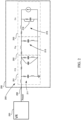
- Figure 4 shows example connection points for capturing differential voltage measurements V1 and V2 in PCB 351 and die 353, respectively.
- differential voltage measurement V1 may be captured at connection points 451a and 451b across capacitor 317 in PCB circuitry 311.
- differential voltage measurement V2 may be captured at connections points 453a and 453b, across capacitor 318 and resistor 319, which are connected in series, in die circuitry 315.
- Differential voltage measurement V2 is the differential voltage measurement across the point of load within die 353.
- the connection points illustrated in Figure 4 are merely examples. Any connection points which capture the voltage on a power line, such as power line 392, and a ground line, such as ground line 393 may be used to measure a differential voltage.
- the measurements corresponding to V1 and V2 may be passed back to the voltage monitor 322 via connections. For instance, the measurements associated with voltage measurement V1 captured at points 451a and 451b may be passed to VM 322 via lines 551a and 551b, respectively. Likewise, the measurements associated with voltage measurement V1 captured at points 453a and 453b may be passed to VM 322 via lines 553a and 553b, respectively.
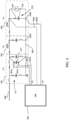
- Figure 5 illustrates the connections of the differential voltage measurements to differential amplifiers within the VM 322.
- lines 551a and 551b are connected to differential amplifier (DA) 561
- lines 553a and 553b are connected to DA 563.
- the differential amplifiers 561 and 563 convert the differential voltage measurements into a single-ended ground reference signal.
- the differential voltage measurement is the difference between the voltages on the lines input into the DAs.
- DA 561 may determine the differential voltage between the voltage on lines 551a and 551b, which corresponds to the voltage at PCB 351.
- DA 563 determines the differential voltage between the voltage on lines 553a and 553b, which corresponds to the voltage at die 353.
- the differential voltages output by DAs 561 and 563 may be boosted or attenuated according to a gain introduced by the DAs.
- the DAs 561 and 563 may supply a gain value to the differential voltages before they are output on lines 571 and 573, respectively.
- the differential voltages output from DAs 561 and 563 on lines 571 and 573, respectively, may be input into a voltage divider formed by pairs of resistors.
- line 571 carrying the differential voltage from DA 561 may be input into voltage divider 586 formed by resistors 581 and 582, connected in parallel, with resistor 582 being connected to ground 585.
- line 537 may be input into voltage divider 586 formed by resistors 583 and 584, connected in parallel, within resistor 584 being connected to ground 585.
- the voltage dividers 586 and 587 may attenuate the differential voltages values based on the resistor values used.
- the VM 322 may not include voltage dividers.
- the VM 322 may be connected to VR 320 via a connection illustrated as line 323.
- the VM 322 may pass the differential voltages to the VR 320 via this connection.
- the differential voltage from DA 561 may be passed, via line 591, to an input on operational amplifier 565.
- the differential voltage from DA 563 may be passed, via line 593 to an input to on operational amplifier 567.
- Each operational amplifier 565 and 567 may compare the respective differential voltages they receive to a reference voltage received via lines 592 and 594, respectively.
- the reference voltage is a predefined value against which the differential voltages are compared.
- the threshold voltage may be adjustable in increments of 5 millivolts or more or less. If a differential voltage goes below the predefined value, a transient event may have occurred. In some instances, a transient event may be determined to have occurred when a differential voltage goes above a reference voltage
- the output from the operational amplifiers may be sent to other circuitry or a process, as illustrated by block 567, via lines 575 and 577.
- the other circuitry or processor 567 may determine, based on the outputs of the operational amplifiers whether to assert a signal on reset line 391 to enable, disable, or reset the die 353.
Landscapes
- Engineering & Computer Science (AREA)
- Physics & Mathematics (AREA)
- General Physics & Mathematics (AREA)
- Power Engineering (AREA)
- General Engineering & Computer Science (AREA)
- Theoretical Computer Science (AREA)
- Environmental & Geological Engineering (AREA)
- Computer Hardware Design (AREA)
- Microelectronics & Electronic Packaging (AREA)
- Health & Medical Sciences (AREA)
- Toxicology (AREA)
- Measurement Of Current Or Voltage (AREA)
Abstract
Description
- Many modern electronic devices, including electronic systems and individual electronic components, have strict power supply operating ranges. These electronic devices may be damaged, fail, and/or suffer from performance reductions when supplied with power outside of the appropriate operating ranges. Certain electronic devices may fail to power on if the power being supplied is outside of an appropriate operating range.
- Voltage supervisors sometimes referred to as reset integrated circuits, brownout detectors, or voltage detectors, are devices that can monitor and control the power being delivered to electronic devices. Voltage supervisors may detect voltage transients, which are either under-voltage or over-voltage events. Under-voltage events are when voltage droops or falls below a certain threshold and over-voltage events are when voltage surges above a certain threshold. When a voltage supervisor detects a voltage transient event, the voltage supervisor may assert a signal to enable, disable, or reset another device, such as an electronic device. By doing so, a voltage supervisor may prevent performance issues or failures of electronic devices.
- Typical voltage supervisors are only capable of detecting voltage transient events that are longer than 100ns. However, fast transient events, such as those that last less than 100ns and are undetected by a voltage supervisor, can still damage and negatively affect the performance of electronic devices.
- The present disclosure provides a voltage supervisor capable of detecting and responding to fast voltage transient events. One aspect of the disclosure is directed to an apparatus, comprising: voltage monitoring circuitry for sensing voltage changes and having a first connection point and a second connection point; and a pair of leads connected to a die and coupled to the first connection point and the second connection point to enable the voltage monitoring circuitry to sense a differential voltage associated with an effective power supply voltage at the die.
- According to another aspect of the present disclosure, a voltage supervisor (VS) or voltage sensing circuitry or architecture can detect fast voltage transients. To detect fast voltage transients, a dedicated differential pair is routed between a point of load, such as a die or other chip, processor, etc., and the circuitry of the voltage supervisor. By connecting the differential pair at the point of load, fast voltage transients may be detected at the load level (e.g., at the point of load) and thereafter used to enable, disable, and/or restart an electronic device, such as a die, chip, processor, or other electronic component or system.
- In some instances, the differential voltage comprises a voltage change having a duration less than or equal to 10 nanoseconds.
- In some instances, the differential voltage comprises a voltage change having a duration less than or equal to 1 nanosecond.
- In some instances, the pair of leads are connected to the die across a resistor and a capacitor connected in series.
- In some instances, the pair of leads are directly connected to the die.
- In some instances, the pair of leads couple a change in the current load across the die to the first connection point and the second connection point.
- In some instances, the voltage monitoring circuitry comprises a voltage supervisor.
- In some instances, the voltage monitoring circuitry is configured to include a threshold voltage that is adjustable in increments of 5 millivolts or less.
- In some instances, the voltage monitoring circuitry comprises a reset output that outputs a reset signal based on the differential voltage sensed by the voltage monitoring circuitry.
- In some instances, the apparatus comprises one of a printed circuit board, integrated circuit packaging, or a system on a chip.
- In some instances, the voltage monitoring circuitry comprises a voltage supervisor comprising a voltage monitor.
- In some instances, the voltage supervisor further comprises a voltage regulator configured to provide power to the die.
- In some instances, the voltage monitor is configured to sense the differential voltage associated with the effective power supply voltage at the die and pass the differential voltage to the voltage regulator.
- In some instances, the voltage regulator compares the differential voltage to a reference voltage to determine a voltage change.
- In some instances, the regulator is configured to assert a signal to the die to enable, disable, or reset the die.
- In some instances, the voltage supervisor is part of the die.
- In some instances, the voltage monitor is configured to sense a differential voltage associated with an effective power supply voltage at a PCB on which the die is mounted.
- In some instances, the voltage monitor is configured to pass the differential voltage associated with an effective power supply voltage at the PCB to the voltage regulator.
- In some instances, the voltage regulator compares the differential voltage associated with an effective power supply voltage at the PCB to the reference voltage to determine a voltage change.
- In some instances, the regulator is configured to, after determining the voltage change satisfies a threshold value, assert a signal to the die to enable, disable, or reset the die.
-
-
Fig. 1 is a block diagram of an example droop in a power signal in accordance with aspects of the present disclosure. -
Fig. 2 is a block diagram of an example voltage regulator providing power to an integrated circuit in accordance with aspects of the present disclosure. -
Fig. 3 is a block diagram of an example voltage supervisor and integrated circuit in accordance with aspects of the present disclosure. -
Fig. 4 is a block diagram of an example voltage monitor monitoring power within the integrated circuit in accordance with aspects of the present disclosure. -
Fig. 5 is a block diagram of the components of a voltage monitor and voltage regulator in accordance with aspects of the present disclosure. - The present disclosure provides a voltage supervisor (VS) or voltage sensing circuitry or architecture that can detect fast voltage transients. To detect fast voltage transients, a dedicated differential pair is routed between a point of load, such as a die or other chip, processor, etc., and the circuitry of the voltage supervisor. By connecting the differential pair at the point of load, fast voltage transients may be detected at the load level (e.g., at the point of load) and thereafter used, for example, to enable, disable, and/or restart an electronic device, such as a die, chip, processor, or other electronic component or system.
-
Figure 1 illustrates a sample transient event triggered by a droop 103 (i.e., drop in voltage.)Figure 1 shows the voltage level of apower signal 101 being delivered to an electronic device over a period of time t. Prior to time t1, the voltage ofpower signal 101 is V2. However, at time t1, the voltage ofpower signal 101 begins to droop, and at time t2, the voltage ofpower signal 101 may fall below a threshold voltage, illustrated as V1. Upon crossing the threshold value V1, a transient event may be considered to have occurred. At time t3, when the voltage ofpower signal 101 goes above the threshold value V1, the transient event may be considered to have ended. The voltage ofpower signal 101 returns to V2 at time t4. A droop may be defined by its width, illustrated by line 107, and its "magnitude" (i.e., the maximum reduction in voltage value of the signal over the droop width.) - A transient event may also occur when a power signal, such as
power signal 101, surges above a threshold voltage. For instance, and as further illustrated inFigure 1 , if thepower signal 101 crosses above an upper threshold voltage, illustrated as V3, a transient event may be considered to have occurred. Thus, transient events may result from both power surges and power droops. - As used herein, a fast transient event may be considered a transient event when the voltage of the
power signal 101 stays below a threshold value for less than 100ns. Continuing the example shown inFigure 1 , the determination of whether the transient event is a fast transient event may be determined by subtracting time t2 from t3. If the resulting value is less than 100ns, the illustrated transient event resulting from the droop may be considered a fast transient event. Similarly, if thepower signal 101 stays above upper threshold voltage V3 for less than 100ns (i.e., crosses above and then below V3 in less than 100ns), the transient event resulting from the surge may be considered a fast transient event. -
Figure 2 illustrates atypical VR 220 connected to an integrated circuit (IC) 250 via a power delivery network 200 (PDN). The IC 250 includes a printed circuit board (PCB) 251, packaging (Pkg) 252, and adie 253. ThePDN 200 includescircuitry 211 within thePCB 251,circuitry 213 withinPkg 252, andcircuitry 215 within die 253. The circuitry illustrated by 211, 213, and 215 are merely examples meant to represent RLC networks typically present in PCBs, Pkgs, and dies, respectively. More or fewer components in the same or different configurations than illustrated incircuitry IC 250 is shown as including asingle PCB 251,Pkg 252, and die 253, theIC 250 may include any number of dies, packages, PCBs, and other components (e.g., transistor, resistors, capacitors, inductors, chips, processors, etc.) and circuitry found in an integrated circuit. Further, although anIC 250 is illustrated, aVR 220 may be connected to a printed circuit board and/or a system on a chip. - As further shown in
Figure 2 , theVR 220 may be connected to thePDN 200 viapower line 292. Although not illustrated, theVR 220 may include or be connected to one or more transistors, such as field effect transistors (FETs) or metal oxide semiconductor FETS (MOSFETs), for controlling the voltage output by theVR 220, such as by increasing or decreasing the output voltage to maintain a consistent output voltage. Although theVR 220 is shown as being outside ofIC 250, in some implementations theVR 220 may be within the IC. In such implementation, thePDN 200 may also be entirely within theIC 250. - The
PDN 200 may carry a power signal from theVR 220 to a point ofload 216 in the die 205 viapower line 292. As the power signal is carried on the PDN to the point ofload 216, the RLC components, or combinations thereof, within thecircuitry PDN 200 to thePoL 216. As used herein, unless otherwise stated, resistance (R) is not limited to the resistance of a resistor, but instead refers to the resistance that current faces as it travels through a PDN, such asPDN 200. - IR drop may lead to a loss of efficiency in delivering power. In this regard, the current drops may be dissipated (e.g. in the form of heat loss) instead of being provided to the intended destination (e.g., the PoL.) Thus, power delivery is less efficient which may increase operating costs, waste money, etc.
- The IR drop introduced by RLC components in the
PCB 251,Pkg 252, and/or die 253 may also make the detection of transient events by a voltage supervisor slower, as the transient event has to propagate through the PCB and circuitry connecting the PCB to the voltage supervisor before getting detected. In this regard, voltage supervisors typically monitor for voltage transients at the PCB level and are connected to thePDN 200 through the PCB. Thus, the transient event may hit thePoL 216 before the transient event has propagated to the voltage supervisor and/or before the voltage supervisor has time to act on a detected transient event. Moreover, IR drops that occur after thePCB 251, such as in thePkg 252 and/or die 253 may go undetected. - As described herein, the VS of the disclosed technology addresses filtering by implementing differential remote voltage sensing at or close to the point of load. By detecting the differential remote voltage at the point of load, the effects of fast transient filtering that occurs when detection occurs at the PCB or packaging level may be reduced or eliminated. In addition, by routing a differential pair of leads from the die or other point-of-load (POL) to the VS, the VS is enabled to allow for adjustment of VR voltage trigger levels in smaller increments. Further, the technology enables the monitoring of multiple power rails on a PCB or within the packaging or die.
- Another aspect of the disclosed technology is sensing the effective power supply voltage as close to the point of load as possible or directly from the POL if possible. In this regard, the VS may be integrated into the die or other such component to minimize the propagation of time of the transient to the VS. This aspect will compensate for most of the current drop (IR drop) occurring at the PCB, packaging, and possibly on the die.
- The technology described herein also advantageously allows for a VS to detect droops that result in a transient event, including fast transient events. Detecting droops may enable a VS to monitor the voltage rails within a system (e.g., PCB, package, etc.) to detect such droops and send an alert that may be used to reset the system, processor, etc. As previously explained, the failure to generate an alert when fast transients occur may cause a system to experience performance issues such as a brownout (e.g., resulting in operation at a lower speed than intended), a failure (e.g., operating differently than intended, or totally shut down), or be damaged. This technology mitigates or prevents these types of events.
-
Figure 3 illustrates anexample voltage supervisor 325 including aVR 320 andVM 322 within anintegrated circuit 350. Although theVS 325 is shown as being separate from the other illustrated components of theIC including PCB 351,Pkg 352, and die 353, the VS may be integrated into such components. For instance,VS 320 may be mounted to thePCB 351 or integrated into thedie 353. AlthoughIC 350 is shown as including asingle PCB 351,Pkg 352, and die 353, theIC 250 may include any number of dies, packages, PCBs, and other components (e.g., transistor, resistors, capacitors, inductors, chips, processors, etc.) and circuitry found in an integrated circuit. By positioning theVS 325 within theIC 350, the propagation delays experienced by typical voltage supervisors is avoided. - Although
Figure 3 illustrates an example VS 325 includingVR 320. However, in some examples,VR 320 may be a separate component from theVS 325. In such cases, theVR 320 may be connected to theVM 322 via an external connection between theVS 325 andVR 320 - In operation, the
VR 320, which may be compared toVR 220, delivers power to a point of load (not shown) indie 353. TheVM 322 detects voltage changes in the power being delivered by theVR 320 to the PoL relative to a reference power. Based on these detected differences, which theVM 322 may provide to the VR, the VR may adjust (i.e., increase or decrease) the amount of voltage being provided to the PoL. In the event the power being provided to the PoL moves outside of a predetermined operating range, such as due to a transient event (including fast transient events), theVS 325, such as through theVR 320, may assert a signal onreset line 391 to enable, disable, or reset thedie 353. In other instances, theVM 322 or other componentry of theVS 325 may assert the signal to enable, disable, or reset thedie 353. In these examples, thereset line 391 may run from theVM 322 or other componentry of theVS 325. - As illustrated, the
VR 320 provides power via apower line 392 to other components ofintegrated circuit 350, including any components within thePCB 351, Pkg, 352, and die 353, which may be compared toPCB 251,Pkg 252, and die 253, respectively. Although not shown, theVR 320 may provide power to any number of components in theintegrated circuit 350, including components on thePCB 351,Pkg 352, and die 353. - As illustrated in
Figure 3 , theVM 322 is configured to receive differential voltage measurements taken at thePCB 351 and die 353. In this regard, a differential voltage measurement V1 taken atPCB 351 is provided toVM 322 through a connection, represented byline 371. Similarly, a differential voltage measurement V2 taken atdie 353 is provided toVM 322 through a connection, represented byline 372. AlthoughFigure 3 illustrates differential voltage measurement V1 being captured atPCB 351, V1 may be captured atPkg 352 or beforePCB 351. In some embodiments, a third differential voltage measurement may be captured atPkg 352, in which case three differential voltage measurements may be provided to theVM 322. -
Figure 4 shows example connection points for capturing differential voltage measurements V1 and V2 inPCB 351 and die 353, respectively. In this regard, differential voltage measurement V1 may be captured atconnection points capacitor 317 inPCB circuitry 311. Similarly, differential voltage measurement V2 may be captured atconnections points capacitor 318 andresistor 319, which are connected in series, indie circuitry 315. Differential voltage measurement V2 is the differential voltage measurement across the point of load withindie 353. The connection points illustrated inFigure 4 are merely examples. Any connection points which capture the voltage on a power line, such aspower line 392, and a ground line, such asground line 393 may be used to measure a differential voltage. - The measurements corresponding to V1 and V2 may be passed back to the voltage monitor 322 via connections. For instance, the measurements associated with voltage measurement V1 captured at
points VM 322 vialines points VM 322 vialines -
Figure 5 illustrates the connections of the differential voltage measurements to differential amplifiers within theVM 322. In this regard,lines lines DA 563. Thedifferential amplifiers DA 561 may determine the differential voltage between the voltage onlines PCB 351. Likewise,DA 563 determines the differential voltage between the voltage onlines die 353. - The differential voltages output by
DAs DAs lines - The differential voltages output from
DAs lines line 571 carrying the differential voltage fromDA 561 may be input intovoltage divider 586 formed byresistors resistor 582 being connected toground 585. Likewise, line 537 may be input intovoltage divider 586 formed byresistors resistor 584 being connected toground 585. Thevoltage dividers VM 322 may not include voltage dividers. - Referring back to
Figure 3 , theVM 322 may be connected toVR 320 via a connection illustrated asline 323. TheVM 322 may pass the differential voltages to theVR 320 via this connection. For instance, and as illustrated inFigure 5 , the differential voltage fromDA 561 may be passed, vialine 591, to an input onoperational amplifier 565. Similarly, the differential voltage fromDA 563 may be passed, vialine 593 to an input to onoperational amplifier 567. - Each
operational amplifier lines - The output from the operational amplifiers may be sent to other circuitry or a process, as illustrated by
block 567, vialines processor 567 may determine, based on the outputs of the operational amplifiers whether to assert a signal onreset line 391 to enable, disable, or reset thedie 353. - Although the technology herein has been described with reference to particular embodiments, it is to be understood that these embodiments are merely illustrative of the principles and applications of the present technology. It is therefore to be understood that numerous modifications may be made to the illustrative embodiments and that other arrangements may be devised without departing from the spirit and scope of the present technology as defined by the appended claims.
- Most of the foregoing alternative examples are not mutually exclusive, but may be implemented in various combinations to achieve unique advantages. As these and other variations and combinations of the features discussed above can be utilized without departing from the subject matter defined by the claims, the foregoing description of the embodiments should be taken by way of illustration rather than by way of limitation of the subject matter defined by the claims. As an example, the preceding operations do not have to be performed in the precise order described above. Rather, various steps can be handled in a different order, such as reversed, or simultaneously. Steps can also be omitted unless otherwise stated. In addition, the provision of the examples described herein, as well as clauses phrased as "such as," "including" and the like, should not be interpreted as limiting the subject matter of the claims to the specific examples; rather, the examples are intended to illustrate only one of many possible embodiments. Further, the same reference numbers in different drawings can identify the same or similar elements.
Claims (15)
- An apparatus, comprising:voltage monitoring circuitry for sensing voltage changes and having a first connection point and a second connection point; anda pair of leads connected to a die and coupled to the first connection point and the second connection point to enable the voltage monitoring circuitry to sense a differential voltage associated with an effective power supply voltage at the die.
- The apparatus of claim 1, wherein the differential voltage comprises a voltage change having a duration less than or equal to 10 nanoseconds, or
wherein the differential voltage comprises a voltage change having a duration less than or equal to 1 nanosecond. - The apparatus of any one of claims 1 or 2, wherein the pair of leads are connected to the die across a resistor and a capacitor connected in series.
- The apparatus of claim 3, wherein the pair of leads are directly connected to the die.
- The apparatus of any one of claims 3 or 4, wherein the pair of leads couple a change in the current load across the die to the first connection point and the second connection point.
- The apparatus of any one of the preceding claims, wherein the voltage monitoring circuitry comprises a voltage supervisor.
- The apparatus of any one of the preceding claims, wherein the voltage monitoring circuitry is configured to include a threshold voltage that is adjustable in increments of 5 millivolts or less.
- The apparatus of any one of the preceding claims, comprising a reset output that outputs a reset signal based on the differential voltage sensed by the voltage monitoring circuitry.
- The apparatus of any one of the preceding claims, wherein the apparatus comprises one of a printed circuit board, integrated circuit packaging, or a system on a chip.
- The apparatus of any one of the preceding claims, wherein the voltage monitoring circuitry comprises a voltage supervisor comprising a voltage monitor.
- The apparatus of claim 10, wherein the voltage supervisor further comprises a voltage regulator configured to provide power to the die, andwherein the voltage monitor is optionally configured to sense the differential voltage associated with the effective power supply voltage at the die and pass the differential voltage to the voltage regulator, andwherein the voltage regulator optionally compares the differential voltage to a reference voltage to determine a voltage change, andwherein the regulator is optionally configured to assert a signal to the die to enable, disable, or reset the die.
- The apparatus of claim 11, wherein the voltage supervisor is part of the die.
- The apparatus of any one of claims 11 or 12, wherein the voltage monitor is configured to sense a differential voltage associated with an effective power supply voltage at a PCB on which the die is mounted.
- The apparatus of claim 13, wherein the voltage monitor is configured to pass the differential voltage associated with an effective power supply voltage at the PCB to the voltage regulator.
- The apparatus of any one of claims 13 or 14, wherein the voltage regulator compares the differential voltage associated with an effective power supply voltage at the PCB to the reference voltage to determine a voltage change, and
wherein the regulator is optionally configured to, after determining the voltage change satisfies a threshold value, assert a signal to the die to enable, disable, or reset the die.
Applications Claiming Priority (1)
| Application Number | Priority Date | Filing Date | Title |
|---|---|---|---|
| US17/885,071 US12360139B2 (en) | 2022-08-10 | 2022-08-10 | Fast transient detection |
Publications (1)
| Publication Number | Publication Date |
|---|---|
| EP4321879A1 true EP4321879A1 (en) | 2024-02-14 |
Family
ID=85278255
Family Applications (1)
| Application Number | Title | Priority Date | Filing Date |
|---|---|---|---|
| EP23157037.5A Pending EP4321879A1 (en) | 2022-08-10 | 2023-02-16 | Fast transient detection |
Country Status (3)
| Country | Link |
|---|---|
| US (1) | US12360139B2 (en) |
| EP (1) | EP4321879A1 (en) |
| CN (1) | CN116047170A (en) |
Families Citing this family (1)
| Publication number | Priority date | Publication date | Assignee | Title |
|---|---|---|---|---|
| CN118376950B (en) * | 2024-06-24 | 2024-08-23 | 北京七星华创微电子有限责任公司 | Load point power supply analog circuit testing method and system |
Citations (4)
| Publication number | Priority date | Publication date | Assignee | Title |
|---|---|---|---|---|
| US20170030954A1 (en) * | 2015-07-30 | 2017-02-02 | Arm Limited | Apparatus and Method for Detecting a Resonant Frequency Giving Rise to an Impedance Peak in a Power Delivery Network |
| US20170052219A1 (en) * | 2015-08-18 | 2017-02-23 | Apple Inc. | Integrated Characterization Circuit |
| WO2018160578A1 (en) * | 2017-02-28 | 2018-09-07 | Ampere Computing Llc | Variation immune on-die voltage droop detector |
| US11171562B1 (en) * | 2020-07-07 | 2021-11-09 | Nxp Usa, Inc. | Multi-sense point voltage regulator systems and power-regulated devices containing the same |
Family Cites Families (19)
| Publication number | Priority date | Publication date | Assignee | Title |
|---|---|---|---|---|
| DE1149452B (en) * | 1961-02-08 | 1963-05-30 | Siemens Ag | Device for the early detection of voltage changes in the event of line faults |
| US5805401A (en) * | 1995-08-30 | 1998-09-08 | Cherry Semiconductor Corporation | Undervoltage lockout circuit with sleep pin |
| US6965502B2 (en) | 2001-03-21 | 2005-11-15 | Primarion, Inc. | System, device and method for providing voltage regulation to a microelectronic device |
| US7570036B2 (en) | 2004-09-10 | 2009-08-04 | Primarion Corporation | Multi-threshold multi-gain active transient response circuit and method for digital multiphase pulse width modulated regulators |
| US7521913B2 (en) | 2004-09-10 | 2009-04-21 | Primarion Corporation | Active transient response circuits, system and method for digital multiphase pulse width modulated regulators |
| US7138815B1 (en) * | 2003-12-24 | 2006-11-21 | Xilinx, Inc. | Power distribution system built-in self test using on-chip data converter |
| US6954083B1 (en) * | 2003-12-29 | 2005-10-11 | Zilog, Inc. | Circuit for detection of hardware faults due to temporary power supply fluctuations |
| US7567415B2 (en) | 2006-07-11 | 2009-07-28 | Honeywell International Inc. | Separable transient voltage suppression device |
| US8232786B2 (en) | 2007-09-28 | 2012-07-31 | Astec International Limited | Fast transient step load response in a power converter |
| US7898236B2 (en) * | 2008-04-10 | 2011-03-01 | Intersil Americas Inc. | Varying operation of a voltage regulator, and components thereof, based upon load conditions |
| CN102132627B (en) * | 2008-08-19 | 2014-09-17 | Nxp股份有限公司 | A surge protection circuit |
| CN102128972B (en) * | 2011-01-12 | 2013-06-26 | 重庆市电力公司市区供电局 | Sensor device for monitoring transient voltage of broadband integral type power grid |
| CN107925235B (en) | 2015-03-19 | 2020-10-13 | Abb公司 | Safe Fault Detection in Power Substations |
| CN205786799U (en) * | 2016-05-13 | 2016-12-07 | 浙江正泰电器股份有限公司 | The voltage detecting circuit of Dual-power switch controller |
| CN106291226B (en) * | 2016-07-27 | 2019-08-06 | 北大青鸟环宇消防设备股份有限公司 | Residual current transformer fault detection circuit and electrical fire-detector |
| US11169218B2 (en) * | 2018-12-21 | 2021-11-09 | Analog Devices, Inc. | Current monitor with fault detection |
| US10958170B2 (en) | 2019-03-27 | 2021-03-23 | Alpha And Omega Semiconductor (Cayman) Ltd. | Fast transient response in DC-to-DC converters |
| AU2021342648A1 (en) * | 2020-09-15 | 2023-03-02 | F. Hoffmann-La Roche Ag | Method for detecting a failure of at least one component of a continuous analyte monitoring system |
| US11644487B2 (en) * | 2021-04-21 | 2023-05-09 | Nxp B.V. | Circuits and methods for tracking minimum voltage at multiple sense points |
-
2022
- 2022-08-10 US US17/885,071 patent/US12360139B2/en active Active
-
2023
- 2023-01-19 CN CN202310087218.4A patent/CN116047170A/en active Pending
- 2023-02-16 EP EP23157037.5A patent/EP4321879A1/en active Pending
Patent Citations (4)
| Publication number | Priority date | Publication date | Assignee | Title |
|---|---|---|---|---|
| US20170030954A1 (en) * | 2015-07-30 | 2017-02-02 | Arm Limited | Apparatus and Method for Detecting a Resonant Frequency Giving Rise to an Impedance Peak in a Power Delivery Network |
| US20170052219A1 (en) * | 2015-08-18 | 2017-02-23 | Apple Inc. | Integrated Characterization Circuit |
| WO2018160578A1 (en) * | 2017-02-28 | 2018-09-07 | Ampere Computing Llc | Variation immune on-die voltage droop detector |
| US11171562B1 (en) * | 2020-07-07 | 2021-11-09 | Nxp Usa, Inc. | Multi-sense point voltage regulator systems and power-regulated devices containing the same |
Also Published As
| Publication number | Publication date |
|---|---|
| US20240094264A1 (en) | 2024-03-21 |
| US12360139B2 (en) | 2025-07-15 |
| CN116047170A (en) | 2023-05-02 |
Similar Documents
| Publication | Publication Date | Title |
|---|---|---|
| US7099135B2 (en) | Integrated inrush current limiter circuit and method | |
| US11722130B1 (en) | System and method for distinguishing short-circuit events in high inrush current systems | |
| US10566780B2 (en) | Electronic circuit for single-event latch-up detection and protection | |
| US9071051B2 (en) | Overvoltage protection unit with AC input current sensors | |
| EP4321879A1 (en) | Fast transient detection | |
| CN113381378B (en) | High-reliability protection circuit and power supply system | |
| US20140320155A1 (en) | Critical capacitor built in test | |
| WO2015025860A1 (en) | Voltage-type multilevel converter | |
| US7102338B2 (en) | Multi-sense voltage regulator | |
| US10788518B2 (en) | Detection circuit and switch module using the same | |
| US11994565B2 (en) | Potential difference early-warning circuit and system | |
| US11474161B2 (en) | Power supply semiconductor integrated circuit | |
| EP2847600B1 (en) | An apparatus and associated method for measuring a series resistance | |
| CN109873399B (en) | Power supply protection circuit and power supply protection device | |
| CN109991466A (en) | Detection device protects system and guard method | |
| JP2886339B2 (en) | Device to protect DC distribution bus during power supply | |
| CN114002976A (en) | Control detection circuit and detection method | |
| CN103592519A (en) | Surge detection device capable of detecting surge signal characteristics | |
| US6239961B1 (en) | Overvoltage protection circuit | |
| US8975902B2 (en) | Power circuit | |
| KR102913649B1 (en) | Apparatus for protecting a short in a switch | |
| US20250062937A1 (en) | Signal transfer assembly with capacitive coupling | |
| CN114414925B (en) | Fault signal holding circuit, detection device, and electronic device | |
| WO2023214961A1 (en) | System and method for distinguishing short-circuit events in high inrush current circuits | |
| JPH0626036Y2 (en) | Inverter protector |
Legal Events
| Date | Code | Title | Description |
|---|---|---|---|
| PUAI | Public reference made under article 153(3) epc to a published international application that has entered the european phase |
Free format text: ORIGINAL CODE: 0009012 |
|
| STAA | Information on the status of an ep patent application or granted ep patent |
Free format text: STATUS: THE APPLICATION HAS BEEN PUBLISHED |
|
| AK | Designated contracting states |
Kind code of ref document: A1 Designated state(s): AL AT BE BG CH CY CZ DE DK EE ES FI FR GB GR HR HU IE IS IT LI LT LU LV MC ME MK MT NL NO PL PT RO RS SE SI SK SM TR |
|
| STAA | Information on the status of an ep patent application or granted ep patent |
Free format text: STATUS: REQUEST FOR EXAMINATION WAS MADE |
|
| 17P | Request for examination filed |
Effective date: 20240718 |
|
| RBV | Designated contracting states (corrected) |
Designated state(s): AL AT BE BG CH CY CZ DE DK EE ES FI FR GB GR HR HU IE IS IT LI LT LU LV MC ME MK MT NL NO PL PT RO RS SE SI SK SM TR |
|
| STAA | Information on the status of an ep patent application or granted ep patent |
Free format text: STATUS: EXAMINATION IS IN PROGRESS |
|
| 17Q | First examination report despatched |
Effective date: 20260211 |