EP4318706A1 - Gel polymer electrolyte and lithium secondary battery comprising same - Google Patents
Gel polymer electrolyte and lithium secondary battery comprising same Download PDFInfo
- Publication number
- EP4318706A1 EP4318706A1 EP22849943.0A EP22849943A EP4318706A1 EP 4318706 A1 EP4318706 A1 EP 4318706A1 EP 22849943 A EP22849943 A EP 22849943A EP 4318706 A1 EP4318706 A1 EP 4318706A1
- Authority
- EP
- European Patent Office
- Prior art keywords
- polymer electrolyte
- gel polymer
- thiol
- group
- lithium
- Prior art date
- Legal status (The legal status is an assumption and is not a legal conclusion. Google has not performed a legal analysis and makes no representation as to the accuracy of the status listed.)
- Granted
Links
Images
Classifications
-
- H—ELECTRICITY
- H01—ELECTRIC ELEMENTS
- H01M—PROCESSES OR MEANS, e.g. BATTERIES, FOR THE DIRECT CONVERSION OF CHEMICAL ENERGY INTO ELECTRICAL ENERGY
- H01M10/00—Secondary cells; Manufacture thereof
- H01M10/05—Accumulators with non-aqueous electrolyte
- H01M10/056—Accumulators with non-aqueous electrolyte characterised by the materials used as electrolytes, e.g. mixed inorganic/organic electrolytes
- H01M10/0564—Accumulators with non-aqueous electrolyte characterised by the materials used as electrolytes, e.g. mixed inorganic/organic electrolytes the electrolyte being constituted of organic materials only
- H01M10/0565—Polymeric materials, e.g. gel-type or solid-type
-
- H—ELECTRICITY
- H01—ELECTRIC ELEMENTS
- H01M—PROCESSES OR MEANS, e.g. BATTERIES, FOR THE DIRECT CONVERSION OF CHEMICAL ENERGY INTO ELECTRICAL ENERGY
- H01M10/00—Secondary cells; Manufacture thereof
- H01M10/05—Accumulators with non-aqueous electrolyte
- H01M10/052—Li-accumulators
-
- H—ELECTRICITY
- H01—ELECTRIC ELEMENTS
- H01M—PROCESSES OR MEANS, e.g. BATTERIES, FOR THE DIRECT CONVERSION OF CHEMICAL ENERGY INTO ELECTRICAL ENERGY
- H01M10/00—Secondary cells; Manufacture thereof
- H01M10/05—Accumulators with non-aqueous electrolyte
- H01M10/052—Li-accumulators
- H01M10/0525—Rocking-chair batteries, i.e. batteries with lithium insertion or intercalation in both electrodes; Lithium-ion batteries
-
- H—ELECTRICITY
- H01—ELECTRIC ELEMENTS
- H01M—PROCESSES OR MEANS, e.g. BATTERIES, FOR THE DIRECT CONVERSION OF CHEMICAL ENERGY INTO ELECTRICAL ENERGY
- H01M10/00—Secondary cells; Manufacture thereof
- H01M10/05—Accumulators with non-aqueous electrolyte
- H01M10/056—Accumulators with non-aqueous electrolyte characterised by the materials used as electrolytes, e.g. mixed inorganic/organic electrolytes
- H01M10/0564—Accumulators with non-aqueous electrolyte characterised by the materials used as electrolytes, e.g. mixed inorganic/organic electrolytes the electrolyte being constituted of organic materials only
- H01M10/0566—Liquid materials
- H01M10/0567—Liquid materials characterised by the additives
-
- H—ELECTRICITY
- H01—ELECTRIC ELEMENTS
- H01M—PROCESSES OR MEANS, e.g. BATTERIES, FOR THE DIRECT CONVERSION OF CHEMICAL ENERGY INTO ELECTRICAL ENERGY
- H01M10/00—Secondary cells; Manufacture thereof
- H01M10/05—Accumulators with non-aqueous electrolyte
- H01M10/056—Accumulators with non-aqueous electrolyte characterised by the materials used as electrolytes, e.g. mixed inorganic/organic electrolytes
- H01M10/0564—Accumulators with non-aqueous electrolyte characterised by the materials used as electrolytes, e.g. mixed inorganic/organic electrolytes the electrolyte being constituted of organic materials only
- H01M10/0566—Liquid materials
- H01M10/0569—Liquid materials characterised by the solvents
-
- H—ELECTRICITY
- H01—ELECTRIC ELEMENTS
- H01M—PROCESSES OR MEANS, e.g. BATTERIES, FOR THE DIRECT CONVERSION OF CHEMICAL ENERGY INTO ELECTRICAL ENERGY
- H01M10/00—Secondary cells; Manufacture thereof
- H01M10/05—Accumulators with non-aqueous electrolyte
- H01M10/058—Construction or manufacture
-
- H—ELECTRICITY
- H01—ELECTRIC ELEMENTS
- H01M—PROCESSES OR MEANS, e.g. BATTERIES, FOR THE DIRECT CONVERSION OF CHEMICAL ENERGY INTO ELECTRICAL ENERGY
- H01M10/00—Secondary cells; Manufacture thereof
- H01M10/42—Methods or arrangements for servicing or maintenance of secondary cells or secondary half-cells
-
- H—ELECTRICITY
- H01—ELECTRIC ELEMENTS
- H01M—PROCESSES OR MEANS, e.g. BATTERIES, FOR THE DIRECT CONVERSION OF CHEMICAL ENERGY INTO ELECTRICAL ENERGY
- H01M10/00—Secondary cells; Manufacture thereof
- H01M10/42—Methods or arrangements for servicing or maintenance of secondary cells or secondary half-cells
- H01M10/4235—Safety or regulating additives or arrangements in electrodes, separators or electrolyte
-
- H—ELECTRICITY
- H01—ELECTRIC ELEMENTS
- H01M—PROCESSES OR MEANS, e.g. BATTERIES, FOR THE DIRECT CONVERSION OF CHEMICAL ENERGY INTO ELECTRICAL ENERGY
- H01M2300/00—Electrolytes
- H01M2300/0017—Non-aqueous electrolytes
- H01M2300/0065—Solid electrolytes
- H01M2300/0082—Organic polymers
-
- H—ELECTRICITY
- H01—ELECTRIC ELEMENTS
- H01M—PROCESSES OR MEANS, e.g. BATTERIES, FOR THE DIRECT CONVERSION OF CHEMICAL ENERGY INTO ELECTRICAL ENERGY
- H01M2300/00—Electrolytes
- H01M2300/0085—Immobilising or gelification of electrolyte
-
- Y—GENERAL TAGGING OF NEW TECHNOLOGICAL DEVELOPMENTS; GENERAL TAGGING OF CROSS-SECTIONAL TECHNOLOGIES SPANNING OVER SEVERAL SECTIONS OF THE IPC; TECHNICAL SUBJECTS COVERED BY FORMER USPC CROSS-REFERENCE ART COLLECTIONS [XRACs] AND DIGESTS
- Y02—TECHNOLOGIES OR APPLICATIONS FOR MITIGATION OR ADAPTATION AGAINST CLIMATE CHANGE
- Y02E—REDUCTION OF GREENHOUSE GAS [GHG] EMISSIONS, RELATED TO ENERGY GENERATION, TRANSMISSION OR DISTRIBUTION
- Y02E60/00—Enabling technologies; Technologies with a potential or indirect contribution to GHG emissions mitigation
- Y02E60/10—Energy storage using batteries
-
- Y—GENERAL TAGGING OF NEW TECHNOLOGICAL DEVELOPMENTS; GENERAL TAGGING OF CROSS-SECTIONAL TECHNOLOGIES SPANNING OVER SEVERAL SECTIONS OF THE IPC; TECHNICAL SUBJECTS COVERED BY FORMER USPC CROSS-REFERENCE ART COLLECTIONS [XRACs] AND DIGESTS
- Y02—TECHNOLOGIES OR APPLICATIONS FOR MITIGATION OR ADAPTATION AGAINST CLIMATE CHANGE
- Y02P—CLIMATE CHANGE MITIGATION TECHNOLOGIES IN THE PRODUCTION OR PROCESSING OF GOODS
- Y02P70/00—Climate change mitigation technologies in the production process for final industrial or consumer products
- Y02P70/50—Manufacturing or production processes characterised by the final manufactured product
Definitions
- the present invention relates to a gel polymer electrolyte, and a lithium secondary battery including the same and a preparation method thereof.
- lithium secondary batteries having high stability as well as high capacity and high output is increasing as an application area of lithium secondary batteries is rapidly expanding not only to electricity, electronics, communication, and power supply of electronic devices such as computers, but also to power storage supply of automobiles or large-area devices such as power storage devices.
- a lithium secondary battery is prepared by inserting the electrode assembly and an electrolyte solution into a battery case.
- the electrolyte solution it is generally known to use a non-aqueous electrolyte solution in which a lithium salt is dissolved in a carbonate-based organic solvent such as ethylene carbonate (EC), propylene carbonate (PC), and diethyl carbonate (DEC).
- a carbonate-based organic solvent such as ethylene carbonate (EC), propylene carbonate (PC), and diethyl carbonate (DEC).
- EC ethylene carbonate
- PC propylene carbonate
- DEC diethyl carbonate
- the above carbonate-based organic solvents have disadvantages in that they are not only highly likely to leak when used for a long period of time, but safety is also low due to the risk of fire caused by an increase in ambient temperature and temperature of the battery itself.
- An aspect of the present invention provides a gel polymer electrolyte having oxidation stability, flame retardancy, thermal stability, a great effect of inhibiting leakage of an organic solvent, and excellent lithium ion conductivity.
- Another aspect of the present invention provides a lithium secondary battery in which thermal stability is excellent and overall performance, such as cycle characteristics, is improved by including the gel polymer electrolyte.
- Another aspect of the present invention provides a method of preparing the lithium secondary battery.
- a gel polymer electrolyte including a cross-linked polymer having a thiol-ene structure, wherein the thiol-ene structure is formed by a click reaction of a thiol group of a thiol compound containing at least four reactive thiol groups per molecule and an acrylic group of a fluorinated polyether diacrylate.
- a lithium secondary battery including the gel polymer electrolyte.
- the chemically crosslinked gel polymer electrolyte is prepared by using a click reaction of a thiol group of a thiol compound containing at least four reactive thiol groups per molecule and an acrylic group of a fluorinated polyether diacrylate.
- a click reaction of a thiol group of a thiol compound containing at least four reactive thiol groups per molecule and an acrylic group of a fluorinated polyether diacrylate In a case in which the gel polymer electrolyte is prepared through the click reaction, since there is almost no side reaction and the thiol group and the acrylic group selectively and rapidly react, there is an advantage in that yield of the cross-linked polymer is high.
- the gel polymer electrolyte of the present invention which includes the cross-linked polymer prepared by the click reaction, has an excellent effect of preventing leakage of an organic solvent by confining the organic solvent in a three-dimensional polymer network.
- the gel polymer electrolyte of the present invention since the gel polymer electrolyte of the present invention has a cross-linked structure, there is little change in the structure even with changes in external environment or the passage of time, and thus it has excellent structural, thermal, and mechanical stabilities.
- a secondary battery using the gel polymer electrolyte of the present invention since the fluorinated polyether diacrylate having flame retardant properties is used as a crosslinking agent, a secondary battery using the gel polymer electrolyte of the present invention has an effect of improving thermal stability and suppressing a calorific value of an electrode.
- the gel polymer electrolyte according to the present invention has an effect of excellent oxidation stability due to fluorine atoms contained in the fluorinated polyether diacrylate crosslinking agent.
- the expressions "a” and “b” in the description of "a to b carbon atoms” in the present specification each denote the number of carbon atoms included in a specific functional group. That is, the functional group may include “a” to "b” carbon atoms.
- the expression “alkylene group having 1 to 5 carbon atoms” denotes an alkylene group including 1 to 5 carbon atoms, that is, -CH 2 -, -CH 2 CH 2 -, - CH 2 CH 2 CH 2 -, -CH 2 CH(CH 3 ) -, -CH (CH 3 ) CH 2 -, and -CH (CH 3 ) CH 2 CH 2 -.
- alkylene group denotes a branched or unbranched divalent saturated hydrocarbon group.
- both the alkyl group and the alkylene group in the present specification may be substituted or unsubstituted.
- substitution denotes that at least one hydrogen bonded to carbon is substituted with an element other than hydrogen, for example, an alkyl group having 1 to 20 carbon atoms, an alkenyl group having 2 to 20 carbon atoms, an alkynyl group having 2 to 20 carbon atoms, an alkoxy group having 1 to 20 carbon atoms, a cycloalkyl group having 3 to 12 carbon atoms, a cycloalkenyl group having 3 to 12 carbon atoms, a heterocycloalkyl group having 3 to 12 carbon atoms, a heterocycloalkenyl group having 3 to 12 carbon atoms, an aryloxy group having 6 to 12 carbon atoms, a halogen atom, a fluoroalkyl group having 1 to 20 carbon atoms, a nitro group, a nitrile group, an alkyl group having 2 to 20 carbon
- the present invention relates to a gel polymer electrolyte including a cross-linked polymer having a thiol-ene structure, wherein the thiol-ene structure may be formed by a click reaction of a thiol group of a thiol compound containing at least four reactive thiol groups per molecule and an acrylic group of a fluorinated polyether diacrylate.
- the thiol compound containing at least four reactive thiol groups per molecule may be at least one selected from the group consisting of pentaerythritol tetrakis(3-mercaptopropionate), dipentaerythritol hexakis(3-mercaptopropionate), pentaerythrityl tetrathiol, tetrakis(2-mercaptoethyl)silane, and benzene-1,2,4,5-tetrathiol.
- a three-dimensional polymer network may be formed by using the above-described thiol compound as a crosslinking agent. Such a three-dimensional polymer network may trap an organic solvent, and, as a result, there is an effect of preventing leakage of the organic solvent.
- the fluorinated polyether diacrylate may be represented by Formula 1 below:
- R x and R y may each independently be an alkylene group having 1 to 10 carbon atoms, preferably an alkylene group having 1 to 5 carbon atoms, and more preferably an alkylene group having 1 to 3 carbon atoms.
- R 1 to R 4 may each independently be selected from hydrogen (H), an alkyl group having 1 to 10 carbon atoms, and halogen, and, preferably, at least one of R 1 to R 4 may be halogen. Most preferably, at least one of R 1 to R 4 may be a fluoro group, and a gel polymer electrolyte having excellent flame retardancy and thermal stability may be obtained by using the polyether diacrylate substituted with fluoro as a crosslinking agent.
- n may be an integer of 1 to 5, and, preferably, n may be an integer of 2 to 4.
- the fluorinated polyether diacrylate used as the crosslinking agent in the gel polymer electrolyte of the present invention may be represented by Formula 1-1 below.
- a gel polymer electrolyte having excellent flame retardancy and thermal stability may be obtained.
- R x and R y may each independently be an alkylene group having 1 to 10 carbon atoms, preferably an alkylene group having 1 to 5 carbon atoms, and more preferably an alkylene group having 1 to 3 carbon atoms.
- n may be an integer of 1 to 5, and, preferably, n may be an integer of 2 to 4.
- the fluorinated polyether diacrylate used as the crosslinking agent in the gel polymer electrolyte of the present invention may be represented by Formula 1-2 below.
- a weight-average molecular weight of the fluorinated polyether diacrylate used as the crosslinking agent in the gel polymer electrolyte of the present invention may be in a range of 200 g/mol to 2,000 g/mol, preferably 200 g/mol to 1,000 g/mol, and more preferably 300 g/mol to 600 g/mol.
- the weight-average molecular weight of the fluorinated polyether diacrylate satisfies the above range, since a precursor including the fluorinated polyether diacrylate is well impregnated into a cell during preparation of a secondary battery, excellent battery characteristics may be exhibited.
- the gel polymer electrolyte according to the present invention may further include a lithium salt and an organic solvent in addition to the cross-linked polymer having a thiol-ene structure.
- the lithium salt is used as an electrolyte salt in the lithium secondary battery, wherein it is used as a medium for transferring ions.
- the lithium salt may include Li + as a cation, and may include at least one selected from the group consisting of F-, Cl-, Br - , I-, NO 3 - , N(CN) 2 - , BF 4 - , ClO 4 - , B 10 Cl 10 - , AlCl 4 - , AlO 2 - , PF 6 - , CF 3 SO 3 - , CH 3 CO 2 - , CF 3 CO 2 - , AsF 6 - , SbF 6 - , CH 3 SO 3 - , (CF 3 CF 2 SO 2 ) 2 N-, (CF 3 SO 2 ) 2 N-, (FSO 2 ) 2 N-, BF 2 C 2 O 4 - , BC 4 O 8 - , PF 4 C 2 O 4 - , PF 4 C 2
- the lithium salt may include a single material selected from the group consisting of LiCl, LiBr, LiI, LiBF 4 , LiClO 4 , LiB 10 Cl 10 , LiAlCl 4 , LiAlO 4 , LiPF 6 , LiCF 3 SO 3 , LiCH 3 CO 2 , LiCF 3 CO 2 , LiAsF 6 , LiSbF 6 , LiCH 3 SO 3 , LiFSI (lithium bis(fluorosulfonyl)imide, LiN(SO 2 F) 2 ), LiBETI (lithium bis (pentafluoroethanesulfonyl) imide, LiN(SO 2 CF 2 CF 3 ) 2 ), and LiTFSI (lithium bis(trifluoromethanesulfonyl)imide, LiN(SO 2 CF 3 ) 2 ) or a mixture of two or more thereof.
- LiFSI lithium bis(fluorosulfonyl)imide, LiN(SO
- a lithium salt typically used in an electrolyte of a lithium secondary battery may be used without limitation.
- LiTFSI is particularly preferable in terms of high thermal stability in a heat treatment process and high ionic conductivity and improved flame retardancy in the secondary battery.
- an organic solvent typically used in a non-aqueous electrolyte may be used as the organic solvent without limitation.
- the organic solvent may include at least one organic solvent selected from the group consisting of a cyclic carbonate-based organic solvent, a linear carbonate-based organic solvent, a linear ester-based organic solvent, a cyclic ester-based organic solvent, an ether-based organic solvent, a glyme-based solvent, and a nitrile-based organic solvent.
- the cyclic carbonate-based organic solvent as a highly viscous organic solvent, is an organic solvent which may well dissociate the lithium salt in the electrolyte due to high permittivity, wherein specific examples thereof may be at least one organic solvent selected from the group consisting of ethylene carbonate (EC), propylene carbonate (PC), 1,2-butylene carbonate, 2,3-butylene carbonate, 1,2-pentylene carbonate, 2,3-pentylene carbonate, and vinylene carbonate.
- EC ethylene carbonate
- PC propylene carbonate
- 1,2-butylene carbonate 2,3-butylene carbonate
- 1,2-pentylene carbonate 1,2-pentylene carbonate
- 2,3-pentylene carbonate 2,3-pentylene carbonate
- vinylene carbonate vinylene carbonate
- the linear carbonate-based organic solvent is an organic solvent having low viscosity and low permittivity, wherein typical examples thereof may be at least one organic solvent selected from the group consisting of dimethyl carbonate (DMC), diethyl carbonate (DEC), dipropyl carbonate, ethylmethyl carbonate (EMC), methylpropyl carbonate, and ethylpropyl carbonate.
- DMC dimethyl carbonate
- DEC diethyl carbonate
- EMC ethylmethyl carbonate
- methylpropyl carbonate methylpropyl carbonate
- ethylpropyl carbonate methylpropyl carbonate
- the linear ester-based organic solvent may include at least one organic solvent selected from the group consisting of methyl acetate, ethyl acetate, propyl acetate, methyl propionate, ethyl propionate, propyl propionate, and butyl propionate.
- the cyclic ester-based organic solvent may include at least one organic solvent selected from the group consisting of ⁇ -butyrolactone, ⁇ -valerolactone, ⁇ -caprolactone, ⁇ -valerolactone, and ⁇ -caprolactone.
- the ether-based solvent may include at least one organic solvent selected from the group consisting of dimethyl ether, diethyl ether, dipropyl ether, methylethyl ether, methylpropyl ether, ethylpropyl ether, 1,3-dioxolane (DOL), and 2,2-bis(trifluoromethyl)-1,3-dioxolane (TFDOL).
- organic solvent selected from the group consisting of dimethyl ether, diethyl ether, dipropyl ether, methylethyl ether, methylpropyl ether, ethylpropyl ether, 1,3-dioxolane (DOL), and 2,2-bis(trifluoromethyl)-1,3-dioxolane (TFDOL).
- the glyme-based solvent is a solvent having higher permittivity and lower surface tension than the linear carbonate-based organic solvent as well as less reactivity with metal, wherein the glyme-based solvent may include at least one organic solvent selected from the group consisting of dimethoxyethane (glyme, DME), diethoxyethane, diglyme, triglyme (triglyme), and tetra-glyme (TEGDME).
- dimethoxyethane glyme, DME
- diethoxyethane diethoxyethane
- diglyme diglyme
- triglyme triglyme
- TEGDME tetra-glyme
- the nitrile-based solvent may include at least one organic solvent selected from the group consisting of acetonitrile, propionitrile, butyronitrile, valeronitrile, caprylontrile, heptanenitrile, cyclopentane carbonitrile, cyclohexane carbonitrile, 2-fluorobenzonitrile, 4-fluorobenzonitrile, difluorobenzonitrile, trifluorobenzonitrile, phenylacetonitrile, 2-fluorophenylacetonitrile, and 4-fluorophenylacetonitrile.
- organic solvent selected from the group consisting of acetonitrile, propionitrile, butyronitrile, valeronitrile, caprylontrile, heptanenitrile, cyclopentane carbonitrile, cyclohexane carbonitrile, 2-fluorobenzonitrile, 4-fluorobenzonitrile, difluorobenzonitrile, trifluorobenzonitrile
- the organic solvent may include the cyclic carbonate-based organic solvent, the linear carbonate-based organic solvent, or a mixed organic solvent thereof, and, among them, the linear carbonate-based organic solvent is preferable in terms of improving ionic conductivity of the electrolyte due to its low viscosity, and dimethyl carbonate (DMC) is particularly preferable.
- DMC dimethyl carbonate
- the gel polymer electrolyte of the present invention may include the cross-linked polymer having a thiol-ene structure and the lithium salt in a weight ratio of 1:11 to 1:0.5, preferably 1:7 to 1:0.5, and more preferably 1:6 to 1:1.
- the weight ratio of the cross-linked polymer having a thiol-ene structure to the lithium salt satisfies the above range, excellent battery characteristics may be exhibited due to high ionic conductivity.
- the cross-linked polymer having a thiol-ene structure may be included in an amount of 10 parts by weight to 80 parts by weight, preferably 20 parts by weight to 80 parts by weight, more preferably 20 parts by weight to 75 parts by weight, and most preferably 20 parts by weight to 50 parts by weight based on 100 parts by weight of the organic solvent.
- the amount of the cross-linked polymer having a thiol-ene structure with respect to the organic solvent satisfies the above range, since high lithium ion conductivity and oxidation stability may be secured and the amount of the organic solvent used may be reduced, there is an advantage in that the leakage may be prevented and flame retardant properties may be obtained at the same time.
- the gel polymer electrolyte according to the present invention may have a lithium ion conductivity at 25°C of 1.0 ⁇ 10 -3 S/cm or more, preferably 1.0 ⁇ 10 -3 S/cm to 5.0 ⁇ 10 -3 S/cm, and more preferably 1.4 ⁇ 10 -3 S/cm to 3.0 ⁇ 10 -3 S/cm, for example, 1.5 ⁇ 10 -3 S/cm to 3.0 ⁇ 10 -3 S/cm.
- a desired level of secondary battery characteristics may be obtained.
- the gel polymer electrolyte according to the present invention may have a lithium ion conductivity at 45°C of 2.0 ⁇ 10 -3 S/cm or more, preferably 2.0 ⁇ 10 -3 S/cm to 1.0 ⁇ 10 -2 S/cm, and more preferably 2.0 ⁇ 10 -3 S/cm to 4.0 ⁇ 10 -3 S/cm.
- a desired level of secondary battery characteristics may be obtained.
- the ionic conductivity may be measured at an amplitude of 50 mV and a frequency range of 10 Hz to 1.0 ⁇ 10 6 Hz using an IM6 instrument by Zahner Electrik.
- the gel polymer electrolyte of the present invention may further include a known electrolyte additive in the gel polymer electrolyte, if necessary, in order to prevent the occurrence of collapse of a negative electrode due to decomposition of the gel polymer electrolyte in a high output environment or to further improve low-temperature high rate discharge characteristics, high-temperature stability, overcharge prevention, and an effect of suppressing battery swelling at high temperature.
- Typical examples of the other electrolyte additives may include at least one additive for forming a solid electrolyte interface (SEI) which is selected from the group consisting of a cyclic carbonate-based compound, a halogen-substituted carbonate-based compound, a sultone-based compound, a sulfate-based compound, a phosphate-based compound, a borate-based compound, a nitrile-based compound, a benzene-based compound, an amine-based compound, a silane-based compound, and a lithium salt-based compound.
- SEI solid electrolyte interface
- the cyclic carbonate-based compound may include vinylene carbonate (VC) or vinyl ethylene carbonate.
- the halogen-substituted carbonate-based compound may include fluoroethylene carbonate (FEC).
- FEC fluoroethylene carbonate
- the sultone-based compound may include at least one compound selected from the group consisting of 1,3-propane sultone (PS), 1,4-butane sultone, ethane sultone, 1,3-propene sultone (PRS), 1,4-butene sultone, and 1-methyl-1,3-propene sultone.
- PS 1,3-propane sultone
- PRS 1,3-propene sultone
- 1-methyl-1,3-propene sultone 1-methyl-1,3-propene sultone.
- the sulfate-based compound may include ethylene sulfate (Esa), trimethylene sulfate (TMS), or methyl trimethylene sulfate (MTMS).
- Esa ethylene sulfate
- TMS trimethylene sulfate
- MTMS methyl trimethylene sulfate
- the phosphate-based compound may include at least one compound selected from the group consisting of lithium difluoro (bisoxalato)phosphate, lithium difluorophosphate, tetramethyl trimethyl silyl phosphate, trimethyl silyl phosphite, tris(2,2,2-trifluoroethyl)phosphate, and tris(trifluoroethyl)phosphite.
- the borate-based compound may include tetraphenylborate, lithium oxalyldifluoroborate (LiODFB), and lithium bis(oxalato)borate (LiB(C 2 O 4 ) 2 , LiBOB).
- the nitrile-based compound may include at least one compound selected from the group consisting of succinonitrile, adiponitrile, acetonitrile, propionitrile, butyronitrile, valeronitrile, caprylonitrile, heptanenitrile, cyclopentane carbonitrile, cyclohexane carbonitrile, 2-fluorobenzonitrile, 4-fluorobenzonitrile, difluorobenzonitrile, trifluorobenzonitrile, phenylacetonitrile, 2-fluorophenylacetonitrile, and 4-fluorophenylacetonitrile.
- the benzene-based compound may include fluorobenzene
- the amine-based compound may include triethanolamine or ethylenediamine
- the silane-based compound may include tetravinylsilane.
- the lithium salt-based compound is a compound different from the lithium salt included in the gel polymer electrolyte, wherein the lithium salt-based compound may include LiPO 2 F 2 or LiBF 4 .
- a more robust SEI may be formed on a surface of the negative electrode during an initial activation process of the secondary battery.
- high-temperature stability of the secondary battery may be improved by suppressing generation of a gas which may be generated due to the decomposition of the electrolyte at high temperature.
- Two or more other electrolyte additives may be mixed and used, and the additives may be included in an amount of 0.01 wt% to 2 wt%, preferably 0.01 wt% to 1.5 wt%, and more preferably 0.05 wt% to 1 wt% based on a total weight of the gel polymer electrolyte.
- the amount of the additive satisfies the above range, an effect of improving ionic conductivity and cycle characteristics is more excellent.
- the present invention may also provide a lithium secondary battery including the gel polymer electrolyte.
- the lithium secondary battery may include a positive electrode including a positive electrode active material, a negative electrode including a negative electrode active material, a separator disposed between the positive electrode and the negative electrode, and the above-described gel polymer electrolyte.
- a calorific value in a temperature range of 200°C to 300°C when a heat flow is measured by differential scanning calorimetry (DSC) is 100 J/g or less, wherein there may be few peaks.
- the calorific value in a temperature range of 200°C to 300°C may be 80 J/g or less. This is considered to be because the ether diacrylate crosslinking agent containing a fluorinated group is more effective in suppressing the calorific value of the lithium secondary battery due to excellent heat absorption properties.
- the heat flow measurement by the differential scanning calorimetry may be measured using a DSC25 instrument by TA instrument, and a calorific value in a temperature range of 0°C to 300°C may be measured at a heating rate of 10 °C/min using a Tzero hermetic aluminum pan.
- the positive electrode may be prepared by coating a positive electrode current collector with a positive electrode material mixture slurry including a positive electrode active material, a binder, a conductive agent, and a solvent.
- the positive electrode current collector is not particularly limited so long as it has conductivity without causing adverse chemical changes in the battery, and, for example, stainless steel, aluminum, nickel, titanium, fired carbon, or aluminum or stainless steel that is surface-treated with one of carbon, nickel, titanium, silver, or the like may be used.
- the positive electrode active material is a compound capable of reversibly intercalating and deintercalating lithium, wherein the positive electrode active material may specifically include a lithium metal oxide including lithium and at least one metal such as cobalt, manganese, nickel, or aluminum. More specifically, the lithium metal oxide may include lithium-manganese-based oxide (e.g., LiMnO 2 , LiMn 2 O 4 , etc.), lithium-cobalt-based oxide (e.g., LiCoO 2 , etc.), lithium-nickel-based oxide (e.g., LiNiO 2 , etc.), lithium-nickel-manganese-based oxide (e.g., LiNi 1-Y Mn Y O 2 (where 0 ⁇ Y ⁇ 1), LiMn 2-Z Ni z O 4 (where 0 ⁇ Z ⁇ 2), etc.), lithium-nickel-cobalt-based oxide (e.g., LiNi 1-Y1 Co Y1 O 2 (where 0 ⁇ Y1 ⁇ 1), etc.),
- the lithium metal oxide may include LiCoO 2 , LiMnO 2 , LiNiO 2 , lithium nickel manganese cobalt oxide (e.g., Li(Ni 1/3 Mn 1/3 Co 1/3 )O 2 , Li (Ni 0.6 Mn 0.2 Co 0.2 )O 2 , Li (Ni 0.5 Mn 0.5 Co 0.2 )O 2 , Li (Ni 0.7 Mn 0.15 Co 0.15 )O 2 , and Li(Ni 0.8 Mn 0.1 Co 0.1 )O 2 , etc.), or lithium nickel cobalt aluminum oxide (e.g., LiNi 0.8 Co 0.15 Al 0.05 O 2 , etc.), and any one thereof or a mixture of two or more thereof may be used.
- the positive electrode active material may be a lithium-nickel-manganese-cobalt-based oxide.
- the positive electrode active material may be included in an amount of 60 wt% to 99 wt%, preferably 70 wt% to 99 wt%, and more preferably 80 wt% to 98 wt% based on a total weight of solid content excluding the solvent in the positive electrode material mixture slurry.
- the binder is a component that assists in the binding between the active material and the conductive agent and in the binding with the current collector.
- binder may be polyvinylidene fluoride, polyvinyl alcohol, carboxymethylcellulose (CMC), starch, hydroxypropylcellulose, regenerated cellulose, polyvinylpyrrolidone, polytetrafluoroethylene, polyethylene (PE), polypropylene, an ethylene-propylene-diene monomer, a sulfonated ethylene-propylene-diene monomer, a styrene-butadiene rubber, a fluoro rubber, or various copolymers.
- the binder may commonly be included in an amount of 1 wt% to 20 wt%, preferably 1 wt% to 15 wt%, and more preferably 1 wt% to 10 wt% based on the total weight of the solid content excluding the solvent in the positive electrode material mixture slurry.
- the conductive agent is a component for further improving conductivity of the positive electrode active material, wherein it may be added in an amount of 1 wt% to 20 wt% based on the total weight of the solid content in the positive electrode material mixture slurry.
- the conductive agent is not particularly limited as long as it has conductivity without causing adverse chemical changes in the battery, and, for example, a conductive material, such as: carbon powder such as carbon black, acetylene black, Ketjen black, channel black, furnace black, lamp black, or thermal black; graphite powder such as natural graphite with a well-developed crystal structure, artificial graphite, or graphite; conductive fibers such as carbon fibers or metal fibers; fluorocarbon powder; conductive powder such as aluminum powder and nickel powder; conductive whiskers such as zinc oxide whiskers and potassium titanate whiskers; conductive metal oxide such as titanium oxide; or polyphenylene derivatives, may be used.
- the conductive agent may commonly be included in an amount of 1 wt% to 20 wt%, preferably 1 wt% to 15 wt%, and more preferably 1 wt% to 10 wt% based on the total weight of the solid content excluding the solvent in the positive electrode material mixture slurry.
- the solvent may include an organic solvent, such as N-methyl-2-pyrrolidone (NMP), and may be used in an amount such that desirable viscosity is obtained when the positive electrode active material as well as optionally the binder and the conductive agent is included.
- NMP N-methyl-2-pyrrolidone
- the solvent may be included in an amount such that a concentration of the solid content including the positive electrode active material as well as optionally the binder and the conductive agent is in a range of 50 wt% to 95 wt%, preferably 70 wt% to 95 wt%, and more preferably 70 wt% to 90 wt%.
- the negative electrode for example, may be prepared by coating a negative electrode material mixture slurry including a negative electrode active material, a binder, a conductive agent, and a solvent on a negative electrode current collector, or a graphite electrode formed of carbon (C) or a metal itself may be used as the negative electrode.
- the negative electrode current collector in a case in which the negative electrode is prepared by coating the negative electrode material mixture slurry on the negative electrode current collector, the negative electrode current collector generally has a thickness of 3 um to 500 um.
- the negative electrode current collector is not particularly limited so long as it has high conductivity without causing adverse chemical changes in the battery, and, for example, copper, stainless steel, aluminum, nickel, titanium, fired carbon, copper or stainless steel that is surface-treated with one of carbon, nickel, titanium, silver, or the like, an aluminum-cadmium alloy, or the like may be used.
- the negative electrode current collector may have fine surface roughness to improve bonding strength with the negative electrode active material, and the negative electrode current collector may be used in various shapes such as a film, a sheet, a foil, a net, a porous body, a foam body, a nonwoven fabric body, and the like.
- the negative electrode active material may include at least one selected from the group consisting of lithium metal, a carbon material capable of reversibly intercalating/deintercalating lithium ions, metal or an alloy of lithium and the metal, a metal composite oxide, a material which may be doped and undoped with lithium, and a transition metal oxide.
- a carbon-based negative electrode active material generally used in a lithium ion secondary battery may be used without particular limitation, and, as a typical example, crystalline carbon, amorphous carbon, or both thereof may be used.
- the crystalline carbon may be graphite such as irregular, planar, flaky, spherical, or fibrous natural graphite or artificial graphite
- examples of the amorphous carbon may be soft carbon (low-temperature sintered carbon) or hard carbon, mesophase pitch carbide, and fired cokes.
- a metal selected from the group consisting of copper (Cu), nickel (Ni), sodium (Na), potassium (K), rubidium (Rb), cesium (Cs), francium (Fr), beryllium (Be), Mg, calcium (Ca), strontium (Sr), silicon (Si), antimony (Sb), lead (Pb), indium (In), zinc (Zn), barium (Ba), radium (Ra), germanium (Ge), Al, and tin (Sn) or an alloy of lithium and the metal may be used.
- the material which may be doped and undoped with lithium, may include Si, SiO x (0 ⁇ x ⁇ 2), a Si-Y alloy (where Y is an element selected from the group consisting of alkali metal, alkaline earth metal, a Group 13 element, a Group 14 element, transition metal, a rare earth element, and a combination thereof, and is not Si), Sn, SnO 2 , and Sn-Y (where Y is an element selected from the group consisting of alkali metal, alkaline earth metal, a Group 13 element, a Group 14 element, transition metal, a rare earth element, and a combination thereof, and is not Sn) , and a mixture of SiO 2 and at least one thereof may also be used.
- the element Y may be selected from the group consisting of Mg, Ca, Sr, Ba, Ra, scandium (Sc), yttrium (Y), Ti, zirconium (Zr), hafnium (Hf), rutherfordium (Rf), V, niobium (Nb), Ta, dubnium (Db), Cr, Mo, tungsten (W), seaborgium (Sg), technetium (Tc), rhenium (Re), bohrium (Bh), Fe, Pb, ruthenium (Ru), osmium (Os), hassium (Hs), rhodium (Rh), iridium (Ir), palladium (Pd), platinum (Pt), Cu, silver (Ag), gold (Au), Zn, cadmium (Cd), B, Al, gallium (Ga), Sn, In, Ge, P, arsenic (As), Sb, bismuth (Bi), sulfur (S), selenium (Se), tell
- the transition metal oxide may include lithium-containing titanium composite oxide (LTO), vanadium oxide, and lithium vanadium oxide.
- LTO lithium-containing titanium composite oxide
- vanadium oxide vanadium oxide
- lithium vanadium oxide lithium vanadium oxide
- the negative electrode active material may be included in an amount of 60 wt% to 99 wt%, preferably 70 wt% to 99 wt%, and more preferably 80 wt% to 98 wt% based on a total weight of solid content in the negative electrode material mixture slurry.
- the binder is a component that assists in the binding between the conductive agent, the active material, and the current collector.
- the binder may be polyvinylidene fluoride (PVDF), polyvinyl alcohol, carboxymethylcellulose (CMC), starch, hydroxypropylcellulose, regenerated cellulose, polyvinylpyrrolidone, polytetrafluoroethylene, polyethylene, polypropylene, an ethylene-propylene-diene monomer, a sulfonated ethylene-propylene-diene monomer, a styrene-butadiene rubber, a fluoro rubber, or various copolymers thereof.
- the binder may be commonly included in an amount of 1 wt% to 20 wt%, preferably 1 wt% to 15 wt%, and more preferably 1 wt% to 10 wt% based on the total weight of the solid content excluding the solvent in the negative electrode material mixture slurry.
- the conductive agent is a component for further improving conductivity of the negative electrode active material, wherein the conductive agent may be added in an amount of 1 wt% to 20 wt% based on the total weight of the solid content in the negative electrode material mixture slurry.
- the conductive agent is not particularly limited as long as it has conductivity without causing adverse chemical changes in the battery, and, for example, a conductive material, such as: carbon powder such as carbon black, acetylene black, Ketjen black, channel black, furnace black, lamp black, or thermal black; graphite powder such as natural graphite with a well-developed crystal structure, artificial graphite, or graphite; conductive fibers such as carbon fibers or metal fibers; fluorocarbon powder; conductive powder such as aluminum powder and nickel powder; conductive whiskers such as zinc oxide whiskers and potassium titanate whiskers; conductive metal oxide such as titanium oxide; or polyphenylene derivatives, may be used.
- a conductive material such as: carbon powder such as carbon black, acetylene black, Ketjen black, channel black, furnace black, lamp black, or thermal black; graphite powder such as natural graphite with a well-developed crystal structure, artificial graphite, or graphite; conductive fibers such as carbon fibers or metal fiber
- the conductive agent may be included in an amount of 1 wt% to 20 wt%, preferably 1 wt% to 15 wt%, and more preferably 1 wt% to 10 wt% based on the total weight of the solid content excluding the solvent in the negative electrode material mixture slurry.
- the solvent may include water or an organic solvent, such as NMP (N-methyl-2-pyrrolidone), and may be used in an amount such that desirable viscosity is obtained when the negative electrode active material as well as optionally the binder and the conductive agent is included.
- the solvent may be included in an amount such that a concentration of the solid content including the negative electrode active material as well as optionally the binder and the conductive agent is in a range of 50 wt% to 95 wt%, for example, 70 wt% to 90 wt%.
- the negative electrode may be a metal thin film itself or may be prepared by a method in which the metal is physically bonded, rolled, or deposited on the negative electrode current collector.
- the deposition method an electrical deposition method or a chemical vapor deposition method for the metal may be used.
- the metal thin film itself or the metal to be bonded/rolled/deposited on the negative electrode current collector may include one type of metal selected from the group consisting of lithium (Li), nickel (Ni), tin (Sn), copper (Cu), and indium (In) or an alloy of two types of metals.
- a conventional porous polymer film typically used for example, a porous polymer film prepared from a polyolefin-based polymer, such as an ethylene homopolymer, a propylene homopolymer, an ethylene/butene copolymer, an ethylene/hexene copolymer, and an ethylene/methacrylate copolymer, may be used alone or in a lamination therewith as the separator, and a typical porous nonwoven fabric, for example, a nonwoven fabric formed of high melting point glass fibers or polyethylene terephthalate fibers may be used, but the present invention is not limited thereto.
- a coated separator including a ceramic component or a polymer material may be used to secure heat resistance or mechanical strength, and the separator having a single layer or multilayer structure may be optionally used.
- a shape of a lithium secondary battery case of the present invention is not particularly limited, but a cylindrical type using a can, a prismatic type, a pouch type, or a coin type may be used.
- An amount of the gel polymer electrolyte based on the entire secondary battery may be in a range of 10 wt% to 30 wt%, preferably 10 wt% to 25% wt%, and more preferably 10 wt% to 20 wt%.
- the amount of the gel polymer electrolyte satisfies the above range, high ionic conductivity and thermal stability may not only be secured, but there is also an advantage in that a lithium secondary battery with improved cycle life characteristics and safety may be prepared.
- a method of preparing the lithium secondary battery of the present invention may include the steps of: preparing an electrode assembly including the above-described positive electrode, negative electrode, and separator disposed between the positive electrode and the negative electrode; inserting the electrode assembly into a battery case; preparing a gel polymer electrolyte precursor solution including a thiol compound containing at least four reactive thiol groups per molecule, a fluorinated polyether diacrylate, an organic solvent, a lithium salt, and a thermal polymerization initiator; and injecting the precursor solution into the battery case in which the electrode assembly has been inserted and performing a heat treatment to proceed a crosslinking reaction.
- the gel polymer electrolyte precursor solution may be prepared by mixing a thiol compound containing at least four reactive thiol groups per molecule, a fluorinated polyether diacrylate, an organic solvent, a lithium salt, and a thermal polymerization initiator. Since the thiol compound, the fluorinated polyether diacrylate, the organic solvent, and the lithium salt have been described above, detailed descriptions thereof will be omitted.
- the thermal polymerization initiator for example, at least one selected from the group consisting of a peroxy initiator and an azo initiator may be used.
- the peroxy initiator includes t-butylperoxypivalate, 1-cyclohexyl-1-methylethyl peroxy-2-ethyl hexanonate, t-butyl peroxy isopropyl monocarbonate, and t-butyl triallyl silyl peroxide.
- azo initiator examples include 2,2'-azobis(4-methoxy-2,4-dimethyl valeronitrile), dimethyl 2,2'-azobis(2-methyl propionate), and 2,2'-azobis(N-cyclohexyl-2-methyl propionamide.
- the thermal polymerization initiator may be included in an amount of 0.005 part by weight to 5.0 parts by weight, preferably 0.01 part by weight to 3.0 parts by weight, and more preferably 0.01 part by weight to 1 part by weight based on 100 parts by weight of a combined weight of the thiol compound, the fluorinated polyether diacrylate, the organic solvent, and the lithium salt.
- the amount of the thermal polymerization initiator satisfies the above range, reactivity of the click reaction between thiol of the thiol compound containing at least four reactive thiol groups per molecule and the acrylic group of the fluorinated polyether diacrylate is excellent for the thiol-ene structure.
- the heat treatment may be performed at a temperature of 50°C to 80°C, preferably 55°C to 75°C, and more preferably 65°C to 75°C.
- the heat treatment temperature is less than 50°C, since radicals for polymerization are not sufficiently generated, there is a problem in that efficiency in completing the polymerization is reduced and a residual unreacted crosslinking agent degrades battery performance, and, in a case in which the heat treatment temperature is greater than 80°C, there may be a problem in that the electrolyte material is degraded or the structure is deformed.
- the heat treatment time may be in a range of 0.5 hours to 3 hours, for example, 1.5 hours to 2.5 hours.
- the heat treatment time is less than 0.5 hours, since the polymerization reaction does not sufficiently occur, a high polymerization conversion rate may not be ensured, a uniform polymer may not be obtained, and there is a problem in that the residual unreacted crosslinking agent degrades the battery performance.
- the heat treatment time is greater than 3 hours, there may be a problem in that the material is degraded or the structure is deformed.
- a positive electrode active material LiNi 0.6 Co 0.2 Mn 0.2 O 2 : a conductive agent (Super P) :a binder (polyvinylidene fluoride) were added in a weight ratio of 95:3:2 to N-methyl-2-pyrrolidone (NMP), as a solvent, to prepare a positive electrode slurry (solid content 75 wt%).
- a 20 um thick positive electrode current collector Al thin film was coated with the positive electrode slurry, dried, and roll-pressed to prepare a positive electrode.
- a negative electrode active material graphite:a conductive agent (Super P):a binder (polyvinylidene fluoride) were added to N-methyl-2-pyrrolidone (NMP), as a solvent, in a weight ratio of 90:3:7 to prepare a negative electrode slurry (solid content 60 wt%).
- NMP N-methyl-2-pyrrolidone
- One surface of a 15 um thick negative electrode current collector (Cu thin film) was coated with the negative electrode slurry, dried, and roll-pressed to prepare a negative electrode.
- An electrode stack was prepared by disposing a polyethylene separator between the above-prepared positive electrode and negative electrode in a glove box and the electrode stack was inserted into a battery case.
- a secondary battery cell was prepared by injecting the precursor solution into the battery case and performing a heat treatment at 70°C for 2 hours to proceed a cross-linking reaction.
- a secondary battery cell was prepared in the same manner as in Example 1 except that 0.76 g of pentaerythritol tetrakis(3-mercapto propionate) and 1.24 g of the fluorinated polyether diacrylate of Formula 1-2 were mixed so that the numbers of moles of reactive functional groups were the same, and 4 g of lithium bis(trifluoromethanesulphonyl)imide (LiTFSI) as a lithium salt, 4 g of dimethyl carbonate (DMC) as an organic solvent, and 0.03 g of t-butyl peroxypivalate (t-BPP), as an initiator, were added to prepare a gel polymer electrolyte precursor solution.
- LiTFSI lithium bis(trifluoromethanesulphonyl)imide
- DMC dimethyl carbonate
- t-BPP t-butyl peroxypivalate
- a secondary battery cell was prepared in the same manner as in Example 1 except that 1.14 g of pentaerythritol tetrakis(3-mercapto propionate) and 1.86 g of the fluorinated polyether diacrylate of Formula 1-2 were mixed so that the numbers of moles of reactive functional groups were the same, and 3 g of lithium bis(trifluoromethanesulphonyl)imide (LiTFSI) as a lithium salt, 4 g of dimethyl carbonate (DMC) as an organic solvent, and 0.03 g of t-butyl peroxypivalate (t-BPP), as an initiator, were added to prepare a gel polymer electrolyte precursor solution.
- LiTFSI lithium bis(trifluoromethanesulphonyl)imide
- DMC dimethyl carbonate
- t-BPP t-butyl peroxypivalate
- a secondary battery cell was prepared in the same manner as in Example 1 except that 0.38 g of pentaerythritol tetrakis(3-mercapto propionate) and 0.62 g of the fluorinated polyether diacrylate of Formula 1-2 were mixed so that the numbers of moles of reactive functional groups were the same, and 5 g of lithium bis(trifluoromethanesulphonyl)imide (LiTFSI) as a lithium salt, 4 g of dimethyl carbonate (DMC) as an organic solvent, 0.03 g of t-butyl peroxypivalate (t-BPP) as an initiator, and 0.1 g of vinylene carbonate (VC), as an additive, were added to prepare a gel polymer electrolyte precursor solution.
- LiTFSI lithium bis(trifluoromethanesulphonyl)imide
- DMC dimethyl carbonate
- t-BPP t-butyl peroxypivalate
- VC vinylene carbonate
- LiTFSI lithium bis(trifluoromethanesulphonyl)imide
- DMC dimethyl carbonate
- a positive electrode active material LiNi 0.6 Co 0.2 Mn 0.2 O 2 : a conductive agent (Super P) :a binder (polyvinylidene fluoride) were added in a weight ratio of 95:3:2 to N-methyl-2-pyrrolidone (NMP), as a solvent, to prepare a positive electrode slurry (solid content 75 wt%).
- a 20 um thick positive electrode current collector Al thin film was coated with the positive electrode slurry, dried, and roll-pressed to prepare a positive electrode.
- a negative electrode active material graphite:a conductive agent (Super P):a binder (polyvinylidene fluoride) were added to N-methyl-2-pyrrolidone (NMP), as a solvent, in a weight ratio of 90:3:7 to prepare a negative electrode slurry (solid content 60 wt%).
- NMP N-methyl-2-pyrrolidone
- One surface of a 15 um thick negative electrode current collector (Cu thin film) was coated with the negative electrode slurry, dried, and roll-pressed to prepare a negative electrode.
- the liquid electrolyte was injected to prepare a secondary battery cell.
- a secondary battery cell was prepared in the same manner as in Example 1 except that 0.49 g of pentaerythritol tetrakis(3-mercapto propionate) and 0.51 g of polyether diacrylate of the following Formula A were mixed so that the numbers of moles of reactive functional groups were the same, and 5 g of lithium bis(trifluoromethanesulphonyl)imide (LiTFSI) as a lithium salt, 4 g of dimethyl carbonate (DMC) as an organic solvent, and 0.03 g of t-butyl peroxypivalate (t-BPP), as an initiator, were added to prepare a gel polymer electrolyte precursor solution.
- LiTFSI lithium bis(trifluoromethanesulphonyl)imide
- DMC dimethyl carbonate
- t-BPP t-butyl peroxypivalate
- the gel polymer electrolytes of Examples 1 to 4 exhibited high ionic conductivities of 1.3 ⁇ 10 -3 S/cm or more at room temperature, and exhibited high ionic conductivities of 2.0 ⁇ 10 -3 S/cm or more at 45°C. Also, the gel polymer electrolytes of Examples 1 to 4 exhibited higher ionic conductivities than the gel polymer electrolyte of Comparative Example 2.
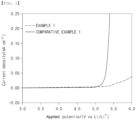
- Linear sweep voltammograms were measured in order to evaluate electrochemical stabilities of the electrolytes of Example 1 and Comparative Example 1.
- An LSV experiment was performed at a scan rate of 1 mV/s at 25°C, and the results thereof are presented in FIG. 1 .
- Example 1 As illustrated in FIG. 1 , it was confirmed that the gel polymer electrolyte of Example 1, which was prepared by using the fluorinated ether diacrylate, was stable up to 5.3 V without electrochemical decomposition. In contrast, since the electrolyte of Comparative Example 1 was decomposed at about 5.1 V, it may be confirmed that its electrochemical stability was lower than that of the gel polymer electrolyte of Example 1.
- the secondary batteries of Examples 1 to 4 using the gel polymer electrolytes according to the present invention had better life characteristics than the secondary battery of Comparative Example 1 using the liquid organic solvent electrolyte. Also, the secondary batteries of Examples 1 to 4 had better life characteristics than the secondary battery of Comparative Example 2 using the carbon-based polyether diacrylate crosslinking agent not containing a fluorine group.
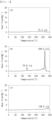
- a calorific value during charging and discharging of each of the secondary batteries prepared in Example 1, Comparative Examples 1, and Comparative Example 2 was measured using a differential scanning calorimeter (TA instrument, DSC25). Specifically, 0.0016 g of each of the secondary batteries prepared in Example 1, Comparative Examples 1, and Comparative Example 2 was put into a pressure-resistant pen for measuring differential scanning calorimetry (DSC). A temperature range for DSC analysis was 25°C to 400°C, and a heating rate was 10°C/min. A heat flow according to temperature was measured for each secondary battery. Measurement results were illustrated in FIG. 2 .
- the secondary battery of Comparative Example 2 using the carbon-based polyether diacrylate crosslinking agent exhibited a calorific value of 139.6 J/g in a temperature range of 200°C to 300°C.
- the secondary battery using the gel polymer electrolyte of Comparative Example 2 exhibited a higher calorific value than the secondary battery using the gel polymer electrolyte of Example 1 according to the present invention. Therefore, it may be understood that the use of the fluorinated polyether diacrylate crosslinking agent was more effective in suppressing heat generation of the lithium secondary battery than the use of the acrylate crosslinking agent in which a fluoro group was not substituted.
Landscapes
- Chemical & Material Sciences (AREA)
- Engineering & Computer Science (AREA)
- Manufacturing & Machinery (AREA)
- Chemical Kinetics & Catalysis (AREA)
- Electrochemistry (AREA)
- General Chemical & Material Sciences (AREA)
- Physics & Mathematics (AREA)
- Condensed Matter Physics & Semiconductors (AREA)
- General Physics & Mathematics (AREA)
- Inorganic Chemistry (AREA)
- Dispersion Chemistry (AREA)
- Materials Engineering (AREA)
- Secondary Cells (AREA)
Abstract
Description
- This application claims priority from
Korean Patent Application No. 10-2021-0099776, filed on July 29, 2021 - The present invention relates to a gel polymer electrolyte, and a lithium secondary battery including the same and a preparation method thereof.
- Recently, demand for a secondary battery having high stability as well as high capacity and high output is increasing as an application area of lithium secondary batteries is rapidly expanding not only to electricity, electronics, communication, and power supply of electronic devices such as computers, but also to power storage supply of automobiles or large-area devices such as power storage devices.
- In general, after a positive electrode, which is prepared by coating a positive electrode current collector with a positive electrode material mixture in which a positive electrode active material formed of a lithium-containing transition metal oxide, a binder, and/or a conductive agent are mixed, and a negative electrode, which is prepared by coating a negative electrode current collector with a negative electrode material mixture in which a carbon material and/or silicon negative electrode active material capable of intercalating and deintercalating lithium ions, a binder, and/or a conductive agent are mixed, are stacked on both sides of a separator to form an electrode assembly having a predetermined shape, a lithium secondary battery is prepared by inserting the electrode assembly and an electrolyte solution into a battery case.
- In this case, as the electrolyte solution, it is generally known to use a non-aqueous electrolyte solution in which a lithium salt is dissolved in a carbonate-based organic solvent such as ethylene carbonate (EC), propylene carbonate (PC), and diethyl carbonate (DEC). However, the above carbonate-based organic solvents have disadvantages in that they are not only highly likely to leak when used for a long period of time, but safety is also low due to the risk of fire caused by an increase in ambient temperature and temperature of the battery itself. Thus, developments of an electrolyte for a lithium secondary battery, which may compensate for these disadvantages, are being attempted, and, among them, a gel polymer electrolyte for confining a liquid electrolyte in a polymer structure has been proposed as a new electrolyte system.
- However, in a case in which the gel polymer electrolyte is used in a lithium secondary battery, there is a problem in that performance of the lithium secondary battery is degraded due to low lithium ion conductivity.
- An aspect of the present invention provides a gel polymer electrolyte having oxidation stability, flame retardancy, thermal stability, a great effect of inhibiting leakage of an organic solvent, and excellent lithium ion conductivity.
- Another aspect of the present invention provides a lithium secondary battery in which thermal stability is excellent and overall performance, such as cycle characteristics, is improved by including the gel polymer electrolyte.
- Another aspect of the present invention provides a method of preparing the lithium secondary battery.
- According to an aspect of the present invention, there is provided a gel polymer electrolyte including a cross-linked polymer having a thiol-ene structure, wherein the thiol-ene structure is formed by a click reaction of a thiol group of a thiol compound containing at least four reactive thiol groups per molecule and an acrylic group of a fluorinated polyether diacrylate.
- According to another aspect of the present invention, there is provided a lithium secondary battery including the gel polymer electrolyte.
- With respect to a cross-linked polymer having a thiol-ene structure which is included in a gel polymer electrolyte of the present invention, the chemically crosslinked gel polymer electrolyte is prepared by using a click reaction of a thiol group of a thiol compound containing at least four reactive thiol groups per molecule and an acrylic group of a fluorinated polyether diacrylate. In a case in which the gel polymer electrolyte is prepared through the click reaction, since there is almost no side reaction and the thiol group and the acrylic group selectively and rapidly react, there is an advantage in that yield of the cross-linked polymer is high.
- Also, the gel polymer electrolyte of the present invention, which includes the cross-linked polymer prepared by the click reaction, has an excellent effect of preventing leakage of an organic solvent by confining the organic solvent in a three-dimensional polymer network.
- Furthermore, since the gel polymer electrolyte of the present invention has a cross-linked structure, there is little change in the structure even with changes in external environment or the passage of time, and thus it has excellent structural, thermal, and mechanical stabilities.
- Also, according to the present invention, since the fluorinated polyether diacrylate having flame retardant properties is used as a crosslinking agent, a secondary battery using the gel polymer electrolyte of the present invention has an effect of improving thermal stability and suppressing a calorific value of an electrode. The gel polymer electrolyte according to the present invention has an effect of excellent oxidation stability due to fluorine atoms contained in the fluorinated polyether diacrylate crosslinking agent.
- Thus, in a case in which the gel polymer electrolyte of the present invention is used, since oxidation stability, flame retardancy, and thermal stability are not only improved, but cycle life characteristics and safety are also improved, a lithium secondary battery with improved overall performance may be achieved.
-
-
FIG. 1 is a result of measuring linear sweep voltammograms (LSV) in order to evaluate electrochemical stabilities of Example 1 and Comparative Example 1. -
FIG. 2 is a result of measuring calorific values during charge and discharge of lithium secondary batteries using electrolytes of Example 1 and Comparative Examples 1 and 2. - It will be understood that words or terms used in the specification and claims shall not be interpreted as the meaning defined in commonly used dictionaries. It will be further understood that the words or terms should be interpreted as having a meaning that is consistent with their meaning in the context of the relevant art and the technical idea of the invention, based on the principle that an inventor may properly define the meaning of the words or terms to best explain the invention.
- It will be further understood that the terms "include," "comprise," or "have" in this specification specify the presence of stated features, numbers, steps, elements, or combinations thereof, but do not preclude the presence or addition of one or more other features, numbers, steps, elements, or combinations thereof.
- Also, the expressions "a" and "b" in the description of "a to b carbon atoms" in the present specification each denote the number of carbon atoms included in a specific functional group. That is, the functional group may include "a" to "b" carbon atoms. For example, the expression "alkylene group having 1 to 5 carbon atoms" denotes an alkylene group including 1 to 5 carbon atoms, that is, -CH2-, -CH2CH2-, - CH2CH2CH2-, -CH2CH(CH3) -, -CH (CH3) CH2-, and -CH (CH3) CH2CH2-.
- Furthermore, in the present specification, the expression "alkylene group" denotes a branched or unbranched divalent saturated hydrocarbon group.
- Also, both the alkyl group and the alkylene group in the present specification may be substituted or unsubstituted. Unless otherwise defined, the expression "substitution" denotes that at least one hydrogen bonded to carbon is substituted with an element other than hydrogen, for example, an alkyl group having 1 to 20 carbon atoms, an alkenyl group having 2 to 20 carbon atoms, an alkynyl group having 2 to 20 carbon atoms, an alkoxy group having 1 to 20 carbon atoms, a cycloalkyl group having 3 to 12 carbon atoms, a cycloalkenyl group having 3 to 12 carbon atoms, a heterocycloalkyl group having 3 to 12 carbon atoms, a heterocycloalkenyl group having 3 to 12 carbon atoms, an aryloxy group having 6 to 12 carbon atoms, a halogen atom, a fluoroalkyl group having 1 to 20 carbon atoms, a nitro group, a nitrile group, an aryl group having 6 to 20 carbon atoms, a heteroaryl group having 2 to 20 carbon atoms, or a haloaryl group having 6 to 20 carbon atoms.
- Hereinafter, the present invention will be described in more detail.
- The present invention relates to a gel polymer electrolyte including a cross-linked polymer having a thiol-ene structure, wherein the thiol-ene structure may be formed by a click reaction of a thiol group of a thiol compound containing at least four reactive thiol groups per molecule and an acrylic group of a fluorinated polyether diacrylate.
- The thiol compound containing at least four reactive thiol groups per molecule, for example, may be at least one selected from the group consisting of pentaerythritol tetrakis(3-mercaptopropionate), dipentaerythritol hexakis(3-mercaptopropionate), pentaerythrityl tetrathiol, tetrakis(2-mercaptoethyl)silane, and benzene-1,2,4,5-tetrathiol. A three-dimensional polymer network may be formed by using the above-described thiol compound as a crosslinking agent. Such a three-dimensional polymer network may trap an organic solvent, and, as a result, there is an effect of preventing leakage of the organic solvent.
- The fluorinated polyether diacrylate may be represented by Formula 1 below:

- In Formula 1, Rx and Ry may each independently be an alkylene group having 1 to 10 carbon atoms, preferably an alkylene group having 1 to 5 carbon atoms, and more preferably an alkylene group having 1 to 3 carbon atoms.
- In Formula 1, R1 to R4 may each independently be selected from hydrogen (H), an alkyl group having 1 to 10 carbon atoms, and halogen, and, preferably, at least one of R1 to R4 may be halogen. Most preferably, at least one of R1 to R4 may be a fluoro group, and a gel polymer electrolyte having excellent flame retardancy and thermal stability may be obtained by using the polyether diacrylate substituted with fluoro as a crosslinking agent.
- In Formula 1, n may be an integer of 1 to 5, and, preferably, n may be an integer of 2 to 4.
- The fluorinated polyether diacrylate used as the crosslinking agent in the gel polymer electrolyte of the present invention may be represented by Formula 1-1 below. In a case in which the perfluorinated polyether diacrylate of Formula 1-1 is used, a gel polymer electrolyte having excellent flame retardancy and thermal stability may be obtained.
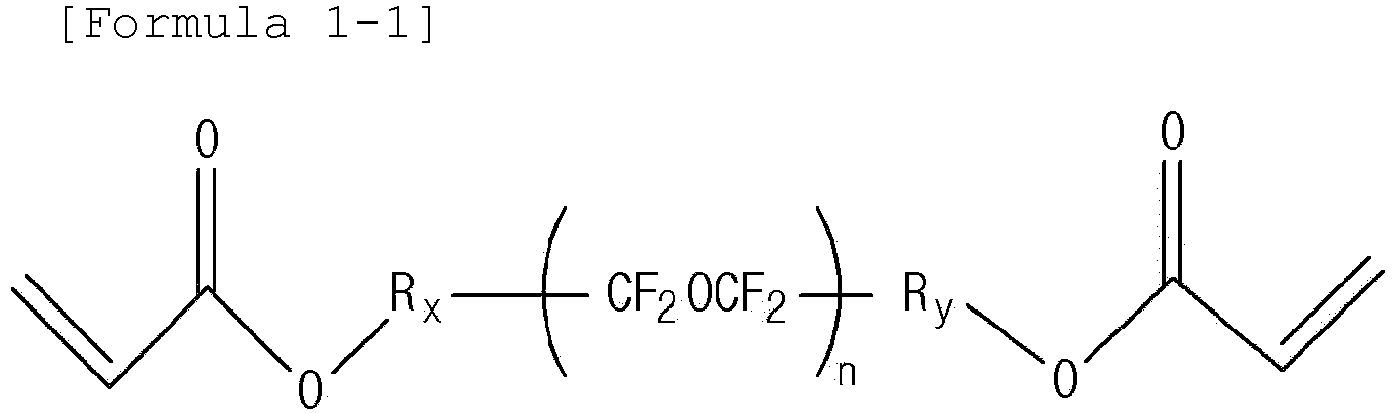
- In Formula 1, Rx and Ry may each independently be an alkylene group having 1 to 10 carbon atoms, preferably an alkylene group having 1 to 5 carbon atoms, and more preferably an alkylene group having 1 to 3 carbon atoms.
- In Formula 1-1, n may be an integer of 1 to 5, and, preferably, n may be an integer of 2 to 4.
- Specifically, the fluorinated polyether diacrylate used as the crosslinking agent in the gel polymer electrolyte of the present invention may be represented by Formula 1-2 below.


- A weight-average molecular weight of the fluorinated polyether diacrylate used as the crosslinking agent in the gel polymer electrolyte of the present invention may be in a range of 200 g/mol to 2,000 g/mol, preferably 200 g/mol to 1,000 g/mol, and more preferably 300 g/mol to 600 g/mol. In a case in which the weight-average molecular weight of the fluorinated polyether diacrylate satisfies the above range, since a precursor including the fluorinated polyether diacrylate is well impregnated into a cell during preparation of a secondary battery, excellent battery characteristics may be exhibited.
- The gel polymer electrolyte according to the present invention may further include a lithium salt and an organic solvent in addition to the cross-linked polymer having a thiol-ene structure.
- The lithium salt is used as an electrolyte salt in the lithium secondary battery, wherein it is used as a medium for transferring ions. Typically, the lithium salt, for example, may include Li+ as a cation, and may include at least one selected from the group consisting of F-, Cl-, Br-, I-, NO3 -, N(CN)2 -, BF4 -, ClO4 -, B10Cl10 -, AlCl4 -, AlO2 -, PF6 -, CF3SO3 -, CH3CO2 -, CF3CO2 -, AsF6 -, SbF6 -, CH3SO3 -, (CF3CF2SO2)2N-, (CF3SO2)2N-, (FSO2)2N-, BF2C2O4 -, BC4O8 -, PF4C2O4 -, PF2C4O8 -, (CF3)2PF4 -, (CF3)3PF3 -, (CF3)4PF2 -, (CF3)5PF-, (CF3)6P-, C4F9SO3 -, CF3CF2SO3 -, CF3CF2(CF3)2CO-, (CF3SO2)2CH-, CF3(CF2)7SO3 -, and SCN- as an anion.
- Specifically, the lithium salt may include a single material selected from the group consisting of LiCl, LiBr, LiI, LiBF4, LiClO4, LiB10Cl10, LiAlCl4, LiAlO4, LiPF6, LiCF3SO3, LiCH3CO2, LiCF3CO2, LiAsF6, LiSbF6, LiCH3SO3, LiFSI (lithium bis(fluorosulfonyl)imide, LiN(SO2F)2), LiBETI (lithium bis (pentafluoroethanesulfonyl) imide, LiN(SO2CF2CF3)2), and LiTFSI (lithium bis(trifluoromethanesulfonyl)imide, LiN(SO2CF3)2) or a mixture of two or more thereof. In addition to these materials, a lithium salt typically used in an electrolyte of a lithium secondary battery may be used without limitation. Among them, LiTFSI is particularly preferable in terms of high thermal stability in a heat treatment process and high ionic conductivity and improved flame retardancy in the secondary battery.
- An organic solvent typically used in a non-aqueous electrolyte may be used as the organic solvent without limitation. For example, the organic solvent may include at least one organic solvent selected from the group consisting of a cyclic carbonate-based organic solvent, a linear carbonate-based organic solvent, a linear ester-based organic solvent, a cyclic ester-based organic solvent, an ether-based organic solvent, a glyme-based solvent, and a nitrile-based organic solvent.
- The cyclic carbonate-based organic solvent, as a highly viscous organic solvent, is an organic solvent which may well dissociate the lithium salt in the electrolyte due to high permittivity, wherein specific examples thereof may be at least one organic solvent selected from the group consisting of ethylene carbonate (EC), propylene carbonate (PC), 1,2-butylene carbonate, 2,3-butylene carbonate, 1,2-pentylene carbonate, 2,3-pentylene carbonate, and vinylene carbonate.
- The linear carbonate-based organic solvent is an organic solvent having low viscosity and low permittivity, wherein typical examples thereof may be at least one organic solvent selected from the group consisting of dimethyl carbonate (DMC), diethyl carbonate (DEC), dipropyl carbonate, ethylmethyl carbonate (EMC), methylpropyl carbonate, and ethylpropyl carbonate.
- The linear ester-based organic solvent may include at least one organic solvent selected from the group consisting of methyl acetate, ethyl acetate, propyl acetate, methyl propionate, ethyl propionate, propyl propionate, and butyl propionate.
- The cyclic ester-based organic solvent may include at least one organic solvent selected from the group consisting of γ-butyrolactone, γ-valerolactone, γ-caprolactone, σ-valerolactone, and ε-caprolactone.
- The ether-based solvent may include at least one organic solvent selected from the group consisting of dimethyl ether, diethyl ether, dipropyl ether, methylethyl ether, methylpropyl ether, ethylpropyl ether, 1,3-dioxolane (DOL), and 2,2-bis(trifluoromethyl)-1,3-dioxolane (TFDOL).
- The glyme-based solvent is a solvent having higher permittivity and lower surface tension than the linear carbonate-based organic solvent as well as less reactivity with metal, wherein the glyme-based solvent may include at least one organic solvent selected from the group consisting of dimethoxyethane (glyme, DME), diethoxyethane, diglyme, triglyme (triglyme), and tetra-glyme (TEGDME).
- The nitrile-based solvent may include at least one organic solvent selected from the group consisting of acetonitrile, propionitrile, butyronitrile, valeronitrile, caprylontrile, heptanenitrile, cyclopentane carbonitrile, cyclohexane carbonitrile, 2-fluorobenzonitrile, 4-fluorobenzonitrile, difluorobenzonitrile, trifluorobenzonitrile, phenylacetonitrile, 2-fluorophenylacetonitrile, and 4-fluorophenylacetonitrile.
- Specifically, the organic solvent may include the cyclic carbonate-based organic solvent, the linear carbonate-based organic solvent, or a mixed organic solvent thereof, and, among them, the linear carbonate-based organic solvent is preferable in terms of improving ionic conductivity of the electrolyte due to its low viscosity, and dimethyl carbonate (DMC) is particularly preferable.
- The gel polymer electrolyte of the present invention may include the cross-linked polymer having a thiol-ene structure and the lithium salt in a weight ratio of 1:11 to 1:0.5, preferably 1:7 to 1:0.5, and more preferably 1:6 to 1:1. In a case in which the weight ratio of the cross-linked polymer having a thiol-ene structure to the lithium salt satisfies the above range, excellent battery characteristics may be exhibited due to high ionic conductivity.
- In the gel polymer electrolyte according to the present invention, the cross-linked polymer having a thiol-ene structure may be included in an amount of 10 parts by weight to 80 parts by weight, preferably 20 parts by weight to 80 parts by weight, more preferably 20 parts by weight to 75 parts by weight, and most preferably 20 parts by weight to 50 parts by weight based on 100 parts by weight of the organic solvent. In the gel polymer electrolyte, in a case in which the amount of the cross-linked polymer having a thiol-ene structure with respect to the organic solvent satisfies the above range, since high lithium ion conductivity and oxidation stability may be secured and the amount of the organic solvent used may be reduced, there is an advantage in that the leakage may be prevented and flame retardant properties may be obtained at the same time.
- The gel polymer electrolyte according to the present invention may have a lithium ion conductivity at 25°C of 1.0×10⁻³ S/cm or more, preferably 1.0×10⁻³ S/cm to 5.0×10⁻³ S/cm, and more preferably 1.4×10⁻³ S/cm to 3.0×10⁻³ S/cm, for example, 1.5×10⁻³ S/cm to 3.0×10⁻³ S/cm. In a case in which the lithium ion conductivity of the gel polymer electrolyte satisfies the above range, a desired level of secondary battery characteristics may be obtained.
- The gel polymer electrolyte according to the present invention may have a lithium ion conductivity at 45°C of 2.0×10⁻³ S/cm or more, preferably 2.0×10⁻³ S/cm to 1.0×10⁻² S/cm, and more preferably 2.0×10⁻³ S/cm to 4.0×10⁻³ S/cm. In a case in which the lithium ion conductivity of the gel polymer electrolyte satisfies the above range, a desired level of secondary battery characteristics may be obtained.
- The ionic conductivity, for example, may be measured at an amplitude of 50 mV and a frequency range of 10 Hz to 1.0×10⁶ Hz using an IM6 instrument by Zahner Electrik.
- The gel polymer electrolyte of the present invention may further include a known electrolyte additive in the gel polymer electrolyte, if necessary, in order to prevent the occurrence of collapse of a negative electrode due to decomposition of the gel polymer electrolyte in a high output environment or to further improve low-temperature high rate discharge characteristics, high-temperature stability, overcharge prevention, and an effect of suppressing battery swelling at high temperature.
- Typical examples of the other electrolyte additives may include at least one additive for forming a solid electrolyte interface (SEI) which is selected from the group consisting of a cyclic carbonate-based compound, a halogen-substituted carbonate-based compound, a sultone-based compound, a sulfate-based compound, a phosphate-based compound, a borate-based compound, a nitrile-based compound, a benzene-based compound, an amine-based compound, a silane-based compound, and a lithium salt-based compound.
- The cyclic carbonate-based compound may include vinylene carbonate (VC) or vinyl ethylene carbonate.
- The halogen-substituted carbonate-based compound may include fluoroethylene carbonate (FEC).
- The sultone-based compound may include at least one compound selected from the group consisting of 1,3-propane sultone (PS), 1,4-butane sultone, ethane sultone, 1,3-propene sultone (PRS), 1,4-butene sultone, and 1-methyl-1,3-propene sultone.
- The sulfate-based compound may include ethylene sulfate (Esa), trimethylene sulfate (TMS), or methyl trimethylene sulfate (MTMS).
- The phosphate-based compound may include at least one compound selected from the group consisting of lithium difluoro (bisoxalato)phosphate, lithium difluorophosphate, tetramethyl trimethyl silyl phosphate, trimethyl silyl phosphite, tris(2,2,2-trifluoroethyl)phosphate, and tris(trifluoroethyl)phosphite.
- The borate-based compound may include tetraphenylborate, lithium oxalyldifluoroborate (LiODFB), and lithium bis(oxalato)borate (LiB(C2O4)2, LiBOB).
- The nitrile-based compound may include at least one compound selected from the group consisting of succinonitrile, adiponitrile, acetonitrile, propionitrile, butyronitrile, valeronitrile, caprylonitrile, heptanenitrile, cyclopentane carbonitrile, cyclohexane carbonitrile, 2-fluorobenzonitrile, 4-fluorobenzonitrile, difluorobenzonitrile, trifluorobenzonitrile, phenylacetonitrile, 2-fluorophenylacetonitrile, and 4-fluorophenylacetonitrile.
- The benzene-based compound may include fluorobenzene, the amine-based compound may include triethanolamine or ethylenediamine, and the silane-based compound may include tetravinylsilane.
- The lithium salt-based compound is a compound different from the lithium salt included in the gel polymer electrolyte, wherein the lithium salt-based compound may include LiPO2F2 or LiBF4.
- In a case in which, among these other electrolyte additives, vinylene carbonate, vinyl ethylene carbonate, or succinonitrile is additionally included, a more robust SEI may be formed on a surface of the negative electrode during an initial activation process of the secondary battery.
- In a case in which the LiBF4 is included, high-temperature stability of the secondary battery may be improved by suppressing generation of a gas which may be generated due to the decomposition of the electrolyte at high temperature.
- Two or more other electrolyte additives may be mixed and used, and the additives may be included in an amount of 0.01 wt% to 2 wt%, preferably 0.01 wt% to 1.5 wt%, and more preferably 0.05 wt% to 1 wt% based on a total weight of the gel polymer electrolyte. When the amount of the additive satisfies the above range, an effect of improving ionic conductivity and cycle characteristics is more excellent.
- The present invention may also provide a lithium secondary battery including the gel polymer electrolyte.
- Specifically, the lithium secondary battery may include a positive electrode including a positive electrode active material, a negative electrode including a negative electrode active material, a separator disposed between the positive electrode and the negative electrode, and the above-described gel polymer electrolyte.
- Since the lithium secondary battery including the gel polymer electrolyte according to the present invention has improved thermal stability, a calorific value in a temperature range of 200°C to 300°C when a heat flow is measured by differential scanning calorimetry (DSC) is 100 J/g or less, wherein there may be few peaks. Specifically, the calorific value in a temperature range of 200°C to 300°C may be 80 J/g or less. This is considered to be because the ether diacrylate crosslinking agent containing a fluorinated group is more effective in suppressing the calorific value of the lithium secondary battery due to excellent heat absorption properties.
- The heat flow measurement by the differential scanning calorimetry (DSC) may be measured using a DSC25 instrument by TA instrument, and a calorific value in a temperature range of 0°C to 300°C may be measured at a heating rate of 10 °C/min using a Tzero hermetic aluminum pan.
- The positive electrode may be prepared by coating a positive electrode current collector with a positive electrode material mixture slurry including a positive electrode active material, a binder, a conductive agent, and a solvent.
- The positive electrode current collector is not particularly limited so long as it has conductivity without causing adverse chemical changes in the battery, and, for example, stainless steel, aluminum, nickel, titanium, fired carbon, or aluminum or stainless steel that is surface-treated with one of carbon, nickel, titanium, silver, or the like may be used.
- The positive electrode active material is a compound capable of reversibly intercalating and deintercalating lithium, wherein the positive electrode active material may specifically include a lithium metal oxide including lithium and at least one metal such as cobalt, manganese, nickel, or aluminum. More specifically, the lithium metal oxide may include lithium-manganese-based oxide (e.g., LiMnO2, LiMn2O4, etc.), lithium-cobalt-based oxide (e.g., LiCoO2, etc.), lithium-nickel-based oxide (e.g., LiNiO2, etc.), lithium-nickel-manganese-based oxide (e.g., LiNi1-YMnYO2 (where 0<Y<1), LiMn2-ZNizO4 (where 0<Z<2), etc.), lithium-nickel-cobalt-based oxide (e.g., LiNi1-Y1CoY1O2 (where 0<Y1<1), etc.), lithium-manganese-cobalt-based oxide (e.g., LiCo1-Y2MnY2O2 (where 0<Y2<1), LiMn2-Z1Coz1O4 (where 0<Z1<2), etc.), lithium-nickel-manganese-cobalt-based oxide (e.g., Li(NipCoqMnr1)O2 (where 0<p<1, 0<q<1, 0<r1<1, and p+q+r1=1) or Li(Nip1Coq1Mnr2)O4 (where 0<p1<2, 0<q1<2, 0<r2<2, and p1+q1+r2=2), etc.), or lithium-nickel-cobalt-transition metal (M) oxide (e.g., Li(Nip2Coq2Mnr3MS2)O2 (where M is selected from the group consisting of aluminum (Al), iron (Fe), vanadium (V), chromium (Cr), titanium (Ti), tantalum (Ta), magnesium (Mg), and molybdenum (Mo), and p2, q2, r3, and s2 are atomic fractions of each independent elements, wherein 0<p2<1, 0<q2<1, 0<r3<1, 0<S2<1, and p2+q2+r3+S2=1), etc.), and any one thereof or a compound of two or more thereof may be included.
- Among these materials, in terms of the improvement of capacity characteristics and stability of the battery, the lithium metal oxide may include LiCoO2, LiMnO2, LiNiO2, lithium nickel manganese cobalt oxide (e.g., Li(Ni1/3Mn1/3Co1/3)O2, Li (Ni0.6Mn0.2Co0.2)O2, Li (Ni0.5Mn0.5Co0.2)O2, Li (Ni0.7Mn0.15Co0.15)O2, and Li(Ni0.8Mn0.1Co0.1)O2, etc.), or lithium nickel cobalt aluminum oxide (e.g., LiNi0.8Co0.15Al0.05O2, etc.), and any one thereof or a mixture of two or more thereof may be used. Preferably, the positive electrode active material may be a lithium-nickel-manganese-cobalt-based oxide.
- The positive electrode active material may be included in an amount of 60 wt% to 99 wt%, preferably 70 wt% to 99 wt%, and more preferably 80 wt% to 98 wt% based on a total weight of solid content excluding the solvent in the positive electrode material mixture slurry.
- The binder is a component that assists in the binding between the active material and the conductive agent and in the binding with the current collector.
- Examples of the binder may be polyvinylidene fluoride, polyvinyl alcohol, carboxymethylcellulose (CMC), starch, hydroxypropylcellulose, regenerated cellulose, polyvinylpyrrolidone, polytetrafluoroethylene, polyethylene (PE), polypropylene, an ethylene-propylene-diene monomer, a sulfonated ethylene-propylene-diene monomer, a styrene-butadiene rubber, a fluoro rubber, or various copolymers.
- The binder may commonly be included in an amount of 1 wt% to 20 wt%, preferably 1 wt% to 15 wt%, and more preferably 1 wt% to 10 wt% based on the total weight of the solid content excluding the solvent in the positive electrode material mixture slurry.
- The conductive agent is a component for further improving conductivity of the positive electrode active material, wherein it may be added in an amount of 1 wt% to 20 wt% based on the total weight of the solid content in the positive electrode material mixture slurry. The conductive agent is not particularly limited as long as it has conductivity without causing adverse chemical changes in the battery, and, for example, a conductive material, such as: carbon powder such as carbon black, acetylene black, Ketjen black, channel black, furnace black, lamp black, or thermal black; graphite powder such as natural graphite with a well-developed crystal structure, artificial graphite, or graphite; conductive fibers such as carbon fibers or metal fibers; fluorocarbon powder; conductive powder such as aluminum powder and nickel powder; conductive whiskers such as zinc oxide whiskers and potassium titanate whiskers; conductive metal oxide such as titanium oxide; or polyphenylene derivatives, may be used.
- The conductive agent may commonly be included in an amount of 1 wt% to 20 wt%, preferably 1 wt% to 15 wt%, and more preferably 1 wt% to 10 wt% based on the total weight of the solid content excluding the solvent in the positive electrode material mixture slurry.
- The solvent may include an organic solvent, such as N-methyl-2-pyrrolidone (NMP), and may be used in an amount such that desirable viscosity is obtained when the positive electrode active material as well as optionally the binder and the conductive agent is included. For example, the solvent may be included in an amount such that a concentration of the solid content including the positive electrode active material as well as optionally the binder and the conductive agent is in a range of 50 wt% to 95 wt%, preferably 70 wt% to 95 wt%, and more preferably 70 wt% to 90 wt%.
- The negative electrode, for example, may be prepared by coating a negative electrode material mixture slurry including a negative electrode active material, a binder, a conductive agent, and a solvent on a negative electrode current collector, or a graphite electrode formed of carbon (C) or a metal itself may be used as the negative electrode.
- For example, in a case in which the negative electrode is prepared by coating the negative electrode material mixture slurry on the negative electrode current collector, the negative electrode current collector generally has a thickness of 3 um to 500 um. The negative electrode current collector is not particularly limited so long as it has high conductivity without causing adverse chemical changes in the battery, and, for example, copper, stainless steel, aluminum, nickel, titanium, fired carbon, copper or stainless steel that is surface-treated with one of carbon, nickel, titanium, silver, or the like, an aluminum-cadmium alloy, or the like may be used. Also, similar to the positive electrode current collector, the negative electrode current collector may have fine surface roughness to improve bonding strength with the negative electrode active material, and the negative electrode current collector may be used in various shapes such as a film, a sheet, a foil, a net, a porous body, a foam body, a nonwoven fabric body, and the like.
- Also, the negative electrode active material may include at least one selected from the group consisting of lithium metal, a carbon material capable of reversibly intercalating/deintercalating lithium ions, metal or an alloy of lithium and the metal, a metal composite oxide, a material which may be doped and undoped with lithium, and a transition metal oxide.
- As the carbon material capable of reversibly intercalating/deintercalating lithium ions, a carbon-based negative electrode active material generally used in a lithium ion secondary battery may be used without particular limitation, and, as a typical example, crystalline carbon, amorphous carbon, or both thereof may be used. Examples of the crystalline carbon may be graphite such as irregular, planar, flaky, spherical, or fibrous natural graphite or artificial graphite, and examples of the amorphous carbon may be soft carbon (low-temperature sintered carbon) or hard carbon, mesophase pitch carbide, and fired cokes.
- As the metal or the alloy of lithium and the metal, a metal selected from the group consisting of copper (Cu), nickel (Ni), sodium (Na), potassium (K), rubidium (Rb), cesium (Cs), francium (Fr), beryllium (Be), Mg, calcium (Ca), strontium (Sr), silicon (Si), antimony (Sb), lead (Pb), indium (In), zinc (Zn), barium (Ba), radium (Ra), germanium (Ge), Al, and tin (Sn) or an alloy of lithium and the metal may be used.
- One selected from the group consisting of PbO, PbO2, Pb2O3, Pb3O4, Sb2O3, Sb2O4, Sb2O5, GeO, GeO2, Bi2O3, Bi2O4, Bi2O5, LixFe2O3 (0≤x≤1), LixWO2 (0≤x≤1), and SnxMe1-xMe'yOz (Me: manganese (Mn), Fe, Pb, or Ge; Me': Al, boron (B), phosphorus (P), Si, Groups I, II and III elements of the periodic table, or halogen; 0<x≤1; 1≤y≤3; 1≤z≤8) may be used as the metal composite oxide.
- The material, which may be doped and undoped with lithium, may include Si, SiOx (0<x≤2), a Si-Y alloy (where Y is an element selected from the group consisting of alkali metal, alkaline earth metal, a Group 13 element, a Group 14 element, transition metal, a rare earth element, and a combination thereof, and is not Si), Sn, SnO2, and Sn-Y (where Y is an element selected from the group consisting of alkali metal, alkaline earth metal, a Group 13 element, a Group 14 element, transition metal, a rare earth element, and a combination thereof, and is not Sn) , and a mixture of SiO2 and at least one thereof may also be used. The element Y may be selected from the group consisting of Mg, Ca, Sr, Ba, Ra, scandium (Sc), yttrium (Y), Ti, zirconium (Zr), hafnium (Hf), rutherfordium (Rf), V, niobium (Nb), Ta, dubnium (Db), Cr, Mo, tungsten (W), seaborgium (Sg), technetium (Tc), rhenium (Re), bohrium (Bh), Fe, Pb, ruthenium (Ru), osmium (Os), hassium (Hs), rhodium (Rh), iridium (Ir), palladium (Pd), platinum (Pt), Cu, silver (Ag), gold (Au), Zn, cadmium (Cd), B, Al, gallium (Ga), Sn, In, Ge, P, arsenic (As), Sb, bismuth (Bi), sulfur (S), selenium (Se), tellurium (Te), polonium (Po), and a combination thereof.
- The transition metal oxide may include lithium-containing titanium composite oxide (LTO), vanadium oxide, and lithium vanadium oxide.
- The negative electrode active material may be included in an amount of 60 wt% to 99 wt%, preferably 70 wt% to 99 wt%, and more preferably 80 wt% to 98 wt% based on a total weight of solid content in the negative electrode material mixture slurry.
- The binder is a component that assists in the binding between the conductive agent, the active material, and the current collector. Examples of the binder may be polyvinylidene fluoride (PVDF), polyvinyl alcohol, carboxymethylcellulose (CMC), starch, hydroxypropylcellulose, regenerated cellulose, polyvinylpyrrolidone, polytetrafluoroethylene, polyethylene, polypropylene, an ethylene-propylene-diene monomer, a sulfonated ethylene-propylene-diene monomer, a styrene-butadiene rubber, a fluoro rubber, or various copolymers thereof.
- The binder may be commonly included in an amount of 1 wt% to 20 wt%, preferably 1 wt% to 15 wt%, and more preferably 1 wt% to 10 wt% based on the total weight of the solid content excluding the solvent in the negative electrode material mixture slurry.
- The conductive agent is a component for further improving conductivity of the negative electrode active material, wherein the conductive agent may be added in an amount of 1 wt% to 20 wt% based on the total weight of the solid content in the negative electrode material mixture slurry. The conductive agent is not particularly limited as long as it has conductivity without causing adverse chemical changes in the battery, and, for example, a conductive material, such as: carbon powder such as carbon black, acetylene black, Ketjen black, channel black, furnace black, lamp black, or thermal black; graphite powder such as natural graphite with a well-developed crystal structure, artificial graphite, or graphite; conductive fibers such as carbon fibers or metal fibers; fluorocarbon powder; conductive powder such as aluminum powder and nickel powder; conductive whiskers such as zinc oxide whiskers and potassium titanate whiskers; conductive metal oxide such as titanium oxide; or polyphenylene derivatives, may be used.
- The conductive agent may be included in an amount of 1 wt% to 20 wt%, preferably 1 wt% to 15 wt%, and more preferably 1 wt% to 10 wt% based on the total weight of the solid content excluding the solvent in the negative electrode material mixture slurry.
- The solvent may include water or an organic solvent, such as NMP (N-methyl-2-pyrrolidone), and may be used in an amount such that desirable viscosity is obtained when the negative electrode active material as well as optionally the binder and the conductive agent is included. For example, the solvent may be included in an amount such that a concentration of the solid content including the negative electrode active material as well as optionally the binder and the conductive agent is in a range of 50 wt% to 95 wt%, for example, 70 wt% to 90 wt%.
- In a case in which the metal itself is used as the negative electrode, the negative electrode may be a metal thin film itself or may be prepared by a method in which the metal is physically bonded, rolled, or deposited on the negative electrode current collector. As the deposition method, an electrical deposition method or a chemical vapor deposition method for the metal may be used.
- For example, the metal thin film itself or the metal to be bonded/rolled/deposited on the negative electrode current collector may include one type of metal selected from the group consisting of lithium (Li), nickel (Ni), tin (Sn), copper (Cu), and indium (In) or an alloy of two types of metals.
- Also, a conventional porous polymer film typically used, for example, a porous polymer film prepared from a polyolefin-based polymer, such as an ethylene homopolymer, a propylene homopolymer, an ethylene/butene copolymer, an ethylene/hexene copolymer, and an ethylene/methacrylate copolymer, may be used alone or in a lamination therewith as the separator, and a typical porous nonwoven fabric, for example, a nonwoven fabric formed of high melting point glass fibers or polyethylene terephthalate fibers may be used, but the present invention is not limited thereto. Furthermore, a coated separator including a ceramic component or a polymer material may be used to secure heat resistance or mechanical strength, and the separator having a single layer or multilayer structure may be optionally used.
- A shape of a lithium secondary battery case of the present invention is not particularly limited, but a cylindrical type using a can, a prismatic type, a pouch type, or a coin type may be used.
- An amount of the gel polymer electrolyte based on the entire secondary battery may be in a range of 10 wt% to 30 wt%, preferably 10 wt% to 25% wt%, and more preferably 10 wt% to 20 wt%. In a case in which the amount of the gel polymer electrolyte satisfies the above range, high ionic conductivity and thermal stability may not only be secured, but there is also an advantage in that a lithium secondary battery with improved cycle life characteristics and safety may be prepared.
- A method of preparing the lithium secondary battery of the present invention may include the steps of: preparing an electrode assembly including the above-described positive electrode, negative electrode, and separator disposed between the positive electrode and the negative electrode; inserting the electrode assembly into a battery case; preparing a gel polymer electrolyte precursor solution including a thiol compound containing at least four reactive thiol groups per molecule, a fluorinated polyether diacrylate, an organic solvent, a lithium salt, and a thermal polymerization initiator; and injecting the precursor solution into the battery case in which the electrode assembly has been inserted and performing a heat treatment to proceed a crosslinking reaction.
- The gel polymer electrolyte precursor solution may be prepared by mixing a thiol compound containing at least four reactive thiol groups per molecule, a fluorinated polyether diacrylate, an organic solvent, a lithium salt, and a thermal polymerization initiator. Since the thiol compound, the fluorinated polyether diacrylate, the organic solvent, and the lithium salt have been described above, detailed descriptions thereof will be omitted.
- As the thermal polymerization initiator, for example, at least one selected from the group consisting of a peroxy initiator and an azo initiator may be used. Specifically, the peroxy initiator includes t-butylperoxypivalate, 1-cyclohexyl-1-methylethyl peroxy-2-ethyl hexanonate, t-butyl peroxy isopropyl monocarbonate, and t-butyl triallyl silyl peroxide. Specific examples of the azo initiator are 2,2'-azobis(4-methoxy-2,4-dimethyl valeronitrile), dimethyl 2,2'-azobis(2-methyl propionate), and 2,2'-azobis(N-cyclohexyl-2-methyl propionamide.
- The thermal polymerization initiator may be included in an amount of 0.005 part by weight to 5.0 parts by weight, preferably 0.01 part by weight to 3.0 parts by weight, and more preferably 0.01 part by weight to 1 part by weight based on 100 parts by weight of a combined weight of the thiol compound, the fluorinated polyether diacrylate, the organic solvent, and the lithium salt. In a case in which the amount of the thermal polymerization initiator satisfies the above range, reactivity of the click reaction between thiol of the thiol compound containing at least four reactive thiol groups per molecule and the acrylic group of the fluorinated polyether diacrylate is excellent for the thiol-ene structure.
- The heat treatment may be performed at a temperature of 50°C to 80°C, preferably 55°C to 75°C, and more preferably 65°C to 75°C. In a case in which the heat treatment temperature is less than 50°C, since radicals for polymerization are not sufficiently generated, there is a problem in that efficiency in completing the polymerization is reduced and a residual unreacted crosslinking agent degrades battery performance, and, in a case in which the heat treatment temperature is greater than 80°C, there may be a problem in that the electrolyte material is degraded or the structure is deformed.
- The heat treatment time may be in a range of 0.5 hours to 3 hours, for example, 1.5 hours to 2.5 hours. In a case in which the heat treatment time is less than 0.5 hours, since the polymerization reaction does not sufficiently occur, a high polymerization conversion rate may not be ensured, a uniform polymer may not be obtained, and there is a problem in that the residual unreacted crosslinking agent degrades the battery performance. In a case in which the heat treatment time is greater than 3 hours, there may be a problem in that the material is degraded or the structure is deformed.
- Hereinafter, the present invention will be described in detail, according to specific examples. However, the following examples are merely presented to exemplify the present invention, and the scope of the present invention is not limited thereto. It will be apparent to those skilled in the art that various modifications and alterations are possible within the scope and technical spirit of the present invention, and such modifications and alterations fall within the scope of claims included herein.
- 0.38 g of pentaerythritol tetrakis(3-mercapto propionate) and 0.62 g of the fluorinated polyether diacrylate of Formula 1-2 were mixed so that the numbers of moles of reactive functional groups were the same, and 5 g of lithium bis(trifluoromethanesulphonyl)imide (LiTFSI) as a lithium salt, 4 g of dimethyl carbonate (DMC) as an organic solvent, and 0.03 g of t-butyl peroxypivalate (t-BPP), as an initiator, were added to prepare a gel polymer electrolyte precursor solution which included a cross-linked polymer having a thiol-ene structure.
- A positive electrode active material (LiNi0.6Co0.2Mn0.2O2) : a conductive agent (Super P) :a binder (polyvinylidene fluoride) were added in a weight ratio of 95:3:2 to N-methyl-2-pyrrolidone (NMP), as a solvent, to prepare a positive electrode slurry (solid content 75 wt%). One surface of a 20 um thick positive electrode current collector (Al thin film) was coated with the positive electrode slurry, dried, and roll-pressed to prepare a positive electrode.
- A negative electrode active material (graphite):a conductive agent (Super P):a binder (polyvinylidene fluoride) were added to N-methyl-2-pyrrolidone (NMP), as a solvent, in a weight ratio of 90:3:7 to prepare a negative electrode slurry (solid content 60 wt%). One surface of a 15 um thick negative electrode current collector (Cu thin film) was coated with the negative electrode slurry, dried, and roll-pressed to prepare a negative electrode.
- An electrode stack was prepared by disposing a polyethylene separator between the above-prepared positive electrode and negative electrode in a glove box and the electrode stack was inserted into a battery case. A secondary battery cell was prepared by injecting the precursor solution into the battery case and performing a heat treatment at 70°C for 2 hours to proceed a cross-linking reaction.
- A secondary battery cell was prepared in the same manner as in Example 1 except that 0.76 g of pentaerythritol tetrakis(3-mercapto propionate) and 1.24 g of the fluorinated polyether diacrylate of Formula 1-2 were mixed so that the numbers of moles of reactive functional groups were the same, and 4 g of lithium bis(trifluoromethanesulphonyl)imide (LiTFSI) as a lithium salt, 4 g of dimethyl carbonate (DMC) as an organic solvent, and 0.03 g of t-butyl peroxypivalate (t-BPP), as an initiator, were added to prepare a gel polymer electrolyte precursor solution.
- A secondary battery cell was prepared in the same manner as in Example 1 except that 1.14 g of pentaerythritol tetrakis(3-mercapto propionate) and 1.86 g of the fluorinated polyether diacrylate of Formula 1-2 were mixed so that the numbers of moles of reactive functional groups were the same, and 3 g of lithium bis(trifluoromethanesulphonyl)imide (LiTFSI) as a lithium salt, 4 g of dimethyl carbonate (DMC) as an organic solvent, and 0.03 g of t-butyl peroxypivalate (t-BPP), as an initiator, were added to prepare a gel polymer electrolyte precursor solution.
- A secondary battery cell was prepared in the same manner as in Example 1 except that 0.38 g of pentaerythritol tetrakis(3-mercapto propionate) and 0.62 g of the fluorinated polyether diacrylate of Formula 1-2 were mixed so that the numbers of moles of reactive functional groups were the same, and 5 g of lithium bis(trifluoromethanesulphonyl)imide (LiTFSI) as a lithium salt, 4 g of dimethyl carbonate (DMC) as an organic solvent, 0.03 g of t-butyl peroxypivalate (t-BPP) as an initiator, and 0.1 g of vinylene carbonate (VC), as an additive, were added to prepare a gel polymer electrolyte precursor solution.
- 5 g of lithium bis(trifluoromethanesulphonyl)imide (LiTFSI), as a lithium salt, and 4 g of dimethyl carbonate (DMC), as an organic solvent, were mixed to prepare a liquid electrolyte.
- A positive electrode active material (LiNi0.6Co0.2Mn0.2O2) : a conductive agent (Super P) :a binder (polyvinylidene fluoride) were added in a weight ratio of 95:3:2 to N-methyl-2-pyrrolidone (NMP), as a solvent, to prepare a positive electrode slurry (solid content 75 wt%). One surface of a 20 um thick positive electrode current collector (Al thin film) was coated with the positive electrode slurry, dried, and roll-pressed to prepare a positive electrode.
- A negative electrode active material (graphite):a conductive agent (Super P):a binder (polyvinylidene fluoride) were added to N-methyl-2-pyrrolidone (NMP), as a solvent, in a weight ratio of 90:3:7 to prepare a negative electrode slurry (solid content 60 wt%). One surface of a 15 um thick negative electrode current collector (Cu thin film) was coated with the negative electrode slurry, dried, and roll-pressed to prepare a negative electrode.
- After disposing a polyethylene separator between the above-prepared positive electrode and negative electrode in a dry room, the liquid electrolyte was injected to prepare a secondary battery cell.
- A secondary battery cell was prepared in the same manner as in Example 1 except that 0.49 g of pentaerythritol tetrakis(3-mercapto propionate) and 0.51 g of polyether diacrylate of the following Formula A were mixed so that the numbers of moles of reactive functional groups were the same, and 5 g of lithium bis(trifluoromethanesulphonyl)imide (LiTFSI) as a lithium salt, 4 g of dimethyl carbonate (DMC) as an organic solvent, and 0.03 g of t-butyl peroxypivalate (t-BPP), as an initiator, were added to prepare a gel polymer electrolyte precursor solution.

- An ionic conductivity value for each temperature of the prepared gel polymer electrolytes in the secondary batteries in Examples 1 to 4 and Comparative Example 2 was measured. Specifically, ionic conductivities of the gel polymer electrolytes prepared in Examples 1 to 4 and Comparative Example 2 were analyzed using IM6 by Zahner Electrik, and the results thereof are presented in Table 1 below.
[Table 1] Ionic conductivity (S/cm) 25°C 45°C Example 1 2.0 × 10⁻³ 2.9 × 10⁻³ Example 2 1.8 × 10⁻³ 2.7 × 10⁻³ Example 3 1.5 × 10⁻³ 2.0 × 10⁻³ Example 4 2.2 × 10⁻³ 3.1 × 10⁻³ Comparative Example 2 1.3 × 10⁻³ 1.8 × 10⁻³ - The gel polymer electrolytes of Examples 1 to 4 exhibited high ionic conductivities of 1.3 × 10⁻³ S/cm or more at room temperature, and exhibited high ionic conductivities of 2.0 × 10⁻³ S/cm or more at 45°C. Also, the gel polymer electrolytes of Examples 1 to 4 exhibited higher ionic conductivities than the gel polymer electrolyte of Comparative Example 2.
- Linear sweep voltammograms (LSV) were measured in order to evaluate electrochemical stabilities of the electrolytes of Example 1 and Comparative Example 1. An LSV experiment was performed at a scan rate of 1 mV/s at 25°C, and the results thereof are presented in
FIG. 1 . - As illustrated in
FIG. 1 , it was confirmed that the gel polymer electrolyte of Example 1, which was prepared by using the fluorinated ether diacrylate, was stable up to 5.3 V without electrochemical decomposition. In contrast, since the electrolyte of Comparative Example 1 was decomposed at about 5.1 V, it may be confirmed that its electrochemical stability was lower than that of the gel polymer electrolyte of Example 1. - Cycle characteristics were evaluated for each of the secondary batteries prepared in Examples 1 to 4 and Comparative Examples 1 and 2.
- Specifically, after charging of each of the secondary batteries prepared in Examples 1 to 4 and Comparative Examples 1 and 2 at a constant current of 0.1 C to 4.2 V at 25°C and discharging of each secondary battery at a constant current of 0.1 C to 3.0 V were set as one cycle and 100 cycles of the charging and discharging were performed, capacity retention relative to initial capacity after 100 cycles was measured. The results thereof are presented in Table 2 below.
[Table 2] Capacity retention (%) Example 1 84.3 Example 2 82.7 Example 3 81.5 Example 4 93.6 Comparative Example 1 64.7 Comparative Example 2 62.6 - The secondary batteries of Examples 1 to 4 using the gel polymer electrolytes according to the present invention had better life characteristics than the secondary battery of Comparative Example 1 using the liquid organic solvent electrolyte. Also, the secondary batteries of Examples 1 to 4 had better life characteristics than the secondary battery of Comparative Example 2 using the carbon-based polyether diacrylate crosslinking agent not containing a fluorine group.
- A calorific value during charging and discharging of each of the secondary batteries prepared in Example 1, Comparative Examples 1, and Comparative Example 2 was measured using a differential scanning calorimeter (TA instrument, DSC25). Specifically, 0.0016 g of each of the secondary batteries prepared in Example 1, Comparative Examples 1, and Comparative Example 2 was put into a pressure-resistant pen for measuring differential scanning calorimetry (DSC). A temperature range for DSC analysis was 25°C to 400°C, and a heating rate was 10°C/min. A heat flow according to temperature was measured for each secondary battery. Measurement results were illustrated in
FIG. 2 . - Referring to (a) of
FIG. 2 , since the secondary battery of Example 1 had excellent thermal stability, a calorific value in a temperature range of 200°C to 300°C was 75.4 J/g, and thus, it may be confirmed that a peak hardly appeared. - In contrast, referring to (b) of
FIG. 2 , with respect to the secondary battery of Comparative Example 1, distinct exothermic peaks were observed in a low-temperature part and a high-temperature part, and, particularly, a high calorific value of 689.0 J/g was exhibited in a temperature range of 200°C to 300°C. - Referring to (c) of
FIG. 2 , it may be confirmed that the secondary battery of Comparative Example 2 using the carbon-based polyether diacrylate crosslinking agent exhibited a calorific value of 139.6 J/g in a temperature range of 200°C to 300°C. The secondary battery using the gel polymer electrolyte of Comparative Example 2 exhibited a higher calorific value than the secondary battery using the gel polymer electrolyte of Example 1 according to the present invention. Therefore, it may be understood that the use of the fluorinated polyether diacrylate crosslinking agent was more effective in suppressing heat generation of the lithium secondary battery than the use of the acrylate crosslinking agent in which a fluoro group was not substituted.
Claims (17)
- A gel polymer electrolyte comprising a cross-linked polymer having a thiol-ene structure, wherein the thiol-ene structure is formed by a click reaction of a thiol group of a thiol compound containing at least four reactive thiol groups per molecule and an acrylic group of a fluorinated polyether diacrylate.
- The gel polymer electrolyte of claim 1, wherein the thiol compound is at least one selected from the group consisting of pentaerythritol tetrakis(3-mercaptopropionate), dipentaerythritol hexakis(3-mercaptopropionate), pentaerythrityl tetrathiol, tetrakis(2-mercaptoethyl)silane, and benzene-1,2,4,5-tetrathiol.
- The gel polymer electrolyte of claim 1, wherein the fluorinated polyether diacrylate is represented by Formula 1:
 wherein, in Formula 1, Rx and Ry are each independently an alkylene group having 1 to 10 carbon atoms,R1 to R4 are each independently selected from hydrogen (H), an alkyl group having 1 to 10 carbon atoms, and halogen, and at least one of R1 to R4 is halogen, andn is an integer of 1 to 5.
 - The gel polymer electrolyte of claim 1, wherein the fluorinated polyether diacrylate is represented by Formula 1-1:
 wherein, in Formula 1-1, Rx and Ry are each independently an alkylene group having 1 to 10 carbon atoms, andn is an integer of 1 to 5.
 - The gel polymer electrolyte of claim 1, wherein the fluorinated polyether diacrylate is represented by Formula 1-2 :

- The gel polymer electrolyte of claim 1, wherein a weight-average molecular weight of the fluorinated polyether diacrylate is in a range of 200 g/mol to 2,000 g/mol.
- The gel polymer electrolyte of claim 1, further comprising a lithium salt and an organic solvent.
- The gel polymer electrolyte of claim 7, wherein a weight ratio of the cross-linked polymer having a thiol-ene structure to the lithium salt is in a range of 1:11 to 1:0.5.
- The gel polymer electrolyte of claim 7, wherein the cross-linked polymer having a thiol-ene structure is included in an amount of 10 parts by weight to 80 parts by weight based on 100 parts by weight of the organic solvent.
- The gel polymer electrolyte of claim 1, which has a lithium ion conductivity at 25°C of 1.0×10⁻³ S/cm or more.
- The gel polymer electrolyte of claim 1, which has a lithium ion conductivity at 45°C 2.0×10⁻³ S/cm or more.
- The gel polymer electrolyte of claim 1, further comprising at least one compound selected from the group consisting of a cyclic carbonate-based compound, a halogen-substituted carbonate-based compound, a sultone-based compound, a sulfate-based compound, a phosphate-based compound, a borate-based compound, a nitrile-based compound, a benzene-based compound, an amine-based compound, a silane-based compound, and a lithium salt-based compound, as an additive.
- The gel polymer electrolyte of claim 12, wherein the additive is included in an amount of 0.01 wt% to 2 wt% based on a total weight of the gel polymer electrolyte.
- A lithium secondary battery comprising the gel polymer electrolyte of any one of claims 1 to 13.
- The lithium secondary battery of claim 14, wherein, when a heat flow is measured by differential scanning calorimetry (DSC), a calorific value in a temperature range of 200°C to 300°C is 100 J/g or less.
- A method of preparing a lithium secondary battery, the method comprising:preparing an electrode assembly including a positive electrode, a negative electrode, and a separator disposed between the positive electrode and the negative electrode; inserting the electrode assembly into a battery case;preparing a gel polymer electrolyte precursor solution including a thiol compound containing at least four reactive thiol groups per molecule, a fluorinated polyether diacrylate, an organic solvent, a lithium salt, and a thermal polymerization initiator; and injecting the precursor solution into the battery case in which the electrode assembly has been inserted and performing a heat treatment to proceed a crosslinking reaction.
- The method of claim 16, wherein the heat treatment is performed at a temperature of 50°C to 80°C for 0.5 hours to 3 hours.
Applications Claiming Priority (2)
| Application Number | Priority Date | Filing Date | Title |
|---|---|---|---|
| KR20210099776 | 2021-07-29 | ||
| PCT/KR2022/011251 WO2023008970A1 (en) | 2021-07-29 | 2022-07-29 | Gel polymer electrolyte and lithium secondary battery comprising same |
Publications (3)
| Publication Number | Publication Date |
|---|---|
| EP4318706A1 true EP4318706A1 (en) | 2024-02-07 |
| EP4318706A4 EP4318706A4 (en) | 2024-10-30 |
| EP4318706B1 EP4318706B1 (en) | 2025-07-02 |
Family
ID=85088065
Family Applications (1)
| Application Number | Title | Priority Date | Filing Date |
|---|---|---|---|
| EP22849943.0A Active EP4318706B1 (en) | 2021-07-29 | 2022-07-29 | Gel polymer electrolyte and lithium secondary battery including the same |
Country Status (9)
| Country | Link |
|---|---|
| US (1) | US20240213531A1 (en) |
| EP (1) | EP4318706B1 (en) |
| JP (1) | JP7694970B2 (en) |
| KR (1) | KR102821224B1 (en) |
| CN (1) | CN117203813A (en) |
| ES (1) | ES3042662T3 (en) |
| HU (1) | HUE072151T2 (en) |
| PL (1) | PL4318706T3 (en) |
| WO (1) | WO2023008970A1 (en) |
Families Citing this family (3)
| Publication number | Priority date | Publication date | Assignee | Title |
|---|---|---|---|---|
| JP7838807B2 (en) * | 2022-06-28 | 2026-04-01 | 国立研究開発法人物質・材料研究機構 | Ionic gel, method for manufacturing the same, coating material, negative electrode, and metal secondary battery using the same |
| JP2026513848A (en) * | 2023-09-19 | 2026-05-01 | エルジー エナジー ソリューション リミテッド | Composition for forming gel polymer electrolyte, gel polymer electrolyte, and lithium secondary battery containing the gel polymer electrolyte |
| WO2025071484A1 (en) * | 2023-09-26 | 2025-04-03 | Agency For Science, Technology And Research | Rapid curing of phosphorus allyl/vinyl compounds for flame retardant polymeric matrix |
Family Cites Families (17)
| Publication number | Priority date | Publication date | Assignee | Title |
|---|---|---|---|---|
| US6778753B2 (en) | 2001-07-25 | 2004-08-17 | E. I. Du Pont De Nemours And Company | Halogenated optical polymer composition |
| KR20110137567A (en) * | 2010-06-17 | 2011-12-23 | 호남석유화학 주식회사 | Polymer electrolyte for lithium secondary battery and lithium secondary battery comprising same |
| JP5921982B2 (en) * | 2012-07-27 | 2016-05-24 | 富士フイルム株式会社 | Non-aqueous secondary battery electrolyte and secondary battery |
| WO2015065101A1 (en) * | 2013-10-31 | 2015-05-07 | 주식회사 엘지화학 | Gel polymer electrolyte and electro-chemical device comprising same |
| KR102400831B1 (en) | 2014-05-30 | 2022-05-20 | 시온 파워 코퍼레이션 | Polymer for use as protective layers and other components in electrochemical cells |
| PL3361546T3 (en) * | 2016-09-02 | 2023-09-11 | Lg Energy Solution, Ltd. | Gel polymer electrolyte and lithium secondary battery including the same |
| CN110663085B (en) | 2017-07-21 | 2021-04-20 | 富士胶片株式会社 | Solid electrolyte composition, solid electrolyte-containing sheet, all-solid-state secondary battery, and method for producing solid electrolyte-containing sheet and all-solid-state secondary battery |
| KR102566407B1 (en) * | 2017-12-20 | 2023-08-14 | 삼성전자주식회사 | Negative electrolyte for lithium metal battery, lithium metal battery including the same, and manufacturing method thereof |
| CN108288729B (en) * | 2017-12-26 | 2020-01-21 | 华中科技大学 | A composite gel electrolyte that can be used in ion batteries and preparation method thereof |
| KR102027421B1 (en) * | 2017-12-28 | 2019-10-01 | 한국원자력연구원 | Radiation gel-type electrolyte precursor composition, secondary battery and manufacturing method of the same |
| CA2994005A1 (en) * | 2018-02-05 | 2019-08-05 | Hydro-Quebec | Ester and ether copolymer units, their fabrication process and their uses |
| KR102093129B1 (en) * | 2018-07-09 | 2020-03-25 | 울산과학기술원 | Gel electrolyte comprising crosslinked polymer and manufacturing method for the same |
| JP7265744B2 (en) * | 2018-11-09 | 2023-04-27 | 東京都公立大学法人 | Electrolyte for secondary batteries. |
| CN110172115B (en) * | 2019-04-19 | 2020-07-10 | 华中科技大学 | Preparation method and application of polymer electrolyte |
| CN110994013B (en) | 2019-11-26 | 2020-12-29 | 华中科技大学 | A kind of hybrid polymer electrolyte, its preparation method and application |
| KR102402487B1 (en) | 2020-02-05 | 2022-05-25 | 최옥선 | An Alarm System Capable of Checking Normal Operation |
| US11901562B2 (en) * | 2021-03-10 | 2024-02-13 | Global Graphene Group, Inc. | Bipolar electrodes containing flame-resistant quasi-solid or solid-state electrolyte, bipolar lithium batteries, and manufacturing method |
-
2022
- 2022-07-29 KR KR1020220094753A patent/KR102821224B1/en active Active
- 2022-07-29 EP EP22849943.0A patent/EP4318706B1/en active Active
- 2022-07-29 PL PL22849943.0T patent/PL4318706T3/en unknown
- 2022-07-29 CN CN202280030682.3A patent/CN117203813A/en active Pending
- 2022-07-29 ES ES22849943T patent/ES3042662T3/en active Active
- 2022-07-29 JP JP2023563871A patent/JP7694970B2/en active Active
- 2022-07-29 HU HUE22849943A patent/HUE072151T2/en unknown
- 2022-07-29 US US18/287,292 patent/US20240213531A1/en active Pending
- 2022-07-29 WO PCT/KR2022/011251 patent/WO2023008970A1/en not_active Ceased
Also Published As
| Publication number | Publication date |
|---|---|
| CN117203813A (en) | 2023-12-08 |
| US20240213531A1 (en) | 2024-06-27 |
| HUE072151T2 (en) | 2025-10-28 |
| JP7694970B2 (en) | 2025-06-18 |
| EP4318706A4 (en) | 2024-10-30 |
| PL4318706T3 (en) | 2025-09-01 |
| KR102821224B1 (en) | 2025-06-17 |
| EP4318706B1 (en) | 2025-07-02 |
| KR20230018349A (en) | 2023-02-07 |
| WO2023008970A1 (en) | 2023-02-02 |
| ES3042662T3 (en) | 2025-11-24 |
| JP2024514218A (en) | 2024-03-28 |
Similar Documents
| Publication | Publication Date | Title |
|---|---|---|
| US12237467B2 (en) | Non-aqueous electrolyte solution for lithium secondary battery and lithium secondary battery including the same | |
| US11735767B2 (en) | Composition for gel polymer electrolyte and lithium secondary battery including gel polymer electrolyte formed therefrom | |
| US20240405270A1 (en) | Composition for gel polymer electrolyte and lithium secondary battery including gel polymer electrolyte formed therefrom | |
| US12148887B2 (en) | Non-aqueous electrolyte solution for lithium secondary battery and lithium secondary battery including the same | |
| EP4318706B1 (en) | Gel polymer electrolyte and lithium secondary battery including the same | |
| US12438153B2 (en) | Lithium secondary battery | |
| EP4322276B1 (en) | Non-aqueous electrolyte with additive for non-aqueous electrolyte and lithium secondary battery so that | |
| US20250260053A1 (en) | Non-Aqueous Electrolyte and Lithium Secondary Battery Including the Same | |
| EP4318712A1 (en) | Non-aqueous electrolyte containing additive for non-aqueous electrolyte and lithium secondary battery comprising same | |
| EP4318713A1 (en) | Non-aqueous electrolyte comprising additive for non-aqueous electrolyte, and lithium secondary battery comprising same | |
| US11881556B2 (en) | Non-aqueous electrolyte including additive for non-aqueous electrolyte, and lithium secondary battery including the non-aqueous electrolyte | |
| KR102650157B1 (en) | Non-aqueous electrolyte and lithium secondary battery comprising the same | |
| KR20240045130A (en) | Lithium secondary battery | |
| EP4329041A1 (en) | Non-aqueous electrolyte comprising additive for non-aqueous electrolyte, and lithium secondary battery comprising same | |
| EP4401187B1 (en) | Non-aqueous electrolyte and lithium secondary battery including the same | |
| US12113173B2 (en) | Non-aqueous electrolyte including additive for non-aqueous electrolyte and lithium secondary battery including the same | |
| US12021190B2 (en) | Non-aqueous electrolyte solution for lithium secondary battery and lithium secondary battery including the same | |
| EP4369459B1 (en) | Non-aqueous electrolyte including additives for non-aqueous electrolyte, and lithium secondary battery including the same | |
| EP4475258A1 (en) | Non-aqueous electrolyte and lithium secondary battery comprising same | |
| KR20230057884A (en) | Non-aqueous electrolyte comprising additives for non-aqueous electrolyte, and lithium secondary battery comprising the same | |
| CN117337507A (en) | Non-aqueous electrolyte containing additive for non-aqueous electrolyte and lithium secondary battery containing same |
Legal Events
| Date | Code | Title | Description |
|---|---|---|---|
| STAA | Information on the status of an ep patent application or granted ep patent |
Free format text: STATUS: THE INTERNATIONAL PUBLICATION HAS BEEN MADE |
|
| PUAI | Public reference made under article 153(3) epc to a published international application that has entered the european phase |
Free format text: ORIGINAL CODE: 0009012 |
|
| STAA | Information on the status of an ep patent application or granted ep patent |
Free format text: STATUS: REQUEST FOR EXAMINATION WAS MADE |
|
| 17P | Request for examination filed |
Effective date: 20231024 |
|
| AK | Designated contracting states |
Kind code of ref document: A1 Designated state(s): AL AT BE BG CH CY CZ DE DK EE ES FI FR GB GR HR HU IE IS IT LI LT LU LV MC MK MT NL NO PL PT RO RS SE SI SK SM TR |
|
| A4 | Supplementary search report drawn up and despatched |
Effective date: 20240927 |
|
| RIC1 | Information provided on ipc code assigned before grant |
Ipc: H01M 10/0525 20100101ALI20240923BHEP Ipc: H01M 10/0569 20100101ALI20240923BHEP Ipc: H01M 10/0567 20100101ALI20240923BHEP Ipc: H01M 10/052 20100101ALI20240923BHEP Ipc: H01M 10/058 20100101ALI20240923BHEP Ipc: H01M 10/42 20060101ALI20240923BHEP Ipc: H01M 10/0565 20100101AFI20240923BHEP |
|
| DAV | Request for validation of the european patent (deleted) | ||
| DAX | Request for extension of the european patent (deleted) | ||
| GRAP | Despatch of communication of intention to grant a patent |
Free format text: ORIGINAL CODE: EPIDOSNIGR1 |
|
| STAA | Information on the status of an ep patent application or granted ep patent |
Free format text: STATUS: GRANT OF PATENT IS INTENDED |
|
| RIC1 | Information provided on ipc code assigned before grant |
Ipc: H01M 10/42 20060101ALI20250228BHEP Ipc: H01M 10/058 20100101ALI20250228BHEP Ipc: H01M 10/0569 20100101ALI20250228BHEP Ipc: H01M 10/0525 20100101ALI20250228BHEP Ipc: H01M 10/052 20100101ALI20250228BHEP Ipc: H01M 10/0567 20100101ALI20250228BHEP Ipc: H01M 10/0565 20100101AFI20250228BHEP |
|
| INTG | Intention to grant announced |
Effective date: 20250319 |
|
| GRAS | Grant fee paid |
Free format text: ORIGINAL CODE: EPIDOSNIGR3 |
|
| GRAA | (expected) grant |
Free format text: ORIGINAL CODE: 0009210 |
|
| STAA | Information on the status of an ep patent application or granted ep patent |
Free format text: STATUS: THE PATENT HAS BEEN GRANTED |
|
| P01 | Opt-out of the competence of the unified patent court (upc) registered |
Free format text: CASE NUMBER: APP_21023/2025 Effective date: 20250502 |
|
| AK | Designated contracting states |
Kind code of ref document: B1 Designated state(s): AL AT BE BG CH CY CZ DE DK EE ES FI FR GB GR HR HU IE IS IT LI LT LU LV MC MK MT NL NO PL PT RO RS SE SI SK SM TR |
|
| REG | Reference to a national code |
Ref country code: GB Ref legal event code: FG4D |
|
| REG | Reference to a national code |
Ref country code: CH Ref legal event code: EP |
|
| REG | Reference to a national code |
Ref country code: DE Ref legal event code: R096 Ref document number: 602022017101 Country of ref document: DE |
|
| REG | Reference to a national code |
Ref country code: IE Ref legal event code: FG4D |
|
| REG | Reference to a national code |
Ref country code: SE Ref legal event code: TRGR |
|
| PGFP | Annual fee paid to national office [announced via postgrant information from national office to epo] |
Ref country code: ES Payment date: 20250822 Year of fee payment: 4 |
|
| PGFP | Annual fee paid to national office [announced via postgrant information from national office to epo] |
Ref country code: DE Payment date: 20250707 Year of fee payment: 4 |
|
| PGFP | Annual fee paid to national office [announced via postgrant information from national office to epo] |
Ref country code: PL Payment date: 20250709 Year of fee payment: 4 |
|
| PGFP | Annual fee paid to national office [announced via postgrant information from national office to epo] |
Ref country code: BE Payment date: 20250708 Year of fee payment: 4 Ref country code: HU Payment date: 20250929 Year of fee payment: 4 |
|
| PGFP | Annual fee paid to national office [announced via postgrant information from national office to epo] |
Ref country code: FR Payment date: 20250715 Year of fee payment: 4 Ref country code: AT Payment date: 20251020 Year of fee payment: 4 |
|
| PGFP | Annual fee paid to national office [announced via postgrant information from national office to epo] |
Ref country code: SE Payment date: 20250708 Year of fee payment: 4 |
|
| REG | Reference to a national code |
Ref country code: HU Ref legal event code: AG4A Ref document number: E072151 Country of ref document: HU |
|
| REG | Reference to a national code |
Ref country code: NL Ref legal event code: MP Effective date: 20250702 |
|
| REG | Reference to a national code |
Ref country code: ES Ref legal event code: FG2A Ref document number: 3042662 Country of ref document: ES Kind code of ref document: T3 Effective date: 20251124 |
|
| PG25 | Lapsed in a contracting state [announced via postgrant information from national office to epo] |
Ref country code: PT Free format text: LAPSE BECAUSE OF FAILURE TO SUBMIT A TRANSLATION OF THE DESCRIPTION OR TO PAY THE FEE WITHIN THE PRESCRIBED TIME-LIMIT Effective date: 20251103 |
|
| PG25 | Lapsed in a contracting state [announced via postgrant information from national office to epo] |
Ref country code: NL Free format text: LAPSE BECAUSE OF FAILURE TO SUBMIT A TRANSLATION OF THE DESCRIPTION OR TO PAY THE FEE WITHIN THE PRESCRIBED TIME-LIMIT Effective date: 20250702 |
|
| REG | Reference to a national code |
Ref country code: AT Ref legal event code: MK05 Ref document number: 1810312 Country of ref document: AT Kind code of ref document: T Effective date: 20250702 |
|
| PG25 | Lapsed in a contracting state [announced via postgrant information from national office to epo] |
Ref country code: IS Free format text: LAPSE BECAUSE OF FAILURE TO SUBMIT A TRANSLATION OF THE DESCRIPTION OR TO PAY THE FEE WITHIN THE PRESCRIBED TIME-LIMIT Effective date: 20251102 |
|
| PG25 | Lapsed in a contracting state [announced via postgrant information from national office to epo] |
Ref country code: NO Free format text: LAPSE BECAUSE OF FAILURE TO SUBMIT A TRANSLATION OF THE DESCRIPTION OR TO PAY THE FEE WITHIN THE PRESCRIBED TIME-LIMIT Effective date: 20251002 |
|
| REG | Reference to a national code |
Ref country code: LT Ref legal event code: MG9D |
|
| PG25 | Lapsed in a contracting state [announced via postgrant information from national office to epo] |
Ref country code: AT Free format text: LAPSE BECAUSE OF FAILURE TO SUBMIT A TRANSLATION OF THE DESCRIPTION OR TO PAY THE FEE WITHIN THE PRESCRIBED TIME-LIMIT Effective date: 20250702 |
|
| PG25 | Lapsed in a contracting state [announced via postgrant information from national office to epo] |
Ref country code: FI Free format text: LAPSE BECAUSE OF FAILURE TO SUBMIT A TRANSLATION OF THE DESCRIPTION OR TO PAY THE FEE WITHIN THE PRESCRIBED TIME-LIMIT Effective date: 20250702 |
|
| PG25 | Lapsed in a contracting state [announced via postgrant information from national office to epo] |
Ref country code: HR Free format text: LAPSE BECAUSE OF FAILURE TO SUBMIT A TRANSLATION OF THE DESCRIPTION OR TO PAY THE FEE WITHIN THE PRESCRIBED TIME-LIMIT Effective date: 20250702 |
|
| PG25 | Lapsed in a contracting state [announced via postgrant information from national office to epo] |
Ref country code: GR Free format text: LAPSE BECAUSE OF FAILURE TO SUBMIT A TRANSLATION OF THE DESCRIPTION OR TO PAY THE FEE WITHIN THE PRESCRIBED TIME-LIMIT Effective date: 20251003 |
|
| PG25 | Lapsed in a contracting state [announced via postgrant information from national office to epo] |
Ref country code: CZ Free format text: LAPSE BECAUSE OF FAILURE TO SUBMIT A TRANSLATION OF THE DESCRIPTION OR TO PAY THE FEE WITHIN THE PRESCRIBED TIME-LIMIT Effective date: 20250702 |
|
| PG25 | Lapsed in a contracting state [announced via postgrant information from national office to epo] |
Ref country code: LV Free format text: LAPSE BECAUSE OF FAILURE TO SUBMIT A TRANSLATION OF THE DESCRIPTION OR TO PAY THE FEE WITHIN THE PRESCRIBED TIME-LIMIT Effective date: 20250702 |
|
| PG25 | Lapsed in a contracting state [announced via postgrant information from national office to epo] |
Ref country code: BG Free format text: LAPSE BECAUSE OF FAILURE TO SUBMIT A TRANSLATION OF THE DESCRIPTION OR TO PAY THE FEE WITHIN THE PRESCRIBED TIME-LIMIT Effective date: 20250702 |
|
| PG25 | Lapsed in a contracting state [announced via postgrant information from national office to epo] |
Ref country code: RS Free format text: LAPSE BECAUSE OF FAILURE TO SUBMIT A TRANSLATION OF THE DESCRIPTION OR TO PAY THE FEE WITHIN THE PRESCRIBED TIME-LIMIT Effective date: 20251002 |
|
| REG | Reference to a national code |
Ref country code: CH Ref legal event code: H13 Free format text: ST27 STATUS EVENT CODE: U-0-0-H10-H13 (AS PROVIDED BY THE NATIONAL OFFICE) Effective date: 20260224 |
|
| PG25 | Lapsed in a contracting state [announced via postgrant information from national office to epo] |
Ref country code: LU Free format text: LAPSE BECAUSE OF NON-PAYMENT OF DUE FEES Effective date: 20250729 Ref country code: RO Free format text: LAPSE BECAUSE OF FAILURE TO SUBMIT A TRANSLATION OF THE DESCRIPTION OR TO PAY THE FEE WITHIN THE PRESCRIBED TIME-LIMIT Effective date: 20250702 |
|
| PG25 | Lapsed in a contracting state [announced via postgrant information from national office to epo] |
Ref country code: SM Free format text: LAPSE BECAUSE OF FAILURE TO SUBMIT A TRANSLATION OF THE DESCRIPTION OR TO PAY THE FEE WITHIN THE PRESCRIBED TIME-LIMIT Effective date: 20250702 |
|
| PG25 | Lapsed in a contracting state [announced via postgrant information from national office to epo] |
Ref country code: DK Free format text: LAPSE BECAUSE OF FAILURE TO SUBMIT A TRANSLATION OF THE DESCRIPTION OR TO PAY THE FEE WITHIN THE PRESCRIBED TIME-LIMIT Effective date: 20250702 |
|
| PG25 | Lapsed in a contracting state [announced via postgrant information from national office to epo] |
Ref country code: IT Free format text: LAPSE BECAUSE OF FAILURE TO SUBMIT A TRANSLATION OF THE DESCRIPTION OR TO PAY THE FEE WITHIN THE PRESCRIBED TIME-LIMIT Effective date: 20250702 |
|
| PG25 | Lapsed in a contracting state [announced via postgrant information from national office to epo] |
Ref country code: CH Free format text: LAPSE BECAUSE OF NON-PAYMENT OF DUE FEES Effective date: 20250731 |
|
| PG25 | Lapsed in a contracting state [announced via postgrant information from national office to epo] |
Ref country code: SK Free format text: LAPSE BECAUSE OF FAILURE TO SUBMIT A TRANSLATION OF THE DESCRIPTION OR TO PAY THE FEE WITHIN THE PRESCRIBED TIME-LIMIT Effective date: 20250702 Ref country code: EE Free format text: LAPSE BECAUSE OF FAILURE TO SUBMIT A TRANSLATION OF THE DESCRIPTION OR TO PAY THE FEE WITHIN THE PRESCRIBED TIME-LIMIT Effective date: 20250702 |
|
| PLBE | No opposition filed within time limit |
Free format text: ORIGINAL CODE: 0009261 |
|
| STAA | Information on the status of an ep patent application or granted ep patent |
Free format text: STATUS: NO OPPOSITION FILED WITHIN TIME LIMIT |