EP4316922A1 - System for detecting the intention of a user to open a hatch of a vehicle - Google Patents
System for detecting the intention of a user to open a hatch of a vehicle Download PDFInfo
- Publication number
- EP4316922A1 EP4316922A1 EP23179415.7A EP23179415A EP4316922A1 EP 4316922 A1 EP4316922 A1 EP 4316922A1 EP 23179415 A EP23179415 A EP 23179415A EP 4316922 A1 EP4316922 A1 EP 4316922A1
- Authority
- EP
- European Patent Office
- Prior art keywords
- hatch
- open
- identifier
- intention
- command
- Prior art date
- Legal status (The legal status is an assumption and is not a legal conclusion. Google has not performed a legal analysis and makes no representation as to the accuracy of the status listed.)
- Granted
Links
Images

Classifications
-
- B—PERFORMING OPERATIONS; TRANSPORTING
- B60—VEHICLES IN GENERAL
- B60R—VEHICLES, VEHICLE FITTINGS, OR VEHICLE PARTS, NOT OTHERWISE PROVIDED FOR
- B60R25/00—Fittings or systems for preventing or indicating unauthorised use or theft of vehicles
- B60R25/20—Means to switch the anti-theft system on or off
- B60R25/25—Means to switch the anti-theft system on or off using biometry
- B60R25/257—Voice recognition
-
- B—PERFORMING OPERATIONS; TRANSPORTING
- B60—VEHICLES IN GENERAL
- B60R—VEHICLES, VEHICLE FITTINGS, OR VEHICLE PARTS, NOT OTHERWISE PROVIDED FOR
- B60R25/00—Fittings or systems for preventing or indicating unauthorised use or theft of vehicles
- B60R25/20—Means to switch the anti-theft system on or off
- B60R25/2018—Central base unlocks or authorises unlocking
-
- B—PERFORMING OPERATIONS; TRANSPORTING
- B60—VEHICLES IN GENERAL
- B60R—VEHICLES, VEHICLE FITTINGS, OR VEHICLE PARTS, NOT OTHERWISE PROVIDED FOR
- B60R25/00—Fittings or systems for preventing or indicating unauthorised use or theft of vehicles
- B60R25/20—Means to switch the anti-theft system on or off
- B60R25/209—Remote starting of engine
-
- B—PERFORMING OPERATIONS; TRANSPORTING
- B60—VEHICLES IN GENERAL
- B60R—VEHICLES, VEHICLE FITTINGS, OR VEHICLE PARTS, NOT OTHERWISE PROVIDED FOR
- B60R25/00—Fittings or systems for preventing or indicating unauthorised use or theft of vehicles
- B60R25/20—Means to switch the anti-theft system on or off
- B60R25/24—Means to switch the anti-theft system on or off using electronic identifiers containing a code not memorised by the user
- B60R25/245—Means to switch the anti-theft system on or off using electronic identifiers containing a code not memorised by the user where the antenna reception area plays a role
-
- B—PERFORMING OPERATIONS; TRANSPORTING
- B60—VEHICLES IN GENERAL
- B60R—VEHICLES, VEHICLE FITTINGS, OR VEHICLE PARTS, NOT OTHERWISE PROVIDED FOR
- B60R25/00—Fittings or systems for preventing or indicating unauthorised use or theft of vehicles
- B60R25/20—Means to switch the anti-theft system on or off
- B60R25/24—Means to switch the anti-theft system on or off using electronic identifiers containing a code not memorised by the user
- B60R25/248—Electronic key extraction prevention
-
- E—FIXED CONSTRUCTIONS
- E05—LOCKS; KEYS; WINDOW OR DOOR FITTINGS; SAFES
- E05F—DEVICES FOR MOVING WINGS INTO OPEN OR CLOSED POSITION; CHECKS FOR WINGS; WING FITTINGS NOT OTHERWISE PROVIDED FOR, CONCERNED WITH THE FUNCTIONING OF THE WING
- E05F15/00—Power-operated mechanisms for wings
- E05F15/70—Power-operated mechanisms for wings with automatic actuation
-
- G—PHYSICS
- G05—CONTROLLING; REGULATING
- G05B—CONTROL OR REGULATING SYSTEMS IN GENERAL; FUNCTIONAL ELEMENTS OF SUCH SYSTEMS; MONITORING OR TESTING ARRANGEMENTS FOR SUCH SYSTEMS OR ELEMENTS
- G05B19/00—Program-control systems
- G05B19/02—Program-control systems electric
- G05B19/04—Program control other than numerical control, i.e. in sequence controllers or logic controllers
-
- G—PHYSICS
- G10—MUSICAL INSTRUMENTS; ACOUSTICS
- G10L—SPEECH ANALYSIS TECHNIQUES OR SPEECH SYNTHESIS; SPEECH RECOGNITION; SPEECH OR VOICE PROCESSING TECHNIQUES; SPEECH OR AUDIO CODING OR DECODING
- G10L15/00—Speech recognition
- G10L15/22—Procedures used during a speech recognition process, e.g. man-machine dialogue
-
- G—PHYSICS
- G10—MUSICAL INSTRUMENTS; ACOUSTICS
- G10L—SPEECH ANALYSIS TECHNIQUES OR SPEECH SYNTHESIS; SPEECH RECOGNITION; SPEECH OR VOICE PROCESSING TECHNIQUES; SPEECH OR AUDIO CODING OR DECODING
- G10L15/00—Speech recognition
- G10L15/28—Constructional details of speech recognition systems
-
- B—PERFORMING OPERATIONS; TRANSPORTING
- B60—VEHICLES IN GENERAL
- B60R—VEHICLES, VEHICLE FITTINGS, OR VEHICLE PARTS, NOT OTHERWISE PROVIDED FOR
- B60R2325/00—Indexing scheme relating to vehicle anti-theft devices
- B60R2325/20—Communication devices for vehicle anti-theft devices
- B60R2325/205—Mobile phones
-
- B—PERFORMING OPERATIONS; TRANSPORTING
- B60—VEHICLES IN GENERAL
- B60R—VEHICLES, VEHICLE FITTINGS, OR VEHICLE PARTS, NOT OTHERWISE PROVIDED FOR
- B60R25/00—Fittings or systems for preventing or indicating unauthorised use or theft of vehicles
- B60R25/20—Means to switch the anti-theft system on or off
-
- B—PERFORMING OPERATIONS; TRANSPORTING
- B60—VEHICLES IN GENERAL
- B60R—VEHICLES, VEHICLE FITTINGS, OR VEHICLE PARTS, NOT OTHERWISE PROVIDED FOR
- B60R25/00—Fittings or systems for preventing or indicating unauthorised use or theft of vehicles
- B60R25/20—Means to switch the anti-theft system on or off
- B60R25/24—Means to switch the anti-theft system on or off using electronic identifiers containing a code not memorised by the user
-
- B—PERFORMING OPERATIONS; TRANSPORTING
- B60—VEHICLES IN GENERAL
- B60R—VEHICLES, VEHICLE FITTINGS, OR VEHICLE PARTS, NOT OTHERWISE PROVIDED FOR
- B60R25/00—Fittings or systems for preventing or indicating unauthorised use or theft of vehicles
- B60R25/20—Means to switch the anti-theft system on or off
- B60R25/24—Means to switch the anti-theft system on or off using electronic identifiers containing a code not memorised by the user
- B60R25/246—Means to switch the anti-theft system on or off using electronic identifiers containing a code not memorised by the user characterised by the challenge triggering
-
- B—PERFORMING OPERATIONS; TRANSPORTING
- B60—VEHICLES IN GENERAL
- B60R—VEHICLES, VEHICLE FITTINGS, OR VEHICLE PARTS, NOT OTHERWISE PROVIDED FOR
- B60R25/00—Fittings or systems for preventing or indicating unauthorised use or theft of vehicles
- B60R25/30—Detection related to theft or to other events relevant to anti-theft systems
- B60R25/31—Detection related to theft or to other events relevant to anti-theft systems of human presence inside or outside the vehicle
-
- G—PHYSICS
- G10—MUSICAL INSTRUMENTS; ACOUSTICS
- G10L—SPEECH ANALYSIS TECHNIQUES OR SPEECH SYNTHESIS; SPEECH RECOGNITION; SPEECH OR VOICE PROCESSING TECHNIQUES; SPEECH OR AUDIO CODING OR DECODING
- G10L15/00—Speech recognition
- G10L15/22—Procedures used during a speech recognition process, e.g. man-machine dialogue
- G10L2015/223—Execution procedure of a spoken command
Definitions
- the present invention relates to a system for detecting the intention of a user to open a hatch of a vehicle. It is particularly but non-limitingly applicable to motor vehicles.
- one system for detecting the intention of a user to open a hatch of a vehicle comprises one or more dedicated movement sensors, such as a sensor of movement of the foot or "kick sensor”.
- the present invention aims to provide a system for detecting the intention of a user to open a hatch of a vehicle that allows the mentioned drawback to be resolved.
- the invention provides a system for detecting the intention of a user to open a hatch of a vehicle, characterized in that said detecting system comprises:
- the identifier allows the intention of the user to be 100% confirmed and thus cases of false positives and false negatives to be prevented. Moreover, removing the one or more movement sensors allows the cost of the detecting system to be decreased.
- said system for detecting the intention of a user to open a hatch of a vehicle may further comprise one or more of the following additional features, implemented alone or in any technically possible combination.
- said electronic control unit is further configured to open or not open said hatch depending on said command signal.
- said command confirming intention to open a hatch is pre-recorded in the identifier.
- it is pre-recorded in said memory of the identifier.
- said command confirming intention to open a hatch is a voice message or a confirmation value.
- said command signal is said command confirming intention to open a hatch.
- said command signal is a confirmation value when the command confirming intention to open a hatch is a voice message.
- said means for recording intention to open a hatch are:
- said identifier when said identifier enters the region of proximity around said hatch, said identifier is further configured to send a warning signal to a user of said identifier.
- said electronic control unit if said electronic control unit does not receive a command signal from said identifier, it is further configured to consider the command signal as corresponding to a negative command confirming intention to open a hatch.
- said identifier is an identifier of hands-free access of said vehicle for accessing and/or starting said vehicle hands free.
- said hatch is a boot lid or tailgate or a door of said vehicle.
- said identifier is a key, a smartphone, or a connected object.
- the confirming command is positive or negative. When it is positive, it confirms the intention of the user to open a hatch. When it is negative, it confirms her or his intention not to open it.
- a region of proximity occupies about 1.5 metres around said corresponding hatch.
- the data signal is sent to an interface of said identifier.
- said electronic control unit is further configured to check whether it has already sent the request for confirmation of intention to open a hatch to said identifier.
- said electronic control unit is further configured to locate said identifier in an unlocking region.
- said electronic control unit when said identifier is located in said unlocking region, said electronic control unit is further configured to unlock said hatch if said hatch is locked. This allows it to be opened subsequently.
- said detecting method further comprises said electronic control unit checking whether it has already sent said request for confirmation of intention to open a hatch to said identifier.
- An identifier for a vehicle is further provided, said identifier being configured to interact with an electronic control unit, said identifier comprising means for recording intention to open a hatch and being configured to:
- An electronic control unit configured to interact with an identifier is further provided, said electronic control unit being integrated in a vehicle and being configured to:
- a method for detecting the intention of a user to open a hatch of a vehicle comprising an electronic control unit configured to interact with an identifier, characterized in that said detecting method comprises:
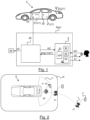
- FIG. 1 is a schematic view of a system for detecting the intention of a user to open a hatch of a vehicle, said detecting system comprising an identifier and an electronic control unit integrated in said vehicle, according to one non-limiting embodiment of the invention,
- FIG. 2 illustrates a user bearing/wearing said identifier of Figure 1 approaching a vehicle and entering a region of proximity around a hatch of said vehicle, according to one non-limiting embodiment
- FIG. 3 illustrates said user sending a command confirming intention to open a hatch that is a voice message, said voice message being received by a microphone of said identifier of Figure 2 , according to one non-limiting embodiment,
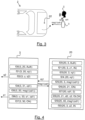
- FIG. 4 illustrates said identifier of Figure 1 and its functions and said electronic control unit of Figure 1 and its functions, according to one non-limiting embodiment
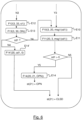
- FIG. 5 is a flowchart of a method for detecting the intention of a user to open a hatch of a vehicle, said detecting method being implemented by the detecting system of Figure 1 , according to one non-limiting embodiment,
- FIG. 6 illustrates the rest of the flowchart of the detecting method of Figure 5 , according to one non-limiting embodiment.
- the vehicle 2 is a motor vehicle.
- motor vehicle what is meant is any type of motorized vehicle. This embodiment is taken as non-limiting example throughout the remainder of the description. Throughout the remainder of the description, the vehicle 2 is thus also called motor vehicle 2.
- the motor vehicle 2 comprises a plurality of hatches 21.
- a hatch 21 is a boot lid or tailgate or a door of said motor vehicle 2.
- the door may open laterally or be a sliding door or a side door that opens vertically.
- each hatch 21 is associated a region of proximity z1 about said hatch 21.
- a region of proximity z1 occupies about 1.5 metres around said corresponding hatch 21.
- FIG 2 only the region of proximity z1 corresponding to the boot lid/tailgate has been shown.
- Each hatch 21 has a reference state (st in Figure 2 ) that is either open (referenced OPN in Figure 6 ) or closed (referenced CLSD in Figure 6 ).
- the detecting system Sys1 comprises:
- the identifier 3 is an identifier of hands-free access for accessing and/or starting said motor vehicle 2 hands free.
- the identifier 3 may be used for a PEPS application (PEPS standing for Passive Entry Passive Start) allowing a user u of the motor vehicle 2 to unlock/lock and start the motor vehicle 2 by virtue of this identifier 3 without physically inserting said identifier 3 into a lock of said motor vehicle 2 to unlock/lock it or into an ignition switch of said motor vehicle 2 to start it.
- PEPS Passive Entry Passive Start
- the hatches 21 may be unlocked, and when it is located inside the motor vehicle 2, the engine or motor of the motor vehicle 2 may be started.
- said identifier 3 is a smartphone or a key or a connected object such as wireless earphones or even a smartwatch.
- the smartphone or connected object is thus used as a key to access and/or start the motor vehicle 2.
- the electronic control unit 20, or ECU is configured to communicate with the identifier 3 via the BLE communication protocol (BLE standing for Bluetooth Low Energy).
- BLE communication protocol BLE standing for Bluetooth Low Energy
- it comprises a BLE communication module for communicating with a corresponding BLE communication module of the identifier 3 to authenticate said identifier 3 and to communicate the confirmation request rq1, confirming command cd1 and command signal msg1 described below.
- BLE communication protocol BLE standing for Bluetooth Low Energy
- the electronic control unit 20 is further configured to interact with:
- said identifier 3 is thus located by means:
- radio-frequency (RF) communications are implemented in a frequency range comprised between 30 MHz and 300 GHz.
- UWB communications are implemented in a frequency range comprised between 3.2 GHz and 8.3 GHz with a bandwidth of 500 MHz.
- BLE is implemented at 2.4 GHz.
- the UWB sensors comprise UWB communication modules and UWB antennas.
- the RF sensors comprise RF communication modules and RF antennas.
- the non-limiting example of UWB sensors is taken as example throughout the remainder of the description.
- the locating process is carried out periodically. In one non-limiting example, the locating process is carried out every second. Thus, this makes it possible to detect if the identifier 3 (and therefore its user u) has returned to the predetermined region z1 after having left it for example.
- the identifier 3 is described in more detail below.
- the identifier 3 comprises means for recording intention to open a hatch 30, which are also called recording means.
- said recording means 30 are:
- said recording means 30 are a button or a plurality of buttons dedicated to a given hatch 21.
- said recording means 30 are an application or a microphone.
- the application comprises one or more boxes to be ticked, each of these boxes being dedicated to one hatch 21, such that the user u indicates if she or he wants to open a hatch 21 when she or he is located in the region of proximity z1 of said hatch 21.
- the identifier 3 further comprises a memory 31 in which a command confirming intention to open a hatch cd1, also called the confirming command cd1, may be stored. This means that this confirming command cd1 has been pre-recorded before the user u enters the region of proximity z1 of a hatch 21.
- the confirming command cd1 is a voice message or a confirmation value.
- the recording means 30 is a microphone
- the confirming command cd1 is a voice message
- the recording means 30 are an application or at least one button
- the confirming command cd1 is a confirmation value.
- the confirming command cd1 may be positive (opening desired) or negative (opening not desired). It confirms the intention of the user u to open a hatch 21 or it confirms her or his intention not to open it, namely to leave it closed.
- the voice message is "open sesame” or "don't open sesame”.
- the confirmation value may be equal to 1 for a confirmation to open, or to 0 for a confirmation not to open.
- she or he for example ticks a box in the application to say that she or he confirms her or his intention, this setting the confirmation value to 1. If she or he does not tick this box, this means that she or he confirms her or his intention not to open the hatch 12, or in other words that she or he would like the hatch 21 to remain closed.
- the application may comprise two boxes, one for the positive confirmation and the other for the negative confirmation.
- the identifier 3 may comprise two buttons, one for the positive confirmation and the other for the negative confirmation.
- various voice messages may be used or various values other than 0 and 1 may be used.
- the identifier 3 comprises a voice recognition module 32 (illustrated in Figure 1 ) configured to analyse the confirming command cd1 when the latter takes the form of a voice message. Either the analysis of the voice message is performed in the identifier 3 (via its voice recognition module 32), or in the motor vehicle 2. In the latter case, the identifier 3 does not need a voice recognition module 31.
- the identifier 3 further comprises an interface 33 configured to receive a data message s1 (described below) intended for the user u.
- the identifier 3 is configured to authenticate itself with the electronic control unit 20 (function f30(3, 20, Auth) illustrated in Figure 4 ). Since various methods for authenticating an identifier 3 are known in the art, they are not described here.
- the identifier 3 is further configured to receive from said electronic control unit 20 a request rq1 for confirmation of intention to open a hatch, also called confirmation request rq1 (function f31(3, 20, rq1) illustrated in Figure 4 ).
- said identifier 3 when said identifier 3 enters the region of proximity z1 around said hatch 21, said identifier 3 is further configured to send a warning signal s2 to a user u of said identifier 3 (function f32(3, u, s2) illustrated in Figure 4 ).
- a warning signal s2 takes the form of vibration of said identifier 3, of an audio signal, of a voice signal indicating that it is entering a region of proximity z1, or of a visual signal on a screen of said identifier 3, etc. This thus apprises the user u that the hatch 21 may now be opened if the confirming command cd1 has been pre-recorded as positive (described below).
- the identifier 3 is further configured to verify the existence of a command cd1 confirming intention to open a hatch in the memory 31 (function f34(3, 31, cd1) illustrated in Figure 4 ), and if the command exists in the memory 31, the identifier 3 is further configured to send to said electronic control unit 20 a command signal msg1 corresponding to said command cd1 confirming intention to open a hatch (function f35(3, 20, msg1(cd1)) illustrated in Figure 4 ).
- the command signal msg1 is the command cd1 confirming intention to open a hatch itself.
- this is either the voice message or the confirmation value.
- the identifier 3 sends the voice message to the electronic control unit 20 of the motor vehicle 2, which will transmit it to the voice recognition module of the motor vehicle 2 with a view to having it decoded.
- the command signal msg1 is a confirmation value.
- the identifier 3 no longer needs to send the entire voice message to the electronic control unit 20 of the motor vehicle 2, and it therefore sends, to the electronic control unit 20, only a confirmation value corresponding to said voice message.
- the confirming command cd1 is pre-recorded in the identifier 3 before the user enters the region of proximity z1, i.e. in practice before the user has her or his arms full. It is thus stored in the memory 31 beforehand.
- the identifier 3 is configured to send a data signal s1 to the user u to initiate said command cd1 confirming intention to open a hatch via said means 30 for recording intention to open a hatch (function f36(3, u, 33, s1, cd1) illustrated in Figure 4 ).
- the data signal s1 is sent to the interface 33.
- the identifier 3 After this confirming command cd1 has been initiated, the identifier 3 sends, to the electronic control unit 20, a corresponding command signal msg1 (function f35 defined above).
- the identifier 3 is further configured to activate its microphone 30 (function f37(3, 30, ON) illustrated in Figure 4 ).
- the identifier 3 is able to receive, via its microphone 30, a confirming command cd1 taking the form of a voice message.
- the voice message is given by the user u of the identifier 3 as illustrated in Figure 3 . It may also be given by a person located beside said user u. This case may arise if, in one non-limiting example, the user u has her or his arms too full to be able to take her or his identifier 3 in her or his hand.
- the identifier 3 comprises an electronic control unit (not illustrated) for performing the functions described above.
- the electronic control unit 20 is described in more detail below.
- the electronic control unit 20 is configured to authenticate said identifier 3 (function f20(20, 3, Auth) illustrated in Figure 4 ).
- the electronic control unit 20 is further configured to locate said identifier 3 in a region of proximity z1 around a hatch 21 of said motor vehicle 2 (function f21(20, 3, z1, IN) illustrated in Figure 4 ).
- Figure 2 illustrates a user u bearing/wearing said identifier 3 approaching the motor vehicle 2.
- the identifier 3 is situated outside of the regions of proximity z1 of the hatches 21.
- the electronic control unit 20 locates it in this region of proximity z1 by means of the UWB sensors in this given non-limiting example.
- the electronic control unit 20 is further configured to send to said identifier 3 a request rq1 for confirmation of intention to open a hatch when said identifier 3 enters the region of proximity z1 (function f23(20, 3, rq1) illustrated in Figure 4 ).
- this confirmation request rq1 is sent as soon as the identifier 3 enters into the region of proximity z1.
- the electronic control unit 20 is further configured to check whether it has already sent such a confirmation request rq1 to said identifier 3 beforehand (function f24(20, rq1) illustrated in Figure 4 ). In the affirmative, it does not resend it. If the identifier 3 is repeatedly detected in the region of proximity z1, this prevents the confirmation request rq1 from being sent each time.
- the electronic control unit 20 is further configured to receive from said identifier 3 a command signal msg1 corresponding to said confirming command cd1 pre-recorded or initiated by the user u (function f25(20, 3, msg1(cd1)) illustrated in Figure 4 ).
- the electronic control unit 20 is able to know the intention of the user u to open or leave closed the boot lid 21 by virtue of the analysis of the command signal msg1 corresponding to the confirming command cd1, to learn if it is positive or if it is negative.
- the electronic control unit 20 on receipt of the command signal msg1 corresponding to the confirming command cd1, is further configured to open (function f26(20, 21, OPN) illustrated in Figure 4 ) or not open (namely to open or to leave closed) said hatch 21. Thus, either it opens it, or it does nothing.
- the hatch 21 automatically opens by itself as illustrated by the dashed arrow in Figure 3 , and the user u does not need to open it herself or himself manually. She or he may thus load her or his shopping into the motor vehicle 2.
- the electronic control unit 20 if it does not receive any command signal msg1 from the identifier 3, it is further configured to define the confirming command cd1 as having a negative confirmation value and therefore characterize the corresponding command signal msg1 as also being negative (function f27(20, cd1, 0) illustrated in Figure 4 ). In this case, the electronic control unit leaves the hatch 21 closed. Specifically, it is possible for the electronic control unit 20 not to receive a command signal msg1 corresponding to a confirming command cd1 from the identifier 3 in the following non-exhaustive cases:
- the electronic control unit 20 is further configured to unlock said hatch 21 if it were locked beforehand, in order to allow it to be opened (function f28(20, 21, d2, DLCK) illustrated in Figure 4 ). Unlocking occurs when the identifier 3 is situated at a predetermined distance d2 from the motor vehicle 2 in an unlocking region z2 around said motor vehicle 2, the unlocking region being illustrated in Figure 2 . In one non-limiting embodiment, the predetermined distance d2 is about 2 metres from the motor vehicle 2, in accordance with Thatcham rules.
- the electronic control unit 20 is further configured to locate the identifier 3 in an unlocking region z2 (function f30(20, 3, z2, IN) illustrated in Figure 4 ).
- the unlocking region z2 is larger than or equal to the region of proximity z1. In the non-limiting example illustrated, it is larger and encompasses the region of proximity z1. Since such a locating process is known in the art, it is not described here.
- the electronic control unit 20 is configured to transmit the received command signal msg1 (function f29(20, 40, msg1(cd1)) illustrated in Figure 4 ) to another electronic control unit referenced 40 in Figure 1 that is dedicated to opening/closing the hatch 21 and it is the latter that opens or leaves closed the hatch 21 depending on the command signal msg1, and especially depending on the voice message or the confirmation value.
- the described detecting system Sys1 makes it possible to implement a method PR1 for detecting the intention of a user to open a hatch 21 of a vehicle 2, one non-limiting embodiment of this system being described below with reference to Figure 5 and Figure 6 .
- the hatch 21 is the boot lid and it is initially locked.
- the detecting method PR1 comprises checking to see if the confirmation request rq1 has already been sent beforehand.
- the confirming command cd1 is a voice message.
- the recording means 30 are therefore the microphone.
- the electronic control unit 20 is also in charge of opening or not opening the hatch 21 depending on the confirming command cd 1.
- the electronic control unit 20 authenticates the identifier 3 via a BLE communication in one non-limiting embodiment. This allows the identifier 3 to be paired with the motor vehicle 2. In the case of BLE, pairing occurs when the identifier 3 is located within about 50 metres around the motor vehicle 2.
- step E2 illustrated F2(20, 3, z2, IN) in Figure 5 the electronic control unit 31 determines if the identifier 3 is in an unlocking region z2 around the boot lid 21. If the identifier 3 is located in the unlocking region z2 (branch Y0), then, in a step E3 illustrated F3(20, 21, DLCK) in Figure 5 , the electronic control unit 20 unlocks the boot lid 21. Otherwise (branch N0), the locating process continues. It will be noted that no confirmation of intention is required to unlock it. It will be noted that the boot lid 21 is unlocked even if ultimately the user u does not want to open it, namely even if the confirming command cd1 is subsequently negative.
- a step E4 illustrated F4(20, 3, z1, IN) in Figure 5 the electronic control unit 31 determines if the identifier 3 is in a proximity region z1 around the boot lid 21. Provided that the identifier 3 has not entered the region of proximity z1, the locating process is reiterated (illustrated branch N1). In one non-limiting example, the locating process is carried out every 96 ms (milliseconds). It will be noted that while the identifier 3 is in the region of proximity z1, the locating process is still reiterated. This makes it possible to verify that it is still in said region of proximity z1.
- a step E5 illustrated F5(3, u, s2) in Figure 5 the identifier 3 sends a warning signal s2 to the user u to indicate thereto that she or he has entered the region of proximity z1 of the boot lid 21.
- step E6 when said identifier 3 is located in the region of proximity z1 of the boot lid 21, in one non-limiting embodiment, the electronic control unit 20 checks if it has not already sent to said identifier 3 a confirmation request rq1 to indicate thereto that it has entered the region of proximity z1.
- step E9 illustrated branch Y2
- step E7 illustrated F7(20, 3, rq1) in Figure 5
- the electronic control unit 20 sends to said identifier 3 a confirmation request rq1.
- step E8 illustrated F8(3, 20, rq1) in Figure 5 the identifier 3 receives this confirmation request rq1 if it has not received it beforehand.
- the identifier 3 verifies the existence of a command cd1 confirming intention to open a hatch in its memory 31 and, if the command is saved in memory (illustrated branch Y3), sends a corresponding confirmation signal msg1 to said electronic control unit 20 (step E10 illustrated F10(3, 20, msg1(cd1)) in Figure 6 ) which receives it (step E11 illustrated F11(20, 3, msg1(cd1)) in Figure 6 ).
- step E12 illustrated F12(3, 33, s1) in Figure 6 the identifier 3 sends, via its interface 33, a data signal s1 to the user u of said identifier 3 to initiate said command cd1 confirming intention to open a hatch via said means 30 for recording intention to open a hatch.
- the user u is apprised that she or he may initiate such a confirming command cd1 and show that she or he wants the boot lid 21 to open or to remain closed.
- a step E13 illustrated F13(3, 30, ON) in Figure 6 in the embodiment employing the microphone 30, the latter is then activated by the identifier 3. It will be noted that the microphone 30 is still activated when the confirming command cd1 does not exist because it is not known whether the user u will use the microphone or the dedicated application to confirm her or his intention to open the boot lid 21 or not, namely which recording means 30 she or he will use to initiate the confirming command cd1. It will be noted that steps E9 and E10 are performed in parallel in one non-limiting embodiment, or in any order.
- the recording means 30 are the microphone
- the user u speaks into the microphone 30; a voice message such as "open sesame” is thus transmitted via the microphone 30.
- the user u speaks into the microphone 30; a voice message such as "don't open sesame” is thus transmitted via the microphone 30.
- the identifier 3 sends the corresponding command signal msg1 to said electronic control unit 20 (step E10) which receives it (step E11).
- the electronic control unit 20 detects the intention of the user u to open or the boot lid 21 or not via the confirming command cd1. By analysing it, it is able to see whether it is positive or negative.
- the electronic control unit 20 On receipt of the command signal msg1, if it corresponds to a positive confirming command cd1 (branch Y5 illustrated in Figure 6 ), in a step E14 illustrated F14(20, 21, OPN) in Figure 6 , the electronic control unit 20 opens the boot lid 21.
- the electronic control unit is able to do so because the boot lid was unlocked beforehand.
- the boot lid 21 is opened automatically without the intervention of the user u. It is in an open state st: st referenced OPN illustrated in Figure 6 .
- the electronic control unit 20 On receipt of the command signal msg1, if it corresponds to a negative confirming command cd1 (branch N5 illustrated in Figure 6 ), the electronic control unit 20 does not open the boot lid 21. Thus, the boot lid 21 remains closed. It remains in a closed state st: st referenced CLSD illustrated in Figure 6 .
- the electronic control unit 20 defines the confirmation command cd1 as being negative, namely that the user u does not have the intention of opening the hatch 21. Therefore, the corresponding command signal msg1 is considered to also be negative.
- the electronic control unit 20 waits for the user u to initiate the confirming command cd1 via a button as described above.
- the identifier 3 comprises a plurality of microphones 30.
- the described invention especially has the following advantages:
Landscapes
- Engineering & Computer Science (AREA)
- Mechanical Engineering (AREA)
- Human Computer Interaction (AREA)
- Physics & Mathematics (AREA)
- Computational Linguistics (AREA)
- Health & Medical Sciences (AREA)
- Audiology, Speech & Language Pathology (AREA)
- Acoustics & Sound (AREA)
- Multimedia (AREA)
- General Physics & Mathematics (AREA)
- Automation & Control Theory (AREA)
- Lock And Its Accessories (AREA)
Abstract
- (a) an identifier comprising means for recording intention to open a hatch and being configured to:
- authenticate itself with an electronic control unit,
- when it is located in a region of proximity around said hatch, receive from said electronic control unit a request for confirmation of intention to open a hatch,
- following receipt of said request for confirmation of intention to open a hatch, verify the existence of a command confirming intention to open a hatch in a memory in the identifier,
- if said command exists, send to the electronic control unit a corresponding command signal,
- if said command does not exist, send a data signal to a user of said identifier to initiate said command confirming intention to open a hatch via said means for recording intention to open a hatch,
- when said command is initiated, send to said electronic control unit a command signal corresponding to said command confirming intention to open a hatch,
- (b) said electronic control unit being integrated in said vehicle and being configured to:
- authenticate said identifier,
- locate said identifier in a region of proximity around said hatch,
- send to said identifier said request for confirmation of intention to open a hatch,
- receive said command signal corresponding to said command confirming intention to open a hatch.
Description
- The present invention relates to a system for detecting the intention of a user to open a hatch of a vehicle. It is particularly but non-limitingly applicable to motor vehicles.
- In the field of motor vehicles, one system for detecting the intention of a user to open a hatch of a vehicle, known to those skilled in the art, comprises one or more dedicated movement sensors, such as a sensor of movement of the foot or "kick sensor".
- One drawback of this prior art is that such movement sensors are very sensitive to the least movement and may detect spurious movements such as a cat passing, causing a hatch such as the boot lid or tailgate of the motor vehicle to open undesirably. Thus, this generates cases of false positives (case of a cat passing), or cases of false negatives (case where passage of the foot is not recognized when it passes too far from the sensor).
- In this context, the present invention aims to provide a system for detecting the intention of a user to open a hatch of a vehicle that allows the mentioned drawback to be resolved.
- To this end, the invention provides a system for detecting the intention of a user to open a hatch of a vehicle, characterized in that said detecting system comprises:
- (a) an identifier comprising means for recording intention to open a hatch and being configured to:
- authenticate itself with an electronic control unit,
- when it is located in a region of proximity around said hatch, receive from said electronic control unit a request for confirmation of intention to open a hatch,
- following receipt of said request for confirmation of intention to open a hatch, verify the existence of a command confirming intention to open a hatch in a memory in the identifier,
- if said command confirming intention to open a hatch exists, send to the electronic control unit a command signal corresponding to said command confirming intention to open a hatch,
- if said command does not exist, send a data signal to a user of said identifier to initiate said command confirming intention to open a hatch via said means for recording intention to open a hatch,
- when said command confirming intention to open a hatch is initiated, send to said electronic control unit a command signal corresponding to said command confirming intention to open a hatch,
- (b) said electronic control unit being integrated in said vehicle and being configured to:
- authenticate said identifier,
- locate said identifier in a region of proximity around said hatch,
- when said identifier is located in said region of proximity, send to said identifier said request for confirmation of intention to open a hatch,
- receive said command signal corresponding to said command confirming intention to open a hatch.
- Thus, as will be seen in detail below, by replacing movement detection with detection of the existence of a command confirming intention to open a hatch recorded in a memory of an identifier, or with initiation of such a command by the user of said identifier via means for recording intention to open a hatch, the identifier allows the intention of the user to be 100% confirmed and thus cases of false positives and false negatives to be prevented. Moreover, removing the one or more movement sensors allows the cost of the detecting system to be decreased.
- According to non-limiting embodiments, said system for detecting the intention of a user to open a hatch of a vehicle may further comprise one or more of the following additional features, implemented alone or in any technically possible combination.
- According to one non-limiting embodiment, said electronic control unit is further configured to open or not open said hatch depending on said command signal.
- According to one non-limiting embodiment, said command confirming intention to open a hatch is pre-recorded in the identifier. In particular, it is pre-recorded in said memory of the identifier.
- According to one non-limiting embodiment, said command confirming intention to open a hatch is a voice message or a confirmation value.
- According to one non-limiting embodiment, said command signal is said command confirming intention to open a hatch.
- According to one non-limiting embodiment, said command signal is a confirmation value when the command confirming intention to open a hatch is a voice message.
- According to one non-limiting embodiment, said means for recording intention to open a hatch are:
- a microphone, or
- an application, or
- at least one button.
- According to one non-limiting embodiment, when said identifier enters the region of proximity around said hatch, said identifier is further configured to send a warning signal to a user of said identifier.
- According to one non-limiting embodiment, if said electronic control unit does not receive a command signal from said identifier, it is further configured to consider the command signal as corresponding to a negative command confirming intention to open a hatch.
- According to one non-limiting embodiment, said identifier is an identifier of hands-free access of said vehicle for accessing and/or starting said vehicle hands free.
- According to one non-limiting embodiment, said hatch is a boot lid or tailgate or a door of said vehicle.
- According to one non-limiting embodiment, said identifier is a key, a smartphone, or a connected object.
- According to one non-limiting embodiment, the confirming command is positive or negative. When it is positive, it confirms the intention of the user to open a hatch. When it is negative, it confirms her or his intention not to open it.
- According to one non-limiting embodiment, a region of proximity occupies about 1.5 metres around said corresponding hatch.
- According to one non-limiting embodiment, the data signal is sent to an interface of said identifier.
- According to one non-limiting embodiment, said electronic control unit is further configured to check whether it has already sent the request for confirmation of intention to open a hatch to said identifier.
- According to one non-limiting embodiment, said electronic control unit is further configured to locate said identifier in an unlocking region.
- According to one non-limiting embodiment, when said identifier is located in said unlocking region, said electronic control unit is further configured to unlock said hatch if said hatch is locked. This allows it to be opened subsequently.
- According to one non-limiting embodiment, said detecting method further comprises said electronic control unit checking whether it has already sent said request for confirmation of intention to open a hatch to said identifier.
- An identifier for a vehicle is further provided, said identifier being configured to interact with an electronic control unit, said identifier comprising means for recording intention to open a hatch and being configured to:
- authenticate itself with said electronic control unit, the latter being integrated in a vehicle,
- when it is located in a region of proximity around a hatch of said vehicle, receive from said electronic control unit a request for confirmation of intention to open a hatch,
- following receipt of said request for confirmation of intention to open a hatch, verify the existence of a command confirming intention to open a hatch in a memory in the identifier,
- if said command confirming intention to open a hatch exists, send to the electronic control unit a command signal corresponding to said command confirming intention to open a hatch,
- if said command does not exist, send a data signal to a user of said identifier to initiate said command confirming intention to open a hatch via said means for recording intention to open a hatch,
- when said command confirming intention to open a hatch is initiated, send to said electronic control unit a command signal corresponding to said command confirming intention to open a hatch.
- An electronic control unit configured to interact with an identifier is further provided, said electronic control unit being integrated in a vehicle and being configured to:
- authenticate said identifier,
- locate said identifier in region of proximity around a hatch of said vehicle,
- when said identifier is located in said region of proximity around said hatch, send to said identifier a request for confirmation of intention to open a hatch,
- receive from said identifier a command signal relating to a command confirming intention to open a hatch.
- A method for detecting the intention of a user to open a hatch of a vehicle is further provided, said vehicle comprising an electronic control unit configured to interact with an identifier, characterized in that said detecting method comprises:
- said electronic control unit authenticating said identifier,
- said electronic control unit locating said identifier in a region of proximity around said hatch,
- when said identifier is located in said region of proximity around said hatch, said electronic control unit sending to said identifier a request for confirmation of intention to open a hatch and said identifier receiving said request for confirmation of intention to open a hatch,
- on receipt of said request for confirmation of intention to open a hatch, said identifier verifying the existence of a command confirming intention to open a hatch in a memory in the identifier and, if said command exists, sending to said electronic control unit a corresponding command signal,
- if said command does not exist, said identifier sending a data signal to a user of said identifier to initiate said command confirming intention to open a hatch via said means for recording intention to open a hatch,
- when said command confirming intention to open a hatch is initiated, said identifier sending to said electronic control unit a command signal corresponding to said command confirming intention to open a hatch,
- said electronic control unit receiving said command signal.
- The invention and the various applications thereof will be better understood on reading the following description and on examining the accompanying figures, in which:
- [
Fig. 1 ] is a schematic view of a system for detecting the intention of a user to open a hatch of a vehicle, said detecting system comprising an identifier and an electronic control unit integrated in said vehicle, according to one non-limiting embodiment of the invention, - [
Fig. 2 ] illustrates a user bearing/wearing said identifier ofFigure 1 approaching a vehicle and entering a region of proximity around a hatch of said vehicle, according to one non-limiting embodiment, - [
Fig. 3 ] illustrates said user sending a command confirming intention to open a hatch that is a voice message, said voice message being received by a microphone of said identifier ofFigure 2 , according to one non-limiting embodiment, - [
Fig. 4 ] illustrates said identifier ofFigure 1 and its functions and said electronic control unit ofFigure 1 and its functions, according to one non-limiting embodiment, - [
Fig. 5 ] is a flowchart of a method for detecting the intention of a user to open a hatch of a vehicle, said detecting method being implemented by the detecting system ofFigure 1 , according to one non-limiting embodiment, - [
Fig. 6 ] illustrates the rest of the flowchart of the detecting method ofFigure 5 , according to one non-limiting embodiment. - Elements that are identical, in structure or in function, and that appear in more than one figure, have been designated by the same reference signs, unless otherwise indicated.
- The system Sys1 for detecting the intention of a user to open a hatch of a vehicle, according to the invention, will now be described with reference to
Figures 1 to 4 . It is also referred to as detecting system Sys1. In one non-limiting embodiment, thevehicle 2 is a motor vehicle. By motor vehicle, what is meant is any type of motorized vehicle. This embodiment is taken as non-limiting example throughout the remainder of the description. Throughout the remainder of the description, thevehicle 2 is thus also calledmotor vehicle 2. - The
motor vehicle 2 comprises a plurality ofhatches 21. In some non-limiting embodiments, ahatch 21 is a boot lid or tailgate or a door of saidmotor vehicle 2. The door may open laterally or be a sliding door or a side door that opens vertically. With eachhatch 21 is associated a region of proximity z1 about saidhatch 21. In one non-limiting embodiment, a region of proximity z1 occupies about 1.5 metres around said correspondinghatch 21. For the sake of clarity, inFigure 2 only the region of proximity z1 corresponding to the boot lid/tailgate has been shown. Eachhatch 21 has a reference state (st inFigure 2 ) that is either open (referenced OPN inFigure 6 ) or closed (referenced CLSD inFigure 6 ). - As illustrated in
Figure 1 , the detecting system Sys1 comprises: - an
identifier 3, and - an
electronic control unit 20 integrated in themotor vehicle 2. - In one non-limiting embodiment, the
identifier 3 is an identifier of hands-free access for accessing and/or starting saidmotor vehicle 2 hands free. Thus, theidentifier 3 may be used for a PEPS application (PEPS standing for Passive Entry Passive Start) allowing a user u of themotor vehicle 2 to unlock/lock and start themotor vehicle 2 by virtue of thisidentifier 3 without physically inserting saididentifier 3 into a lock of saidmotor vehicle 2 to unlock/lock it or into an ignition switch of saidmotor vehicle 2 to start it. Thus, when it is located in proximity to themotor vehicle 2, thehatches 21 may be unlocked, and when it is located inside themotor vehicle 2, the engine or motor of themotor vehicle 2 may be started. - In non-limiting embodiments, said
identifier 3 is a smartphone or a key or a connected object such as wireless earphones or even a smartwatch. The smartphone or connected object is thus used as a key to access and/or start themotor vehicle 2. - In one non-limiting embodiment, the
electronic control unit 20, or ECU, is configured to communicate with theidentifier 3 via the BLE communication protocol (BLE standing for Bluetooth Low Energy). To this end, it comprises a BLE communication module for communicating with a corresponding BLE communication module of theidentifier 3 to authenticate saididentifier 3 and to communicate the confirmation request rq1, confirming command cd1 and command signal msg1 described below. Of course, other communication protocols may be used. - In one non-limiting embodiment, the
electronic control unit 20 is further configured to interact with: - radio-frequency (RF) sensors (referenced 22 in
Figure 1 ) that are installed all around saidvehicle 2 to locate saididentifier 3. In one non-limiting embodiment, these sensors are UWB or BLE sensors (UWB standing for Ultra-Wide Band). - According to one non-limiting embodiment, said
identifier 3 is thus located by means: - of a UWB or BLE communication if said
identifier 3 is a smartphone or a connected object or if theidentifier 3 is a key, or - of an low-frequency (LF) radio-frequency (RF) communication if said
identifier 3 is a key, the key then comprising LF transmitters. - Of course, other communication protocols may be used.
- It will be recalled that radio-frequency (RF) communications are implemented in a frequency range comprised between 30 MHz and 300 GHz. It will be recalled that UWB communications are implemented in a frequency range comprised between 3.2 GHz and 8.3 GHz with a bandwidth of 500 MHz. It will be recalled that BLE is implemented at 2.4 GHz.
- It will be noted that the UWB sensors comprise UWB communication modules and UWB antennas. Likewise, the RF sensors comprise RF communication modules and RF antennas. The non-limiting example of UWB sensors is taken as example throughout the remainder of the description.
- Since various locating techniques employing the various UWB, RF and LF communication protocols are known in the art, they are not described here. In one non-limiting embodiment, the locating process is carried out periodically. In one non-limiting example, the locating process is carried out every second. Thus, this makes it possible to detect if the identifier 3 (and therefore its user u) has returned to the predetermined region z1 after having left it for example.
- The
identifier 3 is described in more detail below. - As illustrated in
Figure 1 , theidentifier 3 comprises means for recording intention to open ahatch 30, which are also called recording means. In some non-limiting embodiments, said recording means 30 are: - a microphone, or
- a dedicated application, or
- at least one dedicated button.
- Thus, in the case in which the
identifier 3 is a key, said recording means 30 are a button or a plurality of buttons dedicated to a givenhatch 21. Thus, in the case in which theidentifier 3 is a smartphone or a connected object, said recording means 30 are an application or a microphone. In one non-limiting example, the application comprises one or more boxes to be ticked, each of these boxes being dedicated to onehatch 21, such that the user u indicates if she or he wants to open ahatch 21 when she or he is located in the region of proximity z1 of saidhatch 21. - As illustrated in
Figure 1 , theidentifier 3 further comprises a memory 31 in which a command confirming intention to open a hatch cd1, also called the confirming command cd1, may be stored. This means that this confirming command cd1 has been pre-recorded before the user u enters the region of proximity z1 of ahatch 21. - According to some non-limiting embodiments, the confirming command cd1 is a voice message or a confirmation value. Thus, when the recording means 30 is a microphone, the confirming command cd1 is a voice message, whereas when the recording means 30 are an application or at least one button, the confirming command cd1 is a confirmation value.
- It will be noted that the confirming command cd1 relates:
- to the confirmation of the intention of the user to open a
hatch 21 of thevehicle 2, or - to the confirmation of the intention of the user not to open a
hatch 21 of thevehicle 2. - Thus, the confirming command cd1 may be positive (opening desired) or negative (opening not desired). It confirms the intention of the user u to open a
hatch 21 or it confirms her or his intention not to open it, namely to leave it closed. - Thus, in one non-limiting example, the voice message is "open sesame" or "don't open sesame".
- Thus, in one non-limiting example, the confirmation value may be equal to 1 for a confirmation to open, or to 0 for a confirmation not to open. When the user u uses an application to confirm her or his intention to open a
hatch 21, she or he for example ticks a box in the application to say that she or he confirms her or his intention, this setting the confirmation value to 1. If she or he does not tick this box, this means that she or he confirms her or his intention not to open the hatch 12, or in other words that she or he would like thehatch 21 to remain closed. The application may comprise two boxes, one for the positive confirmation and the other for the negative confirmation. When the user u uses a button to confirm her or his intention to open ahatch 21, she or he depresses the button to say that she or he confirms her or his intention, this setting the confirmation value to 1. If the button is not depressed, this means that she or he confirms her or his intention not to open it, this setting the confirmation value to 0. Theidentifier 3 may comprise two buttons, one for the positive confirmation and the other for the negative confirmation. - In one non-limiting embodiment, to differentiate between
various hatches 21, various voice messages may be used or various values other than 0 and 1 may be used. - In one non-limiting embodiment, the
identifier 3 comprises a voice recognition module 32 (illustrated inFigure 1 ) configured to analyse the confirming command cd1 when the latter takes the form of a voice message. Either the analysis of the voice message is performed in the identifier 3 (via its voice recognition module 32), or in themotor vehicle 2. In the latter case, theidentifier 3 does not need a voice recognition module 31. - In one non-limiting embodiment, the
identifier 3 further comprises aninterface 33 configured to receive a data message s1 (described below) intended for the user u. - The
identifier 3 is configured to authenticate itself with the electronic control unit 20 (function f30(3, 20, Auth) illustrated inFigure 4 ). Since various methods for authenticating anidentifier 3 are known in the art, they are not described here. - As illustrated in
Figure 1 , theidentifier 3 is further configured to receive from said electronic control unit 20 a request rq1 for confirmation of intention to open a hatch, also called confirmation request rq1 (function f31(3, 20, rq1) illustrated inFigure 4 ). - In one non-limiting embodiment, when said
identifier 3 enters the region of proximity z1 around saidhatch 21, saididentifier 3 is further configured to send a warning signal s2 to a user u of said identifier 3 (function f32(3, u, s2) illustrated inFigure 4 ). This makes it possible to apprise the user u that she or he is in the region of proximity z1. In some non-limiting examples of embodiment, the warning signal s2 takes the form of vibration of saididentifier 3, of an audio signal, of a voice signal indicating that it is entering a region of proximity z1, or of a visual signal on a screen of saididentifier 3, etc. This thus apprises the user u that thehatch 21 may now be opened if the confirming command cd1 has been pre-recorded as positive (described below). - Following receipt of this confirmation request rq1, the
identifier 3 is further configured to verify the existence of a command cd1 confirming intention to open a hatch in the memory 31 (function f34(3, 31, cd1) illustrated inFigure 4 ), and if the command exists in the memory 31, theidentifier 3 is further configured to send to said electronic control unit 20 a command signal msg1 corresponding to said command cd1 confirming intention to open a hatch (function f35(3, 20, msg1(cd1)) illustrated inFigure 4 ). - In one non-limiting embodiment, the command signal msg1 is the command cd1 confirming intention to open a hatch itself. Thus, this is either the voice message or the confirmation value. For example, when the voice recognition of the voice message is done by a voice recognition module of the
motor vehicle 2, theidentifier 3 sends the voice message to theelectronic control unit 20 of themotor vehicle 2, which will transmit it to the voice recognition module of themotor vehicle 2 with a view to having it decoded. In another non-limiting embodiment, when the command cd1 confirming intention to open a hatch is a voice message, the command signal msg1 is a confirmation value. For example, when the voice recognition of the voice message is done by thevoice recognition module 32 of theidentifier 3, theidentifier 3 no longer needs to send the entire voice message to theelectronic control unit 20 of themotor vehicle 2, and it therefore sends, to theelectronic control unit 20, only a confirmation value corresponding to said voice message. - In one non-limiting embodiment, the confirming command cd1 is pre-recorded in the
identifier 3 before the user enters the region of proximity z1, i.e. in practice before the user has her or his arms full. It is thus stored in the memory 31 beforehand. - If it does not exist (namely the confirming command cd1 has not been pre-recorded), the
identifier 3 is configured to send a data signal s1 to the user u to initiate said command cd1 confirming intention to open a hatch via said means 30 for recording intention to open a hatch (function f36(3, u, 33, s1, cd1) illustrated inFigure 4 ). The data signal s1 is sent to theinterface 33. Thus, this reminds the user u that she or he has not pre-recorded any confirming command cd1 and that if she or he wants to open thehatch 21 or to leave it closed, she or he may now initiate such a confirming command cd1. - After this confirming command cd1 has been initiated, the
identifier 3 sends, to theelectronic control unit 20, a corresponding command signal msg1 (function f35 defined above). - It will be noted that, with a view to initiation of the confirming command cd1, in one non-limiting embodiment, the
identifier 3 is further configured to activate its microphone 30 (function f37(3, 30, ON) illustrated inFigure 4 ). Thus, theidentifier 3 is able to receive, via itsmicrophone 30, a confirming command cd1 taking the form of a voice message. The voice message is given by the user u of theidentifier 3 as illustrated inFigure 3 . It may also be given by a person located beside said user u. This case may arise if, in one non-limiting example, the user u has her or his arms too full to be able to take her or hisidentifier 3 in her or his hand. - It will be noted that the
identifier 3 comprises an electronic control unit (not illustrated) for performing the functions described above. - The
electronic control unit 20 is described in more detail below. - The
electronic control unit 20 is configured to authenticate said identifier 3 (function f20(20, 3, Auth) illustrated inFigure 4 ). - The
electronic control unit 20 is further configured to locate saididentifier 3 in a region of proximity z1 around ahatch 21 of said motor vehicle 2 (function f21(20, 3, z1, IN) illustrated inFigure 4 ). -
Figure 2 illustrates a user u bearing/wearing saididentifier 3 approaching themotor vehicle 2. When she or he is in position p1 theidentifier 3 is situated outside of the regions of proximity z1 of thehatches 21. When the user u approaches themotor vehicle 2 and enters a region of proximity z1 associated with a hatch 21 (position p2), here the boot lid or tailgate of themotor vehicle 2, theelectronic control unit 20 locates it in this region of proximity z1 by means of the UWB sensors in this given non-limiting example. - When said
identifier 3 is located in the region of proximity z1, theelectronic control unit 20 is further configured to send to said identifier 3 a request rq1 for confirmation of intention to open a hatch when saididentifier 3 enters the region of proximity z1 (function f23(20, 3, rq1) illustrated inFigure 4 ). Thus, this confirmation request rq1 is sent as soon as theidentifier 3 enters into the region of proximity z1. In one non-limiting embodiment, theelectronic control unit 20 is further configured to check whether it has already sent such a confirmation request rq1 to saididentifier 3 beforehand (function f24(20, rq1) illustrated inFigure 4 ). In the affirmative, it does not resend it. If theidentifier 3 is repeatedly detected in the region of proximity z1, this prevents the confirmation request rq1 from being sent each time. - The
electronic control unit 20 is further configured to receive from said identifier 3 a command signal msg1 corresponding to said confirming command cd1 pre-recorded or initiated by the user u (function f25(20, 3, msg1(cd1)) illustrated inFigure 4 ). Thus, theelectronic control unit 20 is able to know the intention of the user u to open or leave closed theboot lid 21 by virtue of the analysis of the command signal msg1 corresponding to the confirming command cd1, to learn if it is positive or if it is negative. - In one non-limiting embodiment, on receipt of the command signal msg1 corresponding to the confirming command cd1, the
electronic control unit 20 is further configured to open (function f26(20, 21, OPN) illustrated inFigure 4 ) or not open (namely to open or to leave closed) saidhatch 21. Thus, either it opens it, or it does nothing. Thehatch 21 either changes to a state st in which it is open (st= OPN), or remains in a state st (closed st= CLSD). - Thus, if the user u of the
identifier 3 has her or his arms full of shopping in the non-limiting example given, thehatch 21 automatically opens by itself as illustrated by the dashed arrow inFigure 3 , and the user u does not need to open it herself or himself manually. She or he may thus load her or his shopping into themotor vehicle 2. - In one non-limiting embodiment, if the
electronic control unit 20 does not receive any command signal msg1 from theidentifier 3, it is further configured to define the confirming command cd1 as having a negative confirmation value and therefore characterize the corresponding command signal msg1 as also being negative (function f27(20, cd1, 0) illustrated inFigure 4 ). In this case, the electronic control unit leaves thehatch 21 closed. Specifically, it is possible for theelectronic control unit 20 not to receive a command signal msg1 corresponding to a confirming command cd1 from theidentifier 3 in the following non-exhaustive cases: - if the user u does not have the intention to open the
hatch 21, - if the confirming command cd1 is a voice message and the latter is not correctly decoded by the
voice recognition module 32, - if time has passed and the user u has not given a voice message or ticked a box in the dedicated application of the
identifier 3 or depressed a dedicated button of theidentifier 3. - In one non-limiting embodiment, the
electronic control unit 20 is further configured to unlock saidhatch 21 if it were locked beforehand, in order to allow it to be opened (function f28(20, 21, d2, DLCK) illustrated inFigure 4 ). Unlocking occurs when theidentifier 3 is situated at a predetermined distance d2 from themotor vehicle 2 in an unlocking region z2 around saidmotor vehicle 2, the unlocking region being illustrated inFigure 2 . In one non-limiting embodiment, the predetermined distance d2 is about 2 metres from themotor vehicle 2, in accordance with Thatcham rules. Thus, in one non-limiting embodiment, theelectronic control unit 20 is further configured to locate theidentifier 3 in an unlocking region z2 (function f30(20, 3, z2, IN) illustrated inFigure 4 ). The unlocking region z2 is larger than or equal to the region of proximity z1. In the non-limiting example illustrated, it is larger and encompasses the region of proximity z1. Since such a locating process is known in the art, it is not described here. - It will be noted that in another embodiment (not illustrated), the
electronic control unit 20 is configured to transmit the received command signal msg1 (function f29(20, 40, msg1(cd1)) illustrated inFigure 4 ) to another electronic control unit referenced 40 inFigure 1 that is dedicated to opening/closing thehatch 21 and it is the latter that opens or leaves closed thehatch 21 depending on the command signal msg1, and especially depending on the voice message or the confirmation value. - Thus, the described detecting system Sys1 makes it possible to implement a method PR1 for detecting the intention of a user to open a
hatch 21 of avehicle 2, one non-limiting embodiment of this system being described below with reference toFigure 5 andFigure 6 . In the non-limiting embodiment illustrated, thehatch 21 is the boot lid and it is initially locked. Moreover, in the non-limiting embodiment illustrated, the detecting method PR1 comprises checking to see if the confirmation request rq1 has already been sent beforehand. Furthermore, in the non-limiting embodiment illustrated, the confirming command cd1 is a voice message. The recording means 30 are therefore the microphone. Lastly, in the embodiment illustrated, theelectronic control unit 20 is also in charge of opening or not opening thehatch 21 depending on the confirming command cd 1. - In a step E1 illustrated F1(20, 3, Auth) in
Figure 5 , theelectronic control unit 20 authenticates theidentifier 3 via a BLE communication in one non-limiting embodiment. This allows theidentifier 3 to be paired with themotor vehicle 2. In the case of BLE, pairing occurs when theidentifier 3 is located within about 50 metres around themotor vehicle 2. - In a step E2 illustrated F2(20, 3, z2, IN) in
Figure 5 , the electronic control unit 31 determines if theidentifier 3 is in an unlocking region z2 around theboot lid 21. If theidentifier 3 is located in the unlocking region z2 (branch Y0), then, in a step E3 illustrated F3(20, 21, DLCK) inFigure 5 , theelectronic control unit 20 unlocks theboot lid 21. Otherwise (branch N0), the locating process continues. It will be noted that no confirmation of intention is required to unlock it. It will be noted that theboot lid 21 is unlocked even if ultimately the user u does not want to open it, namely even if the confirming command cd1 is subsequently negative. - In a step E4 illustrated F4(20, 3, z1, IN) in
Figure 5 , the electronic control unit 31 determines if theidentifier 3 is in a proximity region z1 around theboot lid 21. Provided that theidentifier 3 has not entered the region of proximity z1, the locating process is reiterated (illustrated branch N1). In one non-limiting example, the locating process is carried out every 96 ms (milliseconds). It will be noted that while theidentifier 3 is in the region of proximity z1, the locating process is still reiterated. This makes it possible to verify that it is still in said region of proximity z1. - In a step E5 illustrated F5(3, u, s2) in
Figure 5 , theidentifier 3 sends a warning signal s2 to the user u to indicate thereto that she or he has entered the region of proximity z1 of theboot lid 21. - In a step E6 (branch Y1 illustrated in
Figure 5 ), when saididentifier 3 is located in the region of proximity z1 of theboot lid 21, in one non-limiting embodiment, theelectronic control unit 20 checks if it has not already sent to said identifier 3 a confirmation request rq1 to indicate thereto that it has entered the region of proximity z1. - If it has already done so, it does not send it again and it moves on to step E9 (illustrated branch Y2), otherwise (branch N2) in a step E7 illustrated F7(20, 3, rq1) in
Figure 5 , theelectronic control unit 20 sends to said identifier 3 a confirmation request rq1. In a step E8 illustrated F8(3, 20, rq1) inFigure 5 , theidentifier 3 receives this confirmation request rq1 if it has not received it beforehand. - On receipt of said request rq1 for confirmation of intention to open a hatch, in a step E9 in
Figure 5 , theidentifier 3 verifies the existence of a command cd1 confirming intention to open a hatch in its memory 31 and, if the command is saved in memory (illustrated branch Y3), sends a corresponding confirmation signal msg1 to said electronic control unit 20 (step E10 illustrated F10(3, 20, msg1(cd1)) inFigure 6 ) which receives it (step E11 illustrated F11(20, 3, msg1(cd1)) inFigure 6 ). - If said command does not exist (illustrated branch N3), namely if there is no confirming command cd1 pre-recorded in memory, in a step E12 illustrated F12(3, 33, s1) in
Figure 6 , theidentifier 3 sends, via itsinterface 33, a data signal s1 to the user u of saididentifier 3 to initiate said command cd1 confirming intention to open a hatch via said means 30 for recording intention to open a hatch. Thus, the user u is apprised that she or he may initiate such a confirming command cd1 and show that she or he wants theboot lid 21 to open or to remain closed. In a step E13 illustrated F13(3, 30, ON) inFigure 6 , in the embodiment employing themicrophone 30, the latter is then activated by theidentifier 3. It will be noted that themicrophone 30 is still activated when the confirming command cd1 does not exist because it is not known whether the user u will use the microphone or the dedicated application to confirm her or his intention to open theboot lid 21 or not, namely which recording means 30 she or he will use to initiate the confirming command cd1. It will be noted that steps E9 and E10 are performed in parallel in one non-limiting embodiment, or in any order. - In the non-limiting example where the recording means 30 are the microphone, to open the
boot lid 21, the user u speaks into themicrophone 30; a voice message such as "open sesame" is thus transmitted via themicrophone 30. To leave theboot lid 21 closed, the user u speaks into themicrophone 30; a voice message such as "don't open sesame" is thus transmitted via themicrophone 30. - If the confirming command cd1 has been initiated by the user u (branch Y4 illustrated in
Figure 6 ), theidentifier 3 sends the corresponding command signal msg1 to said electronic control unit 20 (step E10) which receives it (step E11). Thus, theelectronic control unit 20 detects the intention of the user u to open or theboot lid 21 or not via the confirming command cd1. By analysing it, it is able to see whether it is positive or negative. - On receipt of the command signal msg1, if it corresponds to a positive confirming command cd1 (branch Y5 illustrated in
Figure 6 ), in a step E14 illustrated F14(20, 21, OPN) inFigure 6 , theelectronic control unit 20 opens theboot lid 21. The electronic control unit is able to do so because the boot lid was unlocked beforehand. Thus, theboot lid 21 is opened automatically without the intervention of the user u. It is in an open state st: st referenced OPN illustrated inFigure 6 . - On receipt of the command signal msg1, if it corresponds to a negative confirming command cd1 (branch N5 illustrated in
Figure 6 ), theelectronic control unit 20 does not open theboot lid 21. Thus, theboot lid 21 remains closed. It remains in a closed state st: st referenced CLSD illustrated inFigure 6 . - If the confirming command cd1 is not initiated by the user u (branch N4 illustrated in
Figure 6 ) (whether via its microphone or via an application or via a button because she or he does not have the intention to open thehatch 21 or because the voice message is not correctly decoded by thevoice recognition module 32 in one non-limiting example or because she or he takes too long to initiate the confirming command cd1), then, in a step E14' illustrated F14'(20, cd1, 0) inFigure 6 , theelectronic control unit 20 defines the confirmation command cd1 as being negative, namely that the user u does not have the intention of opening thehatch 21. Therefore, the corresponding command signal msg1 is considered to also be negative. The confirmation value is then set to 0. In this case, theelectronic control unit 20 does not open saidhatch 21, here the boot lid or tailgate of themotor vehicle 2. Thus, it remains in the closed state st (st = CLSD shown inFigure 6 ). - It will be noted that, in another non-limiting embodiment, when the
identifier 3 is a key, there is no step E10 of activating a microphone. If the confirming command cd1 is not pre-recorded, theelectronic control unit 20 waits for the user u to initiate the confirming command cd1 via a button as described above. - Of course the described invention is not limited to the embodiments described above and to the field described above. Thus, in one non-limiting embodiment, the
identifier 3 comprises a plurality ofmicrophones 30. - Thus, the described invention especially has the following advantages:
- it allows a
hatch 21 to be automatically opened reliably, no manual intervention by the user u being required to open thehatch 21, - with respect to a solution that might integrate recognition of a confirmation command cd1 taking the form of a voice message delivered via microphones placed in the
vehicle 2, it allows such microphones to be removed from thevehicle 2, this allowing the cost of the detecting system Sys1 to be decreased; it will be noted that the cost is all the lower given that theidentifiers 3 such as smartphones for example already comprise integrated voice recognition systems and an integrated microphone; moreover, this makes it possible to reduce problems with spurious noises that may arise with the solution in which the microphones are integrated in thevehicle 2, the user u in this case being very far from said microphones, in contrast to the solution of the invention which allows a confirmation command cd1, which in one non-limiting embodiment is a voice message, to be pre-recorded or initiated in the immediate vicinity of the microphone of the identifier 3 (for example via earphones or directly with the mouth brought close to the microphone), - because the pre-recording or initiation of the confirmation command cd1 is done via the
identifier 3 and no longer via thevehicle 2, it allows the intention of the user to open or not open ahatch 21 to be detected with certainty, - it makes it possible to avoid the need to equip the
vehicle 2 with a kick sensor, such sensors being very sensitive to the least movement and being able to detect spurious movements, such as a cat passing, which cause ahatch 21 such as the boot lid or tailgate to open undesirably; thus, by virtue of the solution of the invention, the cost of thevehicle 2 is decreased because it does not possess such a movement sensor, - it is simple to implement.
Claims (15)
- System (Sys1) for detecting the intention of a user (u) to open a hatch (21) of a vehicle (2), characterized in that said detecting system (Sys1) comprises:- (a) an identifier (3) comprising means (30) for recording intention to open a hatch and being configured to:- authenticate itself with an electronic control unit (20),- when it is located in a region of proximity (z1) around said hatch (21), receive from said electronic control unit (20) a request (rq1) for confirmation of intention to open a hatch,- following receipt of said request (rq1) for confirmation of intention to open a hatch, verify the existence of a command (cd1) confirming intention to open a hatch in a memory (31) in the identifier (3),- if said command (cd1) confirming intention to open a hatch exists, send to the electronic control unit (20) a command signal (msg1) corresponding to said command (cd1) confirming intention to open a hatch,- if said command does not exist, send a data signal (s1) to a user (u) of said identifier (3) to initiate said command (cd1) confirming intention to open a hatch via said means (30) for recording intention to open a hatch,- when said command (cd1) confirming intention to open a hatch is initiated, send to said electronic control unit (20) a command signal (msg1) corresponding to said command (cd1) confirming intention to open a hatch,- (b) said electronic control unit (20) being integrated in said vehicle (2) and being configured to:- authenticate said identifier (3),- locate said identifier (3) in a region of proximity (z1) around said hatch (21),- when said identifier (3) is located in said region of proximity (z1), send to said identifier (3) said request (rq1) for confirmation of intention to open a hatch,- receive said command signal (msg1) corresponding to said command (cd1) confirming intention to open a hatch.
- Detecting system (Sys1) according to Claim 1, wherein said electronic control unit (20) is further configured to open or not open said hatch (21) depending on said command signal (msg1).
- Detecting system (Sys1) according to Claim 1 or Claim 2, wherein said command (cd1) confirming intention to open a hatch is pre-recorded in the identifier (3).
- Detecting system (Sys1) according to any one of the preceding claims, wherein said command (cd1) confirming intention to open a hatch is a voice message or a confirmation value.
- Detecting system (Sys1) according to Claim 4, wherein said command signal (msg1) is said command (cd1) confirming intention to open a hatch.
- Detecting system (Sys1) according to Claim 4, wherein said command signal (msg1) is a confirmation value when the command (cd1) confirming intention to open a hatch is a voice message.
- Detecting system (Sys1) according to any one of the preceding claims, wherein said means (30) for recording intention to open a hatch are:- a microphone, or- an application, or- at least one button.
- Detecting system (Sys1) according to any one of the preceding claims, wherein when said identifier (3) enters the region of proximity (z1) around said hatch (21), said identifier (3) is further configured to send a warning signal (s2) to a user (u) of said identifier (3).
- Detecting system (Sys1) according to any one of the preceding claims, wherein if said electronic control unit (20) does not receive from said identifier (3) a command signal (msg1), it is further configured to consider the command signal (msg1) as corresponding to a negative command (cd1) confirming intention to open a hatch.
- Detecting system (Sys1) according to any one of the preceding claims, wherein said identifier (3) is an identifier of hands-free access of said vehicle (2) for accessing and/or starting said vehicle (2) hands free.
- Detecting system (Sys1) according to any one of the preceding claims, wherein said hatch (21) is a boot lid or tailgate or a door of said vehicle (2).
- Detecting system (Sys1) according to any one of the preceding claims, wherein said identifier (3) is a key, a smartphone, or a connected object.
- Identifier (3) for a vehicle (2), said identifier being configured to interact with an electronic control unit (20), said identifier (3) comprising means (30) for recording intention to open a hatch and being configured to:- authenticate itself with said electronic control unit (20), the latter being integrated in a vehicle (2),- when it is located in a region of proximity (z1) around a hatch (21) of said vehicle (2), receive from said electronic control unit (20) a request (rq1) for confirmation of intention to open a hatch,- following receipt of said request (rq1) for confirmation of intention to open a hatch, verify the existence of a command (cd1) confirming intention to open a hatch in a memory (31) in the identifier (3),- if said command (cd1) confirming intention to open a hatch exists, send to the electronic control unit (20) a command signal (msg1) corresponding to said command (cd1) confirming intention to open a hatch,- if said command does not exist, send a data signal (s1) to a user (u) of said identifier (3) to initiate said command (cd1) confirming intention to open a hatch via said means (30) for recording intention to open a hatch,- when said command (cd1) confirming intention to open a hatch is initiated, send to said electronic control unit (20) a command signal (msg1) corresponding to said command (cd1) confirming intention to open a hatch.
- Electronic control unit (20) configured to interact with an identifier (3), said electronic control unit (20) being integrated in a vehicle (2) and being configured to:- authenticate said identifier (3),- locate said identifier (3) in region of proximity (z1) around a hatch (21) of said vehicle (2),- when said identifier (3) is located in said region of proximity (z1) around said hatch (21), send to said identifier (3) a request (rq1) for confirmation of intention to open a hatch (21),- receive from said identifier (3) a command signal (msg1) relating to a command (cd1) confirming intention to open a hatch.
- Method (PR1) for detecting the intention of a user (u) to open a hatch (21) of a vehicle (2), said vehicle (2) comprising an electronic control unit (20) configured to interact with an identifier (3), said detecting method (PR1) comprising:- said electronic control unit (20) authenticating said identifier (3),- said electronic control unit (20) locating said identifier (3) in a region of proximity (z1) around said hatch (21),- when said identifier (3) is located in said region of proximity (z1) around said hatch (21), said electronic control unit (20) sending to said identifier (3) a request (rq1) for confirmation of intention to open a hatch and said identifier receiving said request (rq1) for confirmation of intention to open a hatch,- on receipt of said request (rq1) for confirmation of intention to open a hatch, said identifier (3) verifying the existence of a command (cd1) confirming intention to open a hatch in a memory (31) in the identifier (3) and, if said command exists, sending to said electronic control unit (20) a corresponding command signal (msg1),- if said command does not exist, said identifier (3) sending a data signal (s1) to a user (u) of said identifier (3) to initiate said command (cd1) confirming intention to open a hatch via said means (30) for recording intention to open a hatch,- when said command (cd1) confirming intention to open a hatch is initiated, said identifier (3) sending to said electronic control unit (20) a command signal (msg1) corresponding to said command (cd1) confirming intention to open a hatch,- said electronic control unit (20) receiving said command signal (msg1).
Applications Claiming Priority (1)
| Application Number | Priority Date | Filing Date | Title |
|---|---|---|---|
| FR2208030A FR3138665B1 (en) | 2022-08-02 | 2022-08-02 | System for detecting a user's intention to open a vehicle door |
Publications (2)
| Publication Number | Publication Date |
|---|---|
| EP4316922A1 true EP4316922A1 (en) | 2024-02-07 |
| EP4316922B1 EP4316922B1 (en) | 2025-12-17 |
Family
ID=83594430
Family Applications (1)
| Application Number | Title | Priority Date | Filing Date |
|---|---|---|---|
| EP23179415.7A Active EP4316922B1 (en) | 2022-08-02 | 2023-06-15 | System for detecting the intention of a user to open a hatch of a vehicle |
Country Status (5)
| Country | Link |
|---|---|
| US (1) | US12491839B2 (en) |
| EP (1) | EP4316922B1 (en) |
| JP (1) | JP2024021072A (en) |
| CN (1) | CN117496965A (en) |
| FR (1) | FR3138665B1 (en) |
Families Citing this family (1)
| Publication number | Priority date | Publication date | Assignee | Title |
|---|---|---|---|---|
| US20250296574A1 (en) * | 2024-03-22 | 2025-09-25 | GM Global Technology Operations LLC | Uwb-based intention detection for vehicular applications |
Citations (6)
| Publication number | Priority date | Publication date | Assignee | Title |
|---|---|---|---|---|
| JP2004211358A (en) * | 2002-12-27 | 2004-07-29 | Omron Corp | Detection device and lock control device |
| US20070176737A1 (en) * | 2006-01-13 | 2007-08-02 | Marco Friese | Device for actuating a vehicle door locking system |
| JP2015098679A (en) * | 2013-11-18 | 2015-05-28 | 株式会社東海理化電機製作所 | Electronic key system |
| US20170152697A1 (en) * | 2014-04-10 | 2017-06-01 | U-Shin France Sas | Method for opening a movable panel of the motor vehicle and corresponding opening control device |
| US10829034B2 (en) * | 2018-03-29 | 2020-11-10 | Aisin Seiki Kabushiki Kaisha | Vehicle control device |
| CN113494228A (en) * | 2020-04-06 | 2021-10-12 | 丰田自动车株式会社 | Vehicle door opening/closing control system and recording medium |
Family Cites Families (6)
| Publication number | Priority date | Publication date | Assignee | Title |
|---|---|---|---|---|
| JP4190934B2 (en) * | 2003-04-10 | 2008-12-03 | 株式会社デンソー | Portable transmitter |
| US20160251890A1 (en) * | 2015-02-27 | 2016-09-01 | Honda Access Corp. | Door opening-closing control apparatus of vehicle |
| JP2017154689A (en) * | 2016-03-04 | 2017-09-07 | オムロンオートモーティブエレクトロニクス株式会社 | Vehicle control system |
| JP6246262B2 (en) * | 2016-05-26 | 2017-12-13 | 三菱電機株式会社 | Keyless system |
| DE102017222392A1 (en) * | 2017-12-11 | 2019-06-13 | Continental Automotive Gmbh | Method and device for automatically opening an object |
| WO2022010943A1 (en) * | 2020-07-10 | 2022-01-13 | Tascent, Inc. | Door access control system based on user intent |
-
2022
- 2022-08-02 FR FR2208030A patent/FR3138665B1/en active Active
-
2023
- 2023-06-15 EP EP23179415.7A patent/EP4316922B1/en active Active
- 2023-07-31 CN CN202310953096.2A patent/CN117496965A/en active Pending
- 2023-08-01 JP JP2023125678A patent/JP2024021072A/en active Pending
- 2023-08-02 US US18/364,052 patent/US12491839B2/en active Active
Patent Citations (6)
| Publication number | Priority date | Publication date | Assignee | Title |
|---|---|---|---|---|
| JP2004211358A (en) * | 2002-12-27 | 2004-07-29 | Omron Corp | Detection device and lock control device |
| US20070176737A1 (en) * | 2006-01-13 | 2007-08-02 | Marco Friese | Device for actuating a vehicle door locking system |
| JP2015098679A (en) * | 2013-11-18 | 2015-05-28 | 株式会社東海理化電機製作所 | Electronic key system |
| US20170152697A1 (en) * | 2014-04-10 | 2017-06-01 | U-Shin France Sas | Method for opening a movable panel of the motor vehicle and corresponding opening control device |
| US10829034B2 (en) * | 2018-03-29 | 2020-11-10 | Aisin Seiki Kabushiki Kaisha | Vehicle control device |
| CN113494228A (en) * | 2020-04-06 | 2021-10-12 | 丰田自动车株式会社 | Vehicle door opening/closing control system and recording medium |
Also Published As
| Publication number | Publication date |
|---|---|
| US12491839B2 (en) | 2025-12-09 |
| FR3138665A1 (en) | 2024-02-09 |
| CN117496965A (en) | 2024-02-02 |
| US20240042965A1 (en) | 2024-02-08 |
| EP4316922B1 (en) | 2025-12-17 |
| JP2024021072A (en) | 2024-02-15 |
| FR3138665B1 (en) | 2024-07-26 |
Similar Documents
| Publication | Publication Date | Title |
|---|---|---|
| US10034146B2 (en) | Control system, control device, and mobile device for vehicle | |
| US9396597B2 (en) | Smart entry system | |
| CN114347948A (en) | Vehicle control method, apparatus, device, medium, and program product | |
| WO2018127407A1 (en) | Vehicle entry system | |
| EP2784754B1 (en) | Hands-free system and method for opening trunk | |
| US20190039571A1 (en) | Vehicle door lock control device | |
| CN105484608A (en) | Car window control method, car window control device and mobile terminal | |
| CN109552248A (en) | Terminal, vehicle control system and vehicle control method | |
| EP4316922B1 (en) | System for detecting the intention of a user to open a hatch of a vehicle | |
| JP2018534540A (en) | Method and apparatus for locating a portable radio unit | |
| US11234114B2 (en) | Device operation controller, device operation control method, and computer program | |
| US9126564B2 (en) | Communication apparatus for vehicle | |
| JP5135921B2 (en) | Smart keyless entry system | |
| JP2012167467A (en) | Vehicle door lock system | |
| US11858460B2 (en) | Device and method for controlling user authentication transmission | |
| US12400636B2 (en) | Methods and apparatus for training a classification device with constrained capabilities | |
| JP5962526B2 (en) | Vehicle control device | |
| JP5614038B2 (en) | Wireless communication system | |
| KR102588530B1 (en) | Smart key system for protecting the relay station attack and method thereof | |
| KR101791975B1 (en) | digital door lock opening device using genuine product remote controller for vehicle and digital door lock system | |
| US12304425B2 (en) | Method and system for triggering a function in a vehicle | |
| JP2020006752A (en) | Vehicle notification device | |
| JPH09315267A (en) | Vehicle alarm system, portable alarm device and in-vehicle device | |
| JP6763741B2 (en) | Vehicle door lock device and vehicle door lock method | |
| JP2025173963A (en) | Control device and control method |
Legal Events
| Date | Code | Title | Description |
|---|---|---|---|
| PUAI | Public reference made under article 153(3) epc to a published international application that has entered the european phase |
Free format text: ORIGINAL CODE: 0009012 |
|
| STAA | Information on the status of an ep patent application or granted ep patent |
Free format text: STATUS: THE APPLICATION HAS BEEN PUBLISHED |
|
| AK | Designated contracting states |
Kind code of ref document: A1 Designated state(s): AL AT BE BG CH CY CZ DE DK EE ES FI FR GB GR HR HU IE IS IT LI LT LU LV MC ME MK MT NL NO PL PT RO RS SE SI SK SM TR |
|
| STAA | Information on the status of an ep patent application or granted ep patent |
Free format text: STATUS: REQUEST FOR EXAMINATION WAS MADE |
|
| 17P | Request for examination filed |
Effective date: 20240724 |
|
| RBV | Designated contracting states (corrected) |
Designated state(s): AL AT BE BG CH CY CZ DE DK EE ES FI FR GB GR HR HU IE IS IT LI LT LU LV MC ME MK MT NL NO PL PT RO RS SE SI SK SM TR |
|
| RIC1 | Information provided on ipc code assigned before grant |
Ipc: B60R 25/20 20130101AFI20250701BHEP Ipc: B60R 25/24 20130101ALI20250701BHEP Ipc: B60R 25/31 20130101ALI20250701BHEP |
|
| GRAP | Despatch of communication of intention to grant a patent |
Free format text: ORIGINAL CODE: EPIDOSNIGR1 |
|
| STAA | Information on the status of an ep patent application or granted ep patent |
Free format text: STATUS: GRANT OF PATENT IS INTENDED |
|
| GRAS | Grant fee paid |
Free format text: ORIGINAL CODE: EPIDOSNIGR3 |
|
| GRAA | (expected) grant |
Free format text: ORIGINAL CODE: 0009210 |
|
| STAA | Information on the status of an ep patent application or granted ep patent |
Free format text: STATUS: THE PATENT HAS BEEN GRANTED |
|
| INTG | Intention to grant announced |
Effective date: 20251015 |
|
| AK | Designated contracting states |
Kind code of ref document: B1 Designated state(s): AL AT BE BG CH CY CZ DE DK EE ES FI FR GB GR HR HU IE IS IT LI LT LU LV MC ME MK MT NL NO PL PT RO RS SE SI SK SM TR |
|
| REG | Reference to a national code |
Ref country code: CH Ref legal event code: F10 Free format text: ST27 STATUS EVENT CODE: U-0-0-F10-F00 (AS PROVIDED BY THE NATIONAL OFFICE) Effective date: 20251217 Ref country code: GB Ref legal event code: FG4D |
|
| REG | Reference to a national code |
Ref country code: DE Ref legal event code: R096 Ref document number: 602023009735 Country of ref document: DE |
|
| REG | Reference to a national code |
Ref country code: LT Ref legal event code: MG9D |
|
| PG25 | Lapsed in a contracting state [announced via postgrant information from national office to epo] |
Ref country code: NO Free format text: LAPSE BECAUSE OF FAILURE TO SUBMIT A TRANSLATION OF THE DESCRIPTION OR TO PAY THE FEE WITHIN THE PRESCRIBED TIME-LIMIT Effective date: 20260317 |
|
| PG25 | Lapsed in a contracting state [announced via postgrant information from national office to epo] |
Ref country code: FI Free format text: LAPSE BECAUSE OF FAILURE TO SUBMIT A TRANSLATION OF THE DESCRIPTION OR TO PAY THE FEE WITHIN THE PRESCRIBED TIME-LIMIT Effective date: 20251217 Ref country code: HR Free format text: LAPSE BECAUSE OF FAILURE TO SUBMIT A TRANSLATION OF THE DESCRIPTION OR TO PAY THE FEE WITHIN THE PRESCRIBED TIME-LIMIT Effective date: 20251217 |
|
| PG25 | Lapsed in a contracting state [announced via postgrant information from national office to epo] |
Ref country code: RS Free format text: LAPSE BECAUSE OF FAILURE TO SUBMIT A TRANSLATION OF THE DESCRIPTION OR TO PAY THE FEE WITHIN THE PRESCRIBED TIME-LIMIT Effective date: 20260317 |
|
| REG | Reference to a national code |
Ref country code: NL Ref legal event code: MP Effective date: 20251217 |
|
| PG25 | Lapsed in a contracting state [announced via postgrant information from national office to epo] |
Ref country code: LV Free format text: LAPSE BECAUSE OF FAILURE TO SUBMIT A TRANSLATION OF THE DESCRIPTION OR TO PAY THE FEE WITHIN THE PRESCRIBED TIME-LIMIT Effective date: 20251217 |