EP4315327B1 - Tiefenlernbasierte sprachverbesserung gegen artefakte und verzerrungen - Google Patents
Tiefenlernbasierte sprachverbesserung gegen artefakte und verzerrungen Download PDFInfo
- Publication number
- EP4315327B1 EP4315327B1 EP22713495.4A EP22713495A EP4315327B1 EP 4315327 B1 EP4315327 B1 EP 4315327B1 EP 22713495 A EP22713495 A EP 22713495A EP 4315327 B1 EP4315327 B1 EP 4315327B1
- Authority
- EP
- European Patent Office
- Prior art keywords
- audio signal
- component
- output
- deep learning
- stage
- Prior art date
- Legal status (The legal status is an assumption and is not a legal conclusion. Google has not performed a legal analysis and makes no representation as to the accuracy of the status listed.)
- Active
Links
Images


Classifications
-
- G—PHYSICS
- G10—MUSICAL INSTRUMENTS; ACOUSTICS
- G10L—SPEECH ANALYSIS TECHNIQUES OR SPEECH SYNTHESIS; SPEECH RECOGNITION; SPEECH OR VOICE PROCESSING TECHNIQUES; SPEECH OR AUDIO CODING OR DECODING
- G10L21/00—Speech or voice signal processing techniques to produce another audible or non-audible signal, e.g. visual or tactile, in order to modify its quality or its intelligibility
- G10L21/02—Speech enhancement, e.g. noise reduction or echo cancellation
-
- G—PHYSICS
- G10—MUSICAL INSTRUMENTS; ACOUSTICS
- G10L—SPEECH ANALYSIS TECHNIQUES OR SPEECH SYNTHESIS; SPEECH RECOGNITION; SPEECH OR VOICE PROCESSING TECHNIQUES; SPEECH OR AUDIO CODING OR DECODING
- G10L21/00—Speech or voice signal processing techniques to produce another audible or non-audible signal, e.g. visual or tactile, in order to modify its quality or its intelligibility
- G10L21/02—Speech enhancement, e.g. noise reduction or echo cancellation
- G10L21/0208—Noise filtering
- G10L21/0216—Noise filtering characterised by the method used for estimating noise
- G10L21/0232—Processing in the frequency domain
-
- G—PHYSICS
- G06—COMPUTING OR CALCULATING; COUNTING
- G06N—COMPUTING ARRANGEMENTS BASED ON SPECIFIC COMPUTATIONAL MODELS
- G06N3/00—Computing arrangements based on biological models
- G06N3/02—Neural networks
- G06N3/04—Architecture, e.g. interconnection topology
- G06N3/044—Recurrent networks, e.g. Hopfield networks
-
- G—PHYSICS
- G06—COMPUTING OR CALCULATING; COUNTING
- G06N—COMPUTING ARRANGEMENTS BASED ON SPECIFIC COMPUTATIONAL MODELS
- G06N3/00—Computing arrangements based on biological models
- G06N3/02—Neural networks
- G06N3/04—Architecture, e.g. interconnection topology
- G06N3/044—Recurrent networks, e.g. Hopfield networks
- G06N3/0442—Recurrent networks, e.g. Hopfield networks characterised by memory or gating, e.g. long short-term memory [LSTM] or gated recurrent units [GRU]
-
- G—PHYSICS
- G06—COMPUTING OR CALCULATING; COUNTING
- G06N—COMPUTING ARRANGEMENTS BASED ON SPECIFIC COMPUTATIONAL MODELS
- G06N3/00—Computing arrangements based on biological models
- G06N3/02—Neural networks
- G06N3/04—Architecture, e.g. interconnection topology
- G06N3/045—Combinations of networks
-
- G—PHYSICS
- G06—COMPUTING OR CALCULATING; COUNTING
- G06N—COMPUTING ARRANGEMENTS BASED ON SPECIFIC COMPUTATIONAL MODELS
- G06N3/00—Computing arrangements based on biological models
- G06N3/02—Neural networks
- G06N3/04—Architecture, e.g. interconnection topology
- G06N3/045—Combinations of networks
- G06N3/0455—Auto-encoder networks; Encoder-decoder networks
-
- G—PHYSICS
- G06—COMPUTING OR CALCULATING; COUNTING
- G06N—COMPUTING ARRANGEMENTS BASED ON SPECIFIC COMPUTATIONAL MODELS
- G06N3/00—Computing arrangements based on biological models
- G06N3/02—Neural networks
- G06N3/04—Architecture, e.g. interconnection topology
- G06N3/0464—Convolutional networks [CNN, ConvNet]
-
- G—PHYSICS
- G06—COMPUTING OR CALCULATING; COUNTING
- G06N—COMPUTING ARRANGEMENTS BASED ON SPECIFIC COMPUTATIONAL MODELS
- G06N3/00—Computing arrangements based on biological models
- G06N3/02—Neural networks
- G06N3/04—Architecture, e.g. interconnection topology
- G06N3/0475—Generative networks
-
- G—PHYSICS
- G06—COMPUTING OR CALCULATING; COUNTING
- G06N—COMPUTING ARRANGEMENTS BASED ON SPECIFIC COMPUTATIONAL MODELS
- G06N3/00—Computing arrangements based on biological models
- G06N3/02—Neural networks
- G06N3/08—Learning methods
- G06N3/084—Backpropagation, e.g. using gradient descent
-
- G—PHYSICS
- G06—COMPUTING OR CALCULATING; COUNTING
- G06N—COMPUTING ARRANGEMENTS BASED ON SPECIFIC COMPUTATIONAL MODELS
- G06N3/00—Computing arrangements based on biological models
- G06N3/02—Neural networks
- G06N3/08—Learning methods
- G06N3/09—Supervised learning
-
- G—PHYSICS
- G10—MUSICAL INSTRUMENTS; ACOUSTICS
- G10L—SPEECH ANALYSIS TECHNIQUES OR SPEECH SYNTHESIS; SPEECH RECOGNITION; SPEECH OR VOICE PROCESSING TECHNIQUES; SPEECH OR AUDIO CODING OR DECODING
- G10L21/00—Speech or voice signal processing techniques to produce another audible or non-audible signal, e.g. visual or tactile, in order to modify its quality or its intelligibility
- G10L21/02—Speech enhancement, e.g. noise reduction or echo cancellation
- G10L21/0208—Noise filtering
-
- G—PHYSICS
- G10—MUSICAL INSTRUMENTS; ACOUSTICS
- G10L—SPEECH ANALYSIS TECHNIQUES OR SPEECH SYNTHESIS; SPEECH RECOGNITION; SPEECH OR VOICE PROCESSING TECHNIQUES; SPEECH OR AUDIO CODING OR DECODING
- G10L25/00—Speech or voice analysis techniques not restricted to a single one of groups G10L15/00 - G10L21/00
- G10L25/27—Speech or voice analysis techniques not restricted to a single one of groups G10L15/00 - G10L21/00 characterised by the analysis technique
- G10L25/30—Speech or voice analysis techniques not restricted to a single one of groups G10L15/00 - G10L21/00 characterised by the analysis technique using neural networks
Definitions
- Speech enhancement aims to enhance or separate the speech signal (speech component) from a noisy mixture signal.
- speech enhancement approaches have been developed over the last several decades.
- speech enhancement has been formulated as a supervised learning task, where discriminative patterns of clean speech and background noise are learned from training data.
- these algorithms all suffer from different processing distortions when dealing with different acoustic environments. Typical processing distortions include target loss, interference, and algorithmic artifacts.
- Document EP 3 716 270 A1 describes a speech processing system comprising an input that receives an input speech signal that comprises clean speech and acoustic interference; a first neural network circuit configured to suppress the acoustic interference in the input speech signal and output a representation of an estimate of a clean speech signal; and a second neural network circuit configured to receive the representation of the estimated clean speech signal and restore at least one speech component of the clean speech in the input speech signal and output a reconstructed speech signal.
- Speech enhancement has been recently formulated as a supervised learning task, where discriminative patterns of clean speech and background noise are learned from training data.
- supervised speech enhancement algorithms basically can be categorized into two groups. One group includes wave domain based models, and the other group includes transformed domain (transform domain) based models.
- the target of wave domain based models is essentially the clean wave, while for the transform domain based models, the target can be a bin based mask (e.g., magnitude mask, phase-sensitive mask, complex mask, binary mask, etc.) or a band based mask, depending on respective use cases.
- the goal of speech enhancement is to separate the target speech s (e.g., speech component) from background n (e.g., background, noise, or residual component).
- Y, S, and N denote the time-frequency (T-F) representations of y, s and n, respectively, while m and f denote the time frame and frequency bin, respectively.
- E target indicates the target distortion caused by the speech enhancement algorithm
- E interf and E artif are respectively the interferences (e.g., residual T-F components from noise) and artifacts (e.g., "burbling" artifacts or musical noise) error terms.
- the present disclosure proposes a new model framework that comprises two blocks: one 'separator' block and one 'improver' block.
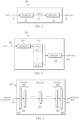
- Fig. 1 is a block diagram schematically illustrating an apparatus (e.g., system or device) in accordance with this model framework.
- the system 100 for speech enhancement (or audio enhancement / processing in general) comprises the separator block (separator) 10 and the improver block (improver) 20.
- An audio signal 5 (e.g., containing the aforementioned mixture y ) is input to the system 100.
- the separator 10 implements a first stage or first step of the proposed model framework. It is used to perform first round denoising of the input audio signal 5.
- An output 15 of the separator 10 may relate to a modified version of the input audio signal 5, i.e., to a waveform domain audio signal (not encompassed by the independent claims), or to a mask that can be applies to the audio signal in the transform domain, as will be described in more detail later.
- the downstream improver 20 implements a second stage or second step of the model framework. It receives and operates on the output 15 of the separator 10.
- the improver 20 processes the output 15 of the separator 10 to reduce the target distortion, remove or suppress artifacts, and/or remove or suppress residual noise in the audio signal.
- the improver 20 eventually generates an output 25, which may relate to a (further) modified waveform signal (not encompassed by the independent claims) or to a modified mask, as will be described in more detail below.
- the proposed framework does not relate to a concatenation of two separate models, but relates indeed to a single unified model.
- the separator 10 and the improver 20 are merely two (conceptual) blocks in the model.
- Method 1000 may be a method of speech enhancement, for example. It comprises steps S1010 and S1020.
- Step S1010 is a first step (e.g., enhancement step or separation step) for applying enhancement to a first component of the audio signal 5 (e.g., speech) and/or applying suppression to a second component of the audio signal 5 (e.g., noise or background).
- enhancement of the first component may be relative to the second component, and/or suppression of the second component may be relative to the first component.
- the first step at least partially isolates the first component from any residual components of the audio signal 5.
- the first step may also be said to perform a denoising operation for the audio signal 5.
- the first step can be a step for applying speech enhancement (not encompassed by the independent claims) to the audio signal 5.
- the first component is a speech component and the second component is a noise, background, or residual component, or the like.
- the first step may be implemented both by traditional audio processing means, as well as by a deep neural network. That is, the first step may be a deep learning based step in some implementations, for enhancing the first component of the audio signal and/or suppressing the second component of the audio signal relative to the first component.
- Step S1020 is a second step (e.g., modification step or improvement step) of modifying an output of the first step by applying a deep learning based model to the output of the first step, for perceptually improving the first component of the audio signal.
- perceptual improvement may relate to (or may comprises) the removal (or at least suppression) of distortion and/or artifacts introduced by the first step, as well as possibly any remaining unwanted components (e.g., noise or background) not removed by the first step.
- step S1010 may be implemented by the aforementioned separator 10 and that step S1020 may be implemented by the aforementioned improver 20.
- the first and second steps operate in the transform domain.
- One non-limiting example of the transform domain is the spectral domain.
- the transformation translating from the waveform domain to the transform domain may involve a time-frequency transform.
- the transform domain may also be referred to as frequency domain.
- the deep learning based model implementing the improver comprises an auto-encoder architecture.
- the auto-encoder structure has an encoder stage (or encoder) 340 and a decoder stage (or decoder) 360.
- Each of the encoder 340 and the decoder 360 comprises a respective plurality of consecutive filter layers 345, 365.
- the encoder 340 maps an input 315 thereto to a latent space representation 350.
- the last layer of the encoder 340 may be referred to as a bottleneck layer.
- the output of the bottleneck layer is the aforementioned latent space representation 350.
- the decoder 360 maps the latent space representation 350 output by the encoder 340 back to the initial format, i.e., to an output of the decoder 325 that has the same format as the input 315 to the encoder 340.
- the encoder 340 may be said to successively (i.e., from one layer to the next) reduce the dimension of its input 315, and the decoder 360 may be said to successively enhance the dimension of its input (i.e., the latent space representation 350) back to the original dimension.
- the AE based improver 420 is implemented using a series of DNN layers (e.g., with 512, 256, 512, and 1025 nodes, respectively).
- the encoder of the AE structure learns 256-dimentional representations of the mask, and the decoder reconstructs the improved 1025-dimensional mask by using these 256-dimensional representations. It has been found that such an improver can fix at least part of the target distortion, can further remove at least part of the residual noise, and can alleviate at least part of the audible artifacts.
- the perceptual quality is significantly improved by the AE based improver.
- the improver may be implemented using a RNN based architecture that uses multiple outputs of the separator.
- the separator may be the same as for the AE based implementation, for example.
- the improver 520 comprises a plurality of consecutive layers. In the example, these layers are gated recurrent unit (GRU) / LSTM layers.
- the separator 520 may have been trained first, for example with eight frames as input. At runtime, the separator is fed with 32 blocks, with each block comprising eight frames and a frame-shift of one frame (so that altogether 39 frames are fed to the separator 510).
- the separator 510 processes 32 blocks and outputs the results of 32 frames accordingly. These 32-frame results are then fed it into the improver 520 as the input.
- the deep learning based model of the improver may implement a recurrent neural network architecture with a plurality of consecutive layers.
- the plurality of layers may be layers of long short-term memory type or gated recurrent unit type.
- a transformer 630 (or ISTFT) is optionally added to transform the output 615 of the separator to the waveform domain, if necessary.
- the improver 620 uses a series of 1-D dilated convolutionally layers 640 with a skip connection 645 followed by a 1-D convolutional layer 660 to generate a modified audio signal 625 (e.g., modified dialog signal). It may recover the degraded speech components caused by the separator and may also help to remove the residual noise that cannot be removed by the separator.
- the deep learning based model of the improver may implement a generative model architecture with a plurality of consecutive convolutional layers.
- the convolutional layers may be dilated convolutional layers, optionally comprising one or more skip connections.
- the present disclosure proposes two alternative training strategies for the separator-improver framework described herein. Therein, it is assumed that the separator and the improver each comprise or implement a deep learning based model, and that training the separator / improver corresponds to training their respective deep learning based models.
- the first training strategy is a two-stage training strategy.
- the separator is trained, and its corresponding loss will be optimized via back propagation.
- all its parameters are fixed (i.e., untrainable), and the output of the trained separator will be fed into the improver.
- the improver is trained, and the loss function of the improver is optimized via back propagation.
- the whole framework can be used as an entire model while the separator and the improver are trained in two training stages separately.
- the improver can be regarded as a deep learning based customized post-processing block for the separator, which can generally improve the performance of the separator.
- the separator and the improver can be trained at the same time (i.e., simultaneously).
- a challenge and important issue in doing so may be to ensure that each of the separator and the improver performs its respective own function, i.e., the separator is expected to extract the speech signal and the improver is expected to improve the performance of the separator.
- a 'constrained' training strategy is proposed, in which the loss function used for training not only considers the final output of the improver, but also the intermediate output of the separator.
- the loss function used for training may be a common loss function for both the deep learning based model of the separator and the deep learning model of the improver (respectively applied in the first step and second step of the corresponding processing method).
- the loss function is based on both the output of the separator and the output of the improver, in addition to appropriate reference data.
- the separator can be trained towards dialog separation (or any desired audio processing function in general), and convergence of the improver will be improved since the output of the separator also converges towards the final goal.
- the above method of audio processing may further comprise one or more additional first steps for applying enhancement to the first component of the audio signal and/or applying suppression to the second component of the audio signal relative to the first component.
- the first step described above and the one or more additional first steps generate mutually (e.g., pairwise) different outputs.
- these steps may use different models of audio processing (e.g., speech enhancement), and/or different model parameters.
- the second step receives a respective output of each of the one or more additional first steps in addition to the output of the first step, and jointly applies its deep learning based model to the output of the first step and the outputs of the one or more additional first steps, for perceptually improving the first component of the audio signal.
- a new training strategy can be resorted to for enabling use of traditional methods as the separator in the proposed framework.
- one or a set of different traditional speech enhancement algorithms can be used, and each of a plurality of noisy signals in a training set 850 can be used as input 805 for processing by each of these algorithms (e.g., separator(s) 810).
- all the enhanced speech signals 815 as well as the original unprocessed noisy speech signals are collected to form a new comprehensive training set 855, which is then used to train the deep learning based improver 820, which generates output 825.
- an unprocessed noisy signal and its multiple enhanced versions correspond to the same target speech signal.
- the improver 820 tends to learn a many-to-one mapping.
- the traditional methods can be spectral subtraction or a Wiener filter based on priori SNR estimation etc., for example.
- the auto-encoder based improver described above can also be considered as relating to banding and de-banding processing.
- banding In a typical signal processing algorithm, more T-F characteristics will be retained for higher band number, but banding may still be necessary for reducing the processing complexity.
- banding there are many cases where an acceptable performance cannot be achieved by using limited bands when using traditional banding algorithms (e.g., octave band, one-third octave band, etc.).
- the aforementioned auto-encoder based improver can be used for implementing an automatic banding scheme.
- the corresponding framework is schematically illustrated in Fig. 9 .
- the improver is split into two parts, a first (front) part 920-1 for receiving an input 905 (e.g., an input audio signal) and automatic banding thereof, and a second (back) part 920-2 for automatic de-banding.
- first (front) part 920-1 for receiving an input 905 (e.g., an input audio signal) and automatic banding thereof
- a second (back) part 920-2 for automatic de-banding.
- the same considerations as made above for the auto-encoder based improver also apply here.
- the front improver 920-1 may comprise a plurality of consecutive layers 930 (e.g., DNN layers) with successively decreasing node number that eventually map to a latent space representation 935 (code), and the back improver 920-2 may also comprise a plurality of consecutive layers 940 (e.g., DNN layers) with successively increasing node number.
- a latent space representation 935 code
- the back improver 920-2 may also comprise a plurality of consecutive layers 940 (e.g., DNN layers) with successively increasing node number.
- front and back improvers 920-1, 920-2 may have the same number of layers
- the outermost layer of the front improver 920-1 may have the same number of nodes as the outermost layer of the back improver 920-2
- the next-to-outermost layer of the front improver 920-1 may have the same number of nodes as the next-to-outermost layer of the back improver 920-2, and so forth, up to respective innermost layers.
- the separator 910 can be trained based on the intelligent band feature learned by the front improver to obtain the denoised band features. Then the denoised band features (i.e., latent space representation 945) are fed into the back improver for de-banding processing, which will eventually yield a bin-based output 925.
- the dimension of the code (e.g., latent representation) in the front improver i.e., output by the front improver
- the dimension of the code e.g., latent representation
- the performance for different band numbers can be assessed. Accordingly, the most appropriate band number can be selected to provide a good trade-off between complexity and accuracy.
- a series of DNN layers can be used for the front improver 920-1 to group a 1025-point spectral magnitude (obtained by a 2048-point STFT with 50% overlap) and obtain a 256-dimensional band feature.
- DNN layers with reverse node number assignment as compared to the front improver 920-1 e.g., 256 and 512 nodes, respectively
- the back improver 920-2 will eventually reconstruct the bin based output (e.g., the bin based mask) based on the output of the separator (e.g., denoised band features).
- the aforementioned method of audio processing may further comprise a third step of applying a deep learning based model to the audio signal for banding the audio signal.
- the third step is to be performed before the first step, so that the order of steps is third step - first step - second step.
- the second step modifies the output of the first step by de-banding the output of the first step.
- the third and second steps implement an auto-encoder structure for banding and de-banding. They may be said to be based on a single deep learning based model, or alternatively, it may be said that their deep learning based models have been jointly trained.
- the second and third steps may each implement a plurality of consecutive layers with successively increasing and decreasing node number, respectively.
- Method 1100 may be a method of speech enhancement, for example. It comprises steps S1110 through S1130.
- a deep learning based model is applied to the audio signal for banding the audio signal.
- enhancement is applied to a first component of the banded audio signal and/or suppression relative to the first component is applied to a second component of the banded audio signal relative to the first component.
- an output of the enhancement step is modified by applying a deep learning based model to the output of the enhancement step for de-banding the output of the enhancement step, and for perceptually improving the first component of the audio signal.
- the second stage in the proposed framework for audio processing may be an improver for removing artifacts and fixing speech distortion.
- the second stage could also have other functionalities, such as implementing a voice activity detector (VAD), for example.
- VAD voice activity detector
- all known VAD algorithms may have a degraded accuracy when there is strong noise. It is very challenging for these algorithms to show robust performance in the presence of various noise types and/or for low SNR in general.
- the separator can be used to denoise the mixture (i.e., the input audio signal), and the improver can be used to perform VAD.
- Such a VAD system can internally perform the denoising and thus will be more robust with respect to complicated (e.g., noisy) scenarios.
- the aforementioned improver may be replaced by an improver that performs deep learning based VAD on the output of the separator, in addition to or as an alternative to removing distortion and/or artifacts, etc.
- the proposed two-step training scheme can be generalized to a number of other speech enhancement based applications, such as equalizers or intelligibility meters, for example.
- the separator may perform speech enhancement as described above and remove the background, and the improver may be trained based on specific requirements. This can achieve more robust and better results compared to the results when only using the original noisy input of the separator. Accordingly, the improver can be specifically adapted so that the separator and the improver jointly achieve the desired application / operation, such as equalizers or intelligibility meters, for example.
- a mature audio signal processing technology chain typically includes several modules (e.g., audio processing modules), some of which may use traditional signal processing methods, and some of which may be based on deep learning. These modules are typically cascaded in series to get the desired final output. Based on the proposed framework, each module or part of the module in such signal processing chain can be embedded into a large deep learning based model. When training, each module can be trained in turn (i.e., separately and in sequence) and its output can be supervised to meet the desired outcome, up to the end of the last module training. The whole model will become a chain of audio processing technologies based on deep learning, and the modules will work together as expected in the model.
- modules e.g., audio processing modules
- the present disclosure also relates to any pairing of a signal processing module (e.g., adapted to perform audio processing, audio enhancement, etc.), followed by a deep learning based improver, trained to improve the output of the signal processing module.
- Improving the output of the signal processing module may include one or more of removing artifacts, removing distortion, and/or removing noise.
- a method of audio processing (e.g., speech enhancement) has been described above. Additionally, the present disclosure also relates to an apparatus (e.g., system or device) for carrying out this method. An example of such apparatus is shown in Fig. 1 . Moreover, in line with the method 1000 illustrated in Fig. 10 , an apparatus for processing an audio signal according to the present disclosure can be said to comprise a first stage and a second stage. The first and second stages may be implemented in hardware and/or software. The first stage is adapted for applying enhancement to a first component of the audio signal and/or applying suppression to a second component of the audio signal.
- the second stage is adapted for modifying an output of the first stage by applying a deep learning based model to the output of the first stage, for perceptually improving the first component of the audio signal.
- a deep learning based model to the output of the first stage, for perceptually improving the first component of the audio signal.
- the present disclosure relates to an apparatus comprising a processor and a memory coupled to the processor, wherein the processor is adapted to carry out the steps of the method(s) described herein.
- the processor may be adapted to implement the aforementioned first and second stages.
- a server computer may be implemented by a client computer, a personal computer (PC), a tablet PC, a set-top box (STB), a personal digital assistant (PDA), a cellular telephone, a smartphone, a web appliance, a network router, switch or bridge, or any machine capable of executing instructions (sequential or otherwise) that specify actions to be taken by that apparatus.
- PC personal computer
- PDA personal digital assistant
- STB set-top box
- a cellular telephone a smartphone
- smartphone a web appliance
- network router switch or bridge
- the present disclosure further relates to a program (e.g., computer program) comprising instructions that, when executed by a processor, cause the processor to carry out some or all of the steps of the methods described herein.
- a program e.g., computer program
- the present disclosure relates to methods of audio processing and apparatus (e.g., systems or devices) for audio processing. It is understood that any statements made with regard to the methods and their steps likewise and analogously apply to the corresponding apparatus and their stages / blocks / units, and vice versa.
- processor may refer to any device or portion of a device that processes electronic data, e.g., from registers and/or memory to transform that electronic data into other electronic data that, e.g., may be stored in registers and/or memory.
- a "computer” or a “computing machine” or a “computing platform” may include one or more processors.
- the methodologies described herein are, in one example embodiment, performable by one or more processors that accept computer-readable (also called machine-readable) code containing a set of instructions that when executed by one or more of the processors carry out at least one of the methods described herein.
- Any processor capable of executing a set of instructions (sequential or otherwise) that specify actions to be taken are included.
- a typical processing system that includes one or more processors.
- Each processor may include one or more of a CPU, a graphics processing unit, and a programmable DSP unit.
- the processing system further may include a memory subsystem including main RAM and/or a static RAM, and/or ROM.
- a bus subsystem may be included for communicating between the components.
- the processing system further may be a distributed processing system with processors coupled by a network. If the processing system requires a display, such a display may be included, e.g., a liquid crystal display (LCD) or a cathode ray tube (CRT) display. If manual data entry is required, the processing system also includes an input device such as one or more of an alphanumeric input unit such as a keyboard, a pointing control device such as a mouse, and so forth. The processing system may also encompass a storage system such as a disk drive unit. The processing system in some configurations may include a sound output device, and a network interface device.
- LCD liquid crystal display
- CRT cathode ray tube
- the memory subsystem thus includes a computer-readable carrier medium that carries computer-readable code (e.g., software) including a set of instructions to cause performing, when executed by one or more processors, one or more of the methods described herein.
- computer-readable code e.g., software
- the software may reside in the hard disk, or may also reside, completely or at least partially, within the RAM and/or within the processor during execution thereof by the computer system.
- the memory and the processor also constitute computer-readable carrier medium carrying computer-readable code.
- a computer-readable carrier medium may form, or be included in a computer program product.
- the one or more processors operate as a standalone device or may be connected, e.g., networked to other processor(s), in a networked deployment, the one or more processors may operate in the capacity of a server or a user machine in server-user network environment, or as a peer machine in a peer-to-peer or distributed network environment.
- the one or more processors may form a personal computer (PC), a tablet PC, a Personal Digital Assistant (PDA), a cellular telephone, a web appliance, a network router, switch or bridge, or any machine capable of executing a set of instructions (sequential or otherwise) that specify actions to be taken by that machine.
- machine shall also be taken to include any collection of machines that individually or jointly execute a set (or multiple sets) of instructions to perform any one or more of the methodologies discussed herein.
- aspects of the present disclosure may take the form of a method, an entirely hardware example embodiment, an entirely software example embodiment or an example embodiment combining software and hardware aspects.
- the present disclosure may take the form of carrier medium (e.g., a computer program product on a computer-readable storage medium) carrying computer-readable program code embodied in the medium.
- the software may further be transmitted or received over a network via a network interface device.
- the carrier medium is in an example embodiment a single medium, the term “carrier medium” should be taken to include a single medium or multiple media (e.g., a centralized or distributed database, and/or associated caches and servers) that store the one or more sets of instructions.
- the term “carrier medium” shall also be taken to include any medium that is capable of storing, encoding or carrying a set of instructions for execution by one or more of the processors and that cause the one or more processors to perform any one or more of the methodologies of the present disclosure.
- a carrier medium may take many forms, including but not limited to, non-volatile media, volatile media, and transmission media.
- Non-volatile media includes, for example, optical, magnetic disks, and magnetooptical disks.
- Volatile media includes dynamic memory, such as main memory.
- Transmission media includes coaxial cables, copper wire and fiber optics, including the wires that comprise a bus subsystem. Transmission media may also take the form of acoustic or light waves, such as those generated during radio wave and infrared data communications.
- carrier medium shall accordingly be taken to include, but not be limited to, solid-state memories, a computer product embodied in optical and magnetic media; a medium bearing a propagated signal detectable by at least one processor or one or more processors and representing a set of instructions that, when executed, implement a method; and a transmission medium in a network bearing a propagated signal detectable by at least one processor of the one or more processors and representing the set of instructions.
- any one of the terms comprising, comprised of or which comprises is an open term that means including at least the elements/features that follow, but not excluding others.
- the term comprising, when used in the claims should not be interpreted as being limitative to the means or elements or steps listed thereafter.
- the scope of the expression a device comprising A and B should not be limited to devices consisting only of elements A and B.
- Any one of the terms including or which includes or that includes as used herein is also an open term that also means including at least the elements/features that follow the term, but not excluding others. Thus, including is synonymous with and means comprising.
Landscapes
- Engineering & Computer Science (AREA)
- Physics & Mathematics (AREA)
- Theoretical Computer Science (AREA)
- Computational Linguistics (AREA)
- Health & Medical Sciences (AREA)
- Artificial Intelligence (AREA)
- Evolutionary Computation (AREA)
- Software Systems (AREA)
- General Engineering & Computer Science (AREA)
- Mathematical Physics (AREA)
- General Physics & Mathematics (AREA)
- Life Sciences & Earth Sciences (AREA)
- Biomedical Technology (AREA)
- Biophysics (AREA)
- Data Mining & Analysis (AREA)
- General Health & Medical Sciences (AREA)
- Molecular Biology (AREA)
- Computing Systems (AREA)
- Human Computer Interaction (AREA)
- Multimedia (AREA)
- Acoustics & Sound (AREA)
- Audiology, Speech & Language Pathology (AREA)
- Signal Processing (AREA)
- Quality & Reliability (AREA)
- Soundproofing, Sound Blocking, And Sound Damping (AREA)
- Stereophonic System (AREA)
- Compression, Expansion, Code Conversion, And Decoders (AREA)
- Machine Translation (AREA)
Claims (15)
- Verfahren zum Verarbeiten eines Audiosignals, umfassend:einen ersten Schritt zum Anwenden einer Verbesserung auf eine erste Komponente des Audiosignals und/oder Anwenden einer Unterdrückung auf eine zweite Komponente des Audiosignals in Bezug zur ersten Komponente, wobei die Ausgabe des ersten Schritts eine Transformationsbereichsmaske ist, die Gewichtungskoeffizienten für einzelne Bins oder Bänder angibt, und wobei Anwenden der Maske auf das Audiosignal zu der Verbesserung der ersten Komponente und/oder der Unterdrückung der zweiten Komponente in Bezug zur ersten Komponente führt; undeinen zweiten Schritt des Modifizierens der Ausgabe des ersten Schritts durch Anwenden eines auf Deep Learning basierenden Modells auf die Ausgabe des ersten Schritts, zum wahrnehmbaren Verbessern der ersten Komponente des Audiosignals durch Entfernen von Artefakten und/oder Verzerrungen, die durch den ersten Schritt in das Audiosignal eingeführt wurden.
- Verfahren nach Anspruch 1, wobei der erste Schritt ein Schritt zum Anwenden einer Sprachverbesserung auf das Audiosignal ist.
- Verfahren nach einem der Ansprüche 1 bis 2, wobei der zweite Schritt eine Vielzahl von Instanzen einer Ausgabe des ersten Schritts empfängt, wobei jede der Instanzen einem jeweiligen einer Vielzahl von Frames des Audiosignals entspricht, und wobei der zweite Schritt das auf maschinellem Lernen basierende Modell gemeinsam auf die Vielzahl von Instanzen einer Ausgabe zum wahrnehmbaren Verbessern der ersten Komponente des Audiosignals in einem oder mehreren der Vielzahl von Frames des Audiosignals anwendet.
- Verfahren nach einem der Ansprüche 1 bis 3, wobei der zweite Schritt für einen gegebenen Frame des Audiosignals eine Sequenz von Instanzen einer Ausgabe des ersten Schritts empfängt, wobei jede der Instanzen einer jeweiligen in einer Sequenz von Frames des Audiosignals entspricht, wobei die Sequenz von Frames den gegebenen Frame beinhaltet, und wobei der zweite Schritt das auf maschinellem Lernen basierende Modell gemeinsam auf die Sequenz von Instanzen einer Ausgabe zum wahrnehmbaren Verbessern der ersten Komponente des Audiosignals in dem gegebenen Frame anwendet.
- Verfahren nach einem der Ansprüche 1 bis 4, wobei das auf Deep Learning basierende Modell des zweiten Schritts eine Autoencoder-Architektur mit einer Encoder-Stufe und einer Decoder-Stufe umsetzt, wobei jede Stufe eine jeweilige Vielzahl aufeinanderfolgender Filterschichten umfasst, und wobei die Encoder-Stufe eine Eingabe in die Encoder-Stufe auf eine latente Raumdarstellung abbildet, und die Decoder-Stufe die von der Encoder-Stufe ausgegebene latente Raumdarstellung auf eine Ausgabe von der Decoder-Stufe abbildet, die das gleiche Format wie die Eingabe in die Encoder-Stufe aufweist.
- Verfahren nach einem der Ansprüche 1 bis 4, wobei das auf Deep Learning basierende Modell des zweiten Schritts eine rekurrente neuronale Netzwerkarchitektur mit einer Vielzahl von aufeinanderfolgenden Schichten umsetzt, wobei die Vielzahl von Schichten Schichten vom Typ "Long Short-Term Memory" oder "Gated Recurrent Unit" sind.
- Verfahren nach einem der Ansprüche 1 bis 4, wobei das auf Deep Learning basierende Modell eine generative Modellarchitektur mit einer Vielzahl aufeinanderfolgender Faltungsschichten umsetzt.
- Verfahren nach einem der Ansprüche 1 bis 7, das weiter einen oder mehrere zusätzliche erste Schritte zum Anwenden einer Verbesserung auf die erste Komponente des Audiosignals und/oder Anwenden einer Unterdrückung auf die zweite Komponente des Audiosignals umfasst, wobei der erste Schritt und der eine oder die mehreren zusätzlichen ersten Schritte voneinander verschiedene Ausgaben erzeugen;wobei der zweite Schritt zusätzlich zu der Ausgabe des ersten Schritts eine Ausgabe jedes von dem einen oder den mehreren zusätzlichen ersten Schritten empfängt; undwobei der zweite Schritt das auf Deep Learning basierende Modell gemeinsam auf die Ausgabe des ersten Schritts und die Ausgaben des einen oder der mehreren zusätzlichen ersten Schritte zum wahrnehmbaren Verbessern der ersten Komponente des Audiosignals anwendet.
- Verfahren nach einem der vorstehenden Ansprüche, das weiter einen dritten Schritt zum Anwenden eines auf Deep Learning basierendes Modells auf das Audiosignal zum Bändern des Audiosignals vor der Eingabe in den ersten Schritt umfasst;wobei der zweite Schritt die Ausgabe des ersten Schritts durch Entbändern der Ausgabe des ersten Schritts modifiziert; undwobei die auf Deep Learning basierenden Modelle des zweiten und dritten Schritts gemeinsam trainiert worden sind.
- Verfahren nach Anspruch 9, wobei der zweite und der dritte Schritt jeweils eine Vielzahl aufeinanderfolgender Schichten mit sukzessive zunehmender beziehungsweise abnehmender Knotenzahl umsetzen.
- Verfahren nach einem der Ansprüche 1 bis 10, wobei der erste Schritt ein auf Deep-Learning basierendes Modell zum Verbessern der ersten Komponente des Audiosignals und/oder Unterdrücken der zweiten Komponente des Audiosignals in Bezug zur ersten Komponente anwendet.
- Verfahren nach Anspruch 11, wobei die Deep-Learning-Modelle des ersten Schritts und des zweiten Schritts getrennt über Backpropagation trainiert werden; oder wobei die Deep-Learning-Modelle des ersten Schritts und des zweiten Schritts gleichzeitig unter Verwendung einer gemeinsamen Verlustfunktion trainiert werden.
- Einrichtung zum Verarbeiten eines Audiosignals, umfassend:eine erste Stufe zum Anwenden einer Verbesserung auf eine erste Komponente des Audiosignals und/oder Anwenden einer Unterdrückung auf eine zweite Komponente des Audiosignals in Bezug zur ersten Komponente, wobei die Ausgabe der ersten Stufe eine Transformationsbereichsmaske ist, die Gewichtungskoeffizienten für einzelne Bins oder Bänder angibt, und wobei Anwenden der Maske auf das Audiosignal zu der Verbesserung der ersten Komponente und/oder der Unterdrückung der zweiten Komponente in Bezug zur ersten Komponente führt; undeine zweite Stufe zum Modifizieren der Ausgabe der ersten Stufe durch Anwenden eines auf Deep Learning basierenden Modells auf die Ausgabe der ersten Stufe, zum wahrnehmbaren Verbessern der ersten Komponente des Audiosignals durch Entfernen von Artefakten und/oder Verzerrungen, die durch die erste Stufe in das Audiosignal eingeführt wurden.
- Computerprogramm, das Anweisungen umfasst, die, wenn sie von einer Rechenvorrichtung ausgeführt werden, die Rechenvorrichtung veranlassen, die Schritte des Verfahren nach einem der Ansprüche 1 bis 12 auszuführen.
- Computerlesbares Speichermedium, welches das Computerprogramm nach Anspruch 14 speichert.
Priority Applications (1)
| Application Number | Priority Date | Filing Date | Title |
|---|---|---|---|
| EP25185015.2A EP4621773A3 (de) | 2021-03-22 | 2022-03-17 | Robustheit/leistungsverbesserung für auf tiefenlernen basierende sprachverbesserung gegen artefakte und verzerrungen |
Applications Claiming Priority (4)
| Application Number | Priority Date | Filing Date | Title |
|---|---|---|---|
| CN2021082199 | 2021-03-22 | ||
| US202163180705P | 2021-04-28 | 2021-04-28 | |
| EP21178178 | 2021-06-08 | ||
| PCT/US2022/020790 WO2022203939A1 (en) | 2021-03-22 | 2022-03-17 | Robustness/performance improvement for deep learning based speech enhancement against artifacts and distortion |
Related Child Applications (1)
| Application Number | Title | Priority Date | Filing Date |
|---|---|---|---|
| EP25185015.2A Division EP4621773A3 (de) | 2021-03-22 | 2022-03-17 | Robustheit/leistungsverbesserung für auf tiefenlernen basierende sprachverbesserung gegen artefakte und verzerrungen |
Publications (2)
| Publication Number | Publication Date |
|---|---|
| EP4315327A1 EP4315327A1 (de) | 2024-02-07 |
| EP4315327B1 true EP4315327B1 (de) | 2025-06-25 |
Family
ID=80953306
Family Applications (2)
| Application Number | Title | Priority Date | Filing Date |
|---|---|---|---|
| EP25185015.2A Pending EP4621773A3 (de) | 2021-03-22 | 2022-03-17 | Robustheit/leistungsverbesserung für auf tiefenlernen basierende sprachverbesserung gegen artefakte und verzerrungen |
| EP22713495.4A Active EP4315327B1 (de) | 2021-03-22 | 2022-03-17 | Tiefenlernbasierte sprachverbesserung gegen artefakte und verzerrungen |
Family Applications Before (1)
| Application Number | Title | Priority Date | Filing Date |
|---|---|---|---|
| EP25185015.2A Pending EP4621773A3 (de) | 2021-03-22 | 2022-03-17 | Robustheit/leistungsverbesserung für auf tiefenlernen basierende sprachverbesserung gegen artefakte und verzerrungen |
Country Status (7)
| Country | Link |
|---|---|
| US (1) | US20240161766A1 (de) |
| EP (2) | EP4621773A3 (de) |
| JP (2) | JP7562878B2 (de) |
| KR (2) | KR102749822B1 (de) |
| BR (1) | BR112023017453A2 (de) |
| ES (1) | ES3036376T3 (de) |
| WO (1) | WO2022203939A1 (de) |
Families Citing this family (3)
| Publication number | Priority date | Publication date | Assignee | Title |
|---|---|---|---|---|
| CN115731941A (zh) * | 2021-08-27 | 2023-03-03 | 脸萌有限公司 | 音频信号的分离方法、装置、设备、存储介质及程序 |
| WO2024030338A1 (en) * | 2022-08-05 | 2024-02-08 | Dolby Laboratories Licensing Corporation | Deep learning based mitigation of audio artifacts |
| EP4481740A1 (de) * | 2023-06-19 | 2024-12-25 | ai-coustics UG | Verfahren zur sprachverbesserung |
Citations (5)
| Publication number | Priority date | Publication date | Assignee | Title |
|---|---|---|---|---|
| US20190318755A1 (en) | 2018-04-13 | 2019-10-17 | Microsoft Technology Licensing, Llc | Systems, methods, and computer-readable media for improved real-time audio processing |
| EP3716270A1 (de) | 2019-03-29 | 2020-09-30 | Goodix Technology (HK) Company Limited | Sprachverarbeitungssystem und verfahren dafür |
| US20200312343A1 (en) | 2019-04-01 | 2020-10-01 | Qnap Systems, Inc. | Speech enhancement method and system |
| WO2020232180A1 (en) | 2019-05-14 | 2020-11-19 | Dolby Laboratories Licensing Corporation | Method and apparatus for speech source separation based on a convolutional neural network |
| US11100941B2 (en) | 2018-08-21 | 2021-08-24 | Krisp Technologies, Inc. | Speech enhancement and noise suppression systems and methods |
Family Cites Families (4)
| Publication number | Priority date | Publication date | Assignee | Title |
|---|---|---|---|---|
| EP1653445A1 (de) * | 2004-10-26 | 2006-05-03 | Harman Becker Automotive Systems-Wavemakers, Inc. | System zur Verbesserung periodischer Signale |
| JP5641186B2 (ja) * | 2010-01-13 | 2014-12-17 | ヤマハ株式会社 | 雑音抑圧装置およびプログラム |
| JP6840302B2 (ja) * | 2018-11-28 | 2021-03-10 | 三菱電機株式会社 | 情報処理装置、プログラム及び情報処理方法 |
| WO2021044551A1 (ja) * | 2019-09-04 | 2021-03-11 | 日本電信電話株式会社 | 到来方向推定装置、モデル学習装置、到来方向推定方法、モデル学習方法、プログラム |
-
2022
- 2022-03-17 BR BR112023017453A patent/BR112023017453A2/pt unknown
- 2022-03-17 KR KR1020237031485A patent/KR102749822B1/ko active Active
- 2022-03-17 EP EP25185015.2A patent/EP4621773A3/de active Pending
- 2022-03-17 US US18/282,311 patent/US20240161766A1/en active Pending
- 2022-03-17 KR KR1020247043367A patent/KR20250005554A/ko active Pending
- 2022-03-17 ES ES22713495T patent/ES3036376T3/es active Active
- 2022-03-17 EP EP22713495.4A patent/EP4315327B1/de active Active
- 2022-03-17 WO PCT/US2022/020790 patent/WO2022203939A1/en not_active Ceased
- 2022-03-17 JP JP2023558124A patent/JP7562878B2/ja active Active
-
2024
- 2024-09-25 JP JP2024165835A patent/JP2025026831A/ja active Pending
Patent Citations (5)
| Publication number | Priority date | Publication date | Assignee | Title |
|---|---|---|---|---|
| US20190318755A1 (en) | 2018-04-13 | 2019-10-17 | Microsoft Technology Licensing, Llc | Systems, methods, and computer-readable media for improved real-time audio processing |
| US11100941B2 (en) | 2018-08-21 | 2021-08-24 | Krisp Technologies, Inc. | Speech enhancement and noise suppression systems and methods |
| EP3716270A1 (de) | 2019-03-29 | 2020-09-30 | Goodix Technology (HK) Company Limited | Sprachverarbeitungssystem und verfahren dafür |
| US20200312343A1 (en) | 2019-04-01 | 2020-10-01 | Qnap Systems, Inc. | Speech enhancement method and system |
| WO2020232180A1 (en) | 2019-05-14 | 2020-11-19 | Dolby Laboratories Licensing Corporation | Method and apparatus for speech source separation based on a convolutional neural network |
Non-Patent Citations (6)
| Title |
|---|
| "Advances in Visual Computing : 16th International Symposium, ISVC 2021, Virtual Event, October 4-6, 2021, Proceedings, Part II", vol. 12, 15 August 2015, SPRINGER INTERNATIONAL PUBLISHING, Cham, ISBN: 978-3-030-90436-4, ISSN: 0302-9743, article KIM MINJE; SMARAGDIS PARIS: "Adaptive Denoising Autoencoders: A Fine-Tuning Scheme to Learn from Test Mixtures", pages: 100 - 107, XP047656085, DOI: 10.1007/978-3-319-22482-4_12 |
| NARAYANAN ARUN; WANG DELIANG: "Ideal ratio mask estimation using deep neural networks for robust speech recognition", ICASSP, IEEE INTERNATIONAL CONFERENCE ON ACOUSTICS, SPEECH AND SIGNAL PROCESSING - PROCEEDINGS 1999 IEEE, IEEE, 26 May 2013 (2013-05-26), pages 7092 - 7096, XP032508424, ISSN: 1520-6149, ISBN: 978-0-7803-5041-0, DOI: 10.1109/ICASSP.2013.6639038 |
| SALEEM NASIR; KHATTAK MUHAMMAD IRFAN; AL-HASAN MUATH; QAZI ABDUL BASEER: "On Learning Spectral Masking for Single Channel Speech Enhancement Using Feedforward and Recurrent Neural Networks", IEEE ACCESS, IEEE, USA, vol. 8, 31 August 2020 (2020-08-31), USA , pages 160581 - 160595, XP011808493, DOI: 10.1109/ACCESS.2020.3021061 |
| SHAH NEIL; PATIL HEMANT A.; SONI MEET H.: "Time-Frequency Mask-based Speech Enhancement using Convolutional Generative Adversarial Network", 2018 ASIA-PACIFIC SIGNAL AND INFORMATION PROCESSING ASSOCIATION ANNUAL SUMMIT AND CONFERENCE (APSIPA ASC), APSIPA ORGANIZATION, 12 November 2018 (2018-11-12), pages 1246 - 1251, XP033526047, DOI: 10.23919/APSIPA.2018.8659692 |
| SONI MEET H.; SHARMA MANISHA; SAILOR HARDIK B.; PATIL HEMANT A.: "Sub-band Autoencoder features for Automatic Speech Recognition", 2017 NINTH INTERNATIONAL CONFERENCE ON ADVANCES IN PATTERN RECOGNITION (ICAPR), IEEE, 27 December 2017 (2017-12-27), pages 1 - 5, XP033484919, DOI: 10.1109/ICAPR.2017.8593069 |
| TU YAN-HUI; DU JUN; SUN LEI; LEE CHIN-HUI: "LSTM-based iterative mask estimation and post-processing for multi-channel speech enhancement", 2017 ASIA-PACIFIC SIGNAL AND INFORMATION PROCESSING ASSOCIATION ANNUAL SUMMIT AND CONFERENCE (APSIPA ASC), IEEE, 12 December 2017 (2017-12-12), pages 488 - 491, XP033315467, DOI: 10.1109/APSIPA.2017.8282081 |
Also Published As
| Publication number | Publication date |
|---|---|
| EP4315327A1 (de) | 2024-02-07 |
| JP2025026831A (ja) | 2025-02-26 |
| EP4621773A3 (de) | 2025-10-29 |
| BR112023017453A2 (pt) | 2023-10-03 |
| KR20230138043A (ko) | 2023-10-05 |
| JP2024510347A (ja) | 2024-03-06 |
| US20240161766A1 (en) | 2024-05-16 |
| EP4621773A2 (de) | 2025-09-24 |
| WO2022203939A1 (en) | 2022-09-29 |
| ES3036376T3 (en) | 2025-09-18 |
| KR20250005554A (ko) | 2025-01-09 |
| KR102749822B1 (ko) | 2025-01-07 |
| JP7562878B2 (ja) | 2024-10-07 |
Similar Documents
| Publication | Publication Date | Title |
|---|---|---|
| EP4315327B1 (de) | Tiefenlernbasierte sprachverbesserung gegen artefakte und verzerrungen | |
| EP4208865A1 (de) | Auf trainingssignalen mit verschiedenen störungen trainiertes qualitätsschätzungsmodell | |
| CN116682444A (zh) | 一种基于波形频谱融合网络的单通道语音增强方法 | |
| Lim et al. | Harmonic and percussive source separation using a convolutional auto encoder | |
| Chou et al. | Av2wav: Diffusion-based re-synthesis from continuous self-supervised features for audio-visual speech enhancement | |
| KR20230101829A (ko) | 처리된 오디오 신호를 제공하는 장치, 처리된 오디오 신호를 제공하는 방법, 신경망 파라미터를 제공하는 장치, 및 신경망 파라미터를 제공하는 방법 | |
| CN120636435A (zh) | 基于时频特征联合建模的语音增强方法及系统 | |
| RU2846602C1 (ru) | Повышение надёжности/производительности для усиления речи на основе глубокого обучения против артефактов и искажения | |
| CN117083672A (zh) | 针对伪影和失真的基于深度学习的语音增强的稳健性/性能改善 | |
| Zhao et al. | Conv-TasNet Adaptive Noise Cancellation Model Enhanced by WaveNet | |
| Zhang et al. | MSLD-SENet: Time–Frequency Multi-Dconv Channel-Shuffled Attention with Lightweight Dilated DenseNet for Monaural Speech Enhancement | |
| GB2617613A (en) | An audio processing method and apparatus | |
| Li et al. | Dynamic attention based generative adversarial network with phase post-processing for speech enhancement | |
| Wan et al. | Cross domain optimization for speech enhancement: Parallel or cascade? | |
| Peng et al. | Einstein matrix-optimized multiscale frequency band fusion framework for speech denoising | |
| Song et al. | Complex-valued temporal convolutional network for speech enhancement | |
| Wen et al. | EffiFusion-GAN: Efficient Fusion Generative Adversarial Network for Speech Enhancement | |
| Baskaran et al. | Autoencoder Based Noise Cancellation for Real-Time Audio Enhancement | |
| CN119152874B (zh) | 语音信号处理方法、装置、设备、介质及产品 | |
| Jenifa et al. | Integrating Advanced Convolutional and Recurrent Architectures for Speech Enhancement | |
| RU2802279C1 (ru) | Способ улучшения речевого сигнала с низкой задержкой, вычислительное устройство и считываемый компьютером носитель, реализующий упомянутый способ | |
| Zhang et al. | SMRU-Lite: Efficient Low-Complexity Speech Enhancement Model with Uncertainty Estimation | |
| Yang et al. | DCCRN-SUBNET: A DCCRN and subnet fusion model for speech enhancement | |
| Ning et al. | Bridging the Front-End and Back-End for Robust ASR via Cross-Attention-Based U-Net | |
| Li et al. | A Global Discriminant Joint Training Framework for Robust Speech Recognition |
Legal Events
| Date | Code | Title | Description |
|---|---|---|---|
| STAA | Information on the status of an ep patent application or granted ep patent |
Free format text: STATUS: UNKNOWN |
|
| STAA | Information on the status of an ep patent application or granted ep patent |
Free format text: STATUS: THE INTERNATIONAL PUBLICATION HAS BEEN MADE |
|
| PUAI | Public reference made under article 153(3) epc to a published international application that has entered the european phase |
Free format text: ORIGINAL CODE: 0009012 |
|
| STAA | Information on the status of an ep patent application or granted ep patent |
Free format text: STATUS: REQUEST FOR EXAMINATION WAS MADE |
|
| 17P | Request for examination filed |
Effective date: 20230908 |
|
| AK | Designated contracting states |
Kind code of ref document: A1 Designated state(s): AL AT BE BG CH CY CZ DE DK EE ES FI FR GB GR HR HU IE IS IT LI LT LU LV MC MK MT NL NO PL PT RO RS SE SI SK SM TR |
|
| P01 | Opt-out of the competence of the unified patent court (upc) registered |
Effective date: 20240319 |
|
| DAV | Request for validation of the european patent (deleted) | ||
| DAX | Request for extension of the european patent (deleted) | ||
| RIC1 | Information provided on ipc code assigned before grant |
Ipc: G10L 25/30 20130101ALN20240802BHEP Ipc: G10L 21/0208 20130101ALI20240802BHEP Ipc: G06N 3/084 20230101ALI20240802BHEP Ipc: G06N 3/045 20230101ALI20240802BHEP Ipc: G06N 3/044 20230101ALI20240802BHEP Ipc: G10L 21/02 20130101AFI20240802BHEP |
|
| GRAP | Despatch of communication of intention to grant a patent |
Free format text: ORIGINAL CODE: EPIDOSNIGR1 |
|
| STAA | Information on the status of an ep patent application or granted ep patent |
Free format text: STATUS: GRANT OF PATENT IS INTENDED |
|
| INTG | Intention to grant announced |
Effective date: 20240917 |
|
| GRAJ | Information related to disapproval of communication of intention to grant by the applicant or resumption of examination proceedings by the epo deleted |
Free format text: ORIGINAL CODE: EPIDOSDIGR1 |
|
| STAA | Information on the status of an ep patent application or granted ep patent |
Free format text: STATUS: REQUEST FOR EXAMINATION WAS MADE |
|
| GRAP | Despatch of communication of intention to grant a patent |
Free format text: ORIGINAL CODE: EPIDOSNIGR1 |
|
| STAA | Information on the status of an ep patent application or granted ep patent |
Free format text: STATUS: GRANT OF PATENT IS INTENDED |
|
| INTC | Intention to grant announced (deleted) | ||
| INTG | Intention to grant announced |
Effective date: 20250128 |
|
| RIC1 | Information provided on ipc code assigned before grant |
Ipc: G10L 25/30 20130101ALN20250122BHEP Ipc: G10L 21/0208 20130101ALI20250122BHEP Ipc: G06N 3/084 20230101ALI20250122BHEP Ipc: G06N 3/045 20230101ALI20250122BHEP Ipc: G06N 3/044 20230101ALI20250122BHEP Ipc: G10L 21/02 20130101AFI20250122BHEP |
|
| GRAS | Grant fee paid |
Free format text: ORIGINAL CODE: EPIDOSNIGR3 |
|
| GRAA | (expected) grant |
Free format text: ORIGINAL CODE: 0009210 |
|
| STAA | Information on the status of an ep patent application or granted ep patent |
Free format text: STATUS: THE PATENT HAS BEEN GRANTED |
|
| AK | Designated contracting states |
Kind code of ref document: B1 Designated state(s): AL AT BE BG CH CY CZ DE DK EE ES FI FR GB GR HR HU IE IS IT LI LT LU LV MC MK MT NL NO PL PT RO RS SE SI SK SM TR |
|
| REG | Reference to a national code |
Ref country code: GB Ref legal event code: FG4D |
|
| REG | Reference to a national code |
Ref country code: CH Ref legal event code: EP |
|
| REG | Reference to a national code |
Ref country code: CH Ref legal event code: EP |
|
| REG | Reference to a national code |
Ref country code: IE Ref legal event code: FG4D |
|
| REG | Reference to a national code |
Ref country code: DE Ref legal event code: R096 Ref document number: 602022016436 Country of ref document: DE |
|
| REG | Reference to a national code |
Ref country code: NL Ref legal event code: FP |
|
| REG | Reference to a national code |
Ref country code: ES Ref legal event code: FG2A Ref document number: 3036376 Country of ref document: ES Kind code of ref document: T3 Effective date: 20250918 |
|
| PG25 | Lapsed in a contracting state [announced via postgrant information from national office to epo] |
Ref country code: FI Free format text: LAPSE BECAUSE OF FAILURE TO SUBMIT A TRANSLATION OF THE DESCRIPTION OR TO PAY THE FEE WITHIN THE PRESCRIBED TIME-LIMIT Effective date: 20250625 |
|
| REG | Reference to a national code |
Ref country code: LT Ref legal event code: MG9D |
|
| PG25 | Lapsed in a contracting state [announced via postgrant information from national office to epo] |
Ref country code: NO Free format text: LAPSE BECAUSE OF FAILURE TO SUBMIT A TRANSLATION OF THE DESCRIPTION OR TO PAY THE FEE WITHIN THE PRESCRIBED TIME-LIMIT Effective date: 20250925 Ref country code: GR Free format text: LAPSE BECAUSE OF FAILURE TO SUBMIT A TRANSLATION OF THE DESCRIPTION OR TO PAY THE FEE WITHIN THE PRESCRIBED TIME-LIMIT Effective date: 20250926 |
|
| PG25 | Lapsed in a contracting state [announced via postgrant information from national office to epo] |
Ref country code: BG Free format text: LAPSE BECAUSE OF FAILURE TO SUBMIT A TRANSLATION OF THE DESCRIPTION OR TO PAY THE FEE WITHIN THE PRESCRIBED TIME-LIMIT Effective date: 20250625 |
|
| PG25 | Lapsed in a contracting state [announced via postgrant information from national office to epo] |
Ref country code: HR Free format text: LAPSE BECAUSE OF FAILURE TO SUBMIT A TRANSLATION OF THE DESCRIPTION OR TO PAY THE FEE WITHIN THE PRESCRIBED TIME-LIMIT Effective date: 20250625 |
|
| PG25 | Lapsed in a contracting state [announced via postgrant information from national office to epo] |
Ref country code: RS Free format text: LAPSE BECAUSE OF FAILURE TO SUBMIT A TRANSLATION OF THE DESCRIPTION OR TO PAY THE FEE WITHIN THE PRESCRIBED TIME-LIMIT Effective date: 20250925 |
|
| PG25 | Lapsed in a contracting state [announced via postgrant information from national office to epo] |
Ref country code: LV Free format text: LAPSE BECAUSE OF FAILURE TO SUBMIT A TRANSLATION OF THE DESCRIPTION OR TO PAY THE FEE WITHIN THE PRESCRIBED TIME-LIMIT Effective date: 20250625 |
|
| PG25 | Lapsed in a contracting state [announced via postgrant information from national office to epo] |
Ref country code: PT Free format text: LAPSE BECAUSE OF FAILURE TO SUBMIT A TRANSLATION OF THE DESCRIPTION OR TO PAY THE FEE WITHIN THE PRESCRIBED TIME-LIMIT Effective date: 20251027 |
|
| REG | Reference to a national code |
Ref country code: AT Ref legal event code: MK05 Ref document number: 1807421 Country of ref document: AT Kind code of ref document: T Effective date: 20250625 |
|
| PG25 | Lapsed in a contracting state [announced via postgrant information from national office to epo] |
Ref country code: IS Free format text: LAPSE BECAUSE OF FAILURE TO SUBMIT A TRANSLATION OF THE DESCRIPTION OR TO PAY THE FEE WITHIN THE PRESCRIBED TIME-LIMIT Effective date: 20251025 |
|
| PG25 | Lapsed in a contracting state [announced via postgrant information from national office to epo] |
Ref country code: AT Free format text: LAPSE BECAUSE OF FAILURE TO SUBMIT A TRANSLATION OF THE DESCRIPTION OR TO PAY THE FEE WITHIN THE PRESCRIBED TIME-LIMIT Effective date: 20250625 Ref country code: SM Free format text: LAPSE BECAUSE OF FAILURE TO SUBMIT A TRANSLATION OF THE DESCRIPTION OR TO PAY THE FEE WITHIN THE PRESCRIBED TIME-LIMIT Effective date: 20250625 |
|
| PG25 | Lapsed in a contracting state [announced via postgrant information from national office to epo] |
Ref country code: CZ Free format text: LAPSE BECAUSE OF FAILURE TO SUBMIT A TRANSLATION OF THE DESCRIPTION OR TO PAY THE FEE WITHIN THE PRESCRIBED TIME-LIMIT Effective date: 20250625 |
|
| PG25 | Lapsed in a contracting state [announced via postgrant information from national office to epo] |
Ref country code: PL Free format text: LAPSE BECAUSE OF FAILURE TO SUBMIT A TRANSLATION OF THE DESCRIPTION OR TO PAY THE FEE WITHIN THE PRESCRIBED TIME-LIMIT Effective date: 20250625 |
|
| PG25 | Lapsed in a contracting state [announced via postgrant information from national office to epo] |
Ref country code: EE Free format text: LAPSE BECAUSE OF FAILURE TO SUBMIT A TRANSLATION OF THE DESCRIPTION OR TO PAY THE FEE WITHIN THE PRESCRIBED TIME-LIMIT Effective date: 20250625 |
|
| PG25 | Lapsed in a contracting state [announced via postgrant information from national office to epo] |
Ref country code: SK Free format text: LAPSE BECAUSE OF FAILURE TO SUBMIT A TRANSLATION OF THE DESCRIPTION OR TO PAY THE FEE WITHIN THE PRESCRIBED TIME-LIMIT Effective date: 20250625 |
|
| PGFP | Annual fee paid to national office [announced via postgrant information from national office to epo] |
Ref country code: NL Payment date: 20260219 Year of fee payment: 5 |
|
| REG | Reference to a national code |
Ref country code: DE Ref legal event code: R026 Ref document number: 602022016436 Country of ref document: DE |
|
| PLBI | Opposition filed |
Free format text: ORIGINAL CODE: 0009260 |
|
| REG | Reference to a national code |
Ref country code: CH Ref legal event code: L10 Free format text: ST27 STATUS EVENT CODE: U-0-0-L10-L00 (AS PROVIDED BY THE NATIONAL OFFICE) Effective date: 20260402 |
|
| PGFP | Annual fee paid to national office [announced via postgrant information from national office to epo] |
Ref country code: GB Payment date: 20260219 Year of fee payment: 5 |
|
| PLAX | Notice of opposition and request to file observation + time limit sent |
Free format text: ORIGINAL CODE: EPIDOSNOBS2 |
|
| PG25 | Lapsed in a contracting state [announced via postgrant information from national office to epo] |
Ref country code: DK Free format text: LAPSE BECAUSE OF FAILURE TO SUBMIT A TRANSLATION OF THE DESCRIPTION OR TO PAY THE FEE WITHIN THE PRESCRIBED TIME-LIMIT Effective date: 20250625 |
|
| PGFP | Annual fee paid to national office [announced via postgrant information from national office to epo] |
Ref country code: DE Payment date: 20260219 Year of fee payment: 5 |
|
| PGFP | Annual fee paid to national office [announced via postgrant information from national office to epo] |
Ref country code: IT Payment date: 20260219 Year of fee payment: 5 |
|
| PGFP | Annual fee paid to national office [announced via postgrant information from national office to epo] |
Ref country code: FR Payment date: 20260219 Year of fee payment: 5 |