EP4312428A1 - Targeted re-processing of digital content - Google Patents
Targeted re-processing of digital content Download PDFInfo
- Publication number
- EP4312428A1 EP4312428A1 EP23179662.4A EP23179662A EP4312428A1 EP 4312428 A1 EP4312428 A1 EP 4312428A1 EP 23179662 A EP23179662 A EP 23179662A EP 4312428 A1 EP4312428 A1 EP 4312428A1
- Authority
- EP
- European Patent Office
- Prior art keywords
- segment
- content
- processing
- fade
- segmented
- Prior art date
- Legal status (The legal status is an assumption and is not a legal conclusion. Google has not performed a legal analysis and makes no representation as to the accuracy of the status listed.)
- Pending
Links
Images

Classifications
-
- H—ELECTRICITY
- H04—ELECTRIC COMMUNICATION TECHNIQUE
- H04N—PICTORIAL COMMUNICATION, e.g. TELEVISION
- H04N21/00—Selective content distribution, e.g. interactive television or video on demand [VOD]
- H04N21/40—Client devices specifically adapted for the reception of or interaction with content, e.g. set-top-box [STB]; Operations thereof
- H04N21/43—Processing of content or additional data, e.g. demultiplexing additional data from a digital video stream; Elementary client operations, e.g. monitoring of home network or synchronising decoder's clock; Client middleware
- H04N21/44—Processing of video elementary streams, e.g. splicing a video clip retrieved from local storage with an incoming video stream or rendering scenes according to encoded video stream scene graphs
- H04N21/44016—Processing of video elementary streams, e.g. splicing a video clip retrieved from local storage with an incoming video stream or rendering scenes according to encoded video stream scene graphs involving splicing one content stream with another content stream, e.g. for substituting a video clip
-
- G—PHYSICS
- G06—COMPUTING OR CALCULATING; COUNTING
- G06Q—INFORMATION AND COMMUNICATION TECHNOLOGY [ICT] SPECIALLY ADAPTED FOR ADMINISTRATIVE, COMMERCIAL, FINANCIAL, MANAGERIAL OR SUPERVISORY PURPOSES; SYSTEMS OR METHODS SPECIALLY ADAPTED FOR ADMINISTRATIVE, COMMERCIAL, FINANCIAL, MANAGERIAL OR SUPERVISORY PURPOSES, NOT OTHERWISE PROVIDED FOR
- G06Q30/00—Commerce
- G06Q30/02—Marketing; Price estimation or determination; Fundraising
- G06Q30/0241—Advertisements
- G06Q30/0251—Targeted advertisements
- G06Q30/0264—Targeted advertisements based upon schedule
-
- H—ELECTRICITY
- H04—ELECTRIC COMMUNICATION TECHNIQUE
- H04N—PICTORIAL COMMUNICATION, e.g. TELEVISION
- H04N21/00—Selective content distribution, e.g. interactive television or video on demand [VOD]
- H04N21/20—Servers specifically adapted for the distribution of content, e.g. VOD servers; Operations thereof
- H04N21/23—Processing of content or additional data; Elementary server operations; Server middleware
- H04N21/234—Processing of video elementary streams, e.g. splicing of video streams or manipulating encoded video stream scene graphs
- H04N21/23424—Processing of video elementary streams, e.g. splicing of video streams or manipulating encoded video stream scene graphs involving splicing one content stream with another content stream, e.g. for inserting or substituting an advertisement
-
- H—ELECTRICITY
- H04—ELECTRIC COMMUNICATION TECHNIQUE
- H04N—PICTORIAL COMMUNICATION, e.g. TELEVISION
- H04N21/00—Selective content distribution, e.g. interactive television or video on demand [VOD]
- H04N21/40—Client devices specifically adapted for the reception of or interaction with content, e.g. set-top-box [STB]; Operations thereof
- H04N21/47—End-user applications
- H04N21/482—End-user interface for programme selection
- H04N21/4825—End-user interface for programme selection using a list of items to be played back in a given order, e.g. playlists
-
- H—ELECTRICITY
- H04—ELECTRIC COMMUNICATION TECHNIQUE
- H04N—PICTORIAL COMMUNICATION, e.g. TELEVISION
- H04N21/00—Selective content distribution, e.g. interactive television or video on demand [VOD]
- H04N21/80—Generation or processing of content or additional data by content creator independently of the distribution process; Content per se
- H04N21/81—Monomedia components thereof
- H04N21/812—Monomedia components thereof involving advertisement data
-
- H—ELECTRICITY
- H04—ELECTRIC COMMUNICATION TECHNIQUE
- H04N—PICTORIAL COMMUNICATION, e.g. TELEVISION
- H04N21/00—Selective content distribution, e.g. interactive television or video on demand [VOD]
- H04N21/80—Generation or processing of content or additional data by content creator independently of the distribution process; Content per se
- H04N21/83—Generation or processing of protective or descriptive data associated with content; Content structuring
- H04N21/845—Structuring of content, e.g. decomposing content into time segments
- H04N21/8455—Structuring of content, e.g. decomposing content into time segments involving pointers to the content, e.g. pointers to the I-frames of the video stream
-
- H—ELECTRICITY
- H04—ELECTRIC COMMUNICATION TECHNIQUE
- H04N—PICTORIAL COMMUNICATION, e.g. TELEVISION
- H04N21/00—Selective content distribution, e.g. interactive television or video on demand [VOD]
- H04N21/80—Generation or processing of content or additional data by content creator independently of the distribution process; Content per se
- H04N21/83—Generation or processing of protective or descriptive data associated with content; Content structuring
- H04N21/845—Structuring of content, e.g. decomposing content into time segments
- H04N21/8456—Structuring of content, e.g. decomposing content into time segments by decomposing the content in the time domain, e.g. in time segments
Definitions
- the present invention relates to a method and system for processing digital content according to claim 1.
- ABR adjustable bit-rate
- supplemental content such as advertisements (ads) for instance
- introducing that content post production can result in an unpleasant or confusing experience for a consumer viewing the content during playback.
- an ad that has been naively inserted into AV content may appear mid-scene, or even mid-shot, thereby jarringly disrupting the viewing experience of the consumer.
- a conventional approach to adding supplemental content that avoids viewer disruption and aesthetic unpleasantness is to re-encode the content in its entirety, this time taking into account splice points for use in conditioning segment boundaries for ads or other supplemental content.
- this conventional approach is undesirably, and in some instances impracticably, expensive in terms both of compute time and the quality control (QC) review required for the re-encoded content.
- QC quality control
- the invention provides
- a method comprising:
- the method further comprising: before re-processing, determining, based on the segmented content, an optimal sequence of the segmented content for re-processing, the optimal sequence including at least one content segment in addition to the first segment and the second segment.
- the optimal sequence includes a plurality of content segments in addition to the first segment and the second segment, and wherein at least one of the plurality of content segments precedes the first segment or succeeds the second segment.
- the supplemental content is new content.
- the supplemental content comprises at least one advertisement.
- the supplemental content comprises new content and a black segment preceding the new content or succeeding the new content.
- the supplemental content comprises new content, a first black segment preceding the new content, and a second black segment succeeding the new content.
- the method wherein a same playlist for playback of the segmented content before re-processing can be used for playback of the segmented content after re-processing.
- a timeline of the segmented content after re-processing matches the timeline of the digital content.
- segmented content comprises adaptive bit-rate (ABR) content.
- ABR adaptive bit-rate
- a system including a processing hardware and a system memory storing a software code that when executed performs a method as described herein.
- a system comprising:
- processing hardware is further configured to execute the software code to: before re-processing, determine, based on the segmented content, an optimal sequence of the segmented content for re-processing, the optimal sequence including at least one content segment in addition to the first segment and the second segment.
- the optimal sequence includes a plurality of content segments in addition to the first segment and the second segment, and wherein at least one of the plurality of content segments precedes the first segment or succeeds the second segment.
- the supplemental content is new content.
- the supplemental content comprises at least one advertisement.
- the supplemental content comprises new content and a black segment preceding the new content or succeeding the new content.
- the supplemental content comprises new content, a first black segment preceding the new content, and a second black segment succeeding the new content.
- a same playlist for playback of the segmented content before re-processing can be used for playback of the segmented content after re-processing.
- a timeline of the segmented content after re-processing matches the timeline of the digital content.
- segmented content comprises adaptive bit-rate (ABR) content.
- ABR adaptive bit-rate
- the method further comprising: before re-processing, determining, by the software code executed by the processing hardware based on the segmented content, an optimal sequence of the segmented content for re-processing, the optimal sequence including at least one content segment in addition to the first segment and the second segment.
- the optimal sequence includes a plurality of content segments in addition to the first segment and the second segment, and wherein at least one of the plurality of content segments precedes the first segment or succeeds the second segment.
- the supplemental content is new content.
- the supplemental content comprises at least one advertisement.
- the supplemental content comprises new content and a black segment preceding the new content or succeeding the new content.
- the supplemental content comprises new content, a first black segment preceding the new content, and a second black segment succeeding the new content.
- a timeline of the segmented content after re-processing matches the timeline of the digital content.
- segmented content comprises adaptive bit-rate (ABR) content.
- ABR adaptive bit-rate
- supplemental content in the form of an advertisement (hereinafter "ad") that has been naively inserted into AV content may appear mid-scene, or even mid-shot, thereby jarringly disrupting the viewing experience of the consumer.
- a conventional approach to adding supplemental content that avoids viewer disruption and aesthetic unpleasantness is to re-process the content in its entirety, this time taking into account splice points for use in conditioning segment boundaries for ads or other supplemental content.
- this conventional approach is undesirably, and in some instances impracticably, expensive in terms both of compute time and the quality control (QC) review required for the re-processed content.
- QC quality control
- targeted re-processing may refer to one or both of the selective re-processing of one or more sections of content that has previously been transcoded, but less than all of that content, or the selective targeted modification to a media playlist for the introduction of black segments, such as black slugs as known in the art, in order to enable the introduction of new supplemental content, such as ads for example, without negatively impacting the aesthetic integrity or creative intent of the original content.
- the targeted re-processing solution disclosed in the present application enables substantially seamless insertion of supplemental content at segment boundaries of encoded digital content by advantageously re-processing only those segments considered to be necessary to avoid subjective audio or video irregularities produced by the introduction of the supplemental content at those insertion points. Consequently, the present solution advances the state-of-the-art as described above while significantly reducing the time required to re-process, as well as the QC time required in validation, because only targeted sequences of previously encoded digital content are re-processed.
- the feature “fade-out” refers to a transition from fully illuminated content to black
- the feature “fade-in” refers to a transition from black to fully illuminated content.
- Each of a fade-out and a fade-in may have a relatively brief time duration, such half a second (0.5 s) for example, or any other time interval deemed to be advantageous or desirable, and are used to provide for a pleasant subjective viewer experience when transitioning from digital content to supplemental content in the form of one or more ads, for example, and back again.
- streaming platforms may offer subscription services that are alternatively ad-supported or ad-free.
- the present solution for targeted re-processing of digital content advantageously enables the delivery of content as part of an ad-free tier without fade-outs or fade-ins, and an ad-supported tier with such fade-outs and fade-ins. That is to say, the targeted re-processing solution disclosed in the present application provides a clean, non-disruptive experience for the ad-free tier (i.e., no fade-outs or fade-ins), and a pleasant transition between streaming content and ads (i.e., using fade-outs and fade-ins) for the ad-supported tier.
- the present solution for targeted re-processing of digital content may advantageously be implemented using automated or substantially automated systems and methods.
- the terms “automation,” “automated,” and “automating” refer to systems and processes that do not require the participation of a human user, such as a system administrator.
- a human editor or QC technician may review the performance of the systems and methods disclosed herein, that human involvement is optional.
- the processes described in the present application may be performed under the control of hardware processing components of the disclosed systems.
- digital content may refer to a variety of different types and genres of AV content, as well as to video unaccompanied by audio, or audio unaccompanied by video.
- digital AV content include adjustable bit-rate (ABR) content in the form of movies, TV episodes or series, video games, and sporting events.
- ABR adjustable bit-rate
- digital content may be or include digital representations of persons, fictional characters, locations, objects, and identifiers such as brands and logos, for example, which populate a virtual reality (VR), augmented reality (AR), or mixed reality (MR) environment.
- VR virtual reality
- AR augmented reality
- MR mixed reality
- digital content may depict virtual worlds that can be experienced by any number of users synchronously and persistently, while providing continuity of data such as personal identity, user history, entitlements, possessions, payments, and the like. It is noted that the concepts disclosed by the present application may also be applied to digital content that is a hybrid of traditional AV and fully immersive VR/AR/MR experiences, such as interactive video.
- FIG. 1 shows a diagram of exemplary system 100 for targeted re-processing of digital content, according to one implementation.
- System 100 includes computing platform 102 having processing hardware 104, and system memory 106 implemented as a computer-readable non-transitory storage medium.
- system memory 106 stores targeted re-processing software code 110, and may optionally store content database 108.
- system 100 may be implemented in a use environment including content source 116 providing non-transcoded digital content 130 (hereinafter "digital content 130") and insertion data 126 for digital content 130, communication network 112, and user 124 utilizing user system 120 including display 122.
- Figure 1 shows network communication links 114 communicatively coupling content source 116 and user system 120 with system 100 via communication network 112.
- re-processed content 150 corresponding to digital content 130 and provided by targeted re-processing software code 110.
- system 100 may receive digital content 130 from content source 116 via communication network 112 and network communication links 114, in some implementations, content source 116 may take the form of a content source integrated with computing platform 102, or may be in direct communication with system 100, as shown by dashed communication link 118. It is further noted that, in some implementations, system 100 may omit one or both of content database 108. Thus, in some implementations, system memory 106 may store targeted re-processing software code 110 but not content database 108.
- system memory 106 may take the form of any computer-readable non-transitory storage medium.
- computer-readable non-transitory storage medium refers to any medium, excluding a carrier wave or other transitory signal that provides instructions to processing hardware of a computing platform, such as processing hardware 104 of computing platform 102.
- a computer-readable non-transitory storage medium may correspond to various types of media, such as volatile media and non-volatile media, for example.
- Volatile media may include dynamic memory, such as dynamic random access memory (dynamic RAM), while non-volatile memory may include optical, magnetic, or electrostatic storage devices.
- dynamic RAM dynamic random access memory
- non-volatile memory may include optical, magnetic, or electrostatic storage devices.
- Common forms of computer-readable non-transitory storage media include, for example, optical discs, RAM, programmable read-only memory (PROM), erasable PROM (EPROM), and FLASH memory.
- system 100 may include one or more computing platforms, such as computer servers for example, which may be co-located, or may form an interactively linked but distributed system, such as a cloud-based system, for instance.
- processing hardware 104 and system memory 106 may correspond to distributed processor and memory resources within system 100.
- targeted re-processing software code 110 and optional content database 108 may be stored remotely from one another within the distributed memory resources of system 100.
- Processing hardware 104 may include multiple hardware processing units, such as one or more central processing units, one or more graphics processing units, one or more tensor processing units, one or more field-programmable gate arrays (FPGAs), and an application programming interface (API) server, for example.
- CPU central processing unit
- GPU graphics processing unit
- tensor processing unit TPU
- a CPU includes an Arithmetic Logic Unit (ALU) for carrying out the arithmetic and logical operations of computing platform 102, as well as a Control Unit (CU) for retrieving programs, such as targeted re-processing software code 110, from system memory 106, while a GPU may be implemented to reduce the processing overhead of the CPU by performing computationally intensive graphics or other processing tasks.
- a TPU is an application-specific integrated circuit (ASIC) configured specifically for artificial intelligence (AI) applications such as machine learning modeling.
- machine learning model or “ML model” may refer to a mathematical model for making future predictions based on patterns learned from samples of data or “training data.”
- Various learning algorithms can be used to map correlations between input data and output data. These correlations form the mathematical model that can be used to make future predictions on new input data.
- a predictive model may include one or more logistic regression models, Bayesian models, or neural networks (NNs).
- NNs neural networks
- a "deep neural network,” in the context of deep learning may refer to a NN that utilizes multiple hidden layers between input and output layers, which may allow for learning based on features not explicitly defined in raw data.
- NNs may be trained as classifiers and may be utilized to perform image processing or natural-language processing.
- computing platform 102 may correspond to one or more web servers, accessible over a packet-switched network such as the Internet, for example.
- computing platform 102 may correspond to one or more computer servers supporting a private wide area network (WAN), local area network (LAN), or included in another type of limited distribution or private network.
- system 100 may be implemented virtually, such as in a data center.
- system 100 may be implemented in software, or as virtual machines.
- user system 120 is shown as a desktop computer in Figure 1 , that representation is provided merely as an example as well. More generally, user system 120 may be any suitable mobile or stationary computing device or system that implements data processing capabilities sufficient to provide a user interface, support connections to communication network 112, and implement the functionality ascribed to user system 120 herein. For example, in other implementations, user system 120 and may take the form of a laptop computer, tablet computer, or smartphone.
- display 122 may be physically integrated with user system 120, or may be communicatively coupled to but physically separate from user system 120.
- display 122 will typically be integrated with user system 120.
- display 122 may take the form of a monitor separate from user system 120 in the form of a computer tower.
- display 122 of user system 120 may be implemented as a liquid crystal display (LCD), a light-emitting diode (LED) display, an organic light-emitting diode (OLED) display, a quantum dot (QD) display, or any other suitable display screen that performs a physical transformation of signals to light.
- LCD liquid crystal display
- LED light-emitting diode
- OLED organic light-emitting diode
- QD quantum dot
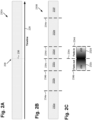
- Figure 2A shows an exemplary diagram depicting marker 238 identifying timecode 236 for insertion of supplemental content into digital content 230A indexed to timeline 228, according to one implementation.
- Digital content 230A corresponds in general to digital content 130, in Figure 1 .
- digital content 130 may share any of the characteristics attributed to digital content 230A by the present disclosure, and vice versa. That is to say, like digital content 230A, digital content 130 may be indexed to timeline 228.
- marker 238 may take the form of a fixed point candidate insertion time (FPCI) marker, for example, as known in the art.
- FPCI fixed point candidate insertion time
- Figure 2B shows an exemplary diagram depicting segmented content 230B, which corresponds to digital content 230A, in Figure 2A , after encoding to produce segment boundaries 234a, 234b, 234c, 234d, and 234e, and segments 232a, 232b, 232c, 232d, 232e, and 232f (hereinafter "segments 232a-232f"). It is noted that segment boundary 234c, in Figure 2B , coincides with timecode 236 of timeline 228, identified by marker 238.
- segment durations of segments 232a-232f it is noted that for a variety of reasons there may be limitations imposed on the minimum and maximum segment durations for segments 232a-232f. In a practical sense, for example, it is undesirable to have a segment that includes only a single frame. As a result, it may be the case that a streaming service has or imposes a minimum segment duration on the content they deliver. Furthermore, for some ABR protocols, the minimum and maximum segment durations may be predetermined, and those values may be included in the description of the content. For example, in Hypertext Transfer Protocol (HTTP) Live Streaming (HLS), the content playlist tag EXT-X-TARGETDURATION is required and specifies the maximum segment duration.
- HTTP Hypertext Transfer Protocol
- HLS Live Streaming
- Figure 2C shows an exemplary diagram depicting a portion of segmented content 230B, in Figure 2B , after targeted re-processing of segments 232c and 232d adjoining segment boundary 234c to apply fade-out 252 to segment 232c and fade-in 254 within or to segment 232d, according to one implementation.
- a fade-out or fade-in may have a timeline duration of approximately 0.5 s, or any other time interval deemed advantageous or desirable.
- the segment duration of segment 232c may be predetermined to match the timeline duration of fade-out 252 applied to segment 232c, while the segment duration of segment 232d may be predetermined to match the timeline duration of fade-in 254 applied to segment 232d.
- the segment duration of segment 232c may be greater than the timeline duration of fade-out 252, while the segment duration of segment 232d may be greater than the timeline duration of fade-in 254.
- fade-out 252 may be applied within segment 232c rather than being applied to segment 232c in its entirety
- fade-in 254 may be applied within segment 232d rather than being applied to segment 232d in its entirety. That is to say, in various implementations, fade-out 252 and fade-in 254 may be applied within or to respective segments 232c and 232d.
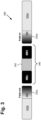
- Figure 3 shows an exemplary diagram in which supplemental content is introduced into the insertion point provided by re-processing of segments 232c and 232d to apply respective fade-out 252 and fade-in 254, as shown in Figure 2C , according to one implementation.
- supplemented digital content 352 includes originally encoded segments 332b and 332e, re-processed segments 332c, and 332d, and supplemental content 340 situated at the insertion point provided between segments 332c and 332d.
- supplemental content 340 includes at least new content 342, and in various implementations, may also include one or both of black segment 344a preceding new content 342 or black segment 344b succeeding new content 342.
- Segments 332b and 332e correspond respectively in general to segments 232b and 232e, in Figure 2B .
- segment 332c having applied fade-out 352 and segment 332d having applied fade-in 354 correspond respectively in general to segment 232c having applied fade-out 252 and segment 232d having applied fade-in 254, in Figure 2C .
- segments 232b, 232c, 232d, 232e, fade-out 252, and fade-in 254 may share any of the characteristics attributed to respective 232b, 232c, 232d, 232e, fade-out 252, and fade-in 254 by the present disclosure, and vice versa.
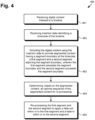
- FIG. 4 shows flowchart 460 presenting an exemplary method for targeted re-processing of digital content, according to one implementation. With respect to the method outlined in Figure 4 , it is noted that certain details and features have been left out of flowchart 460 in order not to obscure the discussion of the inventive features in the present application.
- flowchart 460 begins with receiving digital content 130/230A indexed to timeline 228 (action 461).
- Digital content 130/230A may be received in action 461 by targeted re-processing software code 110, executed by processing hardware 104 of system 100.
- digital content 130/230A may be received by system 100 from content source 116, either via communication network 112 and network communication links 114 or directly via communication link 118.
- digital content 130/230A may be received by system 100 from user system 120, via communication network 112 and network communication links 114.
- digital content 130/230A may include any of a variety of different types and genres of AV content, as well as to video unaccompanied by audio, or audio unaccompanied by video.
- digital AV content include ABR content in the form of movies, TV episodes or series, video games, and sporting events.
- digital content 130/230A may be or include digital representations of persons, fictional characters, locations, objects, and identifiers such as brands and logos, for example, which populate a VR, AR, or MR environment.
- digital content 130/230A may depict virtual worlds that can be experienced by any number of users synchronously and persistently, while providing continuity of data such as personal identity, user history, entitlements, possessions, payments, and the like.
- digital content 130/230A may be or include a hybrid of traditional AV and fully immersive VR/AR/MR experiences, such as interactive video.
- Flowchart further includes receiving insertion data 126 identifying timecode 236 of timeline 228 (action 462). It is noted that the location within digital content 130/230A that is specified by timecode 236 included in insertion data 126 may be an insertion point for supplemental content, such as one or more ads for example, into digital content 130/230A. Insertion data 126 may be received in action 462 by targeted re-processing software code 110, executed by processing hardware 104 of system 100. For example, as shown in Figure 1 , in some implementations, insertion data 126 may be received by system 100 from content source 116, either via communication network 112 and network communication links 114 or directly via communication link 118. However and as further shown in Figure 1 , in other implementations, insertion data 126 may be received by system 100 from user system 120, via communication network 112 and network communication links 114.
- flowchart 460 further includes encoding digital content 130/230A, using insertion data 126, to provide segmented content 230B having segment boundary 234c at timecode 236, as well as first segment 232c and second segment 232d adjoining segment boundary 234c, wherein first segment 232c precedes segment boundary 234c and second segment 232d succeeds segment boundary 234c with respect to timeline 228 (action 463).
- segmented content 230B may be or include ABR content.
- Encoding of digital content 130/230A, using insertion data 126, to provide segmented content 230B in action 463 may be performed by targeted re-processing software code 110, executed by processing hardware 104 of computing platform 102.
- flowchart 460 may further include determining, based on segmented content 230B, an optimal sequence of segmented content 230B for re-processing, the optimal sequence including at least one content segment in addition to first segment 232c and second segment 232d (action 464).
- content at the beginning of first segment 232c, content at the end of second segment 232d, or content at both locations may have certain attributes that if re-processing were to start or end there, may result in an audio artifact, a video artifact, or both an audio artifact and a video artifact noticeable upon playback of re-processed content 150.
- the process for identifying an optimal re-processing sequence of segmented content 230B that includes at least first segment 232c and second segment 232d may include a variety of methods to reduce or eliminate such issues.
- the process for determining an optimal start time and end time for re-processing may consider one or more of content metadata, such as Dolby Vision ® shot metadata, scene change detection, chunk boundary complexity analysis, and the like.
- action 464 is optional, and in some implementations may be omitted from the method outlined by flowchart 460. However, in implementations in which action 464 is included in the method outlined by flowchart 460, action 464 may be performed by targeted re-processing software code 110, executed by processing hardware 104 of computing platform 102. It is noted that in various use case, the one or more segments of segmented content 230B in addition to first segment 232c and second segment 232d that are included in the optimal re-processing sequence may precede first segment 232c, may succeed second segment 232d, or one or more of those segments may precede first segment 232c and one or more of those segments may succeed second segment 232d.
- Flowchart 460 further includes re-processing first segment 232c/332c and second segment 232d/232d, or the optimal sequence determined in action 464, to apply fade-out 252/352 within or to first segment 232c/332c and fade-in 254/354 within or to second segment 232d/332d (action 465). It is noted that re-processing first segment 232c/332c and second segment 232d/332d provides encoded segments having segment boundary 234c configured as an insertion point for supplemental content 340.
- supplemental content 340 may include new content 342, black segment 344a preceding new content 342, and black segment 344b succeeding new content 342.
- supplemental content 340 may include new content 342 and either black segment 344a preceding new content 342 or black segment 344b succeeding new content 342, but not both.
- supplemental content 340 may include new content 342 but may omit both of black segments 344a and 344b. That is to say, in some implementations, supplemental content 340 is new content 342.
- first segment 232c/332c and second segment 232d/332d may be omitted, and supplemental content 340 including one or both of black segment 344a and black segment 344b may be inserted between originally encoded segments 332b and 332e.
- supplemental content 340 may be or include new content 342 in the form of one or more ads, such as a single ad, or an ad pod as known in the art.
- the re-processing performed in action 465 may be performed by targeted re-processing software code 110, executed by processing hardware 104 of computing platform 102 and confers significant advantages over alternative techniques for configuring digital content 130/230A for insertion of supplemental content such as ads.
- targeted re-processing software code 110 executed by processing hardware 104 of computing platform 102 and confers significant advantages over alternative techniques for configuring digital content 130/230A for insertion of supplemental content such as ads.
- the timeline of segmented content 230B still matches timeline 228 of digital content 130/230A.
- the same playlist for playback of segmented content 230B before re-processing can advantageously be used for playback of segmented content 230B after re-processing to apply fade-out 252/352 within or to segment 232c/332c and fade-in within or to segment 232d/332d.
- segmented content 230B takes the form of ABR content
- the ABR protocol specifications for segmented content 230B may use a form of playlist that utilizes Uniform Resource Identifiers (URIs), such as Uniform Resource Locators (URLs) for example, for discrete segmented files.
- URIs Uniform Resource Identifiers
- URLs Uniform Resource Locators
- an existing playlist for segmented content 230B may be used after re-processing of segments 323c/332c and 232d/332d, in action 465.
- actions 461, 462, 463, and 465, or actions 461, 462, 463, 464, and 465 may be performed as automated processes from which human involvement may be omitted.
- the present application discloses systems and methods for targeted re-processing of digital content.
- the targeted re-processing solution disclosed in the present application enables substantially seamless insertion of supplemental content at segment boundaries of encoded digital content by advantageously re-processing only those segments considered to be necessary to avoid subjective audio or video irregularities produced by the introduction of the supplemental content at those insertion points. Consequently, the present solution advances the state-of-the-art as described above while significantly reducing the time required to re-process, as well as the QC time required in validation, because only targeted sequences of previously encoded digital content are re-processed.
Landscapes
- Engineering & Computer Science (AREA)
- Multimedia (AREA)
- Signal Processing (AREA)
- Business, Economics & Management (AREA)
- Marketing (AREA)
- Finance (AREA)
- Strategic Management (AREA)
- Development Economics (AREA)
- Accounting & Taxation (AREA)
- Physics & Mathematics (AREA)
- Game Theory and Decision Science (AREA)
- Economics (AREA)
- Entrepreneurship & Innovation (AREA)
- General Business, Economics & Management (AREA)
- General Physics & Mathematics (AREA)
- Theoretical Computer Science (AREA)
- Human Computer Interaction (AREA)
- Two-Way Televisions, Distribution Of Moving Picture Or The Like (AREA)
- Management Or Editing Of Information On Record Carriers (AREA)
Abstract
Description
- The present invention relates to a method and system for processing digital content according to claim 1.
- Due to its nearly universal popularity as a content medium, ever more audio-video (AV) content is being produced and made available to consumers. Moreover, as streaming platforms have become increasingly important distribution hubs for AV content, adjustable bit-rate (ABR) AV content has become increasingly important as well, due to variable network conditions and differences in data processing capabilities among the wide variety of consumer devices that receive streaming content. As a result, the efficiency with which AV content, including ABR content, can be supplemented or enhanced post production has become increasingly important to the producers, owners, and distributors of that content.
- By way of example, in some use cases it may be advantageous or desirable to add supplemental content, such as advertisements (ads) for instance, to existing AV content, post production. In cases in which the AV content was originally produced without predetermined insertion points for supplemental content, introducing that content post production can result in an unpleasant or confusing experience for a consumer viewing the content during playback. For example, an ad that has been naively inserted into AV content may appear mid-scene, or even mid-shot, thereby jarringly disrupting the viewing experience of the consumer. A conventional approach to adding supplemental content that avoids viewer disruption and aesthetic unpleasantness is to re-encode the content in its entirety, this time taking into account splice points for use in conditioning segment boundaries for ads or other supplemental content. However, this conventional approach is undesirably, and in some instances impracticably, expensive in terms both of compute time and the quality control (QC) review required for the re-encoded content.
- It is the object of the present invention to provide a method and system for processing digital content which are improved in connection with these disadvantages.
- The invention is defined by the features of the independent claims. The dependent claims describe preferred embodiments.
- According to an embodiment of the present invention, as described in claim 1, the invention provides
- A method comprising:
- receiving digital content indexed to a timeline;
- receiving insertion data identifying a timecode of the timeline;
- encoding the digital content, using the insertion data to provide segmented content having a segment boundary at the timecode, a first segment and a second segment adjoining the segment boundary, wherein the first segment precedes the segment boundary and the second segment succeeds the segment boundary;
- re-processing the first segment and the second segment to apply a fade-out within or to the first segment and a fade-in within or to the second segment;
- wherein re-processing the first segment and the second segment provides encoded segments having the segment boundary configured as an insertion point for supplemental content.
- Preferably the method, further comprising:
before re-processing, determining, based on the segmented content, an optimal sequence of the segmented content for re-processing, the optimal sequence including at least one content segment in addition to the first segment and the second segment. - Preferably the method, wherein the optimal sequence includes a plurality of content segments in addition to the first segment and the second segment, and wherein at least one of the plurality of content segments precedes the first segment or succeeds the second segment.
- Preferably the method, wherein the supplemental content is new content.
- Preferably the method, wherein the supplemental content comprises at least one advertisement.
- Preferably the method, wherein the supplemental content comprises new content and a black segment preceding the new content or succeeding the new content.
- Preferably the method, wherein the supplemental content comprises new content, a first black segment preceding the new content, and a second black segment succeeding the new content.
- Preferably the method, wherein a same playlist for playback of the segmented content before re-processing can be used for playback of the segmented content after re-processing.
- Preferably the method, wherein a timeline of the segmented content after re-processing matches the timeline of the digital content.
- Preferably the method, wherein the segmented content comprises adaptive bit-rate (ABR) content.
- A system including a processing hardware and a system memory storing a software code that when executed performs a method as described herein.
- Further embodiments of the invention may be as follows:
A system comprising: - a computing platform having a processing hardware and a system memory storing a software code;
- the processing hardware configured to execute the software code to:
- receive digital content indexed to a timeline;
- receive insertion data identifying a timecode of the timeline;
- encode the digital content using the insertion data to provide segmented content having a segment boundary at the timecode, a first segment and a second segment adjoining the segment boundary, wherein the first segment precedes the segment boundary and the second segment succeeds the segment boundary;
- re-process the first segment and the second segment to apply a fade-out within or to the first segment and a fade-in within or to the second segment;
- wherein re-processing the first segment and the second segment provides encoded segments having the segment boundary configured as an insertion point for supplemental content.
- Preferably the system, wherein the processing hardware is further configured to execute the software code to:
before re-processing, determine, based on the segmented content, an optimal sequence of the segmented content for re-processing, the optimal sequence including at least one content segment in addition to the first segment and the second segment. - Preferably the system, wherein the optimal sequence includes a plurality of content segments in addition to the first segment and the second segment, and wherein at least one of the plurality of content segments precedes the first segment or succeeds the second segment.
- Preferably the system, wherein the supplemental content is new content.
- Preferably the system, wherein the supplemental content comprises at least one advertisement.
- Preferably the system, wherein the supplemental content comprises new content and a black segment preceding the new content or succeeding the new content.
- Preferably the system, wherein the supplemental content comprises new content, a first black segment preceding the new content, and a second black segment succeeding the new content.
- Preferably the system, wherein a same playlist for playback of the segmented content before re-processing can be used for playback of the segmented content after re-processing.
- Preferably the system, wherein a timeline of the segmented content after re-processing matches the timeline of the digital content.
- Preferably the system, wherein the segmented content comprises adaptive bit-rate (ABR) content.
- A method for use by a system including a computing platform having a processing hardware, and a system memory storing a software code, the method comprising:
- receiving, by the software code executed by the processing hardware, digital content indexed to a timeline;
- receiving, by the software code executed by the processing hardware, insertion data identifying a timecode of the timeline;
- encoding the digital content, by the software code executed by the processing hardware using the insertion data to provide segmented content having a segment boundary at the timecode, a first segment and a second segment adjoining the segment boundary, wherein the first segment precedes the segment boundary and the second segment succeeds the segment boundary;
- re-processing the first segment and the second segment, by the software code executed by the processing hardware, to apply a fade-out within or to the first segment and a fade-in within or to the second segment;
- wherein re-processing the first segment and the second segment provides encoded segments having the segment boundary configured as an insertion point for supplemental content.
- Preferably the method, further comprising:
before re-processing, determining, by the software code executed by the processing hardware based on the segmented content, an optimal sequence of the segmented content for re-processing, the optimal sequence including at least one content segment in addition to the first segment and the second segment. - Preferably the method, wherein the optimal sequence includes a plurality of content segments in addition to the first segment and the second segment, and wherein at least one of the plurality of content segments precedes the first segment or succeeds the second segment.
- Preferably the method, wherein the supplemental content is new content.
- Preferably the method, wherein the supplemental content comprises at least one advertisement.
- Preferably the method, wherein the supplemental content comprises new content and a black segment preceding the new content or succeeding the new content.
- Preferably the method, wherein the supplemental content comprises new content, a first black segment preceding the new content, and a second black segment succeeding the new content.
- Preferably the method, wherein a same playlist for playback of the segmented content before re-proces
- Preferably the method, wherein a timeline of the segmented content after re-processing matches the timeline of the digital content.
- Preferably the method, wherein the segmented content comprises adaptive bit-rate (ABR) content.
- Embodiments of the invention will be described in connection with the drawings.
-
-
Figure 1 shows a diagram of an exemplary system for targeted re-processing of digital content, according to one implementation; -
Figure 2A shows an exemplary diagram depicting a marker identifying a timecode for insertion of supplemental content to existing digital content, according to one implementation; -
Figure 2B shows an exemplary diagram depicting the digital content ofFigure 2A after encoding to produce segment boundaries, according to one implementation; -
Figure 2C shows an exemplary diagram depicting the digital content ofFigures 2A and 2B after targeted re-processing to apply a fade-out and a fade-in within or to respective segments adjoining the segment boundary at the timecode identified by the marker ofFigure 2A , according to one implementation; -
Figure 3 shows an exemplary diagram in which supplemental content is introduced into the insertion point after re-processing to apply the fade-out and fade-in ofFigure 2C , according to one implementation; and -
Figure 4 shows a flowchart outlining an exemplary method for targeted re-processing of digital content, according to one implementation, according to one implementation. - The following description contains specific information pertaining to implementations in the present disclosure. One skilled in the art will recognize that the present disclosure may be implemented in a manner different from that specifically discussed herein. The drawings in the present application and their accompanying detailed description are directed to merely exemplary implementations. Unless noted otherwise, like or corresponding elements among the figures may be indicated by like or corresponding reference numerals. Moreover, the drawings and illustrations in the present application are generally not to scale, and are not intended to correspond to actual relative dimensions.
- As noted above, in cases in which the audio-video (AV) content is originally produced without predetermined insertion points for supplemental content, introducing that content post production can result in an unpleasant or confusing experience for a consumer viewing the content during playback. For example, supplemental content in the form of an advertisement (hereinafter "ad") that has been naively inserted into AV content may appear mid-scene, or even mid-shot, thereby jarringly disrupting the viewing experience of the consumer. A conventional approach to adding supplemental content that avoids viewer disruption and aesthetic unpleasantness is to re-process the content in its entirety, this time taking into account splice points for use in conditioning segment boundaries for ads or other supplemental content. However and as also noted above, this conventional approach is undesirably, and in some instances impracticably, expensive in terms both of compute time and the quality control (QC) review required for the re-processed content.
- The present application discloses systems and methods for targeted re-processing of digital content. It is noted that, as defined in the present application, the expression "targeted re-processing" may refer to one or both of the selective re-processing of one or more sections of content that has previously been transcoded, but less than all of that content, or the selective targeted modification to a media playlist for the introduction of black segments, such as black slugs as known in the art, in order to enable the introduction of new supplemental content, such as ads for example, without negatively impacting the aesthetic integrity or creative intent of the original content. The targeted re-processing solution disclosed in the present application enables substantially seamless insertion of supplemental content at segment boundaries of encoded digital content by advantageously re-processing only those segments considered to be necessary to avoid subjective audio or video irregularities produced by the introduction of the supplemental content at those insertion points. Consequently, the present solution advances the state-of-the-art as described above while significantly reducing the time required to re-process, as well as the QC time required in validation, because only targeted sequences of previously encoded digital content are re-processed.
- It is noted that, as defined in the present application, the feature "fade-out" refers to a transition from fully illuminated content to black, while the feature "fade-in" refers to a transition from black to fully illuminated content. Each of a fade-out and a fade-in may have a relatively brief time duration, such half a second (0.5 s) for example, or any other time interval deemed to be advantageous or desirable, and are used to provide for a pleasant subjective viewer experience when transitioning from digital content to supplemental content in the form of one or more ads, for example, and back again.
- As a specific example, streaming platforms may offer subscription services that are alternatively ad-supported or ad-free. The present solution for targeted re-processing of digital content advantageously enables the delivery of content as part of an ad-free tier without fade-outs or fade-ins, and an ad-supported tier with such fade-outs and fade-ins. That is to say, the targeted re-processing solution disclosed in the present application provides a clean, non-disruptive experience for the ad-free tier (i.e., no fade-outs or fade-ins), and a pleasant transition between streaming content and ads (i.e., using fade-outs and fade-ins) for the ad-supported tier. Moreover, the present solution for targeted re-processing of digital content may advantageously be implemented using automated or substantially automated systems and methods.
- As defined in the present application, the terms "automation," "automated," and "automating" refer to systems and processes that do not require the participation of a human user, such as a system administrator. For example, although in some implementations a human editor or QC technician may review the performance of the systems and methods disclosed herein, that human involvement is optional. Thus, in some implementations, the processes described in the present application may be performed under the control of hardware processing components of the disclosed systems.
- It is further noted that, as defined in the present application, "digital content" may refer to a variety of different types and genres of AV content, as well as to video unaccompanied by audio, or audio unaccompanied by video. Specific examples of digital AV content include adjustable bit-rate (ABR) content in the form of movies, TV episodes or series, video games, and sporting events. In addition, or alternatively, in some implementations, "digital content" may be or include digital representations of persons, fictional characters, locations, objects, and identifiers such as brands and logos, for example, which populate a virtual reality (VR), augmented reality (AR), or mixed reality (MR) environment. Moreover, that digital content may depict virtual worlds that can be experienced by any number of users synchronously and persistently, while providing continuity of data such as personal identity, user history, entitlements, possessions, payments, and the like. It is noted that the concepts disclosed by the present application may also be applied to digital content that is a hybrid of traditional AV and fully immersive VR/AR/MR experiences, such as interactive video.
-
Figure 1 shows a diagram ofexemplary system 100 for targeted re-processing of digital content, according to one implementation.System 100 includescomputing platform 102 havingprocessing hardware 104, andsystem memory 106 implemented as a computer-readable non-transitory storage medium. As shown inFigure 1 , according to some implementations,system memory 106 stores targetedre-processing software code 110, and may optionally storecontent database 108. - As further shown in
Figure 1 ,system 100 may be implemented in a use environment includingcontent source 116 providing non-transcoded digital content 130 (hereinafter "digital content 130") andinsertion data 126 fordigital content 130,communication network 112, anduser 124 utilizinguser system 120 includingdisplay 122. In addition,Figure 1 showsnetwork communication links 114 communicativelycoupling content source 116 anduser system 120 withsystem 100 viacommunication network 112. Also shown inFigure 1 isre-processed content 150 corresponding todigital content 130 and provided by targetedre-processing software code 110. - It is noted that although
system 100 may receivedigital content 130 fromcontent source 116 viacommunication network 112 andnetwork communication links 114, in some implementations,content source 116 may take the form of a content source integrated withcomputing platform 102, or may be in direct communication withsystem 100, as shown by dashedcommunication link 118. It is further noted that, in some implementations,system 100 may omit one or both ofcontent database 108. Thus, in some implementations,system memory 106 may store targetedre-processing software code 110 but notcontent database 108. - With respect to the representation of
system 100 shown inFigure 1 , it is noted that although targetedre-processing software code 110 andoptional content database 108 are depicted as being stored insystem memory 106 for conceptual clarity, more generally,system memory 106 may take the form of any computer-readable non-transitory storage medium. The expression "computer-readable non-transitory storage medium," as used in the present application, refers to any medium, excluding a carrier wave or other transitory signal that provides instructions to processing hardware of a computing platform, such asprocessing hardware 104 ofcomputing platform 102. Thus, a computer-readable non-transitory storage medium may correspond to various types of media, such as volatile media and non-volatile media, for example. Volatile media may include dynamic memory, such as dynamic random access memory (dynamic RAM), while non-volatile memory may include optical, magnetic, or electrostatic storage devices. Common forms of computer-readable non-transitory storage media include, for example, optical discs, RAM, programmable read-only memory (PROM), erasable PROM (EPROM), and FLASH memory. - It is further noted that although
Figure 1 depicts targetedre-processing software code 110 andoptional content database 108 as being mutually co-located insystem memory 106, that representation is also merely provided as an aid to conceptual clarity. More generally,system 100 may include one or more computing platforms, such as computer servers for example, which may be co-located, or may form an interactively linked but distributed system, such as a cloud-based system, for instance. As a result,processing hardware 104 andsystem memory 106 may correspond to distributed processor and memory resources withinsystem 100. Thus, it is to be understood that targetedre-processing software code 110 andoptional content database 108 may be stored remotely from one another within the distributed memory resources ofsystem 100. -
Processing hardware 104 may include multiple hardware processing units, such as one or more central processing units, one or more graphics processing units, one or more tensor processing units, one or more field-programmable gate arrays (FPGAs), and an application programming interface (API) server, for example. By way of definition, as used in the present application, the terms "central processing unit" (CPU), "graphics processing unit" (GPU), and "tensor processing unit" (TPU) have their customary meaning in the art. That is to say, a CPU includes an Arithmetic Logic Unit (ALU) for carrying out the arithmetic and logical operations ofcomputing platform 102, as well as a Control Unit (CU) for retrieving programs, such as targetedre-processing software code 110, fromsystem memory 106, while a GPU may be implemented to reduce the processing overhead of the CPU by performing computationally intensive graphics or other processing tasks. A TPU is an application-specific integrated circuit (ASIC) configured specifically for artificial intelligence (AI) applications such as machine learning modeling. - Moreover, as defined in the present application, the expression "machine learning model" or "ML model" may refer to a mathematical model for making future predictions based on patterns learned from samples of data or "training data." Various learning algorithms can be used to map correlations between input data and output data. These correlations form the mathematical model that can be used to make future predictions on new input data. Such a predictive model may include one or more logistic regression models, Bayesian models, or neural networks (NNs). Moreover, a "deep neural network," in the context of deep learning, may refer to a NN that utilizes multiple hidden layers between input and output layers, which may allow for learning based on features not explicitly defined in raw data. In various implementations, NNs may be trained as classifiers and may be utilized to perform image processing or natural-language processing.
- In some implementations,
computing platform 102 may correspond to one or more web servers, accessible over a packet-switched network such as the Internet, for example. Alternatively,computing platform 102 may correspond to one or more computer servers supporting a private wide area network (WAN), local area network (LAN), or included in another type of limited distribution or private network. As yet another alternative, in some implementations,system 100 may be implemented virtually, such as in a data center. For example, in some implementations,system 100 may be implemented in software, or as virtual machines. - Although
user system 120 is shown as a desktop computer inFigure 1 , that representation is provided merely as an example as well. More generally,user system 120 may be any suitable mobile or stationary computing device or system that implements data processing capabilities sufficient to provide a user interface, support connections tocommunication network 112, and implement the functionality ascribed touser system 120 herein. For example, in other implementations,user system 120 and may take the form of a laptop computer, tablet computer, or smartphone. - With respect to display 122 of
user system 120,display 122 may be physically integrated withuser system 120, or may be communicatively coupled to but physically separate fromuser system 120. For example, whereuser system 120 is implemented as a smartphone, laptop computer, or tablet computer,display 122 will typically be integrated withuser system 120. By contrast, whereuser system 120 is implemented as a desktop computer,display 122 may take the form of a monitor separate fromuser system 120 in the form of a computer tower. Furthermore, display 122 ofuser system 120 may be implemented as a liquid crystal display (LCD), a light-emitting diode (LED) display, an organic light-emitting diode (OLED) display, a quantum dot (QD) display, or any other suitable display screen that performs a physical transformation of signals to light. -
Figure 2A shows an exemplarydiagram depicting marker 238 identifyingtimecode 236 for insertion of supplemental content intodigital content 230A indexed totimeline 228, according to one implementation.Digital content 230A corresponds in general todigital content 130, inFigure 1 . Thus,digital content 130 may share any of the characteristics attributed todigital content 230A by the present disclosure, and vice versa. That is to say, likedigital content 230A,digital content 130 may be indexed totimeline 228. It is noted that, in some implementations,marker 238 may take the form of a fixed point candidate insertion time (FPCI) marker, for example, as known in the art. -
Figure 2B shows an exemplary diagram depictingsegmented content 230B, which corresponds todigital content 230A, inFigure 2A , after encoding to producesegment boundaries segments segments 232a-232f"). It is noted that segment boundary 234c, inFigure 2B , coincides withtimecode 236 oftimeline 228, identified bymarker 238. - With respect to the sizes or segment durations of
segments 232a-232f, it is noted that for a variety of reasons there may be limitations imposed on the minimum and maximum segment durations forsegments 232a-232f. In a practical sense, for example, it is undesirable to have a segment that includes only a single frame. As a result, it may be the case that a streaming service has or imposes a minimum segment duration on the content they deliver. Furthermore, for some ABR protocols, the minimum and maximum segment durations may be predetermined, and those values may be included in the description of the content. For example, in Hypertext Transfer Protocol (HTTP) Live Streaming (HLS), the content playlist tag EXT-X-TARGETDURATION is required and specifies the maximum segment duration. -
Figure 2C shows an exemplary diagram depicting a portion ofsegmented content 230B, inFigure 2B , after targeted re-processing ofsegments segment 232c and fade-in 254 within or tosegment 232d, according to one implementation. As noted above, a fade-out or fade-in may have a timeline duration of approximately 0.5 s, or any other time interval deemed advantageous or desirable. - It is noted that, according to the exemplary implementation shown by
Figure 2C , the segment duration ofsegment 232c may be predetermined to match the timeline duration of fade-out 252 applied tosegment 232c, while the segment duration ofsegment 232d may be predetermined to match the timeline duration of fade-in 254 applied tosegment 232d. However, in other implementations, the segment duration ofsegment 232c may be greater than the timeline duration of fade-out 252, while the segment duration ofsegment 232d may be greater than the timeline duration of fade-in 254. Thus, in those implementations, fade-out 252 may be applied withinsegment 232c rather than being applied tosegment 232c in its entirety, and fade-in 254 may be applied withinsegment 232d rather than being applied tosegment 232d in its entirety. That is to say, in various implementations, fade-out 252 and fade-in 254 may be applied within or torespective segments -
Figure 3 shows an exemplary diagram in which supplemental content is introduced into the insertion point provided by re-processing ofsegments Figure 2C , according to one implementation. As shown inFigure 3 , supplementeddigital content 352 includes originally encodedsegments re-processed segments supplemental content 340 situated at the insertion point provided betweensegments Figure 3 ,supplemental content 340 includes at leastnew content 342, and in various implementations, may also include one or both ofblack segment 344a precedingnew content 342 orblack segment 344b succeedingnew content 342. -
Segments segments Figure 2B . Moreover,segment 332c having applied fade-out 352 andsegment 332d having applied fade-in 354 correspond respectively in general tosegment 232c having applied fade-out 252 andsegment 232d having applied fade-in 254, inFigure 2C . Thus,segments - The functionality of
system 100 and targetedre-processing software code 110 will be further described by reference toFigure 4. Figure 4 showsflowchart 460 presenting an exemplary method for targeted re-processing of digital content, according to one implementation. With respect to the method outlined inFigure 4 , it is noted that certain details and features have been left out offlowchart 460 in order not to obscure the discussion of the inventive features in the present application. - Referring now to
Figure 4 in combination withFigures 1 and2A ,flowchart 460 begins with receivingdigital content 130/230A indexed to timeline 228 (action 461).Digital content 130/230A may be received inaction 461 by targetedre-processing software code 110, executed by processinghardware 104 ofsystem 100. For example, as shown inFigure 1 , in some implementations,digital content 130/230A may be received bysystem 100 fromcontent source 116, either viacommunication network 112 andnetwork communication links 114 or directly viacommunication link 118. However and as further shown inFigure 1 , in other implementations,digital content 130/230A may be received bysystem 100 fromuser system 120, viacommunication network 112 and network communication links 114. - As noted above,
digital content 130/230A may include any of a variety of different types and genres of AV content, as well as to video unaccompanied by audio, or audio unaccompanied by video. Specific examples of digital AV content include ABR content in the form of movies, TV episodes or series, video games, and sporting events. In addition, or alternatively, in some implementations,digital content 130/230A may be or include digital representations of persons, fictional characters, locations, objects, and identifiers such as brands and logos, for example, which populate a VR, AR, or MR environment. Moreover,digital content 130/230A may depict virtual worlds that can be experienced by any number of users synchronously and persistently, while providing continuity of data such as personal identity, user history, entitlements, possessions, payments, and the like. Alternatively, or in addition,digital content 130/230A may be or include a hybrid of traditional AV and fully immersive VR/AR/MR experiences, such as interactive video. - Flowchart further includes receiving
insertion data 126 identifyingtimecode 236 of timeline 228 (action 462). It is noted that the location withindigital content 130/230A that is specified bytimecode 236 included ininsertion data 126 may be an insertion point for supplemental content, such as one or more ads for example, intodigital content 130/230A.Insertion data 126 may be received inaction 462 by targetedre-processing software code 110, executed by processinghardware 104 ofsystem 100. For example, as shown inFigure 1 , in some implementations,insertion data 126 may be received bysystem 100 fromcontent source 116, either viacommunication network 112 andnetwork communication links 114 or directly viacommunication link 118. However and as further shown inFigure 1 , in other implementations,insertion data 126 may be received bysystem 100 fromuser system 120, viacommunication network 112 and network communication links 114. - Referring to
Figure 2B in combination withFigures 1 ,2A , and4 ,flowchart 460 further includes encodingdigital content 130/230A, usinginsertion data 126, to providesegmented content 230B having segment boundary 234c attimecode 236, as well asfirst segment 232c andsecond segment 232d adjoining segment boundary 234c, whereinfirst segment 232c precedes segment boundary 234c andsecond segment 232d succeeds segment boundary 234c with respect to timeline 228 (action 463). It is noted that, in some implementations,segmented content 230B may be or include ABR content. Encoding ofdigital content 130/230A, usinginsertion data 126, to providesegmented content 230B inaction 463 may be performed by targetedre-processing software code 110, executed by processinghardware 104 ofcomputing platform 102. - In some implementations,
flowchart 460 may further include determining, based onsegmented content 230B, an optimal sequence ofsegmented content 230B for re-processing, the optimal sequence including at least one content segment in addition tofirst segment 232c andsecond segment 232d (action 464). For example, content at the beginning offirst segment 232c, content at the end ofsecond segment 232d, or content at both locations, may have certain attributes that if re-processing were to start or end there, may result in an audio artifact, a video artifact, or both an audio artifact and a video artifact noticeable upon playback ofre-processed content 150. The process for identifying an optimal re-processing sequence ofsegmented content 230B that includes at leastfirst segment 232c andsecond segment 232d may include a variety of methods to reduce or eliminate such issues. For example, the process for determining an optimal start time and end time for re-processing may consider one or more of content metadata, such as Dolby Vision® shot metadata, scene change detection, chunk boundary complexity analysis, and the like. - It is noted that
action 464 is optional, and in some implementations may be omitted from the method outlined byflowchart 460. However, in implementations in whichaction 464 is included in the method outlined byflowchart 460,action 464 may be performed by targetedre-processing software code 110, executed by processinghardware 104 ofcomputing platform 102. It is noted that in various use case, the one or more segments ofsegmented content 230B in addition tofirst segment 232c andsecond segment 232d that are included in the optimal re-processing sequence may precedefirst segment 232c, may succeedsecond segment 232d, or one or more of those segments may precedefirst segment 232c and one or more of those segments may succeedsecond segment 232d. - Referring to
Figures 2C and3 in combination withFigures 1 ,2A ,2B , and4 ,Flowchart 460 further includes re-processingfirst segment 232c/332c andsecond segment 232d/232d, or the optimal sequence determined inaction 464, to apply fade-out 252/352 within or tofirst segment 232c/332c and fade-in 254/354 within or tosecond segment 232d/332d (action 465). It is noted that re-processingfirst segment 232c/332c andsecond segment 232d/332d provides encoded segments having segment boundary 234c configured as an insertion point forsupplemental content 340. - As noted above, and as shown in
Figure 3 , in some implementationssupplemental content 340 may includenew content 342,black segment 344a precedingnew content 342, andblack segment 344b succeedingnew content 342. However, in other implementations,supplemental content 340 may includenew content 342 and eitherblack segment 344a precedingnew content 342 orblack segment 344b succeedingnew content 342, but not both. In yet other implementations,supplemental content 340 may includenew content 342 but may omit both ofblack segments supplemental content 340 isnew content 342. Moreover, in some implementations, one or both offirst segment 232c/332c andsecond segment 232d/332d may be omitted, andsupplemental content 340 including one or both ofblack segment 344a andblack segment 344b may be inserted between originally encodedsegments supplemental content 340 may be or includenew content 342 in the form of one or more ads, such as a single ad, or an ad pod as known in the art. - The re-processing performed in
action 465 may be performed by targetedre-processing software code 110, executed by processinghardware 104 ofcomputing platform 102 and confers significant advantages over alternative techniques for configuringdigital content 130/230A for insertion of supplemental content such as ads. For example, after re-processing offirst segment 232c/332c andsecond segment 232d/332d to provide encoded segments having segment boundary 234c configured as an insertion point forsupplemental content 340, the timeline ofsegmented content 230B still matchestimeline 228 ofdigital content 130/230A. - In addition, the same playlist for playback of
segmented content 230B before re-processing can advantageously be used for playback ofsegmented content 230B after re-processing to apply fade-out 252/352 within or tosegment 232c/332c and fade-in within or tosegment 232d/332d. For instance, in implementations in whichsegmented content 230B takes the form of ABR content, the ABR protocol specifications forsegmented content 230B may use a form of playlist that utilizes Uniform Resource Identifiers (URIs), such as Uniform Resource Locators (URLs) for example, for discrete segmented files. In those use cases, an existing playlist forsegmented content 230B may be used after re-processing of segments 323c/332c and 232d/332d, inaction 465. - With respect to the actions described by
flowchart 460, it is noted thatactions actions - Thus, the present application discloses systems and methods for targeted re-processing of digital content. The targeted re-processing solution disclosed in the present application enables substantially seamless insertion of supplemental content at segment boundaries of encoded digital content by advantageously re-processing only those segments considered to be necessary to avoid subjective audio or video irregularities produced by the introduction of the supplemental content at those insertion points. Consequently, the present solution advances the state-of-the-art as described above while significantly reducing the time required to re-process, as well as the QC time required in validation, because only targeted sequences of previously encoded digital content are re-processed.
- From the above description it is manifest that various techniques can be used for implementing the concepts described in the present application without departing from the scope of those concepts. Moreover, while the concepts have been described with specific reference to certain implementations, a person of ordinary skill in the art would recognize that changes can be made in form and detail without departing from the scope of those concepts. As such, the described implementations are to be considered in all respects as illustrative and not restrictive. It should also be understood that the present application is not limited to the particular implementations described herein, but many rearrangements, modifications, and substitutions are possible without departing from the scope of the present claims.
Claims (11)
- A method comprising:receiving digital content indexed to a timeline;receiving insertion data identifying a timecode of the timeline;encoding the digital content, using the insertion data to provide segmented content having a segment boundary at the timecode, a first segment and a second segment adjoining the segment boundary, wherein the first segment precedes the segment boundary and the second segment succeeds the segment boundary;re-processing the first segment and the second segment to apply a fade-out within or to the first segment and a fade-in within or to the second segment;wherein re-processing the first segment and the second segment provides encoded segments having the segment boundary configured as an insertion point for supplemental content.
- The method of claim 1, further comprising:
before re-processing, determining, based on the segmented content, an optimal sequence of the segmented content for re-processing, the optimal sequence including at least one content segment in addition to the first segment and the second segment. - The method of claim 2, wherein the optimal sequence includes a plurality of content segments in addition to the first segment and the second segment, and wherein at least one of the plurality of content segments precedes the first segment or succeeds the second segment.
- The method of any of preceding claims, wherein the supplemental content is new content.
- The method of claim 4, wherein the supplemental content comprises at least one advertisement.
- The method of any of preceding claims, wherein the supplemental content comprises new content and a black segment preceding the new content or succeeding the new content.
- The method of any of preceding claims, wherein the supplemental content comprises new content, a first black segment preceding the new content, and a second black segment succeeding the new content.
- The method of any of preceding claims, wherein a same playlist for playback of the segmented content before re-processing can be used for playback of the segmented content after re-processing.
- The method of any of preceding claims, wherein a timeline of the segmented content after re-processing matches the timeline of the digital content.
- The method of any of preceding claims, wherein the segmented content comprises adaptive bit-rate (ABR) content.
- A system including a processing hardware and a system memory storing a software code that when executed performs the method of any of claims 1-10.
Applications Claiming Priority (1)
| Application Number | Priority Date | Filing Date | Title |
|---|---|---|---|
| US17/873,511 US12382112B2 (en) | 2022-07-26 | 2022-07-26 | Targeted re-processing of digital content |
Publications (1)
| Publication Number | Publication Date |
|---|---|
| EP4312428A1 true EP4312428A1 (en) | 2024-01-31 |
Family
ID=86862037
Family Applications (1)
| Application Number | Title | Priority Date | Filing Date |
|---|---|---|---|
| EP23179662.4A Pending EP4312428A1 (en) | 2022-07-26 | 2023-06-16 | Targeted re-processing of digital content |
Country Status (4)
| Country | Link |
|---|---|
| US (2) | US12382112B2 (en) |
| EP (1) | EP4312428A1 (en) |
| JP (2) | JP2024016803A (en) |
| CN (1) | CN117459787A (en) |
Citations (3)
| Publication number | Priority date | Publication date | Assignee | Title |
|---|---|---|---|---|
| US20200359082A1 (en) * | 2019-05-10 | 2020-11-12 | The Nielsen Company (Us), Llc | Content-Modification System with Volume Level Adjustment Feature |
| US20210112313A1 (en) * | 2019-10-14 | 2021-04-15 | Inscape Data, Inc. | Dynamic content serving using a media device |
| US11218784B1 (en) * | 2021-04-09 | 2022-01-04 | CodeShop, B.V. | Method and system for inserting markers in a media presentation |
Family Cites Families (13)
| Publication number | Priority date | Publication date | Assignee | Title |
|---|---|---|---|---|
| JP4045651B2 (en) | 1997-11-19 | 2008-02-13 | ソニー株式会社 | Information processing apparatus, information processing method, and program recording medium |
| US20060029093A1 (en) | 2004-08-09 | 2006-02-09 | Cedric Van Rossum | Multimedia system over electronic network and method of use |
| US20070118425A1 (en) * | 2005-10-25 | 2007-05-24 | Podbridge, Inc. | User device agent for asynchronous advertising in time and space shifted media network |
| US9554093B2 (en) | 2006-02-27 | 2017-01-24 | Microsoft Technology Licensing, Llc | Automatically inserting advertisements into source video content playback streams |
| US8438646B2 (en) | 2006-04-28 | 2013-05-07 | Disney Enterprises, Inc. | System and/or method for distributing media content |
| US20080276266A1 (en) * | 2007-04-18 | 2008-11-06 | Google Inc. | Characterizing content for identification of advertising |
| US8108257B2 (en) | 2007-09-07 | 2012-01-31 | Yahoo! Inc. | Delayed advertisement insertion in videos |
| JP2011215458A (en) | 2010-04-01 | 2011-10-27 | Seiko Epson Corp | Method of manufacturing electro-optical device |
| US8789090B1 (en) | 2012-02-14 | 2014-07-22 | Uplynk, LLC | Advertisement insertion into media content for streaming |
| JP2016149802A (en) | 2016-04-20 | 2016-08-18 | トムソン ライセンシングThomson Licensing | Interval based advertisement insertion used for delivery of video streams |
| US11166085B2 (en) | 2017-04-26 | 2021-11-02 | Google Llc | Generating media content playlists including interstitials combined with media content items |
| US10522186B2 (en) * | 2017-07-28 | 2019-12-31 | Adobe Inc. | Apparatus, systems, and methods for integrating digital media content |
| US11128688B2 (en) | 2019-10-16 | 2021-09-21 | Disney Enterprises, Inc. | Transcoder conditioning for segment fluidity |
-
2022
- 2022-07-26 US US17/873,511 patent/US12382112B2/en active Active
-
2023
- 2023-06-16 JP JP2023099104A patent/JP2024016803A/en active Pending
- 2023-06-16 EP EP23179662.4A patent/EP4312428A1/en active Pending
- 2023-07-19 CN CN202310890880.3A patent/CN117459787A/en active Pending
-
2025
- 2025-07-09 US US19/264,582 patent/US20250337967A1/en active Pending
- 2025-11-11 JP JP2025190298A patent/JP2026035626A/en active Pending
Patent Citations (3)
| Publication number | Priority date | Publication date | Assignee | Title |
|---|---|---|---|---|
| US20200359082A1 (en) * | 2019-05-10 | 2020-11-12 | The Nielsen Company (Us), Llc | Content-Modification System with Volume Level Adjustment Feature |
| US20210112313A1 (en) * | 2019-10-14 | 2021-04-15 | Inscape Data, Inc. | Dynamic content serving using a media device |
| US11218784B1 (en) * | 2021-04-09 | 2022-01-04 | CodeShop, B.V. | Method and system for inserting markers in a media presentation |
Also Published As
| Publication number | Publication date |
|---|---|
| JP2026035626A (en) | 2026-03-04 |
| JP2024016803A (en) | 2024-02-07 |
| CN117459787A (en) | 2024-01-26 |
| US20240040167A1 (en) | 2024-02-01 |
| US20250337967A1 (en) | 2025-10-30 |
| US12382112B2 (en) | 2025-08-05 |
Similar Documents
| Publication | Publication Date | Title |
|---|---|---|
| US11297388B2 (en) | Systems and methods for deep recommendations using signature analysis | |
| US11375256B1 (en) | Artificial intelligence system for modeling emotions elicited by videos | |
| US9912994B2 (en) | Interactive distributed multimedia system | |
| KR20190096952A (en) | System and method for streaming personalized media content | |
| US20250016243A1 (en) | Systems and methods for adjusting storage based on determining content item popularity | |
| US11677796B2 (en) | System and method for video encoding optimization and broadcasting | |
| US12137273B2 (en) | Rendering a dynamic endemic banner on streaming platforms using content recommendation systems and advanced banner personalization | |
| US12587693B2 (en) | Artificially intelligent ad-break prediction | |
| US20250016426A1 (en) | Rendering a dynamic endemic banner on streaming platforms using content recommendation systems | |
| US20250267315A1 (en) | Methods For Generating Advertisement Videos Consistent With The Context And Storyline Of A Primary Video Stream | |
| US12549815B2 (en) | Context classification of streaming content using machine learning | |
| US20250016428A1 (en) | Distributing digital data in a distributed computing environment | |
| WO2016032399A1 (en) | Selecting adaptive secondary content based on a profile of primary content | |
| EP4304186A1 (en) | Re-encoding segment boundaries in timed content based on marker locations | |
| US12382112B2 (en) | Targeted re-processing of digital content | |
| US20250238841A1 (en) | Rendering a dynamic endemic banner on streaming platforms using content recommendation systems and content affinity modeling | |
| JP2025170028A (en) | Information processing method, information processing program, and information processing device | |
| JP2022082453A (en) | Methods for Media Consumption Gap Filling, Computer Systems, and Computer Programs (Gap Filling Using Personalized Insertable Media) | |
| CN111343483B (en) | Method and device for prompting media content segment, storage medium and electronic device | |
| CA3092380A1 (en) | Evolutionary parameter optimization for selecting optimal personalized screen carousels | |
| US20230007352A1 (en) | Systems and Methods for Alternative Adverts | |
| CN111435996A (en) | Information distribution method and device | |
| US20230239527A1 (en) | Automation of User-Initiated Content Modification | |
| US20260089368A1 (en) | Video transformation techniques | |
| US20260017892A1 (en) | Artificial Intelligence Based Content Immersion Environment Generation |
Legal Events
| Date | Code | Title | Description |
|---|---|---|---|
| PUAI | Public reference made under article 153(3) epc to a published international application that has entered the european phase |
Free format text: ORIGINAL CODE: 0009012 |
|
| STAA | Information on the status of an ep patent application or granted ep patent |
Free format text: STATUS: THE APPLICATION HAS BEEN PUBLISHED |
|
| AK | Designated contracting states |
Kind code of ref document: A1 Designated state(s): AL AT BE BG CH CY CZ DE DK EE ES FI FR GB GR HR HU IE IS IT LI LT LU LV MC ME MK MT NL NO PL PT RO RS SE SI SK SM TR |
|
| STAA | Information on the status of an ep patent application or granted ep patent |
Free format text: STATUS: REQUEST FOR EXAMINATION WAS MADE |
|
| 17P | Request for examination filed |
Effective date: 20240710 |
|
| RBV | Designated contracting states (corrected) |
Designated state(s): AL AT BE BG CH CY CZ DE DK EE ES FI FR GB GR HR HU IE IS IT LI LT LU LV MC ME MK MT NL NO PL PT RO RS SE SI SK SM TR |
|
| STAA | Information on the status of an ep patent application or granted ep patent |
Free format text: STATUS: EXAMINATION IS IN PROGRESS |
|
| 17Q | First examination report despatched |
Effective date: 20251007 |