EP4311870A2 - Method for forming reformable epoxy resin materials into weavable yarns - Google Patents
Method for forming reformable epoxy resin materials into weavable yarns Download PDFInfo
- Publication number
- EP4311870A2 EP4311870A2 EP23210960.3A EP23210960A EP4311870A2 EP 4311870 A2 EP4311870 A2 EP 4311870A2 EP 23210960 A EP23210960 A EP 23210960A EP 4311870 A2 EP4311870 A2 EP 4311870A2
- Authority
- EP
- European Patent Office
- Prior art keywords
- epoxy resin
- reformable epoxy
- resin material
- reformable
- forming
- Prior art date
- Legal status (The legal status is an assumption and is not a legal conclusion. Google has not performed a legal analysis and makes no representation as to the accuracy of the status listed.)
- Pending
Links
- 239000000463 material Substances 0.000 title claims abstract description 129
- 238000000034 method Methods 0.000 title claims abstract description 66
- 239000003822 epoxy resin Substances 0.000 title claims abstract description 65
- 229920000647 polyepoxide Polymers 0.000 title claims abstract description 65
- 239000012783 reinforcing fiber Substances 0.000 claims abstract description 19
- 238000009941 weaving Methods 0.000 claims abstract description 5
- 239000002131 composite material Substances 0.000 claims description 21
- 229920001169 thermoplastic Polymers 0.000 claims description 19
- 239000004416 thermosoftening plastic Substances 0.000 claims description 17
- 230000009477 glass transition Effects 0.000 claims description 14
- 238000010438 heat treatment Methods 0.000 claims description 7
- 150000003141 primary amines Chemical class 0.000 claims description 6
- 150000001412 amines Chemical class 0.000 claims description 5
- 229920000049 Carbon (fiber) Polymers 0.000 claims description 4
- 239000004917 carbon fiber Substances 0.000 claims description 4
- 239000003365 glass fiber Substances 0.000 claims description 4
- 238000000465 moulding Methods 0.000 claims 1
- 239000000835 fiber Substances 0.000 abstract description 43
- 239000004593 Epoxy Substances 0.000 description 16
- 239000004615 ingredient Substances 0.000 description 10
- 150000002118 epoxides Chemical group 0.000 description 7
- 239000000203 mixture Substances 0.000 description 7
- 239000004744 fabric Substances 0.000 description 6
- 229920000728 polyester Polymers 0.000 description 6
- 230000015572 biosynthetic process Effects 0.000 description 5
- IISBACLAFKSPIT-UHFFFAOYSA-N bisphenol A Chemical class C=1C=C(O)C=CC=1C(C)(C)C1=CC=C(O)C=C1 IISBACLAFKSPIT-UHFFFAOYSA-N 0.000 description 5
- -1 poly(hydroxyamino ether) Polymers 0.000 description 5
- LCFVJGUPQDGYKZ-UHFFFAOYSA-N Bisphenol A diglycidyl ether Chemical compound C=1C=C(OCC2OC2)C=CC=1C(C)(C)C(C=C1)=CC=C1OCC1CO1 LCFVJGUPQDGYKZ-UHFFFAOYSA-N 0.000 description 4
- 230000008901 benefit Effects 0.000 description 4
- GYZLOYUZLJXAJU-UHFFFAOYSA-N diglycidyl ether Chemical compound C1OC1COCC1CO1 GYZLOYUZLJXAJU-UHFFFAOYSA-N 0.000 description 4
- 238000004381 surface treatment Methods 0.000 description 4
- 239000002657 fibrous material Substances 0.000 description 3
- 239000000155 melt Substances 0.000 description 3
- 239000008188 pellet Substances 0.000 description 3
- 229910052799 carbon Inorganic materials 0.000 description 2
- 238000006243 chemical reaction Methods 0.000 description 2
- 238000001816 cooling Methods 0.000 description 2
- 238000002156 mixing Methods 0.000 description 2
- 239000000178 monomer Substances 0.000 description 2
- 125000000951 phenoxy group Chemical group [H]C1=C([H])C([H])=C(O*)C([H])=C1[H] 0.000 description 2
- 229920000233 poly(alkylene oxides) Polymers 0.000 description 2
- 229920005989 resin Polymers 0.000 description 2
- 239000011347 resin Substances 0.000 description 2
- GHMLBKRAJCXXBS-UHFFFAOYSA-N resorcinol Chemical compound OC1=CC=CC(O)=C1 GHMLBKRAJCXXBS-UHFFFAOYSA-N 0.000 description 2
- 239000007787 solid Substances 0.000 description 2
- 238000003786 synthesis reaction Methods 0.000 description 2
- HIXDQWDOVZUNNA-UHFFFAOYSA-N 2-(3,4-dimethoxyphenyl)-5-hydroxy-7-methoxychromen-4-one Chemical compound C=1C(OC)=CC(O)=C(C(C=2)=O)C=1OC=2C1=CC=C(OC)C(OC)=C1 HIXDQWDOVZUNNA-UHFFFAOYSA-N 0.000 description 1
- XKZQKPRCPNGNFR-UHFFFAOYSA-N 2-(3-hydroxyphenyl)phenol Chemical compound OC1=CC=CC(C=2C(=CC=CC=2)O)=C1 XKZQKPRCPNGNFR-UHFFFAOYSA-N 0.000 description 1
- HZAXFHJVJLSVMW-UHFFFAOYSA-N 2-Aminoethan-1-ol Chemical compound NCCO HZAXFHJVJLSVMW-UHFFFAOYSA-N 0.000 description 1
- UFWIBTONFRDIAS-UHFFFAOYSA-N Naphthalene Chemical compound C1=CC=CC2=CC=CC=C21 UFWIBTONFRDIAS-UHFFFAOYSA-N 0.000 description 1
- ISWSIDIOOBJBQZ-UHFFFAOYSA-N Phenol Chemical compound OC1=CC=CC=C1 ISWSIDIOOBJBQZ-UHFFFAOYSA-N 0.000 description 1
- 239000004698 Polyethylene Substances 0.000 description 1
- 239000004743 Polypropylene Substances 0.000 description 1
- 125000001931 aliphatic group Chemical group 0.000 description 1
- 150000001408 amides Chemical class 0.000 description 1
- 150000001491 aromatic compounds Chemical class 0.000 description 1
- 239000011230 binding agent Substances 0.000 description 1
- 239000004841 bisphenol A epoxy resin Substances 0.000 description 1
- 239000007795 chemical reaction product Substances 0.000 description 1
- 150000001875 compounds Chemical class 0.000 description 1
- 238000006482 condensation reaction Methods 0.000 description 1
- 150000004985 diamines Chemical group 0.000 description 1
- RTZKZFJDLAIYFH-UHFFFAOYSA-N ether Substances CCOCC RTZKZFJDLAIYFH-UHFFFAOYSA-N 0.000 description 1
- 238000001125 extrusion Methods 0.000 description 1
- NIHNNTQXNPWCJQ-UHFFFAOYSA-N fluorene Chemical compound C1=CC=C2CC3=CC=CC=C3C2=C1 NIHNNTQXNPWCJQ-UHFFFAOYSA-N 0.000 description 1
- LNEPOXFFQSENCJ-UHFFFAOYSA-N haloperidol Chemical compound C1CC(O)(C=2C=CC(Cl)=CC=2)CCN1CCCC(=O)C1=CC=C(F)C=C1 LNEPOXFFQSENCJ-UHFFFAOYSA-N 0.000 description 1
- 125000002887 hydroxy group Chemical group [H]O* 0.000 description 1
- 238000005470 impregnation Methods 0.000 description 1
- 238000011065 in-situ storage Methods 0.000 description 1
- 239000007788 liquid Substances 0.000 description 1
- 239000011159 matrix material Substances 0.000 description 1
- 229920000570 polyether Polymers 0.000 description 1
- 229920000573 polyethylene Polymers 0.000 description 1
- 229920000642 polymer Polymers 0.000 description 1
- 229920000098 polyolefin Polymers 0.000 description 1
- 229920001155 polypropylene Polymers 0.000 description 1
- 238000003672 processing method Methods 0.000 description 1
- 239000000047 product Substances 0.000 description 1
- 238000000926 separation method Methods 0.000 description 1
- 238000007493 shaping process Methods 0.000 description 1
- 238000003860 storage Methods 0.000 description 1
- 239000012815 thermoplastic material Substances 0.000 description 1
- 229920001187 thermosetting polymer Polymers 0.000 description 1
- 239000004634 thermosetting polymer Substances 0.000 description 1
Images

Classifications
-
- D—TEXTILES; PAPER
- D03—WEAVING
- D03D—WOVEN FABRICS; METHODS OF WEAVING; LOOMS
- D03D15/00—Woven fabrics characterised by the material, structure or properties of the fibres, filaments, yarns, threads or other warp or weft elements used
- D03D15/20—Woven fabrics characterised by the material, structure or properties of the fibres, filaments, yarns, threads or other warp or weft elements used characterised by the material of the fibres or filaments constituting the yarns or threads
- D03D15/242—Woven fabrics characterised by the material, structure or properties of the fibres, filaments, yarns, threads or other warp or weft elements used characterised by the material of the fibres or filaments constituting the yarns or threads inorganic, e.g. basalt
- D03D15/267—Glass
-
- D—TEXTILES; PAPER
- D03—WEAVING
- D03D—WOVEN FABRICS; METHODS OF WEAVING; LOOMS
- D03D13/00—Woven fabrics characterised by the special disposition of the warp or weft threads, e.g. with curved weft threads, with discontinuous warp threads, with diagonal warp or weft
- D03D13/002—With diagonal warps or wefts
-
- C—CHEMISTRY; METALLURGY
- C03—GLASS; MINERAL OR SLAG WOOL
- C03C—CHEMICAL COMPOSITION OF GLASSES, GLAZES OR VITREOUS ENAMELS; SURFACE TREATMENT OF GLASS; SURFACE TREATMENT OF FIBRES OR FILAMENTS MADE FROM GLASS, MINERALS OR SLAGS; JOINING GLASS TO GLASS OR OTHER MATERIALS
- C03C25/00—Surface treatment of fibres or filaments made from glass, minerals or slags
- C03C25/10—Coating
- C03C25/1095—Coating to obtain coated fabrics
-
- C—CHEMISTRY; METALLURGY
- C08—ORGANIC MACROMOLECULAR COMPOUNDS; THEIR PREPARATION OR CHEMICAL WORKING-UP; COMPOSITIONS BASED THEREON
- C08J—WORKING-UP; GENERAL PROCESSES OF COMPOUNDING; AFTER-TREATMENT NOT COVERED BY SUBCLASSES C08B, C08C, C08F, C08G or C08H
- C08J5/00—Manufacture of articles or shaped materials containing macromolecular substances
- C08J5/04—Reinforcing macromolecular compounds with loose or coherent fibrous material
-
- C—CHEMISTRY; METALLURGY
- C08—ORGANIC MACROMOLECULAR COMPOUNDS; THEIR PREPARATION OR CHEMICAL WORKING-UP; COMPOSITIONS BASED THEREON
- C08J—WORKING-UP; GENERAL PROCESSES OF COMPOUNDING; AFTER-TREATMENT NOT COVERED BY SUBCLASSES C08B, C08C, C08F, C08G or C08H
- C08J5/00—Manufacture of articles or shaped materials containing macromolecular substances
- C08J5/04—Reinforcing macromolecular compounds with loose or coherent fibrous material
- C08J5/0405—Reinforcing macromolecular compounds with loose or coherent fibrous material with inorganic fibres
- C08J5/042—Reinforcing macromolecular compounds with loose or coherent fibrous material with inorganic fibres with carbon fibres
-
- C—CHEMISTRY; METALLURGY
- C08—ORGANIC MACROMOLECULAR COMPOUNDS; THEIR PREPARATION OR CHEMICAL WORKING-UP; COMPOSITIONS BASED THEREON
- C08J—WORKING-UP; GENERAL PROCESSES OF COMPOUNDING; AFTER-TREATMENT NOT COVERED BY SUBCLASSES C08B, C08C, C08F, C08G or C08H
- C08J5/00—Manufacture of articles or shaped materials containing macromolecular substances
- C08J5/04—Reinforcing macromolecular compounds with loose or coherent fibrous material
- C08J5/0405—Reinforcing macromolecular compounds with loose or coherent fibrous material with inorganic fibres
- C08J5/043—Reinforcing macromolecular compounds with loose or coherent fibrous material with inorganic fibres with glass fibres
-
- D—TEXTILES; PAPER
- D03—WEAVING
- D03D—WOVEN FABRICS; METHODS OF WEAVING; LOOMS
- D03D15/00—Woven fabrics characterised by the material, structure or properties of the fibres, filaments, yarns, threads or other warp or weft elements used
- D03D15/40—Woven fabrics characterised by the material, structure or properties of the fibres, filaments, yarns, threads or other warp or weft elements used characterised by the structure of the yarns or threads
- D03D15/47—Woven fabrics characterised by the material, structure or properties of the fibres, filaments, yarns, threads or other warp or weft elements used characterised by the structure of the yarns or threads multicomponent, e.g. blended yarns or threads
-
- B—PERFORMING OPERATIONS; TRANSPORTING
- B32—LAYERED PRODUCTS
- B32B—LAYERED PRODUCTS, i.e. PRODUCTS BUILT-UP OF STRATA OF FLAT OR NON-FLAT, e.g. CELLULAR OR HONEYCOMB, FORM
- B32B17/00—Layered products essentially comprising sheet glass, or glass, slag, or like fibres
- B32B17/06—Layered products essentially comprising sheet glass, or glass, slag, or like fibres comprising glass as the main or only constituent of a layer, next to another layer of a specific material
- B32B17/10—Layered products essentially comprising sheet glass, or glass, slag, or like fibres comprising glass as the main or only constituent of a layer, next to another layer of a specific material of synthetic resin
- B32B17/10005—Layered products essentially comprising sheet glass, or glass, slag, or like fibres comprising glass as the main or only constituent of a layer, next to another layer of a specific material of synthetic resin laminated safety glass or glazing
- B32B17/1055—Layered products essentially comprising sheet glass, or glass, slag, or like fibres comprising glass as the main or only constituent of a layer, next to another layer of a specific material of synthetic resin laminated safety glass or glazing characterized by the resin layer, i.e. interlayer
- B32B17/10733—Layered products essentially comprising sheet glass, or glass, slag, or like fibres comprising glass as the main or only constituent of a layer, next to another layer of a specific material of synthetic resin laminated safety glass or glazing characterized by the resin layer, i.e. interlayer containing epoxy
-
- C—CHEMISTRY; METALLURGY
- C03—GLASS; MINERAL OR SLAG WOOL
- C03C—CHEMICAL COMPOSITION OF GLASSES, GLAZES OR VITREOUS ENAMELS; SURFACE TREATMENT OF GLASS; SURFACE TREATMENT OF FIBRES OR FILAMENTS MADE FROM GLASS, MINERALS OR SLAGS; JOINING GLASS TO GLASS OR OTHER MATERIALS
- C03C25/00—Surface treatment of fibres or filaments made from glass, minerals or slags
- C03C25/10—Coating
- C03C25/24—Coatings containing organic materials
- C03C25/26—Macromolecular compounds or prepolymers
- C03C25/32—Macromolecular compounds or prepolymers obtained otherwise than by reactions involving only carbon-to-carbon unsaturated bonds
- C03C25/36—Epoxy resins
-
- C—CHEMISTRY; METALLURGY
- C08—ORGANIC MACROMOLECULAR COMPOUNDS; THEIR PREPARATION OR CHEMICAL WORKING-UP; COMPOSITIONS BASED THEREON
- C08J—WORKING-UP; GENERAL PROCESSES OF COMPOUNDING; AFTER-TREATMENT NOT COVERED BY SUBCLASSES C08B, C08C, C08F, C08G or C08H
- C08J2363/00—Characterised by the use of epoxy resins; Derivatives of epoxy resins
-
- C—CHEMISTRY; METALLURGY
- C08—ORGANIC MACROMOLECULAR COMPOUNDS; THEIR PREPARATION OR CHEMICAL WORKING-UP; COMPOSITIONS BASED THEREON
- C08J—WORKING-UP; GENERAL PROCESSES OF COMPOUNDING; AFTER-TREATMENT NOT COVERED BY SUBCLASSES C08B, C08C, C08F, C08G or C08H
- C08J2363/00—Characterised by the use of epoxy resins; Derivatives of epoxy resins
- C08J2363/02—Polyglycidyl ethers of bis-phenols
-
- C—CHEMISTRY; METALLURGY
- C08—ORGANIC MACROMOLECULAR COMPOUNDS; THEIR PREPARATION OR CHEMICAL WORKING-UP; COMPOSITIONS BASED THEREON
- C08J—WORKING-UP; GENERAL PROCESSES OF COMPOUNDING; AFTER-TREATMENT NOT COVERED BY SUBCLASSES C08B, C08C, C08F, C08G or C08H
- C08J5/00—Manufacture of articles or shaped materials containing macromolecular substances
- C08J5/04—Reinforcing macromolecular compounds with loose or coherent fibrous material
- C08J5/06—Reinforcing macromolecular compounds with loose or coherent fibrous material using pretreated fibrous materials
- C08J5/08—Reinforcing macromolecular compounds with loose or coherent fibrous material using pretreated fibrous materials glass fibres
-
- C—CHEMISTRY; METALLURGY
- C08—ORGANIC MACROMOLECULAR COMPOUNDS; THEIR PREPARATION OR CHEMICAL WORKING-UP; COMPOSITIONS BASED THEREON
- C08L—COMPOSITIONS OF MACROMOLECULAR COMPOUNDS
- C08L63/00—Compositions of epoxy resins; Compositions of derivatives of epoxy resins
-
- D—TEXTILES; PAPER
- D02—YARNS; MECHANICAL FINISHING OF YARNS OR ROPES; WARPING OR BEAMING
- D02G—CRIMPING OR CURLING FIBRES, FILAMENTS, THREADS, OR YARNS; YARNS OR THREADS
- D02G3/00—Yarns or threads, e.g. fancy yarns; Processes or apparatus for the production thereof, not otherwise provided for
- D02G3/22—Yarns or threads characterised by constructional features, e.g. blending, filament/fibre
- D02G3/40—Yarns in which fibres are united by adhesives; Impregnated yarns or threads
- D02G3/402—Yarns in which fibres are united by adhesives; Impregnated yarns or threads the adhesive being one component of the yarn, i.e. thermoplastic yarn
-
- D—TEXTILES; PAPER
- D10—INDEXING SCHEME ASSOCIATED WITH SUBLASSES OF SECTION D, RELATING TO TEXTILES
- D10B—INDEXING SCHEME ASSOCIATED WITH SUBLASSES OF SECTION D, RELATING TO TEXTILES
- D10B2101/00—Inorganic fibres
- D10B2101/02—Inorganic fibres based on oxides or oxide ceramics, e.g. silicates
- D10B2101/06—Glass
-
- D—TEXTILES; PAPER
- D10—INDEXING SCHEME ASSOCIATED WITH SUBLASSES OF SECTION D, RELATING TO TEXTILES
- D10B—INDEXING SCHEME ASSOCIATED WITH SUBLASSES OF SECTION D, RELATING TO TEXTILES
- D10B2101/00—Inorganic fibres
- D10B2101/10—Inorganic fibres based on non-oxides other than metals
-
- D—TEXTILES; PAPER
- D10—INDEXING SCHEME ASSOCIATED WITH SUBLASSES OF SECTION D, RELATING TO TEXTILES
- D10B—INDEXING SCHEME ASSOCIATED WITH SUBLASSES OF SECTION D, RELATING TO TEXTILES
- D10B2101/00—Inorganic fibres
- D10B2101/10—Inorganic fibres based on non-oxides other than metals
- D10B2101/12—Carbon; Pitch
-
- D—TEXTILES; PAPER
- D10—INDEXING SCHEME ASSOCIATED WITH SUBLASSES OF SECTION D, RELATING TO TEXTILES
- D10B—INDEXING SCHEME ASSOCIATED WITH SUBLASSES OF SECTION D, RELATING TO TEXTILES
- D10B2331/00—Fibres made from polymers obtained otherwise than by reactions only involving carbon-to-carbon unsaturated bonds, e.g. polycondensation products
- D10B2331/14—Fibres made from polymers obtained otherwise than by reactions only involving carbon-to-carbon unsaturated bonds, e.g. polycondensation products polycondensates of cyclic compounds, e.g. polyimides, polybenzimidazoles
-
- D—TEXTILES; PAPER
- D10—INDEXING SCHEME ASSOCIATED WITH SUBLASSES OF SECTION D, RELATING TO TEXTILES
- D10B—INDEXING SCHEME ASSOCIATED WITH SUBLASSES OF SECTION D, RELATING TO TEXTILES
- D10B2501/00—Wearing apparel
-
- D—TEXTILES; PAPER
- D10—INDEXING SCHEME ASSOCIATED WITH SUBLASSES OF SECTION D, RELATING TO TEXTILES
- D10B—INDEXING SCHEME ASSOCIATED WITH SUBLASSES OF SECTION D, RELATING TO TEXTILES
- D10B2505/00—Industrial
- D10B2505/02—Reinforcing materials; Prepregs
Definitions
- the present invention pertains generally to reformable epoxy resins for use in fiber-based materials, and more particularly to reformable epoxy resin yarn, binders and co-weaved fibers.
- thermoplastic materials e.g., fibers
- such current methods include a number of drawbacks including but not limited to the incompatibility of typical thermoplastics with secondary materials (in particular epoxy-based composite materials), lack of sufficient blending, yarn showing through composite surfaces, behavior of thermoplastics upon sanding or cutting of secondary materials, rigidity of typical thermoplastics and lack of reformability of typical thermoplastics.
- Thermoplastic polymers having at least one epoxide group have been described in U.S. Patent Nos. 5,115,075 ; 4,438,254 ; 6,011,111 ; and WO 98/14498 (see e.g., pages 3-8) along with illustrative synthesis conditions, all incorporated by reference herein (see also U.S. Patent No. 3,317,471 and 4,647,648 , also incorporated by reference herein). Examples of such materials also can be found, without limitation at paragraphs 15-25 of Published U.S. Patent Application No. 20070270515 (Chmielewski et al ), incorporated by reference for all purposes.
- thermoplastic polymers in a composite material has been disclosed in WIPO Patent Application WO/2008/010823 (addressing in situ reaction of an epoxy and an amine after impregnation), incorporated by reference herein.
- thermoplastic capabilities in that they can be formed as fibrous materials for weaving or stitching or forming webs/meshes and yet avoid the issues identified above.
- the teachings herein are directed to a method comprising forming a reformable epoxy resin (RER) material into a weavable format, weaving the RER material with a reinforcing fiber to form a woven material and heating the woven material to form a flexible thermoplastic blanket.
- the reinforcing fiber may be selected from the group consisting of glass fibers, carbon fibers, and combinations thereof.
- the method may include forming the RER material into a multi-filament yarn.
- the RER material may fall below its glass transition temperature upon exposure to ambient temperature.
- the flexible thermoplastic blanket may be molded to form a composite.
- One or more of the denier or diameter of the weavable RER may be substantially similar to that of the reinforcing fiber.
- the RER material may fall below its glass transition temperature prior to forming the composite.
- a resulting fiber may be free of any phenoxy-containing material.
- the teachings herein further contemplate a method comprising forming a RER material into a weavable yarn, stitching a multiaxial fabric with the weavable yarn and forming a composite with the multiaxial fabric.
- the composite may be an epoxy laminate.
- the composite may be substantially free of any polyester yarn.
- the method may be substantially free of surface treatment for forming class A surfaces.
- the method may be substantially free of any surface treatment after a sanding step or cutting step.
- the teachings herein further include a method comprising forming a RER material into a fiber, forming a web or mesh with the RER fiber, applying the web or mesh to a secondary material, and heating the web or mesh and secondary material so that the web or mesh binds the secondary material.
- This method of forming a pre-form may be substantially free of any step of removing the web or mesh from the secondary material.
- the secondary material may be an epoxy material.
- the RER material may be formed into a film material.
- the applying step may include injecting the web or mesh into the secondary material. Formation of a pre-form significantly reduces cycle time by eliminating the step of shaping the part in a tool.
- the shelf life of the RER material may be at least about 3 months, at least about 6 months, at least about 1 year, or even at least about 5 years.
- the RER material may be recyclable.
- the glass transition temperature of the RER material may be higher than room temperature but lower than 200°C.
- the RER material may be processed at a temperature of less than 200°C, or even less than 150°C.
- the RER may be treated to reduce the viscosity of the RER material during the forming of the RER into the weavable format or yarn.
- the RER material may include a difunctional epoxy resin component and an amine component.
- the ratio of the difunctional epoxy resin and the primary amine may be modified to reduce the viscosity of the RER material during the forming of the RER into the weavable format or yarn.
- the RER material may fall below its glass transition temperature upon exposure to ambient temperature.
- the weavable format of the reformable epoxy resin material may have a tenacity of at least about 1.0 cN/dtex, at least about 1.2 cN/dtex or even at least about 1.4 cN/dtex.
- the teachings herein facilitate a process for forming and utilizing weavable reformable epoxy resin materials, which may be reformable epoxy resin yarns.
- the teachings herein make advantageous use of a RER epoxy yarns that adhere when cooled.
- the teachings herein contemplate a method for providing composite structures or other molded structures that are assembled (e.g., stitched or formed with a web or mesh) with the yarns (e.g., weavable reformable epoxy resin materials) described herein.
- the resulting structures are formable and moldable after the RER material is heated and subsequently falls below its glass transition temperature.
- the RER yarns are particularly compatible with dissimilar reinforcing fibers and epoxy based secondary materials such that the compatibility is improved over typical thermoplastic fibers (e.g., polyester).
- the teachings herein provide for a number of uses for the RER (reformable epoxy resin) fibers.
- the RER fibers may be commingled with reinforcing fibers. Examples of which include but are not limited to glass or carbon fibers.
- the RER fibers may be more compatible with the reinforcing fibers as compared to typical thermoplastic fibers. This may be due to the similarity in size, diameter and/or denier of the RER fibers and reinforcing fibers.
- These commingled fibers can be used to produce drapable materials and composites which are easier to form than rigid composites, enable more complex shapes, require less heat/energy to process, and has a higher modulus than typical thermoplastic fibers.
- FIG. 1A-1C An example of such commingling possibilities are depicted at Figs. 1A-1C , where varying degrees of comingling are shown with the RER fibers 10 and reinforcing fibers 12.
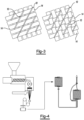
- Fig. 2 A possible processing method is depicted at Fig. 2 where the RER fibers 10 and reinforcing fibers 12 are co-extruded.
- the RER fibers may be used for stitching together secondary materials (which may be multiaxial fabric materials).
- secondary materials which may be multiaxial fabric materials.
- FIG. 3 An example is shown at Fig. 3 where the RER yarn 10 is stitched into a secondary material 14.
- the RER fiber would blend into the epoxy-based material upon heating in a way that typical thermoplastic fibers cannot. Such blending also results in an increase in toughness of the resulting resin, improved appearance, and reduces the need for secondary finishing.
- typical polyester yarn shows through the laminate and is thus visible on surface requiring additional treatment steps for a Class A finish.
- polyester yarn shows (sticks upward and outward) when a laminate is cut or sanded requiring additional treatment.
- the RER fibers may be modified to form a web or mesh which may then be contacted with a secondary material and may serve to bind that secondary material without requiring removal of the web or mesh.
- the secondary material may be an epoxy material and thus particular compatible with the RER web or mesh.
- the RER material may be formed into a film material and the film may be used to form the web or mesh.
- the RER fiber/web/mesh may also be injected into the material to facilitate the binding process.
- RER materials include possible uses for RER materials. It is possible that the RER materials may be provided initially in a pellet form and then formed into the weavable fibers (e.g., yarn) described herein.
- the RER material may be provided as pellets to a feed hopper which leads directly to a feed screw which leads to a melt block, where the pellets are melted from a solid to a viscous liquid.
- the RER material moves from the melt block to a spinneret via the force from a melt pump.
- the material Upon feeding through the spinneret, the material is formed into fibers and pulled onto a bobbin via a series of godets and a yarn traverse.
- Yarns produced via the above method were tested for tenacity.
- tenacity was unexpectedly not improved with a higher fiber mass density or increased twisting.
- the processing temperature may affect the yarn formation process in that the viscosity of the RER materials my require adjustment to form the desired fibers and yarns.
- the materials may require processing at a temperature of at least 150°C, at least 170°C, at least 190°C or even at least about 200°C.
- the viscosity of the materials may be too high for formation into fibers.
- the material is formulated to have a lower viscosity (sufficient for forming into fibers) even at temperatures below 200°C, below 170°C, or even below 150°C.
- the temperature for processing the RER materials may continue to be below that of the temperature required to process fibers formed of other materials such as typical thermoplastics.
- the use of lower processing temperatures reduces the risk of thermal stability of the fiber materials during processing and also allows for easier cooling of the fibers. Cooled fibers minimize any unwanted fiber tackiness so that the fibers are not sticky when wound.
- a key advantage of the present teachings over existing commonly used fibers is the improved compatibility with other materials including epoxy-based thermoset epoxy resin matrix materials (commonly utilized in composite structures).
- the RER may be an amine terminated resin that can potentially react with a thermoset resin.
- the compatibility lies in the RER fibers being epoxy based and having a size that is commonly used in composite fabrics. Additional benefits of the RER material include fast adhesion, and also the ability to re-form and re-mold the yarn with the addition of heat. Adhesion and returning to a solid state upon cooling of the RER begins almost immediately after heating is stopped and full adhesion can occur within about 10 seconds to about 60 seconds (e.g., about 30 seconds).
- a RER may be desirable because of its long shelf life. It also may not require storage at a refrigerated temperature, unlike some alternative materials.
- the RER material may be and/or may include a product (e.g., a thermoplastic condensation reaction product) of a reaction of a mono-functional or di-functional species (i.e., respectively, a species having one or two reactive groups, such as an amide containing species), with an epoxide-containing moiety, such as a diepoxide (i.e., a compound having two epoxide functionalities), reacted under conditions for causing the hydroxyl moieties to react with the epoxy moieties to form a generally linear backbone polymer chain with ether linkages.
- a product e.g., a thermoplastic condensation reaction product of a reaction of a mono-functional or di-functional species (i.e., respectively, a species having one or two reactive groups, such as an amide containing species), with an epoxide-containing moiety, such as a diepoxide (i.e., a compound having two epoxide functionalities), reacted under conditions for
- Exemplary RER materials are made with a difunctional epoxy resin and a primary amine which may be bisphenol A diglycidyl ether (BADGE) and monoethanolamine.
- BADGE bisphenol A diglycidyl ether
- T g glass transition temperature
- BADGE may be replaced by an epoxy monomer with less mobility.
- epoxy monomers may include diglycidylether of fluoren diphenol or 1,6 napthalene diepoxy.
- BADGE can be replaced by a brominated bisphenol A epoxy resin.
- the RER materials disclosed herein may also be known as poly(hydroxyamino ether) (PHAE) and is illustrated in U.S. Pat. Nos.
- Such polyethers may be prepared by reacting a diglycidyl ether of dihydric aromatic compounds such as the diglycidyl ether of bisphenol A, or a diepoxy-functionalized poly(alkylene oxide) or mixture thereof with a primary amine or a secondary diamine or a monoamine functionalized poly(alkylene oxide) or mixture thereof.
- a diglycidyl ether of dihydric aromatic compounds such as the diglycidyl ether of bisphenol A, or a diepoxy-functionalized poly(alkylene oxide) or mixture thereof with a primary amine or a secondary diamine or a monoamine functionalized poly(alkylene oxide) or mixture thereof.
- Such material generally has a relatively high flexural strength and modulus-often much higher than typical polyolefins (i.e. polyethylene and polypropylene)-and has the added benefit of being melt processable at temperatures of 150 to 200° C.
- epoxide-containing moieties may be employed, as is taught in U.S. Patent No. 6,011,111 (incorporated by reference; see, e.g., Cols. 5-6), and WO 98/14498 (incorporated by reference; see, e.g., page 8) such moieties may include at least one mono-functional epoxide and/or a di-funtional epoxide ("diepoxide").
- Diepoxide a di-funtional epoxide
- An example of a diepoxide that can be employed in the teachings includes a diglycidyl ether of a dihydric phenol (e.g., resorcinol, biphenol or bisphenol A). Any epoxide-containing moiety herein may be an aliphatic and/or an aromatic epoxide.
- Forming the RER materials into the desired weavable format may require particularly high temperatures during the extrusion process. Accordingly, it may be necessary to reduce the viscosity of the RER as the heat tends to increase the viscosity to an undesirable range. This may be achieved by modifying the ratio of the difunctional epoxy resin and primary amine such that the molecular chain length is reduced thus reducing the viscosity.
- any member of a genus may be excluded from the genus; and/or any member of a Markush grouping may be excluded from the grouping.
- any numerical values recited herein include all values from the lower value to the upper value in increments of one unit provided that there is a separation of at least 2 units between any lower value and any higher value.
- the amount of a component, a property, or a value of a process variable such as, for example, temperature, pressure, time and the like is, for example, from 1 to 90, preferably from 20 to 80, more preferably from 30 to 70
- intermediate range values such as (for example, 15 to 85, 22 to 68, 43 to 51, 30 to 32 etc.) are within the teachings of this specification.
- individual intermediate values are also within the present teachings.
Landscapes
- Chemical & Material Sciences (AREA)
- Engineering & Computer Science (AREA)
- Chemical Kinetics & Catalysis (AREA)
- Organic Chemistry (AREA)
- Materials Engineering (AREA)
- Textile Engineering (AREA)
- Life Sciences & Earth Sciences (AREA)
- Health & Medical Sciences (AREA)
- Medicinal Chemistry (AREA)
- Polymers & Plastics (AREA)
- Inorganic Chemistry (AREA)
- Manufacturing & Machinery (AREA)
- General Life Sciences & Earth Sciences (AREA)
- General Chemical & Material Sciences (AREA)
- Geochemistry & Mineralogy (AREA)
- Mechanical Engineering (AREA)
- Reinforced Plastic Materials (AREA)
- Treatments For Attaching Organic Compounds To Fibrous Goods (AREA)
- Chemical Or Physical Treatment Of Fibers (AREA)
Abstract
Description
- The present invention pertains generally to reformable epoxy resins for use in fiber-based materials, and more particularly to reformable epoxy resin yarn, binders and co-weaved fibers.
- Industrial fiber materials often require means to hold or bind materials together. Often, thermoplastic materials (e.g., fibers) are used to stitch or bind the materials together. However, such current methods include a number of drawbacks including but not limited to the incompatibility of typical thermoplastics with secondary materials (in particular epoxy-based composite materials), lack of sufficient blending, yarn showing through composite surfaces, behavior of thermoplastics upon sanding or cutting of secondary materials, rigidity of typical thermoplastics and lack of reformability of typical thermoplastics.
- Thermoplastic polymers having at least one epoxide group have been described in
U.S. Patent Nos. 5,115,075 ;4,438,254 ;6,011,111 ; andWO 98/14498 U.S. Patent No. 3,317,471 and4,647,648 , also incorporated by reference herein). Examples of such materials also can be found, without limitation at paragraphs 15-25 of PublishedU.S. Patent Application No. 20070270515 (Chmielewski et al ), incorporated by reference for all purposes. - The use of such thermoplastic polymers in a composite material has been disclosed in WIPO Patent Application
WO/2008/010823 (addressing in situ reaction of an epoxy and an amine after impregnation), incorporated by reference herein. - There is thus a need for materials that have certain thermoplastic capabilities in that they can be formed as fibrous materials for weaving or stitching or forming webs/meshes and yet avoid the issues identified above.
- The teachings herein are directed to a method comprising forming a reformable epoxy resin (RER) material into a weavable format, weaving the RER material with a reinforcing fiber to form a woven material and heating the woven material to form a flexible thermoplastic blanket. The reinforcing fiber may be selected from the group consisting of glass fibers, carbon fibers, and combinations thereof. The method may include forming the RER material into a multi-filament yarn. The RER material may fall below its glass transition temperature upon exposure to ambient temperature. The flexible thermoplastic blanket may be molded to form a composite. One or more of the denier or diameter of the weavable RER may be substantially similar to that of the reinforcing fiber. The RER material may fall below its glass transition temperature prior to forming the composite. A resulting fiber may be free of any phenoxy-containing material.
- The teachings herein further contemplate a method comprising forming a RER material into a weavable yarn, stitching a multiaxial fabric with the weavable yarn and forming a composite with the multiaxial fabric. The composite may be an epoxy laminate. The composite may be substantially free of any polyester yarn. The method may be substantially free of surface treatment for forming class A surfaces. The method may be substantially free of any surface treatment after a sanding step or cutting step.
- The teachings herein further include a method comprising forming a RER material into a fiber, forming a web or mesh with the RER fiber, applying the web or mesh to a secondary material, and heating the web or mesh and secondary material so that the web or mesh binds the secondary material. This method of forming a pre-form may be substantially free of any step of removing the web or mesh from the secondary material. The secondary material may be an epoxy material. The RER material may be formed into a film material. The applying step may include injecting the web or mesh into the secondary material. Formation of a pre-form significantly reduces cycle time by eliminating the step of shaping the part in a tool.
- Any of the methods described herein may include one or more of the following. The shelf life of the RER material may be at least about 3 months, at least about 6 months, at least about 1 year, or even at least about 5 years. The RER material may be recyclable. The glass transition temperature of the RER material may be higher than room temperature but lower than 200°C. The RER material may be processed at a temperature of less than 200°C, or even less than 150°C. The RER may be treated to reduce the viscosity of the RER material during the forming of the RER into the weavable format or yarn. The RER material may include a difunctional epoxy resin component and an amine component. The ratio of the difunctional epoxy resin and the primary amine may be modified to reduce the viscosity of the RER material during the forming of the RER into the weavable format or yarn. The RER material may fall below its glass transition temperature upon exposure to ambient temperature. The weavable format of the reformable epoxy resin material may have a tenacity of at least about 1.0 cN/dtex, at least about 1.2 cN/dtex or even at least about 1.4 cN/dtex.
- The teachings herein facilitate a process for forming and utilizing weavable reformable epoxy resin materials, which may be reformable epoxy resin yarns.
-
-
Fig. 1A illustrates a cross-sectional view of an exemplary fibers of reformable epoxy resin material shown bunched with reinforcing fibers. -
Fig. 1B shows the reformable epoxy resin fibers ofFig. 1A commingled with the reinforcing fibers ofFig. 1A . -
Fig. 1C shows the reformable epoxy resin fibers ofFig. 1A equally dispersed within the reinforcing fibers ofFig. 1A . -
Fig. 2 illustrates an exemplary extruding process for forming the commingled materials described herein. -
Fig. 3 illustrates an exemplary stitching of a secondary material with the reformable epoxy resin yarn described herein. -
Fig. 4 illustrates an exemplary process for forming the commingled materials described herein. - The present teachings meet one or more of the above needs by the improved composite structures and methods described herein. The explanations and illustrations presented herein are intended to acquaint others skilled in the art with the teachings, its principles, and its practical application. Those skilled in the art may adapt and apply the teachings in its numerous forms, as may be best suited to the requirements of a particular use. Accordingly, the specific embodiments of the present teachings as set forth are not intended as being exhaustive or limiting of the teachings. The scope of the teachings should, therefore, be determined not with reference to the above description, but should instead be determined with reference to the appended claims, along with the full scope of equivalents to which such claims are entitled. The disclosures of all articles and references, including patent applications and publications, are incorporated by reference for all purposes. Other combinations are also possible as will be gleaned from the following claims, which are also hereby incorporated by reference into this written description.
- This application claims the benefit of the filing dates of
U.S. Provisional Application Nos. 62/067,131, filed October 22, 2014 62/238,928, filed October 8, 2015 - The teachings herein make advantageous use of a RER epoxy yarns that adhere when cooled. The teachings herein contemplate a method for providing composite structures or other molded structures that are assembled (e.g., stitched or formed with a web or mesh) with the yarns (e.g., weavable reformable epoxy resin materials) described herein. The resulting structures are formable and moldable after the RER material is heated and subsequently falls below its glass transition temperature. The RER yarns are particularly compatible with dissimilar reinforcing fibers and epoxy based secondary materials such that the compatibility is improved over typical thermoplastic fibers (e.g., polyester).
- The teachings herein provide for a number of uses for the RER (reformable epoxy resin) fibers. In one embodiment, the RER fibers may be commingled with reinforcing fibers. Examples of which include but are not limited to glass or carbon fibers. The RER fibers may be more compatible with the reinforcing fibers as compared to typical thermoplastic fibers. This may be due to the similarity in size, diameter and/or denier of the RER fibers and reinforcing fibers. These commingled fibers can be used to produce drapable materials and composites which are easier to form than rigid composites, enable more complex shapes, require less heat/energy to process, and has a higher modulus than typical thermoplastic fibers. An example of such commingling possibilities are depicted at
Figs. 1A-1C , where varying degrees of comingling are shown with theRER fibers 10 and reinforcingfibers 12. A possible processing method is depicted atFig. 2 where theRER fibers 10 and reinforcingfibers 12 are co-extruded. - In another embodiment, the RER fibers may be used for stitching together secondary materials (which may be multiaxial fabric materials). An example is shown at
Fig. 3 where theRER yarn 10 is stitched into asecondary material 14. In the event that such stitching were utilized to form epoxy laminates, the RER fiber would blend into the epoxy-based material upon heating in a way that typical thermoplastic fibers cannot. Such blending also results in an increase in toughness of the resulting resin, improved appearance, and reduces the need for secondary finishing. As just one example, typical polyester yarn shows through the laminate and is thus visible on surface requiring additional treatment steps for a Class A finish. In addition, polyester yarn shows (sticks upward and outward) when a laminate is cut or sanded requiring additional treatment. - In yet another embodiment, the RER fibers may be modified to form a web or mesh which may then be contacted with a secondary material and may serve to bind that secondary material without requiring removal of the web or mesh.. The secondary material may be an epoxy material and thus particular compatible with the RER web or mesh. The RER material may be formed into a film material and the film may be used to form the web or mesh. The RER fiber/web/mesh may also be injected into the material to facilitate the binding process.
- The materials and methods taught herein include possible uses for RER materials. It is possible that the RER materials may be provided initially in a pellet form and then formed into the weavable fibers (e.g., yarn) described herein.
- As shown for example at
Fig. 4 , the RER material may be provided as pellets to a feed hopper which leads directly to a feed screw which leads to a melt block, where the pellets are melted from a solid to a viscous liquid. The RER material moves from the melt block to a spinneret via the force from a melt pump. Upon feeding through the spinneret, the material is formed into fibers and pulled onto a bobbin via a series of godets and a yarn traverse. - Yarns produced via the above method were tested for tenacity. A first yarn, produced with 24 fibers and twisted slightly, had a count of 100 dtex and a resulting tenacity of 1.2 to 1.4 cN/dtex. A second yarn, produced with S (right) and Z (left) twisted (highly twisted) fibers, had a count of 198 dtex and a tenacity of 1.2 cN/dtex. Thus, tenacity was unexpectedly not improved with a higher fiber mass density or increased twisting.
- The processing temperature may affect the yarn formation process in that the viscosity of the RER materials my require adjustment to form the desired fibers and yarns. Specifically, the materials may require processing at a temperature of at least 150°C, at least 170°C, at least 190°C or even at least about 200°C. At lower processing temperatures the viscosity of the materials may be too high for formation into fibers. In one embodiment it is possible that the material is formulated to have a lower viscosity (sufficient for forming into fibers) even at temperatures below 200°C, below 170°C, or even below 150°C. However, the temperature for processing the RER materials may continue to be below that of the temperature required to process fibers formed of other materials such as typical thermoplastics. The use of lower processing temperatures reduces the risk of thermal stability of the fiber materials during processing and also allows for easier cooling of the fibers. Cooled fibers minimize any unwanted fiber tackiness so that the fibers are not sticky when wound.
- A key advantage of the present teachings over existing commonly used fibers (e.g., polyester fibers) is the improved compatibility with other materials including epoxy-based thermoset epoxy resin matrix materials (commonly utilized in composite structures). Specifically, the RER may be an amine terminated resin that can potentially react with a thermoset resin. The compatibility lies in the RER fibers being epoxy based and having a size that is commonly used in composite fabrics. Additional benefits of the RER material include fast adhesion, and also the ability to re-form and re-mold the yarn with the addition of heat. Adhesion and returning to a solid state upon cooling of the RER begins almost immediately after heating is stopped and full adhesion can occur within about 10 seconds to about 60 seconds (e.g., about 30 seconds). In addition, a RER may be desirable because of its long shelf life. It also may not require storage at a refrigerated temperature, unlike some alternative materials.
- As an example, the RER material may be and/or may include a product (e.g., a thermoplastic condensation reaction product) of a reaction of a mono-functional or di-functional species (i.e., respectively, a species having one or two reactive groups, such as an amide containing species), with an epoxide-containing moiety, such as a diepoxide (i.e., a compound having two epoxide functionalities), reacted under conditions for causing the hydroxyl moieties to react with the epoxy moieties to form a generally linear backbone polymer chain with ether linkages. Exemplary RER materials are made with a difunctional epoxy resin and a primary amine which may be bisphenol A diglycidyl ether (BADGE) and monoethanolamine. For some applications that may require a higher glass transition temperature (Tg), it is contemplated that BADGE may be replaced by an epoxy monomer with less mobility. Such epoxy monomers may include diglycidylether of fluoren diphenol or 1,6 napthalene diepoxy. Also, it is contemplated that where fire resistance is desired, BADGE can be replaced by a brominated bisphenol A epoxy resin. Alternatively, the RER materials disclosed herein may also be known as poly(hydroxyamino ether) (PHAE) and is illustrated in
U.S. Pat. Nos. 5,164,472 ;5,275,853 ;5,401,814 and5,464,924 , all incorporated by reference herein for all purposes. Such polyethers may be prepared by reacting a diglycidyl ether of dihydric aromatic compounds such as the diglycidyl ether of bisphenol A, or a diepoxy-functionalized poly(alkylene oxide) or mixture thereof with a primary amine or a secondary diamine or a monoamine functionalized poly(alkylene oxide) or mixture thereof. Such material generally has a relatively high flexural strength and modulus-often much higher than typical polyolefins (i.e. polyethylene and polypropylene)-and has the added benefit of being melt processable at temperatures of 150 to 200° C. Though other epoxide-containing moieties may be employed, as is taught inU.S. Patent No. 6,011,111 (incorporated by reference; see, e.g., Cols. 5-6), andWO 98/14498 - Other examples of illustrative materials, functional species and diepoxides are described in
U.S. PatentNos. 5,115,075 ;4,438,254 ;6,011,111 ; andWO 98/14498 U.S. Patent No. 3,317,471 and4,647,648 , also incorporated by reference herein). Examples of such materials also can be found, without limitation at paragraphs 15-25 of PublishedU.S. Patent Application No. 20070270515 (Chmielewski et al ), incorporated by reference for all purposes. - Forming the RER materials into the desired weavable format may require particularly high temperatures during the extrusion process. Accordingly, it may be necessary to reduce the viscosity of the RER as the heat tends to increase the viscosity to an undesirable range. This may be achieved by modifying the ratio of the difunctional epoxy resin and primary amine such that the molecular chain length is reduced thus reducing the viscosity.
- As used herein, unless otherwise stated, the teachings envision that any member of a genus (list) may be excluded from the genus; and/or any member of a Markush grouping may be excluded from the grouping.
- Unless otherwise stated, any numerical values recited herein include all values from the lower value to the upper value in increments of one unit provided that there is a separation of at least 2 units between any lower value and any higher value. As an example, if it is stated that the amount of a component, a property, or a value of a process variable such as, for example, temperature, pressure, time and the like is, for example, from 1 to 90, preferably from 20 to 80, more preferably from 30 to 70, it is intended that intermediate range values such as (for example, 15 to 85, 22 to 68, 43 to 51, 30 to 32 etc.) are within the teachings of this specification. Likewise, individual intermediate values are also within the present teachings. For values which are less than one, one unit is considered to be 0.0001, 0.001, 0.01 or 0.1 as appropriate. These are only examples of what is specifically intended and all possible combinations of numerical values between the lowest value and the highest value enumerated are to be considered to be expressly stated in this application in a similar manner. As can be seen, the teaching of amounts expressed as "parts by weight" herein also contemplates the same ranges expressed in terms of percent by weight. Thus, an expression in the of a range in terms of at "'x' parts by weight of the resulting polymeric blend composition" also contemplates a teaching of ranges of same recited amount of "x" in percent by weight of the resulting polymeric blend composition."
- Unless otherwise stated, all ranges include both endpoints and all numbers between the endpoints. The use of "about" or "approximately" in connection with a range applies to both ends of the range. Thus, "about 20 to 30" is intended to cover "about 20 to about 30", inclusive of at least the specified endpoints.
- The disclosures of all articles and references, including patent applications and publications, are incorporated by reference for ail purposes. The term "consisting essentially of to describe a combination shall include the elements, ingredients, components or steps identified, and such other elements ingredients, components or steps that do not materially affect the basic and novel characteristics of the combination. The use of the terms "comprising" or "including" to describe combinations of elements, ingredients, components or steps herein also contemplates embodiments that consist of, or consist essentially of the elements, ingredients, components or steps.
- Plural elements, ingredients, components or steps can be provided by a single integrated element, ingredient, component or step. Alternatively, a single integrated element, ingredient, component or step might be divided into separate plural elements, ingredients, components or steps. The disclosure of "a" or "one" to describe an element, ingredient, component or step is not intended to foreclose additional elements, ingredients, components or steps.
- It is understood that the above description is intended to be illustrative and not restrictive. Many embodiments as well as many applications besides the examples provided will be apparent to those of skill in the art upon reading the above description. The scope of the invention should, therefore, be determined not with reference to the above description, but should instead be determined with reference to the appended claims, along with the full scope of equivalents to which such claims are entitled. The disclosures of all articles and references, including patent applications and publications, are incorporated by reference for all purposes. The omission in the following claims of any aspect of subject matter that is disclosed herein is not a disclaimer of such subject matter, nor should it be regarded that the inventors did not consider such subject matter to be part of the disclosed inventive subject matter.
- Particularly preferred embodiments of the invention are compiled as clauses 1 to 28 here below:
- Clause 1: A method comprising: i. forming a reformable epoxy resin material into a weavable format; ii. weaving the reformable epoxy resin material with a reinforcing fiber to form a woven material; iii. heating the woven material to form a flexible thermoplastic blanket.
- Clause 2: The method according to clause 1, wherein the reinforcing fiber is selected from the group consisting of glass fibers, carbon fibers, and combinations thereof.
- Clause 3: The method according to clause 1 or clause 2, including forming the reformable epoxy resin material into a multi-filament yarn.
- Clause 4: The method according to any one of clauses 1 to 3, wherein the reformable epoxy resin material falls below its glass transition temperature upon exposure to ambient temperature.
- Clause 5: The method according to any one of clauses 1 through 4, wherein the flexible thermoplastic blanket is molded to form a composite.
- Clause 6: The method according to any one of clauses 1 through 5, wherein one or more of the denier or diameter of the weavable reformable epoxy resin is substantially similar to that of the reinforcing fiber.
- Clause 7: The method according to clause 5, wherein the reformable epoxy resin material falls below its glass transition temperature prior to forming the composite.
- Clause 8: A method comprising: i. forming a reformable epoxy resin material into a weavable yarn; ii. stitching a multiaxial fabric with the weavable yarn; iii. forming a composite with the multiaxial fabric.
- Clause 9: The method according to clause 8, wherein the composite is an epoxy laminate.
- Clause 10: The method according to clause 8 or clause 9, wherein the composite is substantially free of any polyester yarn.
- Clause 11: The method according to any one of clauses 8 through 10, wherein the method is substantially free of surface treatment for forming class A surfaces.
- Clause 12: The method according to any one of clauses 8 through 11, wherein the method is substantially free of any surface treatment after a sanding step or cutting step.
- Clause 13: A method comprising: i. forming a reformable epoxy resin material into a weavable format such as a fiber; ii. forming a web or mesh with the reformable epoxy resin fiber; iii.
- applying the web or mesh to a secondary material; iv. heating the web or mesh and secondary material so that the web or mesh binds the secondary material.
- Clause 14: The method of clause 13, wherein the method is substantially free of any step of removing the web or mesh from the secondary material.
- Clause 15: The method of
clause 13 or 14, wherein the secondary material is an epoxy material. - Clause 16: The material of any one of clauses 13 through 15, wherein the reformable epoxy resin material is formed into a film material.
- Clause 17: The material of any one of clauses 13 through 16, wherein the applying step includes injecting the web or mesh into the secondary material.
- Clause 18: The method according to any one of clauses 1 through 17, wherein the shelf life of the reformable epoxy resin material is at least about 3 months, at least about 6 months, at least about 1 year, or even at least about 5 years.
- Clause 19: The method according to any one of clauses 1 through 18, wherein the reformable epoxy resin material is recyclable.
- Clause 20: The method according to any one of clauses 1 through 19, wherein the glass transition temperature of the reformable epoxy resin material is higher than room temperature but lower than 200°C.
- Clause 21: The method according to any one of clauses 1 through 20, wherein the reformable epoxy resin material can be processed at a temperature of less than 200°C, or even less than 150°C.
- Clause 22: The method according to any one of clauses 1 through 21, wherein the reformable epoxy resin is treated to reduce the viscosity of the reformable epoxy resin material during the forming of the reformable epoxy resin into the weavable format or yarn.
- Clause 23: The method according to any one of clauses 1 through 22, wherein the reformable epoxy resin material includes a difunctional epoxy resin component and an amine component.
- Clause 24: The method according to clause 23, wherein the ratio of the difunctional epoxy resin and the primary amine is modified to reduce the viscosity of the reformable epoxy resin material during the forming of the reformable epoxy resin into the weavable format or yarn.
- Clause 25: The method according to any one of clauses 1 to 24, wherein the reformable epoxy resin material falls below its glass transition temperature upon exposure to ambient temperature.
- Clause 26: The method of any one of clauses 1 through 25, wherein the weavable format of the reformable epoxy resin material has a tenacity of at least about 1.0 cN/dtex, at least about 1.2 cN/dtex or even at least about 1.4 cN/dtex.
- Clause 27: A yarn formed using the method of any of clauses 1 through 26.
- Clause 28: The yarn of clause 27, wherein the yarn is substantially free of any phenoxy-containing material.
Claims (14)
- A method comprising:i. forming a reformable epoxy resin material into a weavable format;ii. weaving the reformable epoxy resin material with a reinforcing fiber to form a woven material;iii. heating the woven material to form a flexible thermoplastic blanket; andiv. molding the flexible thermoplastic blanket to form a composite.
- The method according to claim 1, wherein the reinforcing fiber is selected from the group consisting of glass fibers, carbon fibers, and combinations thereof.
- The method according to claim 1 or 2, including forming the reformable epoxy resin material into a multi-filament yarn.
- The method according to any of the preceding claims, wherein the reformable epoxy resin material falls below its glass transition temperature upon exposure to ambient temperature.
- The method according to any of the preceding claims, wherein one or more of the denier or diameter of the weavable reformable epoxy resin is substantially similar to that of the reinforcing fiber.
- The method according to any of the preceding claims, wherein the reformable epoxy resin material falls below its glass transition temperature prior to forming the composite.
- The method according to any of the preceding claims, wherein the reformable epoxy resin material is recyclable.
- The method according to any of the preceding claims, wherein the glass transition temperature of the reformable epoxy resin material is higher than room temperature but lower than 200°C.
- The method according to any of the preceding claims, wherein the reformable epoxy resin material can be processed at a temperature of less than 200°C, or even less than 150°C.
- The method according to any of the preceding claims, wherein the reformable epoxy resin is treated to reduce the viscosity of the reformable epoxy resin material during the forming of the reformable epoxy resin into the weavable format or yarn.
- The method according to any of the preceding claims, wherein the reformable epoxy resin material includes a difunctional epoxy resin component and an amine component.
- The method according to claim 11, wherein the ratio of the difunctional epoxy resin and the primary amine is modified to reduce the viscosity of the reformable epoxy resin material during the forming of the reformable epoxy resin into the weavable format or yarn.
- The method according to any of the preceding claims, wherein the reformable epoxy resin material falls below its glass transition temperature upon exposure to ambient temperature.
- The method of any of the preceding claims, wherein the weavable format of the reformable epoxy resin material has a tenacity of at least about 1.0 cN/dtex, at least about 1.2 cN/dtex or even at least about 1.4 cN/dtex.
Applications Claiming Priority (4)
| Application Number | Priority Date | Filing Date | Title |
|---|---|---|---|
| US201462067131P | 2014-10-22 | 2014-10-22 | |
| US201562238928P | 2015-10-08 | 2015-10-08 | |
| EP15791830.1A EP3209821B1 (en) | 2014-10-22 | 2015-10-22 | Method for forming reformable epoxy resin materials into weavable yarns |
| PCT/US2015/056826 WO2016065104A1 (en) | 2014-10-22 | 2015-10-22 | Reformable resin fibers |
Related Parent Applications (1)
| Application Number | Title | Priority Date | Filing Date |
|---|---|---|---|
| EP15791830.1A Division EP3209821B1 (en) | 2014-10-22 | 2015-10-22 | Method for forming reformable epoxy resin materials into weavable yarns |
Publications (2)
| Publication Number | Publication Date |
|---|---|
| EP4311870A2 true EP4311870A2 (en) | 2024-01-31 |
| EP4311870A3 EP4311870A3 (en) | 2024-04-17 |
Family
ID=54478970
Family Applications (2)
| Application Number | Title | Priority Date | Filing Date |
|---|---|---|---|
| EP15791830.1A Active EP3209821B1 (en) | 2014-10-22 | 2015-10-22 | Method for forming reformable epoxy resin materials into weavable yarns |
| EP23210960.3A Pending EP4311870A3 (en) | 2014-10-22 | 2015-10-22 | Method for forming reformable epoxy resin materials into weavable yarns |
Family Applications Before (1)
| Application Number | Title | Priority Date | Filing Date |
|---|---|---|---|
| EP15791830.1A Active EP3209821B1 (en) | 2014-10-22 | 2015-10-22 | Method for forming reformable epoxy resin materials into weavable yarns |
Country Status (6)
| Country | Link |
|---|---|
| US (1) | US10689784B2 (en) |
| EP (2) | EP3209821B1 (en) |
| CN (1) | CN107075750B (en) |
| ES (1) | ES2971638T3 (en) |
| PL (1) | PL3209821T3 (en) |
| WO (1) | WO2016065104A1 (en) |
Families Citing this family (5)
| Publication number | Priority date | Publication date | Assignee | Title |
|---|---|---|---|---|
| US10570258B2 (en) | 2015-03-10 | 2020-02-25 | Zephyros, Inc. | Composites with thermoplastic epoxy polymeric phase, articles such as carriers made therewith and associated methods |
| CN108602937A (en) | 2015-11-12 | 2018-09-28 | 泽费罗斯股份有限公司 | Controlled glass transition polymer material and method |
| CN108602470B (en) | 2015-11-30 | 2022-03-18 | 泽菲罗斯公司 | Adhesive resins and films for composites and tapes, and methods of use thereof |
| WO2019241295A1 (en) | 2018-06-11 | 2019-12-19 | Zephyros, Inc. | Reformable resin filaments and materials formed therewith |
| US11332197B2 (en) | 2018-10-12 | 2022-05-17 | Zephyros, Inc. | Composite load bearing flooring |
Citations (12)
| Publication number | Priority date | Publication date | Assignee | Title |
|---|---|---|---|---|
| US3317471A (en) | 1959-03-12 | 1967-05-02 | Dow Chemical Co | Thermoplastic resinous reaction product of a diglycidyl ether and an amino compound |
| US4438254A (en) | 1983-02-28 | 1984-03-20 | The Dow Chemical Company | Process for producing epoxy resins |
| US4647648A (en) | 1985-08-26 | 1987-03-03 | The Dow Chemical Company | Polyhydroxyethers from hydroxybiphenyls |
| US5115075A (en) | 1990-05-08 | 1992-05-19 | The Dow Chemical Company | Amide and hydroxymethyl functionalized polyethers as thermoplastic barrier resins |
| US5164472A (en) | 1990-01-18 | 1992-11-17 | The Dow Chemical Company | Hydroxy-functional polyethers as thermoplastic barrier resins |
| US5275853A (en) | 1990-10-03 | 1994-01-04 | The Dow Chemical Company | Hydroxyl functionalized polyetheramines as barrier packaging for oxygen-sensitive materials |
| US5401814A (en) | 1993-10-13 | 1995-03-28 | The Dow Chemical Company | Process for the preparation of thermoplastic poly(hydroxy ethers) |
| US5464924A (en) | 1994-01-07 | 1995-11-07 | The Dow Chemical Company | Flexible poly(amino ethers) for barrier packaging |
| WO1998014498A1 (en) | 1996-09-30 | 1998-04-09 | The Dow Chemical Company | Hydroxy-phenoxyether polymer thermoplastic composites |
| US6011111A (en) | 1993-10-18 | 2000-01-04 | The Dow Chemical Company | Hydroxy-phenoxyether polymer thermoplastic composites |
| US20070270515A1 (en) | 2006-05-19 | 2007-11-22 | Zephyros, Inc. | Toughened polymeric material and method of forming and using same |
| WO2008010823A2 (en) | 2005-09-09 | 2008-01-24 | L & L Products, Inc. | Thermoplastic based composites |
Family Cites Families (16)
| Publication number | Priority date | Publication date | Assignee | Title |
|---|---|---|---|---|
| US3473950A (en) * | 1967-07-25 | 1969-10-21 | Owens Corning Fiberglass Corp | High strength fibrous glass |
| DE3012288C2 (en) * | 1980-03-29 | 1984-04-26 | Fröhlich & Wolff GmbH, 3436 Hessisch-Lichtenau | Thread with a prepared core thread |
| FR2862655B1 (en) * | 2003-11-25 | 2007-01-05 | Arkema | ORGANIC FIBER BASED ON EPOXY RESIN AND RHEOLOGY REGULATING AGENT AND CORRESPONDING FABRICS |
| US20080260954A1 (en) * | 2005-10-11 | 2008-10-23 | Rowan Johnson Paton | Method of Binding Dry Reinforcement Fibres |
| US20140335355A1 (en) * | 2006-05-22 | 2014-11-13 | Innegra Technologies, Llc | Hybrid Composite Yarn |
| GB2451136B (en) * | 2007-07-20 | 2012-11-28 | Umeco Structural Materials Derby Ltd | Thermoset resin fibres |
| US9745412B2 (en) | 2009-01-09 | 2017-08-29 | Nagase Chemtex Corporation | Process for production of thermoplastic cured epoxy resin with transparency to visible light, and thermoplastic epoxy resin composition |
| JP5796732B2 (en) * | 2011-03-16 | 2015-10-21 | 三菱レイヨン株式会社 | Fiber reinforced sheet, method for producing the same, and fiber reinforced composite material |
| CN104271667B (en) | 2012-04-27 | 2018-01-26 | 陶氏环球技术有限责任公司 | Curable epoxy resin compositions and composites made therefrom |
| CN103806160A (en) * | 2012-11-12 | 2014-05-21 | 江南大学 | Thermosensitive shape memory lattice apron |
| CN105637234B (en) * | 2013-10-04 | 2018-05-01 | 泽菲罗斯公司 | Form the method and device with adhered panel and supporting structure |
| WO2015051242A1 (en) | 2013-10-04 | 2015-04-09 | Zephyros, Inc. | Method and apparatus for adhesion of inserts |
| US9796891B2 (en) | 2014-08-11 | 2017-10-24 | Zephyros, Inc. | Panel edge enclosures |
| US20160046047A1 (en) | 2014-08-14 | 2016-02-18 | Zephyros, Inc. | Reformable epoxy resin for composites |
| US10570258B2 (en) | 2015-03-10 | 2020-02-25 | Zephyros, Inc. | Composites with thermoplastic epoxy polymeric phase, articles such as carriers made therewith and associated methods |
| WO2016145161A1 (en) | 2015-03-10 | 2016-09-15 | Zephyros, Inc. | Pultruded articles and methods for making same |
-
2015
- 2015-10-22 ES ES15791830T patent/ES2971638T3/en active Active
- 2015-10-22 US US15/518,042 patent/US10689784B2/en active Active
- 2015-10-22 CN CN201580057576.4A patent/CN107075750B/en active Active
- 2015-10-22 PL PL15791830.1T patent/PL3209821T3/en unknown
- 2015-10-22 EP EP15791830.1A patent/EP3209821B1/en active Active
- 2015-10-22 WO PCT/US2015/056826 patent/WO2016065104A1/en not_active Ceased
- 2015-10-22 EP EP23210960.3A patent/EP4311870A3/en active Pending
Patent Citations (12)
| Publication number | Priority date | Publication date | Assignee | Title |
|---|---|---|---|---|
| US3317471A (en) | 1959-03-12 | 1967-05-02 | Dow Chemical Co | Thermoplastic resinous reaction product of a diglycidyl ether and an amino compound |
| US4438254A (en) | 1983-02-28 | 1984-03-20 | The Dow Chemical Company | Process for producing epoxy resins |
| US4647648A (en) | 1985-08-26 | 1987-03-03 | The Dow Chemical Company | Polyhydroxyethers from hydroxybiphenyls |
| US5164472A (en) | 1990-01-18 | 1992-11-17 | The Dow Chemical Company | Hydroxy-functional polyethers as thermoplastic barrier resins |
| US5115075A (en) | 1990-05-08 | 1992-05-19 | The Dow Chemical Company | Amide and hydroxymethyl functionalized polyethers as thermoplastic barrier resins |
| US5275853A (en) | 1990-10-03 | 1994-01-04 | The Dow Chemical Company | Hydroxyl functionalized polyetheramines as barrier packaging for oxygen-sensitive materials |
| US5401814A (en) | 1993-10-13 | 1995-03-28 | The Dow Chemical Company | Process for the preparation of thermoplastic poly(hydroxy ethers) |
| US6011111A (en) | 1993-10-18 | 2000-01-04 | The Dow Chemical Company | Hydroxy-phenoxyether polymer thermoplastic composites |
| US5464924A (en) | 1994-01-07 | 1995-11-07 | The Dow Chemical Company | Flexible poly(amino ethers) for barrier packaging |
| WO1998014498A1 (en) | 1996-09-30 | 1998-04-09 | The Dow Chemical Company | Hydroxy-phenoxyether polymer thermoplastic composites |
| WO2008010823A2 (en) | 2005-09-09 | 2008-01-24 | L & L Products, Inc. | Thermoplastic based composites |
| US20070270515A1 (en) | 2006-05-19 | 2007-11-22 | Zephyros, Inc. | Toughened polymeric material and method of forming and using same |
Also Published As
| Publication number | Publication date |
|---|---|
| EP3209821A1 (en) | 2017-08-30 |
| EP4311870A3 (en) | 2024-04-17 |
| EP3209821B1 (en) | 2023-11-29 |
| WO2016065104A1 (en) | 2016-04-28 |
| PL3209821T3 (en) | 2024-06-17 |
| ES2971638T3 (en) | 2024-06-06 |
| CN107075750B (en) | 2019-12-06 |
| US10689784B2 (en) | 2020-06-23 |
| US20170247821A1 (en) | 2017-08-31 |
| CN107075750A (en) | 2017-08-18 |
Similar Documents
| Publication | Publication Date | Title |
|---|---|---|
| US10689784B2 (en) | Reformable resin fibers | |
| JP4789940B2 (en) | Isotropic fiber reinforced thermoplastic resin sheet, method for producing the same and molded plate | |
| JP5806332B2 (en) | Epoxy resin systems containing insoluble and partially soluble or swellable reinforcing particles for use in prepreg and structural component applications | |
| US10406776B2 (en) | Thermoplastic bonded preforms and thermoset matrices formed therewith | |
| US20230211578A1 (en) | Reformable epoxy resin for composites | |
| EP0390193B1 (en) | Nonwoven fabric for reinforcing resin and moldable sheet utilizing the same | |
| US20240181761A1 (en) | Thermoplastic epoxy materials with core shell phase | |
| AU2019284620B2 (en) | Reformable resin filaments and materials formed therewith | |
| EP3183288A1 (en) | Polylactic acid composites with natural fibers | |
| WO2014032060A1 (en) | High impact long fiber reinforced polyamide compositions | |
| BR112020025140B1 (en) | METHOD, MONOFILAMENT, FIBROUS MATERIAL PRODUCT AND COMPOSITE MATERIAL FIELD OF THE INVENTION | |
| KR102812355B1 (en) | Biodegradable prepreg using lyocell and manufacturing method thereof | |
| WO2017205172A1 (en) | Reformable resin materials and uses therefor | |
| KR20180043043A (en) | Tricot permeate channel for reverse osmosis membrane | |
| KR20250163572A (en) | Recycled fiber nonwoven prepreg with improved thermoplastic resin impregnation properties and its manufacturing method | |
| EP2753890B1 (en) | Antiballistic article with resin |
Legal Events
| Date | Code | Title | Description |
|---|---|---|---|
| PUAI | Public reference made under article 153(3) epc to a published international application that has entered the european phase |
Free format text: ORIGINAL CODE: 0009012 |
|
| STAA | Information on the status of an ep patent application or granted ep patent |
Free format text: STATUS: THE APPLICATION HAS BEEN PUBLISHED |
|
| AC | Divisional application: reference to earlier application |
Ref document number: 3209821 Country of ref document: EP Kind code of ref document: P |
|
| AK | Designated contracting states |
Kind code of ref document: A2 Designated state(s): AL AT BE BG CH CY CZ DE DK EE ES FI FR GB GR HR HU IE IS IT LI LT LU LV MC MK MT NL NO PL PT RO RS SE SI SK SM TR |
|
| REG | Reference to a national code |
Ref country code: DE Ref legal event code: R079 Free format text: PREVIOUS MAIN CLASS: D03D0015470000 Ipc: D03D0015000000 |
|
| PUAL | Search report despatched |
Free format text: ORIGINAL CODE: 0009013 |
|
| AK | Designated contracting states |
Kind code of ref document: A3 Designated state(s): AL AT BE BG CH CY CZ DE DK EE ES FI FR GB GR HR HU IE IS IT LI LT LU LV MC MK MT NL NO PL PT RO RS SE SI SK SM TR |
|
| RIC1 | Information provided on ipc code assigned before grant |
Ipc: B32B 17/10 20060101ALI20240311BHEP Ipc: C08L 63/00 20060101ALI20240311BHEP Ipc: D02G 3/40 20060101ALI20240311BHEP Ipc: C08J 5/08 20060101ALI20240311BHEP Ipc: C03C 25/36 20060101ALI20240311BHEP Ipc: D03D 15/00 20210101AFI20240311BHEP |
|
| STAA | Information on the status of an ep patent application or granted ep patent |
Free format text: STATUS: REQUEST FOR EXAMINATION WAS MADE |
|
| 17P | Request for examination filed |
Effective date: 20241014 |
|
| RBV | Designated contracting states (corrected) |
Designated state(s): AL AT BE BG CH CY CZ DE DK EE ES FI FR GB GR HR HU IE IS IT LI LT LU LV MC MK MT NL NO PL PT RO RS SE SI SK SM TR |
|
| STAA | Information on the status of an ep patent application or granted ep patent |
Free format text: STATUS: EXAMINATION IS IN PROGRESS |
|
| 17Q | First examination report despatched |
Effective date: 20250306 |