EP4310580A1 - Display device - Google Patents
Display device Download PDFInfo
- Publication number
- EP4310580A1 EP4310580A1 EP22770963.1A EP22770963A EP4310580A1 EP 4310580 A1 EP4310580 A1 EP 4310580A1 EP 22770963 A EP22770963 A EP 22770963A EP 4310580 A1 EP4310580 A1 EP 4310580A1
- Authority
- EP
- European Patent Office
- Prior art keywords
- hologram
- diffraction efficiency
- light
- display device
- wavelength
- Prior art date
- Legal status (The legal status is an assumption and is not a legal conclusion. Google has not performed a legal analysis and makes no representation as to the accuracy of the status listed.)
- Withdrawn
Links
Images


Classifications
-
- G—PHYSICS
- G03—PHOTOGRAPHY; CINEMATOGRAPHY; ANALOGOUS TECHNIQUES USING WAVES OTHER THAN OPTICAL WAVES; ELECTROGRAPHY; HOLOGRAPHY
- G03H—HOLOGRAPHIC PROCESSES OR APPARATUS
- G03H1/00—Holographic processes or apparatus using light, infrared or ultraviolet waves for obtaining holograms or for obtaining an image from them; Details peculiar thereto
- G03H1/22—Processes or apparatus for obtaining an optical image from holograms
- G03H1/2202—Reconstruction geometries or arrangements
-
- G—PHYSICS
- G02—OPTICS
- G02B—OPTICAL ELEMENTS, SYSTEMS OR APPARATUS
- G02B27/00—Optical systems or apparatus not provided for by any of the groups G02B1/00 - G02B26/00, G02B30/00
- G02B27/01—Head-up displays
- G02B27/0101—Head-up displays characterised by optical features
- G02B27/0103—Head-up displays characterised by optical features comprising holographic elements
-
- G—PHYSICS
- G02—OPTICS
- G02B—OPTICAL ELEMENTS, SYSTEMS OR APPARATUS
- G02B27/00—Optical systems or apparatus not provided for by any of the groups G02B1/00 - G02B26/00, G02B30/00
- G02B27/01—Head-up displays
- G02B27/017—Head mounted
- G02B27/0172—Head mounted characterised by optical features
-
- G—PHYSICS
- G02—OPTICS
- G02B—OPTICAL ELEMENTS, SYSTEMS OR APPARATUS
- G02B27/00—Optical systems or apparatus not provided for by any of the groups G02B1/00 - G02B26/00, G02B30/00
- G02B27/01—Head-up displays
- G02B27/0101—Head-up displays characterised by optical features
- G02B2027/0112—Head-up displays characterised by optical features comprising device for genereting colour display
-
- G—PHYSICS
- G02—OPTICS
- G02B—OPTICAL ELEMENTS, SYSTEMS OR APPARATUS
- G02B27/00—Optical systems or apparatus not provided for by any of the groups G02B1/00 - G02B26/00, G02B30/00
- G02B27/01—Head-up displays
- G02B27/0101—Head-up displays characterised by optical features
- G02B2027/0112—Head-up displays characterised by optical features comprising device for genereting colour display
- G02B2027/0116—Head-up displays characterised by optical features comprising device for genereting colour display comprising devices for correcting chromatic aberration
-
- G—PHYSICS
- G02—OPTICS
- G02B—OPTICAL ELEMENTS, SYSTEMS OR APPARATUS
- G02B27/00—Optical systems or apparatus not provided for by any of the groups G02B1/00 - G02B26/00, G02B30/00
- G02B27/01—Head-up displays
- G02B27/0101—Head-up displays characterised by optical features
- G02B2027/0118—Head-up displays characterised by optical features comprising devices for improving the contrast of the display / brillance control visibility
-
- G—PHYSICS
- G02—OPTICS
- G02B—OPTICAL ELEMENTS, SYSTEMS OR APPARATUS
- G02B27/00—Optical systems or apparatus not provided for by any of the groups G02B1/00 - G02B26/00, G02B30/00
- G02B27/01—Head-up displays
- G02B27/017—Head mounted
- G02B27/0172—Head mounted characterised by optical features
- G02B2027/0174—Head mounted characterised by optical features holographic
-
- G—PHYSICS
- G02—OPTICS
- G02B—OPTICAL ELEMENTS, SYSTEMS OR APPARATUS
- G02B27/00—Optical systems or apparatus not provided for by any of the groups G02B1/00 - G02B26/00, G02B30/00
- G02B27/01—Head-up displays
- G02B27/017—Head mounted
- G02B2027/0178—Eyeglass type
-
- G—PHYSICS
- G03—PHOTOGRAPHY; CINEMATOGRAPHY; ANALOGOUS TECHNIQUES USING WAVES OTHER THAN OPTICAL WAVES; ELECTROGRAPHY; HOLOGRAPHY
- G03H—HOLOGRAPHIC PROCESSES OR APPARATUS
- G03H1/00—Holographic processes or apparatus using light, infrared or ultraviolet waves for obtaining holograms or for obtaining an image from them; Details peculiar thereto
- G03H1/0005—Adaptation of holography to specific applications
- G03H2001/0088—Adaptation of holography to specific applications for video-holography, i.e. integrating hologram acquisition, transmission and display
-
- G—PHYSICS
- G03—PHOTOGRAPHY; CINEMATOGRAPHY; ANALOGOUS TECHNIQUES USING WAVES OTHER THAN OPTICAL WAVES; ELECTROGRAPHY; HOLOGRAPHY
- G03H—HOLOGRAPHIC PROCESSES OR APPARATUS
- G03H1/00—Holographic processes or apparatus using light, infrared or ultraviolet waves for obtaining holograms or for obtaining an image from them; Details peculiar thereto
- G03H1/22—Processes or apparatus for obtaining an optical image from holograms
- G03H1/2202—Reconstruction geometries or arrangements
- G03H2001/2223—Particular relationship between light source, hologram and observer
- G03H2001/2226—Edge lit holograms
-
- G—PHYSICS
- G03—PHOTOGRAPHY; CINEMATOGRAPHY; ANALOGOUS TECHNIQUES USING WAVES OTHER THAN OPTICAL WAVES; ELECTROGRAPHY; HOLOGRAPHY
- G03H—HOLOGRAPHIC PROCESSES OR APPARATUS
- G03H1/00—Holographic processes or apparatus using light, infrared or ultraviolet waves for obtaining holograms or for obtaining an image from them; Details peculiar thereto
- G03H1/22—Processes or apparatus for obtaining an optical image from holograms
- G03H1/2249—Holobject properties
- G03H2001/2284—Superimposing the holobject with other visual information
-
- G—PHYSICS
- G03—PHOTOGRAPHY; CINEMATOGRAPHY; ANALOGOUS TECHNIQUES USING WAVES OTHER THAN OPTICAL WAVES; ELECTROGRAPHY; HOLOGRAPHY
- G03H—HOLOGRAPHIC PROCESSES OR APPARATUS
- G03H1/00—Holographic processes or apparatus using light, infrared or ultraviolet waves for obtaining holograms or for obtaining an image from them; Details peculiar thereto
- G03H1/26—Processes or apparatus specially adapted to produce multiple sub- holograms or to obtain images from them, e.g. multicolour technique
- G03H1/30—Processes or apparatus specially adapted to produce multiple sub- holograms or to obtain images from them, e.g. multicolour technique discrete holograms only
- G03H2001/303—Interleaved sub-holograms, e.g. three RGB sub-holograms having interleaved pixels for reconstructing coloured holobject
-
- G—PHYSICS
- G03—PHOTOGRAPHY; CINEMATOGRAPHY; ANALOGOUS TECHNIQUES USING WAVES OTHER THAN OPTICAL WAVES; ELECTROGRAPHY; HOLOGRAPHY
- G03H—HOLOGRAPHIC PROCESSES OR APPARATUS
- G03H2210/00—Object characteristics
- G03H2210/10—Modulation characteristics, e.g. amplitude, phase, polarisation
-
- G—PHYSICS
- G03—PHOTOGRAPHY; CINEMATOGRAPHY; ANALOGOUS TECHNIQUES USING WAVES OTHER THAN OPTICAL WAVES; ELECTROGRAPHY; HOLOGRAPHY
- G03H—HOLOGRAPHIC PROCESSES OR APPARATUS
- G03H2222/00—Light sources or light beam properties
- G03H2222/10—Spectral composition
- G03H2222/17—White light
- G03H2222/18—RGB trichrome light
-
- G—PHYSICS
- G03—PHOTOGRAPHY; CINEMATOGRAPHY; ANALOGOUS TECHNIQUES USING WAVES OTHER THAN OPTICAL WAVES; ELECTROGRAPHY; HOLOGRAPHY
- G03H—HOLOGRAPHIC PROCESSES OR APPARATUS
- G03H2222/00—Light sources or light beam properties
- G03H2222/36—Scanning light beam
-
- G—PHYSICS
- G03—PHOTOGRAPHY; CINEMATOGRAPHY; ANALOGOUS TECHNIQUES USING WAVES OTHER THAN OPTICAL WAVES; ELECTROGRAPHY; HOLOGRAPHY
- G03H—HOLOGRAPHIC PROCESSES OR APPARATUS
- G03H2223/00—Optical components
- G03H2223/15—Colour filter, e.g. interferential colour filter
-
- G—PHYSICS
- G03—PHOTOGRAPHY; CINEMATOGRAPHY; ANALOGOUS TECHNIQUES USING WAVES OTHER THAN OPTICAL WAVES; ELECTROGRAPHY; HOLOGRAPHY
- G03H—HOLOGRAPHIC PROCESSES OR APPARATUS
- G03H2223/00—Optical components
- G03H2223/16—Optical waveguide, e.g. optical fibre, rod
-
- G—PHYSICS
- G03—PHOTOGRAPHY; CINEMATOGRAPHY; ANALOGOUS TECHNIQUES USING WAVES OTHER THAN OPTICAL WAVES; ELECTROGRAPHY; HOLOGRAPHY
- G03H—HOLOGRAPHIC PROCESSES OR APPARATUS
- G03H2227/00—Mechanical components or mechanical aspects not otherwise provided for
- G03H2227/03—Means for moving one component
-
- G—PHYSICS
- G03—PHOTOGRAPHY; CINEMATOGRAPHY; ANALOGOUS TECHNIQUES USING WAVES OTHER THAN OPTICAL WAVES; ELECTROGRAPHY; HOLOGRAPHY
- G03H—HOLOGRAPHIC PROCESSES OR APPARATUS
- G03H2240/00—Hologram nature or properties
- G03H2240/50—Parameters or numerical values associated with holography, e.g. peel strength
- G03H2240/51—Intensity, power or luminance
Definitions
- the present technology relates to a display device.
- a technology for superimposing and displaying an image on an external scene such as a real landscape The technology is also called augmented reality (AR) technology.
- AR augmented reality
- One of products using this technology is a head mounted display.
- the head mounted display is used by being worn on the head of a user.
- a video (image) display method using the head mounted display for example, when light from the head mounted display reaches the user's eyes in addition to light from an outside world, the user recognizes a video of the light from the display as if the image were superimposed on an image of the outside world.
- Patent Document 1 proposes a technology related to what is called a head-up display device that displays a front visual field and display contents from a display device in a superimposed manner via a diffraction grating having optical transparency.
- Patent Document 2 proposes a technology related to a holographic display that enables observation of a good image in which an edge of a virtual image is inconspicuous.
- the present technology has been made in view of such a situation, and a main object thereof is to provide a display device capable of further improving reliability of the display device with respect to manufacturing variations, wavelength variations of light sources, and active variations (variations due to external factors).
- the present inventors have surprisingly succeeded in improving further reliability of a display device with respect to manufacturing variations, wavelength variations of light sources, and active variations (variations due to external factors), and have completed the present technology.
- the present technology provides a display device including
- the display device of the first aspect according to the present technology may further include
- the display device of the first aspect according to the present technology may further include a light intensity detector that detects light intensity of the light emitted from the light source.
- the display device of the first aspect according to the present technology may further include a light spectral sensitivity detector that detects spectral sensitivity of the light emitted from the light source.
- the display device of the first aspect according to the present technology may further include a temperature detector that detects a temperature of the light source.
- the first hologram may have an intensity distribution of different diffraction efficiency accompanying a change in wavelength of the light emitted from the light source depending on a position in the plane of the first hologram.
- the first hologram may have maximum intensity of different diffraction efficiency with respect to a wavelength of the light emitted from the light source depending on a position in the plane of the first hologram.
- the first hologram may have an intensity distribution of different diffraction efficiency accompanying a change in wavelength of the light emitted from the light source depending on a position in the plane of the first hologram, and have maximum intensity of different diffraction efficiency with respect to a wavelength of the light emitted from the light source depending on the position in the plane of the first hologram.
- the present technology provides a display device including
- the display device of the second aspect according to the present technology may further include
- the display device of the second aspect according to the present technology may further include a light intensity detector that detects light intensity of the light emitted from the light source for each of both eyes of the user.
- the display device of the second aspect according to the present technology may further include a light spectral sensitivity detector that detects spectral sensitivity of the light emitted from the light source for each of both eyes of the user.
- the display device of the second aspect according to the present technology may further include a temperature detector that detects a temperature of the light source for each of both eyes of the user.
- the first hologram may have an intensity distribution of different diffraction efficiency accompanying a change in wavelength of the light emitted from the light source depending on a position in the plane of the first hologram.
- the first hologram may have maximum intensity of different diffraction efficiency with respect to a wavelength of the light emitted from the light source depending on a position in the plane of the first hologram.
- the first hologram may have an intensity distribution of different diffraction efficiency accompanying a change in wavelength of the light emitted from the light source depending on a position in the plane of the first hologram, and have maximum intensity of different diffraction efficiency with respect to a wavelength of the light emitted from the light source depending on the position in the plane of the first hologram.
- the present technology it is possible to further improve the reliability of the display device with respect to manufacturing variations, wavelength variations of light sources, and active variations (variations due to external factors). Note that the effects described here are not necessarily limited, and may be any effect described in the present disclosure.
- the present technology relates to a display device.
- a total of two holograms of a combiner hologram lens in front of the eyes and a single-pitch hologram for each color to compensate for dispersion are used.
- luminance variations may occur in each set (for example, in each production lot).
- the luminance for each eye is different, leading to discomfort.
- Examples of attempts to solve the above include provision of a dimming function for each individual, enormous selection while viewing a combination of a light source and characteristics of a hologram, and the like. However, even in these cases, it is difficult to fill the performance difference between both eyes.
- a display device including a hologram for displaying a video and a hologram for suppressing dispersion.
- a predetermined half width of each of the two holograms is designed so that luminance in a desired observation range can be sufficiently achieved, and luminance variation due to the observation position of the observer can be suppressed.
- this example does not consider bridging the individual differences in binocular eyewear.
- the diffraction efficiency distribution is designed such that the central portion of the hologram is high and the peripheral portion of the hologram is low, and thus it is possible to display an image without making a boundary between the virtual image display unit and non-display unit (image display is ineffective) conspicuous.
- this example also does not consider bridging the individual differences in binocular eyewear.
- a first hologram (dispersion compensation hologram) in which an intensity distribution of diffraction efficiency varies with respect to a wavelength depending on a position (location) in a plane of the hologram.
- the present technology provides the first hologram (dispersion compensation hologram) in which the intensity distribution of diffraction efficiency varies (changes) accompanying a wavelength change depending on a position (location) in the plane of the hologram, the first hologram (dispersion compensation hologram) in which maximum intensity of diffraction efficiency with respect to a predetermined wavelength changes depending on a position (location) in the plane of the hologram, and the first hologram (dispersion compensation hologram) in which the intensity distribution of diffraction efficiency changes accompanying a wavelength change depending on a position (location) in the plane of the hologram, and the maximum intensity of diffraction efficiency with respect to the predetermined wavelength changes depending on a position (location) in the plane of the hologram.
- the present technology by combining the first hologram (dispersion compensation hologram) and a pair of second holograms (combiner holograms) as targets for dispersion compensation and compensating for dispersion, it is possible to eliminate the dispersion of the diffracted light beam generated by the wavelength distribution of a light source and a luminance difference for each individual, and to reduce discomfort in binocular vision.
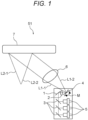
- a display device of a first embodiment (Example 1 of the display device) according to the present technology will be described with reference to Figs. 1 and 2 .
- Fig. 1 is a diagram illustrating a configuration example of the display device of the first embodiment according to the present technology, and specifically, is a diagram illustrating a display device 51.
- the display device 51 includes at least a light source 5, a first hologram (dispersion compensation hologram (dispersion compensation HOE)) 1, and a second hologram (combiner hologram (combiner HOE)) 7.
- the first hologram (dispersion compensation hologram (dispersion compensation HOE)) 1 compensates for dispersion of light emitted from the light source 5 and reflected by a dichroic mirror 3, and diffracts and emits the light as first diffracted light beams L1-1 and L1-2 via a first collimator lens 2 and a MEMS mirror 4 (moving in the direction of arrow M).
- the MEMS mirror 4 also referred to as a scanning mirror
- the first collimator lens 6 collimates the first diffracted light beams L1-1 and L1-2.
- the second hologram (combiner hologram (combiner (HOE)) 7 diffracts the light diffracted with compensated dispersion (first diffracted light beams L1-1 and L1-2) and emits the diffracted light as second diffracted light beams L2-1 and L2-2 in the direction of the user's eye.
- Fig. 2 is a diagram for describing diffraction efficiency in a plane of the first hologram (dispersion compensation hologram) 1 included in the display device (display device 51) of the first embodiment according to the present technology.
- Fig. 2A is a diagram illustrating a configuration example of a distribution of diffraction efficiency in a plane of the dispersion compensation hologram 1, in which a vertical axis (vertical direction in Fig. 2A ) is an adjustment axis of a maximum diffraction efficiency wavelength, and a horizontal axis (horizontal direction in Fig. 2A ) is an adjustment axis of a maximum diffraction efficiency value.
- Fig. 2B is an explanatory diagram for adjusting the diffraction efficiency, in which a vertical axis (vertical direction in Fig. 2B ) indicates the diffraction efficiency and a horizontal axis (horizontal direction in Fig. 2B ) indicates the wavelength.
- Area 1 (high level of diffraction efficiency) illustrated in Fig. 2B corresponds to area 1-A, area 1-B, and area 1-C illustrated in Fig. 2A
- area 2 (medium level of diffraction efficiency) corresponds to area 2-A, area 2-B, and area 2-C illustrated in Fig. 2A
- area 3 low level of diffraction efficiency
- Fig. 2C is an explanatory diagram for adjusting the wavelength of the maximum diffraction efficiency, in which a vertical axis (vertical direction in Fig. 2C ) indicates the diffraction efficiency and a horizontal axis (horizontal direction in Fig. 2C ) indicates the wavelength.
- Area A (short wavelength level) illustrated in Fig. 2C corresponds to area 1-A, area 2-A, and area 3-A illustrated in Fig. 2A
- area B (medium wavelength level) corresponds to area 1-B, area 2-B, and area 3-B illustrated in Fig. 2A
- area C long wavelength level
- the diffraction efficiency is adjusted by changing the position to which light is applied (incident) depending on the luminance and/or the wavelength of light emitted from the light source 5.
- the content described for the display device of the first embodiment (Example 1 of the display device) according to the present technology can be applied to the display devices of the second to fifth embodiments according to the present technology to be described later as long as there is no particular technical inconsistency.
- a display device of a second embodiment (Example 2 of the display device) according to the present technology will be described with reference to Fig. 3 .
- Fig. 3 is a diagram illustrating a configuration example of the display device of the second embodiment according to the present technology, and specifically, is a diagram illustrating a display device 53.
- the display device 53 includes a right-eye display device 53R and a left-eye display device 53L.
- the display device 53R for the right eye includes at least a light source 5R, a first hologram (dispersion compensation hologram (dispersion compensation HOE)) 1R, and a second hologram (combiner hologram (combiner HOE)) 7R.
- the first hologram (dispersion compensation hologram (dispersion compensation (HOE)) 1R compensates for dispersion of light emitted from the light source 5R and reflected by a dichroic mirror 3R, and diffracts and emits the light as first diffracted light beams L1-1R and L1-2R via the first collimator lens 2R and the MEMS mirror 4R.
- the MEMS mirror 4R also referred to as a scanning mirror
- the first collimator lens 6R collimates the first diffracted light beams L1-1R and L1-2R.
- the second hologram (combiner hologram (combiner (HOE)) 7R diffracts the light diffracted with compensated dispersion (first diffracted light beams L1-1R and L1-2R) and emits the diffracted light as second diffracted light beams L2-1R and L2-2R in the direction of the user's eye.
- the display device 53L for the left eye includes at least a light source 5L, a first hologram (dispersion compensation hologram (dispersion compensation HOE)) 1L, and a second hologram (combiner hologram (combiner HOE)) 7L.
- the first hologram (dispersion compensation hologram (dispersion compensation (HOE)) 1L compensates for dispersion of light emitted from the light source 5L and reflected by a dichroic mirror 3L, and diffracts and emits the light as first diffracted light beams L1-1L and L1-2L via the first collimator lens 2L and the MEMS mirror 4L.
- the MEMS mirror 4L also referred to as a scanning mirror
- the first collimator lens 6L collimates the first diffracted light beams L1-1L and L1-2L.
- the second hologram (combiner hologram (combiner (HOE)) 7L diffracts the light diffracted with compensated dispersion (first diffracted light beams L1-1L and L1-2L) and emits the diffracted light as second diffracted light beams L2-1L and L2-2L in the direction of the user's eye.
- the display device 53 it is possible to adjust output light of the second holograms (combiner holograms (combiners (HOE)) 7R and 7L at positions in planes of the first holograms (dispersion compensation holograms (dispersion compensation (HOE)) 1R and 1L to match luminance ratios of both eyes.
- Example 2 of the display device The contents described above for the display device of the second embodiment (Example 2 of the display device) according to the present technology can be applied to the display device of the first embodiment according to the present technology described above and the display devices of the third to fifth embodiments according to the present technology described later, unless there is a particular technical contradiction.
- a display device of a third embodiment (Example 3 of the display device) according to the present technology will be described with reference to Fig. 4 .
- Fig. 4 is a diagram illustrating a configuration example of the display device of the third embodiment according to the present technology, and specifically, is a diagram illustrating a display device 54.
- the display device 54 includes at least the light source 5, the first hologram (dispersion compensation hologram) 1, the second hologram (combiner hologram) 7, a light guide plate 8, and a prism 9.
- the first hologram (dispersion compensation hologram (dispersion compensation HOE)) 1 compensates for dispersion of light emitted from the light source 5 and reflected by the dichroic mirror 3, and diffracts and emits the light as the first diffracted light beams L1-1 and L1-2 via the first collimator lens 2 and the MEMS mirror 4 (moving in the direction of arrow M).
- the MEMS mirror 4 also referred to as a scanning mirror
- the first collimator lens 6 collimates the first diffracted light beams L1-1 and L1-2.
- the first diffracted light beams L1-1 and L1-2 are introduced into the light guide plate 8 via the prism 9, propagate in the light guide plate 8 by total reflection (the first diffracted light beam L1-1 is reflected in the region Q1 and the first diffracted light beam L1-2 is reflected in the region Q2), are emitted to the outside of the light guide plate 8, and are incident on the second hologram (combiner hologram) 7.
- the second hologram (combiner hologram (combiner (HOE)) 7 diffracts the light diffracted with compensated dispersion (first diffracted light beams L1-1 and L1-2) and emits the diffracted light as the second diffracted light beams L2-1 and L2-2 in the direction of the user's eye.
- Example 3 of the display device The contents described above for the display device of the third embodiment (Example 3 of the display device) according to the present technology can be applied to the display devices of the first and second embodiments according to the present technology described above and the display devices of the fourth and fifth embodiments according to the present technology described later, unless there is a particular technical contradiction.
- FIG. 5 is a diagram for describing diffraction efficiency in a plane of a first hologram (dispersion compensation hologram) 15 included in the display device of the fourth embodiment according to the present technology.
- Fig. 5A is a diagram illustrating a configuration example of a distribution of diffraction efficiency in a plane of a dispersion compensation hologram 15A
- Fig. 5B is a diagram illustrating a configuration example of a distribution of diffraction efficiency in a plane of a dispersion compensation hologram 15B
- Fig. 5C is a diagram illustrating a configuration example of a distribution of diffraction efficiency in a plane of a dispersion compensation hologram 15C
- Fig. 5D is a diagram illustrating a configuration example of a distribution of diffraction efficiency in a plane of a dispersion compensation hologram 15D.
- a vertical axis direction (vertical direction in Fig. 5A ) on the left side in the plane of the dispersion compensation hologram 15A is a 1-A region (the above-described area 1 (high intensity) + area A (short wavelength)) and a 3-A region (the above-described area 3 (low intensity) + area A (short wavelength)), and the vertical axis direction (vertical direction in Fig. 5A ) on the right side in the plane of the dispersion compensation hologram 15A is a 2-A region (the above-described area 1 (medium intensity) + area A (short wavelength)) and a 4-A region (area 4 (minimum intensity) + area A (short wave length)).
- a horizontal axis direction (horizontal direction in Fig. 5A ) on the upper side in the plane of the dispersion compensation hologram 15A is the 1-A region (the above-described area 1 (high intensity) + area A (short wavelength)) and the 2-A region (the above-described area 2 (medium intensity) + area A (short wavelength)), and the horizontal axis direction (horizontal direction in Fig. 5A ) on the lower side in the plane of the dispersion compensation hologram 15A is a 3-A region (the above-described area 3 (low intensity) + area A (short wavelength)) and the 4-A region (area 4 (minimum intensity) + area A (short wave length)).
- the vertical axis direction (vertical direction in Fig. 5B ) on the left side in the plane of the dispersion compensation hologram 15B is the 1-A region (the above-described area 1 (high intensity) + area A (short wavelength)) and a 1-C region (the above-described area 1 (high intensity) + area C (long wavelength)), and the vertical axis direction (vertical direction in Fig. 5B ) on the right side in the plane of the dispersion compensation hologram 15B is a 1-B region (the above-described area 1 (medium intensity) + area B (medium wavelength) and a 1-D region (area 1 (high intensity) + area D (longest wavelength)).
- the horizontal axis direction (horizontal direction in Fig. 5B ) on the upper side in the plane of the dispersion compensation hologram 15B is the 1-A region (the above-described area 1 (high intensity) + area A (short wavelength)) and the 1-B region (the above-described area 1 (high intensity) + area B (medium wavelength)), and the horizontal axis direction (horizontal direction in Fig. 5B ) on the lower side in the plane of the dispersion compensation hologram 15B is the 1-C region (the above-described area 1 (high intensity) + area C (long wavelength)) and the 1-D region (area 1 (high intensity) + area D (long wavelength)).
- a region in which the maximum intensity of the diffraction efficiency changes and a region in which the wavelength at which the diffraction efficiency becomes the maximum intensity changes are randomly formed.
- the vertical axis direction (vertical direction in Fig. 5C ) on the left side in the plane of the dispersion compensation hologram 15C is a 2-B region (the above-described area 2 (medium intensity) + area B (medium wavelength)), the 1-B region (the above-described area 1 (high intensity) + area B (medium wavelength)), and the 1-C region (the above-described area 1 (high intensity) + area C (long wavelength)), the vertical axis direction (vertical direction in Fig.
- the 5C in the middle in the plane of the dispersion compensation hologram 15B is a 3-C region (the above-described area 3 (low intensity) + area C (long wavelength)), the 1-A region (the above-described area 1 (high intensity) + area A (short wavelength)), and a 3-B region (the above-described area 3 (low intensity) + area B (medium wavelength)), and the vertical axis direction (vertical direction in Fig.
- the 3-A region (the above-described area 3 (low intensity) + area A (short wavelength)
- a 2-C region (the above-described area 2 (medium intensity) + area C (long wavelength)
- the 2-A region (the above-described area 1 (medium intensity) + area A (short wavelength)).
- the horizontal axis direction (the horizontal direction in Fig. 5C ) on the upper side in the plane of the dispersion compensation hologram 15C is the 2-B region (the above-described area 2 (medium intensity) + area B (medium wavelength)), the 3-C region (the above-described area 3 (low intensity) + area C (long wavelength)), and the 3-A region (the above-described area 3 (low intensity) + area A (short wavelength)), the horizontal axis direction (horizontal direction in Fig.
- the dispersion compensation hologram 15C at the center in the plane of the dispersion compensation hologram 15C is the 1-B region (the above-described area 1 (high intensity) + area B (medium wavelength)), the 1-A region (the above-described area 1 (high intensity) + area A (short wavelength)), and the 2-C region (the above-described area 2 (medium intensity) + area C (long wavelength)), and the horizontal axis direction (horizontal direction in Fig.
- the dispersion compensation hologram 15C on the lower side in the plane of the dispersion compensation hologram 15C is the 1-C region (the above-described area 1 (high intensity) + area C (long wavelength)), the 3-B region (the above-described area 3 (low intensity) + area B (medium wavelength)), and the 2-A region (the above-described area 1 (medium intensity) + area A (short wavelength)) .
- a region in which the maximum intensity of the diffraction efficiency continuously changes is formed in an area on the vertical axis (in the vertical direction of Fig. 15D, the intensity distribution is continuous), and a region in which the wavelength at which the diffraction efficiency becomes the maximum intensity continuously changes is formed in an area on the horizontal axis (the wavelength distribution is continuous in the left-right direction in Fig. 15D).
- a region in which the maximum intensity of the diffraction efficiency discontinuously changes may be formed, and a region in which the wavelength at which the diffraction efficiency becomes the maximum intensity discontinuously changes may be formed.
- a display device of a fifth embodiment (Example 5 of the display device) according to the present technology will be described with reference to Fig. 6 .
- Fig. 6 is a diagram illustrating a configuration example of a display device of a fifth embodiment according to the present technology. Specifically, it is a diagram illustrating a display device 56.
- Fig. 6A is a diagram illustrating the display device 56
- Fig. 6B is an enlarged diagram of a region P6A illustrated in Fig. 6A
- Fig. 6C is an enlarged diagram of the region P6A illustrated in Fig. 6A
- a detection mechanism 60C is an enlarged diagram of the region P6A illustrated in Fig. 6A
- a detection mechanism 60D is an enlarged diagram of the region P6A illustrated in Fig. 6A , and is a diagram illustrating a detection mechanism 60D.
- the display device 56 includes at least the light source 5, the first hologram (dispersion compensation hologram) 1, and the second hologram (combiner hologram) 7.
- the first hologram (dispersion compensation hologram (dispersion compensation HOE)) 1 compensates for dispersion of light emitted from the light source 5 and reflected by the dichroic mirror 3, and diffracts and emits the light as the first diffracted light beams L1-1 and L1-2 via the first collimator lens 2 and the MEMS mirror 4 (moving in the direction of arrow M).
- the MEMS mirror 4 also referred to as a scanning mirror
- the first collimator lens 6 collimates the first diffracted light beams L1-1 and L1-2.
- the second hologram (combiner hologram (combiner (HOE)) 7 diffracts the light diffracted with compensated dispersion (first diffracted light beams L1-1 and L1-2) and emits the diffracted light as the second diffracted light beams L2-1 and L2-2 in the direction of the user's eye.
- the light (for example, red light) emitted from the light source 5R passes through the dichroic mirror 3R and enters a light intensity detector 10B-1
- light (for example, green light) emitted from a light source 5G passes through a dichroic mirror 3G and enters a light intensity detector 10B-2
- light (for example, blue light) emitted from a light source 5B passes through a dichroic mirror 3B and enters a light intensity detector 10B-3
- intensity fluctuations of the light (for example, red light) emitted from the light source 5R, the light (for example, green light) emitted from the light source 5G, and the light (for example, blue light) emitted from the light source 5B can be detected.
- the detection of this intensity variation makes it possible to actively move and adjust the dispersion compensation.
- the light (for example, red light) emitted from the light source 5R is reflected by the dichroic mirror 3R and incident on the first hologram (dispersion compensation hologram) 1, and incident on a light spectral sensitivity detector 10C
- the light (for example, green light) emitted from the light source 5G is reflected by the dichroic mirror 3G and incident on the first hologram (dispersion compensation hologram) 1, and incident on the light spectral sensitivity detector 10C
- the light (for example, blue light) emitted from the light source 5B is reflected by the dichroic mirror 3B and incident on the first hologram (dispersion compensation hologram) 1, and incident on the light spectral sensitivity detector 10C, so that it is possible to detect a variation in light spectral sensitivity (light spectral intensity).
- the dispersion compensation can be actively moved and adjusted.
- a temperature detector 10D-1 is connected to the light source 5R
- a temperature detector 10D-2 is connected to the light source 5G
- a temperature detector 10D-3 is connected to the light source 5B, and temperature fluctuations of the light source 5R, the light source 5G, and the light source 5B can be detected.
- the detection of this temperature variation makes it possible to actively move and adjust the dispersion compensation.
- the present technology can also have the following configurations.
Landscapes
- Physics & Mathematics (AREA)
- General Physics & Mathematics (AREA)
- Optics & Photonics (AREA)
- Holo Graphy (AREA)
Abstract
Description
- The present technology relates to a display device.
- In recent years, attention has been focused on, for example, a technology for superimposing and displaying an image on an external scene such as a real landscape. The technology is also called augmented reality (AR) technology. One of products using this technology is a head mounted display. The head mounted display is used by being worn on the head of a user. In a video (image) display method using the head mounted display, for example, when light from the head mounted display reaches the user's eyes in addition to light from an outside world, the user recognizes a video of the light from the display as if the image were superimposed on an image of the outside world.
- For example,
Patent Document 1 proposes a technology related to what is called a head-up display device that displays a front visual field and display contents from a display device in a superimposed manner via a diffraction grating having optical transparency. - Furthermore, for example,
Patent Document 2 proposes a technology related to a holographic display that enables observation of a good image in which an edge of a virtual image is inconspicuous. -
- Patent Document 1:
Japanese Patent Application Laid-Open No. 1-306814 - Patent Document 2:
Japanese Patent Application Laid-Open No. 6-202037 - However, in the techniques proposed in
Patent Documents - Therefore, the present technology has been made in view of such a situation, and a main object thereof is to provide a display device capable of further improving reliability of the display device with respect to manufacturing variations, wavelength variations of light sources, and active variations (variations due to external factors).
- As a result of intensive studies to achieve the above-described object, the present inventors have surprisingly succeeded in improving further reliability of a display device with respect to manufacturing variations, wavelength variations of light sources, and active variations (variations due to external factors), and have completed the present technology.
- That is, as a first aspect, the present technology provides a display device including
- at least a light source, a first hologram, and a second hologram, in which
- the first hologram compensates for dispersion of light emitted from the light source and diffracts and emits the light,
- the second hologram diffracts the light diffracted with compensated dispersion, and emits the light in a direction of an eye of a user, and
- the first hologram has an intensity distribution of different diffraction efficiency with respect to a wavelength of the light emitted from the light source depending on a position in a plane of the first hologram.
- The display device of the first aspect according to the present technology may further include
- a light guide plate, in which
- the light diffracted with compensated dispersion that has been emitted from the first hologram may be introduced into the light guide plate, propagated through the light guide plate by total reflection, emitted to outside of the light guide plate, and incident on the second hologram.
- The display device of the first aspect according to the present technology may further include
a light intensity detector that detects light intensity of the light emitted from the light source. - The display device of the first aspect according to the present technology may further include
a light spectral sensitivity detector that detects spectral sensitivity of the light emitted from the light source. - The display device of the first aspect according to the present technology may further include
a temperature detector that detects a temperature of the light source. - In the display device of the first aspect according to the present technology,
the first hologram may have an intensity distribution of different diffraction efficiency accompanying a change in wavelength of the light emitted from the light source depending on a position in the plane of the first hologram. - In the display device of the first aspect according to the present technology,
the first hologram may have maximum intensity of different diffraction efficiency with respect to a wavelength of the light emitted from the light source depending on a position in the plane of the first hologram. - In the display device of the first aspect according to the present technology,
the first hologram may have an intensity distribution of different diffraction efficiency accompanying a change in wavelength of the light emitted from the light source depending on a position in the plane of the first hologram, and have maximum intensity of different diffraction efficiency with respect to a wavelength of the light emitted from the light source depending on the position in the plane of the first hologram. - In the display device of the first aspect according to the present technology,
- the first hologram may have, in the plane, a first direction and a second direction substantially perpendicular to the first direction,
- a start point in the first direction and a start point in the second direction may be the same,
- in an area included in the first hologram along the first direction, a region in which a wavelength at which diffraction efficiency becomes maximum intensity changes may be formed, and
- in an area included in the first hologram along the second direction, a region in which the maximum intensity of the diffraction efficiency changes may be formed.
- In the display device of the first aspect according to the present technology,
- the first hologram may have, in the plane, a first direction and a second direction substantially perpendicular to the first direction,
- a start point in the first direction and a start point in the second direction may be the same,
- in an area included in the first hologram along the first direction, a region in which a wavelength at which diffraction efficiency becomes maximum intensity changes in a long wavelength direction may be formed in order from a side of the start point, and
- in an area included in the first hologram along the second direction, a region in which maximum intensity of the diffraction efficiency changes in a direction in which the maximum intensity of the diffraction efficiency is small may be formed in order from the side of the start point.
- In the display device of the first aspect according to the present technology,
- the first hologram may have, in the plane, a first direction and a second direction substantially perpendicular to the first direction,
- a start point in the first direction and a start point in the second direction may be the same,
- in an area included in the first hologram along the first direction, a region in which maximum intensity of diffraction efficiency changes may be formed, and
- in an area included in the first hologram along the second direction, a region in which the maximum intensity of the diffraction efficiency changes may be formed.
- In the display device of the first aspect according to the present technology,
- the first hologram may have, in the plane, a first direction and a second direction substantially perpendicular to the first direction,
- a start point in the first direction and a start point in the second direction may be the same,
- in an area included in the first hologram along the first direction, a region in which a wavelength at which diffraction efficiency becomes maximum intensity changes may be formed, and
- in an area included in the first hologram along the second direction, a region in which the wavelength at which the diffraction efficiency becomes the maximum intensity changes may be formed.
- In the display device of the first aspect according to the present technology,
- the first hologram may have, in the plane, a first direction and a second direction substantially perpendicular to the first direction,
- a start point in the first direction and a start point in the second direction may be the same,
- in an area included in the first hologram along the first direction, a region in which a wavelength at which diffraction efficiency becomes maximum intensity changes and a region in which maximum intensity of diffraction efficiency changes may be randomly formed, and
- in an area included in the first hologram along the second direction, a region in which the wavelength at which the diffraction efficiency becomes the maximum intensity changes and a region in which the maximum intensity of the diffraction efficiency changes may be randomly formed.
- In the display device of the first aspect according to the present technology,
- the first hologram may have, in the plane, a first direction and a second direction substantially perpendicular to the first direction,
- a start point in the first direction and a start point in the second direction may be the same,
- in an area included in the first hologram along the first direction, a region in which maximum intensity of diffraction efficiency continuously changes may be formed, and
- in an area included in the first hologram along the second direction, a region in which a wavelength at which the diffraction efficiency becomes the maximum intensity continuously changes may be formed.
- In the display device of the first aspect according to the present technology,
- the first hologram may have, in the plane, a first direction and a second direction substantially perpendicular to the first direction,
- a start point in the first direction and a start point in the second direction may be the same,
- in an area included in the first hologram along the first direction, a region in which maximum intensity of diffraction efficiency discontinuously changes may be formed, and
- in an area included in the first hologram along the second direction, a region in which a wavelength at which the diffraction efficiency becomes the maximum intensity discontinuously changes may be formed.
- Furthermore, as a second aspect, the present technology provides a display device including
- at least a light source, a first hologram, and a second hologram for each of both eyes of a user, in which
- the first hologram compensates for dispersion of light emitted from the light source and diffracts and emits the light,
- the second hologram diffracts the light diffracted with compensated dispersion, and emits the light in respective directions of the both eyes of the user, and
- the first hologram has an intensity distribution of different diffraction efficiency with respect to a wavelength of the light emitted from the light source depending on a position in a plane of the first hologram.
- The display device of the second aspect according to the present technology may further include
- a light guide plate for each of both eyes of the user, in which
- the light diffracted with compensated dispersion that has been emitted from the first hologram may be introduced into the light guide plate, propagated through the light guide plate by total reflection, emitted to outside of the light guide plate, and incident on the second hologram.
- The display device of the second aspect according to the present technology may further include
a light intensity detector that detects light intensity of the light emitted from the light source for each of both eyes of the user. - The display device of the second aspect according to the present technology may further include
a light spectral sensitivity detector that detects spectral sensitivity of the light emitted from the light source for each of both eyes of the user. - The display device of the second aspect according to the present technology may further include
a temperature detector that detects a temperature of the light source for each of both eyes of the user. - In the display device of the second aspect according to the present technology,
the first hologram may have an intensity distribution of different diffraction efficiency accompanying a change in wavelength of the light emitted from the light source depending on a position in the plane of the first hologram. - In the display device of the second aspect according to the present technology,
the first hologram may have maximum intensity of different diffraction efficiency with respect to a wavelength of the light emitted from the light source depending on a position in the plane of the first hologram. - In the display device of the second aspect according to the present technology,
the first hologram may have an intensity distribution of different diffraction efficiency accompanying a change in wavelength of the light emitted from the light source depending on a position in the plane of the first hologram, and have maximum intensity of different diffraction efficiency with respect to a wavelength of the light emitted from the light source depending on the position in the plane of the first hologram. - In the display device of the second aspect according to the present technology,
- the first hologram may have, in the plane, a first direction and a second direction substantially perpendicular to the first direction,
- a start point in the first direction and a start point in the second direction may be the same,
- in an area included in the first hologram along the first direction, a region in which a wavelength at which diffraction efficiency becomes maximum intensity changes may be formed, and
- in an area included in the first hologram along the second direction, a region in which the maximum intensity of the diffraction efficiency changes may be formed.
- In the display device of the second aspect according to the present technology,
- the first hologram may have, in the plane, a first direction and a second direction substantially perpendicular to the first direction,
- a start point in the first direction and a start point in the second direction may be the same,
- in an area included in the first hologram along the first direction, a region in which a wavelength at which diffraction efficiency becomes maximum intensity changes in a long wavelength direction may be formed in order from a side of the start point, and
- in an area included in the first hologram along the second direction, a region in which maximum intensity of the diffraction efficiency changes in a direction in which the maximum intensity of the diffraction efficiency is small may be formed in order from the side of the start point.
- In the display device of the second aspect according to the present technology,
- the first hologram may have, in the plane, a first direction and a second direction substantially perpendicular to the first direction,
- a start point in the first direction and a start point in the second direction may be the same,
- in an area included in the first hologram along the first direction, a region in which maximum intensity of diffraction efficiency changes may be formed, and
- in an area included in the first hologram along the second direction, a region in which the maximum intensity of the diffraction efficiency changes may be formed.
- In the display device of the second aspect according to the present technology,
- the first hologram may have, in the plane, a first direction and a second direction substantially perpendicular to the first direction,
- a start point in the first direction and a start point in the second direction may be the same,
- in an area included in the first hologram along the first direction, a region in which a wavelength at which diffraction efficiency becomes maximum intensity changes may be formed, and
- in an area included in the first hologram along the second direction, a region in which the wavelength at which the diffraction efficiency becomes the maximum intensity changes may be formed.
- In the display device of the second aspect according to the present technology,
- the first hologram may have, in the plane, a first direction and a second direction substantially perpendicular to the first direction,
- a start point in the first direction and a start point in the second direction may be the same,
- in an area included in the first hologram along the first direction, a region in which a wavelength at which diffraction efficiency becomes maximum intensity changes and a region in which maximum intensity of diffraction efficiency changes may be randomly formed, and
- in an area included in the first hologram along the second direction, a region in which the wavelength at which the diffraction efficiency becomes the maximum intensity changes and a region in which the maximum intensity of the diffraction efficiency changes may be randomly formed.
- In the display device of the second aspect according to the present technology,
- the first hologram may have, in the plane, a first direction and a second direction substantially perpendicular to the first direction,
- a start point in the first direction and a start point in the second direction may be the same,
- in an area included in the first hologram along the first direction, a region in which maximum intensity of diffraction efficiency continuously changes may be formed, and
- in an area included in the first hologram along the second direction, a region in which a wavelength at which the diffraction efficiency becomes the maximum intensity continuously changes may be formed.
- In the display device of the second aspect according to the present technology,
- the first hologram may have, in the plane, a first direction and a second direction substantially perpendicular to the first direction,
- a start point in the first direction and a start point in the second direction may be the same,
- in an area included in the first hologram along the first direction, a region in which maximum intensity of diffraction efficiency discontinuously changes may be formed, and
- in an area included in the first hologram along the second direction, a region in which a wavelength at which the diffraction efficiency becomes the maximum intensity discontinuously changes may be formed.
- According to the present technology, it is possible to further improve the reliability of the display device with respect to manufacturing variations, wavelength variations of light sources, and active variations (variations due to external factors). Note that the effects described here are not necessarily limited, and may be any effect described in the present disclosure.
-
-
Fig. 1 is a diagram illustrating a configuration example of a display device of a first embodiment to which the present technology is applied. -
Fig. 2 is a diagram for describing diffraction efficiency in a plane of a first hologram (wavelength dispersion compensation hologram) included in the display device of the first embodiment to which the present technology is applied. -
Fig. 3 is a diagram illustrating a configuration example of a display device of a second embodiment to which the present technology is applied. -
Fig. 4 is a diagram illustrating a configuration example of a display device of a third embodiment to which the present technology is applied. -
Fig. 5 is a diagram for describing diffraction efficiency in a plane of the first hologram (wavelength dispersion compensation hologram) included in a display device of a fourth embodiment to which the present technology is applied. -
Fig. 6 is a diagram illustrating a configuration example of a display device of a fifth embodiment to which the present technology is applied. - Hereinafter, preferred modes for implementing the present technology will be described. An embodiment hereinafter described illustrates an example of a representative embodiment of the present technology, and the scope of the present technology is not narrowed by this. Note that unless otherwise specified, in the drawings, "upper" means an upper direction or an upper side in the drawings, "lower" means a lower direction or a lower side in the drawings, "left" means a left direction or a left side in the drawings, and "right" means a right direction or a right side in the drawings. Furthermore, in the description using the drawings, the same or equivalent elements or members are designated by the same reference signs, and duplicate descriptions will be omitted unless there is a special circumstance.
- Note that the description will be made in the following order.
- 1. Outline of present technology
- 2. First Embodiment (Example 1 of Display Device)
- 3. Second Embodiment (Example 2 of Display Device)
- 4. Third Embodiment (Example 3 of Display Device)
- 5. Fourth Embodiment (Example 4 of Display Device)
- 6. Fifth Embodiment (Example 5 of Display Device)
- First, an outline of the present technology is described. The present technology relates to a display device.
- In the design of a retina direct drawing display, for example, a total of two holograms of a combiner hologram lens in front of the eyes and a single-pitch hologram for each color to compensate for dispersion are used. In practice, since there are manufacturing variations of holograms, wavelength variations of light sources, active variations (variations due to external factors), and the like, luminance variations may occur in each set (for example, in each production lot). In particular, in a case of binocular vision, the luminance for each eye is different, leading to discomfort.
- Examples of attempts to solve the above include provision of a dimming function for each individual, enormous selection while viewing a combination of a light source and characteristics of a hologram, and the like. However, even in these cases, it is difficult to fill the performance difference between both eyes.
- Furthermore, there is an example of a display device including a hologram for displaying a video and a hologram for suppressing dispersion. In this example, a predetermined half width of each of the two holograms is designed so that luminance in a desired observation range can be sufficiently achieved, and luminance variation due to the observation position of the observer can be suppressed. However, this example does not consider bridging the individual differences in binocular eyewear.
- Moreover, there is an example focusing on a diffraction efficiency distribution of a hologram for displaying an image. In this example, the diffraction efficiency distribution is designed such that the central portion of the hologram is high and the peripheral portion of the hologram is low, and thus it is possible to display an image without making a boundary between the virtual image display unit and non-display unit (image display is ineffective) conspicuous. However, this example also does not consider bridging the individual differences in binocular eyewear.
- The present technology has been made in view of such a situation. In the present technology, there is provided a first hologram (dispersion compensation hologram) in which an intensity distribution of diffraction efficiency varies with respect to a wavelength depending on a position (location) in a plane of the hologram. Specifically, the present technology provides the first hologram (dispersion compensation hologram) in which the intensity distribution of diffraction efficiency varies (changes) accompanying a wavelength change depending on a position (location) in the plane of the hologram, the first hologram (dispersion compensation hologram) in which maximum intensity of diffraction efficiency with respect to a predetermined wavelength changes depending on a position (location) in the plane of the hologram, and the first hologram (dispersion compensation hologram) in which the intensity distribution of diffraction efficiency changes accompanying a wavelength change depending on a position (location) in the plane of the hologram, and the maximum intensity of diffraction efficiency with respect to the predetermined wavelength changes depending on a position (location) in the plane of the hologram.
- Then, according to the present technology, by combining the first hologram (dispersion compensation hologram) and a pair of second holograms (combiner holograms) as targets for dispersion compensation and compensating for dispersion, it is possible to eliminate the dispersion of the diffracted light beam generated by the wavelength distribution of a light source and a luminance difference for each individual, and to reduce discomfort in binocular vision.
- The above description is an outline of the present technology. Hereinafter, preferred embodiments for carrying out the present technology will be specifically described in detail with reference to the drawings.
- A display device of a first embodiment (Example 1 of the display device) according to the present technology will be described with reference to
Figs. 1 and2 . -
Fig. 1 is a diagram illustrating a configuration example of the display device of the first embodiment according to the present technology, and specifically, is a diagram illustrating adisplay device 51. - The
display device 51 includes at least alight source 5, a first hologram (dispersion compensation hologram (dispersion compensation HOE)) 1, and a second hologram (combiner hologram (combiner HOE)) 7. - The first hologram (dispersion compensation hologram (dispersion compensation HOE)) 1 compensates for dispersion of light emitted from the
light source 5 and reflected by adichroic mirror 3, and diffracts and emits the light as first diffracted light beams L1-1 and L1-2 via afirst collimator lens 2 and a MEMS mirror 4 (moving in the direction of arrow M). The MEMS mirror 4 (also referred to as a scanning mirror) two-dimensionally scans the first diffracted light beams (moves in a direction of arrow M). Thefirst collimator lens 6 collimates the first diffracted light beams L1-1 and L1-2. - The second hologram (combiner hologram (combiner (HOE)) 7 diffracts the light diffracted with compensated dispersion (first diffracted light beams L1-1 and L1-2) and emits the diffracted light as second diffracted light beams L2-1 and L2-2 in the direction of the user's eye.
-
Fig. 2 is a diagram for describing diffraction efficiency in a plane of the first hologram (dispersion compensation hologram) 1 included in the display device (display device 51) of the first embodiment according to the present technology. - More specifically,
Fig. 2A is a diagram illustrating a configuration example of a distribution of diffraction efficiency in a plane of thedispersion compensation hologram 1, in which a vertical axis (vertical direction inFig. 2A ) is an adjustment axis of a maximum diffraction efficiency wavelength, and a horizontal axis (horizontal direction inFig. 2A ) is an adjustment axis of a maximum diffraction efficiency value. -
Fig. 2B is an explanatory diagram for adjusting the diffraction efficiency, in which a vertical axis (vertical direction inFig. 2B ) indicates the diffraction efficiency and a horizontal axis (horizontal direction inFig. 2B ) indicates the wavelength. Area 1 (high level of diffraction efficiency) illustrated inFig. 2B corresponds to area 1-A, area 1-B, and area 1-C illustrated inFig. 2A , area 2 (medium level of diffraction efficiency) corresponds to area 2-A, area 2-B, and area 2-C illustrated inFig. 2A , and area 3 (low level of diffraction efficiency) corresponds to area 3-A, area 3-B, and area 2-C illustrated inFig. 2A . -
Fig. 2C is an explanatory diagram for adjusting the wavelength of the maximum diffraction efficiency, in which a vertical axis (vertical direction inFig. 2C ) indicates the diffraction efficiency and a horizontal axis (horizontal direction inFig. 2C ) indicates the wavelength. Area A (short wavelength level) illustrated inFig. 2C corresponds to area 1-A, area 2-A, and area 3-A illustrated inFig. 2A , area B (medium wavelength level) corresponds to area 1-B, area 2-B, and area 3-B illustrated inFig. 2A , and area C (long wavelength level) corresponds to area 1-C, area 2-C, and area 3-C illustrated inFig. 2A . - In the plane of the
dispersion compensation hologram 1, the diffraction efficiency is adjusted by changing the position to which light is applied (incident) depending on the luminance and/or the wavelength of light emitted from thelight source 5. - As described above, the content described for the display device of the first embodiment (Example 1 of the display device) according to the present technology can be applied to the display devices of the second to fifth embodiments according to the present technology to be described later as long as there is no particular technical inconsistency.
- A display device of a second embodiment (Example 2 of the display device) according to the present technology will be described with reference to
Fig. 3 . -
Fig. 3 is a diagram illustrating a configuration example of the display device of the second embodiment according to the present technology, and specifically, is a diagram illustrating adisplay device 53. - The
display device 53 includes a right-eye display device 53R and a left-eye display device 53L. - The
display device 53R for the right eye includes at least alight source 5R, a first hologram (dispersion compensation hologram (dispersion compensation HOE)) 1R, and a second hologram (combiner hologram (combiner HOE)) 7R. - The first hologram (dispersion compensation hologram (dispersion compensation (HOE)) 1R compensates for dispersion of light emitted from the
light source 5R and reflected by adichroic mirror 3R, and diffracts and emits the light as first diffracted light beams L1-1R and L1-2R via thefirst collimator lens 2R and theMEMS mirror 4R. TheMEMS mirror 4R (also referred to as a scanning mirror) two-dimensionally scans the first diffracted light beams (moves in the direction of arrow M). Thefirst collimator lens 6R collimates the first diffracted light beams L1-1R and L1-2R. - The second hologram (combiner hologram (combiner (HOE)) 7R diffracts the light diffracted with compensated dispersion (first diffracted light beams L1-1R and L1-2R) and emits the diffracted light as second diffracted light beams L2-1R and L2-2R in the direction of the user's eye.
- The
display device 53L for the left eye includes at least alight source 5L, a first hologram (dispersion compensation hologram (dispersion compensation HOE)) 1L, and a second hologram (combiner hologram (combiner HOE)) 7L. - The first hologram (dispersion compensation hologram (dispersion compensation (HOE)) 1L compensates for dispersion of light emitted from the
light source 5L and reflected by adichroic mirror 3L, and diffracts and emits the light as first diffracted light beams L1-1L and L1-2L via thefirst collimator lens 2L and theMEMS mirror 4L. TheMEMS mirror 4L (also referred to as a scanning mirror) two-dimensionally scans the first diffracted light beams (moves in the direction of arrow M). Thefirst collimator lens 6L collimates the first diffracted light beams L1-1L and L1-2L. - The second hologram (combiner hologram (combiner (HOE)) 7L diffracts the light diffracted with compensated dispersion (first diffracted light beams L1-1L and L1-2L) and emits the diffracted light as second diffracted light beams L2-1L and L2-2L in the direction of the user's eye.
- With the
display device 53, it is possible to adjust output light of the second holograms (combiner holograms (combiners (HOE)) 7R and 7L at positions in planes of the first holograms (dispersion compensation holograms (dispersion compensation (HOE)) 1R and 1L to match luminance ratios of both eyes. - The contents described above for the display device of the second embodiment (Example 2 of the display device) according to the present technology can be applied to the display device of the first embodiment according to the present technology described above and the display devices of the third to fifth embodiments according to the present technology described later, unless there is a particular technical contradiction.
- A display device of a third embodiment (Example 3 of the display device) according to the present technology will be described with reference to
Fig. 4 . -
Fig. 4 is a diagram illustrating a configuration example of the display device of the third embodiment according to the present technology, and specifically, is a diagram illustrating adisplay device 54. - The
display device 54 includes at least thelight source 5, the first hologram (dispersion compensation hologram) 1, the second hologram (combiner hologram) 7, alight guide plate 8, and aprism 9. - The first hologram (dispersion compensation hologram (dispersion compensation HOE)) 1 compensates for dispersion of light emitted from the
light source 5 and reflected by thedichroic mirror 3, and diffracts and emits the light as the first diffracted light beams L1-1 and L1-2 via thefirst collimator lens 2 and the MEMS mirror 4 (moving in the direction of arrow M). The MEMS mirror 4 (also referred to as a scanning mirror) two-dimensionally scans the first diffracted light beams (moves in the direction of arrow M). Thefirst collimator lens 6 collimates the first diffracted light beams L1-1 and L1-2. - The first diffracted light beams L1-1 and L1-2 are introduced into the
light guide plate 8 via theprism 9, propagate in thelight guide plate 8 by total reflection (the first diffracted light beam L1-1 is reflected in the region Q1 and the first diffracted light beam L1-2 is reflected in the region Q2), are emitted to the outside of thelight guide plate 8, and are incident on the second hologram (combiner hologram) 7. - The second hologram (combiner hologram (combiner (HOE)) 7 diffracts the light diffracted with compensated dispersion (first diffracted light beams L1-1 and L1-2) and emits the diffracted light as the second diffracted light beams L2-1 and L2-2 in the direction of the user's eye.
- The contents described above for the display device of the third embodiment (Example 3 of the display device) according to the present technology can be applied to the display devices of the first and second embodiments according to the present technology described above and the display devices of the fourth and fifth embodiments according to the present technology described later, unless there is a particular technical contradiction.
- A display device of a fourth embodiment (Example 4 of the display device) according to the present technology will be described with reference to
Fig. 5. Fig. 5 is a diagram for describing diffraction efficiency in a plane of a first hologram (dispersion compensation hologram) 15 included in the display device of the fourth embodiment according to the present technology. - More specifically,
Fig. 5A is a diagram illustrating a configuration example of a distribution of diffraction efficiency in a plane of adispersion compensation hologram 15A,Fig. 5B is a diagram illustrating a configuration example of a distribution of diffraction efficiency in a plane of adispersion compensation hologram 15B,Fig. 5C is a diagram illustrating a configuration example of a distribution of diffraction efficiency in a plane of adispersion compensation hologram 15C, andFig. 5D is a diagram illustrating a configuration example of a distribution of diffraction efficiency in a plane of adispersion compensation hologram 15D. - In the plane of the
dispersion compensation hologram 15A illustrated inFig. 5A , a region in which the maximum intensity of the diffraction efficiency changes is formed. - That is, a vertical axis direction (vertical direction in
Fig. 5A ) on the left side in the plane of thedispersion compensation hologram 15A is a 1-A region (the above-described area 1 (high intensity) + area A (short wavelength)) and a 3-A region (the above-described area 3 (low intensity) + area A (short wavelength)), and the vertical axis direction (vertical direction inFig. 5A ) on the right side in the plane of thedispersion compensation hologram 15A is a 2-A region (the above-described area 1 (medium intensity) + area A (short wavelength)) and a 4-A region (area 4 (minimum intensity) + area A (short wave length)). - A horizontal axis direction (horizontal direction in
Fig. 5A ) on the upper side in the plane of thedispersion compensation hologram 15A is the 1-A region (the above-described area 1 (high intensity) + area A (short wavelength)) and the 2-A region (the above-described area 2 (medium intensity) + area A (short wavelength)), and the horizontal axis direction (horizontal direction inFig. 5A ) on the lower side in the plane of thedispersion compensation hologram 15A is a 3-A region (the above-described area 3 (low intensity) + area A (short wavelength)) and the 4-A region (area 4 (minimum intensity) + area A (short wave length)). - In the plane of the
dispersion compensation hologram 15B illustrated inFig. 5B , a region in which the wavelength at which the diffraction efficiency becomes the maximum intensity changes is formed. - That is, the vertical axis direction (vertical direction in
Fig. 5B ) on the left side in the plane of thedispersion compensation hologram 15B is the 1-A region (the above-described area 1 (high intensity) + area A (short wavelength)) and a 1-C region (the above-described area 1 (high intensity) + area C (long wavelength)), and the vertical axis direction (vertical direction inFig. 5B ) on the right side in the plane of thedispersion compensation hologram 15B is a 1-B region (the above-described area 1 (medium intensity) + area B (medium wavelength) and a 1-D region (area 1 (high intensity) + area D (longest wavelength)). - The horizontal axis direction (horizontal direction in
Fig. 5B ) on the upper side in the plane of thedispersion compensation hologram 15B is the 1-A region (the above-described area 1 (high intensity) + area A (short wavelength)) and the 1-B region (the above-described area 1 (high intensity) + area B (medium wavelength)), and the horizontal axis direction (horizontal direction inFig. 5B ) on the lower side in the plane of thedispersion compensation hologram 15B is the 1-C region (the above-described area 1 (high intensity) + area C (long wavelength)) and the 1-D region (area 1 (high intensity) + area D (long wavelength)). - In the plane of the
dispersion compensation hologram 15C illustrated inFig. 5C , a region in which the maximum intensity of the diffraction efficiency changes and a region in which the wavelength at which the diffraction efficiency becomes the maximum intensity changes are randomly formed. - That is, the vertical axis direction (vertical direction in
Fig. 5C ) on the left side in the plane of thedispersion compensation hologram 15C is a 2-B region (the above-described area 2 (medium intensity) + area B (medium wavelength)), the 1-B region (the above-described area 1 (high intensity) + area B (medium wavelength)), and the 1-C region (the above-described area 1 (high intensity) + area C (long wavelength)), the vertical axis direction (vertical direction inFig. 5C ) in the middle in the plane of thedispersion compensation hologram 15B is a 3-C region (the above-described area 3 (low intensity) + area C (long wavelength)), the 1-A region (the above-described area 1 (high intensity) + area A (short wavelength)), and a 3-B region (the above-described area 3 (low intensity) + area B (medium wavelength)), and the vertical axis direction (vertical direction inFig. 5C ) on the right side in the plane of thedispersion compensation hologram 15B is the 3-A region (the above-described area 3 (low intensity) + area A (short wavelength)), a 2-C region (the above-described area 2 (medium intensity) + area C (long wavelength)), and the 2-A region (the above-described area 1 (medium intensity) + area A (short wavelength)). - The horizontal axis direction (the horizontal direction in
Fig. 5C ) on the upper side in the plane of thedispersion compensation hologram 15C is the 2-B region (the above-described area 2 (medium intensity) + area B (medium wavelength)), the 3-C region (the above-described area 3 (low intensity) + area C (long wavelength)), and the 3-A region (the above-described area 3 (low intensity) + area A (short wavelength)), the horizontal axis direction (horizontal direction inFig. 5C ) at the center in the plane of thedispersion compensation hologram 15C is the 1-B region (the above-described area 1 (high intensity) + area B (medium wavelength)), the 1-A region (the above-described area 1 (high intensity) + area A (short wavelength)), and the 2-C region (the above-described area 2 (medium intensity) + area C (long wavelength)), and the horizontal axis direction (horizontal direction inFig. 5C ) on the lower side in the plane of thedispersion compensation hologram 15C is the 1-C region (the above-described area 1 (high intensity) + area C (long wavelength)), the 3-B region (the above-described area 3 (low intensity) + area B (medium wavelength)), and the 2-A region (the above-described area 1 (medium intensity) + area A (short wavelength)) . - In the plane of the
dispersion compensation hologram 15D illustrated inFig. 5D , a region in which the maximum intensity of the diffraction efficiency continuously changes is formed in an area on the vertical axis (in the vertical direction of Fig. 15D, the intensity distribution is continuous), and a region in which the wavelength at which the diffraction efficiency becomes the maximum intensity continuously changes is formed in an area on the horizontal axis (the wavelength distribution is continuous in the left-right direction in Fig. 15D). Note that, although not illustrated, a region in which the maximum intensity of the diffraction efficiency discontinuously changes may be formed, and a region in which the wavelength at which the diffraction efficiency becomes the maximum intensity discontinuously changes may be formed. - The contents described above for the display device of the fourth embodiment (Example 4 of the display device) according to the present technology can be applied to the display devices of the first to third embodiments according to the present technology described above and the display device of the fifth embodiment according to the present technology described later, unless there is a particular technical contradiction.
- A display device of a fifth embodiment (Example 5 of the display device) according to the present technology will be described with reference to
Fig. 6 . -
Fig. 6 is a diagram illustrating a configuration example of a display device of a fifth embodiment according to the present technology. Specifically, it is a diagram illustrating adisplay device 56. - More specifically,
Fig. 6A is a diagram illustrating thedisplay device 56,Fig. 6B is an enlarged diagram of a region P6A illustrated inFig. 6A , and is a diagram illustrating adetection mechanism 60B,Fig. 6C is an enlarged diagram of the region P6A illustrated inFig. 6A , and is a diagram illustrating adetection mechanism 60C, andFig. 6D is an enlarged diagram of the region P6A illustrated inFig. 6A , and is a diagram illustrating adetection mechanism 60D. - The
display device 56 includes at least thelight source 5, the first hologram (dispersion compensation hologram) 1, and the second hologram (combiner hologram) 7. - The first hologram (dispersion compensation hologram (dispersion compensation HOE)) 1 compensates for dispersion of light emitted from the
light source 5 and reflected by thedichroic mirror 3, and diffracts and emits the light as the first diffracted light beams L1-1 and L1-2 via thefirst collimator lens 2 and the MEMS mirror 4 (moving in the direction of arrow M). The MEMS mirror 4 (also referred to as a scanning mirror) two-dimensionally scans the first diffracted light beams (moves in the direction of arrow M). Thefirst collimator lens 6 collimates the first diffracted light beams L1-1 and L1-2. - The second hologram (combiner hologram (combiner (HOE)) 7 diffracts the light diffracted with compensated dispersion (first diffracted light beams L1-1 and L1-2) and emits the diffracted light as the second diffracted light beams L2-1 and L2-2 in the direction of the user's eye.
- In the
detection mechanism 60B, the light (for example, red light) emitted from thelight source 5R passes through thedichroic mirror 3R and enters alight intensity detector 10B-1, light (for example, green light) emitted from alight source 5G passes through adichroic mirror 3G and enters alight intensity detector 10B-2, light (for example, blue light) emitted from alight source 5B passes through adichroic mirror 3B and enters alight intensity detector 10B-3, and intensity fluctuations of the light (for example, red light) emitted from thelight source 5R, the light (for example, green light) emitted from thelight source 5G, and the light (for example, blue light) emitted from thelight source 5B can be detected. The detection of this intensity variation makes it possible to actively move and adjust the dispersion compensation. - In the
detection mechanism 60C, the light (for example, red light) emitted from thelight source 5R is reflected by thedichroic mirror 3R and incident on the first hologram (dispersion compensation hologram) 1, and incident on a lightspectral sensitivity detector 10C, the light (for example, green light) emitted from thelight source 5G is reflected by thedichroic mirror 3G and incident on the first hologram (dispersion compensation hologram) 1, and incident on the lightspectral sensitivity detector 10C, and the light (for example, blue light) emitted from thelight source 5B is reflected by thedichroic mirror 3B and incident on the first hologram (dispersion compensation hologram) 1, and incident on the lightspectral sensitivity detector 10C, so that it is possible to detect a variation in light spectral sensitivity (light spectral intensity). By detecting the variation in the light spectral sensitivity (light spectral intensity), the dispersion compensation can be actively moved and adjusted. - In the
detection mechanism 60D, atemperature detector 10D-1 is connected to thelight source 5R, atemperature detector 10D-2 is connected to thelight source 5G, atemperature detector 10D-3 is connected to thelight source 5B, and temperature fluctuations of thelight source 5R, thelight source 5G, and thelight source 5B can be detected. The detection of this temperature variation makes it possible to actively move and adjust the dispersion compensation. - The contents described above for the display device of the fifth embodiment (Example 5 of the display device) according to the present technology can be applied to the display devices of the first to fourth embodiments according to the present technology described above unless there is a particular technical contradiction.
- Note that the embodiments according to the present technology are not limited to the above-described embodiments, and various modifications can be made without departing from the gist of the present technology.
- Furthermore, effects described in the present specification are merely examples and are not limited, and there may be other effects.
- Furthermore, the present technology can also have the following configurations.
- [1] A display device, including:
- at least a light source, a first hologram, and a second hologram, in which
- the first hologram compensates for dispersion of light emitted from the light source and diffracts and emits the light,
- the second hologram diffracts the light diffracted with compensated dispersion, and emits the light in a direction of an eye of a user, and
- the first hologram has an intensity distribution of different diffraction efficiency with respect to a wavelength of the light emitted from the light source depending on a position in a plane of the first hologram.
- [2] The display device according to [1], further including:
- a light guide plate, in which
- the light diffracted with compensated dispersion that has been emitted from the first hologram is introduced into the light guide plate, propagated through the light guide plate by total reflection, emitted to outside of the light guide plate, and incident on the second hologram.
- [3] The display device according to [1] or [2], further including a light intensity detector that detects light intensity of the light emitted from the light source.
- [4] The display device according to any one of [1] to [3], further including a light spectral sensitivity detector that detects spectral sensitivity of the light emitted from the light source.
- [5] The display device according to any one of [1] to [4], further including a temperature detector that detects a temperature of the light source.
- [6] The display device according to any one of [1] to [5], in which the first hologram has an intensity distribution of different diffraction efficiency accompanying a change in wavelength of the light emitted from the light source depending on a position in the plane of the first hologram.
- [7] The display device according to any one of [1] to [5], in which the first hologram has maximum intensity of different diffraction efficiency with respect to a wavelength of the light emitted from the light source depending on a position in the plane of the first hologram.
- [8] The display device according to any one of [1] to [5], in which the first hologram has an intensity distribution of different diffraction efficiency accompanying a change in wavelength of the light emitted from the light source depending on a position in the plane of the first hologram, and has maximum intensity of different diffraction efficiency with respect to a wavelength of the light emitted from the light source depending on the position in the plane of the first hologram.
- [9] The display device according to any one of [1] to [5], in which
- the first hologram has, in the plane, a first direction and a second direction substantially perpendicular to the first direction,
- a start point in the first direction and a start point in the second direction are the same,
- in an area included in the first hologram along the first direction, a region in which a wavelength at which diffraction efficiency becomes maximum intensity changes is formed, and
- in an area included in the first hologram along the second direction, a region in which the maximum intensity of the diffraction efficiency changes is formed.
- [10] The display device according to any one of [1] to [5], in which
- the first hologram has, in the plane, a first direction and a second direction substantially perpendicular to the first direction,
- a start point in the first direction and a start point in the second direction are the same,
- in an area included in the first hologram along the first direction, a region in which a wavelength at which diffraction efficiency becomes maximum intensity changes in a long wavelength direction is formed in order from a side of the start point, and
- in an area included in the first hologram along the second direction, a region in which maximum intensity of the diffraction efficiency changes in a direction in which the maximum intensity of the diffraction efficiency is small is formed in order from the side of the start point.
- [11] The display device according to any one of [1] to [5], in which
- the first hologram has, in the plane, a first direction and a second direction substantially perpendicular to the first direction,
- a start point in the first direction and a start point in the second direction are the same,
- in an area included in the first hologram along the first direction, a region in which maximum intensity of diffraction efficiency changes is formed, and
- in an area included in the first hologram along the second direction, a region in which the maximum intensity of the diffraction efficiency changes is formed.
- [12] The display device according to any one of [1] to [5], in which
- the first hologram has, in the plane, a first direction and a second direction substantially perpendicular to the first direction,
- a start point in the first direction and a start point in the second direction are the same,
- in an area included in the first hologram along the first direction, a region in which a wavelength at which diffraction efficiency becomes maximum intensity changes is formed, and
- in an area included in the first hologram along the second direction, a region in which the wavelength at which the diffraction efficiency becomes the maximum intensity changes is formed.
- [13] The display device according to any one of [1] to [5], in which
- the first hologram has, in the plane, a first direction and a second direction substantially perpendicular to the first direction,
- a start point in the first direction and a start point in the second direction are the same,
- in an area included in the first hologram along the first direction, a region in which a wavelength at which diffraction efficiency becomes maximum intensity changes and a region in which maximum intensity of diffraction efficiency changes are randomly formed, and
- in an area included in the first hologram along the second direction, a region in which the wavelength at which the diffraction efficiency becomes the maximum intensity changes and a region in which the maximum intensity of the diffraction efficiency changes are randomly formed.
- [14] The display device according to any one of [1] to [5], in which
- the first hologram has, in the plane, a first direction and a second direction substantially perpendicular to the first direction,
- a start point in the first direction and a start point in the second direction are the same,
- in an area included in the first hologram along the first direction, a region in which maximum intensity of diffraction efficiency continuously changes is formed, and
- in an area included in the first hologram along the second direction, a region in which a wavelength at which the diffraction efficiency becomes the maximum intensity continuously changes is formed.
- [15] The display device according to any one of [1] to [5], in which
- the first hologram has, in the plane, a first direction and a second direction substantially perpendicular to the first direction,
- a start point in the first direction and a start point in the second direction are the same,
- in an area included in the first hologram along the first direction, a region in which maximum intensity of diffraction efficiency discontinuously changes is formed, and
- in an area included in the first hologram along the second direction, a region in which a wavelength at which the diffraction efficiency becomes the maximum intensity discontinuously changes is formed.
- [16] A display device, including:
- at least a light source, a first hologram, and a second hologram for each of both eyes of a user, in which
- the first hologram compensates for dispersion of light emitted from the light source and diffracts and emits the light,
- the second hologram diffracts the light diffracted with compensated dispersion, and emits the light in respective directions of the both eyes of the user, and
- the first hologram has an intensity distribution of different diffraction efficiency with respect to a wavelength of the light emitted from the light source depending on a position in a plane of the first hologram.
- [17] The display device according to [16], further including:
- a light guide plate for each of both eyes of the user, in which
- the light diffracted with compensated dispersion that has been emitted from the first hologram is introduced into the light guide plate, propagated through the light guide plate by total reflection, emitted to outside of the light guide plate, and incident on the second hologram.
- [18] The display device according to [16] or [17], further including a light intensity detector that detects light intensity of the light emitted from the light source for each of both eyes of the user.
- [19] The display device according to any one of [16] to [18], further including a light spectral sensitivity detector that detects spectral sensitivity of the light emitted from the light source for each of both eyes of the user.
- [20] The display device according to any one of [16] to [19], further including a temperature detector that detects a temperature of the light source for each of both eyes of the user.
- [21] The display device according to any one of [16] to [20], in which the first hologram has an intensity distribution of different diffraction efficiency accompanying a change in wavelength of the light emitted from the light source depending on a position in the plane of the first hologram.
- [22] The display device according to any one of [16] to [20], in which the first hologram has maximum intensity of different diffraction efficiency with respect to a wavelength of the light emitted from the light source depending on a position in the plane of the first hologram.
- [23] The display device according to any one of [16] to [20], in which the first hologram has an intensity distribution of different diffraction efficiency accompanying a change in wavelength of the light emitted from the light source depending on a position in the plane of the first hologram, and has maximum intensity of different diffraction efficiency with respect to a wavelength of the light emitted from the light source depending on the position in the plane of the first hologram.
- [24] The display device according to any one of [16] to [20], in which
- the first hologram has, in the plane, a first direction and a second direction substantially perpendicular to the first direction,
- a start point in the first direction and a start point in the second direction are the same,
- in an area included in the first hologram along the first direction, a region in which a wavelength at which diffraction efficiency becomes maximum intensity changes is formed, and
- in an area included in the first hologram along the second direction, a region in which the maximum intensity of the diffraction efficiency changes is formed.
- [25] The display device according to any one of [16] to [20], in which
- the first hologram has, in the plane, a first direction and a second direction substantially perpendicular to the first direction,
- a start point in the first direction and a start point in the second direction are the same,
- in an area included in the first hologram along the first direction, a region in which a wavelength at which diffraction efficiency becomes maximum intensity changes in a long wavelength direction is formed in order from a side of the start point, and
- in an area included in the first hologram along the second direction, a region in which maximum intensity of the diffraction efficiency changes in a direction in which the maximum intensity of the diffraction efficiency is small is formed in order from the side of the start point.
- [26] The display device according to any one of [16] to [20], in which
- the first hologram has, in the plane, a first direction and a second direction substantially perpendicular to the first direction,
- a start point in the first direction and a start point in the second direction are the same,
- in an area included in the first hologram along the first direction, a region in which maximum intensity of diffraction efficiency changes is formed, and
- in an area included in the first hologram along the second direction, a region in which the maximum intensity of the diffraction efficiency changes is formed.
- [27] The display device according to any one of [16] to [20], in which
- the first hologram has, in the plane, a first direction and a second direction substantially perpendicular to the first direction,
- a start point in the first direction and a start point in the second direction are the same,
- in an area included in the first hologram along the first direction, a region in which a wavelength at which diffraction efficiency becomes maximum intensity changes is formed, and
- in an area included in the first hologram along the second direction, a region in which the wavelength at which the diffraction efficiency becomes the maximum intensity changes is formed.
- [28] The display device according to any one of [16] to [20], in which
- the first hologram has, in the plane, a first direction and a second direction substantially perpendicular to the first direction,
- a start point in the first direction and a start point in the second direction are the same,
- in an area included in the first hologram along the first direction, a region in which a wavelength at which diffraction efficiency becomes maximum intensity changes and a region in which maximum intensity of diffraction efficiency changes are randomly formed, and
- in an area included in the first hologram along the second direction, a region in which the wavelength at which the diffraction efficiency becomes the maximum intensity changes and a region in which the maximum intensity of the diffraction efficiency changes are randomly formed.
- [29] The display device according to any one of [16] to [20], in which
- the first hologram has, in the plane, a first direction and a second direction substantially perpendicular to the first direction,
- a start point in the first direction and a start point in the second direction are the same,
- in an area included in the first hologram along the first direction, a region in which maximum intensity of diffraction efficiency continuously changes is formed, and
- in an area included in the first hologram along the second direction, a region in which a wavelength at which the diffraction efficiency becomes the maximum intensity continuously changes is formed.
- [30] The display device according to any one of [16] to [20], in which
- the first hologram has, in the plane, a first direction and a second direction substantially perpendicular to the first direction,
- a start point in the first direction and a start point in the second direction are the same,
- in an area included in the first hologram along the first direction, a region in which maximum intensity of diffraction efficiency discontinuously changes is formed, and
- in an area included in the first hologram along the second direction, a region in which a wavelength at which the diffraction efficiency becomes the maximum intensity discontinuously changes is formed.
-
- 1 First hologram (dispersion compensation hologram)
- 2, 2L, 2R First collimator lens
- 3, 3L, 3R Dichroic mirror
- 4, 4L, 4R MEMS mirror
- 5, 5L, 5R Light source
- 6, 6L, 6R Second collimator lens
- 7, 7L, 7R Second hologram (combiner hologram)
- 8 Light guide plate
- 9 Prism
- 51, 53(53L, 53R), 54, 56 Display device
Claims (16)
- A display device, comprising:at least a light source, a first hologram, and a second hologram, whereinthe first hologram compensates for dispersion of light emitted from the light source and diffracts and emits the light,the second hologram diffracts the light diffracted with compensated dispersion, and emits the light in a direction of an eye of a user, andthe first hologram has an intensity distribution of different diffraction efficiency with respect to a wavelength of the light emitted from the light source depending on a position in a plane of the first hologram.
- The display device according to claim 1, further comprising:a light guide plate, whereinthe light diffracted with compensated dispersion that has been emitted from the first hologram is introduced into the light guide plate, propagated through the light guide plate by total reflection, emitted to outside of the light guide plate, and incident on the second hologram.
- The display device according to claim 1, further comprising a light intensity detector that detects light intensity of the light emitted from the light source.
- The display device according to claim 1, further comprising a light spectral sensitivity detector that detects spectral sensitivity of the light emitted from the light source.
- The display device according to claim 1, further comprising a temperature detector that detects a temperature of the light source.
- The display device according to claim 1, wherein the first hologram has an intensity distribution of different diffraction efficiency accompanying a change in wavelength of the light emitted from the light source depending on a position in the plane of the first hologram.
- The display device according to claim 1, wherein the first hologram has maximum intensity of different diffraction efficiency with respect to a wavelength of the light emitted from the light source depending on a position in the plane of the first hologram.
- The display device according to claim 1, wherein the first hologram has an intensity distribution of different diffraction efficiency accompanying a change in wavelength of the light emitted from the light source depending on a position in the plane of the first hologram, and has maximum intensity of different diffraction efficiency with respect to a wavelength of the light emitted from the light source depending on the position in the plane of the first hologram.
- The display device according to claim 1, whereinthe first hologram has, in the plane, a first direction and a second direction substantially perpendicular to the first direction,a start point in the first direction and a start point in the second direction are same,in an area included in the first hologram along the first direction, a region in which a wavelength at which diffraction efficiency becomes maximum intensity changes is formed, andin an area included in the first hologram along the second direction, a region in which the maximum intensity of the diffraction efficiency changes is formed.
- The display device according to claim 1, whereinthe first hologram has, in the plane, a first direction and a second direction substantially perpendicular to the first direction,a start point in the first direction and a start point in the second direction are same,in an area included in the first hologram along the first direction, a region in which a wavelength at which diffraction efficiency becomes maximum intensity changes in a long wavelength direction is formed in order from a side of the start point, andin an area included in the first hologram along the second direction, a region in which maximum intensity of the diffraction efficiency changes in a direction in which the maximum intensity of the diffraction efficiency is small is formed in order from the side of the start point.
- The display device according to claim 1, whereinthe first hologram has, in the plane, a first direction and a second direction substantially perpendicular to the first direction,a start point in the first direction and a start point in the second direction are same,in an area included in the first hologram along the first direction, a region in which maximum intensity of diffraction efficiency changes is formed, andin an area included in the first hologram along the second direction, a region in which the maximum intensity of the diffraction efficiency changes is formed.
- The display device according to claim 1, whereinthe first hologram has, in the plane, a first direction and a second direction substantially perpendicular to the first direction,a start point in the first direction and a start point in the second direction are same,in an area included in the first hologram along the first direction, a region in which a wavelength at which diffraction efficiency becomes maximum intensity changes is formed, andin an area included in the first hologram along the second direction, a region in which the wavelength at which the diffraction efficiency becomes the maximum intensity changes is formed.
- The display device according to claim 1, whereinthe first hologram has, in the plane, a first direction and a second direction substantially perpendicular to the first direction,a start point in the first direction and a start point in the second direction are same,in an area included in the first hologram along the first direction, a region in which a wavelength at which diffraction efficiency becomes maximum intensity changes and a region in which maximum intensity of diffraction efficiency changes are randomly formed, andin an area included in the first hologram along the second direction, a region in which the wavelength at which the diffraction efficiency becomes the maximum intensity changes and a region in which the maximum intensity of the diffraction efficiency changes are randomly formed.
- The display device according to claim 1, whereinthe first hologram has, in the plane, a first direction and a second direction substantially perpendicular to the first direction,a start point in the first direction and a start point in the second direction are same,in an area included in the first hologram along the first direction, a region in which maximum intensity of diffraction efficiency continuously changes is formed, andin an area included in the first hologram along the second direction, a region in which a wavelength at which the diffraction efficiency becomes the maximum intensity continuously changes is formed.
- The display device according to claim 1, whereinthe first hologram has, in the plane, a first direction and a second direction substantially perpendicular to the first direction,a start point in the first direction and a start point in the second direction are same,in an area included in the first hologram along the first direction, a region in which maximum intensity of diffraction efficiency discontinuously changes is formed, andin an area included in the first hologram along the second direction, a region in which a wavelength at which the diffraction efficiency becomes the maximum intensity discontinuously changes is formed.
- A display device, comprising:at least a light source, a first hologram, and a second hologram for each of both eyes of a user, whereinthe first hologram compensates for dispersion of light emitted from the light source and diffracts and emits the light,the second hologram diffracts the light diffracted with compensated dispersion, and emits the light in respective directions of the both eyes of the user, andthe first hologram has an intensity distribution of different diffraction efficiency with respect to a wavelength of the light emitted from the light source depending on a position in a plane of the first hologram.
Applications Claiming Priority (2)
| Application Number | Priority Date | Filing Date | Title |
|---|---|---|---|
| JP2021045853 | 2021-03-19 | ||
| PCT/JP2022/005603 WO2022196204A1 (en) | 2021-03-19 | 2022-02-14 | Display device |
Publications (2)
| Publication Number | Publication Date |
|---|---|
| EP4310580A1 true EP4310580A1 (en) | 2024-01-24 |
| EP4310580A4 EP4310580A4 (en) | 2024-09-04 |
Family
ID=83322221
Family Applications (1)
| Application Number | Title | Priority Date | Filing Date |
|---|---|---|---|
| EP22770963.1A Withdrawn EP4310580A4 (en) | 2021-03-19 | 2022-02-14 | Display device |
Country Status (4)
| Country | Link |
|---|---|
| US (1) | US20240184245A1 (en) |
| EP (1) | EP4310580A4 (en) |
| CN (1) | CN117043662A (en) |
| WO (1) | WO2022196204A1 (en) |
Families Citing this family (1)
| Publication number | Priority date | Publication date | Assignee | Title |
|---|---|---|---|---|
| JP2024145312A (en) * | 2023-03-31 | 2024-10-15 | パナソニックオートモーティブシステムズ株式会社 | Display device |
Family Cites Families (18)
| Publication number | Priority date | Publication date | Assignee | Title |
|---|---|---|---|---|
| JP2585717B2 (en) | 1988-06-03 | 1997-02-26 | キヤノン株式会社 | Display device |
| JPH06202037A (en) | 1992-12-28 | 1994-07-22 | Canon Inc | Holographic display |
| JP3623250B2 (en) * | 1993-06-23 | 2005-02-23 | オリンパス株式会社 | Video display device |
| JP2001519928A (en) * | 1998-01-28 | 2001-10-23 | コーニンクレッカ フィリップス エレクトロニクス エヌ ヴィ | Head mounted display |
| JP3867634B2 (en) * | 2002-07-26 | 2007-01-10 | 株式会社ニコン | Image combiner and image display device |
| JP4810949B2 (en) * | 2005-09-29 | 2011-11-09 | ソニー株式会社 | Optical device and image display device |
| JP5545076B2 (en) * | 2009-07-22 | 2014-07-09 | ソニー株式会社 | Image display device and optical device |
| EP3351996A4 (en) * | 2015-09-16 | 2018-11-14 | Konica Minolta, Inc. | Image display device and head mounted display |
| WO2018031634A1 (en) * | 2016-08-10 | 2018-02-15 | FictionArt, Inc. | Volume phase holographic waveguide for display |
| CN110383117A (en) * | 2017-01-26 | 2019-10-25 | 迪吉伦斯公司 | Plumbing with uniform output illumination |
| FI128551B (en) * | 2017-05-08 | 2020-07-31 | Dispelix Oy | Diffractive grating with variable diffraction efficiency and method for displaying an image |
| FI128376B (en) * | 2017-06-02 | 2020-04-15 | Dispelix Oy | Method of manufacturing a variable efficiency diffractive grating and a diffractive grating |
| US11789265B2 (en) * | 2017-08-18 | 2023-10-17 | A9.Com, Inc. | Waveguide image combiners for augmented reality displays |
| CN111566544B (en) * | 2017-11-06 | 2021-11-19 | 奇跃公司 | Method and system for tunable gradient patterning using shadow mask |
| KR102449658B1 (en) * | 2017-12-19 | 2022-09-29 | 아코니아 홀로그래픽스 엘엘씨 | Optical system with dispersion compensation |
| CN112166372B (en) * | 2018-03-26 | 2024-11-29 | 视瑞尔技术公司 | Display device |
| JP6437172B1 (en) * | 2018-04-02 | 2018-12-12 | 三菱電機株式会社 | Laser equipment |
| JP2020042212A (en) * | 2018-09-12 | 2020-03-19 | ソニー株式会社 | Display device, display control method, and recording medium |
-
2022
- 2022-02-14 WO PCT/JP2022/005603 patent/WO2022196204A1/en not_active Ceased
- 2022-02-14 EP EP22770963.1A patent/EP4310580A4/en not_active Withdrawn
- 2022-02-14 CN CN202280020791.7A patent/CN117043662A/en active Pending
- 2022-02-14 US US18/550,117 patent/US20240184245A1/en active Pending
Also Published As
| Publication number | Publication date |
|---|---|
| US20240184245A1 (en) | 2024-06-06 |
| WO2022196204A1 (en) | 2022-09-22 |
| EP4310580A4 (en) | 2024-09-04 |
| CN117043662A (en) | 2023-11-10 |
Similar Documents
| Publication | Publication Date | Title |
|---|---|---|
| JP7709198B2 (en) | Image Projection System | |
| US11202043B1 (en) | Self-testing display device | |
| EP3794397B1 (en) | Near-eye display having overlapping projector assemblies | |
| JP7185331B2 (en) | How to render light field images for integral imaging light field displays | |
| US10048500B2 (en) | Directionally illuminated waveguide arrangement | |
| JP7185303B2 (en) | Head-mounted Lightfield Display with Integral Imaging and Relay Optics | |
| JP3984907B2 (en) | Image observation system | |
| US9851562B2 (en) | Embedded grating structure | |
| US20180084232A1 (en) | Optical See-Through Head Worn Display | |
| JP6424552B2 (en) | Image display device | |
| JP2019204092A (en) | Methods and systems for displaying stereoscopy with freeform optical system with addressable focus for virtual and augmented reality | |
| JPWO2009066475A1 (en) | Display device | |
| KR20090089412A (en) | Head-mounted display device for creating reconstructions of three-dimensional representations | |
| JP6857197B2 (en) | Dynamic full 3D display | |
| US20220163816A1 (en) | Display apparatus for rendering three-dimensional image and method therefor | |
| US20230418034A1 (en) | Anamorphic directional illumination device | |
| GB2268283A (en) | Stereoscopic optical system | |
| EP4310580A1 (en) | Display device | |
| US20170010467A1 (en) | Hmpd with near eye projection | |
| JP7127415B2 (en) | virtual image display | |
| WO2022064564A1 (en) | Head-mounted display | |
| JP2006003822A (en) | Three-dimensional imaging adaptor | |
| US20240427152A1 (en) | Anamorphic directional illumination device | |
| US20240427161A1 (en) | Anamorphic directional illumination device | |
| JP3469854B2 (en) | 3D display |
Legal Events
| Date | Code | Title | Description |
|---|---|---|---|
| STAA | Information on the status of an ep patent application or granted ep patent |
Free format text: STATUS: THE INTERNATIONAL PUBLICATION HAS BEEN MADE |
|
| PUAI | Public reference made under article 153(3) epc to a published international application that has entered the european phase |
Free format text: ORIGINAL CODE: 0009012 |
|
| STAA | Information on the status of an ep patent application or granted ep patent |
Free format text: STATUS: REQUEST FOR EXAMINATION WAS MADE |
|
| 17P | Request for examination filed |
Effective date: 20231003 |
|
| AK | Designated contracting states |
Kind code of ref document: A1 Designated state(s): AL AT BE BG CH CY CZ DE DK EE ES FI FR GB GR HR HU IE IS IT LI LT LU LV MC MK MT NL NO PL PT RO RS SE SI SK SM TR |
|
| DAV | Request for validation of the european patent (deleted) | ||
| DAX | Request for extension of the european patent (deleted) | ||
| A4 | Supplementary search report drawn up and despatched |
Effective date: 20240806 |
|
| RIC1 | Information provided on ipc code assigned before grant |
Ipc: G02B 27/00 20060101ALI20240731BHEP Ipc: G03H 1/30 20060101ALI20240731BHEP Ipc: G03H 1/22 20060101ALI20240731BHEP Ipc: G02B 27/01 20060101ALI20240731BHEP Ipc: H04N 5/64 20060101ALI20240731BHEP Ipc: G02B 5/32 20060101ALI20240731BHEP Ipc: G02B 5/18 20060101ALI20240731BHEP Ipc: G02B 27/02 20060101AFI20240731BHEP |
|
| STAA | Information on the status of an ep patent application or granted ep patent |
Free format text: STATUS: THE APPLICATION HAS BEEN WITHDRAWN |
|
| 18W | Application withdrawn |
Effective date: 20250925 |