EP4310067A1 - Method for producing organic metal nucleophilic agent and reaction method using organic metal nucleophilic agent - Google Patents
Method for producing organic metal nucleophilic agent and reaction method using organic metal nucleophilic agent Download PDFInfo
- Publication number
- EP4310067A1 EP4310067A1 EP22771541.4A EP22771541A EP4310067A1 EP 4310067 A1 EP4310067 A1 EP 4310067A1 EP 22771541 A EP22771541 A EP 22771541A EP 4310067 A1 EP4310067 A1 EP 4310067A1
- Authority
- EP
- European Patent Office
- Prior art keywords
- compound
- reaction
- organohalide
- group
- metal
- Prior art date
- Legal status (The legal status is an assumption and is not a legal conclusion. Google has not performed a legal analysis and makes no representation as to the accuracy of the status listed.)
- Pending
Links
Images


Classifications
-
- C—CHEMISTRY; METALLURGY
- C07—ORGANIC CHEMISTRY
- C07F—ACYCLIC, CARBOCYCLIC OR HETEROCYCLIC COMPOUNDS CONTAINING ELEMENTS OTHER THAN CARBON, HYDROGEN, HALOGEN, OXYGEN, NITROGEN, SULFUR, SELENIUM OR TELLURIUM
- C07F3/00—Compounds containing elements of Groups 2 or 12 of the Periodic Table
- C07F3/02—Magnesium compounds
-
- C—CHEMISTRY; METALLURGY
- C07—ORGANIC CHEMISTRY
- C07B—GENERAL METHODS OF ORGANIC CHEMISTRY; APPARATUS THEREFOR
- C07B37/00—Reactions without formation or introduction of functional groups containing hetero atoms, involving either the formation of a carbon-to-carbon bond between two carbon atoms not directly linked already or the disconnection of two directly linked carbon atoms
- C07B37/04—Substitution
-
- C—CHEMISTRY; METALLURGY
- C07—ORGANIC CHEMISTRY
- C07B—GENERAL METHODS OF ORGANIC CHEMISTRY; APPARATUS THEREFOR
- C07B49/00—Grignard reactions
-
- C—CHEMISTRY; METALLURGY
- C07—ORGANIC CHEMISTRY
- C07C—ACYCLIC OR CARBOCYCLIC COMPOUNDS
- C07C1/00—Preparation of hydrocarbons from one or more compounds, none of them being a hydrocarbon
- C07C1/32—Preparation of hydrocarbons from one or more compounds, none of them being a hydrocarbon starting from compounds containing hetero-atoms other than or in addition to oxygen or halogen
- C07C1/325—Preparation of hydrocarbons from one or more compounds, none of them being a hydrocarbon starting from compounds containing hetero-atoms other than or in addition to oxygen or halogen the hetero-atom being a metal atom
-
- C—CHEMISTRY; METALLURGY
- C07—ORGANIC CHEMISTRY
- C07C—ACYCLIC OR CARBOCYCLIC COMPOUNDS
- C07C1/00—Preparation of hydrocarbons from one or more compounds, none of them being a hydrocarbon
- C07C1/32—Preparation of hydrocarbons from one or more compounds, none of them being a hydrocarbon starting from compounds containing hetero-atoms other than or in addition to oxygen or halogen
- C07C1/325—Preparation of hydrocarbons from one or more compounds, none of them being a hydrocarbon starting from compounds containing hetero-atoms other than or in addition to oxygen or halogen the hetero-atom being a metal atom
- C07C1/326—Preparation of hydrocarbons from one or more compounds, none of them being a hydrocarbon starting from compounds containing hetero-atoms other than or in addition to oxygen or halogen the hetero-atom being a metal atom the hetero-atom being a magnesium atom
-
- C—CHEMISTRY; METALLURGY
- C07—ORGANIC CHEMISTRY
- C07C—ACYCLIC OR CARBOCYCLIC COMPOUNDS
- C07C17/00—Preparation of halogenated hydrocarbons
- C07C17/26—Preparation of halogenated hydrocarbons by reactions involving an increase in the number of carbon atoms in the skeleton
- C07C17/263—Preparation of halogenated hydrocarbons by reactions involving an increase in the number of carbon atoms in the skeleton by condensation reactions
- C07C17/2632—Preparation of halogenated hydrocarbons by reactions involving an increase in the number of carbon atoms in the skeleton by condensation reactions involving an organo-magnesium compound, e.g. Grignard synthesis
-
- C—CHEMISTRY; METALLURGY
- C07—ORGANIC CHEMISTRY
- C07C—ACYCLIC OR CARBOCYCLIC COMPOUNDS
- C07C209/00—Preparation of compounds containing amino groups bound to a carbon skeleton
- C07C209/68—Preparation of compounds containing amino groups bound to a carbon skeleton from amines, by reactions not involving amino groups, e.g. reduction of unsaturated amines, aromatisation, or substitution of the carbon skeleton
-
- C—CHEMISTRY; METALLURGY
- C07—ORGANIC CHEMISTRY
- C07C—ACYCLIC OR CARBOCYCLIC COMPOUNDS
- C07C29/00—Preparation of compounds having hydroxy or O-metal groups bound to a carbon atom not belonging to a six-membered aromatic ring
- C07C29/36—Preparation of compounds having hydroxy or O-metal groups bound to a carbon atom not belonging to a six-membered aromatic ring increasing the number of carbon atoms by reactions with formation of hydroxy groups, which may occur via intermediates being derivatives of hydroxy, e.g. O-metal
-
- C—CHEMISTRY; METALLURGY
- C07—ORGANIC CHEMISTRY
- C07C—ACYCLIC OR CARBOCYCLIC COMPOUNDS
- C07C29/00—Preparation of compounds having hydroxy or O-metal groups bound to a carbon atom not belonging to a six-membered aromatic ring
- C07C29/36—Preparation of compounds having hydroxy or O-metal groups bound to a carbon atom not belonging to a six-membered aromatic ring increasing the number of carbon atoms by reactions with formation of hydroxy groups, which may occur via intermediates being derivatives of hydroxy, e.g. O-metal
- C07C29/38—Preparation of compounds having hydroxy or O-metal groups bound to a carbon atom not belonging to a six-membered aromatic ring increasing the number of carbon atoms by reactions with formation of hydroxy groups, which may occur via intermediates being derivatives of hydroxy, e.g. O-metal by reaction with aldehydes or ketones
- C07C29/40—Preparation of compounds having hydroxy or O-metal groups bound to a carbon atom not belonging to a six-membered aromatic ring increasing the number of carbon atoms by reactions with formation of hydroxy groups, which may occur via intermediates being derivatives of hydroxy, e.g. O-metal by reaction with aldehydes or ketones with compounds containing carbon-to-metal bonds
-
- C—CHEMISTRY; METALLURGY
- C07—ORGANIC CHEMISTRY
- C07C—ACYCLIC OR CARBOCYCLIC COMPOUNDS
- C07C41/00—Preparation of ethers; Preparation of compounds having groups, groups or groups
- C07C41/01—Preparation of ethers
- C07C41/18—Preparation of ethers by reactions not forming ether-oxygen bonds
- C07C41/30—Preparation of ethers by reactions not forming ether-oxygen bonds by increasing the number of carbon atoms, e.g. by oligomerisation
-
- C—CHEMISTRY; METALLURGY
- C07—ORGANIC CHEMISTRY
- C07C—ACYCLIC OR CARBOCYCLIC COMPOUNDS
- C07C45/00—Preparation of compounds having >C = O groups bound only to carbon or hydrogen atoms; Preparation of chelates of such compounds
- C07C45/44—Preparation of compounds having >C = O groups bound only to carbon or hydrogen atoms; Preparation of chelates of such compounds by reduction and hydrolysis of nitriles
-
- C—CHEMISTRY; METALLURGY
- C07—ORGANIC CHEMISTRY
- C07C—ACYCLIC OR CARBOCYCLIC COMPOUNDS
- C07C45/00—Preparation of compounds having >C = O groups bound only to carbon or hydrogen atoms; Preparation of chelates of such compounds
- C07C45/45—Preparation of compounds having >C = O groups bound only to carbon or hydrogen atoms; Preparation of chelates of such compounds by condensation
- C07C45/455—Preparation of compounds having >C = O groups bound only to carbon or hydrogen atoms; Preparation of chelates of such compounds by condensation with carboxylic acids or their derivatives
-
- C—CHEMISTRY; METALLURGY
- C07—ORGANIC CHEMISTRY
- C07F—ACYCLIC, CARBOCYCLIC OR HETEROCYCLIC COMPOUNDS CONTAINING ELEMENTS OTHER THAN CARBON, HYDROGEN, HALOGEN, OXYGEN, NITROGEN, SULFUR, SELENIUM OR TELLURIUM
- C07F13/00—Compounds containing elements of Groups 7 or 17 of the Periodic Table
-
- C—CHEMISTRY; METALLURGY
- C07—ORGANIC CHEMISTRY
- C07F—ACYCLIC, CARBOCYCLIC OR HETEROCYCLIC COMPOUNDS CONTAINING ELEMENTS OTHER THAN CARBON, HYDROGEN, HALOGEN, OXYGEN, NITROGEN, SULFUR, SELENIUM OR TELLURIUM
- C07F3/00—Compounds containing elements of Groups 2 or 12 of the Periodic Table
-
- C—CHEMISTRY; METALLURGY
- C07—ORGANIC CHEMISTRY
- C07F—ACYCLIC, CARBOCYCLIC OR HETEROCYCLIC COMPOUNDS CONTAINING ELEMENTS OTHER THAN CARBON, HYDROGEN, HALOGEN, OXYGEN, NITROGEN, SULFUR, SELENIUM OR TELLURIUM
- C07F3/00—Compounds containing elements of Groups 2 or 12 of the Periodic Table
- C07F3/04—Calcium compounds
-
- C—CHEMISTRY; METALLURGY
- C07—ORGANIC CHEMISTRY
- C07C—ACYCLIC OR CARBOCYCLIC COMPOUNDS
- C07C2523/00—Catalysts comprising metals or metal oxides or hydroxides, not provided for in group C07C2521/00
- C07C2523/02—Catalysts comprising metals or metal oxides or hydroxides, not provided for in group C07C2521/00 of the alkali- or alkaline earth metals or beryllium
-
- C—CHEMISTRY; METALLURGY
- C07—ORGANIC CHEMISTRY
- C07C—ACYCLIC OR CARBOCYCLIC COMPOUNDS
- C07C2531/00—Catalysts comprising hydrides, coordination complexes or organic compounds
- C07C2531/16—Catalysts comprising hydrides, coordination complexes or organic compounds containing coordination complexes
- C07C2531/24—Phosphines
-
- C—CHEMISTRY; METALLURGY
- C07—ORGANIC CHEMISTRY
- C07C—ACYCLIC OR CARBOCYCLIC COMPOUNDS
- C07C2601/00—Systems containing only non-condensed rings
- C07C2601/12—Systems containing only non-condensed rings with a six-membered ring
- C07C2601/14—The ring being saturated
Definitions
- the present invention relates to a novel method for producing an organometallic nucleophile, the method utilizing a mechanochemical process.
- the invention also relates to a reaction method using an organometallic nucleophile, the method utilizing a mechanochemical process.
- Grignard reagents As the organometallic nucleophiles, for example, Grignard reagents (RMgX) are widely known. Grignard reagents have been one of the most-used carbon nucleophiles in modern organic synthesis since their discovery by Victor Grignard in 1900. In particular, the reaction between a Grignard reagent and a carbonyl compound is a reaction that can be said to be a pioneering carbon-carbon bond forming reaction and is very important in synthesizing alcohols.
- existing methods for producing organometallic nucleophiles such as Grignard reagents and reaction methods using the organometallic nucleophiles have practical problems because they must be performed under strict water-free conditions in inert gases such as nitrogen. Furthermore, these methods are required to use large amounts of organic solvents and have room for improvement from the viewpoint of environmental load reduction.
- the mechanochemical process is a method in which solid raw materials are activated to undergo reaction by applying mechanical energy to the solid raw materials by means of, for example, grinding, shearing, impact, or compression.
- PTL 1 discloses a method for producing a polymer compound having a repeating unit by performing a reaction between functional groups by a mechanochemical effect.
- PTL 2 discloses a method for debrominating an organic bromine compound by mechanochemically processing the organic bromine compound in the presence of an alkali metal hydroxide.
- NPL 1 describes that dechlorination of a mixture of an aryl chloride, magnesium, and n-butylamine by a mechanochemical process using a ball mill involves the formation of an intermediary Grignard reagent.
- NPL 2 describes that a halogenated naphthalene and magnesium are reacted with each other under solvent-free conditions by a mechanochemical process using a ball mill in a glove box to obtain a Grignard reagent.
- this Grignard reagent and a ketone were reacted with each other by a mechanochemical process, an unexpected reaction occurred and only a reaction mixture containing a by-product was obtained.
- NPL 3 describes that fluoronaphthalene, magnesium, and iron chloride are reacted with each other under solvent-free conditions by a mechanochemical process using a ball mill in a glove box.
- the yield of binaphthalene, which is a coupling reaction product is as low as on the order of 20%.
- organometallic nucleophiles such as Grignard reagents are extremely useful for producing various compounds and intermediates and are widely used.
- an organometallic nucleophile it is necessary to create an inert atmosphere using a noble gas or the like in a large-scale hermetically sealed apparatus or to use a large amount of dry organic solvent (anhydrous organic solvent) in order to reduce the influence of oxygen and water (moisture).
- dry organic solvent anhydrous organic solvent
- Grignard reagents while being organometallic nucleophiles with high reactivity, sometimes show low reaction yields depending on the substrate.
- a first object of the present invention is to provide a method for producing an organometallic nucleophile, which uses a reduced amount of organic solvent to reduce environmental load and which does not require the adjustment of an atmosphere or water (moisture) and thus is a simplified means without the use of a large-scale apparatus.
- a second object of the present invention is to provide a reaction method by which reactions between an organometallic nucleophile and various organic electrophiles can be performed by an efficient and simplified means such as a one-pot system and which is advantageous in terms of cost.
- a third object of the present invention is to provide a simplified method for producing an organometallic nucleophile having higher reactivity.
- a target organic nucleophile organomagnesium nucleophile/Grignard reagent, etc.
- the organic nucleophile thus prepared reacts with various electrophiles such as aldehydes and ketones on a one-pot system to provide corresponding products
- the organic nucleophile thus prepared can be applied to various reactions such as a coupling reaction using a Ni catalyst, thereby completing the present invention.
- the present invention provides a method for producing an organometallic nucleophile, a method for producing an alcohol, an addition reaction method, and a coupling method described below.
- a method for producing an organometallic nucleophile including reacting an organohalide and a metal or metal compound with each other by a mechanochemical process in the presence of an ether compound in an amount of 0.5 to 10.0 equivalents relative to 1 equivalent of the organohalide.
- a method for producing an alcohol including reacting an organohalide and a metal or metal compound with each other by a mechanochemical process in the presence of an ether compound in an amount of 0.5 to 10.0 equivalents relative to 1 equivalent of the organohalide to produce an organometallic nucleophile, and further adding an organic carbonyl compound and performing a reaction by the mechanochemical process.
- a method for producing an alcohol including reacting an organohalide, a metal or metal compound, and an organic carbonyl compound with each other by a mechanochemical process in the presence of an ether compound in an amount of 0.5 to 10.0 equivalents relative to 1 equivalent of the organohalide.
- An addition reaction method including reacting an organohalide and a metal or metal compound with each other by a mechanochemical process in the presence of an ether compound in an amount of 0.5 to 10.0 equivalents relative to 1 equivalent of the organohalide to produce an organometallic nucleophile, and further adding an electrophile and performing a reaction by the mechanochemical process.
- An addition reaction method including reacting an organohalide, a metal or metal compound, and an electrophile with each other by a mechanochemical process in the presence of an ether compound in an amount of 0.5 to 10.0 equivalents relative to 1 equivalent of the organohalide.
- a coupling reaction method including reacting an organohalide and a metal or metal compound with each other by a mechanochemical process in the presence of an ether compound in an amount of 0.5 to 10.0 equivalents relative to 1 equivalent of the organohalide to produce an organometallic nucleophile, and further adding a nickel catalyst and a sulfonate ester compound and performing a reaction by the mechanochemical process.
- a coupling reaction method including reacting an organohalide, a metal or metal compound, and a sulfonate ester compound with each other by a mechanochemical process in the presence of a nickel catalyst and an ether compound in an amount of 0.5 to 10.0 equivalents relative to 1 equivalent of the organohalide.
- An addition reaction method including reacting an organohalide and a metal or metal compound with each other by a mechanochemical process in the presence of an ether compound in an amount of 0.5 to 10.0 equivalents relative to 1 equivalent of the organohalide to produce an organometallic nucleophile, and further adding a conjugated enone compound and performing a reaction by the mechanochemical process.
- An addition reaction method including reacting an organohalide, a metal or metal compound, and a conjugated enone compound with each other by a mechanochemical process in the presence of an ether compound in an amount of 0.5 to 10.0 equivalents relative to 1 equivalent of the organohalide.
- a halogenated organometallic compound-ether compound complex including at least a halogenated organometallic compound and an ether compound, in which the complex is represented by formula (A): [R 11 -(MX) p ] q -rE (A) (where R 11 is a p-valent organic group derived from the halogenated organometallic compound, M is a metal derived from the halogenated organometallic compound, X is a halogen, and E is the ether compound; a plurality of R 11 's, M's, X's, or E's, if present, may be the same or different; and p is an integer of 1 or greater, q is a number of 2 or greater, and r is a number greater than 0).
- a method for producing an organometallic nucleophile which uses a reduced amount of organic solvent to reduce environmental load and which does not require the adjustment of an atmosphere or water (moisture) and thus is a simplified means without the use of a large-scale apparatus, is provided.
- a reaction method by which reactions between an organometallic nucleophile and various organic electrophiles can be performed by an efficient and simplified means such as a one-pot system and which is advantageous in terms of cost is provided.
- Embodiment 1 of the present invention is a method for producing an organometallic nucleophile, including reacting an organohalide and a metal or metal compound with each other by a mechanochemical process in the presence of an ether compound in an amount of 0.5 to 10.0 equivalents relative to 1 equivalent of the organohalide.
- Embodiment 2 of the present invention is a method for producing an alcohol, including reacting an organohalide and a metal or metal compound with each other by a mechanochemical process in the presence of an ether compound in an amount of 0.5 to 10.0 equivalents relative to 1 equivalent of the organohalide, and further adding an organic carbonyl compound and performing a reaction by the mechanochemical process.
- Embodiment 3 of the present invention is a method for producing an alcohol, including reacting an organohalide, a metal or metal compound, and an organic carbonyl compound with each other by a mechanochemical process in the presence of an ether compound in an amount of 0.5 to 10.0 equivalents relative to 1 equivalent of the organohalide.
- Embodiment 4 of the present invention is an addition reaction method including reacting reaction components including an organohalide, a metal or metal compound, an electrophile, and an ether compound in an amount of 0.5 to 10.0 equivalents relative to 1 equivalent of the organohalide by a mechanochemical process.
- Embodiment 4-1 of the present invention is an addition reaction method including reacting an organohalide and a metal or metal compound with each other by a mechanochemical process in the presence of an ether compound in an amount of 0.5 to 10.0 equivalents relative to 1 equivalent of the organohalide, and further adding an electrophile and performing a reaction by the mechanochemical process.
- Embodiment 4-2 of the present invention is an addition reaction method including reacting an organohalide, a metal or metal compound, and an electrophile with each other by a mechanochemical process in the presence of an ether compound in an amount of 0.5 to 10.0 equivalents relative to 1 equivalent of the organohalide.
- Embodiment 5 of the present invention is a coupling reaction method including reacting reaction components including an organohalide, a metal or metal compound, a sulfonate ester compound, an ether compound in an amount of 0.5 to 10.0 equivalents relative to 1 equivalent of the organohalide, and a nickel catalyst by a mechanochemical process.
- Embodiment 5-1 of the present invention is a coupling reaction method including reacting an organohalide and a metal or metal compound with each other by a mechanochemical process in the presence of an ether compound in an amount of 0.5 to 10.0 equivalents relative to 1 equivalent of the organohalide, and further adding a nickel catalyst and a sulfonate ester compound and performing a reaction by the mechanochemical process.
- Embodiment 5-2 of the present invention is a coupling reaction method including reacting an organohalide, a metal or metal compound, and a sulfonate ester compound with each other by a mechanochemical process in the presence of a nickel catalyst and an ether compound in an amount of 0.5 to 10.0 equivalents relative to 1 equivalent of the organohalide.
- Embodiment 6 of the present invention is an addition reaction method including reacting reaction components including an organohalide, a metal or metal compound, a conjugated enone compound, and an ether compound in an amount of 0.5 to 10.0 equivalents relative to 1 equivalent of the organohalide by a mechanochemical process.
- Embodiment 6-1 of the present invention is an addition reaction method including reacting an organohalide and a metal or metal compound with each other by a mechanochemical process in the presence of an ether compound in an amount of 0.5 to 10.0 equivalents relative to 1 equivalent of the organohalide, and further adding a conjugated enone compound and performing a reaction by the mechanochemical process.
- Embodiment 6-2 of the present invention is an addition reaction method including reacting an organohalide, a metal or metal compound, and a conjugated enone compound with each other by a mechanochemical process in the presence of an ether compound in an amount of 0.5 to 10.0 equivalents relative to 1 equivalent of the organohalide.
- Embodiment 7 of the present invention is a composition obtained by the method including reacting an organohalide and a metal or metal compound with each other by a mechanochemical process in the presence of an ether compound in an amount of 0.5 to 10.0 equivalents relative to 1 equivalent of the organohalide.
- the composition contains a halogenated organometallic compound and an ether compound, and a content of the ether compound is 0.5 to 10 equivalents relative to 1 equivalent of the halogenated organometallic compound.
- Embodiment 8 of the present invention is a halogenated organometallic compound-ether compound complex including at least a halogenated organometallic compound and an ether compound.
- the complex is represented by formula (A): [R 11 -(MX) p ] q -rE (A) (where R 11 is a p-valent organic group derived from the halogenated organometallic compound, M is a metal derived from the halogenated organometallic compound, X is a halogen, and E is the ether compound; a plurality of R 11 's, M's, X's, or E's, if present, may be the same or different; and p is an integer of 1 or greater, q is a number of 2 or greater, and r is a number greater than 0).
- Embodiment 9 of the present invention is an organometallic nucleophile obtained by reacting an organohalide having a solubility at 20°C in an ether compound of less than 1.0 mol/L and a metal or metal compound with each other by a mechanochemical process in the presence of an ether compound in an amount of 0.5 to 10.0 equivalents relative to 1 equivalent of the organohalide.
- Embodiment 1 of the present invention is a method for producing an organometallic nucleophile, including reacting an organohalide and a metal or metal compound with each other by a mechanochemical process in the presence of an ether compound in an amount of 0.5 to 10.0 equivalents relative to 1 equivalent of the organohalide.
- the organohalide used in the method for producing an organometallic nucleophile according to the present invention is a compound (I) represented by formula (I) below.
- a 1 -X m (I) (In the formula, A 1 represents an optionally substituted m-valent aromatic hydrocarbon group, an optionally substituted m-valent aromatic heterocyclic group, an optionally substituted m-valent aliphatic hydrocarbon group, or an optionally substituted m-valent unsaturated aliphatic hydrocarbon group.
- Each occurrence of X represents F (fluorine), Cl (chlorine), Br (bromine), or I (iodine).
- n is the number of X and represents an integer of 1 or greater.
- a single compound (I) can be used alone, or two or more compounds (I) can be used in combination.
- the number of carbon atoms in the optionally substituted m-valent aromatic hydrocarbon group represented by A 1 is not particularly limited, and is, for example, 6 to 60, preferably 6 to 40, more preferably 6 to 30.
- m is an integer of 1 or greater, for example, 1 to 10, preferably 1 to 6, more preferably 1 to 4.
- examples of m-valent aromatic hydrocarbon groups where m is an integer of 2 or greater include groups obtained by removing (m - 1) hydrogen atoms from aromatic rings in the above monovalent aromatic hydrocarbon groups.
- the number of carbon atoms in the optionally substituted m-valent aromatic heterocyclic group represented by A 1 is not particularly limited, and is, for example, 4 to 60, preferably 4 to 40, more preferably 4 to 30.
- m is an integer of 1 or greater, for example, 1 to 10, preferably 1 to 6, more preferably 1 to 4.
- a pyrrole group a silole group, a borole group, a phosphole group, a selenophene group, a germole group, an indole group, an indene group, a benzosilole group, a benzoborole group, a benzophosphole group, a benzoselenophene group, a benzogermole group, a dibenzosilole group, a dibenzoborole group, a dibenzophosphole group, a dibenzoselenophene group, a dibenzogermole group, a dibenzothiophene 5-oxide group, a 9H-fluoren-9-one group, a dibenzothiophene 5,5-dioxide group, an azabenzothiophene group, an azabenzofuran group, an azaindole group, an azaindene group, an azabenzosilole group
- examples of m-valent aromatic heterocyclic groups where m is an integer of 2 or greater include groups obtained by removing (m - 1) hydrogen atoms from aromatic rings in the above monovalent aromatic heterocyclic groups.
- Another example is a benzo[1,2-c:4,5-c']bis[1,2,5]thiadiazole skeleton (benzobisthiadiazole group) .
- the number of carbon atoms in the optionally substituted m-valent aliphatic hydrocarbon group represented by A 1 is not particularly limited, and is, for example, 1 to 60, preferably 1 to 40, more preferably 1 to 30.
- m is an integer of 1 or greater, for example, 1 to 10, preferably 1 to 6, more preferably 1 to 4.
- examples of m-valent aliphatic hydrocarbon groups where m is an integer of 2 or greater include groups obtained by removing (m - 1) hydrogen atoms from the above monovalent aliphatic hydrocarbon groups.
- the number of carbon atoms in the optionally substituted m-valent unsaturated aliphatic hydrocarbon group represented by A 1 is not particularly limited, and is, for example, 2 to 60, preferably 3 to 40, more preferably 5 to 30.
- m is an integer of 1 or greater, for example, 1 to 10, preferably 1 to 6, more preferably 1 to 4.
- examples of m-valent unsaturated aliphatic hydrocarbon groups where m is an integer of 2 or greater include groups obtained by removing (m - 1) hydrogen atoms from the above monovalent unsaturated aliphatic hydrocarbon groups.
- the optional substituent in the optionally substituted m-valent aromatic hydrocarbon group, the optionally substituted m-valent aromatic heterocyclic group, the optionally substituted m-valent aliphatic hydrocarbon group, or the optionally substituted m-valent unsaturated aliphatic hydrocarbon group represented by A 1 is not particularly limited as long as the intended reaction of the present invention can be performed.
- substituents include one or more selected from the group consisting of alkyl groups having 1 to 24, preferably 1 to 18, more preferably 1 to 12, still more preferably 1 to 8 carbon atoms (e.g., a methyl group, an ethyl group, a n-propyl group, an isopropyl group, a n-butyl group, an isobutyl group, a tert-butyl group, a pentyl group, a hexyl group, and an octyl group); alkoxy groups having 1 to 24, preferably 1 to 18, more preferably 1 to 12, still more preferably 1 to 8 carbon atoms (e.g., a methoxy group, an ethoxy group, a n-propoxy group, an isopropoxy group, a n-butoxy group, an isobutoxy group, a tert-butoxy group, a pentyloxy group, a hexyloxy group, and an oc
- the substituents may be crosslinked with each other, and the whole substituents may form a cyclic structure (an aromatic group). Each substituent may further have a substituent.
- Each occurrence of X represents F (fluorine), Cl (chlorine), Br (bromine), or I (iodine).
- Cl chlorine
- Br bromine
- I iodine
- the number of X in the compound (I) is not particularly limited as long as it is 1 or greater.
- the number of X is, for example, 1 to 6, preferably 1 to 4, more preferably 1 to 3.
- m the number of X in the compound (I), is not particularly limited as long as it is an integer and at least one X can react with the metal or metal compound to form an organometallic nucleophile.
- m is, for example, 1 to 10, preferably 1 to 8, more preferably 1 to 6, still more preferably 1 to 4.
- a 1 in the compound (I) represented by formula (I) include the following groups.
- Naphthyl groups such as a naphthyl group, aryl (e.g., phenyl) naphthyl groups, alkylene-bridged (e.g., ethylene-bridged) naphthyl groups, and arylene-bridged (e.g., phenylene-bridged) naphthyl groups;
- Specific examples of the compound (I) used in a cross-coupling reaction method of the present invention include one or more selected from the group consisting of compounds used in Examples 1 to 150.
- the metal or metal compound is not particularly limited as long as it can react with the organohalide to form an organometallic nucleophile.
- the metal include one or more selected from the group consisting of alkaline-earth metals, alkali metals, transition metals, zinc, aluminum, indium, tin, bismuth, boron, silicon, gallium, germanium, antimony, lead, and rare-earth metals.
- the metal compound include one or more selected from the group consisting of salts of these metals (e.g., chlorides, bromides, iodides, nitrates, sulfates, and carbonates), oxides of these metals, and the like.
- magnesium calcium, strontium, lithium, manganese, palladium, titanium, zinc, aluminum, bismuth, indium, samarium, salts of these metals, oxides of these metals, and the like are preferred.
- the amount of metal used is not particularly limited. Relative to 1 equivalent of the organohalide, the amount of metal is, for example, 0.1 equivalents or more, preferably 0.5 equivalents or more, more preferably 0.7 equivalents or more, and, for example, 10.0 equivalents or less, preferably 5.0 equivalents or less, more preferably 3.0 equivalents or less. If the amount of metal is less than 0.1 equivalents, the reaction may not proceed sufficiently, and the yield may decrease. If the amount of metal is more than 10.0 equivalents, it may be necessary to remove unreacted metal, and the unreacted metal may cause a side reaction.
- the ether compound is a compound having one or more ether bonds (-O-) in a molecule, and is not particularly limited as long as it is a compound inactive in the reaction between the organohalide and the metal or metal compound.
- Examples include one or more selected from the group consisting of diethyl ether, diisopropyl ether, dibutyl ether, t-butyl methyl ether, tetrahydrofuran, tetrahydropyran, dimethoxyethane, 1,4-dioxane, anisole, acetoxy-2-ethoxyethane, propylene glycol monomethyl ether acetate, ethylene glycol dimethyl ether, diethylene glycol dimethyl ether, 1-methoxy-1,1,2,2-tetrafluoroethane, 1-ethoxy-1,1,2,2-tetrafluoroethane, and the like.
- the ether compound may be used as a mixture with, for example, an organic solvent.
- organic solvent examples include one or more selected from the group consisting of aromatic solvents such as benzene, toluene, xylene, mesitylene durene, and decalin; aliphatic solvents such as hexane, pentane, and heptane; alcohol solvents such as methanol, ethanol, n-propanol, isopropanol, 1-butanol, 1,1-dimethylethanol, tert-butanol, 2-methoxyethanol, and ethylene glycol; halogenated hydrocarbon solvents such as dichloromethane, chloroform, carbon tetrachloride, chlorobenzene, and 1,2-dichlorobenzene; polar solvents such as acetonitrile, N,N'-dimethylformamide, N,N'-dimethylacetamide, N-methyl-2-pyrrolidone, and dimethylsulfoxide; pyridine; and the like.
- aromatic solvents such as benz
- the amount of ether compound used is 0.5 to 10.0 equivalents relative to 1 equivalent of the organohalide.
- the amount of ether compound is preferably 0.7 equivalents or more, more preferably 1.0 equivalents or more, still more preferably 1.2 equivalents or more, yet still more preferably 1.5 equivalents or more, and preferably 7.0 equivalents or less, more preferably 5.0 equivalents or less. If the amount of ether compound is less than 0.5 equivalents, the organometallic nucleophile, particularly a Grignard reagent, cannot be efficiently synthesized, and when the organometallic nucleophile is subjected to a subsequent reaction, the reaction may not proceed sufficiently.
- the amount of ether compound is more than 10.0 equivalents, since the ether compound functions substantially as a solvent to make it difficult to apply a mechanochemical action to reaction components, the organometallic nucleophile, particularly a Grignard reagent, cannot be efficiently synthesized, and when the organometallic nucleophile is subjected to a subsequent reaction, the reaction may not proceed sufficiently.
- the mechanochemical process is a processing method in which mechanical energy is applied to a reactant (particularly, a solid reactant) by means of, for example, shearing, compression, stretching, grinding, rubbing, kneading, mixing, dispersion, disintegration, or shaking to thereby activate the reactant and provide structural change, phase transition, reactivity, adsorbability, catalytic activity, etc.
- a reactant particularly, a solid reactant
- This is expected to lead to surface activation, an increase in surface area, an increase in lattice defect, a decrease in crystal grain size, amorphization, etc.
- the device for the mechanochemical process is not particularly limited as long as it is a device capable of applying mechanical energy by the above means.
- Examples of such devices include one or more selected from the group consisting of:
- mills such as ball mills, grinders, mixing devices, and kneaders are preferably used.
- the amount of energy applied when the mechanochemical process is performed is not particularly limited and can be appropriately determined taking into account, for example, the types and amounts of reaction materials and the reaction temperature.
- shaking can be performed at 5 Hz or more, preferably 10 Hz or more, more preferably 20 Hz or more.
- the surfaces of the raw material compounds are activated by absorbing the mechanical energy.
- a chemical reaction occurs between the activated surfaces having energy, leading to a reaction between raw material compound molecules.
- the surfaces of the raw material compounds are abraded and activated (inactive surfaces are removed) upon application of mechanical energy to the raw material compounds.
- reaction conditions of the present invention are not particularly limited as long as the organohalide and the metal or metal compound can react with each other to form an organometallic nucleophile.
- the reaction temperature (the temperature in a reaction vessel during mixing) can be -50°C to 500°C.
- the reaction can be performed at around room temperature (23°C) without heating.
- the inside of the reaction vessel (the reaction system) may be heated to a desired temperature by using a heating device such as a heat gun.
- the method for controlling the reaction temperature to be -50°C to 500°C is not particularly limited, and a temperature control method used in performing a chemical reaction can be used. Examples of such methods include controlling the temperature in the reaction vessel by immersing the reaction vessel in liquid nitrogen or the like, controlling the temperature in the reaction vessel by using warm air, controlling the temperature in the reaction vessel by covering the reaction vessel with a heating medium at a predetermined temperature, and controlling the temperature in the reaction vessel by providing a heating element.
- controlling the temperature in the reaction vessel by applying warm air generated with a heat gun to the reaction vessel is preferred, for example, from the viewpoint of safety and ease of temperature control operation.
- the pressure is not particularly limited, and the reaction can be performed under any pressure.
- a decompression device or a pressurization device can be used.
- the reaction can be performed without pressurization or decompression.
- the reaction atmosphere (the atmosphere in the reaction vessel during mixing) is not particularly limited and can be appropriately determined taking into account, for example, the types and amounts of organohalide and metal and the reaction temperature.
- the reaction can be performed in an air atmosphere without any particular atmosphere adjustment.
- the reaction can also be performed in an inert gas atmosphere such as nitrogen, helium, neon, or argon.
- Grignard reagent which is a typical example of an organometallic nucleophile
- the present invention is advantageous in that it is not necessary to create an inert atmosphere and strict control of oxygen and water is not required.
- reaction time (mixing time; the time period during which processing by a mechanical means is performed) is not particularly limited and can be appropriately determined taking into account, for example, the types and amounts of organohalide and metal and the reaction temperature.
- the reaction time can be 1 minute or more, preferably 3 minutes or more, more preferably 5 minutes or more.
- the upper limit of the reaction time is not particularly limited and can be, for example, 10 hours or less, preferably 5 hours or less, more preferably 3 hours or less.
- the order in which the components, that is, the organohalide, the metal, and the ether compound, are put in the reaction vessel is not particularly limited.
- the means of input is also not particularly limited.
- the resulting reaction product may be purified as needed.
- the purification method is not particularly limited, and, for example, a method such as filtration, distillation, recrystallization, column chromatography, or washing with a solvent is used.
- the reaction vessel provided in a reactor for use in the present invention may be any type of reaction vessel that can be provided in a reactor for compounds, and can be appropriately determined taking into account, for example, the types and amounts of organohalide, metal, ether compound, and reaction product, the reaction temperature, the atmosphere, and the reaction pressure.
- a device that mechanically performs mixing treatment e.g., a ball mill
- a ball mill jar or the like can be used as the reaction vessel.
- the means for stirring the contents in the reaction vessel provided in the reactor of the present invention may be any type of stirring means that can be provided in a reactor for compounds.
- means using the devices that mechanically perform mixing treatment described in ⁇ Mechanochemical process> above can be used.
- a ball mill is preferably used as the device that mechanically performs mixing treatment.
- the temperature control means in the reaction vessel provided in the reactor of the present invention is not particularly limited as long as it is a means that controls the temperature so that a cross-coupling reaction is performed at a temperature of -50°C to 500°C.
- the temperature control means described in (Temperature) in ⁇ Reaction conditions> above can be used.
- the reactor for use in the present invention may further include various means that can be provided in a reactor for compounds, such as a weighing means, a decompression or pressurization means, an atmosphere adjustment means (gas introduction or discharge means), a means of input of components, a means of removal of components and reaction products, a purification means, and an analysis means.
- a reactor for compounds such as a weighing means, a decompression or pressurization means, an atmosphere adjustment means (gas introduction or discharge means), a means of input of components, a means of removal of components and reaction products, a purification means, and an analysis means.
- organometallic nucleophiles produced in Embodiment 1 include various ones. Of these, Grignard reagents (organomagnesium chlorides, organomagnesium bromides, and organomagnesium iodides), organocalcium reagents ("Heacy" Grignard reagents), and organomanganese reagents are particularly preferred.
- Grignard reagents organomagnesium chlorides, organomagnesium bromides, and organomagnesium iodides
- organocalcium reagents (“Heacy" Grignard reagents)
- organomanganese reagents organomanganese reagents
- the present inventors measured the near-edge x-ray absorption fine structure (NEXAFS) at the Mg-K absorption edge and the near-edge x-ray absorption fine structure at the C-K absorption edge of PhMgBr prepared mechanochemically in Example 116 and PhMgBr prepared in solution, and compared the spectra with each other.
- NXAFS near-edge x-ray absorption fine structure
- Embodiment 2 of the present invention is a method for producing an alcohol, including reacting an organohalide and a metal or metal compound with each other by a mechanochemical process in the presence of an ether compound in an amount of 0.5 to 10.0 equivalents relative to 1 equivalent of the organohalide, and further adding an organic carbonyl compound and performing a reaction by the mechanochemical process.
- the organohalide, the metal or metal compound, and the ether compound can be the same as those described in Embodiment 1.
- the conditions of the reaction between the organohalide and the metal or metal compound, and the like can also be the same as those described in Embodiment 1.
- the mechanochemical process and the reactor used in the reaction between the organic carbonyl compound and a reaction product of the organohalide and the metal or metal compound can be the same as those described in Embodiment 1.
- the organic carbonyl compound is not particularly limited as long as it is a compound that has a carbonyl group in a molecule and can undergo a coupling reaction with an organometallic nucleophile (Grignard reagent) to form an alcohol.
- organometallic nucleophile Grignard reagent
- Examples include one or more selected from the group consisting of aldehydes, ketones, esters, ketoesters, acetals, and the like.
- a secondary alcohol When an aldehyde is used, a secondary alcohol can be obtained, and when a ketone or an ester is used, a tertiary alcohol can be produced.
- the amount of organic carbonyl compound used is not particularly limited. Relative to 1 equivalent of the organohalide, the amount of organic carbonyl compound is, for example, 0.1 equivalents or more, preferably 0.2 equivalents or more, more preferably 0.3 equivalents or more, and, for example, 10.0 equivalents or less, preferably 5.0 equivalents or less, more preferably 3.0 equivalents or less. If the amount of organic carbonyl compound is less than 0.1 equivalents or more than 10.0 equivalents, the reaction may not proceed sufficiently, and the yield may decrease. Furthermore, a component present in excess may cause a side reaction with, for example, the reaction product.
- the aldehyde is not particularly limited, and may be, for example, any of aliphatic aldehydes, aromatic aldehydes, heterocyclic aldehydes, and the like. Examples include one or more selected from the group consisting of acetaldehyde, propionaldehyde, butyraldehyde, valeraldehyde, capronaldehyde, cyclohexylaldehyde, isobutyraldehyde, crotonaldehyde, 2-cyclopentenylaldehyde, benzaldehyde, 2-fluorobenzaldehyde, 4-fluorobenzaldehyde, glyoxal, malonaldehyde, succinaldehyde, glutaraldehyde, adipinaldehyde, pimelinaldehyde, sebacinaldehyde, acrolein, salicylaldehyde, phthalaldehyde, furf
- ketone examples include, but are not limited to, one or more selected from the group consisting of compounds in which two groups selected from aliphatic hydrocarbon groups, alicyclic hydrocarbon groups, aromatic hydrocarbon groups, and heterocyclic groups are bonded to carbonyl carbon, compounds in which carbonyl carbon constitutes alicyclic hydrocarbon rings, and the like.
- Examples include one or more selected from the group consisting of benzophenone, acetone, methyl ethyl ketone, methyl isobutyl ketone, cyclohexanone, acetophenone, propiophenone, acetonaphthone, cyclohexanone, cyclopentanone, 1- or 2-indanone, 1- or 2-tetralone, adamantanone, methyl-2-thienyl ketone, methyl-3-thienyl ketone, methyl-2-pyridyl ketone, 2,2'-dithienyl ketone, diethyl ketone, benzil, acetylacetone, methyl isopropyl ketone, ethyl phenyl ketone, fluorenone, indanone, 3,3,5-trimethylcyclohexanone, anthraquinone, acenaphthenequinone, quinone, benzoy
- ester examples include, but are not limited to, alkyl esters of aliphatic carboxylic acids and alkyl esters of aromatic carboxylic acids. Examples include one or more selected from the group consisting of ethyl acetate, butyl acetate, ethyl benzoate, butyl benzoate, and the like.
- the conditions of the reaction between the carbonyl compound and the reaction product of the organohalide and the metal are not particularly limited as long as the carbonyl compound and the reaction product can react with each other to form an alcohol.
- the reaction temperature (the temperature in a reaction vessel during mixing) can be -50°C to 500°C.
- the reaction can be performed at around room temperature (23°C) without heating.
- the inside of the reaction vessel (the reaction system) may be heated to a desired temperature by using a heating device such as a heat gun.
- the method for controlling the reaction temperature to be -50°C to 500°C the method described in (Temperature) in ⁇ Reaction conditions> of Embodiment 1 can be used.
- the pressure is not particularly limited, and the reaction can be performed under any pressure.
- a decompression device or a pressurization device can be used.
- the reaction can be performed without pressurization or decompression.
- the reaction atmosphere (the atmosphere in the reaction vessel during mixing) is not particularly limited and can be appropriately determined taking into account, for example, the types and amounts of organometallic nucleophile and carbonyl compound and the reaction temperature.
- the reaction can be performed in an air atmosphere without any particular atmosphere adjustment.
- the reaction can also be performed in an inert gas atmosphere such as nitrogen, helium, neon, or argon.
- the reaction can be performed in an air atmosphere.
- the reaction time (mixing time; the time period during which processing by mechanical means is performed) is not particularly limited and can be appropriately determined taking into account, for example, the types and amounts of organometallic nucleophile and carbonyl compound and the reaction temperature.
- the reaction time can be 1 minute or more, preferably 3 minutes or more, more preferably 5 minutes or more.
- the upper limit of the reaction time is not particularly limited and can be, for example, 10 hours or less, preferably 5 hours or less, more preferably 3 hours or less.
- the means for putting the carbonyl compound in the reaction vessel is not particularly limited.
- the alcohol obtained as a reaction product can be purified as needed.
- the purification method is not particularly limited, and, for example, a method such as filtration, distillation, recrystallization, column chromatography, or washing with a solvent can be used.
- Embodiment 3 of the present invention is a method for producing an alcohol, including reacting an organohalide, a metal or metal compound, and an organic carbonyl compound with each other by a mechanochemical process in the presence of an ether compound in an amount of 0.5 to 10.0 equivalents relative to 1 equivalent of the organohalide.
- Embodiment 3 of the present invention is a reaction corresponding to what is called the Barbier reaction.
- the organohalide and the ether compound used in Embodiment 3 can be the same as those described in Embodiment 1, and the organic carbonyl compound can be the same as that described in Embodiment 2.
- the mechanochemical process and the reactor used in the reaction of the organohalide, the metal, and the organic carbonyl compound can be the same as those described in Embodiment 1.
- the metal or metal compound is not particularly limited as long as it can form an alcohol when the organohalide, the metal or metal compound, and the organic carbonyl compound are reacted with each other.
- Examples include one or more selected from the group consisting of alkaline-earth metals, alkali metals, transition metals, zinc, aluminum, indium, tin, bismuth, boron, silicon, gallium, germanium, antimony, lead, rare-earth metals, salts of these metals (e.g., chlorides, bromides, iodides, nitrates, sulfates, and carbonates), oxides of these metals, and the like.
- magnesium calcium, strontium, lithium, manganese, palladium, titanium, zinc, aluminum, bismuth, indium, samarium, salts of these metals (e.g., chlorides and iodides), and the like are preferred.
- the amount of metal or metal compound used is, for example, 0.1 equivalents or more, preferably 0.5 equivalents or more, more preferably 0.7 equivalents or more, and, for example, 10.0 equivalents or less, preferably 5.0 equivalents or less, more preferably 3.0 equivalents or less. If the amount of metal or metal compound is less than 0.1 equivalents or more than 10.0 equivalents, the reaction may not proceed sufficiently, and the yield may decrease. Furthermore, a component present in excess may cause a side reaction with, for example, the reaction product.
- the conditions of the reaction between the organohalide, the metal or metal compound, and the organic carbonyl compound are not particularly limited as long as they can react with each other to form an alcohol.
- the reaction temperature (the temperature in a reaction vessel during mixing) can be -50°C to 500°C.
- the reaction can be performed at around room temperature (23°C) without heating.
- the inside of the reaction vessel (the reaction system) may be heated to a desired temperature by using a heating device such as a heat gun.
- the method for controlling the reaction temperature to be -50°C to 500°C the method described in (Temperature) in ⁇ Reaction conditions> of Embodiment 1 can be used.
- the pressure is not particularly limited, and the reaction can be performed under any pressure.
- a decompression device or a pressurization device can be used.
- the reaction can be performed without pressurization or decompression.
- the reaction atmosphere (the atmosphere in the reaction vessel during mixing) is not particularly limited and can be appropriately determined taking into account, for example, the types and amounts of organohalide, metal or metal compound, and carbonyl compound and the reaction temperature.
- the reaction can be performed in an air atmosphere without any particular atmosphere adjustment.
- the reaction can also be performed in an inert gas atmosphere such as nitrogen, helium, neon, or argon.
- the reaction can be performed in an air atmosphere.
- the reaction time (mixing time; the time period during which processing by mechanical means is performed) is not particularly limited and can be appropriately determined taking into account, for example, the types and amounts of organohalide, metal or metal compound, and carbonyl compound and the reaction temperature.
- the reaction time can be 1 minute or more, preferably 3 minutes or more, more preferably 5 minutes or more.
- the upper limit of the reaction time is not particularly limited and can be, for example, 10 hours or less, preferably 5 hours or less, more preferably 3 hours or less.
- the order in which the components, that is, the organohalide, the metal or metal compound, the ether compound, and the carbonyl compound, are put in the reaction vessel is not particularly limited.
- the means of input is also not particularly limited.
- the resulting reaction product may be purified as needed.
- the purification method is not particularly limited, and, for example, a method such as filtration, distillation, recrystallization, column chromatography, or washing with a solvent is used.
- Embodiment 4 of the present invention is an addition reaction method including reacting reaction components including an organohalide, a metal or metal compound, an electrophile, and an ether compound in an amount of 0.5 to 10.0 equivalents relative to 1 equivalent of the organohalide by a mechanochemical process.
- Embodiment 4-1 of the present invention relates to an addition reaction method including reacting an organohalide and a metal or metal compound with each other by a mechanochemical process in the presence of an ether compound in an amount of 0.5 to 10.0 equivalents relative to 1 equivalent of the organohalide, and further adding an electrophile and performing a reaction by the mechanochemical process.
- Embodiment 4-2 of the present invention relates to an addition reaction method including reacting an organohalide, a metal or metal compound, and an electrophile with each other by a mechanochemical process in the presence of an ether compound in an amount of 0.5 to 10.0 equivalents relative to 1 equivalent of the organohalide.
- the organohalide, the metal, and the ether compound can be the same as those described in Embodiment 1.
- the conditions of the reaction between the organohalide and the metal or metal compound, and the like can also be the same as those described in Embodiment 1.
- the mechanochemical process and the reactor used in the reaction between the electrophile and a reaction product of the organohalide and the metal or metal compound can be the same as those described in Embodiment 1.
- the electrophile is, for example, one or more selected from the group consisting of compounds having functional groups such as a ketone group, an aldehyde group, a carboxylic acid amide group, a carboxylic acid ester group, a halogen group, a cyano group, a silane halide group, a phosphorus halide (pentavalent) group, a phosphorus halide (trivalent) group, a boron halide group, a group having a boron-oxygen bond, a metal halide group, a heterosilyl group, an imino group, an acyl halide group, an epoxy group, a disulfide group, carbon dioxide (CO 2 ), a carboxylic anhydride, an imidoyl halide group, and an aziridine group, and is not particularly limited as long as it is a compound that can react with an organometallic nucleophile (Grignard reagent).
- the electrophiles as compounds having a ketone group, an aldehyde group, and a carboxylic acid ester group, the carbonyl compounds described in Embodiment 2 can be used.
- examples of compounds having a carboxylic acid amide group include compounds obtained by reacting a carboxylic acid such as acetic acid, propionic acid, or benzoic acid with an amine and having a corresponding carboxylic acid amide group.
- examples of compounds having a halogen group include the organohalides listed in Embodiment 1, silane compounds having a total of three alkyl and aryl groups and one halogen group, phosphorus compounds (divalent and pentavalent) having a total of two alkyl and aryl groups and one halogen group, boron compounds having a total of three alkyl and aryl groups and one halogen group, and transition metal complexes having a halogen group (e.g., complexes having a structure containing nickel(II) halide, palladium(II) halide, platinum(II) halide, cobalt(I or III) halide, rhodium(I or III) halide, iridium(I or III) halide, copper(I) halide, silver(I) halide, gold(I) halide, iron(II) ⁇ (III) halide, ruthenium(II
- the amount of electrophile used is not particularly limited. Relative to 1 equivalent of the organohalide, the amount of electrophile is, for example, 0.1 equivalents or more, preferably 0.2 equivalents or more, more preferably 0.3 equivalents or more, and, for example, 10.0 equivalents or less, preferably 5.0 equivalents or less, more preferably 3.0 equivalents or less. If the amount of electrophile is less than 0.1 equivalents or more than 10.0 equivalents, the reaction may not proceed sufficiently, and the yield may decrease. Furthermore, a component present in excess may cause a side reaction with, for example, the reaction product.
- the conditions of the reaction between the electrophile and the reaction product of the organohalide and the metal are not particularly limited as long as the electrophile and the reaction product can react with each other to form a product.
- the reaction temperature (the temperature in a reaction vessel during mixing) can be -50°C to 500°C.
- the reaction can be performed at around room temperature (23°C) without heating.
- the inside of the reaction vessel (the reaction system) may be heated to a desired temperature by using a heating device such as a heat gun.
- the method for controlling the reaction temperature to be -50°C to 500°C the method described in (Temperature) in ⁇ Reaction conditions> of Embodiment 1 can be used.
- the pressure is not particularly limited, and the reaction can be performed under any pressure.
- a decompression device or a pressurization device can be used.
- the reaction can be performed without pressurization or decompression.
- the reaction atmosphere (the atmosphere in the reaction vessel during mixing) is not particularly limited and can be appropriately determined taking into account, for example, the types and amounts of organometallic nucleophile and electrophile and the reaction temperature.
- the reaction can be performed in an air atmosphere without any particular atmosphere adjustment.
- the reaction can also be performed in an inert gas atmosphere such as nitrogen, helium, neon, or argon.
- the reaction can be performed in an air atmosphere.
- the reaction time (mixing time; the time period during which processing by mechanical means is performed) is not particularly limited and can be appropriately determined taking into account, for example, the types and amounts of organometallic nucleophile and electrophile and the reaction temperature.
- the reaction time can be 1 minute or more, preferably 3 minutes or more, more preferably 5 minutes or more.
- the upper limit of the reaction time is not particularly limited and can be, for example, 10 hours or less, preferably 5 hours or less, more preferably 3 hours or less.
- the means for putting the electrophile in the reaction vessel is not particularly limited.
- the resulting reaction product may be purified as needed.
- the purification method is not particularly limited, and, for example, a method such as filtration, distillation, recrystallization, column chromatography, or washing with a solvent is used.
- a compound having a halogen group is used as the electrophile
- a compound in which the halogen group is substituted with an organic group (e.g., an aliphatic hydrocarbon group or an aromatic hydrocarbon group) in the organometallic nucleophile can be obtained.
- Embodiment 5 of the present invention is a coupling reaction method including reacting reaction components including an organohalide, a metal or metal compound, a sulfonate ester compound, an ether compound in an amount of 0.5 to 10.0 equivalents relative to 1 equivalent of the organohalide, and a nickel catalyst by a mechanochemical process.
- Embodiment 5-1 of the present invention is a coupling reaction method including reacting an organohalide and a metal or metal compound with each other by a mechanochemical process in the presence of an ether compound in an amount of 0.5 to 10.0 equivalents relative to 1 equivalent of the organohalide, and further adding a nickel catalyst and a sulfonate ester compound and performing a reaction by the mechanochemical process.
- Embodiment 5-2 of the present invention is a coupling reaction method including reacting an organohalide, a metal or metal compound, and a sulfonate ester compound with each other by a mechanochemical process in the presence of a nickel catalyst and an ether compound in an amount of 0.5 to 10.0 equivalents relative to 1 equivalent of the organohalide.
- Embodiment 5 of the present invention is a reaction corresponding to what is called the Kumada-Tamao-Corriu coupling reaction.
- the organohalide, the metal, and the ether compound can be the same as those described in Embodiment 1.
- the conditions of the reaction between the organohalide and the metal or metal compound, and the like can also be the same as those described in Embodiment 1.
- the mechanochemical process and the reactor used in the reaction between the sulfonate ester compound and a reaction product of the organohalide and the metal or metal compound in the presence of the nickel catalyst can be the same as those described in Embodiment 1.
- the nickel catalyst is not particularly limited as long as it can catalyze the reaction between an organometallic nucleophile and the sulfonate ester compound.
- Examples include one or more selected from the group consisting of nickel(II) chloride, nickel(II) bromide, nickel(II) iodide, nickel(II) nitrate, nickel(II) acetate, nickel(II) sulfate, nickel(II) carbonate, nickel formate, nickel acetate, nickel(II) acetylacetonate, dichloro[bis(triphenylphosphine)]nickel(II) [Ni(PPh 3 )2Cl 2 ], dibromo[bis(triphenylphosphine)]nickel(II) [Ni(PPh 3 )2Br 2 ], dichloro[bis(diphenylphosphino)methane]nickel(II) [Ni(dppm)Cl 2
- the amount of nickel catalyst used is not particularly limited. Relative to 1 equivalent of the organohalide, the amount of nickel catalyst is, for example, 1.0 ⁇ 10 -3 equivalents or more, preferably 0.01 equivalents or more, more preferably 0.1 equivalents or more, and, for example, 3.0 equivalents or less, preferably 2.0 equivalents or less, more preferably 1.0 equivalents or less, still more preferably 0.5 equivalents or less. If the amount of nickel catalyst is less than 1.0 ⁇ 10 -3 equivalents or more than 3.0 equivalents, the reaction may not proceed smoothly.
- the sulfonate ester compound is not particularly limited as long as it undergoes a coupling reaction (Kumada-Tamao-Corriu coupling reaction) with the organometallic nucleophile in the presence of the nickel catalyst.
- Examples include one or more selected from the group consisting of C1 to C10 alkyl esters, C6 to C20 aryl esters, C6 to C20 heteroaryl esters, C3 to C10 cycloalkyl esters, and the like of arenesulfonic acids such as p-toluenesulfonic acid, benzenesulfonic acid, and naphthalenesulfonic acid.
- the amount of sulfonate ester compound used is not particularly limited. Relative to 1 equivalent of the organohalide, the amount of sulfonate ester compound is, for example, 0.1 equivalents or more, preferably 0.2 equivalents or more, more preferably 0.3 equivalents or more, and, for example, 10.0 equivalents or less, preferably 5.0 equivalents or less, more preferably 3.0 equivalents or less. If the amount of sulfonate ester compound is less than 0.1 equivalents or more than 10.0 equivalents, the reaction may not proceed sufficiently, and the yield may decrease. Furthermore, a component present in excess may cause a side reaction with, for example, the reaction product.
- the conditions of the reaction between the sulfonate ester compound and the reaction product of the organohalide and the metal in the presence of the nickel catalyst are not particularly limited as long as the sulfonate ester compound and the reaction product can react with each other to form a product.
- the reaction temperature (the temperature in a reaction vessel during mixing) can be -50°C to 500°C.
- the reaction can be performed at around room temperature (23°C) without heating.
- the inside of the reaction vessel (the reaction system) may be heated to a desired temperature by using a heating device such as a heat gun.
- the method for controlling the reaction temperature to be -50°C to 500°C the method described in (Temperature) in ⁇ Reaction conditions> of Embodiment 1 can be used.
- the pressure is not particularly limited, and the reaction can be performed under any pressure.
- a decompression device or a pressurization device can be used.
- the reaction can be performed without pressurization or decompression.
- the reaction atmosphere (the atmosphere in the reaction vessel during mixing) is not particularly limited and can be appropriately determined taking into account, for example, the types and amounts of organometallic nucleophile and sulfonate ester compound and the reaction temperature.
- the reaction can be performed in an air atmosphere without any particular atmosphere adjustment.
- the reaction can also be performed in an inert gas atmosphere such as nitrogen, helium, neon, or argon.
- the reaction can be performed in an air atmosphere.
- reaction time (mixing time; the time period during which processing by mechanical means is performed) is not particularly limited and can be appropriately determined taking into account, for example, the types and amounts of organometallic nucleophile and sulfonate ester compound and the reaction temperature.
- the reaction time can be 1 minute or more, preferably 3 minutes or more, more preferably 5 minutes or more.
- the upper limit of the reaction time is not particularly limited and can be, for example, 10 hours or less, preferably 5 hours or less, more preferably 3 hours or less.
- the means for putting the electrophile in the reaction vessel is not particularly limited.
- the resulting reaction product may be purified as needed.
- the purification method is not particularly limited, and, for example, a method such as filtration, distillation, recrystallization, column chromatography, or washing with a solvent is used.
- Embodiment 6 of the present invention is an addition reaction method including reacting reaction components including an organohalide, a metal or metal compound, a conjugated enone compound, and an ether compound in an amount of 0.5 to 10.0 equivalents relative to 1 equivalent of the organohalide by a mechanochemical process.
- Embodiment 6-1 of the present invention is an addition reaction method including reacting an organohalide and a metal or metal compound with each other by a mechanochemical process in the presence of an ether compound in an amount of 0.5 to 10.0 equivalents relative to 1 equivalent of the organohalide, and further adding a conjugated enone compound and performing a reaction by the mechanochemical process.
- Embodiment 6-2 of the present invention is an addition reaction method including reacting an organohalide, a metal or metal compound, and a conjugated enone compound with each other by a mechanochemical process in the presence of an ether compound in an amount of 0.5 to 10.0 equivalents relative to 1 equivalent of the organohalide.
- the organohalide, the metal or metal compound, and the ether compound can be the same as those described in Embodiment 1.
- the conditions of the reaction between the organohalide and the metal or metal compound, and the like can also be the same as those described in Embodiment 1.
- the mechanochemical process and the reactor used in the reaction between the conjugated enone compound and a reaction product of the organohalide and the metal or metal compound can be the same as those described in Embodiment 1.
- Examples of the conjugated enone compound include one or more selected from the group consisting of methyl vinyl ketone, 2-cyclohexen-1-one, 2-cyclopenten-1-one, 2-cyclohepten-1-one, 1-phenyl-2-buten-1-one, 5-methyl-3-hexen-2-one, 3-nonen-2-one, benzylideneacetone, 5,6-dihydro-2H-pyran-2-one, 3-buten-2-one, 3-nonen-2-one, 1,3-diphenyl-2-propen-1-one, 3-phenyl-2-propenal, acrylaldehyde, and the like.
- the amount of conjugated enone compound used is not particularly limited. Relative to 1 equivalent of the organohalide, the amount of conjugated enone compound is, for example, 0.1 equivalents or more, preferably 0.2 equivalents or more, more preferably 0.3 equivalents or more, and, for example, 10.0 equivalents or less, preferably 5.0 equivalents or less, more preferably 3.0 equivalents or less. If the amount of conjugated enone compound is less than 0.1 equivalents or more than 10.0 equivalents, the reaction may not proceed sufficiently, and the yield may decrease. Furthermore, a component present in excess may cause a side reaction with, for example, the reaction product.
- Embodiment 7 of the present invention is a composition obtained by the method including reacting an organohalide and a metal or metal compound with each other by a mechanochemical process in the presence of an ether compound in an amount of 0.5 to 10.0 equivalents relative to 1 equivalent of the organohalide.
- the composition contains a halogenated organometallic compound and an ether compound, and a content of the ether compound is 0.5 to 10 equivalents relative to 1 equivalent of the halogenated organometallic compound.
- the organohalide, the metal or metal compound, and the ether compound used in Embodiment 7 may be, for example, the same as those described in Embodiment 1.
- the mechanochemical process and the reactor used in the reaction can also be the same as those described in Embodiment 1.
- composition according to Embodiment 7 is obtained, for example, as a muddy mixture (slurry) by the method including reacting an organohalide and a metal or metal compound with each other by a mechanochemical process in the presence of an ether compound in an amount of 0.5 to 10.0 equivalents relative to 1 equivalent of the organohalide.
- composition according to Embodiment 7 of the present invention includes a slurry-like composition with low solvent content and is advantageous in terms of, for example, handleability and reaction efficiency.
- Embodiment 8 of the present invention is a halogenated organometallic compound-ether compound complex including at least a halogenated organometallic compound and an ether compound.
- the complex is represented by formula (A): [R 11 -(MX) p ] q -rE (A) (where R 11 is a p-valent organic group derived from the halogenated organometallic compound, M is a metal derived from the halogenated organometallic compound, X is a halogen, and E is the ether compound; a plurality of R 11' s, M's, X's, or E's, if present, may be the same or different; and p is an integer of 1 or greater, q is a number of 2 or greater, and r is a number greater than 0).
- a 11 in formula (A) represents the same group as A 1 in formula (I) relating to the organohalide described in Embodiment 1, that is, an optionally substituted m-valent aromatic hydrocarbon group, an optionally substituted m-valent aromatic heterocyclic group, an optionally substituted m-valent aliphatic hydrocarbon group, or an optionally substituted m-valent unsaturated aliphatic hydrocarbon group. Specific examples of the group are the same as those described in Embodiment 1.
- M in formula (A) is the same as the metal or the metal constituting the metal compound described in Embodiment 1.
- Each occurrence of X in formula (A) represents F (fluorine), Cl (chlorine), Br (bromine), or I (iodine).
- E in formula (A) is an ether compound coordinated to the halogenated organometallic compound and may be, for example, the ether compound described in Embodiment 1.
- p in formula (A) represents the number of halogenated metal groups in the halogenated organometallic compound, and is an integer of 1 or greater, preferably an integer of 1 to 6, more preferably an integer of 1 to 3.
- q in formula (A) is the quantity of halogenated organometallic compounds constituting the complex
- r in formula (A) is the quantity of ether compounds constituting the complex (the number of ether compounds coordinated to the halogenated organometallic compound).
- q is, for example, 1 or greater, preferably 2 or greater, more preferably 2 to 12.
- r is a number greater than 0, for example, 0.5 or greater, and is preferably 1 or greater, more preferably an integer of 2 to 12.
- the halogenated organometallic compound-ether compound complex can be easily obtained also by using other methods.
- Example 116 an ether compound (tetrahydrofuran; THF) in an amount of 2.0 equivalents relative to 1 equivalent of an organohalide (bromobenzene) is added in the reaction system.
- THF tetrahydrofuran
- organohalide bromobenzene
- the most stable [PhMgBr] 4 isomer was found to have a cubic structure.
- the THF molecules were additionally coordinated to the Mg atoms, and this coordination eventually induced Mg-Br bond scission in the cubic structure. This shows that the coordination of the THF molecules transformed the cubic structure into more open structures.
- Embodiment 9 of the present invention is an organometallic nucleophile obtained by reacting an organohalide having a solubility at 20°C in an ether compound of less than 1.0 mol/L and a metal or metal compound with each other by a mechanochemical process in the presence of an ether compound in an amount of 0.5 to 10.0 equivalents relative to 1 equivalent of the organohalide.
- the organohalide having a solubility at 20°C in an ether compound of less than 1.0 mol/L is not particularly limited.
- organohalides having a solubility at 20°C in an ether compound of less than 1.0 mol/L may be used.
- a compound represented by formula (II): A 2 -(A 3 ) n -A 4 -X (II) (where A 2 is an optionally substituted monovalent aromatic group, an optionally substituted monovalent heterocyclic group, or an optionally substituted monovalent cycloaliphatic group; A 3 and A 4 are each an optionally substituted monovalent aromatic group, an optionally substituted monovalent heterocyclic group, or an optionally substituted monovalent cycloaliphatic group; a plurality of A 3 's, if present, may be the same or different from each other, and A 3 and A 4 may be the same or different from each other; and n is an integer of 1 to 10) may be used.
- rings constituting A 2 , A 3 , and A 4 include a benzene ring, a naphthalene ring, a cyclohexane ring, a thiophene ring, a pyrrole ring, a furan ring, an oxadiazole ring, and a pyridine ring.
- the compound is, for example, a compound (4-bromo-p-terphenyl) used in Example 115.
- the organohalide having a solubility at 20°C in an ether compound of less than 1.0 mol/L does not sufficiently dissolve in an organic solvent such as an ether solvent, and thus is a compound that has not been able to be a raw material for an organometallic nucleophile such as a Grignard reagent.
- Embodiment 9 of the present invention is an organometallic nucleophile based on a compound that could not previously be used as a raw material for an organometallic nucleophile such as a Grignard reagent, and is extremely useful as a reagent that expands the possibilities of organic synthesis.
- Examples of the metal or metal compound and the ether compound used in Embodiment 9 include those described in Embodiment 1.
- the mechanochemical process and the reactor used in the reaction between the organohalide and the metal or metal compound can be the same as those described in Embodiment 1.
- Embodiments 1 to 9 of the present invention in addition to the organohalide, the metal or metal compound, the ether compound, the organic carbonyl compound, the electrophile, the nickel catalyst, the sulfonate ester compound, and the conjugated enone compound, components that have previously been used in the synthesis of an organometallic nucleophile (Grignard reagent) and components used in the reaction between the organometallic nucleophile (Grignard reagent) and the organic carbonyl compound, the electrophile, the nickel catalyst, the sulfonate ester compound, or the conjugated enone compound can be used as other components.
- organometallic nucleophile Grignard reagent
- Me represents a methyl group
- t-Bu or tBu represents a tertiary butyl group
- Ph represents a phenyl group
- Ts represents a tosyl group (p-toluenesulfonyl group)
- TBS represents a tert-butyldimethylsilyl group.
- the ball mill jar was uncapped, and 53.1 mg (0.5 mmol, 1.0 equiv) of benzaldehyde as an organic carbonyl compound was added.
- the ball mill jar was capped, mounted to the ball mill, and stirred by shaking (30 Hz) at room temperature (30°C) for 60 minutes to cause a reaction.
- the reaction mixture was extracted with dichloromethane and dried over magnesium sulfate. Thereafter, inorganic salts were removed by filtration. After the dichloromethane was removed with an evaporator, the NMR yield was determined by 1H NMR to be 91%.
- the crude mixture was purified by silica gel column chromatography to isolate a target alcohol ((4-methylphenyl)phenylmethanol) (86.1 mg, 0.43 mmol, isolated yield 86%).
- reaction was performed in the same manner as in Example 1 to obtain reaction products, except that compounds in Table 2 were used as organohalides and organic carbonyl compounds and the amounts of the components used were as follows: organohalide, 1.5 equiv; metal (magnesium), 1.5 equiv; ether compound (tetrahydrofuran), 3.0 equiv; and organic carbonyl compound, 0.05 mmol (1.0 equiv).
- organohalide 1.5 equiv
- metal magnesium
- ether compound tetrahydrofuran
- organic carbonyl compound 0.05 mmol (1.0 equiv).
- reaction was performed in the same manner as in Example 1 to obtain reaction products, except that compounds in Table 3 were used as organohalides and organic carbonyl compounds and the amounts of the components used were as follows: organohalide, 2.0 equiv; metal (magnesium), 5.0 equiv; ether compound (tetrahydrofuran), 3.0 equiv; and organic carbonyl compound, 0.05 mmol (1.0 equiv).
- organohalide 2.0 equiv
- metal magnesium
- ether compound tetrahydrofuran
- organic carbonyl compound 0.05 mmol (1.0 equiv).
- the ball mill jar was uncapped, and 53.1 mg (0.5 mmol, 1.0 equiv) of benzaldehyde as an organic carbonyl compound and 205 ⁇ L (5.0 equiv) of tetrahydrofuran as an ether compound were added.
- the ball mill jar was capped, mounted to the ball mill, and stirred by shaking (30 Hz) at room temperature (30°C) for 60 minutes to cause a reaction.
- the reaction mixture was extracted with dichloromethane and dried over magnesium sulfate. Thereafter, inorganic salts were removed by filtration. After the dichloromethane was removed with an evaporator, the NMR yield was determined by 1H NMR to be 85%.
- the crude mixture was purified by silica gel column chromatography to isolate a target alcohol (phenyl(2-naphthyl)methanol). The isolated yield was 77%.
- reaction was performed in the same manner as in Example 61 to obtain reaction products, except that compounds in Table 4 were used as organohalides and organic carbonyl compounds and the amounts of the components used were as follows: organohalide, 2.0 equiv; metal, 5.0 equiv; ether compound, 3.0 equiv; and organic carbonyl compound, 0.50 mmol (1.0 equiv). The results are shown in Table 4 together with isolated yields.
- reaction was performed in the same manner as in Example 61 to obtain reaction products, except that compounds in Table 4 were used as organohalides and organic carbonyl compounds and the amounts of the components used were as follows: organohalide, 1.5 equiv; metal (magnesium), 1.5 equiv; ether compound (tetrahydrofuran), 3.0 equiv; and organic carbonyl compound, 0.50 mmol (1.0 equiv).
- organohalide 1.5 equiv
- metal magnesium
- ether compound tetrahydrofuran
- organic carbonyl compound 0.50 mmol (1.0 equiv).
- the organohalides in Table 4 are as shown below.
- the organic carbonyl compounds in Table 4 are as shown below.
- reaction mixture was extracted with dichloromethane and dried over magnesium sulfate. Thereafter, inorganic salts were removed by filtration. The dichloromethane was removed with an evaporator to obtain a reaction product (diphenylmethanol).
- the NMR yield was determined by 1H NMR to be 91%.
- reaction mixture was extracted with dichloromethane and dried over magnesium sulfate. Thereafter, inorganic salts were removed by filtration. The dichloromethane was removed with an evaporator to obtain a reaction product (diphenylmethanol).
- the NMR yield was determined by 1H NMR to be 6%.
- reaction was performed in the same manner as in Example 73 to obtain reaction products (diphenylmethanol), except that compounds in Table 5 were used as organic halogen compounds and ether compounds and the amounts of the components used were the same as in Example 73.
- the results are shown in Table 5 together with NMR yields.
- the reaction mixture was extracted with dichloromethane and dried over magnesium sulfate. Thereafter, inorganic salts were removed by filtration. After the dichloromethane was removed with an evaporator, the NMR yield was determined by 1H NMR to be 91%.
- the crude mixture was purified by silica gel column chromatography to isolate a target alcohol (diphenylmethanol). The isolated yield was 93%.
- the organohalides in Table 6 are as shown below.
- the organic carbonyl compounds in Table 6 are as shown below.
- the ball mill jar was uncapped, and 82.6 mg (0.5 mmol, 1.0 equiv) of N-methoxy-N-methylbenzamide (42a) as an electrophile (Weinreb amide) was added.
- the ball mill jar was capped, mounted to the ball mill, and stirred by shaking (30 Hz) at room temperature (30°C) for 60 minutes to cause a reaction.
- the reaction mixture was extracted with dichloromethane and dried over magnesium sulfate. Thereafter, inorganic salts were removed by filtration. After the dichloromethane was removed with an evaporator, the NMR yield was determined by 1H NMR to be 69%.
- the crude mixture was purified by silica gel column chromatography to isolate target 1-phenylpentan-1-one (43aa). The isolated yield was 53%.
- Example 84 The reaction was performed in the same manner as in Example 84 to obtain target 1-phenylpentan-1-one (43aa), except that the amounts of the components used were as follows: organohalide, 1.5 equiv; metal, 1.5 equiv; ether compound, 3.0 equiv; and electrophile (Weinreb amide), 0.50 mmol (1.0 equiv).
- the NMR yield was 60%.
- the ball mill jar was uncapped, and 44.9 mg (0.33 mmol, 1.0 equiv) of methyl benzoate (42b) was added.
- the ball mill jar was capped, mounted to the ball mill, and stirred by shaking (30 Hz) at room temperature (30°C) for 60 minutes to cause a reaction.
- the reaction mixture was extracted with dichloromethane and dried over magnesium sulfate. Thereafter, inorganic salts were removed by filtration. After the dichloromethane was removed with an evaporator, the NMR yield was determined by 1H NMR to be 73%.
- the crude mixture was purified by silica gel column chromatography to isolate target 5-phenylnonan-5-ol (43ab). The isolated yield was 61%.
- the ball mill jar was uncapped, and 76.6 mg (0.5 mmol, 1.0 equiv) of 2-naphthonitrile 4c was added.
- the ball mill jar was capped, mounted to the ball mill, and stirred by shaking (30 Hz) at room temperature (30°C) for 60 minutes to cause a reaction.
- reaction mixture was extracted with dichloromethane and dried over magnesium sulfate. Thereafter, inorganic salts were removed by filtration. After the dichloromethane was removed with an evaporator, the crude mixture was purified by silica gel column chromatography to isolate target 1-(naphthalen-2-yl)pentan-1-one (43ac). The isolated yield was 52%.
- the reaction was performed in the same manner as in Example 87 to obtain target 1-(naphthalen-2-yl)pentan-1-one (43ac), except that the amounts of the components used were as follows: organohalide, 1.5 equiv; metal, 1.5 equiv; ether compound, 3.0 equiv; and electrophile (nitrile), 0.50 mmol (1.0 equiv).
- the NMR yield was 40%.
- the ball mill jar was uncapped, and 85.3 mg (0.5 mmol, 1.0 equiv) of chlorodimethylphenylsilane (42d) and 23.8 mg (0.125 mmol, 0.25 equiv) of copper iodide were added.
- the ball mill jar was capped, mounted to the ball mill, and stirred by shaking (30 Hz) at room temperature (30°C) for 60 minutes to cause a reaction.
- the reaction mixture was extracted with dichloromethane and dried over magnesium sulfate. Thereafter, inorganic salts were removed by filtration. After the dichloromethane was removed with an evaporator, the NMR yield was determined by 1H NMR to be 86%.
- the crude mixture was purified by silica gel column chromatography to isolate target dimethyldiphenylsilane (43bd). The isolated yield was 62%.
- the reaction was performed in the same manner as in Example 89 to obtain target dimethyldiphenylsilane (43bd), except that the amounts of the components used were as follows: organohalide, 2.0 equiv; metal, 5.0 equiv; ether compound, 3.0 equiv; and electrophile (chlorosilane), 0.50 mmol (1.0 equiv).
- the isolated yield was 48%.
- organohalides (41a and 41b), the electrophiles (42a, 42b, 42c, and 42d), and the reaction products (43aa, 43ab, 43ac, and 43bd) used in Examples 84 to 90 are as shown below.
- the ball mill jar was uncapped, and 17.4 mg (0.033 mmol; 0.1 equiv) of 10 mol% [1,2-bis(diphenylphosphino)ethane]nickel(II) dichloride ((dppe)NiCl 2 ) as a nickel catalyst and 98.5 mg (0.33 mmol; 1.0 equiv) of 2-naphthyl tosylate (52a) as a sulfonate ester compound were added.
- the ball mill jar was capped, mounted to the ball mill, and stirred by shaking (30 Hz) at room temperature (30°C) for 60 minutes to cause a reaction.
- reaction mixture was extracted with dichloromethane and dried over magnesium sulfate. Thereafter, inorganic salts were removed by filtration. After the dichloromethane was removed with an evaporator, the crude mixture was purified by silica gel column chromatography to obtain target 2-n-butyl-naphthalene. The isolated yield was 75%.
- reaction was performed in the same manner as in Example 91 to obtain reaction products, except that compounds in Table 7 were used as organohalides and/or sulfonate ester compounds. The results are shown in Table 7 together with isolated yields.
- reaction was performed in the same manner as in Example 91 to obtain reaction products, except that compounds in Table 7 were used as organohalides and/or sulfonate ester compounds and the amounts of the components used were as follows: organohalide, 1.5 equiv; metal (magnesium), 1.5 equiv; ether compound (tetrahydrofuran), 3.0 equiv; and sulfonate ester compound, 0.33 mmol (1.0 equiv). The results are shown in Table 7 together with isolated yields and NMR yields.
- the organohalides in Table 7 are as shown below.
- the ball mill jar was capped, mounted to a ball mill, and stirred by shaking (30 Hz) at room temperature (30°C) for 90 minutes to cause a reaction. After completion of the reaction, the reaction mixture was extracted with dichloromethane and dried over magnesium sulfate. Thereafter, inorganic salts were removed by filtration. After the dichloromethane was removed with an evaporator, the NMR yield of target 2-n-butyl-naphthalene was determined by 1H NMR. The NMR yield was 43%.
- the ball mill jar was uncapped, and 73.1 mg (0.50 mmol; 1.0 equiv) of benzylideneacetone as a conjugated enone compound was added.
- the ball mill jar was capped, mounted to the ball mill, and stirred by shaking (30 Hz) at room temperature (30°C) for 60 minutes to cause a reaction.
- the reaction mixture was extracted with dichloromethane and dried over magnesium sulfate. Thereafter, inorganic salts were removed by filtration. After the dichloromethane was removed with an evaporator, the NMR yield was determined by 1H NMR to be as follows: 1,2-adduct, 59%; 1.4-adduct, 8%.
- reaction and purification were performed in the same manner as in Example 110 to obtain a reaction product, except that the amounts of the components used were as follows: organohalide (bromobenzene), 1.5 equiv; metal (magnesium), 1.5 equiv; ether compound (tetrahydrofuran), 3.0 equiv; and conjugated enone compound (benzylideneacetone), 0.50 mmol (1.0 equiv).
- organohalide bromobenzene
- metal magnesium
- ether compound tetrahydrofuran
- conjugated enone compound benzylideneacetone
- the NMR yield was determined by 1H NMR to be as follows: 1,2-adduct, 56%; 1.4-adduct, 7%.
- the reaction was performed in the same manner as in Example 110 except that 95.2 mg (0.5 mmol; 2.0 equiv) of copper iodide was added together with 36.5 mg (0.25 mmol; 1.0 equiv) of benzylideneacetone.
- the NMR yield was determined by 1H NMR to obtain a reaction mixture of 4% 1,2-addcuct and 46% 1.4-adduct.
- Bromobenzene in an amount of 117.8 mg (0.75 mmol; 1.5 equiv) and magnesium in an amount of 18.2 mg (0.75 mmol; 1.5 equiv) were mixed with 0.5 mL of tetrahydrofuran and allowed to react at room temperature for 60 minutes.
- 73.1 mg (0.50 mmol; 1.0 equiv) of benzylideneacetone was added and allowed to react at room temperature for 60 minutes.
- the reaction mixture was extracted with dichloromethane and dried over magnesium sulfate. Thereafter, inorganic salts were removed by filtration. After the dichloromethane was removed with an evaporator, the NMR yield was determined by 1H NMR to be as follows: 1,2-adduct, 75%; 1.4-adduct, 25%.
- the reaction mixture was extracted with dichloromethane and dried over magnesium sulfate. Thereafter, inorganic salts were removed by filtration. After the dichloromethane was removed with an evaporator, the NMR yield was determined by 1H NMR to be 60%.
- the ball mill jar was uncapped, and 67.1 mg (0.50 mmol; 1.0 equiv) of 3-phenylpropionaldehyde (72a) as an organic carbonyl compound was added.
- the ball mill jar was capped, mounted to the ball mill, and stirred by shaking (30 Hz) at room temperature (30°C) for 60 minutes in air to cause a reaction.
- reaction mixture (73aa) was extracted with dichloromethane and dried over magnesium sulfate. Thereafter, inorganic salts were removed by filtration. After the dichloromethane was removed with an evaporator, the NMR yield was determined by 1H NMR to be 42%.
- reaction mixture (73aa) was extracted with dichloromethane and dried over magnesium sulfate. Thereafter, inorganic salts were removed by filtration. After the dichloromethane was removed with an evaporator, the NMR yield was determined by 1H NMR to be less than 1%.
- the organohalide (4-bromo-p-terphenyl: 71a), the organic carbonyl compound (3-phenylpropionaldehyde: 72a), and the reaction product (73aa) used in Example 115 and Comparative Example 4 are as shown below.
- PhMgBr prepared mechanochemically in Example 116 and PhMgBr prepared in solution (16% tetrahydrofuran solution, about 1 mol/L; commercially available product) were measured for their Mg K-edge NEXAFS (near-edge x-ray absorption fine structure (NEXAFS) at the Mg-K absorption edge) and C K-edge NEXAFS (near-edge x-ray absorption fine structure at the C-K absorption edge), and the spectra were compared with each other.
- NEXAFS near-edge x-ray absorption fine structure
- C K-edge NEXAFS near-edge x-ray absorption fine structure at the C-K absorption edge
- Mg K-edge NEXAFS was performed using the soft X-ray beamline BL2A of UVSOR-III synchrotron.
- a gummy sample of PhMgBr prepared mechanochemically was attached to high-purity indium foil and fixed to a cup-shaped sample holder.
- a 1.0 M THF solution of PhMgBr without MgBr 2 precipitation was dropped on high-purity indium foil and dried.
- the sample holder was fixed to a manipulator and placed in a vacuum chamber evacuated to 1 ⁇ 10 -6 Pa or lower.
- the sample preparation and the placement operation were carefully performed in an argon atmosphere.
- the Mg K-edge NEXAFS spectra (1250-1400 eV) were acquired in total electron yields (TEYs) by measuring the drain current of the samples in an argon atmosphere.
- the energy resolution of the soft X-rays incident on the Mg K-edge was set to 0.2 eV in the range from 1300 to 1330 eV and to 1.0 eV in the ranges from 1250 to 1300 eV and from 1330 to 1400 eV.
- the C K-edge NEXAFS measurement was performed using the soft X-ray beamline BL3U of UVSOR-III synchrotron.
- the PhMgBr samples were all fixed to a stainless-steel sample holder and placed in a vacuum chamber evacuated to 1 ⁇ 10 -6 Pa or lower as in the Mg K-edge NEXAFS measurement.
- the C K-edge NEXASF spectra (280-300 eV) were acquired in total electron yields (TEYs) by measuring the drain current of the samples in an argon atmosphere.
- the energy resolution of the soft X-rays incident on the C K-edge was set to 0.05 eV in the range from 283 to 293 eV and to 0.2 eV in the ranges from 280 to 283 eV and from 293 to 300 eV.
- divalent cationic Mg 2+ species can be clearly confirmed from a high-energy shift from the Mg 0 absorption edge (1302.6 eV) of a starting magnesium flake to the Mg-K absorption edge (1307.4 eV) ( Fig. 1 ).
- Example 115 and Comparative Example 4 it can be seen from Example 115 and Comparative Example 4 that an organometallic nucleophile can be obtained by a simplified method under simplified reaction conditions from a compound which has previously been difficult to form an organometallic nucleophile, which is significantly advantageous.
- the ball mill jar was capped, mounted to a ball mill, and stirred by shaking (30 Hz) for 60 minutes while being heated with a heat gun so as to have an internal temperature of 60°C to cause a reaction. Thereafter, the ball mill jar was uncapped, and 1 mL (1 mmol; 2 equiv) of 1.0 M hydrochloric acid was added. Naphthalene, the reaction product, was extracted with dichloromethane and dried over magnesium sulfate. After filtration, the dichloromethane was removed with an evaporator, and the NMR yield was determined by 1H NMR to be 32%. The conversion rate was more than 99%.
- Example Aromatic halide Aliphatic halide Reaction product Isolated yield (%) NMR yield (%) 118 101a 102a 103a 80 69 119 (Mg) 101a 102a 103a 15 120 101b 102a 103b 41 65 121 101c 102a 103c 52 63 122 101d 102a 103d 67 74 123 101e 102a 103e 73 80 124 101f 102a 103f 58 73 125 101g 102a 103g 40 58 126 101h 102a 103h 64 72 127 101i 102a 103i 80 82 128 101a 102b 103j 52 77 129 101a 102c 103k 65 75 130 101a 102d 103l 58
- reaction product was extracted with dichloromethane and dried over magnesium sulfate. After filtration, the dichloromethane was removed with an evaporator to obtain a reactive product.
- the NMR yield was determined by 1H NMR to be 50%.
- Example Aromatic halide Reaction product NMR yield (%) 136 201a 202a 50 137 201b 202b 69 138 201c 202c 58 139 201d 202c 39 140 201e 202d 59 141 201f 202e 36
- the NMR yield of a reaction product (202a in Table 9) was determined by 1H NMR in the same manner as in Comparative Example 6 except that 1-octanal was added after stirring at a system temperature of 70°C for 1.5 hours (Comparative Example 7), stirring at a system temperature of 35°C for 24 hours (Comparative Example 8), or stirring at a system temperature of 70°C for 24 hours (Comparative Example 9) in a nitrogen atmosphere, but the reaction product was not detected in any cases.
- the recovery rates of the aromatic halide were 91% (Comparative Example 7), 77% (Comparative Example 8), and 85% (Comparative Example 9), confirming that the reaction between the manganese powder and the aromatic halide did not occur.
- reaction product was extracted with dichloromethane and dried over magnesium sulfate. After filtration, the dichloromethane was removed with an evaporator to obtain a reactive product.
- the NMR yield was determined by 1H NMR to be 40%.
- Examples of known methods for obtaining an organomanganese reagent by a reaction between metallic manganese and a halide include the following methods (i) and (ii) .
Landscapes
- Chemical & Material Sciences (AREA)
- Organic Chemistry (AREA)
- Chemical Kinetics & Catalysis (AREA)
- Organic Low-Molecular-Weight Compounds And Preparation Thereof (AREA)
- Low-Molecular Organic Synthesis Reactions Using Catalysts (AREA)
Abstract
Description
- The present invention relates to a novel method for producing an organometallic nucleophile, the method utilizing a mechanochemical process. The invention also relates to a reaction method using an organometallic nucleophile, the method utilizing a mechanochemical process.
- As the organometallic nucleophiles, for example, Grignard reagents (RMgX) are widely known. Grignard reagents have been one of the most-used carbon nucleophiles in modern organic synthesis since their discovery by Victor Grignard in 1900. In particular, the reaction between a Grignard reagent and a carbonyl compound is a reaction that can be said to be a pioneering carbon-carbon bond forming reaction and is very important in synthesizing alcohols. However, existing methods for producing organometallic nucleophiles such as Grignard reagents and reaction methods using the organometallic nucleophiles have practical problems because they must be performed under strict water-free conditions in inert gases such as nitrogen. Furthermore, these methods are required to use large amounts of organic solvents and have room for improvement from the viewpoint of environmental load reduction.
- Organic synthesis reaction methods in which reaction materials are brought into direct contact with each other and no organic solvents are used are environmentally friendly and academically and industrially interesting. As such an organic synthesis reaction method, a mechanochemical process has attracted attention. The mechanochemical process is a method in which solid raw materials are activated to undergo reaction by applying mechanical energy to the solid raw materials by means of, for example, grinding, shearing, impact, or compression.
- PTL 1 discloses a method for producing a polymer compound having a repeating unit by performing a reaction between functional groups by a mechanochemical effect.
- PTL 2 discloses a method for debrominating an organic bromine compound by mechanochemically processing the organic bromine compound in the presence of an alkali metal hydroxide.
- NPL 1 describes that dechlorination of a mixture of an aryl chloride, magnesium, and n-butylamine by a mechanochemical process using a ball mill involves the formation of an intermediary Grignard reagent.
- NPL 2 describes that a halogenated naphthalene and magnesium are reacted with each other under solvent-free conditions by a mechanochemical process using a ball mill in a glove box to obtain a Grignard reagent. However, it is described that when this Grignard reagent and a ketone were reacted with each other by a mechanochemical process, an unexpected reaction occurred and only a reaction mixture containing a by-product was obtained.
- NPL 3 describes that fluoronaphthalene, magnesium, and iron chloride are reacted with each other under solvent-free conditions by a mechanochemical process using a ball mill in a glove box. However, the yield of binaphthalene, which is a coupling reaction product, is as low as on the order of 20%.
-
- PTL 1:
Japanese Patent No. 6733985 - PTL 2:
Japanese Unexamined Patent Application Publication No. 2002-30003 -
- NPL 1: Fresenius Encironmental Bulletin, Vol. 20, No. 10a, P. 2794-2805 (2011)
- NPL 2: Australian Journal of Chemistry, Vol. 54, P. 423-425
- NPL 3: Molecules 2020, 25, 570
- In the fields of pharmaceuticals, organic materials, foods, polymers, etc., organometallic nucleophiles such as Grignard reagents are extremely useful for producing various compounds and intermediates and are widely used.
- However, in producing an organometallic nucleophile, it is necessary to create an inert atmosphere using a noble gas or the like in a large-scale hermetically sealed apparatus or to use a large amount of dry organic solvent (anhydrous organic solvent) in order to reduce the influence of oxygen and water (moisture). In addition, it is also necessary to consider, for example, a means for activating a reaction reagent by, for example, removing an oxide film on a metal reagent surface. Furthermore, in handling or storing an organometallic nucleophile, it is necessary to consider, for example, the Schlenk equilibrium. Thus, improvements in environmental load, cost of reaction equipment, etc. have been desired.
- In addition, Grignard reagents, while being organometallic nucleophiles with high reactivity, sometimes show low reaction yields depending on the substrate.
- A first object of the present invention is to provide a method for producing an organometallic nucleophile, which uses a reduced amount of organic solvent to reduce environmental load and which does not require the adjustment of an atmosphere or water (moisture) and thus is a simplified means without the use of a large-scale apparatus.
- A second object of the present invention is to provide a reaction method by which reactions between an organometallic nucleophile and various organic electrophiles can be performed by an efficient and simplified means such as a one-pot system and which is advantageous in terms of cost.
- A third object of the present invention is to provide a simplified method for producing an organometallic nucleophile having higher reactivity.
- As a result of intensive studies to achieve the above objects, the present inventors have focused on the fact that an organic synthesis reaction by a mechanochemical process using a ball mill or the like can be simply performed without using an organic solvent.
- As a result of the studies, the present inventors have found that (a) when a reaction between an organohalide and a metal or metal compound is performed in a ball mill, a target organic nucleophile (organomagnesium nucleophile/Grignard reagent, etc.) can be efficiently produced in air under solvent-free conditions by adding a very small amount of ether compound to the reaction system, (b) the organic nucleophile thus prepared reacts with various electrophiles such as aldehydes and ketones on a one-pot system to provide corresponding products, and (c) the organic nucleophile thus prepared can be applied to various reactions such as a coupling reaction using a Ni catalyst, thereby completing the present invention.
- Thus, the present invention provides a method for producing an organometallic nucleophile, a method for producing an alcohol, an addition reaction method, and a coupling method described below.
- A method for producing an organometallic nucleophile, including reacting an organohalide and a metal or metal compound with each other by a mechanochemical process in the presence of an ether compound in an amount of 0.5 to 10.0 equivalents relative to 1 equivalent of the organohalide.
- A method for producing an alcohol, including reacting an organohalide and a metal or metal compound with each other by a mechanochemical process in the presence of an ether compound in an amount of 0.5 to 10.0 equivalents relative to 1 equivalent of the organohalide to produce an organometallic nucleophile, and further adding an organic carbonyl compound and performing a reaction by the mechanochemical process.
- A method for producing an alcohol, including reacting an organohalide, a metal or metal compound, and an organic carbonyl compound with each other by a mechanochemical process in the presence of an ether compound in an amount of 0.5 to 10.0 equivalents relative to 1 equivalent of the organohalide.
- An addition reaction method including reacting an organohalide and a metal or metal compound with each other by a mechanochemical process in the presence of an ether compound in an amount of 0.5 to 10.0 equivalents relative to 1 equivalent of the organohalide to produce an organometallic nucleophile, and further adding an electrophile and performing a reaction by the mechanochemical process.
- An addition reaction method including reacting an organohalide, a metal or metal compound, and an electrophile with each other by a mechanochemical process in the presence of an ether compound in an amount of 0.5 to 10.0 equivalents relative to 1 equivalent of the organohalide.
- A coupling reaction method including reacting an organohalide and a metal or metal compound with each other by a mechanochemical process in the presence of an ether compound in an amount of 0.5 to 10.0 equivalents relative to 1 equivalent of the organohalide to produce an organometallic nucleophile, and further adding a nickel catalyst and a sulfonate ester compound and performing a reaction by the mechanochemical process.
- A coupling reaction method including reacting an organohalide, a metal or metal compound, and a sulfonate ester compound with each other by a mechanochemical process in the presence of a nickel catalyst and an ether compound in an amount of 0.5 to 10.0 equivalents relative to 1 equivalent of the organohalide.
- An addition reaction method including reacting an organohalide and a metal or metal compound with each other by a mechanochemical process in the presence of an ether compound in an amount of 0.5 to 10.0 equivalents relative to 1 equivalent of the organohalide to produce an organometallic nucleophile, and further adding a conjugated enone compound and performing a reaction by the mechanochemical process.
- An addition reaction method including reacting an organohalide, a metal or metal compound, and a conjugated enone compound with each other by a mechanochemical process in the presence of an ether compound in an amount of 0.5 to 10.0 equivalents relative to 1 equivalent of the organohalide.
- A composition obtained by the method according to Item 1, containing a halogenated organometallic compound and an ether compound, in which a content of the ether compound is 0.5 to 10 equivalents relative to 1 equivalent of the halogenated organometallic compound.
- A halogenated organometallic compound-ether compound complex obtained by the method according to Item 1, including at least a halogenated organometallic compound and an ether compound, in which the complex is represented by formula (A):
[R11-(MX)p]q-rE (A)
(where R11 is a p-valent organic group derived from the halogenated organometallic compound, M is a metal derived from the halogenated organometallic compound, X is a halogen, and E is the ether compound; a plurality of R11's, M's, X's, or E's, if present, may be the same or different; and p is an integer of 1 or greater, q is a number of 2 or greater, and r is a number greater than 0). - A halogenated organometallic compound-ether compound complex including at least a halogenated organometallic compound and an ether compound, in which the complex is represented by formula (A):
[R11-(MX)p]q-rE (A)
(where R11 is a p-valent organic group derived from the halogenated organometallic compound, M is a metal derived from the halogenated organometallic compound, X is a halogen, and E is the ether compound; a plurality of R11's, M's, X's, or E's, if present, may be the same or different; and p is an integer of 1 or greater, q is a number of 2 or greater, and r is a number greater than 0). - An organometallic nucleophile obtained by the method according to Item 1 using an organohalide having a solubility at 20°C in an ether compound of less than 1.0 mol/L.
- According to the present invention, a method for producing an organometallic nucleophile, which uses a reduced amount of organic solvent to reduce environmental load and which does not require the adjustment of an atmosphere or water (moisture) and thus is a simplified means without the use of a large-scale apparatus, is provided.
- According to the present invention, a reaction method by which reactions between an organometallic nucleophile and various organic electrophiles can be performed by an efficient and simplified means such as a one-pot system and which is advantageous in terms of cost is provided.
- According to the present invention, a simplified method for producing an organometallic nucleophile having higher reactivity is provided.
-
- [
Fig. 1] Fig. 1 shows Mg-K NEXAFS spectra of PhMgBr prepared mechanochemically in Example 116 and PhMgBr prepared in solution. - [
Fig. 2] Fig. 2 shows C-K NEXAFS spectra of PhMgBr prepared mechanochemically in Example 116 and PhMgBr prepared in solution. - [
Fig. 3] Fig. 3 shows examples of structures of (PhMgBr)m-nTHF complexes prepared mechanochemically in Example 116. - Embodiment 1 of the present invention is a method for producing an organometallic nucleophile, including reacting an organohalide and a metal or metal compound with each other by a mechanochemical process in the presence of an ether compound in an amount of 0.5 to 10.0 equivalents relative to 1 equivalent of the organohalide.
- Embodiment 2 of the present invention is a method for producing an alcohol, including reacting an organohalide and a metal or metal compound with each other by a mechanochemical process in the presence of an ether compound in an amount of 0.5 to 10.0 equivalents relative to 1 equivalent of the organohalide, and further adding an organic carbonyl compound and performing a reaction by the mechanochemical process.
- Embodiment 3 of the present invention is a method for producing an alcohol, including reacting an organohalide, a metal or metal compound, and an organic carbonyl compound with each other by a mechanochemical process in the presence of an ether compound in an amount of 0.5 to 10.0 equivalents relative to 1 equivalent of the organohalide.
-
Embodiment 4 of the present invention is an addition reaction method including reacting reaction components including an organohalide, a metal or metal compound, an electrophile, and an ether compound in an amount of 0.5 to 10.0 equivalents relative to 1 equivalent of the organohalide by a mechanochemical process. - In
Embodiment 4, Embodiment 4-1 of the present invention is an addition reaction method including reacting an organohalide and a metal or metal compound with each other by a mechanochemical process in the presence of an ether compound in an amount of 0.5 to 10.0 equivalents relative to 1 equivalent of the organohalide, and further adding an electrophile and performing a reaction by the mechanochemical process. - In
Embodiment 4, Embodiment 4-2 of the present invention is an addition reaction method including reacting an organohalide, a metal or metal compound, and an electrophile with each other by a mechanochemical process in the presence of an ether compound in an amount of 0.5 to 10.0 equivalents relative to 1 equivalent of the organohalide. - Embodiment 5 of the present invention is a coupling reaction method including reacting reaction components including an organohalide, a metal or metal compound, a sulfonate ester compound, an ether compound in an amount of 0.5 to 10.0 equivalents relative to 1 equivalent of the organohalide, and a nickel catalyst by a mechanochemical process.
- In Embodiment 5, Embodiment 5-1 of the present invention is a coupling reaction method including reacting an organohalide and a metal or metal compound with each other by a mechanochemical process in the presence of an ether compound in an amount of 0.5 to 10.0 equivalents relative to 1 equivalent of the organohalide, and further adding a nickel catalyst and a sulfonate ester compound and performing a reaction by the mechanochemical process.
- In Embodiment 5, Embodiment 5-2 of the present invention is a coupling reaction method including reacting an organohalide, a metal or metal compound, and a sulfonate ester compound with each other by a mechanochemical process in the presence of a nickel catalyst and an ether compound in an amount of 0.5 to 10.0 equivalents relative to 1 equivalent of the organohalide.
- Embodiment 6 of the present invention is an addition reaction method including reacting reaction components including an organohalide, a metal or metal compound, a conjugated enone compound, and an ether compound in an amount of 0.5 to 10.0 equivalents relative to 1 equivalent of the organohalide by a mechanochemical process.
- In Embodiment 6, Embodiment 6-1 of the present invention is an addition reaction method including reacting an organohalide and a metal or metal compound with each other by a mechanochemical process in the presence of an ether compound in an amount of 0.5 to 10.0 equivalents relative to 1 equivalent of the organohalide, and further adding a conjugated enone compound and performing a reaction by the mechanochemical process.
- In Embodiment 6, Embodiment 6-2 of the present invention is an addition reaction method including reacting an organohalide, a metal or metal compound, and a conjugated enone compound with each other by a mechanochemical process in the presence of an ether compound in an amount of 0.5 to 10.0 equivalents relative to 1 equivalent of the organohalide.
- Embodiment 7 of the present invention is a composition obtained by the method including reacting an organohalide and a metal or metal compound with each other by a mechanochemical process in the presence of an ether compound in an amount of 0.5 to 10.0 equivalents relative to 1 equivalent of the organohalide. The composition contains a halogenated organometallic compound and an ether compound, and a content of the ether compound is 0.5 to 10 equivalents relative to 1 equivalent of the halogenated organometallic compound.
- Embodiment 8 of the present invention is a halogenated organometallic compound-ether compound complex including at least a halogenated organometallic compound and an ether compound. The complex is represented by formula (A):
[R11-(MX)p]q-rE (A)
(where R11 is a p-valent organic group derived from the halogenated organometallic compound, M is a metal derived from the halogenated organometallic compound, X is a halogen, and E is the ether compound; a plurality of R11's, M's, X's, or E's, if present, may be the same or different; and p is an integer of 1 or greater, q is a number of 2 or greater, and r is a number greater than 0). - Embodiment 9 of the present invention is an organometallic nucleophile obtained by reacting an organohalide having a solubility at 20°C in an ether compound of less than 1.0 mol/L and a metal or metal compound with each other by a mechanochemical process in the presence of an ether compound in an amount of 0.5 to 10.0 equivalents relative to 1 equivalent of the organohalide.
- Hereinafter, Embodiments of the present invention will be described in detail.
- Embodiment 1 of the present invention is a method for producing an organometallic nucleophile, including reacting an organohalide and a metal or metal compound with each other by a mechanochemical process in the presence of an ether compound in an amount of 0.5 to 10.0 equivalents relative to 1 equivalent of the organohalide.
- The organohalide used in the method for producing an organometallic nucleophile according to the present invention is a compound (I) represented by formula (I) below.
A1-Xm (I)
(In the formula,
A1 represents an optionally substituted m-valent aromatic hydrocarbon group, an optionally substituted m-valent aromatic heterocyclic group, an optionally substituted m-valent aliphatic hydrocarbon group, or an optionally substituted m-valent unsaturated aliphatic hydrocarbon group. - Each occurrence of X represents F (fluorine), Cl (chlorine), Br (bromine), or I (iodine).
- m is the number of X and represents an integer of 1 or greater.)
- A single compound (I) can be used alone, or two or more compounds (I) can be used in combination.
- As the compound (I), a commercially available product can be used directly or after purification.
- The number of carbon atoms in the optionally substituted m-valent aromatic hydrocarbon group represented by A1 is not particularly limited, and is, for example, 6 to 60, preferably 6 to 40, more preferably 6 to 30.
- In the m-valent aromatic hydrocarbon group, m is an integer of 1 or greater, for example, 1 to 10, preferably 1 to 6, more preferably 1 to 4.
- For the optionally substituted m-valent aromatic hydrocarbon group represented by A1, examples of monovalent aromatic hydrocarbon groups where m = 1 include a phenyl group, a naphthyl group, an anthracenyl (or anthracene) group, a phenanthrenyl (or phenanthrene) group, a biphenyl group, a terphenyl group, a pyrenyl (or pyrene) group, a perylenyl (or perylene) group, a triphenylenyl (or triphenylene) group, and a fluorenyl group.
- For the optionally substituted m-valent aromatic hydrocarbon group represented by A1, examples of m-valent aromatic hydrocarbon groups where m is an integer of 2 or greater include groups obtained by removing (m - 1) hydrogen atoms from aromatic rings in the above monovalent aromatic hydrocarbon groups.
- The number of carbon atoms in the optionally substituted m-valent aromatic heterocyclic group represented by A1 is not particularly limited, and is, for example, 4 to 60, preferably 4 to 40, more preferably 4 to 30.
- In the m-valent aromatic heterocyclic group represented by A1, m is an integer of 1 or greater, for example, 1 to 10, preferably 1 to 6, more preferably 1 to 4.
- For the optionally substituted m-valent aromatic heterocyclic group represented by A1, examples of monovalent aromatic heterocyclic groups where m = 1 include sulfur-containing heteroaryl groups such as a thiophenyl (thiophene or thienyl) group, a thienylenyl (or thiophenediyl) group, a benzothienyl (benzothiophene) group, a dibenzothienyl (dibenzothiophene) group, a phenyldibenzothienylenyl group, and a dibenzothienylenylphenyl group; oxygen-containing heteroaryl groups such as a furanyl (or furan) group, a benzofuranyl (benzofuran) group, a dibenzofuranyl (dibenzofuran) group, a phenyldibenzofuranyl group, and a dibenzofuranylphenyl group; nitrogen-containing heteroaryl groups such as a pyridyl (or pyridine) group, a pyridylenyl (or pyridinediyl) group, a pyrimidinyl (or pyrimidine) group, a pyrazyl (or pyrazine) group, a quinolyl (or quinoline) group, an isoquinolyl (or isoquinoline) group, a carbazolyl (or carbazole) group, a 9-phenylcarbazolyl group, an acridinyl (or acridine) group, a quinazolyl (or quinazoline) group, a quinoxalyl (or quinoxaline) group, a 1,6-naphthyridinyl group, a 1,8-naphthyridinyl group, and a porphyrin group (or a porphyrin ring); and heteroaryl groups containing two or more heteroatoms (e.g., nitrogen and sulfur), such as a benzothiazolyl (or benzothiazole) group and a benzothiadiazole group. Further examples thereof include a pyrrole group, a silole group, a borole group, a phosphole group, a selenophene group, a germole group, an indole group, an indene group, a benzosilole group, a benzoborole group, a benzophosphole group, a benzoselenophene group, a benzogermole group, a dibenzosilole group, a dibenzoborole group, a dibenzophosphole group, a dibenzoselenophene group, a dibenzogermole group, a dibenzothiophene 5-oxide group, a 9H-fluoren-9-one group, a dibenzothiophene 5,5-dioxide group, an azabenzothiophene group, an azabenzofuran group, an azaindole group, an azaindene group, an azabenzosilole group, an azabenzoborole group, an azabenzophosphole group, an azabenzoselenophene group, an azabenzogermole group, an azadibenzothiophene group, an azadibenzofuran group, an azacarbazole group, an azafluorene group, an azadibenzosilole group, an azadibenzoborole group, an azadibenzophosphole group, an azadibenzoselenophene group, an azadibenzogermole group, an azadibenzothiophene 5-oxide group, an aza-9H-fluoren-9-one group, an azadibenzothiophene 5,5-dioxide group, a pyridazine group, a triazine group, a phenanthroline group, a pyrazole group, an imidazole group, a triazole group, an oxazole group, an isoxazole group, a thiazole group, an isothiazole group, an oxadiazole group, a thiadiazole group, a benzopyrazol group, a benzoimidazole group, a benzoxazole group, a benzooxadiazole group, a 5,6,7,8-tetrahydroisoquinoline group, and a 5,6,7,8-tetrahydroquinoline group.
- For the optionally substituted m-valent aromatic heterocyclic group represented by A1, examples of m-valent aromatic heterocyclic groups where m is an integer of 2 or greater include groups obtained by removing (m - 1) hydrogen atoms from aromatic rings in the above monovalent aromatic heterocyclic groups. Another example is a benzo[1,2-c:4,5-c']bis[1,2,5]thiadiazole skeleton (benzobisthiadiazole group) .
- The number of carbon atoms in the optionally substituted m-valent aliphatic hydrocarbon group represented by A1 is not particularly limited, and is, for example, 1 to 60, preferably 1 to 40, more preferably 1 to 30.
- In the m-valent aliphatic hydrocarbon group represented by A1, m is an integer of 1 or greater, for example, 1 to 10, preferably 1 to 6, more preferably 1 to 4.
- For the optionally substituted m-valent aliphatic hydrocarbon group represented by A1, examples of monovalent aliphatic hydrocarbon groups where m = 1 include saturated aliphatic hydrocarbon groups such as alkyl groups and cycloolefin groups.
- For the optionally substituted m-valent aliphatic hydrocarbon group represented by A1, examples of m-valent aliphatic hydrocarbon groups where m is an integer of 2 or greater include groups obtained by removing (m - 1) hydrogen atoms from the above monovalent aliphatic hydrocarbon groups.
- The number of carbon atoms in the optionally substituted m-valent unsaturated aliphatic hydrocarbon group represented by A1 is not particularly limited, and is, for example, 2 to 60, preferably 3 to 40, more preferably 5 to 30.
- In the m-valent unsaturated aliphatic hydrocarbon group represented by A1, m is an integer of 1 or greater, for example, 1 to 10, preferably 1 to 6, more preferably 1 to 4.
- For the optionally substituted m-valent unsaturated aliphatic hydrocarbon group represented by A1, examples of monovalent aromatic hydrocarbon groups where m = 1 include alkenyl groups and alkynyl groups.
- For the optionally substituted m-valent unsaturated aliphatic hydrocarbon group represented by A1, examples of m-valent unsaturated aliphatic hydrocarbon groups where m is an integer of 2 or greater include groups obtained by removing (m - 1) hydrogen atoms from the above monovalent unsaturated aliphatic hydrocarbon groups.
- The optional substituent in the optionally substituted m-valent aromatic hydrocarbon group, the optionally substituted m-valent aromatic heterocyclic group, the optionally substituted m-valent aliphatic hydrocarbon group, or the optionally substituted m-valent unsaturated aliphatic hydrocarbon group represented by A1 is not particularly limited as long as the intended reaction of the present invention can be performed.
- Examples of the substituent include one or more selected from the group consisting of alkyl groups having 1 to 24, preferably 1 to 18, more preferably 1 to 12, still more preferably 1 to 8 carbon atoms (e.g., a methyl group, an ethyl group, a n-propyl group, an isopropyl group, a n-butyl group, an isobutyl group, a tert-butyl group, a pentyl group, a hexyl group, and an octyl group); alkoxy groups having 1 to 24, preferably 1 to 18, more preferably 1 to 12, still more preferably 1 to 8 carbon atoms (e.g., a methoxy group, an ethoxy group, a n-propoxy group, an isopropoxy group, a n-butoxy group, an isobutoxy group, a tert-butoxy group, a pentyloxy group, a hexyloxy group, and an octyloxy group); cycloalkyl groups having 3 to 24, preferably 3 to 18, more preferably 3 to 12, still more preferably 3 to 8 carbon atoms (e.g., a cyclopropyloxy group, a cyclobutyloxy group, a cyclopentyloxy group, and a cyclohexyloxy group); alkenyl groups having 1 to 24, preferably 1 to 18, more preferably 1 to 12, still more preferably 1 to 8 carbon atoms (e.g., an ethenyl group, a propenyl group, a butenyl group, a pentenyl group, a hexenyl group, and an octenyl group); alkynyl groups having 1 to 24, preferably 1 to 18, more preferably 1 to 12, still more preferably 1 to 8 carbon atoms (e.g., an ethynyl group, a propynyl group, a butynyl group, a pentynyl group, a hexynyl group, and an octynyl group); aryl groups having 5 to 24, preferably 5 to 18, more preferably 5 to 12, still more preferably 5 to 8 carbon atoms (e.g., a phenyl group, a naphthyl group, and a biphenyl group); arylalkyl groups having 7 to 24, preferably 7 to 19, more preferably 7 to 13, still more preferably 7 to 9 carbon atoms (e.g., a monophenylmethyl group, a monophenylpropyl group, and a triphenylmethyl group); aryloxy groups having 5 to 24, preferably 5 to 18, more preferably 5 to 12, still more preferably 5 to 8 carbon atoms (e.g., a phenoxy group, a naphthyloxy group, and a biphenyloxy group); heteroaryl groups having 4 to 24, preferably 4 to 18, more preferably 4 to 12, still more preferably 4 to 8 carbon atoms (e.g., a thiophenyl group, a furanyl group, a carbazole group, a benzothiophenyl group, a benzofuranyl group, an indolyl group, a pyrrolyl group, and a pyridyl group); acyl groups having 1 to 24, preferably 1 to 18, more preferably 1 to 12, still more preferably 1 to 8 carbon atoms (e.g., an acetyl group, a propionyl group, a butanoyl group, a pentanoyl group, a heptanoyl group, and groups obtained by substituting carbonyl groups contained in these acyl groups with ester groups or amide groups); amino groups having 1 to 24, preferably 1 to 18, more preferably 1 to 12, still more preferably 1 to 8 carbon atoms (e.g., a diphenylamino group and a dimethylamino group); fluorine-containing groups such as fluorine and fluorine-containing hydrocarbon groups having 1 to 30, preferably 1 to 12 carbon atoms; a cyano group and a nitro group; and the like.
- The substituents may be crosslinked with each other, and the whole substituents may form a cyclic structure (an aromatic group). Each substituent may further have a substituent.
- Each occurrence of X represents F (fluorine), Cl (chlorine), Br (bromine), or I (iodine).
- Of these, Cl (chlorine), Br (bromine), or I (iodine) is preferred in terms of, for example, reactivity and handleability.
- The number of X in the compound (I) is not particularly limited as long as it is 1 or greater. The number of X is, for example, 1 to 6, preferably 1 to 4, more preferably 1 to 3.
- In the present invention, m, the number of X in the compound (I), is not particularly limited as long as it is an integer and at least one X can react with the metal or metal compound to form an organometallic nucleophile. m is, for example, 1 to 10, preferably 1 to 8, more preferably 1 to 6, still more preferably 1 to 4.
- Specific examples of A1 in the compound (I) represented by formula (I) include the following groups.
- Naphthyl groups such as a naphthyl group, aryl (e.g., phenyl) naphthyl groups, alkylene-bridged (e.g., ethylene-bridged) naphthyl groups, and arylene-bridged (e.g., phenylene-bridged) naphthyl groups;
- a phenanthrenyl group;
- anthracenyl groups such as an anthracenyl group, aryl (e.g., phenyl) anthracenyl groups, diaryl (e.g., dinaphthyl) anthracenyl groups, and diarylboryl (e.g., bis(trialkylphenyl)boryl) anthracenyl groups;
- pyrenyl groups such as a pyrenyl group and alkyl (e.g., tert-butyl) pyrenyl groups;
- biphenyl groups such as a biphenyl group and alkylene-bridged (e.g., propylene-bridged, isopropylene-bridged) biphenyl groups;
- polyphenyl groups such as terphenyl groups, tetraaryl (e.g., tetraphenyl) groups, and pentaaryl groups;
- a triphenylenyl group;
- phenyl groups such as 2-aryl (e.g., phenyl) ethenylphenyl groups, 1,2,2-triaryl (e.g., triphenyl) ethenylphenyl groups, 2-aryl (e.g., phenyl) ethynylphenyl groups, a phenyl group, alkyl (e.g., methyl) phenyl groups, dialkyl (e.g., dimethyl) phenyl groups, alkoxy (e.g., methoxy) phenyl groups, dialkylamino (e.g., dimethylamino) phenyl groups, diaryl (e.g., diphenyl) aminophenyl groups, perfluoroalkyl (e.g., trifluoromethyl) phenyl groups, alkyl (e.g., ethyl) oxycarbonylphenyl groups, and alkanoyl (e.g., acyl) phenyl groups;
- aryl-substituted (e.g., phenyl-substituted) carbazolyl groups;
- an anthracene-9.10-dione group;
- aryl-substituted (e.g., phenyl-substituted) thienyl groups, a thiophene group, and a benzothiadiazole group;
- linear or branched alkyl groups having 1 to 20 carbon atoms, such as a methyl group, an ethyl group, a propyl group, an isopropyl group, a n-butyl group, an isobutyl group, a t-butyl group, a n-pentyl group, a n-hexyl group, and a n-octyl group;
- cyclic alkyl groups having 3 to 20 carbon atoms, such as a cyclopropyl group, a cyclobutyl group, a cyclopentyl group, and a cyclohexyl group;
- unsaturated aliphatic groups having 2 to 20 carbon atoms, such as an ethenyl (vinyl) group, a propenyl (allyl) group, a butenyl group, a pentenyl group, a hexenyl group, an octenyl group, an ethynyl group, a propynyl group, a butynyl group, a pentynyl group, a hexynyl group, and an octynyl group; and
- divalent or higher groups obtained by removing one or more hydrogen atoms from these monovalent groups.
- Specific examples of the compound (I) used in a cross-coupling reaction method of the present invention include one or more selected from the group consisting of compounds used in Examples 1 to 150.
- The metal or metal compound is not particularly limited as long as it can react with the organohalide to form an organometallic nucleophile. Examples of the metal include one or more selected from the group consisting of alkaline-earth metals, alkali metals, transition metals, zinc, aluminum, indium, tin, bismuth, boron, silicon, gallium, germanium, antimony, lead, and rare-earth metals. Examples of the metal compound include one or more selected from the group consisting of salts of these metals (e.g., chlorides, bromides, iodides, nitrates, sulfates, and carbonates), oxides of these metals, and the like.
- Of these, one or more selected from the group consisting of magnesium, calcium, strontium, lithium, manganese, palladium, titanium, zinc, aluminum, bismuth, indium, samarium, salts of these metals, oxides of these metals, and the like are preferred.
- The amount of metal used is not particularly limited. Relative to 1 equivalent of the organohalide, the amount of metal is, for example, 0.1 equivalents or more, preferably 0.5 equivalents or more, more preferably 0.7 equivalents or more, and, for example, 10.0 equivalents or less, preferably 5.0 equivalents or less, more preferably 3.0 equivalents or less. If the amount of metal is less than 0.1 equivalents, the reaction may not proceed sufficiently, and the yield may decrease. If the amount of metal is more than 10.0 equivalents, it may be necessary to remove unreacted metal, and the unreacted metal may cause a side reaction.
- The ether compound is a compound having one or more ether bonds (-O-) in a molecule, and is not particularly limited as long as it is a compound inactive in the reaction between the organohalide and the metal or metal compound.
- Examples include one or more selected from the group consisting of diethyl ether, diisopropyl ether, dibutyl ether, t-butyl methyl ether, tetrahydrofuran, tetrahydropyran, dimethoxyethane, 1,4-dioxane, anisole, acetoxy-2-ethoxyethane, propylene glycol monomethyl ether acetate, ethylene glycol dimethyl ether, diethylene glycol dimethyl ether, 1-methoxy-1,1,2,2-tetrafluoroethane, 1-ethoxy-1,1,2,2-tetrafluoroethane, and the like.
- If necessary, the ether compound may be used as a mixture with, for example, an organic solvent.
- Examples of the organic solvent include one or more selected from the group consisting of aromatic solvents such as benzene, toluene, xylene, mesitylene durene, and decalin; aliphatic solvents such as hexane, pentane, and heptane; alcohol solvents such as methanol, ethanol, n-propanol, isopropanol, 1-butanol, 1,1-dimethylethanol, tert-butanol, 2-methoxyethanol, and ethylene glycol; halogenated hydrocarbon solvents such as dichloromethane, chloroform, carbon tetrachloride, chlorobenzene, and 1,2-dichlorobenzene; polar solvents such as acetonitrile, N,N'-dimethylformamide, N,N'-dimethylacetamide, N-methyl-2-pyrrolidone, and dimethylsulfoxide; pyridine; and the like.
- The amount of ether compound used is 0.5 to 10.0 equivalents relative to 1 equivalent of the organohalide. The amount of ether compound is preferably 0.7 equivalents or more, more preferably 1.0 equivalents or more, still more preferably 1.2 equivalents or more, yet still more preferably 1.5 equivalents or more, and preferably 7.0 equivalents or less, more preferably 5.0 equivalents or less. If the amount of ether compound is less than 0.5 equivalents, the organometallic nucleophile, particularly a Grignard reagent, cannot be efficiently synthesized, and when the organometallic nucleophile is subjected to a subsequent reaction, the reaction may not proceed sufficiently. If the amount of ether compound is more than 10.0 equivalents, since the ether compound functions substantially as a solvent to make it difficult to apply a mechanochemical action to reaction components, the organometallic nucleophile, particularly a Grignard reagent, cannot be efficiently synthesized, and when the organometallic nucleophile is subjected to a subsequent reaction, the reaction may not proceed sufficiently.
- The mechanochemical process is a processing method in which mechanical energy is applied to a reactant (particularly, a solid reactant) by means of, for example, shearing, compression, stretching, grinding, rubbing, kneading, mixing, dispersion, disintegration, or shaking to thereby activate the reactant and provide structural change, phase transition, reactivity, adsorbability, catalytic activity, etc. This is expected to lead to surface activation, an increase in surface area, an increase in lattice defect, a decrease in crystal grain size, amorphization, etc.
- The device for the mechanochemical process is not particularly limited as long as it is a device capable of applying mechanical energy by the above means.
- Examples of such devices include one or more selected from the group consisting of:
- mills such as ball mills, rod mills, jet mills, and SAG mills;
- grinders such as rotary millstones and grinding machines;
- (horizontal-axis rotating) rotary vessel type mixing devices of horizontal cylinder type, V type, double cone type, cube type, S type, continuous V type, etc.;
- rotary vessel type mixing devices (with baffle plates and blades) of horizontal cylinder type, V type, double cone type, ball mill type, etc.;
- (rotationally oscillating) rotary vessel type mixing devices of rocking type, cross-rotary type, etc.;
- (horizontal-axis rotating) fixed vessel type mixing devices of ribbon type, paddle type, single-axis rotor type, bug mill type, etc.;
- (vertical-axis rotating) fixed vessel type mixing devices of ribbon type, screw type, planetary type, turbine type, high-speed flow type, rotating disk type, muller type, etc.;
- (vibratory) fixed vessel type mixing devices of vibratory mill type, sieve type, etc.;
- (fluidal) hydrokinetic mixing devices of heterogeneous fluidized bed type, swirling fluidized bed type, riser tube type, jet pump type, etc.;
- (gravitational) hydrokinetic mixing devices of gravity type, static mixer type, etc.;
- kneaders such as twin-screw kneaders, single-screw kneaders, mixers, and roll mills;
- In the present invention, for example, mills such as ball mills, grinders, mixing devices, and kneaders are preferably used.
- In the method for producing an organometallic nucleophile according to the present invention, the amount of energy applied when the mechanochemical process is performed is not particularly limited and can be appropriately determined taking into account, for example, the types and amounts of reaction materials and the reaction temperature.
- For example, when a ball mill is used, shaking can be performed at 5 Hz or more, preferably 10 Hz or more, more preferably 20 Hz or more.
- Although not clear, the principle and other details of the mechanochemical process are probably as follows.
- When mechanical energy is applied to raw material compounds, the surfaces of the raw material compounds are activated by absorbing the mechanical energy. As a result, a chemical reaction occurs between the activated surfaces having energy, leading to a reaction between raw material compound molecules. For example, when a ball mill is used, the surfaces of the raw material compounds are abraded and activated (inactive surfaces are removed) upon application of mechanical energy to the raw material compounds.
- The reaction conditions of the present invention are not particularly limited as long as the organohalide and the metal or metal compound can react with each other to form an organometallic nucleophile.
- The reaction temperature (the temperature in a reaction vessel during mixing) can be -50°C to 500°C. In the present invention, the reaction can be performed at around room temperature (23°C) without heating. Alternatively, the inside of the reaction vessel (the reaction system) may be heated to a desired temperature by using a heating device such as a heat gun.
- The method for controlling the reaction temperature to be -50°C to 500°C is not particularly limited, and a temperature control method used in performing a chemical reaction can be used. Examples of such methods include controlling the temperature in the reaction vessel by immersing the reaction vessel in liquid nitrogen or the like, controlling the temperature in the reaction vessel by using warm air, controlling the temperature in the reaction vessel by covering the reaction vessel with a heating medium at a predetermined temperature, and controlling the temperature in the reaction vessel by providing a heating element.
- In the present invention, controlling the temperature in the reaction vessel by applying warm air generated with a heat gun to the reaction vessel is preferred, for example, from the viewpoint of safety and ease of temperature control operation.
- The pressure is not particularly limited, and the reaction can be performed under any pressure. In this case, a decompression device or a pressurization device can be used. In the present invention, the reaction can be performed without pressurization or decompression.
- The reaction atmosphere (the atmosphere in the reaction vessel during mixing) is not particularly limited and can be appropriately determined taking into account, for example, the types and amounts of organohalide and metal and the reaction temperature.
- For example, the reaction can be performed in an air atmosphere without any particular atmosphere adjustment. The reaction can also be performed in an inert gas atmosphere such as nitrogen, helium, neon, or argon.
- In general, the synthesis of a Grignard reagent, which is a typical example of an organometallic nucleophile, is performed in an inert atmosphere under conditions avoiding oxygen and water, but the present invention is advantageous in that it is not necessary to create an inert atmosphere and strict control of oxygen and water is not required.
- The reaction time (mixing time; the time period during which processing by a mechanical means is performed) is not particularly limited and can be appropriately determined taking into account, for example, the types and amounts of organohalide and metal and the reaction temperature.
- For example, the reaction time can be 1 minute or more, preferably 3 minutes or more, more preferably 5 minutes or more. The upper limit of the reaction time is not particularly limited and can be, for example, 10 hours or less, preferably 5 hours or less, more preferably 3 hours or less.
- The order in which the components, that is, the organohalide, the metal, and the ether compound, are put in the reaction vessel is not particularly limited. The means of input is also not particularly limited.
- After completion of the reaction, the resulting reaction product may be purified as needed. The purification method is not particularly limited, and, for example, a method such as filtration, distillation, recrystallization, column chromatography, or washing with a solvent is used.
- The reaction vessel provided in a reactor for use in the present invention may be any type of reaction vessel that can be provided in a reactor for compounds, and can be appropriately determined taking into account, for example, the types and amounts of organohalide, metal, ether compound, and reaction product, the reaction temperature, the atmosphere, and the reaction pressure. For example, in the present invention, when a device that mechanically performs mixing treatment (e.g., a ball mill) is used, a ball mill jar or the like can be used as the reaction vessel.
- The means for stirring the contents in the reaction vessel provided in the reactor of the present invention may be any type of stirring means that can be provided in a reactor for compounds. In the present invention, means using the devices that mechanically perform mixing treatment described in <Mechanochemical process> above can be used. As the device that mechanically performs mixing treatment, for example, a ball mill is preferably used.
- The temperature control means in the reaction vessel provided in the reactor of the present invention is not particularly limited as long as it is a means that controls the temperature so that a cross-coupling reaction is performed at a temperature of -50°C to 500°C. In the present invention, the temperature control means described in (Temperature) in <Reaction conditions> above can be used. For example, it is preferable to heat the reaction vessel by using a heat gun.
- The reactor for use in the present invention may further include various means that can be provided in a reactor for compounds, such as a weighing means, a decompression or pressurization means, an atmosphere adjustment means (gas introduction or discharge means), a means of input of components, a means of removal of components and reaction products, a purification means, and an analysis means.
- Examples of organometallic nucleophiles produced in Embodiment 1 include various ones. Of these, Grignard reagents (organomagnesium chlorides, organomagnesium bromides, and organomagnesium iodides), organocalcium reagents ("Heacy" Grignard reagents), and organomanganese reagents are particularly preferred.
- The present inventors measured the near-edge x-ray absorption fine structure (NEXAFS) at the Mg-K absorption edge and the near-edge x-ray absorption fine structure at the C-K absorption edge of PhMgBr prepared mechanochemically in Example 116 and PhMgBr prepared in solution, and compared the spectra with each other.
- As a result, as shown in
Fig. 1 and Fig. 2 , the Mg-K and C-K NEXAFS spectra of PhMgBr prepared mechanochemically in Example 116 and PhMgBr prepared in solution are well-approximated, which shows that PhMgBr prepared mechanochemically and PhMgBr prepared in solution are substantially the same organomagnesium species having a carbon-magnesium bond. Furthermore, intense 1s-π* transition peaks are observed at 285.7 eV and 287.7 eV in the C-K NEXAFS spectra, which supports the formation of a carbon-magnesium bond resulting from transformation of a C-Br bond of bromobenzene as a starting material. - Embodiment 2 of the present invention is a method for producing an alcohol, including reacting an organohalide and a metal or metal compound with each other by a mechanochemical process in the presence of an ether compound in an amount of 0.5 to 10.0 equivalents relative to 1 equivalent of the organohalide, and further adding an organic carbonyl compound and performing a reaction by the mechanochemical process.
- In Embodiment 2, the organohalide, the metal or metal compound, and the ether compound can be the same as those described in Embodiment 1. The conditions of the reaction between the organohalide and the metal or metal compound, and the like can also be the same as those described in Embodiment 1.
- Furthermore, in Embodiment 2, the mechanochemical process and the reactor used in the reaction between the organic carbonyl compound and a reaction product of the organohalide and the metal or metal compound can be the same as those described in Embodiment 1.
- The organic carbonyl compound is not particularly limited as long as it is a compound that has a carbonyl group in a molecule and can undergo a coupling reaction with an organometallic nucleophile (Grignard reagent) to form an alcohol.
- Examples include one or more selected from the group consisting of aldehydes, ketones, esters, ketoesters, acetals, and the like.
- When an aldehyde is used, a secondary alcohol can be obtained, and when a ketone or an ester is used, a tertiary alcohol can be produced.
- The amount of organic carbonyl compound used is not particularly limited. Relative to 1 equivalent of the organohalide, the amount of organic carbonyl compound is, for example, 0.1 equivalents or more, preferably 0.2 equivalents or more, more preferably 0.3 equivalents or more, and, for example, 10.0 equivalents or less, preferably 5.0 equivalents or less, more preferably 3.0 equivalents or less. If the amount of organic carbonyl compound is less than 0.1 equivalents or more than 10.0 equivalents, the reaction may not proceed sufficiently, and the yield may decrease. Furthermore, a component present in excess may cause a side reaction with, for example, the reaction product.
- The aldehyde is not particularly limited, and may be, for example, any of aliphatic aldehydes, aromatic aldehydes, heterocyclic aldehydes, and the like. Examples include one or more selected from the group consisting of acetaldehyde, propionaldehyde, butyraldehyde, valeraldehyde, capronaldehyde, cyclohexylaldehyde, isobutyraldehyde, crotonaldehyde, 2-cyclopentenylaldehyde, benzaldehyde, 2-fluorobenzaldehyde, 4-fluorobenzaldehyde, glyoxal, malonaldehyde, succinaldehyde, glutaraldehyde, adipinaldehyde, pimelinaldehyde, sebacinaldehyde, acrolein, salicylaldehyde, phthalaldehyde, furfural, 5-methylfurfural, 2-thiophenecarboxaldehyde, phenylacetaldehyde, o-tolylaldehyde, p-tolylaldehyde, 2,4-dimethylbenzaldehyde, 2-methyl-5-isopropylbenzaldehyde (p-cymene-2-aldehyde), cuminaldehyde, 4-(trifluoromethyl)benzaldehyde, p-anisaldehyde, 2,4-dimethoxybenzaldehyde, 3,4-dimethoxybenzaldehyde (methyl vanillin), 5-methoxy-3,4-methylenedioxybenzaldehyde, 1-naphthoaldehyde, 2-naphthoaldehyde, 6-methoxy-2-naphthoaldehyde, and the like.
- Examples of the ketone include, but are not limited to, one or more selected from the group consisting of compounds in which two groups selected from aliphatic hydrocarbon groups, alicyclic hydrocarbon groups, aromatic hydrocarbon groups, and heterocyclic groups are bonded to carbonyl carbon, compounds in which carbonyl carbon constitutes alicyclic hydrocarbon rings, and the like.
- Examples include one or more selected from the group consisting of benzophenone, acetone, methyl ethyl ketone, methyl isobutyl ketone, cyclohexanone, acetophenone, propiophenone, acetonaphthone, cyclohexanone, cyclopentanone, 1- or 2-indanone, 1- or 2-tetralone, adamantanone, methyl-2-thienyl ketone, methyl-3-thienyl ketone, methyl-2-pyridyl ketone, 2,2'-dithienyl ketone, diethyl ketone, benzil, acetylacetone, methyl isopropyl ketone, ethyl phenyl ketone, fluorenone, indanone, 3,3,5-trimethylcyclohexanone, anthraquinone, acenaphthenequinone, quinone, benzoylacetone, and the like.
- Examples of the ester include, but are not limited to, alkyl esters of aliphatic carboxylic acids and alkyl esters of aromatic carboxylic acids. Examples include one or more selected from the group consisting of ethyl acetate, butyl acetate, ethyl benzoate, butyl benzoate, and the like.
- In Embodiment 2, the conditions of the reaction between the carbonyl compound and the reaction product of the organohalide and the metal are not particularly limited as long as the carbonyl compound and the reaction product can react with each other to form an alcohol.
- The reaction temperature (the temperature in a reaction vessel during mixing) can be -50°C to 500°C. In the present invention, the reaction can be performed at around room temperature (23°C) without heating. Alternatively, the inside of the reaction vessel (the reaction system) may be heated to a desired temperature by using a heating device such as a heat gun.
- As the method for controlling the reaction temperature to be -50°C to 500°C, the method described in (Temperature) in <Reaction conditions> of Embodiment 1 can be used.
- The pressure is not particularly limited, and the reaction can be performed under any pressure. In this case, a decompression device or a pressurization device can be used. In Embodiment 2 of the present invention, the reaction can be performed without pressurization or decompression.
- The reaction atmosphere (the atmosphere in the reaction vessel during mixing) is not particularly limited and can be appropriately determined taking into account, for example, the types and amounts of organometallic nucleophile and carbonyl compound and the reaction temperature.
- For example, the reaction can be performed in an air atmosphere without any particular atmosphere adjustment. The reaction can also be performed in an inert gas atmosphere such as nitrogen, helium, neon, or argon. In Embodiment 2 of the present invention, the reaction can be performed in an air atmosphere.
- The reaction time (mixing time; the time period during which processing by mechanical means is performed) is not particularly limited and can be appropriately determined taking into account, for example, the types and amounts of organometallic nucleophile and carbonyl compound and the reaction temperature.
- For example, the reaction time can be 1 minute or more, preferably 3 minutes or more, more preferably 5 minutes or more. The upper limit of the reaction time is not particularly limited and can be, for example, 10 hours or less, preferably 5 hours or less, more preferably 3 hours or less.
- The means for putting the carbonyl compound in the reaction vessel is not particularly limited.
- After completion of the reaction, the alcohol obtained as a reaction product can be purified as needed. The purification method is not particularly limited, and, for example, a method such as filtration, distillation, recrystallization, column chromatography, or washing with a solvent can be used.
- <Alcohol>
- In the method for producing an alcohol according to Embodiment 2, when an aldehyde is used, a secondary alcohol can be obtained, and when a ketone or an ester is used, a tertiary alcohol can be produced.
- Embodiment 3 of the present invention is a method for producing an alcohol, including reacting an organohalide, a metal or metal compound, and an organic carbonyl compound with each other by a mechanochemical process in the presence of an ether compound in an amount of 0.5 to 10.0 equivalents relative to 1 equivalent of the organohalide.
- Embodiment 3 of the present invention is a reaction corresponding to what is called the Barbier reaction.
- The organohalide and the ether compound used in Embodiment 3 can be the same as those described in Embodiment 1, and the organic carbonyl compound can be the same as that described in Embodiment 2.
- In Embodiment 3, the mechanochemical process and the reactor used in the reaction of the organohalide, the metal, and the organic carbonyl compound can be the same as those described in Embodiment 1.
- The metal or metal compound is not particularly limited as long as it can form an alcohol when the organohalide, the metal or metal compound, and the organic carbonyl compound are reacted with each other. Examples include one or more selected from the group consisting of alkaline-earth metals, alkali metals, transition metals, zinc, aluminum, indium, tin, bismuth, boron, silicon, gallium, germanium, antimony, lead, rare-earth metals, salts of these metals (e.g., chlorides, bromides, iodides, nitrates, sulfates, and carbonates), oxides of these metals, and the like.
- Of these, one or more selected from the group consisting of magnesium, calcium, strontium, lithium, manganese, palladium, titanium, zinc, aluminum, bismuth, indium, samarium, salts of these metals (e.g., chlorides and iodides), and the like are preferred.
- Relative to 1 equivalent of the organohalide, the amount of metal or metal compound used is, for example, 0.1 equivalents or more, preferably 0.5 equivalents or more, more preferably 0.7 equivalents or more, and, for example, 10.0 equivalents or less, preferably 5.0 equivalents or less, more preferably 3.0 equivalents or less. If the amount of metal or metal compound is less than 0.1 equivalents or more than 10.0 equivalents, the reaction may not proceed sufficiently, and the yield may decrease. Furthermore, a component present in excess may cause a side reaction with, for example, the reaction product.
- In Embodiment 3, the conditions of the reaction between the organohalide, the metal or metal compound, and the organic carbonyl compound are not particularly limited as long as they can react with each other to form an alcohol.
- The reaction temperature (the temperature in a reaction vessel during mixing) can be -50°C to 500°C. In the present invention, the reaction can be performed at around room temperature (23°C) without heating. Alternatively, the inside of the reaction vessel (the reaction system) may be heated to a desired temperature by using a heating device such as a heat gun.
- As the method for controlling the reaction temperature to be -50°C to 500°C, the method described in (Temperature) in <Reaction conditions> of Embodiment 1 can be used.
- The pressure is not particularly limited, and the reaction can be performed under any pressure. In this case, a decompression device or a pressurization device can be used. In Embodiment 3 of the present invention, the reaction can be performed without pressurization or decompression.
- The reaction atmosphere (the atmosphere in the reaction vessel during mixing) is not particularly limited and can be appropriately determined taking into account, for example, the types and amounts of organohalide, metal or metal compound, and carbonyl compound and the reaction temperature.
- For example, the reaction can be performed in an air atmosphere without any particular atmosphere adjustment. The reaction can also be performed in an inert gas atmosphere such as nitrogen, helium, neon, or argon. In Embodiment 3 of the present invention, the reaction can be performed in an air atmosphere.
- The reaction time (mixing time; the time period during which processing by mechanical means is performed) is not particularly limited and can be appropriately determined taking into account, for example, the types and amounts of organohalide, metal or metal compound, and carbonyl compound and the reaction temperature.
- For example, the reaction time can be 1 minute or more, preferably 3 minutes or more, more preferably 5 minutes or more. The upper limit of the reaction time is not particularly limited and can be, for example, 10 hours or less, preferably 5 hours or less, more preferably 3 hours or less.
- The order in which the components, that is, the organohalide, the metal or metal compound, the ether compound, and the carbonyl compound, are put in the reaction vessel is not particularly limited. The means of input is also not particularly limited.
- After completion of the reaction, the resulting reaction product may be purified as needed. The purification method is not particularly limited, and, for example, a method such as filtration, distillation, recrystallization, column chromatography, or washing with a solvent is used.
-
Embodiment 4 of the present invention is an addition reaction method including reacting reaction components including an organohalide, a metal or metal compound, an electrophile, and an ether compound in an amount of 0.5 to 10.0 equivalents relative to 1 equivalent of the organohalide by a mechanochemical process. - In
Embodiment 4, Embodiment 4-1 of the present invention relates to an addition reaction method including reacting an organohalide and a metal or metal compound with each other by a mechanochemical process in the presence of an ether compound in an amount of 0.5 to 10.0 equivalents relative to 1 equivalent of the organohalide, and further adding an electrophile and performing a reaction by the mechanochemical process. - In
Embodiment 4, Embodiment 4-2 of the present invention relates to an addition reaction method including reacting an organohalide, a metal or metal compound, and an electrophile with each other by a mechanochemical process in the presence of an ether compound in an amount of 0.5 to 10.0 equivalents relative to 1 equivalent of the organohalide. - In
Embodiment 4, the organohalide, the metal, and the ether compound can be the same as those described in Embodiment 1. The conditions of the reaction between the organohalide and the metal or metal compound, and the like can also be the same as those described in Embodiment 1. - Furthermore, in
Embodiment 4, the mechanochemical process and the reactor used in the reaction between the electrophile and a reaction product of the organohalide and the metal or metal compound can be the same as those described in Embodiment 1. - The electrophile is, for example, one or more selected from the group consisting of compounds having functional groups such as a ketone group, an aldehyde group, a carboxylic acid amide group, a carboxylic acid ester group, a halogen group, a cyano group, a silane halide group, a phosphorus halide (pentavalent) group, a phosphorus halide (trivalent) group, a boron halide group, a group having a boron-oxygen bond, a metal halide group, a heterosilyl group, an imino group, an acyl halide group, an epoxy group, a disulfide group, carbon dioxide (CO2), a carboxylic anhydride, an imidoyl halide group, and an aziridine group, and is not particularly limited as long as it is a compound that can react with an organometallic nucleophile (Grignard reagent).
- Among the electrophiles, as compounds having a ketone group, an aldehyde group, and a carboxylic acid ester group, the carbonyl compounds described in Embodiment 2 can be used.
- Among the electrophiles, examples of compounds having a carboxylic acid amide group include compounds obtained by reacting a carboxylic acid such as acetic acid, propionic acid, or benzoic acid with an amine and having a corresponding carboxylic acid amide group.
- Among the electrophiles, examples of compounds having a halogen group include the organohalides listed in Embodiment 1, silane compounds having a total of three alkyl and aryl groups and one halogen group, phosphorus compounds (divalent and pentavalent) having a total of two alkyl and aryl groups and one halogen group, boron compounds having a total of three alkyl and aryl groups and one halogen group, and transition metal complexes having a halogen group (e.g., complexes having a structure containing nickel(II) halide, palladium(II) halide, platinum(II) halide, cobalt(I or III) halide, rhodium(I or III) halide, iridium(I or III) halide, copper(I) halide, silver(I) halide, gold(I) halide, iron(II)·(III) halide, ruthenium(II) halide, titanium(IV)·(II) halide, or zirconium(IV) halide and having or not having a ligand).
- The amount of electrophile used is not particularly limited. Relative to 1 equivalent of the organohalide, the amount of electrophile is, for example, 0.1 equivalents or more, preferably 0.2 equivalents or more, more preferably 0.3 equivalents or more, and, for example, 10.0 equivalents or less, preferably 5.0 equivalents or less, more preferably 3.0 equivalents or less. If the amount of electrophile is less than 0.1 equivalents or more than 10.0 equivalents, the reaction may not proceed sufficiently, and the yield may decrease. Furthermore, a component present in excess may cause a side reaction with, for example, the reaction product.
- In
Embodiment 4, the conditions of the reaction between the electrophile and the reaction product of the organohalide and the metal are not particularly limited as long as the electrophile and the reaction product can react with each other to form a product. - The reaction temperature (the temperature in a reaction vessel during mixing) can be -50°C to 500°C. In the present invention, the reaction can be performed at around room temperature (23°C) without heating. Alternatively, the inside of the reaction vessel (the reaction system) may be heated to a desired temperature by using a heating device such as a heat gun.
- As the method for controlling the reaction temperature to be -50°C to 500°C, the method described in (Temperature) in <Reaction conditions> of Embodiment 1 can be used.
- The pressure is not particularly limited, and the reaction can be performed under any pressure. In this case, a decompression device or a pressurization device can be used. In
Embodiment 4 of the present invention, the reaction can be performed without pressurization or decompression. - The reaction atmosphere (the atmosphere in the reaction vessel during mixing) is not particularly limited and can be appropriately determined taking into account, for example, the types and amounts of organometallic nucleophile and electrophile and the reaction temperature.
- For example, the reaction can be performed in an air atmosphere without any particular atmosphere adjustment. The reaction can also be performed in an inert gas atmosphere such as nitrogen, helium, neon, or argon. In
Embodiment 4 of the present invention, the reaction can be performed in an air atmosphere. - The reaction time (mixing time; the time period during which processing by mechanical means is performed) is not particularly limited and can be appropriately determined taking into account, for example, the types and amounts of organometallic nucleophile and electrophile and the reaction temperature.
- For example, the reaction time can be 1 minute or more, preferably 3 minutes or more, more preferably 5 minutes or more. The upper limit of the reaction time is not particularly limited and can be, for example, 10 hours or less, preferably 5 hours or less, more preferably 3 hours or less.
- The means for putting the electrophile in the reaction vessel is not particularly limited.
- After completion of the reaction, the resulting reaction product may be purified as needed. The purification method is not particularly limited, and, for example, a method such as filtration, distillation, recrystallization, column chromatography, or washing with a solvent is used.
- In
Embodiment 4, various compounds can be obtained depending on the electrophile. - When a compound having a carboxylic acid amide group is used as the electrophile, a corresponding carboxylic acid ester compound can be obtained.
- When a compound having a carboxylic acid ester group is used as the electrophile, a corresponding alcohol compound can be obtained.
- When a compound having a cyano group is used as the electrophile, a corresponding carboxylic acid ester compound can be obtained.
- When a compound having a halogen group is used as the electrophile, a compound in which the halogen group is substituted with an organic group (e.g., an aliphatic hydrocarbon group or an aromatic hydrocarbon group) in the organometallic nucleophile can be obtained.
- Embodiment 5 of the present invention is a coupling reaction method including reacting reaction components including an organohalide, a metal or metal compound, a sulfonate ester compound, an ether compound in an amount of 0.5 to 10.0 equivalents relative to 1 equivalent of the organohalide, and a nickel catalyst by a mechanochemical process.
- In Embodiment 5, Embodiment 5-1 of the present invention is a coupling reaction method including reacting an organohalide and a metal or metal compound with each other by a mechanochemical process in the presence of an ether compound in an amount of 0.5 to 10.0 equivalents relative to 1 equivalent of the organohalide, and further adding a nickel catalyst and a sulfonate ester compound and performing a reaction by the mechanochemical process.
- In Embodiment 5, Embodiment 5-2 of the present invention is a coupling reaction method including reacting an organohalide, a metal or metal compound, and a sulfonate ester compound with each other by a mechanochemical process in the presence of a nickel catalyst and an ether compound in an amount of 0.5 to 10.0 equivalents relative to 1 equivalent of the organohalide.
- Embodiment 5 of the present invention is a reaction corresponding to what is called the Kumada-Tamao-Corriu coupling reaction.
- In Embodiment 5, the organohalide, the metal, and the ether compound can be the same as those described in Embodiment 1. The conditions of the reaction between the organohalide and the metal or metal compound, and the like can also be the same as those described in Embodiment 1.
- Furthermore, in Embodiment 5, the mechanochemical process and the reactor used in the reaction between the sulfonate ester compound and a reaction product of the organohalide and the metal or metal compound in the presence of the nickel catalyst can be the same as those described in Embodiment 1.
- The nickel catalyst is not particularly limited as long as it can catalyze the reaction between an organometallic nucleophile and the sulfonate ester compound. Examples include one or more selected from the group consisting of nickel(II) chloride, nickel(II) bromide, nickel(II) iodide, nickel(II) nitrate, nickel(II) acetate, nickel(II) sulfate, nickel(II) carbonate, nickel formate, nickel acetate, nickel(II) acetylacetonate, dichloro[bis(triphenylphosphine)]nickel(II) [Ni(PPh3)2Cl2], dibromo[bis(triphenylphosphine)]nickel(II) [Ni(PPh3)2Br2], dichloro[bis(diphenylphosphino)methane]nickel(II) [Ni(dppm)Cl2], dichloro [1,2-bis(diphenylphosphino)ethane]nickel(II) [Ni(dppe)Cl2], dichloro[1,3-bis(diphenylphosphino)propane]nickel(II) [Ni(dppp)Cl2], dichloro(ethylenediamine)nickel, dichloro(N,N,N',N'-tetramethylethylenediamine)nickel(II), dichloro(N,N,N',N'-tetramethylethylenediamine)nickel(II)/triphenylphosphine mixtures, dichloro[bis(tri-n-butylphosphine)]nickel(II), [1,1'-bis(diphenylphosphino)iron]nickel(II) dichloride, bis(1,5-cyclooctadiene)nickel(0), bis(1,5-cyclooctadiene)nickel(0)/triphenylphosphine mixtures, nickel(0) carbonyl, tetrakis(triphenylphosphine)nickel(0), and the like.
- The amount of nickel catalyst used is not particularly limited. Relative to 1 equivalent of the organohalide, the amount of nickel catalyst is, for example, 1.0 × 10⁻³ equivalents or more, preferably 0.01 equivalents or more, more preferably 0.1 equivalents or more, and, for example, 3.0 equivalents or less, preferably 2.0 equivalents or less, more preferably 1.0 equivalents or less, still more preferably 0.5 equivalents or less. If the amount of nickel catalyst is less than 1.0 × 10⁻³ equivalents or more than 3.0 equivalents, the reaction may not proceed smoothly.
- The sulfonate ester compound is not particularly limited as long as it undergoes a coupling reaction (Kumada-Tamao-Corriu coupling reaction) with the organometallic nucleophile in the presence of the nickel catalyst.
- Examples include one or more selected from the group consisting of C1 to C10 alkyl esters, C6 to C20 aryl esters, C6 to C20 heteroaryl esters, C3 to C10 cycloalkyl esters, and the like of arenesulfonic acids such as p-toluenesulfonic acid, benzenesulfonic acid, and naphthalenesulfonic acid.
- The amount of sulfonate ester compound used is not particularly limited. Relative to 1 equivalent of the organohalide, the amount of sulfonate ester compound is, for example, 0.1 equivalents or more, preferably 0.2 equivalents or more, more preferably 0.3 equivalents or more, and, for example, 10.0 equivalents or less, preferably 5.0 equivalents or less, more preferably 3.0 equivalents or less. If the amount of sulfonate ester compound is less than 0.1 equivalents or more than 10.0 equivalents, the reaction may not proceed sufficiently, and the yield may decrease. Furthermore, a component present in excess may cause a side reaction with, for example, the reaction product.
- In Embodiment 5, the conditions of the reaction between the sulfonate ester compound and the reaction product of the organohalide and the metal in the presence of the nickel catalyst are not particularly limited as long as the sulfonate ester compound and the reaction product can react with each other to form a product.
- The reaction temperature (the temperature in a reaction vessel during mixing) can be -50°C to 500°C. In the present invention, the reaction can be performed at around room temperature (23°C) without heating. Alternatively, the inside of the reaction vessel (the reaction system) may be heated to a desired temperature by using a heating device such as a heat gun.
- As the method for controlling the reaction temperature to be -50°C to 500°C, the method described in (Temperature) in <Reaction conditions> of Embodiment 1 can be used.
- The pressure is not particularly limited, and the reaction can be performed under any pressure. In this case, a decompression device or a pressurization device can be used. In Embodiment 5 of the present invention, the reaction can be performed without pressurization or decompression.
- The reaction atmosphere (the atmosphere in the reaction vessel during mixing) is not particularly limited and can be appropriately determined taking into account, for example, the types and amounts of organometallic nucleophile and sulfonate ester compound and the reaction temperature.
- For example, the reaction can be performed in an air atmosphere without any particular atmosphere adjustment. The reaction can also be performed in an inert gas atmosphere such as nitrogen, helium, neon, or argon. In Embodiment 5 of the present invention, the reaction can be performed in an air atmosphere.
- The reaction time (mixing time; the time period during which processing by mechanical means is performed) is not particularly limited and can be appropriately determined taking into account, for example, the types and amounts of organometallic nucleophile and sulfonate ester compound and the reaction temperature.
- For example, the reaction time can be 1 minute or more, preferably 3 minutes or more, more preferably 5 minutes or more. The upper limit of the reaction time is not particularly limited and can be, for example, 10 hours or less, preferably 5 hours or less, more preferably 3 hours or less.
- The means for putting the electrophile in the reaction vessel is not particularly limited.
- After completion of the reaction, the resulting reaction product may be purified as needed. The purification method is not particularly limited, and, for example, a method such as filtration, distillation, recrystallization, column chromatography, or washing with a solvent is used.
- In Embodiment 5, various coupling reaction products can be obtained depending on the organohalide and the sulfonate ester compound. Specifically, a coupling reaction product in which a halogen group in the organohalide is substituted with an ester group in the sulfonate ester compound can be obtained.
- Embodiment 6 of the present invention is an addition reaction method including reacting reaction components including an organohalide, a metal or metal compound, a conjugated enone compound, and an ether compound in an amount of 0.5 to 10.0 equivalents relative to 1 equivalent of the organohalide by a mechanochemical process.
- In Embodiment 6, Embodiment 6-1 of the present invention is an addition reaction method including reacting an organohalide and a metal or metal compound with each other by a mechanochemical process in the presence of an ether compound in an amount of 0.5 to 10.0 equivalents relative to 1 equivalent of the organohalide, and further adding a conjugated enone compound and performing a reaction by the mechanochemical process.
- In Embodiment 6, Embodiment 6-2 of the present invention is an addition reaction method including reacting an organohalide, a metal or metal compound, and a conjugated enone compound with each other by a mechanochemical process in the presence of an ether compound in an amount of 0.5 to 10.0 equivalents relative to 1 equivalent of the organohalide.
- In Embodiment 6, the organohalide, the metal or metal compound, and the ether compound can be the same as those described in Embodiment 1. The conditions of the reaction between the organohalide and the metal or metal compound, and the like can also be the same as those described in Embodiment 1.
- Furthermore, in Embodiment 6, the mechanochemical process and the reactor used in the reaction between the conjugated enone compound and a reaction product of the organohalide and the metal or metal compound can be the same as those described in Embodiment 1.
- <Conjugated enone compound>
- Examples of the conjugated enone compound include compounds having a -CO-CH=CH- structure in a molecule. The two ends of the enone structure (-CO-CH=CH-) may be, for example, one or more selected from the group consisting of hydrogen, an aromatic hydrocarbon group, an aliphatic hydrocarbon group, and a heterocyclic group, and groups at the two ends may be bonded to each other to form a ring.
- Examples of the conjugated enone compound include one or more selected from the group consisting of methyl vinyl ketone, 2-cyclohexen-1-one, 2-cyclopenten-1-one, 2-cyclohepten-1-one, 1-phenyl-2-buten-1-one, 5-methyl-3-hexen-2-one, 3-nonen-2-one, benzylideneacetone, 5,6-dihydro-2H-pyran-2-one, 3-buten-2-one, 3-nonen-2-one, 1,3-diphenyl-2-propen-1-one, 3-phenyl-2-propenal, acrylaldehyde, and the like.
- The amount of conjugated enone compound used is not particularly limited. Relative to 1 equivalent of the organohalide, the amount of conjugated enone compound is, for example, 0.1 equivalents or more, preferably 0.2 equivalents or more, more preferably 0.3 equivalents or more, and, for example, 10.0 equivalents or less, preferably 5.0 equivalents or less, more preferably 3.0 equivalents or less. If the amount of conjugated enone compound is less than 0.1 equivalents or more than 10.0 equivalents, the reaction may not proceed sufficiently, and the yield may decrease. Furthermore, a component present in excess may cause a side reaction with, for example, the reaction product.
- Embodiment 7 of the present invention is a composition obtained by the method including reacting an organohalide and a metal or metal compound with each other by a mechanochemical process in the presence of an ether compound in an amount of 0.5 to 10.0 equivalents relative to 1 equivalent of the organohalide. The composition contains a halogenated organometallic compound and an ether compound, and a content of the ether compound is 0.5 to 10 equivalents relative to 1 equivalent of the halogenated organometallic compound.
- The organohalide, the metal or metal compound, and the ether compound used in Embodiment 7 may be, for example, the same as those described in Embodiment 1. The mechanochemical process and the reactor used in the reaction can also be the same as those described in Embodiment 1.
- The composition according to Embodiment 7 is obtained, for example, as a muddy mixture (slurry) by the method including reacting an organohalide and a metal or metal compound with each other by a mechanochemical process in the presence of an ether compound in an amount of 0.5 to 10.0 equivalents relative to 1 equivalent of the organohalide.
- Conventionally, organometallic nucleophiles such as Grignard reagents are synthesized after reaction materials are dissolved in a solvent and contain a large amount of organic solvent, and thus, organometallic nucleophiles with low organic solvent content have hitherto been uncommon. The composition according to Embodiment 7 of the present invention includes a slurry-like composition with low solvent content and is advantageous in terms of, for example, handleability and reaction efficiency.
- Embodiment 8 of the present invention is a halogenated organometallic compound-ether compound complex including at least a halogenated organometallic compound and an ether compound. The complex is represented by formula (A):
[R11-(MX)p]q-rE (A)
(where R11 is a p-valent organic group derived from the halogenated organometallic compound, M is a metal derived from the halogenated organometallic compound, X is a halogen, and E is the ether compound; a plurality of R11's, M's, X's, or E's, if present, may be the same or different; and p is an integer of 1 or greater, q is a number of 2 or greater, and r is a number greater than 0). - A11 in formula (A) represents the same group as A1 in formula (I) relating to the organohalide described in Embodiment 1, that is, an optionally substituted m-valent aromatic hydrocarbon group, an optionally substituted m-valent aromatic heterocyclic group, an optionally substituted m-valent aliphatic hydrocarbon group, or an optionally substituted m-valent unsaturated aliphatic hydrocarbon group. Specific examples of the group are the same as those described in Embodiment 1.
- M in formula (A) is the same as the metal or the metal constituting the metal compound described in Embodiment 1.
- Each occurrence of X in formula (A) represents F (fluorine), Cl (chlorine), Br (bromine), or I (iodine).
- E in formula (A) is an ether compound coordinated to the halogenated organometallic compound and may be, for example, the ether compound described in Embodiment 1.
- p in formula (A) represents the number of halogenated metal groups in the halogenated organometallic compound, and is an integer of 1 or greater, preferably an integer of 1 to 6, more preferably an integer of 1 to 3.
- q in formula (A) is the quantity of halogenated organometallic compounds constituting the complex, and r in formula (A) is the quantity of ether compounds constituting the complex (the number of ether compounds coordinated to the halogenated organometallic compound).
- q is, for example, 1 or greater, preferably 2 or greater, more preferably 2 to 12.
- r is a number greater than 0, for example, 0.5 or greater, and is preferably 1 or greater, more preferably an integer of 2 to 12.
- The halogenated organometallic compound-ether compound complex represented by formula (A):
[R11-(MX)p]q-rE (A)
(where R11 is a p-valent organic group derived from the halogenated organometallic compound, M is a metal derived from the halogenated organometallic compound, X is a halogen, and E is the ether compound; a plurality of R11's, M's, X's, or E's, if present, may be the same or different; and p is an integer of 1 or greater, q is a number of 2 or greater, and r is a number greater than 0) can be obtained by the method for producing an organometallic nucleophile according to Embodiment 1. The halogenated organometallic compound-ether compound complex can be easily obtained also by using other methods. - For example, in Example 116, an ether compound (tetrahydrofuran; THF) in an amount of 2.0 equivalents relative to 1 equivalent of an organohalide (bromobenzene) is added in the reaction system.
- It is known that in a Grignard reagent in solution, solvent molecules coordinate to Mg atoms. To determine how the ether compound (THF) affects the structure of a Grignard reagent obtained mechanochemically by solid-phase reaction, solid structure analysis was performed using model complexes [Ph-MgBr]4-rTHF (r = 0, 2, 4, 6, and 8) through a comparison between theoretical calculations and NEXAFS spectra.
- To determine the most stable structures of these complexes, using a quantum chemical calculation program "ORCA", minimum-only sampling calculations were conducted using the SC-AFIR method at the GFN-xTB level of theory, where the model collision energy parameter Gamma of the AFIR method was set at 200 kJ/mol.
- As a result, 1623 locally stable structures were obtained for [Ph-MgBr]4. Next, the most stable structure was selected, and 2, 4, 6, or 8 THF molecules were added to perform the second round of sampling calculations. In the case of [Ph-MgBr]4-rTHF, 1511, 1426, 948, and 750 locally stable structures were eventually provided for r = 2, 4, 6, and 8, respectively. The stable structures obtained by the sampling calculations were subsequently re-optimized by theoretical calculations at the B3LYP-D3/Def2SVP level using the RIJCOSX approximation (implemented in the ORCA package). In the RIJCOSX approximation, an auxiliary basis set called def2/J was used. Frequency calculations were also performed at the same level of theory to confirm that all the optimized structures were minima. Since this reaction was performed in the solid state, no solvation model is adopted. All Gibbs energies were evaluated at 298.15 K and 1 atm.
-
Fig. 3 shows optimized structures of halogenated organometallic compound-ether compound complexes represented by [Ph-MgBr]4-rTHF at the B3LYP-D3/Def2SVP level, where r = 0, 2, 4, 6, and 8. All hydrogen atoms are omitted for clarity. - As shown in
Fig. 3 , the most stable [PhMgBr]4 isomer was found to have a cubic structure. The THF molecules were additionally coordinated to the Mg atoms, and this coordination eventually induced Mg-Br bond scission in the cubic structure. This shows that the coordination of the THF molecules transformed the cubic structure into more open structures. - That is,
Fig. 3 shows that when THF (ether compound) is contained in a complex, the cubic structure of a halogenated organometallic compound not containing THF (r = 0) transforms into a more open structure, and coordination of THF to Mg atoms accompanied by Mg-Br bond scission occurs. - Therefore, it is presumed from
Fig. 1 to Fig. 3 that the compound represented by formula (A):
[R11-(MX)p]q-rE (A)
is transformed from a less reactive closed form into a more reactive open form under the influence of the coordinating ether compound. Note that the present invention is not bound by this presumption. - Embodiment 9 of the present invention is an organometallic nucleophile obtained by reacting an organohalide having a solubility at 20°C in an ether compound of less than 1.0 mol/L and a metal or metal compound with each other by a mechanochemical process in the presence of an ether compound in an amount of 0.5 to 10.0 equivalents relative to 1 equivalent of the organohalide.
- The organohalide having a solubility at 20°C in an ether compound of less than 1.0 mol/L is not particularly limited. For example, among the organohalides described in Embodiment 1, organohalides having a solubility at 20°C in an ether compound of less than 1.0 mol/L may be used. In particular, a compound represented by formula (II):
A2-(A3)n-A4-X (II)
(where A2 is an optionally substituted monovalent aromatic group, an optionally substituted monovalent heterocyclic group, or an optionally substituted monovalent cycloaliphatic group; A3 and A4 are each an optionally substituted monovalent aromatic group, an optionally substituted monovalent heterocyclic group, or an optionally substituted monovalent cycloaliphatic group; a plurality of A3's, if present, may be the same or different from each other, and A3 and A4 may be the same or different from each other; and n is an integer of 1 to 10) may be used. Examples of rings constituting A2, A3, and A4 include a benzene ring, a naphthalene ring, a cyclohexane ring, a thiophene ring, a pyrrole ring, a furan ring, an oxadiazole ring, and a pyridine ring. The compound is, for example, a compound (4-bromo-p-terphenyl) used in Example 115. - The organohalide having a solubility at 20°C in an ether compound of less than 1.0 mol/L does not sufficiently dissolve in an organic solvent such as an ether solvent, and thus is a compound that has not been able to be a raw material for an organometallic nucleophile such as a Grignard reagent.
- Embodiment 9 of the present invention is an organometallic nucleophile based on a compound that could not previously be used as a raw material for an organometallic nucleophile such as a Grignard reagent, and is extremely useful as a reagent that expands the possibilities of organic synthesis.
- Examples of the metal or metal compound and the ether compound used in Embodiment 9 include those described in Embodiment 1.
- In Embodiment 9, the mechanochemical process and the reactor used in the reaction between the organohalide and the metal or metal compound can be the same as those described in Embodiment 1.
- In Embodiments 1 to 9 of the present invention, in addition to the organohalide, the metal or metal compound, the ether compound, the organic carbonyl compound, the electrophile, the nickel catalyst, the sulfonate ester compound, and the conjugated enone compound, components that have previously been used in the synthesis of an organometallic nucleophile (Grignard reagent) and components used in the reaction between the organometallic nucleophile (Grignard reagent) and the organic carbonyl compound, the electrophile, the nickel catalyst, the sulfonate ester compound, or the conjugated enone compound can be used as other components.
- The present invention will now be described in more detail with reference to specific examples. Note that these specific examples are given by way of illustration only and should not be construed as limiting the present invention.
- Unless otherwise specified, compounds used in the specific examples were commercially available products, which were directly used without purification.
- In structural formulae of the compounds used in the examples, Me represents a methyl group, t-Bu or tBu represents a tertiary butyl group, Ph represents a phenyl group, Ts represents a tosyl group (p-toluenesulfonyl group), and TBS represents a tert-butyldimethylsilyl group.
- "Equiv" denotes "equivalent".
- In Examples and Comparative Examples, when a reaction was performed using a ball mill, reagents were put in a stainless-steel ball mill jar, and a ball mill of MM400 model manufactured by Verder Scientific Co., Ltd. (formerly Retsch) was used.
- When a cross-coupling reaction was performed using a ball mill, heating was performed such that the outside of a ball mill jar was heated at a predetermined temperature with a heat gun (HG-1450B manufactured by Takagi Co., Ltd.).
- The relationship between the preset temperature of the heat gun and the temperature inside the ball mill jar (the temperature in the reaction system) was determined using a thermographic image and found to be as follows.
[Table 1] Heat gun temperature Temperature inside jar 250°C 119.9°C 200°C 99.5°C 150°C 74.0°C No heating 32.1°C -

- To a 5 mL stainless-steel ball mill jar containing stainless-steel balls 10 mm in diameter, 128.3 mg (0.75 mmol, 1.5 equiv) of 4-bromotoluene as an organohalide, 18.2 mg (0.75 mmol, 1.5 equiv) of magnesium as a metal, and 123 µL (1.5 mmol, 3.0 equiv) of tetrahydrofuran as an ether compound were added under air. The ball mill jar was capped, mounted to a ball mill, and stirred by shaking (30 Hz) at room temperature (30°C) for 60 minutes to cause a reaction. Thereafter, the ball mill jar was uncapped, and 53.1 mg (0.5 mmol, 1.0 equiv) of benzaldehyde as an organic carbonyl compound was added. The ball mill jar was capped, mounted to the ball mill, and stirred by shaking (30 Hz) at room temperature (30°C) for 60 minutes to cause a reaction.
- After completion of the reaction, the reaction mixture was extracted with dichloromethane and dried over magnesium sulfate. Thereafter, inorganic salts were removed by filtration. After the dichloromethane was removed with an evaporator, the NMR yield was determined by 1H NMR to be 91%. The crude mixture was purified by silica gel column chromatography to isolate a target alcohol ((4-methylphenyl)phenylmethanol) (86.1 mg, 0.43 mmol, isolated yield 86%).
- The reaction was performed in the same manner as in Example 1 to obtain reaction products, except that compounds in Table 2 were used as organohalides and organic carbonyl compounds and the amounts of the components used were as follows: organohalide, 1.5 equiv; metal (magnesium), 1.5 equiv; ether compound (tetrahydrofuran), 3.0 equiv; and organic carbonyl compound, 0.05 mmol (1.0 equiv). The results are shown in Table 2 together with isolated yields and NMR yields.
[Table 2] Example Organohalide Organic carbonyl compound Reaction product Isolated yield (%) NMR yield (%) 1 11a 12a 13aa 86 91 2 11a 12b 13ab 70 86 3 11a 12c 13ac 62 66 4 11a 12d 13ad 74 80 5 11a 12e 13ae 69 72 6 11a 12f 13af 72 81 7 11b 12a 13ba 84 94 8 11b 12b 13bb 70 84 9 11b 12c 13bc 73 75 10 11b 12d 13bd 82 88 11 11b 12e 13be 79 83 12 11b 12f 13bf 73 83 13 11c 12a 13ca 77 81 14 11c 12b 13cb 70 81 15 11c 12c 13cc 62 70 16 11c 12d 13cd 71 71 17 11c 12e 13ce 54 18 11c 12f 13cf 48 19 11d 12a 13da 73 90 20 11d 12b 13db 46 62 21 11d 12c 13dc 67 70 22 11d 12d 13dd 58 23 11d 12e 13de 66 24 11d 12f 13df 68 73 25 11e 12a 13ea 24 26 11e 12b 13eb 40 27 11e 12c 13ec 26 28 11e 12d 13ed 33 29 11e 12e 13ee 15 30 11e 12f 13ef 19 - The reaction was performed in the same manner as in Example 1 to obtain reaction products, except that compounds in Table 3 were used as organohalides and organic carbonyl compounds and the amounts of the components used were as follows: organohalide, 2.0 equiv; metal (magnesium), 5.0 equiv; ether compound (tetrahydrofuran), 3.0 equiv; and organic carbonyl compound, 0.05 mmol (1.0 equiv). The results are shown in Table 3 together with isolated yields and NMR yields.
[Table 3] Example Organohalide Organic carbonyl compound Reaction product Isolated yield (%) NMR yield (%) 31 11a 12a 13aa 56 78 32 11a 12b 13ab 42 61 33 11a 12c 13ac 55 68 34 11a 12d 13ad 64 70 35 11a 12e 13ae 60 85 36 11a 12f 13af 68 75 37 11b 12a 13ba 64 75 38 11b 12b 13bb 63 39 11b 12c 13bc 58 67 40 11b 12d 13bd 45 63 41 11b 12e 13be 69 82 42 11b 12f 13bf 73 82 43 11c 12a 13ca 67 75 44 11c 12b 13cb 61 45 11c 12c 13cc 55 62 46 11c 12d 13cd 61 74 47 11c 12e 13ce 72 48 11c 12f 13cf 65 72 49 11d 12a 13da 77 92 50 11d 12b 13db 62 51 11d 12c 13dc 55 67 52 11d 12d 13dd 60 71 53 11d 12e 13de 63 77 54 11d 12f 13df 99 55 11e 12a 13ea 58 74 56 11e 12b 13eb 42 50 57 11e 12c 13ec 43 44 58 11e 12d 13ed 30 41 59 11e 12e 13ee 22 38 60 11e 12f 13ef 50 51 - The organohalides in Table 2 and Table 3 are as shown below.

- The organic carbonyl compounds in Table 2 and Table 3 are as shown below.

- The reaction products in Table 2 and Table 3 are as shown below.


- To a 5 mL stainless-steel ball mill jar containing stainless-steel balls 10 mm in diameter, 207.1 mg (1.00 mmol, 2.0 equiv) of 2-bromonaphthalene as an organohalide, 60.8 mg (2.50 mmol, 5.0 equiv) of magnesium as a metal, and 123 µL (1.5 mmol, 3.0 equiv) of tetrahydrofuran as an ether compound were added under air. The ball mill jar was capped, mounted to a ball mill, and stirred by shaking (30 Hz) for 60 minutes while being heated at a heat gun temperature of 110°C to cause a reaction. Thereafter, the ball mill jar was uncapped, and 53.1 mg (0.5 mmol, 1.0 equiv) of benzaldehyde as an organic carbonyl compound and 205 µL (5.0 equiv) of tetrahydrofuran as an ether compound were added. The ball mill jar was capped, mounted to the ball mill, and stirred by shaking (30 Hz) at room temperature (30°C) for 60 minutes to cause a reaction.
- After completion of the reaction, the reaction mixture was extracted with dichloromethane and dried over magnesium sulfate. Thereafter, inorganic salts were removed by filtration. After the dichloromethane was removed with an evaporator, the NMR yield was determined by 1H NMR to be 85%. The crude mixture was purified by silica gel column chromatography to isolate a target alcohol (phenyl(2-naphthyl)methanol). The isolated yield was 77%.
- The reaction was performed in the same manner as in Example 61 to obtain reaction products, except that compounds in Table 4 were used as organohalides and organic carbonyl compounds and the amounts of the components used were as follows: organohalide, 2.0 equiv; metal, 5.0 equiv; ether compound, 3.0 equiv; and organic carbonyl compound, 0.50 mmol (1.0 equiv). The results are shown in Table 4 together with isolated yields.
- The reaction was performed in the same manner as in Example 61 to obtain reaction products, except that compounds in Table 4 were used as organohalides and organic carbonyl compounds and the amounts of the components used were as follows: organohalide, 1.5 equiv; metal (magnesium), 1.5 equiv; ether compound (tetrahydrofuran), 3.0 equiv; and organic carbonyl compound, 0.50 mmol (1.0 equiv). The results are shown in Table 4 together with isolated yields and NMR yields.
[Table 4] Example Organohalide Organic carbonyl compound Reaction product Isolated yield (%) NMR yield (%) 61 21a 22a 23aa 77 62 21b 22a 23ba 75 93 63 21b 22b 23bb 76 81 64 21c 22a 23ca 82 65 21d 22a 23da 79 66 21e 22a 23ea 75 67 21a 22a 23aa 61 68 21b 22a 23ba 76 80 69 21b 22b 23bb 60 72 70 21c 22a 23ca 61 71 21d 22a 23da <1 72 21e 22a 23ea 35 - The organohalides in Table 4 are as shown below.

- The organic carbonyl compounds in Table 4 are as shown below.

- The reaction products in Table 4 are as shown below.

- To a 5 mL stainless-steel ball mill jar containing stainless-steel balls 10 mm in diameter, 128.3 mg (0.75 mmol, 1.5 equiv) of 4-bromotoluene as an organohalide, 18.2 mg (0.75 mmol, 1.5 equiv) of magnesium as a metal, and 123 µL (1.5 mmol, 3.0 equiv) of tetrahydrofuran as an ether compound were added under air. The ball mill jar was capped, mounted to a ball mill, and stirred by shaking (30 Hz) at room temperature (30°C) for 60 minutes to cause a reaction. Thereafter, the ball mill jar was uncapped to check the inside, and as a result, it was found that a muddy mixture (slurry) with light orange color was produced.
- Thereafter, 53.1 mg (0.5 mmol, 1.0 equiv) of benzaldehyde as an organic carbonyl compound was further added. The ball mill jar was capped, mounted to the ball mill, and stirred by shaking (30 Hz) at room temperature (30°C) for 60 minutes to cause a reaction.
- After completion of the reaction, the reaction mixture was extracted with dichloromethane and dried over magnesium sulfate. Thereafter, inorganic salts were removed by filtration. The dichloromethane was removed with an evaporator to obtain a reaction product (diphenylmethanol). The NMR yield was determined by 1H NMR to be 91%.
- Thus, a composition containing a halogenated organomagnesium compound and an ether compound, the content of the ether compound being 0.5 to 10 equivalents relative to 1 equivalent of the halogenated organomagnesium compound, was obtained.
- To a 5 mL stainless-steel ball mill jar containing stainless-steel balls 10 mm in diameter, 128.3 mg (0.75 mmol, 1.5 equiv) of 4-bromotoluene as an organohalide and 18.2 mg (0.75 mmol, 1.5 equiv) of magnesium as a metal were added under air. The ball mill jar was capped, mounted to a ball mill, and stirred by shaking (30 Hz) at room temperature (30°C) for 60 minutes to cause a reaction. Thereafter, the ball mill jar was uncapped to check the inside, and as a result, an oily substance with gray color was obtained.
- Thereafter, 53.1 mg (0.5 mmol, 1.0 equiv) of benzaldehyde as an organic carbonyl compound was further added. The ball mill jar was capped, mounted to the ball mill, and stirred by shaking (30 Hz) at room temperature (30°C) for 60 minutes to cause a reaction.
- After completion of the reaction, the reaction mixture was extracted with dichloromethane and dried over magnesium sulfate. Thereafter, inorganic salts were removed by filtration. The dichloromethane was removed with an evaporator to obtain a reaction product (diphenylmethanol). The NMR yield was determined by 1H NMR to be 6%.
- The reaction was performed in the same manner as in Example 73 to obtain reaction products (diphenylmethanol), except that compounds in Table 5 were used as organic halogen compounds and ether compounds and the amounts of the components used were the same as in Example 73. The results are shown in Table 5 together with NMR yields.
[Table 5] Organohalide Ether compound NMR yield (%) Example 73 Bromobenzene Tetrahydrofuran 94 Example 74 Chlorobenzene Tetrahydrofuran 74 Example 75 Iodebenzene Tetrahydrofuran 84 Example 76 Bromobenzene Diethyl ether 79 Example 77 Bromobenzene Cyclopentyl methyl ether 87 Comparative Example 1 Bromobenzene - 6 Comparative Example 2 Bromobenzene Hexane 1 -


- To a 5 mL stainless-steel ball mill jar containing stainless-steel balls 10 mm in diameter, 157.0 mg (1.00 mmol; 2.0 equiv) of bromobenzene as an organohalide, 60.8 mg (2.50 mmol; 5.0 equiv) of magnesium as a metal, 53.1 mg (0.50 mmol; 1.0 equiv) of benzaldehyde as an organic carbonyl compound, and 123 µL (1.5 mmol, 3.0 equiv) of tetrahydrofuran as an ether compound were added under air. The ball mill jar was capped, mounted to a ball mill, and stirred by shaking (30 Hz) at room temperature (30°C) for 15 minutes to cause a reaction.
- After completion of the reaction, the reaction mixture was extracted with dichloromethane and dried over magnesium sulfate. Thereafter, inorganic salts were removed by filtration. After the dichloromethane was removed with an evaporator, the NMR yield was determined by 1H NMR to be 91%. The crude mixture was purified by silica gel column chromatography to isolate a target alcohol (diphenylmethanol). The isolated yield was 93%.
- The reaction was performed in the same manner as in Example 78 to obtain reaction products, except that compounds in Table 6 were used as organohalides and/or organic carbonyl compounds. The results are shown in Table 6 together with isolated yields and NMR yields.
[Table 6] Example Organohalide Electrophilic reagent Reaction product Isolated yield (%) NMR yield (%) 78 31a 32a 33aa 93 79 31a 32b 33ab 92 80 31a 32c 33ac 86 81 31b 32a 33ba 72 91 82 31b 32b 33bb 63 71 83 31b 32c 33bc 52 73 - The organohalides in Table 6 are as shown below.


- The organic carbonyl compounds in Table 6 are as shown below.

- The reaction products in Table 6 are as shown below.

- <Addition reaction method including reacting organohalide and metal or metal compound with each other by mechanochemical process in presence of ether compound in amount of 0.5 to 10.0 equivalents relative to 1 equivalent of organohalide, and further adding electrophile and performing reaction by mechanochemical process>

- To a 5 mL stainless-steel ball mill jar containing stainless-steel balls 10 mm in diameter, 137.0 mg (1.00 mmol, 2.0 equiv) of 1-bromobutane (41a) as an organohalide, 60.8 mg (2.50 mmol, 5.0 equiv) of magnesium as a metal, and 123 µL (1.5 mmol, 3.0 equiv) of tetrahydrofuran as an ether compound were added under air. The ball mill jar was capped, mounted to a ball mill, and stirred by shaking (30 Hz) at room temperature (30°C) for 60 minutes to cause a reaction. Thereafter, the ball mill jar was uncapped, and 82.6 mg (0.5 mmol, 1.0 equiv) of N-methoxy-N-methylbenzamide (42a) as an electrophile (Weinreb amide) was added. The ball mill jar was capped, mounted to the ball mill, and stirred by shaking (30 Hz) at room temperature (30°C) for 60 minutes to cause a reaction.
- After completion of the reaction, the reaction mixture was extracted with dichloromethane and dried over magnesium sulfate. Thereafter, inorganic salts were removed by filtration. After the dichloromethane was removed with an evaporator, the NMR yield was determined by 1H NMR to be 69%. The crude mixture was purified by silica gel column chromatography to isolate target 1-phenylpentan-1-one (43aa). The isolated yield was 53%.
- The reaction was performed in the same manner as in Example 84 to obtain target 1-phenylpentan-1-one (43aa), except that the amounts of the components used were as follows: organohalide, 1.5 equiv; metal, 1.5 equiv; ether compound, 3.0 equiv; and electrophile (Weinreb amide), 0.50 mmol (1.0 equiv). The NMR yield was 60%.
- To a 5 mL stainless-steel ball mill jar containing stainless-steel balls 10 mm in diameter, 137.0 mg (1.00 mmol, 3.0 equiv) of 1-bromobutane (41a) as an organohalide, 24.3 mg (1.00 mmol, 3.0 equiv) of magnesium as a metal, and 164 µL (2.0 mmol, 6.0 equiv) of tetrahydrofuran as an ether compound were added under air. The ball mill jar was capped, mounted to a ball mill, and stirred by shaking (30 Hz) at room temperature (30°C) for 60 minutes to cause a reaction. Thereafter, the ball mill jar was uncapped, and 44.9 mg (0.33 mmol, 1.0 equiv) of methyl benzoate (42b) was added. The ball mill jar was capped, mounted to the ball mill, and stirred by shaking (30 Hz) at room temperature (30°C) for 60 minutes to cause a reaction.
- After completion of the reaction, the reaction mixture was extracted with dichloromethane and dried over magnesium sulfate. Thereafter, inorganic salts were removed by filtration. After the dichloromethane was removed with an evaporator, the NMR yield was determined by 1H NMR to be 73%. The crude mixture was purified by silica gel column chromatography to isolate target 5-phenylnonan-5-ol (43ab). The isolated yield was 61%.
- To a 5 mL stainless-steel ball mill jar containing stainless-steel balls 10 mm in diameter, 137.0 mg (1.00 mmol, 2.0 equiv) of 1-bromobutane (41a) as an organohalide, 60.8 mg (2.50 mmol, 5.0 equiv) of magnesium as a metal, and 123 µL (1.5 mmol, 3.0 equiv) of tetrahydrofuran as an ether compound were added under air. The ball mill jar was capped, mounted to a ball mill, and stirred by shaking (30 Hz) at room temperature (30°C) for 60 minutes to cause a reaction. Thereafter, the ball mill jar was uncapped, and 76.6 mg (0.5 mmol, 1.0 equiv) of 2-naphthonitrile 4c was added. The ball mill jar was capped, mounted to the ball mill, and stirred by shaking (30 Hz) at room temperature (30°C) for 60 minutes to cause a reaction.
- After completion of the reaction, the reaction mixture was extracted with dichloromethane and dried over magnesium sulfate. Thereafter, inorganic salts were removed by filtration. After the dichloromethane was removed with an evaporator, the crude mixture was purified by silica gel column chromatography to isolate target 1-(naphthalen-2-yl)pentan-1-one (43ac). The isolated yield was 52%.
- The reaction was performed in the same manner as in Example 87 to obtain target 1-(naphthalen-2-yl)pentan-1-one (43ac), except that the amounts of the components used were as follows: organohalide, 1.5 equiv; metal, 1.5 equiv; ether compound, 3.0 equiv; and electrophile (nitrile), 0.50 mmol (1.0 equiv). The NMR yield was 40%.
- To a 5 mL stainless-steel ball mill jar containing stainless-steel balls 10 mm in diameter, 117.8 mg (0.75 mmol, 1.5 equiv) of bromobenzene (41b) as an organohalide, 18.2 mg (0.75 mmol, 1.5 equiv) of magnesium as a metal, and 123 µL (1.5 mmol, 3.0 equiv) of tetrahydrofuran as an ether compound were added under air. The ball mill jar was capped, mounted to a ball mill, and stirred by shaking (30 Hz) at room temperature (30°C) for 60 minutes to cause a reaction. Thereafter, the ball mill jar was uncapped, and 85.3 mg (0.5 mmol, 1.0 equiv) of chlorodimethylphenylsilane (42d) and 23.8 mg (0.125 mmol, 0.25 equiv) of copper iodide were added. The ball mill jar was capped, mounted to the ball mill, and stirred by shaking (30 Hz) at room temperature (30°C) for 60 minutes to cause a reaction.
- After completion of the reaction, the reaction mixture was extracted with dichloromethane and dried over magnesium sulfate. Thereafter, inorganic salts were removed by filtration. After the dichloromethane was removed with an evaporator, the NMR yield was determined by 1H NMR to be 86%. The crude mixture was purified by silica gel column chromatography to isolate target dimethyldiphenylsilane (43bd). The isolated yield was 62%.
- The reaction was performed in the same manner as in Example 89 to obtain target dimethyldiphenylsilane (43bd), except that the amounts of the components used were as follows: organohalide, 2.0 equiv; metal, 5.0 equiv; ether compound, 3.0 equiv; and electrophile (chlorosilane), 0.50 mmol (1.0 equiv). The isolated yield was 48%.
- The organohalides (41a and 41b), the electrophiles (42a, 42b, 42c, and 42d), and the reaction products (43aa, 43ab, 43ac, and 43bd) used in Examples 84 to 90 are as shown below.


-

- To a 5 mL stainless-steel ball mill jar containing stainless-steel balls 10 mm in diameter, 137 mg (1.0 mmol; 3.0 equiv) of 1-bromobutane (51a) as an organohalide, 60.8 mg (2.5 mmol; 7.5 equiv) of magnesium as a metal, and 123 µL (1.5 mmol; 4.5 equiv) of tetrahydrofuran as an ether compound were added under air. The ball mill jar was capped, mounted to a ball mill, and stirred by shaking (30 Hz) at room temperature (30°C) for 60 minutes to cause a reaction. Thereafter, the ball mill jar was uncapped, and 17.4 mg (0.033 mmol; 0.1 equiv) of 10 mol% [1,2-bis(diphenylphosphino)ethane]nickel(II) dichloride ((dppe)NiCl2) as a nickel catalyst and 98.5 mg (0.33 mmol; 1.0 equiv) of 2-naphthyl tosylate (52a) as a sulfonate ester compound were added. The ball mill jar was capped, mounted to the ball mill, and stirred by shaking (30 Hz) at room temperature (30°C) for 60 minutes to cause a reaction.
- After completion of the reaction, the reaction mixture was extracted with dichloromethane and dried over magnesium sulfate. Thereafter, inorganic salts were removed by filtration. After the dichloromethane was removed with an evaporator, the crude mixture was purified by silica gel column chromatography to obtain target 2-n-butyl-naphthalene. The isolated yield was 75%.
- The reaction was performed in the same manner as in Example 91 to obtain reaction products, except that compounds in Table 7 were used as organohalides and/or sulfonate ester compounds. The results are shown in Table 7 together with isolated yields.
- The reaction was performed in the same manner as in Example 91 to obtain reaction products, except that compounds in Table 7 were used as organohalides and/or sulfonate ester compounds and the amounts of the components used were as follows: organohalide, 1.5 equiv; metal (magnesium), 1.5 equiv; ether compound (tetrahydrofuran), 3.0 equiv; and sulfonate ester compound, 0.33 mmol (1.0 equiv). The results are shown in Table 7 together with isolated yields and NMR yields.
[Table 7] Example Organohalide Sulfonate ester compound Reaction product Isolated yield (%) NMR yield (%) 91 51a 52a 53aa 75 92 51a 52b 53ab 70 93 51b 52a 53ba 88 99 94 51a 52c 53ac 36 95 51a 52d 53ad 79 96 51c 52a 53ca 78 >99 97 51d 52a 53da 87 98 51e 52a 53ea 43 55 99 51f 52a 53fa 40 53 100 51a 52a 53aa 35 101 51a 52b 53ab 44 102 51b 52a 53ba 31 103 51a 52c 53ac 26 104 51a 52d 53ad 41 105 51c 52a 53ca 16 106 51d 52a 53da 21 107 51e 52a 53ea 4 108 51f 52a 53fa <1 - The organohalides in Table 7 are as shown below.

- The sulfonate ester compounds in Table 7 are as shown below.

- The reaction products in Table 7 are as shown below.

- <Coupling method including reacting organohalide, metal or metal compound, sulfonate ester compound, and nickel catalyst by mechanochemical process in presence of ether compound in amount of 0.5 to 10.0 equivalents relative to 1 equivalent of organohalide>


- To a 5 mL stainless-steel ball mill jar containing stainless-steel balls 10 mm in diameter, 137.0 mg (1.0 mmol) of 1-bromobutane as an organohalide, 60.8 mg (2.5 mmol) of magnesium as a metal, 98.5 mg (0.33 mmol) of 2-naphthyl tosylate as a sulfonate ester compound (tosylal compound), 17.4 mg (0.033 mmol) of 10 mol% [1,2-bis(diphenylphosphino)ethane]nickel(II) dichloride ((dppe)NiCl2) as a nickel catalyst, and 123 µL (1.5 mmol) of tetrahydrofuran as an ether compound were added under air. The ball mill jar was capped, mounted to a ball mill, and stirred by shaking (30 Hz) at room temperature (30°C) for 90 minutes to cause a reaction. After completion of the reaction, the reaction mixture was extracted with dichloromethane and dried over magnesium sulfate. Thereafter, inorganic salts were removed by filtration. After the dichloromethane was removed with an evaporator, the NMR yield of target 2-n-butyl-naphthalene was determined by 1H NMR. The NMR yield was 43%.
- <Addition reaction method including reacting organohalide and metal or metal compound with each other by mechanochemical process in presence of ether compound in amount of 0.5 to 10.0 equivalents relative to 1 equivalent of organohalide, and further adding conjugated enone compound and performing reaction by mechanochemical process>

- To a 5 mL stainless-steel ball mill jar containing stainless-steel balls 10 mm in diameter, 157.0 mg (1.00 mmol; 2.0 equiv) of bromobenzene as an organohalide, 60.8 mg (2.5 mmol; 5.0 equiv) of magnesium, and 123 µL (1.5 mmol; 3.0 equiv) of tetrahydrofuran as an ether compound were added under air. The ball mill jar was capped, mounted to a ball mill, and stirred by shaking (30 Hz) at room temperature (30°C) for 60 minutes to cause a reaction. Thereafter, the ball mill jar was uncapped, and 73.1 mg (0.50 mmol; 1.0 equiv) of benzylideneacetone as a conjugated enone compound was added. The ball mill jar was capped, mounted to the ball mill, and stirred by shaking (30 Hz) at room temperature (30°C) for 60 minutes to cause a reaction.
- After completion of the reaction, the reaction mixture was extracted with dichloromethane and dried over magnesium sulfate. Thereafter, inorganic salts were removed by filtration. After the dichloromethane was removed with an evaporator, the NMR yield was determined by 1H NMR to be as follows: 1,2-adduct, 59%; 1.4-adduct, 8%.
- The reaction and purification were performed in the same manner as in Example 110 to obtain a reaction product, except that the amounts of the components used were as follows: organohalide (bromobenzene), 1.5 equiv; metal (magnesium), 1.5 equiv; ether compound (tetrahydrofuran), 3.0 equiv; and conjugated enone compound (benzylideneacetone), 0.50 mmol (1.0 equiv). The NMR yield was determined by 1H NMR to be as follows: 1,2-adduct, 56%; 1.4-adduct, 7%.
- The reaction was performed in the same manner as in Example 110 except that 95.2 mg (0.5 mmol; 2.0 equiv) of copper iodide was added together with 36.5 mg (0.25 mmol; 1.0 equiv) of benzylideneacetone. The NMR yield was determined by 1H NMR to obtain a reaction mixture of 4% 1,2-addcuct and 46% 1.4-adduct.
- The reaction was performed in the same manner as in Example 110 except that 184.9 mg (0.75 mmol; 1.5 equiv) of cerium chloride was added together with 73.1 mg (0.5 mmol; 1.0 equiv) of benzylideneacetone. The NMR yield was determined by 1H NMR to be as follows: 1,2-adduct, 37%; 1.4-adduct, 6%.
- Bromobenzene in an amount of 117.8 mg (0.75 mmol; 1.5 equiv) and magnesium in an amount of 18.2 mg (0.75 mmol; 1.5 equiv) were mixed with 0.5 mL of tetrahydrofuran and allowed to react at room temperature for 60 minutes. Next, 73.1 mg (0.50 mmol; 1.0 equiv) of benzylideneacetone was added and allowed to react at room temperature for 60 minutes.
- After completion of the reaction, the reaction mixture was extracted with dichloromethane and dried over magnesium sulfate. Thereafter, inorganic salts were removed by filtration. After the dichloromethane was removed with an evaporator, the NMR yield was determined by 1H NMR to be as follows: 1,2-adduct, 75%; 1.4-adduct, 25%.
- <Addition reaction method including reacting organohalide, metal or metal compound, and conjugated enone compound with each other by mechanochemical process in presence of ether compound in amount of 0.5 to 10.0 equivalents relative to 1 equivalent of organohalide>

- To a 5 mL stainless-steel ball mill jar containing stainless-steel balls 10 mm in diameter, 157.0 mg (1.00 mmol) of bromobenzene as an organohalide, 60.8 mg (2.5 mmol) of magnesium, 104.1 mg (0.5 mmol) of chalcone (1,3-diphenyl-2-propen-1-one) as a conjugated enone compound, and 123 µL (1.5 mmol) of tetrahydrofuran as an ether compound were added under air. The ball mill jar was capped, mounted to a ball mill, and stirred by shaking (30 Hz) at room temperature (30°C) for 60 minutes to cause a reaction.
- After completion of the reaction, the reaction mixture was extracted with dichloromethane and dried over magnesium sulfate. Thereafter, inorganic salts were removed by filtration. After the dichloromethane was removed with an evaporator, the NMR yield was determined by 1H NMR to be 60%.
- To a 5 mL stainless-steel ball mill jar containing stainless-steel balls 10 mm in diameter, 309.2 mg (1.00 mmol; 2.0 equiv) of 4-bromo-p-terphenyl (71a) as an organohalide, 60.8 mg (2.50 mmol; 5.0 equiv) of magnesium as a metal, and 123 µL (1.5 mmol, 3.0 equiv) of tetrahydrofuran as an ether compound were added under air. The ball mill jar was capped, mounted to a ball mill, and stirred by shaking (30 Hz) for 60 minutes while being heated with a heat gun so as to have an internal temperature of 70°C to cause a reaction. Thereafter, the ball mill jar was uncapped, and 67.1 mg (0.50 mmol; 1.0 equiv) of 3-phenylpropionaldehyde (72a) as an organic carbonyl compound was added. The ball mill jar was capped, mounted to the ball mill, and stirred by shaking (30 Hz) at room temperature (30°C) for 60 minutes in air to cause a reaction.
- After completion of the reaction, the reaction mixture (73aa) was extracted with dichloromethane and dried over magnesium sulfate. Thereafter, inorganic salts were removed by filtration. After the dichloromethane was removed with an evaporator, the NMR yield was determined by 1H NMR to be 42%.
- To a reaction vessel, 309.2 mg (1.00 mmol; 2.0 equiv) of 4-bromo-p-terphenyl (71a) as an organohalide, 60.8 mg (2.50 mmol; 5.0 equiv) of magnesium as a metal, and 3 mL (0.33 mol) of tetrahydrofuran as an ether compound were added, and allowed to react in a nitrogen atmosphere for 24 hours under reflux. Thereafter, 67.1 mg (0.50 mmol; 1.0 equiv) of 3-phenylpropionaldehyde (72a) as an organic carbonyl compound was added to the reaction vessel and allowed to react in a nitrogen atmosphere at room temperature (30°C) for 60 minutes.
- After completion of the reaction, the reaction mixture (73aa) was extracted with dichloromethane and dried over magnesium sulfate. Thereafter, inorganic salts were removed by filtration. After the dichloromethane was removed with an evaporator, the NMR yield was determined by 1H NMR to be less than 1%.
- The organohalide (4-bromo-p-terphenyl: 71a), the organic carbonyl compound (3-phenylpropionaldehyde: 72a), and the reaction product (73aa) used in Example 115 and Comparative Example 4 are as shown below.

- To a 5 mL stainless-steel ball mill jar containing stainless-steel balls 10 mm in diameter, 157.0 mg (1.00 mmol; 1.0 equiv) of bromobenzene as an organohalide, 24.3 mg (1.00 mmol; 1.0 equiv) of magnesium as a metal, and 164 µL (2.00 mmol, 2.0 equiv) of tetrahydrofuran as an ether compound were added under air. The ball mill jar was capped, mounted to a ball mill, and stirred by shaking (30 Hz) at room temperature (30°C) for 60 minutes to cause a reaction.
- After completion of the reaction, the reaction mixture was purified to obtain a target organometallic nucleophile PhMgBr (phenylmagnesium bromide).
- PhMgBr prepared mechanochemically in Example 116 and PhMgBr prepared in solution (16% tetrahydrofuran solution, about 1 mol/L; commercially available product) were measured for their Mg K-edge NEXAFS (near-edge x-ray absorption fine structure (NEXAFS) at the Mg-K absorption edge) and C K-edge NEXAFS (near-edge x-ray absorption fine structure at the C-K absorption edge), and the spectra were compared with each other.
- The measurement of Mg K-edge NEXAFS was performed using the soft X-ray beamline BL2A of UVSOR-III synchrotron. A gummy sample of PhMgBr prepared mechanochemically was attached to high-purity indium foil and fixed to a cup-shaped sample holder. For a sample of PhMgBr prepared in solution, a 1.0 M THF solution of PhMgBr without MgBr2 precipitation was dropped on high-purity indium foil and dried.
- The sample holder was fixed to a manipulator and placed in a vacuum chamber evacuated to 1 × 10⁻⁶ Pa or lower. The sample preparation and the placement operation were carefully performed in an argon atmosphere.
- The Mg K-edge NEXAFS spectra (1250-1400 eV) were acquired in total electron yields (TEYs) by measuring the drain current of the samples in an argon atmosphere. The energy resolution of the soft X-rays incident on the Mg K-edge was set to 0.2 eV in the range from 1300 to 1330 eV and to 1.0 eV in the ranges from 1250 to 1300 eV and from 1330 to 1400 eV.
- The C K-edge NEXAFS measurement was performed using the soft X-ray beamline BL3U of UVSOR-III synchrotron. The PhMgBr samples were all fixed to a stainless-steel sample holder and placed in a vacuum chamber evacuated to 1 × 10⁻⁶ Pa or lower as in the Mg K-edge NEXAFS measurement.
- The C K-edge NEXASF spectra (280-300 eV) were acquired in total electron yields (TEYs) by measuring the drain current of the samples in an argon atmosphere. The energy resolution of the soft X-rays incident on the C K-edge was set to 0.05 eV in the range from 283 to 293 eV and to 0.2 eV in the ranges from 280 to 283 eV and from 293 to 300 eV.
- Data processing such as subtraction of indium foil background, baseline correction, and normalization of the resulting spectra was performed using the Athena program.
- The formation of divalent cationic Mg2+ species can be clearly confirmed from a high-energy shift from the Mg0 absorption edge (1302.6 eV) of a starting magnesium flake to the Mg-K absorption edge (1307.4 eV) (
Fig. 1 ). - The Mg-K NEXAFS spectra and the C-K NEXAFS spectra of PhMgBr prepared mechanochemically and PhMgBr prepared in solution are well-approximated as shown in
Fig. 1 and Fig. 2 , which confirms that substantially the same organomagnesium species (organometallic nucleophile) having a carbon-magnesium bond is formed also by the mechanochemical process as well as by the conventional production process (production in THF solution). - In addition, intense 1s-π* transition peaks are observed at 285.7 eV and 287.7 eV in the C-K NEXAFS spectra shown in
Fig. 2 , which supports the formation of a carbon-magnesium bond resulting from transformation of a C-Br bond of bromobenzene as a starting material. -
Fig. 3 shows that when THF (ether compound) is contained in a complex, the cubic structure of a halogenated organometallic compound not containing THF (r = 0) transforms into an open structure with higher reactivity, and coordination of THF to Mg atoms accompanied by Mg-Br bond scission occurs. - It can be seen from Examples 1 to 116 and Comparative Examples 1 to 5 that the method for producing an organometallic nucleophile, the method for producing an alcohol, the addition reaction method, and the coupling reaction method according to the present invention are industrially very useful inventions that can achieve reductions in environmental load and, furthermore, reductions in cost by simplified methods under simplified reaction conditions.
- For example, it can be seen from Examples 73 to 77 and Comparative Examples 1 and 2 that the use of an ether compound is significantly advantageous.
- For example, it can be seen from Example 115 and Comparative Example 4 that an organometallic nucleophile can be obtained by a simplified method under simplified reaction conditions from a compound which has previously been difficult to form an organometallic nucleophile, which is significantly advantageous.
- To a 1.5 mL stainless-steel ball mill jar containing two stainless-steel balls 5 mm in diameter, 127 mg (0.5 mmol; 1 equiv) of 1-iodonaphthalene as an organohalide, 30 mg (0.75 mmol; 1.5 equiv) of calcium powder (purity, 99%; particle size, 5 mm or less) as a metal, and 196 µL (2 mmol, 4.0 equiv) of tetrahydropyran (THP) as an ether compound were added under air. The ball mill jar was capped, mounted to a ball mill, and stirred by shaking (30 Hz) for 60 minutes while being heated with a heat gun so as to have an internal temperature of 60°C to cause a reaction. Thereafter, the ball mill jar was uncapped, and 1 mL (1 mmol; 2 equiv) of 1.0 M hydrochloric acid was added. Naphthalene, the reaction product, was extracted with dichloromethane and dried over magnesium sulfate. After filtration, the dichloromethane was removed with an evaporator, and the NMR yield was determined by 1H NMR to be 32%. The conversion rate was more than 99%.
-
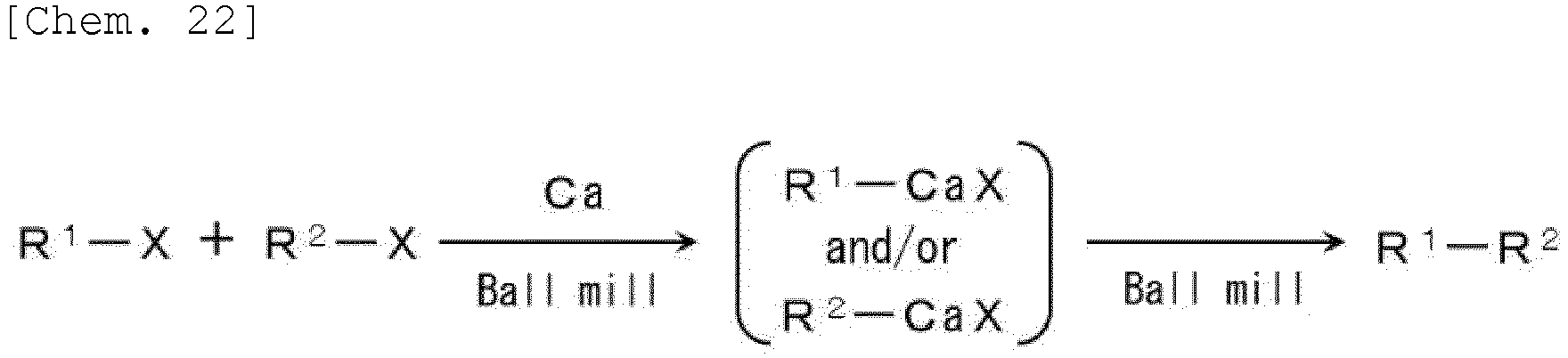
- To a 1.5 mL stainless-steel ball mill jar containing two stainless-steel balls 5 mm in diameter, 127 mg (0.5 mmol; 1 equiv) of 1-iodonaphthalene as an aromatic halide and 312 mg (2 mmol; 4 equiv) of iodoethane as an aliphatic halide, 30 mg (0.75 mmol; 1.5 equiv) of calcium powder (purity, 99%; particle size, 5 mm or less) as a metal, and 196 µL (2 mmol, 4.0 equiv) of tetrahydropyran (THP) as an ether compound were added under air. The ball mill jar was capped, mounted to a ball mill, and stirred by shaking (30 Hz) for 60 minutes while being heated with a heat gun so as to have an internal temperature of 60°C to cause a reaction.
- After completion of the reaction, 1-ethylnaphthalene, the reaction product, was extracted with dichloromethane and dried over magnesium sulfate. After filtration, the dichloromethane was removed with an evaporator to obtain a reactive product. The NMR yield was determined by 1H NMR to be 80%, and the isolated yield was determined to be 69%.
- The reaction and purification were performed in the same manner as in Example 118 to obtain a reaction product, except that 18 mg (0.75 mmol; 1.5 equiv) of magnesium powder as a metal was used. The NMR yield was determined by 1H NMR to be 15%.
- This shows that even when the yield is low and the reaction is difficult with magnesium, the reaction can readily proceed in high yield when calcium is used.
- The reaction was performed in the same manner as in Example 118 to obtain reaction products, except that compounds in Table 8 were used as aromatic halides and aliphatic halides. The results are shown in Table 8 together with isolated yields and NMR yields.
[Table 8] Example Aromatic halide Aliphatic halide Reaction product Isolated yield (%) NMR yield (%) 118 101a 102a 103a 80 69 119 (Mg) 101a 102a 103a 15 120 101b 102a 103b 41 65 121 101c 102a 103c 52 63 122 101d 102a 103d 67 74 123 101e 102a 103e 73 80 124 101f 102a 103f 58 73 125 101g 102a 103g 40 58 126 101h 102a 103h 64 72 127 101i 102a 103i 80 82 128 101a 102b 103j 52 77 129 101a 102c 103k 65 75 130 101a 102d 103l 58 69 131 101a 102e 103m 62 73 132 101a 102f 103n 63 133 101a 102g 103o 57 134 101a 102h 103p 47 54 135 101a 102i 103q 63 - The aromatic halides in Table 8 are as shown below.

- The aliphatic halides in Table 8 are as shown below.

- The reaction products in Table 8 are as shown below.
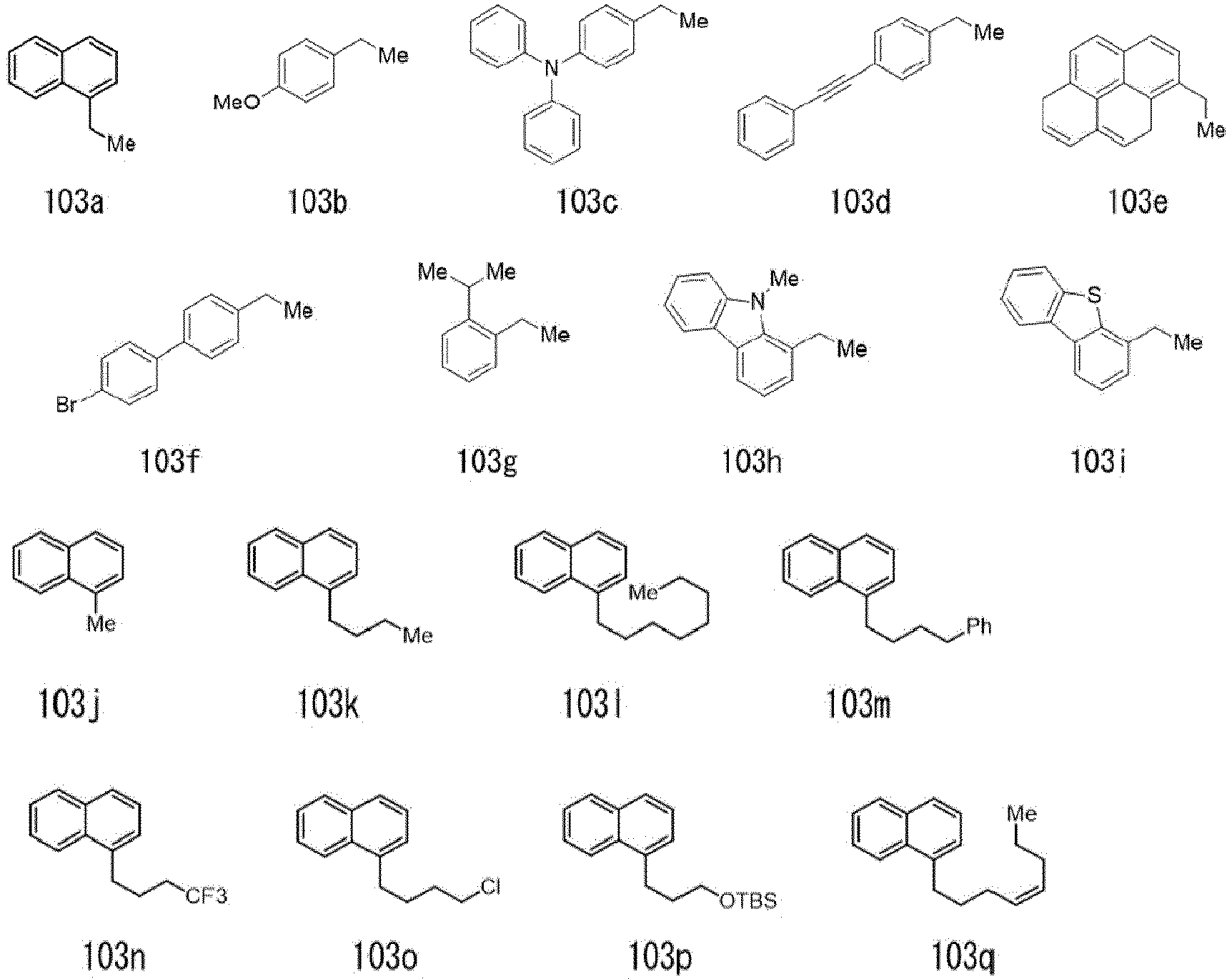
-

- To a 5 mL stainless-steel ball mill jar containing stainless-steel balls 10 mm in diameter, 1 mmol of 1-fluoro-2-iodobenzene as an aromatic halide, 3 mmol of manganese powder as a metal, and 2 mmol of tetrahydrofuran (THF) as an ether compound were added under air. The ball mill jar was capped, mounted to a ball mill, and stirred by shaking (30 Hz) for 180 minutes while being heated with a heat gun so as to have an internal temperature of 35°C to cause a reaction. Thereafter, the ball mill jar was uncapped. In the ball mill jar, a paste-like substance was formed, and no manganese powder was observed. Subsequently, 2 mmol of 1-octanal (CH3(CH2)6CHO) was added into the ball mill jar. The ball mill jar was capped, mounted to the ball mill, and stirred by shaking (30 Hz) for 30 minutes at an internal temperature of 35°C in air to cause a reaction.
- After completion of the reaction, the reaction product was extracted with dichloromethane and dried over magnesium sulfate. After filtration, the dichloromethane was removed with an evaporator to obtain a reactive product. The NMR yield was determined by 1H NMR to be 50%.
- The reaction was performed in the same manner as in Example 136 to obtain reaction products, except that compounds in Table 9 were used as aromatic halides and the internal temperature was 70°C. The results are shown in Table 9 together with NMR yields.
[Table 9] Example Aromatic halide Reaction product NMR yield (%) 136 201a 202a 50 137 201b 202b 69 138 201c 202c 58 139 201d 202c 39 140 201e 202d 59 141 201f 202e 36 - The aromatic halides in Table 9 are as shown below.

- The reaction products in Table 9 are as shown below.

- To a flask, 1 mmol of 1-fluoro-2-iodobenzene as an aromatic halide, 3 mmol (3 equiv) of manganese powder as a metal, and 0.5 mol of tetrahydrofuran (THF) as an ether compound were added. After stirring at a system temperature of 35°C for 1.5 hours in a nitrogen atmosphere, 2 mmol (2 equiv) of 1-octanal was added, and stirring was performed at 25°C for 30 minutes. The NMR yield of a reaction product (202a in Table 9) was determined by 1H NMR, but the reaction product was not detected. The recovery rate of the aromatic halide was 79%, confirming that the reaction between the manganese powder and the aromatic halide did not occur.
- The NMR yield of a reaction product (202a in Table 9) was determined by 1H NMR in the same manner as in Comparative Example 6 except that 1-octanal was added after stirring at a system temperature of 70°C for 1.5 hours (Comparative Example 7), stirring at a system temperature of 35°C for 24 hours (Comparative Example 8), or stirring at a system temperature of 70°C for 24 hours (Comparative Example 9) in a nitrogen atmosphere, but the reaction product was not detected in any cases. The recovery rates of the aromatic halide were 91% (Comparative Example 7), 77% (Comparative Example 8), and 85% (Comparative Example 9), confirming that the reaction between the manganese powder and the aromatic halide did not occur.
- To a 5 mL stainless-steel ball mill jar containing stainless-steel balls 10 mm in diameter, 1 mmol of pentafluoroiodobenzene as an aromatic halide, 3 mmol of manganese powder as a metal, and 207 µL of dimethyl ether (2 mmol (2 equiv); compound 221a below) as an ether compound were added under air. The ball mill jar was capped, mounted to a ball mill, and stirred by shaking (30 Hz) for 90 minutes while being heated with a heat gun so as to have an internal temperature of 35°C to cause a reaction. Thereafter, the ball mill jar was uncapped. In the ball mill jar, a paste-like substance was formed, and no manganese powder was observed. Subsequently, 2 mmol (2 equiv) of 1-octanal was added into the ball mill jar. The ball mill jar was capped, mounted to the ball mill, and stirred by shaking (30 Hz) for 30 minutes at an internal temperature of 35°C in air to cause a reaction.
- After completion of the reaction, the reaction product was extracted with dichloromethane and dried over magnesium sulfate. After filtration, the dichloromethane was removed with an evaporator to obtain a reactive product. The NMR yield was determined by 1H NMR to be 40%.
- The reaction was performed in the same manner as in Example 142 to obtain reaction products, except that compounds in Table 10 were used in an amount of 2 equiv (2 mmol) as ether compounds. The results are shown in Table 10 together with NMR yields.
[Table 10] Example Ether compound NMR yield (%) 142 203a 40 143 203b 54 144 203c 26 145 203d 64 146 203e 64 147 203f 57 148 203g 77 149 203h 66 150 203i 10 - The ether compounds in Table 10 are as shown below.

- Examples of known methods for obtaining an organomanganese reagent by a reaction between metallic manganese and a halide include the following methods (i) and (ii) .


-
- (i) is a method involving reduction of a manganese halide MnX2, and (ii) is a preparation method using metallic Mn and additives, each method being a preparation method using a highly reactive activator or additives difficult to handle. By contrast, the method for preparing an organomanganese reagent by a mechanochemical process according to the present invention is a simplified method not using an activator or additives difficult to handle, and is extremely advantageous.
- In addition, as shown in Comparative Examples 6 to 9, when metallic Mn and a halide are mixed with each other in a conventional solution system, no reaction occurs, and a target compound cannot be obtained. Also in this respect, the method for preparing an organomanganese reagent by a mechanochemical process according to the present invention is extremely advantageous.
Claims (13)
- A method for producing an organometallic nucleophile, comprising reacting an organohalide and a metal or metal compound with each other by a mechanochemical process in the presence of an ether compound in an amount of 0.5 to 10.0 equivalents relative to 1 equivalent of the organohalide.
- A method for producing an alcohol, comprising reacting an organohalide and a metal or metal compound with each other by a mechanochemical process in the presence of an ether compound in an amount of 0.5 to 10.0 equivalents relative to 1 equivalent of the organohalide to produce an organometallic nucleophile, and further adding an organic carbonyl compound and performing a reaction by the mechanochemical process.
- A method for producing an alcohol, comprising reacting an organohalide, a metal or metal compound, and an organic carbonyl compound with each other by a mechanochemical process in the presence of an ether compound in an amount of 0.5 to 10.0 equivalents relative to 1 equivalent of the organohalide.
- An addition reaction method comprising reacting an organohalide and a metal or metal compound with each other by a mechanochemical process in the presence of an ether compound in an amount of 0.5 to 10.0 equivalents relative to 1 equivalent of the organohalide to produce an organometallic nucleophile, and further adding an electrophile and performing a reaction by the mechanochemical process.
- An addition reaction method comprising reacting an organohalide, a metal or metal compound, and an electrophile with each other by a mechanochemical process in the presence of an ether compound in an amount of 0.5 to 10.0 equivalents relative to 1 equivalent of the organohalide.
- A coupling reaction method comprising reacting an organohalide and a metal or metal compound with each other by a mechanochemical process in the presence of an ether compound in an amount of 0.5 to 10.0 equivalents relative to 1 equivalent of the organohalide to produce an organometallic nucleophile, and further adding a nickel catalyst and a sulfonate ester compound and performing a reaction by the mechanochemical process.
- A coupling reaction method comprising reacting an organohalide, a metal or metal compound, and a sulfonate ester compound with each other by a mechanochemical process in the presence of a nickel catalyst and an ether compound in an amount of 0.5 to 10.0 equivalents relative to 1 equivalent of the organohalide.
- An addition reaction method comprising reacting an organohalide and a metal or metal compound with each other by a mechanochemical process in the presence of an ether compound in an amount of 0.5 to 10.0 equivalents relative to 1 equivalent of the organohalide to produce an organometallic nucleophile, and further adding a conjugated enone compound and performing a reaction by the mechanochemical process.
- An addition reaction method comprising reacting an organohalide, a metal or metal compound, and a conjugated enone compound with each other by a mechanochemical process in the presence of an ether compound in an amount of 0.5 to 10.0 equivalents relative to 1 equivalent of the organohalide.
- A composition obtained by the method according to Claim 1, comprising a halogenated organometallic compound and an ether compound, wherein a content of the ether compound is 0.5 to 10 equivalents relative to 1 equivalent of the halogenated organometallic compound.
- A halogenated organometallic compound-ether compound complex obtained by the method according to Claim 1, comprising at least a halogenated organometallic compound and an ether compound, wherein the complex is represented by formula (A):
[R11-(MX)p]q-rE (A)
(where R11 is a p-valent organic group derived from the halogenated organometallic compound, M is a metal derived from the halogenated organometallic compound, X is a halogen, and E is the ether compound; a plurality of R11's, M's, X's, or E's, if present, may be the same or different; and p is an integer of 1 or greater, q is a number of 2 or greater, and r is a number greater than 0). - A halogenated organometallic compound-ether compound complex comprising at least a halogenated organometallic compound and an ether compound, wherein the complex is represented by formula (A):
[R11-(MX)p]q-rE (A)
(where R11 is a p-valent organic group derived from the halogenated organometallic compound, M is a metal derived from the halogenated organometallic compound, X is a halogen, and E is the ether compound; a plurality of R11's, M's, X's, or E's, if present, may be the same or different; and p is an integer of 1 or greater, q is a number of 2 or greater, and r is a number greater than 0). - An organometallic nucleophile obtained by the method according to Claim 1 using an organohalide having a solubility at 20°C in an ether compound of less than 1.0 mol/L.
Applications Claiming Priority (2)
| Application Number | Priority Date | Filing Date | Title |
|---|---|---|---|
| JP2021046299 | 2021-03-19 | ||
| PCT/JP2022/012524 WO2022196796A1 (en) | 2021-03-19 | 2022-03-18 | Method for producing organic metal nucleophilic agent and reaction method using organic metal nucleophilic agent |
Publications (2)
| Publication Number | Publication Date |
|---|---|
| EP4310067A1 true EP4310067A1 (en) | 2024-01-24 |
| EP4310067A4 EP4310067A4 (en) | 2025-05-28 |
Family
ID=83320486
Family Applications (1)
| Application Number | Title | Priority Date | Filing Date |
|---|---|---|---|
| EP22771541.4A Pending EP4310067A4 (en) | 2021-03-19 | 2022-03-18 | Method for producing organic metal nucleophilic agent and reaction method using organic metal nucleophilic agent |
Country Status (5)
| Country | Link |
|---|---|
| US (1) | US20230271988A1 (en) |
| EP (1) | EP4310067A4 (en) |
| JP (1) | JP7404606B2 (en) |
| CN (2) | CN118908981A (en) |
| WO (1) | WO2022196796A1 (en) |
Families Citing this family (3)
| Publication number | Priority date | Publication date | Assignee | Title |
|---|---|---|---|---|
| CN115572240B (en) * | 2022-10-19 | 2024-01-26 | 西安交通大学 | A mechanical synthesis method for constructing C-C bonds through three-component reductive cross-coupling |
| WO2024210060A1 (en) * | 2023-04-07 | 2024-10-10 | 国立大学法人北海道大学 | Reduction method |
| JP7825889B1 (en) | 2024-08-29 | 2026-03-09 | 株式会社メカノクロス | Mechanochemical reaction method and reaction equipment |
Family Cites Families (9)
| Publication number | Priority date | Publication date | Assignee | Title |
|---|---|---|---|---|
| US2416717A (en) * | 1942-04-03 | 1947-03-04 | Cincinnati Milling Machine Co | Mechanical activation |
| JPS5773010A (en) * | 1980-10-24 | 1982-05-07 | Nippon Oil Co Ltd | Preparation of polyolefin |
| JPS58148251A (en) | 1982-02-27 | 1983-09-03 | Yamaha Motor Co Ltd | Casing for multicylinder engine |
| JPH05112501A (en) * | 1991-10-22 | 1993-05-07 | Mita Ind Co Ltd | Butadiene derivative and electroph0t0graphic photoreceptor using the same |
| DE19960865A1 (en) * | 1999-12-17 | 2001-06-28 | Studiengesellschaft Kohle Mbh | Increasing the rate of production of organometallic or inorganic magnesium compounds from magnesium metal in a solvent |
| JP2002030003A (en) | 2000-07-12 | 2002-01-29 | Sumitomo Bakelite Co Ltd | Method for removing bromine from organic bromine compound |
| JP2008174472A (en) * | 2007-01-17 | 2008-07-31 | Showa Denko Kk | Method for producing grignard reagent of carbon substituent-containing chlorobenzene compound in tetrahydropyran as solvent |
| CA2914899C (en) * | 2013-06-27 | 2022-08-30 | Dpx Holdings B.V. | Preparation of grignard reagents using a fluidized bed |
| DE102016206211B4 (en) * | 2016-04-13 | 2018-12-27 | Fraunhofer-Gesellschaft zur Förderung der angewandten Forschung e.V. | Continuous process for the preparation of Grignard adducts and apparatus for carrying it out |
-
2022
- 2022-03-18 CN CN202410934923.8A patent/CN118908981A/en active Pending
- 2022-03-18 CN CN202280003628.XA patent/CN115485255A/en active Pending
- 2022-03-18 JP JP2022551338A patent/JP7404606B2/en active Active
- 2022-03-18 EP EP22771541.4A patent/EP4310067A4/en active Pending
- 2022-03-18 WO PCT/JP2022/012524 patent/WO2022196796A1/en not_active Ceased
- 2022-03-18 US US17/996,070 patent/US20230271988A1/en active Pending
Also Published As
| Publication number | Publication date |
|---|---|
| CN115485255A (en) | 2022-12-16 |
| JP7404606B2 (en) | 2023-12-26 |
| EP4310067A4 (en) | 2025-05-28 |
| WO2022196796A1 (en) | 2022-09-22 |
| CN118908981A (en) | 2024-11-08 |
| US20230271988A1 (en) | 2023-08-31 |
| JPWO2022196796A1 (en) | 2022-09-22 |
Similar Documents
| Publication | Publication Date | Title |
|---|---|---|
| US20230271988A1 (en) | Method for producing organometallic nucleophile and reaction method using organometallic nucleophile | |
| Mimoun et al. | Palladium (II) tert-butyl peroxide carboxylates. New reagents for the selective oxidation of terminal olefins to methyl ketones. The role of peroxymetalation in selective oxidative processes | |
| Bergbreiter et al. | Microwave promoted Heck reactions using an oligo (ethylene glycol)-bound SCS palladacycle under thermomorphic conditions | |
| CN104592281B (en) | Bifunctional 4-TMS-5-I-1,2,3-triazole compound and its preparation method and application | |
| CN104030975B (en) | A kind of Mn (III)-Salen Catalysts and its preparation method and application | |
| CN106902880B (en) | 4,6- dimethyl -2- mercaptopyrimidine univalent copper complex prepares the application in alcohol in catalysis ketone or aldehyde hydrogen transfer reaction | |
| Phan et al. | Solid-supported cross-coupling catalysts derived from homogeneous nickel and palladium coordination complexes | |
| Tan et al. | SnCl2-mediated carbonyl allylation in fully aqueous media | |
| EP2457656B1 (en) | Catalyst precursor, method for producing the same, method for using the same, and reactor that uses the same | |
| Ganina et al. | Cu-MOF-catalyzed carboxylation of alkynes and epoxides | |
| CN109956970A (en) | Biphenyl-type tridentate ligand ruthenium complex and its preparation method and application | |
| CN105085563B (en) | A kind of branch allyl compound, preparation method and application | |
| CN103360220A (en) | Method for producing more hydroquinone | |
| Mugo et al. | Cu (II) and Ni (II) complexes based on monofunctional and dendrimeric pyrrole-imine ligands: Applications in catalytic liquid phase hydroxylation of phenol | |
| CN102764673B (en) | Catalyst for preparing diphenyl oxide compound and preparation method and application of catalyst | |
| EP4488249A1 (en) | Mechanochemical-reaction additive, mechanochemical method, ligand compound, and complex | |
| CN101143331B (en) | A kind of non-palladium catalyst system for coupling reaction | |
| CN117510303A (en) | Synthesis method of monofluoro 1, 4-eneyne compound | |
| JP6498048B2 (en) | Fluorine-containing organic compound and method for producing biaryl compound using this and Grignard reagent | |
| CN103360218A (en) | Benzene hydroxylation reaction method | |
| CN107915653A (en) | Catalysis ester and amine carry out the method that reaction prepares acid amides | |
| Fidelibus et al. | Three‐step synthesis of arylpolyboronic acids from phenols via organotin compounds | |
| CN114195719A (en) | Ionic liquid of iodinated imidazole containing phenolic hydroxyl group, preparation method and application thereof | |
| CN112547064A (en) | Method for removing halogen in halogenated aromatic compound by using catalyst loaded with copper or copper oxide nanoparticles | |
| Deng et al. | Unusual C–O bond cleavage of aromatic ethers in ruthenium complexes bearing a 2-alkoxypyridyl fragment |
Legal Events
| Date | Code | Title | Description |
|---|---|---|---|
| STAA | Information on the status of an ep patent application or granted ep patent |
Free format text: STATUS: THE INTERNATIONAL PUBLICATION HAS BEEN MADE |
|
| PUAI | Public reference made under article 153(3) epc to a published international application that has entered the european phase |
Free format text: ORIGINAL CODE: 0009012 |
|
| STAA | Information on the status of an ep patent application or granted ep patent |
Free format text: STATUS: REQUEST FOR EXAMINATION WAS MADE |
|
| 17P | Request for examination filed |
Effective date: 20221026 |
|
| AK | Designated contracting states |
Kind code of ref document: A1 Designated state(s): AL AT BE BG CH CY CZ DE DK EE ES FI FR GB GR HR HU IE IS IT LI LT LU LV MC MK MT NL NO PL PT RO RS SE SI SK SM TR |
|
| DAV | Request for validation of the european patent (deleted) | ||
| DAX | Request for extension of the european patent (deleted) | ||
| A4 | Supplementary search report drawn up and despatched |
Effective date: 20250430 |
|
| RIC1 | Information provided on ipc code assigned before grant |
Ipc: C07C 33/14 20060101ALI20250424BHEP Ipc: C07C 33/50 20060101ALI20250424BHEP Ipc: C07C 33/46 20060101ALI20250424BHEP Ipc: C07C 33/28 20060101ALI20250424BHEP Ipc: C07C 211/54 20060101ALI20250424BHEP Ipc: C07C 209/68 20060101ALI20250424BHEP Ipc: C07C 45/69 20060101ALI20250424BHEP Ipc: C07C 45/44 20060101ALI20250424BHEP Ipc: C07C 41/30 20060101ALI20250424BHEP Ipc: C07C 29/40 20060101ALI20250424BHEP Ipc: C07C 29/38 20060101ALI20250424BHEP Ipc: C07C 29/36 20060101ALI20250424BHEP Ipc: C07C 17/263 20060101ALI20250424BHEP Ipc: C07C 1/32 20060101ALI20250424BHEP Ipc: C07F 13/00 20060101ALI20250424BHEP Ipc: C07F 3/04 20060101ALI20250424BHEP Ipc: C07F 3/02 20060101ALI20250424BHEP Ipc: C07B 37/04 20060101ALI20250424BHEP Ipc: C07B 49/00 20060101AFI20250424BHEP |