EP4309903A1 - Printing apparatus and printing method - Google Patents
Printing apparatus and printing method Download PDFInfo
- Publication number
- EP4309903A1 EP4309903A1 EP23179299.5A EP23179299A EP4309903A1 EP 4309903 A1 EP4309903 A1 EP 4309903A1 EP 23179299 A EP23179299 A EP 23179299A EP 4309903 A1 EP4309903 A1 EP 4309903A1
- Authority
- EP
- European Patent Office
- Prior art keywords
- permeability
- white
- printing
- ink amount
- medium
- Prior art date
- Legal status (The legal status is an assumption and is not a legal conclusion. Google has not performed a legal analysis and makes no representation as to the accuracy of the status listed.)
- Granted
Links
Images


Classifications
-
- B—PERFORMING OPERATIONS; TRANSPORTING
- B41—PRINTING; LINING MACHINES; TYPEWRITERS; STAMPS
- B41J—TYPEWRITERS; SELECTIVE PRINTING MECHANISMS, i.e. MECHANISMS PRINTING OTHERWISE THAN FROM A FORME; CORRECTION OF TYPOGRAPHICAL ERRORS
- B41J2/00—Typewriters or selective printing mechanisms characterised by the printing or marking process for which they are designed
- B41J2/005—Typewriters or selective printing mechanisms characterised by the printing or marking process for which they are designed characterised by bringing liquid or particles selectively into contact with a printing material
- B41J2/01—Ink jet
- B41J2/21—Ink jet for multi-colour printing
- B41J2/2107—Ink jet for multi-colour printing characterised by the ink properties
- B41J2/2114—Ejecting specialized liquids, e.g. transparent or processing liquids
- B41J2/2117—Ejecting white liquids
-
- B—PERFORMING OPERATIONS; TRANSPORTING
- B41—PRINTING; LINING MACHINES; TYPEWRITERS; STAMPS
- B41J—TYPEWRITERS; SELECTIVE PRINTING MECHANISMS, i.e. MECHANISMS PRINTING OTHERWISE THAN FROM A FORME; CORRECTION OF TYPOGRAPHICAL ERRORS
- B41J11/00—Devices or arrangements of selective printing mechanisms, e.g. ink-jet printers or thermal printers, for supporting or handling copy material in sheet or web form
- B41J11/009—Detecting type of paper, e.g. by automatic reading of a code that is printed on a paper package or on a paper roll or by sensing the grade of translucency of the paper
-
- B—PERFORMING OPERATIONS; TRANSPORTING
- B41—PRINTING; LINING MACHINES; TYPEWRITERS; STAMPS
- B41J—TYPEWRITERS; SELECTIVE PRINTING MECHANISMS, i.e. MECHANISMS PRINTING OTHERWISE THAN FROM A FORME; CORRECTION OF TYPOGRAPHICAL ERRORS
- B41J2/00—Typewriters or selective printing mechanisms characterised by the printing or marking process for which they are designed
- B41J2/005—Typewriters or selective printing mechanisms characterised by the printing or marking process for which they are designed characterised by bringing liquid or particles selectively into contact with a printing material
- B41J2/01—Ink jet
- B41J2/205—Ink jet for printing a discrete number of tones
- B41J2/2054—Ink jet for printing a discrete number of tones by the variation of dot disposition or characteristics, e.g. dot number density, dot shape
-
- G—PHYSICS
- G06—COMPUTING OR CALCULATING; COUNTING
- G06K—GRAPHICAL DATA READING; PRESENTATION OF DATA; RECORD CARRIERS; HANDLING RECORD CARRIERS
- G06K15/00—Arrangements for producing a permanent visual presentation of the output data, e.g. computer output printers
- G06K15/02—Arrangements for producing a permanent visual presentation of the output data, e.g. computer output printers using printers
- G06K15/021—Adaptations for printing on specific media
- G06K15/023—Adaptations for printing on specific media for printing on transparent media
Definitions
- This invention relates to so-called back printing of overlapping a white image printed in white ink and a non-white image printed in non-white ink on a transparent sheet-like printing medium.
- JP 2019-147267A a white image and a non-white image are superimposed on a transparent printing medium such as a film of PET (polyethylene terephthalate), nylon, OPP (oriented polyethylene), CPP (cast polyethylene) or the like or a soft packaging material of cellophane or the like.
- a transparent printing medium such as a film of PET (polyethylene terephthalate), nylon, OPP (oriented polyethylene), CPP (cast polyethylene) or the like or a soft packaging material of cellophane or the like.
- Permeability to visible light may differ depending on the type of the printing medium, whereby how the printed matter looks may differ. Accordingly, to obtain a high-quality printed matter, it is important to consider the permeability of the printing medium. However, conventionally, this point has not been sufficiently taken into account and there has been a room for improvement.
- This invention was developed in view of the above problem and aims to provide a printing apparatus and a printing method capable of providing a high-quality printed matter without being affected by the permeability of a printing medium in so-called back printing.
- the apparatus comprises: a white printer configured to print a white image in white ink on a transparent sheet-like printing medium; a non-white printer configured to print a non-white image in non-white ink on the printing medium; and a controller configured to control the white printer and the non-white printer such that the white image and the non-white image are superimposed on the printing medium.
- the controller includes: a permeability information acquirer configured to obtain permeability information relating to permeability to visible light of the printing medium; and an ink amount adjuster configured to adjust at least one of a white ink amount constituting the white image and a non-white ink amount constituting the non-white image according to the permeability information.
- a printing method for superimposing a white image printed in white ink and a non-white image printed in non-white ink on a transparent sheet-like printing medium is characterized by comprising: obtaining permeability information relating to permeability to visible light of the printing medium; and adjusting at least one of a white ink amount constituting the white image and a non-white ink amount constituting the non-white image according to the permeability information.
- the white image and the non-white image are printed to be superimposed on the transparent sheet-like printing medium. If a printed matter is seen through the printing medium from a side where such a printed matter is not printed, it is affected by the permeability of the printing medium. Accordingly, in the invention, at least one of the white ink amount and the non-white ink amount is adjusted according to the permeability information relating to the permeability. That is, the printed matter taking the permeability of the printing medium into account is obtained.
- transparency means a property of being permeable to visible light and is a concept including colorless transparency and colored transparency.
- a high-quality printed matter can be obtained by suppressing an influence by the permeability of the printing medium in so-called back printing.
- All of a plurality of constituent elements of each aspect of the invention described above are not essential and some of the plurality of constituent elements can be appropriately changed, deleted, replaced by other new constituent elements or have limited contents partially deleted in order to solve some or all of the aforementioned problems or to achieve some or all of effects described in this specification. Further, some or all of technical features included in one aspect of the invention described above can be combined with some or all of technical features included in another aspect of the invention described above to obtain one independent form of the invention in order to solve some or all of the aforementioned problems or to achieve some or all of the effects described in this specification.
- FIG. 1 is a diagram schematically showing a first embodiment of a printing apparatus according to the invention.
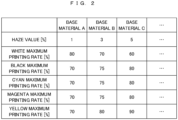
- FIG. 2 is a table showing an example of a medium information database used in the first embodiment.
- the printing apparatus 1 is provided with a conveyor 2 for conveying a sheet S in a conveying direction X, a color printer 3 for printing a color image, which is an example of a "non-white image” of the invention, on the sheet S, and a base printer 4 for printing a white image, which is an example of a "white image” of the invention.
- the color printer 3 and the base printer 4 respectively correspond to examples of a "non-white printer” and a "white printer” of the invention.
- the sheet S is constituted by a transparent film or transparent packaging material described above, and is permeable to visible light.
- the sheet S made of a base material having a "haze value", which is a value indicating permeability, of 5 % or less is used.
- the conveyor 2 includes a feed roller 21 for feeding the sheet S wound into a roll and a take-up roller 22 for taking up the sheet S into a roll.
- a feed roller 21 for feeding the sheet S wound into a roll
- a take-up roller 22 for taking up the sheet S into a roll.
- the color printer 3 includes a plurality of (four) discharge heads 31k, 31c, 31m and 31y for discharging an ink to the sheet S being conveyed in the conveying direction X by an inkjet method. These discharge heads 31k, 31c, 31m and 31y are arranged in this order in the conveying direction X.
- the discharge head 31k is controlled by a head driver 32k.
- This head driver 32k receives print data for black (K) from a controller 9 for controlling the entire apparatus, converts this print data into a drive pulse signal and feeds the drive pulse signal to the discharge head 31k. In accordance with this drive pulse signal, the discharge head 31k operates and discharges an ink of black (K).
- the discharge heads 31c, 31m and 31y are similarly connected to head drivers 32c, 32m and 32y, the discharge head 31c discharges an ink of cyan (C), the discharge head 31m discharges an ink of magenta (M) and the discharge head 31y discharges an ink of yellow (Y) in accordance with the print data.
- the color printer 3 prints a color image on the sheet S by discharging the inks of process colors (K, C, M, Y) from the discharge heads 31k, 31c, 31m and 31y.
- each of the discharge heads 31k, 31c, 31m and 31y is capable of discharging three types of ink droplets of different sizes including large ink droplets, medium ink droplets and small ink droplets, and capable of flexibly changing a printing rate and a droplet volume.
- the base printer 4 includes a discharge head 41w for discharging an ink by the inkjet method to the color image on the sheet S being conveyed in the conveying direction X on a side downstream of the color printer 3 in the conveying direction X.
- This discharge head 41w is arranged downstream of the four discharge heads 31k, 31c, 31m and 31y of the color printer 3 in the conveying direction X.
- the discharge head 41w is controlled by a head driver 42w for driving the discharge head 41w.
- This head driver 42w receives print data for white (W) from the controller 9, converts this print data into a drive pulse signal and feeds the drive pulse signal to the discharge head 41w.
- the discharge head 41w operates and discharges an ink of white (W).
- This discharge head 41w is also capable of discharging three types of ink droplets of different sizes including large ink droplets, medium ink droplets and small ink droplets, and capable of flexibly changing a printing rate and a droplet volume.
- a color ink amount constituting a color image and a white ink amount constituting a white image can be appropriately adjusted. Accordingly, in this embodiment, the color ink amount and the white ink amount are controlled according to a haze value of the sheet S based on knowledge obtained by the inventors of this application.
- the knowledge obtained by the inventors of this application is that, if the permeability to visible light of the sheet S differs depending on a base material, e.g. if the haze value largely differs according to base materials A to C constituting the sheet S as shown in FIG. 2 , the following optical characteristic appears.
- the base material C has a highest haze value. This is equivalent to that a white density of the sheet S is already offset, and means that a high white density (white concealability) can be realized with a relatively small white ink amount.
- a density of the color image hardly increases. Such a tendency becomes more remarkable as the haze value of the base material constituting the sheet S increases, i.e. permeability decreases. Accordingly, it is preferable in obtaining a high-quality printed matter to decrease the white ink amount and increase the color ink amount as the permeability of the sheet S decreases.
- the base material A has, for example, a lowest haze value.
- This enables a user to clearly see the color image since the permeability of the sheet S is high and the density of the color image visible through the sheet S is high even with a relatively small color ink amount.
- the white ink amount needs to be increased. Such a tendency becomes more remarkable as the haze value of the base material constituting the sheet S decreases, i.e. permeability increases. Accordingly, it is preferable in obtaining a high-quality printed matter to increase the white ink amount and decrease the color ink amount as the permeability of the sheet S increases.
- the storage 92 such as a hard disk drive.
- the print job includes an image to be printed on the sheet S (hereinafter, referred to as an "input image").
- the arithmetic processor 91 obtains the type of the base material constituting the sheet S as an example of “medium information” from the print job. Then, the arithmetic processor 91 refers to the medium information database and specifies the haze value of this base material as permeability information relating to the permeability to visible light of the sheet S. As just described, the arithmetic processor 91 functions as a "medium information acquirer” and a "permeability information acquirer” of the invention. Further, the arithmetic processor 91 obtains the maximum printing rate of each color corresponding to the haze value of the base material constituting the sheet S and generates print data of each color based on those.
- the maximum printing rate of each color is obtained in two stages including a first step of obtaining the haze value (permeability information) from the type of the base material (medium information) and a second step of obtaining the maximum printing rate of each color from the haze value obtained in the first step.
- the maximum printing rate of each color can be quickly obtained by referring to the table of FIG. 2 . That is, as shown in FIG.
- the medium information database compiling the haze value of each of the base materials A to C constituting the sheet S, the maximum printing rate of the white ink, the maximum printing rate of the black ink, the maximum printing rate of the cyan ink, the maximum printing rate of the magenta ink, the maximum printing rate of the yellow ink in a table format while relating these to each other is created in advance. Accordingly, the arithmetic processor 91 directly obtains the maximum printing rate of each color from the type of the base material constituting the sheet S. Therefore, by preparing the medium information database of FIG. 2 in advance, the maximum printing rate of each color can be more quickly obtained than the two stage steps described above, and a processing speed can be enhanced.
- the arithmetic processor 91 functions as a print data generator for generating print data of each color by applying grouping and shading to the input image included in the print job.
- the print data is not merely generated, but the haze value of the base material constituting the sheet S is considered. That is, the arithmetic processor 91 generates the print data of each color by correcting an image value of the input image or a threshold value (value of a threshold matrix) in shading to obtain the maximum printing rate corresponding to this haze value.
- each of the discharge heads 31k, 31c, 31m, 31y and 41w is a head capable of discharging three types of ink droplets of different sizes including large ink droplets, medium ink droplets and small ink droplets, i.e. capable of multi-level output
- the arithmetic processor 91 controls, for example, such that a printing rate of large dots is high to increase an ink amount.
- the arithmetic processor 91 functions as a print data generator provided with an ink amount adjuster as shown in FIG. 1 .
- the arithmetic processor 91 decreases the white ink amount discharged from the base printer 4 and increases the color ink amount discharged from the color printer 3 as the permeability of the sheet S decreases (the haze value increases).
- the arithmetic processor 91 increases the white ink amount discharged from the base printer 4 and decreases the color ink amount discharged from the color printer 3 as the permeability of the sheet S increases (the haze value decreases).
- the arithmetic processor 91 increases the white ink amount discharged from the base printer 4 and decreases the color ink amount discharged from the color printer 3 as the permeability of the sheet S increases (the haze value decreases).
- the sheet S corresponds to an example of a "sheet-like printing medium" of the invention.
- the base printer 4 and the color printer 3 respectively correspond to examples of a “white printer” and a “non-white printer” of the invention.
- the inks and the ink amounts of the process colors (K, C, M, Y) respectively correspond to examples of a "non-white ink” and a “non-white ink amount” of the invention.
- the type of the base material constituting the sheet S corresponds to an example of the "type of a printing medium" of the invention.
- FIG. 3 is a diagram schematically showing a second embodiment of the printing apparatus according to the invention.
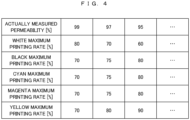
- FIG. 4 is a table showing an example of a medium information database used in the second embodiment.
- the second embodiment largely differs from the first embodiment in including a permeability meter 5 for measuring the permeability of a sheet S as the "permeability information" of the invention and in the configuration of the medium information database.
- the other configuration is basically the same as in the first embodiment. Therefore, the following description is centered on points of difference and the same components are denoted by the same reference signs and not described.
- values of permeability are listed up instead of the types and haze values of base materials as shown in FIG. 4 . That is, a medium information database compiling a relationship of the permeability and a maximum printing rate in a table format is stored in a storage 92.
- the permeability meter 5 is provided between a feed roller 21 and a color printer 3 in a conveying direction X of a sheet S.
- the permeability meter 5 includes a line light source 51 and a line sensor 52 respectively parallel to a width direction Y (orthogonal to the conveying direction X) of the sheet S, and the sheet S is sandwiched by the line light source 51 and the line sensor 52.
- This permeability meter 5 measures the permeability to visible light of the sheet S by detecting an intensity of visible light emitted from the line light source 51 and transmitted through the sheet S before the printing of a color image by the line sensor 52. This measurement result, i.e. actually measured permeability, is output to a controller 9.
- An arithmetic processor 91 of the controller 9 obtain a maximum printing rate of each color based on the received actually measured permeability and the medium information database of FIG. 4 . Then, as in the first embodiment, the arithmetic processor 91 decreases a white ink amount discharged from a base printer 4 and increases a color ink amount discharged from the color printer 3 as the permeability of the sheet S decreases (the actually measured permeability decreases). On the other hand, the arithmetic processor 91 increases the white ink amount discharged from the base printer 4 and decreases the color ink amount discharged from the color printer 3 as the permeability of the sheet S increases (the actually measured permeability increases). As a result, an influence by the permeability of the sheet S is suppressed and a high-quality printed matter is obtained in sol-called back printing.
- the invention is not limited to the above embodiments and various changes other than the aforementioned ones can be made without departing from the gist of the invention.
- the arithmetic processor 91 functioning as the ink amount adjuster adjusts both the white ink amount constituting the white image and the color ink amount constituting the color image according to the permeability information, but may be configured to adjust at least one of these.
- the haze value may be measured instead of the permeability.
- the color of the sheet S is not limited to a colorless transparent color, but may be a colored transparent color as described above.
- the colors of the non-white inks usable to print a non-white image are not limited to the aforementioned process colors K, C, M and Y, but other specific color inks may be, for example, used.
- the sizes of the ink droplets dischargeable by each of the discharge heads 31k, 31c, 31m, 31y and 41w are not limited to the above three types. At this time, ink droplets can be appropriately changed and used according to a size variation of the ink droplets.
- the invention is applicable to so-called back printing techniques in general for superimposing a white image printed in white ink and a non-white image printed in non-white ink on a transparent sheet-like printing medium.
Landscapes
- Engineering & Computer Science (AREA)
- General Engineering & Computer Science (AREA)
- Physics & Mathematics (AREA)
- General Physics & Mathematics (AREA)
- Theoretical Computer Science (AREA)
- Ink Jet (AREA)
- Color, Gradation (AREA)
Abstract
Description
- The disclosure of
Japanese Patent Application No. 2022-116169 filed on July 21, 2022 - This invention relates to so-called back printing of overlapping a white image printed in white ink and a non-white image printed in non-white ink on a transparent sheet-like printing medium.
- In
JP 2019-147267A - Permeability to visible light may differ depending on the type of the printing medium, whereby how the printed matter looks may differ. Accordingly, to obtain a high-quality printed matter, it is important to consider the permeability of the printing medium. However, conventionally, this point has not been sufficiently taken into account and there has been a room for improvement.
- This invention was developed in view of the above problem and aims to provide a printing apparatus and a printing method capable of providing a high-quality printed matter without being affected by the permeability of a printing medium in so-called back printing.
- One aspect of this invention is directed to a printing apparatus. The apparatus comprises: a white printer configured to print a white image in white ink on a transparent sheet-like printing medium; a non-white printer configured to print a non-white image in non-white ink on the printing medium; and a controller configured to control the white printer and the non-white printer such that the white image and the non-white image are superimposed on the printing medium. The apparatus is characterized in that the controller includes: a permeability information acquirer configured to obtain permeability information relating to permeability to visible light of the printing medium; and an ink amount adjuster configured to adjust at least one of a white ink amount constituting the white image and a non-white ink amount constituting the non-white image according to the permeability information.
- Other aspect of the invention is a printing method for superimposing a white image printed in white ink and a non-white image printed in non-white ink on a transparent sheet-like printing medium. The method is characterized by comprising: obtaining permeability information relating to permeability to visible light of the printing medium; and adjusting at least one of a white ink amount constituting the white image and a non-white ink amount constituting the non-white image according to the permeability information.
- In the invention thus configured, the white image and the non-white image are printed to be superimposed on the transparent sheet-like printing medium. If a printed matter is seen through the printing medium from a side where such a printed matter is not printed, it is affected by the permeability of the printing medium. Accordingly, in the invention, at least one of the white ink amount and the non-white ink amount is adjusted according to the permeability information relating to the permeability. That is, the printed matter taking the permeability of the printing medium into account is obtained.
- Note that, in this specification, "transparency" means a property of being permeable to visible light and is a concept including colorless transparency and colored transparency.
- As described above, according to the invention, a high-quality printed matter can be obtained by suppressing an influence by the permeability of the printing medium in so-called back printing.
- All of a plurality of constituent elements of each aspect of the invention described above are not essential and some of the plurality of constituent elements can be appropriately changed, deleted, replaced by other new constituent elements or have limited contents partially deleted in order to solve some or all of the aforementioned problems or to achieve some or all of effects described in this specification. Further, some or all of technical features included in one aspect of the invention described above can be combined with some or all of technical features included in another aspect of the invention described above to obtain one independent form of the invention in order to solve some or all of the aforementioned problems or to achieve some or all of the effects described in this specification.
-
-
FIG. 1 is a diagram schematically showing a first embodiment of a printing apparatus according to the invention. -
FIG. 2 is a table showing an example of a medium information database used in the first embodiment. -
FIG. 3 is a diagram schematically showing a second embodiment of the printing apparatus according to the invention. -
FIG. 4 is a table showing an example of a medium information database used in the second embodiment. -
FIG. 1 is a diagram schematically showing a first embodiment of a printing apparatus according to the invention. Further,FIG. 2 is a table showing an example of a medium information database used in the first embodiment. Theprinting apparatus 1 is provided with aconveyor 2 for conveying a sheet S in a conveying direction X, acolor printer 3 for printing a color image, which is an example of a "non-white image" of the invention, on the sheet S, and a base printer 4 for printing a white image, which is an example of a "white image" of the invention. As just described, in this embodiment, thecolor printer 3 and the base printer 4 respectively correspond to examples of a "non-white printer" and a "white printer" of the invention. - The sheet S is constituted by a transparent film or transparent packaging material described above, and is permeable to visible light. In the first embodiment, the sheet S made of a base material having a "haze value", which is a value indicating permeability, of 5 % or less is used. Note that the "haze value" is a ratio of a diffuse transmittance of components except parallel components to a total light transmittance including the parallel components and diffuse components, and represented by the following equation:

- The
conveyor 2 includes afeed roller 21 for feeding the sheet S wound into a roll and a take-up roller 22 for taking up the sheet S into a roll. By taking up the sheet S fed by thefeed roller 21 by the take-up roller 22, the sheet S is conveyed in a roll-to-roll manner in the conveying direction X. - The
color printer 3 includes a plurality of (four)discharge heads discharge heads discharge head 31k is controlled by ahead driver 32k. Thishead driver 32k receives print data for black (K) from acontroller 9 for controlling the entire apparatus, converts this print data into a drive pulse signal and feeds the drive pulse signal to thedischarge head 31k. In accordance with this drive pulse signal, thedischarge head 31k operates and discharges an ink of black (K). For the other ink colors, thedischarge heads head drivers discharge head 31c discharges an ink of cyan (C), thedischarge head 31m discharges an ink of magenta (M) and thedischarge head 31y discharges an ink of yellow (Y) in accordance with the print data. In this way, thecolor printer 3 prints a color image on the sheet S by discharging the inks of process colors (K, C, M, Y) from thedischarge heads discharge heads - The base printer 4 includes a
discharge head 41w for discharging an ink by the inkjet method to the color image on the sheet S being conveyed in the conveying direction X on a side downstream of thecolor printer 3 in the conveying direction X. Thisdischarge head 41w is arranged downstream of the fourdischarge heads color printer 3 in the conveying direction X. Thedischarge head 41w is controlled by ahead driver 42w for driving thedischarge head 41w. Thishead driver 42w receives print data for white (W) from thecontroller 9, converts this print data into a drive pulse signal and feeds the drive pulse signal to thedischarge head 41w. In accordance with this drive pulse signal, thedischarge head 41w operates and discharges an ink of white (W). Thisdischarge head 41w is also capable of discharging three types of ink droplets of different sizes including large ink droplets, medium ink droplets and small ink droplets, and capable of flexibly changing a printing rate and a droplet volume. - As just described, in this embodiment, a color ink amount constituting a color image and a white ink amount constituting a white image can be appropriately adjusted. Accordingly, in this embodiment, the color ink amount and the white ink amount are controlled according to a haze value of the sheet S based on knowledge obtained by the inventors of this application.
- Here, the knowledge obtained by the inventors of this application is that, if the permeability to visible light of the sheet S differs depending on a base material, e.g. if the haze value largely differs according to base materials A to C constituting the sheet S as shown in
FIG. 2 , the following optical characteristic appears. For example, out of the above three types, the base material C has a highest haze value. This is equivalent to that a white density of the sheet S is already offset, and means that a high white density (white concealability) can be realized with a relatively small white ink amount. On the other hand, a density of the color image hardly increases. Such a tendency becomes more remarkable as the haze value of the base material constituting the sheet S increases, i.e. permeability decreases. Accordingly, it is preferable in obtaining a high-quality printed matter to decrease the white ink amount and increase the color ink amount as the permeability of the sheet S decreases. - On the contrary, out of the above three types, the base material A has, for example, a lowest haze value. This enables a user to clearly see the color image since the permeability of the sheet S is high and the density of the color image visible through the sheet S is high even with a relatively small color ink amount. On the other hand, to ensure white concealability, the white ink amount needs to be increased. Such a tendency becomes more remarkable as the haze value of the base material constituting the sheet S decreases, i.e. permeability increases. Accordingly, it is preferable in obtaining a high-quality printed matter to increase the white ink amount and decrease the color ink amount as the permeability of the sheet S increases.
- Based on such knowledge, in this embodiment, the
controller 9 stores, for example, a medium information database shown inFIG. 2 in a storage 92 as shown inFIG. 1 . Further, thecontroller 9 is configured to perform back printing after a maximum printing rate of each color is updated according to the type of the changed base material every time the base material constituting the sheet S is changed. More particularly, as shown inFIG. 1 , thecontroller 9 is provided with an arithmetic processor 91 constituted by a computer including a CPU (= Central Processing Unit), a RAM (= Random Access Memory) and the like, and the storage 92 such as a hard disk drive. The arithmetic processor 91 appropriately reads out a print program stored in the storage 92 in advance, develops the print program in the RAM (not shown) and performs a printing process based on a print job from a user. - The print job includes an image to be printed on the sheet S (hereinafter, referred to as an "input image"). The arithmetic processor 91 obtains the type of the base material constituting the sheet S as an example of "medium information" from the print job. Then, the arithmetic processor 91 refers to the medium information database and specifies the haze value of this base material as permeability information relating to the permeability to visible light of the sheet S. As just described, the arithmetic processor 91 functions as a "medium information acquirer" and a "permeability information acquirer" of the invention. Further, the arithmetic processor 91 obtains the maximum printing rate of each color corresponding to the haze value of the base material constituting the sheet S and generates print data of each color based on those.
- As just described, the maximum printing rate of each color is obtained in two stages including a first step of obtaining the haze value (permeability information) from the type of the base material (medium information) and a second step of obtaining the maximum printing rate of each color from the haze value obtained in the first step. However, in this embodiment, the maximum printing rate of each color can be quickly obtained by referring to the table of
FIG. 2 . That is, as shown inFIG. 2 , the medium information database compiling the haze value of each of the base materials A to C constituting the sheet S, the maximum printing rate of the white ink, the maximum printing rate of the black ink, the maximum printing rate of the cyan ink, the maximum printing rate of the magenta ink, the maximum printing rate of the yellow ink in a table format while relating these to each other is created in advance. Accordingly, the arithmetic processor 91 directly obtains the maximum printing rate of each color from the type of the base material constituting the sheet S. Therefore, by preparing the medium information database ofFIG. 2 in advance, the maximum printing rate of each color can be more quickly obtained than the two stage steps described above, and a processing speed can be enhanced. - Further, the arithmetic processor 91 functions as a print data generator for generating print data of each color by applying grouping and shading to the input image included in the print job. However, in this embodiment, the print data is not merely generated, but the haze value of the base material constituting the sheet S is considered. That is, the arithmetic processor 91 generates the print data of each color by correcting an image value of the input image or a threshold value (value of a threshold matrix) in shading to obtain the maximum printing rate corresponding to this haze value. Particularly, in this embodiment, since each of the discharge heads 31k, 31c, 31m, 31y and 41w is a head capable of discharging three types of ink droplets of different sizes including large ink droplets, medium ink droplets and small ink droplets, i.e. capable of multi-level output, the arithmetic processor 91 controls, for example, such that a printing rate of large dots is high to increase an ink amount. As just described, the arithmetic processor 91 functions as a print data generator provided with an ink amount adjuster as shown in
FIG. 1 . - Accordingly, in the
printing apparatus 1 configured as described above, the arithmetic processor 91 decreases the white ink amount discharged from the base printer 4 and increases the color ink amount discharged from thecolor printer 3 as the permeability of the sheet S decreases (the haze value increases). On the other hand, the arithmetic processor 91 increases the white ink amount discharged from the base printer 4 and decreases the color ink amount discharged from thecolor printer 3 as the permeability of the sheet S increases (the haze value decreases). As a result, an influence by the permeability of the sheet S is suppressed and a high-quality printed matter is obtained in sol-called back printing. - In the first embodiment described above, the sheet S corresponds to an example of a "sheet-like printing medium" of the invention. Further, the base printer 4 and the
color printer 3 respectively correspond to examples of a "white printer" and a "non-white printer" of the invention. Further, the inks and the ink amounts of the process colors (K, C, M, Y) respectively correspond to examples of a "non-white ink" and a "non-white ink amount" of the invention. Further, the type of the base material constituting the sheet S corresponds to an example of the "type of a printing medium" of the invention. -
FIG. 3 is a diagram schematically showing a second embodiment of the printing apparatus according to the invention. Further,FIG. 4 is a table showing an example of a medium information database used in the second embodiment. The second embodiment largely differs from the first embodiment in including apermeability meter 5 for measuring the permeability of a sheet S as the "permeability information" of the invention and in the configuration of the medium information database. Note that the other configuration is basically the same as in the first embodiment. Therefore, the following description is centered on points of difference and the same components are denoted by the same reference signs and not described. - In the second embodiment, values of permeability are listed up instead of the types and haze values of base materials as shown in
FIG. 4 . That is, a medium information database compiling a relationship of the permeability and a maximum printing rate in a table format is stored in a storage 92. - Further, the
permeability meter 5 is provided between afeed roller 21 and acolor printer 3 in a conveying direction X of a sheet S. Thepermeability meter 5 includes a line light source 51 and aline sensor 52 respectively parallel to a width direction Y (orthogonal to the conveying direction X) of the sheet S, and the sheet S is sandwiched by the line light source 51 and theline sensor 52. Thispermeability meter 5 measures the permeability to visible light of the sheet S by detecting an intensity of visible light emitted from the line light source 51 and transmitted through the sheet S before the printing of a color image by theline sensor 52. This measurement result, i.e. actually measured permeability, is output to acontroller 9. - An arithmetic processor 91 of the
controller 9 obtain a maximum printing rate of each color based on the received actually measured permeability and the medium information database ofFIG. 4 . Then, as in the first embodiment, the arithmetic processor 91 decreases a white ink amount discharged from a base printer 4 and increases a color ink amount discharged from thecolor printer 3 as the permeability of the sheet S decreases (the actually measured permeability decreases). On the other hand, the arithmetic processor 91 increases the white ink amount discharged from the base printer 4 and decreases the color ink amount discharged from thecolor printer 3 as the permeability of the sheet S increases (the actually measured permeability increases). As a result, an influence by the permeability of the sheet S is suppressed and a high-quality printed matter is obtained in sol-called back printing. - Note that the invention is not limited to the above embodiments and various changes other than the aforementioned ones can be made without departing from the gist of the invention. For example, in the above embodiments, the arithmetic processor 91 functioning as the ink amount adjuster adjusts both the white ink amount constituting the white image and the color ink amount constituting the color image according to the permeability information, but may be configured to adjust at least one of these.
- Further, although the permeability of the sheet S before printing is measured in the above second embodiment, the haze value may be measured instead of the permeability.
- Further, the color of the sheet S is not limited to a colorless transparent color, but may be a colored transparent color as described above.
- The colors of the non-white inks usable to print a non-white image are not limited to the aforementioned process colors K, C, M and Y, but other specific color inks may be, for example, used.
- Further, the sizes of the ink droplets dischargeable by each of the discharge heads 31k, 31c, 31m, 31y and 41w are not limited to the above three types. At this time, ink droplets can be appropriately changed and used according to a size variation of the ink droplets.
- Although the invention has been described along the specific embodiments, this description is not intended to be interpreted in a limited sense. If the description of the invention is referred to, various modifications of the disclosed embodiments would be apparent to a person skilled in this art similarly to other embodiments of the invention. Therefore, the scope of appended claims is thought to include these modifications and embodiments without departing from a true scope of the invention.
- The invention is applicable to so-called back printing techniques in general for superimposing a white image printed in white ink and a non-white image printed in non-white ink on a transparent sheet-like printing medium.
Claims (6)
- A printing apparatus (1), comprising:a white printer (4) configured to print a white image in white ink on a transparent sheet-like printing medium (S);a non-white printer (3) configured to print a non-white image in non-white ink on the printing medium (S); anda controller (9) configured to control the white printer (4) and the non-white printer (3) such that the white image and the non-white image are superimposed on the printing medium (S), whereinthe controller (9) includes:a permeability information acquirer configured to obtain permeability information relating to permeability to visible light of the printing medium (S); andan ink amount adjuster configured to adjust at least one of a white ink amount constituting the white image and a non-white ink amount constituting the non-white image according to the permeability information.
- The printing apparatus (1) according to claim 1, wherein:
the ink amount adjuster is configured to increase the non-white ink amount while decreasing the white ink amount as the permeability decreases. - The printing apparatus (1) according to claim 1, wherein:
the ink amount adjuster is configured to decrease the non-white ink amount while increase the white ink amount as the permeability increases. - The printing apparatus (1) according to any one of claims 1 to 3, wherein:the controller (9) further includes a storage configured to store a medium information database specifying a haze value of each type of the printing medium (S) in advance and a medium information acquirer configured to obtain medium information relating to the type of the printing medium (S), andthe permeability information acquirer is configured to read out the haze value corresponding to the medium information obtained by the medium information acquirer as the permeability information from the storage.
- The printing apparatus (1) according to any one of claims 1 to 3, comprising a permeability meter configured to measure the permeability of the printing medium (S), wherein:
the permeability information acquirer is configured to obtain the permeability measured by the permeability meter as the permeability information. - A printing method for superimposing a white image printed in white ink and a non-white image printed in non-white ink on a transparent sheet-like printing medium (S), characterized in that the method comprises:obtaining permeability information relating to permeability to visible light of the printing medium (S); andadjusting at least one of a white ink amount constituting the white image and a non-white ink amount constituting the non-white image according to the permeability information.
Applications Claiming Priority (1)
| Application Number | Priority Date | Filing Date | Title |
|---|---|---|---|
| JP2022116169A JP2024013798A (en) | 2022-07-21 | 2022-07-21 | Printing device and printing method |
Publications (2)
| Publication Number | Publication Date |
|---|---|
| EP4309903A1 true EP4309903A1 (en) | 2024-01-24 |
| EP4309903B1 EP4309903B1 (en) | 2026-03-25 |
Family
ID=86776282
Family Applications (1)
| Application Number | Title | Priority Date | Filing Date |
|---|---|---|---|
| EP23179299.5A Active EP4309903B1 (en) | 2022-07-21 | 2023-06-14 | Printing apparatus and printing method |
Country Status (3)
| Country | Link |
|---|---|
| US (1) | US20240025184A1 (en) |
| EP (1) | EP4309903B1 (en) |
| JP (1) | JP2024013798A (en) |
Citations (4)
| Publication number | Priority date | Publication date | Assignee | Title |
|---|---|---|---|---|
| JP2005262553A (en) * | 2004-03-17 | 2005-09-29 | Konica Minolta Medical & Graphic Inc | Image recording apparatus |
| JP2010102136A (en) * | 2008-10-24 | 2010-05-06 | Oji Paper Co Ltd | Surface light source device and luminance uniformizing sheet |
| US20180126747A1 (en) * | 2016-11-04 | 2018-05-10 | Roland Dg Corporation | Inkjet printer and inkjet printing method |
| JP2019147267A (en) | 2018-02-26 | 2019-09-05 | 株式会社Screenホールディングス | Printer, printing method, and method of creating hiding ratio correction table |
-
2022
- 2022-07-21 JP JP2022116169A patent/JP2024013798A/en active Pending
-
2023
- 2023-06-09 US US18/332,189 patent/US20240025184A1/en active Pending
- 2023-06-14 EP EP23179299.5A patent/EP4309903B1/en active Active
Patent Citations (4)
| Publication number | Priority date | Publication date | Assignee | Title |
|---|---|---|---|---|
| JP2005262553A (en) * | 2004-03-17 | 2005-09-29 | Konica Minolta Medical & Graphic Inc | Image recording apparatus |
| JP2010102136A (en) * | 2008-10-24 | 2010-05-06 | Oji Paper Co Ltd | Surface light source device and luminance uniformizing sheet |
| US20180126747A1 (en) * | 2016-11-04 | 2018-05-10 | Roland Dg Corporation | Inkjet printer and inkjet printing method |
| JP2019147267A (en) | 2018-02-26 | 2019-09-05 | 株式会社Screenホールディングス | Printer, printing method, and method of creating hiding ratio correction table |
Also Published As
| Publication number | Publication date |
|---|---|
| US20240025184A1 (en) | 2024-01-25 |
| EP4309903B1 (en) | 2026-03-25 |
| JP2024013798A (en) | 2024-02-01 |
Similar Documents
| Publication | Publication Date | Title |
|---|---|---|
| JP4992788B2 (en) | Correction value calculation method and liquid ejection method | |
| US9688066B2 (en) | Method of testing print head, printing method, device for testing print head, and printer | |
| US9405940B2 (en) | Printing device and control method of printing a barcode with a combination of preset and added correction information for a specified recording medium | |
| JP2011110923A (en) | Printing system, printing control program, and printing method | |
| CN105398237B (en) | Label processing device and its processing method | |
| US20090256877A1 (en) | Method of calculating correction value, correctioin value calculating program, and liquid ejecting apparatus | |
| JP2015196334A (en) | Printing system, and method for creation of color regulation chart and creation control program | |
| EP4309903B1 (en) | Printing apparatus and printing method | |
| JP7028674B2 (en) | Printing device, printing method, how to create a table for hiding factor correction | |
| JP2018118417A (en) | Image formation system, image formation apparatus and image formation control program | |
| US20050057590A1 (en) | Liquid ejecting method, liquid ejecting apparatus, and liquid ejecting system | |
| JP2010184440A (en) | Printing method | |
| EP3626460B1 (en) | Printing apparatus and corresponding printing method | |
| JP6301788B2 (en) | Label processing apparatus and label processing program | |
| JP6054850B2 (en) | Recording apparatus and recording method | |
| US8727529B2 (en) | Barcode printing control device | |
| US8687238B2 (en) | Determine modified printer profile by selectively changing color saturation to balance ink usage | |
| US20150181058A1 (en) | Print control apparatus, print control method, storage medium for storing program, and printing system | |
| JP5887905B2 (en) | Color correction method, printing method, color correction apparatus, and program | |
| JP2014159177A (en) | Liquid ejecting apparatus and liquid ejecting method | |
| JP7352138B2 (en) | image forming device | |
| EP3760446B1 (en) | Data processing method, data recording method, flexible package manufacturing method, and image recording device | |
| JP5427539B2 (en) | System and method for recording images in a single pass to a plurality of serially arranged printheads | |
| JP2011194832A (en) | Printing method and program | |
| EP2874007A1 (en) | Digital printing method and system with left/right correction |
Legal Events
| Date | Code | Title | Description |
|---|---|---|---|
| PUAI | Public reference made under article 153(3) epc to a published international application that has entered the european phase |
Free format text: ORIGINAL CODE: 0009012 |
|
| STAA | Information on the status of an ep patent application or granted ep patent |
Free format text: STATUS: THE APPLICATION HAS BEEN PUBLISHED |
|
| AK | Designated contracting states |
Kind code of ref document: A1 Designated state(s): AL AT BE BG CH CY CZ DE DK EE ES FI FR GB GR HR HU IE IS IT LI LT LU LV MC ME MK MT NL NO PL PT RO RS SE SI SK SM TR |
|
| STAA | Information on the status of an ep patent application or granted ep patent |
Free format text: STATUS: REQUEST FOR EXAMINATION WAS MADE |
|
| 17P | Request for examination filed |
Effective date: 20240723 |
|
| RBV | Designated contracting states (corrected) |
Designated state(s): AL AT BE BG CH CY CZ DE DK EE ES FI FR GB GR HR HU IE IS IT LI LT LU LV MC ME MK MT NL NO PL PT RO RS SE SI SK SM TR |
|
| STAA | Information on the status of an ep patent application or granted ep patent |
Free format text: STATUS: EXAMINATION IS IN PROGRESS |
|
| 17Q | First examination report despatched |
Effective date: 20241205 |
|
| GRAP | Despatch of communication of intention to grant a patent |
Free format text: ORIGINAL CODE: EPIDOSNIGR1 |
|
| STAA | Information on the status of an ep patent application or granted ep patent |
Free format text: STATUS: GRANT OF PATENT IS INTENDED |
|
| INTG | Intention to grant announced |
Effective date: 20251014 |
|
| GRAS | Grant fee paid |
Free format text: ORIGINAL CODE: EPIDOSNIGR3 |
|
| GRAA | (expected) grant |
Free format text: ORIGINAL CODE: 0009210 |
|
| STAA | Information on the status of an ep patent application or granted ep patent |
Free format text: STATUS: THE PATENT HAS BEEN GRANTED |
|
| AK | Designated contracting states |
Kind code of ref document: B1 Designated state(s): AL AT BE BG CH CY CZ DE DK EE ES FI FR GB GR HR HU IE IS IT LI LT LU LV MC ME MK MT NL NO PL PT RO RS SE SI SK SM TR |
|
| P01 | Opt-out of the competence of the unified patent court (upc) registered |
Free format text: CASE NUMBER: UPC_APP_0005697_4309903/2026 Effective date: 20260216 |
|
| REG | Reference to a national code |
Ref country code: CH Ref legal event code: F10 Free format text: ST27 STATUS EVENT CODE: U-0-0-F10-F00 (AS PROVIDED BY THE NATIONAL OFFICE) Effective date: 20260325 Ref country code: GB Ref legal event code: FG4D |
|
| REG | Reference to a national code |
Ref country code: DE Ref legal event code: R096 Ref document number: 602023013954 Country of ref document: DE |
|
| REG | Reference to a national code |
Ref country code: IE Ref legal event code: FG4D |