EP4309632A2 - Prothesen - Google Patents
Prothesen Download PDFInfo
- Publication number
- EP4309632A2 EP4309632A2 EP23215522.6A EP23215522A EP4309632A2 EP 4309632 A2 EP4309632 A2 EP 4309632A2 EP 23215522 A EP23215522 A EP 23215522A EP 4309632 A2 EP4309632 A2 EP 4309632A2
- Authority
- EP
- European Patent Office
- Prior art keywords
- head
- cup
- femoral head
- rim
- ceramic
- Prior art date
- Legal status (The legal status is an assumption and is not a legal conclusion. Google has not performed a legal analysis and makes no representation as to the accuracy of the status listed.)
- Pending
Links
Images
Classifications
-
- A—HUMAN NECESSITIES
- A61—MEDICAL OR VETERINARY SCIENCE; HYGIENE
- A61F—FILTERS IMPLANTABLE INTO BLOOD VESSELS; PROSTHESES; DEVICES PROVIDING PATENCY TO, OR PREVENTING COLLAPSING OF, TUBULAR STRUCTURES OF THE BODY, e.g. STENTS; ORTHOPAEDIC, NURSING OR CONTRACEPTIVE DEVICES; FOMENTATION; TREATMENT OR PROTECTION OF EYES OR EARS; BANDAGES, DRESSINGS OR ABSORBENT PADS; FIRST-AID KITS
- A61F2/00—Filters implantable into blood vessels; Prostheses, i.e. artificial substitutes or replacements for parts of the body; Appliances for connecting them with the body; Devices providing patency to, or preventing collapsing of, tubular structures of the body, e.g. stents
- A61F2/02—Prostheses implantable into the body
- A61F2/30—Joints
- A61F2/32—Joints for the hip
-
- A—HUMAN NECESSITIES
- A61—MEDICAL OR VETERINARY SCIENCE; HYGIENE
- A61F—FILTERS IMPLANTABLE INTO BLOOD VESSELS; PROSTHESES; DEVICES PROVIDING PATENCY TO, OR PREVENTING COLLAPSING OF, TUBULAR STRUCTURES OF THE BODY, e.g. STENTS; ORTHOPAEDIC, NURSING OR CONTRACEPTIVE DEVICES; FOMENTATION; TREATMENT OR PROTECTION OF EYES OR EARS; BANDAGES, DRESSINGS OR ABSORBENT PADS; FIRST-AID KITS
- A61F2/00—Filters implantable into blood vessels; Prostheses, i.e. artificial substitutes or replacements for parts of the body; Appliances for connecting them with the body; Devices providing patency to, or preventing collapsing of, tubular structures of the body, e.g. stents
- A61F2/02—Prostheses implantable into the body
- A61F2/30—Joints
- A61F2/32—Joints for the hip
- A61F2/34—Acetabular cups
-
- A—HUMAN NECESSITIES
- A61—MEDICAL OR VETERINARY SCIENCE; HYGIENE
- A61F—FILTERS IMPLANTABLE INTO BLOOD VESSELS; PROSTHESES; DEVICES PROVIDING PATENCY TO, OR PREVENTING COLLAPSING OF, TUBULAR STRUCTURES OF THE BODY, e.g. STENTS; ORTHOPAEDIC, NURSING OR CONTRACEPTIVE DEVICES; FOMENTATION; TREATMENT OR PROTECTION OF EYES OR EARS; BANDAGES, DRESSINGS OR ABSORBENT PADS; FIRST-AID KITS
- A61F2/00—Filters implantable into blood vessels; Prostheses, i.e. artificial substitutes or replacements for parts of the body; Appliances for connecting them with the body; Devices providing patency to, or preventing collapsing of, tubular structures of the body, e.g. stents
- A61F2/02—Prostheses implantable into the body
- A61F2/30—Joints
- A61F2/32—Joints for the hip
- A61F2/36—Femoral heads ; Femoral endoprostheses
-
- A—HUMAN NECESSITIES
- A61—MEDICAL OR VETERINARY SCIENCE; HYGIENE
- A61F—FILTERS IMPLANTABLE INTO BLOOD VESSELS; PROSTHESES; DEVICES PROVIDING PATENCY TO, OR PREVENTING COLLAPSING OF, TUBULAR STRUCTURES OF THE BODY, e.g. STENTS; ORTHOPAEDIC, NURSING OR CONTRACEPTIVE DEVICES; FOMENTATION; TREATMENT OR PROTECTION OF EYES OR EARS; BANDAGES, DRESSINGS OR ABSORBENT PADS; FIRST-AID KITS
- A61F2/00—Filters implantable into blood vessels; Prostheses, i.e. artificial substitutes or replacements for parts of the body; Appliances for connecting them with the body; Devices providing patency to, or preventing collapsing of, tubular structures of the body, e.g. stents
- A61F2/02—Prostheses implantable into the body
- A61F2/30—Joints
- A61F2/32—Joints for the hip
- A61F2/36—Femoral heads ; Femoral endoprostheses
- A61F2/3601—Femoral heads ; Femoral endoprostheses for replacing only the epiphyseal or metaphyseal parts of the femur, e.g. endoprosthetic femoral heads or necks directly fixed to the natural femur by internal fixation devices
-
- A—HUMAN NECESSITIES
- A61—MEDICAL OR VETERINARY SCIENCE; HYGIENE
- A61F—FILTERS IMPLANTABLE INTO BLOOD VESSELS; PROSTHESES; DEVICES PROVIDING PATENCY TO, OR PREVENTING COLLAPSING OF, TUBULAR STRUCTURES OF THE BODY, e.g. STENTS; ORTHOPAEDIC, NURSING OR CONTRACEPTIVE DEVICES; FOMENTATION; TREATMENT OR PROTECTION OF EYES OR EARS; BANDAGES, DRESSINGS OR ABSORBENT PADS; FIRST-AID KITS
- A61F2/00—Filters implantable into blood vessels; Prostheses, i.e. artificial substitutes or replacements for parts of the body; Appliances for connecting them with the body; Devices providing patency to, or preventing collapsing of, tubular structures of the body, e.g. stents
- A61F2/02—Prostheses implantable into the body
- A61F2/30—Joints
- A61F2/32—Joints for the hip
- A61F2/36—Femoral heads ; Femoral endoprostheses
- A61F2/3601—Femoral heads ; Femoral endoprostheses for replacing only the epiphyseal or metaphyseal parts of the femur, e.g. endoprosthetic femoral heads or necks directly fixed to the natural femur by internal fixation devices
- A61F2/3603—Femoral heads ; Femoral endoprostheses for replacing only the epiphyseal or metaphyseal parts of the femur, e.g. endoprosthetic femoral heads or necks directly fixed to the natural femur by internal fixation devices implanted without ablation of the whole natural femoral head
-
- A—HUMAN NECESSITIES
- A61—MEDICAL OR VETERINARY SCIENCE; HYGIENE
- A61F—FILTERS IMPLANTABLE INTO BLOOD VESSELS; PROSTHESES; DEVICES PROVIDING PATENCY TO, OR PREVENTING COLLAPSING OF, TUBULAR STRUCTURES OF THE BODY, e.g. STENTS; ORTHOPAEDIC, NURSING OR CONTRACEPTIVE DEVICES; FOMENTATION; TREATMENT OR PROTECTION OF EYES OR EARS; BANDAGES, DRESSINGS OR ABSORBENT PADS; FIRST-AID KITS
- A61F2/00—Filters implantable into blood vessels; Prostheses, i.e. artificial substitutes or replacements for parts of the body; Appliances for connecting them with the body; Devices providing patency to, or preventing collapsing of, tubular structures of the body, e.g. stents
- A61F2/02—Prostheses implantable into the body
- A61F2/30—Joints
- A61F2/46—Special tools for implanting artificial joints
-
- A—HUMAN NECESSITIES
- A61—MEDICAL OR VETERINARY SCIENCE; HYGIENE
- A61F—FILTERS IMPLANTABLE INTO BLOOD VESSELS; PROSTHESES; DEVICES PROVIDING PATENCY TO, OR PREVENTING COLLAPSING OF, TUBULAR STRUCTURES OF THE BODY, e.g. STENTS; ORTHOPAEDIC, NURSING OR CONTRACEPTIVE DEVICES; FOMENTATION; TREATMENT OR PROTECTION OF EYES OR EARS; BANDAGES, DRESSINGS OR ABSORBENT PADS; FIRST-AID KITS
- A61F2/00—Filters implantable into blood vessels; Prostheses, i.e. artificial substitutes or replacements for parts of the body; Appliances for connecting them with the body; Devices providing patency to, or preventing collapsing of, tubular structures of the body, e.g. stents
- A61F2/02—Prostheses implantable into the body
- A61F2/30—Joints
- A61F2002/30001—Additional features of subject-matter classified in A61F2/28, A61F2/30 and subgroups thereof
- A61F2002/30108—Shapes
- A61F2002/30199—Three-dimensional shapes
- A61F2002/30299—Three-dimensional shapes umbrella-shaped or mushroom-shaped
-
- A—HUMAN NECESSITIES
- A61—MEDICAL OR VETERINARY SCIENCE; HYGIENE
- A61F—FILTERS IMPLANTABLE INTO BLOOD VESSELS; PROSTHESES; DEVICES PROVIDING PATENCY TO, OR PREVENTING COLLAPSING OF, TUBULAR STRUCTURES OF THE BODY, e.g. STENTS; ORTHOPAEDIC, NURSING OR CONTRACEPTIVE DEVICES; FOMENTATION; TREATMENT OR PROTECTION OF EYES OR EARS; BANDAGES, DRESSINGS OR ABSORBENT PADS; FIRST-AID KITS
- A61F2/00—Filters implantable into blood vessels; Prostheses, i.e. artificial substitutes or replacements for parts of the body; Appliances for connecting them with the body; Devices providing patency to, or preventing collapsing of, tubular structures of the body, e.g. stents
- A61F2/02—Prostheses implantable into the body
- A61F2/30—Joints
- A61F2002/30001—Additional features of subject-matter classified in A61F2/28, A61F2/30 and subgroups thereof
- A61F2002/30316—The prosthesis having different structural features at different locations within the same prosthesis; Connections between prosthetic parts; Special structural features of bone or joint prostheses not otherwise provided for
- A61F2002/30535—Special structural features of bone or joint prostheses not otherwise provided for
- A61F2002/30604—Special structural features of bone or joint prostheses not otherwise provided for modular
-
- A—HUMAN NECESSITIES
- A61—MEDICAL OR VETERINARY SCIENCE; HYGIENE
- A61F—FILTERS IMPLANTABLE INTO BLOOD VESSELS; PROSTHESES; DEVICES PROVIDING PATENCY TO, OR PREVENTING COLLAPSING OF, TUBULAR STRUCTURES OF THE BODY, e.g. STENTS; ORTHOPAEDIC, NURSING OR CONTRACEPTIVE DEVICES; FOMENTATION; TREATMENT OR PROTECTION OF EYES OR EARS; BANDAGES, DRESSINGS OR ABSORBENT PADS; FIRST-AID KITS
- A61F2/00—Filters implantable into blood vessels; Prostheses, i.e. artificial substitutes or replacements for parts of the body; Appliances for connecting them with the body; Devices providing patency to, or preventing collapsing of, tubular structures of the body, e.g. stents
- A61F2/02—Prostheses implantable into the body
- A61F2/30—Joints
- A61F2002/30001—Additional features of subject-matter classified in A61F2/28, A61F2/30 and subgroups thereof
- A61F2002/30316—The prosthesis having different structural features at different locations within the same prosthesis; Connections between prosthetic parts; Special structural features of bone or joint prostheses not otherwise provided for
- A61F2002/30535—Special structural features of bone or joint prostheses not otherwise provided for
- A61F2002/30604—Special structural features of bone or joint prostheses not otherwise provided for modular
- A61F2002/30616—Sets comprising a plurality of prosthetic parts of different sizes or orientations
-
- A—HUMAN NECESSITIES
- A61—MEDICAL OR VETERINARY SCIENCE; HYGIENE
- A61F—FILTERS IMPLANTABLE INTO BLOOD VESSELS; PROSTHESES; DEVICES PROVIDING PATENCY TO, OR PREVENTING COLLAPSING OF, TUBULAR STRUCTURES OF THE BODY, e.g. STENTS; ORTHOPAEDIC, NURSING OR CONTRACEPTIVE DEVICES; FOMENTATION; TREATMENT OR PROTECTION OF EYES OR EARS; BANDAGES, DRESSINGS OR ABSORBENT PADS; FIRST-AID KITS
- A61F2/00—Filters implantable into blood vessels; Prostheses, i.e. artificial substitutes or replacements for parts of the body; Appliances for connecting them with the body; Devices providing patency to, or preventing collapsing of, tubular structures of the body, e.g. stents
- A61F2/02—Prostheses implantable into the body
- A61F2/30—Joints
- A61F2/32—Joints for the hip
- A61F2/34—Acetabular cups
- A61F2002/3445—Acetabular cups having a number of shells different from two
- A61F2002/3446—Single cups
-
- A—HUMAN NECESSITIES
- A61—MEDICAL OR VETERINARY SCIENCE; HYGIENE
- A61F—FILTERS IMPLANTABLE INTO BLOOD VESSELS; PROSTHESES; DEVICES PROVIDING PATENCY TO, OR PREVENTING COLLAPSING OF, TUBULAR STRUCTURES OF THE BODY, e.g. STENTS; ORTHOPAEDIC, NURSING OR CONTRACEPTIVE DEVICES; FOMENTATION; TREATMENT OR PROTECTION OF EYES OR EARS; BANDAGES, DRESSINGS OR ABSORBENT PADS; FIRST-AID KITS
- A61F2/00—Filters implantable into blood vessels; Prostheses, i.e. artificial substitutes or replacements for parts of the body; Appliances for connecting them with the body; Devices providing patency to, or preventing collapsing of, tubular structures of the body, e.g. stents
- A61F2/02—Prostheses implantable into the body
- A61F2/30—Joints
- A61F2/32—Joints for the hip
- A61F2/34—Acetabular cups
- A61F2002/3453—Acetabular cups having a non-hemispherical convex outer surface, e.g. quadric-shaped
- A61F2002/3456—Acetabular cups having a non-hemispherical convex outer surface, e.g. quadric-shaped ellipsoidal or having a flattened polar region
-
- A—HUMAN NECESSITIES
- A61—MEDICAL OR VETERINARY SCIENCE; HYGIENE
- A61F—FILTERS IMPLANTABLE INTO BLOOD VESSELS; PROSTHESES; DEVICES PROVIDING PATENCY TO, OR PREVENTING COLLAPSING OF, TUBULAR STRUCTURES OF THE BODY, e.g. STENTS; ORTHOPAEDIC, NURSING OR CONTRACEPTIVE DEVICES; FOMENTATION; TREATMENT OR PROTECTION OF EYES OR EARS; BANDAGES, DRESSINGS OR ABSORBENT PADS; FIRST-AID KITS
- A61F2/00—Filters implantable into blood vessels; Prostheses, i.e. artificial substitutes or replacements for parts of the body; Appliances for connecting them with the body; Devices providing patency to, or preventing collapsing of, tubular structures of the body, e.g. stents
- A61F2/02—Prostheses implantable into the body
- A61F2/30—Joints
- A61F2/32—Joints for the hip
- A61F2/36—Femoral heads ; Femoral endoprostheses
- A61F2/3609—Femoral heads or necks; Connections of endoprosthetic heads or necks to endoprosthetic femoral shafts
- A61F2002/3611—Heads or epiphyseal parts of femur
- A61F2002/3613—Heads or epiphyseal parts of femur with lateral or oblique apertures, holes or openings
-
- A—HUMAN NECESSITIES
- A61—MEDICAL OR VETERINARY SCIENCE; HYGIENE
- A61F—FILTERS IMPLANTABLE INTO BLOOD VESSELS; PROSTHESES; DEVICES PROVIDING PATENCY TO, OR PREVENTING COLLAPSING OF, TUBULAR STRUCTURES OF THE BODY, e.g. STENTS; ORTHOPAEDIC, NURSING OR CONTRACEPTIVE DEVICES; FOMENTATION; TREATMENT OR PROTECTION OF EYES OR EARS; BANDAGES, DRESSINGS OR ABSORBENT PADS; FIRST-AID KITS
- A61F2/00—Filters implantable into blood vessels; Prostheses, i.e. artificial substitutes or replacements for parts of the body; Appliances for connecting them with the body; Devices providing patency to, or preventing collapsing of, tubular structures of the body, e.g. stents
- A61F2/02—Prostheses implantable into the body
- A61F2/30—Joints
- A61F2/46—Special tools for implanting artificial joints
- A61F2002/4631—Special tools for implanting artificial joints the prosthesis being specially adapted for being cemented
-
- A—HUMAN NECESSITIES
- A61—MEDICAL OR VETERINARY SCIENCE; HYGIENE
- A61F—FILTERS IMPLANTABLE INTO BLOOD VESSELS; PROSTHESES; DEVICES PROVIDING PATENCY TO, OR PREVENTING COLLAPSING OF, TUBULAR STRUCTURES OF THE BODY, e.g. STENTS; ORTHOPAEDIC, NURSING OR CONTRACEPTIVE DEVICES; FOMENTATION; TREATMENT OR PROTECTION OF EYES OR EARS; BANDAGES, DRESSINGS OR ABSORBENT PADS; FIRST-AID KITS
- A61F2310/00—Prostheses classified in A61F2/28 or A61F2/30 - A61F2/44 being constructed from or coated with a particular material
- A61F2310/00005—The prosthesis being constructed from a particular material
- A61F2310/00179—Ceramics or ceramic-like structures
-
- A—HUMAN NECESSITIES
- A61—MEDICAL OR VETERINARY SCIENCE; HYGIENE
- A61F—FILTERS IMPLANTABLE INTO BLOOD VESSELS; PROSTHESES; DEVICES PROVIDING PATENCY TO, OR PREVENTING COLLAPSING OF, TUBULAR STRUCTURES OF THE BODY, e.g. STENTS; ORTHOPAEDIC, NURSING OR CONTRACEPTIVE DEVICES; FOMENTATION; TREATMENT OR PROTECTION OF EYES OR EARS; BANDAGES, DRESSINGS OR ABSORBENT PADS; FIRST-AID KITS
- A61F2310/00—Prostheses classified in A61F2/28 or A61F2/30 - A61F2/44 being constructed from or coated with a particular material
- A61F2310/00389—The prosthesis being coated or covered with a particular material
- A61F2310/00395—Coating or prosthesis-covering structure made of metals or of alloys
- A61F2310/00407—Coating made of titanium or of Ti-based alloys
-
- A—HUMAN NECESSITIES
- A61—MEDICAL OR VETERINARY SCIENCE; HYGIENE
- A61F—FILTERS IMPLANTABLE INTO BLOOD VESSELS; PROSTHESES; DEVICES PROVIDING PATENCY TO, OR PREVENTING COLLAPSING OF, TUBULAR STRUCTURES OF THE BODY, e.g. STENTS; ORTHOPAEDIC, NURSING OR CONTRACEPTIVE DEVICES; FOMENTATION; TREATMENT OR PROTECTION OF EYES OR EARS; BANDAGES, DRESSINGS OR ABSORBENT PADS; FIRST-AID KITS
- A61F2310/00—Prostheses classified in A61F2/28 or A61F2/30 - A61F2/44 being constructed from or coated with a particular material
- A61F2310/00389—The prosthesis being coated or covered with a particular material
- A61F2310/00592—Coating or prosthesis-covering structure made of ceramics or of ceramic-like compounds
- A61F2310/00796—Coating or prosthesis-covering structure made of a phosphorus-containing compound, e.g. hydroxy(l)apatite
Definitions
- This invention relates to a ceramic acetabular cup and a resurfacing head prosthesis for use in hip resurfacing surgery.
- Hip resurfacing is an alternative to a conventional total hip replacement wherein both the head of a femur and the socket or the acetabulum are removed and replaced with prostheses.
- hip resurfacing only a few millimetres of the femur head are shaved down to accept a replacement head, whereas for the socket the procedure is similar to that of a hip replacement where a prosthetic acetabular cup is fixed in the acetabulum bone.
- hip resurfacing prostheses include metal (metal-on-metal), ceramic (ceramic-on-ceramic) implants and their combination (ceramic-on-metal).
- metal only prostheses can release metal wear particles into the human body and patients having metal-on-metal implants have to be regularly tested for the presence of metal ions in the blood stream. From this point of view, it is advantageous to use ceramics as an implant material as it has been demonstrated that ceramic prostheses are more biocompatible and/or biologically inert when implanted into the body.
- the resurfacing heads are normally attached to the part of femur by means of forming a cement mantle inside the inner profile of the head. Occasionally, fixation failures may develop when too much prolonged stress is applied to the implant, which may occur during normal functioning of the joint. These stresses may cause loosening of the bone-cement interface and may lead to a malfunctioning of the joint resulting in implant failure.
- Another problem associated with full or partial hip replacement is concerned with the relative sizes of the prosthetic head and cup.
- the desired cup and head size are usually determined by the size and height of the patient, and are normally smaller in females. Therefore a set of differently-sized prostheses is available to the surgeon, with both the outer diameter of the cup (which sits in the acetabulum) and the inner diameter of the cup (which fits snugly with a correspondingly sized head) typically increasing in 2mm increments.
- a hip resurfacing procedure it is generally desirable to minimise the amount of natural bone that is removed in order to accommodate the implants. At the same time, it is desirable to maximise the head-to-neck ratio for the resurfaced femur.
- the resurfaced "head-to-neck ratio" is the ratio between the diameter of the resurfacing head and the diameter of the natural femoral neck.
- the head-to-neck ratio affects the range of motion for the resurfaced joint, which is desirably as great as possible.
- maximising the head-to-neck ratio for smaller femurs and achieving consistent scaling for the whole range of sizes is difficult to achieve.
- each cup in the set comprising:
- such incrementation allows for an improved size variation of the cups, thus providing more cup size choices to the surgeons and allowing to take into account individual's morphology and thus eliminating a one-size-fits-all approach for the hip treatment strategy.
- the combination of the lateral offset and the difference in scaling of the outer and inner diameters of the cup improves the range of motion of the resurfaced joint reduces the chance of impingement and potentially reduce wear on the prosthesis.
- the outer diameter is between 45 and 67 mm. In yet another embodiment, the inner diameter is between 39.9 and 60.8 mm.
- the range of sizes allow for better matching of the prosthesis and maintaining the desired range of movement for different patients.
- the cup rim comprises an outer edge and an inner edge.
- the cup rim preferably has an edge radius between said bearing surface edge and said cup rim inner edge, preferably an edge radius of at least 1 mm.
- edge radius between said bearing surface edge and said cup rim inner edge, preferably an edge radius of at least 1 mm.
- such a configuration helps avoid irritation of the soft tissue traversing the cup rim, e.g. the psoas tendon.
- the lateral offset of the inner bearing surface is defined by fixed bearing arc of 160° measured from the CBD to the inner bearing surface edge.
- the lateral offset may be between 2.6 and 4.5 mm.
- the presence of the lateral offset leads to a translation of the geometric centre of rotation and, in turn, allows for better positioning of the acetabular cup in the acetabulum.
- the cup thickness is between 2.8 and 3.5 mm.
- the cup thickness is greatest at the cup pole and thinnest at the cup rim.
- this helps minimise removal of the natural acetabulum when preparing it to receive the cup.
- the outer surface comprises a plasma-sprayed coating.
- the plasma-sprayed coating comprises one or more of titanium and hydroxyapatite.
- a rough and partially porous coating allows for an improved initial cup fixation as well as subsequent osseointegration and longterm fixation due to the presence of a biocompatible ceramic Ca-P component (e.g. hydroxyapatite).
- the outer surface is flattened at the cup pole, preferably wherein the flattened section subtends an angle of 22° from the COD.
- a ceramic femoral head prosthesis suitable for use with the ceramic cup prostheses comprising:
- the presence of the cement pockets provides resistance to torque-out loads.
- the stem having its distal end laterally projecting from the rim allows for better engagement with the femur as well as improved alignment during implantation.
- the second tapered portion comprises a second group of elongate cement pockets spaced around said longitudinal axis.
- a configuration allows for improved resistance to pull-off loads of the cemented head.
- said cement pockets are equispaced around said longitudinal axis.
- said cement pockets have a maximum depth of between 0.6 and 1.5mm.
- said cement pockets have a concave radiused profile.
- said proximal end is cylindrical and wherein said distal end is tapered in the lateral direction.
- said stem projects between 1 and 5 mm laterally beyond said head rim.
- said head rim comprises an outer edge and an inner edge.
- the outer edge of the head rim has a radius of at least 0.8 mm. In another embodiment, the inner edge of the head rim has a radius of at least 0.5 mm.
- the head thickness is between 3 and 5 mm. In another embodiment, the head thickness at the head rim is 1.3 mm.
- the first near-cylindrical portion of the inner socket tapers with respect to the longitudinal axis by 1.25°.
- the second tapered portion of the inner socket tapers with respect to the longitudinal axis by 35 to 45°.
- the distal end of the stem is curved with a radius of between 1.5 and 4 mm. In another embodiment, the stem has a diameter at its proximal end of between 7 and 9 mm.
- a set of differently-sized ceramic femoral head prostheses wherein for each head in the set starting from the smallest head, the outer diameter increases in less than 2 mm increments.
- introduction of the degree of scaling that is different from the currently existing prostheses allows for a minimal amount of femur and acetabulum to be replaced during the implantation, as well maximising the head-to-neck ratio of the resurfaced femur.
- a resurfaced hip joint comprising a ceramic acetabular cup and a ceramic femoral head prosthesis, wherein said inner bearing surface of the cup is configured to receive said outer bearing surface of the head.
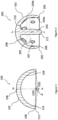
- FIG 1 shows a cross-section of an acetabular cup 100 according to an embodiment of the invention.
- the cup has a generally hollow hemi-spherical shape and comprises an outer surface 102 and an inner bearing surface 104.
- the inner bearing surface 104 is intended to receive a resurfaced femoral head prosthesis (200 in Figure 2 )
- the inner surface 104 is highly polished and provides a snug fit between the cup 100 and the head 200.
- the outer surface 102 has an outer diameter that ranges between 45mm to 67mm and an outer diameter centre point (COD), wherein said diameter changes in 2 mm increments when scaling the size of the cup.
- the inner surface 104 has a bearing diameter in the range 39.9mm and 60.8mm and a bearing diameter centre point (CBD).
- the cup further comprises a cup pole 106 having a flattened profile with a longitudinal axis X-X' of the cup passing therethrough, and a cup rim 108 that is coplanar with the centre of the outside diameter (COD).
- the flattened profile of the cup pole is defined by an inclusive subtended angle of 17 -22 degrees struck from the COD.
- the cup rim comprises an outer edge 112 and an inner edge 114, the cup rim 108 has an edge radius between said bearing surface 104 and said cup rim inner edge 114, preferably an edge radius is at least 1 mm to allow for a smooth movement of the femoral head 200 inside the cup 100.
- the cup rim 108 may also have an edge radius of 1mm between the outer surface 102 and the outer edge 112 of the rim 108 to avoid irritation of soft tissue traversing the rim.
- the inner surface 104 is offset laterally from the cup pole 106.
- the lateral offset effectively translates the centre of hip rotation (in the resurfaced joint) laterally relative to the cup pole and this is desirable in maximising the range of motion in the resurfaced joint.
- the lateral offset of the inner bearing surface 104 is defined by a fixed bearing arc of 160° measured from a bearing diameter centre point CBD to the inner bearing surface edge.
- the lateral offset can be seen as an angle ⁇ between two lines drawn from the centre of the bearing diameter CBD to the points marking the extent in each direction of the inner conforming bearing surface 104.
- the cup thickness is greatest at the cup pole 106 and thinnest at the cup rim 108.
- the fixed bearing arc and edge radius size effectively determine the degree of lateral offset of the bearing, which then scales with increasing bearing/cup size as a result.
- the resulting lateral offset values measured from the cup rim 108 to the CBD, range from 2.6mm to 4.5mm between the smallest to largest size cups.
- the outer surface 102 of the cup 100 may have a rough and partially porous plasma-sprayed dual coating of titanium and hydroxyapatite (HA). This provides both initial fixation (by "scratch-fit") as well as allowing enhanced longer term fixation following bone ongrowth (osseointegration).
- the cup 100 is normally implanted into a prepared acetabulum reamed to between 1 and 2mm smaller than the effective diameter of the coated surface 102.
- a set of differently-sized acetabular cups is provided in order to accommodate the full range of differently sized patients.
- their outer and inner diameters increase together in fixed increments, e.g. 2mm
- the ratio between the outer and inner diameters changes as one moves through the range of cups.
- the outer diameter increases in 2mm increments whereas the inner diameter increases in smaller increments, e.g. 1.9mm.
- FIG 2 shows a monobloc ceramic femoral resurfacing head prosthesis 200.
- Said femoral head prosthesis is configured to be used with the ceramic cup 100 shown on Figure 1 above, together forming the articulating joint of the resurfaced hip.
- the femoral head 200 is affixed to the patient's femur by cementing, and, like the acetabular cups, is provided in a range of sizes to suit individual patient anatomy.
- the head 200 comprises a generally spherical outer bearing surface 201 having an outer bearing diameter and a head rim 202.
- the bearing diameter is typically in the range 39.9mm to 60.8mm.
- the head 200 further comprises an inner socket 203 having an inner surface 204 intended to receive a prepared femur.
- the inner surface 204 comprises two portions: a first near cylindrical portion 204a and a second tapered portion 204b adjacent to the first portion 204a.
- the first portion 204a tapers with respect to a longitudinal axis Y-Y' of the head by at least 1.25°, wherein the second tapered portion 204b tapers with respect to the longitudinal axis Y-Y' of the head by 35 to 45°.
- the inner surface 204 and the outer surface 201 form a head thickness, that is defined as the furthest perpendicular distance between the first near-cylindrical portion 204a and the outer bearing surface 201, and lies in the range between 3 and 5mm, depending on the size of the head 200.
- the head thickness at the rim 202 lies in the range between 1.1 to 1.5 mm, preferably being 1.3mm. It is important to conserve as much bone as possible on the natural femoral head and, in turn, for the head prosthesis wall thickness to be as thin as possible, particularly in the region nearest to the natural femoral neck.
- the head rim 202 forms a smooth radius between an outer edge 205 and an inner edge 206.
- Said radius has a size of at least 0.8 mm. Having a radiused rim helps avoid soft-tissue irritation and minimize edge wear.
- the inner edge 206 of the head rim 202 is also radiused, with the radius being at least 0.5mm. The absence of sharp inner edges helps to avoid localised stress concentrations within the prosthesis.
- the outer bearing surface 201 and the rim edges 205 and 206 are highly polished for a better fit with the cup 100.
- the first near-cylindrical portion 204a comprises a first group of elongate cement pockets 207 in the form of elongated recesses oriented generally parallel with and spaced, preferably equispaced, around the longitudinal axis Y-Y' of the head 200.
- the second tapered portion 204b comprises a second group of cement pockets 208 that are regularly spaced around the longitudinal axis Y-Y'.
- Said first 207 and second 208 groups of cement pockets are elongated and between 0.6 and 1.5mm in depth at their centers, with a concave radiused profile at each end running-up to the surrounding socket surface. It is also understood that other shapes of the cement pockets can be used, such as flat, square or trapezoid.
- the second group of cement pockets 208 provides rotational stability, in a conventional manner by resisting rotation around the longitudinal axis Y-Y'
- the first group of pockets 207 provides a mechanical interlock with the cement mantle to resist both torsional and axial forces acting on the cemented femoral head 200.
- the cement pockets 207 also provide resistance to pull-off forces owing to their alignment with respect to the longitudinal axis Y-Y'.
- the pockets 207 provide a local high-point for cement ingress, deeper and further from the head's axis Y-Y' than the surrounding near-cylindrical inner portion 204.
- the femoral head 200 further comprises a stem 209 projecting laterally inwardly from a pole of the inner surface 204 along the longitudinal axis Y-Y'.
- the stem 209 comprises a proximal end 210 and a distal end 211, said distal end projects laterally beyond the head rim 202.
- the stem 209 is of nearly-cylindrical shape and its diameter ranges in size between 7 and 9 mm.
- By “nearly-cylindrical” it is understood that the proximal end 210 of stem 209 is generally cylindrical, and the distal end 211 is tapered in the lateral direction.
- the length of the proximal portion can be 60-70% of the overall length of the stem 209.
- the stem 209 projects laterally between 1 and 5 mm, more preferably between 3 and 4 mm, beyond the level of the rim 202.
- the distal end 211 of the stem 209 is curved with a radius of between 1.5 and 4 mm.
- the protruding distal end 211 of the stem 209 can be used to assist with the correct alignment of the femoral head 200 during implantation. It is understood that the stem 209 is intended to be a clearance fit within a prepared hole in the natural femur.
- the natural femur is prepared to accept the inner socket 203 and the stem 209 of the resurfacing head 200 prior to cementing.
- the prepared natural femur has a profile which broadly resembles that of the inner socket 203, but leaving clearance between the natural bone and the fully-seated head 200 in some regions, in particular in the tapered portion 204b, to provide a maximum cement mantle thickness of approximately 0.5mm.
- a set of differently-sized femoral heads 200 is provided in order to accommodate the full range of differently sized patients.
- the bearing diameters of the differently-sized femoral heads increase in 1.9mm increments through a range of 39.9mm to 60.8mm, in line with the inner diameters of the correspondingly-sized acetabular cups.
- Prosthetic joint comprising an acetabular cup and a femoral head
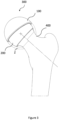
- FIG 3 shows a prosthetic hip joint 300 comprising an acetabular cup 100 and a femoral head 200, each selected from a set of available sizes.
- the prosthetic hip joint 300 is mounted on a natural femoral neck 400.
- the outer diameter of the femoral head 200 matches the inner bearing diameter of the respective cup 100. This results in the ratio between the outer diameter of the cup and the bearing surface of the head being different for each size in the range. For example, for the smallest cup and head in the set, the ratio is 1.154. For the largest cup and head in the set, the ratio is 1.098.
- Figure 3 shows an impingement zone Z (indicated by dotted lines in Figure 3 ) wherein rotation of the cup 100 on the head 200 is limited at the extremes by impingement on the natural femoral neck 400.
- the lateral offset of the inner surface of the cup 100 enables the cup 100 to rotate further with respect to the head 200 before impingement occurs. This effectively increases the range of motion in the resurfaced joint.
- the variation in the ratio between the outer diameter of the cup 100 and the outer bearing surface of the head 200 contributes to desirably minimizing the amount of natural bone that needs to be removed to accommodate the prostheses (this having a greater adverse effect in a smaller sized patient).
- the variation in ratio contributes to maximising the head-neck ratio for the resurfaced femur. This, along with the lateral offset described above, maximises the range of motion of the resurfaced joint.
Landscapes
- Health & Medical Sciences (AREA)
- Orthopedic Medicine & Surgery (AREA)
- Transplantation (AREA)
- Vascular Medicine (AREA)
- Animal Behavior & Ethology (AREA)
- Engineering & Computer Science (AREA)
- Biomedical Technology (AREA)
- Heart & Thoracic Surgery (AREA)
- Cardiology (AREA)
- Life Sciences & Earth Sciences (AREA)
- Oral & Maxillofacial Surgery (AREA)
- General Health & Medical Sciences (AREA)
- Public Health (AREA)
- Veterinary Medicine (AREA)
- Physical Education & Sports Medicine (AREA)
- Prostheses (AREA)
- Transition And Organic Metals Composition Catalysts For Addition Polymerization (AREA)
- Dental Preparations (AREA)
- Materials For Medical Uses (AREA)
Applications Claiming Priority (3)
| Application Number | Priority Date | Filing Date | Title |
|---|---|---|---|
| GB2016534.6A GB2599955B (en) | 2020-10-19 | 2020-10-19 | Prostheses |
| PCT/GB2021/052680 WO2022084659A2 (en) | 2020-10-19 | 2021-10-15 | Prostheses |
| EP21801201.1A EP4228557B1 (de) | 2020-10-19 | 2021-10-15 | Prothesen |
Related Parent Applications (2)
| Application Number | Title | Priority Date | Filing Date |
|---|---|---|---|
| EP21801201.1A Division EP4228557B1 (de) | 2020-10-19 | 2021-10-15 | Prothesen |
| EP21801201.1A Division-Into EP4228557B1 (de) | 2020-10-19 | 2021-10-15 | Prothesen |
Publications (2)
| Publication Number | Publication Date |
|---|---|
| EP4309632A2 true EP4309632A2 (de) | 2024-01-24 |
| EP4309632A3 EP4309632A3 (de) | 2024-04-24 |
Family
ID=73598530
Family Applications (2)
| Application Number | Title | Priority Date | Filing Date |
|---|---|---|---|
| EP21801201.1A Active EP4228557B1 (de) | 2020-10-19 | 2021-10-15 | Prothesen |
| EP23215522.6A Pending EP4309632A3 (de) | 2020-10-19 | 2021-10-15 | Prothesen |
Family Applications Before (1)
| Application Number | Title | Priority Date | Filing Date |
|---|---|---|---|
| EP21801201.1A Active EP4228557B1 (de) | 2020-10-19 | 2021-10-15 | Prothesen |
Country Status (7)
| Country | Link |
|---|---|
| US (1) | US20230397993A1 (de) |
| EP (2) | EP4228557B1 (de) |
| CN (1) | CN116528800A (de) |
| AU (2) | AU2021366372B2 (de) |
| ES (1) | ES3025976T3 (de) |
| GB (1) | GB2599955B (de) |
| WO (1) | WO2022084659A2 (de) |
Families Citing this family (1)
| Publication number | Priority date | Publication date | Assignee | Title |
|---|---|---|---|---|
| US12458500B2 (en) * | 2017-11-01 | 2025-11-04 | Matortho Limited | Ceramic femoral resurfacing head prosthesis |
Family Cites Families (10)
| Publication number | Priority date | Publication date | Assignee | Title |
|---|---|---|---|---|
| US3641590A (en) * | 1970-01-16 | 1972-02-15 | Arthur A Michele | Acetabular replacement prosthesis and method of assembling |
| DE2751537A1 (de) * | 1977-11-18 | 1979-05-23 | Wolfgang Bongartz | Hueftgelenkprothese |
| EP0013863A1 (de) * | 1979-01-26 | 1980-08-06 | Osteo Ag | Zementfrei einsetzbare Schalenprothese, insbesondere für das Hüftgelenk |
| FR2839441B1 (fr) * | 2002-05-07 | 2004-07-30 | Raphael Mosseri | Nouvelle prothese totale de hanche |
| GB2396561A (en) * | 2002-12-27 | 2004-06-30 | Biomet Merck Ltd | Hip prosthesis with ceramic bearing |
| DE102004032675B4 (de) * | 2004-07-02 | 2007-03-01 | Eska Implants Gmbh & Co.Kg | Prüfhilfe zur Überprüfung des Formenschlusses zwischen der Außenkontur eines präparierten Restgelenkkopfes und der Innenoberfläche der Prüfhilfe selbst |
| US8439978B2 (en) * | 2007-12-10 | 2013-05-14 | Mako Surgical Corp. | Prosthetic device and method for implanting the prosthetic device |
| EP2174621B1 (de) * | 2008-10-07 | 2013-07-17 | Finsbury (Development) Limited | Prothese |
| GB2531589B (en) * | 2014-10-23 | 2017-02-01 | James Wallace Mcminn Derek | Femoral head resurfacing implant |
| GB2562256B (en) * | 2017-05-09 | 2021-08-11 | Matortho Ltd | Ceramic acetabular cup |
-
2020
- 2020-10-19 GB GB2016534.6A patent/GB2599955B/en active Active
-
2021
- 2021-10-15 ES ES21801201T patent/ES3025976T3/es active Active
- 2021-10-15 US US18/249,374 patent/US20230397993A1/en active Pending
- 2021-10-15 EP EP21801201.1A patent/EP4228557B1/de active Active
- 2021-10-15 AU AU2021366372A patent/AU2021366372B2/en active Active
- 2021-10-15 EP EP23215522.6A patent/EP4309632A3/de active Pending
- 2021-10-15 CN CN202180071219.9A patent/CN116528800A/zh active Pending
- 2021-10-15 WO PCT/GB2021/052680 patent/WO2022084659A2/en not_active Ceased
-
2025
- 2025-08-29 AU AU2025223915A patent/AU2025223915A1/en active Pending
Also Published As
| Publication number | Publication date |
|---|---|
| WO2022084659A3 (en) | 2022-06-23 |
| AU2021366372A1 (en) | 2023-06-22 |
| EP4309632A3 (de) | 2024-04-24 |
| AU2021366372B2 (en) | 2025-09-18 |
| CN116528800A (zh) | 2023-08-01 |
| US20230397993A1 (en) | 2023-12-14 |
| EP4228557A2 (de) | 2023-08-23 |
| GB2599955B (en) | 2024-12-11 |
| ES3025976T3 (en) | 2025-06-10 |
| AU2021366372A9 (en) | 2024-08-08 |
| GB202016534D0 (en) | 2020-12-02 |
| GB2599955A (en) | 2022-04-20 |
| EP4228557C0 (de) | 2025-04-23 |
| WO2022084659A2 (en) | 2022-04-28 |
| EP4228557B1 (de) | 2025-04-23 |
| AU2025223915A1 (en) | 2025-09-25 |
Similar Documents
| Publication | Publication Date | Title |
|---|---|---|
| EP1138283B1 (de) | Oberschenkelteil einer Hüftgelenksprothese | |
| US5507833A (en) | Hip replacement system and method for implanting the same | |
| CA2588523C (en) | Femoral head resurfacing | |
| US9937048B2 (en) | Femoral stem including an anchor to facilitate assembly and implantation | |
| US4944759A (en) | Porous-coated artificial joints | |
| AU779958B2 (en) | Femoral hip prosthesis | |
| US20120265319A1 (en) | Total hip arthroplasty | |
| US20080009951A1 (en) | Femoral head resurfacing implant with internal plate fixation and instrumentation | |
| WO2016028795A1 (en) | Variable hip resurfacing femoral implant | |
| EP2108338A2 (de) | Oberflächenumformung-Femurkopfteil | |
| AU2025223915A1 (en) | Prostheses | |
| EP3606476B1 (de) | Komplettschulterprothese | |
| GB2630902A (en) | Prostheses | |
| Refior et al. | Special problems of cementless fixation of total hip-joint endoprostheses with reference to the PM type | |
| EP4274517A1 (de) | Ineinandergreifende umgekehrte hüftprothese mit abnehmbarem konischem zentralen pfosten | |
| WO2003047471A1 (en) | Femoral component of hip joint prosthesis | |
| Amstutz et al. | Evolution of hip resurfacing | |
| JP2005278876A (ja) | 人工股関節 | |
| AU9724101A (en) | Prosthesis with feature aligned to trabeculae |
Legal Events
| Date | Code | Title | Description |
|---|---|---|---|
| PUAI | Public reference made under article 153(3) epc to a published international application that has entered the european phase |
Free format text: ORIGINAL CODE: 0009012 |
|
| STAA | Information on the status of an ep patent application or granted ep patent |
Free format text: STATUS: THE APPLICATION HAS BEEN PUBLISHED |
|
| AC | Divisional application: reference to earlier application |
Ref document number: 4228557 Country of ref document: EP Kind code of ref document: P |
|
| AK | Designated contracting states |
Kind code of ref document: A2 Designated state(s): AL AT BE BG CH CY CZ DE DK EE ES FI FR GB GR HR HU IE IS IT LI LT LU LV MC MK MT NL NO PL PT RO RS SE SI SK SM TR |
|
| REG | Reference to a national code |
Ref country code: DE Ref legal event code: R079 Free format text: PREVIOUS MAIN CLASS: A61F0002360000 Ipc: A61F0002320000 |
|
| PUAL | Search report despatched |
Free format text: ORIGINAL CODE: 0009013 |
|
| AK | Designated contracting states |
Kind code of ref document: A3 Designated state(s): AL AT BE BG CH CY CZ DE DK EE ES FI FR GB GR HR HU IE IS IT LI LT LU LV MC MK MT NL NO PL PT RO RS SE SI SK SM TR |
|
| RIC1 | Information provided on ipc code assigned before grant |
Ipc: A61F 2/36 20060101ALI20240315BHEP Ipc: A61F 2/34 20060101ALI20240315BHEP Ipc: A61F 2/32 20060101AFI20240315BHEP |
|
| STAA | Information on the status of an ep patent application or granted ep patent |
Free format text: STATUS: REQUEST FOR EXAMINATION WAS MADE |
|
| 17P | Request for examination filed |
Effective date: 20241016 |
|
| RBV | Designated contracting states (corrected) |
Designated state(s): AL AT BE BG CH CY CZ DE DK EE ES FI FR GB GR HR HU IE IS IT LI LT LU LV MC MK MT NL NO PL PT RO RS SE SI SK SM TR |
|
| GRAP | Despatch of communication of intention to grant a patent |
Free format text: ORIGINAL CODE: EPIDOSNIGR1 |
|
| STAA | Information on the status of an ep patent application or granted ep patent |
Free format text: STATUS: GRANT OF PATENT IS INTENDED |
|
| INTG | Intention to grant announced |
Effective date: 20250915 |
|
| RIC1 | Information provided on ipc code assigned before grant |
Ipc: A61F 2/32 20060101AFI20250908BHEP Ipc: A61F 2/34 20060101ALI20250908BHEP Ipc: A61F 2/36 20060101ALI20250908BHEP |