EP4308388B1 - Tyre with improved snow performance - Google Patents
Tyre with improved snow performance Download PDFInfo
- Publication number
- EP4308388B1 EP4308388B1 EP22716215.3A EP22716215A EP4308388B1 EP 4308388 B1 EP4308388 B1 EP 4308388B1 EP 22716215 A EP22716215 A EP 22716215A EP 4308388 B1 EP4308388 B1 EP 4308388B1
- Authority
- EP
- European Patent Office
- Prior art keywords
- tyre
- external surface
- protrusions
- points
- recesses
- Prior art date
- Legal status (The legal status is an assumption and is not a legal conclusion. Google has not performed a legal analysis and makes no representation as to the accuracy of the status listed.)
- Active
Links
Images




Classifications
-
- B—PERFORMING OPERATIONS; TRANSPORTING
- B60—VEHICLES IN GENERAL
- B60C—VEHICLE TYRES; TYRE INFLATION; TYRE CHANGING; CONNECTING VALVES TO INFLATABLE ELASTIC BODIES IN GENERAL; DEVICES OR ARRANGEMENTS RELATED TO TYRES
- B60C11/00—Tyre tread bands; Tread patterns; Anti-skid inserts
- B60C11/03—Tread patterns
- B60C11/13—Tread patterns characterised by the groove cross-section, e.g. for buttressing or preventing stone-trapping
- B60C11/1307—Tread patterns characterised by the groove cross-section, e.g. for buttressing or preventing stone-trapping with special features of the groove walls
-
- B—PERFORMING OPERATIONS; TRANSPORTING
- B60—VEHICLES IN GENERAL
- B60C—VEHICLE TYRES; TYRE INFLATION; TYRE CHANGING; CONNECTING VALVES TO INFLATABLE ELASTIC BODIES IN GENERAL; DEVICES OR ARRANGEMENTS RELATED TO TYRES
- B60C11/00—Tyre tread bands; Tread patterns; Anti-skid inserts
- B60C11/03—Tread patterns
- B60C11/13—Tread patterns characterised by the groove cross-section, e.g. for buttressing or preventing stone-trapping
- B60C11/1307—Tread patterns characterised by the groove cross-section, e.g. for buttressing or preventing stone-trapping with special features of the groove walls
- B60C2011/133—Tread patterns characterised by the groove cross-section, e.g. for buttressing or preventing stone-trapping with special features of the groove walls comprising recesses
-
- B—PERFORMING OPERATIONS; TRANSPORTING
- B60—VEHICLES IN GENERAL
- B60C—VEHICLE TYRES; TYRE INFLATION; TYRE CHANGING; CONNECTING VALVES TO INFLATABLE ELASTIC BODIES IN GENERAL; DEVICES OR ARRANGEMENTS RELATED TO TYRES
- B60C11/00—Tyre tread bands; Tread patterns; Anti-skid inserts
- B60C11/03—Tread patterns
- B60C11/13—Tread patterns characterised by the groove cross-section, e.g. for buttressing or preventing stone-trapping
- B60C11/1307—Tread patterns characterised by the groove cross-section, e.g. for buttressing or preventing stone-trapping with special features of the groove walls
- B60C2011/1338—Tread patterns characterised by the groove cross-section, e.g. for buttressing or preventing stone-trapping with special features of the groove walls comprising protrusions
Definitions
- the present invention relates to a tyre having an innovative 3-D pattern profile at external perimetral walls of the tread land portions, for improving snow performances with reference to snow digging and snow trapping effects.
- Tire performance on snow is linked to several mechanisms depending mainly on tread compound and pattern features (void ratio/distribution, edges geometry/number/distribution, tread block shape/stiffness).
- the main mechanisms concurring to such kind of performance are the "snow digging" and the “snow trapping” effects, the former dealing with the penetration of tread in the snowpack, the latter dealing with the capability of tread voids to collect and compress snow.
- snow digging is about the capability of tread pattern elements (sipes, cuts, edges) to penetrate into snowpack and to provide gripping for traction/braking/cornering maneuvers.
- Snow trapping is instead the capability of macro-voids of the tread pattern (grooves, lugs, cranks, etc.) to collect and compress snow in order to take advantage the snow-snow friction mechanism as additional contribution to snow grip.
- tread blocks whose contours are shaped like a simple polygonal chain (e.g. square-wave, saw tooth shape, "zig-zag” shape, etc.) in order to increase the points where snow can be racked up: this improve the snow trapping mechanism.
- a simple polygonal chain e.g. square-wave, saw tooth shape, "zig-zag” shape, etc.
- FIG. 1a-1c a first prior art solution is shown in Figures 1a-1c .
- the tread block cross profile does not change along the height of the block itself, and presents voids pattern features (cuts, notches, "zig-zag” lines) which have been basically "extruded” along tyre radial direction, that is along block height z.
- a second prior art solution shown in Figures 2a-2c is to have a tread block cross profile which changes along the height of the block itself (direction z) but remains flat along the block width (direction x) and the block length (direction y).
- variable profile of the tread block's walls is applied only in one direction, which could be, alternatively, the width/length or the height.
- JPH11151912 , EP1048488 , JP2010120427 , JP2005231600 and JPH0357704 show other examples of external surfaces of tread block perimetral walls.
- the technical problem posed and solved by the present invention is therefore to provide a tyre which allows overcoming the disadvantages mentioned above with reference to the known art.
- Target of the subject idea is to provide a solution to enhance the "snow trapping" effect by introducing a series of 3-dimensional (3D) shaped additional pattern elements (e.g. cuts, notches, wavy voids) on perimetral wall surfaces of tread land portions, in particular at perimetral wall surfaces of tread blocks.
- 3-dimensional (3D) shaped additional pattern elements e.g. cuts, notches, wavy voids
- the above 3D features are shaped and distributed in such a way that snow is trapped and compressed inside them, so providing an increased contribution to snow grip.
- the problem solved is that of improving snow performance by enhancing the overall snow trapping mechanism at tread land portions level on top of tread compound properties' design.
- the present invention provides a tyre having an external surface with innovative 3D profile at perimetral walls of the tread land portions, for improving snow performances.
- the perimetral walls present a 3D voids (or recesses) and/or protrusions pattern, configured to improve snow digging and snow trapping effects.
- a first key aspect of the proposed invention consists in that voids (cuts, notches, grooves, etc.) and/or protruding elements are applied to longitudinal walls of the tread land portions (both leading and trailing with respect to tyre rolling direction) and/or lateral walls in such a way a variable profile is possible contemporarily along both land portions height and width/length.
- a complex 3D pattern can be shaped, so that the whole land portions walls can be exerted to increase the snow trapping mechanism, and in turn the overall snow grip potential.
- the entire side walls of the tread land portions can be affected by this 3D pattern, so that the total surface area involved in such mechanism is potentially much higher with respect to that of the prior art solutions. This leads to an increased number of voids that enhances snow trapping capability and so the overall snow grip.
- a first technical benefit of the invention is that edge density (very important for both snow trapping and digging effects) is increased.
- tread land portion wall profile snow trapping can be improved locally (at tread land portion level), providing a higher volume of trapped snow and with higher density, too.
- voids are introduced in such a way that land portion stiffness is not affected, and in particular not decreased. This is very important for all the others performance (i.e. dry, wet) which could be negatively affected by snow-oriented design intents, such us lowering bock stiffness, indeed.
- the proposed invention provides a solution to enhance the snow trapping effect by introducing a series of 3D small "voids" (cuts or recesses) and/or protruding elements as additional pattern elements on longitudinal/lateral side wall surfaces of tread land portions, not on internal surfaces thereof.
- the 3D pattern is provided onto perimetral, external surfaces of the tread land portions, which are designed to penetrate in the snow (or, more in general, in the ground).
- the 3D small voids, positioned with a specific layout, are shaped and distributed in such a way snow is trapped and compressed inside them, so providing an increased contribution to snow grip.
- the proposed solution is to be potentially applied to all tyres for which an overall snow performance improvement (braking/traction/handling/slalom) is required, but of course its application to all kind of tyres is advantageous.
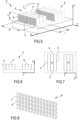
- a preferred embodiment of a tyre 1 according to the present invention is shown, including an external tread portion P, which comprises at least a tread block a.
- a tread portion could refer to, or comprise, a central, middle or/and shoulder land portion of a tread. Still according to the present invention, all the features of the invention which in the following are referred to a tread block exemplary provided with a prismatic shape, are intended to be applied also to tread blocks, or more in general to tread land portions, provided with different and even more complex shapes, e.g. provided with V-shaped ("palm" shaped) profiles.
- the tyre 1 presents a circumferential direction C, a radial direction R and a transversal direction T, said transversal direction being a direction parallel to the rotation axis A of the tyre.
- an arrow indicates the rolling direction of the tyre 1.
- transversal direction T and the rotation axis A are represented as being coincident.
- a Cartesian coordinate system is given, which is intended to be the local reference system of the tread block, defined by a longitudinal axis x, a transversal axis y and a sagittal axis z.
- the longitudinal axis x is locally tangent to the circumferential direction C
- the transversal axis y is parallel to the rotation axis A
- the sagittal axis z is locally coincident with the radial direction R.
- the tread portion P or in particular, according to the present example, the tread block a, comprises a plurality of lateral perimetral faces or walls, which according to the present invention are intended to be external walls of the block a, for example walls facing macro-voids or facing other blocks, and not inner walls of the tread block facing micro-voids such as, for example, sipes' walls.
- the perimetral walls are those which penetrate and engage with the snow, or, more in general, with the ground, when the tyre 1 is in use.
- At least a portion of an external surface of one of said perimetral walls bears a 3-dimensional (3D) pattern of recesses and/or protrusions.
- the 3D pattern comprises recesses and/or protrusions alternating to each other according to at least two spatial directions, preferably perpendicular to each other, of the same external surface.
- recesses and/or protrusions alternate to each other according to two main directions which are perpendicular to each other and define the extension, according to a plan view, of the concerned external surface.
- two directions could be a transversal/longitudinal direction and a sagittal direction.
- Said 3D pattern is configured to improve snow digging and snow trapping effects, as the snow is trapped and compacted inside the 3D recesses, and/or between the 3D protrusions, when the tyre 1 is in use.
- each of said alternating recesses and/or protrusions is shaped as a double-curved element but, according to preferred embodiments of the inventions, it can present also a prismatic shape (embodiment of Figure 4b e 4c ) or a pyramidal shape. Otherwise, various regions of external surface, each presenting different shapes of recesses and/or protrusions, could be provided at the same block wall.
- Figures 4b e 4c show a plan view and a lateral view of a preferred embodiment of a tread block a according to the present invention, respectively.
- the tread block a presents a prismatic shape defined by four perimetral walls, namely a first couple of longitudinal perimetral walls, and a second couple of transversal perimetral walls.
- all external surfaces of the four perimetral walls bear alternating recesses and/or protrusions presenting a prismatic shape, creating a 3D pattern.
- the alternation of recesses and/or protrusions realizes a sort of 3D checkerboard pattern on the external surface of a tread land portion, in particular of a tread block.
- a 3D pattern according to what already described could be provided to the external surface of only one perimetral wall, or two opposite perimetral walls (preferably, a couple of transversal perimetral walls), or - of course - all the perimetral walls of the tread block, as already said.
- the 3D pattern could be provided to a whole external surface of a respective perimetral wall, or only to a limited portion thereof.
- the distance between consecutive recesses and/or protrusions, measured according a direction parallel to the external surface of the perimetral wall on which they are provided to, is constant.
- tread portion P With reference to Figure 5 , another preferred embodiment of a tread portion P according to the present invention is shown. For better clarity, an arrow indicates the rolling direction of the tyre comprising the tread portion P (the tyre is not represented in Figure 5 ).
- the tread portion P comprises, as way of example, two tread blocks respectively designed by reference letters a and b , but the following description will refer to tread block a only. However, all the following considerations about tread block a are to be intended as extended to tread block b , too (or to any other tread block comprised in a tire according to the present invention).
- the 3D pattern of the invention is intended to be provided to external, perimetral faces or walls which define the tread portion or more in particular the tread block, which faces or walls are not intended to comprise inner walls provided within tread block body, such as walls defining the sipes 11.
- the tread block a has preferably a prismatic shape and comprises four perimetral walls, namely a first couple 3, 5 ad a second couple 2, 4 of perimetral walls, wherein in general the walls of each couple are substantially opposite to each other.
- tread block a comprises two longitudinal perimetral walls 2, 4 extending according said circumferential and radial directions C, R and two transversal perimetral walls 3, 5 extending according said transversal and radial directions T, R.
- a whole external surface 10 of each of the two perimetral walls of the first couple 3, 5, or of the second couple 2, 4, is provided with the 3D pattern of alternating recesses 6 and/or protrusions 7.
- a whole external surface 10 of both said two transversal perimetral walls 3, 5 bears the 3D pattern of alternating recesses 6 and/or protrusions 7, as can be seen also in Figures 6 and 7 .
- An increased view of the 3D patterned external surface 10 is shown in Figure 8 .
- a whole external surface 10 of two consecutive perimetral walls of tread block a (with reference to Figures 6 and 7 , consecutive perimetral walls being denoted by the numeral references 2, 3 or 3, 4 or 4, 5 or 5, 2) could bear the 3D pattern of alternating recesses and/or protrusions.
- a whole external surface 10 of three perimetral walls of tread block a could bear the 3D pattern of alternating recesses and/or protrusions.
- the 3D pattern of alternating recesses and/or protrusions is realized by means of a wavy generatrix G swept along a wavy directrix D path, the preferred embodiments of lines G and D being shown in Figures 10 and 9 , respectively.
- the generatrix G and directrix D both comprise crest points 8, which are most external points of a respective external surface 10, and trough points 9, which are most internal points of a respective external surface 10.
- zigzag line which presents a bend radius different than zero at its crest points and trough points is intended to be a wavy line.
- the directrix D is shown, corresponding to the external profile of the tread block 3D patterned surface according to a x-z plane section.
- the generatrix G is shown, corresponding to the external profile of the tread block 3D patterned surface according to a x-y plane section.
- the 3D pattern has been generated by means of the generatrix G profile (on plane x-y, as shown in Figure 10 ) swept along the directrix D profile (on plane x-z, as shown in Figure 9 ).
- the distance between consecutive crest points 8 and trough points 9, measured according to the longitudinal direction x, which is a direction parallel to said external surface 10, is constant.
- the height x h out , x w out of the crest points 8 with respect to the external surface 10, measured according to the transversal direction y is constant.
- the depth x h in , x w in of the trough points 9 with respect to the external surface 10 can be constant, too.
- the height x h out , x w out of the crest points 8 with respect to the external surface 10 can be comprised between 0 and 4 mm, preferably between 0,5 and 3 mm.
- the depth x h in , x w in of the trough points 9 with respect to the external surface 10 can be comprised between 0 and 4 mm, preferably between 0,5 and 3 mm.
- the distance y h 3 , y w 3 between consecutive crest points 8 and trough points 9, measured according a transversal direction y parallel to said external surface 10, is comprised between 0,5 and 7,5 mm, preferably between 0,5 and 5 mm. Still preferably, the distance between each of the crest points 8 and trough points 9, measured according a longitudinal direction x orthogonal to said external surface 10 is equal at most to 8 mm, preferably comprised between 0.5 and 6 mm.
- the wavy generatrix G and/or the wavy directrix D present a bend radius equal to 0,2 mm at each of crest points 8 and trough points 9 (not shown in Figures 9 and 10 ).
- the bend radius could be at most equal to 2 mm, more preferably comprised between 0,2 and 1,5 mm.
- the 3D pattern of alternating recesses and/or protrusions could be realized by means of a zigzag generatrix swept along a zigzag directrix (wherein the zigzag generatrix and directrix have bend radius different than zero at their crest points and trough points).
- the recesses and/or protrusions generated would have a pyramidal shape.
- the aim of the introduction of a complex 3D pattern is to maximize the presence of grooves/cuts/voids (properly shaped and spaced) on tread land portions (in particular tread block) walls, in order to get snow trapped in them. Trapped snow will be compacted, resulting in increasing longitudinal shear forces and in turn the overall gripping effect.
- the more external surface of the tread blocks is provided with a 3D pattern of recesses and/or protrusions according to the invention, the more the snow performance is improved.
- the external surfaces of the tread land portions provided with the 3D-pattern it is possible to improve traction and/or braking and/or cornering on snow, and even all of said features at the same time.
- the experimental campaign consisted of providing three rubber blocks prototypes sliding on a snow track under the same working conditions, according to fixed velocity, temperature and applied pressure, with a controlled temperature.
- Solution A A first rubber block without cuts (Solution A), a second rubber block according to the prior art (Solution B) and a third rubber block according to the invention (Solution C) have been provided.
- the tread block of prior art solution B is provided with a pattern of recesses and protrusions presenting the following dimensions: Item Dimension x b 0,75 mm y b1 1,5 mm y b2 2 mm r b 0,3 mm ⁇ b 90°
- the bend radius in Solution C is equal to 0,2 mm.
- snow friction coefficient is the ratio between Longitudinal Force Fx and Normal Force Fz ), wherein high friction was desired, of course.
- the snow friction potential index of the proposed Solution C is higher than that of tested Solutions A and B.
Landscapes
- Engineering & Computer Science (AREA)
- Mechanical Engineering (AREA)
- Tires In General (AREA)
Description
- The present invention relates to a tyre having an innovative 3-D pattern profile at external perimetral walls of the tread land portions, for improving snow performances with reference to snow digging and snow trapping effects.
- Tire performance on snow is linked to several mechanisms depending mainly on tread compound and pattern features (void ratio/distribution, edges geometry/number/distribution, tread block shape/stiffness).
- In particular, the main mechanisms concurring to such kind of performance are the "snow digging" and the "snow trapping" effects, the former dealing with the penetration of tread in the snowpack, the latter dealing with the capability of tread voids to collect and compress snow.
- In particular, snow digging is about the capability of tread pattern elements (sipes, cuts, edges) to penetrate into snowpack and to provide gripping for traction/braking/cornering maneuvers.
- Snow trapping is instead the capability of macro-voids of the tread pattern (grooves, lugs, cranks, etc.) to collect and compress snow in order to take advantage the snow-snow friction mechanism as additional contribution to snow grip.
- With regard to snow trapping effect, having a flat surface as longitudinal/lateral side wall of tread blocks, even if usual, is not a good solution for the enhancement of this mechanism.
- One of the most common approaches adopted to increase snow performance is realizing tread blocks whose contours are shaped like a simple polygonal chain (e.g. square-wave, saw tooth shape, "zig-zag" shape, etc.) in order to increase the points where snow can be racked up: this improve the snow trapping mechanism.
- As way of example, a first prior art solution is shown in
Figures 1a-1c . The tread block cross profile does not change along the height of the block itself, and presents voids pattern features (cuts, notches, "zig-zag" lines) which have been basically "extruded" along tyre radial direction, that is along block height z. - A second prior art solution shown in
Figures 2a-2c is to have a tread block cross profile which changes along the height of the block itself (direction z) but remains flat along the block width (direction x) and the block length (direction y). - In
Figures 3a and 3b , the external surfaces of tread block perimetral walls of another prior art solution are shown. The external surface in provided with rectilinear cuts realized by extruding a "zig-zag" profile (featuring rounds, too) along the block width. Each cut has a triangular shaped profile. - In all the above known solutions, the variable profile of the tread block's walls is applied only in one direction, which could be, alternatively, the width/length or the height.
- All these kinds of known embodiments have the limitation to not exert the whole block walls to trap snow and increase snow performance.
-
JPH11151912 EP1048488 ,JP2010120427 JP2005231600 JPH0357704 - The technical problem posed and solved by the present invention is therefore to provide a tyre which allows overcoming the disadvantages mentioned above with reference to the known art.
- This problem is solved by a tyre according to claim 1. Preferred features of the present invention are object of the dependent claims.
- Target of the subject idea is to provide a solution to enhance the "snow trapping" effect by introducing a series of 3-dimensional (3D) shaped additional pattern elements (e.g. cuts, notches, wavy voids) on perimetral wall surfaces of tread land portions, in particular at perimetral wall surfaces of tread blocks.
- The above 3D features (basically small patterned voids and /or protrusions) are shaped and distributed in such a way that snow is trapped and compressed inside them, so providing an increased contribution to snow grip. The problem solved is that of improving snow performance by enhancing the overall snow trapping mechanism at tread land portions level on top of tread compound properties' design.
- The present invention provides a tyre having an external surface with innovative 3D profile at perimetral walls of the tread land portions, for improving snow performances. The perimetral walls present a 3D voids (or recesses) and/or protrusions pattern, configured to improve snow digging and snow trapping effects.
- In the context of the present application, the terms 'voids' and 'recesses' are to be intended as synonyms.
- A first key aspect of the proposed invention consists in that voids (cuts, notches, grooves, etc.) and/or protruding elements are applied to longitudinal walls of the tread land portions (both leading and trailing with respect to tyre rolling direction) and/or lateral walls in such a way a variable profile is possible contemporarily along both land portions height and width/length.
- By applying a variable profile in both the height and width/length directions, a complex 3D pattern can be shaped, so that the whole land portions walls can be exerted to increase the snow trapping mechanism, and in turn the overall snow grip potential.
- The entire side walls of the tread land portions can be affected by this 3D pattern, so that the total surface area involved in such mechanism is potentially much higher with respect to that of the prior art solutions. This leads to an increased number of voids that enhances snow trapping capability and so the overall snow grip.
- More specifically, a first technical benefit of the invention is that edge density (very important for both snow trapping and digging effects) is increased.
- Furthermore, by a proper optimization of tread land portion wall profile, snow trapping can be improved locally (at tread land portion level), providing a higher volume of trapped snow and with higher density, too.
- In addition, voids are introduced in such a way that land portion stiffness is not affected, and in particular not decreased. This is very important for all the others performance (i.e. dry, wet) which could be negatively affected by snow-oriented design intents, such us lowering bock stiffness, indeed.
- It is crucial to note that the proposed invention provides a solution to enhance the snow trapping effect by introducing a series of 3D small "voids" (cuts or recesses) and/or protruding elements as additional pattern elements on longitudinal/lateral side wall surfaces of tread land portions, not on internal surfaces thereof. In other words, the 3D pattern is provided onto perimetral, external surfaces of the tread land portions, which are designed to penetrate in the snow (or, more in general, in the ground). The 3D small voids, positioned with a specific layout, are shaped and distributed in such a way snow is trapped and compressed inside them, so providing an increased contribution to snow grip.
- The proposed solution is to be potentially applied to all tyres for which an overall snow performance improvement (braking/traction/handling/slalom) is required, but of course its application to all kind of tyres is advantageous.
- Other advantages, features and modes of employ of the present invention will become evident from the following detailed description of some embodiments, presented by way of example and not of limitation.
- Reference will be made to the Figures of the enclosed drawings, wherein:
- ▪
Figure 1a shows a schematic prospective view of a first prior art embodiment of a tyre; - ▪
Figures 1b and 1c show, respectively, a plan view and a lateral view of a first prior art tread block comprised in the embodiment ofFigure 1a ; - ▪
Figure 2a shows a schematic prospective view of a second prior art embodiment of a tyre; - ▪
Figures 2b and 2c show, respectively, a plan view and a lateral view of a second prior art tread block comprised in the embodiment ofFigure 2a ; - ▪
Figure 3a shows a schematic, prospective view of a third prior art tread block; - ▪
Figure 3b shows a lateral section view of the third prior art tread block ofFigure 3a ; - ▪
Figure 4a shows a schematic prospective view of a preferred embodiment of a tyre according to the present invention; - ▪
Figures 4b and 4c show, respectively, a plan view and a lateral view of a preferred embodiment of tread block according to the present invention, comprised in the tyre ofFigure 4a ; - ▪
Figure 5 shows more in detail a lateral, prospective view of a preferred embodiment of tread block according to the present invention; - ▪
Figures 6 and 7 show, respectively, a lateral view and a plan view of the preferred embodiment of tread block according toFigure 5 ; - ▪
Figure 8 shows in greater detail an external 3-dimensional patterned surface of the tread block ofFigure 5 ; - ▪
Figure 9 shows the geometrical features of a directrix line D according to the present invention; - ▪
Figure 10 shows the geometrical features of a generatrix line G according to the present invention; and - ▪
Figure 11 is a histogram showing the potential index referred to snow friction with reference to prototypes of a first prior art tread block (solution A), a second prior art tread block (solution B) and a preferred embodiment of tread block according to the present invention (solution C), respectively. - The thicknesses and curvatures shown in the Figures introduced above are to be understood as purely exemplary and are not necessarily shown in proportion. Moreover, in said Figures some layers/components of the tyre may have been omitted, for a clearer illustration of aspects of the present invention.
- Hereinafter, several embodiments and variations of the invention will be described, with reference to the Figures introduced above.
- Moreover, the different embodiments and variants described in the following are possibly employed in combination, when they are compatible.
- With reference to
Figure 4a , a preferred embodiment of a tyre 1 according to the present invention is shown, including an external tread portion P, which comprises at least a tread block a. - According to the present invention, it is intended that a tread portion could refer to, or comprise, a central, middle or/and shoulder land portion of a tread. Still according to the present invention, all the features of the invention which in the following are referred to a tread block exemplary provided with a prismatic shape, are intended to be applied also to tread blocks, or more in general to tread land portions, provided with different and even more complex shapes, e.g. provided with V-shaped ("palm" shaped) profiles.
- The tyre 1 presents a circumferential direction C, a radial direction R and a transversal direction T, said transversal direction being a direction parallel to the rotation axis A of the tyre. For better clarity, an arrow indicates the rolling direction of the tyre 1.
- In the exemplary view of
Figure 4a , the transversal direction T and the rotation axis A are represented as being coincident. - Furthermore, to ease the following description of the tread block geometry, in
Figure 4a a Cartesian coordinate system is given, which is intended to be the local reference system of the tread block, defined by a longitudinal axis x, a transversal axis y and a sagittal axis z. The longitudinal axis x is locally tangent to the circumferential direction C, the transversal axis y is parallel to the rotation axis A and the sagittal axis z is locally coincident with the radial direction R. - The tread portion P, or in particular, according to the present example, the tread block a, comprises a plurality of lateral perimetral faces or walls, which according to the present invention are intended to be external walls of the block a, for example walls facing macro-voids or facing other blocks, and not inner walls of the tread block facing micro-voids such as, for example, sipes' walls. The perimetral walls are those which penetrate and engage with the snow, or, more in general, with the ground, when the tyre 1 is in use.
- According to the invention, at least a portion of an external surface of one of said perimetral walls bears a 3-dimensional (3D) pattern of recesses and/or protrusions.
- According to the invention, also embodiments comprising a 3D only-recesses pattern and a 3D only-protrusions pattern are foreseen.
- In other words, the 3D pattern comprises recesses and/or protrusions alternating to each other according to at least two spatial directions, preferably perpendicular to each other, of the same external surface. Preferably, recesses and/or protrusions alternate to each other according to two main directions which are perpendicular to each other and define the extension, according to a plan view, of the concerned external surface. As way of example, with reference to the above Cartesian coordinate system, such two directions could be a transversal/longitudinal direction and a sagittal direction. Said 3D pattern is configured to improve snow digging and snow trapping effects, as the snow is trapped and compacted inside the 3D recesses, and/or between the 3D protrusions, when the tyre 1 is in use.
- Preferably, each of said alternating recesses and/or protrusions is shaped as a double-curved element but, according to preferred embodiments of the inventions, it can present also a prismatic shape (embodiment of
Figure 4b e 4c ) or a pyramidal shape. Otherwise, various regions of external surface, each presenting different shapes of recesses and/or protrusions, could be provided at the same block wall. - As way of example,
Figures 4b e 4c show a plan view and a lateral view of a preferred embodiment of a tread block a according to the present invention, respectively. The tread block a presents a prismatic shape defined by four perimetral walls, namely a first couple of longitudinal perimetral walls, and a second couple of transversal perimetral walls. Preferably, all external surfaces of the four perimetral walls bear alternating recesses and/or protrusions presenting a prismatic shape, creating a 3D pattern. - More in general, the alternation of recesses and/or protrusions realizes a sort of 3D checkerboard pattern on the external surface of a tread land portion, in particular of a tread block.
- According to other embodiments of the invention, a 3D pattern according to what already described could be provided to the external surface of only one perimetral wall, or two opposite perimetral walls (preferably, a couple of transversal perimetral walls), or - of course - all the perimetral walls of the tread block, as already said. The 3D pattern could be provided to a whole external surface of a respective perimetral wall, or only to a limited portion thereof.
- Preferably, the distance between consecutive recesses and/or protrusions, measured according a direction parallel to the external surface of the perimetral wall on which they are provided to, is constant.
- With reference to
Figure 5 , another preferred embodiment of a tread portion P according to the present invention is shown. For better clarity, an arrow indicates the rolling direction of the tyre comprising the tread portion P (the tyre is not represented inFigure 5 ). The tread portion P comprises, as way of example, two tread blocks respectively designed by reference letters a and b, but the following description will refer to tread block a only. However, all the following considerations about tread block a are to be intended as extended to tread block b, too (or to any other tread block comprised in a tire according to the present invention). - As can be clearly seen in
Figure 5 , the 3D pattern of the invention is intended to be provided to external, perimetral faces or walls which define the tread portion or more in particular the tread block, which faces or walls are not intended to comprise inner walls provided within tread block body, such as walls defining thesipes 11. - The tread block a has preferably a prismatic shape and comprises four perimetral walls, namely a
first couple second couple longitudinal perimetral walls transversal perimetral walls - Preferably, a whole
external surface 10 of each of the two perimetral walls of thefirst couple second couple recesses 6 and/orprotrusions 7. - That is, according to a preferred embodiment, a whole
external surface 10 of both said twotransversal perimetral walls recesses 6 and/orprotrusions 7, as can be seen also inFigures 6 and 7 . An increased view of the 3D patternedexternal surface 10 is shown inFigure 8 . - According to another preferred embodiment of the invention, a whole
external surface 10 of two consecutive perimetral walls of tread block a (with reference toFigures 6 and 7 , consecutive perimetral walls being denoted by thenumeral references - Alternatively, a whole
external surface 10 of three perimetral walls of tread block a could bear the 3D pattern of alternating recesses and/or protrusions. - Preferably, the 3D pattern of alternating recesses and/or protrusions is realized by means of a wavy generatrix G swept along a wavy directrix D path, the preferred embodiments of lines G and D being shown in
Figures 10 and 9 , respectively. The generatrix G and directrix D both comprisecrest points 8, which are most external points of a respectiveexternal surface 10, andtrough points 9, which are most internal points of a respectiveexternal surface 10. - It is to be noted that, in the present invention, also a zigzag line which presents a bend radius different than zero at its crest points and trough points is intended to be a wavy line.
- With reference to
Figure 9 , the directrix D is shown, corresponding to the external profile of the tread block 3D patterned surface according to a x-z plane section. With reference toFigure 10 , the generatrix G is shown, corresponding to the external profile of the tread block 3D patterned surface according to a x-y plane section. - In particular, the 3D pattern has been generated by means of the generatrix G profile (on plane x-y, as shown in
Figure 10 ) swept along the directrix D profile (on plane x-z, as shown inFigure 9 ). - According to a preferred embodiment of the invention, the distance between
consecutive crest points 8 andtrough points 9, measured according to the longitudinal direction x, which is a direction parallel to saidexternal surface 10, is constant. Preferably, the height xh out, xw out of the crest points 8 with respect to theexternal surface 10, measured according to the transversal direction y, is constant. The depth xh in, xw in of the trough points 9 with respect to theexternal surface 10 can be constant, too. - More particularly, the height xh out, xw out of the crest points 8 with respect to the
external surface 10 can be comprised between 0 and 4 mm, preferably between 0,5 and 3 mm. On the other side, the depth xh in, xw in of the trough points 9 with respect to theexternal surface 10 can be comprised between 0 and 4 mm, preferably between 0,5 and 3 mm. - Preferably, the distance yh 3, yw 3 between
consecutive crest points 8 andtrough points 9, measured according a transversal direction y parallel to saidexternal surface 10, is comprised between 0,5 and 7,5 mm, preferably between 0,5 and 5 mm. Still preferably, the distance between each of the crest points 8 andtrough points 9, measured according a longitudinal direction x orthogonal to saidexternal surface 10 is equal at most to 8 mm, preferably comprised between 0.5 and 6 mm. - In particular, the wavy generatrix G and/or the wavy directrix D present a bend radius equal to 0,2 mm at each of
crest points 8 and trough points 9 (not shown inFigures 9 and 10 ). According to other embodiments, the bend radius could be at most equal to 2 mm, more preferably comprised between 0,2 and 1,5 mm. - According to other embodiments of the invention, the 3D pattern of alternating recesses and/or protrusions could be realized by means of a zigzag generatrix swept along a zigzag directrix (wherein the zigzag generatrix and directrix have bend radius different than zero at their crest points and trough points). In such a case, the recesses and/or protrusions generated would have a pyramidal shape.
- The aim of the introduction of a complex 3D pattern is to maximize the presence of grooves/cuts/voids (properly shaped and spaced) on tread land portions (in particular tread block) walls, in order to get snow trapped in them. Trapped snow will be compacted, resulting in increasing longitudinal shear forces and in turn the overall gripping effect.
- The more external surface of the tread blocks is provided with a 3D pattern of recesses and/or protrusions according to the invention, the more the snow performance is improved. As intended by those skilled in the art that, depending on the selection of the external surfaces of the tread land portions provided with the 3D-pattern, it is possible to improve traction and/or braking and/or cornering on snow, and even all of said features at the same time.
- Referring to
Figures 5 ,9 and 10 , preferred dimensional values of the generatrix G and directrix D lines are reported below (aw and ah indicate the original quote of a flatexternal surface 10, with no recesses and protrusions applied thereon).Range Preferred range Min. Dimension [mm] Max. Dimension [mm] Min. Dimension [mm] Max. Dimension [mm] xh out 0 4 0.25 3 xh in 0 4 0.25 3 yh 1 0 2.5 0.3 2 yh 2 0 4 0 2.5 yh 3 0.5 7.5 0.5 5 yh 4 0 2.5 0.3 2 xw out 0 4 0.25 3 xw in 0 4 0.25 3 yw 1 0 2.5 0.3 2 yw 2 0 4 0 2.5 yw 3 0.5 7.5 0.5 5 yw 4 0 2.5 0.3 2 xl out 0 4 0.25 3 xl in 0 4 0.25 3 yl 1 0 2.5 0.3 2 yl 2 0 4 0 2.5 yl 3 0.5 7.5 0.5 5 yl 4 0 2.5 0.3 2 - An experimental campaign has been performed to prove how much the invention allows to improve snow performances of tyres.
- The experimental campaign consisted of providing three rubber blocks prototypes sliding on a snow track under the same working conditions, according to fixed velocity, temperature and applied pressure, with a controlled temperature.
- A first rubber block without cuts (Solution A), a second rubber block according to the prior art (Solution B) and a third rubber block according to the invention (Solution C) have been provided.
- Each of the rubber blocks subject of the experimental campaign presents the same overall dimensions.
- With reference to
Figure 3b , the tread block of prior art solution B is provided with a pattern of recesses and protrusions presenting the following dimensions:Item Dimension xb 0,75 mm y b1 1,5 mm y b2 2 mm r b 0,3 mm αb 90° - Dimensions of tested Solution C according to the present invention:
Item Dimension [mm] xh out 0,2 xh in 0,75 yh 1 0,4 yh 2 0,75 yh 3 0,95 yh 4 0,4 xw out 0,2 xw in 0,75 yw 1 0,4 yw 2 0,75 yw 3 0,95 y w 40,4 - The bend radius in Solution C is equal to 0,2 mm.
- Experimental results are showed in the histogram of
Figure 11 , in terms of different potential index of snow friction coefficient (snow friction coefficient is the ratio between Longitudinal Force Fx and Normal Force Fz), wherein high friction was desired, of course. - The snow friction potential index of the proposed Solution C is higher than that of tested Solutions A and B.
- The present invention has been up to here described with reference to preferred embodiments. It is to be intended that other embodiments are possible within the present invention as defined by the scope of protection of the following claims.
Claims (18)
- A tyre (1) presenting a circumferential direction (C), a radial direction (R) and a transversal direction (T) including an external tread portion (P) which comprises at least a tread block (a), said tread block (a) comprising a plurality of lateral perimetral walls (2, 3, 4, 5), wherein:at least a portion of an external surface (10) of one of said perimetral walls (2, 3, 4, 5) bears a 3-dimensional pattern of recesses (6) and/or protrusions (7),wherein said recesses (6) and/or protrusions (7) alternate to each other according to at least two spatial directions (x, y) of the same external surface (10), characterized in thatsaid 3-dimensional pattern of alternating recesses (6) and/or protrusions (7) is realized by means of a wavy generatrix (G) swept along a wavy directrix (D), said generatrix (G) and directrix (D) each comprising crest points (8), which are most external points of a respective external surface (10), and trough points (9), which are most internal points of said respective external surface (10).
- The tyre (1) according to claim 1, wherein said at least two spatial directions (x, y) are perpendicular to each other.
- The tyre (1) according to claim 1 or 2, wherein a distance between consecutive recesses (6) and/or protrusions (7), measured according a direction parallel to said external surface (10), is constant.
- The tyre (1) according to any of the preceding claims, wherein a whole external surface (10) of one of said perimetral walls (2, 3, 4, 5) bears said 3-dimensional pattern of alternating recesses (6) and/or protrusions (7).
- The tyre (1) according to any of the preceding claims, wherein a whole external surface (10) of two opposite of said perimetral walls (3, 5, 2, 4) bears said 3-dimensional pattern of alternating recesses (6) and/or protrusions (7).
- The tyre (1) according to claims 1 to 4, wherein a whole external surface (10) of two consecutive of said perimetral walls (2, 3, 4, 5) bears said 3-dimensional pattern of alternating recesses (6) and/or protrusions (7).
- The tyre (1) according to claims 1 to 4, wherein a whole external surface (10) of three of said perimetral walls (2, 3, 4, 5) bears said 3-dimensional pattern of alternating recesses (6) and/or protrusions (7).
- The tyre (1) according to any of the preceding claims, wherein a whole external surface (10) of all said perimetral walls (2, 3, 4, 5) bears said 3-dimensional pattern of alternating recesses (6) and/or protrusions (7).
- The tyre (1) according to any of the preceding claims, wherein the distance (yh 3, yw 3) between consecutive crest points (8) and trough points (9), measured according a direction parallel to said external surface (10), is constant.
- The tyre (1) according to any of the preceding claims, wherein the height (xh out, xw out) of said crest points (8) with respect to said external surface (10) is constant.
- The tyre (1) according to any of the preceding claims, wherein the depth (xh in, xw in) of said trough points (9) with respect to said external surface (10) is constant.
- The tyre (1) according to any of the preceding claims, wherein the height (xh out, xw out) of said crest points (8) with respect to said external surface (10) is comprised between 0 and 4 mm, preferably between 0,25 and 3 mm.
- The tyre (1) according to any of the preceding claims, wherein the depth (xh in, xw in) of said trough points (9) with respect to said external surface (10) is comprised between 0 and 4 mm, preferably between 0,25 and 3 mm.
- The tyre (1) according to any of the preceding claims, wherein the distance (yh 3, yw 3) between consecutive crest points (8) and trough points (9), measured according a direction parallel to said external surface (10), is comprised between 0,5 and 7,5 mm, preferably between 0,5 and 5 mm.
- The tyre (1) according to any of the preceding claims, wherein the height of said crest points (8) with respect said trough points (9), measured according a direction orthogonal to said external surface (10), is equal at most to 8 mm, preferably comprised between 0.5 and 6 mm.
- The tyre (1) according to any of the preceding claims, wherein said wavy generatrix (G) and/or wavy directrix (D) present a bend radius equal to 0,2 mm at each of said crest points (8) and trough points (9).
- The tyre (1) according to any of the preceding claims, wherein said alternating recesses (6) and/or protrusions (7) presents a prismatic or pyramidal shape.
- The tyre (1) according to any of the preceding claims, wherein said 3-dimensional pattern of alternating recesses (6) and/or protrusions (7) is realized by means of a zigzag generatrix (G) swept along a zigzag directrix (D).
Applications Claiming Priority (2)
| Application Number | Priority Date | Filing Date | Title |
|---|---|---|---|
| IT102021000006614A IT202100006614A1 (en) | 2021-03-19 | 2021-03-19 | TIRE WITH IMPROVED SNOW PERFORMANCE |
| PCT/EP2022/057082 WO2022195049A1 (en) | 2021-03-19 | 2022-03-17 | Tyre with improved snow performance |
Publications (3)
| Publication Number | Publication Date |
|---|---|
| EP4308388A1 EP4308388A1 (en) | 2024-01-24 |
| EP4308388C0 EP4308388C0 (en) | 2025-02-26 |
| EP4308388B1 true EP4308388B1 (en) | 2025-02-26 |
Family
ID=76375473
Family Applications (1)
| Application Number | Title | Priority Date | Filing Date |
|---|---|---|---|
| EP22716215.3A Active EP4308388B1 (en) | 2021-03-19 | 2022-03-17 | Tyre with improved snow performance |
Country Status (6)
| Country | Link |
|---|---|
| US (1) | US12420595B2 (en) |
| EP (1) | EP4308388B1 (en) |
| JP (1) | JP7765488B2 (en) |
| CN (1) | CN117320895A (en) |
| IT (1) | IT202100006614A1 (en) |
| WO (1) | WO2022195049A1 (en) |
Family Cites Families (10)
| Publication number | Priority date | Publication date | Assignee | Title |
|---|---|---|---|---|
| JPH0357704A (en) * | 1989-07-25 | 1991-03-13 | Bridgestone Corp | Pneumatic tire |
| FR2722144B1 (en) * | 1994-07-05 | 1996-09-27 | Michelin & Cie | TIRE TREAD |
| JPH11151912A (en) * | 1997-11-20 | 1999-06-08 | Bridgestone Corp | Pneumatic tire |
| JP2000309207A (en) * | 1999-04-26 | 2000-11-07 | Sumitomo Rubber Ind Ltd | Pneumatic tire |
| JP4441949B2 (en) * | 1999-06-22 | 2010-03-31 | 横浜ゴム株式会社 | Pneumatic tire |
| US6866076B2 (en) * | 2000-02-07 | 2005-03-15 | Bridgestone Corporation | Tire having longitudinally extending smaller grooves formed in the walls of a groove |
| JP3998574B2 (en) * | 2002-12-19 | 2007-10-31 | 横浜ゴム株式会社 | Pneumatic tire |
| JP2005231600A (en) * | 2004-02-23 | 2005-09-02 | Yokohama Rubber Co Ltd:The | Pneumatic tire and manufacturing mold thereof |
| JP4897777B2 (en) * | 2008-11-17 | 2012-03-14 | 東洋ゴム工業株式会社 | Pneumatic tire |
| JP5438609B2 (en) * | 2010-07-07 | 2014-03-12 | 住友ゴム工業株式会社 | Pneumatic tire |
-
2021
- 2021-03-19 IT IT102021000006614A patent/IT202100006614A1/en unknown
-
2022
- 2022-03-17 WO PCT/EP2022/057082 patent/WO2022195049A1/en not_active Ceased
- 2022-03-17 CN CN202280032914.9A patent/CN117320895A/en active Pending
- 2022-03-17 EP EP22716215.3A patent/EP4308388B1/en active Active
- 2022-03-17 US US18/282,565 patent/US12420595B2/en active Active
- 2022-03-17 JP JP2023557435A patent/JP7765488B2/en active Active
Also Published As
| Publication number | Publication date |
|---|---|
| EP4308388A1 (en) | 2024-01-24 |
| IT202100006614A1 (en) | 2022-09-19 |
| WO2022195049A1 (en) | 2022-09-22 |
| US12420595B2 (en) | 2025-09-23 |
| EP4308388C0 (en) | 2025-02-26 |
| US20240174031A1 (en) | 2024-05-30 |
| CN117320895A (en) | 2023-12-29 |
| JP7765488B2 (en) | 2025-11-06 |
| JP2024510656A (en) | 2024-03-08 |
Similar Documents
| Publication | Publication Date | Title |
|---|---|---|
| US6681824B2 (en) | Heavy load bearing tire having tread including at least one incision | |
| JP2514780Y2 (en) | Pneumatic tire | |
| EP3153333B1 (en) | Pneumatic tire | |
| RU2427476C1 (en) | Pneumatic tire | |
| JP6010704B2 (en) | Pneumatic tire | |
| EP1533141A1 (en) | Three-dimensional sipes for treads | |
| EP0485883A1 (en) | Winter type tire tread | |
| US20050211354A1 (en) | Pneumatic tire | |
| EP1623818A1 (en) | Three-dimensional tread sipes and mold blade for forming three-dimensional tread sipes | |
| JPH04306106A (en) | Pneumatic radial tire | |
| JP2003118322A (en) | Pneumatic tire | |
| KR102120870B1 (en) | Pneumatic tire | |
| CA2461358A1 (en) | Tire, in particular winter tire, with a tread rubber | |
| WO2020102056A1 (en) | Truck tire with varying sipe density in angled ribs | |
| WO2018225501A1 (en) | Pneumatic tire | |
| JP3273772B2 (en) | studless tire | |
| JPH07172111A (en) | Pneumatic tire for heavy load | |
| EP4308388B1 (en) | Tyre with improved snow performance | |
| EP4234275B1 (en) | A tread block arrangement having a sipe | |
| JPH11291717A (en) | Pneumatic tire | |
| JPH02267007A (en) | Pneumatic winter tire for heavy load | |
| JP4396958B2 (en) | Pneumatic tire | |
| JP2886634B2 (en) | Pneumatic tire | |
| KR102856211B1 (en) | Pneumatic tire | |
| JP3938618B2 (en) | Pneumatic tire |
Legal Events
| Date | Code | Title | Description |
|---|---|---|---|
| STAA | Information on the status of an ep patent application or granted ep patent |
Free format text: STATUS: UNKNOWN |
|
| STAA | Information on the status of an ep patent application or granted ep patent |
Free format text: STATUS: THE INTERNATIONAL PUBLICATION HAS BEEN MADE |
|
| PUAI | Public reference made under article 153(3) epc to a published international application that has entered the european phase |
Free format text: ORIGINAL CODE: 0009012 |
|
| STAA | Information on the status of an ep patent application or granted ep patent |
Free format text: STATUS: REQUEST FOR EXAMINATION WAS MADE |
|
| 17P | Request for examination filed |
Effective date: 20231018 |
|
| AK | Designated contracting states |
Kind code of ref document: A1 Designated state(s): AL AT BE BG CH CY CZ DE DK EE ES FI FR GB GR HR HU IE IS IT LI LT LU LV MC MK MT NL NO PL PT RO RS SE SI SK SM TR |
|
| DAV | Request for validation of the european patent (deleted) | ||
| DAX | Request for extension of the european patent (deleted) | ||
| GRAP | Despatch of communication of intention to grant a patent |
Free format text: ORIGINAL CODE: EPIDOSNIGR1 |
|
| STAA | Information on the status of an ep patent application or granted ep patent |
Free format text: STATUS: GRANT OF PATENT IS INTENDED |
|
| INTG | Intention to grant announced |
Effective date: 20240919 |
|
| GRAS | Grant fee paid |
Free format text: ORIGINAL CODE: EPIDOSNIGR3 |
|
| GRAA | (expected) grant |
Free format text: ORIGINAL CODE: 0009210 |
|
| STAA | Information on the status of an ep patent application or granted ep patent |
Free format text: STATUS: THE PATENT HAS BEEN GRANTED |
|
| AK | Designated contracting states |
Kind code of ref document: B1 Designated state(s): AL AT BE BG CH CY CZ DE DK EE ES FI FR GB GR HR HU IE IS IT LI LT LU LV MC MK MT NL NO PL PT RO RS SE SI SK SM TR |
|
| REG | Reference to a national code |
Ref country code: GB Ref legal event code: FG4D |
|
| REG | Reference to a national code |
Ref country code: CH Ref legal event code: EP |
|
| REG | Reference to a national code |
Ref country code: DE Ref legal event code: R096 Ref document number: 602022011155 Country of ref document: DE |
|
| REG | Reference to a national code |
Ref country code: IE Ref legal event code: FG4D |
|
| PGFP | Annual fee paid to national office [announced via postgrant information from national office to epo] |
Ref country code: AT Payment date: 20250417 Year of fee payment: 4 |
|
| U01 | Request for unitary effect filed |
Effective date: 20250326 |
|
| U07 | Unitary effect registered |
Designated state(s): AT BE BG DE DK EE FI FR IT LT LU LV MT NL PT RO SE SI Effective date: 20250401 |
|
| U20 | Renewal fee for the european patent with unitary effect paid |
Year of fee payment: 4 Effective date: 20250331 |
|
| PG25 | Lapsed in a contracting state [announced via postgrant information from national office to epo] |
Ref country code: RS Free format text: LAPSE BECAUSE OF FAILURE TO SUBMIT A TRANSLATION OF THE DESCRIPTION OR TO PAY THE FEE WITHIN THE PRESCRIBED TIME-LIMIT Effective date: 20250526 |
|
| PG25 | Lapsed in a contracting state [announced via postgrant information from national office to epo] |
Ref country code: PL Free format text: LAPSE BECAUSE OF FAILURE TO SUBMIT A TRANSLATION OF THE DESCRIPTION OR TO PAY THE FEE WITHIN THE PRESCRIBED TIME-LIMIT Effective date: 20250226 |
|
| PG25 | Lapsed in a contracting state [announced via postgrant information from national office to epo] |
Ref country code: ES Free format text: LAPSE BECAUSE OF FAILURE TO SUBMIT A TRANSLATION OF THE DESCRIPTION OR TO PAY THE FEE WITHIN THE PRESCRIBED TIME-LIMIT Effective date: 20250226 |
|
| PG25 | Lapsed in a contracting state [announced via postgrant information from national office to epo] |
Ref country code: NO Free format text: LAPSE BECAUSE OF FAILURE TO SUBMIT A TRANSLATION OF THE DESCRIPTION OR TO PAY THE FEE WITHIN THE PRESCRIBED TIME-LIMIT Effective date: 20250526 Ref country code: IS Free format text: LAPSE BECAUSE OF FAILURE TO SUBMIT A TRANSLATION OF THE DESCRIPTION OR TO PAY THE FEE WITHIN THE PRESCRIBED TIME-LIMIT Effective date: 20250626 |
|
| PG25 | Lapsed in a contracting state [announced via postgrant information from national office to epo] |
Ref country code: HR Free format text: LAPSE BECAUSE OF FAILURE TO SUBMIT A TRANSLATION OF THE DESCRIPTION OR TO PAY THE FEE WITHIN THE PRESCRIBED TIME-LIMIT Effective date: 20250226 |
|
| PG25 | Lapsed in a contracting state [announced via postgrant information from national office to epo] |
Ref country code: GR Free format text: LAPSE BECAUSE OF FAILURE TO SUBMIT A TRANSLATION OF THE DESCRIPTION OR TO PAY THE FEE WITHIN THE PRESCRIBED TIME-LIMIT Effective date: 20250527 |
|
| PG25 | Lapsed in a contracting state [announced via postgrant information from national office to epo] |
Ref country code: SM Free format text: LAPSE BECAUSE OF FAILURE TO SUBMIT A TRANSLATION OF THE DESCRIPTION OR TO PAY THE FEE WITHIN THE PRESCRIBED TIME-LIMIT Effective date: 20250226 |
|
| PG25 | Lapsed in a contracting state [announced via postgrant information from national office to epo] |
Ref country code: CZ Free format text: LAPSE BECAUSE OF FAILURE TO SUBMIT A TRANSLATION OF THE DESCRIPTION OR TO PAY THE FEE WITHIN THE PRESCRIBED TIME-LIMIT Effective date: 20250226 |
|
| REG | Reference to a national code |
Ref country code: CH Ref legal event code: H13 Free format text: ST27 STATUS EVENT CODE: U-0-0-H10-H13 (AS PROVIDED BY THE NATIONAL OFFICE) Effective date: 20251024 |
|
| PG25 | Lapsed in a contracting state [announced via postgrant information from national office to epo] |
Ref country code: SK Free format text: LAPSE BECAUSE OF FAILURE TO SUBMIT A TRANSLATION OF THE DESCRIPTION OR TO PAY THE FEE WITHIN THE PRESCRIBED TIME-LIMIT Effective date: 20250226 |
|
| PG25 | Lapsed in a contracting state [announced via postgrant information from national office to epo] |
Ref country code: MC Free format text: LAPSE BECAUSE OF FAILURE TO SUBMIT A TRANSLATION OF THE DESCRIPTION OR TO PAY THE FEE WITHIN THE PRESCRIBED TIME-LIMIT Effective date: 20250226 |
|
| PLBE | No opposition filed within time limit |
Free format text: ORIGINAL CODE: 0009261 |
|
| STAA | Information on the status of an ep patent application or granted ep patent |
Free format text: STATUS: NO OPPOSITION FILED WITHIN TIME LIMIT |
|
| PG25 | Lapsed in a contracting state [announced via postgrant information from national office to epo] |
Ref country code: CH Free format text: LAPSE BECAUSE OF NON-PAYMENT OF DUE FEES Effective date: 20250331 |
|
| PG25 | Lapsed in a contracting state [announced via postgrant information from national office to epo] |
Ref country code: IE Free format text: LAPSE BECAUSE OF NON-PAYMENT OF DUE FEES Effective date: 20250317 |
|
| 26N | No opposition filed |
Effective date: 20251127 |
|
| U20 | Renewal fee for the european patent with unitary effect paid |
Year of fee payment: 5 Effective date: 20260219 |