EP4306950A1 - Odor detection device and plant status detection system - Google Patents
Odor detection device and plant status detection system Download PDFInfo
- Publication number
- EP4306950A1 EP4306950A1 EP23177561.0A EP23177561A EP4306950A1 EP 4306950 A1 EP4306950 A1 EP 4306950A1 EP 23177561 A EP23177561 A EP 23177561A EP 4306950 A1 EP4306950 A1 EP 4306950A1
- Authority
- EP
- European Patent Office
- Prior art keywords
- odor
- detection device
- plant
- sample gas
- metal
- Prior art date
- Legal status (The legal status is an assumption and is not a legal conclusion. Google has not performed a legal analysis and makes no representation as to the accuracy of the status listed.)
- Granted
Links
Images



Classifications
-
- G—PHYSICS
- G01—MEASURING; TESTING
- G01N—INVESTIGATING OR ANALYSING MATERIALS BY DETERMINING THEIR CHEMICAL OR PHYSICAL PROPERTIES
- G01N33/00—Investigating or analysing materials by specific methods not covered by groups G01N1/00 - G01N31/00
- G01N33/0004—Gaseous mixtures, e.g. polluted air
- G01N33/0009—General constructional details of gas analysers, e.g. portable test equipment
- G01N33/0011—Sample conditioning
-
- G—PHYSICS
- G01—MEASURING; TESTING
- G01N—INVESTIGATING OR ANALYSING MATERIALS BY DETERMINING THEIR CHEMICAL OR PHYSICAL PROPERTIES
- G01N33/00—Investigating or analysing materials by specific methods not covered by groups G01N1/00 - G01N31/00
- G01N33/0098—Plants or trees
-
- G—PHYSICS
- G01—MEASURING; TESTING
- G01N—INVESTIGATING OR ANALYSING MATERIALS BY DETERMINING THEIR CHEMICAL OR PHYSICAL PROPERTIES
- G01N33/00—Investigating or analysing materials by specific methods not covered by groups G01N1/00 - G01N31/00
- G01N33/0004—Gaseous mixtures, e.g. polluted air
- G01N33/0009—General constructional details of gas analysers, e.g. portable test equipment
- G01N33/0011—Sample conditioning
- G01N33/0014—Sample conditioning by eliminating a gas
-
- G—PHYSICS
- G01—MEASURING; TESTING
- G01N—INVESTIGATING OR ANALYSING MATERIALS BY DETERMINING THEIR CHEMICAL OR PHYSICAL PROPERTIES
- G01N1/00—Sampling; Preparing specimens for investigation
- G01N1/28—Preparing specimens for investigation including physical details of (bio-)chemical methods covered elsewhere, e.g. G01N33/50, C12Q
-
- G—PHYSICS
- G01—MEASURING; TESTING
- G01N—INVESTIGATING OR ANALYSING MATERIALS BY DETERMINING THEIR CHEMICAL OR PHYSICAL PROPERTIES
- G01N1/00—Sampling; Preparing specimens for investigation
- G01N1/28—Preparing specimens for investigation including physical details of (bio-)chemical methods covered elsewhere, e.g. G01N33/50, C12Q
- G01N1/34—Purifying; Cleaning
Definitions
- the present disclosure relates to an odor detection device and a plant status detection system.
- Patent Document 1 discloses a molecule detection device including a collection unit that collects a gas to be detected, a substitution unit that produces a substitution product by substituting a part of a molecular structure of a detected molecule included in the collected gas to be detected, a detector that includes a plurality of detection cells collecting the detected molecule or the substitution product, and a discriminator that discriminates the detected molecule based on a signal pattern of a detection signal which is generated when the detected molecule or the substitution product is collected by organic substance probes of the plurality of detection cells.
- Patent Document 1 Japanese Unexamined Patent Publication No. 2017-156346
- a plant emits various odor substances according to a plant status thereof.
- plant emits plant hormones such as leaf alcohol (cis-3-hexen-1-ol) or leaf aldehyde (trans-2-hexenal) known as green fragrance substances as a reaction for protection from insect damage.
- plant emits a plant hormone called ethylene.
- the present disclosure is for improving detection accuracy of a plant-derived odor substance.
- An odor detection device includes a filter including a metal-organic framework in which a metal ion and an organic ligand are bonded and an odor sensor detecting a plant-derived odor substance having a straight chain structure which is included in a sample gas passing through the filter.
- the filter transmits the odor substance included in the sample gas and removes volatile compounds other than the odor substance from the sample gas.
- the odor detection device when the sample gas passes through the filter, plant-derived odor substances are transmitted by the filter and volatile compounds other than the odor substances are removed from the sample gas.
- the sample gas from which the volatile compounds have been removed is supplied to the odor sensor, it is possible to improve detection accuracy of the odor substance.
- An odor detection device includes a filter including a metal-organic framework in which a metal ion and an organic ligand are bonded and an odor sensor detecting a plant-derived odor substance having a straight chain structure which is included in a sample gas passing through the filter.
- the filter transmits the odor substance included in the sample gas and removes a volatile compound other than the odor substance from the sample gas.
- a volatile compound other than an odor substance is removed by the filter, it is possible to prevent detection of the odor substance from being hindered by the volatile compound. Accordingly, it is possible to improve detection accuracy of the odor substance in the odor sensor.
- the metal-organic framework may be a porous medium including pores with a rectangular or circular sectional shape.
- the pores may have an opening size ranging from 2 nm to 100 nm. By setting the opening diameter of the pores to range from 2 nm to 100 nm, it is possible to selectively transmit an odor substance included in the sample gas.
- the filter may remove a volatile compound having a carboxyl group from the sample gas. By removing the volatile compound having a carboxyl group, it is possible to prevent the volatile compound from badly affecting detection of an odor substance. Accordingly, it is possible to improve detection accuracy of an odor substance.
- the filter may remove jasmonic acids or a salicylic acid from the sample gas.
- the jasmonic acids and the salicylic acid are kinds of plant hormone serving to adjust physiological functions of plants and large amounts thereof are present in farms.
- detection of an odor substance may be hindered.
- the metal-organic framework may include a benzene dicarboxylic acid or a benzene tricarboxylic acid as the organic ligand.
- the benzene dicarboxylic acid or the benzene tricarboxylic acid is included as the organic ligand, the carboxyl group of the volatile compound and the carboxyl group of the organic ligand are chemically bonded to form a dimer. Since adsorption of the volatile compound onto the filter is promoted by this bond, it is possible to effectively remove the volatile compound using the filter.
- the metal-organic framework may include one of a silver ion, a copper ion, an iron ion, a zinc ion, an aluminum ion, a nickel ion, and a chromium ion as the metal ion. Since such metal ions are included, it is possible to form a metal-organic framework selectively transmitting an odor substance.
- the odor sensor may detect at least one of leaf alcohol, leaf aldehyde, and ethylene as the odor substance.
- Leaf alcohol, leaf aldehyde, and ethylene are plant hormones which are emitted based on a health status or a growth status of plant. Accordingly, by detecting such an odor substance, it is possible to acquire information on the health status or the growth status of plant.
- a plant status detection system includes: the odor detection device according to any one of clauses 1 to 8 and a plant status detection device outputting information indicating a plant status based on the odor substance detected by the odor sensor of the odor detection device.
- a volatile compound other than an odor substance is removed by the filter of the odor detection device, it is possible to detect an odor substance with high accuracy. Accordingly, it is possible to detect a plant status with high accuracy based on a result of detection of the odor substance.
- FIG. 1 is a block diagram illustrating a functional configuration of a plant status detection system including an odor detection device according to an embodiment.
- the plant status detection system 1 illustrated in FIG. 1 detects a plant-derived odor substance and detects a plant status.
- the plant status includes a health status and a growth status of plant.
- the plant status detection system 1 includes an odor detection device 10 and a plant status detection device 20.
- the odor detection device 10 detects an odor substance emitted from a plant 2.
- the plant 2 is a plant such as vegetables, fruit trees, or flowers which are growing in a farm such as a plant factory, a field, or a plastic greenhouse.
- the odor detection device 10 is provided in the farm to detect an odor substance.
- the odor detection device 10 includes an odor sensor 12, a filter 14, a suction unit 16, and a communication unit 18.
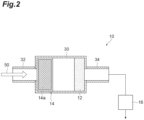
- FIG. 2 illustrates an example of a configuration of the odor detection device 10 according to the embodiment.
- the odor sensor 12 and the filter 14 are disposed in a container 30.
- An intake pipe 32 and an exhaust pipe 34 communicating with the internal space of the container 30 are connected to the container 30.
- the suction unit 16 is connected to the exhaust pipe 34.
- the suction unit 16 is, for example, a vacuum pump.
- the sample gas 50 is air in the farm.
- the sample gas 50 includes various volatile compounds including an odor substance.
- the odor sensor 12 detects an odor substance included in the sample gas 50. Specifically, the odor sensor 12 detects at least one odor substance of leaf alcohol, leaf aldehyde, and ethylene.
- a gas sensor of, for example, a semiconductor type, an electrochemical type, or a quartz oscillator type is used as the odor sensor 12.
- the odor sensor 12 is a VOC sensor including an organic film of polyaniline and an oxide semiconductor such as a tin oxide (SnO 2 ).
- a sensor of a type different from the aforementioned types may be used as the odor sensor 12.
- the odor detection device 10 may include two or more odor sensors 12.
- An odor substance detected by the odor sensor 12 is a plant-derived volatile compound and includes leaf alcohol, leaf aldehyde, and ethylene.
- Leaf alcohol and leaf aldehyde are plant hormones that are emitted from the plant 2 as a protective reaction when insect damage due to insects or animal occurs. These plant hormones are green fragrance substances giving rise to the odor of fresh green leaves.
- FIG. 3A illustrates a molecular structure of leaf alcohol
- FIG. 3B illustrates a molecular structure of the leaf aldehyde.
- Leaf alcohol and leaf aldehyde are low-molecular-weight compounds having a straight chain structure.
- Ethylene is a plant hormone which is emitted when fruits or the like mature.
- FIG. 3C illustrates a molecular structure of ethylene.
- ethylene is a low-molecular-weight compound having a straight chain structure. By detecting ethylene, it is possible to detect a growth status of the plant 2.
- the odor sensor 12 may detect an odor substance that can detect a status of the plant 2 in addition to leaf alcohol, leaf aldehyde, and ethylene.
- the filter 14 is disposed upstream from the odor sensor 12 in a flow direction of the sample gas 50.
- the filter 14 transmits the odor substance included in the sample gas 50 and removes a volatile compound other than the odor substance from the sample gas 50.
- the filter 14 includes a metal-organic framework (MOF) 14a in which a metal ion and an organic ligand are bonded.
- the metal-organic framework 14a is disposed to be in close contact with an inner wall of a container 30 in a state in which the metal-organic framework 14a is accommodated in an air-permeability bag of a nonwoven fabric.
- Silver ions, copper ions, iron (II) ions, iron (III) ions, zinc ions, aluminum ions, nickel ions, and chromium ions can be used as the metal ions used in the metal-organic framework 14a.
- copper ions have high availability and good adsorption characteristics.
- a benzene dicarboxylic acid and a benzene tricarboxylic acid can be used as the organic-ligand used in the metal-organic framework 14a.
- a phthalic acid, an isophthalic acid, and a terephthalic acid can be used as the benzene dicarboxylic acid.
- a trimesic acid can be used as the benzene tricarboxylic acid.
- the benzene dicarboxylic acid and the benzene tricarboxylic acid are organic ligands having a carboxyl group.
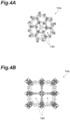
- the metal-organic framework 14a has a crystal structure in which nano-size apertures are regularly formed by coordinate bonding between the metal ion and the organic ligand. Accordingly, the metal-organic framework 14a is a porous medium including a plurality of pores 14h (see FIGS. 4A and 4B ).
- the pores 14h formed in the metal-organic framework 14a have a circular or rectangular sectional shape. In this specification, a circular shape includes an elliptical shape.
- the pores 14h have a polygonal sectional shape.
- the pores 14h formed in the metal-organic framework 14a have an opening size ranging from 2 nm to 100 nm.
- the opening size of the pores 14h means a width of an opening of each pore 14h formed in the filter 14.
- a diameter thereof is defined as the opening size of the pores 14h.
- a diameter of a circle inscribed in the rectangular opening is defined as the opening size of the pores 14h.
- the pores 14h formed in the metal-organic framework 14a have a substantially constant opening size in a longitudinal direction thereof.
- the metal-organic framework 14a may have a specific surface area ranging from 500 m 2 /g to 5000 m 2 /g and have a pore volume of 0.1 m 2 /g to 1.0 m2/g.
- the sectional shape and the opening size of the pores 14h are determined based on a combination of the metal ion and the organic ligand.
- a metal-organic framework 14a including pores 14h with a circular sectional shape is formed as illustrated in FIG. 4A .
- a metal-organic framework 14a including pores 14h with a rectangular sectional shape is formed as illustrated in FIG. 4B .
- the filter 14 selectively transmits an odor substance having a straight chain structure using the pores 14h of the metal-organic framework 14a and removes a volatile compound other than the odor substance.
- An example of the volatile compound which is removed from the sample gas 50 by the filter 14 is a volatile compound including a carboxyl group (-COOH).
- Examples of the volatile compound including a carboxyl group include j asmonic acids and a salicylic acid.
- the jasmonic acids include a jasmonic acid and a jasmonic acid analog.
- Examples of the jasmonic acid analog include methyl jasmonate, methyl dihydrojasmonate, and a tuberonic acid.
- the jasmonic acids are volatile compounds which are widely present in the plant world and are kinds of plant hormones serving to adjust physiological functions of plant.
- FIG. 5 illustrates a molecular structure of a jasmonic acid. As illustrated in FIG. 5 , the jasmonic acid is a cyclic compound including a five-membered ring and including a carboxyl group as a functional group.
- the jasmonic acid has a complex molecular structure with a larger molecular weight than an odor substance to be detected.
- the salicylic acid is a kind of plant hormone serving to perform physiological functions of plant.
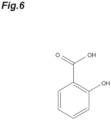
- FIG. 6 illustrates a molecular structure of the salicylic acid. As illustrated in FIG. 6 , the salicylic acid has a carboxyl group and a hydroxyl group and has a complex molecular structure with a larger molecular weight than an odor substance to be detected.
- the filter 14 collects jasmonic acids and a salicylic acid with a relatively complex molecular structure from various volatile compounds included in the sample gas 50.
- a benzene dicarboxylic acid or a benzene tricarboxylic acid is included as the organic ligand in the metal-organic framework 14a of the filter 14
- the carboxyl group of the jasmonic acids or the salicylic acid is ionically bonded to the metal-organic framework 14a. More specifically, the carboxyl group of the jasmonic acids or the salicylic acid and the carboxyl group of the organic ligand are chemically bonded to form a dimer. Through this bonding, adsorption of the carboxyl group of the jasmonic acids or the salicylic acid on the filter 14 is promoted.
- the filter 14 transmits an odor substance such as leaf alcohol, leaf aldehyde, or ethylene having a relatively simple molecular structure.
- the sample gas 50 passing through the filter 14 is sent to the odor sensor 12.
- the odor sensor 12 detects the odor substance included in the sample gas 50 and outputs waveform data indicating the result of detection.
- the communication unit 18 is, for example, a wireless communication device.
- the communication unit 18 transmits the waveform data output from the odor sensor 12 to the plant status detection device 20.
- the plant status detection device 20 outputs information indicating a status of the plant 2 based on the result of detection of an odor substance from the odor detection device 10.
- the plant status detection device 20 is a computer including a processor, a storage device, an input device, and a display device.
- the plant status detection device 20 may be a stationary or potable personal computer or workstation or may be a mobile terminal such as a notebook PC, a tablet terminal, a smartphone, or a PDA.
- the plant status detection device 20 includes a detection unit 22, a display unit 24, a recording unit 26, and a communication unit 28.
- the communication unit 28 is, for example, a wireless communication device and receives waveform data transmitted from the odor detection device 10.
- the detection unit 22 estimates the status of the plant 2 by analyzing the waveform data output from the odor sensor 12. For example, the detection unit 22 acquires a concentration of an odor substance included in the sample gas 50 from an intensity of the waveform data and determines the status of the plant 2 based on the acquired concentration. For example, the detection unit 22 estimates the status of the plant 2 with reference to a table indicating a relationship between the concentration of an odor substance and the status of the plant 2.
- the detection unit 22 determines the health status of the plant 2 from an output of the odor sensor 12. For example, the detection unit 22 determines that there is a low likelihood that insect damage will occur when the concentration of leaf alcohol or leaf aldehyde in the sample gas 50 is low, and determines that there is a high likelihood that insect damage will occur when the concentration of leaf alcohol or leaf aldehyde in the sample gas 50 is high.
- the detection unit 22 determines the growth status of the plant 2 based on the output of the odor sensor 12. For example, the detection unit 22 determines that a degree of maturity of the plant 2 is low when the concentration of ethylene in the sample gas 50 is low, and determines that the degree of maturity of the plant 2 is high when the concentration of ethylene in the sample gas 50 is high.
- the display unit 24 displays information indicating the status of the plant 2 detected by the detection unit 22 on a display device.
- the display unit 24 may display the status of the plant 2 on the display device with categorization such that the health status or the growth status of the plant 2 can be visually recognized.
- the recording unit 26 records the information indicating the status of the plant 2 on a storage device.
- the suction unit 16 operates to depressurize the internal space of the container 30. Accordingly, the sample gas 50 is guided into the intake pipe 32 and passes through the filter 14 disposed in the container 30. At this time, a volatile compound with a carboxyl group included in the sample gas 50 is collected by the filter 14. On the other hand, an odor substance with a straight chain structure included in the sample gas 50 passes through the pores 14h of the filter 14 and is sent to the odor sensor 12 along with the sample gas 50. Then, the odor substance in the sample gas 50 is detected by the odor sensor 12. Thereafter, the sample gas 50 is discharged to the outside of the odor detection device 10 via the exhaust pipe 34. Information on the odor substance detected by the odor sensor 12 is transmitted to the plant status detection device 20. The plant status detection device 20 outputs information indicating the status of the plant 2 by analyzing the information indicating the result of detection of the odor substance.
- the volatile compounds other than the odor substance are removed by the filter 14. Accordingly, it is possible to prevent detection of an odor substance from being hindered due to the volatile compounds and to improve detection accuracy of the odor substance in the odor sensor 12. As a result, it is possible to detect the status of the plant 2 with high accuracy.
- the present disclosure is not limited to the embodiments and can be modified in various forms without departing from the gist of the present disclosure. That is, it should be noted that the aforementioned embodiments are form exemplification and is not intended to limit the scope of the present disclosure. The aforementioned embodiments can be combined unless technical conflictions arise.
- Plant status detection system 2: Plant, 10: Odor detection device, 12: Odor sensor, 14: Filter, 50: Sample gas.
Landscapes
- Chemical & Material Sciences (AREA)
- Life Sciences & Earth Sciences (AREA)
- Health & Medical Sciences (AREA)
- Engineering & Computer Science (AREA)
- Physics & Mathematics (AREA)
- Pathology (AREA)
- Immunology (AREA)
- General Physics & Mathematics (AREA)
- General Health & Medical Sciences (AREA)
- Analytical Chemistry (AREA)
- Biochemistry (AREA)
- Medicinal Chemistry (AREA)
- Food Science & Technology (AREA)
- Combustion & Propulsion (AREA)
- Botany (AREA)
- Wood Science & Technology (AREA)
- Biomedical Technology (AREA)
- Molecular Biology (AREA)
- Investigating Or Analyzing Materials By The Use Of Fluid Adsorption Or Reactions (AREA)
Abstract
Description
- The present disclosure relates to an odor detection device and a plant status detection system.
- Technology for detecting a substance included in a gas is known. For example, Patent Document 1 discloses a molecule detection device including a collection unit that collects a gas to be detected, a substitution unit that produces a substitution product by substituting a part of a molecular structure of a detected molecule included in the collected gas to be detected, a detector that includes a plurality of detection cells collecting the detected molecule or the substitution product, and a discriminator that discriminates the detected molecule based on a signal pattern of a detection signal which is generated when the detected molecule or the substitution product is collected by organic substance probes of the plurality of detection cells.
- [Patent Document 1]
Japanese Unexamined Patent Publication No. 2017-156346 - It is known that a plant emits various odor substances according to a plant status thereof. For example, plant emits plant hormones such as leaf alcohol (cis-3-hexen-1-ol) or leaf aldehyde (trans-2-hexenal) known as green fragrance substances as a reaction for protection from insect damage. When fruits mature, plant emits a plant hormone called ethylene. By detecting and analyzing such plant hormones as odor substances, it is possible to detect a health status or a growth status of plants.
- However, various volatile compounds emitted from plants or agricultural chemicals are included in the air of farms. When a volatile compound other than an odor substance is included in a sample gas sampled in the farms, there is concern that detection of an odor substance will be hindered due to the volatile compounds and detection accuracy of the odor substance will decrease.
- Therefore, the present disclosure is for improving detection accuracy of a plant-derived odor substance.
- An odor detection device according to an aspect includes a filter including a metal-organic framework in which a metal ion and an organic ligand are bonded and an odor sensor detecting a plant-derived odor substance having a straight chain structure which is included in a sample gas passing through the filter. The filter transmits the odor substance included in the sample gas and removes volatile compounds other than the odor substance from the sample gas.
- In the odor detection device according to the aspect, when the sample gas passes through the filter, plant-derived odor substances are transmitted by the filter and volatile compounds other than the odor substances are removed from the sample gas. As a result, since the sample gas from which the volatile compounds have been removed is supplied to the odor sensor, it is possible to improve detection accuracy of the odor substance.
- According to the present disclosure, it is possible to improve detection accuracy of a plant-derived odor substance.
-
-
FIG. 1 is a block diagram illustrating a functional configuration of a plant status detection system according to an embodiment. -
FIG. 2 is a diagram illustrating an example of a configuration of an odor detection device according to the embodiment. -
FIG. 3A is a diagram illustrating a molecular structure of leaf alcohol,FIG. 3B is a diagram illustrating a molecular structure of leaf aldehyde, andFIG. 3C is a diagram illustrating a molecular structure of ethylene. -
FIG. 4A is a sectional view illustrating a metal-organic framework including pores with a circular sectional shape, andFIG. 4B is a sectional view illustrating a metal-organic framework including pores with a rectangular sectional shape. -
FIG. 5 is a diagram illustrating a molecular structure of a jasmonic acid. -
FIG. 6 is a diagram illustrating a molecular structure of a salicylic acid. - Summaries of an embodiment of the present disclosure will be first described below.
- (Clause 1) An odor detection device according to an aspect of the present disclosure includes a filter including a metal-organic framework in which a metal ion and an organic ligand are bonded and an odor sensor detecting a plant-derived odor substance having a straight chain structure which is included in a sample gas passing through the filter. The filter transmits the odor substance included in the sample gas and removes a volatile compound other than the odor substance from the sample gas. In the odor detection device according to the aspect, since a volatile compound other than an odor substance is removed by the filter, it is possible to prevent detection of the odor substance from being hindered by the volatile compound. Accordingly, it is possible to improve detection accuracy of the odor substance in the odor sensor.
- (Clause 2) In the odor detection device according to clause 1, the metal-organic framework may be a porous medium including pores with a rectangular or circular sectional shape. By using the metal-organic framework including pores with a rectangular or circular sectional shape, it is possible to selectively transmit an odor substance included in the sample gas.
- (Clause 3) In the odor detection device according to
clause 1 or 2, the pores may have an opening size ranging from 2 nm to 100 nm. By setting the opening diameter of the pores to range from 2 nm to 100 nm, it is possible to selectively transmit an odor substance included in the sample gas. - (Clause 4) In the odor detection device according to any one of clauses 1 to 3, the filter may remove a volatile compound having a carboxyl group from the sample gas. By removing the volatile compound having a carboxyl group, it is possible to prevent the volatile compound from badly affecting detection of an odor substance. Accordingly, it is possible to improve detection accuracy of an odor substance.
- (Clause 5) In the odor detection device according to any one of clauses 1 to 4, the filter may remove jasmonic acids or a salicylic acid from the sample gas. The jasmonic acids and the salicylic acid are kinds of plant hormone serving to adjust physiological functions of plants and large amounts thereof are present in farms. When a large amount of jasmonic acids or the salicylic acid is included in the sample gas, detection of an odor substance may be hindered. By removing the jasmonic acid or salicylic acid using the filter, it is possible to improve detection accuracy of an odor substance.
- (Clause 6) In the odor detection device according to any one of clauses 1 to 5, the metal-organic framework may include a benzene dicarboxylic acid or a benzene tricarboxylic acid as the organic ligand. When the benzene dicarboxylic acid or the benzene tricarboxylic acid is included as the organic ligand, the carboxyl group of the volatile compound and the carboxyl group of the organic ligand are chemically bonded to form a dimer. Since adsorption of the volatile compound onto the filter is promoted by this bond, it is possible to effectively remove the volatile compound using the filter.
- (Clause 7) In the odor detection device according to any one of clauses 1 to 6, the metal-organic framework may include one of a silver ion, a copper ion, an iron ion, a zinc ion, an aluminum ion, a nickel ion, and a chromium ion as the metal ion. Since such metal ions are included, it is possible to form a metal-organic framework selectively transmitting an odor substance.
- (Clause 8) In the odor detection device according to any one of clauses 1 to 7, the odor sensor may detect at least one of leaf alcohol, leaf aldehyde, and ethylene as the odor substance. Leaf alcohol, leaf aldehyde, and ethylene are plant hormones which are emitted based on a health status or a growth status of plant. Accordingly, by detecting such an odor substance, it is possible to acquire information on the health status or the growth status of plant.
- (Clause 9) A plant status detection system according to another aspect of the present disclosure includes: the odor detection device according to any one of clauses 1 to 8 and a plant status detection device outputting information indicating a plant status based on the odor substance detected by the odor sensor of the odor detection device. As described above, since a volatile compound other than an odor substance is removed by the filter of the odor detection device, it is possible to detect an odor substance with high accuracy. Accordingly, it is possible to detect a plant status with high accuracy based on a result of detection of the odor substance.
- Hereinafter, an embodiment of the present disclosure will be described in detail with reference to the accompanying drawings. In describing the drawings, the same elements will be referred to by the same reference signs and repeated description will be omitted.
-
FIG. 1 is a block diagram illustrating a functional configuration of a plant status detection system including an odor detection device according to an embodiment. The plant status detection system 1 illustrated inFIG. 1 detects a plant-derived odor substance and detects a plant status. The plant status includes a health status and a growth status of plant. The plant status detection system 1 includes anodor detection device 10 and a plantstatus detection device 20. - The
odor detection device 10 detects an odor substance emitted from aplant 2. Theplant 2 is a plant such as vegetables, fruit trees, or flowers which are growing in a farm such as a plant factory, a field, or a plastic greenhouse. Theodor detection device 10 is provided in the farm to detect an odor substance. As illustrated inFIG. 1 , theodor detection device 10 includes anodor sensor 12, afilter 14, asuction unit 16, and acommunication unit 18. -
FIG. 2 illustrates an example of a configuration of theodor detection device 10 according to the embodiment. As illustrated inFIG. 2 , theodor sensor 12 and thefilter 14 are disposed in acontainer 30. Anintake pipe 32 and anexhaust pipe 34 communicating with the internal space of thecontainer 30 are connected to thecontainer 30. Thesuction unit 16 is connected to theexhaust pipe 34. Thesuction unit 16 is, for example, a vacuum pump. When thesuction unit 16 operates to depressurize the internal space of thecontainer 30, asample gas 50 is guided into thecontainer 30 via theintake pipe 32. Thesample gas 50 is air in the farm. Thesample gas 50 includes various volatile compounds including an odor substance. - The
odor sensor 12 detects an odor substance included in thesample gas 50. Specifically, theodor sensor 12 detects at least one odor substance of leaf alcohol, leaf aldehyde, and ethylene. A gas sensor of, for example, a semiconductor type, an electrochemical type, or a quartz oscillator type is used as theodor sensor 12. For example, theodor sensor 12 is a VOC sensor including an organic film of polyaniline and an oxide semiconductor such as a tin oxide (SnO2). As long as it can detect an odor substance, a sensor of a type different from the aforementioned types may be used as theodor sensor 12. When two or more kinds of odor substances are detected, theodor detection device 10 may include two ormore odor sensors 12. - An odor substance detected by the
odor sensor 12 is a plant-derived volatile compound and includes leaf alcohol, leaf aldehyde, and ethylene. Leaf alcohol and leaf aldehyde are plant hormones that are emitted from theplant 2 as a protective reaction when insect damage due to insects or animal occurs. These plant hormones are green fragrance substances giving rise to the odor of fresh green leaves.FIG. 3A illustrates a molecular structure of leaf alcohol, andFIG. 3B illustrates a molecular structure of the leaf aldehyde. Leaf alcohol and leaf aldehyde are low-molecular-weight compounds having a straight chain structure. By detecting leaf alcohol and leaf aldehyde, it is possible to detect occurrence of insect damage. - Ethylene is a plant hormone which is emitted when fruits or the like mature.
FIG. 3C illustrates a molecular structure of ethylene. Similarly to leaf alcohol and leaf aldehyde, ethylene is a low-molecular-weight compound having a straight chain structure. By detecting ethylene, it is possible to detect a growth status of theplant 2. Theodor sensor 12 may detect an odor substance that can detect a status of theplant 2 in addition to leaf alcohol, leaf aldehyde, and ethylene. - The
filter 14 is disposed upstream from theodor sensor 12 in a flow direction of thesample gas 50. Thefilter 14 transmits the odor substance included in thesample gas 50 and removes a volatile compound other than the odor substance from thesample gas 50. Thefilter 14 includes a metal-organic framework (MOF) 14a in which a metal ion and an organic ligand are bonded. The metal-organic framework 14a is disposed to be in close contact with an inner wall of acontainer 30 in a state in which the metal-organic framework 14a is accommodated in an air-permeability bag of a nonwoven fabric. - Silver ions, copper ions, iron (II) ions, iron (III) ions, zinc ions, aluminum ions, nickel ions, and chromium ions can be used as the metal ions used in the metal-
organic framework 14a. Particularly, copper ions have high availability and good adsorption characteristics. A benzene dicarboxylic acid and a benzene tricarboxylic acid can be used as the organic-ligand used in the metal-organic framework 14a. A phthalic acid, an isophthalic acid, and a terephthalic acid can be used as the benzene dicarboxylic acid. A trimesic acid can be used as the benzene tricarboxylic acid. The benzene dicarboxylic acid and the benzene tricarboxylic acid are organic ligands having a carboxyl group. - The metal-
organic framework 14a has a crystal structure in which nano-size apertures are regularly formed by coordinate bonding between the metal ion and the organic ligand. Accordingly, the metal-organic framework 14a is a porous medium including a plurality ofpores 14h (seeFIGS. 4A and 4B ). Thepores 14h formed in the metal-organic framework 14a have a circular or rectangular sectional shape. In this specification, a circular shape includes an elliptical shape. Thepores 14h have a polygonal sectional shape. - In this embodiment, the
pores 14h formed in the metal-organic framework 14a have an opening size ranging from 2 nm to 100 nm. The opening size of thepores 14h means a width of an opening of eachpore 14h formed in thefilter 14. For example, when the opening of thepores 14h has a circular shape, a diameter thereof is defined as the opening size of thepores 14h. When the opening of thepores 14h has a rectangular shape, a diameter of a circle inscribed in the rectangular opening is defined as the opening size of thepores 14h. Thepores 14h formed in the metal-organic framework 14a have a substantially constant opening size in a longitudinal direction thereof. The metal-organic framework 14a may have a specific surface area ranging from 500 m2/g to 5000 m2/g and have a pore volume of 0.1 m2/g to 1.0 m2/g. - The sectional shape and the opening size of the
pores 14h are determined based on a combination of the metal ion and the organic ligand. For example, when a benzene dicarboxylic acid is used as the organic ligand, a metal-organic framework 14a including pores 14h with a circular sectional shape is formed as illustrated inFIG. 4A . On the other hand, when a benzene tricarboxylic acid is used as the organic ligand, a metal-organic framework 14a including pores 14h with a rectangular sectional shape is formed as illustrated inFIG. 4B . - The
filter 14 selectively transmits an odor substance having a straight chain structure using thepores 14h of the metal-organic framework 14a and removes a volatile compound other than the odor substance. An example of the volatile compound which is removed from thesample gas 50 by thefilter 14 is a volatile compound including a carboxyl group (-COOH). Examples of the volatile compound including a carboxyl group include j asmonic acids and a salicylic acid. - The jasmonic acids include a jasmonic acid and a jasmonic acid analog. Examples of the jasmonic acid analog include methyl jasmonate, methyl dihydrojasmonate, and a tuberonic acid. The jasmonic acids are volatile compounds which are widely present in the plant world and are kinds of plant hormones serving to adjust physiological functions of plant.
FIG. 5 illustrates a molecular structure of a jasmonic acid. As illustrated inFIG. 5 , the jasmonic acid is a cyclic compound including a five-membered ring and including a carboxyl group as a functional group. The jasmonic acid has a complex molecular structure with a larger molecular weight than an odor substance to be detected. - The salicylic acid is a kind of plant hormone serving to perform physiological functions of plant.
FIG. 6 illustrates a molecular structure of the salicylic acid. As illustrated inFIG. 6 , the salicylic acid has a carboxyl group and a hydroxyl group and has a complex molecular structure with a larger molecular weight than an odor substance to be detected. - As described above, the
filter 14 collects jasmonic acids and a salicylic acid with a relatively complex molecular structure from various volatile compounds included in thesample gas 50. Particularly, when a benzene dicarboxylic acid or a benzene tricarboxylic acid is included as the organic ligand in the metal-organic framework 14a of thefilter 14, the carboxyl group of the jasmonic acids or the salicylic acid is ionically bonded to the metal-organic framework 14a. More specifically, the carboxyl group of the jasmonic acids or the salicylic acid and the carboxyl group of the organic ligand are chemically bonded to form a dimer. Through this bonding, adsorption of the carboxyl group of the jasmonic acids or the salicylic acid on thefilter 14 is promoted. - On the other hand, the
filter 14 transmits an odor substance such as leaf alcohol, leaf aldehyde, or ethylene having a relatively simple molecular structure. Thesample gas 50 passing through thefilter 14 is sent to theodor sensor 12. Theodor sensor 12 detects the odor substance included in thesample gas 50 and outputs waveform data indicating the result of detection. - The
communication unit 18 is, for example, a wireless communication device. Thecommunication unit 18 transmits the waveform data output from theodor sensor 12 to the plantstatus detection device 20. - The plant
status detection device 20 outputs information indicating a status of theplant 2 based on the result of detection of an odor substance from theodor detection device 10. The plantstatus detection device 20 is a computer including a processor, a storage device, an input device, and a display device. The plantstatus detection device 20 may be a stationary or potable personal computer or workstation or may be a mobile terminal such as a notebook PC, a tablet terminal, a smartphone, or a PDA. - The plant
status detection device 20 includes adetection unit 22, adisplay unit 24, arecording unit 26, and acommunication unit 28. Thecommunication unit 28 is, for example, a wireless communication device and receives waveform data transmitted from theodor detection device 10. - The
detection unit 22 estimates the status of theplant 2 by analyzing the waveform data output from theodor sensor 12. For example, thedetection unit 22 acquires a concentration of an odor substance included in thesample gas 50 from an intensity of the waveform data and determines the status of theplant 2 based on the acquired concentration. For example, thedetection unit 22 estimates the status of theplant 2 with reference to a table indicating a relationship between the concentration of an odor substance and the status of theplant 2. - Specifically, when the odor substance to be detected is leaf alcohol or leaf aldehyde, the
detection unit 22 determines the health status of theplant 2 from an output of theodor sensor 12. For example, thedetection unit 22 determines that there is a low likelihood that insect damage will occur when the concentration of leaf alcohol or leaf aldehyde in thesample gas 50 is low, and determines that there is a high likelihood that insect damage will occur when the concentration of leaf alcohol or leaf aldehyde in thesample gas 50 is high. - When the odor substance to be detected is ethylene, the
detection unit 22 determines the growth status of theplant 2 based on the output of theodor sensor 12. For example, thedetection unit 22 determines that a degree of maturity of theplant 2 is low when the concentration of ethylene in thesample gas 50 is low, and determines that the degree of maturity of theplant 2 is high when the concentration of ethylene in thesample gas 50 is high. - The
display unit 24 displays information indicating the status of theplant 2 detected by thedetection unit 22 on a display device. For example, thedisplay unit 24 may display the status of theplant 2 on the display device with categorization such that the health status or the growth status of theplant 2 can be visually recognized. Therecording unit 26 records the information indicating the status of theplant 2 on a storage device. - As described above, when an odor substance is detected using the
odor detection device 10, first, thesuction unit 16 operates to depressurize the internal space of thecontainer 30. Accordingly, thesample gas 50 is guided into theintake pipe 32 and passes through thefilter 14 disposed in thecontainer 30. At this time, a volatile compound with a carboxyl group included in thesample gas 50 is collected by thefilter 14. On the other hand, an odor substance with a straight chain structure included in thesample gas 50 passes through thepores 14h of thefilter 14 and is sent to theodor sensor 12 along with thesample gas 50. Then, the odor substance in thesample gas 50 is detected by theodor sensor 12. Thereafter, thesample gas 50 is discharged to the outside of theodor detection device 10 via theexhaust pipe 34. Information on the odor substance detected by theodor sensor 12 is transmitted to the plantstatus detection device 20. The plantstatus detection device 20 outputs information indicating the status of theplant 2 by analyzing the information indicating the result of detection of the odor substance. - In the
odor detection device 10, the volatile compounds other than the odor substance are removed by thefilter 14. Accordingly, it is possible to prevent detection of an odor substance from being hindered due to the volatile compounds and to improve detection accuracy of the odor substance in theodor sensor 12. As a result, it is possible to detect the status of theplant 2 with high accuracy. - While the odor detection device and the plant status detection system according to the embodiments have been described above, the present disclosure is not limited to the embodiments and can be modified in various forms without departing from the gist of the present disclosure. That is, it should be noted that the aforementioned embodiments are form exemplification and is not intended to limit the scope of the present disclosure. The aforementioned embodiments can be combined unless technical conflictions arise.
- 1: Plant status detection system, 2: Plant, 10: Odor detection device, 12: Odor sensor, 14: Filter, 50: Sample gas.
Claims (9)
- An odor detection device comprising:a filter including a metal-organic framework in which a metal ion and an organic ligand are bonded; andan odor sensor detecting a plant-derived odor substance having a straight chain structure which is included in a sample gas passing through the filter,wherein the filter transmits the odor substance included in the sample gas and removes a volatile compound other than the odor substance from the sample gas.
- The odor detection device according to claim 1, wherein the metal-organic framework is a porous medium including pores with a rectangular or circular sectional shape.
- The odor detection device according to claim 2, wherein the pores have an opening width of 2 nm to 100 nm.
- The odor detection device according to claim 1, wherein the filter removes a volatile compound having a carboxyl group from the sample gas.
- The odor detection device according to claim 4, wherein the filter removes jasmonic acids or a salicylic acid from the sample gas.
- The odor detection device according to claim 4, wherein the metal-organic framework includes a benzene dicarboxylic acid or a benzene tricarboxylic acid as the organic ligand.
- The odor detection device according to claim 6, wherein the metal-organic framework includes one of a silver ion, a copper ion, an iron ion, a zinc ion, an aluminum ion, a nickel ion, and a chromium ion as the metal ion.
- The odor detection device according to claim 1, wherein the odor sensor detects at least one of leaf alcohol, leaf aldehyde, and ethylene as the odor substance.
- A plant status detection system comprising:the odor detection device according to any one of claims 1 to 8; anda plant status detection device to output information indicating a plant status based on the odor substance detected by the odor sensor of the odor detection device.
Applications Claiming Priority (1)
| Application Number | Priority Date | Filing Date | Title |
|---|---|---|---|
| JP2022113260A JP7907240B2 (en) | 2022-07-14 | Odor detection device and plant condition detection system |
Publications (2)
| Publication Number | Publication Date |
|---|---|
| EP4306950A1 true EP4306950A1 (en) | 2024-01-17 |
| EP4306950B1 EP4306950B1 (en) | 2026-01-28 |
Family
ID=86693137
Family Applications (1)
| Application Number | Title | Priority Date | Filing Date |
|---|---|---|---|
| EP23177561.0A Active EP4306950B1 (en) | 2022-07-14 | 2023-06-06 | Odor detection device and plant status detection system |
Country Status (3)
| Country | Link |
|---|---|
| US (1) | US12517103B2 (en) |
| EP (1) | EP4306950B1 (en) |
| CN (1) | CN117405826A (en) |
Citations (3)
| Publication number | Priority date | Publication date | Assignee | Title |
|---|---|---|---|---|
| JP2017156346A (en) | 2016-02-29 | 2017-09-07 | 株式会社東芝 | Molecular detection apparatus and molecular detection method |
| US20200333310A1 (en) * | 2019-04-19 | 2020-10-22 | Samsung Electronics Co., Ltd. | Article storage apparatus and method of identifying condition of article therein |
| US20210055275A1 (en) * | 2019-08-22 | 2021-02-25 | Samsung Electronics Co., Ltd | Electronic device and method for determining kind and state of food stored therein |
Family Cites Families (7)
| Publication number | Priority date | Publication date | Assignee | Title |
|---|---|---|---|---|
| DE102005022844A1 (en) * | 2005-05-18 | 2006-11-23 | Basf Ag | Separation of odors from gases |
| DE102005023857A1 (en) * | 2005-05-24 | 2006-11-30 | Basf Ag | Suspension for the reduction of odor |
| US8269029B2 (en) * | 2008-04-08 | 2012-09-18 | The Board Of Trustees Of The University Of Illinois | Water repellent metal-organic frameworks, process for making and uses regarding same |
| US9757710B1 (en) * | 2016-08-19 | 2017-09-12 | Ford Global Technologies, Llc | Solvent-supported compaction of metal-organic frameworks |
| KR102637685B1 (en) * | 2016-09-13 | 2024-02-19 | 엘지전자 주식회사 | Electrochromic structure and method for producing the same |
| JP7052283B2 (en) * | 2017-10-18 | 2022-04-12 | 株式会社豊田中央研究所 | Volatiles release control device, volatile substance release control method, and volatile substance release control program |
| CN114230821B (en) * | 2021-12-28 | 2023-06-20 | 中南大学 | A kind of carboxyl functional hypercrosslinked polymer and its preparation method and application |
-
2023
- 2023-06-05 US US18/205,720 patent/US12517103B2/en active Active
- 2023-06-06 EP EP23177561.0A patent/EP4306950B1/en active Active
- 2023-07-11 CN CN202310844819.5A patent/CN117405826A/en active Pending
Patent Citations (3)
| Publication number | Priority date | Publication date | Assignee | Title |
|---|---|---|---|---|
| JP2017156346A (en) | 2016-02-29 | 2017-09-07 | 株式会社東芝 | Molecular detection apparatus and molecular detection method |
| US20200333310A1 (en) * | 2019-04-19 | 2020-10-22 | Samsung Electronics Co., Ltd. | Article storage apparatus and method of identifying condition of article therein |
| US20210055275A1 (en) * | 2019-08-22 | 2021-02-25 | Samsung Electronics Co., Ltd | Electronic device and method for determining kind and state of food stored therein |
Non-Patent Citations (1)
| Title |
|---|
| SANAEIFAR ALIREZA ET AL: "Early detection of contamination and defect in foodstuffs by electronic nose: A review", TRAC TRENDS IN ANALYTICAL CHEMISTRY, vol. 97, 21 September 2017 (2017-09-21), pages 257 - 271, XP085268081, ISSN: 0165-9936, DOI: 10.1016/J.TRAC.2017.09.014 * |
Also Published As
| Publication number | Publication date |
|---|---|
| US20240019411A1 (en) | 2024-01-18 |
| US12517103B2 (en) | 2026-01-06 |
| EP4306950B1 (en) | 2026-01-28 |
| JP2024011339A (en) | 2024-01-25 |
| CN117405826A (en) | 2024-01-16 |
Similar Documents
| Publication | Publication Date | Title |
|---|---|---|
| US12131617B2 (en) | System and method of detecting chemicals in products or the environment of products using sensors | |
| CN103575690B (en) | Fruit maturity detection system based on infrared gas sensor | |
| US12517103B2 (en) | Odor detection device and plant status detection system | |
| Lee et al. | Wearable volatile organic compound sensors for plant health monitoring | |
| CN205409235U (en) | It lures an album detection device to store up grain pest | |
| Viana de Carvalho et al. | Two‐dimensional coordination polymer matrix for solid‐phase extraction of pesticide residues from plant Cordia salicifolia | |
| CN116297698A (en) | Wireless flexible vinyl sensing device and method based on MXene printed electronics | |
| JP2016514845A (en) | Ethylene gas detection device and method | |
| US20230090813A1 (en) | Crop growth information monitoring method and device and method for manufacturing a crop growth information monitoring device | |
| CN105512430A (en) | Shared input and output system of spectroscopic data and chemical detection data | |
| Juul et al. | Deployment of wireless sensor networks in crop storages | |
| CN208653884U (en) | It is a kind of for acquiring the acquisition device of persistent organism content in air | |
| CN104407070A (en) | Method for detecting content of azodicarbonamide in food | |
| CN206609854U (en) | Yellow tea mite toxicity test device | |
| Fitra et al. | Design and Development of a IoT-Based Moisture Detection Device for Corn Seeds | |
| JP2017173277A (en) | Sample preparation method for analysis of pesticide contamination | |
| CN111724171A (en) | Whole process traceability system of agricultural product quality | |
| CN203688389U (en) | Comprehensive monitoring equipment for atmospheric particulates | |
| Lawrence et al. | Direct analysis of the wild oat herbicide, asulam, in wheat samples by reversed-phase liquid chromatography at selected ultraviolet wavelengths | |
| JP2019132631A (en) | Method for preparing sample for analysis of pesticide contamination | |
| CN104597067A (en) | All-phase detection device for metals in gas, and working method of all-phase detection device for metals in gas | |
| CN216978846U (en) | Quick detection device of vegetable leaf pesticide residue | |
| CN219675970U (en) | A fruit pesticide residue detection device for melon and fruit planting | |
| US20230204555A1 (en) | Use of output of real time sensors to automatically trigger devices | |
| CN110007030A (en) | A kind of method that efficient liquid phase biabsorption wavelength measures dehydroactic acid in food |
Legal Events
| Date | Code | Title | Description |
|---|---|---|---|
| PUAI | Public reference made under article 153(3) epc to a published international application that has entered the european phase |
Free format text: ORIGINAL CODE: 0009012 |
|
| STAA | Information on the status of an ep patent application or granted ep patent |
Free format text: STATUS: THE APPLICATION HAS BEEN PUBLISHED |
|
| AK | Designated contracting states |
Kind code of ref document: A1 Designated state(s): AL AT BE BG CH CY CZ DE DK EE ES FI FR GB GR HR HU IE IS IT LI LT LU LV MC ME MK MT NL NO PL PT RO RS SE SI SK SM TR |
|
| STAA | Information on the status of an ep patent application or granted ep patent |
Free format text: STATUS: REQUEST FOR EXAMINATION WAS MADE |
|
| 17P | Request for examination filed |
Effective date: 20240604 |
|
| RBV | Designated contracting states (corrected) |
Designated state(s): AL AT BE BG CH CY CZ DE DK EE ES FI FR GB GR HR HU IE IS IT LI LT LU LV MC ME MK MT NL NO PL PT RO RS SE SI SK SM TR |
|
| GRAP | Despatch of communication of intention to grant a patent |
Free format text: ORIGINAL CODE: EPIDOSNIGR1 |
|
| STAA | Information on the status of an ep patent application or granted ep patent |
Free format text: STATUS: GRANT OF PATENT IS INTENDED |
|
| INTG | Intention to grant announced |
Effective date: 20250811 |
|
| RIC1 | Information provided on ipc code assigned before grant |
Ipc: G01N 33/00 20060101AFI20250731BHEP |
|
| GRAS | Grant fee paid |
Free format text: ORIGINAL CODE: EPIDOSNIGR3 |
|
| GRAA | (expected) grant |
Free format text: ORIGINAL CODE: 0009210 |
|
| STAA | Information on the status of an ep patent application or granted ep patent |
Free format text: STATUS: THE PATENT HAS BEEN GRANTED |
|
| AK | Designated contracting states |
Kind code of ref document: B1 Designated state(s): AL AT BE BG CH CY CZ DE DK EE ES FI FR GB GR HR HU IE IS IT LI LT LU LV MC ME MK MT NL NO PL PT RO RS SE SI SK SM TR |
|
| REG | Reference to a national code |
Ref country code: CH Ref legal event code: F10 Free format text: ST27 STATUS EVENT CODE: U-0-0-F10-F00 (AS PROVIDED BY THE NATIONAL OFFICE) Effective date: 20260128 Ref country code: GB Ref legal event code: FG4D |
|
| REG | Reference to a national code |
Ref country code: DE Ref legal event code: R096 Ref document number: 602023011181 Country of ref document: DE |
|
| REG | Reference to a national code |
Ref country code: IE Ref legal event code: FG4D |
|
| REG | Reference to a national code |
Ref country code: NL Ref legal event code: MP Effective date: 20260128 |
|
| PG25 | Lapsed in a contracting state [announced via postgrant information from national office to epo] |
Ref country code: NL Free format text: LAPSE BECAUSE OF FAILURE TO SUBMIT A TRANSLATION OF THE DESCRIPTION OR TO PAY THE FEE WITHIN THE PRESCRIBED TIME-LIMIT Effective date: 20260128 |
|
| REG | Reference to a national code |
Ref country code: AT Ref legal event code: MK05 Ref document number: 1881885 Country of ref document: AT Kind code of ref document: T Effective date: 20260128 |
|
| PG25 | Lapsed in a contracting state [announced via postgrant information from national office to epo] |
Ref country code: RS Free format text: LAPSE BECAUSE OF FAILURE TO SUBMIT A TRANSLATION OF THE DESCRIPTION OR TO PAY THE FEE WITHIN THE PRESCRIBED TIME-LIMIT Effective date: 20260428 |
|
| PG25 | Lapsed in a contracting state [announced via postgrant information from national office to epo] |
Ref country code: ES Free format text: LAPSE BECAUSE OF FAILURE TO SUBMIT A TRANSLATION OF THE DESCRIPTION OR TO PAY THE FEE WITHIN THE PRESCRIBED TIME-LIMIT Effective date: 20260128 |
|
| PG25 | Lapsed in a contracting state [announced via postgrant information from national office to epo] |
Ref country code: PL Free format text: LAPSE BECAUSE OF FAILURE TO SUBMIT A TRANSLATION OF THE DESCRIPTION OR TO PAY THE FEE WITHIN THE PRESCRIBED TIME-LIMIT Effective date: 20260128 |
|
| PG25 | Lapsed in a contracting state [announced via postgrant information from national office to epo] |
Ref country code: GR Free format text: LAPSE BECAUSE OF FAILURE TO SUBMIT A TRANSLATION OF THE DESCRIPTION OR TO PAY THE FEE WITHIN THE PRESCRIBED TIME-LIMIT Effective date: 20260429 |
|
| REG | Reference to a national code |
Ref country code: LT Ref legal event code: MG9D |
|
| PG25 | Lapsed in a contracting state [announced via postgrant information from national office to epo] |
Ref country code: LT Free format text: LAPSE BECAUSE OF FAILURE TO SUBMIT A TRANSLATION OF THE DESCRIPTION OR TO PAY THE FEE WITHIN THE PRESCRIBED TIME-LIMIT Effective date: 20260128 |
|
| PGFP | Annual fee paid to national office [announced via postgrant information from national office to epo] |
Ref country code: DE Payment date: 20260622 Year of fee payment: 4 |
|
| PG25 | Lapsed in a contracting state [announced via postgrant information from national office to epo] |
Ref country code: NO Free format text: LAPSE BECAUSE OF FAILURE TO SUBMIT A TRANSLATION OF THE DESCRIPTION OR TO PAY THE FEE WITHIN THE PRESCRIBED TIME-LIMIT Effective date: 20260428 |
|
| PG25 | Lapsed in a contracting state [announced via postgrant information from national office to epo] |
Ref country code: SE Free format text: LAPSE BECAUSE OF FAILURE TO SUBMIT A TRANSLATION OF THE DESCRIPTION OR TO PAY THE FEE WITHIN THE PRESCRIBED TIME-LIMIT Effective date: 20260128 Ref country code: FI Free format text: LAPSE BECAUSE OF FAILURE TO SUBMIT A TRANSLATION OF THE DESCRIPTION OR TO PAY THE FEE WITHIN THE PRESCRIBED TIME-LIMIT Effective date: 20260128 Ref country code: AT Free format text: LAPSE BECAUSE OF FAILURE TO SUBMIT A TRANSLATION OF THE DESCRIPTION OR TO PAY THE FEE WITHIN THE PRESCRIBED TIME-LIMIT Effective date: 20260128 |
|
| PG25 | Lapsed in a contracting state [announced via postgrant information from national office to epo] |
Ref country code: HR Free format text: LAPSE BECAUSE OF FAILURE TO SUBMIT A TRANSLATION OF THE DESCRIPTION OR TO PAY THE FEE WITHIN THE PRESCRIBED TIME-LIMIT Effective date: 20260128 |
|
| PG25 | Lapsed in a contracting state [announced via postgrant information from national office to epo] |
Ref country code: IS Free format text: LAPSE BECAUSE OF FAILURE TO SUBMIT A TRANSLATION OF THE DESCRIPTION OR TO PAY THE FEE WITHIN THE PRESCRIBED TIME-LIMIT Effective date: 20260528 Ref country code: PT Free format text: LAPSE BECAUSE OF FAILURE TO SUBMIT A TRANSLATION OF THE DESCRIPTION OR TO PAY THE FEE WITHIN THE PRESCRIBED TIME-LIMIT Effective date: 20260528 |
|
| PG25 | Lapsed in a contracting state [announced via postgrant information from national office to epo] |
Ref country code: LV Free format text: LAPSE BECAUSE OF FAILURE TO SUBMIT A TRANSLATION OF THE DESCRIPTION OR TO PAY THE FEE WITHIN THE PRESCRIBED TIME-LIMIT Effective date: 20260128 |
|
| PG25 | Lapsed in a contracting state [announced via postgrant information from national office to epo] |
Ref country code: BG Free format text: LAPSE BECAUSE OF FAILURE TO SUBMIT A TRANSLATION OF THE DESCRIPTION OR TO PAY THE FEE WITHIN THE PRESCRIBED TIME-LIMIT Effective date: 20260128 |