EP4306334A1 - Flat spot-proof tire, and vehicle - Google Patents
Flat spot-proof tire, and vehicle Download PDFInfo
- Publication number
- EP4306334A1 EP4306334A1 EP21929632.4A EP21929632A EP4306334A1 EP 4306334 A1 EP4306334 A1 EP 4306334A1 EP 21929632 A EP21929632 A EP 21929632A EP 4306334 A1 EP4306334 A1 EP 4306334A1
- Authority
- EP
- European Patent Office
- Prior art keywords
- flat
- spot
- proof tire
- cords
- tire
- Prior art date
- Legal status (The legal status is an assumption and is not a legal conclusion. Google has not performed a legal analysis and makes no representation as to the accuracy of the status listed.)
- Pending
Links
Images
Classifications
-
- B—PERFORMING OPERATIONS; TRANSPORTING
- B60—VEHICLES IN GENERAL
- B60C—VEHICLE TYRES; TYRE INFLATION; TYRE CHANGING; CONNECTING VALVES TO INFLATABLE ELASTIC BODIES IN GENERAL; DEVICES OR ARRANGEMENTS RELATED TO TYRES
- B60C9/00—Reinforcements or ply arrangement of pneumatic tyres
- B60C9/18—Structure or arrangement of belts or breakers, crown-reinforcing or cushioning layers
- B60C9/20—Structure or arrangement of belts or breakers, crown-reinforcing or cushioning layers built-up from rubberised plies each having all cords arranged substantially parallel
-
- B—PERFORMING OPERATIONS; TRANSPORTING
- B60—VEHICLES IN GENERAL
- B60C—VEHICLE TYRES; TYRE INFLATION; TYRE CHANGING; CONNECTING VALVES TO INFLATABLE ELASTIC BODIES IN GENERAL; DEVICES OR ARRANGEMENTS RELATED TO TYRES
- B60C9/00—Reinforcements or ply arrangement of pneumatic tyres
- B60C9/18—Structure or arrangement of belts or breakers, crown-reinforcing or cushioning layers
- B60C9/20—Structure or arrangement of belts or breakers, crown-reinforcing or cushioning layers built-up from rubberised plies each having all cords arranged substantially parallel
- B60C9/2003—Structure or arrangement of belts or breakers, crown-reinforcing or cushioning layers built-up from rubberised plies each having all cords arranged substantially parallel characterised by the materials of the belt cords
- B60C9/2009—Structure or arrangement of belts or breakers, crown-reinforcing or cushioning layers built-up from rubberised plies each having all cords arranged substantially parallel characterised by the materials of the belt cords comprising plies of different materials
-
- B—PERFORMING OPERATIONS; TRANSPORTING
- B60—VEHICLES IN GENERAL
- B60C—VEHICLE TYRES; TYRE INFLATION; TYRE CHANGING; CONNECTING VALVES TO INFLATABLE ELASTIC BODIES IN GENERAL; DEVICES OR ARRANGEMENTS RELATED TO TYRES
- B60C11/00—Tyre tread bands; Tread patterns; Anti-skid inserts
- B60C11/0083—Tyre tread bands; Tread patterns; Anti-skid inserts characterised by the curvature of the tyre tread
-
- B—PERFORMING OPERATIONS; TRANSPORTING
- B60—VEHICLES IN GENERAL
- B60C—VEHICLE TYRES; TYRE INFLATION; TYRE CHANGING; CONNECTING VALVES TO INFLATABLE ELASTIC BODIES IN GENERAL; DEVICES OR ARRANGEMENTS RELATED TO TYRES
- B60C11/00—Tyre tread bands; Tread patterns; Anti-skid inserts
- B60C11/01—Shape of the shoulders between tread and sidewall, e.g. rounded, stepped or cantilevered
-
- B—PERFORMING OPERATIONS; TRANSPORTING
- B60—VEHICLES IN GENERAL
- B60C—VEHICLE TYRES; TYRE INFLATION; TYRE CHANGING; CONNECTING VALVES TO INFLATABLE ELASTIC BODIES IN GENERAL; DEVICES OR ARRANGEMENTS RELATED TO TYRES
- B60C9/00—Reinforcements or ply arrangement of pneumatic tyres
- B60C9/18—Structure or arrangement of belts or breakers, crown-reinforcing or cushioning layers
- B60C2009/1828—Structure or arrangement of belts or breakers, crown-reinforcing or cushioning layers characterised by special physical properties of the belt ply
-
- B—PERFORMING OPERATIONS; TRANSPORTING
- B60—VEHICLES IN GENERAL
- B60C—VEHICLE TYRES; TYRE INFLATION; TYRE CHANGING; CONNECTING VALVES TO INFLATABLE ELASTIC BODIES IN GENERAL; DEVICES OR ARRANGEMENTS RELATED TO TYRES
- B60C9/00—Reinforcements or ply arrangement of pneumatic tyres
- B60C9/18—Structure or arrangement of belts or breakers, crown-reinforcing or cushioning layers
- B60C9/20—Structure or arrangement of belts or breakers, crown-reinforcing or cushioning layers built-up from rubberised plies each having all cords arranged substantially parallel
- B60C2009/2061—Physical properties or dimensions of the belt coating rubber
- B60C2009/2064—Modulus; Hardness; Loss modulus or "tangens delta"
-
- B—PERFORMING OPERATIONS; TRANSPORTING
- B60—VEHICLES IN GENERAL
- B60C—VEHICLE TYRES; TYRE INFLATION; TYRE CHANGING; CONNECTING VALVES TO INFLATABLE ELASTIC BODIES IN GENERAL; DEVICES OR ARRANGEMENTS RELATED TO TYRES
- B60C9/00—Reinforcements or ply arrangement of pneumatic tyres
- B60C9/18—Structure or arrangement of belts or breakers, crown-reinforcing or cushioning layers
- B60C9/20—Structure or arrangement of belts or breakers, crown-reinforcing or cushioning layers built-up from rubberised plies each having all cords arranged substantially parallel
- B60C2009/2074—Physical properties or dimension of the belt cord
- B60C2009/2077—Diameters of the cords; Linear density thereof
-
- B—PERFORMING OPERATIONS; TRANSPORTING
- B60—VEHICLES IN GENERAL
- B60C—VEHICLE TYRES; TYRE INFLATION; TYRE CHANGING; CONNECTING VALVES TO INFLATABLE ELASTIC BODIES IN GENERAL; DEVICES OR ARRANGEMENTS RELATED TO TYRES
- B60C9/00—Reinforcements or ply arrangement of pneumatic tyres
- B60C9/18—Structure or arrangement of belts or breakers, crown-reinforcing or cushioning layers
- B60C9/20—Structure or arrangement of belts or breakers, crown-reinforcing or cushioning layers built-up from rubberised plies each having all cords arranged substantially parallel
- B60C2009/2074—Physical properties or dimension of the belt cord
- B60C2009/2083—Density in width direction
-
- B—PERFORMING OPERATIONS; TRANSPORTING
- B60—VEHICLES IN GENERAL
- B60C—VEHICLE TYRES; TYRE INFLATION; TYRE CHANGING; CONNECTING VALVES TO INFLATABLE ELASTIC BODIES IN GENERAL; DEVICES OR ARRANGEMENTS RELATED TO TYRES
- B60C11/00—Tyre tread bands; Tread patterns; Anti-skid inserts
- B60C11/0008—Tyre tread bands; Tread patterns; Anti-skid inserts characterised by the tread rubber
- B60C2011/0016—Physical properties or dimensions
Definitions
- the present document relates to vehicle tire technologies, in particular to a flat-spot-proof tire and a vehicle having the same.
- the design of tires can avoid some short-term flat spots by selecting fiber materials of the carcass, but does not have good effect on long-term flat spots, while the long-term flat spots can easily lead to vehicle jitter during high-speed traveling.
- the present document is proposed to solve the technical problems that the tires are prone to long-term flat spot effect in the related art.
- a flat-spot-proof tire which includes a tread, a cap ply, a belt ply, and a carcass;
- the flat-spot-proof tire also includes a bead filler having a rubber hardness of 74 to 90 Shore A.
- a height of the bead filler is in a range from 25 to 35 millimeters.
- a ground clearance of a shoulder of the flat-spot-proof tire is in a range from 6.5 to 8.5 millimeters.
- a vulcanization time of the flat-spot-proof tire is in a range from 16 to 18 minutes, and an inflation pressure after vulcanization is in a range from 1.2 to 1.4 bar.
- the nylon cords are PA66 wires having a fineness of 930 deniers and a linear density of 134 pieces per 100mm.
- the steel cords are HT steel wires having a diameter of 0.25 millimeters, and the HT steel wires are twisted into 2+2 * 0.25HT strands.
- the polyester cord are PET wires having a fineness of 1500 deniers and a linear density of 118 pieces per 100mm.
- the nylon cords are PA66 wires having a fineness of 1200 deniers and a linear density of 97 pieces per 100mm.
- the present document also discloses a vehicle, which includes any one of the aforementioned flat-spot-proof tires.
- the flat-spot-proof tire and the vehicle in the present document have the following advantages:
- the flat-spot-proof tire and the vehicle of the present document use suitable industrial rubber and fiber polyester materials, have a specific size design and an optimized inflation process after vulcanization, such that the long-term flat spot effect of the tire can be mitigated, and the jitter of the vehicle during high-speed traveling can be reduced.
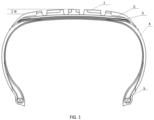
- FIG. 1 is a schematic structural diagram of an optional flat-spot-proof tire in an embodiment of the present document.
- the term 'one embodiment' or 'embodiment' refers to a specific feature, structure, or characteristic that can be included in at least one implementation of the present document.
- the terms “up”, “down”, “top”, “bottom”, and etc. indicate the orientation or position relationship based on the orientation or position relationship shown in the attached drawings, only for the convenience of describing the present document and simplifying the description, rather than indicating or implying that the device or element must have a specific orientation, be constructed and operated in a specific orientation, and therefore cannot be understood as a limitation of the present document.
- first and second are only used to describe and cannot be understood as indicating or implying the importance or inherently indicating the quantity of the technical features. Therefore, the features limited by “first” and “second” can explicitly or implicitly include one or more of these features. Moreover, the terms “first”, “second”, and etc. are used to distinguish similar objects without describing a specific order or sequence. It should be understood that the data used in this way can be interchanged in appropriate cases, so that the embodiments of the present document can be implemented in an order other than those illustrated or described here.
- FIG.1 is a structural schematic diagram of an optional flat-spot-proof tire in an embodiment of the present document.
- FIG.1 shows a tread 1, a cap ply 2, a belt ply 3, a carcass 4, a bead filler 5, and a ground clearance H of a tire shoulder.
- the flat-spot-proof tire and the vehicle in embodiments of the present document use suitable industrial rubber and fiber polyester materials, have a specific size design, and an optimized inflation process after vulcanization, such that the long-term flat spot effect of the tire can be mitigated, and the jitter of the vehicle during high-speed traveling can be reduced.
- a rubber hardness of the tread 1 is in a range from 68 to78 Shore A;
- the cap ply 2 is made of nylon cords, and a linear density of the nylon cords is in a range from 90 to 140 pieces per 100mm;
- the belt ply 3 is made of steel cords, and the steel cords are selected from a group consisting of HT steel wires and SHT steel wires;
- the carcass 4 is made of polyester cords, and a linear density of the polyester cords is in a range from 100 to 120 pieces per 100mm.
- a rubber hardness of the bead filler 5 shown in FIG.1 is in a range from 74 to 90 Shore A.
- a height of the bead filler 5 shown in FIG.1 is in a range from 25 to 35 millimeters.
- the ground clearance H of the tire shoulder shown in FIG.1 is in a range from 6.5 to 8.5 millimeters.
- a vulcanization time of the flat-spot-proof tire is in a range from 16 to 18 minutes, and an inflation pressure after vulcanization is in a range from 1.2 to1.4 bar.
- the nylon cords are PA66 wires.
- a fineness of the nylon cords is 930 deniers and a linear density of the nylon cords is 134 pieces per 100mm.
- the steel cords are HT steel wires.
- a diameter of the HT steel wires is 0.25 millimeters, and the HT steel wires are twisted into 2+2*0.25HT strands.
- the polyester cords are PET wires.
- a fineness of the PET wires is 1500 deniers and a linear density of the PET wires is 118 pieces per 100mm.
- the nylon cords are PA66 wires.
- a fineness of the PA66 wires is 1200 deniers and a linear density of the PA66 wires is 97 pieces per 100mm.
- the rubber hardness of the tread 1 is 68 Shore A.
- the cap ply 2 is made of PA66 nylon cords, with a fineness of 930 deniers and a linear density of 97 pieces per 100mm.
- the belt ply 3 is made of HT steel wires with a diameter of 2.3mm, and the HT steel wires are twisted into 1*2*2.30HT strand.
- the carcass 4 is made of PET polyester cords, with a fineness of 1000 deniers and a linear density of 100 pieces per 100mm.
- the rubber hardness of the bead filler 5 is 88 Shore A, and the height of the bead filler 5 is 25 millimeters.
- the ground clearance of the tire shoulder is 6.5 millimeters.
- the vulcanization time of the tire is 16 minutes, and the inflation pressure after vulcanization is 1.2 bar.
- the rubber hardness of the tread 1 is 70 Shore A.
- the cap ply 2 is made of PA66 nylon cords, with a fineness of 930 deniers and a linear density of 134 pieces per 100mm.
- the belt ply 3 is made of HT steel wires with a diameter of 0.25mm, and the HT steel wires are twisted into 2+2*0.25HT strand.
- the carcass 4 is made of PET polyester cords, with a fineness of 1500 deniers and a linear density of 118 pieces per 100mm.
- the rubber hardness of the bead filler 5 is 74 Shore A, and the height of the bead filler 5 is 30 millimeters.
- the ground clearance of the tire shoulder is 8.5 millimeters.
- the vulcanization time of the tire is 18 minutes, and the inflation pressure after vulcanization is 1.4 bar.
- the rubber hardness of the tread 1 is 74 Shore A.
- the cap ply 2 is made of PA66 nylon cords, with a fineness of 930 deniers and a linear density of 134 pieces per 100mm.
- the belt ply 3 is made of HT steel wires with a diameter of 2.3mm, and the HT steel wires are twisted into 1*2*2.30HT strand.
- the carcass 4 is made of PET polyester cords, with a fineness of 1500 deniers and a linear density of 118 pieces per 100mm.
- the rubber hardness of the bead filler 5 is 74 Shore A, and the height of the bead filler 5 is 30 millimeters.
- the ground clearance of the tire shoulder is 6.5 millimeters.
- the vulcanization time of the tire is 18 minutes, and the inflation pressure after vulcanization is 1.4 bar.
- the rubber hardness of the tread 1 is 78 Shore A.
- the cap ply 2 is made of PA66 nylon cords, with a fineness of 1200 deniers and a linear density of 97 pieces per 100mm.
- the belt ply 3 is made of HT steel wires with a diameter of 2.3mm, and the HT steel wires are twisted into 1*2*2.30HT.
- the carcass 4 is made of PET polyester cords, with a fineness of 1000 deniers and a linear density of 100 pieces per 100mm.
- the rubber hardness of the bead filler 5 is 74 Shore A, and the height of the bead filler 5 is 35 millimeters.
- the ground clearance of the tire shoulder is 8.5 millimeters.
- the vulcanization time of the tire is 18 minutes, and the inflation pressure after vulcanization is 1.4 bar.
- Table 1 shows z-jitter data of a steering wheel after vehicle tires manufactured by the techniques of Examples 1 to 4 generate flat spot.
- the tires being manufactured by the technique of Example 2 have the best performance.
- the average data corresponding to the tires using the technique of Example 2 is 6.95m/s, while the average data corresponding to the tires using the technique of Example 1 is 8.21m/s.
- the embodiments of the present document also provide a vehicle, which includes any one of the abovementioned flat-spot-proof tires.
- the flat-spot-proof tire of the embodiments of the present document has the following advantages:
- the flat-spot-proof tire and the vehicle of the embodiments of the present document use suitable industrial rubber and fiber polyester materials, have a specific size design, and an optimized inflation process after vulcanization, such that the long-term flat spot effect of the tire can be mitigated, and the jitter of the vehicle during high-speed traveling can be reduced.
Landscapes
- Engineering & Computer Science (AREA)
- Mechanical Engineering (AREA)
- Tires In General (AREA)
Abstract
Description
- The present document relates to vehicle tire technologies, in particular to a flat-spot-proof tire and a vehicle having the same.
- Due to viscoelastic properties of rubber materials, traditional tires are prone to flat spots at their stress mark points during exporting vehicles from main engine factories under long-term local stress conditions. According to the duration of sea transportations and the thermal and light environments, flat spots have short-term and long-term effects. Generally, the short-term flat spots can be eliminated, while the long-term flat spots cannot be eliminated.
- In the related technologies, the design of tires can avoid some short-term flat spots by selecting fiber materials of the carcass, but does not have good effect on long-term flat spots, while the long-term flat spots can easily lead to vehicle jitter during high-speed traveling.
- The present document is proposed to solve the technical problems that the tires are prone to long-term flat spot effect in the related art.
- In order to solve the technical problems, the present document discloses a flat-spot-proof tire, which includes a tread, a cap ply, a belt ply, and a carcass;
- A rubber hardness of the tread is in a range from 68 to 78 Shore A;
- The cap ply is made of nylon cords having a linear density of 90 to 140 pieces per100mm;
- The belt ply is made of steel cords being selected from HT steel wires and SHT steel wires;
- The carcass is made of polyester cords having a linear density of 100 to 120 pieces per 100mm.
- In some embodiments, the flat-spot-proof tire also includes a bead filler having a rubber hardness of 74 to 90 Shore A.
- In some embodiments, a height of the bead filler is in a range from 25 to 35 millimeters.
- In some embodiments, a ground clearance of a shoulder of the flat-spot-proof tire is in a range from 6.5 to 8.5 millimeters.
- In some embodiments, a vulcanization time of the flat-spot-proof tire is in a range from 16 to 18 minutes, and an inflation pressure after vulcanization is in a range from 1.2 to 1.4 bar.
- In some embodiments, the nylon cords are PA66 wires having a fineness of 930 deniers and a linear density of 134 pieces per 100mm.
- In some embodiments, the steel cords are HT steel wires having a diameter of 0.25 millimeters, and the HT steel wires are twisted into 2+2 * 0.25HT strands.
- In some embodiments, the polyester cord are PET wires having a fineness of 1500 deniers and a linear density of 118 pieces per 100mm.
- In some embodiments, the nylon cords are PA66 wires having a fineness of 1200 deniers and a linear density of 97 pieces per 100mm.
- The present document also discloses a vehicle, which includes any one of the aforementioned flat-spot-proof tires.
- By means of the abovementioned technical solutions, the flat-spot-proof tire and the vehicle in the present document have the following advantages:
- The flat-spot-proof tire and the vehicle of the present document use suitable industrial rubber and fiber polyester materials, have a specific size design and an optimized inflation process after vulcanization, such that the long-term flat spot effect of the tire can be mitigated, and the jitter of the vehicle during high-speed traveling can be reduced.
- In order to clearly explain of the technical solutions in the embodiments of the present document, the following will give a brief introduction of the accompany drawings required in the description of the embodiments. Obviously, the accompany drawings in the following description only show some of the embodiments in the present document. For those having ordinary skill in the art, other drawings can also be obtained based on these drawings without any creative work.
FIG. 1 is a schematic structural diagram of an optional flat-spot-proof tire in an embodiment of the present document. - The following will provide a clear and complete description of the technical solution in the embodiments of the present document in conjunction with the accompanying drawings. Obviously, the described embodiments are only a part but not all of the embodiments of the present document. Based on the embodiments in the present document, all other embodiments obtained by those having ordinary skill the art without creative work will fall within the protection scope of the present document.
- The term 'one embodiment' or 'embodiment' refers to a specific feature, structure, or characteristic that can be included in at least one implementation of the present document. In the description of the present document, it should be understood that the terms "up", "down", "top", "bottom", and etc. indicate the orientation or position relationship based on the orientation or position relationship shown in the attached drawings, only for the convenience of describing the present document and simplifying the description, rather than indicating or implying that the device or element must have a specific orientation, be constructed and operated in a specific orientation, and therefore cannot be understood as a limitation of the present document. In addition, the terms "first" and "second" are only used to describe and cannot be understood as indicating or implying the importance or inherently indicating the quantity of the technical features. Therefore, the features limited by "first" and "second" can explicitly or implicitly include one or more of these features. Moreover, the terms "first", "second", and etc. are used to distinguish similar objects without describing a specific order or sequence. It should be understood that the data used in this way can be interchanged in appropriate cases, so that the embodiments of the present document can be implemented in an order other than those illustrated or described here.
- Please refer to
FIG.1 , which is a structural schematic diagram of an optional flat-spot-proof tire in an embodiment of the present document.FIG.1 shows a tread 1, a cap ply 2, a belt ply 3, a carcass 4, a bead filler 5, and a ground clearance H of a tire shoulder. - The flat-spot-proof tire and the vehicle in embodiments of the present document use suitable industrial rubber and fiber polyester materials, have a specific size design, and an optimized inflation process after vulcanization, such that the long-term flat spot effect of the tire can be mitigated, and the jitter of the vehicle during high-speed traveling can be reduced.
- In the present document, a rubber hardness of the tread 1 is in a range from 68 to78 Shore A; The cap ply 2 is made of nylon cords, and a linear density of the nylon cords is in a range from 90 to 140 pieces per 100mm; The belt ply 3 is made of steel cords, and the steel cords are selected from a group consisting of HT steel wires and SHT steel wires; The carcass 4 is made of polyester cords, and a linear density of the polyester cords is in a range from 100 to 120 pieces per 100mm.
- In some embodiments, a rubber hardness of the bead filler 5 shown in
FIG.1 is in a range from 74 to 90 Shore A. - In some embodiments, a height of the bead filler 5 shown in
FIG.1 is in a range from 25 to 35 millimeters. - In some embodiments, the ground clearance H of the tire shoulder shown in
FIG.1 is in a range from 6.5 to 8.5 millimeters. - In some embodiments, a vulcanization time of the flat-spot-proof tire is in a range from 16 to 18 minutes, and an inflation pressure after vulcanization is in a range from 1.2 to1.4 bar.
- In some embodiments, the nylon cords are PA66 wires. A fineness of the nylon cords is 930 deniers and a linear density of the nylon cords is 134 pieces per 100mm.
- In some embodiments, the steel cords are HT steel wires. A diameter of the HT steel wires is 0.25 millimeters, and the HT steel wires are twisted into 2+2*0.25HT strands.
- In some embodiments, the polyester cords are PET wires. A fineness of the PET wires is 1500 deniers and a linear density of the PET wires is 118 pieces per 100mm.
- In some embodiments, the nylon cords are PA66 wires. A fineness of the PA66 wires is 1200 deniers and a linear density of the PA66 wires is 97 pieces per 100mm.
- The following is an explanation of the flat-spot-proof tire in specific examples of the present document.
- The rubber hardness of the tread 1 is 68 Shore A. The cap ply 2 is made of PA66 nylon cords, with a fineness of 930 deniers and a linear density of 97 pieces per 100mm. The belt ply 3 is made of HT steel wires with a diameter of 2.3mm, and the HT steel wires are twisted into 1*2*2.30HT strand. The carcass 4 is made of PET polyester cords, with a fineness of 1000 deniers and a linear density of 100 pieces per 100mm. The rubber hardness of the bead filler 5 is 88 Shore A, and the height of the bead filler 5 is 25 millimeters. The ground clearance of the tire shoulder is 6.5 millimeters. The vulcanization time of the tire is 16 minutes, and the inflation pressure after vulcanization is 1.2 bar.
- The rubber hardness of the tread 1 is 70 Shore A. The cap ply 2 is made of PA66 nylon cords, with a fineness of 930 deniers and a linear density of 134 pieces per 100mm. The belt ply 3 is made of HT steel wires with a diameter of 0.25mm, and the HT steel wires are twisted into 2+2*0.25HT strand. The carcass 4 is made of PET polyester cords, with a fineness of 1500 deniers and a linear density of 118 pieces per 100mm. The rubber hardness of the bead filler 5 is 74 Shore A, and the height of the bead filler 5 is 30 millimeters. The ground clearance of the tire shoulder is 8.5 millimeters. The vulcanization time of the tire is 18 minutes, and the inflation pressure after vulcanization is 1.4 bar.
- The rubber hardness of the tread 1 is 74 Shore A. The cap ply 2 is made of PA66 nylon cords, with a fineness of 930 deniers and a linear density of 134 pieces per 100mm. The belt ply 3 is made of HT steel wires with a diameter of 2.3mm, and the HT steel wires are twisted into 1*2*2.30HT strand. The carcass 4 is made of PET polyester cords, with a fineness of 1500 deniers and a linear density of 118 pieces per 100mm. The rubber hardness of the bead filler 5 is 74 Shore A, and the height of the bead filler 5 is 30 millimeters. The ground clearance of the tire shoulder is 6.5 millimeters. The vulcanization time of the tire is 18 minutes, and the inflation pressure after vulcanization is 1.4 bar.
- The rubber hardness of the tread 1 is 78 Shore A. The cap ply 2 is made of PA66 nylon cords, with a fineness of 1200 deniers and a linear density of 97 pieces per 100mm. The belt ply 3 is made of HT steel wires with a diameter of 2.3mm, and the HT steel wires are twisted into 1*2*2.30HT. The carcass 4 is made of PET polyester cords, with a fineness of 1000 deniers and a linear density of 100 pieces per 100mm. The rubber hardness of the bead filler 5 is 74 Shore A, and the height of the bead filler 5 is 35 millimeters. The ground clearance of the tire shoulder is 8.5 millimeters. The vulcanization time of the tire is 18 minutes, and the inflation pressure after vulcanization is 1.4 bar.
- Table 1 shows z-jitter data of a steering wheel after vehicle tires manufactured by the techniques of Examples 1 to 4 generate flat spot. In Table 1, the tires being manufactured by the technique of Example 2 have the best performance. In the test of z-jitter data of the steering wheel after flat spot, the average data corresponding to the tires using the technique of Example 2 is 6.95m/s, while the average data corresponding to the tires using the technique of Example 1 is 8.21m/s.


- The embodiments of the present document also provide a vehicle, which includes any one of the abovementioned flat-spot-proof tires.
- The flat-spot-proof tire of the embodiments of the present document has the following advantages:
The flat-spot-proof tire and the vehicle of the embodiments of the present document use suitable industrial rubber and fiber polyester materials, have a specific size design, and an optimized inflation process after vulcanization, such that the long-term flat spot effect of the tire can be mitigated, and the jitter of the vehicle during high-speed traveling can be reduced. - The above examples are only preferred embodiments and are not intended to limit the present document. Any modifications, equivalent substitutions, improvements, and etc. made within the spirit and principles of the present document shall be included in the scope of protection of the present document.
Claims (10)
- A flat-spot-proof tire, comprising: a tread, a cap ply, a belt ply, and a carcass,
characterized in thata rubber hardness of the tread is in a range from 68 to 78 Shore A;the cap ply is made of nylon cords having a linear density of 90 to140 pieces per 100mm;the belt ply is made of steel cords being selected from HT steel wires and SHT steel wires;the carcass is made of polyester cords having a linear density of 100 to 120 pieces per 100mm. - The flat-spot-proof tire according to claim 1, wherein the flat-spot-proof tire further comprises a bead filler having a rubber hardness of 74 to 90 Shore A.
- The flat-spot-proof tire according to claim 2, wherein a height of the bead filler is in a range from 25 to 35 millimeters.
- The flat-spot-proof tire according to claim 3, wherein a ground clearance of a shoulder of the flat-spot-proof tire is in a range from 6.5 to 8.5 millimeters.
- The flat-spot-proof tire according to claim 4, wherein a vulcanization time of the flat-spot-proof tire is in a range from 16 to 18 minutes, and an inflation pressure after vulcanization is in a range from 1.2 to 1.4 bar.
- The flat-spot-proof tire according to claim 5, wherein the nylon cords are PA66 wires having a fineness of 930 deniers and a linear density of 134 pieces per 100mm.
- The flat-spot-proof tire according to claim 6, wherein the steel cords are HT steel wires having a diameter of 0.25 millimeters and being twisted into 2+2*0.25HT strands.
- The flat-spot-proof tire according to claim 7, wherein the polyester cords are PET wires having a fineness of 1500 deniers and a linear density of 118 pieces per 100mm.
- The flat-spot-proof tire according to claim 5, wherein the nylon cords are PA66 wires having with a fineness of 1200 deniers and a linear density of 97 pieces per 100mm.
- A vehicle, comprising a flat-spot-proof tire as claimed in any one of claims 1 to 9.
Applications Claiming Priority (1)
| Application Number | Priority Date | Filing Date | Title |
|---|---|---|---|
| PCT/CN2021/080483 WO2022188158A1 (en) | 2021-03-12 | 2021-03-12 | Flat spot-proof tire, and vehicle |
Publications (2)
| Publication Number | Publication Date |
|---|---|
| EP4306334A1 true EP4306334A1 (en) | 2024-01-17 |
| EP4306334A4 EP4306334A4 (en) | 2024-11-13 |
Family
ID=83226224
Family Applications (1)
| Application Number | Title | Priority Date | Filing Date |
|---|---|---|---|
| EP21929632.4A Pending EP4306334A4 (en) | 2021-03-12 | 2021-03-12 | Flat spot-proof tire, and vehicle |
Country Status (4)
| Country | Link |
|---|---|
| US (1) | US20240123766A1 (en) |
| EP (1) | EP4306334A4 (en) |
| CN (1) | CN117015480A (en) |
| WO (1) | WO2022188158A1 (en) |
Family Cites Families (21)
| Publication number | Priority date | Publication date | Assignee | Title |
|---|---|---|---|---|
| DE69013903T2 (en) * | 1990-07-20 | 1995-04-20 | Goodyear Tire & Rubber | Tire treads. |
| WO1995008590A1 (en) * | 1993-09-24 | 1995-03-30 | Urethane Technologies, Inc. | Process for forming integral skin microcellular structures |
| JP3393520B2 (en) * | 1994-06-10 | 2003-04-07 | 住友ゴム工業株式会社 | Manufacturing method of pneumatic radial tire |
| JP3608591B2 (en) * | 1995-05-15 | 2005-01-12 | 横浜ゴム株式会社 | Pneumatic radial tire |
| JP3688080B2 (en) * | 1996-11-25 | 2005-08-24 | 横浜ゴム株式会社 | Pneumatic radial tire |
| WO2003008207A1 (en) * | 2001-07-19 | 2003-01-30 | Pirelli Pneumatici S.P.A. | Tyre for motor vehicles with undulated monofilaments in belt reinforcement layer |
| JP4044526B2 (en) * | 2004-01-27 | 2008-02-06 | 住友ゴム工業株式会社 | Pneumatic tire and rim assembly |
| JP4567482B2 (en) * | 2005-02-14 | 2010-10-20 | 住友ゴム工業株式会社 | Pneumatic tire |
| BRPI0520776B1 (en) * | 2005-12-23 | 2019-04-24 | Pirelli Tyre S.P.A. | PNEUMATIC, AND, FOUR WHEELS VEHICLE |
| JP5038739B2 (en) * | 2007-02-22 | 2012-10-03 | 住友ゴム工業株式会社 | studless tire |
| JP5001721B2 (en) * | 2007-06-01 | 2012-08-15 | 東洋ゴム工業株式会社 | Pneumatic tire |
| JP4377934B2 (en) * | 2007-08-03 | 2009-12-02 | 住友ゴム工業株式会社 | Pneumatic tire |
| JP2011225085A (en) * | 2010-04-19 | 2011-11-10 | Sumitomo Rubber Ind Ltd | Pneumatic tire |
| US9862232B2 (en) * | 2011-05-31 | 2018-01-09 | Pirelli Tyre S.P.A. | Pneumatic tyre for heavy load vehicle wheels |
| JP5983038B2 (en) * | 2012-05-29 | 2016-08-31 | 横浜ゴム株式会社 | Pneumatic tire |
| CN103568731A (en) * | 2013-11-11 | 2014-02-12 | 北京化工大学 | Meridianal bias tire with low flatness ratio |
| US20160288573A1 (en) * | 2015-03-31 | 2016-10-06 | The Goodyear Tire & Rubber Company | Continuous crown reinforcement for a pneumatic tire |
| JP6811684B2 (en) * | 2017-06-19 | 2021-01-13 | 株式会社ブリヂストン | tire |
| DE102018130338B4 (en) * | 2017-12-15 | 2023-12-21 | Toyo Tire & Rubber Co., Ltd. | Pneumatic tire |
| CN210416096U (en) * | 2019-06-26 | 2020-04-28 | 青岛双星轮胎工业有限公司 | UHP tyre with steel wire carcass |
| CN211364166U (en) * | 2019-12-26 | 2020-08-28 | 安徽佳通乘用子午线轮胎有限公司 | Low-noise tire |
-
2021
- 2021-03-12 CN CN202180068429.2A patent/CN117015480A/en active Pending
- 2021-03-12 EP EP21929632.4A patent/EP4306334A4/en active Pending
- 2021-03-12 US US18/277,571 patent/US20240123766A1/en not_active Abandoned
- 2021-03-12 WO PCT/CN2021/080483 patent/WO2022188158A1/en not_active Ceased
Also Published As
| Publication number | Publication date |
|---|---|
| WO2022188158A1 (en) | 2022-09-15 |
| CN117015480A (en) | 2023-11-07 |
| EP4306334A4 (en) | 2024-11-13 |
| US20240123766A1 (en) | 2024-04-18 |
Similar Documents
| Publication | Publication Date | Title |
|---|---|---|
| CN109941046B (en) | Pneumatic tires | |
| CN1259905A (en) | Light wt. radial tire having glass fiber belt | |
| JP2013539734A (en) | Passenger car tire with radial carcass reinforcement | |
| CN107000508B (en) | Tires comprising a carcass reinforcement made of two plies | |
| JP2019533093A (en) | Reinforcing element, elastomer composite, and tire including the reinforcing element | |
| ES443872A1 (en) | Pneumatic tires suitable for off-road vehicles | |
| CN101541561A (en) | Pneumatic tire | |
| ATE397107T1 (en) | IMPREGNATED CORD HYBRIDCORD ITS USE IN RADIAL TIRES | |
| US20240123766A1 (en) | Flat-spot-proof tire, and vehicle having the same | |
| NO140370B (en) | BULLET RINGS FOR PNEUMATIC TIRES. | |
| JP2007168711A (en) | Pneumatic radial tire for heavy load | |
| RU2262453C1 (en) | Radial-play pneumatic tyre casing | |
| EP2777948A1 (en) | Radial tire for motorcycle | |
| JP4963860B2 (en) | Radial tires for motorcycles | |
| CN102102253B (en) | Tire cord comprising glass fiber composite material and radial ply tire with the same | |
| JP2017013521A (en) | Reclaimed pneumatic radial tire for aircraft | |
| US4518023A (en) | Pneumatic tire | |
| JPS5876308A (en) | Pneumatic radial tire for high load | |
| EP1757463B1 (en) | Retread tire and method of producing the same | |
| KR102177497B1 (en) | Low Weight Pnematic tire | |
| KR20250010257A (en) | Durable vehicle tire | |
| JP2006256600A (en) | Pneumatic radial tire | |
| JPH1053979A (en) | Steel cord for reinforcing tire | |
| JP2006162560A (en) | Durability testing method for pneumatic tire | |
| CN1260289A (en) | Meridian tyre with casing ply added with steel cord for car and light truck |
Legal Events
| Date | Code | Title | Description |
|---|---|---|---|
| STAA | Information on the status of an ep patent application or granted ep patent |
Free format text: STATUS: THE INTERNATIONAL PUBLICATION HAS BEEN MADE |
|
| PUAI | Public reference made under article 153(3) epc to a published international application that has entered the european phase |
Free format text: ORIGINAL CODE: 0009012 |
|
| STAA | Information on the status of an ep patent application or granted ep patent |
Free format text: STATUS: REQUEST FOR EXAMINATION WAS MADE |
|
| 17P | Request for examination filed |
Effective date: 20230525 |
|
| AK | Designated contracting states |
Kind code of ref document: A1 Designated state(s): AL AT BE BG CH CY CZ DE DK EE ES FI FR GB GR HR HU IE IS IT LI LT LU LV MC MK MT NL NO PL PT RO RS SE SI SK SM TR |
|
| DAV | Request for validation of the european patent (deleted) | ||
| DAX | Request for extension of the european patent (deleted) | ||
| A4 | Supplementary search report drawn up and despatched |
Effective date: 20241010 |
|
| RIC1 | Information provided on ipc code assigned before grant |
Ipc: B60C 9/20 20060101ALI20241004BHEP Ipc: B60C 11/01 20060101ALI20241004BHEP Ipc: B60C 9/00 20060101AFI20241004BHEP |