EP4301656B1 - Hybridantriebssystem für ein freizeitboot - Google Patents
Hybridantriebssystem für ein freizeitboot Download PDFInfo
- Publication number
- EP4301656B1 EP4301656B1 EP22723750.0A EP22723750A EP4301656B1 EP 4301656 B1 EP4301656 B1 EP 4301656B1 EP 22723750 A EP22723750 A EP 22723750A EP 4301656 B1 EP4301656 B1 EP 4301656B1
- Authority
- EP
- European Patent Office
- Prior art keywords
- hybrid propulsion
- propulsion system
- boat
- electric motor
- control
- Prior art date
- Legal status (The legal status is an assumption and is not a legal conclusion. Google has not performed a legal analysis and makes no representation as to the accuracy of the status listed.)
- Active
Links
Images


Classifications
-
- B—PERFORMING OPERATIONS; TRANSPORTING
- B63—SHIPS OR OTHER WATERBORNE VESSELS; RELATED EQUIPMENT
- B63H—MARINE PROPULSION OR STEERING
- B63H21/00—Use of propulsion power plant or units on vessels
- B63H21/20—Use of propulsion power plant or units on vessels the vessels being powered by combinations of different types of propulsion units
-
- B—PERFORMING OPERATIONS; TRANSPORTING
- B63—SHIPS OR OTHER WATERBORNE VESSELS; RELATED EQUIPMENT
- B63B—SHIPS OR OTHER WATERBORNE VESSELS; EQUIPMENT FOR SHIPPING
- B63B79/00—Monitoring properties or operating parameters of vessels in operation
- B63B79/10—Monitoring properties or operating parameters of vessels in operation using sensors, e.g. pressure sensors, strain gauges or accelerometers
-
- B—PERFORMING OPERATIONS; TRANSPORTING
- B63—SHIPS OR OTHER WATERBORNE VESSELS; RELATED EQUIPMENT
- B63H—MARINE PROPULSION OR STEERING
- B63H25/00—Steering; Slowing-down otherwise than by use of propulsive elements; Dynamic anchoring, i.e. positioning vessels by means of main or auxiliary propulsive elements
- B63H25/42—Steering or dynamic anchoring by propulsive elements; Steering or dynamic anchoring by propellers used therefor only; Steering or dynamic anchoring by rudders carrying propellers
-
- B—PERFORMING OPERATIONS; TRANSPORTING
- B63—SHIPS OR OTHER WATERBORNE VESSELS; RELATED EQUIPMENT
- B63H—MARINE PROPULSION OR STEERING
- B63H20/00—Outboard propulsion units, e.g. outboard motors or Z-drives; Arrangements thereof on vessels
- B63H2020/003—Arrangements of two, or more outboard propulsion units
-
- B—PERFORMING OPERATIONS; TRANSPORTING
- B63—SHIPS OR OTHER WATERBORNE VESSELS; RELATED EQUIPMENT
- B63H—MARINE PROPULSION OR STEERING
- B63H21/00—Use of propulsion power plant or units on vessels
- B63H21/20—Use of propulsion power plant or units on vessels the vessels being powered by combinations of different types of propulsion units
- B63H2021/202—Use of propulsion power plant or units on vessels the vessels being powered by combinations of different types of propulsion units of hybrid electric type
- B63H2021/205—Use of propulsion power plant or units on vessels the vessels being powered by combinations of different types of propulsion units of hybrid electric type the second power unit being of the internal combustion engine type, or the like, e.g. a Diesel engine
Definitions
- the present invention relates to a hybrid propulsion system for a pleasure boat equipped with a control system for the hybrid propulsion system and the position of the pleasure boat.
- the hybrid propulsion system comprises an internal combustion engine and an electric motor / generator assisted by one or more supply batteries
- the control system also comprises a plurality of gyroscopic sensors and / or triaxial accelerometers and the control of the position is based on signals from the plurality of gyroscopic sensors and / or triaxial accelerometers.
- the two-mode hybrid propulsion system allows the user of the pleasure boat to navigate in cruise mode with only the internal combustion engine but also to navigate with only the electric motor at low speed and with zero polluting emissions.
- the position control system allows the ability to maintain (or control) the position of the boat under various operating conditions.
- the invention was conceived for the application of the hybrid propulsion system in the so-called "outboard” position, but it is understood that the same inventive solution can be applied to medium and small boats equipped with an inboard propulsion system.
- JP 2018 099903 A discloses a hybrid propulsion system having an outboard configuration.
- GPS Global positioning System
- these systems which have recently developed thanks to GPS satellite technology, do not allow precise positioning for a variety of reasons. First, they lose their effectiveness in areas where the GPS signal is weak or completely absent. Secondly, if the vessel develops tension between the bow and stern, the GPS signal fails to take this into account and the information provided is inaccurate. Thirdly, a GPS signal, which is a punctual signal, is equally unable to evaluate and therefore compensate for the effect of the sea wave. Finally, a control system based on GPS technology requires a significant electricity requirement.
- control of the position of the boat can be carried out in different operating conditions of the boat. For example, during a mooring maneuver in port or at anchor, or to emulate an anchoring maneuver in the open sea or during a trolling maneuver.
- the internal combustion engine will be able to operate during the cruise operating mode and in this mode the electric motor/generator will act as an electric generator to power the onboard accessories and to recharge the batteries.
- the plurality of gyroscopic sensors and/or triaxial accelerometers is configured to operate in wi-fi mode, thus considerably simplifying the on-board electrical wiring.
- control system may also include at least one sensor that detects the angle of the wind.
- a hybrid propulsion system for a pleasure boat comprising a control system configured to control the hybrid propulsion system and the position of the pleasure boat, the hybrid propulsion system having the stated characteristics in the independent product claim annexed to the present description.
- the terminology “pleasure boat” will often be used, including the term “small recreational boat”.
- pleasure boat includes units between 10 and 24 meters, both motor and sailing
- small recreational boat includes all pleasure boats of less than 10 meters length, used both in waters maritime and inland waters, both motor and sailing, as well as all rowing boats.
- gyroscopic sensor and/or triaxial accelerometer will be used in this description. Although this terminology is known to technicians in the sector, it is preferable to remember that gyroscopic sensors and accelerometers are electro-mechanical sensors, so-called MEMS (from the English, acronym for Micro-Electro-Mechanical System). More precisely, the gyroscopic sensor is a sensor which measures the rotational motion and in particular detects the slightest variations in the angular velocity of a given object.
- MEMS Micro-Electro-Mechanical System
- a triaxial accelerometer is able, along three main axes, to detect and/or measure the acceleration, calculating the force detected with respect to the mass of the object.
- an "electric motor/generator” will often be mentioned, meaning by this term an electric machine capable of operating both as a driving machine and as an operating machine. Even when, for the sake of brevity, we write more simply "electric motor”, it will be understood that this machine can also perform the function of electric generator under appropriate conditions.
- tilting we mean the technique of sport fishing in a boat which consists of navigating by pulling lures or live fish with the use of special rods.
- FIGS. 1a and 1b illustrate a pleasure boat 10, as previously defined.
- the pleasure boat 10 is equipped with at least one hybrid propulsion system, according to the present invention, in turn comprising a control system of the hybrid propulsion system and the position of the boat, as will be explained below.
- the control system is also provided with a plurality of gyroscopic sensors and/or triaxial accelerometers 20, 21, located along the boat but in such a way that there is at least one gyroscopic sensor and/or a triaxial accelerometer 20 in the bow of the boat 10 and at least one gyroscopic sensor and/or triaxial accelerometer 21 at the stern of the boat 10.
- the plurality of gyroscopic sensors and/or triaxial accelerometers can be configured to operate in wi-fi mode, thus simplifying the on-board wiring.
- This plurality of sensors provides the position of the pleasure boat to the control system which will implement the desired position by means of two electric motors 31, 32 ( Figure 1a , configuration with two hybrid propulsion systems) or a single electric motor 30 ( Figure 1b , configuration with a hybrid propulsion system).
- the electric motors 31, 32 provide a propulsive thrust along the same direction (the direction joining the bow with the stern of the boat) but opposite to each other. In this way it will be possible to control forward travel (with the first electric motor 31), reverse travel (with the second electric motor 32) but also a rotary motion, when, for example, the propulsive thrust of the first electric motor 31 is greater than the propulsive thrust of the second electric motor 32.
- the electric motor 30 is unique and is able to implement a propulsive thrust directed so as to ensure forward travel, reverse travel and rotation of the pleasure boat 10.
- FIG. 2 an exemplary configuration of the control system 40 of the position of the pleasure boat 10 is schematized with a sequence of logic blocks.
- Figure 2 is a block diagram of the control system 40 of the position of the pleasure boat 10 of Figure 1a (i.e., with the two electric motors 31, 32) in the cases of emulation of the anchoring maneuver or control of the route, for example in the execution of a trolling maneuver.
- the logic blocks 41, 42 compare the set-point signals with the feedback signals coming from corresponding feedback blocks 43, 44, the regulators 45, 46 (preferably of the type "proportional-integral-derivative" or PID) determine on the basis of the value of the variable to be regulated the value of the regulating variable and the control unit 47 transforms the values of the regulating variable into input values for the electric motors.
- the set-points W1 and W2 are static and are angular values and also the signals coming from the feedback blocks 43, 44 are angular values.
- the logic blocks 41, 42 compare the set-point signals with the feedback signals and transmit the errors (i.e.
- the control unit 47 receives and processes the reading of at least two gyroscopic sensors and/or triaxial accelerometers that provide data on the variations of the x and z components of the displacement vector. These variations are the input data of the feedback blocks 43, 44 which calculate the compensated angle to keep the error at zero and keep the pleasure boat 10 in the same position or course.
- the control system operates in the same way working with a single set-point block, a single feedback block, a single PID regulator and the control unit.
- the control of the electric motor will also act on its pivot angle, so that the electric motor can impart the propulsive thrust along any direction, to make changes in the orientation of the pleasure boat.
- FIG 3 is a block diagram of the boat position control system of Figure 1a in the case of performing a mooring maneuver in port or in the roadstead.
- the block diagram coincides with that of Figure 2 previously described and operates in the same way both in the configuration with two electric motors and in the configuration with a single electric motor.
- the angular values w1 and w2 are no longer static but are dynamic and will be calculated by the mooring model 48 which receives the wind angle as input.
- the mooring model 48 evaluates the leeway in mooring conditions in order to produce as output two angles w1, w2 which are the dynamic set-points for position and course control.
- the wind direction can be entered manually by the user or, advantageously, can be automatically supplied to the mooring model 48 by means of a suitable wind sensor, of a known type and therefore not shown in figure 3 .
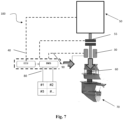
- the hybrid propulsion system 100 is a preferably outboard solution comprising an internal combustion engine 50 and an electric motor/generator 30 of low power.
- the hybrid propulsion system may be completely new, as well as a retrofit solution consisting in the installation of the additional electric motor to an existing architecture with only the internal combustion engine.
- the hybrid configuration does not require any special transmission as it is sufficient to provide a toothed clutch 55, interposed between the internal combustion engine 50 and the electric motor generator 30 and which, depending on the operating mode, can mechanically couple the thermal engine to the electric motor or, on the contrary, uncouple them.
- a vertical drive shaft 60 connects the internal combustion engine 50 and the electric motor 30 to a propeller 70.
- the hybrid propulsion system will be equipped with one or more batteries 80 that power the electric motor in the case of purely electric propulsion.
- Internal combustion engine, toothed clutch and electric motor/generator are managed by the control system 40 (previously described), while the battery or the battery pack 80 are managed by a "battery management system" 90.
- the electric motor/generator 30 is installed in the lower part of the vertical drive shaft 60.
- the size of the electric motor depends on the applications and the size of the pleasure boat: in general, a range of 3 to 10 kW is suitable for a pleasure boat. In case more electric power is needed, it will be possible to install two hybrid propulsion systems, preferably both outboard.
- the hybrid propulsion systems according to the present invention may be one or two in number.
- the values of the powers involved are completely scalable.
- the size of the battery or battery pack will depend on numerous factors: the size of the pleasure boat, the size of the electric motor or electric motors, the required performance and the desired cruising range in electric-only operating mode, i.e., emissions. zero.
- Figure 5 schematically illustrates a second embodiment of the hybrid propulsion system 100 in which the transmission of motion to the propeller 70 is carried out by means of a first vertical drive shaft 60 and a second horizontal drive shaft 65, between them connected in a known way (for example by means of a bevel pair of gears), and in this configuration the electric motor generator 30 can also be mounted on the horizontal drive shaft 65.
- a first operating mode of the hybrid propulsion system 100 is described, for example in the configuration of Figure 4 .
- the electric motor/generator 30 can function as an electric generator and can be disengaged or engaged, by means of the toothed clutch 55, depending on the state of charge of the battery pack 80.
- the toothed clutch 55 is shown engaged and, therefore, the electric motor is operating as an electric generator.
- the control system 40 activates the toothed clutch 55 and controls the electric motor 30 as needed.
- a second operating mode of the hybrid propulsion system 100 is described, again, by way of example, in the configuration of Figure 4 .
- This is an operating mode at a speed significantly lower than the cruising speed in which the propulsion of the pleasure boat 10 is supplied exclusively by the electric motor 30, while the internal combustion engine 50 is completely off. For this reason, this operating mode of propulsion is also called "zero emissions”.
- the control system 40 activates the toothed clutch 55, turns off the internal combustion engine 50 and controls the electric motor 30 as needed.
- the advantages related to the implementation of the present invention are various.
- the possibility of using two operating modes with a single integrated propulsion system avoids the installation of an auxiliary electric motor, in general and not even in the case of boats intended for trolling, where in general an additional electric motor (or an internal combustion engine) is needed to maintain the low speed required by trolling.
- the combination of the use of a hybrid propulsion system and a position control system based on the signals coming from several gyroscopic sensors and/or triaxial accelerometers allows the boat to emulate the anchoring position, as well as access to protected areas via zero-emission propulsion modes. It also allows the best performance for trolling by exploiting the low controlled speed obtainable with the electric motor.
Landscapes
- Chemical & Material Sciences (AREA)
- Engineering & Computer Science (AREA)
- Combustion & Propulsion (AREA)
- Mechanical Engineering (AREA)
- Ocean & Marine Engineering (AREA)
- Hybrid Electric Vehicles (AREA)
- Electric Propulsion And Braking For Vehicles (AREA)
- Regulating Braking Force (AREA)
- Liquid Developers In Electrophotography (AREA)
Claims (10)
- Hybridantriebssystem (100) für ein Sportboot (10), das mit einem Steuersystem (40) des Hybridantriebssystems (100) und der Position des Sportboots (10) ausgestattet ist, wobei das Hybridantriebssystem (100) außerdem einen Verbrennungsmotor (50) und einen Elektromotor/Generator (30, 31, 32) umfasst, die in integrierter Weise und gemäß zwei vom Steuersystem verwalteten Betriebsmodi arbeiten:- ein erster Betriebsmodus, in dem der Verbrennungsmotor (50) so konfiguriert ist, dass er mit Reisegeschwindigkeit läuft, und- ein zweiter Betriebsmodus, in dem der Elektromotor/Generator (30) so konfiguriert ist, dass er mit einer niedrigeren Geschwindigkeit als einer Reisegeschwindigkeit läuft,wobei:- das Steuersystem eine Vielzahl von Gyroskopsensoren und/oder dreiachsigen Beschleunigungsmessern (20, 21) umfasst und so konfiguriert ist, dass es die Position des Bootes mittels Signalen von der Vielzahl von Gyroskopsensoren und/oder dreiachsigen Beschleunigungsmessern steuert (20, 21), und- die Vielzahl von Gyroskopsensoren und/oder dreiachsigen Beschleunigungsmessern ist so angeordnet, dass sich mindestens ein Gyroskopsensor und/oder ein dreiachsiger Beschleunigungsmesser (20) am Bug des Bootes (10) und mindestens ein Gyroskopsensor und/oder ein dreiachsiger Beschleunigungsmesser (21) am Heck des Bootes (10) befindet,das Hybridantriebssystem (100) ist dadurch gekennzeichnet, dass das Steuersystem (40) Folgendes umfasst:- mindestens einen Logikblock (41, 42) und mindestens einen Rückkopplungsblock (43, 44), wobei der mindestens eine Logikblock (41, 42) so konfiguriert ist, dass er Sollwertsignale (W1, W2) mit Rückkopplungssignalen von dem mindestens einen Rückkopplungsblock (43, 44) vergleicht,- mindestens einen Regler (45, 46), der so konfiguriert ist, dass er den Wert einer Regelvariable (Uyl, Uy2) auf der Grundlage des Werts einer Variable bestimmt zu regeln, und- eine Steuereinheit (47), die dazu konfiguriert ist, die Werte der Regelgröße (Uyl, Uy2) in Eingangswerte (Yx1, Yx2 und Yz1, Yz2) für den Elektromotor/Generator (30, 31, 32) des Hybridantriebs umzuwandeln,
und wobei- die Sollwertsignale (W1, W2) statische oder dynamische Winkelwerte sind,- die Rückkopplungssignale Winkelwerte von den mindestens zwei Gyroskopsensoren und/oder dreiachsigen Beschleunigungsmessern (20, 21) am Bug und am Heck sind, die Daten über die Variationen der x- und z-Komponenten des Verschiebungsvektors liefern,- die Regelgröße (Uyl, Uy2) ein Antriebsdrehmoment ist, und- die Eingangswerte (Yx1, Yx2 und Yz1, Yz2) ein Antriebsschub gemäß zweier durch die x- und z-Komponenten des Verschiebungsvektors definierter Richtungen sind. - Hybridantriebssystem (100) nach Anspruch 1, wobei das Steuersystem (40) so konfiguriert ist, dass es die Position des Bootes (10) steuert, während es einen Ankervorgang emuliert.
- Hybridantriebssystem (100) nach Anspruch 1, wobei das Steuersystem (40) so konfiguriert ist, dass es die Position des Bootes (10) steuert, während es einen Trolling-Vorgang durchführt.
- Hybridantriebssystem (100) nach Anspruch 1, wobei der Elektromotor/Generator (30) eindeutig ist und die Eingangswerte auch einen Schwenkwinkel umfassen.
- Hybridantriebssystem (100) nach Anspruch 1, wobei das Steuersystem (40) so konfiguriert ist, dass es die Position des Bootes (10) steuert, während es einen Anlegevorgang in einem Hafen oder auf einer Reede durchführt.
- Hybridantriebssystem (100) nach Anspruch 5, wobei die Sollwertsignale (W1, W2) dynamische und Winkelwerte sind und aus einem Verankerungsmodell (48) berechnet werden, das als Eingangswert die Windrichtung hat.
- Hybridantriebssystem (100) nach einem der vorhergehenden Ansprüche, wobei die Vielzahl von Gyroskopsensoren und/oder dreiachsigen Beschleunigungsmessern (20, 21) so konfiguriert ist, dass sie in einem Wi-Fi-Betriebsmodus arbeiten.
- Hybridantriebssystem (100) nach einem der vorhergehenden Ansprüche, wobei mindestens ein Windwinkelsensor vorhanden ist.
- Hybridantriebssystem (100) nach einem der vorhergehenden Ansprüche, wobei das Hybridantriebssystem (100) in einer Außenbordposition installiert ist.
- Sportboot (10), das mit mindestens einem Hybridantriebssystem (100) nach einem der vorhergehenden Ansprüche ausgestattet ist.
Applications Claiming Priority (2)
| Application Number | Priority Date | Filing Date | Title |
|---|---|---|---|
| IT102021000005261A IT202100005261A1 (it) | 2021-03-05 | 2021-03-05 | Sistema a propulsione ibrida per imbarcazione da diporto |
| PCT/IB2022/051922 WO2022185267A1 (en) | 2021-03-05 | 2022-03-04 | Hybrid propulsion system for a pleasure boat |
Publications (3)
| Publication Number | Publication Date |
|---|---|
| EP4301656A1 EP4301656A1 (de) | 2024-01-10 |
| EP4301656B1 true EP4301656B1 (de) | 2024-12-04 |
| EP4301656C0 EP4301656C0 (de) | 2024-12-04 |
Family
ID=76034959
Family Applications (1)
| Application Number | Title | Priority Date | Filing Date |
|---|---|---|---|
| EP22723750.0A Active EP4301656B1 (de) | 2021-03-05 | 2022-03-04 | Hybridantriebssystem für ein freizeitboot |
Country Status (4)
| Country | Link |
|---|---|
| US (1) | US20240228002A9 (de) |
| EP (1) | EP4301656B1 (de) |
| IT (1) | IT202100005261A1 (de) |
| WO (1) | WO2022185267A1 (de) |
Families Citing this family (2)
| Publication number | Priority date | Publication date | Assignee | Title |
|---|---|---|---|---|
| IT202100005261A1 (it) * | 2021-03-05 | 2022-09-05 | Punch Torino S P A | Sistema a propulsione ibrida per imbarcazione da diporto |
| JP2023122992A (ja) * | 2022-02-24 | 2023-09-05 | ヤマハ発動機株式会社 | 船舶推進機 |
Family Cites Families (8)
| Publication number | Priority date | Publication date | Assignee | Title |
|---|---|---|---|---|
| WO2019157400A1 (en) * | 2018-02-09 | 2019-08-15 | FLIR Belgium BVBA | Autopilot interface systems and methods |
| JP2018099903A (ja) * | 2016-12-19 | 2018-06-28 | ニュージャパンマリン九州株式会社 | ハイブリッド船外機および船位保持機能型船舶 |
| EP3681792B1 (de) * | 2017-09-13 | 2022-11-09 | Hefring EHF | Verfahren und systeme zur wellenschlagüberwachung |
| US10822068B2 (en) * | 2018-08-02 | 2020-11-03 | Marine Technologies, Llc | System and method for minimizing fuel usage and emissions of a marine vessel |
| US10926855B2 (en) * | 2018-11-01 | 2021-02-23 | Brunswick Corporation | Methods and systems for controlling low-speed propulsion of a marine vessel |
| JP2020168921A (ja) * | 2019-04-02 | 2020-10-15 | ヤマハ発動機株式会社 | 船舶用推進システムおよび船舶 |
| JP2022068615A (ja) * | 2020-10-22 | 2022-05-10 | ヤマハ発動機株式会社 | 操船システム及び船舶 |
| IT202100005261A1 (it) * | 2021-03-05 | 2022-09-05 | Punch Torino S P A | Sistema a propulsione ibrida per imbarcazione da diporto |
-
2021
- 2021-03-05 IT IT102021000005261A patent/IT202100005261A1/it unknown
-
2022
- 2022-03-04 US US18/276,642 patent/US20240228002A9/en active Pending
- 2022-03-04 EP EP22723750.0A patent/EP4301656B1/de active Active
- 2022-03-04 WO PCT/IB2022/051922 patent/WO2022185267A1/en not_active Ceased
Also Published As
| Publication number | Publication date |
|---|---|
| EP4301656A1 (de) | 2024-01-10 |
| EP4301656C0 (de) | 2024-12-04 |
| WO2022185267A1 (en) | 2022-09-09 |
| IT202100005261A1 (it) | 2022-09-05 |
| US20240228002A9 (en) | 2024-07-11 |
| US20240132192A1 (en) | 2024-04-25 |
Similar Documents
| Publication | Publication Date | Title |
|---|---|---|
| US6994046B2 (en) | Marine vessel running controlling apparatus, marine vessel maneuvering supporting system and marine vessel each including the marine vessel running controlling apparatus, and marine vessel running controlling method | |
| US7416458B2 (en) | Controller for propulsion unit, control program for propulsion unit controller, method of controlling propulsion unit controller, and controller for watercraft | |
| EP4301656B1 (de) | Hybridantriebssystem für ein freizeitboot | |
| EP1775212A2 (de) | Verfahren zum Manövrieren eines Wasserfahrzeuges und Wasserfahrzeug | |
| US20070017426A1 (en) | Marine vessel maneuvering supporting apparatus, marine vessel including the marine vessel maneuvering supporting apparatus, and marine vessel maneuvering supporting method | |
| CN101342937A (zh) | 一种船舶推进系统以及航行控制方法 | |
| Patil et al. | Design optimization of an AUV for performing depth control maneuver | |
| CN1655985A (zh) | 航海船舶推进装置及其操作方法 | |
| US20080269968A1 (en) | Watercraft position management system & method | |
| WO2013064155A1 (en) | Internally actuated autonomous sailing buoy | |
| EP2064607B1 (de) | Lenksteuersystem für ein seefahrzeug und verfahren zum betrieb eines solchen lenksteuersystems | |
| US5632661A (en) | Device, such as a propeller, for ships which is independent of the main propeller propulsion system and can be used as an active maneuvering mechanism | |
| CN116395111A (zh) | 一种基于多个推进器的水下悬停控制潜航体及其控制方法 | |
| JP2024074829A (ja) | 船舶制御装置及び船舶 | |
| Aage et al. | Hydrodynamic manoeuvrability data of a flatfish type AUV | |
| CN2892668Y (zh) | 舵翼式微小型水下机器人 | |
| WO2022175502A1 (en) | Autopilot system for marine vessels | |
| CN114179961A (zh) | 姿态自适应式水面双体无人平台 | |
| JP4707362B2 (ja) | 推進力制御装置、それを備えた操船支援システムおよび船舶、ならびに推進力制御方法 | |
| JP2005145438A (ja) | 航走制御装置、それを備えた操船支援システムおよび船舶、ならびに航走制御方法 | |
| US20210302965A1 (en) | Watercraft and watercraft control system | |
| GB2627370A (en) | Hybrid control unit for a watercraft | |
| CN115755927A (zh) | 一种无人艇的控制方法及系统 | |
| WO2024170899A1 (en) | Hybrid control unit for a watercraft | |
| CN115180106A (zh) | 一种新型船舶转向系统及推进装置 |
Legal Events
| Date | Code | Title | Description |
|---|---|---|---|
| STAA | Information on the status of an ep patent application or granted ep patent |
Free format text: STATUS: UNKNOWN |
|
| STAA | Information on the status of an ep patent application or granted ep patent |
Free format text: STATUS: THE INTERNATIONAL PUBLICATION HAS BEEN MADE |
|
| PUAI | Public reference made under article 153(3) epc to a published international application that has entered the european phase |
Free format text: ORIGINAL CODE: 0009012 |
|
| STAA | Information on the status of an ep patent application or granted ep patent |
Free format text: STATUS: REQUEST FOR EXAMINATION WAS MADE |
|
| 17P | Request for examination filed |
Effective date: 20230728 |
|
| AK | Designated contracting states |
Kind code of ref document: A1 Designated state(s): AL AT BE BG CH CY CZ DE DK EE ES FI FR GB GR HR HU IE IS IT LI LT LU LV MC MK MT NL NO PL PT RO RS SE SI SK SM TR |
|
| DAV | Request for validation of the european patent (deleted) | ||
| DAX | Request for extension of the european patent (deleted) | ||
| GRAP | Despatch of communication of intention to grant a patent |
Free format text: ORIGINAL CODE: EPIDOSNIGR1 |
|
| STAA | Information on the status of an ep patent application or granted ep patent |
Free format text: STATUS: GRANT OF PATENT IS INTENDED |
|
| RAP3 | Party data changed (applicant data changed or rights of an application transferred) |
Owner name: DUMAREY AUTOMOTIVE ITALIA S.P.A. |
|
| INTG | Intention to grant announced |
Effective date: 20240702 |
|
| GRAS | Grant fee paid |
Free format text: ORIGINAL CODE: EPIDOSNIGR3 |
|
| GRAA | (expected) grant |
Free format text: ORIGINAL CODE: 0009210 |
|
| STAA | Information on the status of an ep patent application or granted ep patent |
Free format text: STATUS: THE PATENT HAS BEEN GRANTED |
|
| AK | Designated contracting states |
Kind code of ref document: B1 Designated state(s): AL AT BE BG CH CY CZ DE DK EE ES FI FR GB GR HR HU IE IS IT LI LT LU LV MC MK MT NL NO PL PT RO RS SE SI SK SM TR |
|
| REG | Reference to a national code |
Ref country code: CH Ref legal event code: EP |
|
| REG | Reference to a national code |
Ref country code: DE Ref legal event code: R096 Ref document number: 602022008443 Country of ref document: DE |
|
| REG | Reference to a national code |
Ref country code: IE Ref legal event code: FG4D |
|
| U01 | Request for unitary effect filed |
Effective date: 20241227 |
|
| U07 | Unitary effect registered |
Designated state(s): AT BE BG DE DK EE FI FR IT LT LU LV MT NL PT RO SE SI Effective date: 20250114 |
|
| PG25 | Lapsed in a contracting state [announced via postgrant information from national office to epo] |
Ref country code: HR Free format text: LAPSE BECAUSE OF FAILURE TO SUBMIT A TRANSLATION OF THE DESCRIPTION OR TO PAY THE FEE WITHIN THE PRESCRIBED TIME-LIMIT Effective date: 20241204 |
|
| PG25 | Lapsed in a contracting state [announced via postgrant information from national office to epo] |
Ref country code: ES Free format text: LAPSE BECAUSE OF FAILURE TO SUBMIT A TRANSLATION OF THE DESCRIPTION OR TO PAY THE FEE WITHIN THE PRESCRIBED TIME-LIMIT Effective date: 20241204 |
|
| PG25 | Lapsed in a contracting state [announced via postgrant information from national office to epo] |
Ref country code: NO Free format text: LAPSE BECAUSE OF FAILURE TO SUBMIT A TRANSLATION OF THE DESCRIPTION OR TO PAY THE FEE WITHIN THE PRESCRIBED TIME-LIMIT Effective date: 20250304 |
|
| U20 | Renewal fee for the european patent with unitary effect paid |
Year of fee payment: 4 Effective date: 20250312 |
|
| PG25 | Lapsed in a contracting state [announced via postgrant information from national office to epo] |
Ref country code: GR Free format text: LAPSE BECAUSE OF FAILURE TO SUBMIT A TRANSLATION OF THE DESCRIPTION OR TO PAY THE FEE WITHIN THE PRESCRIBED TIME-LIMIT Effective date: 20250305 |
|
| PG25 | Lapsed in a contracting state [announced via postgrant information from national office to epo] |
Ref country code: RS Free format text: LAPSE BECAUSE OF FAILURE TO SUBMIT A TRANSLATION OF THE DESCRIPTION OR TO PAY THE FEE WITHIN THE PRESCRIBED TIME-LIMIT Effective date: 20250304 |
|
| PG25 | Lapsed in a contracting state [announced via postgrant information from national office to epo] |
Ref country code: SM Free format text: LAPSE BECAUSE OF FAILURE TO SUBMIT A TRANSLATION OF THE DESCRIPTION OR TO PAY THE FEE WITHIN THE PRESCRIBED TIME-LIMIT Effective date: 20241204 |
|
| PG25 | Lapsed in a contracting state [announced via postgrant information from national office to epo] |
Ref country code: PL Free format text: LAPSE BECAUSE OF FAILURE TO SUBMIT A TRANSLATION OF THE DESCRIPTION OR TO PAY THE FEE WITHIN THE PRESCRIBED TIME-LIMIT Effective date: 20241204 |
|
| PG25 | Lapsed in a contracting state [announced via postgrant information from national office to epo] |
Ref country code: IS Free format text: LAPSE BECAUSE OF FAILURE TO SUBMIT A TRANSLATION OF THE DESCRIPTION OR TO PAY THE FEE WITHIN THE PRESCRIBED TIME-LIMIT Effective date: 20250404 |
|
| PG25 | Lapsed in a contracting state [announced via postgrant information from national office to epo] |
Ref country code: SK Free format text: LAPSE BECAUSE OF FAILURE TO SUBMIT A TRANSLATION OF THE DESCRIPTION OR TO PAY THE FEE WITHIN THE PRESCRIBED TIME-LIMIT Effective date: 20241204 |
|
| PG25 | Lapsed in a contracting state [announced via postgrant information from national office to epo] |
Ref country code: CZ Free format text: LAPSE BECAUSE OF FAILURE TO SUBMIT A TRANSLATION OF THE DESCRIPTION OR TO PAY THE FEE WITHIN THE PRESCRIBED TIME-LIMIT Effective date: 20241204 |
|
| PLBE | No opposition filed within time limit |
Free format text: ORIGINAL CODE: 0009261 |
|
| STAA | Information on the status of an ep patent application or granted ep patent |
Free format text: STATUS: NO OPPOSITION FILED WITHIN TIME LIMIT |
|
| PG25 | Lapsed in a contracting state [announced via postgrant information from national office to epo] |
Ref country code: MC Free format text: LAPSE BECAUSE OF FAILURE TO SUBMIT A TRANSLATION OF THE DESCRIPTION OR TO PAY THE FEE WITHIN THE PRESCRIBED TIME-LIMIT Effective date: 20241204 |
|
| REG | Reference to a national code |
Ref country code: CH Ref legal event code: L10 Free format text: ST27 STATUS EVENT CODE: U-0-0-L10-L00 (AS PROVIDED BY THE NATIONAL OFFICE) Effective date: 20251015 |
|
| REG | Reference to a national code |
Ref country code: CH Ref legal event code: H13 Free format text: ST27 STATUS EVENT CODE: U-0-0-H10-H13 (AS PROVIDED BY THE NATIONAL OFFICE) Effective date: 20251023 |
|
| 26N | No opposition filed |
Effective date: 20250905 |